Questions as text
Q1 · 1 10 (a) An iodine isotope 53 I decays by β-emission to an isotope of xenon (Xe) 0625/42 Feb/March 2016
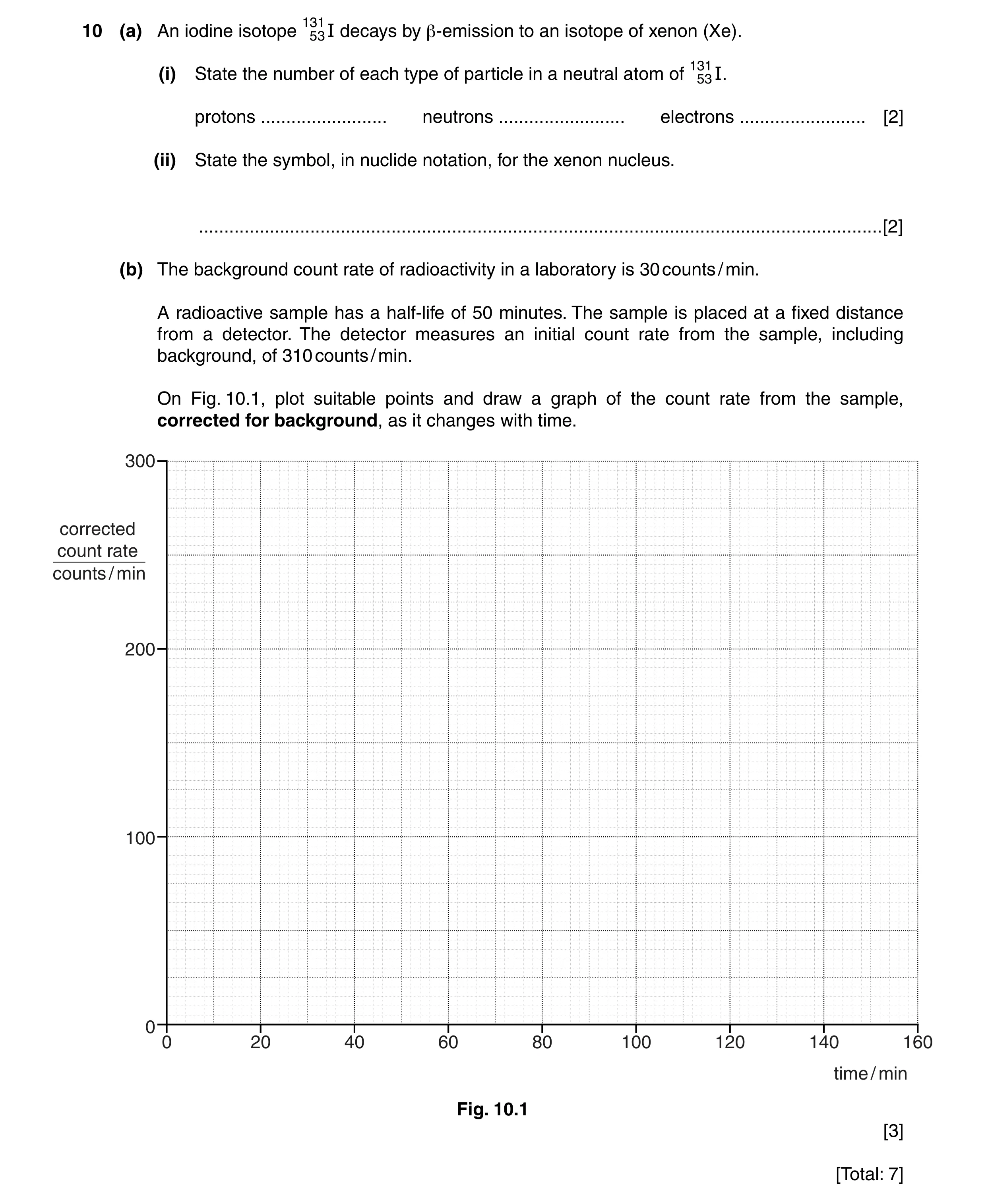
131 10 (a) An iodine isotope 53 I decays by β-emission to an isotope of xenon (Xe). 131 (i) State the number of each type of particle in a neutral atom of 53 I. protons … neutrons … electrons … [2] (ii) State the symbol, in nuclide notation, for the xenon nucleus. … [2] (b) The background count rate of radioactivity in a laboratory is 30 counts / min. A radioactive sample has a half-life of 50 minutes. The sample is placed at a fixed distance from a detector. The detector measures an initial count rate from the sample, including background, of 310 counts / min. On Fig. 10.1, plot suitable points and draw a graph of the count rate from the sample, corrected for background, as it changes with time. 300 corrected count rate counts / min 200 100 0 0 20 40 60 80 100 120 140 160 time / min Fig. 10.1 [3] [Total: 7]
7 marks
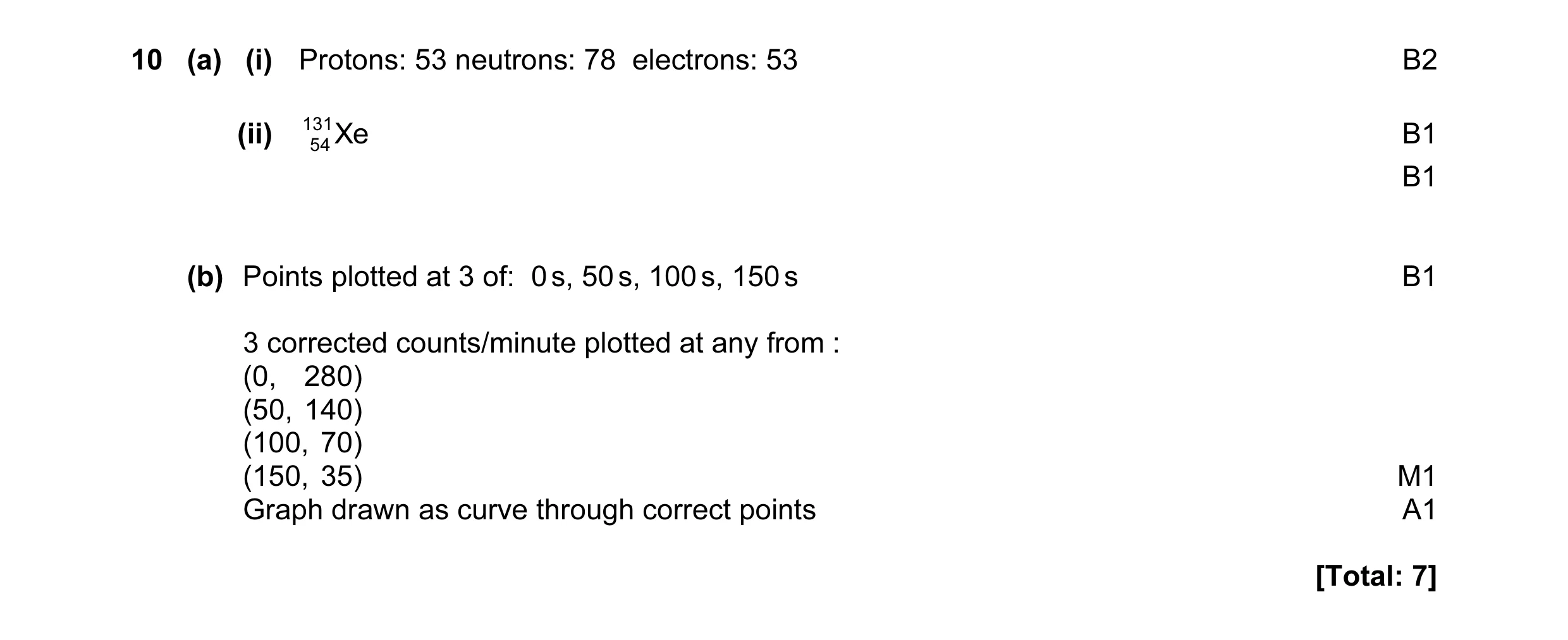
Mark scheme: 10 (a) (i) Protons: 53 neutrons: 78 electrons: 53 B2 (ii) 13154Xe B1 B1 (b) Points plotted at 3 of: 0 s, 50 s, 100 s, 150 s B1 3 corrected counts/minute plotted at any from : (0, 280) (50, 140) (100, 70) (150, 35) M1 Graph drawn as curve through correct points A1 [Total: 7]
This question in 0625/42 Feb/March 2016
Question 2 0625/41 May/June 2016
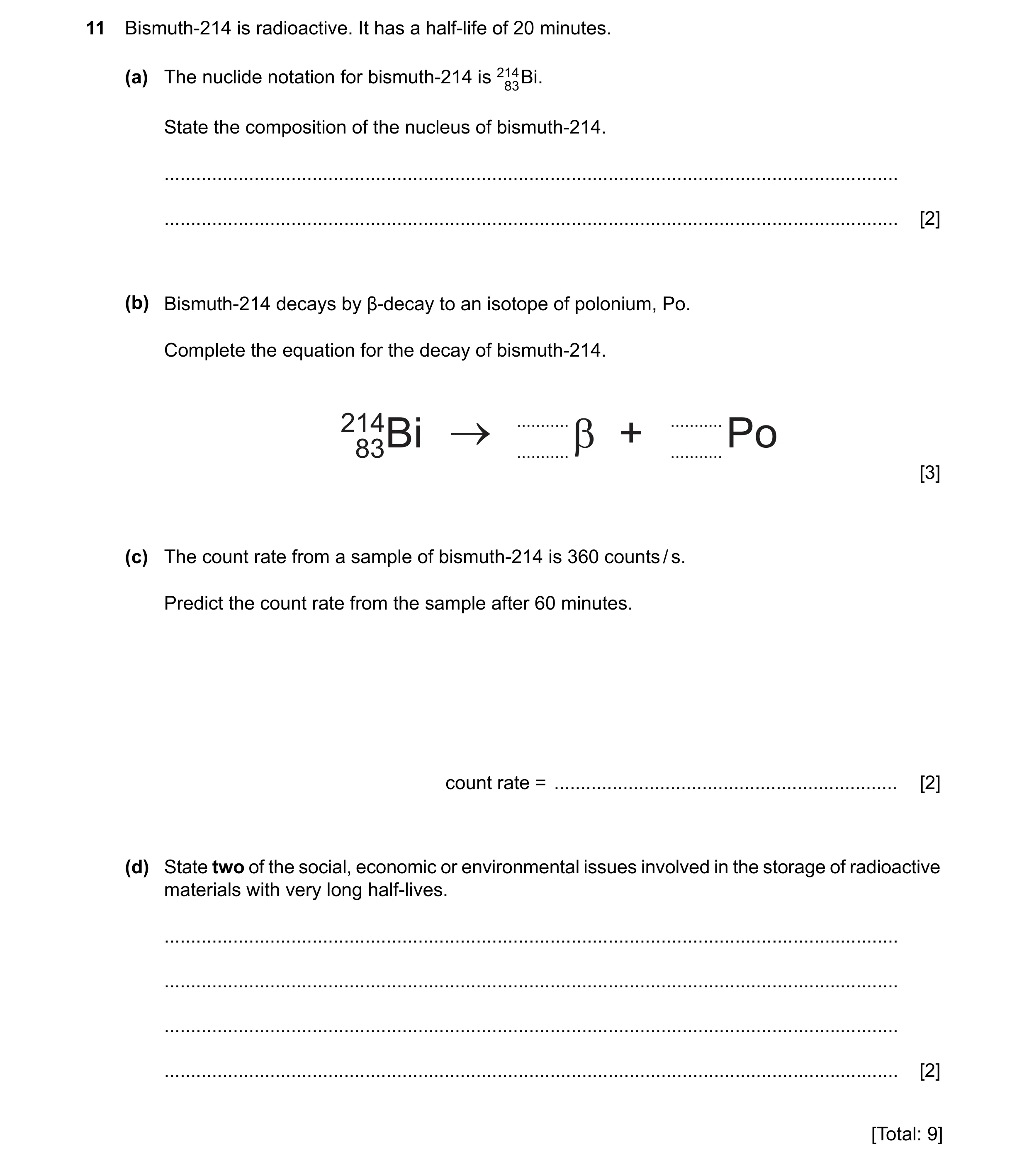
11 Bismuth-214 is radioactive. It has a half-life of 20 minutes. (a) The nuclide notation for bismuth-214 is Bi. State the composition of the nucleus of bismuth-214. … … [2] (b) Bismuth-214 decays by β-decay to an isotope of polonium, Po. Complete the equation for the decay of bismuth-214. → … 214Bi … β + … Po 83 [3] (c) The count rate from a sample of bismuth-214 is 360 counts/s. Predict the count rate from the sample after 60 minutes. count rate = … [2] (d) State two of the social, economic or environmental issues involved in the storage of radioactive materials with very long half-lives. … … … … [2] [Total: 9]
9 marks
Mark scheme: 11(a) 83 protons 131 neutrons B2 11(b) 0 1 −β Superscript 0 Subscript –1 214 84Po B1 B1 B1 11(c) (After 20 min count rate is) 360 / 2 or 180 (count / s) (After 40 min count rate is) 180 / 2 or 90 (counts / s) (After 60 min count rate is) 90 / 2 OR new count-rate = 360/(2 × 2 × 2) or 360 / 8 or 3 half-lives 45 (counts / s) C1 A1 Question Answer Mark 11(d) Any two points chosen from the lists below: (economic): high cost of storage / shielding / guarding / need to store for a long time OR reduction in tourism OR loss of farming produce / land OR reduction of land / property values (social): fear of cancer / causes cancer / genetic mutations / radiation sickness in people / animals OR local objections OR cause people to move away (environmental): crop mutations OR leakage into water supplies OR pollution of atmosphere / water supply B2 Total: 9
This question in 0625/41 May/June 2016
Q3 · Radon-220 is a radioactive isotope 0625/42 May/June 2016
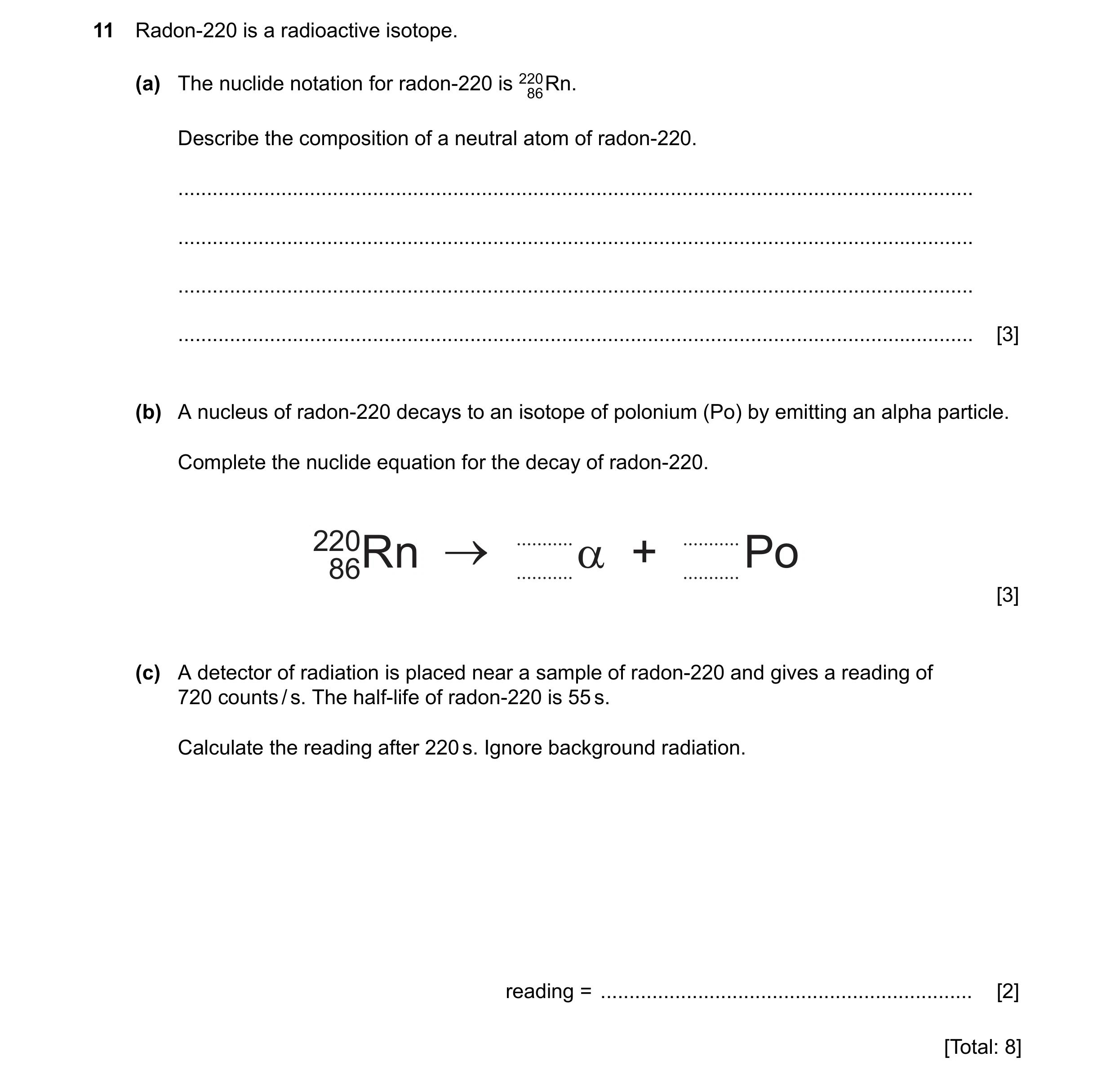
11 Radon-220 is a radioactive isotope. (a) The nuclide notation for radon-220 is Rn. Describe the composition of a neutral atom of radon-220. … … … … [3] (b) A nucleus of radon-220 decays to an isotope of polonium (Po) by emitting an alpha particle. Complete the nuclide equation for the decay of radon-220. → … 220Rn … α + … Po 86 [3] (c) A detector of radiation is placed near a sample of radon-220 and gives a reading of 720 counts/s. The half-life of radon-220 is 55s. Calculate the reading after 220s. Ignore background radiation. reading = … [2] [Total: 8]
8 marks
Mark scheme: 11(a) 86 protons (in nucleus) B1 134 neutrons (in nucleus) B1 86 electrons (surrounding nucleus / in orbit) B1 11(b) 4 2α B1 Po … 84 B1 Po 216 … B1 11(c) 220 / 55 or 4 (half-lives) or 720 / 16 C1 45 counts / s A1 Total: 8
This question in 0625/42 May/June 2016
Q4 · A sample contains atoms of a particular isotope of protactinium 0625/43 May/June 2016
10 A sample contains atoms of a particular isotope of protactinium . (a) A nucleus of this protactinium isotope contains 91 protons and 143 neutrons. (i) State the values of X and Y in the symbol . X = … Y = … [2] (ii) This isotope is radioactive and it decays by the emission of a β-particle, β, to an isotope of uranium, U. Complete the equation for the decay of a protactinium nucleus. … … 0 … Pa β + … U –1 [2] (b) A radiation detector measures a background count rate in a laboratory of 32 counts/minute. (i) Suggest two naturally occurring sources of background radiation. 1. … 2. … [2] (ii) The sample is placed in the laboratory close to the radiation detector, and the count rate increases to 544 counts/minute. This isotope of protactinium has a half-life of 400 minutes. Predict a value for the count rate measured 1200 minutes later. count rate = … [4] (iii) Suggest one reason why the count rate measured 1200 minutes later may differ slightly from the value predicted in (b)(ii). … … [1] [Total: 11]
11 marks
Mark scheme: 10(a)(i) (X = )234 B1 (Y = )91 B1 10(a)(ii) U (number 234 required in correct position) B1 U (number 92 required in correct position) B1 10(b)(i) any two lines from: rocks (buildings / earth / ground / wood / stone / minerals) space (Sun / stars / galaxies / cosmic rays) air (radon) B2 Question Answer Marks 10(b)(ii) 1200 ÷ 400 or 3 (half-lives) C1 544 – 32 or 512 or evidence of 3 halvings C1 1/8(th) or 64 or 68 C1 96 counts / minute A1 10(b)(iii) random fluctuations / variation B1 [Total: 80]
This question in 0625/43 May/June 2016
Q5 · State, using nuclide notation, the symbol for (i) an iron (atomic symbol Fe) nucleus… 0625/43 Oct/Nov 2016
11 (a) State, using nuclide notation, the symbol for (i) an iron (atomic symbol Fe) nucleus which has nucleon number 56 and proton number 26, … [1] (ii) a platinum (atomic symbol Pt) nucleus which contains 78 protons and 118 neutrons. … [2] (b) (i) A nucleus of plutonium-238 (23894Pu) decays to a uranium (atomic symbol U) nucleus by the emission of an α-particle. Write down the nuclear equation that represents this radioactive decay. … [3] (ii) The half-life of plutonium-238 is 90 years. A sample contains 9.6 × 10¹⁰ atoms of plutonium-238. Predict the number of plutonium-238 atoms in the sample that decay in 270 years. number of atoms that decay = … [3] [Total: 9]
9 marks
Mark scheme: 11(a)(i) Fe 56 26 ; both numbers correct and in correct position B1 11(a)(ii) Pt 196 78 ; 78 and Pt correct position 196 in correct position B1 B1 11(b)(i) ( Pu 238 94 → ) U 234 92 + α 4 2 ; 4 and 2 in correct position by the α 92 in correct position by the U 234 in correct position by the U B1 B1 B1 11(b)(ii) 270/90 half-lives or 3 half-lives or 1 / 8 1.2 × 10¹⁰ or 9.6 × 10¹⁰ – 1.2 × 10¹⁰ or 7 / 8 8.4 × 10¹⁰ C1 C1 A1 Total 9 80
This question in 0625/43 Oct/Nov 2016
Q6 · A radioactive source is tested over a number of hours with a radiation detector 0625/41 May/June 2017
11 (a) A radioactive source is tested over a number of hours with a radiation detector. The readings are shown in Table 11.1. Table 11.1 time / hours 0 1 2 3 4 5 6 7 8 9 10 detector reading / (counts / s) 324 96 39 23 21 17 21 20 19 20 18 Use the readings to suggest a value for the background count rate during the test, and to determine the half-life of the sample. background count rate = … half-life of sample = … [4] (b) Hydrogen-3 (tritium) has one proton and two neutrons. The nucleon number of tritium is three. It decays by emitting a β-particle. Complete the nuclide equation to show this decay. The symbol X represents the nuclide produced by this decay. … … … … … … H β + X [3] (c) The arrows in Fig. 11.1 show the paths of three α-particles moving towards gold nuclei in a thin foil. gold nucleus gold nucleus gold nucleus Fig. 11.1 On Fig. 11.1, complete the paths of the three α-particles. [3] [Total: 10]
10 marks
Mark scheme: 11(a) Background count rate stated as in range 17 – 21 counts / s B1 Background used on at least 2 of first 3 readings C1 Any halving of corrected or uncorrected reading C1 (half-life =) ½ hour A1 11(b) 3 1 H on LHS of an equation B1 0 -1 β on RHS of equation B1 Equation all correct: 3 1 H = 0 -1 β + 3 2 X B1 11(c) Top: any path to the left within 45° horizontal B1 Middle: path to the right and deflected down (ending in a straight line) B1 Bottom: path not deflected OR path to the right and deflected up much less than middle path B1 Total: 10
This question in 0625/41 May/June 2017
Q7 · The arrows in Fig 0625/42 May/June 2017
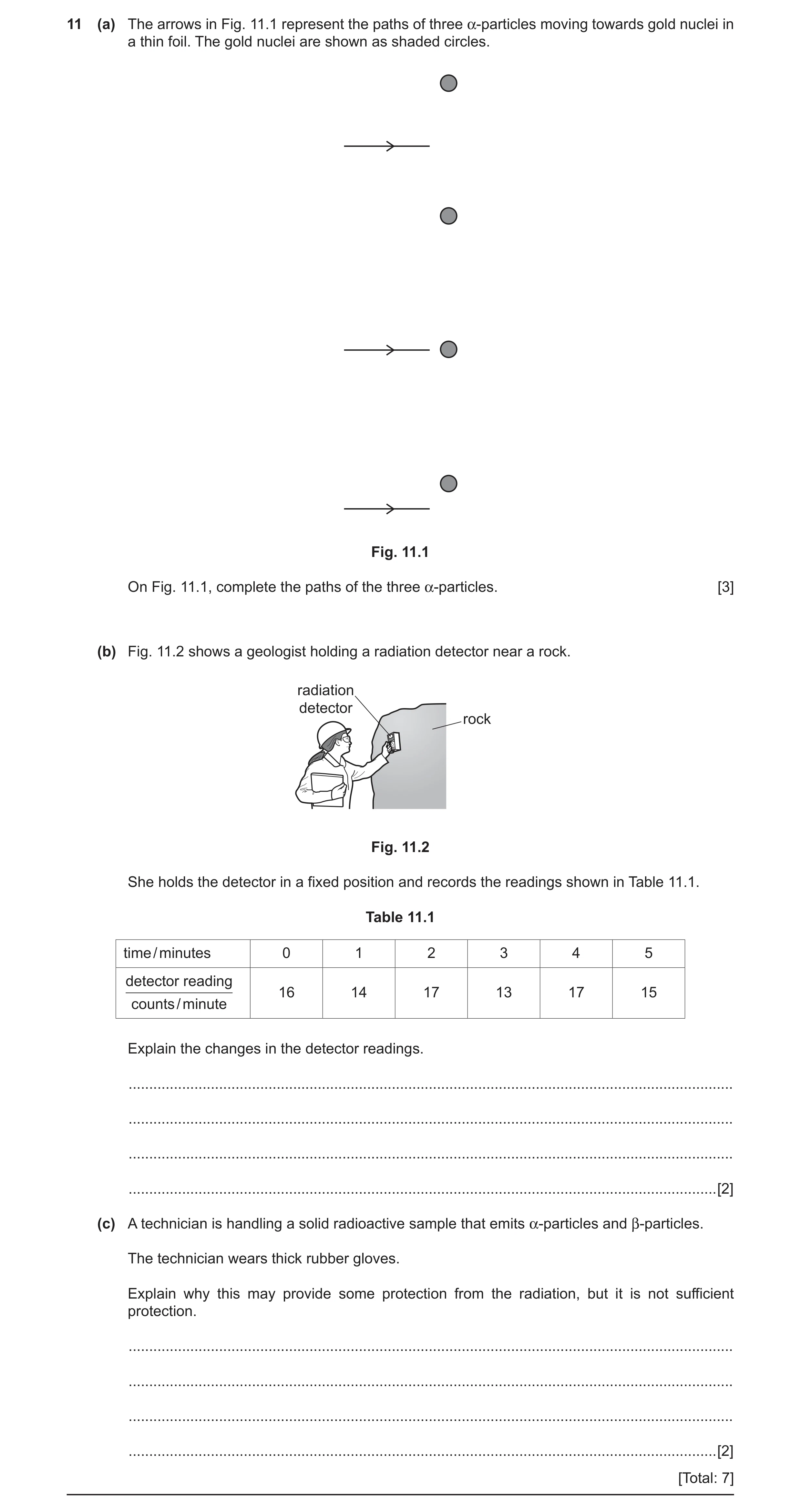
11 (a) The arrows in Fig. 11.1 represent the paths of three α-particles moving towards gold nuclei in a thin foil. The gold nuclei are shown as shaded circles. Fig. 11.1 On Fig. 11.1, complete the paths of the three α-particles. [3] (b) Fig. 11.2 shows a geologist holding a radiation detector near a rock. radiation detector rock Fig. 11.2 She holds the detector in a fixed position and records the readings shown in Table 11.1. Table 11.1 time / minutes 0 1 2 3 4 5 detector reading 16 14 17 13 17 15 counts / minute Explain the changes in the detector readings. … … … … [2] (c) A technician is handling a solid radioactive sample that emits α-particles and β-particles. The technician wears thick rubber gloves. Explain why this may provide some protection from the radiation, but it is not sufficient protection. … … … … [2] [Total: 7]
7 marks
Mark scheme: 11(a) (so insufficient protection) B1 middle: any path to the left within 45° of horizontal B1 bottom: path to the right and deflected down ending in a straight line B1 11(b) radiation from background/rock/air/outer space/cosmic rays B1 random variation owtte. B1 11(c) thick gloves would stop α/alpha (so helpful) B1 (some) β/beta/radiation would penetrate gloves/reach other body parts (so insufficient protection) B1 Total: 7
This question in 0625/42 May/June 2017
Q8 · Solar cells that use radiation from the Sun to generate electricity 0625/43 Oct/Nov 2017
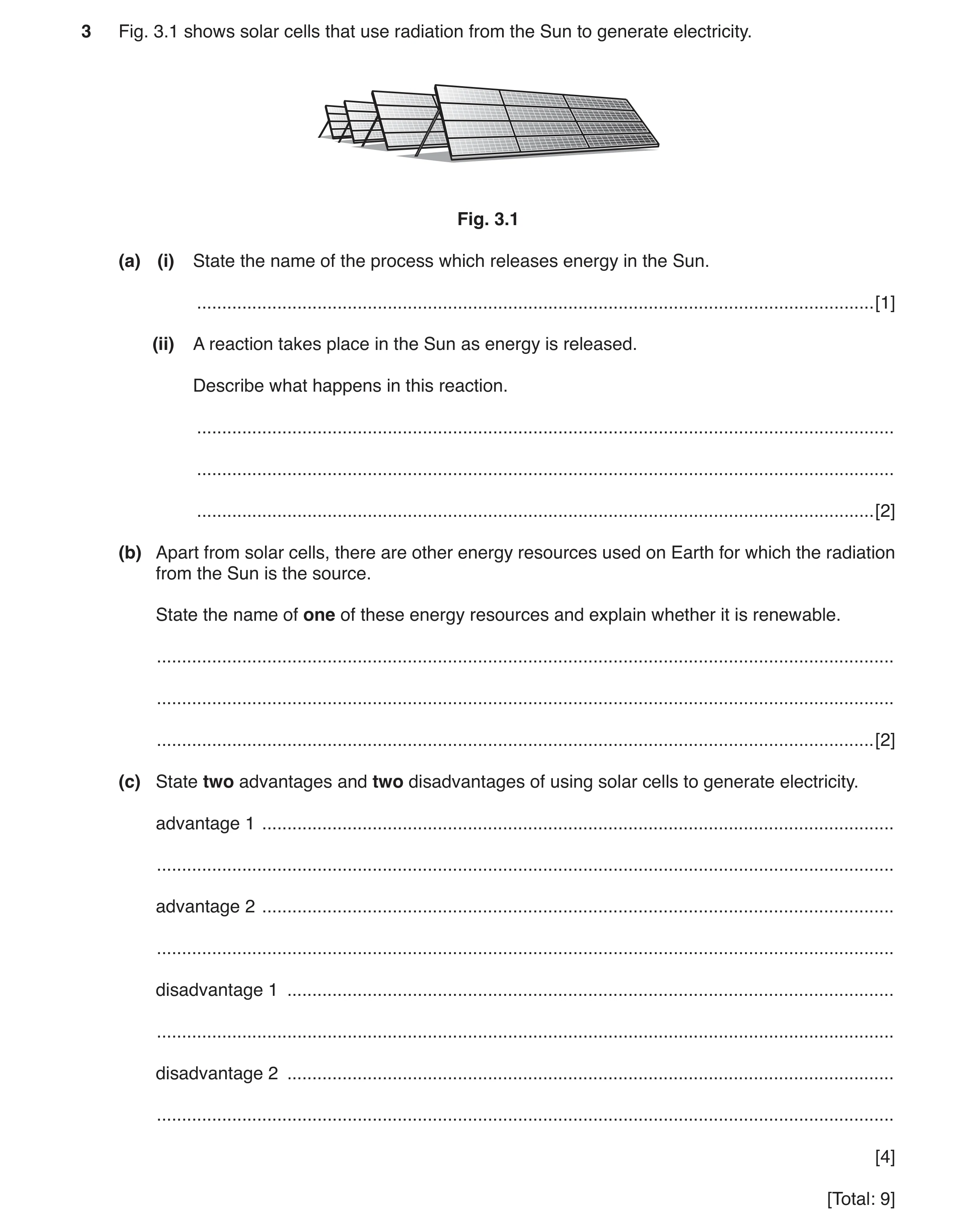
3 Fig. 3.1 shows solar cells that use radiation from the Sun to generate electricity. Fig. 3.1 (a) (i) State the name of the process which releases energy in the Sun. … [1] (ii) A reaction takes place in the Sun as energy is released. Describe what happens in this reaction. … … … [2] (b) Apart from solar cells, there are other energy resources used on Earth for which the radiation from the Sun is the source. State the name of one of these energy resources and explain whether it is renewable. … … … [2] (c) State two advantages and two disadvantages of using solar cells to generate electricity. advantage 1 … … advantage 2 … … disadvantage 1 … … disadvantage 2 … … [4] [Total: 9]
9 marks
Mark scheme: 3(a)(i) nuclear fusion B1 3(a)(ii) nuclei combine / join together B1 small nuclei to larger nuclei or hydrogen to helium (in some way) or loss of mass B1 3(b) any suitable resource e.g. fossil fuels; hydroelectric; wave; wind M1 renewable or not (according answer) and matching explanation A1 3(c) two advantages from: no polluting gases / quiet / low maintenance / can be placed on roofs / clean / cheap to run B2 two disadvantages from: intermittent supply / unattractive / takes up space / uses land / d.c. output B2
This question in 0625/43 Oct/Nov 2017
Question 9 0625/41 May/June 2018
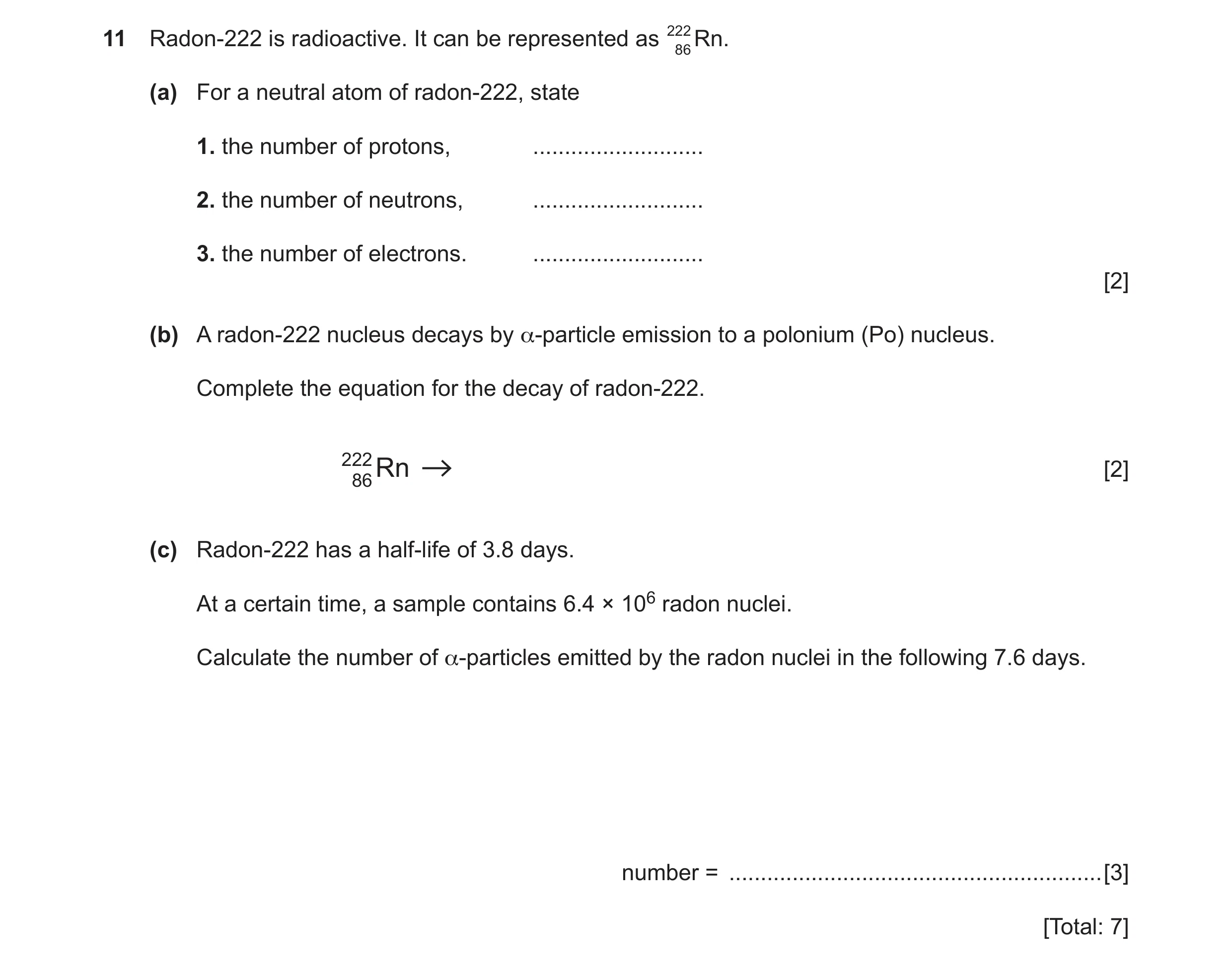
11 Radon-222 is radioactive. It can be represented as 22286 Rn. (a) For a neutral atom of radon-222, state 1. the number of protons, … 2. the number of neutrons, … 3. the number of electrons. … [2] (b) A radon-222 nucleus decays by α-particle emission to a polonium (Po) nucleus. Complete the equation for the decay of radon-222. 222 Rn [2] 86 (c) Radon-222 has a half-life of 3.8 days. At a certain time, a sample contains 6.4 × 10⁶ radon nuclei. Calculate the number of α-particles emitted by the radon nuclei in the following 7.6 days. number = … [3] [Total: 7]
7 marks
Mark scheme: 11(a) Number of protons = 86 and number of electrons = 86 1 Number of neutrons = 136 1 11(b) 218 84 Po 1 + 4 2 α 1 11(c) 7.6 days = 2 half-lives or evidence of two halvings 1 (number of Rn atoms left = 6.4 × 10⁶ ÷ 4 =) 1.6 × 10⁶ 1 number of α-particles emitted = (6.4 × 10⁶ – 1.6 × 106 =) 4.8 × 10⁶ 1
This question in 0625/41 May/June 2018
Q10 · A beam of α-particles moving towards a thin sheet of gold in a vacuum 0625/41 May/June 2019
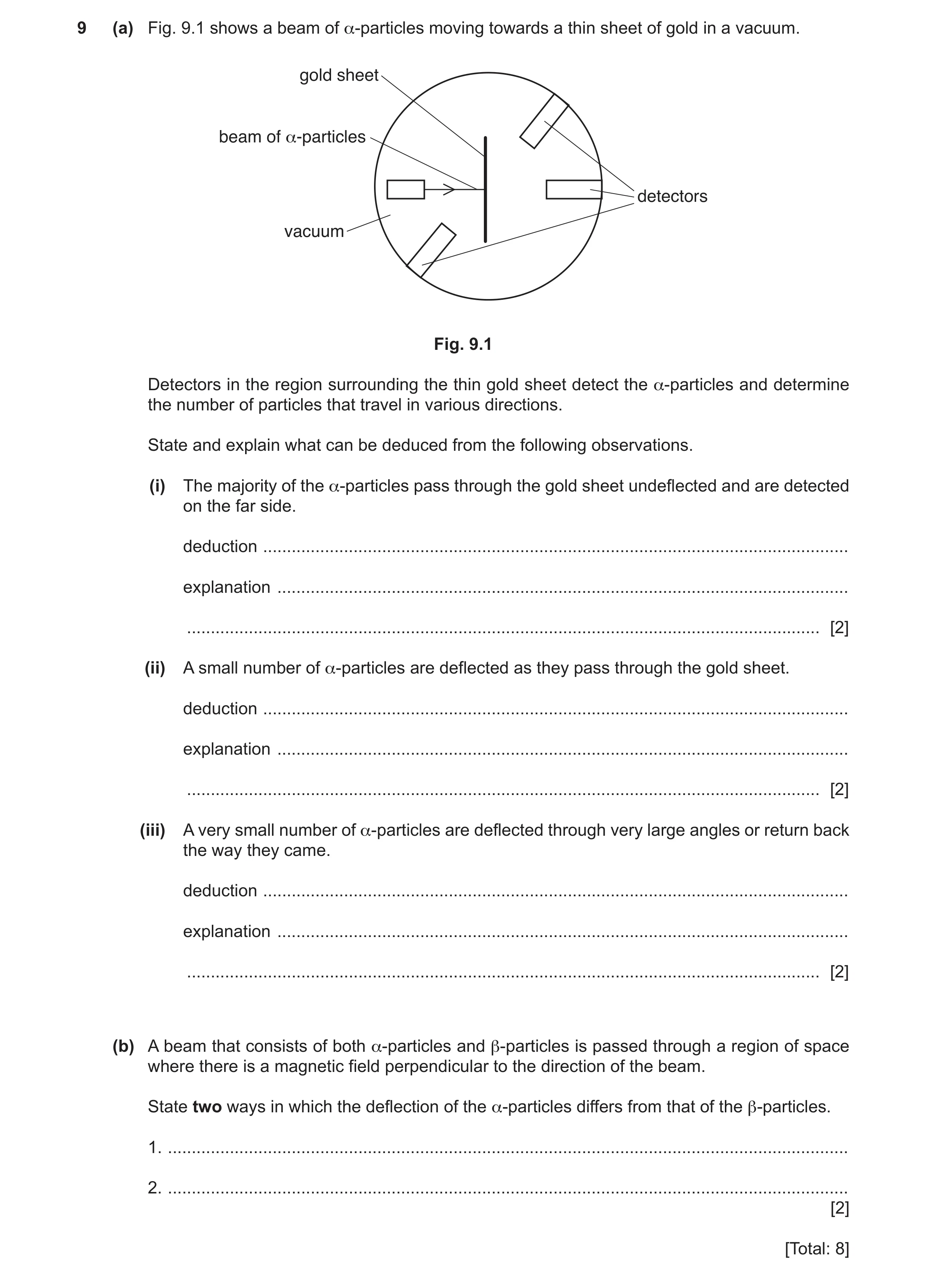
9 (a) Fig. 9.1 shows a beam of α-particles moving towards a thin sheet of gold in a vacuum. gold sheet beam of α-particles detectors vacuum Fig. 9.1 Detectors in the region surrounding the thin gold sheet detect the α-particles and determine the number of particles that travel in various directions. State and explain what can be deduced from the following observations. (i) The majority of the α-particles pass through the gold sheet undeflected and are detected on the far side. deduction … explanation … … [2] (ii) A small number of α-particles are deflected as they pass through the gold sheet. deduction … explanation … … [2] (iii) A very small number of α-particles are deflected through very large angles or return back the way they came. deduction … explanation … … [2] (b) A beam that consists of both α-particles and β-particles is passed through a region of space where there is a magnetic field perpendicular to the direction of the beam. State two ways in which the deflection of the α-particles differs from that of the β-particles. 1. … 2. … [2] [Total: 8]
8 marks
Mark scheme: 9(a)(i) mark both explanation and deduction together nucleus is very small B1 very few α-particles hit or pass near to a nucleus B1 9(a)(ii) mark both explanation and deduction together nucleus is charged B1 (charged) α-particles experience a force B1 9(a)(iii) mark both explanation and deduction together centre / (small) part of atom OR nucleus includes most of the mass of the atom / is (very) dense B1 (α-particles move and) nucleus stays still B1 9(b) any two from: opposite direction (much) smaller deflection undergo deflections of similar magnitude B2
This question in 0625/41 May/June 2019
Q11 · The nucleus of a hydrogen atom is a proton 0625/42 Oct/Nov 2019
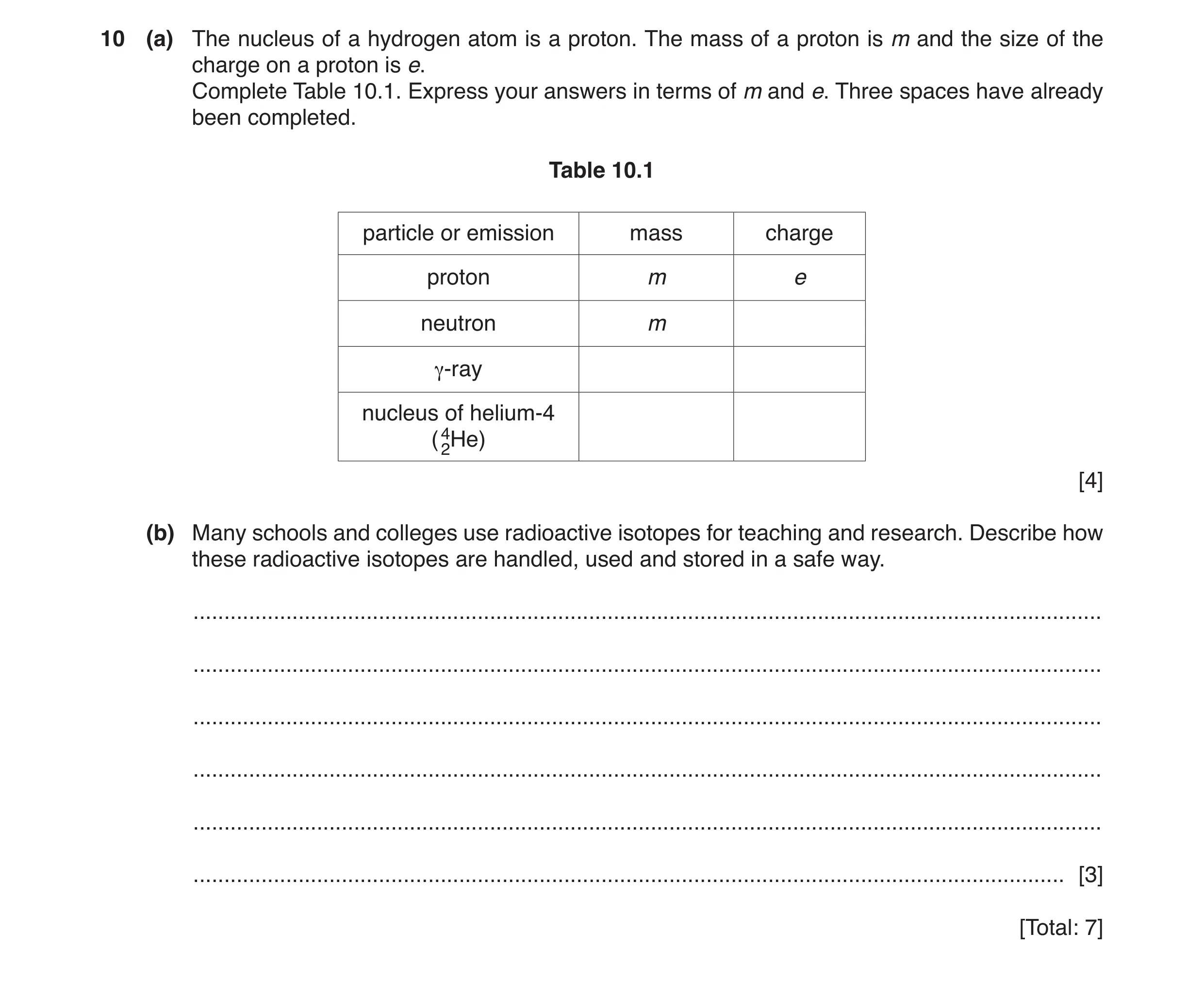
10 (a) The nucleus of a hydrogen atom is a proton. The mass of a proton is m and the size of the charge on a proton is e. Complete Table 10.1. Express your answers in terms of m and e. Three spaces have already been completed. Table 10.1 particle or emission mass charge proton m e neutron m γ-ray nucleus of helium-4 (42He) [4] (b) Many schools and colleges use radioactive isotopes for teaching and research. Describe how these radioactive isotopes are handled, used and stored in a safe way. … … … … … … [3] [Total: 7]
7 marks
Mark scheme: 10(a) neutron charge = 0 γ-ray mass = 0 AND charge = 0 He nucleus mass = 4 m He nucleus charge = 2 e B1 B1 B1 B1 10(b) any 3 different valid points, e.g. • detail of handling source appropriately for, e.g. use of tongs • protective clothing • minimise exposure by time OR distance OR activity • detail of shielded storage • detail of secure storage • monitoring exposure • must be disposed of securely • limitation of access to approved personnel • procedure in place in case of accident / criminal act to protect people and / or environment 3 × B1
This question in 0625/42 Oct/Nov 2019
Q12 · The circles shown in Fig 0625/43 Oct/Nov 2019
11 (a) The circles shown in Fig. 11.1 represent three gold nuclei. Three α-particles are approaching the gold nuclei. α-particle α-particle α-particle Fig. 11.1 On Fig. 11.1, complete the path of each α-particle. [3] (b) A detector of radioactivity in a laboratory indicates an average of 16 counts / min when no radioactive samples are present. A radioactive sample of half-life 1.5 days is placed close to the detector, which indicates a count rate of 208 counts / min. Calculate the count rate that is indicated 6 days later. count rate = … counts / min [4] (c) The waste from nuclear power stations includes the isotopes technetium-99, tin-126 and selenium-79. These isotopes are radioactive with half-lives of many thousands of years. State three economic and environmental consequences of producing this waste. … … … … … … … [3] [Total: 10]
10 marks
Mark scheme: 11(a) top: any path to the left within 45 degrees to the horizontal B1 middle: path to the right and deflected up (ending in a straight line) B1 bottom: path to the right and deflected down (ending in a straight line) B1 11(b) 192 B1 use or clear indication of 4 half-lives C1 (192 / 16 =) 12 A1 28 B1 11(c) any 3 different valid points e.g. • must be stored with shielding • must be stored securely / safely • must be transported with shielding • must be transported securely • expensive to store • expensive to transport • in case of accident / terrorism could escape to environment / danger to people • site of storage uninhabitable for thousands of years 3 x B1
This question in 0625/43 Oct/Nov 2019
Q13 · The isotope hydrogen-1 has a proton number of 1 and a nucleon number of 1 0625/42 Feb/March 2020
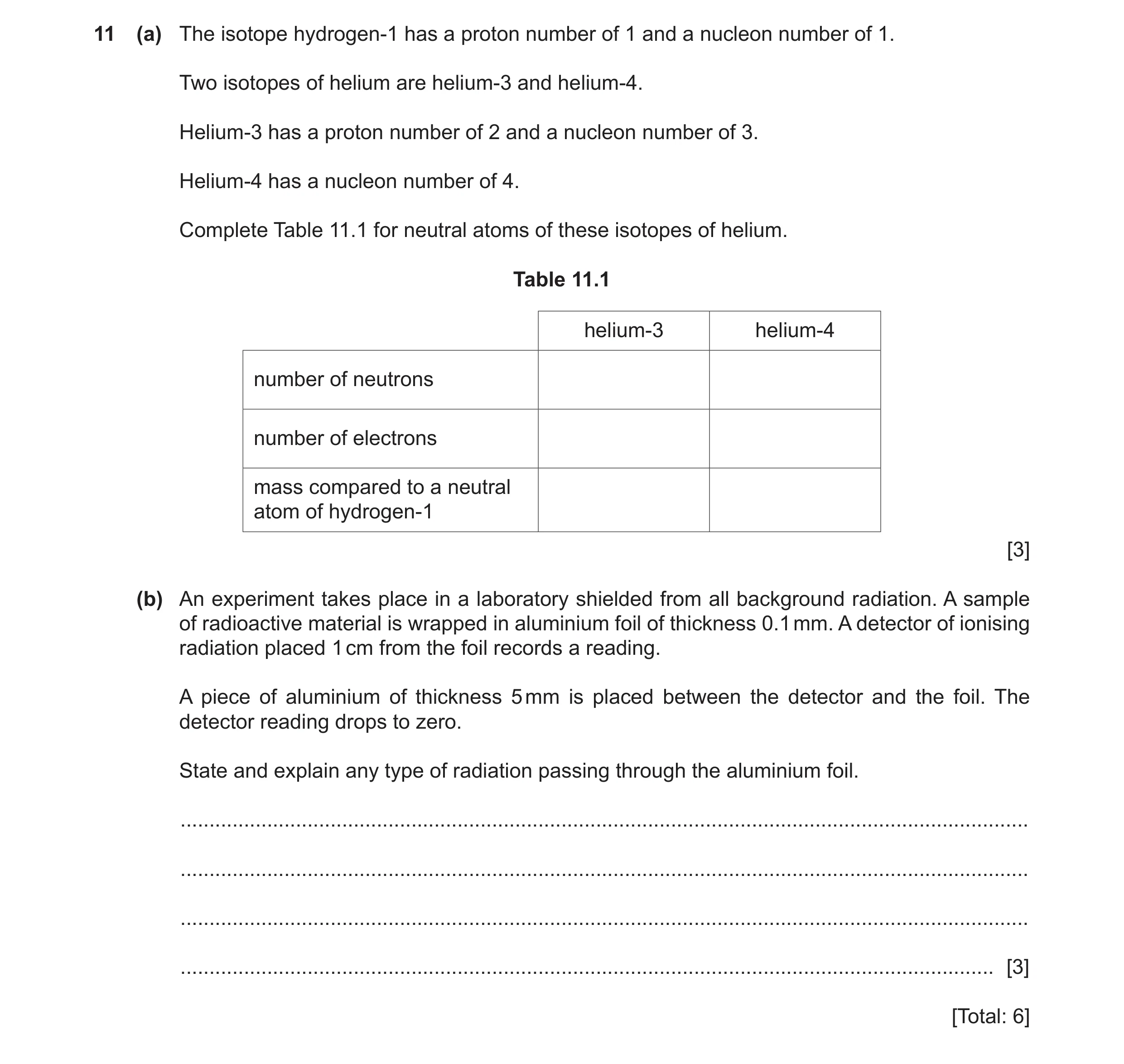
11 (a) The isotope hydrogen-1 has a proton number of 1 and a nucleon number of 1. Two isotopes of helium are helium-3 and helium-4. Helium-3 has a proton number of 2 and a nucleon number of 3. Helium-4 has a nucleon number of 4. Complete Table 11.1 for neutral atoms of these isotopes of helium. Table 11.1 helium-3 helium-4 number of neutrons number of electrons mass compared to a neutral atom of hydrogen-1 [3] (b) An experiment takes place in a laboratory shielded from all background radiation. A sample of radioactive material is wrapped in aluminium foil of thickness 0.1 mm. A detector of ionising radiation placed 1 cm from the foil records a reading. A piece of aluminium of thickness 5 mm is placed between the detector and the foil. The detector reading drops to zero. State and explain any type of radiation passing through the aluminium foil. … … … … [3] [Total: 6]
6 marks
Mark scheme: 11(a) neutrons 1 2 B1 electrons 2 2 B1 mass 3 4 OR 2 more 3 more B1 11(b) β B1 β – (would be) stopped by 5 mm / thick Al B1 α – (would be) stopped by 0.1 mm Al / Al foil AND γ – (would) not (be) stopped by 5 mm / thick Al B1
This question in 0625/42 Feb/March 2020
Q14 · A neutral atom of an isotope of element X 0625/41 May/June 2020
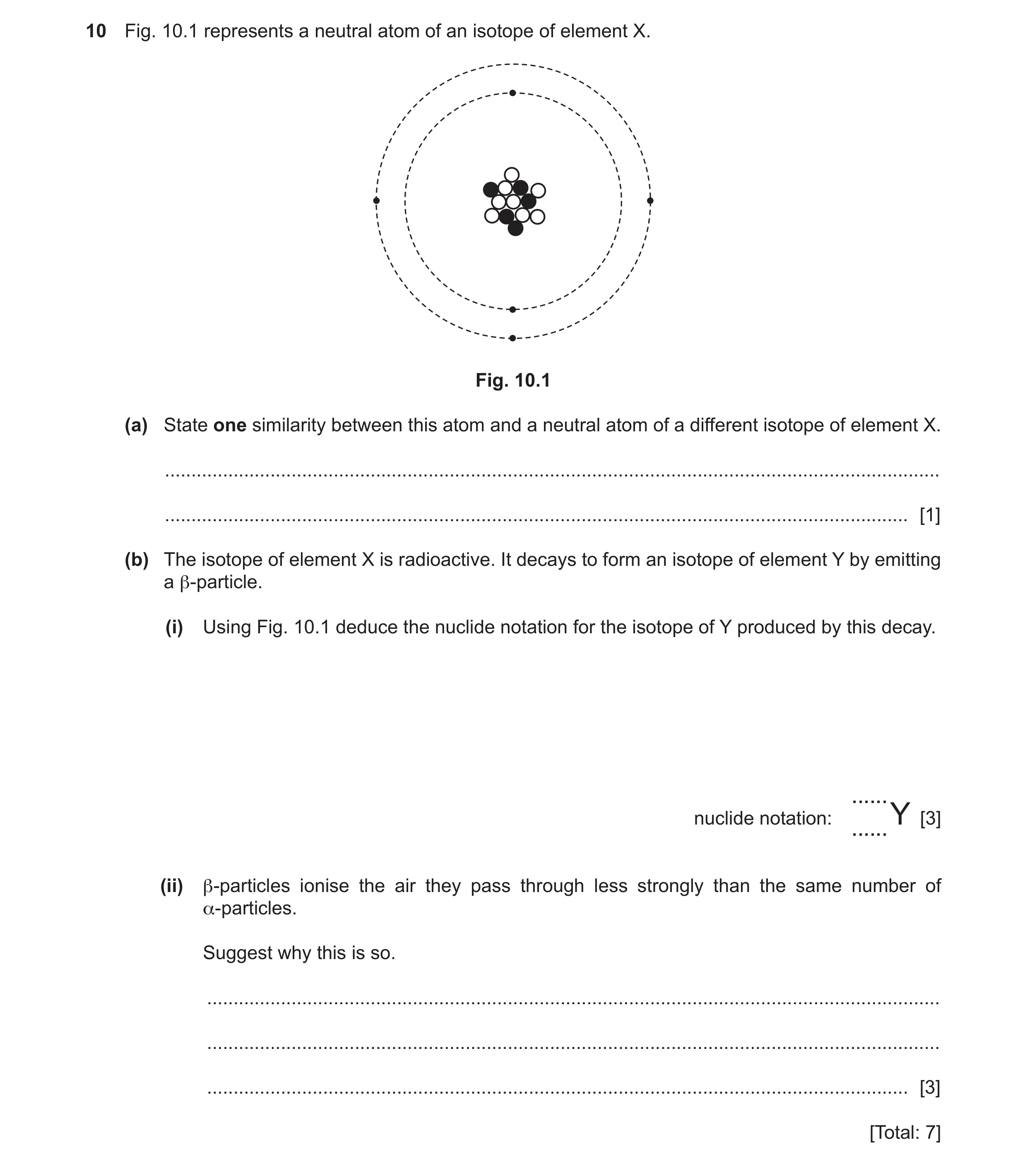
10 Fig. 10.1 represents a neutral atom of an isotope of element X. Fig. 10.1 (a) State one similarity between this atom and a neutral atom of a different isotope of element X. … … [1] (b) The isotope of element X is radioactive. It decays to form an isotope of element Y by emitting a β-particle. (i) Using Fig. 10.1 deduce the nuclide notation for the isotope of Y produced by this decay. … nuclide notation: [3] … Y (ii) β-particles ionise the air they pass through less strongly than the same number of α-particles. Suggest why this is so. … … … [3] [Total: 7]
7 marks
Mark scheme: 10(a) equal number of electrons OR equal number of protons B1 10(b)(i) 13 5 X C1 0 1β − C1 13 6Y A1 10(b)(ii) any three from: • β-particles have charge of smaller size • β-particles have smaller mass • β-particles have less energy • β-particles travel faster / less time near to air molecule • effect / force on electrons in air molecules less B3
This question in 0625/41 May/June 2020
Q15 · State the proton number, nucleon number and the value of the charge on an α-particle 0625/42 Feb/March 2021
10 (a) State the proton number, nucleon number and the value of the charge on an α-particle. proton number … nucleon number … charge … [3] (b) A nucleus of strontium-90 consists of 38 protons and 52 neutrons. Strontium-90 is radioactive and decays by β-emission to an isotope of yttrium. The symbol for strontium is Sr and the symbol for yttrium is Y. Write down the nuclide equation of this decay. [3] (c) The half-life of radon-220 is 56 s. A sample of radon-220 is in a container. After 112 s the mass of radon-220 is 9.2 mg. Calculate the mass of the original sample. mass = … [2] [Total: 8]
8 marks
Mark scheme: 10(a) 2 B1 4 B1 +2 B1 10(b) 90 38 Sr → 90 39 Y + − 0 1β nucleon numbers 90 on both sides of equation B1 Sr and proton number 38 on left AND Y and proton number 39 on right B1 − 0 1 β (to right of arrow) B1 10(c) (original mass = 4 / 9.2 =) 37 mg A2 2 half-lives C1
This question in 0625/42 Feb/March 2021
Q16 · There are three naturally occurring isotopes of hydrogen: hydrogen-1, hydrogen-2 and… 0625/41 May/June 2021
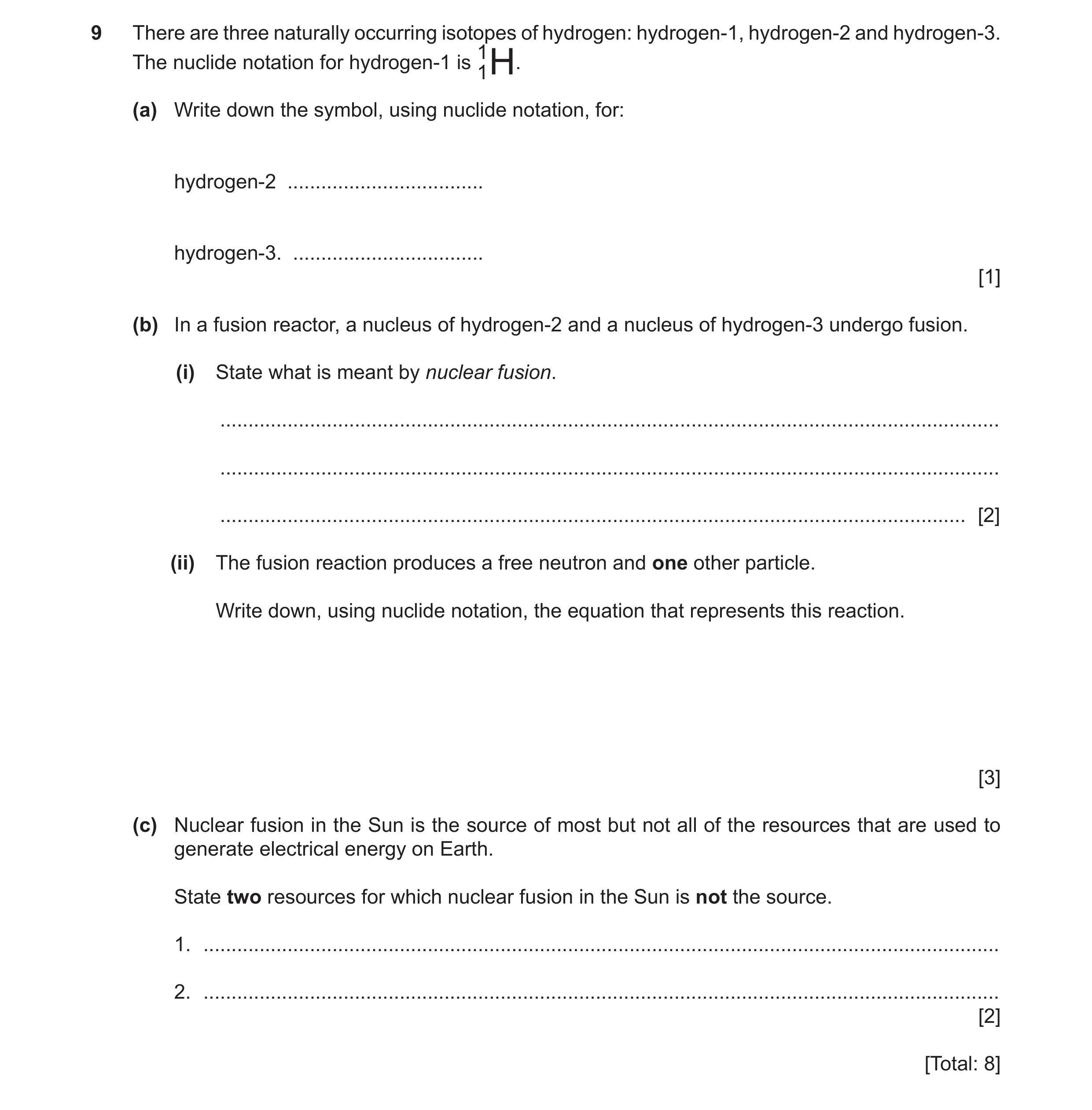
9 There are three naturally occurring isotopes of hydrogen: hydrogen-1, hydrogen-2 and hydrogen-3. 1 The nuclide notation for hydrogen-1 is 1H. (a) Write down the symbol, using nuclide notation, for: hydrogen-2 … hydrogen-3. … [1] (b) In a fusion reactor, a nucleus of hydrogen-2 and a nucleus of hydrogen-3 undergo fusion. (i) State what is meant by nuclear fusion. … … … [2] (ii) The fusion reaction produces a free neutron and one other particle. Write down, using nuclide notation, the equation that represents this reaction. [3] (c) Nuclear fusion in the Sun is the source of most but not all of the resources that are used to generate electrical energy on Earth. State two resources for which nuclear fusion in the Sun is not the source. 1. … 2. … [2] [Total: 8]
8 marks
Mark scheme: 9(a) 2 1H and 3 1H and in this order B1 9(b)(i) joining together of (small / H) nuclei B1 to produce a bigger nucleus / He nucleus or with the release of energy B1 9(b)(ii) ( 2 1H + 3 1H →) 1 0n B1 (+) 4 2(….) B1 He or α seen B1 9(c) any two from: • geothermal (energy) • tidal (energy) • nuclear (energy) B2
This question in 0625/41 May/June 2021
Q17 · Uranium‑235 (23592U) is a radioactive isotope of uranium that occurs naturally on Earth 0625/41 Oct/Nov 2021
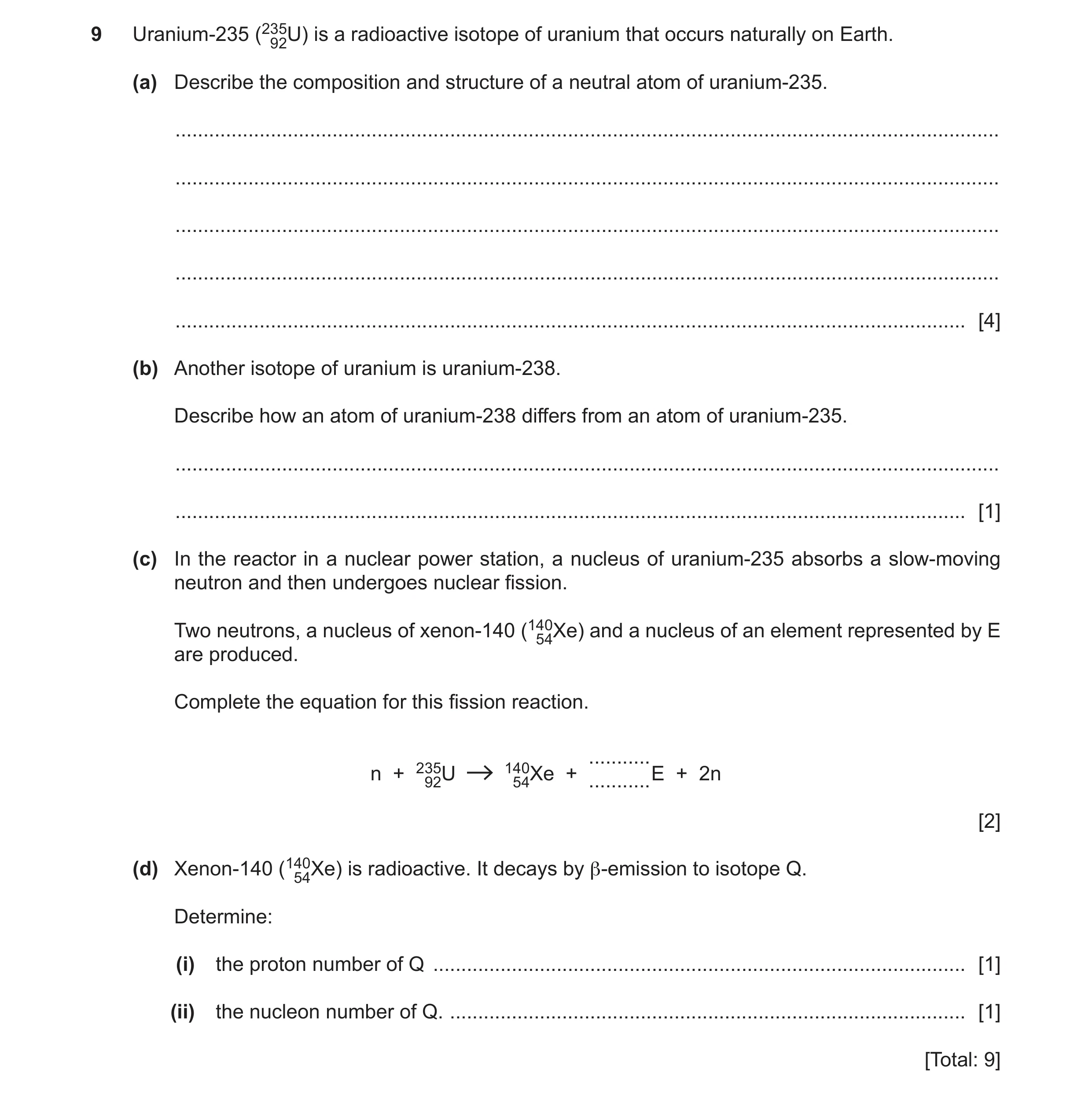
9 Uranium‑235 (23592U) is a radioactive isotope of uranium that occurs naturally on Earth. (a) Describe the composition and structure of a neutral atom of uranium‑235. … … … … … [4] (b) Another isotope of uranium is uranium‑238. Describe how an atom of uranium‑238 differs from an atom of uranium‑235. … … [1] (c) In the reactor in a nuclear power station, a nucleus of uranium‑235 absorbs a slow‑moving neutron and then undergoes nuclear fission. Two neutrons, a nucleus of xenon‑140 (14054Xe) and a nucleus of an element represented by E are produced. Complete the equation for this fission reaction. … n + 23592U 14054Xe + … E + 2n [2] (d) Xenon‑140 (14054Xe) is radioactive. It decays by β‑emission to isotope Q. Determine: (i) the proton number of Q … [1] (ii) the nucleon number of Q. … [1] [Total: 9]
9 marks
Mark scheme: 9(a) (very small) nucleus and surrounded by electrons (in orbit / shells) B1 92 protons or 92 electrons or number of protons = number of electrons B1 protons and neutrons in nucleus B1 143 neutrons B1 9(b) (uranium-238 has) three more neutrons (in nucleus) B1 9(c) 94 (38)(E) B1 (94) 38(E) B1 9(d)(i) 55 B1 9(d)(ii) 140 B1
This question in 0625/41 Oct/Nov 2021
Q18 · Describe the composition and structure of a neutral atom of beryllium-8, which has a… 0625/42 Oct/Nov 2021
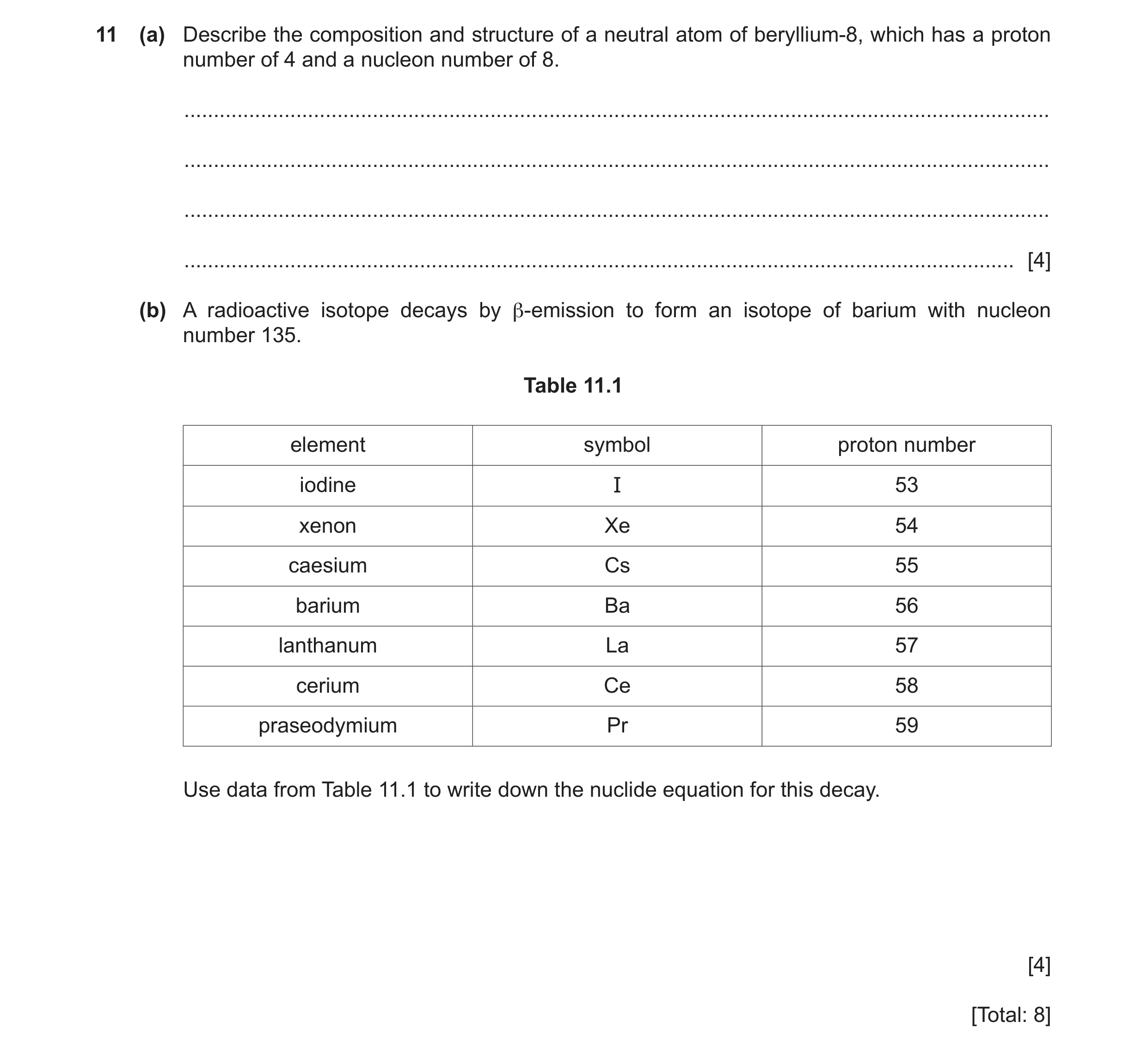
11 (a) Describe the composition and structure of a neutral atom of beryllium-8, which has a proton number of 4 and a nucleon number of 8. … … … … [4] (b) A radioactive isotope decays by β-emission to form an isotope of barium with nucleon number 135. Table 11.1 element symbol proton number iodine I 53 xenon Xe 54 caesium Cs 55 barium Ba 56 lanthanum La 57 cerium Ce 58 praseodymium Pr 59 Use data from Table 11.1 to write down the nuclide equation for this decay. [4] [Total: 8]
8 marks
Mark scheme: 11(a) (very small) nucleus AND (surrounded by) electrons (in orbit / shells) B1 neutrons and protons in nucleus B1 4 electrons (in atom) OR number of electrons = number of protons B1 4 neutrons (in nucleus) B1 11(b) 135 55 on left B1 Cs on left B1 135Ba 56 on right B1 +β on right OR –β on left B1
This question in 0625/42 Oct/Nov 2021
Q19 · Two of the isotopes of hydrogen are hydrogen-2 ( 1H2 ) and hydrogen-3 ( 1H3 ) 0625/41 May/June 2022
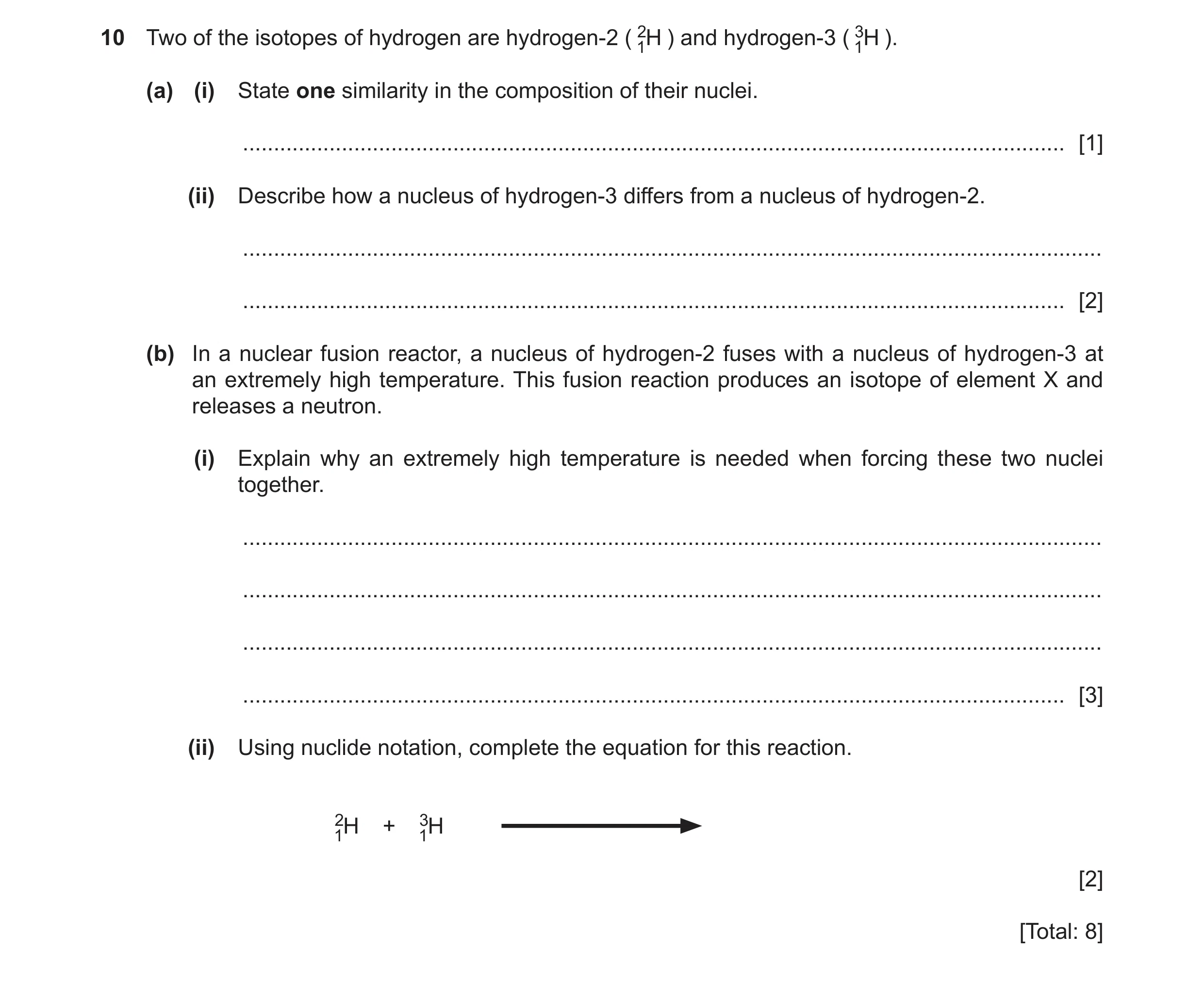
10 Two of the isotopes of hydrogen are hydrogen-2 ( 1H2 ) and hydrogen-3 ( 1H3 ). (a) (i) State one similarity in the composition of their nuclei. … [1] (ii) Describe how a nucleus of hydrogen-3 differs from a nucleus of hydrogen-2. … … [2] (b) In a nuclear fusion reactor, a nucleus of hydrogen-2 fuses with a nucleus of hydrogen-3 at an extremely high temperature. This fusion reaction produces an isotope of element X and releases a neutron. (i) Explain why an extremely high temperature is needed when forcing these two nuclei together. … … … … [3] (ii) Using nuclide notation, complete the equation for this reaction. 1H2 + 1H3 [2] [Total: 8]
8 marks
Mark scheme: 10(a)(i) same number of protons / both have one proton B1 10(a)(ii) it / hydrogen-3 / 3 (1)H has one more neutron A2 different number of neutrons / nucleons C1 Question Answer Marks 10(b)(i) (high temperature produces) high (kinetic) energy / momentum / speed / ability to do large quantity of work B1 they repel each other B1 are positively charged / have like charges or need to come close together B1 10(b)(ii) 4 2 X or 4 2He or 2 4 B1 1 0n and no other particle B1
This question in 0625/41 May/June 2022
Q20 · The paths of three α-particles moving towards a thin gold foil 0625/42 May/June 2022
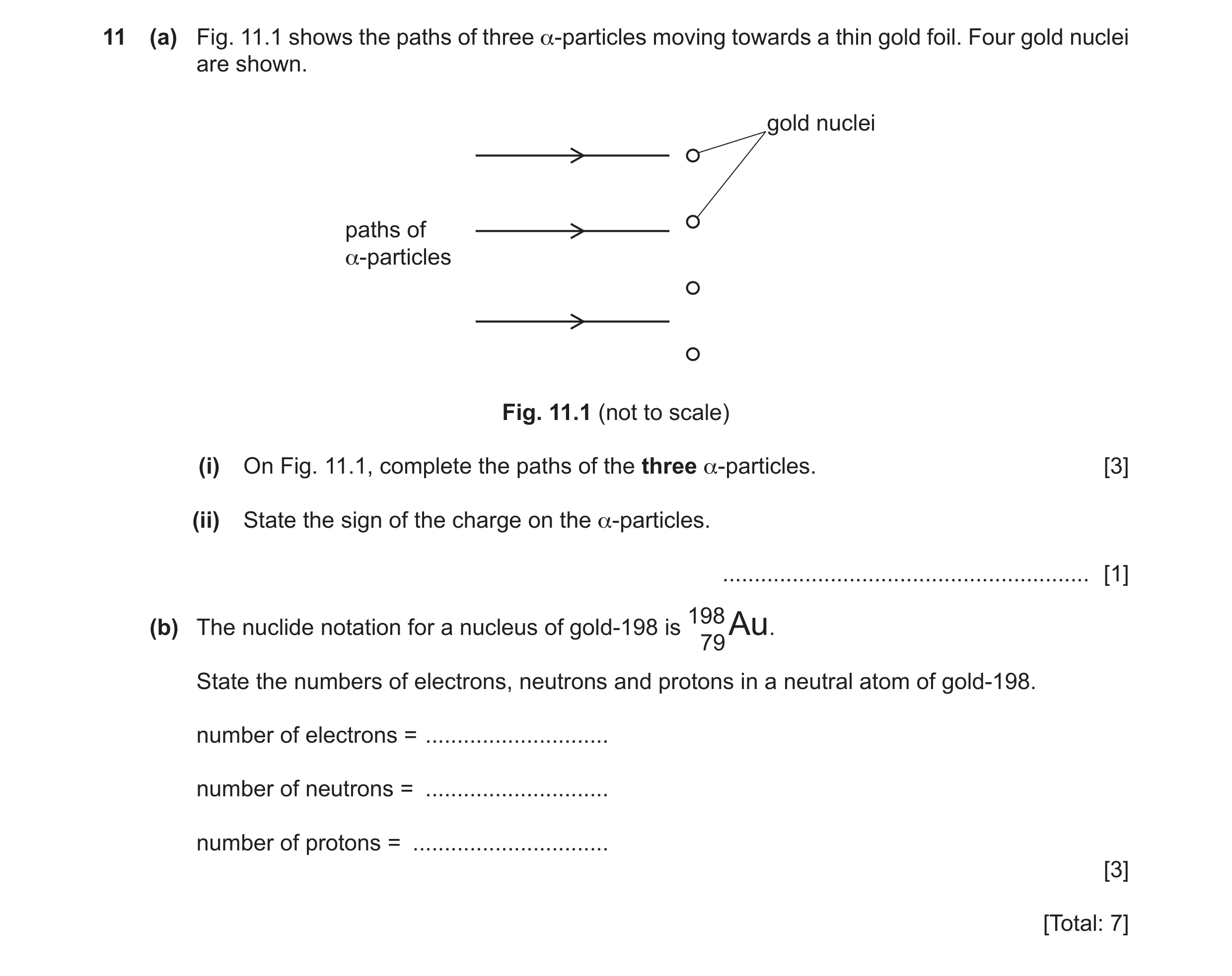
11 (a) Fig. 11.1 shows the paths of three α-particles moving towards a thin gold foil. Four gold nuclei are shown. gold nuclei paths of α-particles Fig. 11.1 (not to scale) (i) On Fig. 11.1, complete the paths of the three α-particles. [3] (ii) State the sign of the charge on the α-particles. … [1] 198 (b) The nuclide notation for a nucleus of gold-198 is 79Au. State the numbers of electrons, neutrons and protons in a neutral atom of gold-198. number of electrons = … number of neutrons = … number of protons = … [3] [Total: 7]
7 marks
Mark scheme: 11(a)(i) top: travels to left B1 middle: deflected down AND still travels to right B1 bottom: straight on B1 Question Answer Marks 11(a)(ii) plus OR positive OR + B1 11(b) 79 (electrons) B1 119 (neutrons) B1 79 (protons) B1
This question in 0625/42 May/June 2022
Q21 · Only one isotope of gold occurs naturally on Earth 0625/41 Oct/Nov 2022
9 Only one isotope of gold occurs naturally on Earth. (a) State what this indicates about the nuclear structure of all the naturally occurring atoms of gold on Earth. … … [1] (b) There are several artificially produced isotopes of gold. Gold-198 (19879 Au) is an artificial isotope which is used in medicine and in scientific research. Gold-198 decays by β (beta)-emission to a stable isotope of mercury. (i) Determine the number of protons and the number of neutrons in a nucleus of this isotope of mercury. number of protons = … number of neutrons = … [2] (ii) A sample of gold-198 is placed near to a radiation detector in a research laboratory. The count rate is recorded at the same time every day for 32 days. The results are used to plot the graph shown in Fig. 9.1. 400 count rate counts / min 300 200 100 0 0 4 8 12 16 20 24 28 32 time / days Fig. 9.1 Using Fig. 9.1, determine the background count rate in the research laboratory. count rate = … [1] (iii) Using Fig. 9.1, determine the half-life of gold-198. half-life = … [4] [Total: 8]
8 marks
Mark scheme: 9(a) they all have the same number of neutrons / nucleons or they are all identical B1 9(b)(i) B2 (number of protons =) 80 B1 (number of neutrons =) 118 B1 9(b)(ii) 19 counts / minute ⩽ count rate ⩽ 21counts / minute B1 9(b)(iii) 2.4 days ⩽ ⩽ 2.9 days A4 count rate from line – background count e.g. 390 – 20 C1 answer from first C1 mark divided by 2 e.g. 370 / 2 or 185 C1 background count + answer from second C1 mark e.g. 20 + 370 / 2 or 20 + 185 or 205 C1
This question in 0625/41 Oct/Nov 2022
Q22 · The magnitude of the charge on a β (beta)-particle is 1.6 × 10⁻¹⁹ C 0625/42 Oct/Nov 2022
10 (a) The magnitude of the charge on a β (beta)-particle is 1.6 × 10⁻¹⁹ C. (i) State the proton number and nucleon number of an α (alpha)-particle. proton number … nucleon number … [2] (ii) Determine the magnitude of the charge of an α (alpha)-particle. charge … [1] (b) A nucleus of radium-230 consists of 88 protons and 142 neutrons. Radium-230 is radioactive and decays by β (beta)-emission to an isotope of actinium. The symbol for radium is Ra and the symbol for actinium is Ac. Write down the nuclide equation for this decay. [3] (c) The half-life of radium-230 is 93 min. A sample contains 9.6 × 10⁻¹² g of radium-230. Calculate the mass of radium in the sample after 279 min. mass = … [2] [Total: 8]
8 marks
Mark scheme: 10(a)(i) (proton number) 2 B1 (nucleon number) 4 B1 10(a)(ii) 3.2 10–19 (C) B1 10(b) 230 88 Ra → 23089 Ac + –10 A3 any two from: C2 • nucleon numbers 230 on left AND 230 on right • Ra and proton number 88 on left AND Ac and proton number 89 on right • 0 . –1 10(c) (mass =) 1.2 10–12 g A2 3 half-lives OR 9.6 10–12 / 8 OR 9.6 10–12 / 23 C1
This question in 0625/42 Oct/Nov 2022
Q23 · A cloud chamber can be used to detect α (alpha)-particles and β (beta)-particles 0625/43 Oct/Nov 2022
10 (a) A cloud chamber can be used to detect α (alpha)-particles and β (beta)-particles. Alcohol in the cloud chamber exists as a vapour and condenses on ions produced in the air. This forms visible tracks. Fig. 10.1 shows the tracks when a source of α-particles and β-particles is present in the cloud chamber. cloud chamber alcohol vapour in air source of α-particles and β-particles Fig. 10.1 Some of the tracks are short and thick. Other tracks are longer and thinner. State and explain which tracks are produced by α-particles and which tracks are produced by β-particles. α-particles … … β-particles … … [3] (b) A radioactive isotope of sodium (Na) is used to detect leaks from water pipes. A nucleus of this isotope of sodium contains 11 protons and 13 neutrons. This nucleus decays by emitting a β-particle to form a nucleus of magnesium (Mg). (i) Describe what is meant by an isotope. … … … [2] (ii) Write down the nuclide equation for the decay of this isotope of sodium to magnesium. [3] (iii) This isotope of sodium has a half-life of 15 hours. The isotope of magnesium is stable and does not undergo radioactive decay. Suggest why these properties of the isotope of sodium and the isotope of magnesium make this isotope of sodium suitable to detect leaks from water pipes. … … … [2] [Total: 10]
10 marks
Mark scheme: 10(a) -particles are short and thick / -particles are long and thin B1 any two from: B2 • -particles are more ionising / -particles are less ionising • -particles are less penetrating or have shorter range / -particles are more penetrating or have longer range • -particles have more energy / -particles have less energy 10(b)(i) (element with) same number of protons B1 (element with) different number of neutrons B1 10(b)(ii) 24 24 0 Na → Mg + 11 12 −1 Na on left with correct proton and nucleon number B1 on right with correct proton and nucleon number B1 Mg on right with correct proton and nucleon number B1 10(b)(iii) half life (of Na 24) long enough (to allow detection of leaks) B1 negligible amount (of Na 24) remains in liquid after a few days B1 (so) less hazardous (to human health) OR decays to something stable/magnesium (is stable) AND (so) less hazardous (to human health)
This question in 0625/43 Oct/Nov 2022
Q24 · All the particles in a neutral atom of a radioactive isotope X1 0625/41 May/June 2023
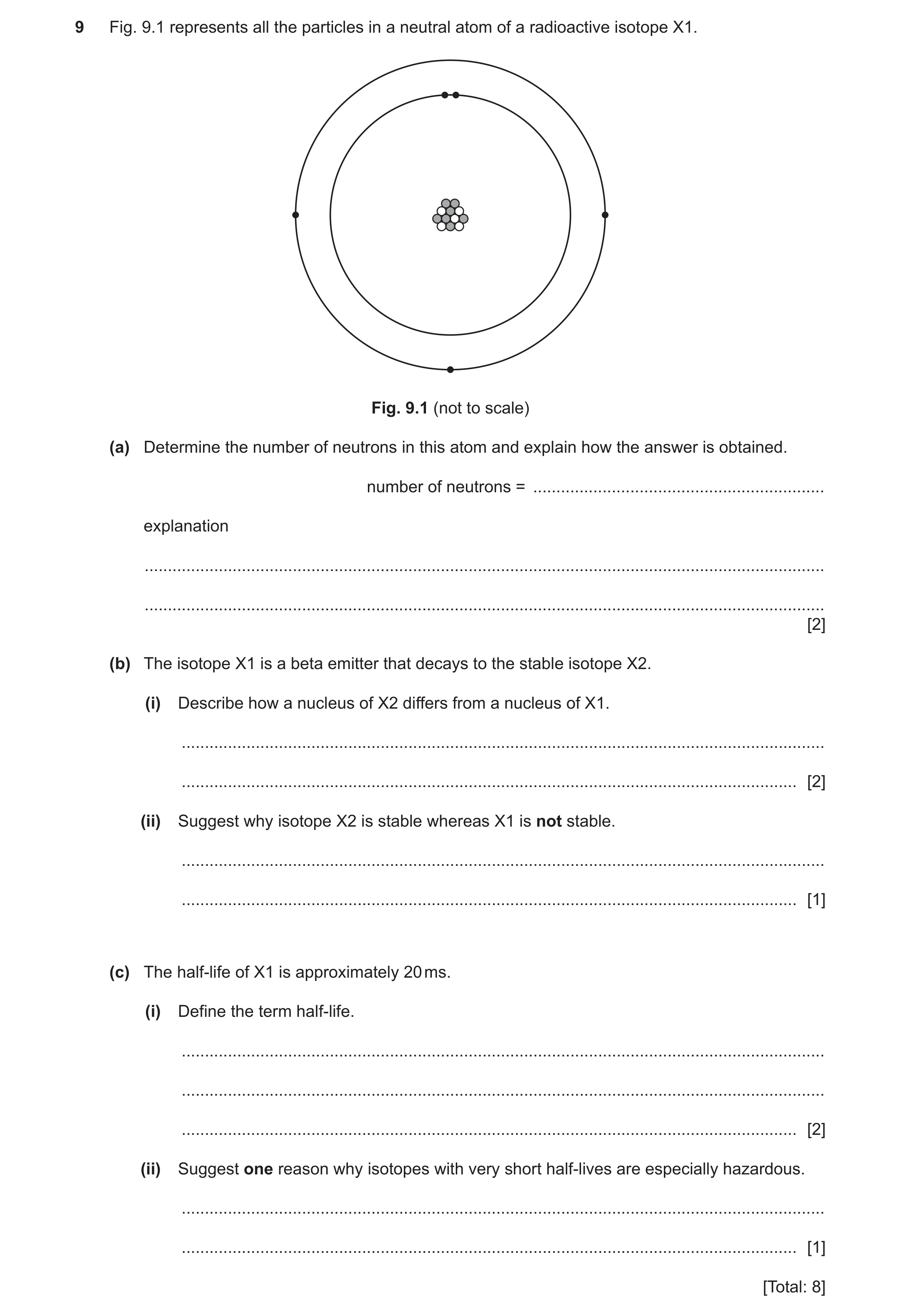
9 Fig. 9.1 represents all the particles in a neutral atom of a radioactive isotope X1. Fig. 9.1 (not to scale) (a) Determine the number of neutrons in this atom and explain how the answer is obtained. number of neutrons = … explanation … … [2] (b) The isotope X1 is a beta emitter that decays to the stable isotope X2. (i) Describe how a nucleus of X2 differs from a nucleus of X1. … … [2] (ii) Suggest why isotope X2 is stable whereas X1 is not stable. … … [1] (c) The half-life of X1 is approximately 20 ms. (i) Define the term half-life. … … … [2] (ii) Suggest one reason why isotopes with very short half-lives are especially hazardous. … … [1] [Total: 8]
8 marks
Mark scheme: 9(a) (number of neutrons =) 7 B1 any one from: number of electrons = number of protons white dots are protons / there are 5 protons grey dots are neutrons (number of neutrons) = 12 – 5 B1 9(b)(i) (X2 has) one more proton more and one fewer neutron (than X1) OR (X2 has) 6 protons and 6 neutrons A2 (X2 has) one neutron fewer / one more proton (than X1) OR (X2 has) 6 protons / 6 neutrons C1 9(b)(ii) (X2) has fewer (excess) neutrons (in its nucleus) ORA B1 9(c)(i) time (taken) M1 for number of (radioactive) nuclei / atoms (in a sample of X1) to halve OR for rate of decay to halve A1 9(c)(ii) large number of particles produced in short time OR high / large decay rate OR high dose (of radiation) in short time B1
This question in 0625/41 May/June 2023
Q25 · A plastic rod is uncharged 0625/41 Oct/Nov 2023
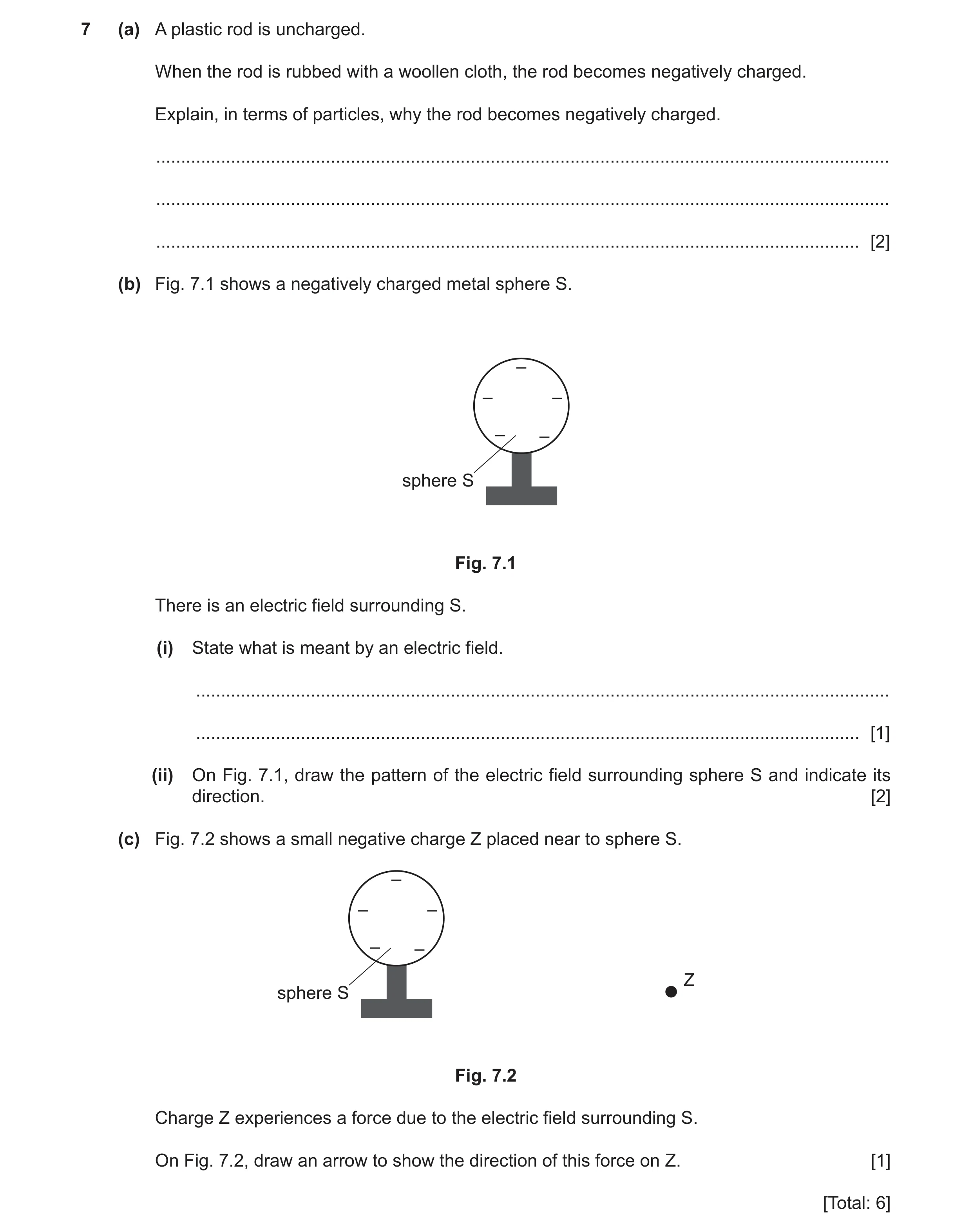
7 (a) A plastic rod is uncharged. When the rod is rubbed with a woollen cloth, the rod becomes negatively charged. Explain, in terms of particles, why the rod becomes negatively charged. … … … [2] (b) Fig. 7.1 shows a negatively charged metal sphere S. – – – – – sphere S Fig. 7.1 There is an electric field surrounding S. (i) State what is meant by an electric field. … … [1] (ii) On Fig. 7.1, draw the pattern of the electric field surrounding sphere S and indicate its direction. [2] (c) Fig. 7.2 shows a small negative charge Z placed near to sphere S. – – – – – Z sphere S Fig. 7.2 Charge Z experiences a force due to the electric field surrounding S. On Fig. 7.2, draw an arrow to show the direction of this force on Z. [1] [Total: 6]
6 marks
Mark scheme: 7(a) electrons move from cloth to rod A2 (plastic) rod gains electrons C1 7(b)(i) (region) where an (electric) charge experiences a force B1 7(b)(ii) At least three radial field lines distributed evenly around outside of S AND touching S AND not inside S B1 arrow on (at least one) field line pointing towards S B1 7(c) arrow through Z and away from (centre of) sphere B1
This question in 0625/41 Oct/Nov 2023
Q26 · Many household smoke alarms contain a sample of the radioactive isotope americium-241 (Am) 0625/41 Oct/Nov 2023
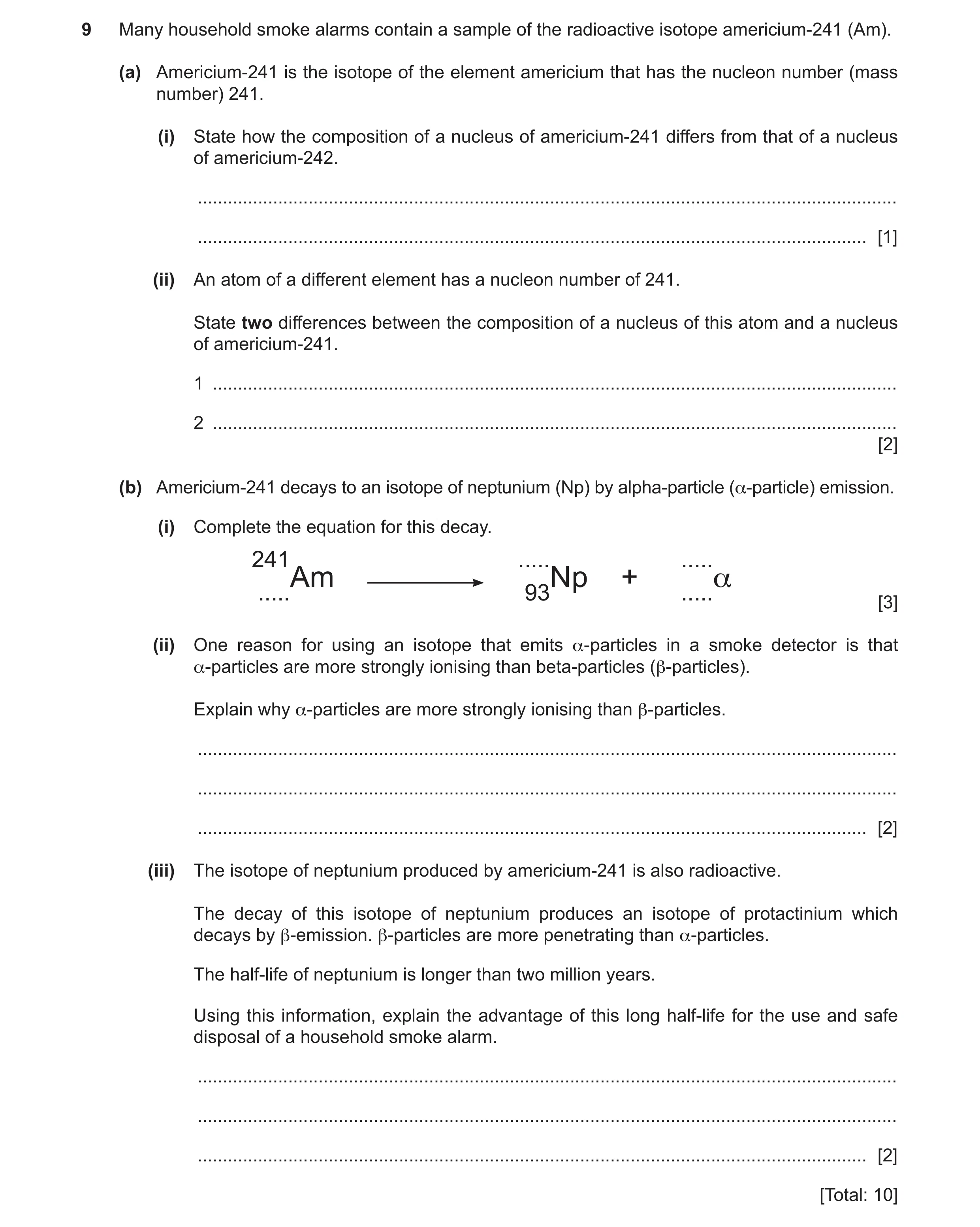
9 Many household smoke alarms contain a sample of the radioactive isotope americium-241 (Am). (a) Americium-241 is the isotope of the element americium that has the nucleon number (mass number) 241. (i) State how the composition of a nucleus of americium-241 differs from that of a nucleus of americium-242. … … [1] (ii) An atom of a different element has a nucleon number of 241. State two differences between the composition of a nucleus of this atom and a nucleus of americium-241. 1 … 2 … [2] (b) Americium-241 decays to an isotope of neptunium (Np) by alpha-particle (α-particle) emission. (i) Complete the equation for this decay. 241 … … … Am 93Np + … α [3] (ii) One reason for using an isotope that emits α-particles in a smoke detector is that α-particles are more strongly ionising than beta-particles (β-particles). Explain why α-particles are more strongly ionising than β-particles. … … … [2] (iii) The isotope of neptunium produced by americium-241 is also radioactive. The decay of this isotope of neptunium produces an isotope of protactinium which decays by β-emission. β-particles are more penetrating than α-particles. The half-life of neptunium is longer than two million years. Using this information, explain the advantage of this long half-life for the use and safe disposal of a household smoke alarm. … … … [2] [Total: 10]
10 marks
Mark scheme: 9(a)(i) (americium-241 has) one neutron fewer (in the nucleus) B1 9(a)(ii) (different) number of protons (in nucleus) B1 (different) number of neutrons (in nucleus) B1 9(b)(i) 241 95 Am →23793 Np + 42 a A3 any two from: C2 95Am 237Np 42a 9(b)(ii) (-particles have) more kinetic energy (than -particles) B1 (-particles have) more charge (than -particles) B1 9(b)(iii) Low(er) (initial) activity OR Few emissions per unit time M1 so smoke detectors are not hazardous to humans OR so disposal of old detectors is cheap / easy A1
This question in 0625/41 Oct/Nov 2023
Q27 · The isotope uranium-235 is represented by 235 92 U 0625/42 Oct/Nov 2023
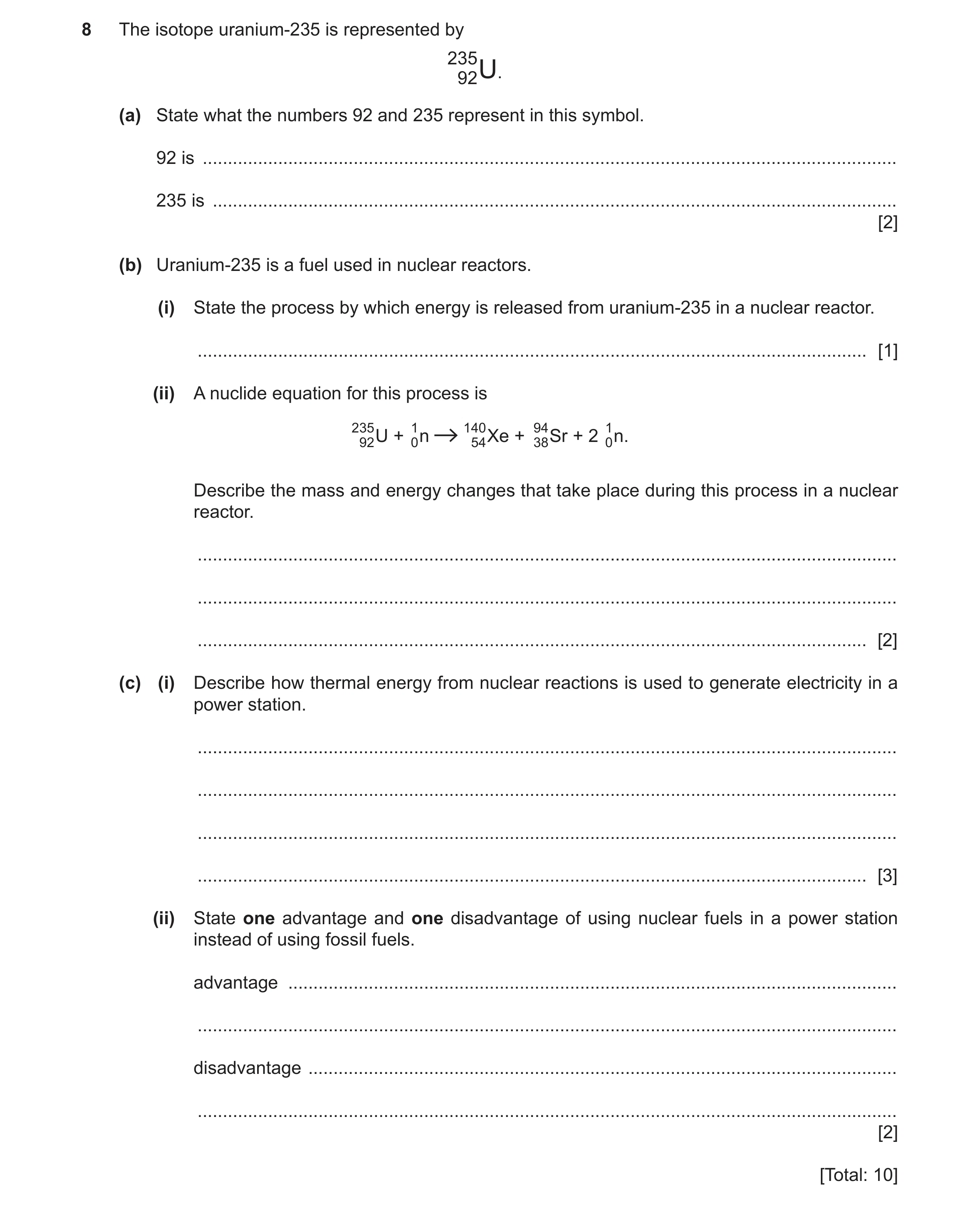
8 The isotope uranium-235 is represented by 235 92 U. (a) State what the numbers 92 and 235 represent in this symbol. 92 is … 235 is … [2] (b) Uranium-235 is a fuel used in nuclear reactors. (i) State the process by which energy is released from uranium-235 in a nuclear reactor. … [1] (ii) A nuclide equation for this process is 235 92 U + 10 n 14054 Xe + 9438 Sr + 2 10 n. Describe the mass and energy changes that take place during this process in a nuclear reactor. … … … [2] (c) (i) Describe how thermal energy from nuclear reactions is used to generate electricity in a power station. … … … … [3] (ii) State one advantage and one disadvantage of using nuclear fuels in a power station instead of using fossil fuels. advantage … … disadvantage … … [2] [Total: 10]
10 marks
Mark scheme: 8(a) (92 is) the proton number / number of protons (in the nucleus) / atomic number B1 (235 is) the nucleon number / number of nucleons (in the nucleus) / mass number B1 8(b)(i) (nuclear) fission B1 8(b)(ii) nucleus converted to (more stable) nuclei with smaller total mass B1 mass (difference) is released / converted as (kinetic) energy (of products) / thermal energy B1 8(c)(i) any three from: B3 • (thermal energy) used to heat / boil (cold) water OR make steam • steam is at high pressure • steam drives a turbine • turbine (connected to and) drives a generator • turbine moves a coil in a magnetic field 8(c)(ii) advantage - any one from: B1 • (much) small(er) amount of fuel needed (to produce same amount of energy) • no greenhouse gases produced OR low carbon dioxide emissions • no air pollution (when operating normally) disadvantage – any one from B1 • danger if any leak of radiation • produces hazardous / dangerous / toxic waste OR difficulty of storage of used radioactive material OR nuclear waste must be stored for a long time • expensive to build or decommission nuclear power plant or store nuclear waste
This question in 0625/42 Oct/Nov 2023
Q28 · An experiment directs alpha particles at a very thin sheet of gold foil 0625/42 Feb/March 2024
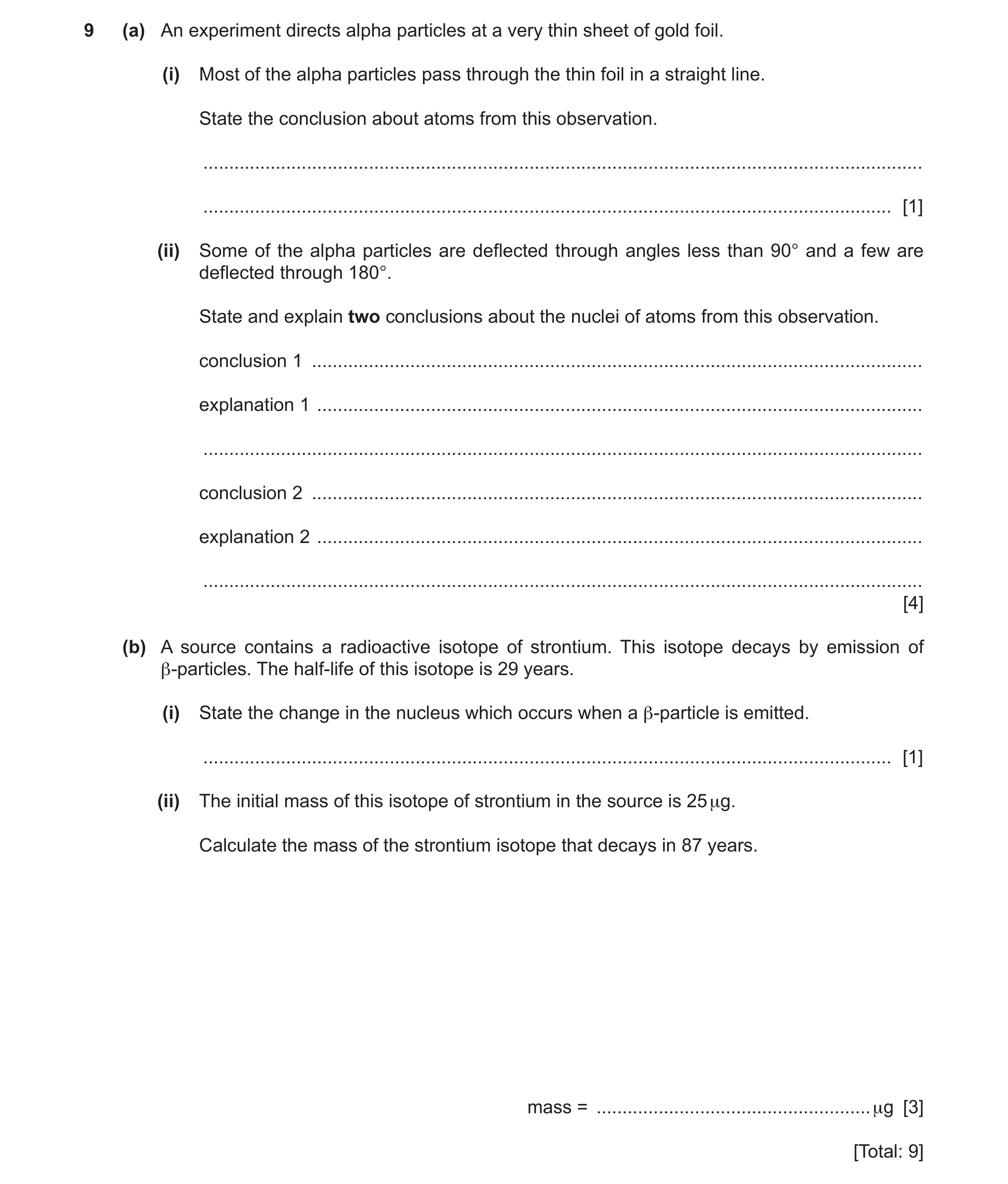
9 (a) An experiment directs alpha particles at a very thin sheet of gold foil. (i) Most of the alpha particles pass through the thin foil in a straight line. State the conclusion about atoms from this observation. … … [1] (ii) Some of the alpha particles are deflected through angles less than 90° and a few are deflected through 180°. State and explain two conclusions about the nuclei of atoms from this observation. conclusion 1 … explanation 1 … … conclusion 2 … explanation 2 … … [4] (b) A source contains a radioactive isotope of strontium. This isotope decays by emission of β‑particles. The half‑life of this isotope is 29 years. (i) State the change in the nucleus which occurs when a β‑particle is emitted. … [1] (ii) The initial mass of this isotope of strontium in the source is 25 µg. Calculate the mass of the strontium isotope that decays in 87 years. mass = … µg [3] [Total: 9]
9 marks
Mark scheme: 9(a)(i) most of the atom is empty space B1 9(a)(ii) any two from: B2 1 the nucleus is very small 2 mass of gold nucleus is much greater than mass of alpha particle 3 the nucleus is positively charged corresponding explanation to conclusion: B2 1 not many alpha particles pass close to the nucleus / owtte 2 large force between alpha and nucleus (has bigger effect on small mass of alpha) 3 alpha particles are positively charged, AND force is repulsive 9(b)(i) (in the nucleus a) neutron is changed into a proton (and an electron which is the emitted -particle) B1 9(b)(ii) 22 g A3 (87 years is) three half-lives OR 25 / 8 OR 87 / 29 = 3 (half lives) (C1) 1 / 8th (of the strontium remains) OR 25 / 8 (decays) OR 3.125 seen (C1)
This question in 0625/42 Feb/March 2024
Q29 · The nuclide notation for the radioactive isotope carbon-14 is 146C 0625/41 Oct/Nov 2024
8 The nuclide notation for the radioactive isotope carbon-14 is 146C. (a) Using the symbols shown in Fig. 8.1, draw a diagram to show the number of electrons, neutrons and protons in a neutral atom of carbon-14 and how they are arranged. symbols: electron neutron proton Fig. 8.1 [3] (b) Describe how the composition of a neutral atom of carbon-14 is different from the composition of a neutral atom of nitrogen-14 (147N). … … [2] (c) Carbon-14 decays by beta (β) emission. (i) State the name of a particle that is identical to a beta-particle. … [1] (ii) Describe the change that takes place in carbon-14 as a beta-particle is emitted. … … [1] (d) The half-life of carbon-14 is 5700 years. A very old object is made of wood. It contains 1.2 × 10¹¹ atoms of carbon-14. When it was manufactured, it contained 9.6 × 10¹¹ atoms of carbon-14. Determine the time that has passed since it was manufactured. time passed = … [3] [Total: 10]
10 marks
Mark scheme: 8(a) 6 electrons AND 6 protons (i.e. 6 AND 6 ) B1 8 neutrons (i.e. 8 ) B1 protons and neutrons in nucleus AND electrons orbiting nucleus B1 8(b) (carbon) has one more neutron OR nitrogen has one fewer neutron B1 (carbon) has one fewer proton / electron OR nitrogen has one more proton / electron B1 8(c)(i) electron B1 8(c)(ii) a neutron changes into a proton (and electron) B1 8(d) 17 000 years A3 1.2 1011 / 9.6 1011 OR 1 / 8 OR one halving seen e.g. 9.6 1011 2 C1 3 (half-lives) OR 1 / 8 9.6 1011 = 1.2 1011 C1
This question in 0625/41 Oct/Nov 2024
Q30 · An isotope of boron is used in the treatment of cancer in the brain 0625/43 Oct/Nov 2024
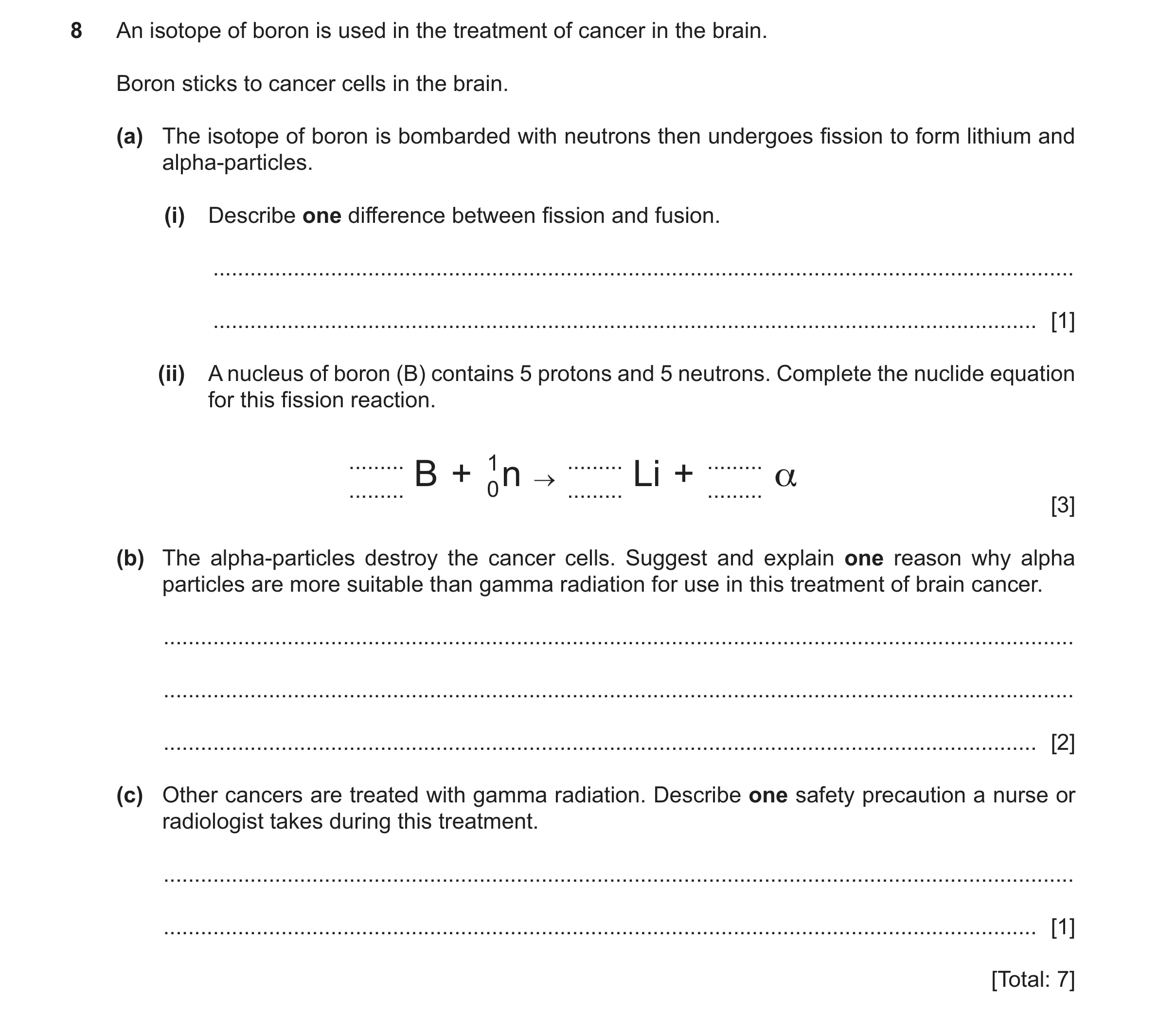
8 An isotope of boron is used in the treatment of cancer in the brain. Boron sticks to cancer cells in the brain. (a) The isotope of boron is bombarded with neutrons then undergoes fission to form lithium and alpha‑particles. (i) Describe one difference between fission and fusion. … … [1] (ii) A nucleus of boron (B) contains 5 protons and 5 neutrons. Complete the nuclide equation for this fission reaction. … B + 10n … Li + … α … [3] (b) The alpha‑particles destroy the cancer cells. Suggest and explain one reason why alpha particles are more suitable than gamma radiation for use in this treatment of brain cancer. … … … [2] (c) Other cancers are treated with gamma radiation. Describe one safety precaution a nurse or radiologist takes during this treatment. … … [1] [Total: 7]
7 marks
Mark scheme: 8(a)(i) fission is splitting of nuclei OR fusion is the joining of nuclei B1 8(a)(ii) 10 5𝐵+ 10𝑛 → 73𝐿𝑖 + 42𝛼 B: proton number 5 and nucleon number 10 B1 Li: proton number 3 and nucleon number 7 B1 : proton number 2 and nucleon number 4 B1 8(b) alpha is less penetrating / has shorter range (than gamma) B1 alpha more easily absorbed / stopped by cancer / tumour cells or won’t travel beyond cancer cells or so won’t damage B1 other / healthy cells OR alpha highly ionising (than gamma) (B1) will destroy / damage cancer cells more easily (B1) 8(c) any one from: B1 • reduce exposure time • increase distance between source and living tissue or stand in another room whilst radiation is emitted • use shielding or wear a lead apron or stand behind a glass partition / lead barrier
This question in 0625/43 Oct/Nov 2024
Q31 · Strontium-90 is a radioactive isotope of strontium 0625/42 Feb/March 2025
9 Strontium-90 is a radioactive isotope of strontium. The nuclide notation for strontium-90 is: 9 0 3 8Sr (a) (i) Explain what isotopes are. … … [1] (ii) Complete Table 9.1 for strontium-90. Table 9.1 particle number in one atom location 38 outside nucleus neutron 38 inside nucleus [2] (b) Strontium-90 is used to measure the thickness of metal sheets in industry. Strontium-90 decays by emitting beta (β) particles which pass through a metal sheet to a detector. (i) One metal sheet is 0.75 mm thick. Suggest why strontium-90 is a suitable radioactive source to measure the thickness of the metal sheets. … … … [2] (ii) The half-life of strontium-90 is approximately 27 years. Fig. 9.1 shows the shape of a decay curve. 100 percentage of 75 strontium-90 remaining 500 25 0 0 5 10 15 20 25 30 35 40 45 50 55 60 age of sample / years Fig. 9.1 The strontium-90 source is replaced with a new source after 15 years. Using Fig. 9.1, suggest why a strontium-90 source that is more than 15 years old needs to be replaced with a new source. … … [2] [Total: 7]
7 marks
Mark scheme: 9(a)(i) (isotopes are) forms of an element with the same number of protons but a different number of neutrons (in the nucleus) OR B1 (isotopes are) the same element with a different number of neutrons 9(a)(ii) B1 particle number in each location atom of strontium electron 38 outside nucleus neutron proton 38 Inside nucleus B1 particle number in each location atom of strontium 38 outside nucleus neutron 52 Inside nucleus 38 Inside nucleus 9(b)(i) (there is a) different count rate with different thicknesses of metal OR number of -particles detected varies with thickness A2 (beta () particles) can penetrate thin / 0.75mm metal OR (beta () particles) are stopped by thick metal C1 9(b)(ii) (approximate) percentage of source remaining (after 15 years) stated AND in range 63–70% B1 (approximate) percentage of sample lost (after 15 years) stated AND in range 30–37% Any one from: B1 • count rate / activity (too) low (to detect differences in thickness) owtte • detector needs high activity (to detect differences in thickness) owtte • count rate / activity too close to background owtte • less difference in activity for different thicknesses owtte
This question in 0625/42 Feb/March 2025
Q32 · Strontium-90 (9038Sr) is a radioactive isotope that contains 38 protons and 52 neutrons 0625/41 May/June 2025
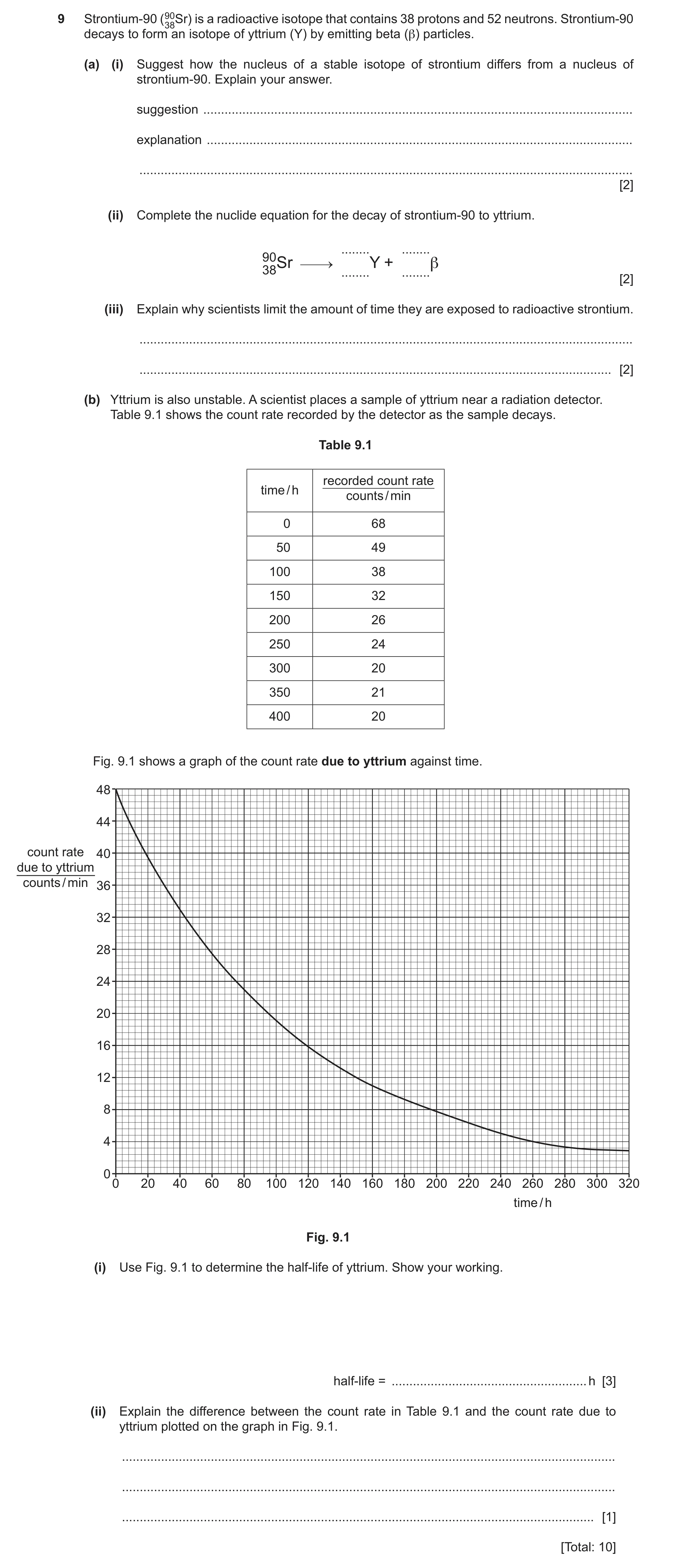
9 Strontium-90 (9038Sr) is a radioactive isotope that contains 38 protons and 52 neutrons. Strontium-90 decays to form an isotope of yttrium (Y) by emitting beta (β) particles. (a) (i) Suggest how the nucleus of a stable isotope of strontium differs from a nucleus of strontium-90. Explain your answer. suggestion … explanation … … [2] (ii) Complete the nuclide equation for the decay of strontium-90 to yttrium. … … 90 38Sr … Y + … β [2] (iii) Explain why scientists limit the amount of time they are exposed to radioactive strontium. … … [2] (b) Yttrium is also unstable. A scientist places a sample of yttrium near a radiation detector. Table 9.1 shows the count rate recorded by the detector as the sample decays. Table 9.1 recorded count rate time / h counts / min 0 68 50 49 100 38 150 32 200 26 250 24 300 20 350 21 400 20 Fig. 9.1 shows a graph of the count rate due to yttrium against time. 48 44 count rate 40 due to yttrium counts / min 36 32 28 24 20 16 12 8 4 0 0 20 40 60 80 100 120 140 160 180 200 220 240 260 280 300 320 time / h Fig. 9.1 (i) Use Fig. 9.1 to determine the half-life of yttrium. Show your working. half-life = … h [3] (ii) Explain the difference between the count rate in Table 9.1 and the count rate due to yttrium plotted on the graph in Fig. 9.1. … … … [1] [Total: 10]
10 marks
Mark scheme: 9(a)(i) (stable isotope) has fewer neutrons AND radioactive isotopes (usually) have an excess of neutrons A2 OR (stable isotope) has fewer neutrons AND radioactive isotopes are too heavy any one from: C1 • (stable isotope) has fewer neutrons • radioactive isotopes (usually) have more neutrons • radioactive isotopes are too heavy 9(a)(ii) 90 B1 39Y –10 B1 9(a)(iii) ionising radiation is harmful (to humans) OR A2 beta particles are ionising and harmful (to humans) any one from: C1 • radiation is / beta particles are harmful • beta particles ionise • it ionises AND is harmful 9(b)(i) 72 ⩽ half-life ⩽ 76 (h) A3 braille: 80 h (mark based on candidate choice of halving) evidence of count rate halved e.g. 48 2 = 24 C1 evidence on graph or in working that Fig. 9.1 is used to find time for count rate to halve C1 9(b)(ii) any one from: B1 • table includes background radiation owtte • graph does not have background count rate owtte • graph has corrected count rate
This question in 0625/41 May/June 2025
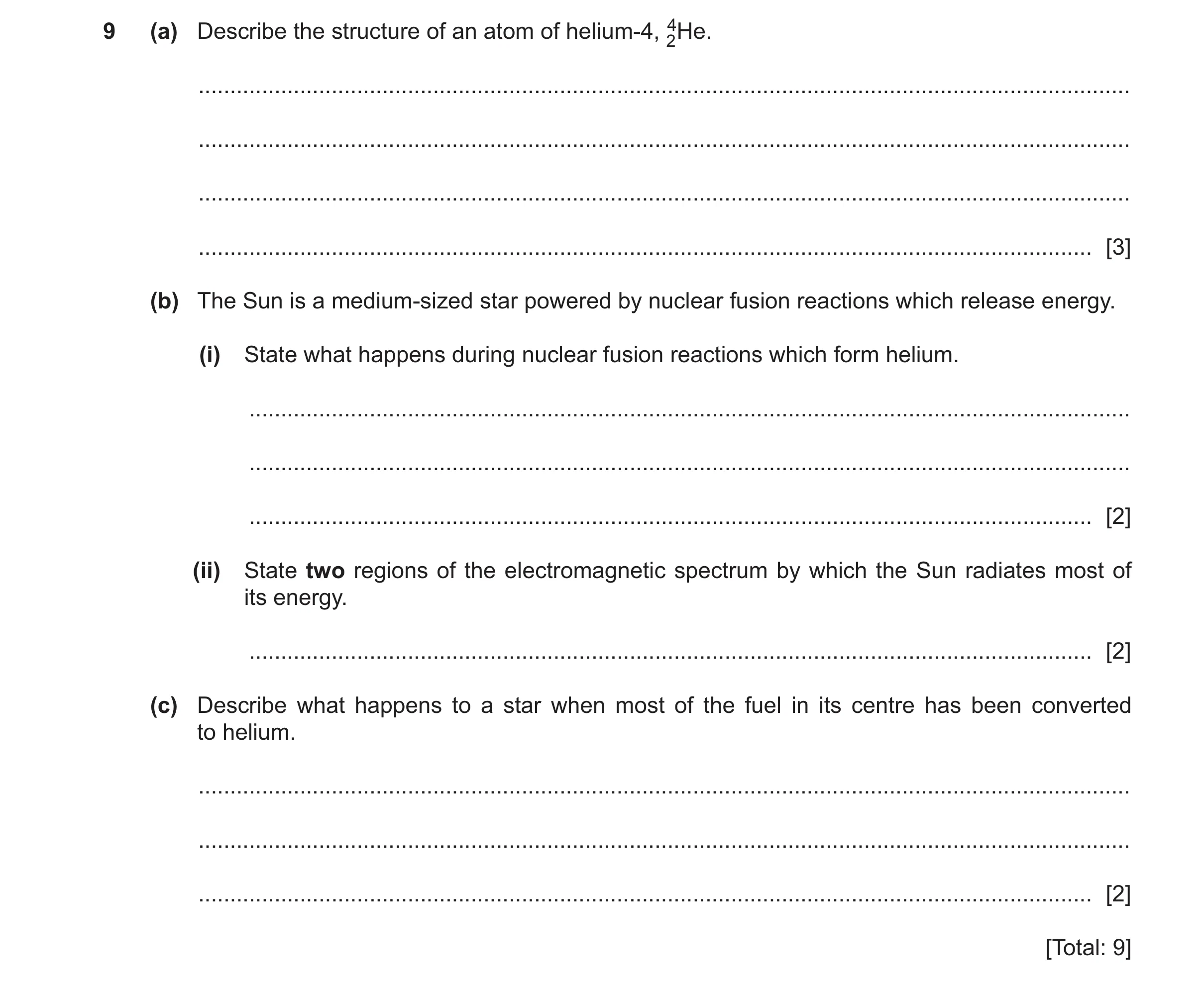
Q33 · Describe the structure of an atom of helium-4, 4He 0625/41 Oct/Nov 2025
9 (a) Describe the structure of an atom of helium-4, 4He. 2 … … … … [3] (b) The Sun is a medium-sized star powered by nuclear fusion reactions which release energy. (i) State what happens during nuclear fusion reactions which form helium. … … … [2] (ii) State two regions of the electromagnetic spectrum by which the Sun radiates most of its energy. … [2] (c) Describe what happens to a star when most of the fuel in its centre has been converted to helium. … … … [2] [Total: 9]
9 marks
Mark scheme: 9(a) Any three from: B3 • nucleus containing protons and neutrons • protons (in nucleus) • 2 neutrons (in nucleus) • 2 electrons outside the nucleus • Protons are positive (charges) OR electrons are negative (charges) 9(b)(i) hydrogen B1 (hydrogen) nuclei join (together) B1 9(b)(ii) Any two from: B2 • infrared • visible • ultraviolet 9(c) • (the star) expands B1 Any one from: B1 • (smaller star) forms a red giant • (more massive star) forms a red supergiant
This question in 0625/41 Oct/Nov 2025
 1 / 36
 2 / 36
 3 / 36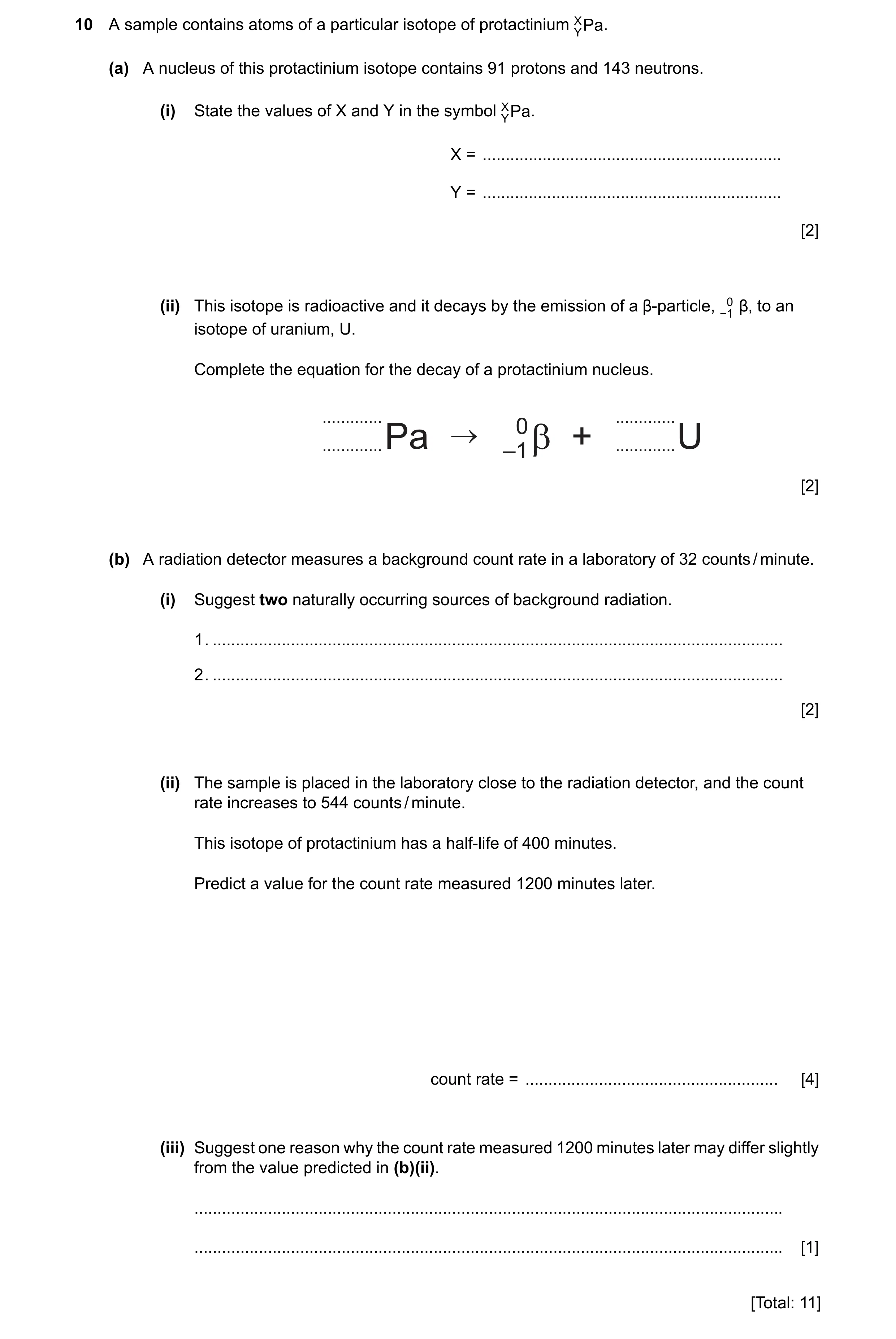
 5 / 36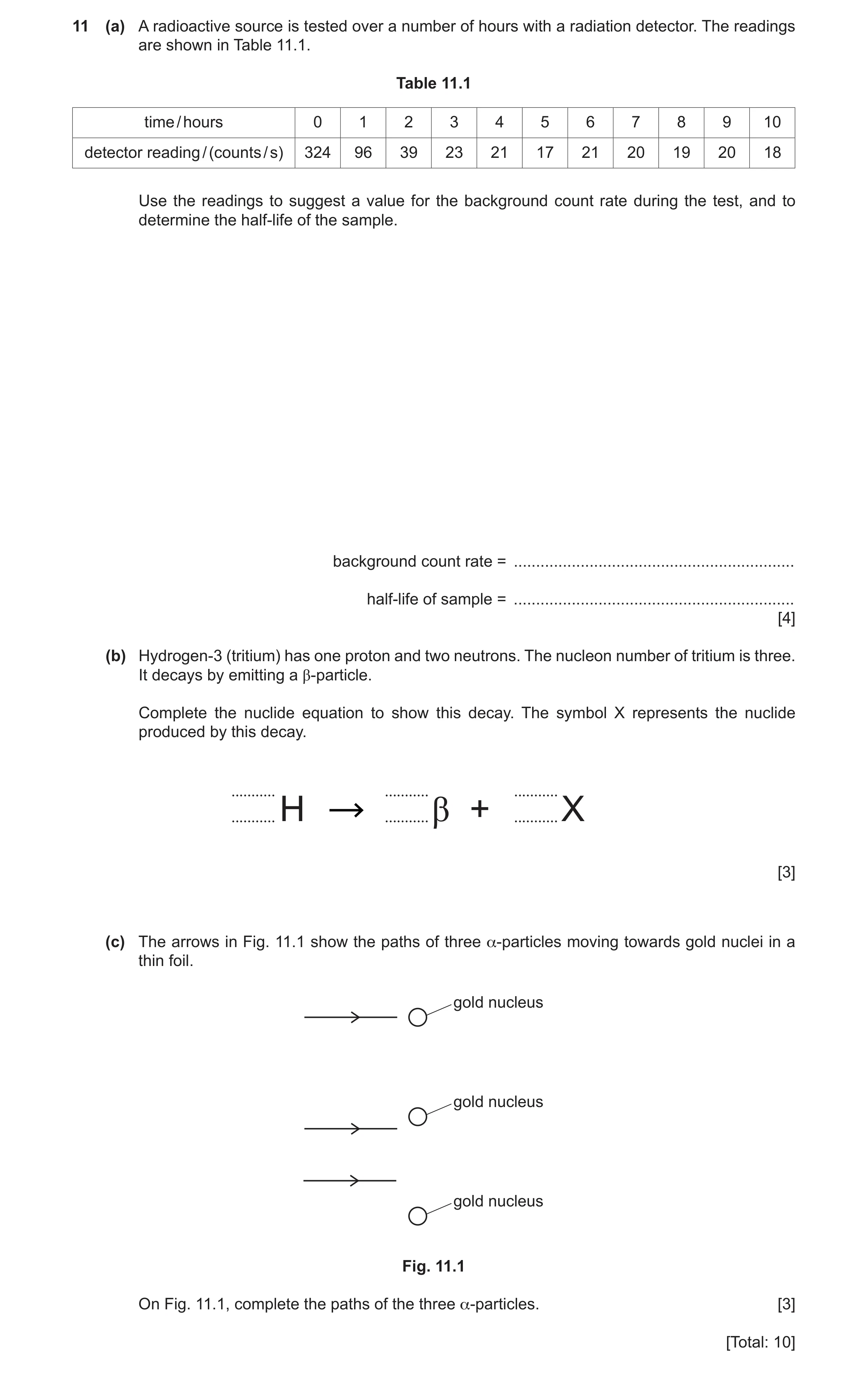
 9 / 36
 10 / 36
 11 / 36
 12 / 36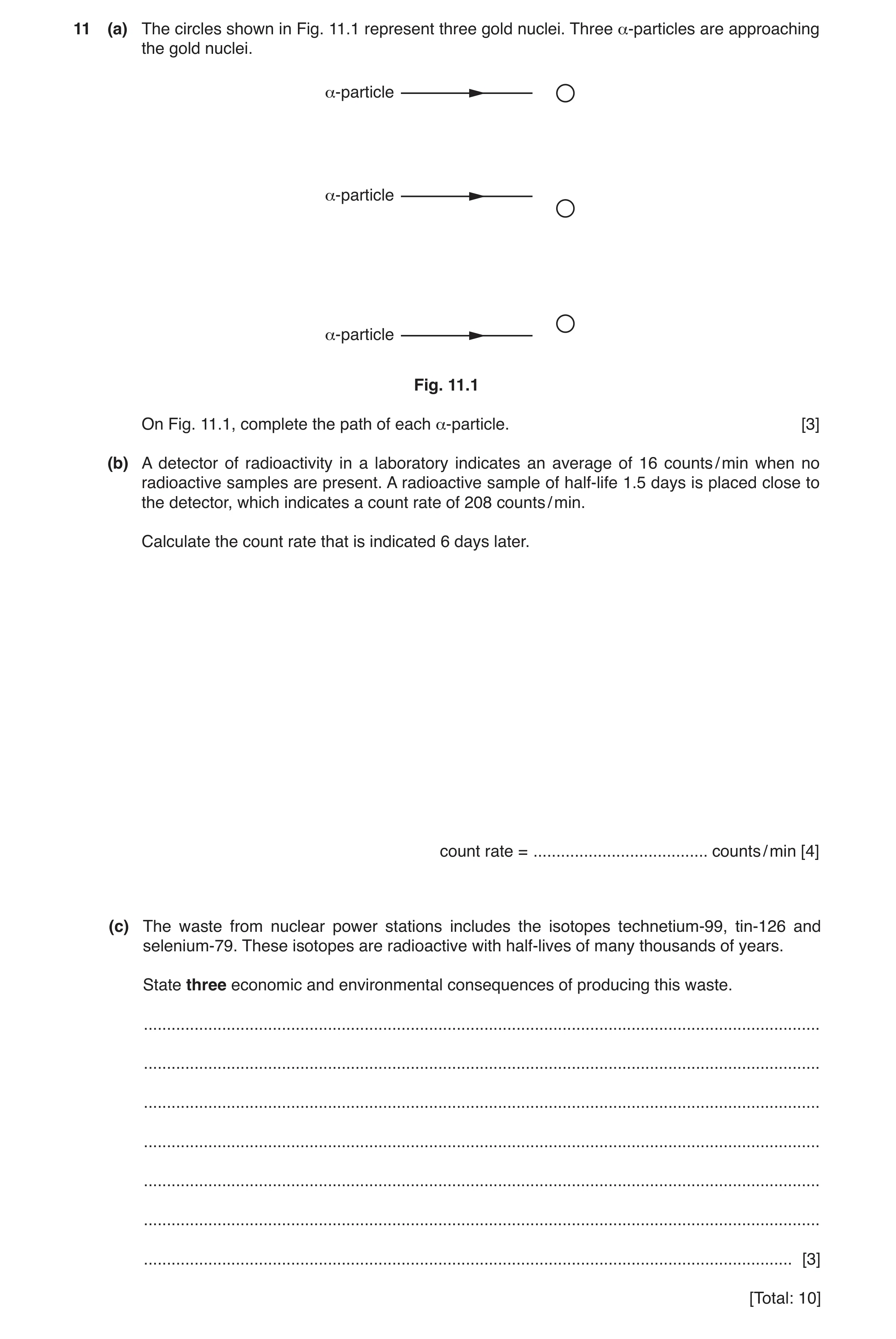
 14 / 36
 15 / 36
 16 / 36
 17 / 36
 18 / 36
 19 / 36
 20 / 36
 21 / 36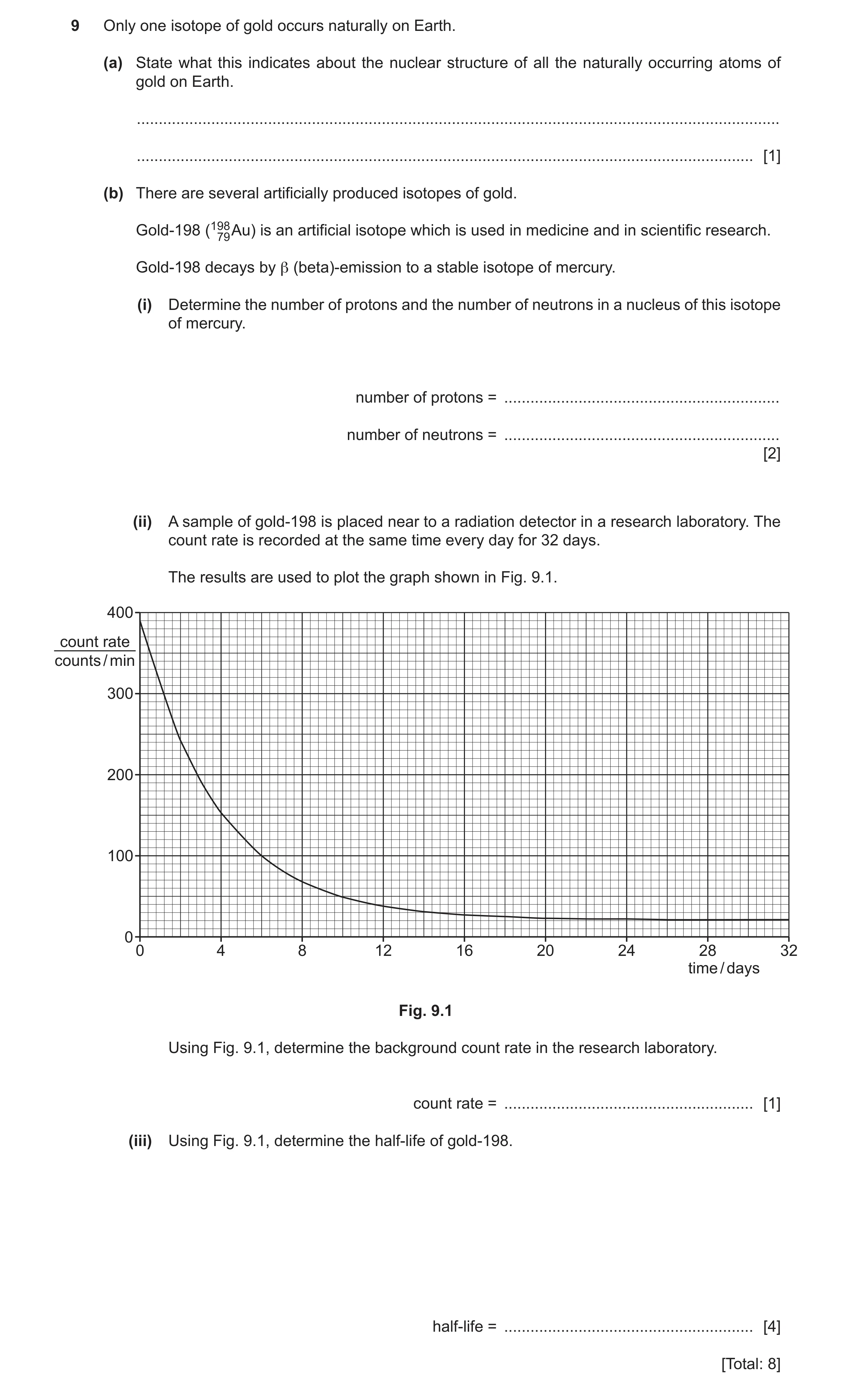
 23 / 36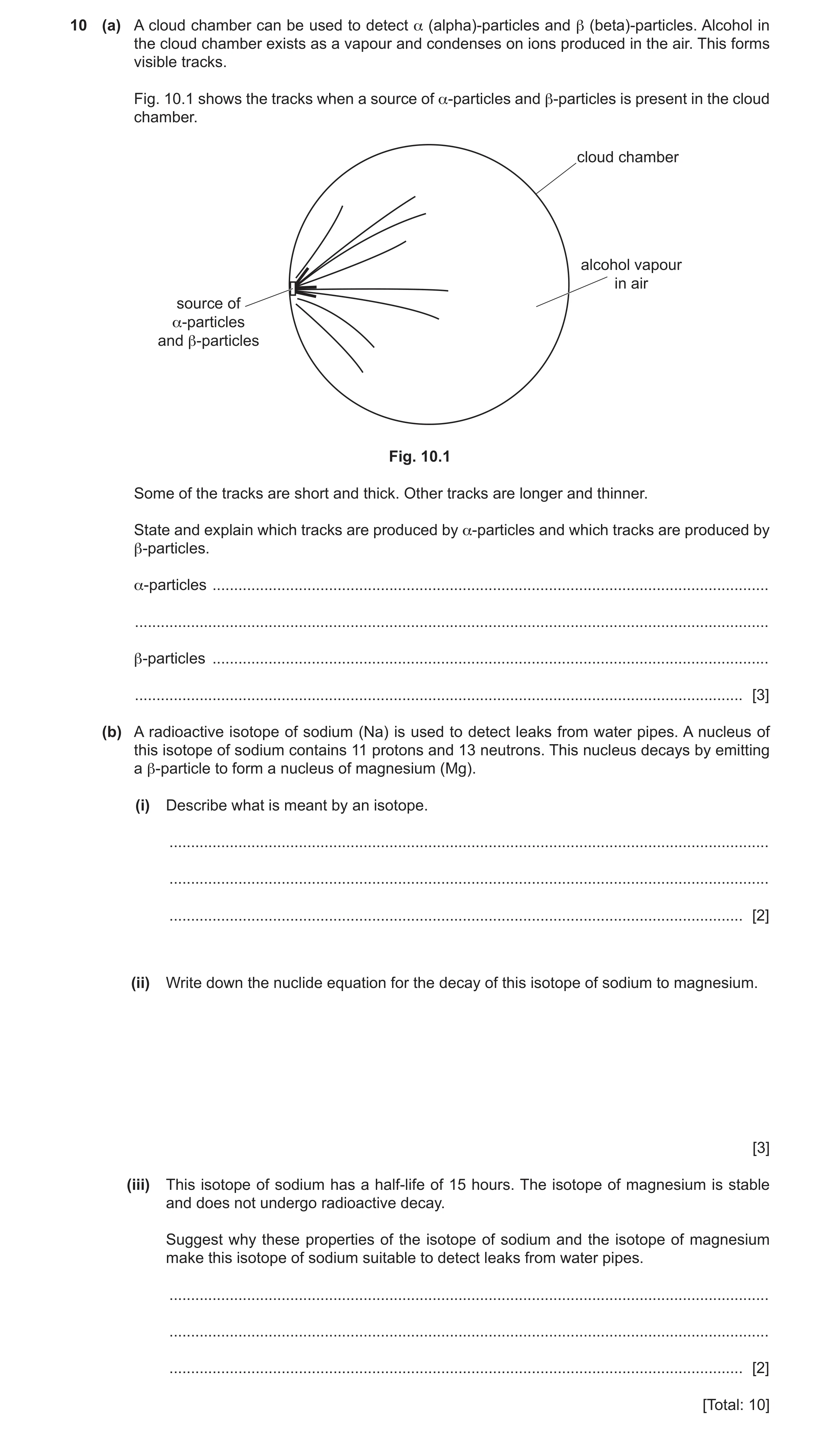
 27 / 36
 28 / 36
 29 / 36
 30 / 36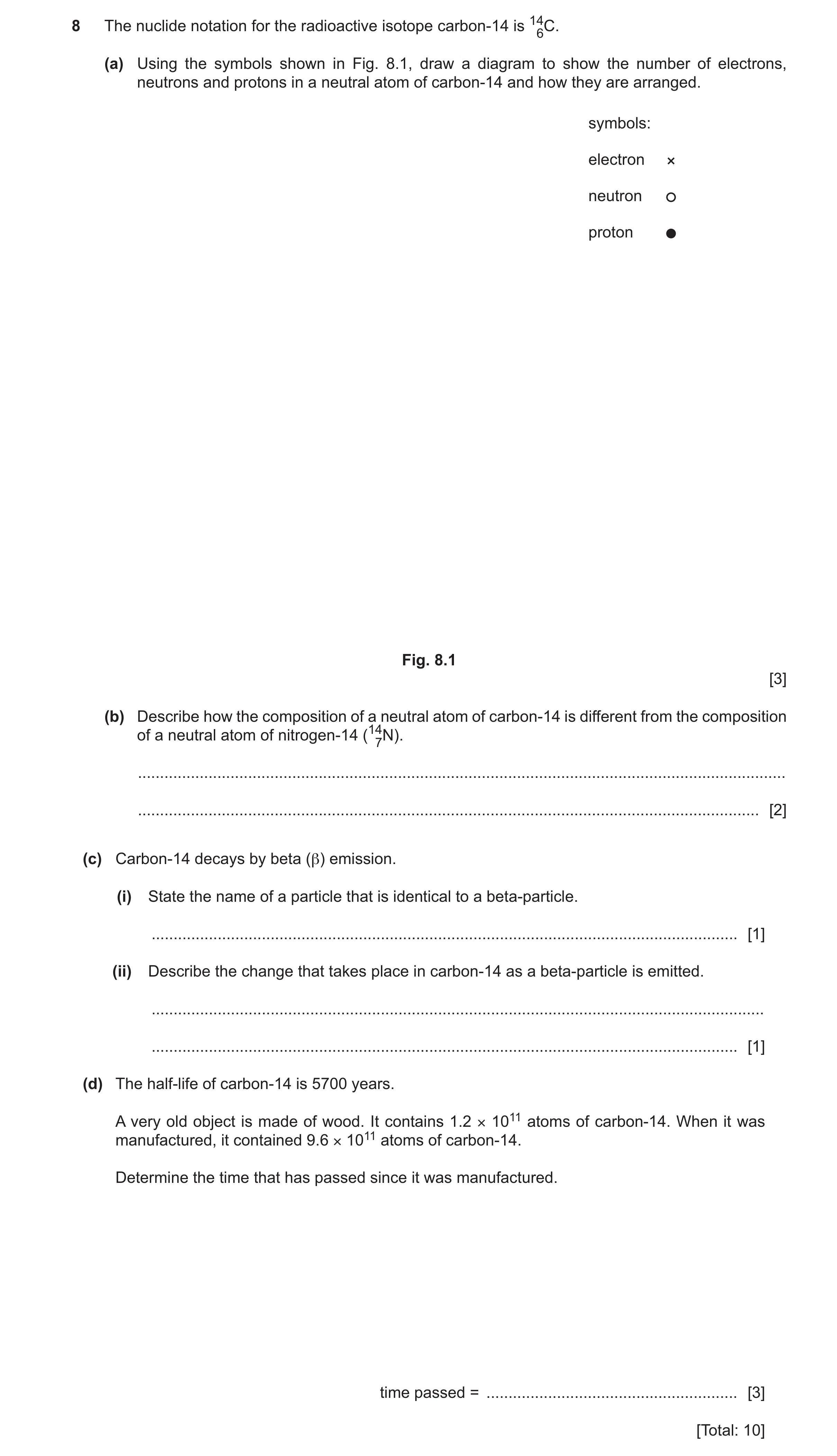
 32 / 36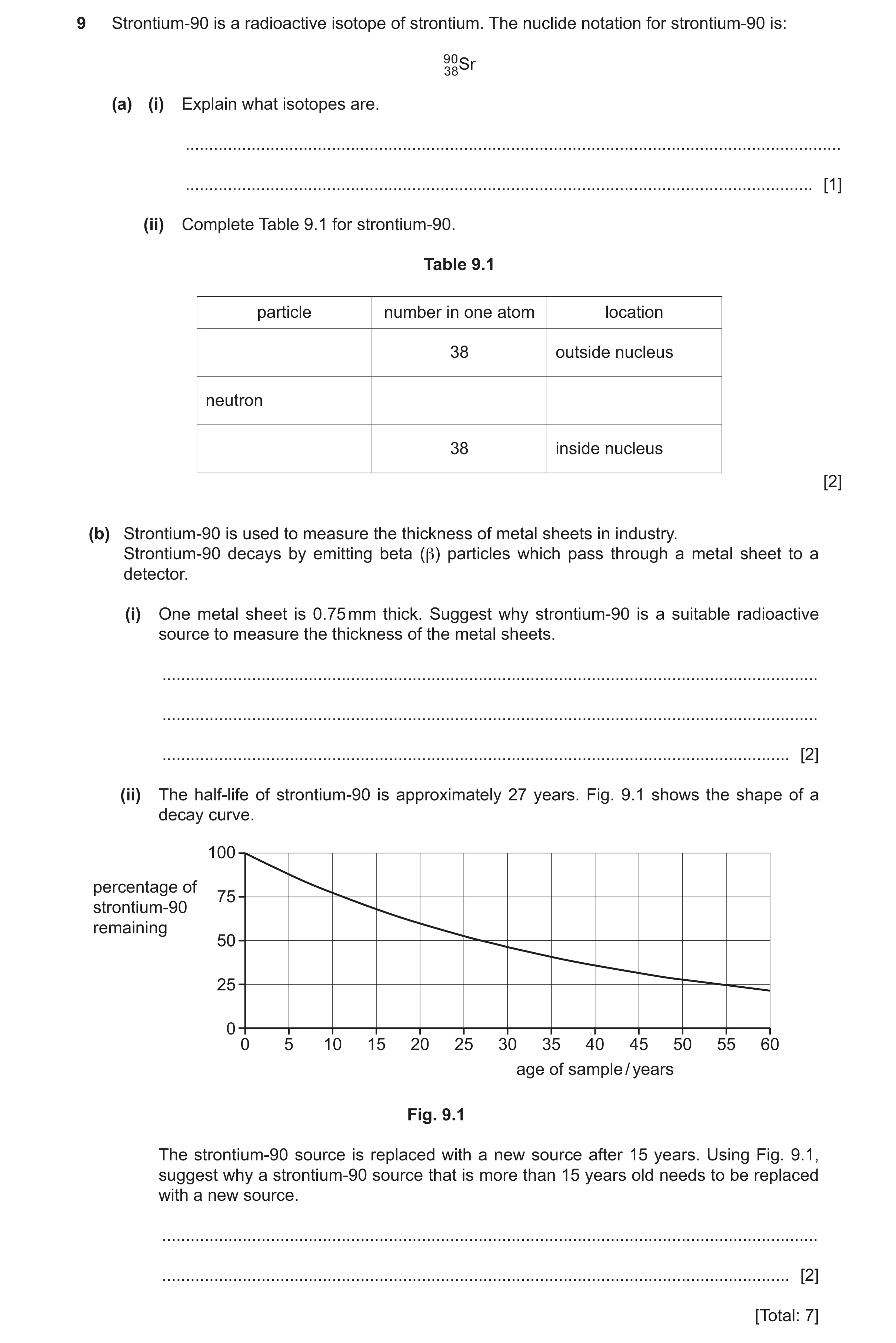
 36 / 36
 7
7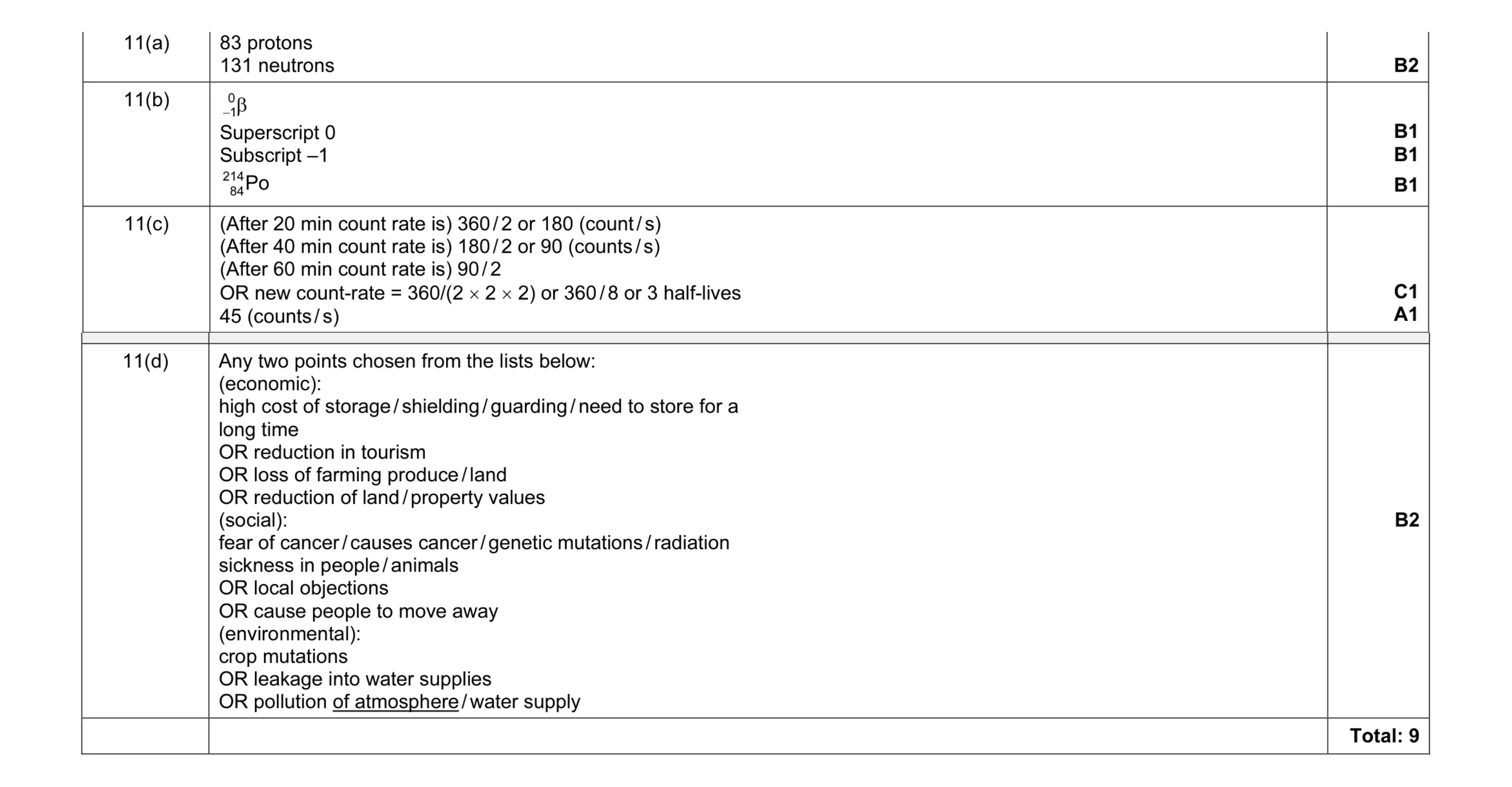 9
9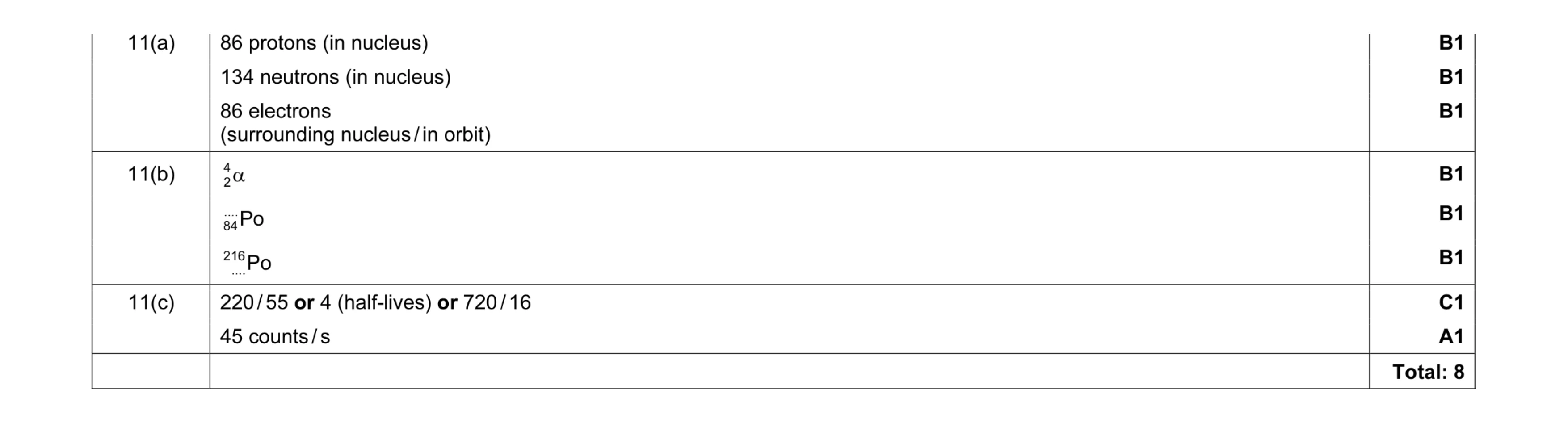 8
8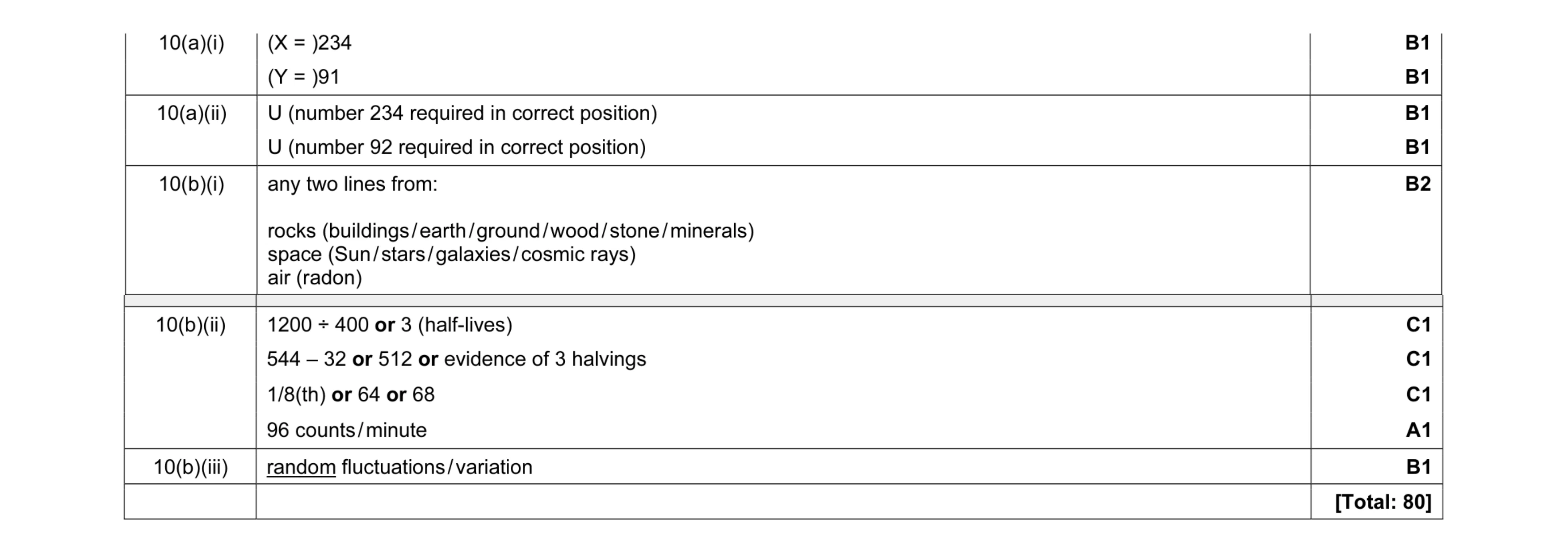 11
11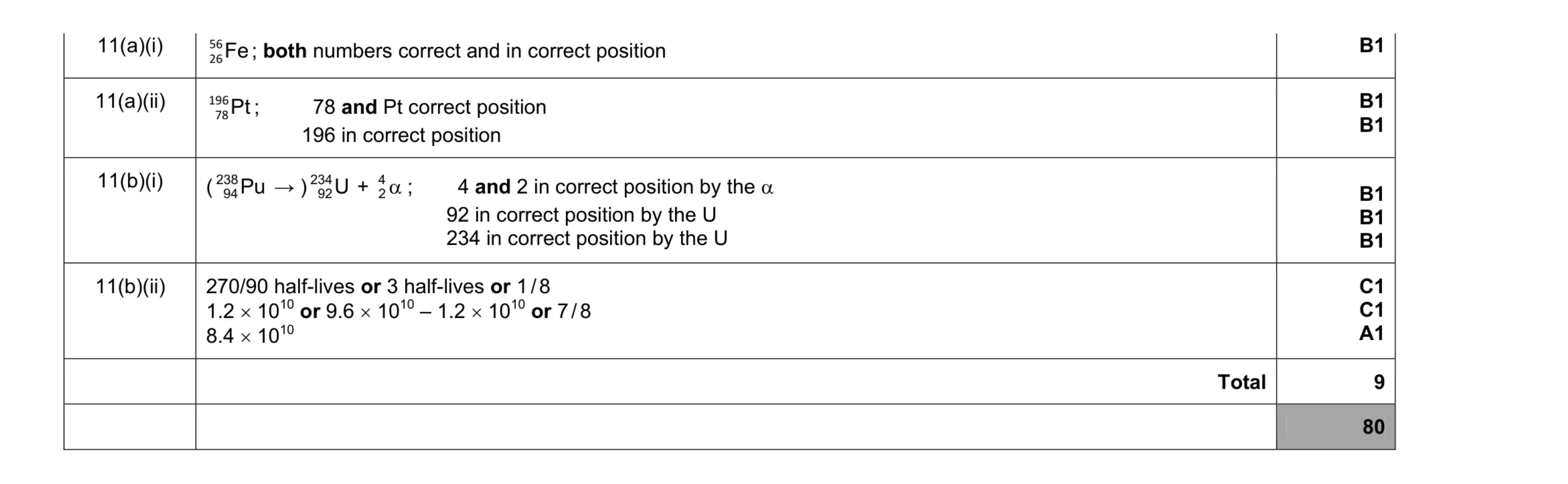 9
9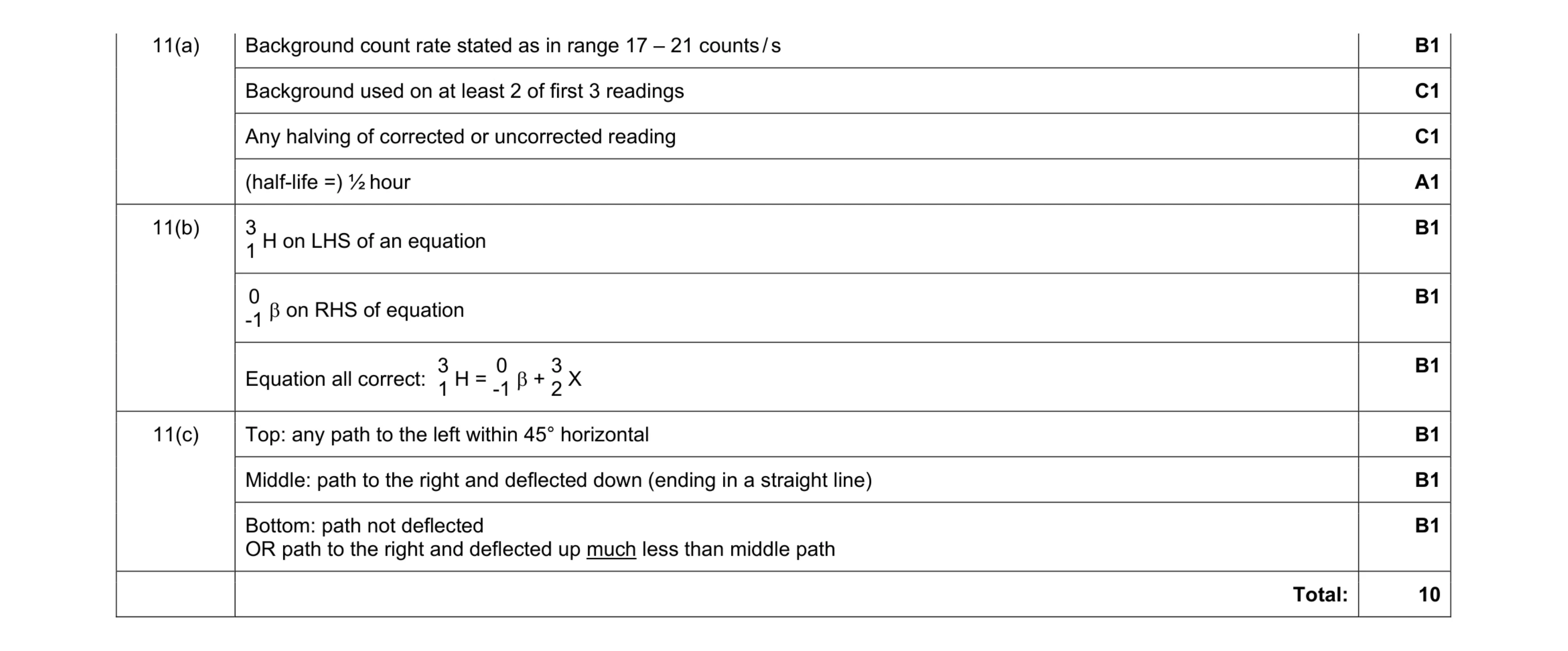 10
10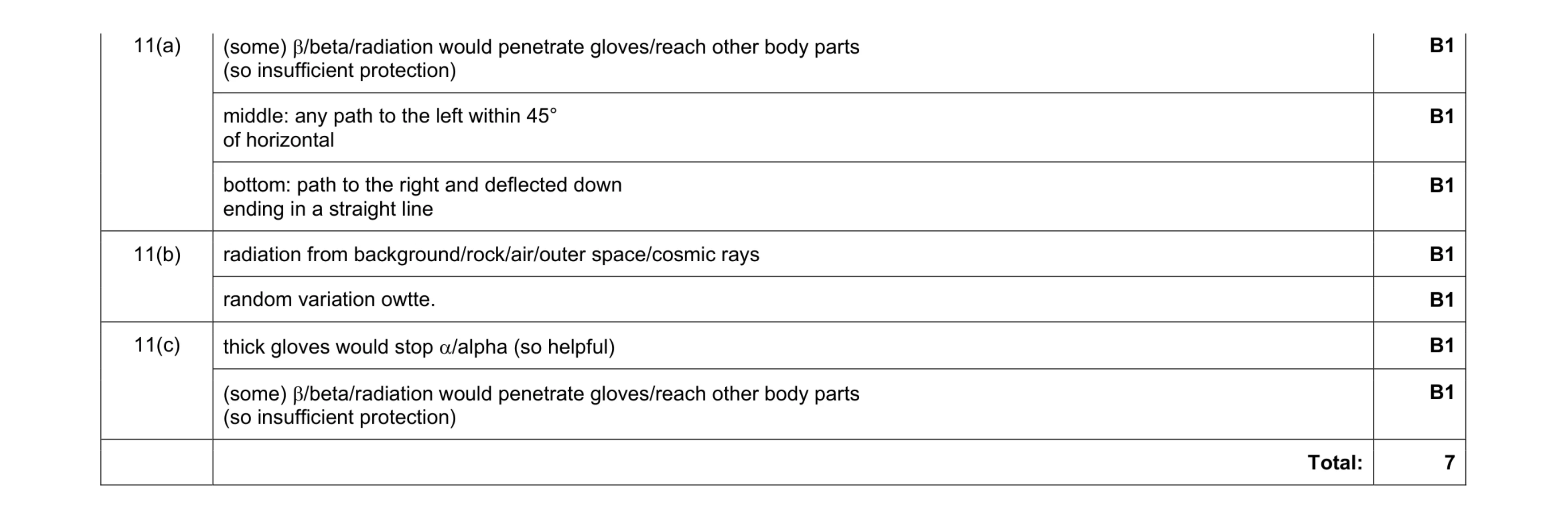 7
7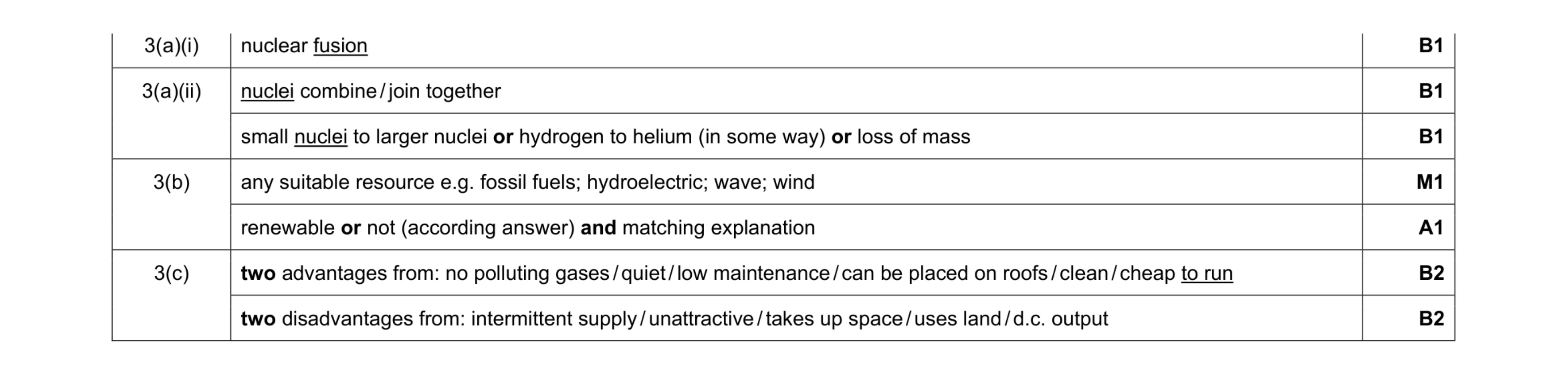 9
9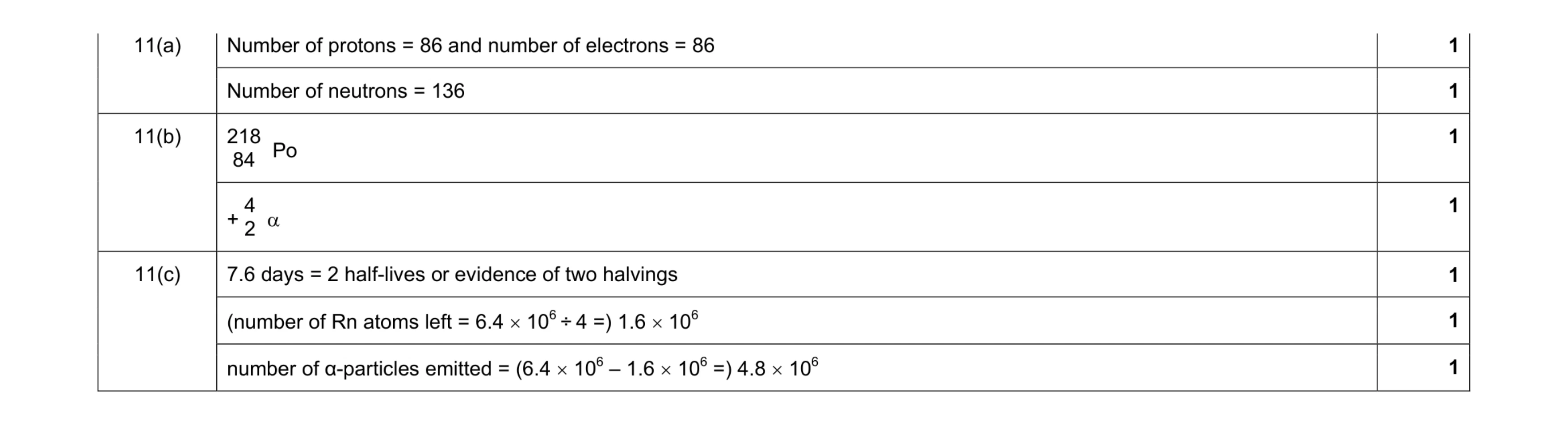 7
7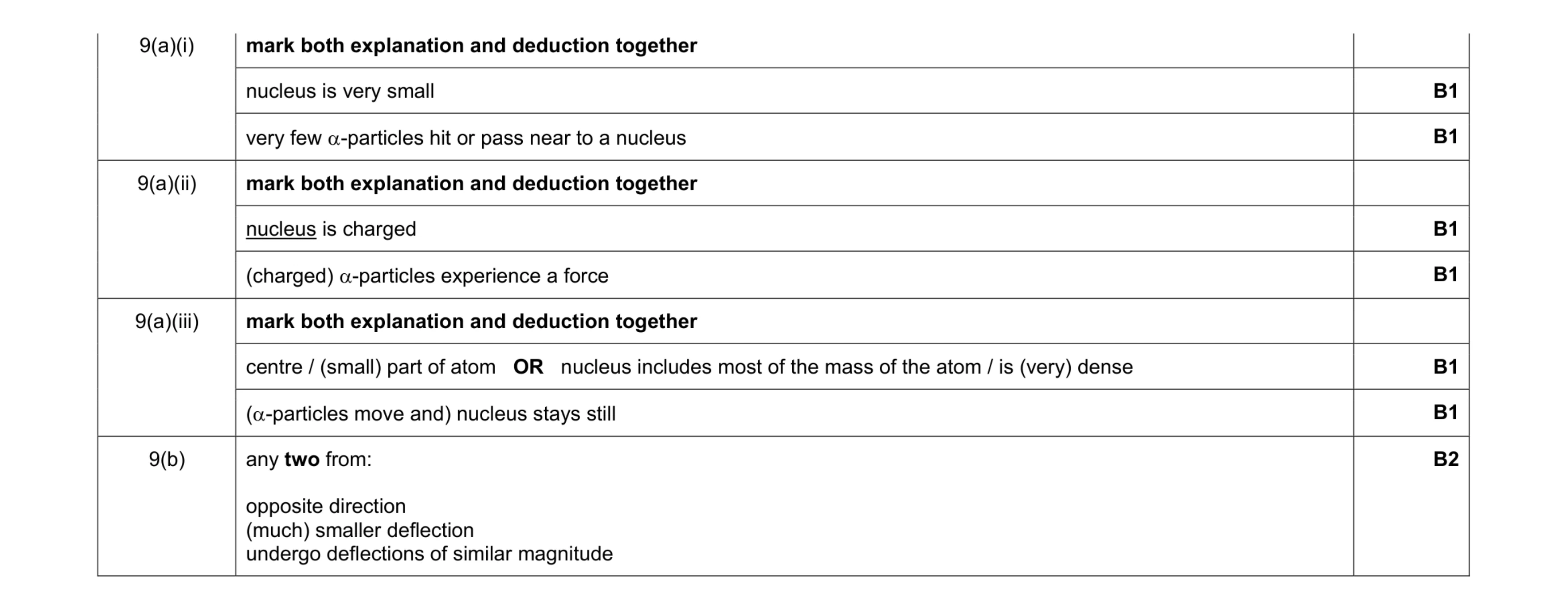 8
8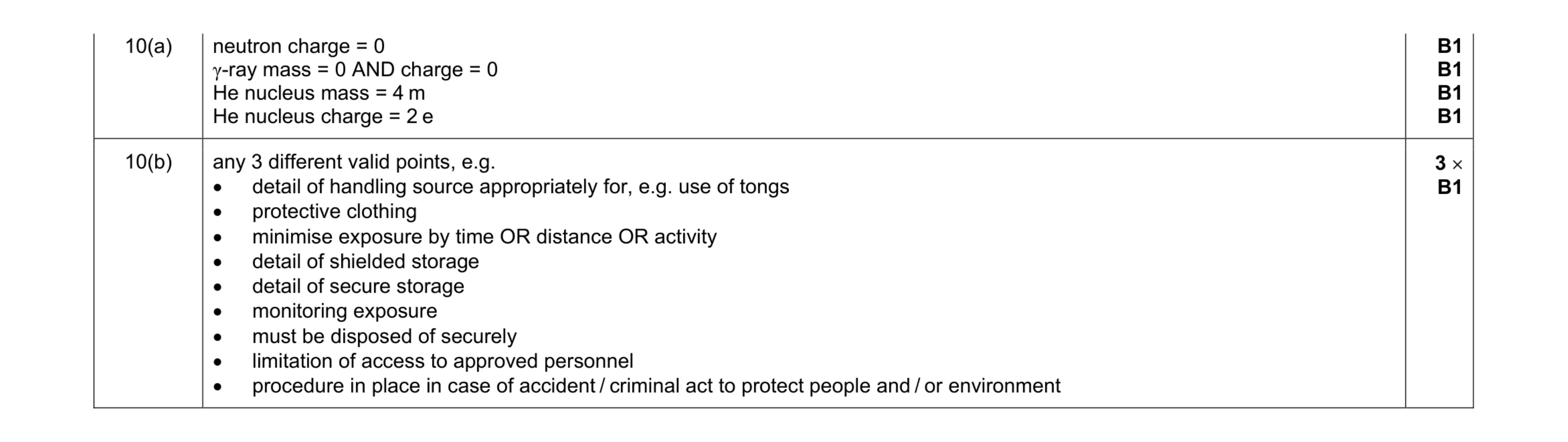 7
7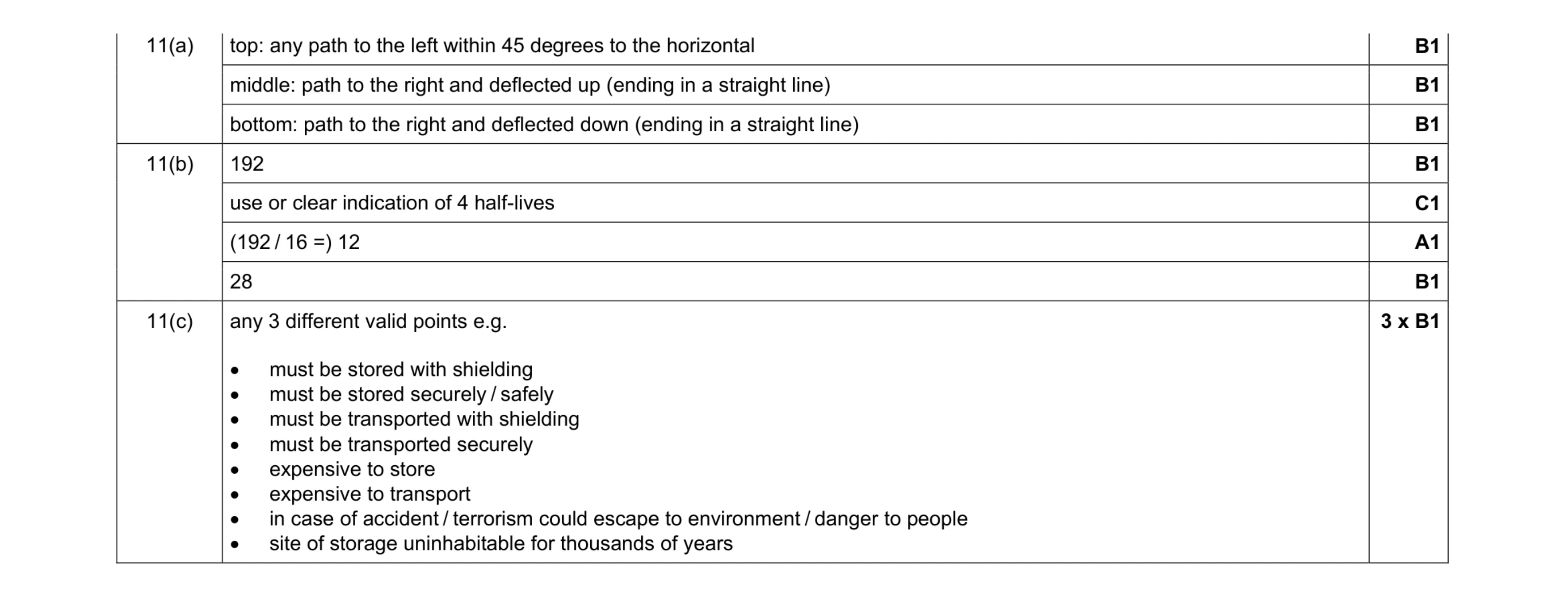 10
10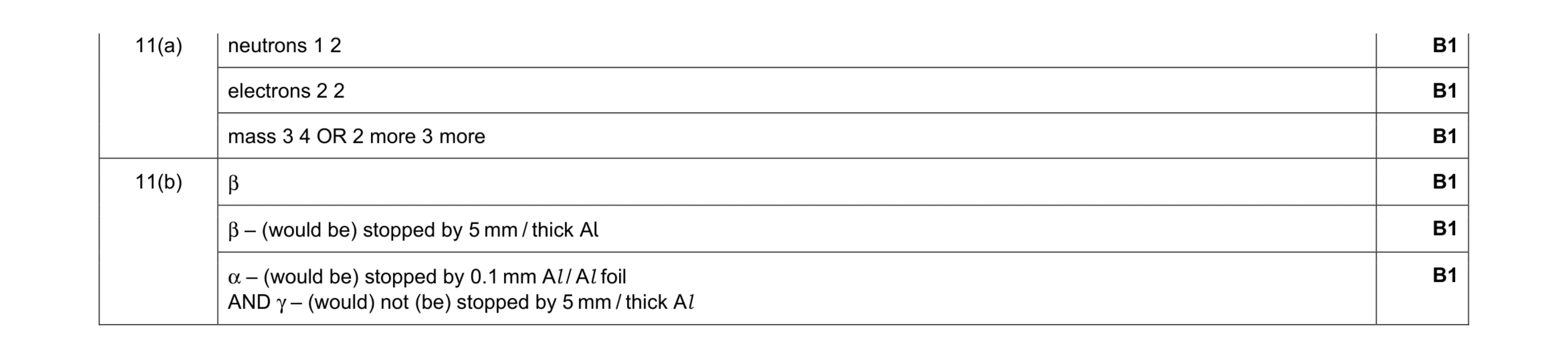 6
6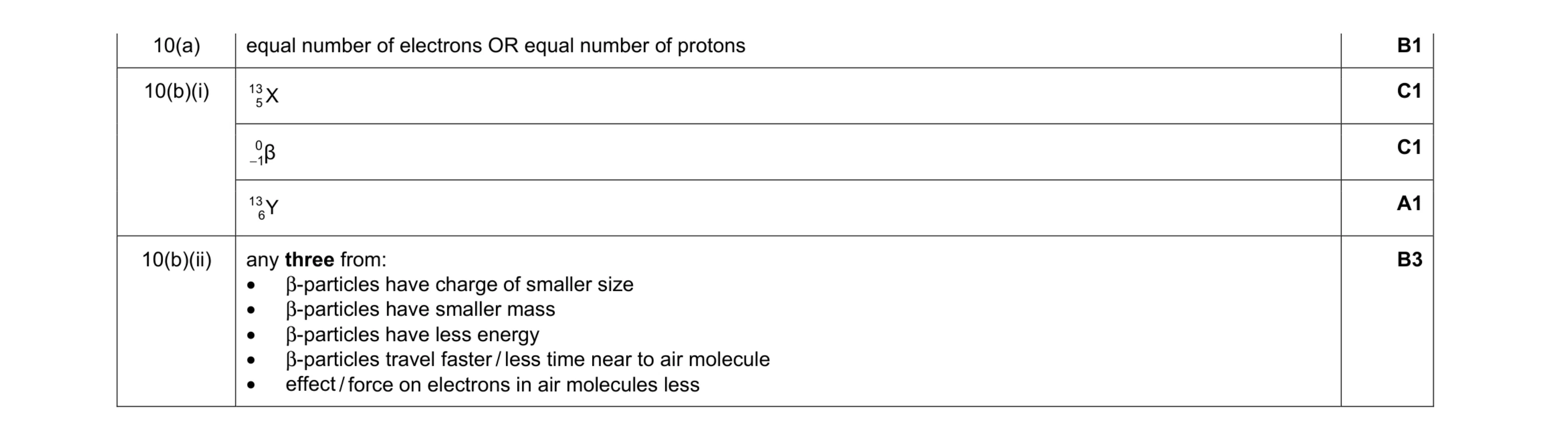 7
7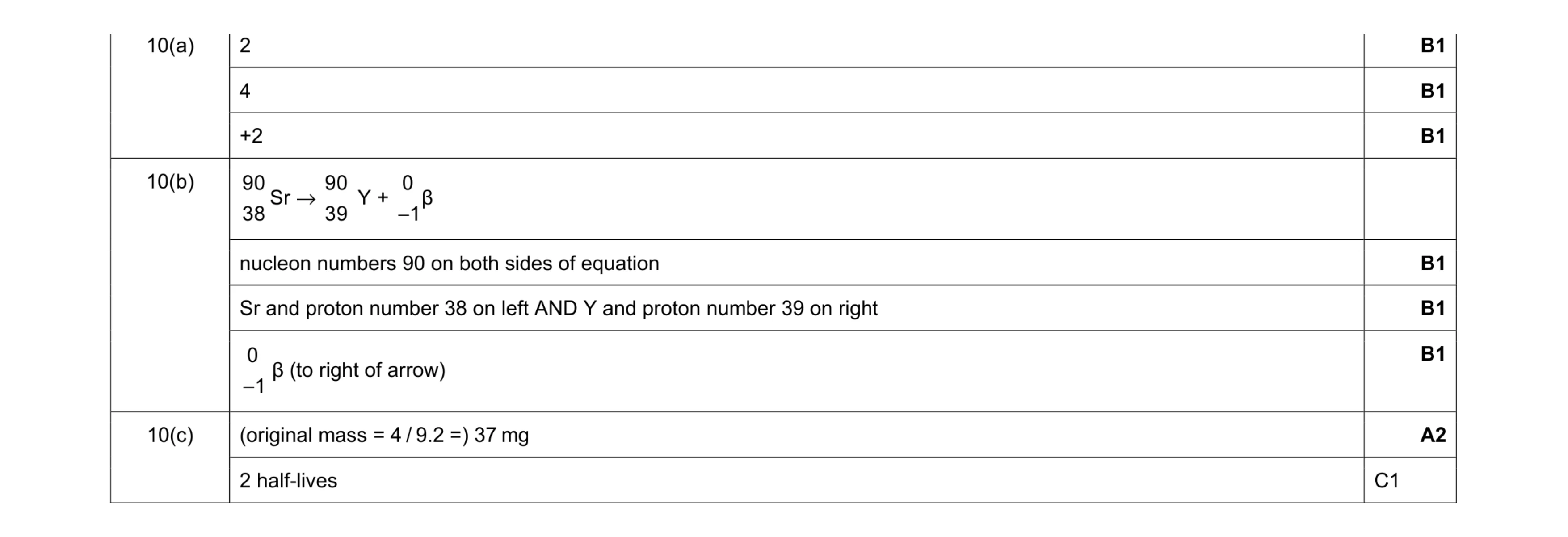 8
8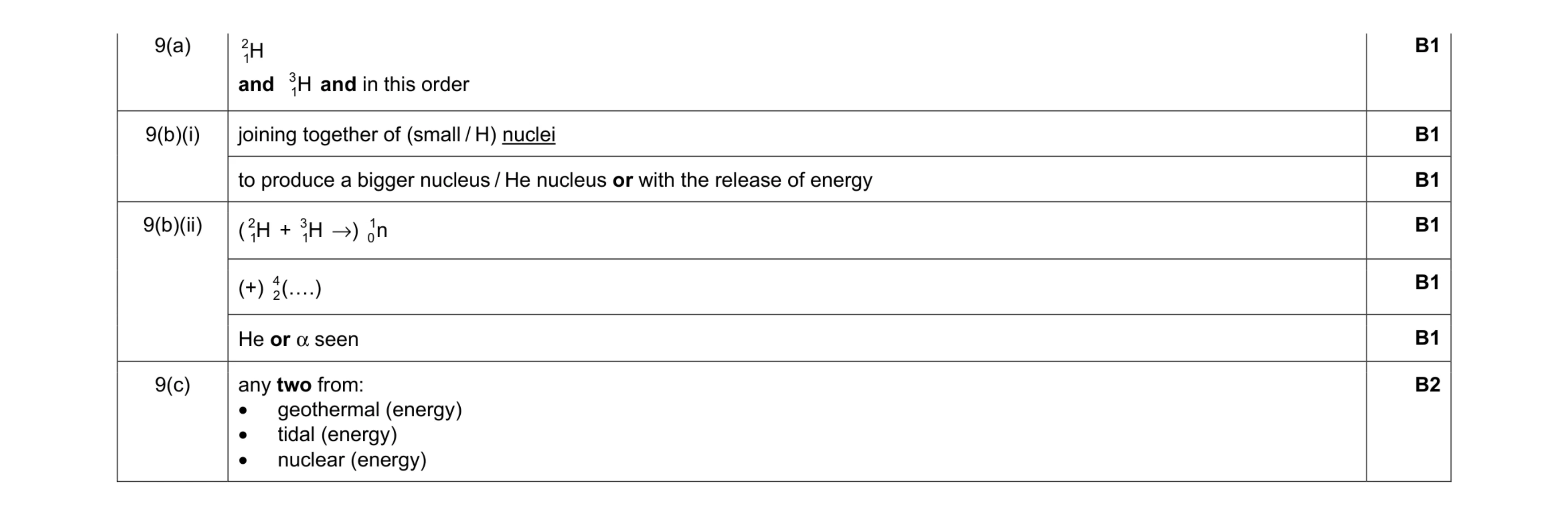 8
8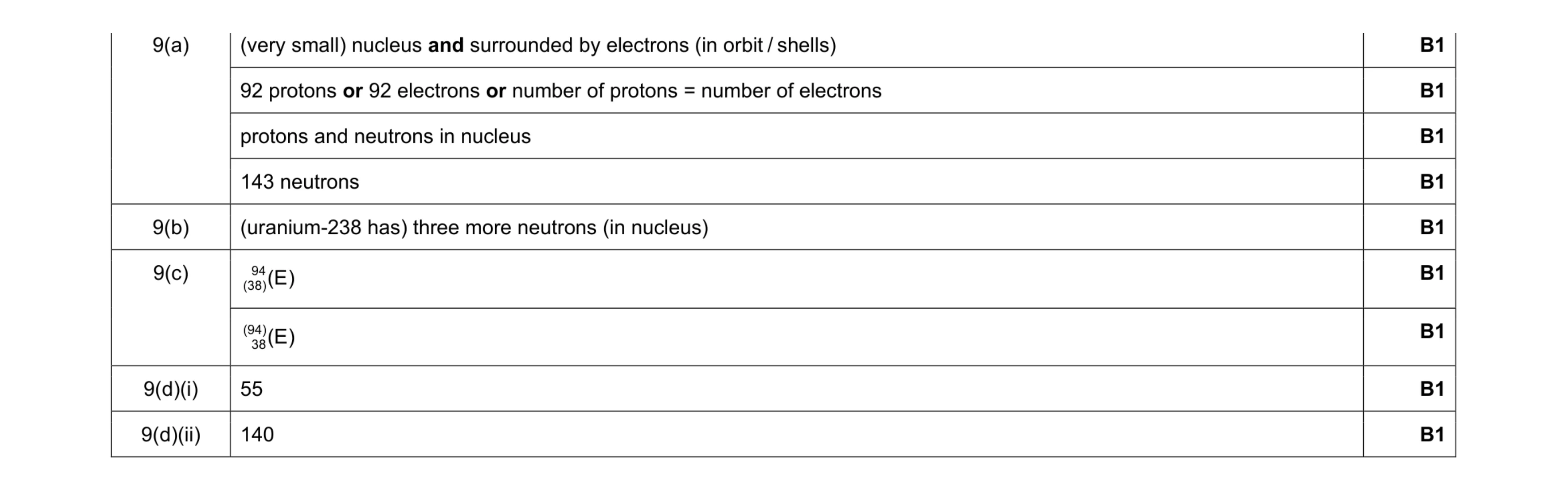 9
9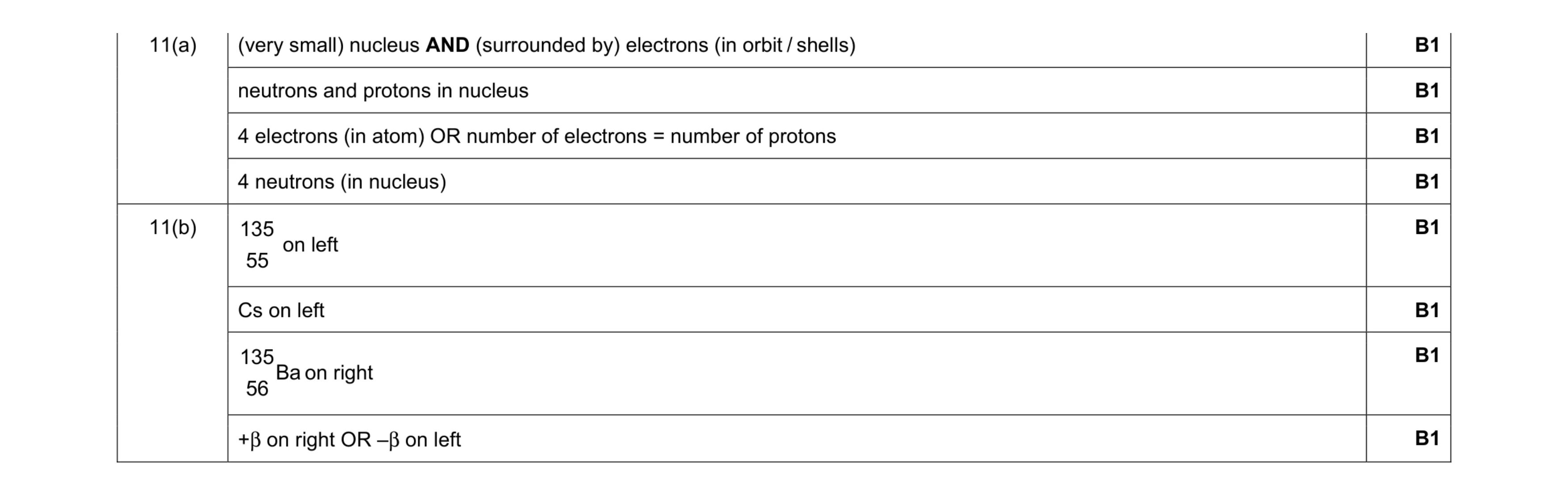 8
8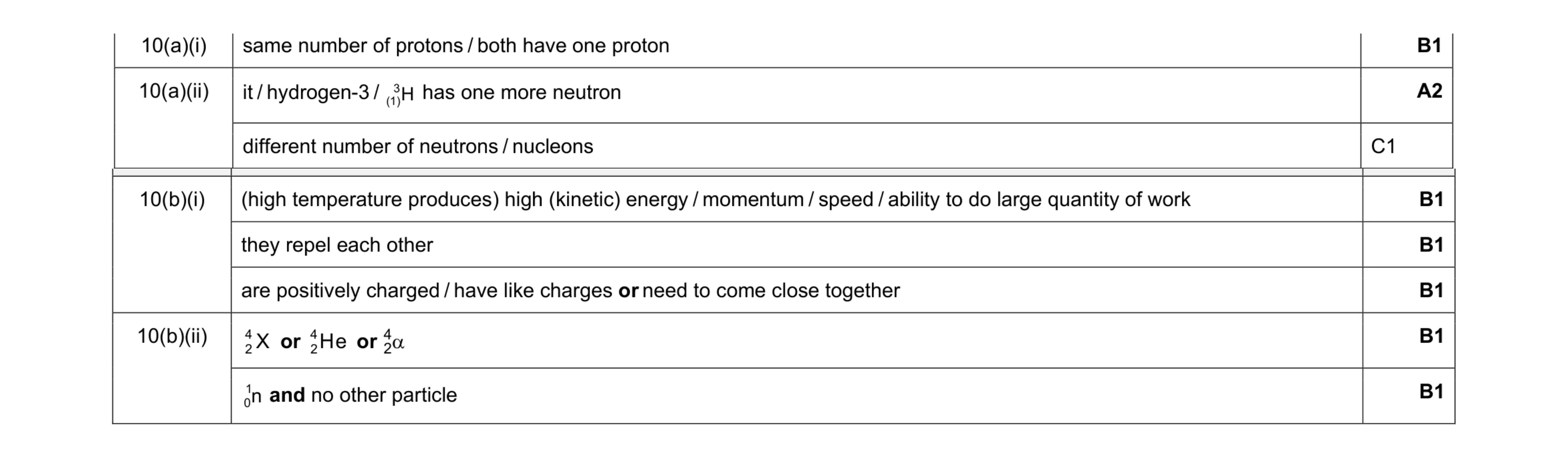 8
8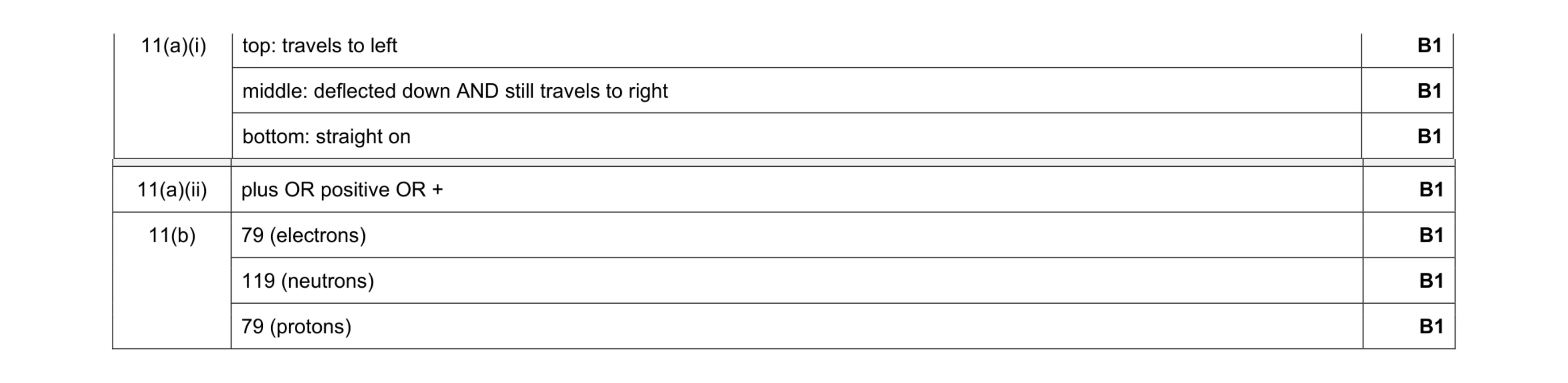 7
7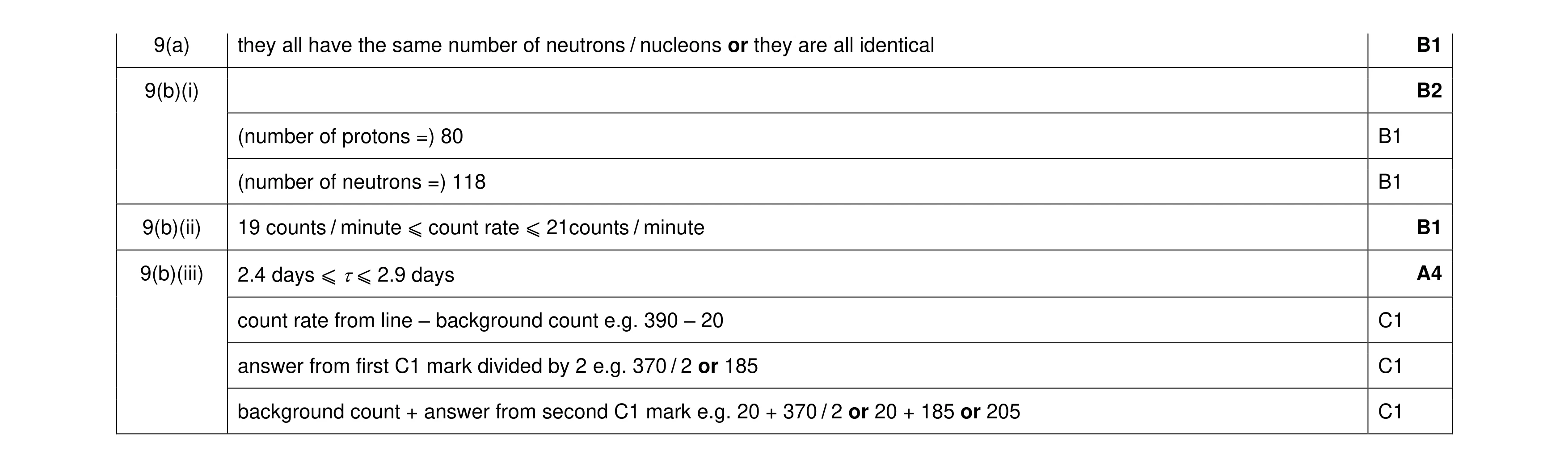 8
8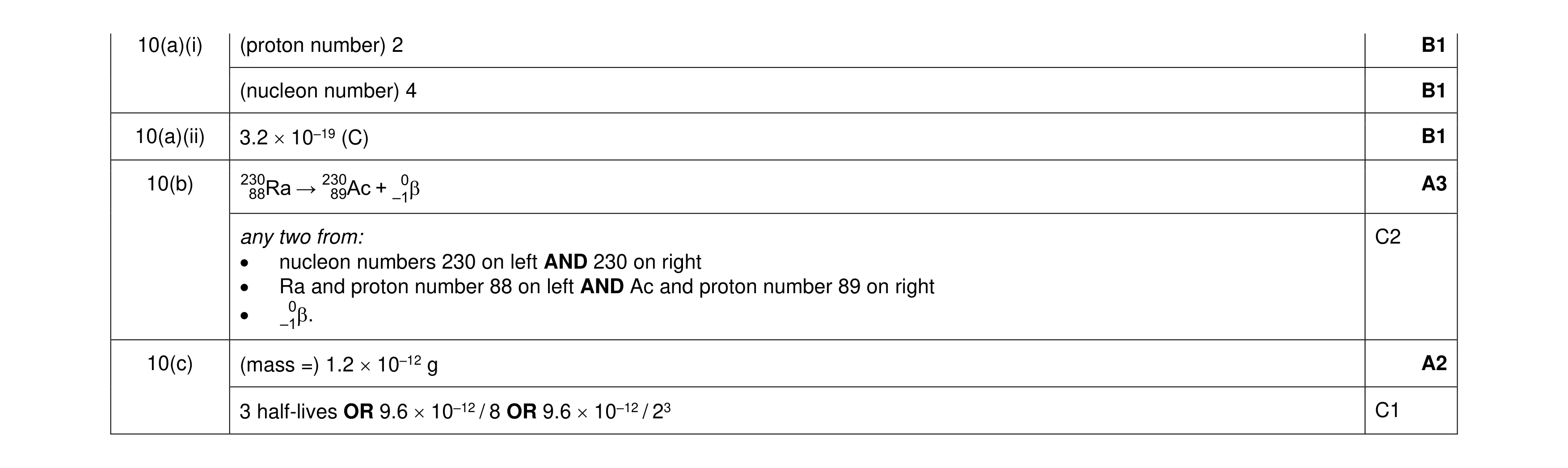 8
8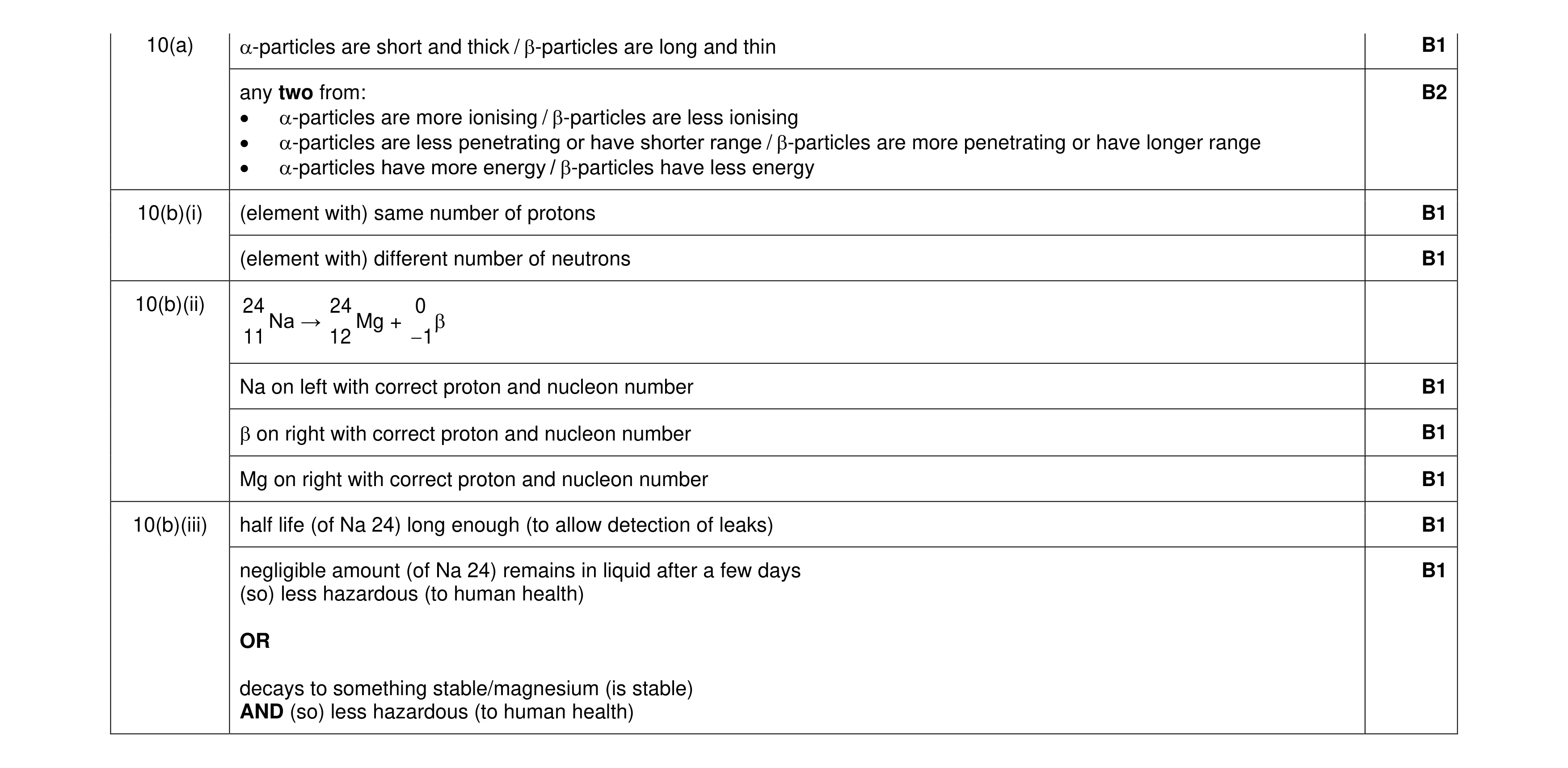 10
10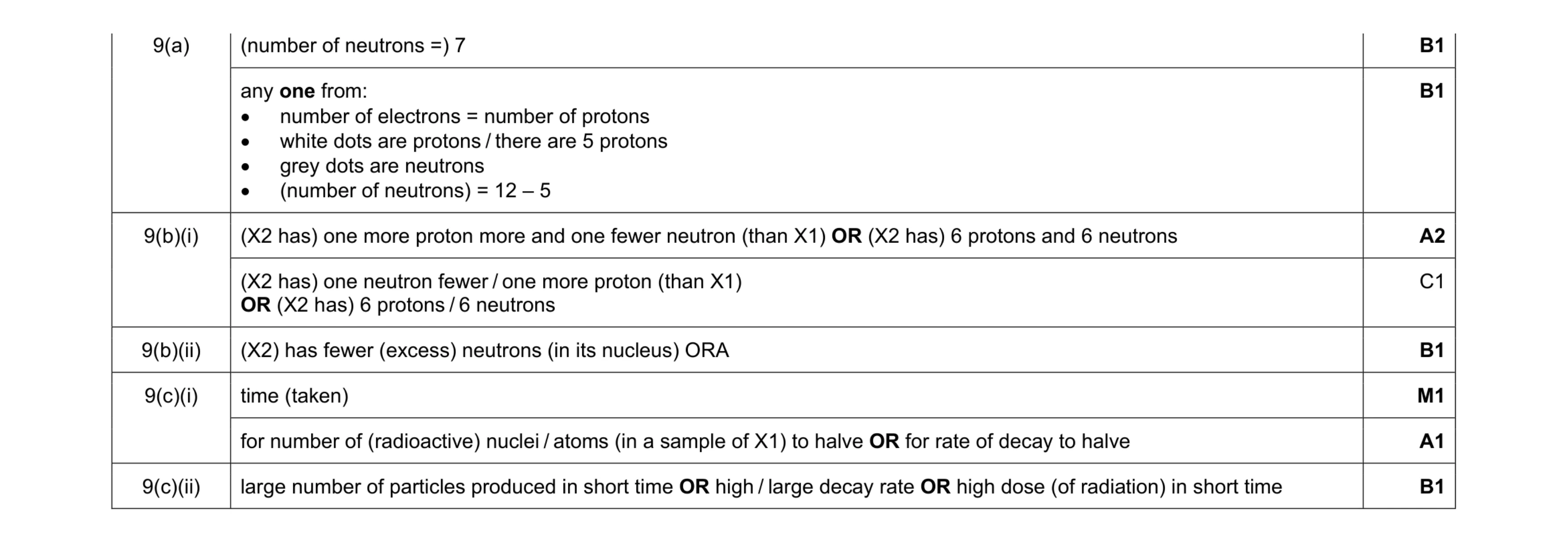 8
8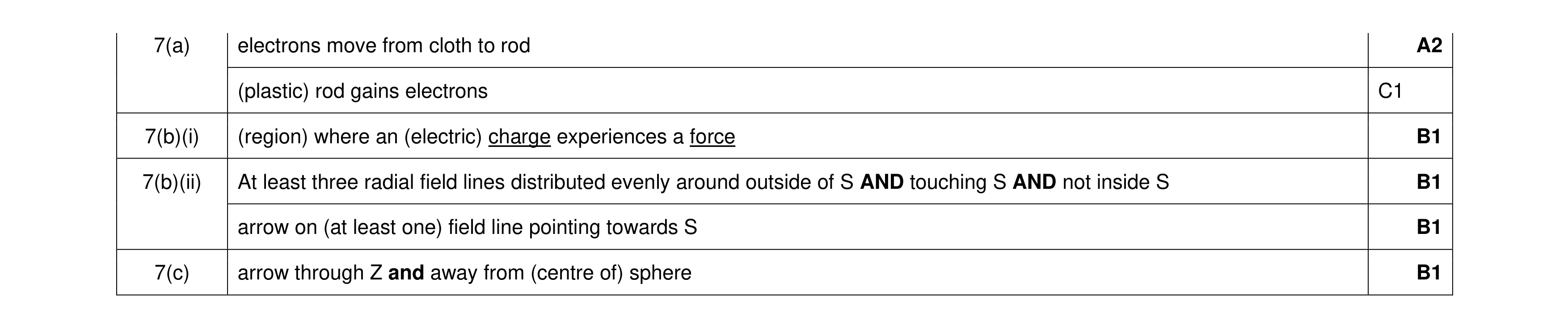 6
6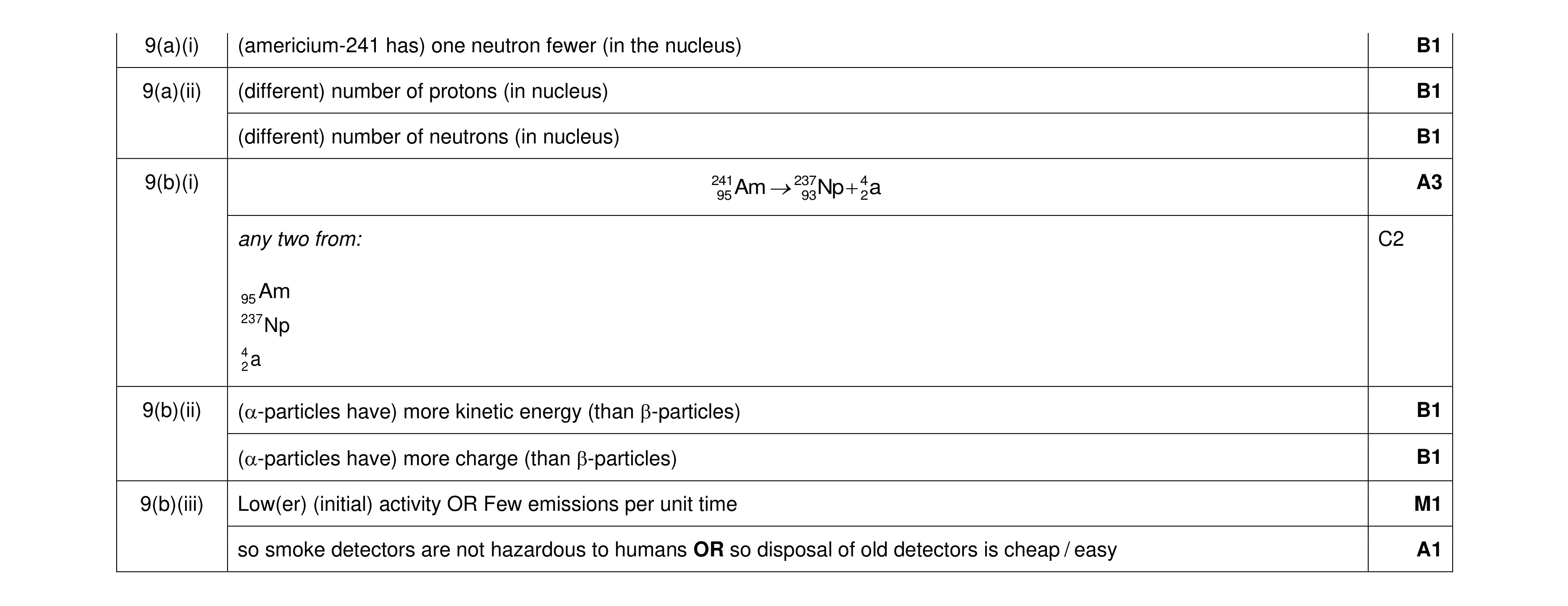 10
10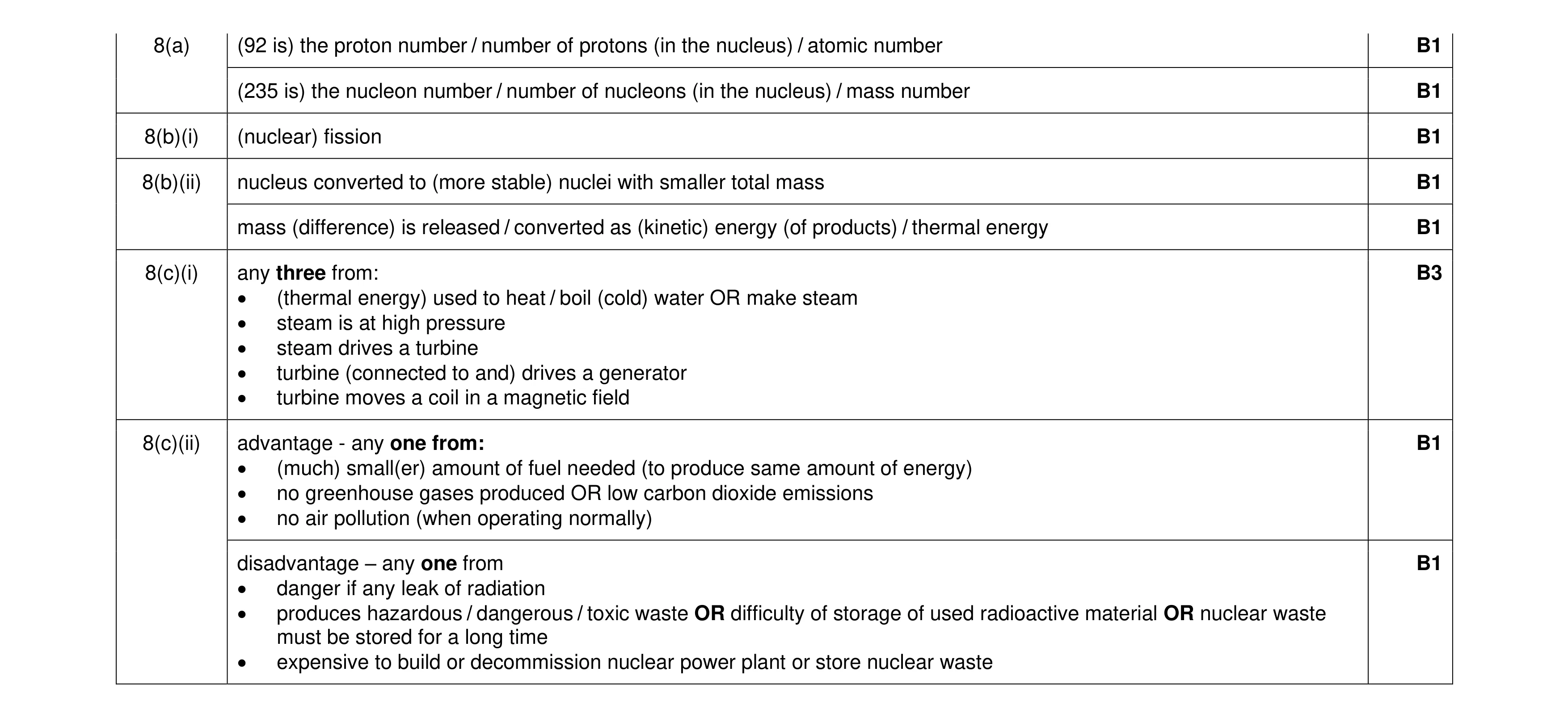 10
10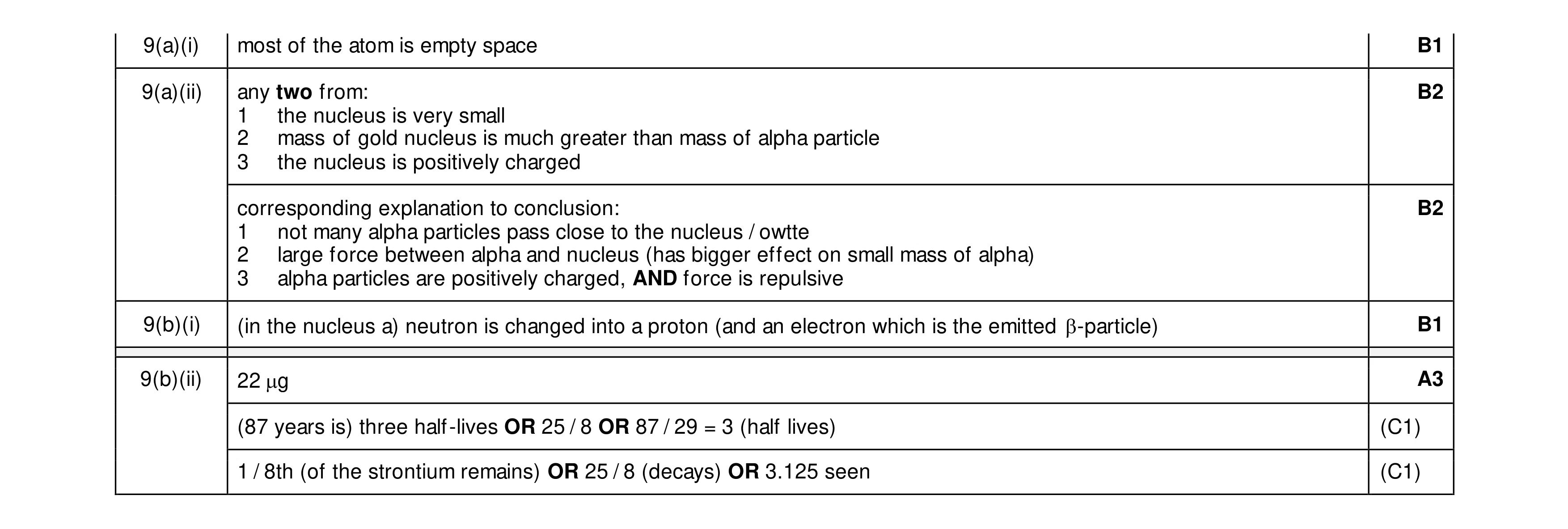 9
9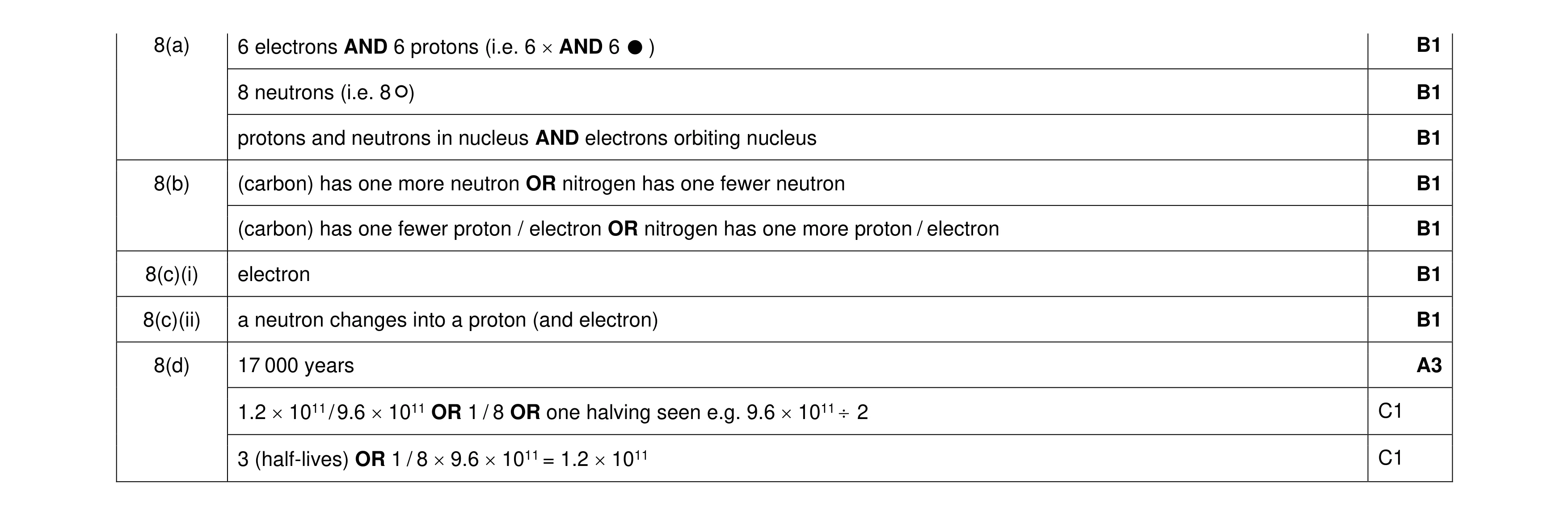 10
10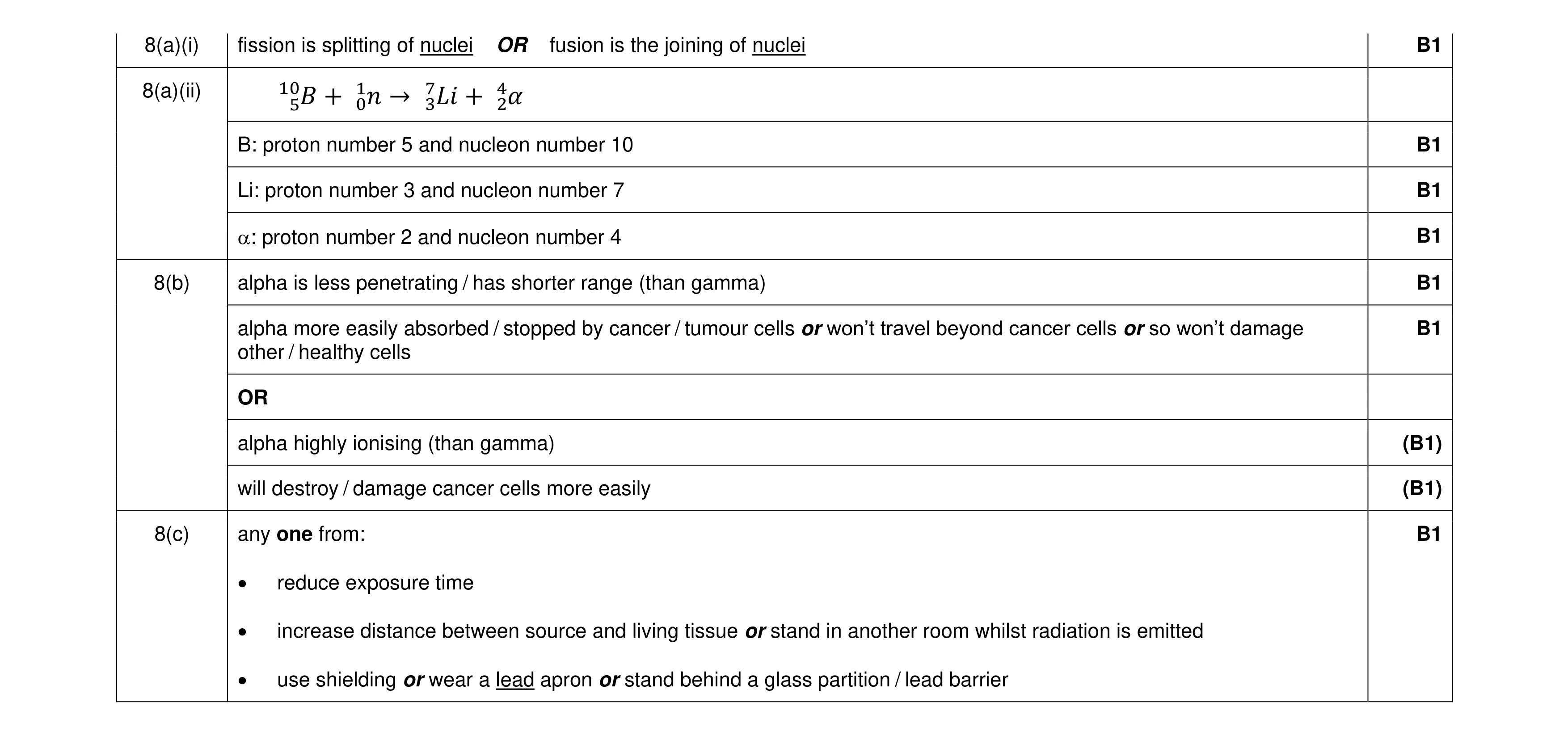 7
7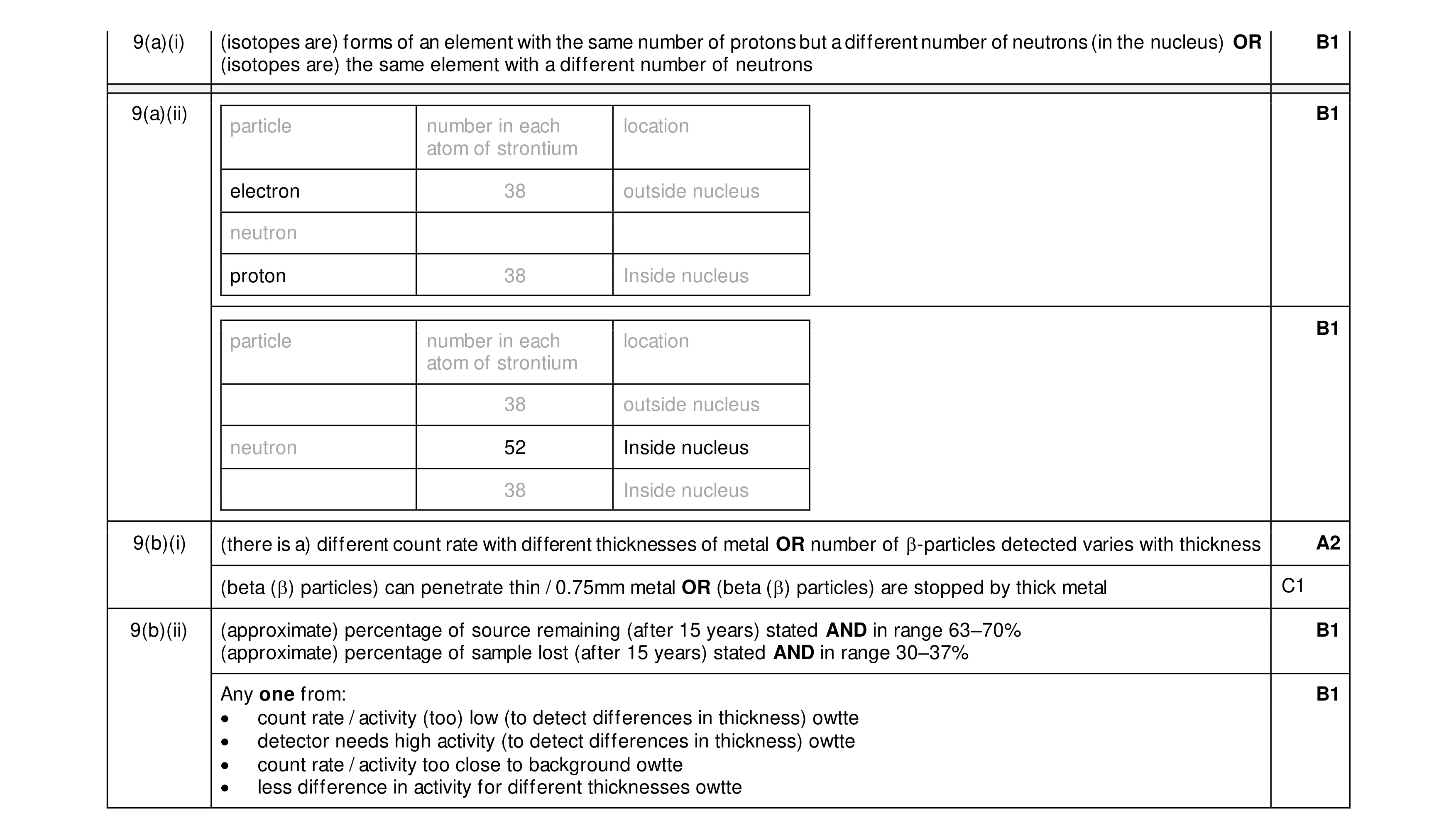 7
7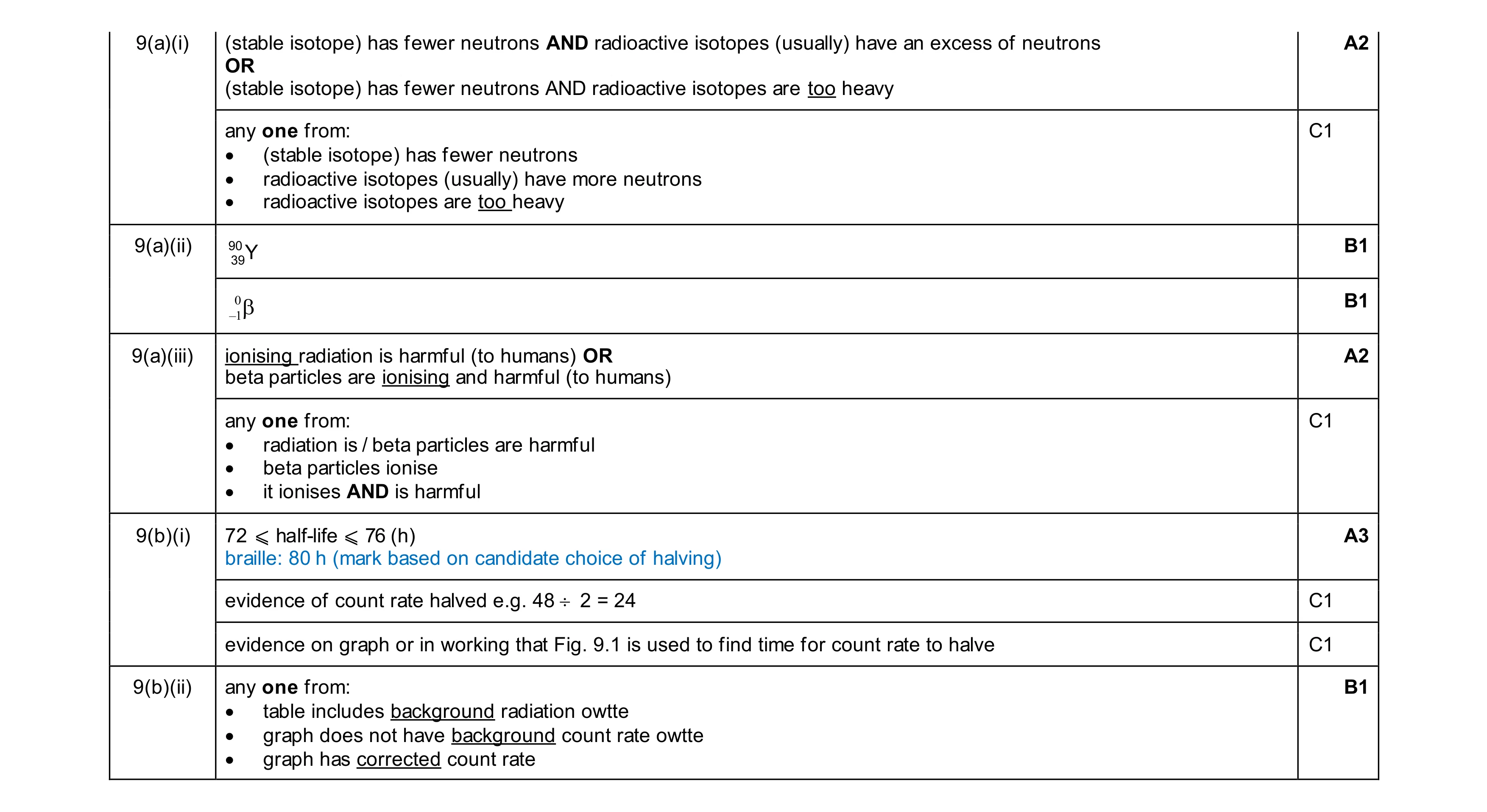 10
10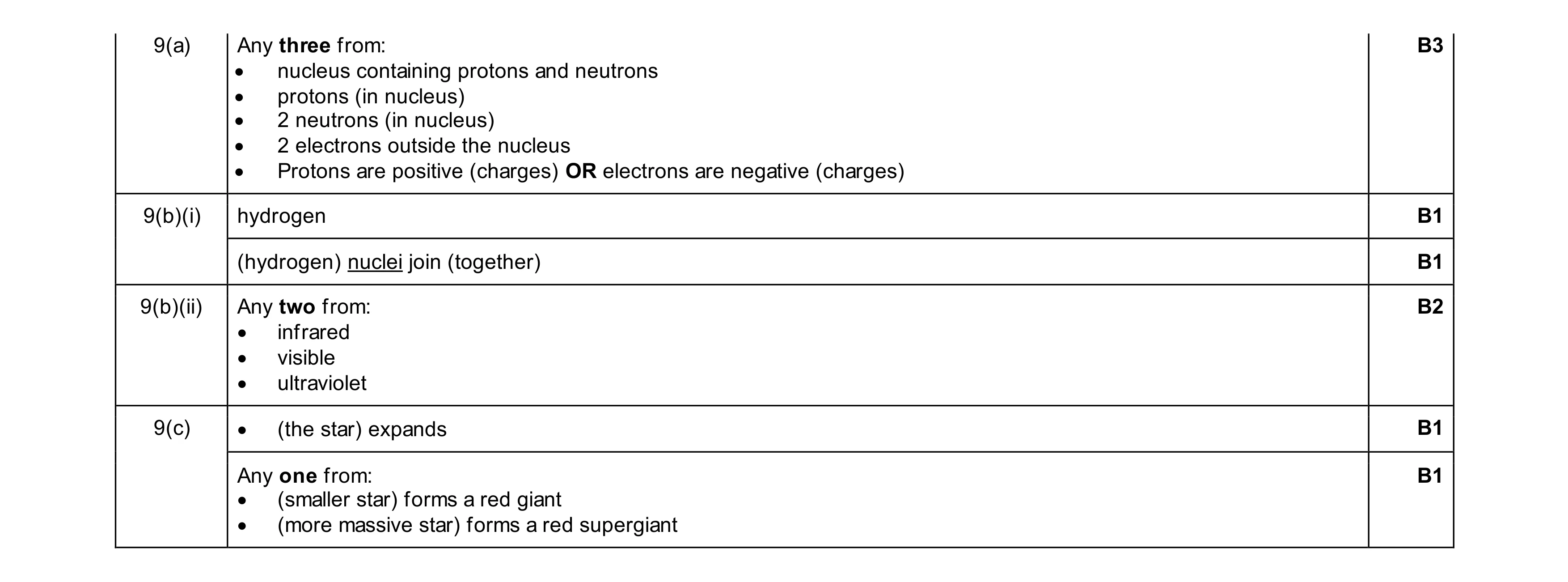 9
9