Questions as text
Q1 · Design a study using an interview to investigate levels of job satisfaction following a… 9990/42 Feb/March 2018
8 (a) Design a study using an interview to investigate levels of job satisfaction following a job rotation. [10] (b) Explain the psychological and methodological evidence on which your interview is based. [8] Section C You must answer one question from this section. Psychology and abnormality
18 marks
Mark scheme: 8(a) Design a study using an interview to investigate levels of job 10 satisfaction following a job rotation. Marks: use generic levels of response ‘Design a study’ question part (a). Additional: Candidates should design the study showing evidence of design features appropriate to the named method. The named method is: interview. Typical features: • Questionnaires/Interviews: type, setting, example questions. Scoring/rating scale, analysis of responses. • Typical features of research methodology: sampling technique and sample, type of data, ethics, reliability, validity, data analysis. 8(b) Explain the psychological and methodological evidence on which your 8 interview is based. Marks: use generic levels of response ‘Design a study’ question part (b). Note: If only methodological or psychological explanation is provided max 5 marks Candidates are expected to explain the reasons for the suggested design in part (a). Explanation should be both psychological and methodological. Psychological to include appropriate theory or research. Syllabus: theories of job satisfaction: techniques of job design: enrichment, rotation and enlargement. Additional: candidates are expected to justify their decisions or evidence presented regarding the design made in answer to question part (a). Psychological: • job rotation is where workers are moved from one task to another to avoid boredom. This may be done on a daily, weekly or even a monthly basis depending on the task. • job enrichment is where workers are given more responsibility in the task they do. This may also include redesigning the task (as they are the user, the expert) or it may involve being responsible for a team of workers completing a task. • job enlargement allows workers to take on additional and more varied tasks. No change in responsibility or involvement but an increase in workload. Methodological: explanation of method using typical features as above. Section C: Evaluation question = 12 marks
This question in 9990/42 Feb/March 2018
Q2 · ‘Job design techniques always improve job satisfaction.’ To what extent do you agree with… 9990/41 May/June 2018
12 ‘Job design techniques always improve job satisfaction.’ To what extent do you agree with this statement? Use examples of research you have studied to support your answer. [12]
12 marks
Mark scheme: 12 ‘Job design techniques always improve job satisfaction.’ 12 To what extent do you agree with this statement? Use examples of research you have studied to support your answer. Marks: use generic levels of response in table C. Syllabus: theories of job satisfaction: techniques of job design: enrichment, rotation and enlargement. Most likely (any other appropriate responses should be credited): Satisfaction of job redesign (general term) depends on a number of factors: For: • job enrichment is where workers are given more responsibility in the task they do. This may also include redesigning the task (as they are the user, the expert) or it may involve being responsible for a team of workers completing a task. This should increase satisfaction • job enlargement allows workers to take on additional and more varied tasks. No change in responsibility or involvement but an increase in workload. May or may not improve satisfaction. Against: • job rotation keeps the worker at the same level of responsibility; there is simply a change in task to be done. There is variation and so reduces boredom, but it is unlikely to improve job satisfaction. Rotation done slowly e.g. rotate each month • Job enlargement may also not improve satisfaction. • The measure of job satisfaction may have flaws and so workers report negatively. • There may be other variables within an organisation or within an individual that result in job dissatisfaction such as physical and psychological working conditions, being too qualified for tasks, having a need for intrinsic motivation.
This question in 9990/41 May/June 2018
Q3 · ‘Job design techniques always improve job satisfaction.’ To what extent do you agree with… 9990/43 May/June 2018
12 ‘Job design techniques always improve job satisfaction.’ To what extent do you agree with this statement? Use examples of research you have studied to support your answer. [12]
12 marks
Mark scheme: 12 ‘Job design techniques always improve job satisfaction.’ 12 To what extent do you agree with this statement? Use examples of research you have studied to support your answer. Marks: use generic levels of response in table C. Syllabus: theories of job satisfaction: techniques of job design: enrichment, rotation and enlargement. Most likely (any other appropriate responses should be credited): Satisfaction of job redesign (general term) depends on a number of factors: For: • job enrichment is where workers are given more responsibility in the task they do. This may also include redesigning the task (as they are the user, the expert) or it may involve being responsible for a team of workers completing a task. This should increase satisfaction • job enlargement allows workers to take on additional and more varied tasks. No change in responsibility or involvement but an increase in workload. May or may not improve satisfaction. Against: • job rotation keeps the worker at the same level of responsibility; there is simply a change in task to be done. There is variation and so reduces boredom, but it is unlikely to improve job satisfaction. Rotation done slowly e.g. rotate each month • Job enlargement may also not improve satisfaction. • The measure of job satisfaction may have flaws and so workers report negatively. • There may be other variables within an organisation or within an individual that result in job dissatisfaction such as physical and psychological working conditions, being too qualified for tasks, having a need for intrinsic motivation.
This question in 9990/43 May/June 2018
Q4 · Design a study using a questionnaire to investigate whether intrinsic or extrinsic… 9990/41 Oct/Nov 2018
8 (a) Design a study using a questionnaire to investigate whether intrinsic or extrinsic motivation is more effective for workers in an organisation. [10] (b) Explain the psychological and methodological evidence on which your questionnaire is based. [8] Section C You must answer one question from this section. Psychology and abnormality
18 marks
Mark scheme: 8(a) Design a study using a questionnaire to investigate whether intrinsic 10 or extrinsic motivation is more effective for workers in your organisation. Marks: use generic levels of response Design a study question part (a). Additional: Candidates should design the study showing evidence of design features appropriate to the named method. The named method is: Questionnaire Typical features: • Questionnaires/Interviews: type, setting, example questions. Scoring/rating scale, analysis of responses. • Typical features of research methodology: sampling technique and sample, type of data, ethics, reliability, validity, data analysis. 8(b) Explain the psychological and methodological evidence on which your 8 questionnaire is based. Marks: use generic levels of response ‘Design a study’ question part (b). Note: If only methodological or psychological explanation is provided max 5 marks Candidates are expected to explain the reasons for the suggested design in part (a). Explanation should be both psychological and methodological. Psychological to include appropriate theory or research. Additional: candidates are expected to justify their decisions or evidence presented regarding the design made in answer to question part (a). Syllabus: Motivators at work: intrinsic and extrinsic motivation. Psychological: Most likely will be the identification of intrinsic and extrinsic motivators and examples of each. The syllabus categorises these as Extrinsic: types of reward systems: pay, bonuses, profit-sharing, performance-related pay. Intrinsic: non-monetary rewards: praise, respect, recognition, empowerment and a sense of belonging. Methodological: explanation of method using typical features as above.
This question in 9990/41 Oct/Nov 2018
Q5 · Design a study to investigate how much managers know about Maslow’s hierarchy of needs 9990/42 Oct/Nov 2018
8 (a) Design a study to investigate how much managers know about Maslow’s hierarchy of needs. [10] (b) Explain the psychological and methodological evidence on which your study is based. [8] Section C You must answer one question from this section. Psychology and abnormality
18 marks
Mark scheme: 8(a) Design a study to investigate how much managers know about 10 Maslow’s hierarchy of needs. Marks: use generic levels of response Design a study question part (a). Additional: Candidates should design the study showing evidence of design features appropriate to the named method. The named method is: any appropriate method. Typical features: • Experiments: type, IV, DV, controls, experimental design. • Observations: type, setting, response categories, sampling frame, number of observers. • Questionnaires/Interviews: type, setting, example questions. Scoring/rating scale, analysis of responses. • Typical features of research methodology: sampling technique and sample, type of data, ethics, reliability, validity, data analysis. 8(b) Explain the psychological and methodological evidence on which your 8 study is based. Marks: use generic levels of response ‘Design a study’ question part (b). Note: If only methodological or psychological explanation is provided max 5 marks. Candidates are expected to explain the reasons for the suggested design in part (a). Explanation should be both psychological and methodological. Psychological to include appropriate theory or research. Additional: candidates are expected to justify their decisions or evidence presented regarding the design made in answer to question part (a). Syllabus: need theories: hierarchy of needs (Maslow, 1970). Psychological: Maslow's need-hierarchy: five to tier hierarchy: physiological, safety, social, esteem and self actualisation, later expanded to eight. Starting with physiological each must be satisfied in order. 1. Physiological: food, drink, warmth, etc.; 2. Safety: protection from harm, need for law and order; 3. Social: need for affection, relationships and family; 4. Esteem: need for achievement, mastery of skills, status; 5. Cognitive: having knowledge and understanding; 6. Aesthetic: the appreciation and search for beauty; 7. Self actualisation: realising potential; fulfilment; 8. Transcendent: helping others to achieve self-actualisation. Methodological: explanation of method using typical features as above.
This question in 9990/42 Oct/Nov 2018
Q6 · ‘Managers only need to set clear goals to motivate their workers.’ To what extent do you… 9990/42 Oct/Nov 2018
12 ‘Managers only need to set clear goals to motivate their workers.’ To what extent do you agree with this statement? Use examples of research you have studied to support your answer. [12]
12 marks
Mark scheme: 12 ‘Managers only need to set clear goals to motivate their workers.’ 12 To what extent do you agree with this statement? Use examples of research you have studied to support your answer. Marks: use generic levels of response in table C. Syllabus: Motivation to work: cognitive theories: goal-setting theory (Latham and Locke, 1984) Most likely (any other appropriate responses should be credited): For: • Goal-setting is a motivator, and if the goals are ‘SMART’ (specific, measurable, attainable, realistic and time-based) regular targets can be set and achieved. • Achieving goals gives a sense of self-worth – it allows people to feel good about themselves and to self-actualise. • Some people like daily targets; some organisations pay workers when targets are achieved. • Successful managers become skilled at setting appropriate targets for their workers. Against: • Some people are motivated more by extrinsic motivators, such as pay (so intrinsic motivation such as goal-setting is irrelevant) • Poorly designed targets which are difficult to achieve can be de- motivating. • What works for one manager and workers in one organisation may not generalise to others. Goal setting only works for some managers with some workers in some organisations. There are individual differences in worker motivation so the statement in the question is too general.
This question in 9990/42 Oct/Nov 2018
Q7 · ‘I really lack motivation 9990/42 Feb/March 2019
4 ‘I really lack motivation. What I need is ERG: existence, relatedness and growth.’ (a) Explain what is meant by a ‘need theory of motivation’. [2] (b) Suggest one similarity and one difference between the need theories of Maslow and Alderfer. [4] (c) Outline one theory of motivation, other than a need theory. [4] (d) Discuss the advantages and disadvantages of using self-reports to gather data on need theories of motivation. You should include a conclusion in your answer. [5]
15 marks
Mark scheme: 4(a) Explain what is meant by a ‘need theory of motivation’. 2 Most likely answer (other appropriate responses to be credited): A need is something that is necessary to live a healthy life. There are essential ‘physical’ needs for survival such as air, water, food and warmth. There are also ‘subjective’ needs (the concern here) such as the need to be ‘social’ and to self-actualise. These ‘subjective’ needs can vary from one culture to another. The syllabus lists three need theories (Maslow, Alderfer and McClelland) so candidates can use examples from any of these to support their answers if they wish. Marks: 1 mark basic answer (what a need is), 2 marks detailed answer/ elaboration/example. 4(b) Suggest one similarity and one difference between the need theories 4 of Maslow and Alderfer. Most likely answer (other appropriate responses to be credited): Similarity: • both are need theories and are needs that must be satisfied. • both have similar needs, just different words (e.g. physiological and safety = ERG ‘existence’ needs). Differences: • Maslow has 5 (8) needs, ERG has three needs (elaboration = identification of one or more needs) • Maslow – person stays at a need until it is fulfilled; ERG – person may have more than one need at a time. • Maslow – person moves up the hierarchy; ERG – person may revert to accomplish an earlier need (frustration- regression). Marks: 2 marks for difference; 2 marks for similarity (both sides must be stated for full marks) 1 mark if both sides are not stated or merely described. 4(c) Outline one theory of motivation, other than a need theory. 4 Most likely answer (other appropriate responses to be credited): • Cognitive/rational theories of motivation view workers as rational, decision-making beings who cognitively assess (think about) the costs and benefits before acting. • goal-setting theory by Latham and Locke believe that people can be motivated by setting goals and when it is achieved a sense of achievement results. Goal-setting has five principles: Clarity, challenge, commitment, effectiveness and task complexity. • The VIE (or expectancy) theory (Vroom, 1964) believes that workers are rational and decision making is guided by potential costs (negative outcomes) and rewards (positive outcomes) M = E × I × V or motivation = expectancy × instrumentality × valence. • Equity theory (Adams) When people feel fairly treated they are more likely to be motivated; when they feel unfairly treated they are prone to feelings of disaffection and demotivation. Employees seek to maintain equity between the inputs that they bring to a job and the outcomes that they receive from it against the perceived inputs and outcomes of others. Marks: 1–2 marks basic answer, 3–4 marks elaboration/example. Note: 0 marks for intrinsic/extrinsic motivation which are not theory. 4(d) Discuss the advantages and disadvantages of using self-reports to 5 gather data on need theories of motivation. You should include a conclusion in your answer. Most likely answer (other appropriate responses to be credited): Self-reports can include questionnaires and interviews. Advantages • Asking people directly means that participants are given the opportunity to express their feelings and explain their behaviour rather than the researcher trying to work out reasons for their behaviour from other methods • Relatively large numbers of participants can be done relatively easily. Questionnaires are easy to replicate. Same for telephone interviews. • Data can be qualitative, but may also be quantitative depending on type of question Disadvantages • Some participants may provide socially desirable responses; not give truthful answers; respond to demand characteristics. • Closed/fixed choice questions may force people into choosing answers that do not reflect their true opinion and therefore may lower the validity. • Researchers have to be careful about use of leading questions; it could affect the validity of the data collected. Conclusion: any appropriate conclusion drawn from the discussion that has been presented. 1 mark if appropriate. Marks: Question requires discussion. Question always plural of each argument. Question always requires conclusion. • 1 mark for each strength/weakness (however detailed) and related to the question up to 4 max. • 1 mark for two strengths unrelated to the question. 1 mark for two weaknesses unrelated to the question. • 1 mark for conclusion. Note: If three (or more) arguments for one side, best two credited. If strength or weakness only, max 2 marks.
This question in 9990/42 Feb/March 2019
Q8 · ‘The harder I work the more I get paid 9990/41 May/June 2019
4 ‘The harder I work the more I get paid. It is hard work, but pay is all I need to support my family. Do I get bored? Yes, of course I do. Do I have a sense of job satisfaction? Not at all. Am I motivated? Yes, by the pay. Pay is all I will ever need.’ [Factory worker] (a) Explain what is meant by the term ‘intrinsic motivation’. [2] (b) Outline two types of extrinsic reward system that could be used to motivate workers. [4] (c) Outline two cognitive theories of motivation, other than equity theory (Adams, 1963). [4] (d) Discuss the advantages and disadvantages of different types of reward system used to motivate workers. You should include a conclusion in your answer. [5]
15 marks
Mark scheme: 4(a) Explain what is meant by the term intrinsic motivation. 2 Most likely answer (other appropriate responses to be credited): Intrinsic motivation is an internal desire to perform a particular task because it gives pleasure or develops a particular skill. Motivation comes from the actual performance of the job or task and gives a sense of achievement and satisfaction. Praise, respect, recognition, empowerment and a sense of belonging are said to be far more powerful motivators than money. Marks: 1 mark for basic answer. 1 mark for elaboration / example. 4(b) Outline two types of extrinsic reward system that could be used to 4 motivate workers. Most likely answer (other appropriate responses to be credited): • Pay (one off amount; commission; percentage pay rise) • Bonuses (commission, company profits, holiday bonus) • Performance related pay (commission, profit sharing) • Non-monetary rewards: company car; food / ‘luncheon’ vouchers. Any obvious elaboration of the basic term is acceptable as is any example. Marks: 1 marks for identifying e.g. ‘pay’ 2 marks detailed answer / elaboration / example (e.g. pay a $50 bonus for every 100 items sold) × 2. 4(c) Outline two cognitive theories of motivation, other than equity theory 4 (Adams, 1963). Most likely answer (other appropriate responses to be credited): The syllabus lists three cognitive theories: • Goal-setting theory by Latham and Locke believe that people can be motivated by setting goals and when it is achieved a sense of achievement results. Goal-setting has five principles: Clarity, challenge, commitment, effectiveness and task complexity. • The VIE (or expectancy) theory (Vroom, 1964) believes that workers are rational and decision making is guided by potential costs (negative outcomes) and rewards (positive outcomes) M = E × I × V or motivation = expectancy × instrumentality × valence. Marks: 1 mark basic answer, 2 marks detailed answer / elaboration / example × 2. Equity theory scores no marks. Note: Maslow’s theory = 0 as it is a need theory, as is that by Alderfer and McClelland. 4(d) Discuss the advantages and disadvantages of different types of 5 reward systems used to motivate workers. You should include a conclusion in your answer. Marks: Question requires discussion; always plural of each argument, and always requires conclusion. 1 mark for each advantage / disadvantage (however detailed) and related to the question up to 4 max. 2 marks max. for two strengths / weaknesses unrelated to the question. 1 mark for conclusion. Most likely answer (other appropriate responses to be credited): Answers could focus on style as applied in an organisation OR could focus on measures used to determine styles. Advantage: • Extrinsic – increases in pay, bonuses, etc. Money = food and increased standard of living • Extrinsic – pay = social status – more pay = higher status • Intrinsic – increase in self-worth and self-esteem. • Intrinsic – may lead to self-actualisation (Maslow) Disadvantage: • Extrinsic – work as means to end; no value in work, just a job that pays money • Extrinsic – may be lack of job satisfaction • Intrinsic – may feel good about oneself, but perhaps low pay Conclusion: any appropriate conclusion drawn from the discussion that has been presented. 1 mark if appropriate. A conclusion is a ‘decision reached by reasoning’ and so a summary of points already made scores 0 marks.
This question in 9990/41 May/June 2019
Q9 · Design a study using an interview to investigate the extent to which workers believe… 9990/41 May/June 2019
8 (a) Design a study using an interview to investigate the extent to which workers believe equity theory (Adams, 1963) applies to them. [10] (b) Explain the psychological and methodological evidence on which your study is based. [8] Section C You must answer one question from this section. Psychology and abnormality
18 marks
Mark scheme: 8(a) Design a study using an interview to investigate the extent to which 10 workers believe equity theory (Adams, 1963) applies to them. Marks: use generic levels of response, ‘Design a study question’ part (a). Additional: Candidates should design the study showing evidence of design features appropriate to the named method. The named method is: interview. Specific features: • Interviews: type, setting, example questions. Scoring / rating scale, analysis of responses. • General features of research methodology: sampling technique & sample, type of data, ethics, reliability, validity, data analysis. 8(b) Explain the psychological and methodological evidence on which your 8 study is based. Marks: use generic levels of response, ‘Design a study’ question part (b). Note: If only methodological or psychological explanation is provided max. 5 marks Candidates are expected to explain the reasons for the suggested design in part (a). Explanation should be both psychological and methodological. Psychological to include appropriate theory or research. Additional: candidates are expected to justify their decisions or evidence presented regarding the design made in answer to question part (a). Syllabus: equity theory (Adams, 1963) Psychological: When people feel treated fairly they are more likely to be motivated; when they feel unfairly treated they are prone to feelings of disaffection and demotivation. Employees seek to maintain equity between the inputs that they bring to a job and the outcomes that they receive from it against the perceived inputs and outcomes of others. Methodological: explanation of method using general and specific features as above. Note: 2 marks max. if psychological knowledge is not related to answer.
This question in 9990/41 May/June 2019
Q10 · To test commitment, Mowday et al 9990/42 May/June 2019
4 To test commitment, Mowday et al. (1979) developed and validated the Organisational Commitment Questionnaire (OCQ). Three items from this questionnaire state: • I am willing to put in a great deal of effort beyond that normally expected in order to help this organisation be successful. • I am proud to tell others that I am part of this organisation. • I feel very little loyalty to this organisation. Each is scored on a 7-point scale: 1 = strongly agree, 7 = strongly disagree. (a) Explain what is meant by ‘organisational commitment’. [2] (b) Suggest two advantages of using a 7-point scale in the OCQ. [4] (c) Suggest two reasons why the sample used in the validation of the OCQ was representative. [4] (d) Discuss the evidence suggesting that measuring organisational commitment using a questionnaire like the OCQ is useful. You should consider both sides of the argument and include a conclusion in your answer. [5]
15 marks
Mark scheme: 4(a) Explain what is meant by ‘organisational commitment’. 2 Most likely answer Quote from study: Organisational commitment was defined here as the relative strength of an individual's identification with and involvement in a particular organization. It can be characterised by at least three related factors: (1) a strong belief in and acceptance of the organization's goals and values; (2) a willingness to exert considerable effort on behalf of the organization; and (3) a strong desire to maintain membership in the organization. Marks: 1 mark for basic answer (bold above). 1 mark for elaboration/example (e.g. point from above). 4(b) Suggest two advantages of using a 7-point scale in the OCQ. 4 Most likely answer (other appropriate responses to be credited): Advantages • a seven point scale allows a wide range of responses from ‘not at all justifiable’ to ‘totally justifiable’ • a seven point scale includes a mid-point, which is neutral, so any participant who really feels neutral can choose this option. • a seven point scale will provide quantitative data that can be statistically analysed. Marks: 1 mark basic answer, 2 marks detailed answer/elaborationfor each. Note: answers must be related to the OCQ. If not 1 mark max for each advantage. 4(c) Give two reasons why the sample used in the validation of the OCQ 4 was representative. Most likely answer (other appropriate responses to be credited): Quote from study: 1 Sample size; 2563 employees working in a wide variety of jobs in nine different work organisations. In all, the array of both job classifications and work organizations is thought to be sufficiently broad to tap a reasonably representative sample of the working population 2 Wide range of occupations: Jobs include: publics employees, classified university employees, hospital employees, bank employees, telephone company employees, scientists and engineers, auto company managers, psychiatric technicians, retail management trainees. Marks: 1 mark basic answer, 2 marks detailed answer/elaboration ×2. 4(d) Discuss the evidence suggesting that measuring organisational 5 commitment using a questionnaire like the OCQ is useful. You should consider both sides of the argument and include a conclusion in your answer. Marks: Question requires discussion; always plural of each argument, and always requires conclusion. 1 mark for each advantage/disadvantage (however detailed) and related to the question up to 4 max. 2 marks max for two strengths/weaknesses unrelated to the question. 1 mark for conclusion. Most likely answer (other appropriate responses to be credited): Advantages • questionnaires can include a wide range of pertinent items that may not be included in a self report of an accident. • questionnaires can provide quantitative data which may allow comparisons to be made with other accidents of the same type. • questionnaires can provide qualitative data through open ended questions allowing a worker to report in detail what happened. Disadvantages • the questionnaire might be pre-written with items that do not apply or do not cover the specifics of a particular accident. • workers may not answer the questions truthfully if their job is at stake. • questionnaires may only give quantitative data; an open ended-question may be more revealing • questionnaires might include leading words. Conclusion: any appropriate conclusion drawn from the discussion that has been presented. 1 mark if appropriate. A conclusion is a ‘decision reached by reasoning’ and so a summary of points already made scores 0 marks.
This question in 9990/42 May/June 2019
Q11 · Design a study to investigate intrinsic motivation in workers in a factory making shoes 9990/42 May/June 2019
8 (a) Design a study to investigate intrinsic motivation in workers in a factory making shoes. [10] (b) Explain the psychological and methodological evidence on which your study is based. [8] Section C You must answer one question from this section. Psychology and abnormality
18 marks
Mark scheme: 8(a) Design a study to investigate intrinsic motivation in workers in a 10 factory making shoes. Marks: use generic levels of response Design a study question part (a). Additional: Candidates should design the study showing evidence of design features appropriate to the named method. The named method is: any appropriate method. Specific features: • Experiments: type, IV, DV, controls, experimental design. • Observations: type, setting, response categories, sampling frame, number of observers. • Questionnaires/Interviews: type, setting, example questions. Scoring/rating scale, analysis of responses. General features of research methodology: sampling technique and sample, type of data, ethics, reliability, validity, data analysis. 8(b) Explain the psychological and methodological evidence on which your 8 study is based. Marks: use generic levels of response ‘Design a study’ question part (b). Note: If only methodological or psychological explanation is provided max 5 marks Candidates are expected to explain the reasons for the suggested design in part (a). Explanation should be both psychological and methodological. Psychological to include appropriate theory or research. Additional: candidates are expected to justify their decisions or evidence presented regarding the design made in answer to question part (a). Syllabus: intrinsic and extrinsic motivation Psychological: Intrinsic motivation can include non-monetary rewards: praise, respect, recognition, empowerment and a sense of belonging. Methodological: explanation of method using general and specific features as above. Note: 2 marks max if psychological knowledge is not related to answer.
This question in 9990/42 May/June 2019
Q12 · ‘The harder I work the more I get paid 9990/43 May/June 2019
4 ‘The harder I work the more I get paid. It is hard work, but pay is all I need to support my family. Do I get bored? Yes, of course I do. Do I have a sense of job satisfaction? Not at all. Am I motivated? Yes, by the pay. Pay is all I will ever need.’ [Factory worker] (a) Explain what is meant by the term ‘intrinsic motivation’. [2] (b) Outline two types of extrinsic reward system that could be used to motivate workers. [4] (c) Outline two cognitive theories of motivation, other than equity theory (Adams, 1963). [4] (d) Discuss the advantages and disadvantages of different types of reward system used to motivate workers. You should include a conclusion in your answer. [5]
15 marks
Mark scheme: 4(a) Explain what is meant by the term intrinsic motivation. 2 Most likely answer (other appropriate responses to be credited): Intrinsic motivation is an internal desire to perform a particular task because it gives pleasure or develops a particular skill. Motivation comes from the actual performance of the job or task and gives a sense of achievement and satisfaction. Praise, respect, recognition, empowerment and a sense of belonging are said to be far more powerful motivators than money. Marks: 1 mark for basic answer. 1 mark for elaboration / example. 4(b) Outline two types of extrinsic reward system that could be used to 4 motivate workers. Most likely answer (other appropriate responses to be credited): • Pay (one off amount; commission; percentage pay rise) • Bonuses (commission, company profits, holiday bonus) • Performance related pay (commission, profit sharing) • Non-monetary rewards: company car; food / ‘luncheon’ vouchers. Any obvious elaboration of the basic term is acceptable as is any example. Marks: 1 marks for identifying e.g. ‘pay’ 2 marks detailed answer / elaboration / example (e.g. pay a $50 bonus for every 100 items sold) × 2. 4(c) Outline two cognitive theories of motivation, other than equity theory 4 (Adams, 1963). Most likely answer (other appropriate responses to be credited): The syllabus lists three cognitive theories: • Goal-setting theory by Latham and Locke believe that people can be motivated by setting goals and when it is achieved a sense of achievement results. Goal-setting has five principles: Clarity, challenge, commitment, effectiveness and task complexity. • The VIE (or expectancy) theory (Vroom, 1964) believes that workers are rational and decision making is guided by potential costs (negative outcomes) and rewards (positive outcomes) M = E × I × V or motivation = expectancy × instrumentality × valence. Marks: 1 mark basic answer, 2 marks detailed answer / elaboration / example × 2. Equity theory scores no marks. Note: Maslow’s theory = 0 as it is a need theory, as is that by Alderfer and McClelland. 4(d) Discuss the advantages and disadvantages of different types of 5 reward systems used to motivate workers. You should include a conclusion in your answer. Marks: Question requires discussion; always plural of each argument, and always requires conclusion. 1 mark for each advantage / disadvantage (however detailed) and related to the question up to 4 max. 2 marks max. for two strengths / weaknesses unrelated to the question. 1 mark for conclusion. Most likely answer (other appropriate responses to be credited): Answers could focus on style as applied in an organisation OR could focus on measures used to determine styles. Advantage: • Extrinsic – increases in pay, bonuses, etc. Money = food and increased standard of living • Extrinsic – pay = social status – more pay = higher status • Intrinsic – increase in self-worth and self-esteem. • Intrinsic – may lead to self-actualisation (Maslow) Disadvantage: • Extrinsic – work as means to end; no value in work, just a job that pays money • Extrinsic – may be lack of job satisfaction • Intrinsic – may feel good about oneself, but perhaps low pay Conclusion: any appropriate conclusion drawn from the discussion that has been presented. 1 mark if appropriate. A conclusion is a ‘decision reached by reasoning’ and so a summary of points already made scores 0 marks.
This question in 9990/43 May/June 2019
Q13 · Design a study using an interview to investigate the extent to which workers believe… 9990/43 May/June 2019
8 (a) Design a study using an interview to investigate the extent to which workers believe equity theory (Adams, 1963) applies to them. [10] (b) Explain the psychological and methodological evidence on which your study is based. [8] Section C You must answer one question from this section. Psychology and abnormality
18 marks
Mark scheme: 8(a) Design a study using an interview to investigate the extent to which 10 workers believe equity theory (Adams, 1963) applies to them. Marks: use generic levels of response, ‘Design a study question’ part (a). Additional: Candidates should design the study showing evidence of design features appropriate to the named method. The named method is: interview. Specific features: • Interviews: type, setting, example questions. Scoring / rating scale, analysis of responses. • General features of research methodology: sampling technique & sample, type of data, ethics, reliability, validity, data analysis. 8(b) Explain the psychological and methodological evidence on which your 8 study is based. Marks: use generic levels of response, ‘Design a study’ question part (b). Note: If only methodological or psychological explanation is provided max. 5 marks Candidates are expected to explain the reasons for the suggested design in part (a). Explanation should be both psychological and methodological. Psychological to include appropriate theory or research. Additional: candidates are expected to justify their decisions or evidence presented regarding the design made in answer to question part (a). Syllabus: equity theory (Adams, 1963) Psychological: When people feel treated fairly they are more likely to be motivated; when they feel unfairly treated they are prone to feelings of disaffection and demotivation. Employees seek to maintain equity between the inputs that they bring to a job and the outcomes that they receive from it against the perceived inputs and outcomes of others. Methodological: explanation of method using general and specific features as above. Note: 2 marks max. if psychological knowledge is not related to answer.
This question in 9990/43 May/June 2019
Q14 · There are five job facets in the job descriptive index (JDI) (Smith et al., 1969) 9990/41 Oct/Nov 2019
4 There are five job facets in the job descriptive index (JDI) (Smith et al., 1969). One question from the JDI asks about the co-worker facet: Think of the majority of people with whom you work or meet in connection with your work. How well does each of the following words or phrases describe these people? __ Stimulating __ Intelligent __ Frustrating __ Stubborn ‘Y’ for ‘Yes’ if it describes the people with whom you work ‘N’ for ‘No’ if it does not describe them ‘?’ for ‘do not know’ if you cannot decide (a) Explain how the JDI is scored. [2] (b) Give two ways in which job satisfaction can be measured using questionnaires, other than the JDI. [4] (c) Outline two job facets measured by the JDI, other than the co-worker facet. [4] (d) Discuss the advantages and disadvantages of measuring job satisfaction using a ‘yes/no/do not know’ scale. You should include a conclusion in your answer. [5]
15 marks
Mark scheme: 4(a) Explain how the JDI is scored. 2 Most likely answer (other appropriate responses to be credited): Each word is either positive or negative. Each item is rated using a ‘yes’, ‘no’ and ‘?’ (don’t know) scale. Positively worded items are scored 3, 1, and 0, (for Y, ?, and N) and negatively worded items are scored 0, 1, and 3). Scores obtained for each of the five dimensions. Marks: 1 mark for each feature from the list above (to 2 max) 4(b) Give two ways in which job satisfaction can be measured using 4 questionnaires, other than the JDI. Most likely answer (other appropriate responses to be credited): • Minnesota Satisfaction Questionnaire MSQ (Weiss et al., 1967) Long form: 20 aspects with 100 questions using a 5-point scale ranging from very satisfied to very dissatisfied. Short form also used • Quality of working life (QWL) questionnaire (Walton, 1974) includes 8 conditions of employment, 35 questions using a five-point scale: very dissatisfied > very satisfied Marks: 1 mark for identification. 1 mark for elaboration/example. ×2. 0 marks for anecdotal answers. 4(c) Outline two job facets measured by the JDI, other than the co-worker 4 facet. Most likely answers • Pay: Think of the pay you get now. How well does each of the following words or phrases describe your present pay? Words, e.g. well paid; bad • Supervision: Think of the kind of supervision that you get on your job. How well does each of the following words or phrases describe this? Words, e.g. supportive; unkind • The work itself: Think of the work you do at present. How well does each of the following words or phrases describe your work? Words, e.g. fascinating; routine • Opportunities for promotion: Think of the opportunities for promotion that you have now. How well does each of the following words or phrases describe these? Words, e.g. regular promotions; very limited Note: Co-workers/people on your current job scores no marks as it is in the question stem. Note: 1 mark max for answers using similar terms and serendipitously answering the question correctly, e.g. rewards/salary. Marks: 1 mark for identification. 1 mark for elaboration/example. ×2. 4(d) Discuss the advantages and disadvantages of measuring job satisfaction 5 using a ‘yes/no/do not know’ scale. You should include a conclusion in your answer. Marks: Question requires discussion; always plural of each argument, and always requires conclusion. 1 mark for each advantage/disadvantage (however detailed) and related to the question up to 4 max. 2 marks max for two strengths/weaknesses unrelated to the question. 1 mark for conclusion. Most likely answer (other appropriate responses to be credited): Advantage: • clear and unambiguous way to answer. No confusing scale, no misinterpretation • provides quantitative data • results in data that can be used for statistical analysis and comparisons Disadvantage: • perhaps too simple – not even variants of ‘strongly’ or ‘slightly’ just yes/no/don’t know • no explanation for reason for answer • may result in ceiling effects (e.g. many ‘yesses’) Conclusion: any appropriate conclusion drawn from the discussion that has been presented. 1 mark if appropriate. A conclusion is a ‘decision reached by reasoning’ and so a summary of points already made scores 0 marks. Section B: Design Question
This question in 9990/41 Oct/Nov 2019
Q15 · ‘Work absenteeism is always a sign of work dissatisfaction.’ To what extent do you agree… 9990/41 Oct/Nov 2019
12 ‘Work absenteeism is always a sign of work dissatisfaction.’ To what extent do you agree with this statement? Use examples of research you have studied to support your answer. [12]
12 marks
Mark scheme: 12 ‘Work absenteeism is always a sign of work dissatisfaction.’ 12 To what extent do you agree with this statement? Use examples of research you have studied to support your answer. Marks: use generic levels of response in table C. Syllabus: attitudes to work: absenteeism (Blau and Boal, 1987) Most likely (any other appropriate responses should be credited): For: • high levels of absenteeism are associated with work dissatisfaction • irregular patterns of absence, such as one day here and there, suggests dissatisfaction • if a worker is absent through stress, there is logically some dissatisfaction with work Against: • there are many other reasons for absenteeism, such as illness • there are other ways in which a worker can express dissatisfaction – leaving the job, sabotage • the worker may simply be ‘lazy’ and absenteeism is one aspect of a ‘lazy’ lifestyle
This question in 9990/41 Oct/Nov 2019
Q16 · There are five job facets in the job descriptive index (JDI) (Smith et al., 1969) 9990/42 Oct/Nov 2019
4 There are five job facets in the job descriptive index (JDI) (Smith et al., 1969). One question from the JDI asks about the co-worker facet: Think of the majority of people with whom you work or meet in connection with your work. How well does each of the following words or phrases describe these people? __ Stimulating __ Intelligent __ Frustrating __ Stubborn ‘Y’ for ‘Yes’ if it describes the people with whom you work ‘N’ for ‘No’ if it does not describe them ‘?’ for ‘do not know’ if you cannot decide (a) Explain how the JDI is scored. [2] (b) Give two ways in which job satisfaction can be measured using questionnaires, other than the JDI. [4] (c) Outline two job facets measured by the JDI, other than the co-worker facet. [4] (d) Discuss the advantages and disadvantages of measuring job satisfaction using a ‘yes/no/do not know’ scale. You should include a conclusion in your answer. [5]
15 marks
Mark scheme: 4(a) Explain how the JDI is scored. 2 Most likely answer (other appropriate responses to be credited): Each word is either positive or negative. Each item is rated using a ‘yes’, ‘no’ and ‘?’ (don’t know) scale. Positively worded items are scored 3, 1, and 0, (for Y, ?, and N) and negatively worded items are scored 0, 1, and 3). Scores obtained for each of the five dimensions. Marks: 1 mark for each feature from the list above (to 2 max) 4(b) Give two ways in which job satisfaction can be measured using 4 questionnaires, other than the JDI. Most likely answer (other appropriate responses to be credited): • Minnesota Satisfaction Questionnaire MSQ (Weiss et al., 1967) Long form: 20 aspects with 100 questions using a 5-point scale ranging from very satisfied to very dissatisfied. Short form also used • Quality of working life (QWL) questionnaire (Walton, 1974) includes 8 conditions of employment, 35 questions using a five-point scale: very dissatisfied > very satisfied Marks: 1 mark for identification. 1 mark for elaboration/example. ×2. 0 marks for anecdotal answers. 4(c) Outline two job facets measured by the JDI, other than the co-worker facet. 4 Most likely answers • Pay: Think of the pay you get now. How well does each of the following words or phrases describe your present pay? Words, e.g. well paid; bad • Supervision: Think of the kind of supervision that you get on your job. How well does each of the following words or phrases describe this? Words, e.g. supportive; unkind • The work itself: Think of the work you do at present. How well does each of the following words or phrases describe your work? Words, e.g. fascinating; routine • Opportunities for promotion: Think of the opportunities for promotion that you have now. How well does each of the following words or phrases describe these? Words, e.g. regular promotions; very limited Note: Co-workers/people on your current job scores no marks as it is in the question stem. Note: 1 mark max for answers using similar terms and serendipitously answering the question correctly, e.g. rewards/salary. Marks: 1 mark for identification. 1 mark for elaboration/example. ×2. 4(d) Discuss the advantages and disadvantages of measuring job satisfaction 5 using a ‘yes/no/do not know’ scale. You should include a conclusion in your answer. Marks: Question requires discussion; always plural of each argument, and always requires conclusion. 1 mark for each advantage/disadvantage (however detailed) and related to the question up to 4 max. 2 marks max for two strengths/weaknesses unrelated to the question. 1 mark for conclusion. Most likely answer (other appropriate responses to be credited): Advantage: • clear and unambiguous way to answer. No confusing scale, no misinterpretation • provides quantitative data • results in data that can be used for statistical analysis and comparisons Disadvantage: • perhaps too simple – not even variants of ‘strongly’ or ‘slightly’ just yes/no/don’t know • no explanation for reason for answer • may result in ceiling effects (e.g. many ‘yesses’) Conclusion: any appropriate conclusion drawn from the discussion that has been presented. 1 mark if appropriate. A conclusion is a ‘decision reached by reasoning’ and so a summary of points already made scores 0 marks. Section B: Design Question
This question in 9990/42 Oct/Nov 2019
Q17 · ‘Work absenteeism is always a sign of work dissatisfaction.’ To what extent do you agree… 9990/42 Oct/Nov 2019
12 ‘Work absenteeism is always a sign of work dissatisfaction.’ To what extent do you agree with this statement? Use examples of research you have studied to support your answer. [12]
12 marks
Mark scheme: 12 ‘Work absenteeism is always a sign of work dissatisfaction.’ 12 To what extent do you agree with this statement? Use examples of research you have studied to support your answer. Marks: use generic levels of response in table C. Syllabus: attitudes to work: absenteeism (Blau and Boal, 1987) Most likely (any other appropriate responses should be credited): For: • high levels of absenteeism are associated with work dissatisfaction • irregular patterns of absence, such as one day here and there, suggests dissatisfaction • if a worker is absent through stress, there is logically some dissatisfaction with work Against: • there are many other reasons for absenteeism, such as illness • there are other ways in which a worker can express dissatisfaction – leaving the job, sabotage • the worker may simply be ‘lazy’ and absenteeism is one aspect of a ‘lazy’ lifestyle
This question in 9990/42 Oct/Nov 2019
Q18 · There are five job facets in the job descriptive index (JDI) (Smith et al., 1969) 9990/43 Oct/Nov 2019
4 There are five job facets in the job descriptive index (JDI) (Smith et al., 1969). One question from the JDI asks about the co-worker facet: Think of the majority of people with whom you work or meet in connection with your work. How well does each of the following words or phrases describe these people? __ Stimulating __ Intelligent __ Frustrating __ Stubborn ‘Y’ for ‘Yes’ if it describes the people with whom you work ‘N’ for ‘No’ if it does not describe them ‘?’ for ‘do not know’ if you cannot decide (a) Explain how the JDI is scored. [2] (b) Give two ways in which job satisfaction can be measured using questionnaires, other than the JDI. [4] (c) Outline two job facets measured by the JDI, other than the co-worker facet. [4] (d) Discuss the advantages and disadvantages of measuring job satisfaction using a ‘yes/no/do not know’ scale. You should include a conclusion in your answer. [5]
15 marks
Mark scheme: 4(a) Explain how the JDI is scored. 2 Most likely answer (other appropriate responses to be credited): Each word is either positive or negative. Each item is rated using a ‘yes’, ‘no’ and ‘?’ (don’t know) scale. Positively worded items are scored 3, 1, and 0, (for Y, ?, and N) and negatively worded items are scored 0, 1, and 3). Scores obtained for each of the five dimensions. Marks: 1 mark for each feature from the list above (to 2 max) 4(b) Give two ways in which job satisfaction can be measured using 4 questionnaires, other than the JDI. Most likely answer (other appropriate responses to be credited): • Minnesota Satisfaction Questionnaire MSQ (Weiss et al., 1967) Long form: 20 aspects with 100 questions using a 5-point scale ranging from very satisfied to very dissatisfied. Short form also used • Quality of working life (QWL) questionnaire (Walton, 1974) includes 8 conditions of employment, 35 questions using a five-point scale: very dissatisfied > very satisfied Marks: 1 mark for identification. 1 mark for elaboration/example. ×2. 0 marks for anecdotal answers. 4(c) Outline two job facets measured by the JDI, other than the co-worker 4 facet. Most likely answers • Pay: Think of the pay you get now. How well does each of the following words or phrases describe your present pay? Words, e.g. well paid; bad • Supervision: Think of the kind of supervision that you get on your job. How well does each of the following words or phrases describe this? Words, e.g. supportive; unkind • The work itself: Think of the work you do at present. How well does each of the following words or phrases describe your work? Words, e.g. fascinating; routine • Opportunities for promotion: Think of the opportunities for promotion that you have now. How well does each of the following words or phrases describe these? Words, e.g. regular promotions; very limited Note: Co-workers/people on your current job scores no marks as it is in the question stem. Note: 1 mark max for answers using similar terms and serendipitously answering the question correctly, e.g. rewards/salary. Marks: 1 mark for identification. 1 mark for elaboration/example. ×2. 4(d) Discuss the advantages and disadvantages of measuring job satisfaction 5 using a ‘yes/no/do not know’ scale. You should include a conclusion in your answer. Marks: Question requires discussion; always plural of each argument, and always requires conclusion. 1 mark for each advantage/disadvantage (however detailed) and related to the question up to 4 max. 2 marks max for two strengths/weaknesses unrelated to the question. 1 mark for conclusion. Most likely answer (other appropriate responses to be credited): Advantage: • clear and unambiguous way to answer. No confusing scale, no misinterpretation • provides quantitative data • results in data that can be used for statistical analysis and comparisons Disadvantage: • perhaps too simple – not even variants of ‘strongly’ or ‘slightly’ just yes/no/don’t know • no explanation for reason for answer • may result in ceiling effects (e.g. many ‘yesses’) Conclusion: any appropriate conclusion drawn from the discussion that has been presented. 1 mark if appropriate. A conclusion is a ‘decision reached by reasoning’ and so a summary of points already made scores 0 marks. Section B: Design Question
This question in 9990/43 Oct/Nov 2019
Q19 · ‘Work absenteeism is always a sign of work dissatisfaction.’ To what extent do you agree… 9990/43 Oct/Nov 2019
12 ‘Work absenteeism is always a sign of work dissatisfaction.’ To what extent do you agree with this statement? Use examples of research you have studied to support your answer. [12]
12 marks
Mark scheme: 12 ‘Work absenteeism is always a sign of work dissatisfaction.’ 12 To what extent do you agree with this statement? Use examples of research you have studied to support your answer. Marks: use generic levels of response in table C. Syllabus: attitudes to work: absenteeism (Blau and Boal, 1987) Most likely (any other appropriate responses should be credited): For: • high levels of absenteeism are associated with work dissatisfaction • irregular patterns of absence, such as one day here and there, suggests dissatisfaction • if a worker is absent through stress, there is logically some dissatisfaction with work Against: • there are many other reasons for absenteeism, such as illness • there are other ways in which a worker can express dissatisfaction – leaving the job, sabotage • the worker may simply be ‘lazy’ and absenteeism is one aspect of a ‘lazy’ lifestyle
This question in 9990/43 Oct/Nov 2019
Q20 · Oldham and Brass (1979) studied open plan offices, such as shown in Fig 9990/42 Feb/March 2020
4 Oldham and Brass (1979) studied open plan offices, such as shown in Fig. 4.1. Fig. 4.1 (a) Explain what is meant by an ‘open plan office’. [2] (b) Suggest two job characteristics that may be affected by office design. [4] (c) Outline two of the dependent variables (outcome measures) in the study by Oldham and Brass. [4] (d) Discuss the advantages and disadvantages of gathering qualitative data using interviews to study workers’ views of open plan offices. You should include a conclusion in your answer. [5]
15 marks
Mark scheme: 4 Oldham and Brass (1979) studied open plan offices, such as shown in Fig. 4.1. Fig. 4.1. 4(a) Explain what is meant by an ‘open plan office’. 2 Most likely answer (other appropriate responses to be credited): Open plan places worker desks in large, open spaces, to create the feeling of space and minimizes the use of small, enclosed rooms such as private offices. Marks: 1 mark basic answer (simple description), 2 marks detailed answer/elaboration. 4(b) Suggest two job characteristics that may be affected by office design. 4 Most likely answer (other appropriate responses to be credited): e.g. Oldham and Brass From study: • Autonomy: the degree to which a job provides substantial freedom, independence, and discretion to the individual in scheduling the work and in determining the procedures to be used in carrying it out • Task identity: the degree to which a job requires completion of a ‘whole’ and identifiable piece of work, that is, doing a job from beginning to end with a visible outcome • Supervisor and co-worker feedback refer to the degree to which supervisors and co-workers provide performance feedback to employees. • Friendship opportunities this refers to the degree to which employees have the opportunity to develop close friendships at work Marks: 1 mark basic answer, 2 marks detailed answer/elaboration for each X2 4(c) Outline two of the dependent variables (outcome measures) in the 4 study by Oldham and Brass. Most likely answer (other appropriate responses to be credited): The outcome measures are as follows: • Work satisfaction is the degree to which an employee is satisfied and happy with the job. This variable was measured with nine items from the JDS, which were designed to tap ‘general’ and ‘growth’ satisfactions at work. The nine items were averaged to form a work satisfaction index. • Interpersonal satisfaction is the degree to which an employee is satisfied with co-workers and supervisors at work. Six items from the ‘social’ and ‘supervisory’ satisfaction sections of the JDS were averaged to form the measure of interpersonal satisfaction. • Internal work motivation is the degree to which an individual experiences positive internal feelings when performing effectively on the job. Six items were averaged to form the measure of internal motivation. This measure has been found to relate substantially to measures of employees' work performance Marks: 1 mark basic answer, 2 marks detailed answer/elaboration x2. 4(d) Discuss the advantages and disadvantages of gathering qualitative 5 data using interviews to study workers’ views of open plan offices. You should include a conclusion in your answer. Most likely answer (other appropriate responses to be credited): Self-reports can include questionnaires and interviews. Advantages • Asking people directly means that participants are given the opportunity to express their feelings and explain their experiences rather than the researcher trying to work out reasons for their behaviour from other methods • People can give as much information as they wish, but they can also say little or nothing if they wish. • Data can be qualitative, but may also be quantitative depending on type of question Disadvantages • Some participants may provide socially desirable responses; not give truthful answers; respond to demand characteristics. • Qualitative data tends not to lead to the calculation of statistics to allow comparison. • Researchers have to be careful about use of leading questions; it could affect the validity of the data collected. Conclusion: any appropriate conclusion drawn from the discussion that has been presented. 1 mark if appropriate. A conclusion is a ‘decision reached by reasoning’ and so a summary of points already made scores 0 marks. Marks: Question requires discussion; always plural of each argument, and always requires conclusion. 1 mark for each advantage/disadvantage (however detailed) and related to the question up to 4 max. 2 marks max for two strengths/weaknesses unrelated to the question. 1 mark for conclusion.
This question in 9990/42 Feb/March 2020
Q21 · ‘Maslow’s hierarchy of needs is culturally biased because it was developed in the United… 9990/42 Feb/March 2020
12 ‘Maslow’s hierarchy of needs is culturally biased because it was developed in the United States.’ To what extent do you agree with this statement? Use examples of research you have studied to support your answer. [12]
12 marks
Mark scheme: 12 ‘Maslow’s hierarchy of needs is culturally biased because it was 12 developed in the United States.’ To what extent do you agree with this statement? Use examples of research you have studied to support your answer. Marks: use generic levels of response in table C. Syllabus: need theories: hierarchy of needs (Maslow, 1970) Most likely (any other appropriate responses should be credited): Only USA: • The hierarchy has needs that may not apply in all cultures (perhaps aesthetic and transcendent) • Some societies are individualistic and based on competition and this is reflected in the hierarchy (e.g. need for achievement at work). • Some societies are co-operative and based on co-operation and this is not reflected in the hierarchy. World-wide: • The hierarchy has many features common to all people (such as physiological needs) • The model explains human needs, motivation and the desire to self- actualise, common in all people. • The hierarchy considers whole-life development extending to self- actualisation.
This question in 9990/42 Feb/March 2020
Q22 · According to achievement motivation theory (McClelland, 1965), people have different needs 9990/42 Feb/March 2021
4 According to achievement motivation theory (McClelland, 1965), people have different needs. Some have a need for power or need for achievement, others have a need for affiliation. (a) Explain what is meant by ‘need for affiliation’. [2] (b) Suggest two reasons why the need for affiliation is important in work environments. [4] (c) Suggest how the needs of a manager in an organisation would differ from the needs of a worker. [4] (d) Discuss the advantages and disadvantages of using self-report to measure need for achievement. You should include a conclusion in your answer. [5]
15 marks
Mark scheme: 4 According to achievement motivation theory (McClelland, 1965), people have different needs. Some have a need for power or need for achievement, others have a need for affiliation. 4(a) Explain what is meant by 'need for affiliation’. 2 Most likely answer (other appropriate responses to be credited): Affiliation is the need to be liked and accepted by other people (1 mark) effort is applied to creating and maintaining social relationships and friendships at work (2 marks). Marks: 1 mark basic answer (what a need is), 2 marks detailed answer/ elaboration/ example. 4(b) Suggest two reasons why the need for affiliation is important in work 4 environments. Most likely answer (other appropriate responses to be credited): • The need to be liked by others (1 mark). In order to be effective, the workers in a team should like each other, removing any group conflict (2 marks). • The need to be accepted as part of a group or team or department (1 mark). People are social and need to feel respected by others, to be treated fairly and not bullied (2 marks) Marks: 1 mark basic answer (what a need is), 2 marks detailed answer/ elaboration/example. 4(c) Suggest how the needs of a manager in an organisation would differ 4 from the needs of a worker. Most likely answer (other appropriate responses to be credited): • Manager: has a need for power, possibly the need for achievement (to get to be a manager) but not a need for affiliation. • Worker: probably does not have a need for power, perhaps has the need for achievement, most likely has the need for affiliation. Marks: 1 mark basic answer, 2 marks elaboration/example for worker and same for manager. 4(d) Discuss the advantages and disadvantages of using self-report to 5 measure need for achievement. You should include a conclusion in your answer. Marks: Question requires discussion; always plural of each argument, and always requires conclusion. 1 mark for each advantage/disadvantage (however basic/detailed) which is related to the question (max 4 marks). 1 mark for conclusion. 2 marks max for two strengths and two weaknesses unrelated to the question. Conclusion: any appropriate conclusion drawn from the discussion that has been presented. 1 mark if appropriate. A conclusion is a ‘decision reached by reasoning’ and so a summary of points already made scores 0 marks. Most likely answer (other appropriate responses to be credited): Self-reports can include questionnaires and interviews. Advantages • asking people directly means that participants are given the opportunity to express their feelings and explain their behaviour rather than the researcher trying to work out reasons for their behaviour from other methods • relatively large numbers of participants can be done relatively easily. Questionnaires are easy to replicate. Same for telephone interviews. • data can be qualitative, but may also be quantitative depending on type of question Disadvantages • some participants may provide socially desirable responses; not give truthful answers; respond to demand characteristics. • closed/fixed choice questions may force people into choosing answers that do not reflect their true opinion and therefore may lower the validity. • researchers have to be careful about use of leading questions; it could affect the validity of the data collected.
This question in 9990/42 Feb/March 2021
Q23 · ‘Recognition, respect and a sense of belonging are the most important motivators at… 9990/42 Feb/March 2021
12 ‘Recognition, respect and a sense of belonging are the most important motivators at work.’ To what extent do you agree with this statement? Use examples of research you have studied to support your answer. [12]
12 marks
Mark scheme: 12 ‘Recognition, respect and a sense of belonging are the most important 12 motivators at work.’ To what extent do you agree with this statement? Use examples of research you have studied to support your answer. Marks: use generic levels of response in table C. Syllabus: Motivators at work: types of rewards systems: pay, bonuses, profit-sharing, performance related pay Most likely (any other appropriate responses should be credited): Are: • Herzberg believes that motivational factors (satisfiers) – achievement, recognition, responsibility, advancement and growth are the causes of job satisfaction. • pay, etc (hygiene factors) can cause job dissatisfaction (and low motivation) • Adams (equity theory). When people feel fairly treated they are more likely to be motivated. • a sense of belonging to an organisation and good worker relationships are important; work becomes enjoyable with ‘good workmates’ Are not: • many people are motivated extrinsically rather than intrinsically. • many people see intrinsic motivation as a secondary bonus after pay, bonuses and performance related pay • some people see work as a means to an end, with family life being much more important rather than ‘giving their life’ to the organisation.
This question in 9990/42 Feb/March 2021
Q24 · ‘Organisational commitment can be measured simply by looking at attendance and… 9990/42 May/June 2021
12 ‘Organisational commitment can be measured simply by looking at attendance and absenteeism.’ To what extent do you agree with this statement? Use examples of research you have studied to support your answer. [12]
12 marks
Mark scheme: 12 ‘Organisational commitment can be measured simply by looking at 12 attendance and absenteeism.’ To what extent do you agree with this statement? Use examples of research you have studied to support your answer. Marks: use generic levels of response in table C. Syllabus: measuring organisational commitment (Mowday et al., 1979); absenteeism (Blau and Boal, 1987) Most likely (any other appropriate responses should be credited): Can: • High attendance is an indicator of organisational commitment • Low attendance/absenteeism is an indication of a lack of commitment. • Normative absenteeism shows a predictable pattern and low organisational commitment • Calculative absenteeism means the worker ‘takes advantage’ and is absent the maximum number of days before sanctions can be applied (low organisational commitment) Cannot: • Absenteeism may be for other reasons, such as medical or family reasons • Absenteeism statistics do not give a reason for the absence. • There are many more things that a worker can offer to show commitment: amount of non-paid overtime; willingness to help – more than just attending.
This question in 9990/42 May/June 2021
Q25 · An example of a question about the quality of working life from the QWL questionnaire… 9990/41 Oct/Nov 2021
4 Fig. 4.1 is an example of a question about the quality of working life from the QWL questionnaire (Walton, 1974). How satisfied are you with the work influence on your family life/routine? Very dissatisfied Dissatisfied Neither satisfied Satisfied Very satisfied nor dissatisfied 1 2 3 4 5 Fig. 4.1 (a) Explain what is meant by ‘quality of working life’. [2] (b) Outline two of the eight ‘key components’ used to assess quality of working life. [4] (c) (i) Suggest how the reliability of the QWL questionnaire could be assessed. [2] (ii) Suggest how the validity of the QWL questionnaire could be assessed. [2] (d) Discuss the advantages and disadvantages of using a five-point scale to measure quality of working life. You should include a conclusion in your answer. [5]
15 marks
Mark scheme: 4 Fig. 4.1 is an example of a question about the quality of working life from the QWL questionnaire (Walton, 1974). Fig. 4.1 4(a) Explain what is meant by ‘quality of working life’. 2 Most likely answer (other appropriate responses to be credited): Quality of Work Life (QWL) can be defined as an extent to which an employee is satisfied with personal and working needs through participating in the workplace while achieving the goals of the organisation. Marks: 1 mark basic answer, 2 marks detailed answer/elaboration/ example. 4(b) Outline two of the eight ‘key components’ used to assess quality of 4 working life. Most likely answer (other appropriate responses to be credited): Quote from study • Adequate and fair compensation (e.g. fair pay, extra benefits) • Safe and healthy environment (workload, process technology) • Development of human capacities (autonomy, performance evaluation) • Growth and security (professional growth, training) • Social integration (interpersonal relationships, discrimination) • Constitutionalism (workers’ rights, freedom of expression) • Total life space (family, leisure) • Social relevance (proud of work, community integration) Marks: 1 mark for identification of component, 2 marks for elaboration of component (as in brackets above or an example) x2 4(c)(i) Suggest how the reliability of the QWL questionnaire could be 2 assessed. Most likely answer (other appropriate responses to be credited): • Test-retest: test given to workers initially and then given to the same workers again after a period of time (e.g. 1 month) and scores compared. • Split half: halve the 8 items into 1–4 and 5–8, or (i) Q1, Q3, Q5 etc and (ii) Q2, Q4, Q6 etc and then compare the scores from the two halves. Marks: 1 mark for identifying term, 2 marks for elaboration of how term can be implemented. 4(c)(ii) Suggest how the validity of the QWL questionnaire could be assessed. 2 Most likely answer (other appropriate responses to be credited): • concurrent validity - compared with an alternative measure (e.g. Global Assessment Functioning Scale) • Face validity – it looks like it measures QWL. Marks: 1 mark for identifying term, 2 marks for elaboration of how term can be implemented. 4(d) Discuss the advantages and disadvantages of using a five-point scale 5 to measure quality of working life. You should include a conclusion in your answer. Marks: Question requires discussion; always plural of each argument, and always requires conclusion. 1 mark for each advantage/disadvantage (however basic/detailed) which is related to the question (max 4 marks). 1 mark for conclusion. 2 marks max for two strengths and two weaknesses unrelated to the question. Conclusion: any appropriate conclusion drawn from the discussion that has been presented. 1 mark if appropriate. A conclusion is a ‘decision reached by reasoning’ and so a summary of points already made scores 0 marks. Most likely answer (other appropriate responses to be credited): Self-reports can include questionnaires and interviews. Advantages • a five-point scale allows a wide range of responses about QWL from ‘very dissatisfied’ to ‘very satisfied’ • a five-point scale includes a mid-point, which is neutral, so any participant who really feels neutral can choose this option. • a five-point scale will provide quantitative data that can be statistically analysed. Disadvantages • Some participants may provide socially desirable responses about QWL; not give truthful answers; respond to demand characteristics. • Closed/fixed choice questions may force people into choosing answers that do not reflect their true opinion and therefore may lower validity. • Researchers have to be careful about use of leading questions; it could affect the validity of the data collected.
This question in 9990/41 Oct/Nov 2021
Q26 · When goal-setting, some organisations set workers targets and some organisations do not 9990/41 Oct/Nov 2021
8 When goal-setting, some organisations set workers targets and some organisations do not. (a) Design a study to investigate the extent to which setting targets motivates workers. [10] (b) Explain the psychological and methodological evidence on which your study is based. [8] Section C You must answer one question from this section. Psychology and abnormality
18 marks
Mark scheme: 8(a) When goal-setting, some organisations set workers targets and some 10 organisations do not. Design a study to investigate the extent to which setting targets motivates workers. Marks: use generic levels of response Design a study question part (a). Additional: Candidates should design the study showing evidence of design features appropriate to the named method. The named method: any appropriate method. Specific features: • Experiments: type, IV, DV, controls, experimental design. • Observations: type, setting, response categories, sampling frame, number of observers. • Questionnaires/Interviews: type, setting, example questions. Scoring/rating scale, analysis of responses. General features of research methodology: sampling technique & sample, type of data, ethics, reliability, validity, data analysis. 8(b) Explain the psychological and methodological evidence on which your 8 study is based. Marks: use generic levels of response ‘Design a study’ question part (b). Note: If only methodological or psychological explanation is provided max 5 marks Candidates are expected to explain the reasons for the suggested design in part (a). Explanation should be both psychological and methodological. Psychological to include appropriate theory or research. Additional: candidates are expected to justify their decisions or evidence presented regarding the design made in answer to question part (a). Syllabus: goal-setting theory (Latham and Locke, 1984) Psychological: Latham and Locke outline ‘SMART’: goals should be specific, measurable, attainable/agreed, realistic/relevant and time-based. These are based on five principles: Clarity, Challenge, Commitment, Effectiveness and Task complexity. Methodological: explanation of method using general and specific features as above.
This question in 9990/41 Oct/Nov 2021
Q27 · ‘Workers do not have the need to achieve; they just need to work hard to earn money.’ To… 9990/41 Oct/Nov 2021
12 ‘Workers do not have the need to achieve; they just need to work hard to earn money.’ To what extent do you agree with this statement? Use examples of research you have studied to support your answer. [12]
12 marks
Mark scheme: 12 ‘Workers do not have the need to achieve; they just need to work hard 12 to earn money.’ To what extent do you agree with this statement? Use examples of research you have studied to support your answer. Marks: use generic levels of response in table C. Syllabus: achievement motivation (McClelland, 1965); intrinsic and extrinsic motivation Most likely (any other appropriate responses should be credited): They do not: • Extrinsic reward – work as means to end; no value in work, just a job that pays money • Extrinsic reward: more overtime leads to more pay • People can work without the need to be with other people; some jobs are isolating. • Satisfaction in life can be achieved in things other than work: family, etc. They do: • People need to achieve: job satisfaction is important; people take pride in the work they do • Achieving, such as meeting targets is self-rewarding, self-actualising • People can feel good about their role even if they do not earn much money • People have a need for affiliation – to work with, and get along with work colleagues
This question in 9990/41 Oct/Nov 2021
Q28 · An example of a question about the quality of working life from the QWL questionnaire… 9990/43 Oct/Nov 2021
4 Fig. 4.1 is an example of a question about the quality of working life from the QWL questionnaire (Walton, 1974). How satisfied are you with the work influence on your family life/routine? Very dissatisfied Dissatisfied Neither satisfied Satisfied Very satisfied nor dissatisfied 1 2 3 4 5 Fig. 4.1 (a) Explain what is meant by ‘quality of working life’. [2] (b) Outline two of the eight ‘key components’ used to assess quality of working life. [4] (c) (i) Suggest how the reliability of the QWL questionnaire could be assessed. [2] (ii) Suggest how the validity of the QWL questionnaire could be assessed. [2] (d) Discuss the advantages and disadvantages of using a five-point scale to measure quality of working life. You should include a conclusion in your answer. [5]
15 marks
Mark scheme: 4 Fig. 4.1 is an example of a question about the quality of working life from the QWL questionnaire (Walton, 1974). Fig. 4.1 4(a) Explain what is meant by ‘quality of working life’. 2 Most likely answer (other appropriate responses to be credited): Quality of Work Life (QWL) can be defined as an extent to which an employee is satisfied with personal and working needs through participating in the workplace while achieving the goals of the organisation. Marks: 1 mark basic answer, 2 marks detailed answer/elaboration/ example. 4(b) Outline two of the eight ‘key components’ used to assess quality of 4 working life. Most likely answer (other appropriate responses to be credited): Quote from study • Adequate and fair compensation (e.g. fair pay, extra benefits) • Safe and healthy environment (workload, process technology) • Development of human capacities (autonomy, performance evaluation) • Growth and security (professional growth, training) • Social integration (interpersonal relationships, discrimination) • Constitutionalism (workers’ rights, freedom of expression) • Total life space (family, leisure) • Social relevance (proud of work, community integration) Marks: 1 mark for identification of component, 2 marks for elaboration of component (as in brackets above or an example) x2 4(c)(i) Suggest how the reliability of the QWL questionnaire could be 2 assessed. Most likely answer (other appropriate responses to be credited): • Test-retest: test given to workers initially and then given to the same workers again after a period of time (e.g. 1 month) and scores compared. • Split half: halve the 8 items into 1–4 and 5–8, or (i) Q1, Q3, Q5 etc and (ii) Q2, Q4, Q6 etc and then compare the scores from the two halves. Marks: 1 mark for identifying term, 2 marks for elaboration of how term can be implemented. 4(c)(ii) Suggest how the validity of the QWL questionnaire could be assessed. 2 Most likely answer (other appropriate responses to be credited): • concurrent validity - compared with an alternative measure (e.g. Global Assessment Functioning Scale) • Face validity – it looks like it measures QWL. Marks: 1 mark for identifying term, 2 marks for elaboration of how term can be implemented. 4(d) Discuss the advantages and disadvantages of using a five-point scale 5 to measure quality of working life. You should include a conclusion in your answer. Marks: Question requires discussion; always plural of each argument, and always requires conclusion. 1 mark for each advantage/disadvantage (however basic/detailed) which is related to the question (max 4 marks). 1 mark for conclusion. 2 marks max for two strengths and two weaknesses unrelated to the question. Conclusion: any appropriate conclusion drawn from the discussion that has been presented. 1 mark if appropriate. A conclusion is a ‘decision reached by reasoning’ and so a summary of points already made scores 0 marks. Most likely answer (other appropriate responses to be credited): Self-reports can include questionnaires and interviews. Advantages • a five-point scale allows a wide range of responses about QWL from ‘very dissatisfied’ to ‘very satisfied’ • a five-point scale includes a mid-point, which is neutral, so any participant who really feels neutral can choose this option. • a five-point scale will provide quantitative data that can be statistically analysed. Disadvantages • Some participants may provide socially desirable responses about QWL; not give truthful answers; respond to demand characteristics. • Closed/fixed choice questions may force people into choosing answers that do not reflect their true opinion and therefore may lower validity. • Researchers have to be careful about use of leading questions; it could affect the validity of the data collected.
This question in 9990/43 Oct/Nov 2021
Q29 · When goal-setting, some organisations set workers targets and some organisations do not 9990/43 Oct/Nov 2021
8 When goal-setting, some organisations set workers targets and some organisations do not. (a) Design a study to investigate the extent to which setting targets motivates workers. [10] (b) Explain the psychological and methodological evidence on which your study is based. [8] Section C You must answer one question from this section. Psychology and abnormality
18 marks
Mark scheme: 8(a) When goal-setting, some organisations set workers targets and some 10 organisations do not. Design a study to investigate the extent to which setting targets motivates workers. Marks: use generic levels of response Design a study question part (a). Additional: Candidates should design the study showing evidence of design features appropriate to the named method. The named method: any appropriate method. Specific features: • Experiments: type, IV, DV, controls, experimental design. • Observations: type, setting, response categories, sampling frame, number of observers. • Questionnaires/Interviews: type, setting, example questions. Scoring/rating scale, analysis of responses. General features of research methodology: sampling technique & sample, type of data, ethics, reliability, validity, data analysis. 8(b) Explain the psychological and methodological evidence on which your 8 study is based. Marks: use generic levels of response ‘Design a study’ question part (b). Note: If only methodological or psychological explanation is provided max 5 marks Candidates are expected to explain the reasons for the suggested design in part (a). Explanation should be both psychological and methodological. Psychological to include appropriate theory or research. Additional: candidates are expected to justify their decisions or evidence presented regarding the design made in answer to question part (a). Syllabus: goal-setting theory (Latham and Locke, 1984) Psychological: Latham and Locke outline ‘SMART’: goals should be specific, measurable, attainable/agreed, realistic/relevant and time-based. These are based on five principles: Clarity, Challenge, Commitment, Effectiveness and Task complexity. Methodological: explanation of method using general and specific features as above.
This question in 9990/43 Oct/Nov 2021
Q30 · ‘Workers do not have the need to achieve; they just need to work hard to earn money.’ To… 9990/43 Oct/Nov 2021
12 ‘Workers do not have the need to achieve; they just need to work hard to earn money.’ To what extent do you agree with this statement? Use examples of research you have studied to support your answer. [12]
12 marks
Mark scheme: 12 ‘Workers do not have the need to achieve; they just need to work hard 12 to earn money.’ To what extent do you agree with this statement? Use examples of research you have studied to support your answer. Marks: use generic levels of response in table C. Syllabus: achievement motivation (McClelland, 1965); intrinsic and extrinsic motivation Most likely (any other appropriate responses should be credited): They do not: • Extrinsic reward – work as means to end; no value in work, just a job that pays money • Extrinsic reward: more overtime leads to more pay • People can work without the need to be with other people; some jobs are isolating. • Satisfaction in life can be achieved in things other than work: family, etc. They do: • People need to achieve: job satisfaction is important; people take pride in the work they do • Achieving, such as meeting targets is self-rewarding, self-actualising • People can feel good about their role even if they do not earn much money • People have a need for affiliation – to work with, and get along with work colleagues
This question in 9990/43 Oct/Nov 2021
Q31 · In his theory, Maslow originally proposed a hierarchy of five needs 9990/42 Feb/March 2022
4 In his theory, Maslow originally proposed a hierarchy of five needs. Several years later, he added three more needs, giving eight in total. These needs are: physiological, safety, social, esteem, cognitive, aesthetic, self-actualisation and transcendence. These needs can be understood in relation to individual and situational explanations. (a) Explain what is meant by ‘self-actualisation’. [2] (b) (i) Explain how one need, other than self-actualisation, could be ‘individual’. [2] (ii) Explain how one need, other than self-actualisation, could be ‘situational’. [2] (c) Suggest why Alderfer’s ERG theory is more reductionist than Maslow’s theory. [4] (d) Discuss the advantages and disadvantages of using interviews to gather data on need theories of motivation. You should include a conclusion in your answer. [5]
15 marks
Mark scheme: 4 In his theory, Maslow originally proposed a hierarchy of five needs. Several years later, he added three more needs, giving eight in total. These needs are: physiological, safety, social, esteem, cognitive, aesthetic, self-actualisation and transcendence. These needs can be understood in relation to individual and situational explanations. 4(a) Explain what is meant by ‘self-actualisation’. 2 Most likely answer (other appropriate responses to be credited): Reaching individual potential. Feeling fulfilled. Reflecting that life has been successful; achieved all that wanted to achieve. Marks: 1 mark basic answer (simple description), 2 marks detailed answer/ elaboration. 4(b)(i) Explain how one need, other than self-actualisation, could be 2 ‘individual’. Most likely answer (other appropriate responses to be credited): • Physiological: each individual needs food, warmth etc to survive • Safety and security: each individual needs to feel safe. • Esteem needs: need to feel sense of achievement, develop skills, independence • Cognitive needs: need for information, knowledge and meaning. • Aesthetic needs: need for and appreciation of beauty. Marks: 1 mark for identification of need +1 mark for how it is individual. 4(b)(ii) Explain how one need, other than self-actualisation, could be 2 ‘situational’. Most likely answer (no other answers allowed) • Safety and security: needs provided by a stable society (no wars, etc). Family is safe. • Social needs: experience of love and belongingness. • Esteem needs: maybe done through comparison with others • Transcendent need: helping others to achieve self-actualisation. Marks: 1 mark for identification of need +1 mark for how it is situational. 4(c) Suggest why Alderfer’s ERG theory is more reductionist than Maslow’s 4 theory. Most likely answer (other appropriate responses to be credited): Maslow reduces all needs to a list of 5 (or 8) Alderfer’s ERG theory reduces five needs to three: • Existence needs (physiological and safety needs). • Relatedness needs (social and esteem needs) • Growth needs (self actualisation) Marks: 1 mark for identification of how ERG is reductionist (5 reduced to 3) +1 mark if ‘two needs are ignored’. 1 mark if Alderfer’s 3 needs are identified. Alternatively, 2 marks for explaining how two needs e.g. (physiological and safety) become one need (existence). Max marks if this is done more than once. Note: 0 marks for defining reductionism or evaluation of ERG. 4(d) Discuss the advantages and disadvantages of using interviews to gather 5 data on need theories of motivation. You should include a conclusion in your answer. Most likely answer (other appropriate responses to be credited): Self-reports can include questionnaires and interviews. Advantages • Asking people directly means that participants are given the opportunity to express their feelings and explain their experiences rather than the researcher trying to work out reasons for their behaviour from other methods. • People can give as much information as they wish, but they can also say little or nothing if they wish. • Data can be qualitative, but may also be quantitative depending on type of question. Disadvantages • Some participants may provide socially desirable responses; not give truthful answers; respond to demand characteristics. • Qualitative data tends not to lead to the calculation of statistics to allow comparison. • Researchers have to be careful about use of leading questions; it could affect the validity of the data collected. Conclusion: any appropriate conclusion drawn from the discussion that has been presented. 1 mark if appropriate. A conclusion is a ‘decision reached by reasoning’ and so a summary of points already made scores 0 marks. Marks: Question requires discussion; always plural of each argument, and always requires conclusion. 1 mark for each advantage/disadvantage (however detailed) and related to the question up to 4 max. 2 marks max for two strengths/weaknesses unrelated to the question. 1 mark for conclusion.
This question in 9990/42 Feb/March 2022
Q32 · Design a study using a questionnaire to investigate which non-monetary reward is more… 9990/41 May/June 2022
8 (a) Design a study using a questionnaire to investigate which non-monetary reward is more effective for workers in an organisation. [10] (b) Explain the psychological and methodological evidence on which your study is based. [8] Section C You must answer one question from this section. Psychology and abnormality
18 marks
Mark scheme: 8(a) Design a study using a questionnaire to investigate which non- 10 monetary reward is more effective for workers in an organisation. Marks: use generic levels of response Design a study question part (a). Additional: Candidates should design the study showing evidence of design features appropriate to the named method. The named method is: questionnaire. Specific features: Questionnaires/Interviews: type, setting, example questions. Scoring/rating scale, analysis of responses. General features of research methodology: sampling technique & sample, type of data, ethics, reliability, validity, data analysis. 8(b) Explain the psychological and methodological evidence on which your 8 study is based. Marks: use generic levels of response ‘Design a study’ question part (b). Note: If only methodological or psychological explanation is provided max 5 marks Candidates are expected to explain the reasons for the suggested design in part (a). Explanation should be both psychological and methodological. Psychological to include appropriate theory or research. Additional: candidates are expected to justify their decisions or evidence presented regarding the design made in answer to question part (a). Syllabus: non-monetary rewards: praise, respect, recognition, empowerment and a sense of belonging Psychological: There is no specific study here, but answers should include the aspects such as praise, respect, recognition, empowerment and a sense of belonging Methodological: explanation of method using general and specific features as above.
This question in 9990/41 May/June 2022
Q33 · ‘There is no difference between Alderfer’s ERG theory and Maslow’s hierarchy of needs.’… 9990/41 May/June 2022
12 ‘There is no difference between Alderfer’s ERG theory and Maslow’s hierarchy of needs.’ To what extent do you agree with this statement? Use examples of research you have studied to support your answer. [12]
12 marks
Mark scheme: 12 ‘There is no difference between Alderfer's ERG theory and Maslow's 12 hierarchy of needs.’ To what extent do you agree with this statement? Use examples of research you have studied to support your answer. Marks: use generic levels of response in table C. Syllabus: hierarchy of needs (Maslow, 1970); ERG theory (Alderfer, 1972) Most likely (any other appropriate responses should be credited): No difference: Alderfer’s ERG theory combines Maslow’s needs; Existence needs (physiological and safety needs); Relatedness needs (social and esteem needs); Growth needs (self actualisation) both are need theories of motivation both acknowledge the importance of the same types of need such as existence/physiological/safety Is difference: some needs such as the ‘new needs’ do not appear in Alderfer’s theory combining ‘two needs into one’ may ignore some individual features Alderfer has three, Maslow has eight, so they are different.
This question in 9990/41 May/June 2022
Q34 · Job design involves matching work processes to improve a worker’s interest in the task… 9990/42 May/June 2022
4 Job design involves matching work processes to improve a worker’s interest in the task and to improve productivity. It can involve job rotation, job enrichment and job enlargement. (a) Explain what is meant by the term ‘job rotation’. [2] (b) Suggest one similarity and one difference between job enrichment and job enlargement. [4] (c) (i) Suggest one way in which worker satisfaction can be measured using a psychometric test. [2] (ii) Suggest one way in which worker satisfaction can be measured, other than using a self-report. [2] (d) Discuss the strengths and weaknesses of measuring job satisfaction using an interview. You should include a conclusion in your answer. [5]
15 marks
Mark scheme: 4 Job design involves matching work processes to improve a worker’s interest in the task and to improve productivity. It can involve job rotation, job enrichment and job enlargement. 4(a) Explain what is meant by the term ‘job rotation’. 2 Most likely answer (other appropriate responses to be credited): job rotation keeps the worker at the same level of responsibility; there is simply a change in task to be done. There is variation and so reduces boredom, but it is unlikely to improve job satisfaction. Unlikely to involve change in skill level. Rotation done variably. Marks: 1 mark basic answer (simple description), 2 marks detailed answer/ elaboration. 4(b) Suggest one similarity and one difference between job enrichment and 4 job enlargement. Most likely answer (other appropriate responses to be credited): similarity difference Enrich more more variety; increas more vertical ment jobs/tasks increased ed, new respon extensi satisfaction skills sibility on Enlarge more more variety skill same horizon ment jobs/tasks level respon tal same sibility extensi on Marks: 1 mark basic answer, 2 marks detailed answer/elaboration (as above) 4(c)(i) Suggest one way in which worker satisfaction can be measured using 2 a psychometric test. Most likely answer (other appropriate responses to be credited): the Minnesota Satisfaction Questionnaire (MSQ) measures satisfaction with work environment. The long version takes 15–20 minutes to complete, using 100 satisfaction items. Weiss et al. (1967) say it is both reliable and valid. It can be completed as a postal questionnaire or in an interview setting. 5 point scale: very dissatisfied to very satisfied. the Quality of Work Life evaluation scale (QWL scale, Walton, 1974) 35 questions over 8 categories using a 5 point scale very satisfied to very dissatisfied. the Job Description Index (JDI) Smith et al. (1969) workers rate 5 facets: pay, promotions, co-workers, supervision and the work itself using a yes/no/don’t know scale. Scoring positive 3, 1, 0 and negative 0, 1 and 3. Marks: 1 mark basic answer (no actual measure identified), 2 marks detailed answer/elaboration. 4(c)(ii) Suggest one way in which worker satisfaction can be measured, other 2 than using a self-report. Most likely answer (other appropriate responses to be credited): observation of worker behaviour: behaviour towards job (e.g. meeting targets); behaviour towards co-workers, involvement in work-related activities, etc. recording attendance/absenteeism, recording punctuality Marks: 1 mark basic answer, 2 marks detailed answer/elaboration. 4(d) Discuss the strengths and weaknesses of measuring job satisfaction 5 using an interview. You should include a conclusion in your answer. Most likely answer (other appropriate responses to be credited): Strengths: interviews allow people to present their side of the study in full detail interviews can be done in a safe and private environment an interview could be unstructured, allowing free interaction; it could be structured allowing management to cover ‘essential’ questions the interview can be recorded providing evidence of what was said should it be needed. Weaknesses: people may be reluctant to be interviewed about their job satisfaction people may not tell the truth, hiding information or modifying it people may not tell the truth for fear of management intimidation people think they will be perceived as weak, inferior or inadequate by management. Conclusion: any appropriate conclusion drawn from the discussion that has been presented. 1 mark if appropriate. A conclusion is a ‘decision reached by reasoning’ and so a summary of points already made scores 0 marks. Marks: Question requires discussion; always plural of each argument, and always requires conclusion. 1 mark for each strength/weakness (however detailed) and related to the question up to 4 max. 2 marks max for two strengthes/weaknesses unrelated to the question. 1 mark for conclusion.
This question in 9990/42 May/June 2022
Q35 · Design a study using a questionnaire to investigate which non-monetary reward is more… 9990/43 May/June 2022
8 (a) Design a study using a questionnaire to investigate which non-monetary reward is more effective for workers in an organisation. [10] (b) Explain the psychological and methodological evidence on which your study is based. [8] Section C You must answer one question from this section. Psychology and abnormality
18 marks
Mark scheme: 8(a) Design a study using a questionnaire to investigate which non- 10 monetary reward is more effective for workers in an organisation. Marks: use generic levels of response Design a study question part (a). Additional: Candidates should design the study showing evidence of design features appropriate to the named method. The named method is: questionnaire. Specific features: Questionnaires/Interviews: type, setting, example questions. Scoring/rating scale, analysis of responses. General features of research methodology: sampling technique & sample, type of data, ethics, reliability, validity, data analysis. 8(b) Explain the psychological and methodological evidence on which your 8 study is based. Marks: use generic levels of response ‘Design a study’ question part (b). Note: If only methodological or psychological explanation is provided max 5 marks Candidates are expected to explain the reasons for the suggested design in part (a). Explanation should be both psychological and methodological. Psychological to include appropriate theory or research. Additional: candidates are expected to justify their decisions or evidence presented regarding the design made in answer to question part (a). Syllabus: non-monetary rewards: praise, respect, recognition, empowerment and a sense of belonging Psychological: There is no specific study here, but answers should include the aspects such as praise, respect, recognition, empowerment and a sense of belonging Methodological: explanation of method using general and specific features as above.
This question in 9990/43 May/June 2022
Q36 · ‘There is no difference between Alderfer’s ERG theory and Maslow’s hierarchy of needs.’… 9990/43 May/June 2022
12 ‘There is no difference between Alderfer’s ERG theory and Maslow’s hierarchy of needs.’ To what extent do you agree with this statement? Use examples of research you have studied to support your answer. [12]
12 marks
Mark scheme: 12 ‘There is no difference between Alderfer's ERG theory and Maslow's 12 hierarchy of needs.’ To what extent do you agree with this statement? Use examples of research you have studied to support your answer. Marks: use generic levels of response in table C. Syllabus: hierarchy of needs (Maslow, 1970); ERG theory (Alderfer, 1972) Most likely (any other appropriate responses should be credited): No difference: Alderfer’s ERG theory combines Maslow’s needs; Existence needs (physiological and safety needs); Relatedness needs (social and esteem needs); Growth needs (self actualisation) both are need theories of motivation both acknowledge the importance of the same types of need such as existence/physiological/safety Is difference: some needs such as the ‘new needs’ do not appear in Alderfer’s theory combining ‘two needs into one’ may ignore some individual features Alderfer has three, Maslow has eight, so they are different.
This question in 9990/43 May/June 2022
Q37 · ‘Quality of working life can only be measured effectively using five‑point rating… 9990/41 Oct/Nov 2022
12 ‘Quality of working life can only be measured effectively using five‑point rating scales.’ To what extent do you agree with this statement? Use examples of research you have studied to support your answer. [12]
12 marks
Mark scheme: 12 ‘Quality of working life can only be measured effectively using five- 12 point rating scales.’ To what extent do you agree with this statement? Use examples of research you have studied to support your answer. Marks: use generic levels of response in table C. Syllabus: quality of working life (QWL) questionnaire (Walton, 1974). Most likely (any other appropriate responses should be credited): Measured effectively: • a five-point scale allows a wide range of responses from ‘very dissatisfied’ to ‘very satisfied’ • a five-point scale includes a mid-point, which is neutral, so any participant who really feels neutral can choose this option • a five-point scale will provide quantitative data that can be statistically analysed Not measured effectively: • Some participants may provide socially desirable responses; not give truthful answers; respond to demand characteristics • Closed/fixed choice questions may force people into choosing answers that do not reflect their true opinion and therefore may lower the validity • Researchers have to be careful about use of leading questions; it could affect the validity of the data collected
This question in 9990/41 Oct/Nov 2022
Q38 · ‘Quality of working life can only be measured effectively using five‑point rating… 9990/43 Oct/Nov 2022
12 ‘Quality of working life can only be measured effectively using five‑point rating scales.’ To what extent do you agree with this statement? Use examples of research you have studied to support your answer. [12]
12 marks
Mark scheme: 12 ‘Quality of working life can only be measured effectively using five- 12 point rating scales.’ To what extent do you agree with this statement? Use examples of research you have studied to support your answer. Marks: use generic levels of response in table C. Syllabus: quality of working life (QWL) questionnaire (Walton, 1974). Most likely (any other appropriate responses should be credited): Measured effectively: • a five-point scale allows a wide range of responses from ‘very dissatisfied’ to ‘very satisfied’ • a five-point scale includes a mid-point, which is neutral, so any participant who really feels neutral can choose this option • a five-point scale will provide quantitative data that can be statistically analysed Not measured effectively: • Some participants may provide socially desirable responses; not give truthful answers; respond to demand characteristics • Closed/fixed choice questions may force people into choosing answers that do not reflect their true opinion and therefore may lower the validity • Researchers have to be careful about use of leading questions; it could affect the validity of the data collected
This question in 9990/43 Oct/Nov 2022
Q39 · A manager can motivate workers by giving a monetary reward for extra work or good… 9990/41 May/June 2023
4 A manager can motivate workers by giving a monetary reward for extra work or good performance. A manager can take money away for poor performance or for not meeting targets. However, giving or taking away money might not be the best motivator. Non-monetary reward systems might be more effective motivators. (a) Explain what is meant by the term ‘non-monetary reward system’. [2] (b) Explain how two types of non-monetary reward can be used to motivate workers. [4] (c) Suggest how non-monetary rewards apply to two needs from Maslow’s hierarchy. [4] (d) Discuss the strengths and weaknesses of using monetary reward systems to motivate workers. You should include a conclusion in your answer. [5]
15 marks
Mark scheme: 4(a) A manager can motivate workers by giving a monetary reward for extra 2 work or good performance. A manager can take money away for poor performance or for not meeting targets. However, giving or taking away money might not be the best motivator. Non-monetary reward systems might be much more effective motivators. Explain what is meant by the term ‘non-monetary reward system’. Most likely answer (other appropriate responses to be credited): any example such as praise, recognition, respect, empowerment and sense of belonging identified (1 mark) with explanation (2 marks) an intrinsic reward system (1 mark) then example (2 marks) Marks: 1 mark basic answer (simple description), 2 marks detailed answer/elaboration. NB: 0 marks for ‘non-monetary’ as this is the question. 4(b) Explain how two types of non-monetary reward can be used to motivate 4 workers. Most likely answer (other appropriate responses to be credited): praise: a simple ‘well done’ can often be all a worker needs to keep them happy and motivated. Praise needs to be done fairly and consistently to be effective (2 marks) respect gaining the respect (‘respect is earned’) of managers is a good psychological/intrinsic motivator (2 marks) recognition: respect and recognition both come from working hard, showing responsibility, leadership, organisation and other skills the organisation values (2 marks) empowerment: this is where a worker becomes stronger and more confident in what they do. It may come about as a result of completing a task, achieving a target (2 marks). sense of belonging: linked to organisational commitment this is where a worker, because they are valued, recognised and have respect, feels part of the organisation; they feel proud to part of (2 marks). Marks: 1 mark basic answer (more than identification), 2 marks detailed answer/elaboration (as above) 2 4(c) Suggest how non-monetary rewards apply to two needs from Maslow’s 4 hierarchy. Most likely answer (other appropriate responses to be credited): self-actualisation: realising potential; feeling fulfilment from work (1 mark) this results from praise, respect, recognition (2 marks) esteem: mastering skills, achieving status, having a need for achievement (1 mark) this results from praise (for good work having shown high levels of skill) respect (because of task competence) recognition (for high quality work) (2 marks) social / love and belongingness: the need for affiliation at work with work colleagues (1 mark) gaining respect and recognition from other workers; being part of a team (2 marks) NB this is Organisations so love and belongingness with friends, family and personal relationships receives no credit. NB: 0 marks for physiological or safety needs (need money to buy food is incorrect; question is non-monetary). Marks: 1 mark basic answer; 2 marks detailed answer/elaboration 2 4(d) Discuss the strengths and weaknesses of using monetary reward 5 systems to motivate workers. You should include a conclusion in your answer. Most likely answer (other appropriate responses to be credited): Strengths many people are motivated extrinsically rather than intrinsically many people see intrinsic motivation as a secondary bonus after pay, bonuses and performance related pay some people see work as a means to an end, with family life being much more important rather than ‘giving their life’ to the organisation Weaknesses non-monetary rewards are more important (Herzberg believers that motivational factors (satisfiers) – achievement, recognition, responsibility, advancement and growth are the causes of job satisfaction) low pay, etc. (hygiene factors) can cause job dissatisfaction and low motivation a sense of belonging to an organisation and good worker relationships are important; work becomes enjoyable with ‘good workmates’ Conclusion: any appropriate conclusion drawn from the discussion that has been presented. 1 mark if appropriate. A conclusion is a ‘decision reached by reasoning’ and so a summary of points already made scores 0 marks. Marks: Question requires discussion; always plural of each argument, and always requires conclusion. 1 mark for each advantage/disadvantage (however detailed) and related to the question up to 4 max. 2 marks max for two strengths/weaknesses unrelated to the question. 1 mark for conclusion.
This question in 9990/41 May/June 2023
Q40 · ‘Setting goals will not motivate employees because need theories explain everything about… 9990/41 May/June 2023
12 ‘Setting goals will not motivate employees because need theories explain everything about motivation at work.’ To what extent do you agree with this statement? Use examples of research you have studied to support your answer. [12]
12 marks
Mark scheme: 12 ‘Setting goals will not motivate employees because need theories 12 explain everything about motivation at work.’ To what extent do you agree with this statement? Use examples of research you have studied to support your answer. Marks: use generic levels of response in table C. Syllabus: goal-setting theory (Latham and Locke, 1984) need theories. Most likely (any other appropriate responses should be credited): Agree (goal setting irrelevant) goal setting does not meet Maslow’s physiological need or Alderfer’s existence need, so it is unimportant. goal setting is unimportant to McClelland’s need for power or affiliation (it can help need for achievement) goal setting, it can be argued, helps the organisation to get work done not the individual goal setting often results in intrinsic motivation, not more money, and many workers work for pay / extrinsic reward. Disagree (goal setting good) if goal setting is to work as a motivator, then goals need to be effective; they need to be ‘SMART’: Specific, Measurable, Attainable/agreed, Relevant/realistic and Time-bound. This means that goals can be set for each individual worker so each worker is successful and is motivated. goal setting and meeting targets can help the organisation as well as the individual. goal setting can be tailored to the individual needs of each worker, whatever their job, responsibility or skill level.
This question in 9990/41 May/June 2023
Q41 · Blau and Boal (1987) proposed a model to explain how job involvement and organisational… 9990/42 May/June 2023
4 Blau and Boal (1987) proposed a model to explain how job involvement and organisational commitment could interact to affect turnover and absenteeism in workers. Each interaction of job involvement and organisational commitment produces different worker behaviours. Each interaction is represented by a letter (W, X, Y, Z) in Fig. 4.1. Job involvement High Low High W X Organisational commitment Low Y Z Fig. 4.1 (a) Explain what is meant by the term ‘job involvement’. [2] (b) (i) Explain what Blau and Boal’s model predicts about workers’ behaviour in ‘Z’. Do not refer to absenteeism in your answer. [2] (ii) Explain what Blau and Boal’s model predicts about workers’ behaviour in ‘X’. Do not refer to absenteeism in your answer. [2] (c) Outline two of the four categories of absence identified by Blau and Boal. [4] (d) Discuss the strengths and weaknesses of using absenteeism to measure organisational commitment. You should include a conclusion in your answer. [5]
15 marks
Mark scheme: 4 Blau and Boal (1987) proposed a model to explain how job involvement and organisational commitment could interact to affect turnover and absenteeism in workers. Each interaction of job involvement and organisational commitment produces different worker behaviours. Each interaction is represented by a letter (W, X, Y, Z) in Fig. 4.1. Job Involvement High Low High W X Organisational commitment Low Y Z 4(a) Explain what is meant by the term 'job involvement’. 2 Most likely answer (other appropriate responses to be credited): Blau (1985b) defines job involvement as the extent to which the individual identifies psychologically with their job. Also included in the Blau and Boal article: the degree of importance of one's job to one's self-image; the degree to which an individual is actively participating in their work the degree to which an individual's self-esteem or self-worth is affected by their perceived performance level Marks: 1 mark basic answer (simple description), 2 marks detailed answer/ elaboration. Note: ‘psychologically’ OWTTE must be included for 2 marks. 4(b)(i) Explain what Blau and Boal’s model predicts about workers’ behaviour 2 in ‘Z’. Do not refer to absenteeism in your answer. Definitive answer: Z = low job involvement and low organisational commitment (1 mark) Apathetic employees. Work is not important, so low effort. Do not care about the organisation or its aims (2 marks) Marks: 1 mark ‘low and low’, 2 marks detailed answer/elaboration i.e. ref to Blau and Boal (does not have to identify term for mark). Note: no marks for stars (high, high), lone wolves (high, low) or corporate citizens (low, high) 4(b)(ii) Explain what Blau and Boal’s model predicts about workers’ behaviour 2 in ‘X’. Do not refer to absenteeism in your answer. Definitive answer: X = low job involvement and high organisational commitment (1 mark) corporate citizens: for these workers work is not personally important to them, but they identify with the organisation and its goals (2 marks) Marks: 1 mark ’low and high’, 2 marks detailed answer/elaboration i.e. ref to Blau and Boal (does not have to identify term for mark). Note: no marks for stars (high, high), lone wolves (high, low) or apathetic employees (low, low) 4(c) Outline two of the four categories of absence identified by Blau and 4 Boal. Most likely answer (other appropriate responses to be credited): Medical (1 mark) (high JI and high OC): response to various infrequent and uncontrollable events such as illness, injury, funeral leave, and family demands (sick spouse or child). For the organisation this is sporadically occurring, excused absence. (2 marks) Career-enhancing (1 mark) (high JI and low OC): absence is depicted as a mechanism that allows the employee to further task- and career-related goals (2 marks) Normative (1 mark) (low JI and high OC): absence is viewed less as a motivated behaviour and more as a habitual response. Rather than absenteeism being random, as with the medical category, definite patterns will emerge and be predictable (2 marks) Calculative (1 mark) (low JI and low OC): absence would be (for the most apathetic worker) the maximum permitted amount of excused and unexcused absences by the organisation before sanctions (such as warnings or termination of employment) are applied (2 marks) Marks: 1 mark basic answer, 2 marks detailed answer/elaboration 2 Note: some texts use ‘voluntary and involuntary’ terms not used by Blau and Boal. Award 1 mark for identification of ‘voluntary’ or ‘involuntary’. Award 1 mark for identification of both these terms. Max 2 marks overall, so award +1 mark for correct elaboration (i.e. relates to one of Blau and Boal’s categories) of either term. Note: 0 marks for anecdotal answers e.g. ‘they are ill’ or has no category identified. 4(d) Discuss the strengths and weaknesses of using absenteeism to 5 measure organisational commitment. You should include a conclusion in your answer. Most likely answer (other appropriate responses to be credited): Strengths absenteeism is an objective measure, clearly and easily recorded management can keep records of absence over time the individual worker decides to be absent, it is not a subjective management opinion Weaknesses high absenteeism may not be a valid measure of OC absenteeism is just one measure; a range of measures are needed absenteeism is a behaviour which needs an explanation; OC is an attitude (extent to which an individual identifies with an organisation) Conclusion: any appropriate conclusion drawn from the discussion that has been presented. 1 mark if appropriate. A conclusion is a ‘decision reached by reasoning’ and so a summary of points already made scores 0 marks. Marks: Question requires discussion; always plural of each argument, and always requires conclusion. 1 mark for each advantage/disadvantage (however detailed) and related to the question up to 4 max. 2 marks max for two strengths/weaknesses unrelated to the question. 1 mark for conclusion.
This question in 9990/42 May/June 2023
Q42 · Design an experiment to investigate which is the more effective way to motivate workers… 9990/42 May/June 2023
8 (a) Design an experiment to investigate which is the more effective way to motivate workers in your organisation, bonuses or performance-related pay. [10] (b) Explain the psychological and methodological evidence on which your experiment is based. [8] Section C You must answer one question from this section. Psychology and abnormality
18 marks
Mark scheme: 8(a) Design an experiment to investigate which is the more effective way to 10 motivate workers in your organisation, bonuses or performance-related pay. Marks: use generic levels of response Design a study question part (a). Additional: Candidates should design the study showing evidence of design features appropriate to the named method. The named method is: experiment. Specific features: Experiments: type, IV, DV, controls, experimental design. General features of research methodology: sampling technique and sample, type of data, ethics, reliability, validity, data analysis. 8(b) Explain the psychological and methodological evidence on which your 8 experiment is based. Marks: use generic levels of response ‘Design a study’ question part (b). Note: If only methodological or psychological explanation is provided max 5 marks Candidates are expected to explain the reasons for the suggested design in part (a). Explanation should be both psychological and methodological. Psychological to include appropriate theory or research. Additional: candidates are expected to justify their decisions or evidence presented regarding the design made in answer to question part (a). Syllabus: Motivators at work: types of rewards systems: pay, bonuses, profit- sharing, performance related pay. Psychological: Bonuses such as an end-of-year monetary payment, or in the form of a gift or other non-monetary reward. Bonuses can be given for achieving sales targets, for example. Performance-related pay motivates workers to work harder to meet targets if the target is reasonable and achievable. Other extrinsic rewards include pay (money) and profit-sharing is where workers share a percentage of the company profit if productivity or sales have exceeded annual (or monthly) targets. Intrinsic rewards may also be included, although of peripheral relevance. Methodological: explanation of method using general and specific features as above.
This question in 9990/42 May/June 2023
Q43 · ‘Job satisfaction can only be assessed effectively using open-ended questions.’ To what… 9990/42 May/June 2023
12 ‘Job satisfaction can only be assessed effectively using open-ended questions.’ To what extent do you agree with this statement? Use examples of research you have studied to support your answer. [12]
12 marks
Mark scheme: 12 ‘Job satisfaction can only be assessed effectively using open-ended 12 questions.’ To what extent do you agree with this statement? Use examples of research you have studied to support your answer. Marks: use generic levels of response in table C. Syllabus: measuring job satisfaction: rating scales and questionnaires: job descriptive index (Smith et al., 1969); Minnesota satisfaction questionnaire (Weiss et al., 1967) Most likely (any other appropriate responses should be credited): Agree (it can) asking open questions can reveal reasons why a worker might be satisfied at work. taking the time to ask open-ended questions indicates to the worker that their opinion matters; that the company cares. open questions can be a part of closed questions and can support any quantitative data. Disagree (it cannot) open questions providing qualitative data have no quantitative data so comparisons between workers are more difficult. it could be argued that only quantitative data is necessary; gathering it is far less time consuming that asking open-ended questions. open questions need to be analysed which may result in researcher bias or misinterpretation. Inter-rater judgments are needed.
This question in 9990/42 May/June 2023
Q44 · A manager can motivate workers by giving a monetary reward for extra work or good… 9990/43 May/June 2023
4 A manager can motivate workers by giving a monetary reward for extra work or good performance. A manager can take money away for poor performance or for not meeting targets. However, giving or taking away money might not be the best motivator. Non-monetary reward systems might be more effective motivators. (a) Explain what is meant by the term ‘non-monetary reward system’. [2] (b) Explain how two types of non-monetary reward can be used to motivate workers. [4] (c) Suggest how non-monetary rewards apply to two needs from Maslow’s hierarchy. [4] (d) Discuss the strengths and weaknesses of using monetary reward systems to motivate workers. You should include a conclusion in your answer. [5]
15 marks
Mark scheme: 4(a) A manager can motivate workers by giving a monetary reward for extra 2 work or good performance. A manager can take money away for poor performance or for not meeting targets. However, giving or taking away money might not be the best motivator. Non-monetary reward systems might be much more effective motivators. Explain what is meant by the term ‘non-monetary reward system’. Most likely answer (other appropriate responses to be credited): any example such as praise, recognition, respect, empowerment and sense of belonging identified (1 mark) with explanation (2 marks) an intrinsic reward system (1 mark) then example (2 marks) Marks: 1 mark basic answer (simple description), 2 marks detailed answer/elaboration. NB: 0 marks for ‘non-monetary’ as this is the question. 4(b) Explain how two types of non-monetary reward can be used to motivate 4 workers. Most likely answer (other appropriate responses to be credited): praise: a simple ‘well done’ can often be all a worker needs to keep them happy and motivated. Praise needs to be done fairly and consistently to be effective (2 marks) respect gaining the respect (‘respect is earned’) of managers is a good psychological/intrinsic motivator (2 marks) recognition: respect and recognition both come from working hard, showing responsibility, leadership, organisation and other skills the organisation values (2 marks) empowerment: this is where a worker becomes stronger and more confident in what they do. It may come about as a result of completing a task, achieving a target (2 marks). sense of belonging: linked to organisational commitment this is where a worker, because they are valued, recognised and have respect, feels part of the organisation; they feel proud to part of (2 marks). Marks: 1 mark basic answer (more than identification), 2 marks detailed answer/elaboration (as above) 2 4(c) Suggest how non-monetary rewards apply to two needs from Maslow’s 4 hierarchy. Most likely answer (other appropriate responses to be credited): self-actualisation: realising potential; feeling fulfilment from work (1 mark) this results from praise, respect, recognition (2 marks) esteem: mastering skills, achieving status, having a need for achievement (1 mark) this results from praise (for good work having shown high levels of skill) respect (because of task competence) recognition (for high quality work) (2 marks) social / love and belongingness: the need for affiliation at work with work colleagues (1 mark) gaining respect and recognition from other workers; being part of a team (2 marks) NB this is Organisations so love and belongingness with friends, family and personal relationships receives no credit. NB: 0 marks for physiological or safety needs (need money to buy food is incorrect; question is non-monetary). Marks: 1 mark basic answer; 2 marks detailed answer/elaboration 2 4(d) Discuss the strengths and weaknesses of using monetary reward 5 systems to motivate workers. You should include a conclusion in your answer. Most likely answer (other appropriate responses to be credited): Strengths many people are motivated extrinsically rather than intrinsically many people see intrinsic motivation as a secondary bonus after pay, bonuses and performance related pay some people see work as a means to an end, with family life being much more important rather than ‘giving their life’ to the organisation Weaknesses non-monetary rewards are more important (Herzberg believers that motivational factors (satisfiers) – achievement, recognition, responsibility, advancement and growth are the causes of job satisfaction) low pay, etc. (hygiene factors) can cause job dissatisfaction and low motivation a sense of belonging to an organisation and good worker relationships are important; work becomes enjoyable with ‘good workmates’ Conclusion: any appropriate conclusion drawn from the discussion that has been presented. 1 mark if appropriate. A conclusion is a ‘decision reached by reasoning’ and so a summary of points already made scores 0 marks. Marks: Question requires discussion; always plural of each argument, and always requires conclusion. 1 mark for each advantage/disadvantage (however detailed) and related to the question up to 4 max. 2 marks max for two strengths/weaknesses unrelated to the question. 1 mark for conclusion.
This question in 9990/43 May/June 2023
Q45 · ‘Setting goals will not motivate employees because need theories explain everything about… 9990/43 May/June 2023
12 ‘Setting goals will not motivate employees because need theories explain everything about motivation at work.’ To what extent do you agree with this statement? Use examples of research you have studied to support your answer. [12]
12 marks
Mark scheme: 12 ‘Setting goals will not motivate employees because need theories 12 explain everything about motivation at work.’ To what extent do you agree with this statement? Use examples of research you have studied to support your answer. Marks: use generic levels of response in table C. Syllabus: goal-setting theory (Latham and Locke, 1984) need theories. Most likely (any other appropriate responses should be credited): Agree (goal setting irrelevant) goal setting does not meet Maslow’s physiological need or Alderfer’s existence need, so it is unimportant. goal setting is unimportant to McClelland’s need for power or affiliation (it can help need for achievement) goal setting, it can be argued, helps the organisation to get work done not the individual goal setting often results in intrinsic motivation, not more money, and many workers work for pay / extrinsic reward. Disagree (goal setting good) if goal setting is to work as a motivator, then goals need to be effective; they need to be ‘SMART’: Specific, Measurable, Attainable/agreed, Relevant/realistic and Time-bound. This means that goals can be set for each individual worker so each worker is successful and is motivated. goal setting and meeting targets can help the organisation as well as the individual. goal setting can be tailored to the individual needs of each worker, whatever their job, responsibility or skill level.
This question in 9990/43 May/June 2023
Q46 · Design a study using a questionnaire to investigate which ‘hygiene’ and ‘motivator’… 9990/42 Oct/Nov 2023
8 (a) Design a study using a questionnaire to investigate which ‘hygiene’ and ‘motivator’ factors (Herzberg, 1959) are most likely to cause job satisfaction/job dissatisfaction. [10] (b) Explain the psychological and methodological evidence on which your study is based. [8] Section C You must answer one question from this section. Psychology and abnormality
18 marks
Mark scheme: 8(a) Design a study using a questionnaire to investigate which ‘hygiene’ and 10 ‘motivator’ factors (Herzberg, 1959) are most likely to cause job satisfaction/job dissatisfaction. Marks: use generic levels of response Design a study question part (a). Additional: Candidates should design the study showing evidence of design features appropriate to the named method. The named method is: questionnaire. Specific features: Questionnaires/Interviews: type, setting, example questions. Scoring/rating scale, analysis of responses. General features of research methodology: sampling technique & sample, type of data, ethics, reliability, validity, data analysis. 8(b) Explain the psychological and methodological evidence on which your 8 study is based. Marks: use generic levels of response ‘Design a study’ question part (b). Note: If only methodological or psychological explanation is provided max 5 marks Candidates are expected to explain the reasons for the suggested design in part (a). Explanation should be both psychological and methodological. Psychological to include appropriate theory or research. Additional: candidates are expected to justify their decisions or evidence presented regarding the design made in answer to question part (a). Syllabus: theories of job satisfaction: two factor theory (Herzberg, 1959) Psychological: Herzberg proposed a two-factor theory (1959) that the factors causing job satisfaction and factors causing job dissatisfaction are separate. Hygiene factors (dissatisfiers) Include: company policy, supervision, work conditions, salary, relationships with peers and job security. Motivational factors (satisfiers) Include: achievement, recognition, responsibility, advancement and growth, meaningfulness of work. Any of these factors could be used in the design, plus any other appropriate factor. Methodological: explanation of method using general and specific features as above.
This question in 9990/42 Oct/Nov 2023
Q47 · Describe how data was collected in one study about the impact of the design of the work… 9990/42 Feb/March 2024
8 (a) Describe how data was collected in one study about the impact of the design of the work environment on people who work in open plan offices (e.g. Oldham and Brass, 1979). [2] (b) Suggest how one job characteristic might be affected by a move to a different type of office. [2] (c) Explain one strength and one weakness of the way that data was collected in the study you described in part (a). [4]
8 marks
Mark scheme: 8(a) Describe how data was collected in one study about the impact of the 2 design of the work environment on open plan offices (e.g. Oldham and Brass, 1979). Syllabus: 4.4.1 impact of the design of the work environment focusing on open plan offices, including a study, e.g. Oldham and Brass (1979). Marks: Award 2 marks for a detailed description. Award 1 mark for a partial description. Answers may include (other appropriate responses to be credited): • a longitudinal study taking measures over time (1 mark) which could be baseline (pre-move), one week after move, six weeks after move (2 marks). • closed questionnaires with a 7-point scale (1 mark) to assess differences in autonomy, skills variety or any other job characteristic (2 marks) • participants were interviewed. Employees described the new office space as a ‘fishbowl,’ ‘cage,’ or ‘warehouse’, reflecting on an inability to concentrate, to develop close friendships, and to complete a job. It was impossible in the open office to engage in a private conversation either with co-workers or with supervisors. 8(b) Suggest how one job characteristic that might be affected by a move to 2 a different type of office. Marks: Award 2 marks for an appropriate suggestion and applied to study with detail / elaboration / example. Award 1 mark for an appropriate suggestion identified but not applied. Answers may include (other appropriate responses to be credited): Hackman and Oldham (1976) list the following job characteristics: • skills variety • task identity • task significance • responsibility (autonomy) • knowledge of outcome (feedback) Can add: • concentration • friendship opportunities (social relations) 8(c) Explain one strength and one weakness with the way that data was 4 collected in the study you described in part (a). Marks: Up to 2 marks for each strength and up to 2 marks for each weakness. Award 2 marks for an appropriate strength/weakness stated and applied as required by the question with detail / elaboration / example. Award 1 mark for an appropriate strength/weakness stated but not applied. Answers may include (other appropriate responses to be credited): Strengths: • the same participants might be measured over time (1 mark) measures can be taken in the same participants before the office move, just after the move and again after a longer period of time (2 marks) • the same measures could be repeated with the same participants which makes the study reliable. (1 mark) Weaknesses: • participants may begin the study but drop out (1 mark) a worker might be measured before the move, but leave the company before the other two measures can be taken because they don’t like open-plan offices (2 marks) • once the study has started changes to the design cannot be made (1 mark) so if a new variable appears after the move it cannot be included as no baseline was taken before the move (2 marks)
This question in 9990/42 Feb/March 2024
Q48 · Within each 24-hour period, workers in different offices have different work patterns… 9990/42 Feb/March 2024
12 Within each 24-hour period, workers in different offices have different work patterns: workers in Office A work 8 hours (9 am–5 pm); workers in Office B work 8 hours flexitime. (a) Plan a study using an interview to investigate which work pattern gives workers more job satisfaction. Your plan must include details about: • interview technique • question scoring/interpretation. [10] (b) For one piece of psychological knowledge on which your plan is based: (i) Describe this psychological knowledge. [4] (ii) Explain how you used two features of this psychological knowledge to plan your study. [4] (c) (i) Explain one reason for your choice of interview technique. [2] (ii) Explain one weakness of your choice of interview technique. [2] (iii) Explain one reason for your choice of question scoring/interpretation. [2]
24 marks
Mark scheme: 12 Within each 24-hour period, workers in different offices have different work patterns: workers in Office A work 8 hours (9am–5pm); workers in Office B work 8 hours flexitime. 12(a) Plan a study using an interview to investigate which work pattern gives 10 workers more job satisfaction. Your plan must include details about: • interview technique • question scoring/interpretation. Use Table A: AO2 Application to mark candidate responses to this question. Credit both general features and specific features of the plan. The specific features of the plan The general features of the plan should include: should include (if appropriate): • interview technique (telephone • sample and sampling technique or face-to-face) • ethical guidelines • interview format (structured, • a procedure unstructured, semi-structured). • type of data, analysis of data, • question format (open and/or use of descriptive statistics closed) • an aim or hypothesis • examples of questions (directional or non- • • question directional)/null hypothesis scoring/interpretation • • steps for making the study • number of questions valid and reliable 12(b) For one piece of psychological knowledge on which your plan is based: 12(b)(i) Describe this psychological knowledge. 4 Syllabus: 4.4.2 design of work: shiftwork: rapid rotation and slow rotation, on- call and flexi-time including definitions and examples of each. Answers are likely to include (other appropriate responses to be credited): (1) work hours: (a) in UK for example, people work 9–5 because of ‘convention’ that is the way it has always been and everyone travels to and from at the same time of day. Also fits in with school hours making society coherent and organised. (b) A flexi-time system means people work the same hours per week but can work whenever they choose (e.g. 7 am to 3 pm or 11 am to 7 pm). This might allow a person to organise their own time. It might allow working 3 days per week and taking two days off work. (2) job satisfaction: can result if workers choose their own work hours (a) could include Herzberg’s ‘motivational factors (e.g. responsibility where workers can be responsible for the pattern of hours they work); (b) Hackman and Oldham’s job characteristics. Marks Description 3–4 The knowledge is appropriate. Relevant points are correctly described in good detail. 1–2 Basic points are identified with some elaboration and understanding. The answer lacks detail (a sentence or two). 0 No creditable response 12(b)(ii) Explain how you used two features of this psychological knowledge to 4 plan your study. Candidates should explain how the psychological knowledge described in (b)(i) has informed their plan in part (a). For each feature: Marks Description 2 Suitable answer that relates a feature and explains how the feature was used, expanded or modified to make it appropriate to the plan. The knowledge has clearly been applied to the plan. 1 Basic answer that identifies a feature 0 No creditable response 12(c)(i) Explain one reason for your choice of interview technique. 2 Candidates must use the choice of interview technique stated in (a). Award 2 marks if an appropriate reason is given and justified. Award 1 mark if an appropriate reason is given but not justified. Example: • face-to-face and then non-verbal responses can be noted by the interviewer (1 mark) related to plan (2 marks) • face-to-face because it is much more ‘personable’ than talking on a telephone (1 mark) related to plan (2 marks) • telephone because the interview will be short and to the point (1 mark) related to plan (2 marks) • telephone because a much wider sample can be obtained; because there is no travelling involved by either interviewer or interviewee (1 mark) related to plan (2 marks) 12(c)(ii) Explain one weakness of your choice of interview technique. 2 Candidates must use the interview technique stated in (c)(i) Marks Description 2 Weakness is given and applied to the plan 1 Weakness is given without being applied to the plan 0 No creditable response Example • face-to-face might result in answers which are not truthful because the interviewer can see the interviewee (1 mark) related to plan (2 marks) • a telephone interview might mean the person may ‘hang up’; the person may not want to spend sufficient time to complete the interview (1 mark) related to study (2 marks) 12(c)(iii) Explain one reason for your choice of question scoring/interpretation. 2 Candidates must use the question scoring/interpretation stated in (a). Award 2 marks if an appropriate reason is given and justified. Award 1 mark if an appropriate reason is given but not justified. Example: • A (n-point) scale was used to keep the answer choice simple for participants because each participant’s score could be compared (1 mark) related to plan (2 marks). • yes/no (don’t know) answers were used to keep the answer choice simple for participants yet provide quantitative data for statistical analysis • the answers gave qualitative data so was coded by raters/judges to ‘convert’ into quantitative data for statistical analysis (1 mark) related to study (2 marks)
This question in 9990/42 Feb/March 2024
Q49 · The key study by Landry et al 9990/42 May/June 2024
7 The key study by Landry et al. (2019) on applying self-determination theory to motivational rewards included a ‘manipulation check’ as part of the procedure in study 1. (a) Describe the conditions of the independent variable used in study 1. [4] (b) Suggest one effect on the results if a manipulation check had not been included in study 1. [2] (c) Explain one strength and one weakness of the experimental design as used in study 1. [4]
10 marks
Mark scheme: 7(a) Describe the conditions of the independent variable used in study 1. 4 Syllabus: 4.1.3 Key study for applying self-determination theory to motivational rewards: Landry et al. (2019), focus on study 1, specifics of methodology from study 2 will not be needed. Award 1 mark for identification of IV plus 1 mark for description of it 2. Answers to include: Autonomy supporting (1) Includes a description of the reward presented in an informational and encouraging way. Leads to need satisfaction/higher intrinsic motivation. For example: “the monetary reward was offered to them as a token of appreciation for their contribution” (2). Autonomy controlling/threatening (1) Includes a description of the reward presented in an autonomy threatening and pressuring way to convey a controlling meaning. Leads to need frustration/higher extrinsic motivation. For example: “the monetary reward was used as a mean to reinforce the performance standards for the task at hand” (2). 7(b) Suggest one effect on the results if a manipulation check had not been 2 included in study 1. Award 2 marks for an appropriate suggestion stated and applied to study with detail / elaboration / example. Award 1 mark for an appropriate suggestion identified but not applied. Answers may include: the conditions of the IV may not be valid (1) e.g. the autonomy supporting and the autonomy controlling not measure what they claim (2) one condition may have produced the desired aim but the other may not (1) e.g. the autonomy supporting and the autonomy controlling (2) NOTE: the question does not ask for details of how the manipulation check was done. Other appropriate responses to be credited. 7(c) Explain one strength and one weakness of the experimental design used 4 in study 1. Up to 2 marks for strength and up to 2 marks for each weakness. Award 2 marks for an appropriate strength/weakness stated and applied as required by the question with detail / elaboration / example. Award 1 mark for an appropriate strength/weakness stated but not applied. Answers may include: Strengths: An independent design means that the participant only participates in one condition so there are no order effects. (1) For example the participant does either the supporting or the controlling condition (2). As participants only participates in one condition of the IV the potential effect of demand characteristics is reduced (1). For example the participant does either the supporting or the controlling condition (2). Weaknesses: Participant variables are more likely to affect the DV; people are different (1) so if two people are directly compared from the supporting or the controlling condition the result might be due to a difference in them rather than the IV (2). More participants are needed compared to repeated measures (1) so 20 participants (rather than 10) are needed for 10 sets of data (2). NOTE: The design used in study 1 was independent groups. Other appropriate responses to be credited.
This question in 9990/42 May/June 2024
Q50 · Plan a study using an online questionnaire to investigate which type of achievement… 9990/42 May/June 2024
12 (a) Plan a study using an online questionnaire to investigate which type of achievement motivation is more likely to motivate workers. Your plan must include details about: • question format • the sample of participants. [10] (b) For one piece of psychological knowledge on which your plan is based: (i) Describe this psychological knowledge. [4] (ii) Explain how you used two features of this psychological knowledge to plan your study. [4] (c) (i) Explain one reason for your choice of sample of participants. [2] (ii) Explain one weakness of your choice of sample of participants. [2] (iii) Explain one reason for your choice of question format. [2]
24 marks
Mark scheme: 12(a) Plan a study using an online questionnaire to investigate which type of 10 achievement motivation is more likely to motivate workers. Your plan must include details about: • question format • the sample of participants. Use Table A: AO2 Application to mark candidate responses to this question. Credit both general features and specific features of the plan. The specific features of the plan The general features of the plan should include: should include (if appropriate): technique (paper/pencil, sample and sampling online, postal) technique format (open and/or closed) ethical guidelines examples of questions a procedure question scoring/interpretation the location number of questions type of data, analysis of data, use of descriptive statistics an aim or hypothesis (directional or non- directional)/null hypothesis • steps for making the study valid and reliable Credit other elements of the plan as appropriate using the marking grid. 12(b) For one piece of psychological knowledge on which your plan is based: 12(b)(i) Describe this psychological knowledge. 4 Syllabus: 4.1.1 McClelland’s theory of achievement motivation including need for achievement, affiliation and power. Description: Achievement motivation: McClelland’s achievement–motivation theory (1961) suggests that we have three work-related needs: Need for achievement – the need to get a job done, to master a task, to be successful. People want to achieve on the basis of their hard work and effort rather than on the basis of luck. Need for affiliation – the need to be liked and accepted by other people; effort is applied to creating and maintaining social relationships and friendships. Need for power – this concerns being influential in the lives of others and also in the control of others; the need for discipline is important. Marks Description 3–4 The knowledge is appropriate. Relevant points are correctly described in good detail. 1–2 Basic points are identified with some elaboration and understanding. The answer lacks detail (a sentence or two). 0 No creditable response. 12(b)(ii) Explain how you used two features of this psychological knowledge to 4 plan your study. Candidates should explain how the psychological knowledge described in (b)(i) has informed their plan in part (a). For each feature: Marks Description 2 Suitable answer that relates a feature and explains how the feature was used, expanded or modified to make it appropriate to the plan. The knowledge has clearly been applied to the plan. 1 Basic answer that identifies a feature. 0 No creditable response. Example: sample of participants from a food factory: all aged 18-60, have been working for at least three years and want to be managers. Volunteer to take part via online questionnaire. Ask closed question: What motivates you most? Need for achievement, need for affiliation or need for power? Ask open question ‘Explain why you chose that answer option’. 12(c)(i) Explain one reason for your choice of sample of participants. 2 Candidates should use the sample of participants stated in (a). Award 2 marks if an appropriate reason is given and justified. Award 1 mark if an appropriate reason is given but not justified. Example: the number of participants in my study was X because (reason given) (1) and related (2) the sex/gender balance of participants in my study was X because (reason given) (1) and related (2) the location participants were chosen from in my study was because (reason given) (1) and related (2) the type of participants chosen to be in my study was because (reason given) (1) and related (2) the age range of participants chosen to be in my study was because (reason given) (1) and related (2) 12(c)(ii) Explain one weakness of your choice of sample of participants. 2 Candidates should use the sample of participants stated in (c)(i). Marks Description 2 Weakness is given and applied to the plan. 1 Weakness is given without being applied to the plan. 0 No creditable response. Example Relevant features: the number of participants was too small because (reason given) (1) and related (2) the sex/gender balance of participants was imbalanced because (reason given) (1) and related (2) the location participants was restricted because (reason given) (1) and related (2) The type of participants chosen was restricted because (reason given) (1) and related (2) The age range of participants was restricted (reason given) (1) and related (2). 12(c)(iii) Explain one reason for your choice of question format. 2 Candidates should use the question format stated in (a). Award 2 marks if an appropriate reason is given and justified. Award 1 mark if an appropriate reason is given but not justified. Example: open questions: the data gathered may be ‘rich’ and detailed (1) related to plan (2) it allows participants the opportunity to express a range of feelings and explain their behaviour (1) related to plan (2). closed questions: answers are in the same format for all participants (1) related to plan (2) answers may be easy to score/analyse (1) related to plan (2) relatively large numbers of participants can be questioned relatively quickly (1) related to plan (2).
This question in 9990/42 May/June 2024
Q51 · Outline what Maslow meant by ‘physiological needs’ and ‘social needs’ 9990/41 Oct/Nov 2024
8 (a) Outline what Maslow meant by ‘physiological needs’ and ‘social needs’. [2] (b) Suggest one way in which achievement of social needs could be measured, other than by interview. [2] (c) Explain one strength and one weakness of using a telephone interview to gather data on need theories of motivation. [4]
8 marks
Mark scheme: 8(a) Outline what Maslow meant by 'physiological needs' and ‘social needs’. 2 Syllabus: 4.1.1 Maslow’s hierarchy of needs including five needs, including a study, e.g. Saeednia (2011). Marks: Award 1 mark for each explanation. Definitive answers • physiological: need for food, drink, warmth, etc. • social: need for affection, relationships and family. 8(b) Suggest one way in which achievement of social needs could be 2 measured, other than by interview. Marks: Award 2 marks for an appropriate suggestion applied to context with detail / elaboration / example. Award 1 mark for an appropriate suggestion identified but not applied. Answers may include (other appropriate responses to be credited): • a questionnaire could be used to include closed questions with tick boxes (1 mark) about each stage the person has achieved (2 marks) • a questionnaire could be used to include open-questions to allow the person to talk about each stage/ their achievement of social needs (2 marks). • an observation of the person interacting with friends and family (1 mark) to show their achievement of social needs (2 marks). 8(c) Explain one strength and one weakness of using a telephone interview 4 to gather data on need theories of motivation. Marks: up to 2 marks for each strength and up to 2 marks for each weakness: Award 2 marks for an appropriate strength/weakness stated and applied as required by the question with detail / elaboration / example. Award 1 mark for an appropriate strength/weakness stated but not applied. Answers may include (other appropriate responses to be credited): Strengths: • an interview is with a person themselves so they know about their needs (1 mark) so they can answer questions about what stage they have achieved easily and honestly (2 marks) • using a telephone means that a potentially representative sample can be contacted (1 mark) and so the needs of a diverse sample of participants can be investigated (2 marks) Weaknesses: • the participant may not tell the truth, exaggerate or underemphasise details (1 mark) which may lead the researcher to make inaccurate conclusions about the needs or stage a person is in (2 marks) • the drop-out rate for telephone interviews is quite high (1 mark) and so what is said about the need may not be detailed or may not be complete (2 marks)
This question in 9990/41 Oct/Nov 2024
Q52 · Outline what Maslow meant by ‘physiological needs’ and ‘social needs’ 9990/43 Oct/Nov 2024
8 (a) Outline what Maslow meant by ‘physiological needs’ and ‘social needs’. [2] (b) Suggest one way in which achievement of social needs could be measured, other than by interview. [2] (c) Explain one strength and one weakness of using a telephone interview to gather data on need theories of motivation. [4]
8 marks
Mark scheme: 8(a) Outline what Maslow meant by 'physiological needs' and ‘social needs’. 2 Syllabus: 4.1.1 Maslow’s hierarchy of needs including five needs, including a study, e.g. Saeednia (2011). Marks: Award 1 mark for each explanation. Definitive answers • physiological: need for food, drink, warmth, etc. • social: need for affection, relationships and family. 8(b) Suggest one way in which achievement of social needs could be 2 measured, other than by interview. Marks: Award 2 marks for an appropriate suggestion applied to context with detail / elaboration / example. Award 1 mark for an appropriate suggestion identified but not applied. Answers may include (other appropriate responses to be credited): • a questionnaire could be used to include closed questions with tick boxes (1 mark) about each stage the person has achieved (2 marks) • a questionnaire could be used to include open-questions to allow the person to talk about each stage/ their achievement of social needs (2 marks). • an observation of the person interacting with friends and family (1 mark) to show their achievement of social needs (2 marks). 8(c) Explain one strength and one weakness of using a telephone interview 4 to gather data on need theories of motivation. Marks: up to 2 marks for each strength and up to 2 marks for each weakness: Award 2 marks for an appropriate strength/weakness stated and applied as required by the question with detail / elaboration / example. Award 1 mark for an appropriate strength/weakness stated but not applied. Answers may include (other appropriate responses to be credited): Strengths: • an interview is with a person themselves so they know about their needs (1 mark) so they can answer questions about what stage they have achieved easily and honestly (2 marks) • using a telephone means that a potentially representative sample can be contacted (1 mark) and so the needs of a diverse sample of participants can be investigated (2 marks) Weaknesses: • the participant may not tell the truth, exaggerate or underemphasise details (1 mark) which may lead the researcher to make inaccurate conclusions about the needs or stage a person is in (2 marks) • the drop-out rate for telephone interviews is quite high (1 mark) and so what is said about the need may not be detailed or may not be complete (2 marks)
This question in 9990/43 Oct/Nov 2024
Q53 · Outline what is meant by a ‘profit-sharing’ type of reward system 9990/42 Feb/March 2025
8 (a) Outline what is meant by a ‘profit-sharing’ type of reward system. [2] (b) Suggest how the effectiveness of a profit-sharing reward system could be measured using a questionnaire with closed questions. [2] (c) Explain one strength and one weakness of a ‘profit-sharing’ type of reward system. [4]
8 marks
Mark scheme: 8(a) Outline what is meant by a ‘profit-sharing’ type of reward system. 2 Syllabus: 4.1.3 motivators at work. extrinsic motivators at work: types of reward systems including pay, bonuses, profit-sharing, performance-related pay. Marks: Award 1 mark for outline and +1 mark for example/detail Answers may include (other appropriate responses to be credited): • it is where a percentage of the company profit is shared among all workers (1 mark) • this is based on profits over a period of time (usually annually) (+1 mark) • it can be paid at a time of year when workers are likely to need more money (such as holiday time) (+1 mark) • it is an extrinsic motivator (+1 mark) 8(b) Suggest how the effectiveness of a profit-sharing reward system could 2 be measured using a questionnaire with closed questions. Marks: Award 2 marks for an appropriate suggestion stated and applied to study with detail / elaboration/example. Award 1 mark for an appropriate suggestion identified but not applied. Answers may include (other appropriate responses to be credited): • questionnaire (+format/technique) (1 mark) asking (for example) about levels of intrinsic motivation in relation to profit-sharing reward (2 marks) • question could be answered using Likert-type scale or more general scale (1 mark) related to profit-sharing e.g. ‘Do you prefer profit to be shared monthly or annually?’ (2 marks) • question could be answered using yes/no/no effect (1 mark) related to profit-sharing (2 marks) 8(c) Explain one strength and one weakness of a ‘profit-sharing’ type of 4 reward system. Marks: Up to 2 marks for each strength and up to 2 marks for each weakness: Award 2 marks for an appropriate strength/weakness stated and applied as required by the question with detail / elaboration / example. Award 1 mark for an appropriate strength/weakness stated but not applied Answers may include (other appropriate responses to be credited): Strengths: • it gives workers a stronger sense of belonging to the organisation (1 mark) increasing organisational commitment and reducing absences from work (2 marks) • it can lead to increased motivation (1 mark) the harder workers work and produce goods, the more profit for the company and so more profit for those who do the hard work (2 marks) • Weaknesses: • profit-sharing does not apply in all organisations or in organisations where there is no profit (1 mark) there is no profit in a public health service or police or fire service for example (2 marks) • profit-sharing is an extrinsic motivator and it is argued that it can decrease intrinsic motivation when workers work only for money (1 mark) resulting in more stress, less autonomy and less job satisfaction (2 marks)
This question in 9990/42 Feb/March 2025
Q54 · McClelland proposed an achievement motivation theory with different types of need… 9990/42 Feb/March 2025
12 McClelland proposed an achievement motivation theory with different types of need: achievement, affiliation and power. (a) Plan a study using a questionnaire to investigate which type of McClelland’s needs is most common in teachers who teach 16–18-year-old students. Your plan must include details about: • sampling technique • type(s) of data. [10] (b) For one piece of psychological knowledge on which your plan is based: (i) Describe this psychological knowledge. [4] (ii) Explain how you used two features of this psychological knowledge to plan your study. [4] (c) (i) Explain one reason for your choice of sampling technique. [2] (ii) Explain one weakness of your choice of sampling technique. [2] (iii) Explain one reason for your choice of type(s) of data. [2]
24 marks
Mark scheme: 12 McClelland proposed an achievement motivation theory with different types of need: achievement, affiliation and power. 12(a) Plan a study using a questionnaire to investigate which type of 10 McClelland’s needs is most common in teachers who teach 16–18-year- old students. Your plan must include details about: • sampling technique • type(s) of data. Use Table A: AO2 Application to mark candidate responses to this question. Credit both general features and specific features of the plan. The specific features of the plan The general features of the plan should include: should include (if appropriate): • interview technique (telephone • sample and sampling or face-to-face) technique • interview format (structured, • ethical guidelines unstructured, semi-structured). • a procedure • question format (open and/or • the location closed) • type(s) of data, analysis of • examples of questions data, use of descriptive • question scoring/interpretation statistics • • number of questions • an aim or hypothesis (directional or non- directional)/null hypothesis • steps for making the study valid and reliable 12(b) For one piece of psychological knowledge on which your plan is based: 12(b)(i) Describe this psychological knowledge. 4 Syllabus: 4.1.1 Need theories. McClelland’s theory of achievement motivation including need for achievement, affiliation and power. Answers are likely to include (other appropriate responses to be credited): Achievement motivation: McClelland’s achievement–motivation theory (1961) suggests that we have three work-related needs: Need for achievement – the need to get a job done, to master a task, to be successful. People want to achieve on the basis of their hard work and effort rather than on the basis of luck. Need for affiliation – the need to be liked and accepted by other people; effort is applied to creating and maintaining social relationships and friendships. Need for power – this concerns being influential in the lives of others and also in the control of others; the need for discipline is important. Marks Description 3–4 The knowledge is appropriate. Relevant points are correctly described in good detail. 1–2 Basic points are identified with some elaboration and understanding. The answer lacks detail (a sentence or two). 0 No creditable response 12(b)(ii) Explain how you used two features of this psychological knowledge to 4 plan your study. Candidates should explain how the psychological knowledge described in (b)(i) has informed their plan in part (a). For each feature: Marks Description 2 Suitable answer that relates a feature and explains how the feature was used, expanded or modified to make it appropriate to the plan. The knowledge has clearly been applied to the plan. 1 Basic answer that identifies a feature 0 No creditable response Note: 1 mark for explanation of follow on from (b)(i); 1 mark for explanation appearing in (a) 2 Example: A closed question could be asked such as ‘Tick which of these is most important to you when you are teaching: the need to get a job done, the need to be liked, the need to be in control of others”. This would show an understanding of the three types of achievement linked to the design of a questionnaire. 12(c)(i) Explain one reason for your choice of sampling technique. 2 Candidates must use the sampling technique stated in (a) Award 2 marks: reason is given and applied to the plan Award 1 mark: reason is given without being applied to the plan Example: • a random sample was chosen so everyone in the target population has an equal chance of participating (1 mark) related to plan (2 marks) • an opportunity sample was chosen because large numbers can be obtained relatively more easily than other methods (1 mark) related to plan (2 marks) • a volunteer sample was chosen because people are willing and more likely to participate; (1 mark) related to plan (2 marks). 12(c)(ii) Explain one weakness of your choice of sampling technique. 2 Candidates must use the sampling technique stated in (c)(i). Award 2 marks: weakness is given and applied to the plan Award 1 mark: weakness is given without being applied to the plan Example • a random sample means that people have to be known to ‘choose them from a hat’ and then they may not agree to participate (1 mark) related to plan (2 marks) • an opportunity sample might result in researcher bias, where participants who ‘look appropriate’ are selected (1 mark) related to plan (2 marks) • a volunteer sample might be biased because they volunteered; perhaps more likely to respond to demand characteristics (1 mark) related to plan (2 marks). 12(c)(iii) Explain one reason for your choice of type(s) of data. 2 Candidates must use the type(s)of data stated in (a). Award 2 marks: reason is given and applied to the plan Award 1 mark: reason is given without being applied to the plan Example: • quantitative data can be statistically analysed by researchers (1 mark) related to plan (2 marks) • qualitative data can allow participants to provide reasons for their answer (1 mark) related to plan (2 marks) • both quantitative and qualitative data can be gathered to provide ‘best of both worlds’ (1 mark) related to plan (2 marks)
This question in 9990/42 Feb/March 2025
Q55 · Plan an experiment to investigate the effectiveness of a reward system to reduce the… 9990/42 May/June 2025
12 (a) Plan an experiment to investigate the effectiveness of a reward system to reduce the number of accidents in a factory where clothes are made. Your plan must include details about: • experimental design • type of experiment. [10] (b) For one piece of psychological knowledge on which your plan is based: (i) Describe this psychological knowledge. [4] (ii) Explain how you used two features of this psychological knowledge to plan your experiment. [4] (c) (i) Explain one reason for your choice of experimental design. [2] (ii) Explain one weakness of your choice of experimental design. [2] (iii) Explain one reason for your choice of type of experiment. [2]
24 marks
Mark scheme: 12(a) Plan an experiment to investigate the effectiveness of a reward system 10 to reduce the number of accidents in a factory where clothes are made. Your plan must include details about: • experimental design • type of experiment Use Table A: AO2 Application to mark candidate responses to this question. Credit both general features and specific features of the plan. The specific features of the The general features of the plan should plan should include: include (if appropriate): • type of experiment • sample and sampling technique • independent variable • ethical guidelines • dependent variable • a procedure • controls • a location • choice of experimental • type of data, analysis of data, use design. of descriptive statistics If appropriate: • an aim or hypothesis (directional or • counterbalancing, random non-directional)/null hypothesis allocation (RCT) • steps for making the study valid • single blind/double blind and reliable • other appropriate features Credit other elements of the plan as appropriate using the marking grid. 12(b) For one piece of psychological knowledge on which your plan is based: 12(b)(i) Describe this psychological knowledge. 4 Syllabus: 4.4.3 Health and safety. reducing accidents at work: token economy, including a study, e.g. Fox et al. (1987). Description: Fox et al. (1987) studied the use of a token economy system at two open-cast mines. Employees could earn stamps/tokens to gain rewards for working without time lost for injury; not being involved in accidental damage to equipment; and behaviour that prevented accidents or injuries. Stamps were lost for unsafe behaviour that could cause accidents. The token economy is based on the learning approach and Skinner’s positive reinforcement (and this explanation alone receives credit). Marks Description 3–4 The knowledge is appropriate. Relevant points are correctly described in good detail. 1–2 Basic points are identified with some elaboration and understanding. The answer lacks detail (a sentence or two). 0 No creditable response 12(b)(ii) Explain how you used two features of this psychological knowledge to 4 plan your study. Candidates should explain how the psychological knowledge described in (b)(i) has informed their plan in part (a) For each feature: Marks Description 2 Suitable answer that relates a feature and explains how the feature was used, expanded or modified to make it appropriate to the plan. The knowledge has clearly been applied to the plan. 1 Basic answer that identifies a feature 0 No creditable response Note 1 mark for explanation of follow on from (b)(i); 1 mark for explanation appearing in (a) 2 Example: In two clothes factories one would be a control and the other would be given a reward (the IV) in the form of a token (like Fox et al.). A year later the number of accidents (the DV) would be compared to see if the token system was effective. 12(c)(i) Explain one reason for your choice of experimental design. 2 Candidates must use the experimental design stated in (a). Award 2 marks: appropriate independent or related design is given, applied to the plan and worded correctly. Award 1 mark: appropriate independent or related design is given, with an attempt to apply to the plan. Partial answer. Award 0 mark: no creditable response. The design is incorrect or there is no attempt to apply it to the plan to the plan (only definition provided). Example • an independent design was chosen because it allows an experimental group to be compared directly to a control group or one treatment group with another (1 mark) related to plan (2 marks) • a repeated design would control participant variables (1 mark) related to plan (2 marks) 12(c)(ii) Explain one weakness of your choice of experimental design. 2 Candidates must use the design stated in (c)i Award 2 marks: weakness is given and applied to the plan Award 1 mark: weakness is given without being applied to the plan Example: • with an independent design there is no control over participant variables (1 mark) related to study (2 marks) • a repeated measures design would not work because the same participant would do two (or more) conditions and the effect of the first might influence the second (and third) (1 mark) related to study (2 marks) • with a repeated measures design there is the possibility of order effects (1 mark) related to study (2 marks) • with a repeated measures design there is the possibility that the participant is more likely to work out the aim of the experiment (1 mark) related to study (2 marks) • with an independent design more participants are needed (1 mark) related to study (2 marks) 12(c)(iii) Explain one reason for your choice of type of experiment. 2 Candidates must use the choice of experiment stated in (a). Award 2 marks: reason is given and applied to the plan Award 1 mark: reason is given without being applied to the plan Examples • laboratory experiments have high levels of control, so the DV is more likely to be caused by the IV (1 mark) example from part (a) of plan (2 marks) • field experiment perhaps more difficult to control but possible to have high levels of ecological validity (1 mark) example from part (a) of plan (2 marks)
This question in 9990/42 May/June 2025
Q56 · Walton’s quality of working life (QWL) has an evaluation scale with eight conditions… 9990/41 Oct/Nov 2025
8 Walton’s quality of working life (QWL) has an evaluation scale with eight conditions, including a fair and appropriate salary. (a) State two question items from the scale that relate to a fair and appropriate salary. [2] (b) Suggest how the reliability of the QWL evaluation scale could be tested. [2] (c) Explain two weaknesses of the question items from the QWL evaluation scale. [4]
8 marks
Mark scheme: 8 Walton’s quality of working life (QWL) has an evaluation scale with eight conditions, including a fair and appropriate salary. 8(a) State two question items from the scale that relate to a fair and 2 appropriate salary. Syllabus: 4.5.2 Measuring job-satisfaction. Walton’s quality of working life (QWL) including eight conditions and QWL evaluation scale. Marks: Award 1 mark for each correct answer. Definitive answers (other appropriate responses to be credited): • How satisfied are you with your salary (remuneration)? • How satisfied are you with your salary, if you compare it to your colleagues’ salary? • How satisfied are you with the recompenses and the participation in results that you receive from the company • How satisfied are you with the extra benefits (alimentation, transport, doctor, dentist, etc.) that your company offers to you? 8(b) Suggest how the reliability of the QWL evaluation scale could be tested. 2 Marks: Award 2 marks for an appropriate suggestion and applied to study with detail / elaboration / example. Award 1 mark for an appropriate suggestion identified but not applied. Answers may include (other appropriate responses to be credited): • test-retest where the test is repeated at a later date (1 mark). The QWL could be given to the same participant on different occasions (2 marks) • the split-half method involves splitting the test into two and administering each half of the test to the same person. (1 mark) The QWL scores from the two halves should show a strong correlation (2 marks). 8(c) Explain two weaknesses of the question items from the QWL evaluation 4 scale. Marks: Up to 2 marks for each weakness 2. Award 2 marks for an appropriate weakness stated and applied as required by the question with detail / elaboration / example. Award 1 mark for an appropriate weakness stated but not applied. Answers may include (other appropriate responses to be credited): Weaknesses • many words used in the questionnaire are very complex and may not be understood by workers (1 mark) such as salubrity, alimentation, recompenses, polyvalence (2 marks) • many questions need thinking about to gain understanding before answering (1 mark) ranges such as ‘How satisfied are you with the recompense and the participation in results that you receive from the company?’ (2 marks) • workers may become bored answering it; give up; write any answer near the end (1 mark) it has 35 questions which is too long (2 marks)
This question in 9990/41 Oct/Nov 2025
Q57 · Plan a study using a questionnaire to investigate levels of job satisfaction following a… 9990/41 Oct/Nov 2025
12 (a) Plan a study using a questionnaire to investigate levels of job satisfaction following a job enlargement. Your plan must include details about: • questionnaire technique • question format. [10] (b) For one piece of psychological knowledge on which your plan is based: (i) Describe this psychological knowledge. [4] (ii) Explain how you used two features of this psychological knowledge to plan your study. [4] (c) (i) Explain one reason for your choice of questionnaire technique. [2] (ii) Explain one weakness of your choice of questionnaire technique. [2] (iii) Explain one reason for your choice of question format. [2]
24 marks
Mark scheme: 12(a) Plan a study using a questionnaire to investigate levels of job 10 satisfaction following a job enlargement. Your plan must include details about: • questionnaire technique • question format. Use Table A: AO2 Application to mark candidate responses to this question. Credit both general features and specific features of the plan. The specific features of the plan The general features of the plan should include: should include (if appropriate): • technique (paper/pencil, • sample and sampling technique online, postal) • ethical guidelines • format (open and/or closed) • a procedure • examples of questions • type of data, analysis of data, • question scoring/interpretation use of descriptive statistics • number of questions • an aim or hypothesis (directional or non- directional)/null hypothesis • • steps for making the study valid and reliable 12(b) For one piece of psychological knowledge on which your plan is based: 12(b)(i) Describe this psychological knowledge. 4 Syllabus: 4.5.1 Theories of job satisfaction. techniques of job design: enrichment, rotation and enlargement, e.g. Belias and Sklikas, (2013). Description: Job enlargement ‘transforms the jobs to include more and/or different tasks’. The aim is to stimulate the interest of employee in the job, namely increasing job attraction, through the differentiated and various tasks that the employee performs in his/her job. Consequently, the objective of job enlargement is to design jobs where the needs of employees meet the interests of the organisation. Horizontal enlargement: the degree to which a job contains many tasks’ This is achieved through adding more tasks to the existing tasks performed by an employee at the same skill level. The goal is to reduce the level of specialisation and boredom of work, to reduce the number of difficult tasks, and finally to lead towards the development of new employee skills. Vertical enlargement is ‘the degree to which the employees decide how the task is to be done’. The goal is to enhance the status and the self-fulfillment needs of the employees, while it gives the employees the opportunity to take part in the organisation, the planning and the control of tasks. Marks Description 3–4 The knowledge is appropriate. Relevant points are correctly described in good detail. 1–2 Basic points are identified with some elaboration and understanding. The answer lacks detail (a sentence or two). 0 No creditable response 12(b)(ii) Explain how you used two features of this psychological knowledge to 4 plan your study. Candidates should explain how the psychological knowledge described in (b)(i) has informed their plan in part (a). For each feature: Marks Description 2 Suitable answer that relates a feature and explains how the feature was used, expanded or modified to make it appropriate to the plan. The knowledge has clearly been applied to the plan. 1 Basic answer that identifies a feature 0 No creditable response Example: In (b)(i) I explained that one aim of horizontal enlargement was to reduce boredom. Therefore, in (a) I used this knowledge to plan that after having their job enlarged horizontally, so each worker is responsible for more tasks, they will be given a questionnaire with closed questions, asking (for example) ‘to what extent has the change in tasks stimulated your interest in the job?’ using a 5-point scale. 12(c)(i) Explain one reason for your choice of questionnaire technique. 2 Candidates should use the choice of question format stated in (a). Award 2 marks if an appropriate reason is given and justified. Award 1 mark if an appropriate reason is given but not justified. Paper/pencil • because they are face-to-face perhaps participants are more likely to complete the questionnaire and perhaps be more honest in their answers (1 mark) related to plan (2 marks). • paper/pencil because the researcher is there at the time watching and waiting and so the environment is perhaps more likely to be controlled if done in a laboratory with students for example (1 mark) related to plan (2 marks). Online • online because the sample size can be much larger and potentially much more diverse than paper/pencil or face-to-face which is probably done in a relatively restricted place (in street, laboratory) (1 mark) related to plan (2 marks). • online because there is no researcher waiting, watching or influencing the person in any way. The participant is more likely to be honest in their responses (1 mark) related to plan (2 marks). Postal • postal because the sample size can be much larger and potentially much more diverse than paper/pencil or face-to-face which is probably done in in a relatively restricted place (in street, laboratory) (1 mark) related to plan (2 marks). • postal because there is no researcher waiting, watching or influencing the person in any way. The participant is more likely to be honest in their responses (1 mark) related to plan (2 marks). 12(c)(ii) Explain one weakness of your choice of questionnaire technique. 2 Candidates should use the question format in (c)(i). Award 2 marks if weakness is given and applied to the plan Award 1 mark if weakness is given without being applied to the plan Example • online means that the participant is perhaps more likely to drop-out without completing the questionnaire (right to withdraw) (1 mark) related to plan (2 marks). • paper-pencil/face-to-face means that the participant may be more likely to respond to demand characteristics and ‘say what they think the researcher wants them to say’ (1 mark) related to plan (2 marks) • postal means that the questionnaire can be treated like ‘junk-mail’ and thrown away; it could be started and then forgotten; it may not be returned because that may incur costs for the participant (1 mark) related to plan (2 marks). 12(c)(iii) Explain one reason for your choice of question format. 2 Candidates must use the question format stated in (a). Award 2 marks: reason is given and applied to the plan Award 1 mark: reason is given without being applied to the plan Example: open questions: • the data gathered may be ‘rich’ and detailed (1 mark) related to plan (2 marks) • it allows participants the opportunity to express a range of feelings and explain their behaviour (1 mark) related to plan (2 marks) closed questions: • answers are in the same format for all participants (1 mark) related to plan (2 marks) • answers may be easy to score/analyse (1 mark) related to plan (2 marks) • relatively large numbers of participants can be questioned relatively quickly (1 mark) related to plan (2 marks)
This question in 9990/41 Oct/Nov 2025
Q58 · The key study on applying self-determination theory to motivational rewards by Landry et… 9990/42 Oct/Nov 2025
7 The key study on applying self-determination theory to motivational rewards by Landry et al. (2019) was conducted in a laboratory. (a) Describe the two measures used to control individual differences in this study. [4] (b) Suggest one reason why using a laboratory could limit the application of this study to everyday life in organisations. [2] (c) Explain two strengths of using a laboratory to investigate motivational rewards. [4]
10 marks
Mark scheme: 7 The key study on applying self-determination theory to motivational rewards by Landry et al. (2019) was conducted in a laboratory. 7(a) Describe the two measures used to control individual differences in this 4 study. Syllabus 4.1.3 Key study for applying self-determination theory to motivational rewards: Landry et al. (2019), focus on study 1, specifics of methodology from study 2 will not be needed. Marks: Award 2 marks for a detailed outline. Award 1 mark for a partial outline 2 Award 1 mark for identification of both perceived value of reward and positive and negative affect. Definitive answer: (quote) Control variables. To further control for confounding individual differences arising from the two conditions of task instructions, participants completed two measures. • perceived value of reward. Participants rated on a 3-item scale how valuable the reward was. (1 mark) The composite score was used to control for individual differences in motivation arising from variations in the perceived value of the reward offered (2 marks) • positive and negative affect (i.e. mood). Participants completed the Positive affect and Negative affect Scale-Short form (1 mark). Composite scores reflecting their positive affect, based on indicators such as feeling ‘alert’ and ‘inspired’, and their negative affect, based on indicators such as feeling ‘upset’ and ‘nervous,’ were used in the main analyses to control for individual differences in affect arising from reading either instruction paragraph (2 marks) 7(b) Suggest one reason why using a laboratory could limit the application of 2 this study to everyday life in organisations. Marks: Award 2 marks for an appropriate suggestion stated and applied to study with detail / elaboration / example. Award 1 mark for an appropriate suggestion identified but not applied. Answers may include (other appropriate responses to be credited). • participants know where they are (a lab) and this might affect the way they perform in the study (1 mark) being in a laboratory is not a real life organisation (2 marks). • participants in a laboratory know that the study is not real (1 mark) they know that the motivational rewards are artificial (2 marks). 7(c) Explain two strengths of using a laboratory to investigate motivational 4 rewards. Marks: Up to 2 marks for each strength 2 Award 2 marks for an appropriate strength stated and applied as required by the question with detail / elaboration / example. Award 1 mark for an appropriate strength stated but not applied. Answers may include (other appropriate responses to be credited): • the participants must give some form of informed consent because they know they are participating in a study in a laboratory (1 mark) they know the study is investigating women's access to managerial positions (2 marks) • all situational variables can be controlled (1 mark) such as temperature, lighting, etc. so focus on task being measured, the 14 adjectives, is not influenced by any other factor (2 marks) • the procedure is standardised, giving consistency (1 mark) all participants receive the same instructions, the narrative about the leader’s behaviour (2 marks)
This question in 9990/42 Oct/Nov 2025
Q59 · Plan a study using an interview to investigate whether praise or recognition is the most… 9990/42 Oct/Nov 2025
12 (a) Plan a study using an interview to investigate whether praise or recognition is the most effective way to motivate workers in an organisation. Your plan must include details about: • sampling technique • interview format. [10] (b) For one piece of psychological knowledge on which your plan is based: (i) Describe this psychological knowledge. [4] (ii) Explain how you used two features of this psychological knowledge to plan your study. [4] (c) (i) Explain one reason for your choice of sampling technique. [2] (ii) Explain one weakness of your choice of sampling technique. [2] (iii) Explain one reason for your choice of interview format. [2]
24 marks
Mark scheme: 12(a) Plan a study using an interview to investigate whether praise or 10 recognition is the most effective way to motivate workers in an organisation. Your plan must include details about: • sample and sampling technique • interview format. Use Table A: AO2 Application to mark candidate responses to this question. Credit both general features and specific features of the plan. The specific features of the plan The general features of the plan should include: should include (if appropriate): • interview technique (telephone • sample and sampling or face-to-face) technique • interview format (structured, • ethical guidelines unstructured, semi-structured). • a procedure • question format (open and/or • type of data, analysis of data, closed) use of descriptive statistics • examples of questions • an aim or hypothesis • question scoring/interpretation (directional or non-directional)/ • number of questions null hypothesis • steps for making the study valid and reliable 12(b) For one piece of psychological knowledge on which your plan is based: 12(b)(i) Describe this psychological knowledge. 4 Syllabus: 4.1.3 Motivators at work. intrinsic motivators at work: non-monetary rewards including praise, respect, recognition, empowerment and a sense of belonging. Description: Praise – a simple ‘well done’ can often be all a worker needs to keep them happy and motivated. Praise needs to be done fairly and consistently to be effective. Praise can be a few words from a manager to a worker. Recognition – results from working hard, showing responsibility, leadership, organisation and other skills the organisation values. Recognition can be in the form of an award, a certificate. Candidates may distinguish between monetary reward systems (extrinsic motivation) and non-monetary rewards (intrinsic motivation) Marks Description 3–4 The knowledge is appropriate. Relevant points are correctly described in good detail. 1–2 Basic points are identified with some elaboration and understanding. The answer lacks detail (a sentence or two). 0 No creditable response 12(b)(ii) Explain how you used two features of this psychological knowledge to 4 plan your study. Candidates should explain how the psychological knowledge described in (b)(i) has informed their plan in part (a). For each feature: Marks Description 2 Suitable answer that relates a feature and explains how the feature was used, expanded or modified to make it appropriate to the plan. The knowledge has clearly been applied to the plan. 1 Basic answer that identifies a feature 0 No creditable response Example: The interview format I outlined in (a) is unstructured, asking for example ‘How do you feel when a manager praises your work?’. This links to the psychological knowledge I outlined in (b)(i) about praise as an intrinsic motivator. I would also ask ‘How do you feel when a manager presents you with a small award for your work?’, which links to the psychological knowledge I outlined in (b)(i) about recognition as an intrinsic motivator. 12(c)(i) Explain one reason for your choice of sampling technique. 2 Candidates should use the sampling technique stated in (a). Award 2 marks: reason is given and applied to the plan Award 1 mark: reason is given without being applied to the plan. Example: • a random sample was chosen so everyone in the target population has an equal chance of participating (1 mark) related to plan (2 marks) • an opportunity sample was chosen because large numbers can be obtained relatively more easily than other methods (1 mark) related to plan (2 marks) • a volunteer sample was chosen because people are willing and more likely to participate; (1 mark) related to plan (2 marks). 12(c)(ii) Explain one weakness of your choice of sampling technique. 2 Candidates should use the sampling technique stated in (a). Award 2 marks: weakness is given and applied to the plan Award 1 mark: weakness is given without being applied to the plan Example • a random sample means that people have to be known to ‘choose them from a hat’ and then they may not agree to participate (1 mark) related to plan (2 marks) • an opportunity sample might result in researcher bias, where participants who ‘look appropriate’ are selected (1 mark) related to plan (2 marks) • a volunteer sample might be biased because they volunteered; perhaps more likely to respond to demand characteristics (1 mark) related to plan (2 marks). 12(c)(iii) Explain one reason for your choice of interview format. 2 Candidates should use the interview format stated in (a). Award 2 marks: reason is given and applied to the plan Award 1 mark: reason is given without being applied to the plan Example: • a structured interview was used so all participants received the same questions in the same order (1 mark) related to plan (2 marks) • a semi structured interview was used so although there were fixed questions there was also the option to ask questions that might arise during the interview (1 mark) related to plan (2 marks) • an unstructured interview was used so participants had the flexibility so answer in any way they pleased (1 mark) related to plan (2 marks)
This question in 9990/42 Oct/Nov 2025
Q60 · Walton’s quality of working life (QWL) has an evaluation scale with eight conditions… 9990/43 Oct/Nov 2025
8 Walton’s quality of working life (QWL) has an evaluation scale with eight conditions, including a fair and appropriate salary. (a) State two question items from the scale that relate to a fair and appropriate salary. [2] (b) Suggest how the reliability of the QWL evaluation scale could be tested. [2] (c) Explain two weaknesses of the question items from the QWL evaluation scale. [4]
8 marks
Mark scheme: 8 Walton’s quality of working life (QWL) has an evaluation scale with eight conditions, including a fair and appropriate salary. 8(a) State two question items from the scale that relate to a fair and 2 appropriate salary. Syllabus: 4.5.2 Measuring job-satisfaction. Walton’s quality of working life (QWL) including eight conditions and QWL evaluation scale. Marks: Award 1 mark for each correct answer. Definitive answers (other appropriate responses to be credited): • How satisfied are you with your salary (remuneration)? • How satisfied are you with your salary, if you compare it to your colleagues’ salary? • How satisfied are you with the recompenses and the participation in results that you receive from the company • How satisfied are you with the extra benefits (alimentation, transport, doctor, dentist, etc.) that your company offers to you? 8(b) Suggest how the reliability of the QWL evaluation scale could be tested. 2 Marks: Award 2 marks for an appropriate suggestion and applied to study with detail / elaboration / example. Award 1 mark for an appropriate suggestion identified but not applied. Answers may include (other appropriate responses to be credited): • test-retest where the test is repeated at a later date (1 mark). The QWL could be given to the same participant on different occasions (2 marks) • the split-half method involves splitting the test into two and administering each half of the test to the same person. (1 mark) The QWL scores from the two halves should show a strong correlation (2 marks). 8(c) Explain two weaknesses of the question items from the QWL evaluation 4 scale. Marks: Up to 2 marks for each weakness 2. Award 2 marks for an appropriate weakness stated and applied as required by the question with detail / elaboration / example. Award 1 mark for an appropriate weakness stated but not applied. Answers may include (other appropriate responses to be credited): Weaknesses • many words used in the questionnaire are very complex and may not be understood by workers (1 mark) such as salubrity, alimentation, recompenses, polyvalence (2 marks) • many questions need thinking about to gain understanding before answering (1 mark) ranges such as ‘How satisfied are you with the recompense and the participation in results that you receive from the company?’ (2 marks) • workers may become bored answering it; give up; write any answer near the end (1 mark) it has 35 questions which is too long (2 marks)
This question in 9990/43 Oct/Nov 2025
Q61 · Plan a study using a questionnaire to investigate levels of job satisfaction following a… 9990/43 Oct/Nov 2025
12 (a) Plan a study using a questionnaire to investigate levels of job satisfaction following a job enlargement. Your plan must include details about: • questionnaire technique • question format. [10] (b) For one piece of psychological knowledge on which your plan is based: (i) Describe this psychological knowledge. [4] (ii) Explain how you used two features of this psychological knowledge to plan your study. [4] (c) (i) Explain one reason for your choice of questionnaire technique. [2] (ii) Explain one weakness of your choice of questionnaire technique. [2] (iii) Explain one reason for your choice of question format. [2]
24 marks
Mark scheme: 12(a) Plan a study using a questionnaire to investigate levels of job 10 satisfaction following a job enlargement. Your plan must include details about: • questionnaire technique • question format. Use Table A: AO2 Application to mark candidate responses to this question. Credit both general features and specific features of the plan. The specific features of the plan The general features of the plan should include: should include (if appropriate): • technique (paper/pencil, • sample and sampling technique online, postal) • ethical guidelines • format (open and/or closed) • a procedure • examples of questions • type of data, analysis of data, • question scoring/interpretation use of descriptive statistics • number of questions • an aim or hypothesis (directional or non- directional)/null hypothesis • • steps for making the study valid and reliable 12(b) For one piece of psychological knowledge on which your plan is based: 12(b)(i) Describe this psychological knowledge. 4 Syllabus: 4.5.1 Theories of job satisfaction. techniques of job design: enrichment, rotation and enlargement, e.g. Belias and Sklikas, (2013). Description: Job enlargement ‘transforms the jobs to include more and/or different tasks’. The aim is to stimulate the interest of employee in the job, namely increasing job attraction, through the differentiated and various tasks that the employee performs in his/her job. Consequently, the objective of job enlargement is to design jobs where the needs of employees meet the interests of the organisation. Horizontal enlargement: the degree to which a job contains many tasks’ This is achieved through adding more tasks to the existing tasks performed by an employee at the same skill level. The goal is to reduce the level of specialisation and boredom of work, to reduce the number of difficult tasks, and finally to lead towards the development of new employee skills. Vertical enlargement is ‘the degree to which the employees decide how the task is to be done’. The goal is to enhance the status and the self-fulfillment needs of the employees, while it gives the employees the opportunity to take part in the organisation, the planning and the control of tasks. Marks Description 3–4 The knowledge is appropriate. Relevant points are correctly described in good detail. 1–2 Basic points are identified with some elaboration and understanding. The answer lacks detail (a sentence or two). 0 No creditable response 12(b)(ii) Explain how you used two features of this psychological knowledge to 4 plan your study. Candidates should explain how the psychological knowledge described in (b)(i) has informed their plan in part (a). For each feature: Marks Description 2 Suitable answer that relates a feature and explains how the feature was used, expanded or modified to make it appropriate to the plan. The knowledge has clearly been applied to the plan. 1 Basic answer that identifies a feature 0 No creditable response Example: In (b)(i) I explained that one aim of horizontal enlargement was to reduce boredom. Therefore, in (a) I used this knowledge to plan that after having their job enlarged horizontally, so each worker is responsible for more tasks, they will be given a questionnaire with closed questions, asking (for example) ‘to what extent has the change in tasks stimulated your interest in the job?’ using a 5-point scale. 12(c)(i) Explain one reason for your choice of questionnaire technique. 2 Candidates should use the choice of question format stated in (a). Award 2 marks if an appropriate reason is given and justified. Award 1 mark if an appropriate reason is given but not justified. Paper/pencil • because they are face-to-face perhaps participants are more likely to complete the questionnaire and perhaps be more honest in their answers (1 mark) related to plan (2 marks). • paper/pencil because the researcher is there at the time watching and waiting and so the environment is perhaps more likely to be controlled if done in a laboratory with students for example (1 mark) related to plan (2 marks). Online • online because the sample size can be much larger and potentially much more diverse than paper/pencil or face-to-face which is probably done in a relatively restricted place (in street, laboratory) (1 mark) related to plan (2 marks). • online because there is no researcher waiting, watching or influencing the person in any way. The participant is more likely to be honest in their responses (1 mark) related to plan (2 marks). Postal • postal because the sample size can be much larger and potentially much more diverse than paper/pencil or face-to-face which is probably done in in a relatively restricted place (in street, laboratory) (1 mark) related to plan (2 marks). • postal because there is no researcher waiting, watching or influencing the person in any way. The participant is more likely to be honest in their responses (1 mark) related to plan (2 marks). 12(c)(ii) Explain one weakness of your choice of questionnaire technique. 2 Candidates should use the question format in (c)(i). Award 2 marks if weakness is given and applied to the plan Award 1 mark if weakness is given without being applied to the plan Example • online means that the participant is perhaps more likely to drop-out without completing the questionnaire (right to withdraw) (1 mark) related to plan (2 marks). • paper-pencil/face-to-face means that the participant may be more likely to respond to demand characteristics and ‘say what they think the researcher wants them to say’ (1 mark) related to plan (2 marks) • postal means that the questionnaire can be treated like ‘junk-mail’ and thrown away; it could be started and then forgotten; it may not be returned because that may incur costs for the participant (1 mark) related to plan (2 marks). 12(c)(iii) Explain one reason for your choice of question format. 2 Candidates must use the question format stated in (a). Award 2 marks: reason is given and applied to the plan Award 1 mark: reason is given without being applied to the plan Example: open questions: • the data gathered may be ‘rich’ and detailed (1 mark) related to plan (2 marks) • it allows participants the opportunity to express a range of feelings and explain their behaviour (1 mark) related to plan (2 marks) closed questions: • answers are in the same format for all participants (1 mark) related to plan (2 marks) • answers may be easy to score/analyse (1 mark) related to plan (2 marks) • relatively large numbers of participants can be questioned relatively quickly (1 mark) related to plan (2 marks)
This question in 9990/43 Oct/Nov 2025
![Question 1: (a) Design a study using an interview to investigate levels of job satisfaction following a job rotation. [10] (b) Explain the psychologica…](https://img.pastlit.com/crops/9f246b7f-14d0-404b-aaaa-a354d3727fcc/q8.webp)


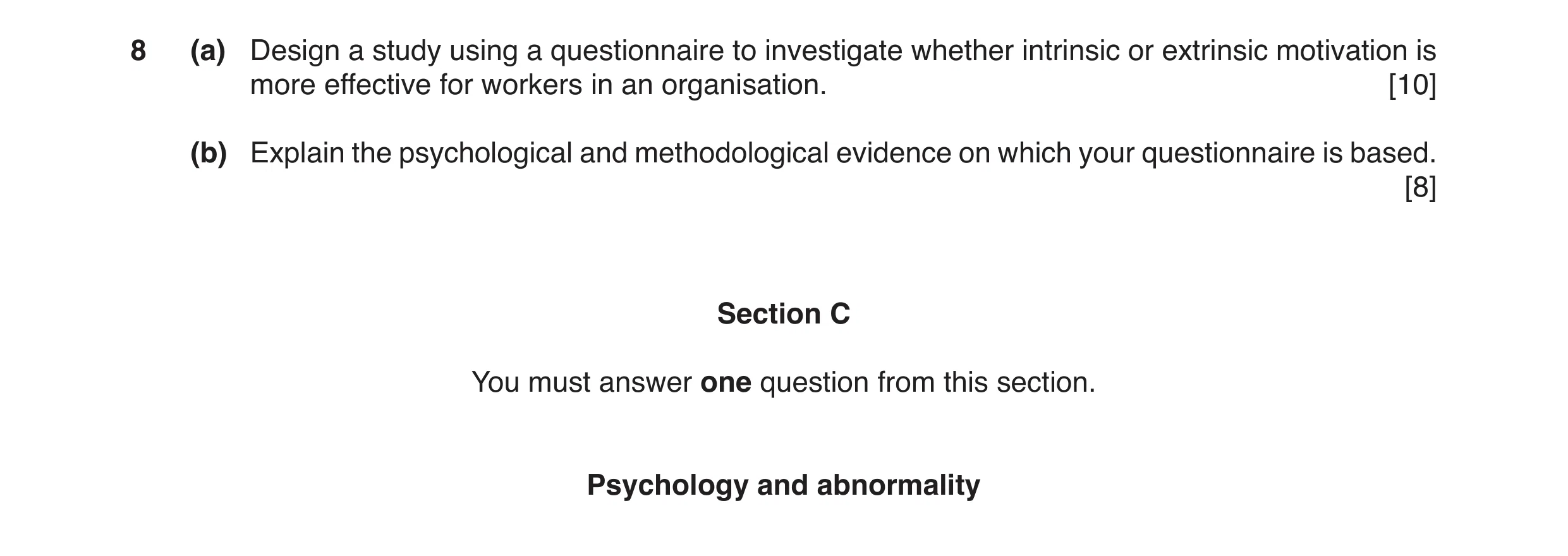
![Question 5: (a) Design a study to investigate how much managers know about Maslow’s hierarchy of needs. [10] (b) Explain the psychological and methodol…](https://img.pastlit.com/crops/c608a9ec-fa7c-4328-8159-d031d9ae0af5/q8.webp) 1 / 17
1 / 17
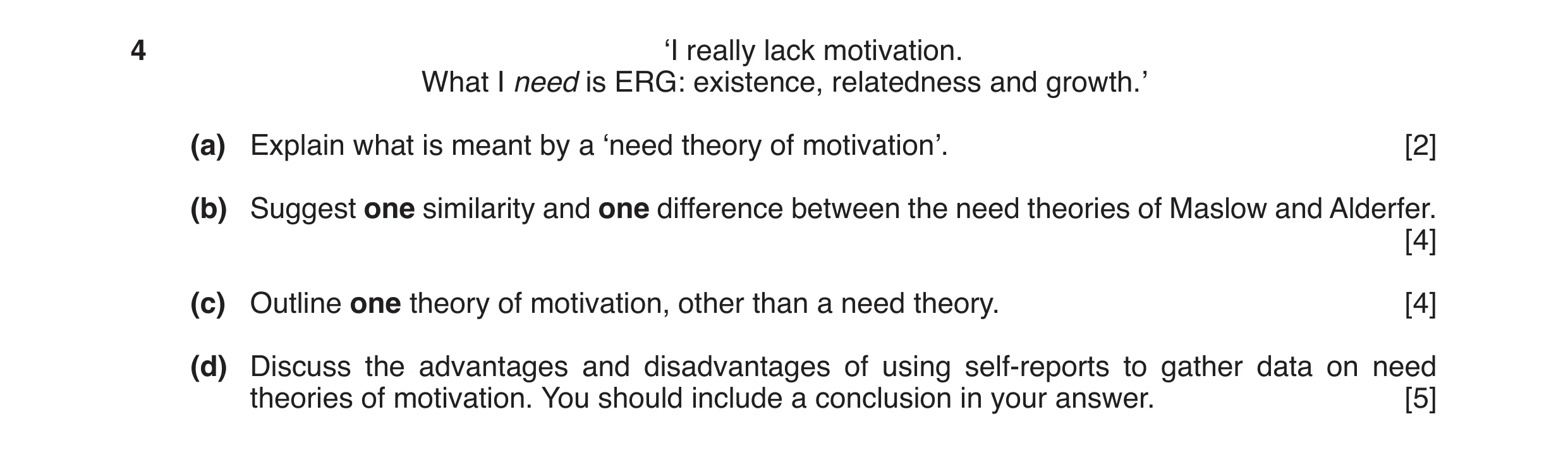
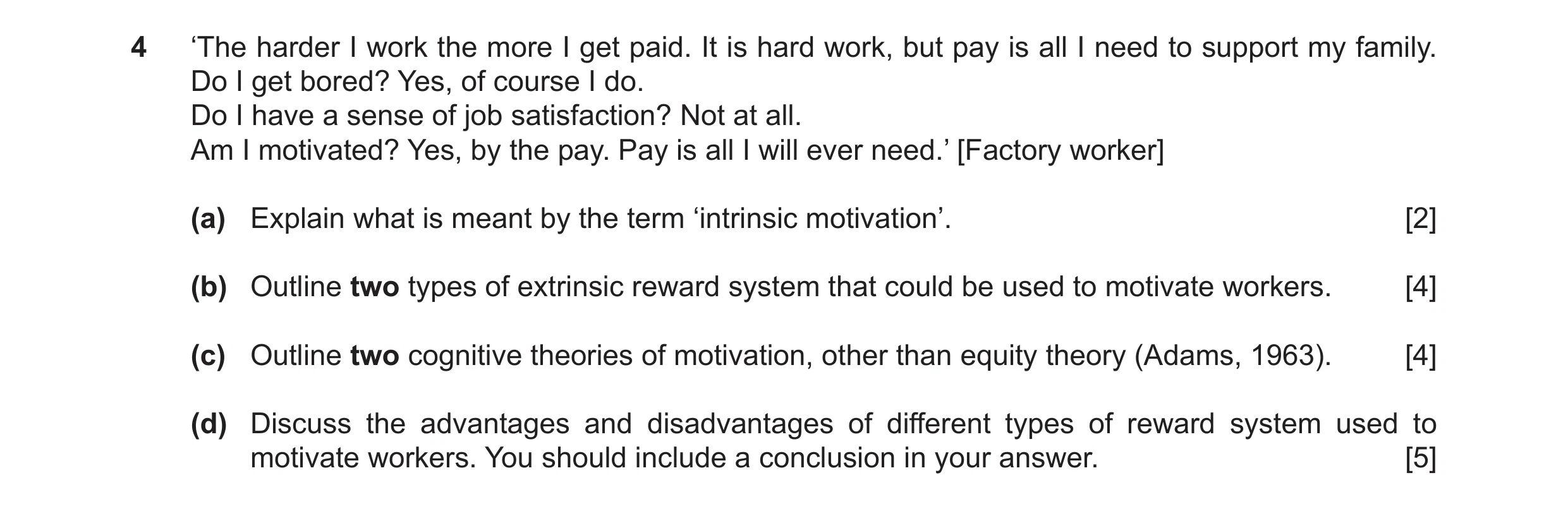
![Question 9: (a) Design a study using an interview to investigate the extent to which workers believe equity theory (Adams, 1963) applies to them. [10] …](https://img.pastlit.com/crops/f9b6a5e0-2427-4847-bc06-fbd234589a89/q8.webp) 2 / 17
2 / 17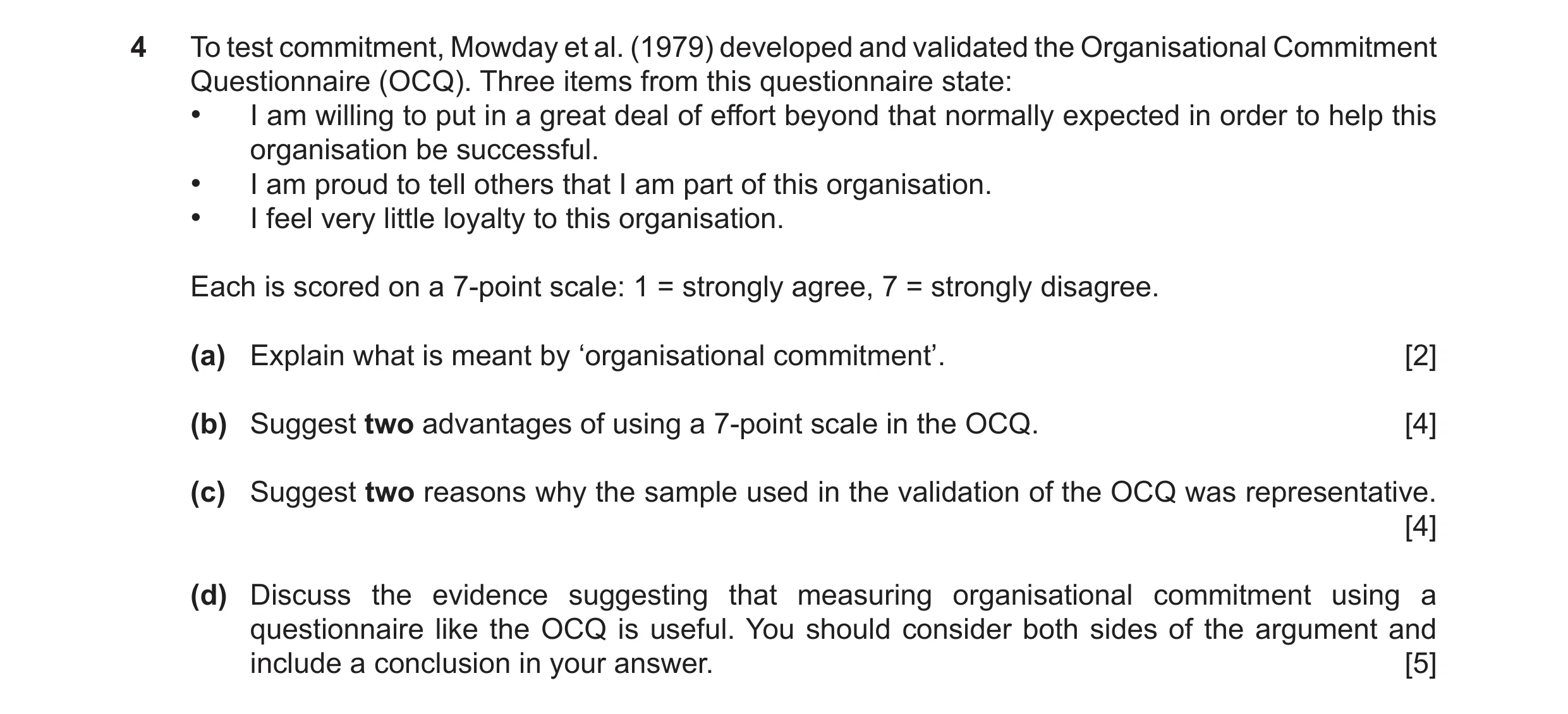
![Question 11: (a) Design a study to investigate intrinsic motivation in workers in a factory making shoes. [10] (b) Explain the psychological and methodo…](https://img.pastlit.com/crops/8d3684d4-0af1-494d-abab-13d7e4e5556f/q8.webp)
 3 / 17
![Question 13: (a) Design a study using an interview to investigate the extent to which workers believe equity theory (Adams, 1963) applies to them. [10] …](https://img.pastlit.com/crops/c27db48c-c88b-4b68-b038-e63b61cec74d/q8.webp)
 4 / 17

 5 / 17
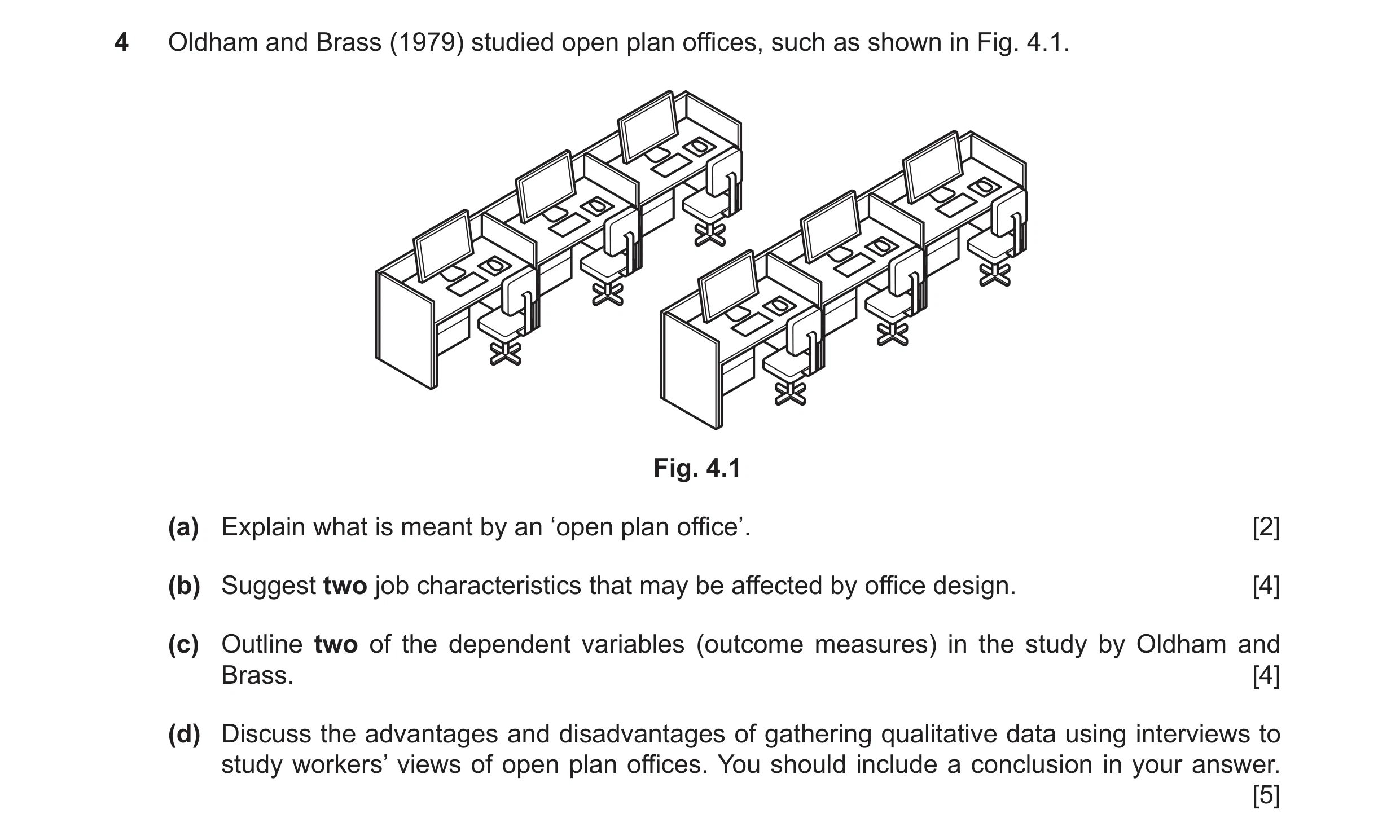

 6 / 17
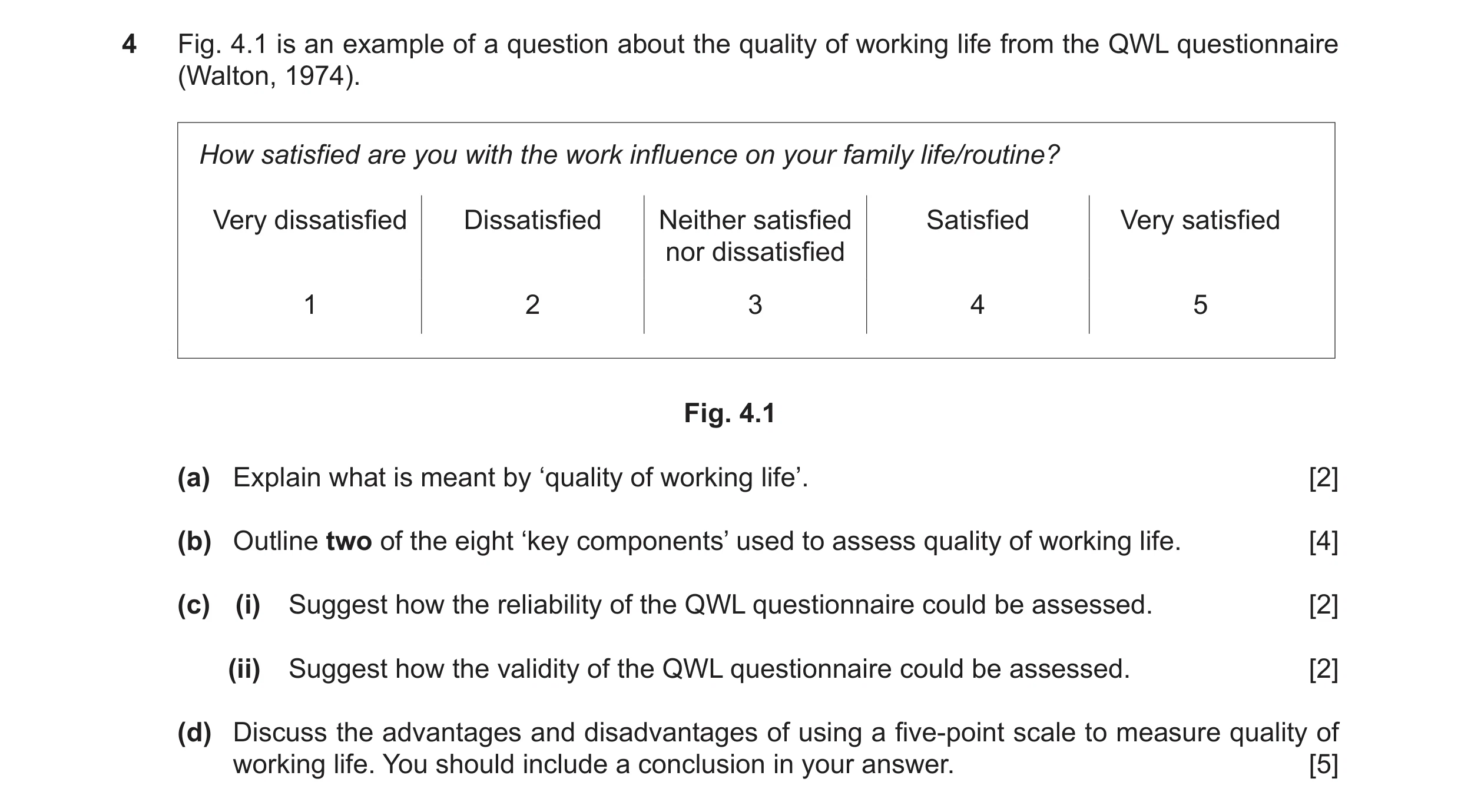
 7 / 17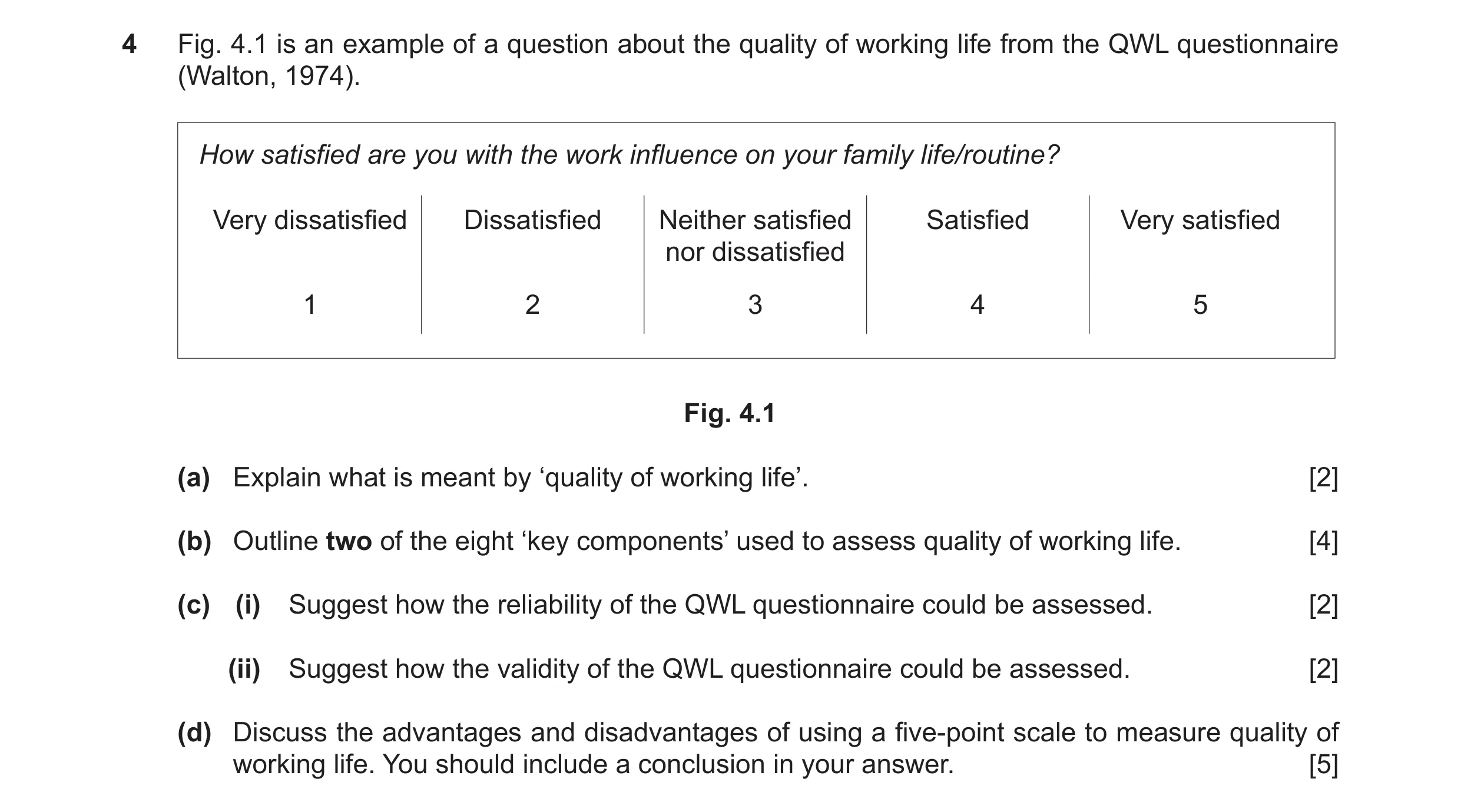
 8 / 17
![Question 32: (a) Design a study using a questionnaire to investigate which non-monetary reward is more effective for workers in an organisation. [10] (b…](https://img.pastlit.com/crops/2d7f7187-b9f0-4dd2-a35a-693d574a90b7/q8.webp)

 9 / 17
![Question 35: (a) Design a study using a questionnaire to investigate which non-monetary reward is more effective for workers in an organisation. [10] (b…](https://img.pastlit.com/crops/80021244-75c0-4761-863b-a2115c87d250/q8.webp)



 10 / 17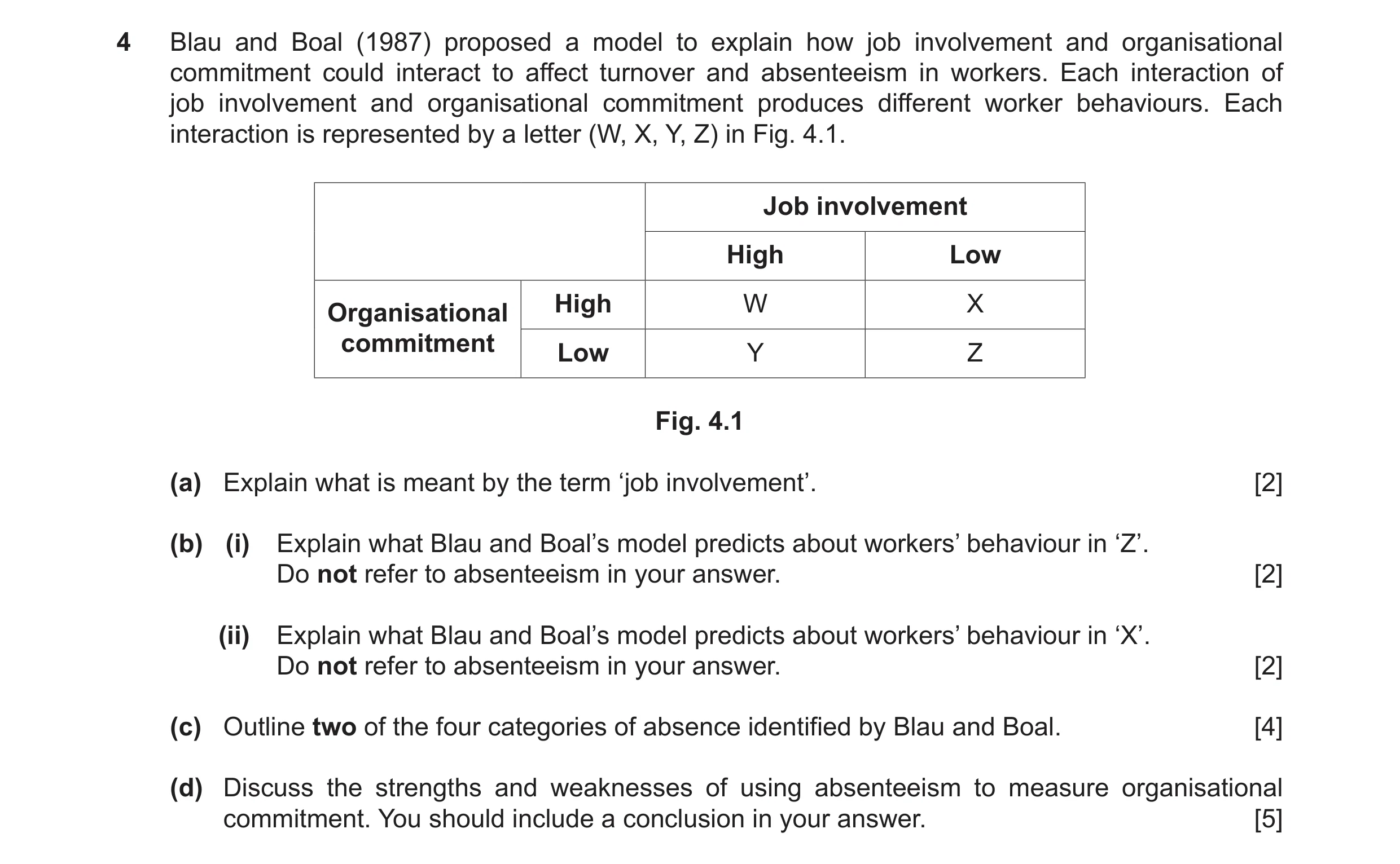
 11 / 17

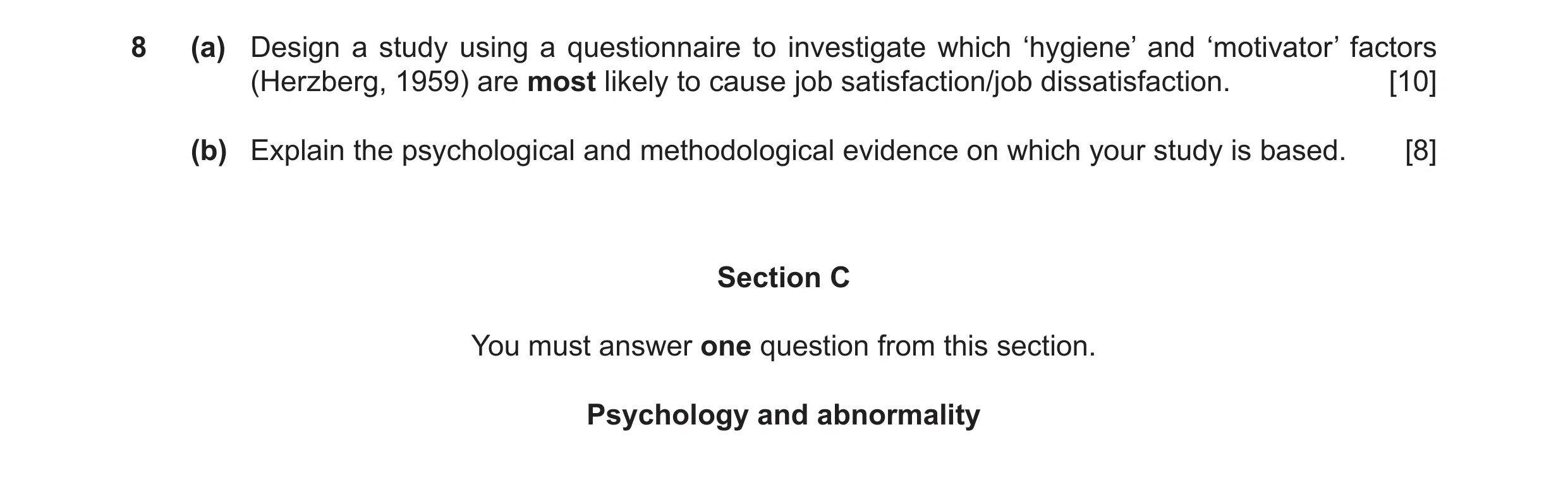
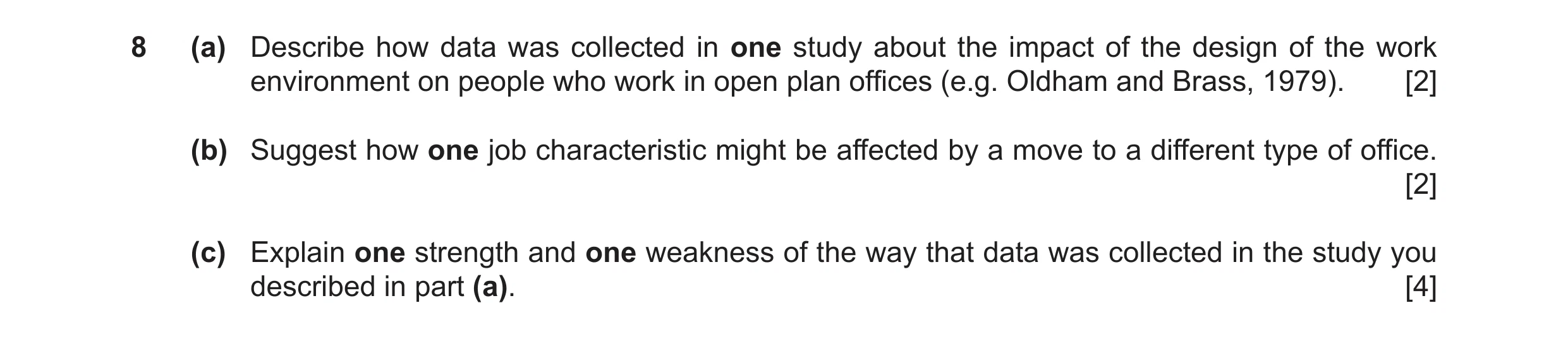 12 / 17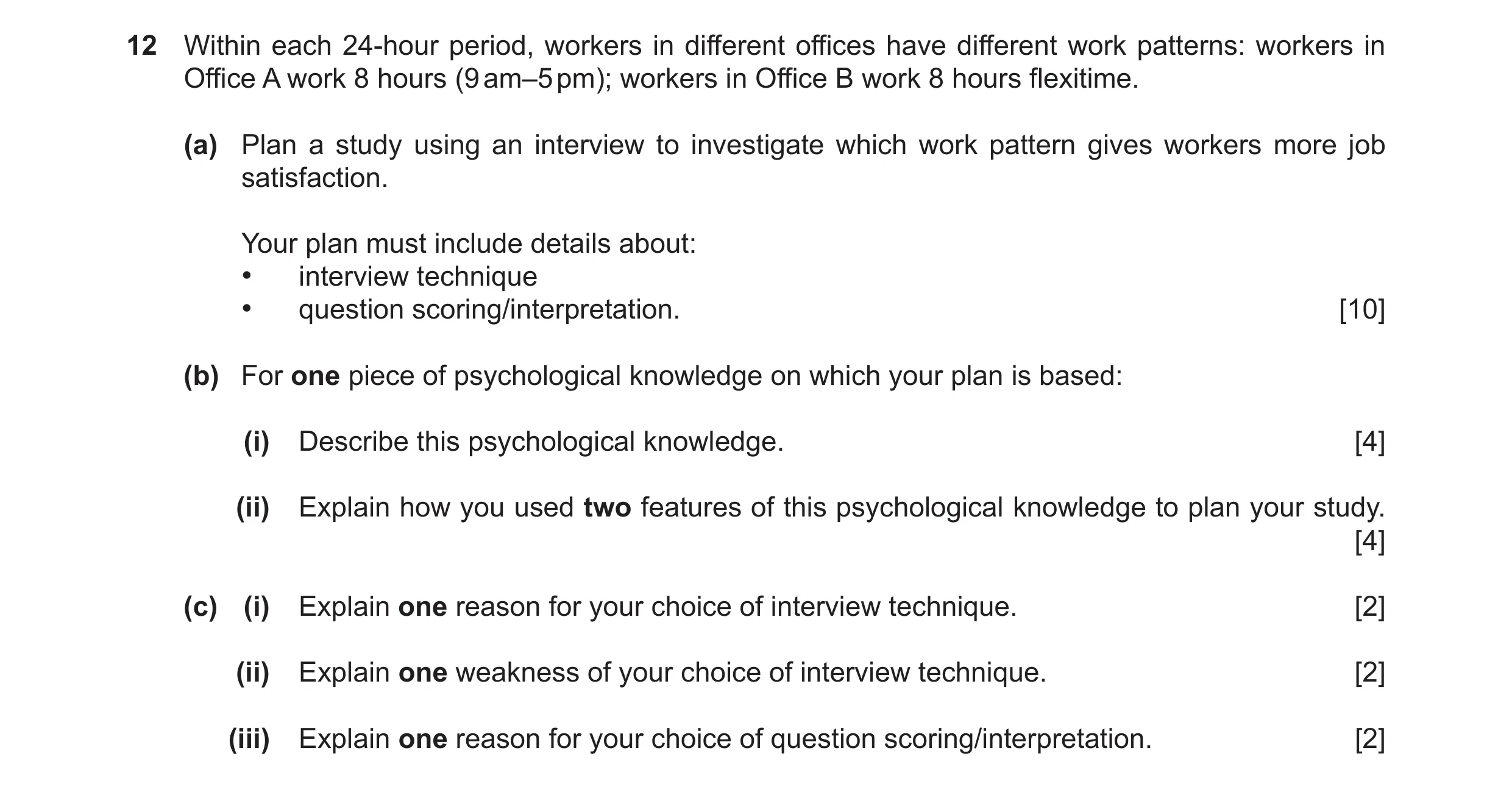
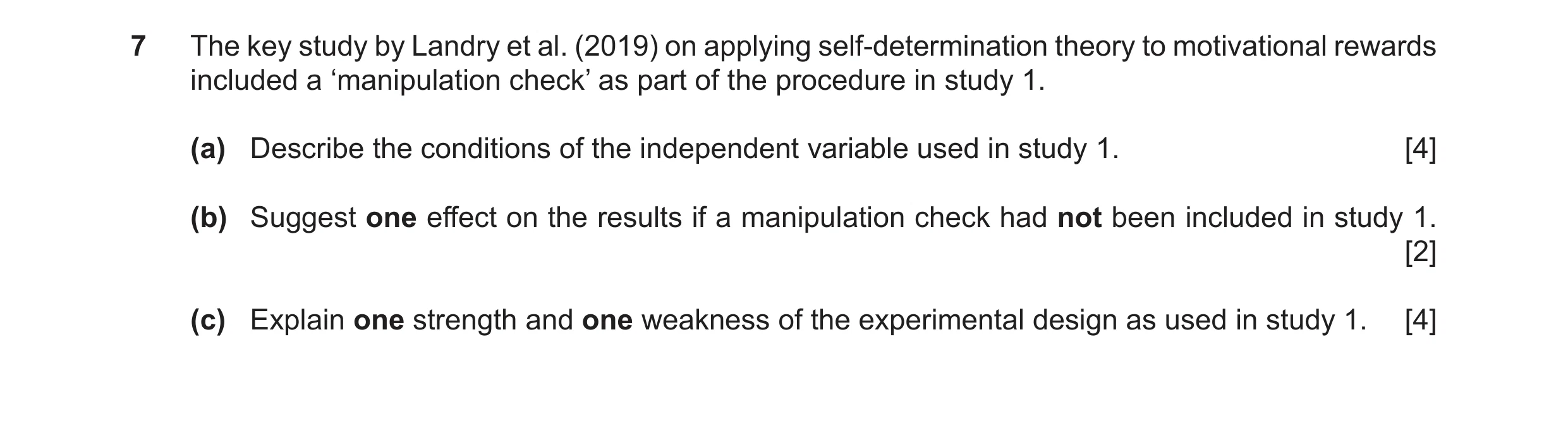
 13 / 17
![Question 51: (a) Outline what Maslow meant by ‘physiological needs’ and ‘social needs’. [2] (b) Suggest one way in which achievement of social needs cou…](https://img.pastlit.com/crops/2734b90a-26d9-408b-8b4a-d7c96815e311/q8.webp)
![Question 52: (a) Outline what Maslow meant by ‘physiological needs’ and ‘social needs’. [2] (b) Suggest one way in which achievement of social needs cou…](https://img.pastlit.com/crops/951ad258-22d0-4a4f-a741-9291c20187c9/q8.webp)
![Question 53: (a) Outline what is meant by a ‘profit-sharing’ type of reward system. [2] (b) Suggest how the effectiveness of a profit-sharing reward sys…](https://img.pastlit.com/crops/498fd2b9-779d-498b-91aa-540a4ef65650/q8.webp)
 14 / 17
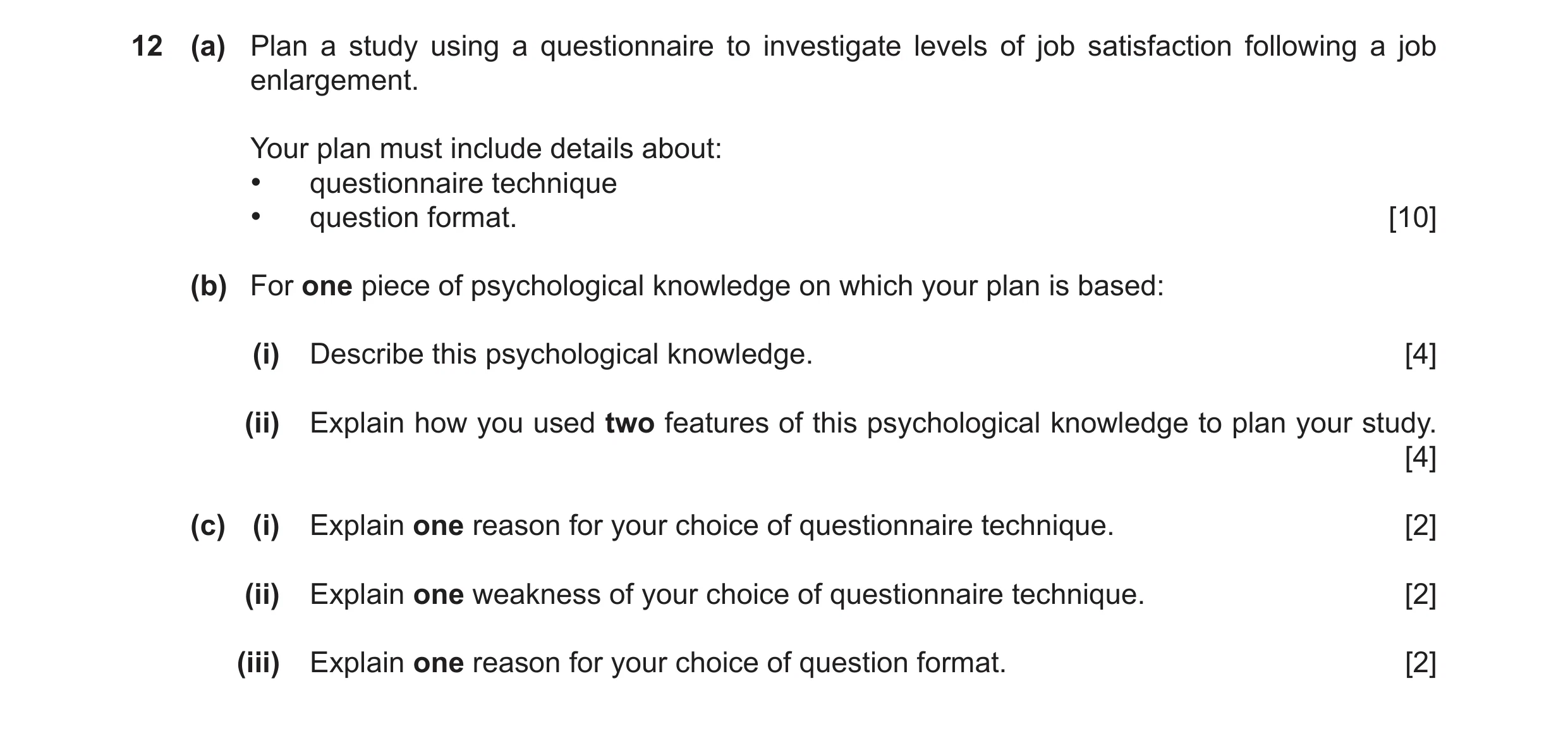 15 / 17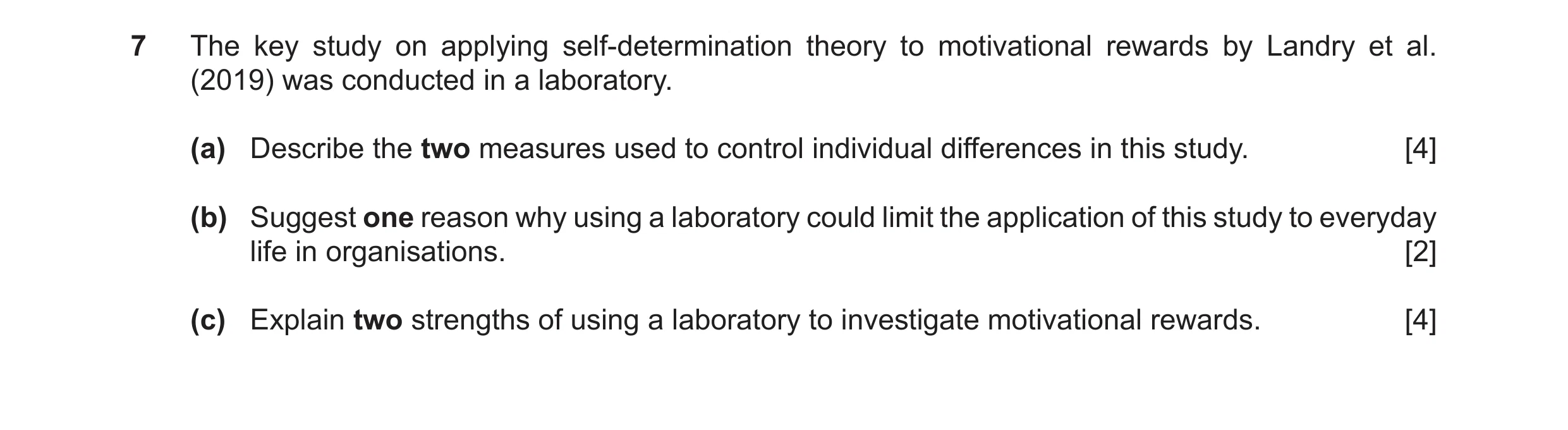
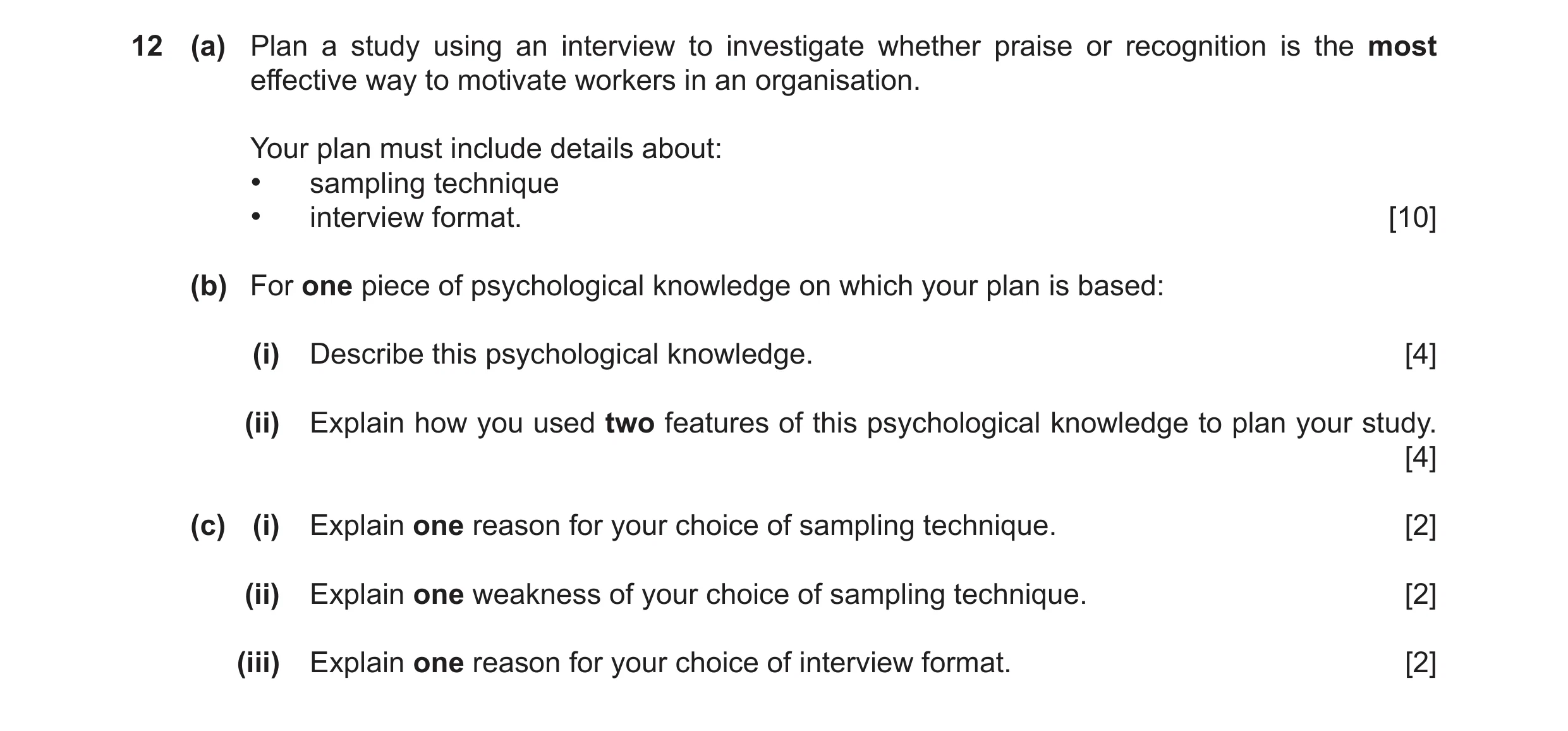
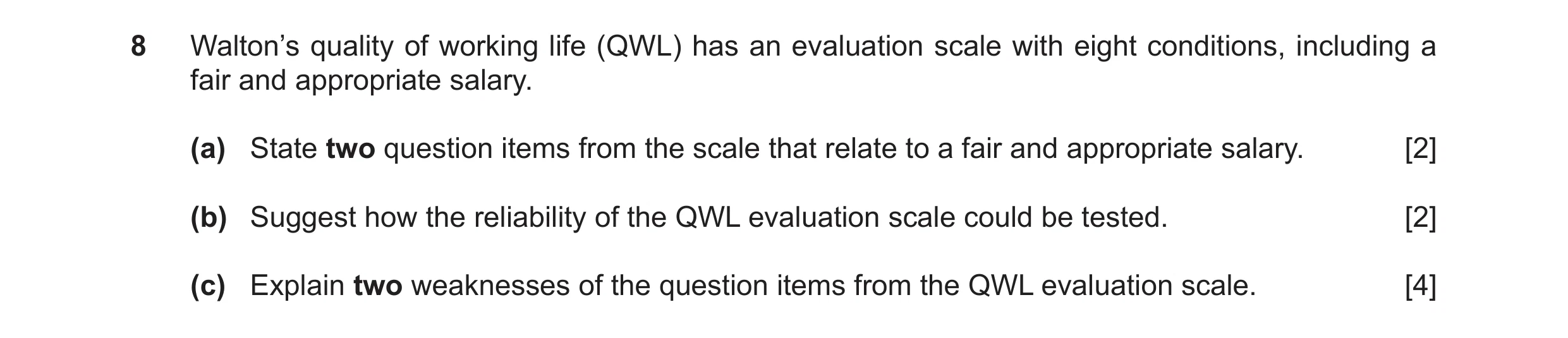 16 / 17
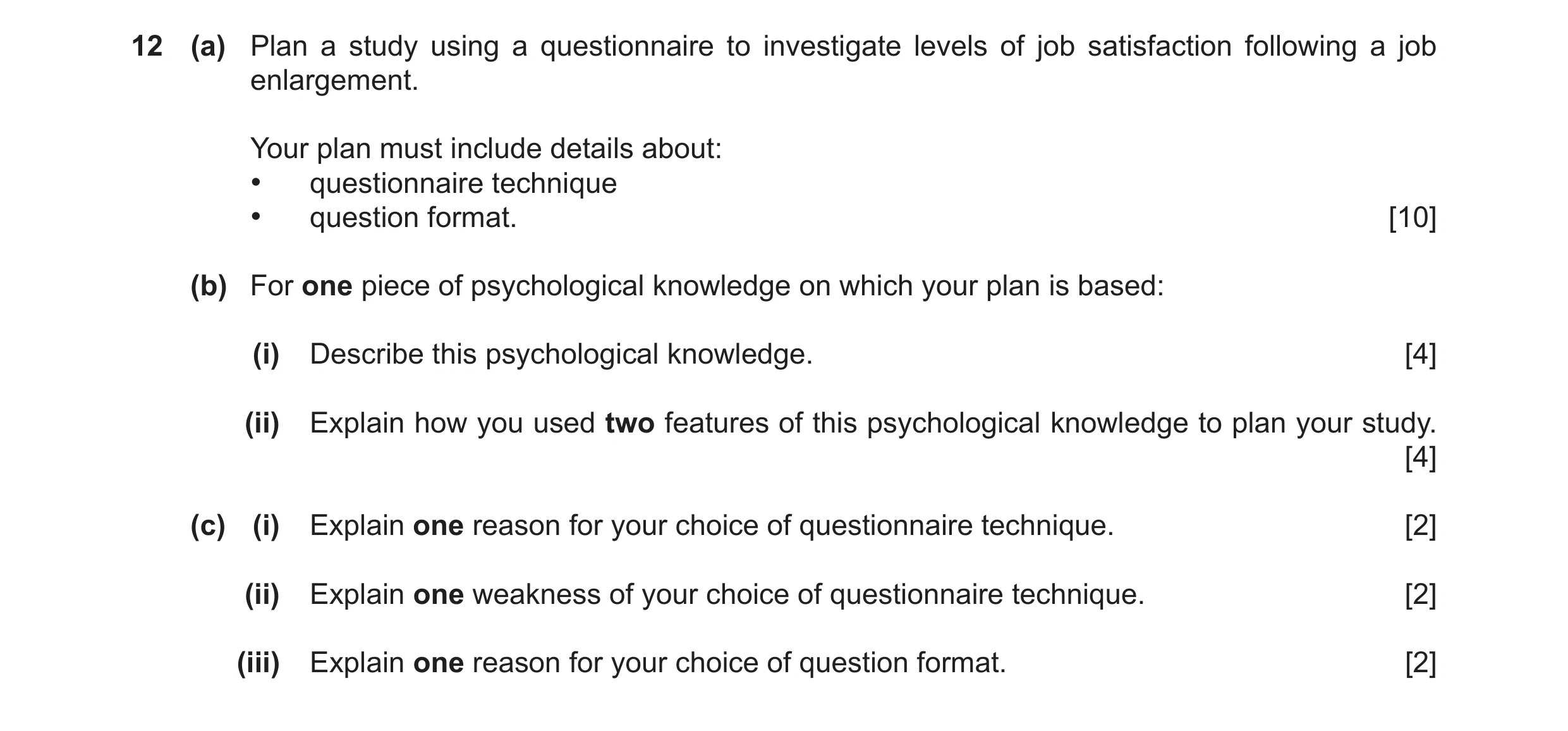 17 / 17
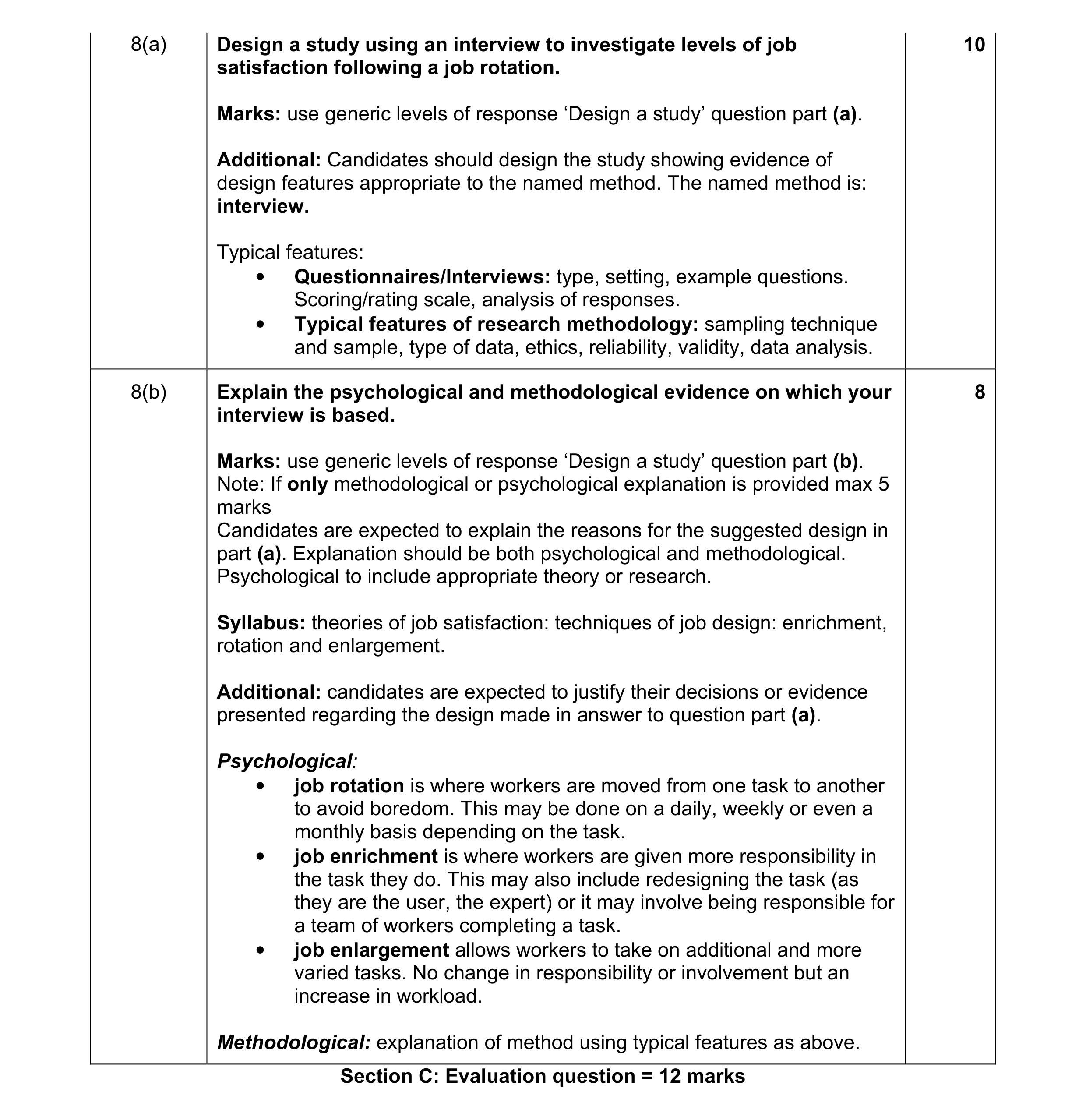 18
18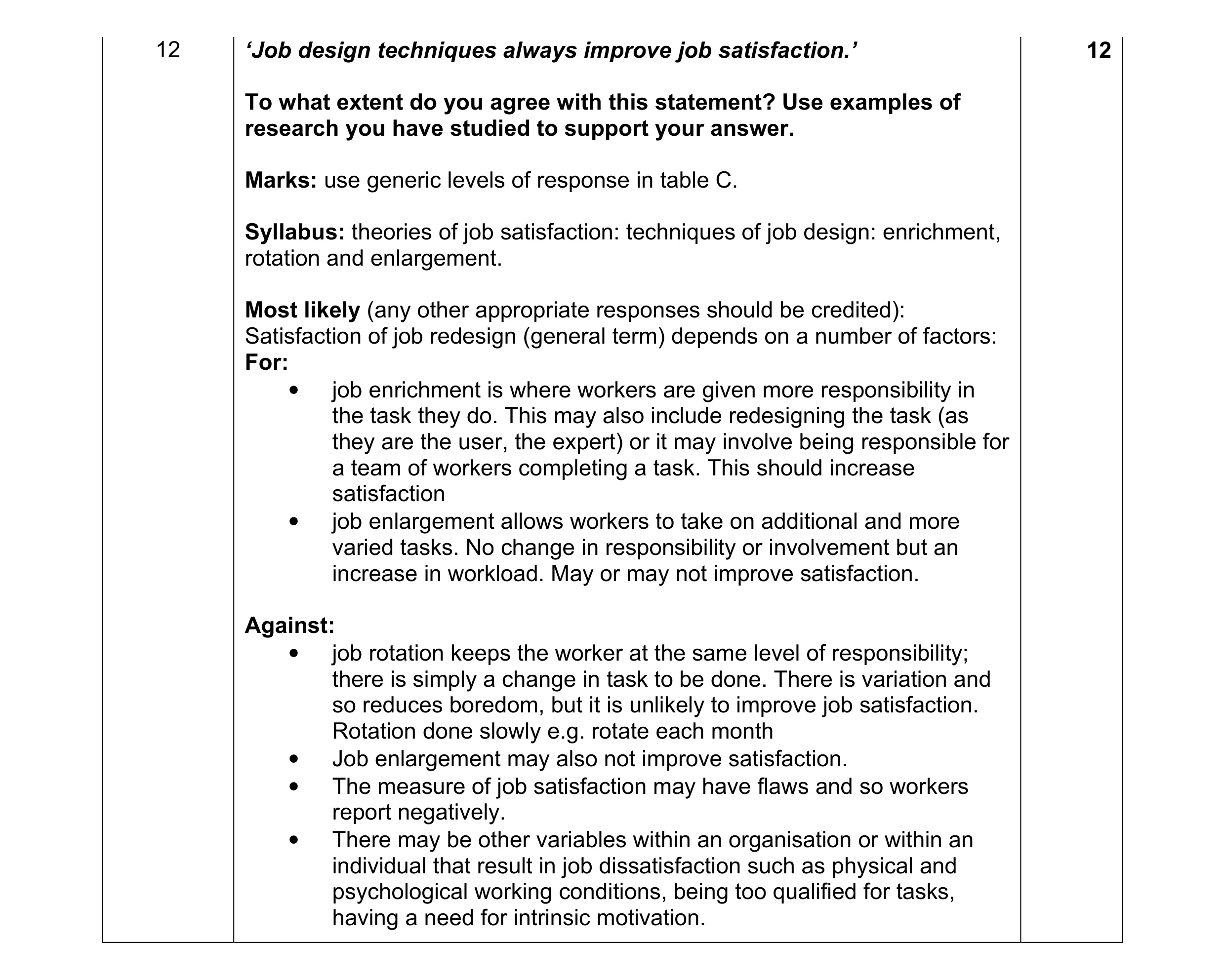 12
12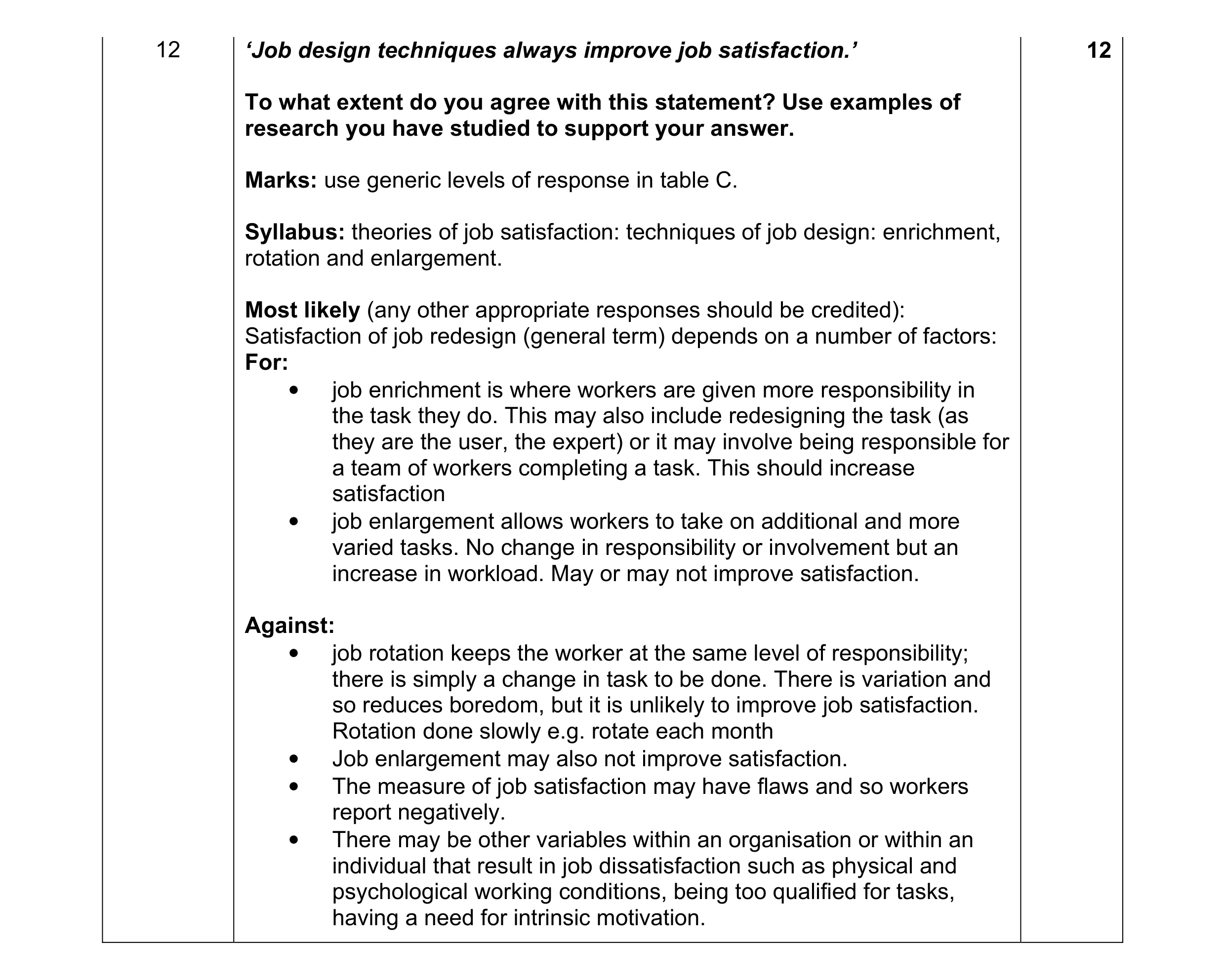 12
12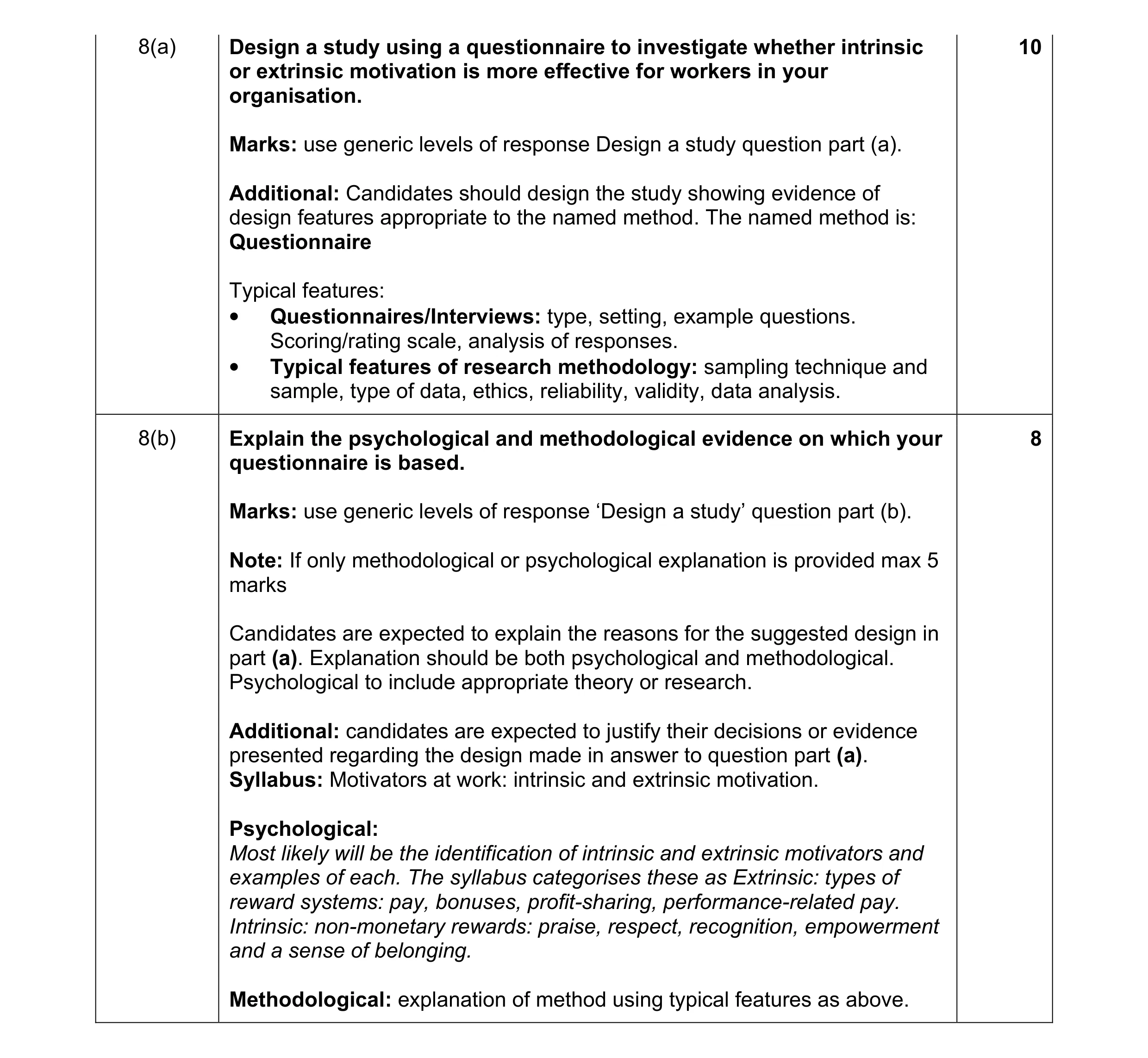 18
18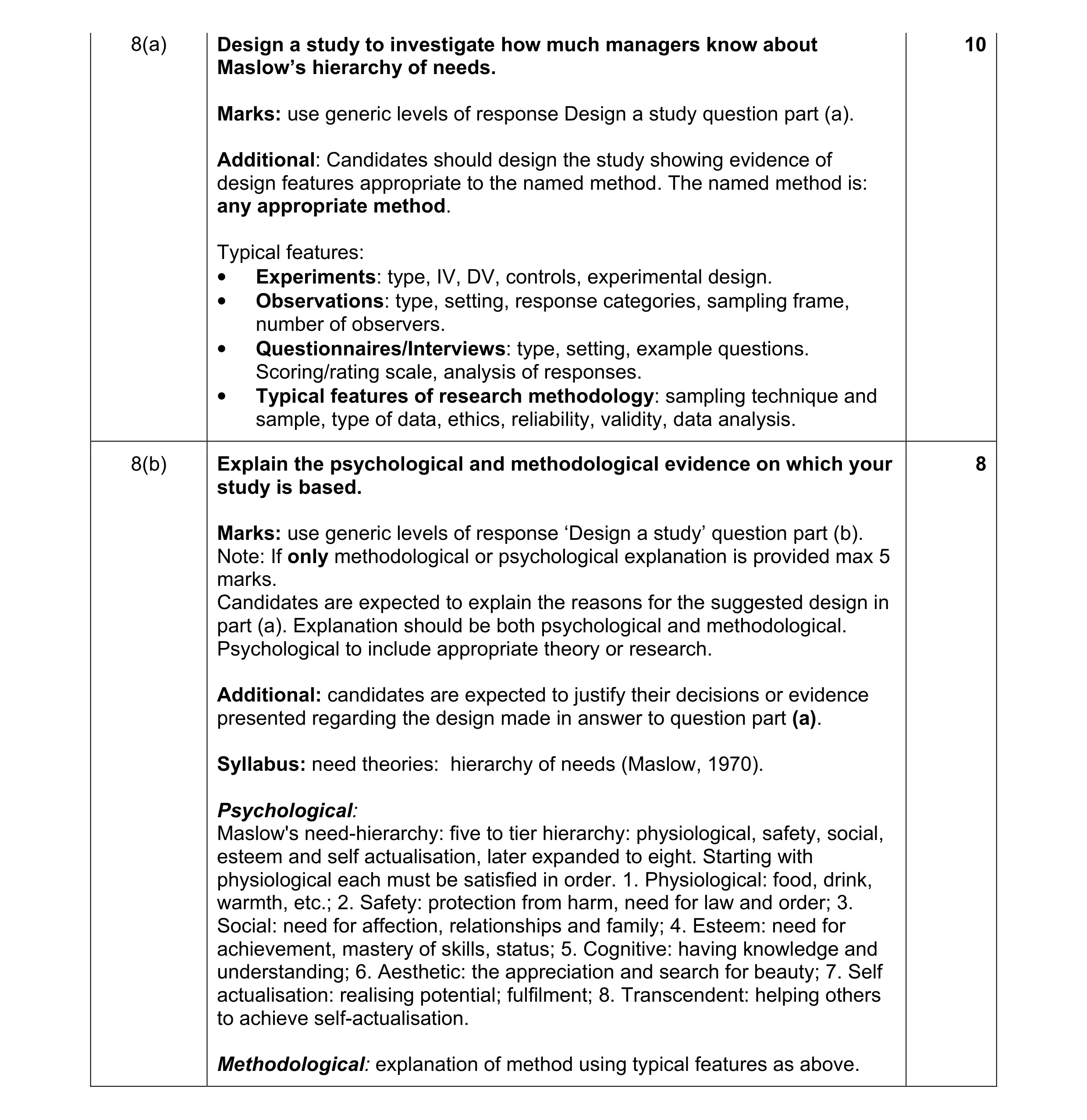 18
18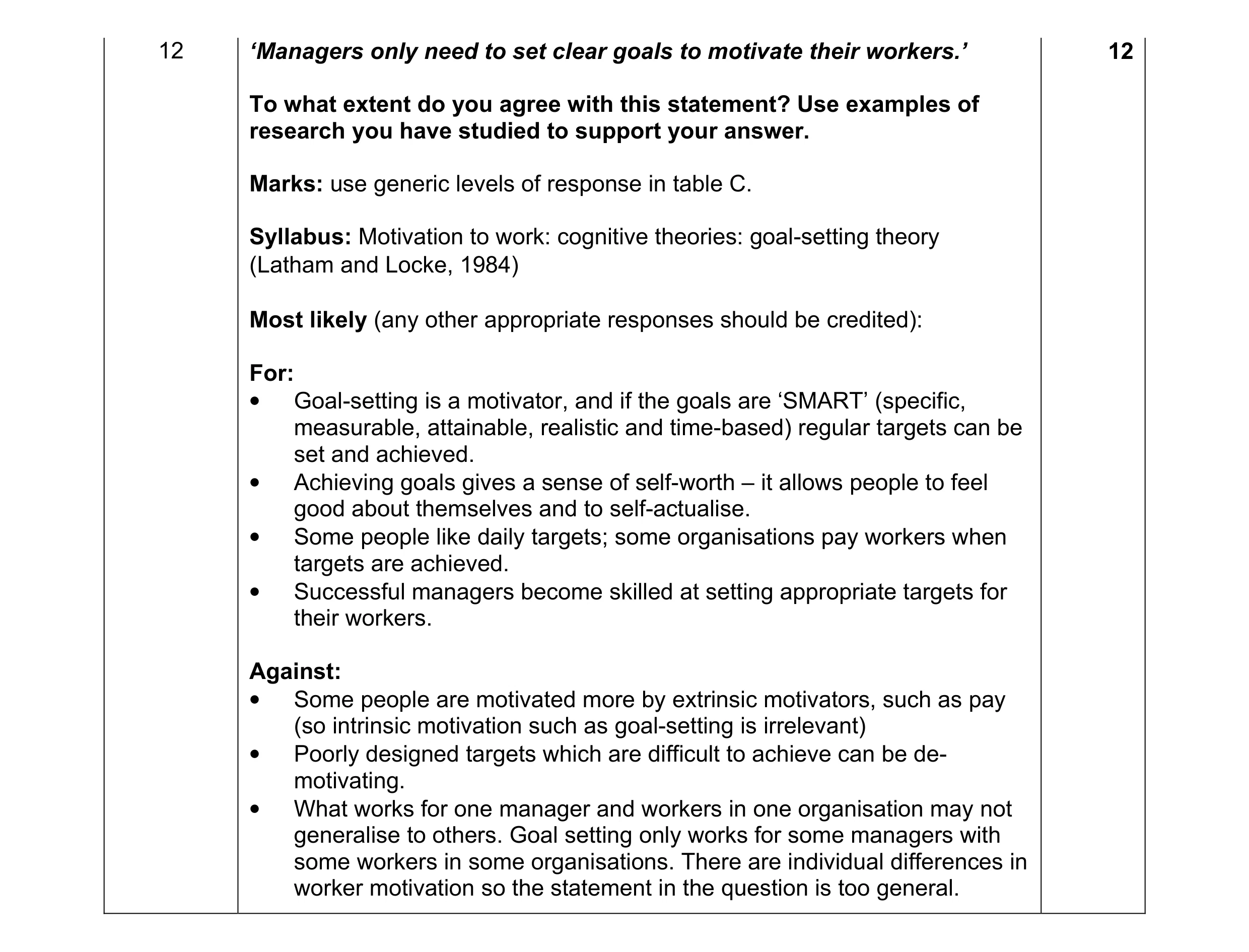 12
12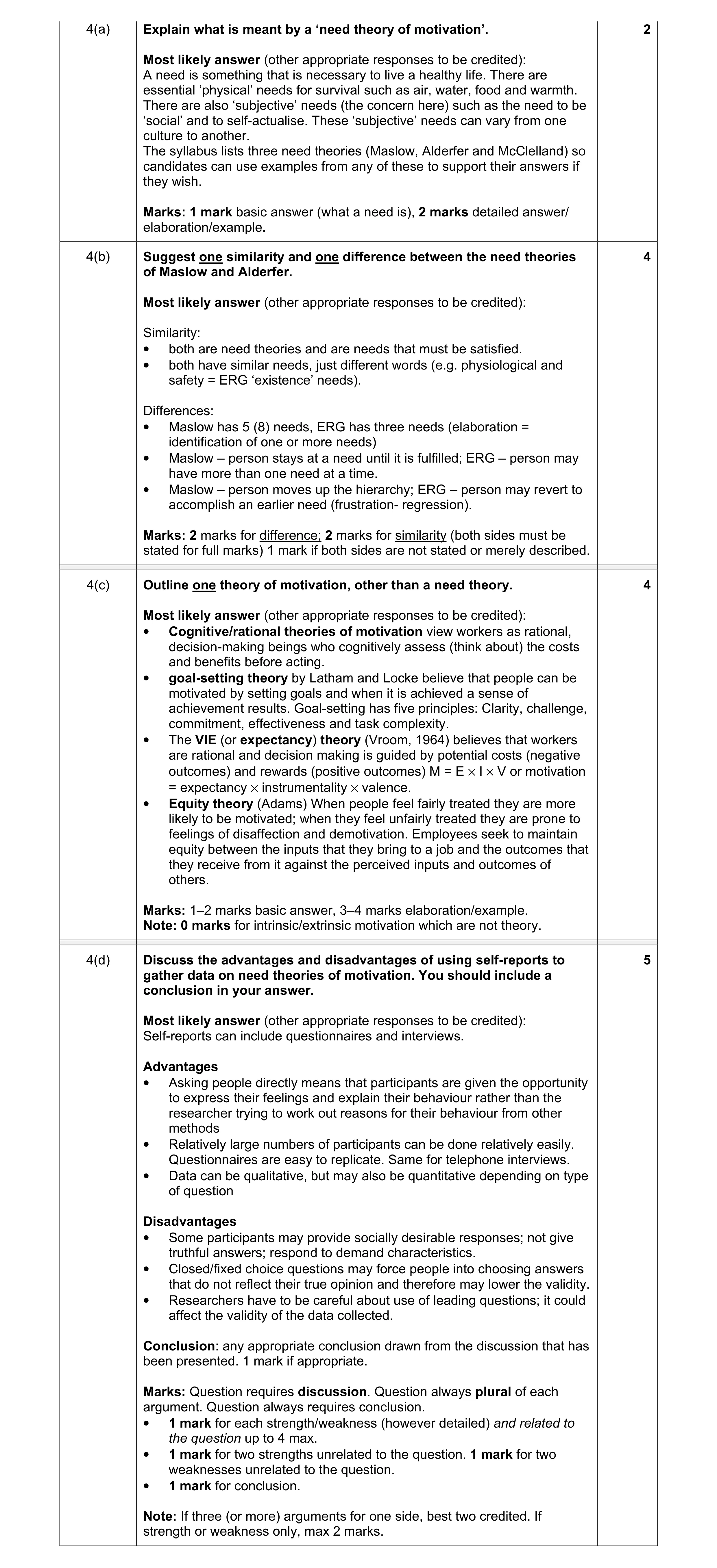 15
15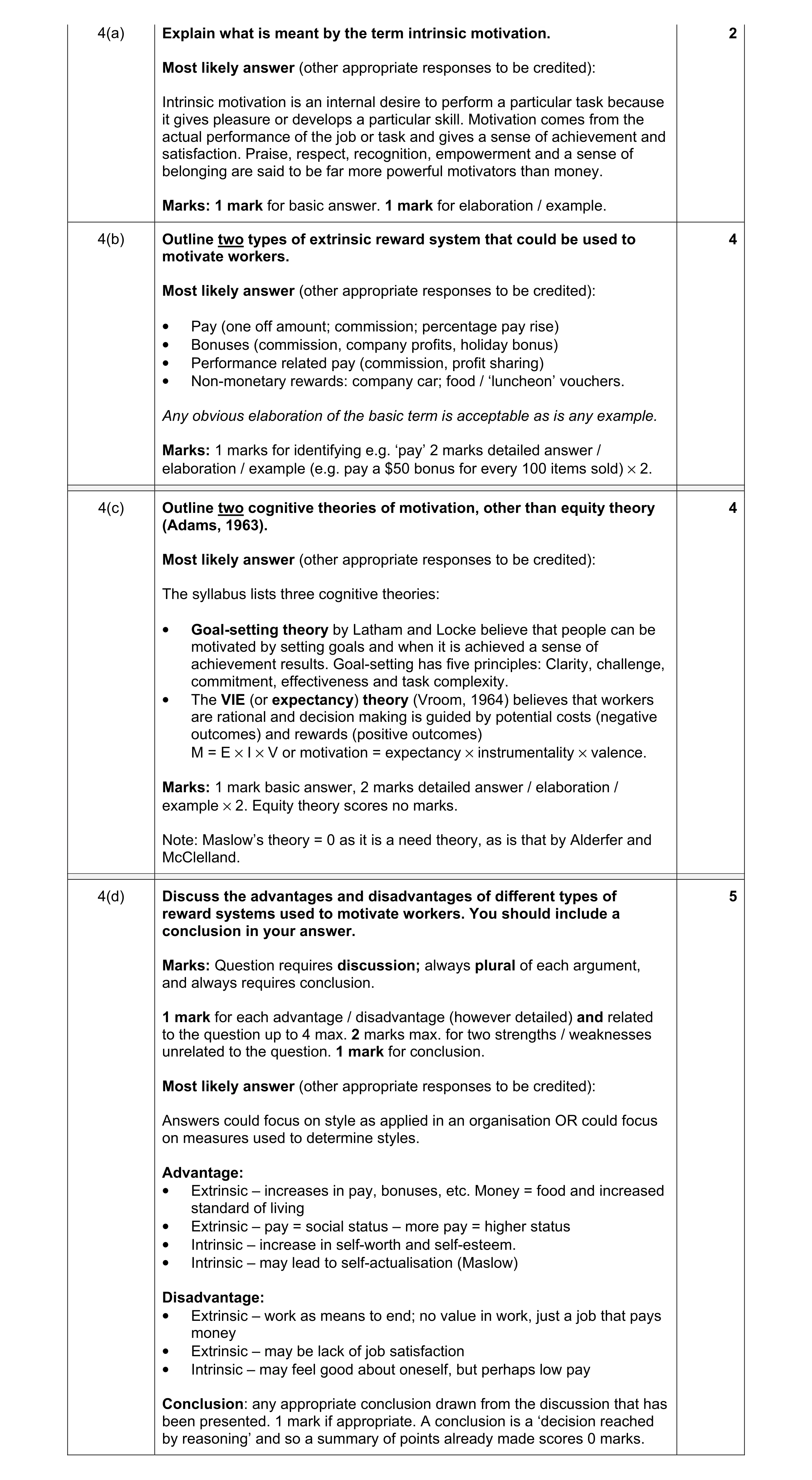 15
15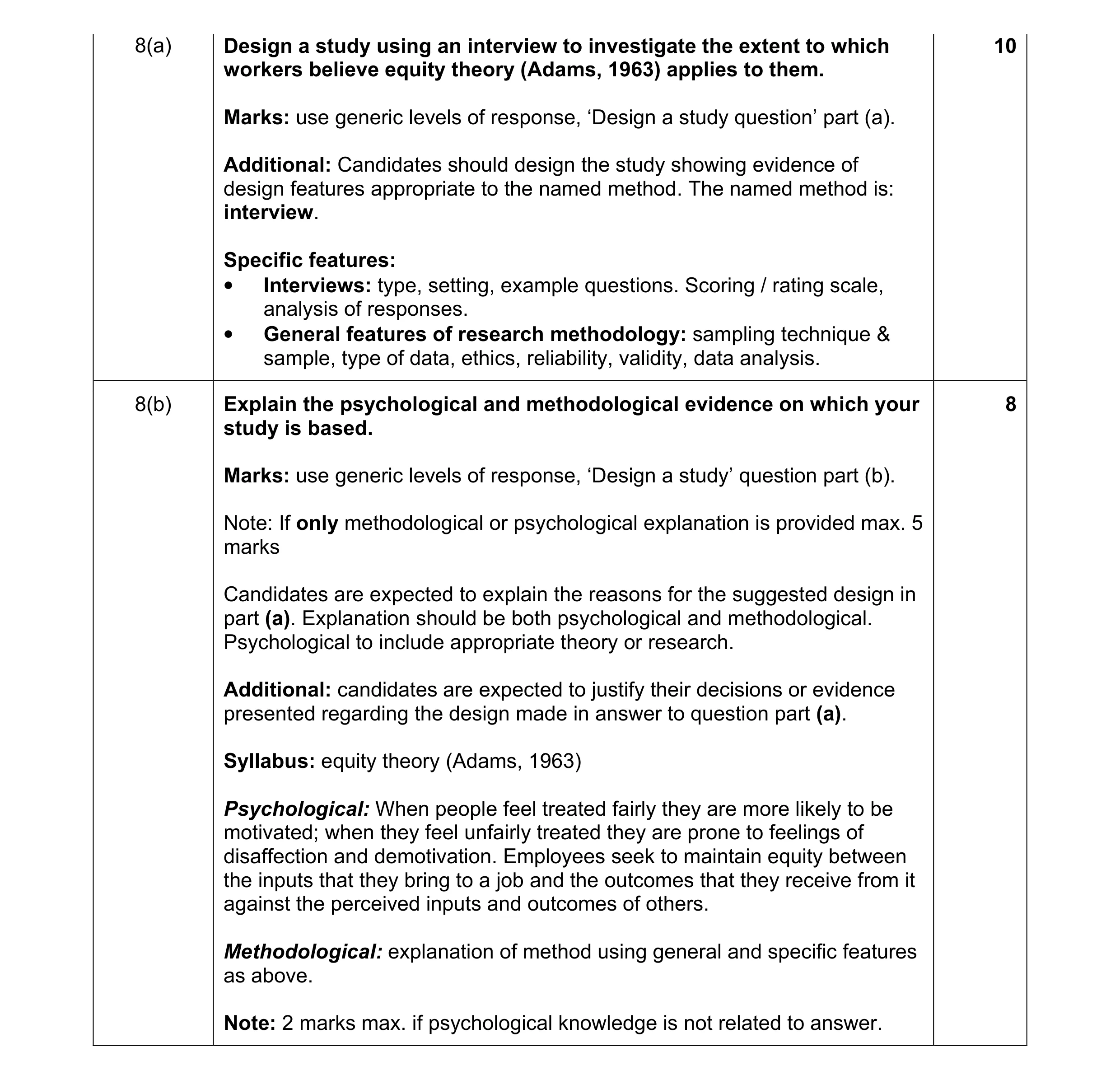 18
18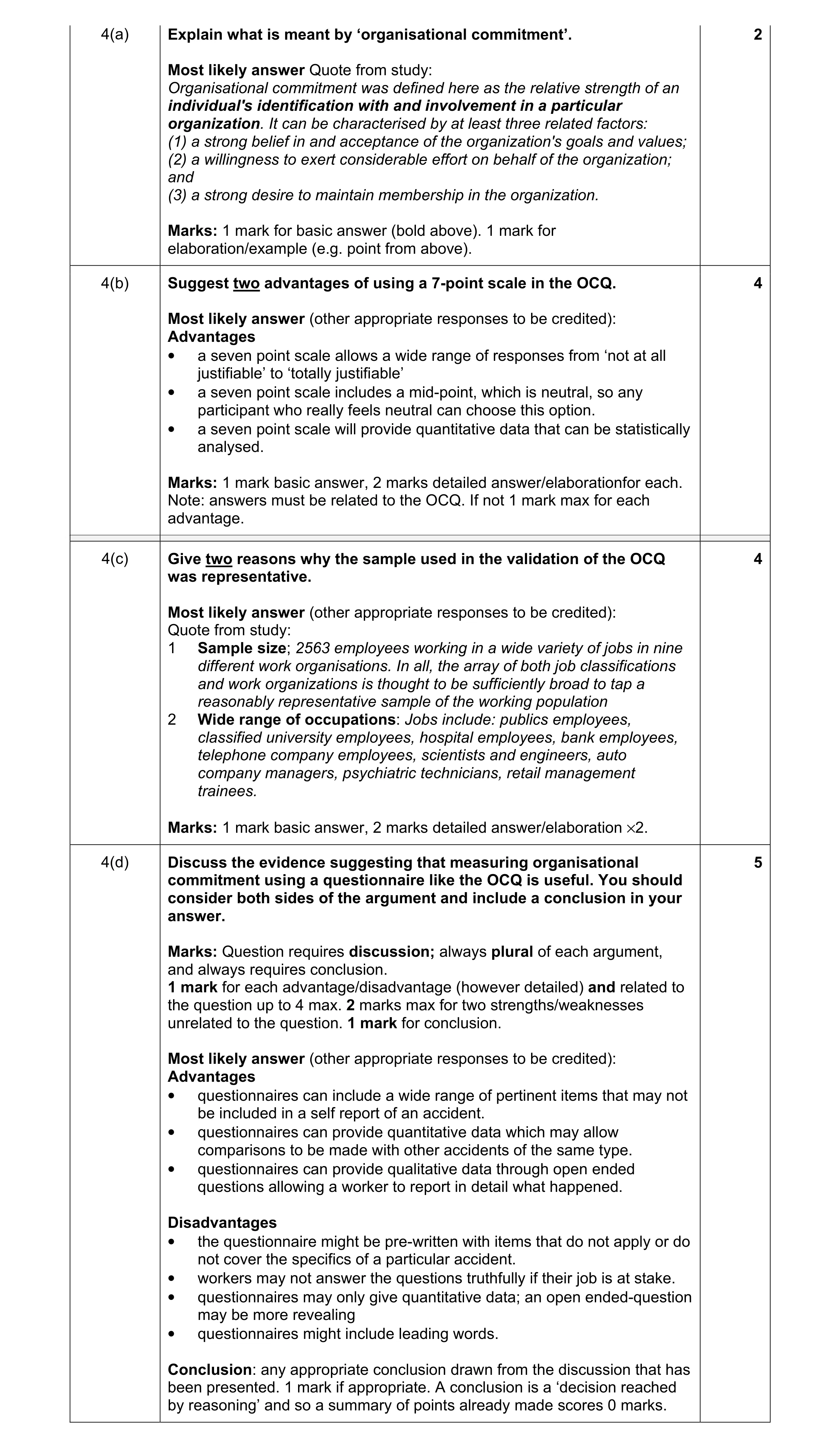 15
15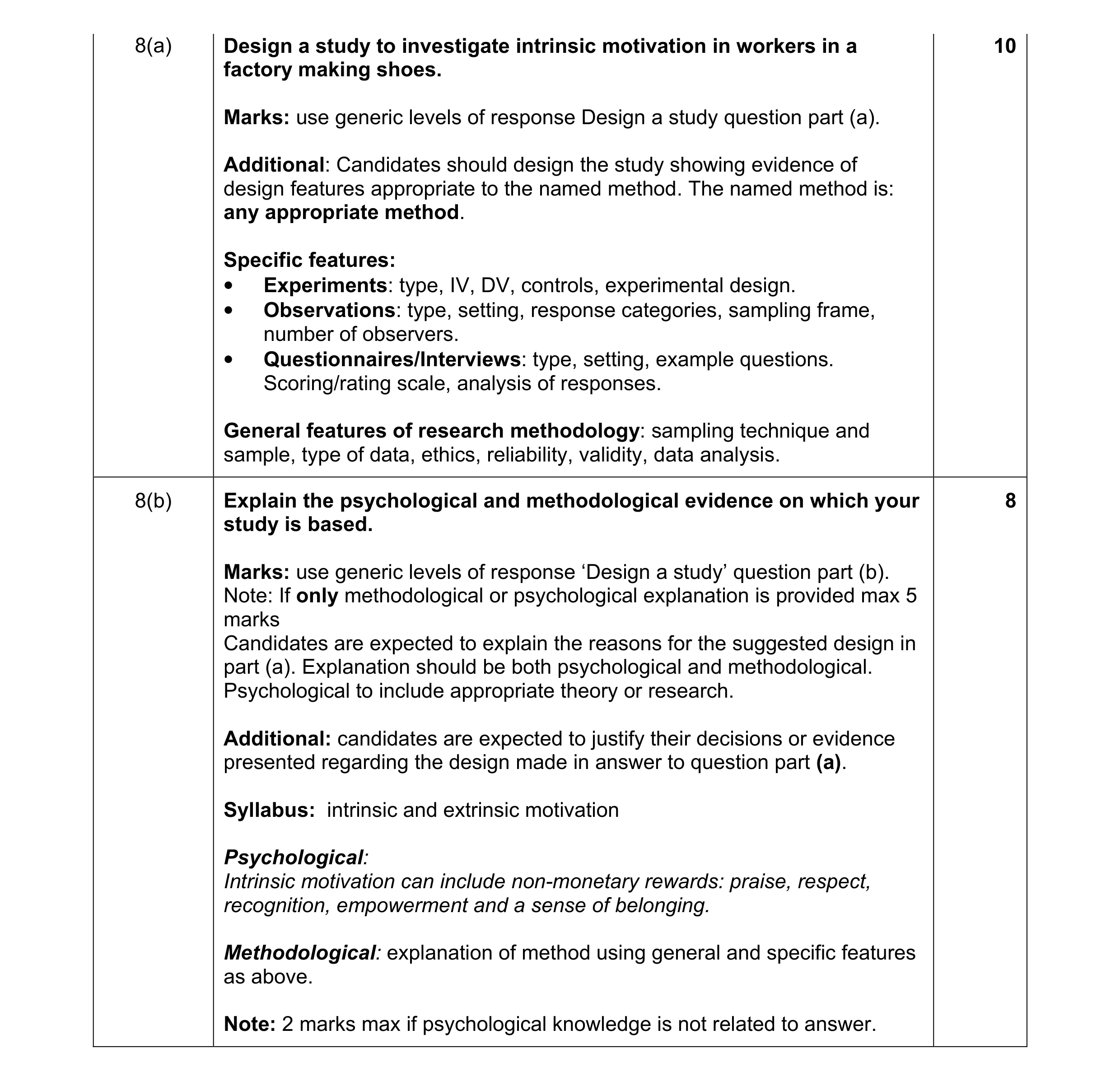 18
18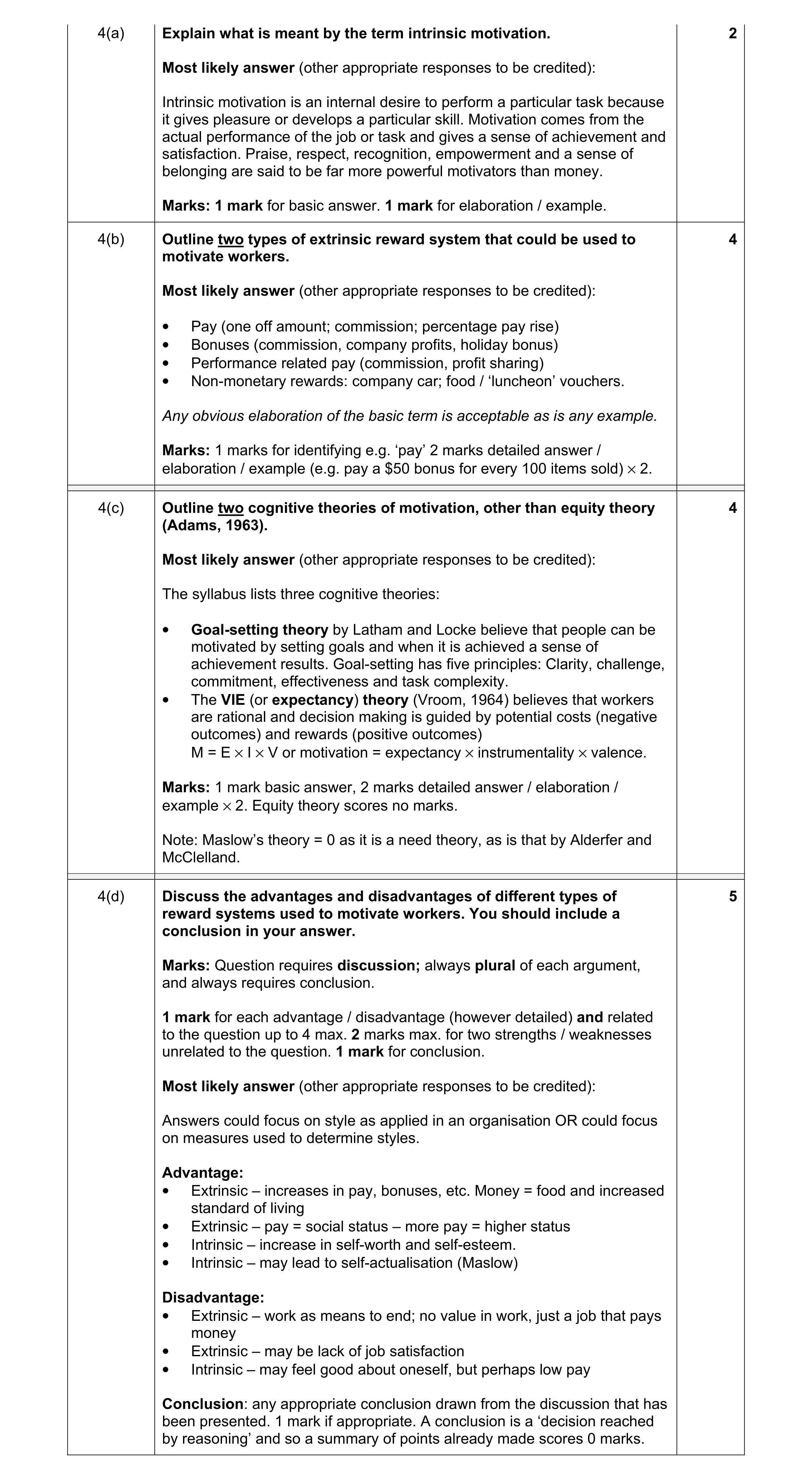 15
15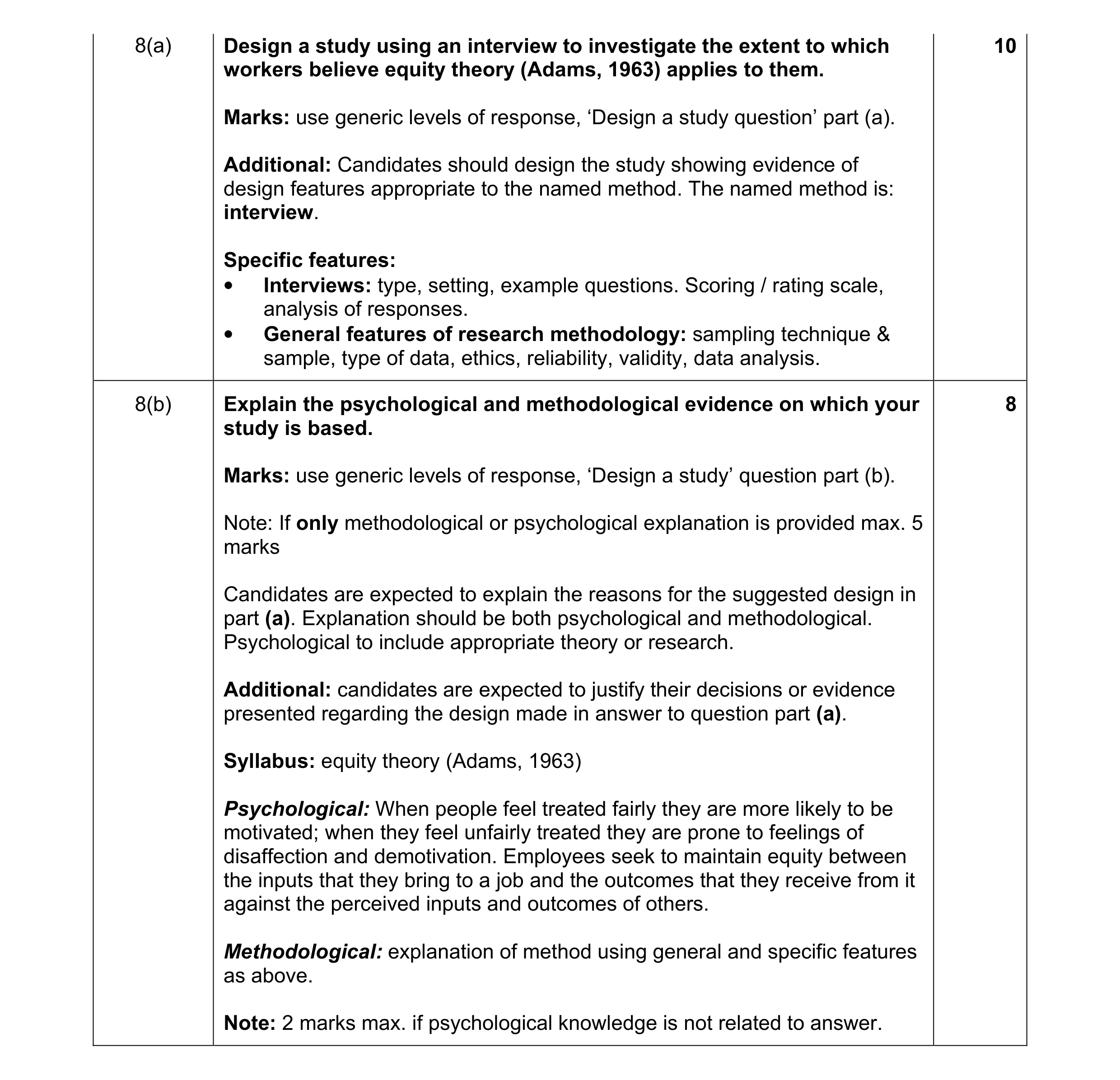 18
18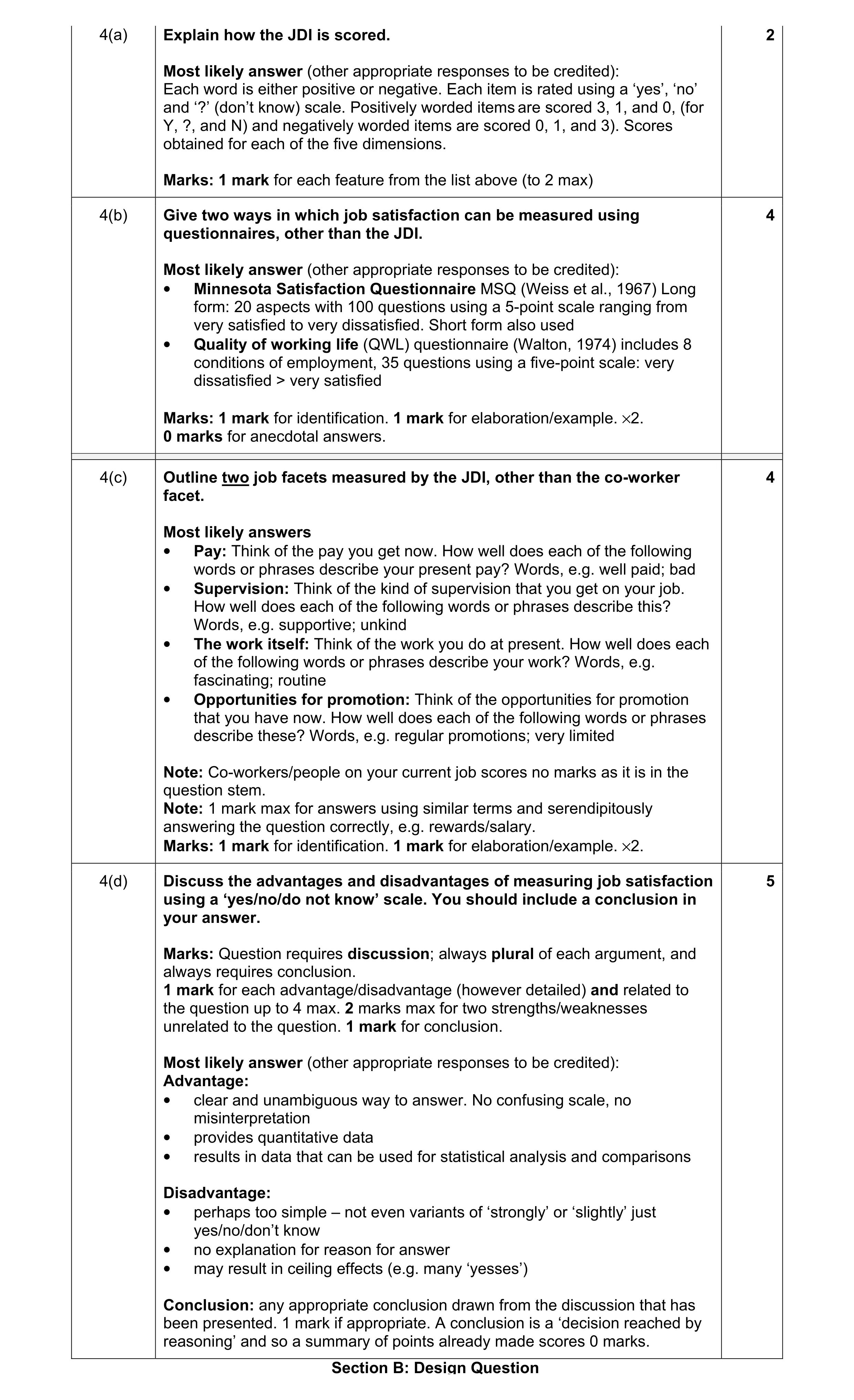 15
15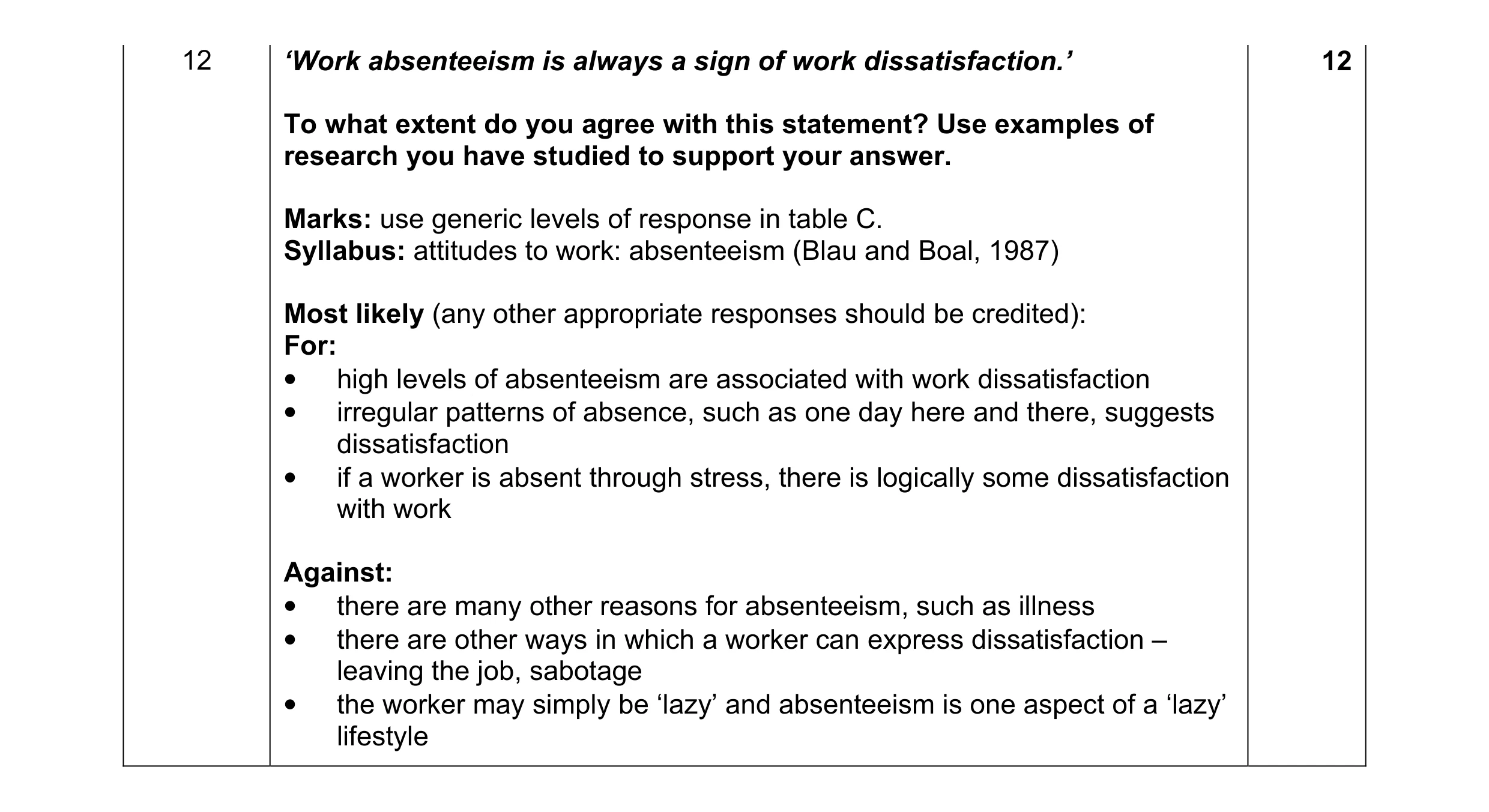 12
12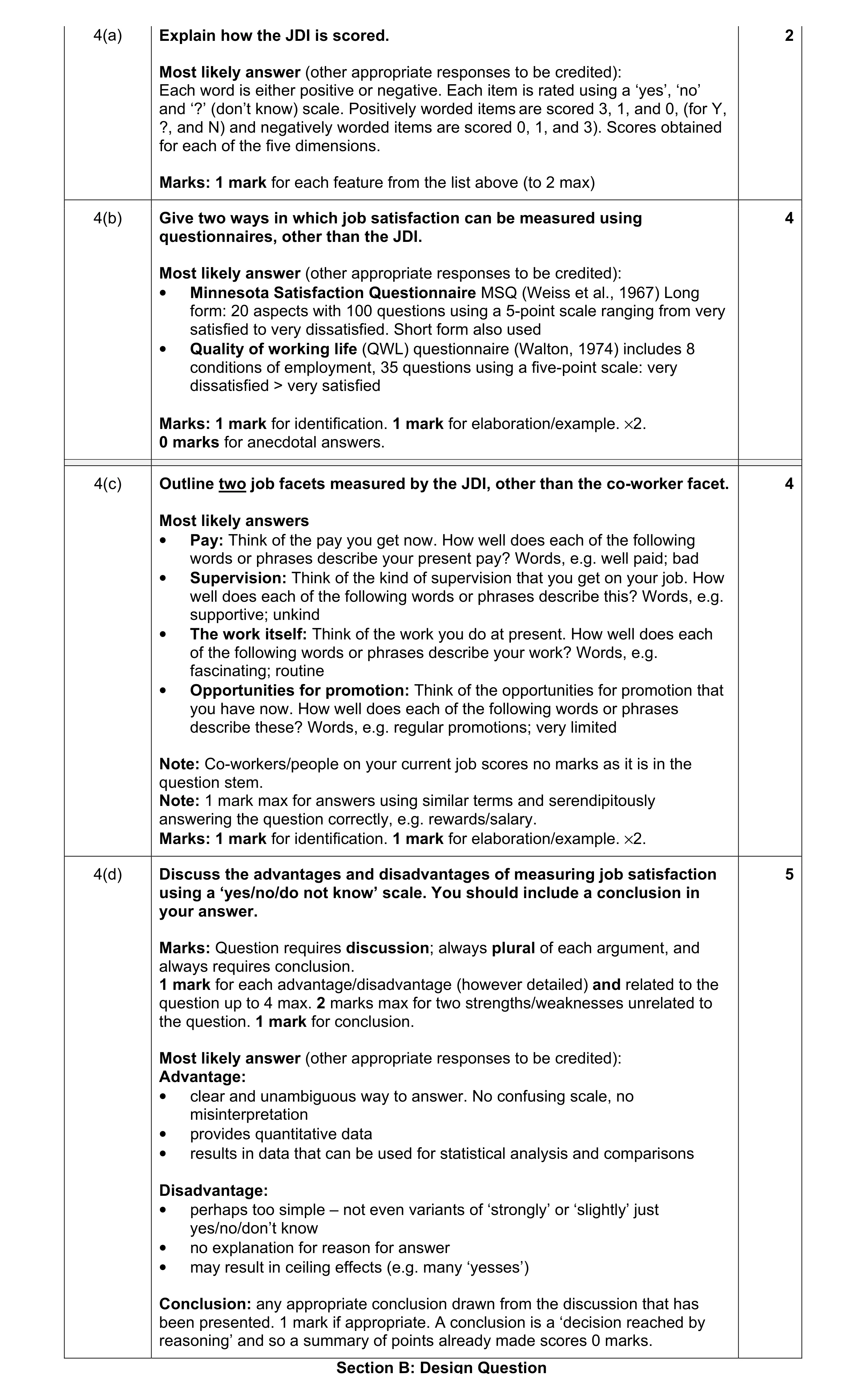 15
15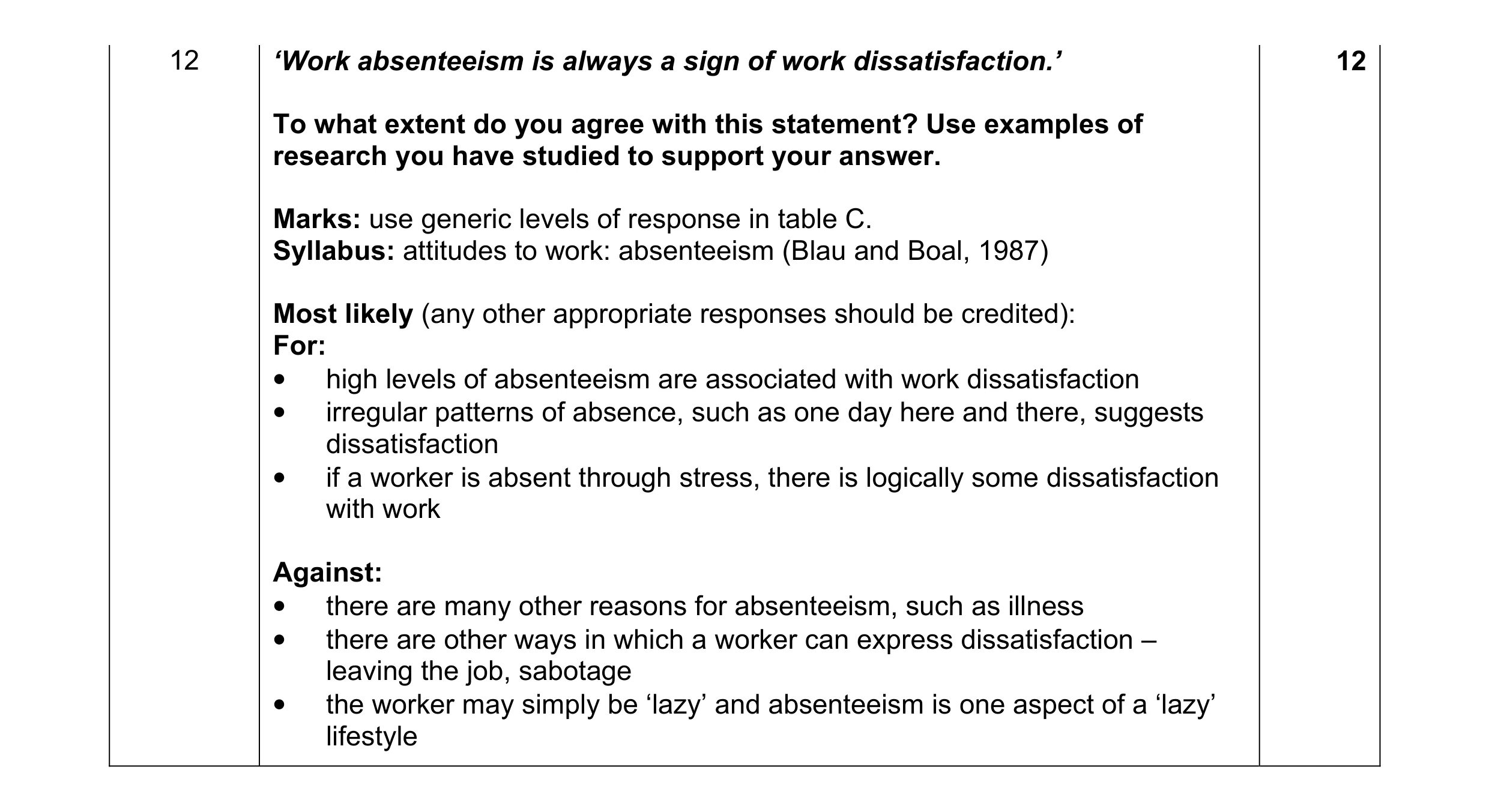 12
12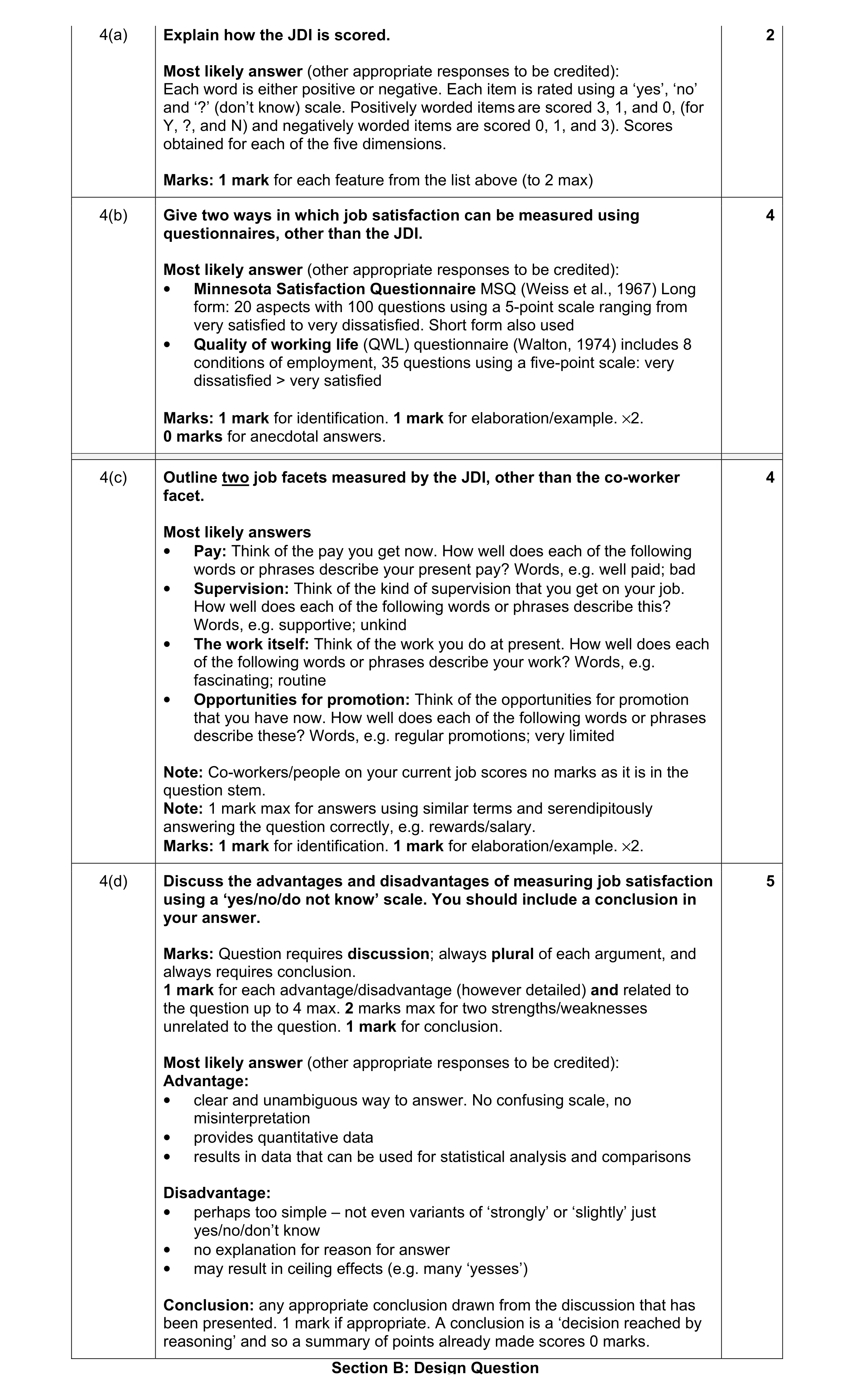 15
15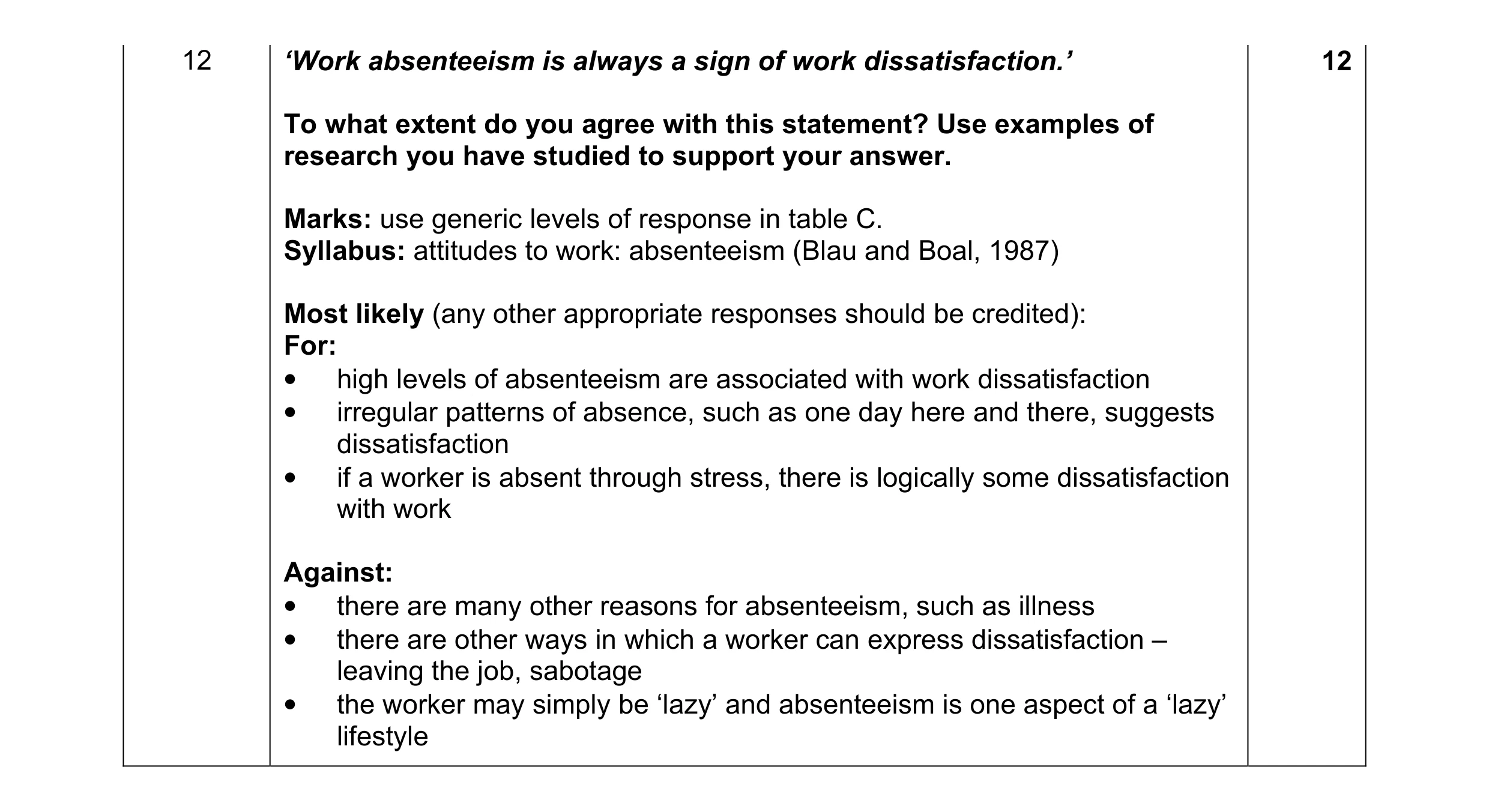 12
12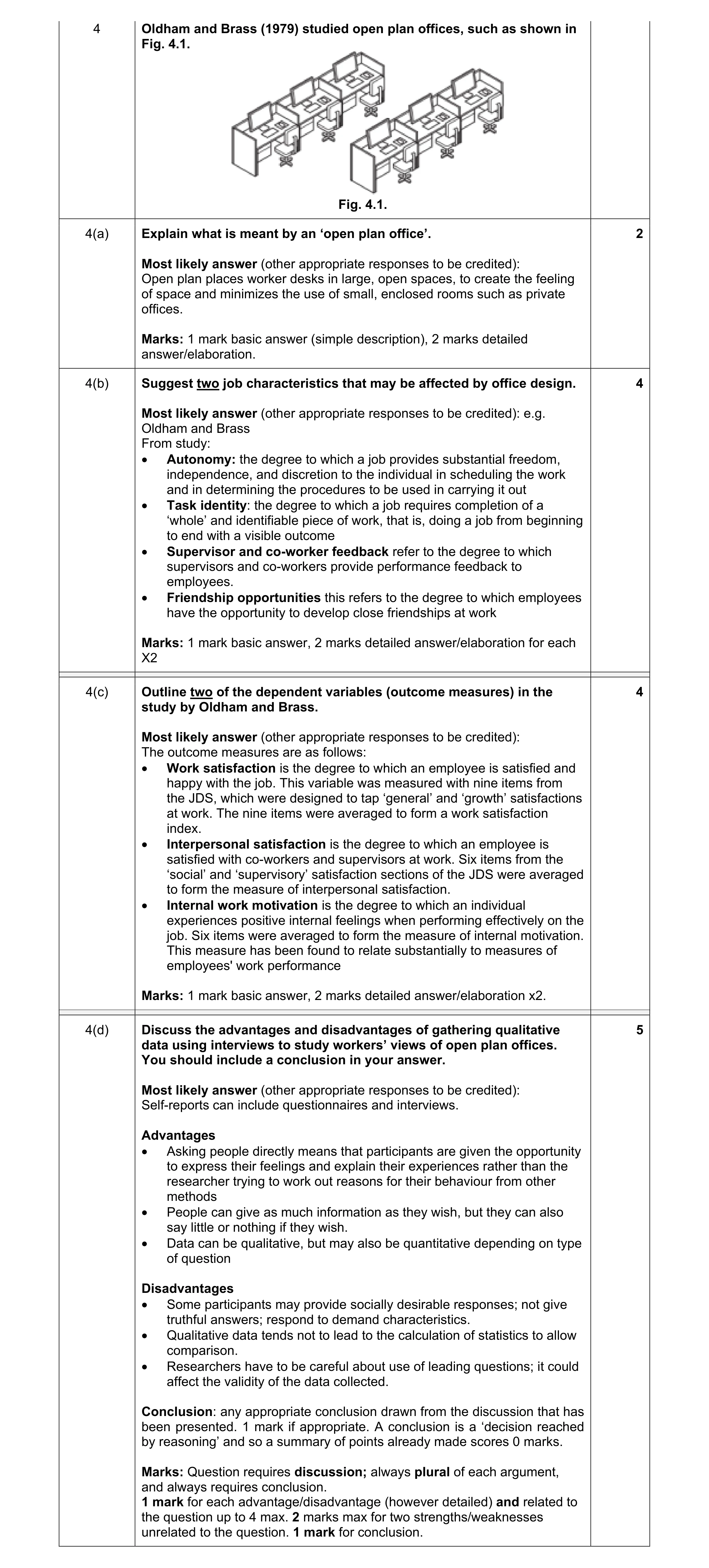 15
15 12
12 15
15 12
12 12
12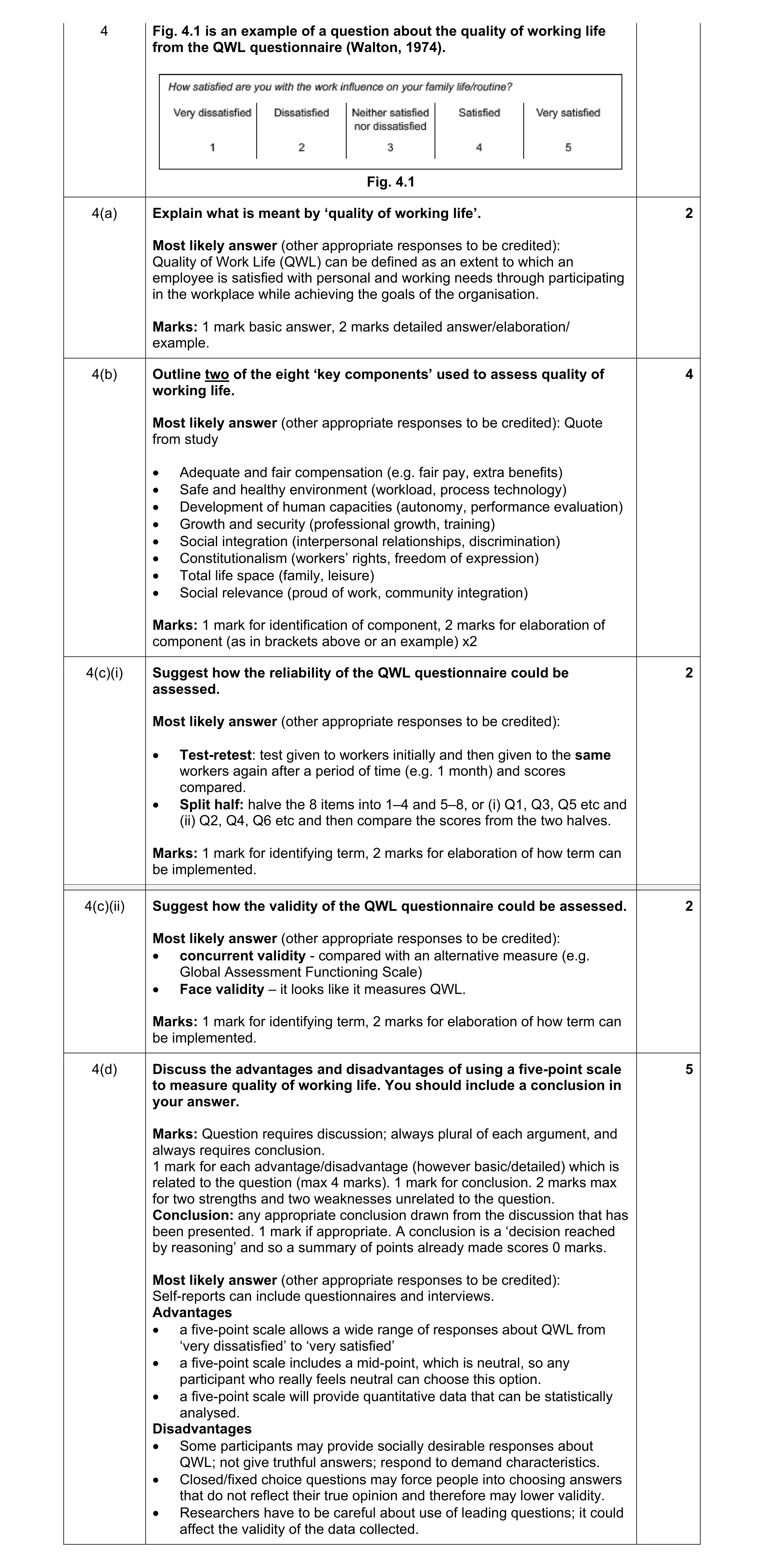 15
15 18
18 12
12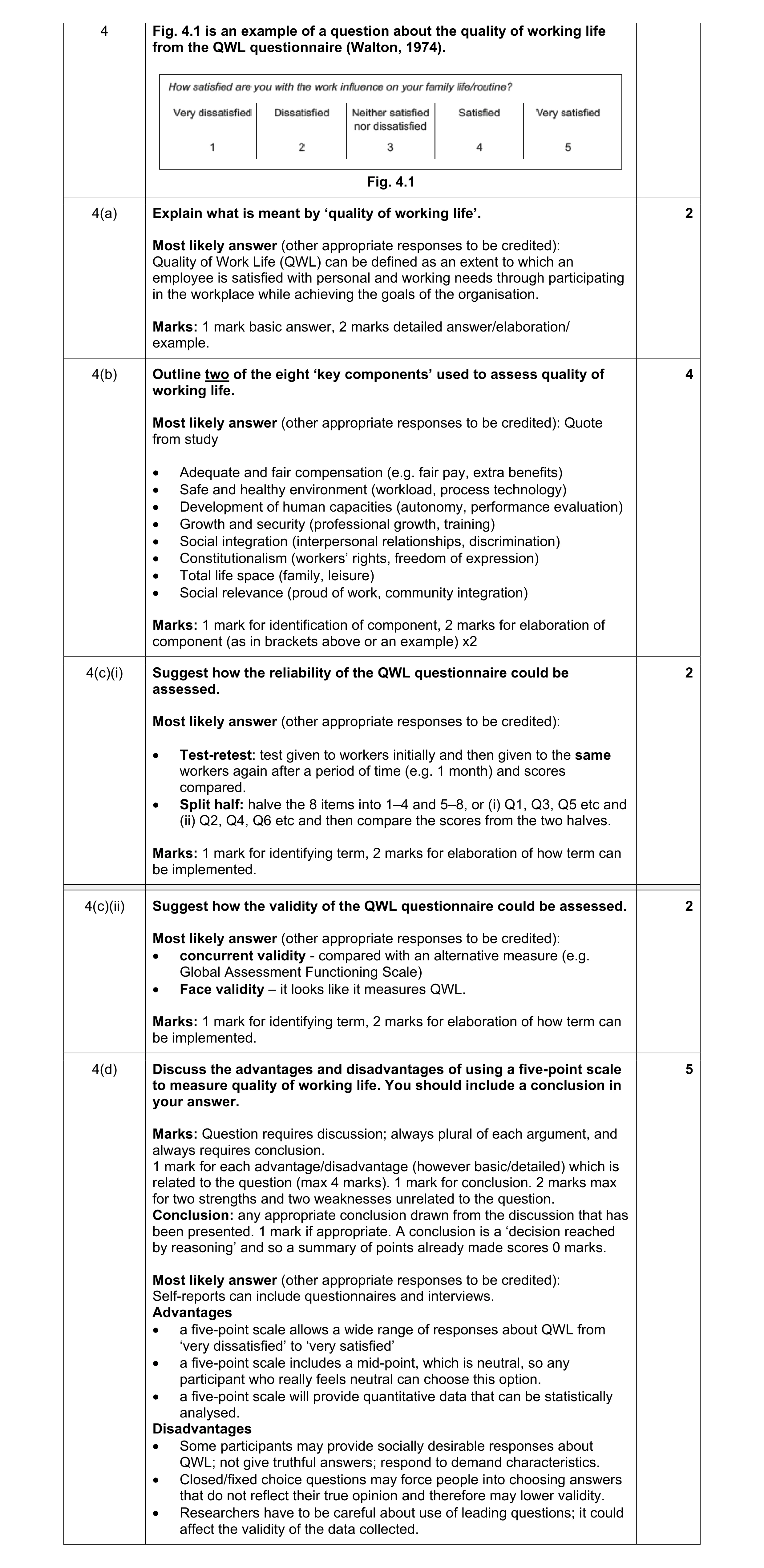 15
15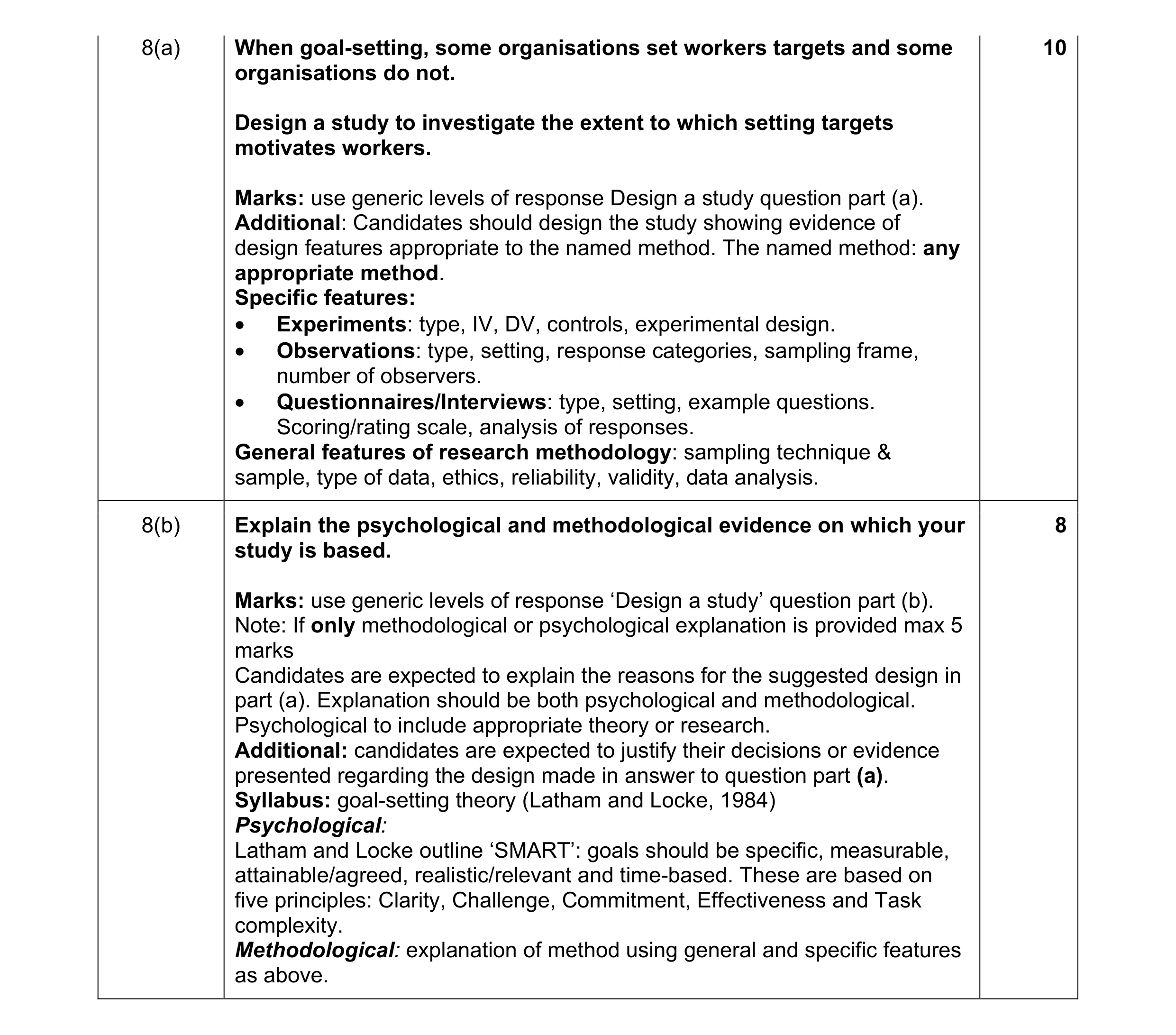 18
18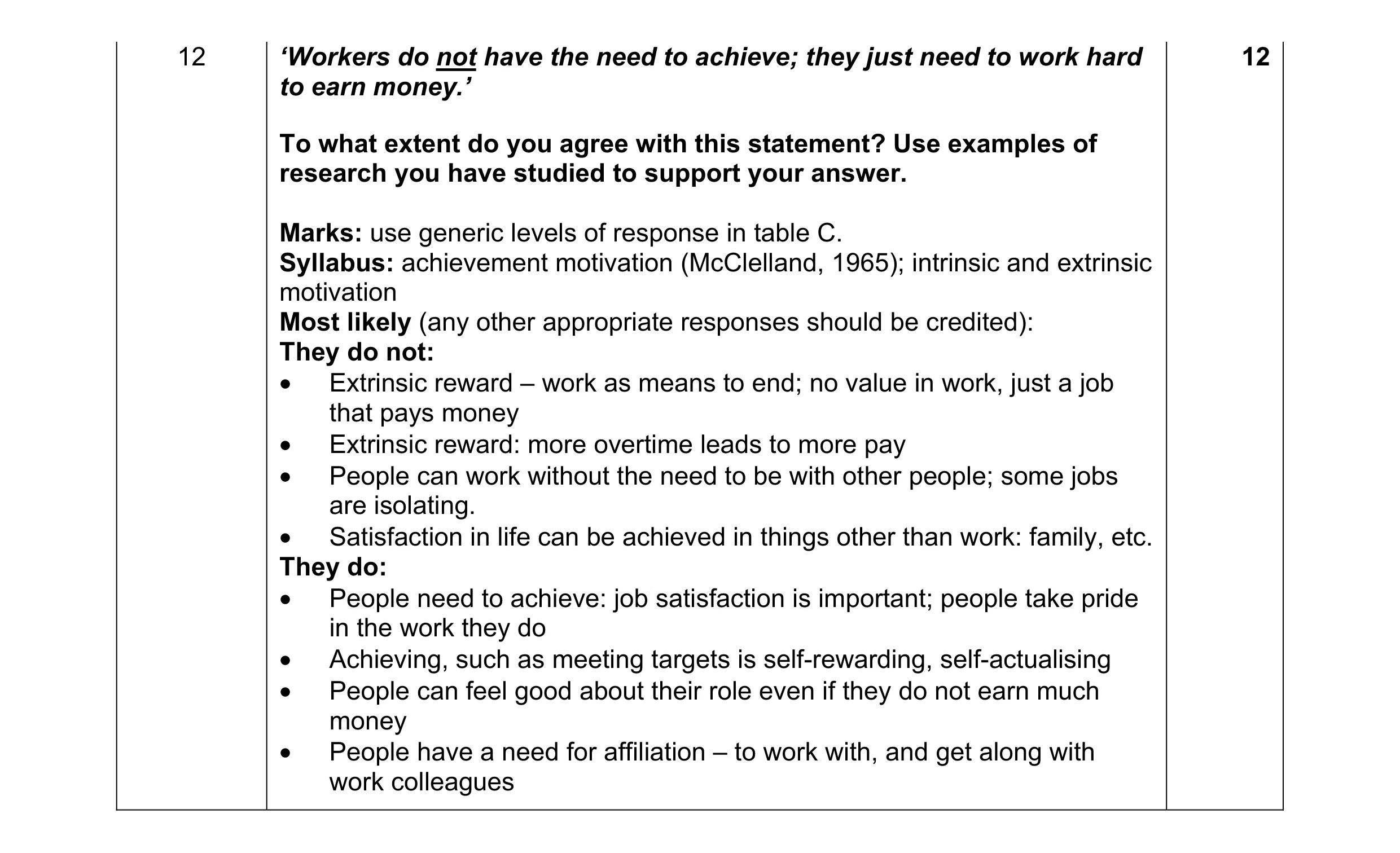 12
12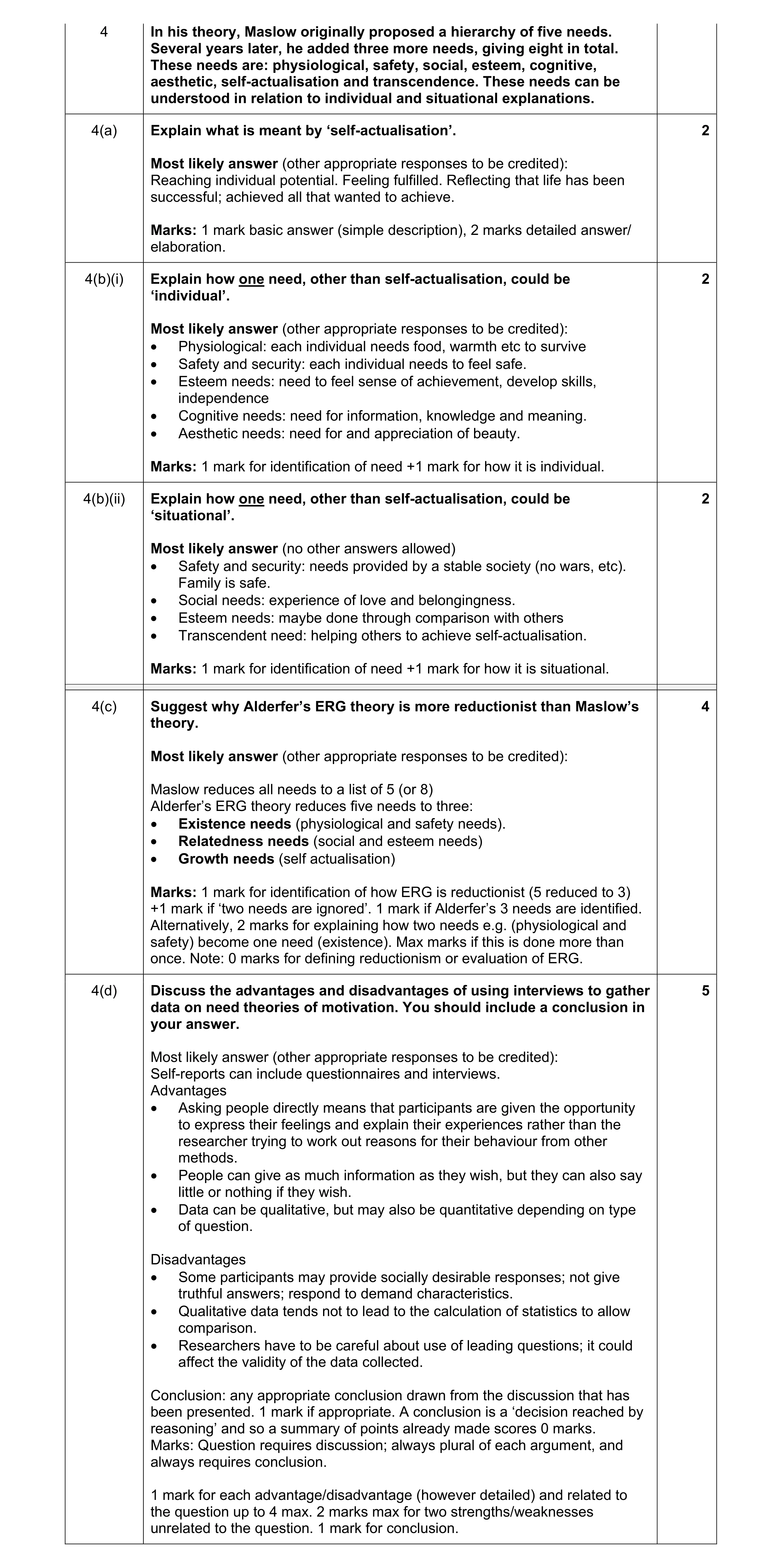 15
15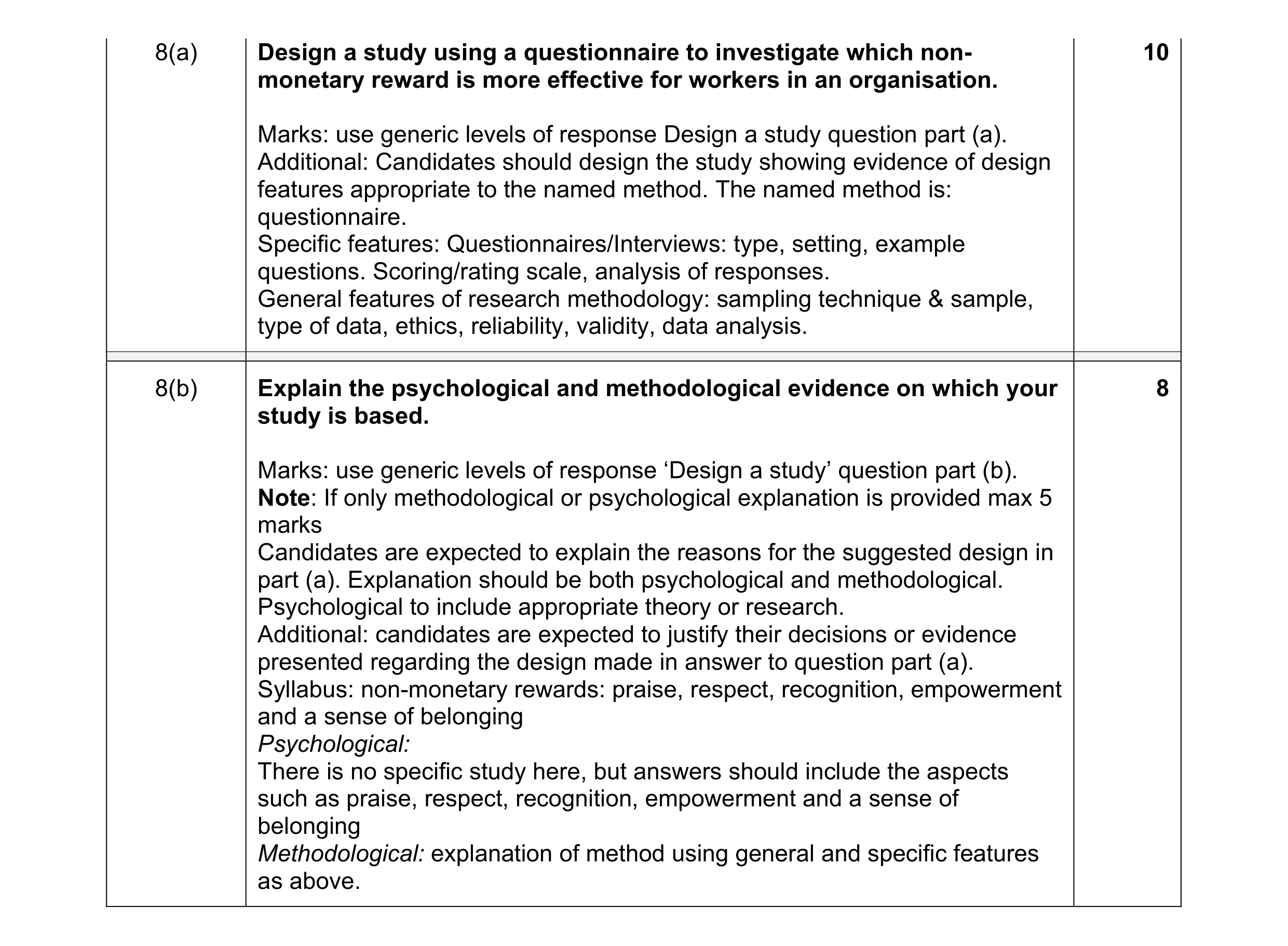 18
18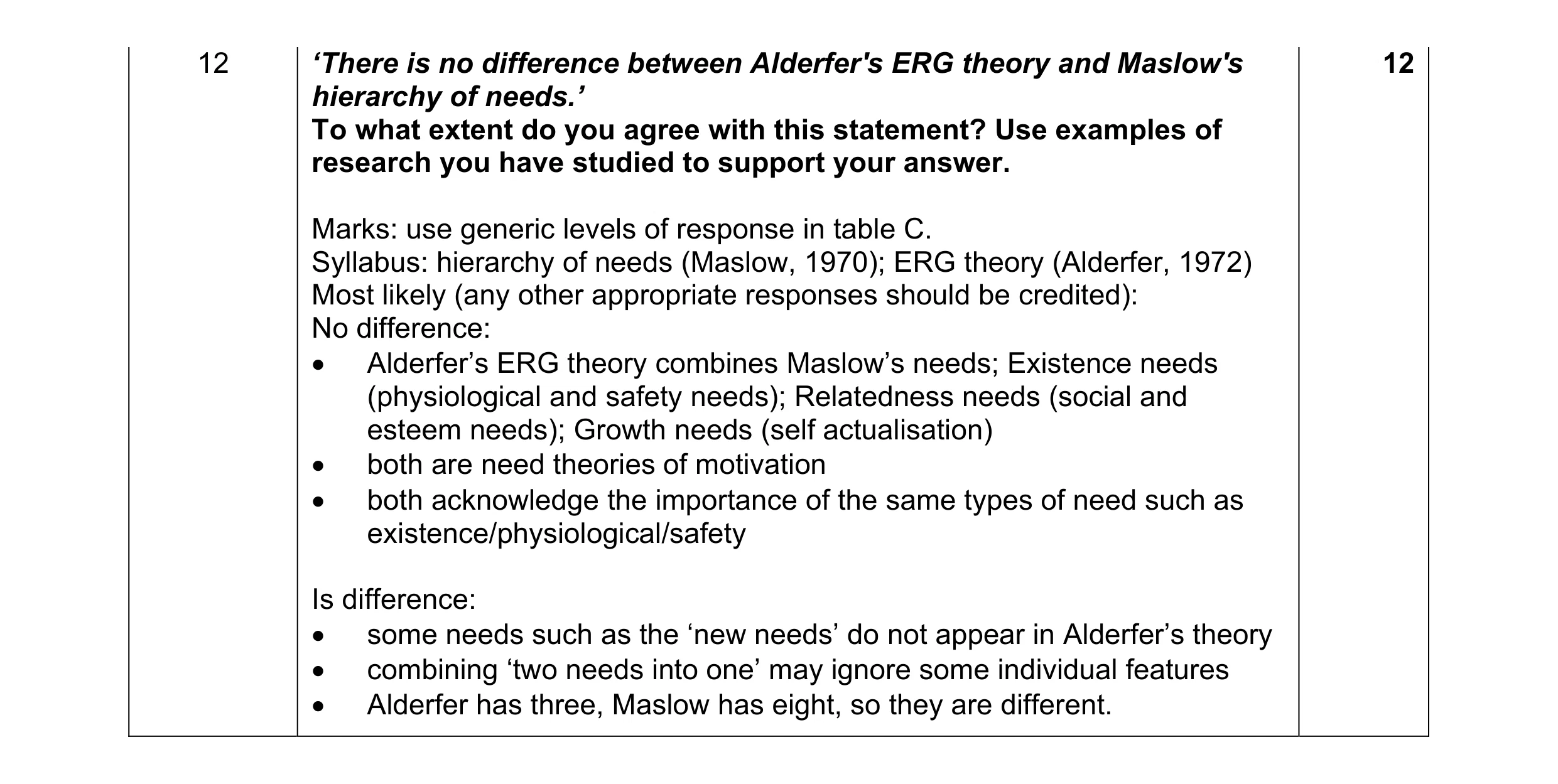 12
12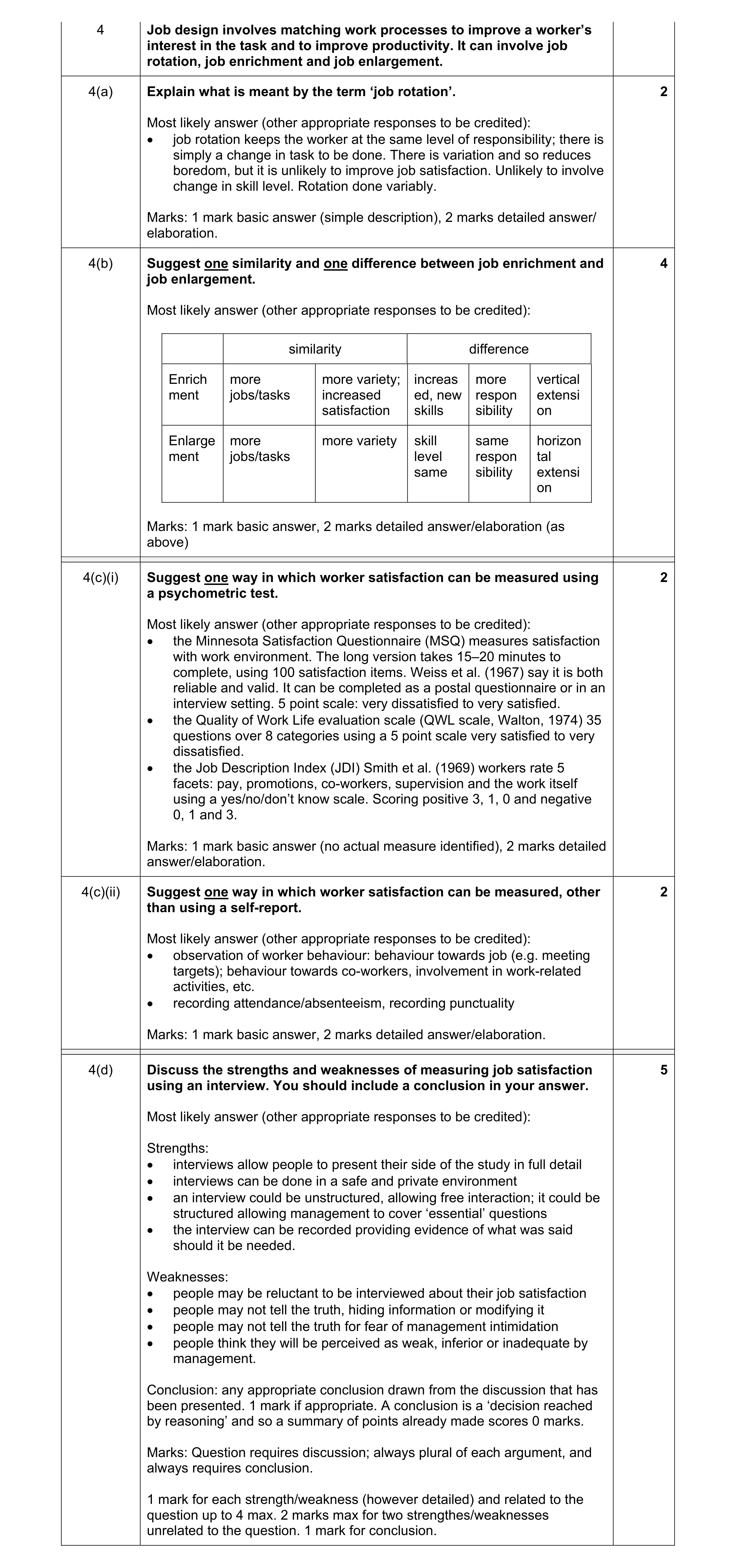 15
15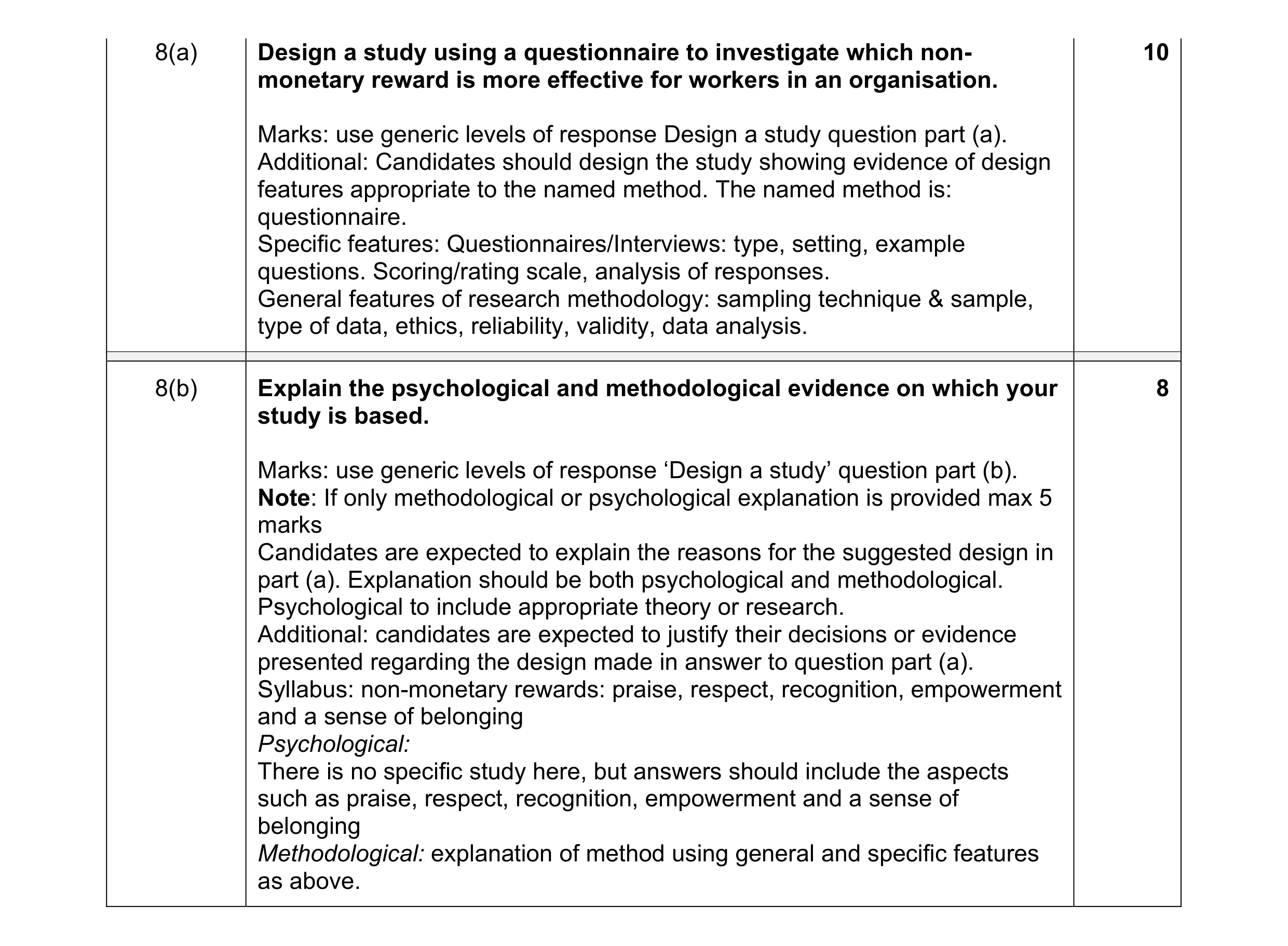 18
18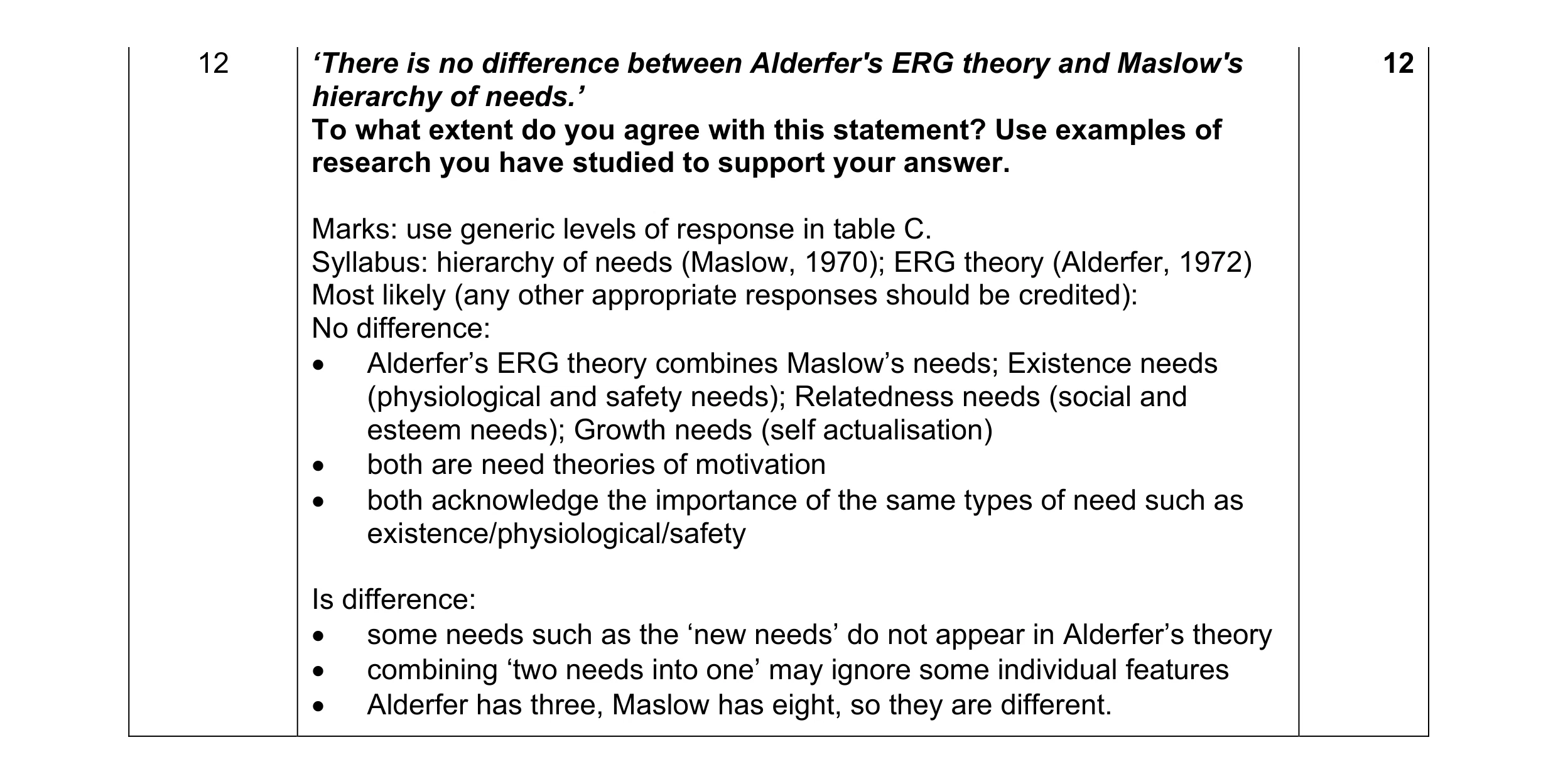 12
12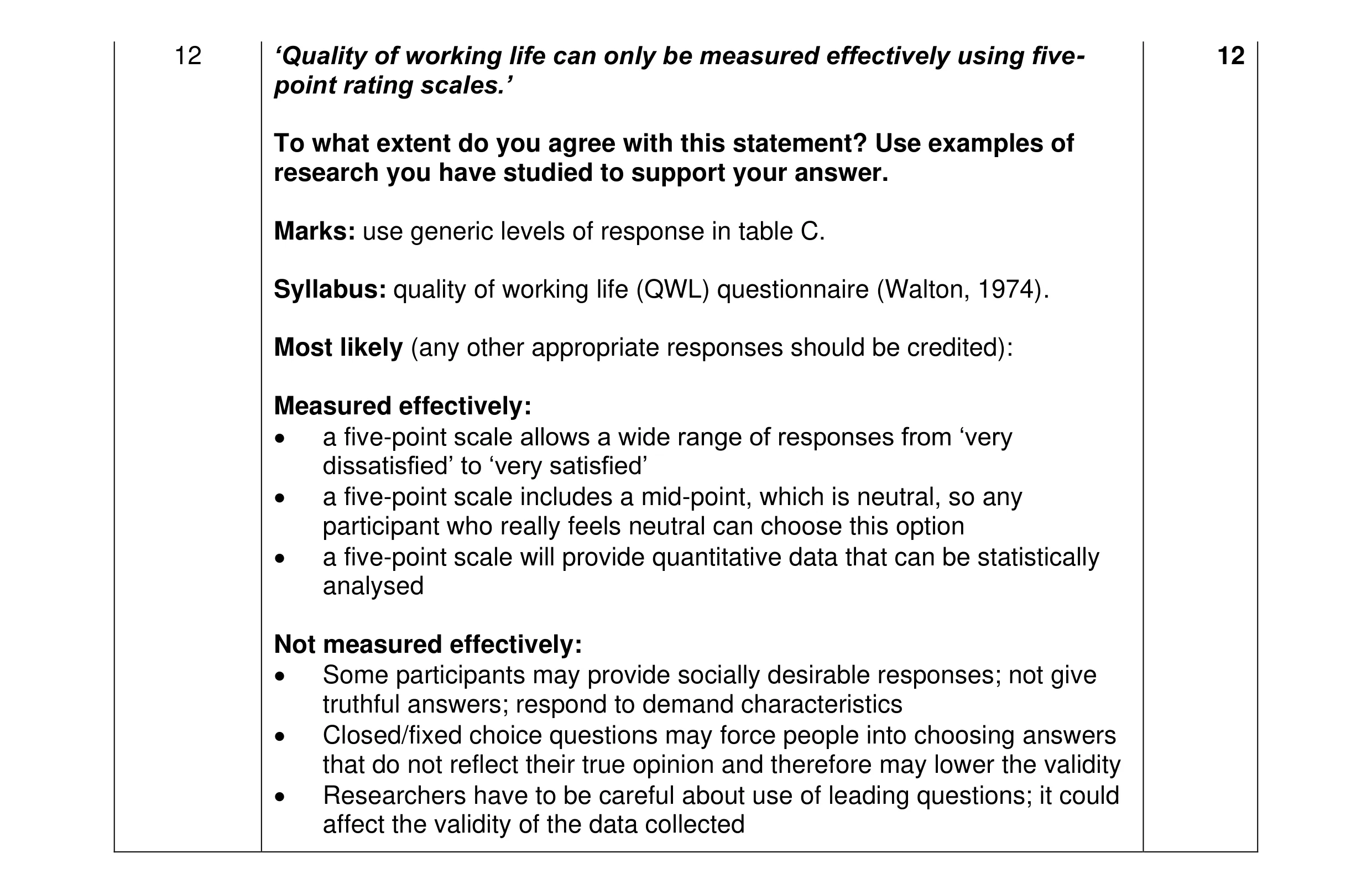 12
12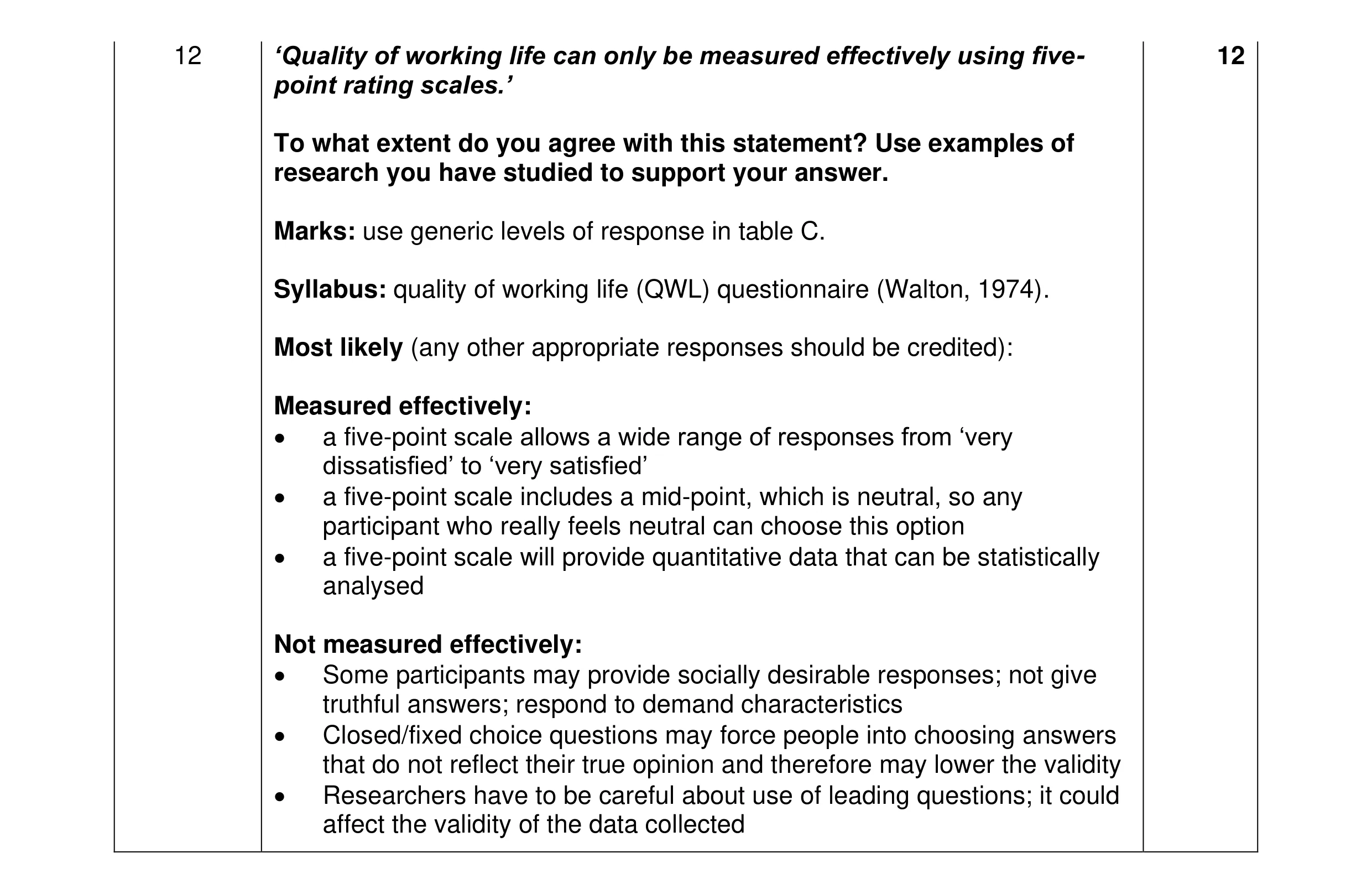 12
12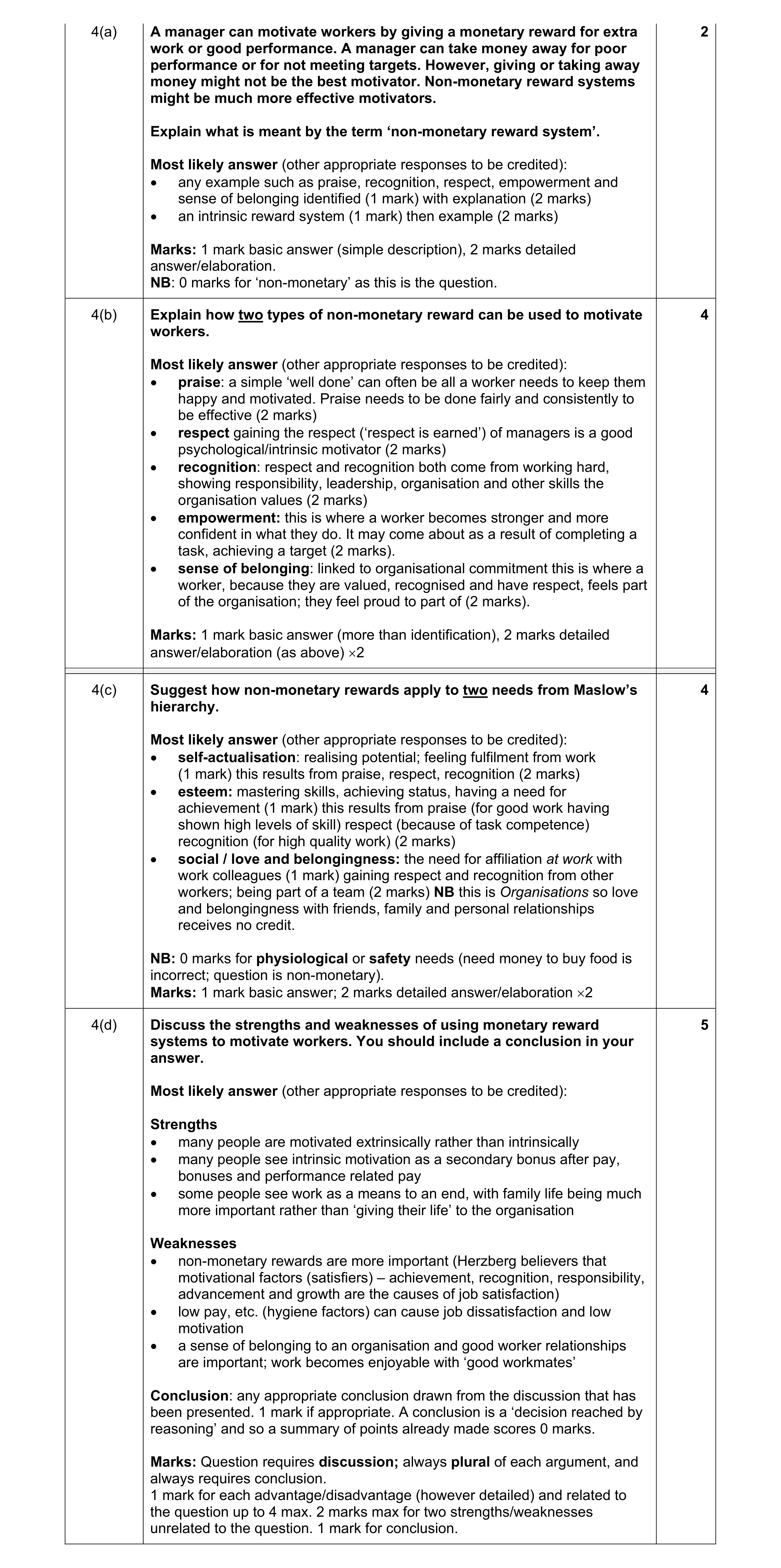 15
15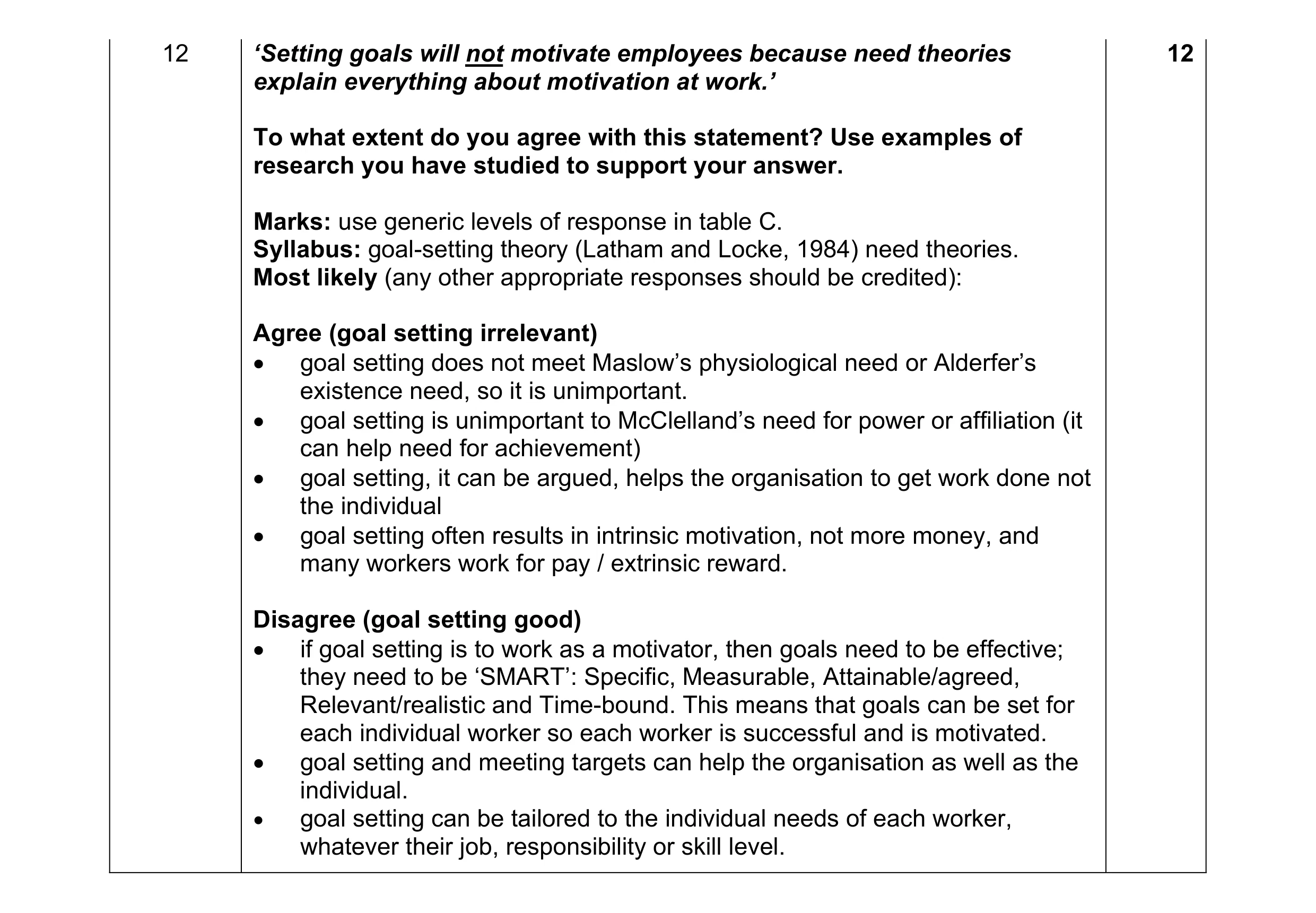 12
12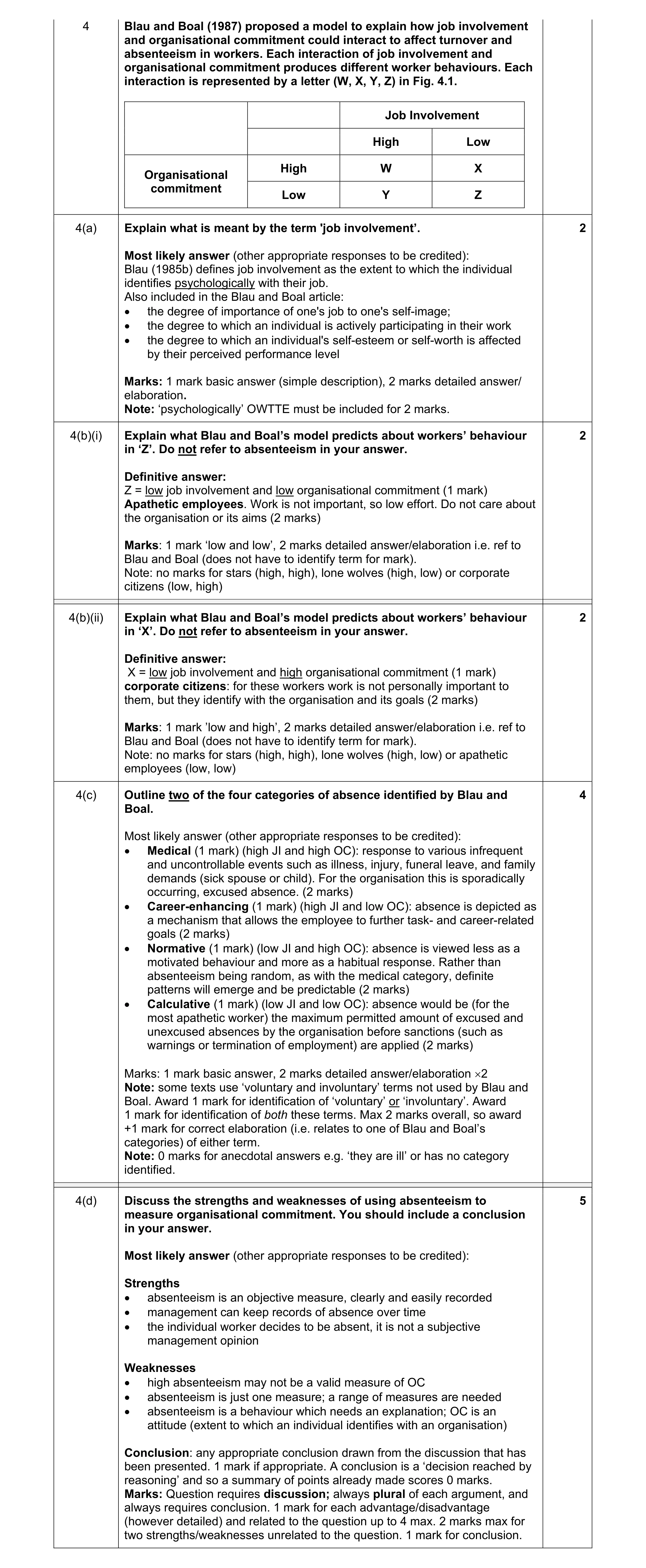 15
15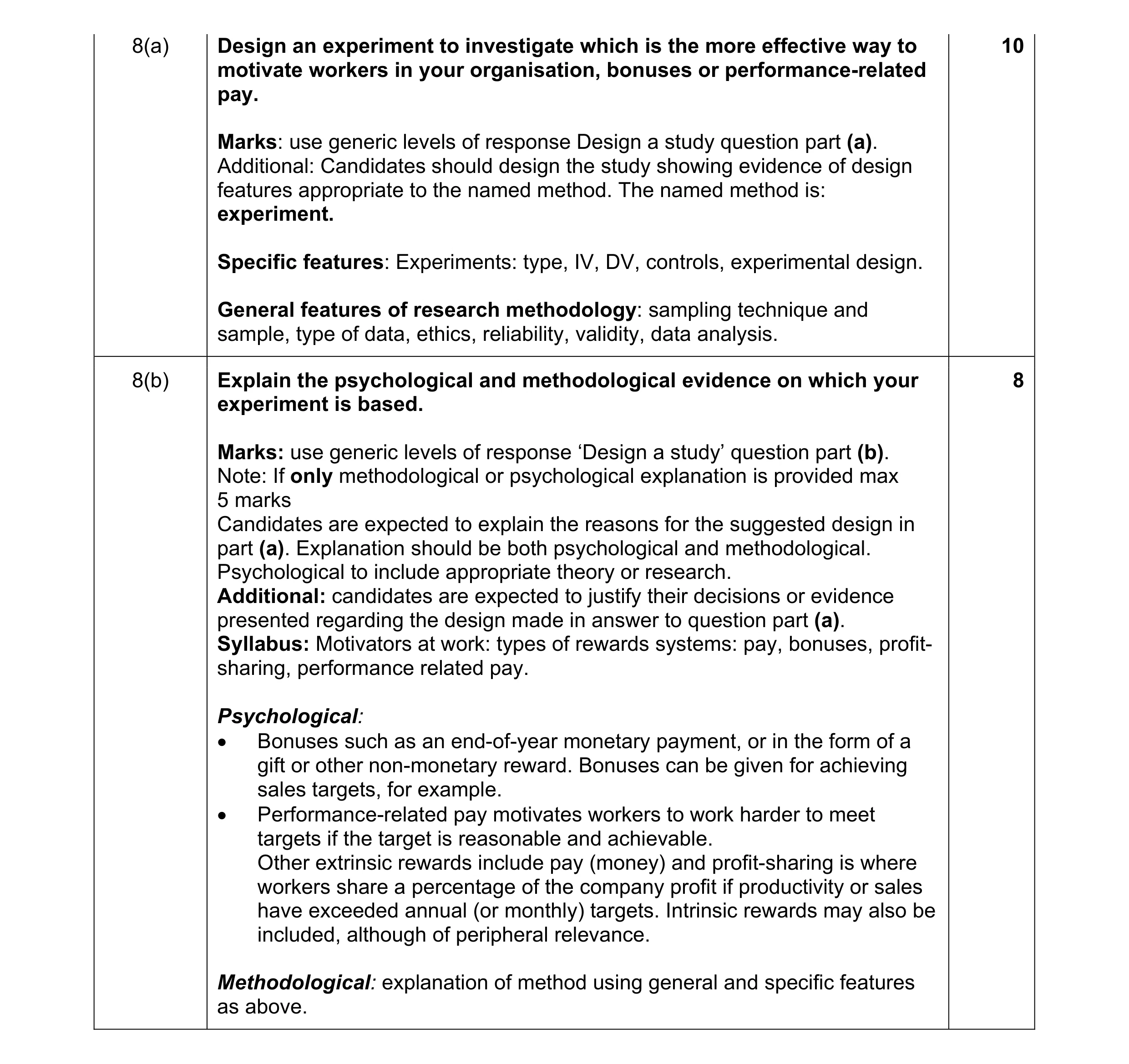 18
18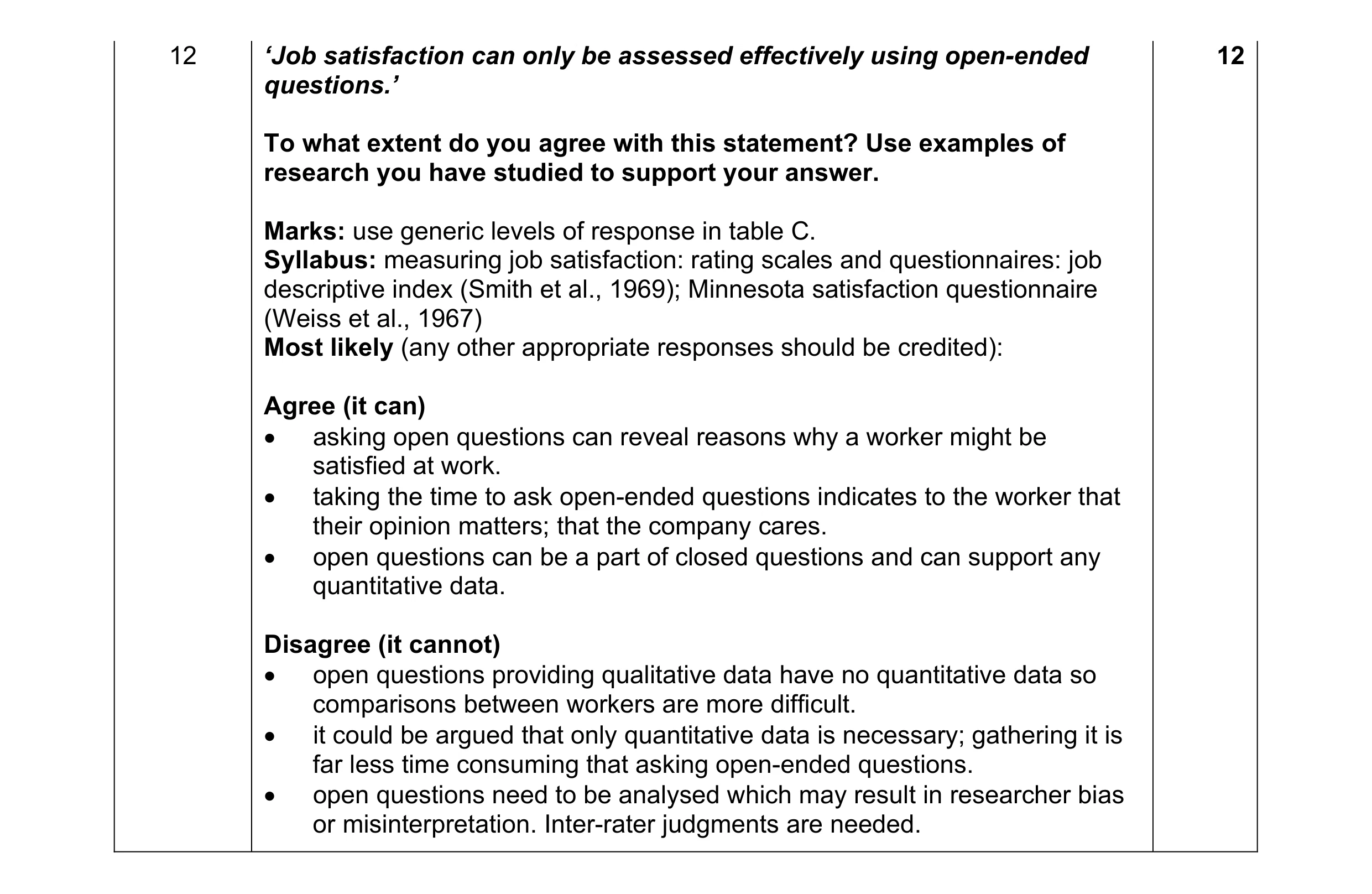 12
12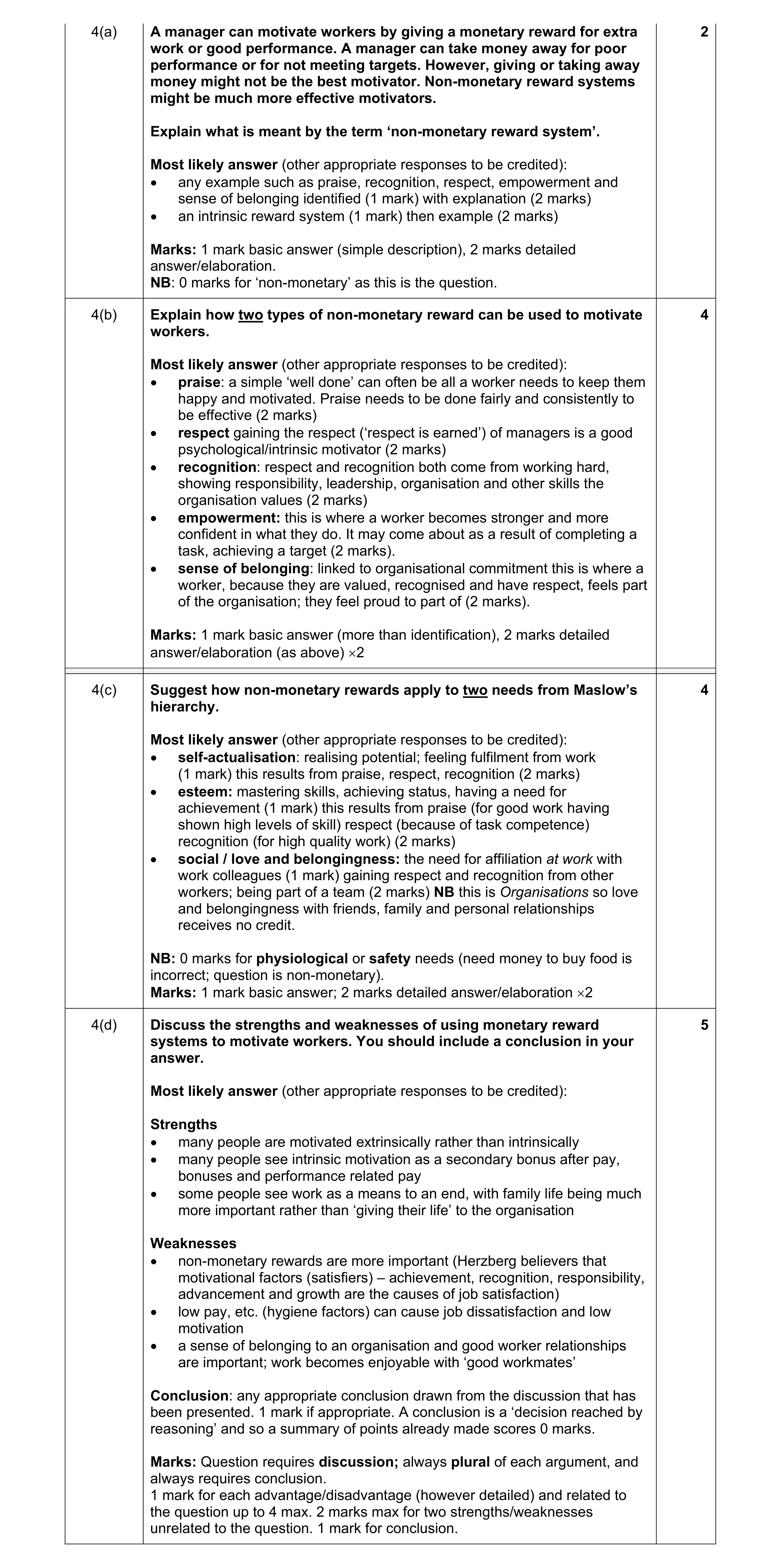 15
15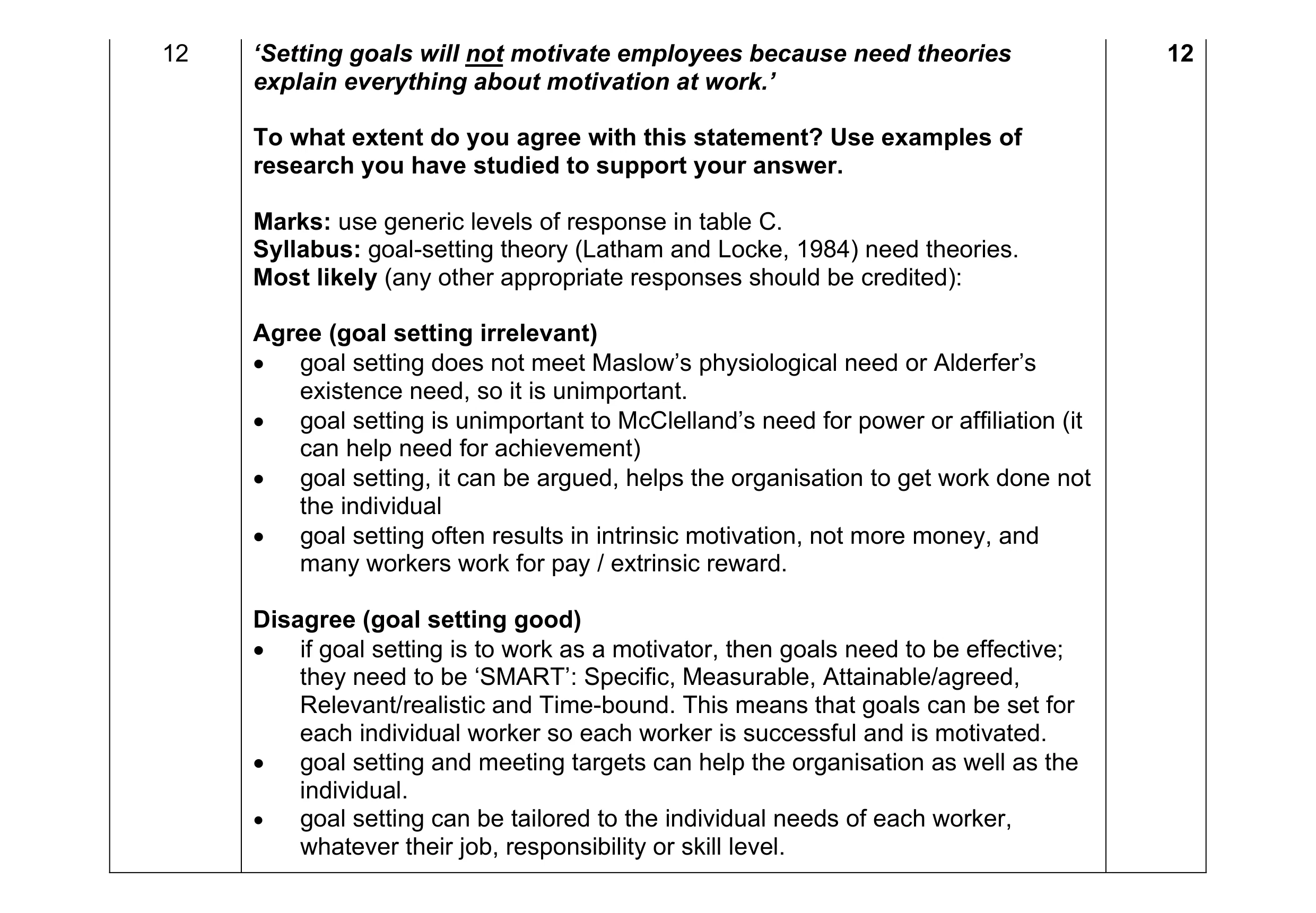 12
12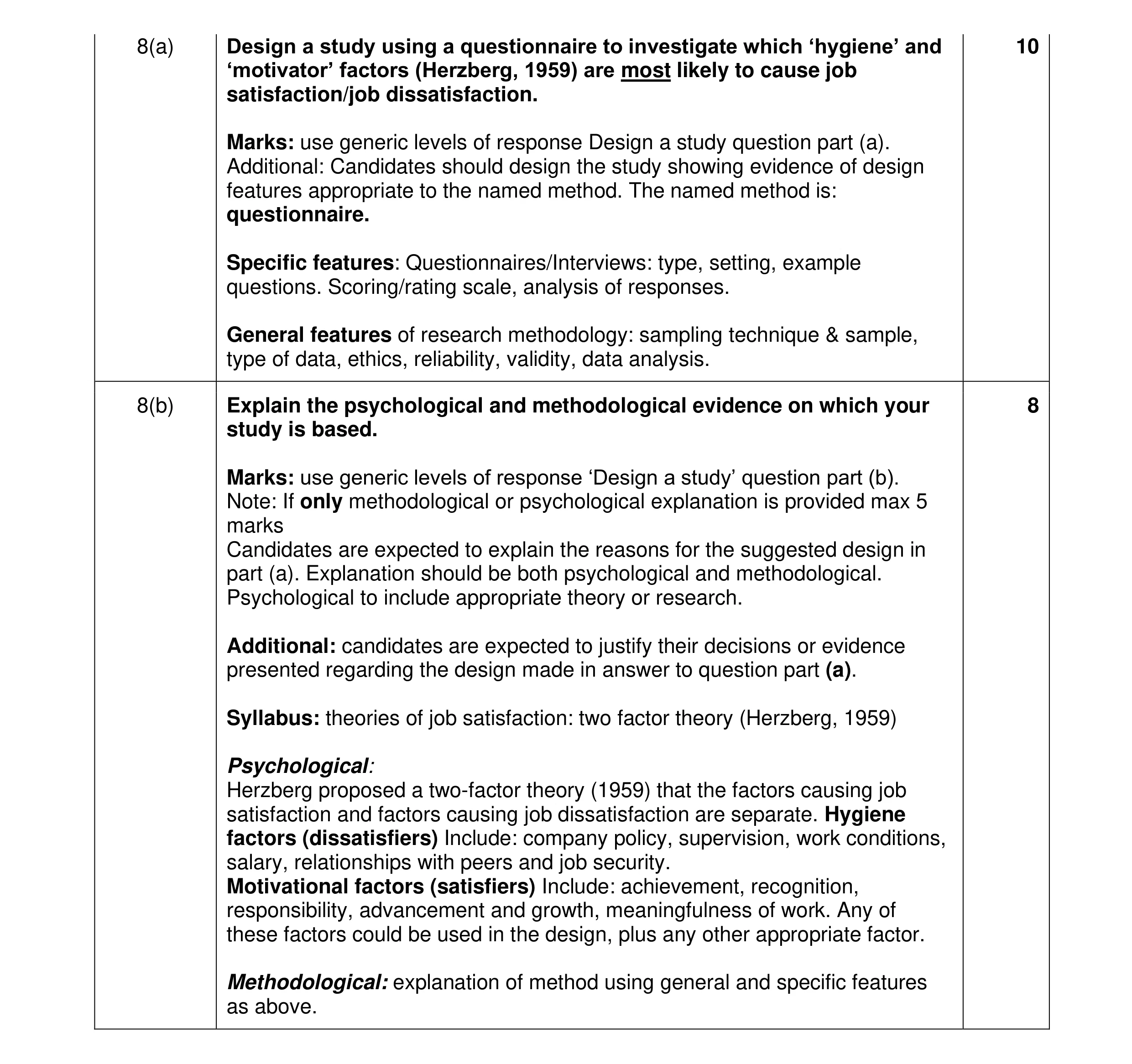 18
18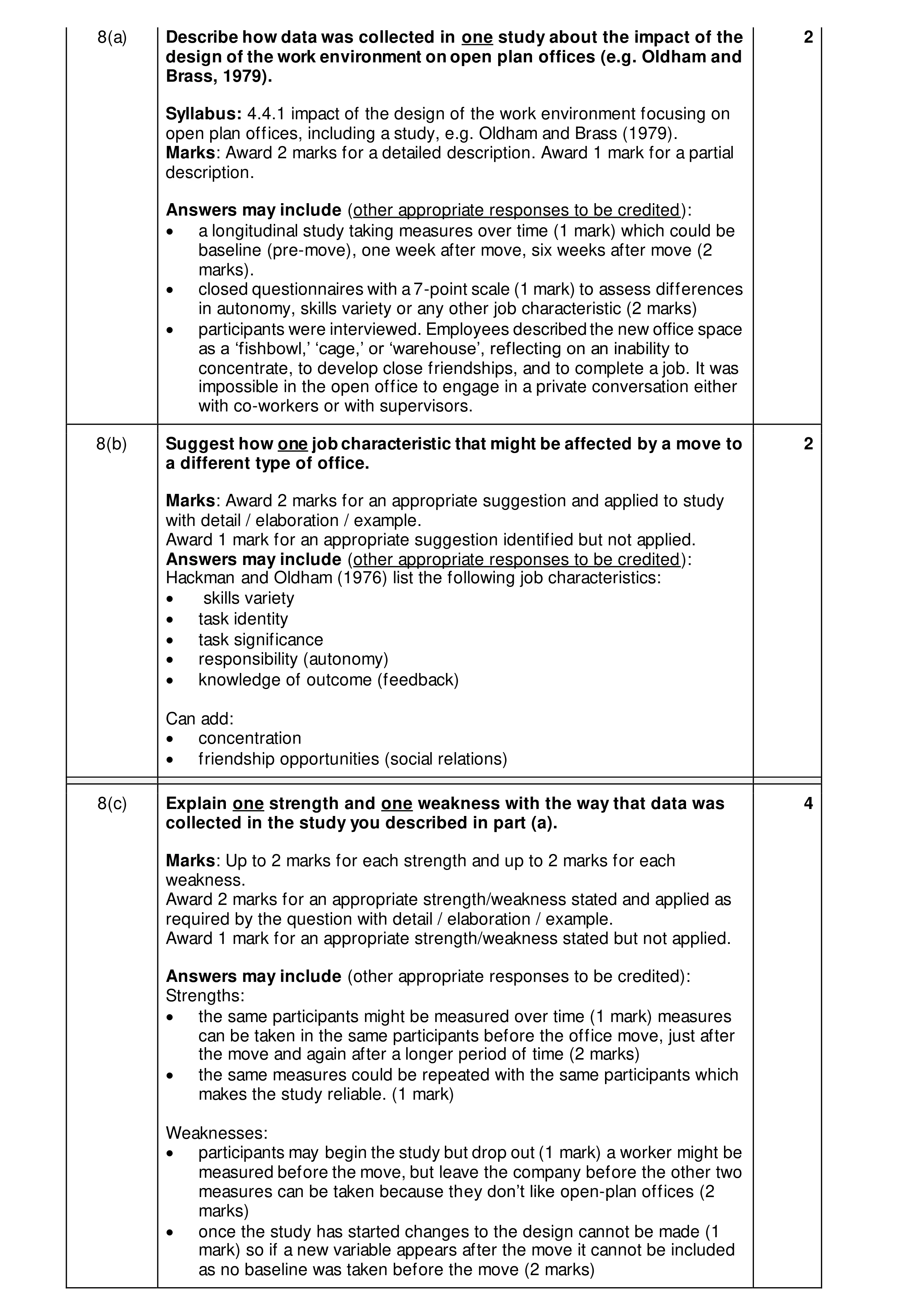 8
8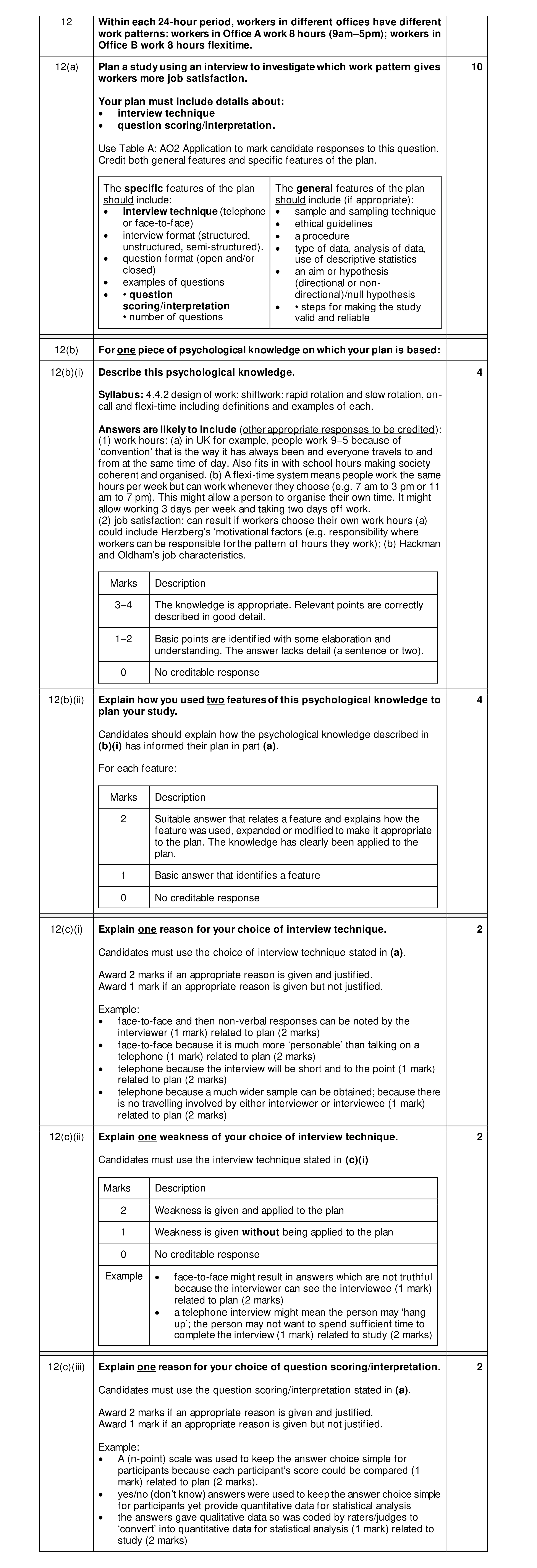 24
24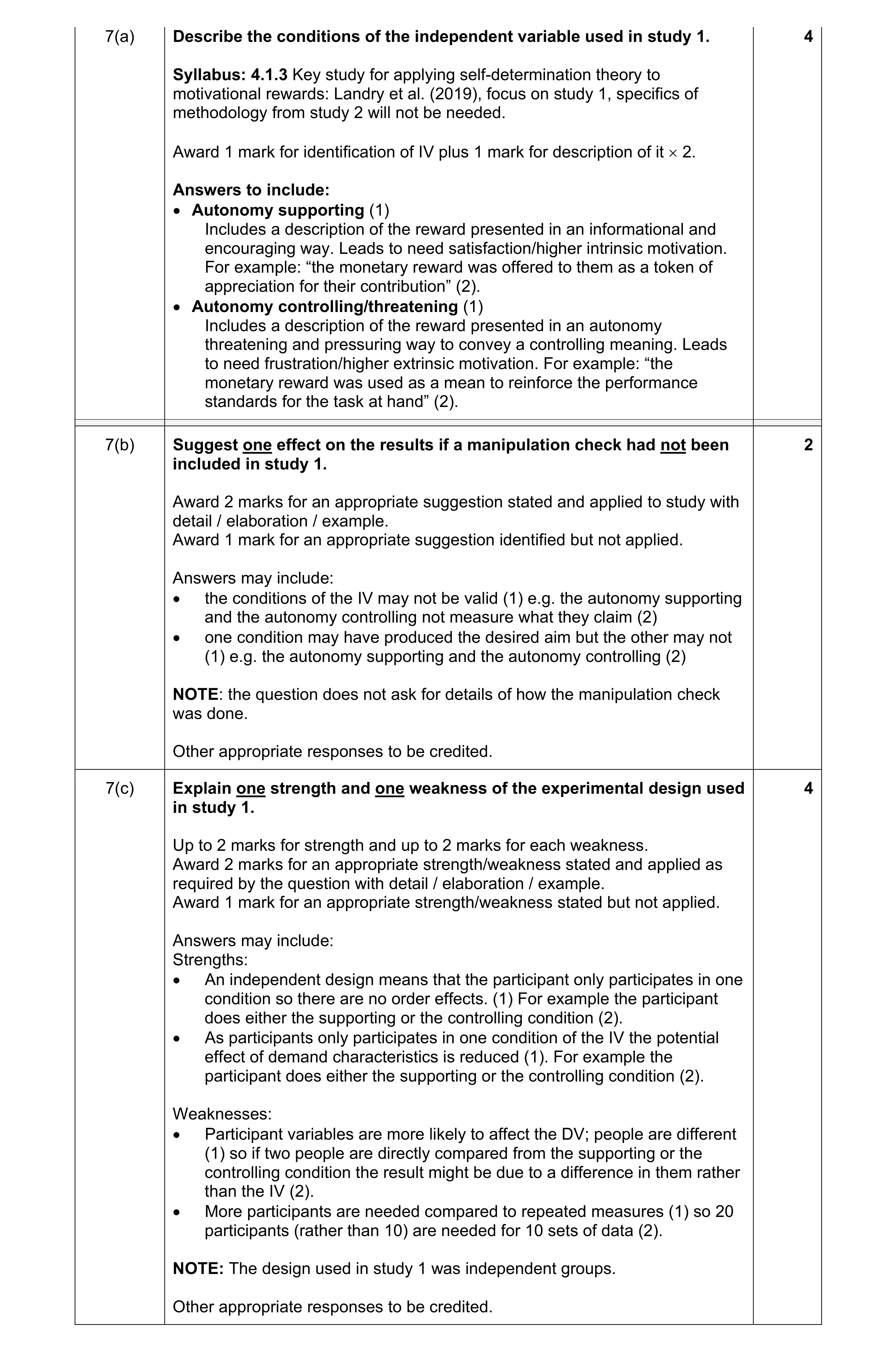 10
10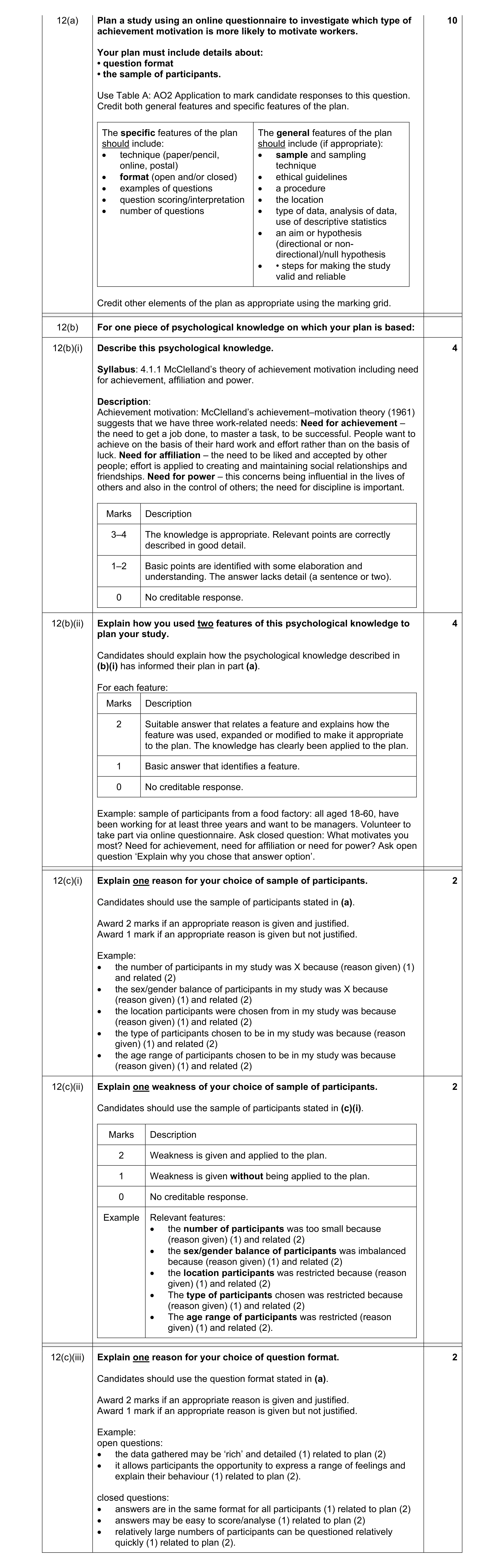 24
24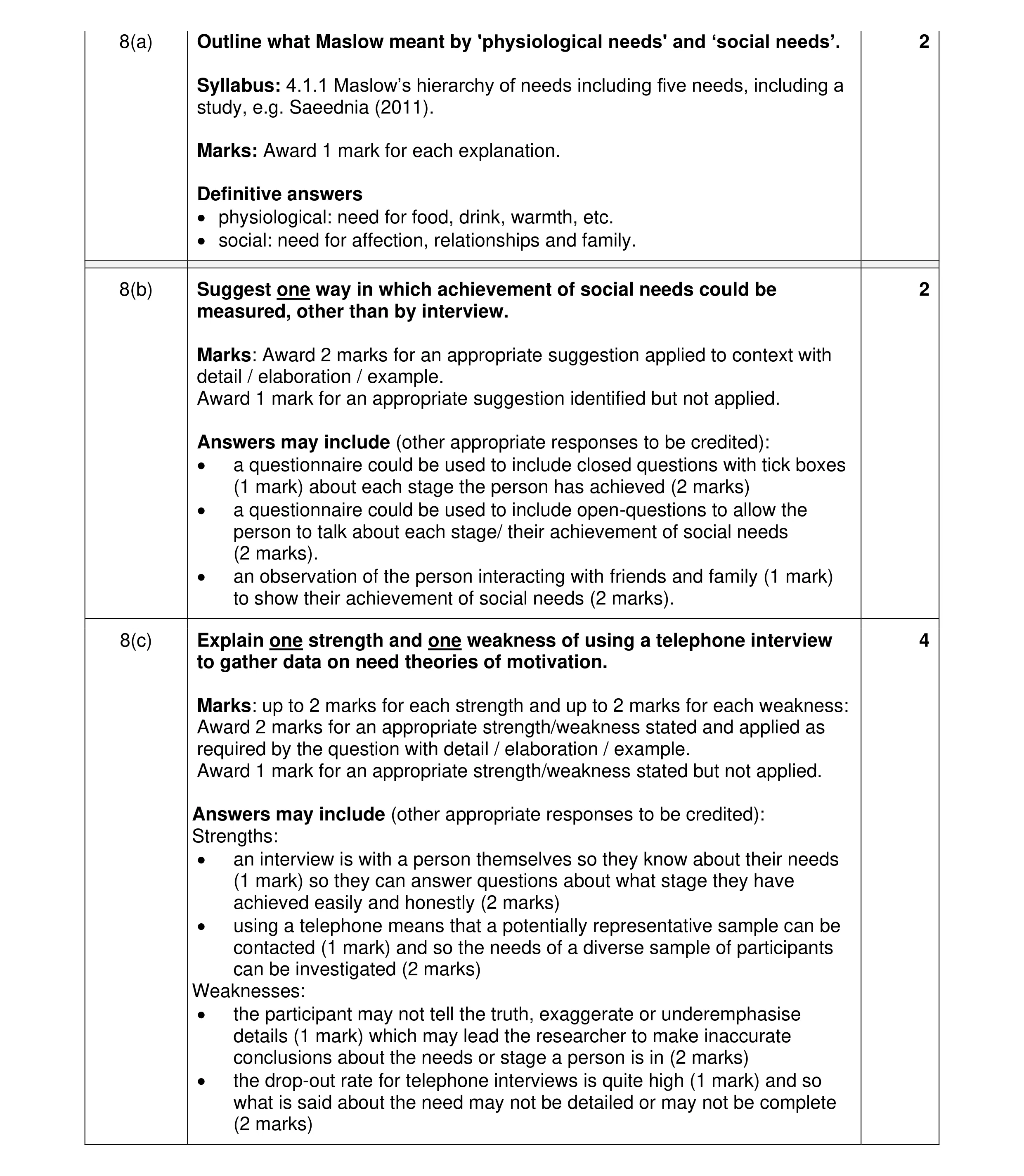 8
8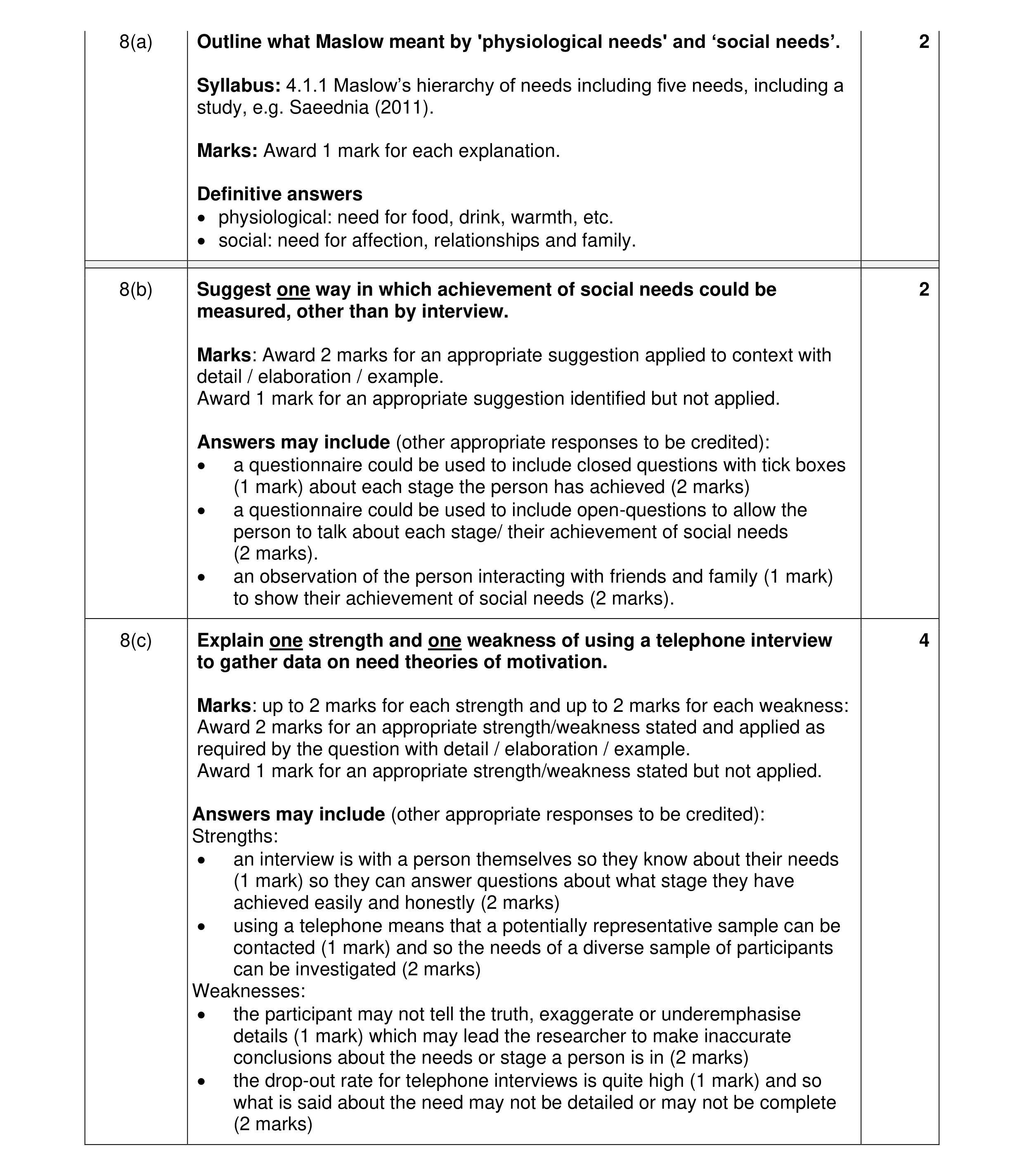 8
8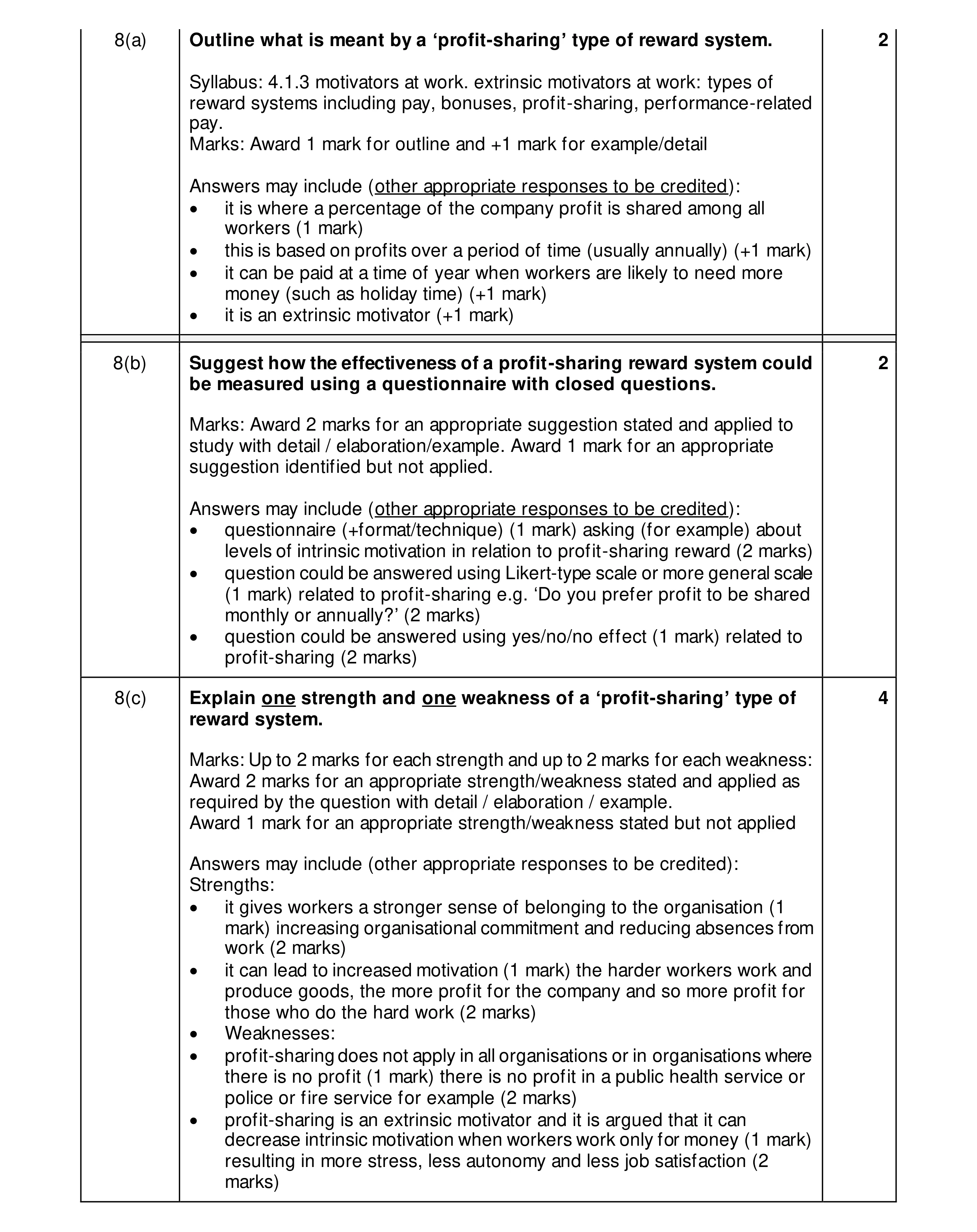 8
8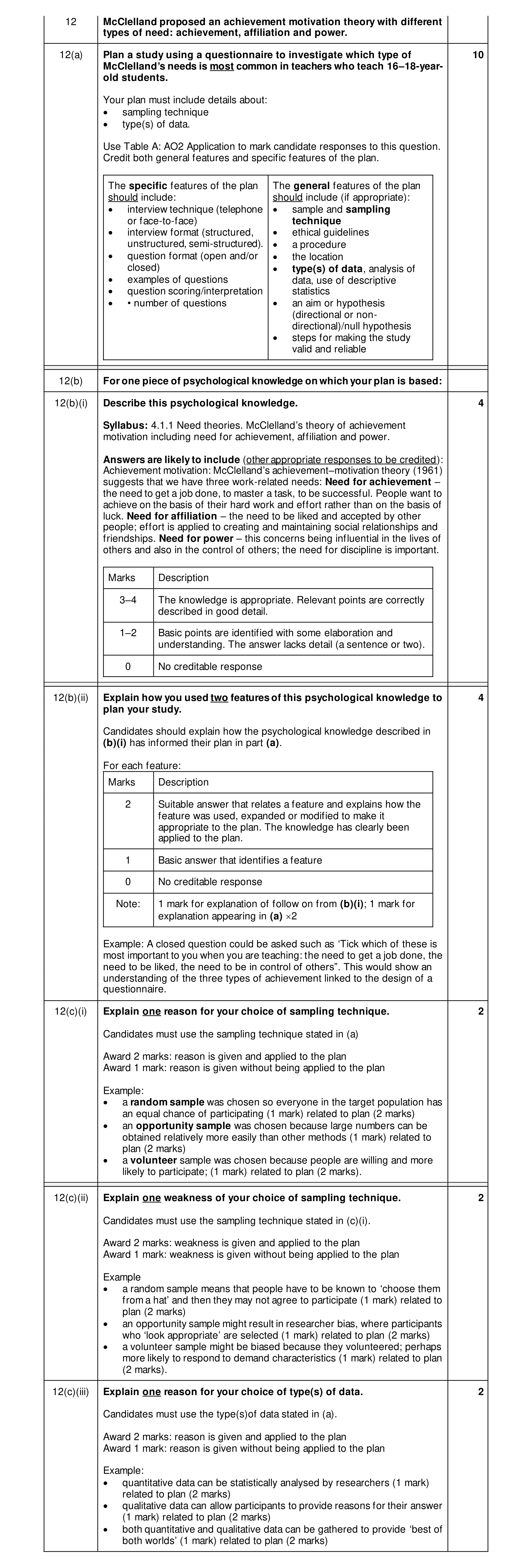 24
24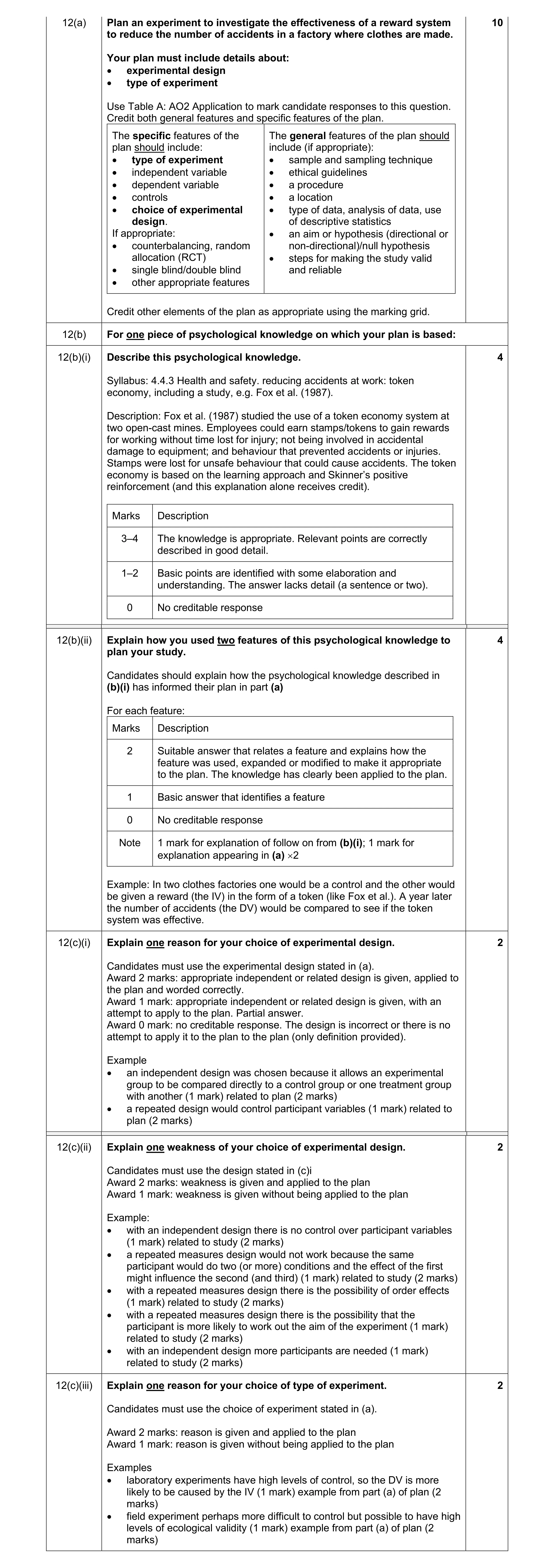 24
24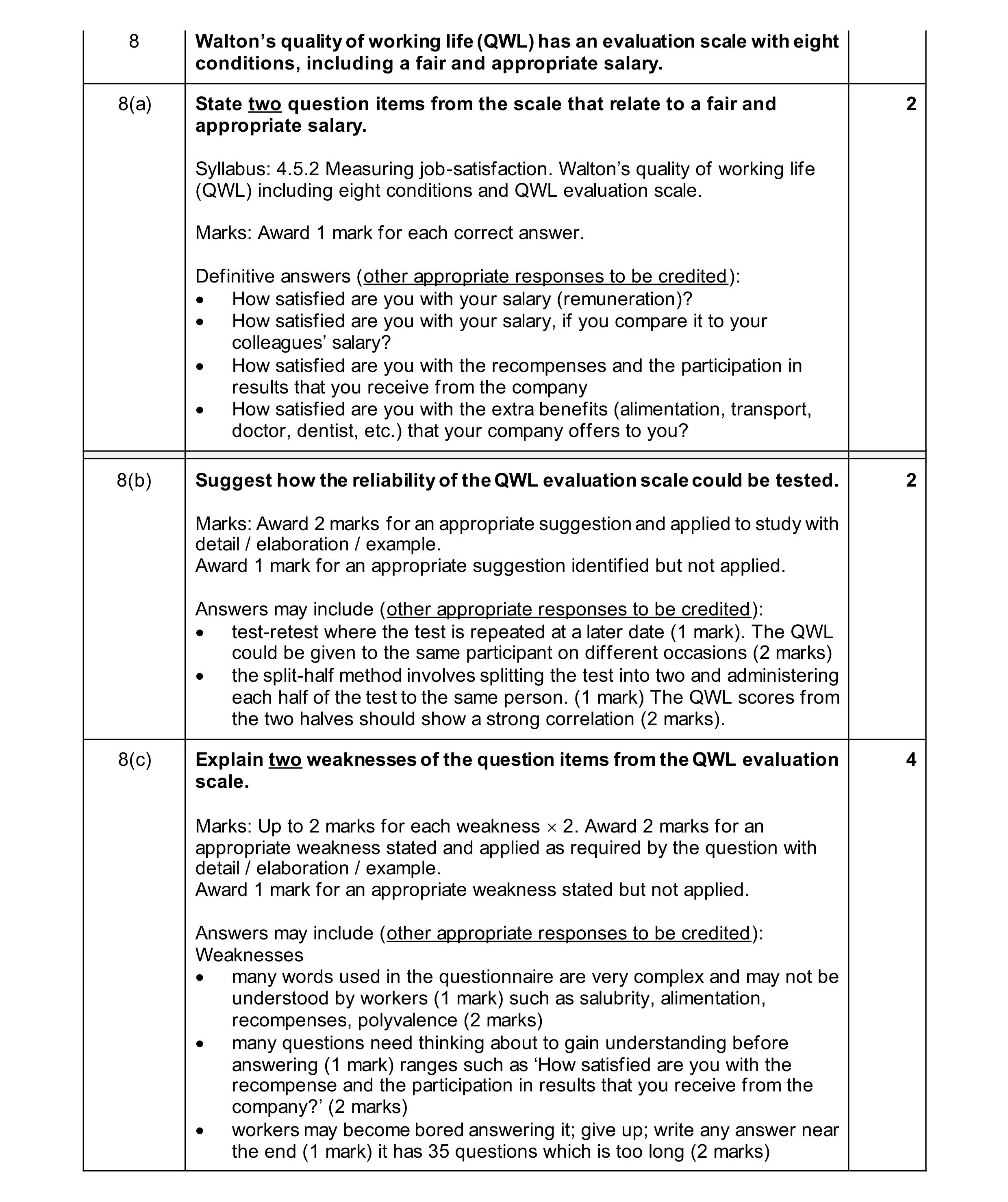 8
8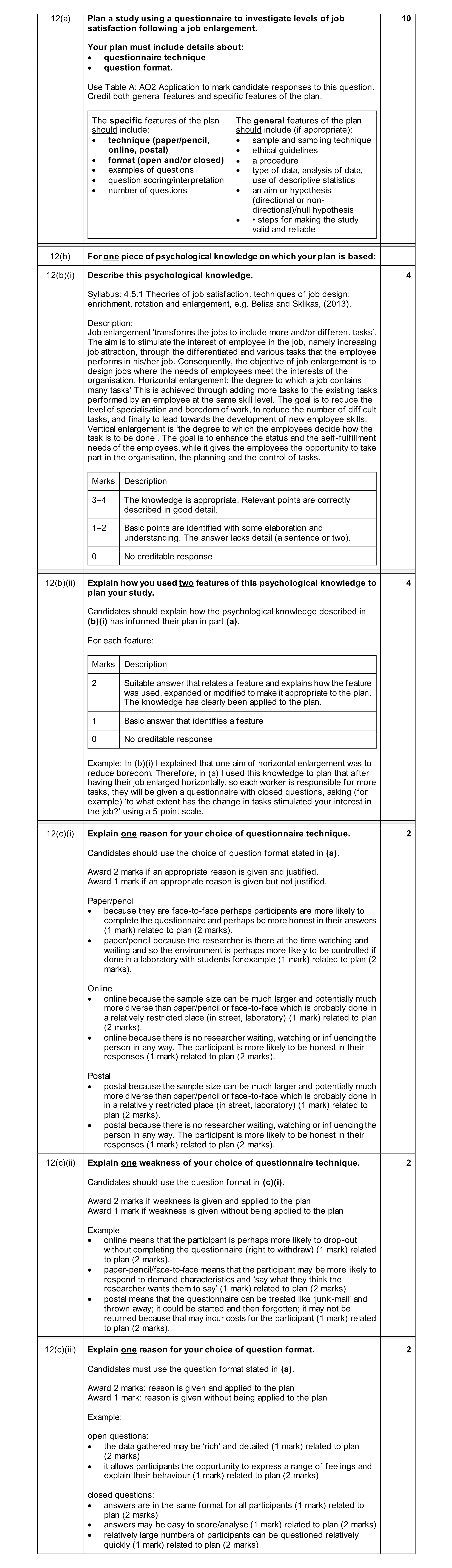 24
24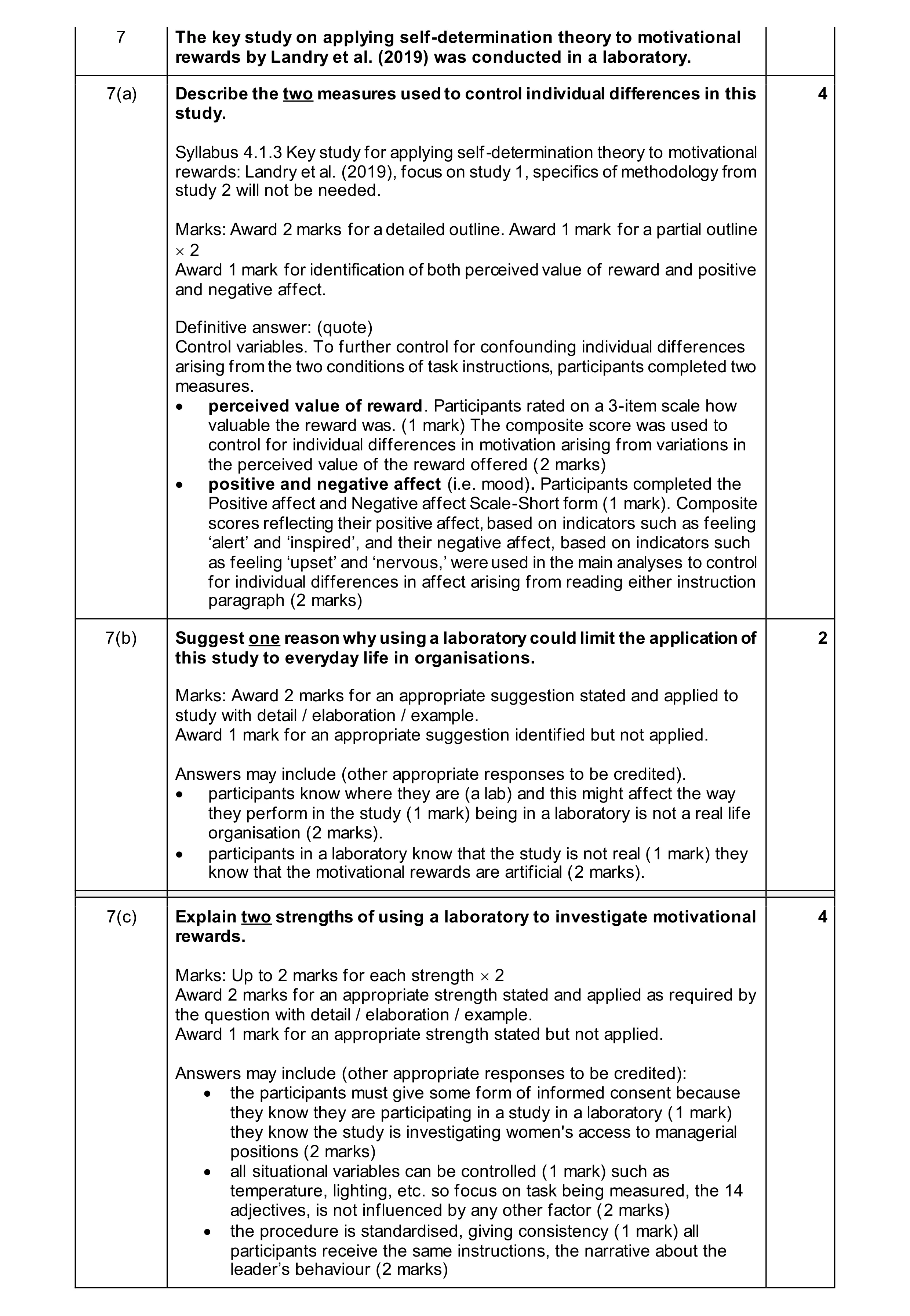 10
10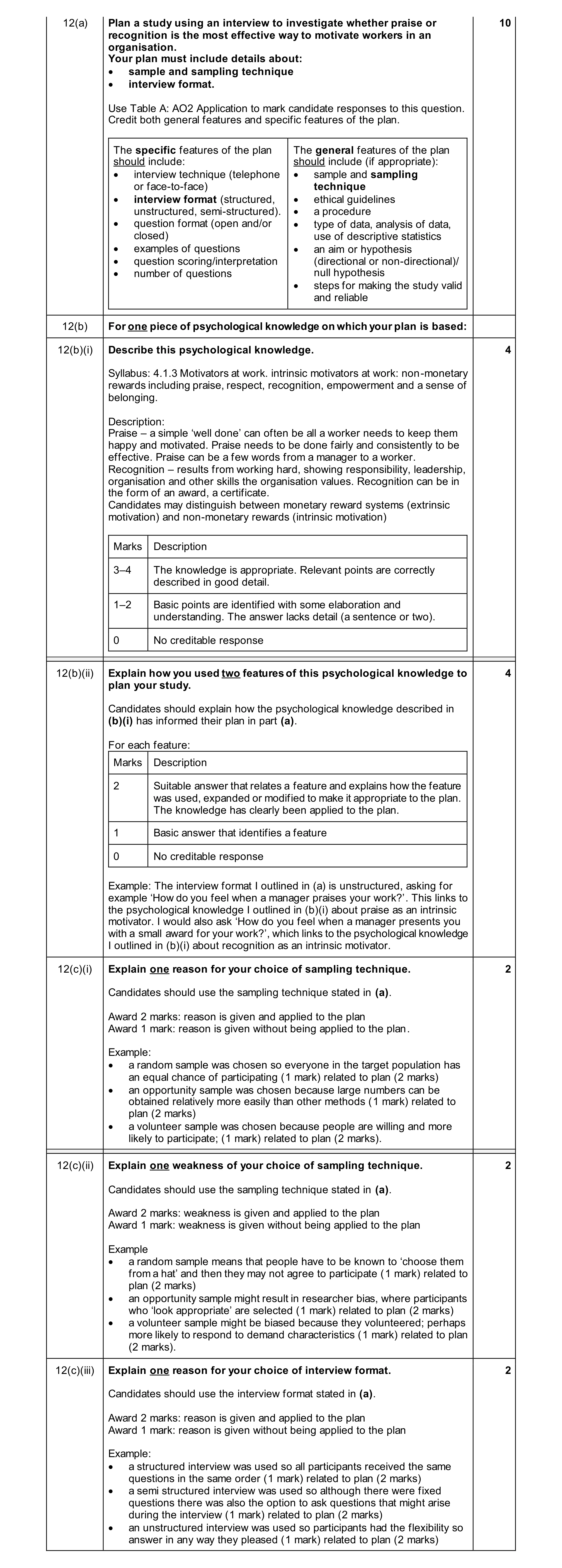 24
24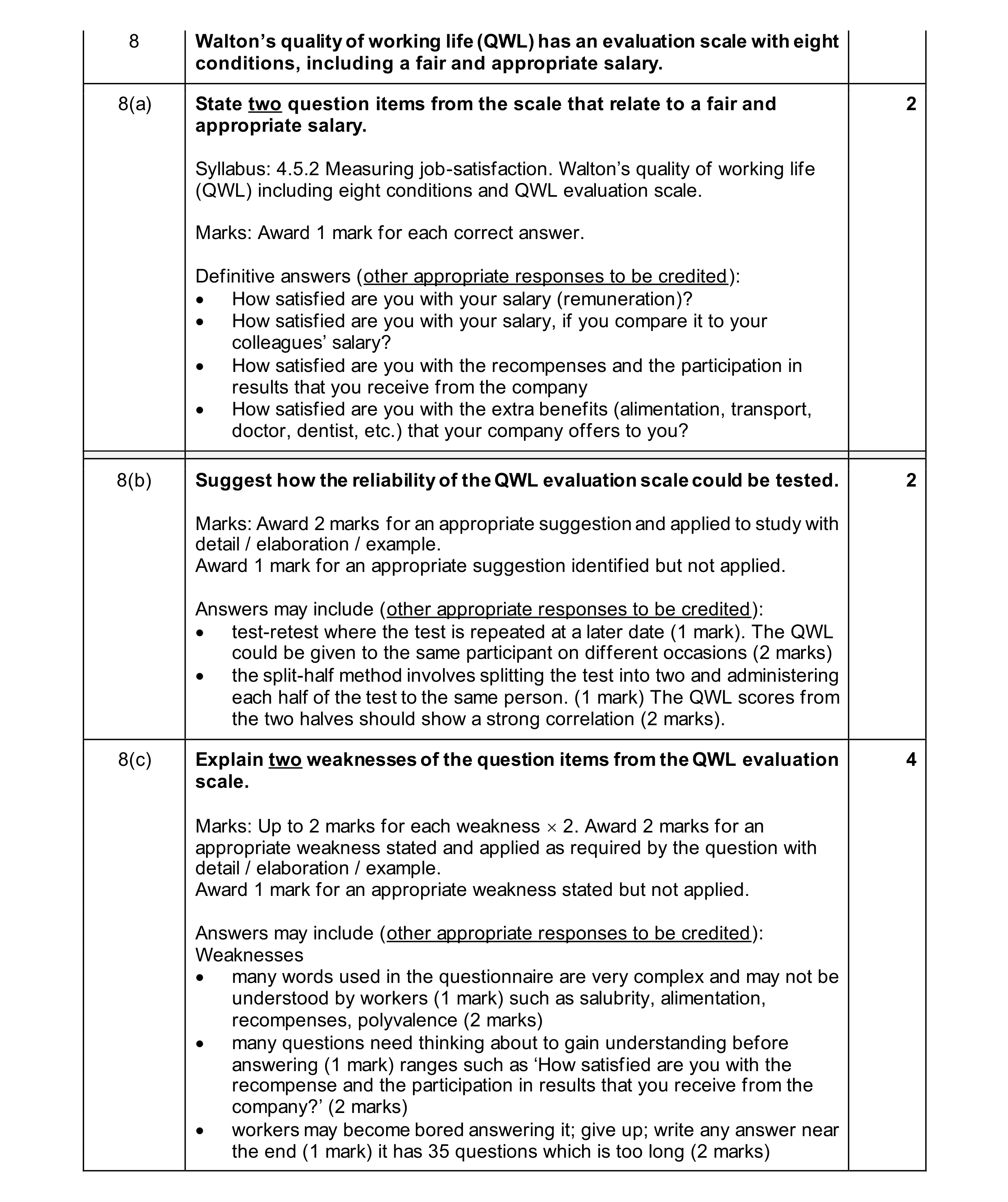 8
8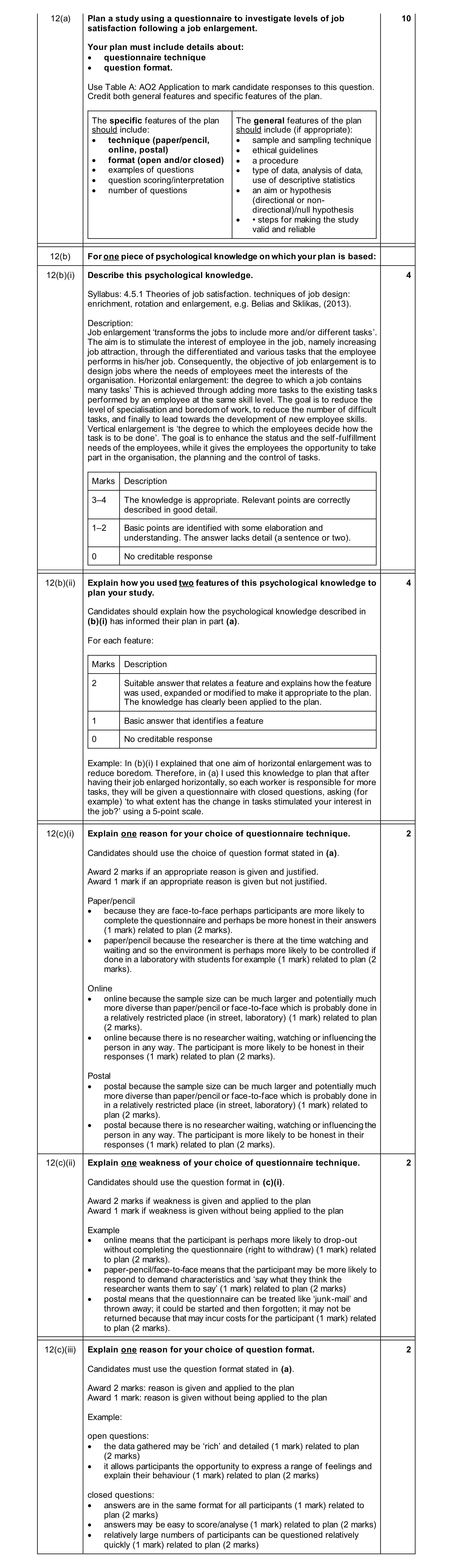 24
24