Cambridge A Level Psychology (from 2018) 9990 — 2018 May/June Paper 4 · Variant 1
9990/41/M/J/18 · 12 questions · 60 marks · ≈68 min
The question paper and its mark scheme, free to read here and free to download. This is Cambridge’s own paper, exactly as it was sat.
Question paper8 pages



Mark scheme20 pages
Answers below. Sit the paper first if you are practising.


Questions as text
Q1 · Blaszczynski and Nower (2002) looked at the effect of imaginal desensitisation on…
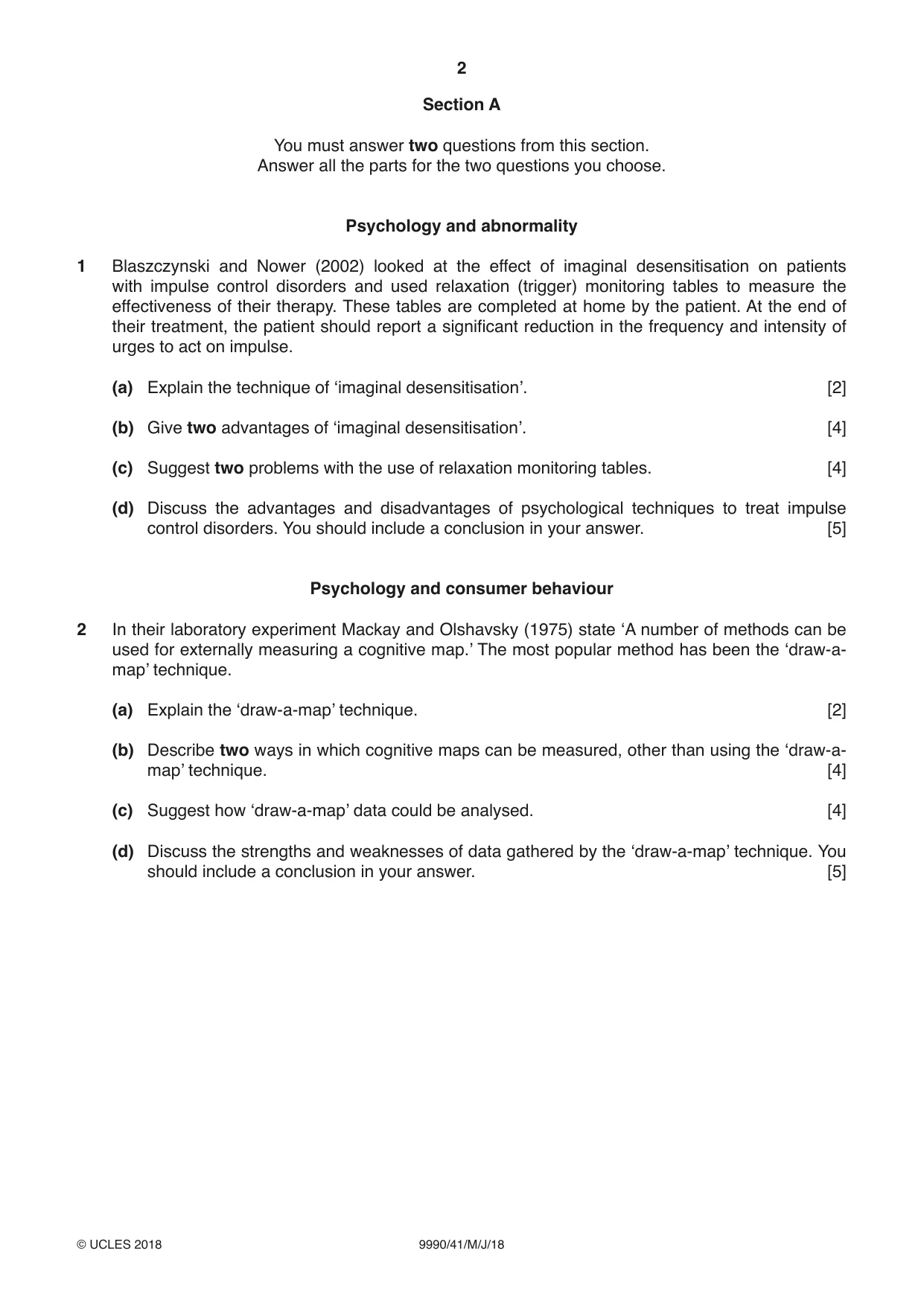
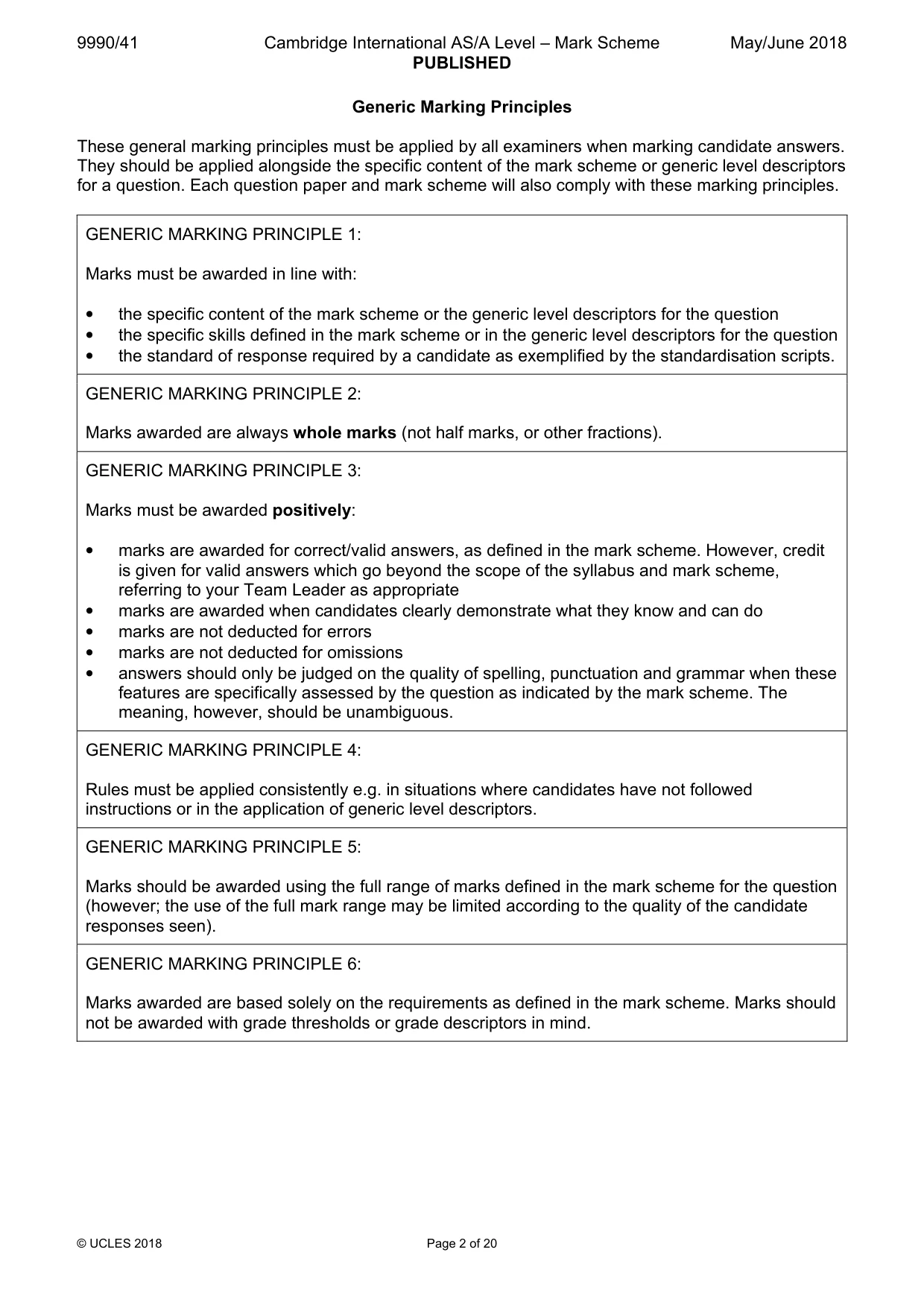
1 Blaszczynski and Nower (2002) looked at the effect of imaginal desensitisation on patients with impulse control disorders and used relaxation (trigger) monitoring tables to measure the effectiveness of their therapy. These tables are completed at home by the patient. At the end of their treatment, the patient should report a significant reduction in the frequency and intensity of urges to act on impulse. (a) Explain the technique of ‘imaginal desensitisation’. [2] (b) Give two advantages of ‘imaginal desensitisation’. [4] (c) Suggest two problems with the use of relaxation monitoring tables. [4] (d) Discuss the advantages and disadvantages of psychological techniques to treat impulse control disorders. You should include a conclusion in your answer. [5] Psychology and consumer behaviour
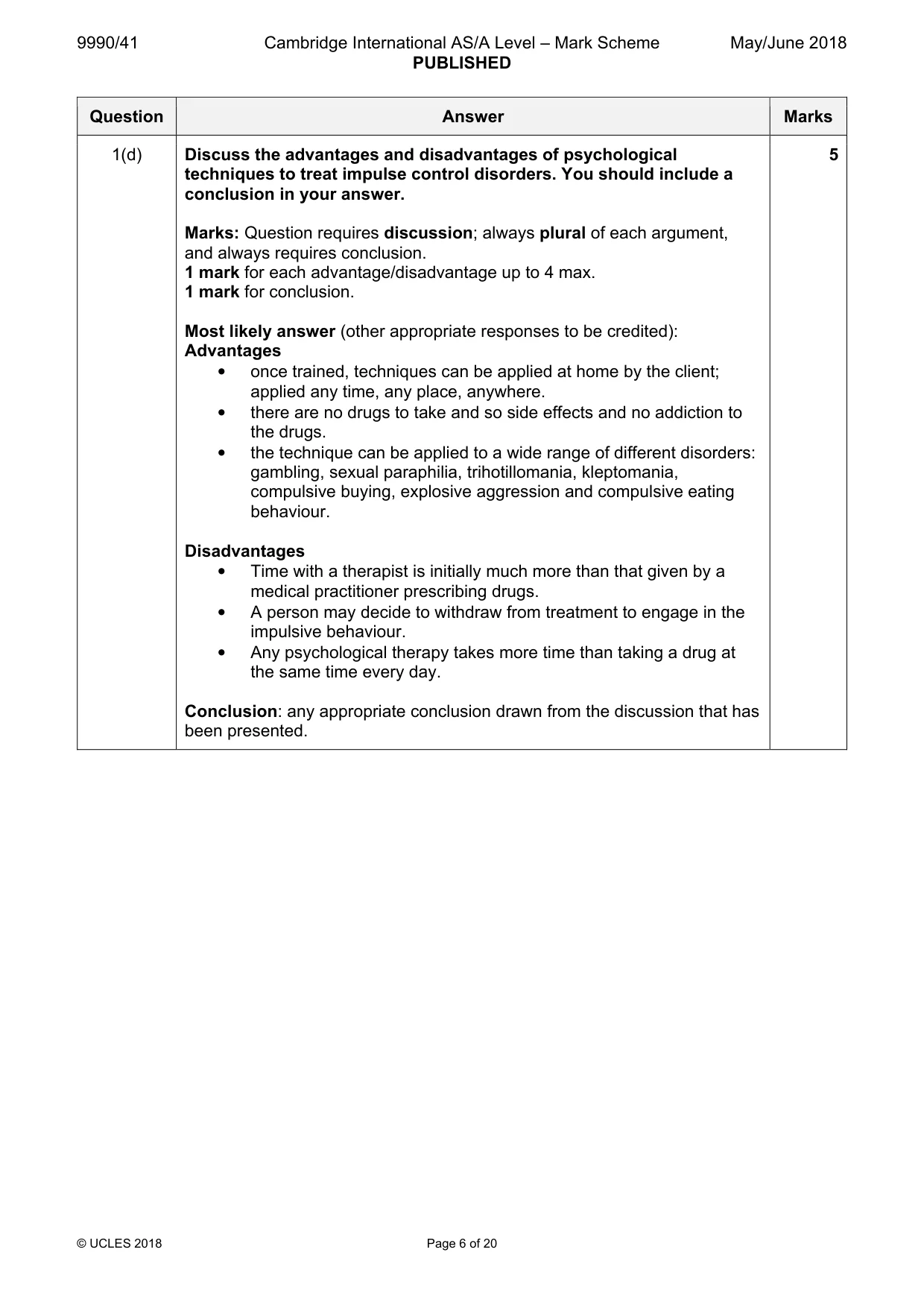
Mark scheme: Question Answer Marks Section A: Stimulus question Psychology and abnormality 1 Blaszczynski and Nower (2002) looked at the effect of imaginal desensitisation on patients with impulse control disorders and used relaxation (trigger) monitoring tables to measure the effectiveness of their therapy. These tables are completed at home by the patient. At the end of their treatment, the patient should report a significant reduction in the frequency and intensity of urges to act on impulse. 1(a) Explain the technique of ‘imaginal desensitisation’. 2 Marks: for components of: ‘relaxation’ 1 mark, for ‘imaginal’ 1 mark. Most likely answer (other appropriate responses to be credited): The technique involves teaching a brief progressive muscle relaxation procedure. Clients are then instructed to visualize themselves being exposed to a situation that triggers the drive to carry out their impulsive behaviour, contemplating acting on their urge but then leaving the situation in a state of continued relaxation without having acted upon their urge. Sessions can be recorded on cassette audiotape for home-practice. 1(b) Give two advantages of ‘imaginal desensitisation’. 4 Marks: for each advantage: 1 mark basic answer. 2 marks elaboration. Most likely answer (other appropriate responses to be credited): From Blaszczynski and Nower: • It reduces the strength of the drive to carry out an habitual behaviour • It empowers the client by providing the necessary skills to resist such urges • It enhances a sense of self-efficacy by demonstrating that the client is in control of his actions • It can be used anywhere once the individual has learned the technique • It can be applied to a range of similar problems 1(c) Suggest two problems with the use of relaxation monitoring tables. 4 Marks: for each problem 1 mark basic answer, 2 marks elaboration Most likely answer (other appropriate responses to be credited): • patients may forget to fill them in; • may fill then in even though they have not completed a session; • may lie about their progress; • may not be able complete the sheets at the appropriate time each day and forget what has happened (Handout 3) • may misjudge the rating of ‘feelings when planning the behaviour’ (Handout 1) 1(d) Discuss the advantages and disadvantages of psychological 5 techniques to treat impulse control disorders. You should include a conclusion in your answer. Marks: Question requires discussion; always plural of each argument, and always requires conclusion. 1 mark for each advantage/disadvantage up to 4 max. 1 mark for conclusion. Most likely answer (other appropriate responses to be credited): Advantages • once trained, techniques can be applied at home by the client; applied any time, any place, anywhere. • there are no drugs to take and so side effects and no addiction to the drugs. • the technique can be applied to a wide range of different disorders: gambling, sexual paraphilia, trihotillomania, kleptomania, compulsive buying, explosive aggression and compulsive eating behaviour. Disadvantages • Time with a therapist is initially much more than that given by a medical practitioner prescribing drugs. • A person may decide to withdraw from treatment to engage in the impulsive behaviour. • Any psychological therapy takes more time than taking a drug at the same time every day. Conclusion: any appropriate conclusion drawn from the discussion that has been presented.
Q2 · In their laboratory experiment Mackay and Olshavsky (1975) state ‘A number of methods can…
2 In their laboratory experiment Mackay and Olshavsky (1975) state ‘A number of methods can be used for externally measuring a cognitive map.’ The most popular method has been the ‘draw-a- map’ technique. (a) Explain the ‘draw-a-map’ technique. [2] (b) Describe two ways in which cognitive maps can be measured, other than using the ‘draw-a- map’ technique. [4] (c) Suggest how ‘draw-a-map’ data could be analysed. [4] (d) Discuss the strengths and weaknesses of data gathered by the ‘draw-a-map’ technique. You should include a conclusion in your answer. [5] Psychology and health
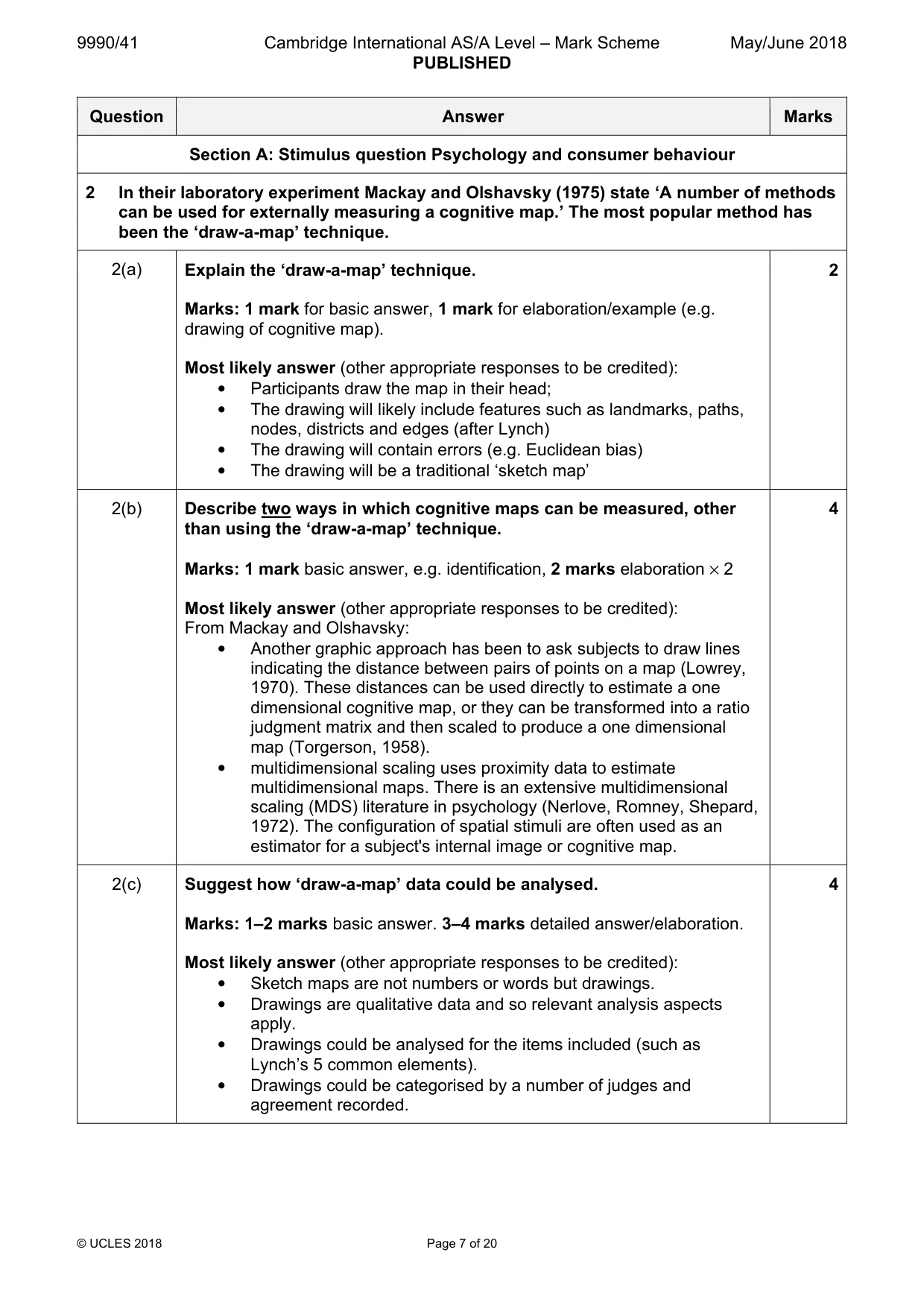
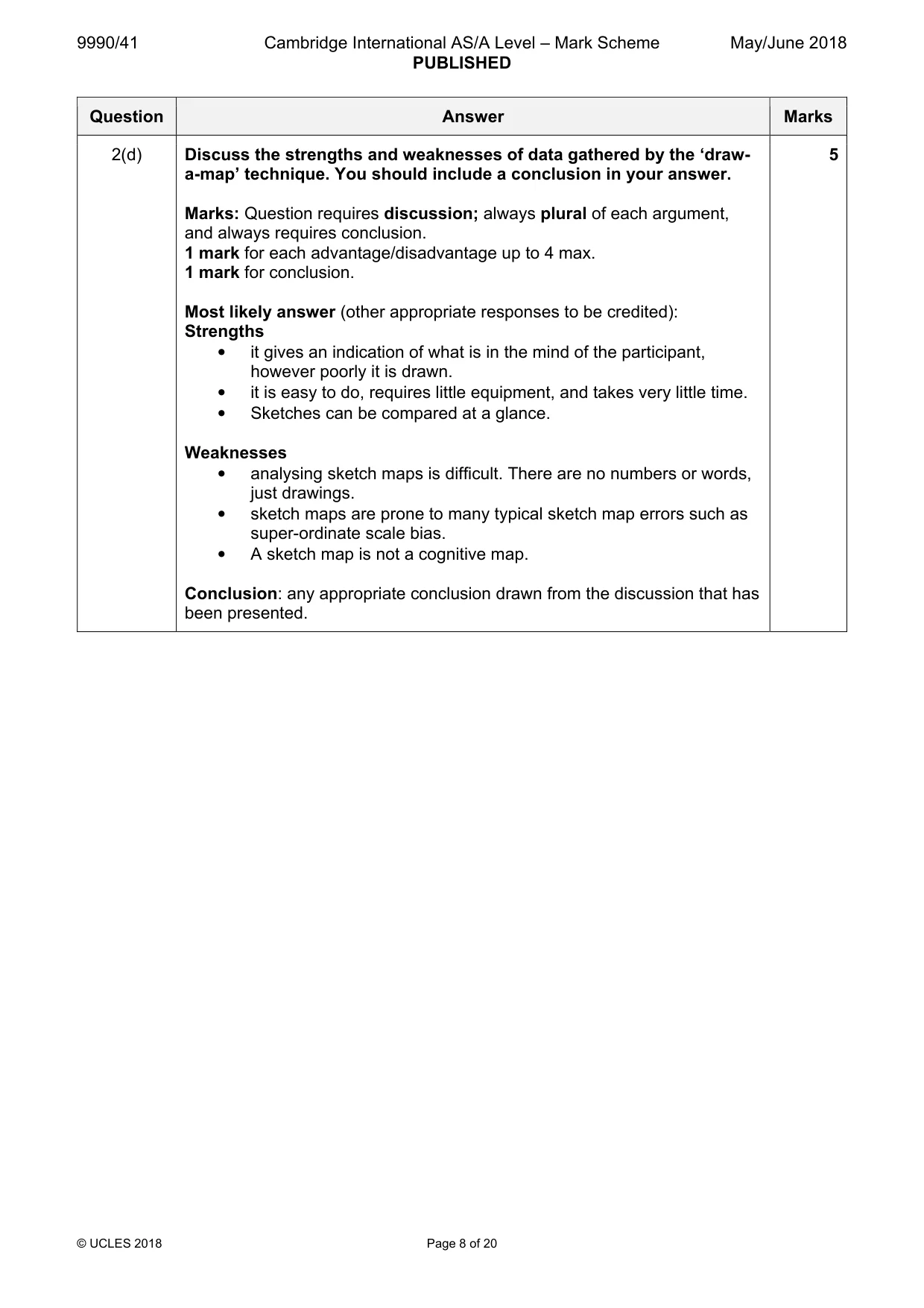
Mark scheme: 2(a) Explain the ‘draw-a-map’ technique. 2 Marks: 1 mark for basic answer, 1 mark for elaboration/example (e.g. drawing of cognitive map). Most likely answer (other appropriate responses to be credited): • Participants draw the map in their head; • The drawing will likely include features such as landmarks, paths, nodes, districts and edges (after Lynch) • The drawing will contain errors (e.g. Euclidean bias) • The drawing will be a traditional ‘sketch map’ 2(b) Describe two ways in which cognitive maps can be measured, other 4 than using the ‘draw-a-map’ technique. Marks: 1 mark basic answer, e.g. identification, 2 marks elaboration × 2 Most likely answer (other appropriate responses to be credited): From Mackay and Olshavsky: • Another graphic approach has been to ask subjects to draw lines indicating the distance between pairs of points on a map (Lowrey, 1970). These distances can be used directly to estimate a one dimensional cognitive map, or they can be transformed into a ratio judgment matrix and then scaled to produce a one dimensional map (Torgerson, 1958). • multidimensional scaling uses proximity data to estimate multidimensional maps. There is an extensive multidimensional scaling (MDS) literature in psychology (Nerlove, Romney, Shepard, 1972). The configuration of spatial stimuli are often used as an estimator for a subject's internal image or cognitive map. 2(c) Suggest how ‘draw-a-map’ data could be analysed. 4 Marks: 1–2 marks basic answer. 3–4 marks detailed answer/elaboration. Most likely answer (other appropriate responses to be credited): • Sketch maps are not numbers or words but drawings. • Drawings are qualitative data and so relevant analysis aspects apply. • Drawings could be analysed for the items included (such as Lynch’s 5 common elements). • Drawings could be categorised by a number of judges and agreement recorded. 2(d) Discuss the strengths and weaknesses of data gathered by the ‘draw- 5 a-map’ technique. You should include a conclusion in your answer. Marks: Question requires discussion; always plural of each argument, and always requires conclusion. 1 mark for each advantage/disadvantage up to 4 max. 1 mark for conclusion. Most likely answer (other appropriate responses to be credited): Strengths • it gives an indication of what is in the mind of the participant, however poorly it is drawn. • it is easy to do, requires little equipment, and takes very little time. • Sketches can be compared at a glance. Weaknesses • analysing sketch maps is difficult. There are no numbers or words, just drawings. • sketch maps are prone to many typical sketch map errors such as super-ordinate scale bias. • A sketch map is not a cognitive map. Conclusion: any appropriate conclusion drawn from the discussion that has been presented.
Q3 · ‘Please don’t make me sit in the middle!’ Evans and Wener (2007) claim that sitting in…
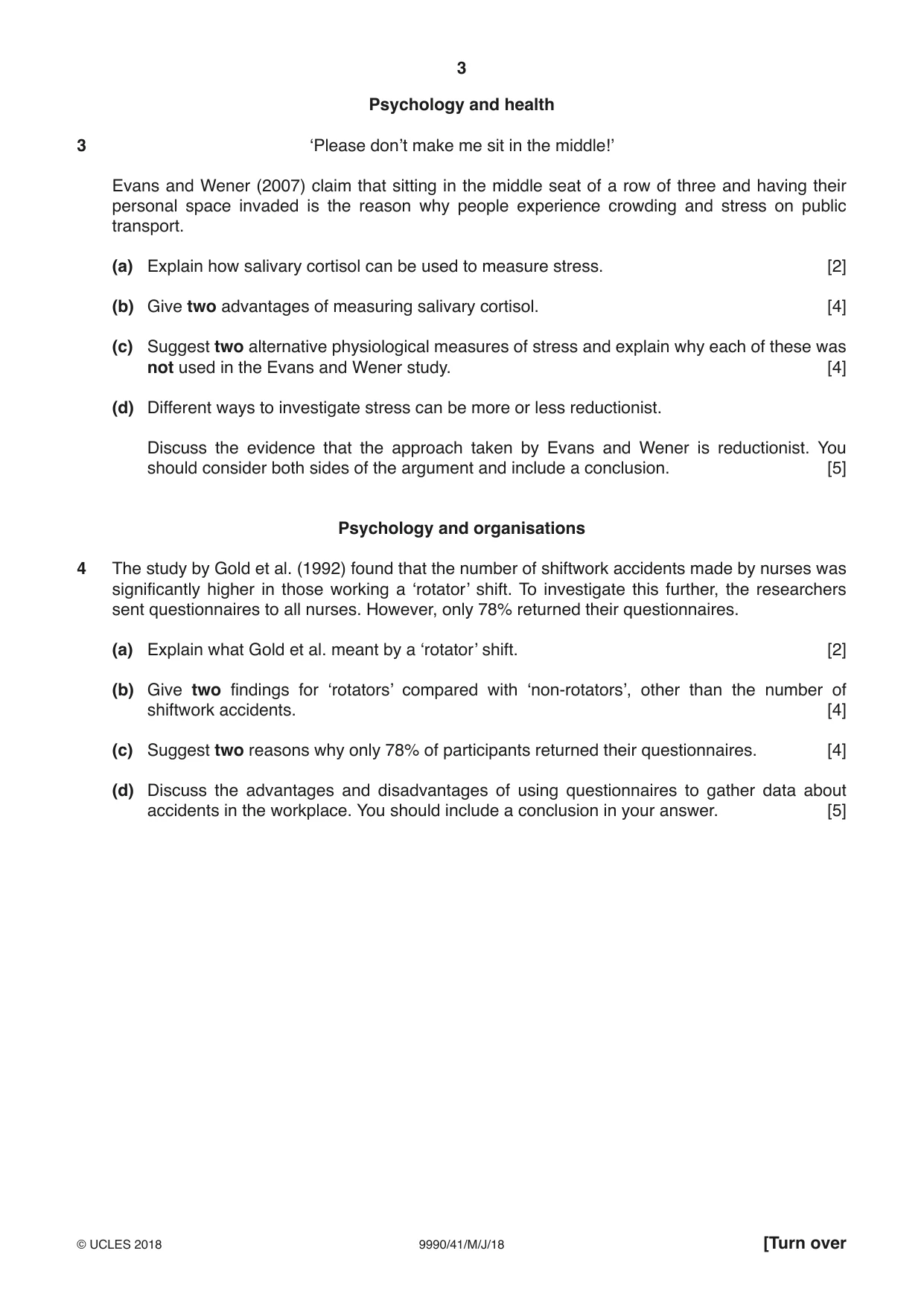
3 ‘Please don’t make me sit in the middle!’ Evans and Wener (2007) claim that sitting in the middle seat of a row of three and having their personal space invaded is the reason why people experience crowding and stress on public transport. (a) Explain how salivary cortisol can be used to measure stress. [2] (b) Give two advantages of measuring salivary cortisol. [4] (c) Suggest two alternative physiological measures of stress and explain why each of these was not used in the Evans and Wener study. [4] (d) Different ways to investigate stress can be more or less reductionist. Discuss the evidence that the approach taken by Evans and Wener is reductionist. You should consider both sides of the argument and include a conclusion. [5] Psychology and organisations
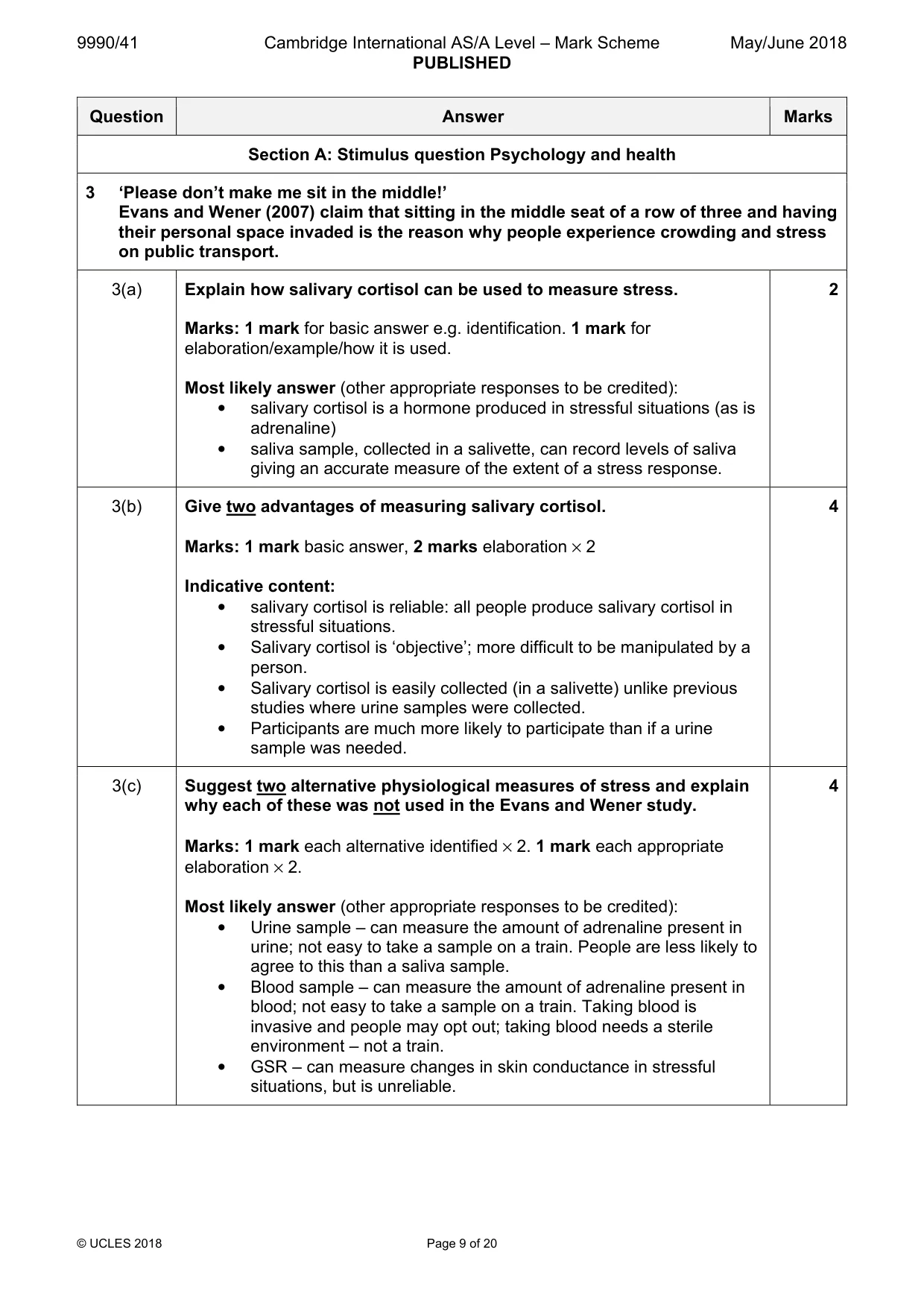
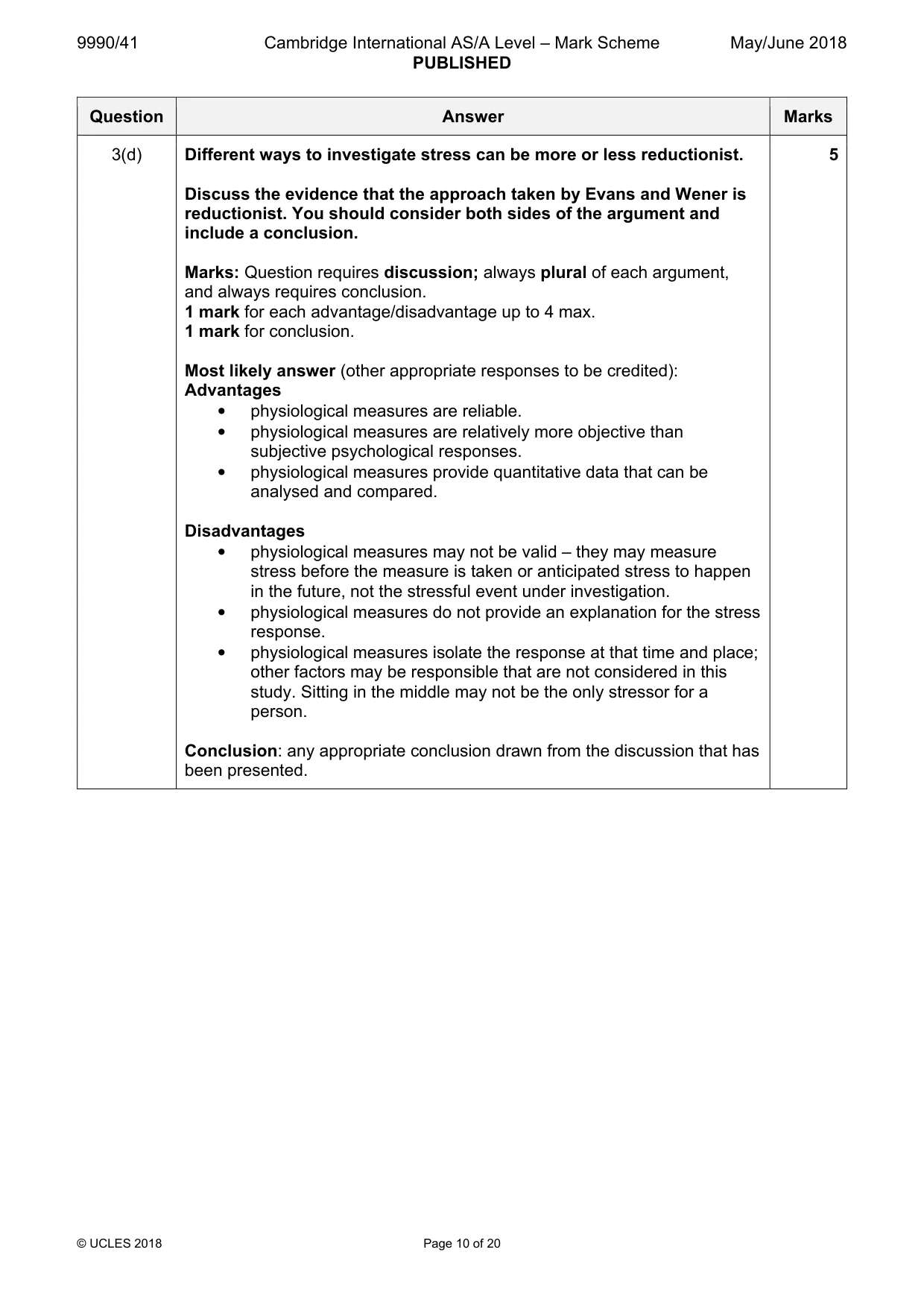
Mark scheme: 3(a) Explain how salivary cortisol can be used to measure stress. 2 Marks: 1 mark for basic answer e.g. identification. 1 mark for elaboration/example/how it is used. Most likely answer (other appropriate responses to be credited): • salivary cortisol is a hormone produced in stressful situations (as is adrenaline) • saliva sample, collected in a salivette, can record levels of saliva giving an accurate measure of the extent of a stress response. 3(b) Give two advantages of measuring salivary cortisol. 4 Marks: 1 mark basic answer, 2 marks elaboration × 2 Indicative content: • salivary cortisol is reliable: all people produce salivary cortisol in stressful situations. • Salivary cortisol is ‘objective’; more difficult to be manipulated by a person. • Salivary cortisol is easily collected (in a salivette) unlike previous studies where urine samples were collected. • Participants are much more likely to participate than if a urine sample was needed. 3(c) Suggest two alternative physiological measures of stress and explain 4 why each of these was not used in the Evans and Wener study. Marks: 1 mark each alternative identified × 2. 1 mark each appropriate elaboration × 2. Most likely answer (other appropriate responses to be credited): • Urine sample – can measure the amount of adrenaline present in urine; not easy to take a sample on a train. People are less likely to agree to this than a saliva sample. • Blood sample – can measure the amount of adrenaline present in blood; not easy to take a sample on a train. Taking blood is invasive and people may opt out; taking blood needs a sterile environment – not a train. • GSR – can measure changes in skin conductance in stressful situations, but is unreliable. 3(d) Different ways to investigate stress can be more or less reductionist. 5 Discuss the evidence that the approach taken by Evans and Wener is reductionist. You should consider both sides of the argument and include a conclusion. Marks: Question requires discussion; always plural of each argument, and always requires conclusion. 1 mark for each advantage/disadvantage up to 4 max. 1 mark for conclusion. Most likely answer (other appropriate responses to be credited): Advantages • physiological measures are reliable. • physiological measures are relatively more objective than subjective psychological responses. • physiological measures provide quantitative data that can be analysed and compared. Disadvantages • physiological measures may not be valid – they may measure stress before the measure is taken or anticipated stress to happen in the future, not the stressful event under investigation. • physiological measures do not provide an explanation for the stress response. • physiological measures isolate the response at that time and place; other factors may be responsible that are not considered in this study. Sitting in the middle may not be the only stressor for a person. Conclusion: any appropriate conclusion drawn from the discussion that has been presented.
Q4 · The study by Gold et al
4 The study by Gold et al. (1992) found that the number of shiftwork accidents made by nurses was significantly higher in those working a ‘rotator’ shift. To investigate this further, the researchers sent questionnaires to all nurses. However, only 78% returned their questionnaires. (a) Explain what Gold et al. meant by a ‘rotator’ shift. [2] (b) Give two findings for ‘rotators’ compared with ‘non-rotators’, other than the number of shiftwork accidents. [4] (c) Suggest two reasons why only 78% of participants returned their questionnaires. [4] (d) Discuss the advantages and disadvantages of using questionnaires to gather data about accidents in the workplace. You should include a conclusion in your answer. [5]
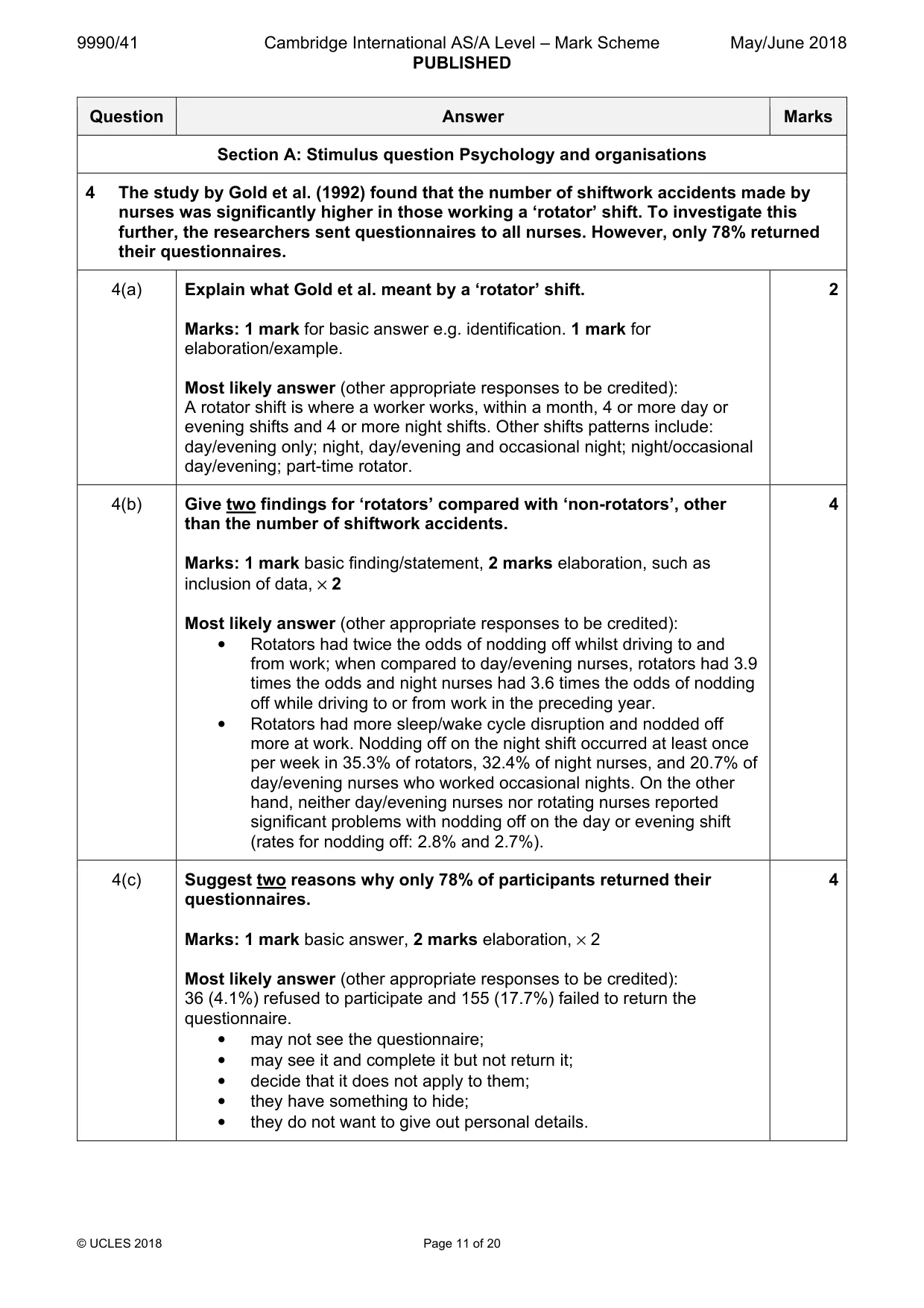
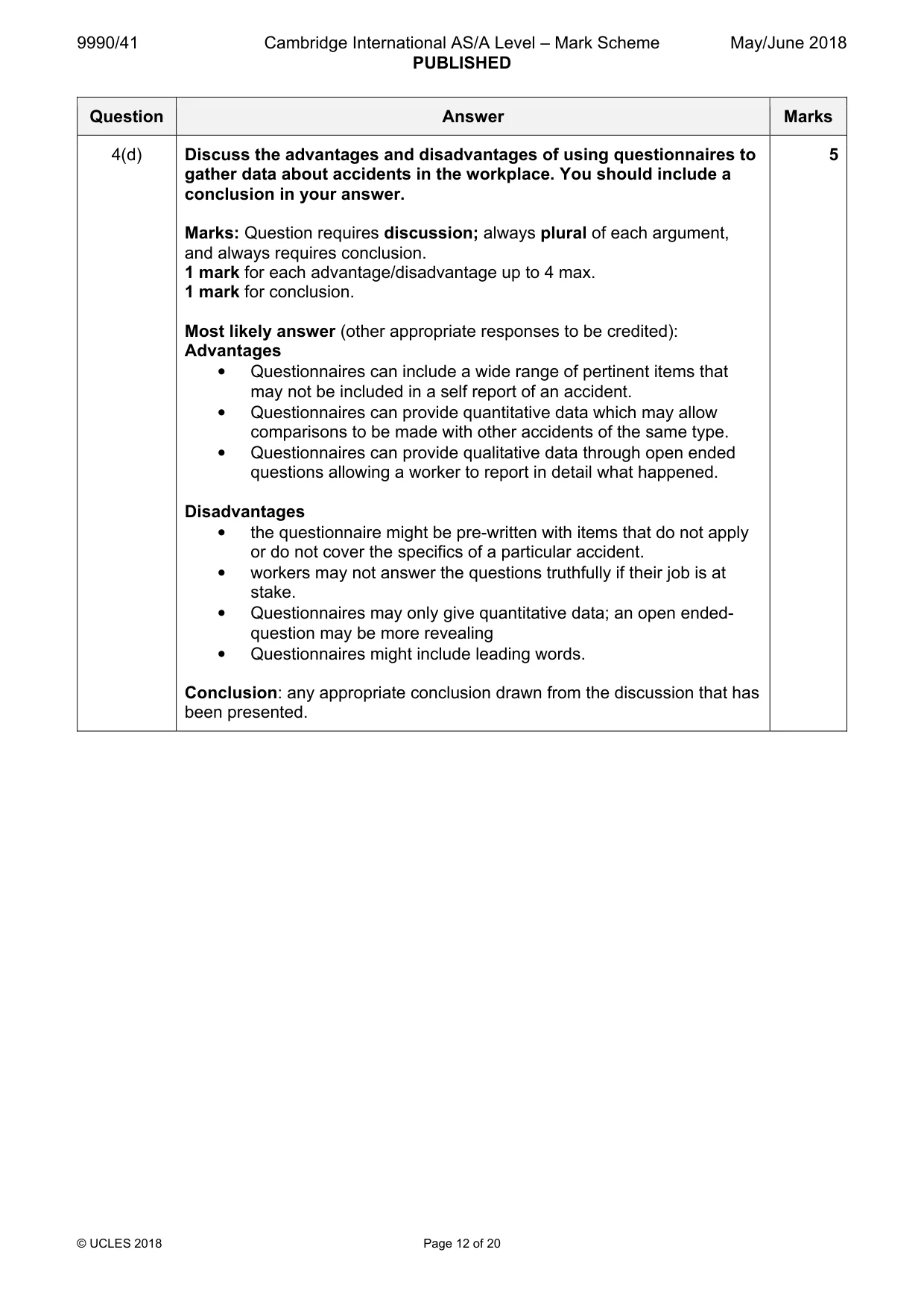
Mark scheme: 4(a) Explain what Gold et al. meant by a ‘rotator’ shift. 2 Marks: 1 mark for basic answer e.g. identification. 1 mark for elaboration/example. Most likely answer (other appropriate responses to be credited): A rotator shift is where a worker works, within a month, 4 or more day or evening shifts and 4 or more night shifts. Other shifts patterns include: day/evening only; night, day/evening and occasional night; night/occasional day/evening; part-time rotator. 4(b) Give two findings for ‘rotators’ compared with ‘non-rotators’, other 4 than the number of shiftwork accidents. Marks: 1 mark basic finding/statement, 2 marks elaboration, such as inclusion of data, × 2 Most likely answer (other appropriate responses to be credited): • Rotators had twice the odds of nodding off whilst driving to and from work; when compared to day/evening nurses, rotators had 3.9 times the odds and night nurses had 3.6 times the odds of nodding off while driving to or from work in the preceding year. • Rotators had more sleep/wake cycle disruption and nodded off more at work. Nodding off on the night shift occurred at least once per week in 35.3% of rotators, 32.4% of night nurses, and 20.7% of day/evening nurses who worked occasional nights. On the other hand, neither day/evening nurses nor rotating nurses reported significant problems with nodding off on the day or evening shift (rates for nodding off: 2.8% and 2.7%). 4(c) Suggest two reasons why only 78% of participants returned their 4 questionnaires. Marks: 1 mark basic answer, 2 marks elaboration, × 2 Most likely answer (other appropriate responses to be credited): 36 (4.1%) refused to participate and 155 (17.7%) failed to return the questionnaire. • may not see the questionnaire; • may see it and complete it but not return it; • decide that it does not apply to them; • they have something to hide; • they do not want to give out personal details. 4(d) Discuss the advantages and disadvantages of using questionnaires to 5 gather data about accidents in the workplace. You should include a conclusion in your answer. Marks: Question requires discussion; always plural of each argument, and always requires conclusion. 1 mark for each advantage/disadvantage up to 4 max. 1 mark for conclusion. Most likely answer (other appropriate responses to be credited): Advantages • Questionnaires can include a wide range of pertinent items that may not be included in a self report of an accident. • Questionnaires can provide quantitative data which may allow comparisons to be made with other accidents of the same type. • Questionnaires can provide qualitative data through open ended questions allowing a worker to report in detail what happened. Disadvantages • the questionnaire might be pre-written with items that do not apply or do not cover the specifics of a particular accident. • workers may not answer the questions truthfully if their job is at stake. • Questionnaires may only give quantitative data; an open ended- question may be more revealing • Questionnaires might include leading words. Conclusion: any appropriate conclusion drawn from the discussion that has been presented.
Q5 · A person is accused of setting several fires
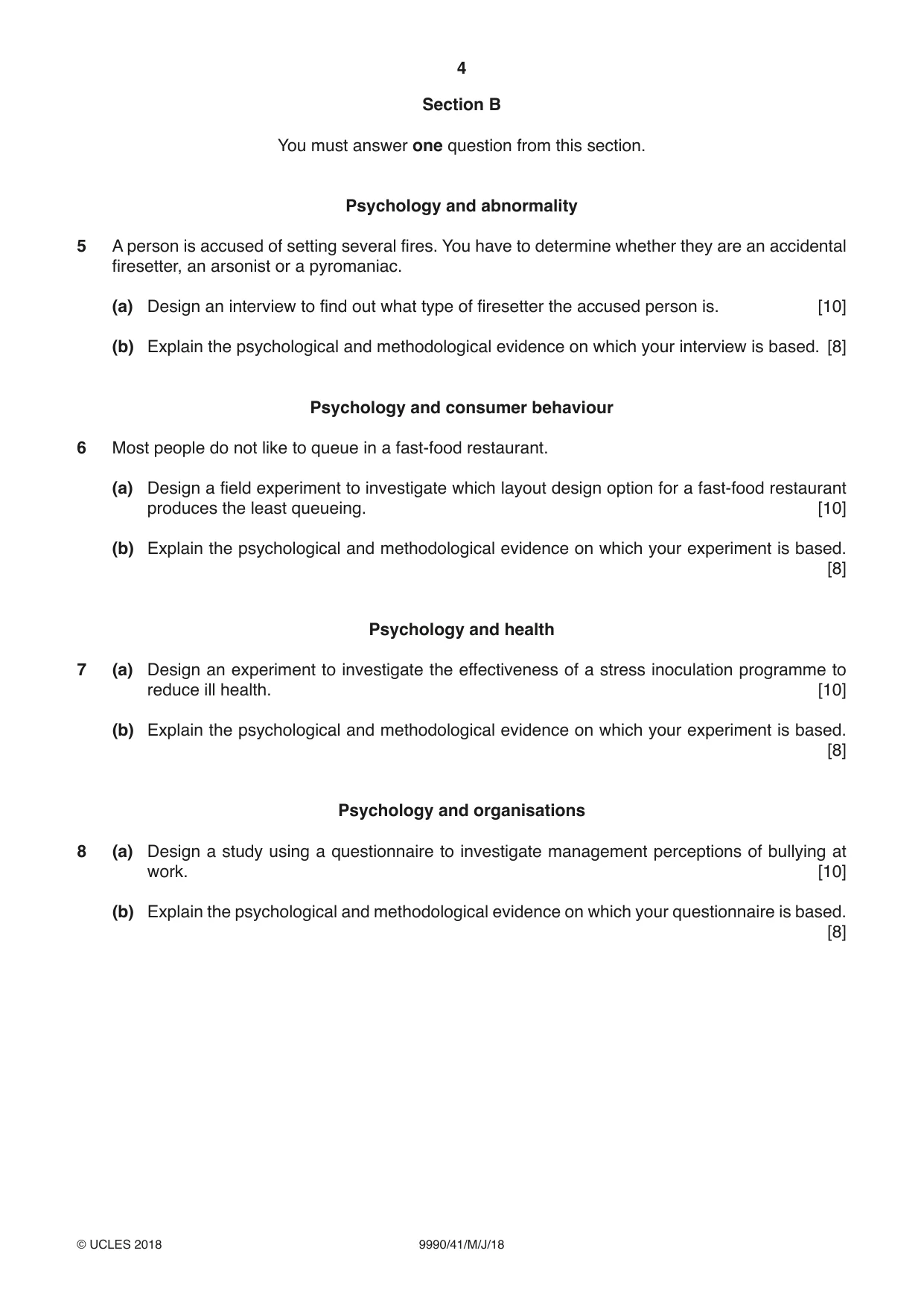
5 A person is accused of setting several fires. You have to determine whether they are an accidental firesetter, an arsonist or a pyromaniac. (a) Design an interview to find out what type of firesetter the accused person is. [10] (b) Explain the psychological and methodological evidence on which your interview is based. [8] Psychology and consumer behaviour
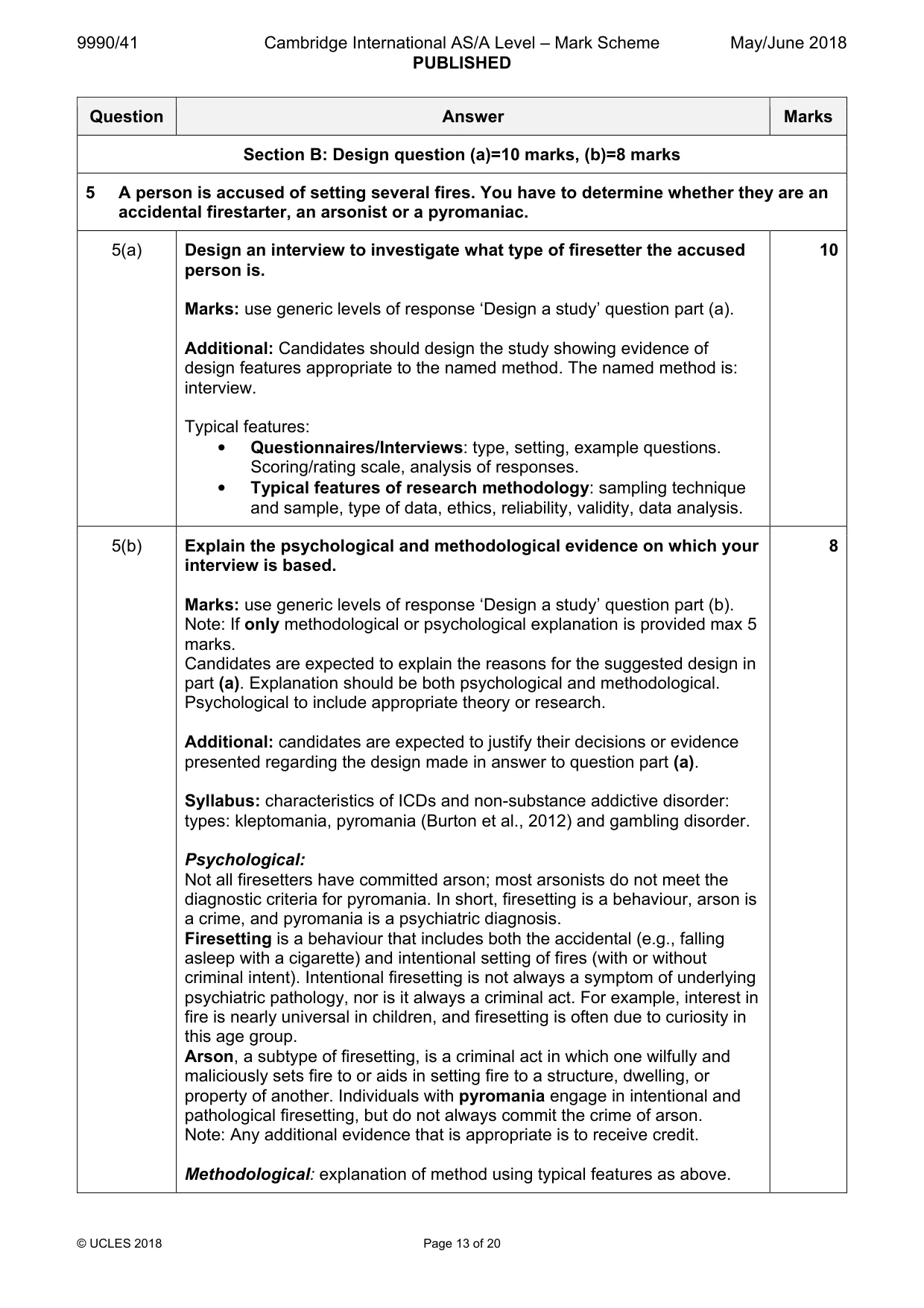
Mark scheme: 5(a) Design an interview to investigate what type of firesetter the accused 10 person is. Marks: use generic levels of response ‘Design a study’ question part (a). Additional: Candidates should design the study showing evidence of design features appropriate to the named method. The named method is: interview. Typical features: • Questionnaires/Interviews: type, setting, example questions. Scoring/rating scale, analysis of responses. • Typical features of research methodology: sampling technique and sample, type of data, ethics, reliability, validity, data analysis. 5(b) Explain the psychological and methodological evidence on which your 8 interview is based. Marks: use generic levels of response ‘Design a study’ question part (b). Note: If only methodological or psychological explanation is provided max 5 marks. Candidates are expected to explain the reasons for the suggested design in part (a). Explanation should be both psychological and methodological. Psychological to include appropriate theory or research. Additional: candidates are expected to justify their decisions or evidence presented regarding the design made in answer to question part (a). Syllabus: characteristics of ICDs and non-substance addictive disorder: types: kleptomania, pyromania (Burton et al., 2012) and gambling disorder. Psychological: Not all firesetters have committed arson; most arsonists do not meet the diagnostic criteria for pyromania. In short, firesetting is a behaviour, arson is a crime, and pyromania is a psychiatric diagnosis. Firesetting is a behaviour that includes both the accidental (e.g., falling asleep with a cigarette) and intentional setting of fires (with or without criminal intent). Intentional firesetting is not always a symptom of underlying psychiatric pathology, nor is it always a criminal act. For example, interest in fire is nearly universal in children, and firesetting is often due to curiosity in this age group. Arson, a subtype of firesetting, is a criminal act in which one wilfully and maliciously sets fire to or aids in setting fire to a structure, dwelling, or property of another. Individuals with pyromania engage in intentional and pathological firesetting, but do not always commit the crime of arson. Note: Any additional evidence that is appropriate is to receive credit. Methodological: explanation of method using typical features as above.
Q6 · Most people do not like to queue in a fast-food restaurant
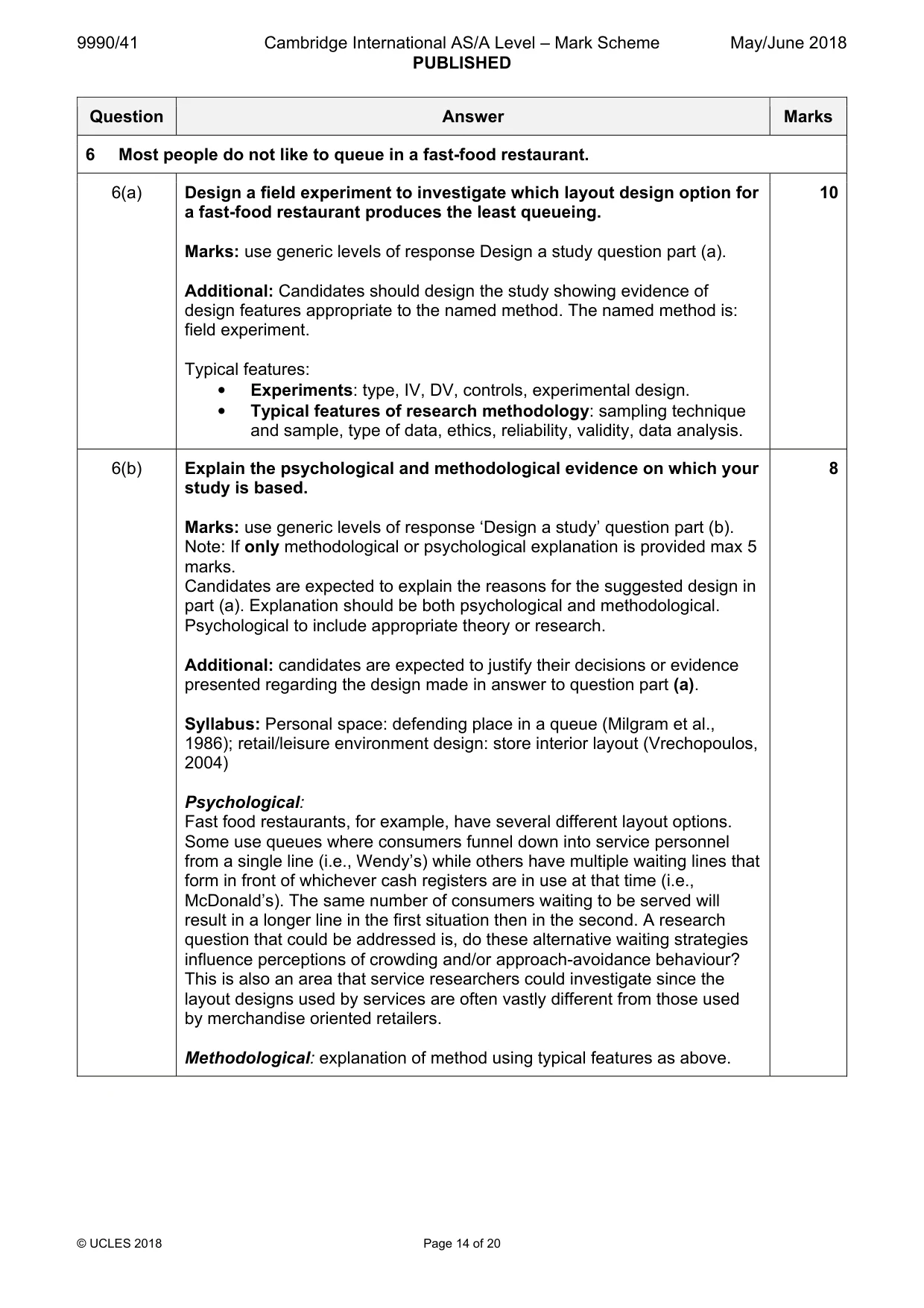
6 Most people do not like to queue in a fast-food restaurant. (a) Design a field experiment to investigate which layout design option for a fast-food restaurant produces the least queueing. [10] (b) Explain the psychological and methodological evidence on which your experiment is based. [8] Psychology and health
Mark scheme: 6(a) Design a field experiment to investigate which layout design option for 10 a fast-food restaurant produces the least queueing. Marks: use generic levels of response Design a study question part (a). Additional: Candidates should design the study showing evidence of design features appropriate to the named method. The named method is: field experiment. Typical features: • Experiments: type, IV, DV, controls, experimental design. • Typical features of research methodology: sampling technique and sample, type of data, ethics, reliability, validity, data analysis. 6(b) Explain the psychological and methodological evidence on which your 8 study is based. Marks: use generic levels of response ‘Design a study’ question part (b). Note: If only methodological or psychological explanation is provided max 5 marks. Candidates are expected to explain the reasons for the suggested design in part (a). Explanation should be both psychological and methodological. Psychological to include appropriate theory or research. Additional: candidates are expected to justify their decisions or evidence presented regarding the design made in answer to question part (a). Syllabus: Personal space: defending place in a queue (Milgram et al., 1986); retail/leisure environment design: store interior layout (Vrechopoulos, 2004) Psychological: Fast food restaurants, for example, have several different layout options. Some use queues where consumers funnel down into service personnel from a single line (i.e., Wendy’s) while others have multiple waiting lines that form in front of whichever cash registers are in use at that time (i.e., McDonald’s). The same number of consumers waiting to be served will result in a longer line in the first situation then in the second. A research question that could be addressed is, do these alternative waiting strategies influence perceptions of crowding and/or approach-avoidance behaviour? This is also an area that service researchers could investigate since the layout designs used by services are often vastly different from those used by merchandise oriented retailers. Methodological: explanation of method using typical features as above.
Q7 · Design an experiment to investigate the effectiveness of a stress inoculation programme…
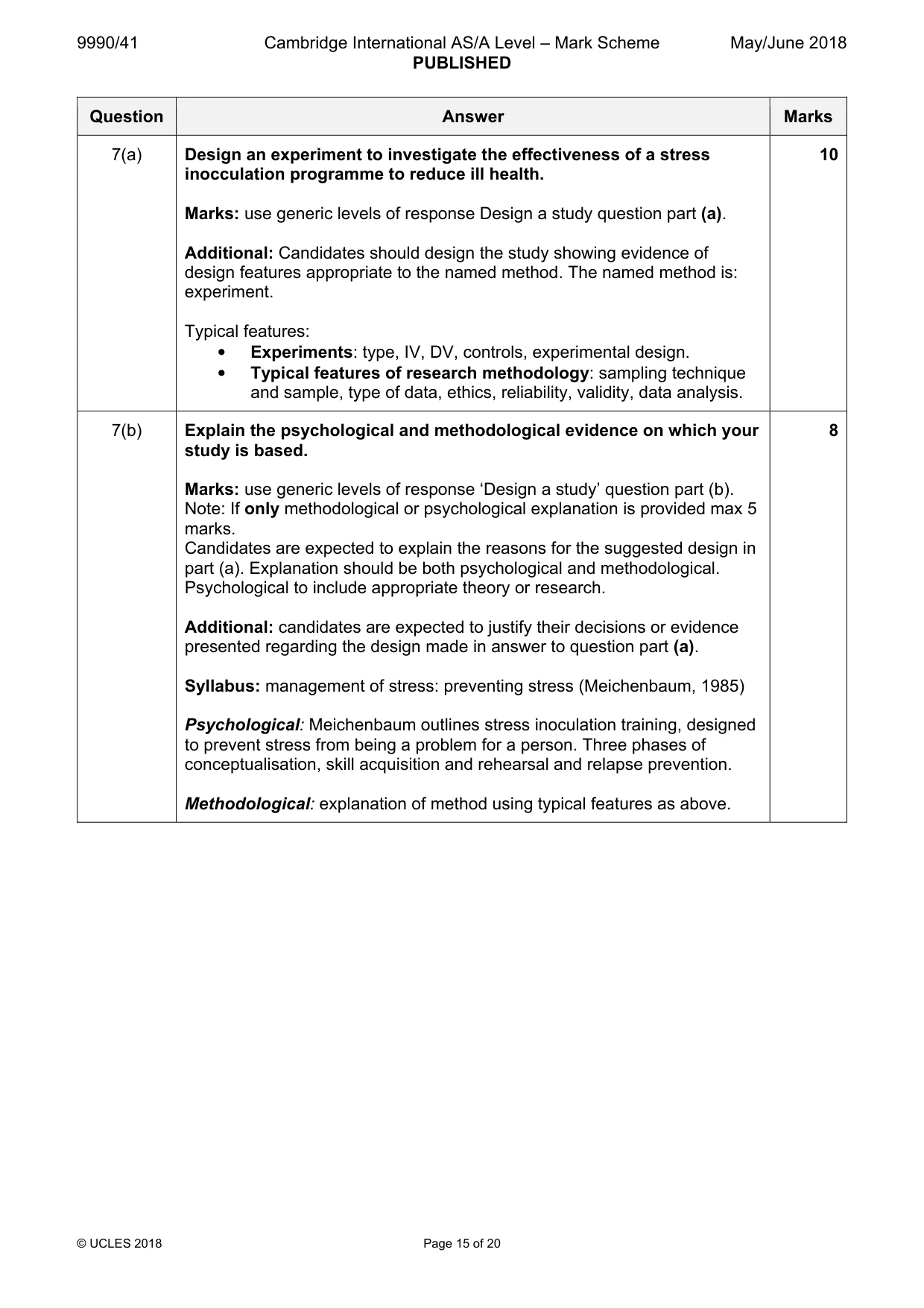
7 (a) Design an experiment to investigate the effectiveness of a stress inoculation programme to reduce ill health. [10] (b) Explain the psychological and methodological evidence on which your experiment is based. [8] Psychology and organisations
Mark scheme: 7(a) Design an experiment to investigate the effectiveness of a stress 10 inocculation programme to reduce ill health. Marks: use generic levels of response Design a study question part (a). Additional: Candidates should design the study showing evidence of design features appropriate to the named method. The named method is: experiment. Typical features: • Experiments: type, IV, DV, controls, experimental design. • Typical features of research methodology: sampling technique and sample, type of data, ethics, reliability, validity, data analysis. 7(b) Explain the psychological and methodological evidence on which your 8 study is based. Marks: use generic levels of response ‘Design a study’ question part (b). Note: If only methodological or psychological explanation is provided max 5 marks. Candidates are expected to explain the reasons for the suggested design in part (a). Explanation should be both psychological and methodological. Psychological to include appropriate theory or research. Additional: candidates are expected to justify their decisions or evidence presented regarding the design made in answer to question part (a). Syllabus: management of stress: preventing stress (Meichenbaum, 1985) Psychological: Meichenbaum outlines stress inoculation training, designed to prevent stress from being a problem for a person. Three phases of conceptualisation, skill acquisition and rehearsal and relapse prevention. Methodological: explanation of method using typical features as above.
Q8 · Design a study using a questionnaire to investigate management perceptions of bullying at…
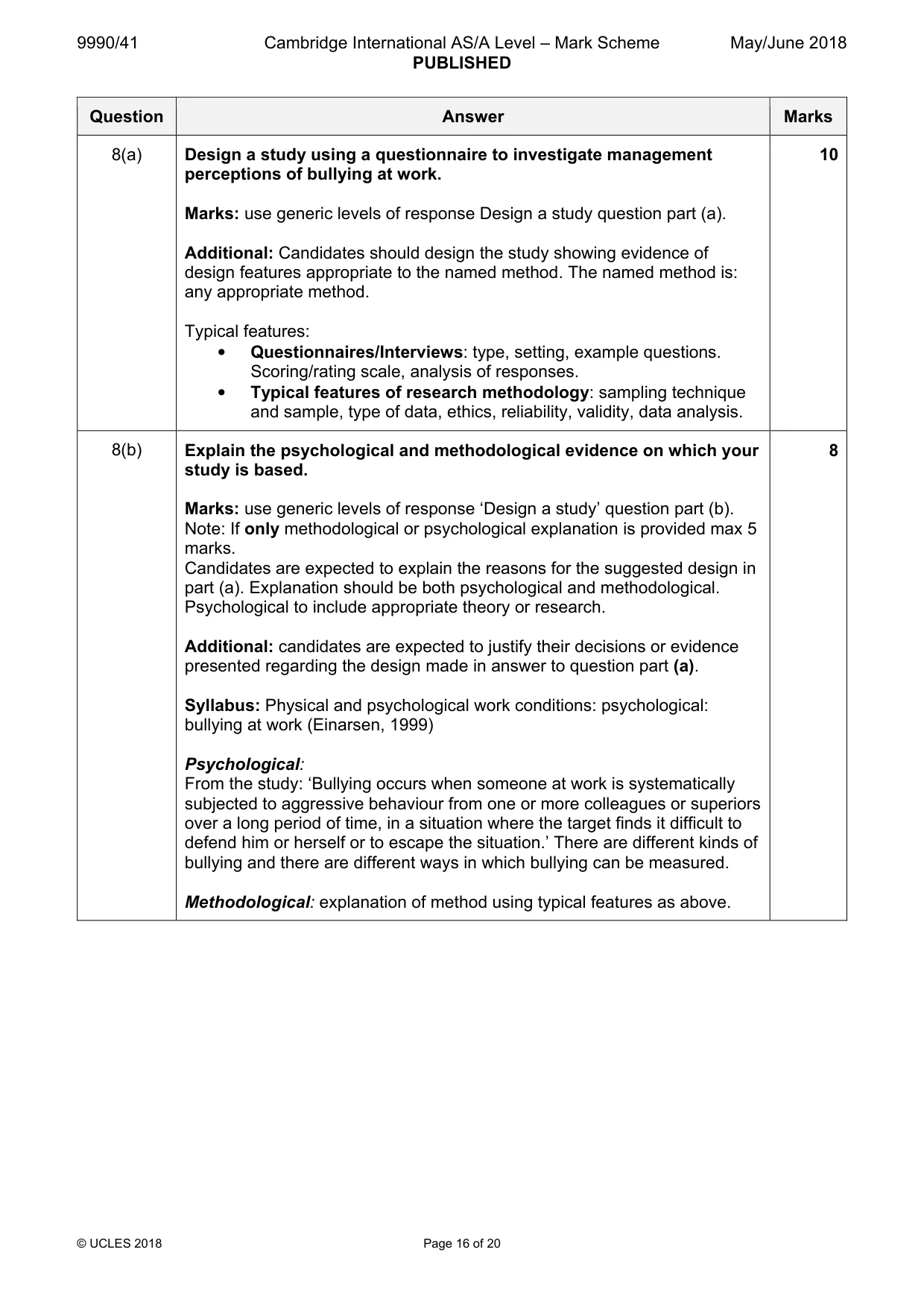
8 (a) Design a study using a questionnaire to investigate management perceptions of bullying at work. [10] (b) Explain the psychological and methodological evidence on which your questionnaire is based. [8] Section C You must answer one question from this section. Psychology and abnormality
Mark scheme: 8(a) Design a study using a questionnaire to investigate management 10 perceptions of bullying at work. Marks: use generic levels of response Design a study question part (a). Additional: Candidates should design the study showing evidence of design features appropriate to the named method. The named method is: any appropriate method. Typical features: • Questionnaires/Interviews: type, setting, example questions. Scoring/rating scale, analysis of responses. • Typical features of research methodology: sampling technique and sample, type of data, ethics, reliability, validity, data analysis. 8(b) Explain the psychological and methodological evidence on which your 8 study is based. Marks: use generic levels of response ‘Design a study’ question part (b). Note: If only methodological or psychological explanation is provided max 5 marks. Candidates are expected to explain the reasons for the suggested design in part (a). Explanation should be both psychological and methodological. Psychological to include appropriate theory or research. Additional: candidates are expected to justify their decisions or evidence presented regarding the design made in answer to question part (a). Syllabus: Physical and psychological work conditions: psychological: bullying at work (Einarsen, 1999) Psychological: From the study: ‘Bullying occurs when someone at work is systematically subjected to aggressive behaviour from one or more colleagues or superiors over a long period of time, in a situation where the target finds it difficult to defend him or herself or to escape the situation.’ There are different kinds of bullying and there are different ways in which bullying can be measured. Methodological: explanation of method using typical features as above.
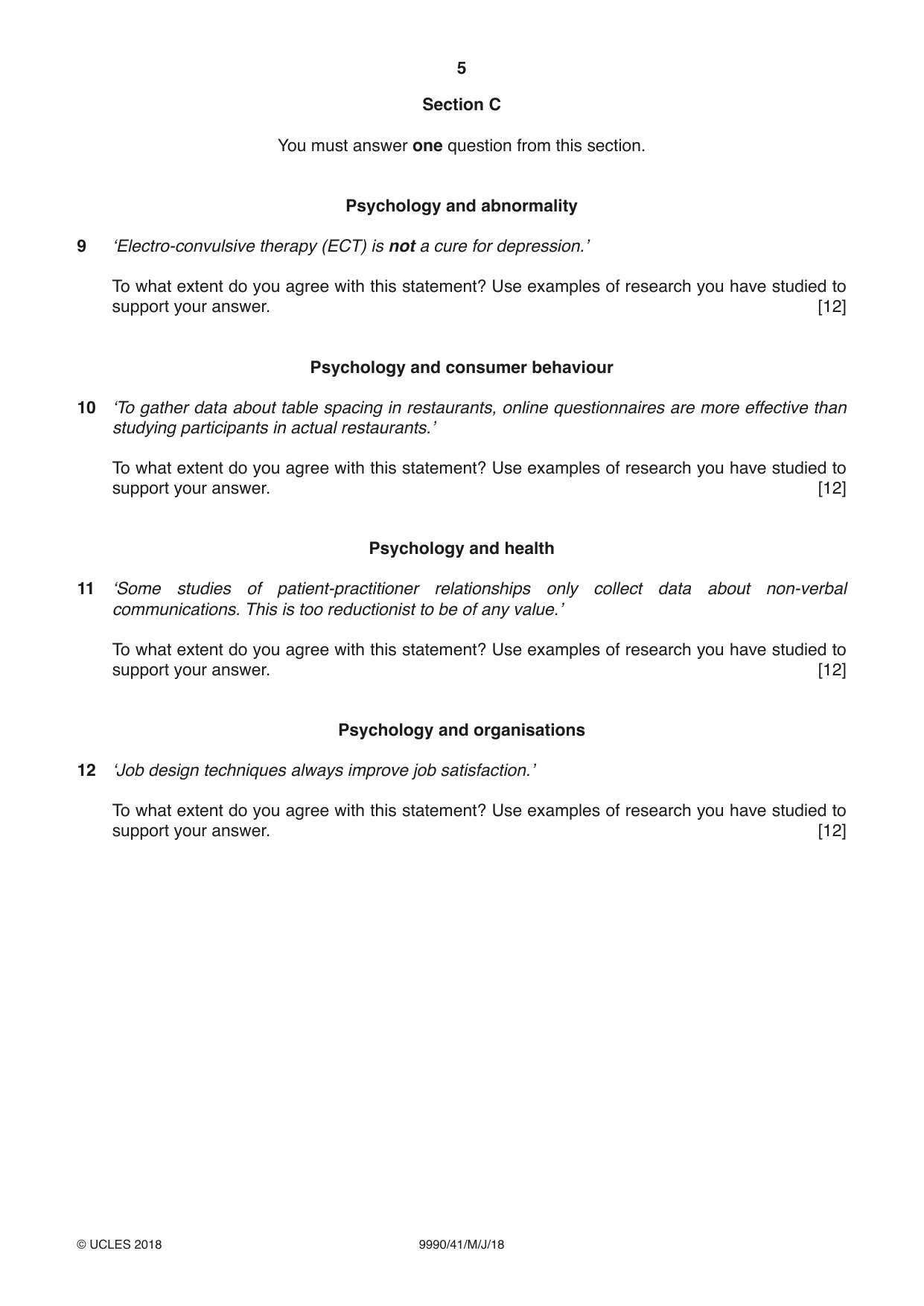
Q9 · ‘Electro-convulsive therapy (ECT) is not a cure for depression.’ To what extent do you…
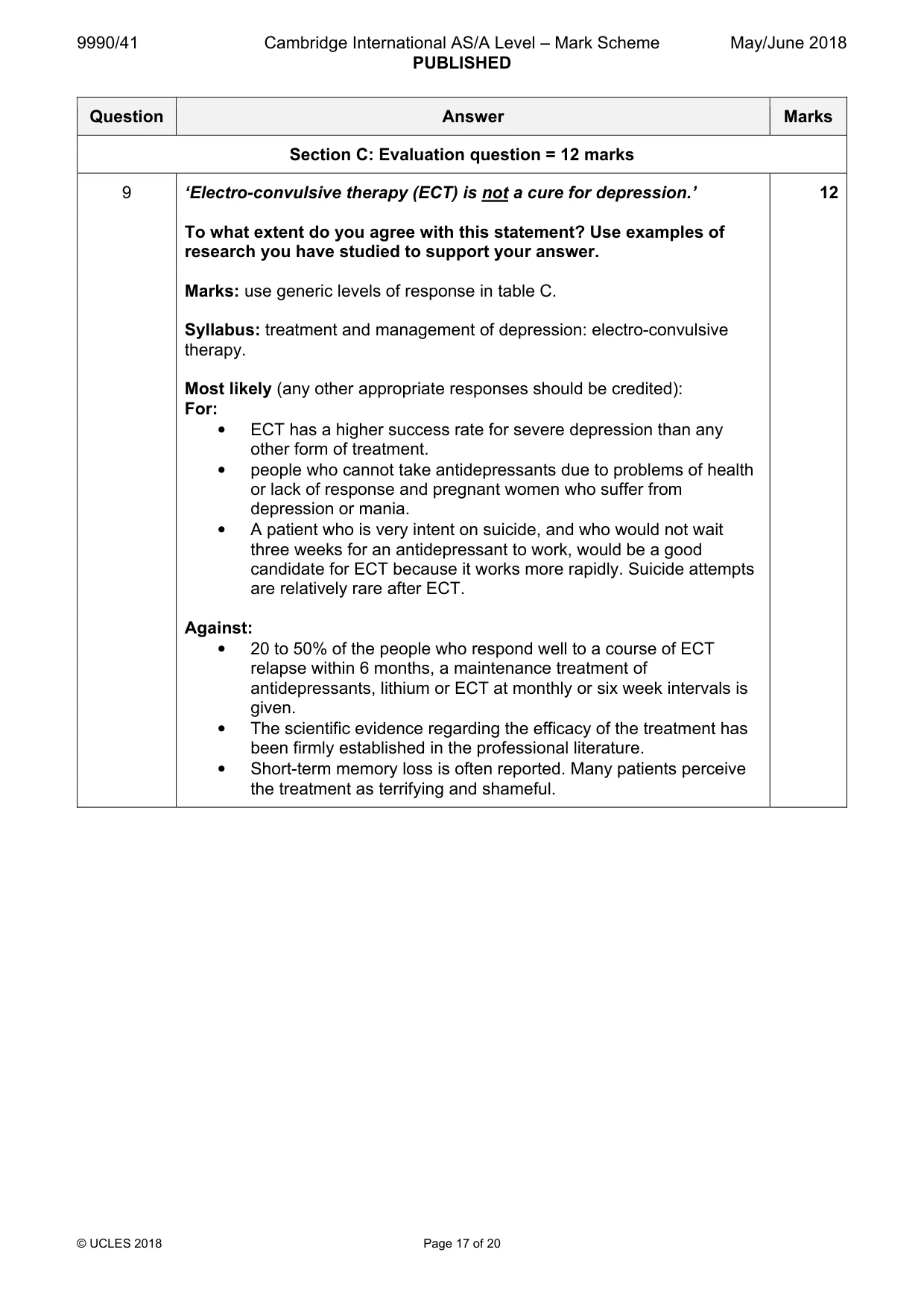
9 ‘Electro-convulsive therapy (ECT) is not a cure for depression.’ To what extent do you agree with this statement? Use examples of research you have studied to support your answer. [12] Psychology and consumer behaviour
Mark scheme: 9 ‘Electro-convulsive therapy (ECT) is not a cure for depression.’ 12 To what extent do you agree with this statement? Use examples of research you have studied to support your answer. Marks: use generic levels of response in table C. Syllabus: treatment and management of depression: electro-convulsive therapy. Most likely (any other appropriate responses should be credited): For: • ECT has a higher success rate for severe depression than any other form of treatment. • people who cannot take antidepressants due to problems of health or lack of response and pregnant women who suffer from depression or mania. • A patient who is very intent on suicide, and who would not wait three weeks for an antidepressant to work, would be a good candidate for ECT because it works more rapidly. Suicide attempts are relatively rare after ECT. Against: • 20 to 50% of the people who respond well to a course of ECT relapse within 6 months, a maintenance treatment of antidepressants, lithium or ECT at monthly or six week intervals is given. • The scientific evidence regarding the efficacy of the treatment has been firmly established in the professional literature. • Short-term memory loss is often reported. Many patients perceive the treatment as terrifying and shameful.
More questions on Mood (affective) disorders: depressive disorder (unipolar) and bipolar disorder
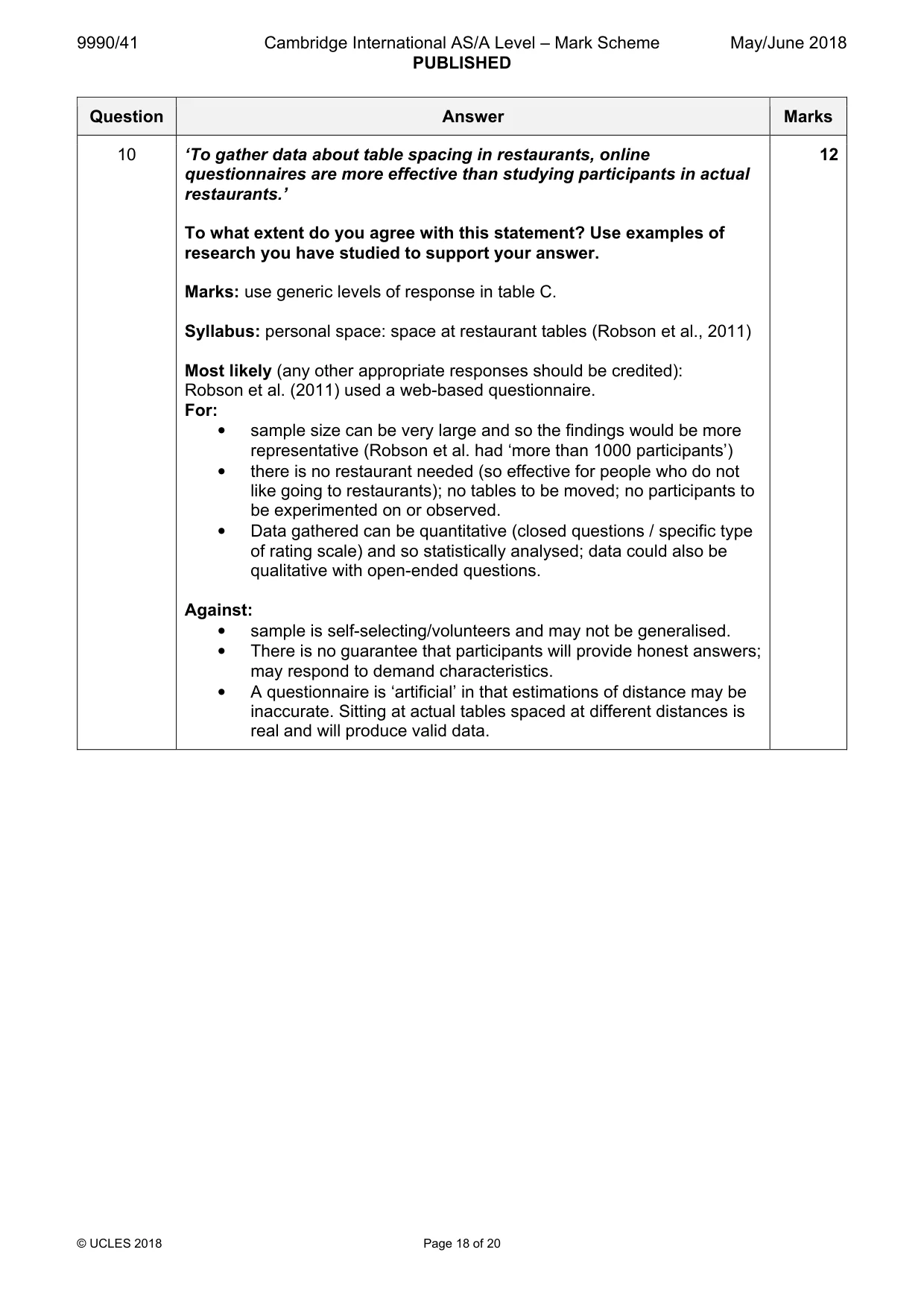
Q10 · ‘To gather data about table spacing in restaurants, online questionnaires are more…
10 ‘To gather data about table spacing in restaurants, online questionnaires are more effective than studying participants in actual restaurants.’ To what extent do you agree with this statement? Use examples of research you have studied to support your answer. [12] Psychology and health
Mark scheme: 10 ‘To gather data about table spacing in restaurants, online 12 questionnaires are more effective than studying participants in actual restaurants.’ To what extent do you agree with this statement? Use examples of research you have studied to support your answer. Marks: use generic levels of response in table C. Syllabus: personal space: space at restaurant tables (Robson et al., 2011) Most likely (any other appropriate responses should be credited): Robson et al. (2011) used a web-based questionnaire. For: • sample size can be very large and so the findings would be more representative (Robson et al. had ‘more than 1000 participants’) • there is no restaurant needed (so effective for people who do not like going to restaurants); no tables to be moved; no participants to be experimented on or observed. • Data gathered can be quantitative (closed questions / specific type of rating scale) and so statistically analysed; data could also be qualitative with open-ended questions. Against: • sample is self-selecting/volunteers and may not be generalised. • There is no guarantee that participants will provide honest answers; may respond to demand characteristics. • A questionnaire is ‘artificial’ in that estimations of distance may be inaccurate. Sitting at actual tables spaced at different distances is real and will produce valid data.
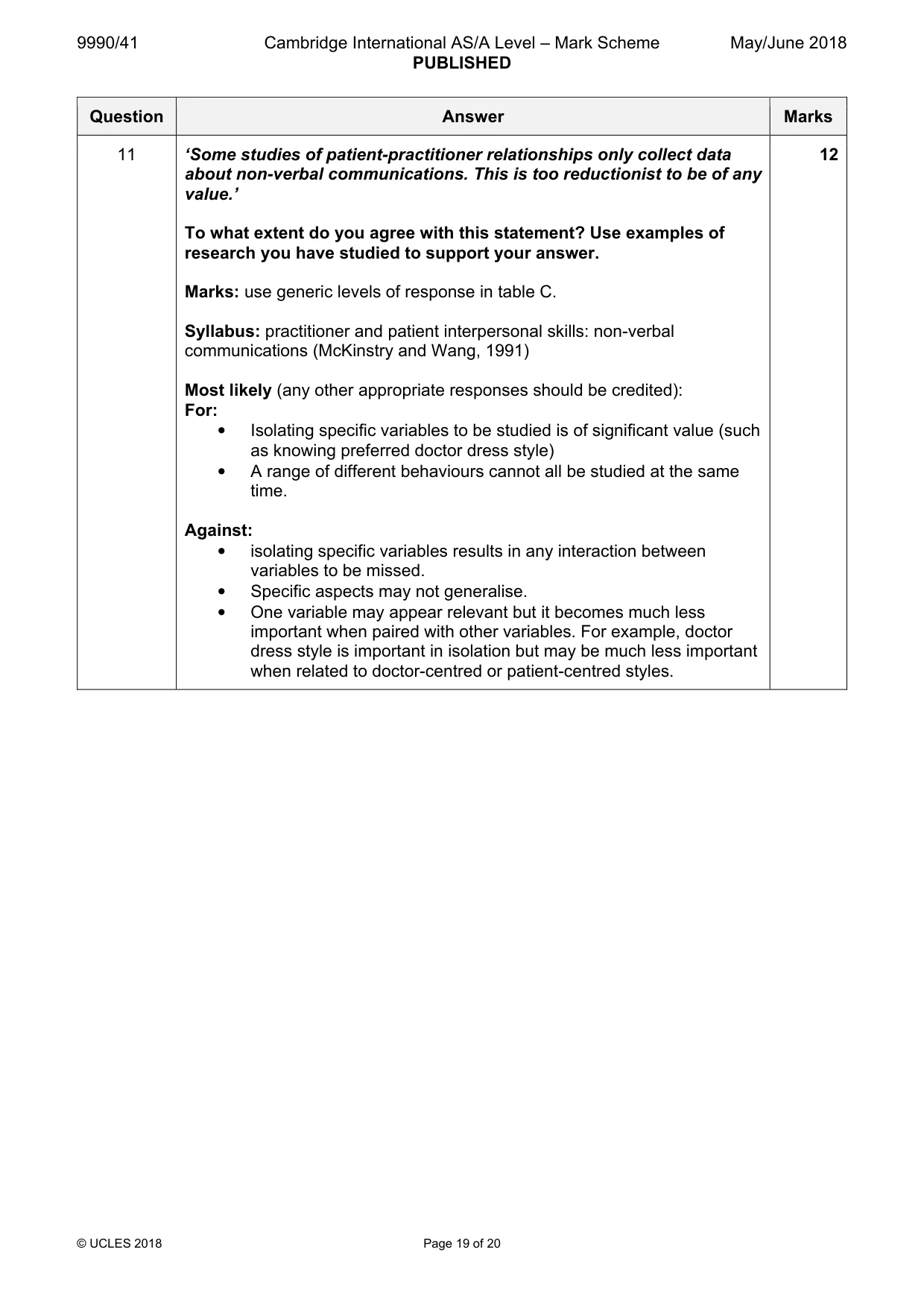
Q11 · ‘Some studies of patient-practitioner relationships only collect data about non-verbal…
11 ‘Some studies of patient-practitioner relationships only collect data about non-verbal communications. This is too reductionist to be of any value.’ To what extent do you agree with this statement? Use examples of research you have studied to support your answer. [12] Psychology and organisations
Mark scheme: 11 ‘Some studies of patient-practitioner relationships only collect data 12 about non-verbal communications. This is too reductionist to be of any value.’ To what extent do you agree with this statement? Use examples of research you have studied to support your answer. Marks: use generic levels of response in table C. Syllabus: practitioner and patient interpersonal skills: non-verbal communications (McKinstry and Wang, 1991) Most likely (any other appropriate responses should be credited): For: • Isolating specific variables to be studied is of significant value (such as knowing preferred doctor dress style) • A range of different behaviours cannot all be studied at the same time. Against: • isolating specific variables results in any interaction between variables to be missed. • Specific aspects may not generalise. • One variable may appear relevant but it becomes much less important when paired with other variables. For example, doctor dress style is important in isolation but may be much less important when related to doctor-centred or patient-centred styles.
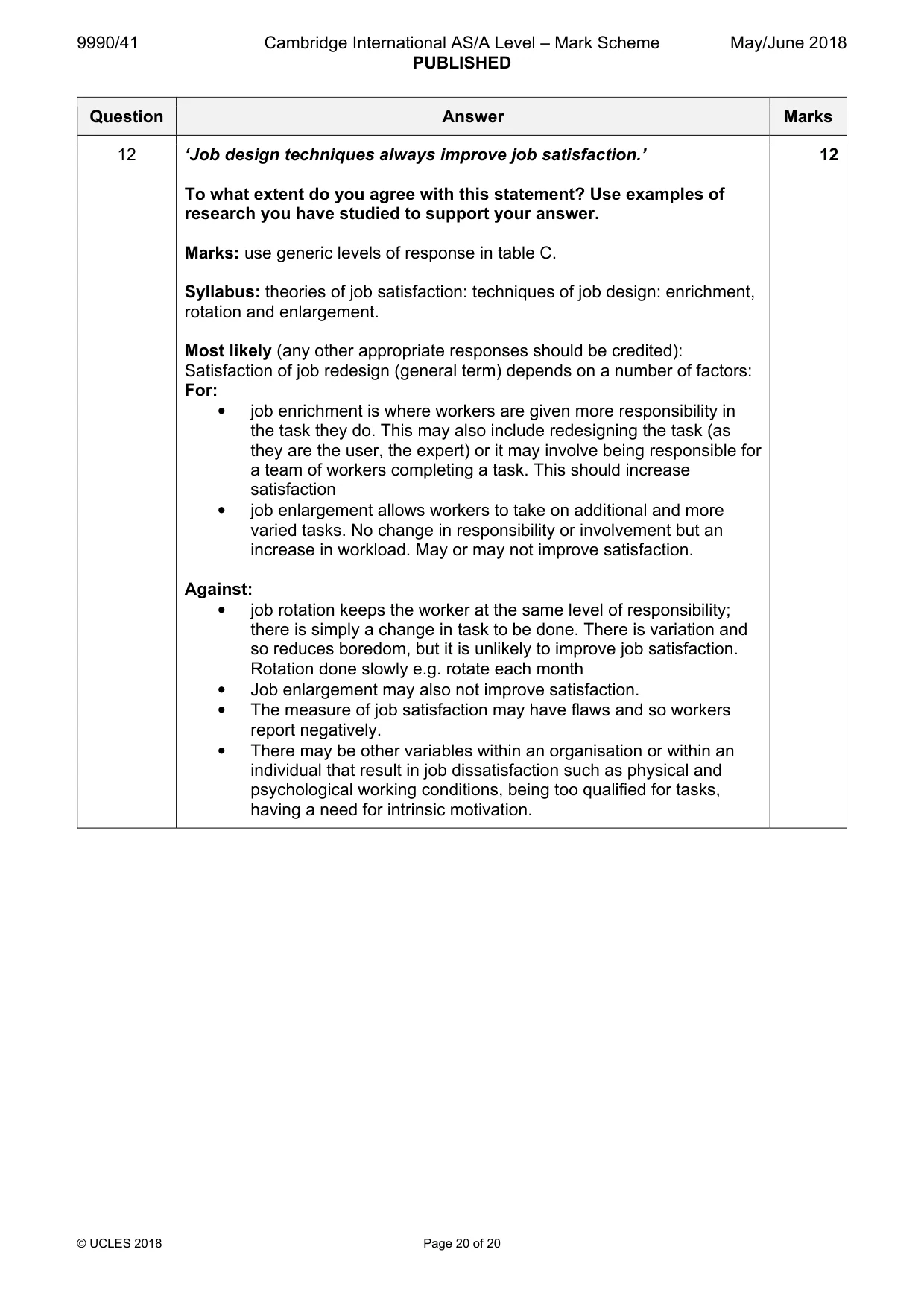
Q12 · ‘Job design techniques always improve job satisfaction.’ To what extent do you agree with…
12 ‘Job design techniques always improve job satisfaction.’ To what extent do you agree with this statement? Use examples of research you have studied to support your answer. [12]
Mark scheme: 12 ‘Job design techniques always improve job satisfaction.’ 12 To what extent do you agree with this statement? Use examples of research you have studied to support your answer. Marks: use generic levels of response in table C. Syllabus: theories of job satisfaction: techniques of job design: enrichment, rotation and enlargement. Most likely (any other appropriate responses should be credited): Satisfaction of job redesign (general term) depends on a number of factors: For: • job enrichment is where workers are given more responsibility in the task they do. This may also include redesigning the task (as they are the user, the expert) or it may involve being responsible for a team of workers completing a task. This should increase satisfaction • job enlargement allows workers to take on additional and more varied tasks. No change in responsibility or involvement but an increase in workload. May or may not improve satisfaction. Against: • job rotation keeps the worker at the same level of responsibility; there is simply a change in task to be done. There is variation and so reduces boredom, but it is unlikely to improve job satisfaction. Rotation done slowly e.g. rotate each month • Job enlargement may also not improve satisfaction. • The measure of job satisfaction may have flaws and so workers report negatively. • There may be other variables within an organisation or within an individual that result in job dissatisfaction such as physical and psychological working conditions, being too qualified for tasks, having a need for intrinsic motivation.
What was in this paper
The subtopics covered by these 12 questions, and how many questions each got. Open one in a new tab to see every Cambridge question on it.
What you needed in this session
Cambridge’s own grade thresholds for 2018 May/June, Paper 4 · Variant 1. A higher threshold means an easier paper — the bar moves with how the cohort did.