Cambridge A Level Psychology (from 2018) 9990 — 2019 May/June Paper 4 · Variant 1
9990/41/M/J/19 · 12 questions · 60 marks · ≈68 min
The question paper and its mark scheme, free to read here and free to download. This is Cambridge’s own paper, exactly as it was sat.
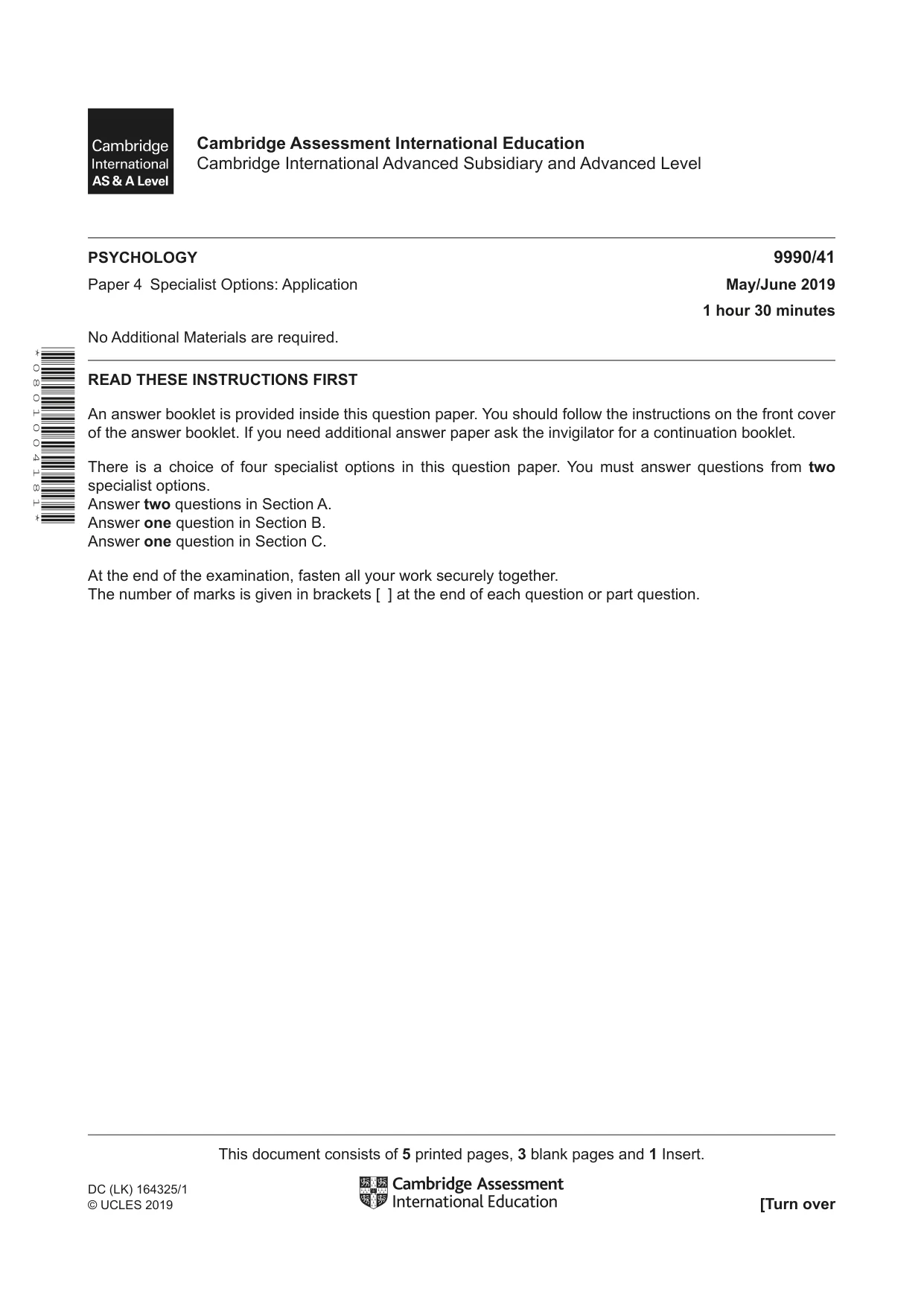
Question paper8 pages



Mark scheme21 pages
Answers below. Sit the paper first if you are practising.
Questions as text
Q1 · Miller (2010) described the case study of ‘John’ who received impulse control therapy
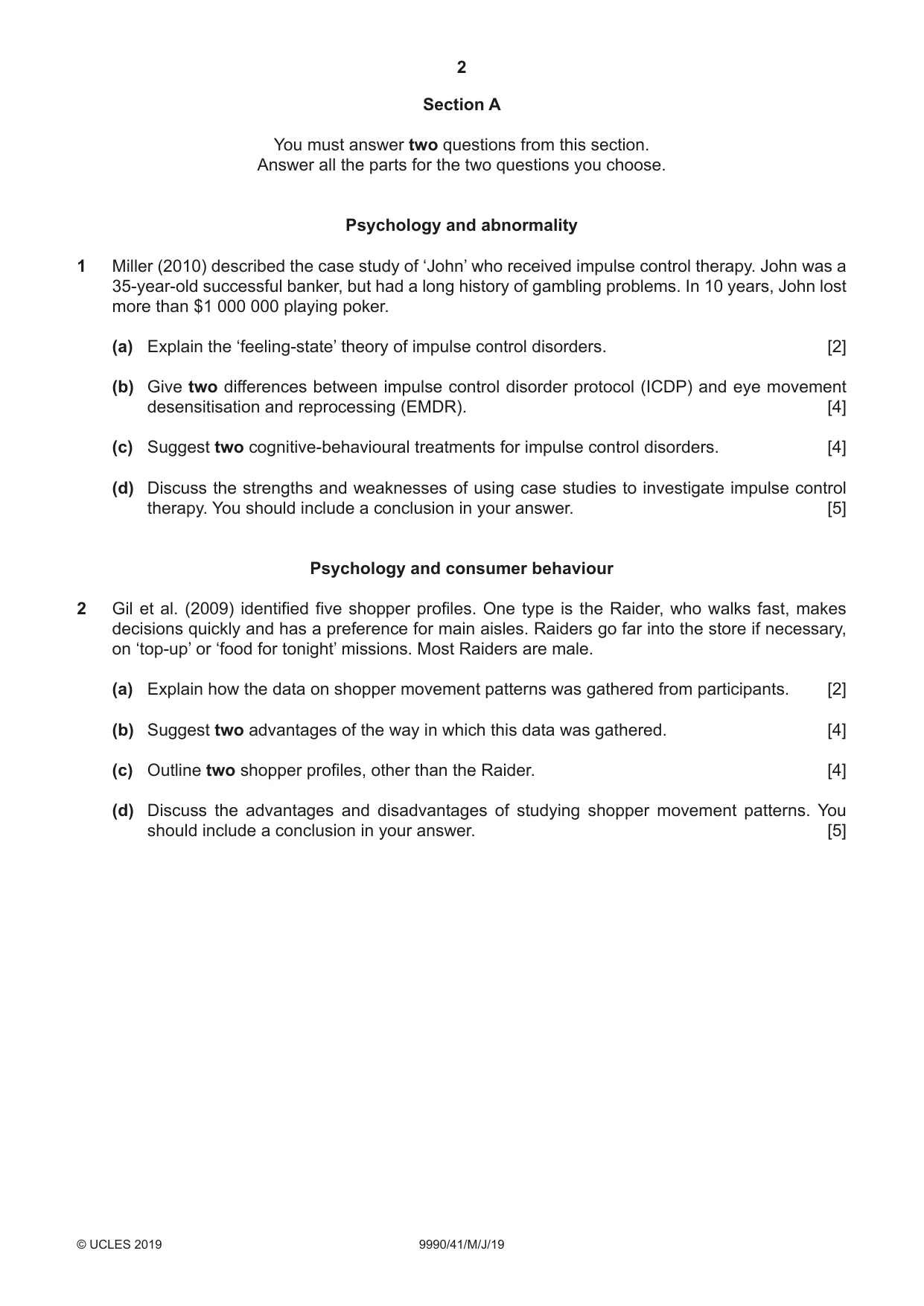
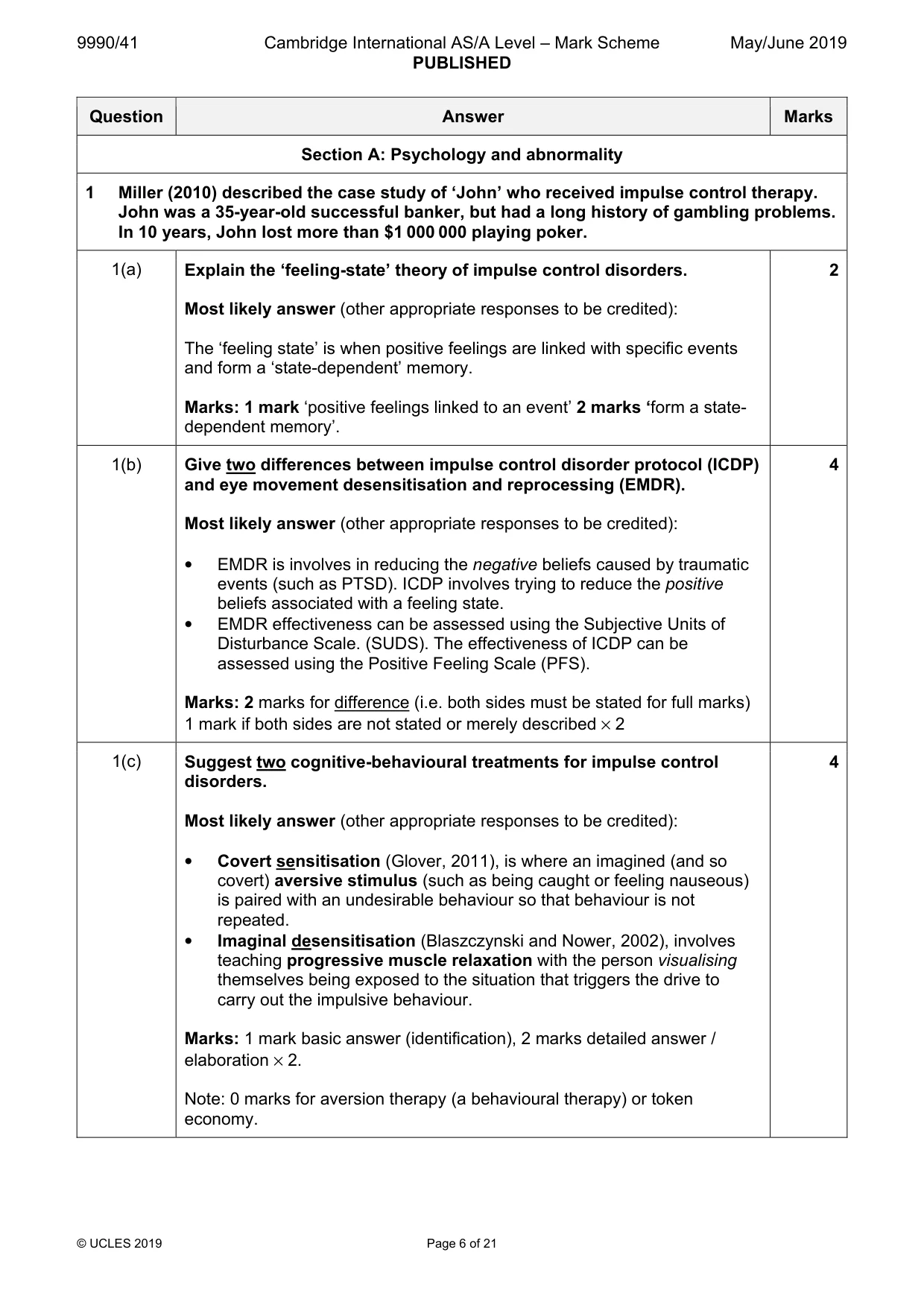
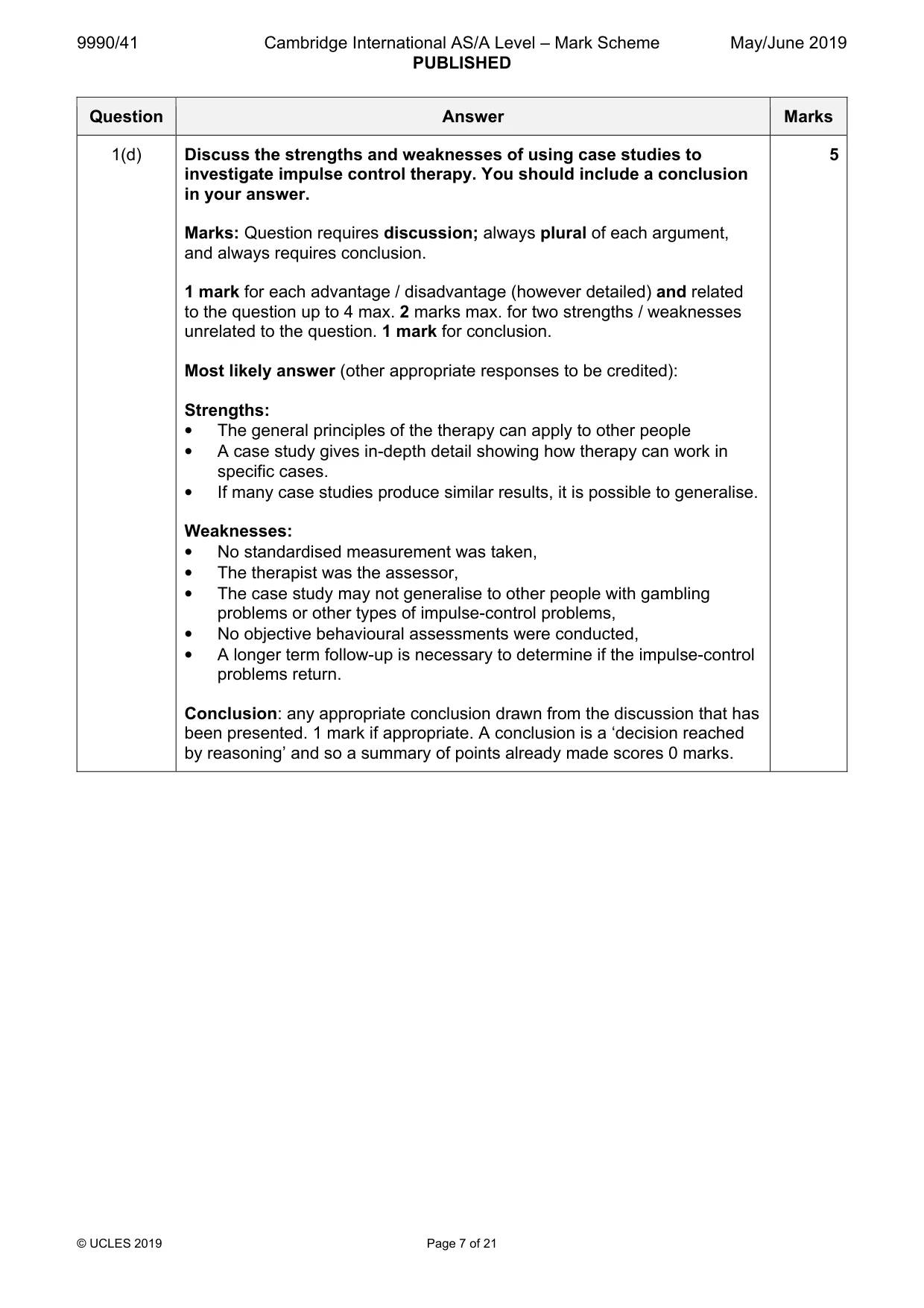
1 Miller (2010) described the case study of ‘John’ who received impulse control therapy. John was a 35-year-old successful banker, but had a long history of gambling problems. In 10 years, John lost more than $1 000 000 playing poker. (a) Explain the ‘feeling-state’ theory of impulse control disorders. [2] (b) Give two differences between impulse control disorder protocol (ICDP) and eye movement desensitisation and reprocessing (EMDR). [4] (c) Suggest two cognitive-behavioural treatments for impulse control disorders. [4] (d) Discuss the strengths and weaknesses of using case studies to investigate impulse control therapy. You should include a conclusion in your answer. [5] Psychology and consumer behaviour
Mark scheme: Question Answer Marks Section A: Psychology and abnormality 1 Miller (2010) described the case study of ‘John’ who received impulse control therapy. John was a 35-year-old successful banker, but had a long history of gambling problems. In 10 years, John lost more than $1 000 000 playing poker. 1(a) Explain the ‘feeling-state’ theory of impulse control disorders. 2 Most likely answer (other appropriate responses to be credited): The ‘feeling state’ is when positive feelings are linked with specific events and form a ‘state-dependent’ memory. Marks: 1 mark ‘positive feelings linked to an event’ 2 marks ‘form a state- dependent memory’. 1(b) Give two differences between impulse control disorder protocol (ICDP) 4 and eye movement desensitisation and reprocessing (EMDR). Most likely answer (other appropriate responses to be credited): • EMDR is involves in reducing the negative beliefs caused by traumatic events (such as PTSD). ICDP involves trying to reduce the positive beliefs associated with a feeling state. • EMDR effectiveness can be assessed using the Subjective Units of Disturbance Scale. (SUDS). The effectiveness of ICDP can be assessed using the Positive Feeling Scale (PFS). Marks: 2 marks for difference (i.e. both sides must be stated for full marks) 1 mark if both sides are not stated or merely described × 2 1(c) Suggest two cognitive-behavioural treatments for impulse control 4 disorders. Most likely answer (other appropriate responses to be credited): • Covert sensitisation (Glover, 2011), is where an imagined (and so covert) aversive stimulus (such as being caught or feeling nauseous) is paired with an undesirable behaviour so that behaviour is not repeated. • Imaginal desensitisation (Blaszczynski and Nower, 2002), involves teaching progressive muscle relaxation with the person visualising themselves being exposed to the situation that triggers the drive to carry out the impulsive behaviour. Marks: 1 mark basic answer (identification), 2 marks detailed answer / elaboration × 2. Note: 0 marks for aversion therapy (a behavioural therapy) or token economy. 1(d) Discuss the strengths and weaknesses of using case studies to 5 investigate impulse control therapy. You should include a conclusion in your answer. Marks: Question requires discussion; always plural of each argument, and always requires conclusion. 1 mark for each advantage / disadvantage (however detailed) and related to the question up to 4 max. 2 marks max. for two strengths / weaknesses unrelated to the question. 1 mark for conclusion. Most likely answer (other appropriate responses to be credited): Strengths: • The general principles of the therapy can apply to other people • A case study gives in-depth detail showing how therapy can work in specific cases. • If many case studies produce similar results, it is possible to generalise. Weaknesses: • No standardised measurement was taken, • The therapist was the assessor, • The case study may not generalise to other people with gambling problems or other types of impulse-control problems, • No objective behavioural assessments were conducted, • A longer term follow-up is necessary to determine if the impulse-control problems return. Conclusion: any appropriate conclusion drawn from the discussion that has been presented. 1 mark if appropriate. A conclusion is a ‘decision reached by reasoning’ and so a summary of points already made scores 0 marks.
Question 2
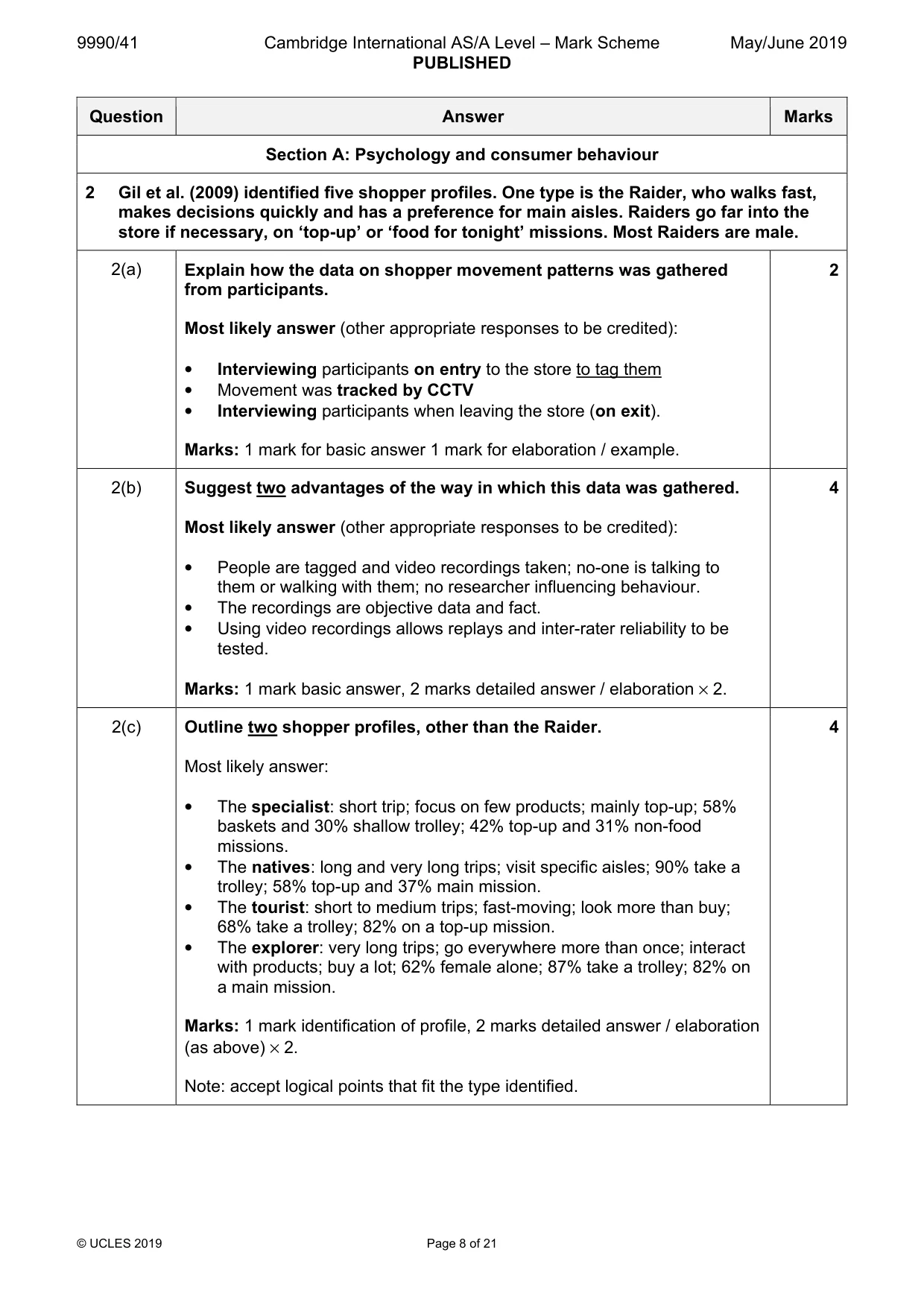
2 Gil et al. (2009) identified five shopper profiles. One type is the Raider, who walks fast, makes decisions quickly and has a preference for main aisles. Raiders go far into the store if necessary, on ‘top-up’ or ‘food for tonight’ missions. Most Raiders are male. (a) Explain how the data on shopper movement patterns was gathered from participants. [2] (b) Suggest two advantages of the way in which this data was gathered. [4] (c) Outline two shopper profiles, other than the Raider. [4] (d) Discuss the advantages and disadvantages of studying shopper movement patterns. You should include a conclusion in your answer. [5] Psychology and health
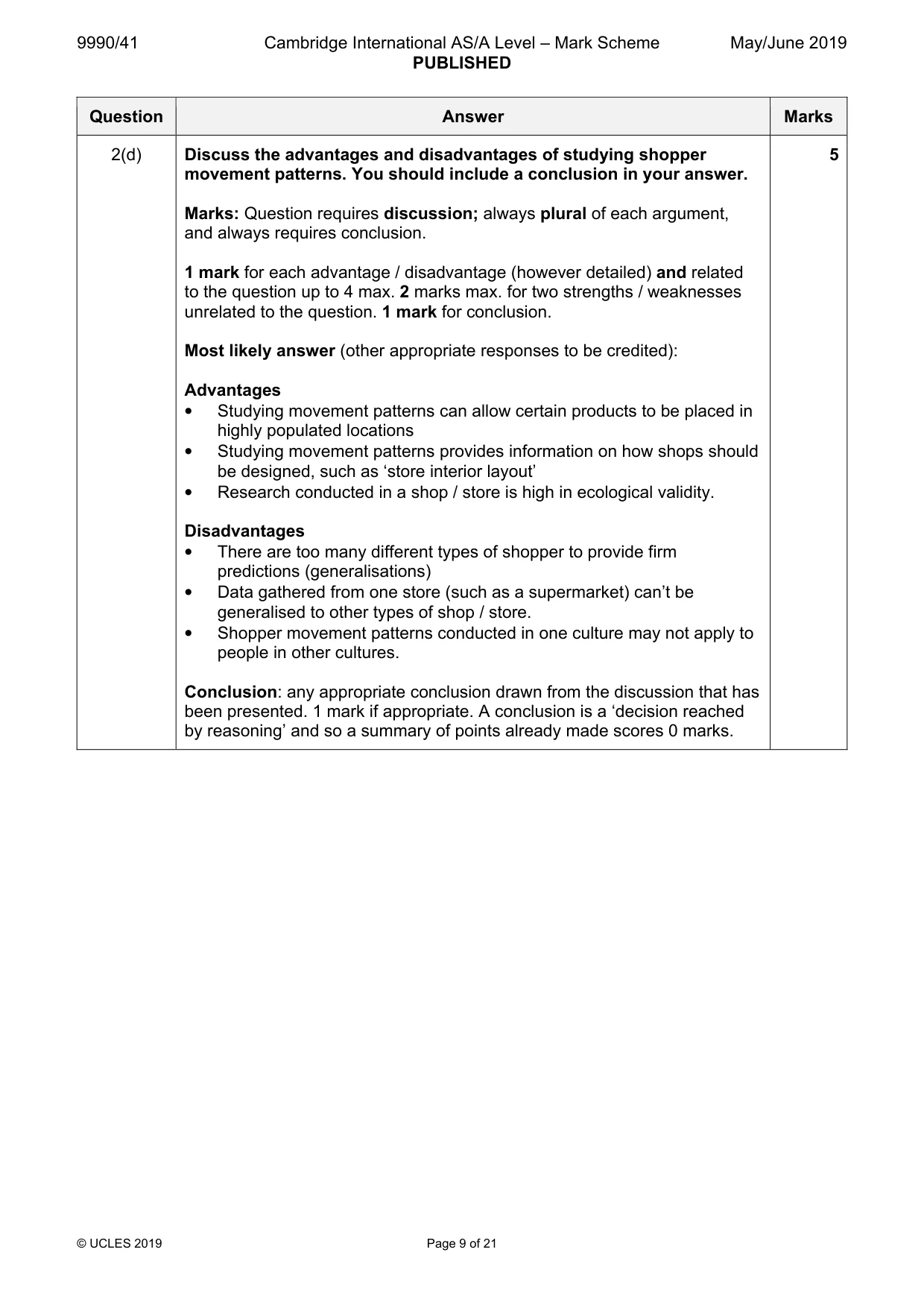
Mark scheme: 2(a) Explain how the data on shopper movement patterns was gathered 2 from participants. Most likely answer (other appropriate responses to be credited): • Interviewing participants on entry to the store to tag them • Movement was tracked by CCTV • Interviewing participants when leaving the store (on exit). Marks: 1 mark for basic answer 1 mark for elaboration / example. 2(b) Suggest two advantages of the way in which this data was gathered. 4 Most likely answer (other appropriate responses to be credited): • People are tagged and video recordings taken; no-one is talking to them or walking with them; no researcher influencing behaviour. • The recordings are objective data and fact. • Using video recordings allows replays and inter-rater reliability to be tested. Marks: 1 mark basic answer, 2 marks detailed answer / elaboration × 2. 2(c) Outline two shopper profiles, other than the Raider. 4 Most likely answer: • The specialist: short trip; focus on few products; mainly top-up; 58% baskets and 30% shallow trolley; 42% top-up and 31% non-food missions. • The natives: long and very long trips; visit specific aisles; 90% take a trolley; 58% top-up and 37% main mission. • The tourist: short to medium trips; fast-moving; look more than buy; 68% take a trolley; 82% on a top-up mission. • The explorer: very long trips; go everywhere more than once; interact with products; buy a lot; 62% female alone; 87% take a trolley; 82% on a main mission. Marks: 1 mark identification of profile, 2 marks detailed answer / elaboration (as above) × 2. Note: accept logical points that fit the type identified. 2(d) Discuss the advantages and disadvantages of studying shopper 5 movement patterns. You should include a conclusion in your answer. Marks: Question requires discussion; always plural of each argument, and always requires conclusion. 1 mark for each advantage / disadvantage (however detailed) and related to the question up to 4 max. 2 marks max. for two strengths / weaknesses unrelated to the question. 1 mark for conclusion. Most likely answer (other appropriate responses to be credited): Advantages • Studying movement patterns can allow certain products to be placed in highly populated locations • Studying movement patterns provides information on how shops should be designed, such as ‘store interior layout’ • Research conducted in a shop / store is high in ecological validity. Disadvantages • There are too many different types of shopper to provide firm predictions (generalisations) • Data gathered from one store (such as a supermarket) can’t be generalised to other types of shop / store. • Shopper movement patterns conducted in one culture may not apply to people in other cultures. Conclusion: any appropriate conclusion drawn from the discussion that has been presented. 1 mark if appropriate. A conclusion is a ‘decision reached by reasoning’ and so a summary of points already made scores 0 marks.
Q3 · Newspaper headline: What I say is not what I do
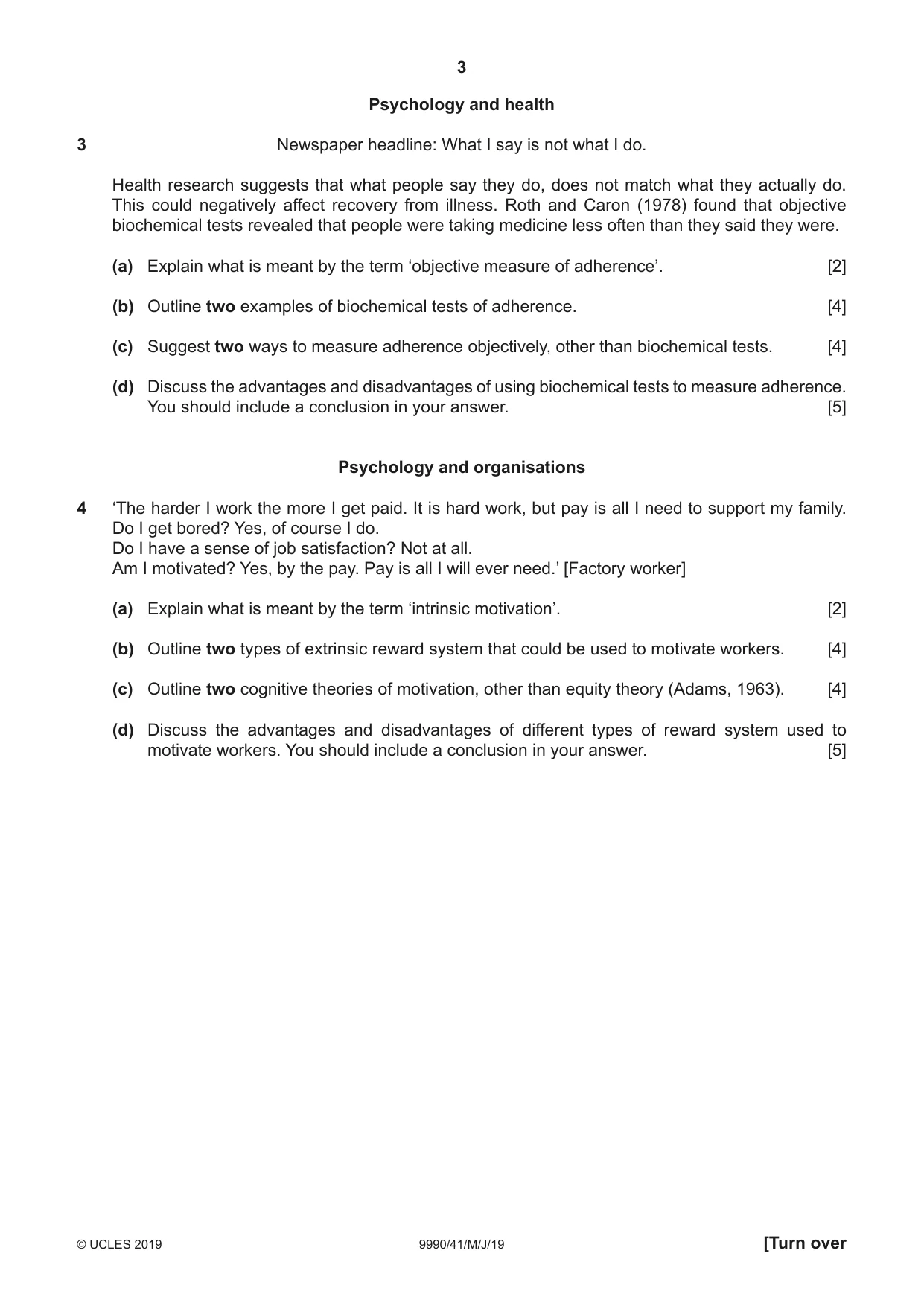
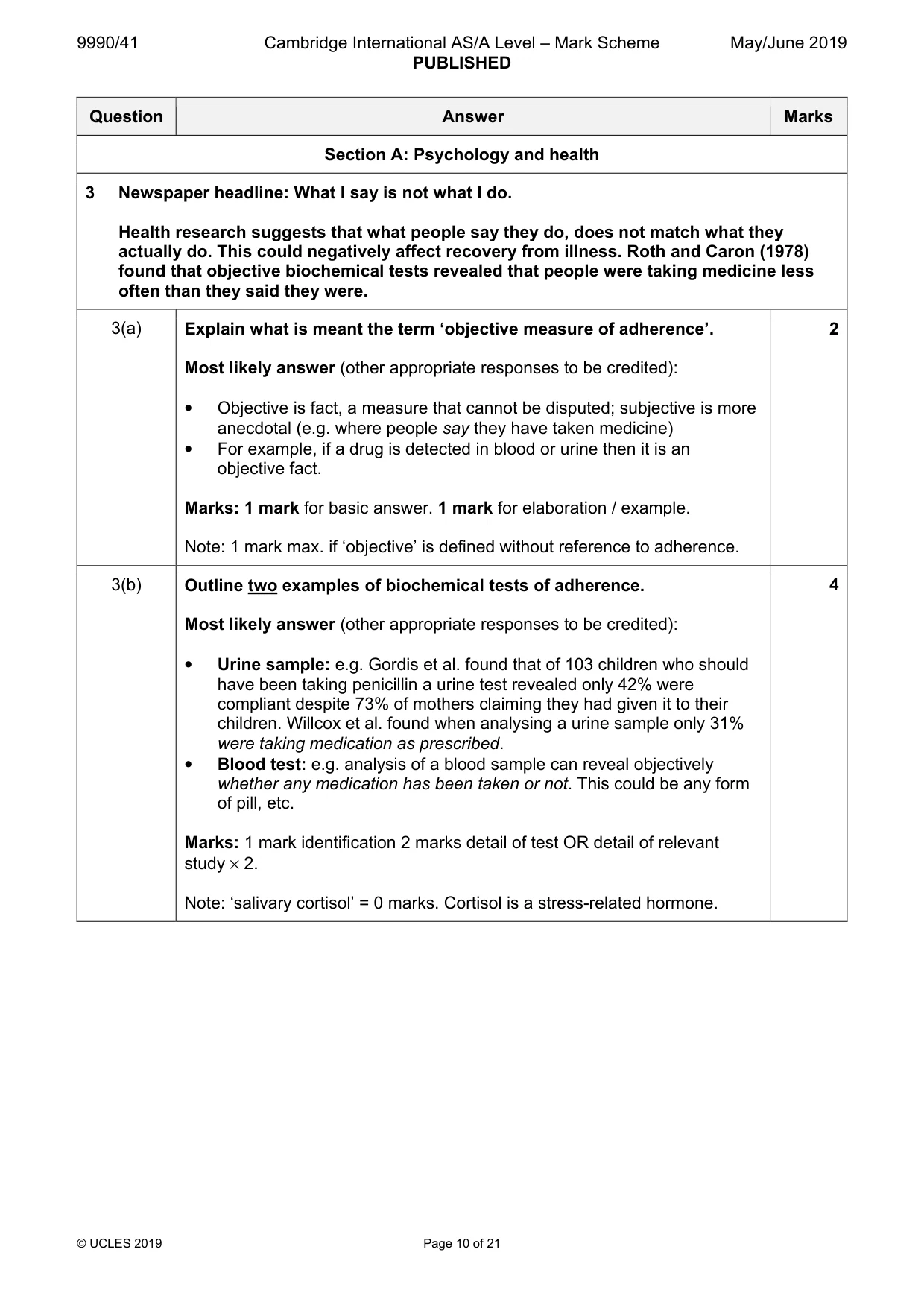
3 Newspaper headline: What I say is not what I do. Health research suggests that what people say they do, does not match what they actually do. This could negatively affect recovery from illness. Roth and Caron (1978) found that objective biochemical tests revealed that people were taking medicine less often than they said they were. (a) Explain what is meant by the term ‘objective measure of adherence’. [2] (b) Outline two examples of biochemical tests of adherence. [4] (c) Suggest two ways to measure adherence objectively, other than biochemical tests. [4] (d) Discuss the advantages and disadvantages of using biochemical tests to measure adherence. You should include a conclusion in your answer. [5] Psychology and organisations
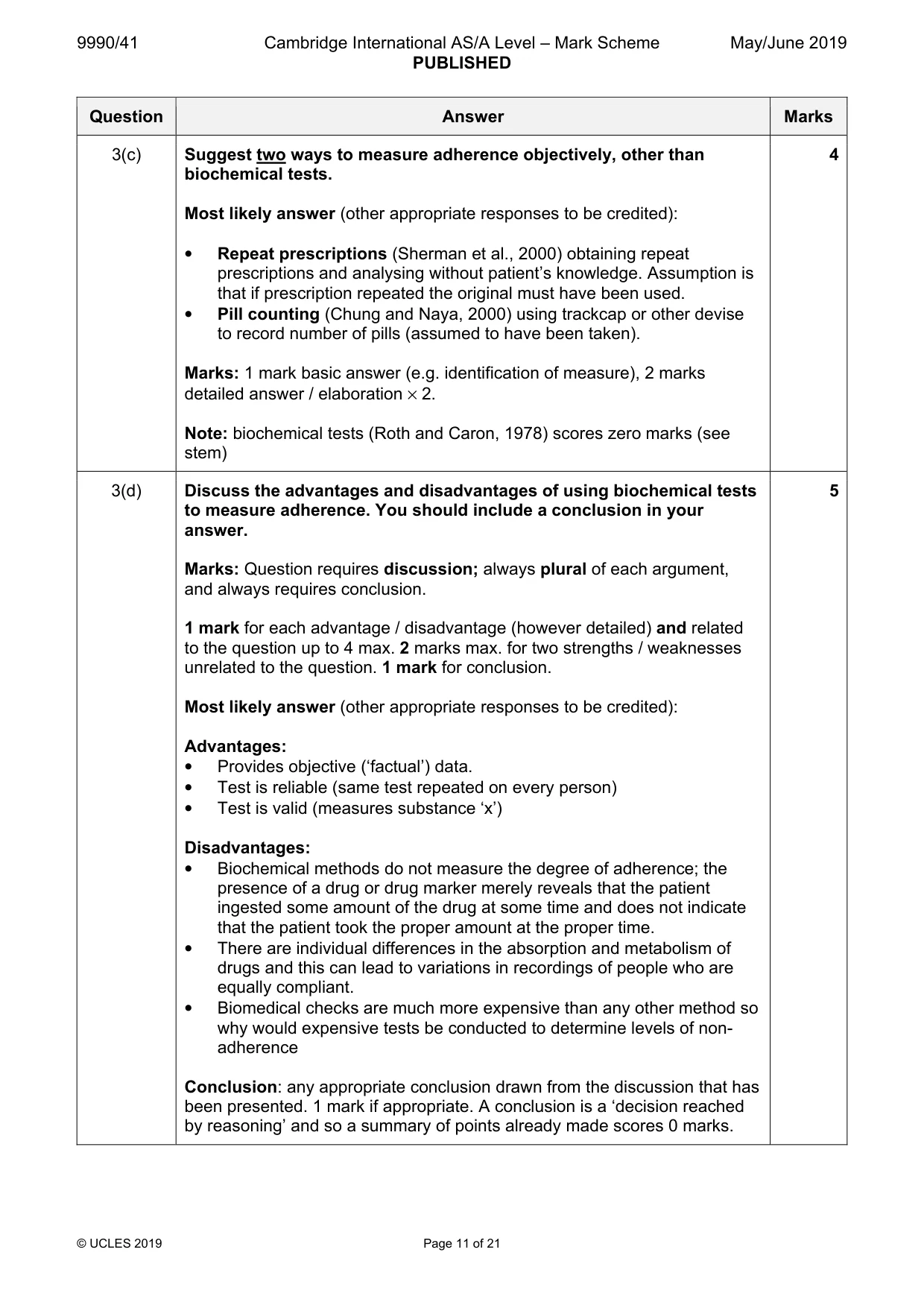
Mark scheme: 3(a) Explain what is meant the term ‘objective measure of adherence’. 2 Most likely answer (other appropriate responses to be credited): • Objective is fact, a measure that cannot be disputed; subjective is more anecdotal (e.g. where people say they have taken medicine) • For example, if a drug is detected in blood or urine then it is an objective fact. Marks: 1 mark for basic answer. 1 mark for elaboration / example. Note: 1 mark max. if ‘objective’ is defined without reference to adherence. 3(b) Outline two examples of biochemical tests of adherence. 4 Most likely answer (other appropriate responses to be credited): • Urine sample: e.g. Gordis et al. found that of 103 children who should have been taking penicillin a urine test revealed only 42% were compliant despite 73% of mothers claiming they had given it to their children. Willcox et al. found when analysing a urine sample only 31% were taking medication as prescribed. • Blood test: e.g. analysis of a blood sample can reveal objectively whether any medication has been taken or not. This could be any form of pill, etc. Marks: 1 mark identification 2 marks detail of test OR detail of relevant study × 2. Note: ‘salivary cortisol’ = 0 marks. Cortisol is a stress-related hormone. 3(c) Suggest two ways to measure adherence objectively, other than 4 biochemical tests. Most likely answer (other appropriate responses to be credited): • Repeat prescriptions (Sherman et al., 2000) obtaining repeat prescriptions and analysing without patient’s knowledge. Assumption is that if prescription repeated the original must have been used. • Pill counting (Chung and Naya, 2000) using trackcap or other devise to record number of pills (assumed to have been taken). Marks: 1 mark basic answer (e.g. identification of measure), 2 marks detailed answer / elaboration × 2. Note: biochemical tests (Roth and Caron, 1978) scores zero marks (see stem) 3(d) Discuss the advantages and disadvantages of using biochemical tests 5 to measure adherence. You should include a conclusion in your answer. Marks: Question requires discussion; always plural of each argument, and always requires conclusion. 1 mark for each advantage / disadvantage (however detailed) and related to the question up to 4 max. 2 marks max. for two strengths / weaknesses unrelated to the question. 1 mark for conclusion. Most likely answer (other appropriate responses to be credited): Advantages: • Provides objective (‘factual’) data. • Test is reliable (same test repeated on every person) • Test is valid (measures substance ‘x’) Disadvantages: • Biochemical methods do not measure the degree of adherence; the presence of a drug or drug marker merely reveals that the patient ingested some amount of the drug at some time and does not indicate that the patient took the proper amount at the proper time. • There are individual differences in the absorption and metabolism of drugs and this can lead to variations in recordings of people who are equally compliant. • Biomedical checks are much more expensive than any other method so why would expensive tests be conducted to determine levels of non- adherence Conclusion: any appropriate conclusion drawn from the discussion that has been presented. 1 mark if appropriate. A conclusion is a ‘decision reached by reasoning’ and so a summary of points already made scores 0 marks.
Q4 · ‘The harder I work the more I get paid
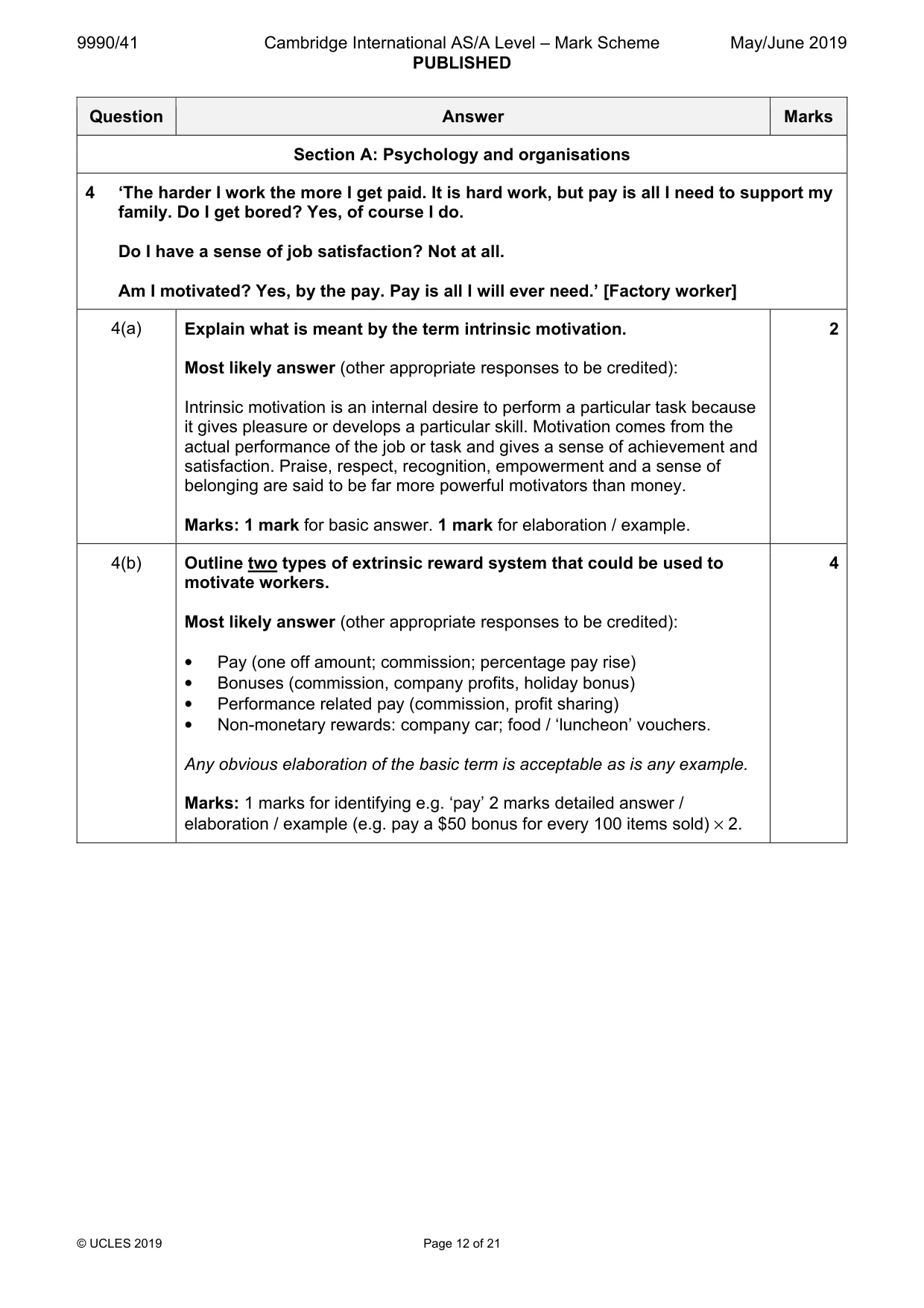
4 ‘The harder I work the more I get paid. It is hard work, but pay is all I need to support my family. Do I get bored? Yes, of course I do. Do I have a sense of job satisfaction? Not at all. Am I motivated? Yes, by the pay. Pay is all I will ever need.’ [Factory worker] (a) Explain what is meant by the term ‘intrinsic motivation’. [2] (b) Outline two types of extrinsic reward system that could be used to motivate workers. [4] (c) Outline two cognitive theories of motivation, other than equity theory (Adams, 1963). [4] (d) Discuss the advantages and disadvantages of different types of reward system used to motivate workers. You should include a conclusion in your answer. [5]
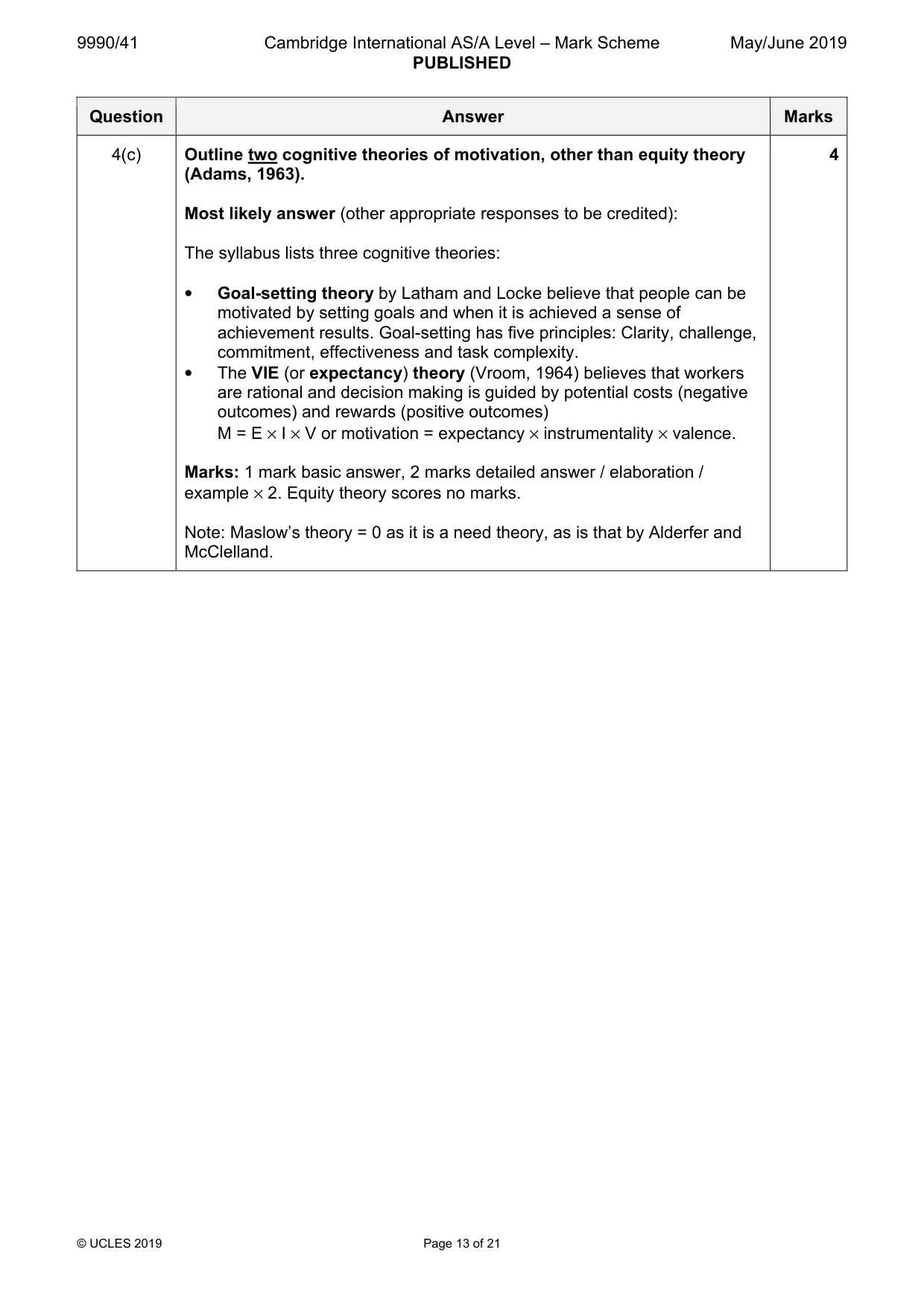
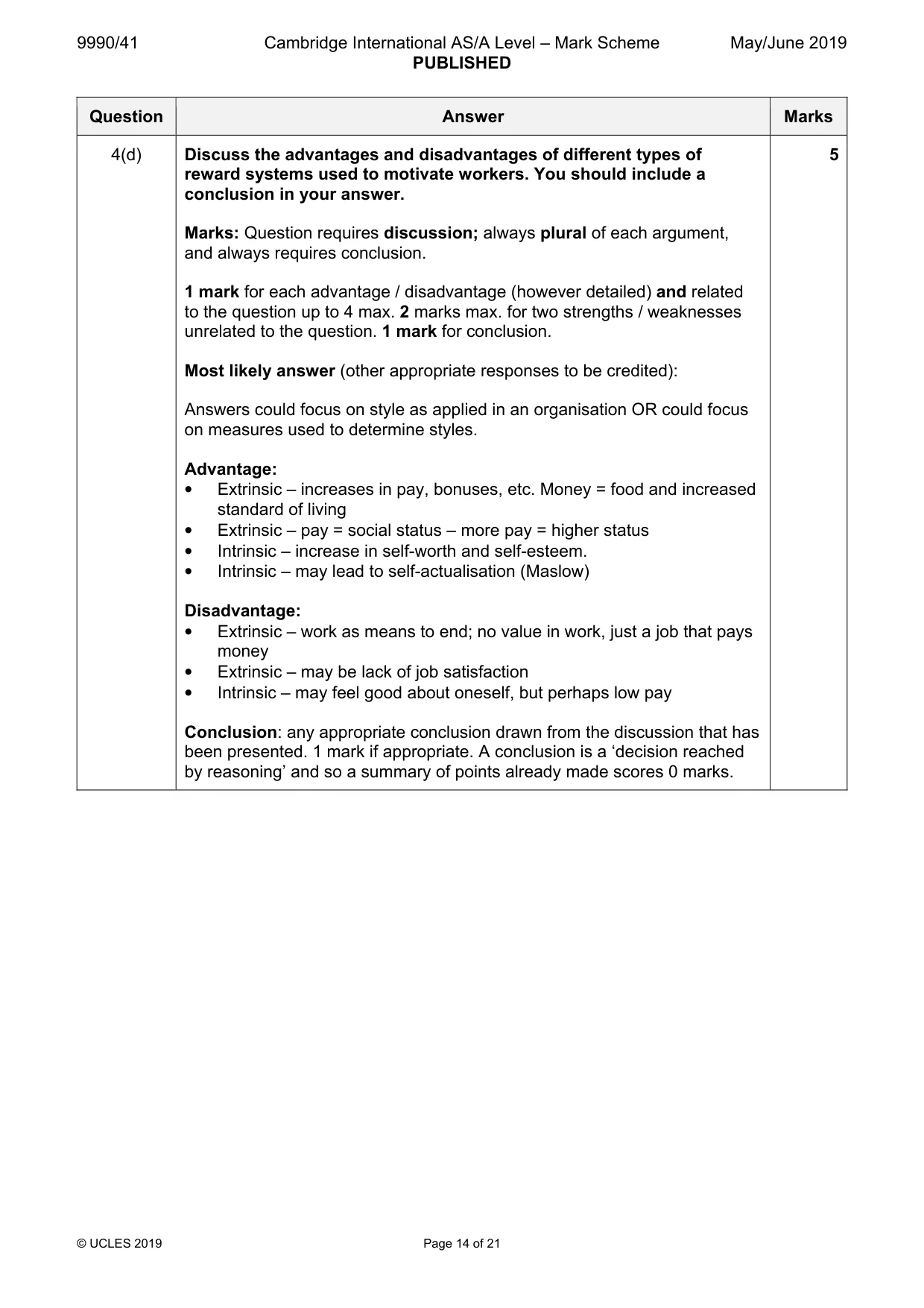
Mark scheme: 4(a) Explain what is meant by the term intrinsic motivation. 2 Most likely answer (other appropriate responses to be credited): Intrinsic motivation is an internal desire to perform a particular task because it gives pleasure or develops a particular skill. Motivation comes from the actual performance of the job or task and gives a sense of achievement and satisfaction. Praise, respect, recognition, empowerment and a sense of belonging are said to be far more powerful motivators than money. Marks: 1 mark for basic answer. 1 mark for elaboration / example. 4(b) Outline two types of extrinsic reward system that could be used to 4 motivate workers. Most likely answer (other appropriate responses to be credited): • Pay (one off amount; commission; percentage pay rise) • Bonuses (commission, company profits, holiday bonus) • Performance related pay (commission, profit sharing) • Non-monetary rewards: company car; food / ‘luncheon’ vouchers. Any obvious elaboration of the basic term is acceptable as is any example. Marks: 1 marks for identifying e.g. ‘pay’ 2 marks detailed answer / elaboration / example (e.g. pay a $50 bonus for every 100 items sold) × 2. 4(c) Outline two cognitive theories of motivation, other than equity theory 4 (Adams, 1963). Most likely answer (other appropriate responses to be credited): The syllabus lists three cognitive theories: • Goal-setting theory by Latham and Locke believe that people can be motivated by setting goals and when it is achieved a sense of achievement results. Goal-setting has five principles: Clarity, challenge, commitment, effectiveness and task complexity. • The VIE (or expectancy) theory (Vroom, 1964) believes that workers are rational and decision making is guided by potential costs (negative outcomes) and rewards (positive outcomes) M = E × I × V or motivation = expectancy × instrumentality × valence. Marks: 1 mark basic answer, 2 marks detailed answer / elaboration / example × 2. Equity theory scores no marks. Note: Maslow’s theory = 0 as it is a need theory, as is that by Alderfer and McClelland. 4(d) Discuss the advantages and disadvantages of different types of 5 reward systems used to motivate workers. You should include a conclusion in your answer. Marks: Question requires discussion; always plural of each argument, and always requires conclusion. 1 mark for each advantage / disadvantage (however detailed) and related to the question up to 4 max. 2 marks max. for two strengths / weaknesses unrelated to the question. 1 mark for conclusion. Most likely answer (other appropriate responses to be credited): Answers could focus on style as applied in an organisation OR could focus on measures used to determine styles. Advantage: • Extrinsic – increases in pay, bonuses, etc. Money = food and increased standard of living • Extrinsic – pay = social status – more pay = higher status • Intrinsic – increase in self-worth and self-esteem. • Intrinsic – may lead to self-actualisation (Maslow) Disadvantage: • Extrinsic – work as means to end; no value in work, just a job that pays money • Extrinsic – may be lack of job satisfaction • Intrinsic – may feel good about oneself, but perhaps low pay Conclusion: any appropriate conclusion drawn from the discussion that has been presented. 1 mark if appropriate. A conclusion is a ‘decision reached by reasoning’ and so a summary of points already made scores 0 marks.
Q5 · Design a study to investigate the long-term effectiveness of antipsychotic drugs in…
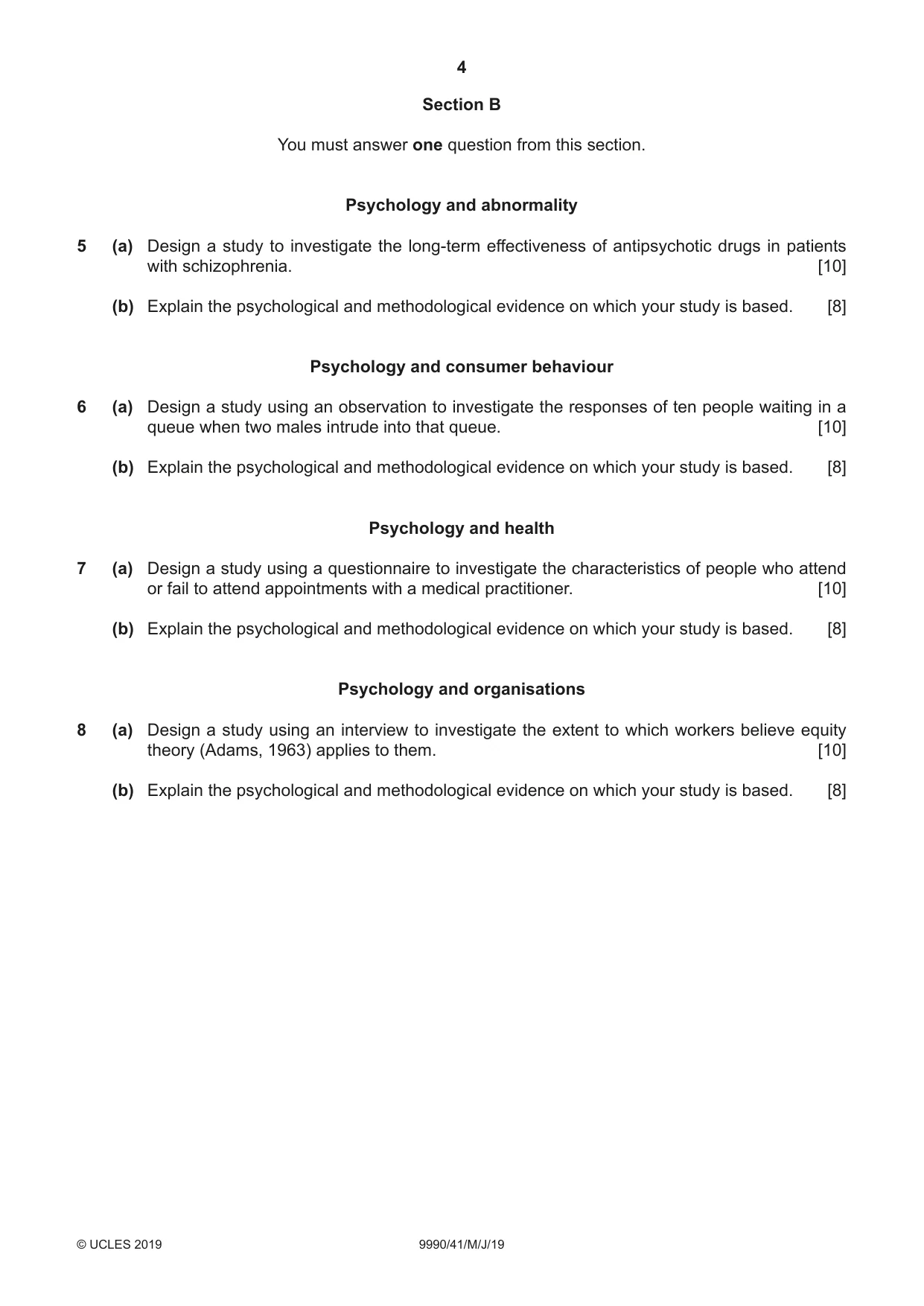
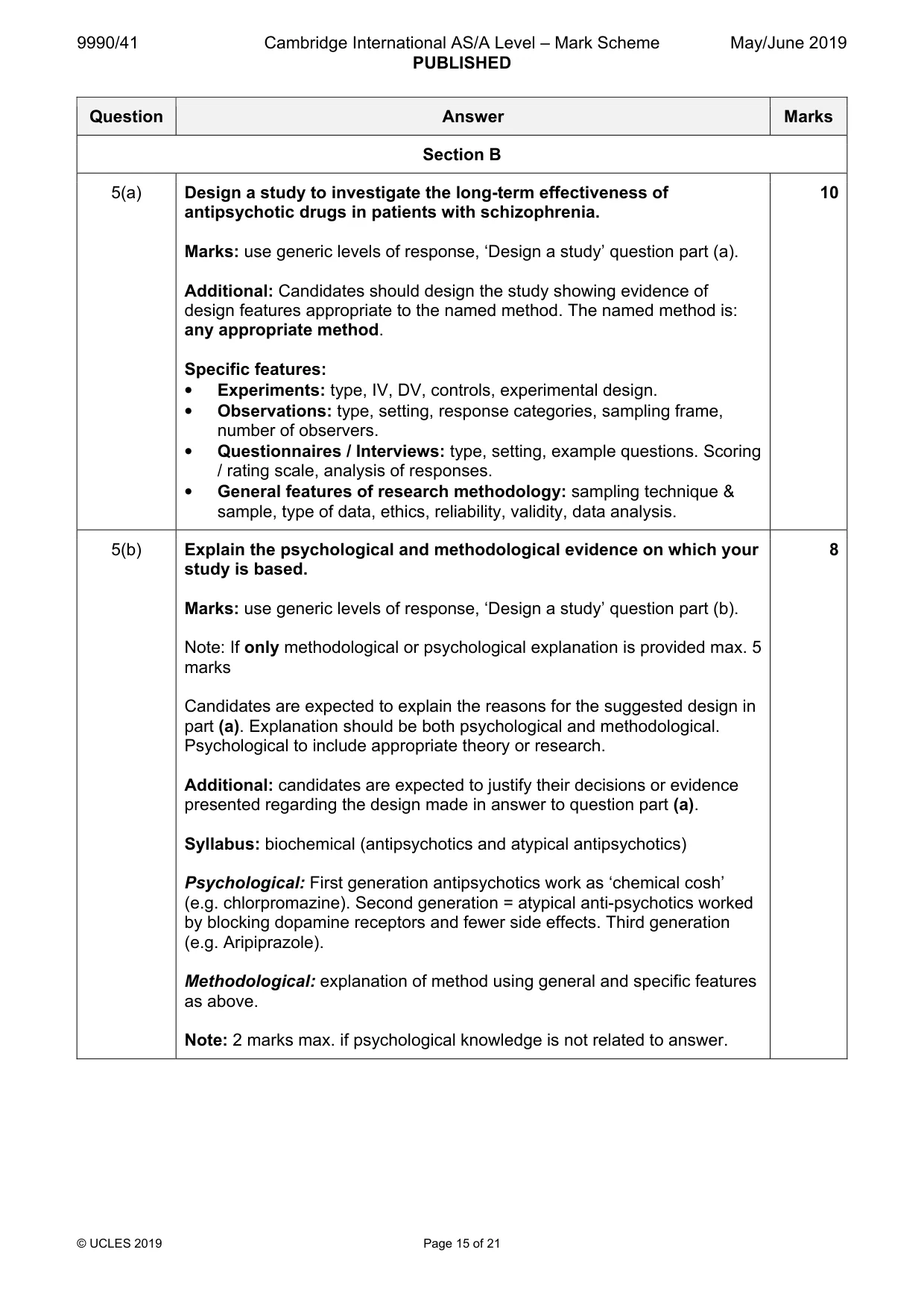
5 (a) Design a study to investigate the long-term effectiveness of antipsychotic drugs in patients with schizophrenia. [10] (b) Explain the psychological and methodological evidence on which your study is based. [8] Psychology and consumer behaviour
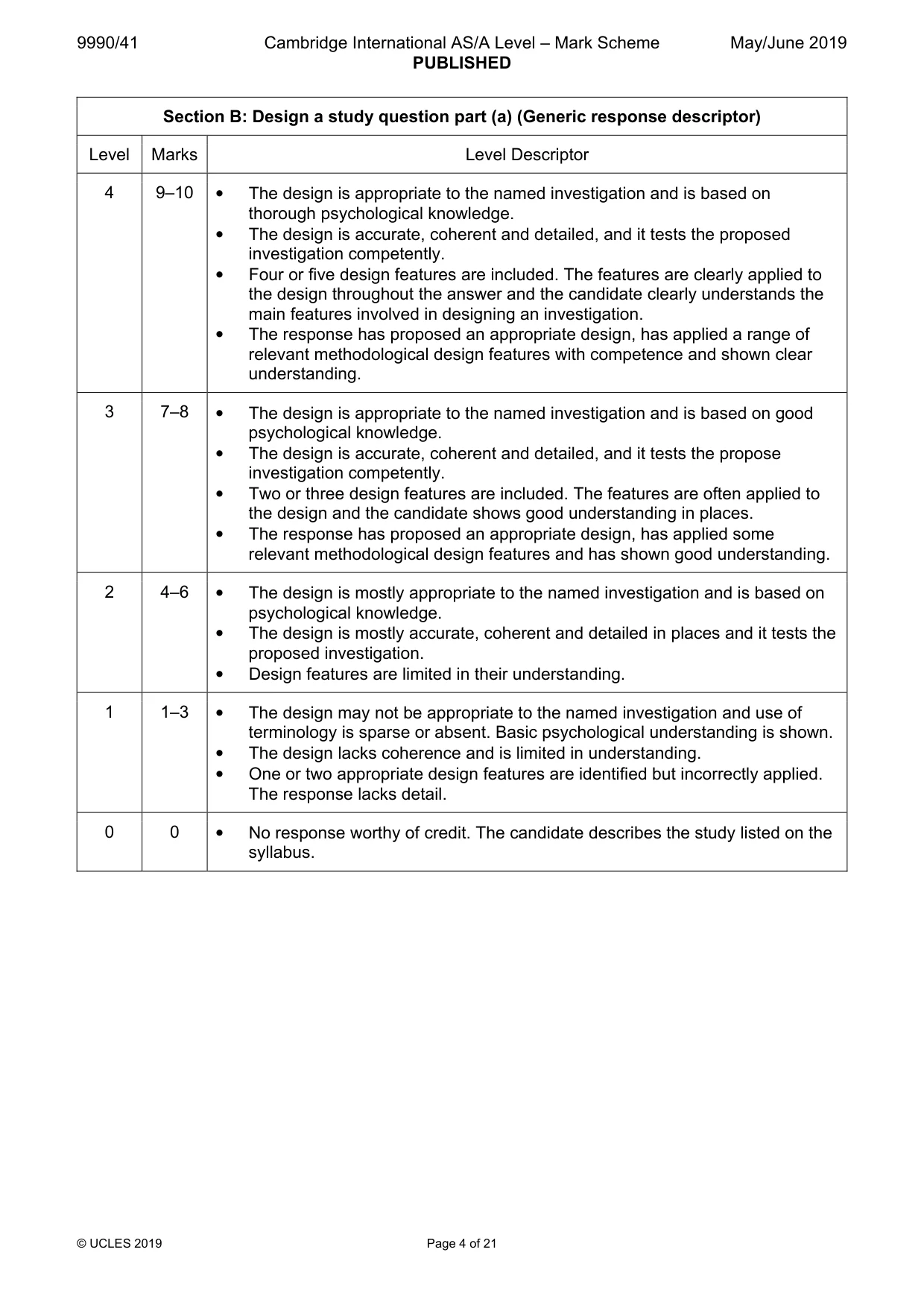
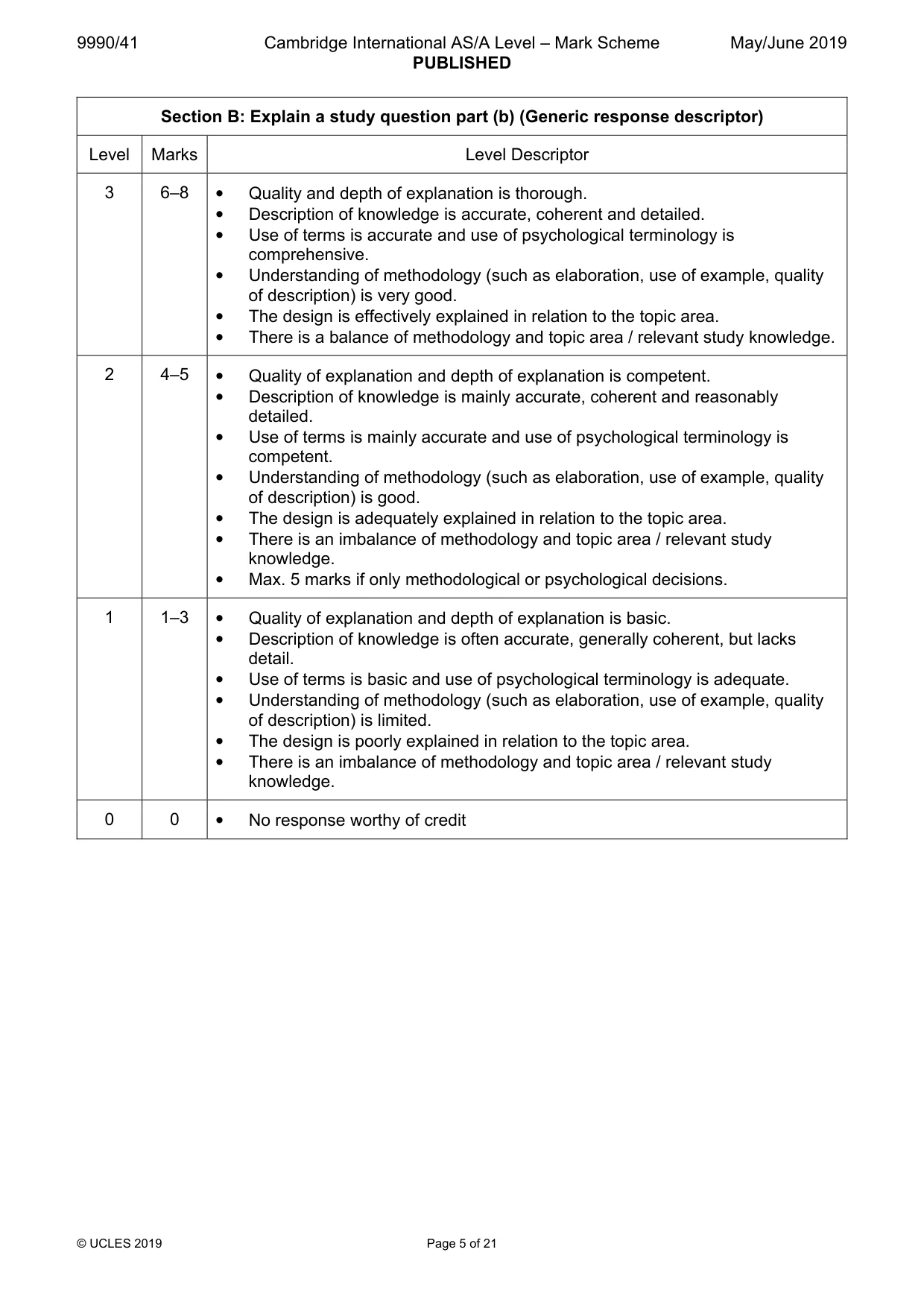
Mark scheme: 5(a) Design a study to investigate the long-term effectiveness of 10 antipsychotic drugs in patients with schizophrenia. Marks: use generic levels of response, ‘Design a study’ question part (a). Additional: Candidates should design the study showing evidence of design features appropriate to the named method. The named method is: any appropriate method. Specific features: • Experiments: type, IV, DV, controls, experimental design. • Observations: type, setting, response categories, sampling frame, number of observers. • Questionnaires / Interviews: type, setting, example questions. Scoring / rating scale, analysis of responses. • General features of research methodology: sampling technique & sample, type of data, ethics, reliability, validity, data analysis. 5(b) Explain the psychological and methodological evidence on which your 8 study is based. Marks: use generic levels of response, ‘Design a study’ question part (b). Note: If only methodological or psychological explanation is provided max. 5 marks Candidates are expected to explain the reasons for the suggested design in part (a). Explanation should be both psychological and methodological. Psychological to include appropriate theory or research. Additional: candidates are expected to justify their decisions or evidence presented regarding the design made in answer to question part (a). Syllabus: biochemical (antipsychotics and atypical antipsychotics) Psychological: First generation antipsychotics work as ‘chemical cosh’ (e.g. chlorpromazine). Second generation = atypical anti-psychotics worked by blocking dopamine receptors and fewer side effects. Third generation (e.g. Aripiprazole). Methodological: explanation of method using general and specific features as above. Note: 2 marks max. if psychological knowledge is not related to answer.
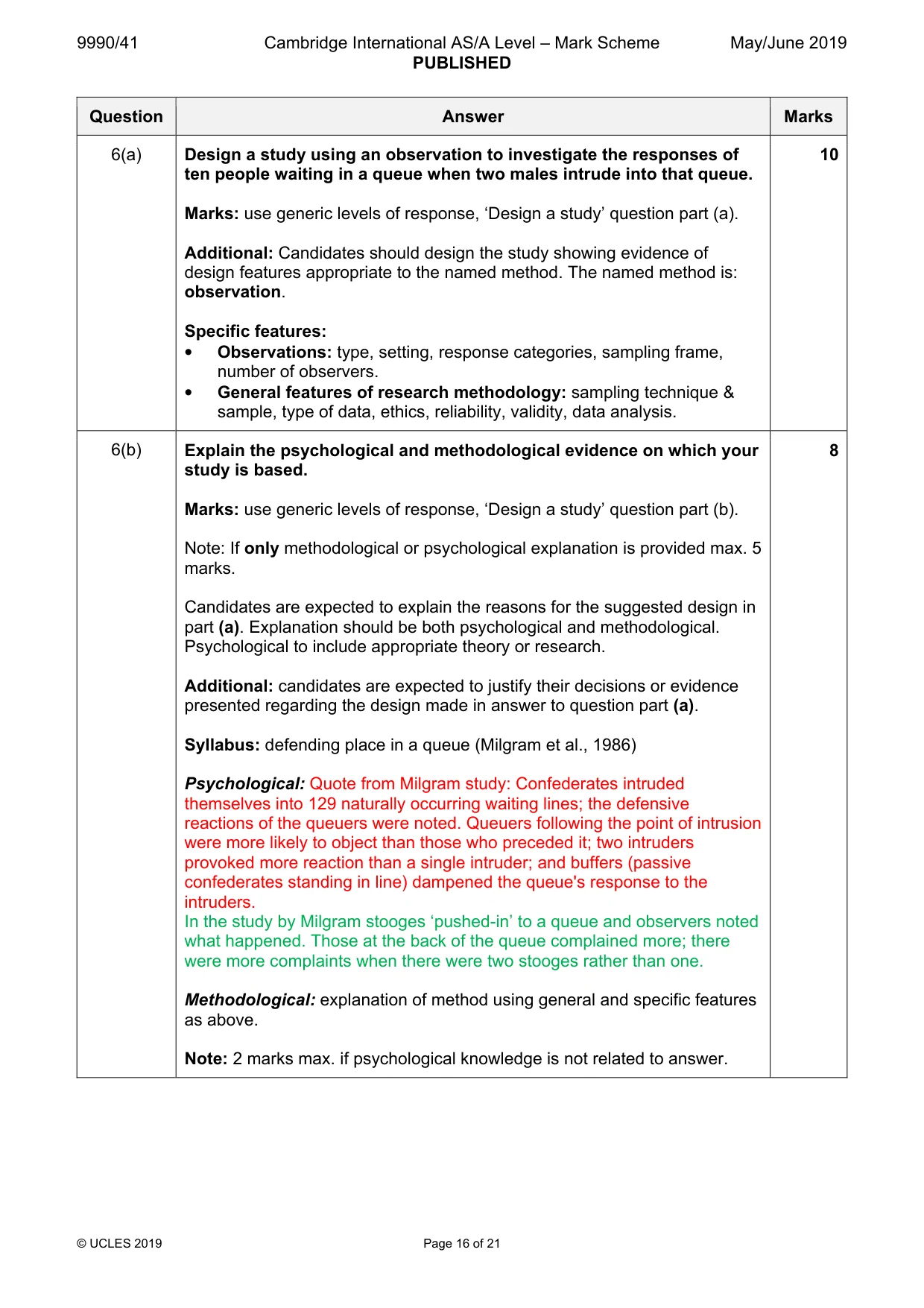
Q6 · Design a study using an observation to investigate the responses of ten people waiting in…
6 (a) Design a study using an observation to investigate the responses of ten people waiting in a queue when two males intrude into that queue. [10] (b) Explain the psychological and methodological evidence on which your study is based. [8] Psychology and health
Mark scheme: 6(a) Design a study using an observation to investigate the responses of 10 ten people waiting in a queue when two males intrude into that queue. Marks: use generic levels of response, ‘Design a study’ question part (a). Additional: Candidates should design the study showing evidence of design features appropriate to the named method. The named method is: observation. Specific features: • Observations: type, setting, response categories, sampling frame, number of observers. • General features of research methodology: sampling technique & sample, type of data, ethics, reliability, validity, data analysis. 6(b) Explain the psychological and methodological evidence on which your 8 study is based. Marks: use generic levels of response, ‘Design a study’ question part (b). Note: If only methodological or psychological explanation is provided max. 5 marks. Candidates are expected to explain the reasons for the suggested design in part (a). Explanation should be both psychological and methodological. Psychological to include appropriate theory or research. Additional: candidates are expected to justify their decisions or evidence presented regarding the design made in answer to question part (a). Syllabus: defending place in a queue (Milgram et al., 1986) Psychological: Quote from Milgram study: Confederates intruded themselves into 129 naturally occurring waiting lines; the defensive reactions of the queuers were noted. Queuers following the point of intrusion were more likely to object than those who preceded it; two intruders provoked more reaction than a single intruder; and buffers (passive confederates standing in line) dampened the queue's response to the intruders. In the study by Milgram stooges ‘pushed-in’ to a queue and observers noted what happened. Those at the back of the queue complained more; there were more complaints when there were two stooges rather than one. Methodological: explanation of method using general and specific features as above. Note: 2 marks max. if psychological knowledge is not related to answer.
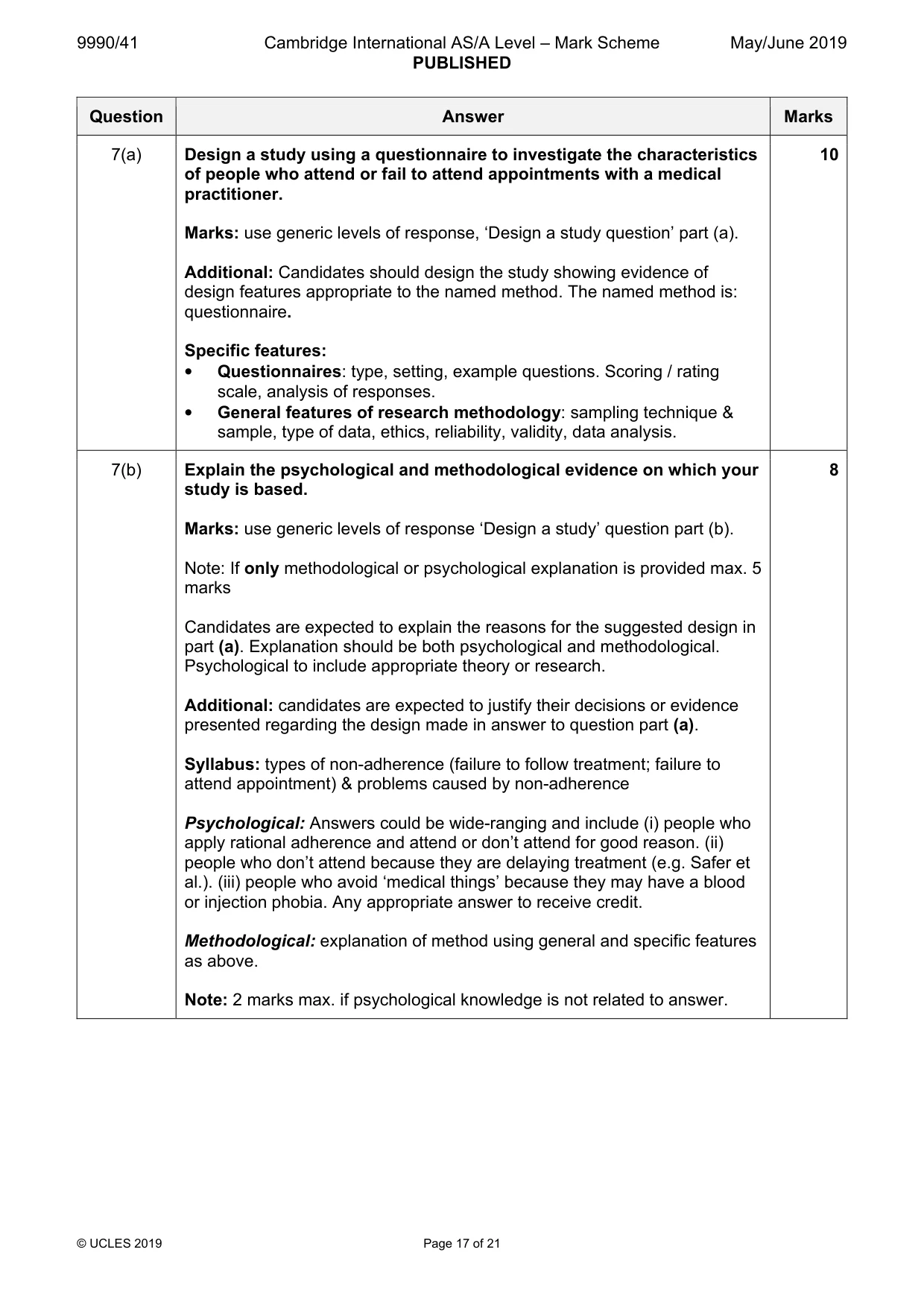
Q7 · Design a study using a questionnaire to investigate the characteristics of people who…
7 (a) Design a study using a questionnaire to investigate the characteristics of people who attend or fail to attend appointments with a medical practitioner. [10] (b) Explain the psychological and methodological evidence on which your study is based. [8] Psychology and organisations
Mark scheme: 7(a) Design a study using a questionnaire to investigate the characteristics 10 of people who attend or fail to attend appointments with a medical practitioner. Marks: use generic levels of response, ‘Design a study question’ part (a). Additional: Candidates should design the study showing evidence of design features appropriate to the named method. The named method is: questionnaire. Specific features: • Questionnaires: type, setting, example questions. Scoring / rating scale, analysis of responses. • General features of research methodology: sampling technique & sample, type of data, ethics, reliability, validity, data analysis. 7(b) Explain the psychological and methodological evidence on which your 8 study is based. Marks: use generic levels of response ‘Design a study’ question part (b). Note: If only methodological or psychological explanation is provided max. 5 marks Candidates are expected to explain the reasons for the suggested design in part (a). Explanation should be both psychological and methodological. Psychological to include appropriate theory or research. Additional: candidates are expected to justify their decisions or evidence presented regarding the design made in answer to question part (a). Syllabus: types of non-adherence (failure to follow treatment; failure to attend appointment) & problems caused by non-adherence Psychological: Answers could be wide-ranging and include (i) people who apply rational adherence and attend or don’t attend for good reason. (ii) people who don’t attend because they are delaying treatment (e.g. Safer et al.). (iii) people who avoid ‘medical things’ because they may have a blood or injection phobia. Any appropriate answer to receive credit. Methodological: explanation of method using general and specific features as above. Note: 2 marks max. if psychological knowledge is not related to answer.
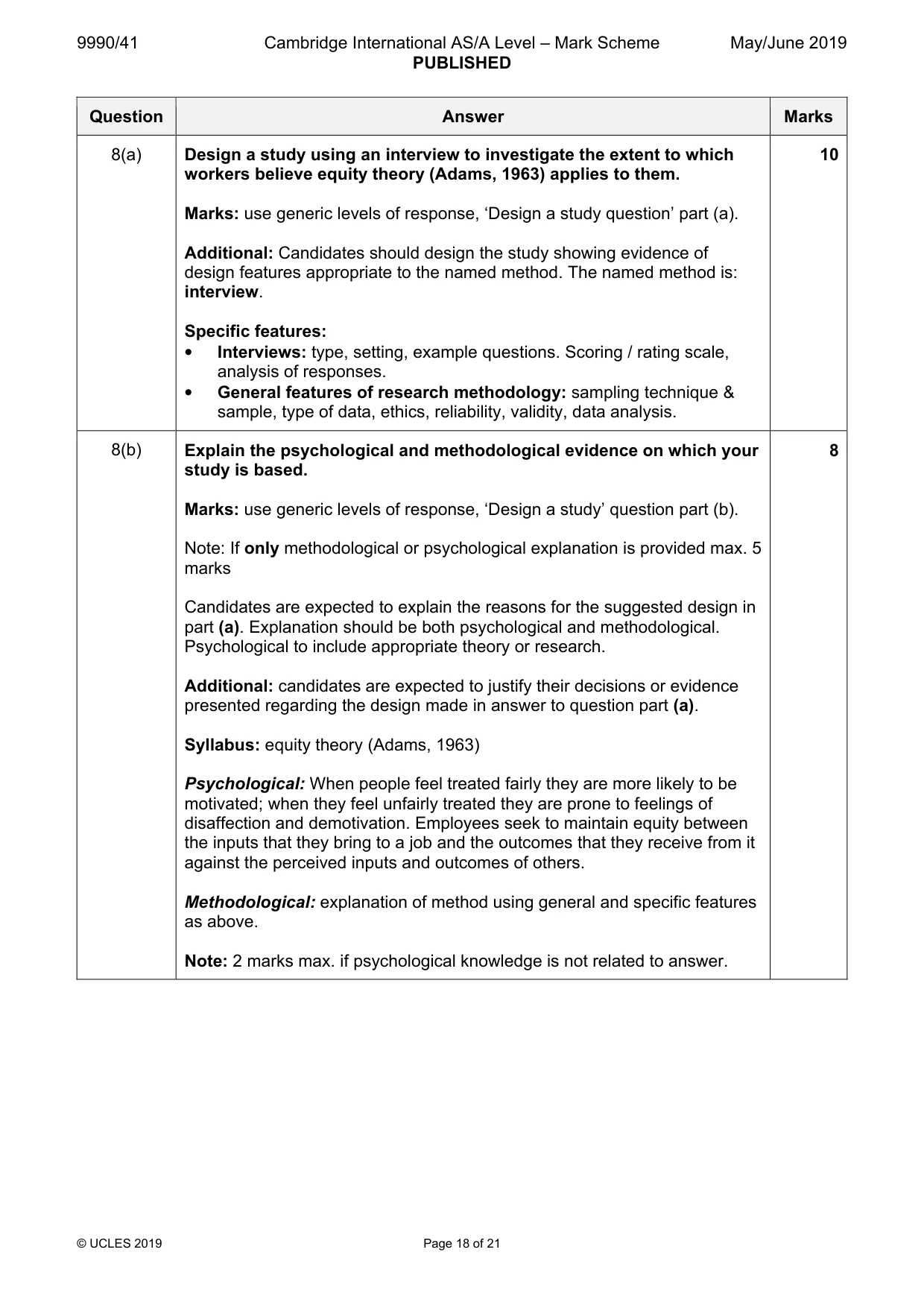
Q8 · Design a study using an interview to investigate the extent to which workers believe…
8 (a) Design a study using an interview to investigate the extent to which workers believe equity theory (Adams, 1963) applies to them. [10] (b) Explain the psychological and methodological evidence on which your study is based. [8] Section C You must answer one question from this section. Psychology and abnormality
Mark scheme: 8(a) Design a study using an interview to investigate the extent to which 10 workers believe equity theory (Adams, 1963) applies to them. Marks: use generic levels of response, ‘Design a study question’ part (a). Additional: Candidates should design the study showing evidence of design features appropriate to the named method. The named method is: interview. Specific features: • Interviews: type, setting, example questions. Scoring / rating scale, analysis of responses. • General features of research methodology: sampling technique & sample, type of data, ethics, reliability, validity, data analysis. 8(b) Explain the psychological and methodological evidence on which your 8 study is based. Marks: use generic levels of response, ‘Design a study’ question part (b). Note: If only methodological or psychological explanation is provided max. 5 marks Candidates are expected to explain the reasons for the suggested design in part (a). Explanation should be both psychological and methodological. Psychological to include appropriate theory or research. Additional: candidates are expected to justify their decisions or evidence presented regarding the design made in answer to question part (a). Syllabus: equity theory (Adams, 1963) Psychological: When people feel treated fairly they are more likely to be motivated; when they feel unfairly treated they are prone to feelings of disaffection and demotivation. Employees seek to maintain equity between the inputs that they bring to a job and the outcomes that they receive from it against the perceived inputs and outcomes of others. Methodological: explanation of method using general and specific features as above. Note: 2 marks max. if psychological knowledge is not related to answer.
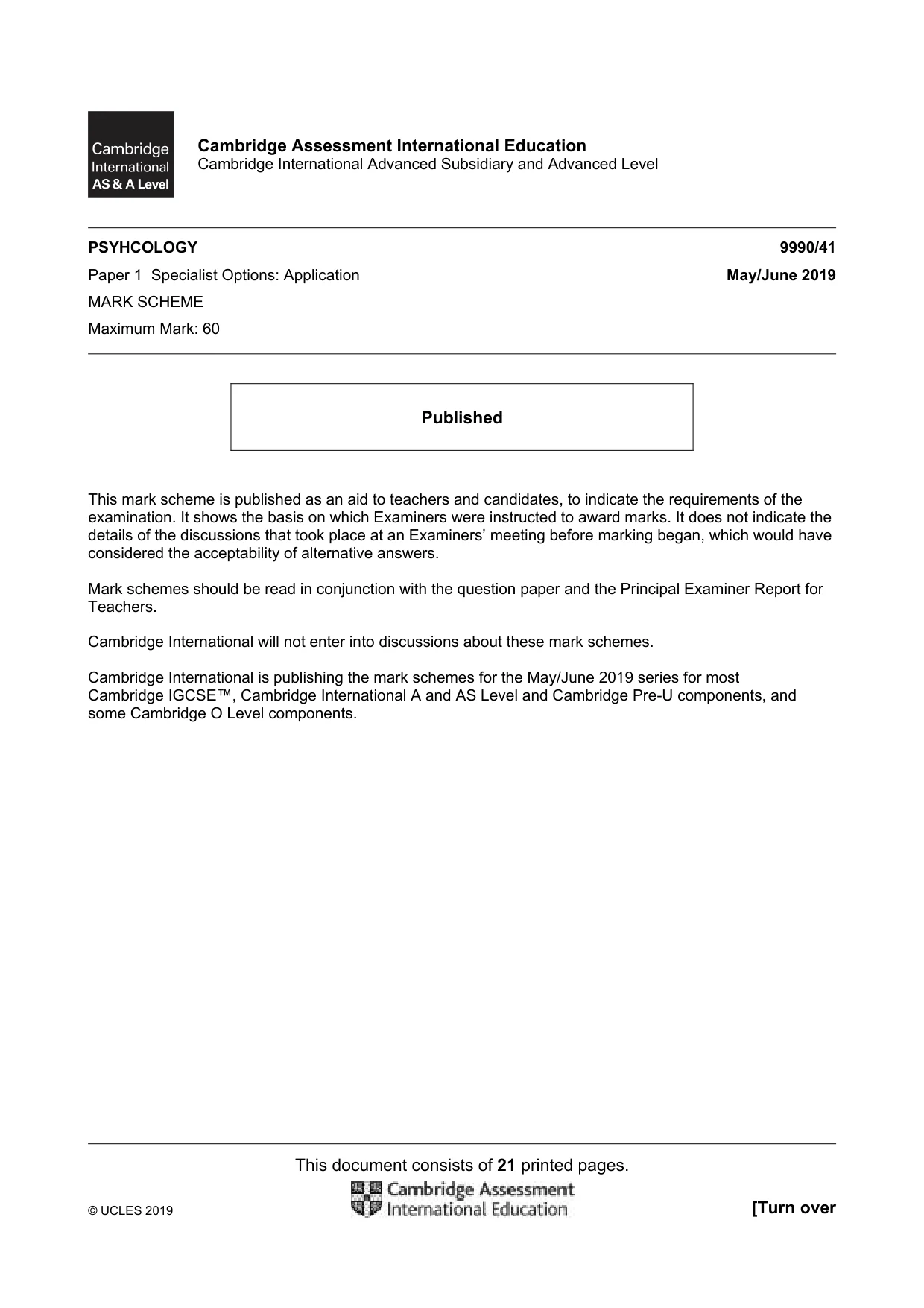
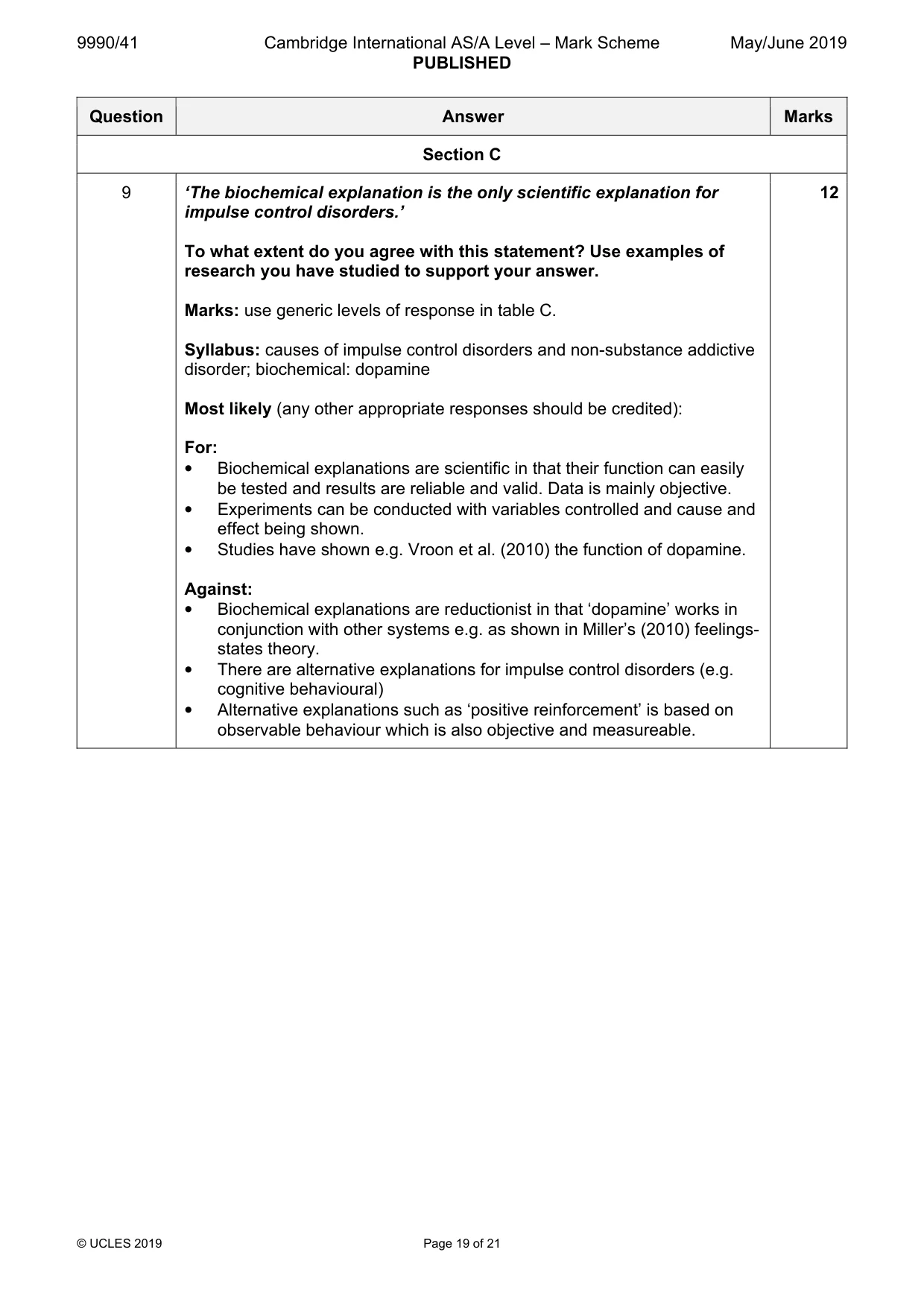
Q9 · ‘The biochemical explanation is the only scientific explanation for impulse control…
9 ‘The biochemical explanation is the only scientific explanation for impulse control disorders.’ To what extent do you agree with this statement? Use examples of research you have studied to support your answer. [12] Psychology and consumer behaviour
Mark scheme: 9 ‘The biochemical explanation is the only scientific explanation for 12 impulse control disorders.’ To what extent do you agree with this statement? Use examples of research you have studied to support your answer. Marks: use generic levels of response in table C. Syllabus: causes of impulse control disorders and non-substance addictive disorder; biochemical: dopamine Most likely (any other appropriate responses should be credited): For: • Biochemical explanations are scientific in that their function can easily be tested and results are reliable and valid. Data is mainly objective. • Experiments can be conducted with variables controlled and cause and effect being shown. • Studies have shown e.g. Vroon et al. (2010) the function of dopamine. Against: • Biochemical explanations are reductionist in that ‘dopamine’ works in conjunction with other systems e.g. as shown in Miller’s (2010) feelings- states theory. • There are alternative explanations for impulse control disorders (e.g. cognitive behavioural) • Alternative explanations such as ‘positive reinforcement’ is based on observable behaviour which is also objective and measureable.
Q10 · ‘The AIDA model, which identifies the stages of the advertising process, applies to all…
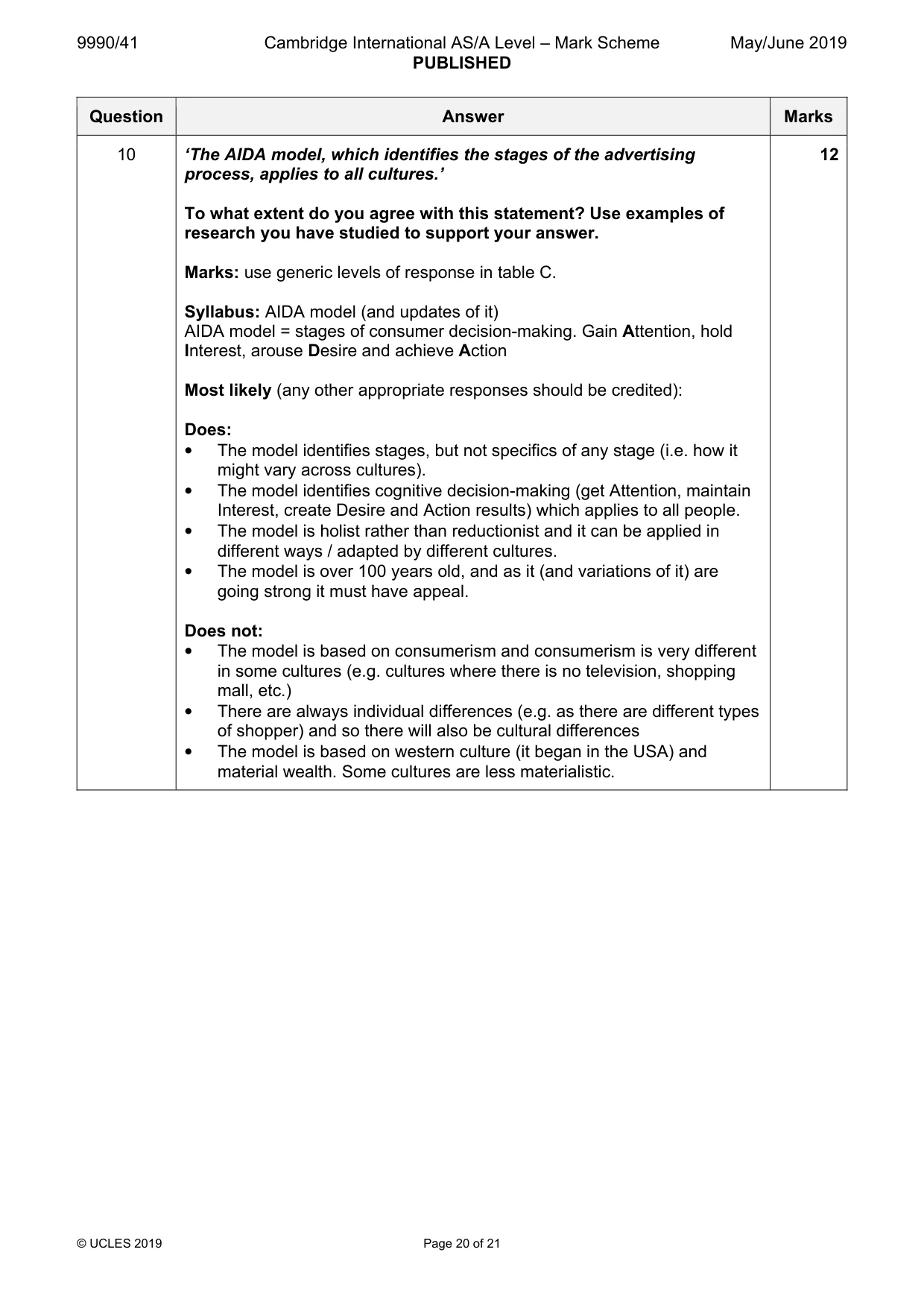
10 ‘The AIDA model, which identifies the stages of the advertising process, applies to all cultures.’ To what extent do you agree with this statement? Use examples of research you have studied to support your answer. [12] Psychology and health
Mark scheme: 10 ‘The AIDA model, which identifies the stages of the advertising 12 process, applies to all cultures.’ To what extent do you agree with this statement? Use examples of research you have studied to support your answer. Marks: use generic levels of response in table C. Syllabus: AIDA model (and updates of it) AIDA model = stages of consumer decision-making. Gain Attention, hold Interest, arouse Desire and achieve Action Most likely (any other appropriate responses should be credited): Does: • The model identifies stages, but not specifics of any stage (i.e. how it might vary across cultures). • The model identifies cognitive decision-making (get Attention, maintain Interest, create Desire and Action results) which applies to all people. • The model is holist rather than reductionist and it can be applied in different ways / adapted by different cultures. • The model is over 100 years old, and as it (and variations of it) are going strong it must have appeal. Does not: • The model is based on consumerism and consumerism is very different in some cultures (e.g. cultures where there is no television, shopping mall, etc.) • There are always individual differences (e.g. as there are different types of shopper) and so there will also be cultural differences • The model is based on western culture (it began in the USA) and material wealth. Some cultures are less materialistic.
Q11 · ‘Medical techniques, such as drugs, are all a person needs to reduce long-term stress.’…
11 ‘Medical techniques, such as drugs, are all a person needs to reduce long-term stress.’ To what extent do you agree with this statement? Use examples of research you have studied to support your answer. [12] Psychology and organisations
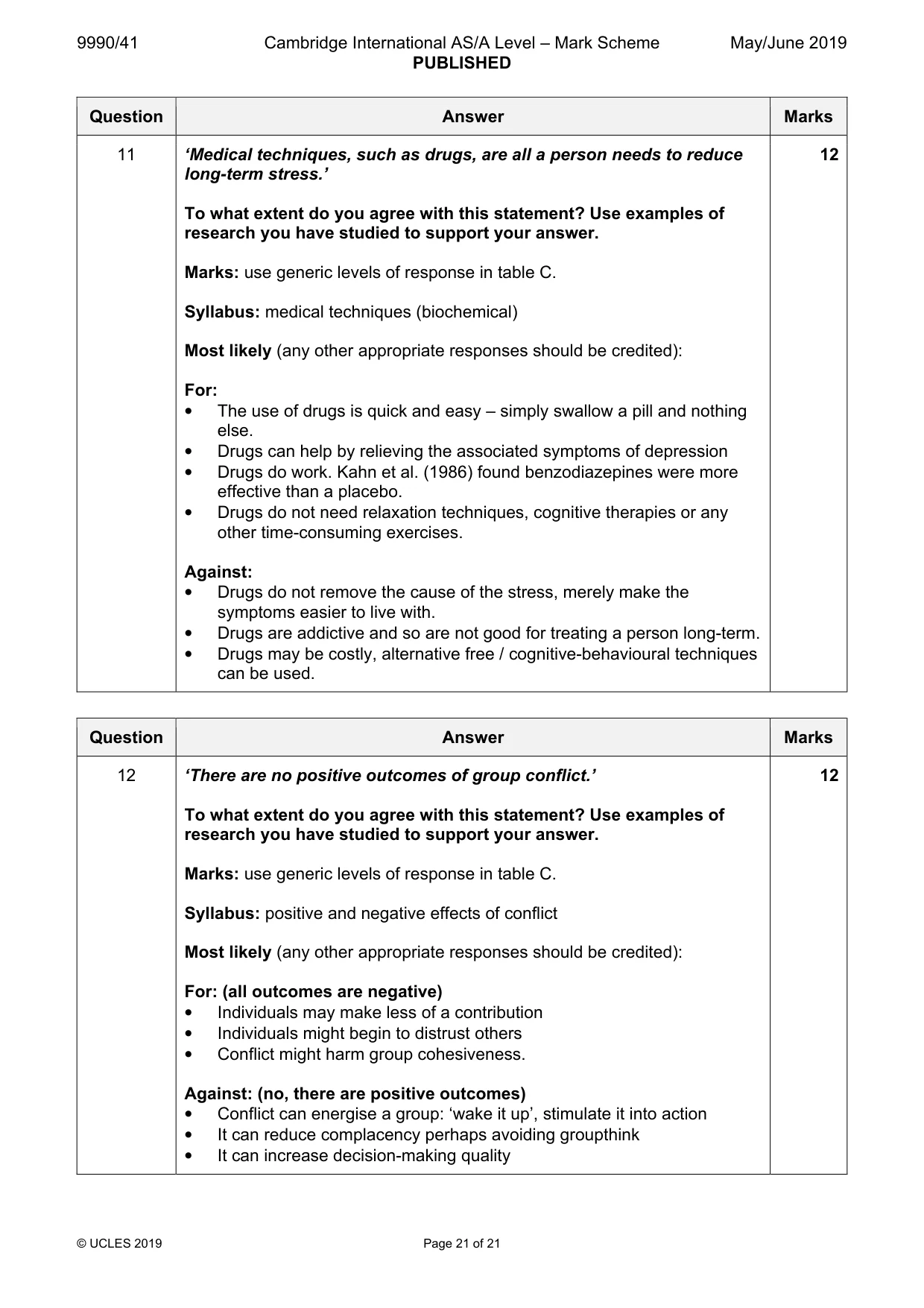
Mark scheme: 11 ‘Medical techniques, such as drugs, are all a person needs to reduce 12 long-term stress.’ To what extent do you agree with this statement? Use examples of research you have studied to support your answer. Marks: use generic levels of response in table C. Syllabus: medical techniques (biochemical) Most likely (any other appropriate responses should be credited): For: • The use of drugs is quick and easy – simply swallow a pill and nothing else. • Drugs can help by relieving the associated symptoms of depression • Drugs do work. Kahn et al. (1986) found benzodiazepines were more effective than a placebo. • Drugs do not need relaxation techniques, cognitive therapies or any other time-consuming exercises. Against: • Drugs do not remove the cause of the stress, merely make the symptoms easier to live with. • Drugs are addictive and so are not good for treating a person long-term. • Drugs may be costly, alternative free / cognitive-behavioural techniques can be used.
Q12 · ‘There are no positive outcomes of group conflict.’ To what extent do you agree with this…
12 ‘There are no positive outcomes of group conflict.’ To what extent do you agree with this statement? Use examples of research you have studied to support your answer. [12]
Mark scheme: 12 ‘There are no positive outcomes of group conflict.’ 12 To what extent do you agree with this statement? Use examples of research you have studied to support your answer. Marks: use generic levels of response in table C. Syllabus: positive and negative effects of conflict Most likely (any other appropriate responses should be credited): For: (all outcomes are negative) • Individuals may make less of a contribution • Individuals might begin to distrust others • Conflict might harm group cohesiveness. Against: (no, there are positive outcomes) • Conflict can energise a group: ‘wake it up’, stimulate it into action • It can reduce complacency perhaps avoiding groupthink • It can increase decision-making quality
What was in this paper
The subtopics covered by these 12 questions, and how many questions each got. Open one in a new tab to see every Cambridge question on it.
What you needed in this session
Cambridge’s own grade thresholds for 2019 May/June, Paper 4 · Variant 1. A higher threshold means an easier paper — the bar moves with how the cohort did.