Cambridge A Level Psychology (from 2018) 9990 — 2019 Oct/Nov Paper 4 · Variant 2
9990/42/O/N/19 · 12 questions · 60 marks · ≈68 min
The question paper and its mark scheme, free to read here and free to download. This is Cambridge’s own paper, exactly as it was sat.
Question paper8 pages



Mark scheme21 pages
Answers below. Sit the paper first if you are practising.
Questions as text
Q1 · A question from the Kleptomania Symptom Assessment Scale (K-SAS): During the past WEEK…
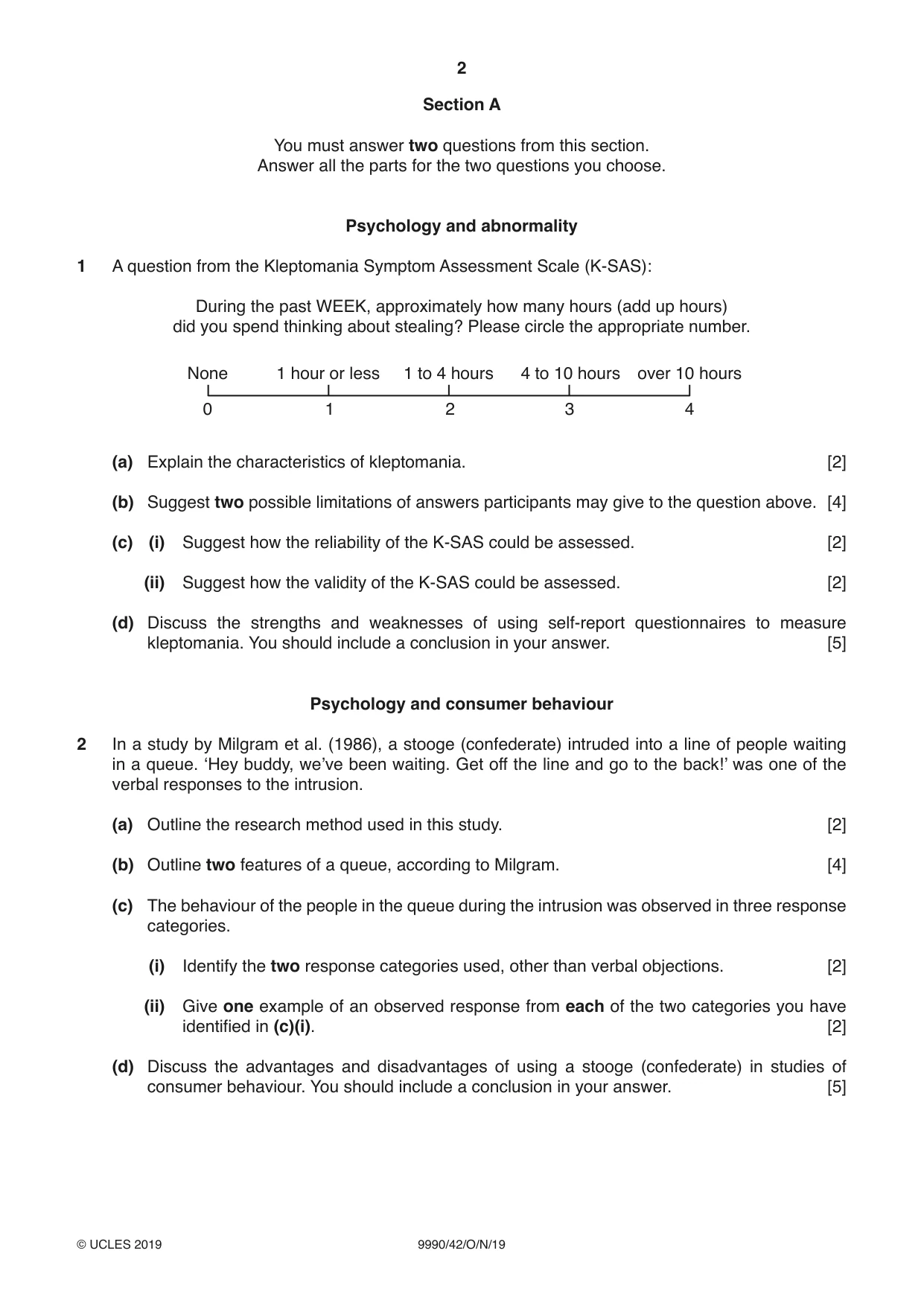
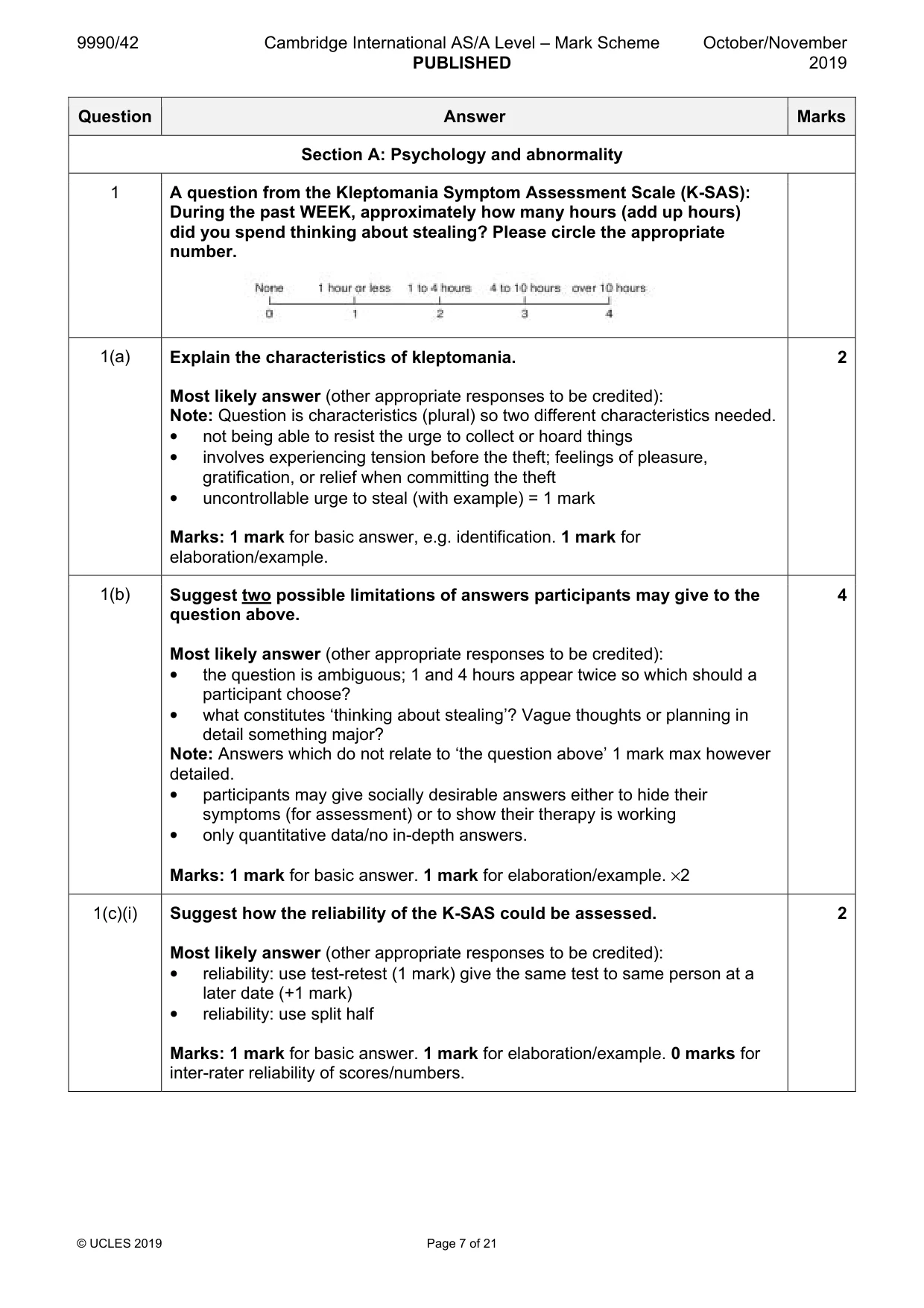
1 A question from the Kleptomania Symptom Assessment Scale (K-SAS): During the past WEEK, approximately how many hours (add up hours) did you spend thinking about stealing? Please circle the appropriate number. None 1 hour or less 1 to 4 hours 4 to 10 hours over 10 hours 0 1 2 3 4 (a) Explain the characteristics of kleptomania. [2] (b) Suggest two possible limitations of answers participants may give to the question above. [4] (c) (i) Suggest how the reliability of the K-SAS could be assessed. [2] (ii) Suggest how the validity of the K-SAS could be assessed. [2] (d) Discuss the strengths and weaknesses of using self-report questionnaires to measure kleptomania. You should include a conclusion in your answer. [5] Psychology and consumer behaviour
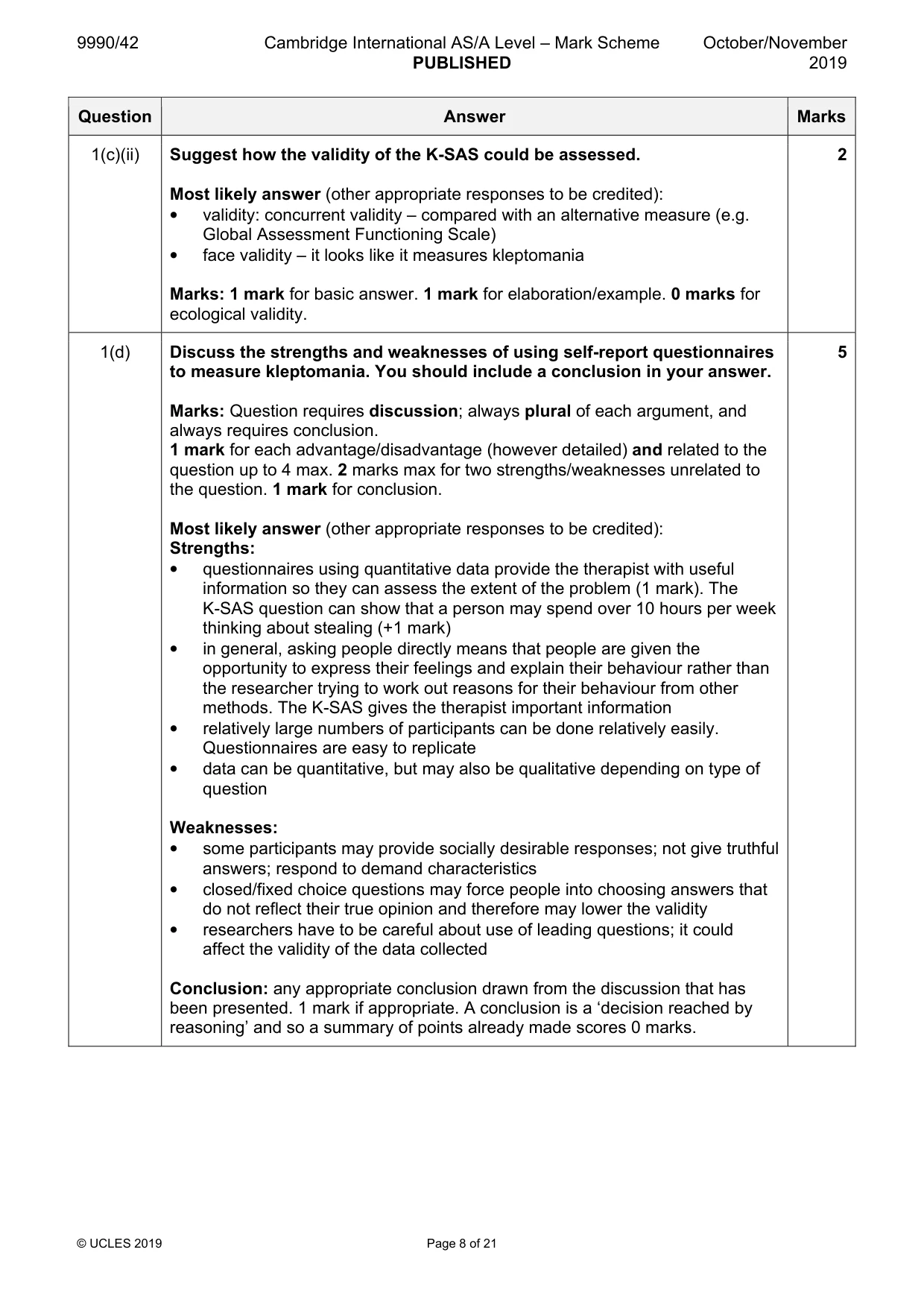
Mark scheme: Question Answer Marks Section A: Psychology and abnormality 1 A question from the Kleptomania Symptom Assessment Scale (K-SAS): During the past WEEK, approximately how many hours (add up hours) did you spend thinking about stealing? Please circle the appropriate number. 1(a) Explain the characteristics of kleptomania. 2 Most likely answer (other appropriate responses to be credited): Note: Question is characteristics (plural) so two different characteristics needed. • not being able to resist the urge to collect or hoard things • involves experiencing tension before the theft; feelings of pleasure, gratification, or relief when committing the theft • uncontrollable urge to steal (with example) = 1 mark Marks: 1 mark for basic answer, e.g. identification. 1 mark for elaboration/example. 1(b) Suggest two possible limitations of answers participants may give to the 4 question above. Most likely answer (other appropriate responses to be credited): • the question is ambiguous; 1 and 4 hours appear twice so which should a participant choose? • what constitutes ‘thinking about stealing’? Vague thoughts or planning in detail something major? Note: Answers which do not relate to ‘the question above’ 1 mark max however detailed. • participants may give socially desirable answers either to hide their symptoms (for assessment) or to show their therapy is working • only quantitative data/no in-depth answers. Marks: 1 mark for basic answer. 1 mark for elaboration/example. ×2 1(c)(i) Suggest how the reliability of the K-SAS could be assessed. 2 Most likely answer (other appropriate responses to be credited): • reliability: use test-retest (1 mark) give the same test to same person at a later date (+1 mark) • reliability: use split half Marks: 1 mark for basic answer. 1 mark for elaboration/example. 0 marks for inter-rater reliability of scores/numbers. 1(c)(ii) Suggest how the validity of the K-SAS could be assessed. 2 Most likely answer (other appropriate responses to be credited): • validity: concurrent validity – compared with an alternative measure (e.g. Global Assessment Functioning Scale) • face validity – it looks like it measures kleptomania Marks: 1 mark for basic answer. 1 mark for elaboration/example. 0 marks for ecological validity. 1(d) Discuss the strengths and weaknesses of using self-report questionnaires 5 to measure kleptomania. You should include a conclusion in your answer. Marks: Question requires discussion; always plural of each argument, and always requires conclusion. 1 mark for each advantage/disadvantage (however detailed) and related to the question up to 4 max. 2 marks max for two strengths/weaknesses unrelated to the question. 1 mark for conclusion. Most likely answer (other appropriate responses to be credited): Strengths: • questionnaires using quantitative data provide the therapist with useful information so they can assess the extent of the problem (1 mark). The K-SAS question can show that a person may spend over 10 hours per week thinking about stealing (+1 mark) • in general, asking people directly means that people are given the opportunity to express their feelings and explain their behaviour rather than the researcher trying to work out reasons for their behaviour from other methods. The K-SAS gives the therapist important information • relatively large numbers of participants can be done relatively easily. Questionnaires are easy to replicate • data can be quantitative, but may also be qualitative depending on type of question Weaknesses: • some participants may provide socially desirable responses; not give truthful answers; respond to demand characteristics • closed/fixed choice questions may force people into choosing answers that do not reflect their true opinion and therefore may lower the validity • researchers have to be careful about use of leading questions; it could affect the validity of the data collected Conclusion: any appropriate conclusion drawn from the discussion that has been presented. 1 mark if appropriate. A conclusion is a ‘decision reached by reasoning’ and so a summary of points already made scores 0 marks.
Q2 · In a study by Milgram et al
2 In a study by Milgram et al. (1986), a stooge (confederate) intruded into a line of people waiting in a queue. ‘Hey buddy, we’ve been waiting. Get off the line and go to the back!’ was one of the verbal responses to the intrusion. (a) Outline the research method used in this study. [2] (b) Outline two features of a queue, according to Milgram. [4] (c) The behaviour of the people in the queue during the intrusion was observed in three response categories. (i) Identify the two response categories used, other than verbal objections. [2] (ii) Give one example of an observed response from each of the two categories you have identified in (c)(i). [2] (d) Discuss the advantages and disadvantages of using a stooge (confederate) in studies of consumer behaviour. You should include a conclusion in your answer. [5] Psychology and health
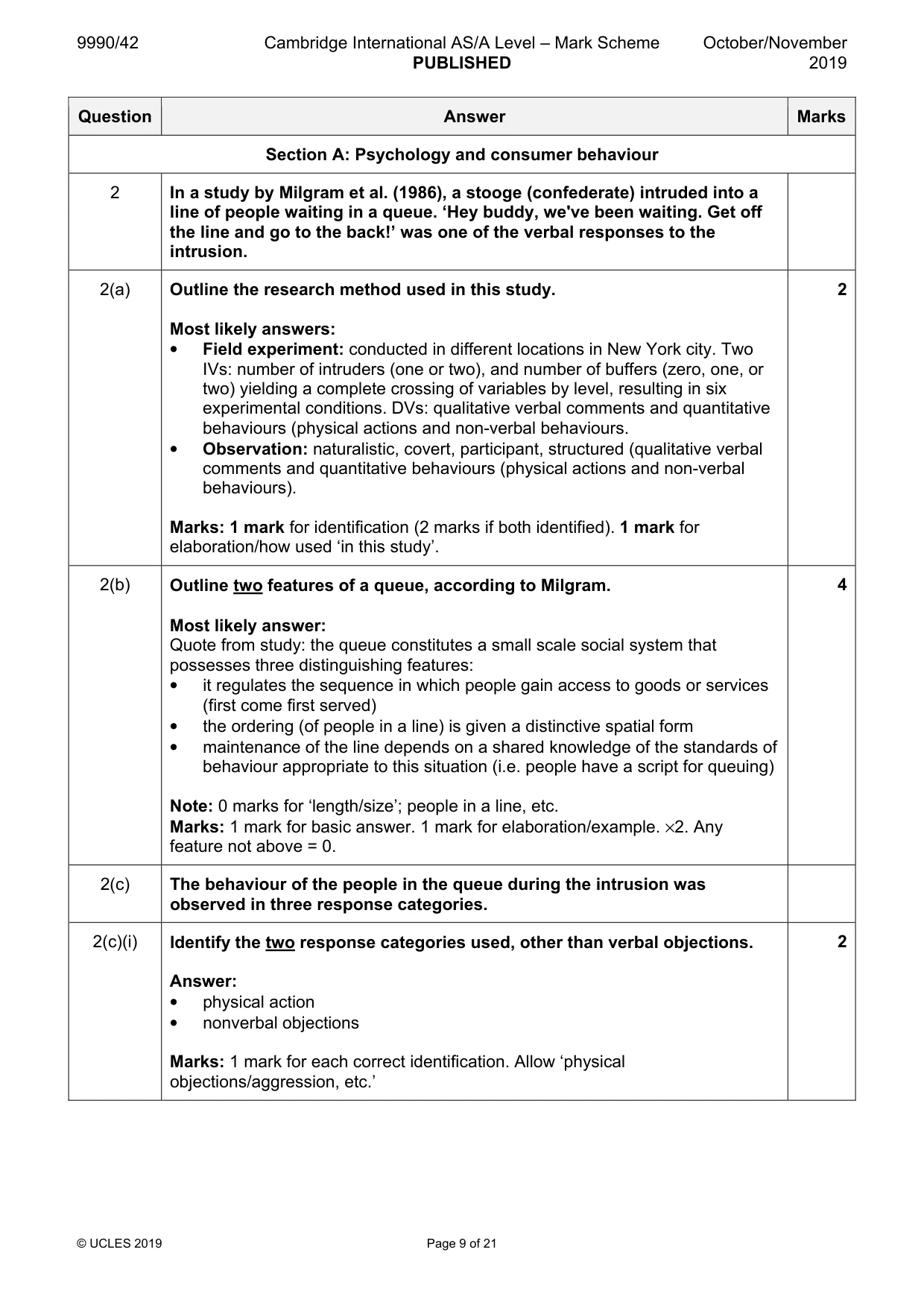
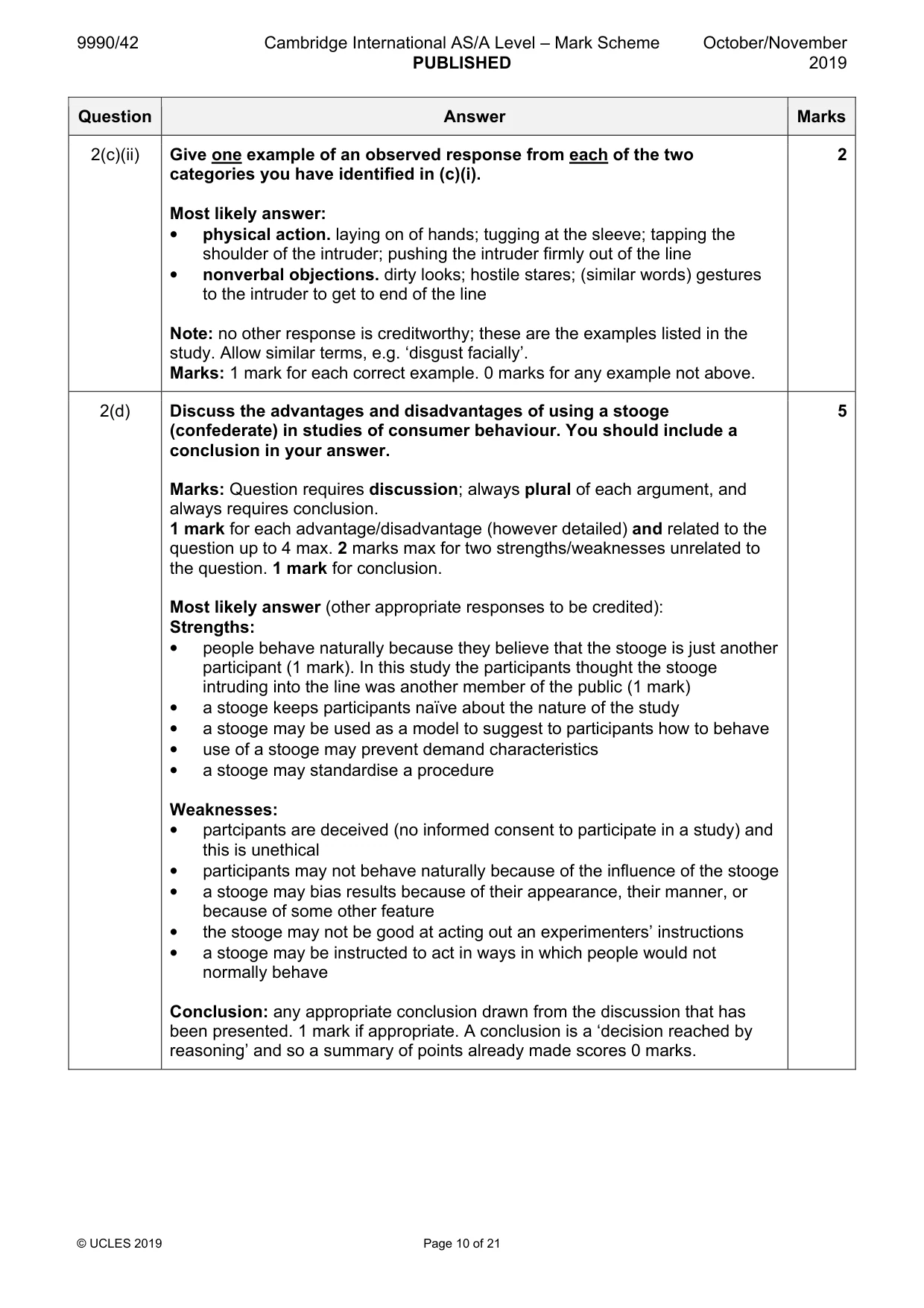
Mark scheme: 2(a) Outline the research method used in this study. 2 Most likely answers: • Field experiment: conducted in different locations in New York city. Two IVs: number of intruders (one or two), and number of buffers (zero, one, or two) yielding a complete crossing of variables by level, resulting in six experimental conditions. DVs: qualitative verbal comments and quantitative behaviours (physical actions and non-verbal behaviours. • Observation: naturalistic, covert, participant, structured (qualitative verbal comments and quantitative behaviours (physical actions and non-verbal behaviours). Marks: 1 mark for identification (2 marks if both identified). 1 mark for elaboration/how used ‘in this study’. 2(b) Outline two features of a queue, according to Milgram. 4 Most likely answer: Quote from study: the queue constitutes a small scale social system that possesses three distinguishing features: • it regulates the sequence in which people gain access to goods or services (first come first served) • the ordering (of people in a line) is given a distinctive spatial form • maintenance of the line depends on a shared knowledge of the standards of behaviour appropriate to this situation (i.e. people have a script for queuing) Note: 0 marks for ‘length/size’; people in a line, etc. Marks: 1 mark for basic answer. 1 mark for elaboration/example. ×2. Any feature not above = 0. 2(c) The behaviour of the people in the queue during the intrusion was observed in three response categories. 2(c)(i) Identify the two response categories used, other than verbal objections. 2 Answer: • physical action • nonverbal objections Marks: 1 mark for each correct identification. Allow ‘physical objections/aggression, etc.’ 2(c)(ii) Give one example of an observed response from each of the two 2 categories you have identified in (c)(i). Most likely answer: • physical action. laying on of hands; tugging at the sleeve; tapping the shoulder of the intruder; pushing the intruder firmly out of the line • nonverbal objections. dirty looks; hostile stares; (similar words) gestures to the intruder to get to end of the line Note: no other response is creditworthy; these are the examples listed in the study. Allow similar terms, e.g. ‘disgust facially’. Marks: 1 mark for each correct example. 0 marks for any example not above. 2(d) Discuss the advantages and disadvantages of using a stooge 5 (confederate) in studies of consumer behaviour. You should include a conclusion in your answer. Marks: Question requires discussion; always plural of each argument, and always requires conclusion. 1 mark for each advantage/disadvantage (however detailed) and related to the question up to 4 max. 2 marks max for two strengths/weaknesses unrelated to the question. 1 mark for conclusion. Most likely answer (other appropriate responses to be credited): Strengths: • people behave naturally because they believe that the stooge is just another participant (1 mark). In this study the participants thought the stooge intruding into the line was another member of the public (1 mark) • a stooge keeps participants naïve about the nature of the study • a stooge may be used as a model to suggest to participants how to behave • use of a stooge may prevent demand characteristics • a stooge may standardise a procedure Weaknesses: • partcipants are deceived (no informed consent to participate in a study) and this is unethical • participants may not behave naturally because of the influence of the stooge • a stooge may bias results because of their appearance, their manner, or because of some other feature • the stooge may not be good at acting out an experimenters’ instructions • a stooge may be instructed to act in ways in which people would not normally behave Conclusion: any appropriate conclusion drawn from the discussion that has been presented. 1 mark if appropriate. A conclusion is a ‘decision reached by reasoning’ and so a summary of points already made scores 0 marks.
Q3 · Newspaper headline: Imagine a pleasant scene that makes you smile
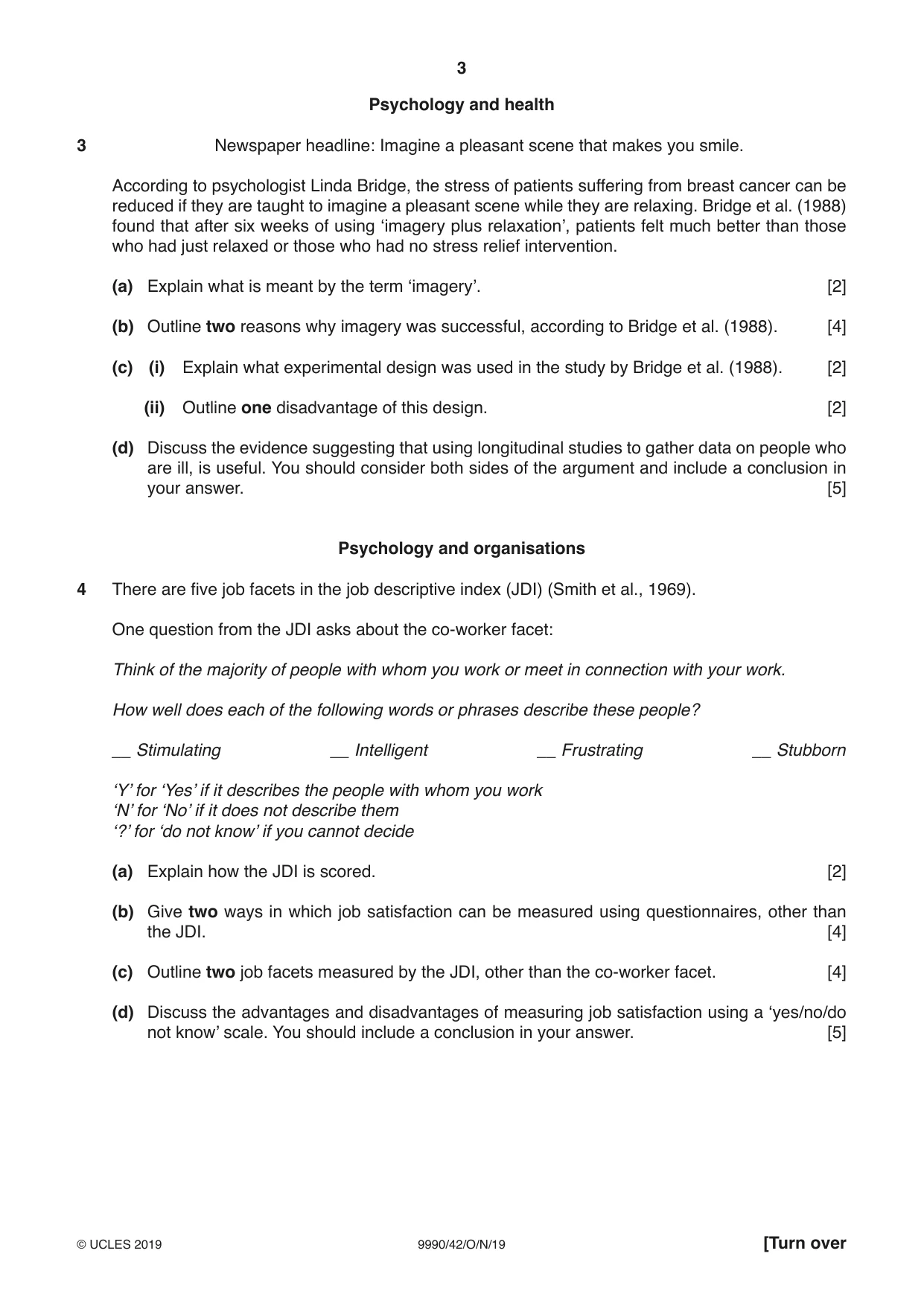
3 Newspaper headline: Imagine a pleasant scene that makes you smile. According to psychologist Linda Bridge, the stress of patients suffering from breast cancer can be reduced if they are taught to imagine a pleasant scene while they are relaxing. Bridge et al. (1988) found that after six weeks of using ‘imagery plus relaxation’, patients felt much better than those who had just relaxed or those who had no stress relief intervention. (a) Explain what is meant by the term ‘imagery’. [2] (b) Outline two reasons why imagery was successful, according to Bridge et al. (1988). [4] (c) (i) Explain what experimental design was used in the study by Bridge et al. (1988). [2] (ii) Outline one disadvantage of this design. [2] (d) Discuss the evidence suggesting that using longitudinal studies to gather data on people who are ill, is useful. You should consider both sides of the argument and include a conclusion in your answer. [5] Psychology and organisations
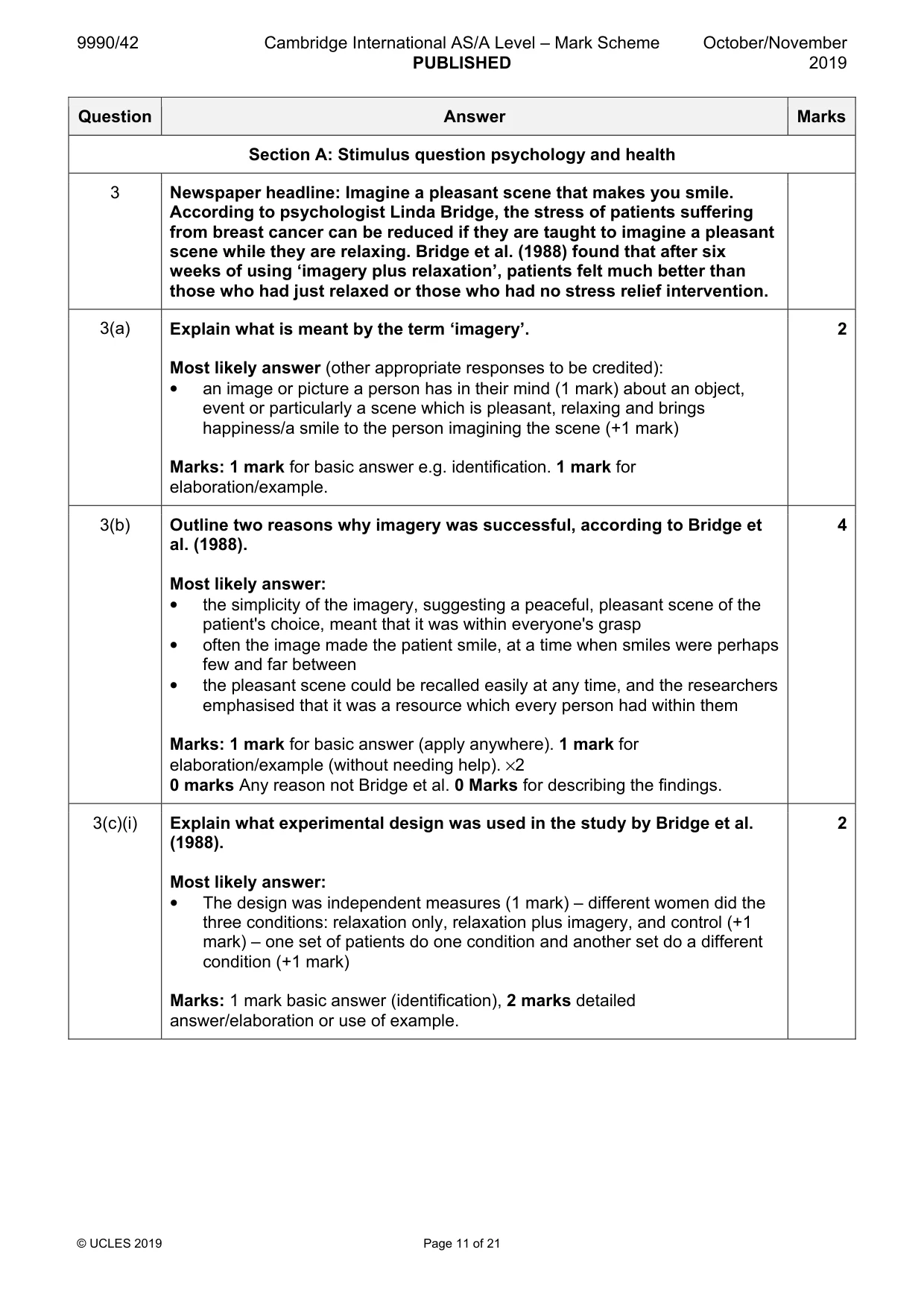
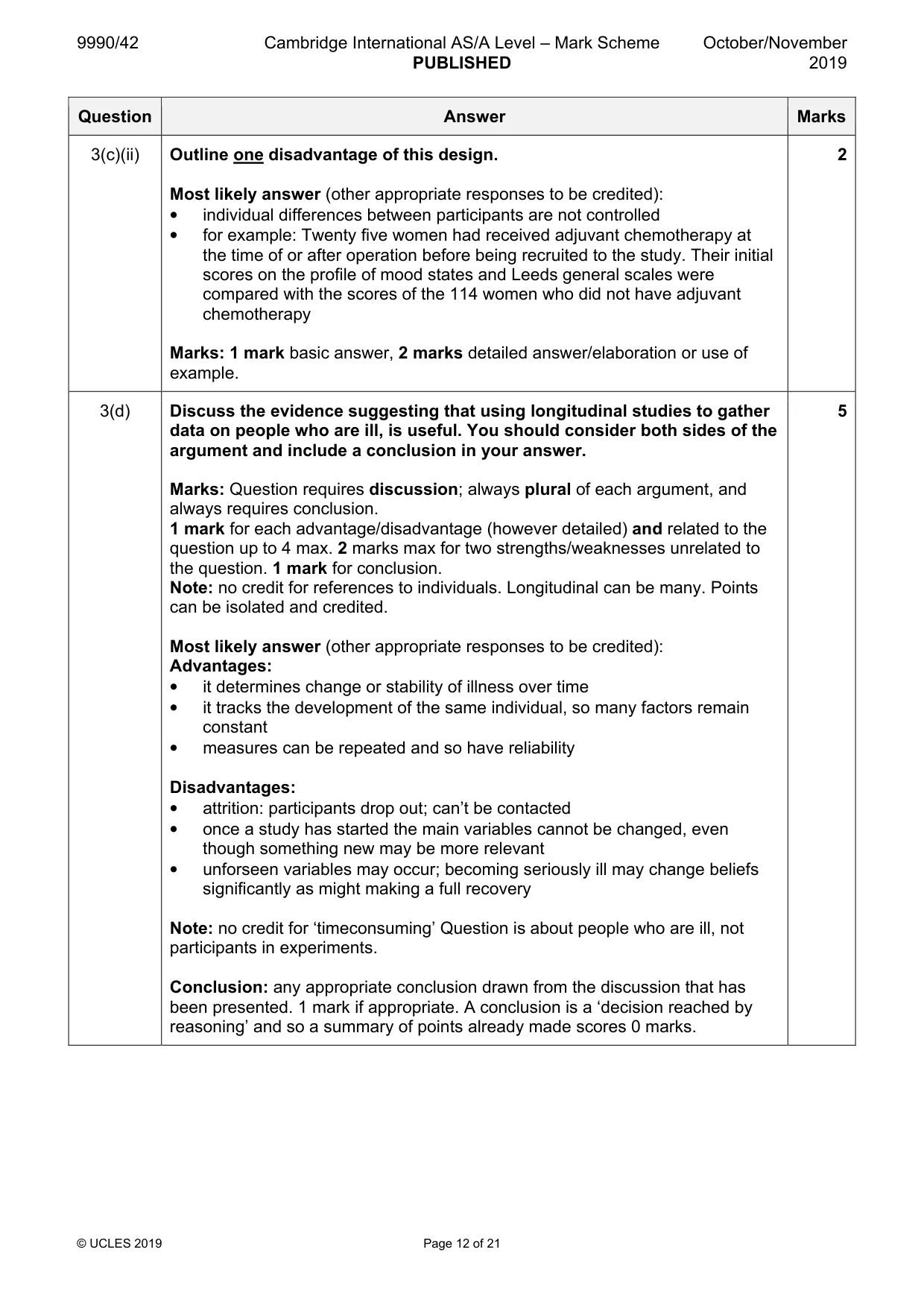
Mark scheme: 3(a) Explain what is meant by the term ‘imagery’. 2 Most likely answer (other appropriate responses to be credited): • an image or picture a person has in their mind (1 mark) about an object, event or particularly a scene which is pleasant, relaxing and brings happiness/a smile to the person imagining the scene (+1 mark) Marks: 1 mark for basic answer e.g. identification. 1 mark for elaboration/example. 3(b) Outline two reasons why imagery was successful, according to Bridge et 4 al. (1988). Most likely answer: • the simplicity of the imagery, suggesting a peaceful, pleasant scene of the patient's choice, meant that it was within everyone's grasp • often the image made the patient smile, at a time when smiles were perhaps few and far between • the pleasant scene could be recalled easily at any time, and the researchers emphasised that it was a resource which every person had within them Marks: 1 mark for basic answer (apply anywhere). 1 mark for elaboration/example (without needing help). ×2 0 marks Any reason not Bridge et al. 0 Marks for describing the findings. 3(c)(i) Explain what experimental design was used in the study by Bridge et al. 2 (1988). Most likely answer: • The design was independent measures (1 mark) – different women did the three conditions: relaxation only, relaxation plus imagery, and control (+1 mark) – one set of patients do one condition and another set do a different condition (+1 mark) Marks: 1 mark basic answer (identification), 2 marks detailed answer/elaboration or use of example. 3(c)(ii) Outline one disadvantage of this design. 2 Most likely answer (other appropriate responses to be credited): • individual differences between participants are not controlled • for example: Twenty five women had received adjuvant chemotherapy at the time of or after operation before being recruited to the study. Their initial scores on the profile of mood states and Leeds general scales were compared with the scores of the 114 women who did not have adjuvant chemotherapy Marks: 1 mark basic answer, 2 marks detailed answer/elaboration or use of example. 3(d) Discuss the evidence suggesting that using longitudinal studies to gather 5 data on people who are ill, is useful. You should consider both sides of the argument and include a conclusion in your answer. Marks: Question requires discussion; always plural of each argument, and always requires conclusion. 1 mark for each advantage/disadvantage (however detailed) and related to the question up to 4 max. 2 marks max for two strengths/weaknesses unrelated to the question. 1 mark for conclusion. Note: no credit for references to individuals. Longitudinal can be many. Points can be isolated and credited. Most likely answer (other appropriate responses to be credited): Advantages: • it determines change or stability of illness over time • it tracks the development of the same individual, so many factors remain constant • measures can be repeated and so have reliability Disadvantages: • attrition: participants drop out; can’t be contacted • once a study has started the main variables cannot be changed, even though something new may be more relevant • unforseen variables may occur; becoming seriously ill may change beliefs significantly as might making a full recovery Note: no credit for ‘timeconsuming’ Question is about people who are ill, not participants in experiments. Conclusion: any appropriate conclusion drawn from the discussion that has been presented. 1 mark if appropriate. A conclusion is a ‘decision reached by reasoning’ and so a summary of points already made scores 0 marks.
Q4 · There are five job facets in the job descriptive index (JDI) (Smith et al., 1969)
4 There are five job facets in the job descriptive index (JDI) (Smith et al., 1969). One question from the JDI asks about the co-worker facet: Think of the majority of people with whom you work or meet in connection with your work. How well does each of the following words or phrases describe these people? __ Stimulating __ Intelligent __ Frustrating __ Stubborn ‘Y’ for ‘Yes’ if it describes the people with whom you work ‘N’ for ‘No’ if it does not describe them ‘?’ for ‘do not know’ if you cannot decide (a) Explain how the JDI is scored. [2] (b) Give two ways in which job satisfaction can be measured using questionnaires, other than the JDI. [4] (c) Outline two job facets measured by the JDI, other than the co-worker facet. [4] (d) Discuss the advantages and disadvantages of measuring job satisfaction using a ‘yes/no/do not know’ scale. You should include a conclusion in your answer. [5]
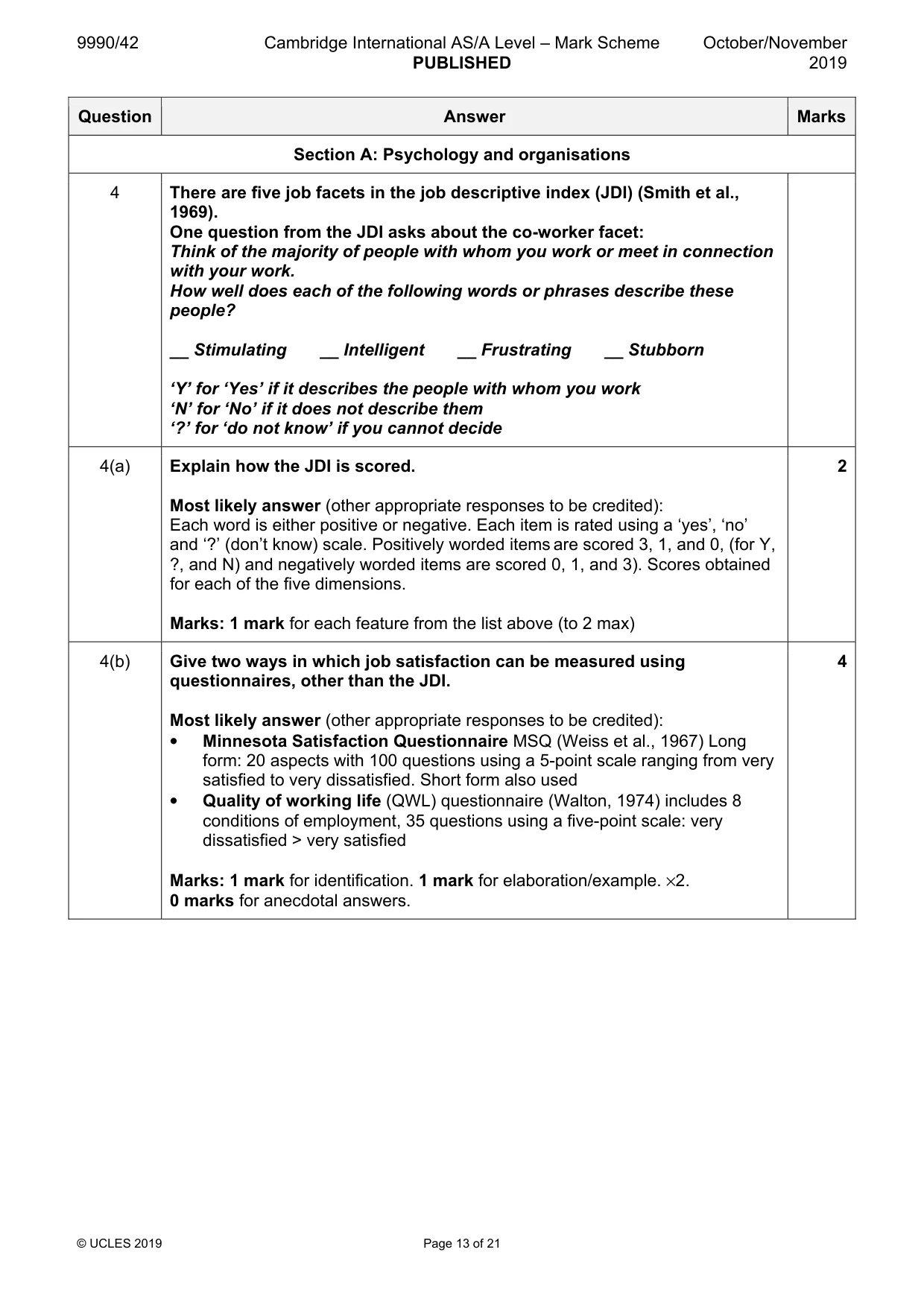
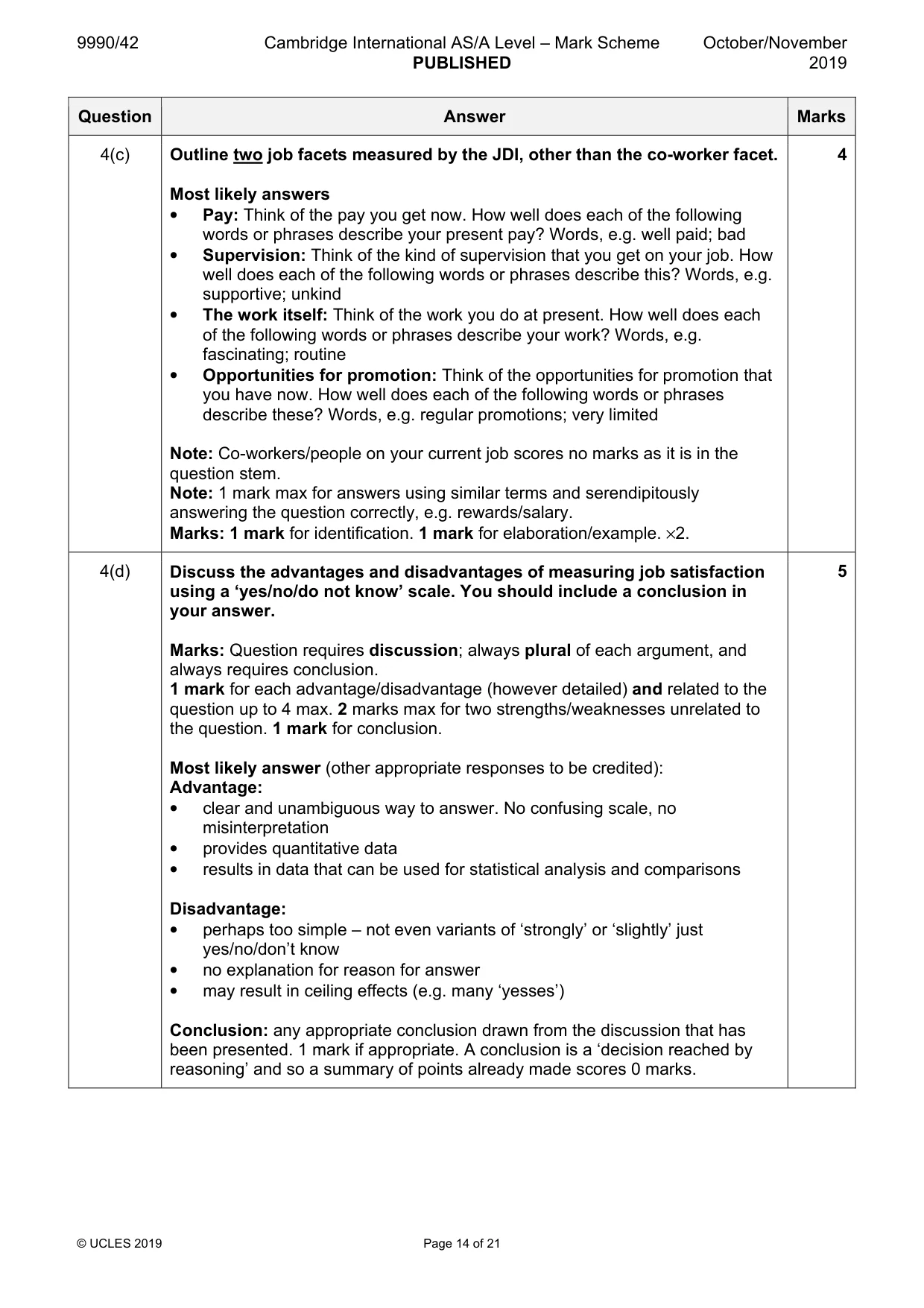
Mark scheme: 4(a) Explain how the JDI is scored. 2 Most likely answer (other appropriate responses to be credited): Each word is either positive or negative. Each item is rated using a ‘yes’, ‘no’ and ‘?’ (don’t know) scale. Positively worded items are scored 3, 1, and 0, (for Y, ?, and N) and negatively worded items are scored 0, 1, and 3). Scores obtained for each of the five dimensions. Marks: 1 mark for each feature from the list above (to 2 max) 4(b) Give two ways in which job satisfaction can be measured using 4 questionnaires, other than the JDI. Most likely answer (other appropriate responses to be credited): • Minnesota Satisfaction Questionnaire MSQ (Weiss et al., 1967) Long form: 20 aspects with 100 questions using a 5-point scale ranging from very satisfied to very dissatisfied. Short form also used • Quality of working life (QWL) questionnaire (Walton, 1974) includes 8 conditions of employment, 35 questions using a five-point scale: very dissatisfied > very satisfied Marks: 1 mark for identification. 1 mark for elaboration/example. ×2. 0 marks for anecdotal answers. 4(c) Outline two job facets measured by the JDI, other than the co-worker facet. 4 Most likely answers • Pay: Think of the pay you get now. How well does each of the following words or phrases describe your present pay? Words, e.g. well paid; bad • Supervision: Think of the kind of supervision that you get on your job. How well does each of the following words or phrases describe this? Words, e.g. supportive; unkind • The work itself: Think of the work you do at present. How well does each of the following words or phrases describe your work? Words, e.g. fascinating; routine • Opportunities for promotion: Think of the opportunities for promotion that you have now. How well does each of the following words or phrases describe these? Words, e.g. regular promotions; very limited Note: Co-workers/people on your current job scores no marks as it is in the question stem. Note: 1 mark max for answers using similar terms and serendipitously answering the question correctly, e.g. rewards/salary. Marks: 1 mark for identification. 1 mark for elaboration/example. ×2. 4(d) Discuss the advantages and disadvantages of measuring job satisfaction 5 using a ‘yes/no/do not know’ scale. You should include a conclusion in your answer. Marks: Question requires discussion; always plural of each argument, and always requires conclusion. 1 mark for each advantage/disadvantage (however detailed) and related to the question up to 4 max. 2 marks max for two strengths/weaknesses unrelated to the question. 1 mark for conclusion. Most likely answer (other appropriate responses to be credited): Advantage: • clear and unambiguous way to answer. No confusing scale, no misinterpretation • provides quantitative data • results in data that can be used for statistical analysis and comparisons Disadvantage: • perhaps too simple – not even variants of ‘strongly’ or ‘slightly’ just yes/no/don’t know • no explanation for reason for answer • may result in ceiling effects (e.g. many ‘yesses’) Conclusion: any appropriate conclusion drawn from the discussion that has been presented. 1 mark if appropriate. A conclusion is a ‘decision reached by reasoning’ and so a summary of points already made scores 0 marks. Section B: Design Question
Q5 · Design a study using an observation to investigate whether a person has generalised…
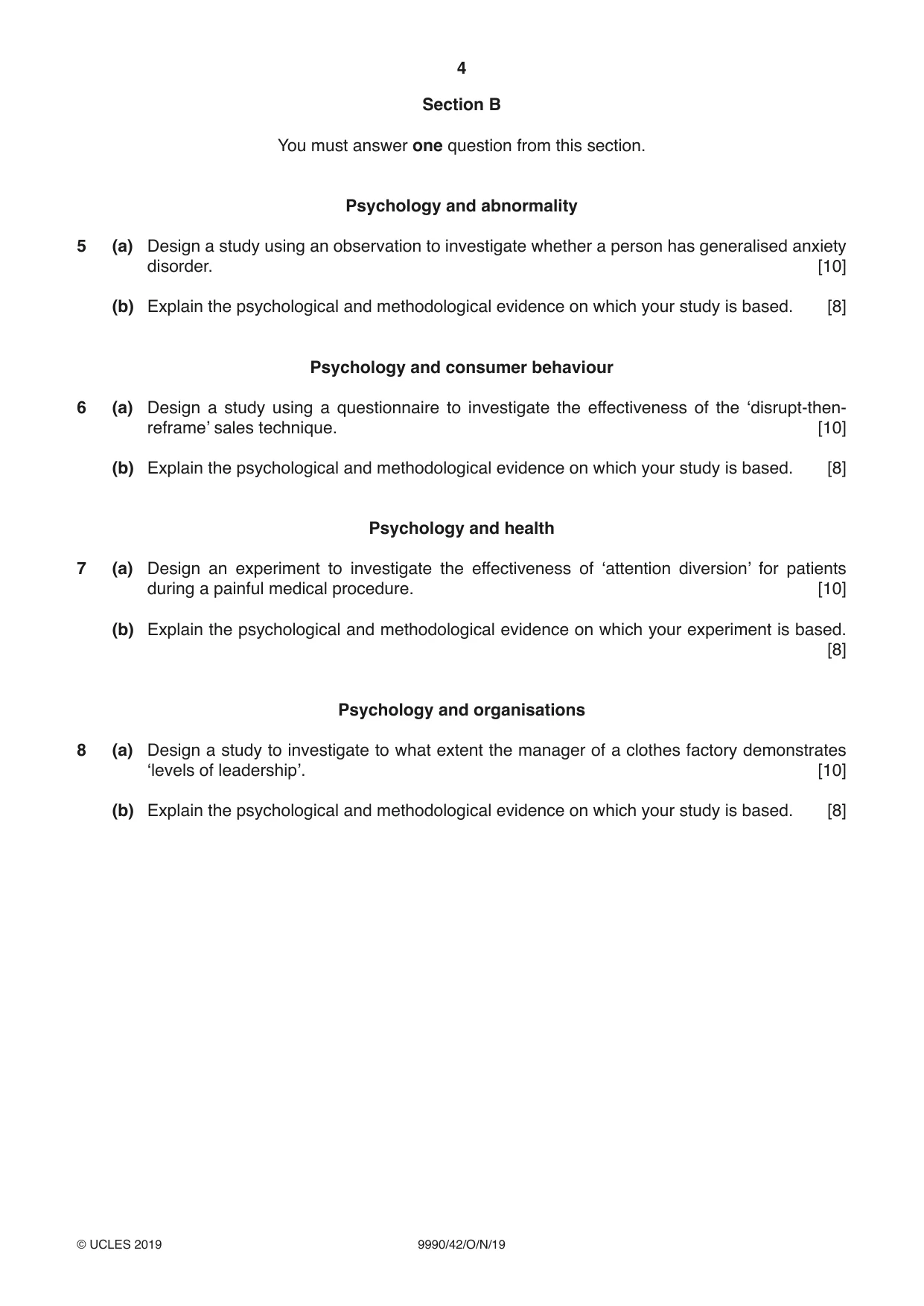
5 (a) Design a study using an observation to investigate whether a person has generalised anxiety disorder. [10] (b) Explain the psychological and methodological evidence on which your study is based. [8] Psychology and consumer behaviour
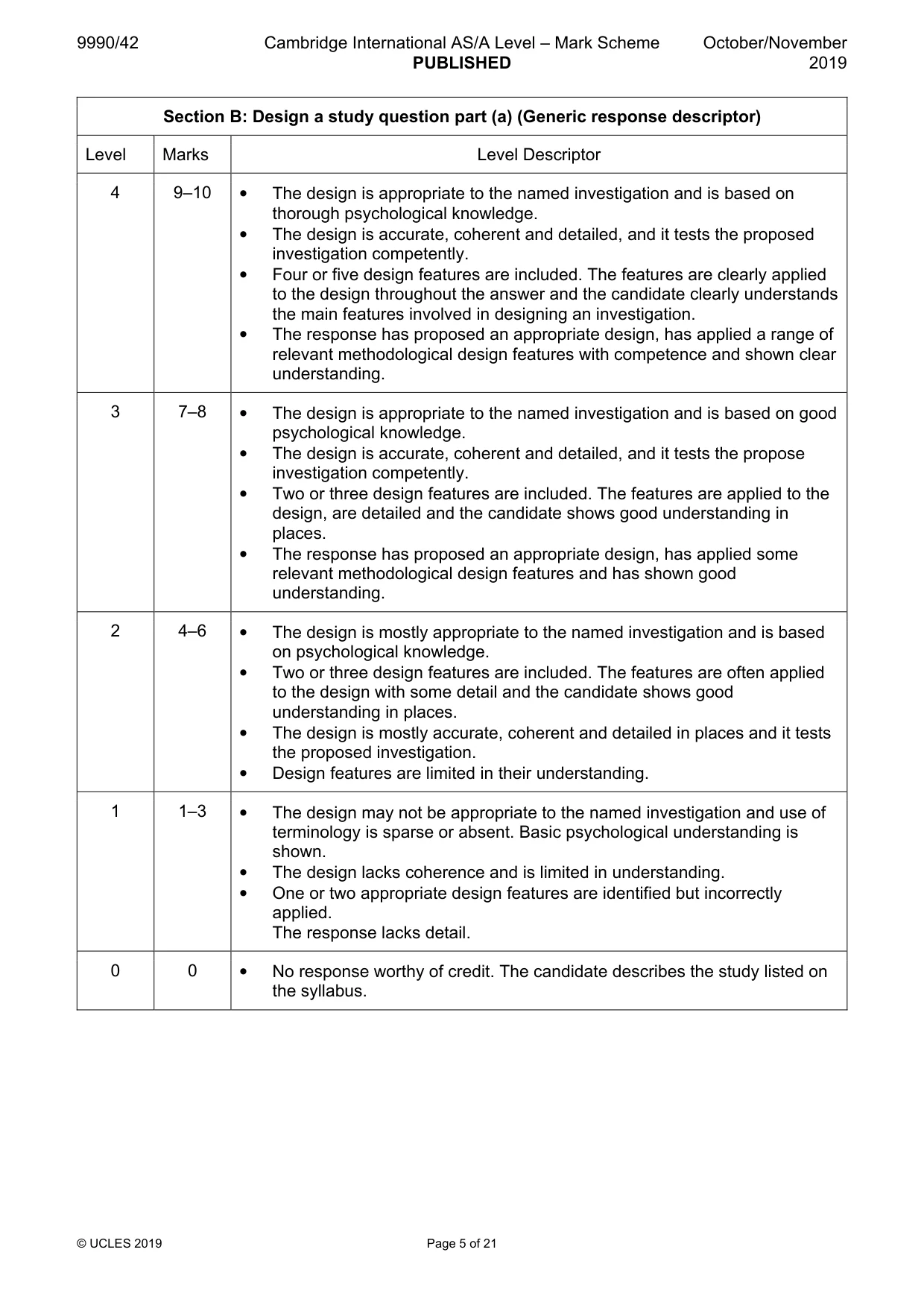
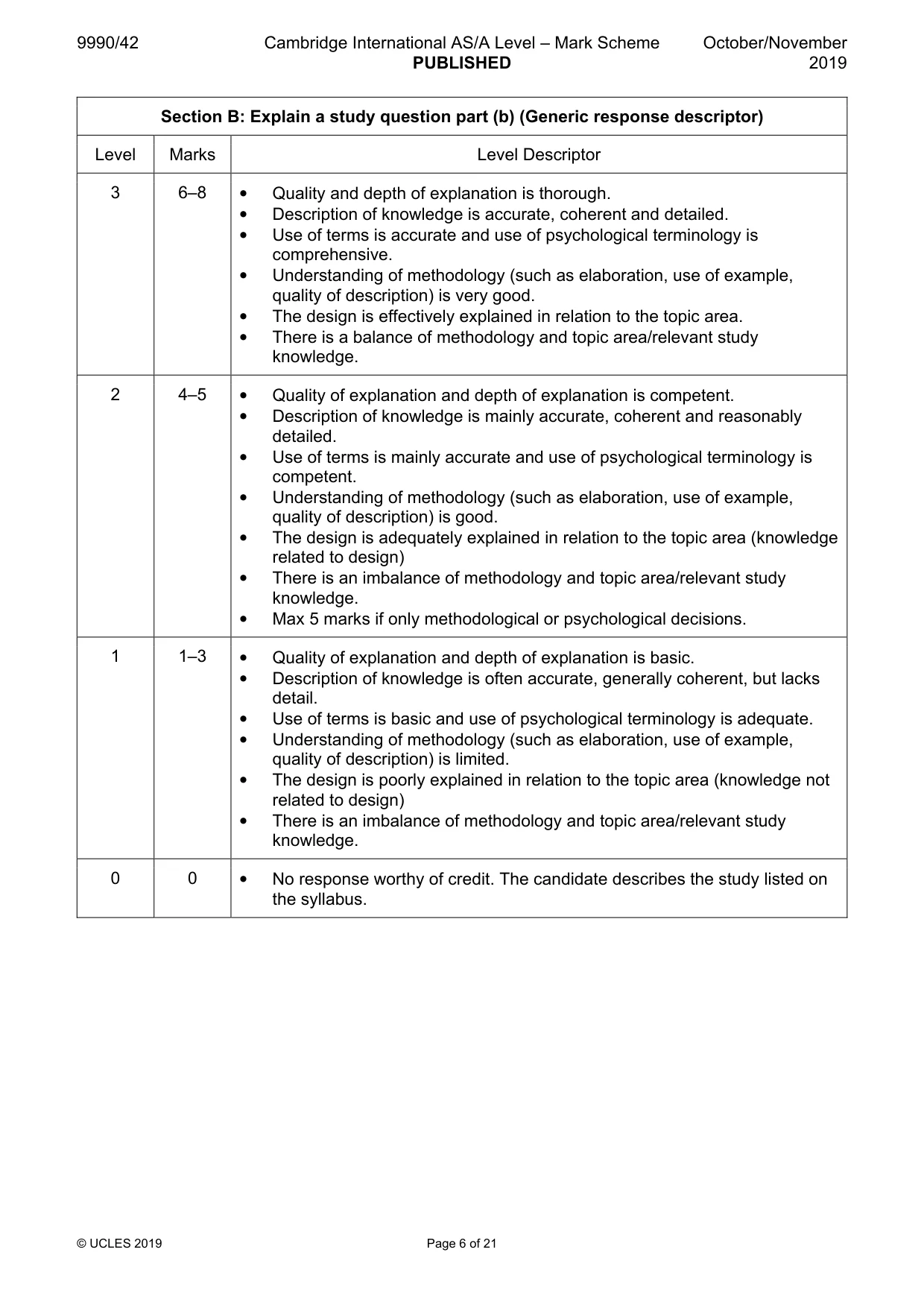
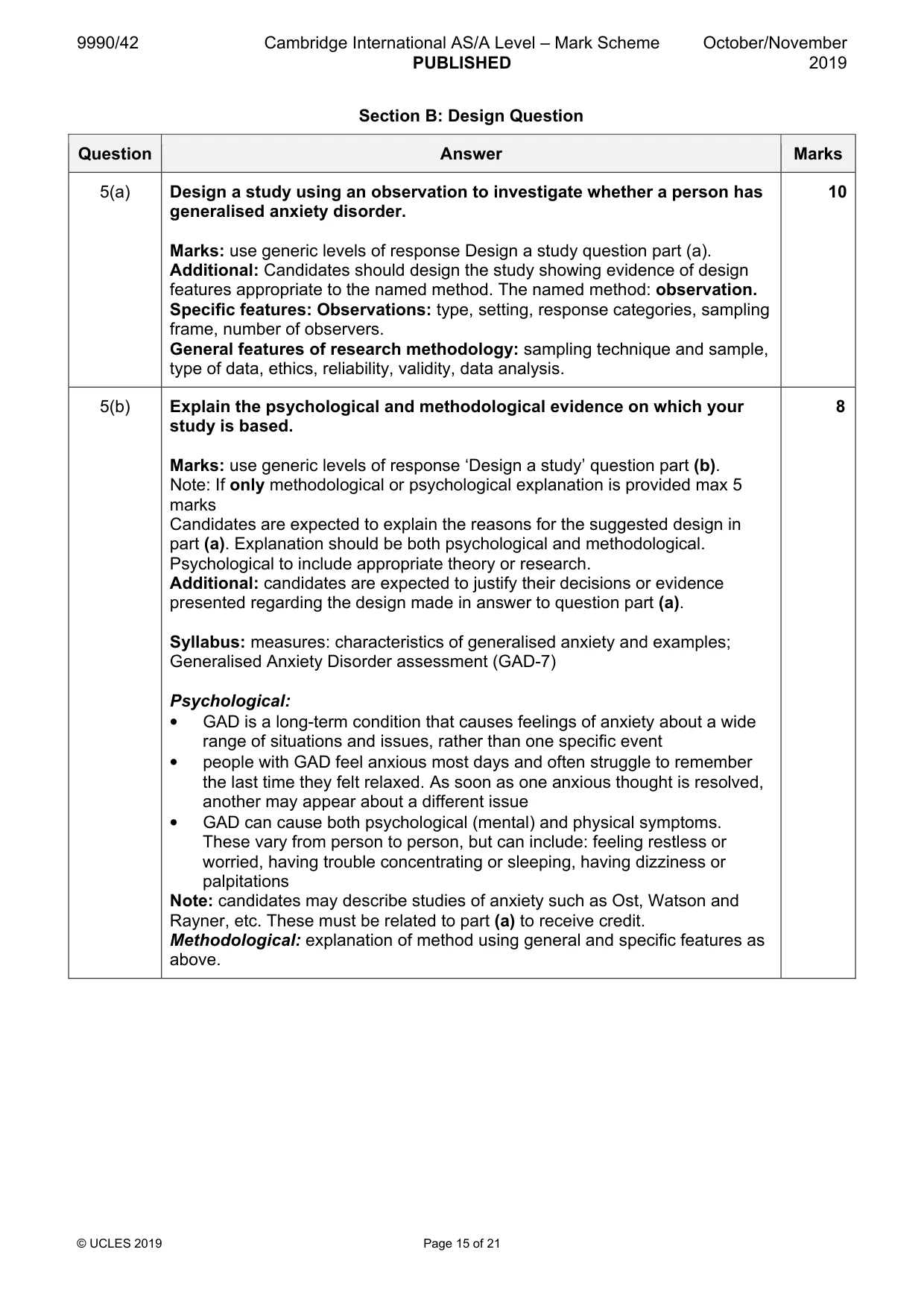
Mark scheme: 5(a) Design a study using an observation to investigate whether a person has 10 generalised anxiety disorder. Marks: use generic levels of response Design a study question part (a). Additional: Candidates should design the study showing evidence of design features appropriate to the named method. The named method: observation. Specific features: Observations: type, setting, response categories, sampling frame, number of observers. General features of research methodology: sampling technique and sample, type of data, ethics, reliability, validity, data analysis. 5(b) Explain the psychological and methodological evidence on which your 8 study is based. Marks: use generic levels of response ‘Design a study’ question part (b). Note: If only methodological or psychological explanation is provided max 5 marks Candidates are expected to explain the reasons for the suggested design in part (a). Explanation should be both psychological and methodological. Psychological to include appropriate theory or research. Additional: candidates are expected to justify their decisions or evidence presented regarding the design made in answer to question part (a). Syllabus: measures: characteristics of generalised anxiety and examples; Generalised Anxiety Disorder assessment (GAD-7) Psychological: • GAD is a long-term condition that causes feelings of anxiety about a wide range of situations and issues, rather than one specific event • people with GAD feel anxious most days and often struggle to remember the last time they felt relaxed. As soon as one anxious thought is resolved, another may appear about a different issue • GAD can cause both psychological (mental) and physical symptoms. These vary from person to person, but can include: feeling restless or worried, having trouble concentrating or sleeping, having dizziness or palpitations Note: candidates may describe studies of anxiety such as Ost, Watson and Rayner, etc. These must be related to part (a) to receive credit. Methodological: explanation of method using general and specific features as above.
More questions on Anxiety disorders and fear-related disorders
Q6 · Design a study using a questionnaire to investigate the effectiveness of the…
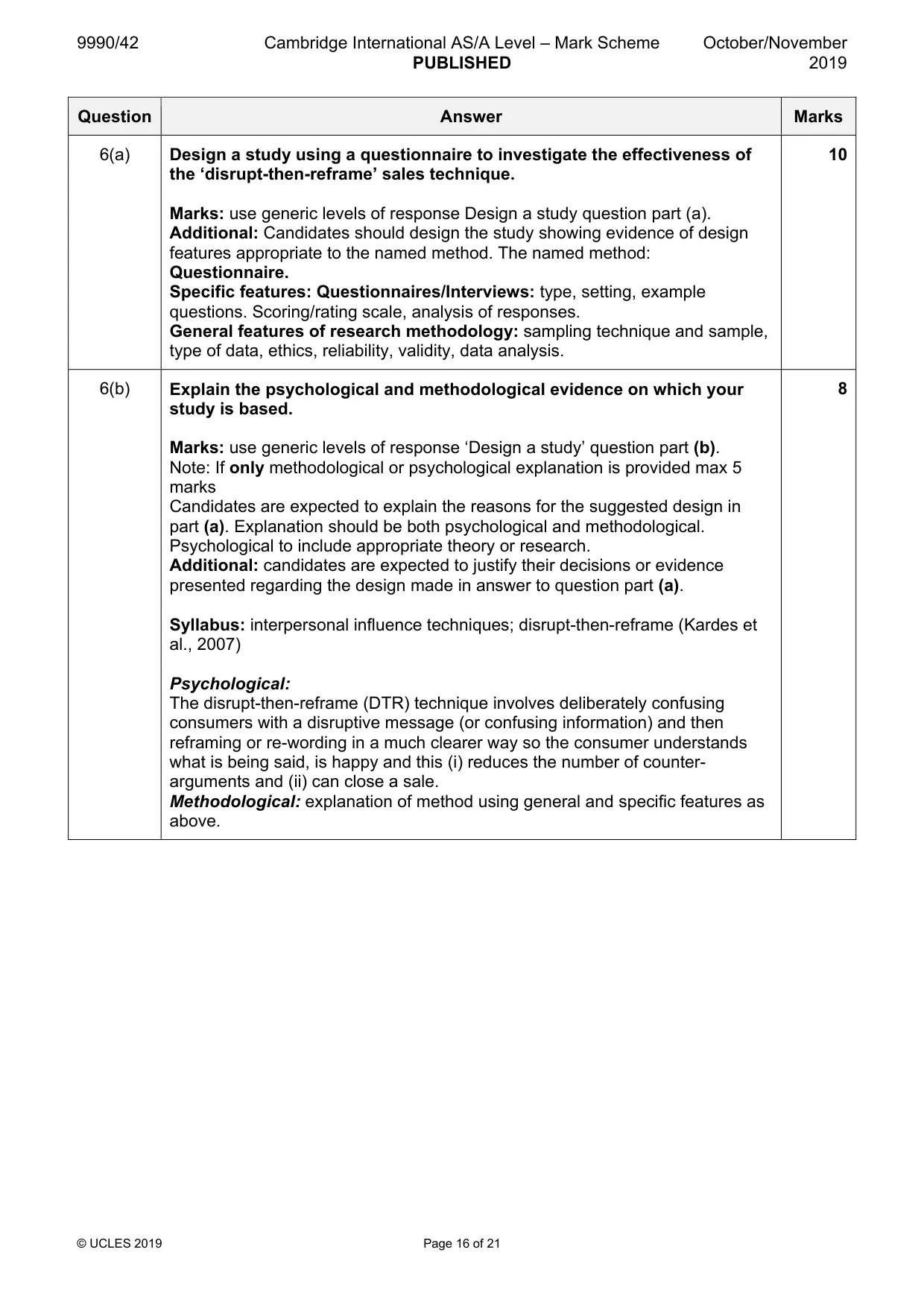
6 (a) Design a study using a questionnaire to investigate the effectiveness of the ‘disrupt-then- reframe’ sales technique. [10] (b) Explain the psychological and methodological evidence on which your study is based. [8] Psychology and health
Mark scheme: 6(a) Design a study using a questionnaire to investigate the effectiveness of 10 the ‘disrupt-then-reframe’ sales technique. Marks: use generic levels of response Design a study question part (a). Additional: Candidates should design the study showing evidence of design features appropriate to the named method. The named method: Questionnaire. Specific features: Questionnaires/Interviews: type, setting, example questions. Scoring/rating scale, analysis of responses. General features of research methodology: sampling technique and sample, type of data, ethics, reliability, validity, data analysis. 6(b) Explain the psychological and methodological evidence on which your 8 study is based. Marks: use generic levels of response ‘Design a study’ question part (b). Note: If only methodological or psychological explanation is provided max 5 marks Candidates are expected to explain the reasons for the suggested design in part (a). Explanation should be both psychological and methodological. Psychological to include appropriate theory or research. Additional: candidates are expected to justify their decisions or evidence presented regarding the design made in answer to question part (a). Syllabus: interpersonal influence techniques; disrupt-then-reframe (Kardes et al., 2007) Psychological: The disrupt-then-reframe (DTR) technique involves deliberately confusing consumers with a disruptive message (or confusing information) and then reframing or re-wording in a much clearer way so the consumer understands what is being said, is happy and this (i) reduces the number of counter- arguments and (ii) can close a sale. Methodological: explanation of method using general and specific features as above.
Q7 · Design an experiment to investigate the effectiveness of ‘attention diversion’ for…
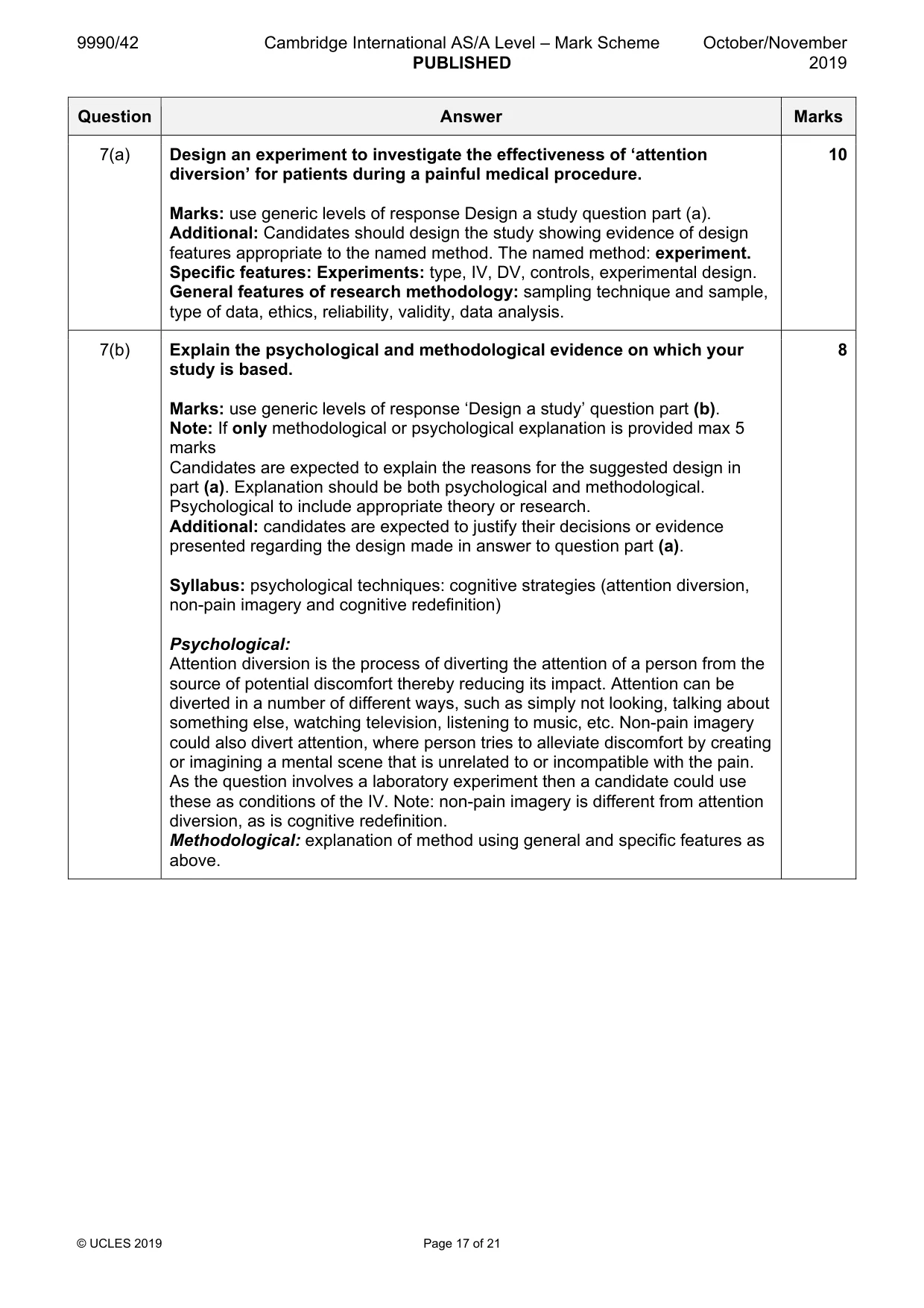
7 (a) Design an experiment to investigate the effectiveness of ‘attention diversion’ for patients during a painful medical procedure. [10] (b) Explain the psychological and methodological evidence on which your experiment is based. [8] Psychology and organisations
Mark scheme: 7(a) Design an experiment to investigate the effectiveness of ‘attention 10 diversion’ for patients during a painful medical procedure. Marks: use generic levels of response Design a study question part (a). Additional: Candidates should design the study showing evidence of design features appropriate to the named method. The named method: experiment. Specific features: Experiments: type, IV, DV, controls, experimental design. General features of research methodology: sampling technique and sample, type of data, ethics, reliability, validity, data analysis. 7(b) Explain the psychological and methodological evidence on which your 8 study is based. Marks: use generic levels of response ‘Design a study’ question part (b). Note: If only methodological or psychological explanation is provided max 5 marks Candidates are expected to explain the reasons for the suggested design in part (a). Explanation should be both psychological and methodological. Psychological to include appropriate theory or research. Additional: candidates are expected to justify their decisions or evidence presented regarding the design made in answer to question part (a). Syllabus: psychological techniques: cognitive strategies (attention diversion, non-pain imagery and cognitive redefinition) Psychological: Attention diversion is the process of diverting the attention of a person from the source of potential discomfort thereby reducing its impact. Attention can be diverted in a number of different ways, such as simply not looking, talking about something else, watching television, listening to music, etc. Non-pain imagery could also divert attention, where person tries to alleviate discomfort by creating or imagining a mental scene that is unrelated to or incompatible with the pain. As the question involves a laboratory experiment then a candidate could use these as conditions of the IV. Note: non-pain imagery is different from attention diversion, as is cognitive redefinition. Methodological: explanation of method using general and specific features as above.
Q8 · Design a study to investigate to what extent the manager of a clothes factory…
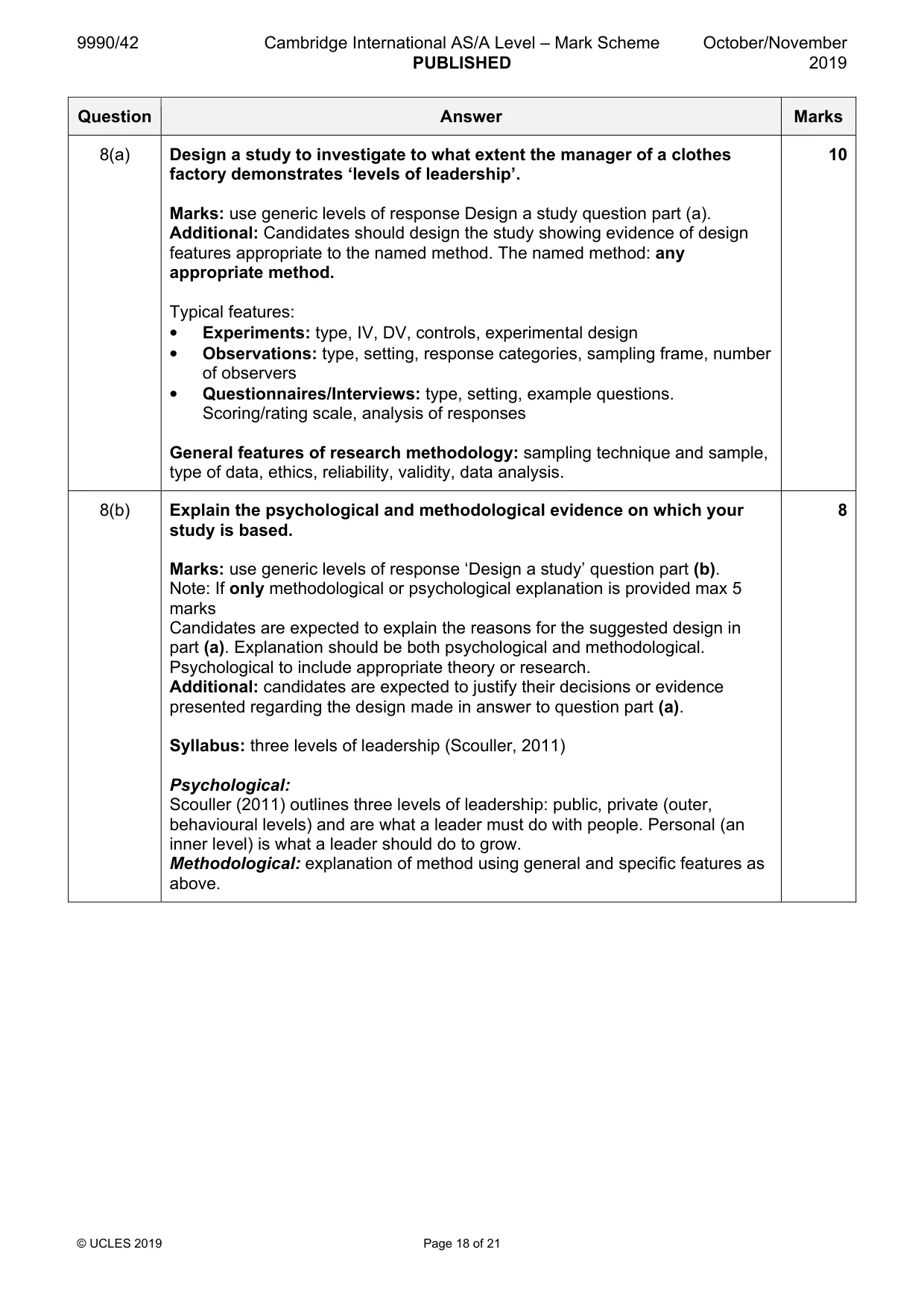
8 (a) Design a study to investigate to what extent the manager of a clothes factory demonstrates ‘levels of leadership’. [10] (b) Explain the psychological and methodological evidence on which your study is based. [8] Section C You must answer one question from this section. Psychology and abnormality
Mark scheme: 8(a) Design a study to investigate to what extent the manager of a clothes 10 factory demonstrates ‘levels of leadership’. Marks: use generic levels of response Design a study question part (a). Additional: Candidates should design the study showing evidence of design features appropriate to the named method. The named method: any appropriate method. Typical features: • Experiments: type, IV, DV, controls, experimental design • Observations: type, setting, response categories, sampling frame, number of observers • Questionnaires/Interviews: type, setting, example questions. Scoring/rating scale, analysis of responses General features of research methodology: sampling technique and sample, type of data, ethics, reliability, validity, data analysis. 8(b) Explain the psychological and methodological evidence on which your 8 study is based. Marks: use generic levels of response ‘Design a study’ question part (b). Note: If only methodological or psychological explanation is provided max 5 marks Candidates are expected to explain the reasons for the suggested design in part (a). Explanation should be both psychological and methodological. Psychological to include appropriate theory or research. Additional: candidates are expected to justify their decisions or evidence presented regarding the design made in answer to question part (a). Syllabus: three levels of leadership (Scouller, 2011) Psychological: Scouller (2011) outlines three levels of leadership: public, private (outer, behavioural levels) and are what a leader must do with people. Personal (an inner level) is what a leader should do to grow. Methodological: explanation of method using general and specific features as above. Section C: Evaluation Question
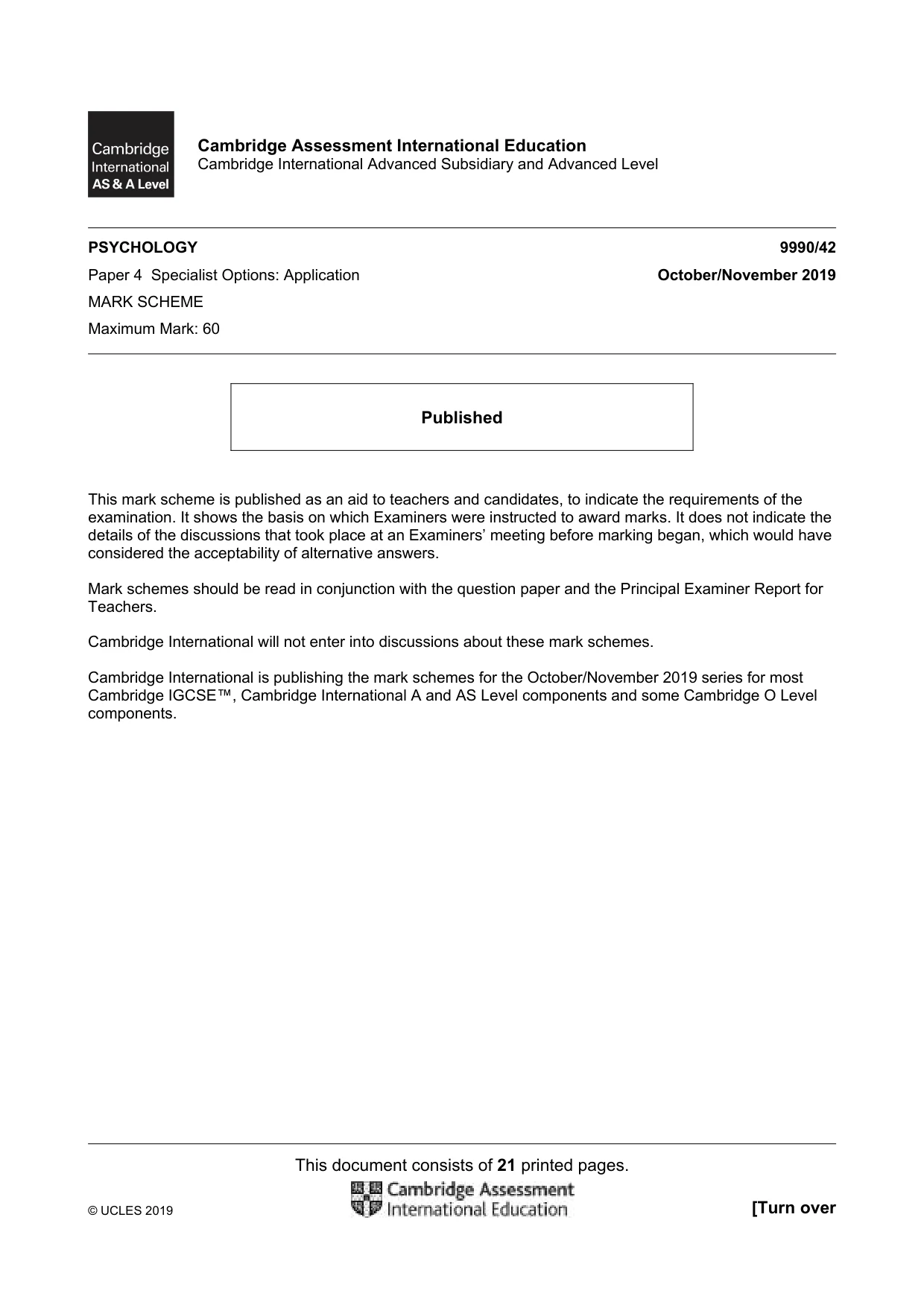
Q9 · ‘All impulse control disorders are caused by a person receiving positive reinforcement…
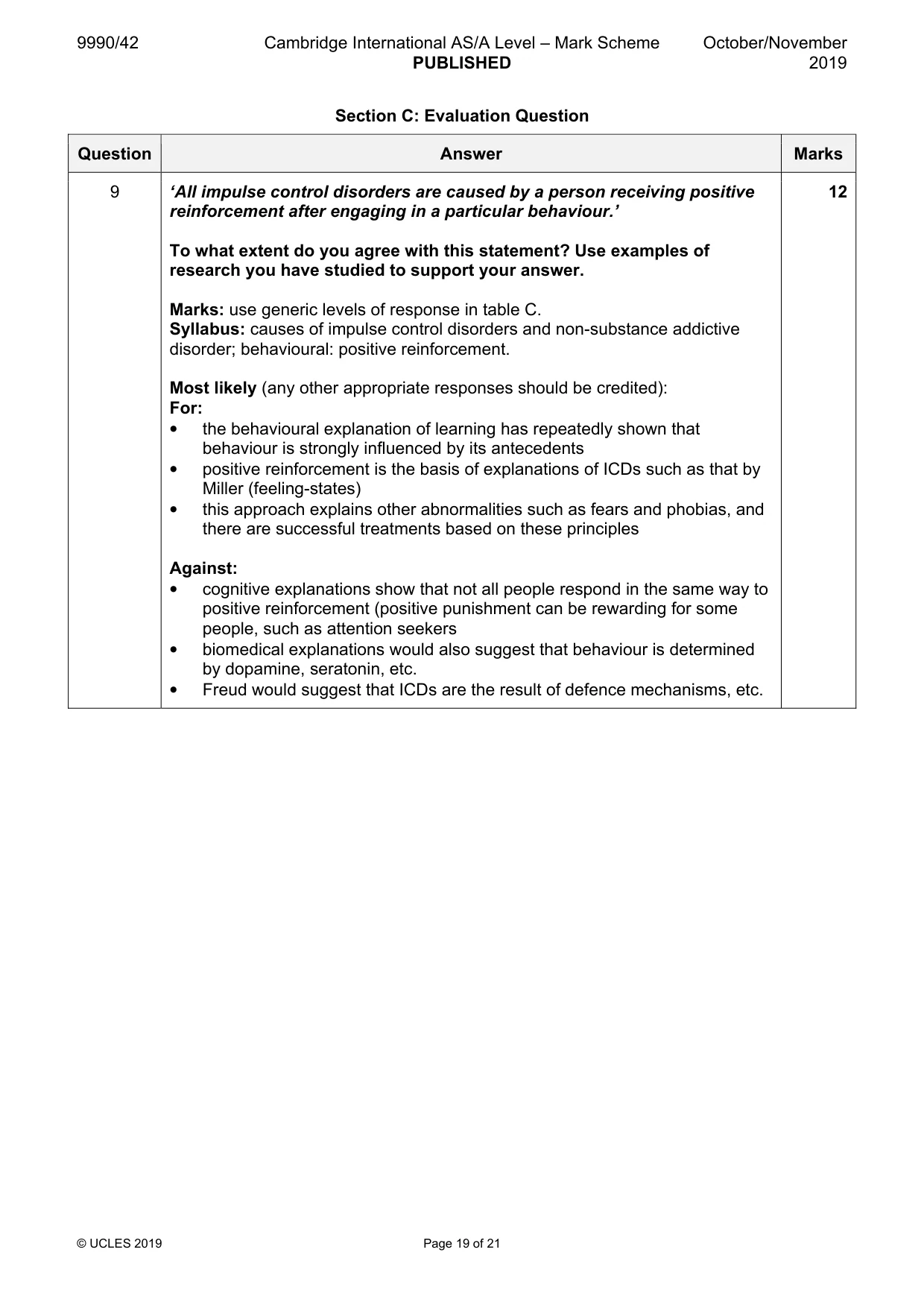
9 ‘All impulse control disorders are caused by a person receiving positive reinforcement after engaging in a particular behaviour.’ To what extent do you agree with this statement? Use examples of research you have studied to support your answer. [12] Psychology and consumer behaviour
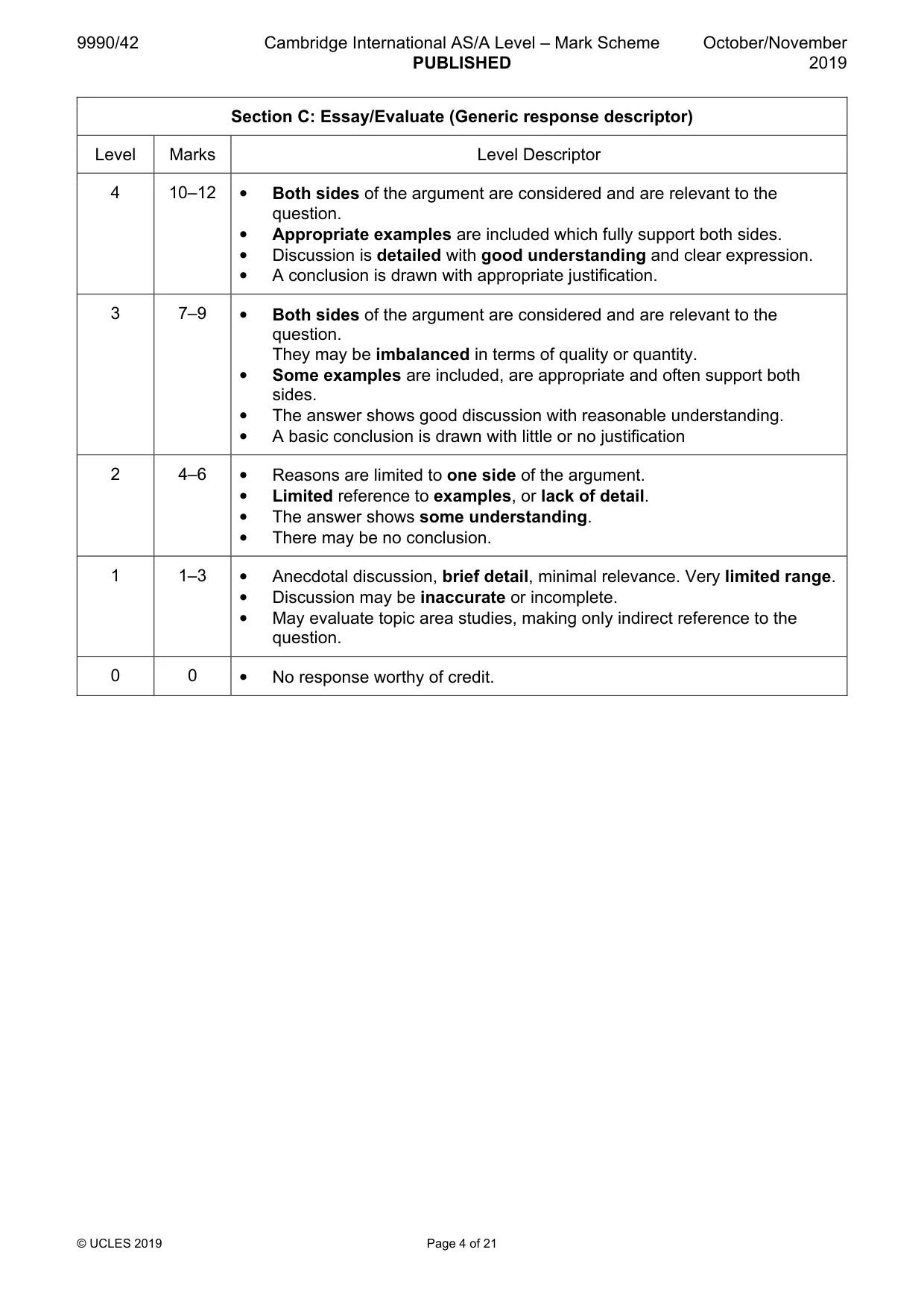
Mark scheme: 9 ‘All impulse control disorders are caused by a person receiving positive 12 reinforcement after engaging in a particular behaviour.’ To what extent do you agree with this statement? Use examples of research you have studied to support your answer. Marks: use generic levels of response in table C. Syllabus: causes of impulse control disorders and non-substance addictive disorder; behavioural: positive reinforcement. Most likely (any other appropriate responses should be credited): For: • the behavioural explanation of learning has repeatedly shown that behaviour is strongly influenced by its antecedents • positive reinforcement is the basis of explanations of ICDs such as that by Miller (feeling-states) • this approach explains other abnormalities such as fears and phobias, and there are successful treatments based on these principles Against: • cognitive explanations show that not all people respond in the same way to positive reinforcement (positive punishment can be rewarding for some people, such as attention seekers • biomedical explanations would also suggest that behaviour is determined by dopamine, seratonin, etc. • Freud would suggest that ICDs are the result of defence mechanisms, etc.
Q10 · ‘Descriptive food names do not influence perception of food; people will eat what they…
10 ‘Descriptive food names do not influence perception of food; people will eat what they like.’ To what extent do you agree with this statement? Use examples of research you have studied to support your answer. [12] Psychology and health
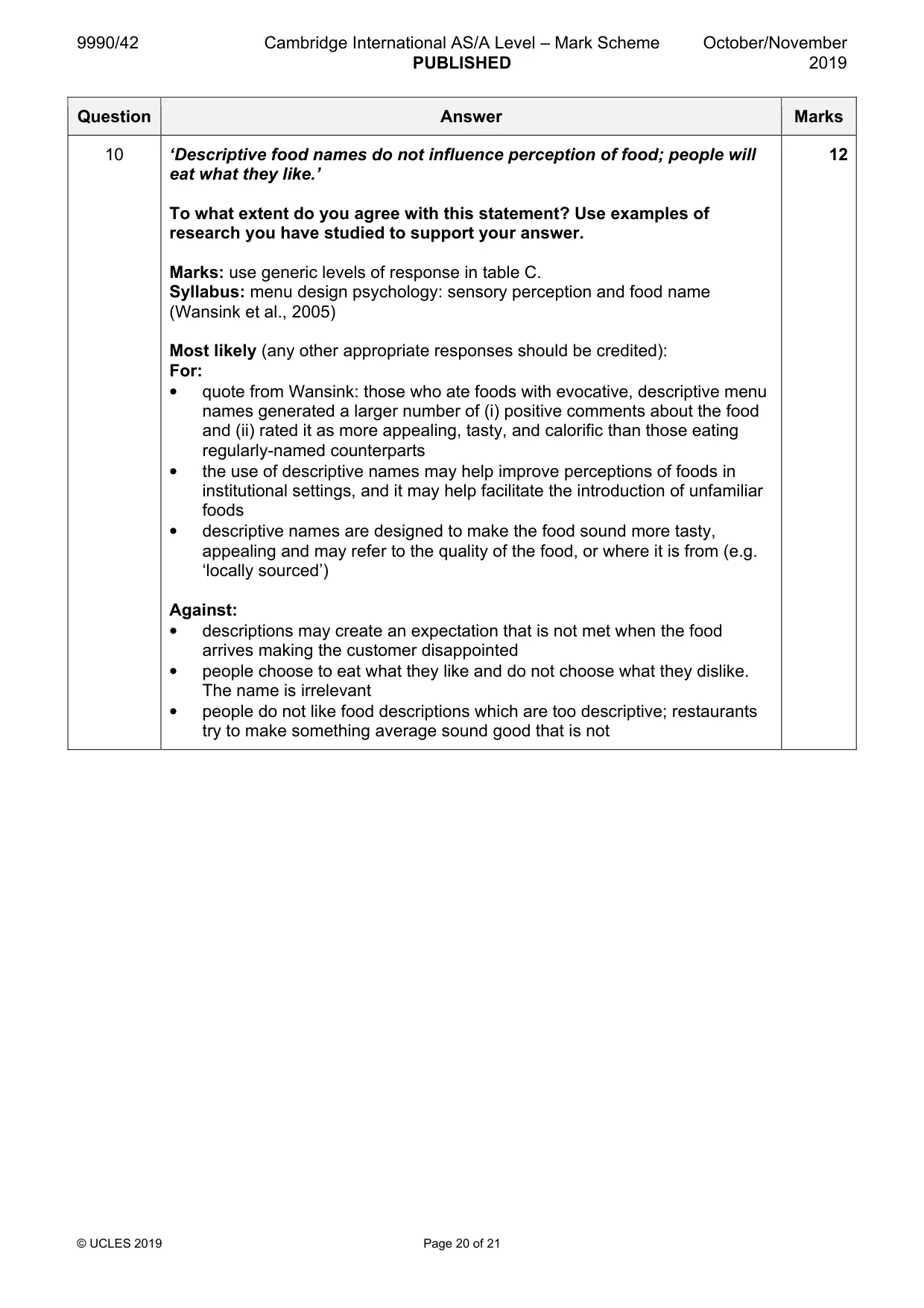
Mark scheme: 10 ‘Descriptive food names do not influence perception of food; people will 12 eat what they like.’ To what extent do you agree with this statement? Use examples of research you have studied to support your answer. Marks: use generic levels of response in table C. Syllabus: menu design psychology: sensory perception and food name (Wansink et al., 2005) Most likely (any other appropriate responses should be credited): For: • quote from Wansink: those who ate foods with evocative, descriptive menu names generated a larger number of (i) positive comments about the food and (ii) rated it as more appealing, tasty, and calorific than those eating regularly-named counterparts • the use of descriptive names may help improve perceptions of foods in institutional settings, and it may help facilitate the introduction of unfamiliar foods • descriptive names are designed to make the food sound more tasty, appealing and may refer to the quality of the food, or where it is from (e.g. ‘locally sourced’) Against: • descriptions may create an expectation that is not met when the food arrives making the customer disappointed • people choose to eat what they like and do not choose what they dislike. The name is irrelevant • people do not like food descriptions which are too descriptive; restaurants try to make something average sound good that is not
Q11 · ‘There is no need to have different measures of pain specifically for children.’ To what…
11 ‘There is no need to have different measures of pain specifically for children.’ To what extent do you agree with this statement? Use examples of research you have studied to support your answer. [12] Psychology and organisations
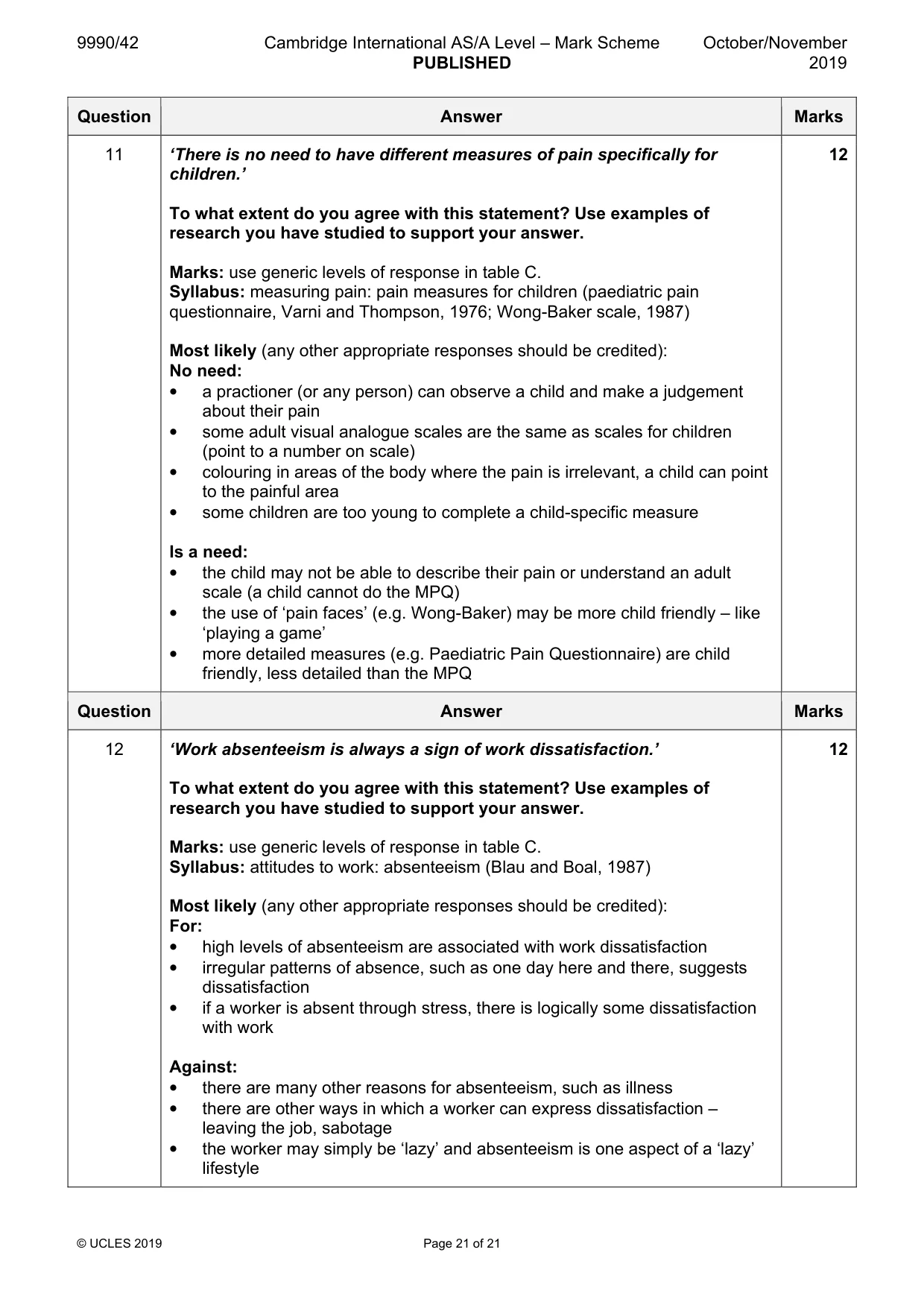
Mark scheme: 11 ‘There is no need to have different measures of pain specifically for 12 children.’ To what extent do you agree with this statement? Use examples of research you have studied to support your answer. Marks: use generic levels of response in table C. Syllabus: measuring pain: pain measures for children (paediatric pain questionnaire, Varni and Thompson, 1976; Wong-Baker scale, 1987) Most likely (any other appropriate responses should be credited): No need: • a practioner (or any person) can observe a child and make a judgement about their pain • some adult visual analogue scales are the same as scales for children (point to a number on scale) • colouring in areas of the body where the pain is irrelevant, a child can point to the painful area • some children are too young to complete a child-specific measure Is a need: • the child may not be able to describe their pain or understand an adult scale (a child cannot do the MPQ) • the use of ‘pain faces’ (e.g. Wong-Baker) may be more child friendly – like ‘playing a game’ • more detailed measures (e.g. Paediatric Pain Questionnaire) are child friendly, less detailed than the MPQ
Q12 · ‘Work absenteeism is always a sign of work dissatisfaction.’ To what extent do you agree…
12 ‘Work absenteeism is always a sign of work dissatisfaction.’ To what extent do you agree with this statement? Use examples of research you have studied to support your answer. [12]
Mark scheme: 12 ‘Work absenteeism is always a sign of work dissatisfaction.’ 12 To what extent do you agree with this statement? Use examples of research you have studied to support your answer. Marks: use generic levels of response in table C. Syllabus: attitudes to work: absenteeism (Blau and Boal, 1987) Most likely (any other appropriate responses should be credited): For: • high levels of absenteeism are associated with work dissatisfaction • irregular patterns of absence, such as one day here and there, suggests dissatisfaction • if a worker is absent through stress, there is logically some dissatisfaction with work Against: • there are many other reasons for absenteeism, such as illness • there are other ways in which a worker can express dissatisfaction – leaving the job, sabotage • the worker may simply be ‘lazy’ and absenteeism is one aspect of a ‘lazy’ lifestyle
What was in this paper
The subtopics covered by these 12 questions, and how many questions each got. Open one in a new tab to see every Cambridge question on it.
What you needed in this session
Cambridge’s own grade thresholds for 2019 Oct/Nov, Paper 4 · Variant 2. A higher threshold means an easier paper — the bar moves with how the cohort did.