Cambridge A Level Psychology (from 2018) 9990 — 2023 May/June Paper 4 · Variant 2
9990/42/M/J/23 · 12 questions · 60 marks · ≈68 min
The question paper and its mark scheme, free to read here and free to download. This is Cambridge’s own paper, exactly as it was sat.
Question paper8 pages



Mark scheme24 pages
Answers below. Sit the paper first if you are practising.
Questions as text
Q1 · Paul and Lentz (1977) conducted a study with 84 patients with schizophrenia, allocating…
1 Paul and Lentz (1977) conducted a study with 84 patients with schizophrenia, allocating each patient to one of three types of treatment, including token economy. After more than four years, the effectiveness of each treatment was compared. Alternatively, schizophrenia can be treated using biochemical techniques. (a) Outline how operant conditioning explains token economy. [2] (b) Outline the findings about the effectiveness of token economy from this study. [4] (c) Suggest two reasons why an independent measures design was a better choice for this study than any other experimental design. [4] (d) Discuss the strengths and weaknesses of using biochemical techniques to treat schizophrenia. You should include a conclusion in your answer. [5] Psychology and consumer behaviour
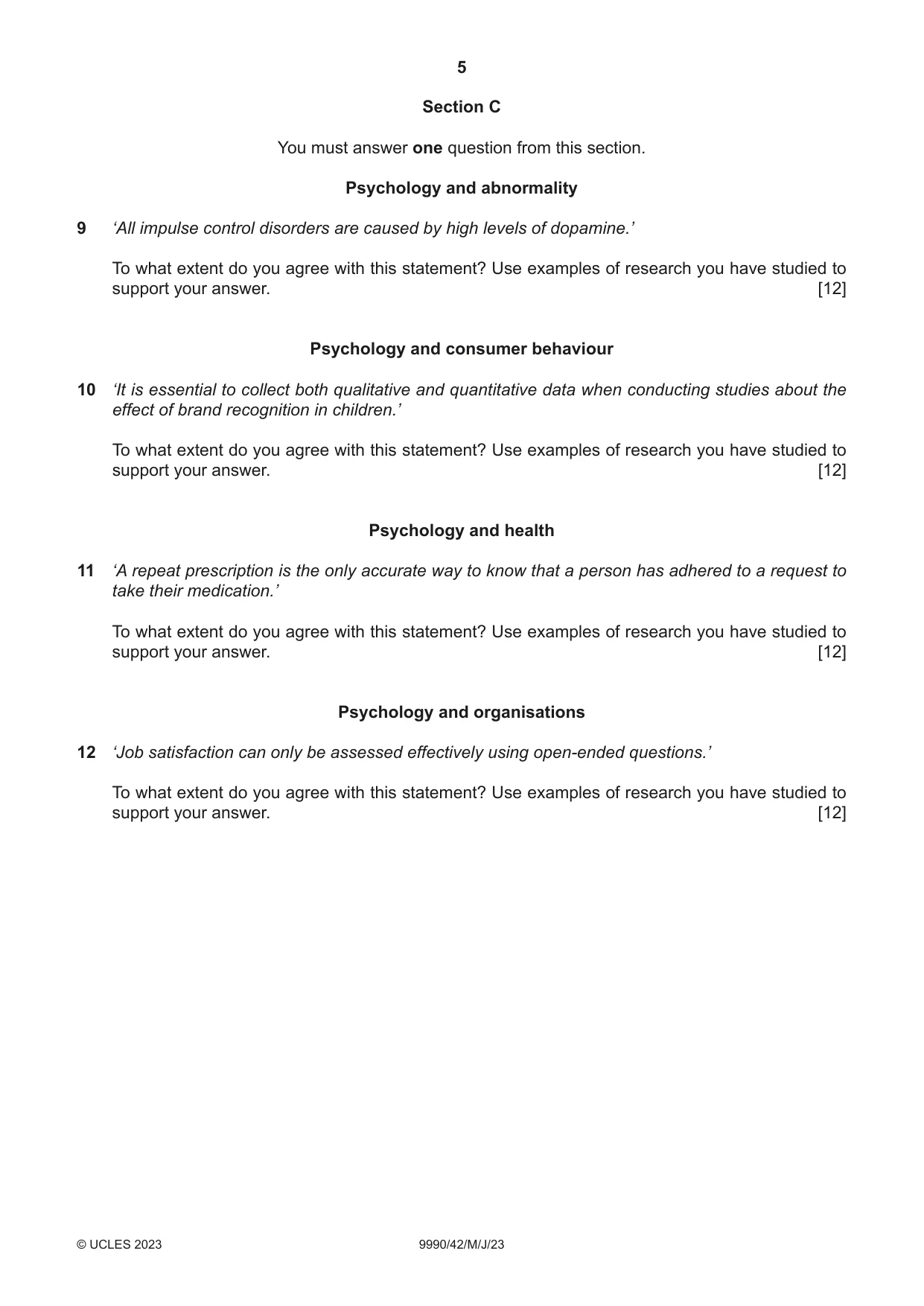
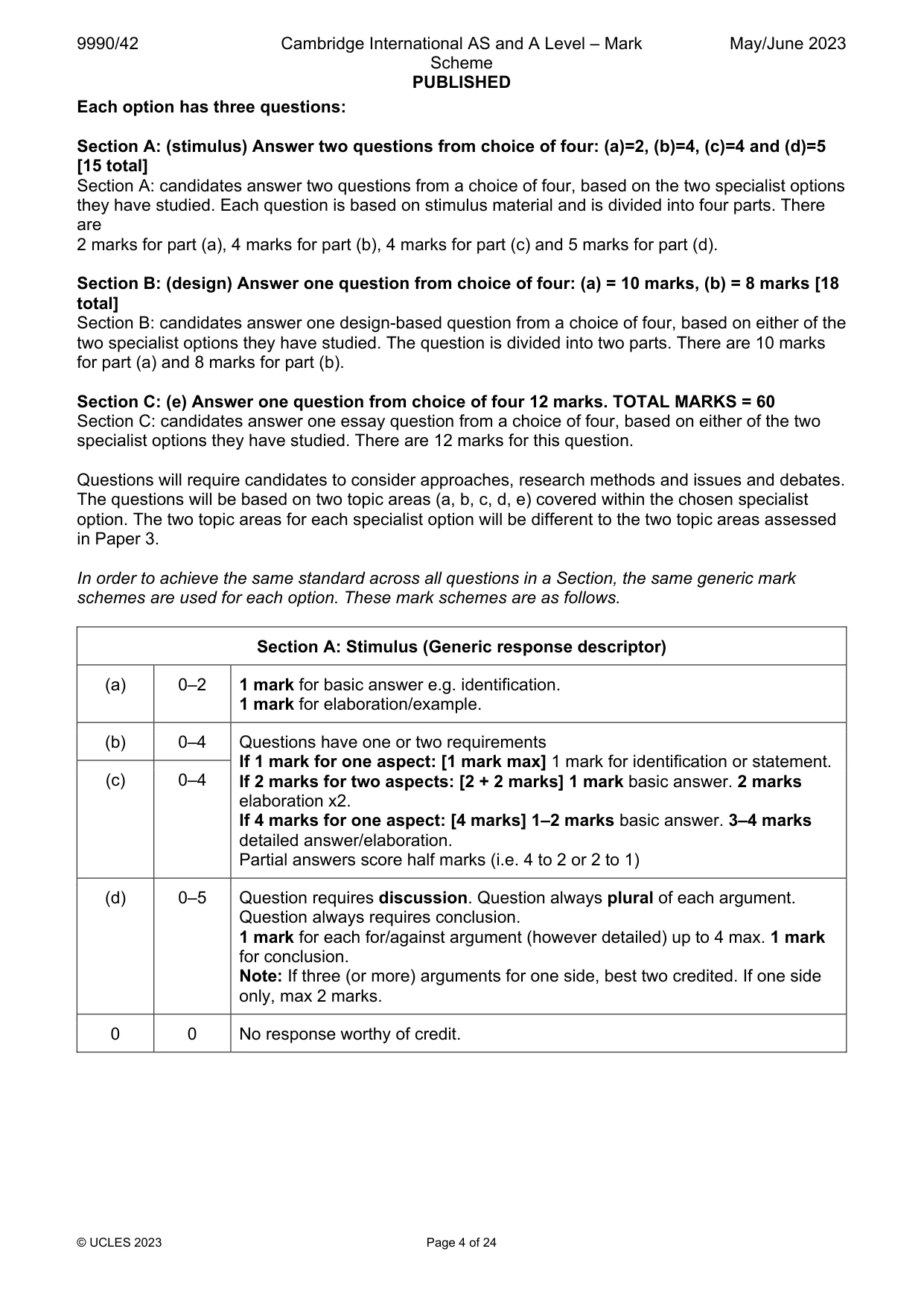
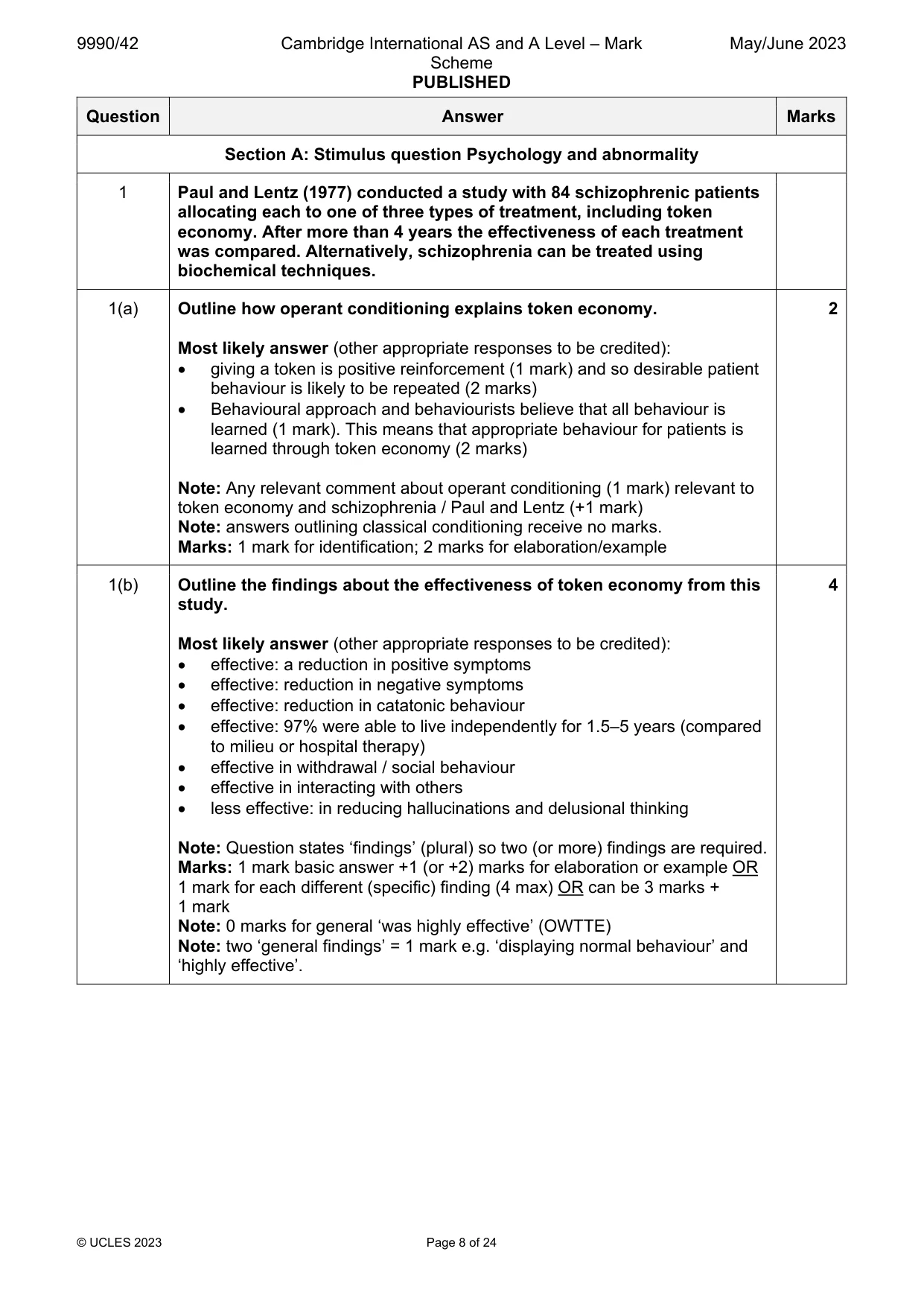
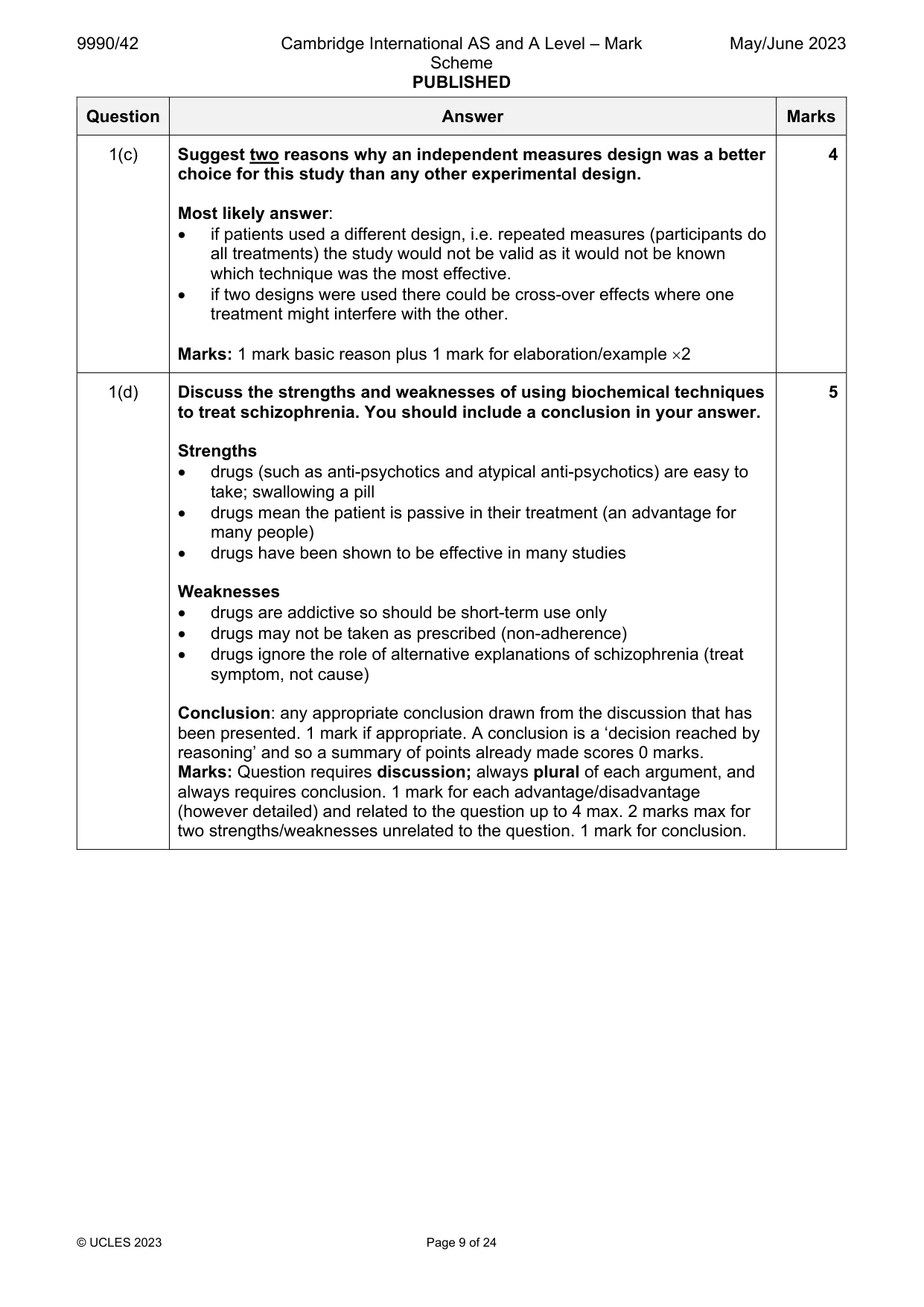
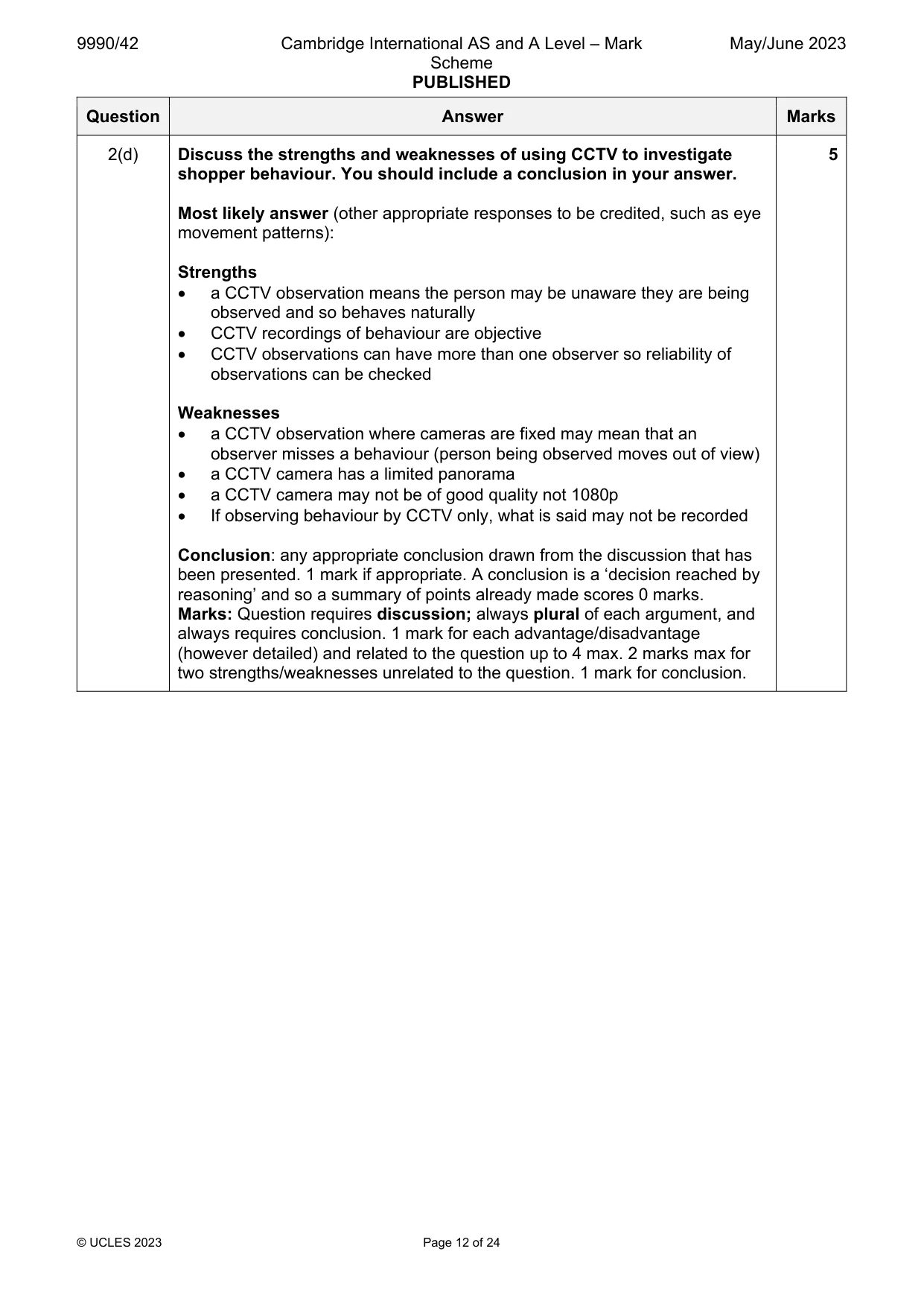
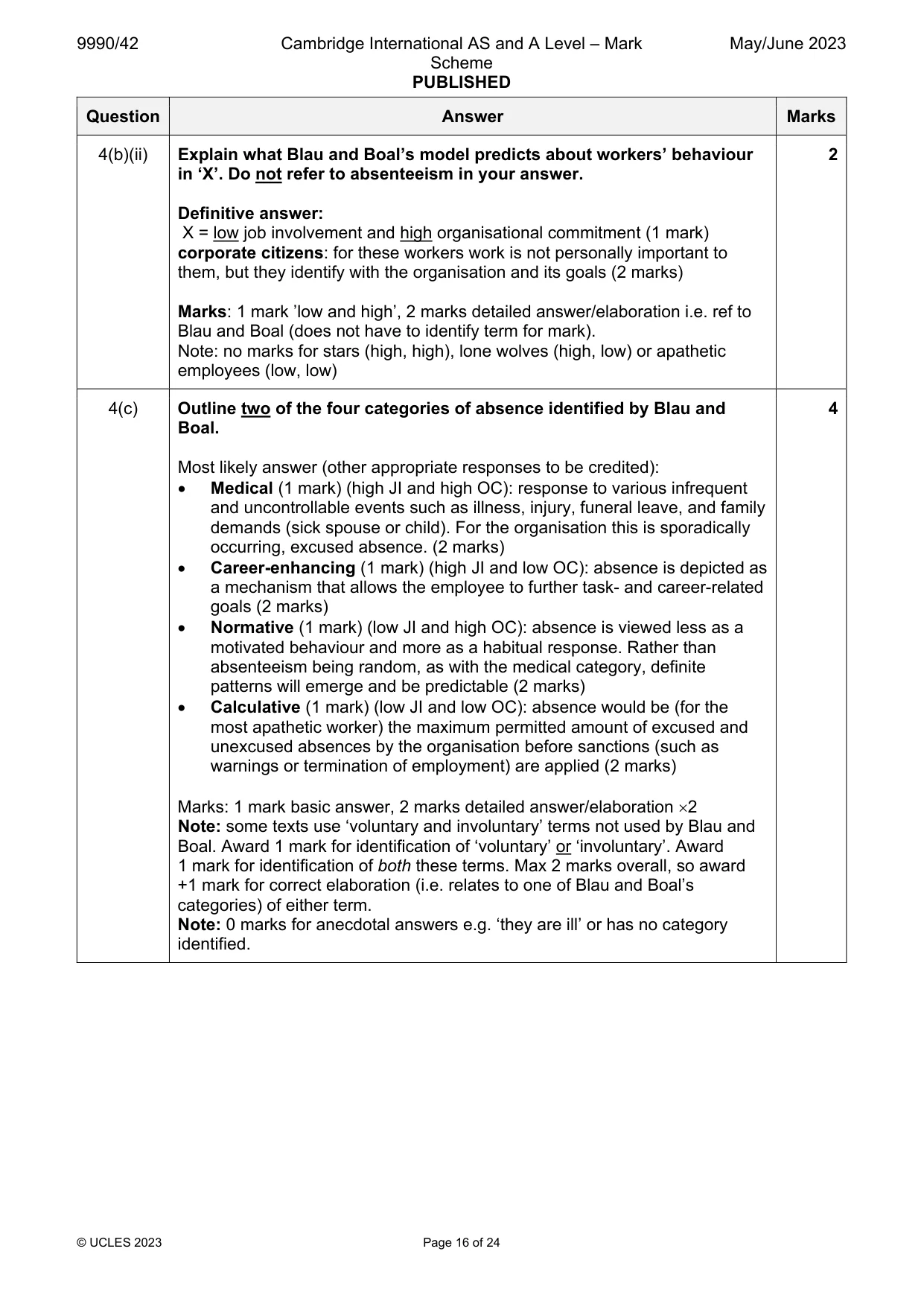
Mark scheme: Question Answer Marks Section A: Stimulus question Psychology and abnormality 1 Paul and Lentz (1977) conducted a study with 84 schizophrenic patients allocating each to one of three types of treatment, including token economy. After more than 4 years the effectiveness of each treatment was compared. Alternatively, schizophrenia can be treated using biochemical techniques. 1(a) Outline how operant conditioning explains token economy. 2 Most likely answer (other appropriate responses to be credited): giving a token is positive reinforcement (1 mark) and so desirable patient behaviour is likely to be repeated (2 marks) Behavioural approach and behaviourists believe that all behaviour is learned (1 mark). This means that appropriate behaviour for patients is learned through token economy (2 marks) Note: Any relevant comment about operant conditioning (1 mark) relevant to token economy and schizophrenia / Paul and Lentz (+1 mark) Note: answers outlining classical conditioning receive no marks. Marks: 1 mark for identification; 2 marks for elaboration/example 1(b) Outline the findings about the effectiveness of token economy from this 4 study. Most likely answer (other appropriate responses to be credited): effective: a reduction in positive symptoms effective: reduction in negative symptoms effective: reduction in catatonic behaviour effective: 97% were able to live independently for 1.5–5 years (compared to milieu or hospital therapy) effective in withdrawal / social behaviour effective in interacting with others less effective: in reducing hallucinations and delusional thinking Note: Question states ‘findings’ (plural) so two (or more) findings are required. Marks: 1 mark basic answer +1 (or +2) marks for elaboration or example OR 1 mark for each different (specific) finding (4 max) OR can be 3 marks + 1 mark Note: 0 marks for general ‘was highly effective’ (OWTTE) Note: two ‘general findings’ = 1 mark e.g. ‘displaying normal behaviour’ and ‘highly effective’. 1(c) Suggest two reasons why an independent measures design was a better 4 choice for this study than any other experimental design. Most likely answer: if patients used a different design, i.e. repeated measures (participants do all treatments) the study would not be valid as it would not be known which technique was the most effective. if two designs were used there could be cross-over effects where one treatment might interfere with the other. Marks: 1 mark basic reason plus 1 mark for elaboration/example 2 1(d) Discuss the strengths and weaknesses of using biochemical techniques 5 to treat schizophrenia. You should include a conclusion in your answer. Strengths drugs (such as anti-psychotics and atypical anti-psychotics) are easy to take; swallowing a pill drugs mean the patient is passive in their treatment (an advantage for many people) drugs have been shown to be effective in many studies Weaknesses drugs are addictive so should be short-term use only drugs may not be taken as prescribed (non-adherence) drugs ignore the role of alternative explanations of schizophrenia (treat symptom, not cause) Conclusion: any appropriate conclusion drawn from the discussion that has been presented. 1 mark if appropriate. A conclusion is a ‘decision reached by reasoning’ and so a summary of points already made scores 0 marks. Marks: Question requires discussion; always plural of each argument, and always requires conclusion. 1 mark for each advantage/disadvantage (however detailed) and related to the question up to 4 max. 2 marks max for two strengths/weaknesses unrelated to the question. 1 mark for conclusion.
Question 2
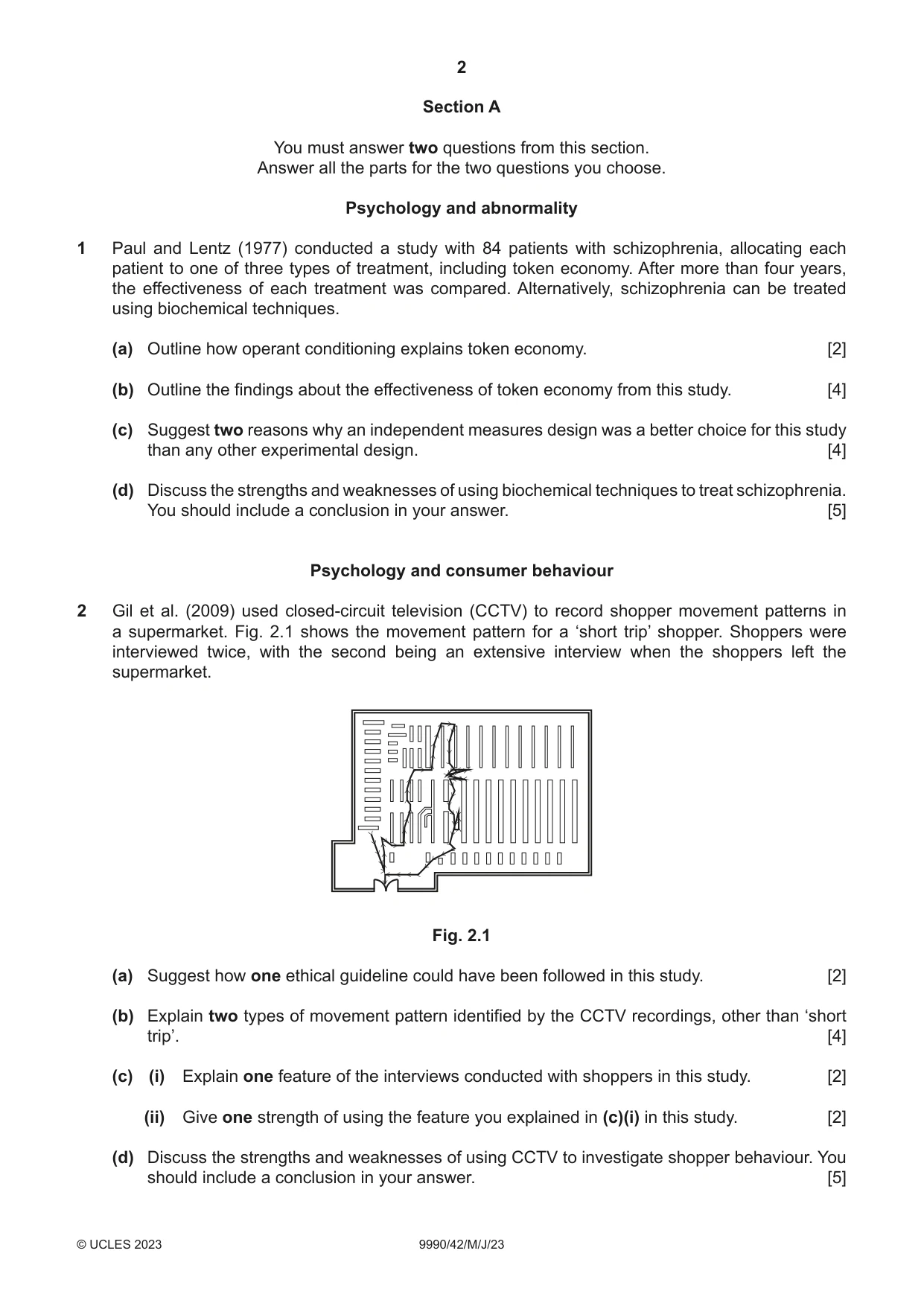
2 Gil et al. (2009) used closed-circuit television (CCTV) to record shopper movement patterns in a supermarket. Fig. 2.1 shows the movement pattern for a ‘short trip’ shopper. Shoppers were interviewed twice, with the second being an extensive interview when the shoppers left the supermarket. Fig. 2.1 (a) Suggest how one ethical guideline could have been followed in this study. [2] (b) Explain two types of movement pattern identified by the CCTV recordings, other than ‘short trip’. [4] (c) (i) Explain one feature of the interviews conducted with shoppers in this study. [2] (ii) Give one strength of using the feature you explained in (c)(i) in this study. [2] (d) Discuss the strengths and weaknesses of using CCTV to investigate shopper behaviour. You should include a conclusion in your answer. [5] Psychology and health
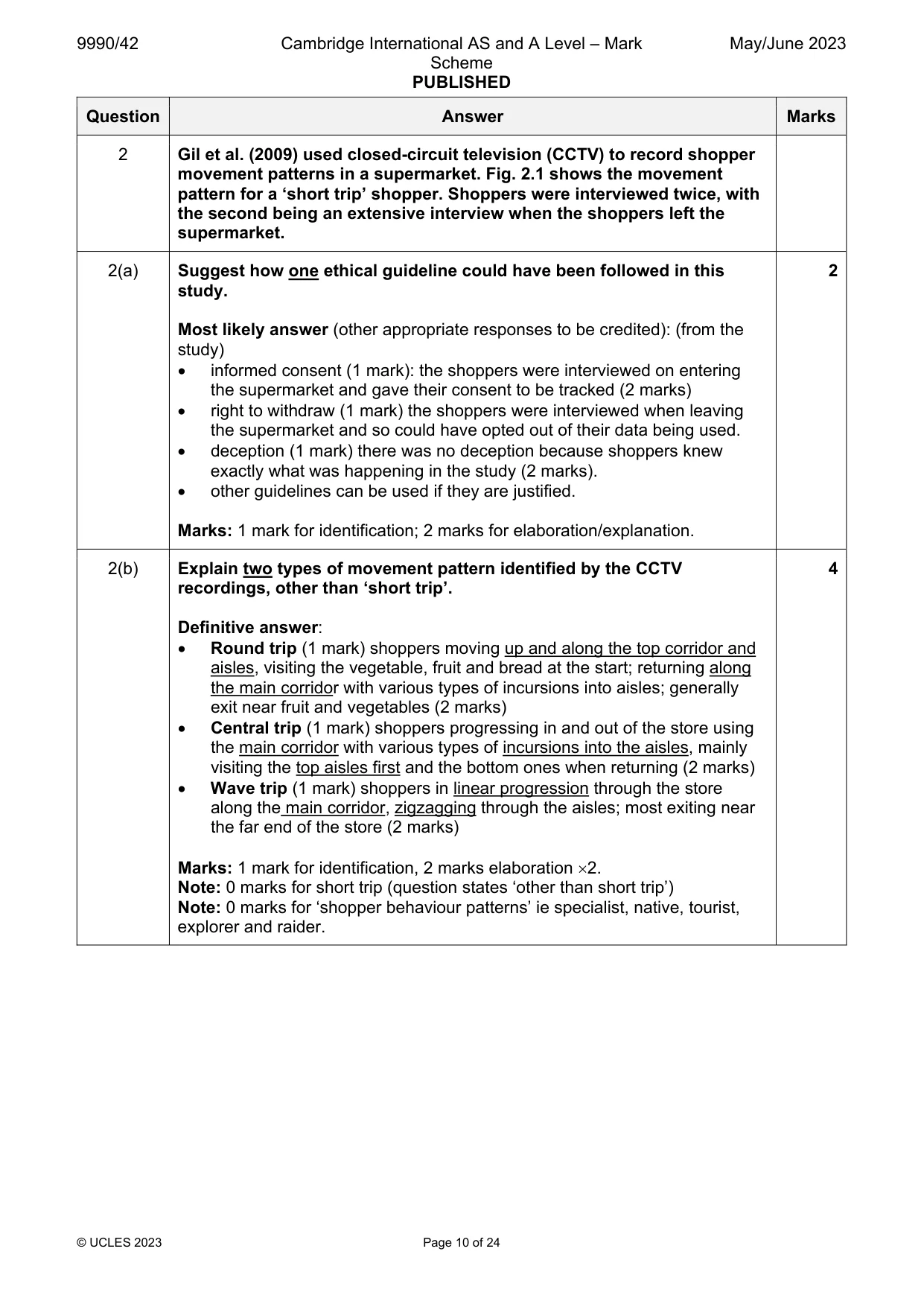
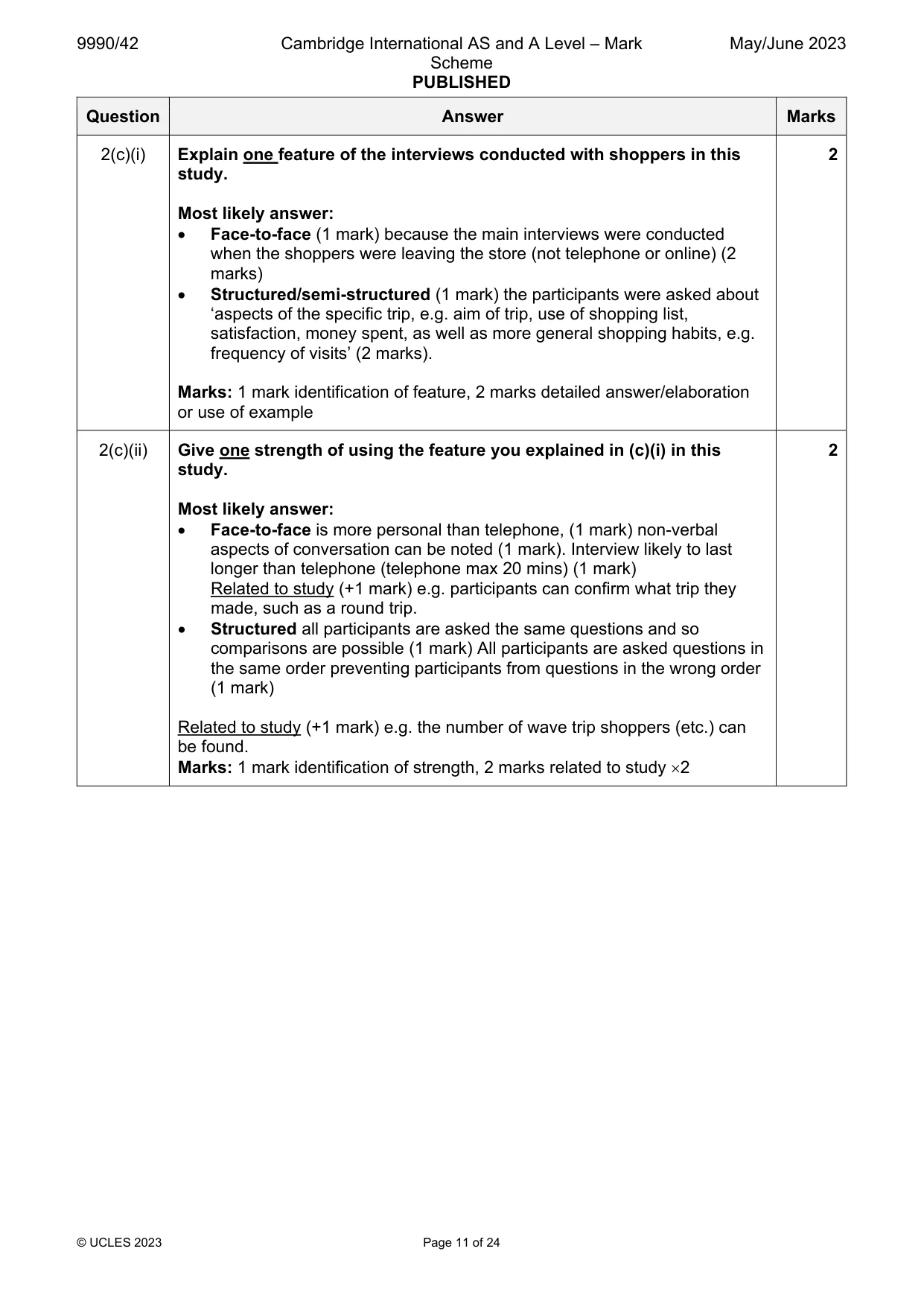
Mark scheme: 2 Gil et al. (2009) used closed-circuit television (CCTV) to record shopper movement patterns in a supermarket. Fig. 2.1 shows the movement pattern for a ‘short trip’ shopper. Shoppers were interviewed twice, with the second being an extensive interview when the shoppers left the supermarket. 2(a) Suggest how one ethical guideline could have been followed in this 2 study. Most likely answer (other appropriate responses to be credited): (from the study) informed consent (1 mark): the shoppers were interviewed on entering the supermarket and gave their consent to be tracked (2 marks) right to withdraw (1 mark) the shoppers were interviewed when leaving the supermarket and so could have opted out of their data being used. deception (1 mark) there was no deception because shoppers knew exactly what was happening in the study (2 marks). other guidelines can be used if they are justified. Marks: 1 mark for identification; 2 marks for elaboration/explanation. 2(b) Explain two types of movement pattern identified by the CCTV 4 recordings, other than ‘short trip’. Definitive answer: Round trip (1 mark) shoppers moving up and along the top corridor and aisles, visiting the vegetable, fruit and bread at the start; returning along the main corridor with various types of incursions into aisles; generally exit near fruit and vegetables (2 marks) Central trip (1 mark) shoppers progressing in and out of the store using the main corridor with various types of incursions into the aisles, mainly visiting the top aisles first and the bottom ones when returning (2 marks) Wave trip (1 mark) shoppers in linear progression through the store along the main corridor, zigzagging through the aisles; most exiting near the far end of the store (2 marks) Marks: 1 mark for identification, 2 marks elaboration 2. Note: 0 marks for short trip (question states ‘other than short trip’) Note: 0 marks for ‘shopper behaviour patterns’ ie specialist, native, tourist, explorer and raider. 2(c)(i) Explain one feature of the interviews conducted with shoppers in this 2 study. Most likely answer: Face-to-face (1 mark) because the main interviews were conducted when the shoppers were leaving the store (not telephone or online) (2 marks) Structured/semi-structured (1 mark) the participants were asked about ‘aspects of the specific trip, e.g. aim of trip, use of shopping list, satisfaction, money spent, as well as more general shopping habits, e.g. frequency of visits’ (2 marks). Marks: 1 mark identification of feature, 2 marks detailed answer/elaboration or use of example 2(c)(ii) Give one strength of using the feature you explained in (c)(i) in this 2 study. Most likely answer: Face-to-face is more personal than telephone, (1 mark) non-verbal aspects of conversation can be noted (1 mark). Interview likely to last longer than telephone (telephone max 20 mins) (1 mark) Related to study (+1 mark) e.g. participants can confirm what trip they made, such as a round trip. Structured all participants are asked the same questions and so comparisons are possible (1 mark) All participants are asked questions in the same order preventing participants from questions in the wrong order (1 mark) Related to study (+1 mark) e.g. the number of wave trip shoppers (etc.) can be found. Marks: 1 mark identification of strength, 2 marks related to study 2 2(d) Discuss the strengths and weaknesses of using CCTV to investigate 5 shopper behaviour. You should include a conclusion in your answer. Most likely answer (other appropriate responses to be credited, such as eye movement patterns): Strengths a CCTV observation means the person may be unaware they are being observed and so behaves naturally CCTV recordings of behaviour are objective CCTV observations can have more than one observer so reliability of observations can be checked Weaknesses a CCTV observation where cameras are fixed may mean that an observer misses a behaviour (person being observed moves out of view) a CCTV camera has a limited panorama a CCTV camera may not be of good quality not 1080p If observing behaviour by CCTV only, what is said may not be recorded Conclusion: any appropriate conclusion drawn from the discussion that has been presented. 1 mark if appropriate. A conclusion is a ‘decision reached by reasoning’ and so a summary of points already made scores 0 marks. Marks: Question requires discussion; always plural of each argument, and always requires conclusion. 1 mark for each advantage/disadvantage (however detailed) and related to the question up to 4 max. 2 marks max for two strengths/weaknesses unrelated to the question. 1 mark for conclusion.
Q3 · Using a sample of 3000 healthy men aged 39–59, Friedman and Rosenman (1974) found that…
3 Using a sample of 3000 healthy men aged 39–59, Friedman and Rosenman (1974) found that those men with a Type A personality experienced more stress-related ill-health over a period of nine years than men with a Type B personality. (a) Explain one physiological effect that stress may have on health. [2] (b) Explain two characteristics of a Type A personality. [4] (c) Suggest two causes of stress, other than personality. [4] (d) Discuss the strengths and weaknesses of conducting longitudinal studies to measure stress. You should include a conclusion in your answer. [5] Psychology and organisations
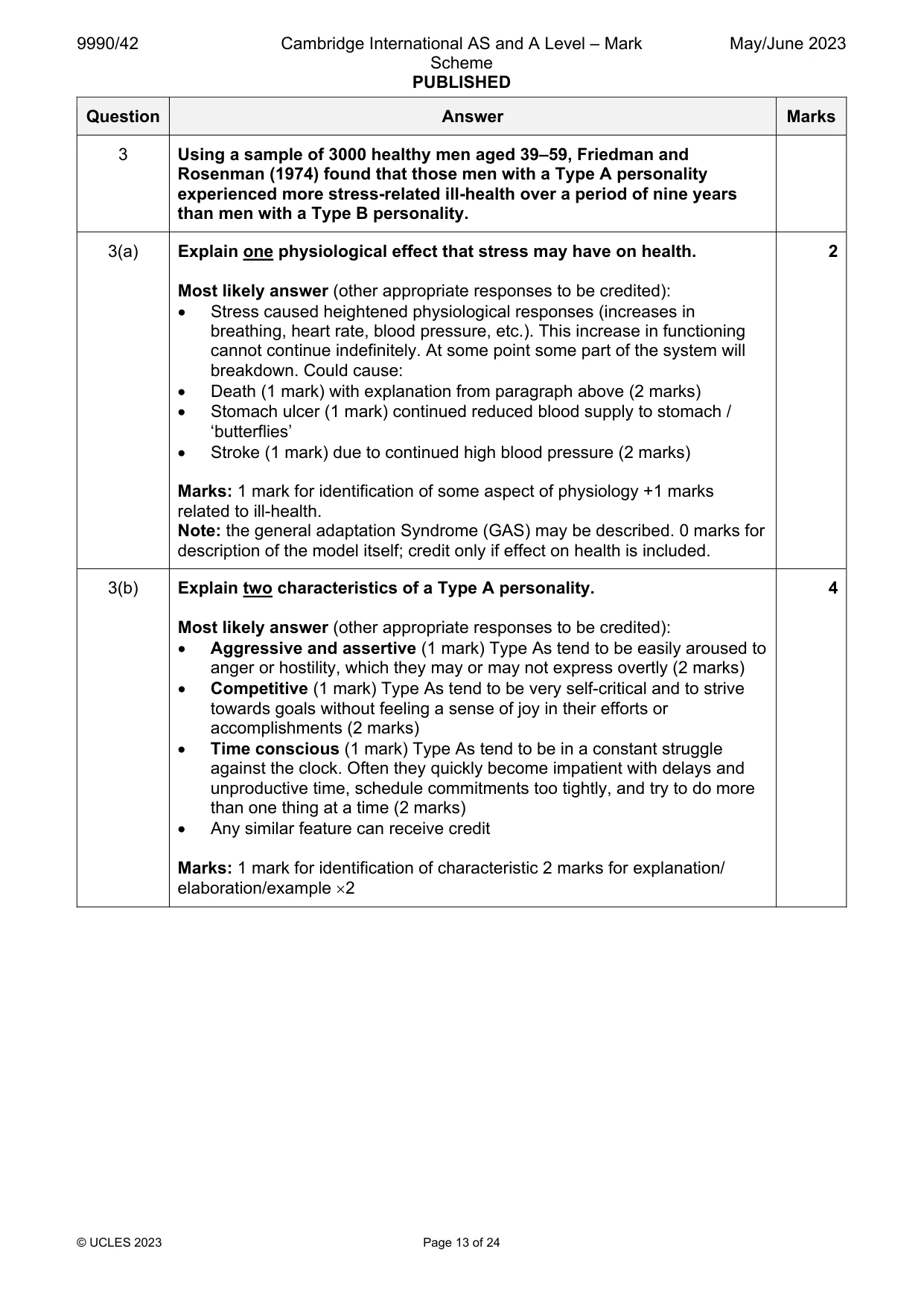
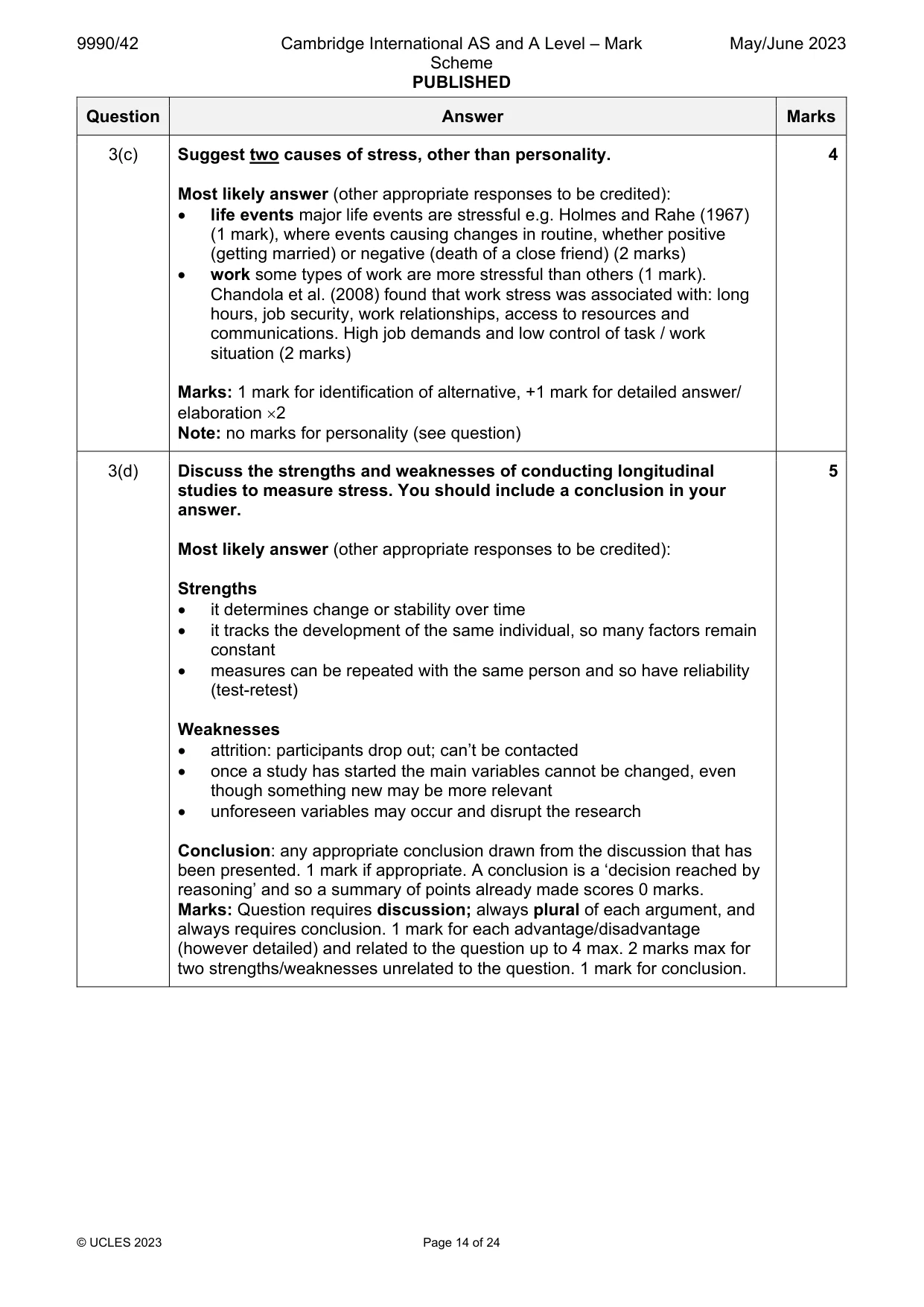
Mark scheme: 3 Using a sample of 3000 healthy men aged 39–59, Friedman and Rosenman (1974) found that those men with a Type A personality experienced more stress-related ill-health over a period of nine years than men with a Type B personality. 3(a) Explain one physiological effect that stress may have on health. 2 Most likely answer (other appropriate responses to be credited): Stress caused heightened physiological responses (increases in breathing, heart rate, blood pressure, etc.). This increase in functioning cannot continue indefinitely. At some point some part of the system will breakdown. Could cause: Death (1 mark) with explanation from paragraph above (2 marks) Stomach ulcer (1 mark) continued reduced blood supply to stomach / ‘butterflies’ Stroke (1 mark) due to continued high blood pressure (2 marks) Marks: 1 mark for identification of some aspect of physiology +1 marks related to ill-health. Note: the general adaptation Syndrome (GAS) may be described. 0 marks for description of the model itself; credit only if effect on health is included. 3(b) Explain two characteristics of a Type A personality. 4 Most likely answer (other appropriate responses to be credited): Aggressive and assertive (1 mark) Type As tend to be easily aroused to anger or hostility, which they may or may not express overtly (2 marks) Competitive (1 mark) Type As tend to be very self-critical and to strive towards goals without feeling a sense of joy in their efforts or accomplishments (2 marks) Time conscious (1 mark) Type As tend to be in a constant struggle against the clock. Often they quickly become impatient with delays and unproductive time, schedule commitments too tightly, and try to do more than one thing at a time (2 marks) Any similar feature can receive credit Marks: 1 mark for identification of characteristic 2 marks for explanation/ elaboration/example 2 3(c) Suggest two causes of stress, other than personality. 4 Most likely answer (other appropriate responses to be credited): life events major life events are stressful e.g. Holmes and Rahe (1967) (1 mark), where events causing changes in routine, whether positive (getting married) or negative (death of a close friend) (2 marks) work some types of work are more stressful than others (1 mark). Chandola et al. (2008) found that work stress was associated with: long hours, job security, work relationships, access to resources and communications. High job demands and low control of task / work situation (2 marks) Marks: 1 mark for identification of alternative, +1 mark for detailed answer/ elaboration 2 Note: no marks for personality (see question) 3(d) Discuss the strengths and weaknesses of conducting longitudinal 5 studies to measure stress. You should include a conclusion in your answer. Most likely answer (other appropriate responses to be credited): Strengths it determines change or stability over time it tracks the development of the same individual, so many factors remain constant measures can be repeated with the same person and so have reliability (test-retest) Weaknesses attrition: participants drop out; can’t be contacted once a study has started the main variables cannot be changed, even though something new may be more relevant unforeseen variables may occur and disrupt the research Conclusion: any appropriate conclusion drawn from the discussion that has been presented. 1 mark if appropriate. A conclusion is a ‘decision reached by reasoning’ and so a summary of points already made scores 0 marks. Marks: Question requires discussion; always plural of each argument, and always requires conclusion. 1 mark for each advantage/disadvantage (however detailed) and related to the question up to 4 max. 2 marks max for two strengths/weaknesses unrelated to the question. 1 mark for conclusion.
Q4 · Blau and Boal (1987) proposed a model to explain how job involvement and organisational…
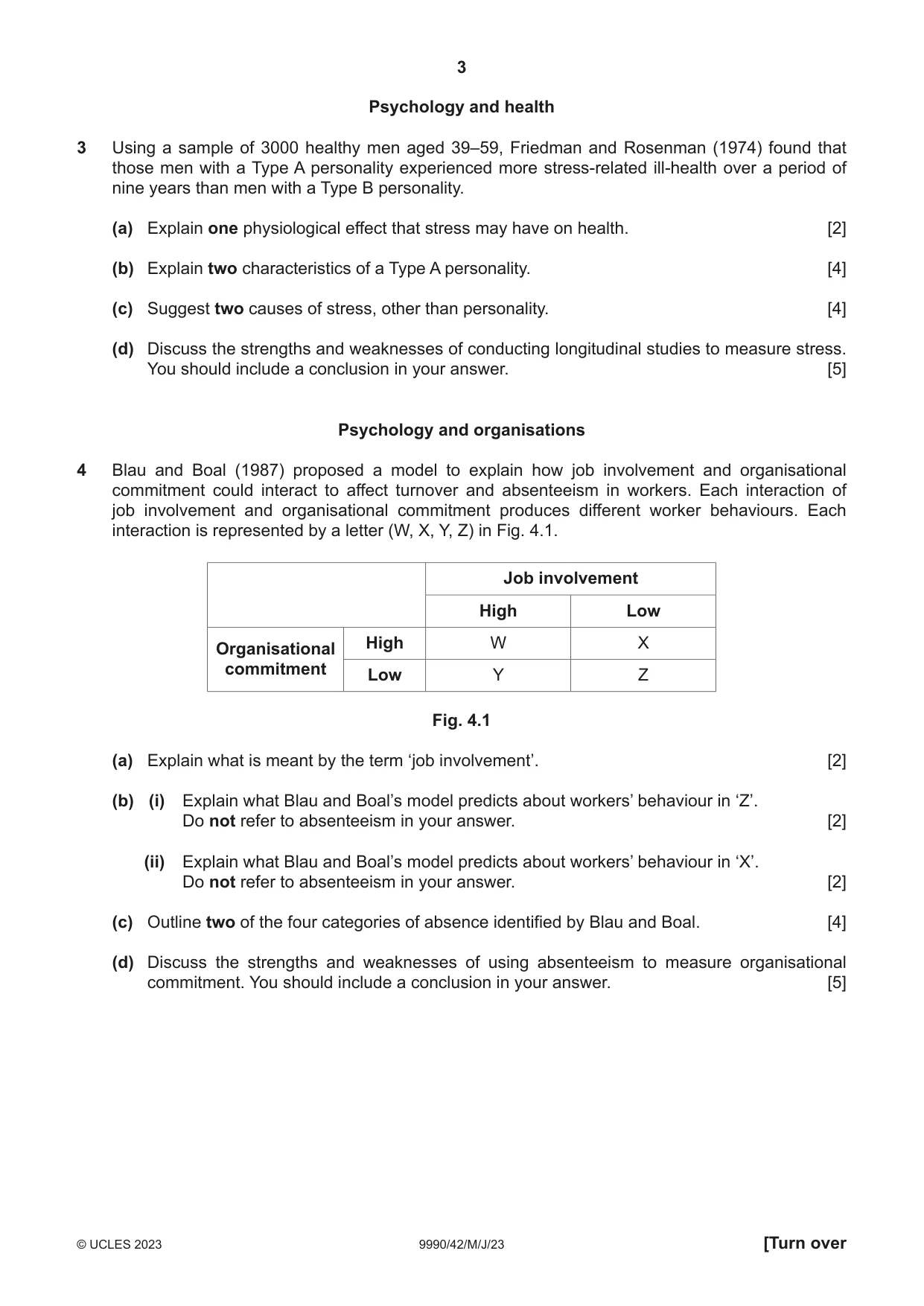
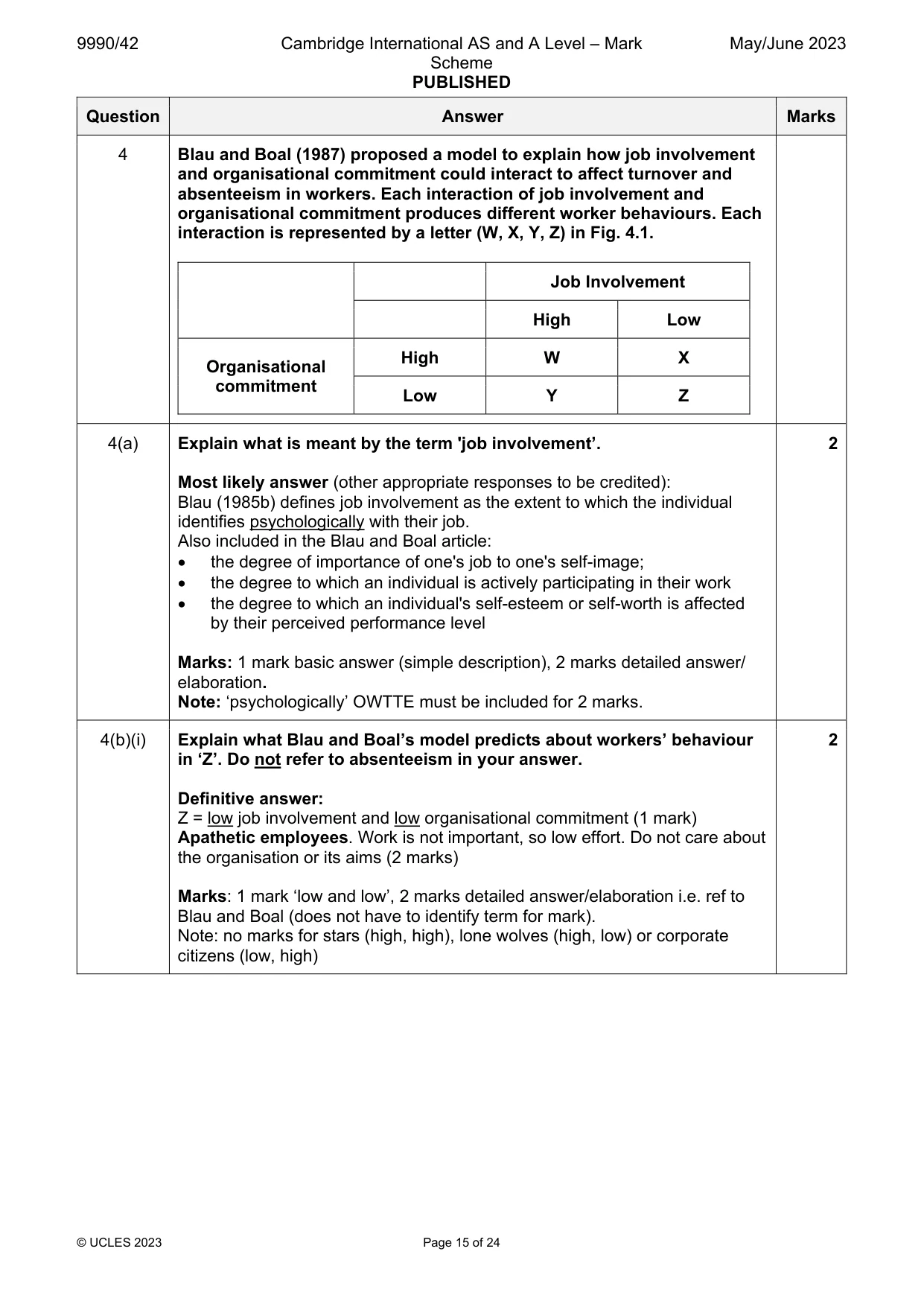
4 Blau and Boal (1987) proposed a model to explain how job involvement and organisational commitment could interact to affect turnover and absenteeism in workers. Each interaction of job involvement and organisational commitment produces different worker behaviours. Each interaction is represented by a letter (W, X, Y, Z) in Fig. 4.1. Job involvement High Low High W X Organisational commitment Low Y Z Fig. 4.1 (a) Explain what is meant by the term ‘job involvement’. [2] (b) (i) Explain what Blau and Boal’s model predicts about workers’ behaviour in ‘Z’. Do not refer to absenteeism in your answer. [2] (ii) Explain what Blau and Boal’s model predicts about workers’ behaviour in ‘X’. Do not refer to absenteeism in your answer. [2] (c) Outline two of the four categories of absence identified by Blau and Boal. [4] (d) Discuss the strengths and weaknesses of using absenteeism to measure organisational commitment. You should include a conclusion in your answer. [5]
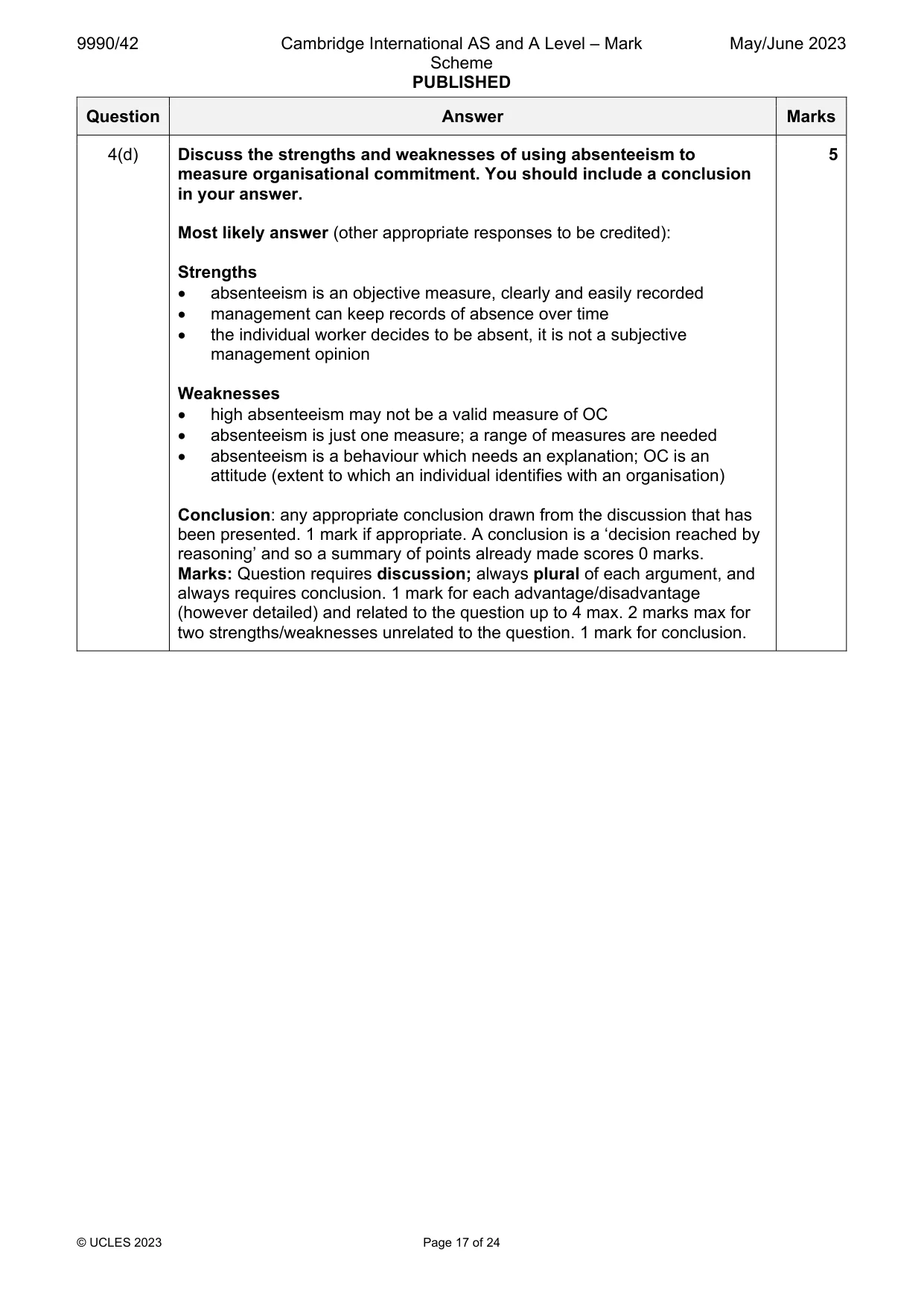
Mark scheme: 4 Blau and Boal (1987) proposed a model to explain how job involvement and organisational commitment could interact to affect turnover and absenteeism in workers. Each interaction of job involvement and organisational commitment produces different worker behaviours. Each interaction is represented by a letter (W, X, Y, Z) in Fig. 4.1. Job Involvement High Low High W X Organisational commitment Low Y Z 4(a) Explain what is meant by the term 'job involvement’. 2 Most likely answer (other appropriate responses to be credited): Blau (1985b) defines job involvement as the extent to which the individual identifies psychologically with their job. Also included in the Blau and Boal article: the degree of importance of one's job to one's self-image; the degree to which an individual is actively participating in their work the degree to which an individual's self-esteem or self-worth is affected by their perceived performance level Marks: 1 mark basic answer (simple description), 2 marks detailed answer/ elaboration. Note: ‘psychologically’ OWTTE must be included for 2 marks. 4(b)(i) Explain what Blau and Boal’s model predicts about workers’ behaviour 2 in ‘Z’. Do not refer to absenteeism in your answer. Definitive answer: Z = low job involvement and low organisational commitment (1 mark) Apathetic employees. Work is not important, so low effort. Do not care about the organisation or its aims (2 marks) Marks: 1 mark ‘low and low’, 2 marks detailed answer/elaboration i.e. ref to Blau and Boal (does not have to identify term for mark). Note: no marks for stars (high, high), lone wolves (high, low) or corporate citizens (low, high) 4(b)(ii) Explain what Blau and Boal’s model predicts about workers’ behaviour 2 in ‘X’. Do not refer to absenteeism in your answer. Definitive answer: X = low job involvement and high organisational commitment (1 mark) corporate citizens: for these workers work is not personally important to them, but they identify with the organisation and its goals (2 marks) Marks: 1 mark ’low and high’, 2 marks detailed answer/elaboration i.e. ref to Blau and Boal (does not have to identify term for mark). Note: no marks for stars (high, high), lone wolves (high, low) or apathetic employees (low, low) 4(c) Outline two of the four categories of absence identified by Blau and 4 Boal. Most likely answer (other appropriate responses to be credited): Medical (1 mark) (high JI and high OC): response to various infrequent and uncontrollable events such as illness, injury, funeral leave, and family demands (sick spouse or child). For the organisation this is sporadically occurring, excused absence. (2 marks) Career-enhancing (1 mark) (high JI and low OC): absence is depicted as a mechanism that allows the employee to further task- and career-related goals (2 marks) Normative (1 mark) (low JI and high OC): absence is viewed less as a motivated behaviour and more as a habitual response. Rather than absenteeism being random, as with the medical category, definite patterns will emerge and be predictable (2 marks) Calculative (1 mark) (low JI and low OC): absence would be (for the most apathetic worker) the maximum permitted amount of excused and unexcused absences by the organisation before sanctions (such as warnings or termination of employment) are applied (2 marks) Marks: 1 mark basic answer, 2 marks detailed answer/elaboration 2 Note: some texts use ‘voluntary and involuntary’ terms not used by Blau and Boal. Award 1 mark for identification of ‘voluntary’ or ‘involuntary’. Award 1 mark for identification of both these terms. Max 2 marks overall, so award +1 mark for correct elaboration (i.e. relates to one of Blau and Boal’s categories) of either term. Note: 0 marks for anecdotal answers e.g. ‘they are ill’ or has no category identified. 4(d) Discuss the strengths and weaknesses of using absenteeism to 5 measure organisational commitment. You should include a conclusion in your answer. Most likely answer (other appropriate responses to be credited): Strengths absenteeism is an objective measure, clearly and easily recorded management can keep records of absence over time the individual worker decides to be absent, it is not a subjective management opinion Weaknesses high absenteeism may not be a valid measure of OC absenteeism is just one measure; a range of measures are needed absenteeism is a behaviour which needs an explanation; OC is an attitude (extent to which an individual identifies with an organisation) Conclusion: any appropriate conclusion drawn from the discussion that has been presented. 1 mark if appropriate. A conclusion is a ‘decision reached by reasoning’ and so a summary of points already made scores 0 marks. Marks: Question requires discussion; always plural of each argument, and always requires conclusion. 1 mark for each advantage/disadvantage (however detailed) and related to the question up to 4 max. 2 marks max for two strengths/weaknesses unrelated to the question. 1 mark for conclusion.
Q5 · Design a study using observation to investigate the frequency of the characteristics of…
5 (a) Design a study using observation to investigate the frequency of the characteristics of schizophrenia spectrum and psychotic disorders. [10] (b) Explain the psychological and methodological evidence on which your study is based. [8] Psychology and consumer behaviour
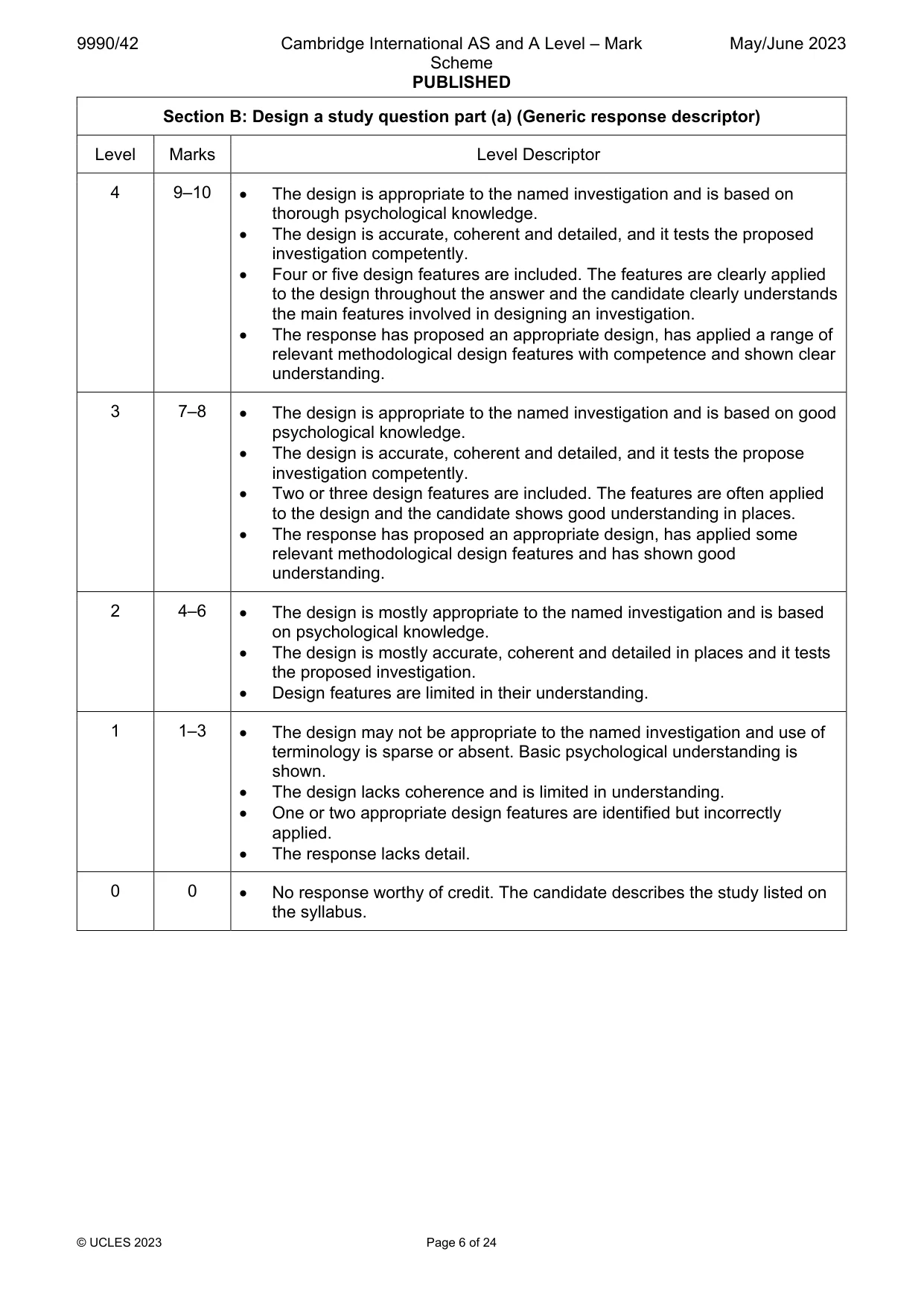
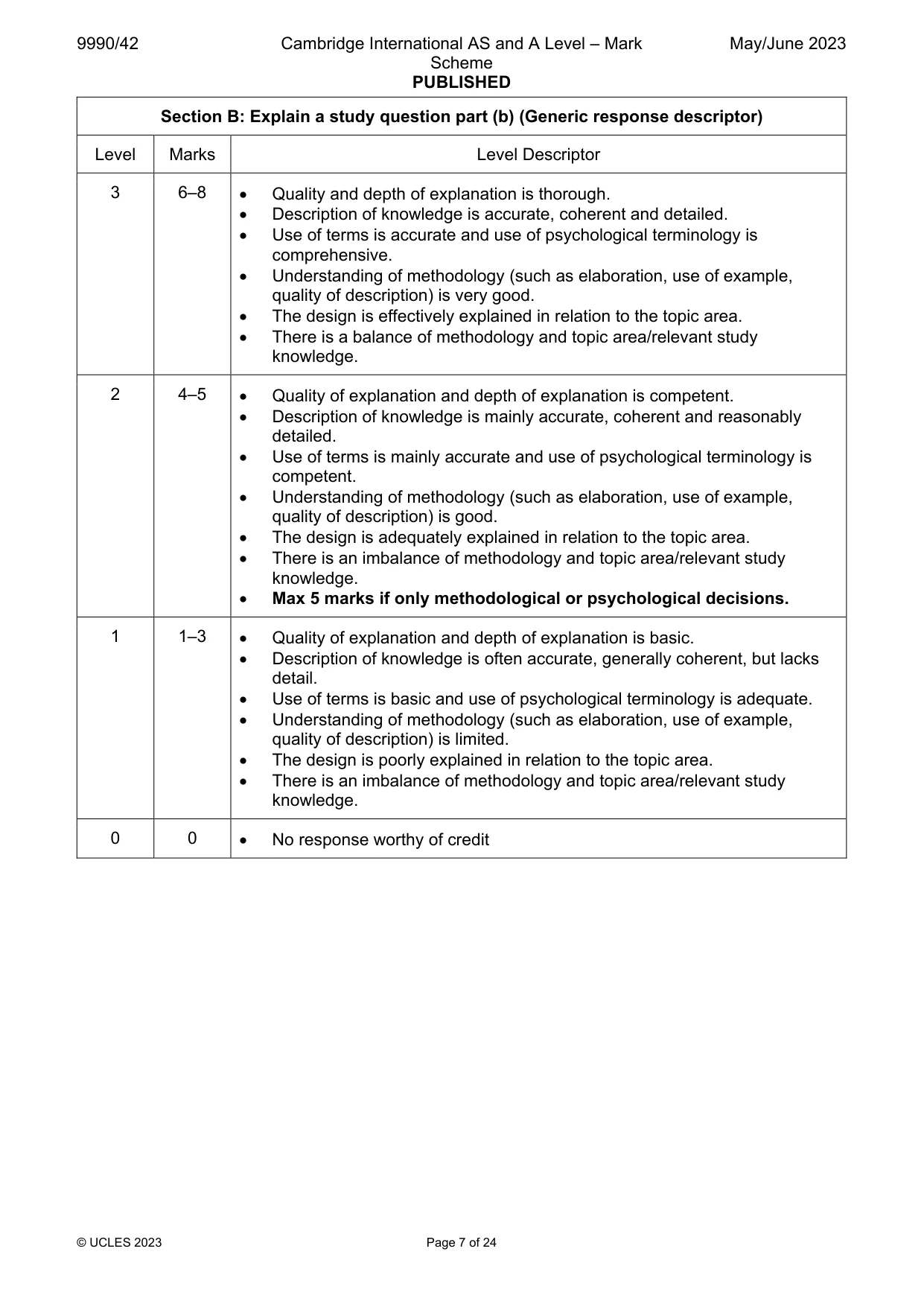
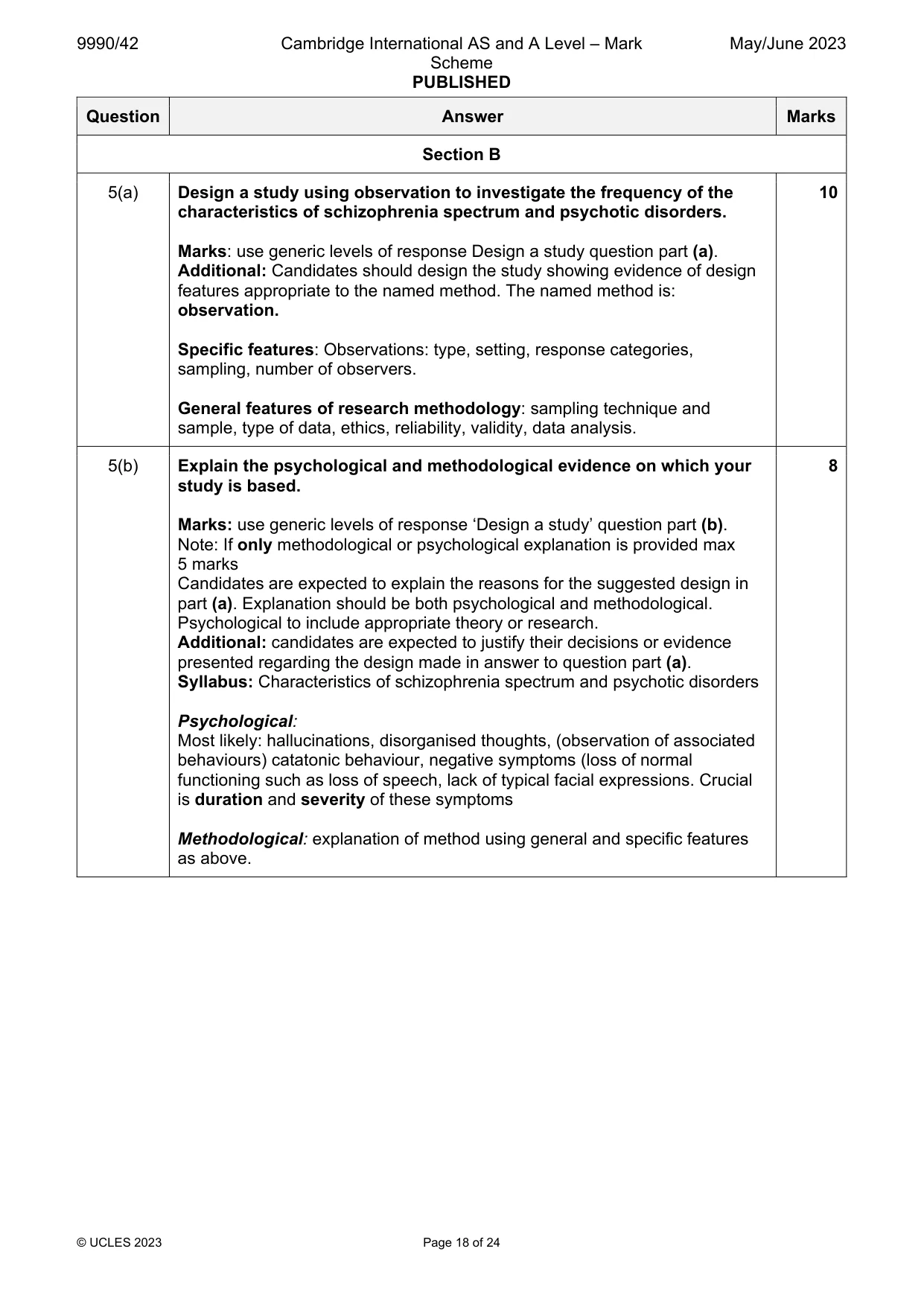
Mark scheme: 5(a) Design a study using observation to investigate the frequency of the 10 characteristics of schizophrenia spectrum and psychotic disorders. Marks: use generic levels of response Design a study question part (a). Additional: Candidates should design the study showing evidence of design features appropriate to the named method. The named method is: observation. Specific features: Observations: type, setting, response categories, sampling, number of observers. General features of research methodology: sampling technique and sample, type of data, ethics, reliability, validity, data analysis. 5(b) Explain the psychological and methodological evidence on which your 8 study is based. Marks: use generic levels of response ‘Design a study’ question part (b). Note: If only methodological or psychological explanation is provided max 5 marks Candidates are expected to explain the reasons for the suggested design in part (a). Explanation should be both psychological and methodological. Psychological to include appropriate theory or research. Additional: candidates are expected to justify their decisions or evidence presented regarding the design made in answer to question part (a). Syllabus: Characteristics of schizophrenia spectrum and psychotic disorders Psychological: Most likely: hallucinations, disorganised thoughts, (observation of associated behaviours) catatonic behaviour, negative symptoms (loss of normal functioning such as loss of speech, lack of typical facial expressions. Crucial is duration and severity of these symptoms Methodological: explanation of method using general and specific features as above.
Q6 · Advertising can be made more effective using a slogan
6 Advertising can be made more effective using a slogan. Two kinds of slogans are ‘jingle slogans’ (slogans with music) and ‘non-jingle slogans’ (slogans without music). (a) Design a study to investigate whether jingle slogans are recalled significantly more than non-jingle slogans. [10] (b) Explain the psychological and methodological evidence on which your study is based. [8] Psychology and health
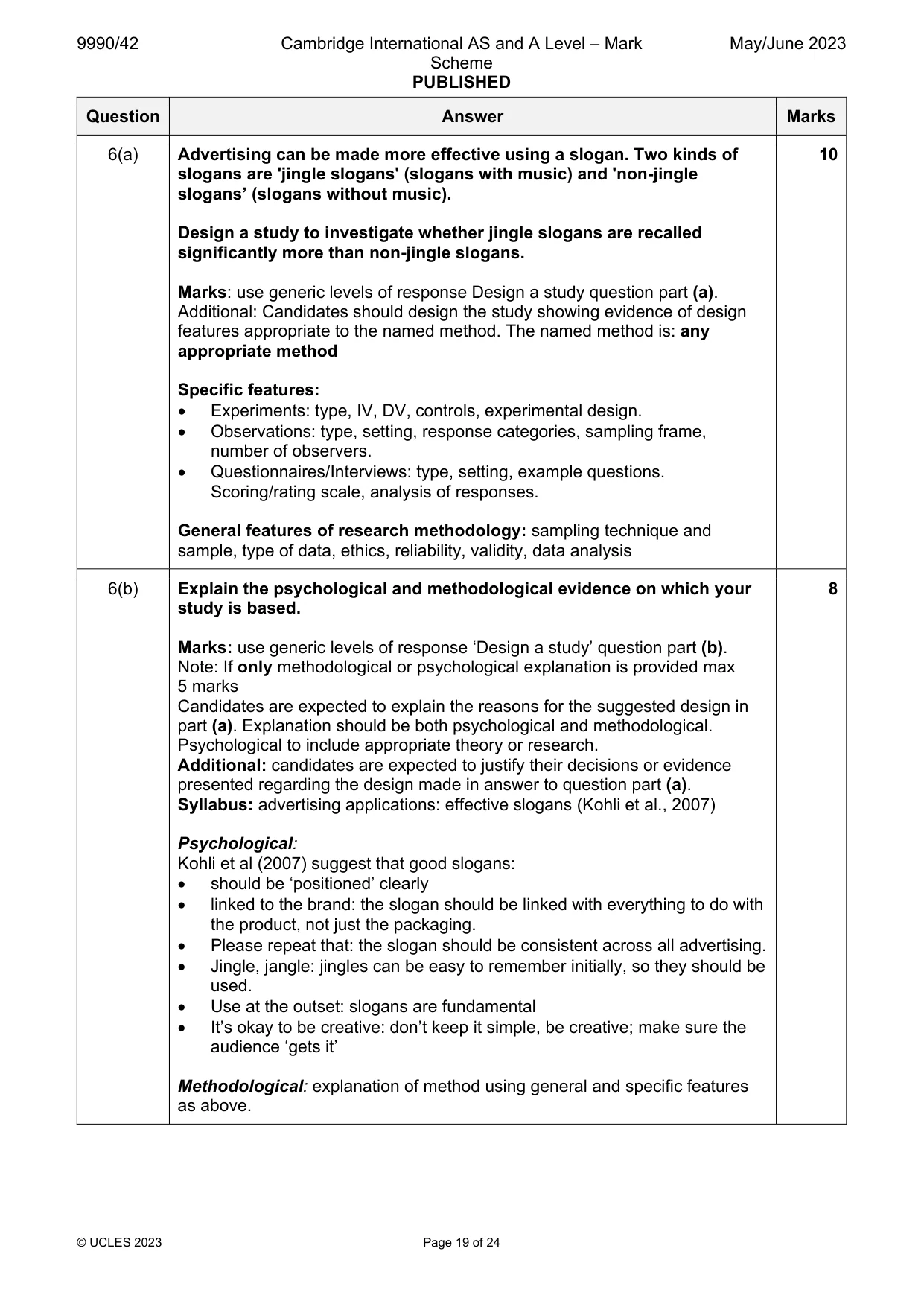
Mark scheme: 6(a) Advertising can be made more effective using a slogan. Two kinds of 10 slogans are 'jingle slogans' (slogans with music) and 'non-jingle slogans’ (slogans without music). Design a study to investigate whether jingle slogans are recalled significantly more than non-jingle slogans. Marks: use generic levels of response Design a study question part (a). Additional: Candidates should design the study showing evidence of design features appropriate to the named method. The named method is: any appropriate method Specific features: Experiments: type, IV, DV, controls, experimental design. Observations: type, setting, response categories, sampling frame, number of observers. Questionnaires/Interviews: type, setting, example questions. Scoring/rating scale, analysis of responses. General features of research methodology: sampling technique and sample, type of data, ethics, reliability, validity, data analysis 6(b) Explain the psychological and methodological evidence on which your 8 study is based. Marks: use generic levels of response ‘Design a study’ question part (b). Note: If only methodological or psychological explanation is provided max 5 marks Candidates are expected to explain the reasons for the suggested design in part (a). Explanation should be both psychological and methodological. Psychological to include appropriate theory or research. Additional: candidates are expected to justify their decisions or evidence presented regarding the design made in answer to question part (a). Syllabus: advertising applications: effective slogans (Kohli et al., 2007) Psychological: Kohli et al (2007) suggest that good slogans: should be ‘positioned’ clearly linked to the brand: the slogan should be linked with everything to do with the product, not just the packaging. Please repeat that: the slogan should be consistent across all advertising. Jingle, jangle: jingles can be easy to remember initially, so they should be used. Use at the outset: slogans are fundamental It’s okay to be creative: don’t keep it simple, be creative; make sure the audience ‘gets it’ Methodological: explanation of method using general and specific features as above.
Q7 · Design a study to investigate whether a stress-prevention technique is more effective for…
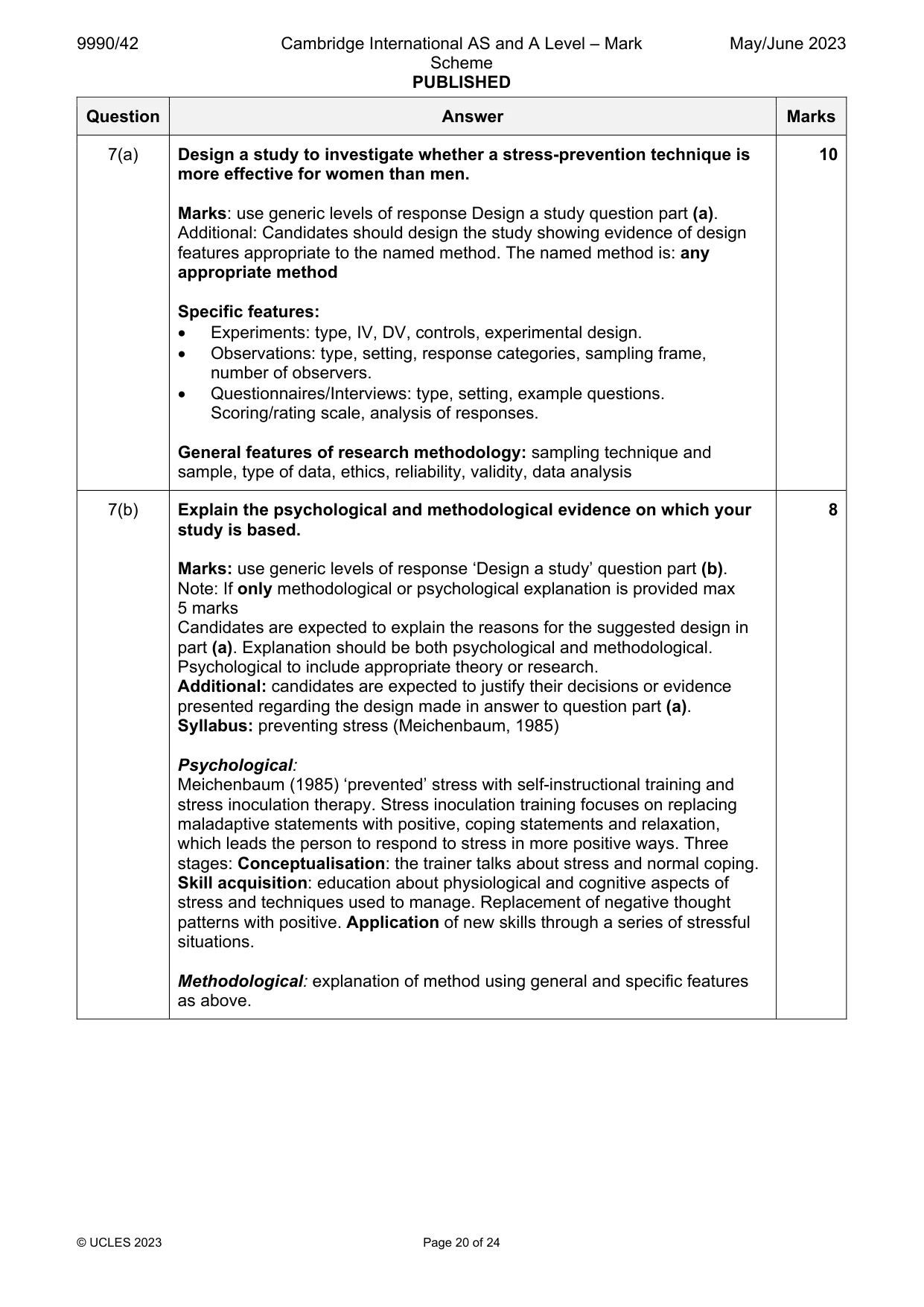
7 (a) Design a study to investigate whether a stress-prevention technique is more effective for women than men. [10] (b) Explain the psychological and methodological evidence on which your study is based. [8] Psychology and organisations
Mark scheme: 7(a) Design a study to investigate whether a stress-prevention technique is 10 more effective for women than men. Marks: use generic levels of response Design a study question part (a). Additional: Candidates should design the study showing evidence of design features appropriate to the named method. The named method is: any appropriate method Specific features: Experiments: type, IV, DV, controls, experimental design. Observations: type, setting, response categories, sampling frame, number of observers. Questionnaires/Interviews: type, setting, example questions. Scoring/rating scale, analysis of responses. General features of research methodology: sampling technique and sample, type of data, ethics, reliability, validity, data analysis 7(b) Explain the psychological and methodological evidence on which your 8 study is based. Marks: use generic levels of response ‘Design a study’ question part (b). Note: If only methodological or psychological explanation is provided max 5 marks Candidates are expected to explain the reasons for the suggested design in part (a). Explanation should be both psychological and methodological. Psychological to include appropriate theory or research. Additional: candidates are expected to justify their decisions or evidence presented regarding the design made in answer to question part (a). Syllabus: preventing stress (Meichenbaum, 1985) Psychological: Meichenbaum (1985) ‘prevented’ stress with self-instructional training and stress inoculation therapy. Stress inoculation training focuses on replacing maladaptive statements with positive, coping statements and relaxation, which leads the person to respond to stress in more positive ways. Three stages: Conceptualisation: the trainer talks about stress and normal coping. Skill acquisition: education about physiological and cognitive aspects of stress and techniques used to manage. Replacement of negative thought patterns with positive. Application of new skills through a series of stressful situations. Methodological: explanation of method using general and specific features as above.
Q8 · Design an experiment to investigate which is the more effective way to motivate workers…
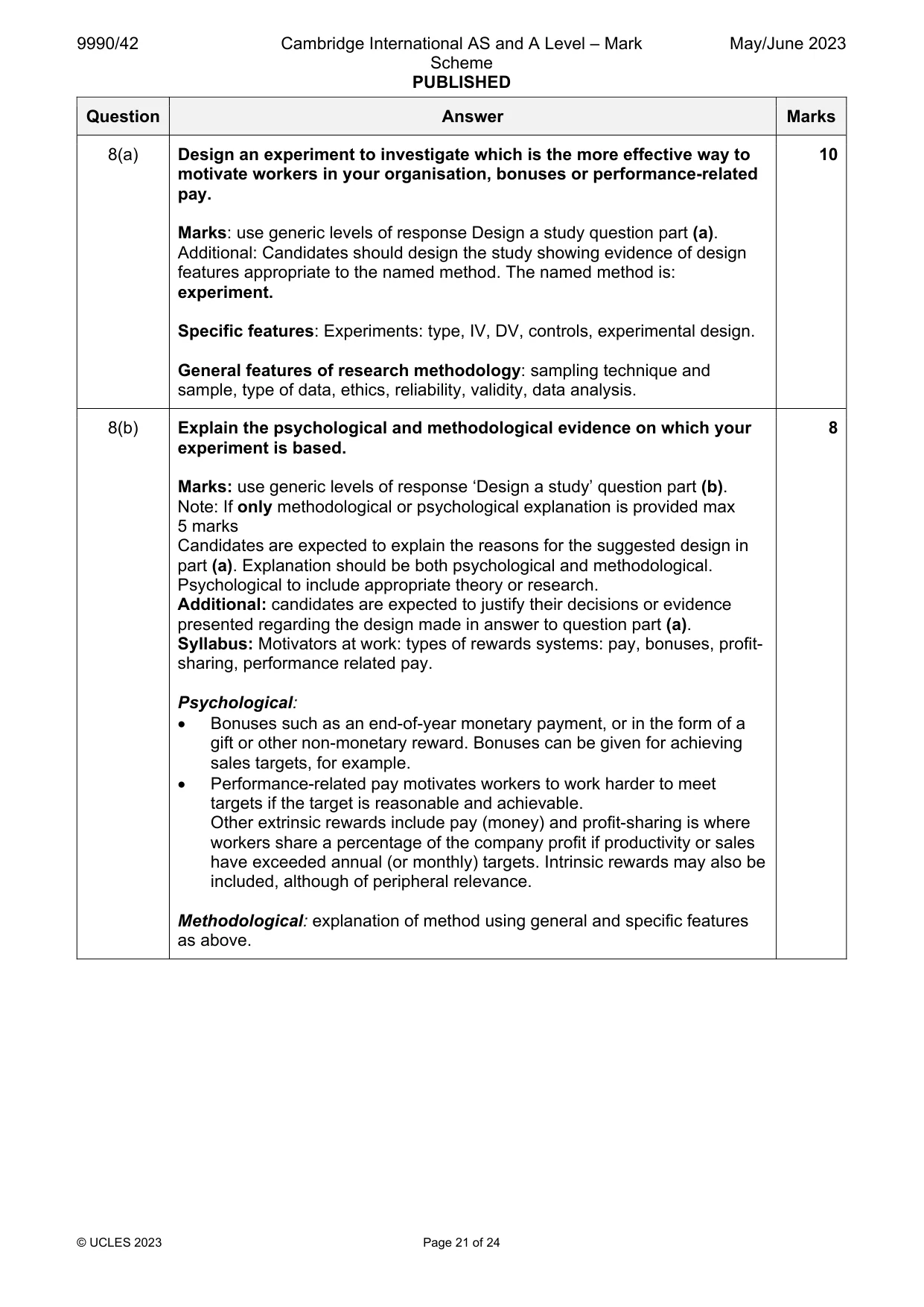
8 (a) Design an experiment to investigate which is the more effective way to motivate workers in your organisation, bonuses or performance-related pay. [10] (b) Explain the psychological and methodological evidence on which your experiment is based. [8] Section C You must answer one question from this section. Psychology and abnormality
Mark scheme: 8(a) Design an experiment to investigate which is the more effective way to 10 motivate workers in your organisation, bonuses or performance-related pay. Marks: use generic levels of response Design a study question part (a). Additional: Candidates should design the study showing evidence of design features appropriate to the named method. The named method is: experiment. Specific features: Experiments: type, IV, DV, controls, experimental design. General features of research methodology: sampling technique and sample, type of data, ethics, reliability, validity, data analysis. 8(b) Explain the psychological and methodological evidence on which your 8 experiment is based. Marks: use generic levels of response ‘Design a study’ question part (b). Note: If only methodological or psychological explanation is provided max 5 marks Candidates are expected to explain the reasons for the suggested design in part (a). Explanation should be both psychological and methodological. Psychological to include appropriate theory or research. Additional: candidates are expected to justify their decisions or evidence presented regarding the design made in answer to question part (a). Syllabus: Motivators at work: types of rewards systems: pay, bonuses, profit- sharing, performance related pay. Psychological: Bonuses such as an end-of-year monetary payment, or in the form of a gift or other non-monetary reward. Bonuses can be given for achieving sales targets, for example. Performance-related pay motivates workers to work harder to meet targets if the target is reasonable and achievable. Other extrinsic rewards include pay (money) and profit-sharing is where workers share a percentage of the company profit if productivity or sales have exceeded annual (or monthly) targets. Intrinsic rewards may also be included, although of peripheral relevance. Methodological: explanation of method using general and specific features as above.
Q9 · ‘All impulse control disorders are caused by high levels of dopamine.’ To what extent do…
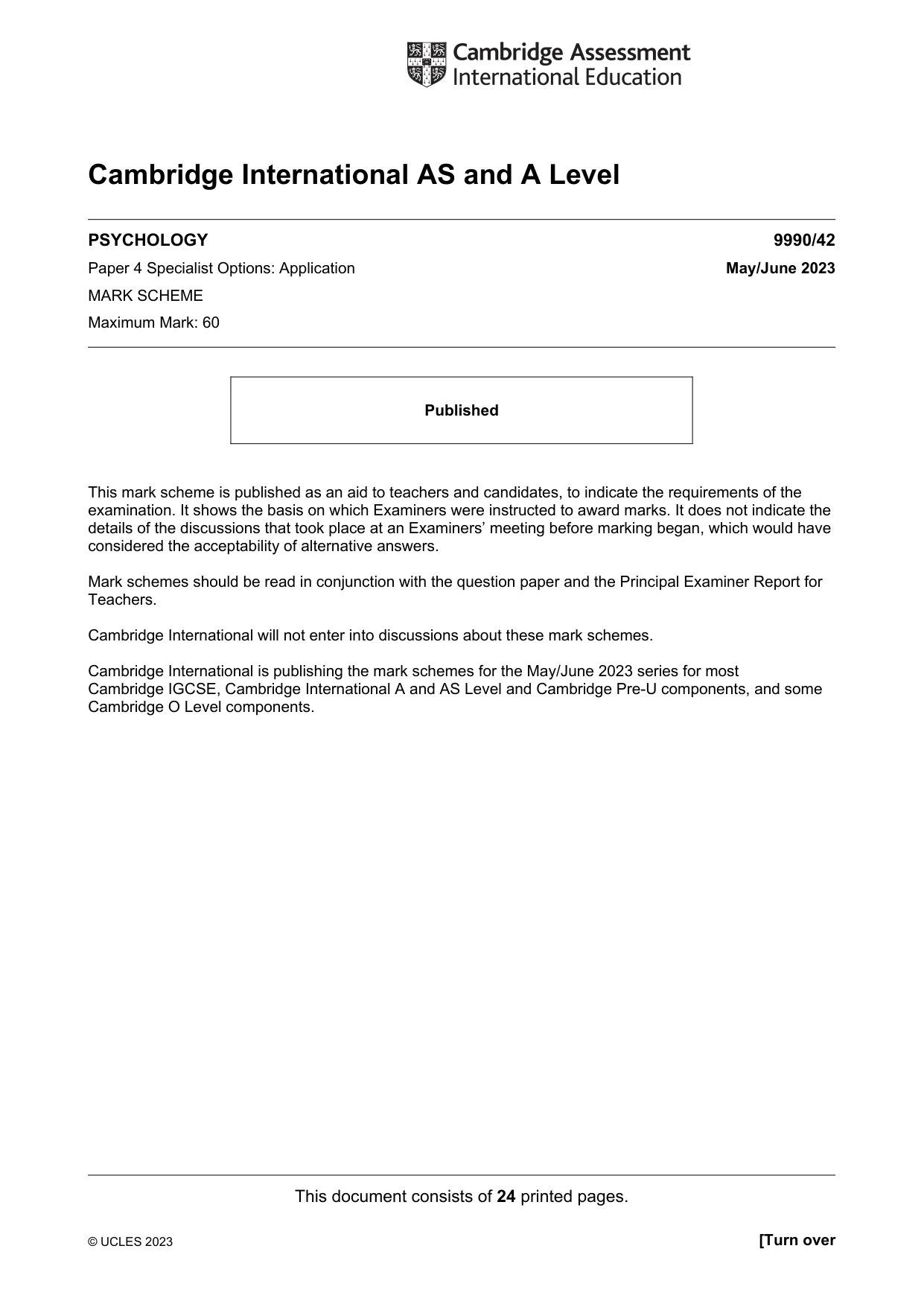
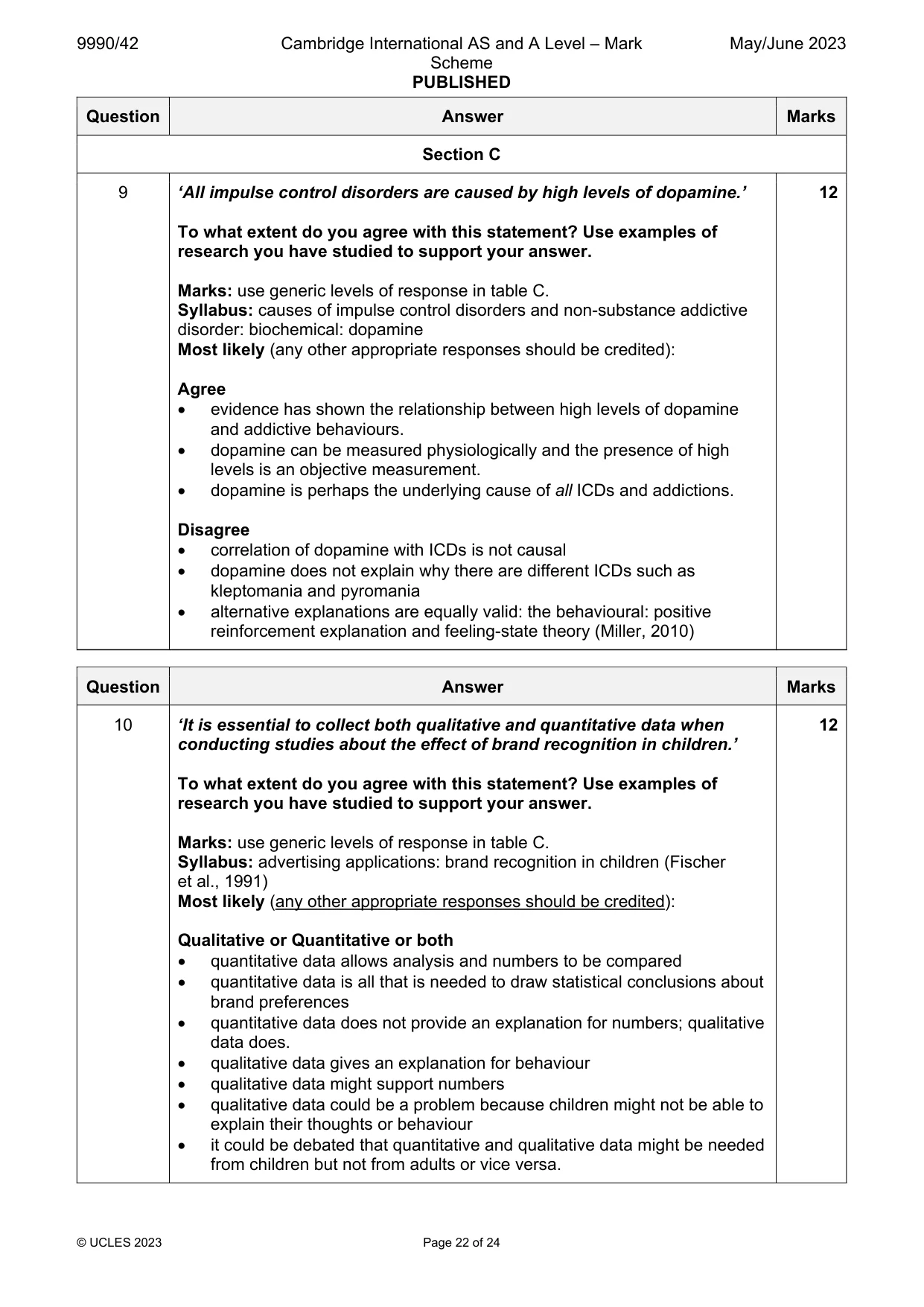
9 ‘All impulse control disorders are caused by high levels of dopamine.’ To what extent do you agree with this statement? Use examples of research you have studied to support your answer. [12] Psychology and consumer behaviour
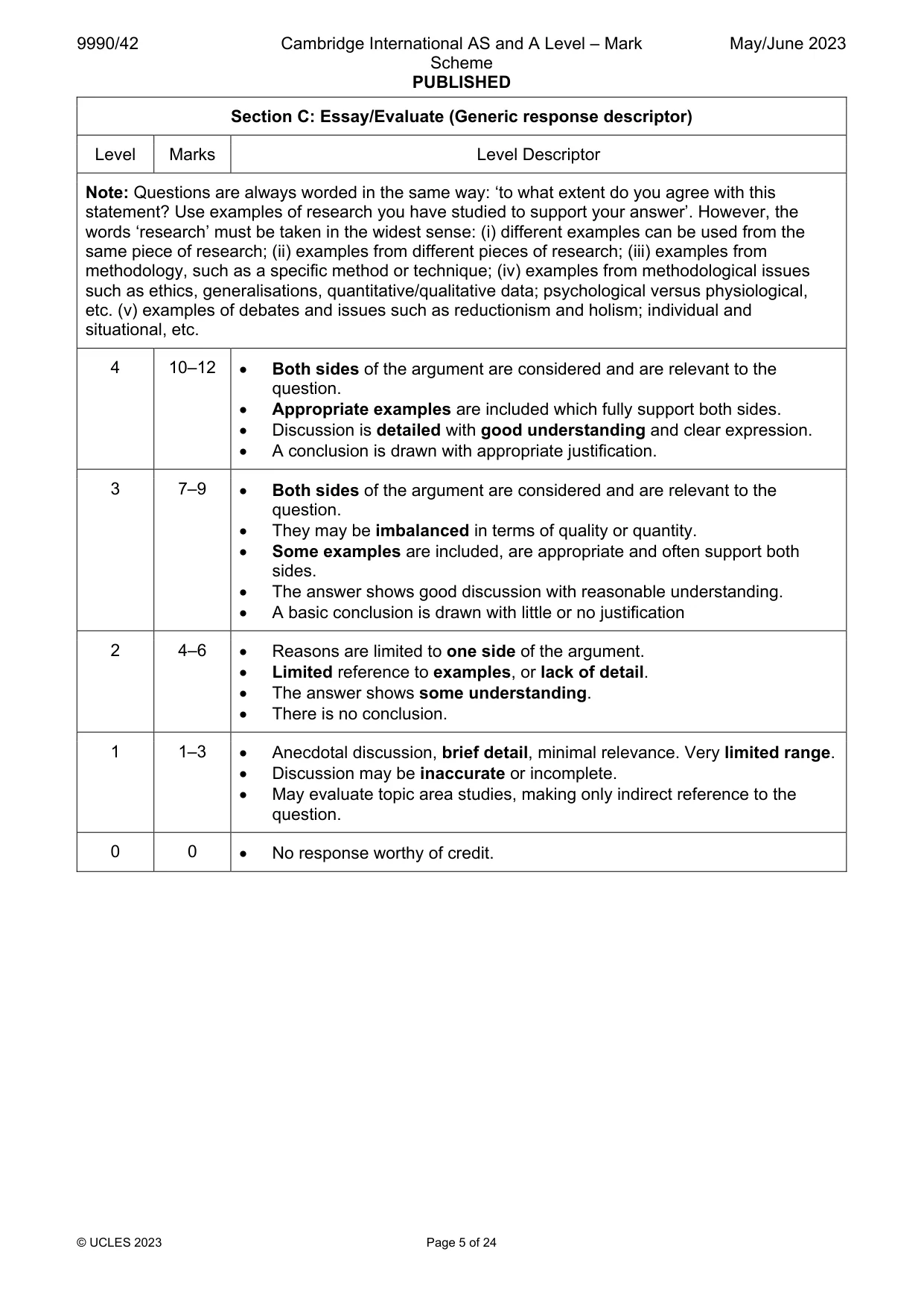
Mark scheme: 9 ‘All impulse control disorders are caused by high levels of dopamine.’ 12 To what extent do you agree with this statement? Use examples of research you have studied to support your answer. Marks: use generic levels of response in table C. Syllabus: causes of impulse control disorders and non-substance addictive disorder: biochemical: dopamine Most likely (any other appropriate responses should be credited): Agree evidence has shown the relationship between high levels of dopamine and addictive behaviours. dopamine can be measured physiologically and the presence of high levels is an objective measurement. dopamine is perhaps the underlying cause of all ICDs and addictions. Disagree correlation of dopamine with ICDs is not causal dopamine does not explain why there are different ICDs such as kleptomania and pyromania alternative explanations are equally valid: the behavioural: positive reinforcement explanation and feeling-state theory (Miller, 2010)
Q10 · ‘It is essential to collect both qualitative and quantitative data when conducting…
10 ‘It is essential to collect both qualitative and quantitative data when conducting studies about the effect of brand recognition in children.’ To what extent do you agree with this statement? Use examples of research you have studied to support your answer. [12] Psychology and health
Mark scheme: 10 ‘It is essential to collect both qualitative and quantitative data when 12 conducting studies about the effect of brand recognition in children.’ To what extent do you agree with this statement? Use examples of research you have studied to support your answer. Marks: use generic levels of response in table C. Syllabus: advertising applications: brand recognition in children (Fischer et al., 1991) Most likely (any other appropriate responses should be credited): Qualitative or Quantitative or both quantitative data allows analysis and numbers to be compared quantitative data is all that is needed to draw statistical conclusions about brand preferences quantitative data does not provide an explanation for numbers; qualitative data does. qualitative data gives an explanation for behaviour qualitative data might support numbers qualitative data could be a problem because children might not be able to explain their thoughts or behaviour it could be debated that quantitative and qualitative data might be needed from children but not from adults or vice versa.
Q11 · ‘A repeat prescription is the only accurate way to know that a person has adhered to a…
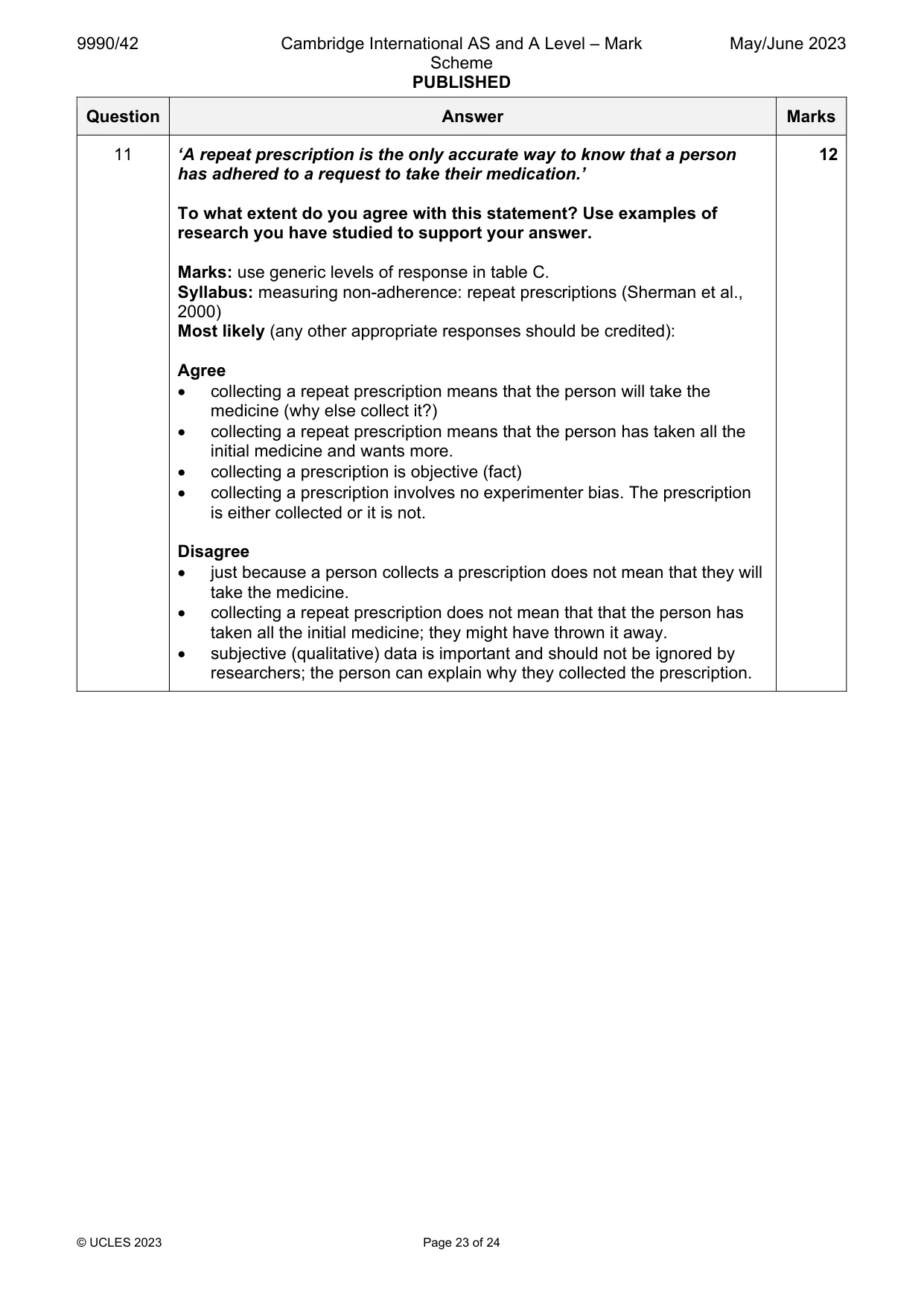
11 ‘A repeat prescription is the only accurate way to know that a person has adhered to a request to take their medication.’ To what extent do you agree with this statement? Use examples of research you have studied to support your answer. [12] Psychology and organisations
Mark scheme: 11 ‘A repeat prescription is the only accurate way to know that a person 12 has adhered to a request to take their medication.’ To what extent do you agree with this statement? Use examples of research you have studied to support your answer. Marks: use generic levels of response in table C. Syllabus: measuring non-adherence: repeat prescriptions (Sherman et al., 2000) Most likely (any other appropriate responses should be credited): Agree collecting a repeat prescription means that the person will take the medicine (why else collect it?) collecting a repeat prescription means that the person has taken all the initial medicine and wants more. collecting a prescription is objective (fact) collecting a prescription involves no experimenter bias. The prescription is either collected or it is not. Disagree just because a person collects a prescription does not mean that they will take the medicine. collecting a repeat prescription does not mean that that the person has taken all the initial medicine; they might have thrown it away. subjective (qualitative) data is important and should not be ignored by researchers; the person can explain why they collected the prescription.
Q12 · ‘Job satisfaction can only be assessed effectively using open-ended questions.’ To what…
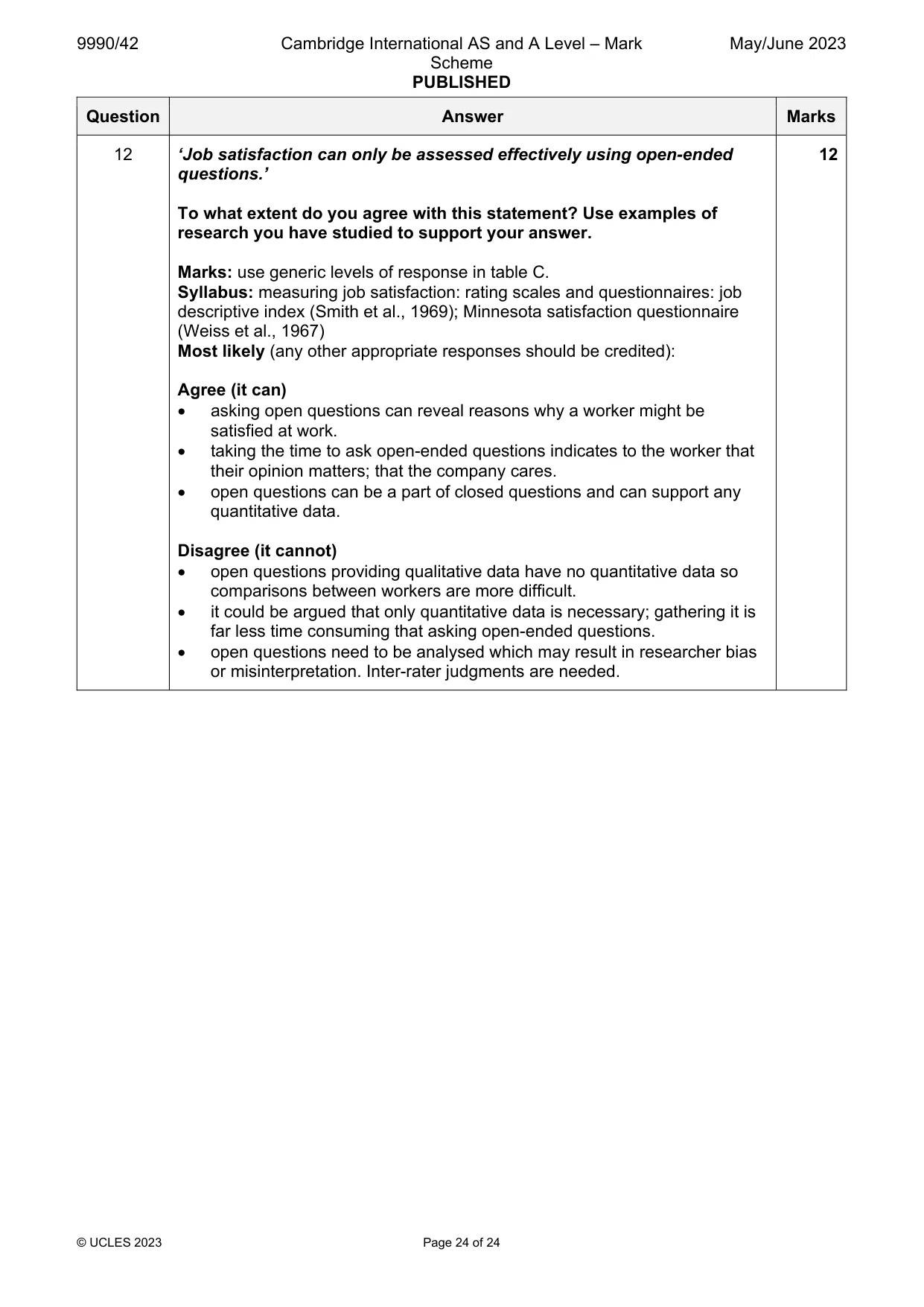
12 ‘Job satisfaction can only be assessed effectively using open-ended questions.’ To what extent do you agree with this statement? Use examples of research you have studied to support your answer. [12]
Mark scheme: 12 ‘Job satisfaction can only be assessed effectively using open-ended 12 questions.’ To what extent do you agree with this statement? Use examples of research you have studied to support your answer. Marks: use generic levels of response in table C. Syllabus: measuring job satisfaction: rating scales and questionnaires: job descriptive index (Smith et al., 1969); Minnesota satisfaction questionnaire (Weiss et al., 1967) Most likely (any other appropriate responses should be credited): Agree (it can) asking open questions can reveal reasons why a worker might be satisfied at work. taking the time to ask open-ended questions indicates to the worker that their opinion matters; that the company cares. open questions can be a part of closed questions and can support any quantitative data. Disagree (it cannot) open questions providing qualitative data have no quantitative data so comparisons between workers are more difficult. it could be argued that only quantitative data is necessary; gathering it is far less time consuming that asking open-ended questions. open questions need to be analysed which may result in researcher bias or misinterpretation. Inter-rater judgments are needed.
What was in this paper
The subtopics covered by these 12 questions, and how many questions each got. Open one in a new tab to see every Cambridge question on it.
What you needed in this session
Cambridge’s own grade thresholds for 2023 May/June, Paper 4 · Variant 2. A higher threshold means an easier paper — the bar moves with how the cohort did.