Cambridge A Level Psychology (from 2018) 9990 — 2021 May/June Paper 4 · Variant 2
9990/42/M/J/21 · 12 questions · 60 marks · ≈68 min
The question paper and its mark scheme, free to read here and free to download. This is Cambridge’s own paper, exactly as it was sat.
Question paper8 pages


Mark scheme25 pages
Answers below. Sit the paper first if you are practising.
Questions as text
Q1 · Three comments about electro-convulsive therapy (ECT): ‘It was the best thing that my…
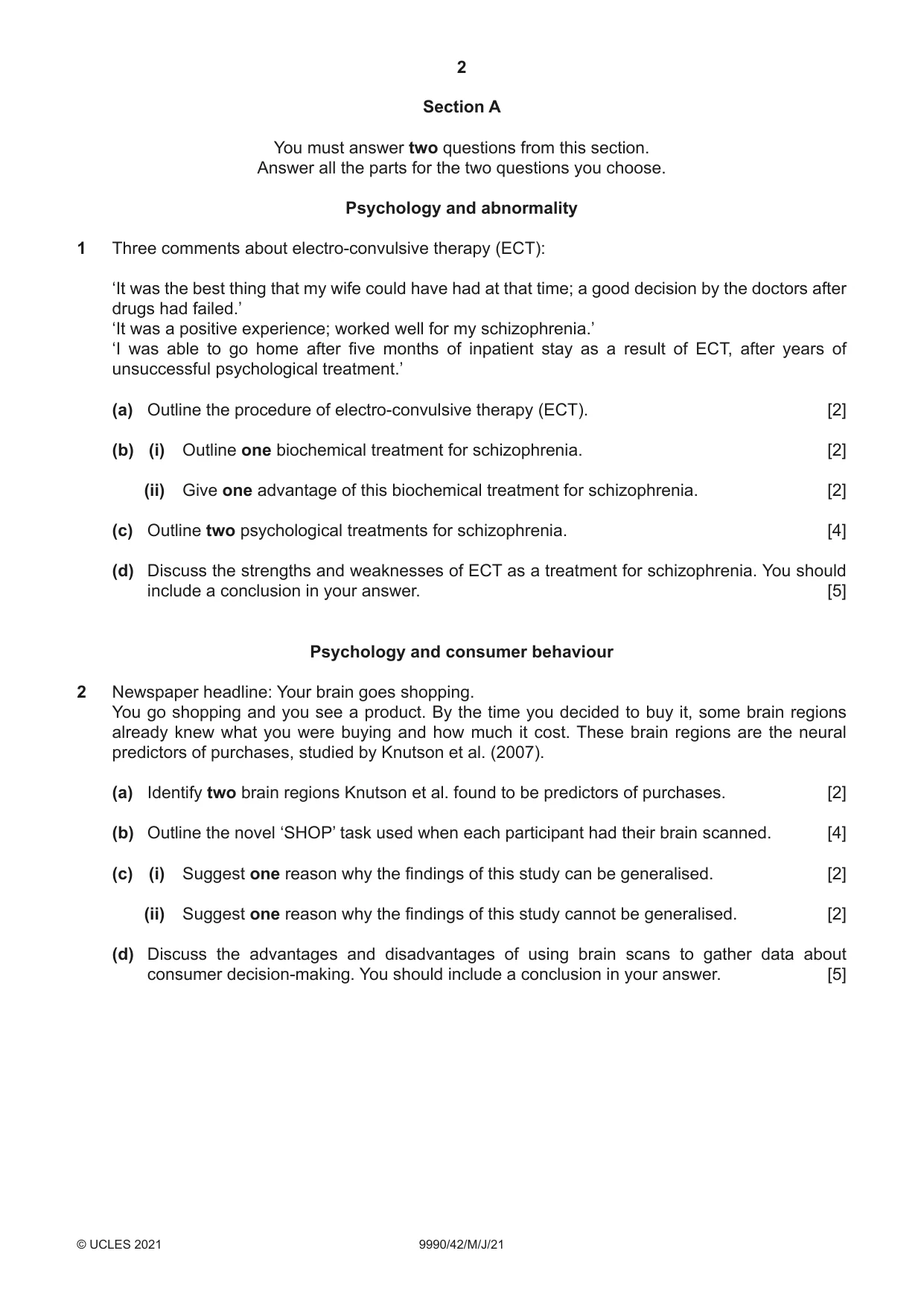
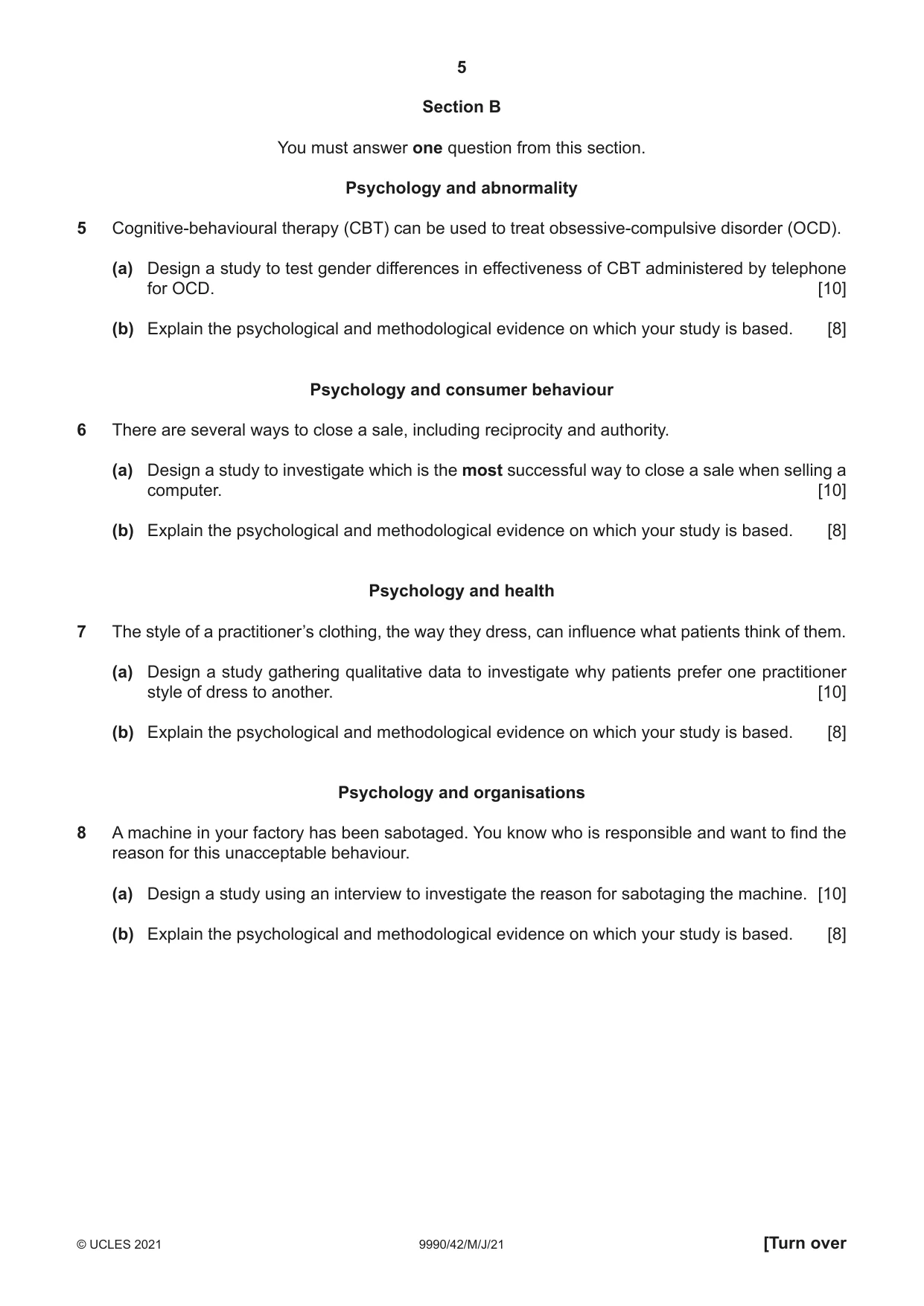
1 Three comments about electro-convulsive therapy (ECT): ‘It was the best thing that my wife could have had at that time; a good decision by the doctors after drugs had failed.’ ‘It was a positive experience; worked well for my schizophrenia.’ ‘I was able to go home after five months of inpatient stay as a result of ECT, after years of unsuccessful psychological treatment.’ (a) Outline the procedure of electro-convulsive therapy (ECT). [2] (b) (i) Outline one biochemical treatment for schizophrenia. [2] (ii) Give one advantage of this biochemical treatment for schizophrenia. [2] (c) Outline two psychological treatments for schizophrenia. [4] (d) Discuss the strengths and weaknesses of ECT as a treatment for schizophrenia. You should include a conclusion in your answer. [5] Psychology and consumer behaviour
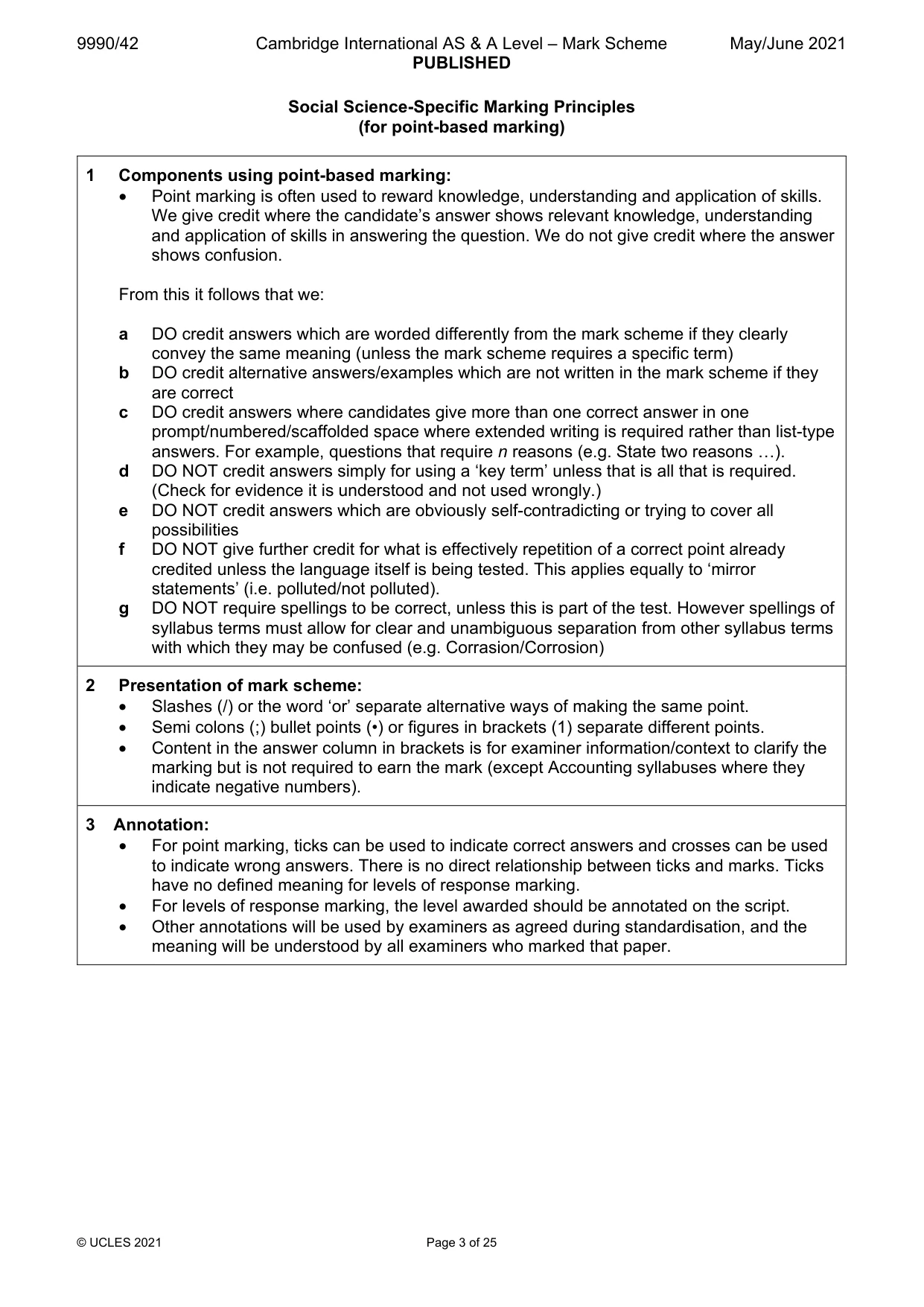
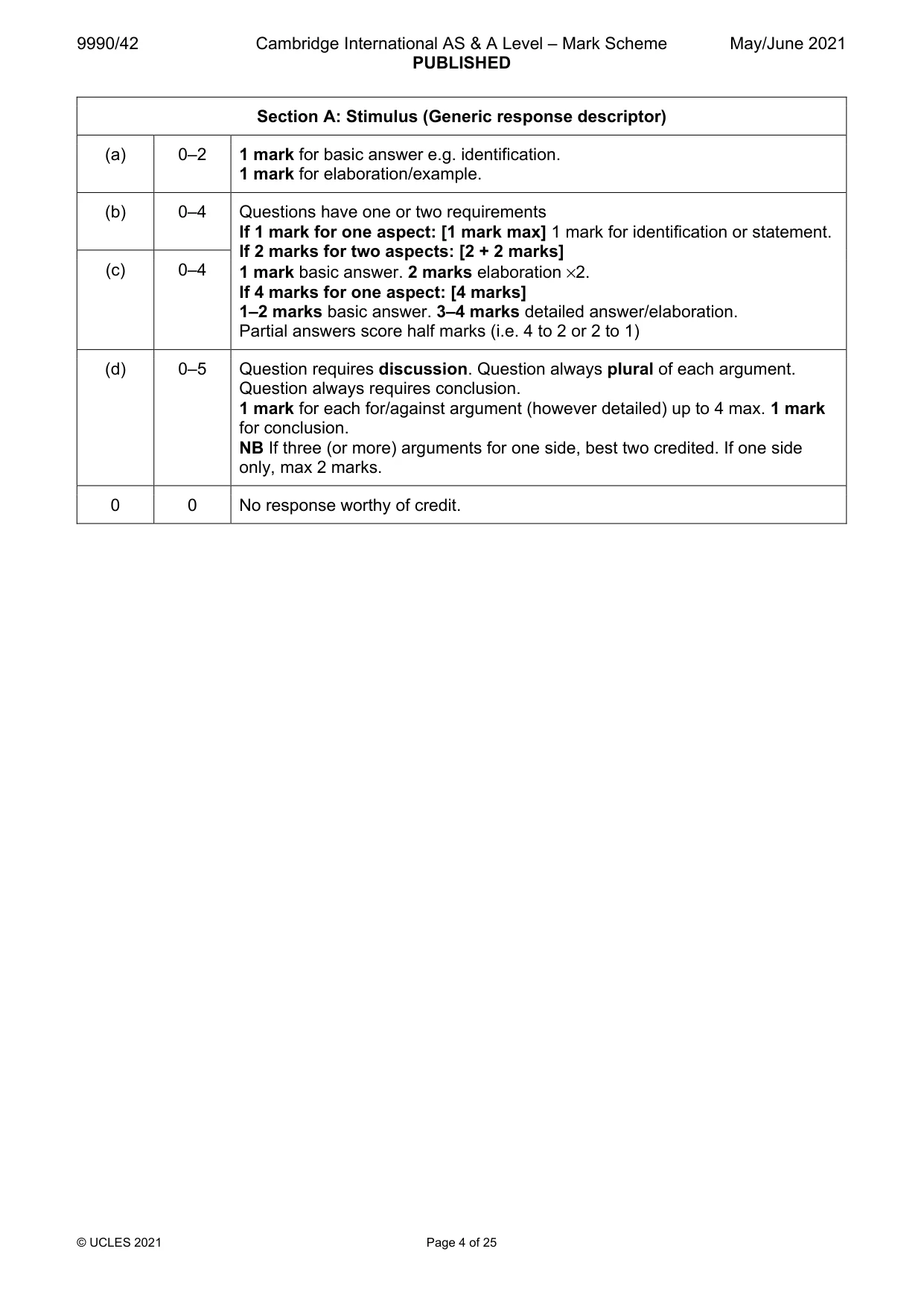
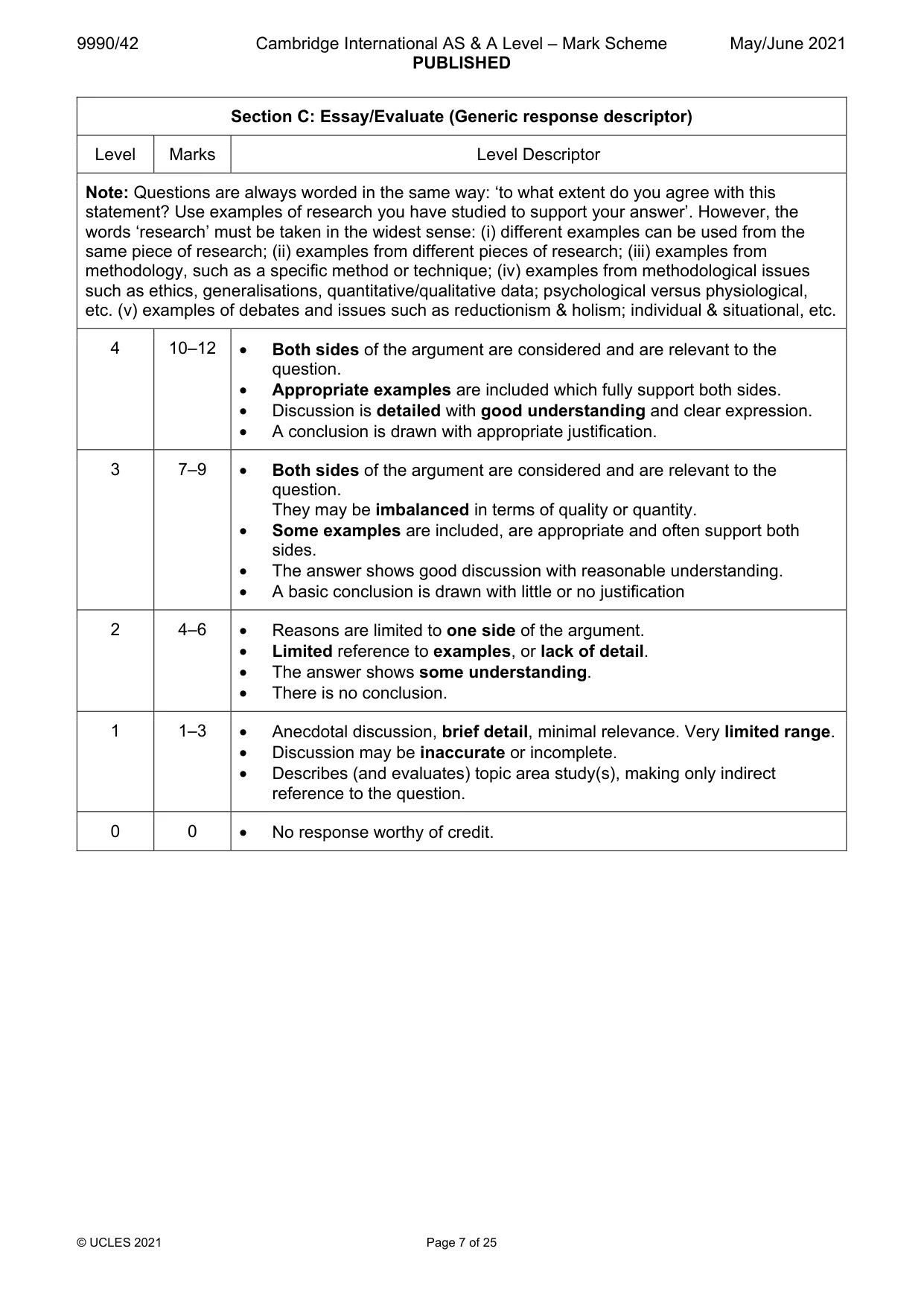
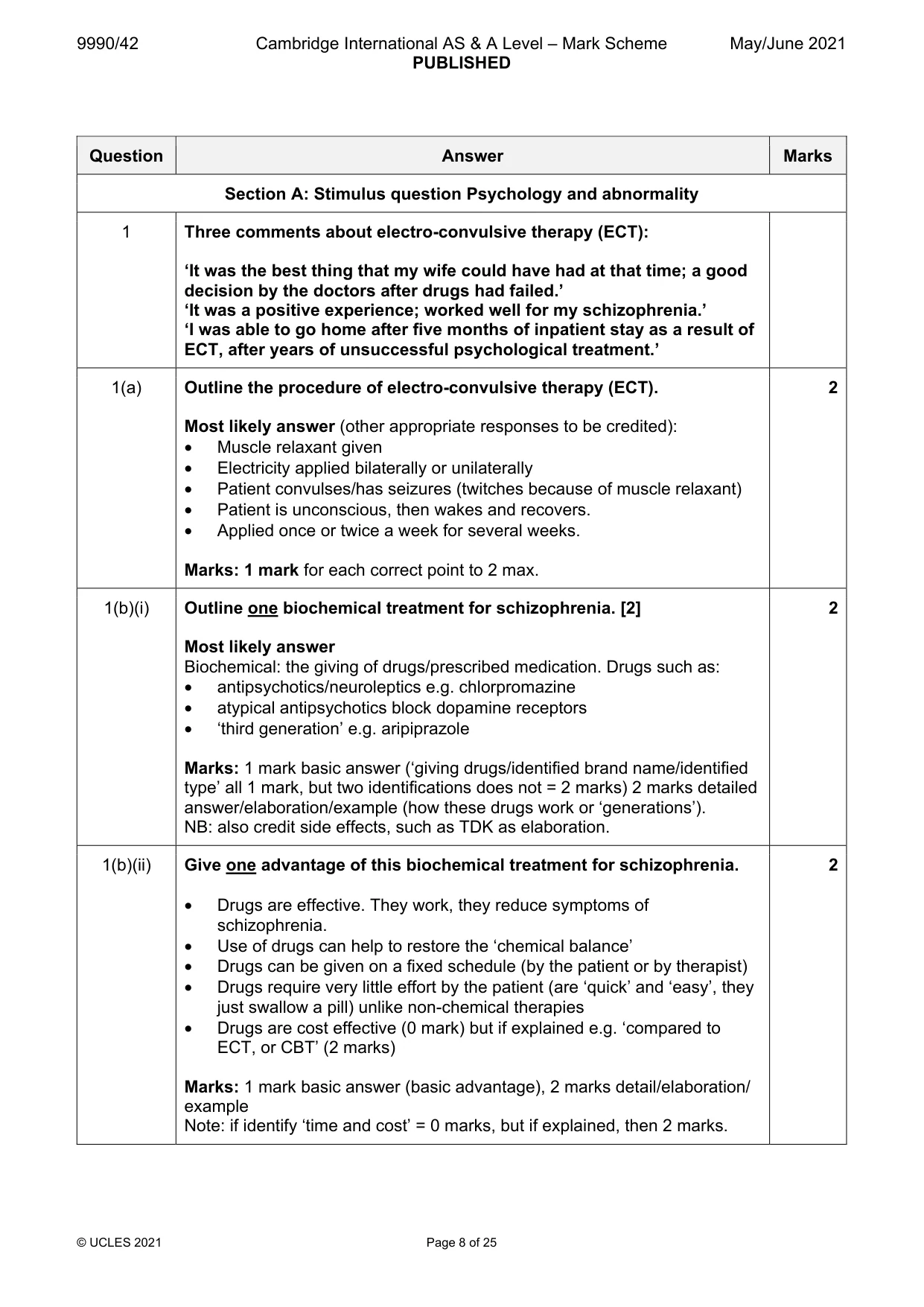
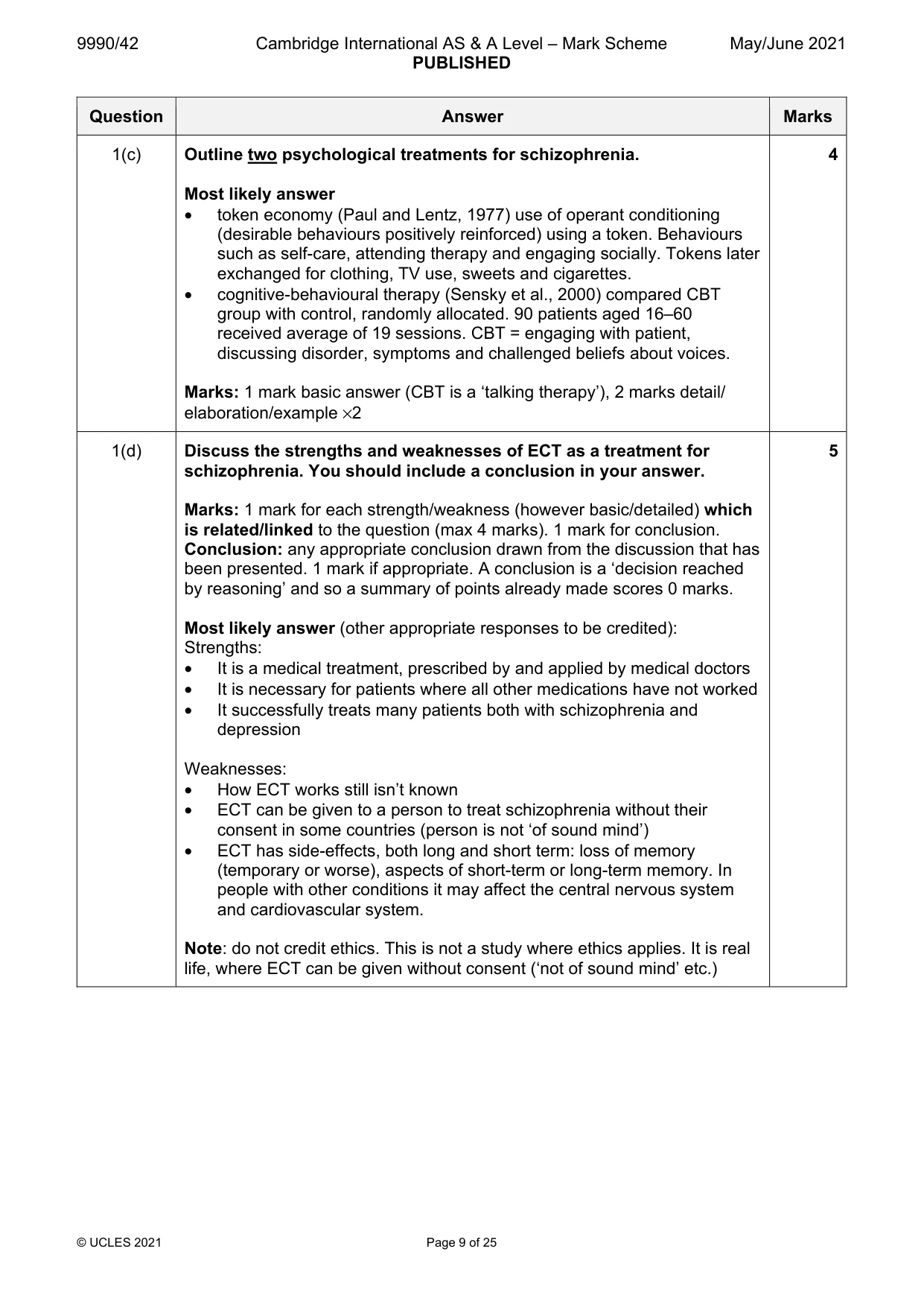
Mark scheme: Question Answer Marks Section A: Stimulus question Psychology and abnormality 1 Three comments about electro-convulsive therapy (ECT): ‘It was the best thing that my wife could have had at that time; a good decision by the doctors after drugs had failed.’ ‘It was a positive experience; worked well for my schizophrenia.’ ‘I was able to go home after five months of inpatient stay as a result of ECT, after years of unsuccessful psychological treatment.’ 1(a) Outline the procedure of electro-convulsive therapy (ECT). 2 Most likely answer (other appropriate responses to be credited): • Muscle relaxant given • Electricity applied bilaterally or unilaterally • Patient convulses/has seizures (twitches because of muscle relaxant) • Patient is unconscious, then wakes and recovers. • Applied once or twice a week for several weeks. Marks: 1 mark for each correct point to 2 max. 1(b)(i) Outline one biochemical treatment for schizophrenia. [2] 2 Most likely answer Biochemical: the giving of drugs/prescribed medication. Drugs such as: • antipsychotics/neuroleptics e.g. chlorpromazine • atypical antipsychotics block dopamine receptors • ‘third generation’ e.g. aripiprazole Marks: 1 mark basic answer (‘giving drugs/identified brand name/identified type’ all 1 mark, but two identifications does not = 2 marks) 2 marks detailed answer/elaboration/example (how these drugs work or ‘generations’). NB: also credit side effects, such as TDK as elaboration. 1(b)(ii) Give one advantage of this biochemical treatment for schizophrenia. 2 • Drugs are effective. They work, they reduce symptoms of schizophrenia. • Use of drugs can help to restore the ‘chemical balance’ • Drugs can be given on a fixed schedule (by the patient or by therapist) • Drugs require very little effort by the patient (are ‘quick’ and ‘easy’, they just swallow a pill) unlike non-chemical therapies • Drugs are cost effective (0 mark) but if explained e.g. ‘compared to ECT, or CBT’ (2 marks) Marks: 1 mark basic answer (basic advantage), 2 marks detail/elaboration/ example Note: if identify ‘time and cost’ = 0 marks, but if explained, then 2 marks. 1(c) Outline two psychological treatments for schizophrenia. 4 Most likely answer • token economy (Paul and Lentz, 1977) use of operant conditioning (desirable behaviours positively reinforced) using a token. Behaviours such as self-care, attending therapy and engaging socially. Tokens later exchanged for clothing, TV use, sweets and cigarettes. • cognitive-behavioural therapy (Sensky et al., 2000) compared CBT group with control, randomly allocated. 90 patients aged 16–60 received average of 19 sessions. CBT = engaging with patient, discussing disorder, symptoms and challenged beliefs about voices. Marks: 1 mark basic answer (CBT is a ‘talking therapy’), 2 marks detail/ elaboration/example ×2 1(d) Discuss the strengths and weaknesses of ECT as a treatment for 5 schizophrenia. You should include a conclusion in your answer. Marks: 1 mark for each strength/weakness (however basic/detailed) which is related/linked to the question (max 4 marks). 1 mark for conclusion. Conclusion: any appropriate conclusion drawn from the discussion that has been presented. 1 mark if appropriate. A conclusion is a ‘decision reached by reasoning’ and so a summary of points already made scores 0 marks. Most likely answer (other appropriate responses to be credited): Strengths: • It is a medical treatment, prescribed by and applied by medical doctors • It is necessary for patients where all other medications have not worked • It successfully treats many patients both with schizophrenia and depression Weaknesses: • How ECT works still isn’t known • ECT can be given to a person to treat schizophrenia without their consent in some countries (person is not ‘of sound mind’) • ECT has side-effects, both long and short term: loss of memory (temporary or worse), aspects of short-term or long-term memory. In people with other conditions it may affect the central nervous system and cardiovascular system. Note: do not credit ethics. This is not a study where ethics applies. It is real life, where ECT can be given without consent (‘not of sound mind’ etc.)
Q2 · Newspaper headline: Your brain goes shopping
2 Newspaper headline: Your brain goes shopping. You go shopping and you see a product. By the time you decided to buy it, some brain regions already knew what you were buying and how much it cost. These brain regions are the neural predictors of purchases, studied by Knutson et al. (2007). (a) Identify two brain regions Knutson et al. found to be predictors of purchases. [2] (b) Outline the novel ‘SHOP’ task used when each participant had their brain scanned. [4] (c) (i) Suggest one reason why the findings of this study can be generalised. [2] (ii) Suggest one reason why the findings of this study cannot be generalised. [2] (d) Discuss the advantages and disadvantages of using brain scans to gather data about consumer decision-making. You should include a conclusion in your answer. [5] Psychology and health
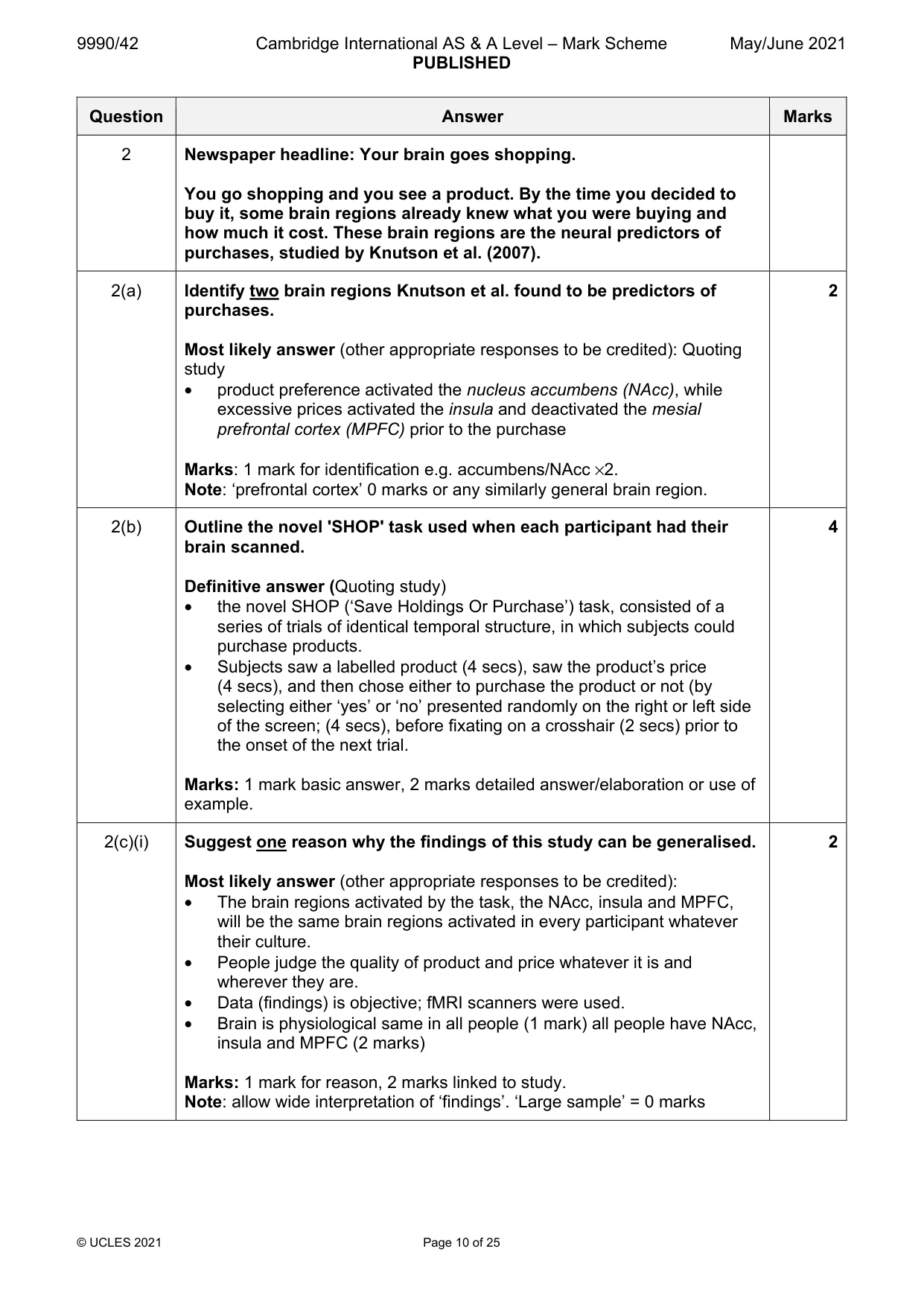
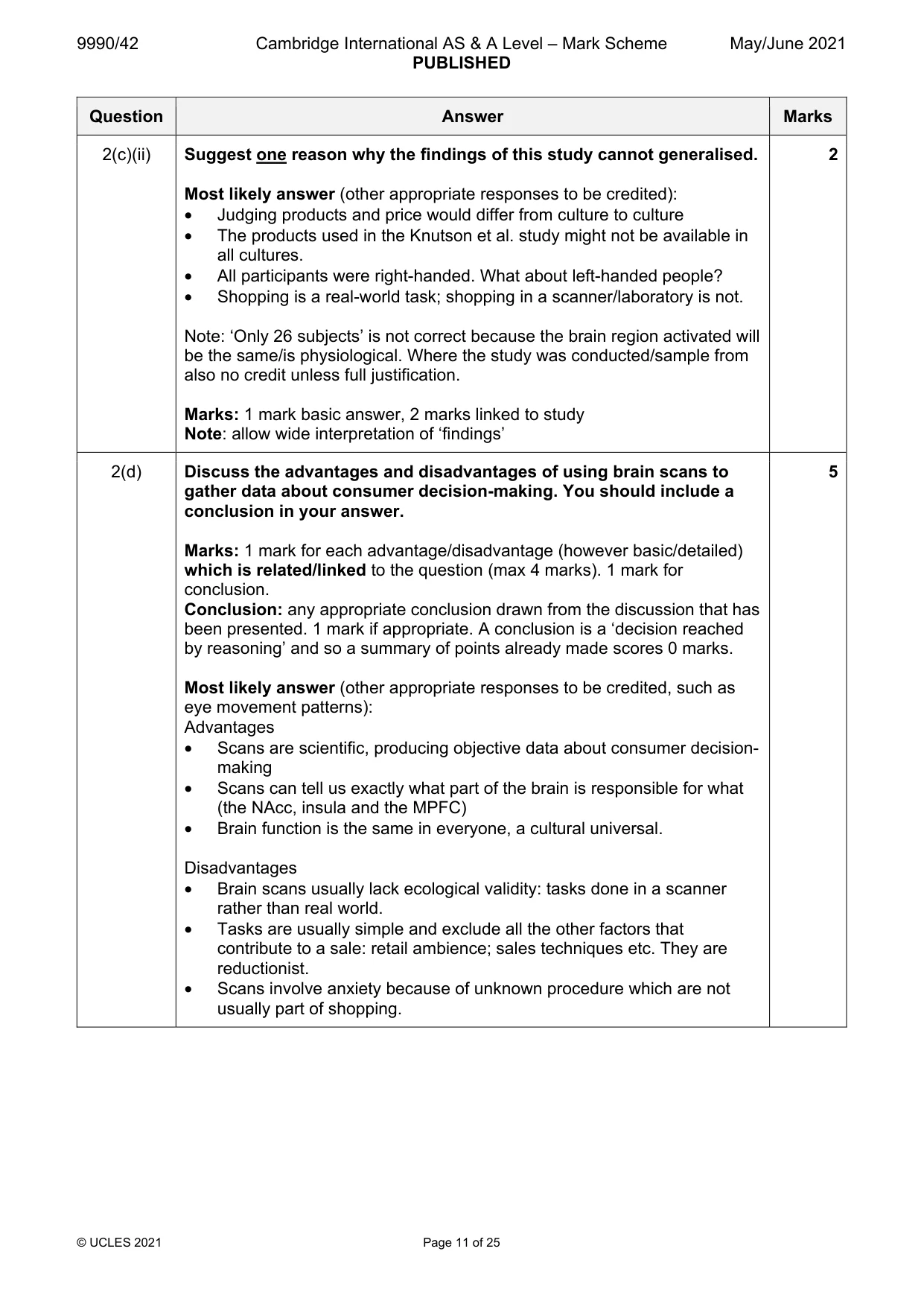
Mark scheme: 2 Newspaper headline: Your brain goes shopping. You go shopping and you see a product. By the time you decided to buy it, some brain regions already knew what you were buying and how much it cost. These brain regions are the neural predictors of purchases, studied by Knutson et al. (2007). 2(a) Identify two brain regions Knutson et al. found to be predictors of 2 purchases. Most likely answer (other appropriate responses to be credited): Quoting study • product preference activated the nucleus accumbens (NAcc), while excessive prices activated the insula and deactivated the mesial prefrontal cortex (MPFC) prior to the purchase Marks: 1 mark for identification e.g. accumbens/NAcc ×2. Note: ‘prefrontal cortex’ 0 marks or any similarly general brain region. 2(b) Outline the novel 'SHOP' task used when each participant had their 4 brain scanned. Definitive answer (Quoting study) • the novel SHOP (‘Save Holdings Or Purchase’) task, consisted of a series of trials of identical temporal structure, in which subjects could purchase products. • Subjects saw a labelled product (4 secs), saw the product’s price (4 secs), and then chose either to purchase the product or not (by selecting either ‘yes’ or ‘no’ presented randomly on the right or left side of the screen; (4 secs), before fixating on a crosshair (2 secs) prior to the onset of the next trial. Marks: 1 mark basic answer, 2 marks detailed answer/elaboration or use of example. 2(c)(i) Suggest one reason why the findings of this study can be generalised. 2 Most likely answer (other appropriate responses to be credited): • The brain regions activated by the task, the NAcc, insula and MPFC, will be the same brain regions activated in every participant whatever their culture. • People judge the quality of product and price whatever it is and wherever they are. • Data (findings) is objective; fMRI scanners were used. • Brain is physiological same in all people (1 mark) all people have NAcc, insula and MPFC (2 marks) Marks: 1 mark for reason, 2 marks linked to study. Note: allow wide interpretation of ‘findings’. ‘Large sample’ = 0 marks 2(c)(ii) Suggest one reason why the findings of this study cannot generalised. 2 Most likely answer (other appropriate responses to be credited): • Judging products and price would differ from culture to culture • The products used in the Knutson et al. study might not be available in all cultures. • All participants were right-handed. What about left-handed people? • Shopping is a real-world task; shopping in a scanner/laboratory is not. Note: ‘Only 26 subjects’ is not correct because the brain region activated will be the same/is physiological. Where the study was conducted/sample from also no credit unless full justification. Marks: 1 mark basic answer, 2 marks linked to study Note: allow wide interpretation of ‘findings’ 2(d) Discuss the advantages and disadvantages of using brain scans to 5 gather data about consumer decision-making. You should include a conclusion in your answer. Marks: 1 mark for each advantage/disadvantage (however basic/detailed) which is related/linked to the question (max 4 marks). 1 mark for conclusion. Conclusion: any appropriate conclusion drawn from the discussion that has been presented. 1 mark if appropriate. A conclusion is a ‘decision reached by reasoning’ and so a summary of points already made scores 0 marks. Most likely answer (other appropriate responses to be credited, such as eye movement patterns): Advantages • Scans are scientific, producing objective data about consumer decision- making • Scans can tell us exactly what part of the brain is responsible for what (the NAcc, insula and the MPFC) • Brain function is the same in everyone, a cultural universal. Disadvantages • Brain scans usually lack ecological validity: tasks done in a scanner rather than real world. • Tasks are usually simple and exclude all the other factors that contribute to a sale: retail ambience; sales techniques etc. They are reductionist. • Scans involve anxiety because of unknown procedure which are not usually part of shopping.
Q3 · The UAB pain behaviour scale This pain scale is administered by an observer of a person…
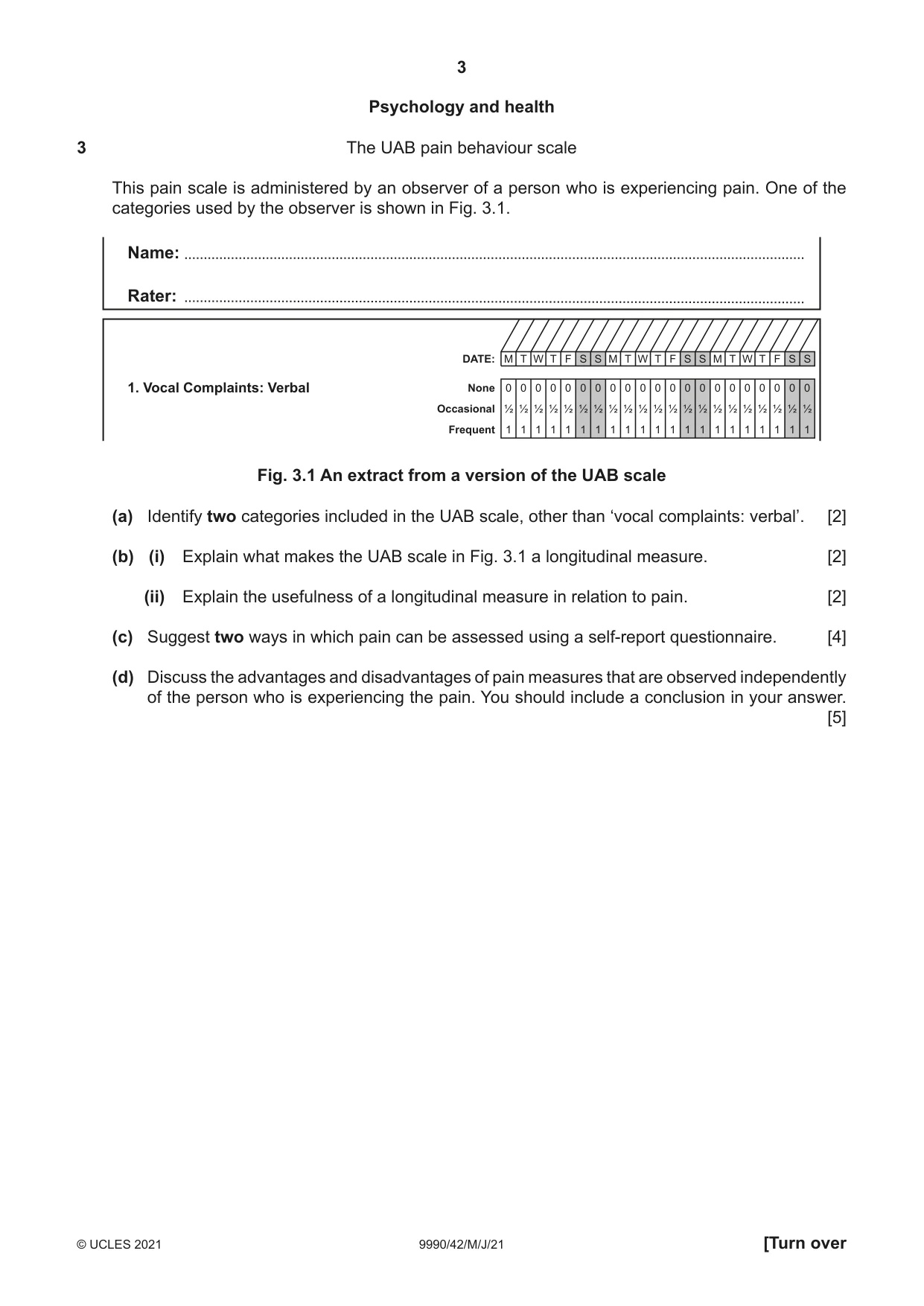
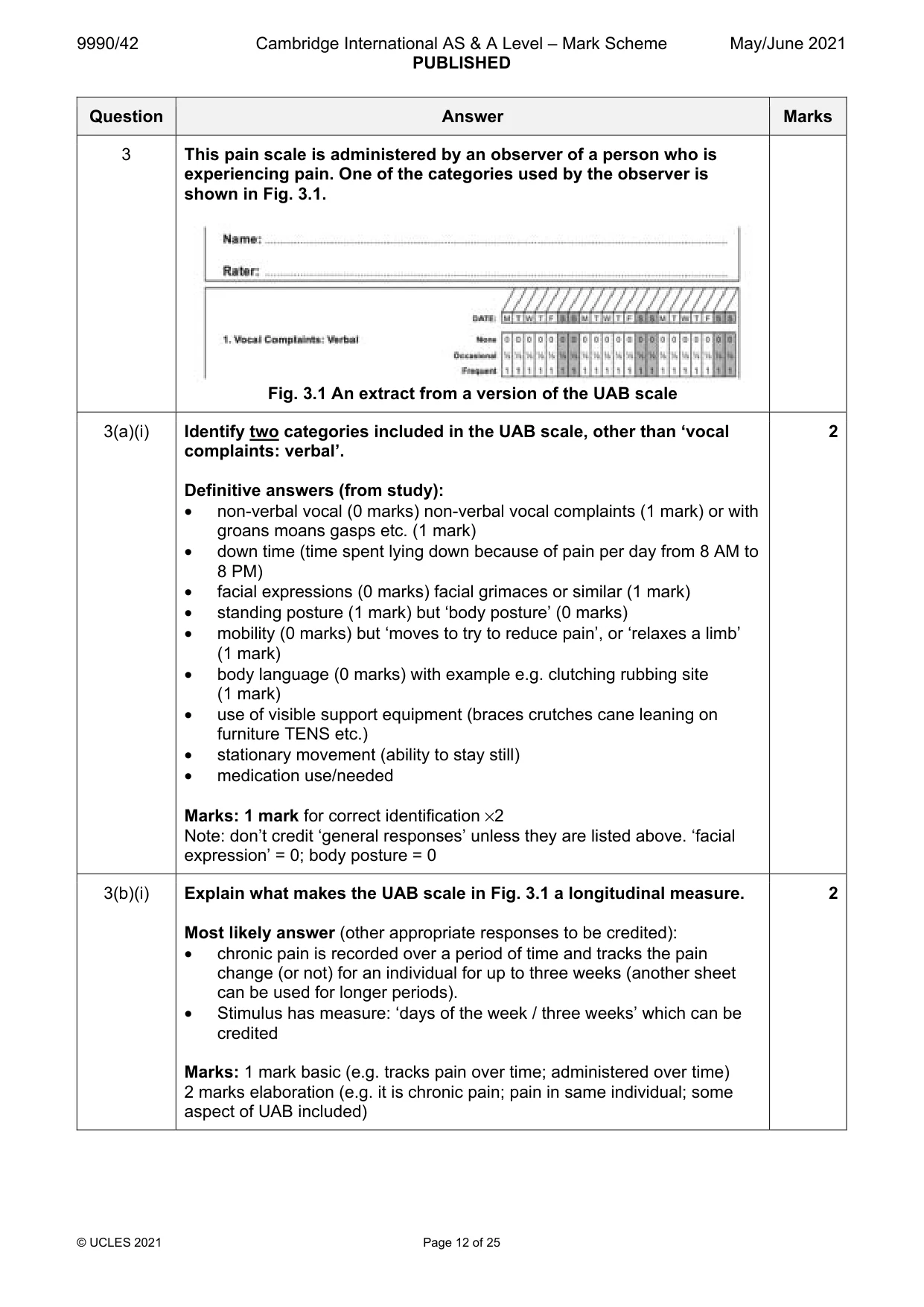
3 The UAB pain behaviour scale This pain scale is administered by an observer of a person who is experiencing pain. One of the categories used by the observer is shown in Fig. 3.1. Name: Rater: DATE: M T W T F S S M T W T F S S M T W T F S S 1. Vocal Complaints: Verbal None 0 0 0 0 0 0 0 0 0 0 0 0 0 0 0 0 0 0 0 0 0 Occasional ½ ½ ½ ½ ½ ½ ½ ½ ½ ½ ½ ½ ½ ½ ½ ½ ½ ½ ½ ½ ½ Frequent 1 1 1 1 1 1 1 1 1 1 1 1 1 1 1 1 1 1 1 1 1 Fig. 3.1 An extract from a version of the UAB scale (a) Identify two categories included in the UAB scale, other than ‘vocal complaints: verbal’. [2] (b) (i) Explain what makes the UAB scale in Fig. 3.1 a longitudinal measure. [2] (ii) Explain the usefulness of a longitudinal measure in relation to pain. [2] (c) Suggest two ways in which pain can be assessed using a self-report questionnaire. [4] (d) Discuss the advantages and disadvantages of pain measures that are observed independently of the person who is experiencing the pain. You should include a conclusion in your answer. [5] Psychology and organisations
Mark scheme: 3 This pain scale is administered by an observer of a person who is experiencing pain. One of the categories used by the observer is shown in Fig. 3.1. Fig. 3.1 An extract from a version of the UAB scale 3(a)(i) Identify two categories included in the UAB scale, other than ‘vocal 2 complaints: verbal’. Definitive answers (from study): • non-verbal vocal (0 marks) non-verbal vocal complaints (1 mark) or with groans moans gasps etc. (1 mark) • down time (time spent lying down because of pain per day from 8 AM to 8 PM) • facial expressions (0 marks) facial grimaces or similar (1 mark) • standing posture (1 mark) but ‘body posture’ (0 marks) • mobility (0 marks) but ‘moves to try to reduce pain’, or ‘relaxes a limb’ (1 mark) • body language (0 marks) with example e.g. clutching rubbing site (1 mark) • use of visible support equipment (braces crutches cane leaning on furniture TENS etc.) • stationary movement (ability to stay still) • medication use/needed Marks: 1 mark for correct identification ×2 Note: don’t credit ‘general responses’ unless they are listed above. ‘facial expression’ = 0; body posture = 0 3(b)(i) Explain what makes the UAB scale in Fig. 3.1 a longitudinal measure. 2 Most likely answer (other appropriate responses to be credited): • chronic pain is recorded over a period of time and tracks the pain change (or not) for an individual for up to three weeks (another sheet can be used for longer periods). • Stimulus has measure: ‘days of the week / three weeks’ which can be credited Marks: 1 mark basic (e.g. tracks pain over time; administered over time) 2 marks elaboration (e.g. it is chronic pain; pain in same individual; some aspect of UAB included) 3(b)(ii) Explain the usefulness of a longitudinal measure in relation to pain. 2 Most likely answer (other appropriate responses to be credited): • can see improvement (or not) in treatment (1 mark); that the patient is recovering (1 mark) which would not be possible with any other measure unless the measure was repeated (e.g. give MPQ on two different occasions) (+1 mark); any appropriate example in relation to pain (+ 1 mark) Marks: 1 mark basic answer, 2 marks detailed answer/elaboration, or use of example. Note: Q is ‘a longitudinal measure’ so other measures are creditworthy. 0 marks for anecdotal. 3(c) Suggest two ways in which pain can be assessed using a self-report 4 questionnaire. Most likely answer (other appropriate responses to be credited): • self-report assessment questionnaire (clinical interview) • psychometric measures (McGill pain questionnaire MPQ) • psychometric measures (paediatric pain questionnaire PPQ) Marks: 1 mark basic answer (identification e.g. MPQ), 2 marks detail/ elaboration/example. Note: 1 mark max for Wong-Baker ‘faces’ scale and any visual rating scale because not strictly questionnaires but are self-report measures. Note: ‘anecdotal’ questionnaires can receive full credit, but only 1 mark if visual rating type. 3(d) Discuss the advantages and disadvantages of pain measures that are 5 observed independently of the person who is experiencing the pain. You should include a conclusion in your answer. Marks: 1 mark for each advantage/disadvantage (however basic/detailed) which is related/linked to the question (max 4 marks). 1 mark for conclusion. Conclusion: any appropriate conclusion drawn from the discussion that has been presented. 1 mark if appropriate. A conclusion is a ‘decision reached by reasoning’ and so a summary of points already made scores 0 marks. Most likely answer (other appropriate responses to be credited): Advantages • Person observing will be a medical specialist • Person observing will observe many people (an expert in pain observation) • Person observing will know categories and apply them consistently and objectively Disadvantages • Person observing is not experiencing the pain of the person being observed. • Person observing does not ask the person experiencing pain about their pain • Observations are done without the person’s knowledge
Q4 · Heifetz (1997) proposes a ‘modern’ theory of adaptive leadership, and suggests that…
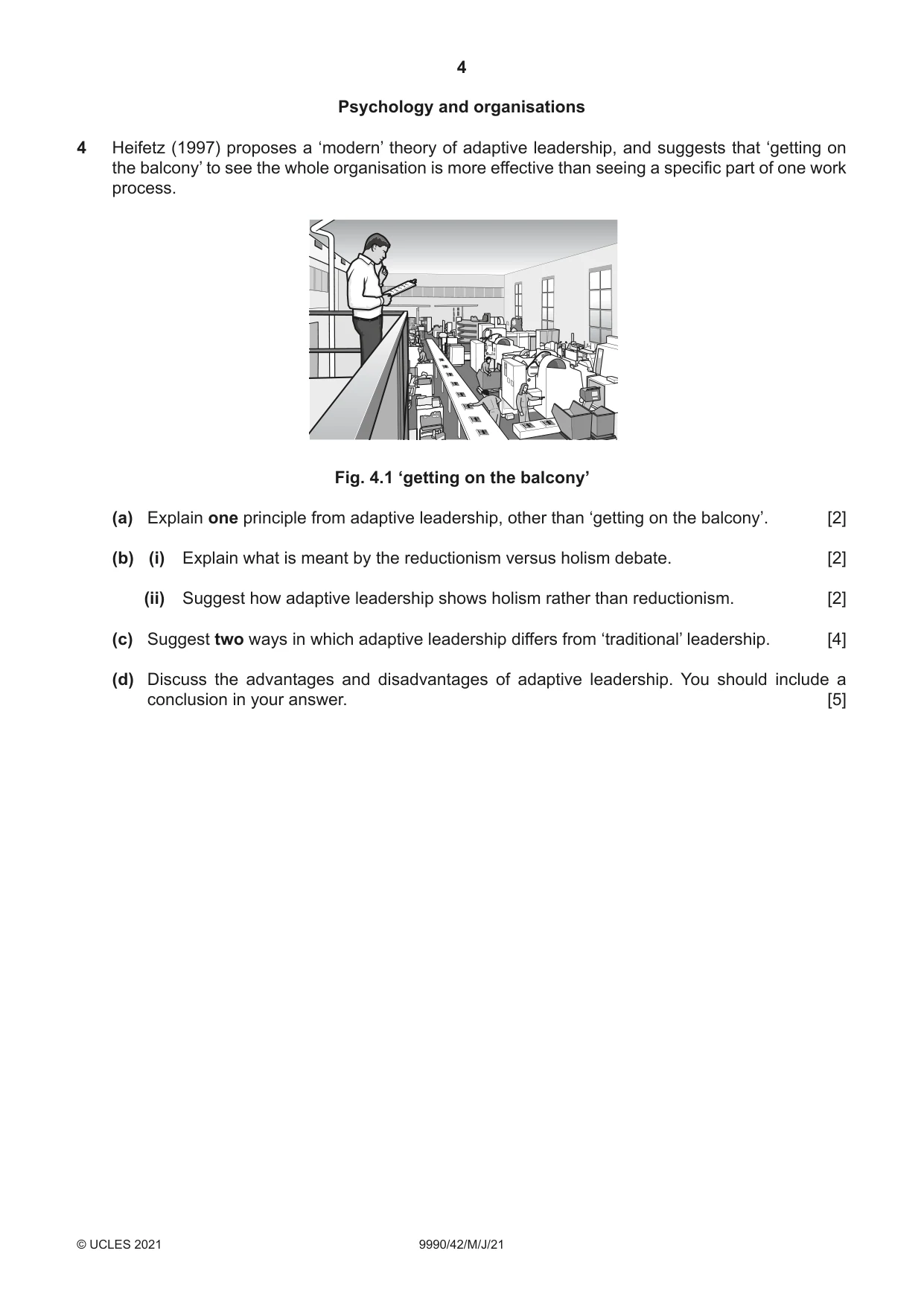
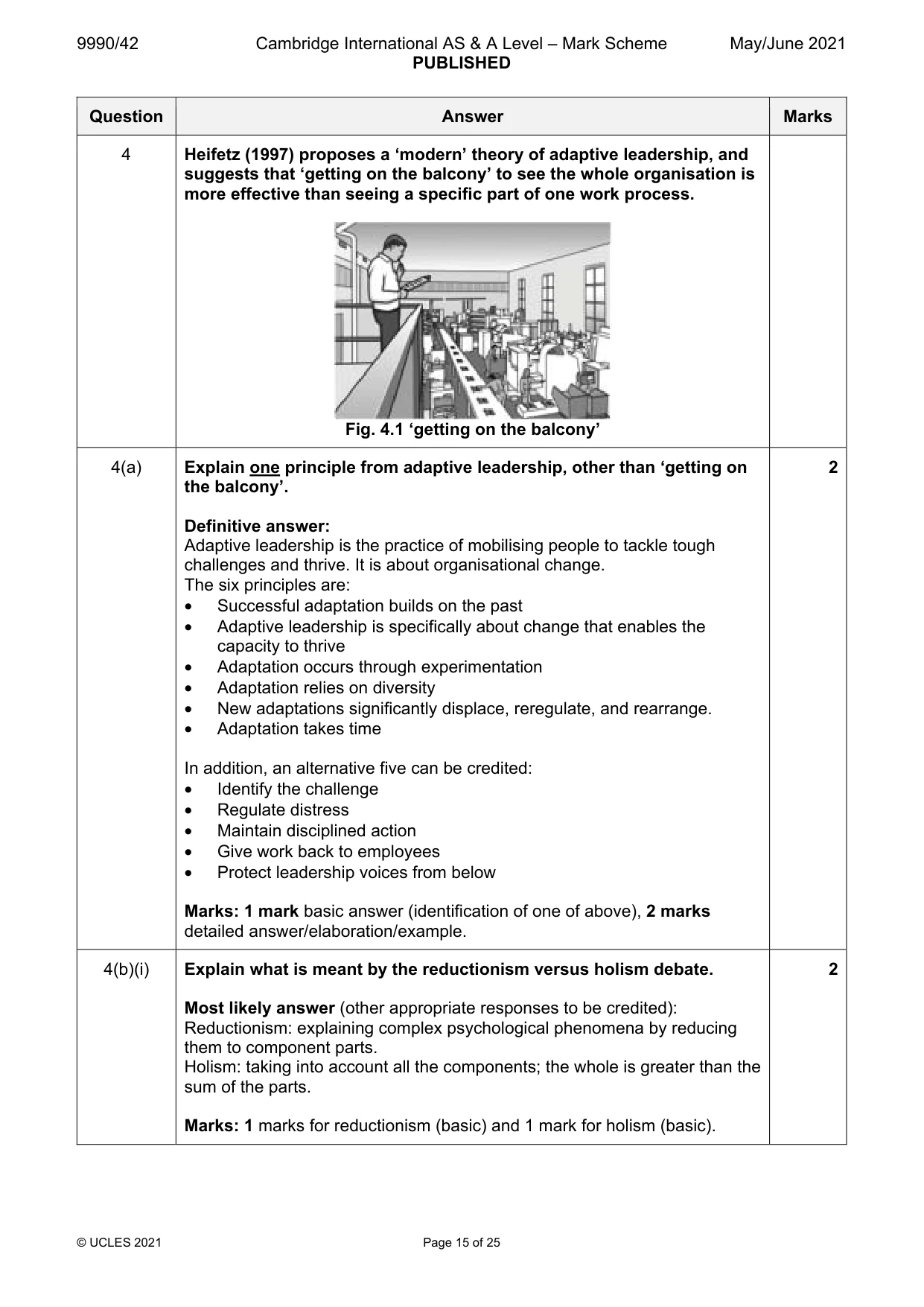
4 Heifetz (1997) proposes a ‘modern’ theory of adaptive leadership, and suggests that ‘getting on the balcony’ to see the whole organisation is more effective than seeing a specific part of one work process. Fig. 4.1 ‘getting on the balcony’ (a) Explain one principle from adaptive leadership, other than ‘getting on the balcony’. [2] (b) (i) Explain what is meant by the reductionism versus holism debate. [2] (ii) Suggest how adaptive leadership shows holism rather than reductionism. [2] (c) Suggest two ways in which adaptive leadership differs from ‘traditional’ leadership. [4] (d) Discuss the advantages and disadvantages of adaptive leadership. You should include a conclusion in your answer. [5]
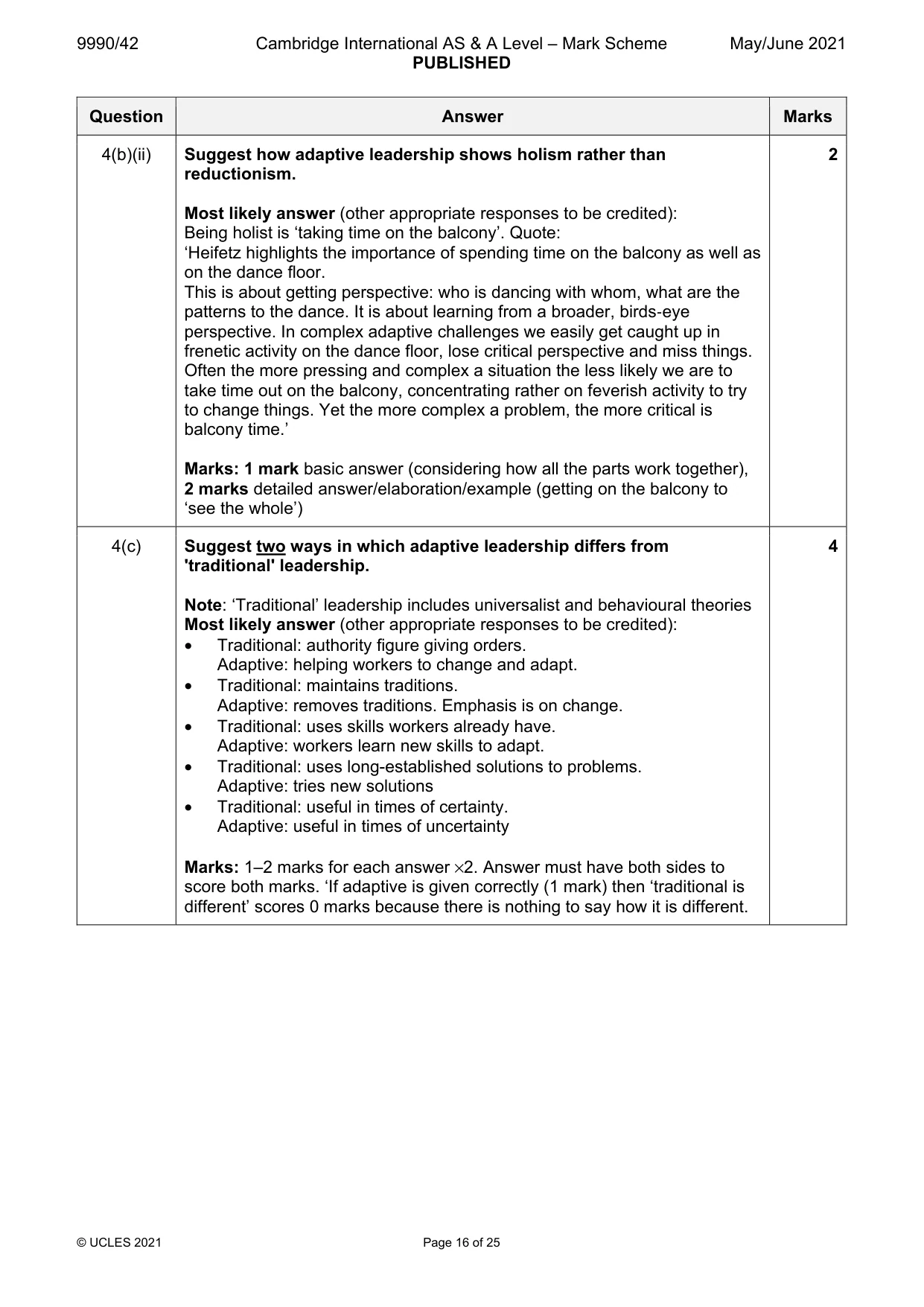
Mark scheme: 4 Heifetz (1997) proposes a ‘modern’ theory of adaptive leadership, and suggests that ‘getting on the balcony’ to see the whole organisation is more effective than seeing a specific part of one work process. Fig. 4.1 ‘getting on the balcony’ 4(a) Explain one principle from adaptive leadership, other than ‘getting on 2 the balcony’. Definitive answer: Adaptive leadership is the practice of mobilising people to tackle tough challenges and thrive. It is about organisational change. The six principles are: • Successful adaptation builds on the past • Adaptive leadership is specifically about change that enables the capacity to thrive • Adaptation occurs through experimentation • Adaptation relies on diversity • New adaptations significantly displace, reregulate, and rearrange. • Adaptation takes time In addition, an alternative five can be credited: • Identify the challenge • Regulate distress • Maintain disciplined action • Give work back to employees • Protect leadership voices from below Marks: 1 mark basic answer (identification of one of above), 2 marks detailed answer/elaboration/example. 4(b)(i) Explain what is meant by the reductionism versus holism debate. 2 Most likely answer (other appropriate responses to be credited): Reductionism: explaining complex psychological phenomena by reducing them to component parts. Holism: taking into account all the components; the whole is greater than the sum of the parts. Marks: 1 marks for reductionism (basic) and 1 mark for holism (basic). 4(b)(ii) Suggest how adaptive leadership shows holism rather than 2 reductionism. Most likely answer (other appropriate responses to be credited): Being holist is ‘taking time on the balcony’. Quote: ‘Heifetz highlights the importance of spending time on the balcony as well as on the dance floor. This is about getting perspective: who is dancing with whom, what are the patterns to the dance. It is about learning from a broader, birds‐eye perspective. In complex adaptive challenges we easily get caught up in frenetic activity on the dance floor, lose critical perspective and miss things. Often the more pressing and complex a situation the less likely we are to take time out on the balcony, concentrating rather on feverish activity to try to change things. Yet the more complex a problem, the more critical is balcony time.’ Marks: 1 mark basic answer (considering how all the parts work together), 2 marks detailed answer/elaboration/example (getting on the balcony to ‘see the whole’) 4(c) Suggest two ways in which adaptive leadership differs from 4 'traditional' leadership. Note: ‘Traditional’ leadership includes universalist and behavioural theories Most likely answer (other appropriate responses to be credited): • Traditional: authority figure giving orders. Adaptive: helping workers to change and adapt. • Traditional: maintains traditions. Adaptive: removes traditions. Emphasis is on change. • Traditional: uses skills workers already have. Adaptive: workers learn new skills to adapt. • Traditional: uses long-established solutions to problems. Adaptive: tries new solutions • Traditional: useful in times of certainty. Adaptive: useful in times of uncertainty Marks: 1–2 marks for each answer ×2. Answer must have both sides to score both marks. ‘If adaptive is given correctly (1 mark) then ‘traditional is different’ scores 0 marks because there is nothing to say how it is different. 4(d) Discuss the advantages and disadvantages of adaptive leadership. 5 You should include a conclusion in your answer. Marks: 1 mark for each advantage/disadvantage (however basic/detailed) which is related/linked to the question (max 4 marks). 1 mark for conclusion. Conclusion: any appropriate conclusion drawn from the discussion that has been presented. 1 mark if appropriate. A conclusion is a ‘decision reached by reasoning’ and so a summary of points already made scores 0 marks. Most likely answer (other appropriate responses to be credited): Advantages • Adaptive leadership is about adapting to changing economic conditions and if the leader can do this, the organisation survives and thrives. If it does not adapt it may ‘go out of business’. • Adaptive leadership involves considering the future rather than ‘the here and now’. • Adaptive leadership involves both reductionist and holist viewpoints • Adaptive leadership involves everyone – workers need to change in the same direction as the organisation Disadvantages • Workers may not be able to change/adapt; they may not have the skills required for the change and become redundant • Workers may experience distress. It can’t be avoided (but it can be managed) • The leader must be adaptive. If not, then the organisation may not survive. How it is known whether a leader is adaptive or not; possesses the relevant skills and abilities.
Q5 · Cognitive-behavioural therapy (CBT) can be used to treat obsessive-compulsive disorder…
5 Cognitive-behavioural therapy (CBT) can be used to treat obsessive-compulsive disorder (OCD). (a) Design a study to test gender differences in effectiveness of CBT administered by telephone for OCD. [10] (b) Explain the psychological and methodological evidence on which your study is based. [8] Psychology and consumer behaviour
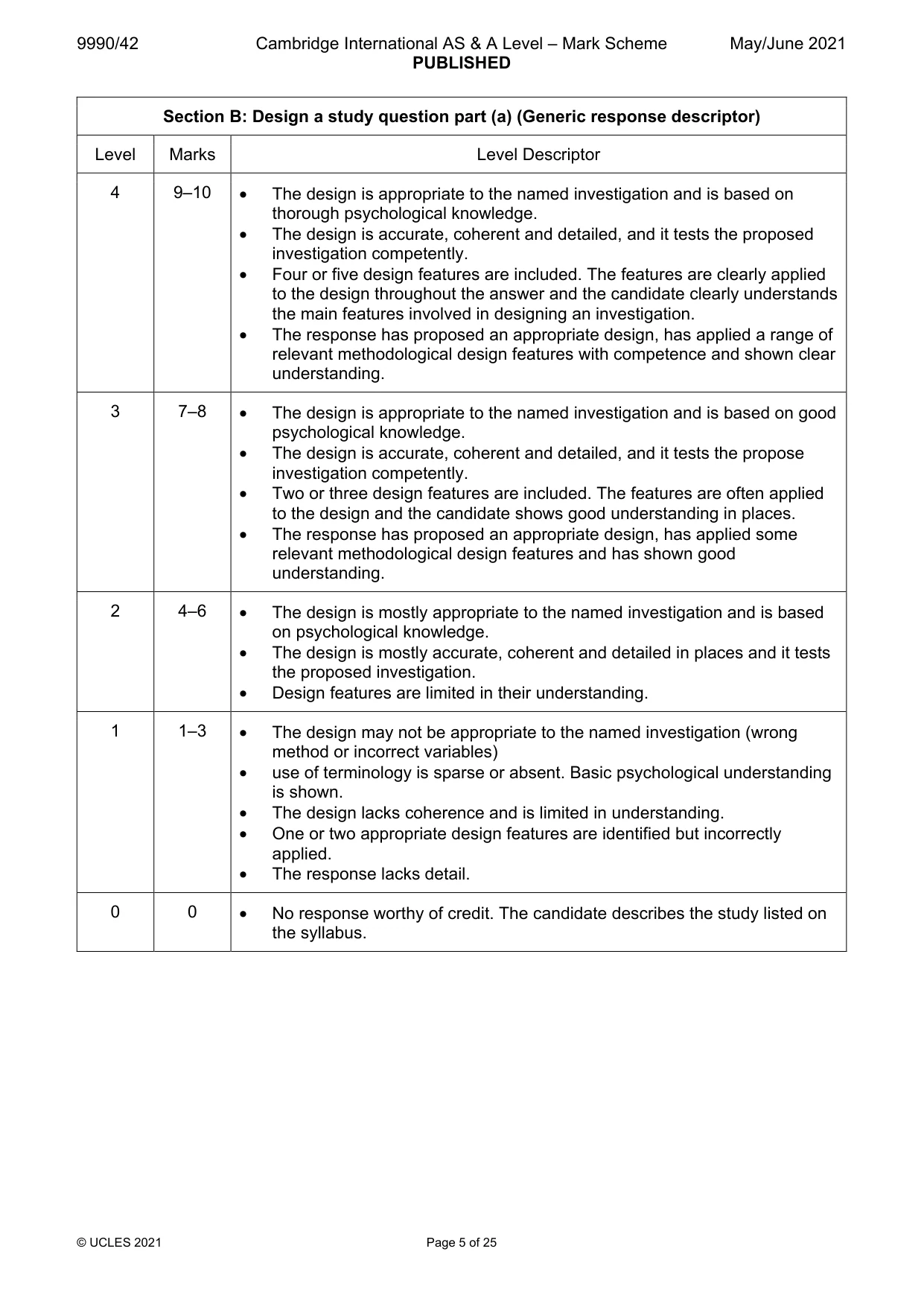
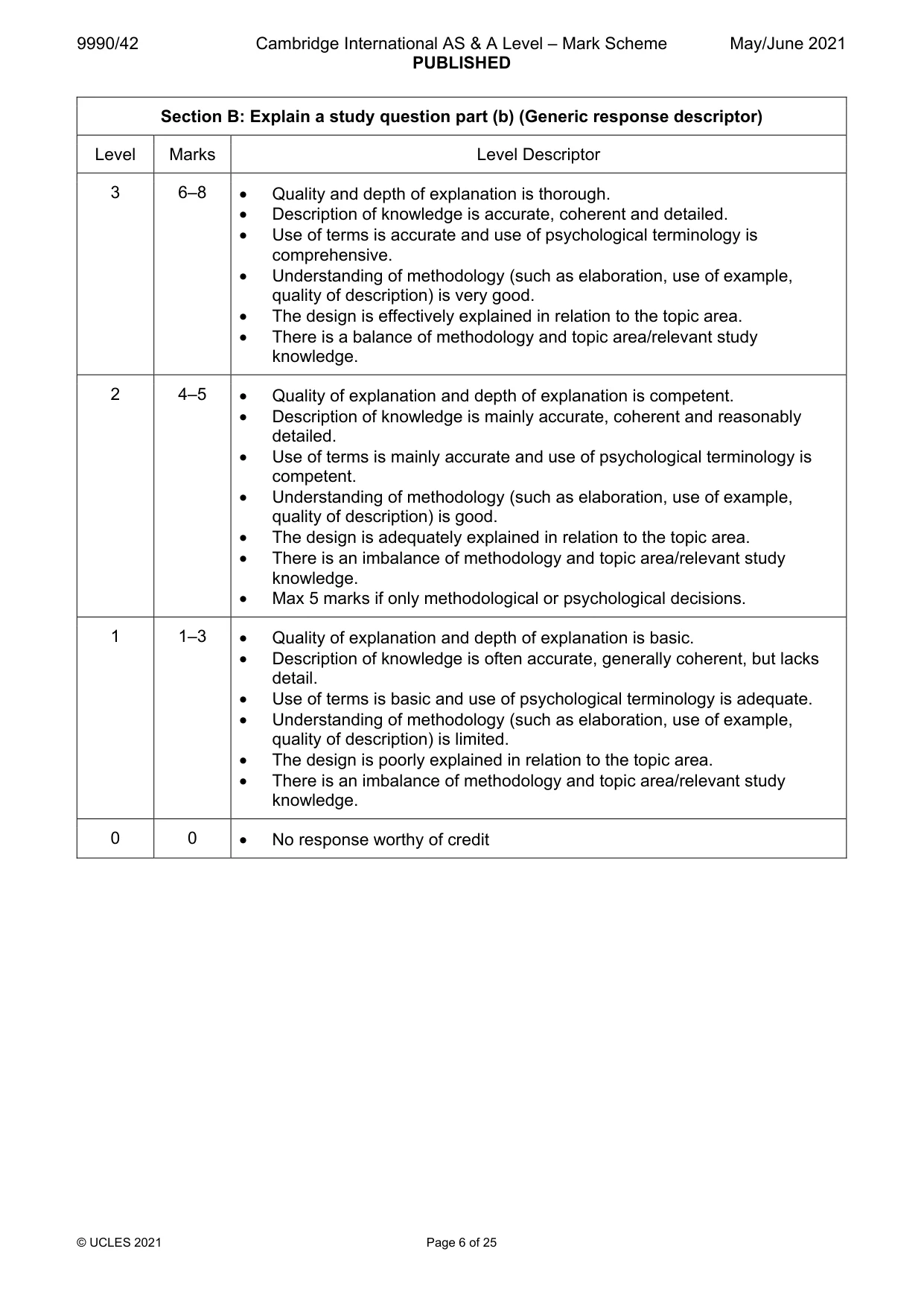
Mark scheme: 5(a) Cognitive-behavioural therapy (CBT) can be used to treat obsessive- 10 compulsive disorder (OCD). Design a study to test gender differences in effectiveness of CBT administered by telephone for OCD. Marks: use generic levels of response Design a study question part (a). Additional: Candidates should design the study showing evidence of design features appropriate to the named method. The named method: any appropriate method. Specific features: • Experiments: type, IV, DV, controls, experimental design. • Observations: type, setting, response categories, sampling frame, number of observers. • Questionnaires/Interviews: type, setting, example questions. Scoring/rating scale, analysis of responses. General features of research methodology: sampling technique and sample, type of data, ethics, reliability, validity, data analysis. 5(b) Explain the psychological and methodological evidence on which your 8 study is based. Candidates are expected to explain the reasons for the suggested design in part (a). Explanation should be both psychological and methodological. Psychological to include appropriate theory or research. Marks: use generic levels of response ‘Design a study’ question part (b). ‘Psychological’ = 4 marks; ‘methodological’ = 4 marks If only methodological or psychological explanation is provided max 5 marks If ‘psychological’ described and not related to part (a) max 2 marks. Syllabus: psychological: cognitive (Lovell et al., 2006) and exposure and response prevention (Lehmkuhl et al., 2008) Psychological: Lovell et al. (2006) compared the effectiveness of CBT face-to-face with CBT given over the telephone. The conclusion was that there was no difference in effectiveness. However, there may have been an age difference that was not explored. NB: Lovell used BDI. Methodological: explanation of method using general and specific features as above.
Q6 · There are several ways to close a sale, including reciprocity and authority
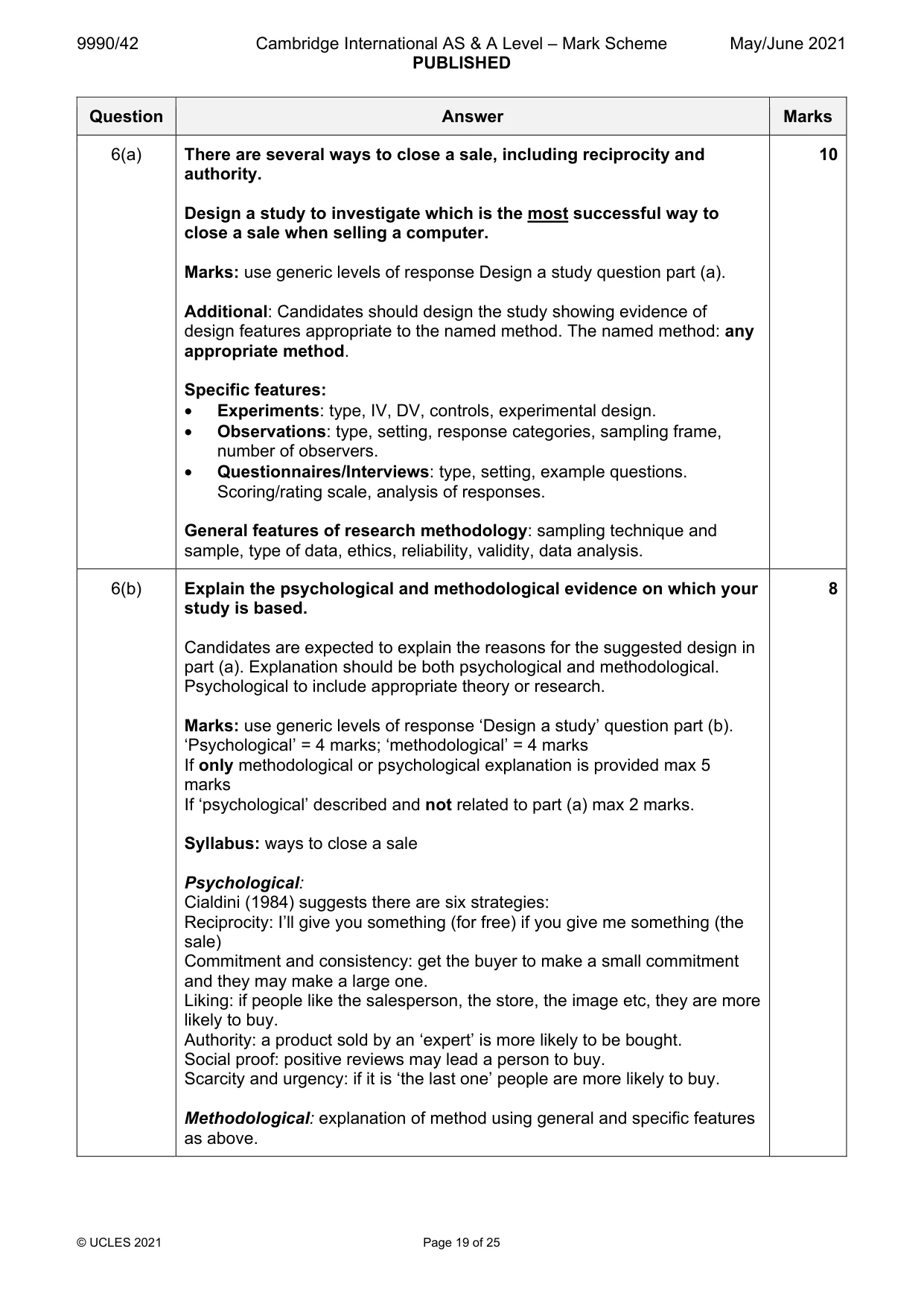
6 There are several ways to close a sale, including reciprocity and authority. (a) Design a study to investigate which is the most successful way to close a sale when selling a computer. [10] (b) Explain the psychological and methodological evidence on which your study is based. [8] Psychology and health
Mark scheme: 6(a) There are several ways to close a sale, including reciprocity and 10 authority. Design a study to investigate which is the most successful way to close a sale when selling a computer. Marks: use generic levels of response Design a study question part (a). Additional: Candidates should design the study showing evidence of design features appropriate to the named method. The named method: any appropriate method. Specific features: • Experiments: type, IV, DV, controls, experimental design. • Observations: type, setting, response categories, sampling frame, number of observers. • Questionnaires/Interviews: type, setting, example questions. Scoring/rating scale, analysis of responses. General features of research methodology: sampling technique and sample, type of data, ethics, reliability, validity, data analysis. 6(b) Explain the psychological and methodological evidence on which your 8 study is based. Candidates are expected to explain the reasons for the suggested design in part (a). Explanation should be both psychological and methodological. Psychological to include appropriate theory or research. Marks: use generic levels of response ‘Design a study’ question part (b). ‘Psychological’ = 4 marks; ‘methodological’ = 4 marks If only methodological or psychological explanation is provided max 5 marks If ‘psychological’ described and not related to part (a) max 2 marks. Syllabus: ways to close a sale Psychological: Cialdini (1984) suggests there are six strategies: Reciprocity: I’ll give you something (for free) if you give me something (the sale) Commitment and consistency: get the buyer to make a small commitment and they may make a large one. Liking: if people like the salesperson, the store, the image etc, they are more likely to buy. Authority: a product sold by an ‘expert’ is more likely to be bought. Social proof: positive reviews may lead a person to buy. Scarcity and urgency: if it is ‘the last one’ people are more likely to buy. Methodological: explanation of method using general and specific features as above.
Q7 · The style of a practitioner’s clothing, the way they dress, can influence what patients…
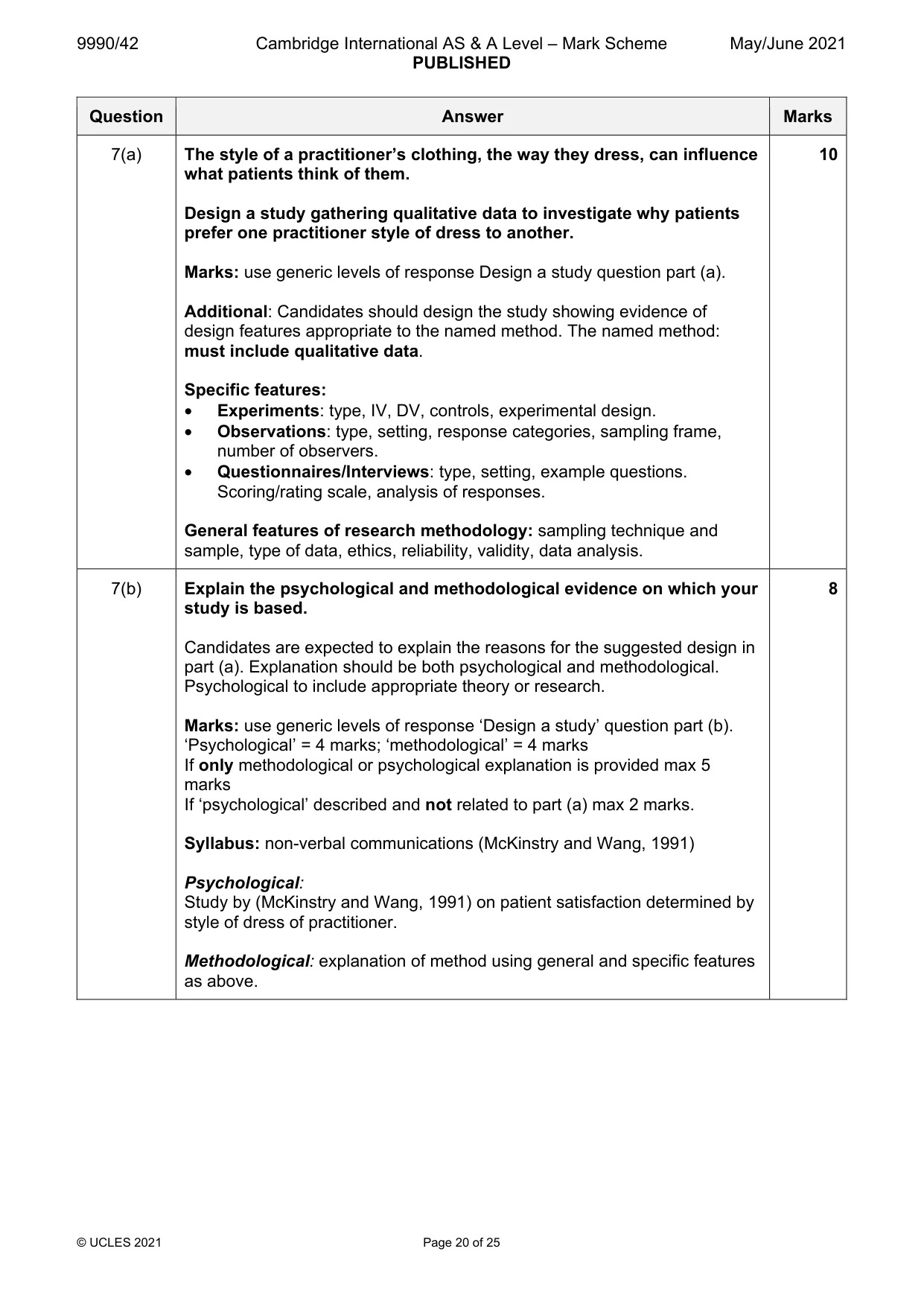
7 The style of a practitioner’s clothing, the way they dress, can influence what patients think of them. (a) Design a study gathering qualitative data to investigate why patients prefer one practitioner style of dress to another. [10] (b) Explain the psychological and methodological evidence on which your study is based. [8] Psychology and organisations
Mark scheme: 7(a) The style of a practitioner’s clothing, the way they dress, can influence 10 what patients think of them. Design a study gathering qualitative data to investigate why patients prefer one practitioner style of dress to another. Marks: use generic levels of response Design a study question part (a). Additional: Candidates should design the study showing evidence of design features appropriate to the named method. The named method: must include qualitative data. Specific features: • Experiments: type, IV, DV, controls, experimental design. • Observations: type, setting, response categories, sampling frame, number of observers. • Questionnaires/Interviews: type, setting, example questions. Scoring/rating scale, analysis of responses. General features of research methodology: sampling technique and sample, type of data, ethics, reliability, validity, data analysis. 7(b) Explain the psychological and methodological evidence on which your 8 study is based. Candidates are expected to explain the reasons for the suggested design in part (a). Explanation should be both psychological and methodological. Psychological to include appropriate theory or research. Marks: use generic levels of response ‘Design a study’ question part (b). ‘Psychological’ = 4 marks; ‘methodological’ = 4 marks If only methodological or psychological explanation is provided max 5 marks If ‘psychological’ described and not related to part (a) max 2 marks. Syllabus: non-verbal communications (McKinstry and Wang, 1991) Psychological: Study by (McKinstry and Wang, 1991) on patient satisfaction determined by style of dress of practitioner. Methodological: explanation of method using general and specific features as above.
Q8 · A machine in your factory has been sabotaged
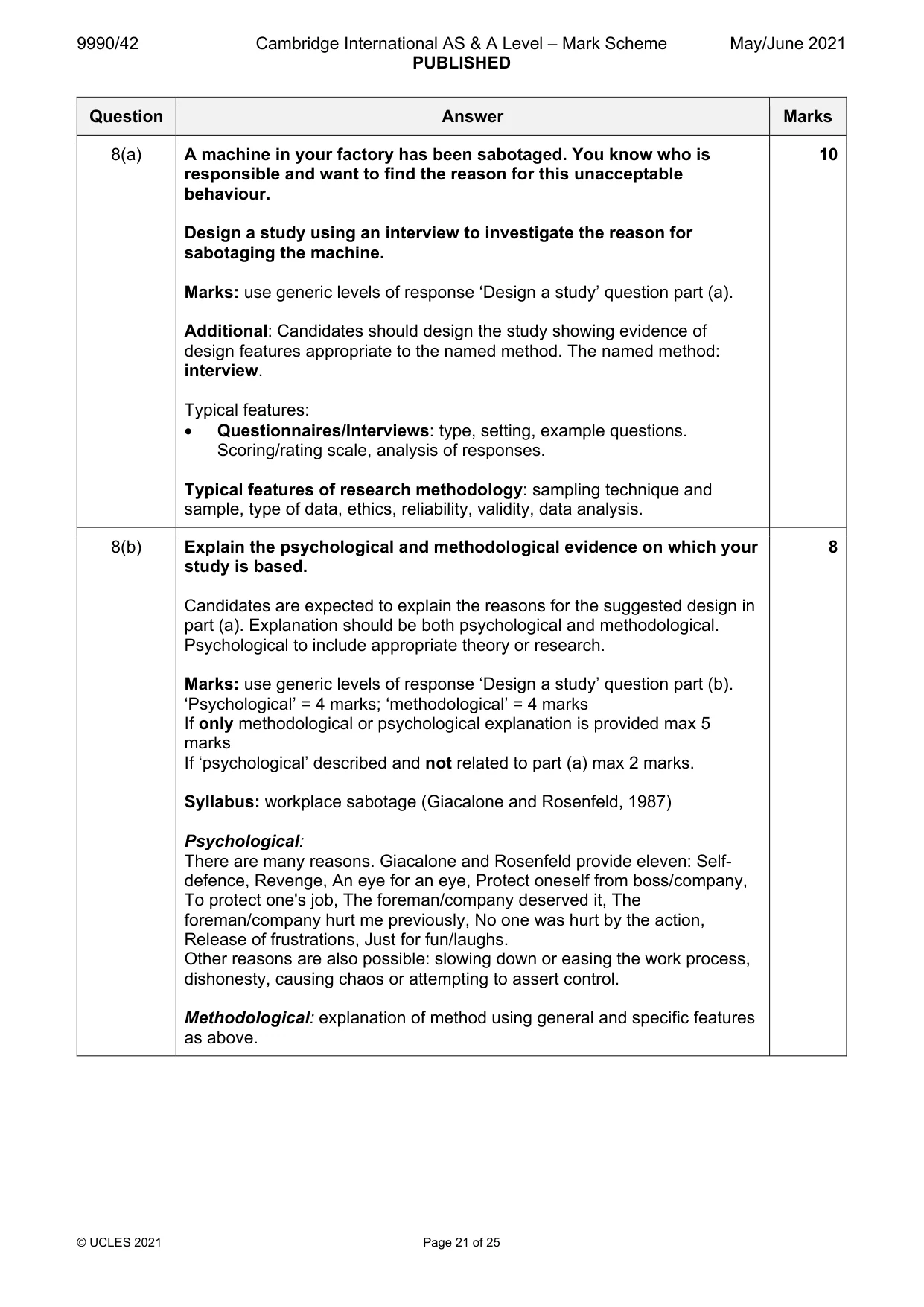
8 A machine in your factory has been sabotaged. You know who is responsible and want to find the reason for this unacceptable behaviour. (a) Design a study using an interview to investigate the reason for sabotaging the machine. [10] (b) Explain the psychological and methodological evidence on which your study is based. [8] Section C You must answer one question from this section. Psychology and abnormality
Mark scheme: 8(a) A machine in your factory has been sabotaged. You know who is 10 responsible and want to find the reason for this unacceptable behaviour. Design a study using an interview to investigate the reason for sabotaging the machine. Marks: use generic levels of response ‘Design a study’ question part (a). Additional: Candidates should design the study showing evidence of design features appropriate to the named method. The named method: interview. Typical features: • Questionnaires/Interviews: type, setting, example questions. Scoring/rating scale, analysis of responses. Typical features of research methodology: sampling technique and sample, type of data, ethics, reliability, validity, data analysis. 8(b) Explain the psychological and methodological evidence on which your 8 study is based. Candidates are expected to explain the reasons for the suggested design in part (a). Explanation should be both psychological and methodological. Psychological to include appropriate theory or research. Marks: use generic levels of response ‘Design a study’ question part (b). ‘Psychological’ = 4 marks; ‘methodological’ = 4 marks If only methodological or psychological explanation is provided max 5 marks If ‘psychological’ described and not related to part (a) max 2 marks. Syllabus: workplace sabotage (Giacalone and Rosenfeld, 1987) Psychological: There are many reasons. Giacalone and Rosenfeld provide eleven: Self- defence, Revenge, An eye for an eye, Protect oneself from boss/company, To protect one's job, The foreman/company deserved it, The foreman/company hurt me previously, No one was hurt by the action, Release of frustrations, Just for fun/laughs. Other reasons are also possible: slowing down or easing the work process, dishonesty, causing chaos or attempting to assert control. Methodological: explanation of method using general and specific features as above.
Q9 · ‘Even though Charles was just one child, Rapoport’s case study of Charles’…
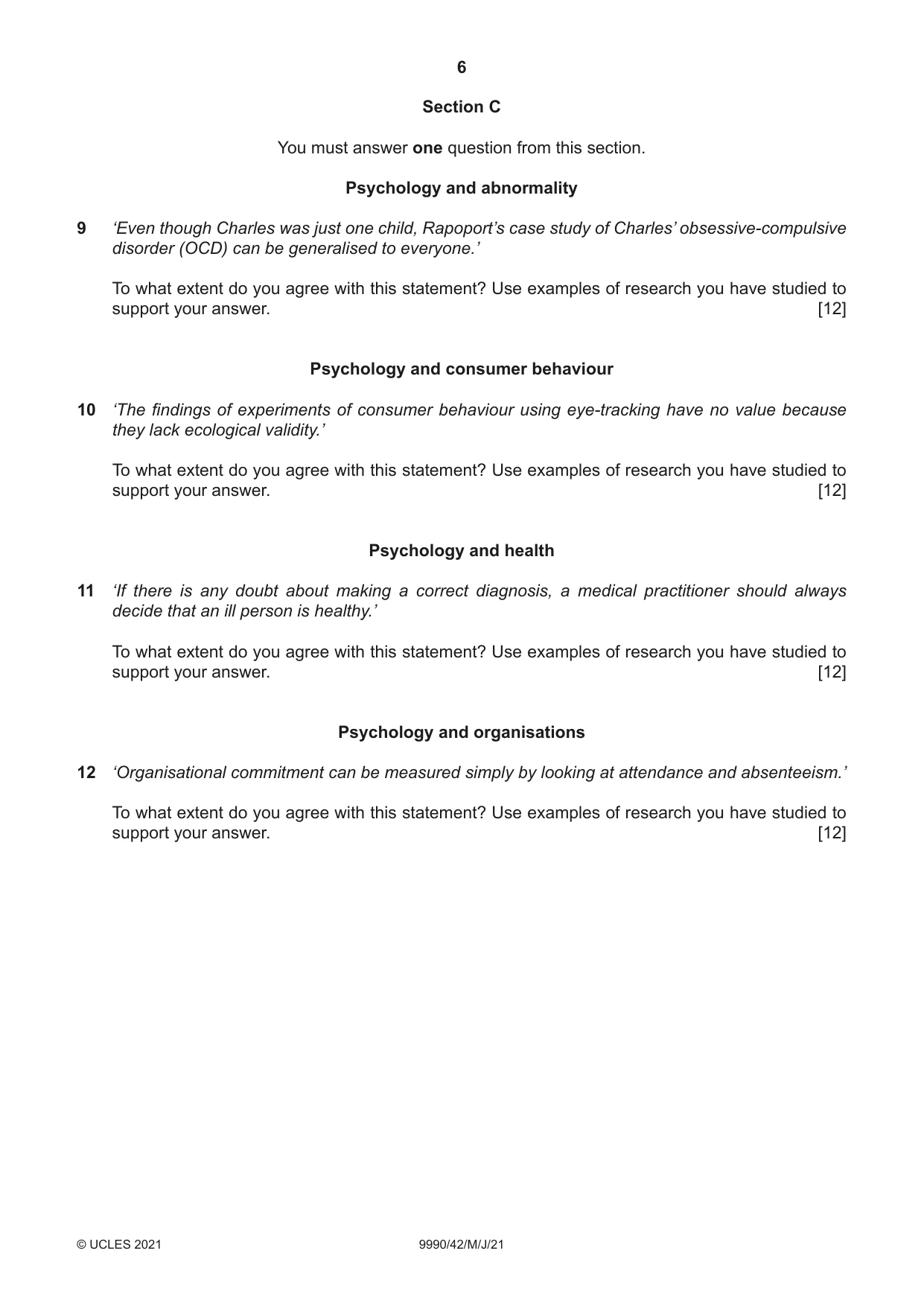
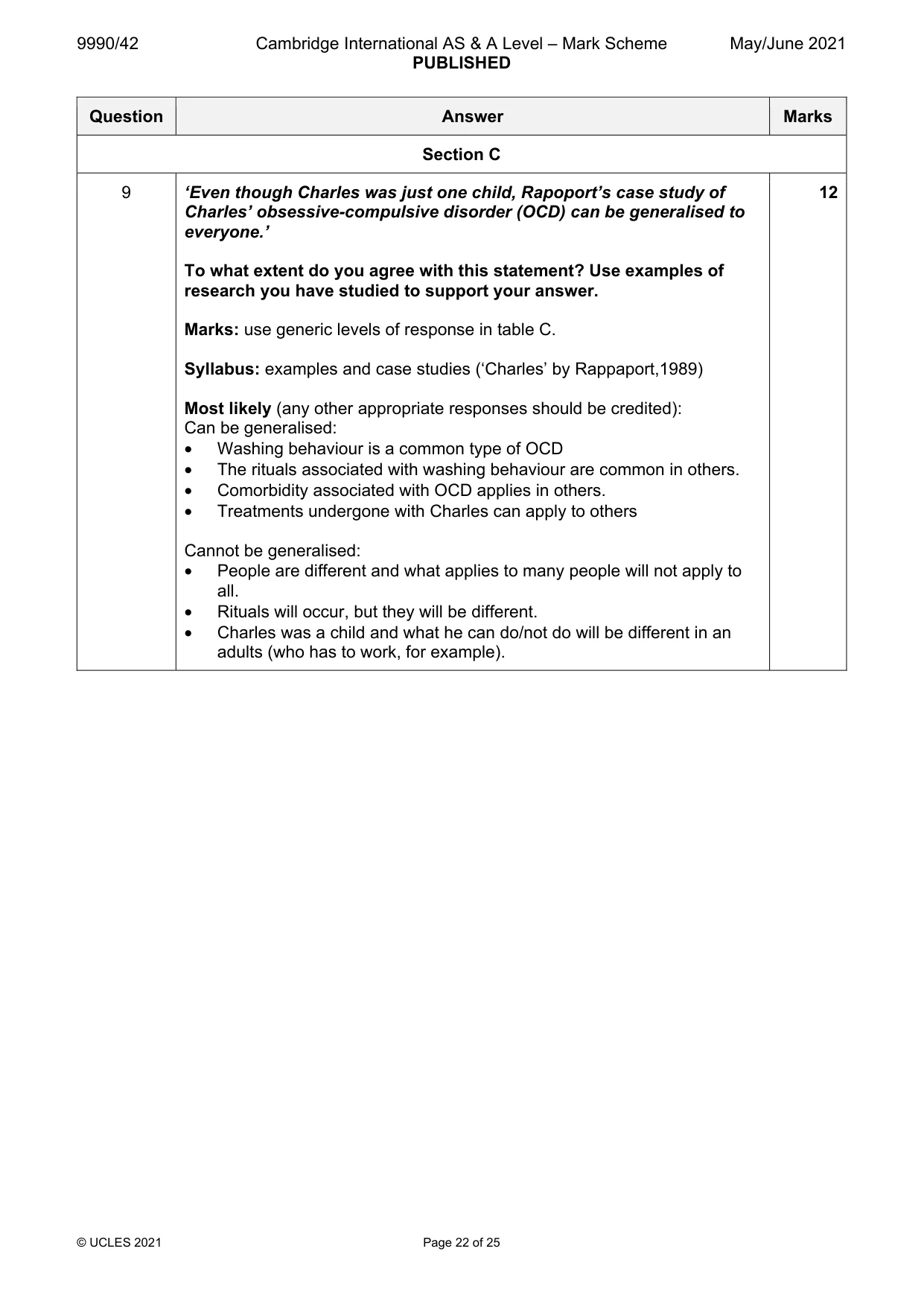
9 ‘Even though Charles was just one child, Rapoport’s case study of Charles’ obsessive-compulsive disorder (OCD) can be generalised to everyone.’ To what extent do you agree with this statement? Use examples of research you have studied to support your answer. [12] Psychology and consumer behaviour
Mark scheme: 9 ‘Even though Charles was just one child, Rapoport’s case study of 12 Charles’ obsessive-compulsive disorder (OCD) can be generalised to everyone.’ To what extent do you agree with this statement? Use examples of research you have studied to support your answer. Marks: use generic levels of response in table C. Syllabus: examples and case studies (‘Charles’ by Rappaport,1989) Most likely (any other appropriate responses should be credited): Can be generalised: • Washing behaviour is a common type of OCD • The rituals associated with washing behaviour are common in others. • Comorbidity associated with OCD applies in others. • Treatments undergone with Charles can apply to others Cannot be generalised: • People are different and what applies to many people will not apply to all. • Rituals will occur, but they will be different. • Charles was a child and what he can do/not do will be different in an adults (who has to work, for example).
Q10 · ‘The findings of experiments of consumer behaviour using eye-tracking have no value…
10 ‘The findings of experiments of consumer behaviour using eye-tracking have no value because they lack ecological validity.’ To what extent do you agree with this statement? Use examples of research you have studied to support your answer. [12] Psychology and health
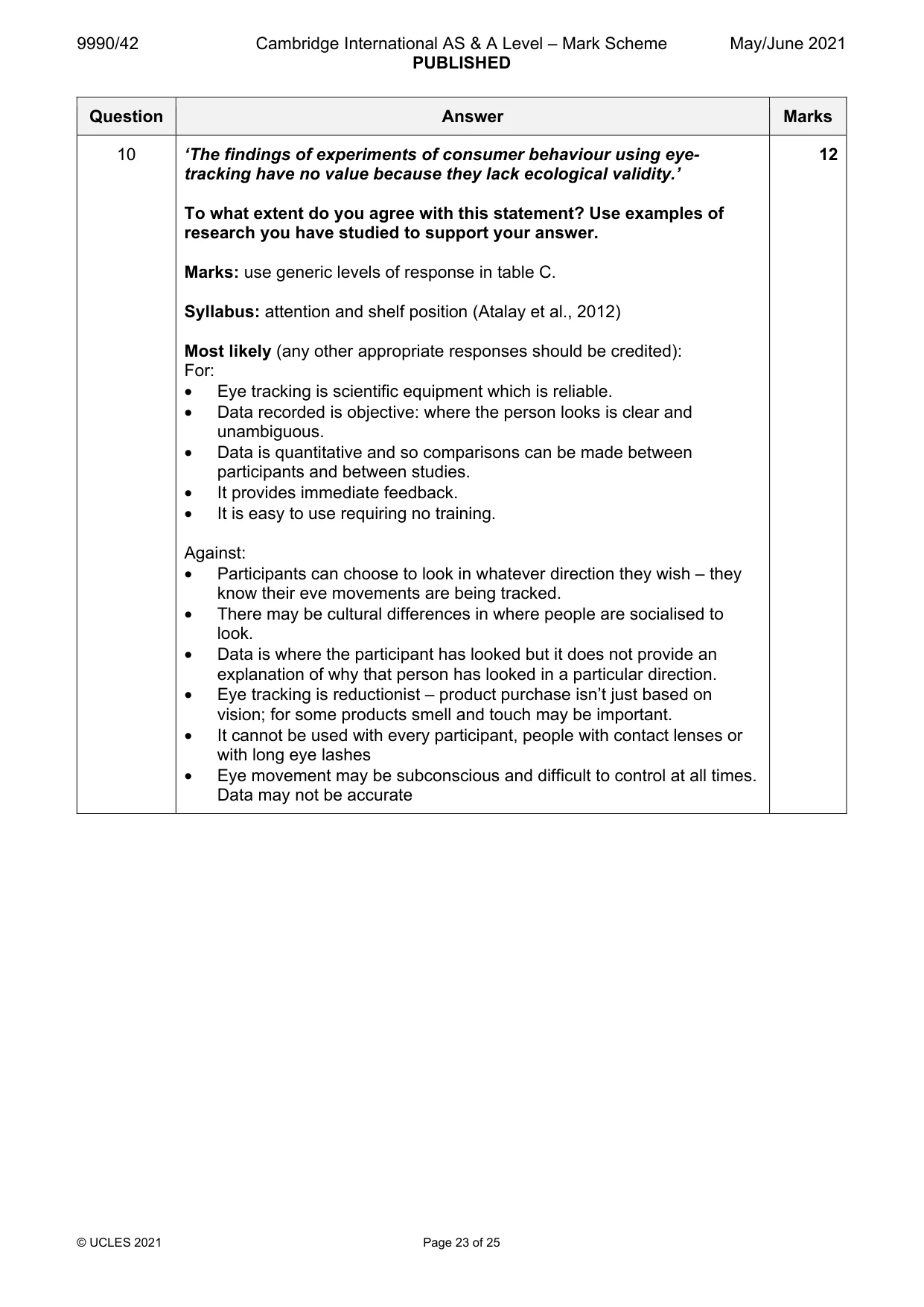
Mark scheme: 10 ‘The findings of experiments of consumer behaviour using eye- 12 tracking have no value because they lack ecological validity.’ To what extent do you agree with this statement? Use examples of research you have studied to support your answer. Marks: use generic levels of response in table C. Syllabus: attention and shelf position (Atalay et al., 2012) Most likely (any other appropriate responses should be credited): For: • Eye tracking is scientific equipment which is reliable. • Data recorded is objective: where the person looks is clear and unambiguous. • Data is quantitative and so comparisons can be made between participants and between studies. • It provides immediate feedback. • It is easy to use requiring no training. Against: • Participants can choose to look in whatever direction they wish – they know their eve movements are being tracked. • There may be cultural differences in where people are socialised to look. • Data is where the participant has looked but it does not provide an explanation of why that person has looked in a particular direction. • Eye tracking is reductionist – product purchase isn’t just based on vision; for some products smell and touch may be important. • It cannot be used with every participant, people with contact lenses or with long eye lashes • Eye movement may be subconscious and difficult to control at all times. Data may not be accurate
Q11 · ‘If there is any doubt about making a correct diagnosis, a medical practitioner should…
11 ‘If there is any doubt about making a correct diagnosis, a medical practitioner should always decide that an ill person is healthy.’ To what extent do you agree with this statement? Use examples of research you have studied to support your answer. [12] Psychology and organisations
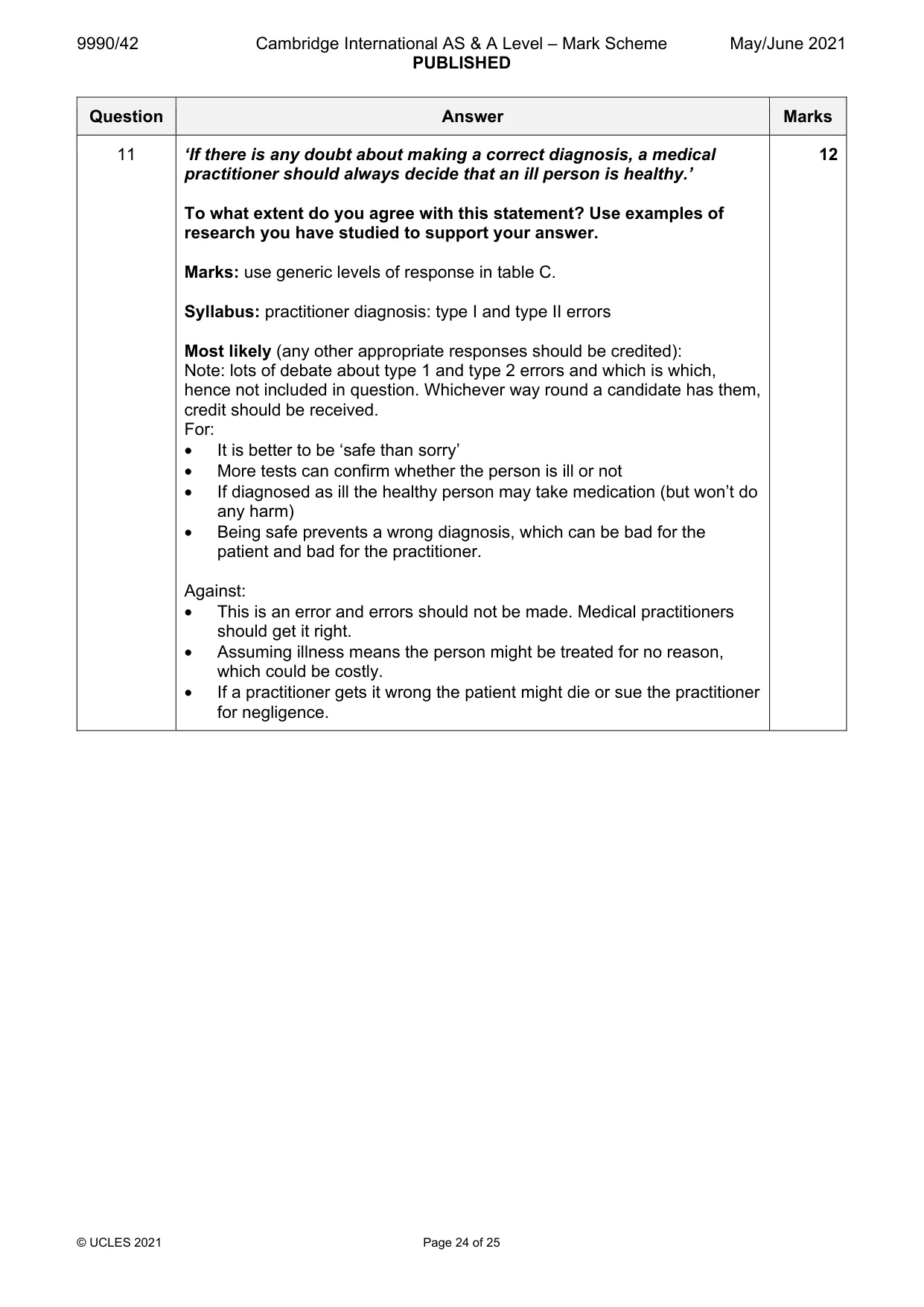
Mark scheme: 11 ‘If there is any doubt about making a correct diagnosis, a medical 12 practitioner should always decide that an ill person is healthy.’ To what extent do you agree with this statement? Use examples of research you have studied to support your answer. Marks: use generic levels of response in table C. Syllabus: practitioner diagnosis: type I and type II errors Most likely (any other appropriate responses should be credited): Note: lots of debate about type 1 and type 2 errors and which is which, hence not included in question. Whichever way round a candidate has them, credit should be received. For: • It is better to be ‘safe than sorry’ • More tests can confirm whether the person is ill or not • If diagnosed as ill the healthy person may take medication (but won’t do any harm) • Being safe prevents a wrong diagnosis, which can be bad for the patient and bad for the practitioner. Against: • This is an error and errors should not be made. Medical practitioners should get it right. • Assuming illness means the person might be treated for no reason, which could be costly. • If a practitioner gets it wrong the patient might die or sue the practitioner for negligence.
Q12 · ‘Organisational commitment can be measured simply by looking at attendance and…
12 ‘Organisational commitment can be measured simply by looking at attendance and absenteeism.’ To what extent do you agree with this statement? Use examples of research you have studied to support your answer. [12]
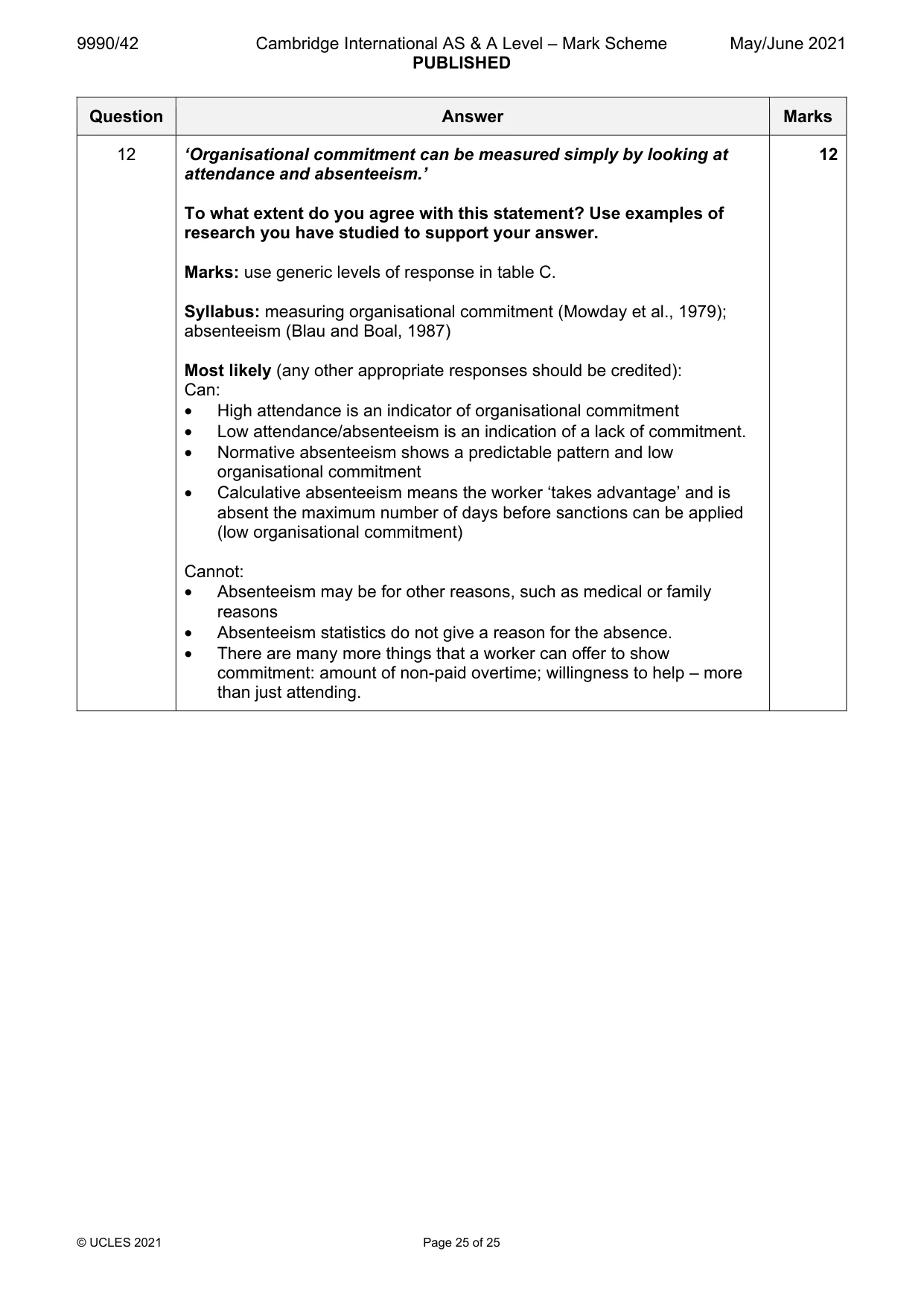
Mark scheme: 12 ‘Organisational commitment can be measured simply by looking at 12 attendance and absenteeism.’ To what extent do you agree with this statement? Use examples of research you have studied to support your answer. Marks: use generic levels of response in table C. Syllabus: measuring organisational commitment (Mowday et al., 1979); absenteeism (Blau and Boal, 1987) Most likely (any other appropriate responses should be credited): Can: • High attendance is an indicator of organisational commitment • Low attendance/absenteeism is an indication of a lack of commitment. • Normative absenteeism shows a predictable pattern and low organisational commitment • Calculative absenteeism means the worker ‘takes advantage’ and is absent the maximum number of days before sanctions can be applied (low organisational commitment) Cannot: • Absenteeism may be for other reasons, such as medical or family reasons • Absenteeism statistics do not give a reason for the absence. • There are many more things that a worker can offer to show commitment: amount of non-paid overtime; willingness to help – more than just attending.
What was in this paper
The subtopics covered by these 12 questions, and how many questions each got. Open one in a new tab to see every Cambridge question on it.
What you needed in this session
Cambridge’s own grade thresholds for 2021 May/June, Paper 4 · Variant 2. A higher threshold means an easier paper — the bar moves with how the cohort did.