Cambridge A Level Psychology (from 2018) 9990 — 2018 Feb/March Paper 4 · Variant 2
9990/42/F/M/18 · 12 questions · 60 marks · ≈68 min
The question paper and its mark scheme, free to read here and free to download. This is Cambridge’s own paper, exactly as it was sat.
Question paper8 pages
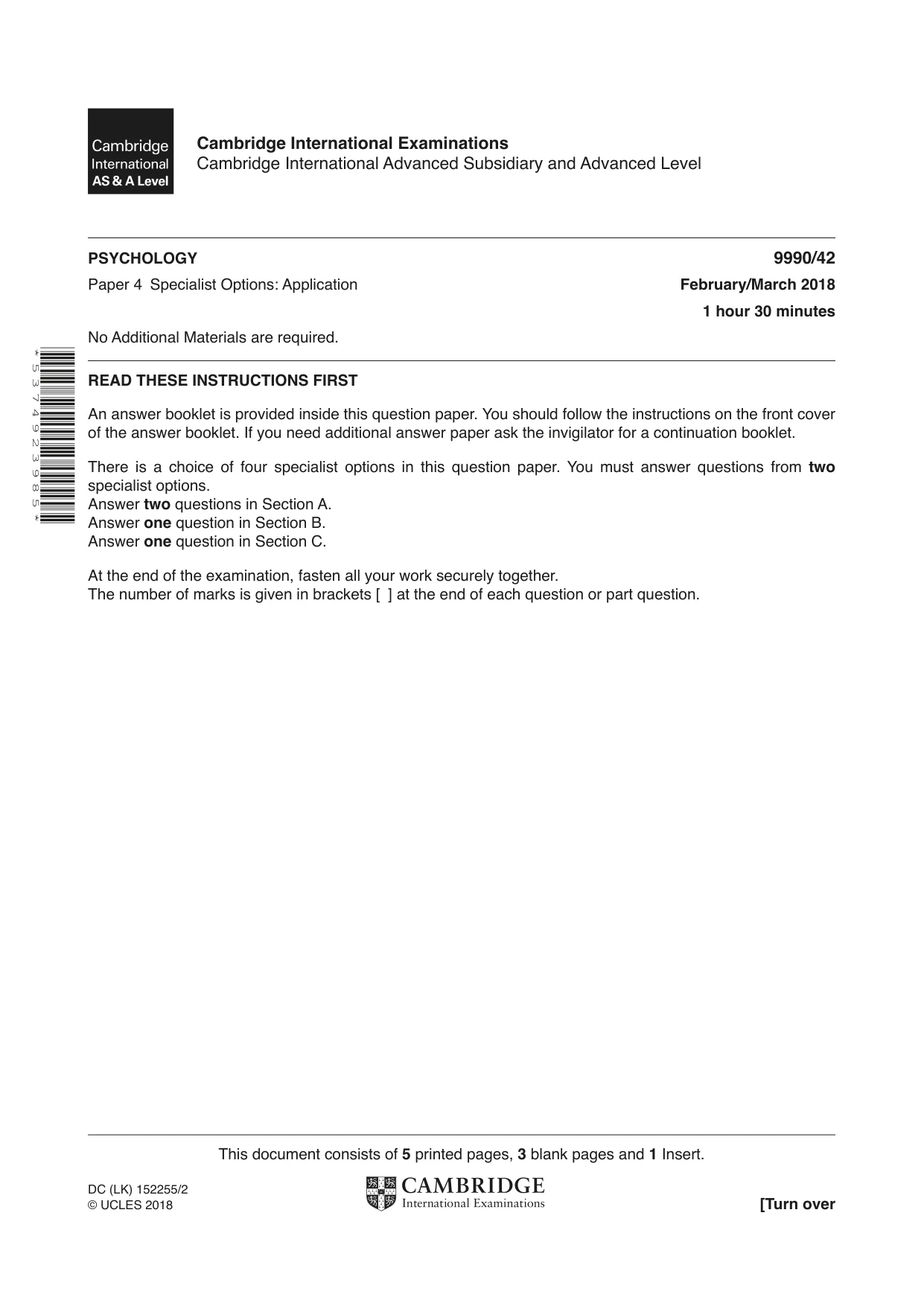



Mark scheme22 pages
Answers below. Sit the paper first if you are practising.
Questions as text
Q1 · Billy has a fear of the dark, and has read about Freud’s psychoanalytic explanation of…
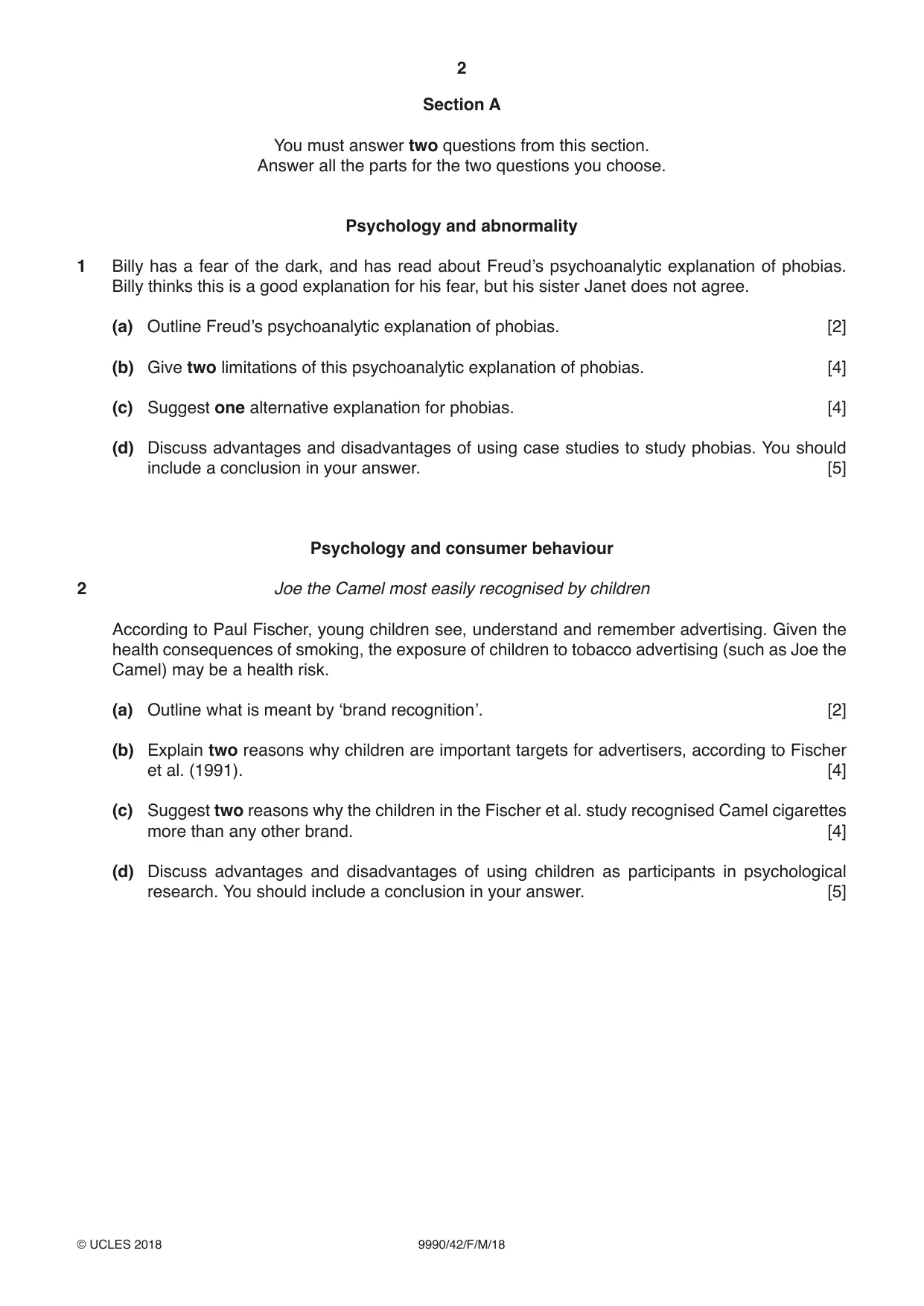
1 Billy has a fear of the dark, and has read about Freud’s psychoanalytic explanation of phobias. Billy thinks this is a good explanation for his fear, but his sister Janet does not agree. (a) Outline Freud’s psychoanalytic explanation of phobias. [2] (b) Give two limitations of this psychoanalytic explanation of phobias. [4] (c) Suggest one alternative explanation for phobias. [4] (d) Discuss advantages and disadvantages of using case studies to study phobias. You should include a conclusion in your answer. [5] Psychology and consumer behaviour
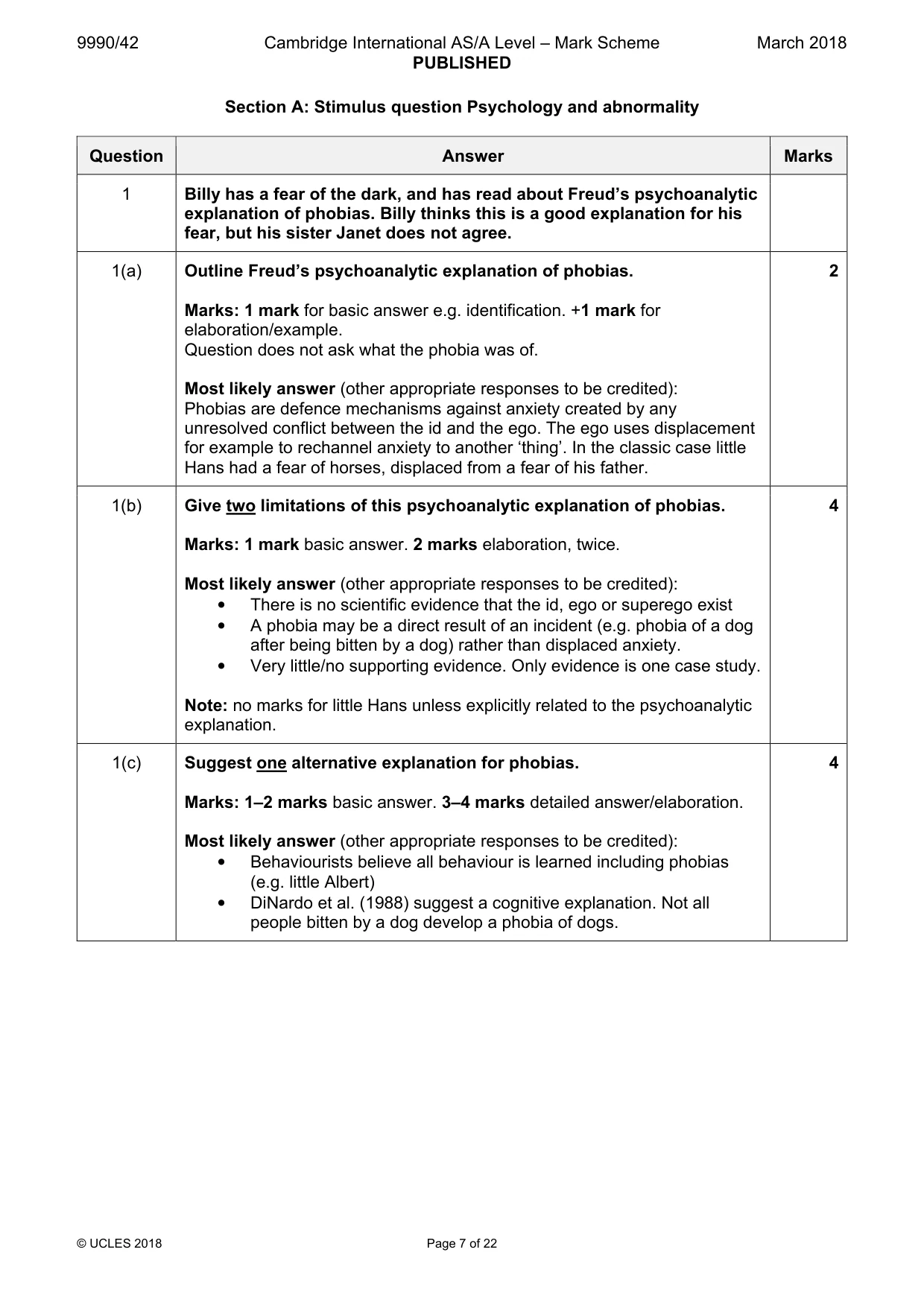
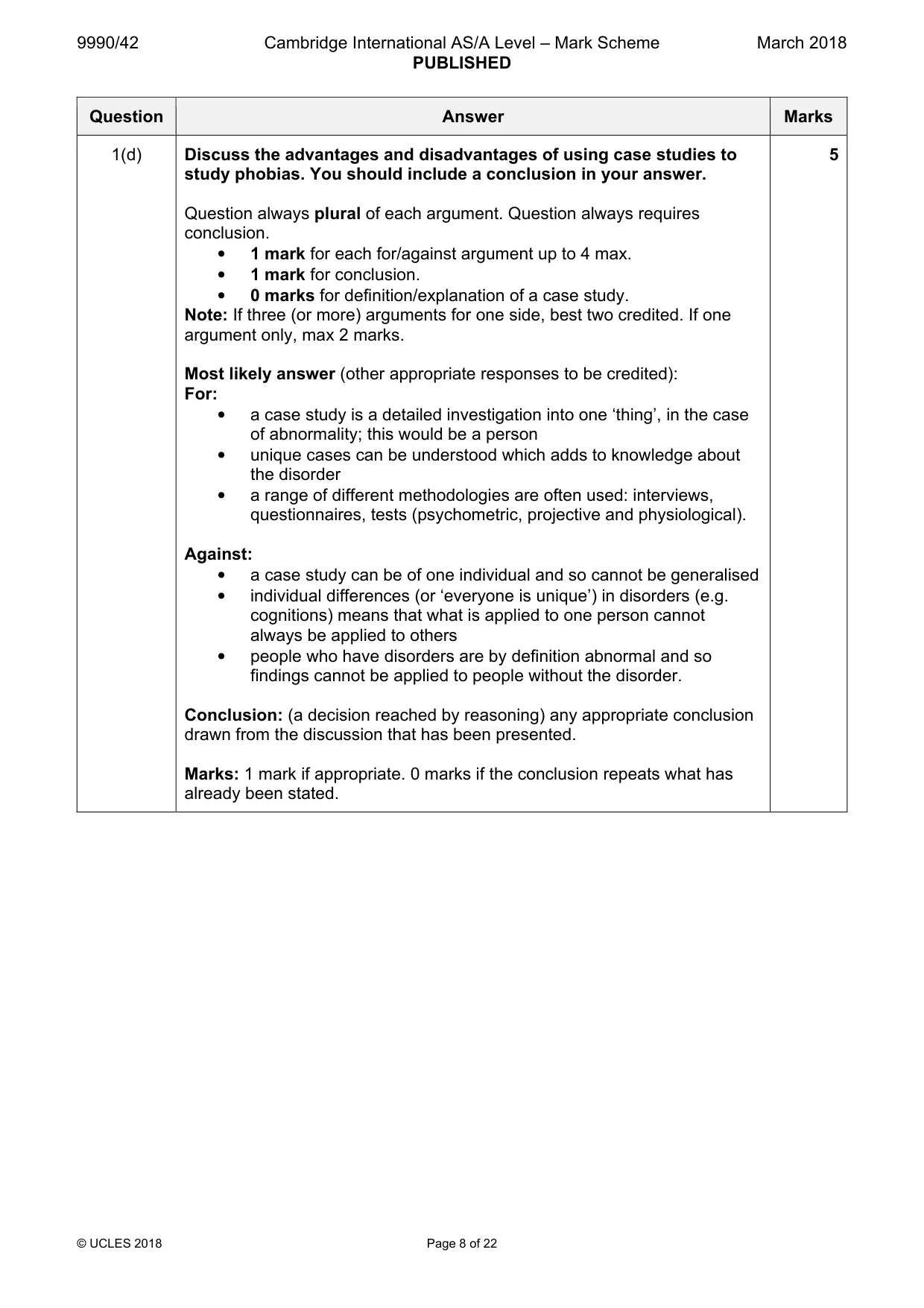
Mark scheme: Question Answer Marks 1 Billy has a fear of the dark, and has read about Freud’s psychoanalytic explanation of phobias. Billy thinks this is a good explanation for his fear, but his sister Janet does not agree. 1(a) Outline Freud’s psychoanalytic explanation of phobias. 2 Marks: 1 mark for basic answer e.g. identification. +1 mark for elaboration/example. Question does not ask what the phobia was of. Most likely answer (other appropriate responses to be credited): Phobias are defence mechanisms against anxiety created by any unresolved conflict between the id and the ego. The ego uses displacement for example to rechannel anxiety to another ‘thing’. In the classic case little Hans had a fear of horses, displaced from a fear of his father. 1(b) Give two limitations of this psychoanalytic explanation of phobias. 4 Marks: 1 mark basic answer. 2 marks elaboration, twice. Most likely answer (other appropriate responses to be credited): • There is no scientific evidence that the id, ego or superego exist • A phobia may be a direct result of an incident (e.g. phobia of a dog after being bitten by a dog) rather than displaced anxiety. • Very little/no supporting evidence. Only evidence is one case study. Note: no marks for little Hans unless explicitly related to the psychoanalytic explanation. 1(c) Suggest one alternative explanation for phobias. 4 Marks: 1–2 marks basic answer. 3–4 marks detailed answer/elaboration. Most likely answer (other appropriate responses to be credited): • Behaviourists believe all behaviour is learned including phobias (e.g. little Albert) • DiNardo et al. (1988) suggest a cognitive explanation. Not all people bitten by a dog develop a phobia of dogs. 1(d) Discuss the advantages and disadvantages of using case studies to 5 study phobias. You should include a conclusion in your answer. Question always plural of each argument. Question always requires conclusion. • 1 mark for each for/against argument up to 4 max. • 1 mark for conclusion. • 0 marks for definition/explanation of a case study. Note: If three (or more) arguments for one side, best two credited. If one argument only, max 2 marks. Most likely answer (other appropriate responses to be credited): For: • a case study is a detailed investigation into one ‘thing’, in the case of abnormality; this would be a person • unique cases can be understood which adds to knowledge about the disorder • a range of different methodologies are often used: interviews, questionnaires, tests (psychometric, projective and physiological). Against: • a case study can be of one individual and so cannot be generalised • individual differences (or ‘everyone is unique’) in disorders (e.g. cognitions) means that what is applied to one person cannot always be applied to others • people who have disorders are by definition abnormal and so findings cannot be applied to people without the disorder. Conclusion: (a decision reached by reasoning) any appropriate conclusion drawn from the discussion that has been presented. Marks: 1 mark if appropriate. 0 marks if the conclusion repeats what has already been stated. Section A: Stimulus question psychology and consumer behaviour
More questions on Anxiety disorders and fear-related disorders
Q2 · Joe the Camel most easily recognised by children According to Paul Fischer, young…
2 Joe the Camel most easily recognised by children According to Paul Fischer, young children see, understand and remember advertising. Given the health consequences of smoking, the exposure of children to tobacco advertising (such as Joe the Camel) may be a health risk. (a) Outline what is meant by ‘brand recognition’. [2] (b) Explain two reasons why children are important targets for advertisers, according to Fischer et al. (1991). [4] (c) Suggest two reasons why the children in the Fischer et al. study recognised Camel cigarettes more than any other brand. [4] (d) Discuss advantages and disadvantages of using children as participants in psychological research. You should include a conclusion in your answer. [5] Psychology and health
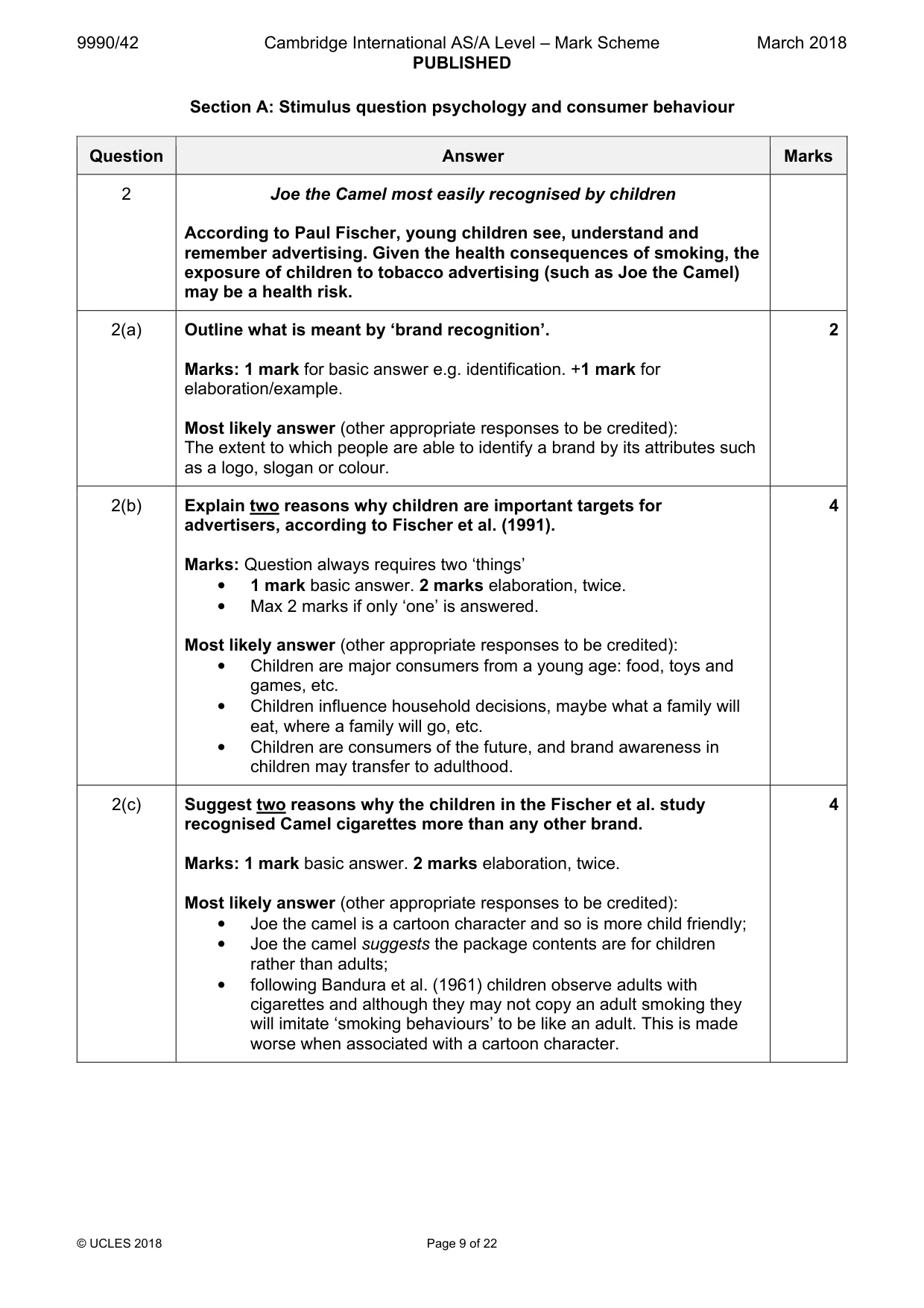
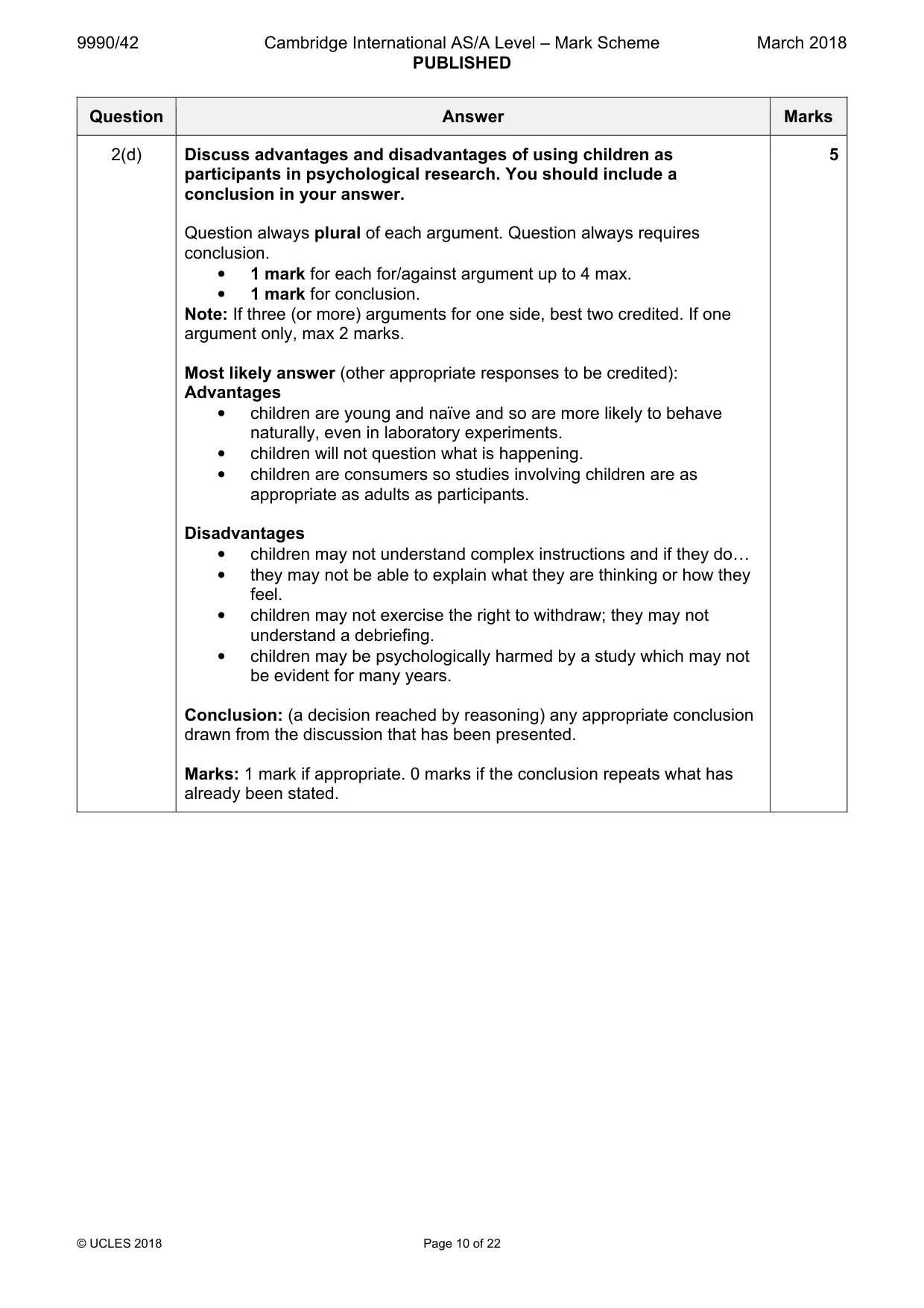
Mark scheme: 2(a) Outline what is meant by ‘brand recognition’. 2 Marks: 1 mark for basic answer e.g. identification. +1 mark for elaboration/example. Most likely answer (other appropriate responses to be credited): The extent to which people are able to identify a brand by its attributes such as a logo, slogan or colour. 2(b) Explain two reasons why children are important targets for 4 advertisers, according to Fischer et al. (1991). Marks: Question always requires two ‘things’ • 1 mark basic answer. 2 marks elaboration, twice. • Max 2 marks if only ‘one’ is answered. Most likely answer (other appropriate responses to be credited): • Children are major consumers from a young age: food, toys and games, etc. • Children influence household decisions, maybe what a family will eat, where a family will go, etc. • Children are consumers of the future, and brand awareness in children may transfer to adulthood. 2(c) Suggest two reasons why the children in the Fischer et al. study 4 recognised Camel cigarettes more than any other brand. Marks: 1 mark basic answer. 2 marks elaboration, twice. Most likely answer (other appropriate responses to be credited): • Joe the camel is a cartoon character and so is more child friendly; • Joe the camel suggests the package contents are for children rather than adults; • following Bandura et al. (1961) children observe adults with cigarettes and although they may not copy an adult smoking they will imitate ‘smoking behaviours’ to be like an adult. This is made worse when associated with a cartoon character. 2(d) Discuss advantages and disadvantages of using children as 5 participants in psychological research. You should include a conclusion in your answer. Question always plural of each argument. Question always requires conclusion. • 1 mark for each for/against argument up to 4 max. • 1 mark for conclusion. Note: If three (or more) arguments for one side, best two credited. If one argument only, max 2 marks. Most likely answer (other appropriate responses to be credited): Advantages • children are young and naïve and so are more likely to behave naturally, even in laboratory experiments. • children will not question what is happening. • children are consumers so studies involving children are as appropriate as adults as participants. Disadvantages • children may not understand complex instructions and if they do« • they may not be able to explain what they are thinking or how they feel. • children may not exercise the right to withdraw; they may not understand a debriefing. • children may be psychologically harmed by a study which may not be evident for many years. Conclusion: (a decision reached by reasoning) any appropriate conclusion drawn from the discussion that has been presented. Marks: 1 mark if appropriate. 0 marks if the conclusion repeats what has already been stated. Section A: Stimulus question psychology and health
Q3 · The field experiment by Savage and Armstrong (1990) investigated the effect of consulting…
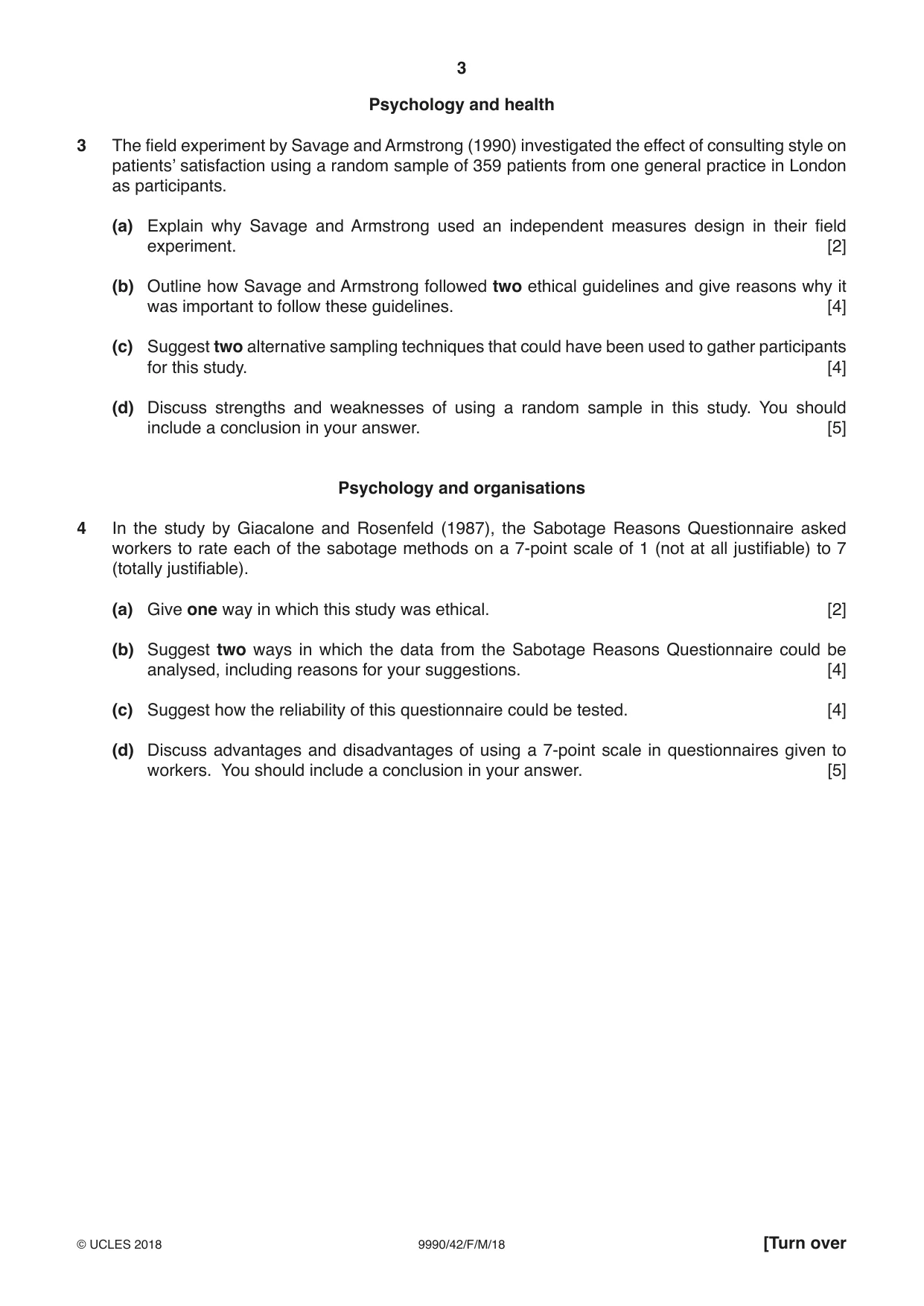
3 The field experiment by Savage and Armstrong (1990) investigated the effect of consulting style on patients’ satisfaction using a random sample of 359 patients from one general practice in London as participants. (a) Explain why Savage and Armstrong used an independent measures design in their field experiment. [2] (b) Outline how Savage and Armstrong followed two ethical guidelines and give reasons why it was important to follow these guidelines. [4] (c) Suggest two alternative sampling techniques that could have been used to gather participants for this study. [4] (d) Discuss strengths and weaknesses of using a random sample in this study. You should include a conclusion in your answer. [5] Psychology and organisations
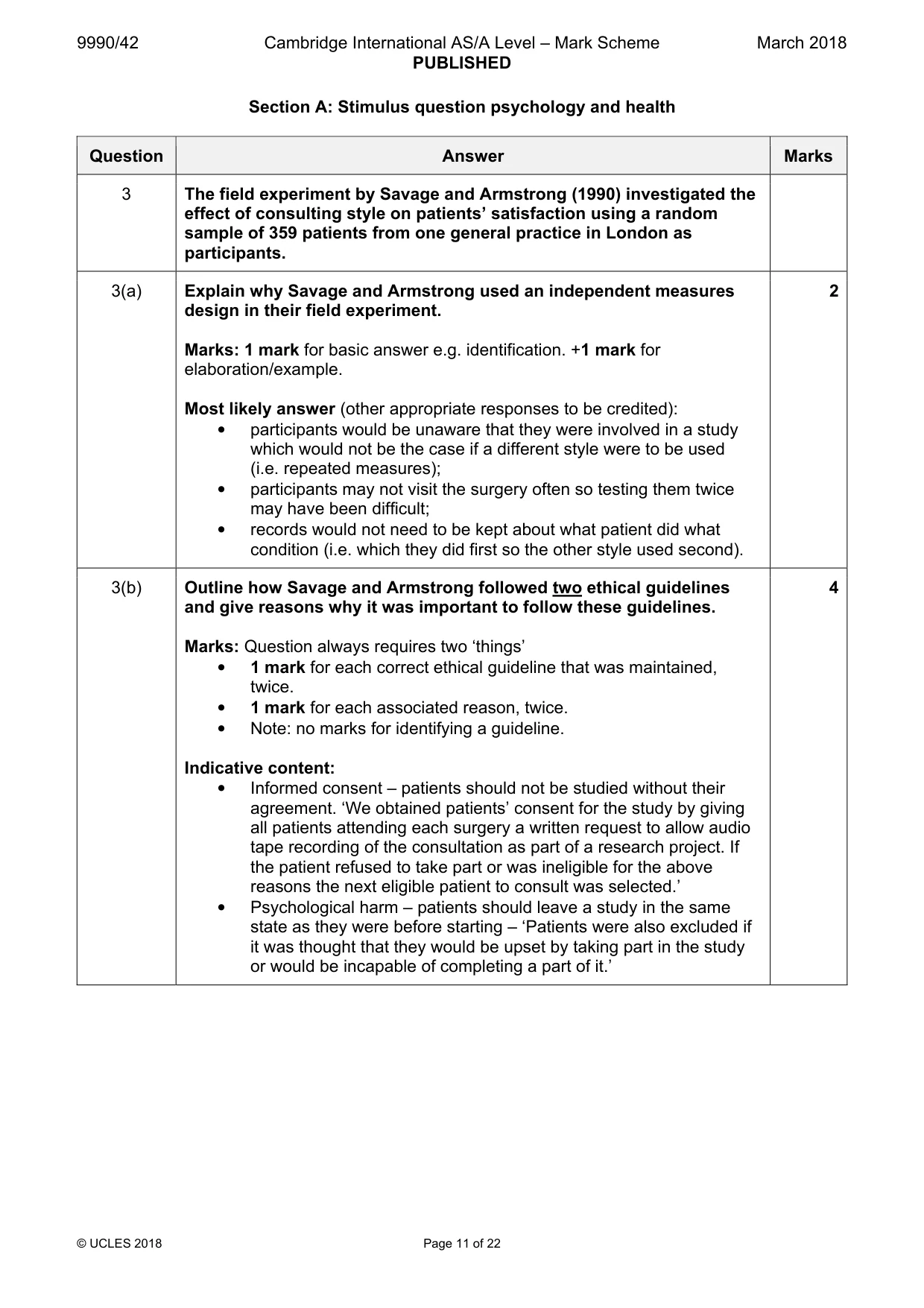
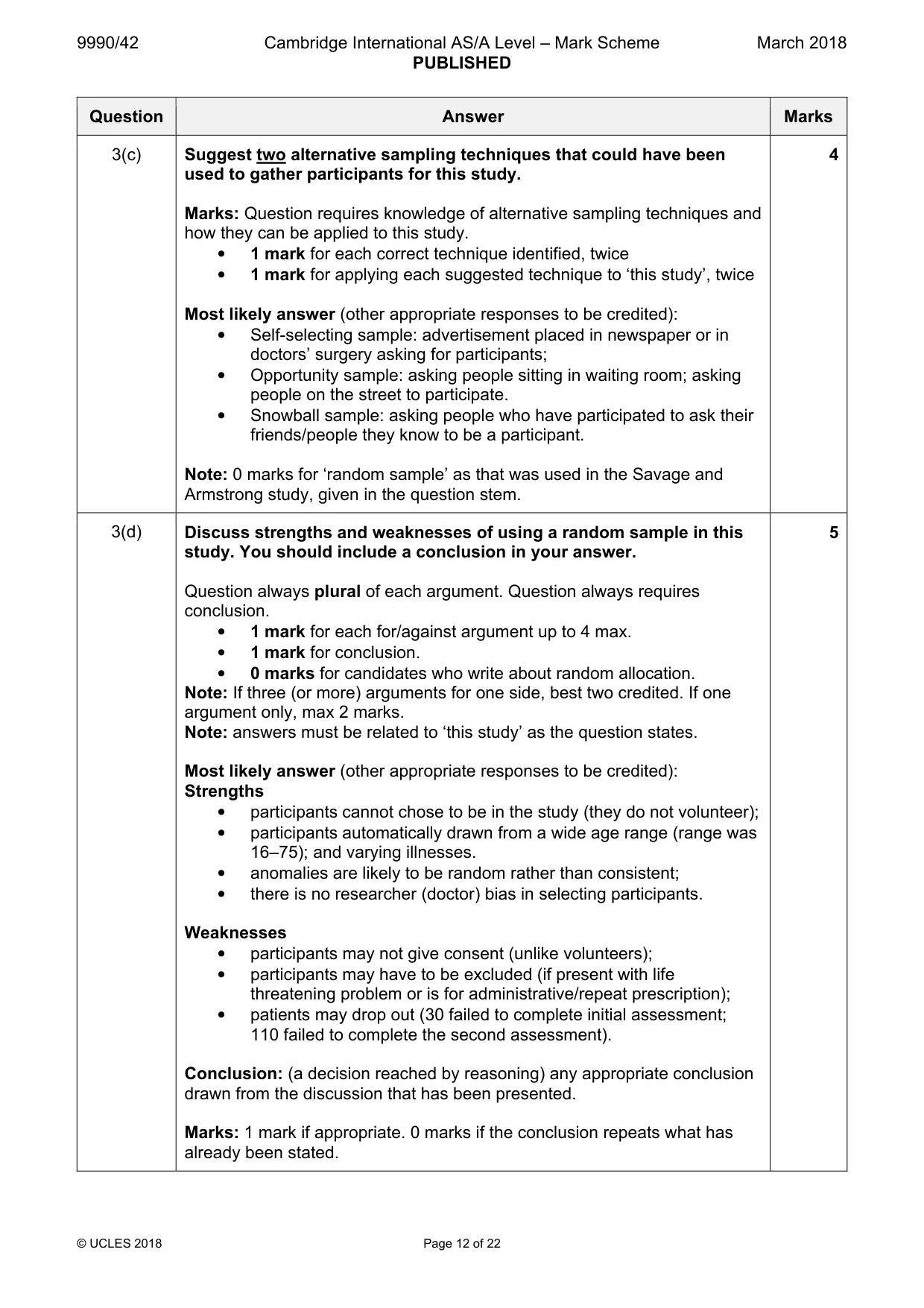
Mark scheme: 3(a) Explain why Savage and Armstrong used an independent measures 2 design in their field experiment. Marks: 1 mark for basic answer e.g. identification. +1 mark for elaboration/example. Most likely answer (other appropriate responses to be credited): • participants would be unaware that they were involved in a study which would not be the case if a different style were to be used (i.e. repeated measures); • participants may not visit the surgery often so testing them twice may have been difficult; • records would not need to be kept about what patient did what condition (i.e. which they did first so the other style used second). 3(b) Outline how Savage and Armstrong followed two ethical guidelines 4 and give reasons why it was important to follow these guidelines. Marks: Question always requires two ‘things’ • 1 mark for each correct ethical guideline that was maintained, twice. • 1 mark for each associated reason, twice. • Note: no marks for identifying a guideline. Indicative content: • Informed consent – patients should not be studied without their agreement. ‘We obtained patients’ consent for the study by giving all patients attending each surgery a written request to allow audio tape recording of the consultation as part of a research project. If the patient refused to take part or was ineligible for the above reasons the next eligible patient to consult was selected.’ • Psychological harm – patients should leave a study in the same state as they were before starting – ‘Patients were also excluded if it was thought that they would be upset by taking part in the study or would be incapable of completing a part of it.’ 3(c) Suggest two alternative sampling techniques that could have been 4 used to gather participants for this study. Marks: Question requires knowledge of alternative sampling techniques and how they can be applied to this study. • 1 mark for each correct technique identified, twice • 1 mark for applying each suggested technique to ‘this study’, twice Most likely answer (other appropriate responses to be credited): • Self-selecting sample: advertisement placed in newspaper or in doctors’ surgery asking for participants; • Opportunity sample: asking people sitting in waiting room; asking people on the street to participate. • Snowball sample: asking people who have participated to ask their friends/people they know to be a participant. Note: 0 marks for ‘random sample’ as that was used in the Savage and Armstrong study, given in the question stem. 3(d) Discuss strengths and weaknesses of using a random sample in this 5 study. You should include a conclusion in your answer. Question always plural of each argument. Question always requires conclusion. • 1 mark for each for/against argument up to 4 max. • 1 mark for conclusion. • 0 marks for candidates who write about random allocation. Note: If three (or more) arguments for one side, best two credited. If one argument only, max 2 marks. Note: answers must be related to ‘this study’ as the question states. Most likely answer (other appropriate responses to be credited): Strengths • participants cannot chose to be in the study (they do not volunteer); • participants automatically drawn from a wide age range (range was 16–75); and varying illnesses. • anomalies are likely to be random rather than consistent; • there is no researcher (doctor) bias in selecting participants. Weaknesses • participants may not give consent (unlike volunteers); • participants may have to be excluded (if present with life threatening problem or is for administrative/repeat prescription); • patients may drop out (30 failed to complete initial assessment; 110 failed to complete the second assessment). Conclusion: (a decision reached by reasoning) any appropriate conclusion drawn from the discussion that has been presented. Marks: 1 mark if appropriate. 0 marks if the conclusion repeats what has already been stated. Section A: Stimulus question psychology and organisations
Q4 · In the study by Giacalone and Rosenfeld (1987), the Sabotage Reasons Questionnaire asked…
4 In the study by Giacalone and Rosenfeld (1987), the Sabotage Reasons Questionnaire asked workers to rate each of the sabotage methods on a 7-point scale of 1 (not at all justifiable) to 7 (totally justifiable). (a) Give one way in which this study was ethical. [2] (b) Suggest two ways in which the data from the Sabotage Reasons Questionnaire could be analysed, including reasons for your suggestions. [4] (c) Suggest how the reliability of this questionnaire could be tested. [4] (d) Discuss advantages and disadvantages of using a 7-point scale in questionnaires given to workers. You should include a conclusion in your answer. [5]
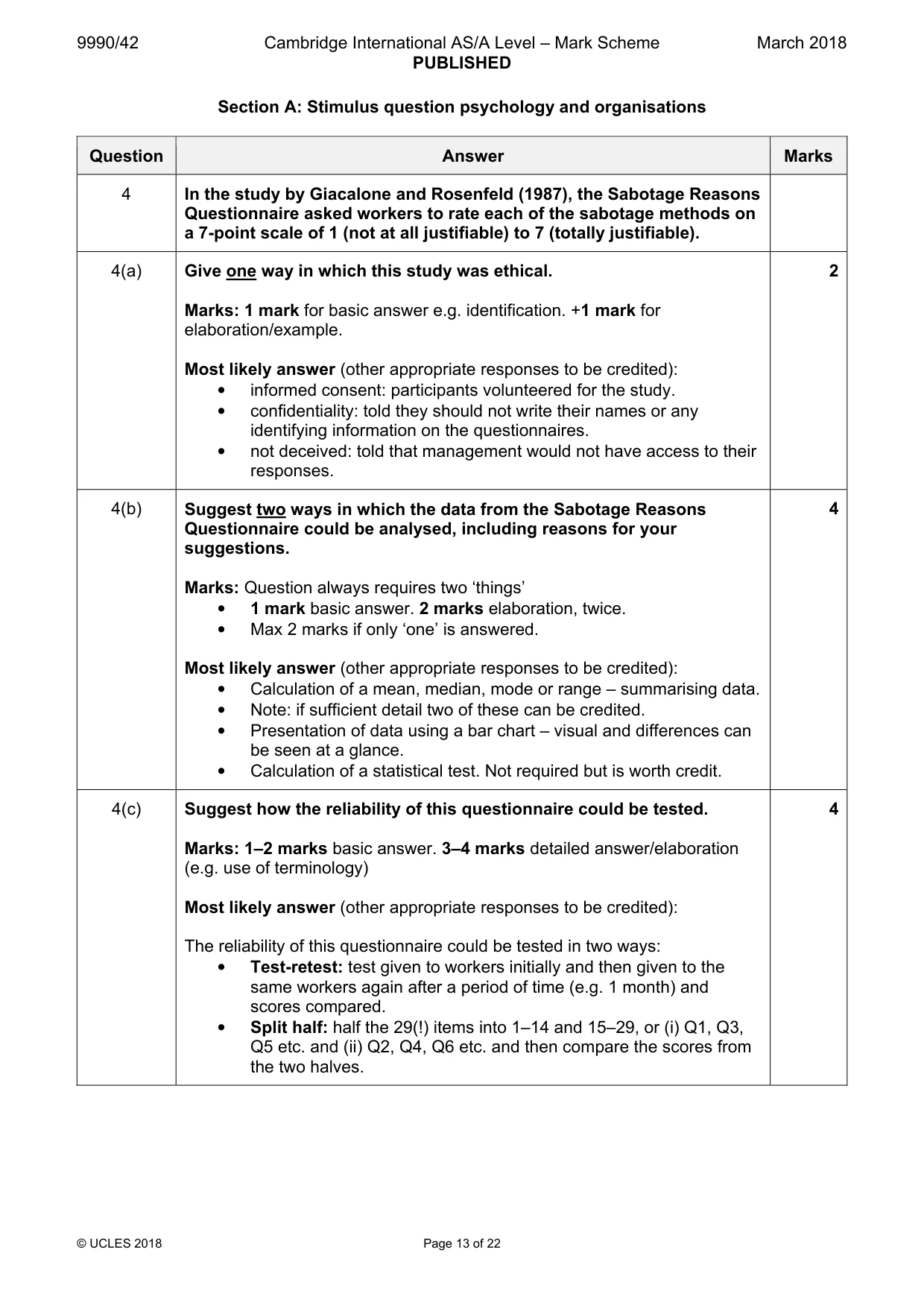
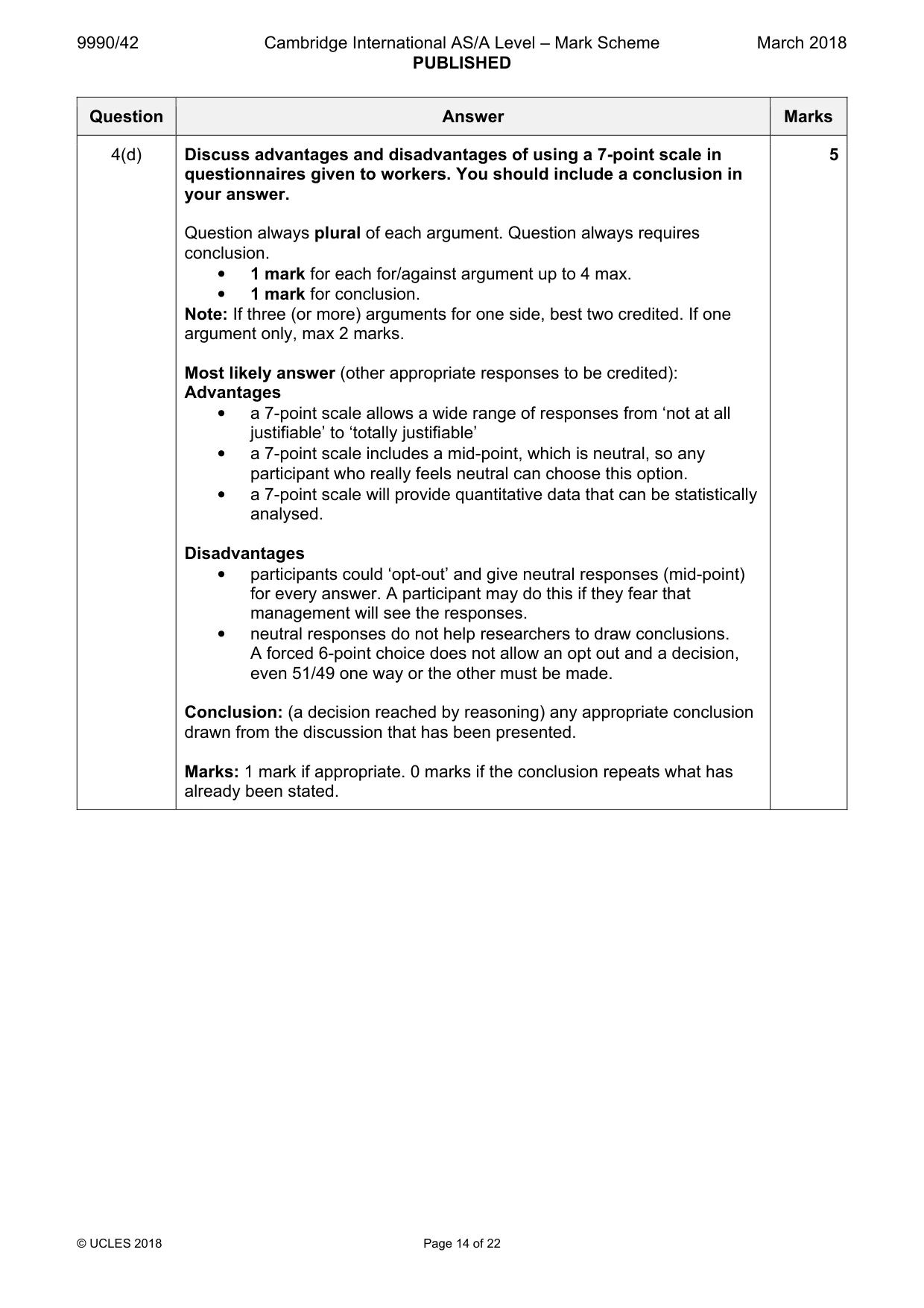
Mark scheme: 4(a) Give one way in which this study was ethical. 2 Marks: 1 mark for basic answer e.g. identification. +1 mark for elaboration/example. Most likely answer (other appropriate responses to be credited): • informed consent: participants volunteered for the study. • confidentiality: told they should not write their names or any identifying information on the questionnaires. • not deceived: told that management would not have access to their responses. 4(b) Suggest two ways in which the data from the Sabotage Reasons 4 Questionnaire could be analysed, including reasons for your suggestions. Marks: Question always requires two ‘things’ • 1 mark basic answer. 2 marks elaboration, twice. • Max 2 marks if only ‘one’ is answered. Most likely answer (other appropriate responses to be credited): • Calculation of a mean, median, mode or range – summarising data. • Note: if sufficient detail two of these can be credited. • Presentation of data using a bar chart – visual and differences can be seen at a glance. • Calculation of a statistical test. Not required but is worth credit. 4(c) Suggest how the reliability of this questionnaire could be tested. 4 Marks: 1–2 marks basic answer. 3–4 marks detailed answer/elaboration (e.g. use of terminology) Most likely answer (other appropriate responses to be credited): The reliability of this questionnaire could be tested in two ways: • Test-retest: test given to workers initially and then given to the same workers again after a period of time (e.g. 1 month) and scores compared. • Split half: half the 29(!) items into 1–14 and 15–29, or (i) Q1, Q3, Q5 etc. and (ii) Q2, Q4, Q6 etc. and then compare the scores from the two halves. 4(d) Discuss advantages and disadvantages of using a 7-point scale in 5 questionnaires given to workers. You should include a conclusion in your answer. Question always plural of each argument. Question always requires conclusion. • 1 mark for each for/against argument up to 4 max. • 1 mark for conclusion. Note: If three (or more) arguments for one side, best two credited. If one argument only, max 2 marks. Most likely answer (other appropriate responses to be credited): Advantages • a 7-point scale allows a wide range of responses from ‘not at all justifiable’ to ‘totally justifiable’ • a 7-point scale includes a mid-point, which is neutral, so any participant who really feels neutral can choose this option. • a 7-point scale will provide quantitative data that can be statistically analysed. Disadvantages • participants could ‘opt-out’ and give neutral responses (mid-point) for every answer. A participant may do this if they fear that management will see the responses. • neutral responses do not help researchers to draw conclusions. A forced 6-point choice does not allow an opt out and a decision, even 51/49 one way or the other must be made. Conclusion: (a decision reached by reasoning) any appropriate conclusion drawn from the discussion that has been presented. Marks: 1 mark if appropriate. 0 marks if the conclusion repeats what has already been stated. Section B: Design question (a)=10 marks, (b)=8 marks
Q5 · Design a study to assess the effectiveness of virtual reality as a way to measure…
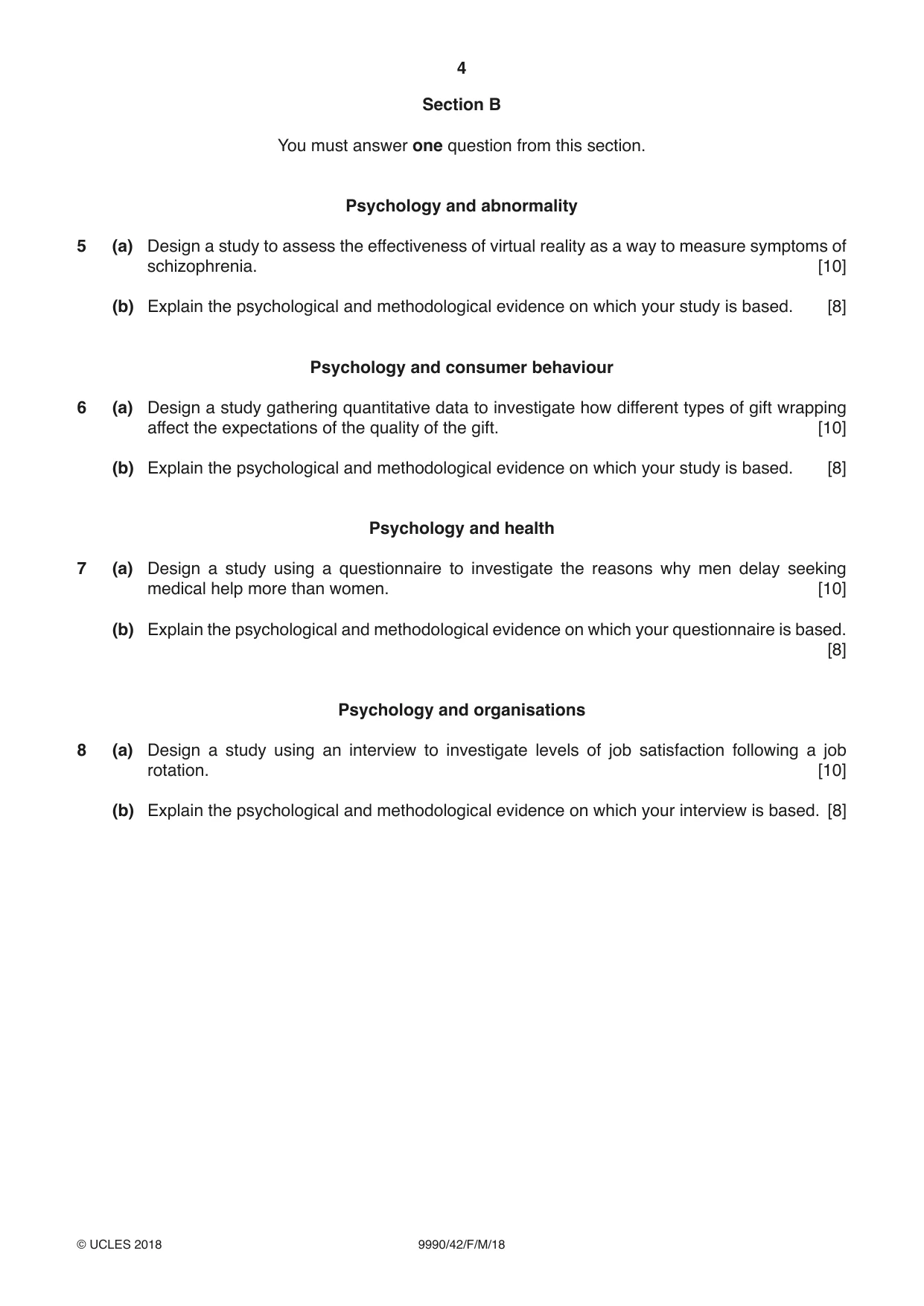
5 (a) Design a study to assess the effectiveness of virtual reality as a way to measure symptoms of schizophrenia. [10] (b) Explain the psychological and methodological evidence on which your study is based. [8] Psychology and consumer behaviour
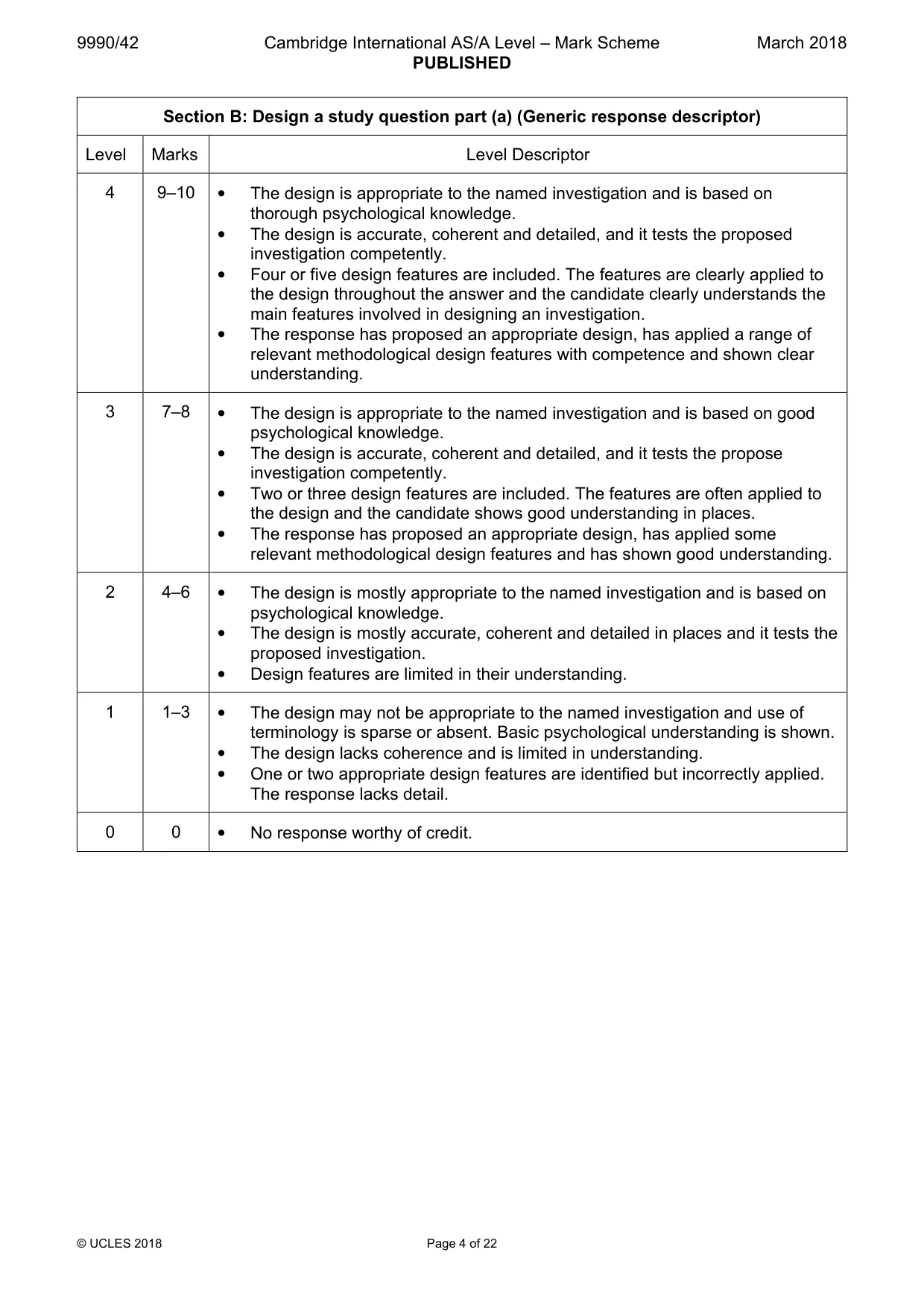
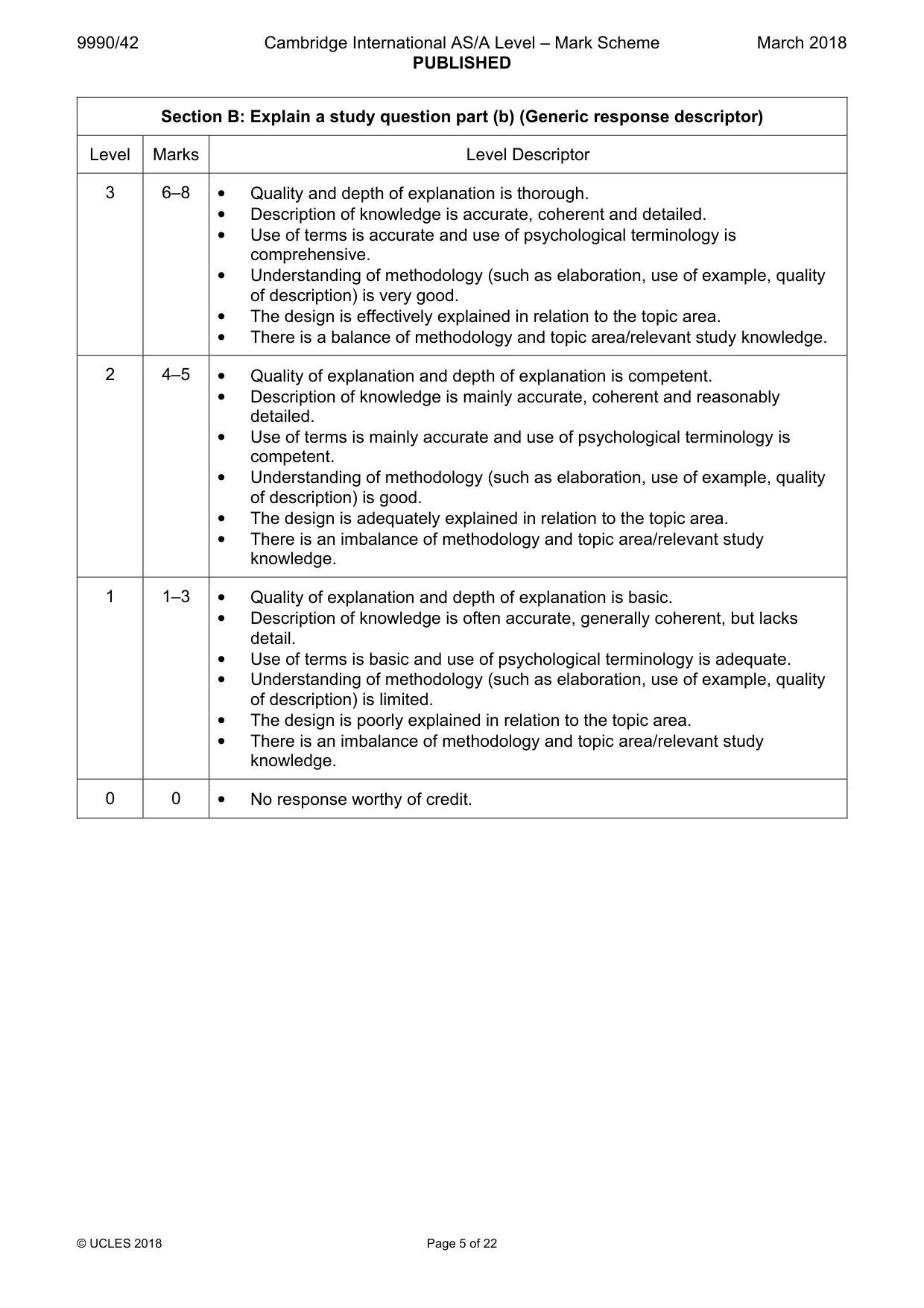
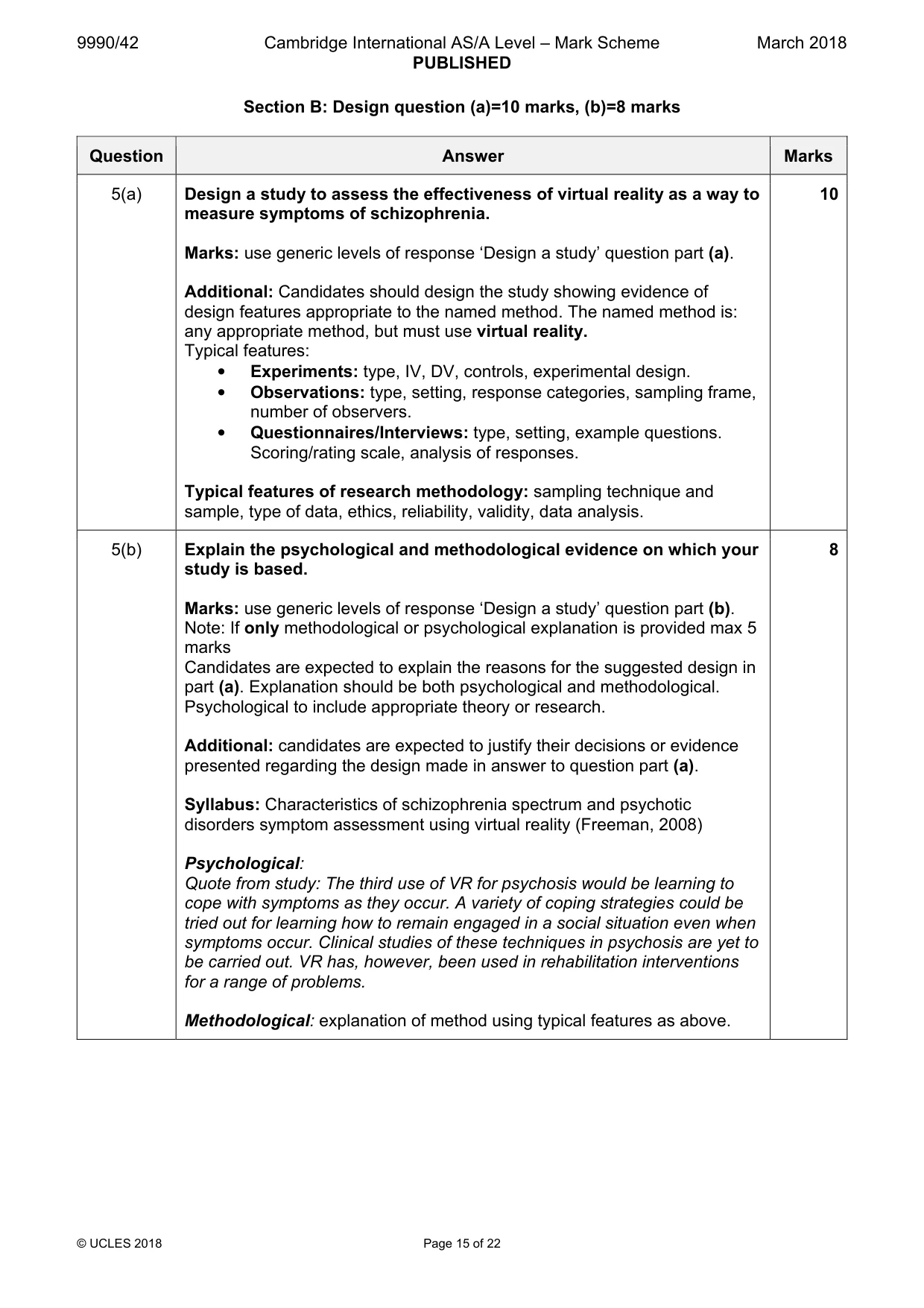
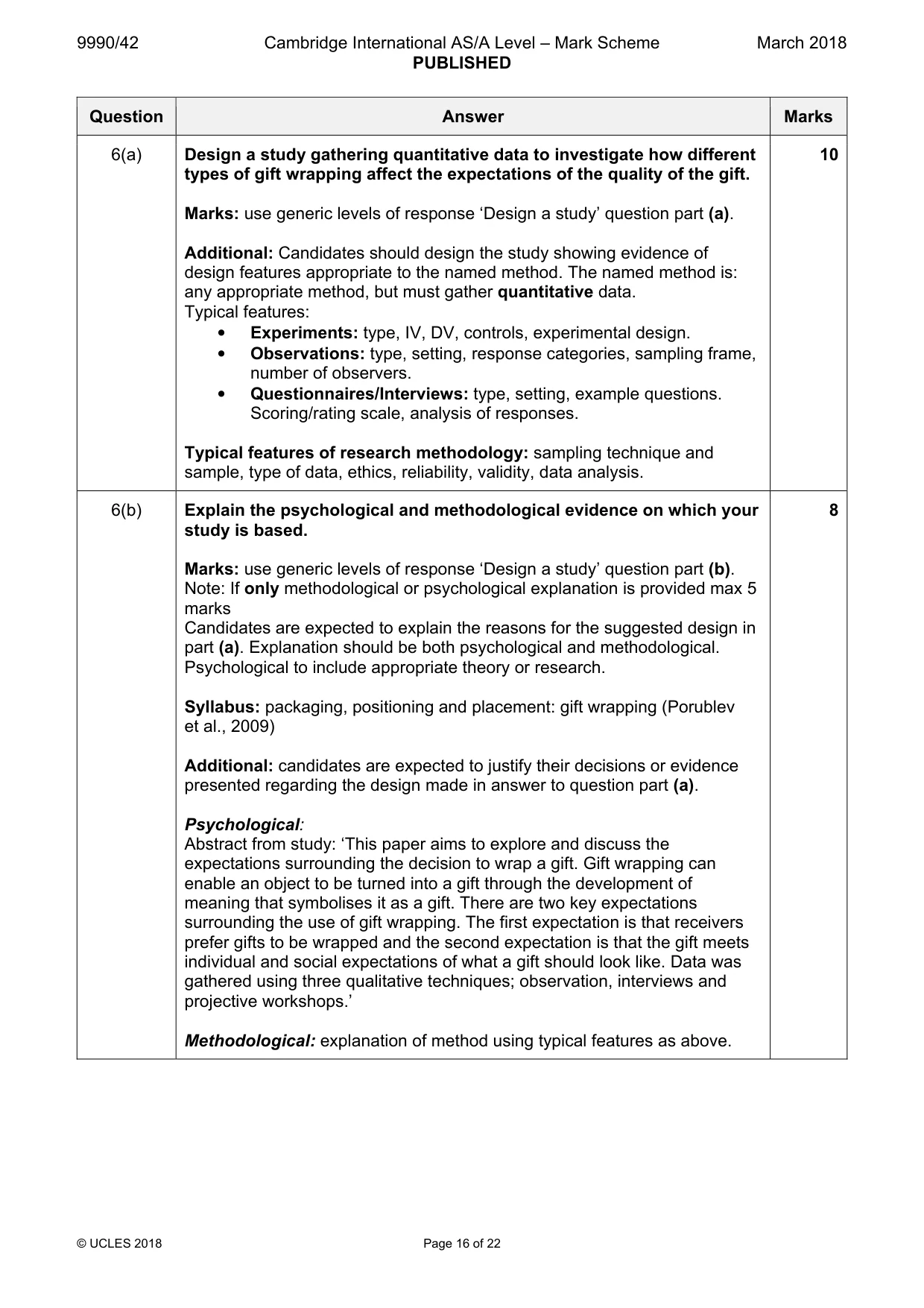
Mark scheme: 5(a) Design a study to assess the effectiveness of virtual reality as a way to 10 measure symptoms of schizophrenia. Marks: use generic levels of response ‘Design a study’ question part (a). Additional: Candidates should design the study showing evidence of design features appropriate to the named method. The named method is: any appropriate method, but must use virtual reality. Typical features: • Experiments: type, IV, DV, controls, experimental design. • Observations: type, setting, response categories, sampling frame, number of observers. • Questionnaires/Interviews: type, setting, example questions. Scoring/rating scale, analysis of responses. Typical features of research methodology: sampling technique and sample, type of data, ethics, reliability, validity, data analysis. 5(b) Explain the psychological and methodological evidence on which your 8 study is based. Marks: use generic levels of response ‘Design a study’ question part (b). Note: If only methodological or psychological explanation is provided max 5 marks Candidates are expected to explain the reasons for the suggested design in part (a). Explanation should be both psychological and methodological. Psychological to include appropriate theory or research. Additional: candidates are expected to justify their decisions or evidence presented regarding the design made in answer to question part (a). Syllabus: Characteristics of schizophrenia spectrum and psychotic disorders symptom assessment using virtual reality (Freeman, 2008) Psychological: Quote from study: The third use of VR for psychosis would be learning to cope with symptoms as they occur. A variety of coping strategies could be tried out for learning how to remain engaged in a social situation even when symptoms occur. Clinical studies of these techniques in psychosis are yet to be carried out. VR has, however, been used in rehabilitation interventions for a range of problems. Methodological: explanation of method using typical features as above.
Q6 · Design a study gathering quantitative data to investigate how different types of gift…
6 (a) Design a study gathering quantitative data to investigate how different types of gift wrapping affect the expectations of the quality of the gift. [10] (b) Explain the psychological and methodological evidence on which your study is based. [8] Psychology and health
Mark scheme: 6(a) Design a study gathering quantitative data to investigate how different 10 types of gift wrapping affect the expectations of the quality of the gift. Marks: use generic levels of response ‘Design a study’ question part (a). Additional: Candidates should design the study showing evidence of design features appropriate to the named method. The named method is: any appropriate method, but must gather quantitative data. Typical features: • Experiments: type, IV, DV, controls, experimental design. • Observations: type, setting, response categories, sampling frame, number of observers. • Questionnaires/Interviews: type, setting, example questions. Scoring/rating scale, analysis of responses. Typical features of research methodology: sampling technique and sample, type of data, ethics, reliability, validity, data analysis. 6(b) Explain the psychological and methodological evidence on which your 8 study is based. Marks: use generic levels of response ‘Design a study’ question part (b). Note: If only methodological or psychological explanation is provided max 5 marks Candidates are expected to explain the reasons for the suggested design in part (a). Explanation should be both psychological and methodological. Psychological to include appropriate theory or research. Syllabus: packaging, positioning and placement: gift wrapping (Porublev et al., 2009) Additional: candidates are expected to justify their decisions or evidence presented regarding the design made in answer to question part (a). Psychological: Abstract from study: ‘This paper aims to explore and discuss the expectations surrounding the decision to wrap a gift. Gift wrapping can enable an object to be turned into a gift through the development of meaning that symbolises it as a gift. There are two key expectations surrounding the use of gift wrapping. The first expectation is that receivers prefer gifts to be wrapped and the second expectation is that the gift meets individual and social expectations of what a gift should look like. Data was gathered using three qualitative techniques; observation, interviews and projective workshops.’ Methodological: explanation of method using typical features as above.
Q7 · Design a study using a questionnaire to investigate the reasons why men delay seeking…
7 (a) Design a study using a questionnaire to investigate the reasons why men delay seeking medical help more than women. [10] (b) Explain the psychological and methodological evidence on which your questionnaire is based. [8] Psychology and organisations
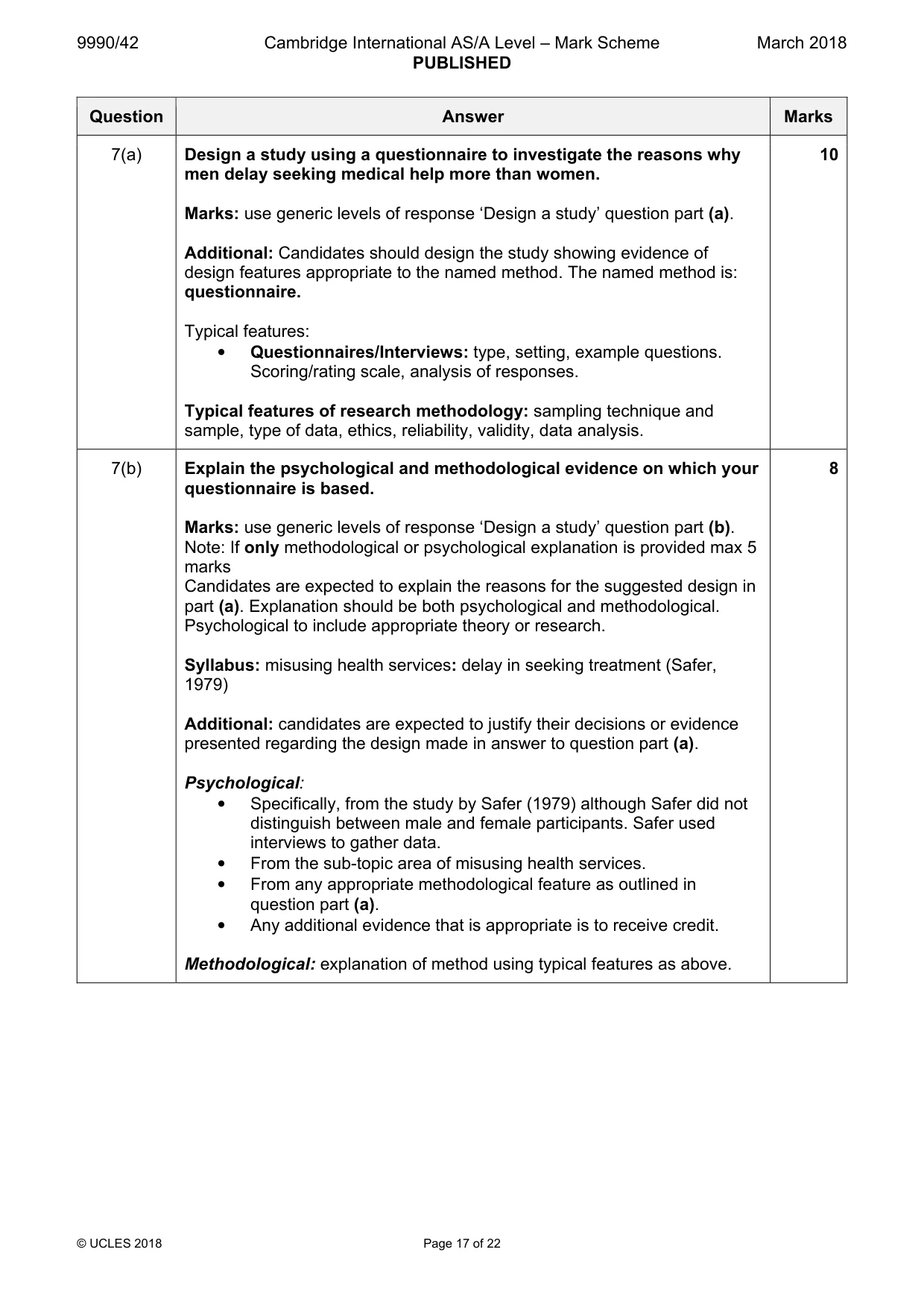
Mark scheme: 7(a) Design a study using a questionnaire to investigate the reasons why 10 men delay seeking medical help more than women. Marks: use generic levels of response ‘Design a study’ question part (a). Additional: Candidates should design the study showing evidence of design features appropriate to the named method. The named method is: questionnaire. Typical features: • Questionnaires/Interviews: type, setting, example questions. Scoring/rating scale, analysis of responses. Typical features of research methodology: sampling technique and sample, type of data, ethics, reliability, validity, data analysis. 7(b) Explain the psychological and methodological evidence on which your 8 questionnaire is based. Marks: use generic levels of response ‘Design a study’ question part (b). Note: If only methodological or psychological explanation is provided max 5 marks Candidates are expected to explain the reasons for the suggested design in part (a). Explanation should be both psychological and methodological. Psychological to include appropriate theory or research. Syllabus: misusing health services: delay in seeking treatment (Safer, 1979) Additional: candidates are expected to justify their decisions or evidence presented regarding the design made in answer to question part (a). Psychological: • Specifically, from the study by Safer (1979) although Safer did not distinguish between male and female participants. Safer used interviews to gather data. • From the sub-topic area of misusing health services. • From any appropriate methodological feature as outlined in question part (a). • Any additional evidence that is appropriate is to receive credit. Methodological: explanation of method using typical features as above.
Q8 · Design a study using an interview to investigate levels of job satisfaction following a…
8 (a) Design a study using an interview to investigate levels of job satisfaction following a job rotation. [10] (b) Explain the psychological and methodological evidence on which your interview is based. [8] Section C You must answer one question from this section. Psychology and abnormality
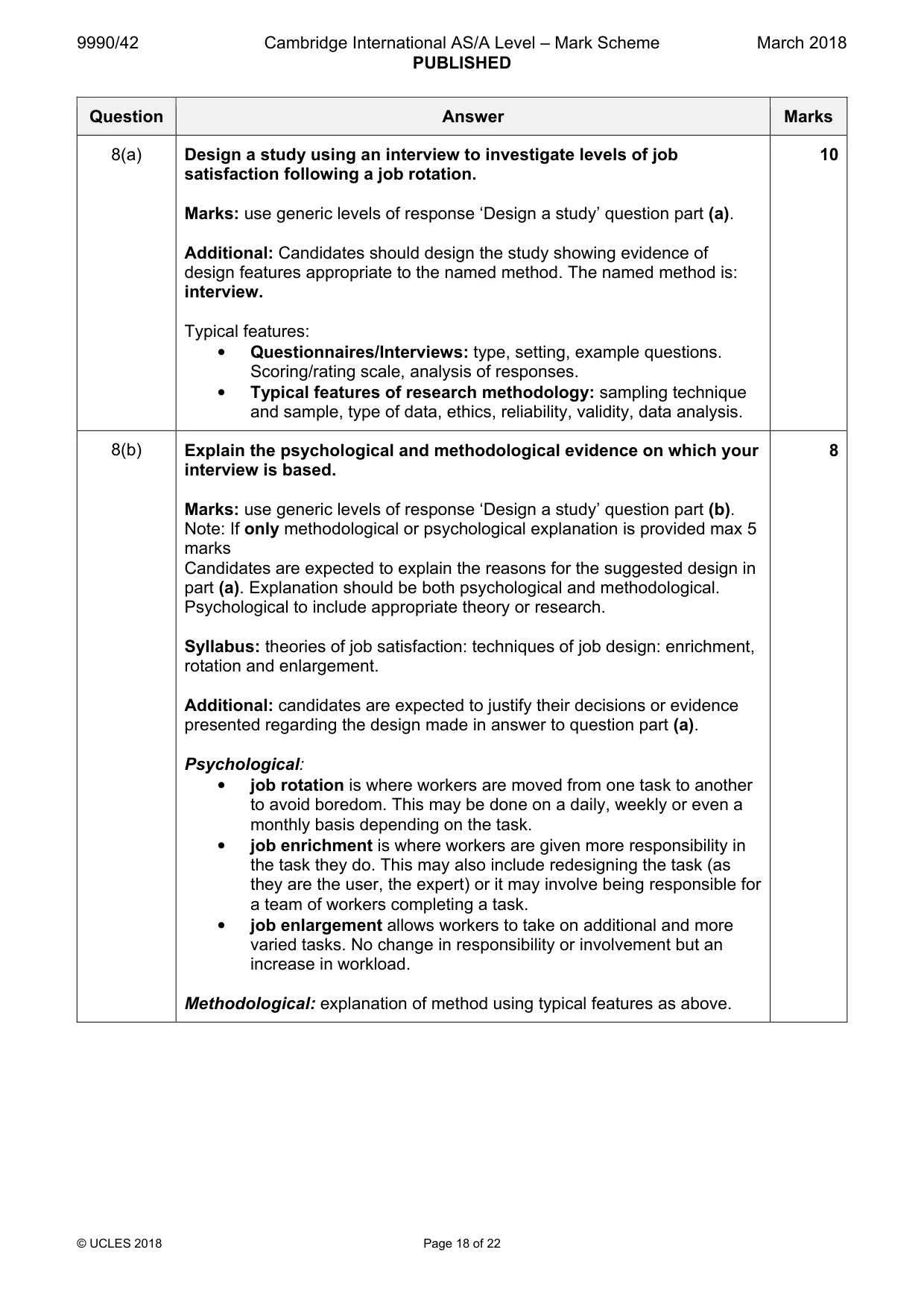
Mark scheme: 8(a) Design a study using an interview to investigate levels of job 10 satisfaction following a job rotation. Marks: use generic levels of response ‘Design a study’ question part (a). Additional: Candidates should design the study showing evidence of design features appropriate to the named method. The named method is: interview. Typical features: • Questionnaires/Interviews: type, setting, example questions. Scoring/rating scale, analysis of responses. • Typical features of research methodology: sampling technique and sample, type of data, ethics, reliability, validity, data analysis. 8(b) Explain the psychological and methodological evidence on which your 8 interview is based. Marks: use generic levels of response ‘Design a study’ question part (b). Note: If only methodological or psychological explanation is provided max 5 marks Candidates are expected to explain the reasons for the suggested design in part (a). Explanation should be both psychological and methodological. Psychological to include appropriate theory or research. Syllabus: theories of job satisfaction: techniques of job design: enrichment, rotation and enlargement. Additional: candidates are expected to justify their decisions or evidence presented regarding the design made in answer to question part (a). Psychological: • job rotation is where workers are moved from one task to another to avoid boredom. This may be done on a daily, weekly or even a monthly basis depending on the task. • job enrichment is where workers are given more responsibility in the task they do. This may also include redesigning the task (as they are the user, the expert) or it may involve being responsible for a team of workers completing a task. • job enlargement allows workers to take on additional and more varied tasks. No change in responsibility or involvement but an increase in workload. Methodological: explanation of method using typical features as above. Section C: Evaluation question = 12 marks
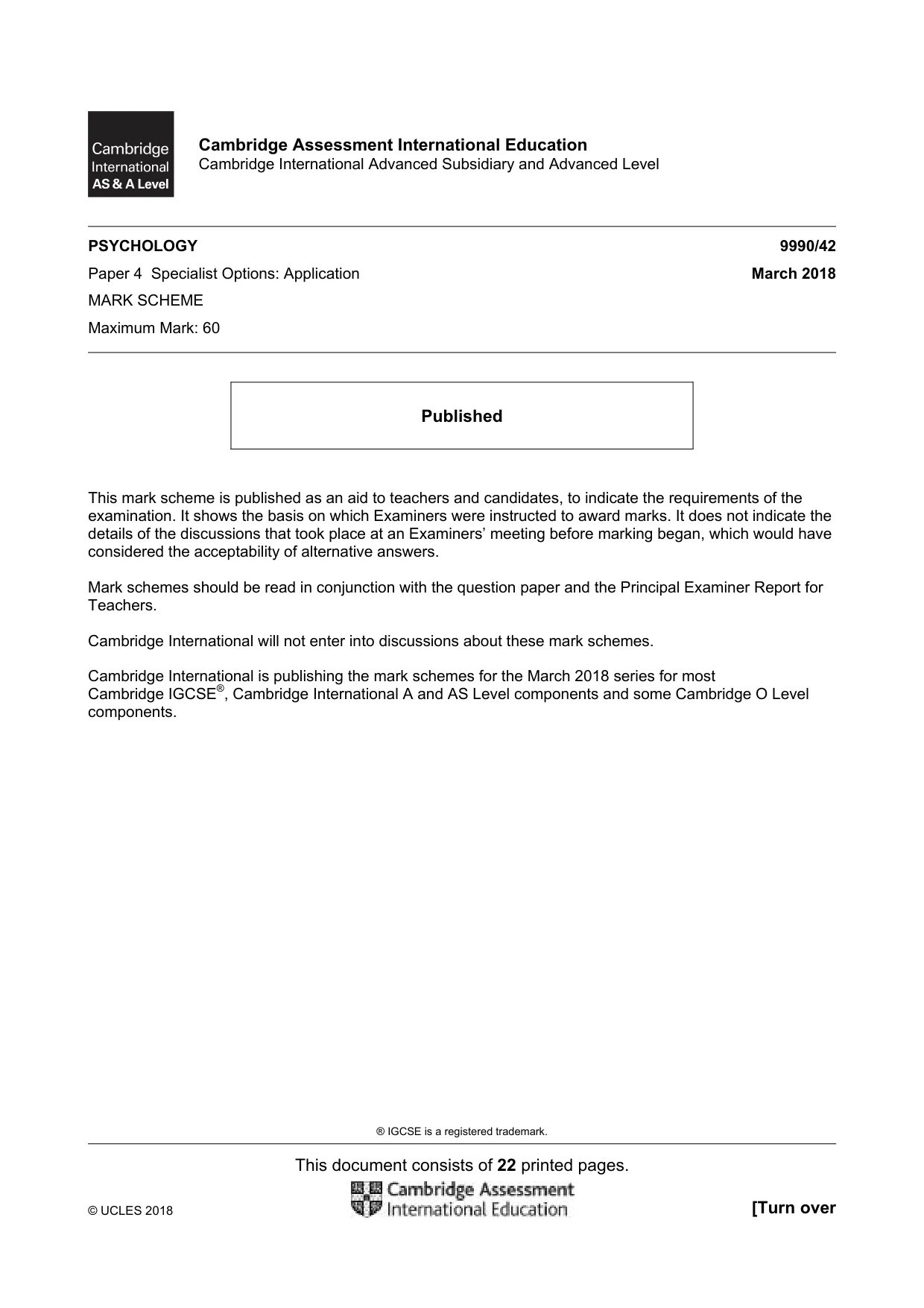
Q9 · ‘A token economy used for patients with schizophrenia in hospitals only makes them behave…
9 ‘A token economy used for patients with schizophrenia in hospitals only makes them behave better for the staff.’ To what extent do you agree with this statement? Use examples of research you have studied to support your answer. [12] Psychology and consumer behaviour
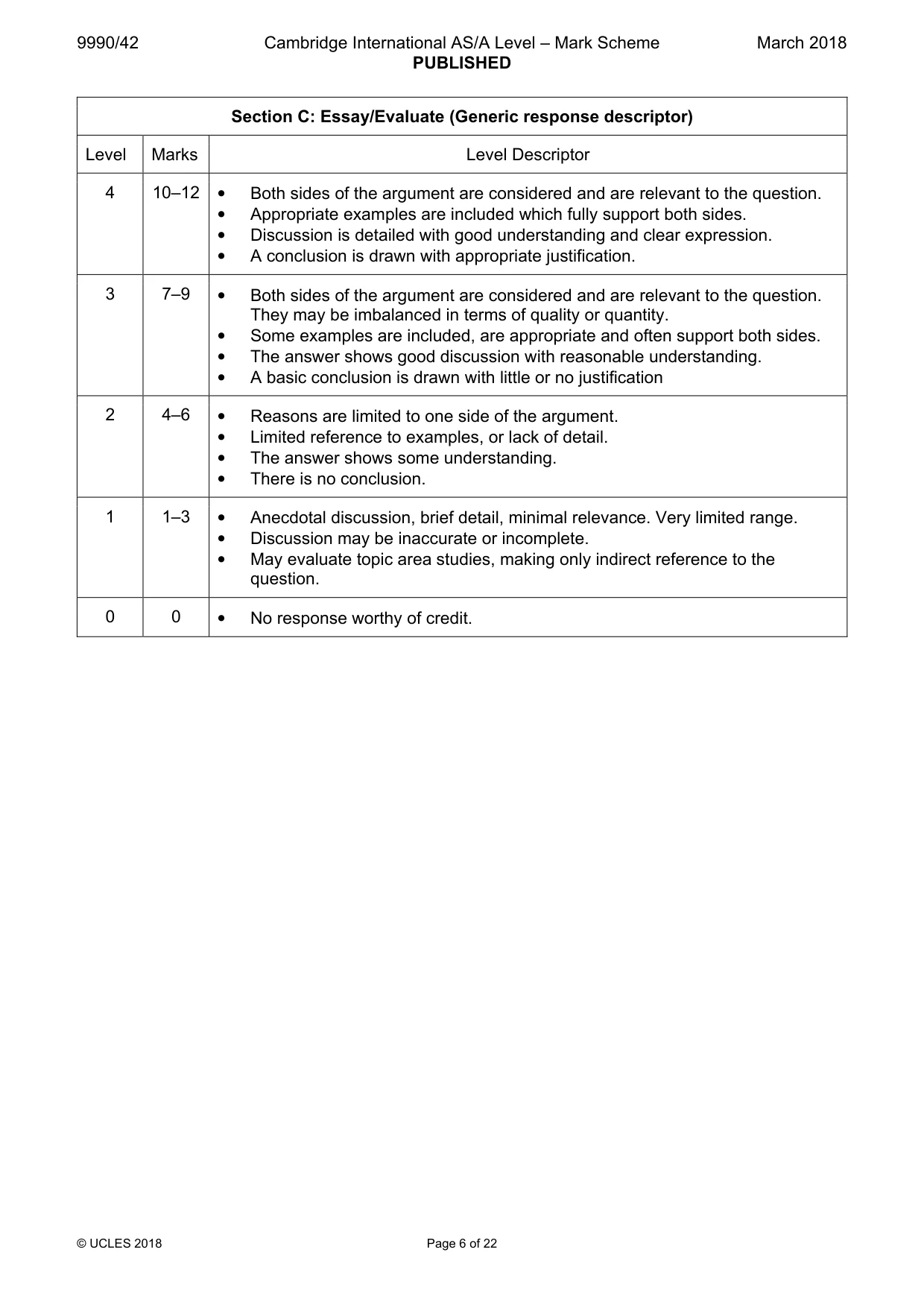
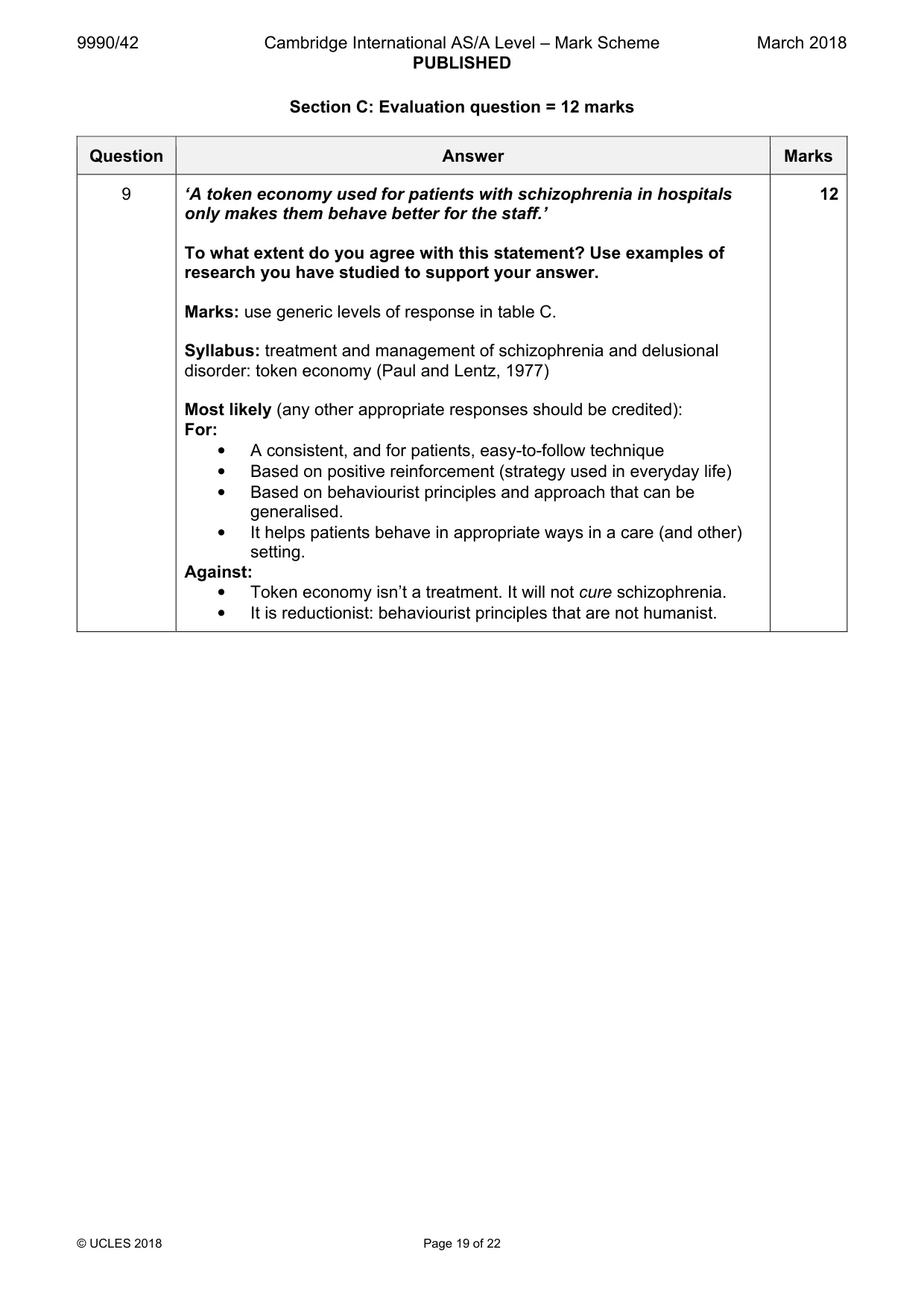
Mark scheme: 9 ‘A token economy used for patients with schizophrenia in hospitals 12 only makes them behave better for the staff.’ To what extent do you agree with this statement? Use examples of research you have studied to support your answer. Marks: use generic levels of response in table C. Syllabus: treatment and management of schizophrenia and delusional disorder: token economy (Paul and Lentz, 1977) Most likely (any other appropriate responses should be credited): For: • A consistent, and for patients, easy-to-follow technique • Based on positive reinforcement (strategy used in everyday life) • Based on behaviourist principles and approach that can be generalised. • It helps patients behave in appropriate ways in a care (and other) setting. Against: • Token economy isn’t a treatment. It will not cure schizophrenia. • It is reductionist: behaviourist principles that are not humanist.
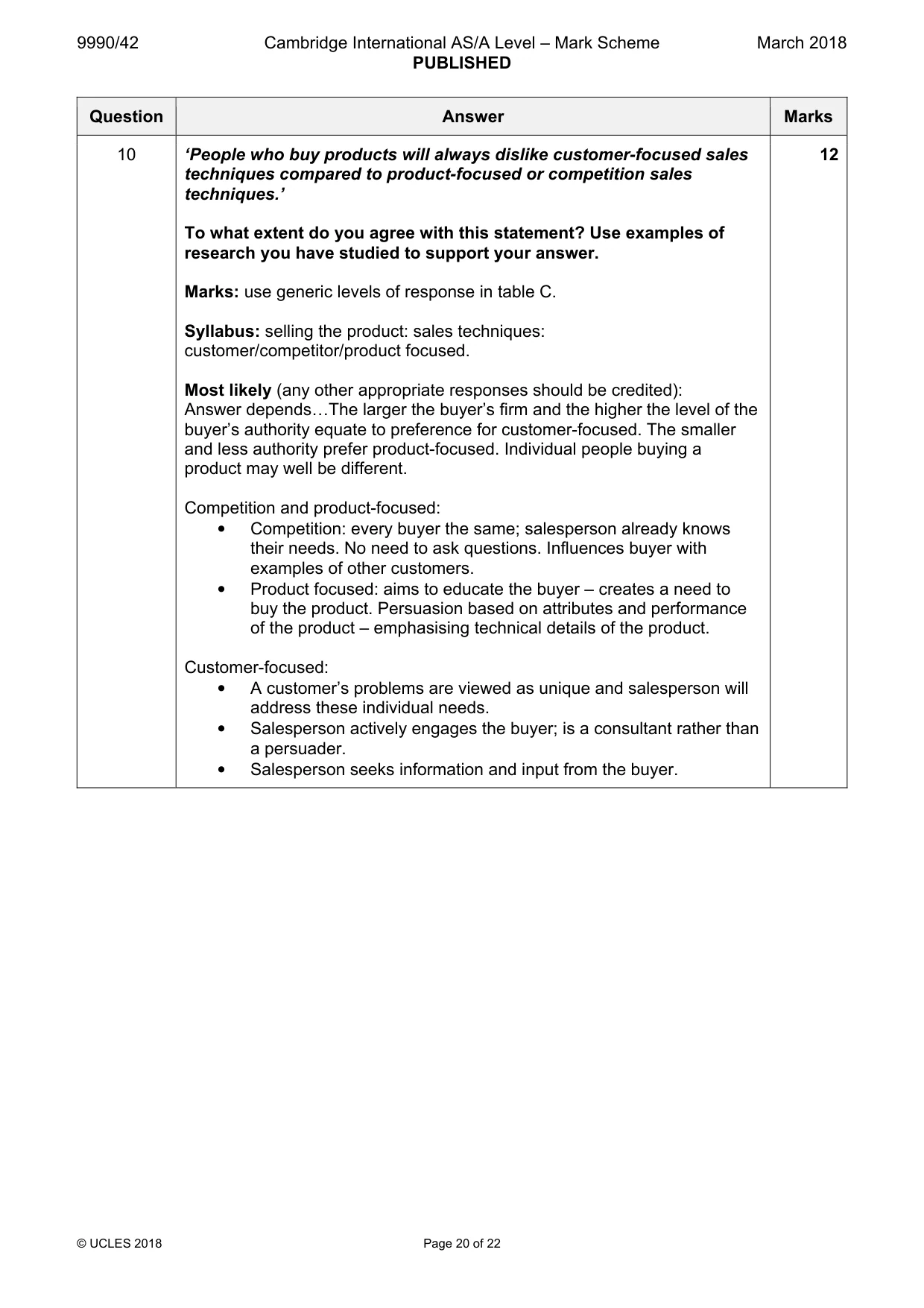
Q10 · ‘People who buy products will always dislike customer-focused sales techniques compared…
10 ‘People who buy products will always dislike customer-focused sales techniques compared to product-focused or competition sales techniques.’ To what extent do you agree with this statement? Use examples of research you have studied to support your answer. [12] Psychology and health
Mark scheme: 10 ‘People who buy products will always dislike customer-focused sales 12 techniques compared to product-focused or competition sales techniques.’ To what extent do you agree with this statement? Use examples of research you have studied to support your answer. Marks: use generic levels of response in table C. Syllabus: selling the product: sales techniques: customer/competitor/product focused. Most likely (any other appropriate responses should be credited): Answer depends«The larger the buyer’s firm and the higher the level of the buyer’s authority equate to preference for customer-focused. The smaller and less authority prefer product-focused. Individual people buying a product may well be different. Competition and product-focused: • Competition: every buyer the same; salesperson already knows their needs. No need to ask questions. Influences buyer with examples of other customers. • Product focused: aims to educate the buyer – creates a need to buy the product. Persuasion based on attributes and performance of the product – emphasising technical details of the product. Customer-focused: • A customer’s problems are viewed as unique and salesperson will address these individual needs. • Salesperson actively engages the buyer; is a consultant rather than a persuader. • Salesperson seeks information and input from the buyer.
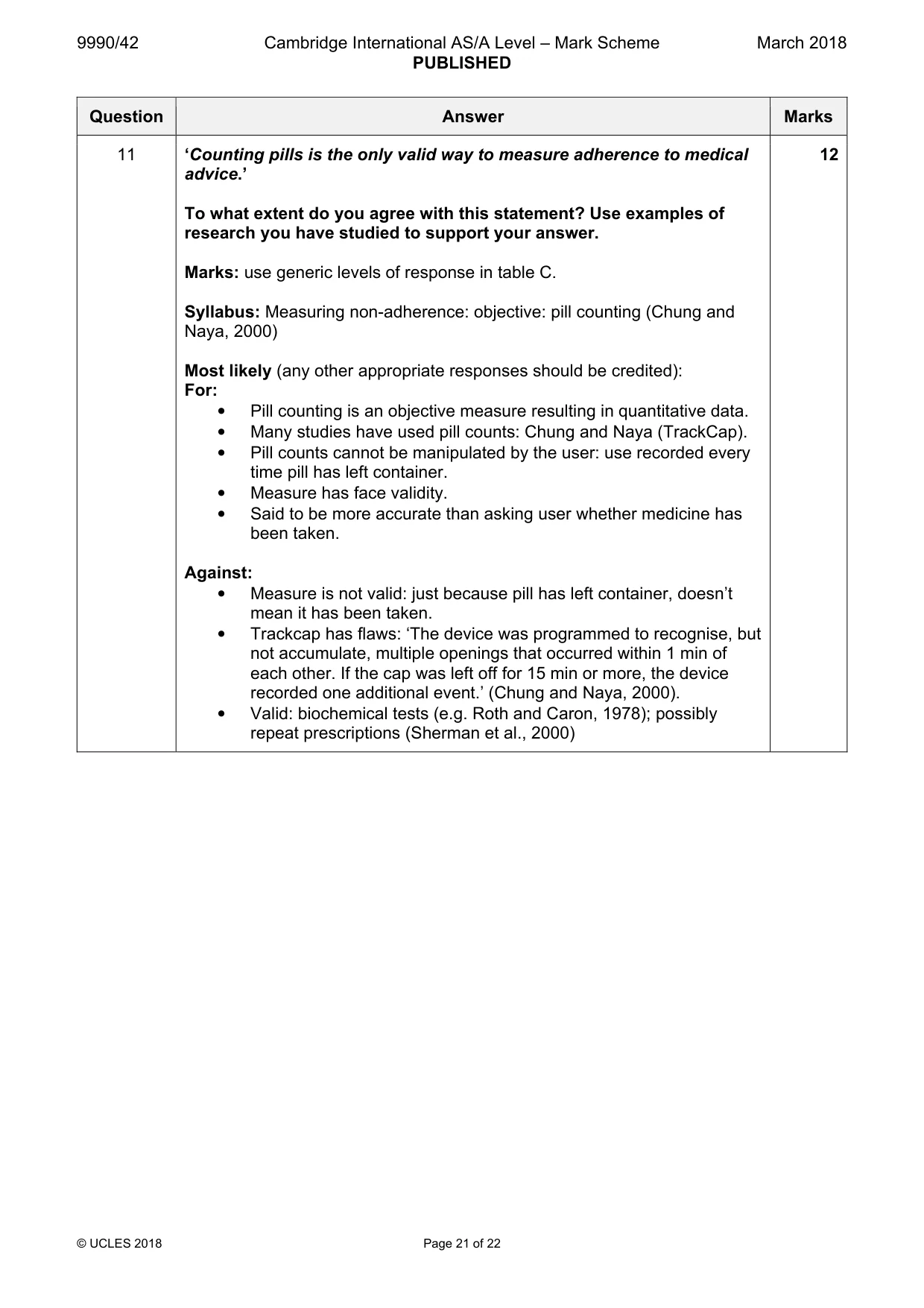
Q11 · ‘Counting pills is the only valid way to measure adherence to medical advice.’ To what…
11 ‘Counting pills is the only valid way to measure adherence to medical advice.’ To what extent do you agree with this statement? Use examples of research you have studied to support your answer. [12] Psychology and organisations
Mark scheme: 11 ‘Counting pills is the only valid way to measure adherence to medical 12 advice.’ To what extent do you agree with this statement? Use examples of research you have studied to support your answer. Marks: use generic levels of response in table C. Syllabus: Measuring non-adherence: objective: pill counting (Chung and Naya, 2000) Most likely (any other appropriate responses should be credited): For: • Pill counting is an objective measure resulting in quantitative data. • Many studies have used pill counts: Chung and Naya (TrackCap). • Pill counts cannot be manipulated by the user: use recorded every time pill has left container. • Measure has face validity. • Said to be more accurate than asking user whether medicine has been taken. Against: • Measure is not valid: just because pill has left container, doesn’t mean it has been taken. • Trackcap has flaws: ‘The device was programmed to recognise, but not accumulate, multiple openings that occurred within 1 min of each other. If the cap was left off for 15 min or more, the device recorded one additional event.’ (Chung and Naya, 2000). • Valid: biochemical tests (e.g. Roth and Caron, 1978); possibly repeat prescriptions (Sherman et al., 2000)
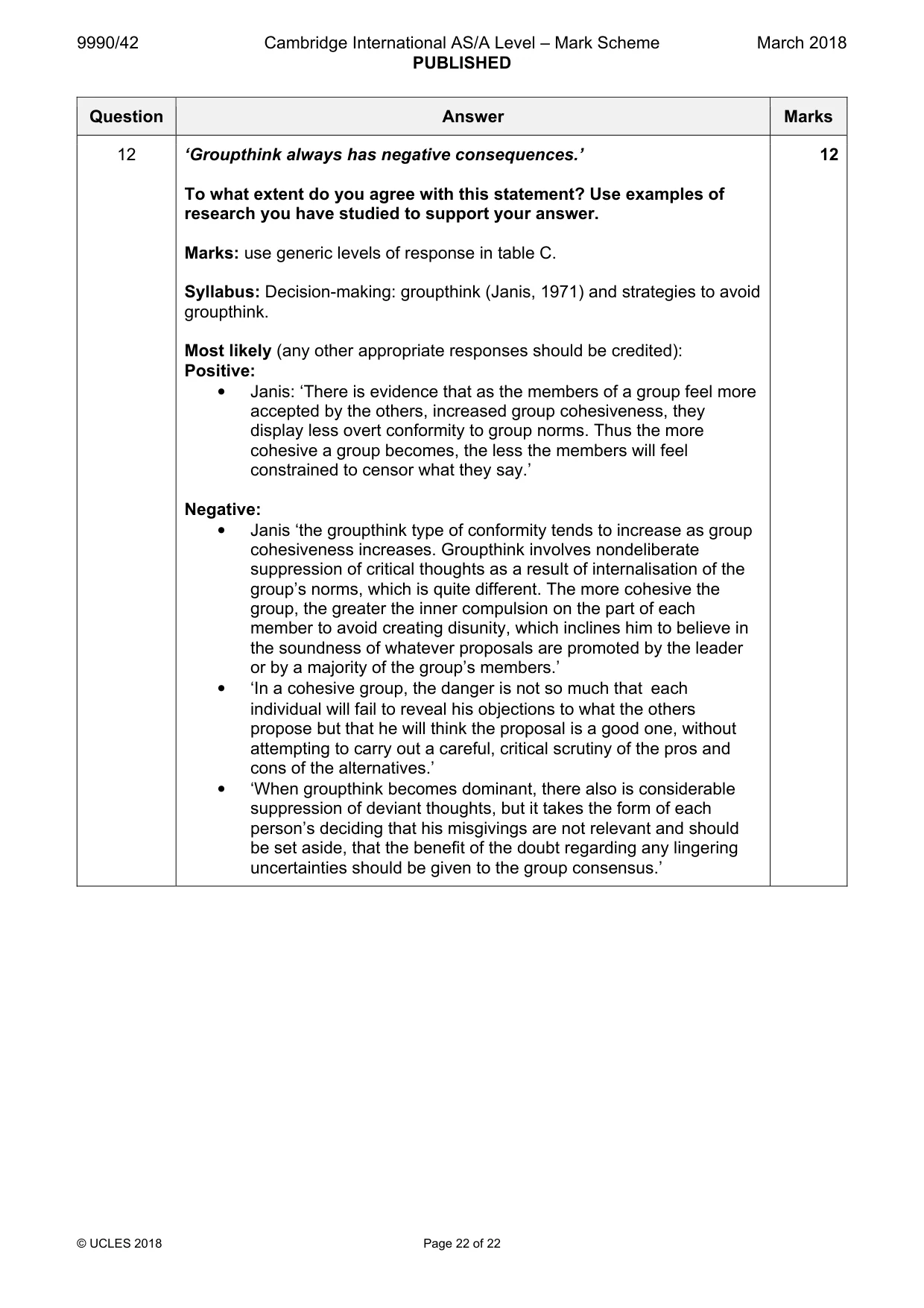
Q12 · ‘Groupthink always has negative consequences.’ To what extent do you agree with this…
12 ‘Groupthink always has negative consequences.’ To what extent do you agree with this statement? Use examples of research you have studied to support your answer. [12]
Mark scheme: 12 ‘Groupthink always has negative consequences.’ 12 To what extent do you agree with this statement? Use examples of research you have studied to support your answer. Marks: use generic levels of response in table C. Syllabus: Decision-making: groupthink (Janis, 1971) and strategies to avoid groupthink. Most likely (any other appropriate responses should be credited): Positive: • Janis: ‘There is evidence that as the members of a group feel more accepted by the others, increased group cohesiveness, they display less overt conformity to group norms. Thus the more cohesive a group becomes, the less the members will feel constrained to censor what they say.’ Negative: • Janis ‘the groupthink type of conformity tends to increase as group cohesiveness increases. Groupthink involves nondeliberate suppression of critical thoughts as a result of internalisation of the group’s norms, which is quite different. The more cohesive the group, the greater the inner compulsion on the part of each member to avoid creating disunity, which inclines him to believe in the soundness of whatever proposals are promoted by the leader or by a majority of the group’s members.’ • ‘In a cohesive group, the danger is not so much that each individual will fail to reveal his objections to what the others propose but that he will think the proposal is a good one, without attempting to carry out a careful, critical scrutiny of the pros and cons of the alternatives.’ • ‘When groupthink becomes dominant, there also is considerable suppression of deviant thoughts, but it takes the form of each person’s deciding that his misgivings are not relevant and should be set aside, that the benefit of the doubt regarding any lingering uncertainties should be given to the group consensus.’
What was in this paper
The subtopics covered by these 12 questions, and how many questions each got. Open one in a new tab to see every Cambridge question on it.
What you needed in this session
Cambridge’s own grade thresholds for 2018 Feb/March, Paper 4 · Variant 2. A higher threshold means an easier paper — the bar moves with how the cohort did.