Cambridge A Level Psychology (from 2018) 9990 — 2024 Oct/Nov Paper 4 · Variant 1
9990/41/O/N/24 · 12 questions · 60 marks · 90 min
The question paper and its mark scheme, free to read here and free to download. This is Cambridge’s own paper, exactly as it was sat.
Question paper8 pages



Mark scheme33 pages
Answers below. Sit the paper first if you are practising.
Questions as text
Q1 · From the key study by Oruč et al
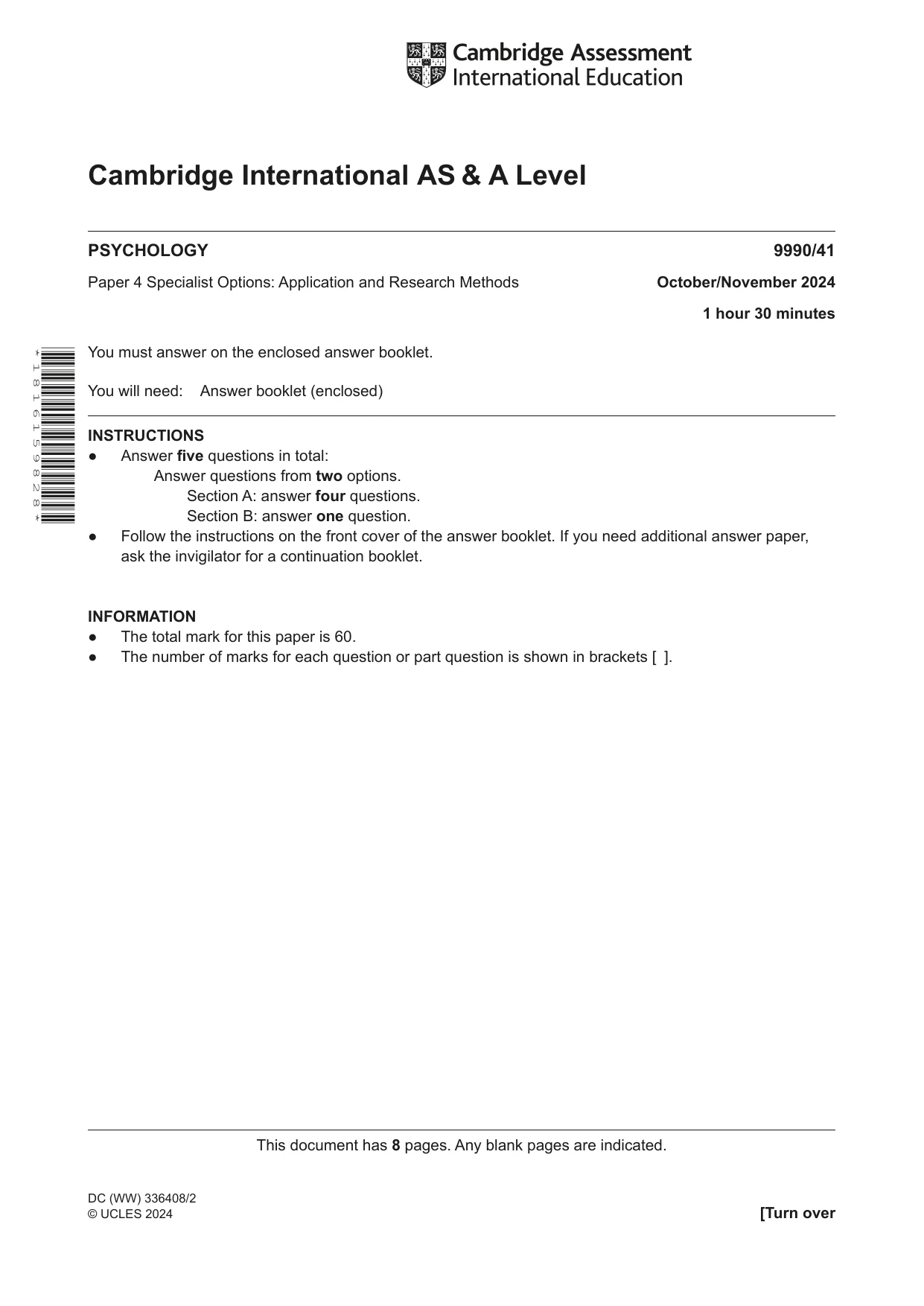
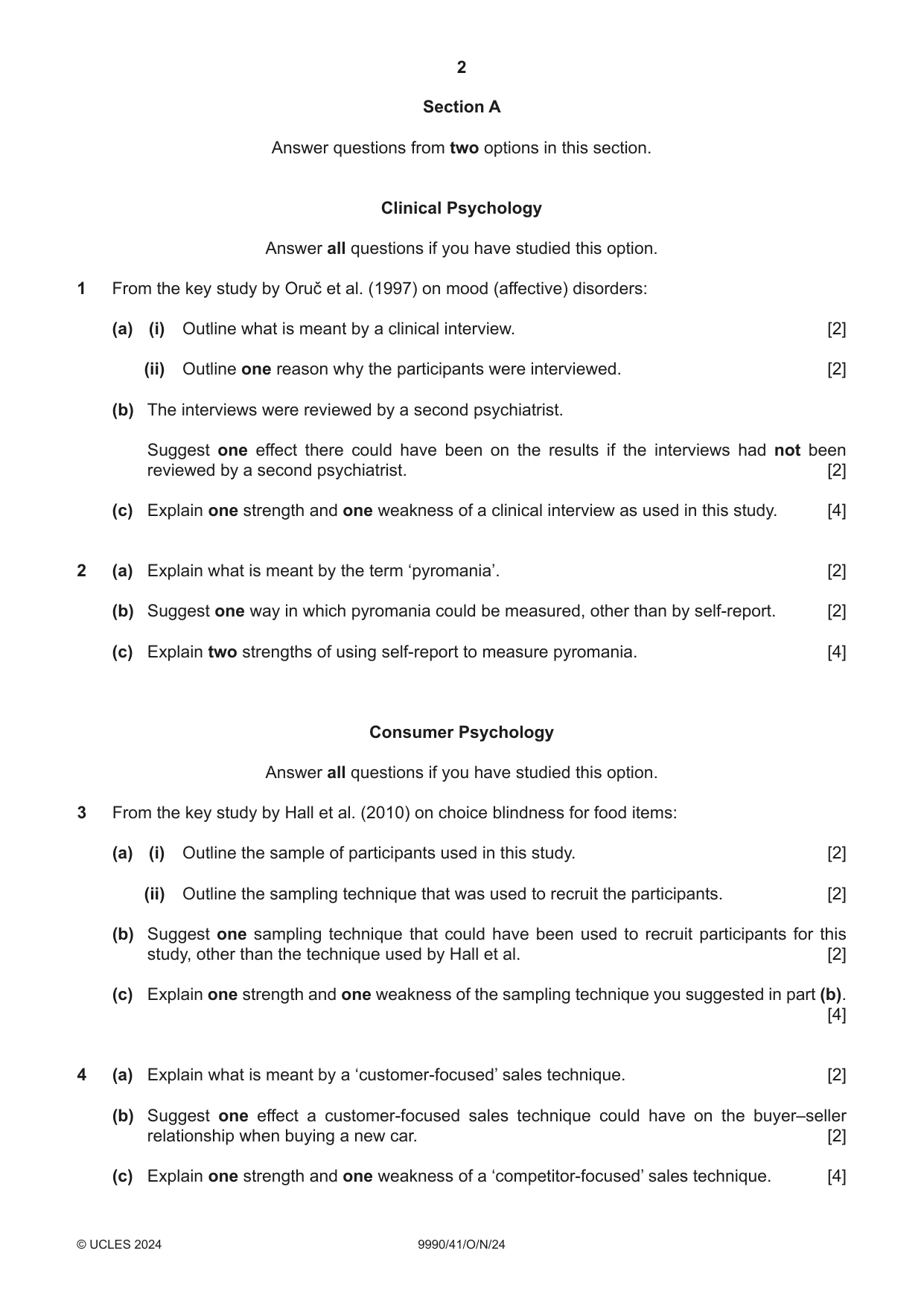
1 From the key study by Oruč et al. (1997) on mood (affective) disorders: (a) (i) Outline what is meant by a clinical interview. [2] (ii) Outline one reason why the participants were interviewed. [2] (b) The interviews were reviewed by a second psychiatrist. Suggest one effect there could have been on the results if the interviews had not been reviewed by a second psychiatrist. [2] (c) Explain one strength and one weakness of a clinical interview as used in this study. [4]
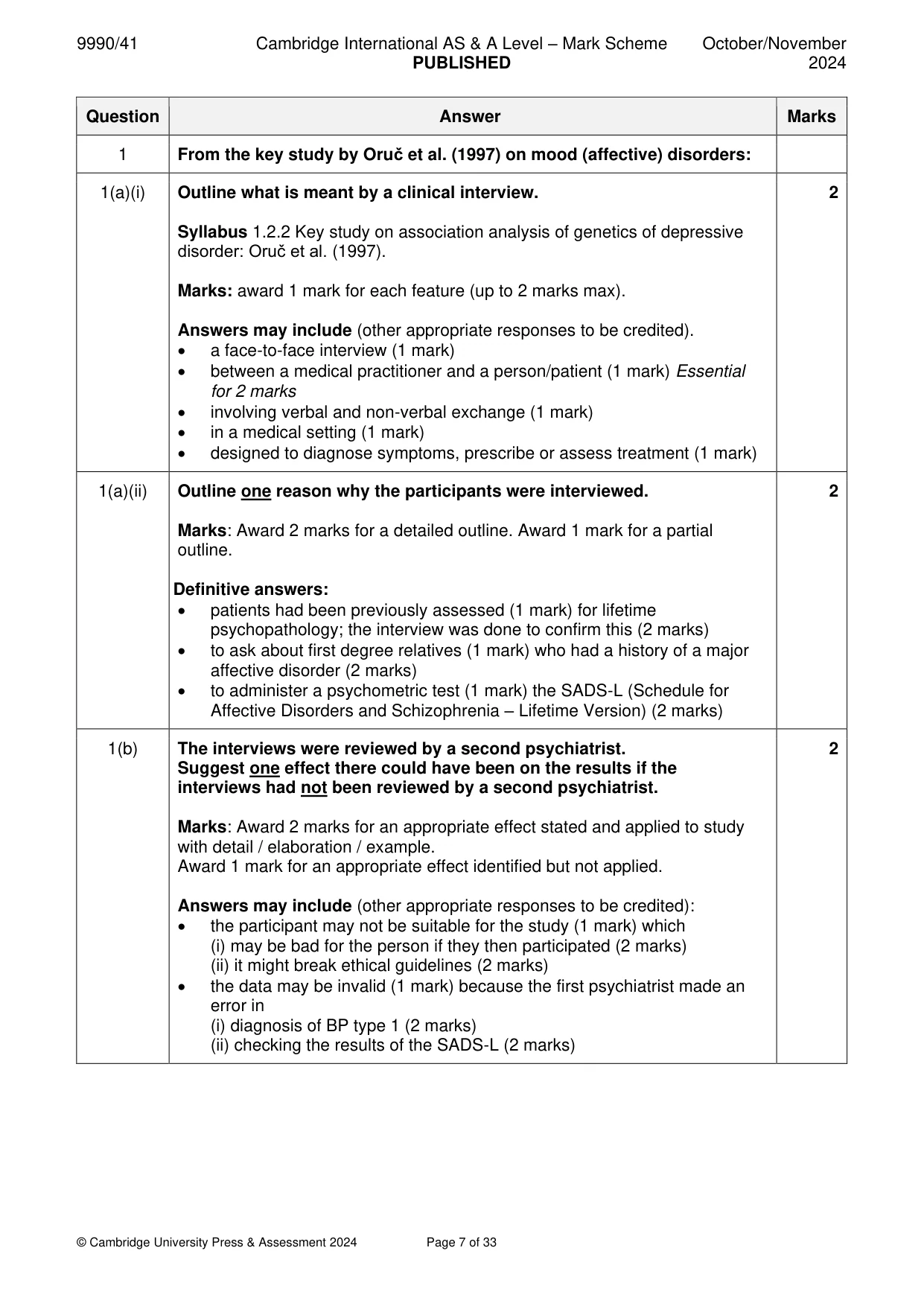
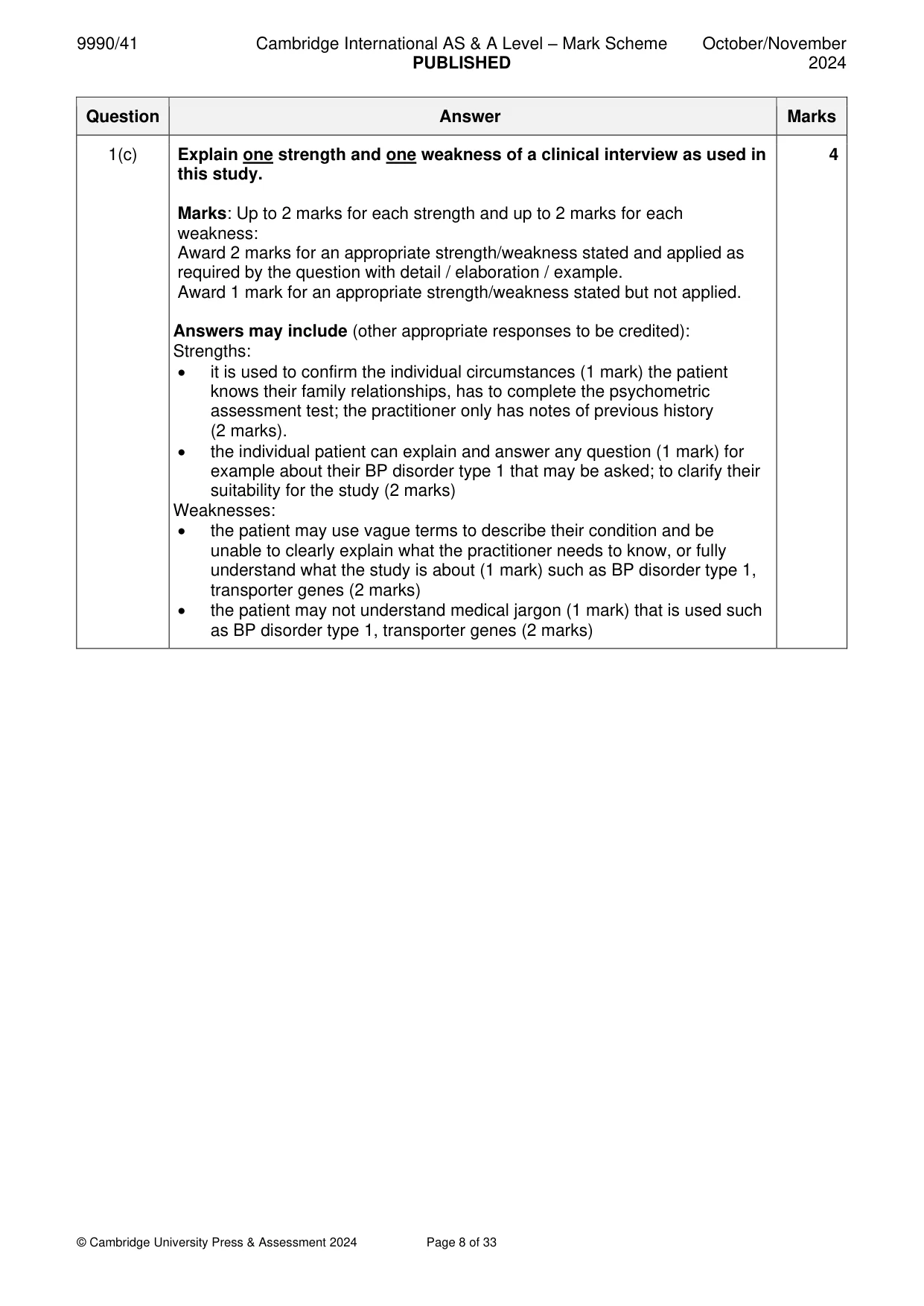
Mark scheme: Question Answer Marks 1 From the key study by Oruč et al. (1997) on mood (affective) disorders: 1(a)(i) Outline what is meant by a clinical interview. 2 Syllabus 1.2.2 Key study on association analysis of genetics of depressive disorder: Oruč et al. (1997). Marks: award 1 mark for each feature (up to 2 marks max). Answers may include (other appropriate responses to be credited). • a face-to-face interview (1 mark) • between a medical practitioner and a person/patient (1 mark) Essential for 2 marks • involving verbal and non-verbal exchange (1 mark) • in a medical setting (1 mark) • designed to diagnose symptoms, prescribe or assess treatment (1 mark) 1(a)(ii) Outline one reason why the participants were interviewed. 2 Marks: Award 2 marks for a detailed outline. Award 1 mark for a partial outline. Definitive answers: • patients had been previously assessed (1 mark) for lifetime psychopathology; the interview was done to confirm this (2 marks) • to ask about first degree relatives (1 mark) who had a history of a major affective disorder (2 marks) • to administer a psychometric test (1 mark) the SADS-L (Schedule for Affective Disorders and Schizophrenia – Lifetime Version) (2 marks) 1(b) The interviews were reviewed by a second psychiatrist. 2 Suggest one effect there could have been on the results if the interviews had not been reviewed by a second psychiatrist. Marks: Award 2 marks for an appropriate effect stated and applied to study with detail / elaboration / example. Award 1 mark for an appropriate effect identified but not applied. Answers may include (other appropriate responses to be credited): • the participant may not be suitable for the study (1 mark) which (i) may be bad for the person if they then participated (2 marks) (ii) it might break ethical guidelines (2 marks) • the data may be invalid (1 mark) because the first psychiatrist made an error in (i) diagnosis of BP type 1 (2 marks) (ii) checking the results of the SADS-L (2 marks) 1(c) Explain one strength and one weakness of a clinical interview as used in 4 this study. Marks: Up to 2 marks for each strength and up to 2 marks for each weakness: Award 2 marks for an appropriate strength/weakness stated and applied as required by the question with detail / elaboration / example. Award 1 mark for an appropriate strength/weakness stated but not applied. Answers may include (other appropriate responses to be credited): Strengths: • it is used to confirm the individual circumstances (1 mark) the patient knows their family relationships, has to complete the psychometric assessment test; the practitioner only has notes of previous history (2 marks). • the individual patient can explain and answer any question (1 mark) for example about their BP disorder type 1 that may be asked; to clarify their suitability for the study (2 marks) Weaknesses: • the patient may use vague terms to describe their condition and be unable to clearly explain what the practitioner needs to know, or fully understand what the study is about (1 mark) such as BP disorder type 1, transporter genes (2 marks) • the patient may not understand medical jargon (1 mark) that is used such as BP disorder type 1, transporter genes (2 marks)
More questions on Mood (affective) disorders: depressive disorder (unipolar) and bipolar disorder
Q2 · Explain what is meant by the term ‘pyromania’
2 (a) Explain what is meant by the term ‘pyromania’. [2] (b) Suggest one way in which pyromania could be measured, other than by self-report. [2] (c) Explain two strengths of using self-report to measure pyromania. [4] Consumer Psychology Answer all questions if you have studied this option.
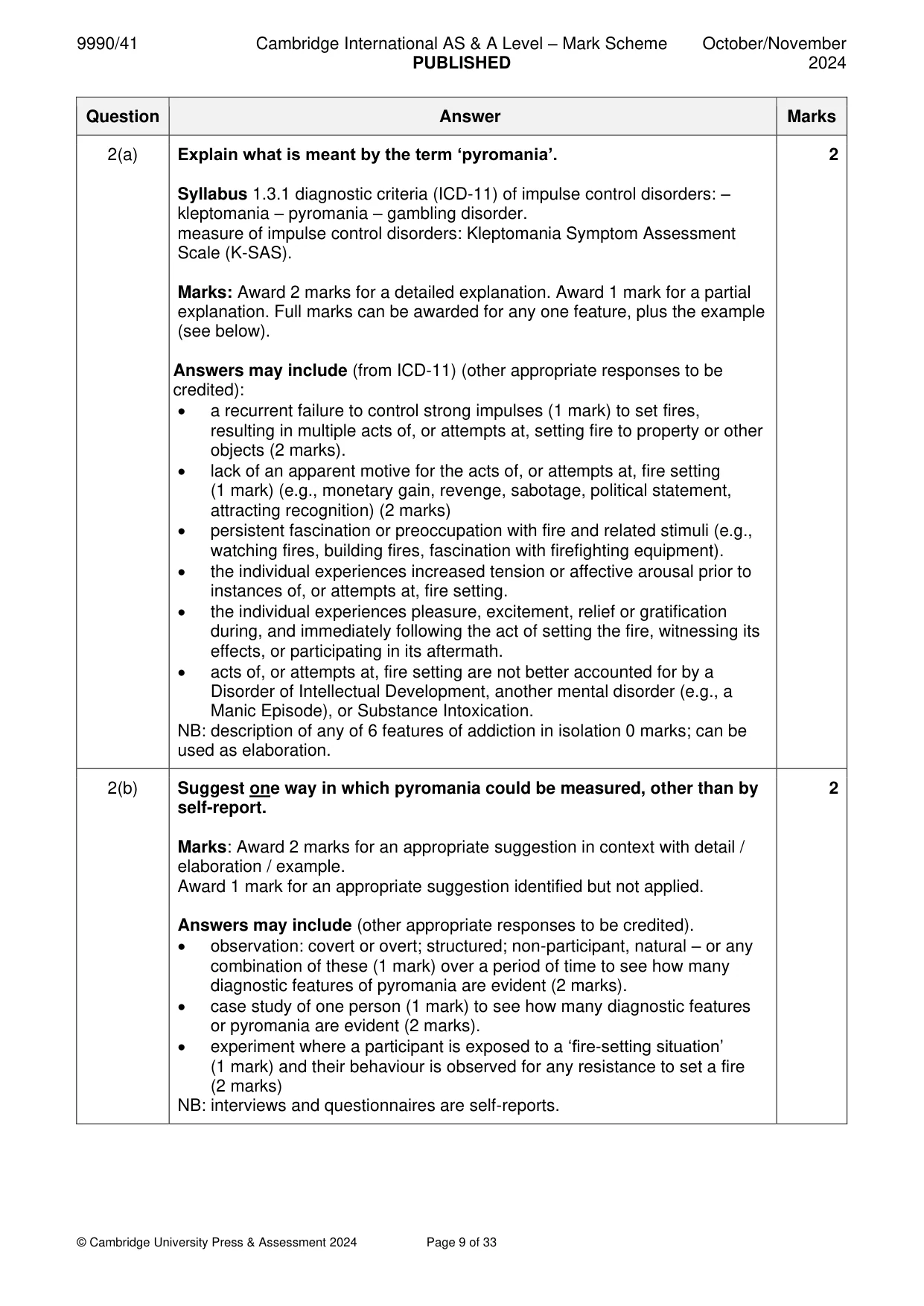
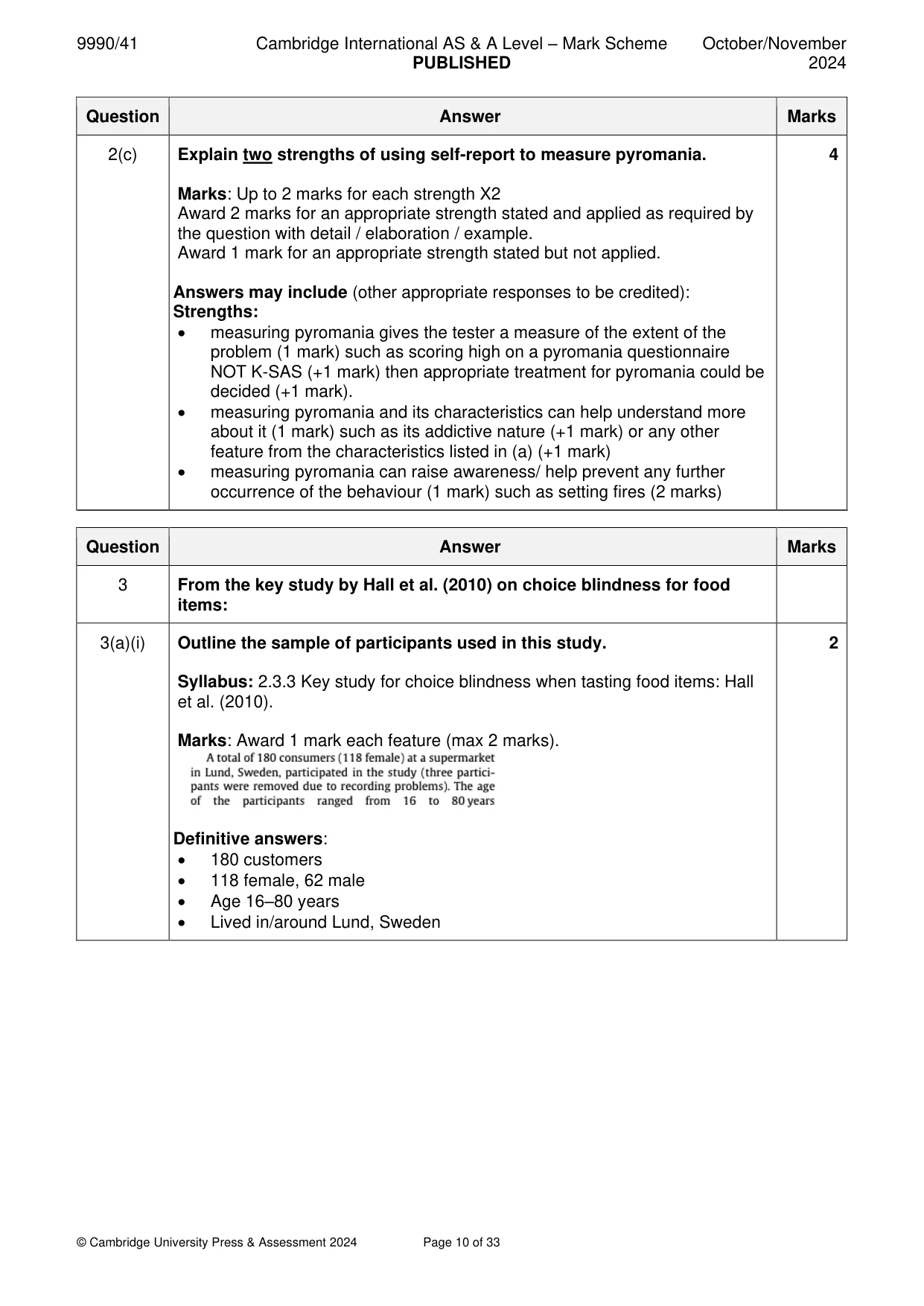
Mark scheme: 2(a) Explain what is meant by the term ‘pyromania’. 2 Syllabus 1.3.1 diagnostic criteria (ICD-11) of impulse control disorders: – kleptomania – pyromania – gambling disorder. measure of impulse control disorders: Kleptomania Symptom Assessment Scale (K-SAS). Marks: Award 2 marks for a detailed explanation. Award 1 mark for a partial explanation. Full marks can be awarded for any one feature, plus the example (see below). Answers may include (from ICD-11) (other appropriate responses to be credited): • a recurrent failure to control strong impulses (1 mark) to set fires, resulting in multiple acts of, or attempts at, setting fire to property or other objects (2 marks). • lack of an apparent motive for the acts of, or attempts at, fire setting (1 mark) (e.g., monetary gain, revenge, sabotage, political statement, attracting recognition) (2 marks) • persistent fascination or preoccupation with fire and related stimuli (e.g., watching fires, building fires, fascination with firefighting equipment). • the individual experiences increased tension or affective arousal prior to instances of, or attempts at, fire setting. • the individual experiences pleasure, excitement, relief or gratification during, and immediately following the act of setting the fire, witnessing its effects, or participating in its aftermath. • acts of, or attempts at, fire setting are not better accounted for by a Disorder of Intellectual Development, another mental disorder (e.g., a Manic Episode), or Substance Intoxication. NB: description of any of 6 features of addiction in isolation 0 marks; can be used as elaboration. 2(b) Suggest one way in which pyromania could be measured, other than by 2 self-report. Marks: Award 2 marks for an appropriate suggestion in context with detail / elaboration / example. Award 1 mark for an appropriate suggestion identified but not applied. Answers may include (other appropriate responses to be credited). • observation: covert or overt; structured; non-participant, natural – or any combination of these (1 mark) over a period of time to see how many diagnostic features of pyromania are evident (2 marks). • case study of one person (1 mark) to see how many diagnostic features or pyromania are evident (2 marks). • experiment where a participant is exposed to a ‘fire-setting situation’ (1 mark) and their behaviour is observed for any resistance to set a fire (2 marks) NB: interviews and questionnaires are self-reports. 2(c) Explain two strengths of using self-report to measure pyromania. 4 Marks: Up to 2 marks for each strength X2 Award 2 marks for an appropriate strength stated and applied as required by the question with detail / elaboration / example. Award 1 mark for an appropriate strength stated but not applied. Answers may include (other appropriate responses to be credited): Strengths: • measuring pyromania gives the tester a measure of the extent of the problem (1 mark) such as scoring high on a pyromania questionnaire NOT K-SAS (+1 mark) then appropriate treatment for pyromania could be decided (+1 mark). • measuring pyromania and its characteristics can help understand more about it (1 mark) such as its addictive nature (+1 mark) or any other feature from the characteristics listed in (a) (+1 mark) • measuring pyromania can raise awareness/ help prevent any further occurrence of the behaviour (1 mark) such as setting fires (2 marks)
Q3 · From the key study by Hall et al
3 From the key study by Hall et al. (2010) on choice blindness for food items: (a) (i) Outline the sample of participants used in this study. [2] (ii) Outline the sampling technique that was used to recruit the participants. [2] (b) Suggest one sampling technique that could have been used to recruit participants for this study, other than the technique used by Hall et al. [2] (c) Explain one strength and one weakness of the sampling technique you suggested in part (b). [4]
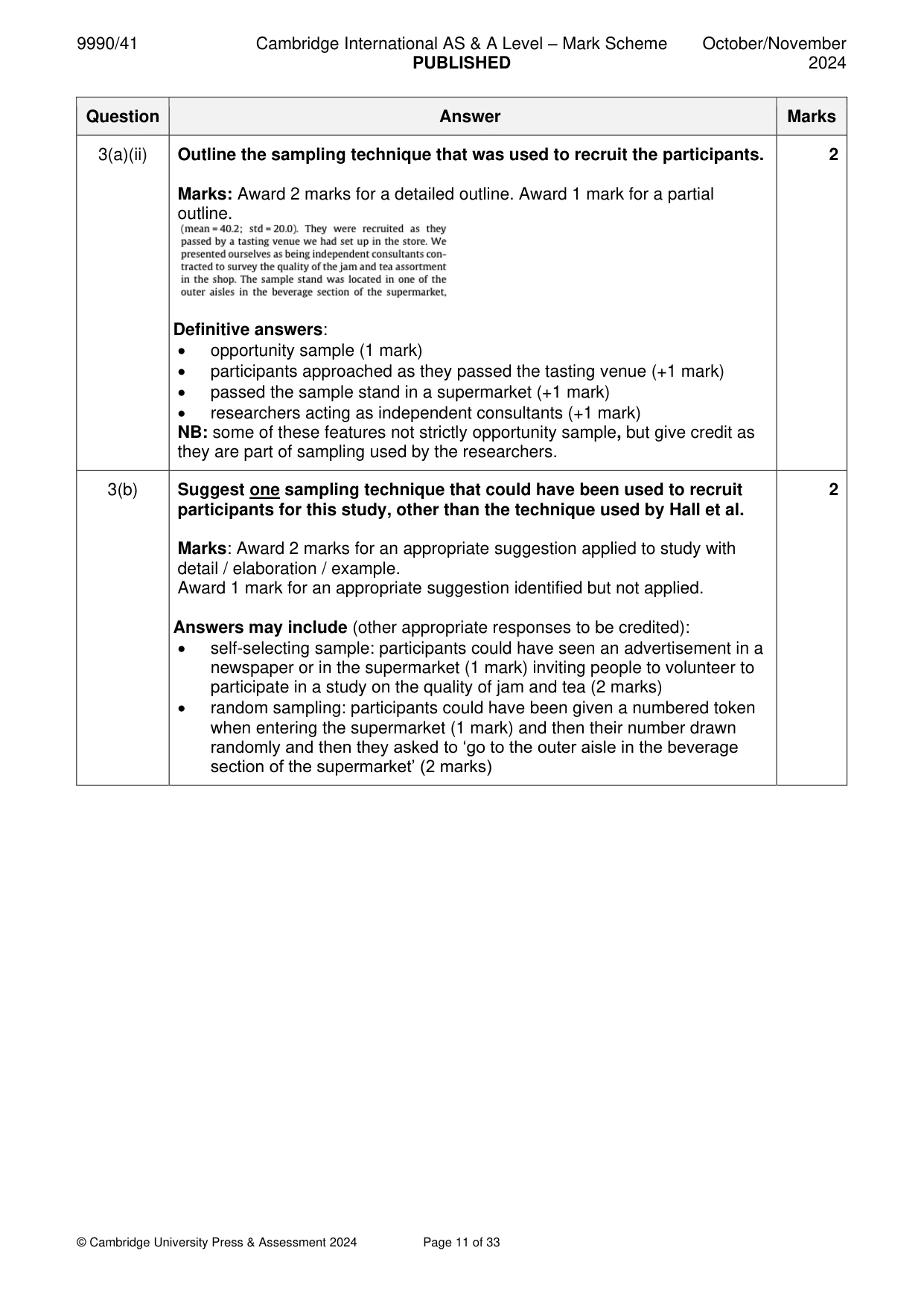
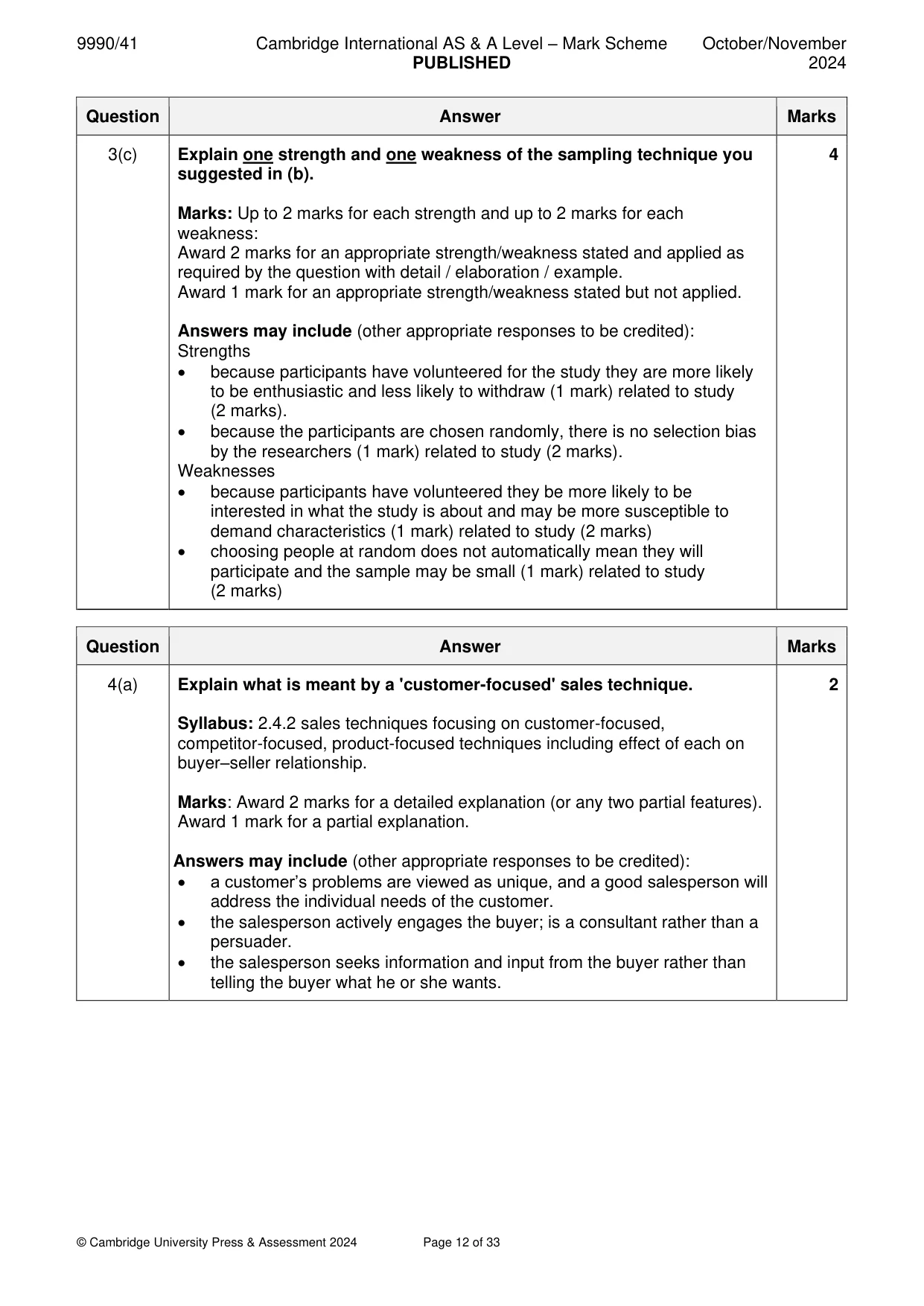
Mark scheme: 3 From the key study by Hall et al. (2010) on choice blindness for food items: 3(a)(i) Outline the sample of participants used in this study. 2 Syllabus: 2.3.3 Key study for choice blindness when tasting food items: Hall et al. (2010). Marks: Award 1 mark each feature (max 2 marks). Definitive answers: • 180 customers • 118 female, 62 male • Age 16–80 years • Lived in/around Lund, Sweden 3(a)(ii) Outline the sampling technique that was used to recruit the participants. 2 Marks: Award 2 marks for a detailed outline. Award 1 mark for a partial outline. Definitive answers: • opportunity sample (1 mark) • participants approached as they passed the tasting venue (+1 mark) • passed the sample stand in a supermarket (+1 mark) • researchers acting as independent consultants (+1 mark) NB: some of these features not strictly opportunity sample, but give credit as they are part of sampling used by the researchers. 3(b) Suggest one sampling technique that could have been used to recruit 2 participants for this study, other than the technique used by Hall et al. Marks: Award 2 marks for an appropriate suggestion applied to study with detail / elaboration / example. Award 1 mark for an appropriate suggestion identified but not applied. Answers may include (other appropriate responses to be credited): • self-selecting sample: participants could have seen an advertisement in a newspaper or in the supermarket (1 mark) inviting people to volunteer to participate in a study on the quality of jam and tea (2 marks) • random sampling: participants could have been given a numbered token when entering the supermarket (1 mark) and then their number drawn randomly and then they asked to ‘go to the outer aisle in the beverage section of the supermarket’ (2 marks) 3(c) Explain one strength and one weakness of the sampling technique you 4 suggested in (b). Marks: Up to 2 marks for each strength and up to 2 marks for each weakness: Award 2 marks for an appropriate strength/weakness stated and applied as required by the question with detail / elaboration / example. Award 1 mark for an appropriate strength/weakness stated but not applied. Answers may include (other appropriate responses to be credited): Strengths • because participants have volunteered for the study they are more likely to be enthusiastic and less likely to withdraw (1 mark) related to study (2 marks). • because the participants are chosen randomly, there is no selection bias by the researchers (1 mark) related to study (2 marks). Weaknesses • because participants have volunteered they be more likely to be interested in what the study is about and may be more susceptible to demand characteristics (1 mark) related to study (2 marks) • choosing people at random does not automatically mean they will participate and the sample may be small (1 mark) related to study (2 marks)
Q4 · Explain what is meant by a ‘customer-focused’ sales technique
4 (a) Explain what is meant by a ‘customer-focused’ sales technique. [2] (b) Suggest one effect a customer-focused sales technique could have on the buyer–seller relationship when buying a new car. [2] (c) Explain one strength and one weakness of a ‘competitor-focused’ sales technique. [4] Health Psychology Answer all questions if you have studied this option.
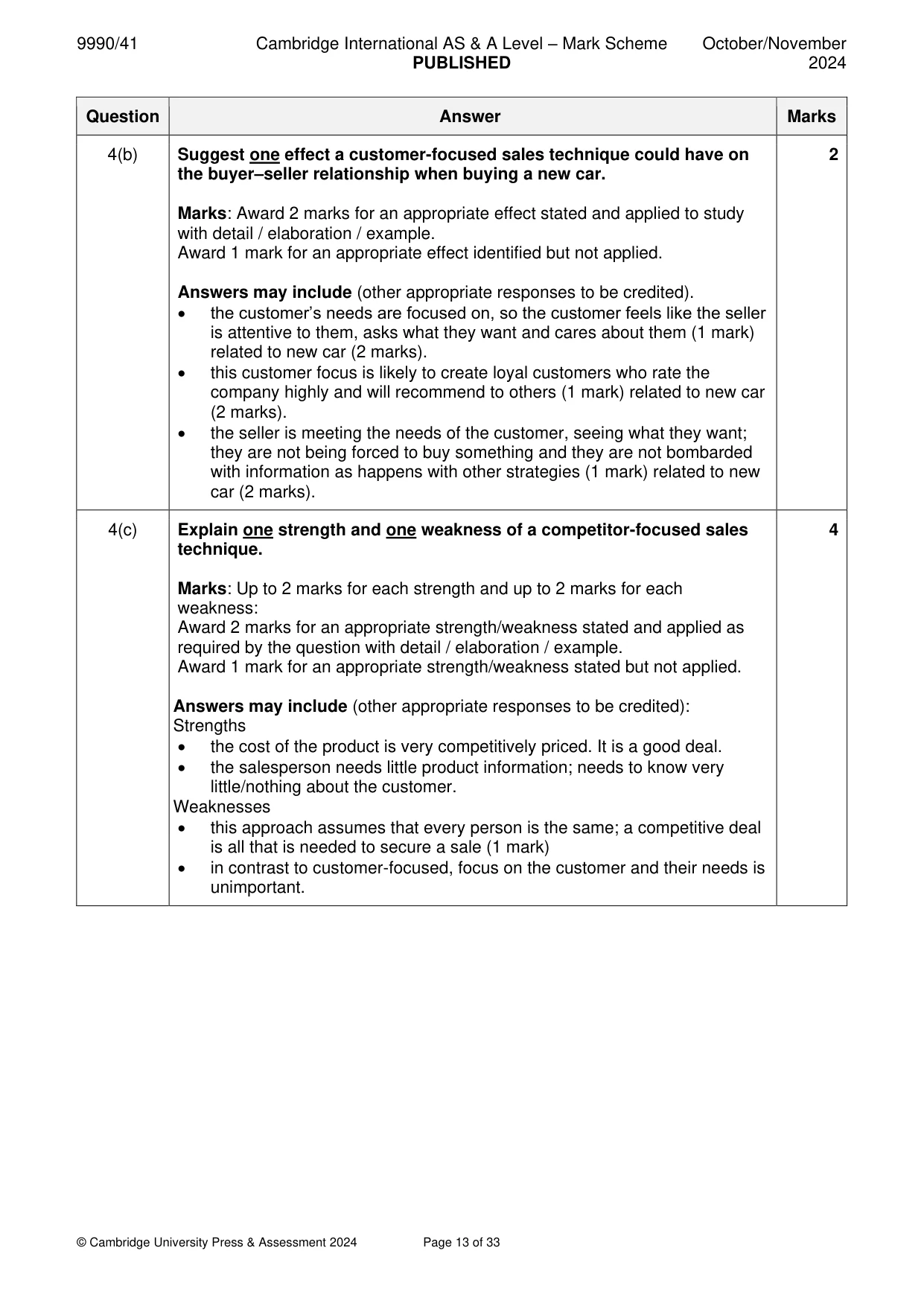
Mark scheme: 4(a) Explain what is meant by a 'customer-focused' sales technique. 2 Syllabus: 2.4.2 sales techniques focusing on customer-focused, competitor-focused, product-focused techniques including effect of each on buyer–seller relationship. Marks: Award 2 marks for a detailed explanation (or any two partial features). Award 1 mark for a partial explanation. Answers may include (other appropriate responses to be credited): • a customer’s problems are viewed as unique, and a good salesperson will address the individual needs of the customer. • the salesperson actively engages the buyer; is a consultant rather than a persuader. • the salesperson seeks information and input from the buyer rather than telling the buyer what he or she wants. 4(b) Suggest one effect a customer-focused sales technique could have on 2 the buyer–seller relationship when buying a new car. Marks: Award 2 marks for an appropriate effect stated and applied to study with detail / elaboration / example. Award 1 mark for an appropriate effect identified but not applied. Answers may include (other appropriate responses to be credited). • the customer’s needs are focused on, so the customer feels like the seller is attentive to them, asks what they want and cares about them (1 mark) related to new car (2 marks). • this customer focus is likely to create loyal customers who rate the company highly and will recommend to others (1 mark) related to new car (2 marks). • the seller is meeting the needs of the customer, seeing what they want; they are not being forced to buy something and they are not bombarded with information as happens with other strategies (1 mark) related to new car (2 marks). 4(c) Explain one strength and one weakness of a competitor-focused sales 4 technique. Marks: Up to 2 marks for each strength and up to 2 marks for each weakness: Award 2 marks for an appropriate strength/weakness stated and applied as required by the question with detail / elaboration / example. Award 1 mark for an appropriate strength/weakness stated but not applied. Answers may include (other appropriate responses to be credited): Strengths • the cost of the product is very competitively priced. It is a good deal. • the salesperson needs little product information; needs to know very little/nothing about the customer. Weaknesses • this approach assumes that every person is the same; a competitive deal is all that is needed to secure a sale (1 mark) • in contrast to customer-focused, focus on the customer and their needs is unimportant.
Q5 · From the key study by Savage and Armstrong (1990) on the effect of practitioner style on…
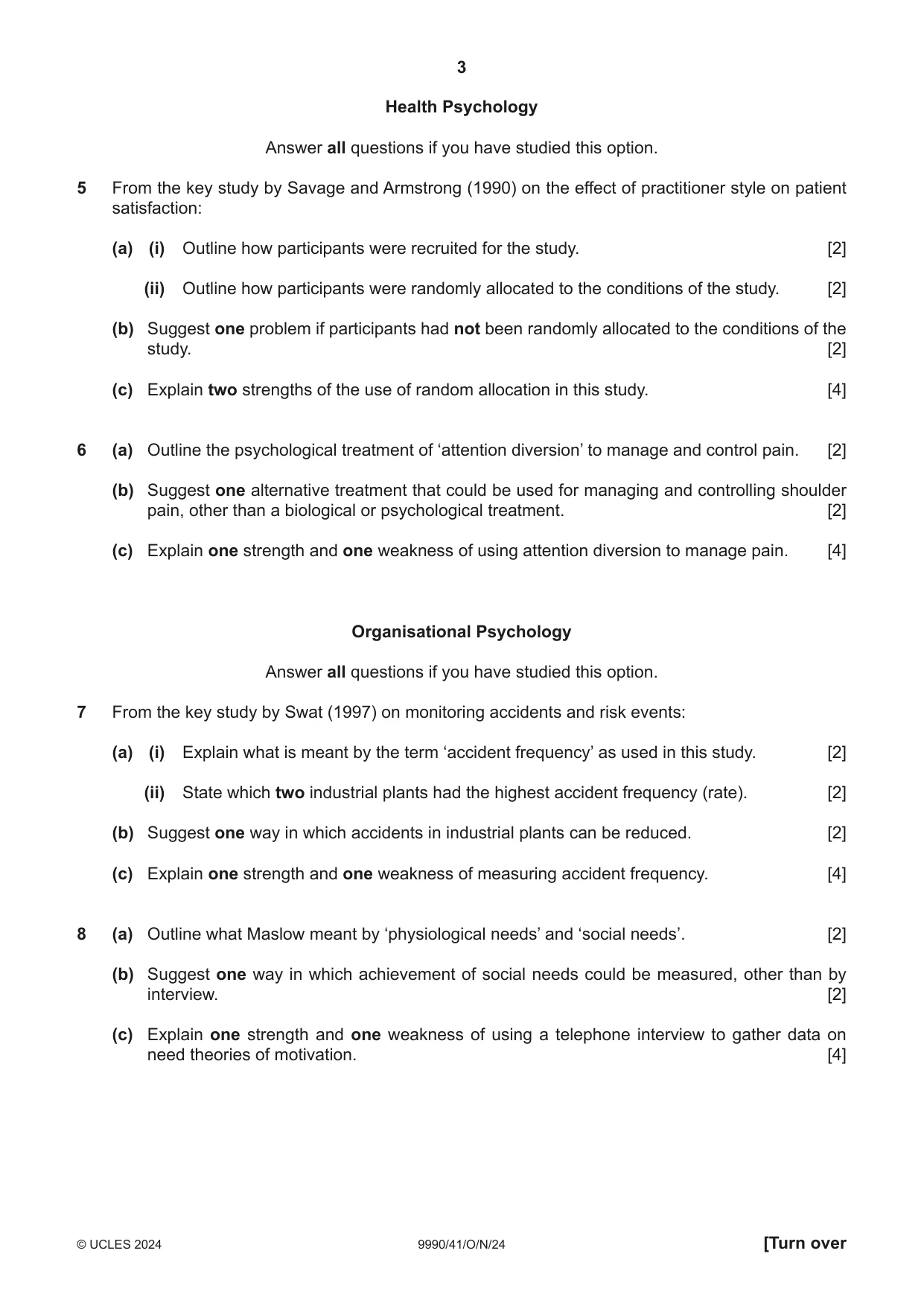
5 From the key study by Savage and Armstrong (1990) on the effect of practitioner style on patient satisfaction: (a) (i) Outline how participants were recruited for the study. [2] (ii) Outline how participants were randomly allocated to the conditions of the study. [2] (b) Suggest one problem if participants had not been randomly allocated to the conditions of the study. [2] (c) Explain two strengths of the use of random allocation in this study. [4]
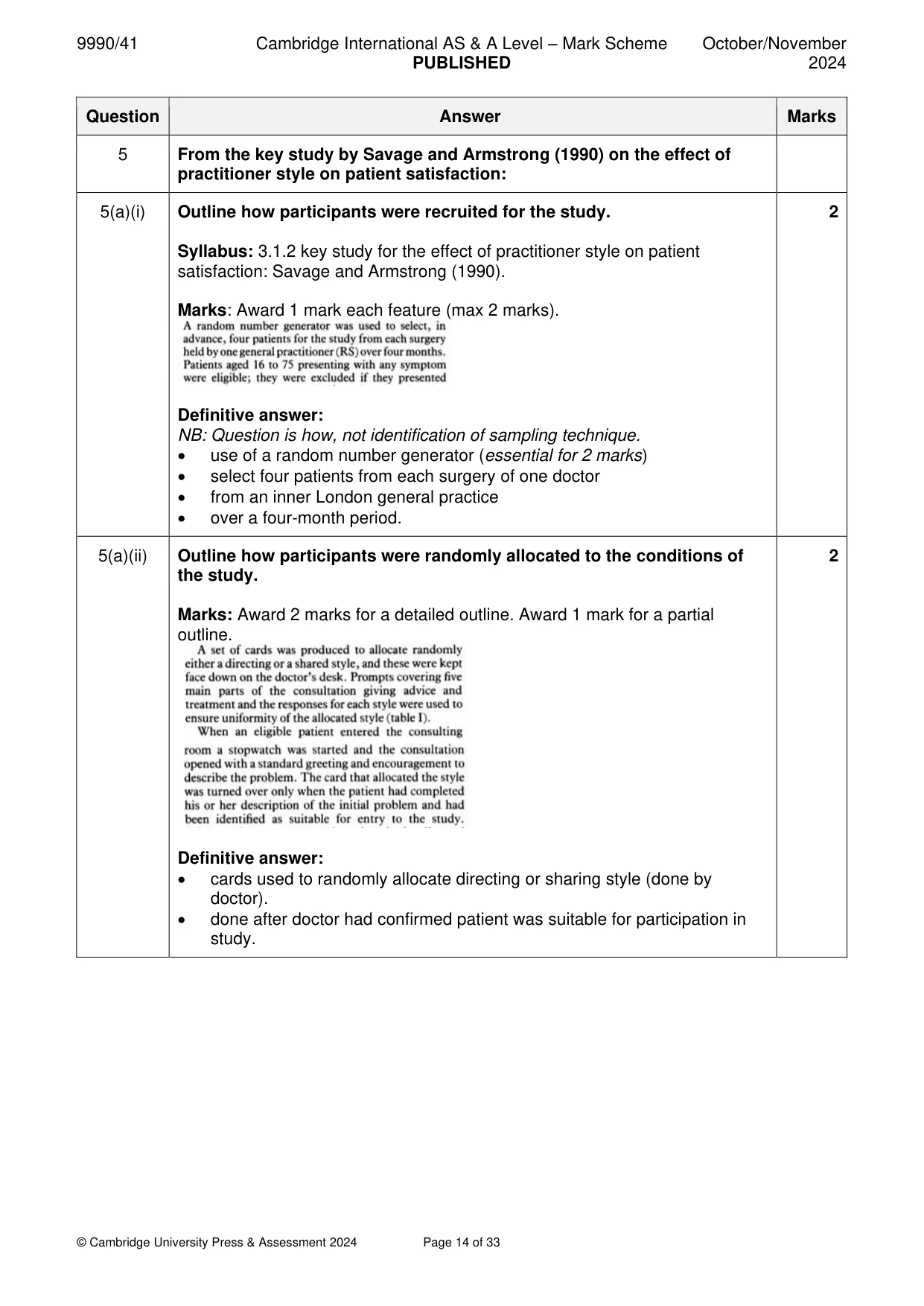
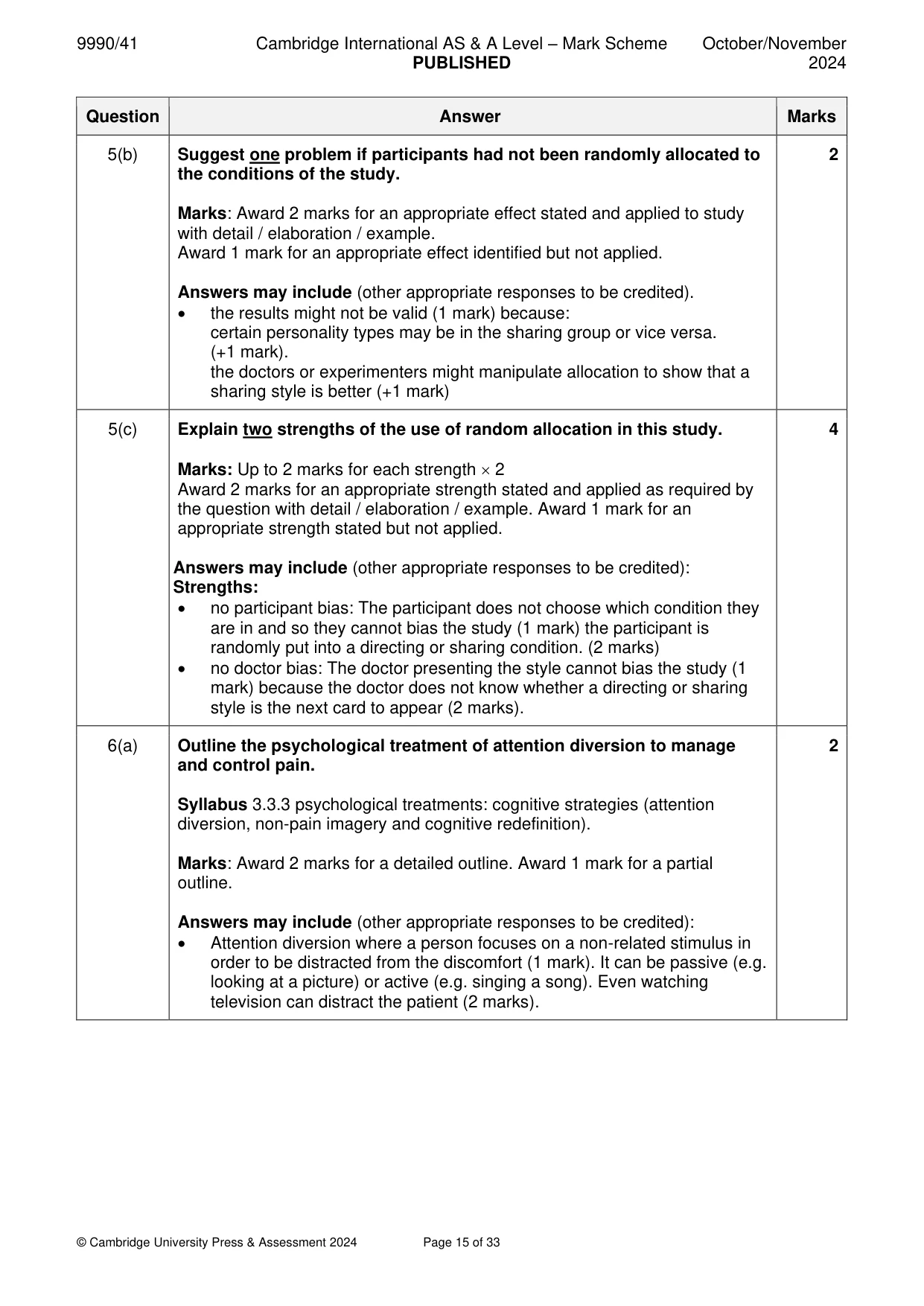
Mark scheme: 5 From the key study by Savage and Armstrong (1990) on the effect of practitioner style on patient satisfaction: 5(a)(i) Outline how participants were recruited for the study. 2 Syllabus: 3.1.2 key study for the effect of practitioner style on patient satisfaction: Savage and Armstrong (1990). Marks: Award 1 mark each feature (max 2 marks). Definitive answer: NB: Question is how, not identification of sampling technique. • use of a random number generator (essential for 2 marks) • select four patients from each surgery of one doctor • from an inner London general practice • over a four-month period. 5(a)(ii) Outline how participants were randomly allocated to the conditions of 2 the study. Marks: Award 2 marks for a detailed outline. Award 1 mark for a partial outline. Definitive answer: • cards used to randomly allocate directing or sharing style (done by doctor). • done after doctor had confirmed patient was suitable for participation in study. 5(b) Suggest one problem if participants had not been randomly allocated to 2 the conditions of the study. Marks: Award 2 marks for an appropriate effect stated and applied to study with detail / elaboration / example. Award 1 mark for an appropriate effect identified but not applied. Answers may include (other appropriate responses to be credited). • the results might not be valid (1 mark) because: certain personality types may be in the sharing group or vice versa. (+1 mark). the doctors or experimenters might manipulate allocation to show that a sharing style is better (+1 mark) 5(c) Explain two strengths of the use of random allocation in this study. 4 Marks: Up to 2 marks for each strength 2 Award 2 marks for an appropriate strength stated and applied as required by the question with detail / elaboration / example. Award 1 mark for an appropriate strength stated but not applied. Answers may include (other appropriate responses to be credited): Strengths: • no participant bias: The participant does not choose which condition they are in and so they cannot bias the study (1 mark) the participant is randomly put into a directing or sharing condition. (2 marks) • no doctor bias: The doctor presenting the style cannot bias the study (1 mark) because the doctor does not know whether a directing or sharing style is the next card to appear (2 marks).
Q6 · Outline the psychological treatment of ‘attention diversion’ to manage and control pain
6 (a) Outline the psychological treatment of ‘attention diversion’ to manage and control pain. [2] (b) Suggest one alternative treatment that could be used for managing and controlling shoulder pain, other than a biological or psychological treatment. [2] (c) Explain one strength and one weakness of using attention diversion to manage pain. [4] Organisational Psychology Answer all questions if you have studied this option.
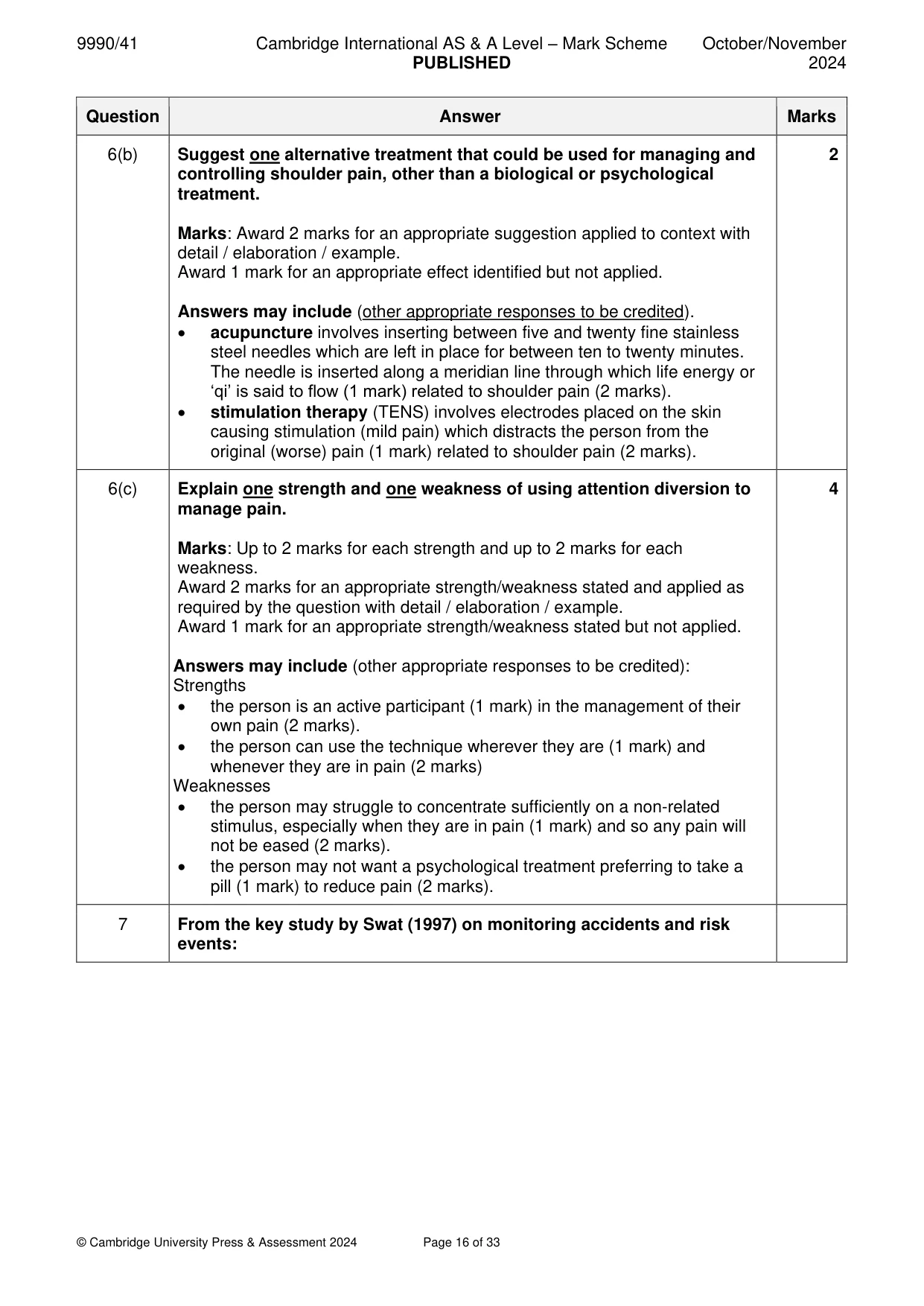
Mark scheme: 6(a) Outline the psychological treatment of attention diversion to manage 2 and control pain. Syllabus 3.3.3 psychological treatments: cognitive strategies (attention diversion, non-pain imagery and cognitive redefinition). Marks: Award 2 marks for a detailed outline. Award 1 mark for a partial outline. Answers may include (other appropriate responses to be credited): • Attention diversion where a person focuses on a non-related stimulus in order to be distracted from the discomfort (1 mark). It can be passive (e.g. looking at a picture) or active (e.g. singing a song). Even watching television can distract the patient (2 marks). 6(b) Suggest one alternative treatment that could be used for managing and 2 controlling shoulder pain, other than a biological or psychological treatment. Marks: Award 2 marks for an appropriate suggestion applied to context with detail / elaboration / example. Award 1 mark for an appropriate effect identified but not applied. Answers may include (other appropriate responses to be credited). • acupuncture involves inserting between five and twenty fine stainless steel needles which are left in place for between ten to twenty minutes. The needle is inserted along a meridian line through which life energy or ‘qi’ is said to flow (1 mark) related to shoulder pain (2 marks). • stimulation therapy (TENS) involves electrodes placed on the skin causing stimulation (mild pain) which distracts the person from the original (worse) pain (1 mark) related to shoulder pain (2 marks). 6(c) Explain one strength and one weakness of using attention diversion to 4 manage pain. Marks: Up to 2 marks for each strength and up to 2 marks for each weakness. Award 2 marks for an appropriate strength/weakness stated and applied as required by the question with detail / elaboration / example. Award 1 mark for an appropriate strength/weakness stated but not applied. Answers may include (other appropriate responses to be credited): Strengths • the person is an active participant (1 mark) in the management of their own pain (2 marks). • the person can use the technique wherever they are (1 mark) and whenever they are in pain (2 marks) Weaknesses • the person may struggle to concentrate sufficiently on a non-related stimulus, especially when they are in pain (1 mark) and so any pain will not be eased (2 marks). • the person may not want a psychological treatment preferring to take a pill (1 mark) to reduce pain (2 marks).
Q7 · From the key study by Swat (1997) on monitoring accidents and risk events: (a) (i)…
7 From the key study by Swat (1997) on monitoring accidents and risk events: (a) (i) Explain what is meant by the term ‘accident frequency’ as used in this study. [2] (ii) State which two industrial plants had the highest accident frequency (rate). [2] (b) Suggest one way in which accidents in industrial plants can be reduced. [2] (c) Explain one strength and one weakness of measuring accident frequency. [4]
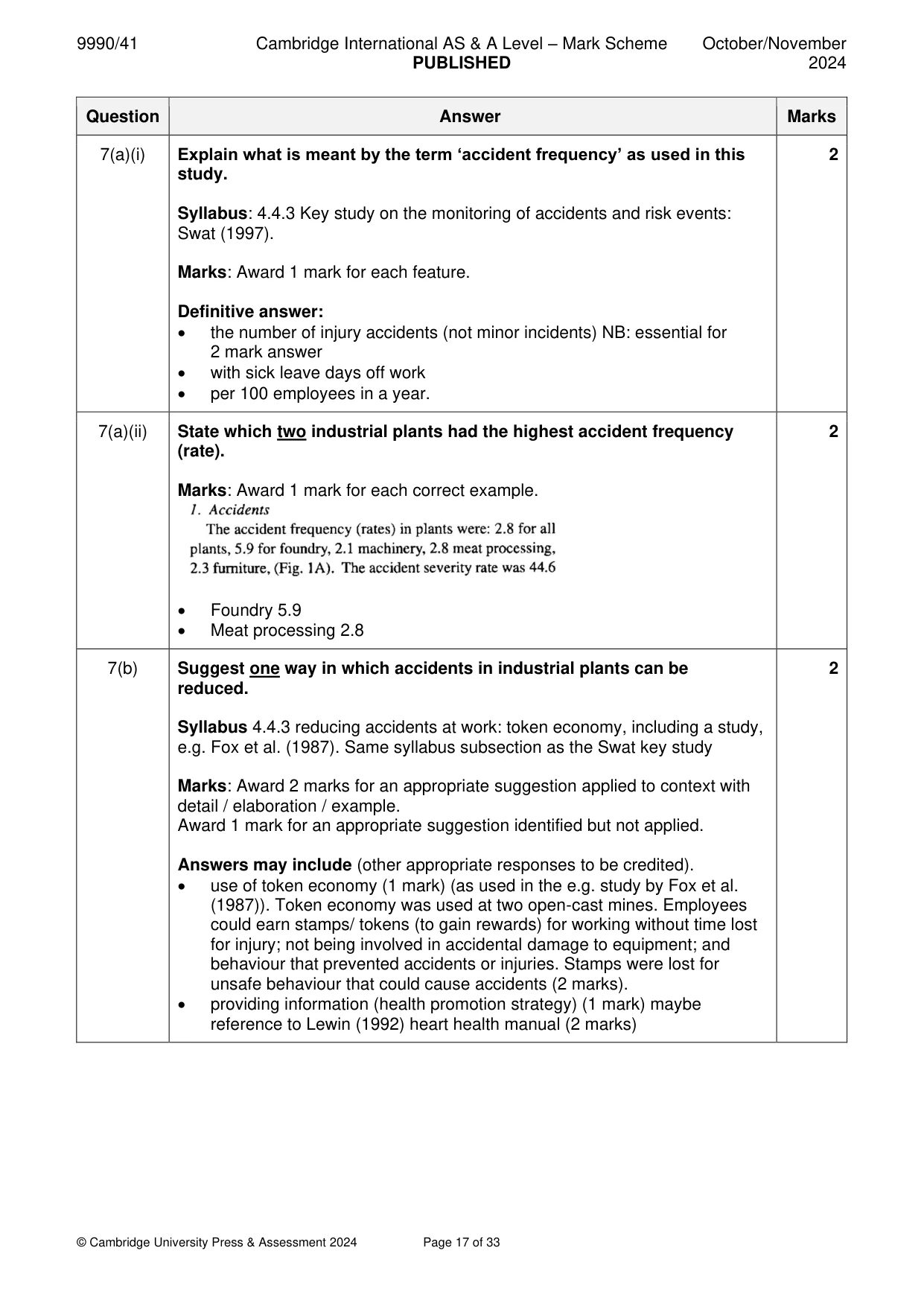
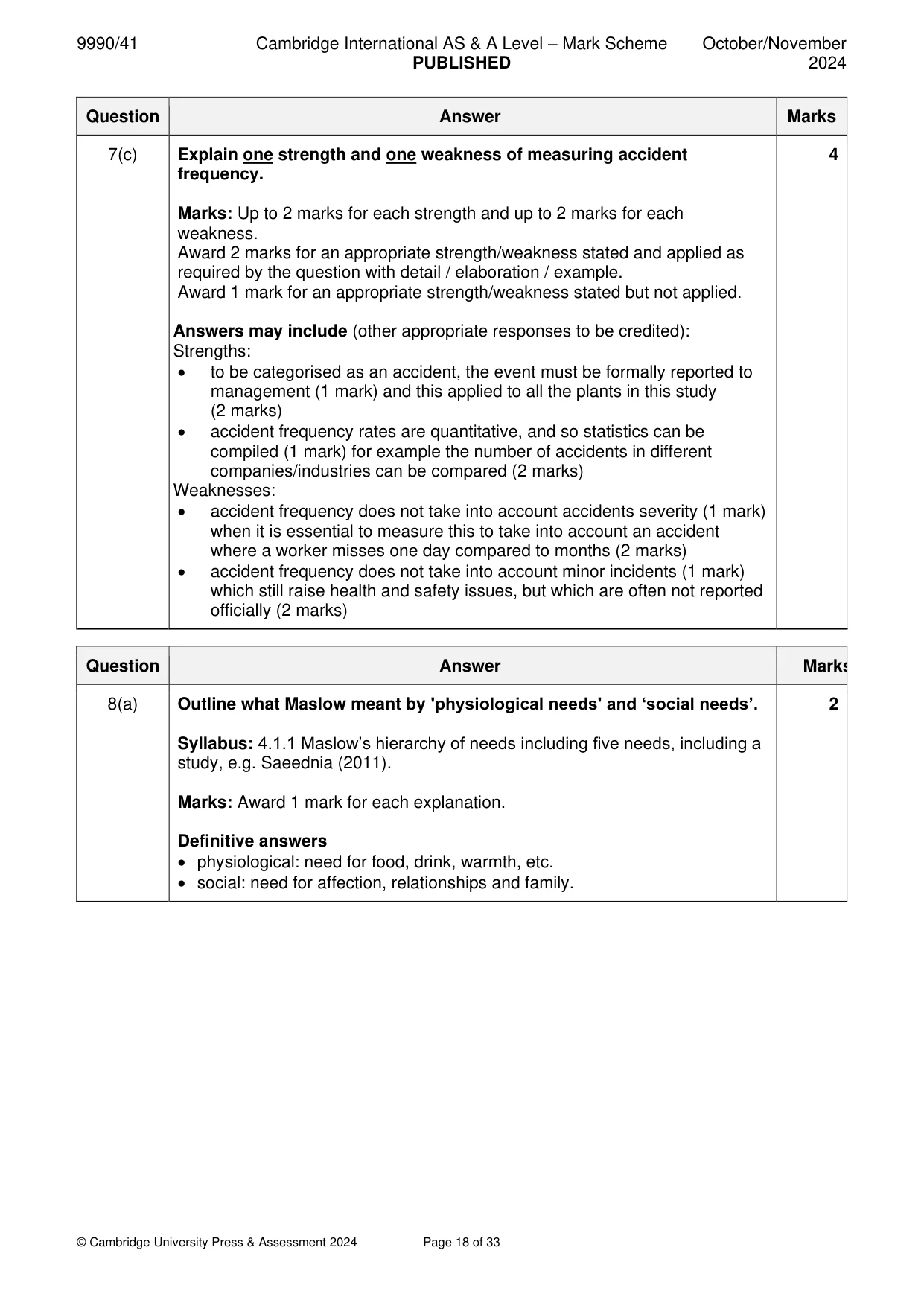
Mark scheme: 7 From the key study by Swat (1997) on monitoring accidents and risk events: 7(a)(i) Explain what is meant by the term ‘accident frequency’ as used in this 2 study. Syllabus: 4.4.3 Key study on the monitoring of accidents and risk events: Swat (1997). Marks: Award 1 mark for each feature. Definitive answer: • the number of injury accidents (not minor incidents) NB: essential for 2 mark answer • with sick leave days off work • per 100 employees in a year. 7(a)(ii) State which two industrial plants had the highest accident frequency 2 (rate). Marks: Award 1 mark for each correct example. • Foundry 5.9 • Meat processing 2.8 7(b) Suggest one way in which accidents in industrial plants can be 2 reduced. Syllabus 4.4.3 reducing accidents at work: token economy, including a study, e.g. Fox et al. (1987). Same syllabus subsection as the Swat key study Marks: Award 2 marks for an appropriate suggestion applied to context with detail / elaboration / example. Award 1 mark for an appropriate suggestion identified but not applied. Answers may include (other appropriate responses to be credited). • use of token economy (1 mark) (as used in the e.g. study by Fox et al. (1987)). Token economy was used at two open-cast mines. Employees could earn stamps/ tokens (to gain rewards) for working without time lost for injury; not being involved in accidental damage to equipment; and behaviour that prevented accidents or injuries. Stamps were lost for unsafe behaviour that could cause accidents (2 marks). • providing information (health promotion strategy) (1 mark) maybe reference to Lewin (1992) heart health manual (2 marks) 7(c) Explain one strength and one weakness of measuring accident 4 frequency. Marks: Up to 2 marks for each strength and up to 2 marks for each weakness. Award 2 marks for an appropriate strength/weakness stated and applied as required by the question with detail / elaboration / example. Award 1 mark for an appropriate strength/weakness stated but not applied. Answers may include (other appropriate responses to be credited): Strengths: • to be categorised as an accident, the event must be formally reported to management (1 mark) and this applied to all the plants in this study (2 marks) • accident frequency rates are quantitative, and so statistics can be compiled (1 mark) for example the number of accidents in different companies/industries can be compared (2 marks) Weaknesses: • accident frequency does not take into account accidents severity (1 mark) when it is essential to measure this to take into account an accident where a worker misses one day compared to months (2 marks) • accident frequency does not take into account minor incidents (1 mark) which still raise health and safety issues, but which are often not reported officially (2 marks)
Q8 · Outline what Maslow meant by ‘physiological needs’ and ‘social needs’
8 (a) Outline what Maslow meant by ‘physiological needs’ and ‘social needs’. [2] (b) Suggest one way in which achievement of social needs could be measured, other than by interview. [2] (c) Explain one strength and one weakness of using a telephone interview to gather data on need theories of motivation. [4]
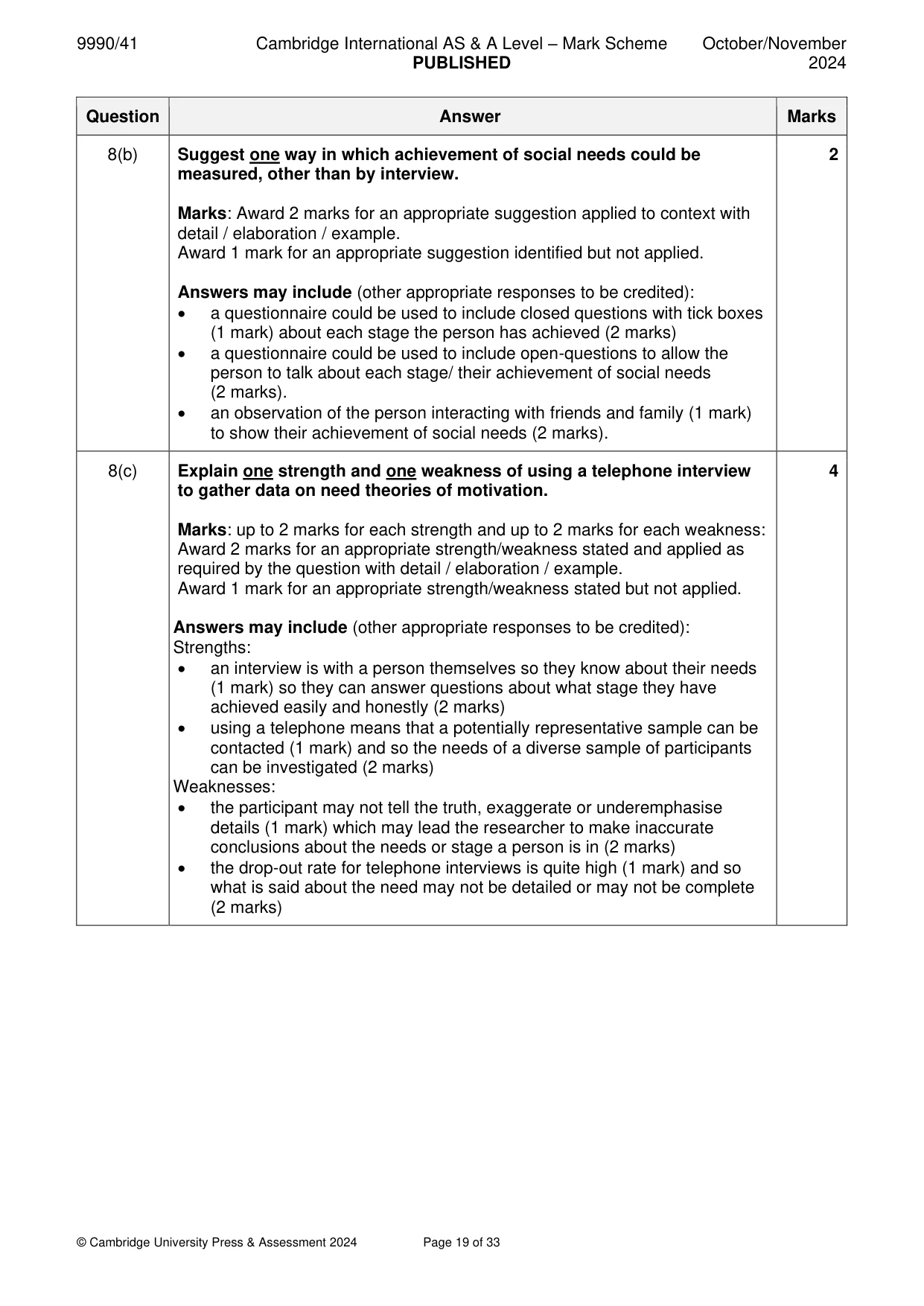
Mark scheme: 8(a) Outline what Maslow meant by 'physiological needs' and ‘social needs’. 2 Syllabus: 4.1.1 Maslow’s hierarchy of needs including five needs, including a study, e.g. Saeednia (2011). Marks: Award 1 mark for each explanation. Definitive answers • physiological: need for food, drink, warmth, etc. • social: need for affection, relationships and family. 8(b) Suggest one way in which achievement of social needs could be 2 measured, other than by interview. Marks: Award 2 marks for an appropriate suggestion applied to context with detail / elaboration / example. Award 1 mark for an appropriate suggestion identified but not applied. Answers may include (other appropriate responses to be credited): • a questionnaire could be used to include closed questions with tick boxes (1 mark) about each stage the person has achieved (2 marks) • a questionnaire could be used to include open-questions to allow the person to talk about each stage/ their achievement of social needs (2 marks). • an observation of the person interacting with friends and family (1 mark) to show their achievement of social needs (2 marks). 8(c) Explain one strength and one weakness of using a telephone interview 4 to gather data on need theories of motivation. Marks: up to 2 marks for each strength and up to 2 marks for each weakness: Award 2 marks for an appropriate strength/weakness stated and applied as required by the question with detail / elaboration / example. Award 1 mark for an appropriate strength/weakness stated but not applied. Answers may include (other appropriate responses to be credited): Strengths: • an interview is with a person themselves so they know about their needs (1 mark) so they can answer questions about what stage they have achieved easily and honestly (2 marks) • using a telephone means that a potentially representative sample can be contacted (1 mark) and so the needs of a diverse sample of participants can be investigated (2 marks) Weaknesses: • the participant may not tell the truth, exaggerate or underemphasise details (1 mark) which may lead the researcher to make inaccurate conclusions about the needs or stage a person is in (2 marks) • the drop-out rate for telephone interviews is quite high (1 mark) and so what is said about the need may not be detailed or may not be complete (2 marks)
Q9 · Plan an experiment to investigate which anti-depressant drug is more effective for…
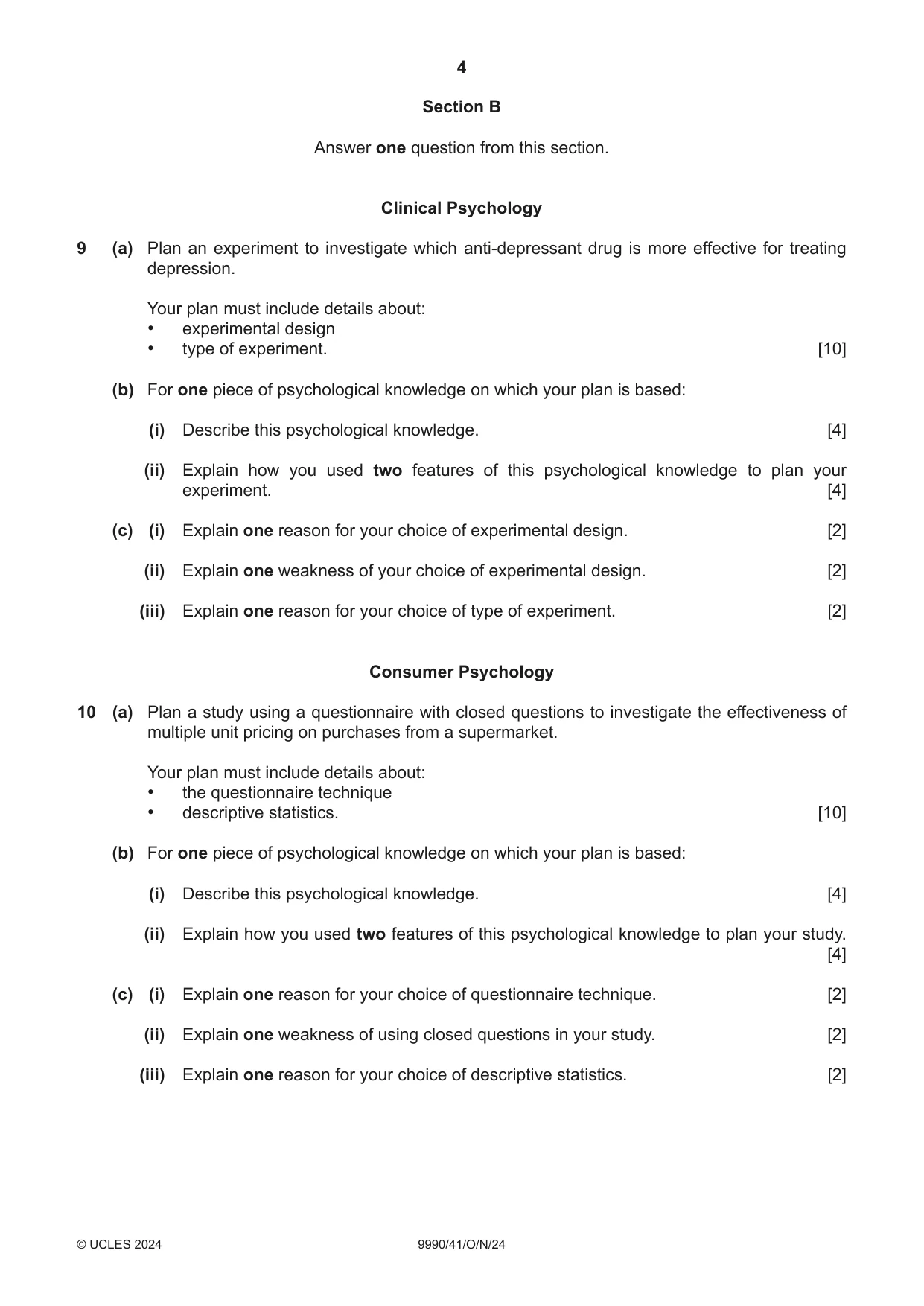
9 (a) Plan an experiment to investigate which anti-depressant drug is more effective for treating depression. Your plan must include details about: • experimental design • type of experiment. [10] (b) For one piece of psychological knowledge on which your plan is based: (i) Describe this psychological knowledge. [4] (ii) Explain how you used two features of this psychological knowledge to plan your experiment. [4] (c) (i) Explain one reason for your choice of experimental design. [2] (ii) Explain one weakness of your choice of experimental design. [2] (iii) Explain one reason for your choice of type of experiment. [2] Consumer Psychology
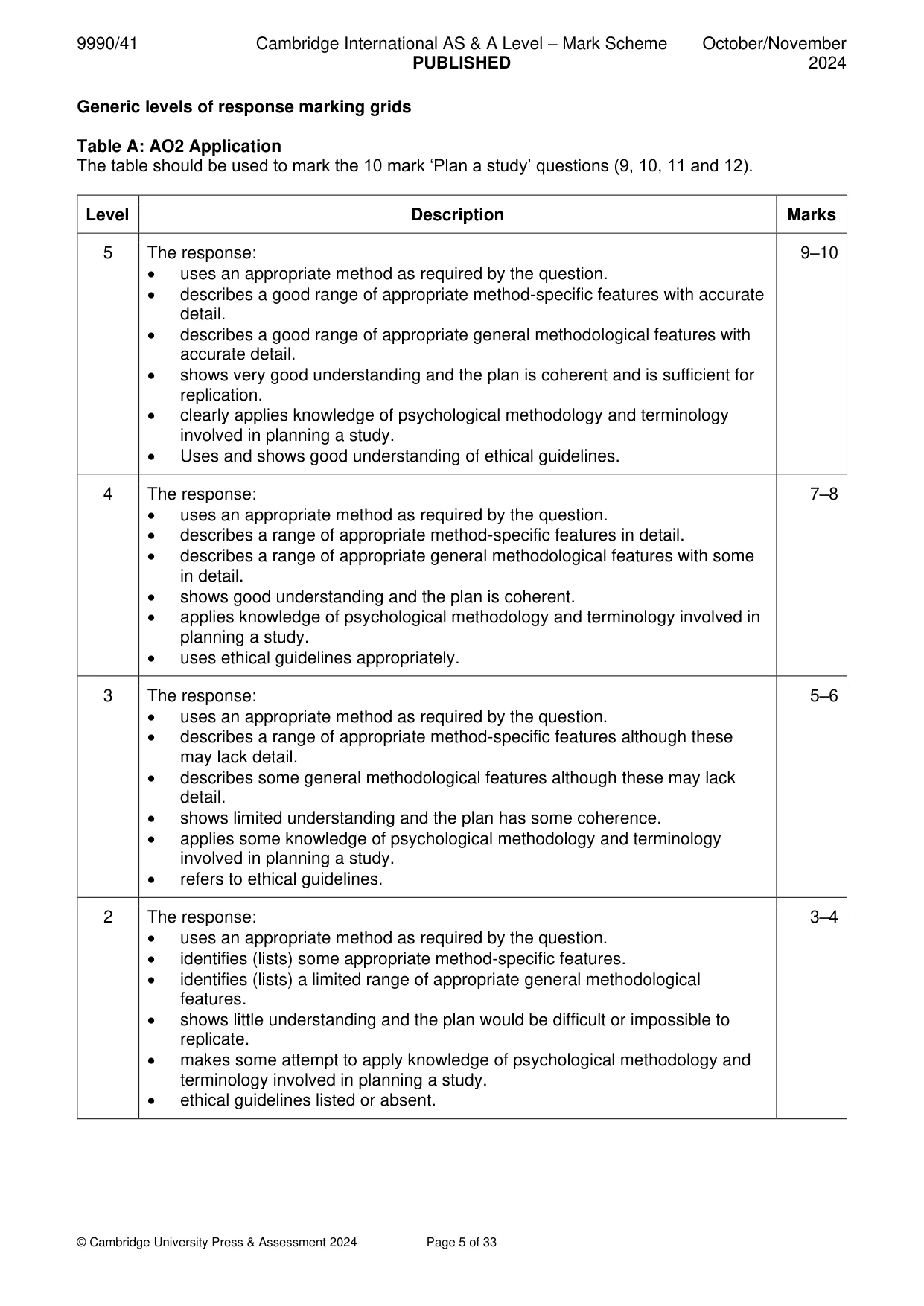
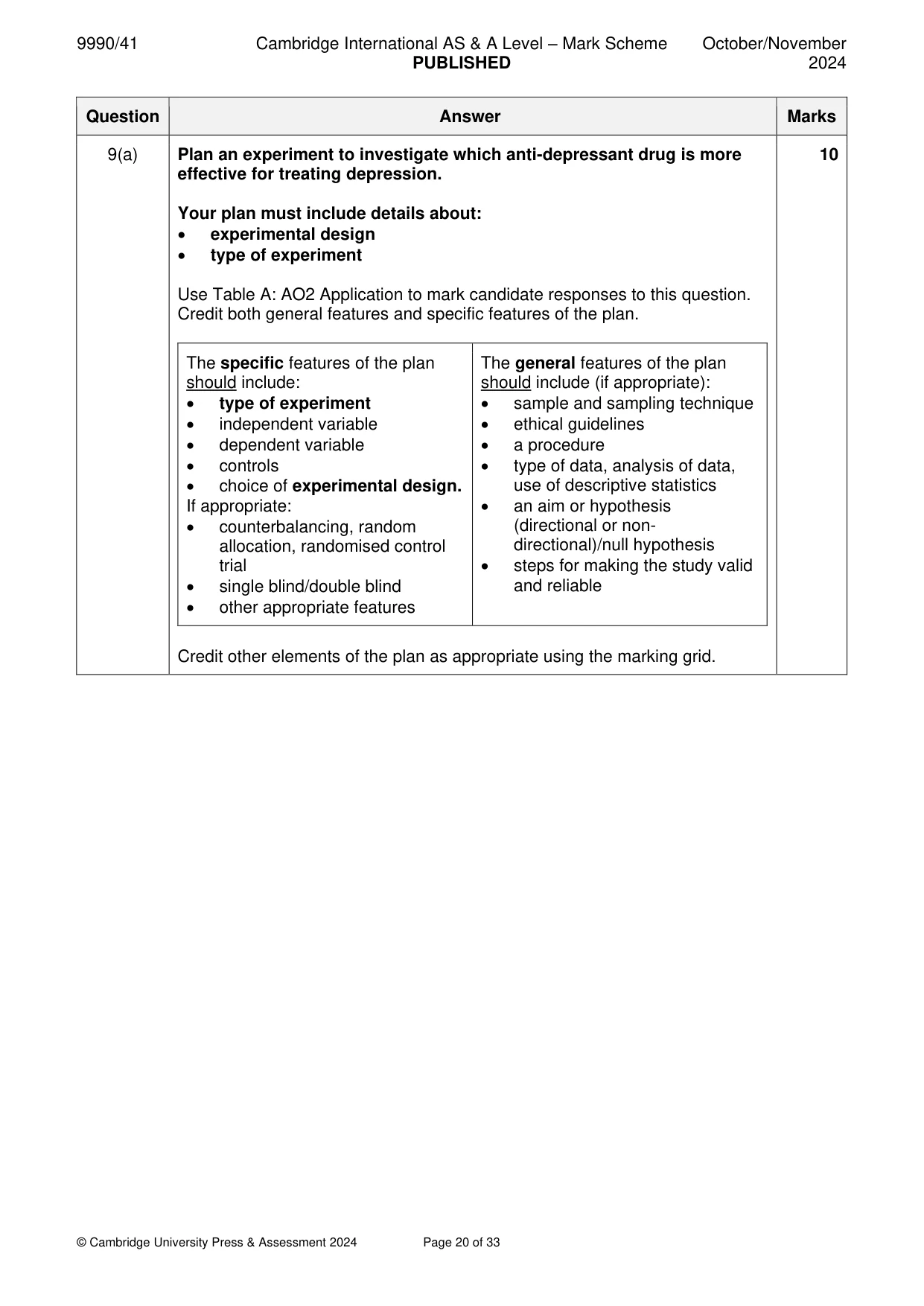
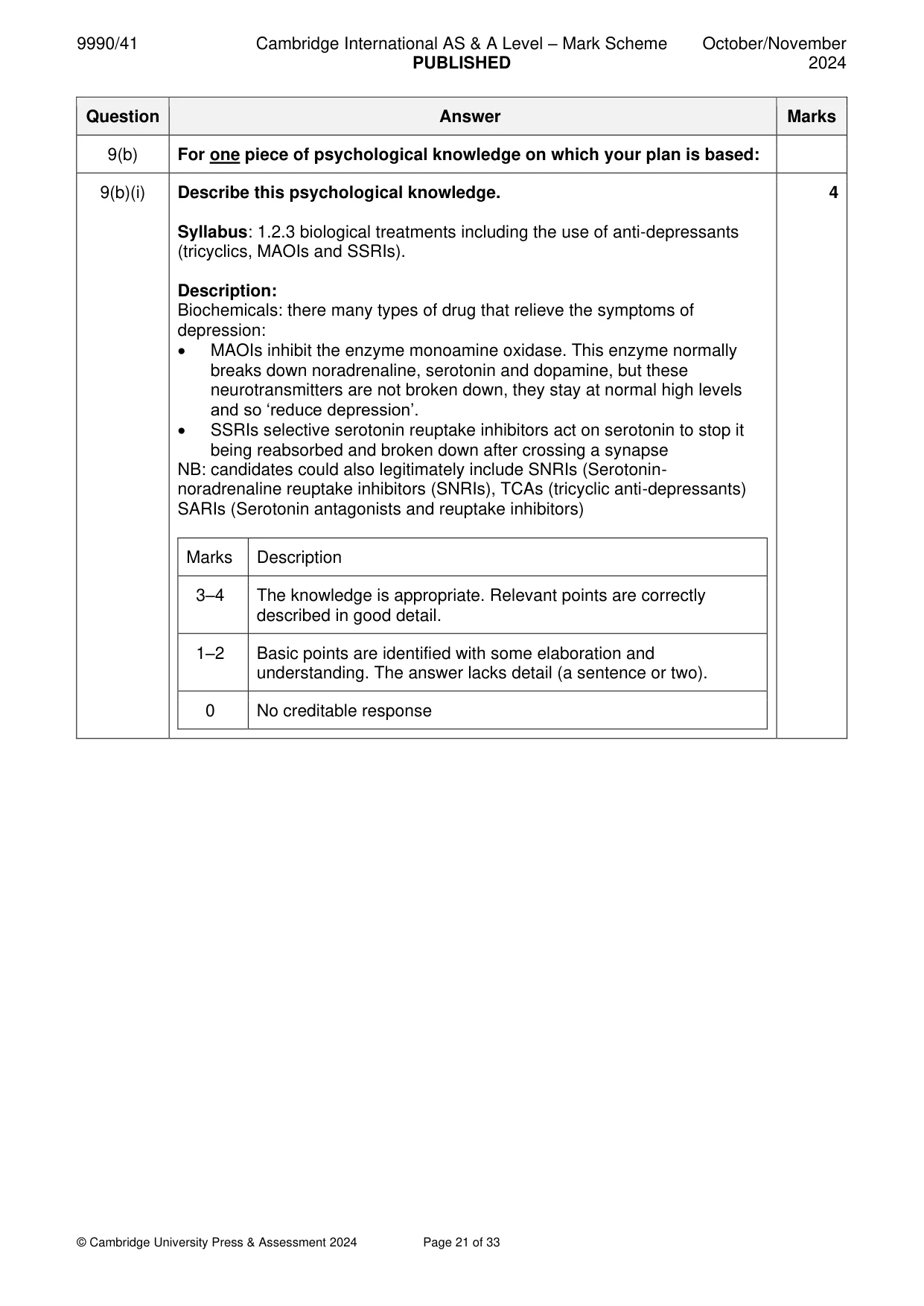
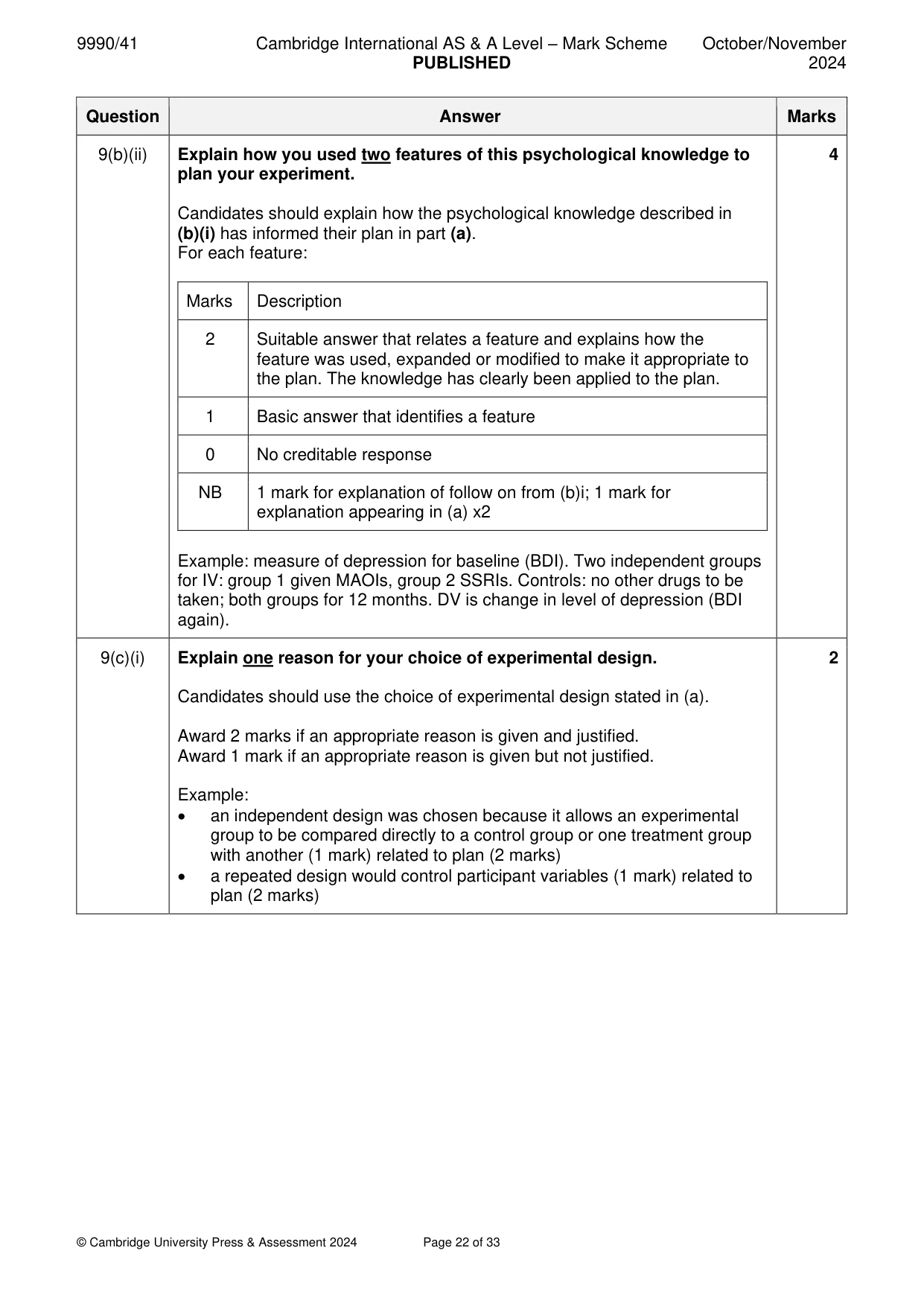
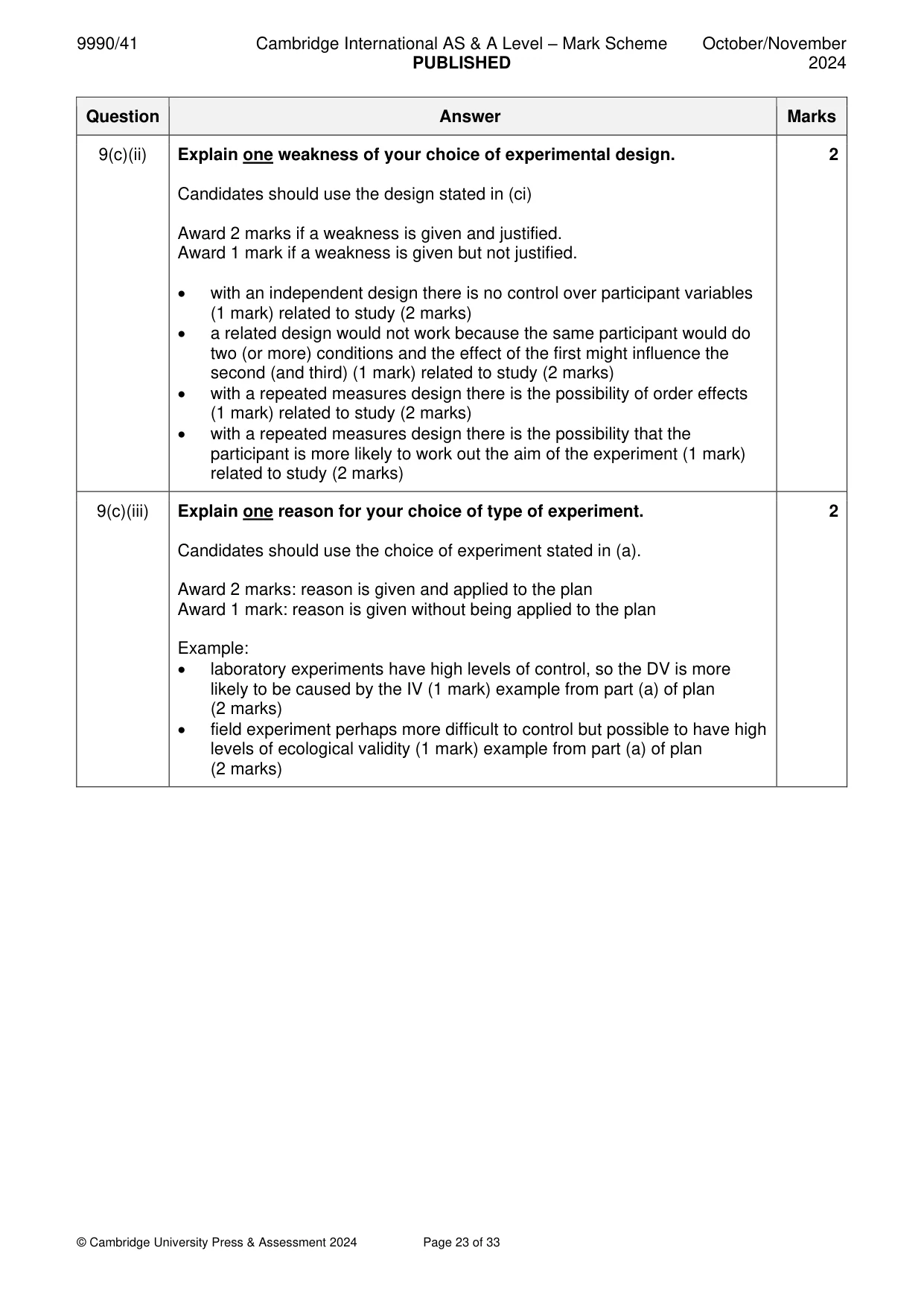
Mark scheme: 9(a) Plan an experiment to investigate which anti-depressant drug is more 10 effective for treating depression. Your plan must include details about: • experimental design • type of experiment Use Table A: AO2 Application to mark candidate responses to this question. Credit both general features and specific features of the plan. The specific features of the plan The general features of the plan should include: should include (if appropriate): • type of experiment • sample and sampling technique • independent variable • ethical guidelines • dependent variable • a procedure • controls • type of data, analysis of data, • choice of experimental design. use of descriptive statistics If appropriate: • an aim or hypothesis • counterbalancing, random (directional or non- allocation, randomised control directional)/null hypothesis trial • steps for making the study valid • single blind/double blind and reliable • other appropriate features Credit other elements of the plan as appropriate using the marking grid. 9(b) For one piece of psychological knowledge on which your plan is based: 9(b)(i) Describe this psychological knowledge. 4 Syllabus: 1.2.3 biological treatments including the use of anti-depressants (tricyclics, MAOIs and SSRIs). Description: Biochemicals: there many types of drug that relieve the symptoms of depression: • MAOIs inhibit the enzyme monoamine oxidase. This enzyme normally breaks down noradrenaline, serotonin and dopamine, but these neurotransmitters are not broken down, they stay at normal high levels and so ‘reduce depression’. • SSRIs selective serotonin reuptake inhibitors act on serotonin to stop it being reabsorbed and broken down after crossing a synapse NB: candidates could also legitimately include SNRIs (Serotonin- noradrenaline reuptake inhibitors (SNRIs), TCAs (tricyclic anti-depressants) SARIs (Serotonin antagonists and reuptake inhibitors) Marks Description 3–4 The knowledge is appropriate. Relevant points are correctly described in good detail. 1–2 Basic points are identified with some elaboration and understanding. The answer lacks detail (a sentence or two). 0 No creditable response 9(b)(ii) Explain how you used two features of this psychological knowledge to 4 plan your experiment. Candidates should explain how the psychological knowledge described in (b)(i) has informed their plan in part (a). For each feature: Marks Description 2 Suitable answer that relates a feature and explains how the feature was used, expanded or modified to make it appropriate to the plan. The knowledge has clearly been applied to the plan. 1 Basic answer that identifies a feature 0 No creditable response NB 1 mark for explanation of follow on from (b)i; 1 mark for explanation appearing in (a) x2 Example: measure of depression for baseline (BDI). Two independent groups for IV: group 1 given MAOIs, group 2 SSRIs. Controls: no other drugs to be taken; both groups for 12 months. DV is change in level of depression (BDI again). 9(c)(i) Explain one reason for your choice of experimental design. 2 Candidates should use the choice of experimental design stated in (a). Award 2 marks if an appropriate reason is given and justified. Award 1 mark if an appropriate reason is given but not justified. Example: • an independent design was chosen because it allows an experimental group to be compared directly to a control group or one treatment group with another (1 mark) related to plan (2 marks) • a repeated design would control participant variables (1 mark) related to plan (2 marks) 9(c)(ii) Explain one weakness of your choice of experimental design. 2 Candidates should use the design stated in (ci) Award 2 marks if a weakness is given and justified. Award 1 mark if a weakness is given but not justified. • with an independent design there is no control over participant variables (1 mark) related to study (2 marks) • a related design would not work because the same participant would do two (or more) conditions and the effect of the first might influence the second (and third) (1 mark) related to study (2 marks) • with a repeated measures design there is the possibility of order effects (1 mark) related to study (2 marks) • with a repeated measures design there is the possibility that the participant is more likely to work out the aim of the experiment (1 mark) related to study (2 marks) 9(c)(iii) Explain one reason for your choice of type of experiment. 2 Candidates should use the choice of experiment stated in (a). Award 2 marks: reason is given and applied to the plan Award 1 mark: reason is given without being applied to the plan Example: • laboratory experiments have high levels of control, so the DV is more likely to be caused by the IV (1 mark) example from part (a) of plan (2 marks) • field experiment perhaps more difficult to control but possible to have high levels of ecological validity (1 mark) example from part (a) of plan (2 marks)
More questions on Mood (affective) disorders: depressive disorder (unipolar) and bipolar disorder
Q10 · Plan a study using a questionnaire with closed questions to investigate the effectiveness…
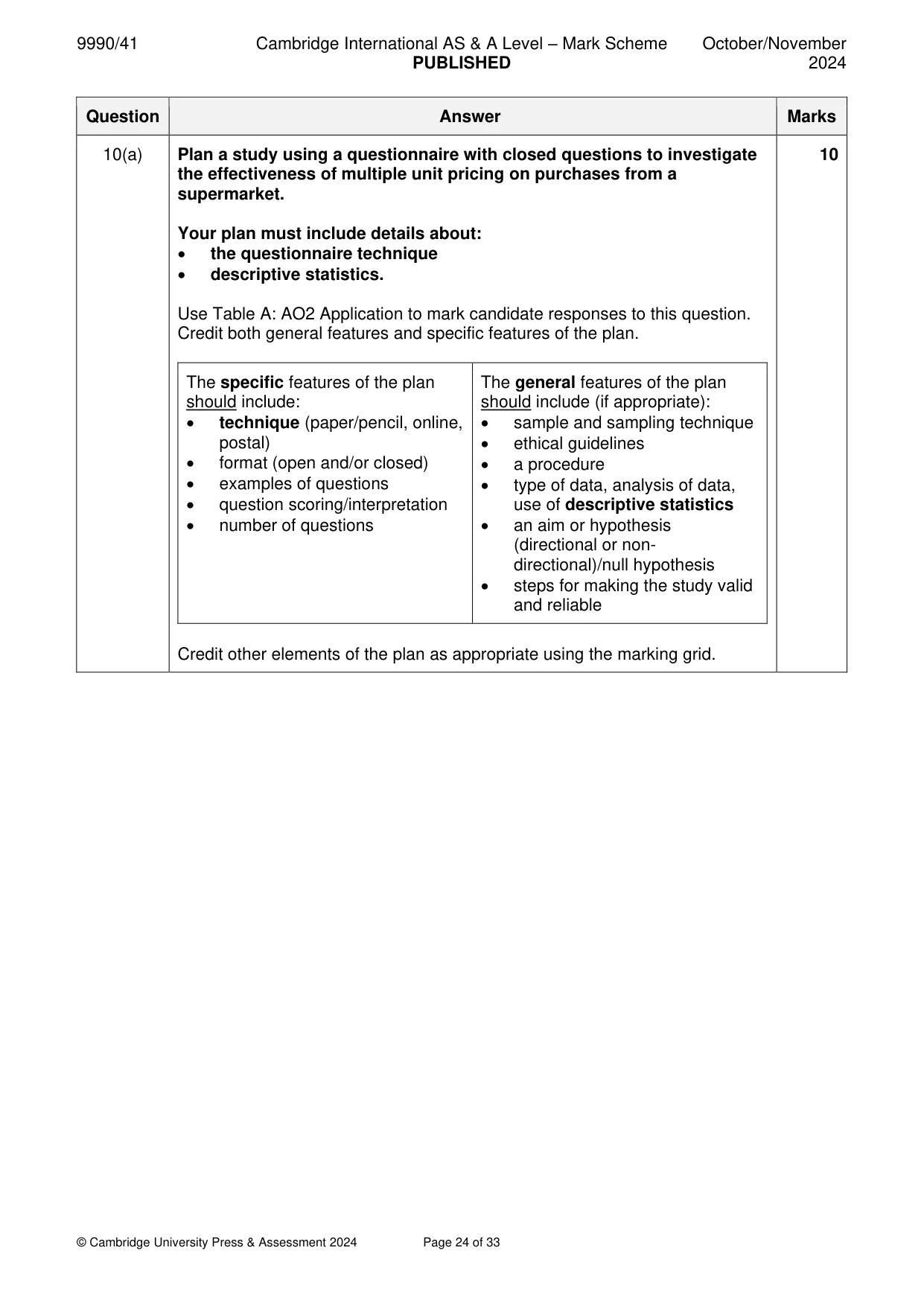
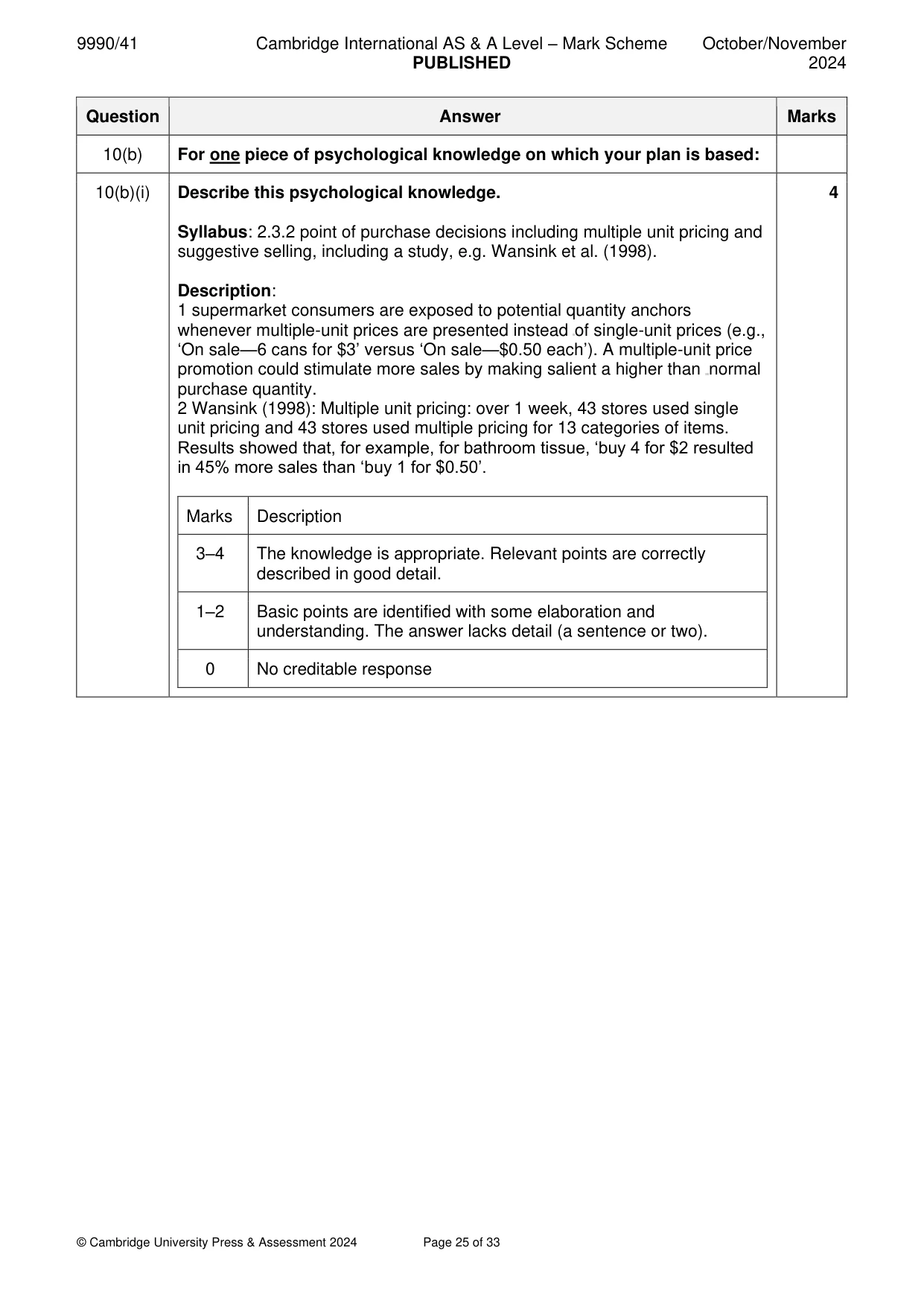
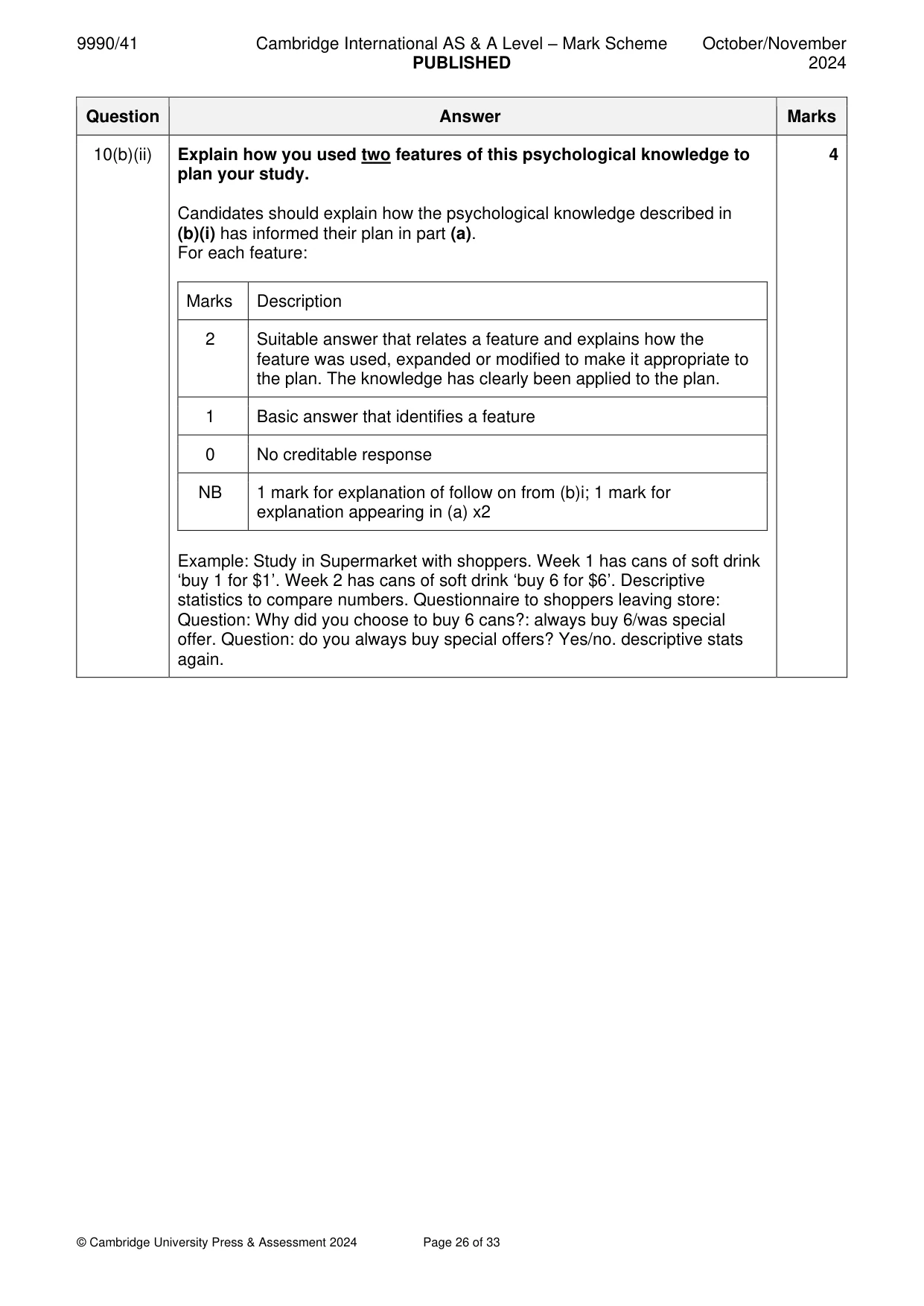
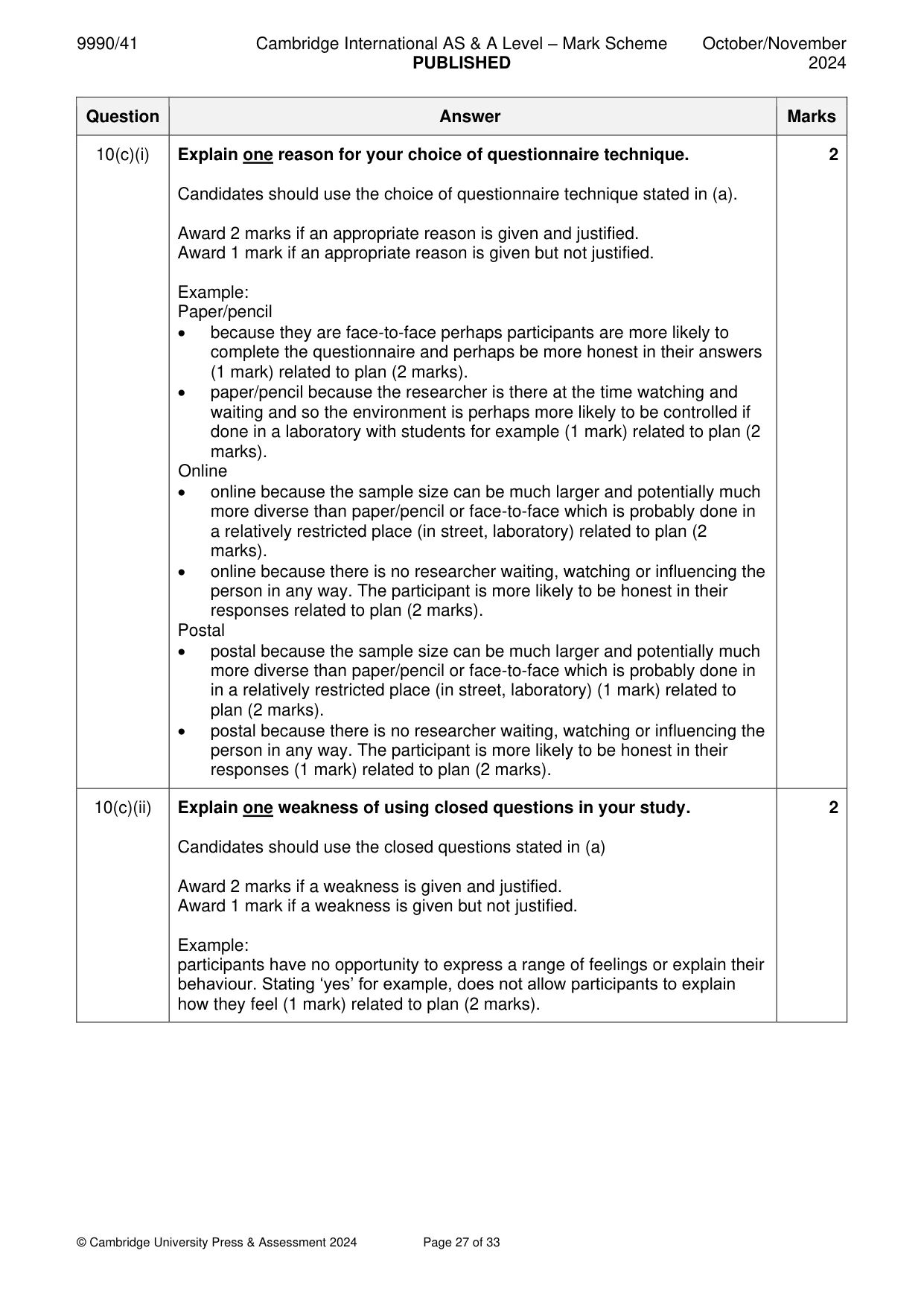
10 (a) Plan a study using a questionnaire with closed questions to investigate the effectiveness of multiple unit pricing on purchases from a supermarket. Your plan must include details about: • the questionnaire technique • descriptive statistics. [10] (b) For one piece of psychological knowledge on which your plan is based: (i) Describe this psychological knowledge. [4] (ii) Explain how you used two features of this psychological knowledge to plan your study. [4] (c) (i) Explain one reason for your choice of questionnaire technique. [2] (ii) Explain one weakness of using closed questions in your study. [2] (iii) Explain one reason for your choice of descriptive statistics. [2] Health Psychology
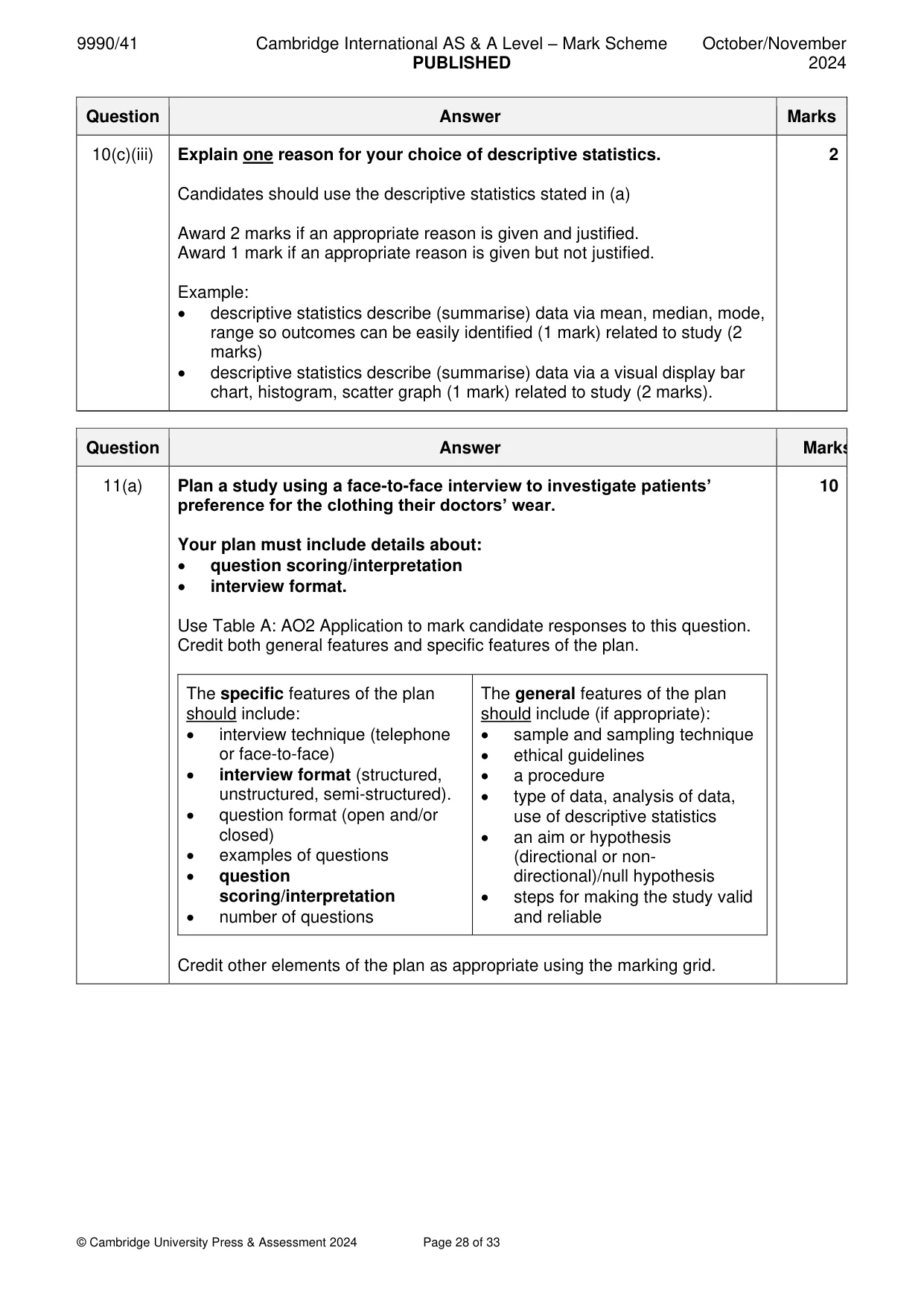
Mark scheme: 10(a) Plan a study using a questionnaire with closed questions to investigate 10 the effectiveness of multiple unit pricing on purchases from a supermarket. Your plan must include details about: • the questionnaire technique • descriptive statistics. Use Table A: AO2 Application to mark candidate responses to this question. Credit both general features and specific features of the plan. The specific features of the plan The general features of the plan should include: should include (if appropriate): • technique (paper/pencil, online, • sample and sampling technique postal) • ethical guidelines • format (open and/or closed) • a procedure • examples of questions • type of data, analysis of data, • question scoring/interpretation use of descriptive statistics • number of questions • an aim or hypothesis (directional or non- directional)/null hypothesis • steps for making the study valid and reliable Credit other elements of the plan as appropriate using the marking grid. 10(b) For one piece of psychological knowledge on which your plan is based: 10(b)(i) Describe this psychological knowledge. 4 Syllabus: 2.3.2 point of purchase decisions including multiple unit pricing and suggestive selling, including a study, e.g. Wansink et al. (1998). Description: 1 supermarket consumers are exposed to potential quantity anchors whenever multiple-unit prices are presented instead of single-unit prices (e.g., ‘On sale—6 cans for $3’ versus ‘On sale—$0.50 each’). A multiple-unit price promotion could stimulate more sales by making salient a higher than normal purchase quantity. 2 Wansink (1998): Multiple unit pricing: over 1 week, 43 stores used single unit pricing and 43 stores used multiple pricing for 13 categories of items. Results showed that, for example, for bathroom tissue, ‘buy 4 for $2 resulted in 45% more sales than ‘buy 1 for $0.50’. Marks Description 3–4 The knowledge is appropriate. Relevant points are correctly described in good detail. 1–2 Basic points are identified with some elaboration and understanding. The answer lacks detail (a sentence or two). 0 No creditable response 10(b)(ii) Explain how you used two features of this psychological knowledge to 4 plan your study. Candidates should explain how the psychological knowledge described in (b)(i) has informed their plan in part (a). For each feature: Marks Description 2 Suitable answer that relates a feature and explains how the feature was used, expanded or modified to make it appropriate to the plan. The knowledge has clearly been applied to the plan. 1 Basic answer that identifies a feature 0 No creditable response NB 1 mark for explanation of follow on from (b)i; 1 mark for explanation appearing in (a) x2 Example: Study in Supermarket with shoppers. Week 1 has cans of soft drink ‘buy 1 for $1’. Week 2 has cans of soft drink ‘buy 6 for $6’. Descriptive statistics to compare numbers. Questionnaire to shoppers leaving store: Question: Why did you choose to buy 6 cans?: always buy 6/was special offer. Question: do you always buy special offers? Yes/no. descriptive stats again. 10(c)(i) Explain one reason for your choice of questionnaire technique. 2 Candidates should use the choice of questionnaire technique stated in (a). Award 2 marks if an appropriate reason is given and justified. Award 1 mark if an appropriate reason is given but not justified. Example: Paper/pencil • because they are face-to-face perhaps participants are more likely to complete the questionnaire and perhaps be more honest in their answers (1 mark) related to plan (2 marks). • paper/pencil because the researcher is there at the time watching and waiting and so the environment is perhaps more likely to be controlled if done in a laboratory with students for example (1 mark) related to plan (2 marks). Online • online because the sample size can be much larger and potentially much more diverse than paper/pencil or face-to-face which is probably done in a relatively restricted place (in street, laboratory) related to plan (2 marks). • online because there is no researcher waiting, watching or influencing the person in any way. The participant is more likely to be honest in their responses related to plan (2 marks). Postal • postal because the sample size can be much larger and potentially much more diverse than paper/pencil or face-to-face which is probably done in in a relatively restricted place (in street, laboratory) (1 mark) related to plan (2 marks). • postal because there is no researcher waiting, watching or influencing the person in any way. The participant is more likely to be honest in their responses (1 mark) related to plan (2 marks). 10(c)(ii) Explain one weakness of using closed questions in your study. 2 Candidates should use the closed questions stated in (a) Award 2 marks if a weakness is given and justified. Award 1 mark if a weakness is given but not justified. Example: participants have no opportunity to express a range of feelings or explain their behaviour. Stating ‘yes’ for example, does not allow participants to explain how they feel (1 mark) related to plan (2 marks). 10(c)(iii) Explain one reason for your choice of descriptive statistics. 2 Candidates should use the descriptive statistics stated in (a) Award 2 marks if an appropriate reason is given and justified. Award 1 mark if an appropriate reason is given but not justified. Example: • descriptive statistics describe (summarise) data via mean, median, mode, range so outcomes can be easily identified (1 mark) related to study (2 marks) • descriptive statistics describe (summarise) data via a visual display bar chart, histogram, scatter graph (1 mark) related to study (2 marks).
Q11 · Plan a study using a face-to-face interview to investigate patients’ preference for the…
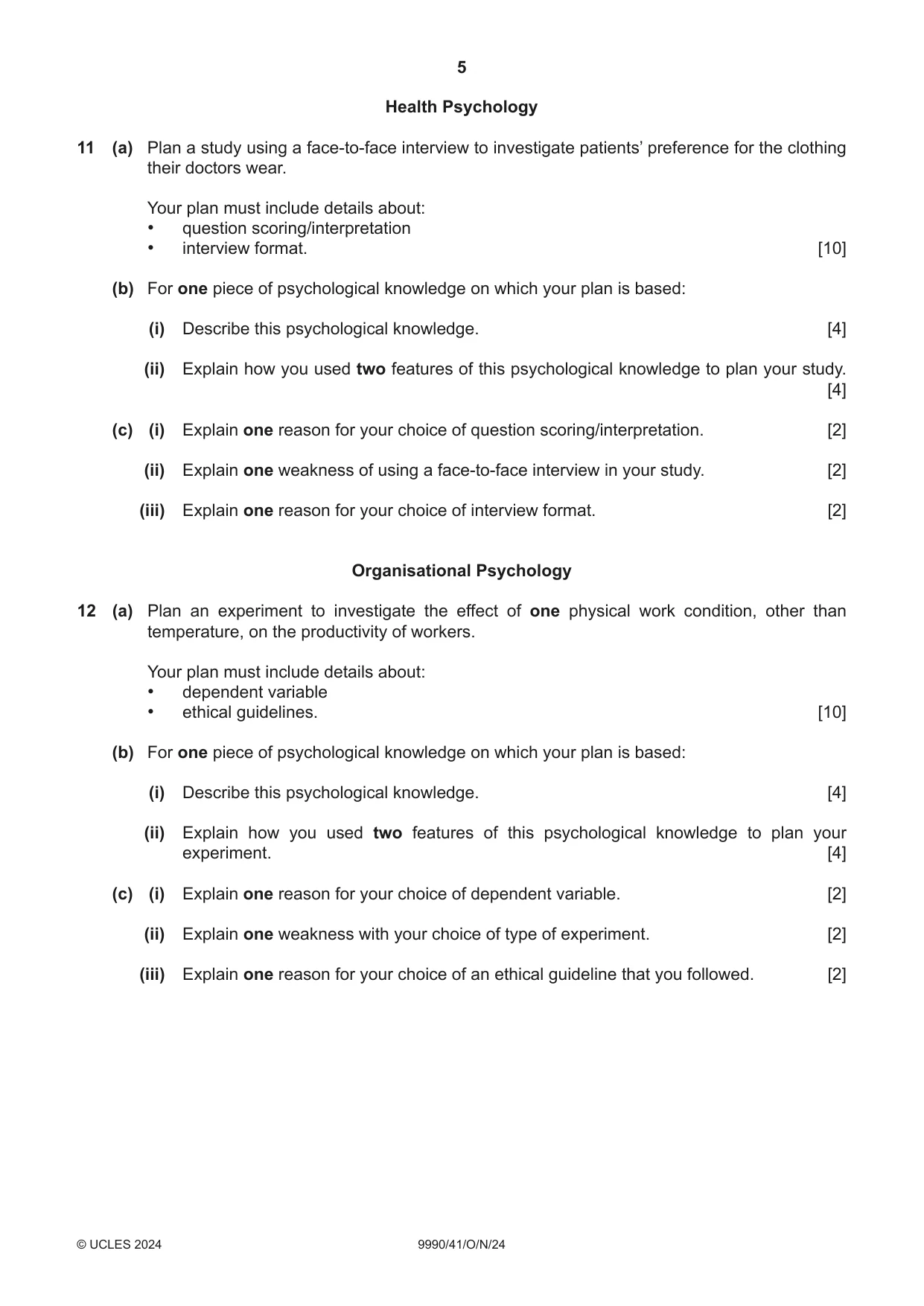
11 (a) Plan a study using a face-to-face interview to investigate patients’ preference for the clothing their doctors wear. Your plan must include details about: • question scoring/interpretation • interview format. [10] (b) For one piece of psychological knowledge on which your plan is based: (i) Describe this psychological knowledge. [4] (ii) Explain how you used two features of this psychological knowledge to plan your study. [4] (c) (i) Explain one reason for your choice of question scoring/interpretation. [2] (ii) Explain one weakness of using a face-to-face interview in your study. [2] (iii) Explain one reason for your choice of interview format. [2] Organisational Psychology
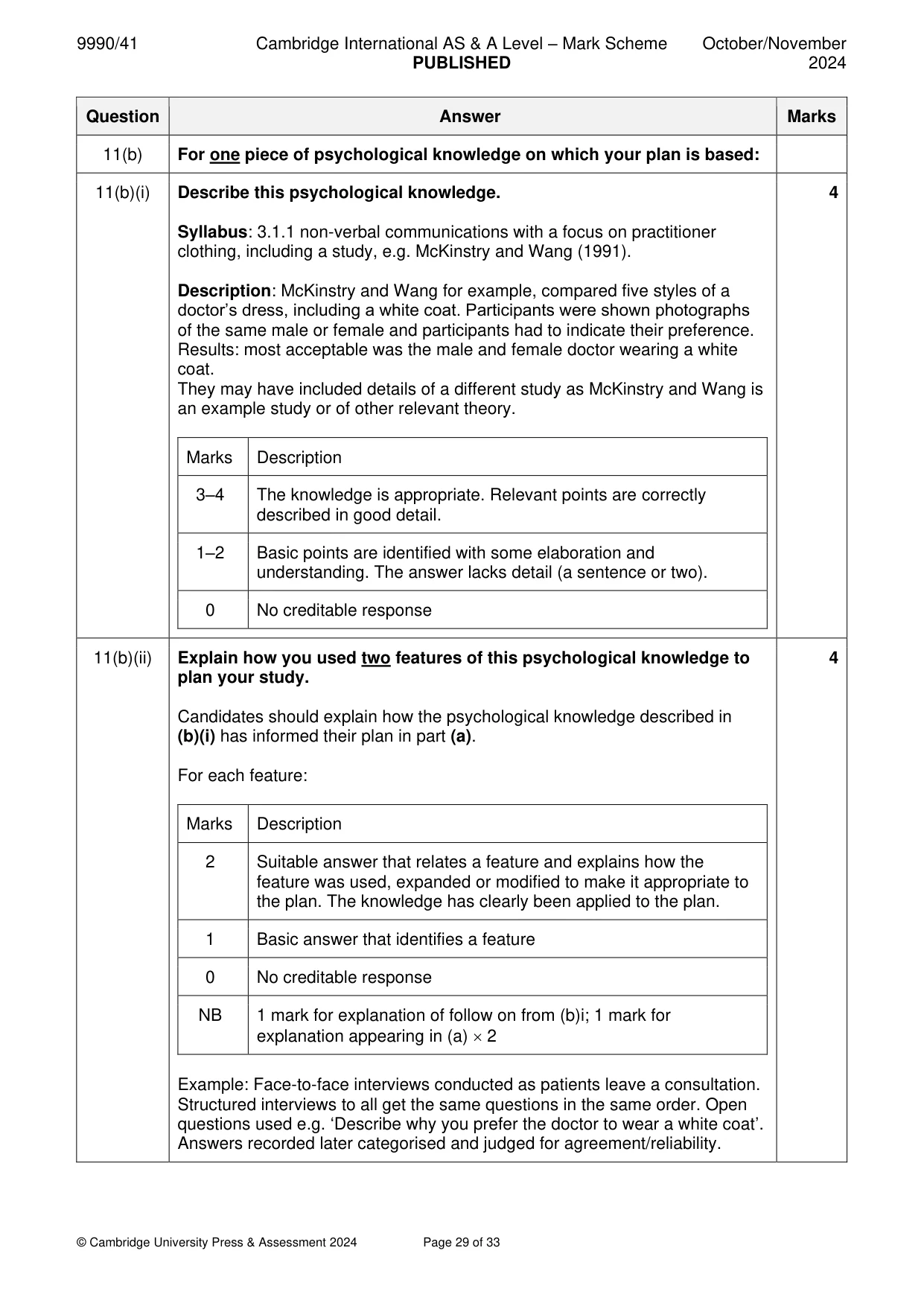
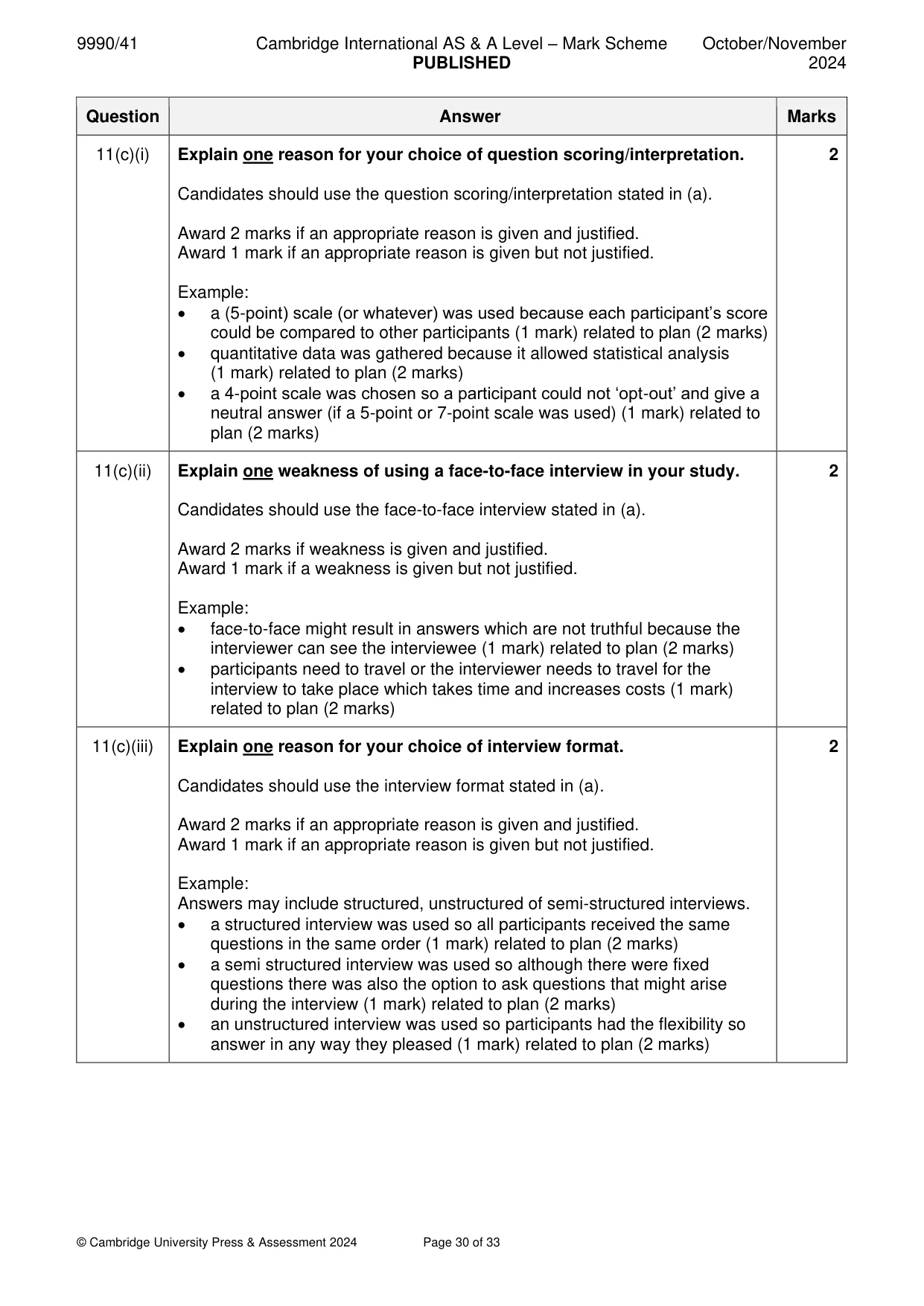
Mark scheme: 11(a) Plan a study using a face-to-face interview to investigate patients’ 10 preference for the clothing their doctors’ wear. Your plan must include details about: • question scoring/interpretation • interview format. Use Table A: AO2 Application to mark candidate responses to this question. Credit both general features and specific features of the plan. The specific features of the plan The general features of the plan should include: should include (if appropriate): • interview technique (telephone • sample and sampling technique or face-to-face) • ethical guidelines • interview format (structured, • a procedure unstructured, semi-structured). • type of data, analysis of data, • question format (open and/or use of descriptive statistics closed) • an aim or hypothesis • examples of questions (directional or non- • question directional)/null hypothesis scoring/interpretation • steps for making the study valid • number of questions and reliable Credit other elements of the plan as appropriate using the marking grid. 11(b) For one piece of psychological knowledge on which your plan is based: 11(b)(i) Describe this psychological knowledge. 4 Syllabus: 3.1.1 non-verbal communications with a focus on practitioner clothing, including a study, e.g. McKinstry and Wang (1991). Description: McKinstry and Wang for example, compared five styles of a doctor’s dress, including a white coat. Participants were shown photographs of the same male or female and participants had to indicate their preference. Results: most acceptable was the male and female doctor wearing a white coat. They may have included details of a different study as McKinstry and Wang is an example study or of other relevant theory. Marks Description 3–4 The knowledge is appropriate. Relevant points are correctly described in good detail. 1–2 Basic points are identified with some elaboration and understanding. The answer lacks detail (a sentence or two). 0 No creditable response 11(b)(ii) Explain how you used two features of this psychological knowledge to 4 plan your study. Candidates should explain how the psychological knowledge described in (b)(i) has informed their plan in part (a). For each feature: Marks Description 2 Suitable answer that relates a feature and explains how the feature was used, expanded or modified to make it appropriate to the plan. The knowledge has clearly been applied to the plan. 1 Basic answer that identifies a feature 0 No creditable response NB 1 mark for explanation of follow on from (b)i; 1 mark for explanation appearing in (a) 2 Example: Face-to-face interviews conducted as patients leave a consultation. Structured interviews to all get the same questions in the same order. Open questions used e.g. ‘Describe why you prefer the doctor to wear a white coat’. Answers recorded later categorised and judged for agreement/reliability. 11(c)(i) Explain one reason for your choice of question scoring/interpretation. 2 Candidates should use the question scoring/interpretation stated in (a). Award 2 marks if an appropriate reason is given and justified. Award 1 mark if an appropriate reason is given but not justified. Example: • a (5-point) scale (or whatever) was used because each participant’s score could be compared to other participants (1 mark) related to plan (2 marks) • quantitative data was gathered because it allowed statistical analysis (1 mark) related to plan (2 marks) • a 4-point scale was chosen so a participant could not ‘opt-out’ and give a neutral answer (if a 5-point or 7-point scale was used) (1 mark) related to plan (2 marks) 11(c)(ii) Explain one weakness of using a face-to-face interview in your study. 2 Candidates should use the face-to-face interview stated in (a). Award 2 marks if weakness is given and justified. Award 1 mark if a weakness is given but not justified. Example: • face-to-face might result in answers which are not truthful because the interviewer can see the interviewee (1 mark) related to plan (2 marks) • participants need to travel or the interviewer needs to travel for the interview to take place which takes time and increases costs (1 mark) related to plan (2 marks) 11(c)(iii) Explain one reason for your choice of interview format. 2 Candidates should use the interview format stated in (a). Award 2 marks if an appropriate reason is given and justified. Award 1 mark if an appropriate reason is given but not justified. Example: Answers may include structured, unstructured of semi-structured interviews. • a structured interview was used so all participants received the same questions in the same order (1 mark) related to plan (2 marks) • a semi structured interview was used so although there were fixed questions there was also the option to ask questions that might arise during the interview (1 mark) related to plan (2 marks) • an unstructured interview was used so participants had the flexibility so answer in any way they pleased (1 mark) related to plan (2 marks)
Q12 · Plan an experiment to investigate the effect of one physical work condition, other than…
12 (a) Plan an experiment to investigate the effect of one physical work condition, other than temperature, on the productivity of workers. Your plan must include details about: • dependent variable • ethical guidelines. [10] (b) For one piece of psychological knowledge on which your plan is based: (i) Describe this psychological knowledge. [4] (ii) Explain how you used two features of this psychological knowledge to plan your experiment. [4] (c) (i) Explain one reason for your choice of dependent variable. [2] (ii) Explain one weakness with your choice of type of experiment. [2] (iii) Explain one reason for your choice of an ethical guideline that you followed. [2]
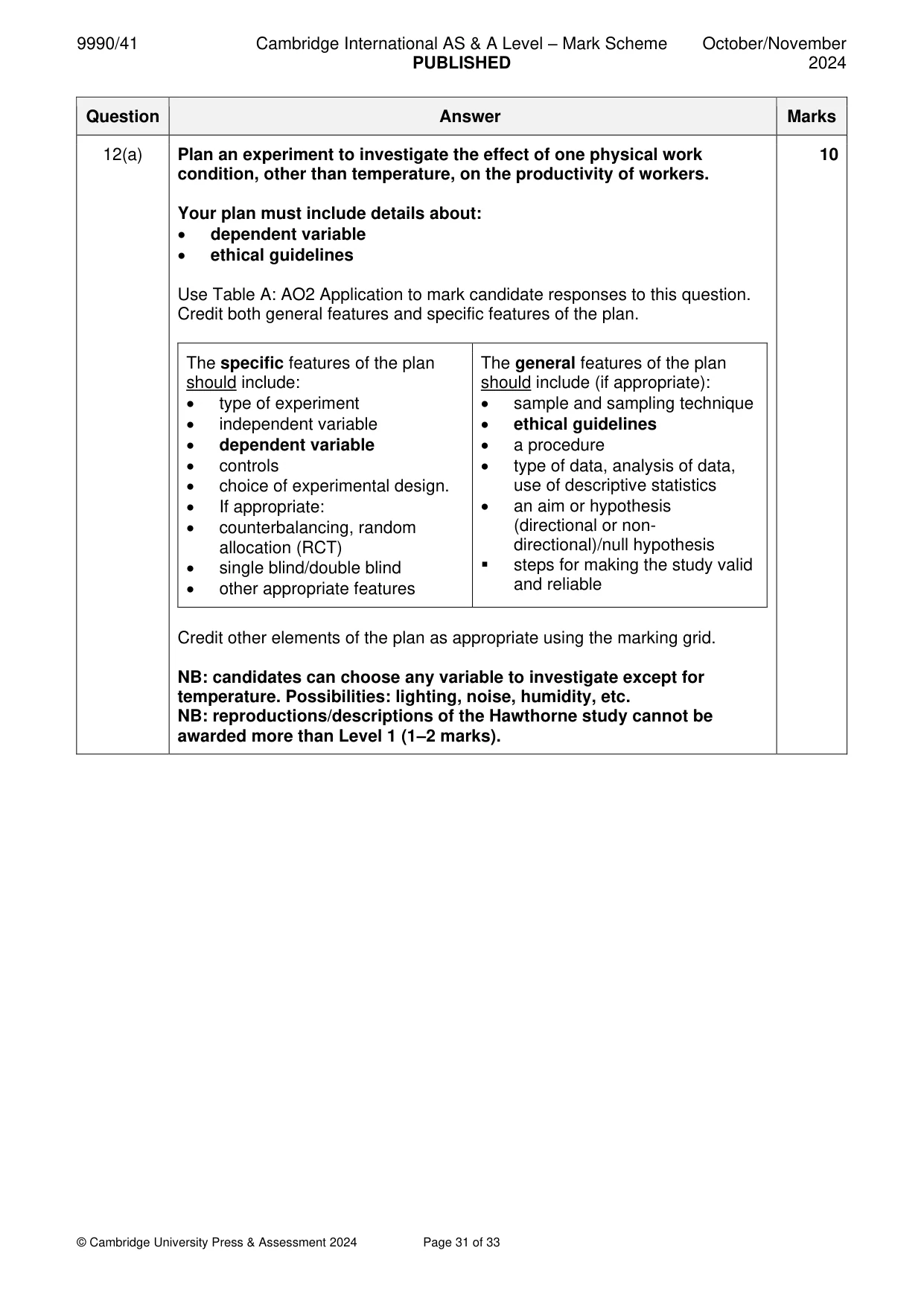
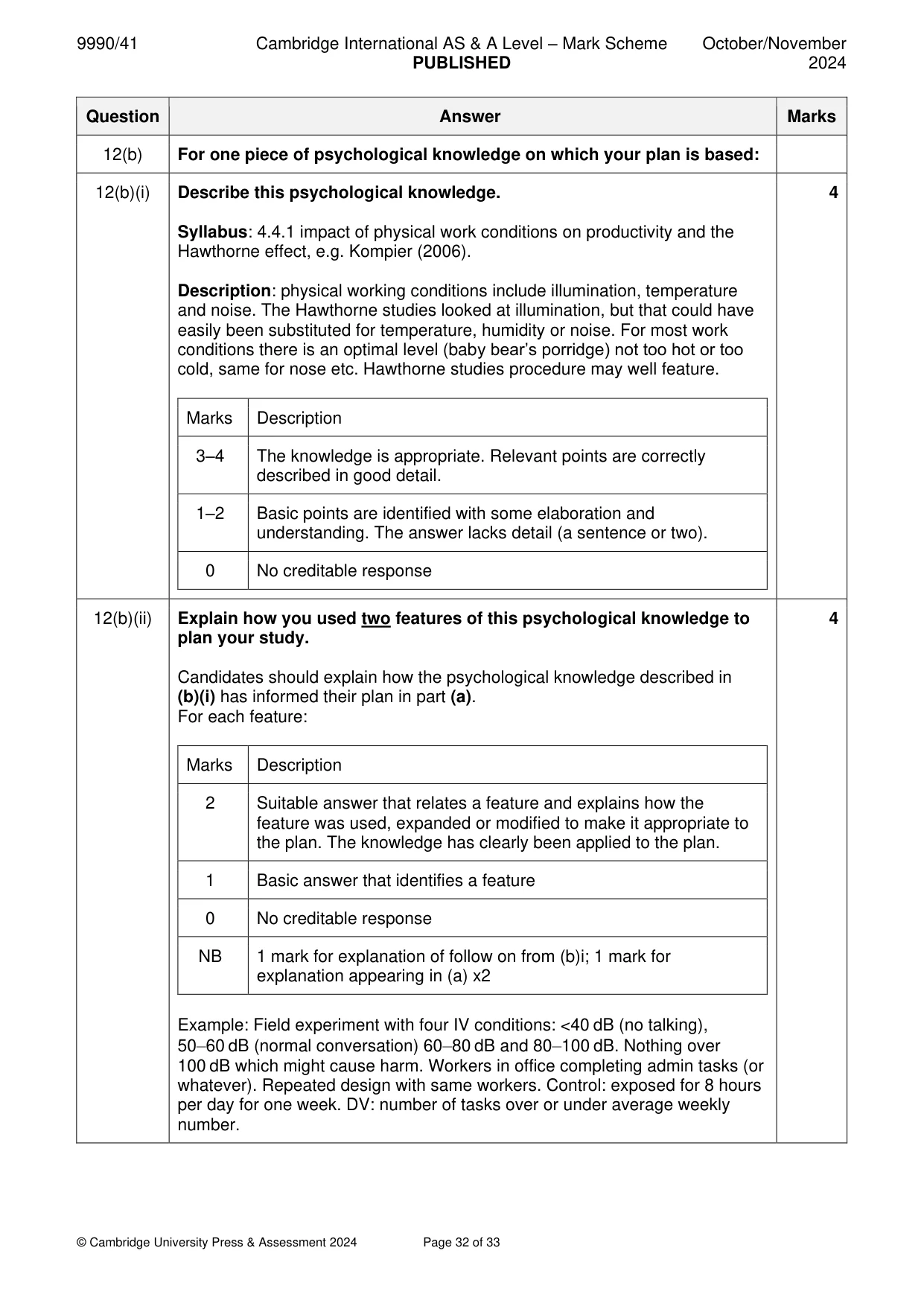
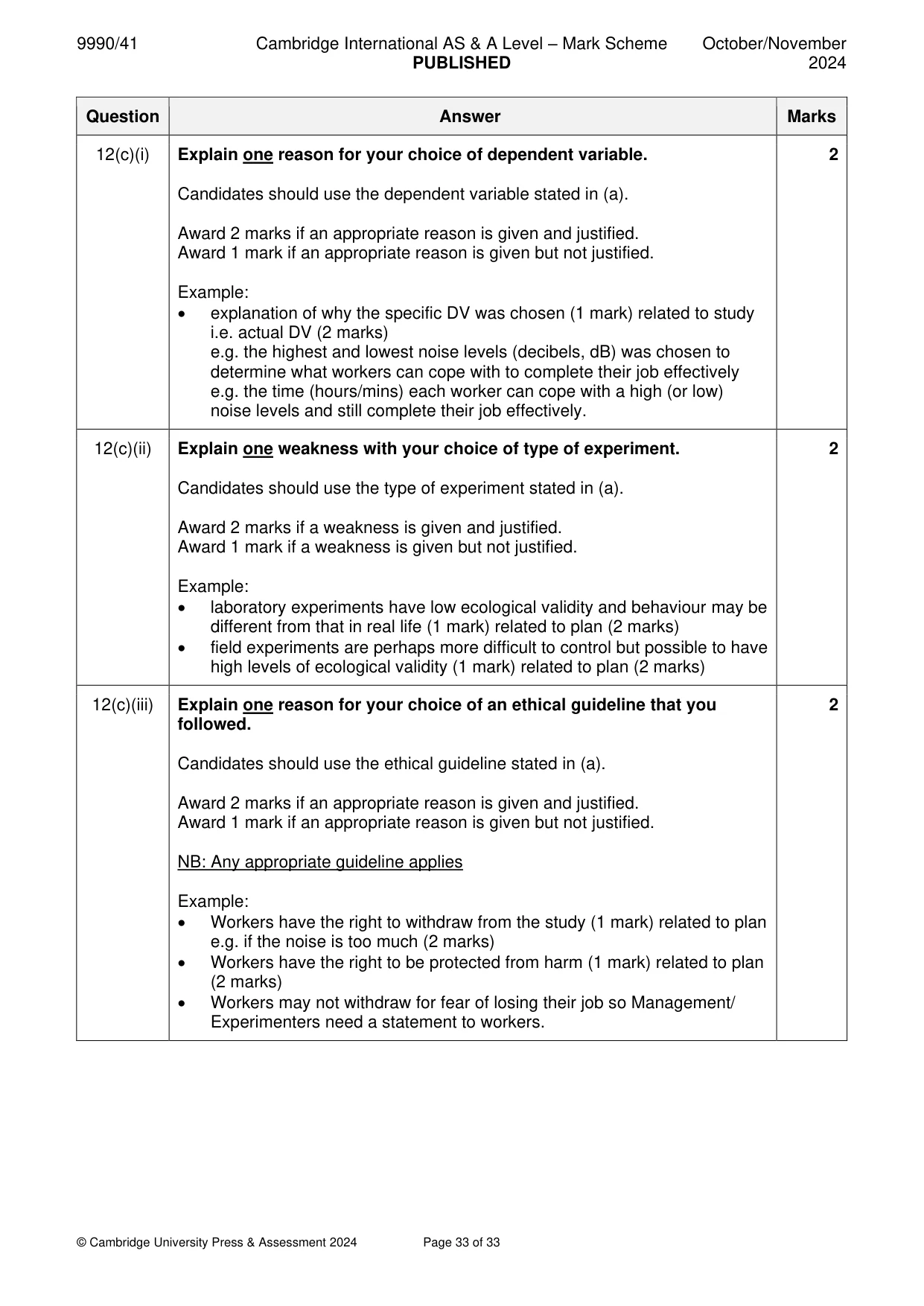
Mark scheme: 12(a) Plan an experiment to investigate the effect of one physical work 10 condition, other than temperature, on the productivity of workers. Your plan must include details about: • dependent variable • ethical guidelines Use Table A: AO2 Application to mark candidate responses to this question. Credit both general features and specific features of the plan. The specific features of the plan The general features of the plan should include: should include (if appropriate): • type of experiment • sample and sampling technique • independent variable • ethical guidelines • dependent variable • a procedure • controls • type of data, analysis of data, • choice of experimental design. use of descriptive statistics • If appropriate: • an aim or hypothesis • counterbalancing, random (directional or non- allocation (RCT) directional)/null hypothesis • single blind/double blind ▪ steps for making the study valid • other appropriate features and reliable Credit other elements of the plan as appropriate using the marking grid. NB: candidates can choose any variable to investigate except for temperature. Possibilities: lighting, noise, humidity, etc. NB: reproductions/descriptions of the Hawthorne study cannot be awarded more than Level 1 (1–2 marks). 12(b) For one piece of psychological knowledge on which your plan is based: 12(b)(i) Describe this psychological knowledge. 4 Syllabus: 4.4.1 impact of physical work conditions on productivity and the Hawthorne effect, e.g. Kompier (2006). Description: physical working conditions include illumination, temperature and noise. The Hawthorne studies looked at illumination, but that could have easily been substituted for temperature, humidity or noise. For most work conditions there is an optimal level (baby bear’s porridge) not too hot or too cold, same for nose etc. Hawthorne studies procedure may well feature. Marks Description 3–4 The knowledge is appropriate. Relevant points are correctly described in good detail. 1–2 Basic points are identified with some elaboration and understanding. The answer lacks detail (a sentence or two). 0 No creditable response 12(b)(ii) Explain how you used two features of this psychological knowledge to 4 plan your study. Candidates should explain how the psychological knowledge described in (b)(i) has informed their plan in part (a). For each feature: Marks Description 2 Suitable answer that relates a feature and explains how the feature was used, expanded or modified to make it appropriate to the plan. The knowledge has clearly been applied to the plan. 1 Basic answer that identifies a feature 0 No creditable response NB 1 mark for explanation of follow on from (b)i; 1 mark for explanation appearing in (a) x2 Example: Field experiment with four IV conditions: <40 dB (no talking), 50–60 dB (normal conversation) 60–80 dB and 80–100 dB. Nothing over 100 dB which might cause harm. Workers in office completing admin tasks (or whatever). Repeated design with same workers. Control: exposed for 8 hours per day for one week. DV: number of tasks over or under average weekly number. 12(c)(i) Explain one reason for your choice of dependent variable. 2 Candidates should use the dependent variable stated in (a). Award 2 marks if an appropriate reason is given and justified. Award 1 mark if an appropriate reason is given but not justified. Example: • explanation of why the specific DV was chosen (1 mark) related to study i.e. actual DV (2 marks) e.g. the highest and lowest noise levels (decibels, dB) was chosen to determine what workers can cope with to complete their job effectively e.g. the time (hours/mins) each worker can cope with a high (or low) noise levels and still complete their job effectively. 12(c)(ii) Explain one weakness with your choice of type of experiment. 2 Candidates should use the type of experiment stated in (a). Award 2 marks if a weakness is given and justified. Award 1 mark if a weakness is given but not justified. Example: • laboratory experiments have low ecological validity and behaviour may be different from that in real life (1 mark) related to plan (2 marks) • field experiments are perhaps more difficult to control but possible to have high levels of ecological validity (1 mark) related to plan (2 marks) 12(c)(iii) Explain one reason for your choice of an ethical guideline that you 2 followed. Candidates should use the ethical guideline stated in (a). Award 2 marks if an appropriate reason is given and justified. Award 1 mark if an appropriate reason is given but not justified. NB: Any appropriate guideline applies Example: • Workers have the right to withdraw from the study (1 mark) related to plan e.g. if the noise is too much (2 marks) • Workers have the right to be protected from harm (1 mark) related to plan (2 marks) • Workers may not withdraw for fear of losing their job so Management/ Experimenters need a statement to workers.
What was in this paper
The subtopics covered by these 12 questions, and how many questions each got. Open one in a new tab to see every Cambridge question on it.
What you needed in this session
Cambridge’s own grade thresholds for 2024 Oct/Nov, Paper 4 · Variant 1. A higher threshold means an easier paper — the bar moves with how the cohort did.