Cambridge A Level Psychology (from 2018) 9990 — 2018 Oct/Nov Paper 4 · Variant 2
9990/42/O/N/18 · 12 questions · 60 marks · ≈68 min
The question paper and its mark scheme, free to read here and free to download. This is Cambridge’s own paper, exactly as it was sat.
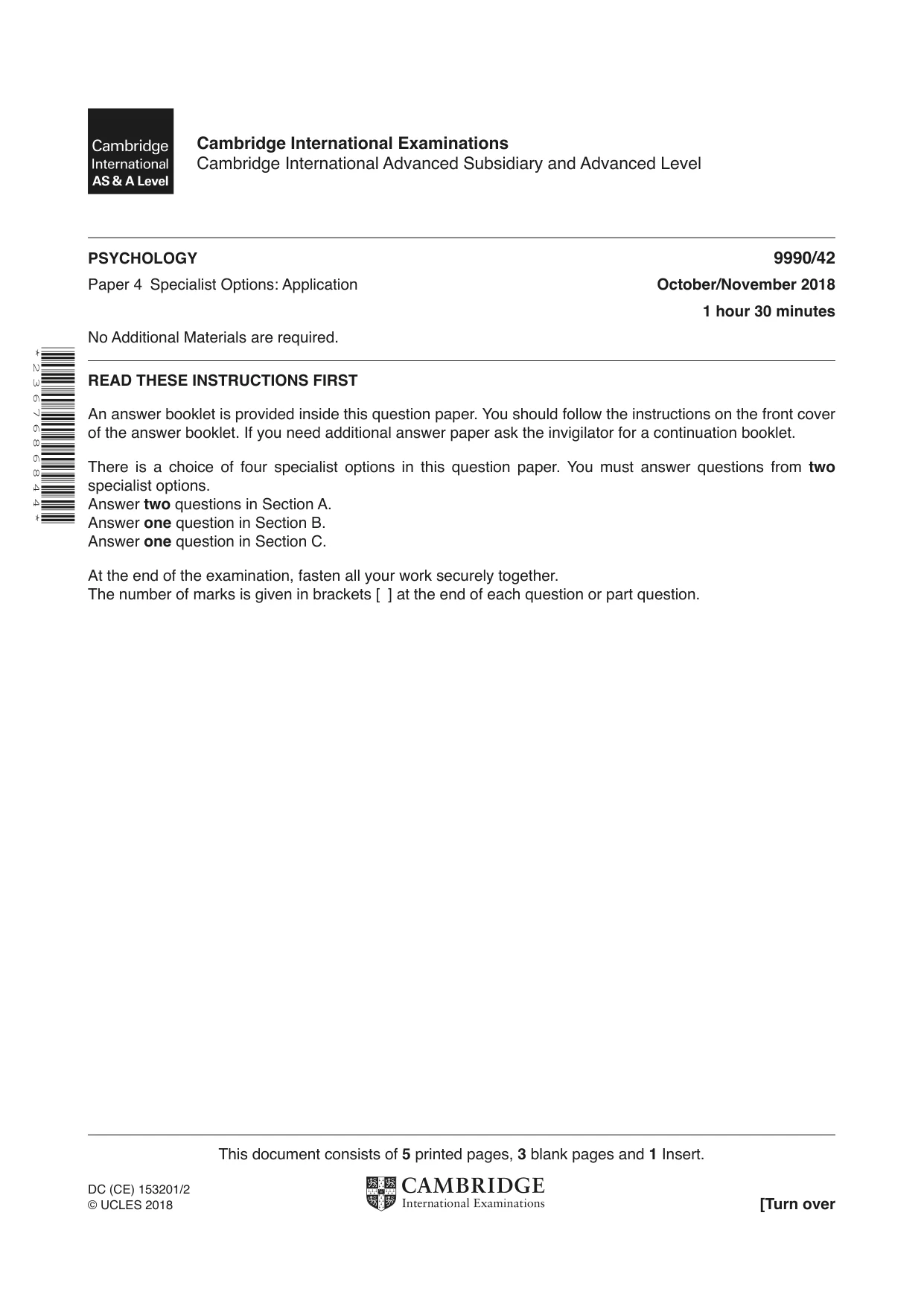
Question paper8 pages



Mark scheme24 pages
Answers below. Sit the paper first if you are practising.
Questions as text
Q1 · People with symptoms of schizophrenia are often diagnosed through an interview with their…
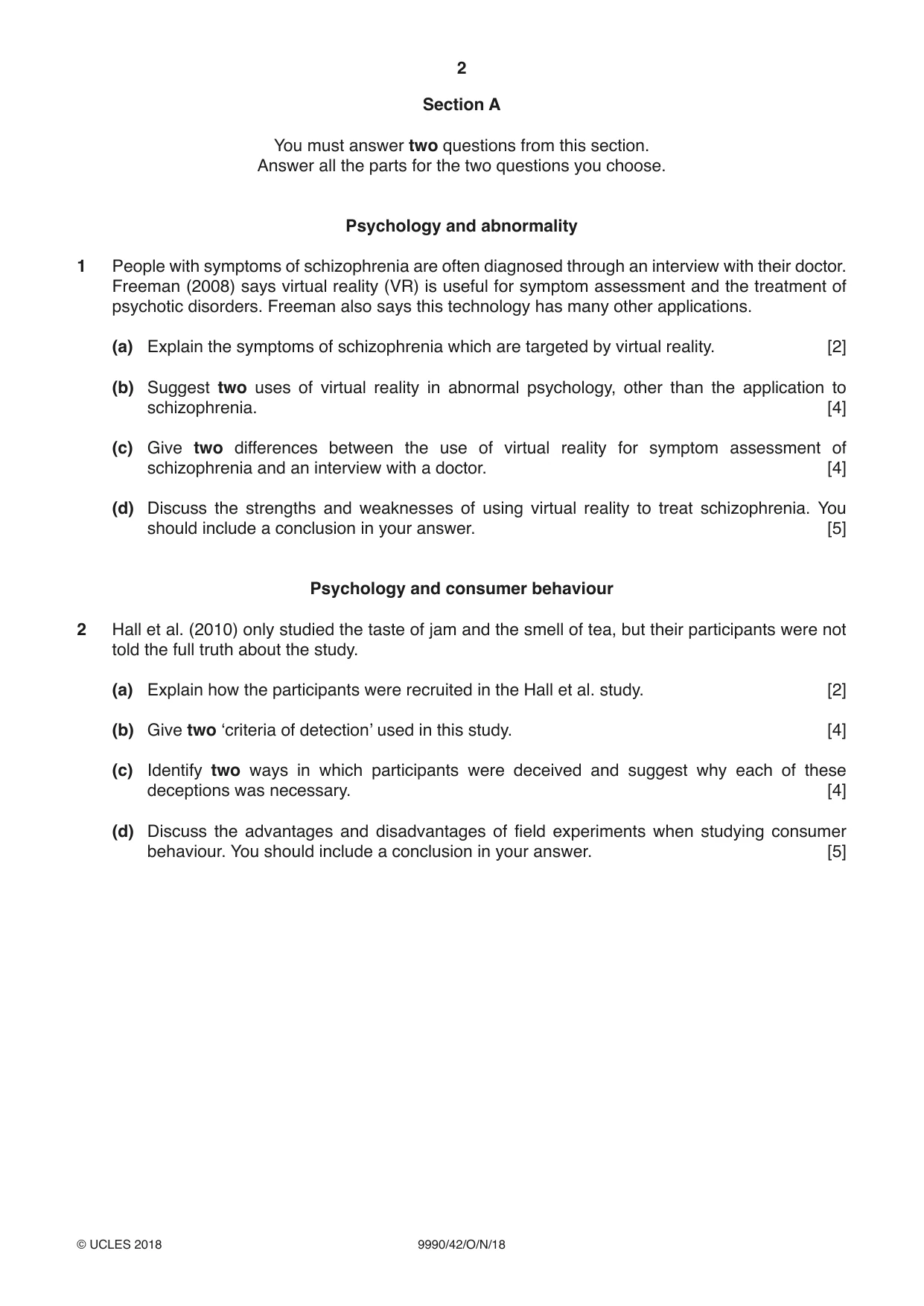
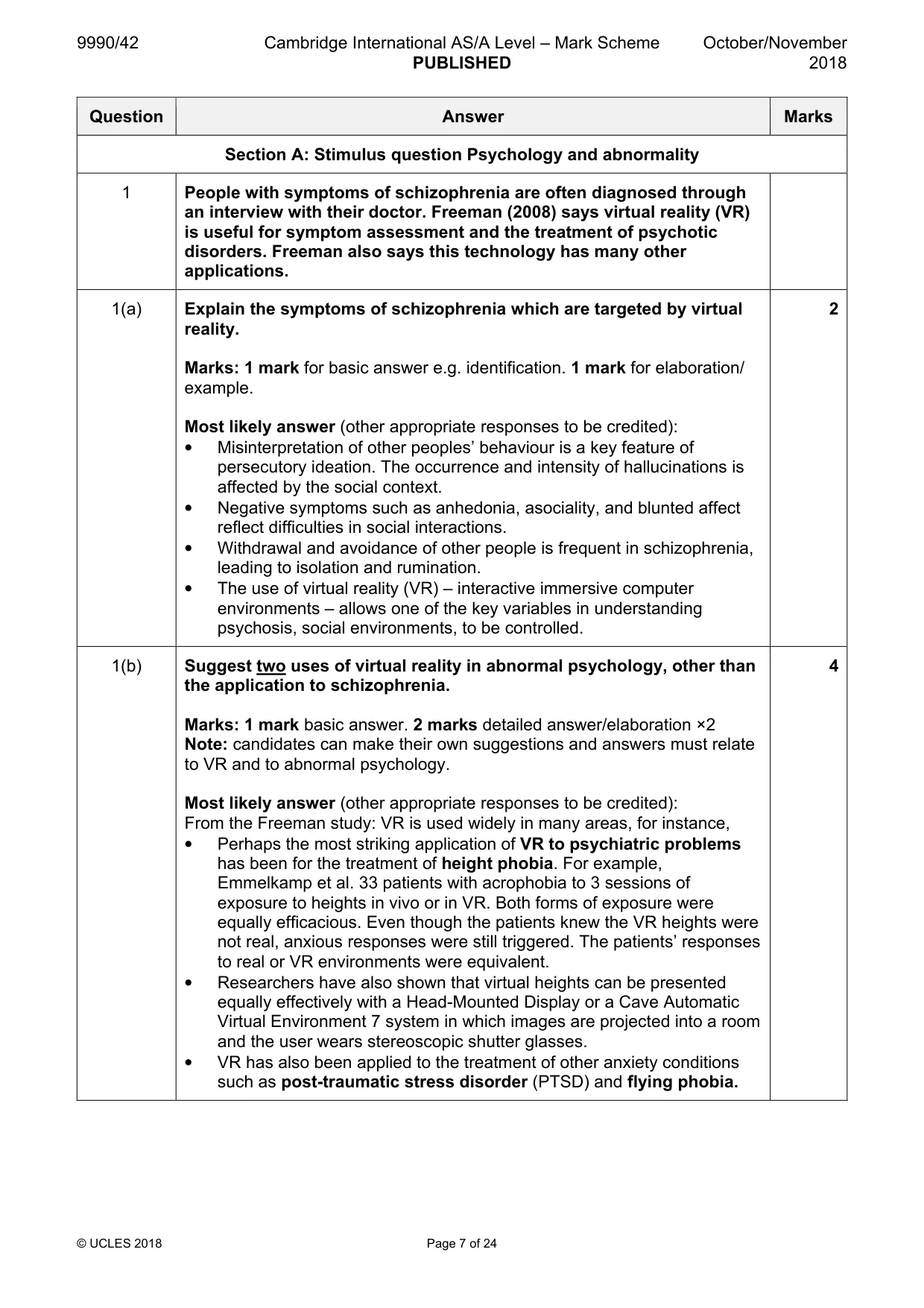
1 People with symptoms of schizophrenia are often diagnosed through an interview with their doctor. Freeman (2008) says virtual reality (VR) is useful for symptom assessment and the treatment of psychotic disorders. Freeman also says this technology has many other applications. (a) Explain the symptoms of schizophrenia which are targeted by virtual reality. [2] (b) Suggest two uses of virtual reality in abnormal psychology, other than the application to schizophrenia. [4] (c) Give two differences between the use of virtual reality for symptom assessment of schizophrenia and an interview with a doctor. [4] (d) Discuss the strengths and weaknesses of using virtual reality to treat schizophrenia. You should include a conclusion in your answer. [5] Psychology and consumer behaviour
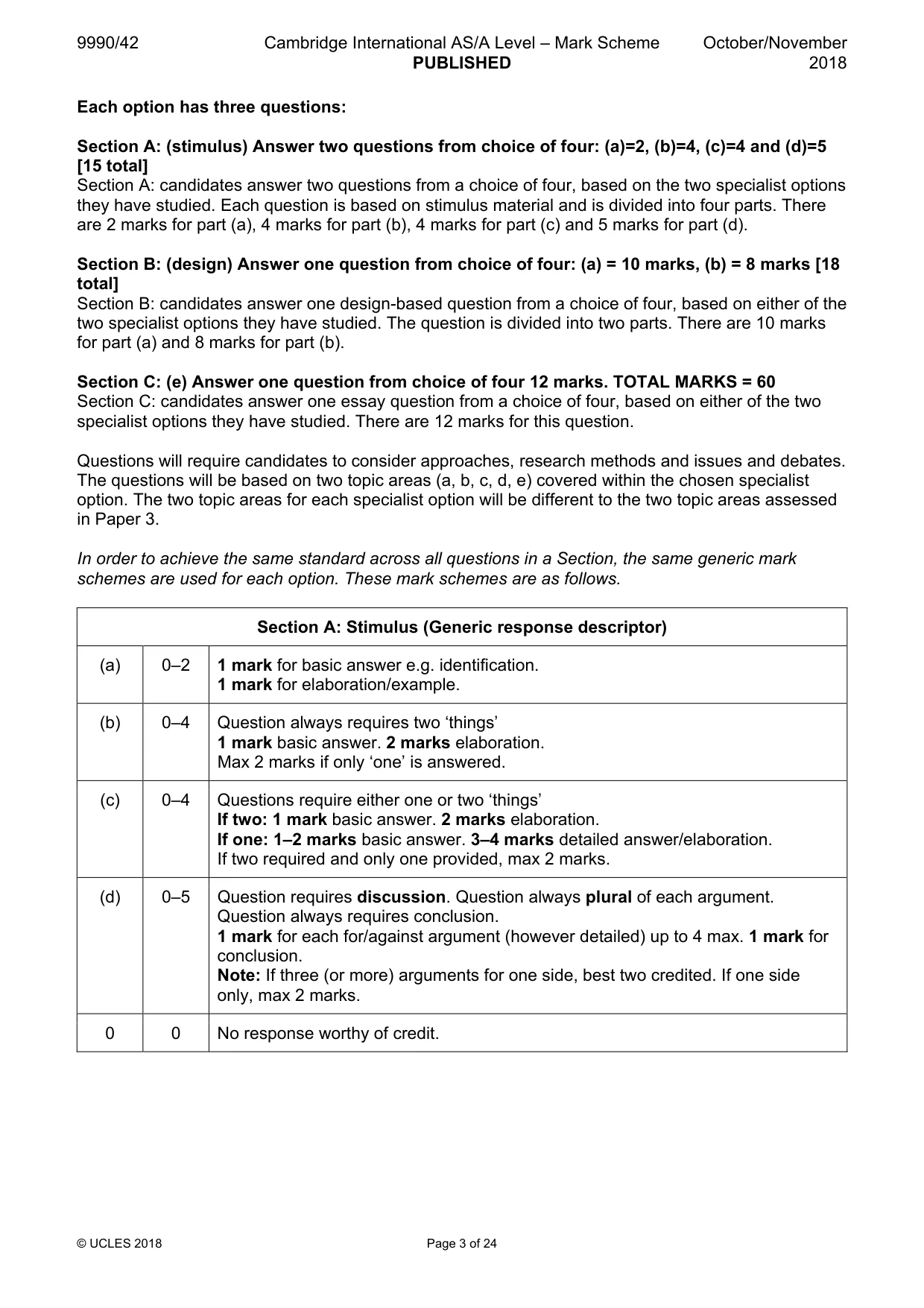
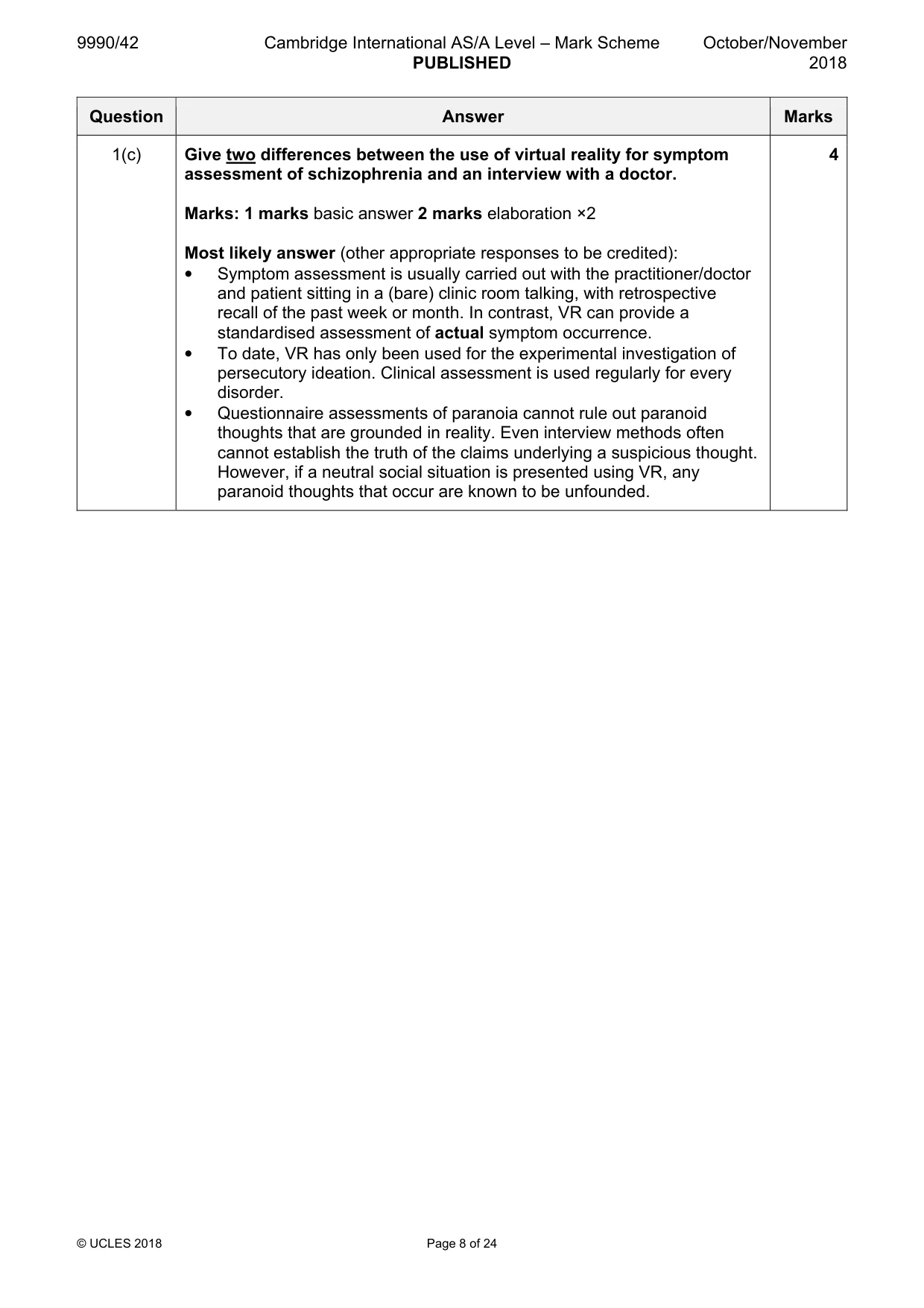
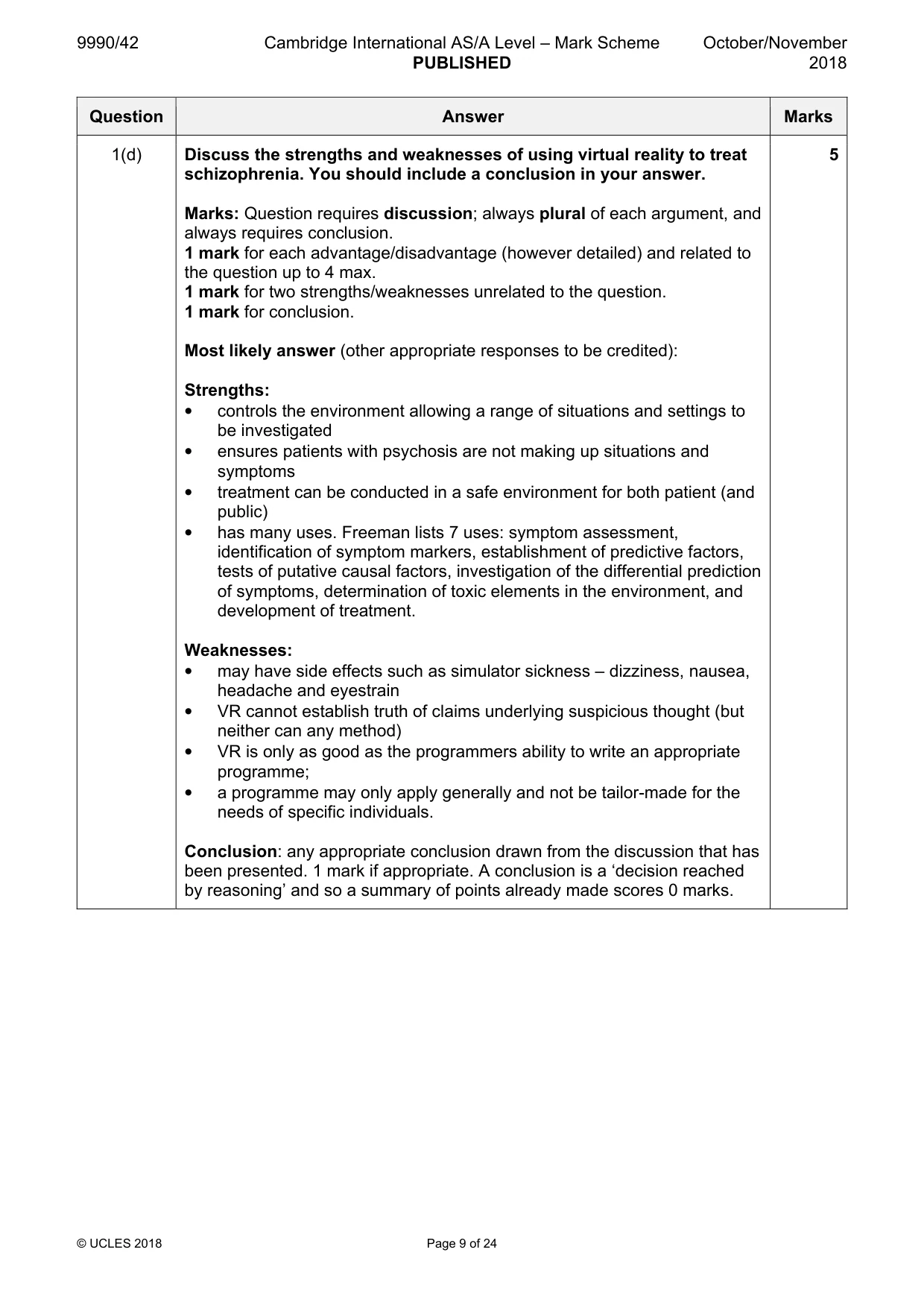
Mark scheme: Question Answer Marks Section A: Stimulus question Psychology and abnormality 1 People with symptoms of schizophrenia are often diagnosed through an interview with their doctor. Freeman (2008) says virtual reality (VR) is useful for symptom assessment and the treatment of psychotic disorders. Freeman also says this technology has many other applications. 1(a) Explain the symptoms of schizophrenia which are targeted by virtual 2 reality. Marks: 1 mark for basic answer e.g. identification. 1 mark for elaboration/ example. Most likely answer (other appropriate responses to be credited): • Misinterpretation of other peoples’ behaviour is a key feature of persecutory ideation. The occurrence and intensity of hallucinations is affected by the social context. • Negative symptoms such as anhedonia, asociality, and blunted affect reflect difficulties in social interactions. • Withdrawal and avoidance of other people is frequent in schizophrenia, leading to isolation and rumination. • The use of virtual reality (VR) – interactive immersive computer environments – allows one of the key variables in understanding psychosis, social environments, to be controlled. 1(b) Suggest two uses of virtual reality in abnormal psychology, other than 4 the application to schizophrenia. Marks: 1 mark basic answer. 2 marks detailed answer/elaboration ×2 Note: candidates can make their own suggestions and answers must relate to VR and to abnormal psychology. Most likely answer (other appropriate responses to be credited): From the Freeman study: VR is used widely in many areas, for instance, • Perhaps the most striking application of VR to psychiatric problems has been for the treatment of height phobia. For example, Emmelkamp et al. 33 patients with acrophobia to 3 sessions of exposure to heights in vivo or in VR. Both forms of exposure were equally efficacious. Even though the patients knew the VR heights were not real, anxious responses were still triggered. The patients’ responses to real or VR environments were equivalent. • Researchers have also shown that virtual heights can be presented equally effectively with a Head-Mounted Display or a Cave Automatic Virtual Environment 7 system in which images are projected into a room and the user wears stereoscopic shutter glasses. • VR has also been applied to the treatment of other anxiety conditions such as post-traumatic stress disorder (PTSD) and flying phobia. 1(c) Give two differences between the use of virtual reality for symptom 4 assessment of schizophrenia and an interview with a doctor. Marks: 1 marks basic answer 2 marks elaboration ×2 Most likely answer (other appropriate responses to be credited): • Symptom assessment is usually carried out with the practitioner/doctor and patient sitting in a (bare) clinic room talking, with retrospective recall of the past week or month. In contrast, VR can provide a standardised assessment of actual symptom occurrence. • To date, VR has only been used for the experimental investigation of persecutory ideation. Clinical assessment is used regularly for every disorder. • Questionnaire assessments of paranoia cannot rule out paranoid thoughts that are grounded in reality. Even interview methods often cannot establish the truth of the claims underlying a suspicious thought. However, if a neutral social situation is presented using VR, any paranoid thoughts that occur are known to be unfounded. 1(d) Discuss the strengths and weaknesses of using virtual reality to treat 5 schizophrenia. You should include a conclusion in your answer. Marks: Question requires discussion; always plural of each argument, and always requires conclusion. 1 mark for each advantage/disadvantage (however detailed) and related to the question up to 4 max. 1 mark for two strengths/weaknesses unrelated to the question. 1 mark for conclusion. Most likely answer (other appropriate responses to be credited): Strengths: • controls the environment allowing a range of situations and settings to be investigated • ensures patients with psychosis are not making up situations and symptoms • treatment can be conducted in a safe environment for both patient (and public) • has many uses. Freeman lists 7 uses: symptom assessment, identification of symptom markers, establishment of predictive factors, tests of putative causal factors, investigation of the differential prediction of symptoms, determination of toxic elements in the environment, and development of treatment. Weaknesses: • may have side effects such as simulator sickness – dizziness, nausea, headache and eyestrain • VR cannot establish truth of claims underlying suspicious thought (but neither can any method) • VR is only as good as the programmers ability to write an appropriate programme; • a programme may only apply generally and not be tailor-made for the needs of specific individuals. Conclusion: any appropriate conclusion drawn from the discussion that has been presented. 1 mark if appropriate. A conclusion is a ‘decision reached by reasoning’ and so a summary of points already made scores 0 marks.
Question 2
2 Hall et al. (2010) only studied the taste of jam and the smell of tea, but their participants were not told the full truth about the study. (a) Explain how the participants were recruited in the Hall et al. study. [2] (b) Give two ‘criteria of detection’ used in this study. [4] (c) Identify two ways in which participants were deceived and suggest why each of these deceptions was necessary. [4] (d) Discuss the advantages and disadvantages of field experiments when studying consumer behaviour. You should include a conclusion in your answer. [5] Psychology and health
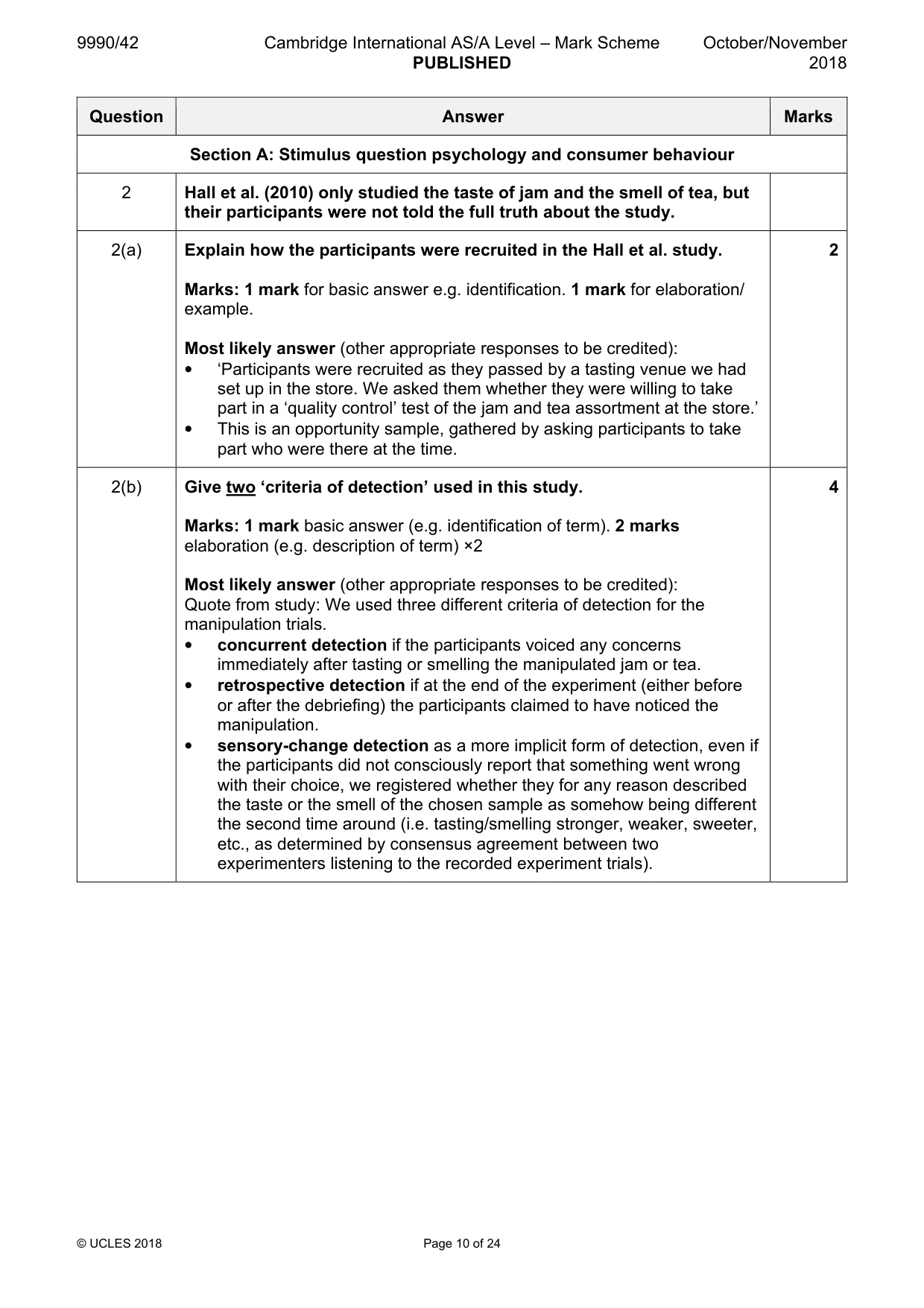
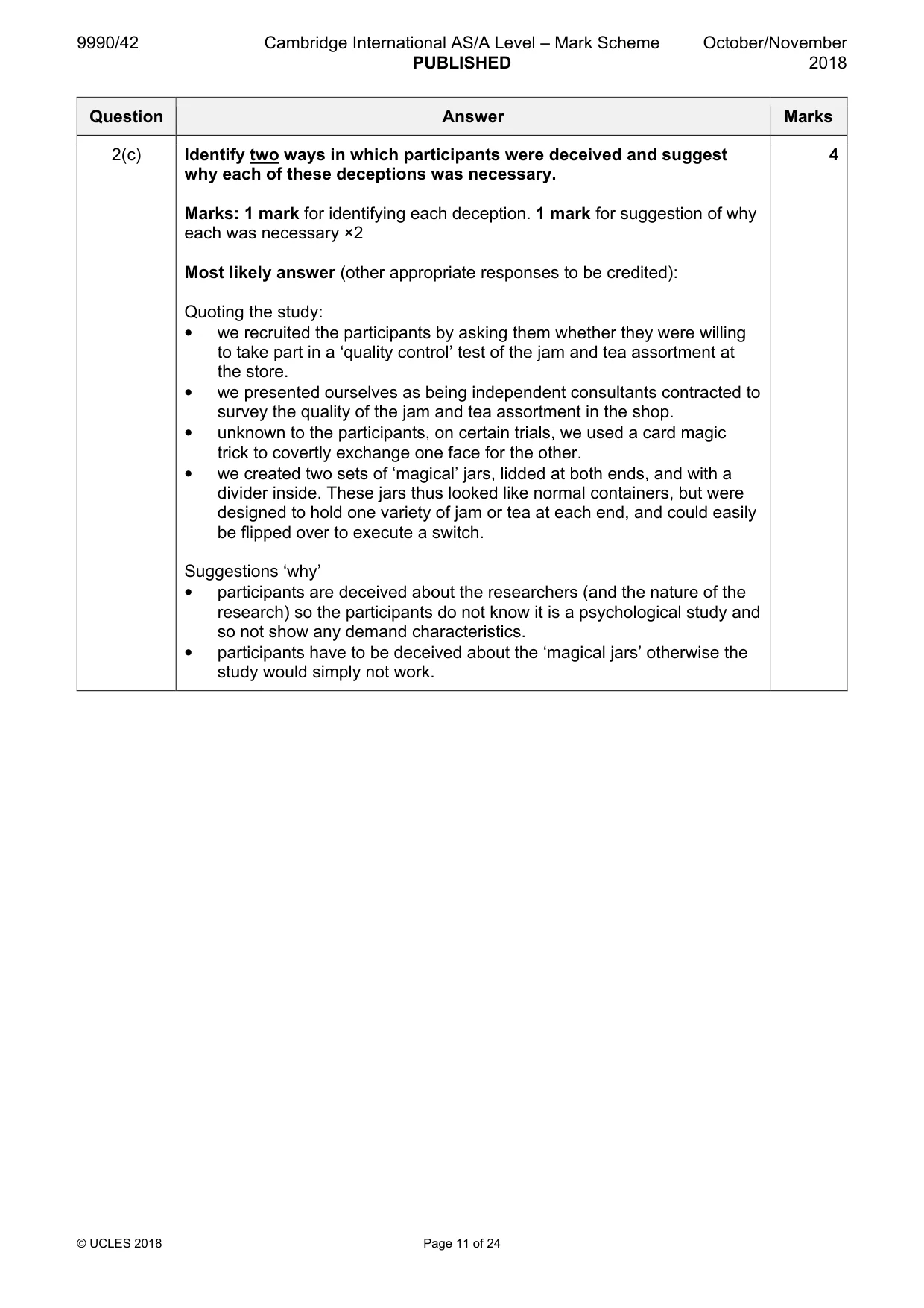
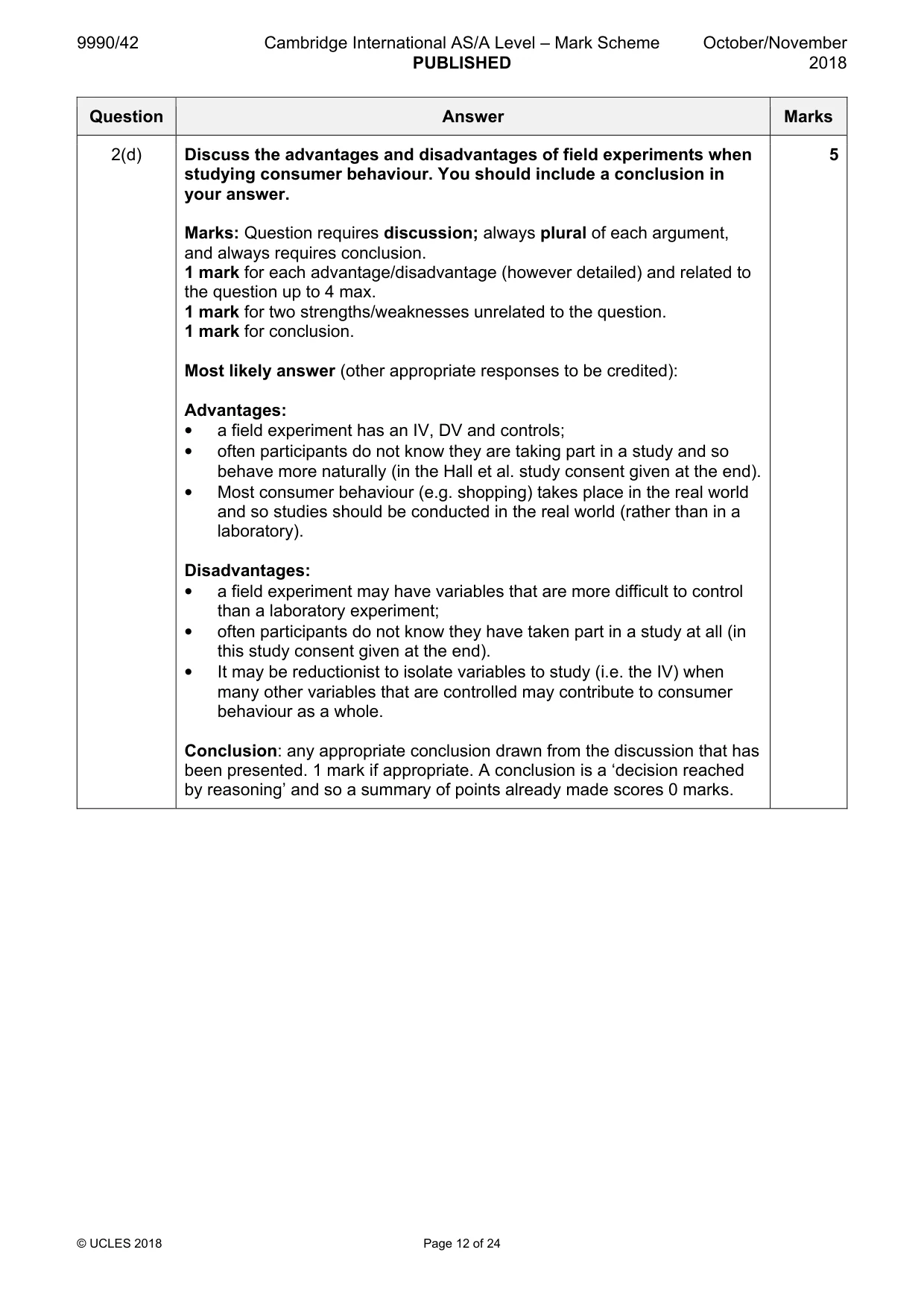
Mark scheme: 2(a) Explain how the participants were recruited in the Hall et al. study. 2 Marks: 1 mark for basic answer e.g. identification. 1 mark for elaboration/ example. Most likely answer (other appropriate responses to be credited): • ‘Participants were recruited as they passed by a tasting venue we had set up in the store. We asked them whether they were willing to take part in a ‘quality control’ test of the jam and tea assortment at the store.’ • This is an opportunity sample, gathered by asking participants to take part who were there at the time. 2(b) Give two ‘criteria of detection’ used in this study. 4 Marks: 1 mark basic answer (e.g. identification of term). 2 marks elaboration (e.g. description of term) ×2 Most likely answer (other appropriate responses to be credited): Quote from study: We used three different criteria of detection for the manipulation trials. • concurrent detection if the participants voiced any concerns immediately after tasting or smelling the manipulated jam or tea. • retrospective detection if at the end of the experiment (either before or after the debriefing) the participants claimed to have noticed the manipulation. • sensory-change detection as a more implicit form of detection, even if the participants did not consciously report that something went wrong with their choice, we registered whether they for any reason described the taste or the smell of the chosen sample as somehow being different the second time around (i.e. tasting/smelling stronger, weaker, sweeter, etc., as determined by consensus agreement between two experimenters listening to the recorded experiment trials). 2(c) Identify two ways in which participants were deceived and suggest 4 why each of these deceptions was necessary. Marks: 1 mark for identifying each deception. 1 mark for suggestion of why each was necessary ×2 Most likely answer (other appropriate responses to be credited): Quoting the study: • we recruited the participants by asking them whether they were willing to take part in a ‘quality control’ test of the jam and tea assortment at the store. • we presented ourselves as being independent consultants contracted to survey the quality of the jam and tea assortment in the shop. • unknown to the participants, on certain trials, we used a card magic trick to covertly exchange one face for the other. • we created two sets of ‘magical’ jars, lidded at both ends, and with a divider inside. These jars thus looked like normal containers, but were designed to hold one variety of jam or tea at each end, and could easily be flipped over to execute a switch. Suggestions ‘why’ • participants are deceived about the researchers (and the nature of the research) so the participants do not know it is a psychological study and so not show any demand characteristics. • participants have to be deceived about the ‘magical jars’ otherwise the study would simply not work. 2(d) Discuss the advantages and disadvantages of field experiments when 5 studying consumer behaviour. You should include a conclusion in your answer. Marks: Question requires discussion; always plural of each argument, and always requires conclusion. 1 mark for each advantage/disadvantage (however detailed) and related to the question up to 4 max. 1 mark for two strengths/weaknesses unrelated to the question. 1 mark for conclusion. Most likely answer (other appropriate responses to be credited): Advantages: • a field experiment has an IV, DV and controls; • often participants do not know they are taking part in a study and so behave more naturally (in the Hall et al. study consent given at the end). • Most consumer behaviour (e.g. shopping) takes place in the real world and so studies should be conducted in the real world (rather than in a laboratory). Disadvantages: • a field experiment may have variables that are more difficult to control than a laboratory experiment; • often participants do not know they have taken part in a study at all (in this study consent given at the end). • It may be reductionist to isolate variables to study (i.e. the IV) when many other variables that are controlled may contribute to consumer behaviour as a whole. Conclusion: any appropriate conclusion drawn from the discussion that has been presented. 1 mark if appropriate. A conclusion is a ‘decision reached by reasoning’ and so a summary of points already made scores 0 marks.
Q3 · According to Chung and Naya (2000), studies have shown that only one third of all…
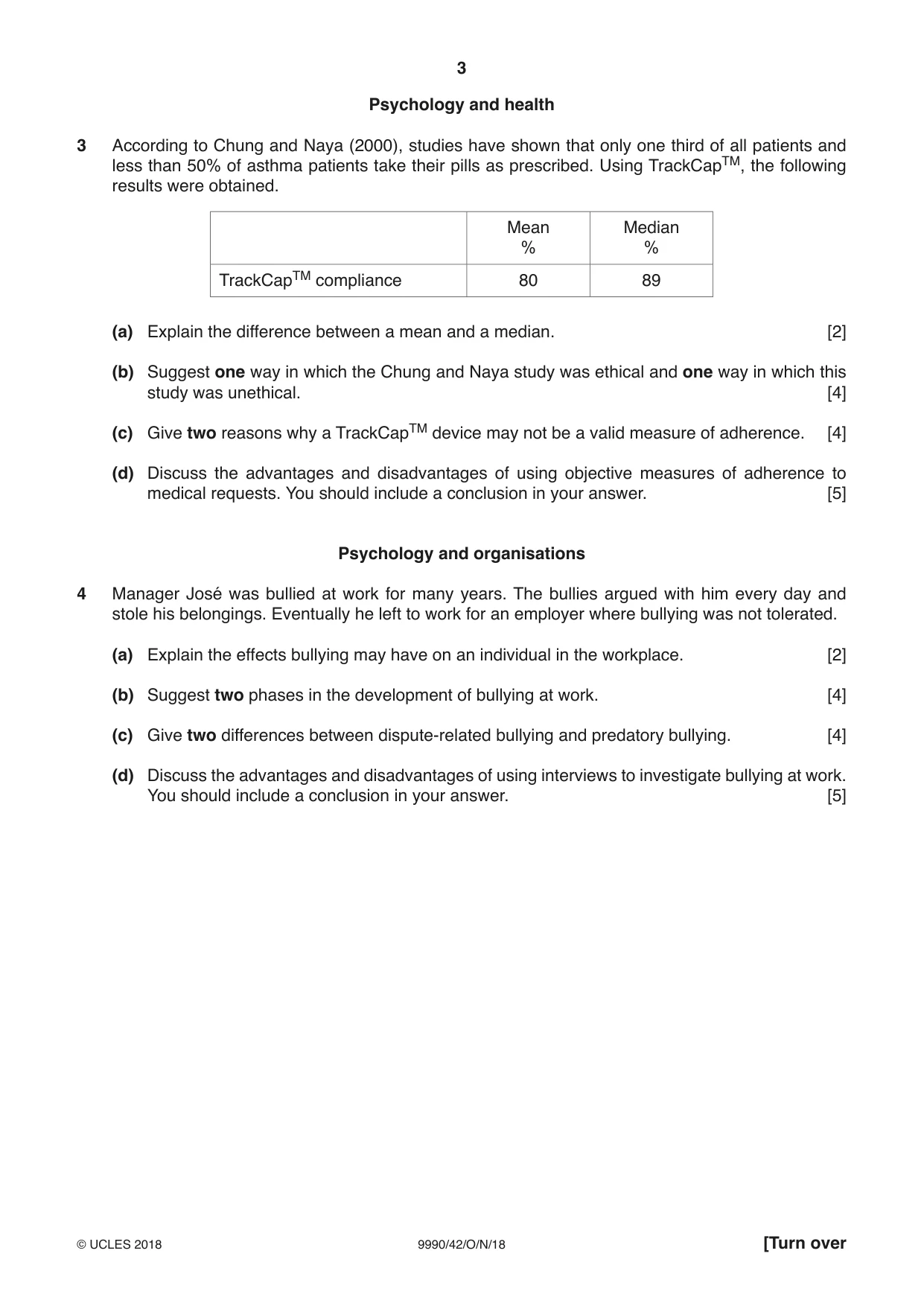
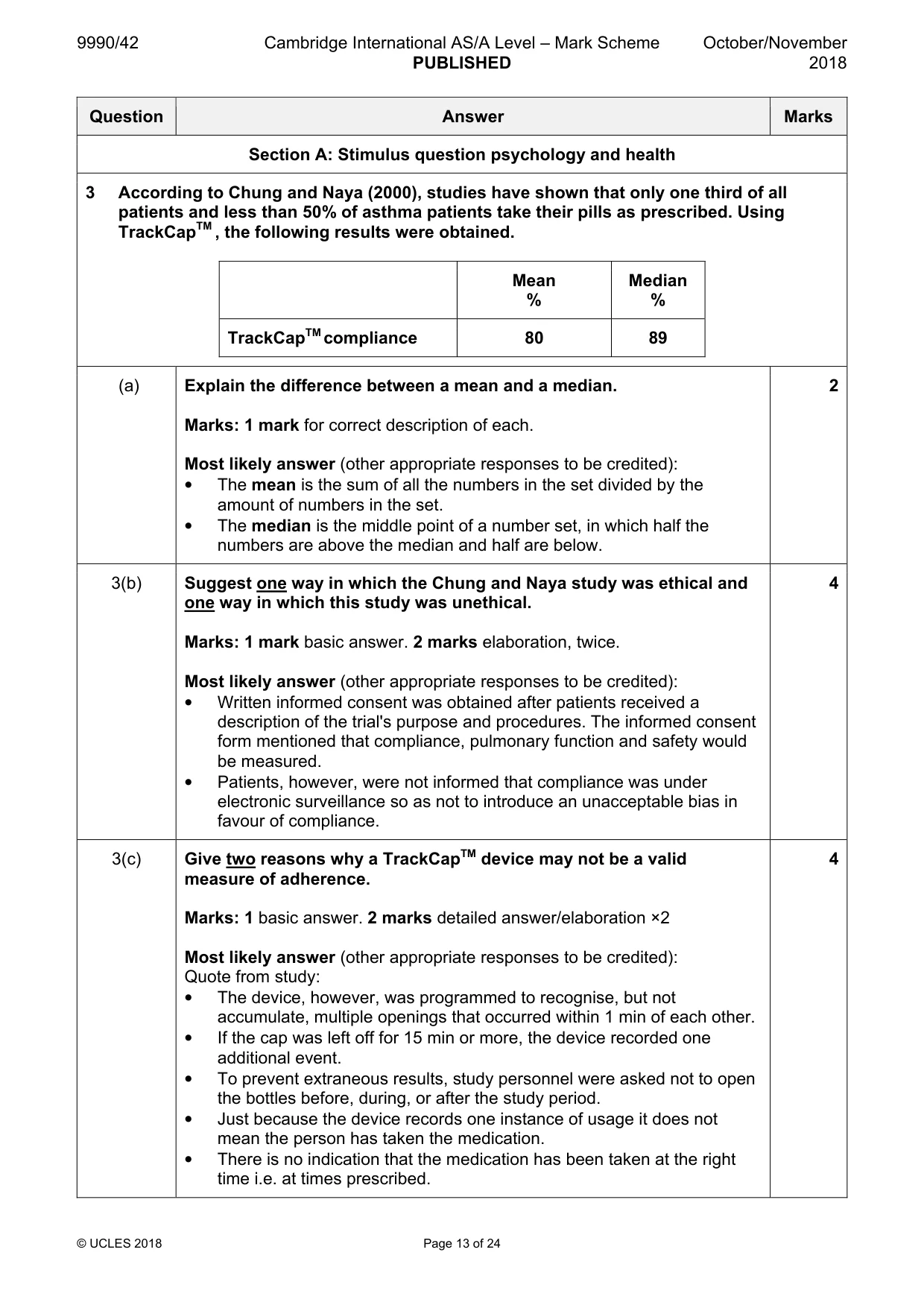
3 According to Chung and Naya (2000), studies have shown that only one third of all patients and less than 50% of asthma patients take their pills as prescribed. Using TrackCapTM, the following results were obtained. Mean Median % % TrackCapTM compliance 80 89 (a) Explain the difference between a mean and a median. [2] (b) Suggest one way in which the Chung and Naya study was ethical and one way in which this study was unethical. [4] (c) Give two reasons why a TrackCapTM device may not be a valid measure of adherence. [4] (d) Discuss the advantages and disadvantages of using objective measures of adherence to medical requests. You should include a conclusion in your answer. [5] Psychology and organisations
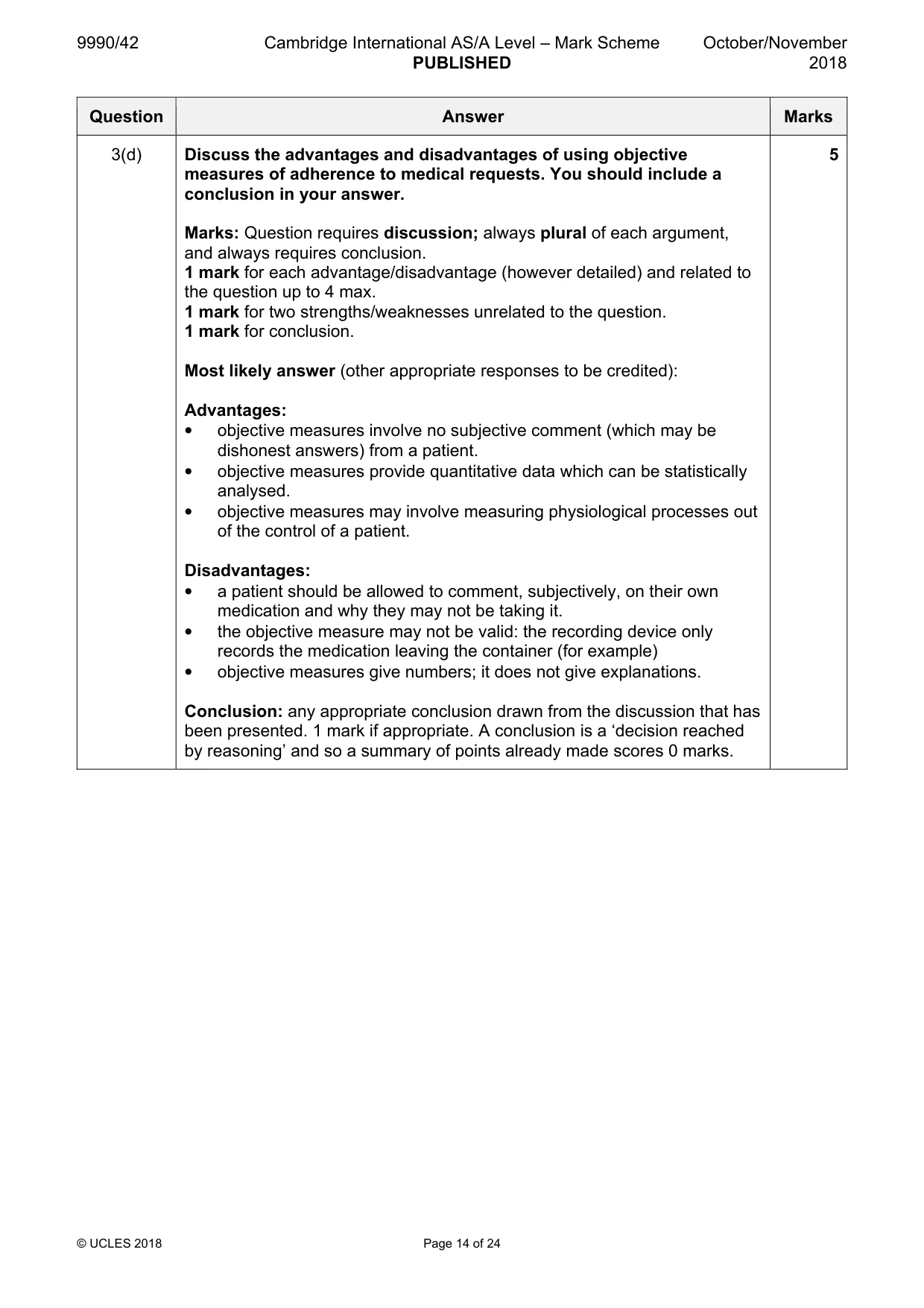
Mark scheme: 3(b) Suggest one way in which the Chung and Naya study was ethical and 4 one way in which this study was unethical. Marks: 1 mark basic answer. 2 marks elaboration, twice. Most likely answer (other appropriate responses to be credited): • Written informed consent was obtained after patients received a description of the trial's purpose and procedures. The informed consent form mentioned that compliance, pulmonary function and safety would be measured. • Patients, however, were not informed that compliance was under electronic surveillance so as not to introduce an unacceptable bias in favour of compliance. 3(c) Give two reasons why a TrackCapTM device may not be a valid 4 measure of adherence. Marks: 1 basic answer. 2 marks detailed answer/elaboration ×2 Most likely answer (other appropriate responses to be credited): Quote from study: • The device, however, was programmed to recognise, but not accumulate, multiple openings that occurred within 1 min of each other. • If the cap was left off for 15 min or more, the device recorded one additional event. • To prevent extraneous results, study personnel were asked not to open the bottles before, during, or after the study period. • Just because the device records one instance of usage it does not mean the person has taken the medication. • There is no indication that the medication has been taken at the right time i.e. at times prescribed. 3(d) Discuss the advantages and disadvantages of using objective 5 measures of adherence to medical requests. You should include a conclusion in your answer. Marks: Question requires discussion; always plural of each argument, and always requires conclusion. 1 mark for each advantage/disadvantage (however detailed) and related to the question up to 4 max. 1 mark for two strengths/weaknesses unrelated to the question. 1 mark for conclusion. Most likely answer (other appropriate responses to be credited): Advantages: • objective measures involve no subjective comment (which may be dishonest answers) from a patient. • objective measures provide quantitative data which can be statistically analysed. • objective measures may involve measuring physiological processes out of the control of a patient. Disadvantages: • a patient should be allowed to comment, subjectively, on their own medication and why they may not be taking it. • the objective measure may not be valid: the recording device only records the medication leaving the container (for example) • objective measures give numbers; it does not give explanations. Conclusion: any appropriate conclusion drawn from the discussion that has been presented. 1 mark if appropriate. A conclusion is a ‘decision reached by reasoning’ and so a summary of points already made scores 0 marks.
Q4 · Manager José was bullied at work for many years
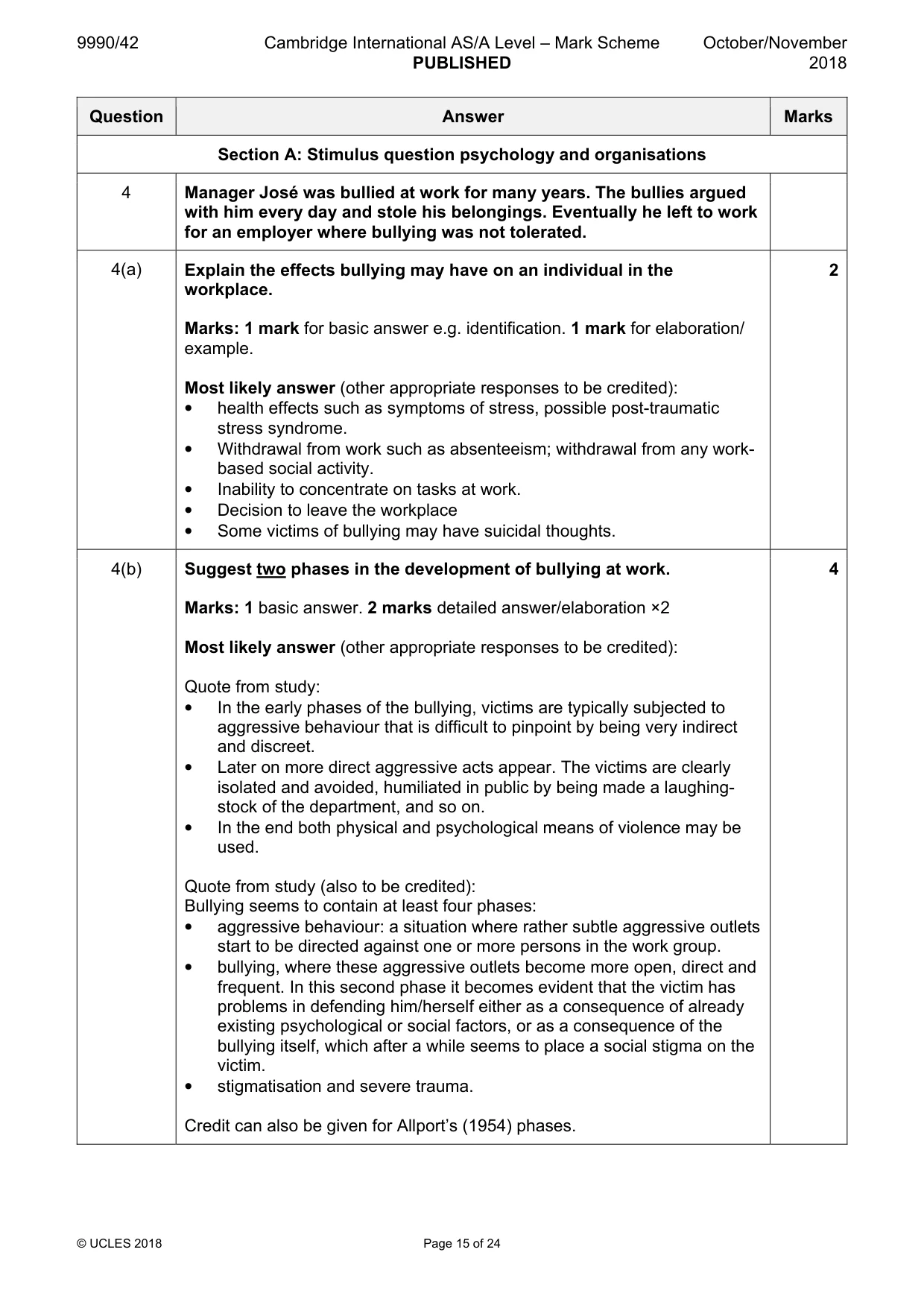
4 Manager José was bullied at work for many years. The bullies argued with him every day and stole his belongings. Eventually he left to work for an employer where bullying was not tolerated. (a) Explain the effects bullying may have on an individual in the workplace. [2] (b) Suggest two phases in the development of bullying at work. [4] (c) Give two differences between dispute-related bullying and predatory bullying. [4] (d) Discuss the advantages and disadvantages of using interviews to investigate bullying at work. You should include a conclusion in your answer. [5]
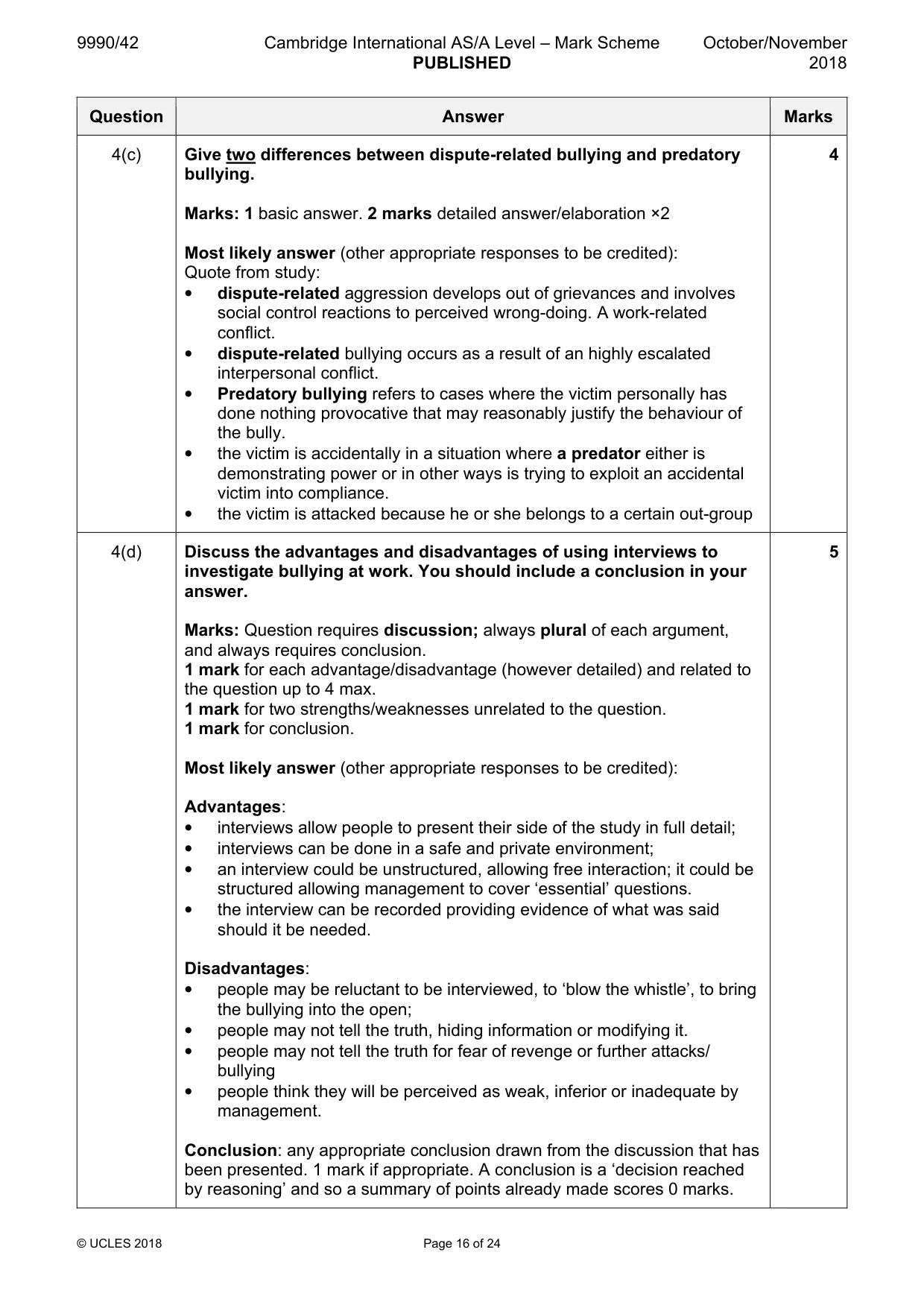
Mark scheme: 4(a) Explain the effects bullying may have on an individual in the 2 workplace. Marks: 1 mark for basic answer e.g. identification. 1 mark for elaboration/ example. Most likely answer (other appropriate responses to be credited): • health effects such as symptoms of stress, possible post-traumatic stress syndrome. • Withdrawal from work such as absenteeism; withdrawal from any work- based social activity. • Inability to concentrate on tasks at work. • Decision to leave the workplace • Some victims of bullying may have suicidal thoughts. 4(b) Suggest two phases in the development of bullying at work. 4 Marks: 1 basic answer. 2 marks detailed answer/elaboration ×2 Most likely answer (other appropriate responses to be credited): Quote from study: • In the early phases of the bullying, victims are typically subjected to aggressive behaviour that is difficult to pinpoint by being very indirect and discreet. • Later on more direct aggressive acts appear. The victims are clearly isolated and avoided, humiliated in public by being made a laughing- stock of the department, and so on. • In the end both physical and psychological means of violence may be used. Quote from study (also to be credited): Bullying seems to contain at least four phases: • aggressive behaviour: a situation where rather subtle aggressive outlets start to be directed against one or more persons in the work group. • bullying, where these aggressive outlets become more open, direct and frequent. In this second phase it becomes evident that the victim has problems in defending him/herself either as a consequence of already existing psychological or social factors, or as a consequence of the bullying itself, which after a while seems to place a social stigma on the victim. • stigmatisation and severe trauma. Credit can also be given for Allport’s (1954) phases. 4(c) Give two differences between dispute-related bullying and predatory 4 bullying. Marks: 1 basic answer. 2 marks detailed answer/elaboration ×2 Most likely answer (other appropriate responses to be credited): Quote from study: • dispute-related aggression develops out of grievances and involves social control reactions to perceived wrong-doing. A work-related conflict. • dispute-related bullying occurs as a result of an highly escalated interpersonal conflict. • Predatory bullying refers to cases where the victim personally has done nothing provocative that may reasonably justify the behaviour of the bully. • the victim is accidentally in a situation where a predator either is demonstrating power or in other ways is trying to exploit an accidental victim into compliance. • the victim is attacked because he or she belongs to a certain out-group 4(d) Discuss the advantages and disadvantages of using interviews to 5 investigate bullying at work. You should include a conclusion in your answer. Marks: Question requires discussion; always plural of each argument, and always requires conclusion. 1 mark for each advantage/disadvantage (however detailed) and related to the question up to 4 max. 1 mark for two strengths/weaknesses unrelated to the question. 1 mark for conclusion. Most likely answer (other appropriate responses to be credited): Advantages: • interviews allow people to present their side of the study in full detail; • interviews can be done in a safe and private environment; • an interview could be unstructured, allowing free interaction; it could be structured allowing management to cover ‘essential’ questions. • the interview can be recorded providing evidence of what was said should it be needed. Disadvantages: • people may be reluctant to be interviewed, to ‘blow the whistle’, to bring the bullying into the open; • people may not tell the truth, hiding information or modifying it. • people may not tell the truth for fear of revenge or further attacks/ bullying • people think they will be perceived as weak, inferior or inadequate by management. Conclusion: any appropriate conclusion drawn from the discussion that has been presented. 1 mark if appropriate. A conclusion is a ‘decision reached by reasoning’ and so a summary of points already made scores 0 marks.
Q5 · Design a longitudinal study to investigate whether electro-convulsive therapy (ECT) as a…
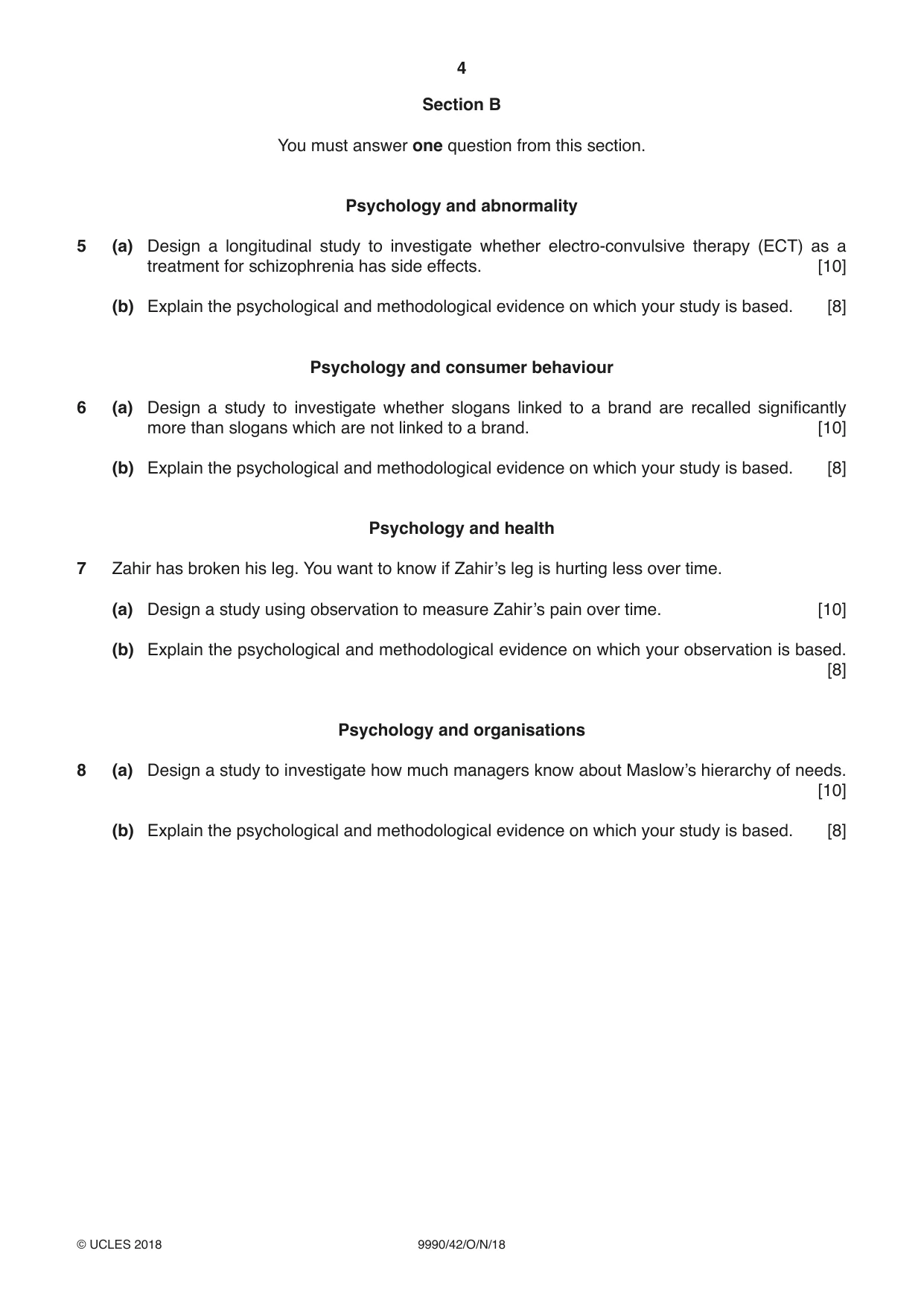
5 (a) Design a longitudinal study to investigate whether electro-convulsive therapy (ECT) as a treatment for schizophrenia has side effects. [10] (b) Explain the psychological and methodological evidence on which your study is based. [8] Psychology and consumer behaviour
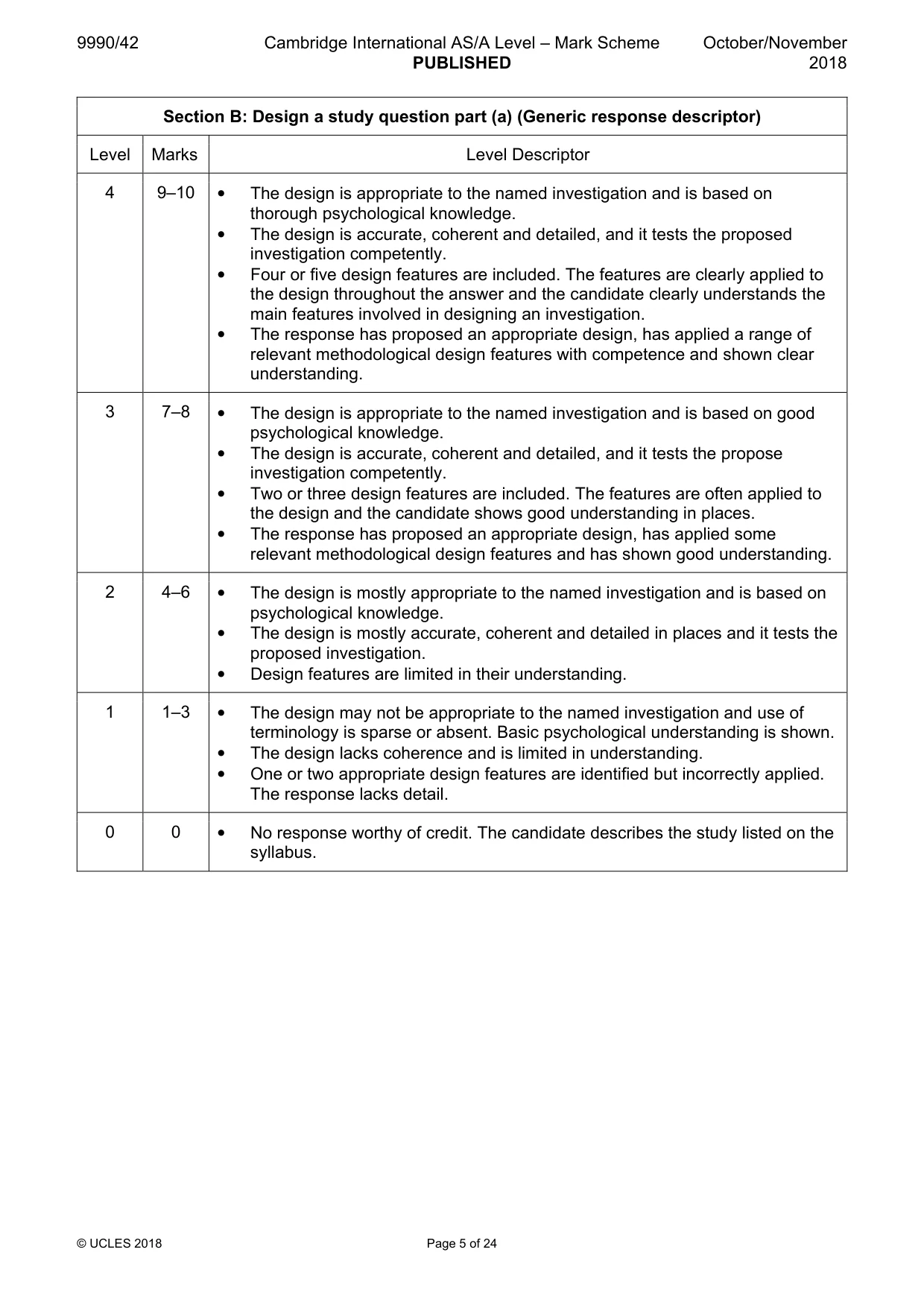
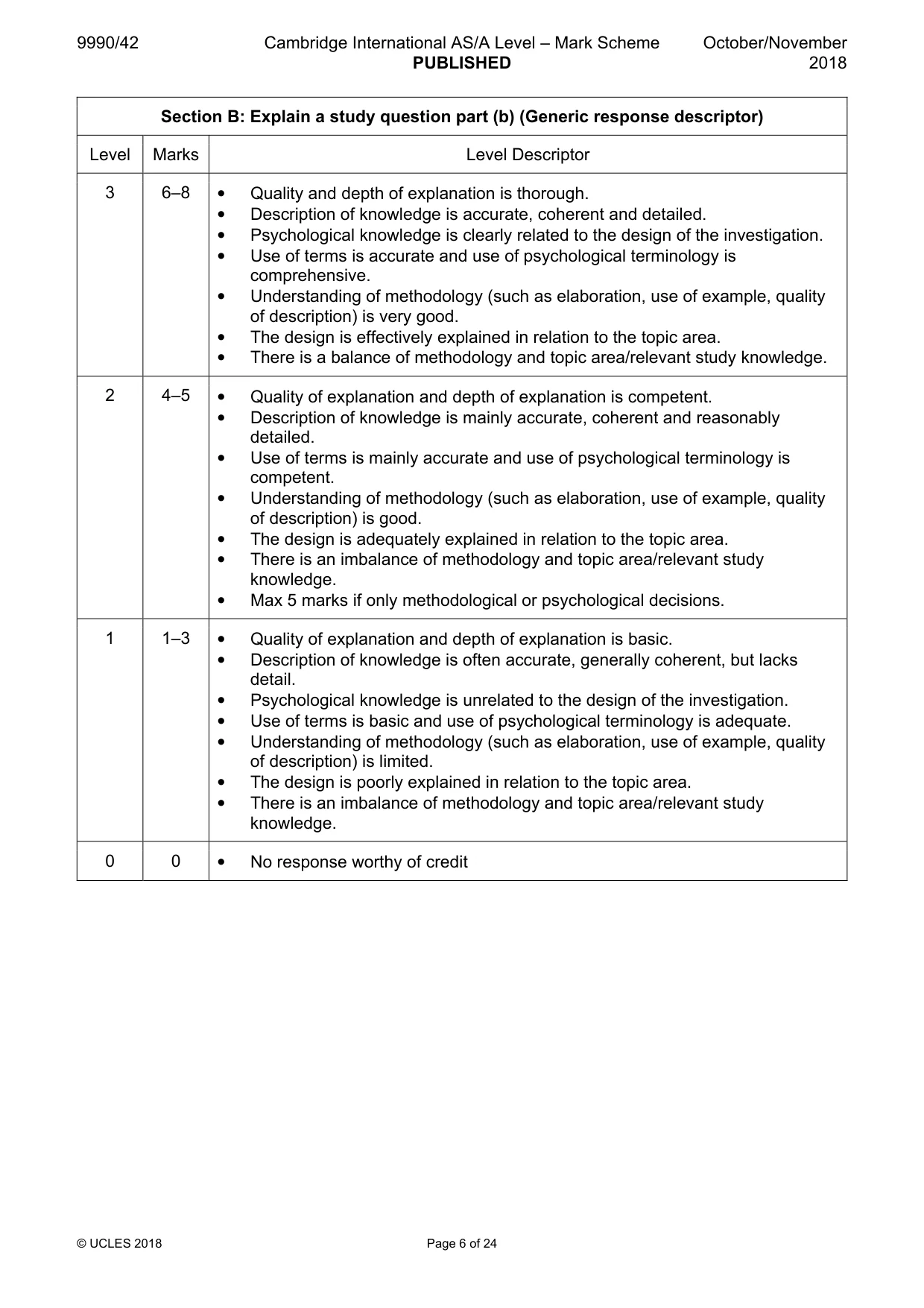
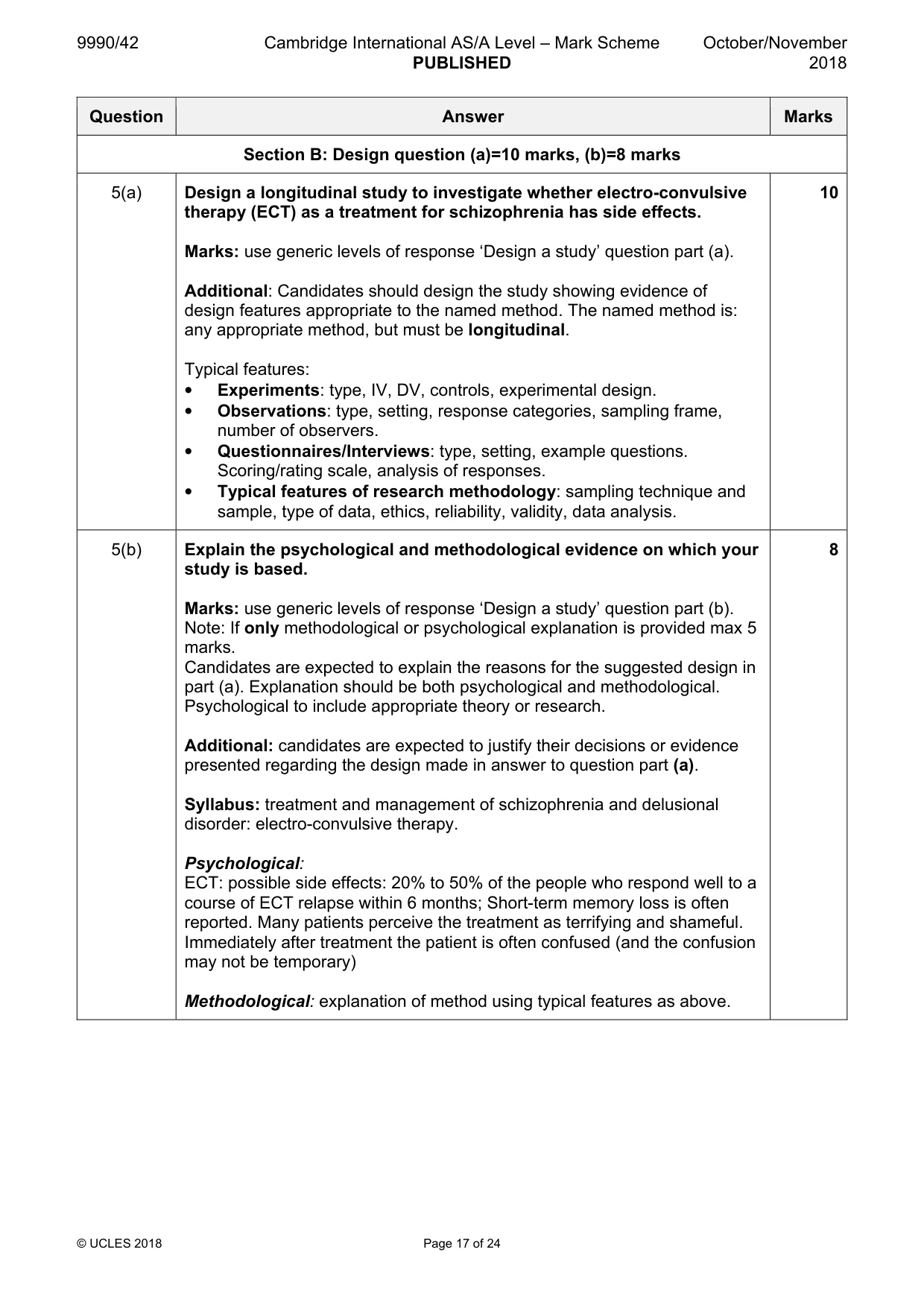
Mark scheme: 5(a) Design a longitudinal study to investigate whether electro-convulsive 10 therapy (ECT) as a treatment for schizophrenia has side effects. Marks: use generic levels of response ‘Design a study’ question part (a). Additional: Candidates should design the study showing evidence of design features appropriate to the named method. The named method is: any appropriate method, but must be longitudinal. Typical features: • Experiments: type, IV, DV, controls, experimental design. • Observations: type, setting, response categories, sampling frame, number of observers. • Questionnaires/Interviews: type, setting, example questions. Scoring/rating scale, analysis of responses. • Typical features of research methodology: sampling technique and sample, type of data, ethics, reliability, validity, data analysis. 5(b) Explain the psychological and methodological evidence on which your 8 study is based. Marks: use generic levels of response ‘Design a study’ question part (b). Note: If only methodological or psychological explanation is provided max 5 marks. Candidates are expected to explain the reasons for the suggested design in part (a). Explanation should be both psychological and methodological. Psychological to include appropriate theory or research. Additional: candidates are expected to justify their decisions or evidence presented regarding the design made in answer to question part (a). Syllabus: treatment and management of schizophrenia and delusional disorder: electro-convulsive therapy. Psychological: ECT: possible side effects: 20% to 50% of the people who respond well to a course of ECT relapse within 6 months; Short-term memory loss is often reported. Many patients perceive the treatment as terrifying and shameful. Immediately after treatment the patient is often confused (and the confusion may not be temporary) Methodological: explanation of method using typical features as above.
Q6 · Design a study to investigate whether slogans linked to a brand are recalled…
6 (a) Design a study to investigate whether slogans linked to a brand are recalled significantly more than slogans which are not linked to a brand. [10] (b) Explain the psychological and methodological evidence on which your study is based. [8] Psychology and health
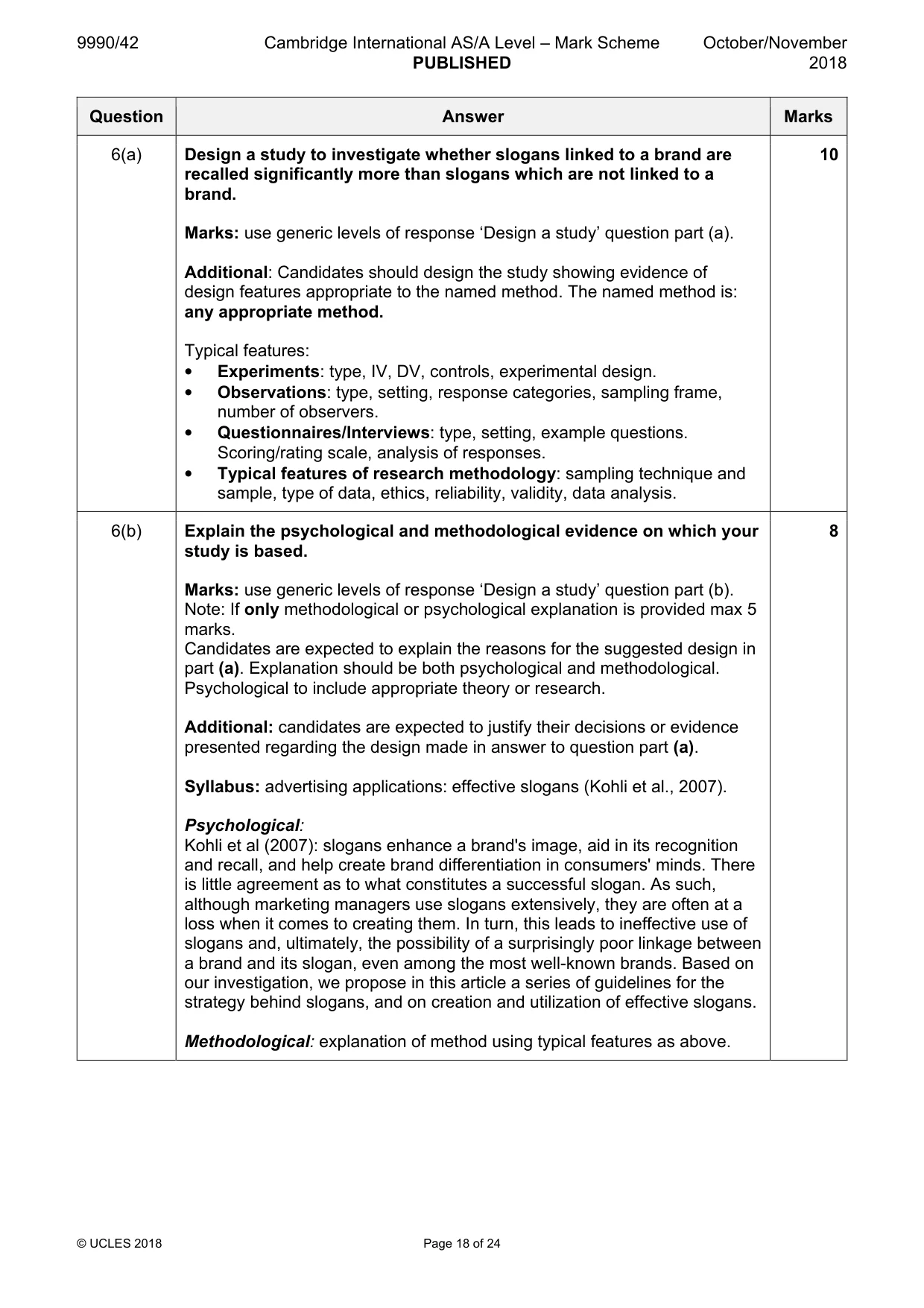
Mark scheme: 6(a) Design a study to investigate whether slogans linked to a brand are 10 recalled significantly more than slogans which are not linked to a brand. Marks: use generic levels of response ‘Design a study’ question part (a). Additional: Candidates should design the study showing evidence of design features appropriate to the named method. The named method is: any appropriate method. Typical features: • Experiments: type, IV, DV, controls, experimental design. • Observations: type, setting, response categories, sampling frame, number of observers. • Questionnaires/Interviews: type, setting, example questions. Scoring/rating scale, analysis of responses. • Typical features of research methodology: sampling technique and sample, type of data, ethics, reliability, validity, data analysis. 6(b) Explain the psychological and methodological evidence on which your 8 study is based. Marks: use generic levels of response ‘Design a study’ question part (b). Note: If only methodological or psychological explanation is provided max 5 marks. Candidates are expected to explain the reasons for the suggested design in part (a). Explanation should be both psychological and methodological. Psychological to include appropriate theory or research. Additional: candidates are expected to justify their decisions or evidence presented regarding the design made in answer to question part (a). Syllabus: advertising applications: effective slogans (Kohli et al., 2007). Psychological: Kohli et al (2007): slogans enhance a brand's image, aid in its recognition and recall, and help create brand differentiation in consumers' minds. There is little agreement as to what constitutes a successful slogan. As such, although marketing managers use slogans extensively, they are often at a loss when it comes to creating them. In turn, this leads to ineffective use of slogans and, ultimately, the possibility of a surprisingly poor linkage between a brand and its slogan, even among the most well-known brands. Based on our investigation, we propose in this article a series of guidelines for the strategy behind slogans, and on creation and utilization of effective slogans. Methodological: explanation of method using typical features as above.
Q7 · Zahir has broken his leg
7 Zahir has broken his leg. You want to know if Zahir’s leg is hurting less over time. (a) Design a study using observation to measure Zahir’s pain over time. [10] (b) Explain the psychological and methodological evidence on which your observation is based. [8] Psychology and organisations
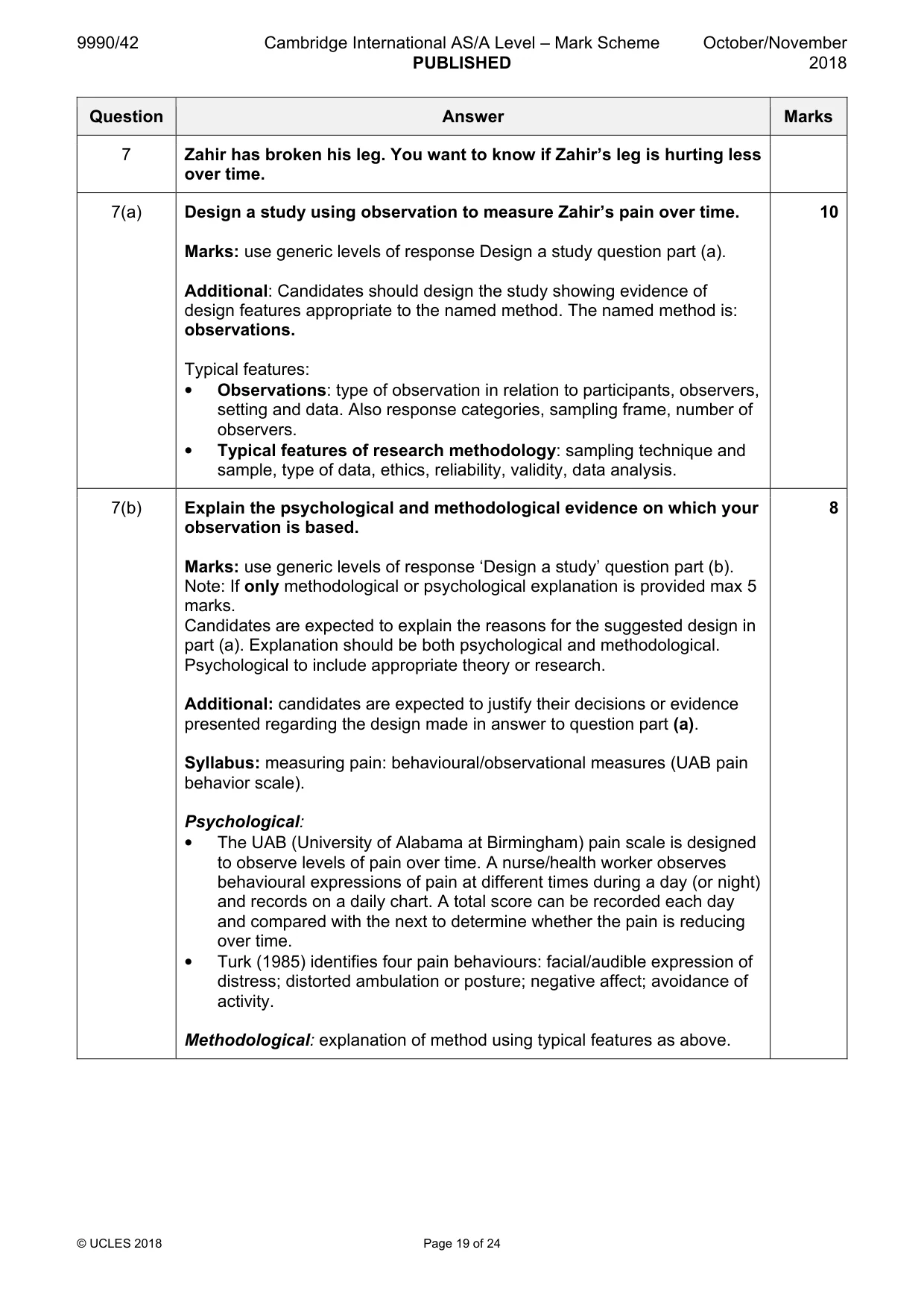
Mark scheme: 7(a) Design a study using observation to measure Zahir’s pain over time. 10 Marks: use generic levels of response Design a study question part (a). Additional: Candidates should design the study showing evidence of design features appropriate to the named method. The named method is: observations. Typical features: • Observations: type of observation in relation to participants, observers, setting and data. Also response categories, sampling frame, number of observers. • Typical features of research methodology: sampling technique and sample, type of data, ethics, reliability, validity, data analysis. 7(b) Explain the psychological and methodological evidence on which your 8 observation is based. Marks: use generic levels of response ‘Design a study’ question part (b). Note: If only methodological or psychological explanation is provided max 5 marks. Candidates are expected to explain the reasons for the suggested design in part (a). Explanation should be both psychological and methodological. Psychological to include appropriate theory or research. Additional: candidates are expected to justify their decisions or evidence presented regarding the design made in answer to question part (a). Syllabus: measuring pain: behavioural/observational measures (UAB pain behavior scale). Psychological: • The UAB (University of Alabama at Birmingham) pain scale is designed to observe levels of pain over time. A nurse/health worker observes behavioural expressions of pain at different times during a day (or night) and records on a daily chart. A total score can be recorded each day and compared with the next to determine whether the pain is reducing over time. • Turk (1985) identifies four pain behaviours: facial/audible expression of distress; distorted ambulation or posture; negative affect; avoidance of activity. Methodological: explanation of method using typical features as above.
Q8 · Design a study to investigate how much managers know about Maslow’s hierarchy of needs
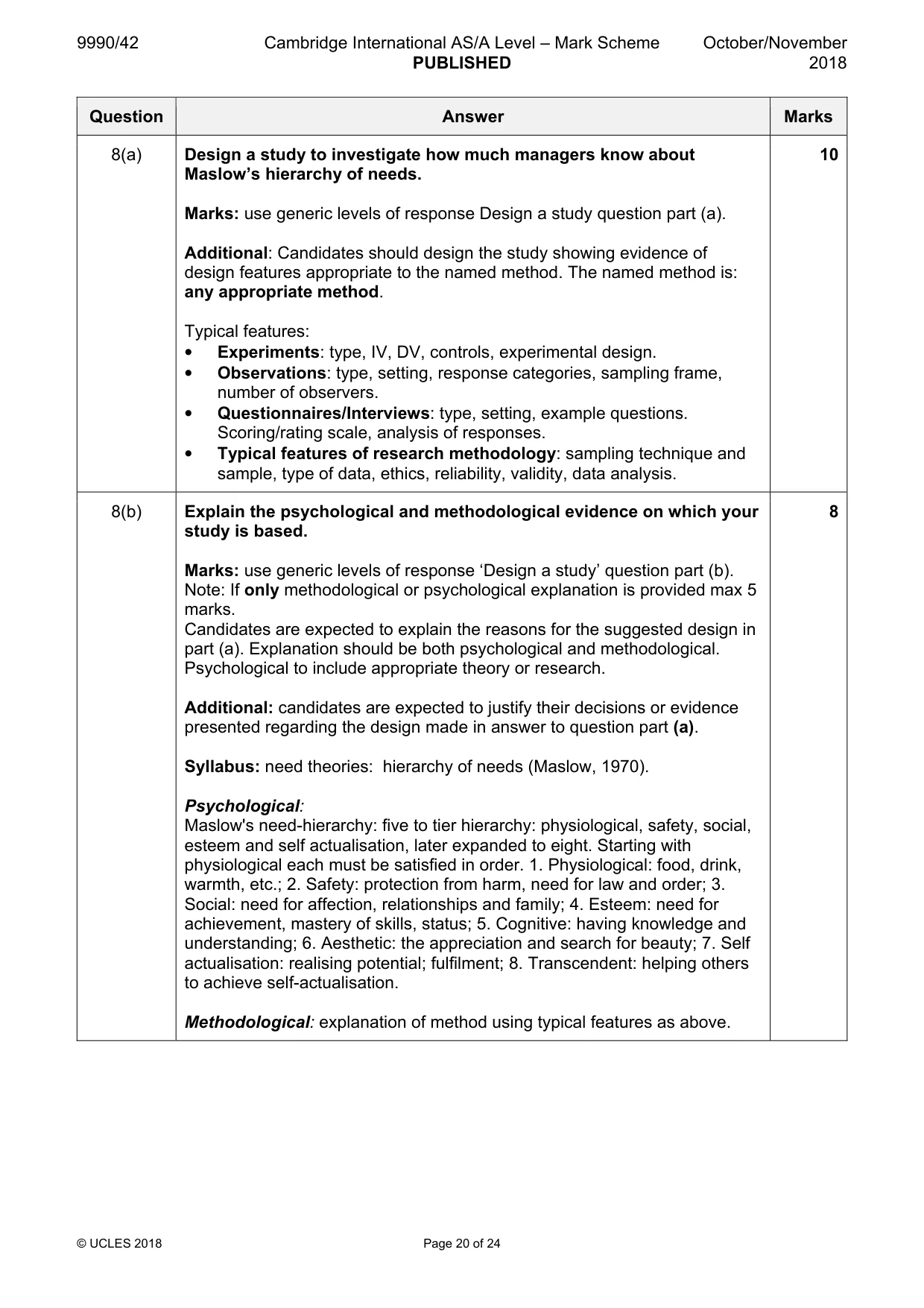
8 (a) Design a study to investigate how much managers know about Maslow’s hierarchy of needs. [10] (b) Explain the psychological and methodological evidence on which your study is based. [8] Section C You must answer one question from this section. Psychology and abnormality
Mark scheme: 8(a) Design a study to investigate how much managers know about 10 Maslow’s hierarchy of needs. Marks: use generic levels of response Design a study question part (a). Additional: Candidates should design the study showing evidence of design features appropriate to the named method. The named method is: any appropriate method. Typical features: • Experiments: type, IV, DV, controls, experimental design. • Observations: type, setting, response categories, sampling frame, number of observers. • Questionnaires/Interviews: type, setting, example questions. Scoring/rating scale, analysis of responses. • Typical features of research methodology: sampling technique and sample, type of data, ethics, reliability, validity, data analysis. 8(b) Explain the psychological and methodological evidence on which your 8 study is based. Marks: use generic levels of response ‘Design a study’ question part (b). Note: If only methodological or psychological explanation is provided max 5 marks. Candidates are expected to explain the reasons for the suggested design in part (a). Explanation should be both psychological and methodological. Psychological to include appropriate theory or research. Additional: candidates are expected to justify their decisions or evidence presented regarding the design made in answer to question part (a). Syllabus: need theories: hierarchy of needs (Maslow, 1970). Psychological: Maslow's need-hierarchy: five to tier hierarchy: physiological, safety, social, esteem and self actualisation, later expanded to eight. Starting with physiological each must be satisfied in order. 1. Physiological: food, drink, warmth, etc.; 2. Safety: protection from harm, need for law and order; 3. Social: need for affection, relationships and family; 4. Esteem: need for achievement, mastery of skills, status; 5. Cognitive: having knowledge and understanding; 6. Aesthetic: the appreciation and search for beauty; 7. Self actualisation: realising potential; fulfilment; 8. Transcendent: helping others to achieve self-actualisation. Methodological: explanation of method using typical features as above.
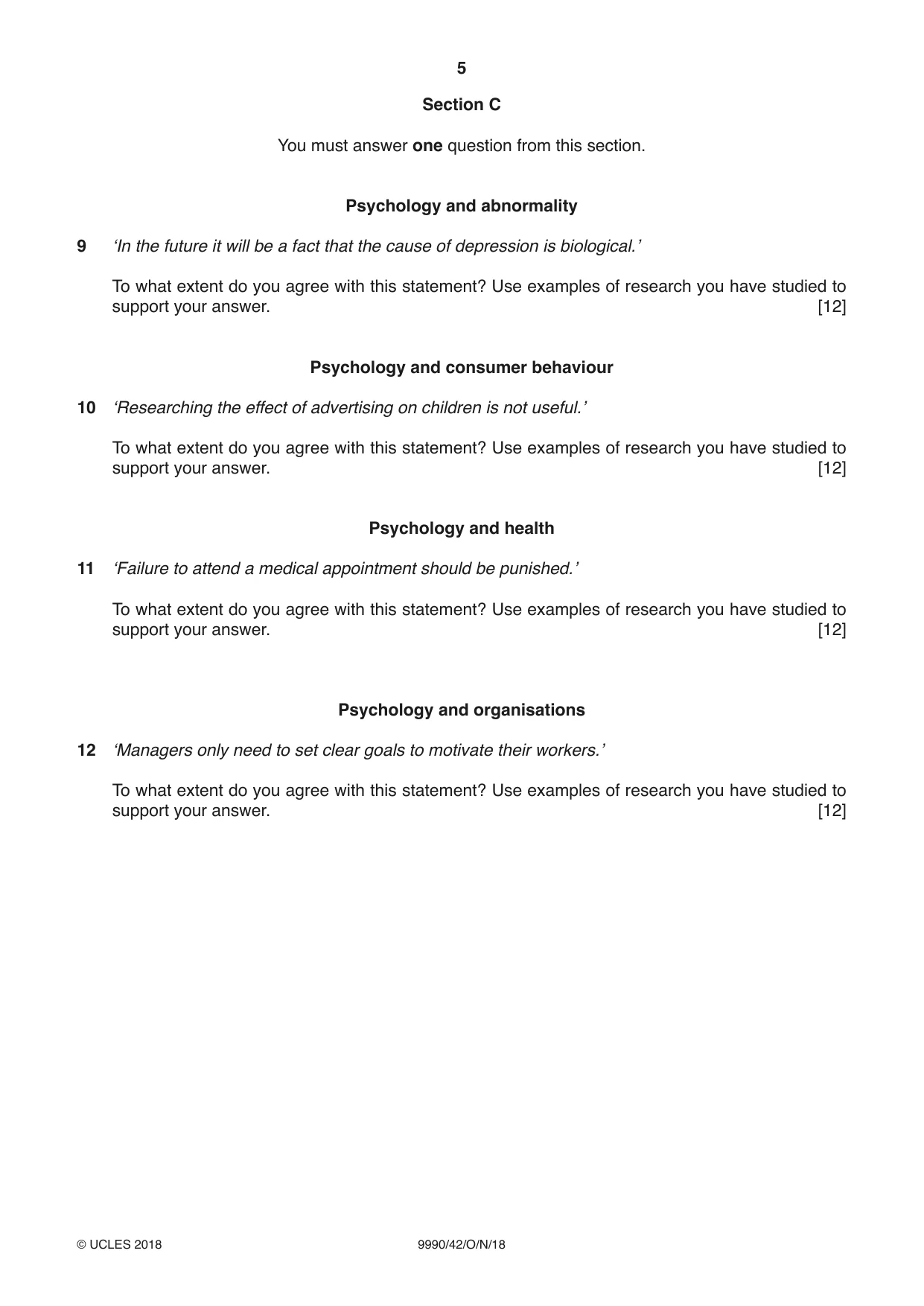
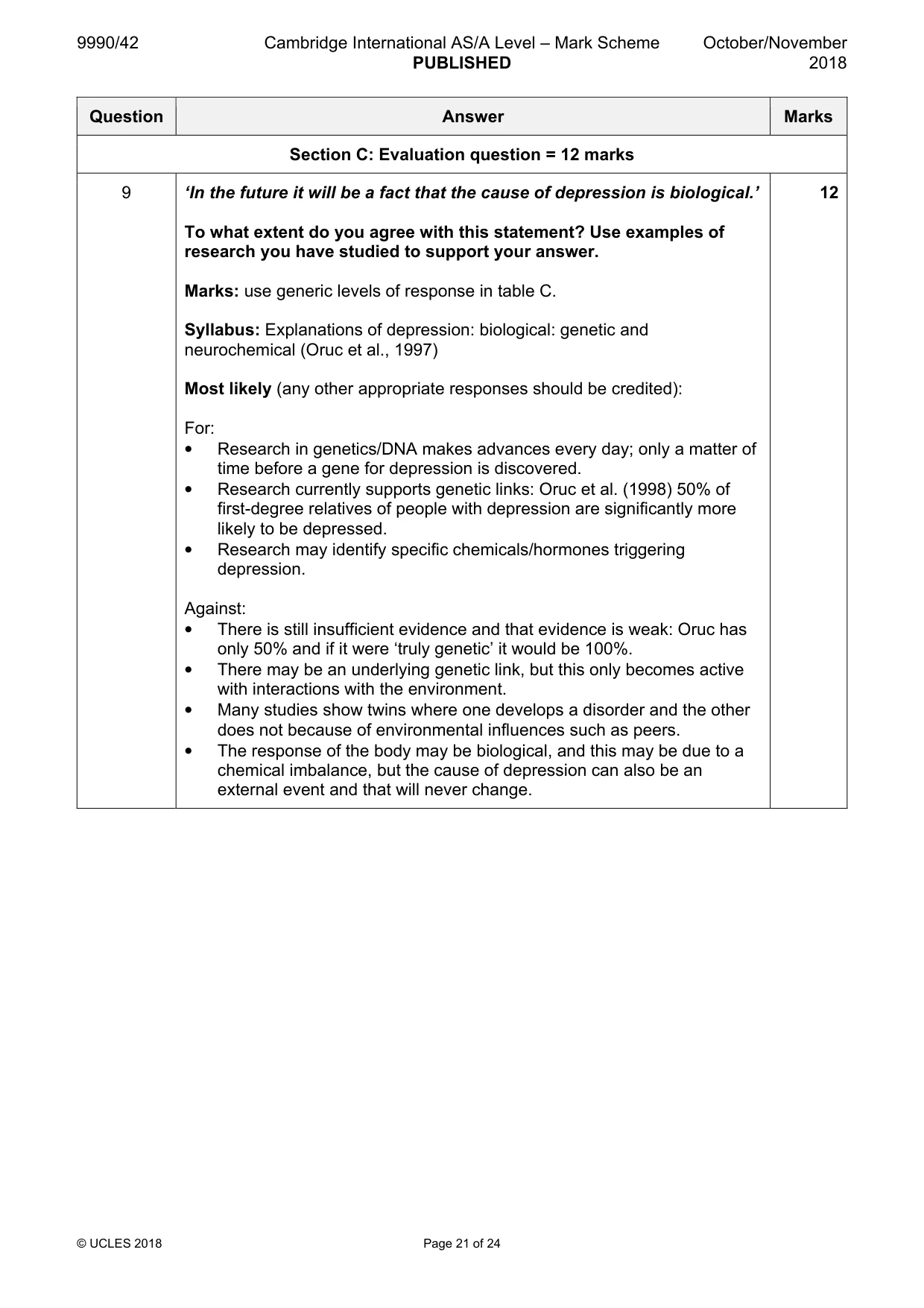
Q9 · ‘In the future it will be a fact that the cause of depression is biological.’ To what…
9 ‘In the future it will be a fact that the cause of depression is biological.’ To what extent do you agree with this statement? Use examples of research you have studied to support your answer. [12] Psychology and consumer behaviour
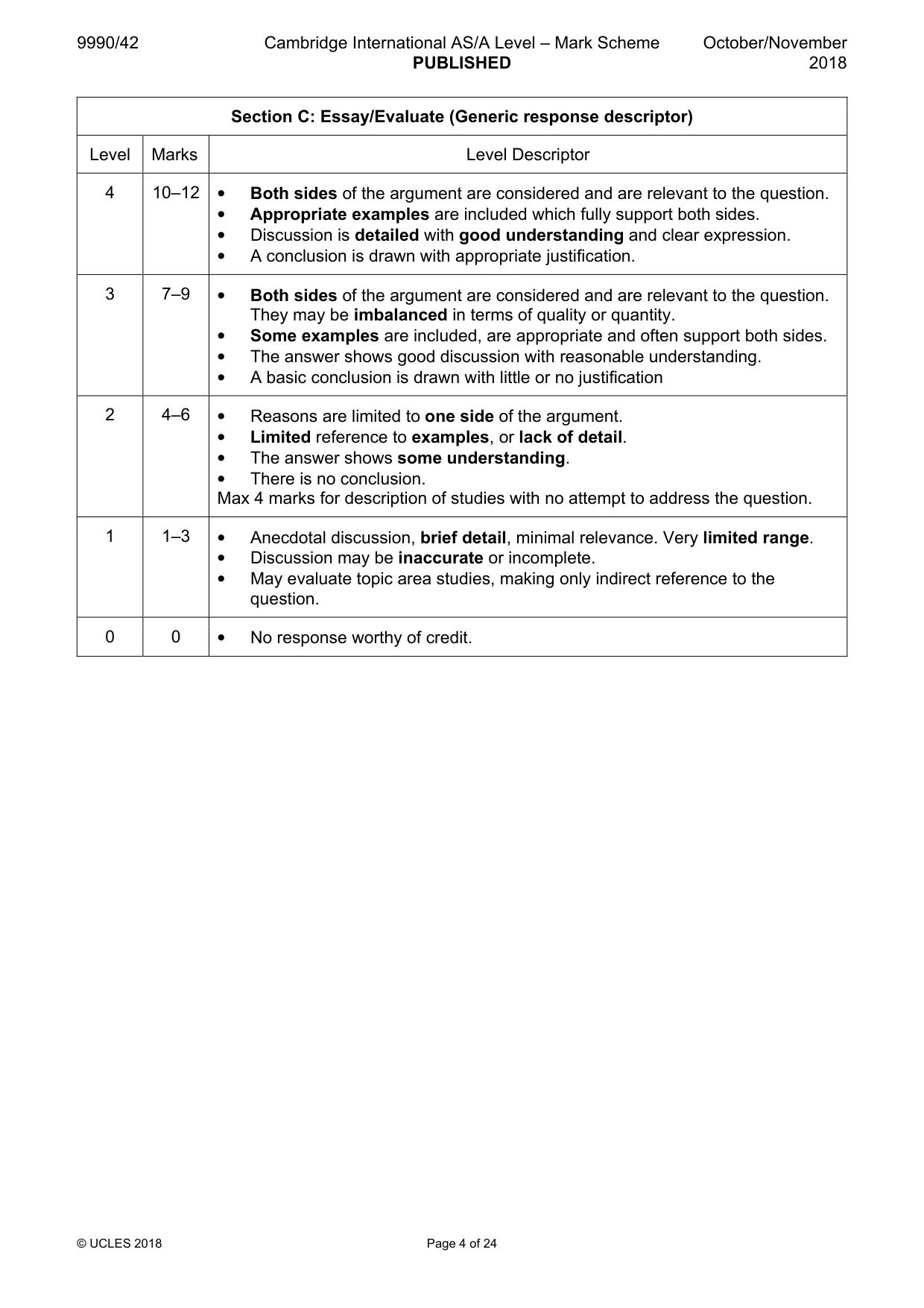
Mark scheme: 9 ‘In the future it will be a fact that the cause of depression is biological.’ 12 To what extent do you agree with this statement? Use examples of research you have studied to support your answer. Marks: use generic levels of response in table C. Syllabus: Explanations of depression: biological: genetic and neurochemical (Oruc et al., 1997) Most likely (any other appropriate responses should be credited): For: • Research in genetics/DNA makes advances every day; only a matter of time before a gene for depression is discovered. • Research currently supports genetic links: Oruc et al. (1998) 50% of first-degree relatives of people with depression are significantly more likely to be depressed. • Research may identify specific chemicals/hormones triggering depression. Against: • There is still insufficient evidence and that evidence is weak: Oruc has only 50% and if it were ‘truly genetic’ it would be 100%. • There may be an underlying genetic link, but this only becomes active with interactions with the environment. • Many studies show twins where one develops a disorder and the other does not because of environmental influences such as peers. • The response of the body may be biological, and this may be due to a chemical imbalance, but the cause of depression can also be an external event and that will never change.
More questions on Mood (affective) disorders: depressive disorder (unipolar) and bipolar disorder
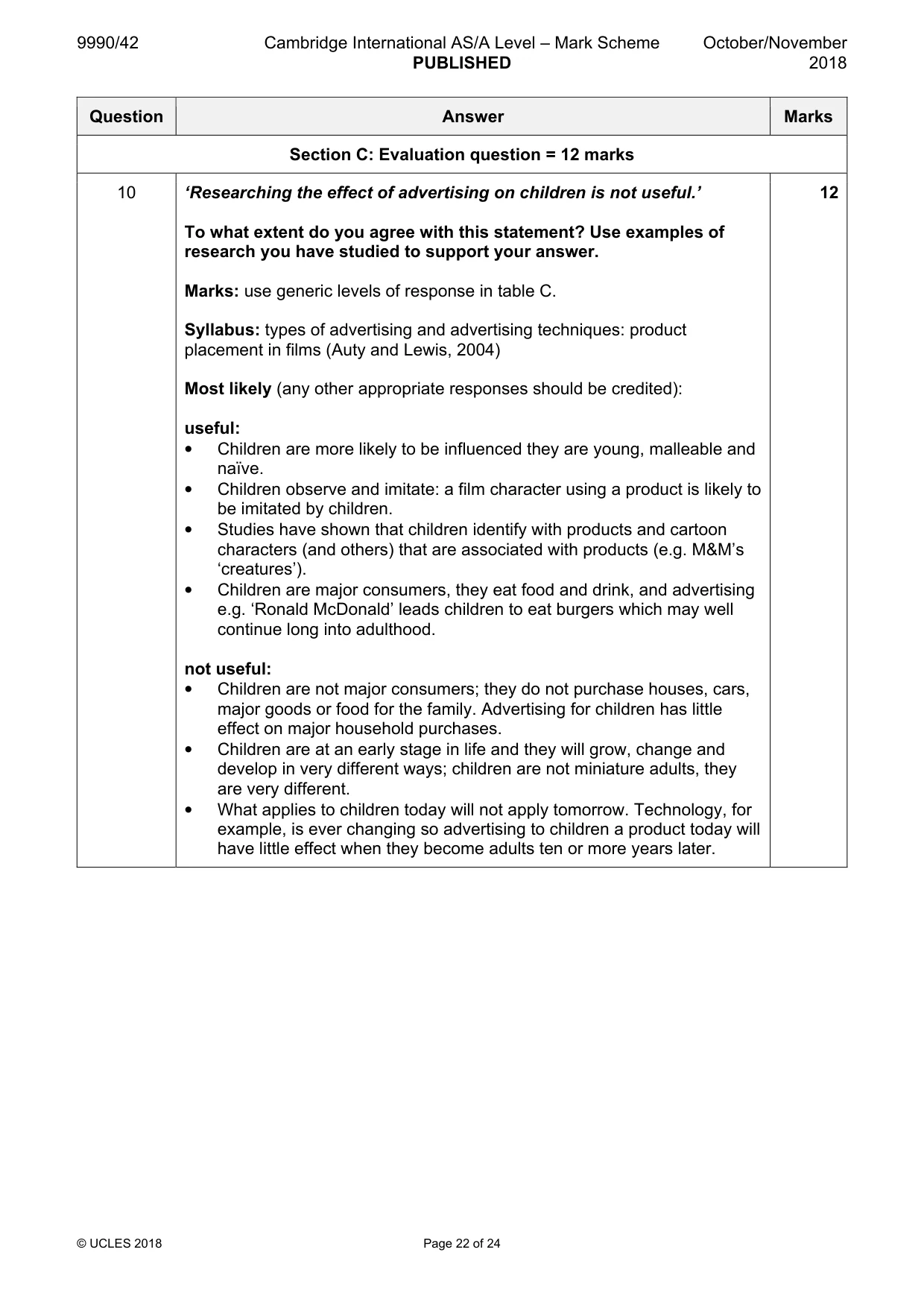
Q10 · ‘Researching the effect of advertising on children is not useful.’ To what extent do you…
10 ‘Researching the effect of advertising on children is not useful.’ To what extent do you agree with this statement? Use examples of research you have studied to support your answer. [12] Psychology and health
Mark scheme: 10 ‘Researching the effect of advertising on children is not useful.’ 12 To what extent do you agree with this statement? Use examples of research you have studied to support your answer. Marks: use generic levels of response in table C. Syllabus: types of advertising and advertising techniques: product placement in films (Auty and Lewis, 2004) Most likely (any other appropriate responses should be credited): useful: • Children are more likely to be influenced they are young, malleable and naïve. • Children observe and imitate: a film character using a product is likely to be imitated by children. • Studies have shown that children identify with products and cartoon characters (and others) that are associated with products (e.g. M&M’s ‘creatures’). • Children are major consumers, they eat food and drink, and advertising e.g. ‘Ronald McDonald’ leads children to eat burgers which may well continue long into adulthood. not useful: • Children are not major consumers; they do not purchase houses, cars, major goods or food for the family. Advertising for children has little effect on major household purchases. • Children are at an early stage in life and they will grow, change and develop in very different ways; children are not miniature adults, they are very different. • What applies to children today will not apply tomorrow. Technology, for example, is ever changing so advertising to children a product today will have little effect when they become adults ten or more years later.
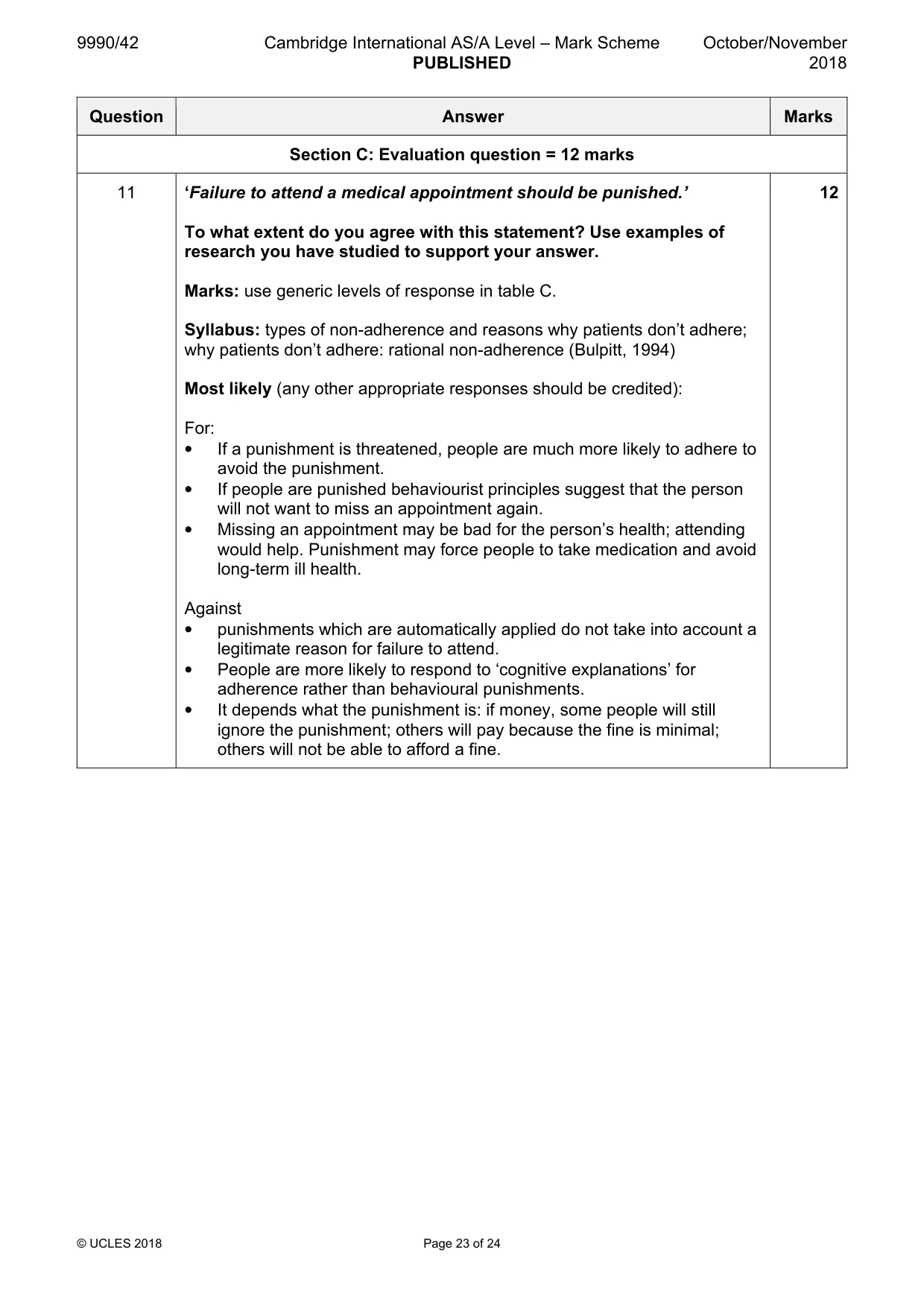
Q11 · ‘Failure to attend a medical appointment should be punished.’ To what extent do you agree…
11 ‘Failure to attend a medical appointment should be punished.’ To what extent do you agree with this statement? Use examples of research you have studied to support your answer. [12] Psychology and organisations
Mark scheme: 11 ‘Failure to attend a medical appointment should be punished.’ 12 To what extent do you agree with this statement? Use examples of research you have studied to support your answer. Marks: use generic levels of response in table C. Syllabus: types of non-adherence and reasons why patients don’t adhere; why patients don’t adhere: rational non-adherence (Bulpitt, 1994) Most likely (any other appropriate responses should be credited): For: • If a punishment is threatened, people are much more likely to adhere to avoid the punishment. • If people are punished behaviourist principles suggest that the person will not want to miss an appointment again. • Missing an appointment may be bad for the person’s health; attending would help. Punishment may force people to take medication and avoid long-term ill health. Against • punishments which are automatically applied do not take into account a legitimate reason for failure to attend. • People are more likely to respond to ‘cognitive explanations’ for adherence rather than behavioural punishments. • It depends what the punishment is: if money, some people will still ignore the punishment; others will pay because the fine is minimal; others will not be able to afford a fine.
Q12 · ‘Managers only need to set clear goals to motivate their workers.’ To what extent do you…
12 ‘Managers only need to set clear goals to motivate their workers.’ To what extent do you agree with this statement? Use examples of research you have studied to support your answer. [12]
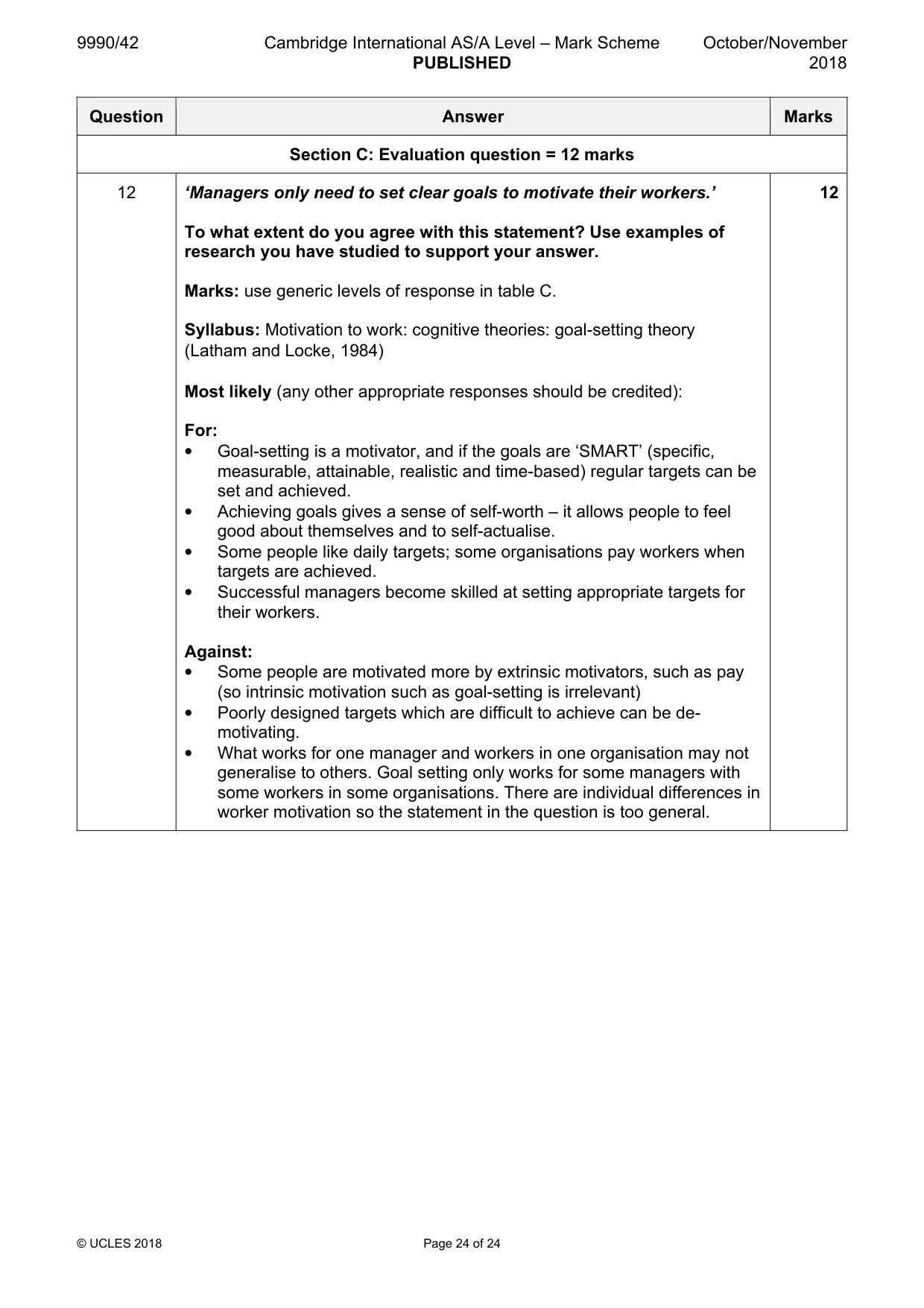
Mark scheme: 12 ‘Managers only need to set clear goals to motivate their workers.’ 12 To what extent do you agree with this statement? Use examples of research you have studied to support your answer. Marks: use generic levels of response in table C. Syllabus: Motivation to work: cognitive theories: goal-setting theory (Latham and Locke, 1984) Most likely (any other appropriate responses should be credited): For: • Goal-setting is a motivator, and if the goals are ‘SMART’ (specific, measurable, attainable, realistic and time-based) regular targets can be set and achieved. • Achieving goals gives a sense of self-worth – it allows people to feel good about themselves and to self-actualise. • Some people like daily targets; some organisations pay workers when targets are achieved. • Successful managers become skilled at setting appropriate targets for their workers. Against: • Some people are motivated more by extrinsic motivators, such as pay (so intrinsic motivation such as goal-setting is irrelevant) • Poorly designed targets which are difficult to achieve can be de- motivating. • What works for one manager and workers in one organisation may not generalise to others. Goal setting only works for some managers with some workers in some organisations. There are individual differences in worker motivation so the statement in the question is too general.
What was in this paper
The subtopics covered by these 12 questions, and how many questions each got. Open one in a new tab to see every Cambridge question on it.
What you needed in this session
Cambridge’s own grade thresholds for 2018 Oct/Nov, Paper 4 · Variant 2. A higher threshold means an easier paper — the bar moves with how the cohort did.