Cambridge A Level Psychology (from 2018) 9990 — 2022 Feb/March Paper 4 · Variant 2
9990/42/F/M/22 · 12 questions · 60 marks · ≈68 min
The question paper and its mark scheme, free to read here and free to download. This is Cambridge’s own paper, exactly as it was sat.
Question paper8 pages
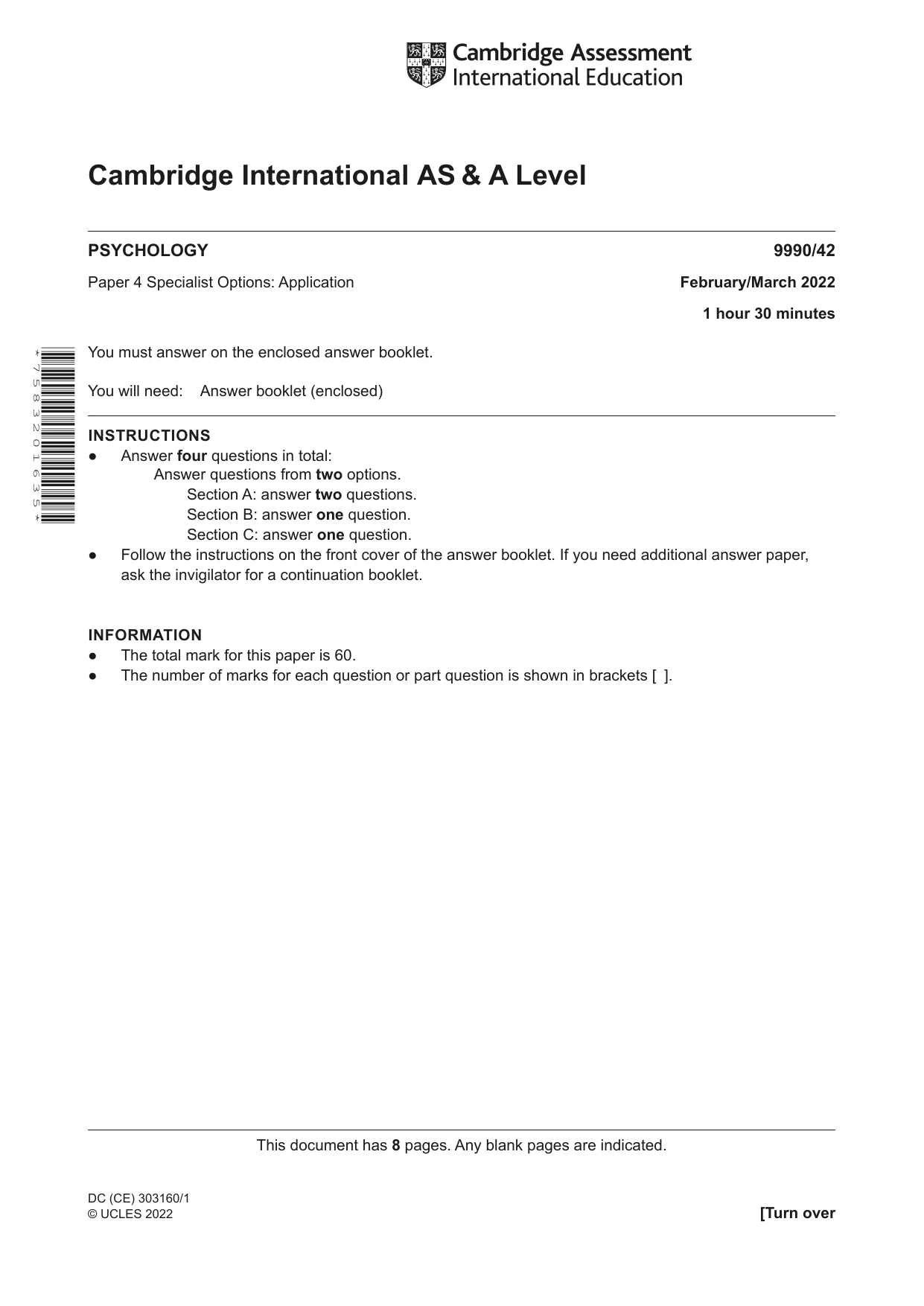
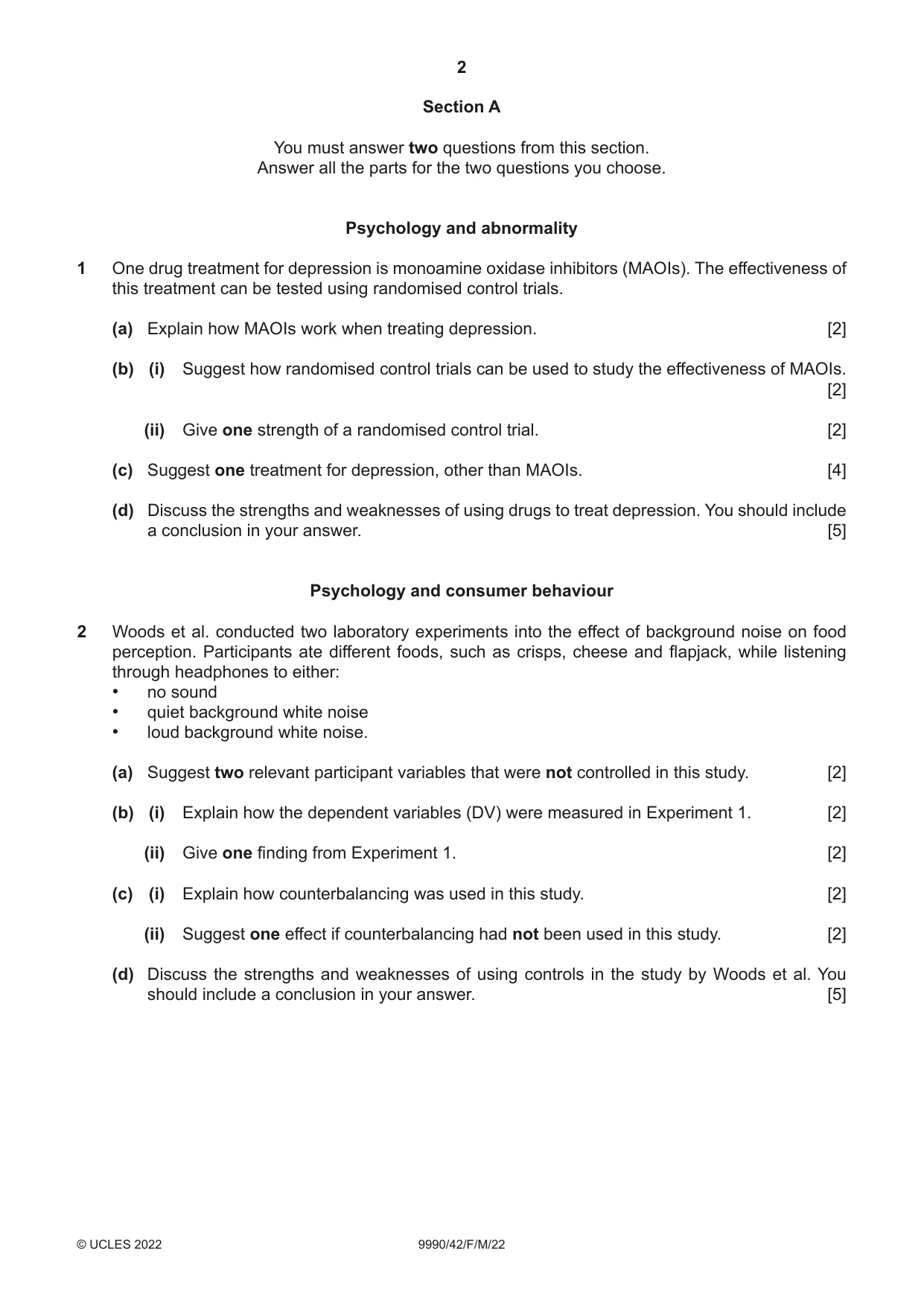
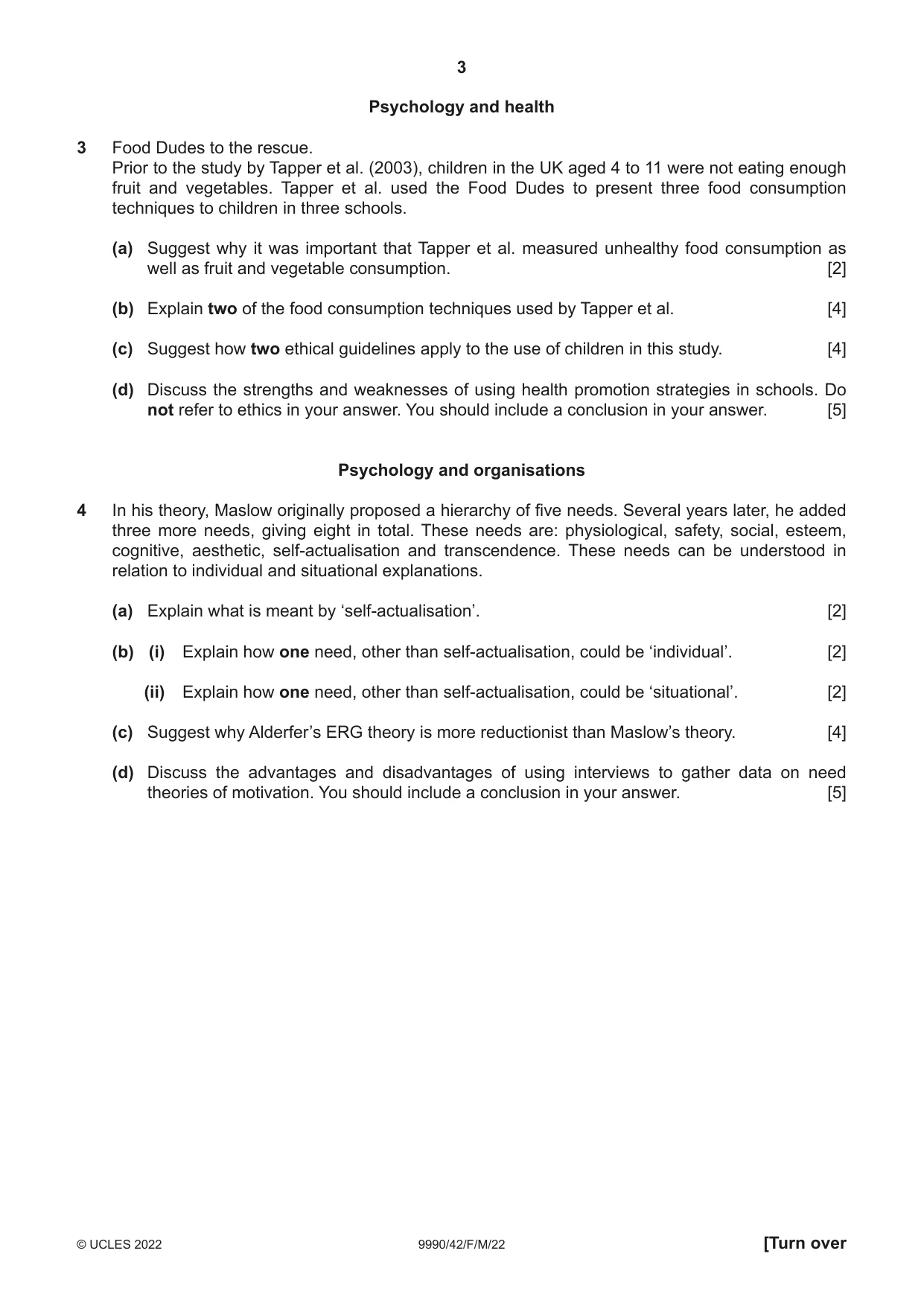
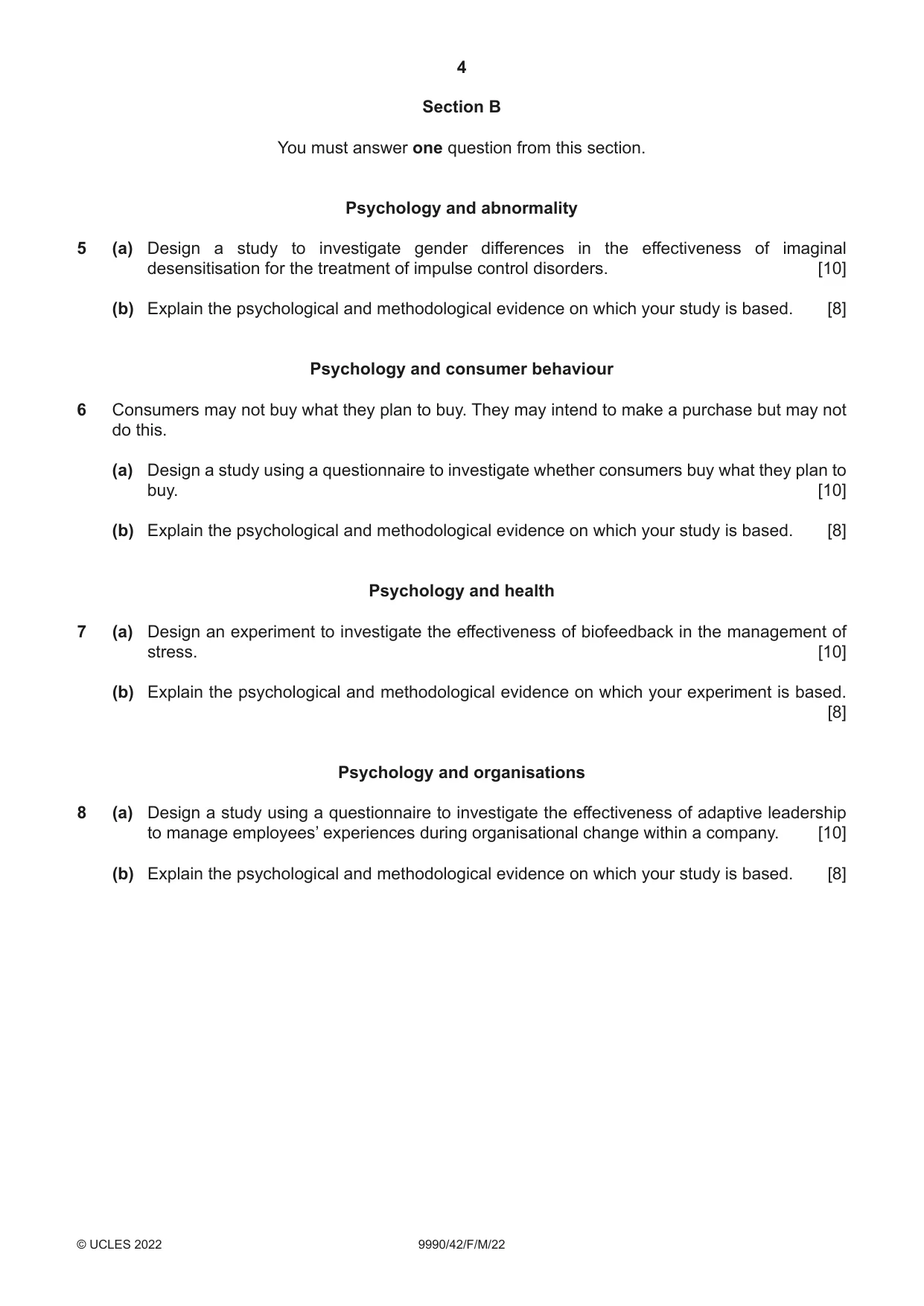



Mark scheme23 pages
Answers below. Sit the paper first if you are practising.
Questions as text
Q1 · One drug treatment for depression is monoamine oxidase inhibitors (MAOIs)
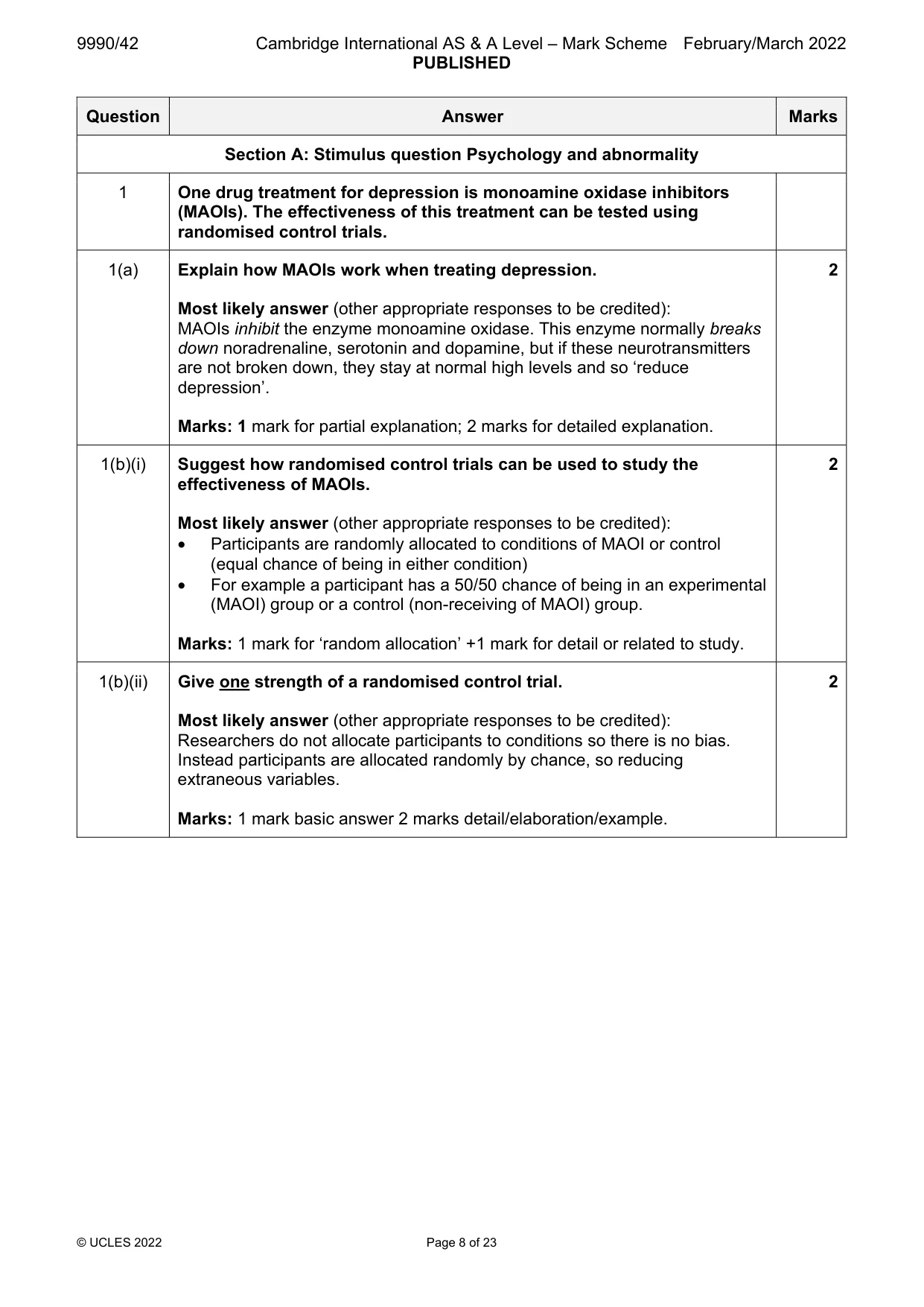
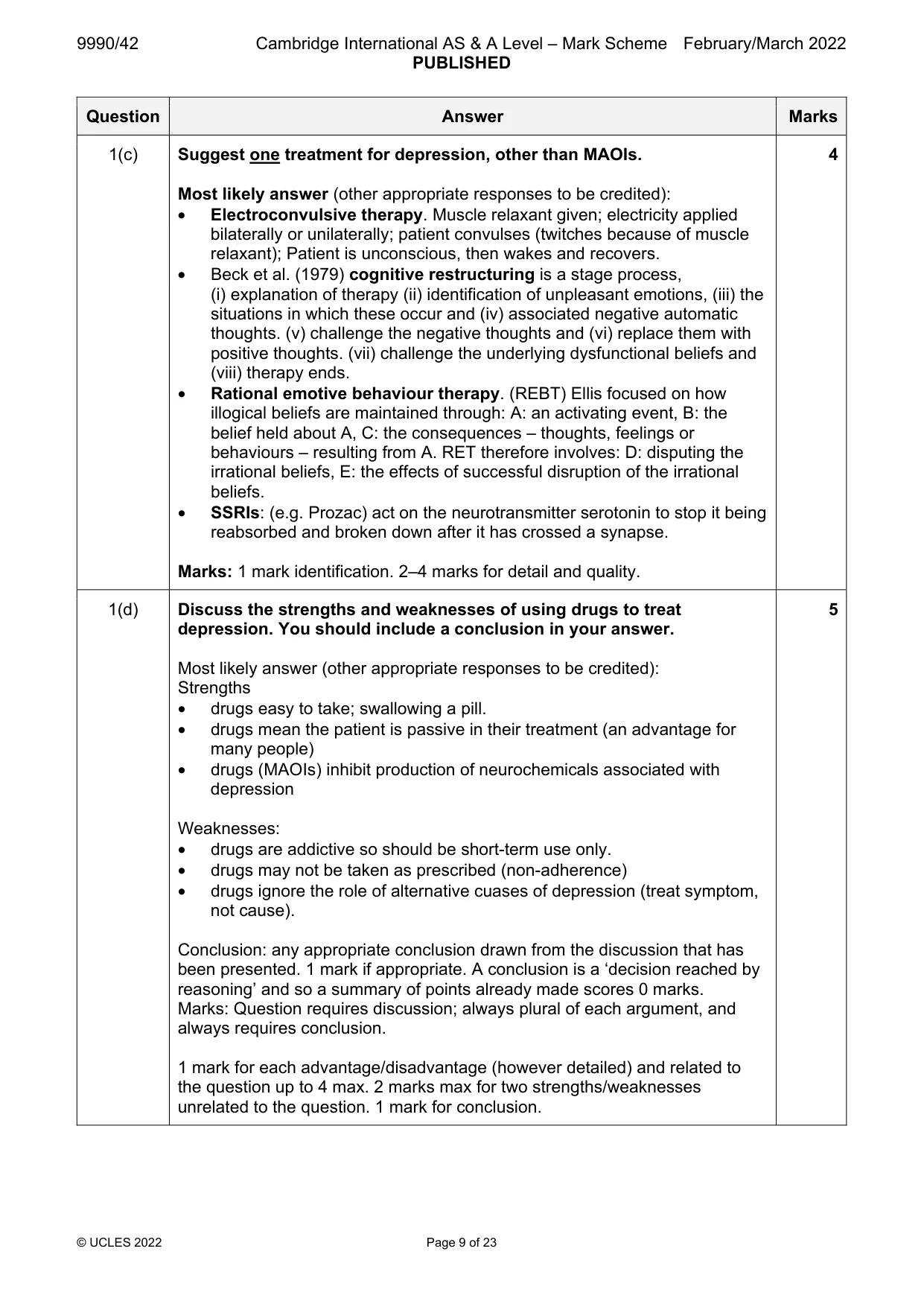
1 One drug treatment for depression is monoamine oxidase inhibitors (MAOIs). The effectiveness of this treatment can be tested using randomised control trials. (a) Explain how MAOIs work when treating depression. [2] (b) (i) Suggest how randomised control trials can be used to study the effectiveness of MAOIs. [2] (ii) Give one strength of a randomised control trial. [2] (c) Suggest one treatment for depression, other than MAOIs. [4] (d) Discuss the strengths and weaknesses of using drugs to treat depression. You should include a conclusion in your answer. [5] Psychology and consumer behaviour
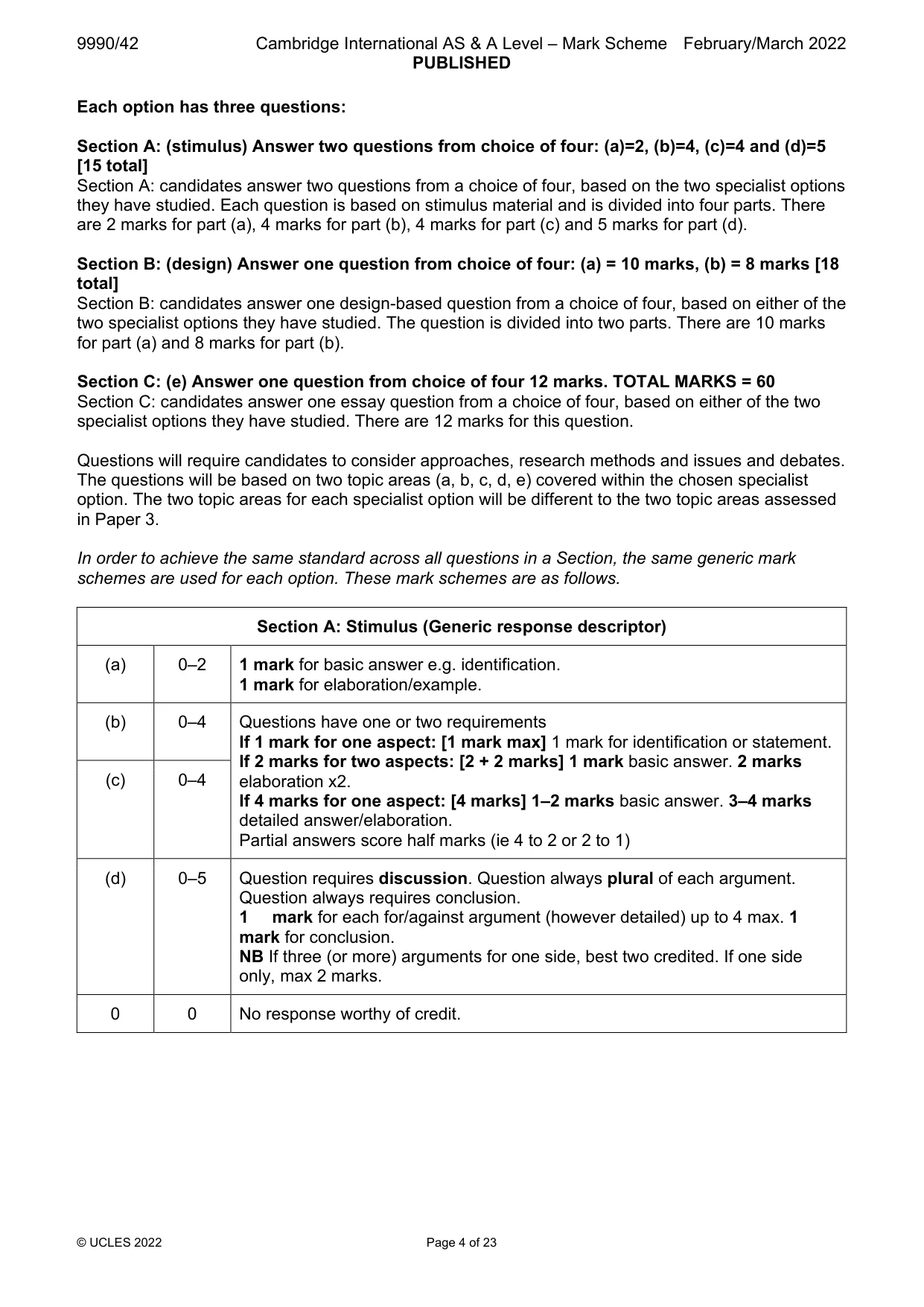
Mark scheme: Question Answer Marks Section A: Stimulus question Psychology and abnormality 1 One drug treatment for depression is monoamine oxidase inhibitors (MAOIs). The effectiveness of this treatment can be tested using randomised control trials. 1(a) Explain how MAOIs work when treating depression. 2 Most likely answer (other appropriate responses to be credited): MAOIs inhibit the enzyme monoamine oxidase. This enzyme normally breaks down noradrenaline, serotonin and dopamine, but if these neurotransmitters are not broken down, they stay at normal high levels and so ‘reduce depression’. Marks: 1 mark for partial explanation; 2 marks for detailed explanation. 1(b)(i) Suggest how randomised control trials can be used to study the 2 effectiveness of MAOIs. Most likely answer (other appropriate responses to be credited): • Participants are randomly allocated to conditions of MAOI or control (equal chance of being in either condition) • For example a participant has a 50/50 chance of being in an experimental (MAOI) group or a control (non-receiving of MAOI) group. Marks: 1 mark for ‘random allocation’ +1 mark for detail or related to study. 1(b)(ii) Give one strength of a randomised control trial. 2 Most likely answer (other appropriate responses to be credited): Researchers do not allocate participants to conditions so there is no bias. Instead participants are allocated randomly by chance, so reducing extraneous variables. Marks: 1 mark basic answer 2 marks detail/elaboration/example. 1(c) Suggest one treatment for depression, other than MAOIs. 4 Most likely answer (other appropriate responses to be credited): • Electroconvulsive therapy. Muscle relaxant given; electricity applied bilaterally or unilaterally; patient convulses (twitches because of muscle relaxant); Patient is unconscious, then wakes and recovers. • Beck et al. (1979) cognitive restructuring is a stage process, (i) explanation of therapy (ii) identification of unpleasant emotions, (iii) the situations in which these occur and (iv) associated negative automatic thoughts. (v) challenge the negative thoughts and (vi) replace them with positive thoughts. (vii) challenge the underlying dysfunctional beliefs and (viii) therapy ends. • Rational emotive behaviour therapy. (REBT) Ellis focused on how illogical beliefs are maintained through: A: an activating event, B: the belief held about A, C: the consequences – thoughts, feelings or behaviours – resulting from A. RET therefore involves: D: disputing the irrational beliefs, E: the effects of successful disruption of the irrational beliefs. • SSRIs: (e.g. Prozac) act on the neurotransmitter serotonin to stop it being reabsorbed and broken down after it has crossed a synapse. Marks: 1 mark identification. 2–4 marks for detail and quality. 1(d) Discuss the strengths and weaknesses of using drugs to treat 5 depression. You should include a conclusion in your answer. Most likely answer (other appropriate responses to be credited): Strengths • drugs easy to take; swallowing a pill. • drugs mean the patient is passive in their treatment (an advantage for many people) • drugs (MAOIs) inhibit production of neurochemicals associated with depression Weaknesses: • drugs are addictive so should be short-term use only. • drugs may not be taken as prescribed (non-adherence) • drugs ignore the role of alternative cuases of depression (treat symptom, not cause). Conclusion: any appropriate conclusion drawn from the discussion that has been presented. 1 mark if appropriate. A conclusion is a ‘decision reached by reasoning’ and so a summary of points already made scores 0 marks. Marks: Question requires discussion; always plural of each argument, and always requires conclusion. 1 mark for each advantage/disadvantage (however detailed) and related to the question up to 4 max. 2 marks max for two strengths/weaknesses unrelated to the question. 1 mark for conclusion.
More questions on Mood (affective) disorders: depressive disorder (unipolar) and bipolar disorder
Question 2
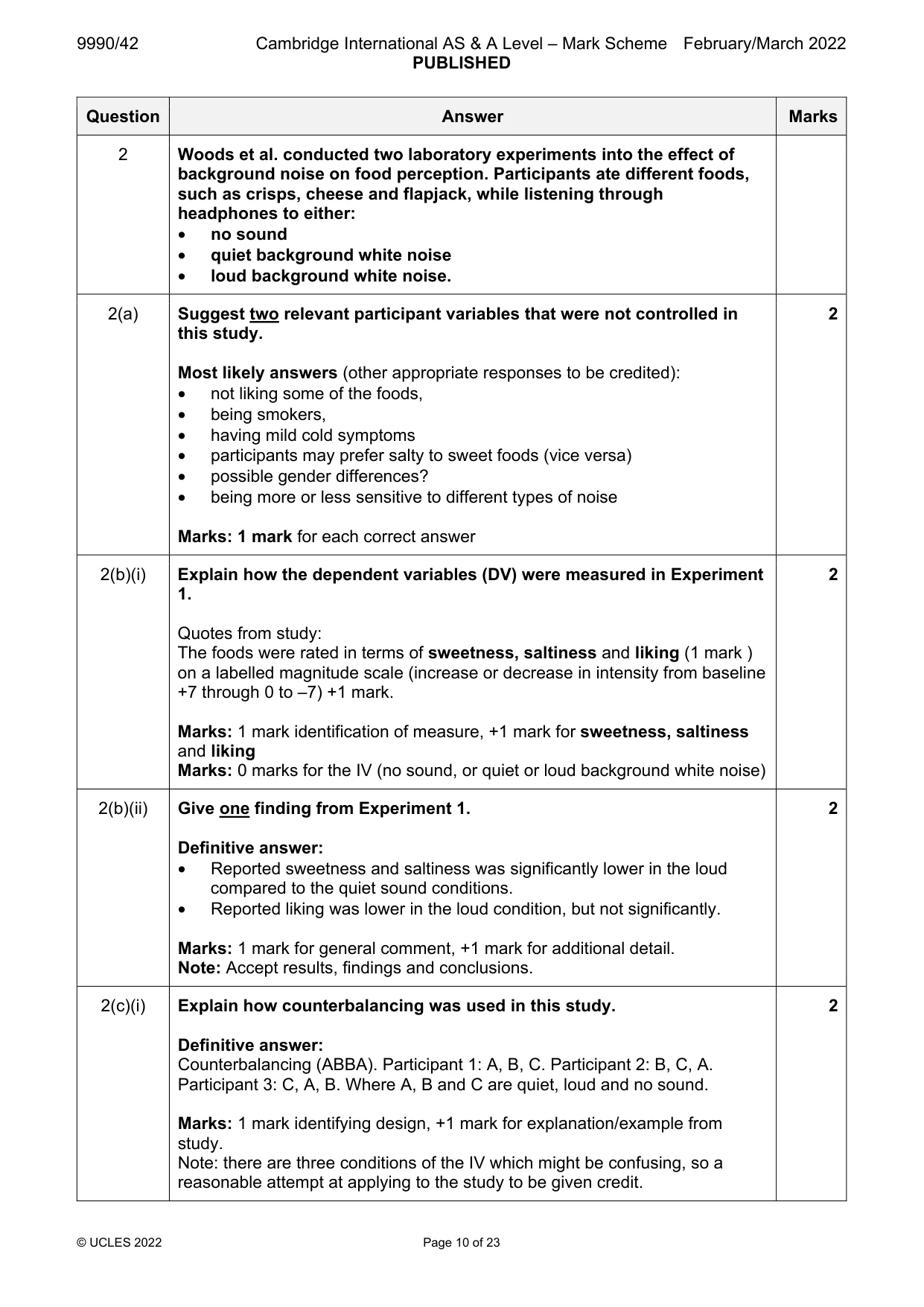
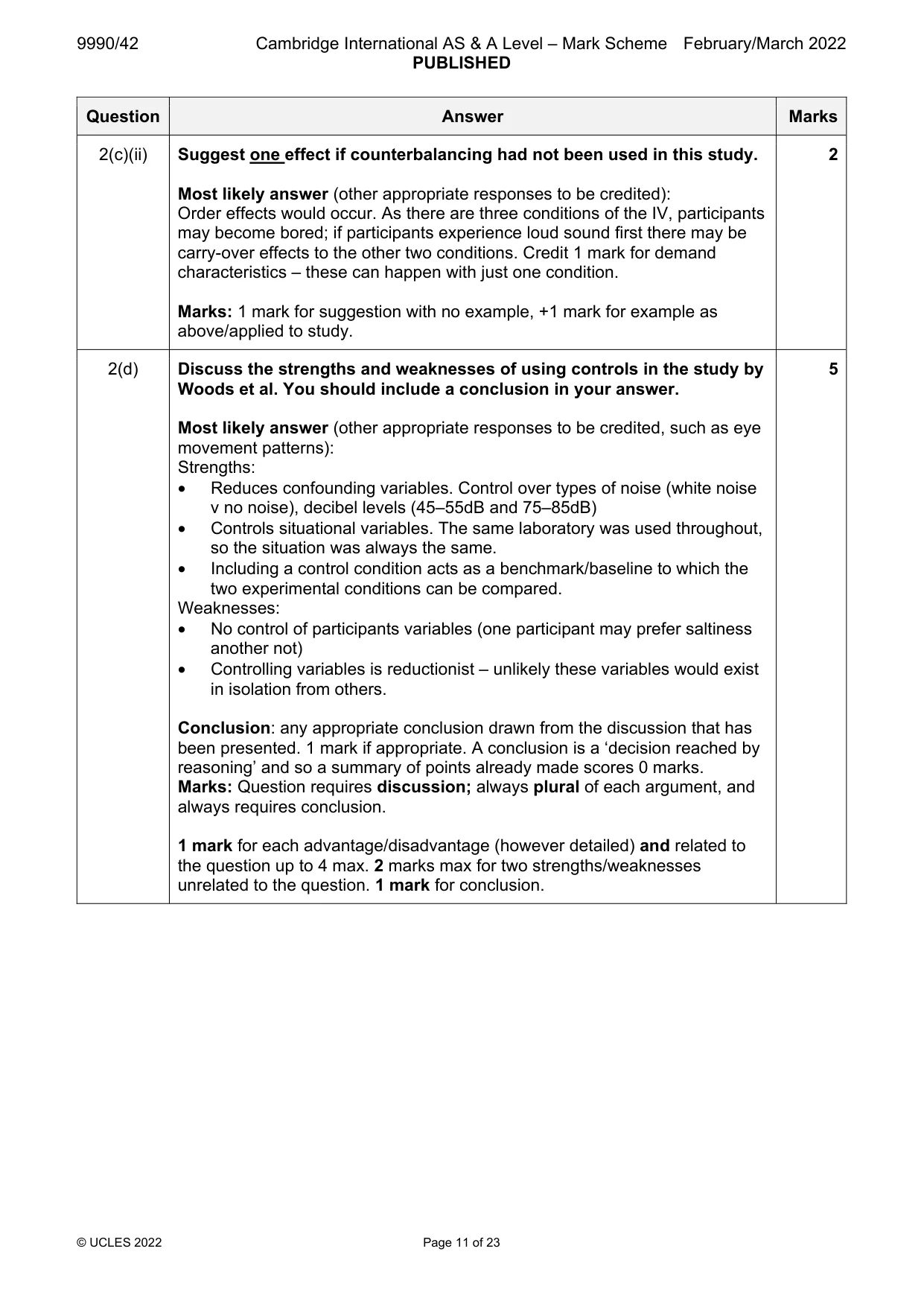
2 Woods et al. conducted two laboratory experiments into the effect of background noise on food perception. Participants ate different foods, such as crisps, cheese and flapjack, while listening through headphones to either: • no sound • quiet background white noise • loud background white noise. (a) Suggest two relevant participant variables that were not controlled in this study. [2] (b) (i) Explain how the dependent variables (DV) were measured in Experiment 1. [2] (ii) Give one finding from Experiment 1. [2] (c) (i) Explain how counterbalancing was used in this study. [2] (ii) Suggest one effect if counterbalancing had not been used in this study. [2] (d) Discuss the strengths and weaknesses of using controls in the study by Woods et al. You should include a conclusion in your answer. [5] Psychology and health
Mark scheme: 2 Woods et al. conducted two laboratory experiments into the effect of background noise on food perception. Participants ate different foods, such as crisps, cheese and flapjack, while listening through headphones to either: • no sound • quiet background white noise • loud background white noise. 2(a) Suggest two relevant participant variables that were not controlled in 2 this study. Most likely answers (other appropriate responses to be credited): • not liking some of the foods, • being smokers, • having mild cold symptoms • participants may prefer salty to sweet foods (vice versa) • possible gender differences? • being more or less sensitive to different types of noise Marks: 1 mark for each correct answer 2(b)(i) Explain how the dependent variables (DV) were measured in Experiment 2 1. Quotes from study: The foods were rated in terms of sweetness, saltiness and liking (1 mark ) on a labelled magnitude scale (increase or decrease in intensity from baseline +7 through 0 to –7) +1 mark. Marks: 1 mark identification of measure, +1 mark for sweetness, saltiness and liking Marks: 0 marks for the IV (no sound, or quiet or loud background white noise) 2(b)(ii) Give one finding from Experiment 1. 2 Definitive answer: • Reported sweetness and saltiness was significantly lower in the loud compared to the quiet sound conditions. • Reported liking was lower in the loud condition, but not significantly. Marks: 1 mark for general comment, +1 mark for additional detail. Note: Accept results, findings and conclusions. 2(c)(i) Explain how counterbalancing was used in this study. 2 Definitive answer: Counterbalancing (ABBA). Participant 1: A, B, C. Participant 2: B, C, A. Participant 3: C, A, B. Where A, B and C are quiet, loud and no sound. Marks: 1 mark identifying design, +1 mark for explanation/example from study. Note: there are three conditions of the IV which might be confusing, so a reasonable attempt at applying to the study to be given credit. 2(c)(ii) Suggest one effect if counterbalancing had not been used in this study. 2 Most likely answer (other appropriate responses to be credited): Order effects would occur. As there are three conditions of the IV, participants may become bored; if participants experience loud sound first there may be carry-over effects to the other two conditions. Credit 1 mark for demand characteristics – these can happen with just one condition. Marks: 1 mark for suggestion with no example, +1 mark for example as above/applied to study. 2(d) Discuss the strengths and weaknesses of using controls in the study by 5 Woods et al. You should include a conclusion in your answer. Most likely answer (other appropriate responses to be credited, such as eye movement patterns): Strengths: • Reduces confounding variables. Control over types of noise (white noise v no noise), decibel levels (45–55dB and 75–85dB) • Controls situational variables. The same laboratory was used throughout, so the situation was always the same. • Including a control condition acts as a benchmark/baseline to which the two experimental conditions can be compared. Weaknesses: • No control of participants variables (one participant may prefer saltiness another not) • Controlling variables is reductionist – unlikely these variables would exist in isolation from others. Conclusion: any appropriate conclusion drawn from the discussion that has been presented. 1 mark if appropriate. A conclusion is a ‘decision reached by reasoning’ and so a summary of points already made scores 0 marks. Marks: Question requires discussion; always plural of each argument, and always requires conclusion. 1 mark for each advantage/disadvantage (however detailed) and related to the question up to 4 max. 2 marks max for two strengths/weaknesses unrelated to the question. 1 mark for conclusion.
Q3 · Food Dudes to the rescue
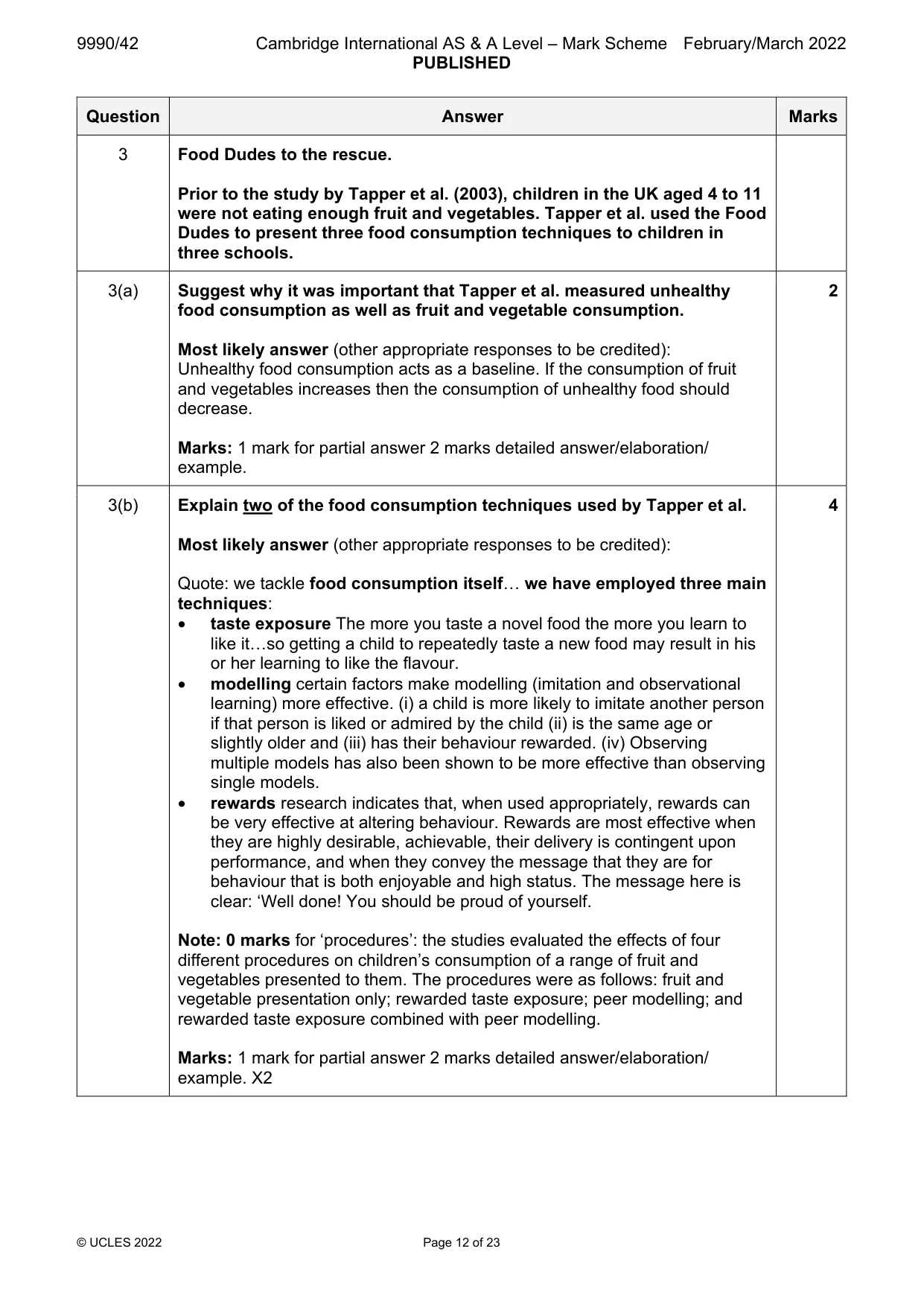
3 Food Dudes to the rescue. Prior to the study by Tapper et al. (2003), children in the UK aged 4 to 11 were not eating enough fruit and vegetables. Tapper et al. used the Food Dudes to present three food consumption techniques to children in three schools. (a) Suggest why it was important that Tapper et al. measured unhealthy food consumption as well as fruit and vegetable consumption. [2] (b) Explain two of the food consumption techniques used by Tapper et al. [4] (c) Suggest how two ethical guidelines apply to the use of children in this study. [4] (d) Discuss the strengths and weaknesses of using health promotion strategies in schools. Do not refer to ethics in your answer. You should include a conclusion in your answer. [5] Psychology and organisations
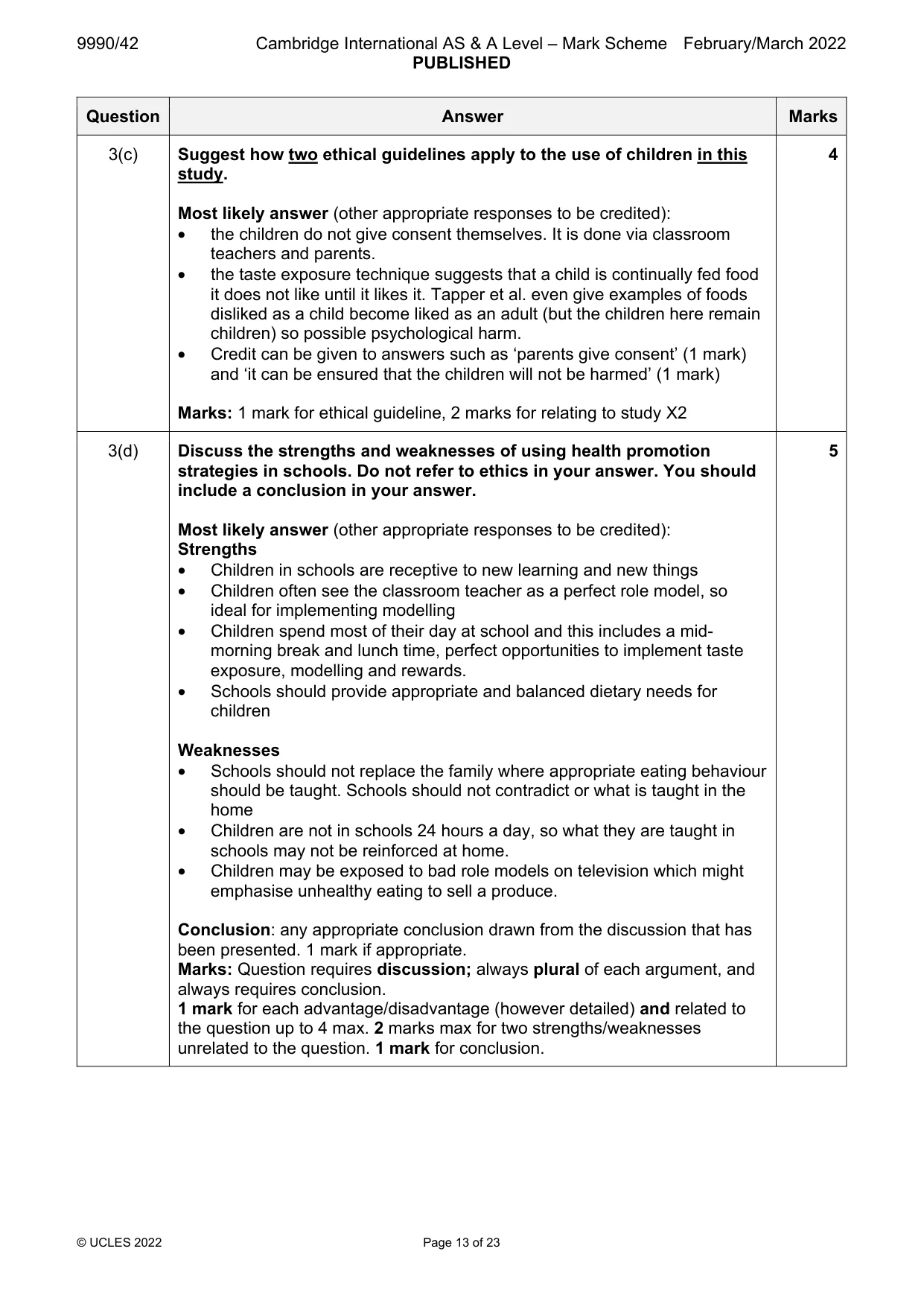
Mark scheme: 3 Food Dudes to the rescue. Prior to the study by Tapper et al. (2003), children in the UK aged 4 to 11 were not eating enough fruit and vegetables. Tapper et al. used the Food Dudes to present three food consumption techniques to children in three schools. 3(a) Suggest why it was important that Tapper et al. measured unhealthy 2 food consumption as well as fruit and vegetable consumption. Most likely answer (other appropriate responses to be credited): Unhealthy food consumption acts as a baseline. If the consumption of fruit and vegetables increases then the consumption of unhealthy food should decrease. Marks: 1 mark for partial answer 2 marks detailed answer/elaboration/ example. 3(b) Explain two of the food consumption techniques used by Tapper et al. 4 Most likely answer (other appropriate responses to be credited): Quote: we tackle food consumption itself… we have employed three main techniques: • taste exposure The more you taste a novel food the more you learn to like it…so getting a child to repeatedly taste a new food may result in his or her learning to like the flavour. • modelling certain factors make modelling (imitation and observational learning) more effective. (i) a child is more likely to imitate another person if that person is liked or admired by the child (ii) is the same age or slightly older and (iii) has their behaviour rewarded. (iv) Observing multiple models has also been shown to be more effective than observing single models. • rewards research indicates that, when used appropriately, rewards can be very effective at altering behaviour. Rewards are most effective when they are highly desirable, achievable, their delivery is contingent upon performance, and when they convey the message that they are for behaviour that is both enjoyable and high status. The message here is clear: ‘Well done! You should be proud of yourself. Note: 0 marks for ‘procedures’: the studies evaluated the effects of four different procedures on children’s consumption of a range of fruit and vegetables presented to them. The procedures were as follows: fruit and vegetable presentation only; rewarded taste exposure; peer modelling; and rewarded taste exposure combined with peer modelling. Marks: 1 mark for partial answer 2 marks detailed answer/elaboration/ example. X2 3(c) Suggest how two ethical guidelines apply to the use of children in this 4 study. Most likely answer (other appropriate responses to be credited): • the children do not give consent themselves. It is done via classroom teachers and parents. • the taste exposure technique suggests that a child is continually fed food it does not like until it likes it. Tapper et al. even give examples of foods disliked as a child become liked as an adult (but the children here remain children) so possible psychological harm. • Credit can be given to answers such as ‘parents give consent’ (1 mark) and ‘it can be ensured that the children will not be harmed’ (1 mark) Marks: 1 mark for ethical guideline, 2 marks for relating to study X2 3(d) Discuss the strengths and weaknesses of using health promotion 5 strategies in schools. Do not refer to ethics in your answer. You should include a conclusion in your answer. Most likely answer (other appropriate responses to be credited): Strengths • Children in schools are receptive to new learning and new things • Children often see the classroom teacher as a perfect role model, so ideal for implementing modelling • Children spend most of their day at school and this includes a mid- morning break and lunch time, perfect opportunities to implement taste exposure, modelling and rewards. • Schools should provide appropriate and balanced dietary needs for children Weaknesses • Schools should not replace the family where appropriate eating behaviour should be taught. Schools should not contradict or what is taught in the home • Children are not in schools 24 hours a day, so what they are taught in schools may not be reinforced at home. • Children may be exposed to bad role models on television which might emphasise unhealthy eating to sell a produce. Conclusion: any appropriate conclusion drawn from the discussion that has been presented. 1 mark if appropriate. Marks: Question requires discussion; always plural of each argument, and always requires conclusion. 1 mark for each advantage/disadvantage (however detailed) and related to the question up to 4 max. 2 marks max for two strengths/weaknesses unrelated to the question. 1 mark for conclusion.
More questions on 2 Health promotion in schools and worksites
Q4 · In his theory, Maslow originally proposed a hierarchy of five needs
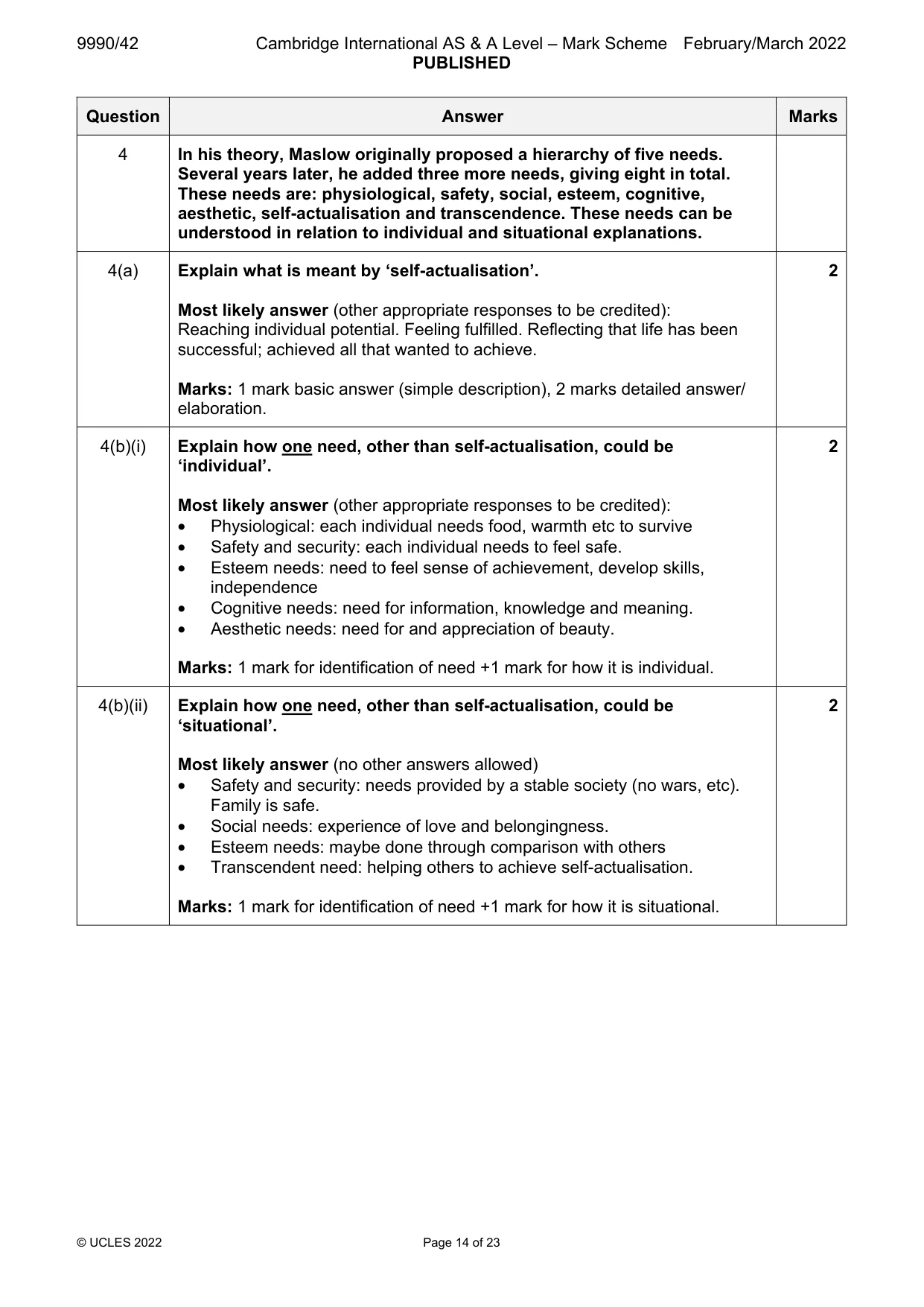
4 In his theory, Maslow originally proposed a hierarchy of five needs. Several years later, he added three more needs, giving eight in total. These needs are: physiological, safety, social, esteem, cognitive, aesthetic, self-actualisation and transcendence. These needs can be understood in relation to individual and situational explanations. (a) Explain what is meant by ‘self-actualisation’. [2] (b) (i) Explain how one need, other than self-actualisation, could be ‘individual’. [2] (ii) Explain how one need, other than self-actualisation, could be ‘situational’. [2] (c) Suggest why Alderfer’s ERG theory is more reductionist than Maslow’s theory. [4] (d) Discuss the advantages and disadvantages of using interviews to gather data on need theories of motivation. You should include a conclusion in your answer. [5]
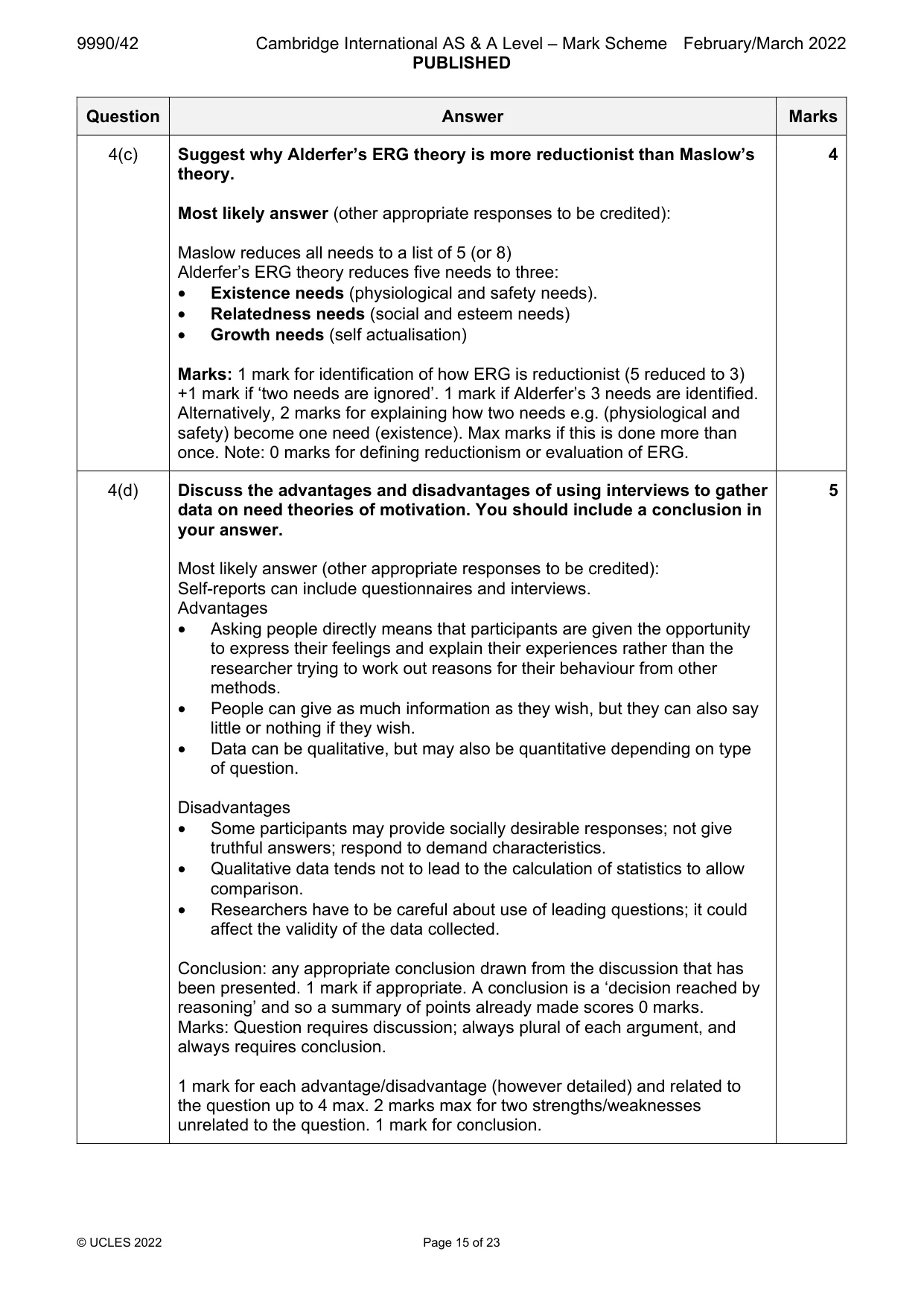
Mark scheme: 4 In his theory, Maslow originally proposed a hierarchy of five needs. Several years later, he added three more needs, giving eight in total. These needs are: physiological, safety, social, esteem, cognitive, aesthetic, self-actualisation and transcendence. These needs can be understood in relation to individual and situational explanations. 4(a) Explain what is meant by ‘self-actualisation’. 2 Most likely answer (other appropriate responses to be credited): Reaching individual potential. Feeling fulfilled. Reflecting that life has been successful; achieved all that wanted to achieve. Marks: 1 mark basic answer (simple description), 2 marks detailed answer/ elaboration. 4(b)(i) Explain how one need, other than self-actualisation, could be 2 ‘individual’. Most likely answer (other appropriate responses to be credited): • Physiological: each individual needs food, warmth etc to survive • Safety and security: each individual needs to feel safe. • Esteem needs: need to feel sense of achievement, develop skills, independence • Cognitive needs: need for information, knowledge and meaning. • Aesthetic needs: need for and appreciation of beauty. Marks: 1 mark for identification of need +1 mark for how it is individual. 4(b)(ii) Explain how one need, other than self-actualisation, could be 2 ‘situational’. Most likely answer (no other answers allowed) • Safety and security: needs provided by a stable society (no wars, etc). Family is safe. • Social needs: experience of love and belongingness. • Esteem needs: maybe done through comparison with others • Transcendent need: helping others to achieve self-actualisation. Marks: 1 mark for identification of need +1 mark for how it is situational. 4(c) Suggest why Alderfer’s ERG theory is more reductionist than Maslow’s 4 theory. Most likely answer (other appropriate responses to be credited): Maslow reduces all needs to a list of 5 (or 8) Alderfer’s ERG theory reduces five needs to three: • Existence needs (physiological and safety needs). • Relatedness needs (social and esteem needs) • Growth needs (self actualisation) Marks: 1 mark for identification of how ERG is reductionist (5 reduced to 3) +1 mark if ‘two needs are ignored’. 1 mark if Alderfer’s 3 needs are identified. Alternatively, 2 marks for explaining how two needs e.g. (physiological and safety) become one need (existence). Max marks if this is done more than once. Note: 0 marks for defining reductionism or evaluation of ERG. 4(d) Discuss the advantages and disadvantages of using interviews to gather 5 data on need theories of motivation. You should include a conclusion in your answer. Most likely answer (other appropriate responses to be credited): Self-reports can include questionnaires and interviews. Advantages • Asking people directly means that participants are given the opportunity to express their feelings and explain their experiences rather than the researcher trying to work out reasons for their behaviour from other methods. • People can give as much information as they wish, but they can also say little or nothing if they wish. • Data can be qualitative, but may also be quantitative depending on type of question. Disadvantages • Some participants may provide socially desirable responses; not give truthful answers; respond to demand characteristics. • Qualitative data tends not to lead to the calculation of statistics to allow comparison. • Researchers have to be careful about use of leading questions; it could affect the validity of the data collected. Conclusion: any appropriate conclusion drawn from the discussion that has been presented. 1 mark if appropriate. A conclusion is a ‘decision reached by reasoning’ and so a summary of points already made scores 0 marks. Marks: Question requires discussion; always plural of each argument, and always requires conclusion. 1 mark for each advantage/disadvantage (however detailed) and related to the question up to 4 max. 2 marks max for two strengths/weaknesses unrelated to the question. 1 mark for conclusion.
Q5 · Design a study to investigate gender differences in the effectiveness of imaginal…
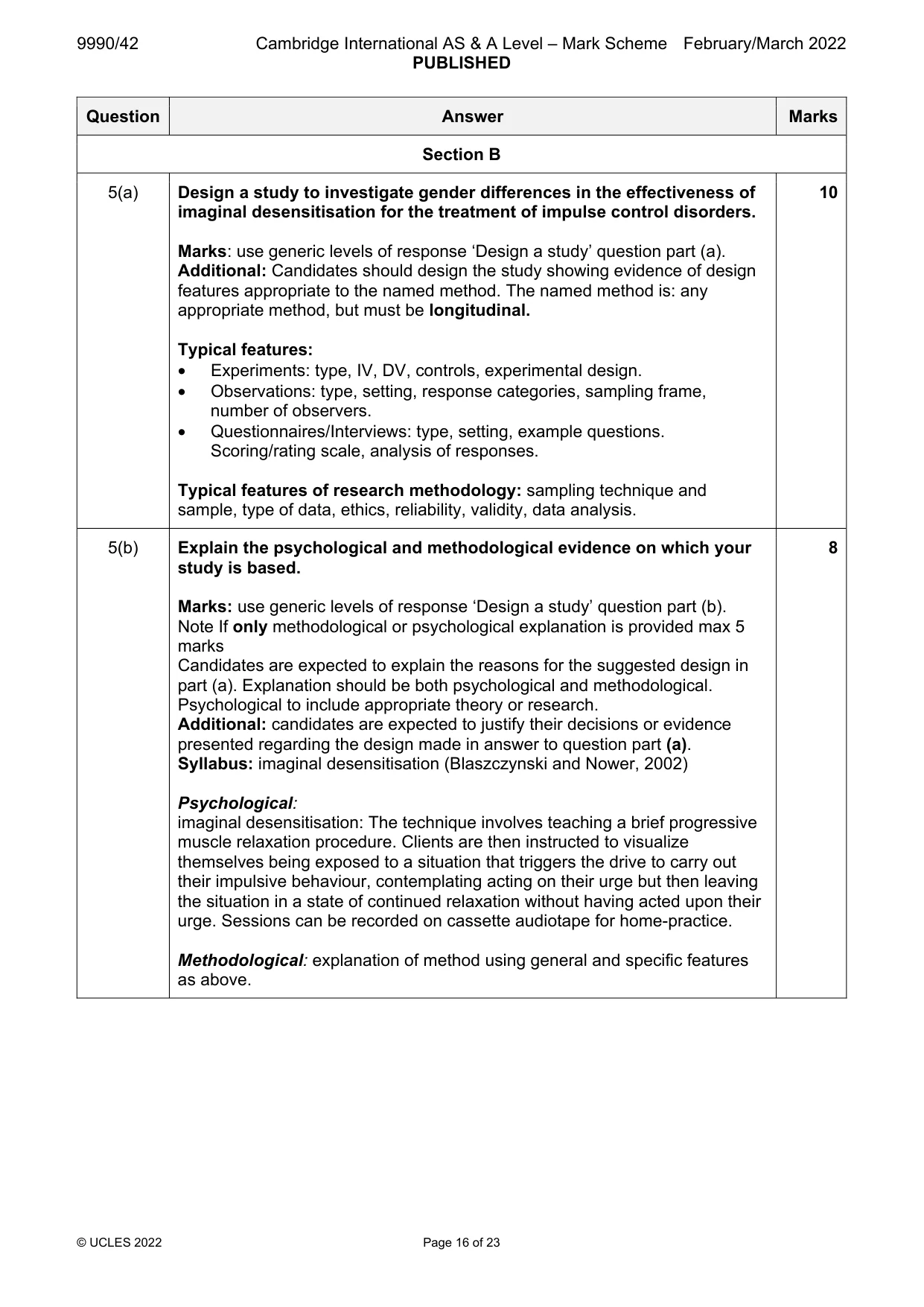
5 (a) Design a study to investigate gender differences in the effectiveness of imaginal desensitisation for the treatment of impulse control disorders. [10] (b) Explain the psychological and methodological evidence on which your study is based. [8] Psychology and consumer behaviour
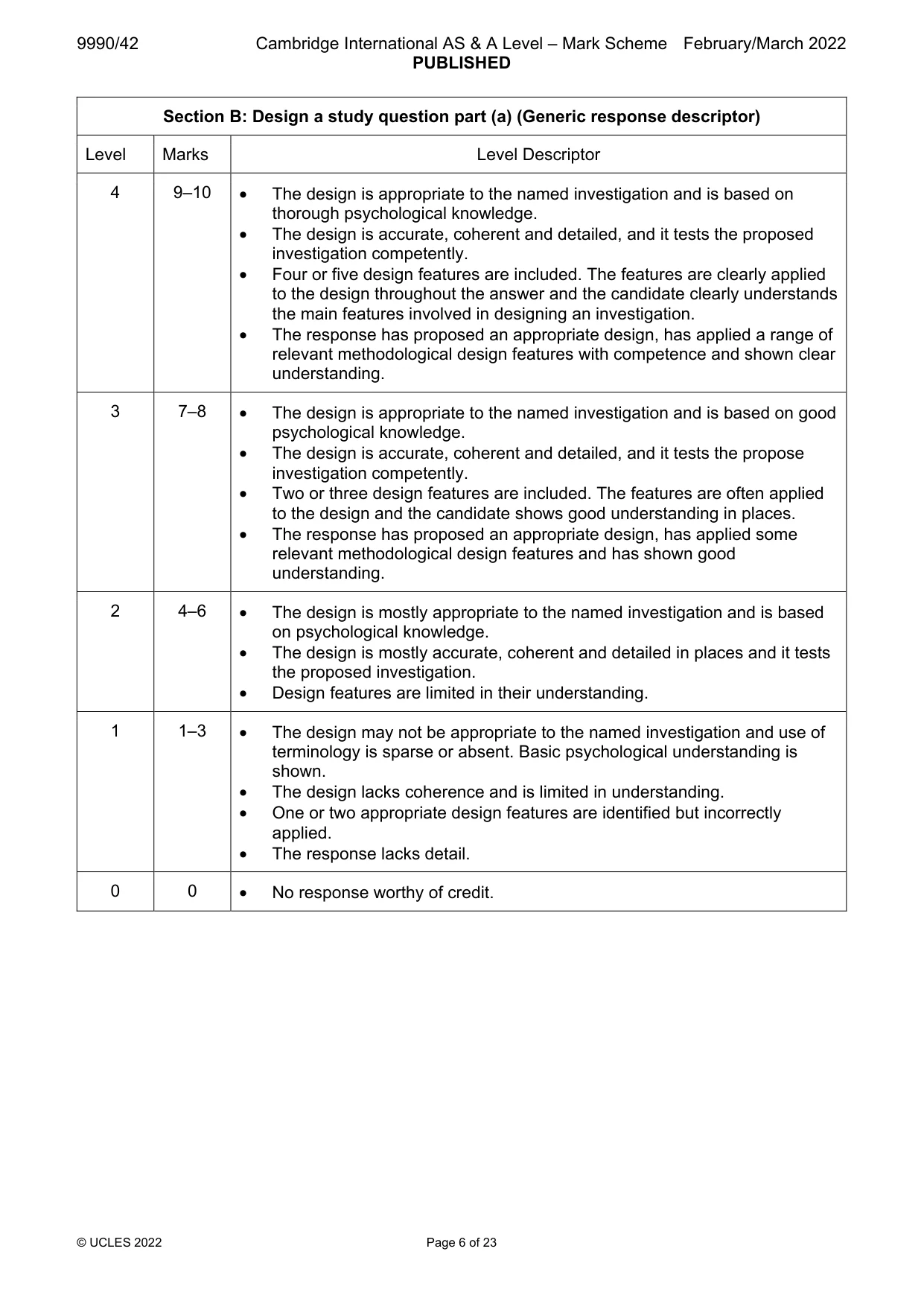
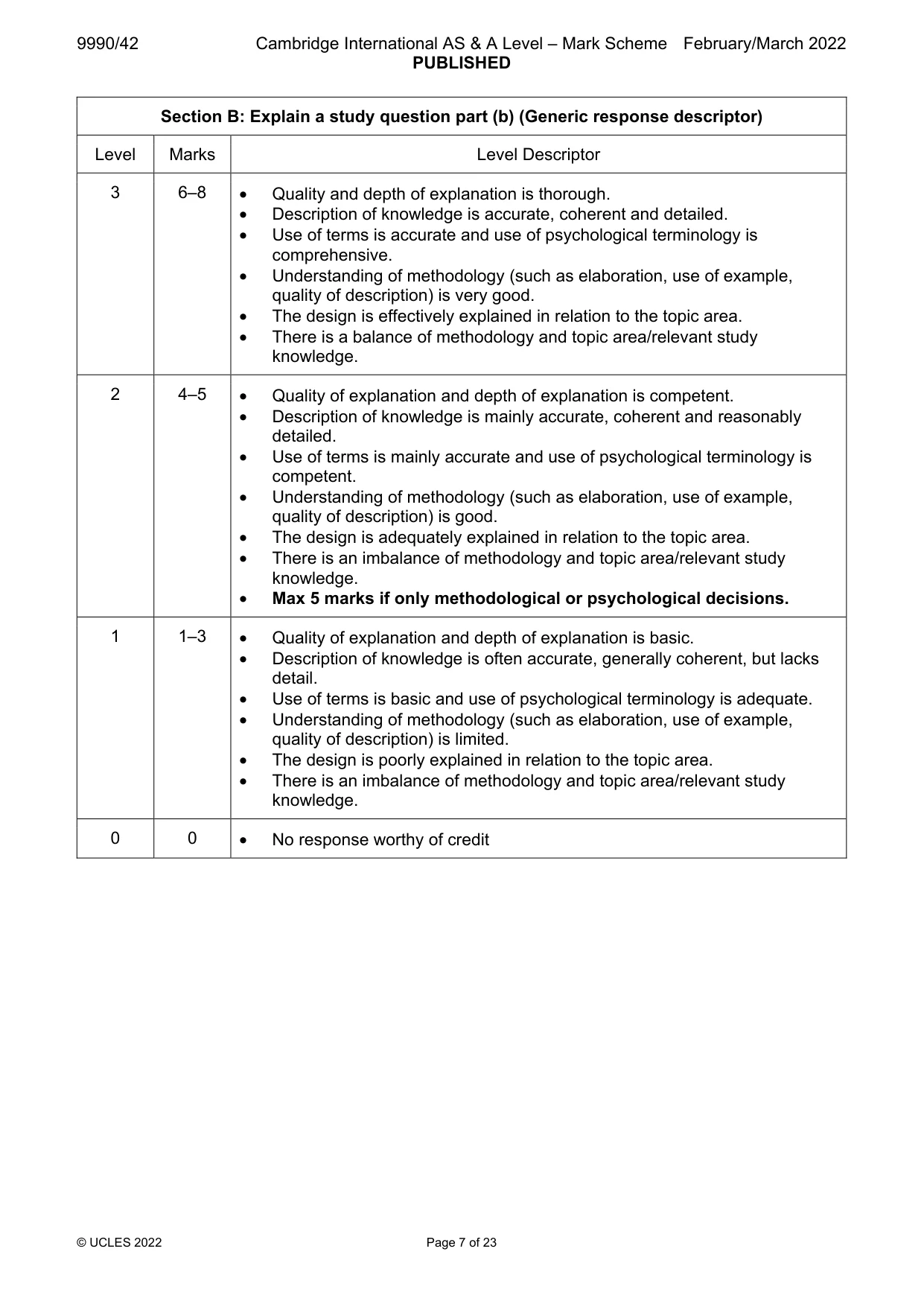
Mark scheme: 5(a) Design a study to investigate gender differences in the effectiveness of 10 imaginal desensitisation for the treatment of impulse control disorders. Marks: use generic levels of response ‘Design a study’ question part (a). Additional: Candidates should design the study showing evidence of design features appropriate to the named method. The named method is: any appropriate method, but must be longitudinal. Typical features: • Experiments: type, IV, DV, controls, experimental design. • Observations: type, setting, response categories, sampling frame, number of observers. • Questionnaires/Interviews: type, setting, example questions. Scoring/rating scale, analysis of responses. Typical features of research methodology: sampling technique and sample, type of data, ethics, reliability, validity, data analysis. 5(b) Explain the psychological and methodological evidence on which your 8 study is based. Marks: use generic levels of response ‘Design a study’ question part (b). Note If only methodological or psychological explanation is provided max 5 marks Candidates are expected to explain the reasons for the suggested design in part (a). Explanation should be both psychological and methodological. Psychological to include appropriate theory or research. Additional: candidates are expected to justify their decisions or evidence presented regarding the design made in answer to question part (a). Syllabus: imaginal desensitisation (Blaszczynski and Nower, 2002) Psychological: imaginal desensitisation: The technique involves teaching a brief progressive muscle relaxation procedure. Clients are then instructed to visualize themselves being exposed to a situation that triggers the drive to carry out their impulsive behaviour, contemplating acting on their urge but then leaving the situation in a state of continued relaxation without having acted upon their urge. Sessions can be recorded on cassette audiotape for home-practice. Methodological: explanation of method using general and specific features as above.
Q6 · Consumers may not buy what they plan to buy
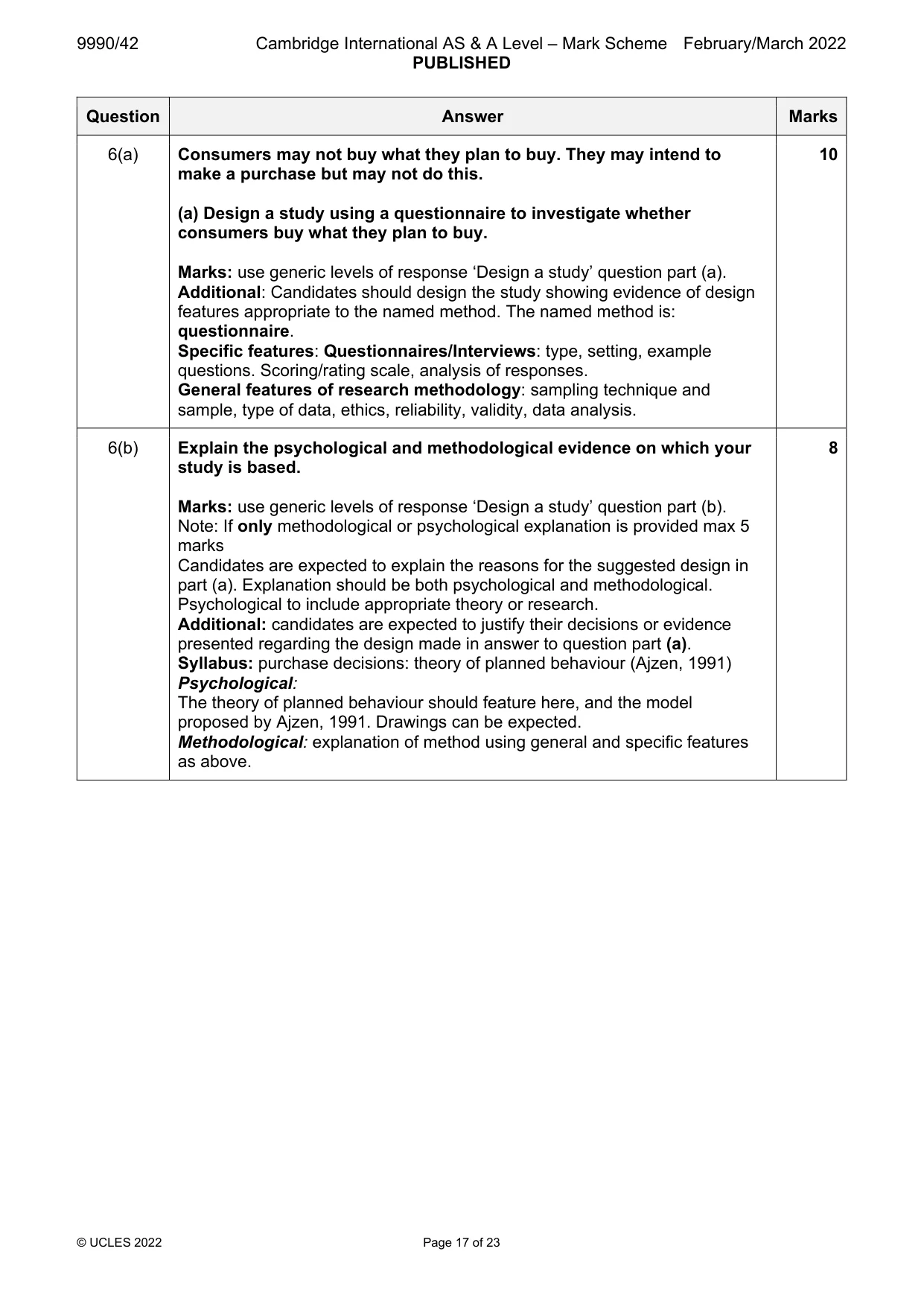
6 Consumers may not buy what they plan to buy. They may intend to make a purchase but may not do this. (a) Design a study using a questionnaire to investigate whether consumers buy what they plan to buy. [10] (b) Explain the psychological and methodological evidence on which your study is based. [8] Psychology and health
Mark scheme: 6(a) Consumers may not buy what they plan to buy. They may intend to 10 make a purchase but may not do this. (a) Design a study using a questionnaire to investigate whether consumers buy what they plan to buy. Marks: use generic levels of response ‘Design a study’ question part (a). Additional: Candidates should design the study showing evidence of design features appropriate to the named method. The named method is: questionnaire. Specific features: Questionnaires/Interviews: type, setting, example questions. Scoring/rating scale, analysis of responses. General features of research methodology: sampling technique and sample, type of data, ethics, reliability, validity, data analysis. 6(b) Explain the psychological and methodological evidence on which your 8 study is based. Marks: use generic levels of response ‘Design a study’ question part (b). Note: If only methodological or psychological explanation is provided max 5 marks Candidates are expected to explain the reasons for the suggested design in part (a). Explanation should be both psychological and methodological. Psychological to include appropriate theory or research. Additional: candidates are expected to justify their decisions or evidence presented regarding the design made in answer to question part (a). Syllabus: purchase decisions: theory of planned behaviour (Ajzen, 1991) Psychological: The theory of planned behaviour should feature here, and the model proposed by Ajzen, 1991. Drawings can be expected. Methodological: explanation of method using general and specific features as above.
Q7 · Design an experiment to investigate the effectiveness of biofeedback in the management of…
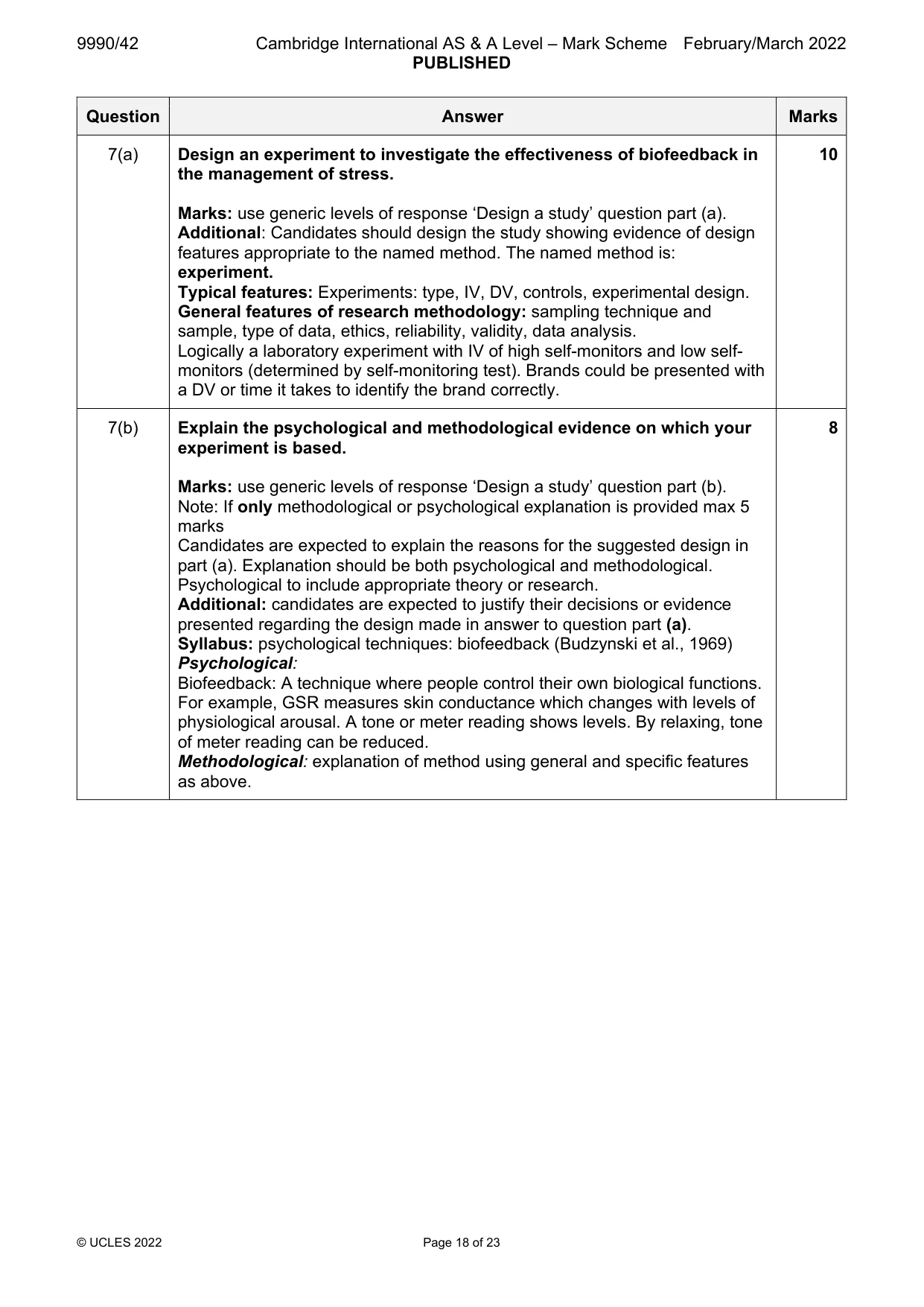
7 (a) Design an experiment to investigate the effectiveness of biofeedback in the management of stress. [10] (b) Explain the psychological and methodological evidence on which your experiment is based. [8] Psychology and organisations
Mark scheme: 7(a) Design an experiment to investigate the effectiveness of biofeedback in 10 the management of stress. Marks: use generic levels of response ‘Design a study’ question part (a). Additional: Candidates should design the study showing evidence of design features appropriate to the named method. The named method is: experiment. Typical features: Experiments: type, IV, DV, controls, experimental design. General features of research methodology: sampling technique and sample, type of data, ethics, reliability, validity, data analysis. Logically a laboratory experiment with IV of high self-monitors and low self- monitors (determined by self-monitoring test). Brands could be presented with a DV or time it takes to identify the brand correctly. 7(b) Explain the psychological and methodological evidence on which your 8 experiment is based. Marks: use generic levels of response ‘Design a study’ question part (b). Note: If only methodological or psychological explanation is provided max 5 marks Candidates are expected to explain the reasons for the suggested design in part (a). Explanation should be both psychological and methodological. Psychological to include appropriate theory or research. Additional: candidates are expected to justify their decisions or evidence presented regarding the design made in answer to question part (a). Syllabus: psychological techniques: biofeedback (Budzynski et al., 1969) Psychological: Biofeedback: A technique where people control their own biological functions. For example, GSR measures skin conductance which changes with levels of physiological arousal. A tone or meter reading shows levels. By relaxing, tone of meter reading can be reduced. Methodological: explanation of method using general and specific features as above.
Q8 · Design a study using a questionnaire to investigate the effectiveness of adaptive…
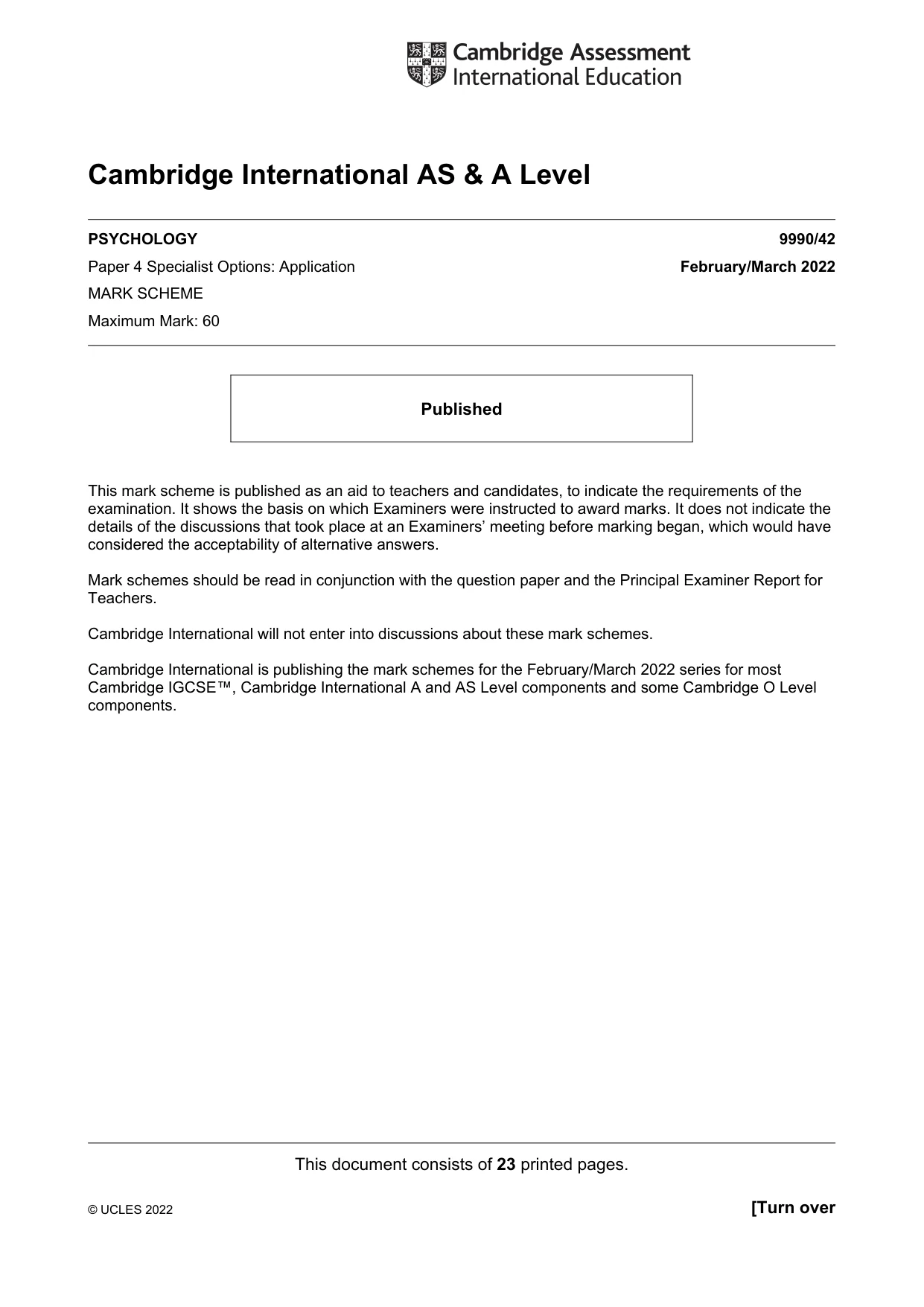
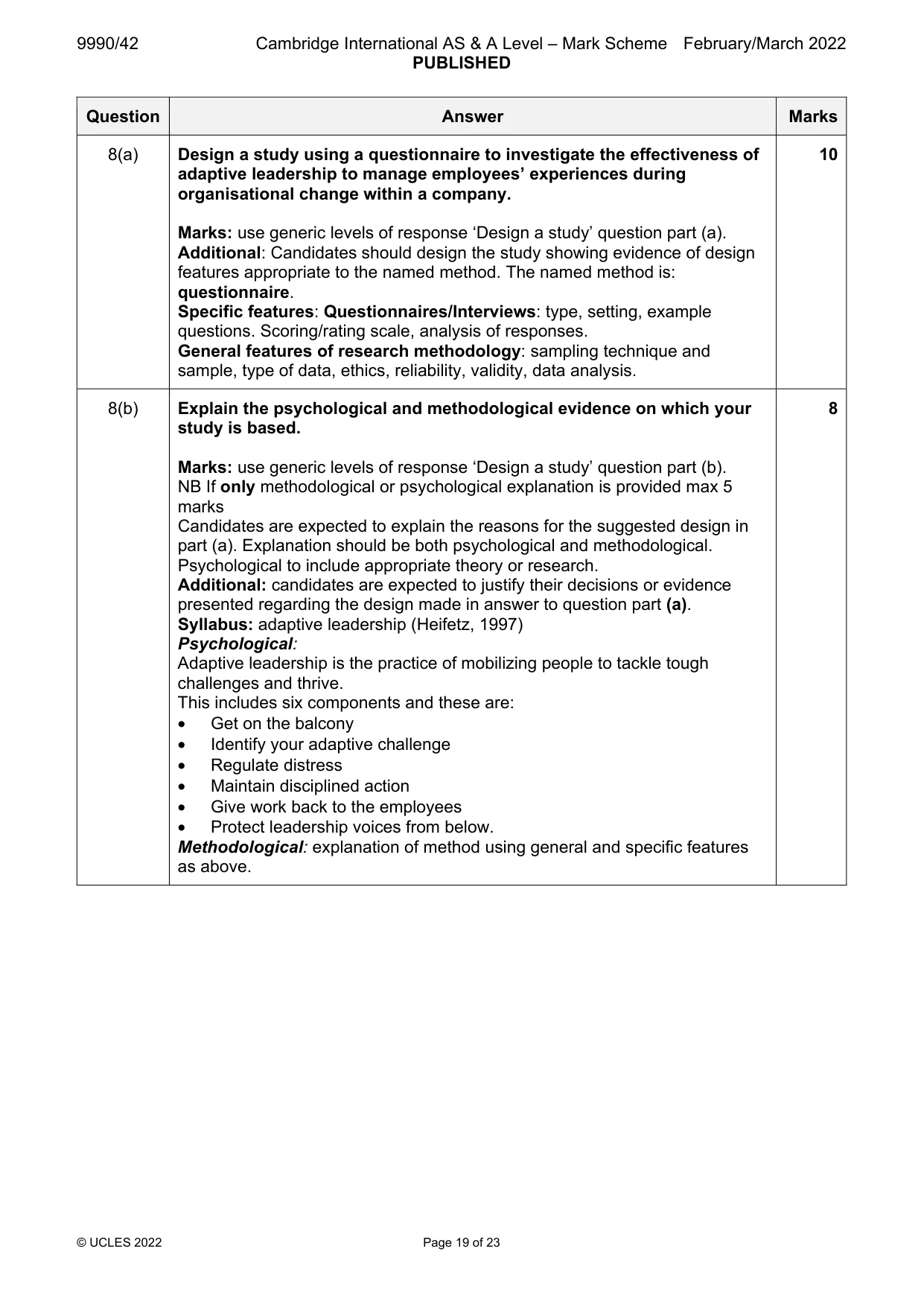
8 (a) Design a study using a questionnaire to investigate the effectiveness of adaptive leadership to manage employees’ experiences during organisational change within a company. [10] (b) Explain the psychological and methodological evidence on which your study is based. [8] Section C You must answer one question from this section. Psychology and abnormality
Mark scheme: 8(a) Design a study using a questionnaire to investigate the effectiveness of 10 adaptive leadership to manage employees’ experiences during organisational change within a company. Marks: use generic levels of response ‘Design a study’ question part (a). Additional: Candidates should design the study showing evidence of design features appropriate to the named method. The named method is: questionnaire. Specific features: Questionnaires/Interviews: type, setting, example questions. Scoring/rating scale, analysis of responses. General features of research methodology: sampling technique and sample, type of data, ethics, reliability, validity, data analysis. 8(b) Explain the psychological and methodological evidence on which your 8 study is based. Marks: use generic levels of response ‘Design a study’ question part (b). NB If only methodological or psychological explanation is provided max 5 marks Candidates are expected to explain the reasons for the suggested design in part (a). Explanation should be both psychological and methodological. Psychological to include appropriate theory or research. Additional: candidates are expected to justify their decisions or evidence presented regarding the design made in answer to question part (a). Syllabus: adaptive leadership (Heifetz, 1997) Psychological: Adaptive leadership is the practice of mobilizing people to tackle tough challenges and thrive. This includes six components and these are: • Get on the balcony • Identify your adaptive challenge • Regulate distress • Maintain disciplined action • Give work back to the employees • Protect leadership voices from below. Methodological: explanation of method using general and specific features as above.
Q9 · ‘Behavioural explanations of impulse control disorders are too reductionist to be…
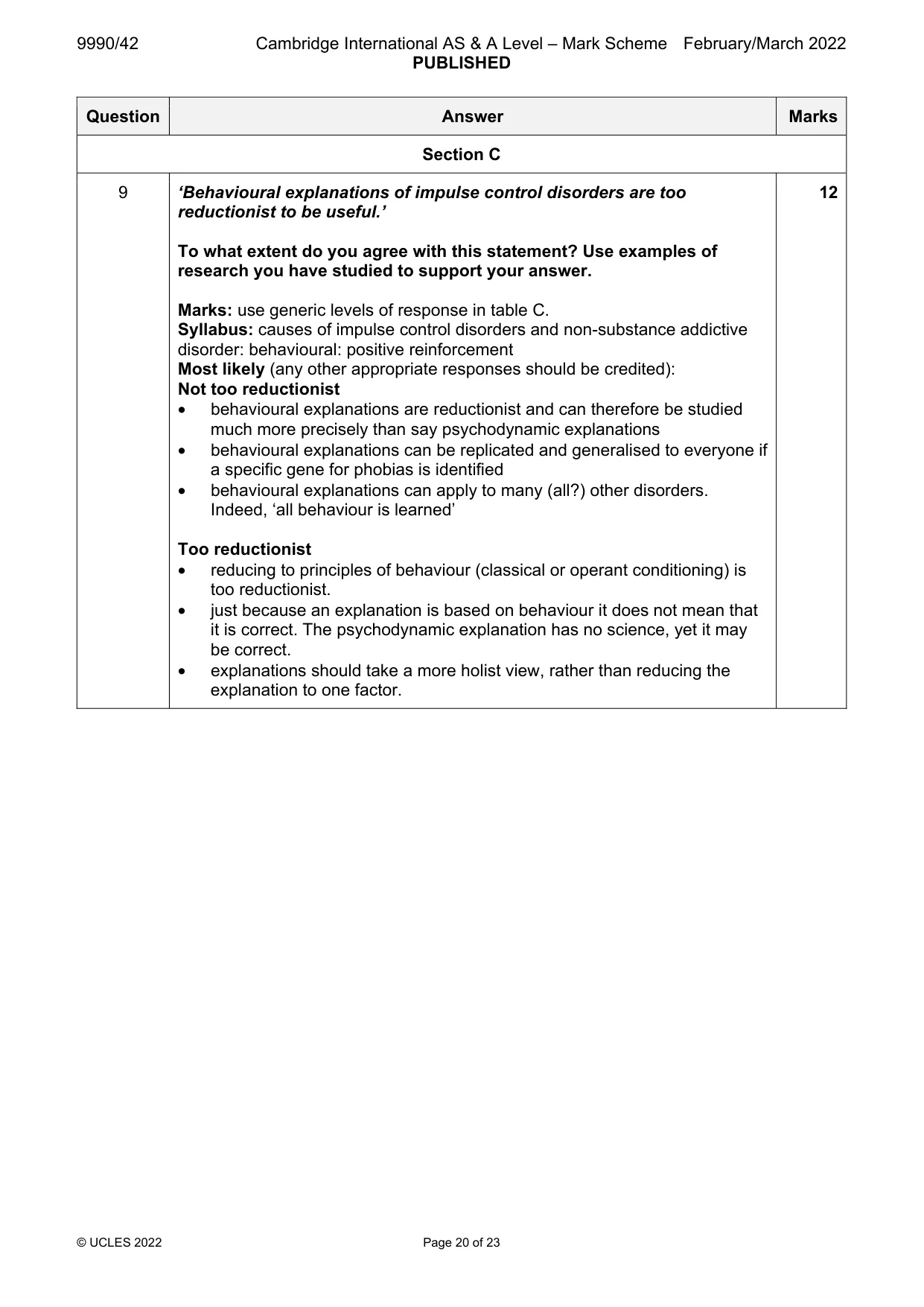
9 ‘Behavioural explanations of impulse control disorders are too reductionist to be useful.’ To what extent do you agree with this statement? Use examples of research you have studied to support your answer. [12] Psychology and consumer behaviour
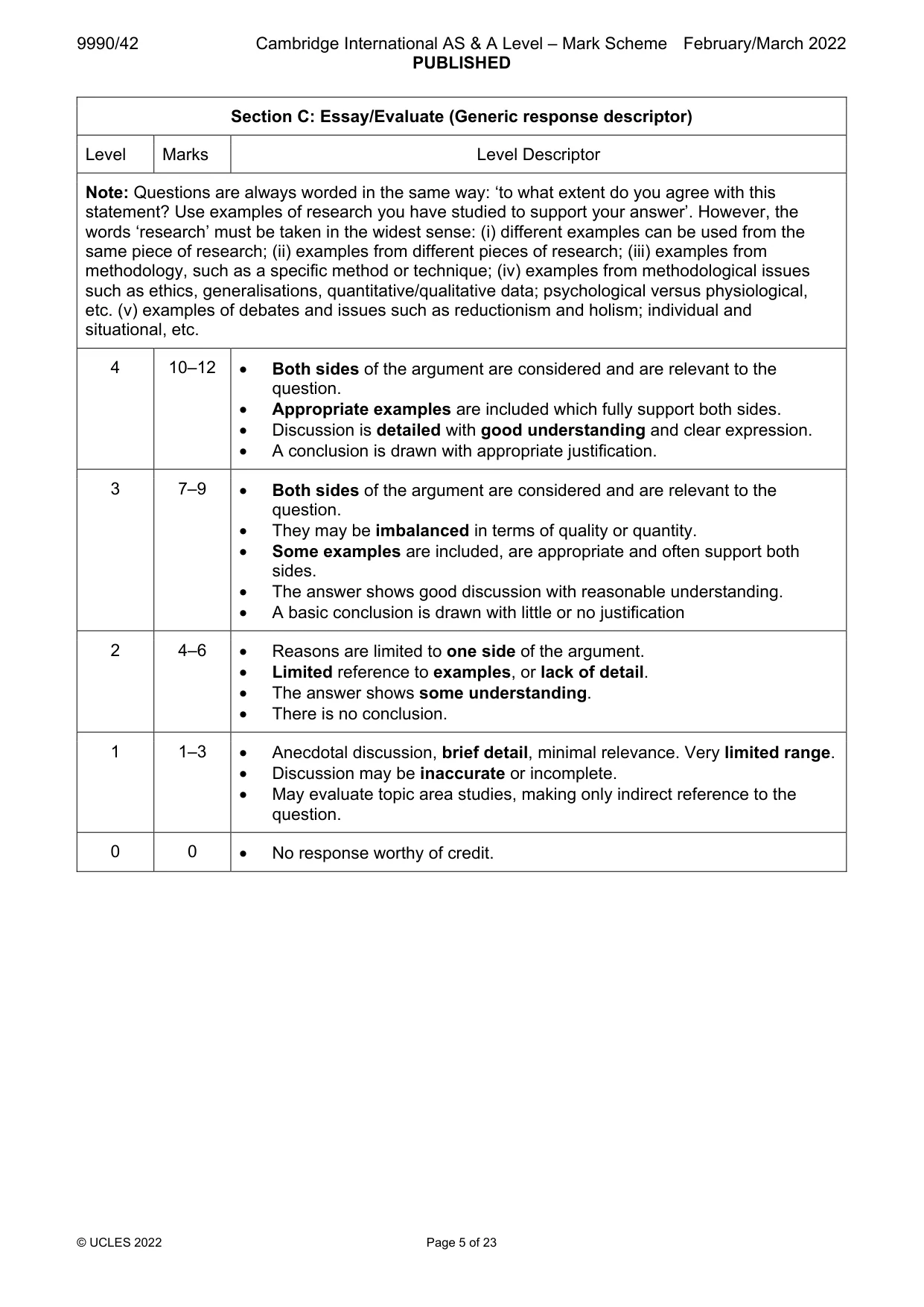
Mark scheme: 9 ‘Behavioural explanations of impulse control disorders are too 12 reductionist to be useful.’ To what extent do you agree with this statement? Use examples of research you have studied to support your answer. Marks: use generic levels of response in table C. Syllabus: causes of impulse control disorders and non-substance addictive disorder: behavioural: positive reinforcement Most likely (any other appropriate responses should be credited): Not too reductionist • behavioural explanations are reductionist and can therefore be studied much more precisely than say psychodynamic explanations • behavioural explanations can be replicated and generalised to everyone if a specific gene for phobias is identified • behavioural explanations can apply to many (all?) other disorders. Indeed, ‘all behaviour is learned’ Too reductionist • reducing to principles of behaviour (classical or operant conditioning) is too reductionist. • just because an explanation is based on behaviour it does not mean that it is correct. The psychodynamic explanation has no science, yet it may be correct. • explanations should take a more holist view, rather than reducing the explanation to one factor.
Q10 · ‘If playing one type of music in one restaurant increases the amount of money spent, this…
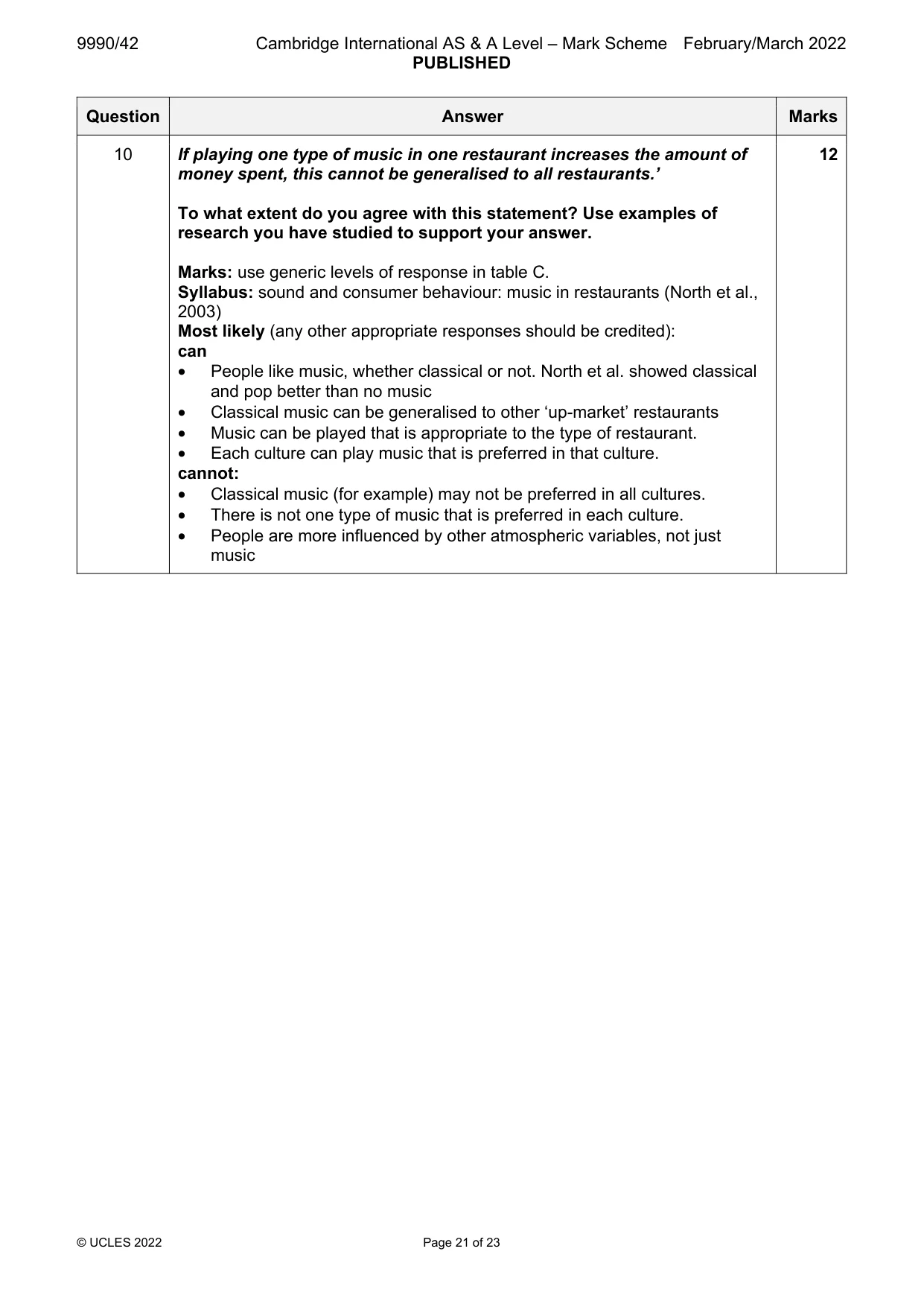
10 ‘If playing one type of music in one restaurant increases the amount of money spent, this cannot be generalised to all restaurants.’ To what extent do you agree with this statement? Use examples of research you have studied to support your answer. [12] Psychology and health
Mark scheme: 10 If playing one type of music in one restaurant increases the amount of 12 money spent, this cannot be generalised to all restaurants.’ To what extent do you agree with this statement? Use examples of research you have studied to support your answer. Marks: use generic levels of response in table C. Syllabus: sound and consumer behaviour: music in restaurants (North et al., 2003) Most likely (any other appropriate responses should be credited): can • People like music, whether classical or not. North et al. showed classical and pop better than no music • Classical music can be generalised to other ‘up-market’ restaurants • Music can be played that is appropriate to the type of restaurant. • Each culture can play music that is preferred in that culture. cannot: • Classical music (for example) may not be preferred in all cultures. • There is not one type of music that is preferred in each culture. • People are more influenced by other atmospheric variables, not just music
Q11 · ‘A questionnaire is the only way that unrealistic optimism can be assessed.’ To what…
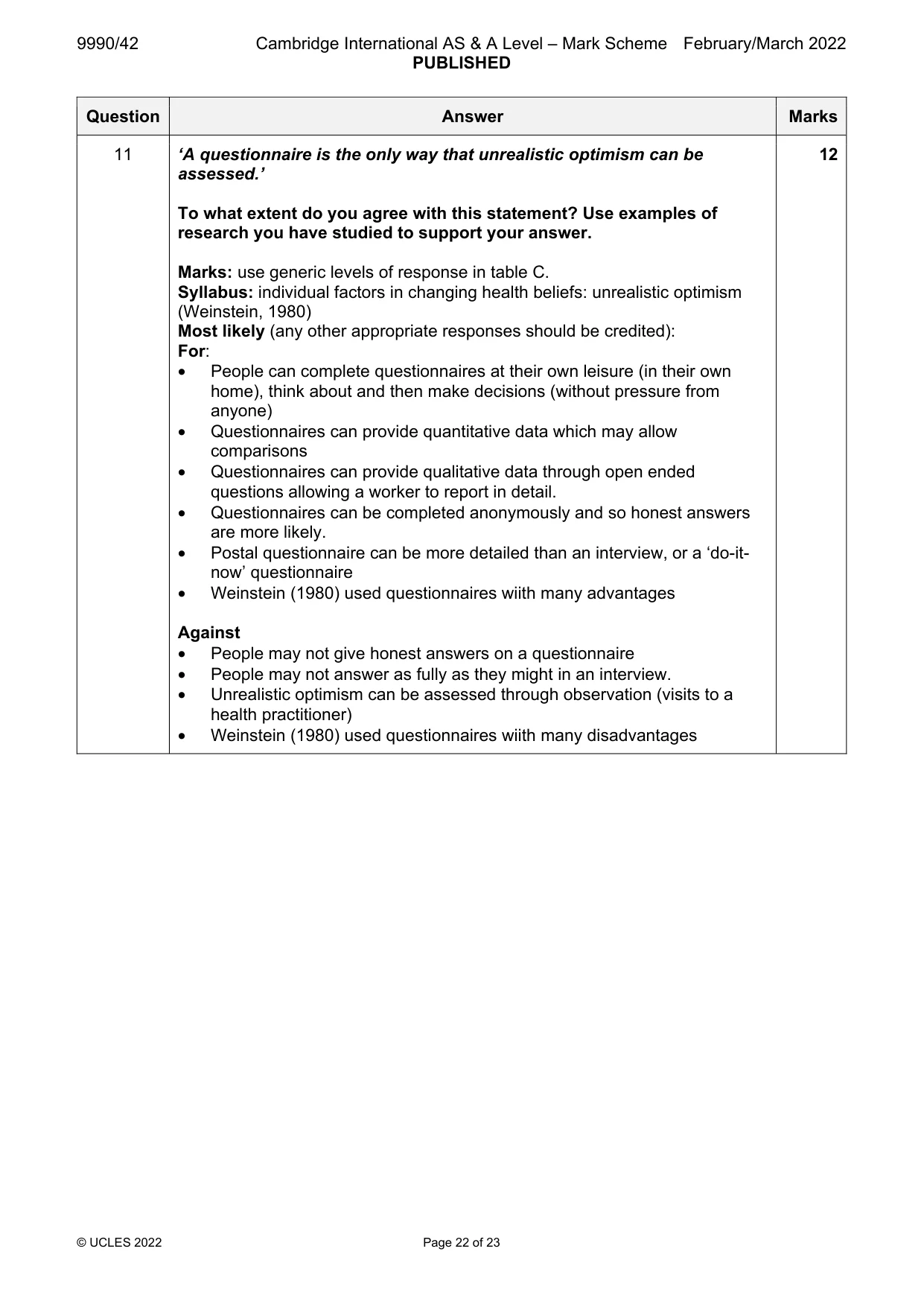
11 ‘A questionnaire is the only way that unrealistic optimism can be assessed.’ To what extent do you agree with this statement? Use examples of research you have studied to support your answer. [12] Psychology and organisations
Mark scheme: 11 ‘A questionnaire is the only way that unrealistic optimism can be 12 assessed.’ To what extent do you agree with this statement? Use examples of research you have studied to support your answer. Marks: use generic levels of response in table C. Syllabus: individual factors in changing health beliefs: unrealistic optimism (Weinstein, 1980) Most likely (any other appropriate responses should be credited): For: • People can complete questionnaires at their own leisure (in their own home), think about and then make decisions (without pressure from anyone) • Questionnaires can provide quantitative data which may allow comparisons • Questionnaires can provide qualitative data through open ended questions allowing a worker to report in detail. • Questionnaires can be completed anonymously and so honest answers are more likely. • Postal questionnaire can be more detailed than an interview, or a ‘do-it- now’ questionnaire • Weinstein (1980) used questionnaires wiith many advantages Against • People may not give honest answers on a questionnaire • People may not answer as fully as they might in an interview. • Unrealistic optimism can be assessed through observation (visits to a health practitioner) • Weinstein (1980) used questionnaires wiith many disadvantages
Q12 · ‘Situational leadership is no longer relevant
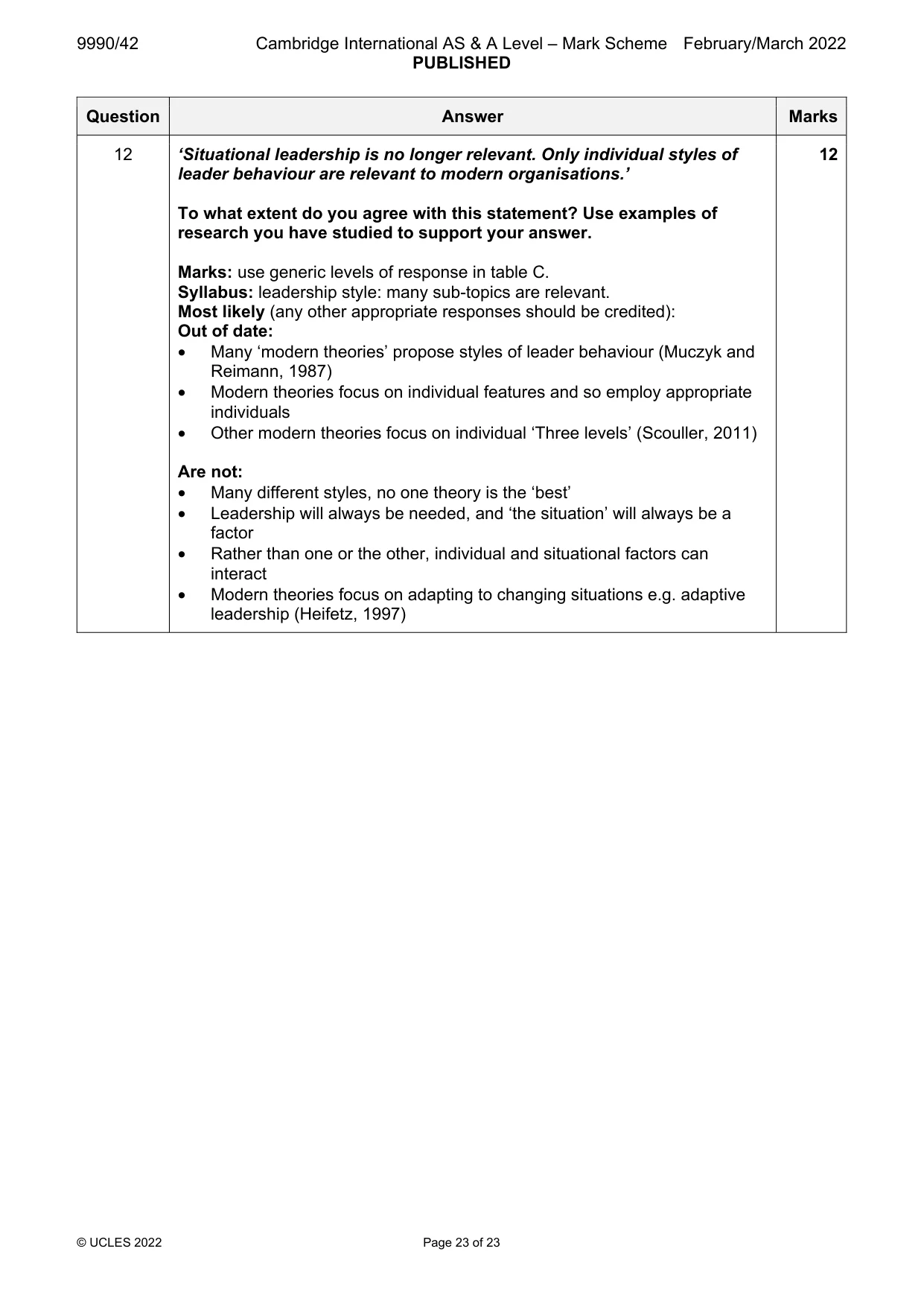
12 ‘Situational leadership is no longer relevant. Only individual styles of leader behaviour are relevant to modern organisations.’ To what extent do you agree with this statement? Use examples of research you have studied to support your answer. [12]
Mark scheme: 12 ‘Situational leadership is no longer relevant. Only individual styles of 12 leader behaviour are relevant to modern organisations.’ To what extent do you agree with this statement? Use examples of research you have studied to support your answer. Marks: use generic levels of response in table C. Syllabus: leadership style: many sub-topics are relevant. Most likely (any other appropriate responses should be credited): Out of date: • Many ‘modern theories’ propose styles of leader behaviour (Muczyk and Reimann, 1987) • Modern theories focus on individual features and so employ appropriate individuals • Other modern theories focus on individual ‘Three levels’ (Scouller, 2011) Are not: • Many different styles, no one theory is the ‘best’ • Leadership will always be needed, and ‘the situation’ will always be a factor • Rather than one or the other, individual and situational factors can interact • Modern theories focus on adapting to changing situations e.g. adaptive leadership (Heifetz, 1997)
What was in this paper
The subtopics covered by these 12 questions, and how many questions each got. Open one in a new tab to see every Cambridge question on it.
What you needed in this session
Cambridge’s own grade thresholds for 2022 Feb/March, Paper 4 · Variant 2. A higher threshold means an easier paper — the bar moves with how the cohort did.