Cambridge A Level Psychology (from 2018) 9990 — 2022 May/June Paper 4 · Variant 3
9990/43/M/J/22 · 12 questions · 60 marks · ≈68 min
The question paper and its mark scheme, free to read here and free to download. This is Cambridge’s own paper, exactly as it was sat.
Question paper8 pages



Mark scheme18 pages
Answers below. Sit the paper first if you are practising.
Questions as text
Q1 · In a case study by Glover, a 56-year-old married woman who had been shoplifting every day…
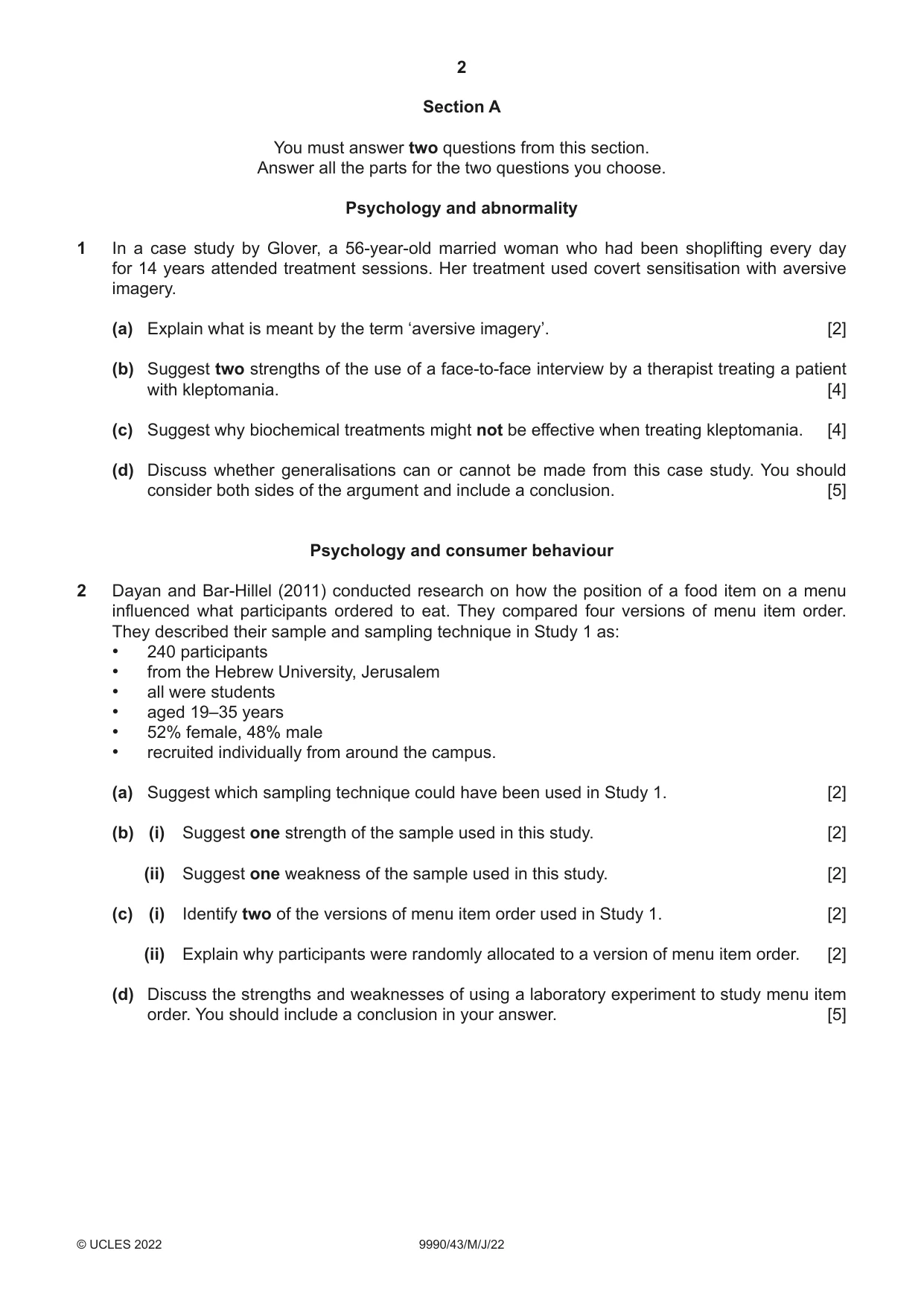
1 In a case study by Glover, a 56-year-old married woman who had been shoplifting every day for 14 years attended treatment sessions. Her treatment used covert sensitisation with aversive imagery. (a) Explain what is meant by the term ‘aversive imagery’. [2] (b) Suggest two strengths of the use of a face-to-face interview by a therapist treating a patient with kleptomania. [4] (c) Suggest why biochemical treatments might not be effective when treating kleptomania. [4] (d) Discuss whether generalisations can or cannot be made from this case study. You should consider both sides of the argument and include a conclusion. [5] Psychology and consumer behaviour
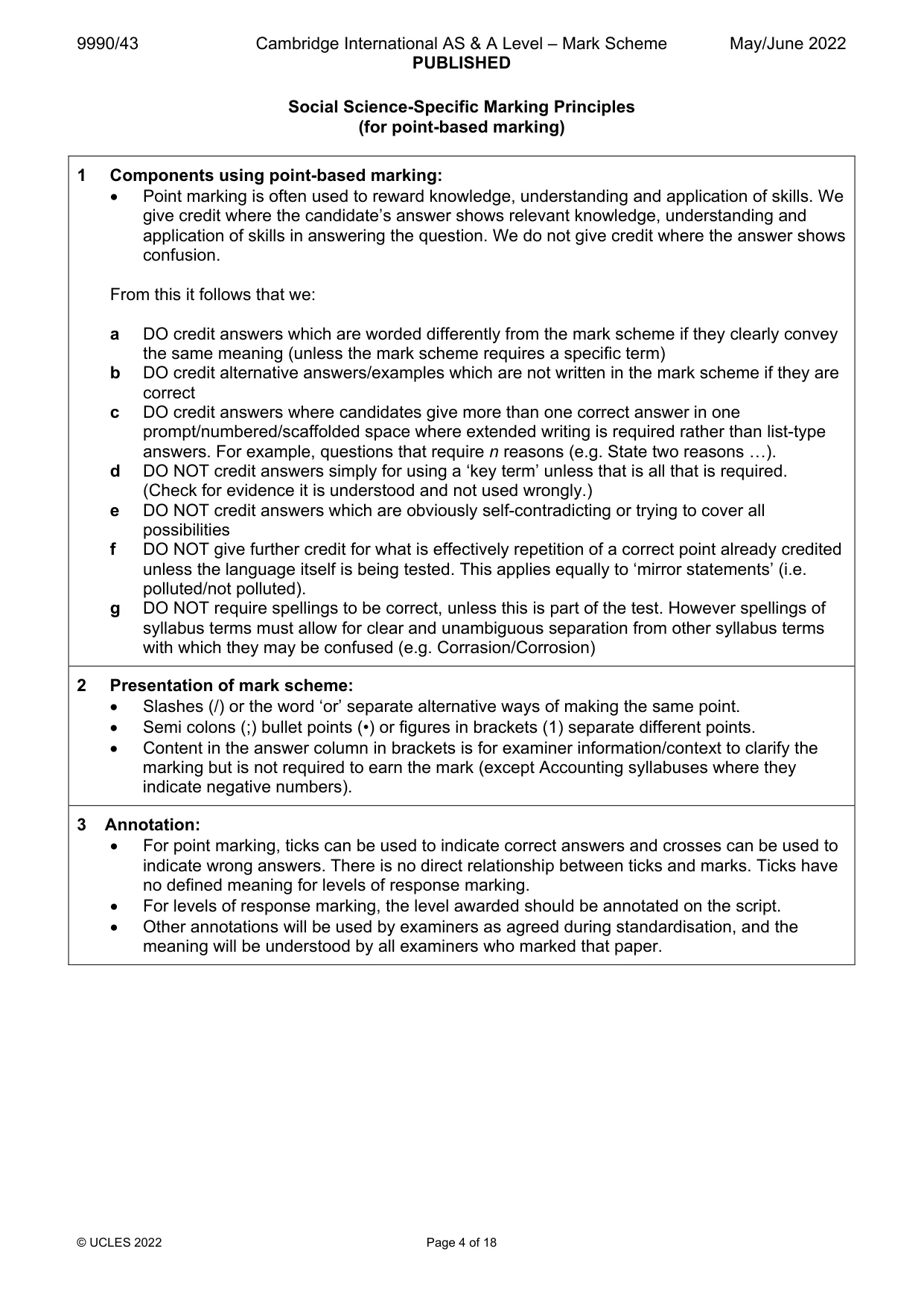
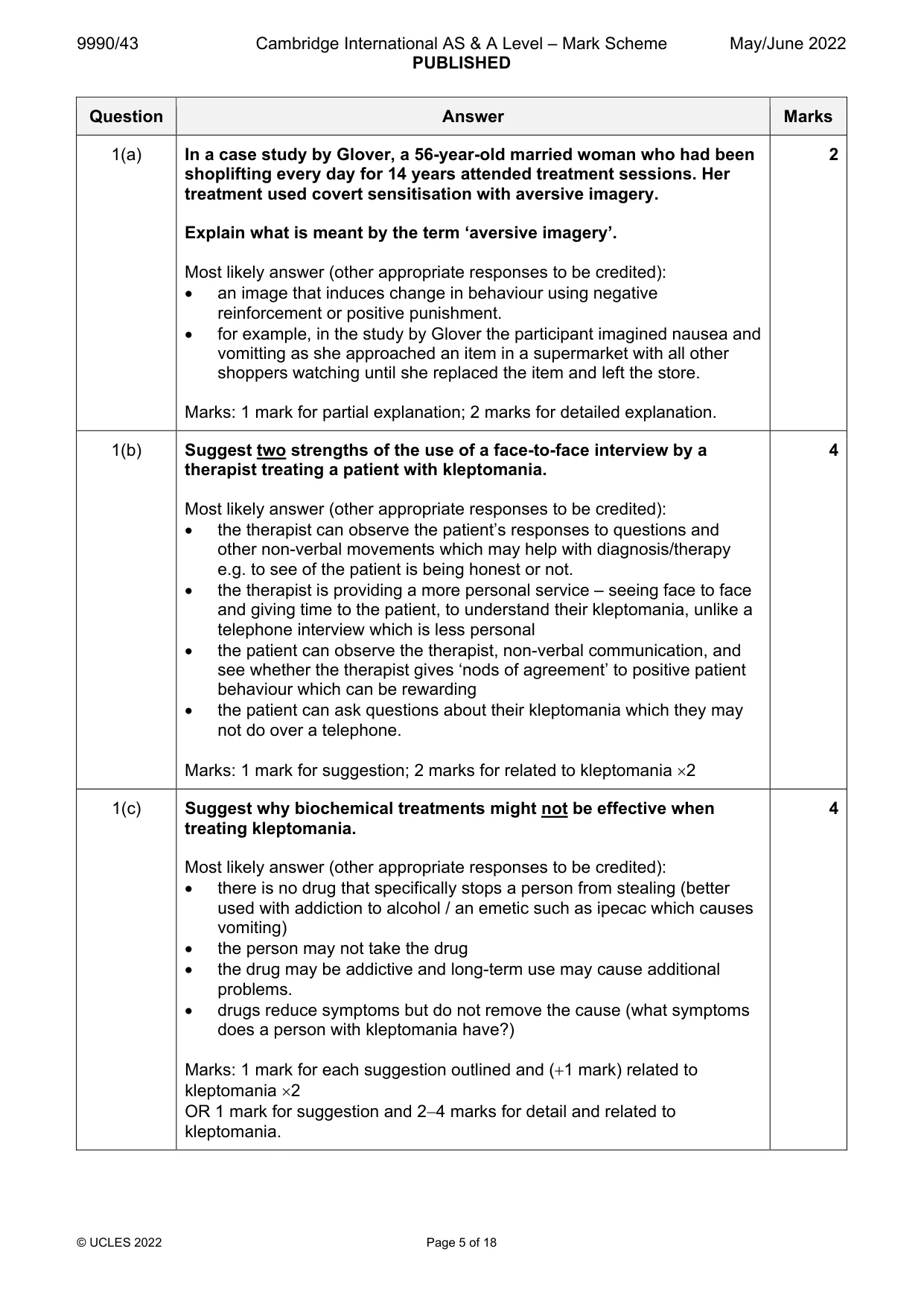
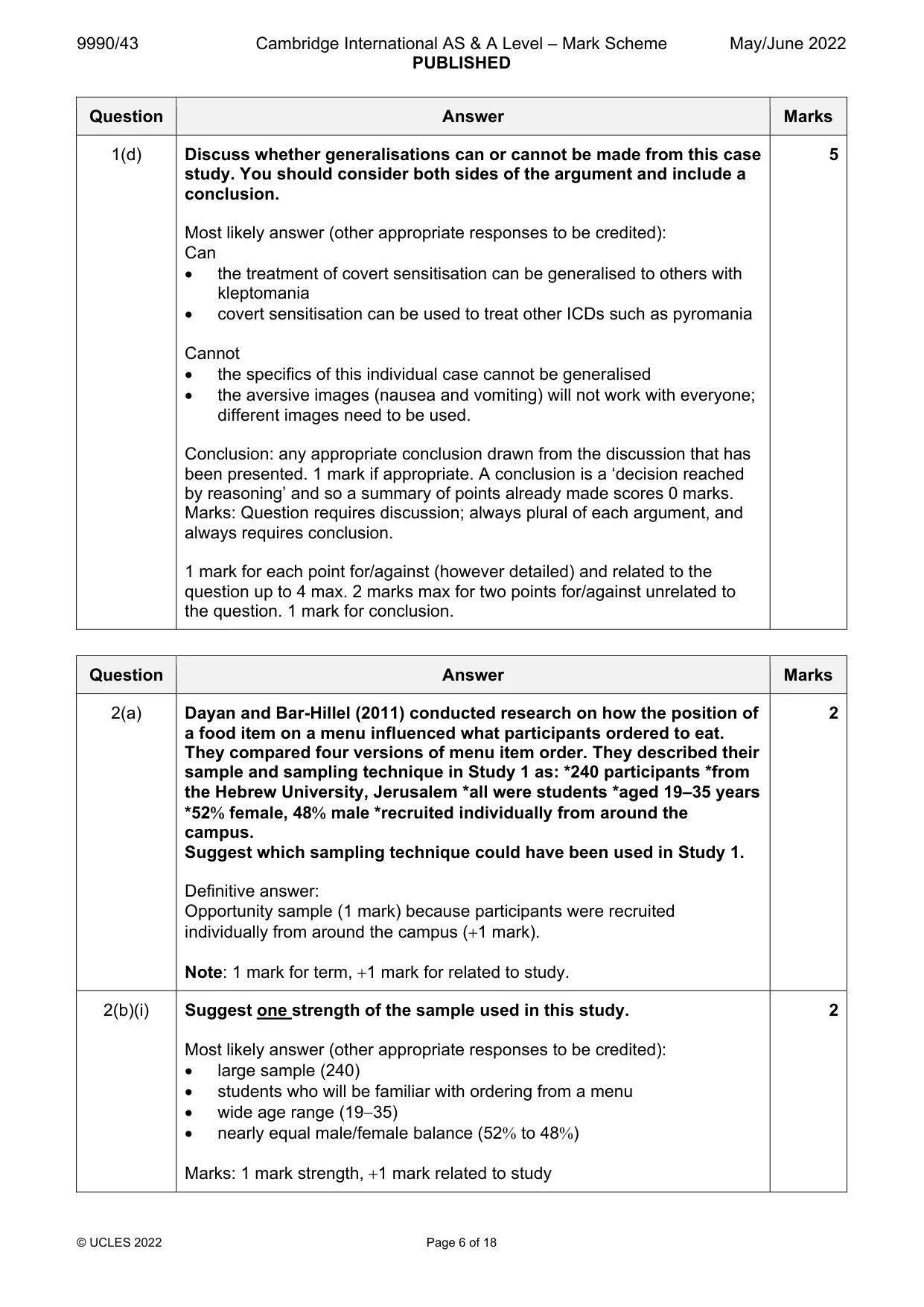
Mark scheme: Question Answer Marks 1(a) In a case study by Glover, a 56-year-old married woman who had been 2 shoplifting every day for 14 years attended treatment sessions. Her treatment used covert sensitisation with aversive imagery. Explain what is meant by the term ‘aversive imagery’. Most likely answer (other appropriate responses to be credited): an image that induces change in behaviour using negative reinforcement or positive punishment. for example, in the study by Glover the participant imagined nausea and vomitting as she approached an item in a supermarket with all other shoppers watching until she replaced the item and left the store. Marks: 1 mark for partial explanation; 2 marks for detailed explanation. 1(b) Suggest two strengths of the use of a face-to-face interview by a 4 therapist treating a patient with kleptomania. Most likely answer (other appropriate responses to be credited): the therapist can observe the patient’s responses to questions and other non-verbal movements which may help with diagnosis/therapy e.g. to see of the patient is being honest or not. the therapist is providing a more personal service – seeing face to face and giving time to the patient, to understand their kleptomania, unlike a telephone interview which is less personal the patient can observe the therapist, non-verbal communication, and see whether the therapist gives ‘nods of agreement’ to positive patient behaviour which can be rewarding the patient can ask questions about their kleptomania which they may not do over a telephone. Marks: 1 mark for suggestion; 2 marks for related to kleptomania 2 1(c) Suggest why biochemical treatments might not be effective when 4 treating kleptomania. Most likely answer (other appropriate responses to be credited): there is no drug that specifically stops a person from stealing (better used with addiction to alcohol / an emetic such as ipecac which causes vomiting) the person may not take the drug the drug may be addictive and long-term use may cause additional problems. drugs reduce symptoms but do not remove the cause (what symptoms does a person with kleptomania have?) Marks: 1 mark for each suggestion outlined and (1 mark) related to kleptomania 2 OR 1 mark for suggestion and 24 marks for detail and related to kleptomania. 1(d) Discuss whether generalisations can or cannot be made from this case 5 study. You should consider both sides of the argument and include a conclusion. Most likely answer (other appropriate responses to be credited): Can the treatment of covert sensitisation can be generalised to others with kleptomania covert sensitisation can be used to treat other ICDs such as pyromania Cannot the specifics of this individual case cannot be generalised the aversive images (nausea and vomiting) will not work with everyone; different images need to be used. Conclusion: any appropriate conclusion drawn from the discussion that has been presented. 1 mark if appropriate. A conclusion is a ‘decision reached by reasoning’ and so a summary of points already made scores 0 marks. Marks: Question requires discussion; always plural of each argument, and always requires conclusion. 1 mark for each point for/against (however detailed) and related to the question up to 4 max. 2 marks max for two points for/against unrelated to the question. 1 mark for conclusion.
Q2 · Dayan and Bar-Hillel (2011) conducted research on how the position of a food item on a…
2 Dayan and Bar-Hillel (2011) conducted research on how the position of a food item on a menu influenced what participants ordered to eat. They compared four versions of menu item order. They described their sample and sampling technique in Study 1 as: • 240 participants • from the Hebrew University, Jerusalem • all were students • aged 19–35 years • 52% female, 48% male • recruited individually from around the campus. (a) Suggest which sampling technique could have been used in Study 1. [2] (b) (i) Suggest one strength of the sample used in this study. [2] (ii) Suggest one weakness of the sample used in this study. [2] (c) (i) Identify two of the versions of menu item order used in Study 1. [2] (ii) Explain why participants were randomly allocated to a version of menu item order. [2] (d) Discuss the strengths and weaknesses of using a laboratory experiment to study menu item order. You should include a conclusion in your answer. [5] Psychology and health
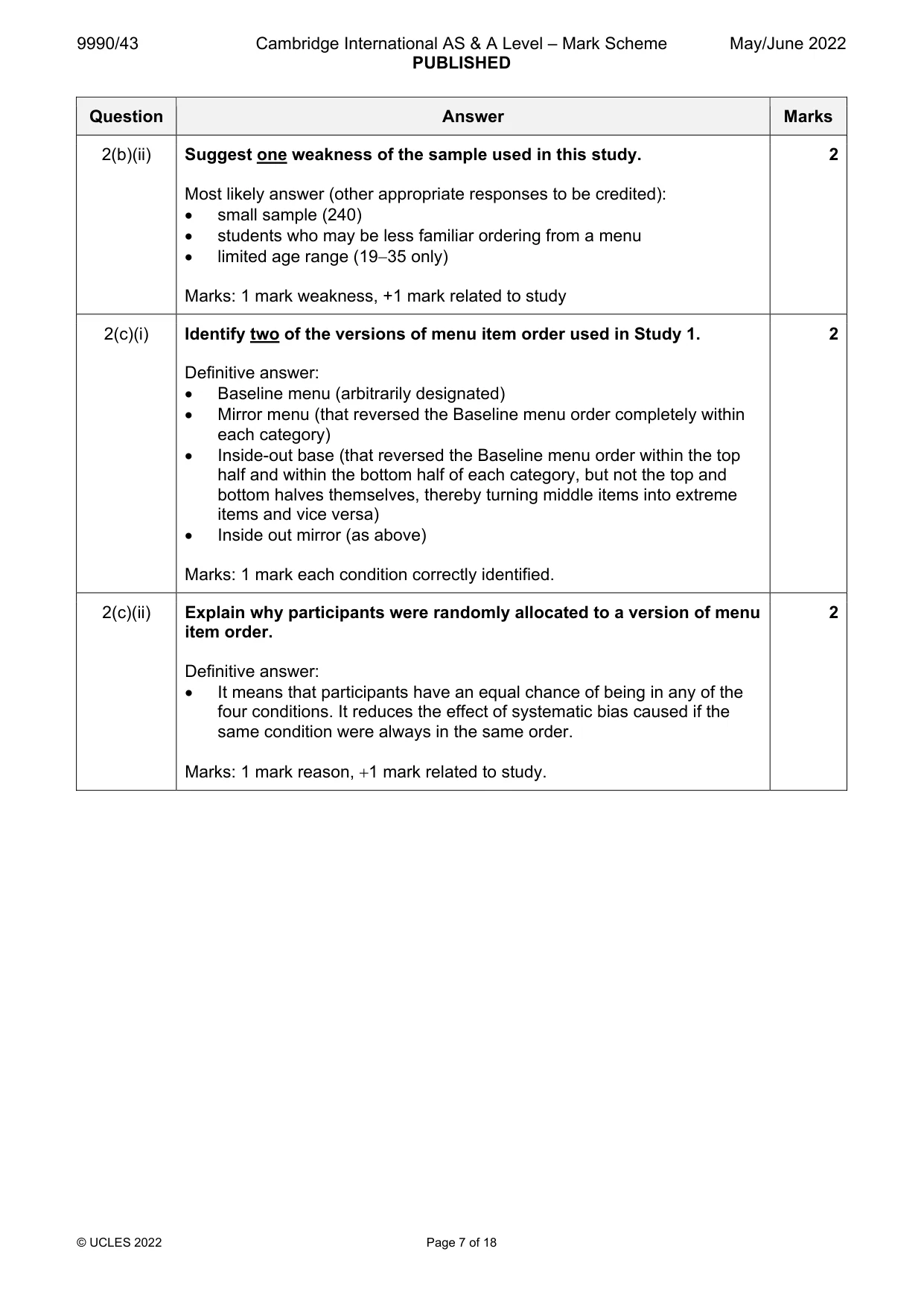
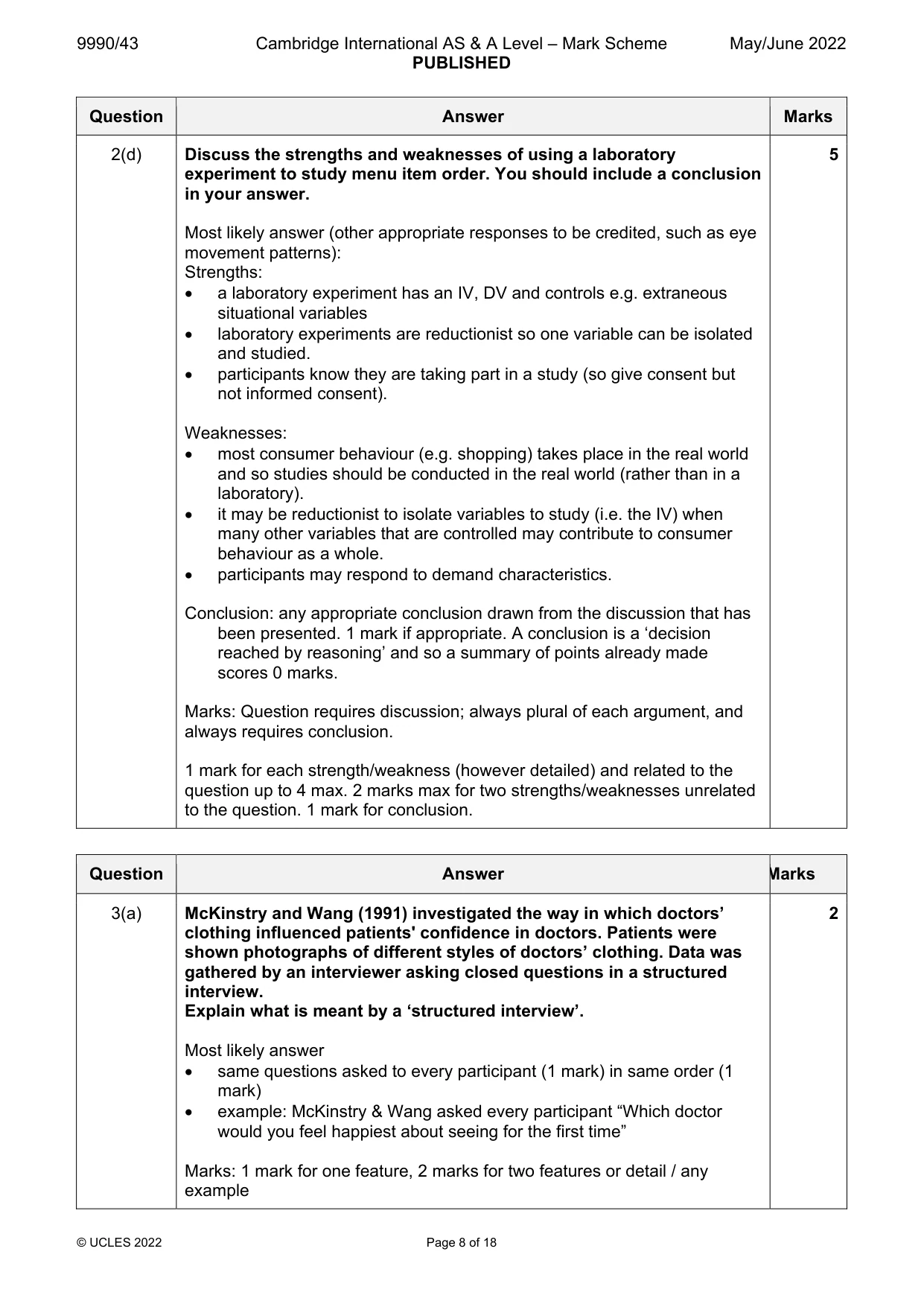
Mark scheme: 2(a) Dayan and Bar-Hillel (2011) conducted research on how the position of 2 a food item on a menu influenced what participants ordered to eat. They compared four versions of menu item order. They described their sample and sampling technique in Study 1 as: *240 participants *from the Hebrew University, Jerusalem *all were students *aged 19–35 years *52 female, 48 male *recruited individually from around the campus. Suggest which sampling technique could have been used in Study 1. Definitive answer: Opportunity sample (1 mark) because participants were recruited individually from around the campus (1 mark). Note: 1 mark for term, 1 mark for related to study. 2(b)(i) Suggest one strength of the sample used in this study. 2 Most likely answer (other appropriate responses to be credited): large sample (240) students who will be familiar with ordering from a menu wide age range (1935) nearly equal male/female balance (52 to 48) Marks: 1 mark strength, 1 mark related to study 2(b)(ii) Suggest one weakness of the sample used in this study. 2 Most likely answer (other appropriate responses to be credited): small sample (240) students who may be less familiar ordering from a menu limited age range (1935 only) Marks: 1 mark weakness, +1 mark related to study 2(c)(i) Identify two of the versions of menu item order used in Study 1. 2 Definitive answer: Baseline menu (arbitrarily designated) Mirror menu (that reversed the Baseline menu order completely within each category) Inside-out base (that reversed the Baseline menu order within the top half and within the bottom half of each category, but not the top and bottom halves themselves, thereby turning middle items into extreme items and vice versa) Inside out mirror (as above) Marks: 1 mark each condition correctly identified. 2(c)(ii) Explain why participants were randomly allocated to a version of menu 2 item order. Definitive answer: It means that participants have an equal chance of being in any of the four conditions. It reduces the effect of systematic bias caused if the same condition were always in the same order. Marks: 1 mark reason, 1 mark related to study. 2(d) Discuss the strengths and weaknesses of using a laboratory 5 experiment to study menu item order. You should include a conclusion in your answer. Most likely answer (other appropriate responses to be credited, such as eye movement patterns): Strengths: a laboratory experiment has an IV, DV and controls e.g. extraneous situational variables laboratory experiments are reductionist so one variable can be isolated and studied. participants know they are taking part in a study (so give consent but not informed consent). Weaknesses: most consumer behaviour (e.g. shopping) takes place in the real world and so studies should be conducted in the real world (rather than in a laboratory). it may be reductionist to isolate variables to study (i.e. the IV) when many other variables that are controlled may contribute to consumer behaviour as a whole. participants may respond to demand characteristics. Conclusion: any appropriate conclusion drawn from the discussion that has been presented. 1 mark if appropriate. A conclusion is a ‘decision reached by reasoning’ and so a summary of points already made scores 0 marks. Marks: Question requires discussion; always plural of each argument, and always requires conclusion. 1 mark for each strength/weakness (however detailed) and related to the question up to 4 max. 2 marks max for two strengths/weaknesses unrelated to the question. 1 mark for conclusion.
Q3 · McKinstry and Wang (1991) investigated the way in which doctors’ clothing influenced…
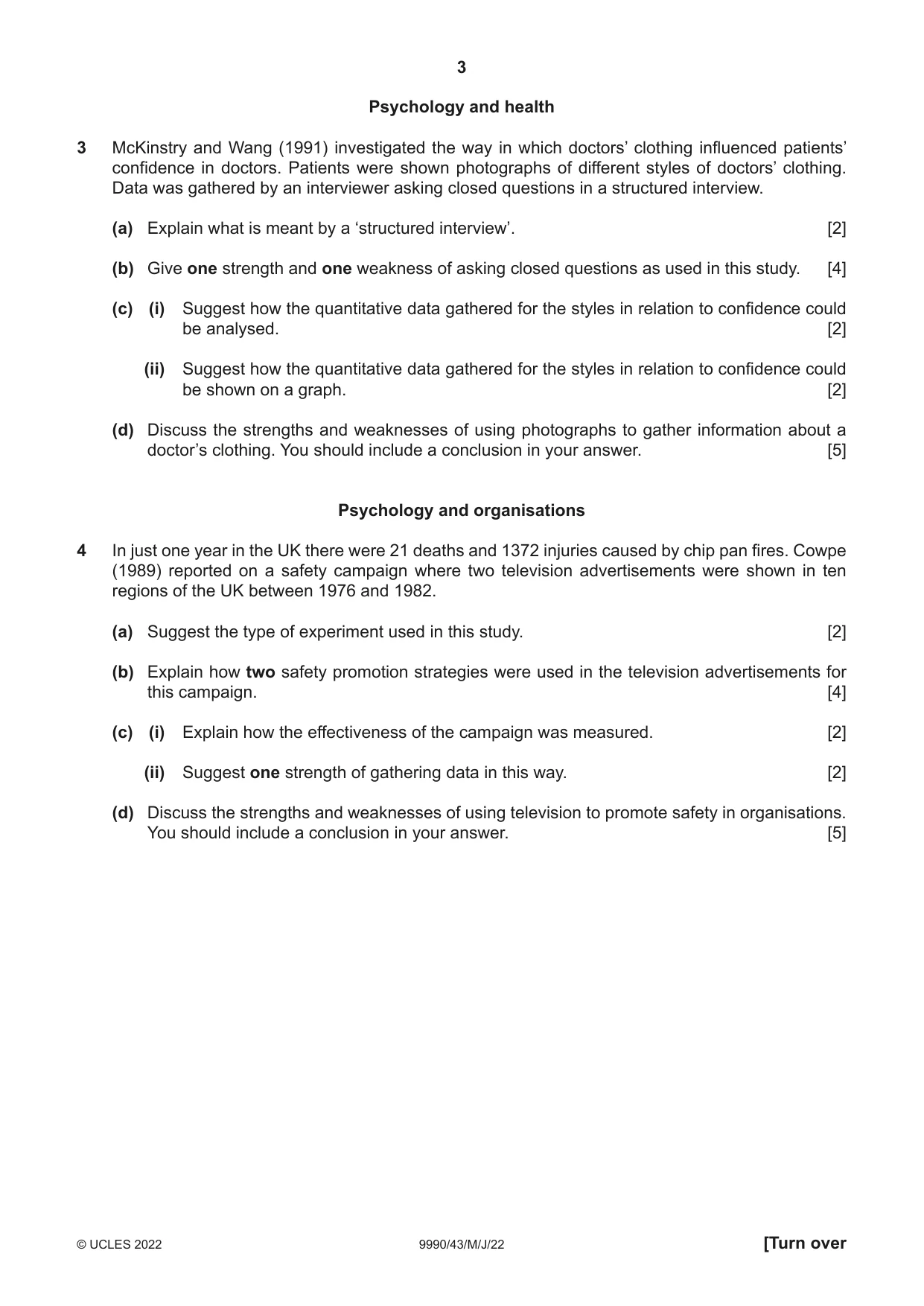
3 McKinstry and Wang (1991) investigated the way in which doctors’ clothing influenced patients’ confidence in doctors. Patients were shown photographs of different styles of doctors’ clothing. Data was gathered by an interviewer asking closed questions in a structured interview. (a) Explain what is meant by a ‘structured interview’. [2] (b) Give one strength and one weakness of asking closed questions as used in this study. [4] (c) (i) Suggest how the quantitative data gathered for the styles in relation to confidence could be analysed. [2] (ii) Suggest how the quantitative data gathered for the styles in relation to confidence could be shown on a graph. [2] (d) Discuss the strengths and weaknesses of using photographs to gather information about a doctor’s clothing. You should include a conclusion in your answer. [5] Psychology and organisations
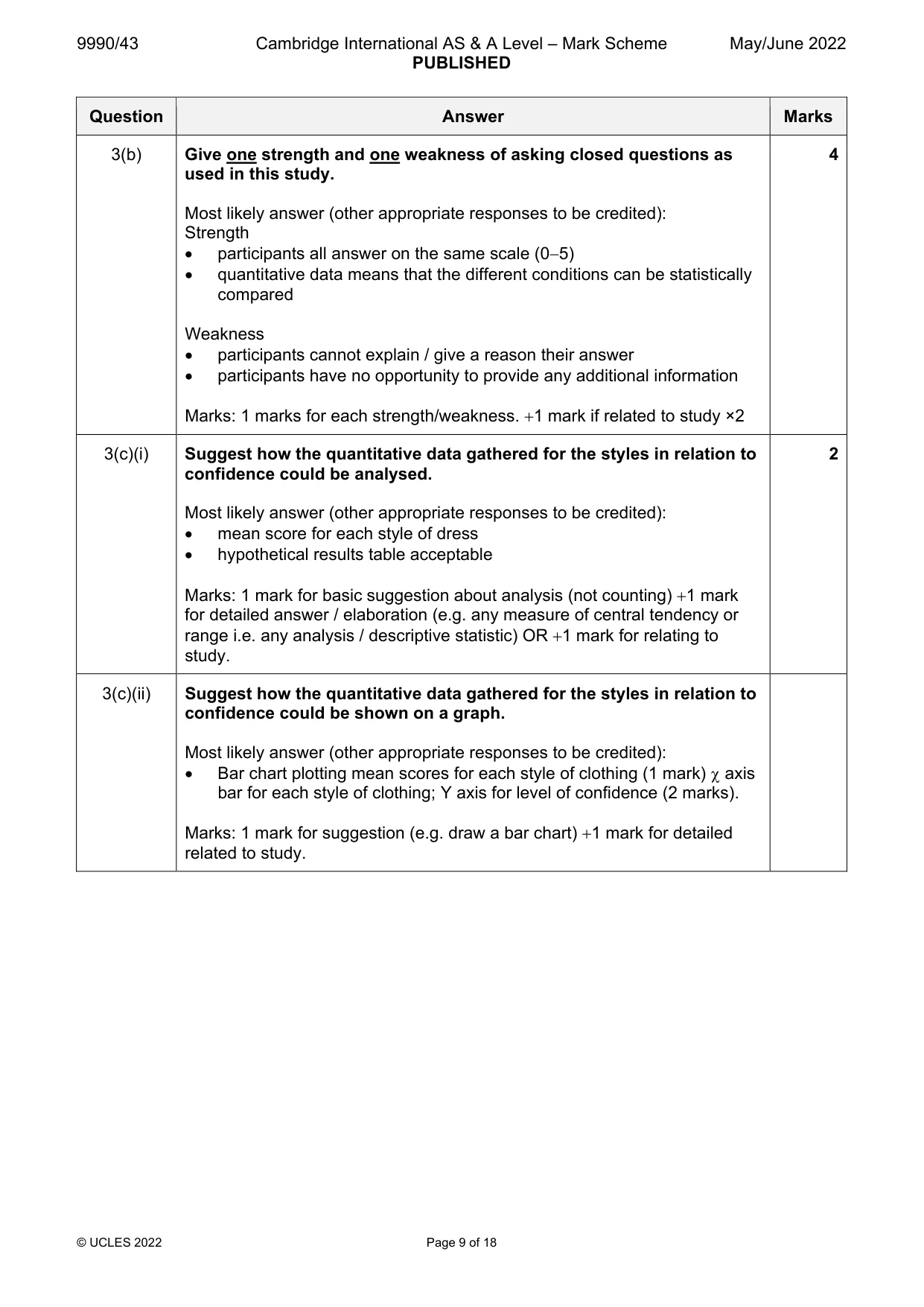
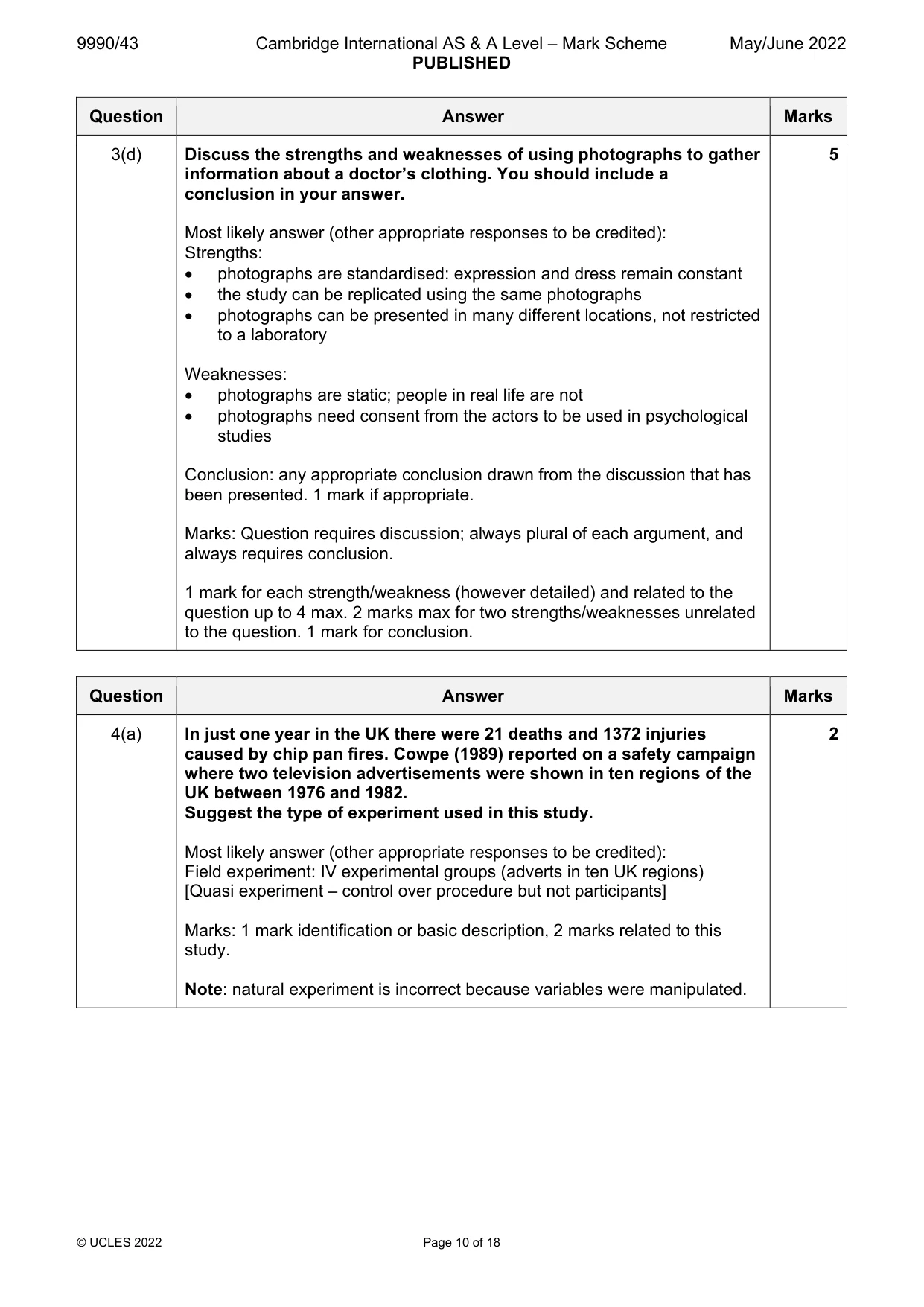
Mark scheme: 3(a) McKinstry and Wang (1991) investigated the way in which doctors’ 2 clothing influenced patients' confidence in doctors. Patients were shown photographs of different styles of doctors’ clothing. Data was gathered by an interviewer asking closed questions in a structured interview. Explain what is meant by a ‘structured interview’. Most likely answer same questions asked to every participant (1 mark) in same order (1 mark) example: McKinstry & Wang asked every participant “Which doctor would you feel happiest about seeing for the first time” Marks: 1 mark for one feature, 2 marks for two features or detail / any example 3(b) Give one strength and one weakness of asking closed questions as 4 used in this study. Most likely answer (other appropriate responses to be credited): Strength participants all answer on the same scale (05) quantitative data means that the different conditions can be statistically compared Weakness participants cannot explain / give a reason their answer participants have no opportunity to provide any additional information Marks: 1 marks for each strength/weakness. 1 mark if related to study ×2 3(c)(i) Suggest how the quantitative data gathered for the styles in relation to 2 confidence could be analysed. Most likely answer (other appropriate responses to be credited): mean score for each style of dress hypothetical results table acceptable Marks: 1 mark for basic suggestion about analysis (not counting) 1 mark for detailed answer / elaboration (e.g. any measure of central tendency or range i.e. any analysis / descriptive statistic) OR 1 mark for relating to study. 3(c)(ii) Suggest how the quantitative data gathered for the styles in relation to confidence could be shown on a graph. Most likely answer (other appropriate responses to be credited): Bar chart plotting mean scores for each style of clothing (1 mark) axis bar for each style of clothing; Y axis for level of confidence (2 marks). Marks: 1 mark for suggestion (e.g. draw a bar chart) 1 mark for detailed related to study. 3(d) Discuss the strengths and weaknesses of using photographs to gather 5 information about a doctor’s clothing. You should include a conclusion in your answer. Most likely answer (other appropriate responses to be credited): Strengths: photographs are standardised: expression and dress remain constant the study can be replicated using the same photographs photographs can be presented in many different locations, not restricted to a laboratory Weaknesses: photographs are static; people in real life are not photographs need consent from the actors to be used in psychological studies Conclusion: any appropriate conclusion drawn from the discussion that has been presented. 1 mark if appropriate. Marks: Question requires discussion; always plural of each argument, and always requires conclusion. 1 mark for each strength/weakness (however detailed) and related to the question up to 4 max. 2 marks max for two strengths/weaknesses unrelated to the question. 1 mark for conclusion.
Q4 · In just one year in the UK there were 21 deaths and 1372 injuries caused by chip pan fires
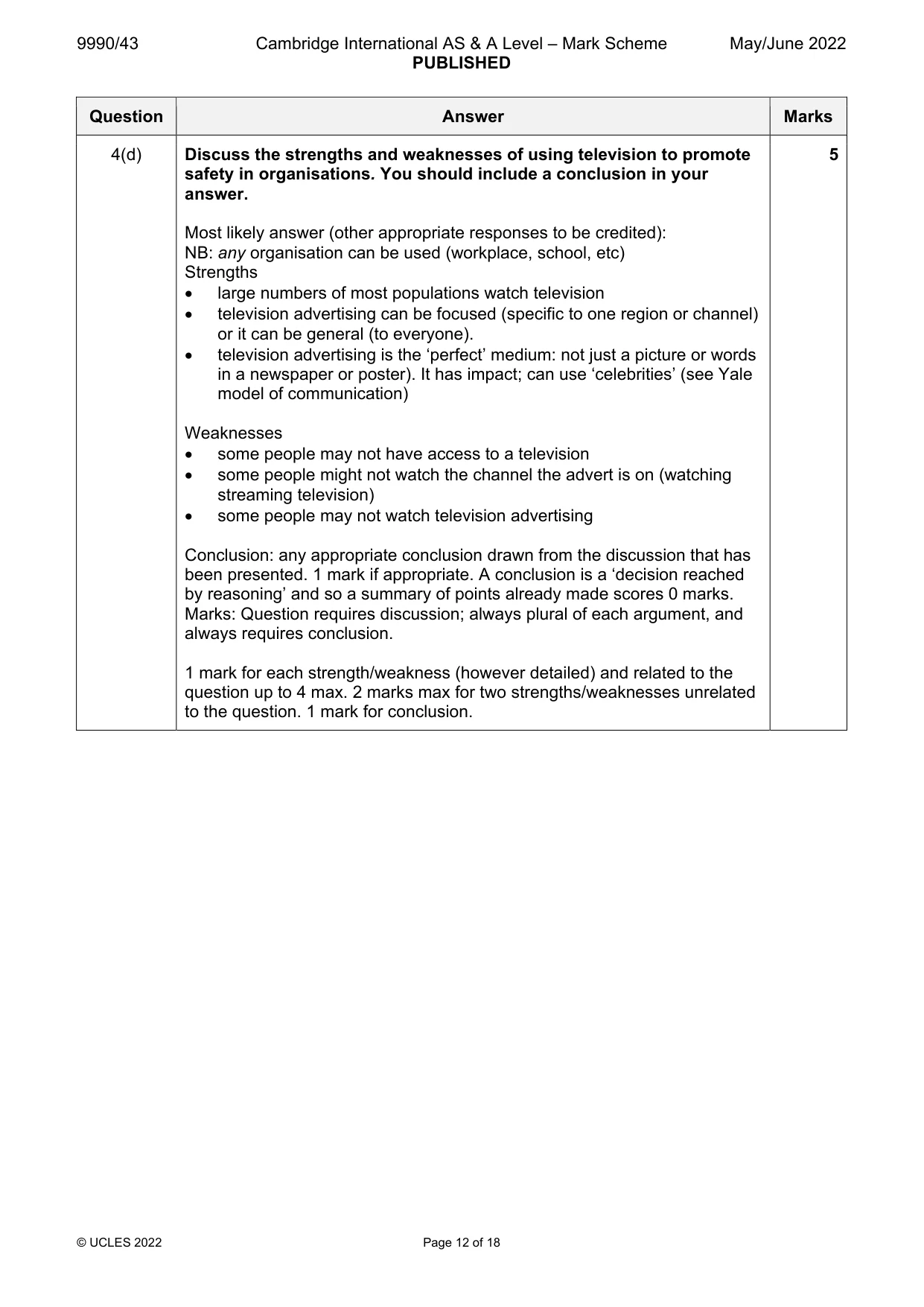
4 In just one year in the UK there were 21 deaths and 1372 injuries caused by chip pan fires. Cowpe (1989) reported on a safety campaign where two television advertisements were shown in ten regions of the UK between 1976 and 1982. (a) Suggest the type of experiment used in this study. [2] (b) Explain how two safety promotion strategies were used in the television advertisements for this campaign. [4] (c) (i) Explain how the effectiveness of the campaign was measured. [2] (ii) Suggest one strength of gathering data in this way. [2] (d) Discuss the strengths and weaknesses of using television to promote safety in organisations. You should include a conclusion in your answer. [5]
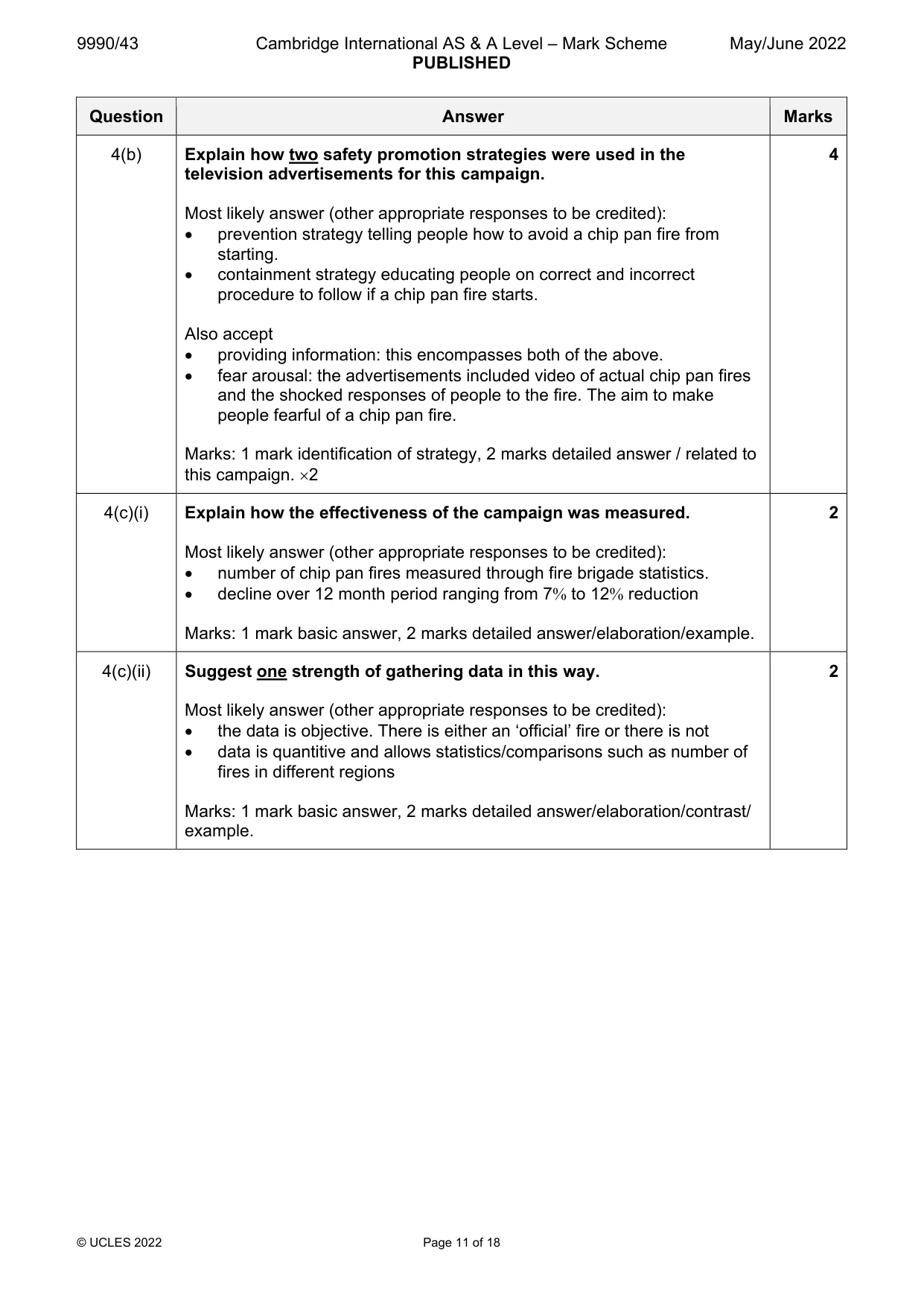
Mark scheme: 4(a) In just one year in the UK there were 21 deaths and 1372 injuries 2 caused by chip pan fires. Cowpe (1989) reported on a safety campaign where two television advertisements were shown in ten regions of the UK between 1976 and 1982. Suggest the type of experiment used in this study. Most likely answer (other appropriate responses to be credited): Field experiment: IV experimental groups (adverts in ten UK regions) [Quasi experiment – control over procedure but not participants] Marks: 1 mark identification or basic description, 2 marks related to this study. Note: natural experiment is incorrect because variables were manipulated. 4(b) Explain how two safety promotion strategies were used in the 4 television advertisements for this campaign. Most likely answer (other appropriate responses to be credited): prevention strategy telling people how to avoid a chip pan fire from starting. containment strategy educating people on correct and incorrect procedure to follow if a chip pan fire starts. Also accept providing information: this encompasses both of the above. fear arousal: the advertisements included video of actual chip pan fires and the shocked responses of people to the fire. The aim to make people fearful of a chip pan fire. Marks: 1 mark identification of strategy, 2 marks detailed answer / related to this campaign. 2 4(c)(i) Explain how the effectiveness of the campaign was measured. 2 Most likely answer (other appropriate responses to be credited): number of chip pan fires measured through fire brigade statistics. decline over 12 month period ranging from 7 to 12 reduction Marks: 1 mark basic answer, 2 marks detailed answer/elaboration/example. 4(c)(ii) Suggest one strength of gathering data in this way. 2 Most likely answer (other appropriate responses to be credited): the data is objective. There is either an ‘official’ fire or there is not data is quantitive and allows statistics/comparisons such as number of fires in different regions Marks: 1 mark basic answer, 2 marks detailed answer/elaboration/contrast/ example. 4(d) Discuss the strengths and weaknesses of using television to promote 5 safety in organisations. You should include a conclusion in your answer. Most likely answer (other appropriate responses to be credited): NB: any organisation can be used (workplace, school, etc) Strengths large numbers of most populations watch television television advertising can be focused (specific to one region or channel) or it can be general (to everyone). television advertising is the ‘perfect’ medium: not just a picture or words in a newspaper or poster). It has impact; can use ‘celebrities’ (see Yale model of communication) Weaknesses some people may not have access to a television some people might not watch the channel the advert is on (watching streaming television) some people may not watch television advertising Conclusion: any appropriate conclusion drawn from the discussion that has been presented. 1 mark if appropriate. A conclusion is a ‘decision reached by reasoning’ and so a summary of points already made scores 0 marks. Marks: Question requires discussion; always plural of each argument, and always requires conclusion. 1 mark for each strength/weakness (however detailed) and related to the question up to 4 max. 2 marks max for two strengths/weaknesses unrelated to the question. 1 mark for conclusion. Section B
More questions on 2 Health promotion in schools and worksites
Q5 · Design a study to investigate the effectiveness of biochemical treatments for impulse…
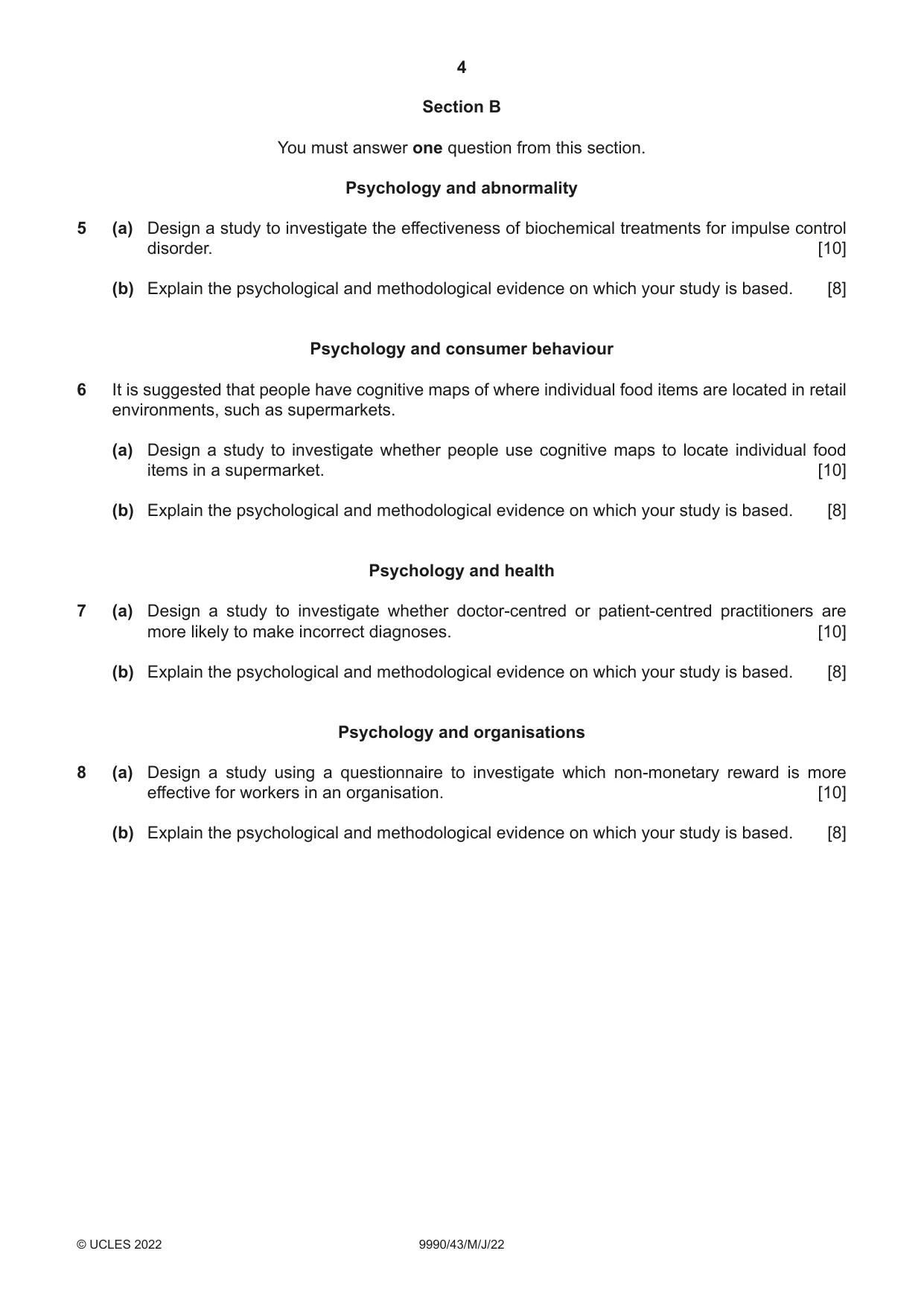
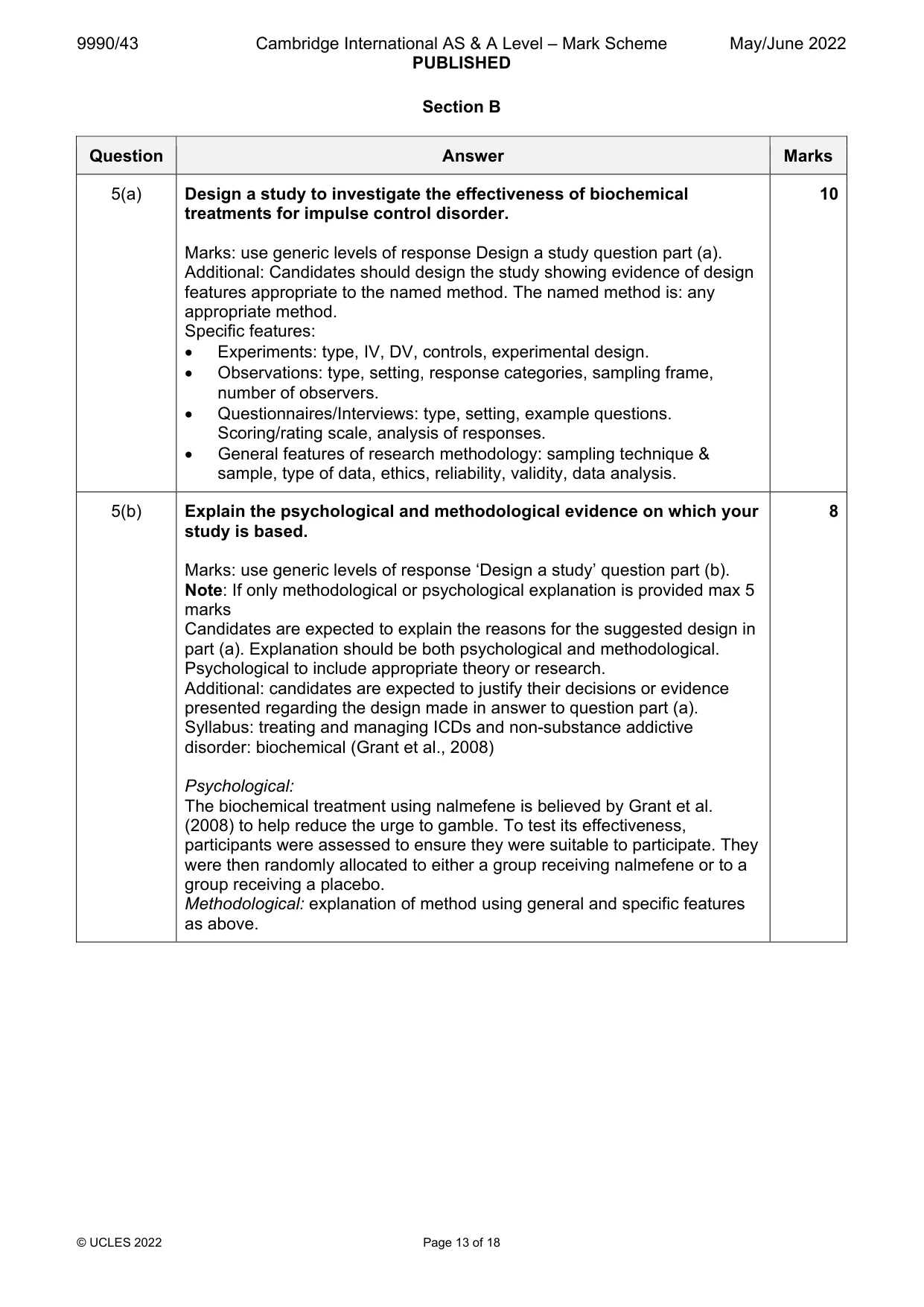
5 (a) Design a study to investigate the effectiveness of biochemical treatments for impulse control disorder. [10] (b) Explain the psychological and methodological evidence on which your study is based. [8] Psychology and consumer behaviour
Mark scheme: 5(a) Design a study to investigate the effectiveness of biochemical 10 treatments for impulse control disorder. Marks: use generic levels of response Design a study question part (a). Additional: Candidates should design the study showing evidence of design features appropriate to the named method. The named method is: any appropriate method. Specific features: Experiments: type, IV, DV, controls, experimental design. Observations: type, setting, response categories, sampling frame, number of observers. Questionnaires/Interviews: type, setting, example questions. Scoring/rating scale, analysis of responses. General features of research methodology: sampling technique & sample, type of data, ethics, reliability, validity, data analysis. 5(b) Explain the psychological and methodological evidence on which your 8 study is based. Marks: use generic levels of response ‘Design a study’ question part (b). Note: If only methodological or psychological explanation is provided max 5 marks Candidates are expected to explain the reasons for the suggested design in part (a). Explanation should be both psychological and methodological. Psychological to include appropriate theory or research. Additional: candidates are expected to justify their decisions or evidence presented regarding the design made in answer to question part (a). Syllabus: treating and managing ICDs and non-substance addictive disorder: biochemical (Grant et al., 2008) Psychological: The biochemical treatment using nalmefene is believed by Grant et al. (2008) to help reduce the urge to gamble. To test its effectiveness, participants were assessed to ensure they were suitable to participate. They were then randomly allocated to either a group receiving nalmefene or to a group receiving a placebo. Methodological: explanation of method using general and specific features as above.
Q6 · It is suggested that people have cognitive maps of where individual food items are…
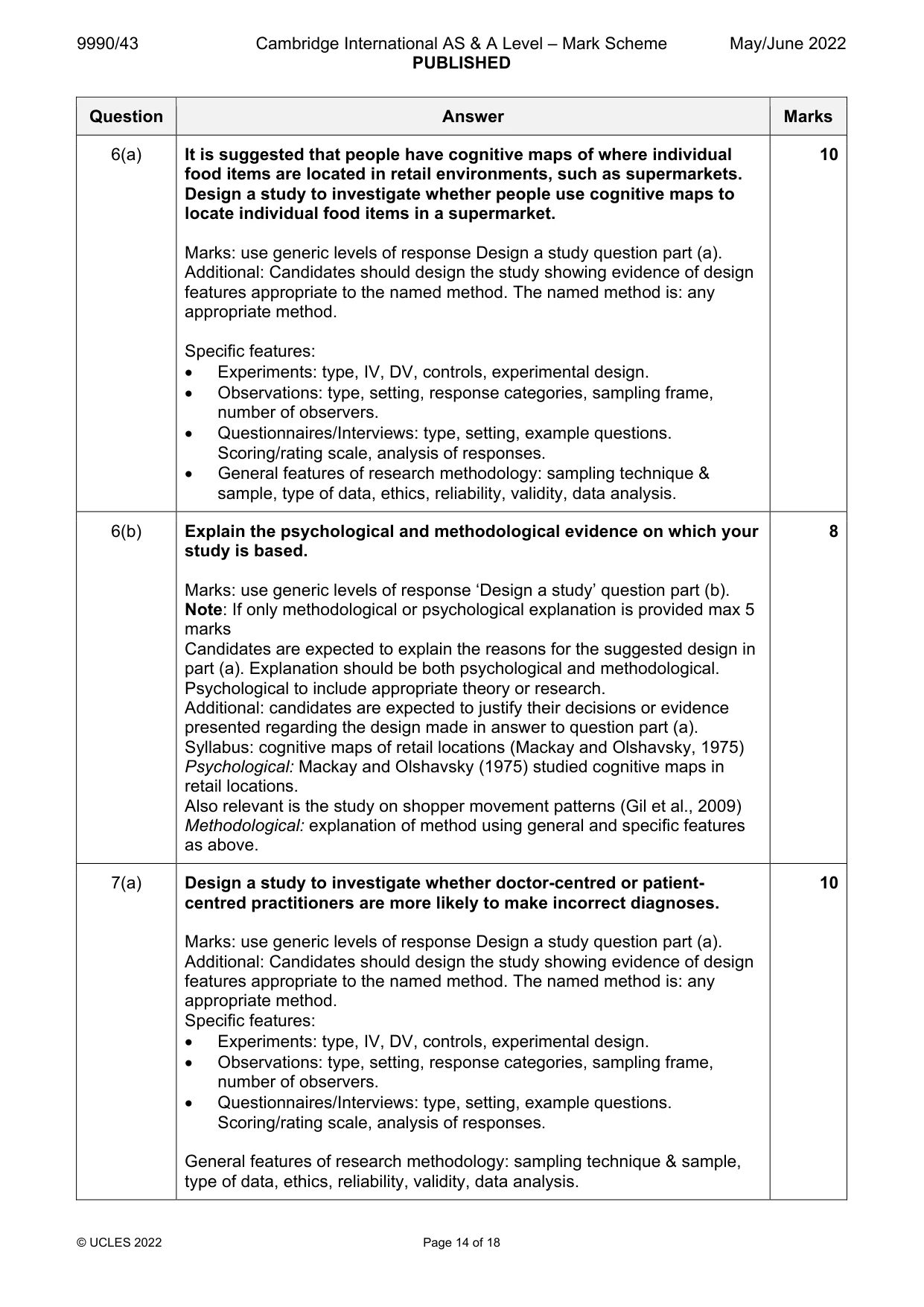
6 It is suggested that people have cognitive maps of where individual food items are located in retail environments, such as supermarkets. (a) Design a study to investigate whether people use cognitive maps to locate individual food items in a supermarket. [10] (b) Explain the psychological and methodological evidence on which your study is based. [8] Psychology and health
Mark scheme: 6(a) It is suggested that people have cognitive maps of where individual 10 food items are located in retail environments, such as supermarkets. Design a study to investigate whether people use cognitive maps to locate individual food items in a supermarket. Marks: use generic levels of response Design a study question part (a). Additional: Candidates should design the study showing evidence of design features appropriate to the named method. The named method is: any appropriate method. Specific features: Experiments: type, IV, DV, controls, experimental design. Observations: type, setting, response categories, sampling frame, number of observers. Questionnaires/Interviews: type, setting, example questions. Scoring/rating scale, analysis of responses. General features of research methodology: sampling technique & sample, type of data, ethics, reliability, validity, data analysis. 6(b) Explain the psychological and methodological evidence on which your 8 study is based. Marks: use generic levels of response ‘Design a study’ question part (b). Note: If only methodological or psychological explanation is provided max 5 marks Candidates are expected to explain the reasons for the suggested design in part (a). Explanation should be both psychological and methodological. Psychological to include appropriate theory or research. Additional: candidates are expected to justify their decisions or evidence presented regarding the design made in answer to question part (a). Syllabus: cognitive maps of retail locations (Mackay and Olshavsky, 1975) Psychological: Mackay and Olshavsky (1975) studied cognitive maps in retail locations. Also relevant is the study on shopper movement patterns (Gil et al., 2009) Methodological: explanation of method using general and specific features as above.
Q7 · Design a study to investigate whether doctor-centred or patient-centred practitioners are…
7 (a) Design a study to investigate whether doctor-centred or patient-centred practitioners are more likely to make incorrect diagnoses. [10] (b) Explain the psychological and methodological evidence on which your study is based. [8] Psychology and organisations
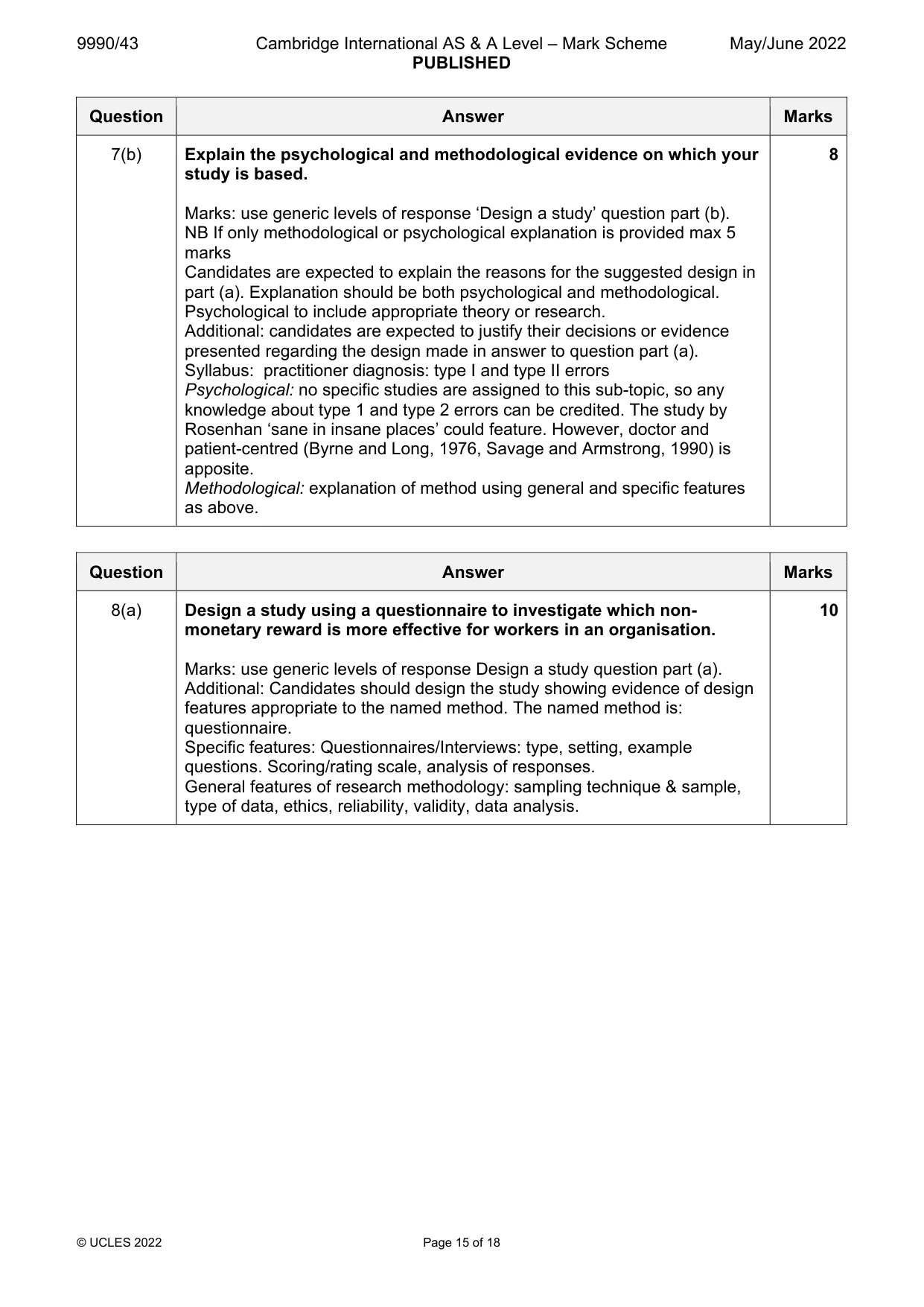
Mark scheme: 7(a) Design a study to investigate whether doctor-centred or patient- 10 centred practitioners are more likely to make incorrect diagnoses. Marks: use generic levels of response Design a study question part (a). Additional: Candidates should design the study showing evidence of design features appropriate to the named method. The named method is: any appropriate method. Specific features: Experiments: type, IV, DV, controls, experimental design. Observations: type, setting, response categories, sampling frame, number of observers. Questionnaires/Interviews: type, setting, example questions. Scoring/rating scale, analysis of responses. General features of research methodology: sampling technique & sample, type of data, ethics, reliability, validity, data analysis. 7(b) Explain the psychological and methodological evidence on which your 8 study is based. Marks: use generic levels of response ‘Design a study’ question part (b). NB If only methodological or psychological explanation is provided max 5 marks Candidates are expected to explain the reasons for the suggested design in part (a). Explanation should be both psychological and methodological. Psychological to include appropriate theory or research. Additional: candidates are expected to justify their decisions or evidence presented regarding the design made in answer to question part (a). Syllabus: practitioner diagnosis: type I and type II errors Psychological: no specific studies are assigned to this sub-topic, so any knowledge about type 1 and type 2 errors can be credited. The study by Rosenhan ‘sane in insane places’ could feature. However, doctor and patient-centred (Byrne and Long, 1976, Savage and Armstrong, 1990) is apposite. Methodological: explanation of method using general and specific features as above.
Q8 · Design a study using a questionnaire to investigate which non-monetary reward is more…
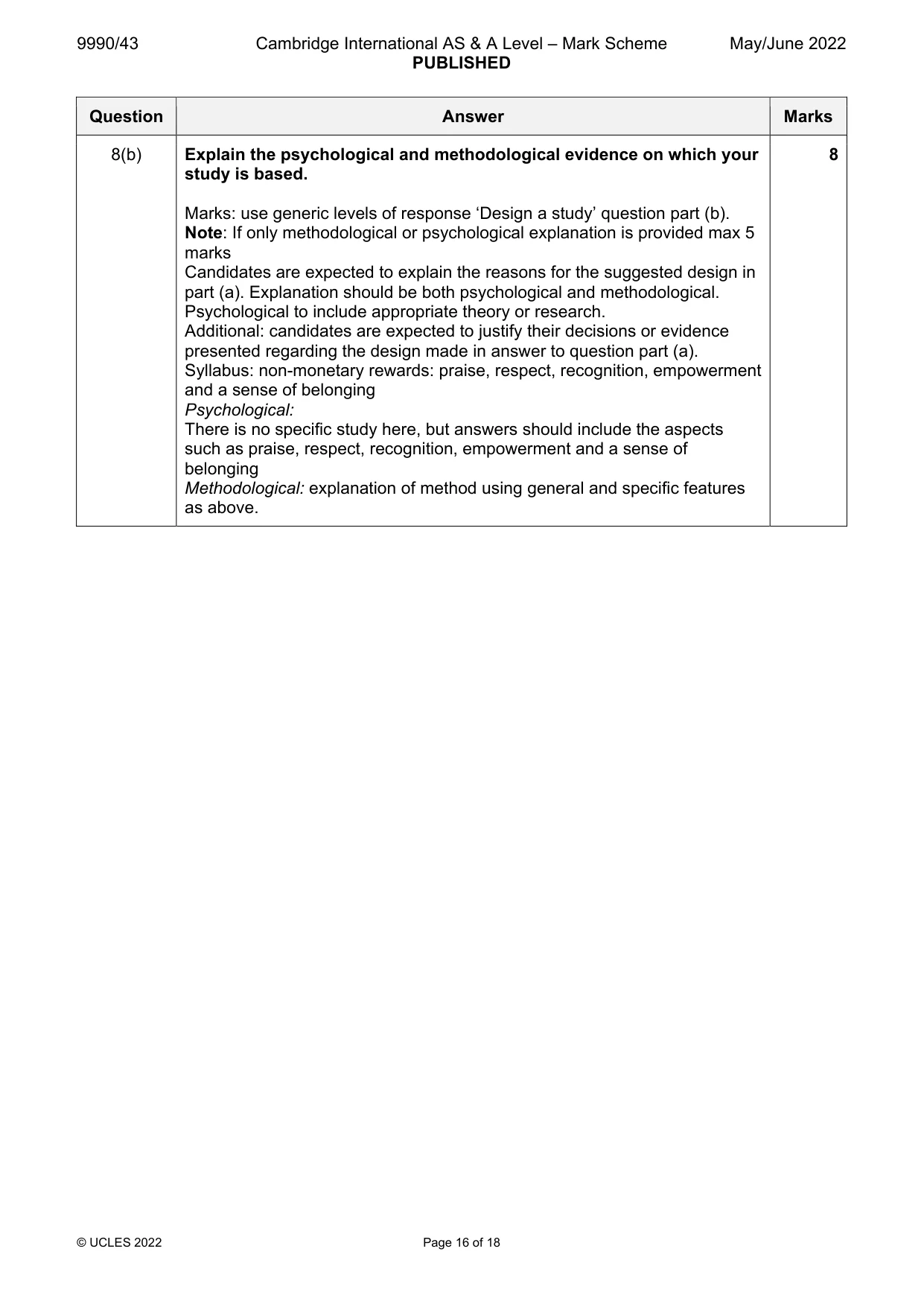
8 (a) Design a study using a questionnaire to investigate which non-monetary reward is more effective for workers in an organisation. [10] (b) Explain the psychological and methodological evidence on which your study is based. [8] Section C You must answer one question from this section. Psychology and abnormality
Mark scheme: 8(a) Design a study using a questionnaire to investigate which non- 10 monetary reward is more effective for workers in an organisation. Marks: use generic levels of response Design a study question part (a). Additional: Candidates should design the study showing evidence of design features appropriate to the named method. The named method is: questionnaire. Specific features: Questionnaires/Interviews: type, setting, example questions. Scoring/rating scale, analysis of responses. General features of research methodology: sampling technique & sample, type of data, ethics, reliability, validity, data analysis. 8(b) Explain the psychological and methodological evidence on which your 8 study is based. Marks: use generic levels of response ‘Design a study’ question part (b). Note: If only methodological or psychological explanation is provided max 5 marks Candidates are expected to explain the reasons for the suggested design in part (a). Explanation should be both psychological and methodological. Psychological to include appropriate theory or research. Additional: candidates are expected to justify their decisions or evidence presented regarding the design made in answer to question part (a). Syllabus: non-monetary rewards: praise, respect, recognition, empowerment and a sense of belonging Psychological: There is no specific study here, but answers should include the aspects such as praise, respect, recognition, empowerment and a sense of belonging Methodological: explanation of method using general and specific features as above.
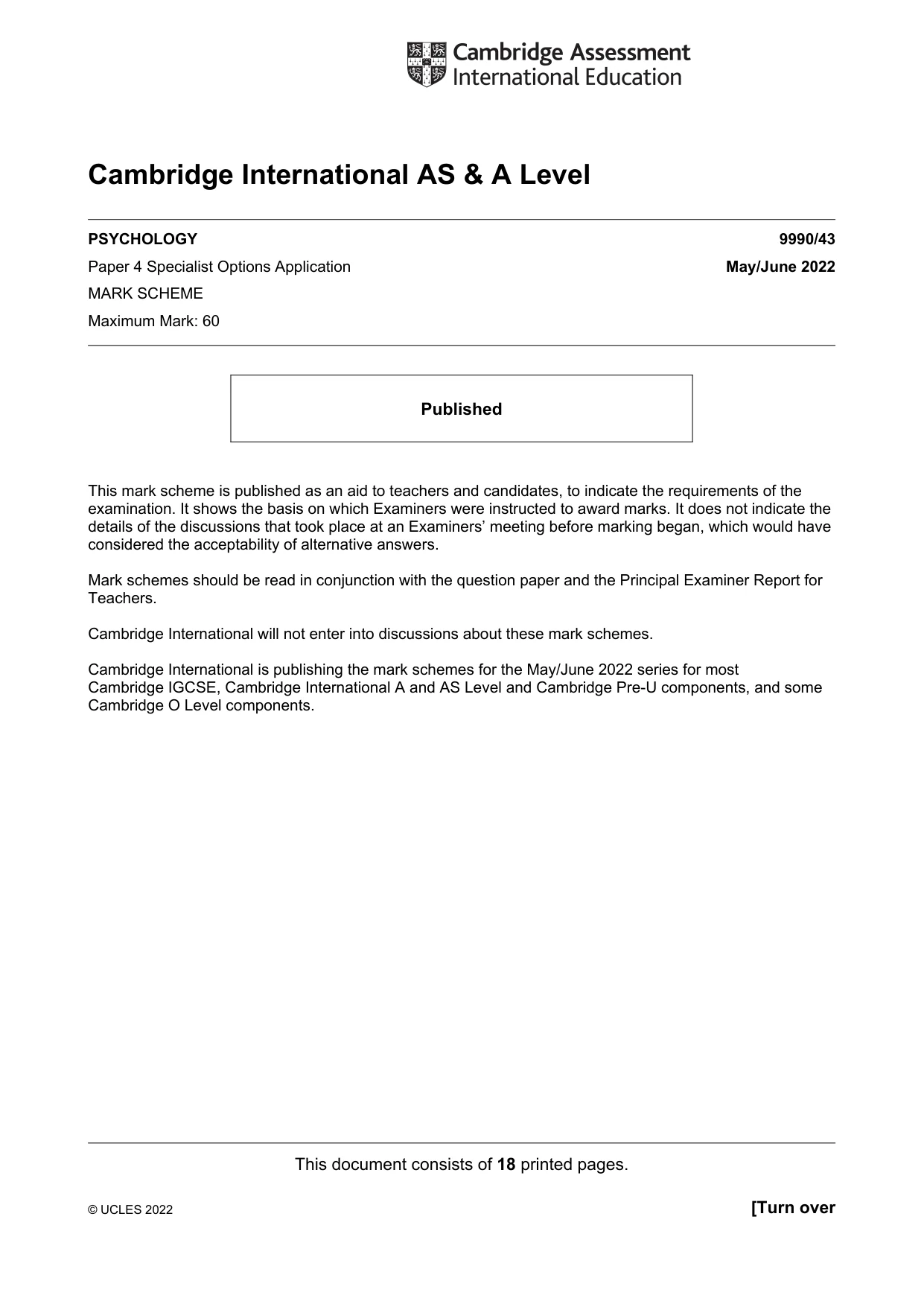
Q9 · ‘Psychometric measures used to assess obsessive-compulsive disorder (OCD) provide…
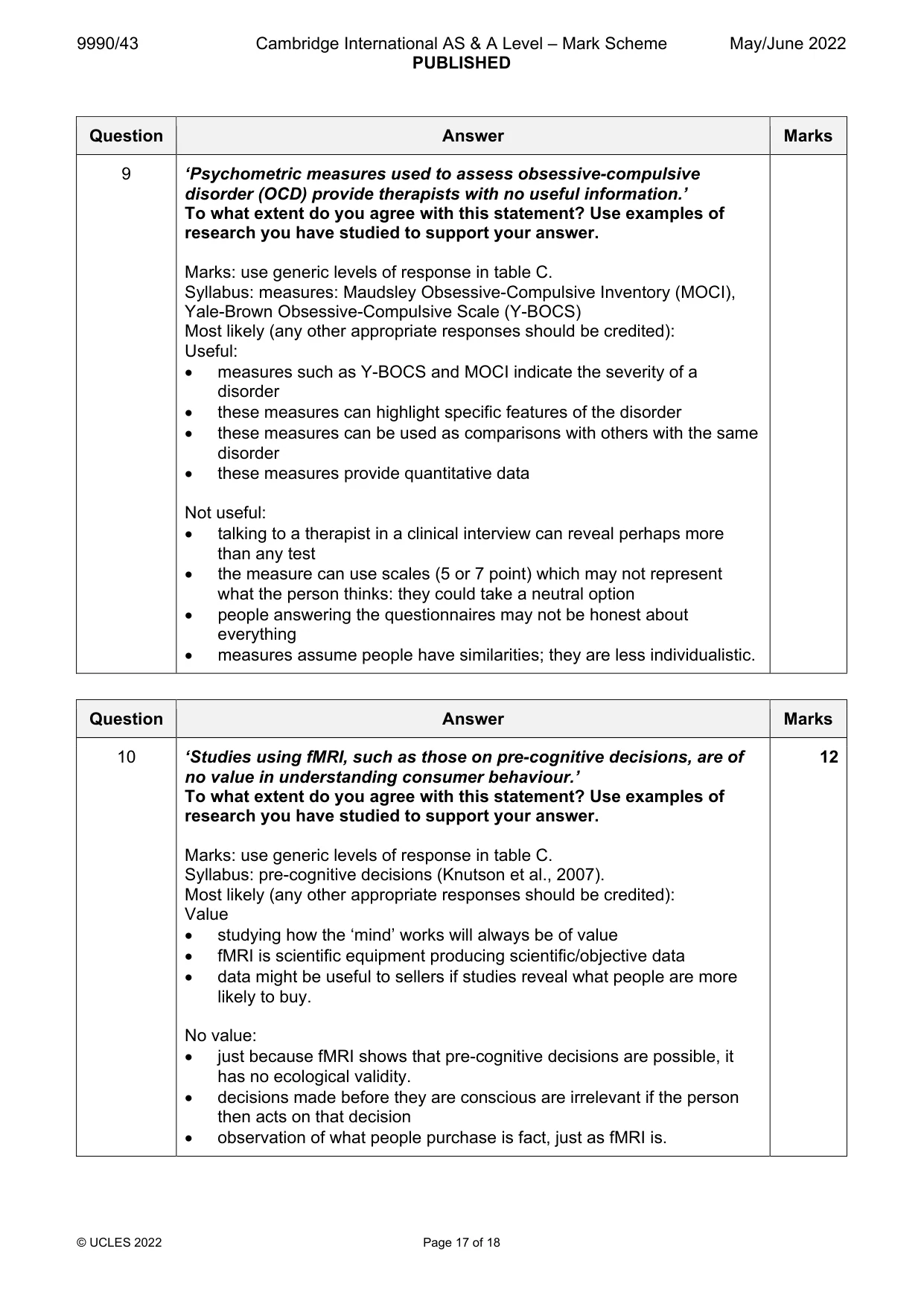
9 ‘Psychometric measures used to assess obsessive-compulsive disorder (OCD) provide therapists with no useful information.’ To what extent do you agree with this statement? Use examples of research you have studied to support your answer. [12] Psychology and consumer behaviour
Mark scheme: 9 ‘Psychometric measures used to assess obsessive-compulsive disorder (OCD) provide therapists with no useful information.’ To what extent do you agree with this statement? Use examples of research you have studied to support your answer. Marks: use generic levels of response in table C. Syllabus: measures: Maudsley Obsessive-Compulsive Inventory (MOCI), Yale-Brown Obsessive-Compulsive Scale (Y-BOCS) Most likely (any other appropriate responses should be credited): Useful: measures such as Y-BOCS and MOCI indicate the severity of a disorder these measures can highlight specific features of the disorder these measures can be used as comparisons with others with the same disorder these measures provide quantitative data Not useful: talking to a therapist in a clinical interview can reveal perhaps more than any test the measure can use scales (5 or 7 point) which may not represent what the person thinks: they could take a neutral option people answering the questionnaires may not be honest about everything measures assume people have similarities; they are less individualistic.
Q10 · ‘Studies using an fMRI, such as those on pre-cognitive decisions, are of no value in…
10 ‘Studies using an fMRI, such as those on pre-cognitive decisions, are of no value in understanding consumer behaviour.’ To what extent do you agree with this statement? Use examples of research you have studied to support your answer. [12] Psychology and health
Mark scheme: 10 ‘Studies using fMRI, such as those on pre-cognitive decisions, are of 12 no value in understanding consumer behaviour.’ To what extent do you agree with this statement? Use examples of research you have studied to support your answer. Marks: use generic levels of response in table C. Syllabus: pre-cognitive decisions (Knutson et al., 2007). Most likely (any other appropriate responses should be credited): Value studying how the ‘mind’ works will always be of value fMRI is scientific equipment producing scientific/objective data data might be useful to sellers if studies reveal what people are more likely to buy. No value: just because fMRI shows that pre-cognitive decisions are possible, it has no ecological validity. decisions made before they are conscious are irrelevant if the person then acts on that decision observation of what people purchase is fact, just as fMRI is.
Q11 · ‘A biochemical test is the only accurate way to know that a person has adhered to a…
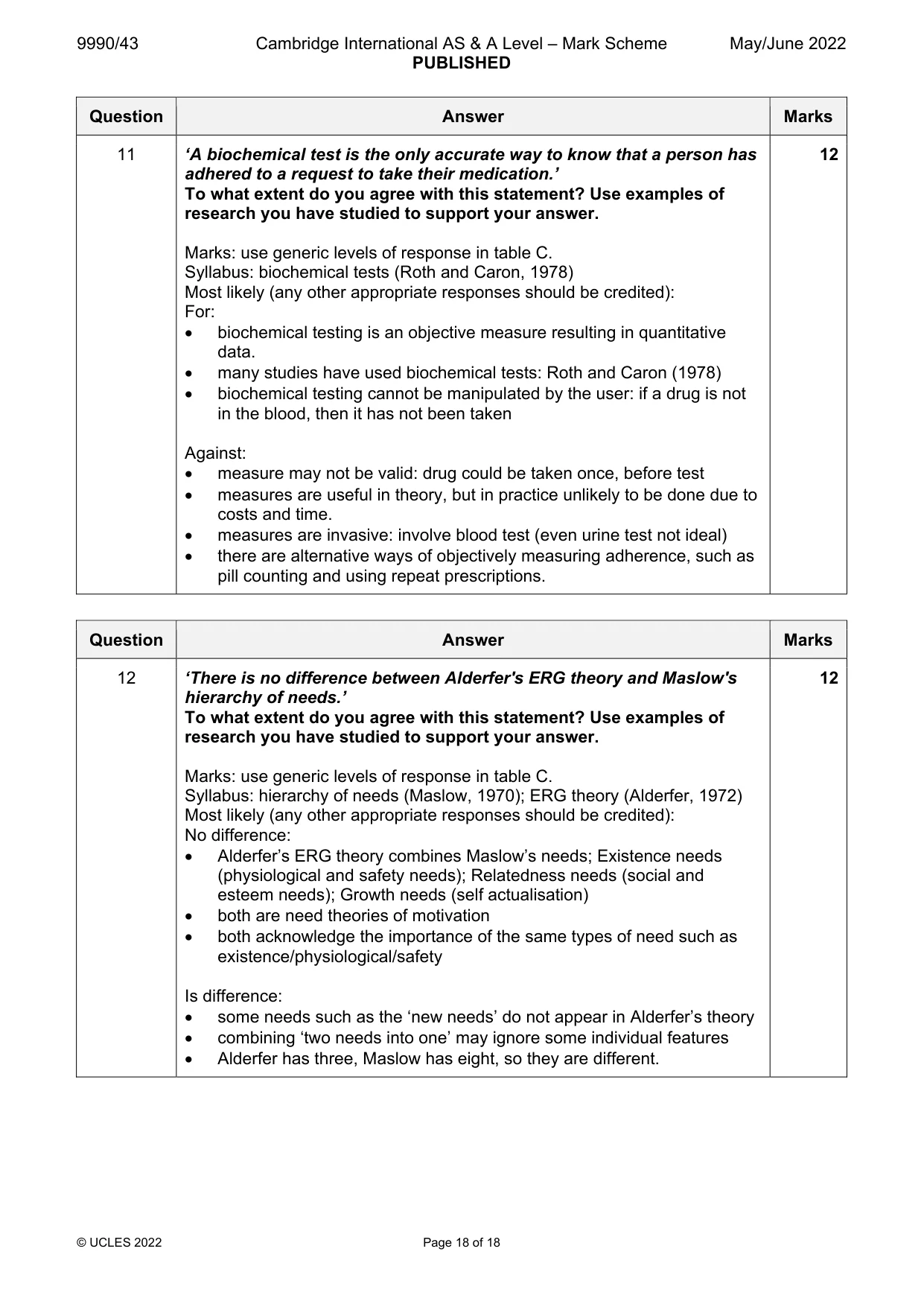
11 ‘A biochemical test is the only accurate way to know that a person has adhered to a request to take their medication.’ To what extent do you agree with this statement? Use examples of research you have studied to support your answer. [12] Psychology and organisations
Mark scheme: 11 ‘A biochemical test is the only accurate way to know that a person has 12 adhered to a request to take their medication.’ To what extent do you agree with this statement? Use examples of research you have studied to support your answer. Marks: use generic levels of response in table C. Syllabus: biochemical tests (Roth and Caron, 1978) Most likely (any other appropriate responses should be credited): For: biochemical testing is an objective measure resulting in quantitative data. many studies have used biochemical tests: Roth and Caron (1978) biochemical testing cannot be manipulated by the user: if a drug is not in the blood, then it has not been taken Against: measure may not be valid: drug could be taken once, before test measures are useful in theory, but in practice unlikely to be done due to costs and time. measures are invasive: involve blood test (even urine test not ideal) there are alternative ways of objectively measuring adherence, such as pill counting and using repeat prescriptions.
Q12 · ‘There is no difference between Alderfer’s ERG theory and Maslow’s hierarchy of needs.’…
12 ‘There is no difference between Alderfer’s ERG theory and Maslow’s hierarchy of needs.’ To what extent do you agree with this statement? Use examples of research you have studied to support your answer. [12]
Mark scheme: 12 ‘There is no difference between Alderfer's ERG theory and Maslow's 12 hierarchy of needs.’ To what extent do you agree with this statement? Use examples of research you have studied to support your answer. Marks: use generic levels of response in table C. Syllabus: hierarchy of needs (Maslow, 1970); ERG theory (Alderfer, 1972) Most likely (any other appropriate responses should be credited): No difference: Alderfer’s ERG theory combines Maslow’s needs; Existence needs (physiological and safety needs); Relatedness needs (social and esteem needs); Growth needs (self actualisation) both are need theories of motivation both acknowledge the importance of the same types of need such as existence/physiological/safety Is difference: some needs such as the ‘new needs’ do not appear in Alderfer’s theory combining ‘two needs into one’ may ignore some individual features Alderfer has three, Maslow has eight, so they are different.
What was in this paper
The subtopics covered by these 12 questions, and how many questions each got. Open one in a new tab to see every Cambridge question on it.
What you needed in this session
Cambridge’s own grade thresholds for 2022 May/June, Paper 4 · Variant 3. A higher threshold means an easier paper — the bar moves with how the cohort did.