Cambridge A Level Psychology (from 2018) 9990 — 2019 May/June Paper 4 · Variant 2
9990/42/M/J/19 · 12 questions · 60 marks · ≈68 min
The question paper and its mark scheme, free to read here and free to download. This is Cambridge’s own paper, exactly as it was sat.
Question paper8 pages



Mark scheme23 pages
Answers below. Sit the paper first if you are practising.
Questions as text
Q1 · The Generalised Anxiety Disorder assessment (GAD-7) was developed using questionnaires…
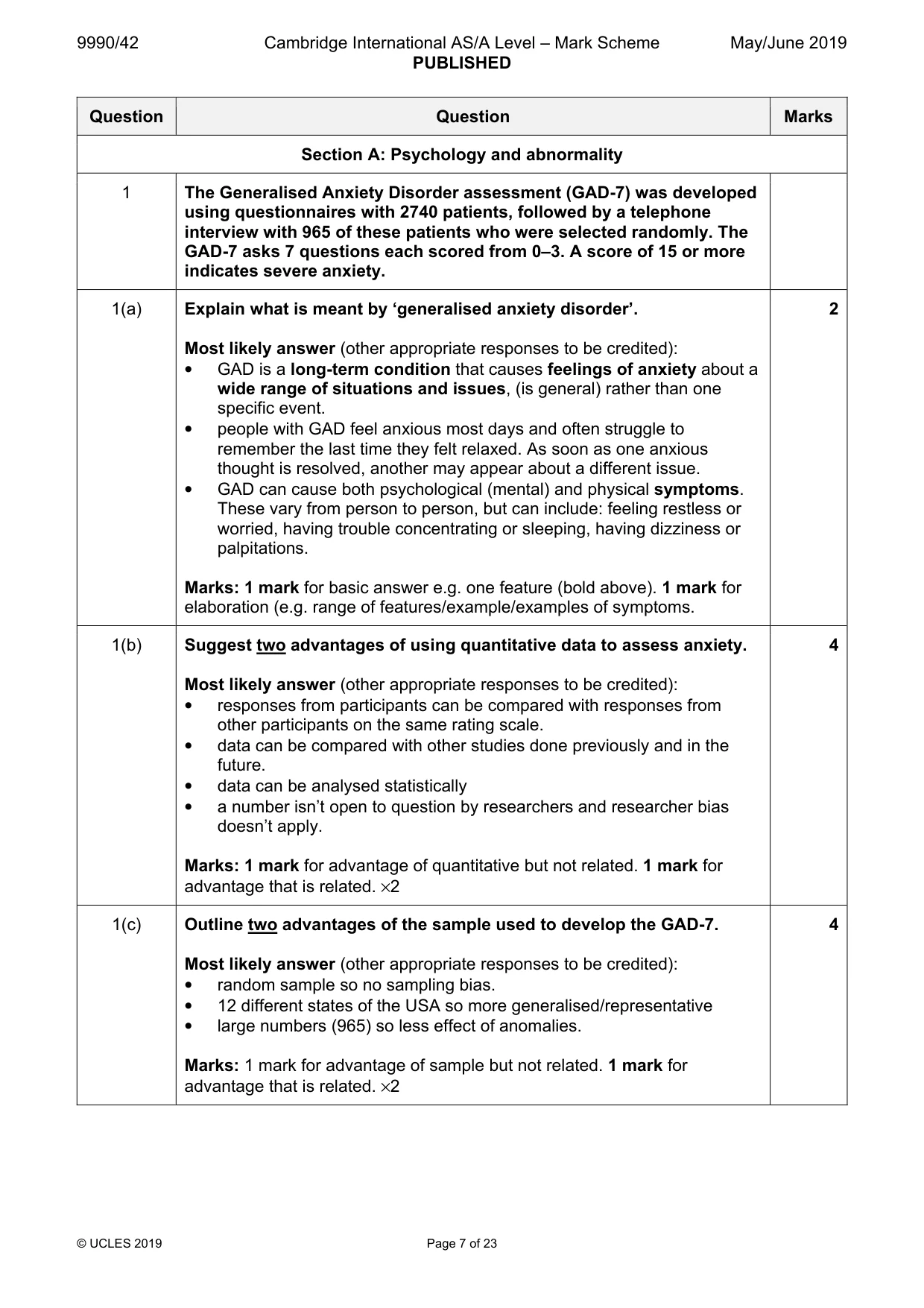
1 The Generalised Anxiety Disorder assessment (GAD-7) was developed using questionnaires with 2740 patients, followed by a telephone interview with 965 of these patients who were selected randomly. The GAD-7 asks 7 questions each scored from 0–3. A score of 15 or more indicates severe anxiety. (a) Explain what is meant by ‘generalised anxiety disorder’. [2] (b) Suggest two advantages of using quantitative data to assess anxiety. [4] (c) Outline two advantages of the sample used to develop the GAD-7. [4] (d) Discuss the strengths and weaknesses of using telephone interviews to assess anxiety. You should include a conclusion in your answer. [5] Psychology and consumer behaviour
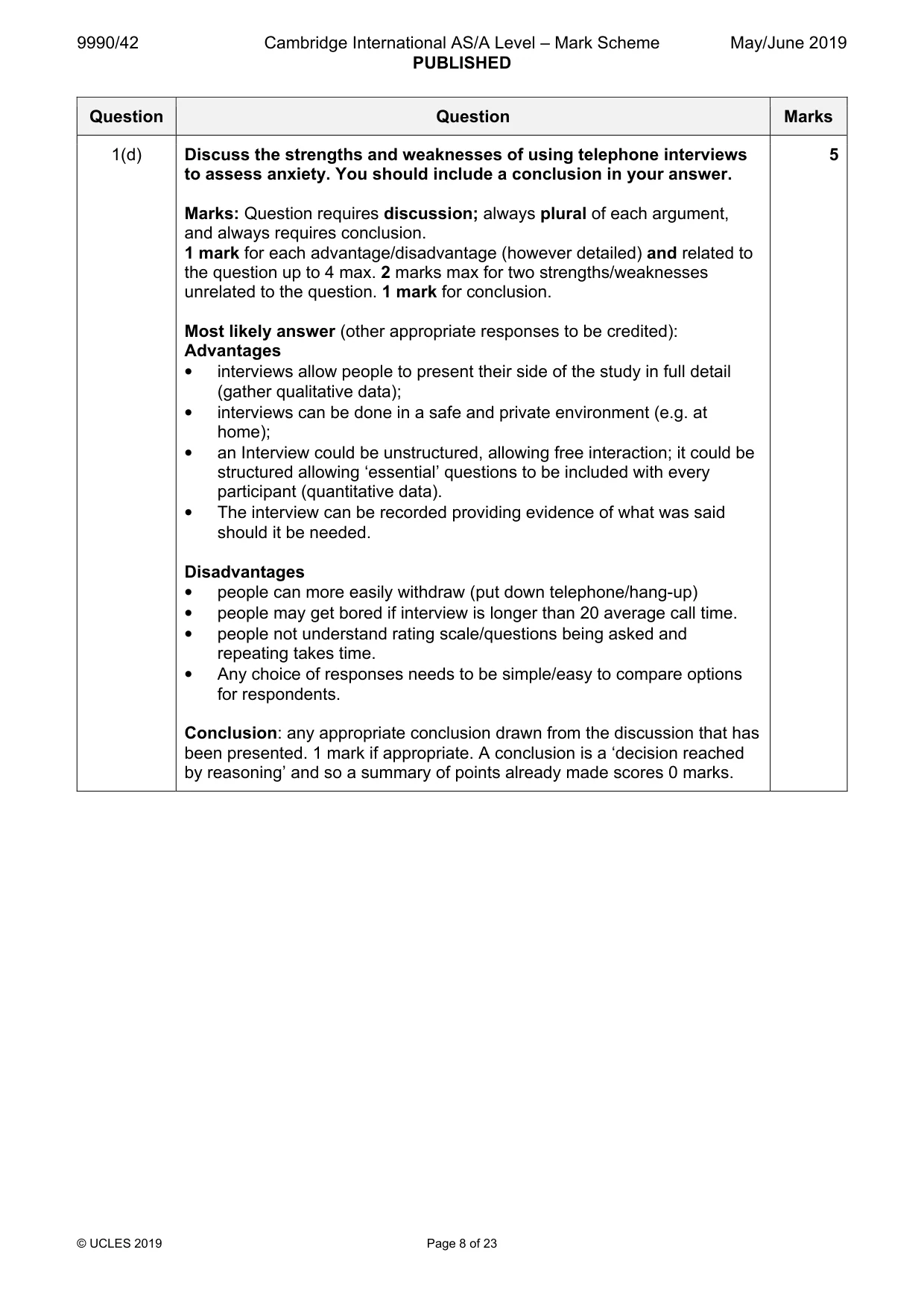
Mark scheme: Question Question Marks Section A: Psychology and abnormality 1 The Generalised Anxiety Disorder assessment (GAD-7) was developed using questionnaires with 2740 patients, followed by a telephone interview with 965 of these patients who were selected randomly. The GAD-7 asks 7 questions each scored from 0–3. A score of 15 or more indicates severe anxiety. 1(a) Explain what is meant by ‘generalised anxiety disorder’. 2 Most likely answer (other appropriate responses to be credited): • GAD is a long-term condition that causes feelings of anxiety about a wide range of situations and issues, (is general) rather than one specific event. • people with GAD feel anxious most days and often struggle to remember the last time they felt relaxed. As soon as one anxious thought is resolved, another may appear about a different issue. • GAD can cause both psychological (mental) and physical symptoms. These vary from person to person, but can include: feeling restless or worried, having trouble concentrating or sleeping, having dizziness or palpitations. Marks: 1 mark for basic answer e.g. one feature (bold above). 1 mark for elaboration (e.g. range of features/example/examples of symptoms. 1(b) Suggest two advantages of using quantitative data to assess anxiety. 4 Most likely answer (other appropriate responses to be credited): • responses from participants can be compared with responses from other participants on the same rating scale. • data can be compared with other studies done previously and in the future. • data can be analysed statistically • a number isn’t open to question by researchers and researcher bias doesn’t apply. Marks: 1 mark for advantage of quantitative but not related. 1 mark for advantage that is related. ×2 1(c) Outline two advantages of the sample used to develop the GAD-7. 4 Most likely answer (other appropriate responses to be credited): • random sample so no sampling bias. • 12 different states of the USA so more generalised/representative • large numbers (965) so less effect of anomalies. Marks: 1 mark for advantage of sample but not related. 1 mark for advantage that is related. ×2 1(d) Discuss the strengths and weaknesses of using telephone interviews 5 to assess anxiety. You should include a conclusion in your answer. Marks: Question requires discussion; always plural of each argument, and always requires conclusion. 1 mark for each advantage/disadvantage (however detailed) and related to the question up to 4 max. 2 marks max for two strengths/weaknesses unrelated to the question. 1 mark for conclusion. Most likely answer (other appropriate responses to be credited): Advantages • interviews allow people to present their side of the study in full detail (gather qualitative data); • interviews can be done in a safe and private environment (e.g. at home); • an Interview could be unstructured, allowing free interaction; it could be structured allowing ‘essential’ questions to be included with every participant (quantitative data). • The interview can be recorded providing evidence of what was said should it be needed. Disadvantages • people can more easily withdraw (put down telephone/hang-up) • people may get bored if interview is longer than 20 average call time. • people not understand rating scale/questions being asked and repeating takes time. • Any choice of responses needs to be simple/easy to compare options for respondents. Conclusion: any appropriate conclusion drawn from the discussion that has been presented. 1 mark if appropriate. A conclusion is a ‘decision reached by reasoning’ and so a summary of points already made scores 0 marks.
Q2 · A study by Snyder and DeBono (1985) used students to investigate how high self-monitors…
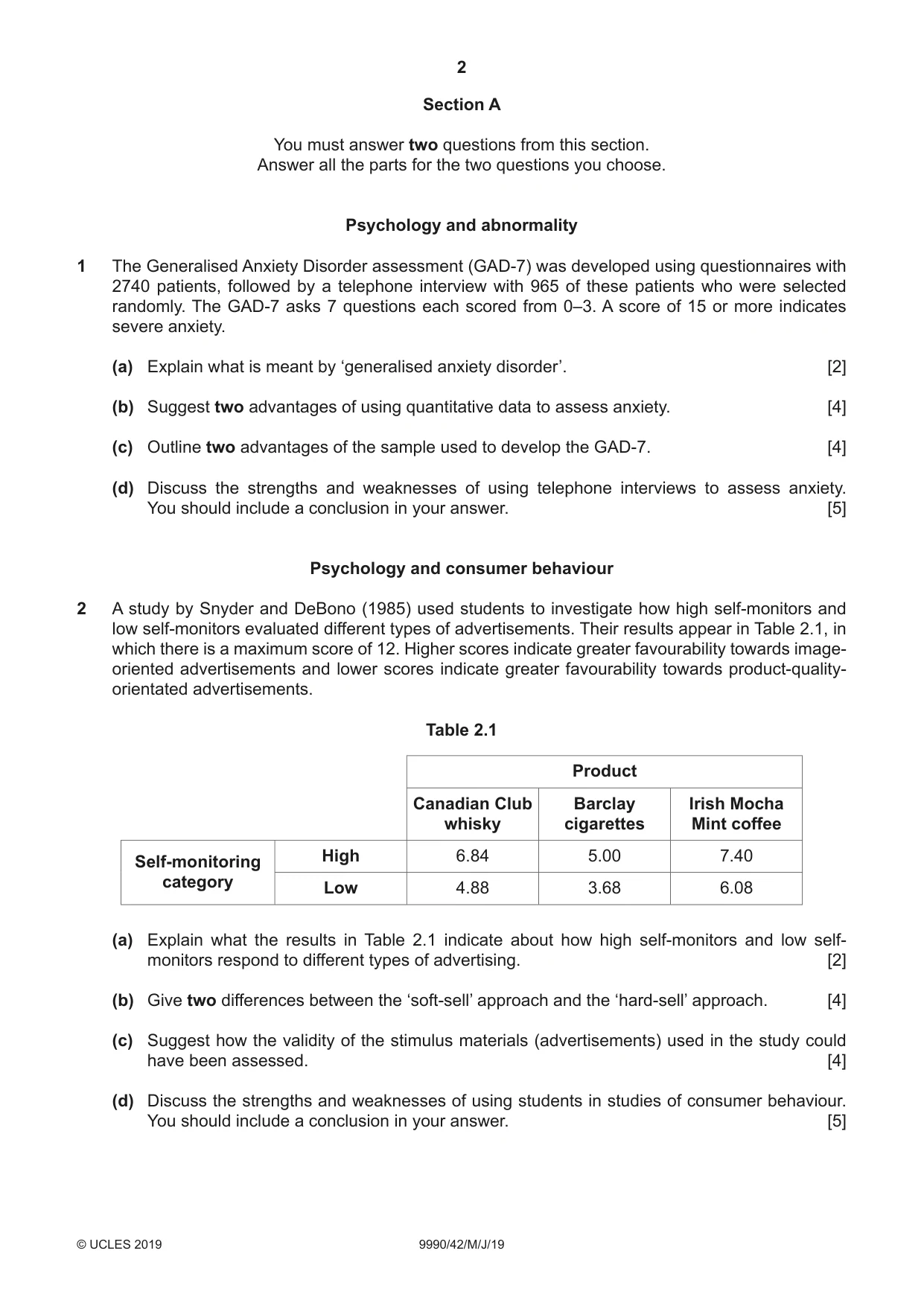
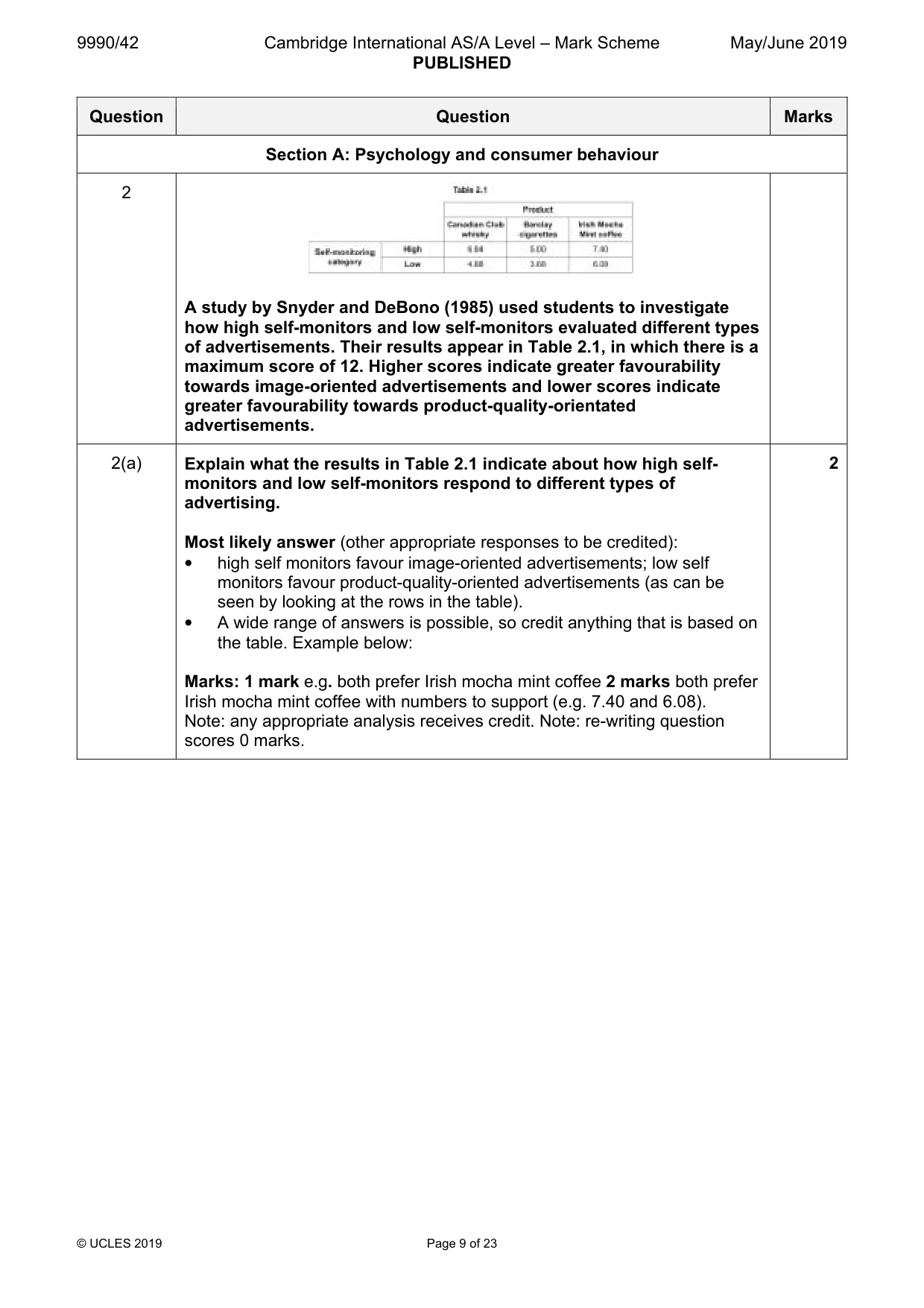
2 A study by Snyder and DeBono (1985) used students to investigate how high self-monitors and low self-monitors evaluated different types of advertisements. Their results appear in Table 2.1, in which there is a maximum score of 12. Higher scores indicate greater favourability towards image- oriented advertisements and lower scores indicate greater favourability towards product-quality- orientated advertisements. Table 2.1 Product Canadian Club Barclay Irish Mocha whisky cigarettes Mint coffee High 6.84 5.00 7.40 Self-monitoring category Low 4.88 3.68 6.08 (a) Explain what the results in Table 2.1 indicate about how high self-monitors and low self- monitors respond to different types of advertising. [2] (b) Give two differences between the ‘soft-sell’ approach and the ‘hard-sell’ approach. [4] (c) Suggest how the validity of the stimulus materials (advertisements) used in the study could have been assessed. [4] (d) Discuss the strengths and weaknesses of using students in studies of consumer behaviour. You should include a conclusion in your answer. [5] Psychology and health
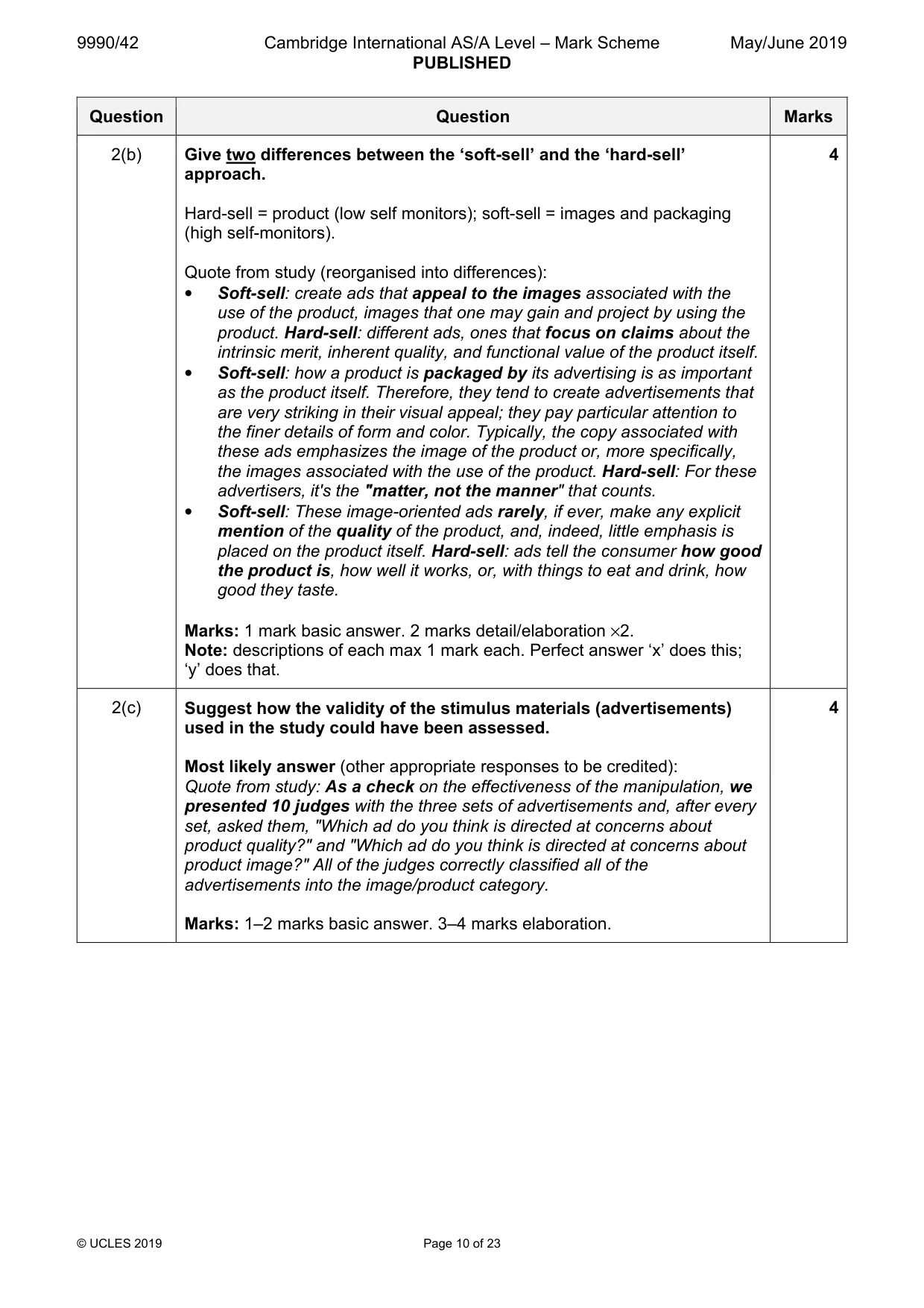
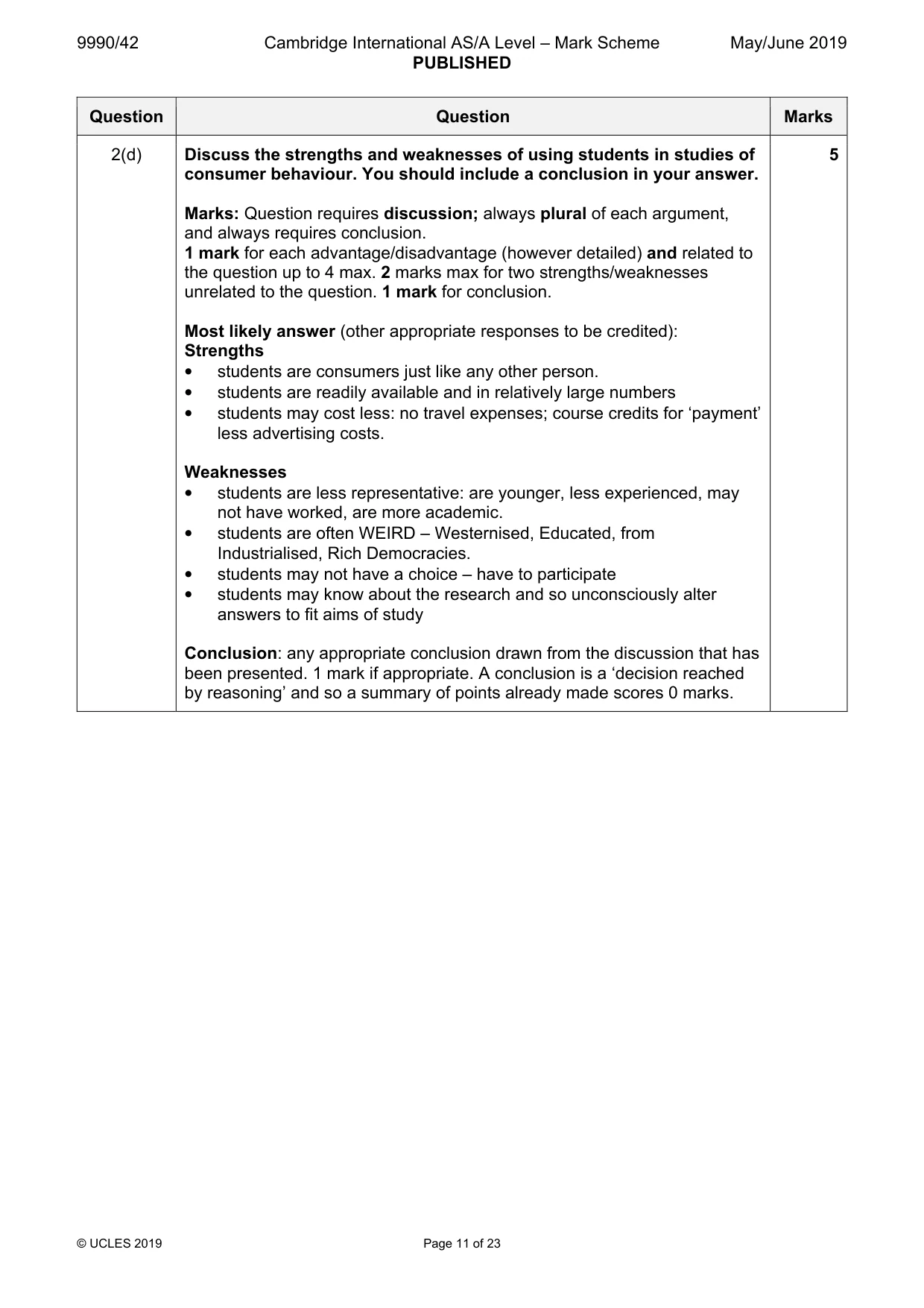
Mark scheme: 2(a) Explain what the results in Table 2.1 indicate about how high self- 2 monitors and low self-monitors respond to different types of advertising. Most likely answer (other appropriate responses to be credited): • high self monitors favour image-oriented advertisements; low self monitors favour product-quality-oriented advertisements (as can be seen by looking at the rows in the table). • A wide range of answers is possible, so credit anything that is based on the table. Example below: Marks: 1 mark e.g. both prefer Irish mocha mint coffee 2 marks both prefer Irish mocha mint coffee with numbers to support (e.g. 7.40 and 6.08). Note: any appropriate analysis receives credit. Note: re-writing question scores 0 marks. 2(b) Give two differences between the ‘soft-sell’ and the ‘hard-sell’ 4 approach. Hard-sell = product (low self monitors); soft-sell = images and packaging (high self-monitors). Quote from study (reorganised into differences): • Soft-sell: create ads that appeal to the images associated with the use of the product, images that one may gain and project by using the product. Hard-sell: different ads, ones that focus on claims about the intrinsic merit, inherent quality, and functional value of the product itself. • Soft-sell: how a product is packaged by its advertising is as important as the product itself. Therefore, they tend to create advertisements that are very striking in their visual appeal; they pay particular attention to the finer details of form and color. Typically, the copy associated with these ads emphasizes the image of the product or, more specifically, the images associated with the use of the product. Hard-sell: For these advertisers, it's the "matter, not the manner" that counts. • Soft-sell: These image-oriented ads rarely, if ever, make any explicit mention of the quality of the product, and, indeed, little emphasis is placed on the product itself. Hard-sell: ads tell the consumer how good the product is, how well it works, or, with things to eat and drink, how good they taste. Marks: 1 mark basic answer. 2 marks detail/elaboration ×2. Note: descriptions of each max 1 mark each. Perfect answer ‘x’ does this; ‘y’ does that. 2(c) Suggest how the validity of the stimulus materials (advertisements) 4 used in the study could have been assessed. Most likely answer (other appropriate responses to be credited): Quote from study: As a check on the effectiveness of the manipulation, we presented 10 judges with the three sets of advertisements and, after every set, asked them, "Which ad do you think is directed at concerns about product quality?" and "Which ad do you think is directed at concerns about product image?" All of the judges correctly classified all of the advertisements into the image/product category. Marks: 1–2 marks basic answer. 3–4 marks elaboration. 2(d) Discuss the strengths and weaknesses of using students in studies of 5 consumer behaviour. You should include a conclusion in your answer. Marks: Question requires discussion; always plural of each argument, and always requires conclusion. 1 mark for each advantage/disadvantage (however detailed) and related to the question up to 4 max. 2 marks max for two strengths/weaknesses unrelated to the question. 1 mark for conclusion. Most likely answer (other appropriate responses to be credited): Strengths • students are consumers just like any other person. • students are readily available and in relatively large numbers • students may cost less: no travel expenses; course credits for ‘payment’ less advertising costs. Weaknesses • students are less representative: are younger, less experienced, may not have worked, are more academic. • students are often WEIRD – Westernised, Educated, from Industrialised, Rich Democracies. • students may not have a choice – have to participate • students may know about the research and so unconsciously alter answers to fit aims of study Conclusion: any appropriate conclusion drawn from the discussion that has been presented. 1 mark if appropriate. A conclusion is a ‘decision reached by reasoning’ and so a summary of points already made scores 0 marks.
Q3 · Model of decisions to seek or delay medical treatment (Safer et al., 1979) notices Am I…
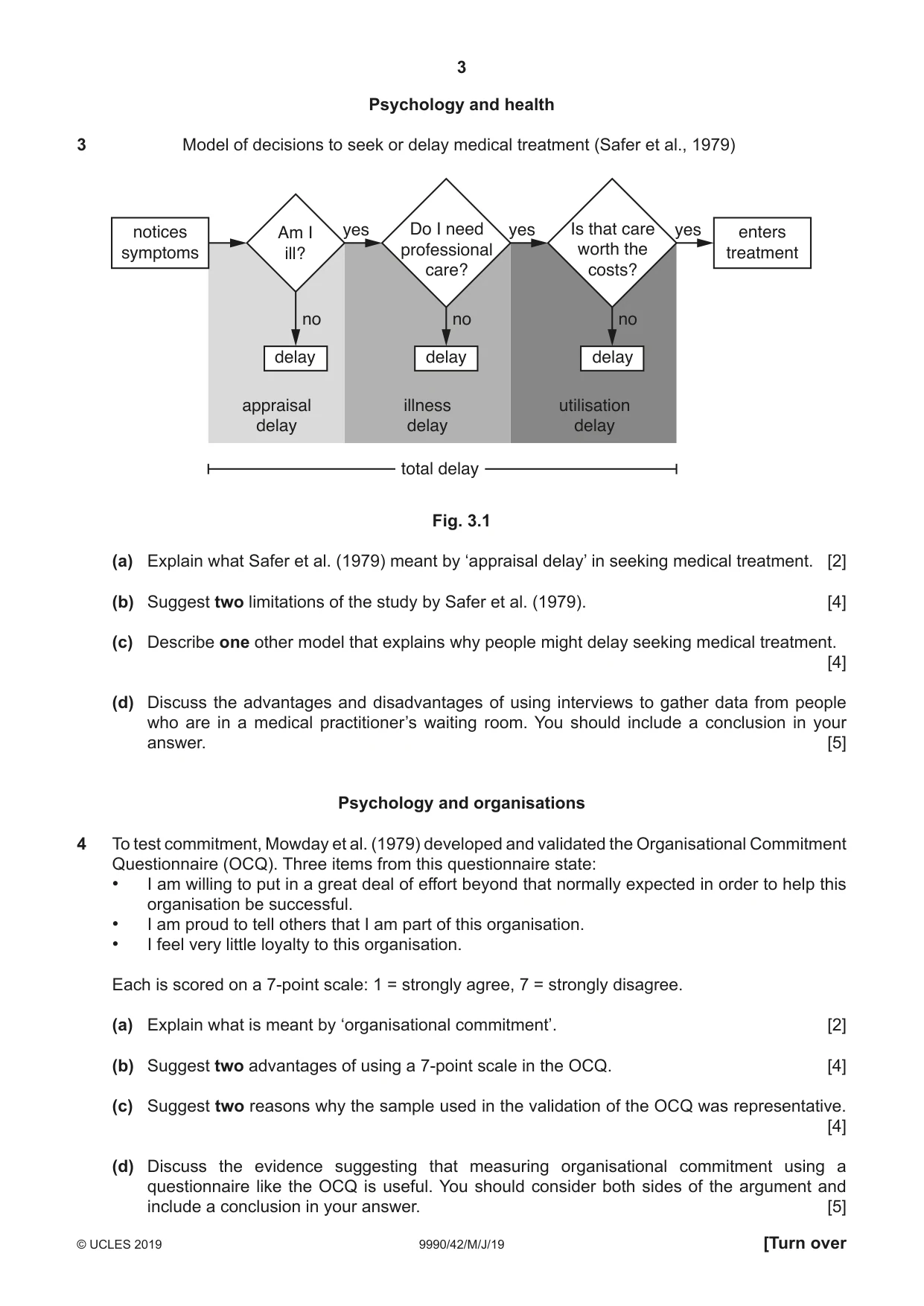
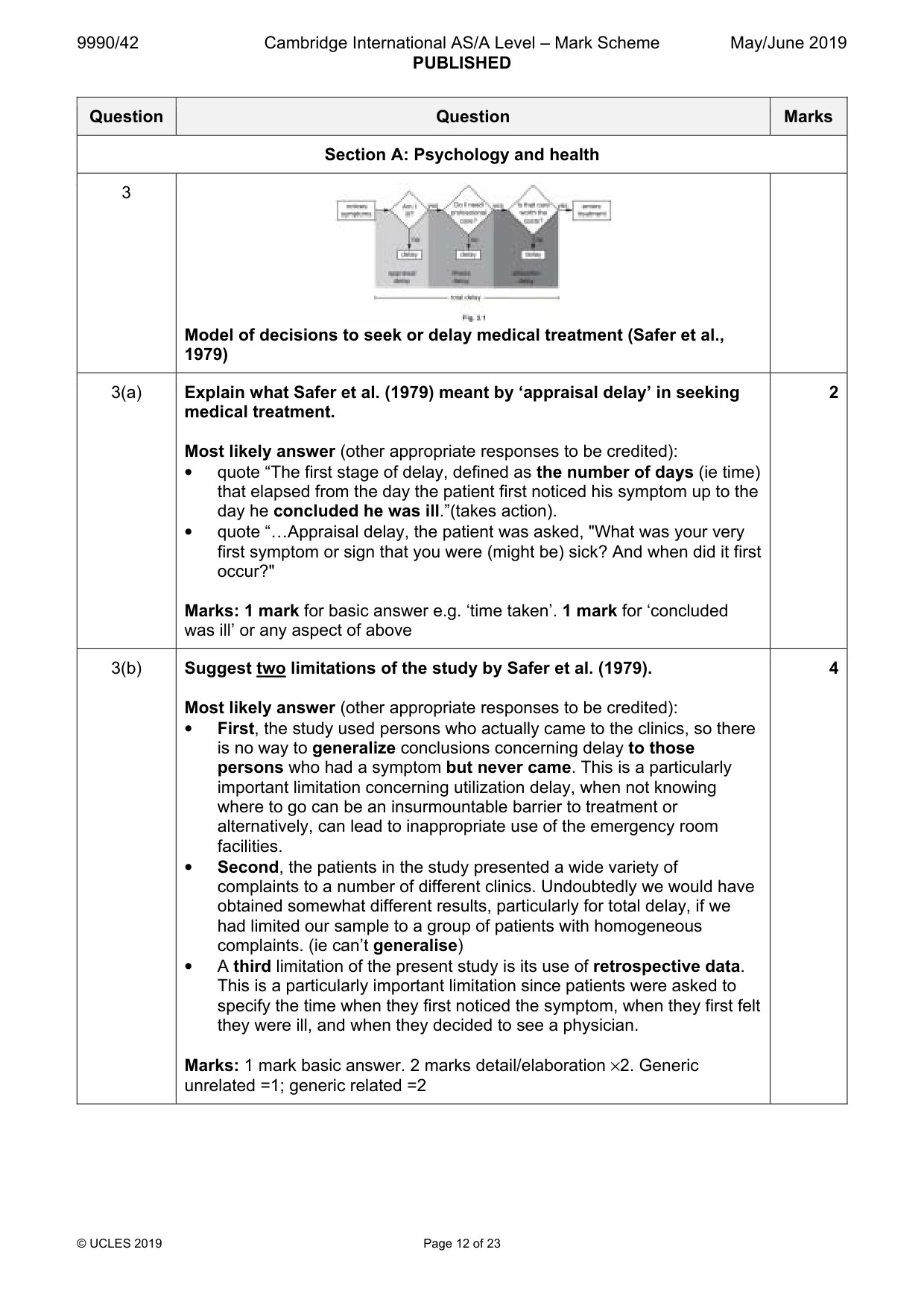
3 Model of decisions to seek or delay medical treatment (Safer et al., 1979) notices Am I yes Do I need yes Is that care yes enters symptoms ill? professional worth the treatment care? costs? no no no delay delay delay appraisal illness utilisation delay delay delay total delay Fig. 3.1 (a) Explain what Safer et al. (1979) meant by ‘appraisal delay’ in seeking medical treatment. [2] (b) Suggest two limitations of the study by Safer et al. (1979). [4] (c) Describe one other model that explains why people might delay seeking medical treatment. [4] (d) Discuss the advantages and disadvantages of using interviews to gather data from people who are in a medical practitioner’s waiting room. You should include a conclusion in your answer. [5] Psychology and organisations
Mark scheme: 3(a) Explain what Safer et al. (1979) meant by ‘appraisal delay’ in seeking 2 medical treatment. Most likely answer (other appropriate responses to be credited): • quote “The first stage of delay, defined as the number of days (ie time) that elapsed from the day the patient first noticed his symptom up to the day he concluded he was ill.”(takes action). • quote “«Appraisal delay, the patient was asked, "What was your very first symptom or sign that you were (might be) sick? And when did it first occur?" Marks: 1 mark for basic answer e.g. ‘time taken’. 1 mark for ‘concluded was ill’ or any aspect of above 3(b) Suggest two limitations of the study by Safer et al. (1979). 4 Most likely answer (other appropriate responses to be credited): • First, the study used persons who actually came to the clinics, so there is no way to generalize conclusions concerning delay to those persons who had a symptom but never came. This is a particularly important limitation concerning utilization delay, when not knowing where to go can be an insurmountable barrier to treatment or alternatively, can lead to inappropriate use of the emergency room facilities. • Second, the patients in the study presented a wide variety of complaints to a number of different clinics. Undoubtedly we would have obtained somewhat different results, particularly for total delay, if we had limited our sample to a group of patients with homogeneous complaints. (ie can’t generalise) • A third limitation of the present study is its use of retrospective data. This is a particularly important limitation since patients were asked to specify the time when they first noticed the symptom, when they first felt they were ill, and when they decided to see a physician. Marks: 1 mark basic answer. 2 marks detail/elaboration ×2. Generic unrelated =1; generic related =2 3(c) Describe one other model to explain why people might delay seeking 4 medical treatment. Most likely answer (other appropriate responses to be credited): The Health belief model. • delay because of perceived vulnerability, perceived severity or self- efficacy beliefs. • delay because of Modifying factors: perceived benefits (get well) and perceived barriers (hurt; cost) • Accept non-models eg optimistic bias; rational choice. 2 marks max if related (1 if unrelated) Marks: 1–2 marks identification and outline. 3–4 marks detailed answer/elaboration. 3(d) Discuss the advantages and disadvantages of using interviews to 5 gather data from people who are in a medical practitioner’s waiting room. You should include a conclusion in your answer. Marks: Question requires discussion; always plural of each argument, and always requires conclusion. 1 mark for each advantage/disadvantage (however detailed) and related to the question up to 4 max. 2 marks max for two strengths/weaknesses unrelated to the question. 1 mark for conclusion. Most likely answer (other appropriate responses to be credited): Advantages • if people are ill they may want to discuss their illness. • people may want something to do to distract them from the nervousness they might have before the consultation. • people are in a consultation waiting room, so ecological validity is high. Disadvantages • people may not want to participate in any psychological research • people may give brief answers because they don’t want to concentrate on questions • people may be nervous and not focus on questions Conclusion: any appropriate conclusion drawn from the discussion that has been presented. 1 mark if appropriate. A conclusion is a ‘decision reached by reasoning’ and so a summary of points already made scores 0 marks.
Q4 · To test commitment, Mowday et al
4 To test commitment, Mowday et al. (1979) developed and validated the Organisational Commitment Questionnaire (OCQ). Three items from this questionnaire state: • I am willing to put in a great deal of effort beyond that normally expected in order to help this organisation be successful. • I am proud to tell others that I am part of this organisation. • I feel very little loyalty to this organisation. Each is scored on a 7-point scale: 1 = strongly agree, 7 = strongly disagree. (a) Explain what is meant by ‘organisational commitment’. [2] (b) Suggest two advantages of using a 7-point scale in the OCQ. [4] (c) Suggest two reasons why the sample used in the validation of the OCQ was representative. [4] (d) Discuss the evidence suggesting that measuring organisational commitment using a questionnaire like the OCQ is useful. You should consider both sides of the argument and include a conclusion in your answer. [5]
Mark scheme: 4(a) Explain what is meant by ‘organisational commitment’. 2 Most likely answer Quote from study: Organisational commitment was defined here as the relative strength of an individual's identification with and involvement in a particular organization. It can be characterised by at least three related factors: (1) a strong belief in and acceptance of the organization's goals and values; (2) a willingness to exert considerable effort on behalf of the organization; and (3) a strong desire to maintain membership in the organization. Marks: 1 mark for basic answer (bold above). 1 mark for elaboration/example (e.g. point from above). 4(b) Suggest two advantages of using a 7-point scale in the OCQ. 4 Most likely answer (other appropriate responses to be credited): Advantages • a seven point scale allows a wide range of responses from ‘not at all justifiable’ to ‘totally justifiable’ • a seven point scale includes a mid-point, which is neutral, so any participant who really feels neutral can choose this option. • a seven point scale will provide quantitative data that can be statistically analysed. Marks: 1 mark basic answer, 2 marks detailed answer/elaborationfor each. Note: answers must be related to the OCQ. If not 1 mark max for each advantage. 4(c) Give two reasons why the sample used in the validation of the OCQ 4 was representative. Most likely answer (other appropriate responses to be credited): Quote from study: 1 Sample size; 2563 employees working in a wide variety of jobs in nine different work organisations. In all, the array of both job classifications and work organizations is thought to be sufficiently broad to tap a reasonably representative sample of the working population 2 Wide range of occupations: Jobs include: publics employees, classified university employees, hospital employees, bank employees, telephone company employees, scientists and engineers, auto company managers, psychiatric technicians, retail management trainees. Marks: 1 mark basic answer, 2 marks detailed answer/elaboration ×2. 4(d) Discuss the evidence suggesting that measuring organisational 5 commitment using a questionnaire like the OCQ is useful. You should consider both sides of the argument and include a conclusion in your answer. Marks: Question requires discussion; always plural of each argument, and always requires conclusion. 1 mark for each advantage/disadvantage (however detailed) and related to the question up to 4 max. 2 marks max for two strengths/weaknesses unrelated to the question. 1 mark for conclusion. Most likely answer (other appropriate responses to be credited): Advantages • questionnaires can include a wide range of pertinent items that may not be included in a self report of an accident. • questionnaires can provide quantitative data which may allow comparisons to be made with other accidents of the same type. • questionnaires can provide qualitative data through open ended questions allowing a worker to report in detail what happened. Disadvantages • the questionnaire might be pre-written with items that do not apply or do not cover the specifics of a particular accident. • workers may not answer the questions truthfully if their job is at stake. • questionnaires may only give quantitative data; an open ended-question may be more revealing • questionnaires might include leading words. Conclusion: any appropriate conclusion drawn from the discussion that has been presented. 1 mark if appropriate. A conclusion is a ‘decision reached by reasoning’ and so a summary of points already made scores 0 marks.
Q5 · People who have been bitten by an animal may interpret this experience in different ways…
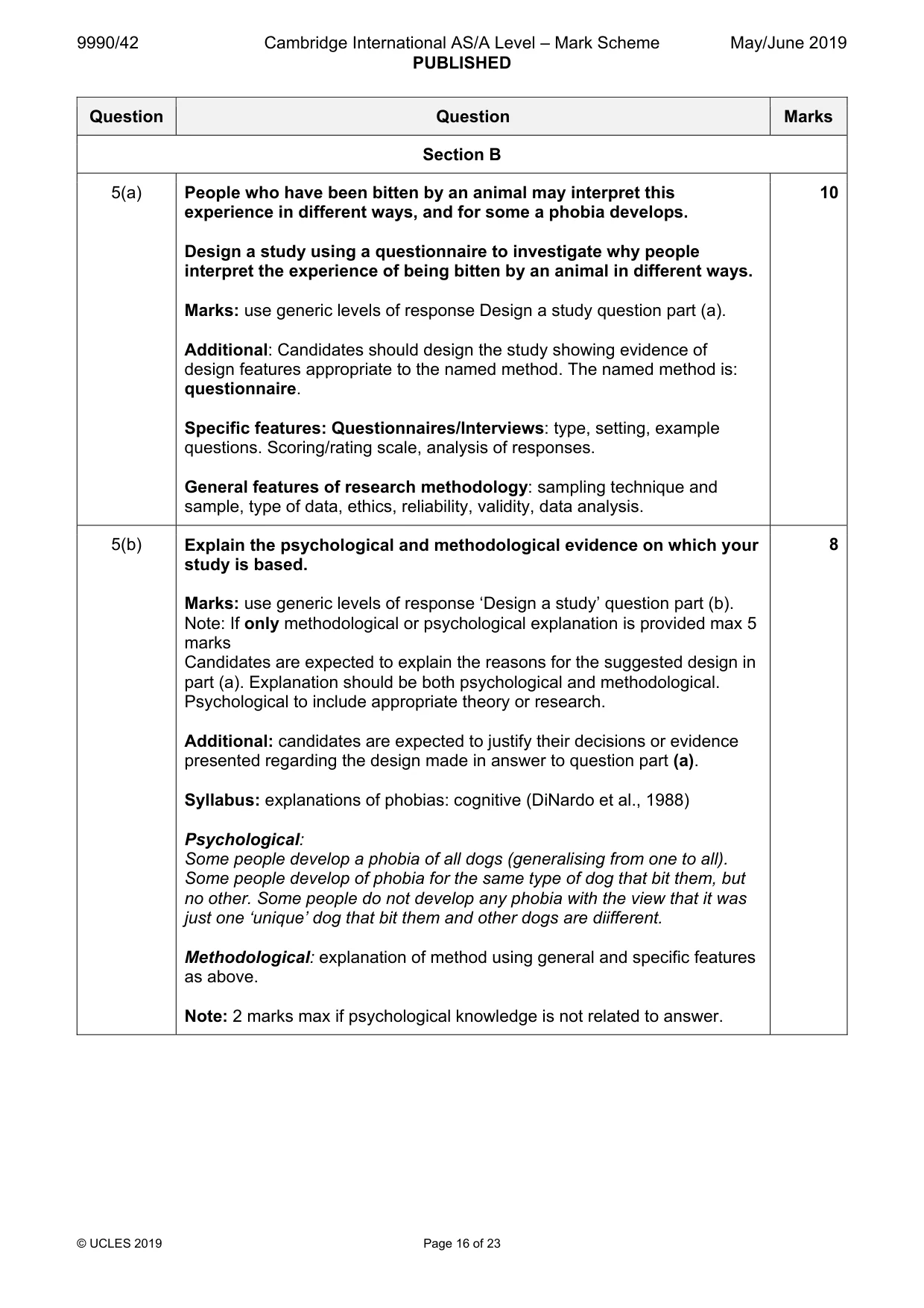
5 People who have been bitten by an animal may interpret this experience in different ways, and for some a phobia develops. (a) Design a study using a questionnaire to investigate why people interpret the experience of being bitten by an animal in different ways. [10] (b) Explain the psychological and methodological evidence on which your study is based. [8] Psychology and consumer behaviour
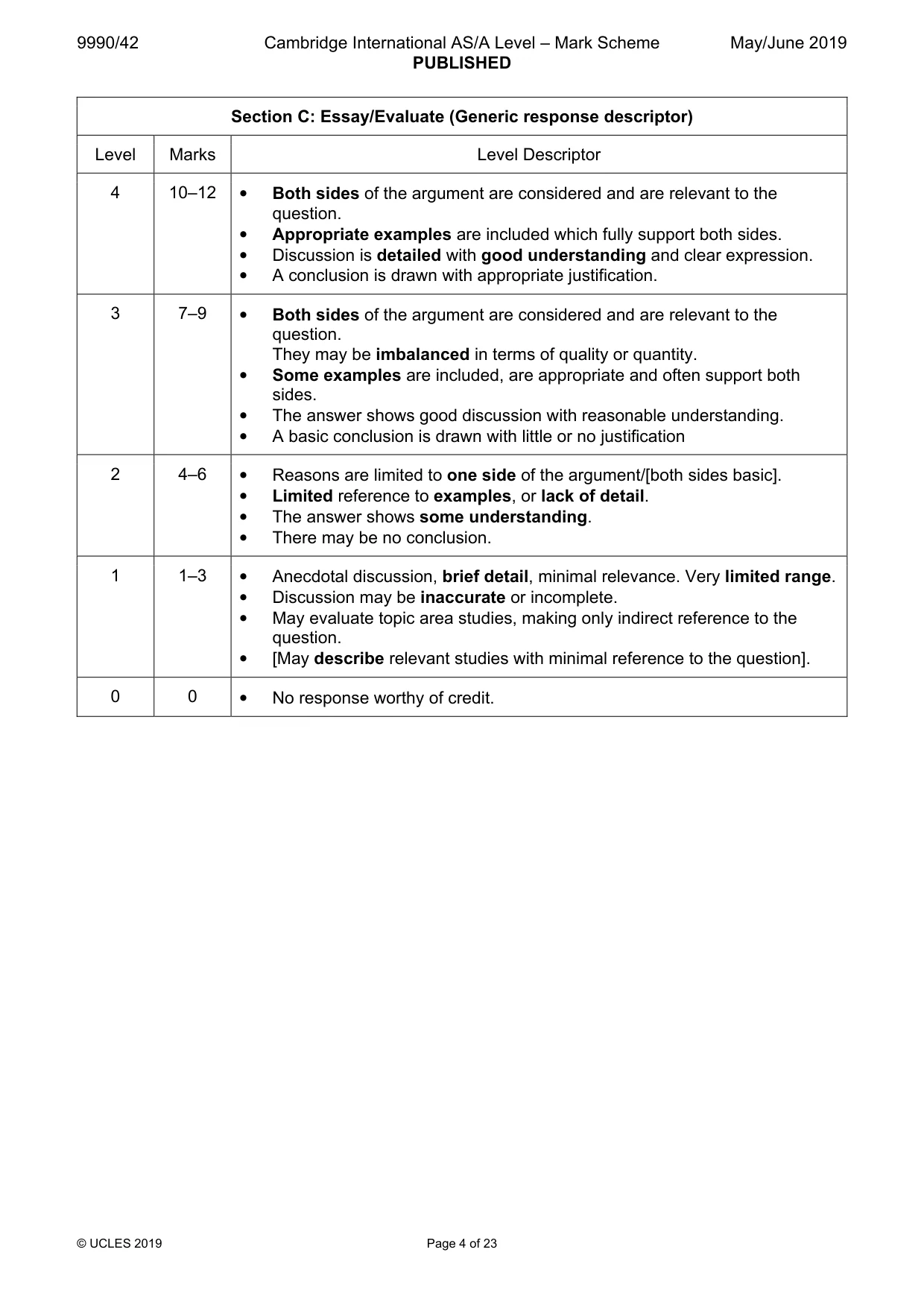
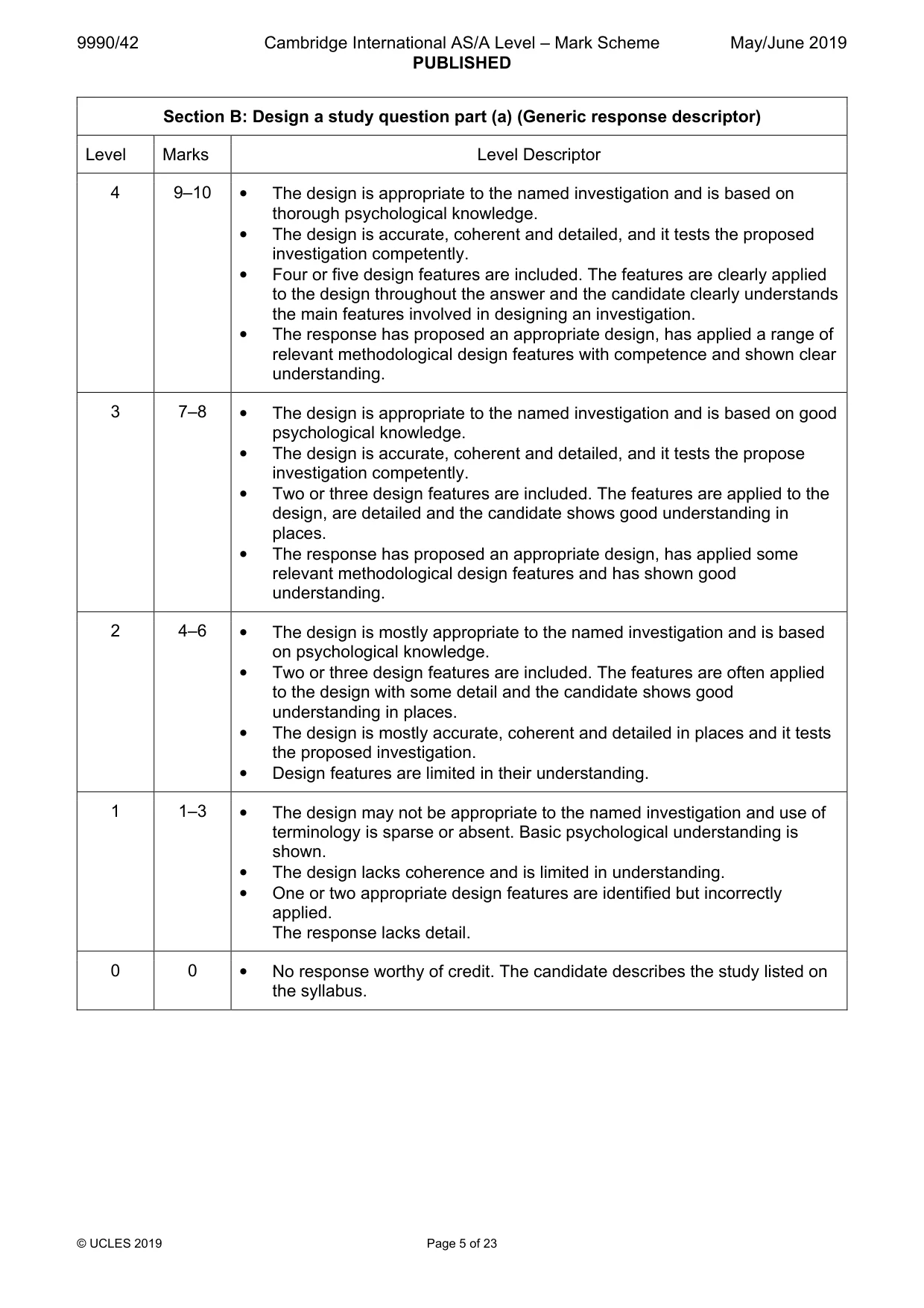
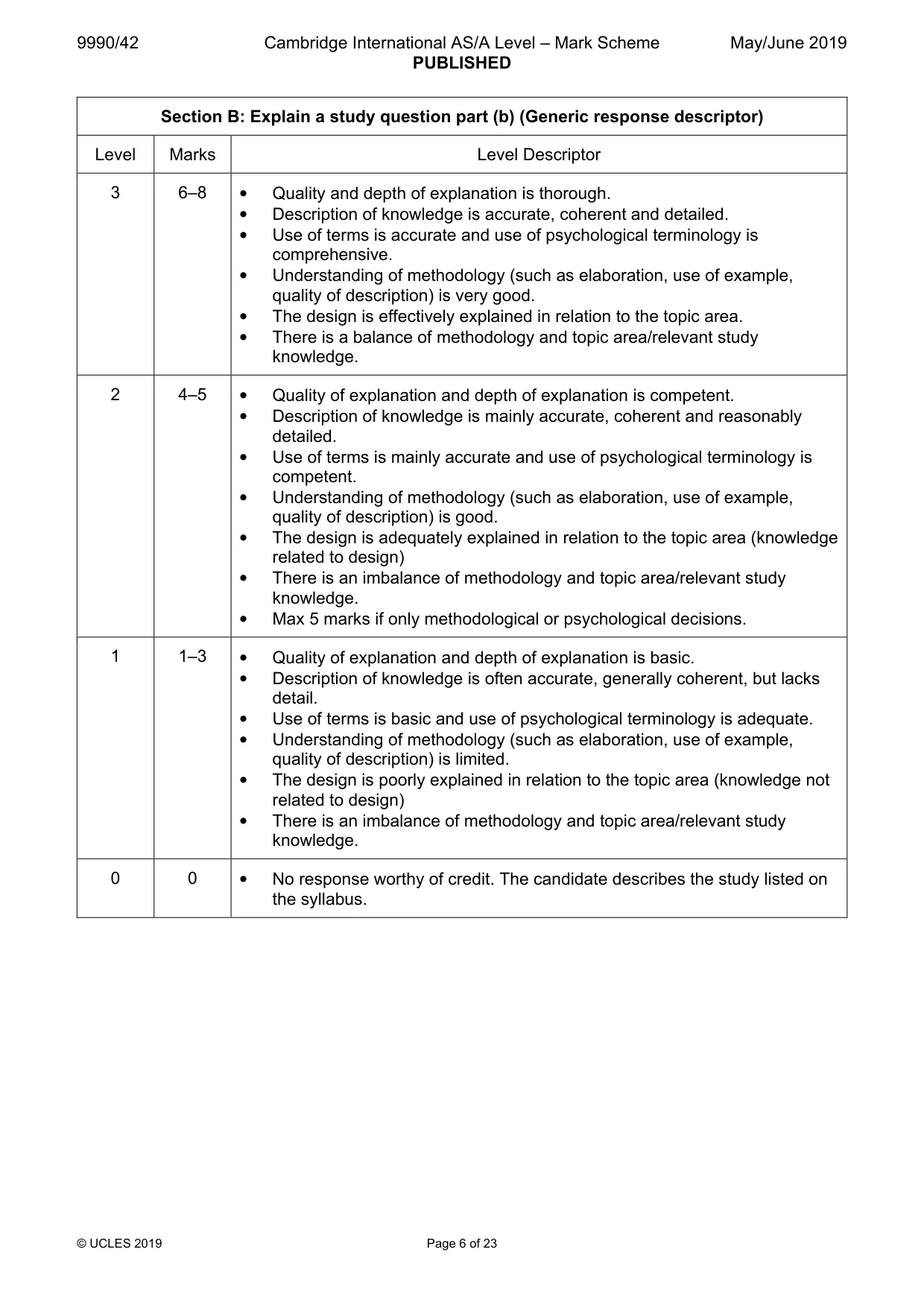
Mark scheme: 5(a) People who have been bitten by an animal may interpret this 10 experience in different ways, and for some a phobia develops. Design a study using a questionnaire to investigate why people interpret the experience of being bitten by an animal in different ways. Marks: use generic levels of response Design a study question part (a). Additional: Candidates should design the study showing evidence of design features appropriate to the named method. The named method is: questionnaire. Specific features: Questionnaires/Interviews: type, setting, example questions. Scoring/rating scale, analysis of responses. General features of research methodology: sampling technique and sample, type of data, ethics, reliability, validity, data analysis. 5(b) Explain the psychological and methodological evidence on which your 8 study is based. Marks: use generic levels of response ‘Design a study’ question part (b). Note: If only methodological or psychological explanation is provided max 5 marks Candidates are expected to explain the reasons for the suggested design in part (a). Explanation should be both psychological and methodological. Psychological to include appropriate theory or research. Additional: candidates are expected to justify their decisions or evidence presented regarding the design made in answer to question part (a). Syllabus: explanations of phobias: cognitive (DiNardo et al., 1988) Psychological: Some people develop a phobia of all dogs (generalising from one to all). Some people develop of phobia for the same type of dog that bit them, but no other. Some people do not develop any phobia with the view that it was just one ‘unique’ dog that bit them and other dogs are diifferent. Methodological: explanation of method using general and specific features as above. Note: 2 marks max if psychological knowledge is not related to answer.
More questions on Anxiety disorders and fear-related disorders
Q6 · Design a field experiment to investigate the effect of different odours in a clothes shop
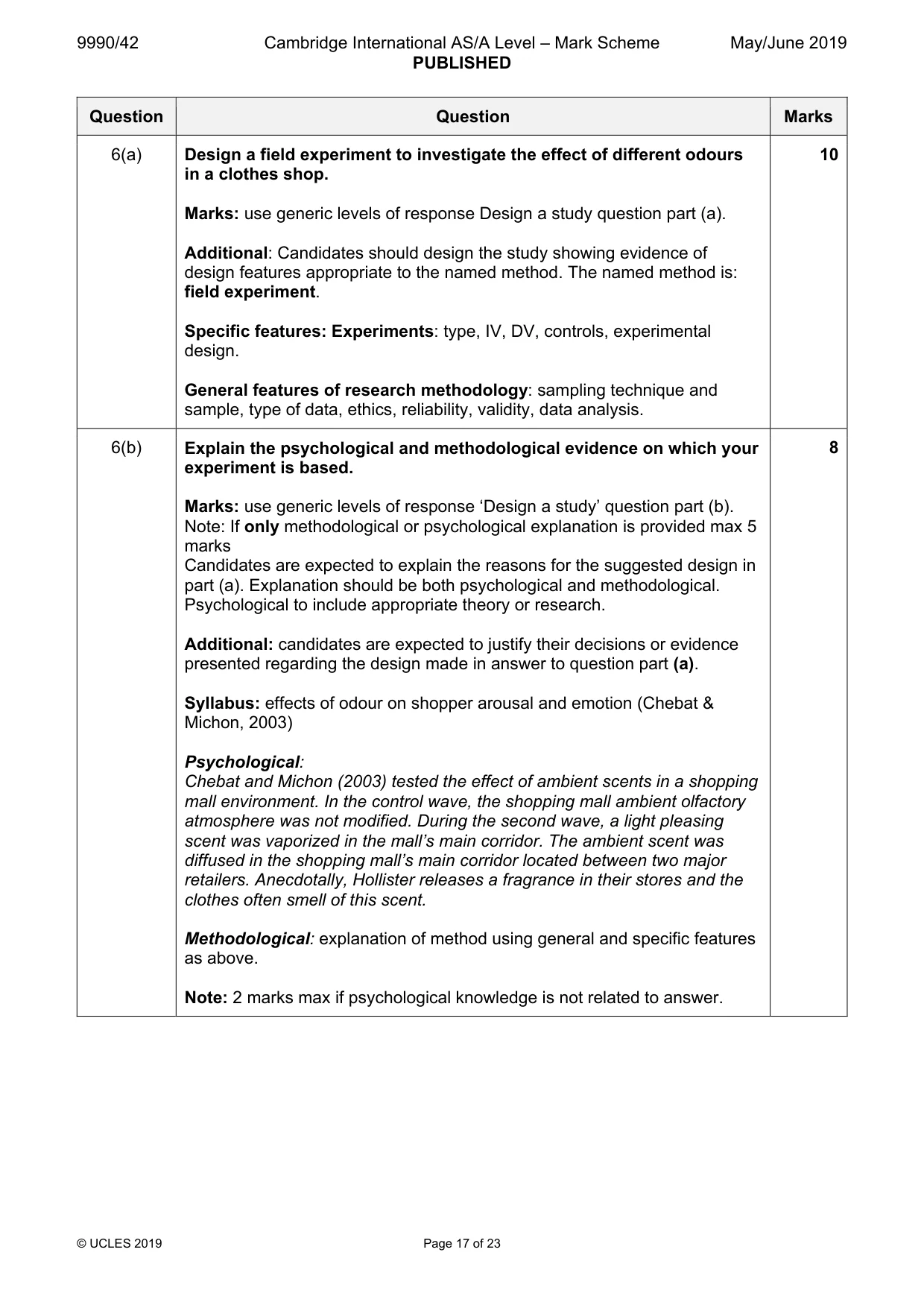
6 (a) Design a field experiment to investigate the effect of different odours in a clothes shop. [10] (b) Explain the psychological and methodological evidence on which your experiment is based. [8] Psychology and health
Mark scheme: 6(a) Design a field experiment to investigate the effect of different odours 10 in a clothes shop. Marks: use generic levels of response Design a study question part (a). Additional: Candidates should design the study showing evidence of design features appropriate to the named method. The named method is: field experiment. Specific features: Experiments: type, IV, DV, controls, experimental design. General features of research methodology: sampling technique and sample, type of data, ethics, reliability, validity, data analysis. 6(b) Explain the psychological and methodological evidence on which your 8 experiment is based. Marks: use generic levels of response ‘Design a study’ question part (b). Note: If only methodological or psychological explanation is provided max 5 marks Candidates are expected to explain the reasons for the suggested design in part (a). Explanation should be both psychological and methodological. Psychological to include appropriate theory or research. Additional: candidates are expected to justify their decisions or evidence presented regarding the design made in answer to question part (a). Syllabus: effects of odour on shopper arousal and emotion (Chebat & Michon, 2003) Psychological: Chebat and Michon (2003) tested the effect of ambient scents in a shopping mall environment. In the control wave, the shopping mall ambient olfactory atmosphere was not modified. During the second wave, a light pleasing scent was vaporized in the mall’s main corridor. The ambient scent was diffused in the shopping mall’s main corridor located between two major retailers. Anecdotally, Hollister releases a fragrance in their stores and the clothes often smell of this scent. Methodological: explanation of method using general and specific features as above. Note: 2 marks max if psychological knowledge is not related to answer.
Q7 · Design a study using an interview of people suffering from phantom limb pain to compare…
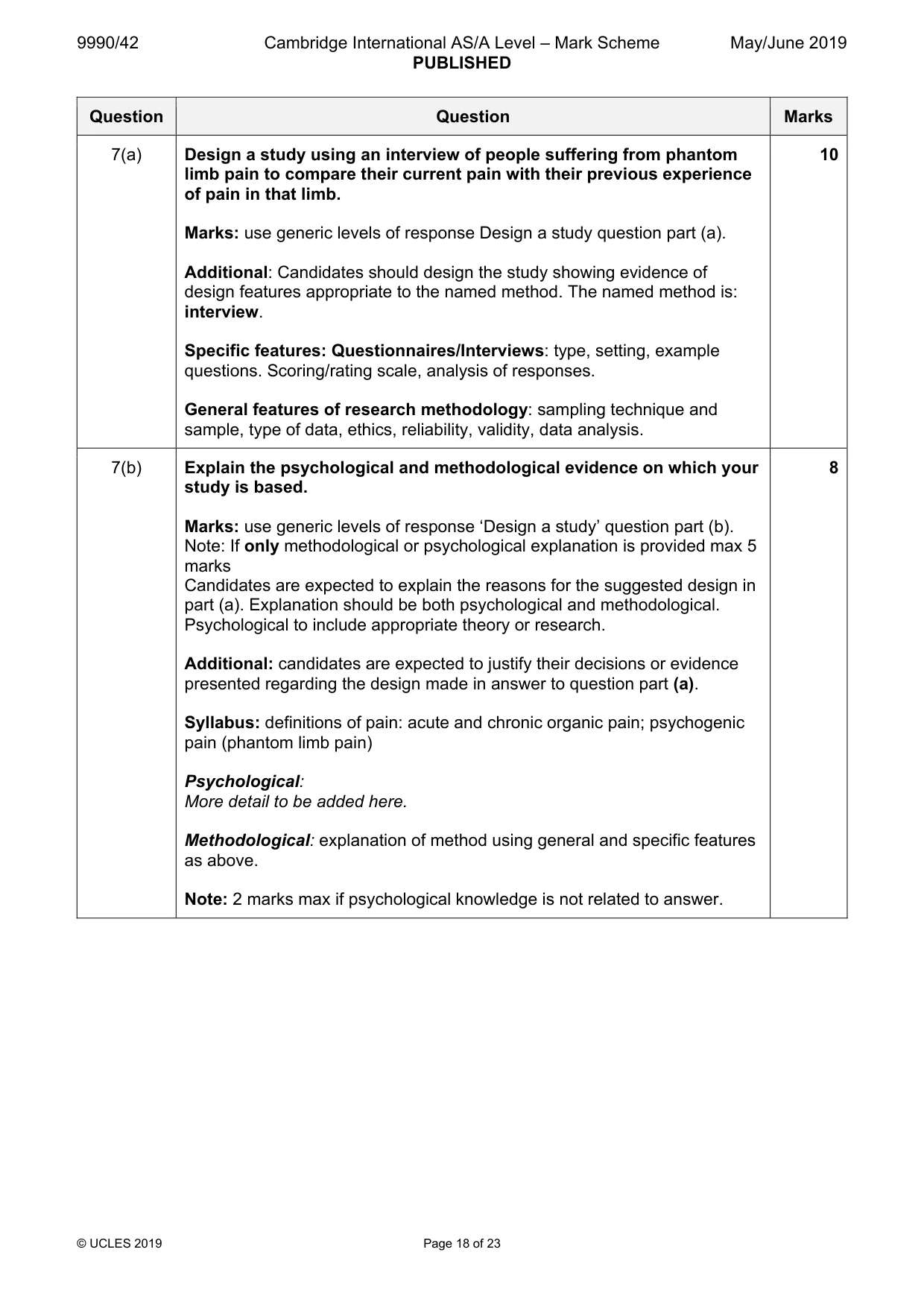
7 (a) Design a study using an interview of people suffering from phantom limb pain to compare their current pain with their previous experience of pain in that limb. [10] (b) Explain the psychological and methodological evidence on which your study is based. [8] Psychology and organisations
Mark scheme: 7(a) Design a study using an interview of people suffering from phantom 10 limb pain to compare their current pain with their previous experience of pain in that limb. Marks: use generic levels of response Design a study question part (a). Additional: Candidates should design the study showing evidence of design features appropriate to the named method. The named method is: interview. Specific features: Questionnaires/Interviews: type, setting, example questions. Scoring/rating scale, analysis of responses. General features of research methodology: sampling technique and sample, type of data, ethics, reliability, validity, data analysis. 7(b) Explain the psychological and methodological evidence on which your 8 study is based. Marks: use generic levels of response ‘Design a study’ question part (b). Note: If only methodological or psychological explanation is provided max 5 marks Candidates are expected to explain the reasons for the suggested design in part (a). Explanation should be both psychological and methodological. Psychological to include appropriate theory or research. Additional: candidates are expected to justify their decisions or evidence presented regarding the design made in answer to question part (a). Syllabus: definitions of pain: acute and chronic organic pain; psychogenic pain (phantom limb pain) Psychological: More detail to be added here. Methodological: explanation of method using general and specific features as above. Note: 2 marks max if psychological knowledge is not related to answer.
Q8 · Design a study to investigate intrinsic motivation in workers in a factory making shoes
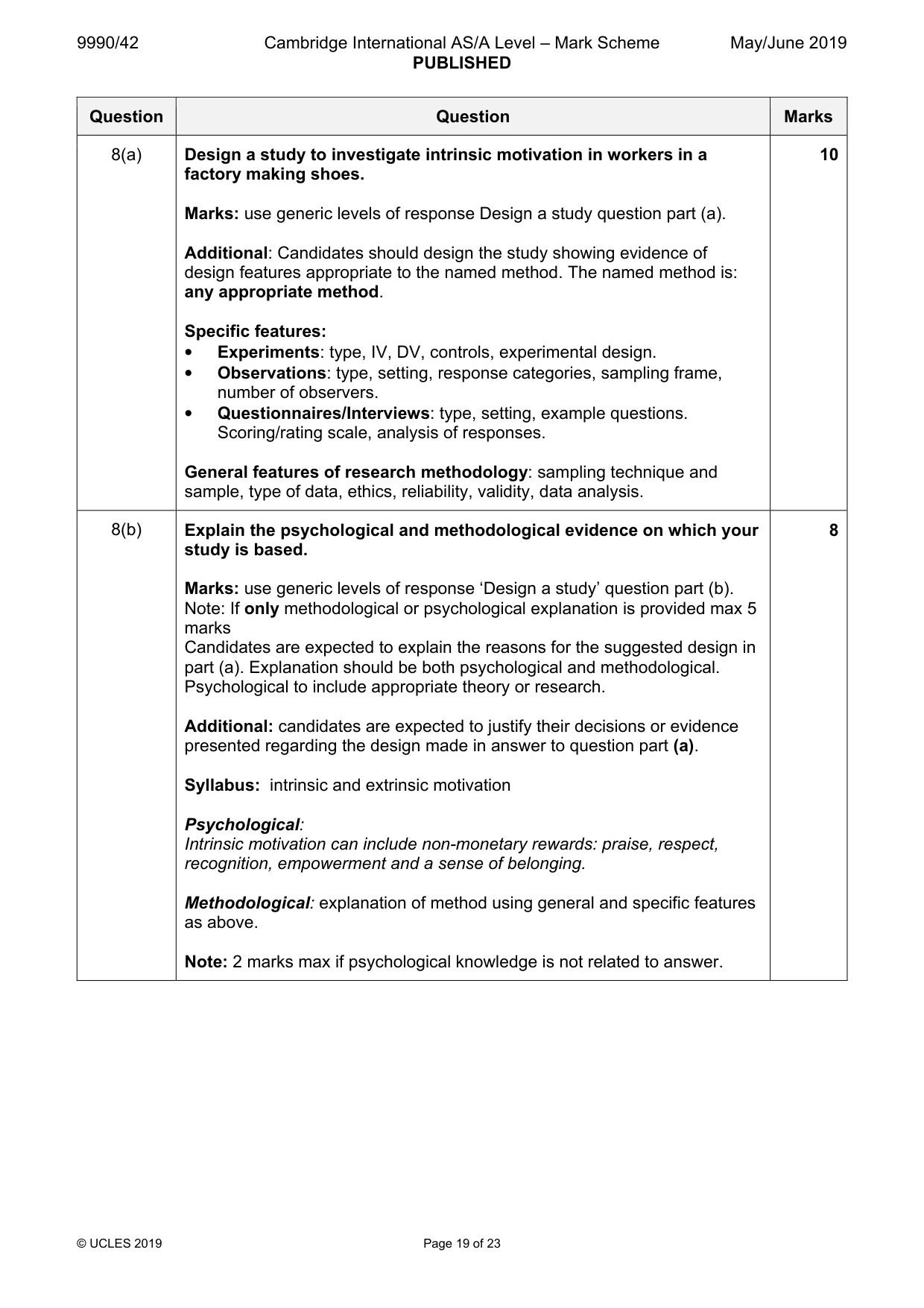
8 (a) Design a study to investigate intrinsic motivation in workers in a factory making shoes. [10] (b) Explain the psychological and methodological evidence on which your study is based. [8] Section C You must answer one question from this section. Psychology and abnormality
Mark scheme: 8(a) Design a study to investigate intrinsic motivation in workers in a 10 factory making shoes. Marks: use generic levels of response Design a study question part (a). Additional: Candidates should design the study showing evidence of design features appropriate to the named method. The named method is: any appropriate method. Specific features: • Experiments: type, IV, DV, controls, experimental design. • Observations: type, setting, response categories, sampling frame, number of observers. • Questionnaires/Interviews: type, setting, example questions. Scoring/rating scale, analysis of responses. General features of research methodology: sampling technique and sample, type of data, ethics, reliability, validity, data analysis. 8(b) Explain the psychological and methodological evidence on which your 8 study is based. Marks: use generic levels of response ‘Design a study’ question part (b). Note: If only methodological or psychological explanation is provided max 5 marks Candidates are expected to explain the reasons for the suggested design in part (a). Explanation should be both psychological and methodological. Psychological to include appropriate theory or research. Additional: candidates are expected to justify their decisions or evidence presented regarding the design made in answer to question part (a). Syllabus: intrinsic and extrinsic motivation Psychological: Intrinsic motivation can include non-monetary rewards: praise, respect, recognition, empowerment and a sense of belonging. Methodological: explanation of method using general and specific features as above. Note: 2 marks max if psychological knowledge is not related to answer.
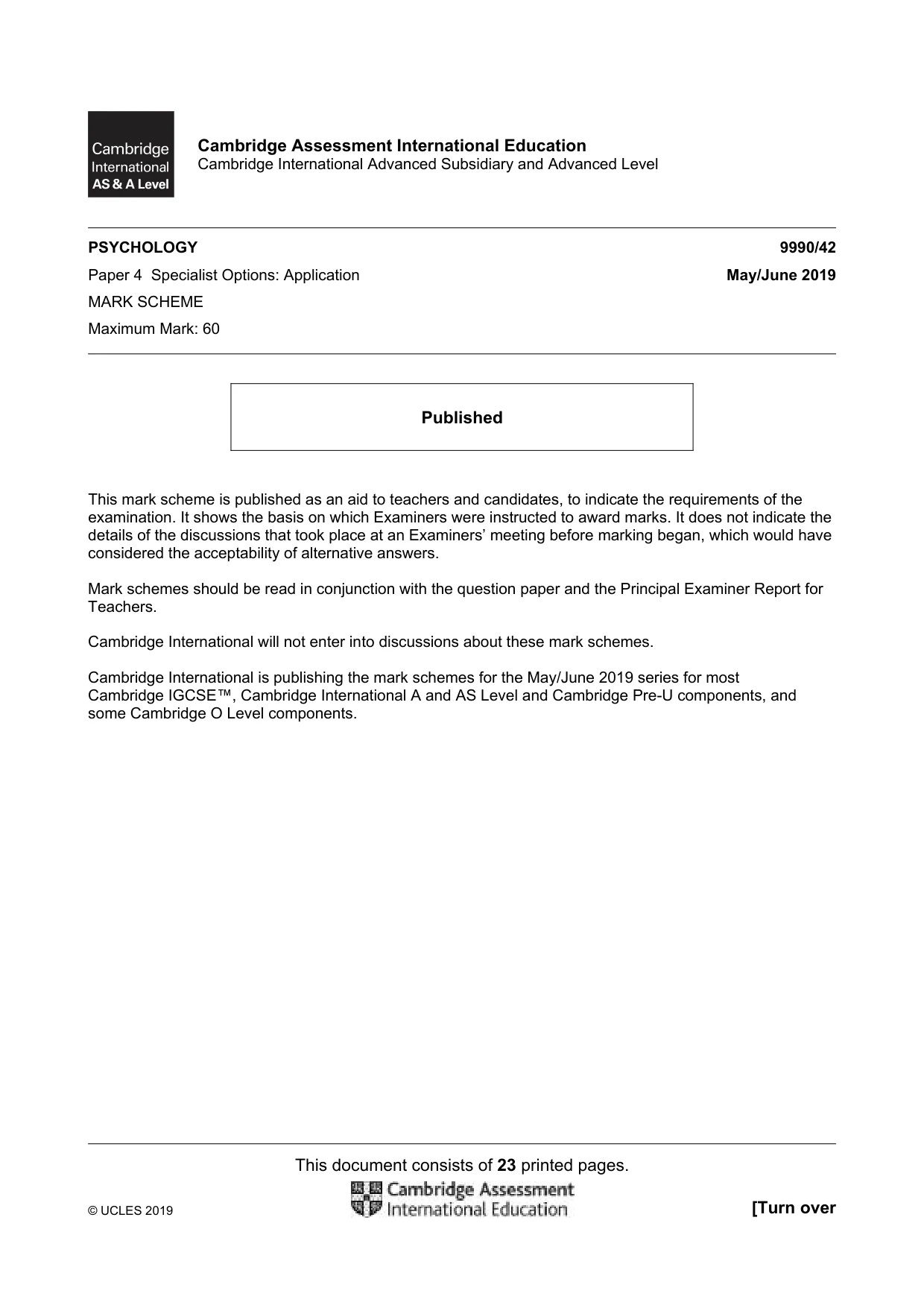
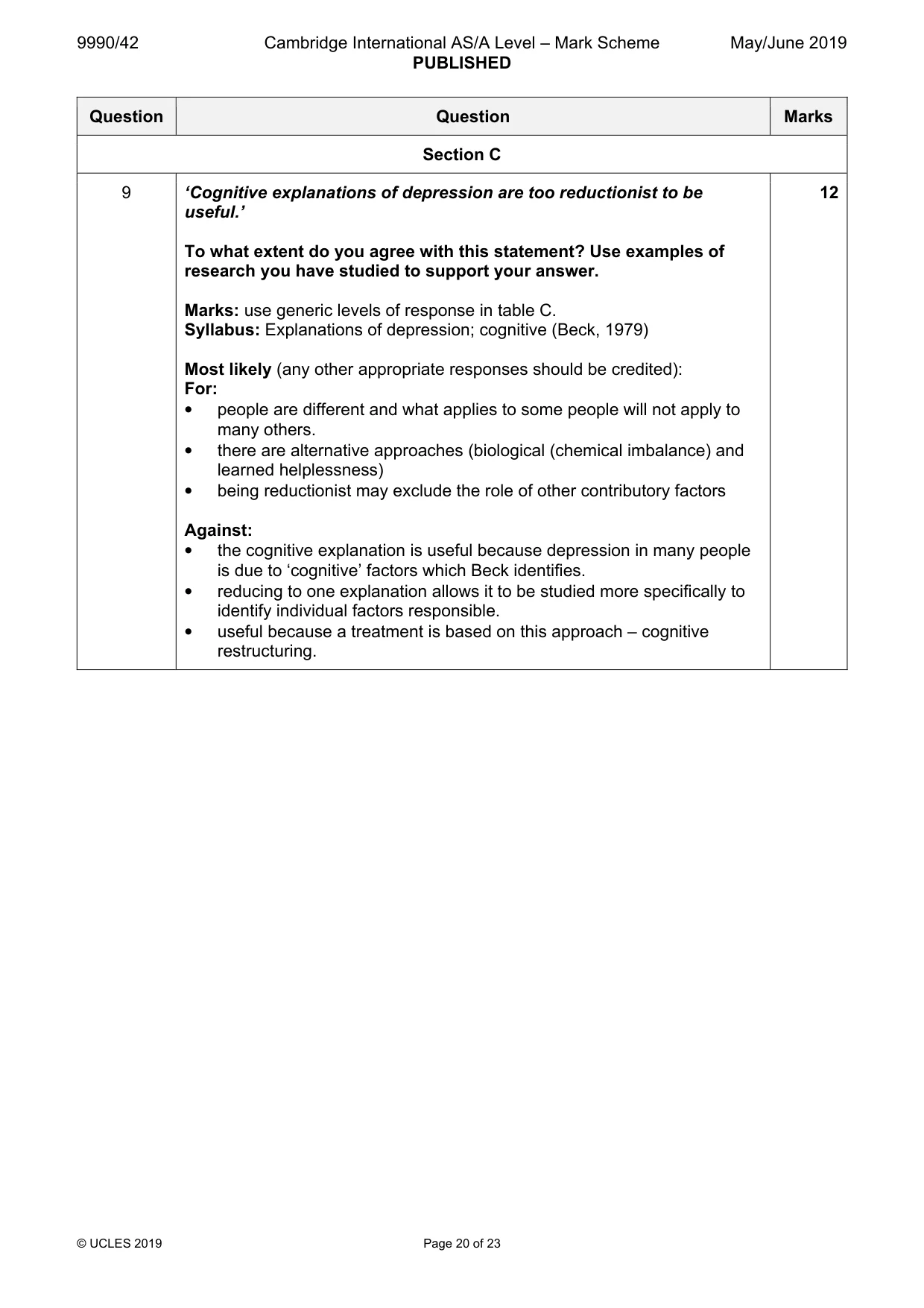
Q9 · ‘Cognitive explanations of depression are too reductionist to be useful.’ To what extent…
9 ‘Cognitive explanations of depression are too reductionist to be useful.’ To what extent do you agree with this statement? Use examples of research you have studied to support your answer. [12] Psychology and consumer behaviour
Mark scheme: 9 ‘Cognitive explanations of depression are too reductionist to be 12 useful.’ To what extent do you agree with this statement? Use examples of research you have studied to support your answer. Marks: use generic levels of response in table C. Syllabus: Explanations of depression; cognitive (Beck, 1979) Most likely (any other appropriate responses should be credited): For: • people are different and what applies to some people will not apply to many others. • there are alternative approaches (biological (chemical imbalance) and learned helplessness) • being reductionist may exclude the role of other contributory factors Against: • the cognitive explanation is useful because depression in many people is due to ‘cognitive’ factors which Beck identifies. • reducing to one explanation allows it to be studied more specifically to identify individual factors responsible. • useful because a treatment is based on this approach – cognitive restructuring.
More questions on Mood (affective) disorders: depressive disorder (unipolar) and bipolar disorder
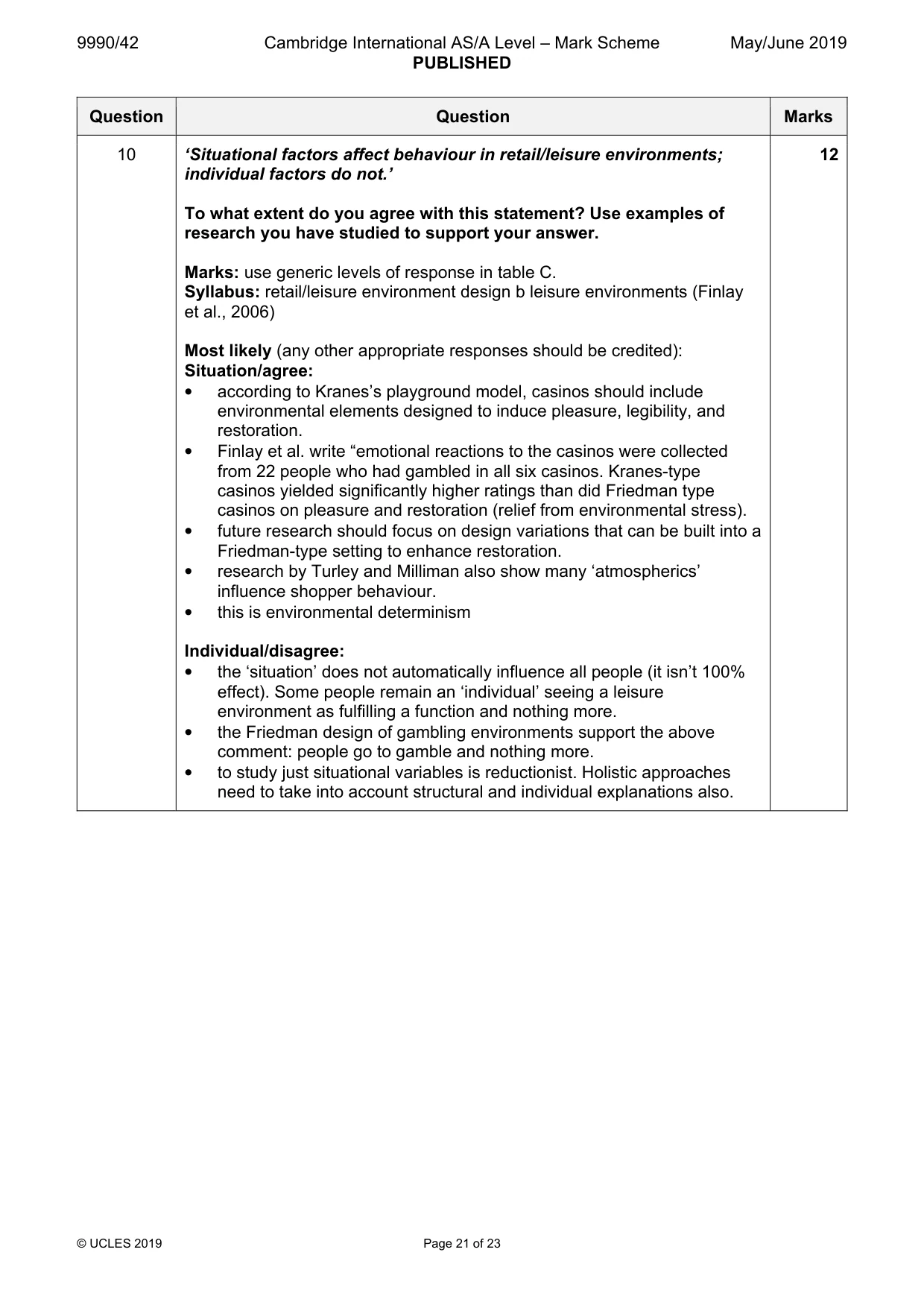
Q10 · ‘Situational factors affect behaviour in retail/leisure environments; individual factors…
10 ‘Situational factors affect behaviour in retail/leisure environments; individual factors do not.’ To what extent do you agree with this statement? Use examples of research you have studied to support your answer. [12] Psychology and health
Mark scheme: 10 ‘Situational factors affect behaviour in retail/leisure environments; 12 individual factors do not.’ To what extent do you agree with this statement? Use examples of research you have studied to support your answer. Marks: use generic levels of response in table C. Syllabus: retail/leisure environment design b leisure environments (Finlay et al., 2006) Most likely (any other appropriate responses should be credited): Situation/agree: • according to Kranes’s playground model, casinos should include environmental elements designed to induce pleasure, legibility, and restoration. • Finlay et al. write “emotional reactions to the casinos were collected from 22 people who had gambled in all six casinos. Kranes-type casinos yielded significantly higher ratings than did Friedman type casinos on pleasure and restoration (relief from environmental stress). • future research should focus on design variations that can be built into a Friedman-type setting to enhance restoration. • research by Turley and Milliman also show many ‘atmospherics’ influence shopper behaviour. • this is environmental determinism Individual/disagree: • the ‘situation’ does not automatically influence all people (it isn’t 100% effect). Some people remain an ‘individual’ seeing a leisure environment as fulfilling a function and nothing more. • the Friedman design of gambling environments support the above comment: people go to gamble and nothing more. • to study just situational variables is reductionist. Holistic approaches need to take into account structural and individual explanations also.
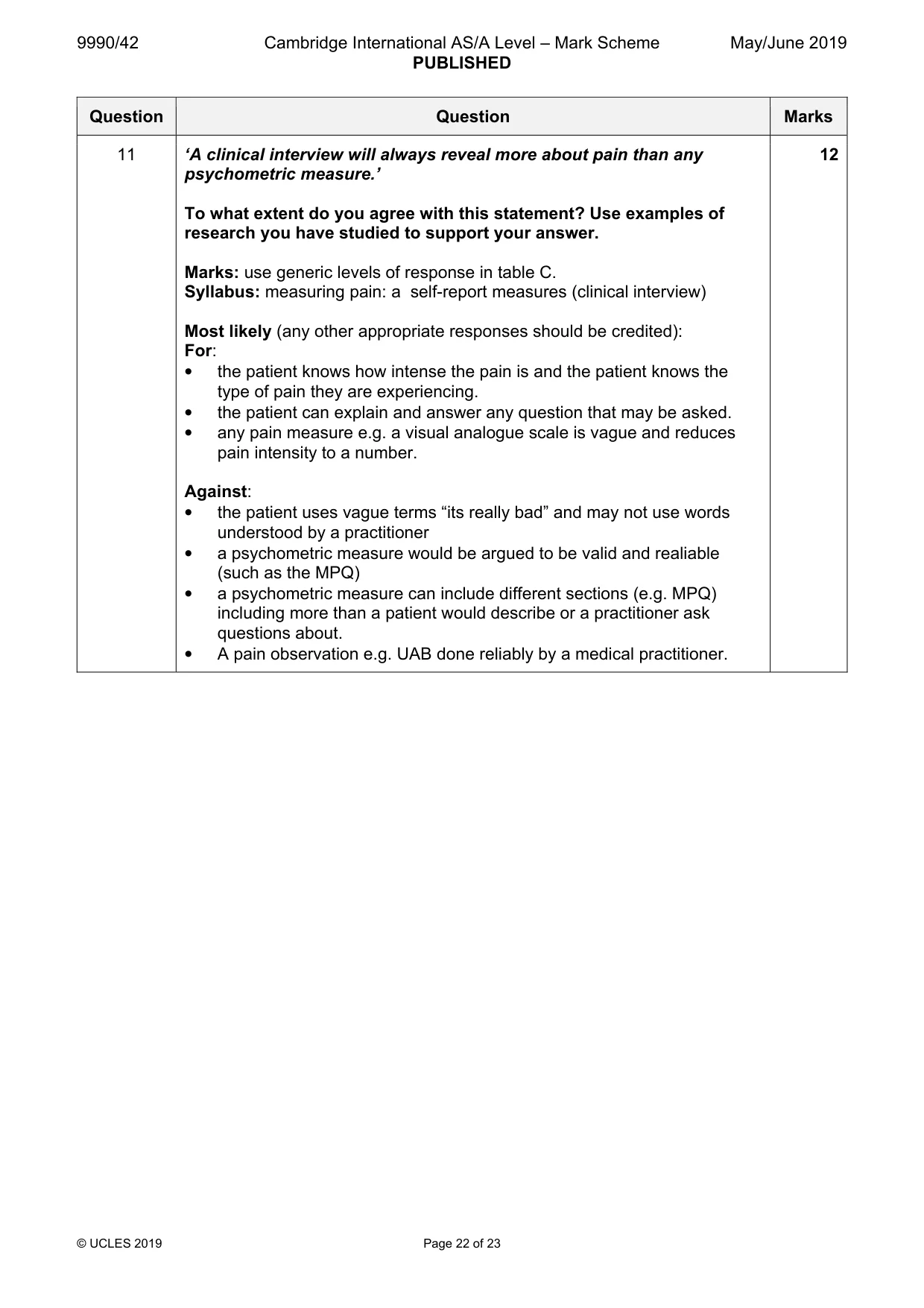
Q11 · ‘A clinical interview will always reveal more about pain than any psychometric measure.’…
11 ‘A clinical interview will always reveal more about pain than any psychometric measure.’ To what extent do you agree with this statement? Use examples of research you have studied to support your answer. [12] Psychology and organisations
Mark scheme: 11 ‘A clinical interview will always reveal more about pain than any 12 psychometric measure.’ To what extent do you agree with this statement? Use examples of research you have studied to support your answer. Marks: use generic levels of response in table C. Syllabus: measuring pain: a self-report measures (clinical interview) Most likely (any other appropriate responses should be credited): For: • the patient knows how intense the pain is and the patient knows the type of pain they are experiencing. • the patient can explain and answer any question that may be asked. • any pain measure e.g. a visual analogue scale is vague and reduces pain intensity to a number. Against: • the patient uses vague terms “its really bad” and may not use words understood by a practitioner • a psychometric measure would be argued to be valid and realiable (such as the MPQ) • a psychometric measure can include different sections (e.g. MPQ) including more than a patient would describe or a practitioner ask questions about. • A pain observation e.g. UAB done reliably by a medical practitioner.
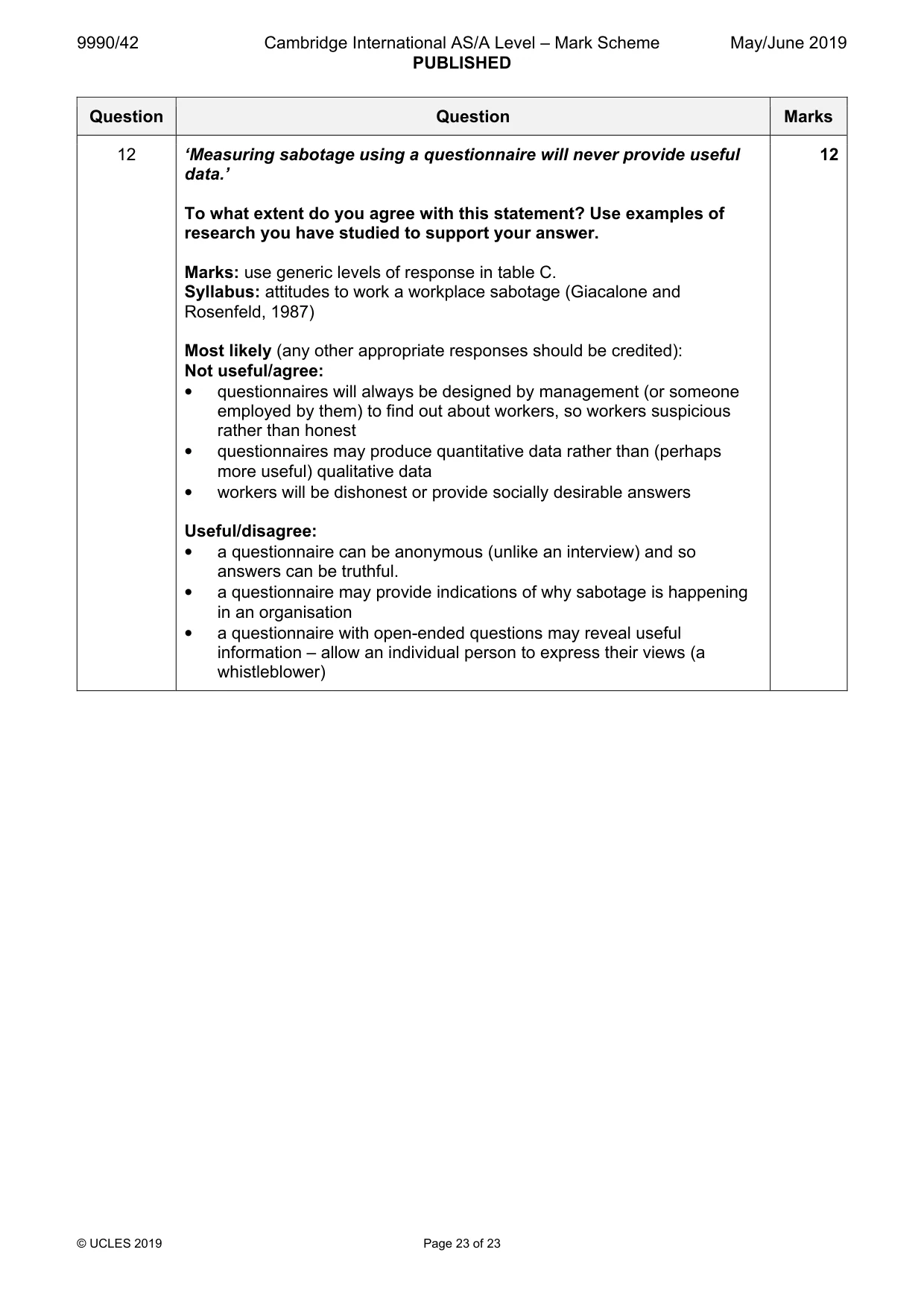
Q12 · ‘Measuring sabotage using a questionnaire will never provide useful data.’ To what extent…
12 ‘Measuring sabotage using a questionnaire will never provide useful data.’ To what extent do you agree with this statement? Use examples of research you have studied to support your answer. [12]
Mark scheme: 12 ‘Measuring sabotage using a questionnaire will never provide useful 12 data.’ To what extent do you agree with this statement? Use examples of research you have studied to support your answer. Marks: use generic levels of response in table C. Syllabus: attitudes to work a workplace sabotage (Giacalone and Rosenfeld, 1987) Most likely (any other appropriate responses should be credited): Not useful/agree: • questionnaires will always be designed by management (or someone employed by them) to find out about workers, so workers suspicious rather than honest • questionnaires may produce quantitative data rather than (perhaps more useful) qualitative data • workers will be dishonest or provide socially desirable answers Useful/disagree: • a questionnaire can be anonymous (unlike an interview) and so answers can be truthful. • a questionnaire may provide indications of why sabotage is happening in an organisation • a questionnaire with open-ended questions may reveal useful information – allow an individual person to express their views (a whistleblower)
What was in this paper
The subtopics covered by these 12 questions, and how many questions each got. Open one in a new tab to see every Cambridge question on it.
What you needed in this session
Cambridge’s own grade thresholds for 2019 May/June, Paper 4 · Variant 2. A higher threshold means an easier paper — the bar moves with how the cohort did.