Cambridge A Level Psychology (from 2018) 9990 — 2018 Oct/Nov Paper 4 · Variant 1
9990/41/O/N/18 · 12 questions · 60 marks · ≈68 min
The question paper and its mark scheme, free to read here and free to download. This is Cambridge’s own paper, exactly as it was sat.
Question paper8 pages



Mark scheme22 pages
Answers below. Sit the paper first if you are practising.
Questions as text
Q1 · The Yale-Brown Obsessive-Compulsive Scale (Y-BOCS) is a questionnaire
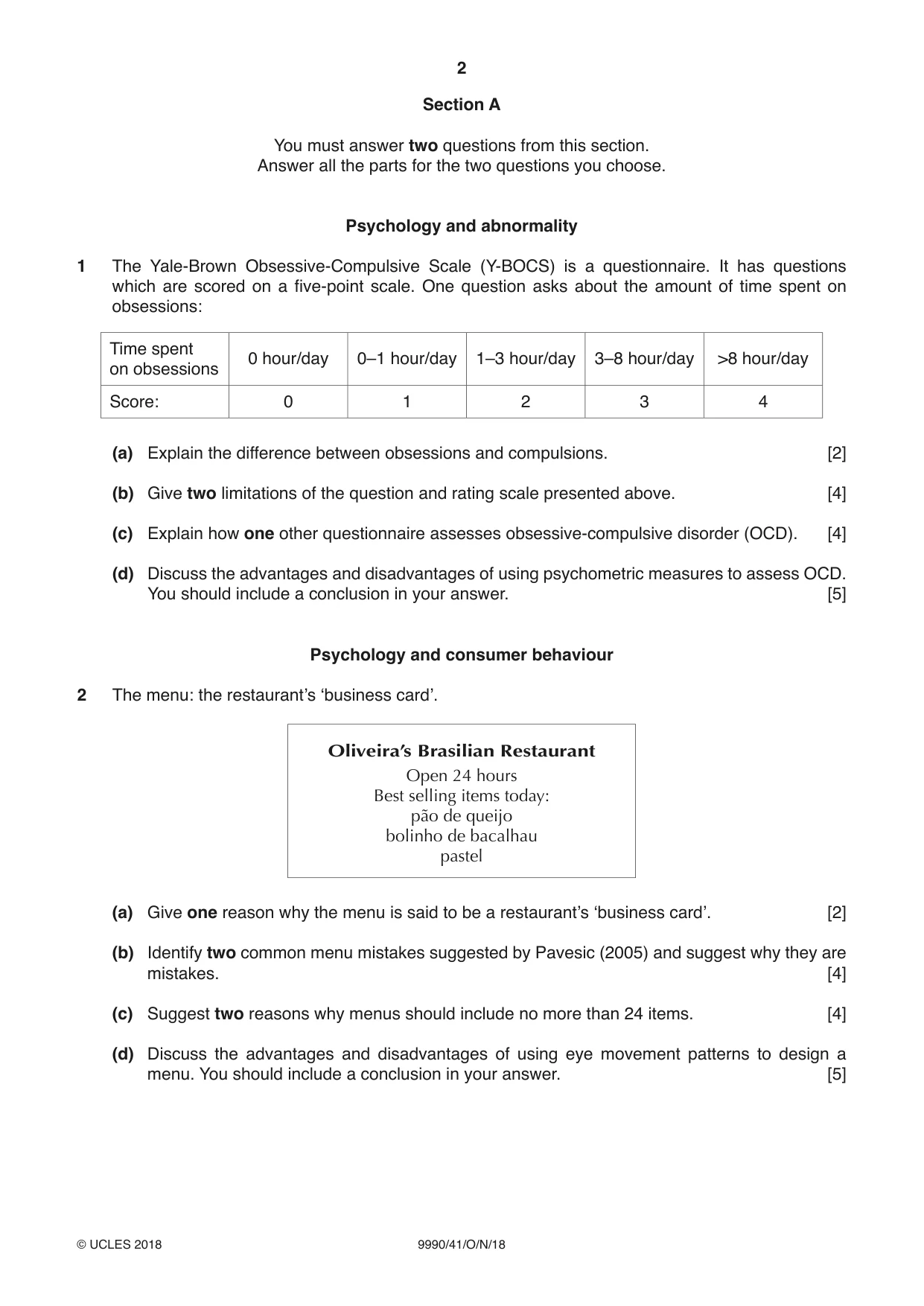
1 The Yale-Brown Obsessive-Compulsive Scale (Y-BOCS) is a questionnaire. It has questions which are scored on a five-point scale. One question asks about the amount of time spent on obsessions: Time spent 0 hour/day 0–1 hour/day 1–3 hour/day 3–8 hour/day >8 hour/day on obsessions Score: 0 1 2 3 4 (a) Explain the difference between obsessions and compulsions. [2] (b) Give two limitations of the question and rating scale presented above. [4] (c) Explain how one other questionnaire assesses obsessive-compulsive disorder (OCD). [4] (d) Discuss the advantages and disadvantages of using psychometric measures to assess OCD. You should include a conclusion in your answer. [5] Psychology and consumer behaviour
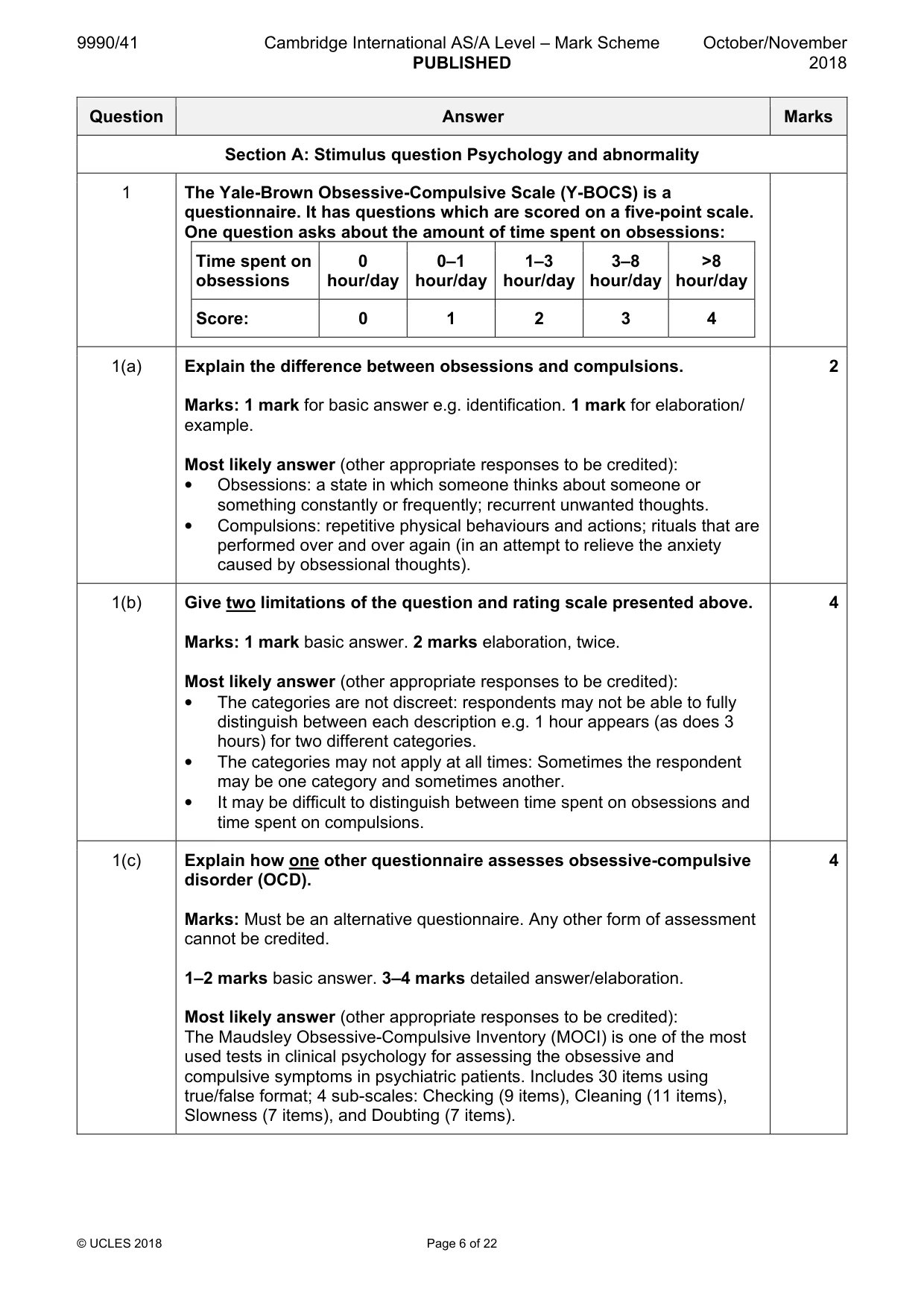
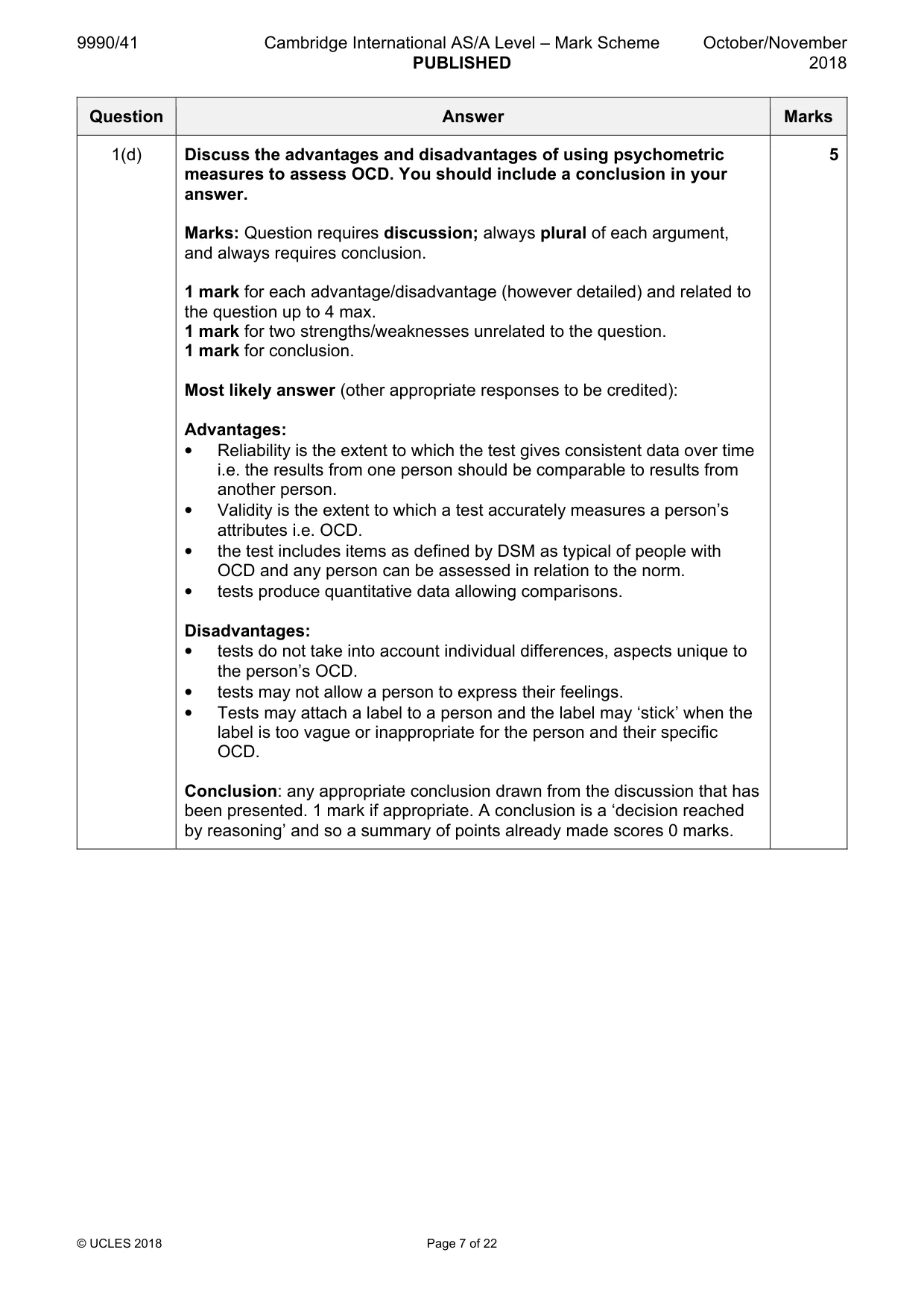
Mark scheme: Question Answer Marks Section A: Stimulus question Psychology and abnormality 1 The Yale-Brown Obsessive-Compulsive Scale (Y-BOCS) is a questionnaire. It has questions which are scored on a five-point scale. One question asks about the amount of time spent on obsessions: Time spent on 0 0–1 1–3 3–8 >8 obsessions hour/day hour/day hour/day hour/day hour/day Score: 0 1 2 3 4 1(a) Explain the difference between obsessions and compulsions. 2 Marks: 1 mark for basic answer e.g. identification. 1 mark for elaboration/ example. Most likely answer (other appropriate responses to be credited): • Obsessions: a state in which someone thinks about someone or something constantly or frequently; recurrent unwanted thoughts. • Compulsions: repetitive physical behaviours and actions; rituals that are performed over and over again (in an attempt to relieve the anxiety caused by obsessional thoughts). 1(b) Give two limitations of the question and rating scale presented above. 4 Marks: 1 mark basic answer. 2 marks elaboration, twice. Most likely answer (other appropriate responses to be credited): • The categories are not discreet: respondents may not be able to fully distinguish between each description e.g. 1 hour appears (as does 3 hours) for two different categories. • The categories may not apply at all times: Sometimes the respondent may be one category and sometimes another. • It may be difficult to distinguish between time spent on obsessions and time spent on compulsions. 1(c) Explain how one other questionnaire assesses obsessive-compulsive 4 disorder (OCD). Marks: Must be an alternative questionnaire. Any other form of assessment cannot be credited. 1–2 marks basic answer. 3–4 marks detailed answer/elaboration. Most likely answer (other appropriate responses to be credited): The Maudsley Obsessive-Compulsive Inventory (MOCI) is one of the most used tests in clinical psychology for assessing the obsessive and compulsive symptoms in psychiatric patients. Includes 30 items using true/false format; 4 sub-scales: Checking (9 items), Cleaning (11 items), Slowness (7 items), and Doubting (7 items). 1(d) Discuss the advantages and disadvantages of using psychometric 5 measures to assess OCD. You should include a conclusion in your answer. Marks: Question requires discussion; always plural of each argument, and always requires conclusion. 1 mark for each advantage/disadvantage (however detailed) and related to the question up to 4 max. 1 mark for two strengths/weaknesses unrelated to the question. 1 mark for conclusion. Most likely answer (other appropriate responses to be credited): Advantages: • Reliability is the extent to which the test gives consistent data over time i.e. the results from one person should be comparable to results from another person. • Validity is the extent to which a test accurately measures a person’s attributes i.e. OCD. • the test includes items as defined by DSM as typical of people with OCD and any person can be assessed in relation to the norm. • tests produce quantitative data allowing comparisons. Disadvantages: • tests do not take into account individual differences, aspects unique to the person’s OCD. • tests may not allow a person to express their feelings. • Tests may attach a label to a person and the label may ‘stick’ when the label is too vague or inappropriate for the person and their specific OCD. Conclusion: any appropriate conclusion drawn from the discussion that has been presented. 1 mark if appropriate. A conclusion is a ‘decision reached by reasoning’ and so a summary of points already made scores 0 marks.
Q2 · The menu: the restaurant’s ‘business card’
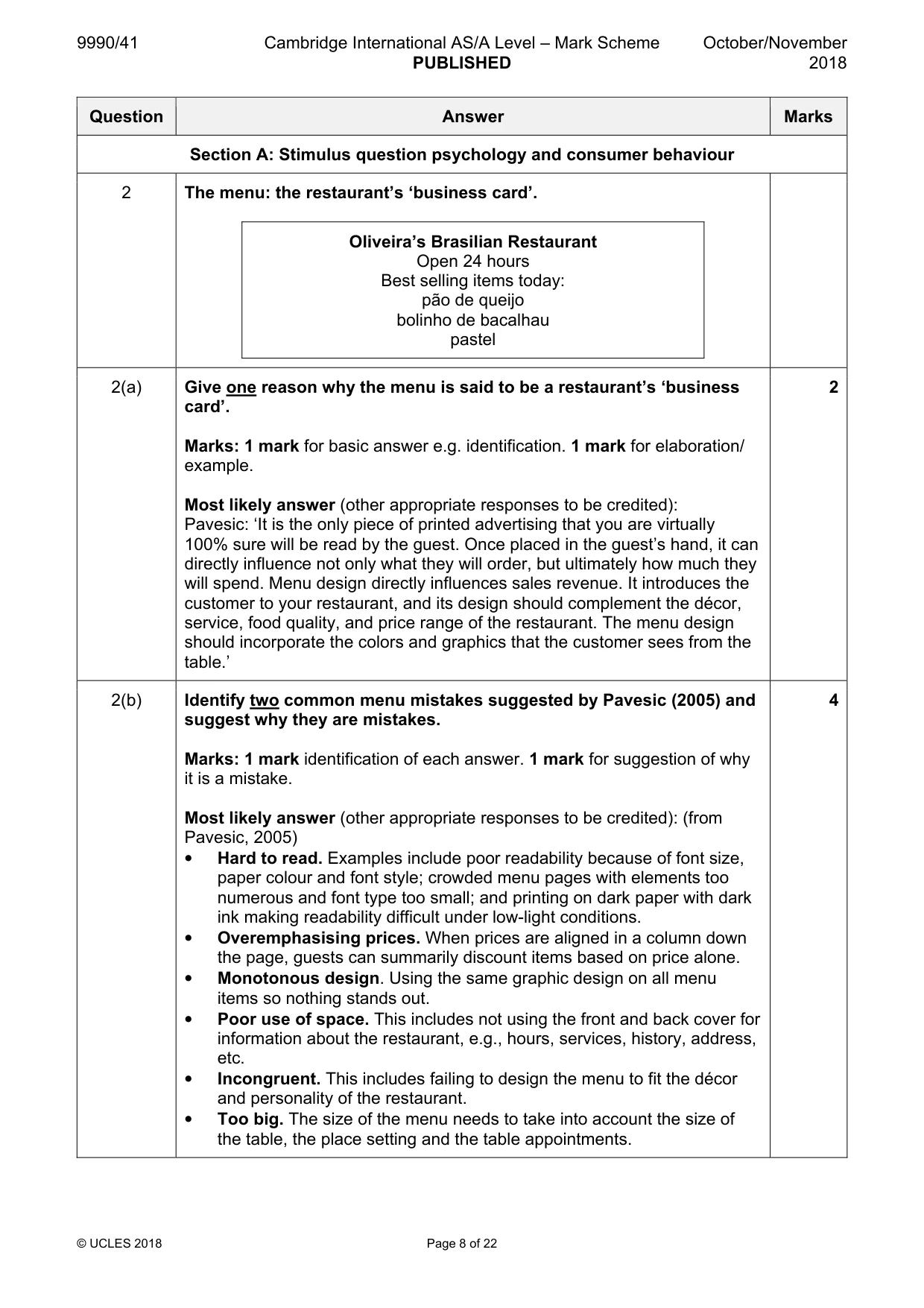
2 The menu: the restaurant’s ‘business card’. Oliveira’s Brasilian Restaurant Open 24 hours Best selling items today: pão de queijo bolinho de bacalhau pastel (a) Give one reason why the menu is said to be a restaurant’s ‘business card’. [2] (b) Identify two common menu mistakes suggested by Pavesic (2005) and suggest why they are mistakes. [4] (c) Suggest two reasons why menus should include no more than 24 items. [4] (d) Discuss the advantages and disadvantages of using eye movement patterns to design a menu. You should include a conclusion in your answer. [5] Psychology and health
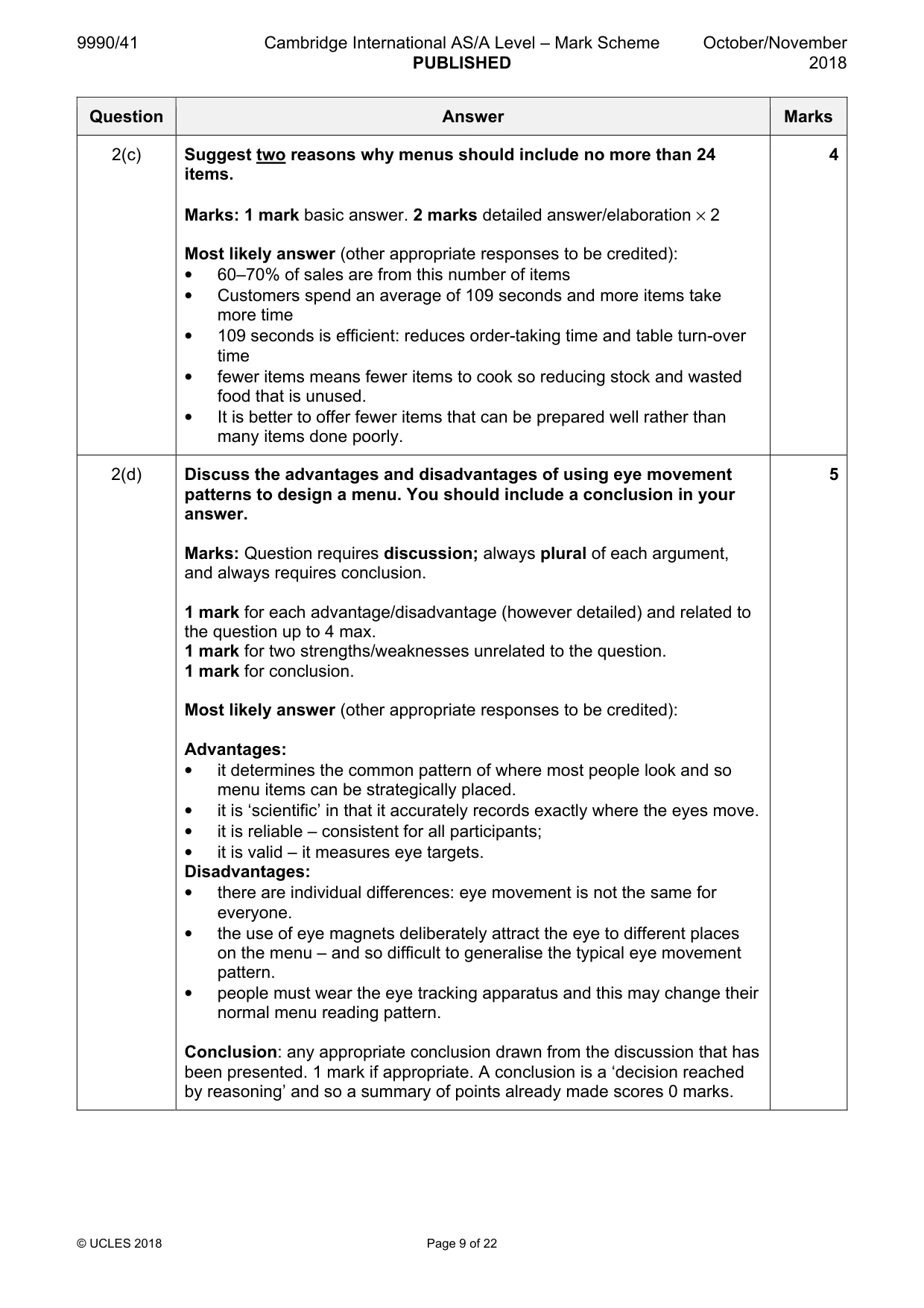
Mark scheme: 2(a) Give one reason why the menu is said to be a restaurant’s ‘business 2 card’. Marks: 1 mark for basic answer e.g. identification. 1 mark for elaboration/ example. Most likely answer (other appropriate responses to be credited): Pavesic: ‘It is the only piece of printed advertising that you are virtually 100% sure will be read by the guest. Once placed in the guest’s hand, it can directly influence not only what they will order, but ultimately how much they will spend. Menu design directly influences sales revenue. It introduces the customer to your restaurant, and its design should complement the décor, service, food quality, and price range of the restaurant. The menu design should incorporate the colors and graphics that the customer sees from the table.’ 2(b) Identify two common menu mistakes suggested by Pavesic (2005) and 4 suggest why they are mistakes. Marks: 1 mark identification of each answer. 1 mark for suggestion of why it is a mistake. Most likely answer (other appropriate responses to be credited): (from Pavesic, 2005) • Hard to read. Examples include poor readability because of font size, paper colour and font style; crowded menu pages with elements too numerous and font type too small; and printing on dark paper with dark ink making readability difficult under low-light conditions. • Overemphasising prices. When prices are aligned in a column down the page, guests can summarily discount items based on price alone. • Monotonous design. Using the same graphic design on all menu items so nothing stands out. • Poor use of space. This includes not using the front and back cover for information about the restaurant, e.g., hours, services, history, address, etc. • Incongruent. This includes failing to design the menu to fit the décor and personality of the restaurant. • Too big. The size of the menu needs to take into account the size of the table, the place setting and the table appointments. 2(c) Suggest two reasons why menus should include no more than 24 4 items. Marks: 1 mark basic answer. 2 marks detailed answer/elaboration × 2 Most likely answer (other appropriate responses to be credited): • 60–70% of sales are from this number of items • Customers spend an average of 109 seconds and more items take more time • 109 seconds is efficient: reduces order-taking time and table turn-over time • fewer items means fewer items to cook so reducing stock and wasted food that is unused. • It is better to offer fewer items that can be prepared well rather than many items done poorly. 2(d) Discuss the advantages and disadvantages of using eye movement 5 patterns to design a menu. You should include a conclusion in your answer. Marks: Question requires discussion; always plural of each argument, and always requires conclusion. 1 mark for each advantage/disadvantage (however detailed) and related to the question up to 4 max. 1 mark for two strengths/weaknesses unrelated to the question. 1 mark for conclusion. Most likely answer (other appropriate responses to be credited): Advantages: • it determines the common pattern of where most people look and so menu items can be strategically placed. • it is ‘scientific’ in that it accurately records exactly where the eyes move. • it is reliable – consistent for all participants; • it is valid – it measures eye targets. Disadvantages: • there are individual differences: eye movement is not the same for everyone. • the use of eye magnets deliberately attract the eye to different places on the menu – and so difficult to generalise the typical eye movement pattern. • people must wear the eye tracking apparatus and this may change their normal menu reading pattern. Conclusion: any appropriate conclusion drawn from the discussion that has been presented. 1 mark if appropriate. A conclusion is a ‘decision reached by reasoning’ and so a summary of points already made scores 0 marks.
Q3 · Holmes and Rahe (1967) devised a questionnaire, based on an opportunity sample in the US
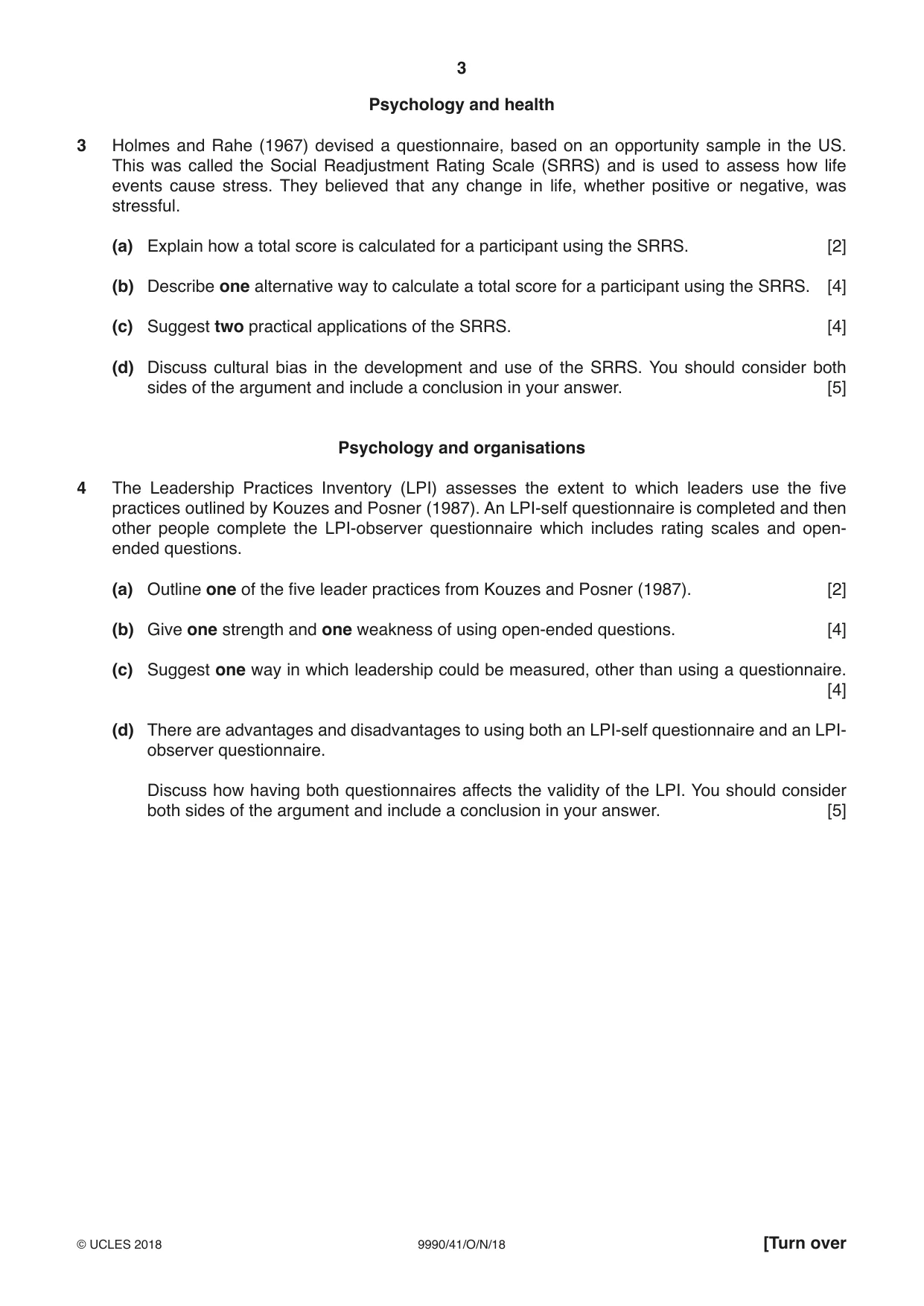
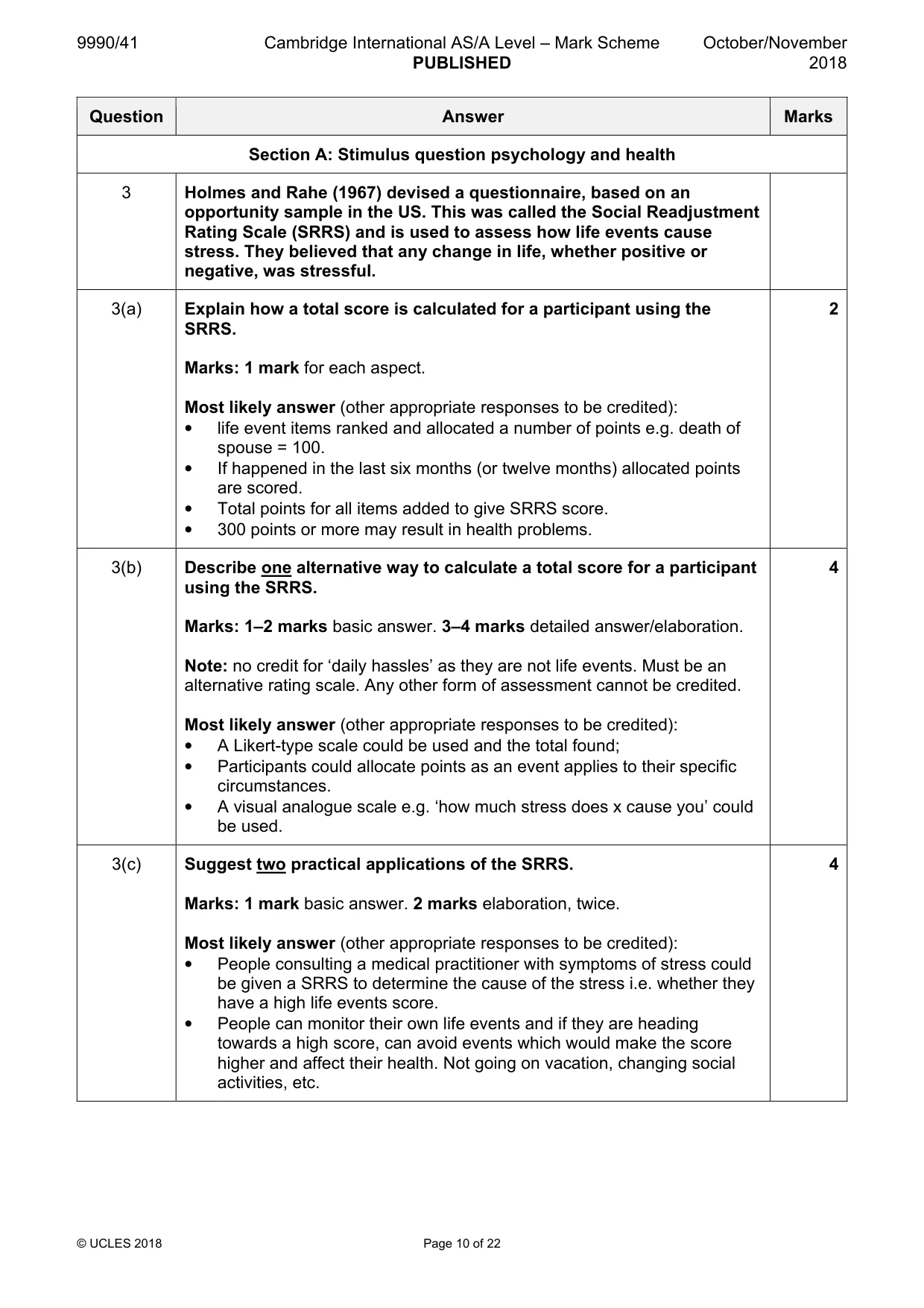
3 Holmes and Rahe (1967) devised a questionnaire, based on an opportunity sample in the US. This was called the Social Readjustment Rating Scale (SRRS) and is used to assess how life events cause stress. They believed that any change in life, whether positive or negative, was stressful. (a) Explain how a total score is calculated for a participant using the SRRS. [2] (b) Describe one alternative way to calculate a total score for a participant using the SRRS. [4] (c) Suggest two practical applications of the SRRS. [4] (d) Discuss cultural bias in the development and use of the SRRS. You should consider both sides of the argument and include a conclusion in your answer. [5] Psychology and organisations
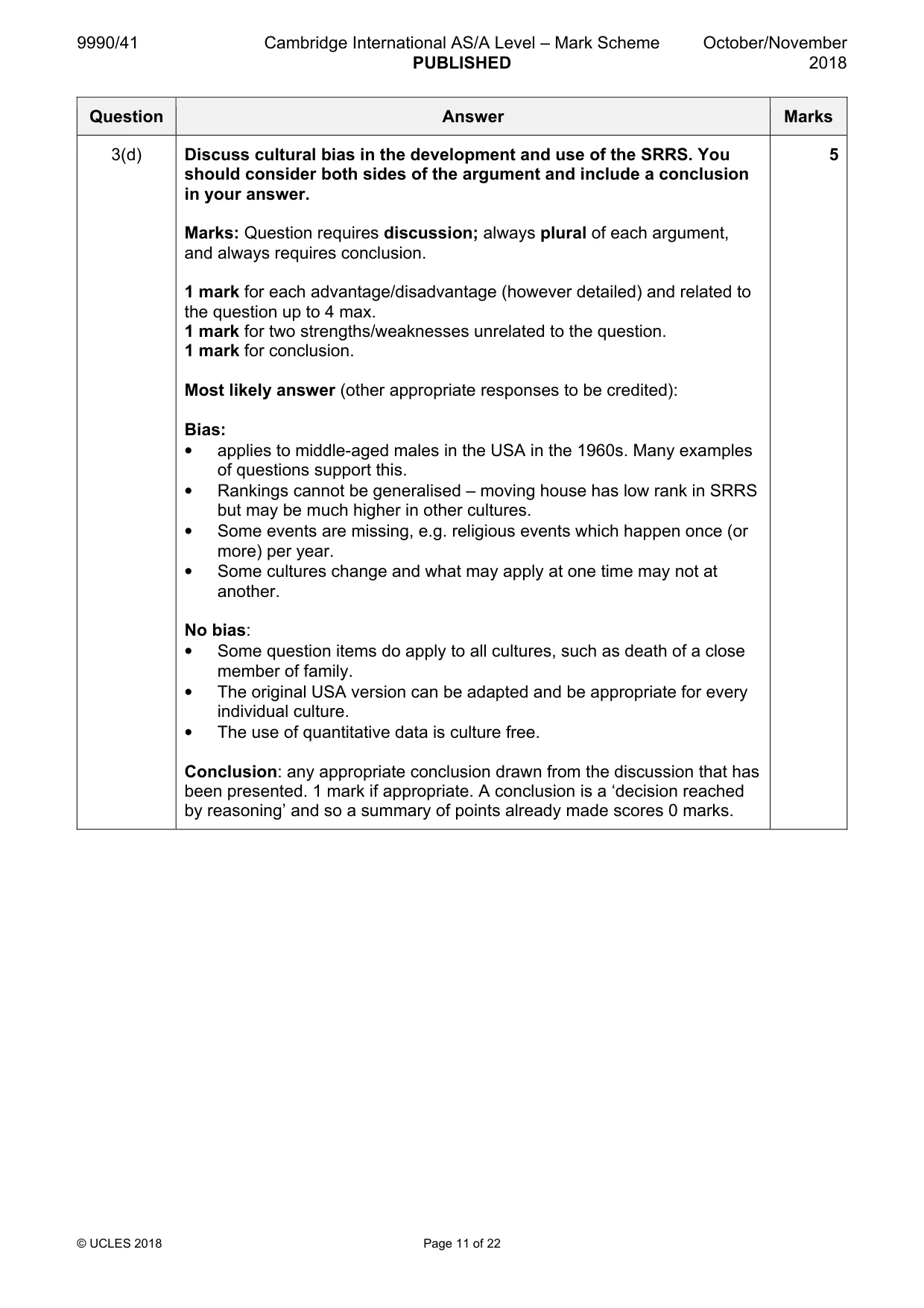
Mark scheme: 3(a) Explain how a total score is calculated for a participant using the 2 SRRS. Marks: 1 mark for each aspect. Most likely answer (other appropriate responses to be credited): • life event items ranked and allocated a number of points e.g. death of spouse = 100. • If happened in the last six months (or twelve months) allocated points are scored. • Total points for all items added to give SRRS score. • 300 points or more may result in health problems. 3(b) Describe one alternative way to calculate a total score for a participant 4 using the SRRS. Marks: 1–2 marks basic answer. 3–4 marks detailed answer/elaboration. Note: no credit for ‘daily hassles’ as they are not life events. Must be an alternative rating scale. Any other form of assessment cannot be credited. Most likely answer (other appropriate responses to be credited): • A Likert-type scale could be used and the total found; • Participants could allocate points as an event applies to their specific circumstances. • A visual analogue scale e.g. ‘how much stress does x cause you’ could be used. 3(c) Suggest two practical applications of the SRRS. 4 Marks: 1 mark basic answer. 2 marks elaboration, twice. Most likely answer (other appropriate responses to be credited): • People consulting a medical practitioner with symptoms of stress could be given a SRRS to determine the cause of the stress i.e. whether they have a high life events score. • People can monitor their own life events and if they are heading towards a high score, can avoid events which would make the score higher and affect their health. Not going on vacation, changing social activities, etc. 3(d) Discuss cultural bias in the development and use of the SRRS. You 5 should consider both sides of the argument and include a conclusion in your answer. Marks: Question requires discussion; always plural of each argument, and always requires conclusion. 1 mark for each advantage/disadvantage (however detailed) and related to the question up to 4 max. 1 mark for two strengths/weaknesses unrelated to the question. 1 mark for conclusion. Most likely answer (other appropriate responses to be credited): Bias: • applies to middle-aged males in the USA in the 1960s. Many examples of questions support this. • Rankings cannot be generalised – moving house has low rank in SRRS but may be much higher in other cultures. • Some events are missing, e.g. religious events which happen once (or more) per year. • Some cultures change and what may apply at one time may not at another. No bias: • Some question items do apply to all cultures, such as death of a close member of family. • The original USA version can be adapted and be appropriate for every individual culture. • The use of quantitative data is culture free. Conclusion: any appropriate conclusion drawn from the discussion that has been presented. 1 mark if appropriate. A conclusion is a ‘decision reached by reasoning’ and so a summary of points already made scores 0 marks.
Q4 · The Leadership Practices Inventory (LPI) assesses the extent to which leaders use the…
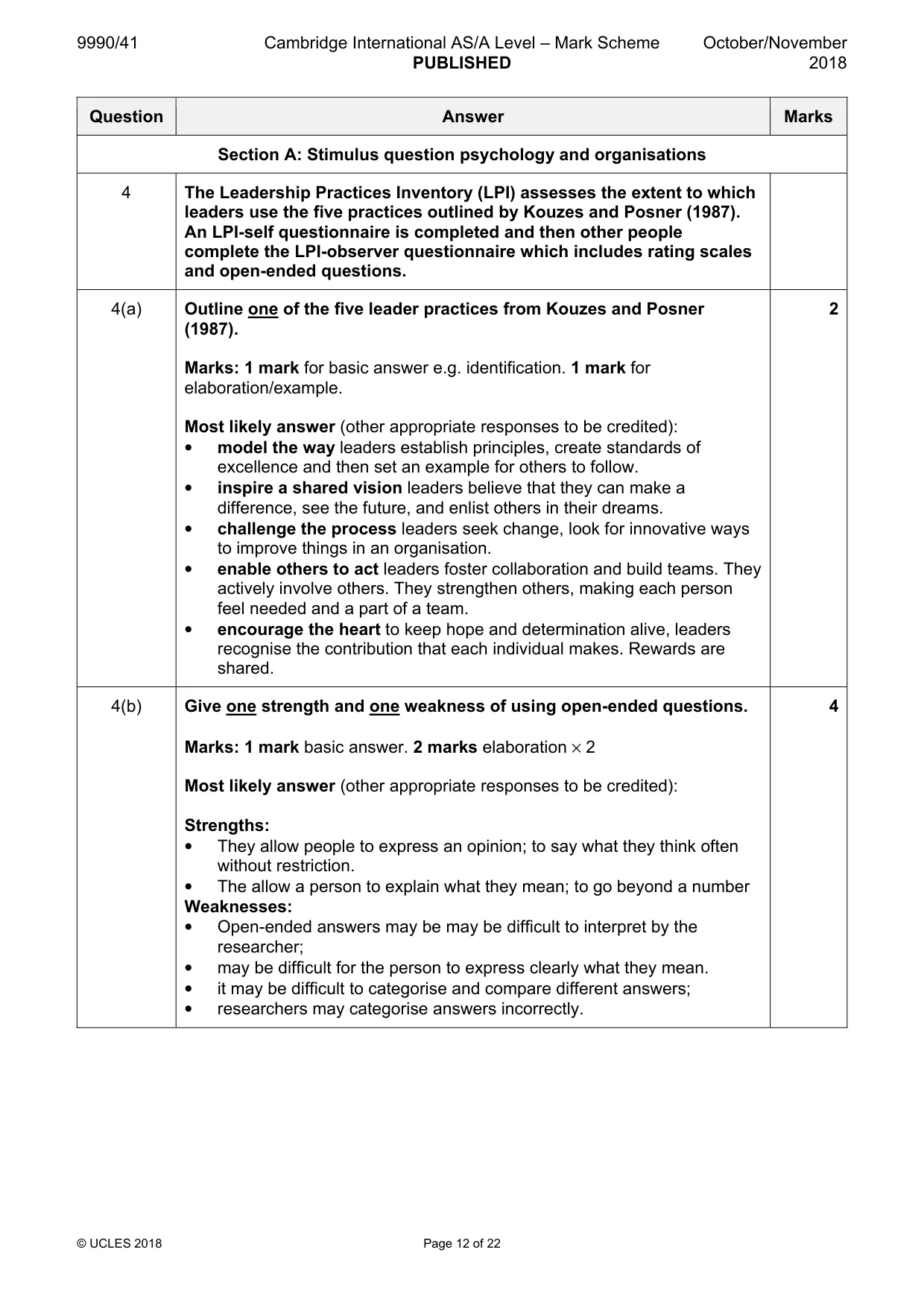
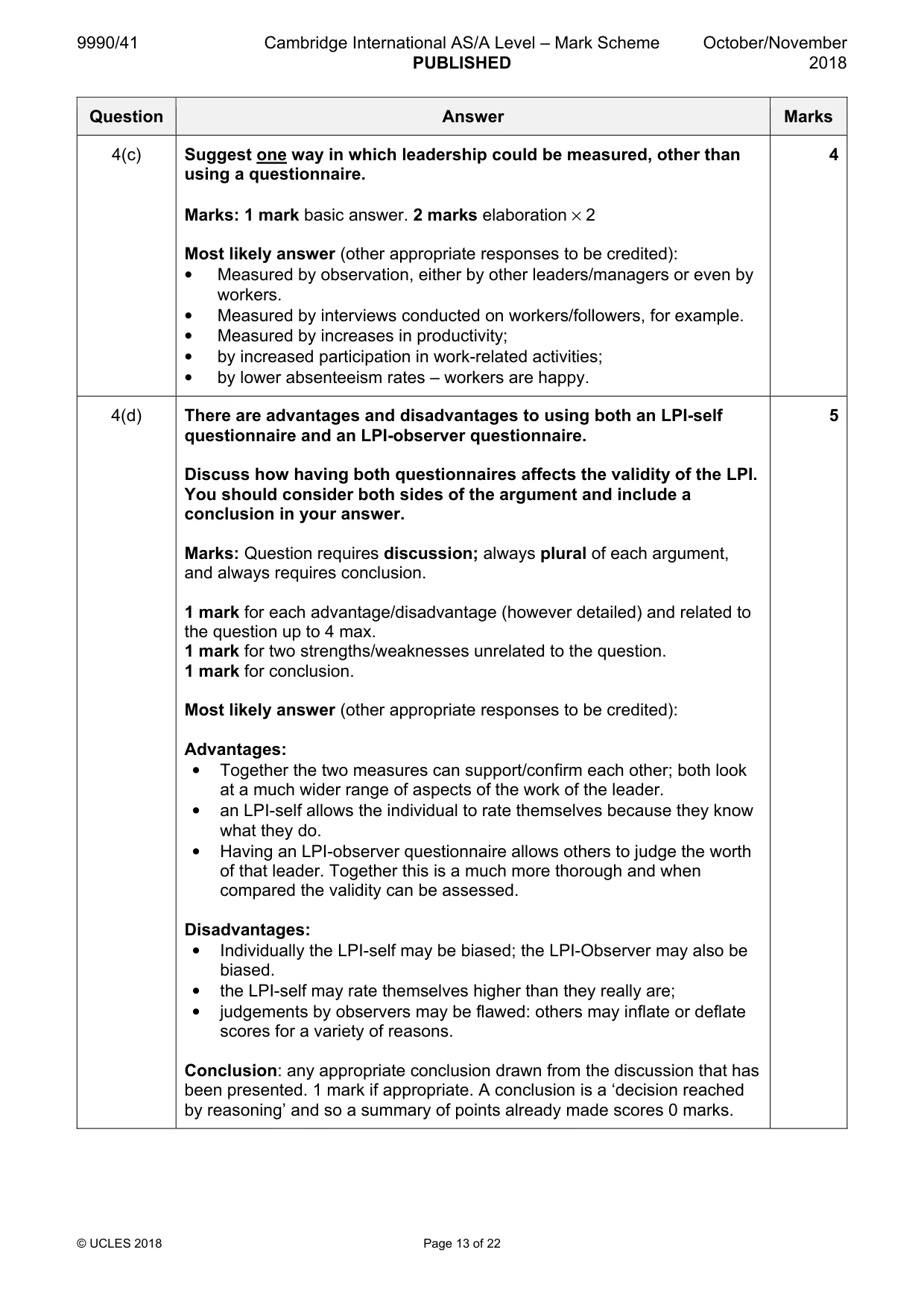
4 The Leadership Practices Inventory (LPI) assesses the extent to which leaders use the five practices outlined by Kouzes and Posner (1987). An LPI-self questionnaire is completed and then other people complete the LPI-observer questionnaire which includes rating scales and open- ended questions. (a) Outline one of the five leader practices from Kouzes and Posner (1987). [2] (b) Give one strength and one weakness of using open-ended questions. [4] (c) Suggest one way in which leadership could be measured, other than using a questionnaire. [4] (d) There are advantages and disadvantages to using both an LPI-self questionnaire and an LPI- observer questionnaire. Discuss how having both questionnaires affects the validity of the LPI. You should consider both sides of the argument and include a conclusion in your answer. [5]
Mark scheme: 4(a) Outline one of the five leader practices from Kouzes and Posner 2 (1987). Marks: 1 mark for basic answer e.g. identification. 1 mark for elaboration/example. Most likely answer (other appropriate responses to be credited): • model the way leaders establish principles, create standards of excellence and then set an example for others to follow. • inspire a shared vision leaders believe that they can make a difference, see the future, and enlist others in their dreams. • challenge the process leaders seek change, look for innovative ways to improve things in an organisation. • enable others to act leaders foster collaboration and build teams. They actively involve others. They strengthen others, making each person feel needed and a part of a team. • encourage the heart to keep hope and determination alive, leaders recognise the contribution that each individual makes. Rewards are shared. 4(b) Give one strength and one weakness of using open-ended questions. 4 Marks: 1 mark basic answer. 2 marks elaboration × 2 Most likely answer (other appropriate responses to be credited): Strengths: • They allow people to express an opinion; to say what they think often without restriction. • The allow a person to explain what they mean; to go beyond a number Weaknesses: • Open-ended answers may be may be difficult to interpret by the researcher; • may be difficult for the person to express clearly what they mean. • it may be difficult to categorise and compare different answers; • researchers may categorise answers incorrectly. 4(c) Suggest one way in which leadership could be measured, other than 4 using a questionnaire. Marks: 1 mark basic answer. 2 marks elaboration × 2 Most likely answer (other appropriate responses to be credited): • Measured by observation, either by other leaders/managers or even by workers. • Measured by interviews conducted on workers/followers, for example. • Measured by increases in productivity; • by increased participation in work-related activities; • by lower absenteeism rates – workers are happy. 4(d) There are advantages and disadvantages to using both an LPI-self 5 questionnaire and an LPI-observer questionnaire. Discuss how having both questionnaires affects the validity of the LPI. You should consider both sides of the argument and include a conclusion in your answer. Marks: Question requires discussion; always plural of each argument, and always requires conclusion. 1 mark for each advantage/disadvantage (however detailed) and related to the question up to 4 max. 1 mark for two strengths/weaknesses unrelated to the question. 1 mark for conclusion. Most likely answer (other appropriate responses to be credited): Advantages: • Together the two measures can support/confirm each other; both look at a much wider range of aspects of the work of the leader. • an LPI-self allows the individual to rate themselves because they know what they do. • Having an LPI-observer questionnaire allows others to judge the worth of that leader. Together this is a much more thorough and when compared the validity can be assessed. Disadvantages: • Individually the LPI-self may be biased; the LPI-Observer may also be biased. • the LPI-self may rate themselves higher than they really are; • judgements by observers may be flawed: others may inflate or deflate scores for a variety of reasons. Conclusion: any appropriate conclusion drawn from the discussion that has been presented. 1 mark if appropriate. A conclusion is a ‘decision reached by reasoning’ and so a summary of points already made scores 0 marks.
Q5 · The feeling-state theory proposes that impulse control disorders are caused by intense…
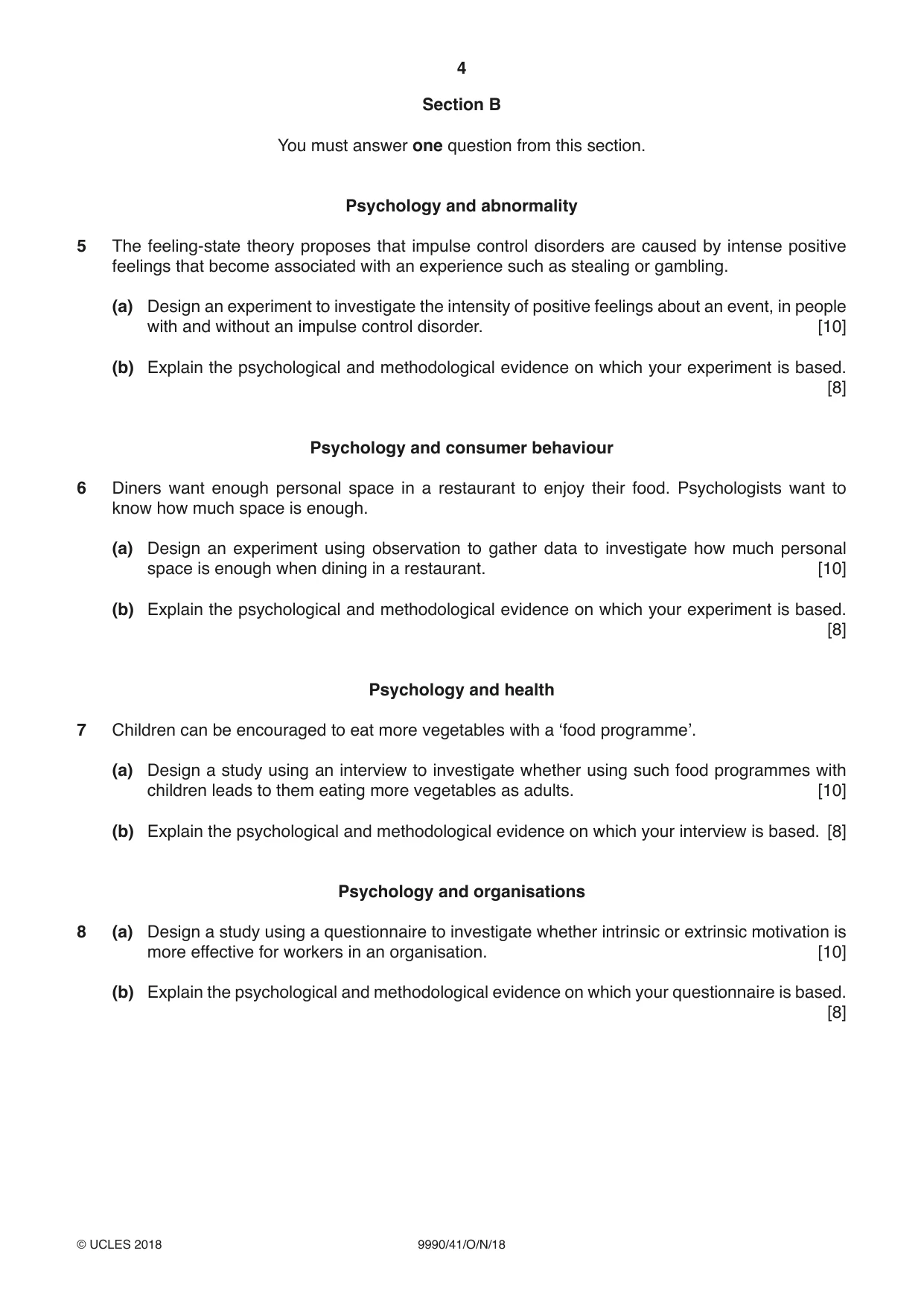
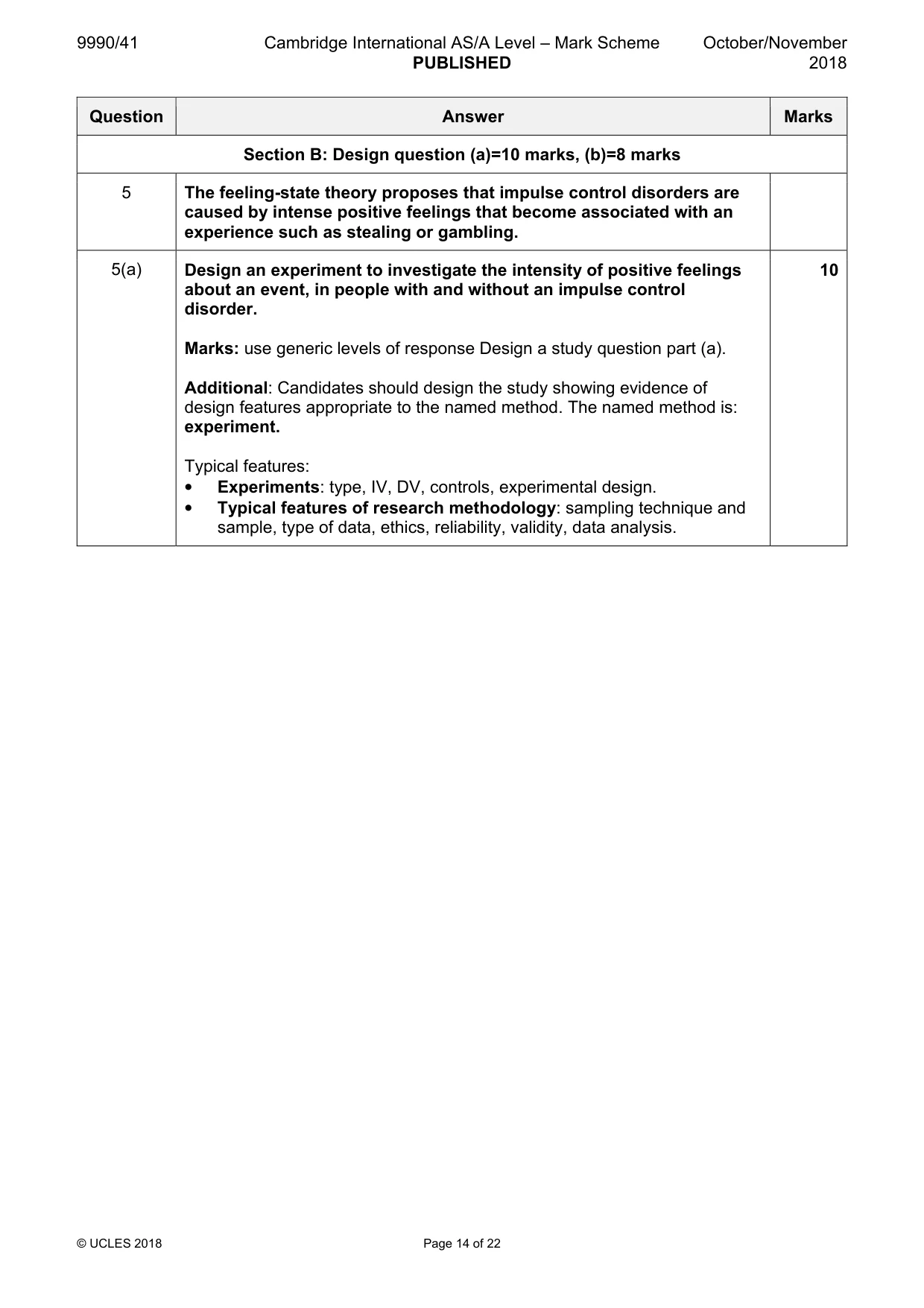
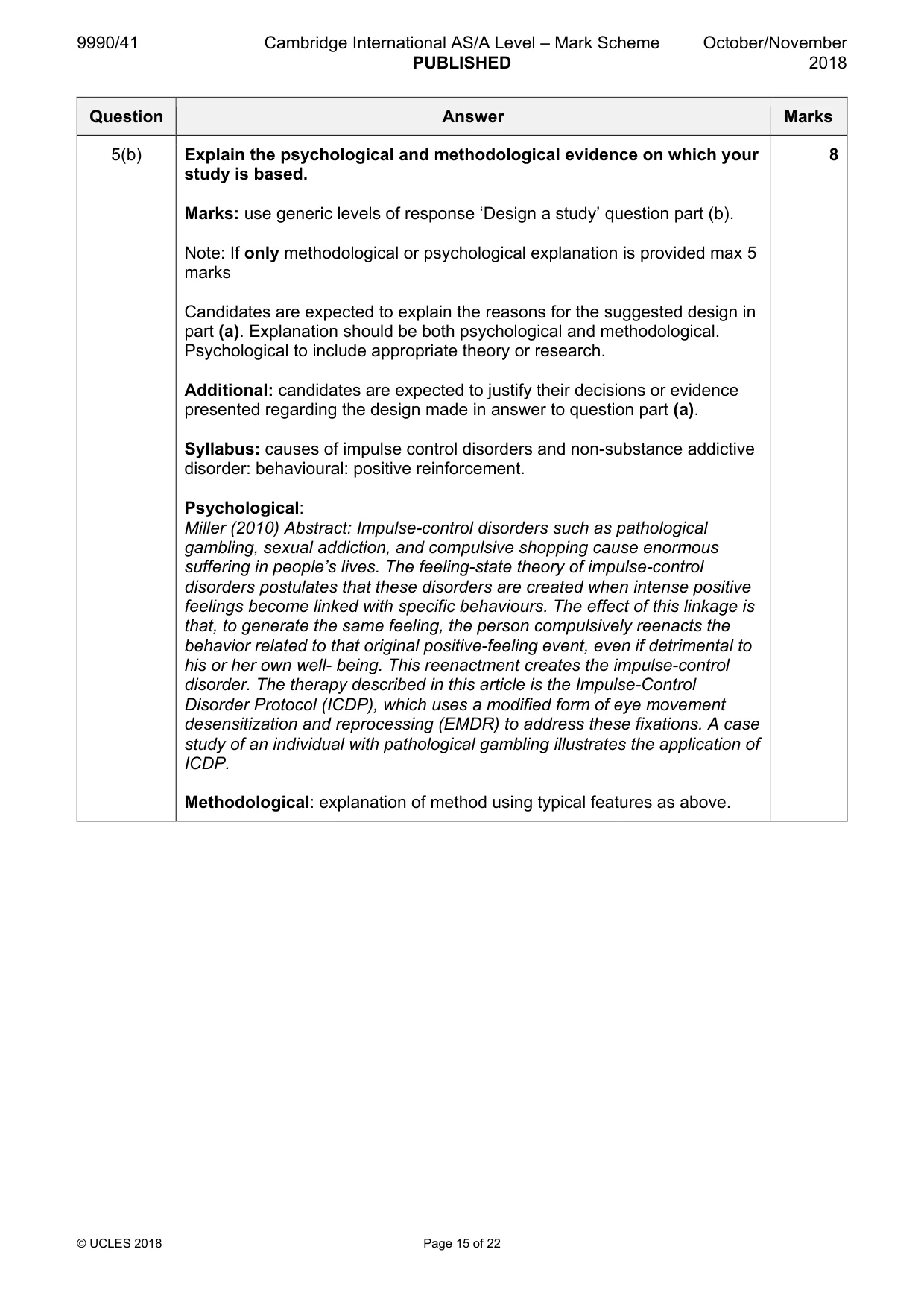
5 The feeling-state theory proposes that impulse control disorders are caused by intense positive feelings that become associated with an experience such as stealing or gambling. (a) Design an experiment to investigate the intensity of positive feelings about an event, in people with and without an impulse control disorder. [10] (b) Explain the psychological and methodological evidence on which your experiment is based. [8] Psychology and consumer behaviour
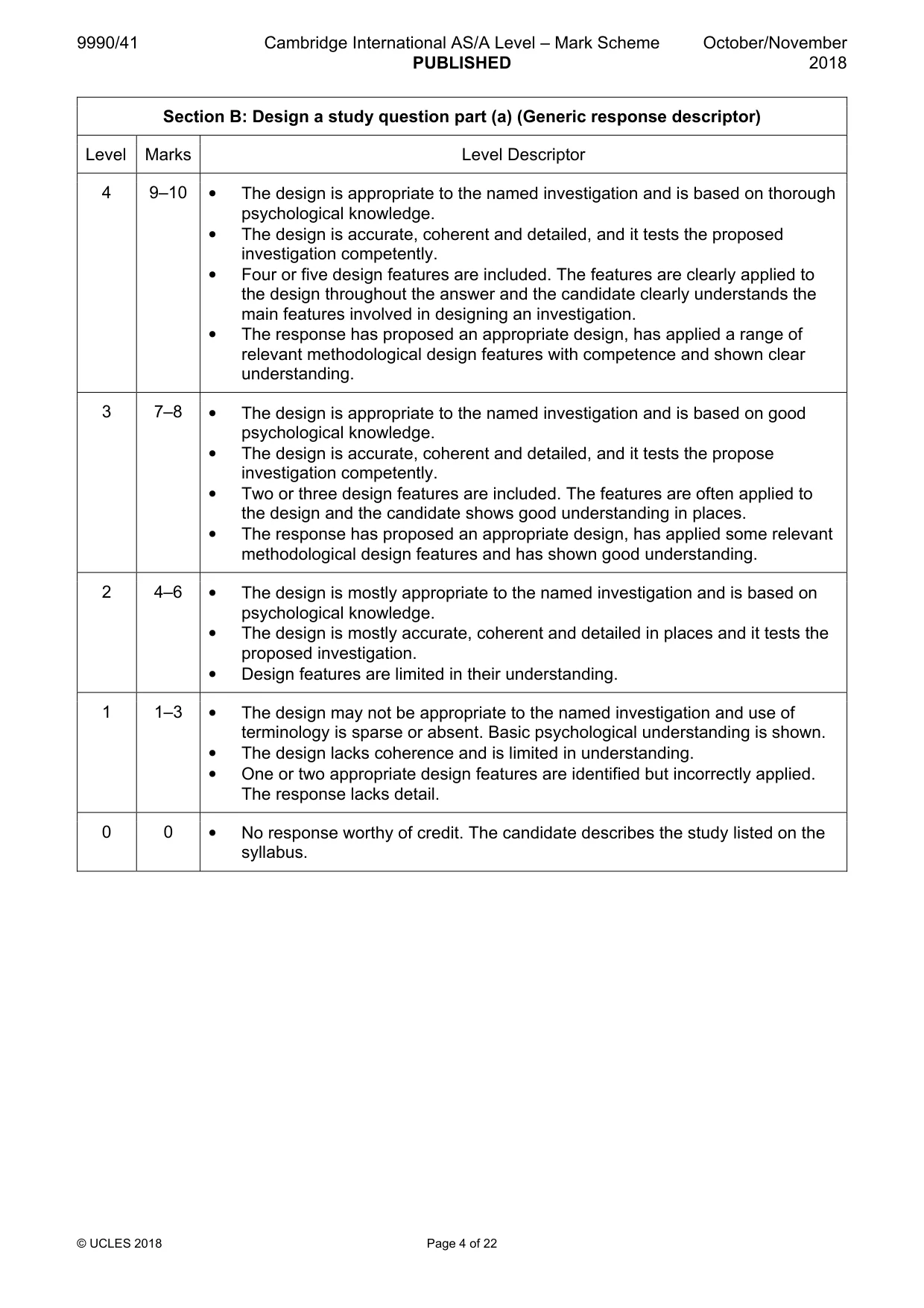
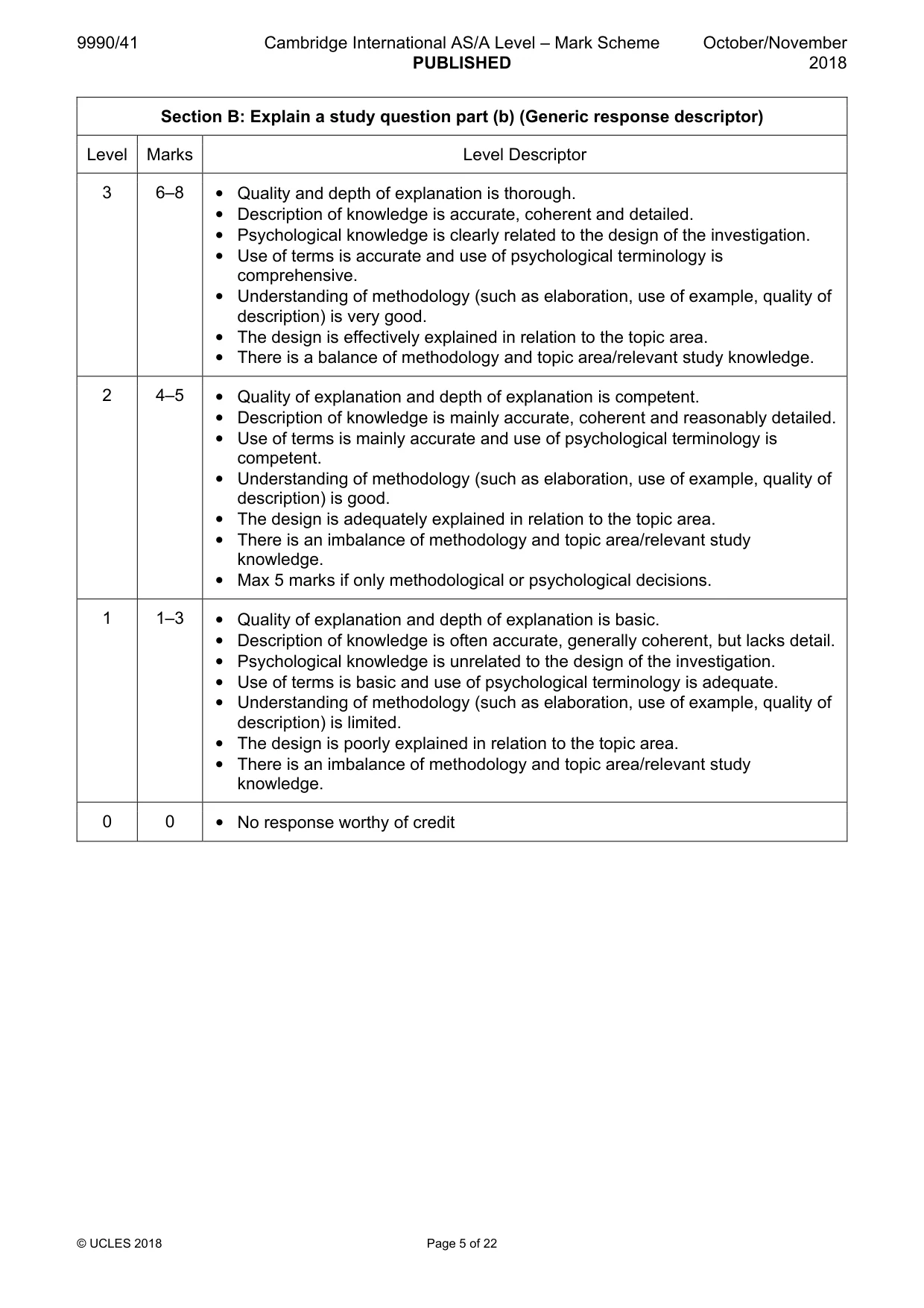
Mark scheme: 5(a) Design an experiment to investigate the intensity of positive feelings 10 about an event, in people with and without an impulse control disorder. Marks: use generic levels of response Design a study question part (a). Additional: Candidates should design the study showing evidence of design features appropriate to the named method. The named method is: experiment. Typical features: • Experiments: type, IV, DV, controls, experimental design. • Typical features of research methodology: sampling technique and sample, type of data, ethics, reliability, validity, data analysis. 5(b) Explain the psychological and methodological evidence on which your 8 study is based. Marks: use generic levels of response ‘Design a study’ question part (b). Note: If only methodological or psychological explanation is provided max 5 marks Candidates are expected to explain the reasons for the suggested design in part (a). Explanation should be both psychological and methodological. Psychological to include appropriate theory or research. Additional: candidates are expected to justify their decisions or evidence presented regarding the design made in answer to question part (a). Syllabus: causes of impulse control disorders and non-substance addictive disorder: behavioural: positive reinforcement. Psychological: Miller (2010) Abstract: Impulse-control disorders such as pathological gambling, sexual addiction, and compulsive shopping cause enormous suffering in people’s lives. The feeling-state theory of impulse-control disorders postulates that these disorders are created when intense positive feelings become linked with specific behaviours. The effect of this linkage is that, to generate the same feeling, the person compulsively reenacts the behavior related to that original positive-feeling event, even if detrimental to his or her own well- being. This reenactment creates the impulse-control disorder. The therapy described in this article is the Impulse-Control Disorder Protocol (ICDP), which uses a modified form of eye movement desensitization and reprocessing (EMDR) to address these fixations. A case study of an individual with pathological gambling illustrates the application of ICDP. Methodological: explanation of method using typical features as above.
Q6 · Diners want enough personal space in a restaurant to enjoy their food
6 Diners want enough personal space in a restaurant to enjoy their food. Psychologists want to know how much space is enough. (a) Design an experiment using observation to gather data to investigate how much personal space is enough when dining in a restaurant. [10] (b) Explain the psychological and methodological evidence on which your experiment is based. [8] Psychology and health
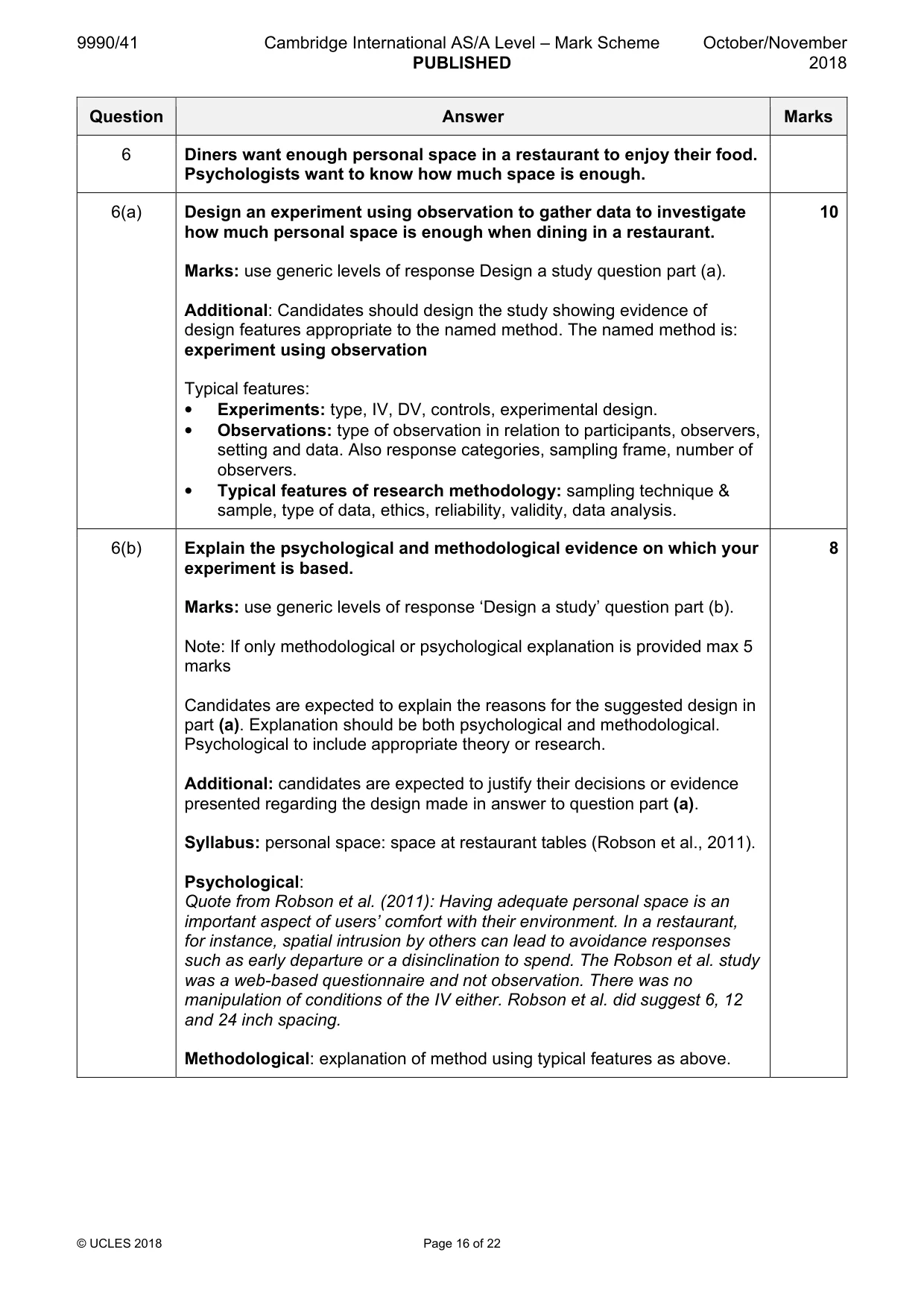
Mark scheme: 6(a) Design an experiment using observation to gather data to investigate 10 how much personal space is enough when dining in a restaurant. Marks: use generic levels of response Design a study question part (a). Additional: Candidates should design the study showing evidence of design features appropriate to the named method. The named method is: experiment using observation Typical features: • Experiments: type, IV, DV, controls, experimental design. • Observations: type of observation in relation to participants, observers, setting and data. Also response categories, sampling frame, number of observers. • Typical features of research methodology: sampling technique & sample, type of data, ethics, reliability, validity, data analysis. 6(b) Explain the psychological and methodological evidence on which your 8 experiment is based. Marks: use generic levels of response ‘Design a study’ question part (b). Note: If only methodological or psychological explanation is provided max 5 marks Candidates are expected to explain the reasons for the suggested design in part (a). Explanation should be both psychological and methodological. Psychological to include appropriate theory or research. Additional: candidates are expected to justify their decisions or evidence presented regarding the design made in answer to question part (a). Syllabus: personal space: space at restaurant tables (Robson et al., 2011). Psychological: Quote from Robson et al. (2011): Having adequate personal space is an important aspect of users’ comfort with their environment. In a restaurant, for instance, spatial intrusion by others can lead to avoidance responses such as early departure or a disinclination to spend. The Robson et al. study was a web-based questionnaire and not observation. There was no manipulation of conditions of the IV either. Robson et al. did suggest 6, 12 and 24 inch spacing. Methodological: explanation of method using typical features as above.
Q7 · Children can be encouraged to eat more vegetables with a ‘food programme’
7 Children can be encouraged to eat more vegetables with a ‘food programme’. (a) Design a study using an interview to investigate whether using such food programmes with children leads to them eating more vegetables as adults. [10] (b) Explain the psychological and methodological evidence on which your interview is based. [8] Psychology and organisations
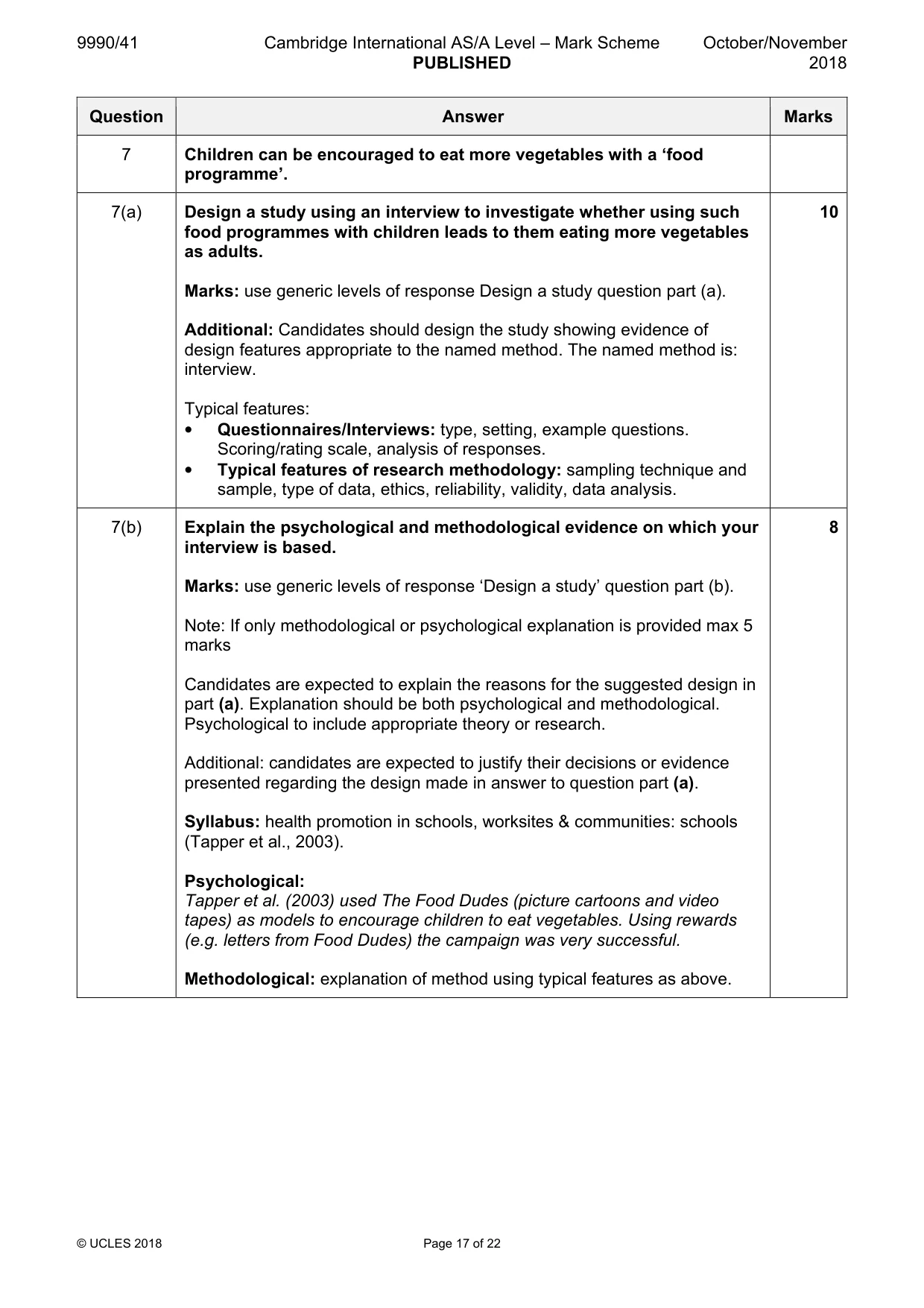
Mark scheme: 7(a) Design a study using an interview to investigate whether using such 10 food programmes with children leads to them eating more vegetables as adults. Marks: use generic levels of response Design a study question part (a). Additional: Candidates should design the study showing evidence of design features appropriate to the named method. The named method is: interview. Typical features: • Questionnaires/Interviews: type, setting, example questions. Scoring/rating scale, analysis of responses. • Typical features of research methodology: sampling technique and sample, type of data, ethics, reliability, validity, data analysis. 7(b) Explain the psychological and methodological evidence on which your 8 interview is based. Marks: use generic levels of response ‘Design a study’ question part (b). Note: If only methodological or psychological explanation is provided max 5 marks Candidates are expected to explain the reasons for the suggested design in part (a). Explanation should be both psychological and methodological. Psychological to include appropriate theory or research. Additional: candidates are expected to justify their decisions or evidence presented regarding the design made in answer to question part (a). Syllabus: health promotion in schools, worksites & communities: schools (Tapper et al., 2003). Psychological: Tapper et al. (2003) used The Food Dudes (picture cartoons and video tapes) as models to encourage children to eat vegetables. Using rewards (e.g. letters from Food Dudes) the campaign was very successful. Methodological: explanation of method using typical features as above.
More questions on 2 Health promotion in schools and worksites
Q8 · Design a study using a questionnaire to investigate whether intrinsic or extrinsic…
8 (a) Design a study using a questionnaire to investigate whether intrinsic or extrinsic motivation is more effective for workers in an organisation. [10] (b) Explain the psychological and methodological evidence on which your questionnaire is based. [8] Section C You must answer one question from this section. Psychology and abnormality
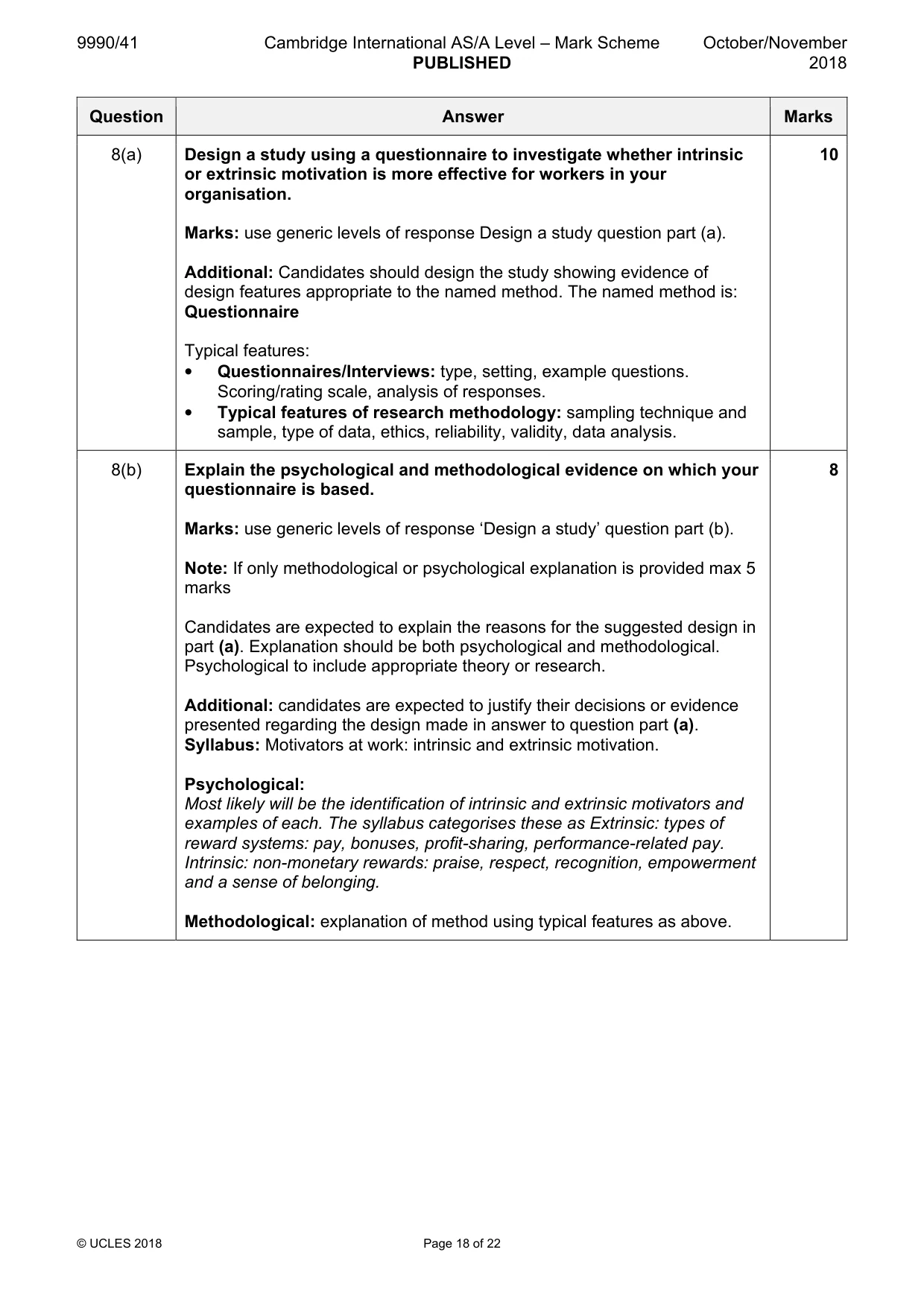
Mark scheme: 8(a) Design a study using a questionnaire to investigate whether intrinsic 10 or extrinsic motivation is more effective for workers in your organisation. Marks: use generic levels of response Design a study question part (a). Additional: Candidates should design the study showing evidence of design features appropriate to the named method. The named method is: Questionnaire Typical features: • Questionnaires/Interviews: type, setting, example questions. Scoring/rating scale, analysis of responses. • Typical features of research methodology: sampling technique and sample, type of data, ethics, reliability, validity, data analysis. 8(b) Explain the psychological and methodological evidence on which your 8 questionnaire is based. Marks: use generic levels of response ‘Design a study’ question part (b). Note: If only methodological or psychological explanation is provided max 5 marks Candidates are expected to explain the reasons for the suggested design in part (a). Explanation should be both psychological and methodological. Psychological to include appropriate theory or research. Additional: candidates are expected to justify their decisions or evidence presented regarding the design made in answer to question part (a). Syllabus: Motivators at work: intrinsic and extrinsic motivation. Psychological: Most likely will be the identification of intrinsic and extrinsic motivators and examples of each. The syllabus categorises these as Extrinsic: types of reward systems: pay, bonuses, profit-sharing, performance-related pay. Intrinsic: non-monetary rewards: praise, respect, recognition, empowerment and a sense of belonging. Methodological: explanation of method using typical features as above.
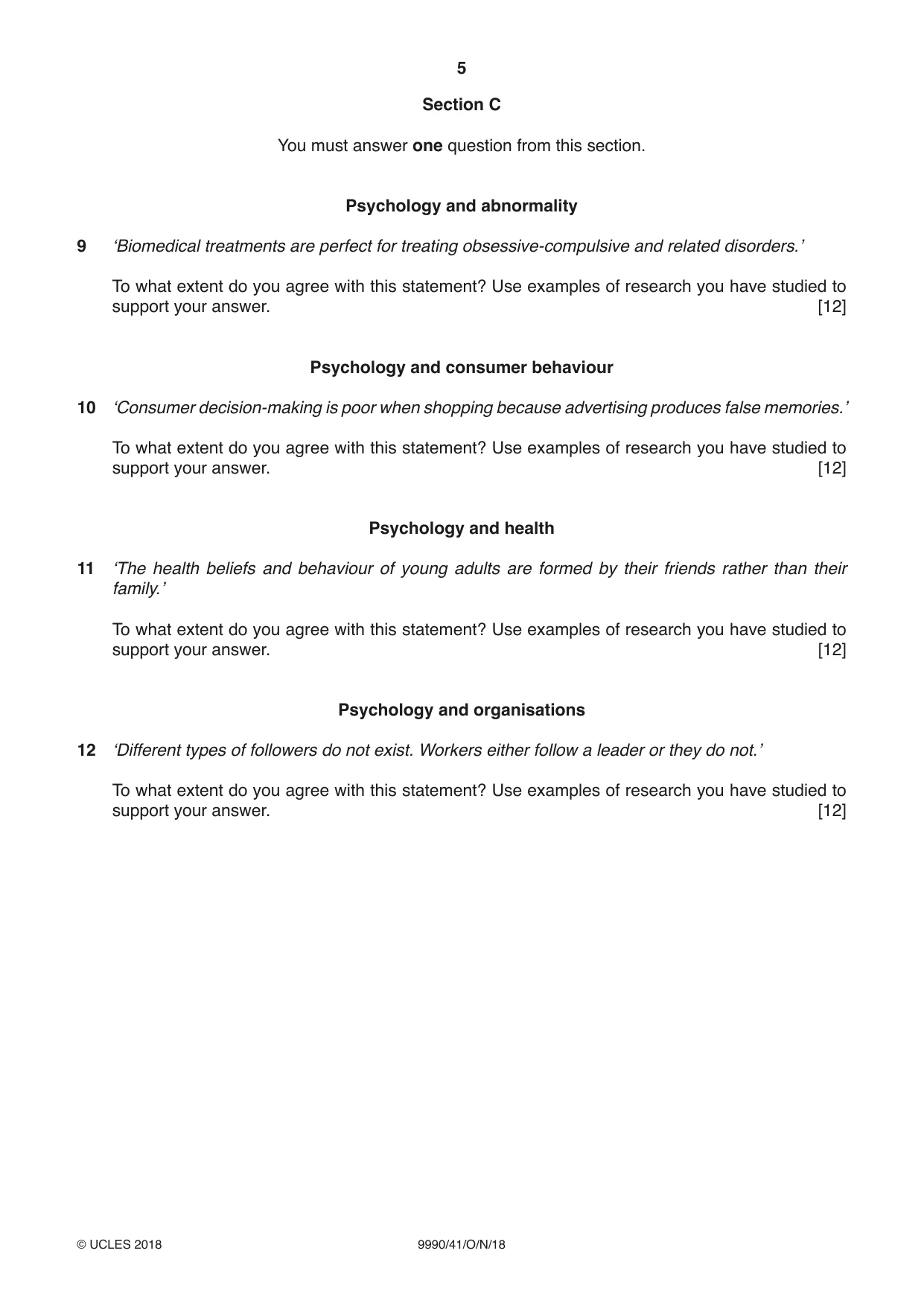
Q9 · ‘Biomedical treatments are perfect for treating obsessive-compulsive and related…
9 ‘Biomedical treatments are perfect for treating obsessive-compulsive and related disorders.’ To what extent do you agree with this statement? Use examples of research you have studied to support your answer. [12] Psychology and consumer behaviour
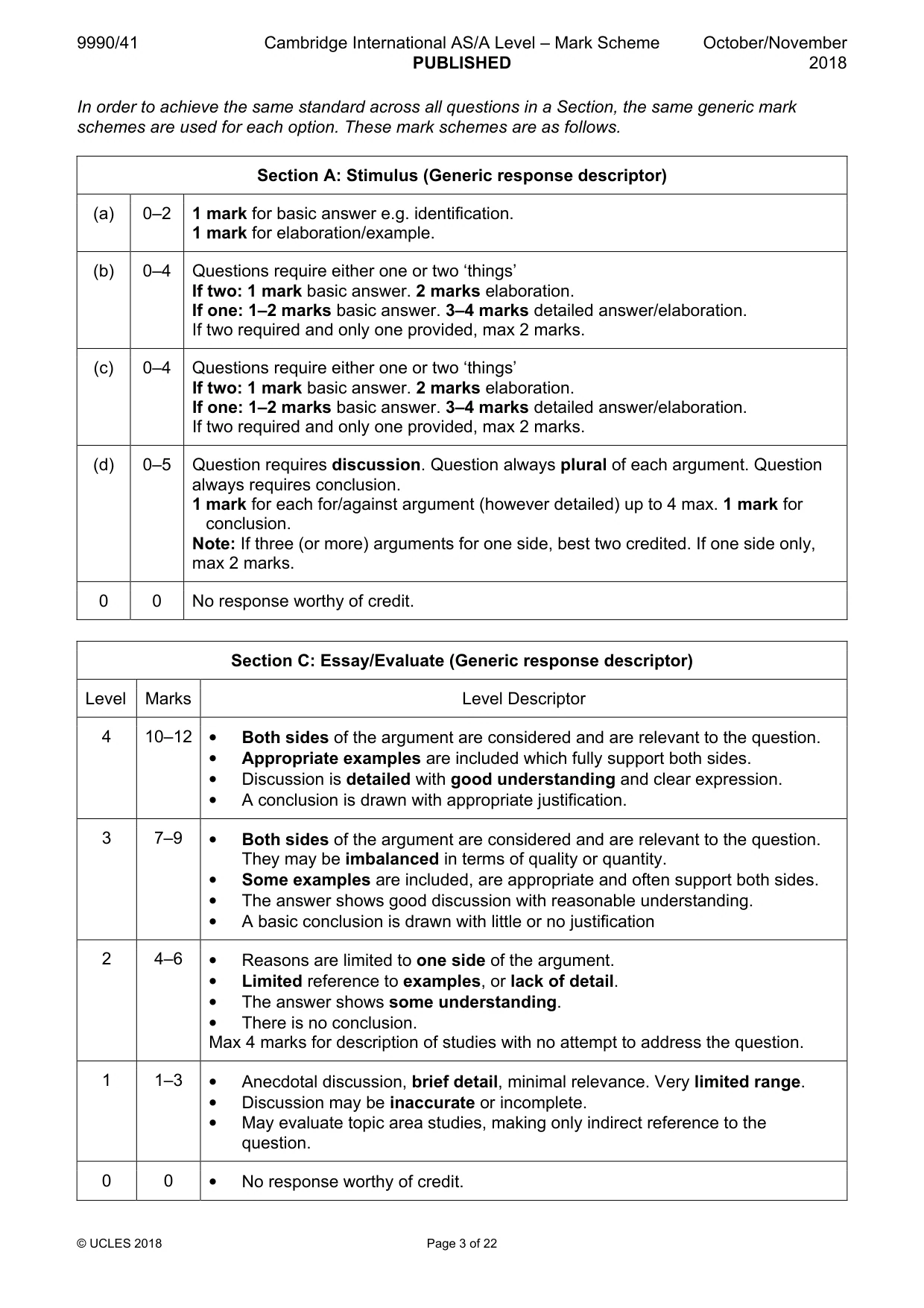
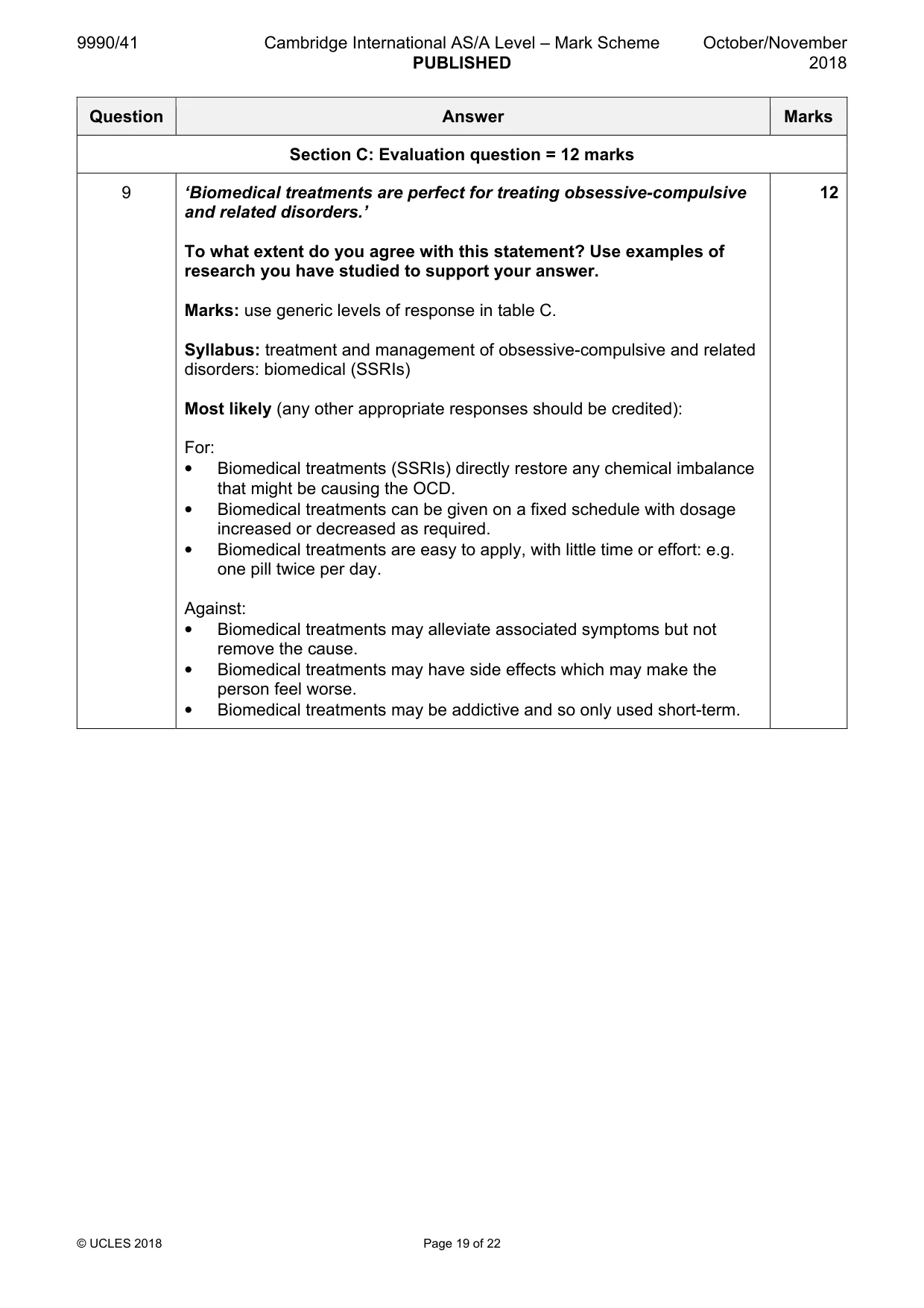
Mark scheme: 9 ‘Biomedical treatments are perfect for treating obsessive-compulsive 12 and related disorders.’ To what extent do you agree with this statement? Use examples of research you have studied to support your answer. Marks: use generic levels of response in table C. Syllabus: treatment and management of obsessive-compulsive and related disorders: biomedical (SSRIs) Most likely (any other appropriate responses should be credited): For: • Biomedical treatments (SSRIs) directly restore any chemical imbalance that might be causing the OCD. • Biomedical treatments can be given on a fixed schedule with dosage increased or decreased as required. • Biomedical treatments are easy to apply, with little time or effort: e.g. one pill twice per day. Against: • Biomedical treatments may alleviate associated symptoms but not remove the cause. • Biomedical treatments may have side effects which may make the person feel worse. • Biomedical treatments may be addictive and so only used short-term.
Q10 · ‘Consumer decision-making is poor when shopping because advertising produces false…
10 ‘Consumer decision-making is poor when shopping because advertising produces false memories.’ To what extent do you agree with this statement? Use examples of research you have studied to support your answer. [12] Psychology and health
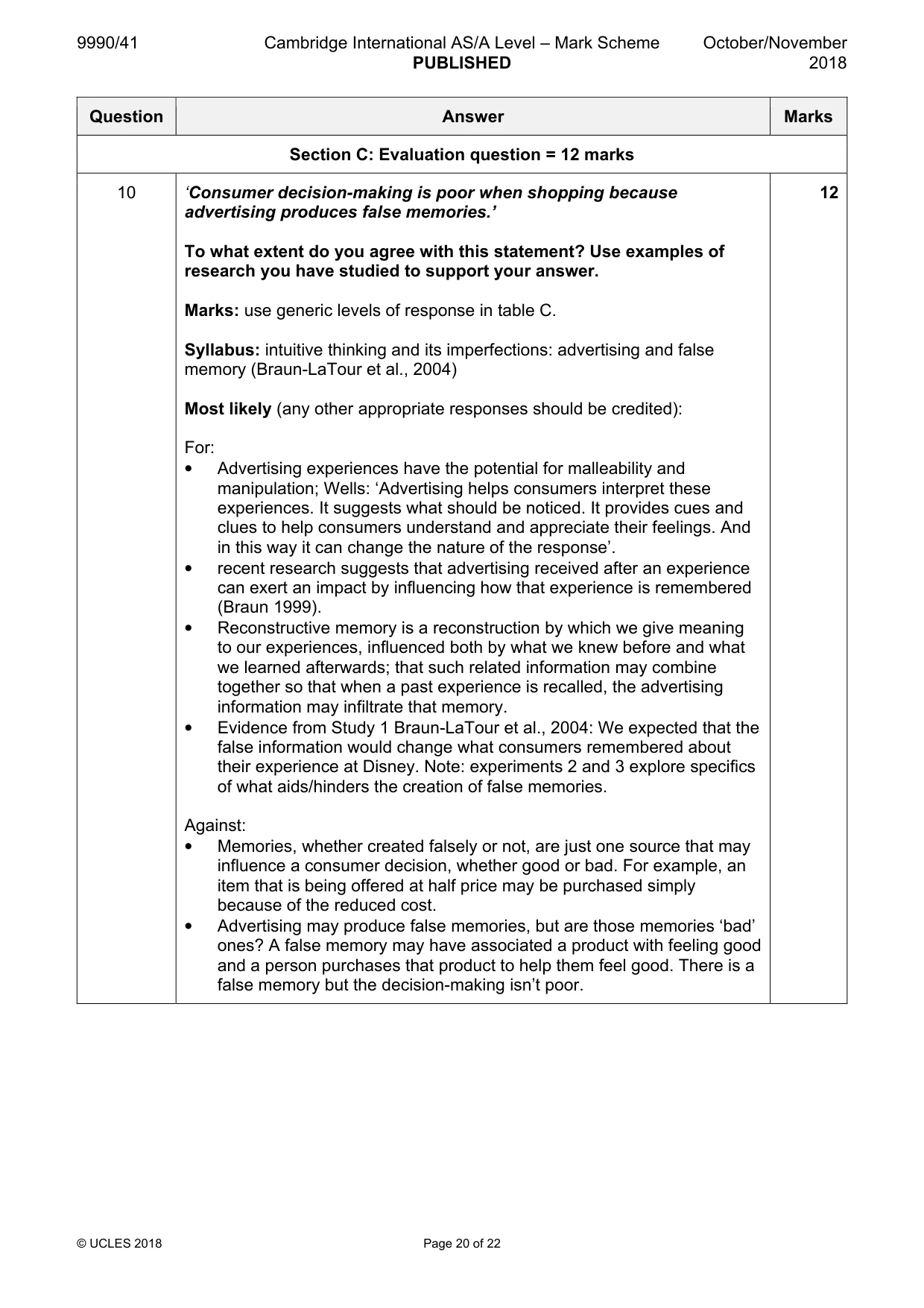
Mark scheme: 10 ‘Consumer decision-making is poor when shopping because 12 advertising produces false memories.’ To what extent do you agree with this statement? Use examples of research you have studied to support your answer. Marks: use generic levels of response in table C. Syllabus: intuitive thinking and its imperfections: advertising and false memory (Braun-LaTour et al., 2004) Most likely (any other appropriate responses should be credited): For: • Advertising experiences have the potential for malleability and manipulation; Wells: ‘Advertising helps consumers interpret these experiences. It suggests what should be noticed. It provides cues and clues to help consumers understand and appreciate their feelings. And in this way it can change the nature of the response’. • recent research suggests that advertising received after an experience can exert an impact by influencing how that experience is remembered (Braun 1999). • Reconstructive memory is a reconstruction by which we give meaning to our experiences, influenced both by what we knew before and what we learned afterwards; that such related information may combine together so that when a past experience is recalled, the advertising information may infiltrate that memory. • Evidence from Study 1 Braun-LaTour et al., 2004: We expected that the false information would change what consumers remembered about their experience at Disney. Note: experiments 2 and 3 explore specifics of what aids/hinders the creation of false memories. Against: • Memories, whether created falsely or not, are just one source that may influence a consumer decision, whether good or bad. For example, an item that is being offered at half price may be purchased simply because of the reduced cost. • Advertising may produce false memories, but are those memories ‘bad’ ones? A false memory may have associated a product with feeling good and a person purchases that product to help them feel good. There is a false memory but the decision-making isn’t poor.
Q11 · ‘The health beliefs and behaviour of young adults are formed by their friends rather than…
11 ‘The health beliefs and behaviour of young adults are formed by their friends rather than their family.’ To what extent do you agree with this statement? Use examples of research you have studied to support your answer. [12] Psychology and organisations
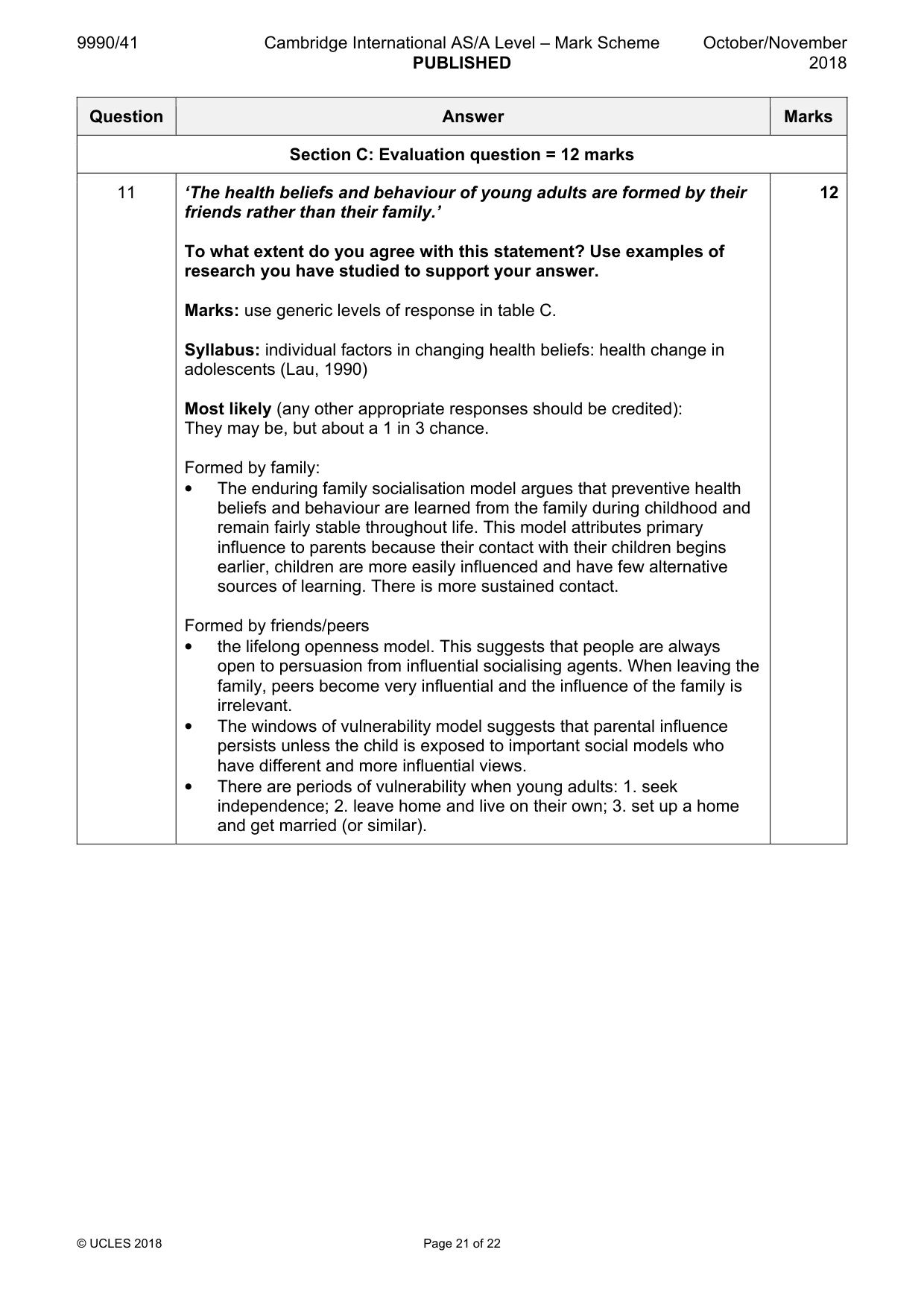
Mark scheme: 11 ‘The health beliefs and behaviour of young adults are formed by their 12 friends rather than their family.’ To what extent do you agree with this statement? Use examples of research you have studied to support your answer. Marks: use generic levels of response in table C. Syllabus: individual factors in changing health beliefs: health change in adolescents (Lau, 1990) Most likely (any other appropriate responses should be credited): They may be, but about a 1 in 3 chance. Formed by family: • The enduring family socialisation model argues that preventive health beliefs and behaviour are learned from the family during childhood and remain fairly stable throughout life. This model attributes primary influence to parents because their contact with their children begins earlier, children are more easily influenced and have few alternative sources of learning. There is more sustained contact. Formed by friends/peers • the lifelong openness model. This suggests that people are always open to persuasion from influential socialising agents. When leaving the family, peers become very influential and the influence of the family is irrelevant. • The windows of vulnerability model suggests that parental influence persists unless the child is exposed to important social models who have different and more influential views. • There are periods of vulnerability when young adults: 1. seek independence; 2. leave home and live on their own; 3. set up a home and get married (or similar).
More questions on 2 Health promotion in schools and worksites
Q12 · ‘Different types of followers do not exist
12 ‘Different types of followers do not exist. Workers either follow a leader or they do not.’ To what extent do you agree with this statement? Use examples of research you have studied to support your answer. [12]
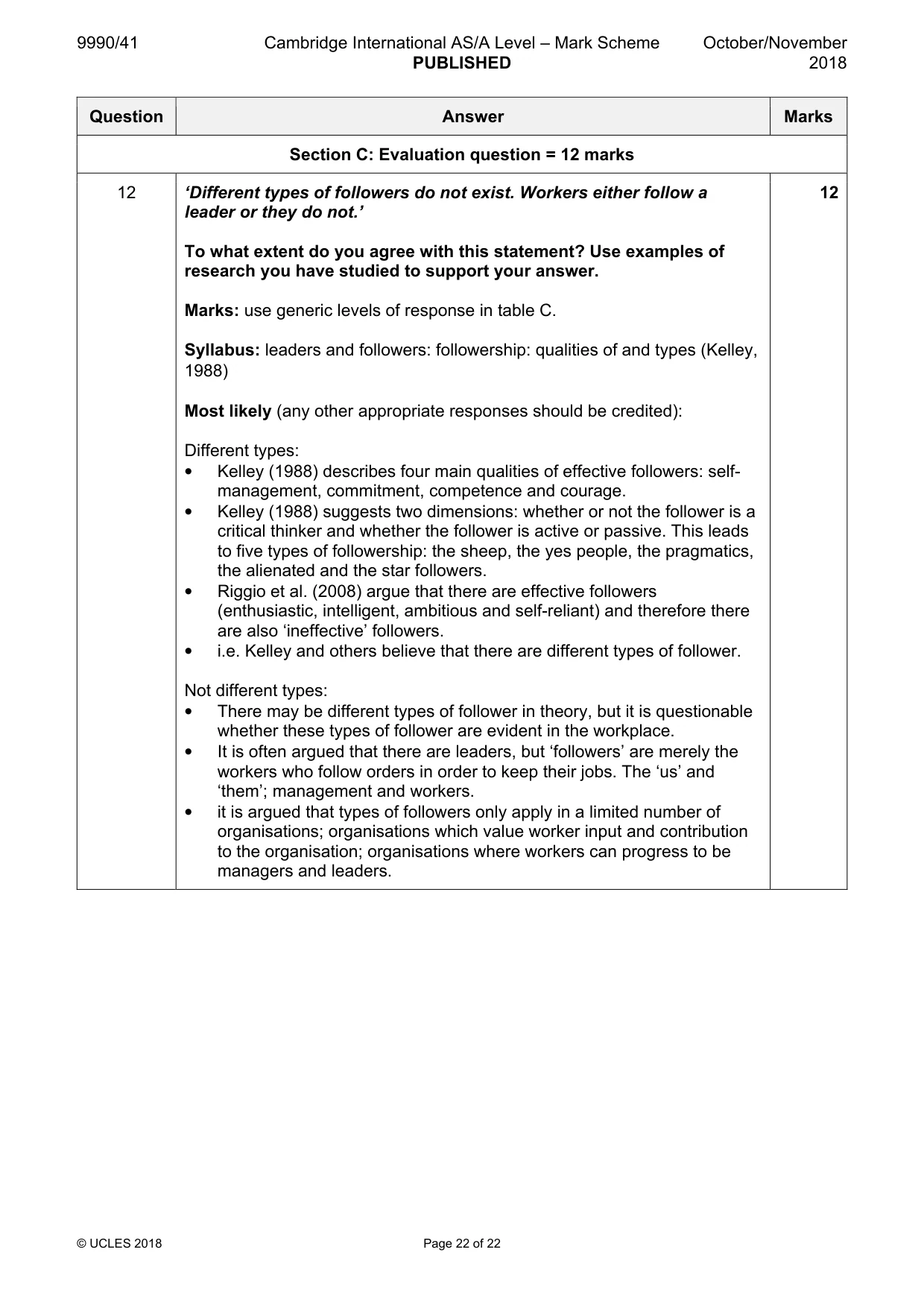
Mark scheme: 12 ‘Different types of followers do not exist. Workers either follow a 12 leader or they do not.’ To what extent do you agree with this statement? Use examples of research you have studied to support your answer. Marks: use generic levels of response in table C. Syllabus: leaders and followers: followership: qualities of and types (Kelley, 1988) Most likely (any other appropriate responses should be credited): Different types: • Kelley (1988) describes four main qualities of effective followers: self- management, commitment, competence and courage. • Kelley (1988) suggests two dimensions: whether or not the follower is a critical thinker and whether the follower is active or passive. This leads to five types of followership: the sheep, the yes people, the pragmatics, the alienated and the star followers. • Riggio et al. (2008) argue that there are effective followers (enthusiastic, intelligent, ambitious and self-reliant) and therefore there are also ‘ineffective’ followers. • i.e. Kelley and others believe that there are different types of follower. Not different types: • There may be different types of follower in theory, but it is questionable whether these types of follower are evident in the workplace. • It is often argued that there are leaders, but ‘followers’ are merely the workers who follow orders in order to keep their jobs. The ‘us’ and ‘them’; management and workers. • it is argued that types of followers only apply in a limited number of organisations; organisations which value worker input and contribution to the organisation; organisations where workers can progress to be managers and leaders.
What was in this paper
The subtopics covered by these 12 questions, and how many questions each got. Open one in a new tab to see every Cambridge question on it.
What you needed in this session
Cambridge’s own grade thresholds for 2018 Oct/Nov, Paper 4 · Variant 1. A higher threshold means an easier paper — the bar moves with how the cohort did.