Cambridge A Level Psychology (from 2018) 9990 — 2022 Oct/Nov Paper 4 · Variant 3
9990/43/O/N/22 · 12 questions · 60 marks · ≈68 min
The question paper and its mark scheme, free to read here and free to download. This is Cambridge’s own paper, exactly as it was sat.
Question paper8 pages



Mark scheme24 pages
Answers below. Sit the paper first if you are practising.
Questions as text
Q1 · Richard has a fear of oranges and knows about the behavioural explanation of phobias
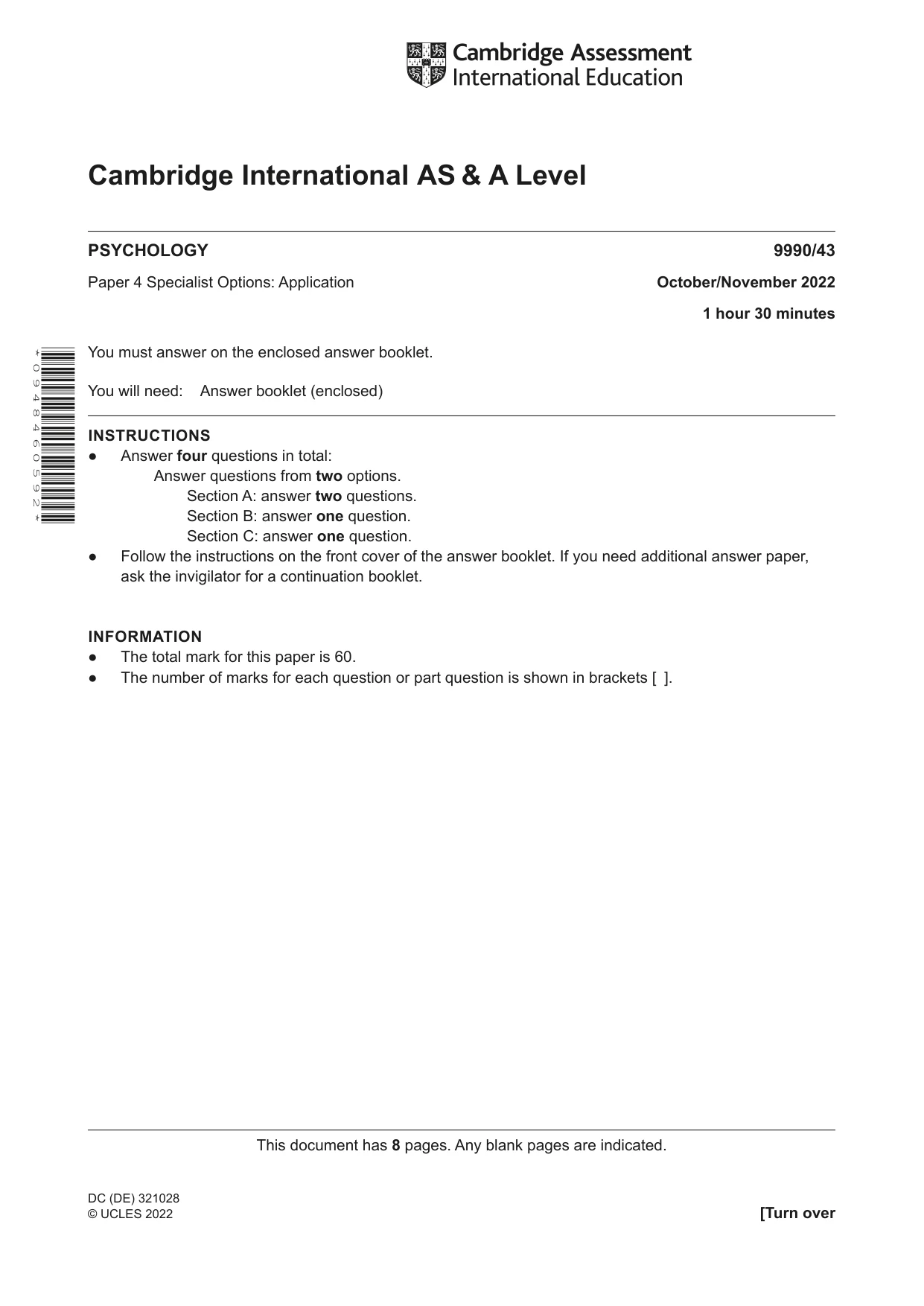
1 Richard has a fear of oranges and knows about the behavioural explanation of phobias. Richard wants to be treated using systematic desensitisation (Wolpe, 1958). However, his partner thinks that other treatments may be better. (a) Explain what is meant by a ‘behavioural explanation of phobias’. [2] (b) Explain how systematic desensitisation would be used to treat Richard’s fear of oranges. [4] (c) Suggest two ways in which a phobia can be treated, other than systematic desensitisation. [4] (d) Discuss the strengths and weaknesses of using systematic desensitisation to treat phobias. You should include a conclusion in your answer. [5] Psychology and consumer behaviour
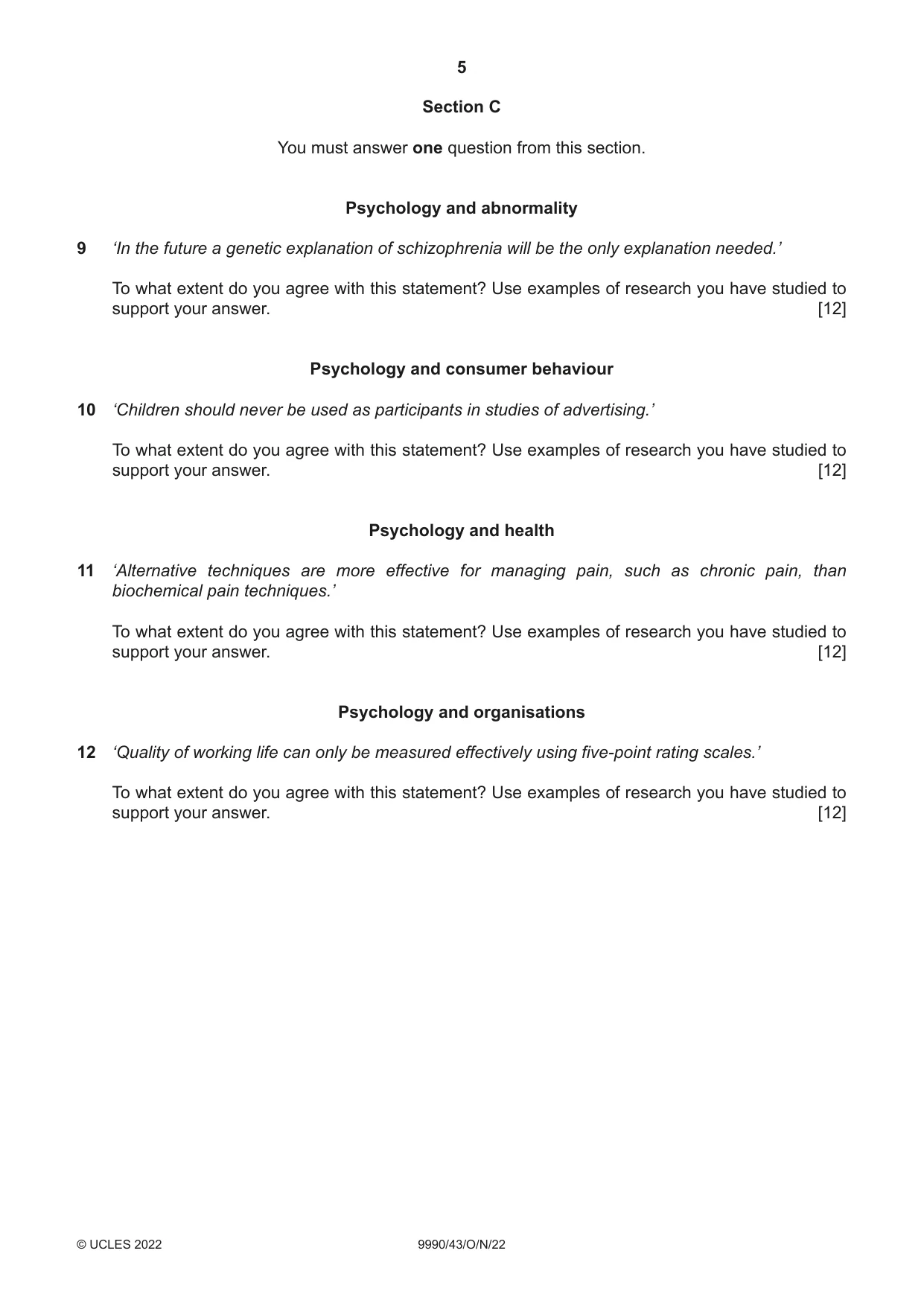
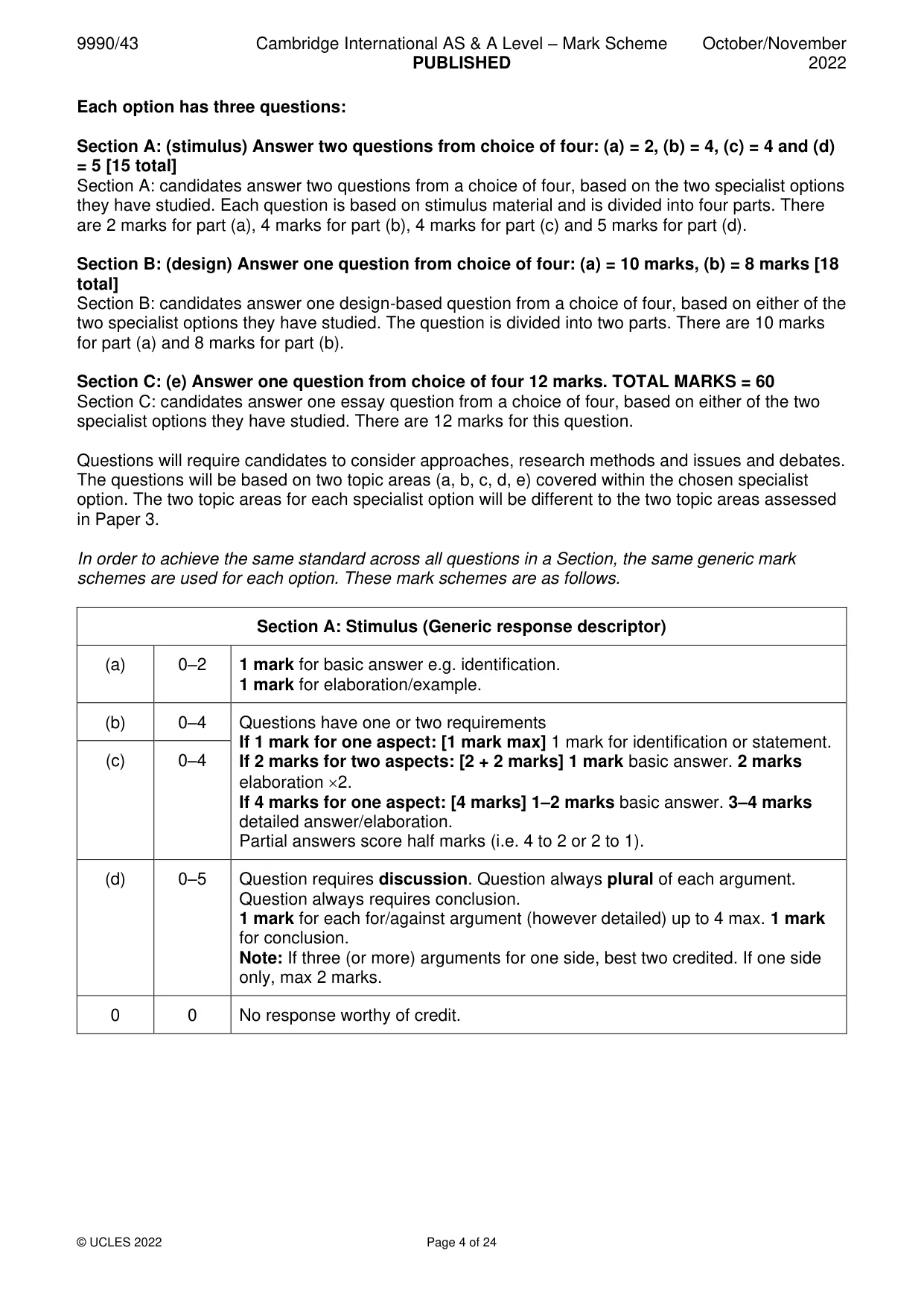
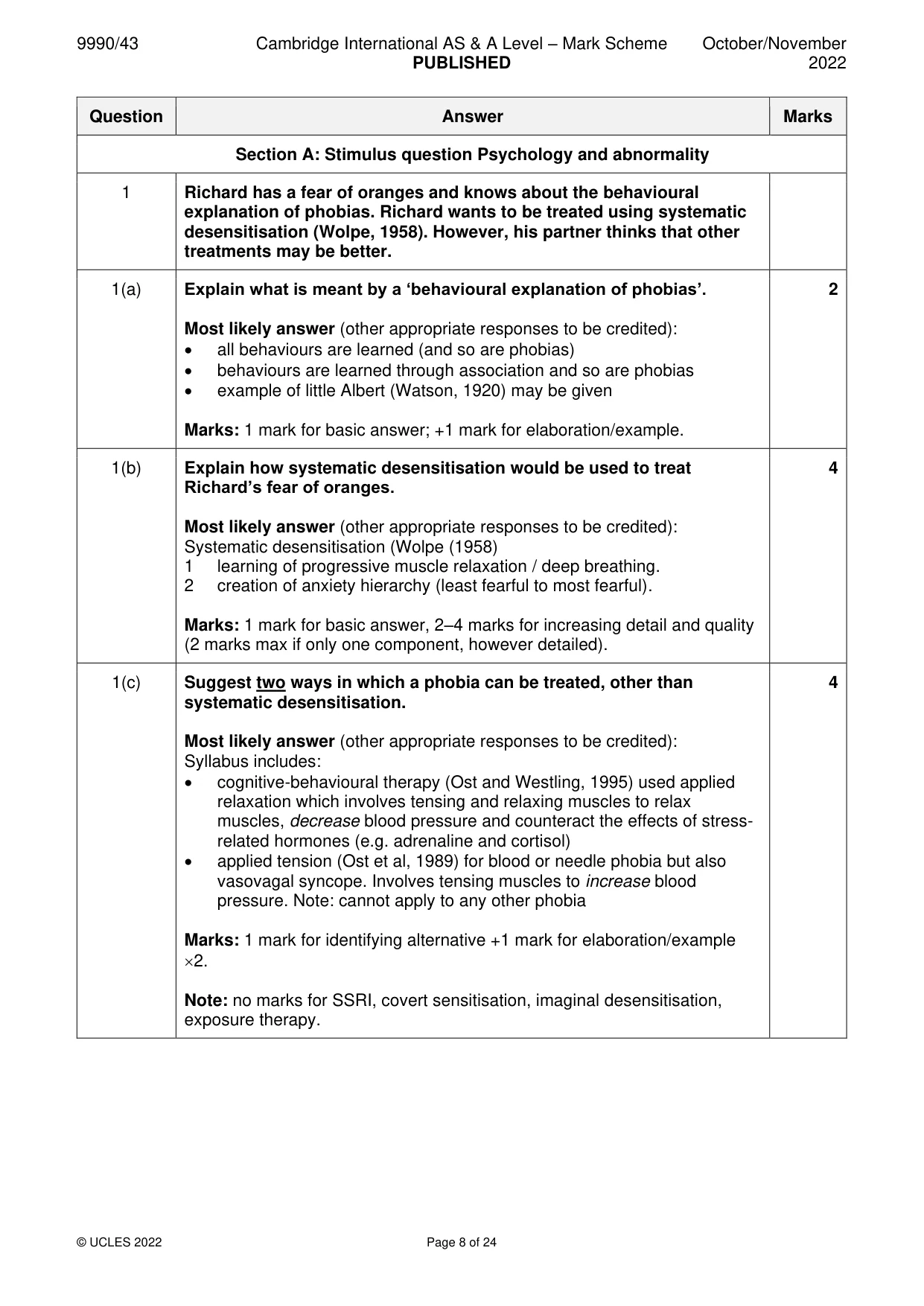
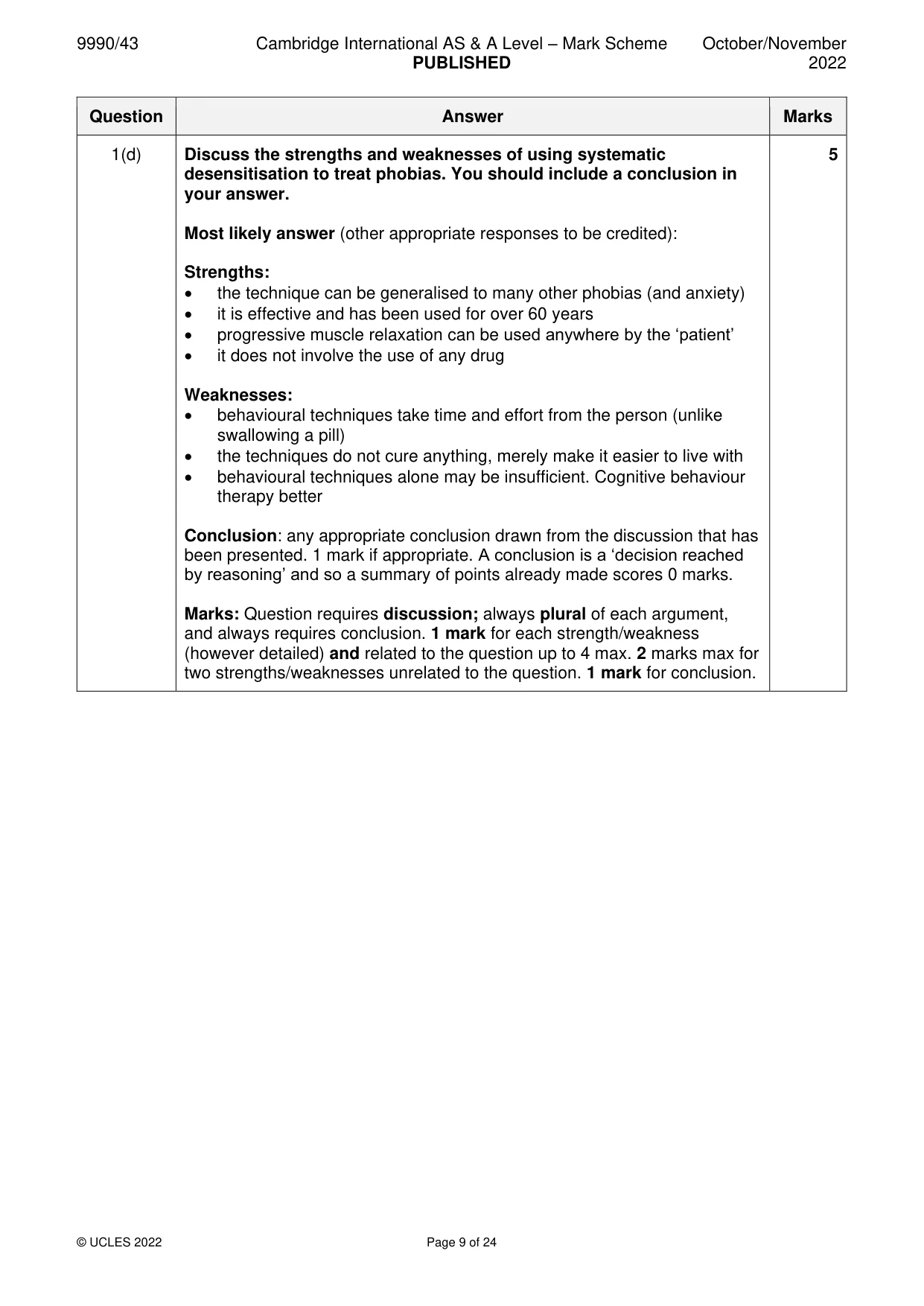
Mark scheme: Question Answer Marks Section A: Stimulus question Psychology and abnormality 1 Richard has a fear of oranges and knows about the behavioural explanation of phobias. Richard wants to be treated using systematic desensitisation (Wolpe, 1958). However, his partner thinks that other treatments may be better. 1(a) Explain what is meant by a ‘behavioural explanation of phobias’. 2 Most likely answer (other appropriate responses to be credited): • all behaviours are learned (and so are phobias) • behaviours are learned through association and so are phobias • example of little Albert (Watson, 1920) may be given Marks: 1 mark for basic answer; +1 mark for elaboration/example. 1(b) Explain how systematic desensitisation would be used to treat 4 Richard’s fear of oranges. Most likely answer (other appropriate responses to be credited): Systematic desensitisation (Wolpe (1958) 1 learning of progressive muscle relaxation / deep breathing. 2 creation of anxiety hierarchy (least fearful to most fearful). Marks: 1 mark for basic answer, 2–4 marks for increasing detail and quality (2 marks max if only one component, however detailed). 1(c) Suggest two ways in which a phobia can be treated, other than 4 systematic desensitisation. Most likely answer (other appropriate responses to be credited): Syllabus includes: • cognitive-behavioural therapy (Ost and Westling, 1995) used applied relaxation which involves tensing and relaxing muscles to relax muscles, decrease blood pressure and counteract the effects of stress- related hormones (e.g. adrenaline and cortisol) • applied tension (Ost et al, 1989) for blood or needle phobia but also vasovagal syncope. Involves tensing muscles to increase blood pressure. Note: cannot apply to any other phobia Marks: 1 mark for identifying alternative +1 mark for elaboration/example 2. Note: no marks for SSRI, covert sensitisation, imaginal desensitisation, exposure therapy. 1(d) Discuss the strengths and weaknesses of using systematic 5 desensitisation to treat phobias. You should include a conclusion in your answer. Most likely answer (other appropriate responses to be credited): Strengths: • the technique can be generalised to many other phobias (and anxiety) • it is effective and has been used for over 60 years • progressive muscle relaxation can be used anywhere by the ‘patient’ • it does not involve the use of any drug Weaknesses: • behavioural techniques take time and effort from the person (unlike swallowing a pill) • the techniques do not cure anything, merely make it easier to live with • behavioural techniques alone may be insufficient. Cognitive behaviour therapy better Conclusion: any appropriate conclusion drawn from the discussion that has been presented. 1 mark if appropriate. A conclusion is a ‘decision reached by reasoning’ and so a summary of points already made scores 0 marks. Marks: Question requires discussion; always plural of each argument, and always requires conclusion. 1 mark for each strength/weakness (however detailed) and related to the question up to 4 max. 2 marks max for two strengths/weaknesses unrelated to the question. 1 mark for conclusion.
More questions on Anxiety disorders and fear-related disorders
Q2 · Newspaper Headline: Bugs Bunny goes to Disney!
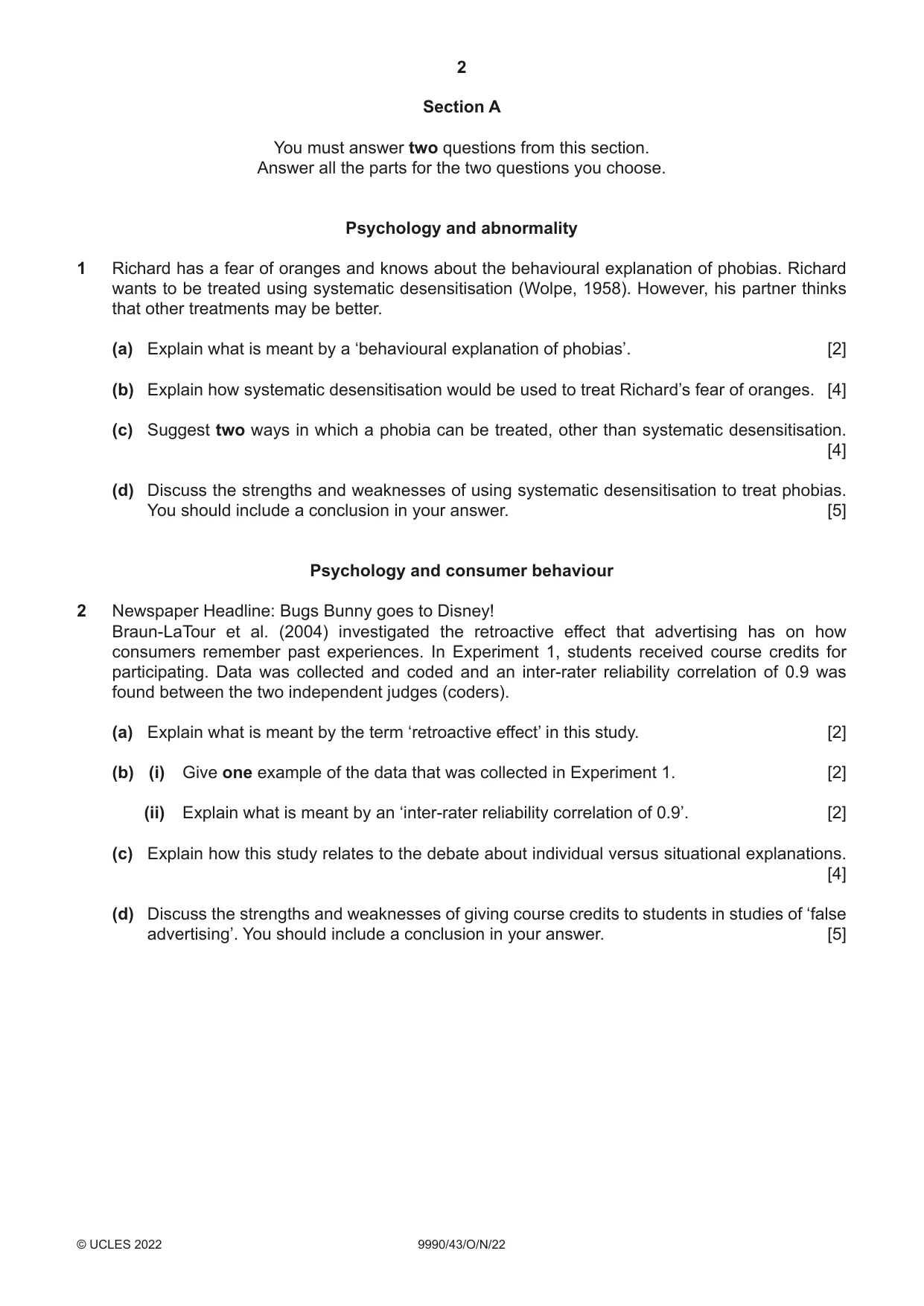
2 Newspaper Headline: Bugs Bunny goes to Disney! Braun‑LaTour et al. (2004) investigated the retroactive effect that advertising has on how consumers remember past experiences. In Experiment 1, students received course credits for participating. Data was collected and coded and an inter‑rater reliability correlation of 0.9 was found between the two independent judges (coders). (a) Explain what is meant by the term ‘retroactive effect’ in this study. [2] (b) (i) Give one example of the data that was collected in Experiment 1. [2] (ii) Explain what is meant by an ‘inter‑rater reliability correlation of 0.9’. [2] (c) Explain how this study relates to the debate about individual versus situational explanations. [4] (d) Discuss the strengths and weaknesses of giving course credits to students in studies of ‘false advertising’. You should include a conclusion in your answer. [5] Psychology and health
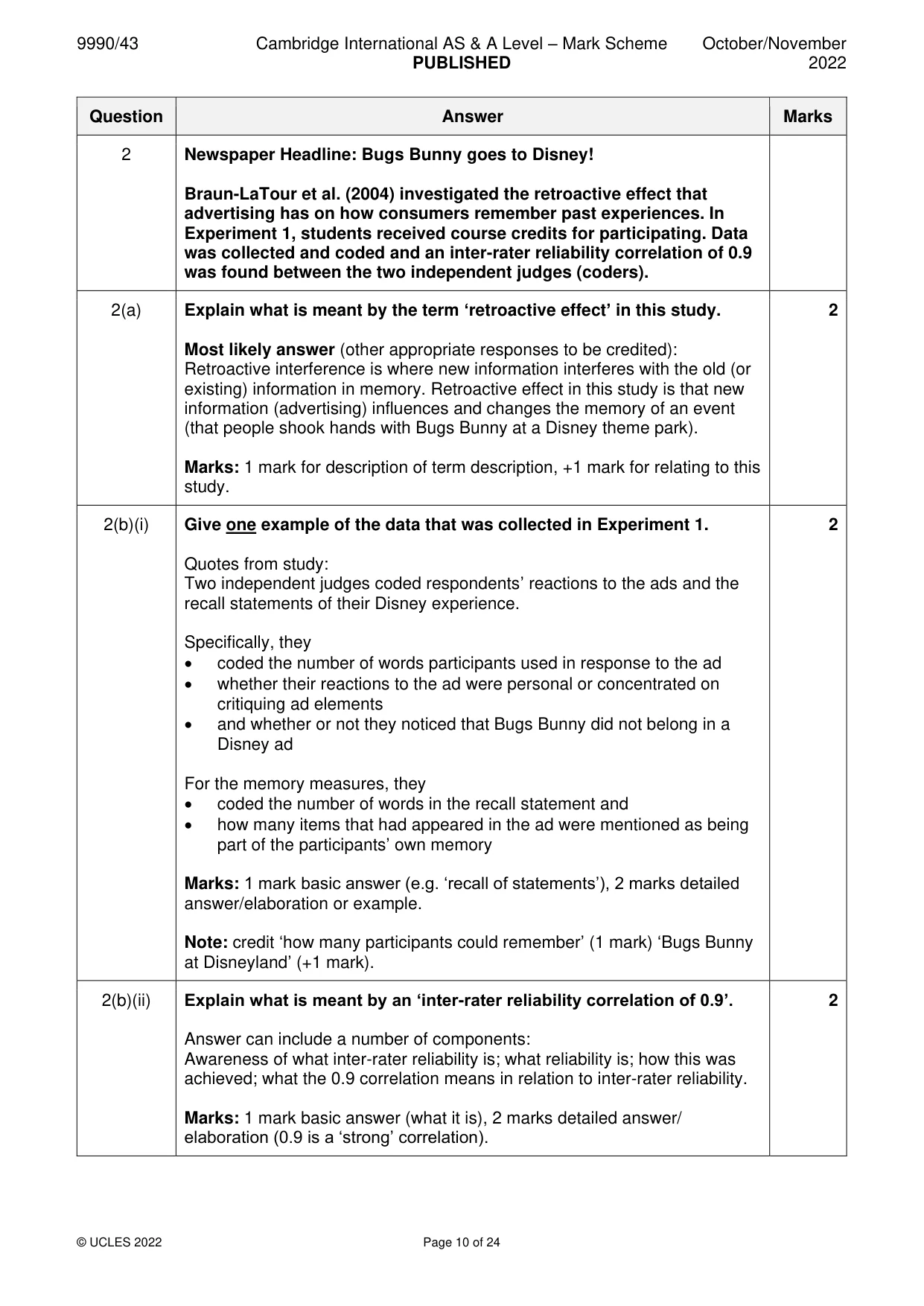
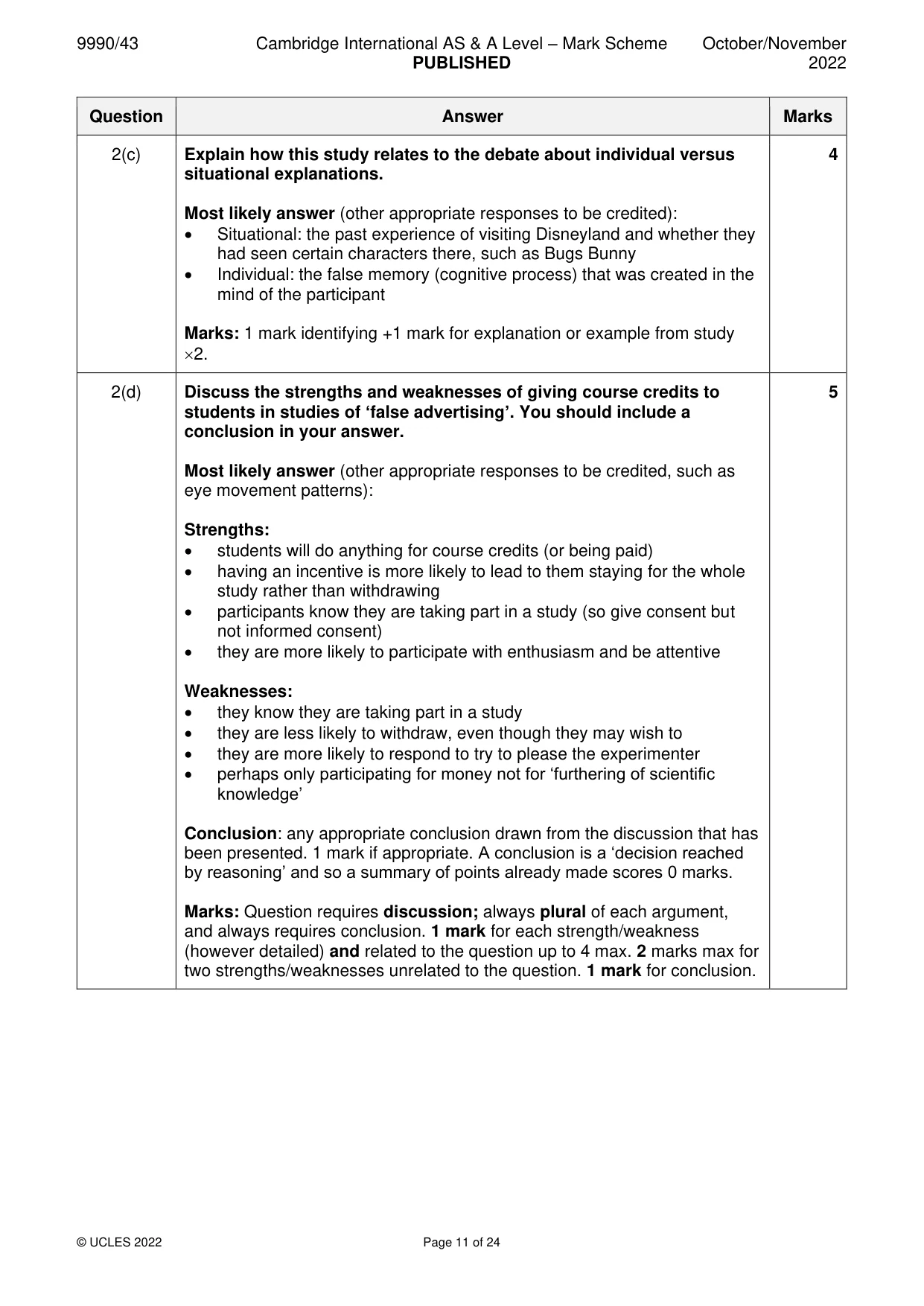
Mark scheme: 2 Newspaper Headline: Bugs Bunny goes to Disney! Braun-LaTour et al. (2004) investigated the retroactive effect that advertising has on how consumers remember past experiences. In Experiment 1, students received course credits for participating. Data was collected and coded and an inter-rater reliability correlation of 0.9 was found between the two independent judges (coders). 2(a) Explain what is meant by the term ‘retroactive effect’ in this study. 2 Most likely answer (other appropriate responses to be credited): Retroactive interference is where new information interferes with the old (or existing) information in memory. Retroactive effect in this study is that new information (advertising) influences and changes the memory of an event (that people shook hands with Bugs Bunny at a Disney theme park). Marks: 1 mark for description of term description, +1 mark for relating to this study. 2(b)(i) Give one example of the data that was collected in Experiment 1. 2 Quotes from study: Two independent judges coded respondents’ reactions to the ads and the recall statements of their Disney experience. Specifically, they • coded the number of words participants used in response to the ad • whether their reactions to the ad were personal or concentrated on critiquing ad elements • and whether or not they noticed that Bugs Bunny did not belong in a Disney ad For the memory measures, they • coded the number of words in the recall statement and • how many items that had appeared in the ad were mentioned as being part of the participants’ own memory Marks: 1 mark basic answer (e.g. ‘recall of statements’), 2 marks detailed answer/elaboration or example. Note: credit ‘how many participants could remember’ (1 mark) ‘Bugs Bunny at Disneyland’ (+1 mark). 2(b)(ii) Explain what is meant by an ‘inter-rater reliability correlation of 0.9’. 2 Answer can include a number of components: Awareness of what inter-rater reliability is; what reliability is; how this was achieved; what the 0.9 correlation means in relation to inter-rater reliability. Marks: 1 mark basic answer (what it is), 2 marks detailed answer/ elaboration (0.9 is a ‘strong’ correlation). 2(c) Explain how this study relates to the debate about individual versus 4 situational explanations. Most likely answer (other appropriate responses to be credited): • Situational: the past experience of visiting Disneyland and whether they had seen certain characters there, such as Bugs Bunny • Individual: the false memory (cognitive process) that was created in the mind of the participant Marks: 1 mark identifying +1 mark for explanation or example from study 2. 2(d) Discuss the strengths and weaknesses of giving course credits to 5 students in studies of ‘false advertising’. You should include a conclusion in your answer. Most likely answer (other appropriate responses to be credited, such as eye movement patterns): Strengths: • students will do anything for course credits (or being paid) • having an incentive is more likely to lead to them staying for the whole study rather than withdrawing • participants know they are taking part in a study (so give consent but not informed consent) • they are more likely to participate with enthusiasm and be attentive Weaknesses: • they know they are taking part in a study • they are less likely to withdraw, even though they may wish to • they are more likely to respond to try to please the experimenter • perhaps only participating for money not for ‘furthering of scientific knowledge’ Conclusion: any appropriate conclusion drawn from the discussion that has been presented. 1 mark if appropriate. A conclusion is a ‘decision reached by reasoning’ and so a summary of points already made scores 0 marks. Marks: Question requires discussion; always plural of each argument, and always requires conclusion. 1 mark for each strength/weakness (however detailed) and related to the question up to 4 max. 2 marks max for two strengths/weaknesses unrelated to the question. 1 mark for conclusion.
Q3 · In an attempt to understand non‑adherence to medical advice, Riekert and Drotar (1999)…
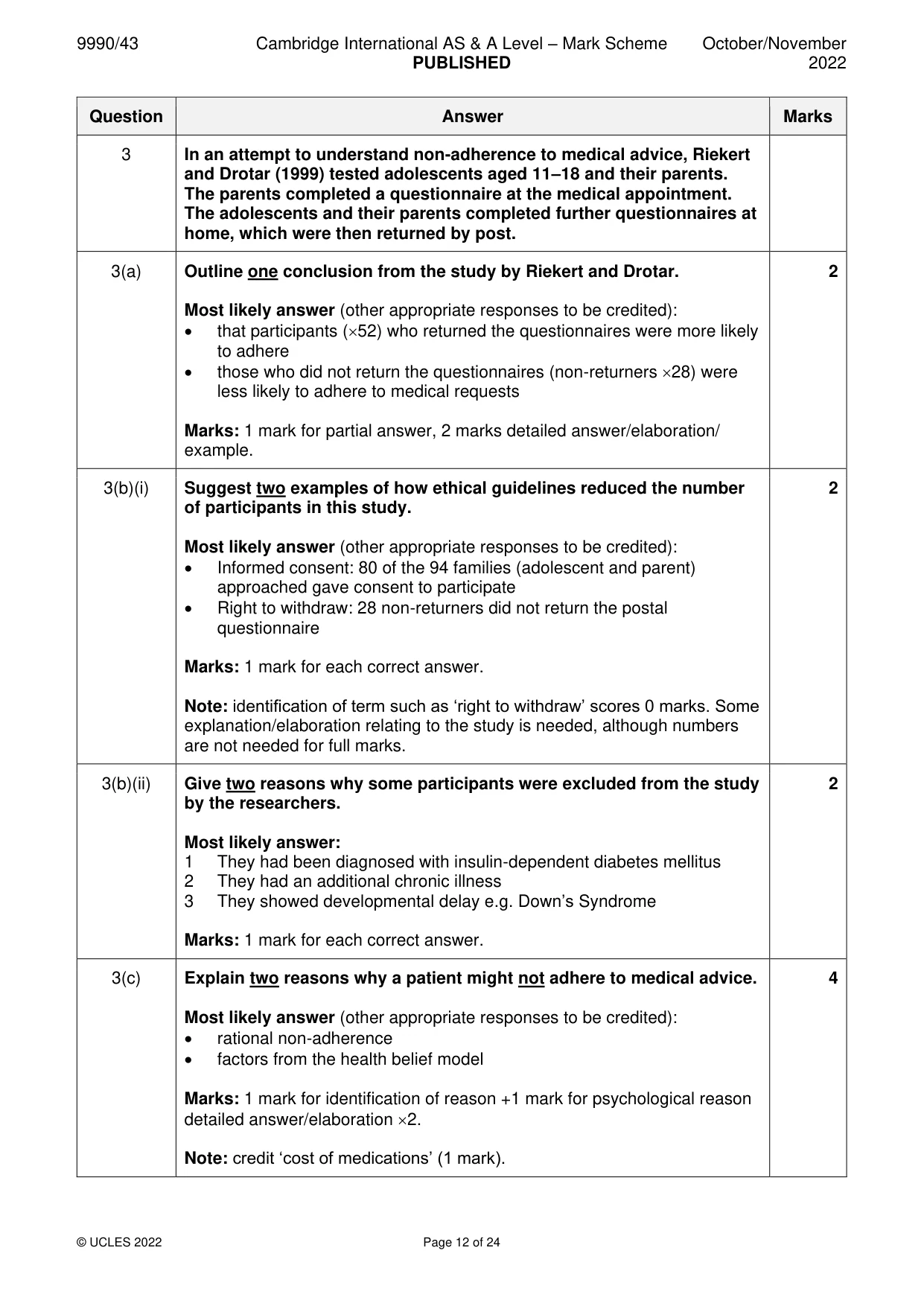
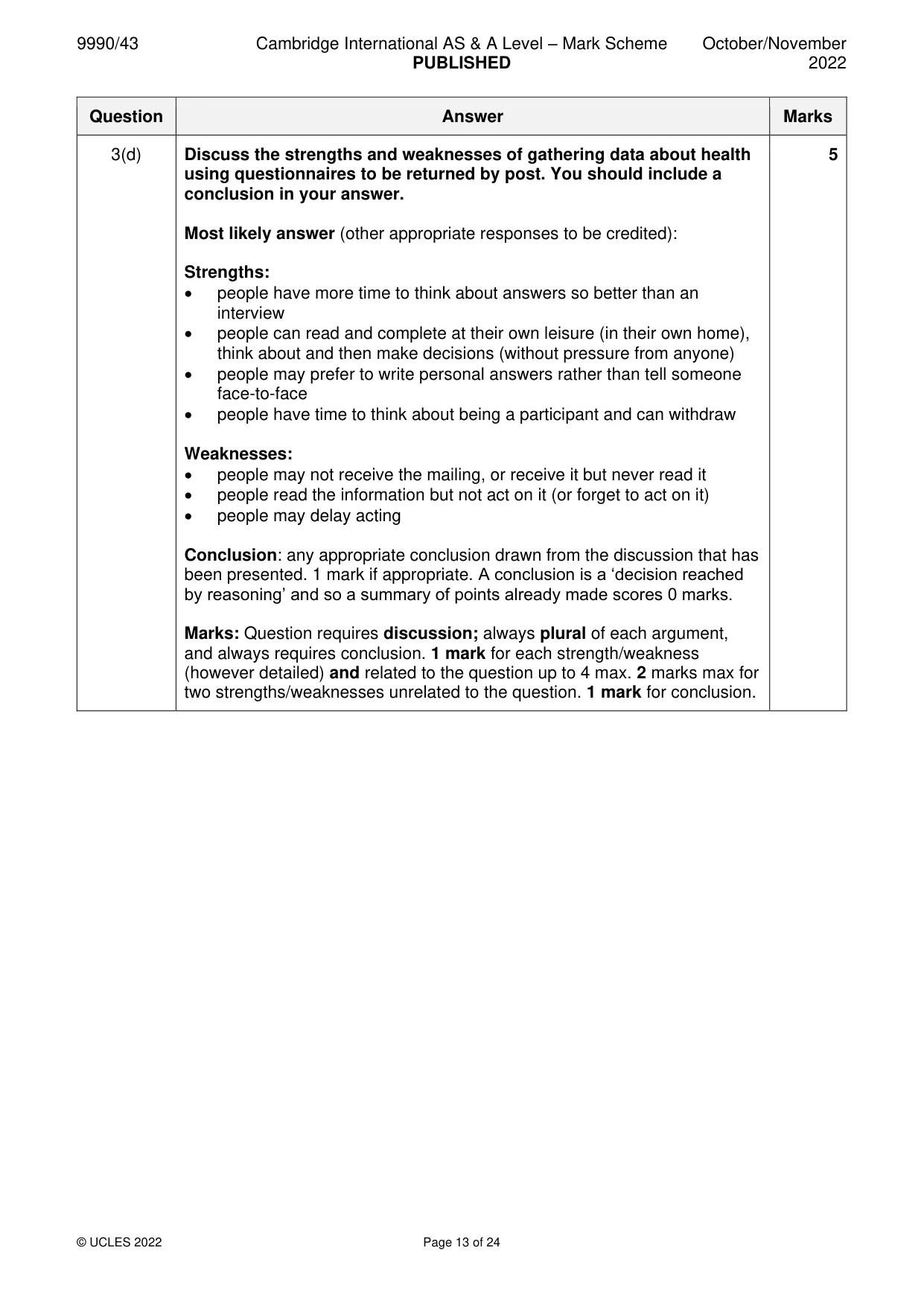
3 In an attempt to understand non‑adherence to medical advice, Riekert and Drotar (1999) tested adolescents aged 11–18 and their parents. The parents completed a questionnaire at the medical appointment. The adolescents and their parents completed further questionnaires at home, which were then returned by post. (a) Outline one conclusion from the study by Riekert and Drotar. [2] (b) (i) Suggest two examples of how ethical guidelines reduced the number of participants in this study. [2] (ii) Give two reasons why some participants were excluded from the study by the researchers. [2] (c) Explain two reasons why a patient might not adhere to medical advice. [4] (d) Discuss the strengths and weaknesses of gathering data about health using questionnaires to be returned by post. You should include a conclusion in your answer. [5] Psychology and organisations
Mark scheme: 3 In an attempt to understand non-adherence to medical advice, Riekert and Drotar (1999) tested adolescents aged 11–18 and their parents. The parents completed a questionnaire at the medical appointment. The adolescents and their parents completed further questionnaires at home, which were then returned by post. 3(a) Outline one conclusion from the study by Riekert and Drotar. 2 Most likely answer (other appropriate responses to be credited): • that participants (52) who returned the questionnaires were more likely to adhere • those who did not return the questionnaires (non-returners 28) were less likely to adhere to medical requests Marks: 1 mark for partial answer, 2 marks detailed answer/elaboration/ example. 3(b)(i) Suggest two examples of how ethical guidelines reduced the number 2 of participants in this study. Most likely answer (other appropriate responses to be credited): • Informed consent: 80 of the 94 families (adolescent and parent) approached gave consent to participate • Right to withdraw: 28 non-returners did not return the postal questionnaire Marks: 1 mark for each correct answer. Note: identification of term such as ‘right to withdraw’ scores 0 marks. Some explanation/elaboration relating to the study is needed, although numbers are not needed for full marks. 3(b)(ii) Give two reasons why some participants were excluded from the study 2 by the researchers. Most likely answer: 1 They had been diagnosed with insulin-dependent diabetes mellitus 2 They had an additional chronic illness 3 They showed developmental delay e.g. Down’s Syndrome Marks: 1 mark for each correct answer. 3(c) Explain two reasons why a patient might not adhere to medical advice. 4 Most likely answer (other appropriate responses to be credited): • rational non-adherence • factors from the health belief model Marks: 1 mark for identification of reason +1 mark for psychological reason detailed answer/elaboration 2. Note: credit ‘cost of medications’ (1 mark). 3(d) Discuss the strengths and weaknesses of gathering data about health 5 using questionnaires to be returned by post. You should include a conclusion in your answer. Most likely answer (other appropriate responses to be credited): Strengths: • people have more time to think about answers so better than an interview • people can read and complete at their own leisure (in their own home), think about and then make decisions (without pressure from anyone) • people may prefer to write personal answers rather than tell someone face-to-face • people have time to think about being a participant and can withdraw Weaknesses: • people may not receive the mailing, or receive it but never read it • people read the information but not act on it (or forget to act on it) • people may delay acting Conclusion: any appropriate conclusion drawn from the discussion that has been presented. 1 mark if appropriate. A conclusion is a ‘decision reached by reasoning’ and so a summary of points already made scores 0 marks. Marks: Question requires discussion; always plural of each argument, and always requires conclusion. 1 mark for each strength/weakness (however detailed) and related to the question up to 4 max. 2 marks max for two strengths/weaknesses unrelated to the question. 1 mark for conclusion.
Question 4
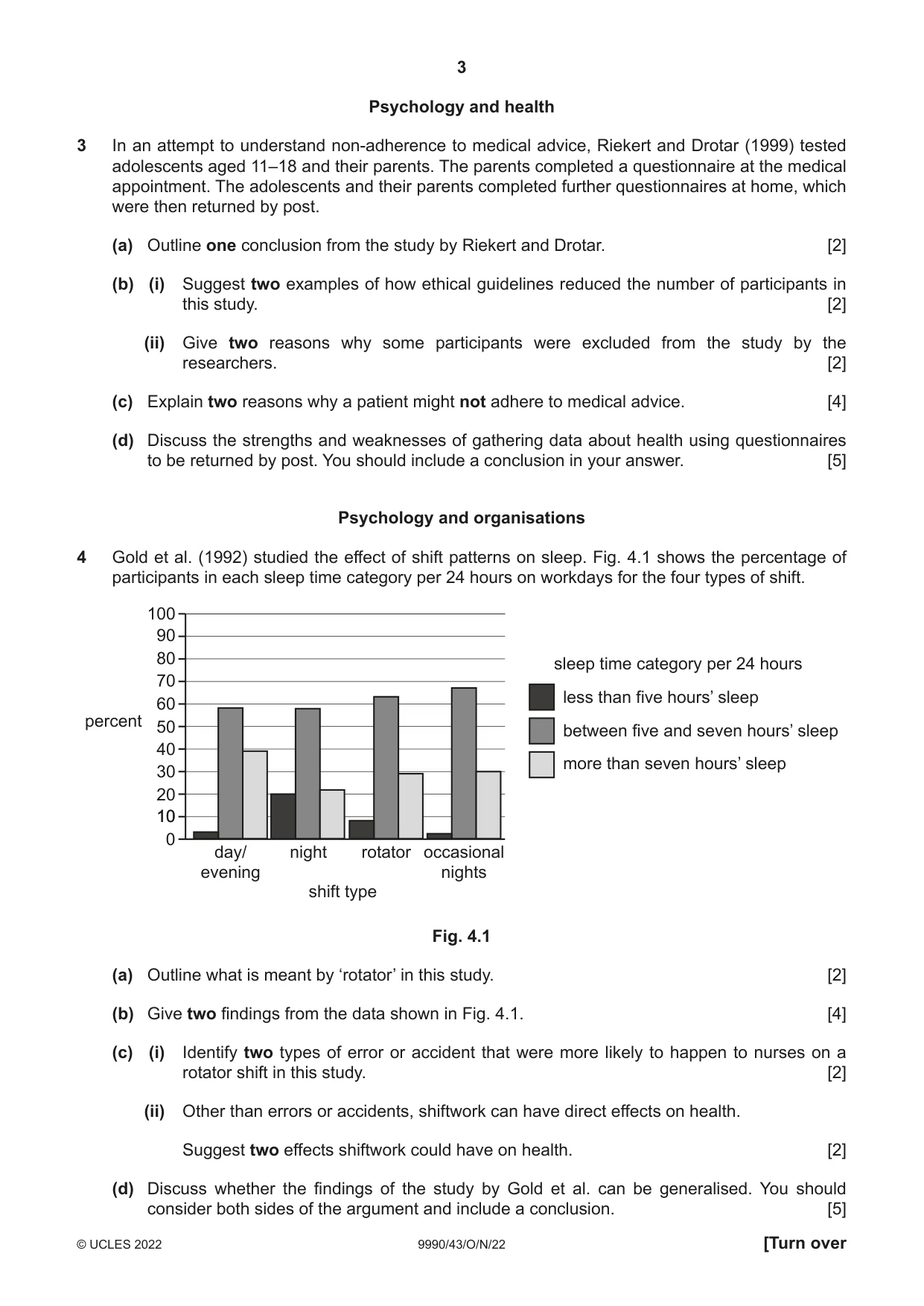
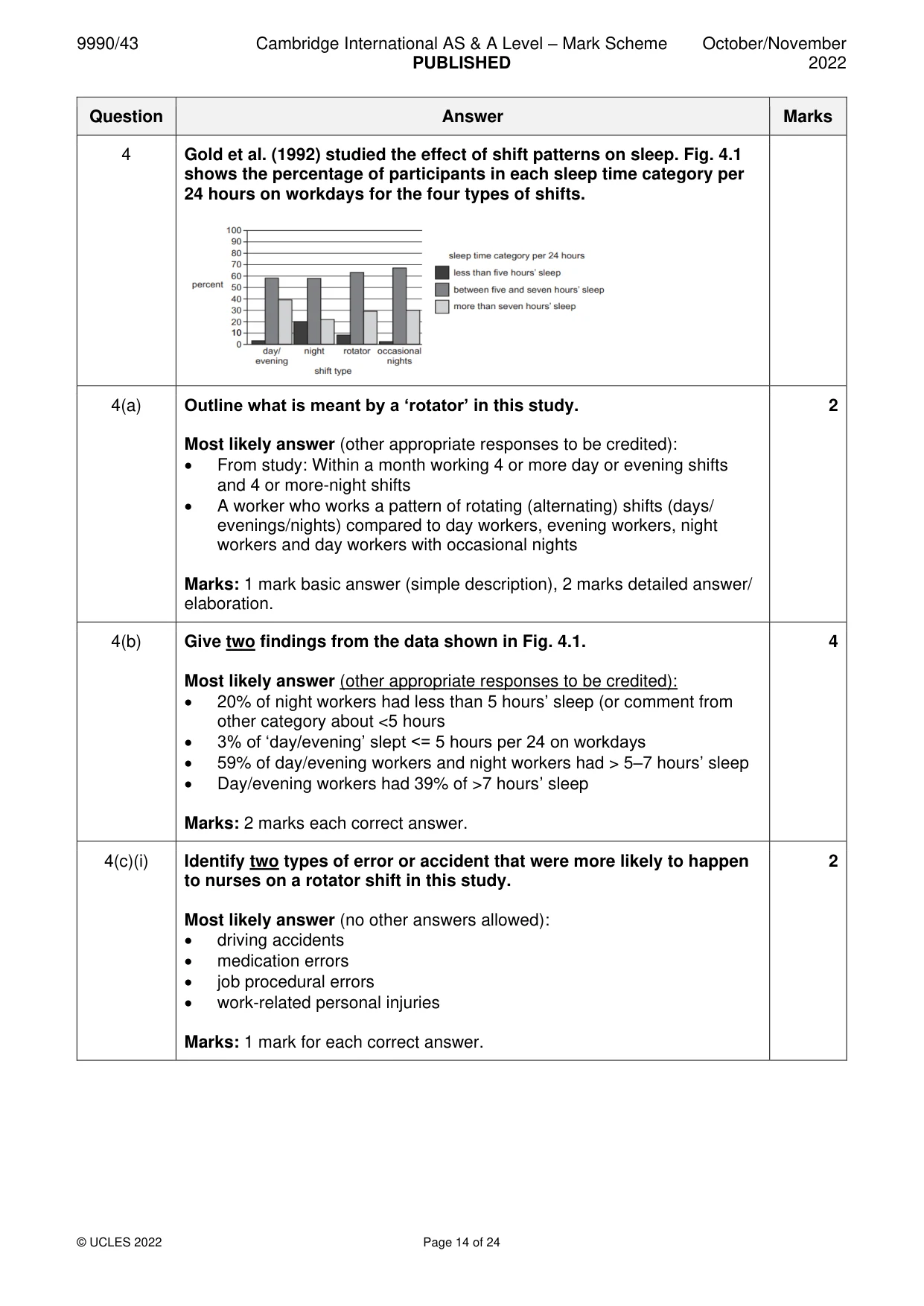
4 Gold et al. (1992) studied the effect of shift patterns on sleep. Fig. 4.1 shows the percentage of participants in each sleep time category per 24 hours on workdays for the four types of shift. 100 90 80 sleep time category per 24 hours 70 less than five hours’ sleep 60 percent 50 between five and seven hours’ sleep 40 more than seven hours’ sleep 30 20 1010 0 day/ night rotator occasional evening nights shift type Fig. 4.1 (a) Outline what is meant by ‘rotator’ in this study. [2] (b) Give two findings from the data shown in Fig. 4.1. [4] (c) (i) Identify two types of error or accident that were more likely to happen to nurses on a rotator shift in this study. [2] (ii) Other than errors or accidents, shiftwork can have direct effects on health. Suggest two effects shiftwork could have on health. [2] (d) Discuss whether the findings of the study by Gold et al. can be generalised. You should consider both sides of the argument and include a conclusion. [5]
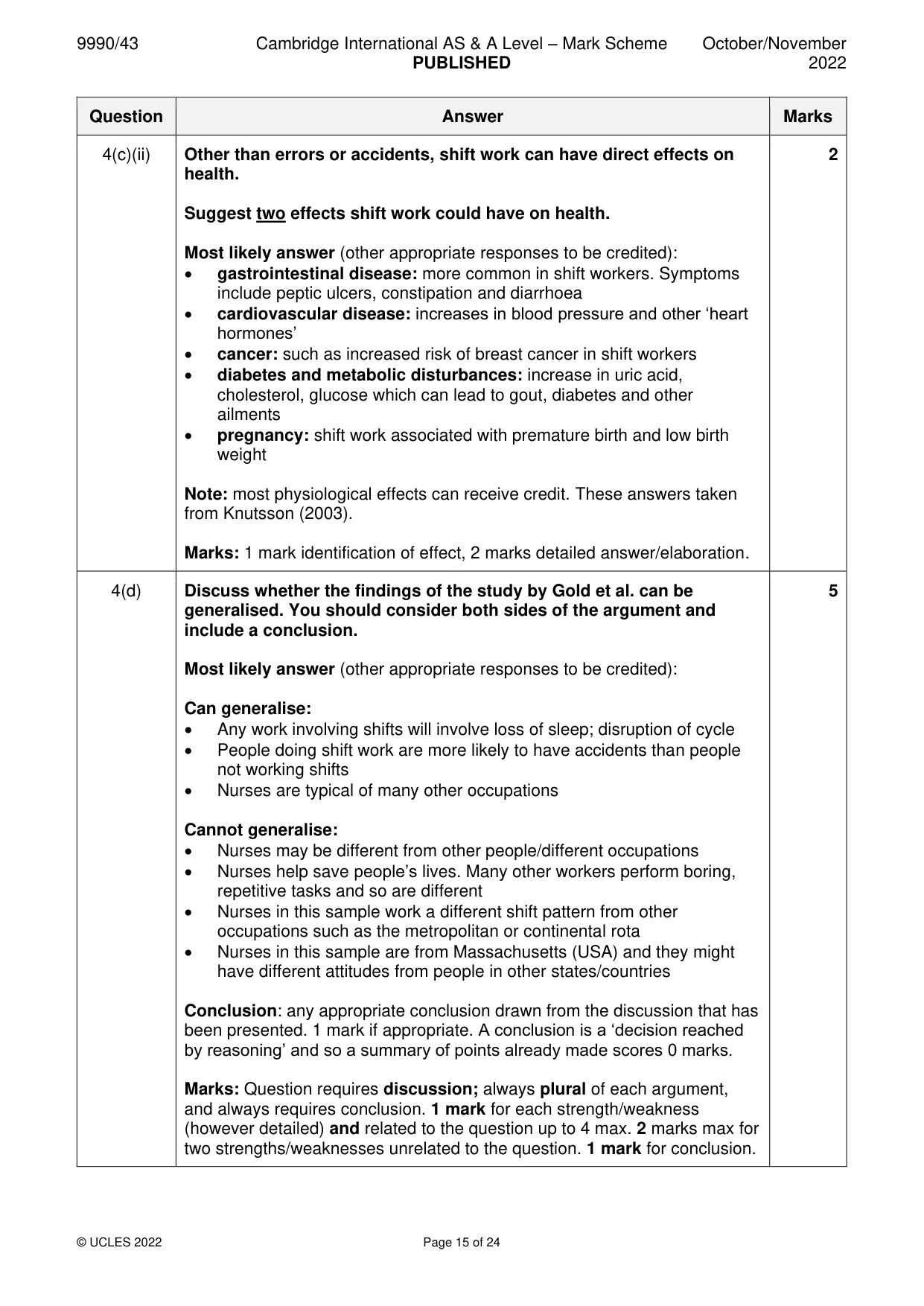
Mark scheme: 4 Gold et al. (1992) studied the effect of shift patterns on sleep. Fig. 4.1 shows the percentage of participants in each sleep time category per 24 hours on workdays for the four types of shifts. 4(a) Outline what is meant by a ‘rotator’ in this study. 2 Most likely answer (other appropriate responses to be credited): • From study: Within a month working 4 or more day or evening shifts and 4 or more-night shifts • A worker who works a pattern of rotating (alternating) shifts (days/ evenings/nights) compared to day workers, evening workers, night workers and day workers with occasional nights Marks: 1 mark basic answer (simple description), 2 marks detailed answer/ elaboration. 4(b) Give two findings from the data shown in Fig. 4.1. 4 Most likely answer (other appropriate responses to be credited): • 20% of night workers had less than 5 hours’ sleep (or comment from other category about <5 hours • 3% of ‘day/evening’ slept <= 5 hours per 24 on workdays • 59% of day/evening workers and night workers had > 5–7 hours’ sleep • Day/evening workers had 39% of >7 hours’ sleep Marks: 2 marks each correct answer. 4(c)(i) Identify two types of error or accident that were more likely to happen 2 to nurses on a rotator shift in this study. Most likely answer (no other answers allowed): • driving accidents • medication errors • job procedural errors • work-related personal injuries Marks: 1 mark for each correct answer. 4(c)(ii) Other than errors or accidents, shift work can have direct effects on 2 health. Suggest two effects shift work could have on health. Most likely answer (other appropriate responses to be credited): • gastrointestinal disease: more common in shift workers. Symptoms include peptic ulcers, constipation and diarrhoea • cardiovascular disease: increases in blood pressure and other ‘heart hormones’ • cancer: such as increased risk of breast cancer in shift workers • diabetes and metabolic disturbances: increase in uric acid, cholesterol, glucose which can lead to gout, diabetes and other ailments • pregnancy: shift work associated with premature birth and low birth weight Note: most physiological effects can receive credit. These answers taken from Knutsson (2003). Marks: 1 mark identification of effect, 2 marks detailed answer/elaboration. 4(d) Discuss whether the findings of the study by Gold et al. can be 5 generalised. You should consider both sides of the argument and include a conclusion. Most likely answer (other appropriate responses to be credited): Can generalise: • Any work involving shifts will involve loss of sleep; disruption of cycle • People doing shift work are more likely to have accidents than people not working shifts • Nurses are typical of many other occupations Cannot generalise: • Nurses may be different from other people/different occupations • Nurses help save people’s lives. Many other workers perform boring, repetitive tasks and so are different • Nurses in this sample work a different shift pattern from other occupations such as the metropolitan or continental rota • Nurses in this sample are from Massachusetts (USA) and they might have different attitudes from people in other states/countries Conclusion: any appropriate conclusion drawn from the discussion that has been presented. 1 mark if appropriate. A conclusion is a ‘decision reached by reasoning’ and so a summary of points already made scores 0 marks. Marks: Question requires discussion; always plural of each argument, and always requires conclusion. 1 mark for each strength/weakness (however detailed) and related to the question up to 4 max. 2 marks max for two strengths/weaknesses unrelated to the question. 1 mark for conclusion.
Q5 · Design a longitudinal study using observation to investigate whether a token economy…
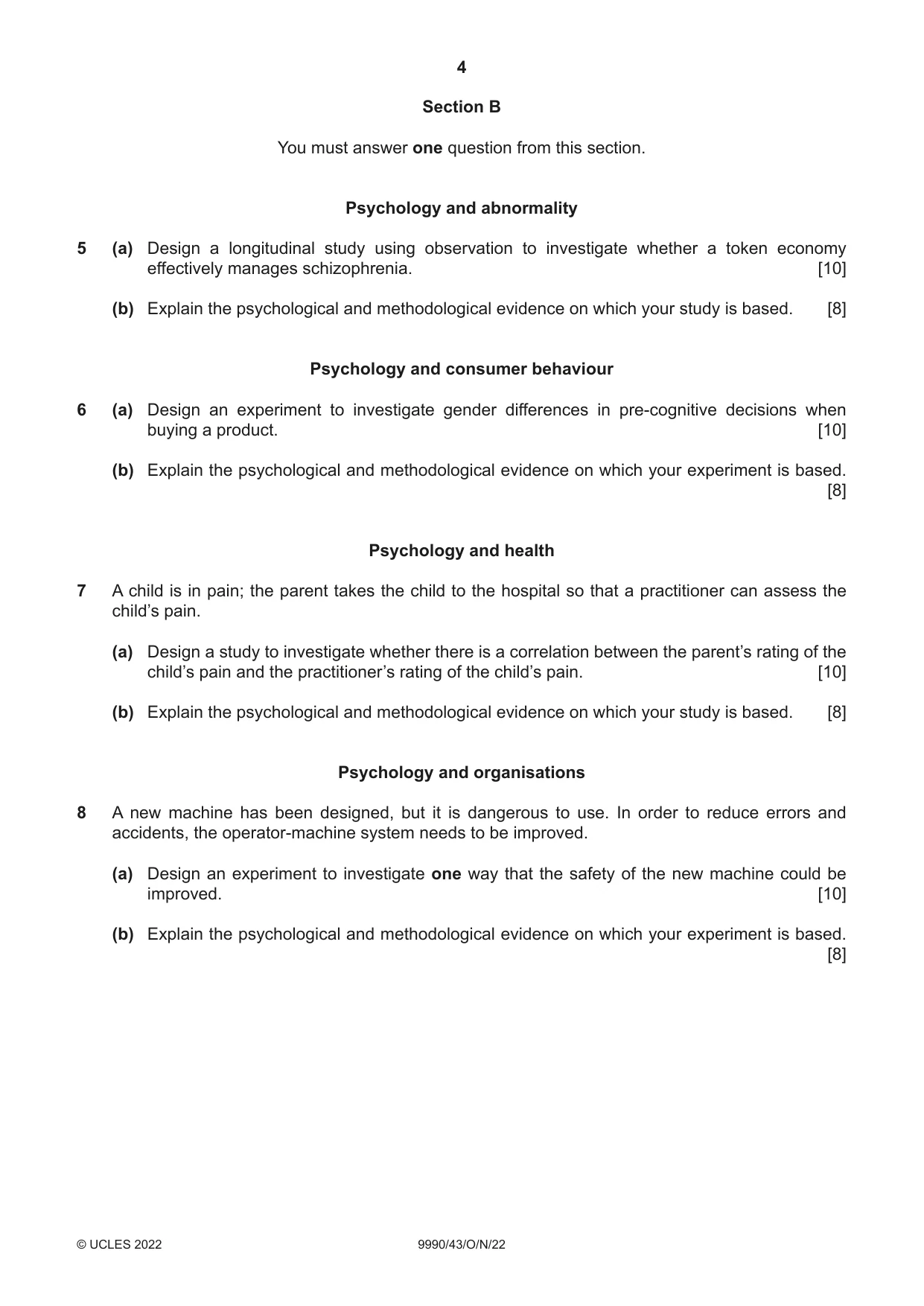
5 (a) Design a longitudinal study using observation to investigate whether a token economy effectively manages schizophrenia. [10] (b) Explain the psychological and methodological evidence on which your study is based. [8] Psychology and consumer behaviour
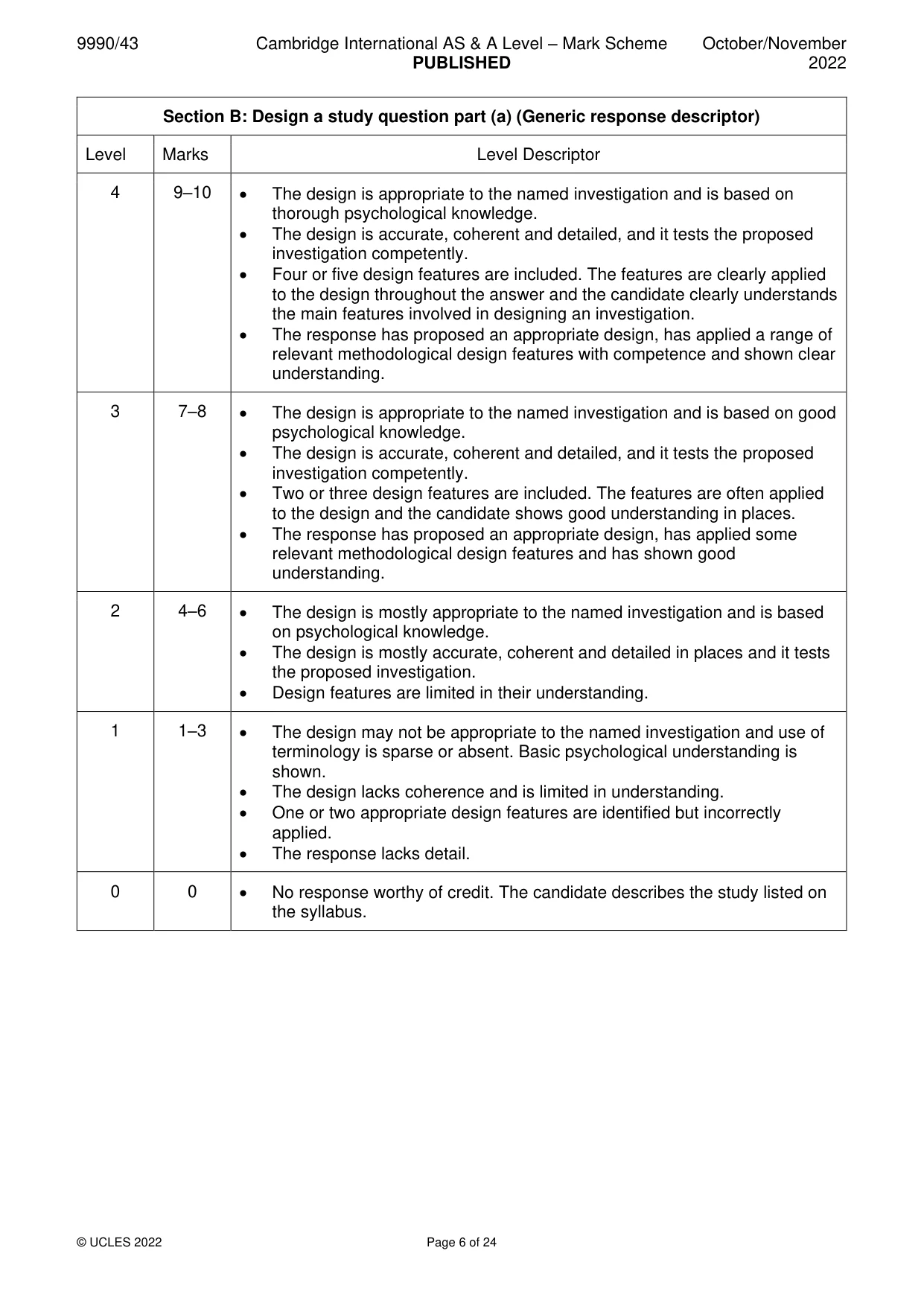
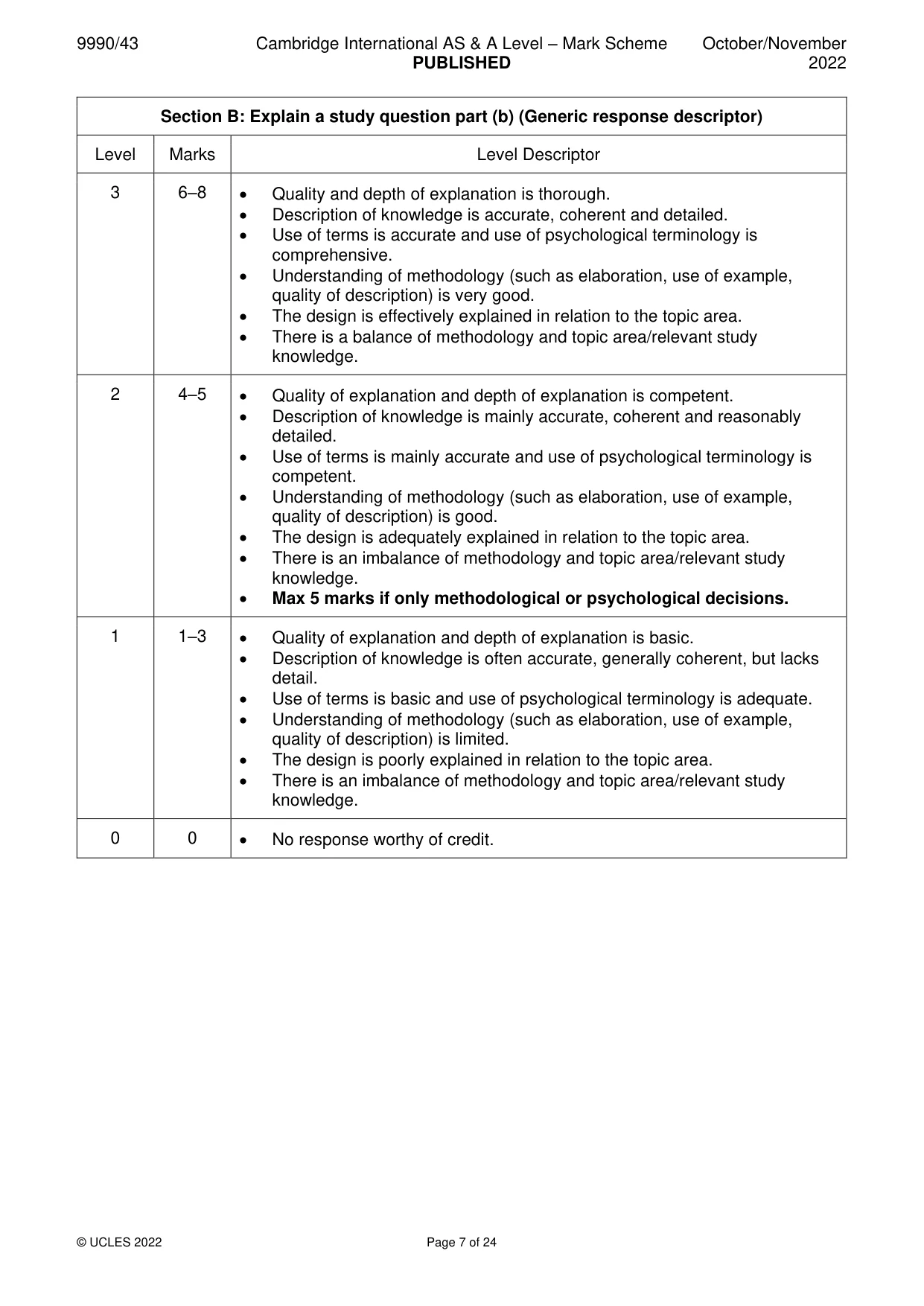
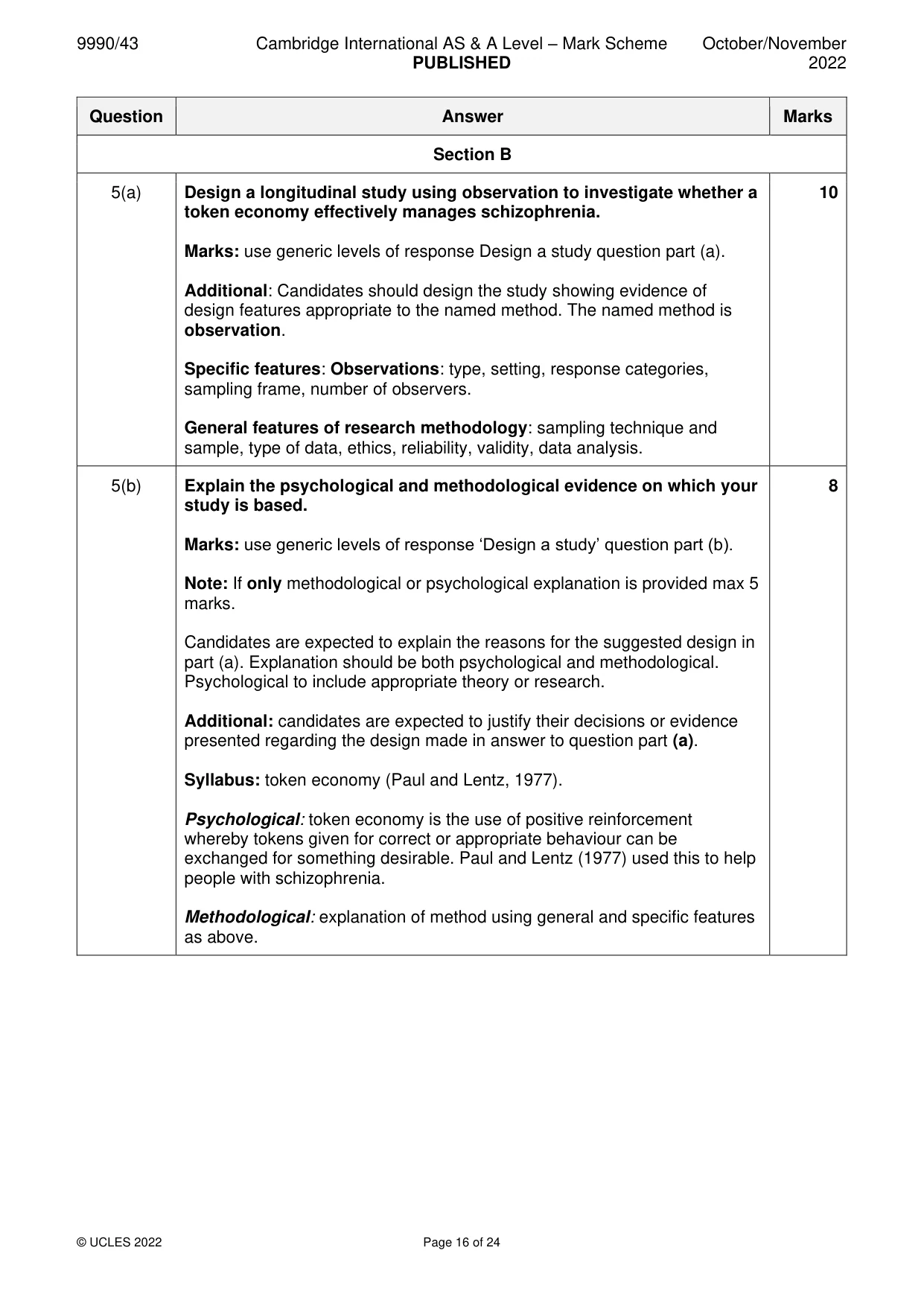
Mark scheme: 5(a) Design a longitudinal study using observation to investigate whether a 10 token economy effectively manages schizophrenia. Marks: use generic levels of response Design a study question part (a). Additional: Candidates should design the study showing evidence of design features appropriate to the named method. The named method is observation. Specific features: Observations: type, setting, response categories, sampling frame, number of observers. General features of research methodology: sampling technique and sample, type of data, ethics, reliability, validity, data analysis. 5(b) Explain the psychological and methodological evidence on which your 8 study is based. Marks: use generic levels of response ‘Design a study’ question part (b). Note: If only methodological or psychological explanation is provided max 5 marks. Candidates are expected to explain the reasons for the suggested design in part (a). Explanation should be both psychological and methodological. Psychological to include appropriate theory or research. Additional: candidates are expected to justify their decisions or evidence presented regarding the design made in answer to question part (a). Syllabus: token economy (Paul and Lentz, 1977). Psychological: token economy is the use of positive reinforcement whereby tokens given for correct or appropriate behaviour can be exchanged for something desirable. Paul and Lentz (1977) used this to help people with schizophrenia. Methodological: explanation of method using general and specific features as above.
Q6 · Design an experiment to investigate gender differences in pre‑cognitive decisions when…
6 (a) Design an experiment to investigate gender differences in pre‑cognitive decisions when buying a product. [10] (b) Explain the psychological and methodological evidence on which your experiment is based. [8] Psychology and health
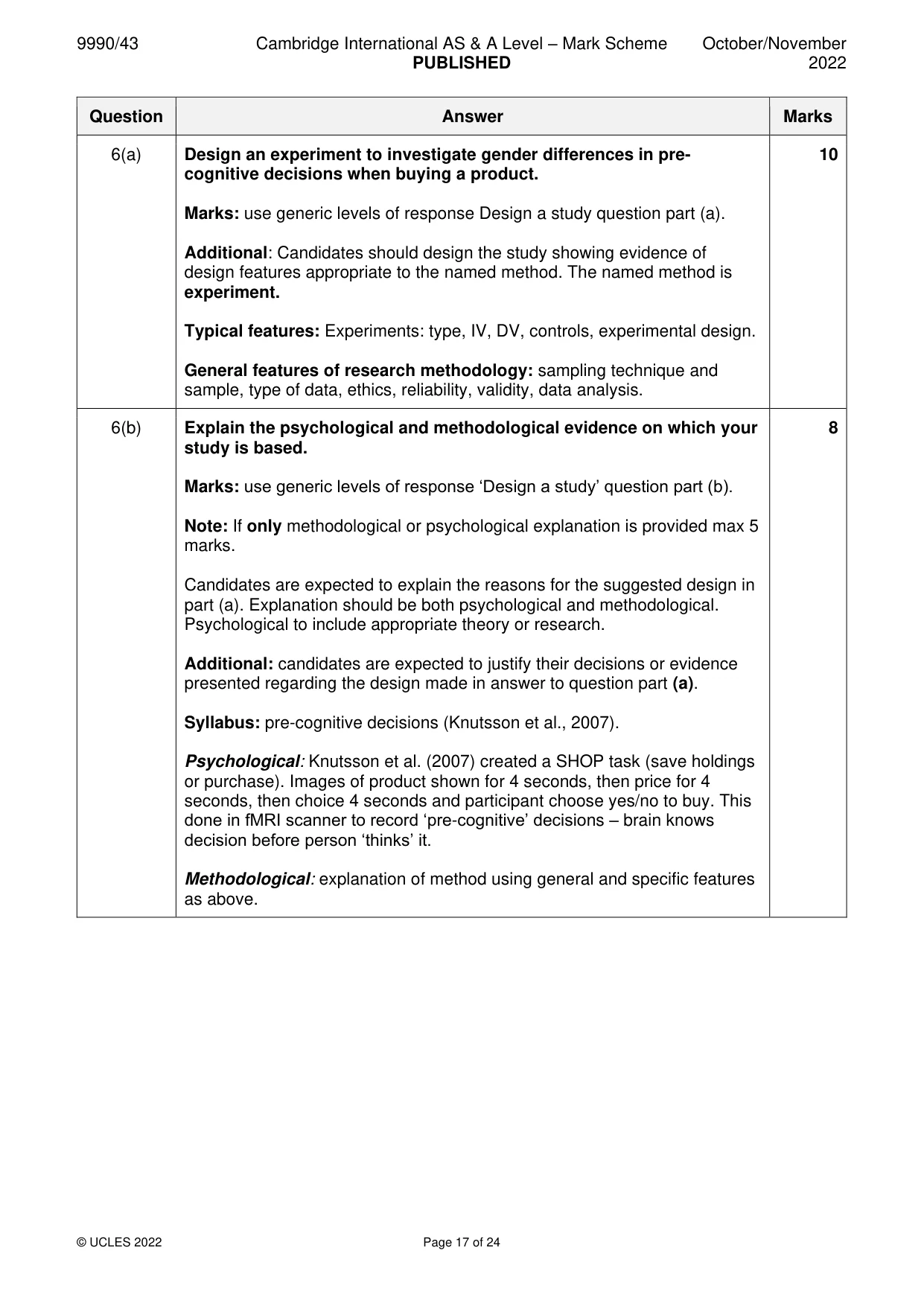
Mark scheme: 6(a) Design an experiment to investigate gender differences in pre- 10 cognitive decisions when buying a product. Marks: use generic levels of response Design a study question part (a). Additional: Candidates should design the study showing evidence of design features appropriate to the named method. The named method is experiment. Typical features: Experiments: type, IV, DV, controls, experimental design. General features of research methodology: sampling technique and sample, type of data, ethics, reliability, validity, data analysis. 6(b) Explain the psychological and methodological evidence on which your 8 study is based. Marks: use generic levels of response ‘Design a study’ question part (b). Note: If only methodological or psychological explanation is provided max 5 marks. Candidates are expected to explain the reasons for the suggested design in part (a). Explanation should be both psychological and methodological. Psychological to include appropriate theory or research. Additional: candidates are expected to justify their decisions or evidence presented regarding the design made in answer to question part (a). Syllabus: pre-cognitive decisions (Knutsson et al., 2007). Psychological: Knutsson et al. (2007) created a SHOP task (save holdings or purchase). Images of product shown for 4 seconds, then price for 4 seconds, then choice 4 seconds and participant choose yes/no to buy. This done in fMRI scanner to record ‘pre-cognitive’ decisions – brain knows decision before person ‘thinks’ it. Methodological: explanation of method using general and specific features as above.
Q7 · A child is in pain; the parent takes the child to the hospital so that a practitioner can…
7 A child is in pain; the parent takes the child to the hospital so that a practitioner can assess the child’s pain. (a) Design a study to investigate whether there is a correlation between the parent’s rating of the child’s pain and the practitioner’s rating of the child’s pain. [10] (b) Explain the psychological and methodological evidence on which your study is based. [8] Psychology and organisations
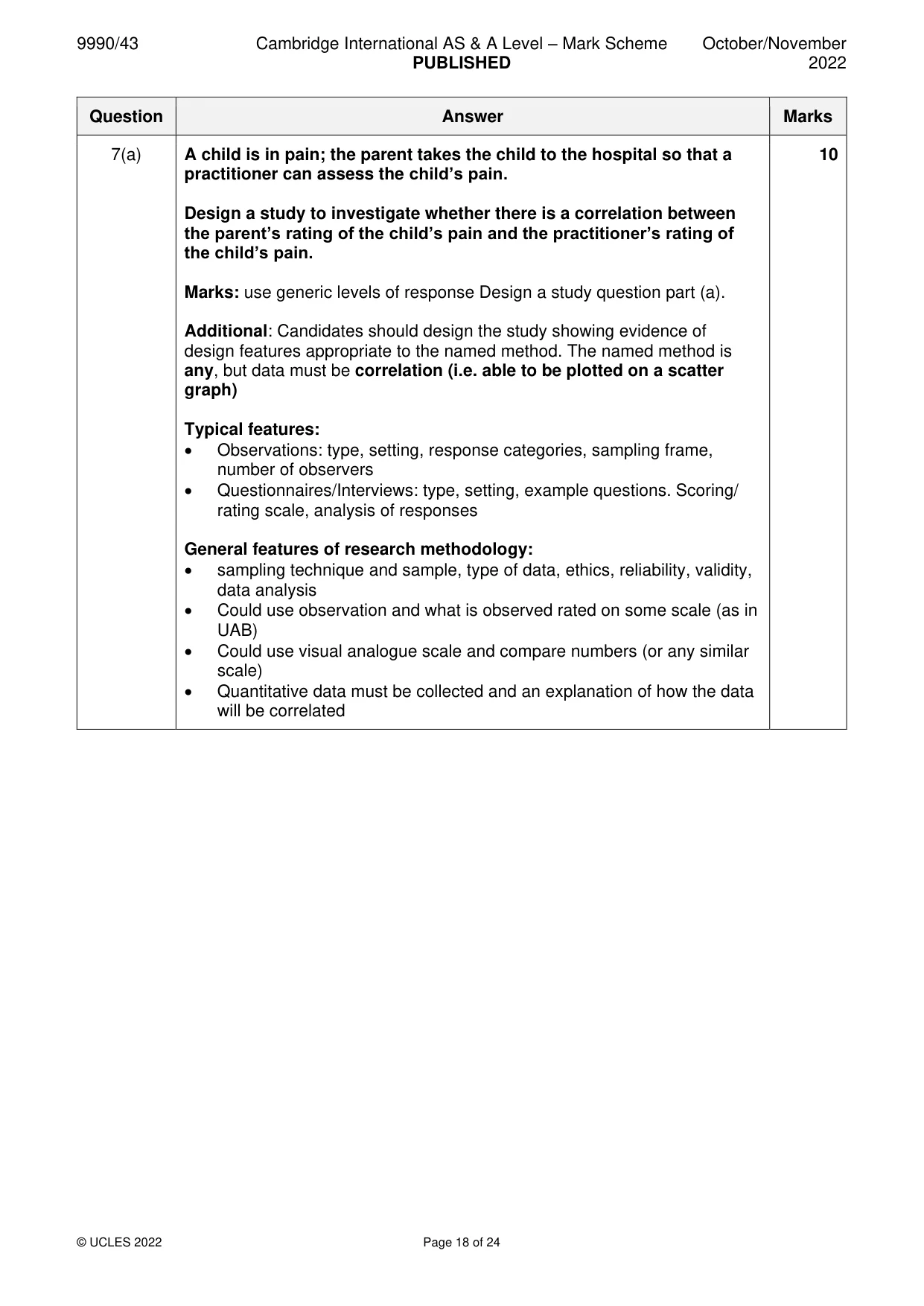
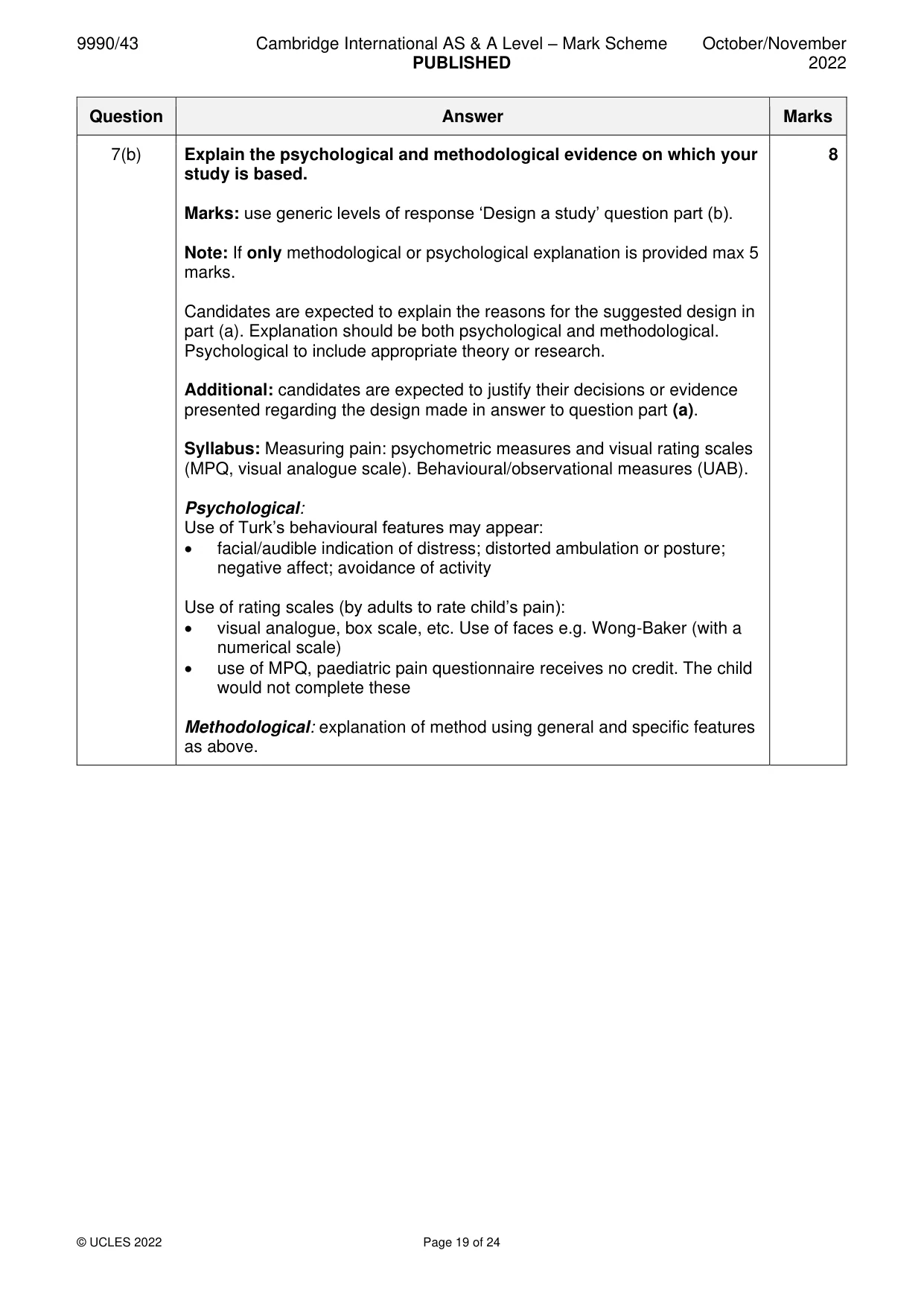
Mark scheme: 7(a) A child is in pain; the parent takes the child to the hospital so that a 10 practitioner can assess the child’s pain. Design a study to investigate whether there is a correlation between the parent’s rating of the child’s pain and the practitioner’s rating of the child’s pain. Marks: use generic levels of response Design a study question part (a). Additional: Candidates should design the study showing evidence of design features appropriate to the named method. The named method is any, but data must be correlation (i.e. able to be plotted on a scatter graph) Typical features: • Observations: type, setting, response categories, sampling frame, number of observers • Questionnaires/Interviews: type, setting, example questions. Scoring/ rating scale, analysis of responses General features of research methodology: • sampling technique and sample, type of data, ethics, reliability, validity, data analysis • Could use observation and what is observed rated on some scale (as in UAB) • Could use visual analogue scale and compare numbers (or any similar scale) • Quantitative data must be collected and an explanation of how the data will be correlated 7(b) Explain the psychological and methodological evidence on which your 8 study is based. Marks: use generic levels of response ‘Design a study’ question part (b). Note: If only methodological or psychological explanation is provided max 5 marks. Candidates are expected to explain the reasons for the suggested design in part (a). Explanation should be both psychological and methodological. Psychological to include appropriate theory or research. Additional: candidates are expected to justify their decisions or evidence presented regarding the design made in answer to question part (a). Syllabus: Measuring pain: psychometric measures and visual rating scales (MPQ, visual analogue scale). Behavioural/observational measures (UAB). Psychological: Use of Turk’s behavioural features may appear: • facial/audible indication of distress; distorted ambulation or posture; negative affect; avoidance of activity Use of rating scales (by adults to rate child’s pain): • visual analogue, box scale, etc. Use of faces e.g. Wong-Baker (with a numerical scale) • use of MPQ, paediatric pain questionnaire receives no credit. The child would not complete these Methodological: explanation of method using general and specific features as above.
Q8 · A new machine has been designed, but it is dangerous to use
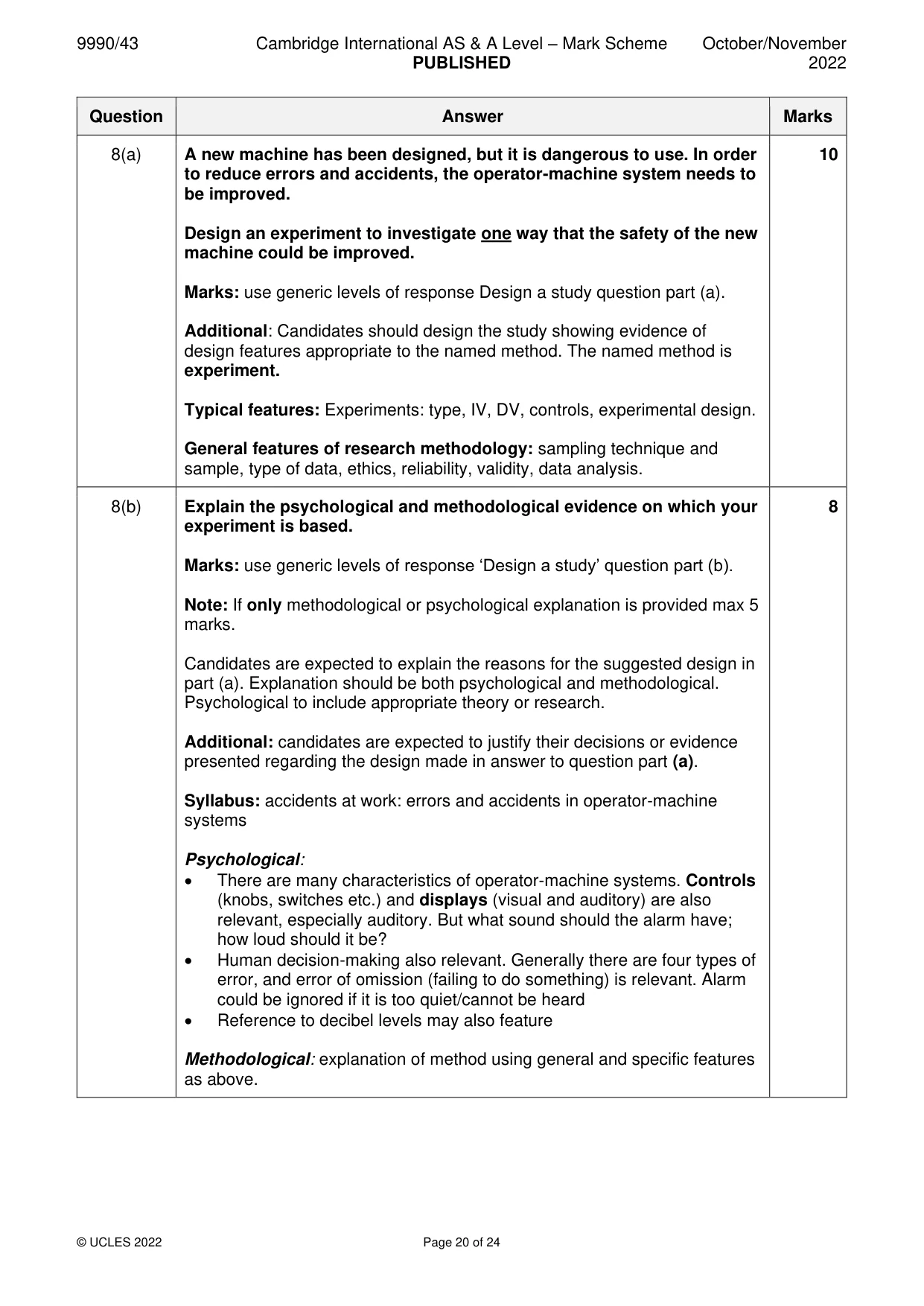
8 A new machine has been designed, but it is dangerous to use. In order to reduce errors and accidents, the operator‑machine system needs to be improved. (a) Design an experiment to investigate one way that the safety of the new machine could be improved. [10] (b) Explain the psychological and methodological evidence on which your experiment is based. [8] Section C You must answer one question from this section. Psychology and abnormality
Mark scheme: 8(a) A new machine has been designed, but it is dangerous to use. In order 10 to reduce errors and accidents, the operator-machine system needs to be improved. Design an experiment to investigate one way that the safety of the new machine could be improved. Marks: use generic levels of response Design a study question part (a). Additional: Candidates should design the study showing evidence of design features appropriate to the named method. The named method is experiment. Typical features: Experiments: type, IV, DV, controls, experimental design. General features of research methodology: sampling technique and sample, type of data, ethics, reliability, validity, data analysis. 8(b) Explain the psychological and methodological evidence on which your 8 experiment is based. Marks: use generic levels of response ‘Design a study’ question part (b). Note: If only methodological or psychological explanation is provided max 5 marks. Candidates are expected to explain the reasons for the suggested design in part (a). Explanation should be both psychological and methodological. Psychological to include appropriate theory or research. Additional: candidates are expected to justify their decisions or evidence presented regarding the design made in answer to question part (a). Syllabus: accidents at work: errors and accidents in operator-machine systems Psychological: • There are many characteristics of operator-machine systems. Controls (knobs, switches etc.) and displays (visual and auditory) are also relevant, especially auditory. But what sound should the alarm have; how loud should it be? • Human decision-making also relevant. Generally there are four types of error, and error of omission (failing to do something) is relevant. Alarm could be ignored if it is too quiet/cannot be heard • Reference to decibel levels may also feature Methodological: explanation of method using general and specific features as above.
Q9 · ‘In the future a genetic explanation of schizophrenia will be the only explanation…
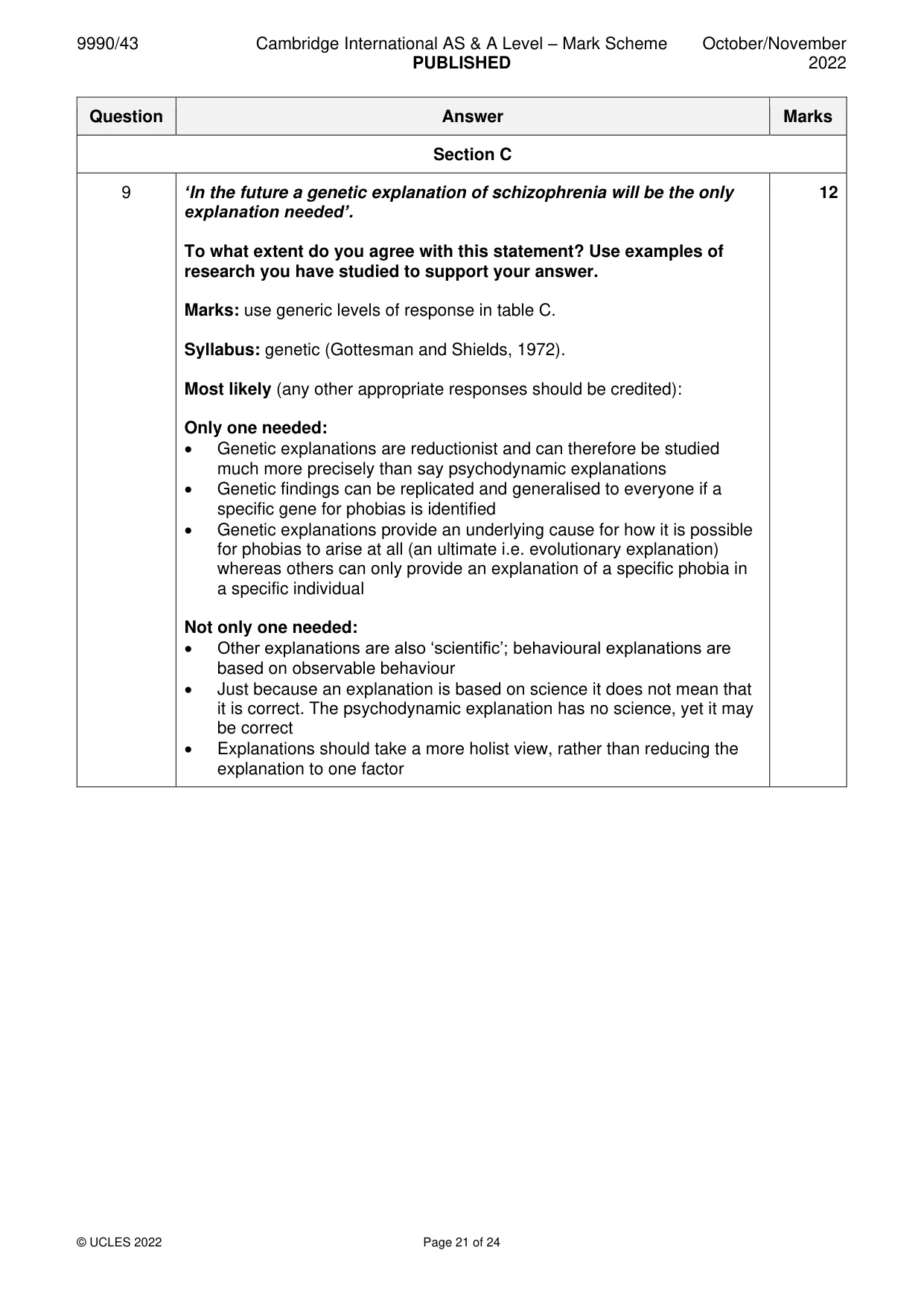
9 ‘In the future a genetic explanation of schizophrenia will be the only explanation needed.’ To what extent do you agree with this statement? Use examples of research you have studied to support your answer. [12] Psychology and consumer behaviour
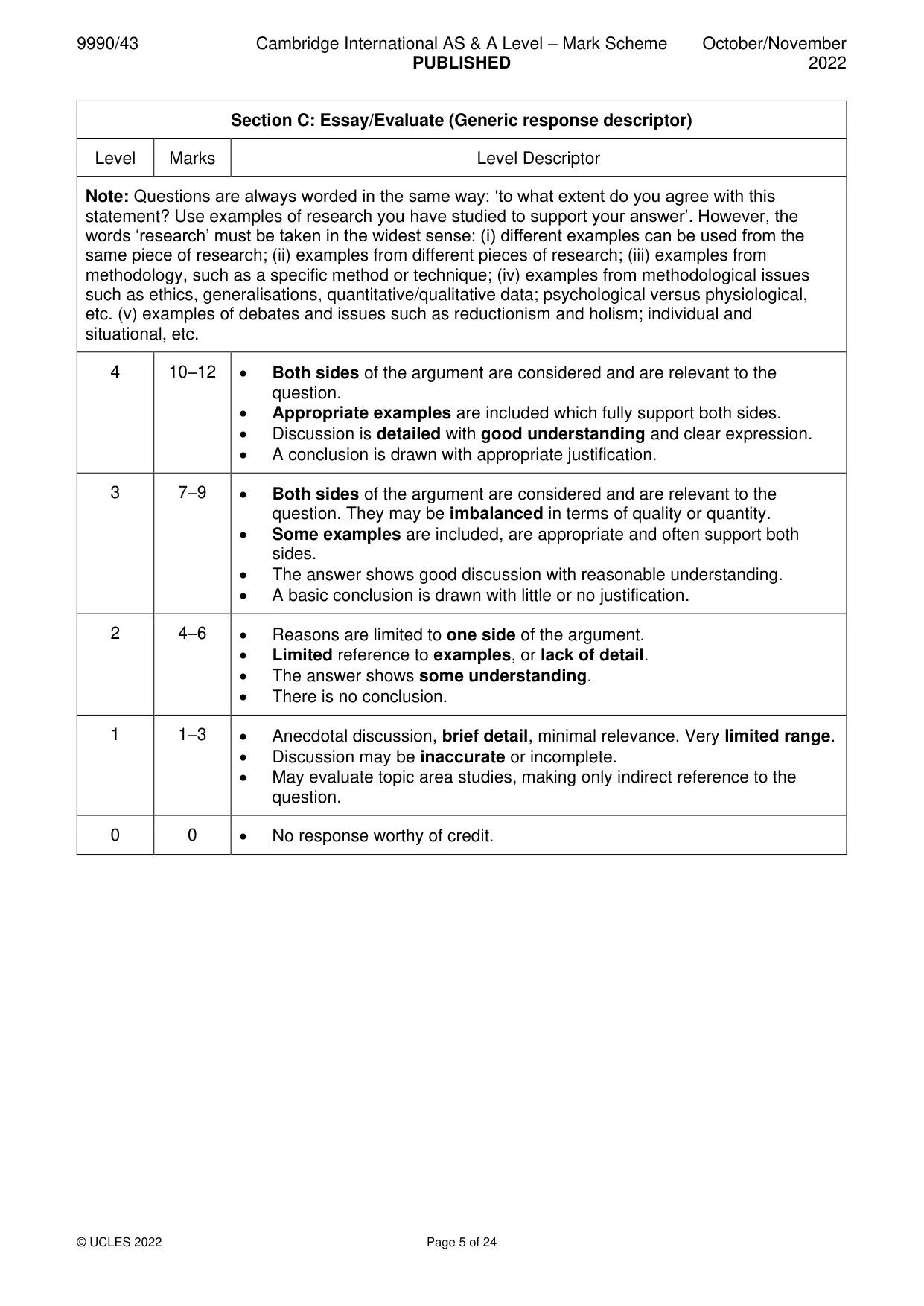
Mark scheme: 9 ‘In the future a genetic explanation of schizophrenia will be the only 12 explanation needed’. To what extent do you agree with this statement? Use examples of research you have studied to support your answer. Marks: use generic levels of response in table C. Syllabus: genetic (Gottesman and Shields, 1972). Most likely (any other appropriate responses should be credited): Only one needed: • Genetic explanations are reductionist and can therefore be studied much more precisely than say psychodynamic explanations • Genetic findings can be replicated and generalised to everyone if a specific gene for phobias is identified • Genetic explanations provide an underlying cause for how it is possible for phobias to arise at all (an ultimate i.e. evolutionary explanation) whereas others can only provide an explanation of a specific phobia in a specific individual Not only one needed: • Other explanations are also ‘scientific’; behavioural explanations are based on observable behaviour • Just because an explanation is based on science it does not mean that it is correct. The psychodynamic explanation has no science, yet it may be correct • Explanations should take a more holist view, rather than reducing the explanation to one factor
Q10 · ‘Children should never be used as participants in studies of advertising.’ To what extent…
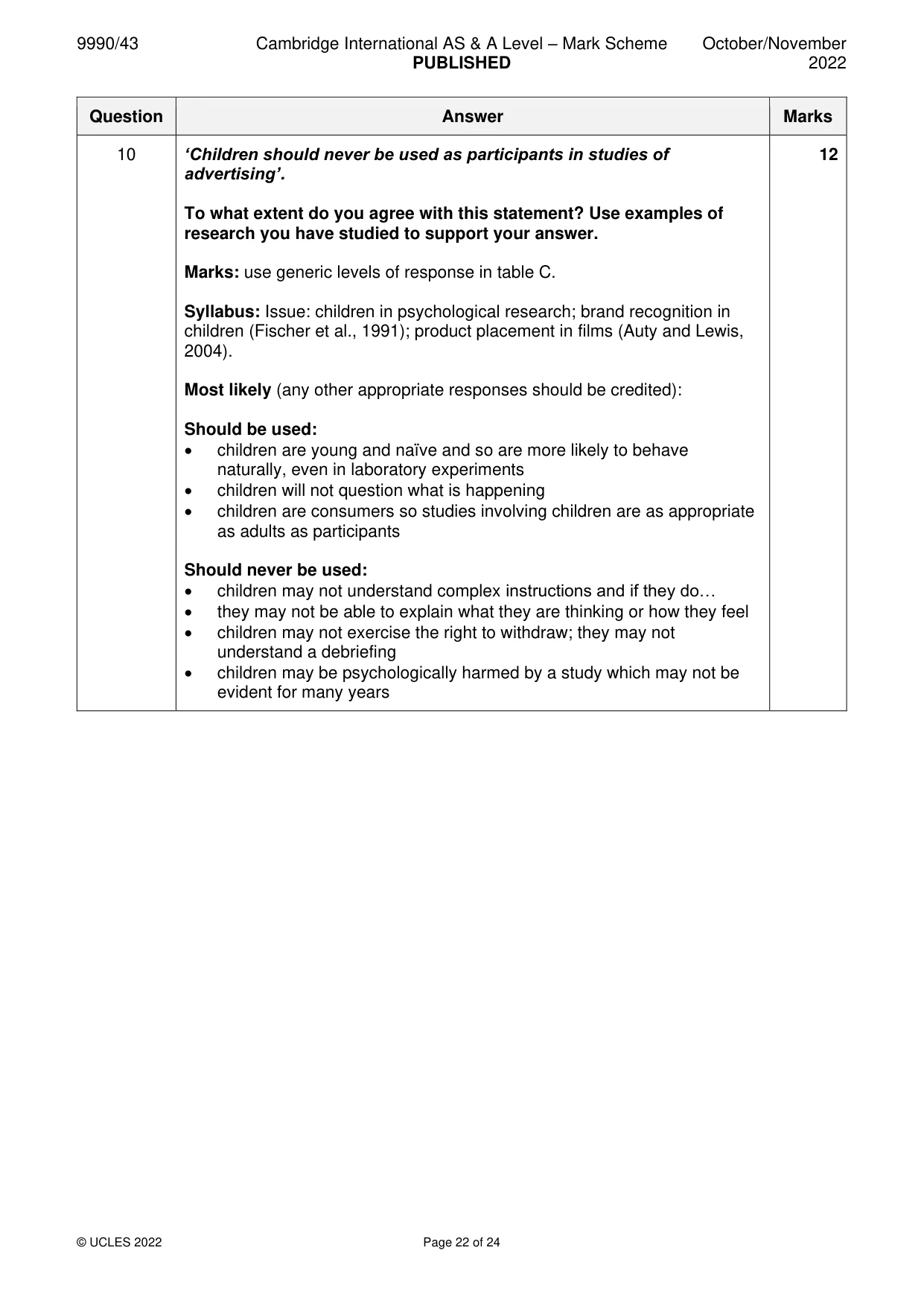
10 ‘Children should never be used as participants in studies of advertising.’ To what extent do you agree with this statement? Use examples of research you have studied to support your answer. [12] Psychology and health
Mark scheme: 10 ‘Children should never be used as participants in studies of 12 advertising’. To what extent do you agree with this statement? Use examples of research you have studied to support your answer. Marks: use generic levels of response in table C. Syllabus: Issue: children in psychological research; brand recognition in children (Fischer et al., 1991); product placement in films (Auty and Lewis, 2004). Most likely (any other appropriate responses should be credited): Should be used: • children are young and naïve and so are more likely to behave naturally, even in laboratory experiments • children will not question what is happening • children are consumers so studies involving children are as appropriate as adults as participants Should never be used: • children may not understand complex instructions and if they do… • they may not be able to explain what they are thinking or how they feel • children may not exercise the right to withdraw; they may not understand a debriefing • children may be psychologically harmed by a study which may not be evident for many years
Q11 · ‘Alternative techniques are more effective for managing pain, such as chronic pain, than…
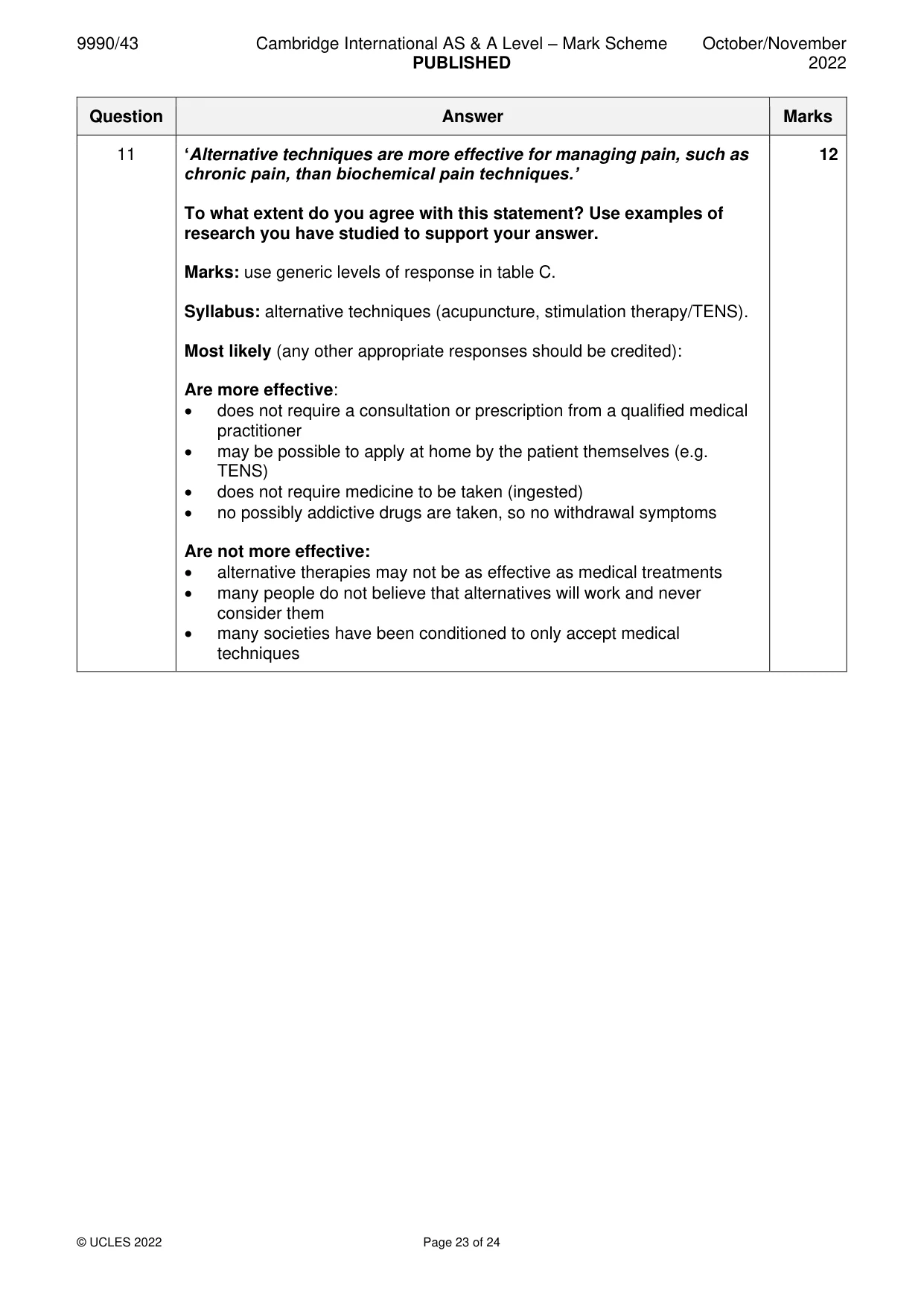
11 ‘Alternative techniques are more effective for managing pain, such as chronic pain, than biochemical pain techniques.’ To what extent do you agree with this statement? Use examples of research you have studied to support your answer. [12] Psychology and organisations
Mark scheme: 11 ‘Alternative techniques are more effective for managing pain, such as 12 chronic pain, than biochemical pain techniques.’ To what extent do you agree with this statement? Use examples of research you have studied to support your answer. Marks: use generic levels of response in table C. Syllabus: alternative techniques (acupuncture, stimulation therapy/TENS). Most likely (any other appropriate responses should be credited): Are more effective: • does not require a consultation or prescription from a qualified medical practitioner • may be possible to apply at home by the patient themselves (e.g. TENS) • does not require medicine to be taken (ingested) • no possibly addictive drugs are taken, so no withdrawal symptoms Are not more effective: • alternative therapies may not be as effective as medical treatments • many people do not believe that alternatives will work and never consider them • many societies have been conditioned to only accept medical techniques
Q12 · ‘Quality of working life can only be measured effectively using five‑point rating…
12 ‘Quality of working life can only be measured effectively using five‑point rating scales.’ To what extent do you agree with this statement? Use examples of research you have studied to support your answer. [12]
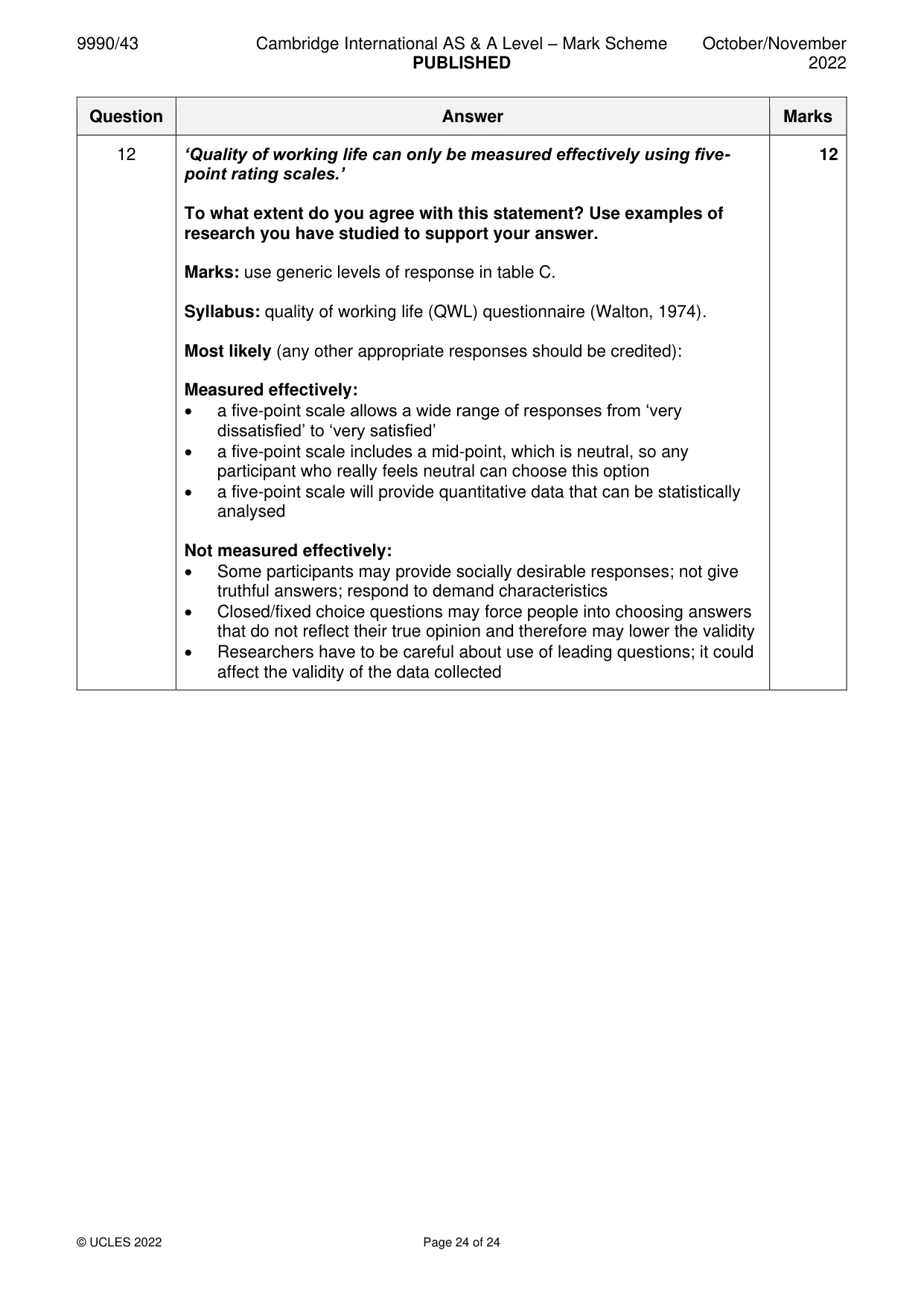
Mark scheme: 12 ‘Quality of working life can only be measured effectively using five- 12 point rating scales.’ To what extent do you agree with this statement? Use examples of research you have studied to support your answer. Marks: use generic levels of response in table C. Syllabus: quality of working life (QWL) questionnaire (Walton, 1974). Most likely (any other appropriate responses should be credited): Measured effectively: • a five-point scale allows a wide range of responses from ‘very dissatisfied’ to ‘very satisfied’ • a five-point scale includes a mid-point, which is neutral, so any participant who really feels neutral can choose this option • a five-point scale will provide quantitative data that can be statistically analysed Not measured effectively: • Some participants may provide socially desirable responses; not give truthful answers; respond to demand characteristics • Closed/fixed choice questions may force people into choosing answers that do not reflect their true opinion and therefore may lower the validity • Researchers have to be careful about use of leading questions; it could affect the validity of the data collected
What was in this paper
The subtopics covered by these 12 questions, and how many questions each got. Open one in a new tab to see every Cambridge question on it.
What you needed in this session
Cambridge’s own grade thresholds for 2022 Oct/Nov, Paper 4 · Variant 3. A higher threshold means an easier paper — the bar moves with how the cohort did.