Cambridge A Level Psychology (from 2018) 9990 — 2025 Oct/Nov Paper 4 · Variant 2
9990/42/O/N/25 · 12 questions · 168 marks · 90 min
The question paper and its mark scheme, free to read here and free to download. This is Cambridge’s own paper, exactly as it was sat.
Question paper8 pages
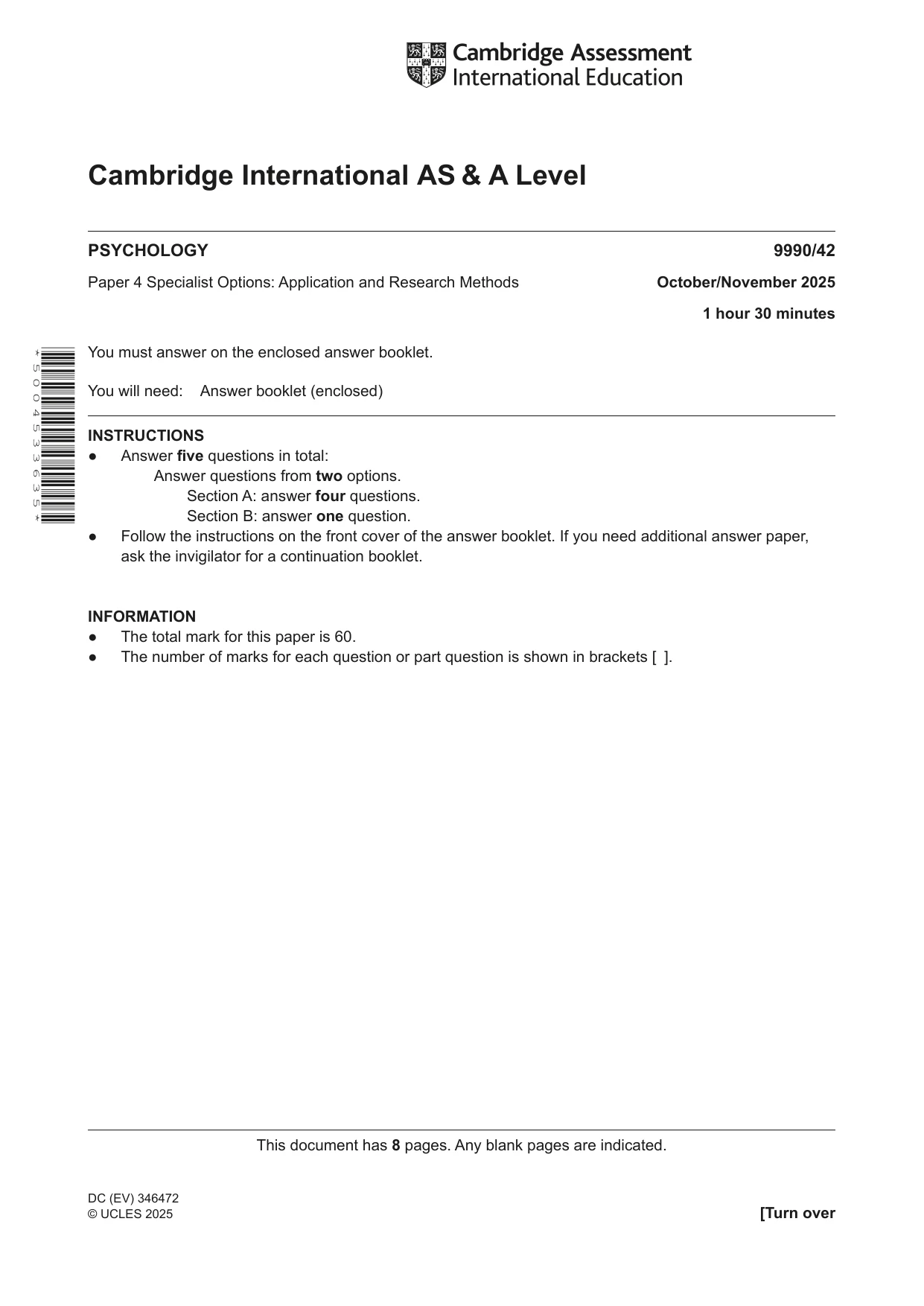



Mark scheme33 pages
Answers below. Sit the paper first if you are practising.
Questions as text
Q1 · From the key study by Lovell et al
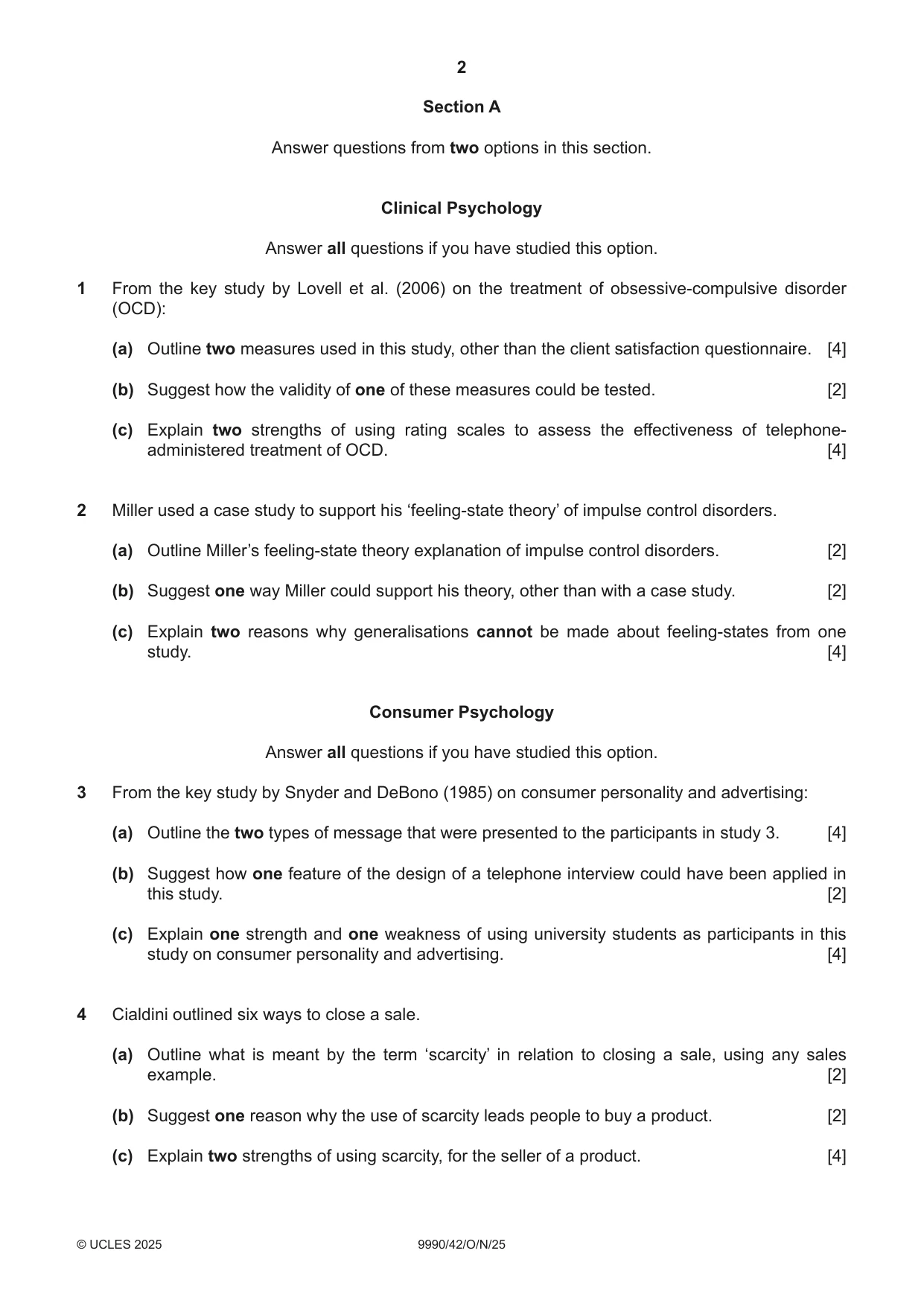
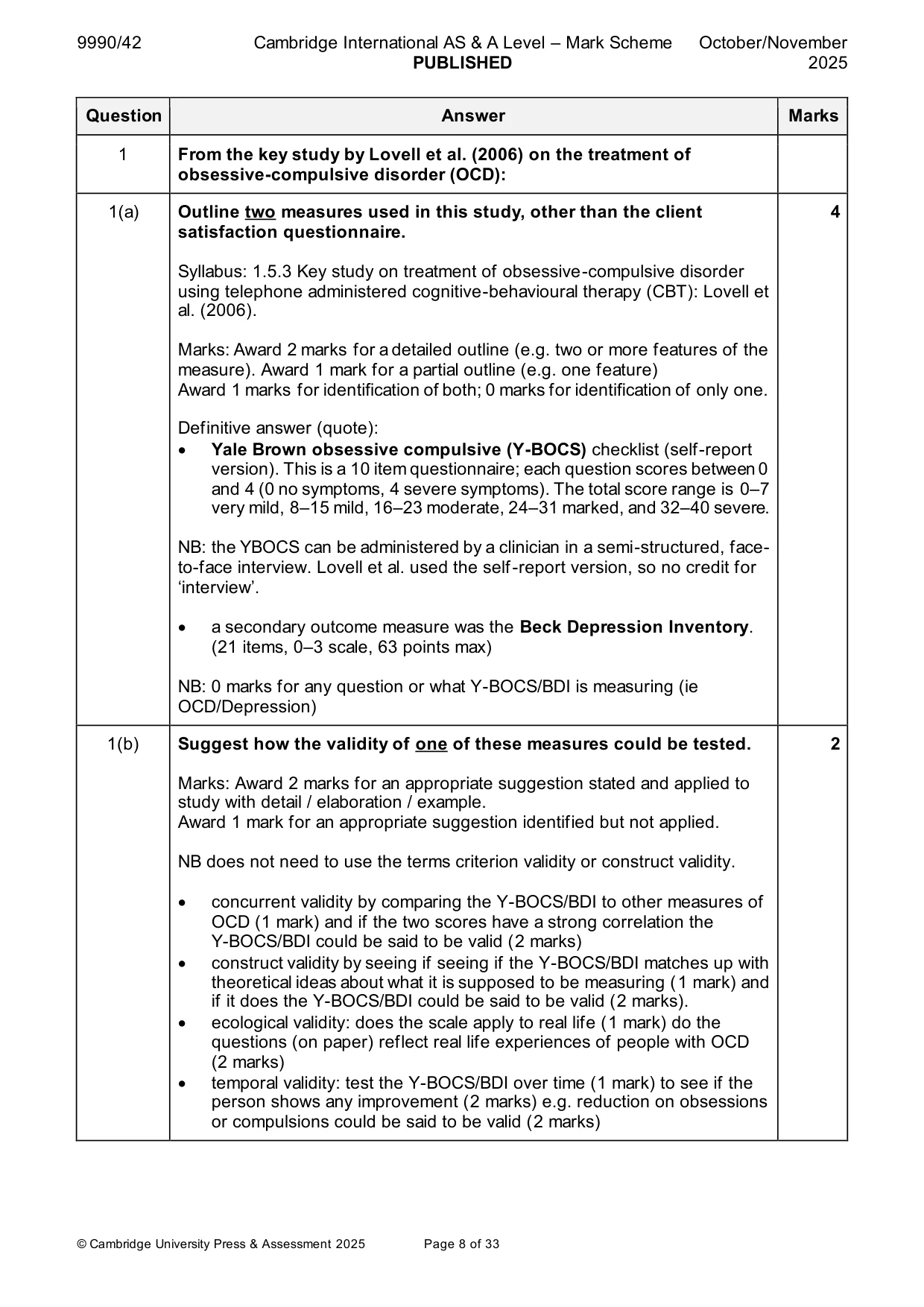
1 From the key study by Lovell et al. (2006) on the treatment of obsessive-compulsive disorder (OCD): (a) Outline two measures used in this study, other than the client satisfaction questionnaire. [4] (b) Suggest how the validity of one of these measures could be tested. [2] (c) Explain two strengths of using rating scales to assess the effectiveness of telephone- administered treatment of OCD. [4]
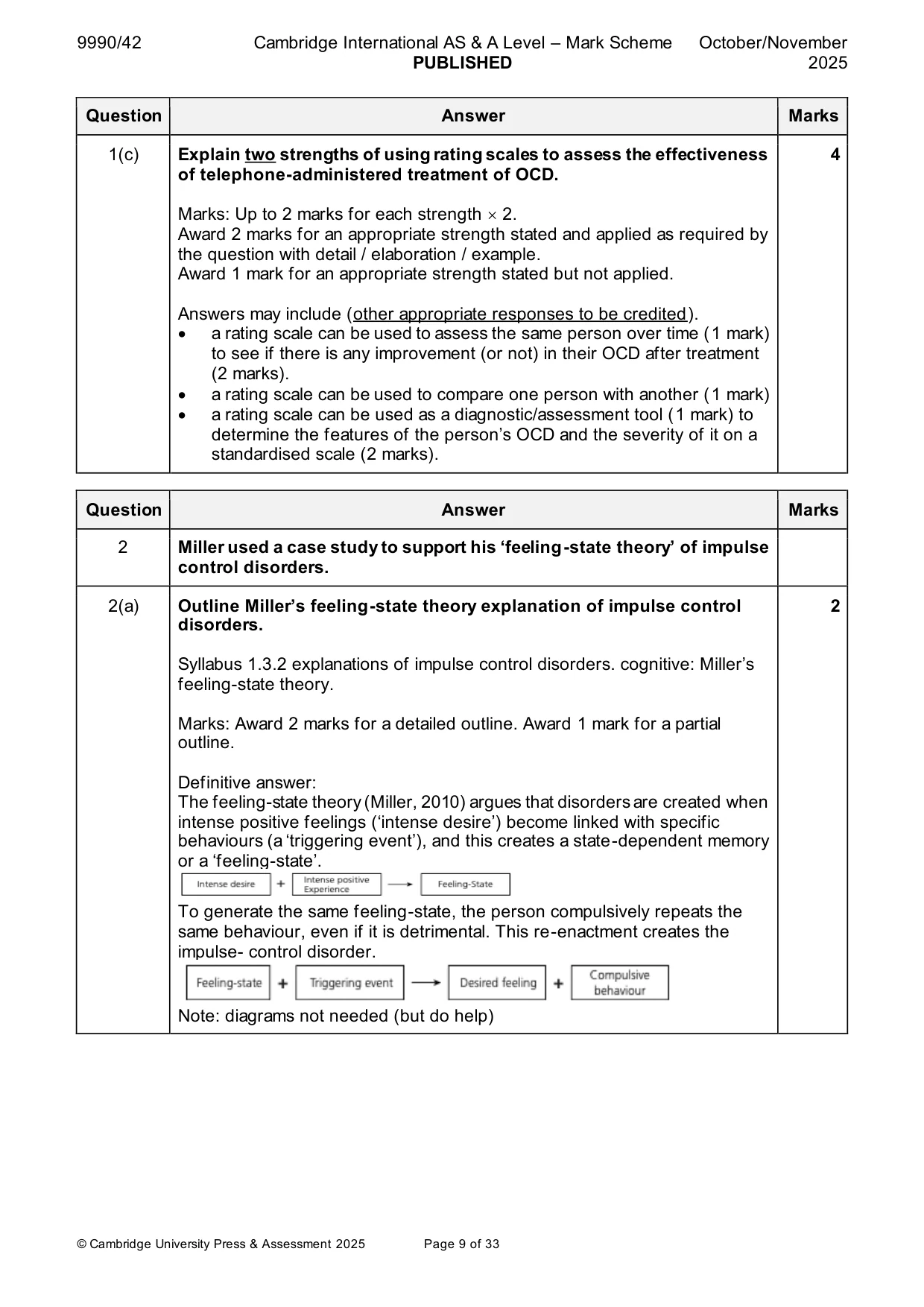
Mark scheme: Question Answer Marks 1 From the key study by Lovell et al. (2006) on the treatment of obsessive-compulsive disorder (OCD): 1(a) Outline two measures used in this study, other than the client 4 satisfaction questionnaire. Syllabus: 1.5.3 Key study on treatment of obsessive-compulsive disorder using telephone administered cognitive-behavioural therapy (CBT): Lovell et al. (2006). Marks: Award 2 marks for a detailed outline (e.g. two or more features of the measure). Award 1 mark for a partial outline (e.g. one feature) Award 1 marks for identification of both; 0 marks for identification of only one. Definitive answer (quote): • Yale Brown obsessive compulsive (Y-BOCS) checklist (self-report version). This is a 10 item questionnaire; each question scores between 0 and 4 (0 no symptoms, 4 severe symptoms). The total score range is 0–7 very mild, 8–15 mild, 16–23 moderate, 24–31 marked, and 32–40 severe. NB: the YBOCS can be administered by a clinician in a semi-structured, face- to-face interview. Lovell et al. used the self-report version, so no credit for ‘interview’. • a secondary outcome measure was the Beck Depression Inventory. (21 items, 0–3 scale, 63 points max) NB: 0 marks for any question or what Y-BOCS/BDI is measuring (ie OCD/Depression) 1(b) Suggest how the validity of one of these measures could be tested. 2 Marks: Award 2 marks for an appropriate suggestion stated and applied to study with detail / elaboration / example. Award 1 mark for an appropriate suggestion identified but not applied. NB does not need to use the terms criterion validity or construct validity. • concurrent validity by comparing the Y-BOCS/BDI to other measures of OCD (1 mark) and if the two scores have a strong correlation the Y-BOCS/BDI could be said to be valid (2 marks) • construct validity by seeing if seeing if the Y-BOCS/BDI matches up with theoretical ideas about what it is supposed to be measuring (1 mark) and if it does the Y-BOCS/BDI could be said to be valid (2 marks). • ecological validity: does the scale apply to real life (1 mark) do the questions (on paper) reflect real life experiences of people with OCD (2 marks) • temporal validity: test the Y-BOCS/BDI over time (1 mark) to see if the person shows any improvement (2 marks) e.g. reduction on obsessions or compulsions could be said to be valid (2 marks) 1(c) Explain two strengths of using rating scales to assess the effectiveness 4 of telephone-administered treatment of OCD. Marks: Up to 2 marks for each strength 2. Award 2 marks for an appropriate strength stated and applied as required by the question with detail / elaboration / example. Award 1 mark for an appropriate strength stated but not applied. Answers may include (other appropriate responses to be credited). • a rating scale can be used to assess the same person over time (1 mark) to see if there is any improvement (or not) in their OCD after treatment (2 marks). • a rating scale can be used to compare one person with another (1 mark) • a rating scale can be used as a diagnostic/assessment tool (1 mark) to determine the features of the person’s OCD and the severity of it on a standardised scale (2 marks).
Q2 · Miller used a case study to support his ‘feeling-state theory’ of impulse control…
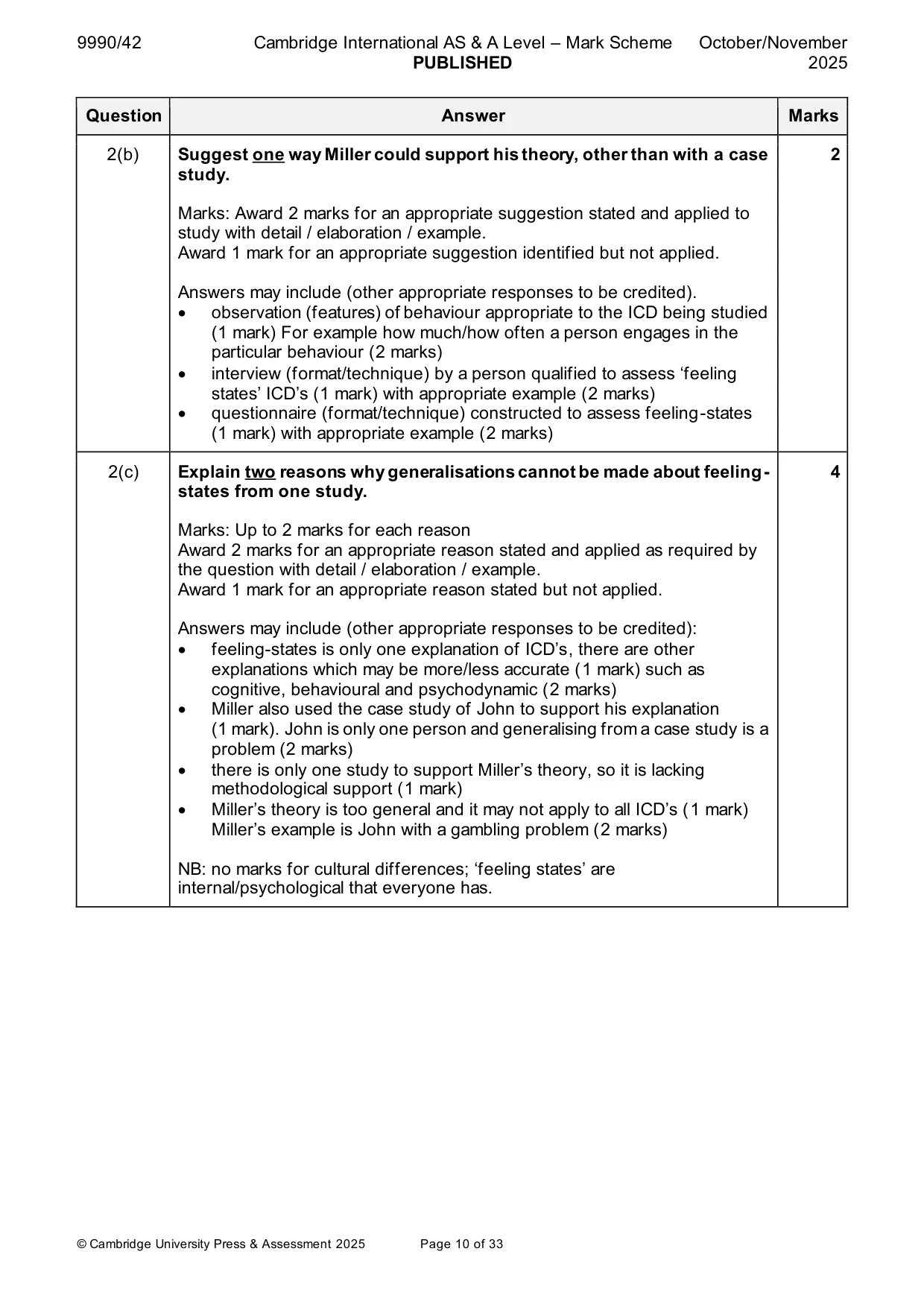
2 Miller used a case study to support his ‘feeling-state theory’ of impulse control disorders. (a) Outline Miller’s feeling-state theory explanation of impulse control disorders. [2] (b) Suggest one way Miller could support his theory, other than with a case study. [2] (c) Explain two reasons why generalisations cannot be made about feeling-states from one study. [4] Consumer Psychology Answer all questions if you have studied this option.
Mark scheme: 2 Miller used a case study to support his ‘feeling-state theory’ of impulse control disorders. 2(a) Outline Miller’s feeling-state theory explanation of impulse control 2 disorders. Syllabus 1.3.2 explanations of impulse control disorders. cognitive: Miller’s feeling-state theory. Marks: Award 2 marks for a detailed outline. Award 1 mark for a partial outline. Definitive answer: The feeling-state theory (Miller, 2010) argues that disorders are created when intense positive feelings (‘intense desire’) become linked with specific behaviours (a ‘triggering event’), and this creates a state-dependent memory or a ‘feeling-state’. To generate the same feeling-state, the person compulsively repeats the same behaviour, even if it is detrimental. This re-enactment creates the impulse- control disorder. Note: diagrams not needed (but do help) 2(b) Suggest one way Miller could support his theory, other than with a case 2 study. Marks: Award 2 marks for an appropriate suggestion stated and applied to study with detail / elaboration / example. Award 1 mark for an appropriate suggestion identified but not applied. Answers may include (other appropriate responses to be credited). • observation (features) of behaviour appropriate to the ICD being studied (1 mark) For example how much/how often a person engages in the particular behaviour (2 marks) • interview (format/technique) by a person qualified to assess ‘feeling states’ ICD’s (1 mark) with appropriate example (2 marks) • questionnaire (format/technique) constructed to assess feeling-states (1 mark) with appropriate example (2 marks) 2(c) Explain two reasons why generalisations cannot be made about feeling- 4 states from one study. Marks: Up to 2 marks for each reason Award 2 marks for an appropriate reason stated and applied as required by the question with detail / elaboration / example. Award 1 mark for an appropriate reason stated but not applied. Answers may include (other appropriate responses to be credited): • feeling-states is only one explanation of ICD’s, there are other explanations which may be more/less accurate (1 mark) such as cognitive, behavioural and psychodynamic (2 marks) • Miller also used the case study of John to support his explanation (1 mark). John is only one person and generalising from a case study is a problem (2 marks) • there is only one study to support Miller’s theory, so it is lacking methodological support (1 mark) • Miller’s theory is too general and it may not apply to all ICD’s (1 mark) Miller’s example is John with a gambling problem (2 marks) NB: no marks for cultural differences; ‘feeling states’ are internal/psychological that everyone has.
Q3 · From the key study by Snyder and DeBono (1985) on consumer personality and advertising…
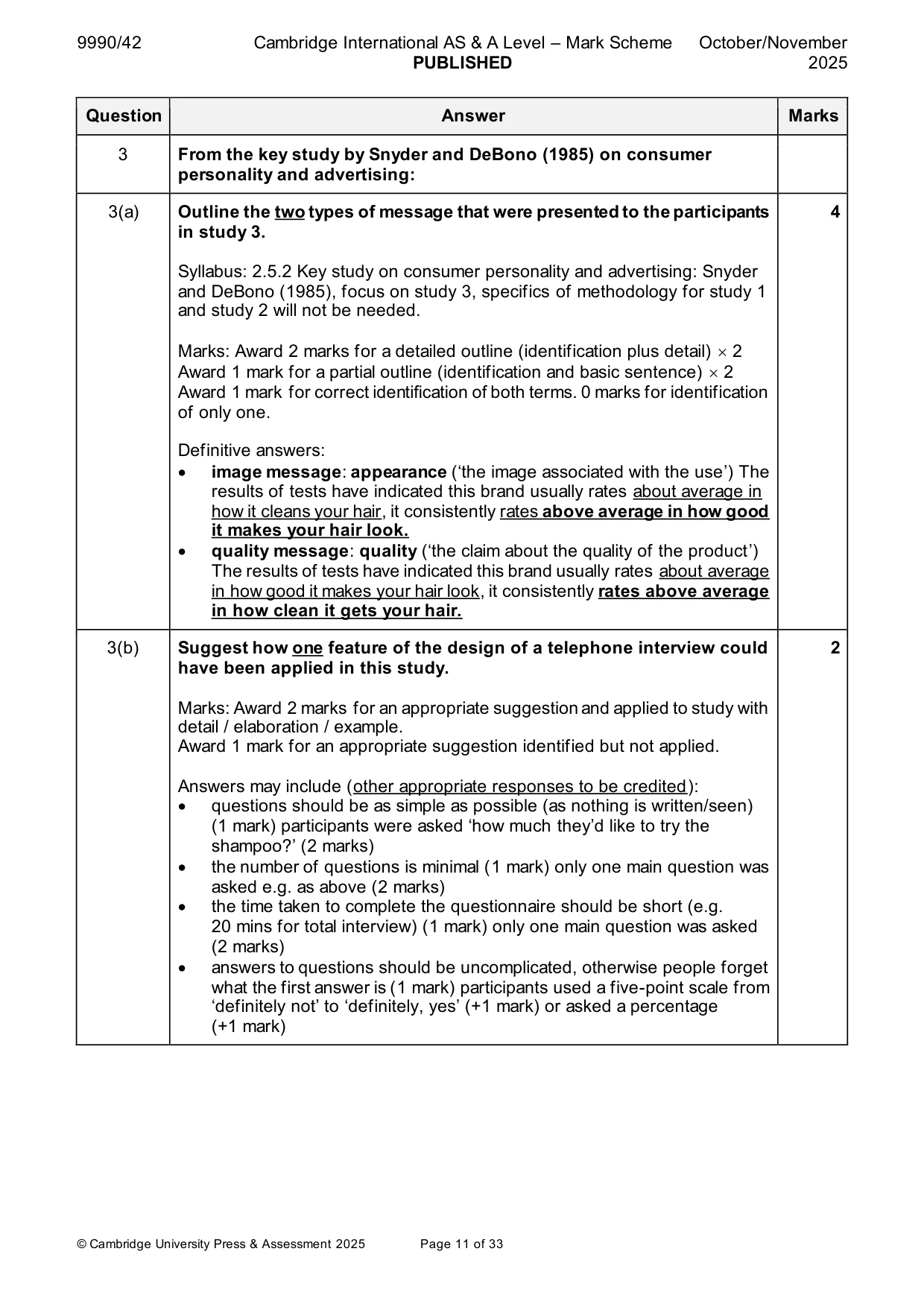
3 From the key study by Snyder and DeBono (1985) on consumer personality and advertising: (a) Outline the two types of message that were presented to the participants in study 3. [4] (b) Suggest how one feature of the design of a telephone interview could have been applied in this study. [2] (c) Explain one strength and one weakness of using university students as participants in this study on consumer personality and advertising. [4]
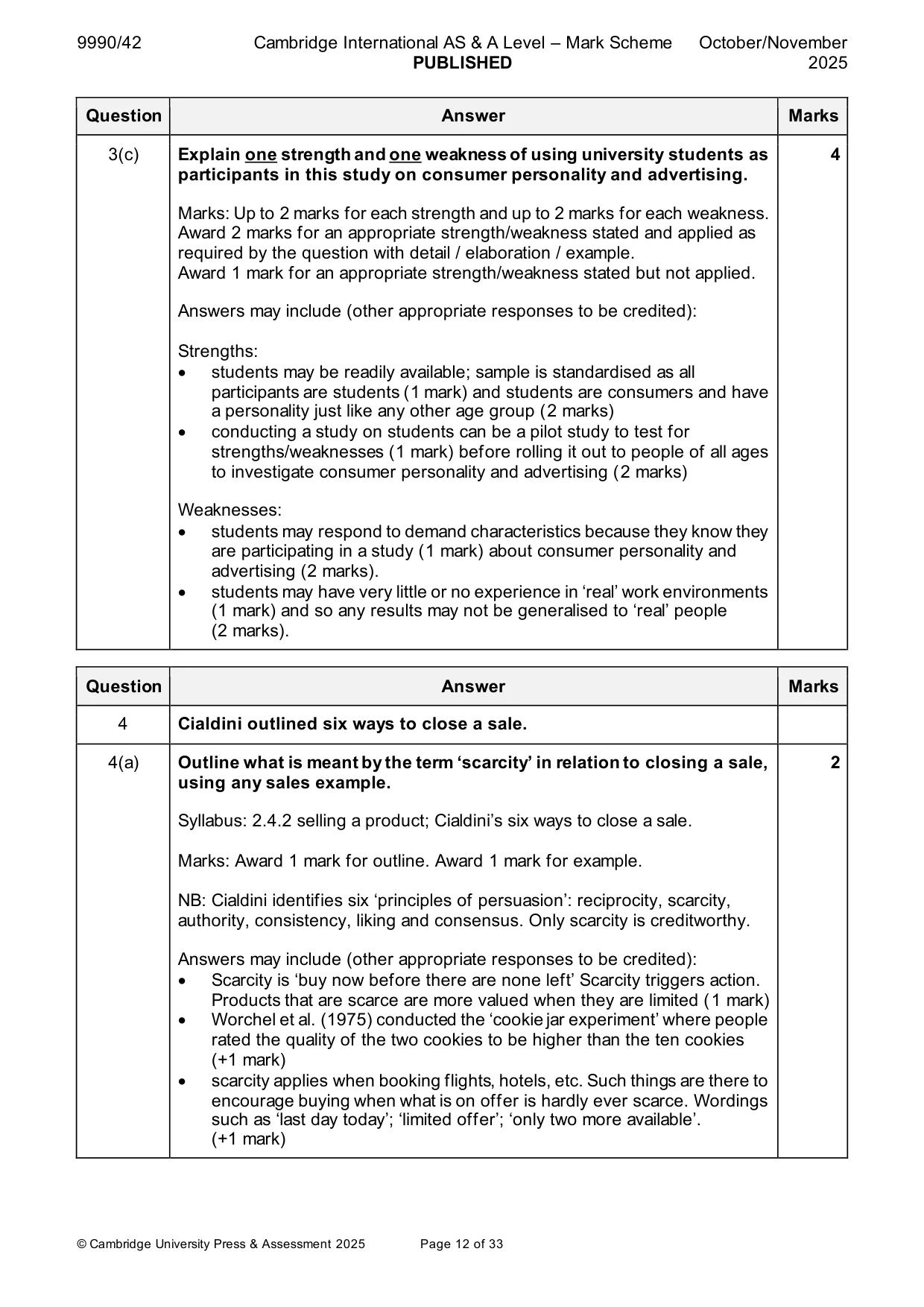
Mark scheme: 3 From the key study by Snyder and DeBono (1985) on consumer personality and advertising: 3(a) Outline the two types of message that were presented to the participants 4 in study 3. Syllabus: 2.5.2 Key study on consumer personality and advertising: Snyder and DeBono (1985), focus on study 3, specifics of methodology for study 1 and study 2 will not be needed. Marks: Award 2 marks for a detailed outline (identification plus detail) 2 Award 1 mark for a partial outline (identification and basic sentence) 2 Award 1 mark for correct identification of both terms. 0 marks for identification of only one. Definitive answers: • image message: appearance (‘the image associated with the use’) The results of tests have indicated this brand usually rates about average in how it cleans your hair, it consistently rates above average in how good it makes your hair look. • quality message: quality (‘the claim about the quality of the product’) The results of tests have indicated this brand usually rates about average in how good it makes your hair look, it consistently rates above average in how clean it gets your hair. 3(b) Suggest how one feature of the design of a telephone interview could 2 have been applied in this study. Marks: Award 2 marks for an appropriate suggestion and applied to study with detail / elaboration / example. Award 1 mark for an appropriate suggestion identified but not applied. Answers may include (other appropriate responses to be credited): • questions should be as simple as possible (as nothing is written/seen) (1 mark) participants were asked ‘how much they’d like to try the shampoo?’ (2 marks) • the number of questions is minimal (1 mark) only one main question was asked e.g. as above (2 marks) • the time taken to complete the questionnaire should be short (e.g. 20 mins for total interview) (1 mark) only one main question was asked (2 marks) • answers to questions should be uncomplicated, otherwise people forget what the first answer is (1 mark) participants used a five-point scale from ‘definitely not’ to ‘definitely, yes’ (+1 mark) or asked a percentage (+1 mark) 3(c) Explain one strength and one weakness of using university students as 4 participants in this study on consumer personality and advertising. Marks: Up to 2 marks for each strength and up to 2 marks for each weakness. Award 2 marks for an appropriate strength/weakness stated and applied as required by the question with detail / elaboration / example. Award 1 mark for an appropriate strength/weakness stated but not applied. Answers may include (other appropriate responses to be credited): Strengths: • students may be readily available; sample is standardised as all participants are students (1 mark) and students are consumers and have a personality just like any other age group (2 marks) • conducting a study on students can be a pilot study to test for strengths/weaknesses (1 mark) before rolling it out to people of all ages to investigate consumer personality and advertising (2 marks) Weaknesses: • students may respond to demand characteristics because they know they are participating in a study (1 mark) about consumer personality and advertising (2 marks). • students may have very little or no experience in ‘real’ work environments (1 mark) and so any results may not be generalised to ‘real’ people (2 marks).
Q4 · Cialdini outlined six ways to close a sale
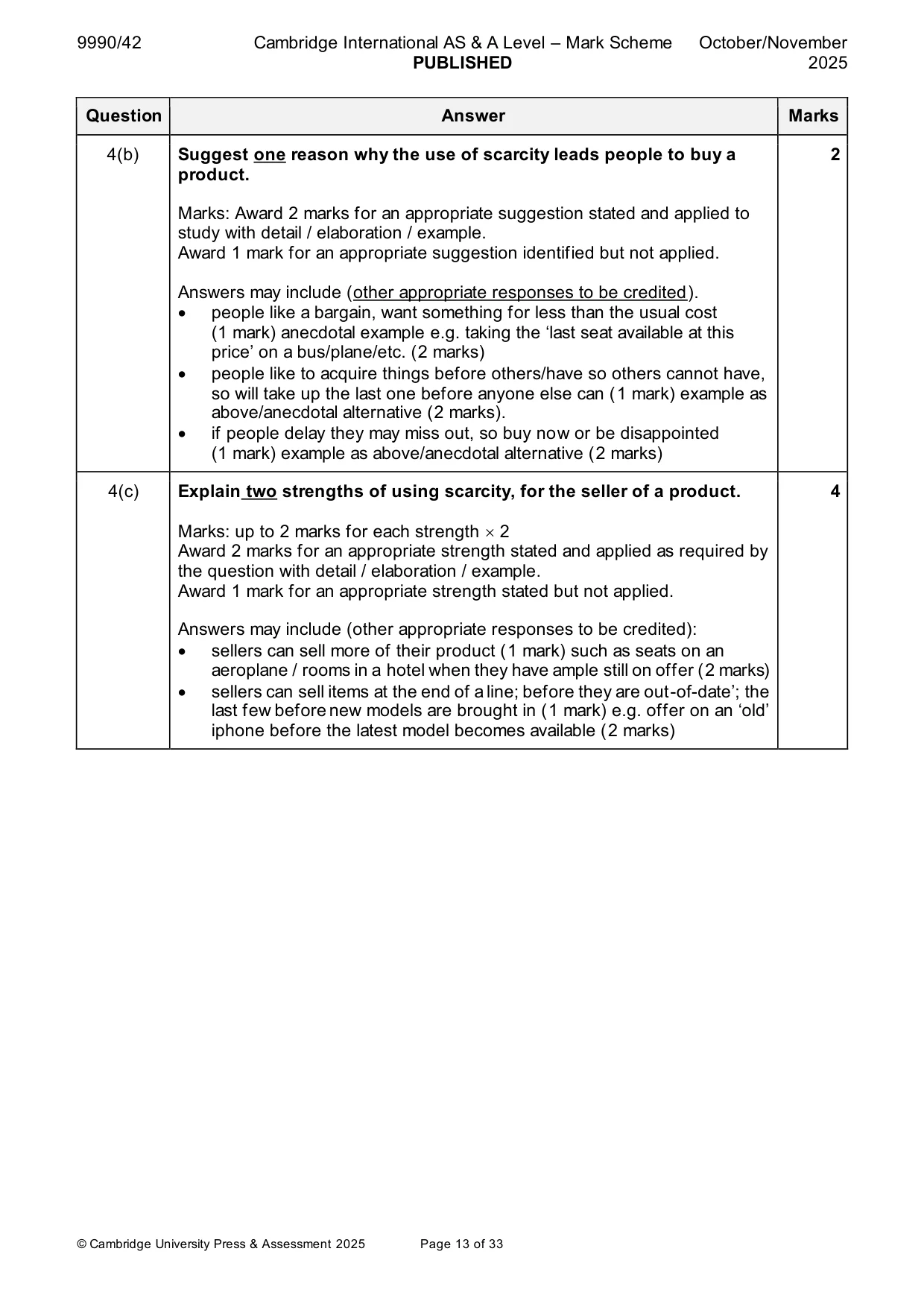
4 Cialdini outlined six ways to close a sale. (a) Outline what is meant by the term ‘scarcity’ in relation to closing a sale, using any sales example. [2] (b) Suggest one reason why the use of scarcity leads people to buy a product. [2] (c) Explain two strengths of using scarcity, for the seller of a product. [4] Health Psychology Answer all questions if you have studied this option.
Mark scheme: 4 Cialdini outlined six ways to close a sale. 4(a) Outline what is meant by the term ‘scarcity’ in relation to closing a sale, 2 using any sales example. Syllabus: 2.4.2 selling a product; Cialdini’s six ways to close a sale. Marks: Award 1 mark for outline. Award 1 mark for example. NB: Cialdini identifies six ‘principles of persuasion’: reciprocity, scarcity, authority, consistency, liking and consensus. Only scarcity is creditworthy. Answers may include (other appropriate responses to be credited): • Scarcity is ‘buy now before there are none left’ Scarcity triggers action. Products that are scarce are more valued when they are limited (1 mark) • Worchel et al. (1975) conducted the ‘cookie jar experiment’ where people rated the quality of the two cookies to be higher than the ten cookies (+1 mark) • scarcity applies when booking flights, hotels, etc. Such things are there to encourage buying when what is on offer is hardly ever scarce. Wordings such as ‘last day today’; ‘limited offer’; ‘only two more available’. (+1 mark) 4(b) Suggest one reason why the use of scarcity leads people to buy a 2 product. Marks: Award 2 marks for an appropriate suggestion stated and applied to study with detail / elaboration / example. Award 1 mark for an appropriate suggestion identified but not applied. Answers may include (other appropriate responses to be credited). • people like a bargain, want something for less than the usual cost (1 mark) anecdotal example e.g. taking the ‘last seat available at this price’ on a bus/plane/etc. (2 marks) • people like to acquire things before others/have so others cannot have, so will take up the last one before anyone else can (1 mark) example as above/anecdotal alternative (2 marks). • if people delay they may miss out, so buy now or be disappointed (1 mark) example as above/anecdotal alternative (2 marks) 4(c) Explain two strengths of using scarcity, for the seller of a product. 4 Marks: up to 2 marks for each strength 2 Award 2 marks for an appropriate strength stated and applied as required by the question with detail / elaboration / example. Award 1 mark for an appropriate strength stated but not applied. Answers may include (other appropriate responses to be credited): • sellers can sell more of their product (1 mark) such as seats on an aeroplane / rooms in a hotel when they have ample still on offer (2 marks) • sellers can sell items at the end of a line; before they are out-of-date’; the last few before new models are brought in (1 mark) e.g. offer on an ‘old’ iphone before the latest model becomes available (2 marks)
Q5 · From the key study by Savage and Armstrong (1990) on the effect of practitioner style on…
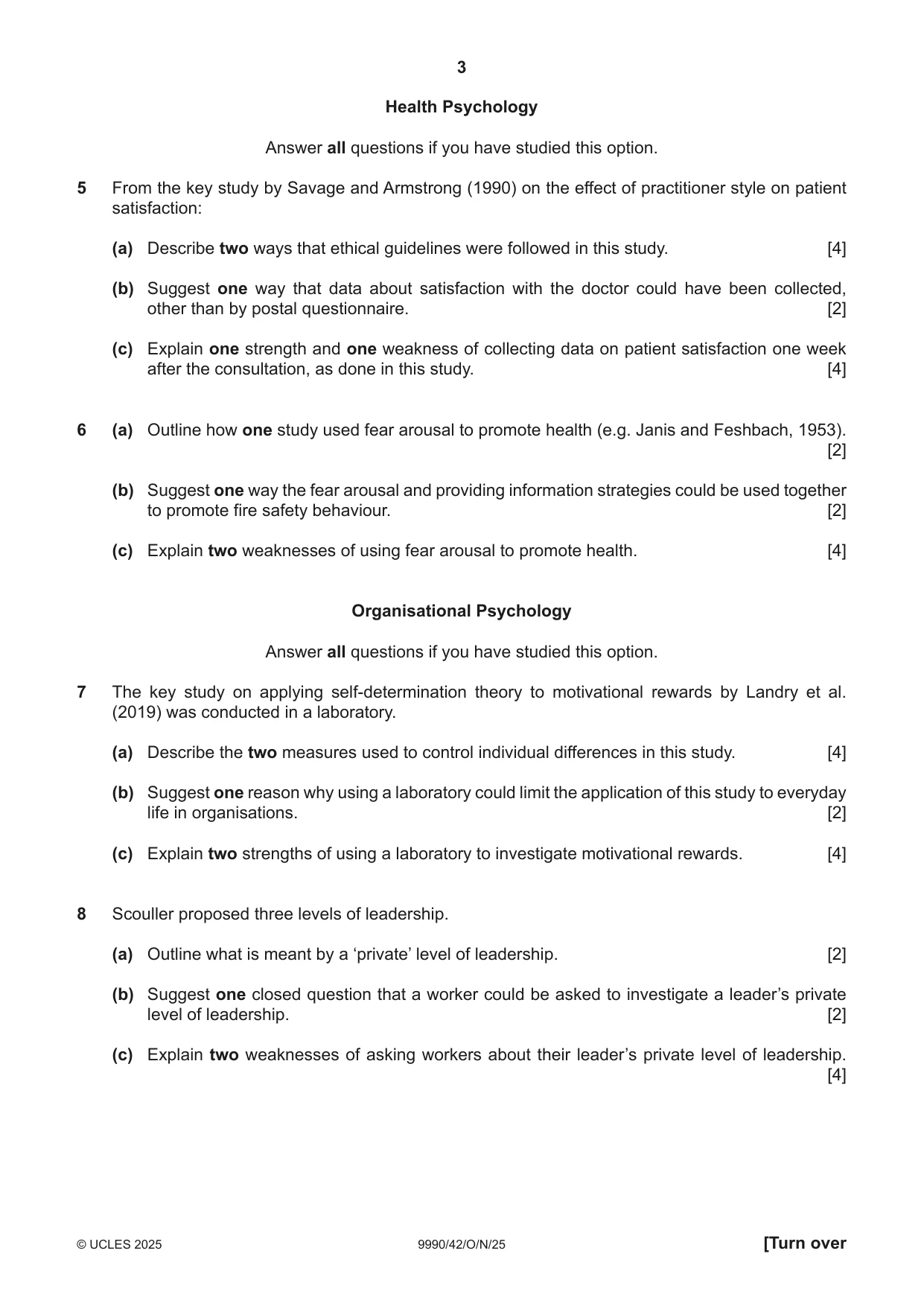
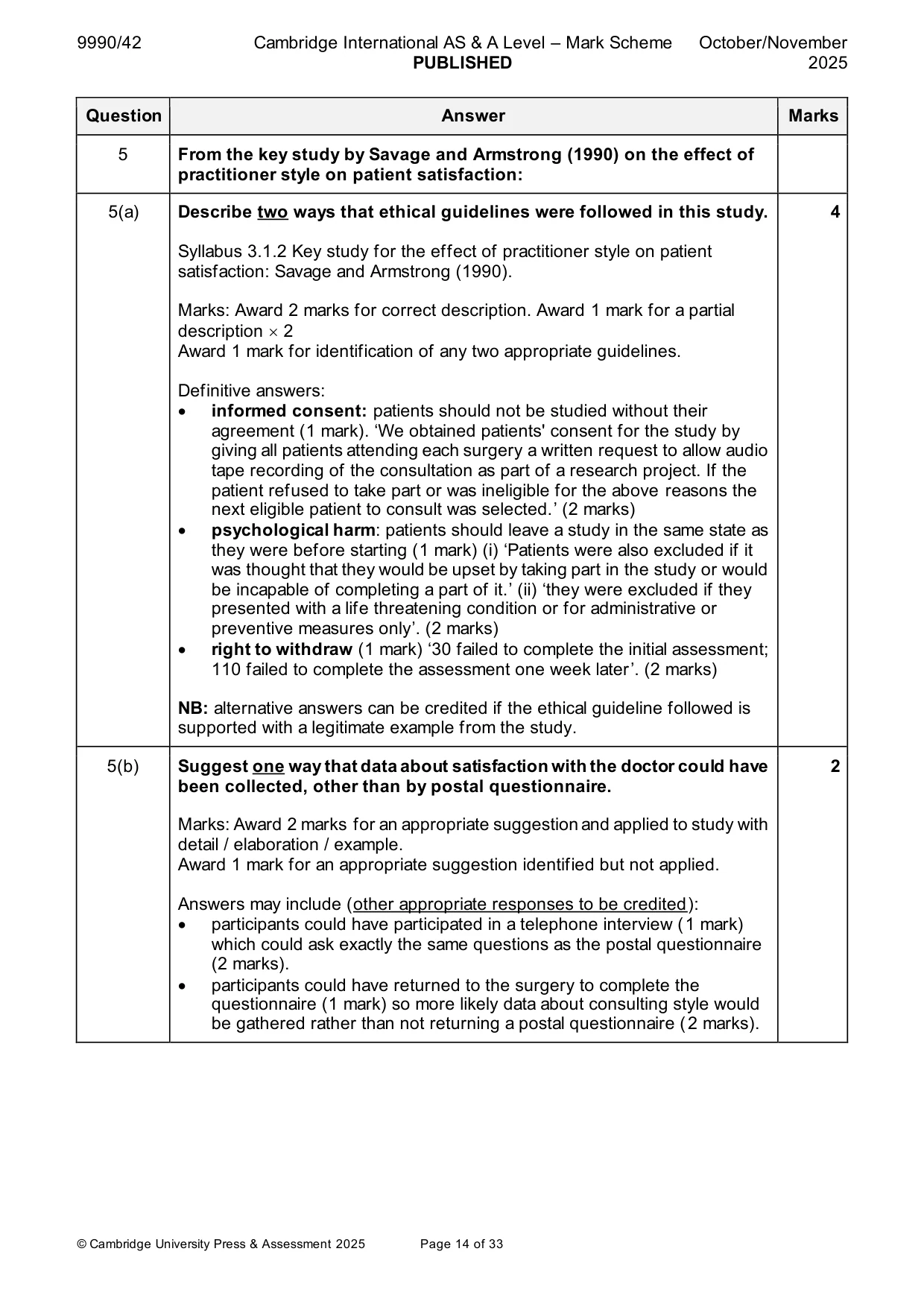
5 From the key study by Savage and Armstrong (1990) on the effect of practitioner style on patient satisfaction: (a) Describe two ways that ethical guidelines were followed in this study. [4] (b) Suggest one way that data about satisfaction with the doctor could have been collected, other than by postal questionnaire. [2] (c) Explain one strength and one weakness of collecting data on patient satisfaction one week after the consultation, as done in this study. [4]
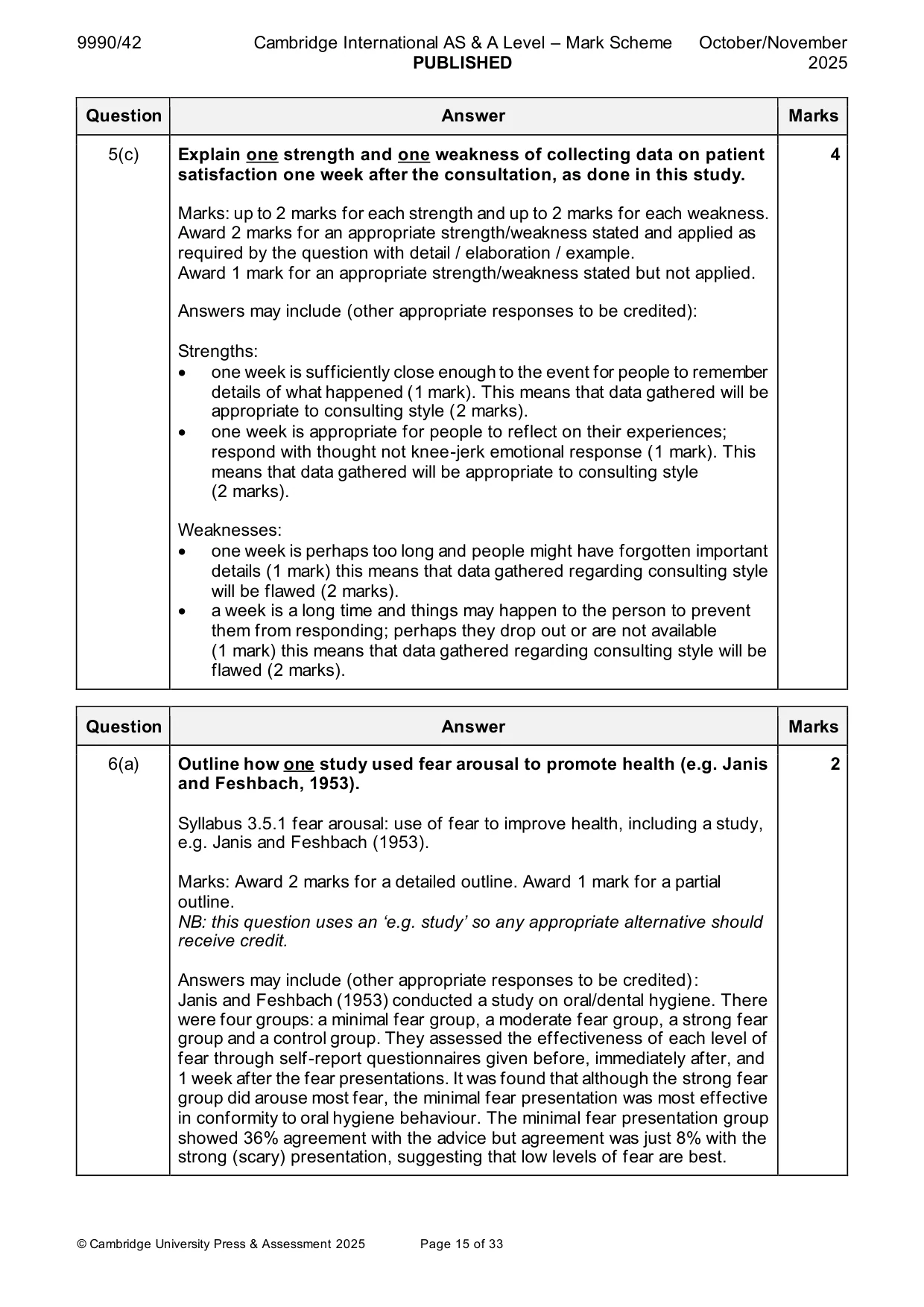
Mark scheme: 5 From the key study by Savage and Armstrong (1990) on the effect of practitioner style on patient satisfaction: 5(a) Describe two ways that ethical guidelines were followed in this study. 4 Syllabus 3.1.2 Key study for the effect of practitioner style on patient satisfaction: Savage and Armstrong (1990). Marks: Award 2 marks for correct description. Award 1 mark for a partial description 2 Award 1 mark for identification of any two appropriate guidelines. Definitive answers: • informed consent: patients should not be studied without their agreement (1 mark). ‘We obtained patients' consent for the study by giving all patients attending each surgery a written request to allow audio tape recording of the consultation as part of a research project. If the patient refused to take part or was ineligible for the above reasons the next eligible patient to consult was selected.’ (2 marks) • psychological harm: patients should leave a study in the same state as they were before starting (1 mark) (i) ‘Patients were also excluded if it was thought that they would be upset by taking part in the study or would be incapable of completing a part of it.’ (ii) ‘they were excluded if they presented with a life threatening condition or for administrative or preventive measures only’. (2 marks) • right to withdraw (1 mark) ‘30 failed to complete the initial assessment; 110 failed to complete the assessment one week later’. (2 marks) NB: alternative answers can be credited if the ethical guideline followed is supported with a legitimate example from the study. 5(b) Suggest one way that data about satisfaction with the doctor could have 2 been collected, other than by postal questionnaire. Marks: Award 2 marks for an appropriate suggestion and applied to study with detail / elaboration / example. Award 1 mark for an appropriate suggestion identified but not applied. Answers may include (other appropriate responses to be credited): • participants could have participated in a telephone interview (1 mark) which could ask exactly the same questions as the postal questionnaire (2 marks). • participants could have returned to the surgery to complete the questionnaire (1 mark) so more likely data about consulting style would be gathered rather than not returning a postal questionnaire (2 marks). 5(c) Explain one strength and one weakness of collecting data on patient 4 satisfaction one week after the consultation, as done in this study. Marks: up to 2 marks for each strength and up to 2 marks for each weakness. Award 2 marks for an appropriate strength/weakness stated and applied as required by the question with detail / elaboration / example. Award 1 mark for an appropriate strength/weakness stated but not applied. Answers may include (other appropriate responses to be credited): Strengths: • one week is sufficiently close enough to the event for people to remember details of what happened (1 mark). This means that data gathered will be appropriate to consulting style (2 marks). • one week is appropriate for people to reflect on their experiences; respond with thought not knee-jerk emotional response (1 mark). This means that data gathered will be appropriate to consulting style (2 marks). Weaknesses: • one week is perhaps too long and people might have forgotten important details (1 mark) this means that data gathered regarding consulting style will be flawed (2 marks). • a week is a long time and things may happen to the person to prevent them from responding; perhaps they drop out or are not available (1 mark) this means that data gathered regarding consulting style will be flawed (2 marks).
Q6 · Outline how one study used fear arousal to promote health (e.g
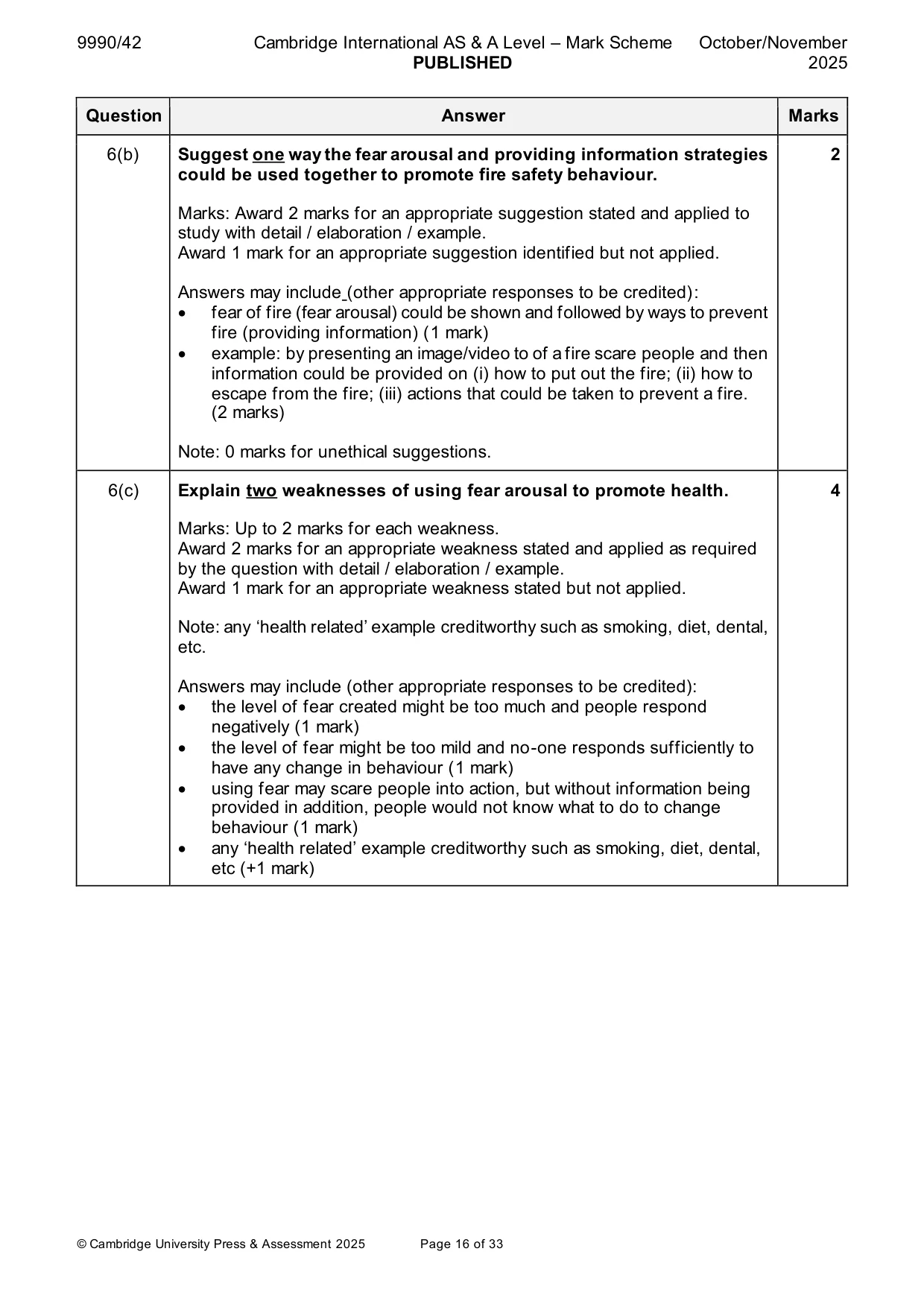
6 (a) Outline how one study used fear arousal to promote health (e.g. Janis and Feshbach, 1953). [2] (b) Suggest one way the fear arousal and providing information strategies could be used together to promote fire safety behaviour. [2] (c) Explain two weaknesses of using fear arousal to promote health. [4] Organisational Psychology Answer all questions if you have studied this option.
Mark scheme: 6(a) Outline how one study used fear arousal to promote health (e.g. Janis 2 and Feshbach, 1953). Syllabus 3.5.1 fear arousal: use of fear to improve health, including a study, e.g. Janis and Feshbach (1953). Marks: Award 2 marks for a detailed outline. Award 1 mark for a partial outline. NB: this question uses an ‘e.g. study’ so any appropriate alternative should receive credit. Answers may include (other appropriate responses to be credited): Janis and Feshbach (1953) conducted a study on oral/dental hygiene. There were four groups: a minimal fear group, a moderate fear group, a strong fear group and a control group. They assessed the effectiveness of each level of fear through self-report questionnaires given before, immediately after, and 1 week after the fear presentations. It was found that although the strong fear group did arouse most fear, the minimal fear presentation was most effective in conformity to oral hygiene behaviour. The minimal fear presentation group showed 36% agreement with the advice but agreement was just 8% with the strong (scary) presentation, suggesting that low levels of fear are best. 6(b) Suggest one way the fear arousal and providing information strategies 2 could be used together to promote fire safety behaviour. Marks: Award 2 marks for an appropriate suggestion stated and applied to study with detail / elaboration / example. Award 1 mark for an appropriate suggestion identified but not applied. Answers may include (other appropriate responses to be credited): • fear of fire (fear arousal) could be shown and followed by ways to prevent fire (providing information) (1 mark) • example: by presenting an image/video to of a fire scare people and then information could be provided on (i) how to put out the fire; (ii) how to escape from the fire; (iii) actions that could be taken to prevent a fire. (2 marks) Note: 0 marks for unethical suggestions. 6(c) Explain two weaknesses of using fear arousal to promote health. 4 Marks: Up to 2 marks for each weakness. Award 2 marks for an appropriate weakness stated and applied as required by the question with detail / elaboration / example. Award 1 mark for an appropriate weakness stated but not applied. Note: any ‘health related’ example creditworthy such as smoking, diet, dental, etc. Answers may include (other appropriate responses to be credited): • the level of fear created might be too much and people respond negatively (1 mark) • the level of fear might be too mild and no-one responds sufficiently to have any change in behaviour (1 mark) • using fear may scare people into action, but without information being provided in addition, people would not know what to do to change behaviour (1 mark) • any ‘health related’ example creditworthy such as smoking, diet, dental, etc (+1 mark)
More questions on 2 Health promotion in schools and worksites
Q7 · The key study on applying self-determination theory to motivational rewards by Landry et…
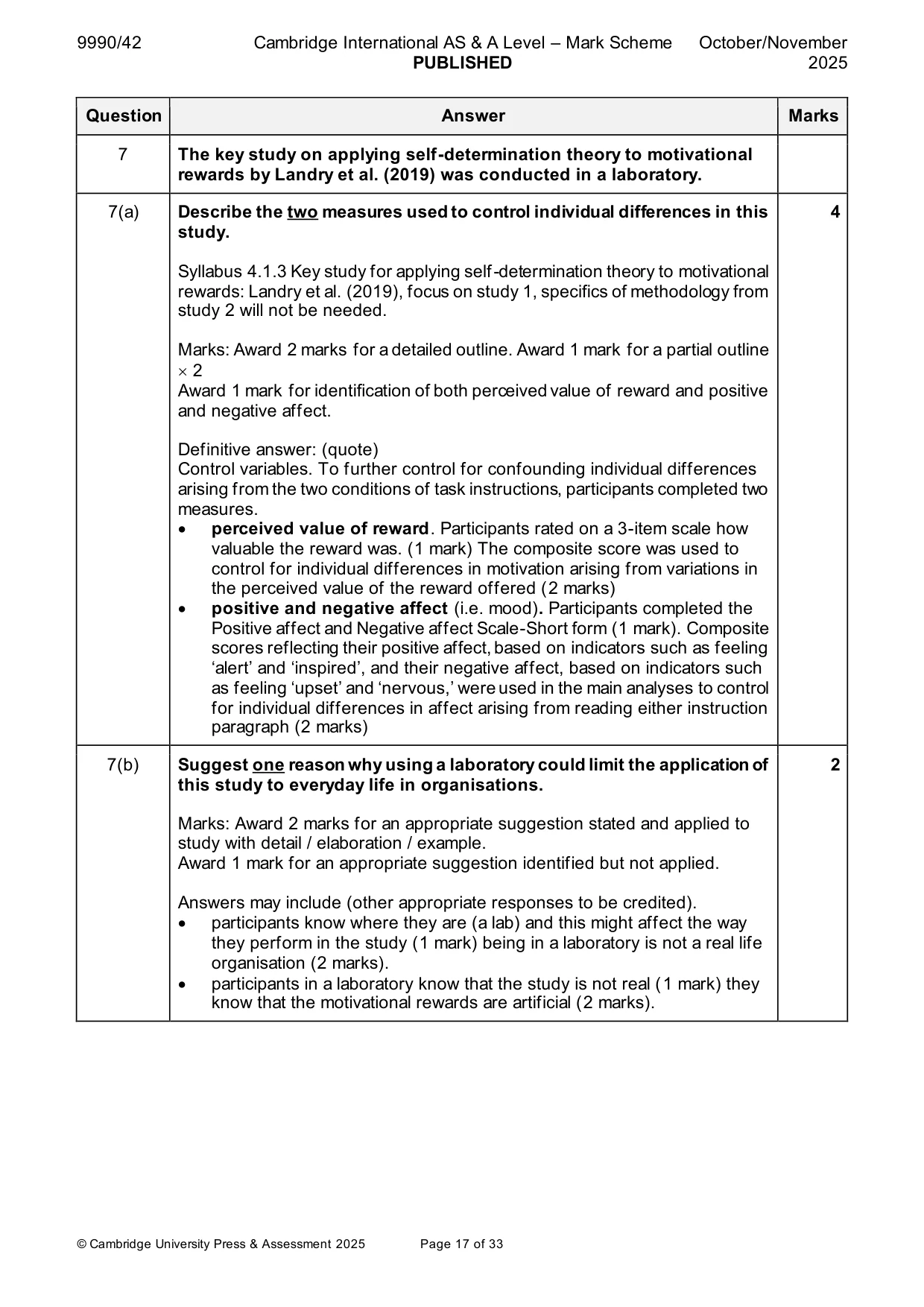
7 The key study on applying self-determination theory to motivational rewards by Landry et al. (2019) was conducted in a laboratory. (a) Describe the two measures used to control individual differences in this study. [4] (b) Suggest one reason why using a laboratory could limit the application of this study to everyday life in organisations. [2] (c) Explain two strengths of using a laboratory to investigate motivational rewards. [4]
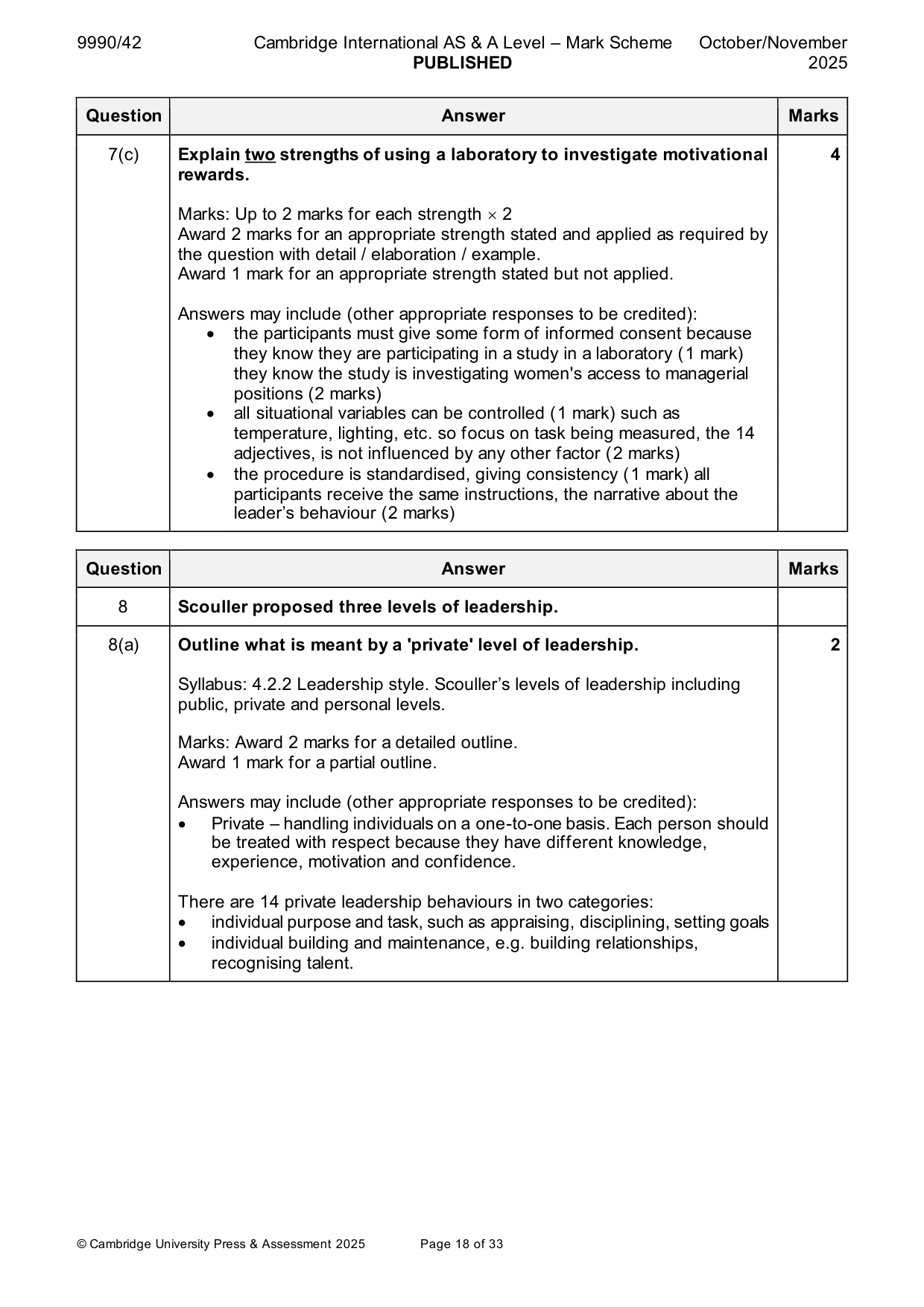
Mark scheme: 7 The key study on applying self-determination theory to motivational rewards by Landry et al. (2019) was conducted in a laboratory. 7(a) Describe the two measures used to control individual differences in this 4 study. Syllabus 4.1.3 Key study for applying self-determination theory to motivational rewards: Landry et al. (2019), focus on study 1, specifics of methodology from study 2 will not be needed. Marks: Award 2 marks for a detailed outline. Award 1 mark for a partial outline 2 Award 1 mark for identification of both perceived value of reward and positive and negative affect. Definitive answer: (quote) Control variables. To further control for confounding individual differences arising from the two conditions of task instructions, participants completed two measures. • perceived value of reward. Participants rated on a 3-item scale how valuable the reward was. (1 mark) The composite score was used to control for individual differences in motivation arising from variations in the perceived value of the reward offered (2 marks) • positive and negative affect (i.e. mood). Participants completed the Positive affect and Negative affect Scale-Short form (1 mark). Composite scores reflecting their positive affect, based on indicators such as feeling ‘alert’ and ‘inspired’, and their negative affect, based on indicators such as feeling ‘upset’ and ‘nervous,’ were used in the main analyses to control for individual differences in affect arising from reading either instruction paragraph (2 marks) 7(b) Suggest one reason why using a laboratory could limit the application of 2 this study to everyday life in organisations. Marks: Award 2 marks for an appropriate suggestion stated and applied to study with detail / elaboration / example. Award 1 mark for an appropriate suggestion identified but not applied. Answers may include (other appropriate responses to be credited). • participants know where they are (a lab) and this might affect the way they perform in the study (1 mark) being in a laboratory is not a real life organisation (2 marks). • participants in a laboratory know that the study is not real (1 mark) they know that the motivational rewards are artificial (2 marks). 7(c) Explain two strengths of using a laboratory to investigate motivational 4 rewards. Marks: Up to 2 marks for each strength 2 Award 2 marks for an appropriate strength stated and applied as required by the question with detail / elaboration / example. Award 1 mark for an appropriate strength stated but not applied. Answers may include (other appropriate responses to be credited): • the participants must give some form of informed consent because they know they are participating in a study in a laboratory (1 mark) they know the study is investigating women's access to managerial positions (2 marks) • all situational variables can be controlled (1 mark) such as temperature, lighting, etc. so focus on task being measured, the 14 adjectives, is not influenced by any other factor (2 marks) • the procedure is standardised, giving consistency (1 mark) all participants receive the same instructions, the narrative about the leader’s behaviour (2 marks)
Q8 · Scouller proposed three levels of leadership
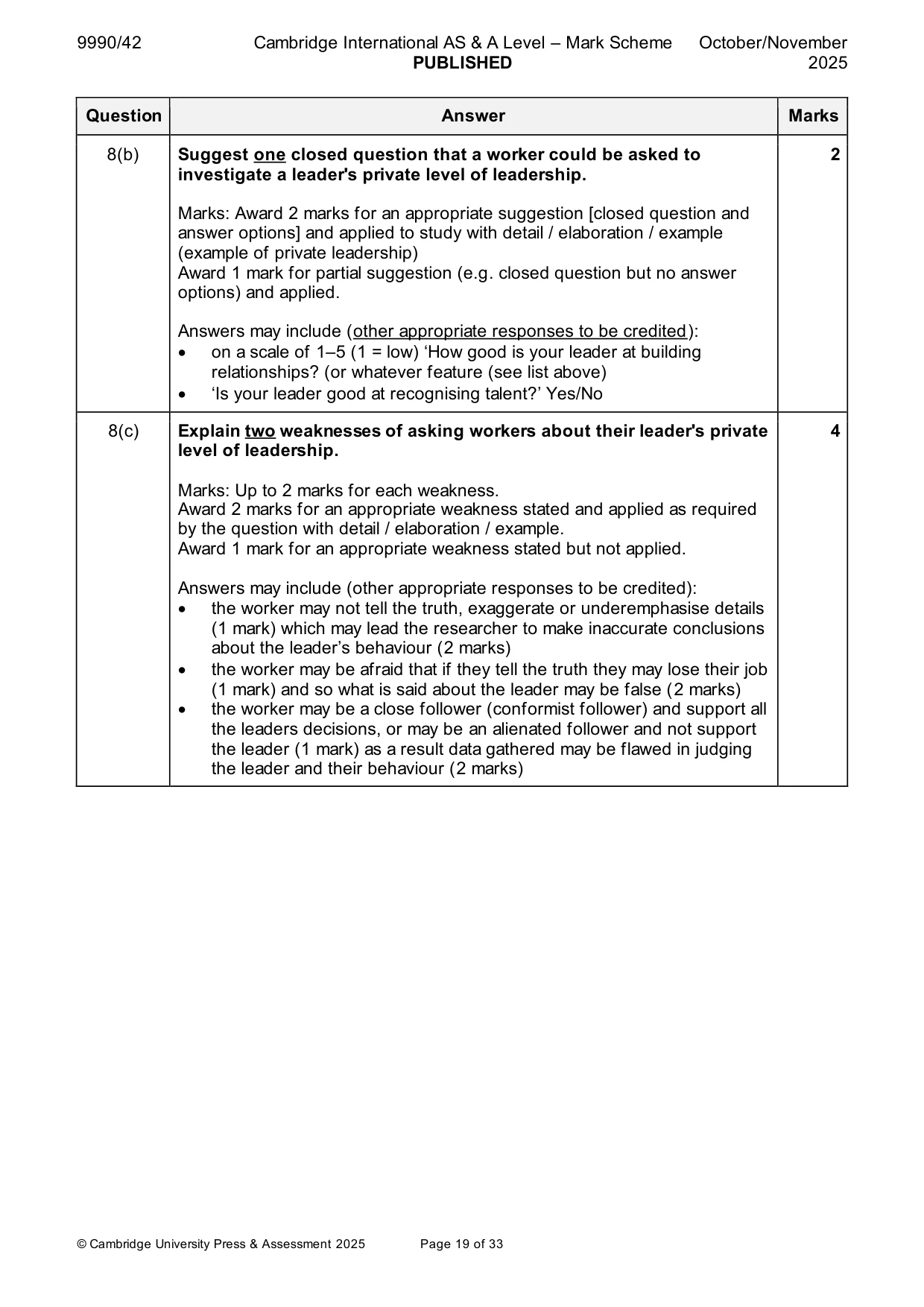
8 Scouller proposed three levels of leadership. (a) Outline what is meant by a ‘private’ level of leadership. [2] (b) Suggest one closed question that a worker could be asked to investigate a leader’s private level of leadership. [2] (c) Explain two weaknesses of asking workers about their leader’s private level of leadership. [4]
Mark scheme: 8 Scouller proposed three levels of leadership. 8(a) Outline what is meant by a 'private' level of leadership. 2 Syllabus: 4.2.2 Leadership style. Scouller’s levels of leadership including public, private and personal levels. Marks: Award 2 marks for a detailed outline. Award 1 mark for a partial outline. Answers may include (other appropriate responses to be credited): • Private – handling individuals on a one-to-one basis. Each person should be treated with respect because they have different knowledge, experience, motivation and confidence. There are 14 private leadership behaviours in two categories: • individual purpose and task, such as appraising, disciplining, setting goals • individual building and maintenance, e.g. building relationships, recognising talent. 8(b) Suggest one closed question that a worker could be asked to 2 investigate a leader's private level of leadership. Marks: Award 2 marks for an appropriate suggestion [closed question and answer options] and applied to study with detail / elaboration / example (example of private leadership) Award 1 mark for partial suggestion (e.g. closed question but no answer options) and applied. Answers may include (other appropriate responses to be credited): • on a scale of 1–5 (1 = low) ‘How good is your leader at building relationships? (or whatever feature (see list above) • ‘Is your leader good at recognising talent?’ Yes/No 8(c) Explain two weaknesses of asking workers about their leader's private 4 level of leadership. Marks: Up to 2 marks for each weakness. Award 2 marks for an appropriate weakness stated and applied as required by the question with detail / elaboration / example. Award 1 mark for an appropriate weakness stated but not applied. Answers may include (other appropriate responses to be credited): • the worker may not tell the truth, exaggerate or underemphasise details (1 mark) which may lead the researcher to make inaccurate conclusions about the leader’s behaviour (2 marks) • the worker may be afraid that if they tell the truth they may lose their job (1 mark) and so what is said about the leader may be false (2 marks) • the worker may be a close follower (conformist follower) and support all the leaders decisions, or may be an alienated follower and not support the leader (1 mark) as a result data gathered may be flawed in judging the leader and their behaviour (2 marks)
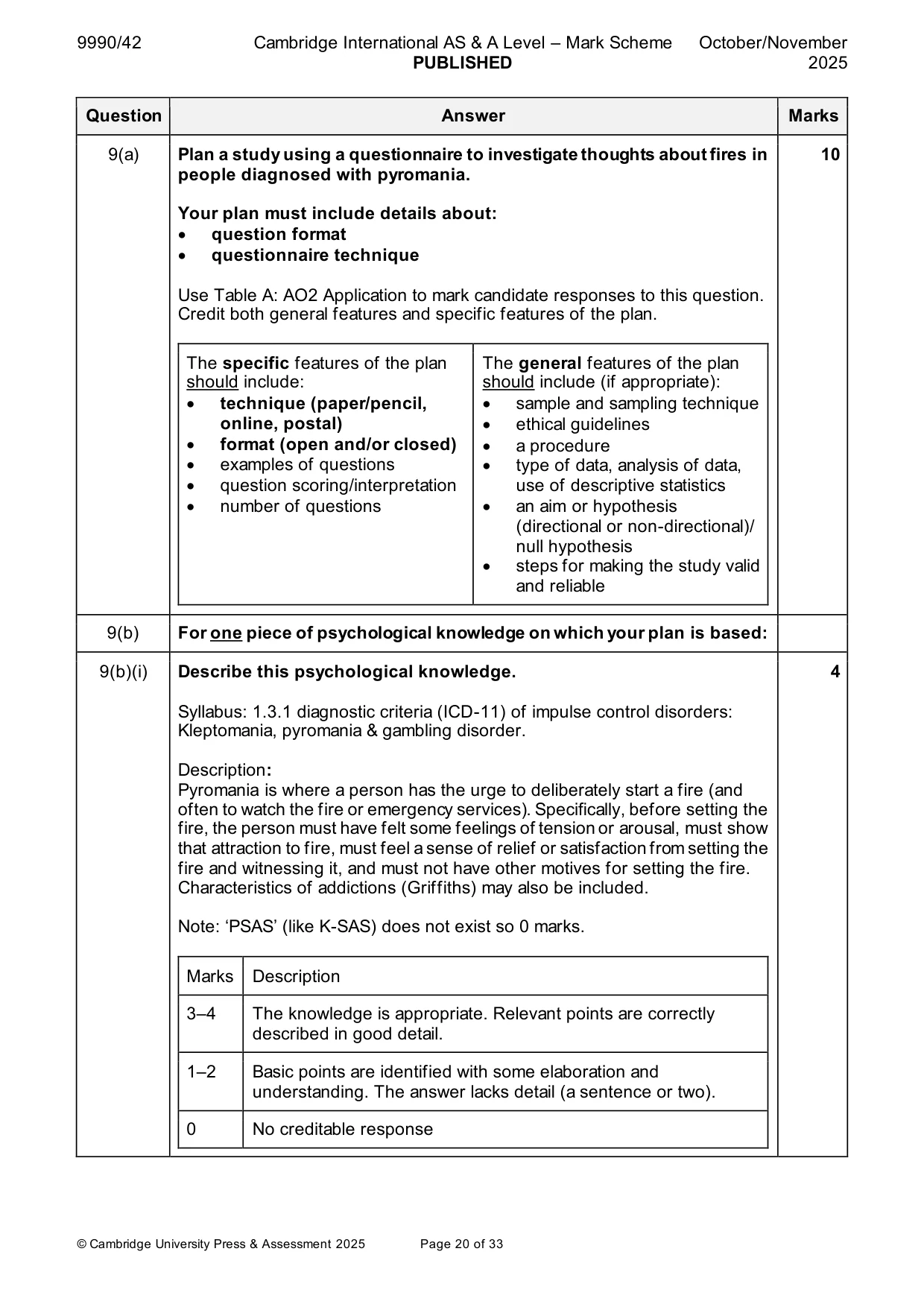
Q9 · Plan a study using a questionnaire to investigate thoughts about fires in people…
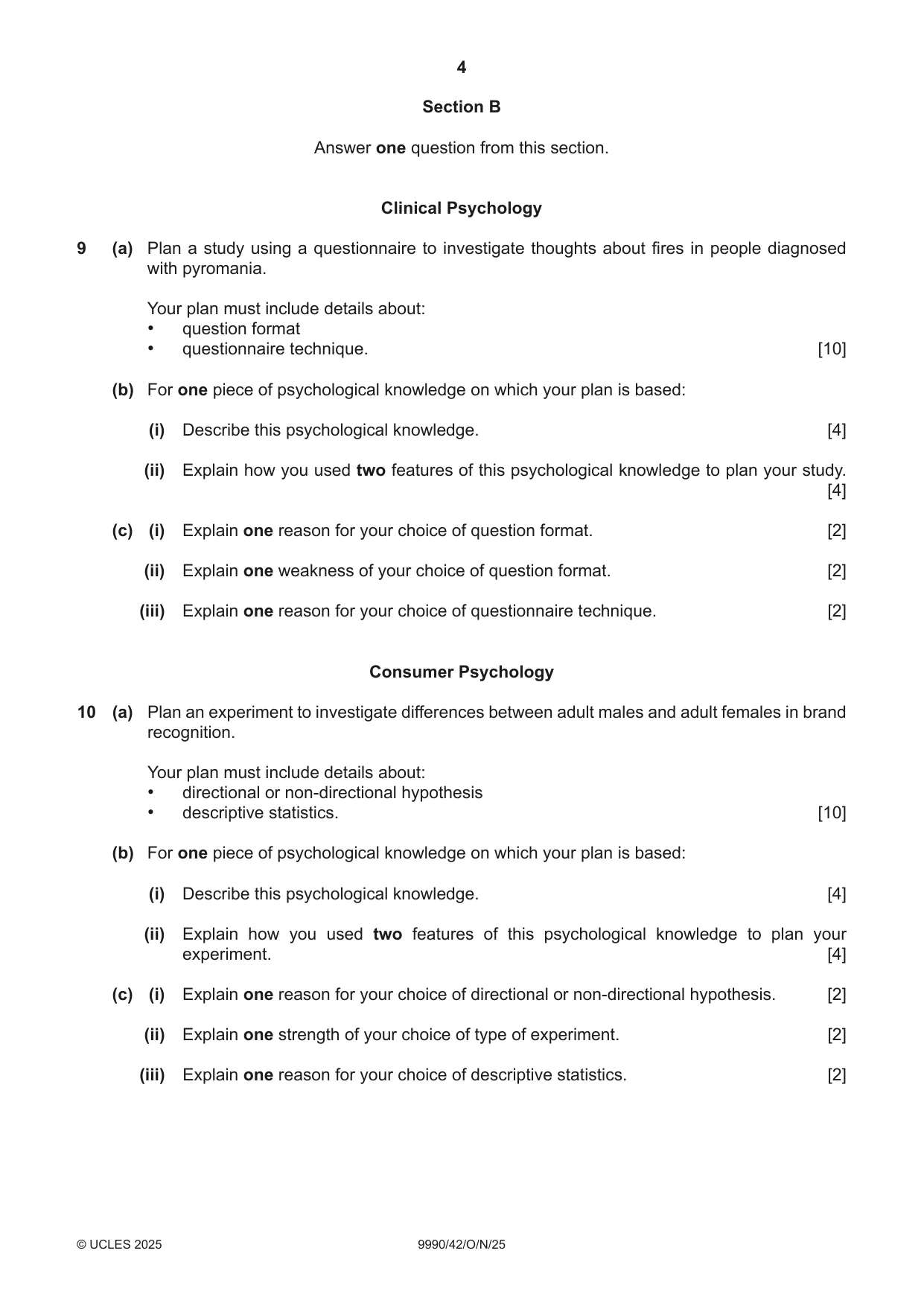
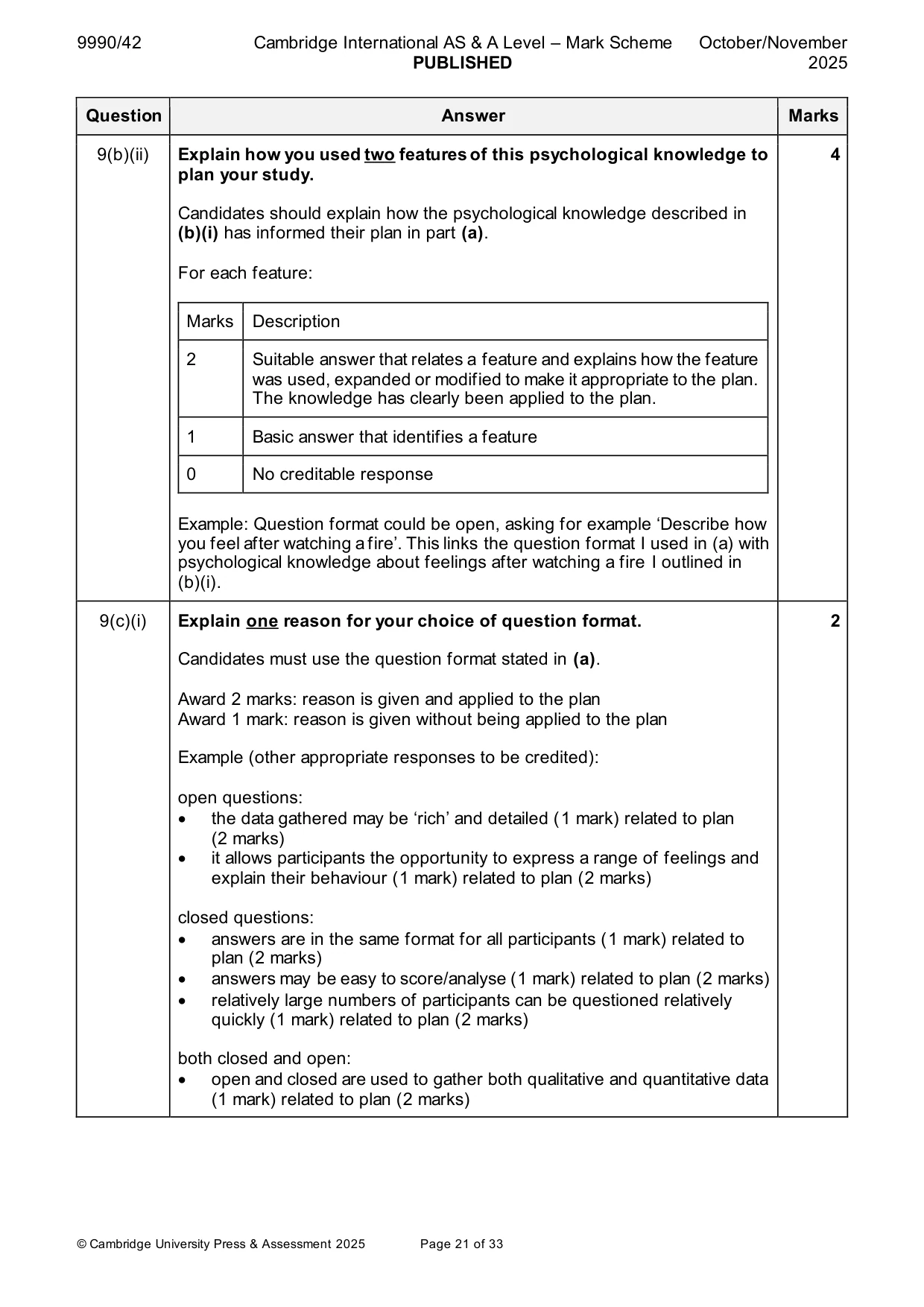
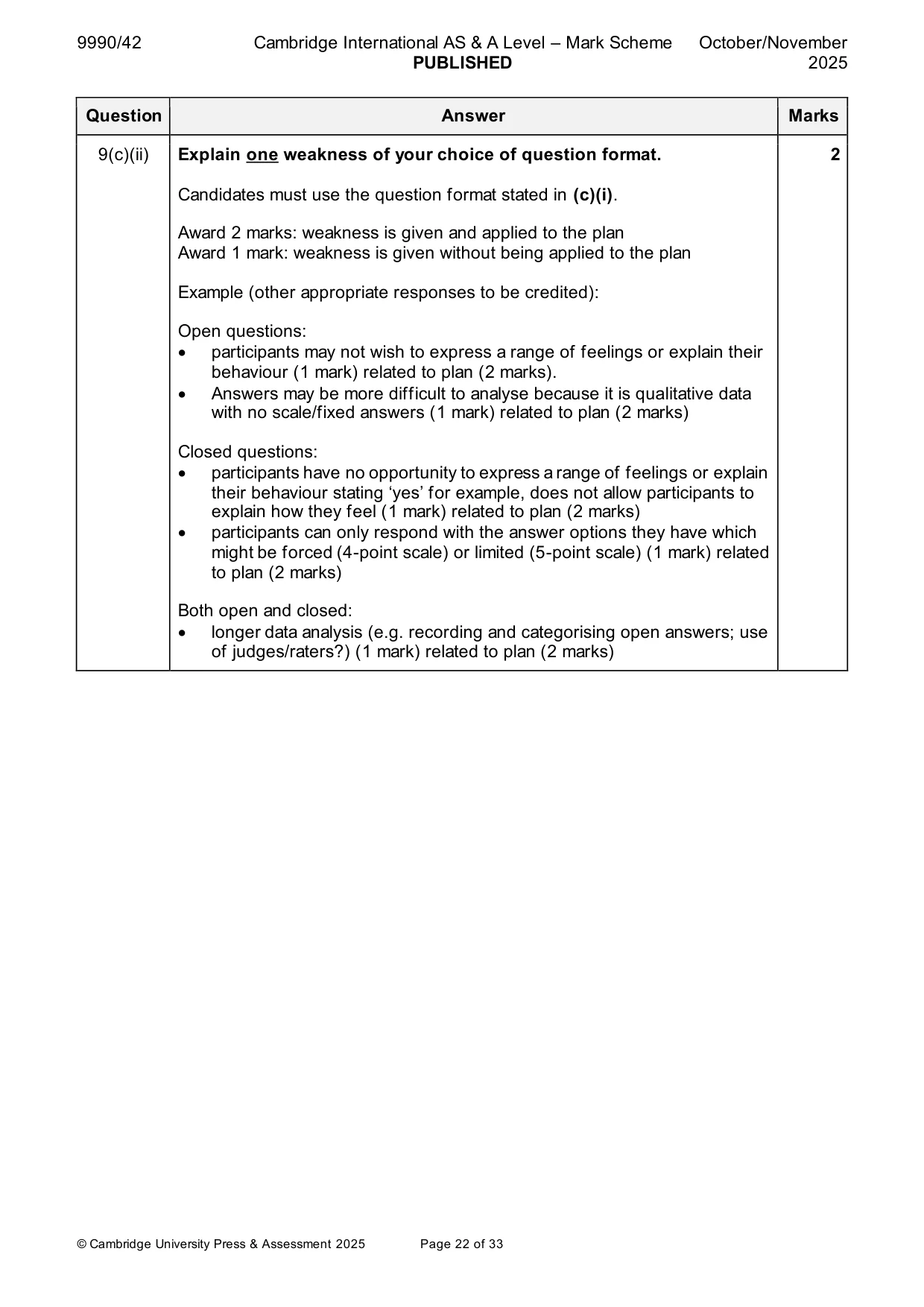
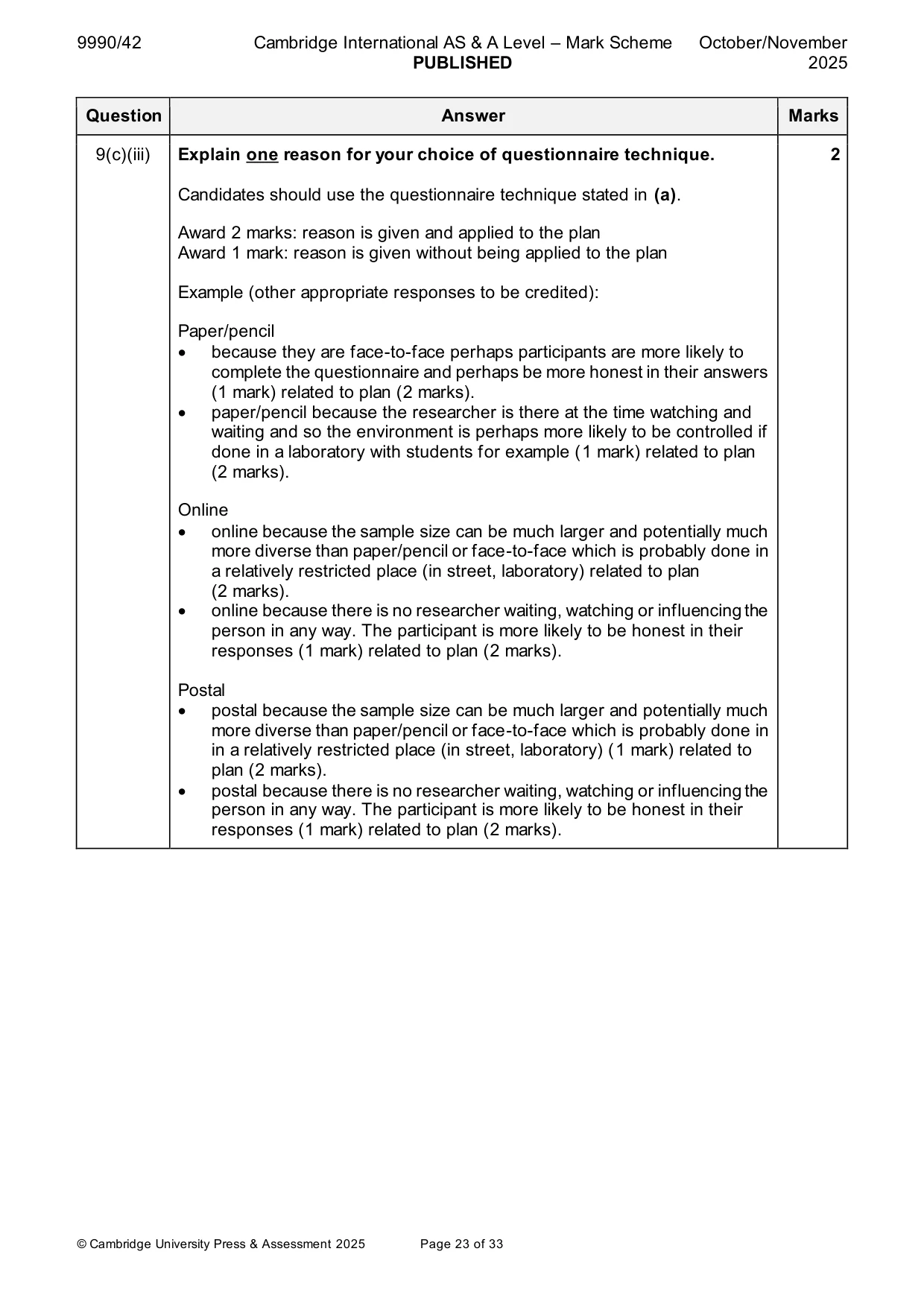
9 (a) Plan a study using a questionnaire to investigate thoughts about fires in people diagnosed with pyromania. Your plan must include details about: • question format • questionnaire technique. [10] (b) For one piece of psychological knowledge on which your plan is based: (i) Describe this psychological knowledge. [4] (ii) Explain how you used two features of this psychological knowledge to plan your study. [4] (c) (i) Explain one reason for your choice of question format. [2] (ii) Explain one weakness of your choice of question format. [2] (iii) Explain one reason for your choice of questionnaire technique. [2] Consumer Psychology
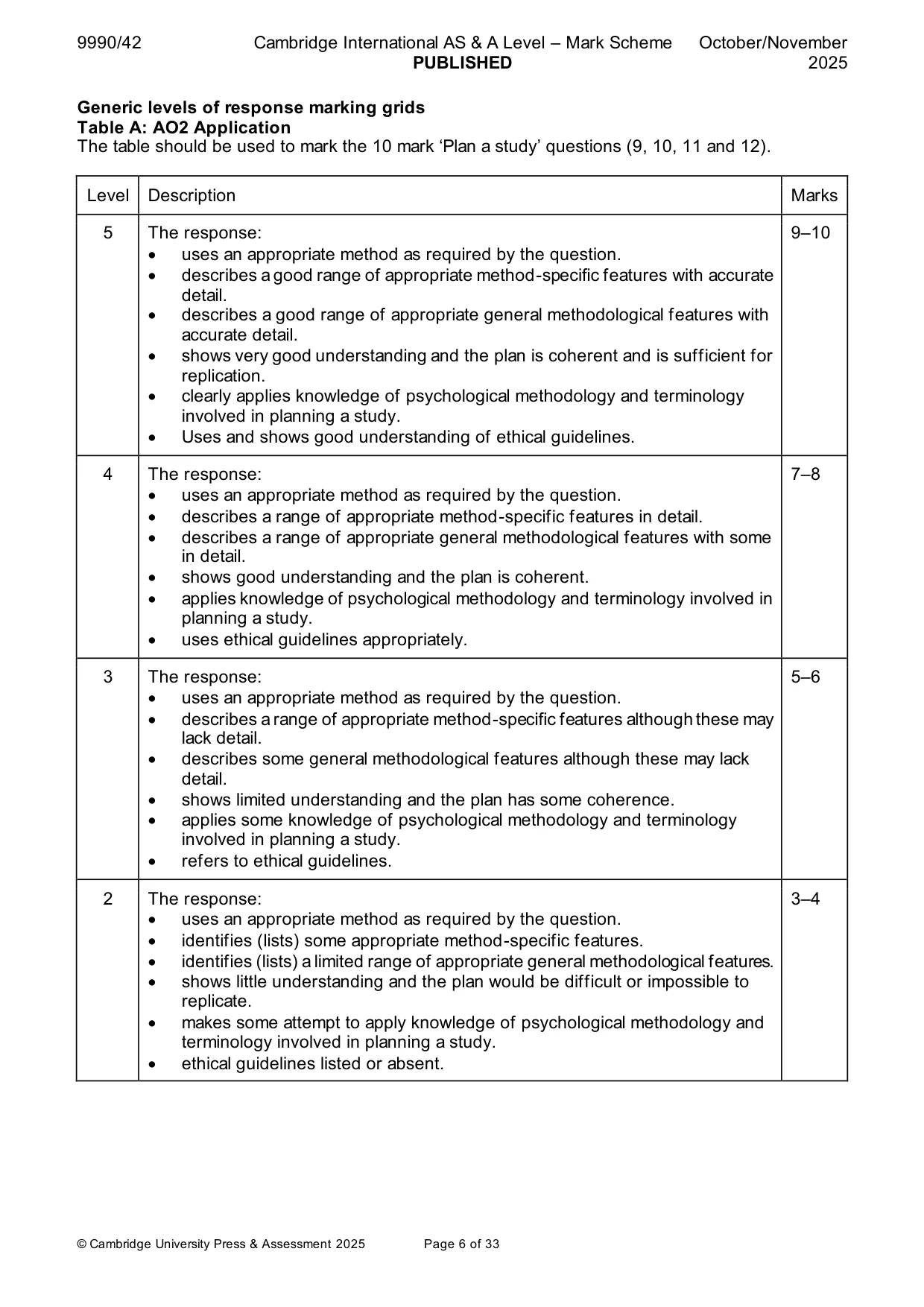
Mark scheme: 9(a) Plan a study using a questionnaire to investigate thoughts about fires in 10 people diagnosed with pyromania. Your plan must include details about: • question format • questionnaire technique Use Table A: AO2 Application to mark candidate responses to this question. Credit both general features and specific features of the plan. The specific features of the plan The general features of the plan should include: should include (if appropriate): • technique (paper/pencil, • sample and sampling technique online, postal) • ethical guidelines • format (open and/or closed) • a procedure • examples of questions • type of data, analysis of data, • question scoring/interpretation use of descriptive statistics • number of questions • an aim or hypothesis (directional or non-directional)/ null hypothesis • steps for making the study valid and reliable 9(b) For one piece of psychological knowledge on which your plan is based: 9(b)(i) Describe this psychological knowledge. 4 Syllabus: 1.3.1 diagnostic criteria (ICD-11) of impulse control disorders: Kleptomania, pyromania & gambling disorder. Description: Pyromania is where a person has the urge to deliberately start a fire (and often to watch the fire or emergency services). Specifically, before setting the fire, the person must have felt some feelings of tension or arousal, must show that attraction to fire, must feel a sense of relief or satisfaction from setting the fire and witnessing it, and must not have other motives for setting the fire. Characteristics of addictions (Griffiths) may also be included. Note: ‘PSAS’ (like K-SAS) does not exist so 0 marks. Marks Description 3–4 The knowledge is appropriate. Relevant points are correctly described in good detail. 1–2 Basic points are identified with some elaboration and understanding. The answer lacks detail (a sentence or two). 0 No creditable response 9(b)(ii) Explain how you used two features of this psychological knowledge to 4 plan your study. Candidates should explain how the psychological knowledge described in (b)(i) has informed their plan in part (a). For each feature: Marks Description 2 Suitable answer that relates a feature and explains how the feature was used, expanded or modified to make it appropriate to the plan. The knowledge has clearly been applied to the plan. 1 Basic answer that identifies a feature 0 No creditable response Example: Question format could be open, asking for example ‘Describe how you feel after watching a fire’. This links the question format I used in (a) with psychological knowledge about feelings after watching a fire I outlined in (b)(i). 9(c)(i) Explain one reason for your choice of question format. 2 Candidates must use the question format stated in (a). Award 2 marks: reason is given and applied to the plan Award 1 mark: reason is given without being applied to the plan Example (other appropriate responses to be credited): open questions: • the data gathered may be ‘rich’ and detailed (1 mark) related to plan (2 marks) • it allows participants the opportunity to express a range of feelings and explain their behaviour (1 mark) related to plan (2 marks) closed questions: • answers are in the same format for all participants (1 mark) related to plan (2 marks) • answers may be easy to score/analyse (1 mark) related to plan (2 marks) • relatively large numbers of participants can be questioned relatively quickly (1 mark) related to plan (2 marks) both closed and open: • open and closed are used to gather both qualitative and quantitative data (1 mark) related to plan (2 marks) 9(c)(ii) Explain one weakness of your choice of question format. 2 Candidates must use the question format stated in (c)(i). Award 2 marks: weakness is given and applied to the plan Award 1 mark: weakness is given without being applied to the plan Example (other appropriate responses to be credited): Open questions: • participants may not wish to express a range of feelings or explain their behaviour (1 mark) related to plan (2 marks). • Answers may be more difficult to analyse because it is qualitative data with no scale/fixed answers (1 mark) related to plan (2 marks) Closed questions: • participants have no opportunity to express a range of feelings or explain their behaviour stating ‘yes’ for example, does not allow participants to explain how they feel (1 mark) related to plan (2 marks) • participants can only respond with the answer options they have which might be forced (4-point scale) or limited (5-point scale) (1 mark) related to plan (2 marks) Both open and closed: • longer data analysis (e.g. recording and categorising open answers; use of judges/raters?) (1 mark) related to plan (2 marks) 9(c)(iii) Explain one reason for your choice of questionnaire technique. 2 Candidates should use the questionnaire technique stated in (a). Award 2 marks: reason is given and applied to the plan Award 1 mark: reason is given without being applied to the plan Example (other appropriate responses to be credited): Paper/pencil • because they are face-to-face perhaps participants are more likely to complete the questionnaire and perhaps be more honest in their answers (1 mark) related to plan (2 marks). • paper/pencil because the researcher is there at the time watching and waiting and so the environment is perhaps more likely to be controlled if done in a laboratory with students for example (1 mark) related to plan (2 marks). Online • online because the sample size can be much larger and potentially much more diverse than paper/pencil or face-to-face which is probably done in a relatively restricted place (in street, laboratory) related to plan (2 marks). • online because there is no researcher waiting, watching or influencing the person in any way. The participant is more likely to be honest in their responses (1 mark) related to plan (2 marks). Postal • postal because the sample size can be much larger and potentially much more diverse than paper/pencil or face-to-face which is probably done in in a relatively restricted place (in street, laboratory) (1 mark) related to plan (2 marks). • postal because there is no researcher waiting, watching or influencing the person in any way. The participant is more likely to be honest in their responses (1 mark) related to plan (2 marks).
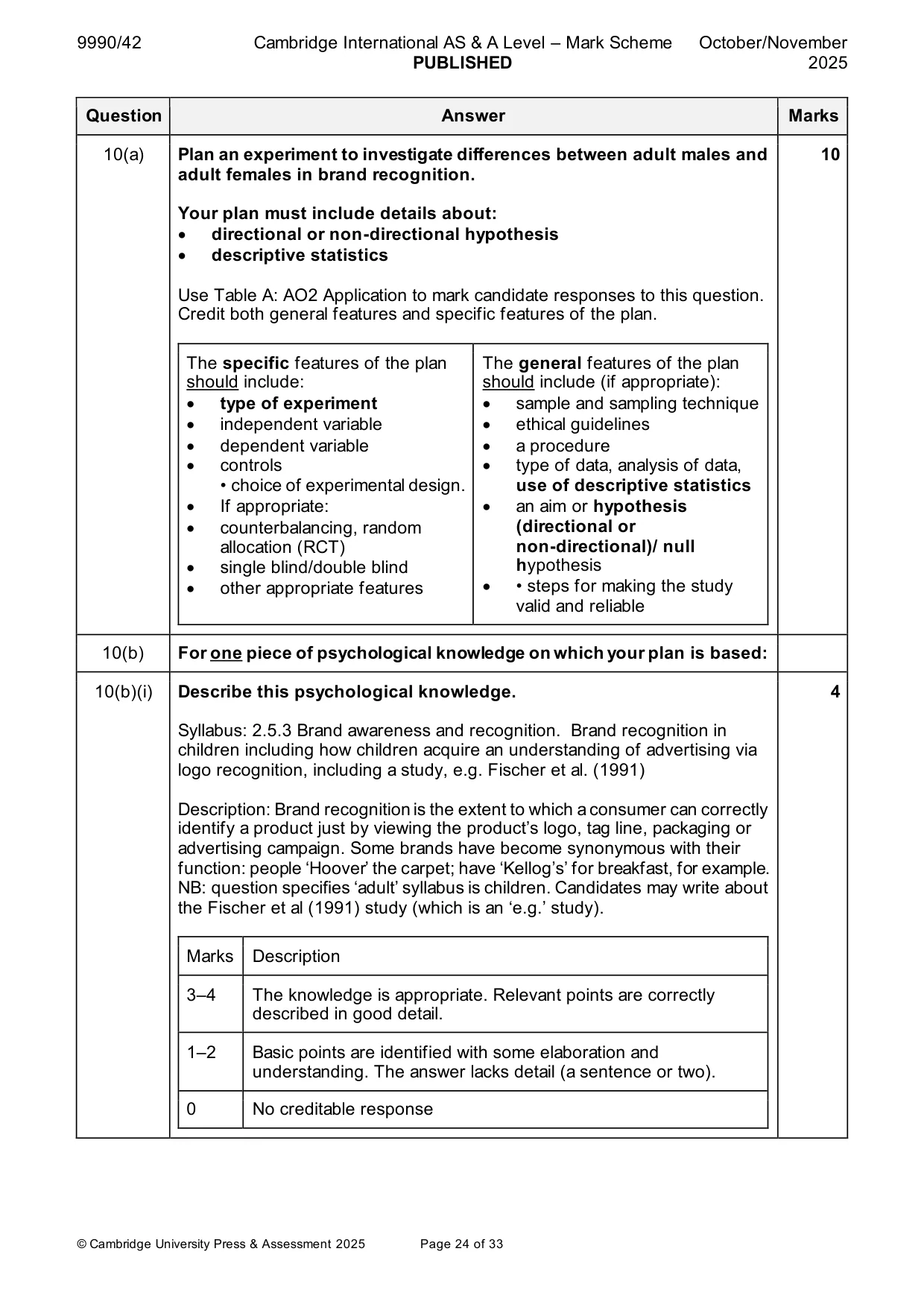
Q10 · Plan an experiment to investigate differences between adult males and adult females in…
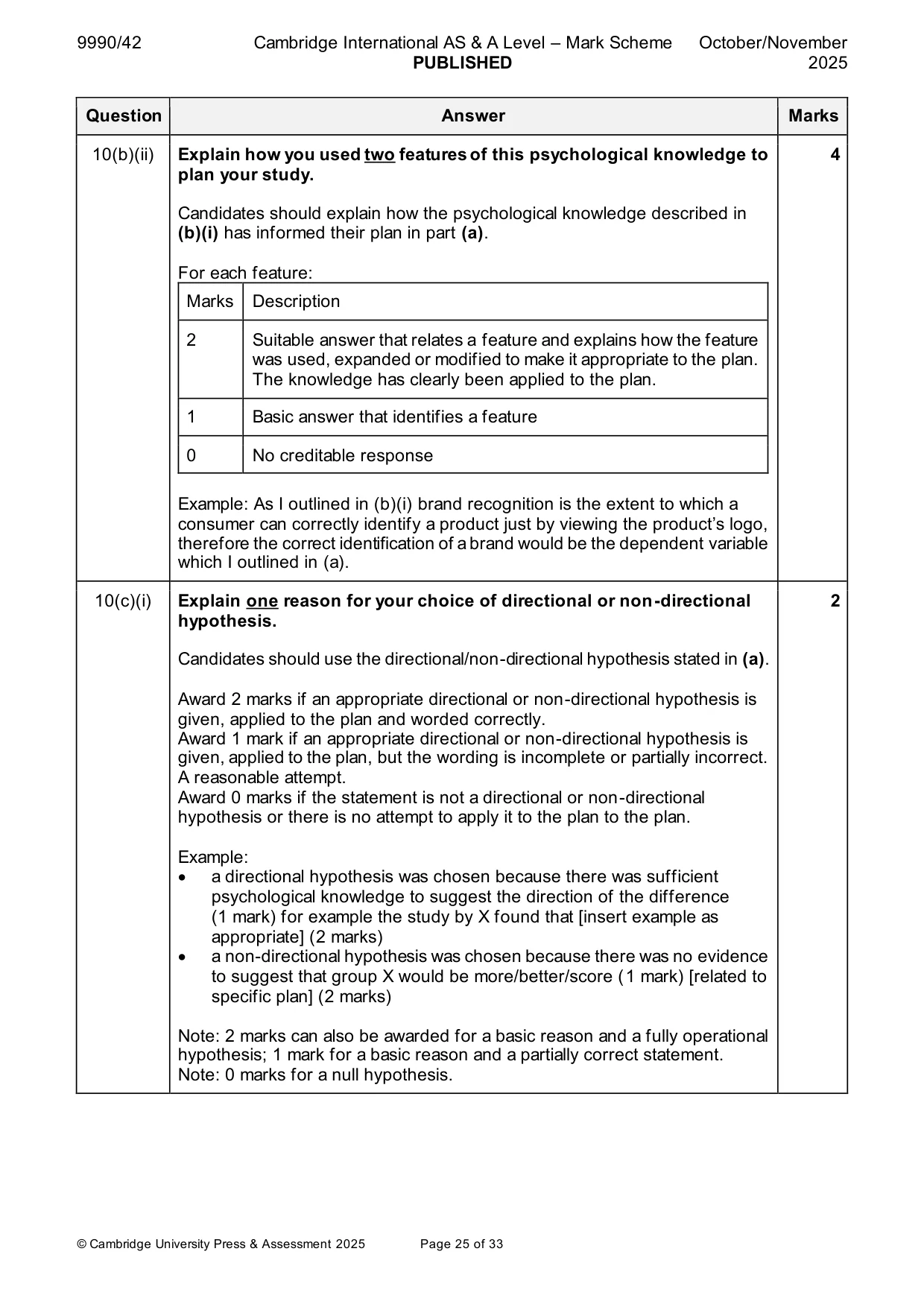
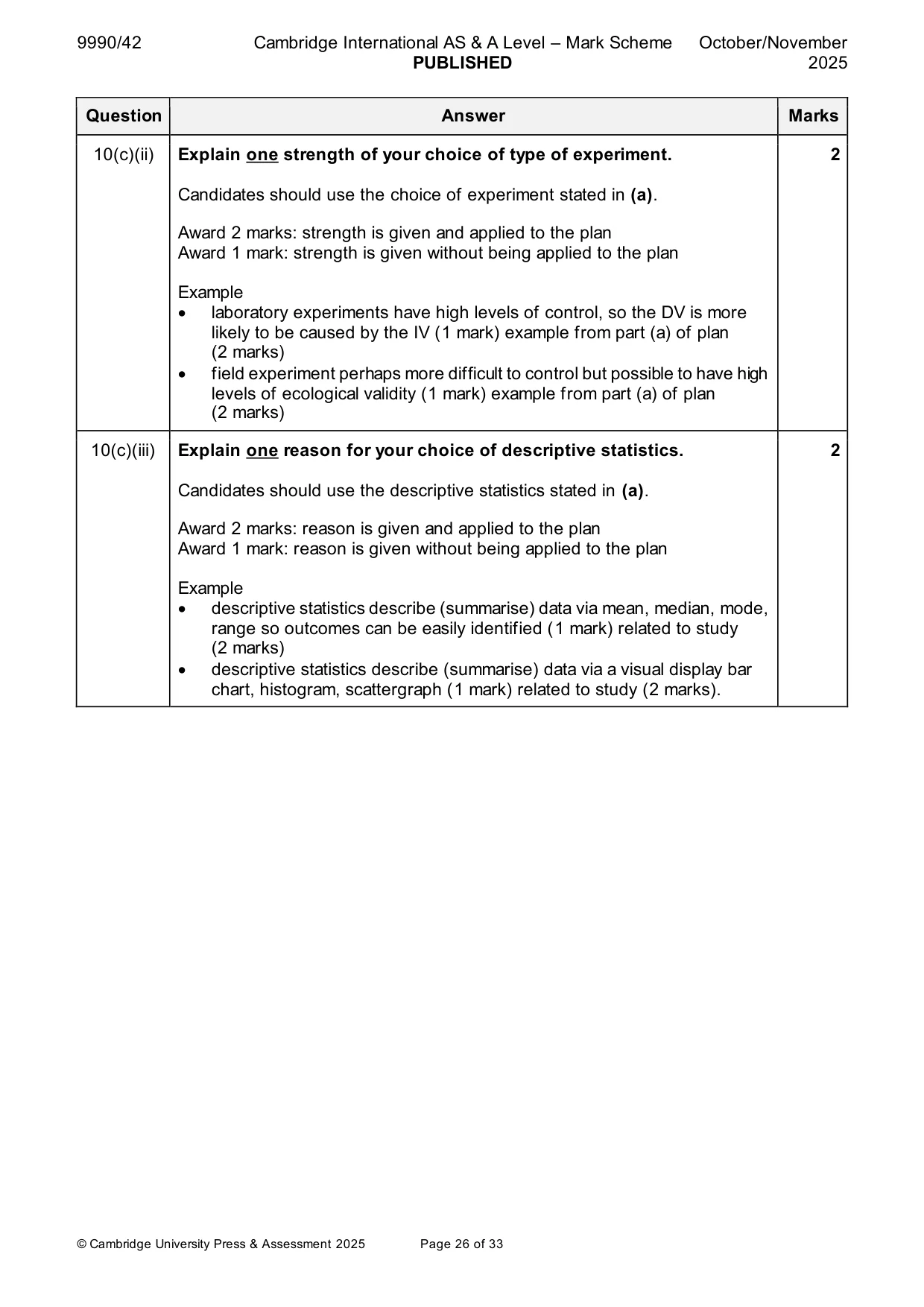
10 (a) Plan an experiment to investigate differences between adult males and adult females in brand recognition. Your plan must include details about: • directional or non-directional hypothesis • descriptive statistics. [10] (b) For one piece of psychological knowledge on which your plan is based: (i) Describe this psychological knowledge. [4] (ii) Explain how you used two features of this psychological knowledge to plan your experiment. [4] (c) (i) Explain one reason for your choice of directional or non-directional hypothesis. [2] (ii) Explain one strength of your choice of type of experiment. [2] (iii) Explain one reason for your choice of descriptive statistics. [2] Health Psychology
Mark scheme: 10(a) Plan an experiment to investigate differences between adult males and 10 adult females in brand recognition. Your plan must include details about: • directional or non-directional hypothesis • descriptive statistics Use Table A: AO2 Application to mark candidate responses to this question. Credit both general features and specific features of the plan. The specific features of the plan The general features of the plan should include: should include (if appropriate): • type of experiment • sample and sampling technique • independent variable • ethical guidelines • dependent variable • a procedure • controls • type of data, analysis of data, • choice of experimental design. use of descriptive statistics • If appropriate: • an aim or hypothesis • counterbalancing, random (directional or allocation (RCT) non-directional)/ null • single blind/double blind hypothesis • other appropriate features • • steps for making the study valid and reliable 10(b) For one piece of psychological knowledge on which your plan is based: 10(b)(i) Describe this psychological knowledge. 4 Syllabus: 2.5.3 Brand awareness and recognition. Brand recognition in children including how children acquire an understanding of advertising via logo recognition, including a study, e.g. Fischer et al. (1991) Description: Brand recognition is the extent to which a consumer can correctly identify a product just by viewing the product’s logo, tag line, packaging or advertising campaign. Some brands have become synonymous with their function: people ‘Hoover’ the carpet; have ‘Kellog’s’ for breakfast, for example. NB: question specifies ‘adult’ syllabus is children. Candidates may write about the Fischer et al (1991) study (which is an ‘e.g.’ study). Marks Description 3–4 The knowledge is appropriate. Relevant points are correctly described in good detail. 1–2 Basic points are identified with some elaboration and understanding. The answer lacks detail (a sentence or two). 0 No creditable response 10(b)(ii) Explain how you used two features of this psychological knowledge to 4 plan your study. Candidates should explain how the psychological knowledge described in (b)(i) has informed their plan in part (a). For each feature: Marks Description 2 Suitable answer that relates a feature and explains how the feature was used, expanded or modified to make it appropriate to the plan. The knowledge has clearly been applied to the plan. 1 Basic answer that identifies a feature 0 No creditable response Example: As I outlined in (b)(i) brand recognition is the extent to which a consumer can correctly identify a product just by viewing the product’s logo, therefore the correct identification of a brand would be the dependent variable which I outlined in (a). 10(c)(i) Explain one reason for your choice of directional or non-directional 2 hypothesis. Candidates should use the directional/non-directional hypothesis stated in (a). Award 2 marks if an appropriate directional or non-directional hypothesis is given, applied to the plan and worded correctly. Award 1 mark if an appropriate directional or non-directional hypothesis is given, applied to the plan, but the wording is incomplete or partially incorrect. A reasonable attempt. Award 0 marks if the statement is not a directional or non-directional hypothesis or there is no attempt to apply it to the plan to the plan. Example: • a directional hypothesis was chosen because there was sufficient psychological knowledge to suggest the direction of the difference (1 mark) for example the study by X found that [insert example as appropriate] (2 marks) • a non-directional hypothesis was chosen because there was no evidence to suggest that group X would be more/better/score (1 mark) [related to specific plan] (2 marks) Note: 2 marks can also be awarded for a basic reason and a fully operational hypothesis; 1 mark for a basic reason and a partially correct statement. Note: 0 marks for a null hypothesis. 10(c)(ii) Explain one strength of your choice of type of experiment. 2 Candidates should use the choice of experiment stated in (a). Award 2 marks: strength is given and applied to the plan Award 1 mark: strength is given without being applied to the plan Example • laboratory experiments have high levels of control, so the DV is more likely to be caused by the IV (1 mark) example from part (a) of plan (2 marks) • field experiment perhaps more difficult to control but possible to have high levels of ecological validity (1 mark) example from part (a) of plan (2 marks) 10(c)(iii) Explain one reason for your choice of descriptive statistics. 2 Candidates should use the descriptive statistics stated in (a). Award 2 marks: reason is given and applied to the plan Award 1 mark: reason is given without being applied to the plan Example • descriptive statistics describe (summarise) data via mean, median, mode, range so outcomes can be easily identified (1 mark) related to study (2 marks) • descriptive statistics describe (summarise) data via a visual display bar chart, histogram, scattergraph (1 mark) related to study (2 marks).
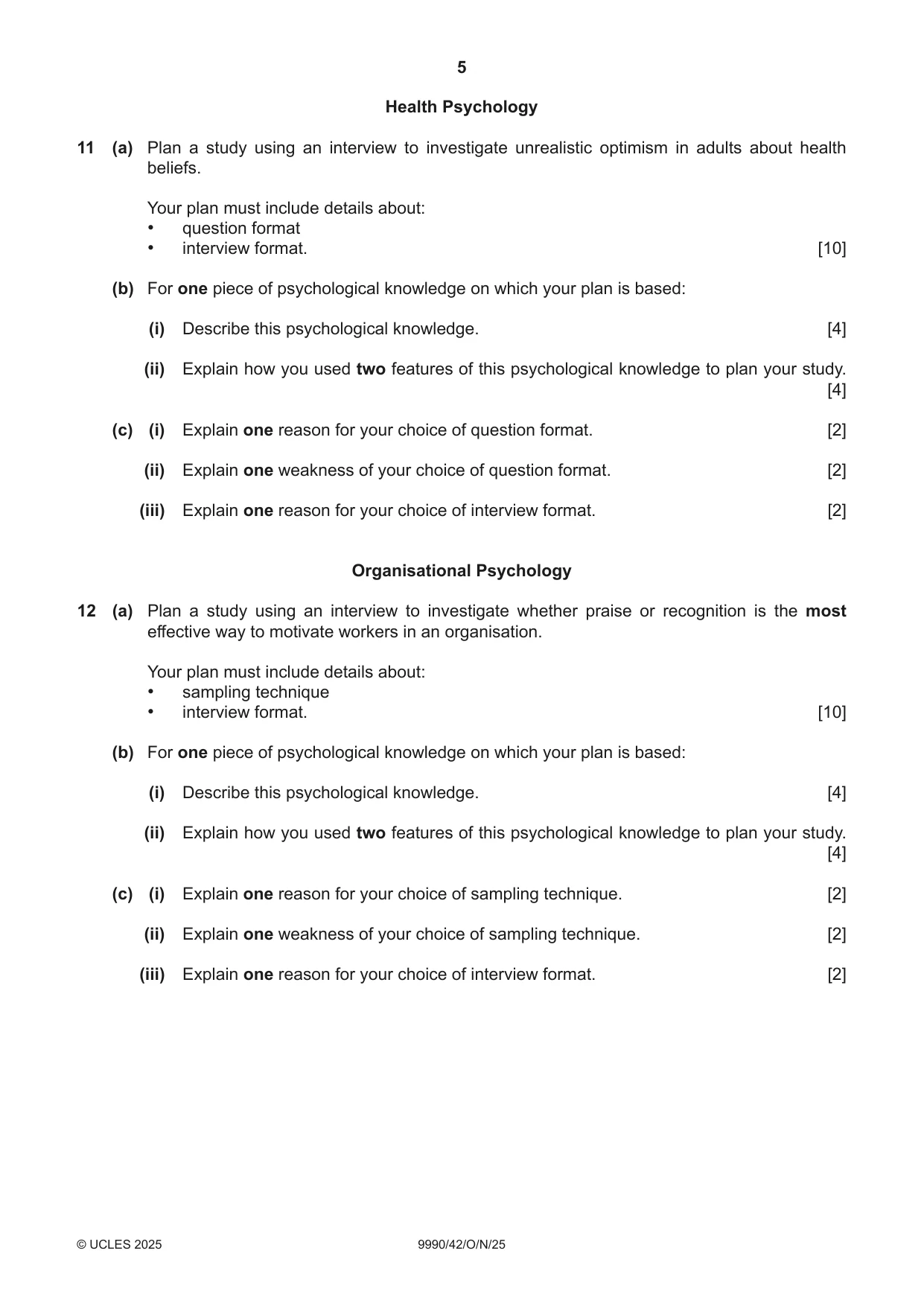
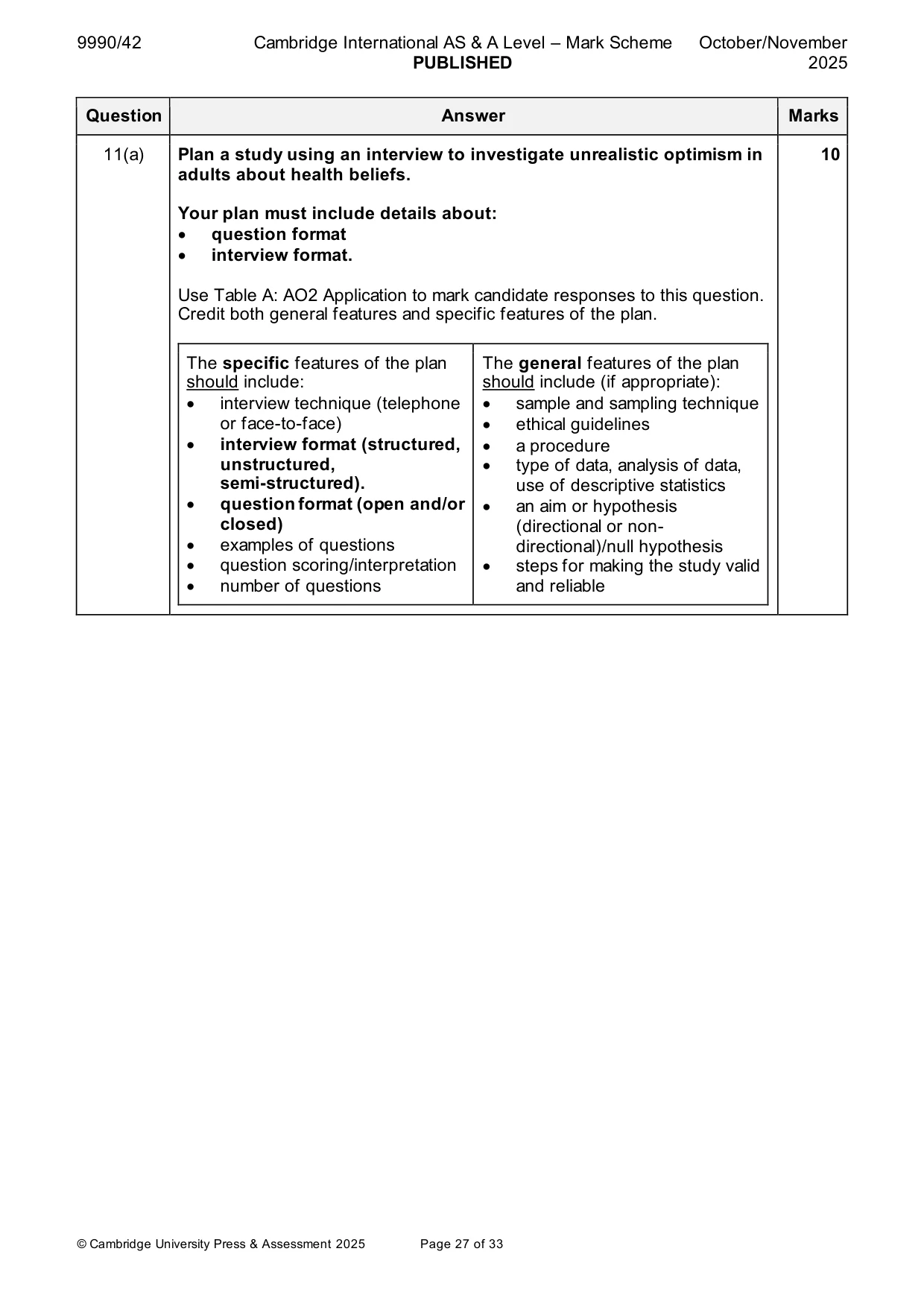
Q11 · Plan a study using an interview to investigate unrealistic optimism in adults about…
11 (a) Plan a study using an interview to investigate unrealistic optimism in adults about health beliefs. Your plan must include details about: • question format • interview format. [10] (b) For one piece of psychological knowledge on which your plan is based: (i) Describe this psychological knowledge. [4] (ii) Explain how you used two features of this psychological knowledge to plan your study. [4] (c) (i) Explain one reason for your choice of question format. [2] (ii) Explain one weakness of your choice of question format. [2] (iii) Explain one reason for your choice of interview format. [2] Organisational Psychology
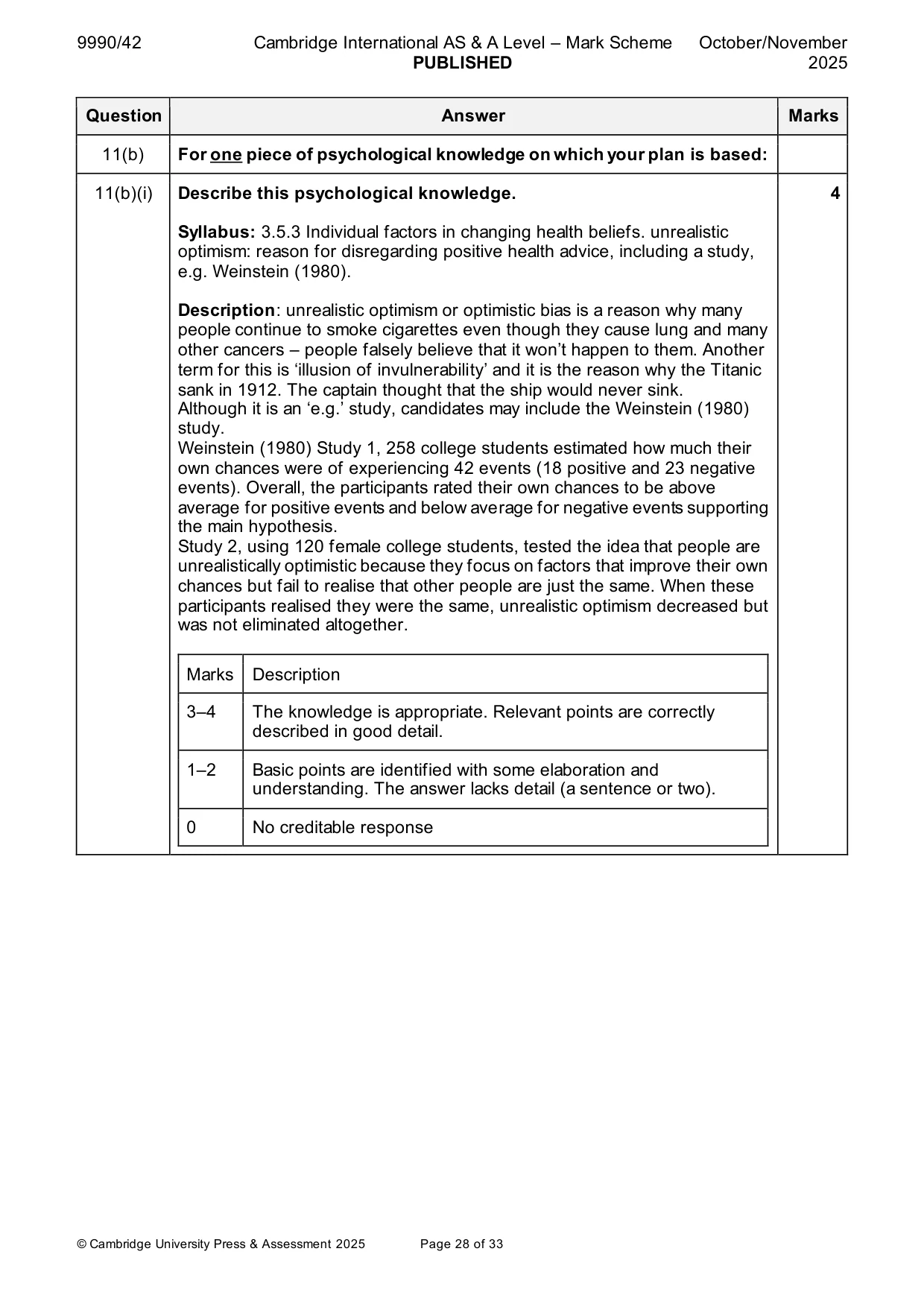
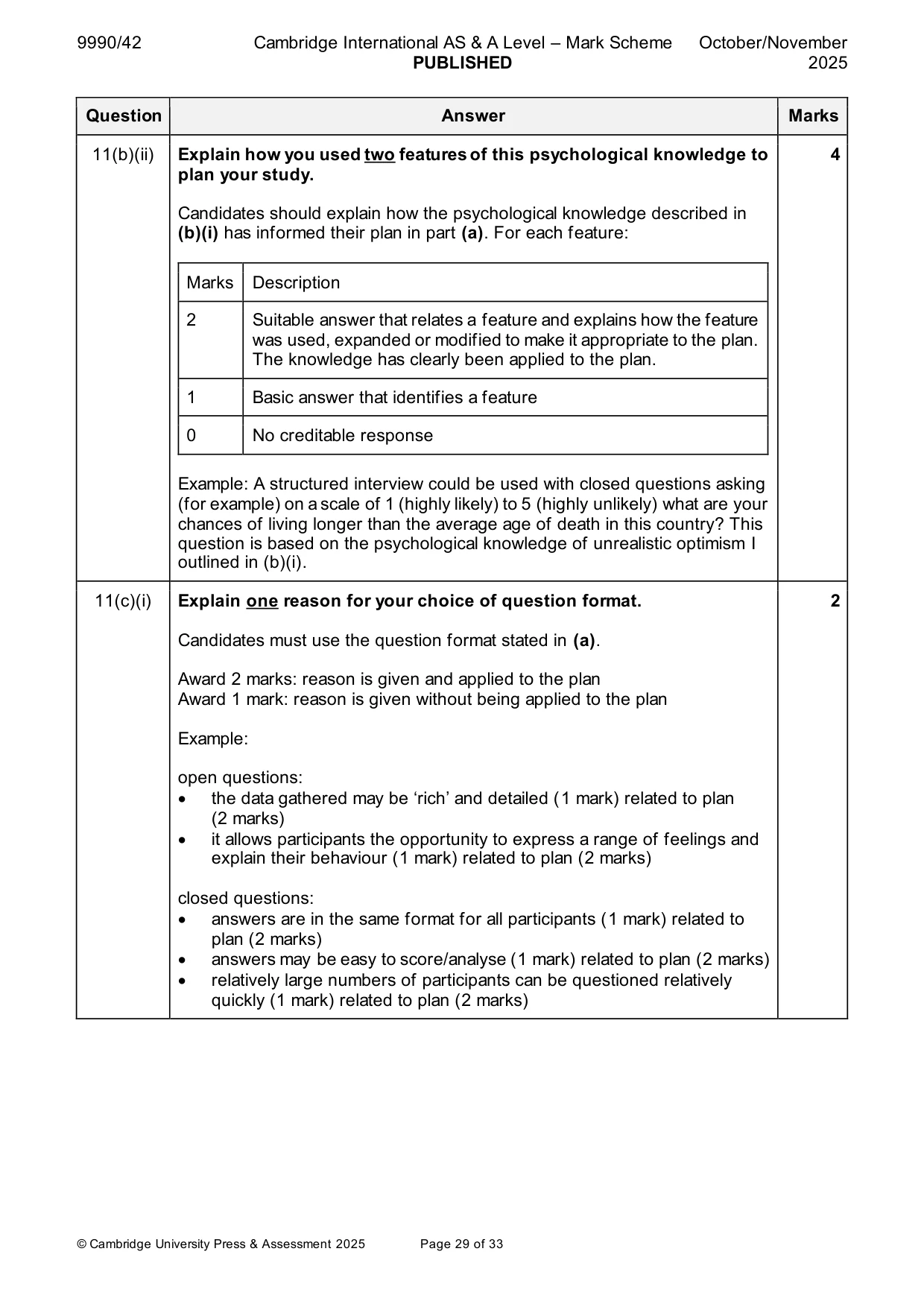
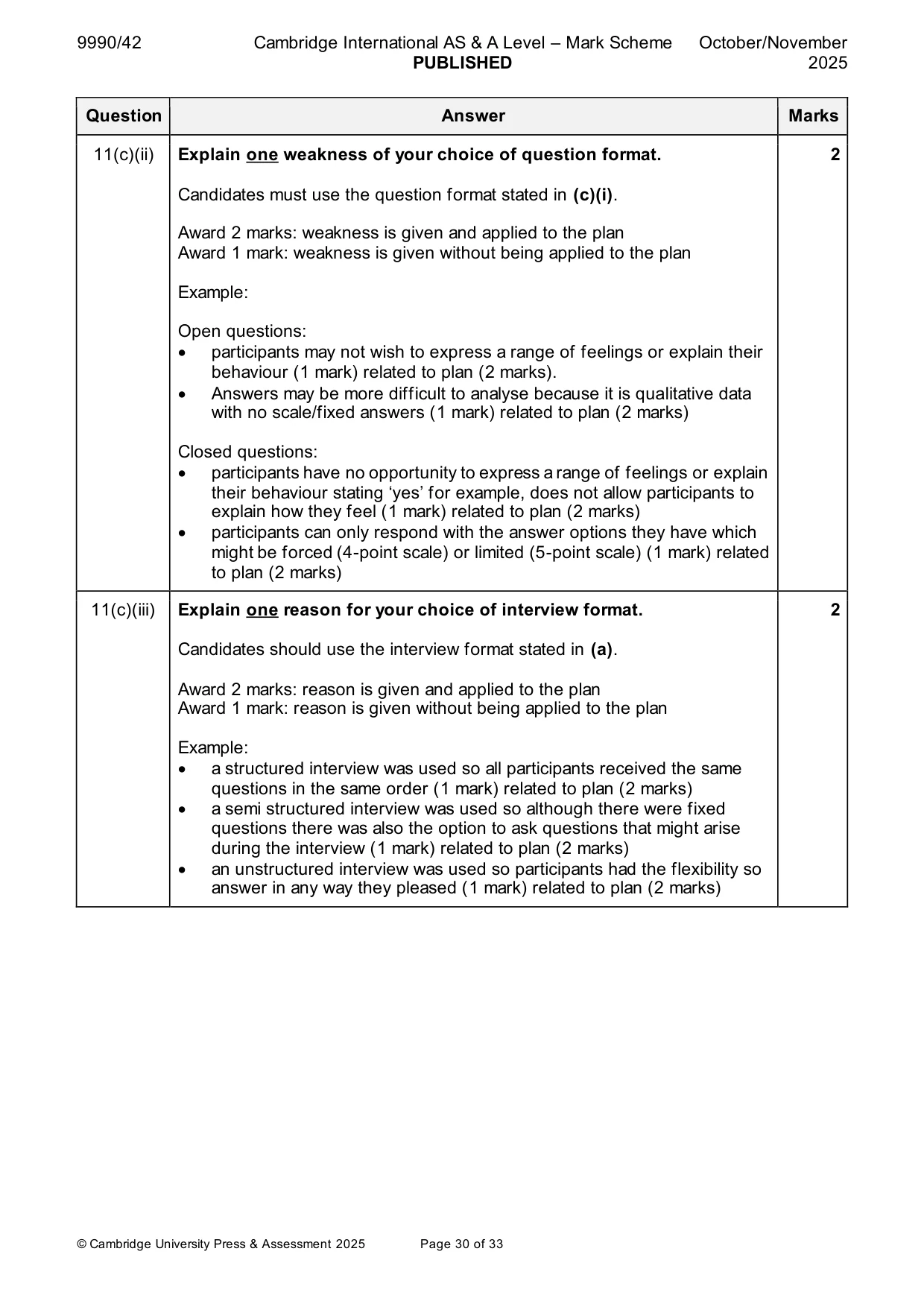
Mark scheme: 11(a) Plan a study using an interview to investigate unrealistic optimism in 10 adults about health beliefs. Your plan must include details about: • question format • interview format. Use Table A: AO2 Application to mark candidate responses to this question. Credit both general features and specific features of the plan. The specific features of the plan The general features of the plan should include: should include (if appropriate): • interview technique (telephone • sample and sampling technique or face-to-face) • ethical guidelines • interview format (structured, • a procedure unstructured, • type of data, analysis of data, semi-structured). use of descriptive statistics • question format (open and/or • an aim or hypothesis closed) (directional or non- • examples of questions directional)/null hypothesis • question scoring/interpretation • steps for making the study valid • number of questions and reliable 11(b) For one piece of psychological knowledge on which your plan is based: 11(b)(i) Describe this psychological knowledge. 4 Syllabus: 3.5.3 Individual factors in changing health beliefs. unrealistic optimism: reason for disregarding positive health advice, including a study, e.g. Weinstein (1980). Description: unrealistic optimism or optimistic bias is a reason why many people continue to smoke cigarettes even though they cause lung and many other cancers – people falsely believe that it won’t happen to them. Another term for this is ‘illusion of invulnerability’ and it is the reason why the Titanic sank in 1912. The captain thought that the ship would never sink. Although it is an ‘e.g.’ study, candidates may include the Weinstein (1980) study. Weinstein (1980) Study 1, 258 college students estimated how much their own chances were of experiencing 42 events (18 positive and 23 negative events). Overall, the participants rated their own chances to be above average for positive events and below average for negative events supporting the main hypothesis. Study 2, using 120 female college students, tested the idea that people are unrealistically optimistic because they focus on factors that improve their own chances but fail to realise that other people are just the same. When these participants realised they were the same, unrealistic optimism decreased but was not eliminated altogether. Marks Description 3–4 The knowledge is appropriate. Relevant points are correctly described in good detail. 1–2 Basic points are identified with some elaboration and understanding. The answer lacks detail (a sentence or two). 0 No creditable response 11(b)(ii) Explain how you used two features of this psychological knowledge to 4 plan your study. Candidates should explain how the psychological knowledge described in (b)(i) has informed their plan in part (a). For each feature: Marks Description 2 Suitable answer that relates a feature and explains how the feature was used, expanded or modified to make it appropriate to the plan. The knowledge has clearly been applied to the plan. 1 Basic answer that identifies a feature 0 No creditable response Example: A structured interview could be used with closed questions asking (for example) on a scale of 1 (highly likely) to 5 (highly unlikely) what are your chances of living longer than the average age of death in this country? This question is based on the psychological knowledge of unrealistic optimism I outlined in (b)(i). 11(c)(i) Explain one reason for your choice of question format. 2 Candidates must use the question format stated in (a). Award 2 marks: reason is given and applied to the plan Award 1 mark: reason is given without being applied to the plan Example: open questions: • the data gathered may be ‘rich’ and detailed (1 mark) related to plan (2 marks) • it allows participants the opportunity to express a range of feelings and explain their behaviour (1 mark) related to plan (2 marks) closed questions: • answers are in the same format for all participants (1 mark) related to plan (2 marks) • answers may be easy to score/analyse (1 mark) related to plan (2 marks) • relatively large numbers of participants can be questioned relatively quickly (1 mark) related to plan (2 marks) 11(c)(ii) Explain one weakness of your choice of question format. 2 Candidates must use the question format stated in (c)(i). Award 2 marks: weakness is given and applied to the plan Award 1 mark: weakness is given without being applied to the plan Example: Open questions: • participants may not wish to express a range of feelings or explain their behaviour (1 mark) related to plan (2 marks). • Answers may be more difficult to analyse because it is qualitative data with no scale/fixed answers (1 mark) related to plan (2 marks) Closed questions: • participants have no opportunity to express a range of feelings or explain their behaviour stating ‘yes’ for example, does not allow participants to explain how they feel (1 mark) related to plan (2 marks) • participants can only respond with the answer options they have which might be forced (4-point scale) or limited (5-point scale) (1 mark) related to plan (2 marks) 11(c)(iii) Explain one reason for your choice of interview format. 2 Candidates should use the interview format stated in (a). Award 2 marks: reason is given and applied to the plan Award 1 mark: reason is given without being applied to the plan Example: • a structured interview was used so all participants received the same questions in the same order (1 mark) related to plan (2 marks) • a semi structured interview was used so although there were fixed questions there was also the option to ask questions that might arise during the interview (1 mark) related to plan (2 marks) • an unstructured interview was used so participants had the flexibility so answer in any way they pleased (1 mark) related to plan (2 marks)
Q12 · Plan a study using an interview to investigate whether praise or recognition is the most…
12 (a) Plan a study using an interview to investigate whether praise or recognition is the most effective way to motivate workers in an organisation. Your plan must include details about: • sampling technique • interview format. [10] (b) For one piece of psychological knowledge on which your plan is based: (i) Describe this psychological knowledge. [4] (ii) Explain how you used two features of this psychological knowledge to plan your study. [4] (c) (i) Explain one reason for your choice of sampling technique. [2] (ii) Explain one weakness of your choice of sampling technique. [2] (iii) Explain one reason for your choice of interview format. [2]
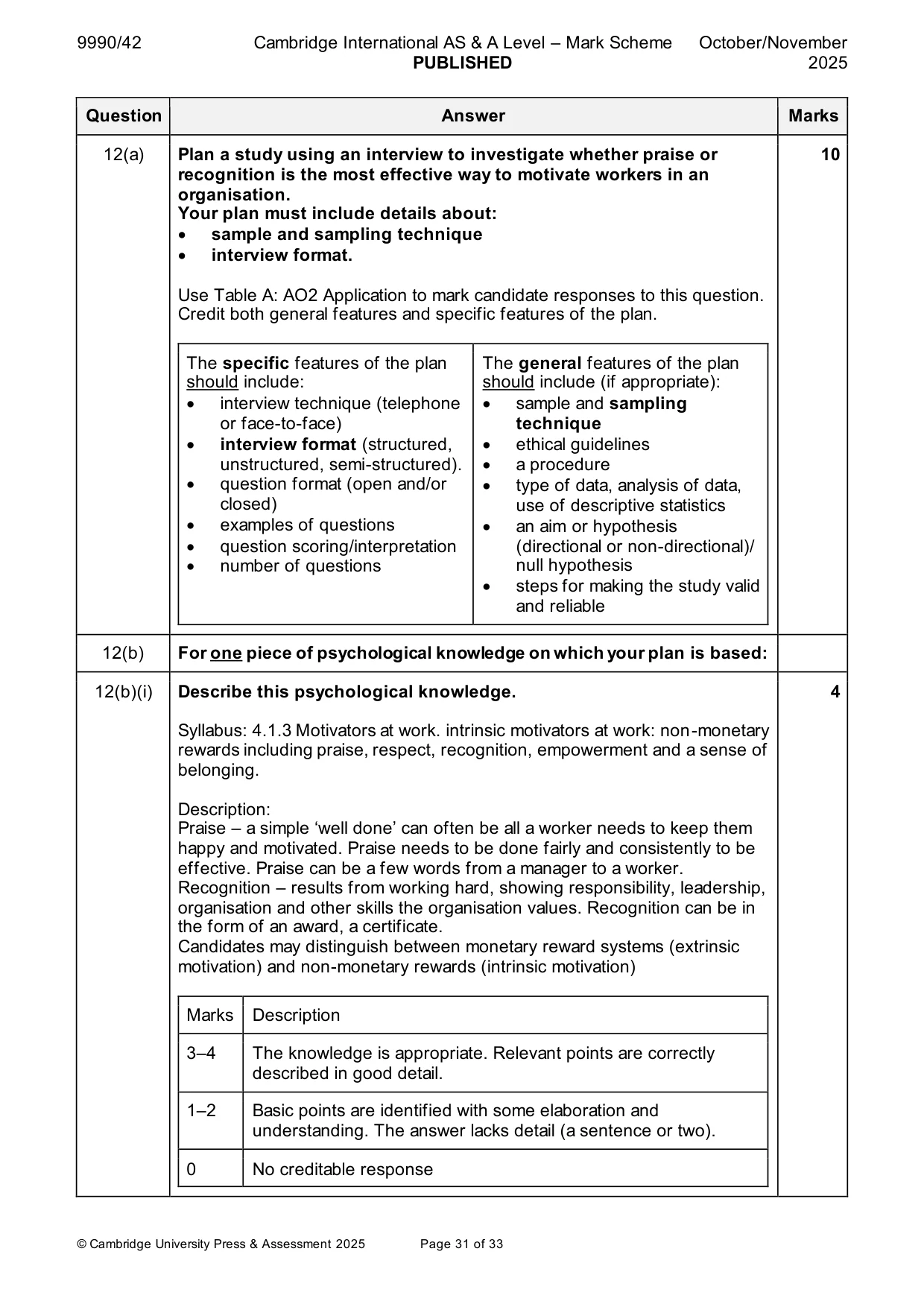
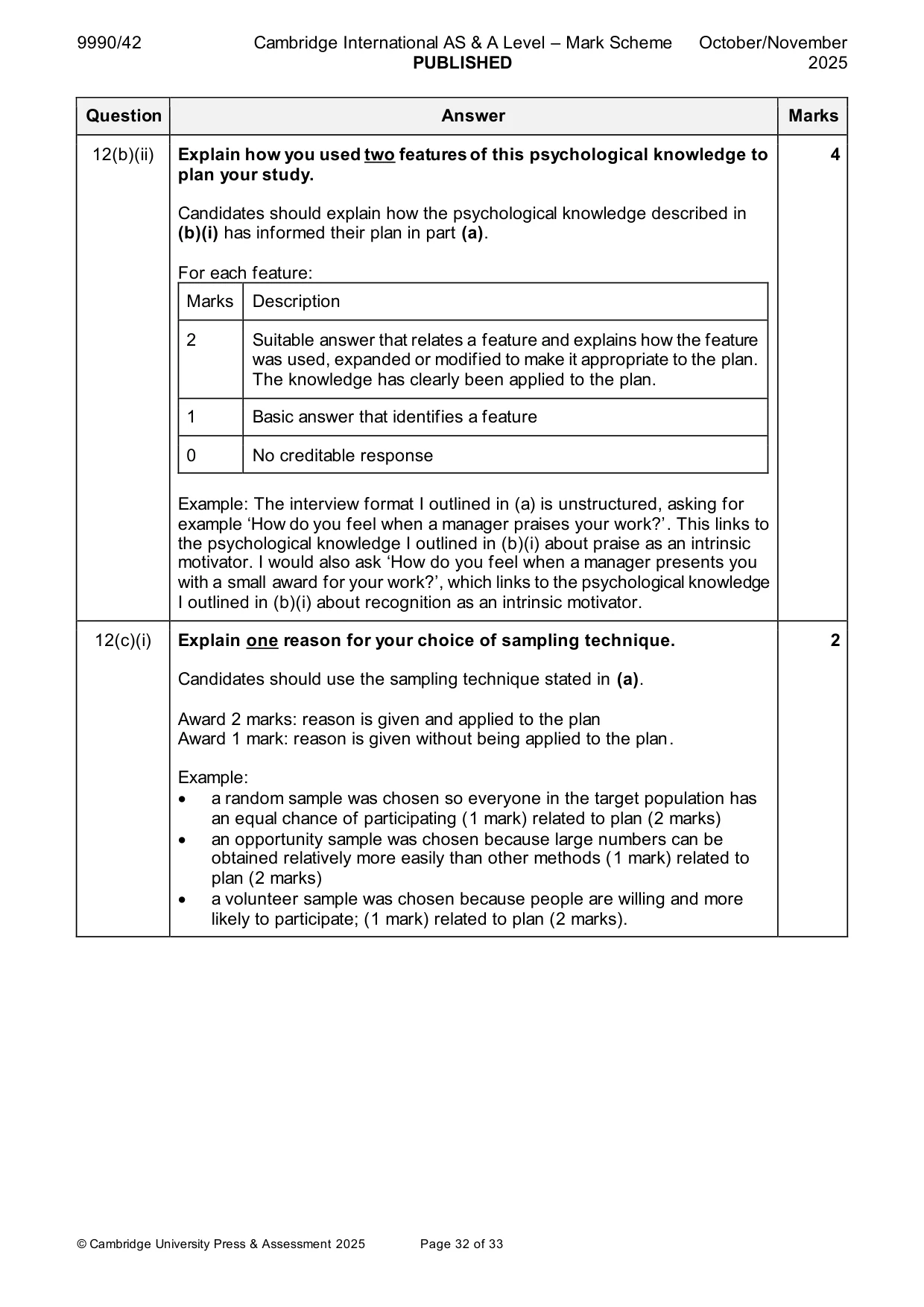
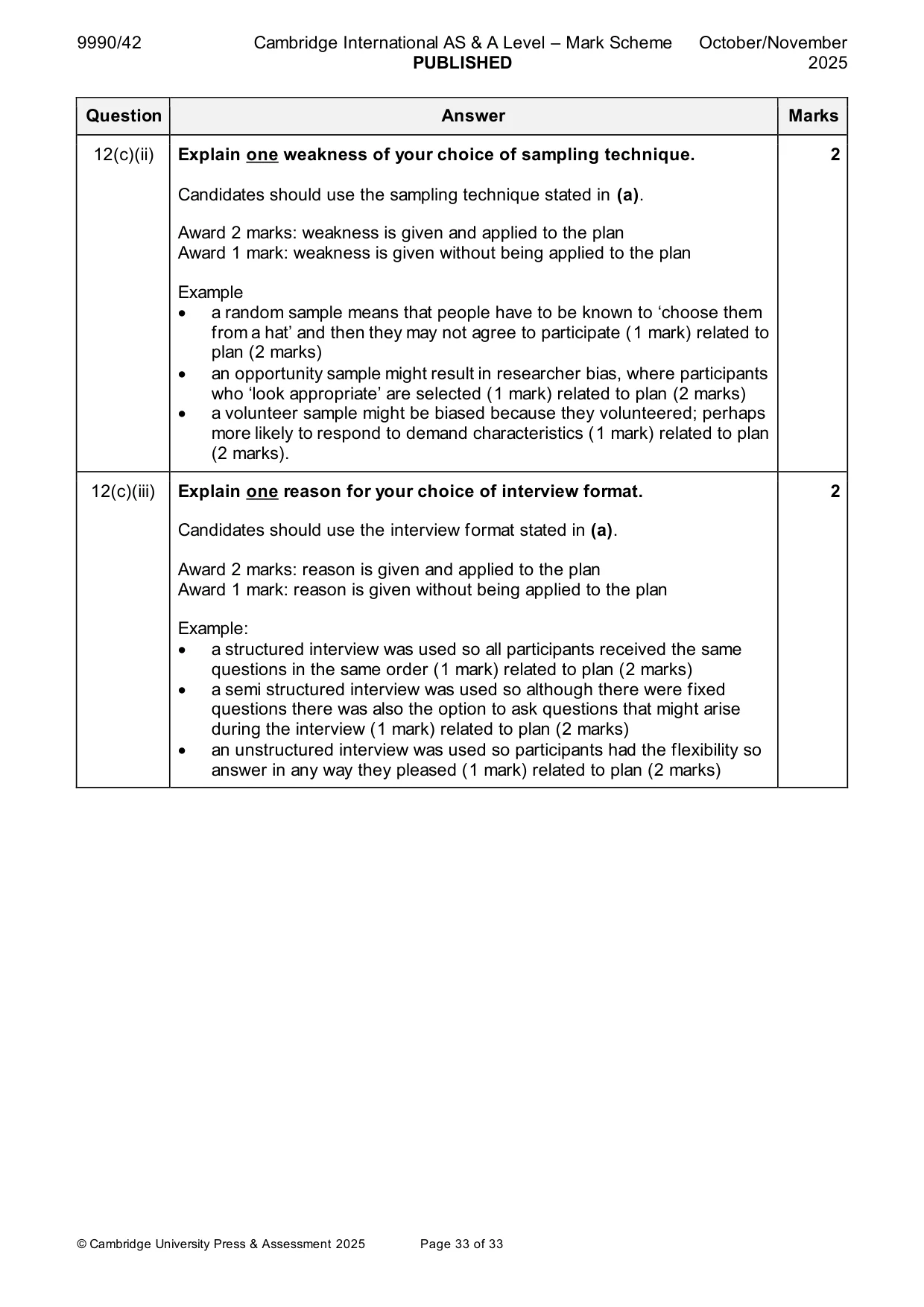
Mark scheme: 12(a) Plan a study using an interview to investigate whether praise or 10 recognition is the most effective way to motivate workers in an organisation. Your plan must include details about: • sample and sampling technique • interview format. Use Table A: AO2 Application to mark candidate responses to this question. Credit both general features and specific features of the plan. The specific features of the plan The general features of the plan should include: should include (if appropriate): • interview technique (telephone • sample and sampling or face-to-face) technique • interview format (structured, • ethical guidelines unstructured, semi-structured). • a procedure • question format (open and/or • type of data, analysis of data, closed) use of descriptive statistics • examples of questions • an aim or hypothesis • question scoring/interpretation (directional or non-directional)/ • number of questions null hypothesis • steps for making the study valid and reliable 12(b) For one piece of psychological knowledge on which your plan is based: 12(b)(i) Describe this psychological knowledge. 4 Syllabus: 4.1.3 Motivators at work. intrinsic motivators at work: non-monetary rewards including praise, respect, recognition, empowerment and a sense of belonging. Description: Praise – a simple ‘well done’ can often be all a worker needs to keep them happy and motivated. Praise needs to be done fairly and consistently to be effective. Praise can be a few words from a manager to a worker. Recognition – results from working hard, showing responsibility, leadership, organisation and other skills the organisation values. Recognition can be in the form of an award, a certificate. Candidates may distinguish between monetary reward systems (extrinsic motivation) and non-monetary rewards (intrinsic motivation) Marks Description 3–4 The knowledge is appropriate. Relevant points are correctly described in good detail. 1–2 Basic points are identified with some elaboration and understanding. The answer lacks detail (a sentence or two). 0 No creditable response 12(b)(ii) Explain how you used two features of this psychological knowledge to 4 plan your study. Candidates should explain how the psychological knowledge described in (b)(i) has informed their plan in part (a). For each feature: Marks Description 2 Suitable answer that relates a feature and explains how the feature was used, expanded or modified to make it appropriate to the plan. The knowledge has clearly been applied to the plan. 1 Basic answer that identifies a feature 0 No creditable response Example: The interview format I outlined in (a) is unstructured, asking for example ‘How do you feel when a manager praises your work?’. This links to the psychological knowledge I outlined in (b)(i) about praise as an intrinsic motivator. I would also ask ‘How do you feel when a manager presents you with a small award for your work?’, which links to the psychological knowledge I outlined in (b)(i) about recognition as an intrinsic motivator. 12(c)(i) Explain one reason for your choice of sampling technique. 2 Candidates should use the sampling technique stated in (a). Award 2 marks: reason is given and applied to the plan Award 1 mark: reason is given without being applied to the plan. Example: • a random sample was chosen so everyone in the target population has an equal chance of participating (1 mark) related to plan (2 marks) • an opportunity sample was chosen because large numbers can be obtained relatively more easily than other methods (1 mark) related to plan (2 marks) • a volunteer sample was chosen because people are willing and more likely to participate; (1 mark) related to plan (2 marks). 12(c)(ii) Explain one weakness of your choice of sampling technique. 2 Candidates should use the sampling technique stated in (a). Award 2 marks: weakness is given and applied to the plan Award 1 mark: weakness is given without being applied to the plan Example • a random sample means that people have to be known to ‘choose them from a hat’ and then they may not agree to participate (1 mark) related to plan (2 marks) • an opportunity sample might result in researcher bias, where participants who ‘look appropriate’ are selected (1 mark) related to plan (2 marks) • a volunteer sample might be biased because they volunteered; perhaps more likely to respond to demand characteristics (1 mark) related to plan (2 marks). 12(c)(iii) Explain one reason for your choice of interview format. 2 Candidates should use the interview format stated in (a). Award 2 marks: reason is given and applied to the plan Award 1 mark: reason is given without being applied to the plan Example: • a structured interview was used so all participants received the same questions in the same order (1 mark) related to plan (2 marks) • a semi structured interview was used so although there were fixed questions there was also the option to ask questions that might arise during the interview (1 mark) related to plan (2 marks) • an unstructured interview was used so participants had the flexibility so answer in any way they pleased (1 mark) related to plan (2 marks)
What was in this paper
The subtopics covered by these 12 questions, and how many questions each got. Open one in a new tab to see every Cambridge question on it.