Cambridge A Level Psychology (from 2018) 9990 — 2023 May/June Paper 4 · Variant 3
9990/43/M/J/23 · 12 questions · 60 marks · ≈68 min
The question paper and its mark scheme, free to read here and free to download. This is Cambridge’s own paper, exactly as it was sat.
Question paper8 pages
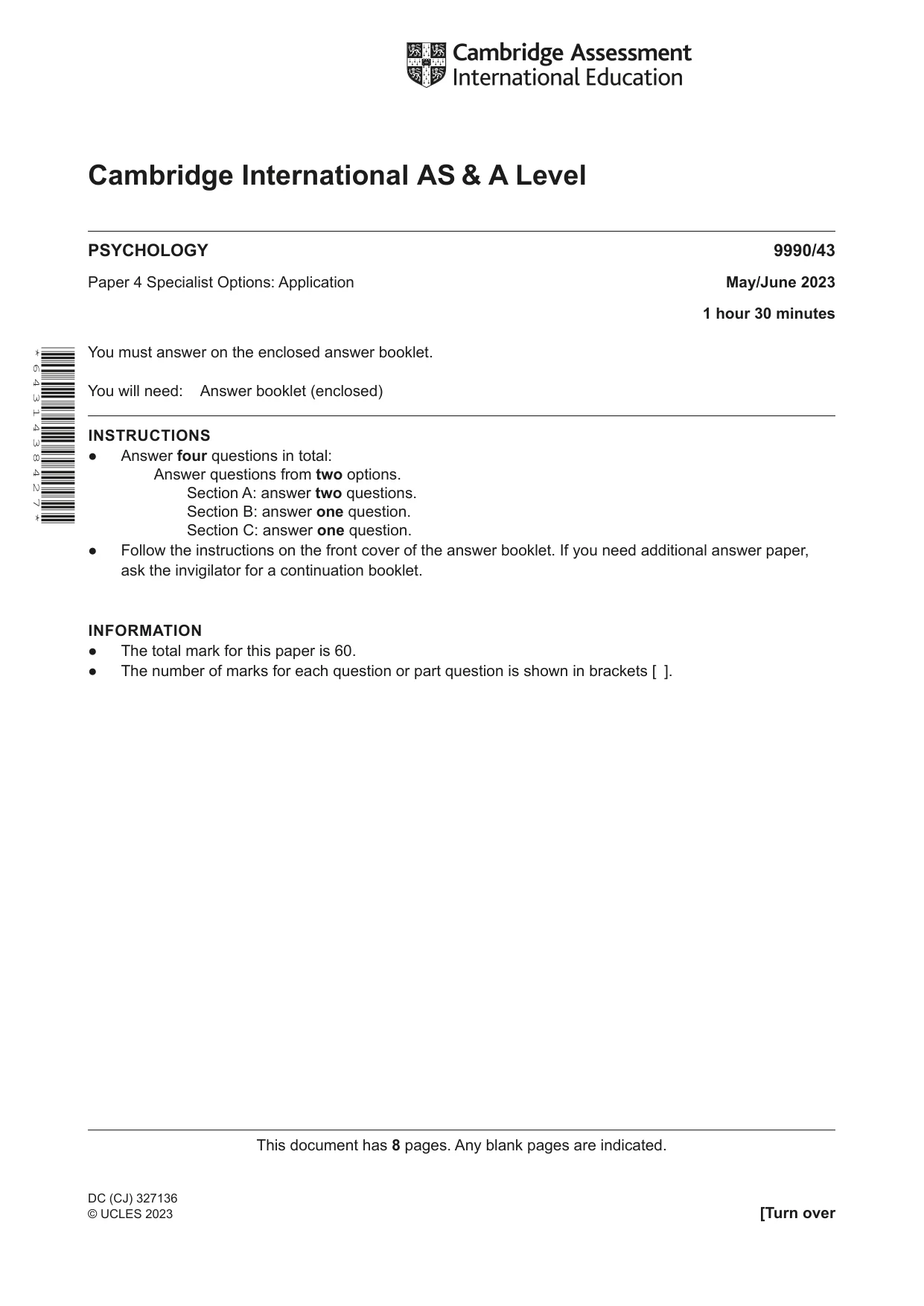
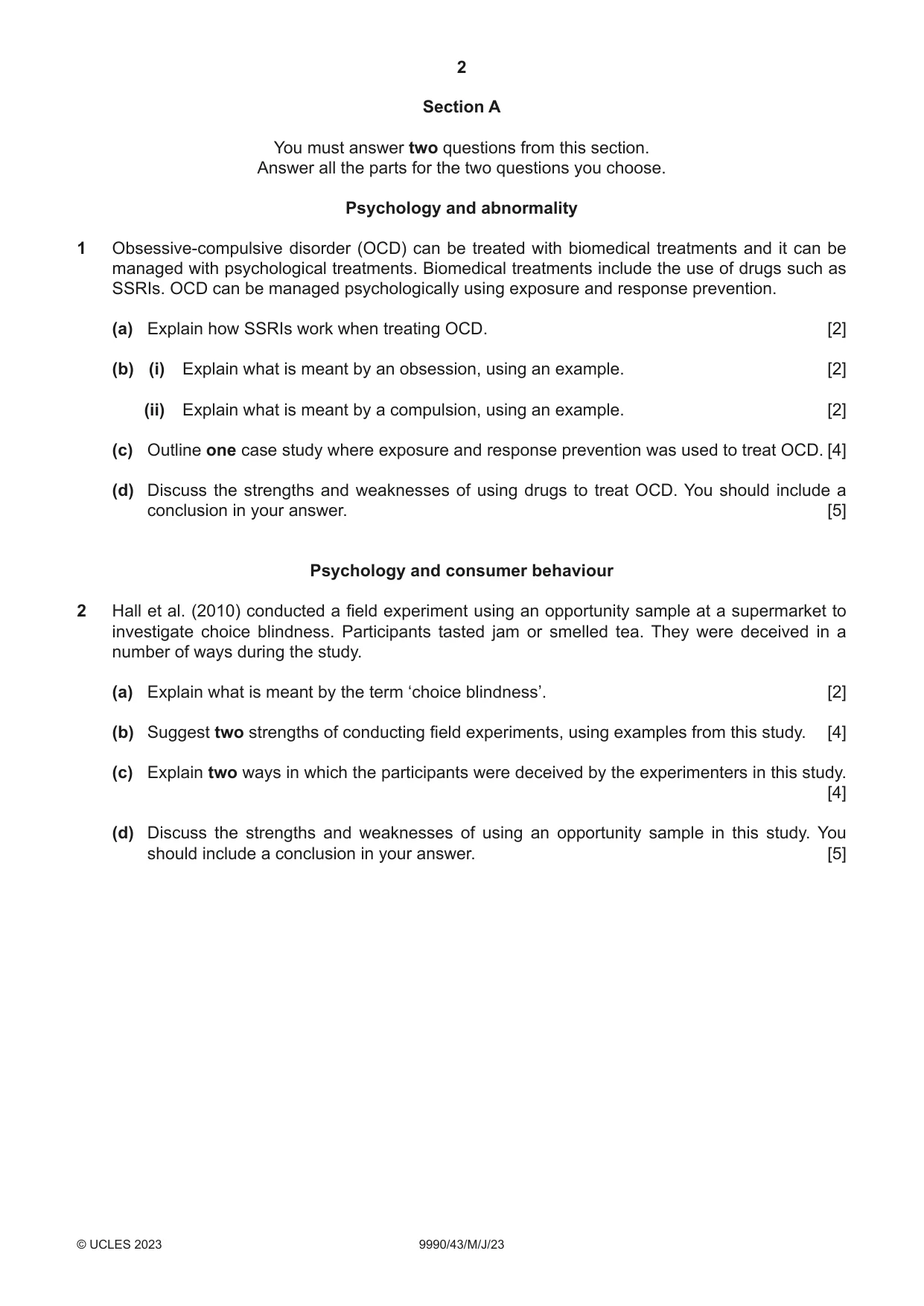
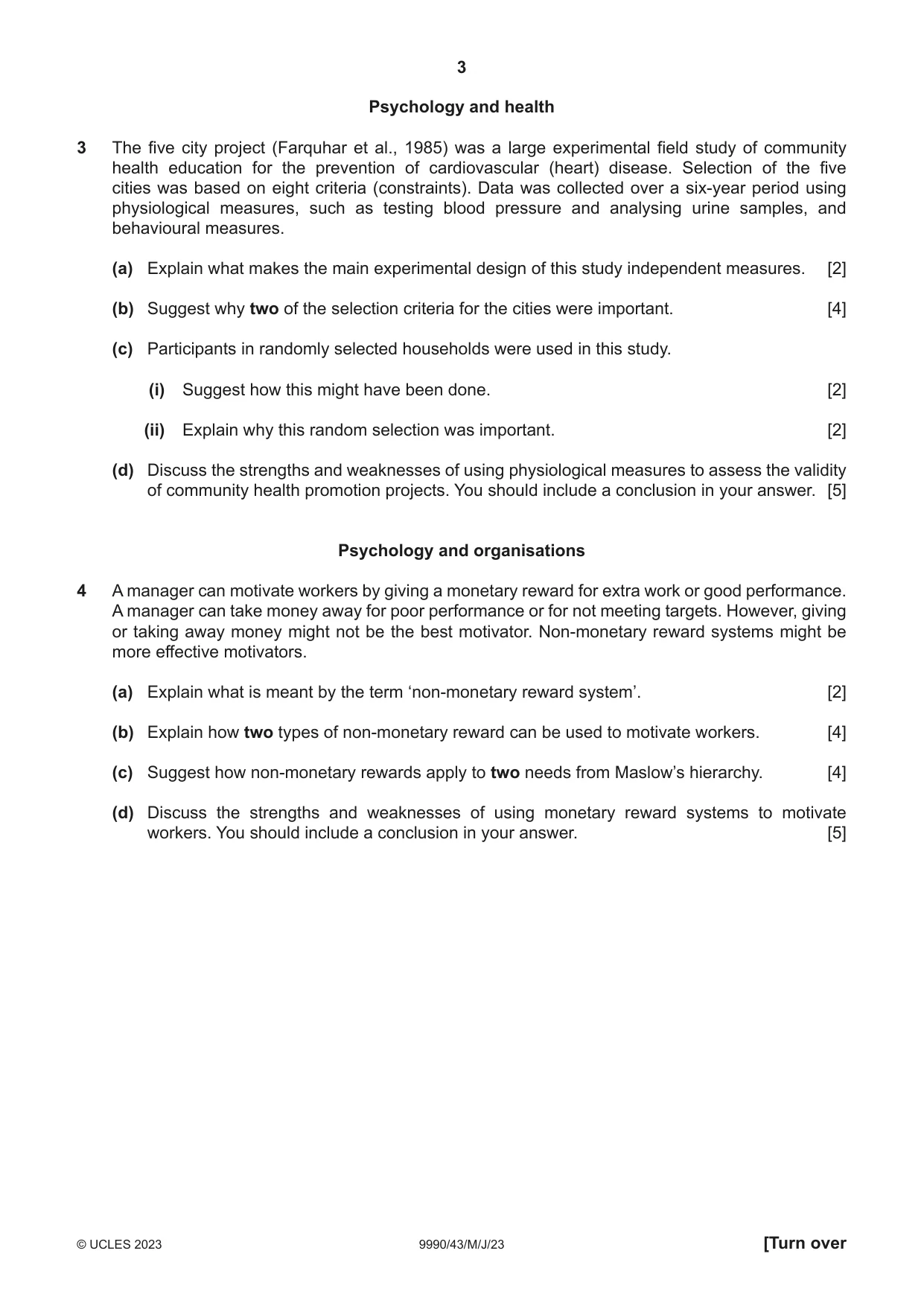
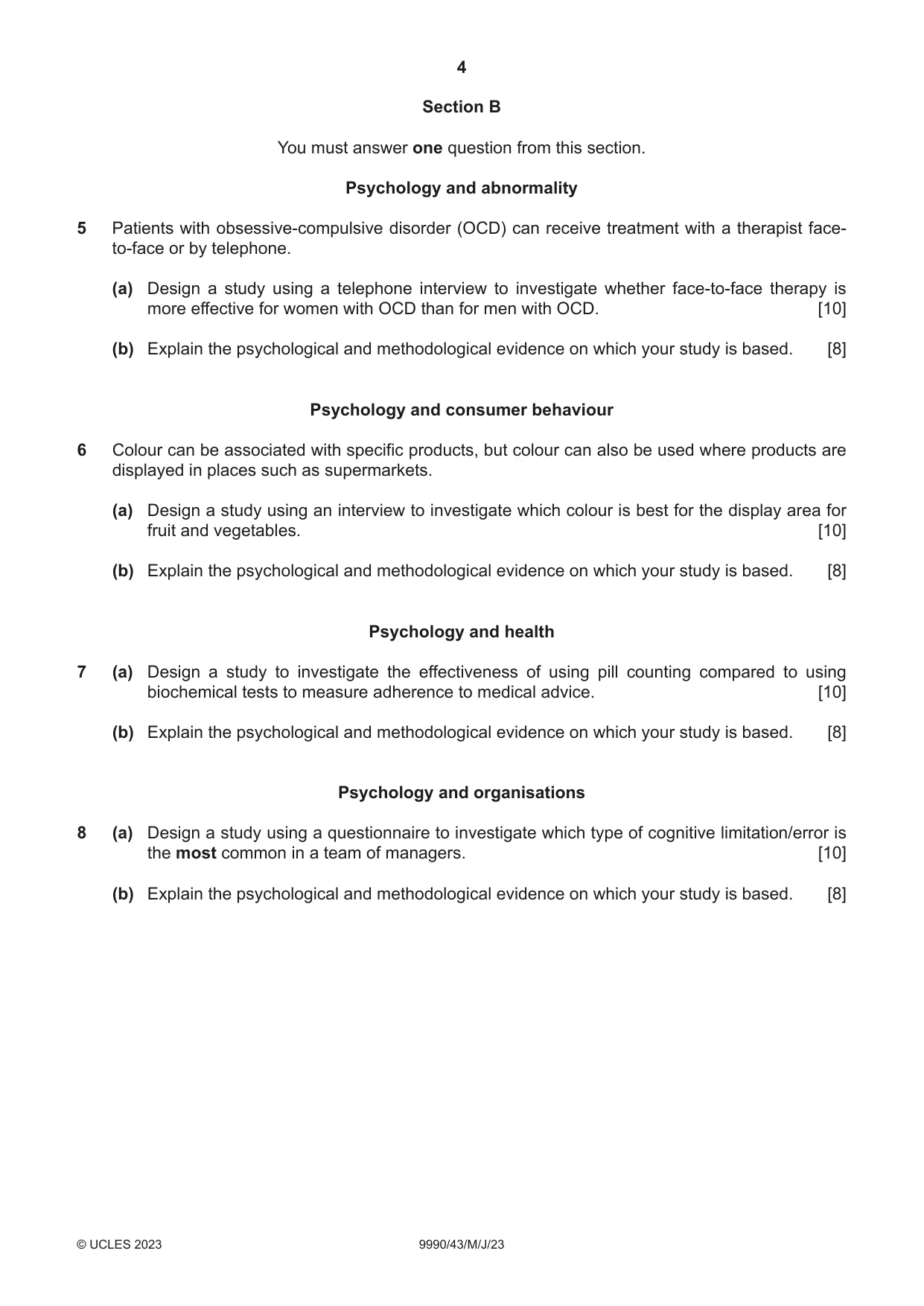



Mark scheme26 pages
Answers below. Sit the paper first if you are practising.
Questions as text
Q1 · Obsessive-compulsive disorder (OCD) can be treated with biomedical treatments and it can…
1 Obsessive-compulsive disorder (OCD) can be treated with biomedical treatments and it can be managed with psychological treatments. Biomedical treatments include the use of drugs such as SSRIs. OCD can be managed psychologically using exposure and response prevention. (a) Explain how SSRIs work when treating OCD. [2] (b) (i) Explain what is meant by an obsession, using an example. [2] (ii) Explain what is meant by a compulsion, using an example. [2] (c) Outline one case study where exposure and response prevention was used to treat OCD. [4] (d) Discuss the strengths and weaknesses of using drugs to treat OCD. You should include a conclusion in your answer. [5] Psychology and consumer behaviour
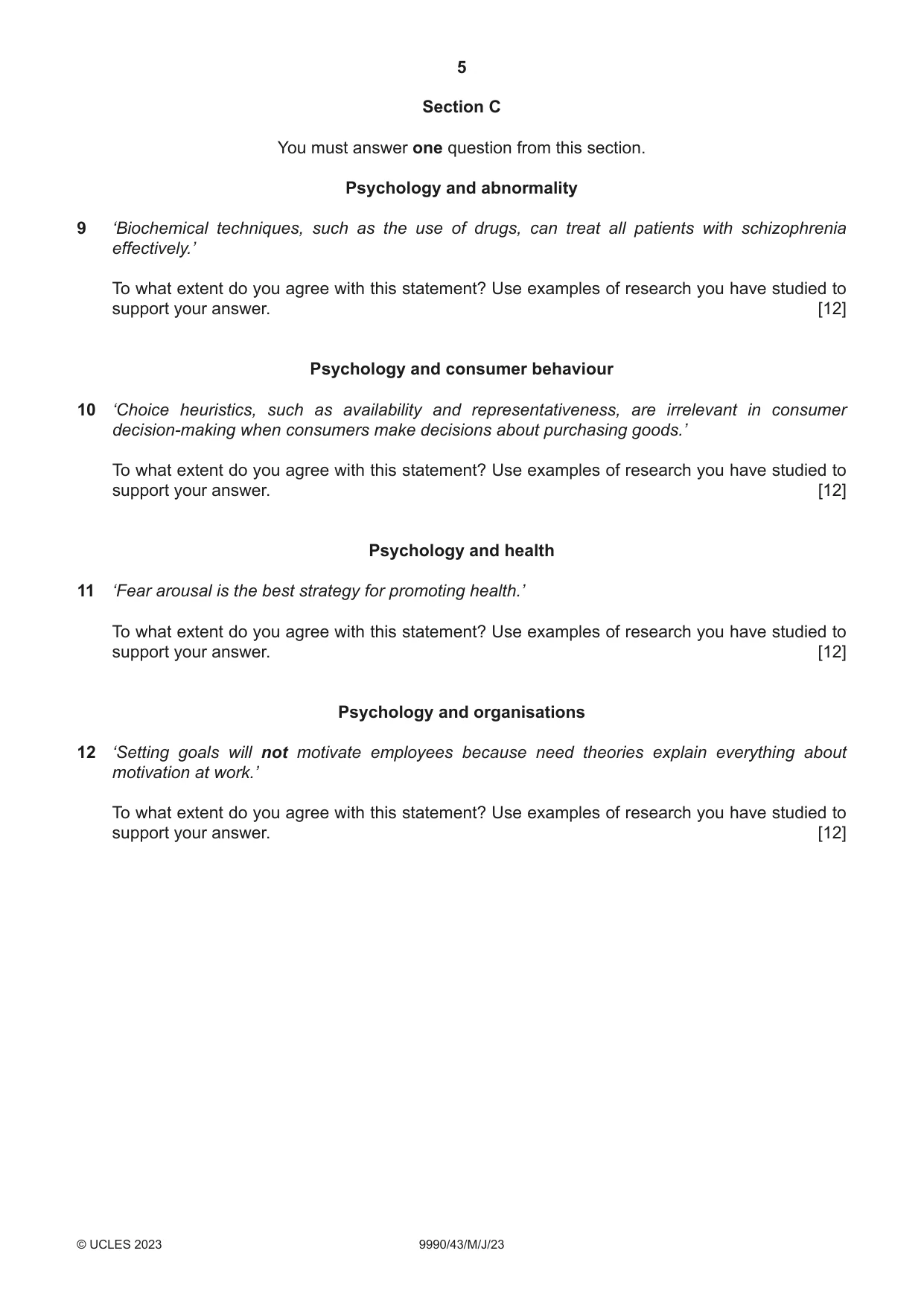
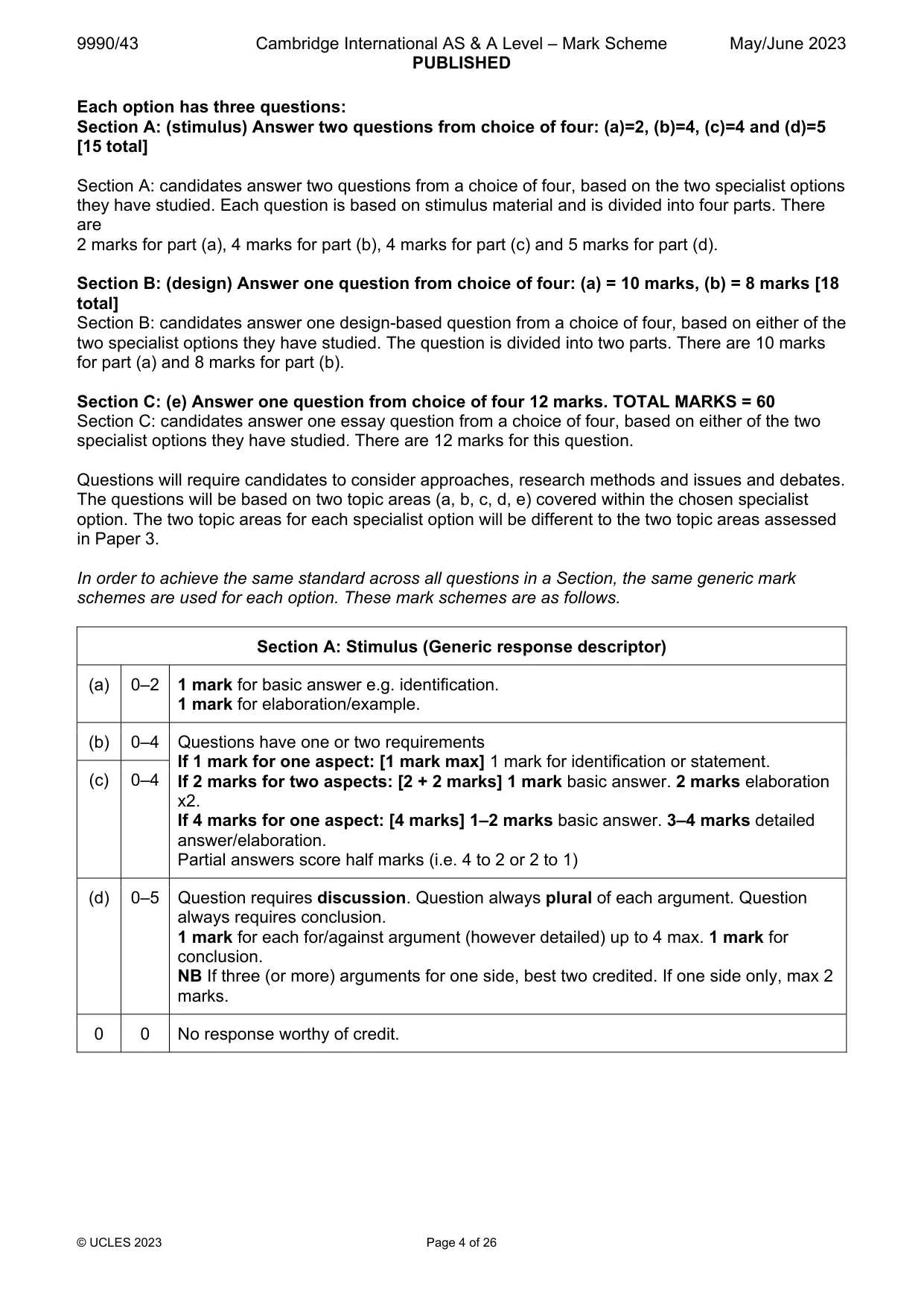
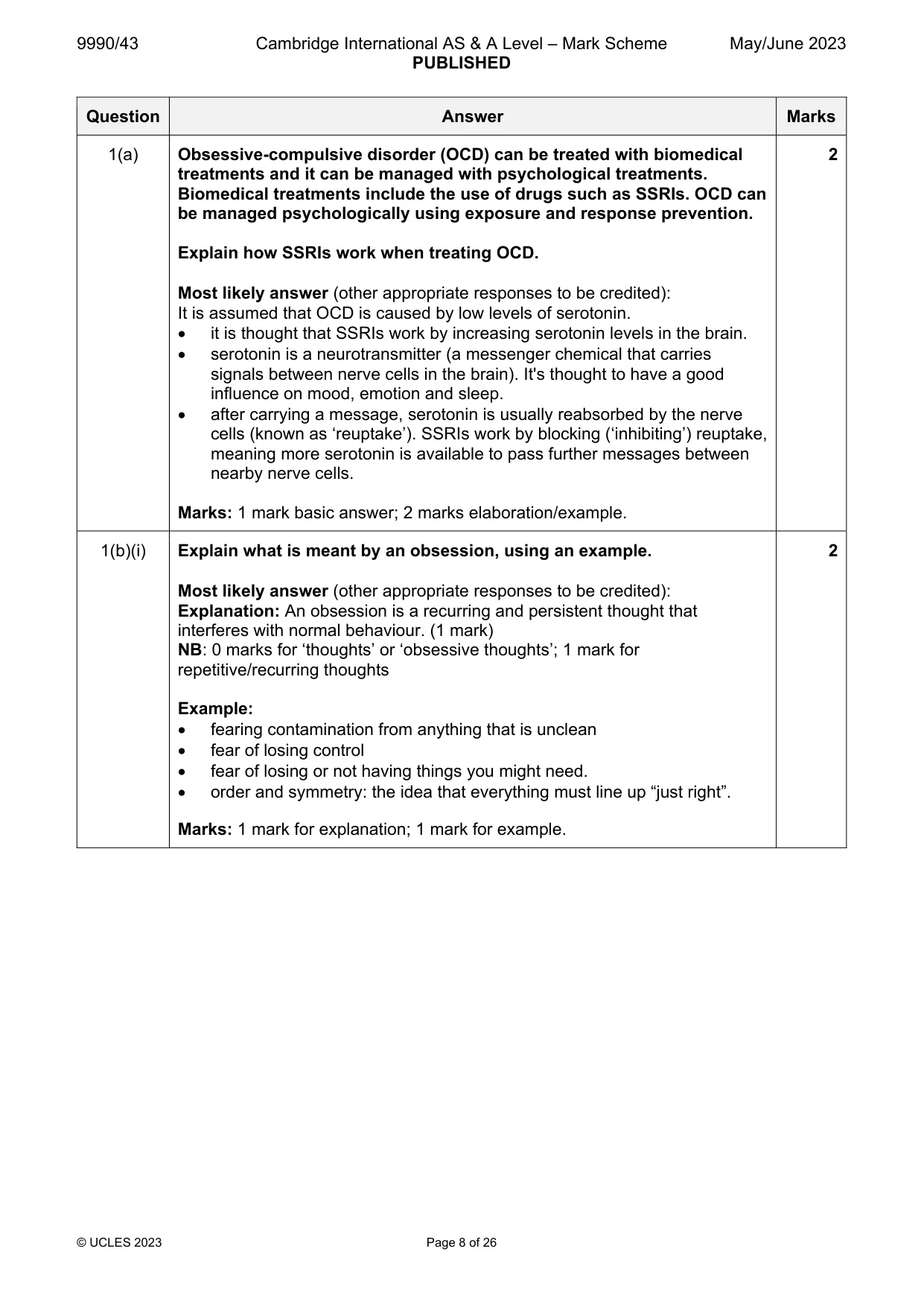
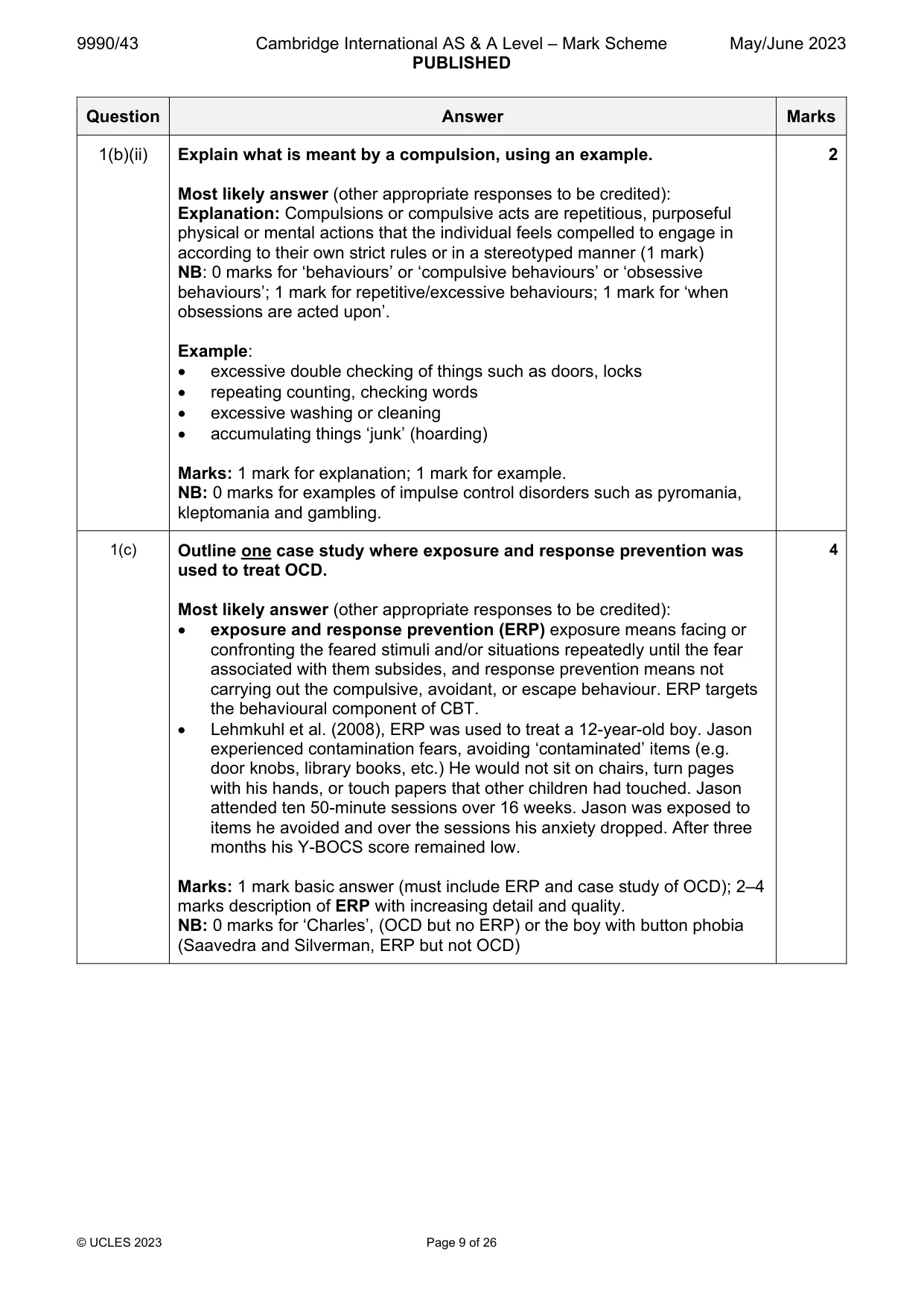
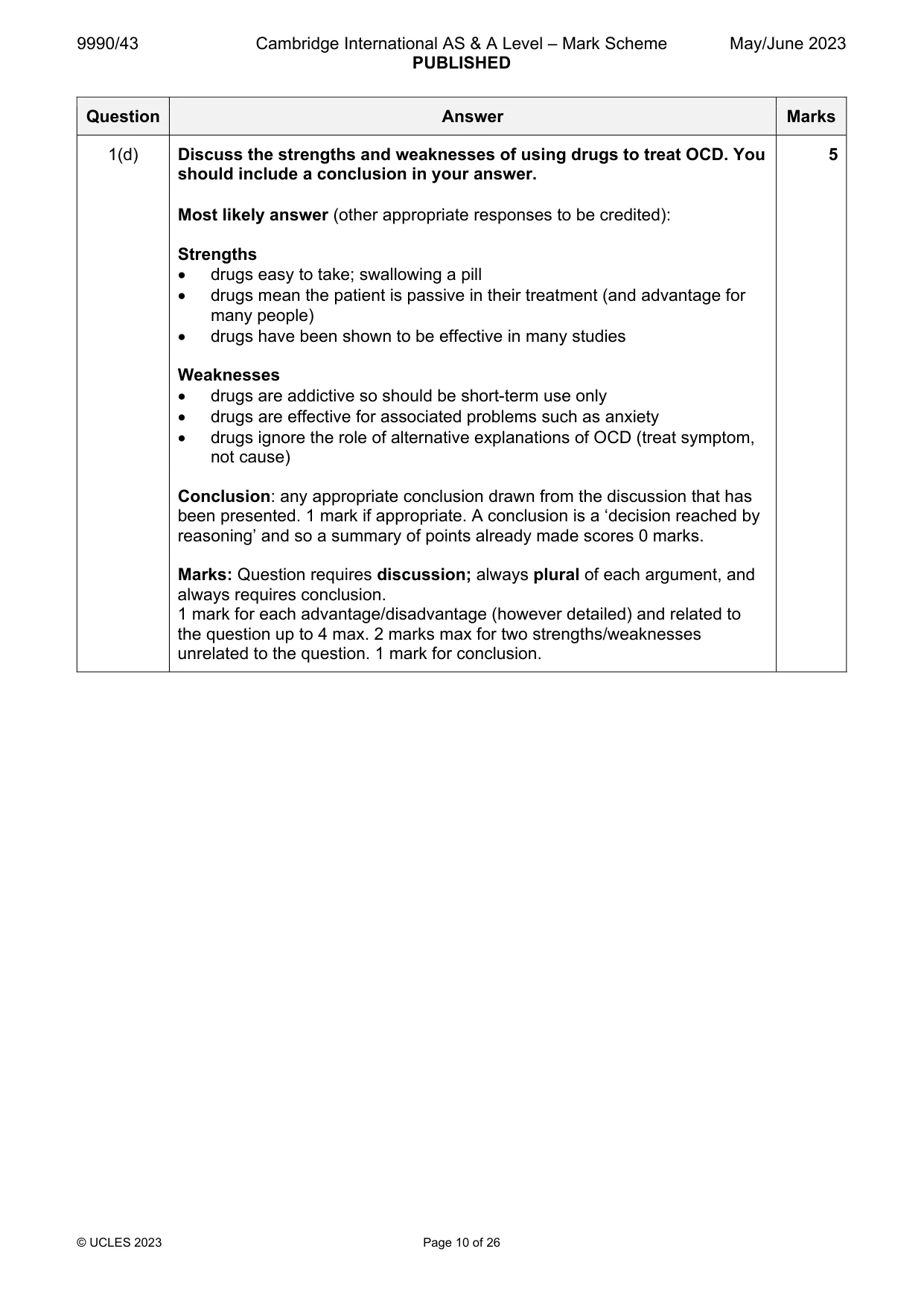
Mark scheme: Question Answer Marks 1(a) Obsessive-compulsive disorder (OCD) can be treated with biomedical 2 treatments and it can be managed with psychological treatments. Biomedical treatments include the use of drugs such as SSRIs. OCD can be managed psychologically using exposure and response prevention. Explain how SSRIs work when treating OCD. Most likely answer (other appropriate responses to be credited): It is assumed that OCD is caused by low levels of serotonin. it is thought that SSRIs work by increasing serotonin levels in the brain. serotonin is a neurotransmitter (a messenger chemical that carries signals between nerve cells in the brain). It's thought to have a good influence on mood, emotion and sleep. after carrying a message, serotonin is usually reabsorbed by the nerve cells (known as ‘reuptake’). SSRIs work by blocking (‘inhibiting’) reuptake, meaning more serotonin is available to pass further messages between nearby nerve cells. Marks: 1 mark basic answer; 2 marks elaboration/example. 1(b)(i) Explain what is meant by an obsession, using an example. 2 Most likely answer (other appropriate responses to be credited): Explanation: An obsession is a recurring and persistent thought that interferes with normal behaviour. (1 mark) NB: 0 marks for ‘thoughts’ or ‘obsessive thoughts’; 1 mark for repetitive/recurring thoughts Example: fearing contamination from anything that is unclean fear of losing control fear of losing or not having things you might need. order and symmetry: the idea that everything must line up “just right”. Marks: 1 mark for explanation; 1 mark for example. 1(b)(ii) Explain what is meant by a compulsion, using an example. 2 Most likely answer (other appropriate responses to be credited): Explanation: Compulsions or compulsive acts are repetitious, purposeful physical or mental actions that the individual feels compelled to engage in according to their own strict rules or in a stereotyped manner (1 mark) NB: 0 marks for ‘behaviours’ or ‘compulsive behaviours’ or ‘obsessive behaviours’; 1 mark for repetitive/excessive behaviours; 1 mark for ‘when obsessions are acted upon’. Example: excessive double checking of things such as doors, locks repeating counting, checking words excessive washing or cleaning accumulating things ‘junk’ (hoarding) Marks: 1 mark for explanation; 1 mark for example. NB: 0 marks for examples of impulse control disorders such as pyromania, kleptomania and gambling. 1(c) Outline one case study where exposure and response prevention was 4 used to treat OCD. Most likely answer (other appropriate responses to be credited): exposure and response prevention (ERP) exposure means facing or confronting the feared stimuli and/or situations repeatedly until the fear associated with them subsides, and response prevention means not carrying out the compulsive, avoidant, or escape behaviour. ERP targets the behavioural component of CBT. Lehmkuhl et al. (2008), ERP was used to treat a 12-year-old boy. Jason experienced contamination fears, avoiding ‘contaminated’ items (e.g. door knobs, library books, etc.) He would not sit on chairs, turn pages with his hands, or touch papers that other children had touched. Jason attended ten 50-minute sessions over 16 weeks. Jason was exposed to items he avoided and over the sessions his anxiety dropped. After three months his Y-BOCS score remained low. Marks: 1 mark basic answer (must include ERP and case study of OCD); 2–4 marks description of ERP with increasing detail and quality. NB: 0 marks for ‘Charles’, (OCD but no ERP) or the boy with button phobia (Saavedra and Silverman, ERP but not OCD) 1(d) Discuss the strengths and weaknesses of using drugs to treat OCD. You 5 should include a conclusion in your answer. Most likely answer (other appropriate responses to be credited): Strengths drugs easy to take; swallowing a pill drugs mean the patient is passive in their treatment (and advantage for many people) drugs have been shown to be effective in many studies Weaknesses drugs are addictive so should be short-term use only drugs are effective for associated problems such as anxiety drugs ignore the role of alternative explanations of OCD (treat symptom, not cause) Conclusion: any appropriate conclusion drawn from the discussion that has been presented. 1 mark if appropriate. A conclusion is a ‘decision reached by reasoning’ and so a summary of points already made scores 0 marks. Marks: Question requires discussion; always plural of each argument, and always requires conclusion. 1 mark for each advantage/disadvantage (however detailed) and related to the question up to 4 max. 2 marks max for two strengths/weaknesses unrelated to the question. 1 mark for conclusion.
Question 2
2 Hall et al. (2010) conducted a field experiment using an opportunity sample at a supermarket to investigate choice blindness. Participants tasted jam or smelled tea. They were deceived in a number of ways during the study. (a) Explain what is meant by the term ‘choice blindness’. [2] (b) Suggest two strengths of conducting field experiments, using examples from this study. [4] (c) Explain two ways in which the participants were deceived by the experimenters in this study. [4] (d) Discuss the strengths and weaknesses of using an opportunity sample in this study. You should include a conclusion in your answer. [5] Psychology and health
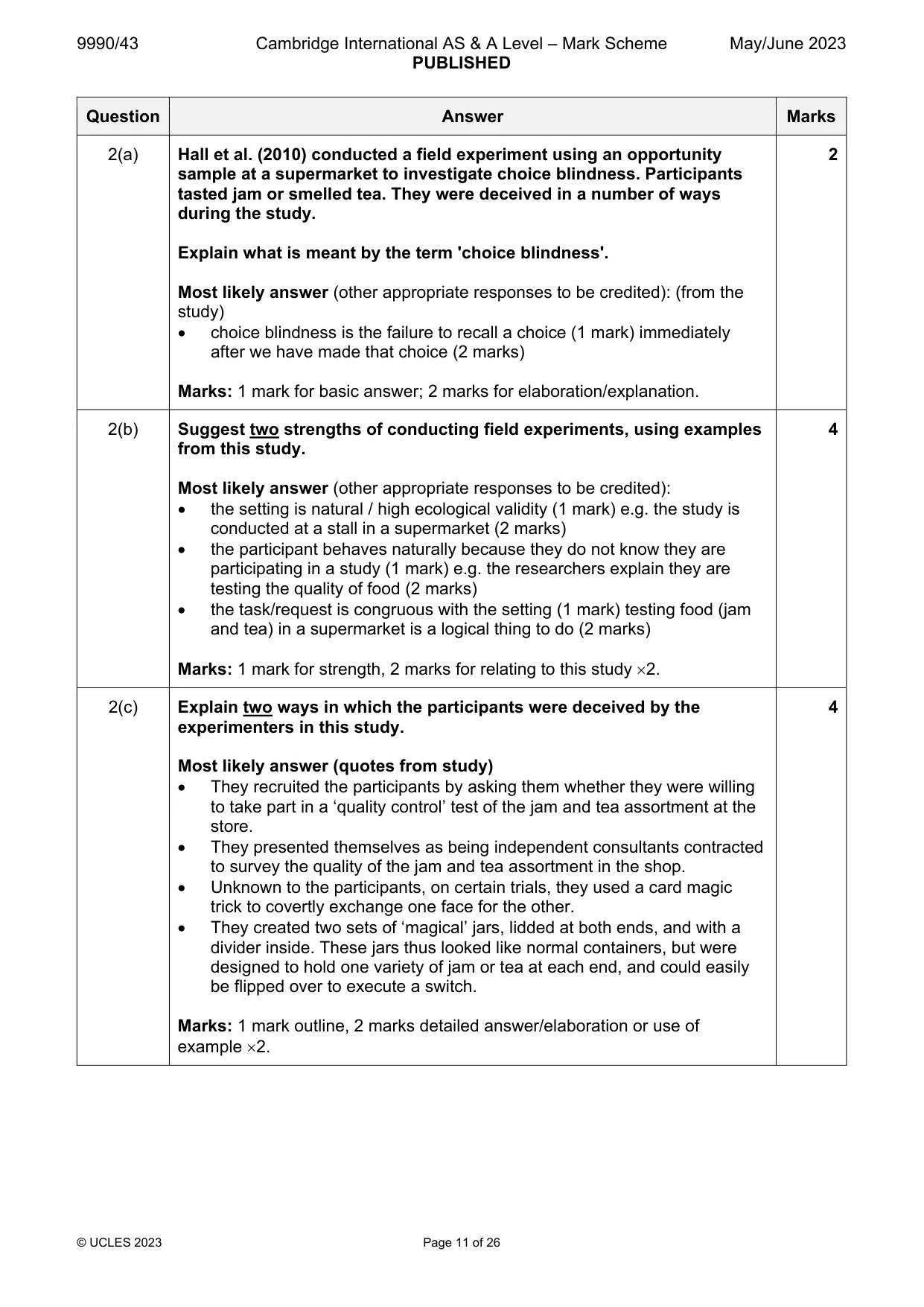
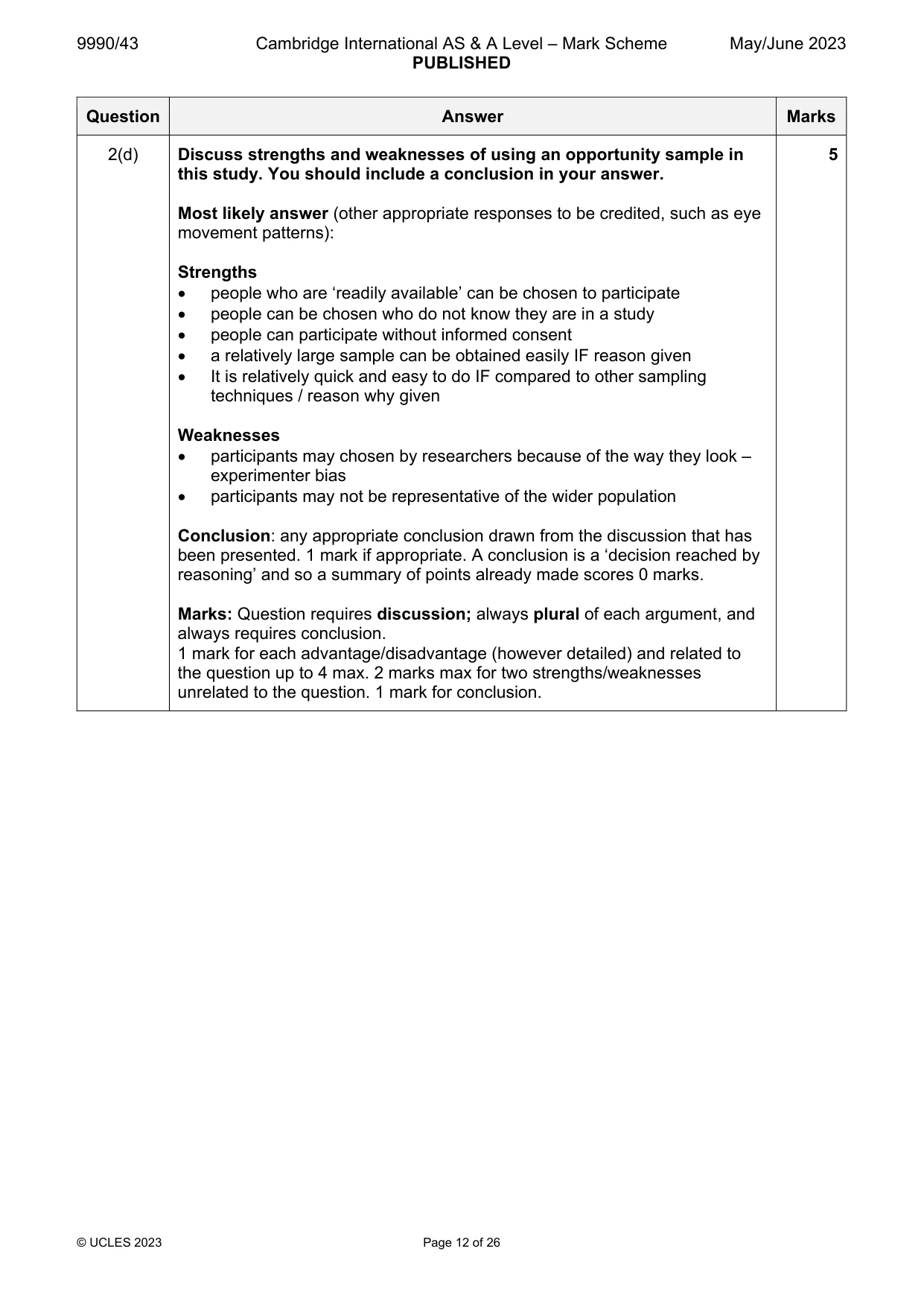
Mark scheme: 2(a) Hall et al. (2010) conducted a field experiment using an opportunity 2 sample at a supermarket to investigate choice blindness. Participants tasted jam or smelled tea. They were deceived in a number of ways during the study. Explain what is meant by the term 'choice blindness'. Most likely answer (other appropriate responses to be credited): (from the study) choice blindness is the failure to recall a choice (1 mark) immediately after we have made that choice (2 marks) Marks: 1 mark for basic answer; 2 marks for elaboration/explanation. 2(b) Suggest two strengths of conducting field experiments, using examples 4 from this study. Most likely answer (other appropriate responses to be credited): the setting is natural / high ecological validity (1 mark) e.g. the study is conducted at a stall in a supermarket (2 marks) the participant behaves naturally because they do not know they are participating in a study (1 mark) e.g. the researchers explain they are testing the quality of food (2 marks) the task/request is congruous with the setting (1 mark) testing food (jam and tea) in a supermarket is a logical thing to do (2 marks) Marks: 1 mark for strength, 2 marks for relating to this study 2. 2(c) Explain two ways in which the participants were deceived by the 4 experimenters in this study. Most likely answer (quotes from study) They recruited the participants by asking them whether they were willing to take part in a ‘quality control’ test of the jam and tea assortment at the store. They presented themselves as being independent consultants contracted to survey the quality of the jam and tea assortment in the shop. Unknown to the participants, on certain trials, they used a card magic trick to covertly exchange one face for the other. They created two sets of ‘magical’ jars, lidded at both ends, and with a divider inside. These jars thus looked like normal containers, but were designed to hold one variety of jam or tea at each end, and could easily be flipped over to execute a switch. Marks: 1 mark outline, 2 marks detailed answer/elaboration or use of example 2. 2(d) Discuss strengths and weaknesses of using an opportunity sample in 5 this study. You should include a conclusion in your answer. Most likely answer (other appropriate responses to be credited, such as eye movement patterns): Strengths people who are ‘readily available’ can be chosen to participate people can be chosen who do not know they are in a study people can participate without informed consent a relatively large sample can be obtained easily IF reason given It is relatively quick and easy to do IF compared to other sampling techniques / reason why given Weaknesses participants may chosen by researchers because of the way they look – experimenter bias participants may not be representative of the wider population Conclusion: any appropriate conclusion drawn from the discussion that has been presented. 1 mark if appropriate. A conclusion is a ‘decision reached by reasoning’ and so a summary of points already made scores 0 marks. Marks: Question requires discussion; always plural of each argument, and always requires conclusion. 1 mark for each advantage/disadvantage (however detailed) and related to the question up to 4 max. 2 marks max for two strengths/weaknesses unrelated to the question. 1 mark for conclusion.
Q3 · The five city project (Farquhar et al., 1985) was a large experimental field study of…
3 The five city project (Farquhar et al., 1985) was a large experimental field study of community health education for the prevention of cardiovascular (heart) disease. Selection of the five cities was based on eight criteria (constraints). Data was collected over a six-year period using physiological measures, such as testing blood pressure and analysing urine samples, and behavioural measures. (a) Explain what makes the main experimental design of this study independent measures. [2] (b) Suggest why two of the selection criteria for the cities were important. [4] (c) Participants in randomly selected households were used in this study. (i) Suggest how this might have been done. [2] (ii) Explain why this random selection was important. [2] (d) Discuss the strengths and weaknesses of using physiological measures to assess the validity of community health promotion projects. You should include a conclusion in your answer. [5] Psychology and organisations
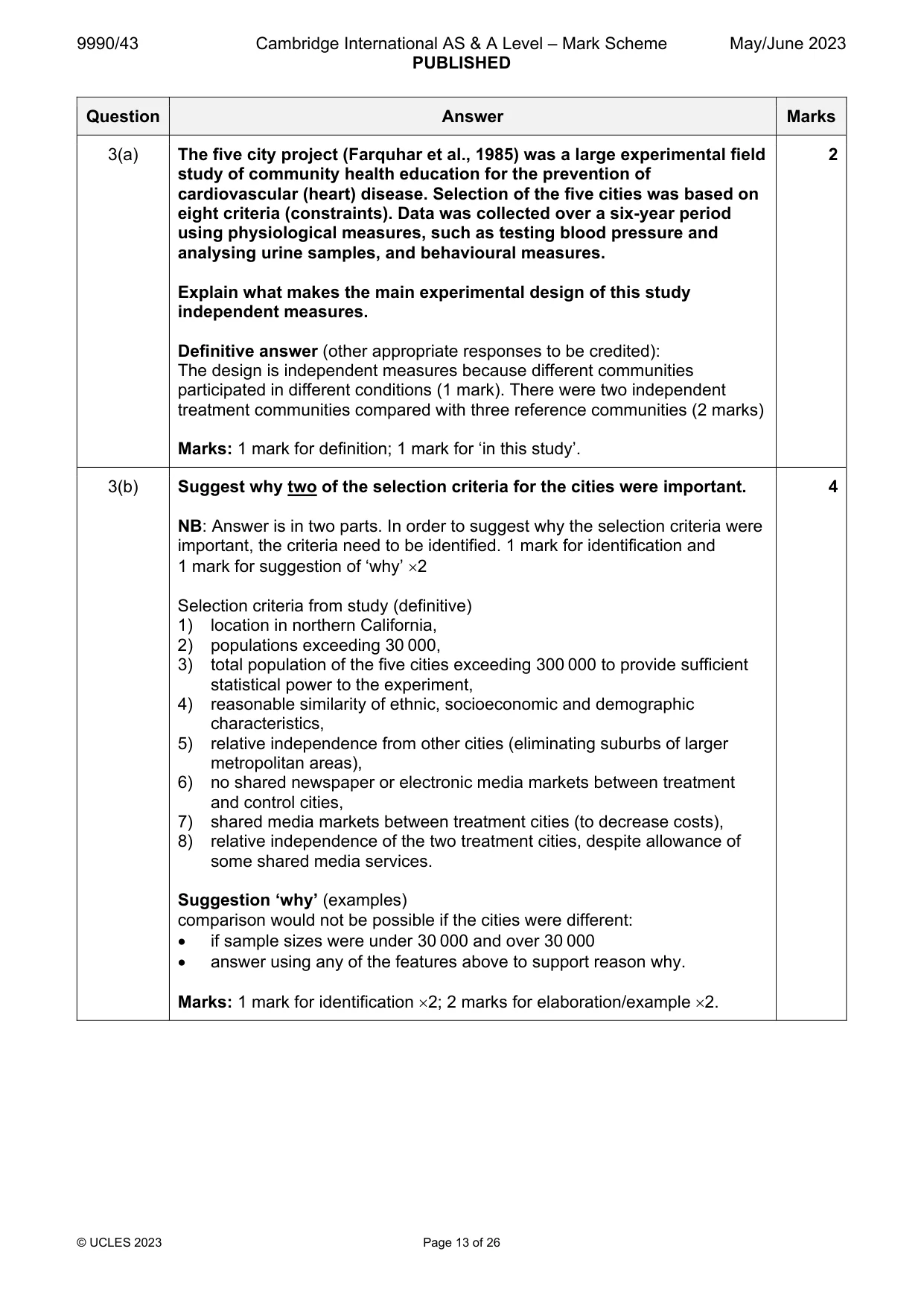
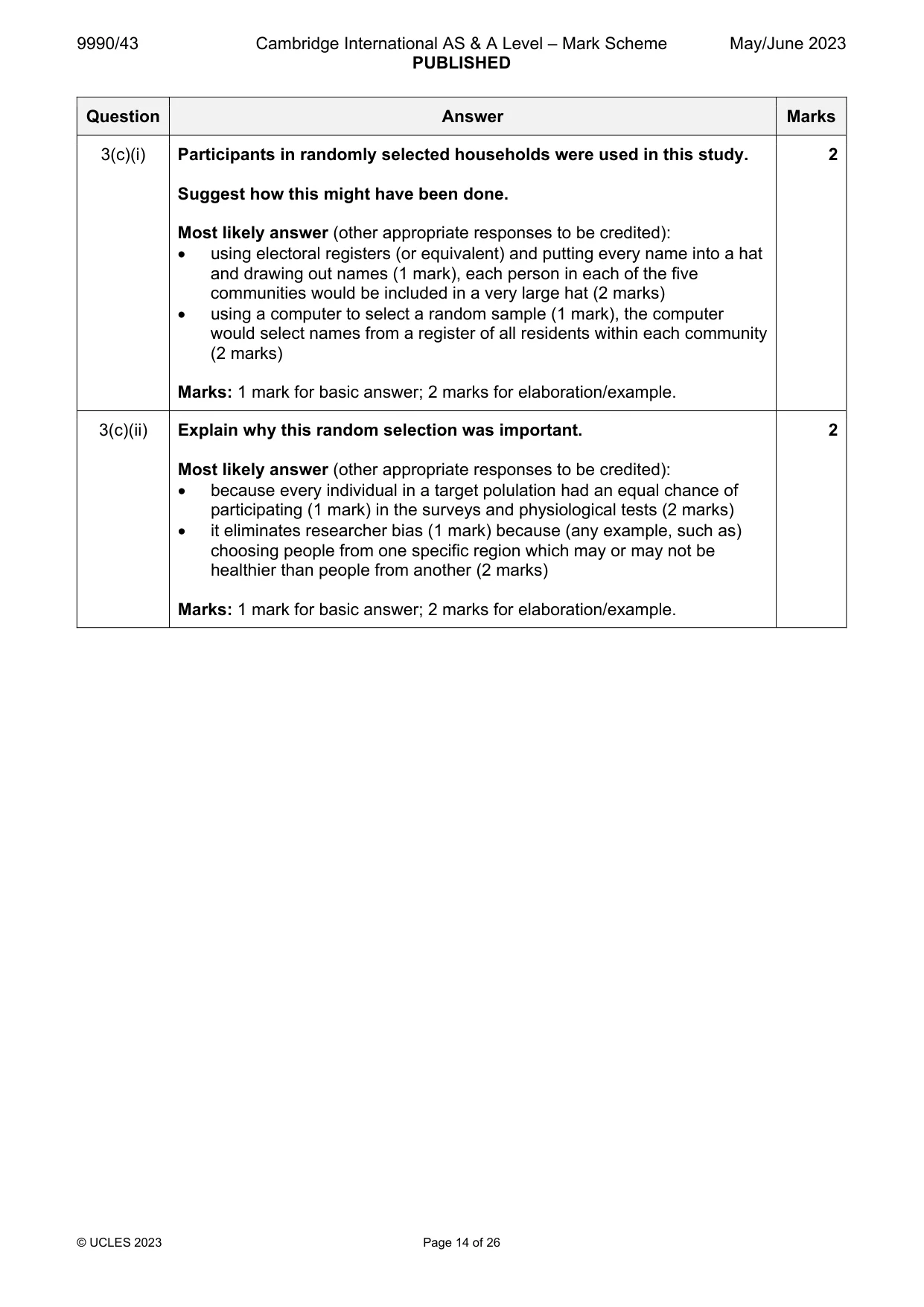
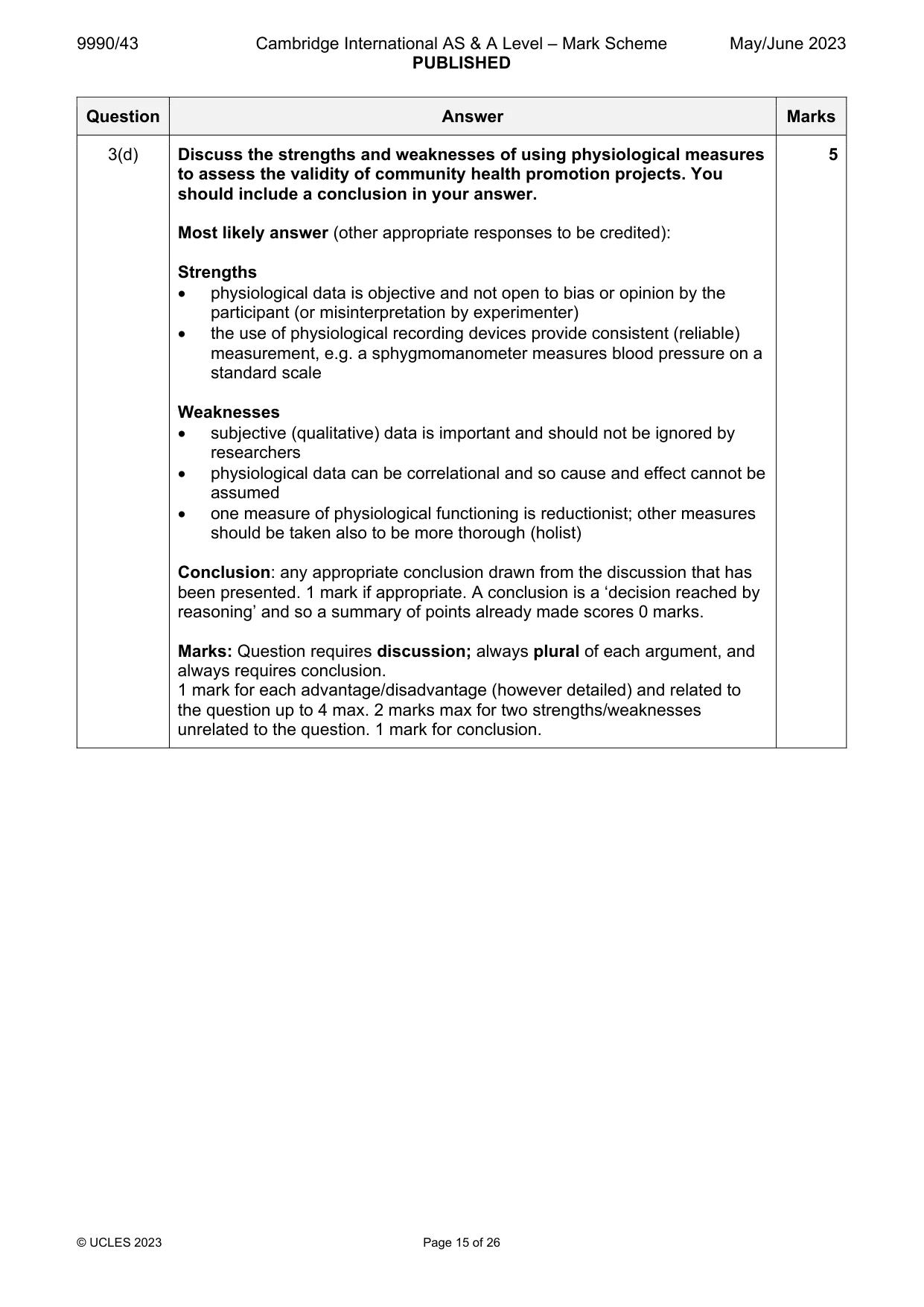
Mark scheme: 3(a) The five city project (Farquhar et al., 1985) was a large experimental field 2 study of community health education for the prevention of cardiovascular (heart) disease. Selection of the five cities was based on eight criteria (constraints). Data was collected over a six-year period using physiological measures, such as testing blood pressure and analysing urine samples, and behavioural measures. Explain what makes the main experimental design of this study independent measures. Definitive answer (other appropriate responses to be credited): The design is independent measures because different communities participated in different conditions (1 mark). There were two independent treatment communities compared with three reference communities (2 marks) Marks: 1 mark for definition; 1 mark for ‘in this study’. 3(b) Suggest why two of the selection criteria for the cities were important. 4 NB: Answer is in two parts. In order to suggest why the selection criteria were important, the criteria need to be identified. 1 mark for identification and 1 mark for suggestion of ‘why’ 2 Selection criteria from study (definitive) 1) location in northern California, 2) populations exceeding 30 000, 3) total population of the five cities exceeding 300 000 to provide sufficient statistical power to the experiment, 4) reasonable similarity of ethnic, socioeconomic and demographic characteristics, 5) relative independence from other cities (eliminating suburbs of larger metropolitan areas), 6) no shared newspaper or electronic media markets between treatment and control cities, 7) shared media markets between treatment cities (to decrease costs), 8) relative independence of the two treatment cities, despite allowance of some shared media services. Suggestion ‘why’ (examples) comparison would not be possible if the cities were different: if sample sizes were under 30 000 and over 30 000 answer using any of the features above to support reason why. Marks: 1 mark for identification 2; 2 marks for elaboration/example 2. 3(c)(i) Participants in randomly selected households were used in this study. 2 Suggest how this might have been done. Most likely answer (other appropriate responses to be credited): using electoral registers (or equivalent) and putting every name into a hat and drawing out names (1 mark), each person in each of the five communities would be included in a very large hat (2 marks) using a computer to select a random sample (1 mark), the computer would select names from a register of all residents within each community (2 marks) Marks: 1 mark for basic answer; 2 marks for elaboration/example. 3(c)(ii) Explain why this random selection was important. 2 Most likely answer (other appropriate responses to be credited): because every individual in a target polulation had an equal chance of participating (1 mark) in the surveys and physiological tests (2 marks) it eliminates researcher bias (1 mark) because (any example, such as) choosing people from one specific region which may or may not be healthier than people from another (2 marks) Marks: 1 mark for basic answer; 2 marks for elaboration/example. 3(d) Discuss the strengths and weaknesses of using physiological measures 5 to assess the validity of community health promotion projects. You should include a conclusion in your answer. Most likely answer (other appropriate responses to be credited): Strengths physiological data is objective and not open to bias or opinion by the participant (or misinterpretation by experimenter) the use of physiological recording devices provide consistent (reliable) measurement, e.g. a sphygmomanometer measures blood pressure on a standard scale Weaknesses subjective (qualitative) data is important and should not be ignored by researchers physiological data can be correlational and so cause and effect cannot be assumed one measure of physiological functioning is reductionist; other measures should be taken also to be more thorough (holist) Conclusion: any appropriate conclusion drawn from the discussion that has been presented. 1 mark if appropriate. A conclusion is a ‘decision reached by reasoning’ and so a summary of points already made scores 0 marks. Marks: Question requires discussion; always plural of each argument, and always requires conclusion. 1 mark for each advantage/disadvantage (however detailed) and related to the question up to 4 max. 2 marks max for two strengths/weaknesses unrelated to the question. 1 mark for conclusion.
More questions on 2 Health promotion in schools and worksites
Q4 · A manager can motivate workers by giving a monetary reward for extra work or good…
4 A manager can motivate workers by giving a monetary reward for extra work or good performance. A manager can take money away for poor performance or for not meeting targets. However, giving or taking away money might not be the best motivator. Non-monetary reward systems might be more effective motivators. (a) Explain what is meant by the term ‘non-monetary reward system’. [2] (b) Explain how two types of non-monetary reward can be used to motivate workers. [4] (c) Suggest how non-monetary rewards apply to two needs from Maslow’s hierarchy. [4] (d) Discuss the strengths and weaknesses of using monetary reward systems to motivate workers. You should include a conclusion in your answer. [5]
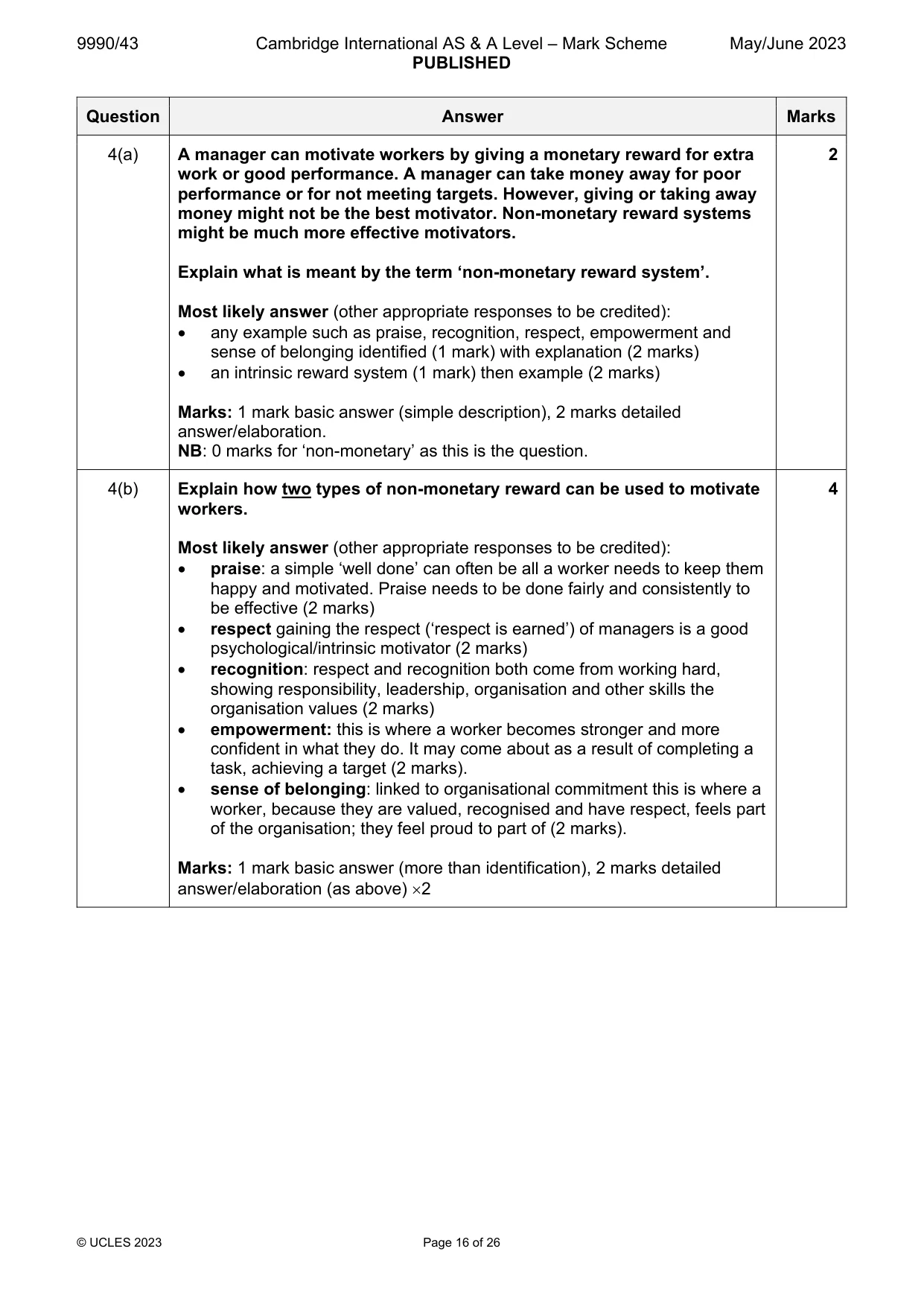
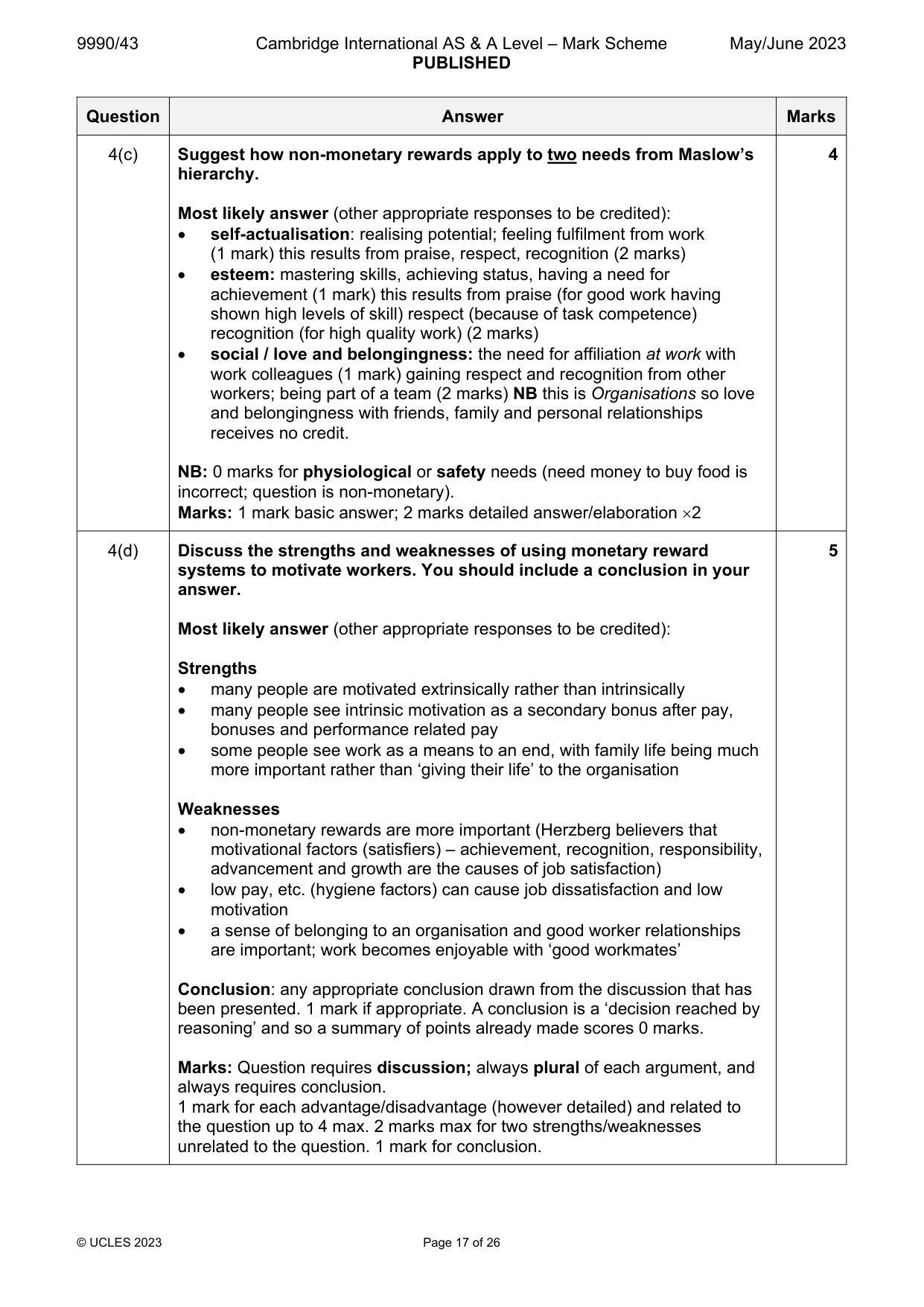
Mark scheme: 4(a) A manager can motivate workers by giving a monetary reward for extra 2 work or good performance. A manager can take money away for poor performance or for not meeting targets. However, giving or taking away money might not be the best motivator. Non-monetary reward systems might be much more effective motivators. Explain what is meant by the term ‘non-monetary reward system’. Most likely answer (other appropriate responses to be credited): any example such as praise, recognition, respect, empowerment and sense of belonging identified (1 mark) with explanation (2 marks) an intrinsic reward system (1 mark) then example (2 marks) Marks: 1 mark basic answer (simple description), 2 marks detailed answer/elaboration. NB: 0 marks for ‘non-monetary’ as this is the question. 4(b) Explain how two types of non-monetary reward can be used to motivate 4 workers. Most likely answer (other appropriate responses to be credited): praise: a simple ‘well done’ can often be all a worker needs to keep them happy and motivated. Praise needs to be done fairly and consistently to be effective (2 marks) respect gaining the respect (‘respect is earned’) of managers is a good psychological/intrinsic motivator (2 marks) recognition: respect and recognition both come from working hard, showing responsibility, leadership, organisation and other skills the organisation values (2 marks) empowerment: this is where a worker becomes stronger and more confident in what they do. It may come about as a result of completing a task, achieving a target (2 marks). sense of belonging: linked to organisational commitment this is where a worker, because they are valued, recognised and have respect, feels part of the organisation; they feel proud to part of (2 marks). Marks: 1 mark basic answer (more than identification), 2 marks detailed answer/elaboration (as above) 2 4(c) Suggest how non-monetary rewards apply to two needs from Maslow’s 4 hierarchy. Most likely answer (other appropriate responses to be credited): self-actualisation: realising potential; feeling fulfilment from work (1 mark) this results from praise, respect, recognition (2 marks) esteem: mastering skills, achieving status, having a need for achievement (1 mark) this results from praise (for good work having shown high levels of skill) respect (because of task competence) recognition (for high quality work) (2 marks) social / love and belongingness: the need for affiliation at work with work colleagues (1 mark) gaining respect and recognition from other workers; being part of a team (2 marks) NB this is Organisations so love and belongingness with friends, family and personal relationships receives no credit. NB: 0 marks for physiological or safety needs (need money to buy food is incorrect; question is non-monetary). Marks: 1 mark basic answer; 2 marks detailed answer/elaboration 2 4(d) Discuss the strengths and weaknesses of using monetary reward 5 systems to motivate workers. You should include a conclusion in your answer. Most likely answer (other appropriate responses to be credited): Strengths many people are motivated extrinsically rather than intrinsically many people see intrinsic motivation as a secondary bonus after pay, bonuses and performance related pay some people see work as a means to an end, with family life being much more important rather than ‘giving their life’ to the organisation Weaknesses non-monetary rewards are more important (Herzberg believers that motivational factors (satisfiers) – achievement, recognition, responsibility, advancement and growth are the causes of job satisfaction) low pay, etc. (hygiene factors) can cause job dissatisfaction and low motivation a sense of belonging to an organisation and good worker relationships are important; work becomes enjoyable with ‘good workmates’ Conclusion: any appropriate conclusion drawn from the discussion that has been presented. 1 mark if appropriate. A conclusion is a ‘decision reached by reasoning’ and so a summary of points already made scores 0 marks. Marks: Question requires discussion; always plural of each argument, and always requires conclusion. 1 mark for each advantage/disadvantage (however detailed) and related to the question up to 4 max. 2 marks max for two strengths/weaknesses unrelated to the question. 1 mark for conclusion.
Q5 · Patients with obsessive-compulsive disorder (OCD) can receive treatment with a therapist…
5 Patients with obsessive-compulsive disorder (OCD) can receive treatment with a therapist face- to-face or by telephone. (a) Design a study using a telephone interview to investigate whether face-to-face therapy is more effective for women with OCD than for men with OCD. [10] (b) Explain the psychological and methodological evidence on which your study is based. [8] Psychology and consumer behaviour
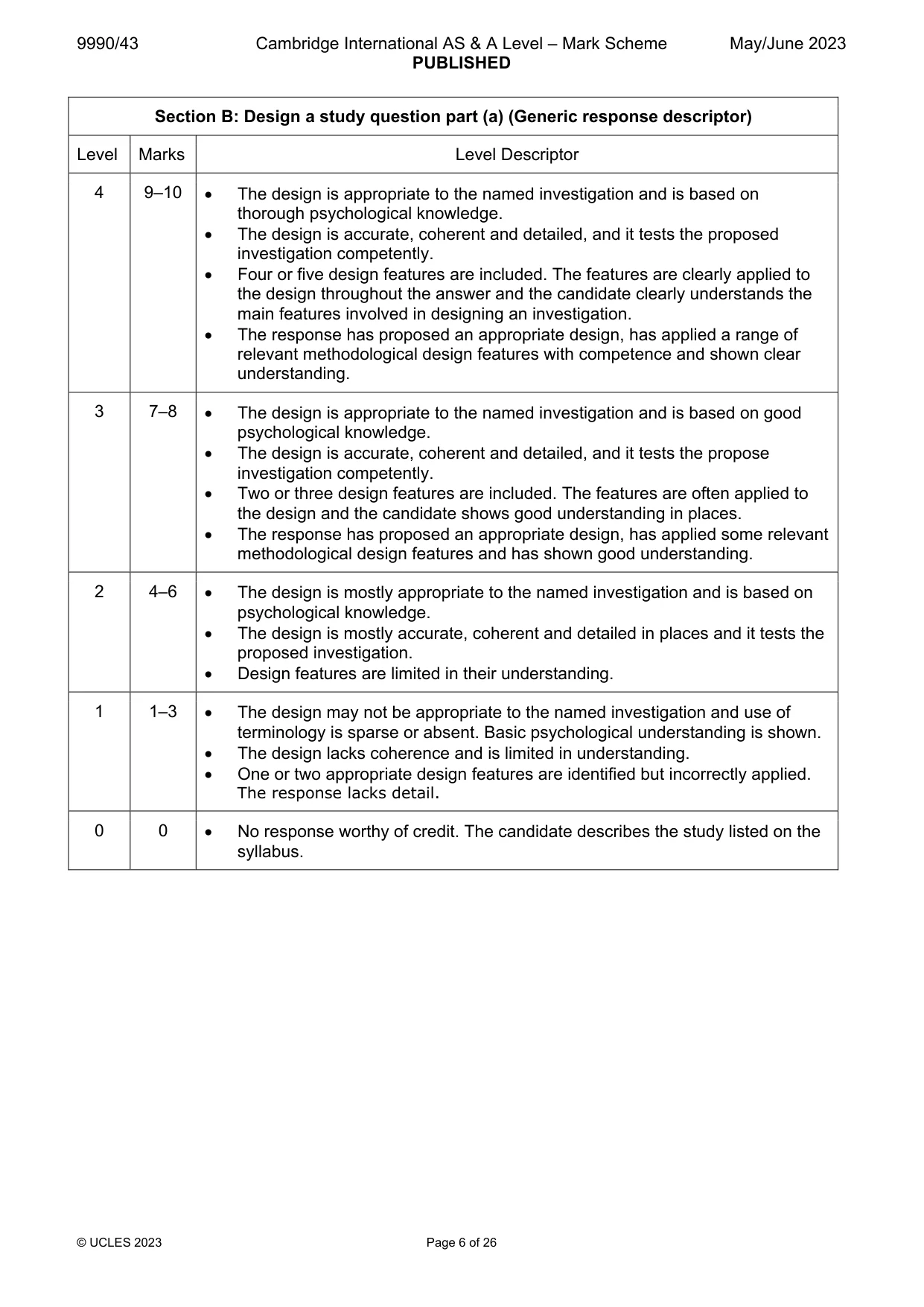
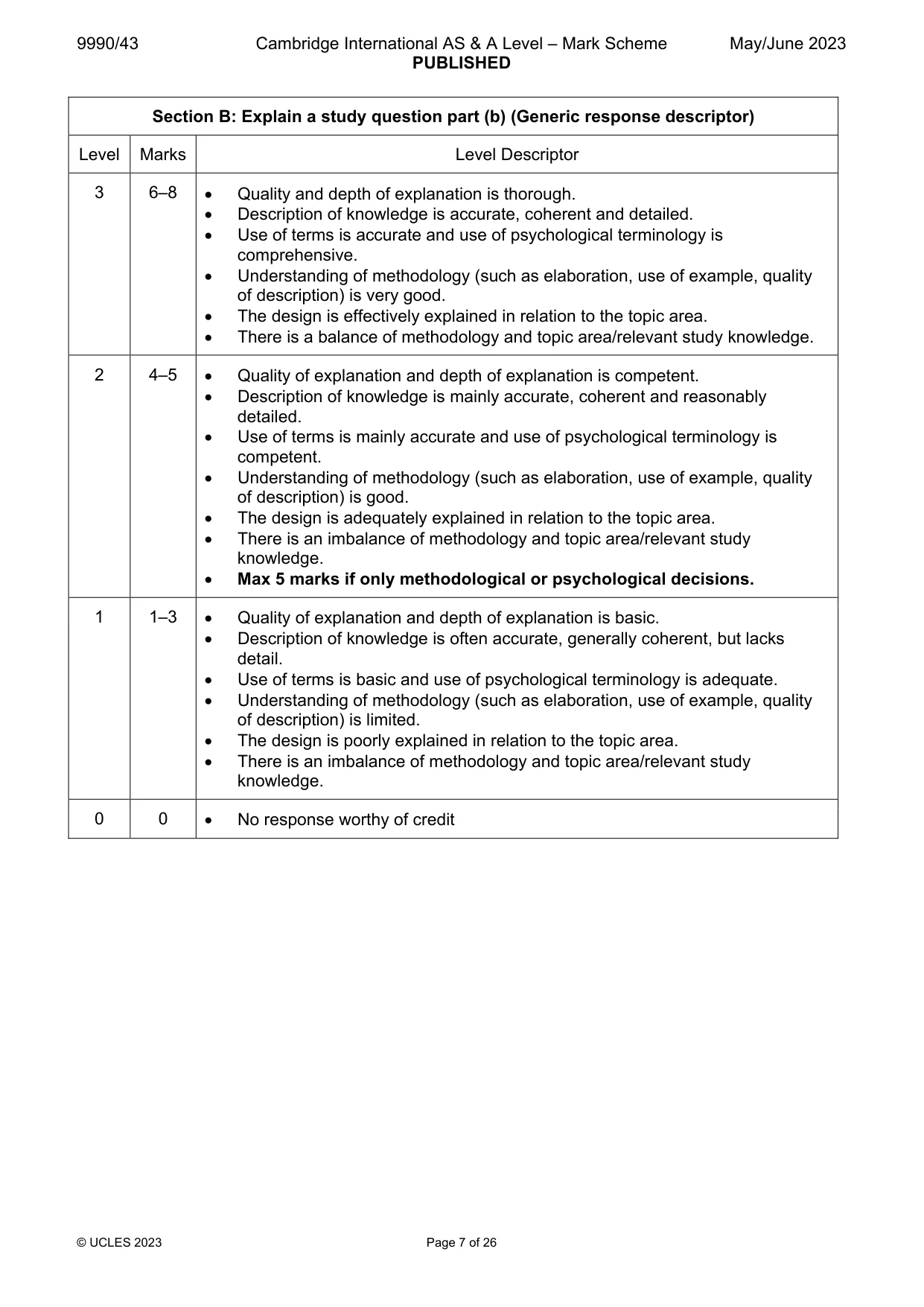
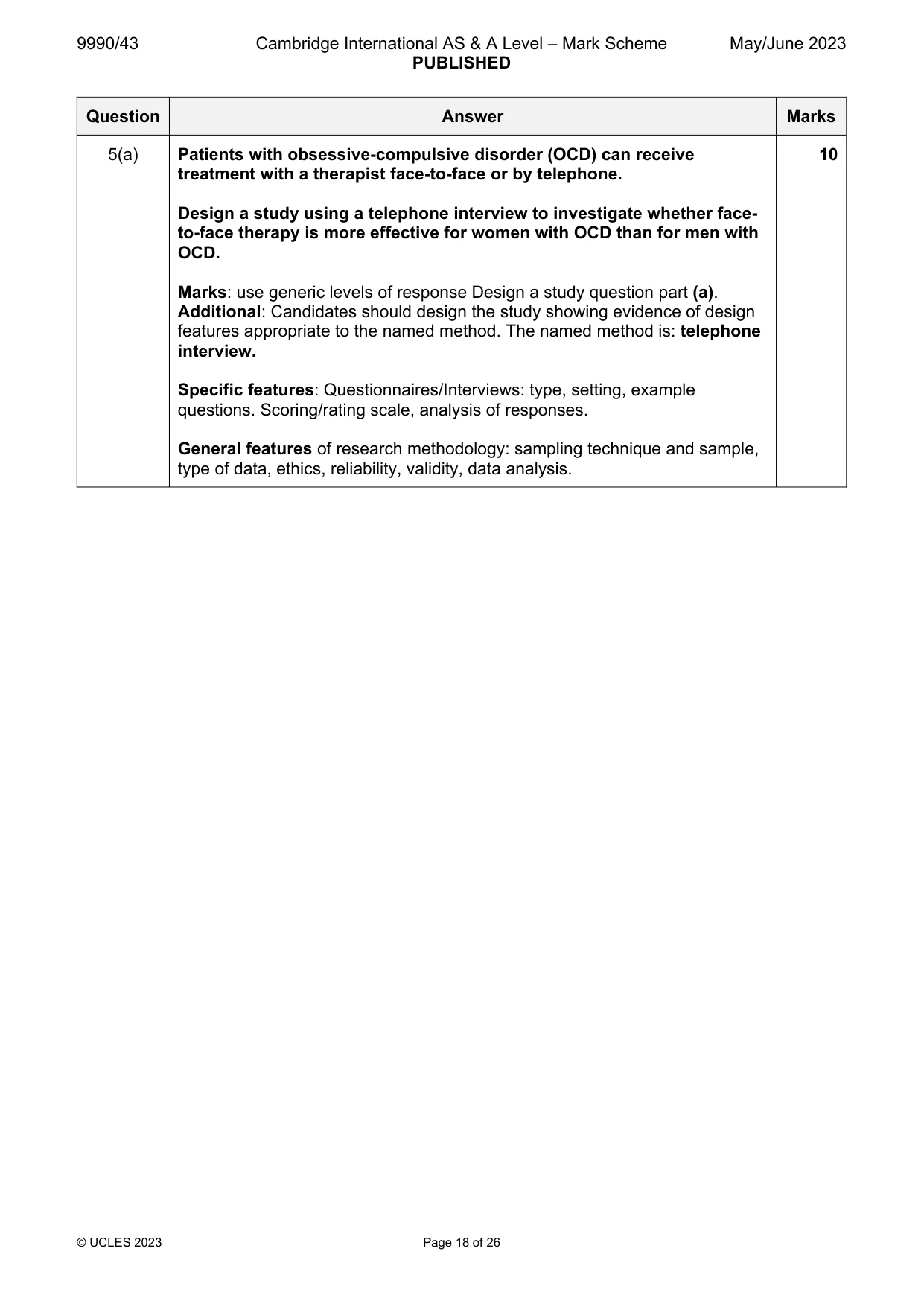
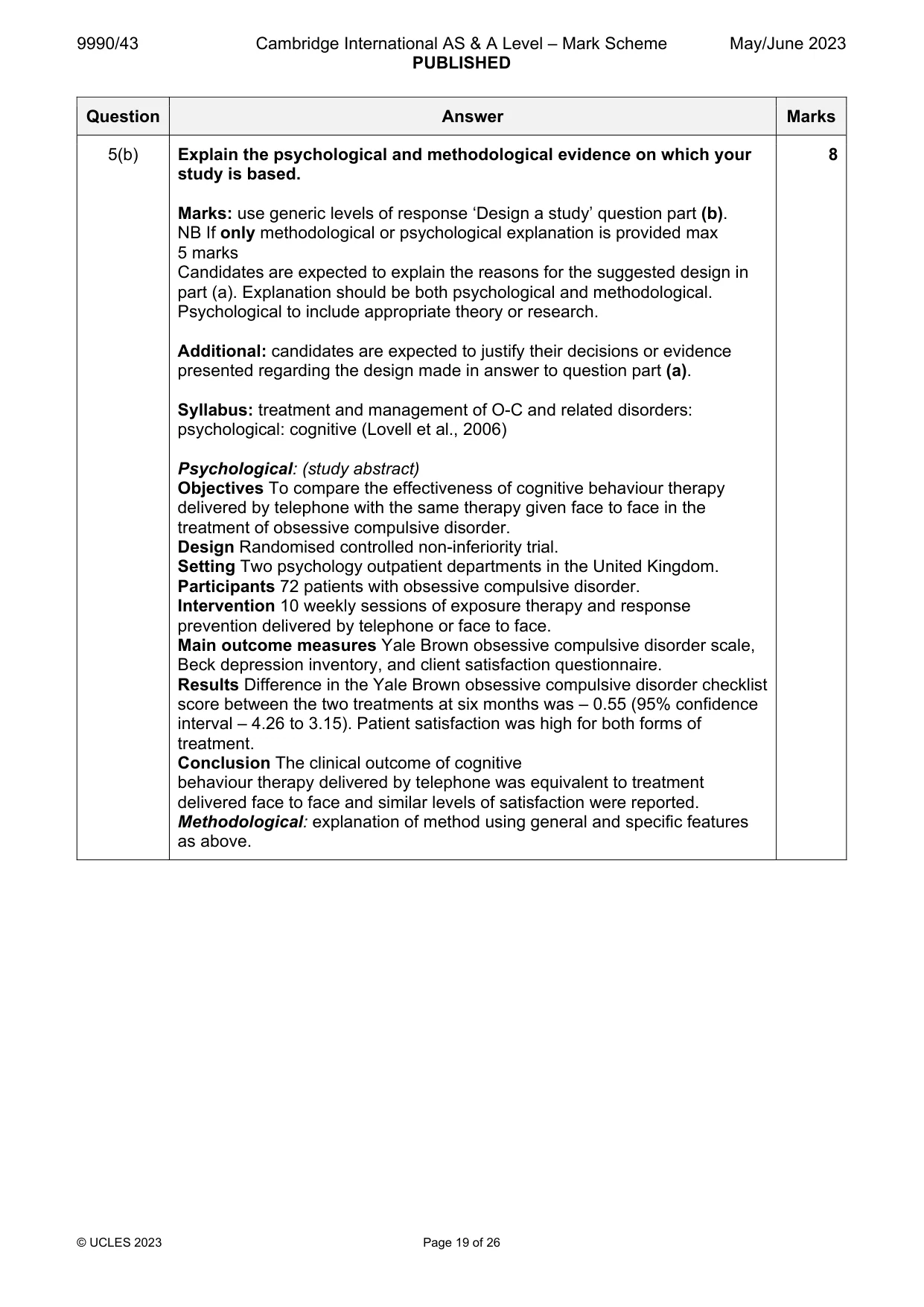
Mark scheme: 5(a) Patients with obsessive-compulsive disorder (OCD) can receive 10 treatment with a therapist face-to-face or by telephone. Design a study using a telephone interview to investigate whether face- to-face therapy is more effective for women with OCD than for men with OCD. Marks: use generic levels of response Design a study question part (a). Additional: Candidates should design the study showing evidence of design features appropriate to the named method. The named method is: telephone interview. Specific features: Questionnaires/Interviews: type, setting, example questions. Scoring/rating scale, analysis of responses. General features of research methodology: sampling technique and sample, type of data, ethics, reliability, validity, data analysis. 5(b) Explain the psychological and methodological evidence on which your 8 study is based. Marks: use generic levels of response ‘Design a study’ question part (b). NB If only methodological or psychological explanation is provided max 5 marks Candidates are expected to explain the reasons for the suggested design in part (a). Explanation should be both psychological and methodological. Psychological to include appropriate theory or research. Additional: candidates are expected to justify their decisions or evidence presented regarding the design made in answer to question part (a). Syllabus: treatment and management of O-C and related disorders: psychological: cognitive (Lovell et al., 2006) Psychological: (study abstract) Objectives To compare the effectiveness of cognitive behaviour therapy delivered by telephone with the same therapy given face to face in the treatment of obsessive compulsive disorder. Design Randomised controlled non-inferiority trial. Setting Two psychology outpatient departments in the United Kingdom. Participants 72 patients with obsessive compulsive disorder. Intervention 10 weekly sessions of exposure therapy and response prevention delivered by telephone or face to face. Main outcome measures Yale Brown obsessive compulsive disorder scale, Beck depression inventory, and client satisfaction questionnaire. Results Difference in the Yale Brown obsessive compulsive disorder checklist score between the two treatments at six months was – 0.55 (95% confidence interval – 4.26 to 3.15). Patient satisfaction was high for both forms of treatment. Conclusion The clinical outcome of cognitive behaviour therapy delivered by telephone was equivalent to treatment delivered face to face and similar levels of satisfaction were reported. Methodological: explanation of method using general and specific features as above.
Q6 · Colour can be associated with specific products, but colour can also be used where…
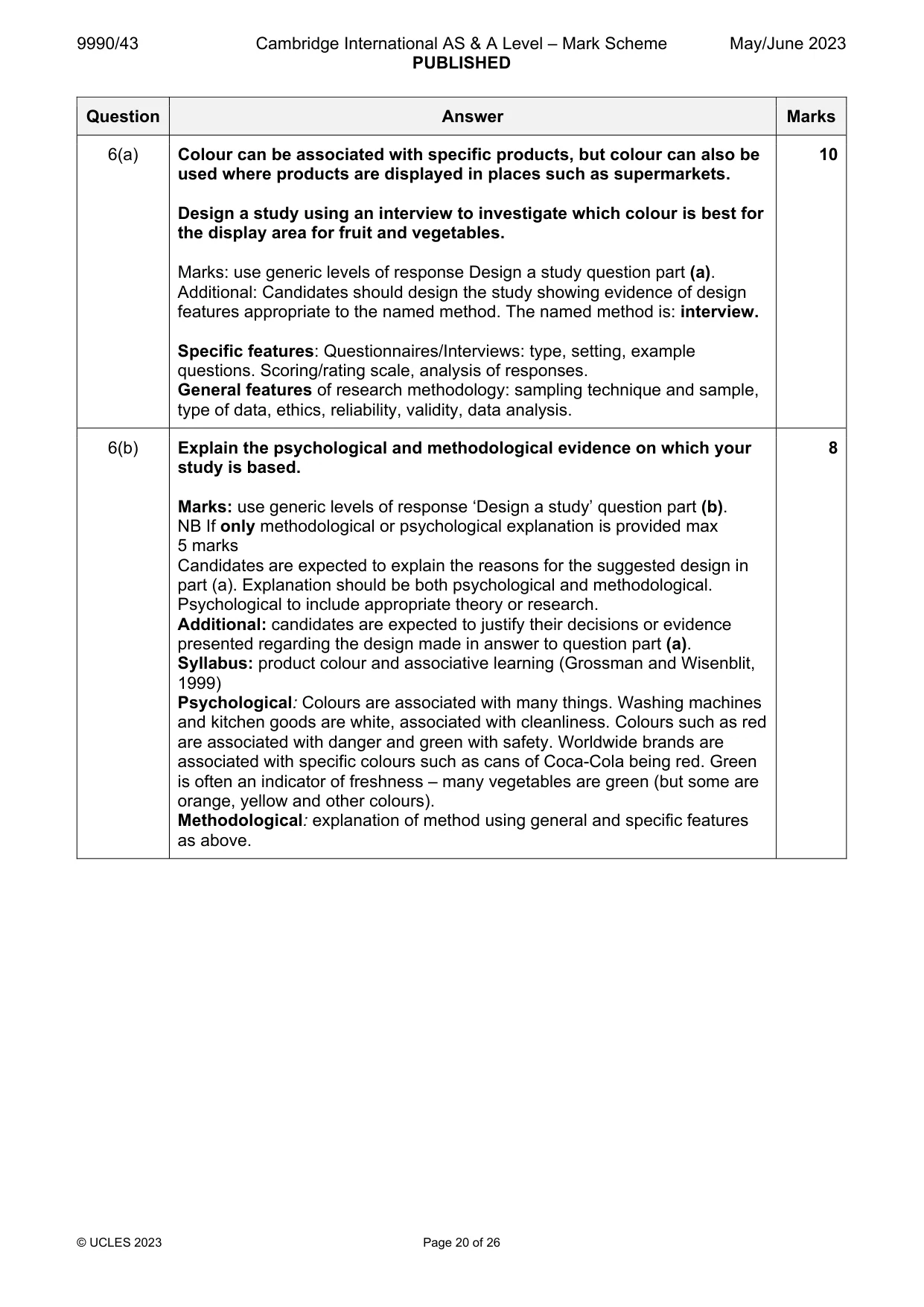
6 Colour can be associated with specific products, but colour can also be used where products are displayed in places such as supermarkets. (a) Design a study using an interview to investigate which colour is best for the display area for fruit and vegetables. [10] (b) Explain the psychological and methodological evidence on which your study is based. [8] Psychology and health
Mark scheme: 6(a) Colour can be associated with specific products, but colour can also be 10 used where products are displayed in places such as supermarkets. Design a study using an interview to investigate which colour is best for the display area for fruit and vegetables. Marks: use generic levels of response Design a study question part (a). Additional: Candidates should design the study showing evidence of design features appropriate to the named method. The named method is: interview. Specific features: Questionnaires/Interviews: type, setting, example questions. Scoring/rating scale, analysis of responses. General features of research methodology: sampling technique and sample, type of data, ethics, reliability, validity, data analysis. 6(b) Explain the psychological and methodological evidence on which your 8 study is based. Marks: use generic levels of response ‘Design a study’ question part (b). NB If only methodological or psychological explanation is provided max 5 marks Candidates are expected to explain the reasons for the suggested design in part (a). Explanation should be both psychological and methodological. Psychological to include appropriate theory or research. Additional: candidates are expected to justify their decisions or evidence presented regarding the design made in answer to question part (a). Syllabus: product colour and associative learning (Grossman and Wisenblit, 1999) Psychological: Colours are associated with many things. Washing machines and kitchen goods are white, associated with cleanliness. Colours such as red are associated with danger and green with safety. Worldwide brands are associated with specific colours such as cans of Coca-Cola being red. Green is often an indicator of freshness – many vegetables are green (but some are orange, yellow and other colours). Methodological: explanation of method using general and specific features as above.
Q7 · Design a study to investigate the effectiveness of using pill counting compared to using…
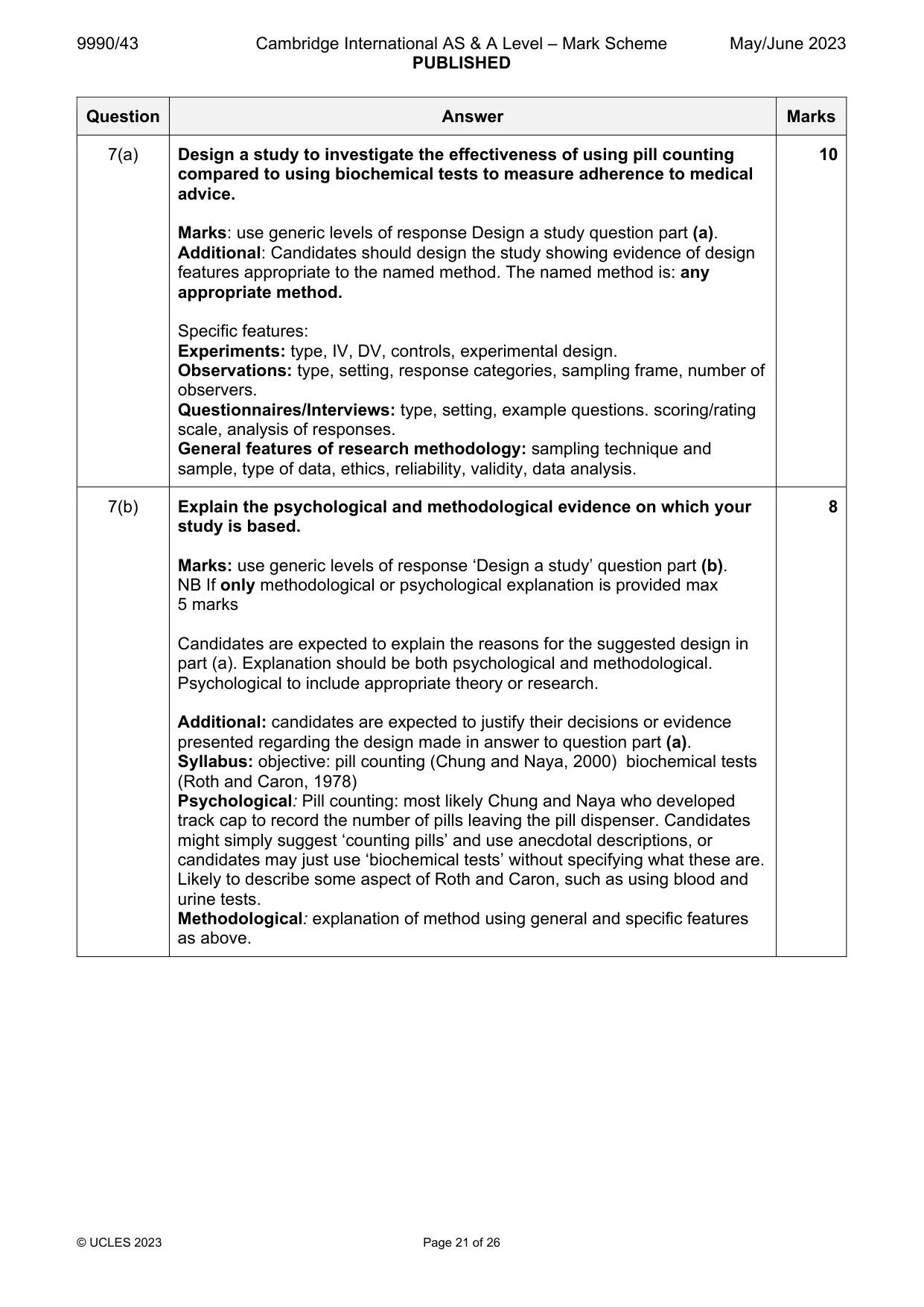
7 (a) Design a study to investigate the effectiveness of using pill counting compared to using biochemical tests to measure adherence to medical advice. [10] (b) Explain the psychological and methodological evidence on which your study is based. [8] Psychology and organisations
Mark scheme: 7(a) Design a study to investigate the effectiveness of using pill counting 10 compared to using biochemical tests to measure adherence to medical advice. Marks: use generic levels of response Design a study question part (a). Additional: Candidates should design the study showing evidence of design features appropriate to the named method. The named method is: any appropriate method. Specific features: Experiments: type, IV, DV, controls, experimental design. Observations: type, setting, response categories, sampling frame, number of observers. Questionnaires/Interviews: type, setting, example questions. scoring/rating scale, analysis of responses. General features of research methodology: sampling technique and sample, type of data, ethics, reliability, validity, data analysis. 7(b) Explain the psychological and methodological evidence on which your 8 study is based. Marks: use generic levels of response ‘Design a study’ question part (b). NB If only methodological or psychological explanation is provided max 5 marks Candidates are expected to explain the reasons for the suggested design in part (a). Explanation should be both psychological and methodological. Psychological to include appropriate theory or research. Additional: candidates are expected to justify their decisions or evidence presented regarding the design made in answer to question part (a). Syllabus: objective: pill counting (Chung and Naya, 2000) biochemical tests (Roth and Caron, 1978) Psychological: Pill counting: most likely Chung and Naya who developed track cap to record the number of pills leaving the pill dispenser. Candidates might simply suggest ‘counting pills’ and use anecdotal descriptions, or candidates may just use ‘biochemical tests’ without specifying what these are. Likely to describe some aspect of Roth and Caron, such as using blood and urine tests. Methodological: explanation of method using general and specific features as above.
Q8 · Design a study using a questionnaire to investigate which type of cognitive…
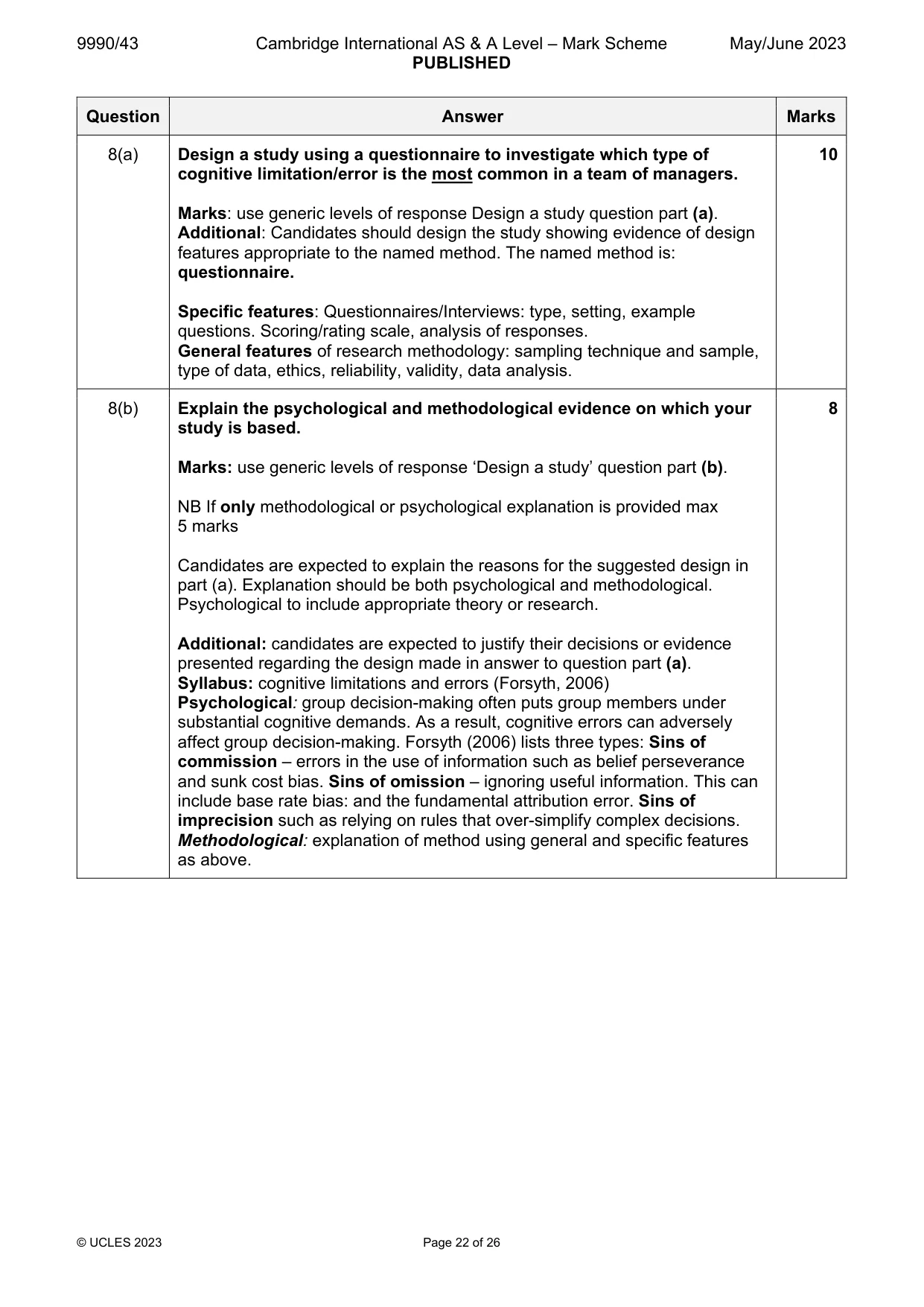
8 (a) Design a study using a questionnaire to investigate which type of cognitive limitation/error is the most common in a team of managers. [10] (b) Explain the psychological and methodological evidence on which your study is based. [8] Section C You must answer one question from this section. Psychology and abnormality
Mark scheme: 8(a) Design a study using a questionnaire to investigate which type of 10 cognitive limitation/error is the most common in a team of managers. Marks: use generic levels of response Design a study question part (a). Additional: Candidates should design the study showing evidence of design features appropriate to the named method. The named method is: questionnaire. Specific features: Questionnaires/Interviews: type, setting, example questions. Scoring/rating scale, analysis of responses. General features of research methodology: sampling technique and sample, type of data, ethics, reliability, validity, data analysis. 8(b) Explain the psychological and methodological evidence on which your 8 study is based. Marks: use generic levels of response ‘Design a study’ question part (b). NB If only methodological or psychological explanation is provided max 5 marks Candidates are expected to explain the reasons for the suggested design in part (a). Explanation should be both psychological and methodological. Psychological to include appropriate theory or research. Additional: candidates are expected to justify their decisions or evidence presented regarding the design made in answer to question part (a). Syllabus: cognitive limitations and errors (Forsyth, 2006) Psychological: group decision-making often puts group members under substantial cognitive demands. As a result, cognitive errors can adversely affect group decision-making. Forsyth (2006) lists three types: Sins of commission – errors in the use of information such as belief perseverance and sunk cost bias. Sins of omission – ignoring useful information. This can include base rate bias: and the fundamental attribution error. Sins of imprecision such as relying on rules that over-simplify complex decisions. Methodological: explanation of method using general and specific features as above.
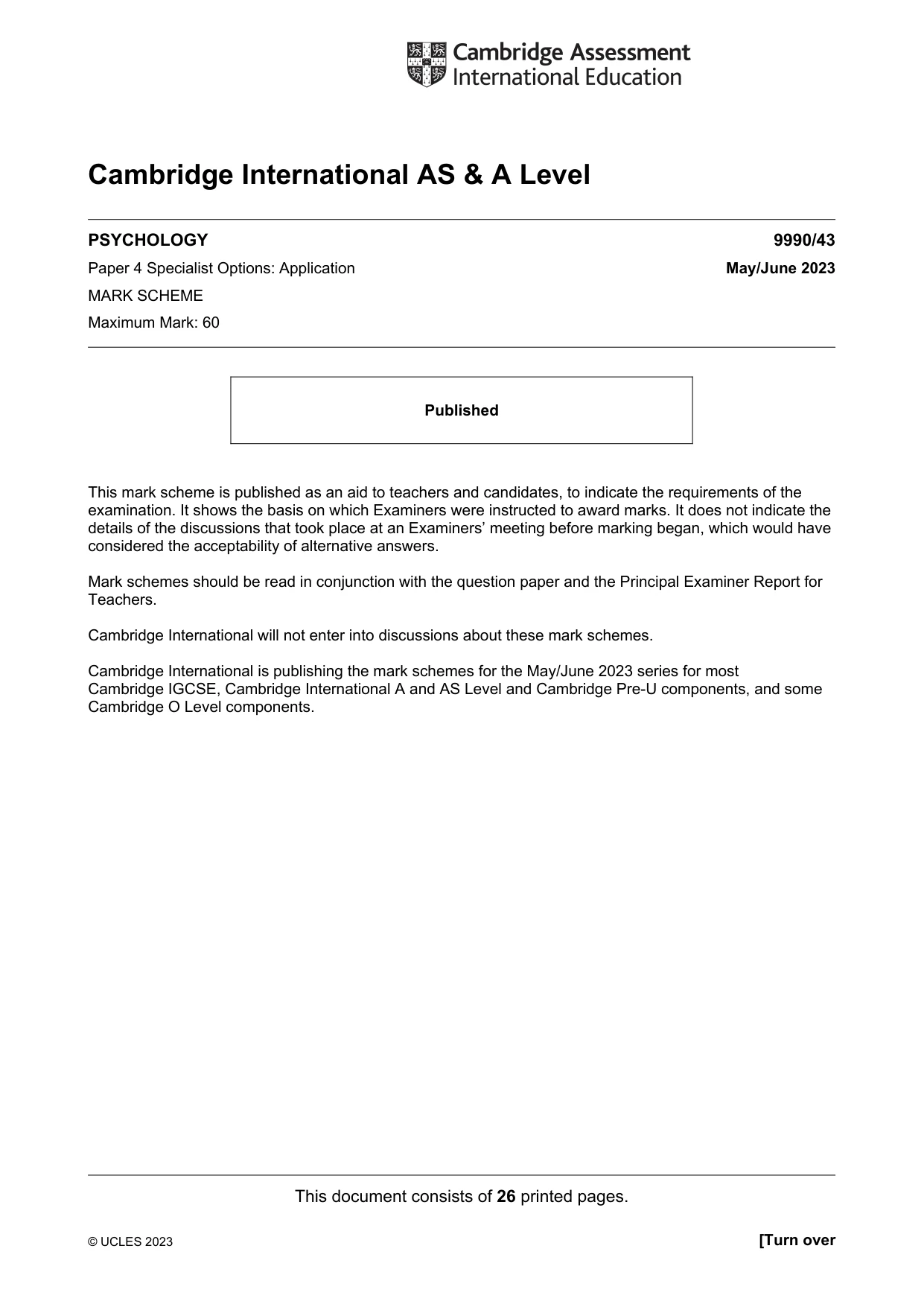
Q9 · ‘Biochemical techniques, such as the use of drugs, can treat all patients with…
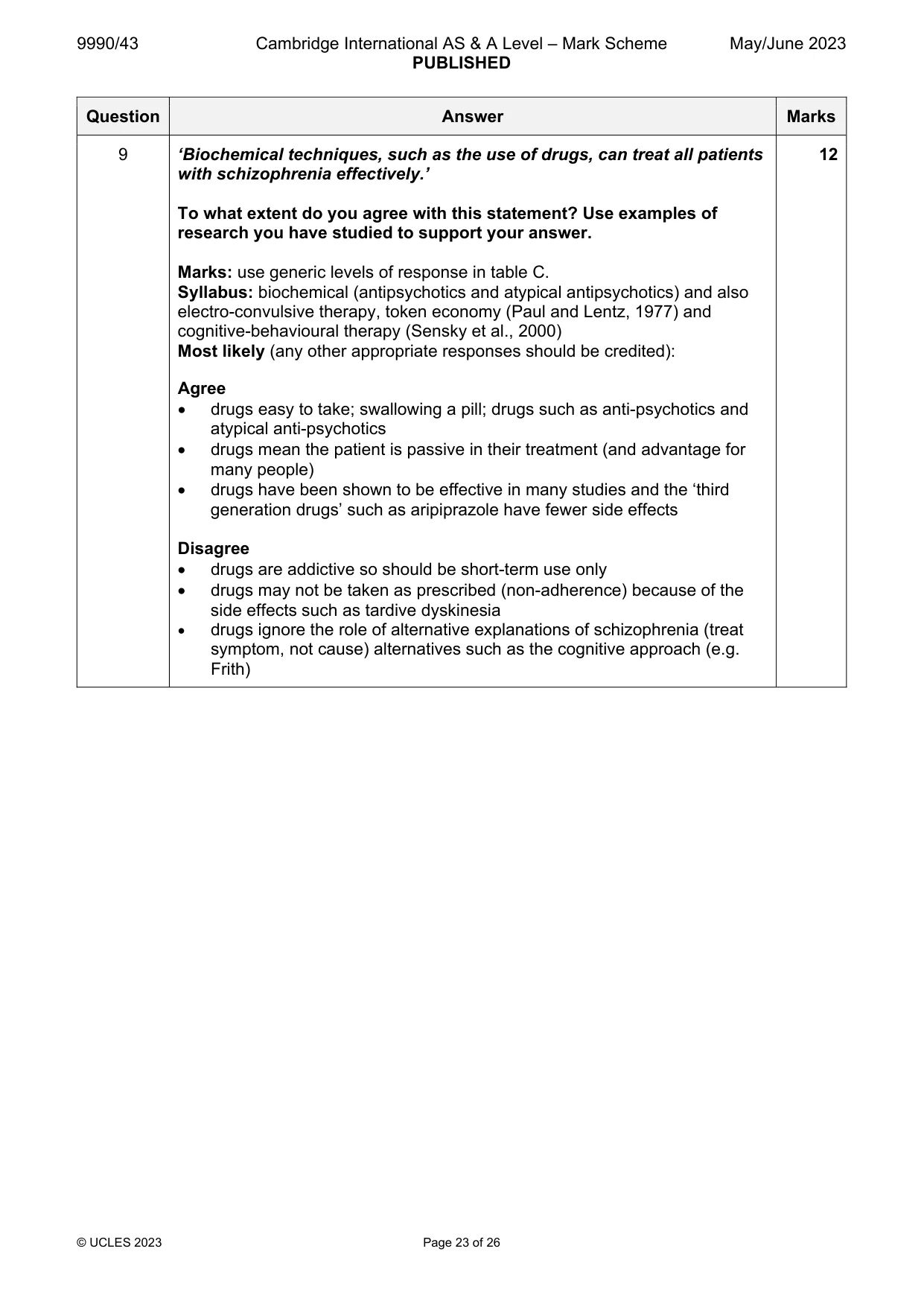
9 ‘Biochemical techniques, such as the use of drugs, can treat all patients with schizophrenia effectively.’ To what extent do you agree with this statement? Use examples of research you have studied to support your answer. [12] Psychology and consumer behaviour
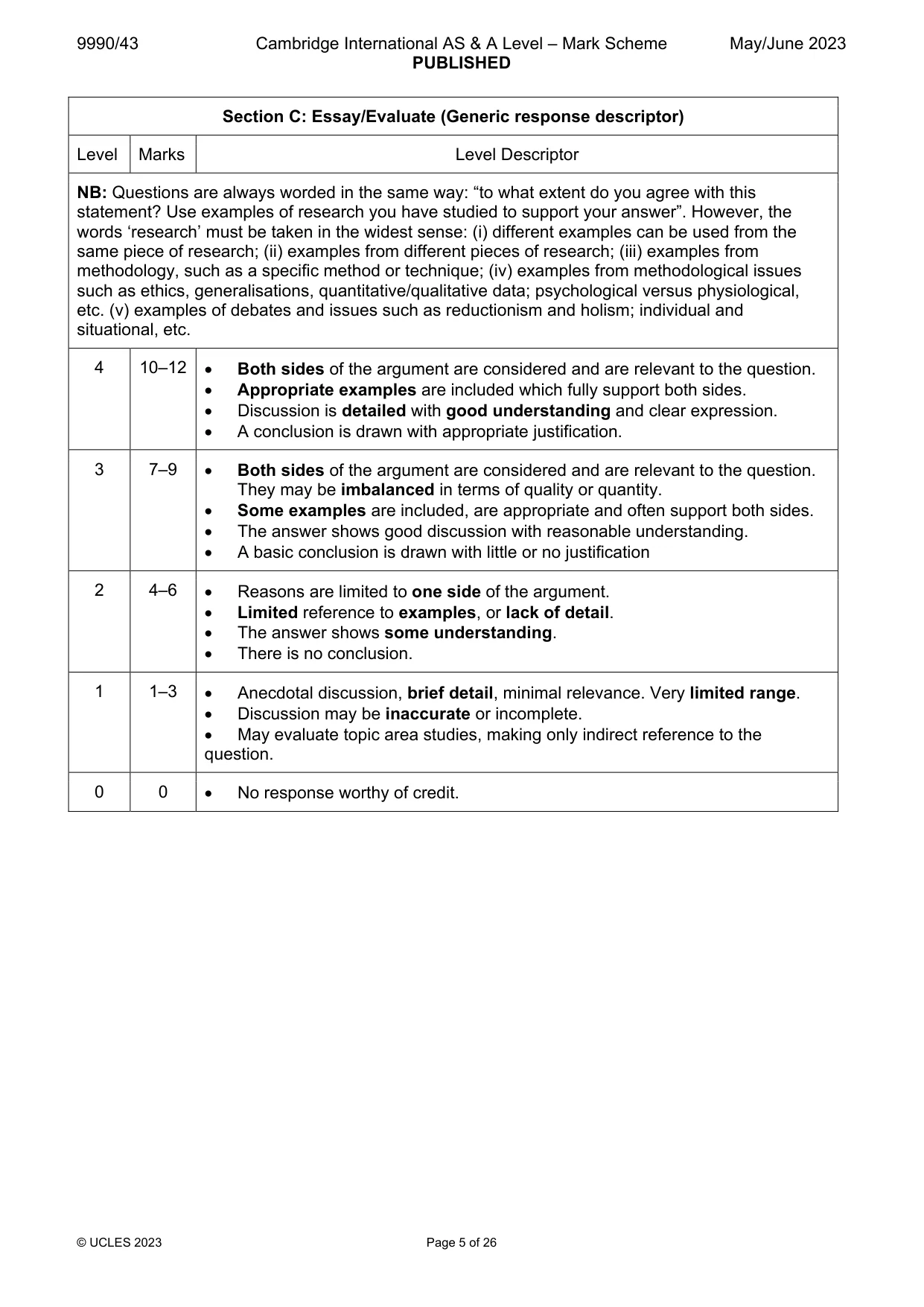
Mark scheme: 9 ‘Biochemical techniques, such as the use of drugs, can treat all patients 12 with schizophrenia effectively.’ To what extent do you agree with this statement? Use examples of research you have studied to support your answer. Marks: use generic levels of response in table C. Syllabus: biochemical (antipsychotics and atypical antipsychotics) and also electro-convulsive therapy, token economy (Paul and Lentz, 1977) and cognitive-behavioural therapy (Sensky et al., 2000) Most likely (any other appropriate responses should be credited): Agree drugs easy to take; swallowing a pill; drugs such as anti-psychotics and atypical anti-psychotics drugs mean the patient is passive in their treatment (and advantage for many people) drugs have been shown to be effective in many studies and the ‘third generation drugs’ such as aripiprazole have fewer side effects Disagree drugs are addictive so should be short-term use only drugs may not be taken as prescribed (non-adherence) because of the side effects such as tardive dyskinesia drugs ignore the role of alternative explanations of schizophrenia (treat symptom, not cause) alternatives such as the cognitive approach (e.g. Frith)
Q10 · ‘Choice heuristics, such as availability and representativeness, are irrelevant in…
10 ‘Choice heuristics, such as availability and representativeness, are irrelevant in consumer decision-making when consumers make decisions about purchasing goods.’ To what extent do you agree with this statement? Use examples of research you have studied to support your answer. [12] Psychology and health
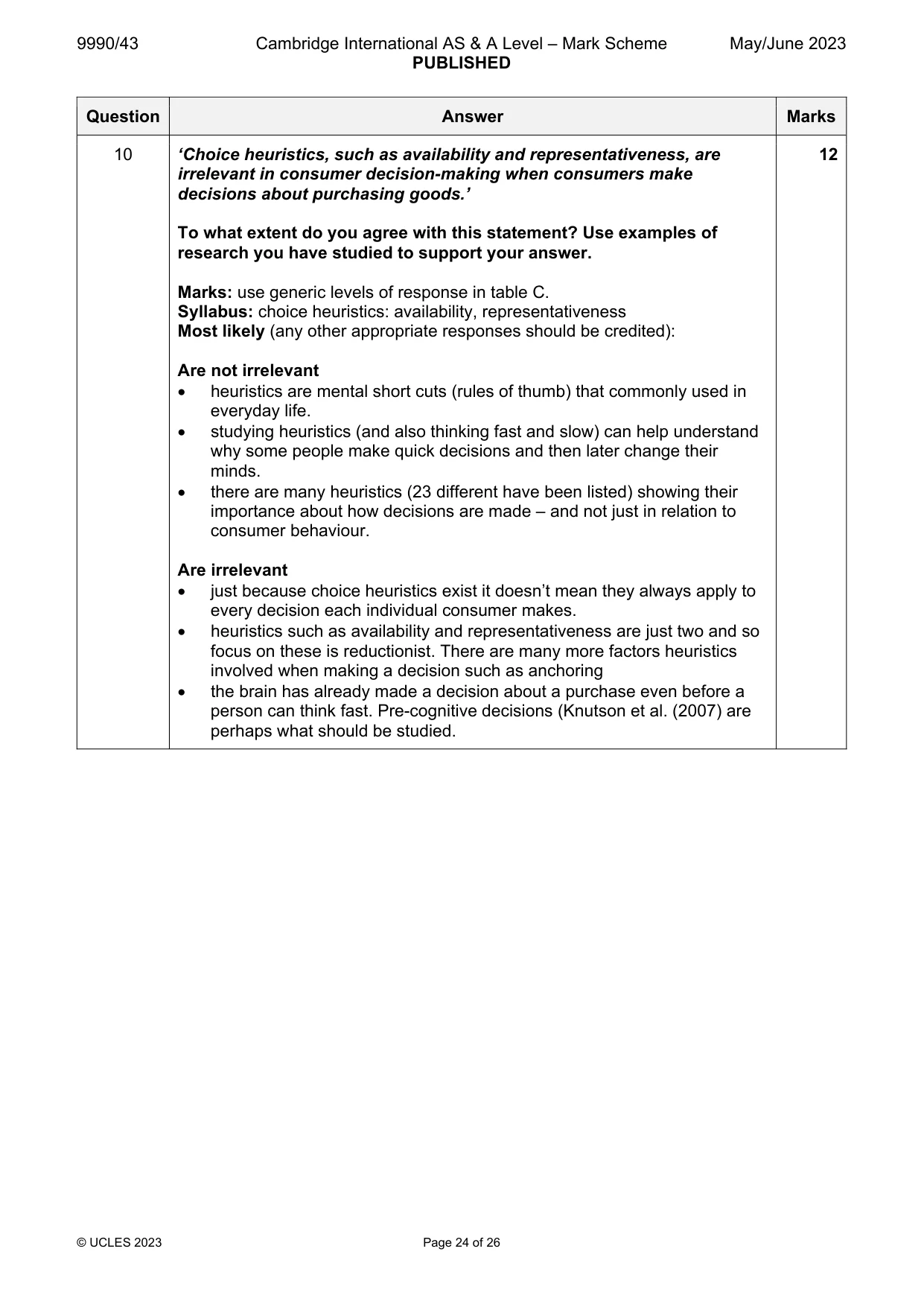
Mark scheme: 10 ‘Choice heuristics, such as availability and representativeness, are 12 irrelevant in consumer decision-making when consumers make decisions about purchasing goods.’ To what extent do you agree with this statement? Use examples of research you have studied to support your answer. Marks: use generic levels of response in table C. Syllabus: choice heuristics: availability, representativeness Most likely (any other appropriate responses should be credited): Are not irrelevant heuristics are mental short cuts (rules of thumb) that commonly used in everyday life. studying heuristics (and also thinking fast and slow) can help understand why some people make quick decisions and then later change their minds. there are many heuristics (23 different have been listed) showing their importance about how decisions are made – and not just in relation to consumer behaviour. Are irrelevant just because choice heuristics exist it doesn’t mean they always apply to every decision each individual consumer makes. heuristics such as availability and representativeness are just two and so focus on these is reductionist. There are many more factors heuristics involved when making a decision such as anchoring the brain has already made a decision about a purchase even before a person can think fast. Pre-cognitive decisions (Knutson et al. (2007) are perhaps what should be studied.
Q11 · ‘Fear arousal is the best strategy for promoting health.’ To what extent do you agree…
11 ‘Fear arousal is the best strategy for promoting health.’ To what extent do you agree with this statement? Use examples of research you have studied to support your answer. [12] Psychology and organisations
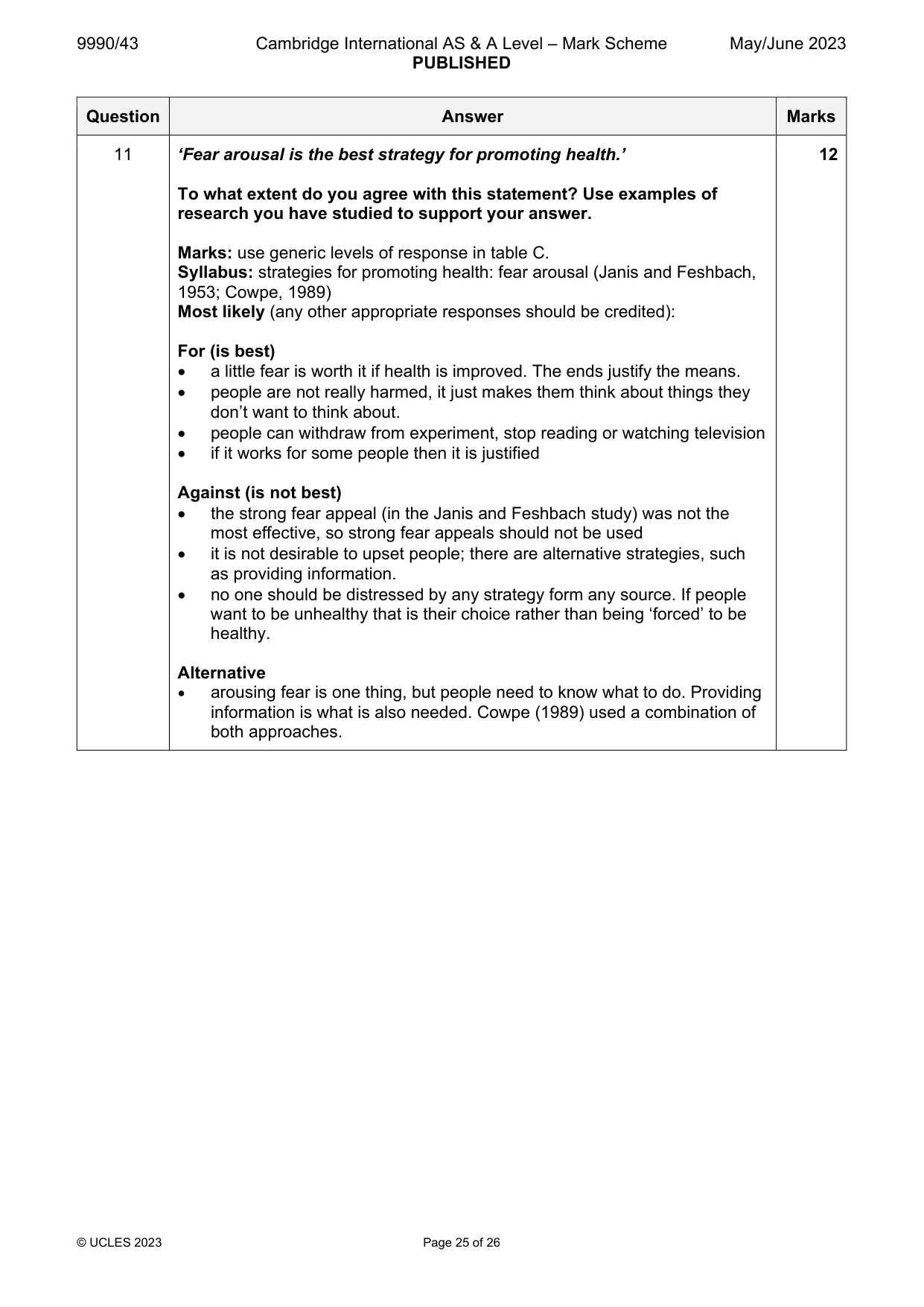
Mark scheme: 11 ‘Fear arousal is the best strategy for promoting health.’ 12 To what extent do you agree with this statement? Use examples of research you have studied to support your answer. Marks: use generic levels of response in table C. Syllabus: strategies for promoting health: fear arousal (Janis and Feshbach, 1953; Cowpe, 1989) Most likely (any other appropriate responses should be credited): For (is best) a little fear is worth it if health is improved. The ends justify the means. people are not really harmed, it just makes them think about things they don’t want to think about. people can withdraw from experiment, stop reading or watching television if it works for some people then it is justified Against (is not best) the strong fear appeal (in the Janis and Feshbach study) was not the most effective, so strong fear appeals should not be used it is not desirable to upset people; there are alternative strategies, such as providing information. no one should be distressed by any strategy form any source. If people want to be unhealthy that is their choice rather than being ‘forced’ to be healthy. Alternative arousing fear is one thing, but people need to know what to do. Providing information is what is also needed. Cowpe (1989) used a combination of both approaches.
More questions on 2 Health promotion in schools and worksites
Q12 · ‘Setting goals will not motivate employees because need theories explain everything about…
12 ‘Setting goals will not motivate employees because need theories explain everything about motivation at work.’ To what extent do you agree with this statement? Use examples of research you have studied to support your answer. [12]
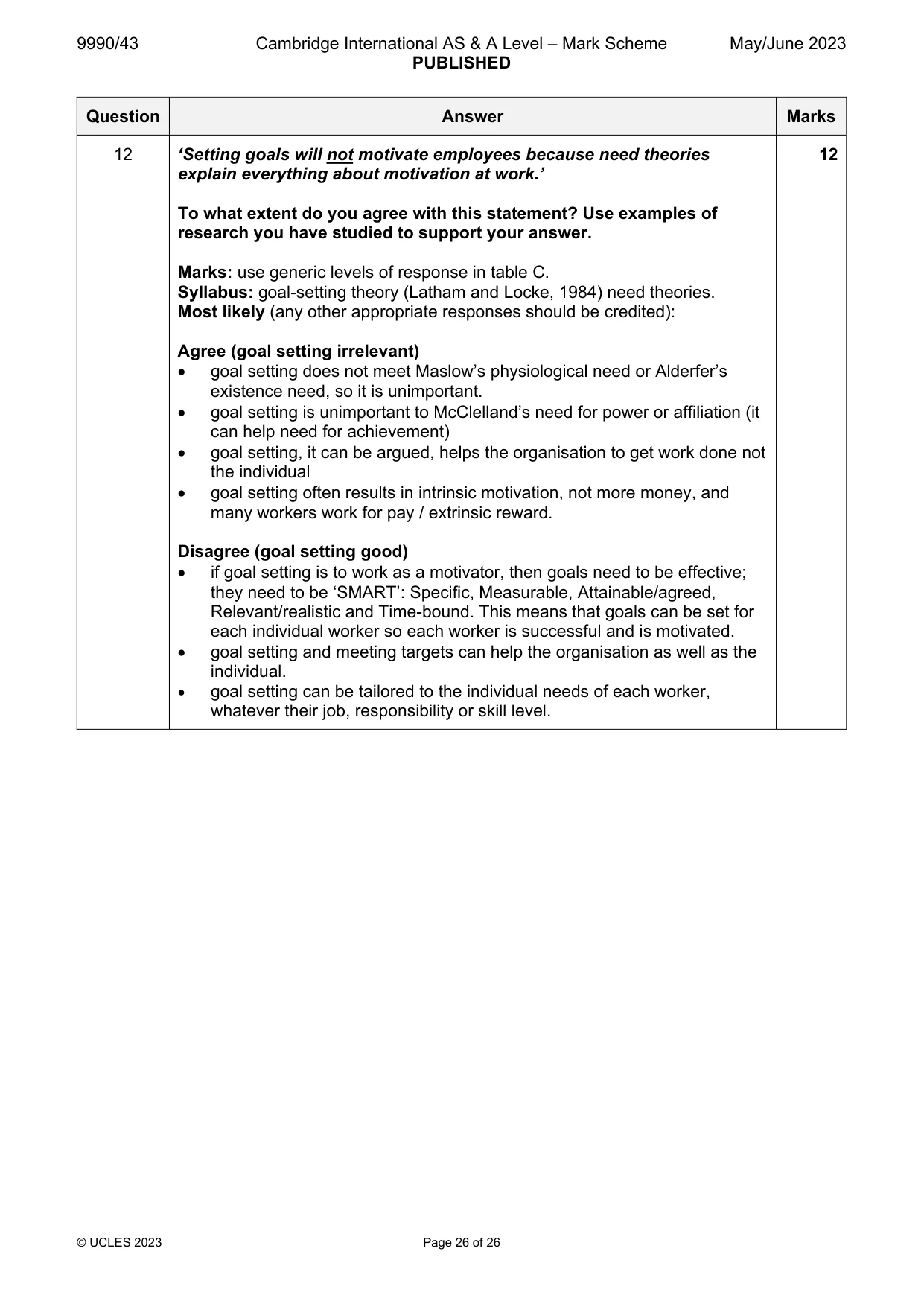
Mark scheme: 12 ‘Setting goals will not motivate employees because need theories 12 explain everything about motivation at work.’ To what extent do you agree with this statement? Use examples of research you have studied to support your answer. Marks: use generic levels of response in table C. Syllabus: goal-setting theory (Latham and Locke, 1984) need theories. Most likely (any other appropriate responses should be credited): Agree (goal setting irrelevant) goal setting does not meet Maslow’s physiological need or Alderfer’s existence need, so it is unimportant. goal setting is unimportant to McClelland’s need for power or affiliation (it can help need for achievement) goal setting, it can be argued, helps the organisation to get work done not the individual goal setting often results in intrinsic motivation, not more money, and many workers work for pay / extrinsic reward. Disagree (goal setting good) if goal setting is to work as a motivator, then goals need to be effective; they need to be ‘SMART’: Specific, Measurable, Attainable/agreed, Relevant/realistic and Time-bound. This means that goals can be set for each individual worker so each worker is successful and is motivated. goal setting and meeting targets can help the organisation as well as the individual. goal setting can be tailored to the individual needs of each worker, whatever their job, responsibility or skill level.
What was in this paper
The subtopics covered by these 12 questions, and how many questions each got. Open one in a new tab to see every Cambridge question on it.
What you needed in this session
Cambridge’s own grade thresholds for 2023 May/June, Paper 4 · Variant 3. A higher threshold means an easier paper — the bar moves with how the cohort did.