Cambridge A Level Psychology (from 2018) 9990 — 2021 Feb/March Paper 4 · Variant 2
9990/42/F/M/21 · 12 questions · 60 marks · ≈68 min
The question paper and its mark scheme, free to read here and free to download. This is Cambridge’s own paper, exactly as it was sat.
Question paper8 pages



Mark scheme24 pages
Answers below. Sit the paper first if you are practising.
Questions as text
Q1 · Ost and Westling (1995) compared the effectiveness of applied relaxation (AR) with…
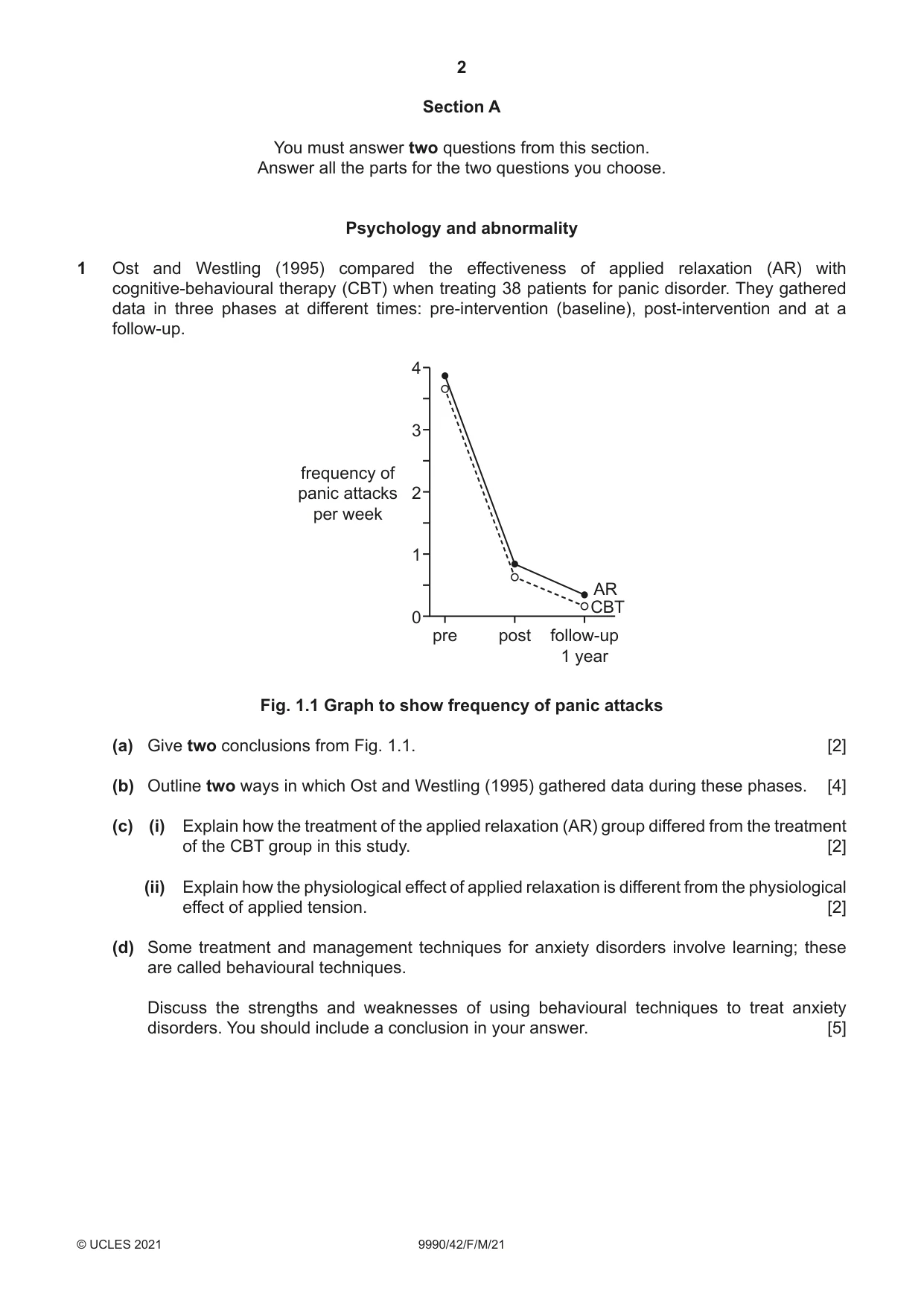
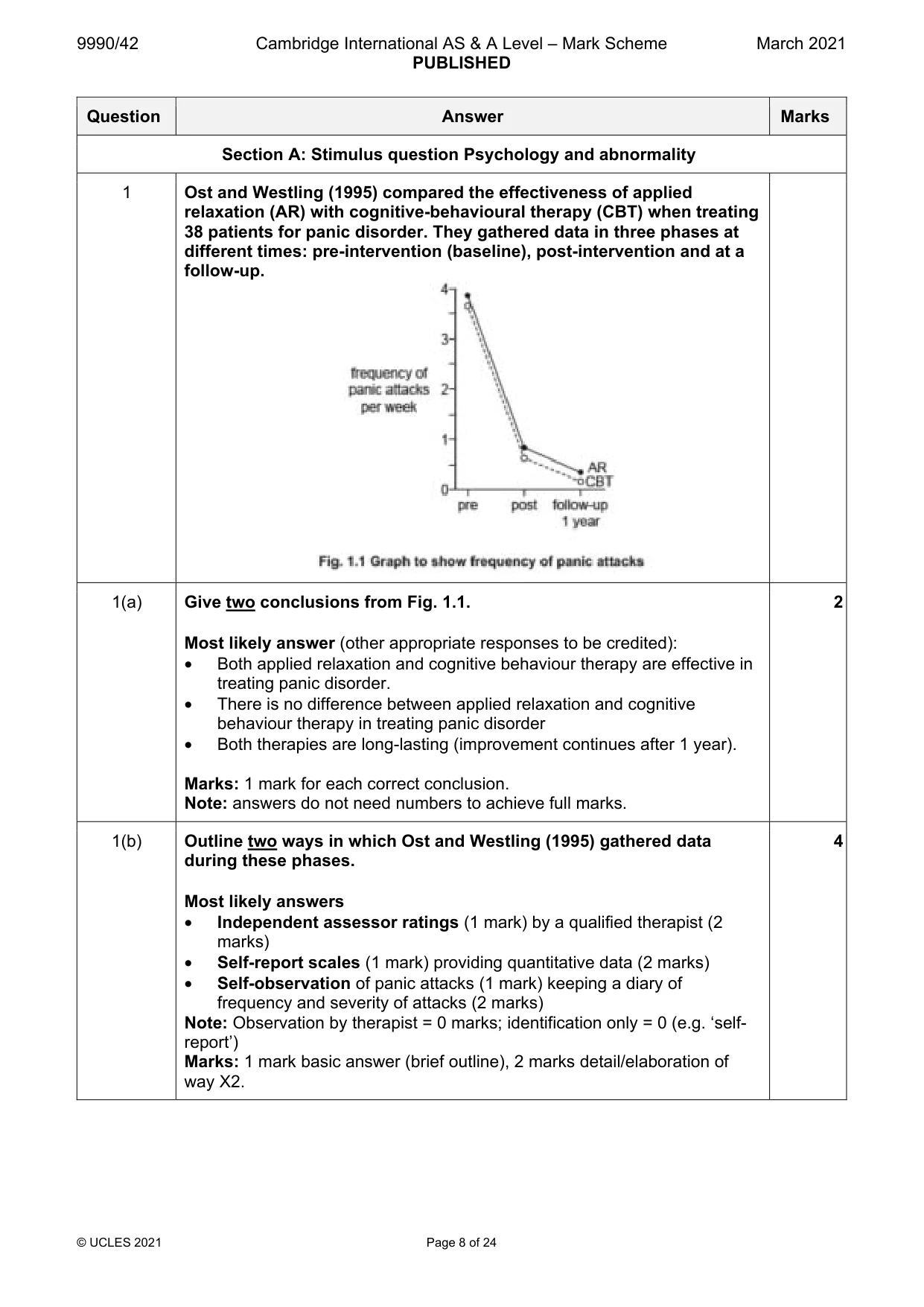
1 Ost and Westling (1995) compared the effectiveness of applied relaxation (AR) with cognitive-behavioural therapy (CBT) when treating 38 patients for panic disorder. They gathered data in three phases at different times: pre-intervention (baseline), post-intervention and at a follow-up. 4 3 frequency of panic attacks 2 per week 1 AR CBT 0 pre post follow-up 1 year Fig. 1.1 Graph to show frequency of panic attacks (a) Give two conclusions from Fig. 1.1. [2] (b) Outline two ways in which Ost and Westling (1995) gathered data during these phases. [4] (c) (i) Explain how the treatment of the applied relaxation (AR) group differed from the treatment of the CBT group in this study. [2] (ii) Explain how the physiological effect of applied relaxation is different from the physiological effect of applied tension. [2] (d) Some treatment and management techniques for anxiety disorders involve learning; these are called behavioural techniques. Discuss the strengths and weaknesses of using behavioural techniques to treat anxiety disorders. You should include a conclusion in your answer. [5] Psychology and consumer behaviour
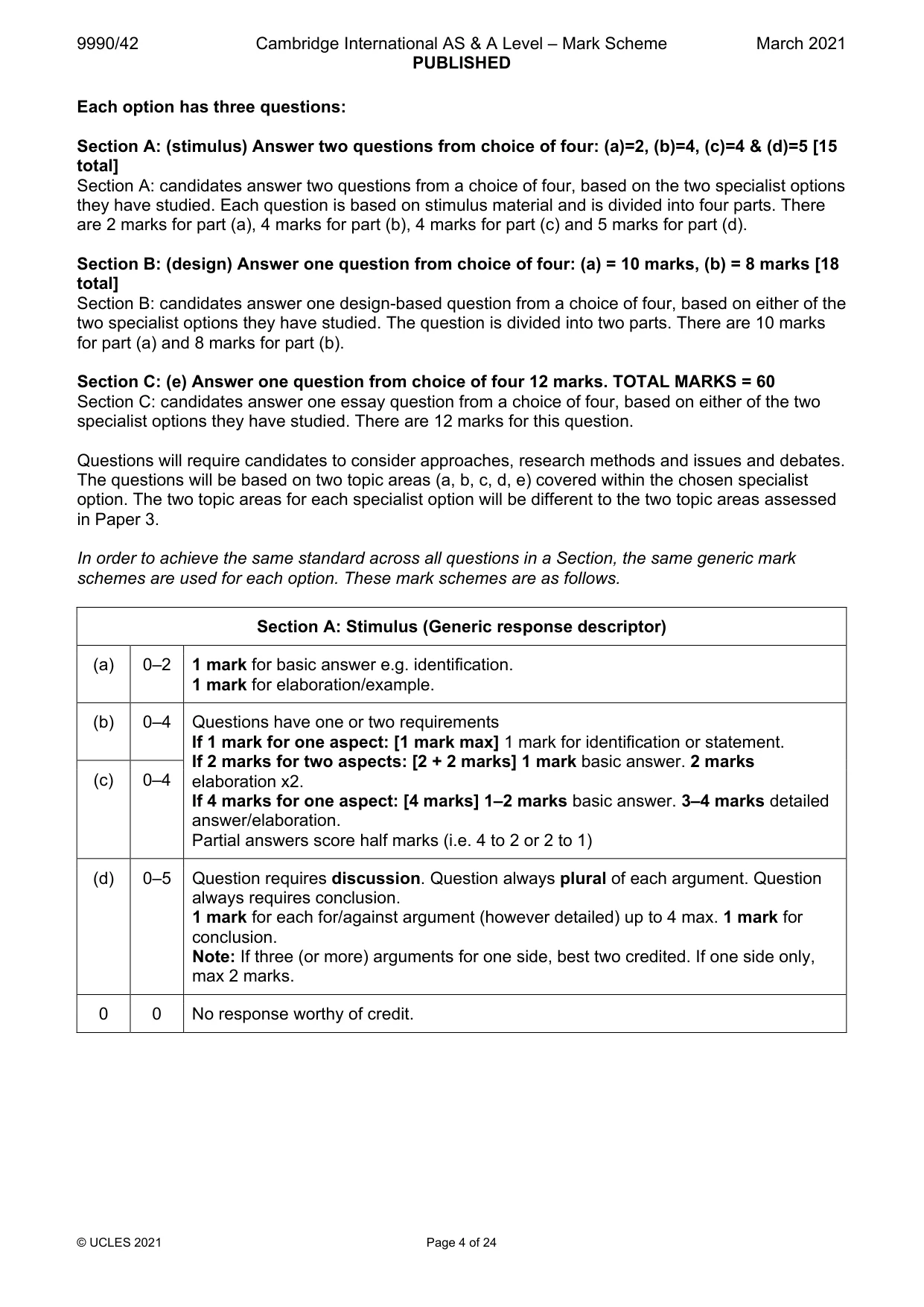
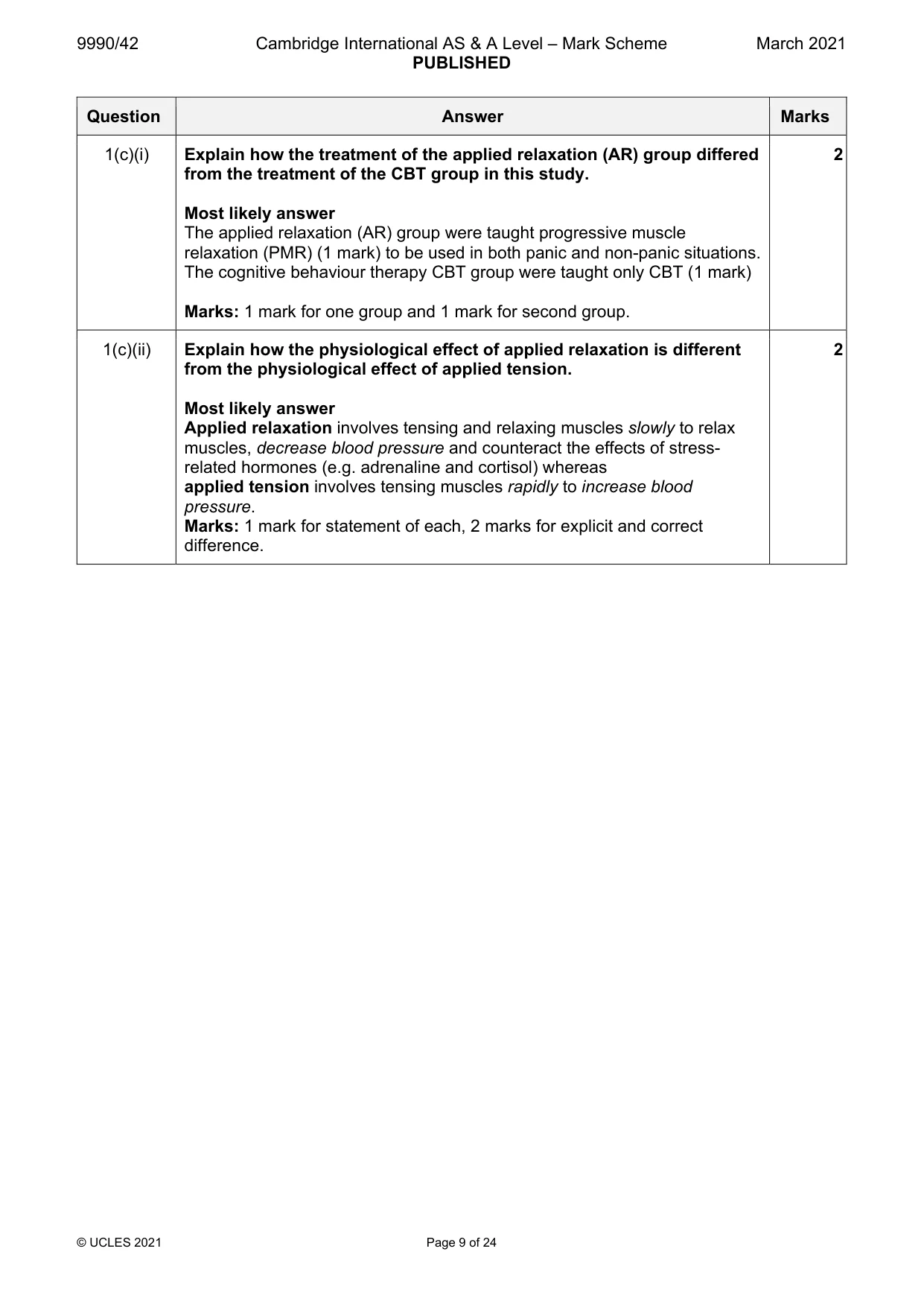
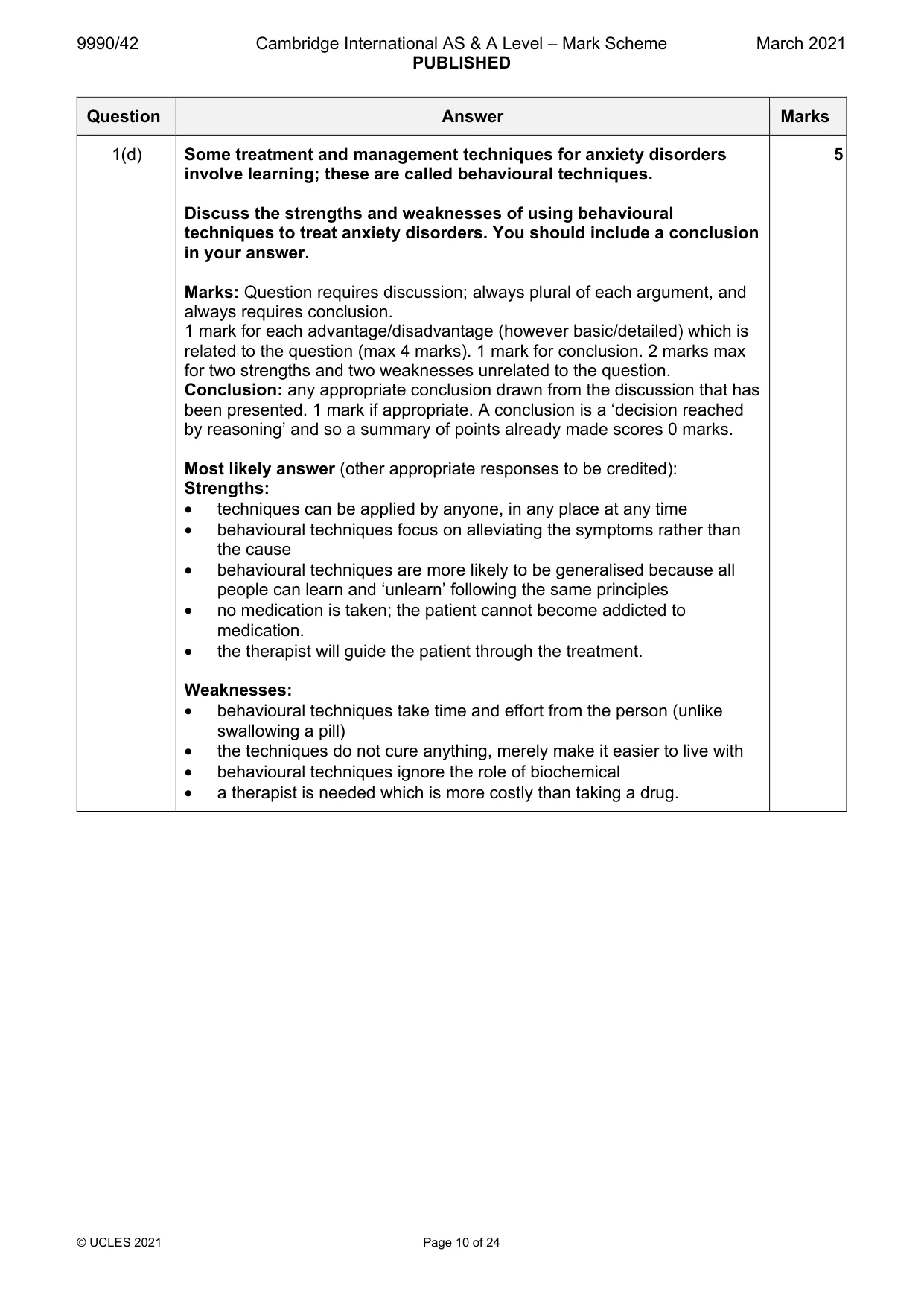
Mark scheme: Question Answer Marks Section A: Stimulus question Psychology and abnormality 1 Ost and Westling (1995) compared the effectiveness of applied relaxation (AR) with cognitive-behavioural therapy (CBT) when treating 38 patients for panic disorder. They gathered data in three phases at different times: pre-intervention (baseline), post-intervention and at a follow-up. 1(a) Give two conclusions from Fig. 1.1. 2 Most likely answer (other appropriate responses to be credited): • Both applied relaxation and cognitive behaviour therapy are effective in treating panic disorder. • There is no difference between applied relaxation and cognitive behaviour therapy in treating panic disorder • Both therapies are long-lasting (improvement continues after 1 year). Marks: 1 mark for each correct conclusion. Note: answers do not need numbers to achieve full marks. 1(b) Outline two ways in which Ost and Westling (1995) gathered data 4 during these phases. Most likely answers • Independent assessor ratings (1 mark) by a qualified therapist (2 marks) • Self-report scales (1 mark) providing quantitative data (2 marks) • Self-observation of panic attacks (1 mark) keeping a diary of frequency and severity of attacks (2 marks) Note: Observation by therapist = 0 marks; identification only = 0 (e.g. ‘self- report’) Marks: 1 mark basic answer (brief outline), 2 marks detail/elaboration of way X2. 1(c)(i) Explain how the treatment of the applied relaxation (AR) group differed 2 from the treatment of the CBT group in this study. Most likely answer The applied relaxation (AR) group were taught progressive muscle relaxation (PMR) (1 mark) to be used in both panic and non-panic situations. The cognitive behaviour therapy CBT group were taught only CBT (1 mark) Marks: 1 mark for one group and 1 mark for second group. 1(c)(ii) Explain how the physiological effect of applied relaxation is different 2 from the physiological effect of applied tension. Most likely answer Applied relaxation involves tensing and relaxing muscles slowly to relax muscles, decrease blood pressure and counteract the effects of stress- related hormones (e.g. adrenaline and cortisol) whereas applied tension involves tensing muscles rapidly to increase blood pressure. Marks: 1 mark for statement of each, 2 marks for explicit and correct difference. 1(d) Some treatment and management techniques for anxiety disorders 5 involve learning; these are called behavioural techniques. Discuss the strengths and weaknesses of using behavioural techniques to treat anxiety disorders. You should include a conclusion in your answer. Marks: Question requires discussion; always plural of each argument, and always requires conclusion. 1 mark for each advantage/disadvantage (however basic/detailed) which is related to the question (max 4 marks). 1 mark for conclusion. 2 marks max for two strengths and two weaknesses unrelated to the question. Conclusion: any appropriate conclusion drawn from the discussion that has been presented. 1 mark if appropriate. A conclusion is a ‘decision reached by reasoning’ and so a summary of points already made scores 0 marks. Most likely answer (other appropriate responses to be credited): Strengths: • techniques can be applied by anyone, in any place at any time • behavioural techniques focus on alleviating the symptoms rather than the cause • behavioural techniques are more likely to be generalised because all people can learn and ‘unlearn’ following the same principles • no medication is taken; the patient cannot become addicted to medication. • the therapist will guide the patient through the treatment. Weaknesses: • behavioural techniques take time and effort from the person (unlike swallowing a pill) • the techniques do not cure anything, merely make it easier to live with • behavioural techniques ignore the role of biochemical • a therapist is needed which is more costly than taking a drug.
More questions on Anxiety disorders and fear-related disorders
Question 2
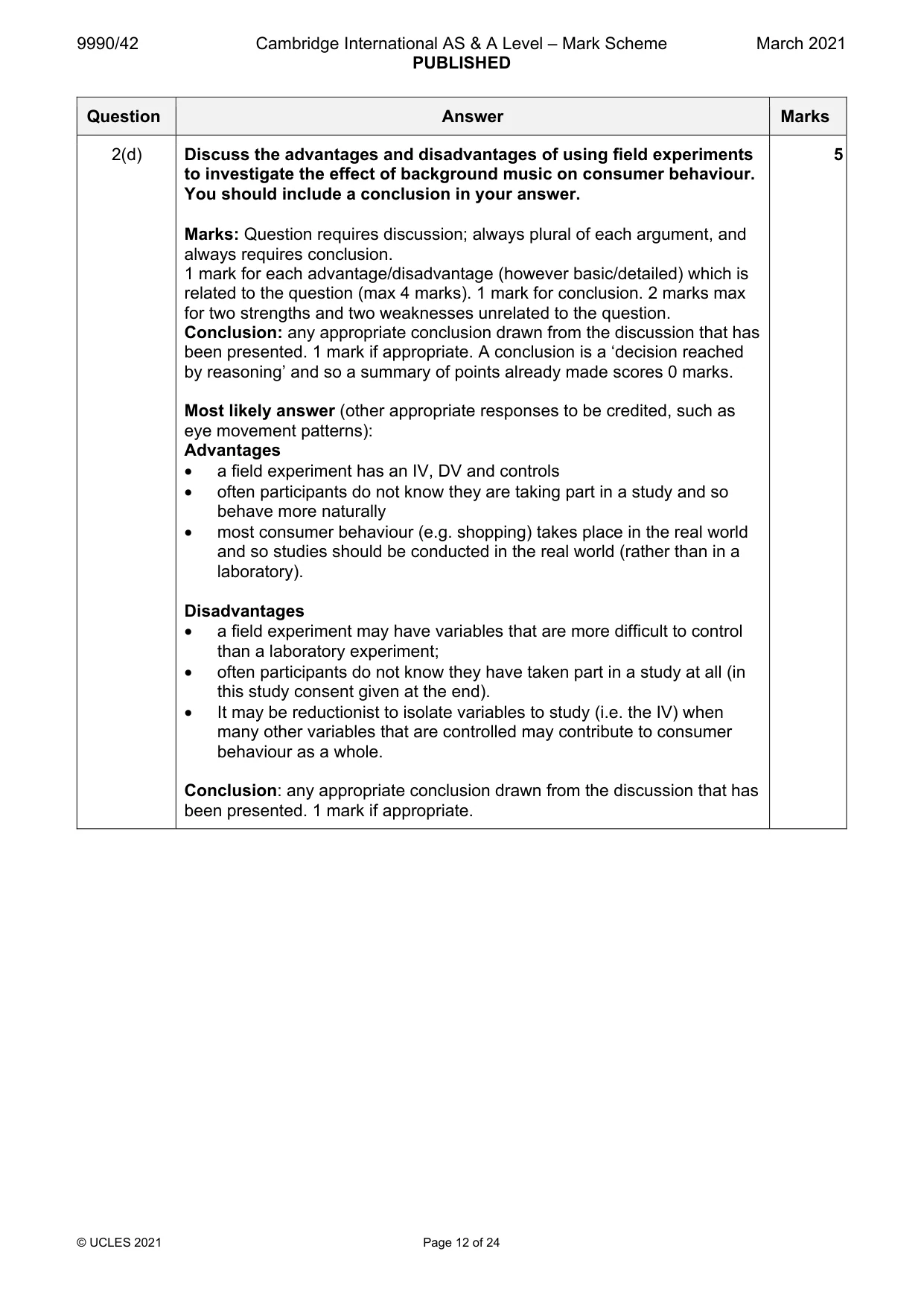
2 Guéguen et al. (2007) conducted a field experiment to test whether playing music in the background, the independent variable, had any effect on the shopping behaviour of their customers. They gathered quantitative data in three ways. (a) Explain what is meant by a ‘dependent variable’. [2] (b) Outline two of the dependent variables in the study by Guéguen et al. (2007). [4] (c) The data collected in this study was quantitative. Suggest two advantages of also gathering qualitative data in this study. [4] (d) Discuss the advantages and disadvantages of using field experiments to investigate the effect of background music on consumer behaviour. You should include a conclusion in your answer. [5] Psychology and health
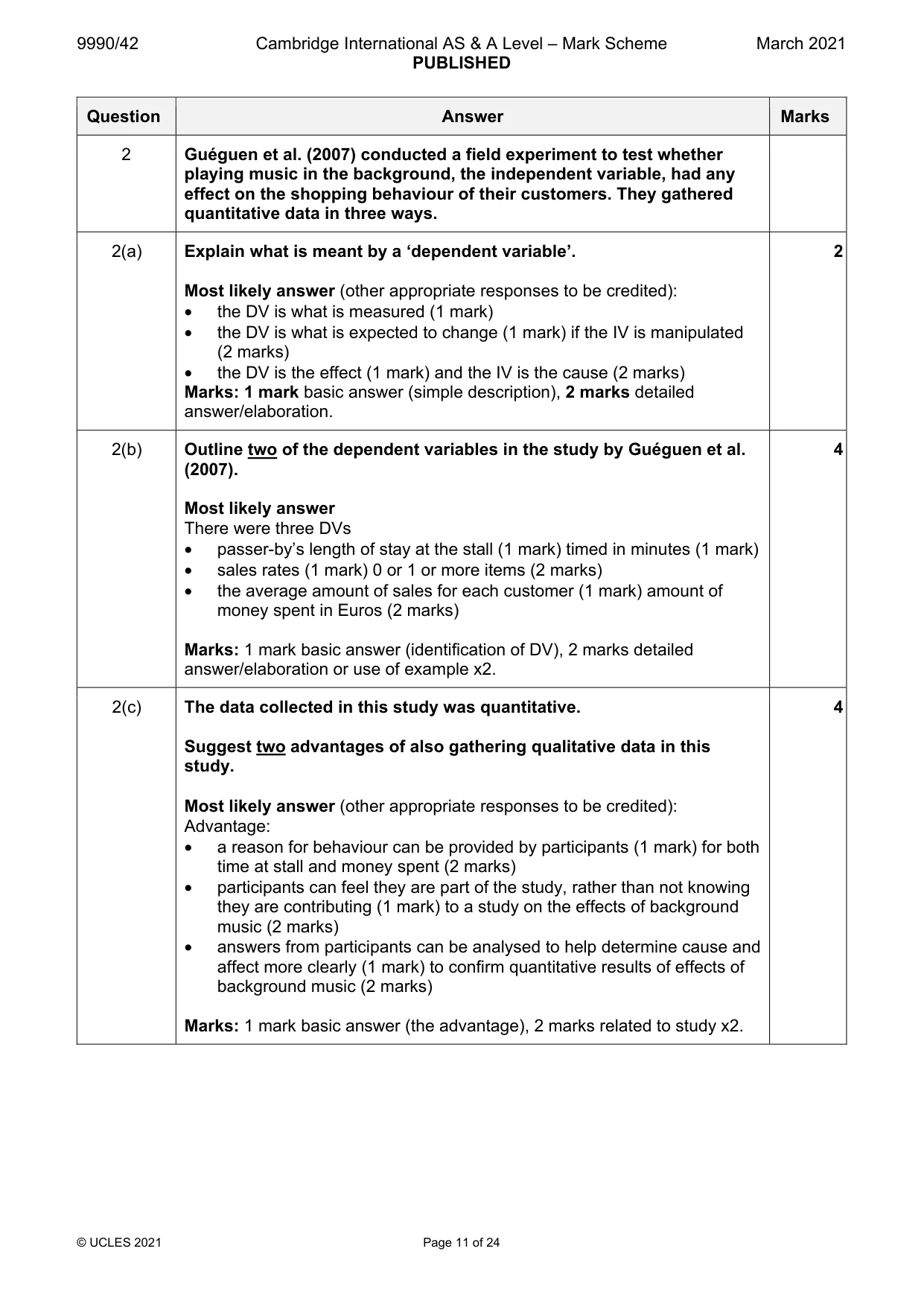
Mark scheme: 2 Guéguen et al. (2007) conducted a field experiment to test whether playing music in the background, the independent variable, had any effect on the shopping behaviour of their customers. They gathered quantitative data in three ways. 2(a) Explain what is meant by a ‘dependent variable’. 2 Most likely answer (other appropriate responses to be credited): • the DV is what is measured (1 mark) • the DV is what is expected to change (1 mark) if the IV is manipulated (2 marks) • the DV is the effect (1 mark) and the IV is the cause (2 marks) Marks: 1 mark basic answer (simple description), 2 marks detailed answer/elaboration. 2(b) Outline two of the dependent variables in the study by Guéguen et al. 4 (2007). Most likely answer There were three DVs • passer-by’s length of stay at the stall (1 mark) timed in minutes (1 mark) • sales rates (1 mark) 0 or 1 or more items (2 marks) • the average amount of sales for each customer (1 mark) amount of money spent in Euros (2 marks) Marks: 1 mark basic answer (identification of DV), 2 marks detailed answer/elaboration or use of example x2. 2(c) The data collected in this study was quantitative. 4 Suggest two advantages of also gathering qualitative data in this study. Most likely answer (other appropriate responses to be credited): Advantage: • a reason for behaviour can be provided by participants (1 mark) for both time at stall and money spent (2 marks) • participants can feel they are part of the study, rather than not knowing they are contributing (1 mark) to a study on the effects of background music (2 marks) • answers from participants can be analysed to help determine cause and affect more clearly (1 mark) to confirm quantitative results of effects of background music (2 marks) Marks: 1 mark basic answer (the advantage), 2 marks related to study x2. 2(d) Discuss the advantages and disadvantages of using field experiments 5 to investigate the effect of background music on consumer behaviour. You should include a conclusion in your answer. Marks: Question requires discussion; always plural of each argument, and always requires conclusion. 1 mark for each advantage/disadvantage (however basic/detailed) which is related to the question (max 4 marks). 1 mark for conclusion. 2 marks max for two strengths and two weaknesses unrelated to the question. Conclusion: any appropriate conclusion drawn from the discussion that has been presented. 1 mark if appropriate. A conclusion is a ‘decision reached by reasoning’ and so a summary of points already made scores 0 marks. Most likely answer (other appropriate responses to be credited, such as eye movement patterns): Advantages • a field experiment has an IV, DV and controls • often participants do not know they are taking part in a study and so behave more naturally • most consumer behaviour (e.g. shopping) takes place in the real world and so studies should be conducted in the real world (rather than in a laboratory). Disadvantages • a field experiment may have variables that are more difficult to control than a laboratory experiment; • often participants do not know they have taken part in a study at all (in this study consent given at the end). • It may be reductionist to isolate variables to study (i.e. the IV) when many other variables that are controlled may contribute to consumer behaviour as a whole. Conclusion: any appropriate conclusion drawn from the discussion that has been presented. 1 mark if appropriate.
Q3 · Weinstein (1980) asked students about their own chances of living past 80, getting lung…
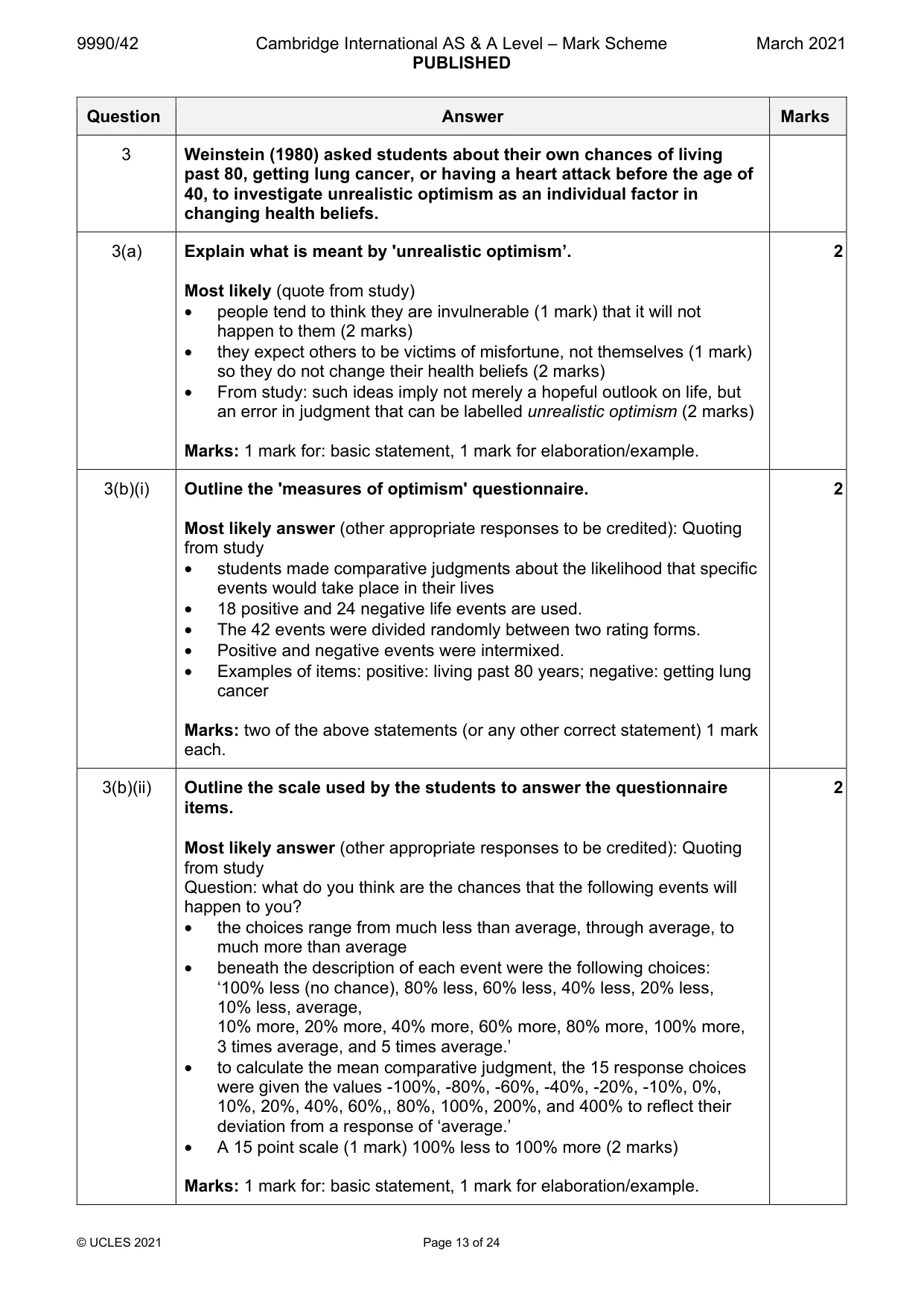
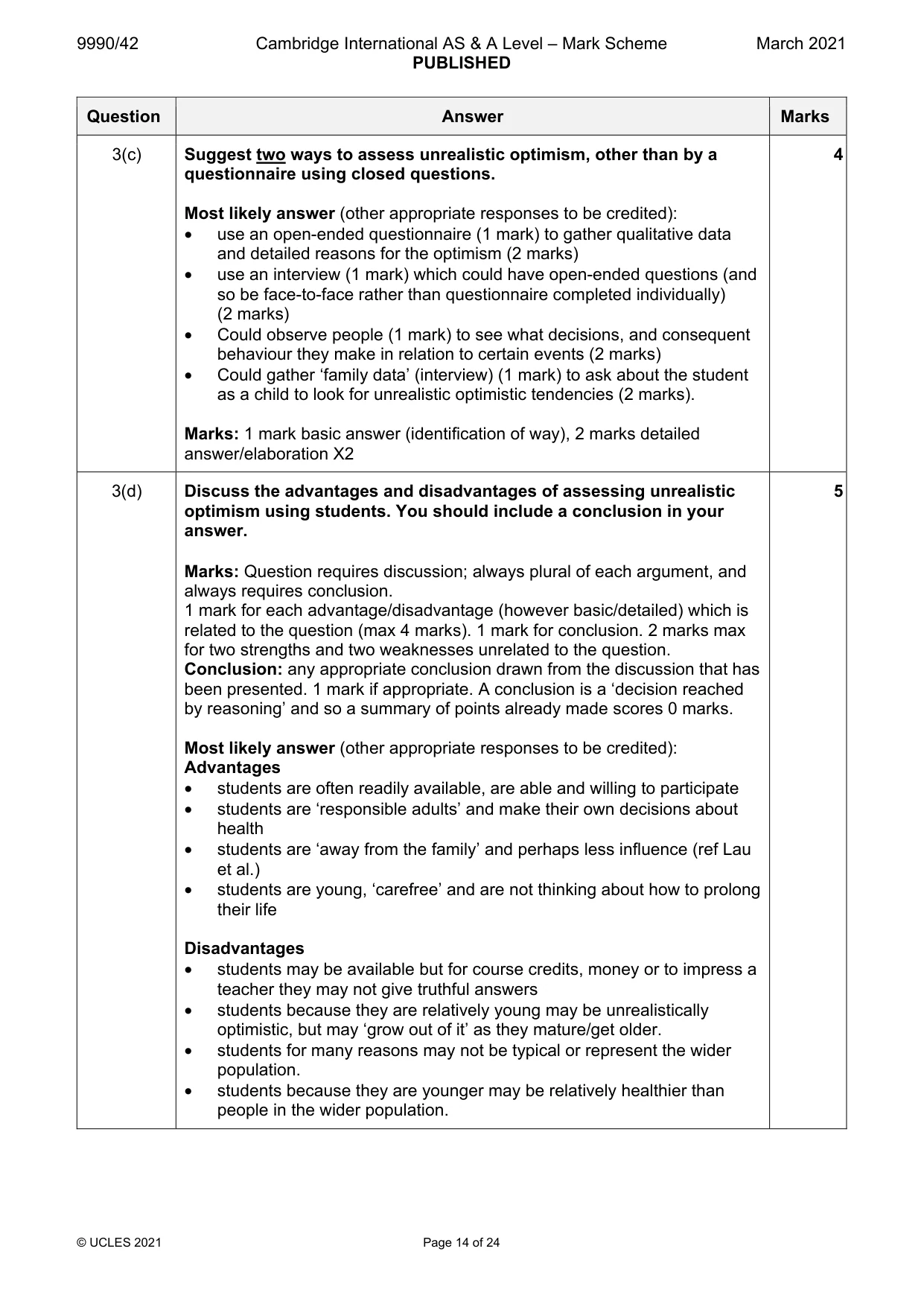
3 Weinstein (1980) asked students about their own chances of living past 80, getting lung cancer or having a heart attack before the age of 40, to investigate unrealistic optimism as an individual factor in changing health beliefs. (a) Explain what is meant by ‘unrealistic optimism’. [2] (b) (i) Outline the ‘measures of optimism’ questionnaire. [2] (ii) Outline the scale used by the students to answer the questionnaire items. [2] (c) Suggest two ways to assess unrealistic optimism, other than by a questionnaire using closed questions. [4] (d) Discuss the advantages and disadvantages of assessing unrealistic optimism using students. You should include a conclusion in your answer. [5] Psychology and organisations
Mark scheme: 3 Weinstein (1980) asked students about their own chances of living past 80, getting lung cancer, or having a heart attack before the age of 40, to investigate unrealistic optimism as an individual factor in changing health beliefs. 3(a) Explain what is meant by 'unrealistic optimism’. 2 Most likely (quote from study) • people tend to think they are invulnerable (1 mark) that it will not happen to them (2 marks) • they expect others to be victims of misfortune, not themselves (1 mark) so they do not change their health beliefs (2 marks) • From study: such ideas imply not merely a hopeful outlook on life, but an error in judgment that can be labelled unrealistic optimism (2 marks) Marks: 1 mark for: basic statement, 1 mark for elaboration/example. 3(b)(i) Outline the 'measures of optimism' questionnaire. 2 Most likely answer (other appropriate responses to be credited): Quoting from study • students made comparative judgments about the likelihood that specific events would take place in their lives • 18 positive and 24 negative life events are used. • The 42 events were divided randomly between two rating forms. • Positive and negative events were intermixed. • Examples of items: positive: living past 80 years; negative: getting lung cancer Marks: two of the above statements (or any other correct statement) 1 mark each. 3(b)(ii) Outline the scale used by the students to answer the questionnaire 2 items. Most likely answer (other appropriate responses to be credited): Quoting from study Question: what do you think are the chances that the following events will happen to you? • the choices range from much less than average, through average, to much more than average • beneath the description of each event were the following choices: ‘100% less (no chance), 80% less, 60% less, 40% less, 20% less, 10% less, average, 10% more, 20% more, 40% more, 60% more, 80% more, 100% more, 3 times average, and 5 times average.’ • to calculate the mean comparative judgment, the 15 response choices were given the values -100%, -80%, -60%, -40%, -20%, -10%, 0%, 10%, 20%, 40%, 60%,, 80%, 100%, 200%, and 400% to reflect their deviation from a response of ‘average.’ • A 15 point scale (1 mark) 100% less to 100% more (2 marks) Marks: 1 mark for: basic statement, 1 mark for elaboration/example. 3(c) Suggest two ways to assess unrealistic optimism, other than by a 4 questionnaire using closed questions. Most likely answer (other appropriate responses to be credited): • use an open-ended questionnaire (1 mark) to gather qualitative data and detailed reasons for the optimism (2 marks) • use an interview (1 mark) which could have open-ended questions (and so be face-to-face rather than questionnaire completed individually) (2 marks) • Could observe people (1 mark) to see what decisions, and consequent behaviour they make in relation to certain events (2 marks) • Could gather ‘family data’ (interview) (1 mark) to ask about the student as a child to look for unrealistic optimistic tendencies (2 marks). Marks: 1 mark basic answer (identification of way), 2 marks detailed answer/elaboration X2 3(d) Discuss the advantages and disadvantages of assessing unrealistic 5 optimism using students. You should include a conclusion in your answer. Marks: Question requires discussion; always plural of each argument, and always requires conclusion. 1 mark for each advantage/disadvantage (however basic/detailed) which is related to the question (max 4 marks). 1 mark for conclusion. 2 marks max for two strengths and two weaknesses unrelated to the question. Conclusion: any appropriate conclusion drawn from the discussion that has been presented. 1 mark if appropriate. A conclusion is a ‘decision reached by reasoning’ and so a summary of points already made scores 0 marks. Most likely answer (other appropriate responses to be credited): Advantages • students are often readily available, are able and willing to participate • students are ‘responsible adults’ and make their own decisions about health • students are ‘away from the family’ and perhaps less influence (ref Lau et al.) • students are young, ‘carefree’ and are not thinking about how to prolong their life Disadvantages • students may be available but for course credits, money or to impress a teacher they may not give truthful answers • students because they are relatively young may be unrealistically optimistic, but may ‘grow out of it’ as they mature/get older. • students for many reasons may not be typical or represent the wider population. • students because they are younger may be relatively healthier than people in the wider population.
Q4 · According to achievement motivation theory (McClelland, 1965), people have different needs
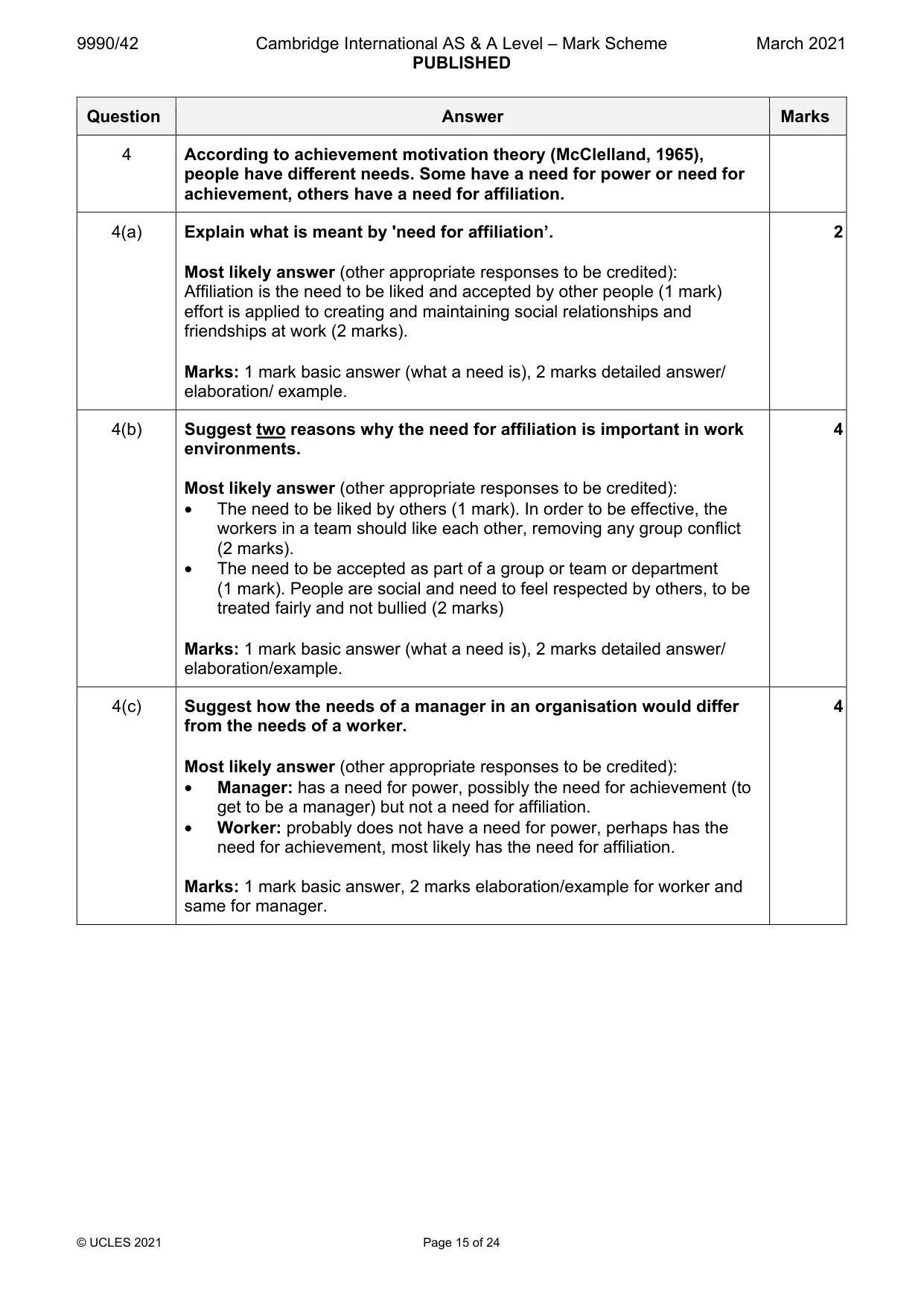
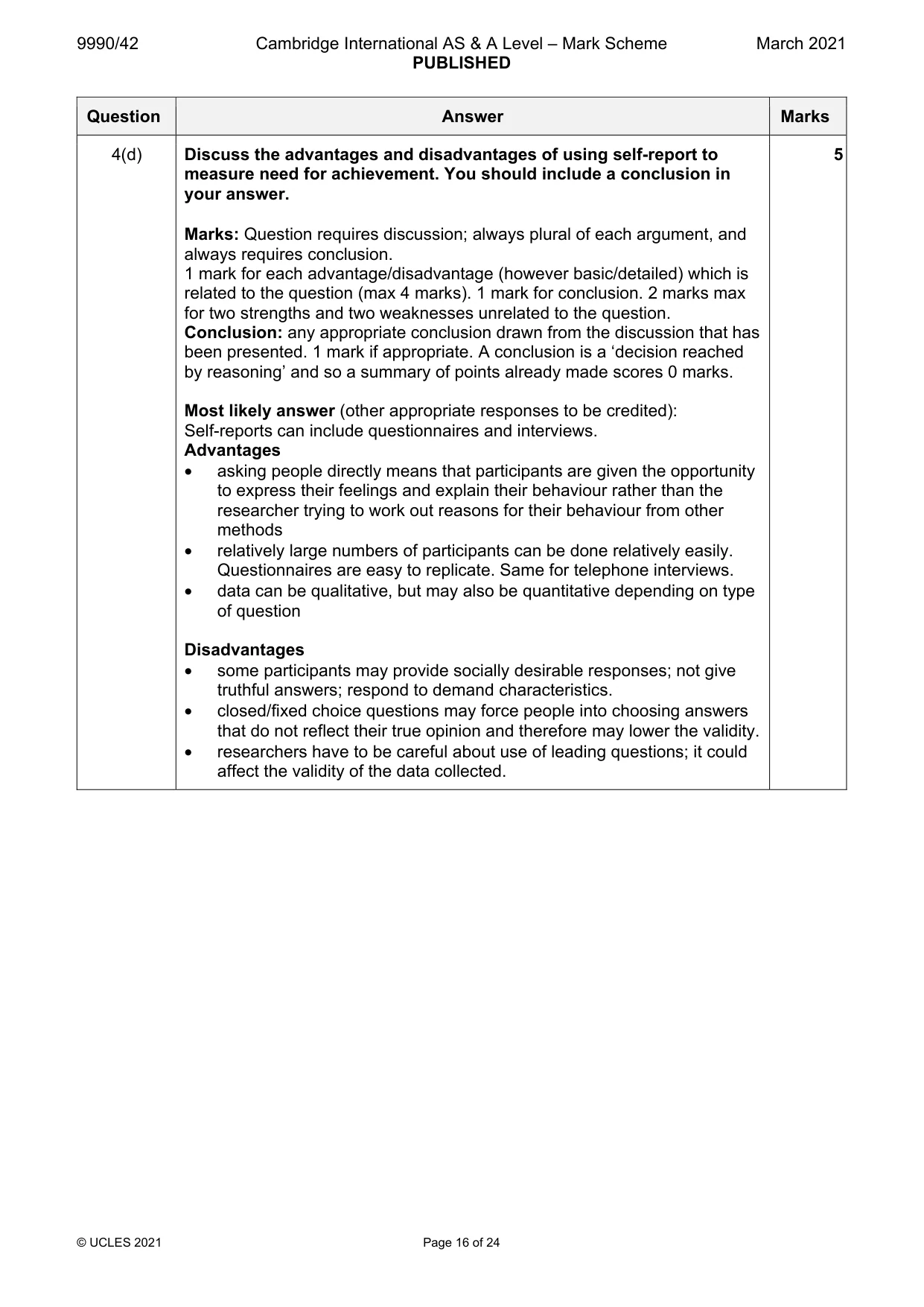
4 According to achievement motivation theory (McClelland, 1965), people have different needs. Some have a need for power or need for achievement, others have a need for affiliation. (a) Explain what is meant by ‘need for affiliation’. [2] (b) Suggest two reasons why the need for affiliation is important in work environments. [4] (c) Suggest how the needs of a manager in an organisation would differ from the needs of a worker. [4] (d) Discuss the advantages and disadvantages of using self-report to measure need for achievement. You should include a conclusion in your answer. [5]
Mark scheme: 4 According to achievement motivation theory (McClelland, 1965), people have different needs. Some have a need for power or need for achievement, others have a need for affiliation. 4(a) Explain what is meant by 'need for affiliation’. 2 Most likely answer (other appropriate responses to be credited): Affiliation is the need to be liked and accepted by other people (1 mark) effort is applied to creating and maintaining social relationships and friendships at work (2 marks). Marks: 1 mark basic answer (what a need is), 2 marks detailed answer/ elaboration/ example. 4(b) Suggest two reasons why the need for affiliation is important in work 4 environments. Most likely answer (other appropriate responses to be credited): • The need to be liked by others (1 mark). In order to be effective, the workers in a team should like each other, removing any group conflict (2 marks). • The need to be accepted as part of a group or team or department (1 mark). People are social and need to feel respected by others, to be treated fairly and not bullied (2 marks) Marks: 1 mark basic answer (what a need is), 2 marks detailed answer/ elaboration/example. 4(c) Suggest how the needs of a manager in an organisation would differ 4 from the needs of a worker. Most likely answer (other appropriate responses to be credited): • Manager: has a need for power, possibly the need for achievement (to get to be a manager) but not a need for affiliation. • Worker: probably does not have a need for power, perhaps has the need for achievement, most likely has the need for affiliation. Marks: 1 mark basic answer, 2 marks elaboration/example for worker and same for manager. 4(d) Discuss the advantages and disadvantages of using self-report to 5 measure need for achievement. You should include a conclusion in your answer. Marks: Question requires discussion; always plural of each argument, and always requires conclusion. 1 mark for each advantage/disadvantage (however basic/detailed) which is related to the question (max 4 marks). 1 mark for conclusion. 2 marks max for two strengths and two weaknesses unrelated to the question. Conclusion: any appropriate conclusion drawn from the discussion that has been presented. 1 mark if appropriate. A conclusion is a ‘decision reached by reasoning’ and so a summary of points already made scores 0 marks. Most likely answer (other appropriate responses to be credited): Self-reports can include questionnaires and interviews. Advantages • asking people directly means that participants are given the opportunity to express their feelings and explain their behaviour rather than the researcher trying to work out reasons for their behaviour from other methods • relatively large numbers of participants can be done relatively easily. Questionnaires are easy to replicate. Same for telephone interviews. • data can be qualitative, but may also be quantitative depending on type of question Disadvantages • some participants may provide socially desirable responses; not give truthful answers; respond to demand characteristics. • closed/fixed choice questions may force people into choosing answers that do not reflect their true opinion and therefore may lower the validity. • researchers have to be careful about use of leading questions; it could affect the validity of the data collected.
Q5 · Design a study to test age differences in the effectiveness of rational emotive behaviour…
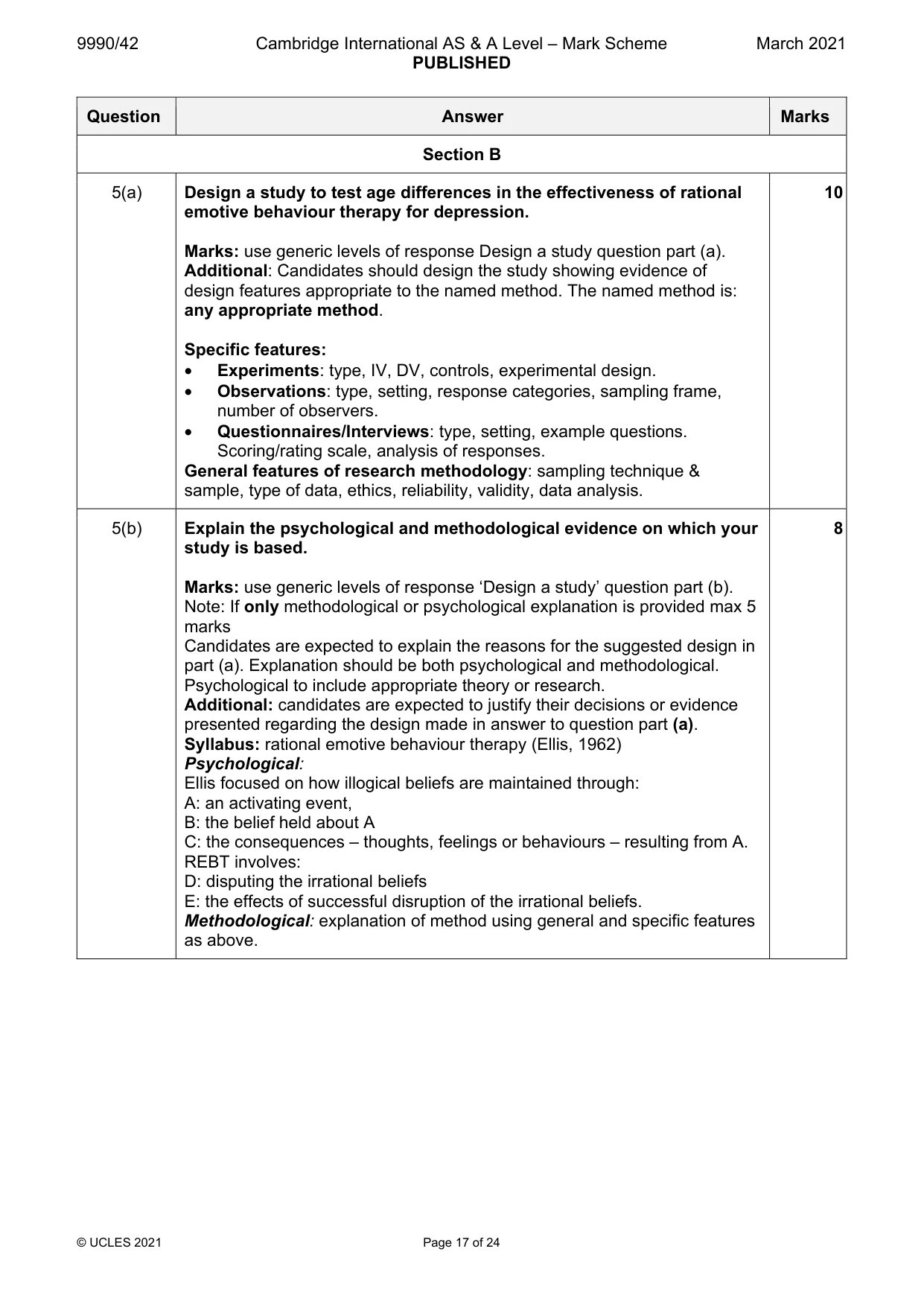
5 (a) Design a study to test age differences in the effectiveness of rational emotive behaviour therapy for depression. [10] (b) Explain the psychological and methodological evidence on which your study is based. [8] Psychology and consumer behaviour
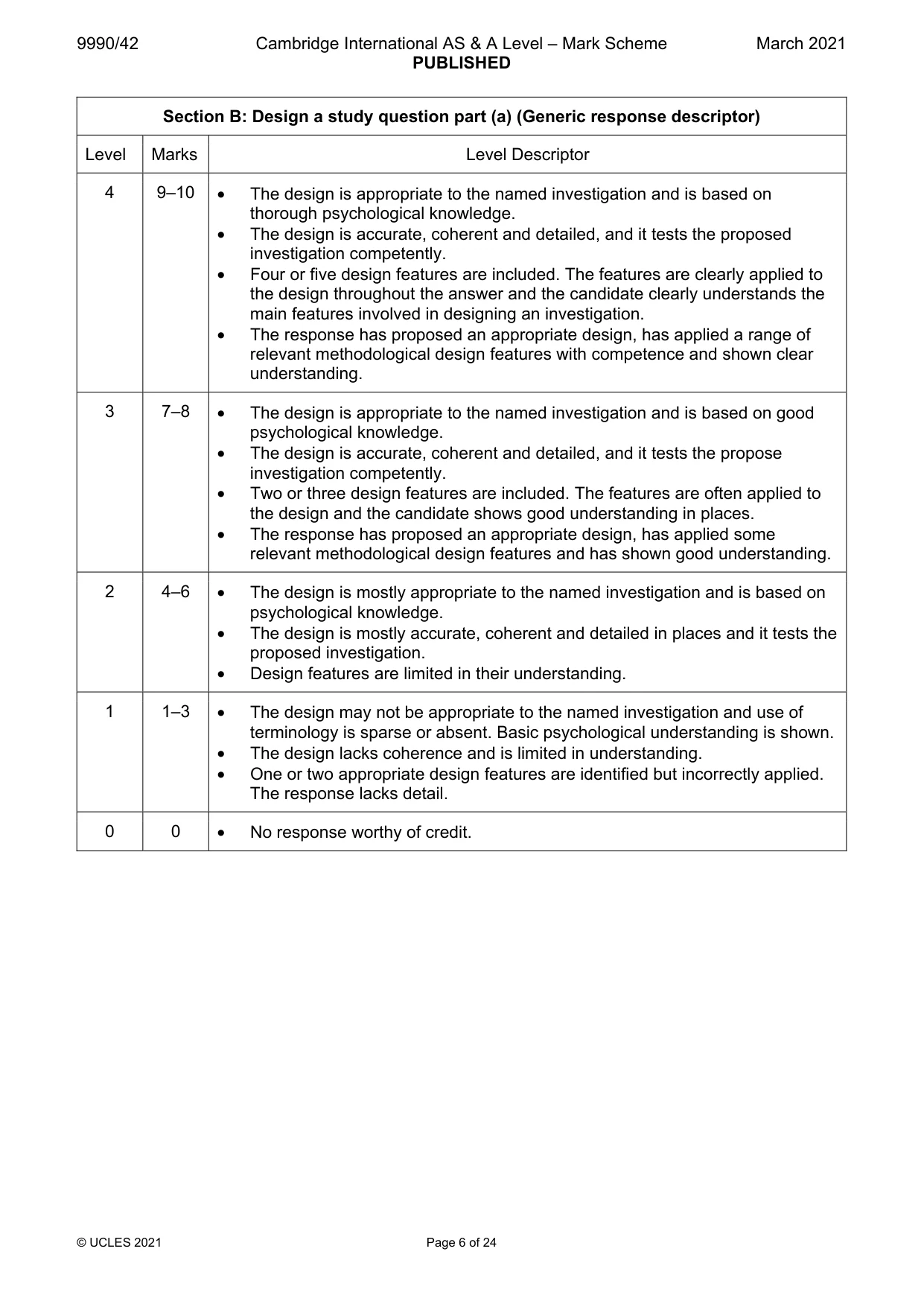
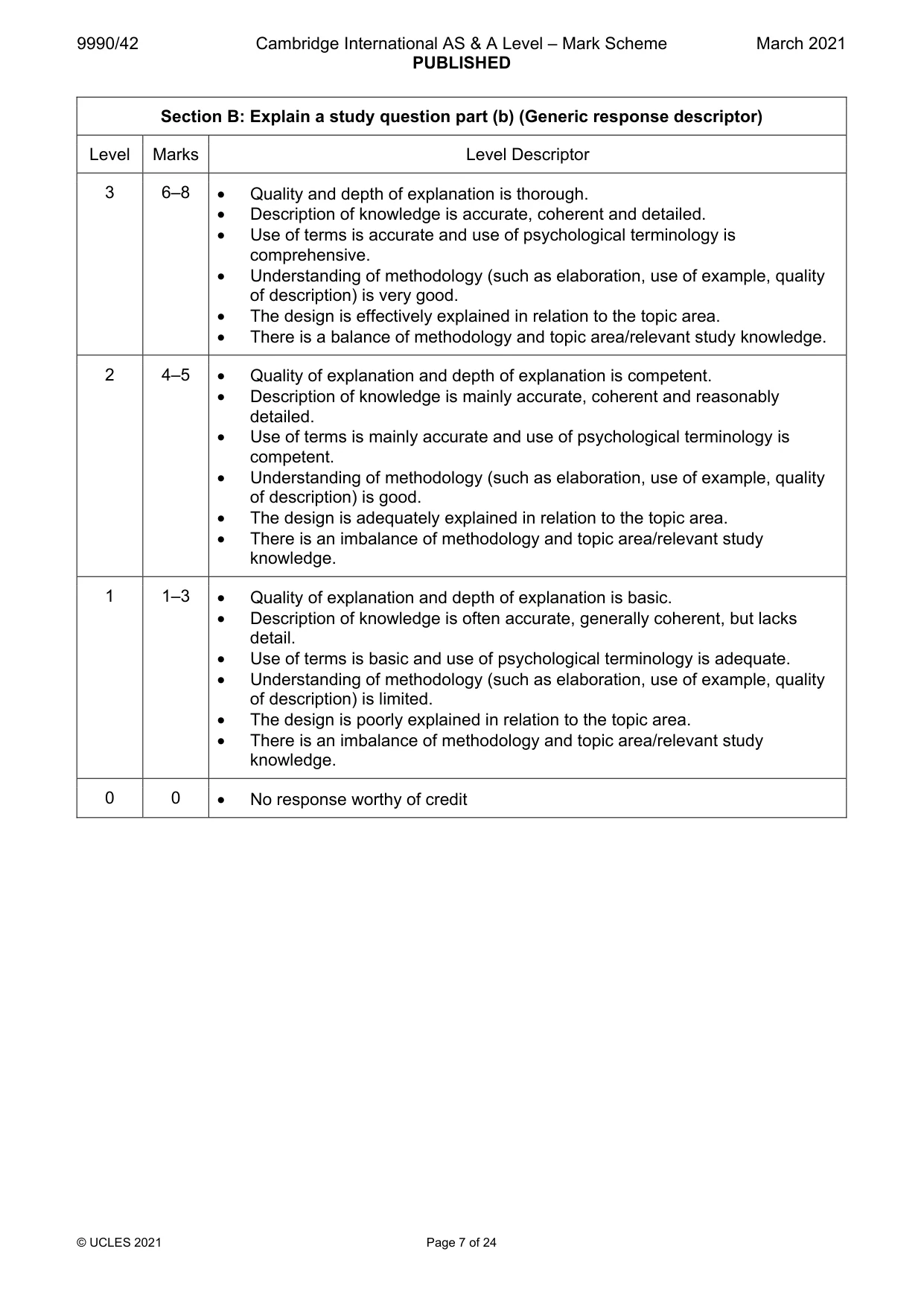
Mark scheme: 5(a) Design a study to test age differences in the effectiveness of rational 10 emotive behaviour therapy for depression. Marks: use generic levels of response Design a study question part (a). Additional: Candidates should design the study showing evidence of design features appropriate to the named method. The named method is: any appropriate method. Specific features: • Experiments: type, IV, DV, controls, experimental design. • Observations: type, setting, response categories, sampling frame, number of observers. • Questionnaires/Interviews: type, setting, example questions. Scoring/rating scale, analysis of responses. General features of research methodology: sampling technique & sample, type of data, ethics, reliability, validity, data analysis. 5(b) Explain the psychological and methodological evidence on which your 8 study is based. Marks: use generic levels of response ‘Design a study’ question part (b). Note: If only methodological or psychological explanation is provided max 5 marks Candidates are expected to explain the reasons for the suggested design in part (a). Explanation should be both psychological and methodological. Psychological to include appropriate theory or research. Additional: candidates are expected to justify their decisions or evidence presented regarding the design made in answer to question part (a). Syllabus: rational emotive behaviour therapy (Ellis, 1962) Psychological: Ellis focused on how illogical beliefs are maintained through: A: an activating event, B: the belief held about A C: the consequences – thoughts, feelings or behaviours – resulting from A. REBT involves: D: disputing the irrational beliefs E: the effects of successful disruption of the irrational beliefs. Methodological: explanation of method using general and specific features as above.
More questions on Mood (affective) disorders: depressive disorder (unipolar) and bipolar disorder
Q6 · Variables, such as lighting, colour and smell, affect pleasure arousal in retail…
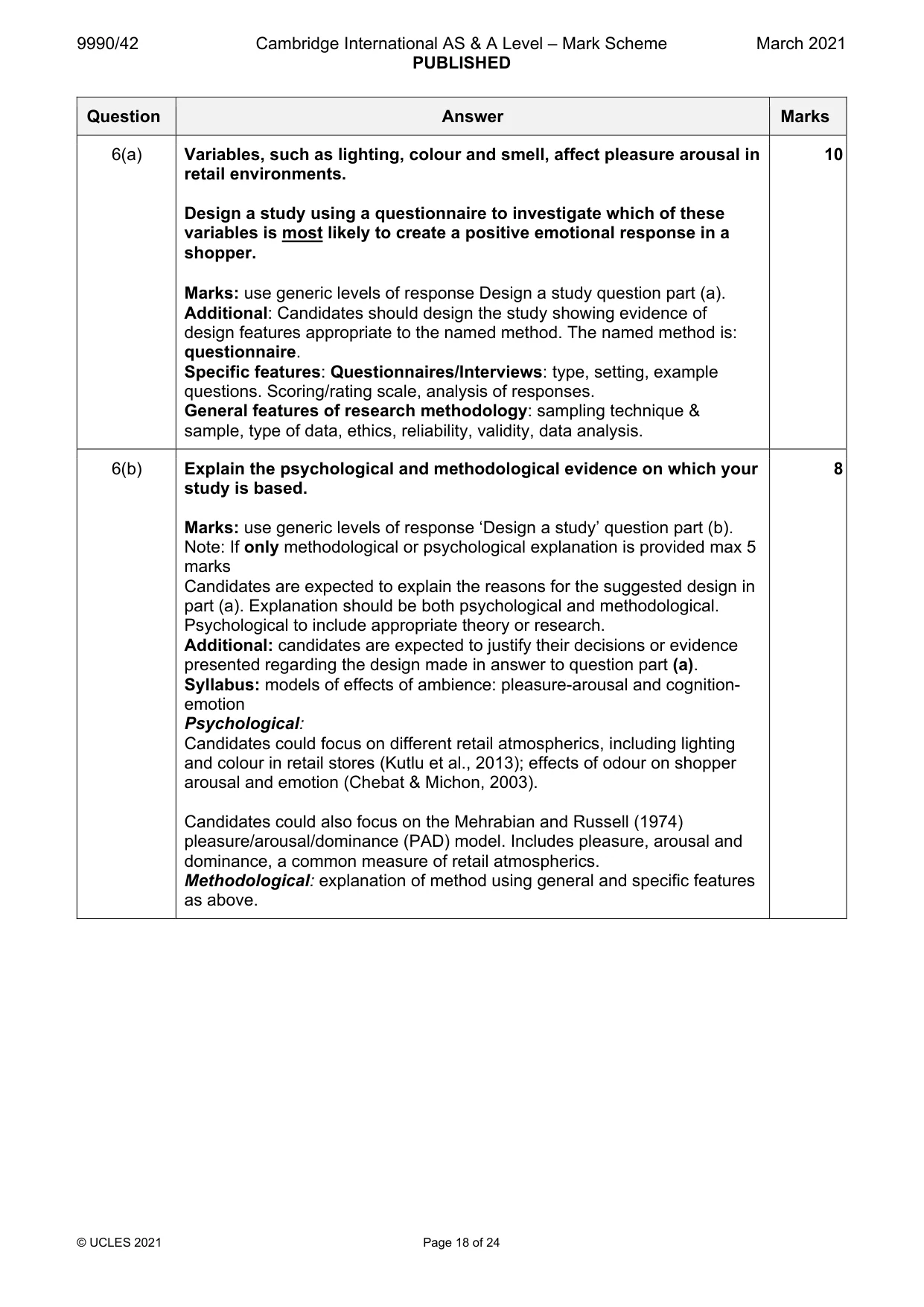
6 (a) Variables, such as lighting, colour and smell, affect pleasure arousal in retail environments. Design a study using a questionnaire to investigate which of these variables is most likely to create a positive emotional response in a shopper. [10] (b) Explain the psychological and methodological evidence on which your study is based. [8] Psychology and health
Mark scheme: 6(a) Variables, such as lighting, colour and smell, affect pleasure arousal in 10 retail environments. Design a study using a questionnaire to investigate which of these variables is most likely to create a positive emotional response in a shopper. Marks: use generic levels of response Design a study question part (a). Additional: Candidates should design the study showing evidence of design features appropriate to the named method. The named method is: questionnaire. Specific features: Questionnaires/Interviews: type, setting, example questions. Scoring/rating scale, analysis of responses. General features of research methodology: sampling technique & sample, type of data, ethics, reliability, validity, data analysis. 6(b) Explain the psychological and methodological evidence on which your 8 study is based. Marks: use generic levels of response ‘Design a study’ question part (b). Note: If only methodological or psychological explanation is provided max 5 marks Candidates are expected to explain the reasons for the suggested design in part (a). Explanation should be both psychological and methodological. Psychological to include appropriate theory or research. Additional: candidates are expected to justify their decisions or evidence presented regarding the design made in answer to question part (a). Syllabus: models of effects of ambience: pleasure-arousal and cognition- emotion Psychological: Candidates could focus on different retail atmospherics, including lighting and colour in retail stores (Kutlu et al., 2013); effects of odour on shopper arousal and emotion (Chebat & Michon, 2003). Candidates could also focus on the Mehrabian and Russell (1974) pleasure/arousal/dominance (PAD) model. Includes pleasure, arousal and dominance, a common measure of retail atmospherics. Methodological: explanation of method using general and specific features as above.
Q7 · Design a study using an interview to investigate what important information patients need…
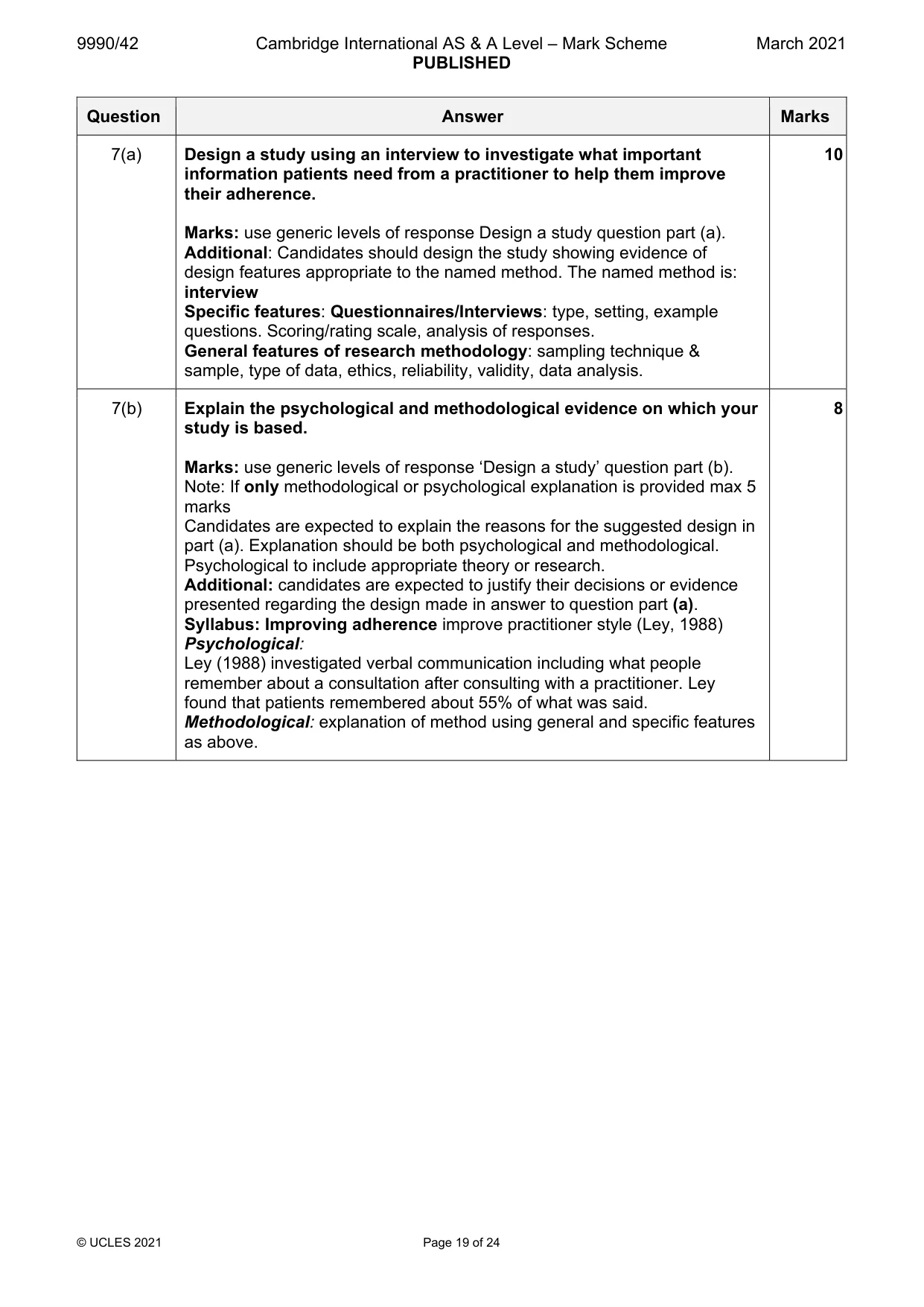
7 (a) Design a study using an interview to investigate what important information patients need from a practitioner to help them improve their adherence. [10] (b) Explain the psychological and methodological evidence on which your study is based. [8] Psychology and organisations
Mark scheme: 7(a) Design a study using an interview to investigate what important 10 information patients need from a practitioner to help them improve their adherence. Marks: use generic levels of response Design a study question part (a). Additional: Candidates should design the study showing evidence of design features appropriate to the named method. The named method is: interview Specific features: Questionnaires/Interviews: type, setting, example questions. Scoring/rating scale, analysis of responses. General features of research methodology: sampling technique & sample, type of data, ethics, reliability, validity, data analysis. 7(b) Explain the psychological and methodological evidence on which your 8 study is based. Marks: use generic levels of response ‘Design a study’ question part (b). Note: If only methodological or psychological explanation is provided max 5 marks Candidates are expected to explain the reasons for the suggested design in part (a). Explanation should be both psychological and methodological. Psychological to include appropriate theory or research. Additional: candidates are expected to justify their decisions or evidence presented regarding the design made in answer to question part (a). Syllabus: Improving adherence improve practitioner style (Ley, 1988) Psychological: Ley (1988) investigated verbal communication including what people remember about a consultation after consulting with a practitioner. Ley found that patients remembered about 55% of what was said. Methodological: explanation of method using general and specific features as above.
Q8 · Design a study using observation to investigate whether a group follows the stages of…
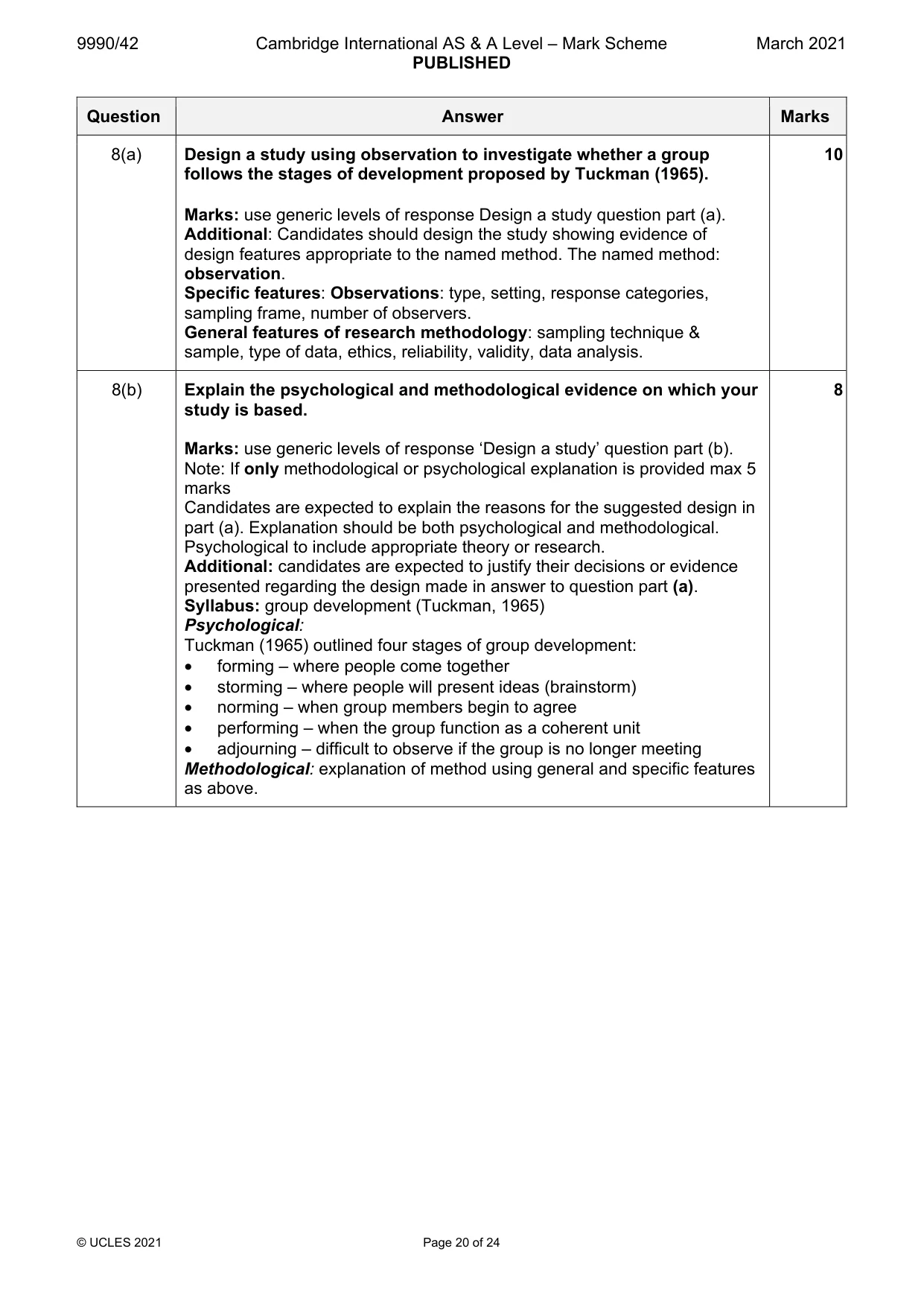
8 (a) Design a study using observation to investigate whether a group follows the stages of development proposed by Tuckman (1965). [10] (b) Explain the psychological and methodological evidence on which your study is based. [8] Section C You must answer one question from this section. Psychology and abnormality
Mark scheme: 8(a) Design a study using observation to investigate whether a group 10 follows the stages of development proposed by Tuckman (1965). Marks: use generic levels of response Design a study question part (a). Additional: Candidates should design the study showing evidence of design features appropriate to the named method. The named method: observation. Specific features: Observations: type, setting, response categories, sampling frame, number of observers. General features of research methodology: sampling technique & sample, type of data, ethics, reliability, validity, data analysis. 8(b) Explain the psychological and methodological evidence on which your 8 study is based. Marks: use generic levels of response ‘Design a study’ question part (b). Note: If only methodological or psychological explanation is provided max 5 marks Candidates are expected to explain the reasons for the suggested design in part (a). Explanation should be both psychological and methodological. Psychological to include appropriate theory or research. Additional: candidates are expected to justify their decisions or evidence presented regarding the design made in answer to question part (a). Syllabus: group development (Tuckman, 1965) Psychological: Tuckman (1965) outlined four stages of group development: • forming – where people come together • storming – where people will present ideas (brainstorm) • norming – when group members begin to agree • performing – when the group function as a coherent unit • adjourning – difficult to observe if the group is no longer meeting Methodological: explanation of method using general and specific features as above.
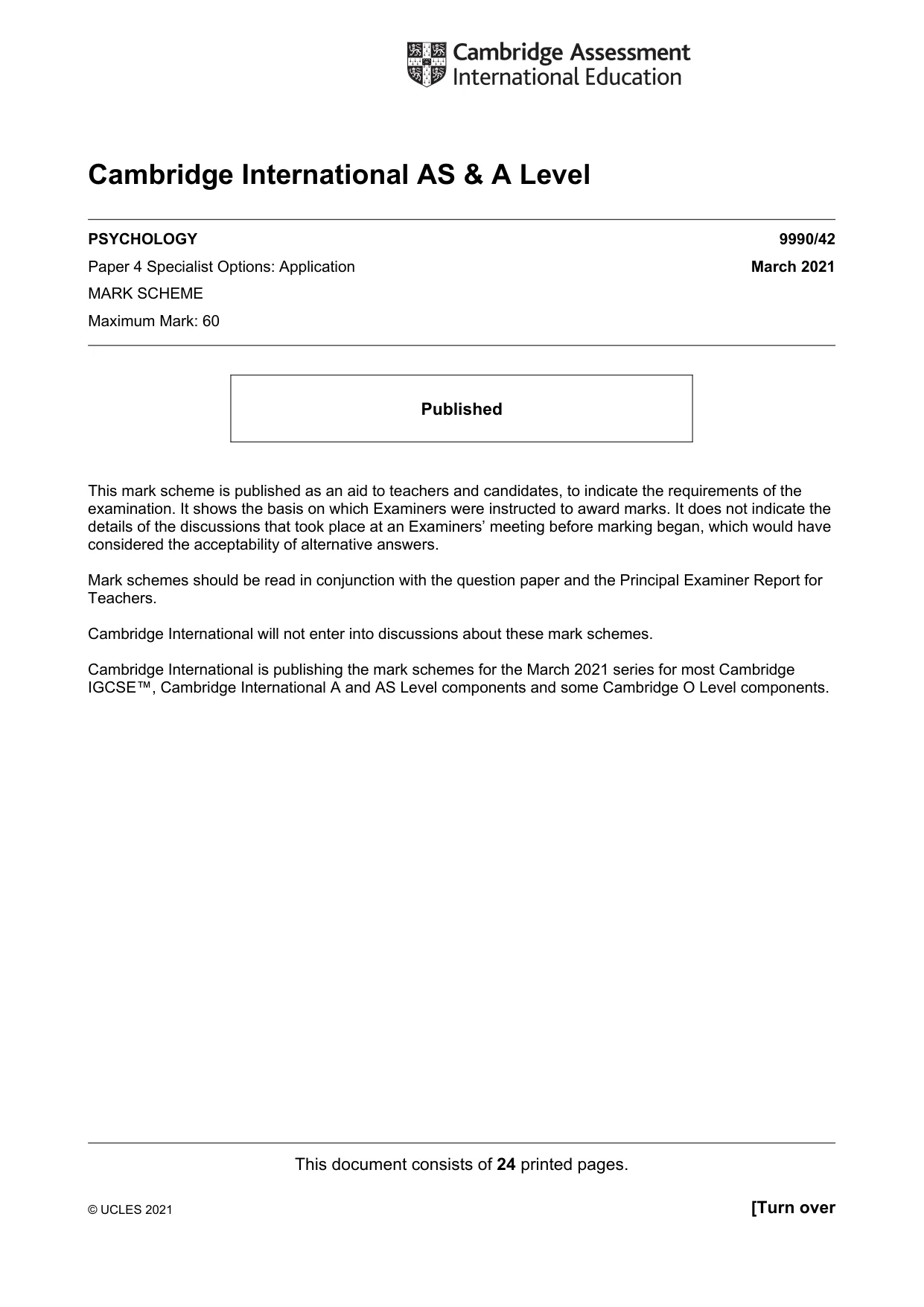
Q9 · ‘The genetic explanation of phobias is better than all other explanations.’ To what…
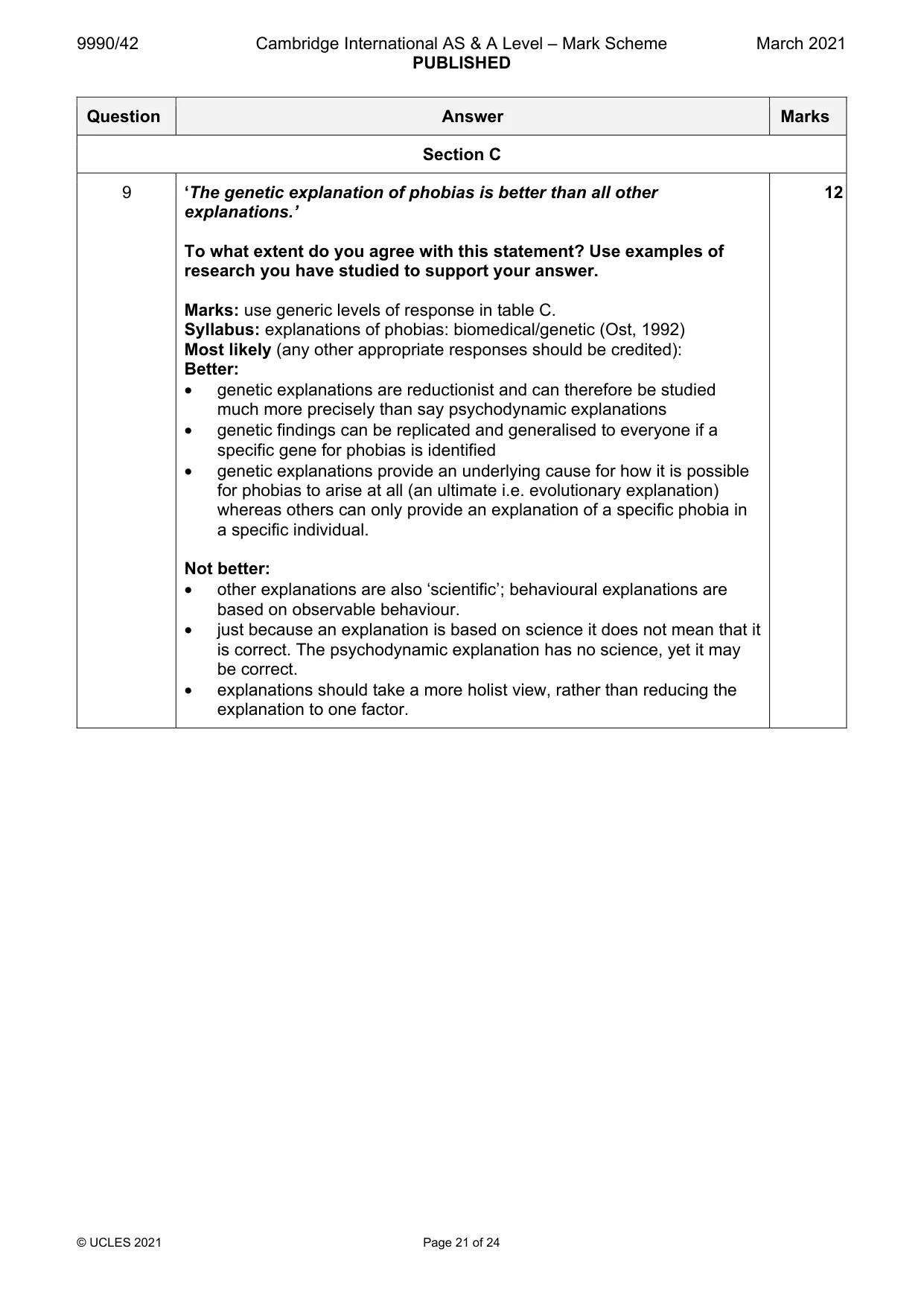
9 ‘The genetic explanation of phobias is better than all other explanations.’ To what extent do you agree with this statement? Use examples of research you have studied to support your answer. [12] Psychology and consumer behaviour
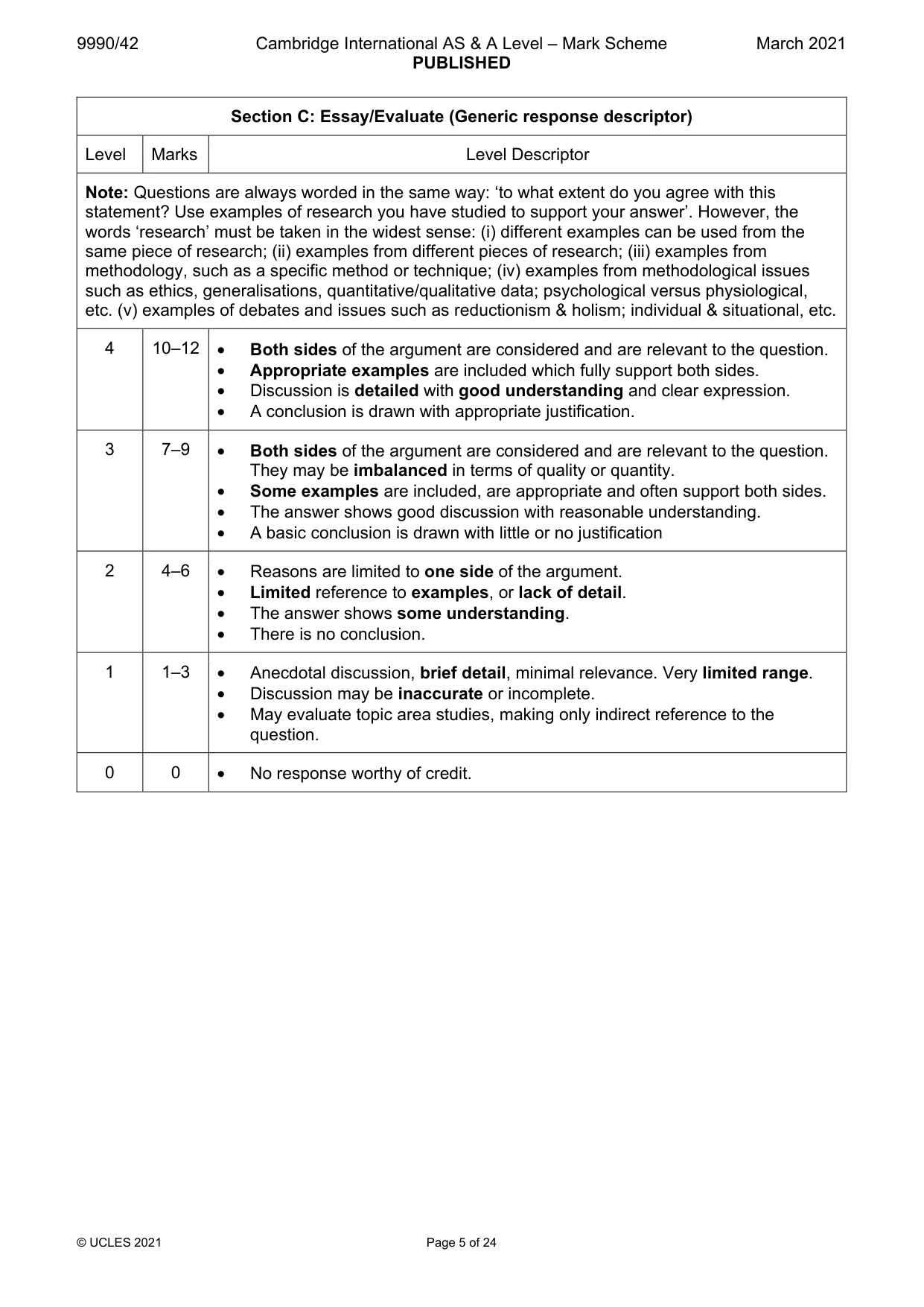
Mark scheme: 9 ‘The genetic explanation of phobias is better than all other 12 explanations.’ To what extent do you agree with this statement? Use examples of research you have studied to support your answer. Marks: use generic levels of response in table C. Syllabus: explanations of phobias: biomedical/genetic (Ost, 1992) Most likely (any other appropriate responses should be credited): Better: • genetic explanations are reductionist and can therefore be studied much more precisely than say psychodynamic explanations • genetic findings can be replicated and generalised to everyone if a specific gene for phobias is identified • genetic explanations provide an underlying cause for how it is possible for phobias to arise at all (an ultimate i.e. evolutionary explanation) whereas others can only provide an explanation of a specific phobia in a specific individual. Not better: • other explanations are also ‘scientific’; behavioural explanations are based on observable behaviour. • just because an explanation is based on science it does not mean that it is correct. The psychodynamic explanation has no science, yet it may be correct. • explanations should take a more holist view, rather than reducing the explanation to one factor.
More questions on Anxiety disorders and fear-related disorders
Q10 · ‘Studies of consumer personality are irrelevant; there are no individual differences in…
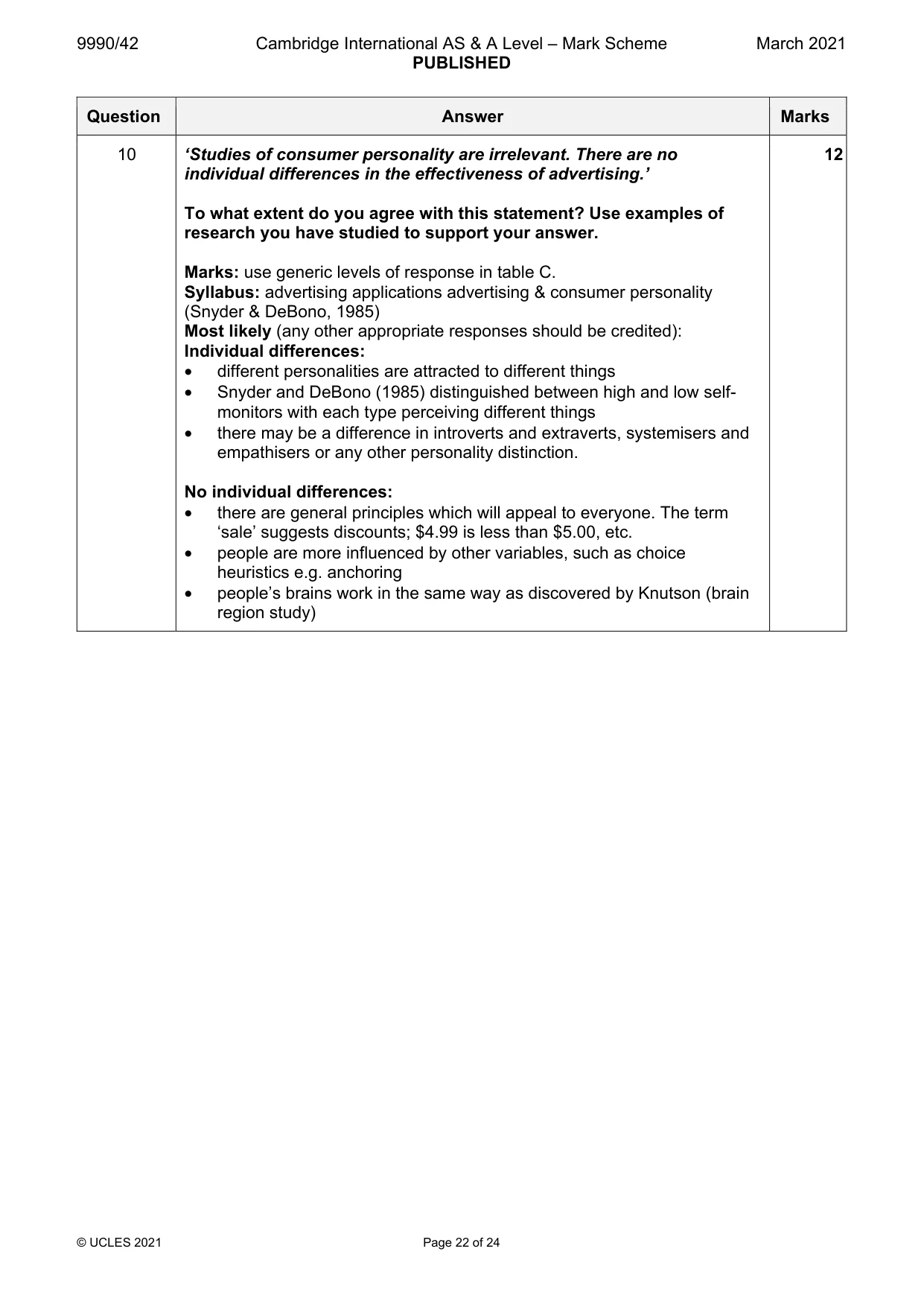
10 ‘Studies of consumer personality are irrelevant; there are no individual differences in the effectiveness of advertising.’ To what extent do you agree with this statement? Use examples of research you have studied to support your answer. [12] Psychology and health
Mark scheme: 10 ‘Studies of consumer personality are irrelevant. There are no 12 individual differences in the effectiveness of advertising.’ To what extent do you agree with this statement? Use examples of research you have studied to support your answer. Marks: use generic levels of response in table C. Syllabus: advertising applications advertising & consumer personality (Snyder & DeBono, 1985) Most likely (any other appropriate responses should be credited): Individual differences: • different personalities are attracted to different things • Snyder and DeBono (1985) distinguished between high and low self- monitors with each type perceiving different things • there may be a difference in introverts and extraverts, systemisers and empathisers or any other personality distinction. No individual differences: • there are general principles which will appeal to everyone. The term ‘sale’ suggests discounts; $4.99 is less than $5.00, etc. • people are more influenced by other variables, such as choice heuristics e.g. anchoring • people’s brains work in the same way as discovered by Knutson (brain region study)
Q11 · ‘The use of postal questionnaires is the best way to assess improvements in adherence to…
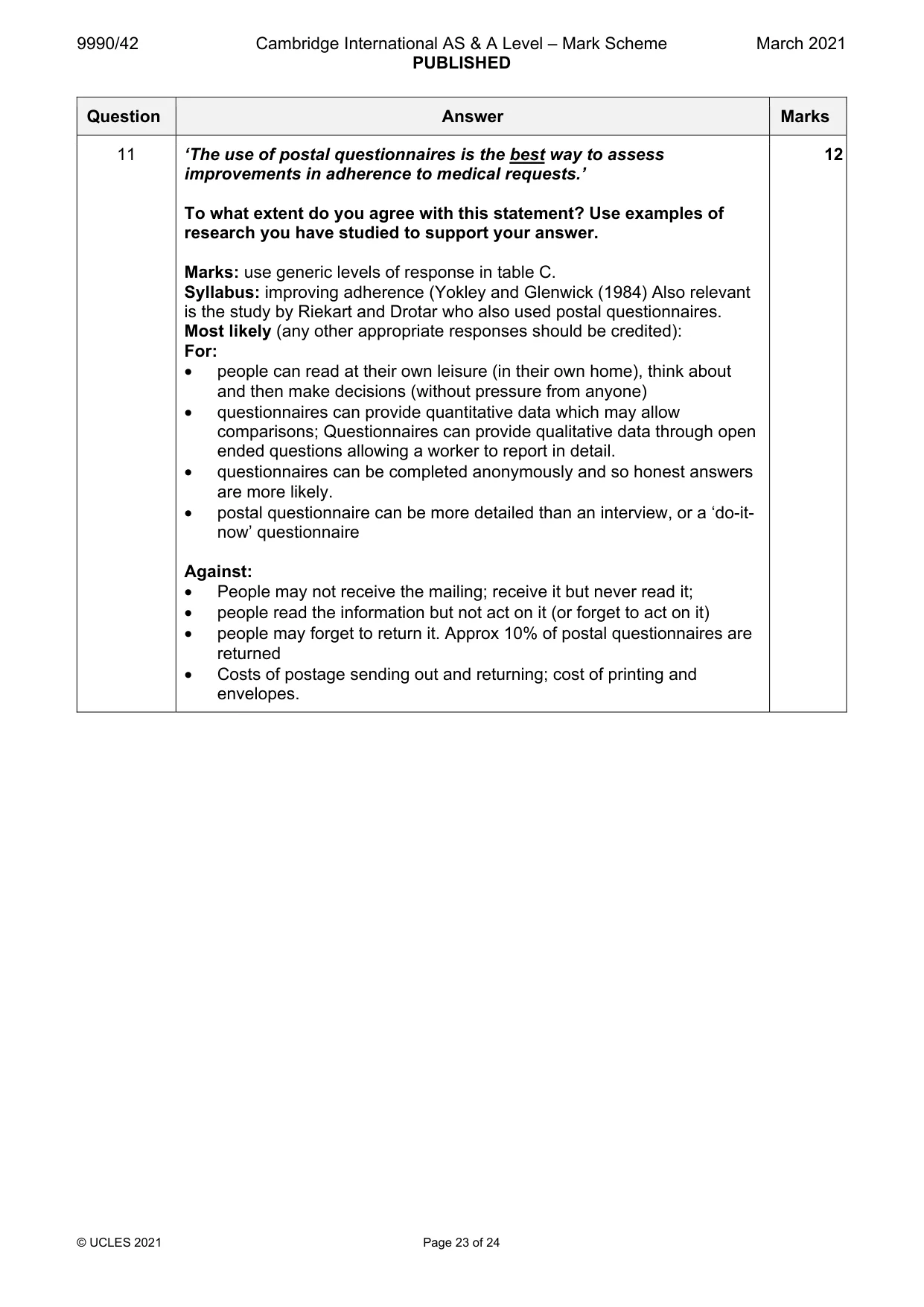
11 ‘The use of postal questionnaires is the best way to assess improvements in adherence to medical requests.’ To what extent do you agree with this statement? Use examples of research you have studied to support your answer. [12] Psychology and organisations
Mark scheme: 11 ‘The use of postal questionnaires is the best way to assess 12 improvements in adherence to medical requests.’ To what extent do you agree with this statement? Use examples of research you have studied to support your answer. Marks: use generic levels of response in table C. Syllabus: improving adherence (Yokley and Glenwick (1984) Also relevant is the study by Riekart and Drotar who also used postal questionnaires. Most likely (any other appropriate responses should be credited): For: • people can read at their own leisure (in their own home), think about and then make decisions (without pressure from anyone) • questionnaires can provide quantitative data which may allow comparisons; Questionnaires can provide qualitative data through open ended questions allowing a worker to report in detail. • questionnaires can be completed anonymously and so honest answers are more likely. • postal questionnaire can be more detailed than an interview, or a ‘do-it- now’ questionnaire Against: • People may not receive the mailing; receive it but never read it; • people read the information but not act on it (or forget to act on it) • people may forget to return it. Approx 10% of postal questionnaires are returned • Costs of postage sending out and returning; cost of printing and envelopes.
Q12 · ‘Recognition, respect and a sense of belonging are the most important motivators at…
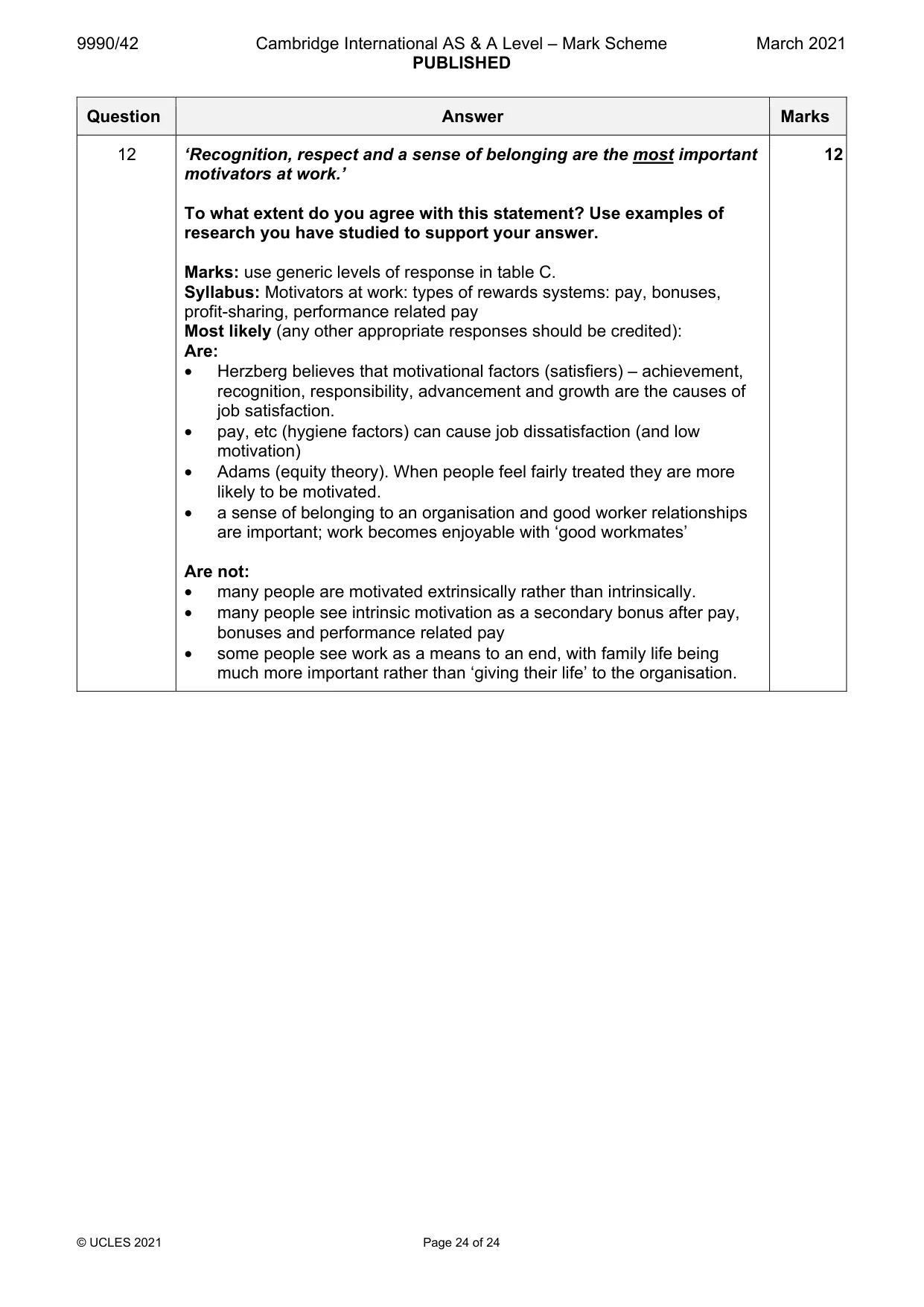
12 ‘Recognition, respect and a sense of belonging are the most important motivators at work.’ To what extent do you agree with this statement? Use examples of research you have studied to support your answer. [12]
Mark scheme: 12 ‘Recognition, respect and a sense of belonging are the most important 12 motivators at work.’ To what extent do you agree with this statement? Use examples of research you have studied to support your answer. Marks: use generic levels of response in table C. Syllabus: Motivators at work: types of rewards systems: pay, bonuses, profit-sharing, performance related pay Most likely (any other appropriate responses should be credited): Are: • Herzberg believes that motivational factors (satisfiers) – achievement, recognition, responsibility, advancement and growth are the causes of job satisfaction. • pay, etc (hygiene factors) can cause job dissatisfaction (and low motivation) • Adams (equity theory). When people feel fairly treated they are more likely to be motivated. • a sense of belonging to an organisation and good worker relationships are important; work becomes enjoyable with ‘good workmates’ Are not: • many people are motivated extrinsically rather than intrinsically. • many people see intrinsic motivation as a secondary bonus after pay, bonuses and performance related pay • some people see work as a means to an end, with family life being much more important rather than ‘giving their life’ to the organisation.
What was in this paper
The subtopics covered by these 12 questions, and how many questions each got. Open one in a new tab to see every Cambridge question on it.
What you needed in this session
Cambridge’s own grade thresholds for 2021 Feb/March, Paper 4 · Variant 2. A higher threshold means an easier paper — the bar moves with how the cohort did.