Cambridge A Level Psychology (from 2018) 9990 — 2025 Feb/March Paper 4 · Variant 2
9990/42/F/M/25 · 12 questions · 60 marks · 90 min
The question paper and its mark scheme, free to read here and free to download. This is Cambridge’s own paper, exactly as it was sat.
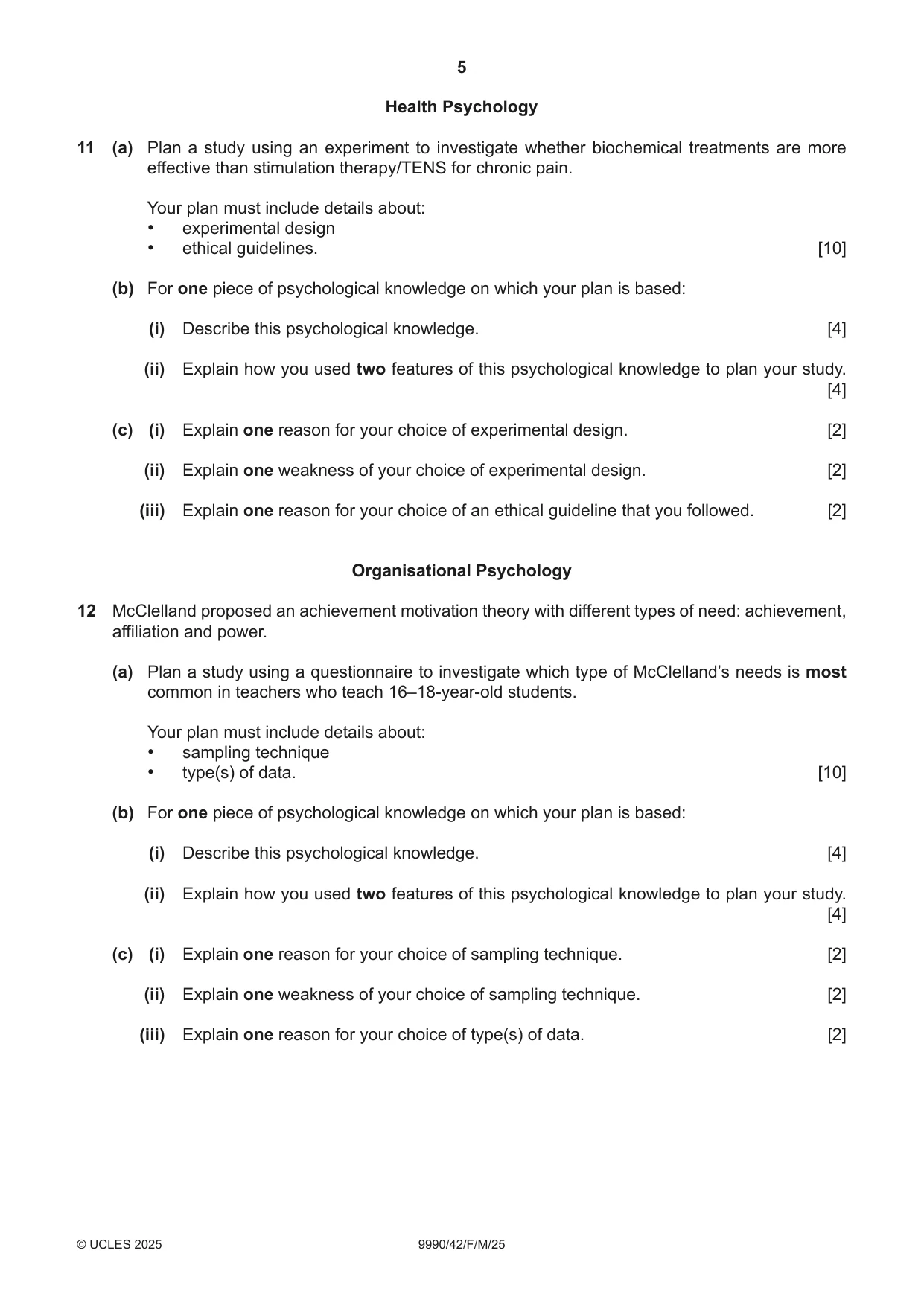
Question paper8 pages



Mark scheme34 pages
Answers below. Sit the paper first if you are practising.
Questions as text
Q1 · From the key study by Oruč et al
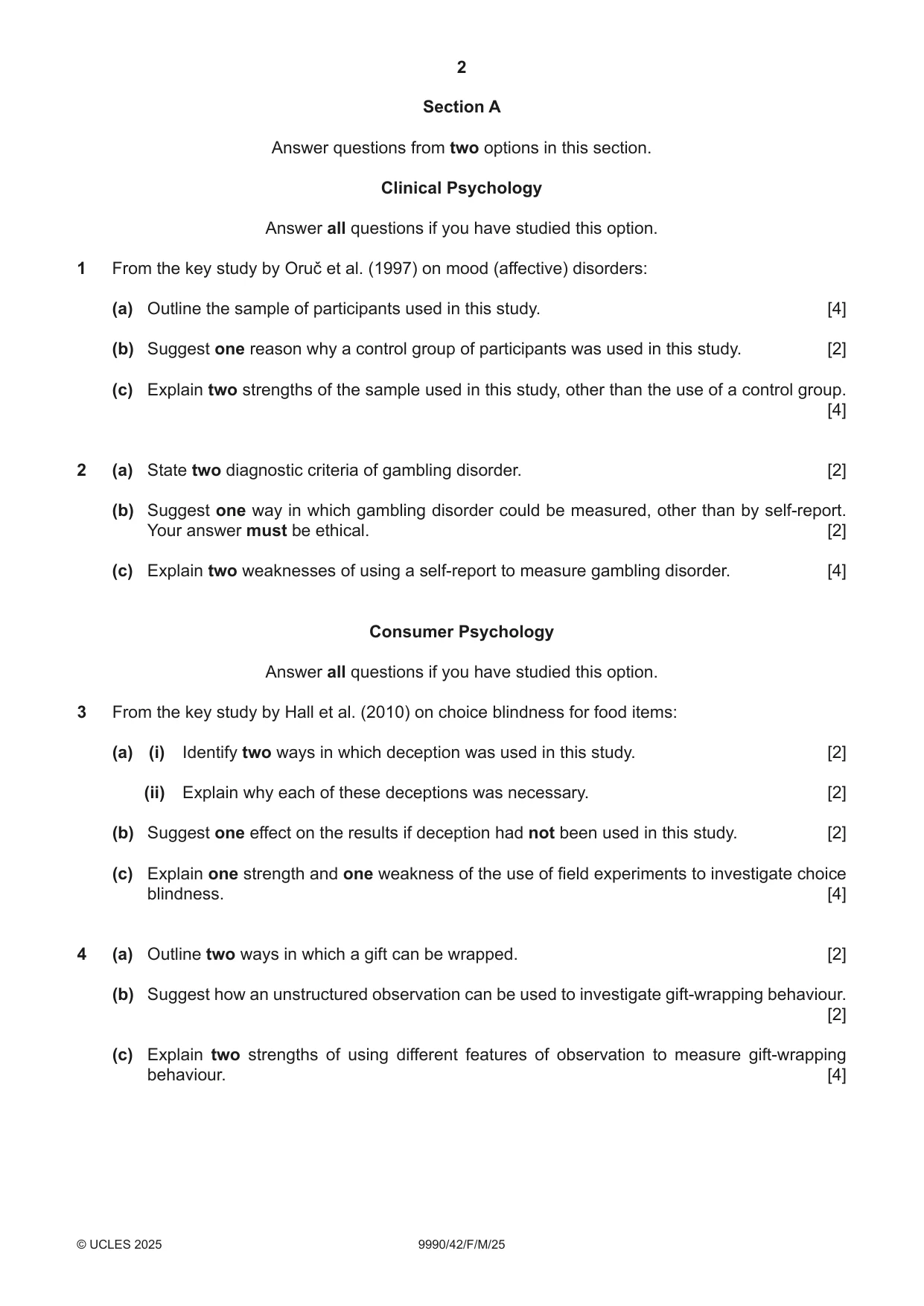
1 From the key study by Oruč et al. (1997) on mood (affective) disorders: (a) Outline the sample of participants used in this study. [4] (b) Suggest one reason why a control group of participants was used in this study. [2] (c) Explain two strengths of the sample used in this study, other than the use of a control group. [4]
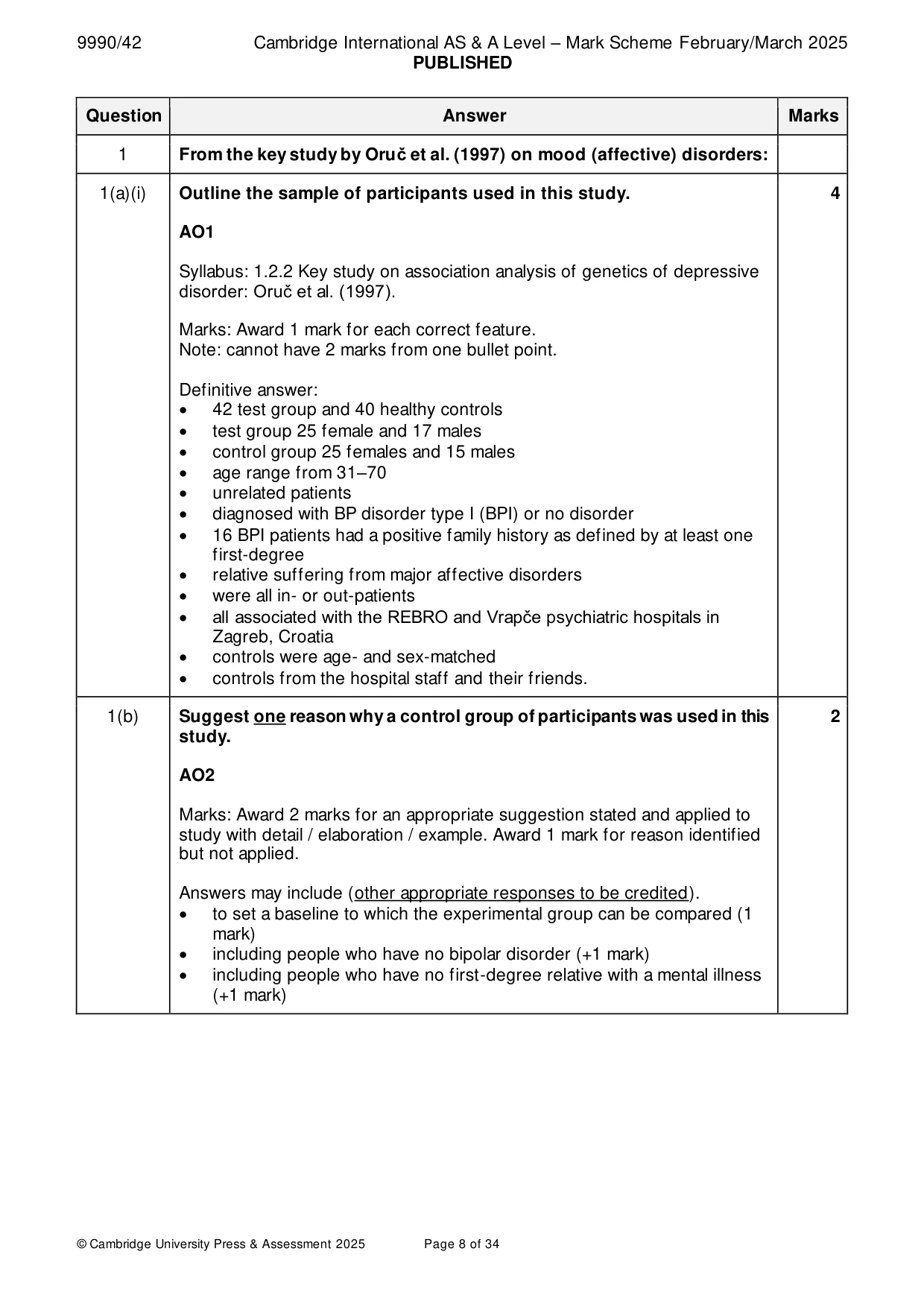
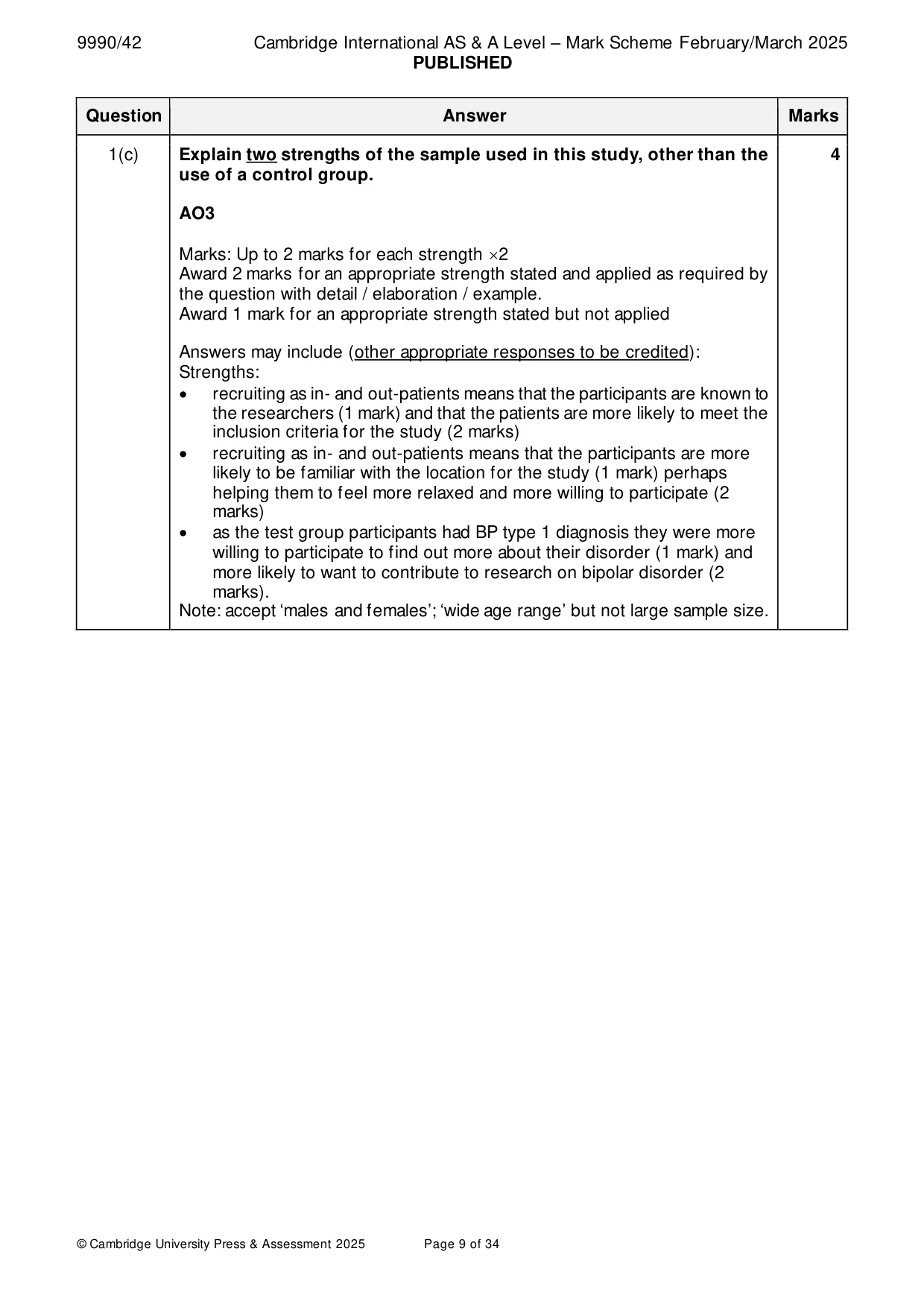
Mark scheme: Question Answer Marks 1 From the key study by Oruč et al. (1997) on mood (affective) disorders: 1(a)(i) Outline the sample of participants used in this study. 4 AO1 Syllabus: 1.2.2 Key study on association analysis of genetics of depressive disorder: Oruč et al. (1997). Marks: Award 1 mark for each correct feature. Note: cannot have 2 marks from one bullet point. Definitive answer: • 42 test group and 40 healthy controls • test group 25 female and 17 males • control group 25 females and 15 males • age range from 31–70 • unrelated patients • diagnosed with BP disorder type I (BPI) or no disorder • 16 BPI patients had a positive family history as defined by at least one first-degree • relative suffering from major affective disorders • were all in- or out-patients • all associated with the REBRO and Vrapče psychiatric hospitals in Zagreb, Croatia • controls were age- and sex-matched • controls from the hospital staff and their friends. 1(b) Suggest one reason why a control group of participants was used in this 2 study. AO2 Marks: Award 2 marks for an appropriate suggestion stated and applied to study with detail / elaboration / example. Award 1 mark for reason identified but not applied. Answers may include (other appropriate responses to be credited). • to set a baseline to which the experimental group can be compared (1 mark) • including people who have no bipolar disorder (+1 mark) • including people who have no first-degree relative with a mental illness (+1 mark) 1(c) Explain two strengths of the sample used in this study, other than the 4 use of a control group. AO3 Marks: Up to 2 marks for each strength 2 Award 2 marks for an appropriate strength stated and applied as required by the question with detail / elaboration / example. Award 1 mark for an appropriate strength stated but not applied Answers may include (other appropriate responses to be credited): Strengths: • recruiting as in- and out-patients means that the participants are known to the researchers (1 mark) and that the patients are more likely to meet the inclusion criteria for the study (2 marks) • recruiting as in- and out-patients means that the participants are more likely to be familiar with the location for the study (1 mark) perhaps helping them to feel more relaxed and more willing to participate (2 marks) • as the test group participants had BP type 1 diagnosis they were more willing to participate to find out more about their disorder (1 mark) and more likely to want to contribute to research on bipolar disorder (2 marks). Note: accept ‘males and females’; ‘wide age range’ but not large sample size.
More questions on Mood (affective) disorders: depressive disorder (unipolar) and bipolar disorder
Q2 · State two diagnostic criteria of gambling disorder
2 (a) State two diagnostic criteria of gambling disorder. [2] (b) Suggest one way in which gambling disorder could be measured, other than by self-report. Your answer must be ethical. [2] (c) Explain two weaknesses of using a self-report to measure gambling disorder. [4] Consumer Psychology Answer all questions if you have studied this option.
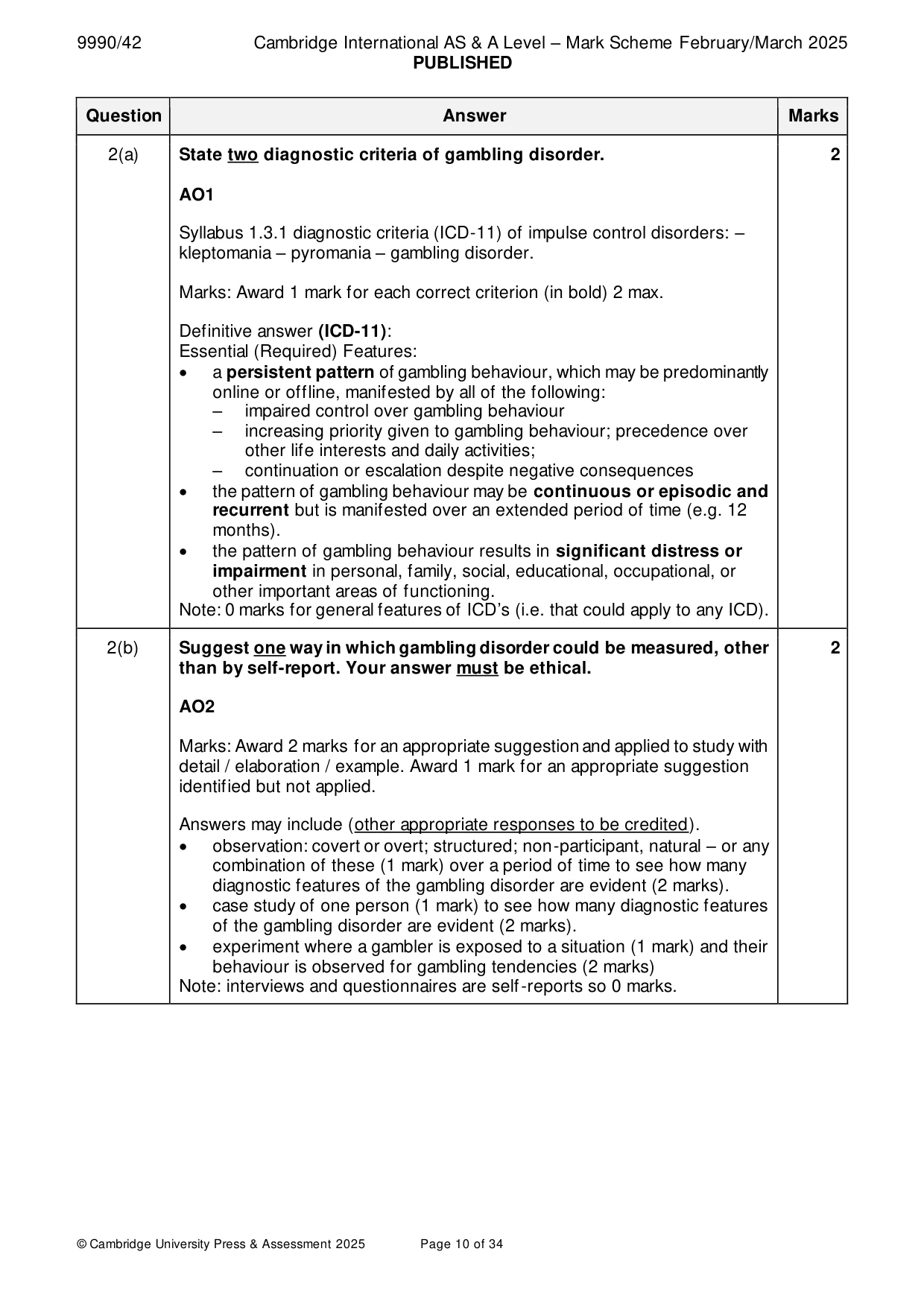
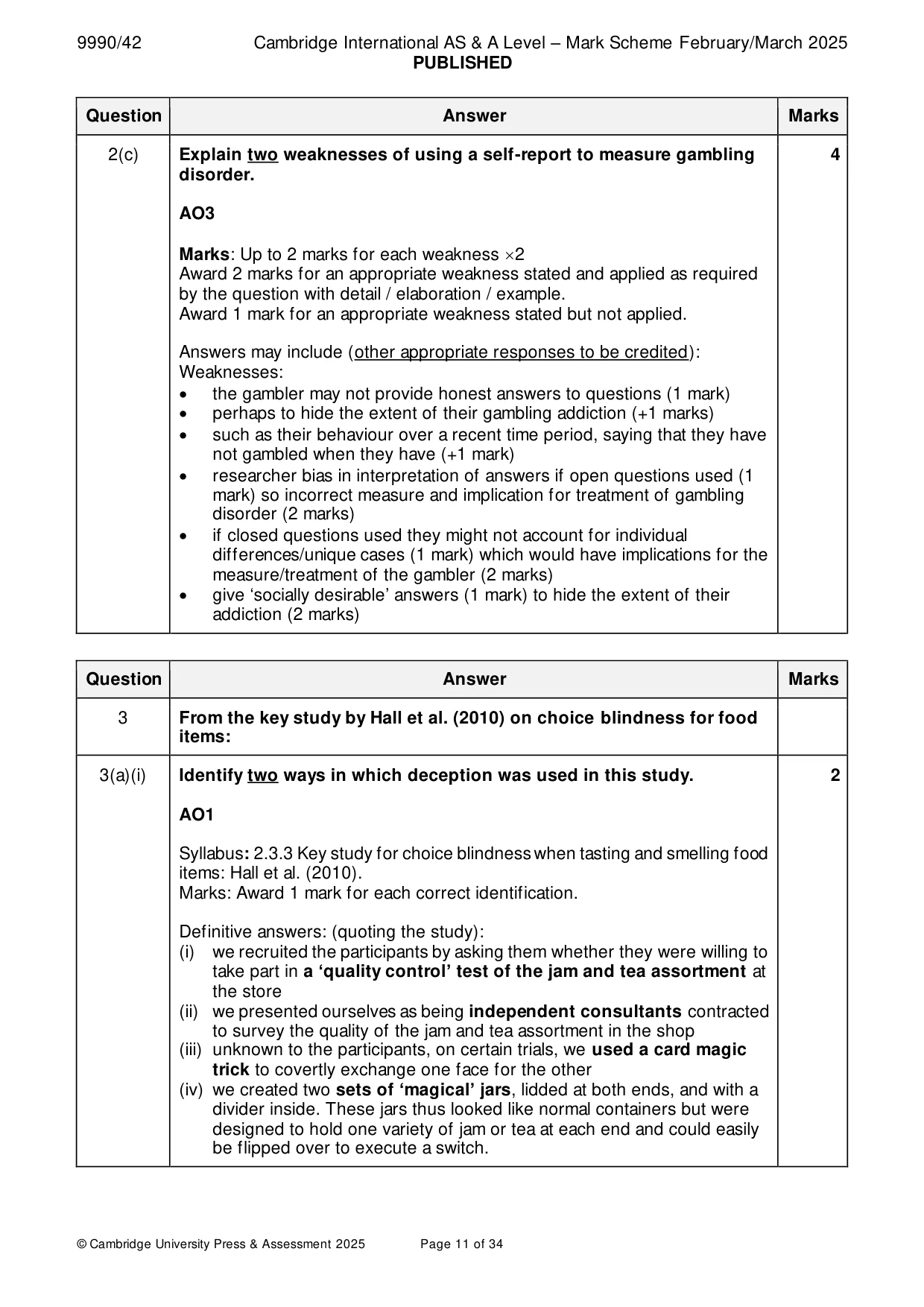
Mark scheme: 2(a) State two diagnostic criteria of gambling disorder. 2 AO1 Syllabus 1.3.1 diagnostic criteria (ICD-11) of impulse control disorders: – kleptomania – pyromania – gambling disorder. Marks: Award 1 mark for each correct criterion (in bold) 2 max. Definitive answer (ICD-11): Essential (Required) Features: • a persistent pattern of gambling behaviour, which may be predominantly online or offline, manifested by all of the following: – impaired control over gambling behaviour – increasing priority given to gambling behaviour; precedence over other life interests and daily activities; – continuation or escalation despite negative consequences • the pattern of gambling behaviour may be continuous or episodic and recurrent but is manifested over an extended period of time (e.g. 12 months). • the pattern of gambling behaviour results in significant distress or impairment in personal, family, social, educational, occupational, or other important areas of functioning. Note: 0 marks for general features of ICD’s (i.e. that could apply to any ICD). 2(b) Suggest one way in which gambling disorder could be measured, other 2 than by self-report. Your answer must be ethical. AO2 Marks: Award 2 marks for an appropriate suggestion and applied to study with detail / elaboration / example. Award 1 mark for an appropriate suggestion identified but not applied. Answers may include (other appropriate responses to be credited). • observation: covert or overt; structured; non-participant, natural – or any combination of these (1 mark) over a period of time to see how many diagnostic features of the gambling disorder are evident (2 marks). • case study of one person (1 mark) to see how many diagnostic features of the gambling disorder are evident (2 marks). • experiment where a gambler is exposed to a situation (1 mark) and their behaviour is observed for gambling tendencies (2 marks) Note: interviews and questionnaires are self-reports so 0 marks. 2(c) Explain two weaknesses of using a self-report to measure gambling 4 disorder. AO3 Marks: Up to 2 marks for each weakness 2 Award 2 marks for an appropriate weakness stated and applied as required by the question with detail / elaboration / example. Award 1 mark for an appropriate weakness stated but not applied. Answers may include (other appropriate responses to be credited): Weaknesses: • the gambler may not provide honest answers to questions (1 mark) • perhaps to hide the extent of their gambling addiction (+1 marks) • such as their behaviour over a recent time period, saying that they have not gambled when they have (+1 mark) • researcher bias in interpretation of answers if open questions used (1 mark) so incorrect measure and implication for treatment of gambling disorder (2 marks) • if closed questions used they might not account for individual differences/unique cases (1 mark) which would have implications for the measure/treatment of the gambler (2 marks) • give ‘socially desirable’ answers (1 mark) to hide the extent of their addiction (2 marks)
Q3 · From the key study by Hall et al
3 From the key study by Hall et al. (2010) on choice blindness for food items: (a) (i) Identify two ways in which deception was used in this study. [2] (ii) Explain why each of these deceptions was necessary. [2] (b) Suggest one effect on the results if deception had not been used in this study. [2] (c) Explain one strength and one weakness of the use of field experiments to investigate choice blindness. [4]
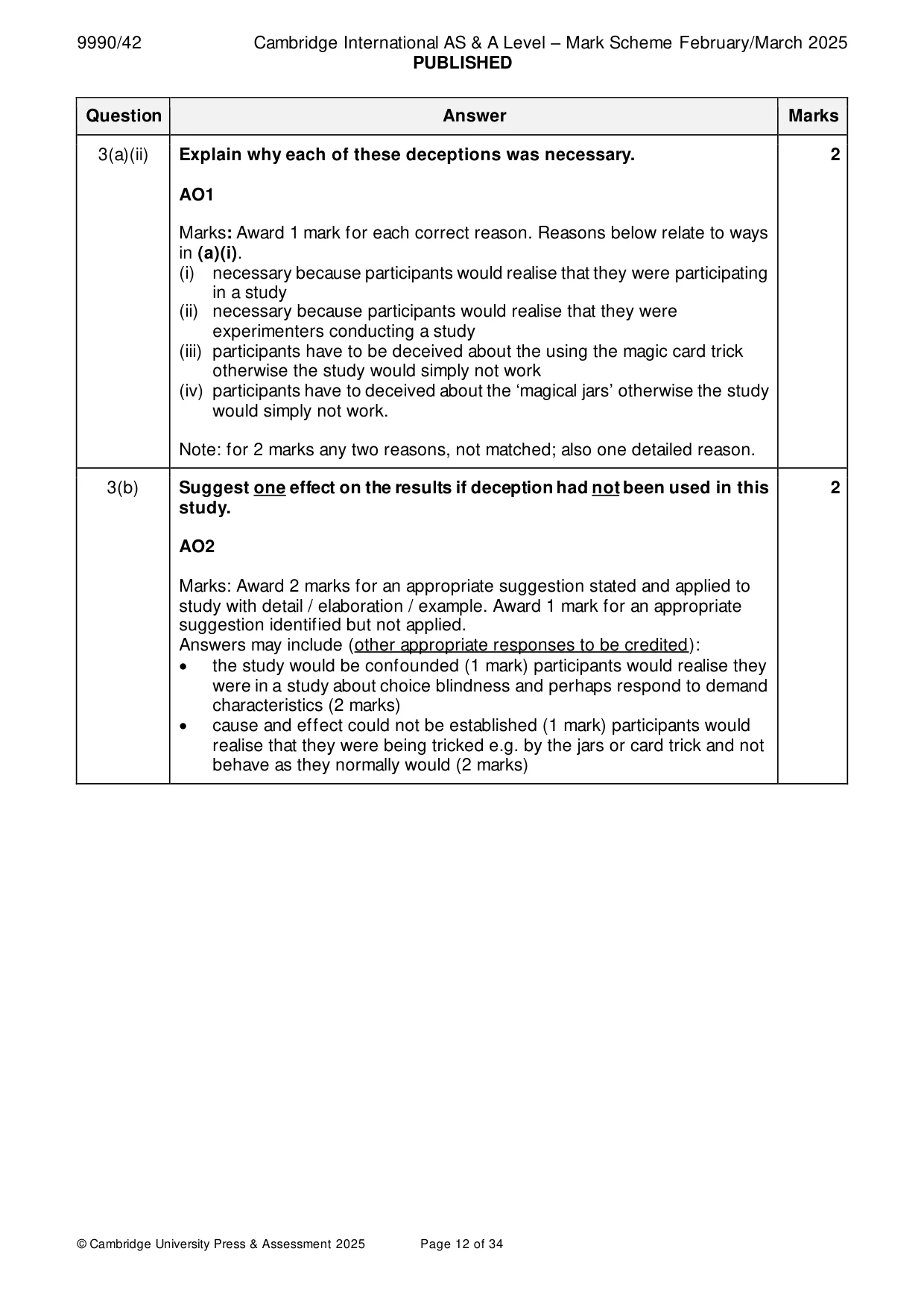
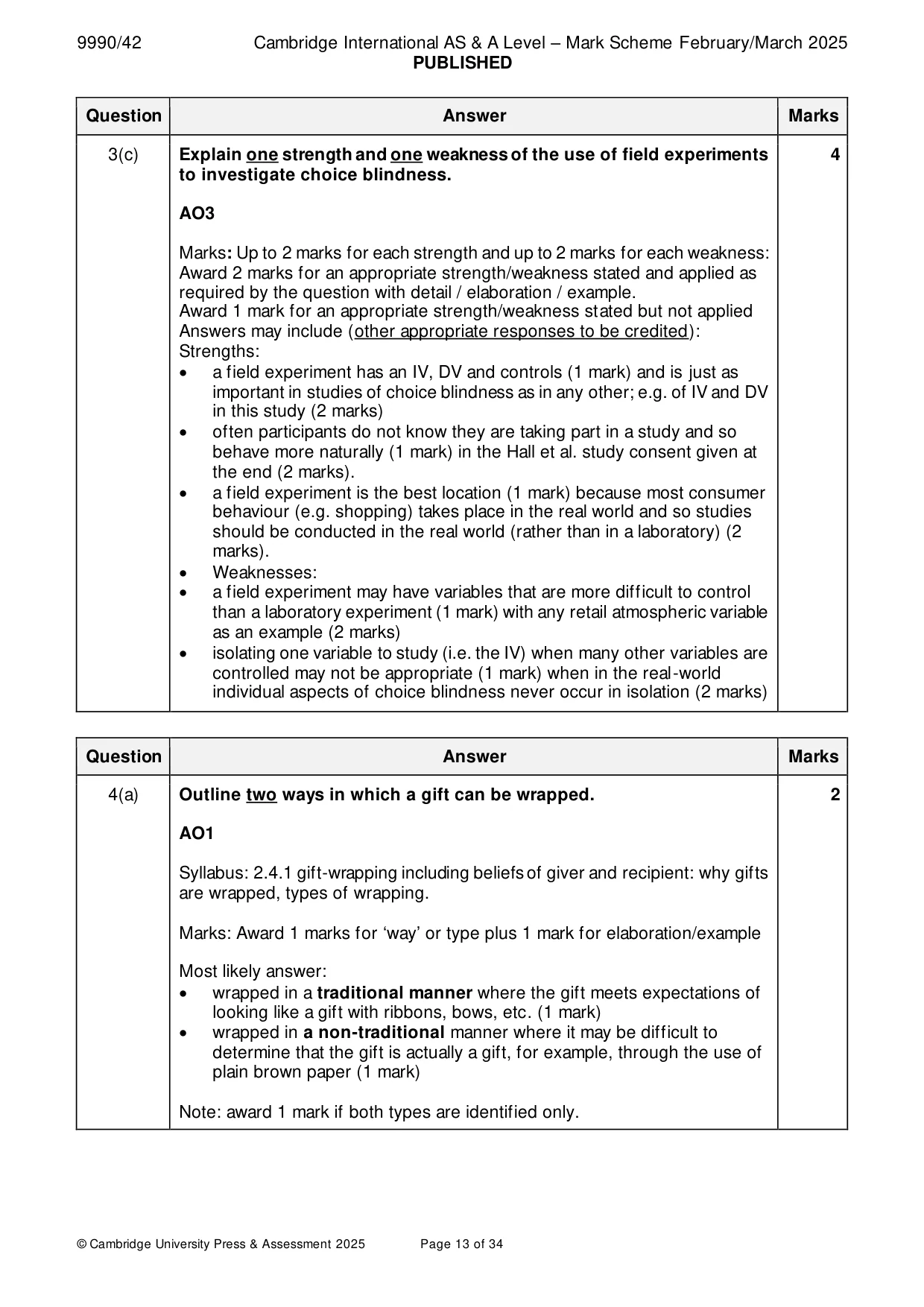
Mark scheme: 3 From the key study by Hall et al. (2010) on choice blindness for food items: 3(a)(i) Identify two ways in which deception was used in this study. 2 AO1 Syllabus: 2.3.3 Key study for choice blindness when tasting and smelling food items: Hall et al. (2010). Marks: Award 1 mark for each correct identification. Definitive answers: (quoting the study): (i) we recruited the participants by asking them whether they were willing to take part in a ‘quality control’ test of the jam and tea assortment at the store (ii) we presented ourselves as being independent consultants contracted to survey the quality of the jam and tea assortment in the shop (iii) unknown to the participants, on certain trials, we used a card magic trick to covertly exchange one face for the other (iv) we created two sets of ‘magical’ jars, lidded at both ends, and with a divider inside. These jars thus looked like normal containers but were designed to hold one variety of jam or tea at each end and could easily be flipped over to execute a switch. 3(a)(ii) Explain why each of these deceptions was necessary. 2 AO1 Marks: Award 1 mark for each correct reason. Reasons below relate to ways in (a)(i). (i) necessary because participants would realise that they were participating in a study (ii) necessary because participants would realise that they were experimenters conducting a study (iii) participants have to be deceived about the using the magic card trick otherwise the study would simply not work (iv) participants have to deceived about the ‘magical jars’ otherwise the study would simply not work. Note: for 2 marks any two reasons, not matched; also one detailed reason. 3(b) Suggest one effect on the results if deception had not been used in this 2 study. AO2 Marks: Award 2 marks for an appropriate suggestion stated and applied to study with detail / elaboration / example. Award 1 mark for an appropriate suggestion identified but not applied. Answers may include (other appropriate responses to be credited): • the study would be confounded (1 mark) participants would realise they were in a study about choice blindness and perhaps respond to demand characteristics (2 marks) • cause and effect could not be established (1 mark) participants would realise that they were being tricked e.g. by the jars or card trick and not behave as they normally would (2 marks) 3(c) Explain one strength and one weakness of the use of field experiments 4 to investigate choice blindness. AO3 Marks: Up to 2 marks for each strength and up to 2 marks for each weakness: Award 2 marks for an appropriate strength/weakness stated and applied as required by the question with detail / elaboration / example. Award 1 mark for an appropriate strength/weakness stated but not applied Answers may include (other appropriate responses to be credited): Strengths: • a field experiment has an IV, DV and controls (1 mark) and is just as important in studies of choice blindness as in any other; e.g. of IV and DV in this study (2 marks) • often participants do not know they are taking part in a study and so behave more naturally (1 mark) in the Hall et al. study consent given at the end (2 marks). • a field experiment is the best location (1 mark) because most consumer behaviour (e.g. shopping) takes place in the real world and so studies should be conducted in the real world (rather than in a laboratory) (2 marks). • Weaknesses: • a field experiment may have variables that are more difficult to control than a laboratory experiment (1 mark) with any retail atmospheric variable as an example (2 marks) • isolating one variable to study (i.e. the IV) when many other variables are controlled may not be appropriate (1 mark) when in the real-world individual aspects of choice blindness never occur in isolation (2 marks)
Q4 · Outline two ways in which a gift can be wrapped
4 (a) Outline two ways in which a gift can be wrapped. [2] (b) Suggest how an unstructured observation can be used to investigate gift-wrapping behaviour. [2] (c) Explain two strengths of using different features of observation to measure gift-wrapping behaviour. [4] Health Psychology Answer all questions if you have studied this option.
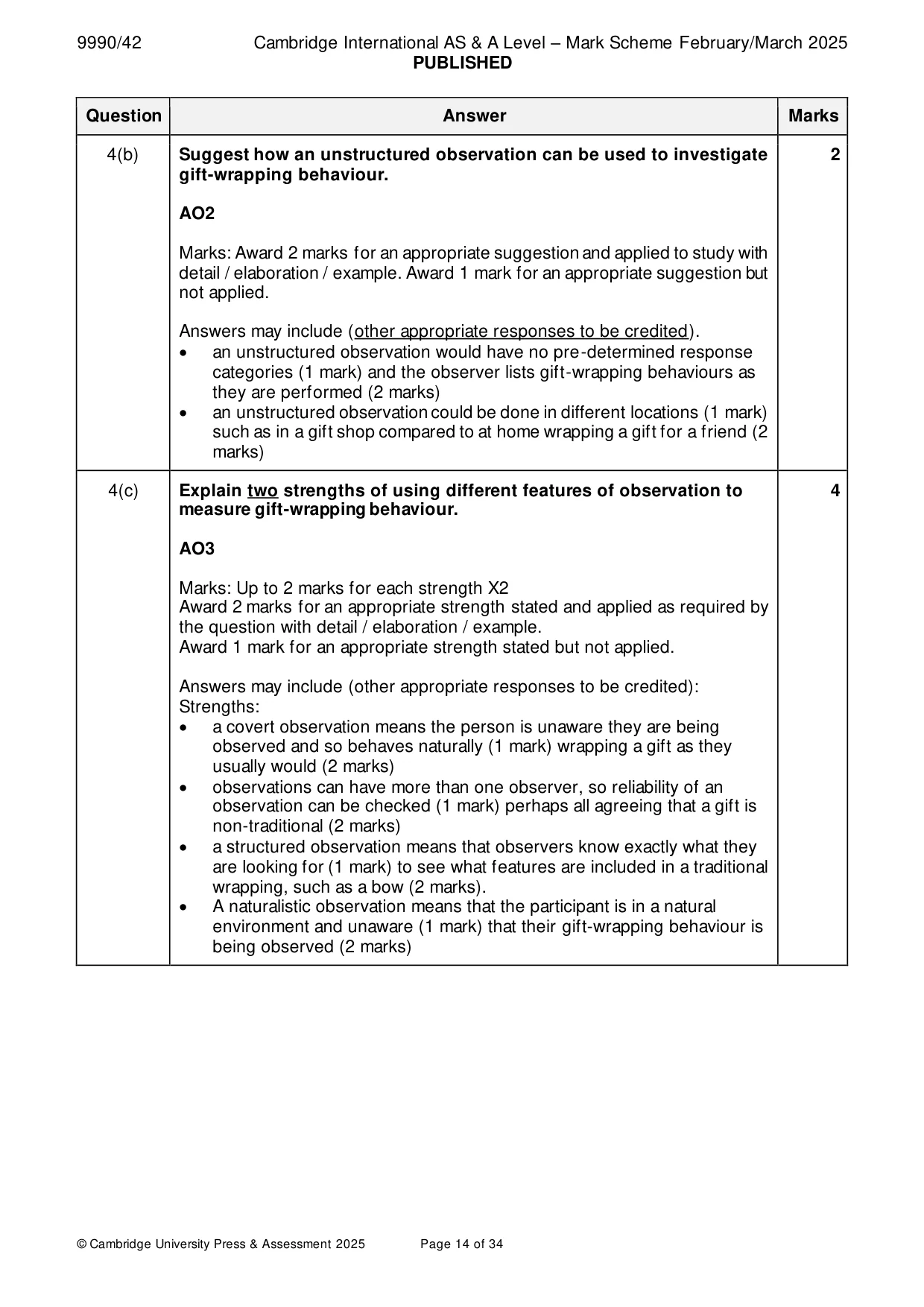
Mark scheme: 4(a) Outline two ways in which a gift can be wrapped. 2 AO1 Syllabus: 2.4.1 gift-wrapping including beliefs of giver and recipient: why gifts are wrapped, types of wrapping. Marks: Award 1 marks for ‘way’ or type plus 1 mark for elaboration/example Most likely answer: • wrapped in a traditional manner where the gift meets expectations of looking like a gift with ribbons, bows, etc. (1 mark) • wrapped in a non-traditional manner where it may be difficult to determine that the gift is actually a gift, for example, through the use of plain brown paper (1 mark) Note: award 1 mark if both types are identified only. 4(b) Suggest how an unstructured observation can be used to investigate 2 gift-wrapping behaviour. AO2 Marks: Award 2 marks for an appropriate suggestion and applied to study with detail / elaboration / example. Award 1 mark for an appropriate suggestion but not applied. Answers may include (other appropriate responses to be credited). • an unstructured observation would have no pre-determined response categories (1 mark) and the observer lists gift-wrapping behaviours as they are performed (2 marks) • an unstructured observation could be done in different locations (1 mark) such as in a gift shop compared to at home wrapping a gift for a friend (2 marks) 4(c) Explain two strengths of using different features of observation to 4 measure gift-wrapping behaviour. AO3 Marks: Up to 2 marks for each strength X2 Award 2 marks for an appropriate strength stated and applied as required by the question with detail / elaboration / example. Award 1 mark for an appropriate strength stated but not applied. Answers may include (other appropriate responses to be credited): Strengths: • a covert observation means the person is unaware they are being observed and so behaves naturally (1 mark) wrapping a gift as they usually would (2 marks) • observations can have more than one observer, so reliability of an observation can be checked (1 mark) perhaps all agreeing that a gift is non-traditional (2 marks) • a structured observation means that observers know exactly what they are looking for (1 mark) to see what features are included in a traditional wrapping, such as a bow (2 marks). • A naturalistic observation means that the participant is in a natural environment and unaware (1 mark) that their gift-wrapping behaviour is being observed (2 marks)
Q5 · From the key study by Brudvik et al
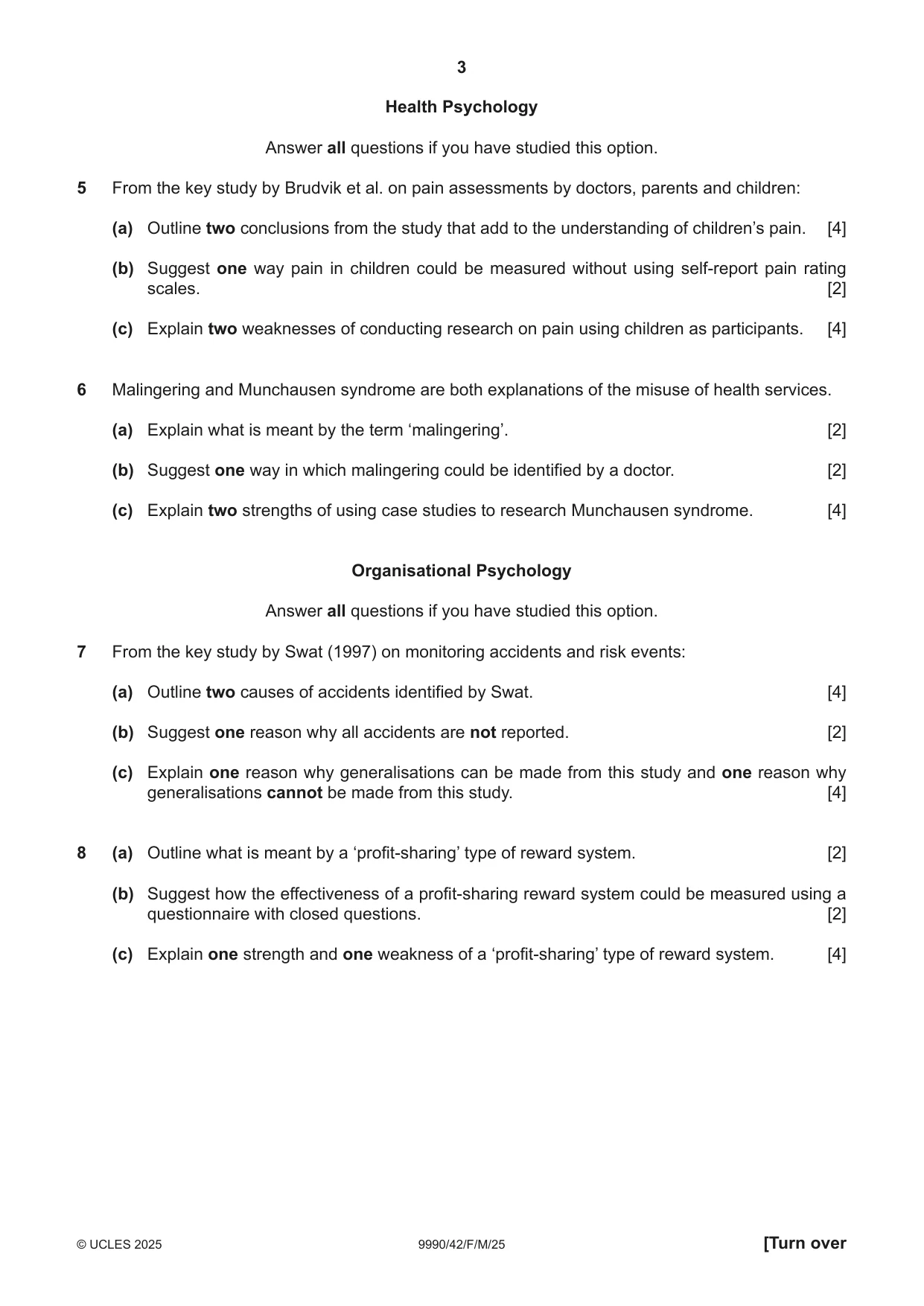
5 From the key study by Brudvik et al. on pain assessments by doctors, parents and children: (a) Outline two conclusions from the study that add to the understanding of children’s pain. [4] (b) Suggest one way pain in children could be measured without using self-report pain rating scales. [2] (c) Explain two weaknesses of conducting research on pain using children as participants. [4]
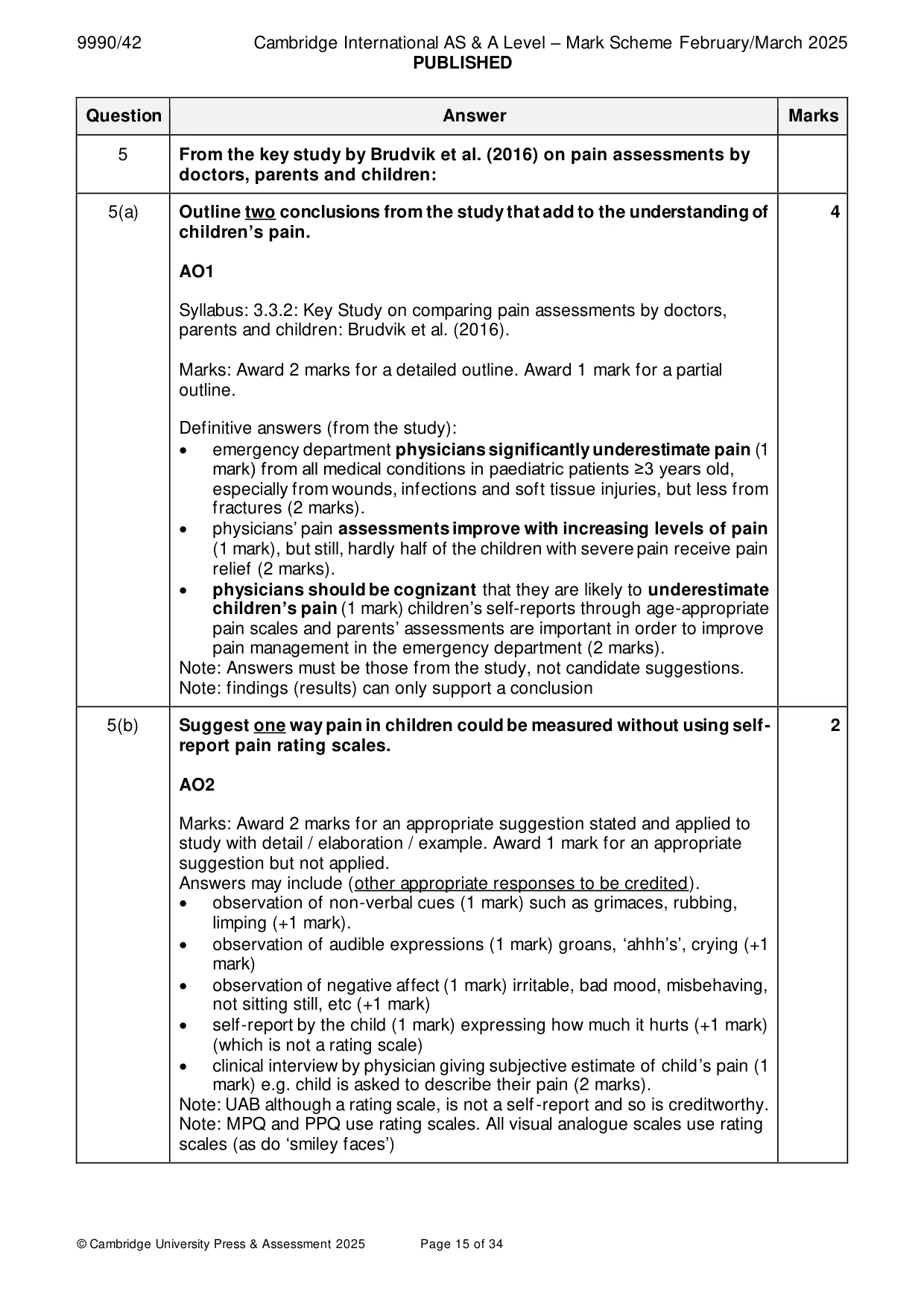
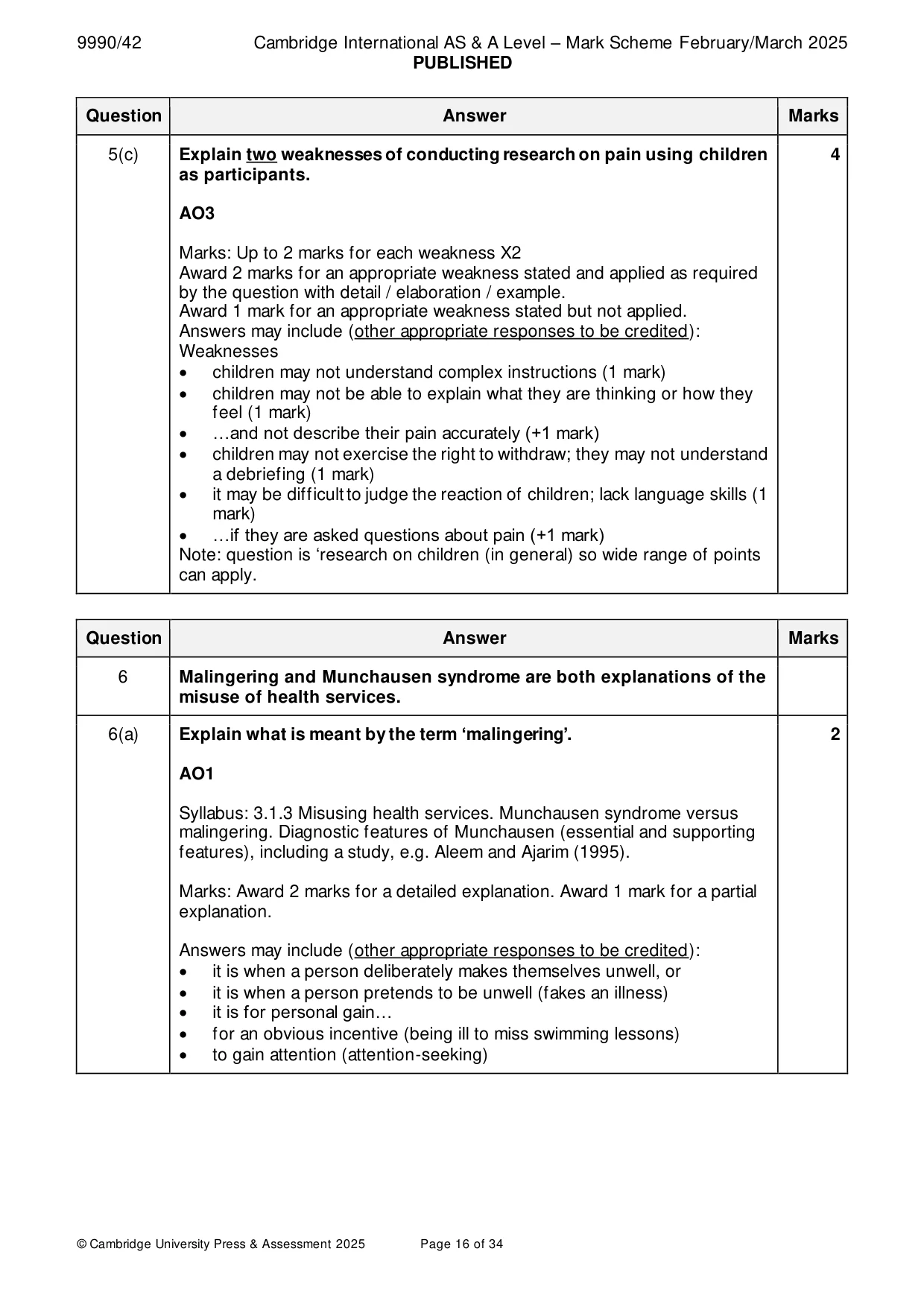
Mark scheme: 5 From the key study by Brudvik et al. (2016) on pain assessments by doctors, parents and children: 5(a) Outline two conclusions from the study that add to the understanding of 4 children’s pain. AO1 Syllabus: 3.3.2: Key Study on comparing pain assessments by doctors, parents and children: Brudvik et al. (2016). Marks: Award 2 marks for a detailed outline. Award 1 mark for a partial outline. Definitive answers (from the study): • emergency department physicians significantly underestimate pain (1 mark) from all medical conditions in paediatric patients ≥3 years old, especially from wounds, infections and soft tissue injuries, but less from fractures (2 marks). • physicians’ pain assessments improve with increasing levels of pain (1 mark), but still, hardly half of the children with severe pain receive pain relief (2 marks). • physicians should be cognizant that they are likely to underestimate children’s pain (1 mark) children’s self-reports through age-appropriate pain scales and parents’ assessments are important in order to improve pain management in the emergency department (2 marks). Note: Answers must be those from the study, not candidate suggestions. Note: findings (results) can only support a conclusion 5(b) Suggest one way pain in children could be measured without using self- 2 report pain rating scales. AO2 Marks: Award 2 marks for an appropriate suggestion stated and applied to study with detail / elaboration / example. Award 1 mark for an appropriate suggestion but not applied. Answers may include (other appropriate responses to be credited). • observation of non-verbal cues (1 mark) such as grimaces, rubbing, limping (+1 mark). • observation of audible expressions (1 mark) groans, ‘ahhh’s’, crying (+1 mark) • observation of negative affect (1 mark) irritable, bad mood, misbehaving, not sitting still, etc (+1 mark) • self-report by the child (1 mark) expressing how much it hurts (+1 mark) (which is not a rating scale) • clinical interview by physician giving subjective estimate of child’s pain (1 mark) e.g. child is asked to describe their pain (2 marks). Note: UAB although a rating scale, is not a self-report and so is creditworthy. Note: MPQ and PPQ use rating scales. All visual analogue scales use rating scales (as do ‘smiley faces’) 5(c) Explain two weaknesses of conducting research on pain using children 4 as participants. AO3 Marks: Up to 2 marks for each weakness X2 Award 2 marks for an appropriate weakness stated and applied as required by the question with detail / elaboration / example. Award 1 mark for an appropriate weakness stated but not applied. Answers may include (other appropriate responses to be credited): Weaknesses • children may not understand complex instructions (1 mark) • children may not be able to explain what they are thinking or how they feel (1 mark) • …and not describe their pain accurately (+1 mark) • children may not exercise the right to withdraw; they may not understand a debriefing (1 mark) • it may be difficult to judge the reaction of children; lack language skills (1 mark) • …if they are asked questions about pain (+1 mark) Note: question is ‘research on children (in general) so wide range of points can apply.
Q6 · Malingering and Munchausen syndrome are both explanations of the misuse of health services
6 Malingering and Munchausen syndrome are both explanations of the misuse of health services. (a) Explain what is meant by the term ‘malingering’. [2] (b) Suggest one way in which malingering could be identified by a doctor. [2] (c) Explain two strengths of using case studies to research Munchausen syndrome. [4] Organisational Psychology Answer all questions if you have studied this option.
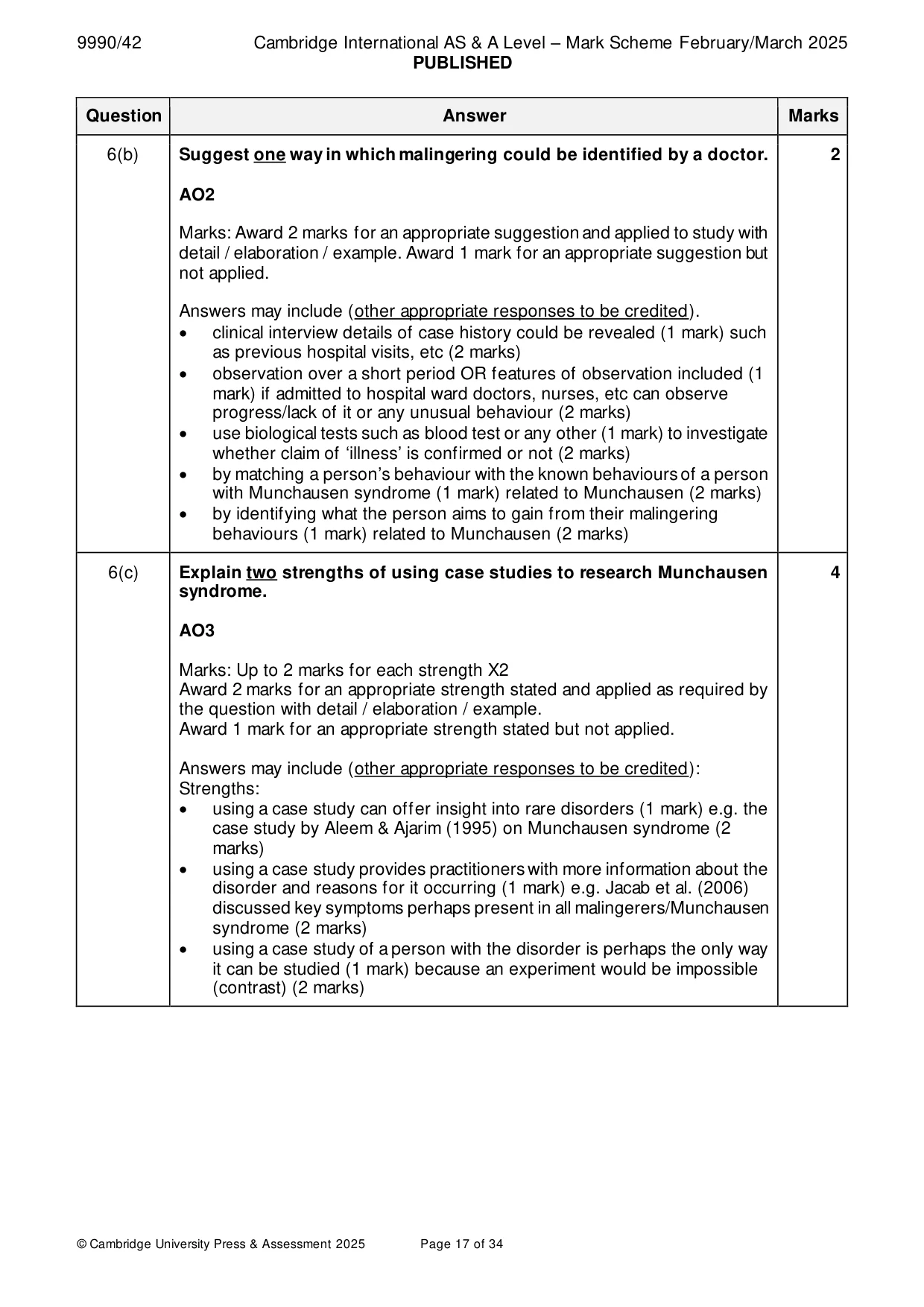
Mark scheme: 6 Malingering and Munchausen syndrome are both explanations of the misuse of health services. 6(a) Explain what is meant by the term ‘malingering’. 2 AO1 Syllabus: 3.1.3 Misusing health services. Munchausen syndrome versus malingering. Diagnostic features of Munchausen (essential and supporting features), including a study, e.g. Aleem and Ajarim (1995). Marks: Award 2 marks for a detailed explanation. Award 1 mark for a partial explanation. Answers may include (other appropriate responses to be credited): • it is when a person deliberately makes themselves unwell, or • it is when a person pretends to be unwell (fakes an illness) • it is for personal gain… • for an obvious incentive (being ill to miss swimming lessons) • to gain attention (attention-seeking) 6(b) Suggest one way in which malingering could be identified by a doctor. 2 AO2 Marks: Award 2 marks for an appropriate suggestion and applied to study with detail / elaboration / example. Award 1 mark for an appropriate suggestion but not applied. Answers may include (other appropriate responses to be credited). • clinical interview details of case history could be revealed (1 mark) such as previous hospital visits, etc (2 marks) • observation over a short period OR features of observation included (1 mark) if admitted to hospital ward doctors, nurses, etc can observe progress/lack of it or any unusual behaviour (2 marks) • use biological tests such as blood test or any other (1 mark) to investigate whether claim of ‘illness’ is confirmed or not (2 marks) • by matching a person’s behaviour with the known behaviours of a person with Munchausen syndrome (1 mark) related to Munchausen (2 marks) • by identifying what the person aims to gain from their malingering behaviours (1 mark) related to Munchausen (2 marks) 6(c) Explain two strengths of using case studies to research Munchausen 4 syndrome. AO3 Marks: Up to 2 marks for each strength X2 Award 2 marks for an appropriate strength stated and applied as required by the question with detail / elaboration / example. Award 1 mark for an appropriate strength stated but not applied. Answers may include (other appropriate responses to be credited): Strengths: • using a case study can offer insight into rare disorders (1 mark) e.g. the case study by Aleem & Ajarim (1995) on Munchausen syndrome (2 marks) • using a case study provides practitioners with more information about the disorder and reasons for it occurring (1 mark) e.g. Jacab et al. (2006) discussed key symptoms perhaps present in all malingerers/Munchausen syndrome (2 marks) • using a case study of a person with the disorder is perhaps the only way it can be studied (1 mark) because an experiment would be impossible (contrast) (2 marks)
Q7 · From the key study by Swat (1997) on monitoring accidents and risk events: (a) Outline…
7 From the key study by Swat (1997) on monitoring accidents and risk events: (a) Outline two causes of accidents identified by Swat. [4] (b) Suggest one reason why all accidents are not reported. [2] (c) Explain one reason why generalisations can be made from this study and one reason why generalisations cannot be made from this study. [4]
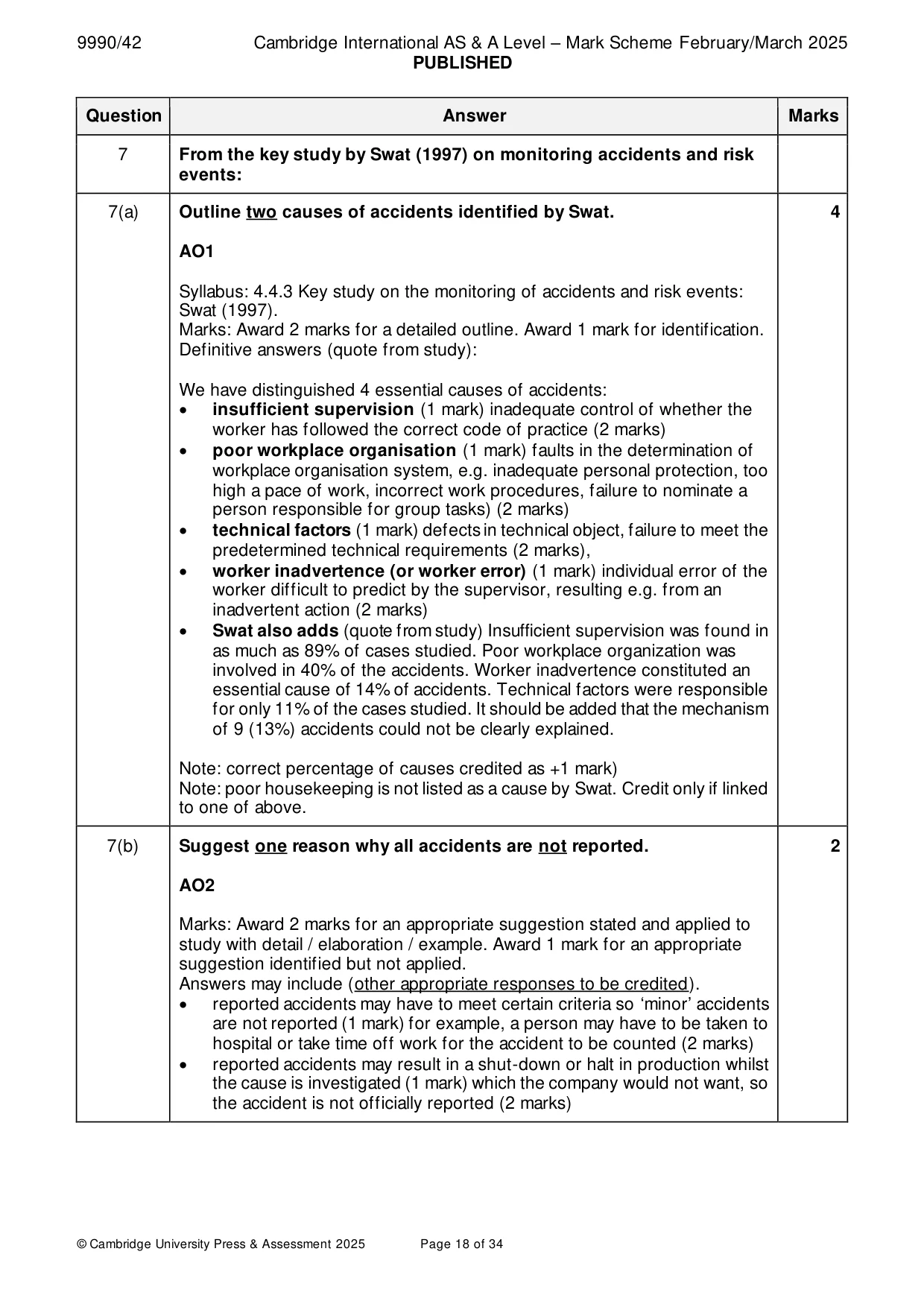
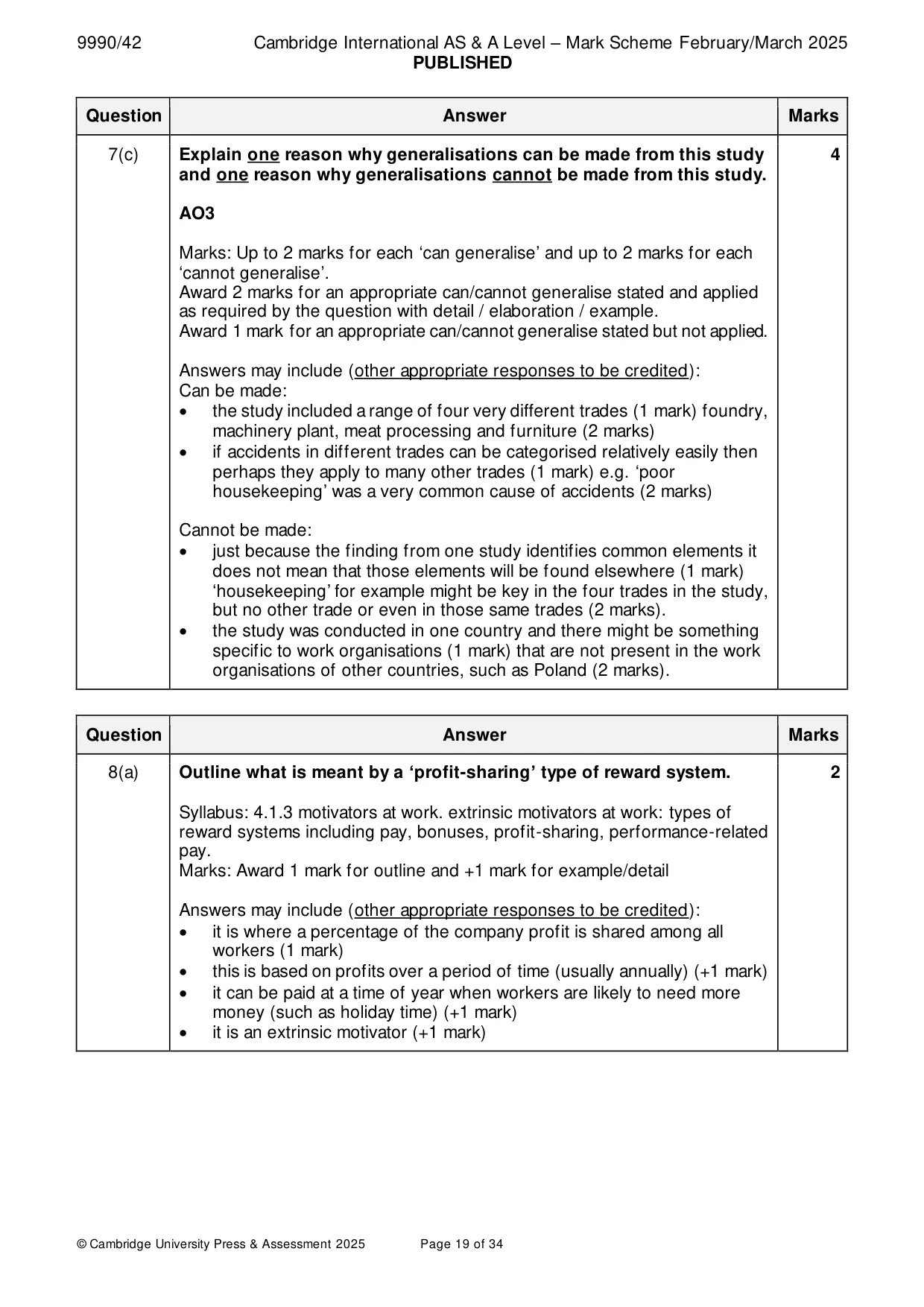
Mark scheme: 7 From the key study by Swat (1997) on monitoring accidents and risk events: 7(a) Outline two causes of accidents identified by Swat. 4 AO1 Syllabus: 4.4.3 Key study on the monitoring of accidents and risk events: Swat (1997). Marks: Award 2 marks for a detailed outline. Award 1 mark for identification. Definitive answers (quote from study): We have distinguished 4 essential causes of accidents: • insufficient supervision (1 mark) inadequate control of whether the worker has followed the correct code of practice (2 marks) • poor workplace organisation (1 mark) faults in the determination of workplace organisation system, e.g. inadequate personal protection, too high a pace of work, incorrect work procedures, failure to nominate a person responsible for group tasks) (2 marks) • technical factors (1 mark) defects in technical object, failure to meet the predetermined technical requirements (2 marks), • worker inadvertence (or worker error) (1 mark) individual error of the worker difficult to predict by the supervisor, resulting e.g. from an inadvertent action (2 marks) • Swat also adds (quote from study) Insufficient supervision was found in as much as 89% of cases studied. Poor workplace organization was involved in 40% of the accidents. Worker inadvertence constituted an essential cause of 14% of accidents. Technical factors were responsible for only 11% of the cases studied. It should be added that the mechanism of 9 (13%) accidents could not be clearly explained. Note: correct percentage of causes credited as +1 mark) Note: poor housekeeping is not listed as a cause by Swat. Credit only if linked to one of above. 7(b) Suggest one reason why all accidents are not reported. 2 AO2 Marks: Award 2 marks for an appropriate suggestion stated and applied to study with detail / elaboration / example. Award 1 mark for an appropriate suggestion identified but not applied. Answers may include (other appropriate responses to be credited). • reported accidents may have to meet certain criteria so ‘minor’ accidents are not reported (1 mark) for example, a person may have to be taken to hospital or take time off work for the accident to be counted (2 marks) • reported accidents may result in a shut-down or halt in production whilst the cause is investigated (1 mark) which the company would not want, so the accident is not officially reported (2 marks) 7(c) Explain one reason why generalisations can be made from this study 4 and one reason why generalisations cannot be made from this study. AO3 Marks: Up to 2 marks for each ‘can generalise’ and up to 2 marks for each ‘cannot generalise’. Award 2 marks for an appropriate can/cannot generalise stated and applied as required by the question with detail / elaboration / example. Award 1 mark for an appropriate can/cannot generalise stated but not applied. Answers may include (other appropriate responses to be credited): Can be made: • the study included a range of four very different trades (1 mark) foundry, machinery plant, meat processing and furniture (2 marks) • if accidents in different trades can be categorised relatively easily then perhaps they apply to many other trades (1 mark) e.g. ‘poor housekeeping’ was a very common cause of accidents (2 marks) Cannot be made: • just because the finding from one study identifies common elements it does not mean that those elements will be found elsewhere (1 mark) ‘housekeeping’ for example might be key in the four trades in the study, but no other trade or even in those same trades (2 marks). • the study was conducted in one country and there might be something specific to work organisations (1 mark) that are not present in the work organisations of other countries, such as Poland (2 marks).
Q8 · Outline what is meant by a ‘profit-sharing’ type of reward system
8 (a) Outline what is meant by a ‘profit-sharing’ type of reward system. [2] (b) Suggest how the effectiveness of a profit-sharing reward system could be measured using a questionnaire with closed questions. [2] (c) Explain one strength and one weakness of a ‘profit-sharing’ type of reward system. [4]
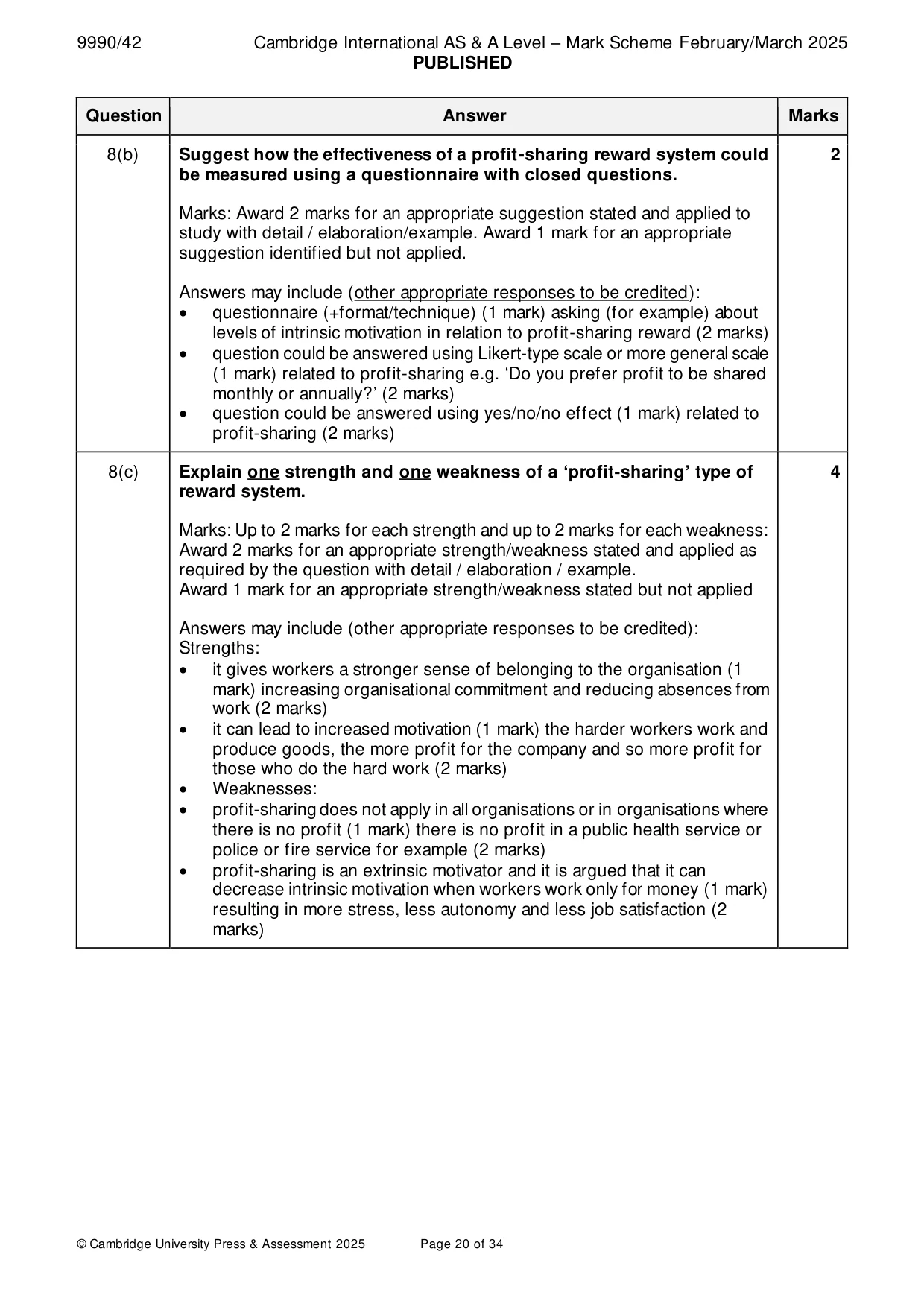
Mark scheme: 8(a) Outline what is meant by a ‘profit-sharing’ type of reward system. 2 Syllabus: 4.1.3 motivators at work. extrinsic motivators at work: types of reward systems including pay, bonuses, profit-sharing, performance-related pay. Marks: Award 1 mark for outline and +1 mark for example/detail Answers may include (other appropriate responses to be credited): • it is where a percentage of the company profit is shared among all workers (1 mark) • this is based on profits over a period of time (usually annually) (+1 mark) • it can be paid at a time of year when workers are likely to need more money (such as holiday time) (+1 mark) • it is an extrinsic motivator (+1 mark) 8(b) Suggest how the effectiveness of a profit-sharing reward system could 2 be measured using a questionnaire with closed questions. Marks: Award 2 marks for an appropriate suggestion stated and applied to study with detail / elaboration/example. Award 1 mark for an appropriate suggestion identified but not applied. Answers may include (other appropriate responses to be credited): • questionnaire (+format/technique) (1 mark) asking (for example) about levels of intrinsic motivation in relation to profit-sharing reward (2 marks) • question could be answered using Likert-type scale or more general scale (1 mark) related to profit-sharing e.g. ‘Do you prefer profit to be shared monthly or annually?’ (2 marks) • question could be answered using yes/no/no effect (1 mark) related to profit-sharing (2 marks) 8(c) Explain one strength and one weakness of a ‘profit-sharing’ type of 4 reward system. Marks: Up to 2 marks for each strength and up to 2 marks for each weakness: Award 2 marks for an appropriate strength/weakness stated and applied as required by the question with detail / elaboration / example. Award 1 mark for an appropriate strength/weakness stated but not applied Answers may include (other appropriate responses to be credited): Strengths: • it gives workers a stronger sense of belonging to the organisation (1 mark) increasing organisational commitment and reducing absences from work (2 marks) • it can lead to increased motivation (1 mark) the harder workers work and produce goods, the more profit for the company and so more profit for those who do the hard work (2 marks) • Weaknesses: • profit-sharing does not apply in all organisations or in organisations where there is no profit (1 mark) there is no profit in a public health service or police or fire service for example (2 marks) • profit-sharing is an extrinsic motivator and it is argued that it can decrease intrinsic motivation when workers work only for money (1 mark) resulting in more stress, less autonomy and less job satisfaction (2 marks)
Q9 · Plan a study using an online questionnaire to investigate whether rational emotive…
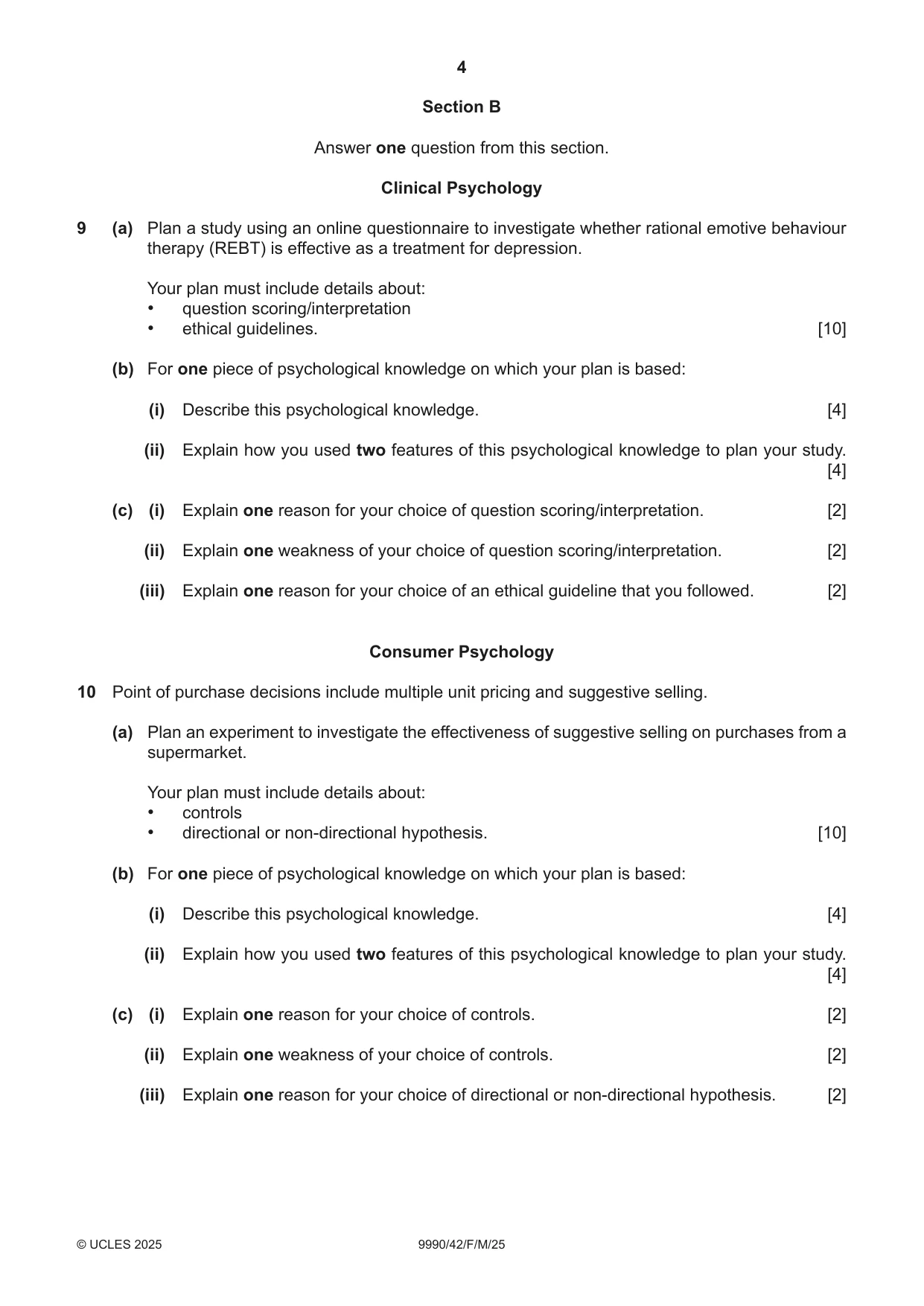
9 (a) Plan a study using an online questionnaire to investigate whether rational emotive behaviour therapy (REBT) is effective as a treatment for depression. Your plan must include details about: • question scoring/interpretation • ethical guidelines. [10] (b) For one piece of psychological knowledge on which your plan is based: (i) Describe this psychological knowledge. [4] (ii) Explain how you used two features of this psychological knowledge to plan your study. [4] (c) (i) Explain one reason for your choice of question scoring/interpretation. [2] (ii) Explain one weakness of your choice of question scoring/interpretation. [2] (iii) Explain one reason for your choice of an ethical guideline that you followed. [2] Consumer Psychology
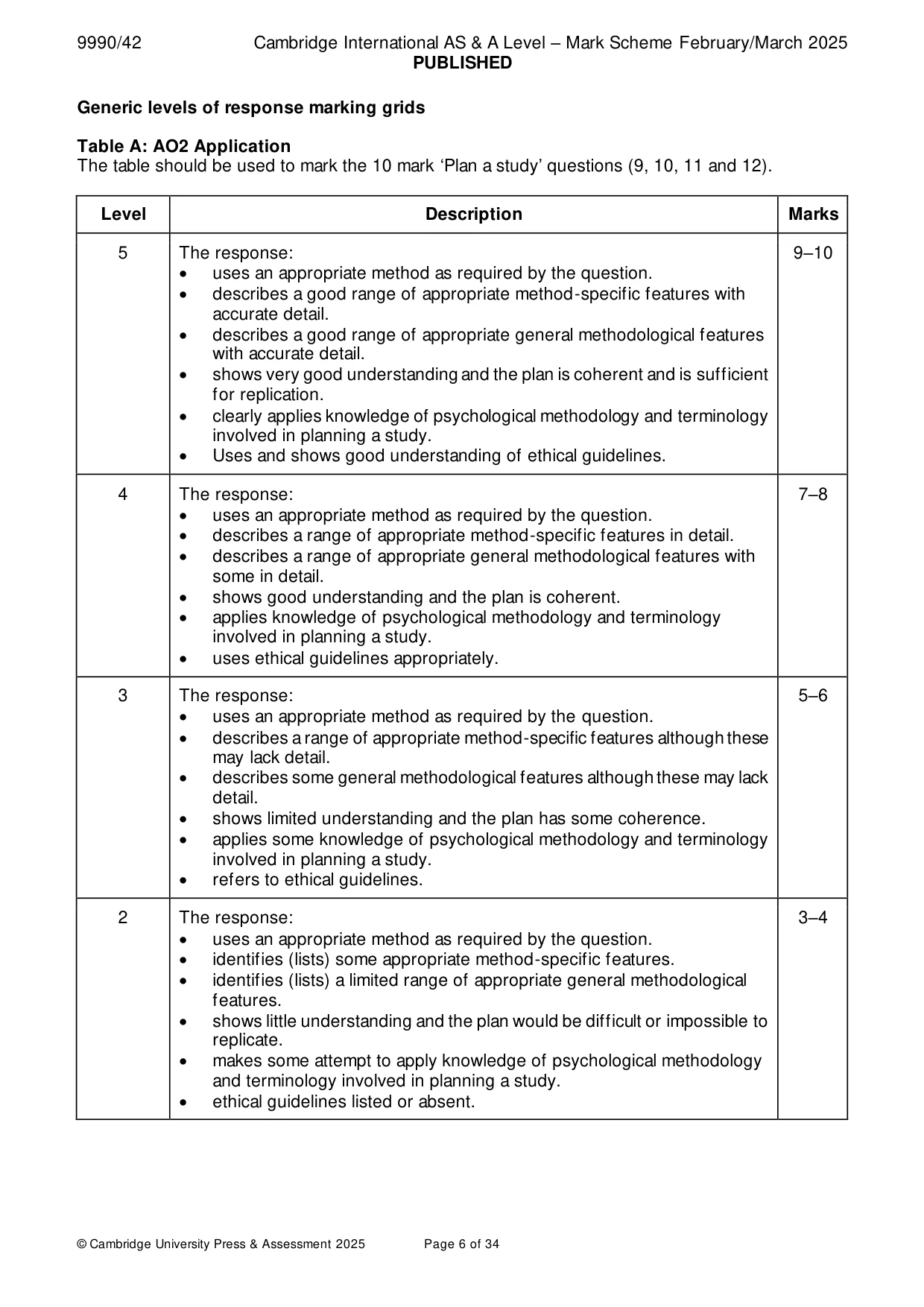
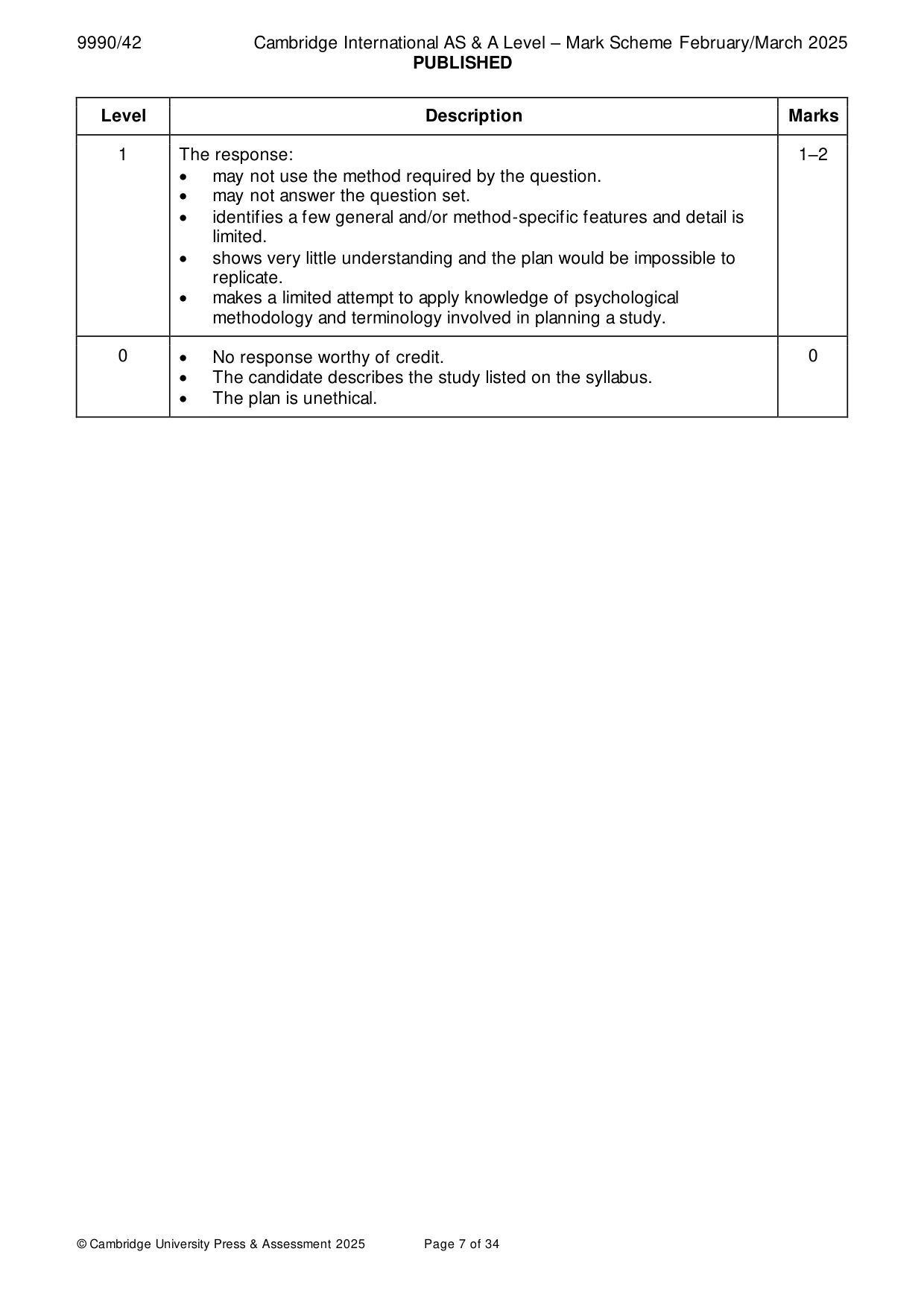
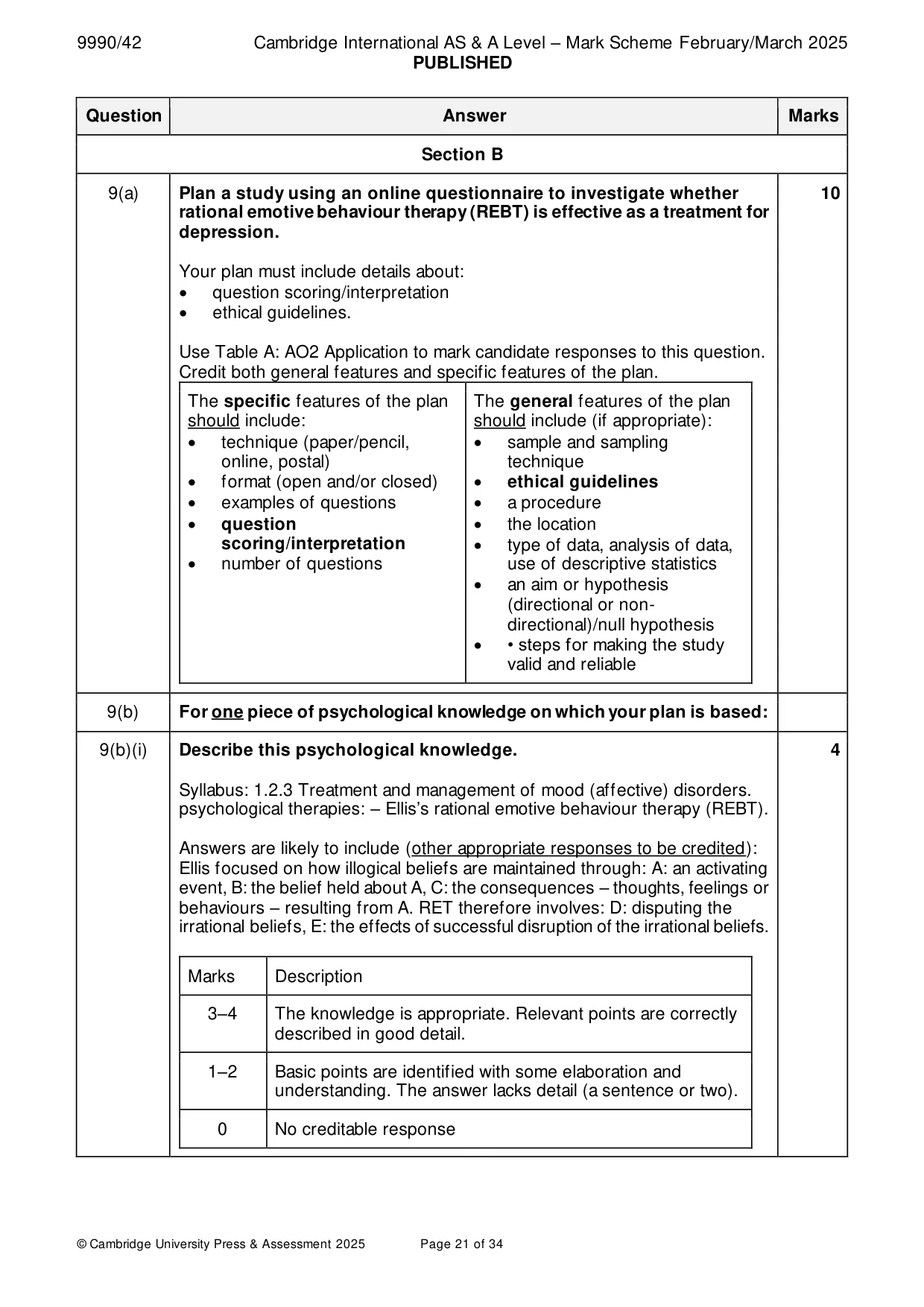
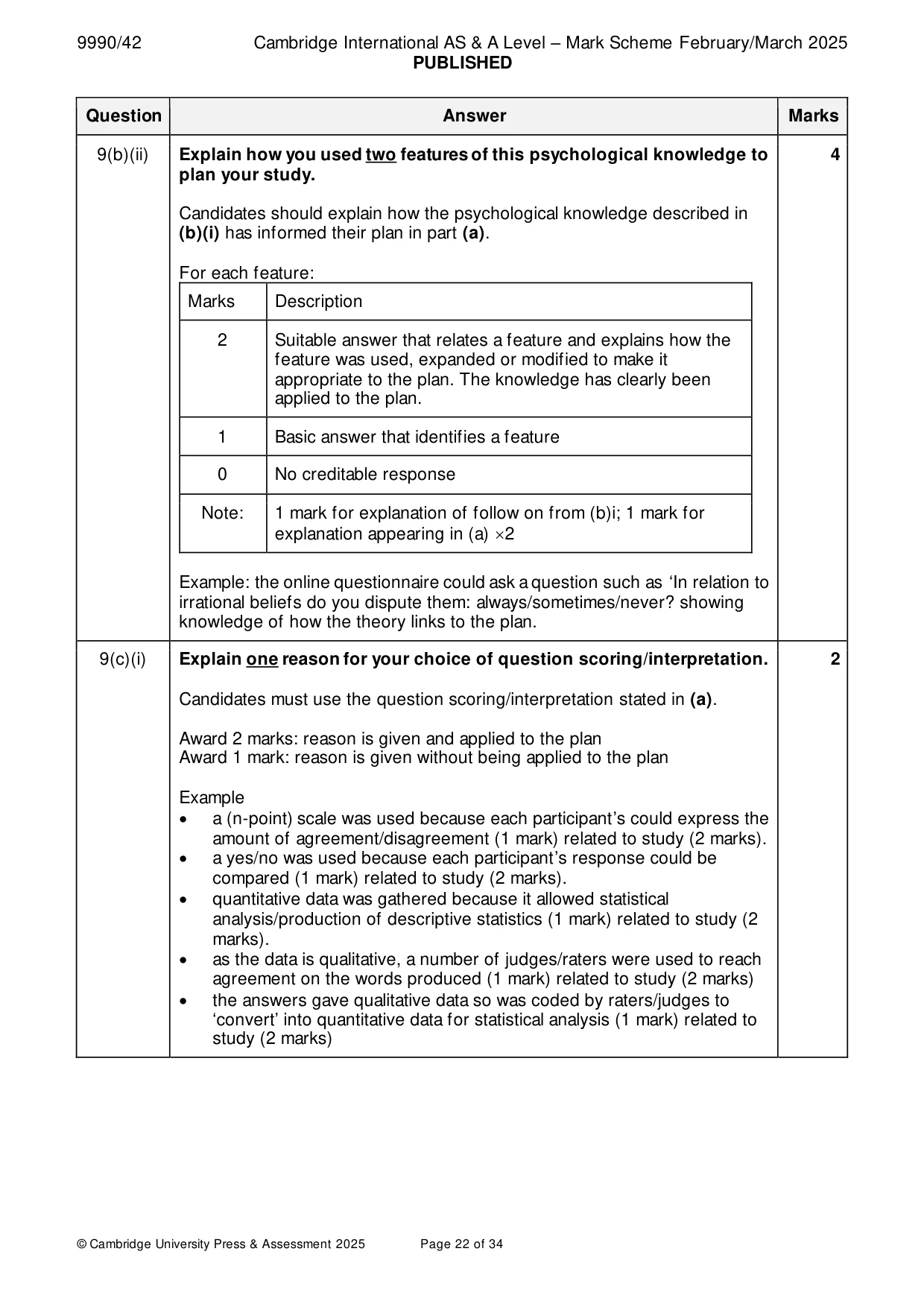
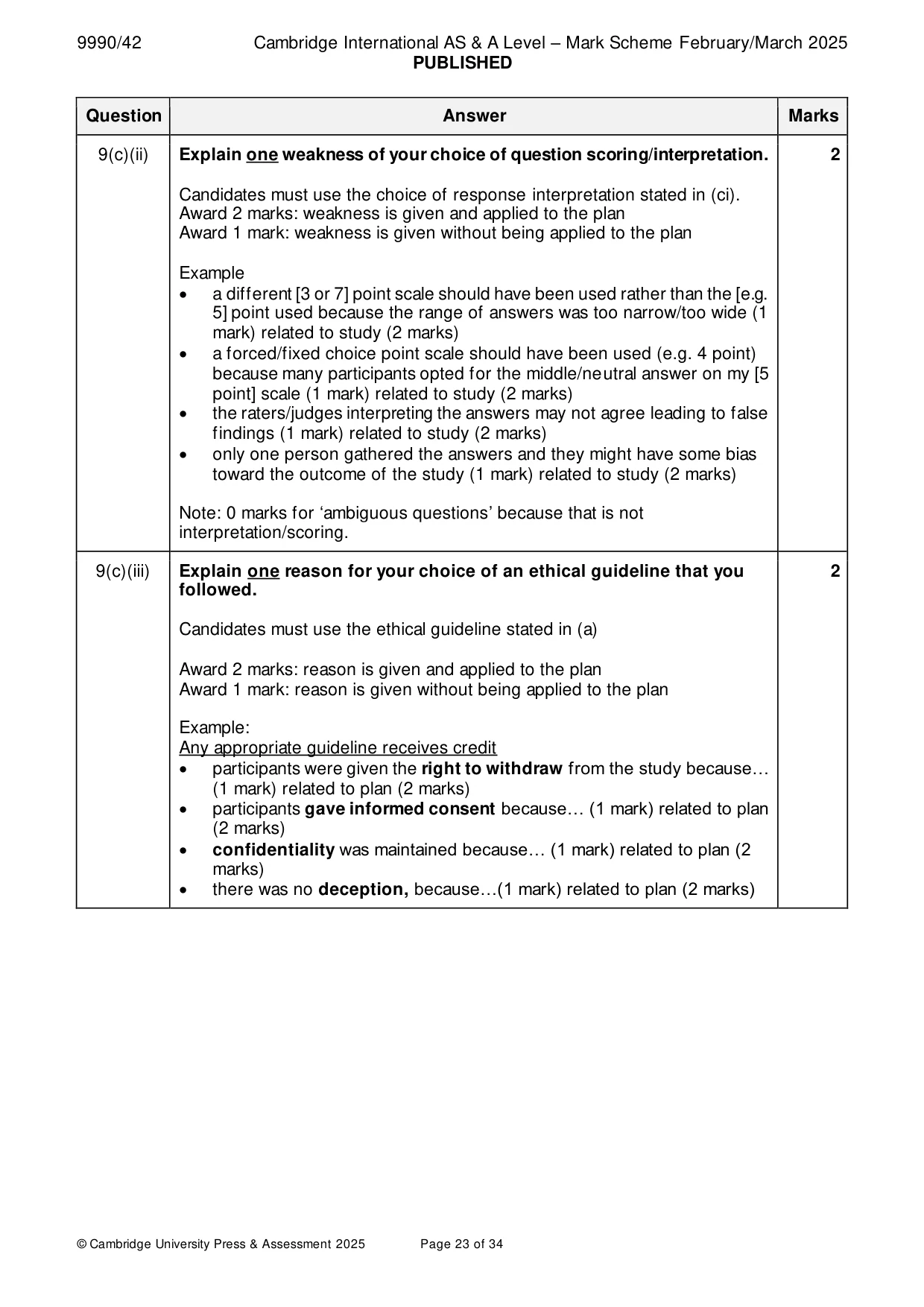
Mark scheme: 9(a) Plan a study using an online questionnaire to investigate whether 10 rational emotive behaviour therapy (REBT) is effective as a treatment for depression. Your plan must include details about: • question scoring/interpretation • ethical guidelines. Use Table A: AO2 Application to mark candidate responses to this question. Credit both general features and specific features of the plan. The specific features of the plan The general features of the plan should include: should include (if appropriate): • technique (paper/pencil, • sample and sampling online, postal) technique • format (open and/or closed) • ethical guidelines • examples of questions • a procedure • question • the location scoring/interpretation • type of data, analysis of data, • number of questions use of descriptive statistics • an aim or hypothesis (directional or non- directional)/null hypothesis • • steps for making the study valid and reliable 9(b) For one piece of psychological knowledge on which your plan is based: 9(b)(i) Describe this psychological knowledge. 4 Syllabus: 1.2.3 Treatment and management of mood (affective) disorders. psychological therapies: – Ellis’s rational emotive behaviour therapy (REBT). Answers are likely to include (other appropriate responses to be credited): Ellis focused on how illogical beliefs are maintained through: A: an activating event, B: the belief held about A, C: the consequences – thoughts, feelings or behaviours – resulting from A. RET therefore involves: D: disputing the irrational beliefs, E: the effects of successful disruption of the irrational beliefs. Marks Description 3–4 The knowledge is appropriate. Relevant points are correctly described in good detail. 1–2 Basic points are identified with some elaboration and understanding. The answer lacks detail (a sentence or two). 0 No creditable response 9(b)(ii) Explain how you used two features of this psychological knowledge to 4 plan your study. Candidates should explain how the psychological knowledge described in (b)(i) has informed their plan in part (a). For each feature: Marks Description 2 Suitable answer that relates a feature and explains how the feature was used, expanded or modified to make it appropriate to the plan. The knowledge has clearly been applied to the plan. 1 Basic answer that identifies a feature 0 No creditable response Note: 1 mark for explanation of follow on from (b)i; 1 mark for explanation appearing in (a) 2 Example: the online questionnaire could ask a question such as ‘In relation to irrational beliefs do you dispute them: always/sometimes/never? showing knowledge of how the theory links to the plan. 9(c)(i) Explain one reason for your choice of question scoring/interpretation. 2 Candidates must use the question scoring/interpretation stated in (a). Award 2 marks: reason is given and applied to the plan Award 1 mark: reason is given without being applied to the plan Example • a (n-point) scale was used because each participant’s could express the amount of agreement/disagreement (1 mark) related to study (2 marks). • a yes/no was used because each participant’s response could be compared (1 mark) related to study (2 marks). • quantitative data was gathered because it allowed statistical analysis/production of descriptive statistics (1 mark) related to study (2 marks). • as the data is qualitative, a number of judges/raters were used to reach agreement on the words produced (1 mark) related to study (2 marks) • the answers gave qualitative data so was coded by raters/judges to ‘convert’ into quantitative data for statistical analysis (1 mark) related to study (2 marks) 9(c)(ii) Explain one weakness of your choice of question scoring/interpretation. 2 Candidates must use the choice of response interpretation stated in (ci). Award 2 marks: weakness is given and applied to the plan Award 1 mark: weakness is given without being applied to the plan Example • a different [3 or 7] point scale should have been used rather than the [e.g. 5] point used because the range of answers was too narrow/too wide (1 mark) related to study (2 marks) • a forced/fixed choice point scale should have been used (e.g. 4 point) because many participants opted for the middle/neutral answer on my [5 point] scale (1 mark) related to study (2 marks) • the raters/judges interpreting the answers may not agree leading to false findings (1 mark) related to study (2 marks) • only one person gathered the answers and they might have some bias toward the outcome of the study (1 mark) related to study (2 marks) Note: 0 marks for ‘ambiguous questions’ because that is not interpretation/scoring. 9(c)(iii) Explain one reason for your choice of an ethical guideline that you 2 followed. Candidates must use the ethical guideline stated in (a) Award 2 marks: reason is given and applied to the plan Award 1 mark: reason is given without being applied to the plan Example: Any appropriate guideline receives credit • participants were given the right to withdraw from the study because… (1 mark) related to plan (2 marks) • participants gave informed consent because… (1 mark) related to plan (2 marks) • confidentiality was maintained because… (1 mark) related to plan (2 marks) • there was no deception, because…(1 mark) related to plan (2 marks)
More questions on Mood (affective) disorders: depressive disorder (unipolar) and bipolar disorder
Q10 · Point of purchase decisions include multiple unit pricing and suggestive selling
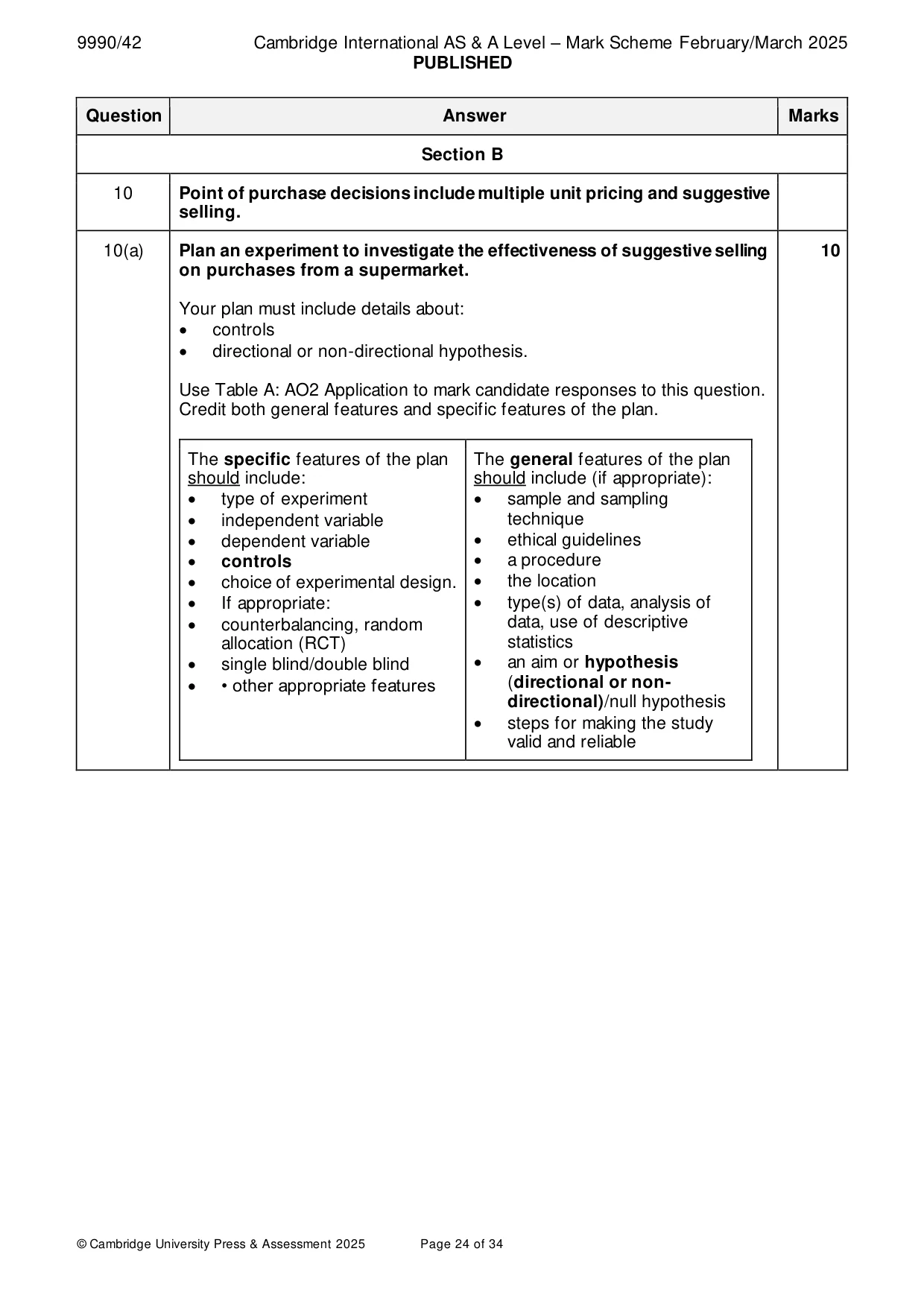
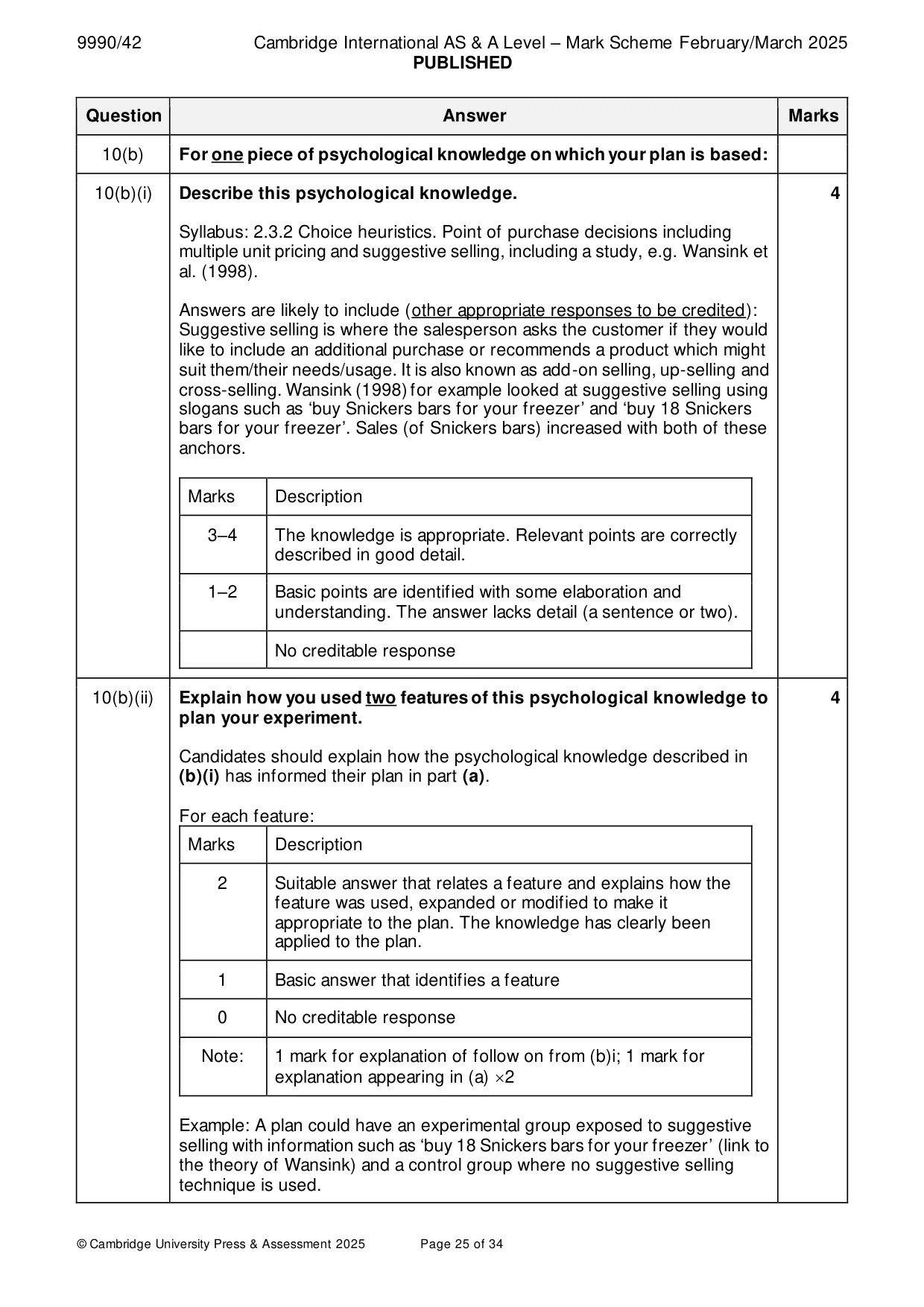
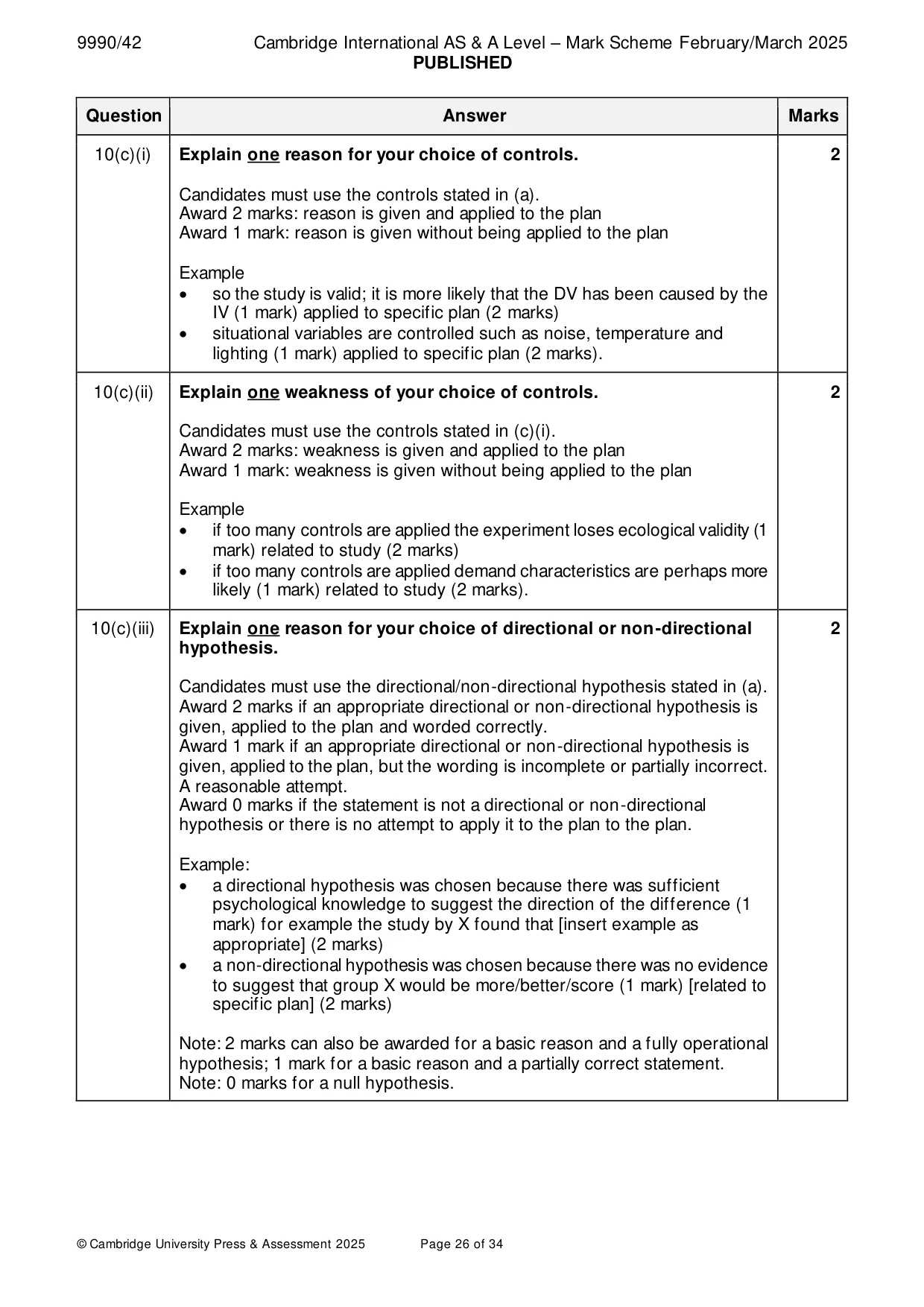
10 Point of purchase decisions include multiple unit pricing and suggestive selling. (a) Plan an experiment to investigate the effectiveness of suggestive selling on purchases from a supermarket. Your plan must include details about: • controls • directional or non-directional hypothesis. [10] (b) For one piece of psychological knowledge on which your plan is based: (i) Describe this psychological knowledge. [4] (ii) Explain how you used two features of this psychological knowledge to plan your study. [4] (c) (i) Explain one reason for your choice of controls. [2] (ii) Explain one weakness of your choice of controls. [2] (iii) Explain one reason for your choice of directional or non-directional hypothesis. [2] Health Psychology
Mark scheme: 10 Point of purchase decisions include multiple unit pricing and suggestive selling. 10(a) Plan an experiment to investigate the effectiveness of suggestive selling 10 on purchases from a supermarket. Your plan must include details about: • controls • directional or non-directional hypothesis. Use Table A: AO2 Application to mark candidate responses to this question. Credit both general features and specific features of the plan. The specific features of the plan The general features of the plan should include: should include (if appropriate): • type of experiment • sample and sampling • independent variable technique • dependent variable • ethical guidelines • controls • a procedure • choice of experimental design. • the location • If appropriate: • type(s) of data, analysis of • counterbalancing, random data, use of descriptive allocation (RCT) statistics • single blind/double blind • an aim or hypothesis • • other appropriate features (directional or non- directional)/null hypothesis • steps for making the study valid and reliable 10(b) For one piece of psychological knowledge on which your plan is based: 10(b)(i) Describe this psychological knowledge. 4 Syllabus: 2.3.2 Choice heuristics. Point of purchase decisions including multiple unit pricing and suggestive selling, including a study, e.g. Wansink et al. (1998). Answers are likely to include (other appropriate responses to be credited): Suggestive selling is where the salesperson asks the customer if they would like to include an additional purchase or recommends a product which might suit them/their needs/usage. It is also known as add-on selling, up-selling and cross-selling. Wansink (1998) for example looked at suggestive selling using slogans such as ‘buy Snickers bars for your freezer’ and ‘buy 18 Snickers bars for your freezer’. Sales (of Snickers bars) increased with both of these anchors. Marks Description 3–4 The knowledge is appropriate. Relevant points are correctly described in good detail. 1–2 Basic points are identified with some elaboration and understanding. The answer lacks detail (a sentence or two). No creditable response 10(b)(ii) Explain how you used two features of this psychological knowledge to 4 plan your experiment. Candidates should explain how the psychological knowledge described in (b)(i) has informed their plan in part (a). For each feature: Marks Description 2 Suitable answer that relates a feature and explains how the feature was used, expanded or modified to make it appropriate to the plan. The knowledge has clearly been applied to the plan. 1 Basic answer that identifies a feature 0 No creditable response Note: 1 mark for explanation of follow on from (b)i; 1 mark for explanation appearing in (a) 2 Example: A plan could have an experimental group exposed to suggestive selling with information such as ‘buy 18 Snickers bars for your freezer’ (link to the theory of Wansink) and a control group where no suggestive selling technique is used. 10(c)(i) Explain one reason for your choice of controls. 2 Candidates must use the controls stated in (a). Award 2 marks: reason is given and applied to the plan Award 1 mark: reason is given without being applied to the plan Example • so the study is valid; it is more likely that the DV has been caused by the IV (1 mark) applied to specific plan (2 marks) • situational variables are controlled such as noise, temperature and lighting (1 mark) applied to specific plan (2 marks). 10(c)(ii) Explain one weakness of your choice of controls. 2 Candidates must use the controls stated in (c)(i). Award 2 marks: weakness is given and applied to the plan Award 1 mark: weakness is given without being applied to the plan Example • if too many controls are applied the experiment loses ecological validity (1 mark) related to study (2 marks) • if too many controls are applied demand characteristics are perhaps more likely (1 mark) related to study (2 marks). 10(c)(iii) Explain one reason for your choice of directional or non-directional 2 hypothesis. Candidates must use the directional/non-directional hypothesis stated in (a). Award 2 marks if an appropriate directional or non-directional hypothesis is given, applied to the plan and worded correctly. Award 1 mark if an appropriate directional or non-directional hypothesis is given, applied to the plan, but the wording is incomplete or partially incorrect. A reasonable attempt. Award 0 marks if the statement is not a directional or non-directional hypothesis or there is no attempt to apply it to the plan to the plan. Example: • a directional hypothesis was chosen because there was sufficient psychological knowledge to suggest the direction of the difference (1 mark) for example the study by X found that [insert example as appropriate] (2 marks) • a non-directional hypothesis was chosen because there was no evidence to suggest that group X would be more/better/score (1 mark) [related to specific plan] (2 marks) Note: 2 marks can also be awarded for a basic reason and a fully operational hypothesis; 1 mark for a basic reason and a partially correct statement. Note: 0 marks for a null hypothesis.
Q11 · Plan a study using an experiment to investigate whether biochemical treatments are more…
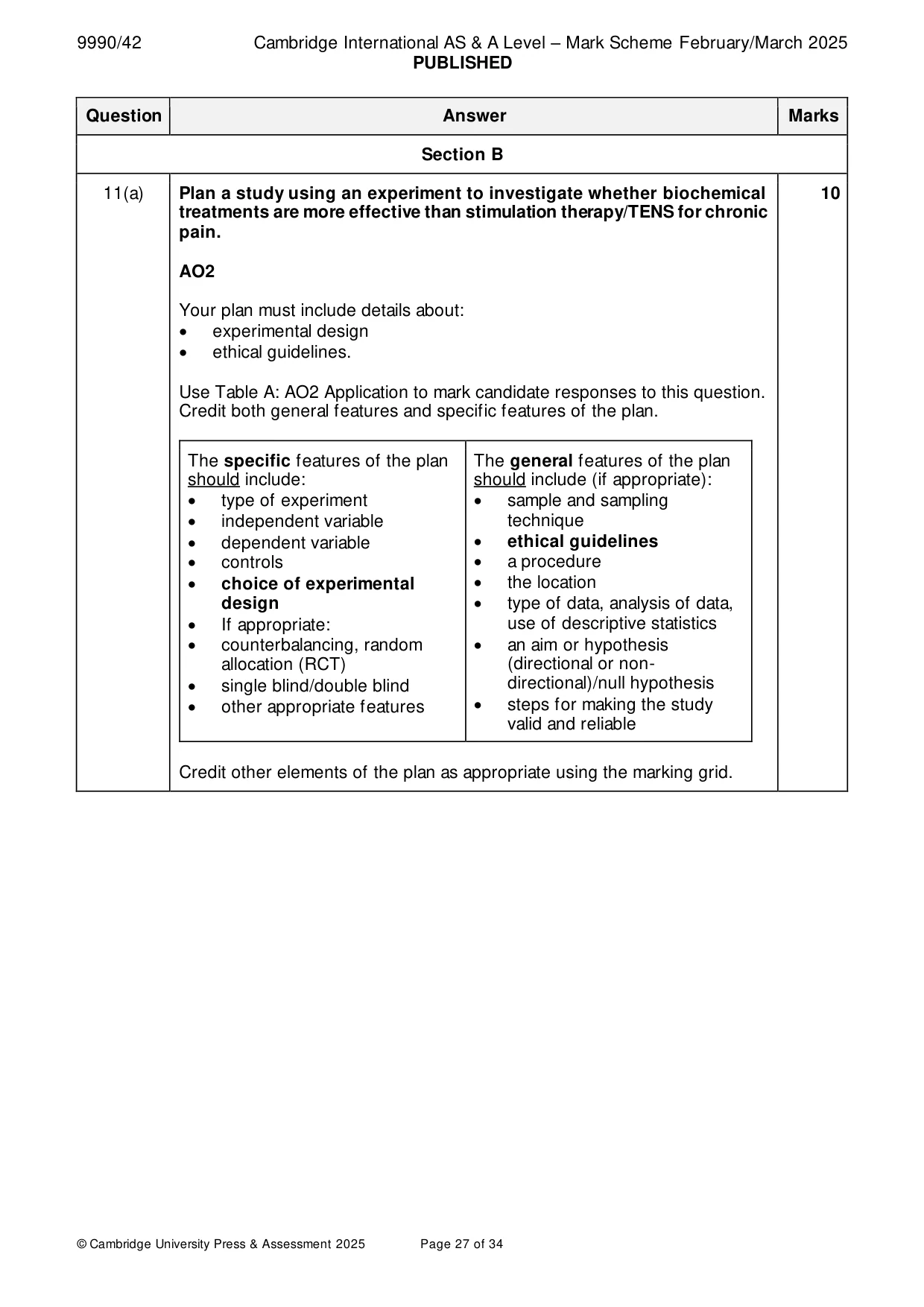
11 (a) Plan a study using an experiment to investigate whether biochemical treatments are more effective than stimulation therapy/TENS for chronic pain. Your plan must include details about: • experimental design • ethical guidelines. [10] (b) For one piece of psychological knowledge on which your plan is based: (i) Describe this psychological knowledge. [4] (ii) Explain how you used two features of this psychological knowledge to plan your study. [4] (c) (i) Explain one reason for your choice of experimental design. [2] (ii) Explain one weakness of your choice of experimental design. [2] (iii) Explain one reason for your choice of an ethical guideline that you followed. [2] Organisational Psychology
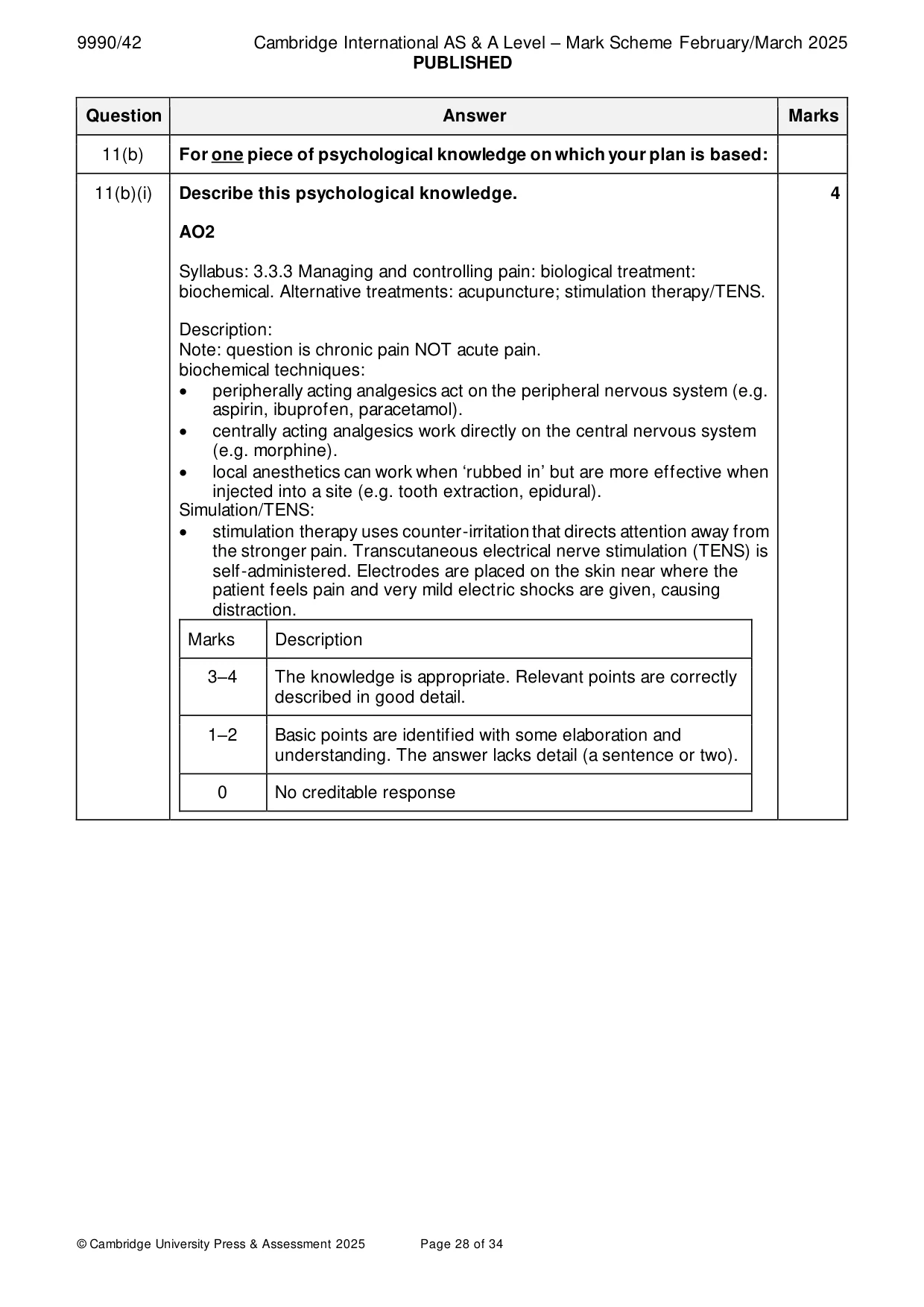
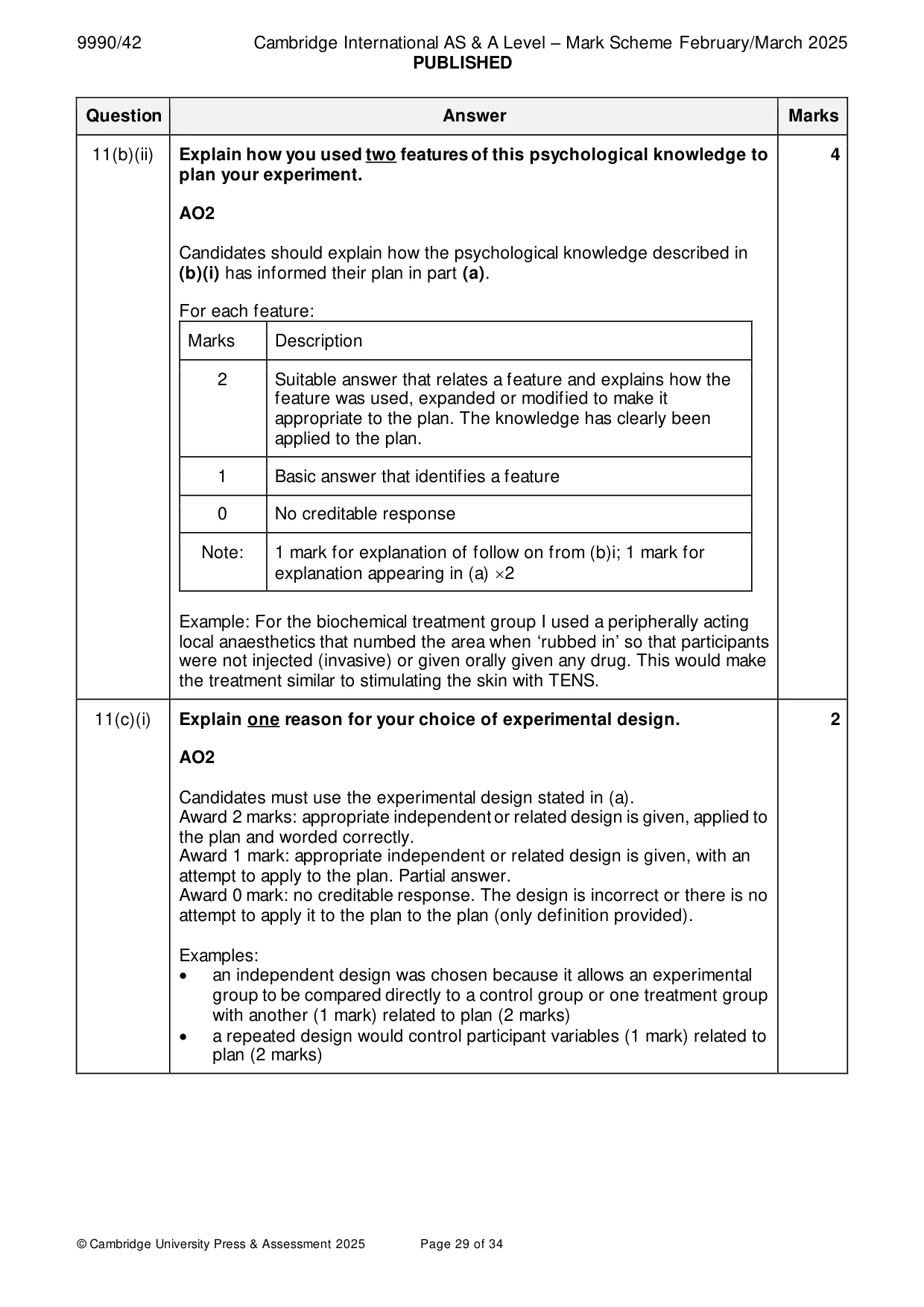
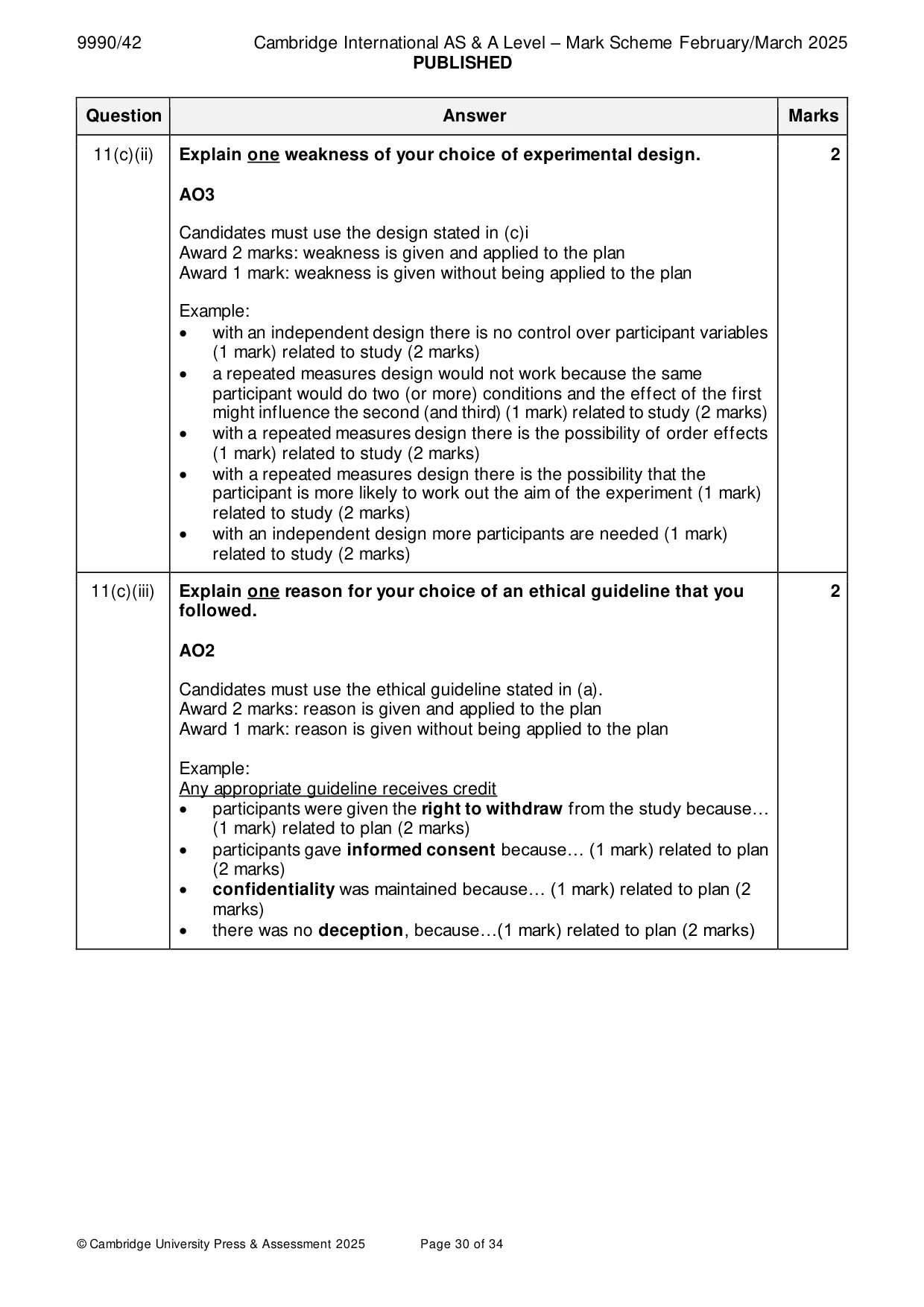
Mark scheme: 11(a) Plan a study using an experiment to investigate whether biochemical 10 treatments are more effective than stimulation therapy/TENS for chronic pain. AO2 Your plan must include details about: • experimental design • ethical guidelines. Use Table A: AO2 Application to mark candidate responses to this question. Credit both general features and specific features of the plan. The specific features of the plan The general features of the plan should include: should include (if appropriate): • type of experiment • sample and sampling • independent variable technique • dependent variable • ethical guidelines • controls • a procedure • choice of experimental • the location design • type of data, analysis of data, • If appropriate: use of descriptive statistics • counterbalancing, random • an aim or hypothesis allocation (RCT) (directional or non- • single blind/double blind directional)/null hypothesis • other appropriate features • steps for making the study valid and reliable Credit other elements of the plan as appropriate using the marking grid. 11(b) For one piece of psychological knowledge on which your plan is based: 11(b)(i) Describe this psychological knowledge. 4 AO2 Syllabus: 3.3.3 Managing and controlling pain: biological treatment: biochemical. Alternative treatments: acupuncture; stimulation therapy/TENS. Description: Note: question is chronic pain NOT acute pain. biochemical techniques: • peripherally acting analgesics act on the peripheral nervous system (e.g. aspirin, ibuprofen, paracetamol). • centrally acting analgesics work directly on the central nervous system (e.g. morphine). • local anesthetics can work when ‘rubbed in’ but are more effective when injected into a site (e.g. tooth extraction, epidural). Simulation/TENS: • stimulation therapy uses counter-irritation that directs attention away from the stronger pain. Transcutaneous electrical nerve stimulation (TENS) is self-administered. Electrodes are placed on the skin near where the patient feels pain and very mild electric shocks are given, causing distraction. Marks Description 3–4 The knowledge is appropriate. Relevant points are correctly described in good detail. 1–2 Basic points are identified with some elaboration and understanding. The answer lacks detail (a sentence or two). 0 No creditable response 11(b)(ii) Explain how you used two features of this psychological knowledge to 4 plan your experiment. AO2 Candidates should explain how the psychological knowledge described in (b)(i) has informed their plan in part (a). For each feature: Marks Description 2 Suitable answer that relates a feature and explains how the feature was used, expanded or modified to make it appropriate to the plan. The knowledge has clearly been applied to the plan. 1 Basic answer that identifies a feature 0 No creditable response Note: 1 mark for explanation of follow on from (b)i; 1 mark for explanation appearing in (a) 2 Example: For the biochemical treatment group I used a peripherally acting local anaesthetics that numbed the area when ‘rubbed in’ so that participants were not injected (invasive) or given orally given any drug. This would make the treatment similar to stimulating the skin with TENS. 11(c)(i) Explain one reason for your choice of experimental design. 2 AO2 Candidates must use the experimental design stated in (a). Award 2 marks: appropriate independent or related design is given, applied to the plan and worded correctly. Award 1 mark: appropriate independent or related design is given, with an attempt to apply to the plan. Partial answer. Award 0 mark: no creditable response. The design is incorrect or there is no attempt to apply it to the plan to the plan (only definition provided). Examples: • an independent design was chosen because it allows an experimental group to be compared directly to a control group or one treatment group with another (1 mark) related to plan (2 marks) • a repeated design would control participant variables (1 mark) related to plan (2 marks) 11(c)(ii) Explain one weakness of your choice of experimental design. 2 AO3 Candidates must use the design stated in (c)i Award 2 marks: weakness is given and applied to the plan Award 1 mark: weakness is given without being applied to the plan Example: • with an independent design there is no control over participant variables (1 mark) related to study (2 marks) • a repeated measures design would not work because the same participant would do two (or more) conditions and the effect of the first might influence the second (and third) (1 mark) related to study (2 marks) • with a repeated measures design there is the possibility of order effects (1 mark) related to study (2 marks) • with a repeated measures design there is the possibility that the participant is more likely to work out the aim of the experiment (1 mark) related to study (2 marks) • with an independent design more participants are needed (1 mark) related to study (2 marks) 11(c)(iii) Explain one reason for your choice of an ethical guideline that you 2 followed. AO2 Candidates must use the ethical guideline stated in (a). Award 2 marks: reason is given and applied to the plan Award 1 mark: reason is given without being applied to the plan Example: Any appropriate guideline receives credit • participants were given the right to withdraw from the study because… (1 mark) related to plan (2 marks) • participants gave informed consent because… (1 mark) related to plan (2 marks) • confidentiality was maintained because… (1 mark) related to plan (2 marks) • there was no deception, because…(1 mark) related to plan (2 marks)
Q12 · McClelland proposed an achievement motivation theory with different types of need…
12 McClelland proposed an achievement motivation theory with different types of need: achievement, affiliation and power. (a) Plan a study using a questionnaire to investigate which type of McClelland’s needs is most common in teachers who teach 16–18-year-old students. Your plan must include details about: • sampling technique • type(s) of data. [10] (b) For one piece of psychological knowledge on which your plan is based: (i) Describe this psychological knowledge. [4] (ii) Explain how you used two features of this psychological knowledge to plan your study. [4] (c) (i) Explain one reason for your choice of sampling technique. [2] (ii) Explain one weakness of your choice of sampling technique. [2] (iii) Explain one reason for your choice of type(s) of data. [2]
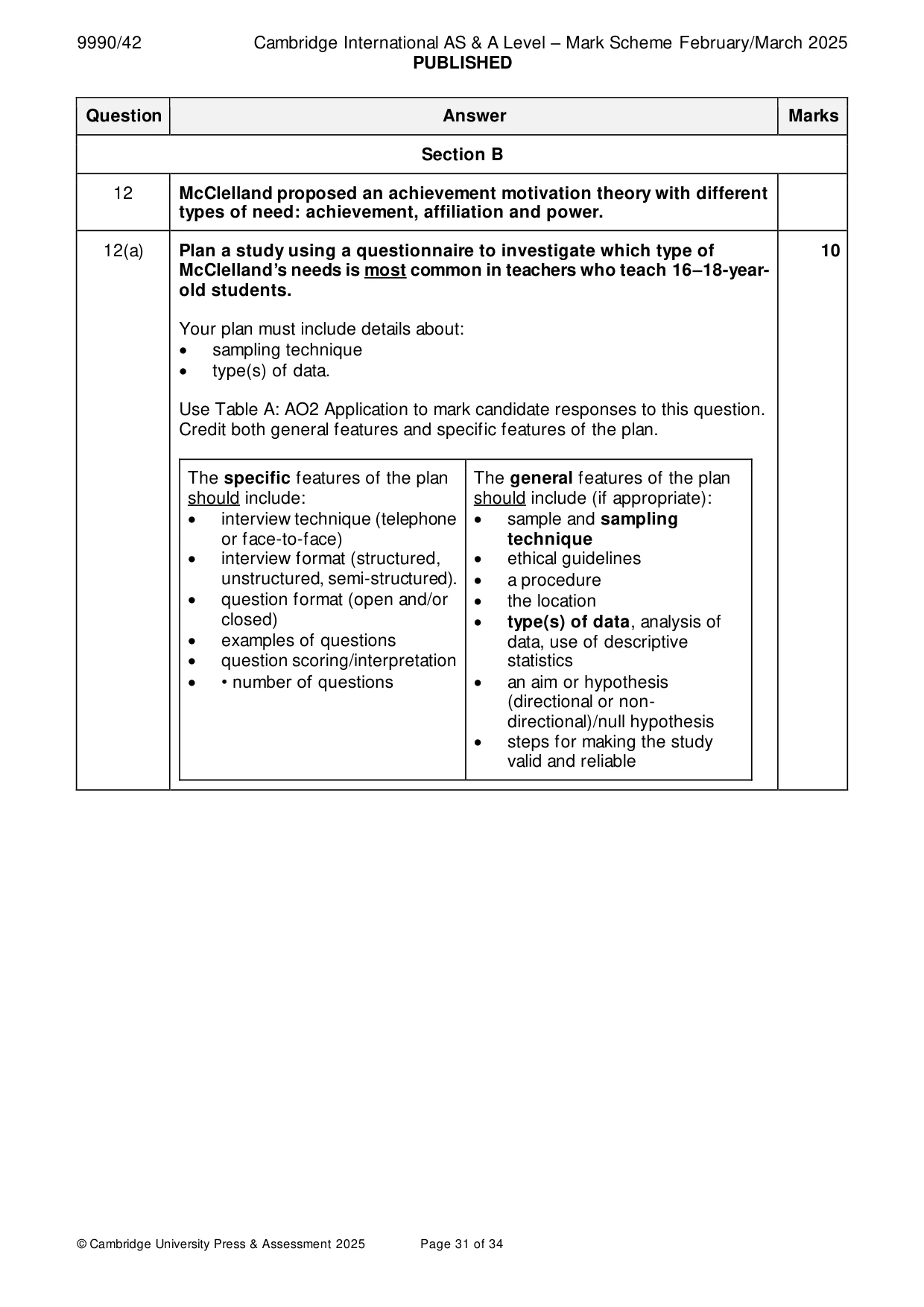
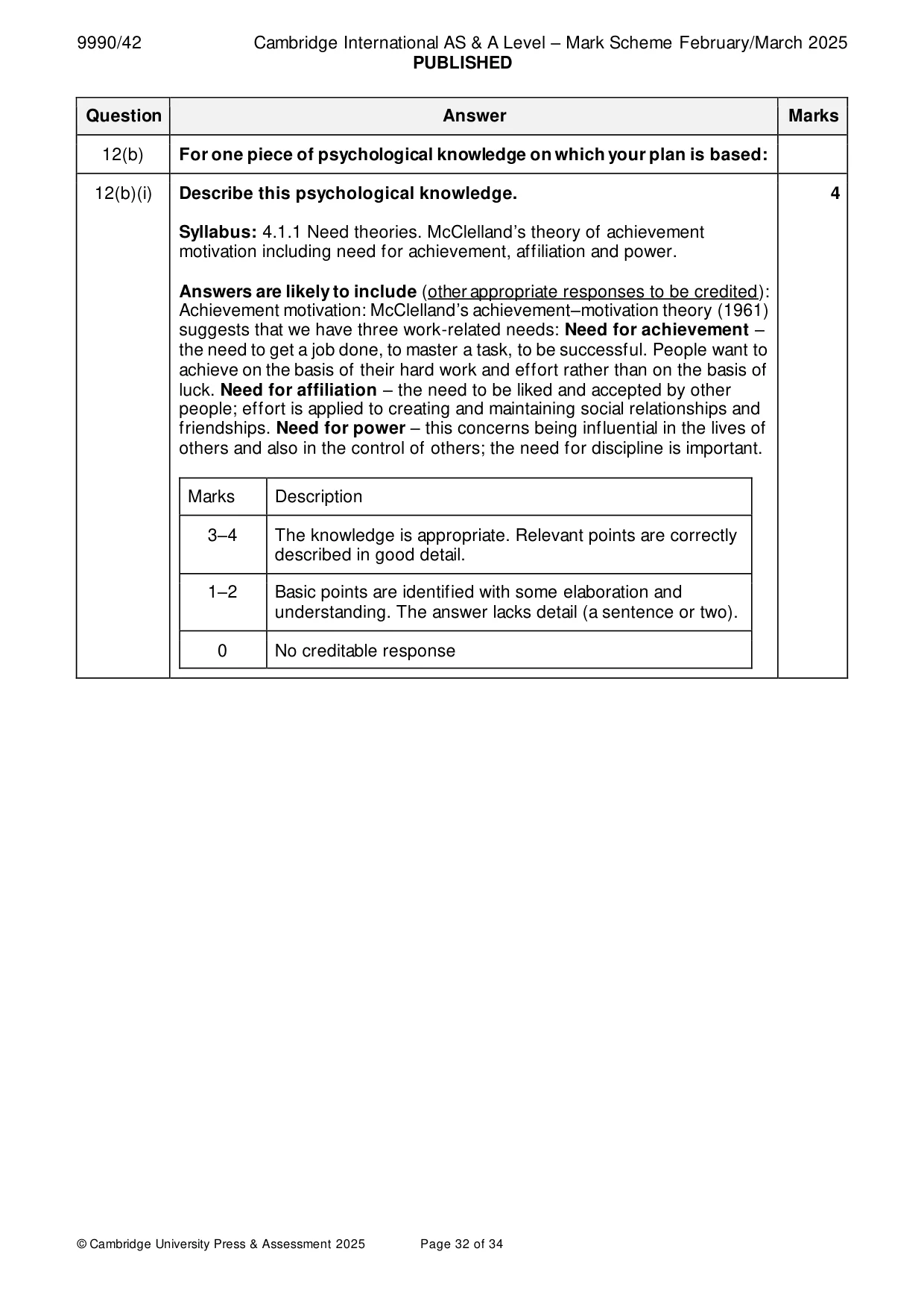
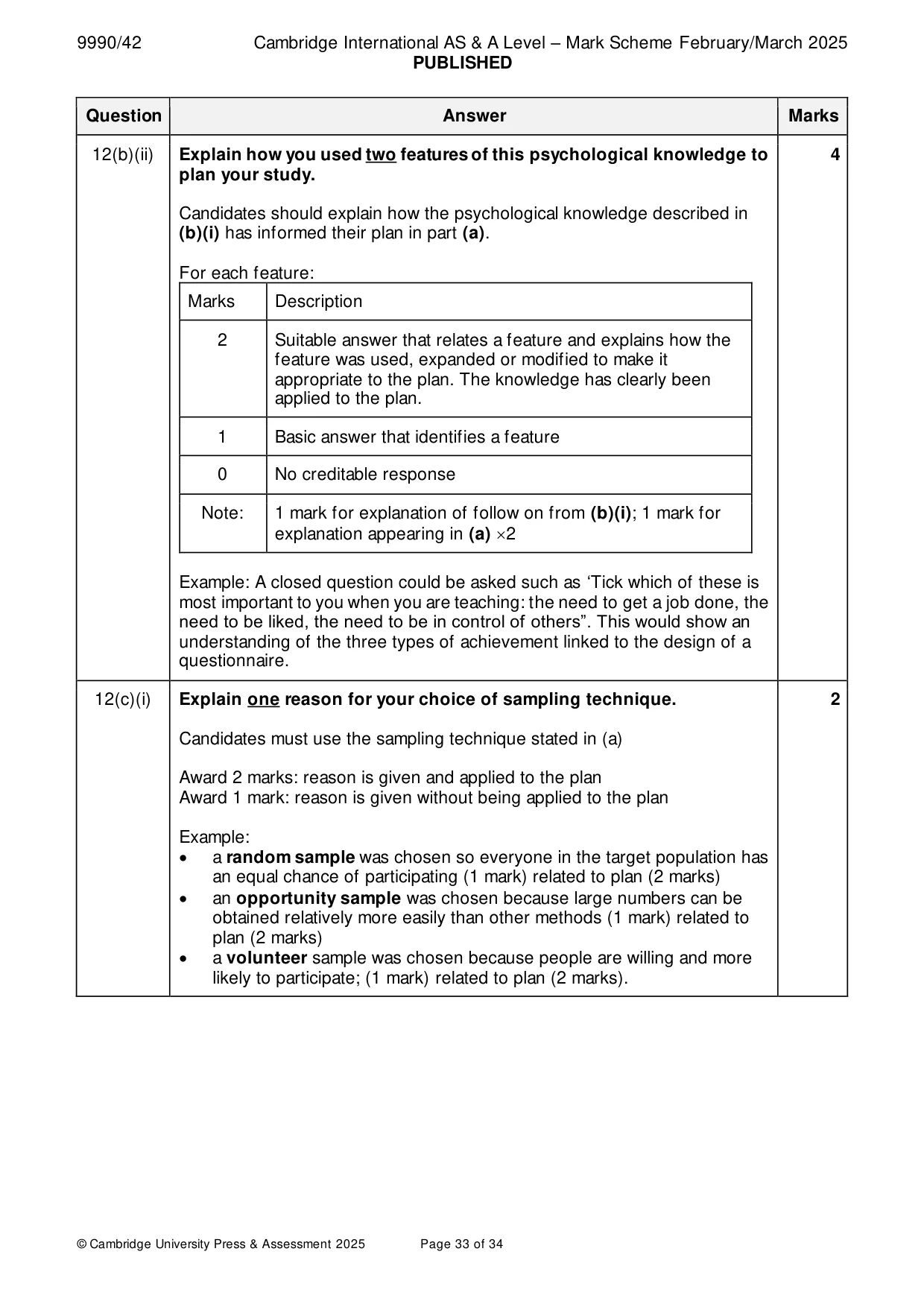
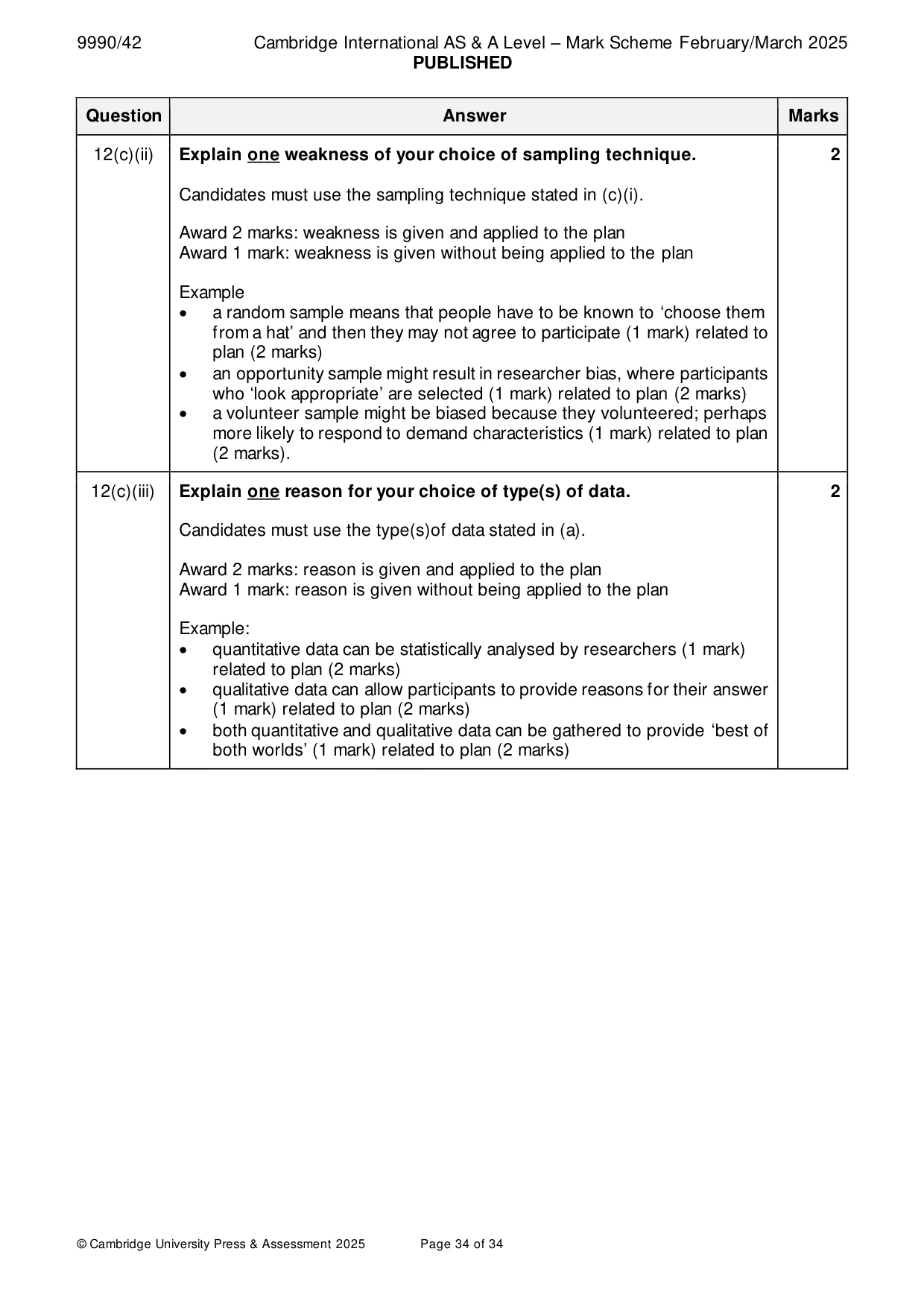
Mark scheme: 12 McClelland proposed an achievement motivation theory with different types of need: achievement, affiliation and power. 12(a) Plan a study using a questionnaire to investigate which type of 10 McClelland’s needs is most common in teachers who teach 16–18-year- old students. Your plan must include details about: • sampling technique • type(s) of data. Use Table A: AO2 Application to mark candidate responses to this question. Credit both general features and specific features of the plan. The specific features of the plan The general features of the plan should include: should include (if appropriate): • interview technique (telephone • sample and sampling or face-to-face) technique • interview format (structured, • ethical guidelines unstructured, semi-structured). • a procedure • question format (open and/or • the location closed) • type(s) of data, analysis of • examples of questions data, use of descriptive • question scoring/interpretation statistics • • number of questions • an aim or hypothesis (directional or non- directional)/null hypothesis • steps for making the study valid and reliable 12(b) For one piece of psychological knowledge on which your plan is based: 12(b)(i) Describe this psychological knowledge. 4 Syllabus: 4.1.1 Need theories. McClelland’s theory of achievement motivation including need for achievement, affiliation and power. Answers are likely to include (other appropriate responses to be credited): Achievement motivation: McClelland’s achievement–motivation theory (1961) suggests that we have three work-related needs: Need for achievement – the need to get a job done, to master a task, to be successful. People want to achieve on the basis of their hard work and effort rather than on the basis of luck. Need for affiliation – the need to be liked and accepted by other people; effort is applied to creating and maintaining social relationships and friendships. Need for power – this concerns being influential in the lives of others and also in the control of others; the need for discipline is important. Marks Description 3–4 The knowledge is appropriate. Relevant points are correctly described in good detail. 1–2 Basic points are identified with some elaboration and understanding. The answer lacks detail (a sentence or two). 0 No creditable response 12(b)(ii) Explain how you used two features of this psychological knowledge to 4 plan your study. Candidates should explain how the psychological knowledge described in (b)(i) has informed their plan in part (a). For each feature: Marks Description 2 Suitable answer that relates a feature and explains how the feature was used, expanded or modified to make it appropriate to the plan. The knowledge has clearly been applied to the plan. 1 Basic answer that identifies a feature 0 No creditable response Note: 1 mark for explanation of follow on from (b)(i); 1 mark for explanation appearing in (a) 2 Example: A closed question could be asked such as ‘Tick which of these is most important to you when you are teaching: the need to get a job done, the need to be liked, the need to be in control of others”. This would show an understanding of the three types of achievement linked to the design of a questionnaire. 12(c)(i) Explain one reason for your choice of sampling technique. 2 Candidates must use the sampling technique stated in (a) Award 2 marks: reason is given and applied to the plan Award 1 mark: reason is given without being applied to the plan Example: • a random sample was chosen so everyone in the target population has an equal chance of participating (1 mark) related to plan (2 marks) • an opportunity sample was chosen because large numbers can be obtained relatively more easily than other methods (1 mark) related to plan (2 marks) • a volunteer sample was chosen because people are willing and more likely to participate; (1 mark) related to plan (2 marks). 12(c)(ii) Explain one weakness of your choice of sampling technique. 2 Candidates must use the sampling technique stated in (c)(i). Award 2 marks: weakness is given and applied to the plan Award 1 mark: weakness is given without being applied to the plan Example • a random sample means that people have to be known to ‘choose them from a hat’ and then they may not agree to participate (1 mark) related to plan (2 marks) • an opportunity sample might result in researcher bias, where participants who ‘look appropriate’ are selected (1 mark) related to plan (2 marks) • a volunteer sample might be biased because they volunteered; perhaps more likely to respond to demand characteristics (1 mark) related to plan (2 marks). 12(c)(iii) Explain one reason for your choice of type(s) of data. 2 Candidates must use the type(s)of data stated in (a). Award 2 marks: reason is given and applied to the plan Award 1 mark: reason is given without being applied to the plan Example: • quantitative data can be statistically analysed by researchers (1 mark) related to plan (2 marks) • qualitative data can allow participants to provide reasons for their answer (1 mark) related to plan (2 marks) • both quantitative and qualitative data can be gathered to provide ‘best of both worlds’ (1 mark) related to plan (2 marks)
What was in this paper
The subtopics covered by these 12 questions, and how many questions each got. Open one in a new tab to see every Cambridge question on it.
What you needed in this session
Cambridge’s own grade thresholds for 2025 Feb/March, Paper 4 · Variant 2. A higher threshold means an easier paper — the bar moves with how the cohort did.