Cambridge A Level Psychology (from 2018) 9990 — 2021 Oct/Nov Paper 4 · Variant 1
9990/41/O/N/21 · 12 questions · 60 marks · ≈68 min
The question paper and its mark scheme, free to read here and free to download. This is Cambridge’s own paper, exactly as it was sat.
Question paper8 pages
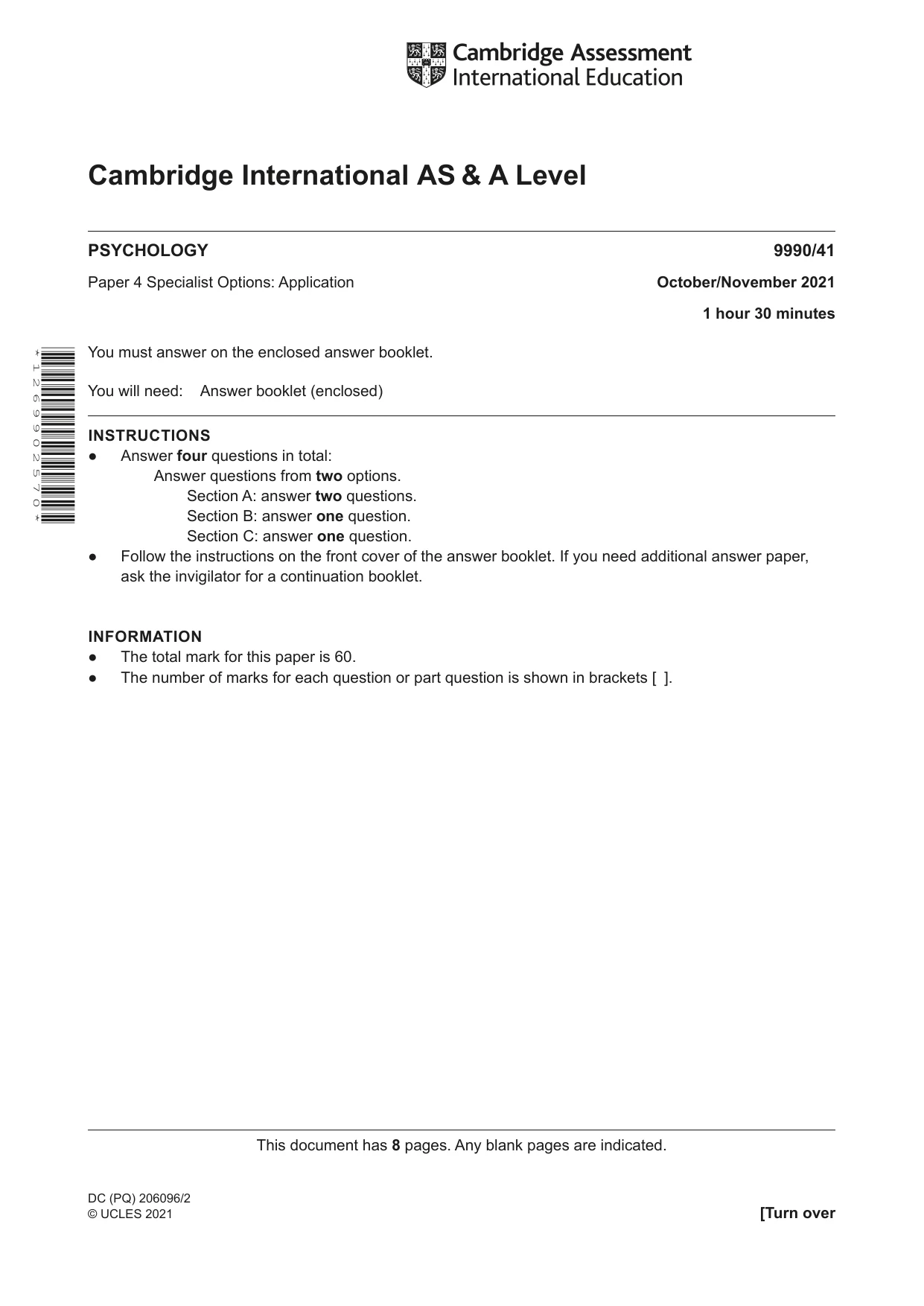
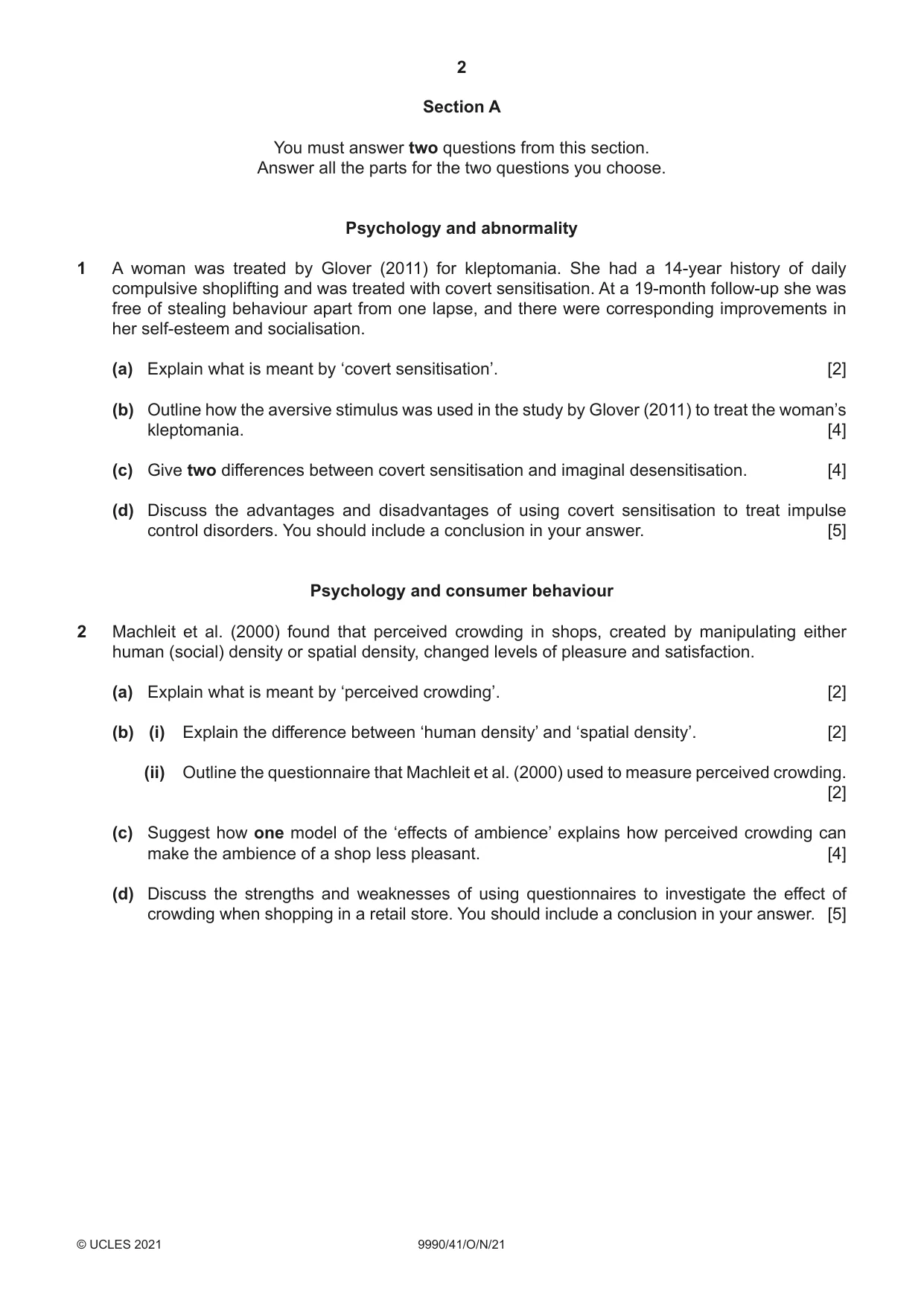
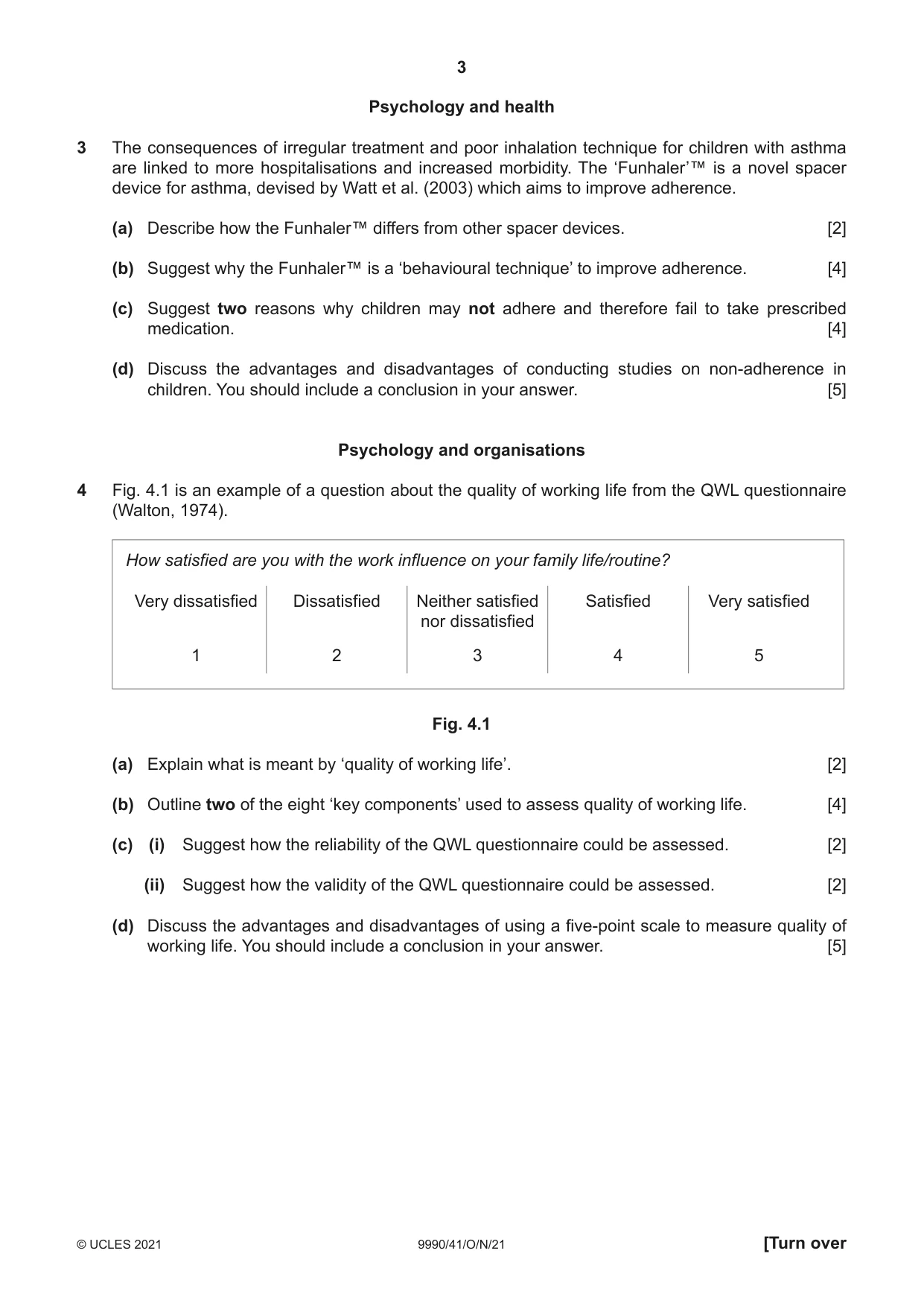
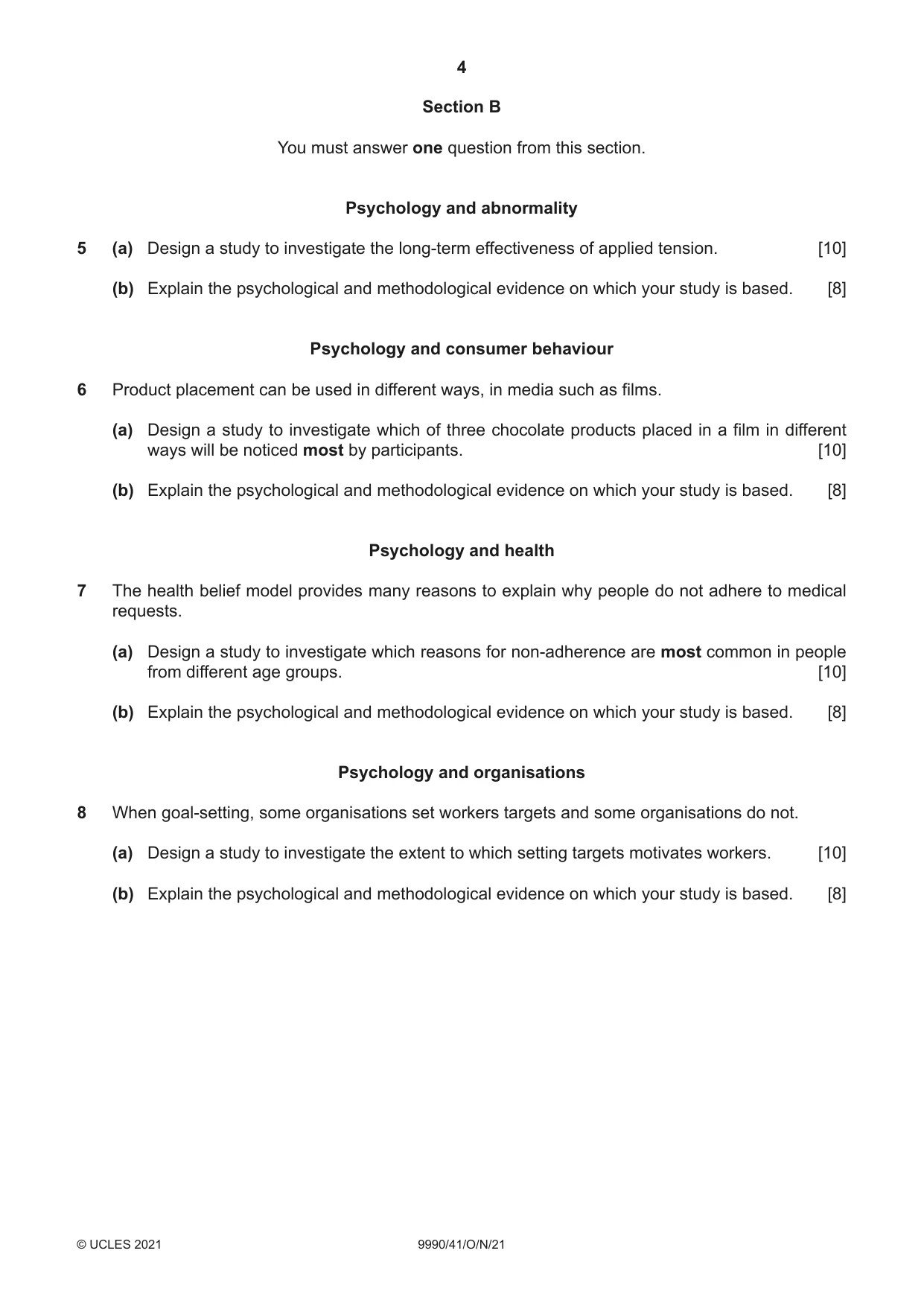



Mark scheme23 pages
Answers below. Sit the paper first if you are practising.

Questions as text
Q1 · A woman was treated by Glover (2011) for kleptomania
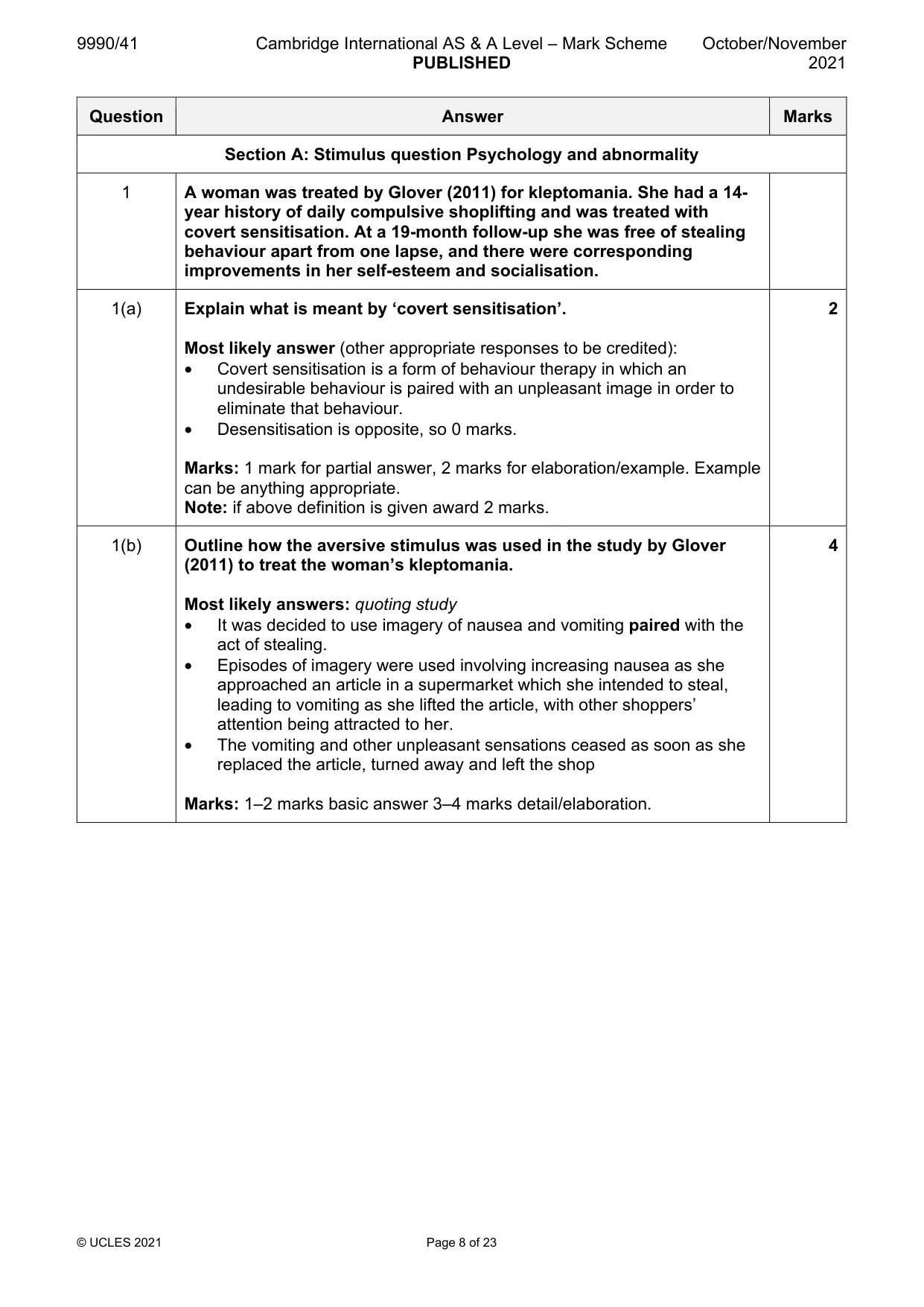
1 A woman was treated by Glover (2011) for kleptomania. She had a 14-year history of daily compulsive shoplifting and was treated with covert sensitisation. At a 19-month follow-up she was free of stealing behaviour apart from one lapse, and there were corresponding improvements in her self-esteem and socialisation. (a) Explain what is meant by ‘covert sensitisation’. [2] (b) Outline how the aversive stimulus was used in the study by Glover (2011) to treat the woman’s kleptomania. [4] (c) Give two differences between covert sensitisation and imaginal desensitisation. [4] (d) Discuss the advantages and disadvantages of using covert sensitisation to treat impulse control disorders. You should include a conclusion in your answer. [5] Psychology and consumer behaviour
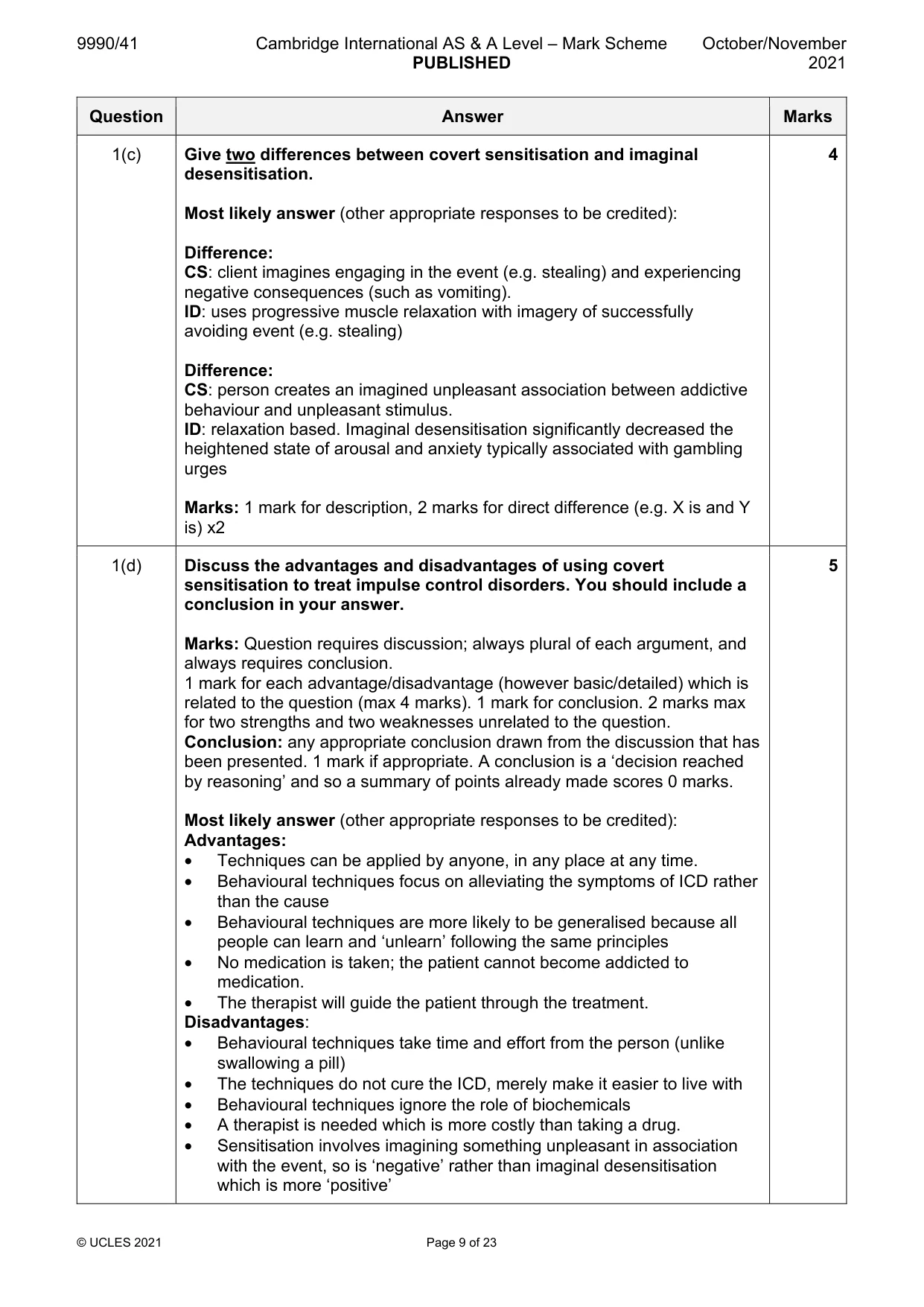
Mark scheme: Question Answer Marks Section A: Stimulus question Psychology and abnormality 1 A woman was treated by Glover (2011) for kleptomania. She had a 14- year history of daily compulsive shoplifting and was treated with covert sensitisation. At a 19-month follow-up she was free of stealing behaviour apart from one lapse, and there were corresponding improvements in her self-esteem and socialisation. 1(a) Explain what is meant by ‘covert sensitisation’. 2 Most likely answer (other appropriate responses to be credited): • Covert sensitisation is a form of behaviour therapy in which an undesirable behaviour is paired with an unpleasant image in order to eliminate that behaviour. • Desensitisation is opposite, so 0 marks. Marks: 1 mark for partial answer, 2 marks for elaboration/example. Example can be anything appropriate. Note: if above definition is given award 2 marks. 1(b) Outline how the aversive stimulus was used in the study by Glover 4 (2011) to treat the woman’s kleptomania. Most likely answers: quoting study • It was decided to use imagery of nausea and vomiting paired with the act of stealing. • Episodes of imagery were used involving increasing nausea as she approached an article in a supermarket which she intended to steal, leading to vomiting as she lifted the article, with other shoppers’ attention being attracted to her. • The vomiting and other unpleasant sensations ceased as soon as she replaced the article, turned away and left the shop Marks: 1–2 marks basic answer 3–4 marks detail/elaboration. 1(c) Give two differences between covert sensitisation and imaginal 4 desensitisation. Most likely answer (other appropriate responses to be credited): Difference: CS: client imagines engaging in the event (e.g. stealing) and experiencing negative consequences (such as vomiting). ID: uses progressive muscle relaxation with imagery of successfully avoiding event (e.g. stealing) Difference: CS: person creates an imagined unpleasant association between addictive behaviour and unpleasant stimulus. ID: relaxation based. Imaginal desensitisation significantly decreased the heightened state of arousal and anxiety typically associated with gambling urges Marks: 1 mark for description, 2 marks for direct difference (e.g. X is and Y is) x2 1(d) Discuss the advantages and disadvantages of using covert 5 sensitisation to treat impulse control disorders. You should include a conclusion in your answer. Marks: Question requires discussion; always plural of each argument, and always requires conclusion. 1 mark for each advantage/disadvantage (however basic/detailed) which is related to the question (max 4 marks). 1 mark for conclusion. 2 marks max for two strengths and two weaknesses unrelated to the question. Conclusion: any appropriate conclusion drawn from the discussion that has been presented. 1 mark if appropriate. A conclusion is a ‘decision reached by reasoning’ and so a summary of points already made scores 0 marks. Most likely answer (other appropriate responses to be credited): Advantages: • Techniques can be applied by anyone, in any place at any time. • Behavioural techniques focus on alleviating the symptoms of ICD rather than the cause • Behavioural techniques are more likely to be generalised because all people can learn and ‘unlearn’ following the same principles • No medication is taken; the patient cannot become addicted to medication. • The therapist will guide the patient through the treatment. Disadvantages: • Behavioural techniques take time and effort from the person (unlike swallowing a pill) • The techniques do not cure the ICD, merely make it easier to live with • Behavioural techniques ignore the role of biochemicals • A therapist is needed which is more costly than taking a drug. • Sensitisation involves imagining something unpleasant in association with the event, so is ‘negative’ rather than imaginal desensitisation which is more ‘positive’
Question 2
2 Machleit et al. (2000) found that perceived crowding in shops, created by manipulating either human (social) density or spatial density, changed levels of pleasure and satisfaction. (a) Explain what is meant by ‘perceived crowding’. [2] (b) (i) Explain the difference between ‘human density’ and ‘spatial density’. [2] (ii) Outline the questionnaire that Machleit et al. (2000) used to measure perceived crowding. [2] (c) Suggest how one model of the ‘effects of ambience’ explains how perceived crowding can make the ambience of a shop less pleasant. [4] (d) Discuss the strengths and weaknesses of using questionnaires to investigate the effect of crowding when shopping in a retail store. You should include a conclusion in your answer. [5] Psychology and health
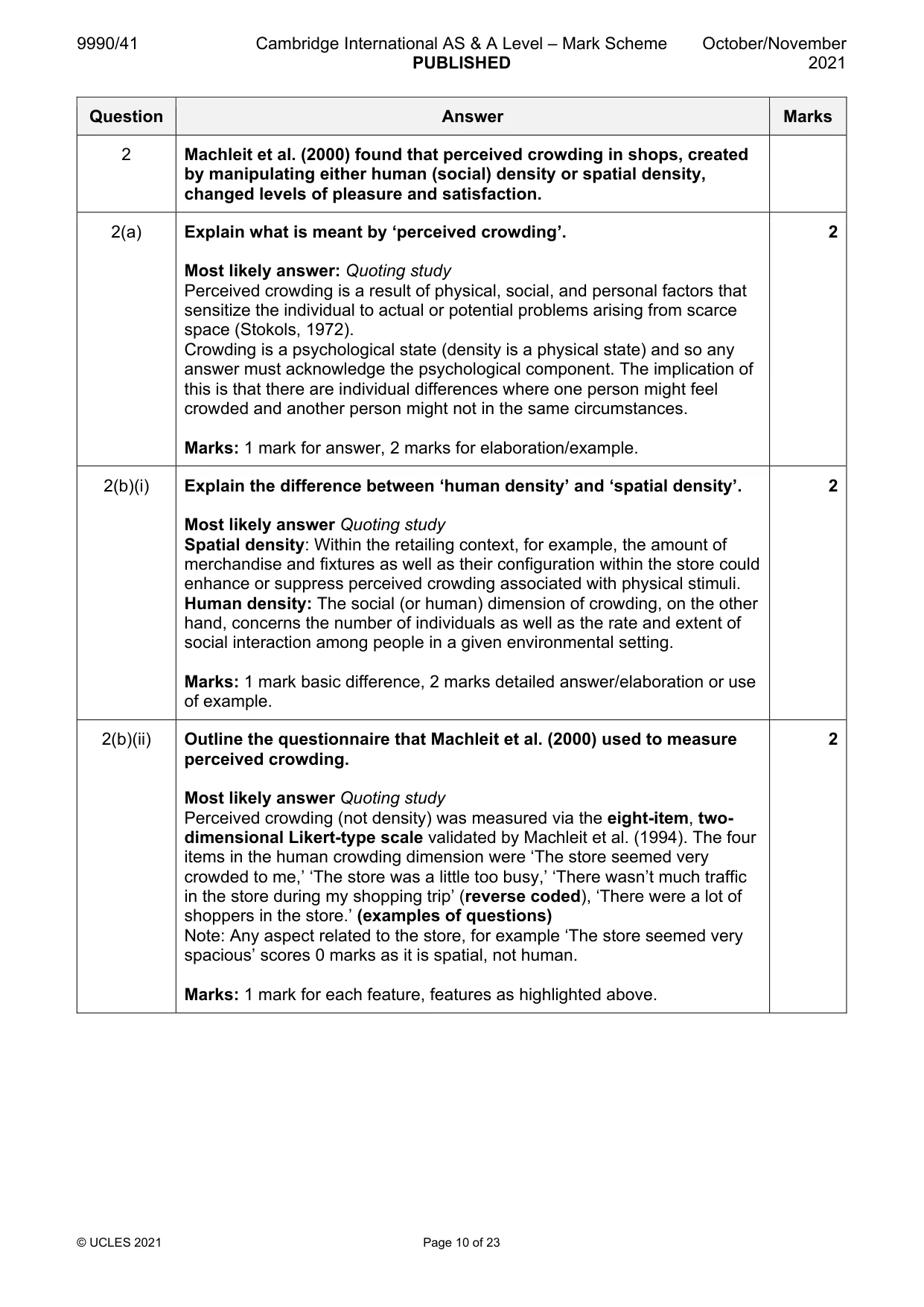
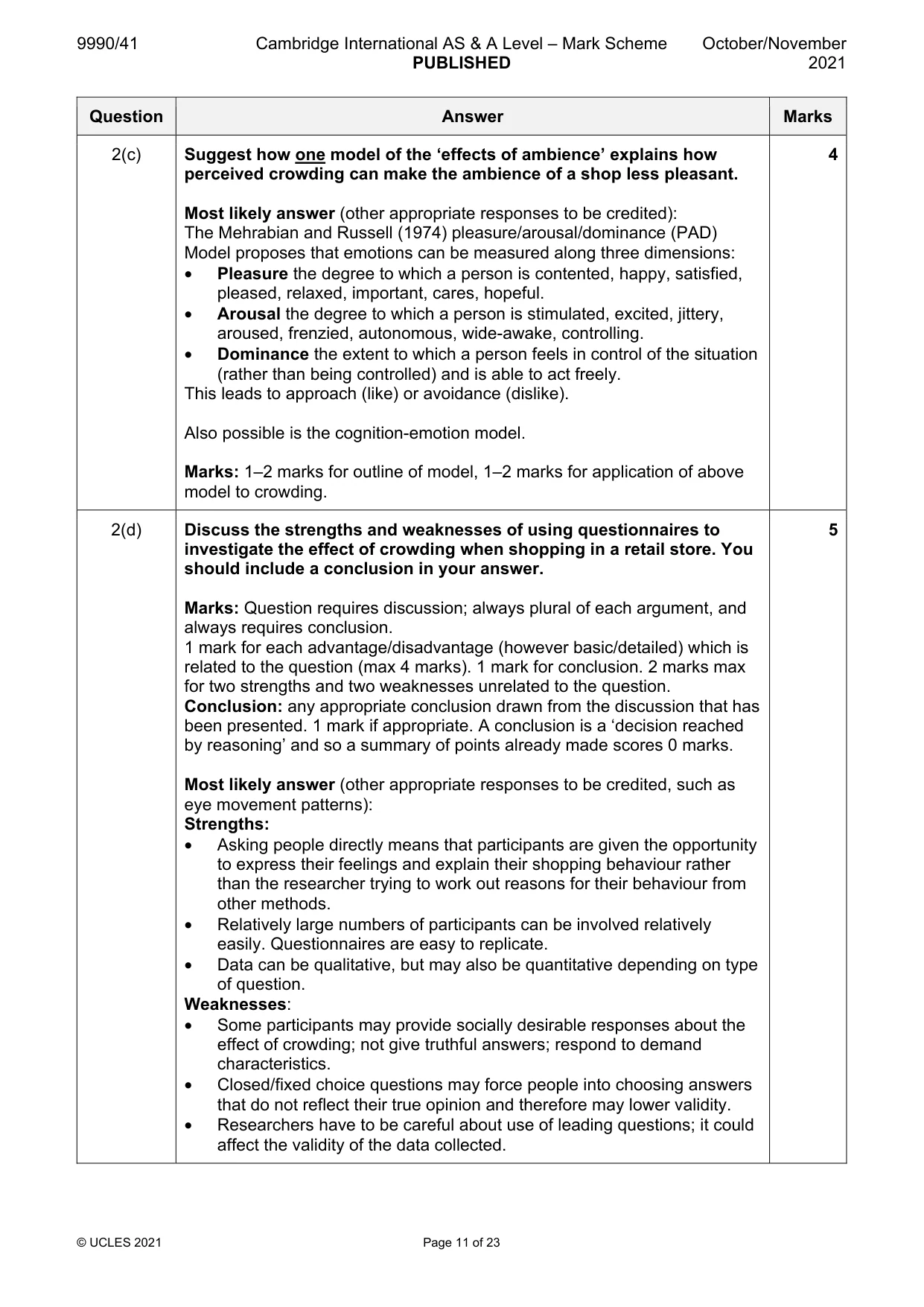
Mark scheme: 2 Machleit et al. (2000) found that perceived crowding in shops, created by manipulating either human (social) density or spatial density, changed levels of pleasure and satisfaction. 2(a) Explain what is meant by ‘perceived crowding’. 2 Most likely answer: Quoting study Perceived crowding is a result of physical, social, and personal factors that sensitize the individual to actual or potential problems arising from scarce space (Stokols, 1972). Crowding is a psychological state (density is a physical state) and so any answer must acknowledge the psychological component. The implication of this is that there are individual differences where one person might feel crowded and another person might not in the same circumstances. Marks: 1 mark for answer, 2 marks for elaboration/example. 2(b)(i) Explain the difference between ‘human density’ and ‘spatial density’. 2 Most likely answer Quoting study Spatial density: Within the retailing context, for example, the amount of merchandise and fixtures as well as their configuration within the store could enhance or suppress perceived crowding associated with physical stimuli. Human density: The social (or human) dimension of crowding, on the other hand, concerns the number of individuals as well as the rate and extent of social interaction among people in a given environmental setting. Marks: 1 mark basic difference, 2 marks detailed answer/elaboration or use of example. 2(b)(ii) Outline the questionnaire that Machleit et al. (2000) used to measure 2 perceived crowding. Most likely answer Quoting study Perceived crowding (not density) was measured via the eight-item, two- dimensional Likert-type scale validated by Machleit et al. (1994). The four items in the human crowding dimension were ‘The store seemed very crowded to me,’ ‘The store was a little too busy,’ ‘There wasn’t much traffic in the store during my shopping trip’ (reverse coded), ‘There were a lot of shoppers in the store.’ (examples of questions) Note: Any aspect related to the store, for example ‘The store seemed very spacious’ scores 0 marks as it is spatial, not human. Marks: 1 mark for each feature, features as highlighted above. 2(c) Suggest how one model of the ‘effects of ambience’ explains how 4 perceived crowding can make the ambience of a shop less pleasant. Most likely answer (other appropriate responses to be credited): The Mehrabian and Russell (1974) pleasure/arousal/dominance (PAD) Model proposes that emotions can be measured along three dimensions: • Pleasure the degree to which a person is contented, happy, satisfied, pleased, relaxed, important, cares, hopeful. • Arousal the degree to which a person is stimulated, excited, jittery, aroused, frenzied, autonomous, wide-awake, controlling. • Dominance the extent to which a person feels in control of the situation (rather than being controlled) and is able to act freely. This leads to approach (like) or avoidance (dislike). Also possible is the cognition-emotion model. Marks: 1–2 marks for outline of model, 1–2 marks for application of above model to crowding. 2(d) Discuss the strengths and weaknesses of using questionnaires to 5 investigate the effect of crowding when shopping in a retail store. You should include a conclusion in your answer. Marks: Question requires discussion; always plural of each argument, and always requires conclusion. 1 mark for each advantage/disadvantage (however basic/detailed) which is related to the question (max 4 marks). 1 mark for conclusion. 2 marks max for two strengths and two weaknesses unrelated to the question. Conclusion: any appropriate conclusion drawn from the discussion that has been presented. 1 mark if appropriate. A conclusion is a ‘decision reached by reasoning’ and so a summary of points already made scores 0 marks. Most likely answer (other appropriate responses to be credited, such as eye movement patterns): Strengths: • Asking people directly means that participants are given the opportunity to express their feelings and explain their shopping behaviour rather than the researcher trying to work out reasons for their behaviour from other methods. • Relatively large numbers of participants can be involved relatively easily. Questionnaires are easy to replicate. • Data can be qualitative, but may also be quantitative depending on type of question. Weaknesses: • Some participants may provide socially desirable responses about the effect of crowding; not give truthful answers; respond to demand characteristics. • Closed/fixed choice questions may force people into choosing answers that do not reflect their true opinion and therefore may lower validity. • Researchers have to be careful about use of leading questions; it could affect the validity of the data collected.
Q3 · The consequences of irregular treatment and poor inhalation technique for children with…
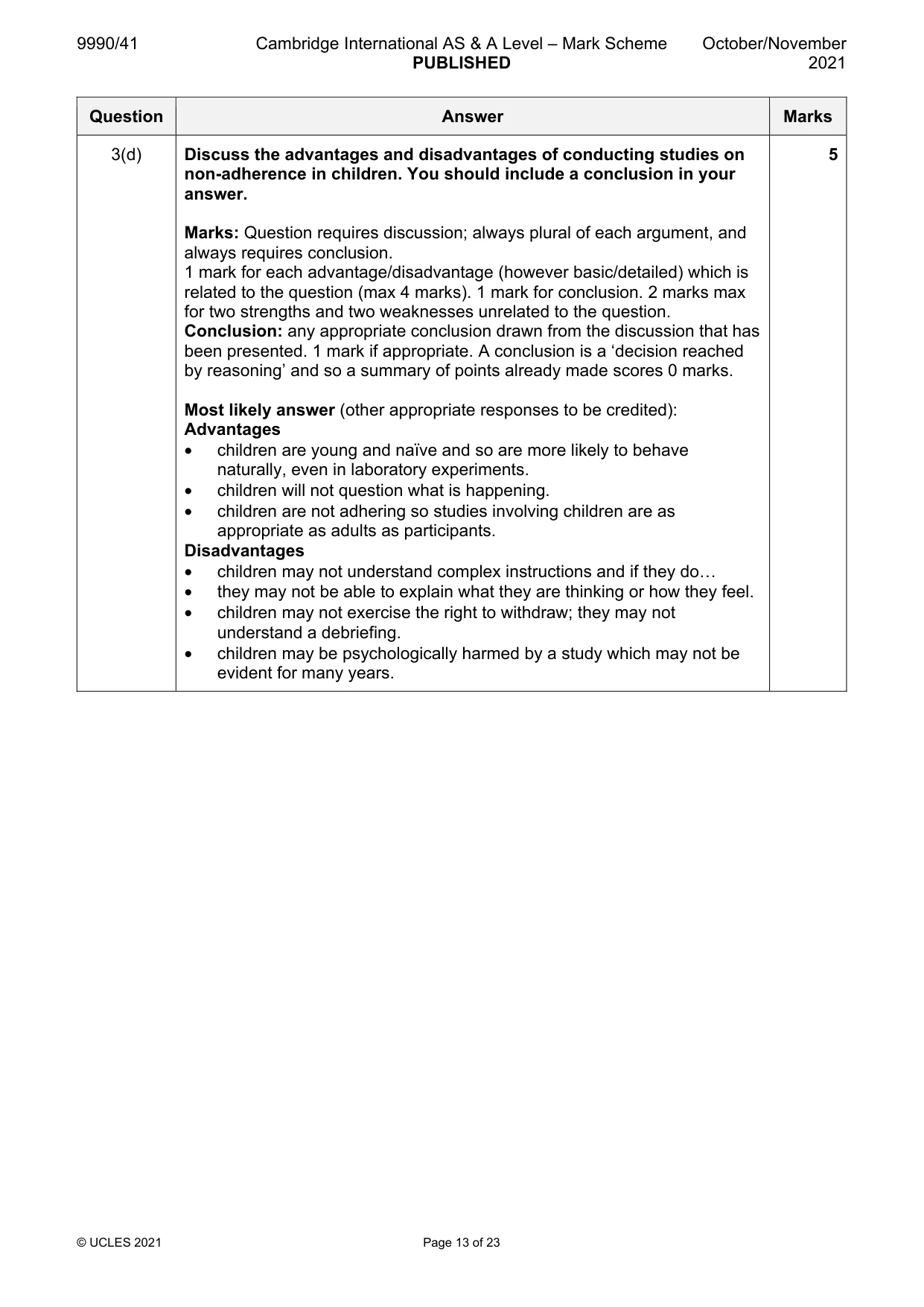
3 The consequences of irregular treatment and poor inhalation technique for children with asthma are linked to more hospitalisations and increased morbidity. The ‘Funhaler’™ is a novel spacer device for asthma, devised by Watt et al. (2003) which aims to improve adherence. (a) Describe how the Funhaler™ differs from other spacer devices. [2] (b) Suggest why the Funhaler™ is a ‘behavioural technique’ to improve adherence. [4] (c) Suggest two reasons why children may not adhere and therefore fail to take prescribed medication. [4] (d) Discuss the advantages and disadvantages of conducting studies on non-adherence in children. You should include a conclusion in your answer. [5] Psychology and organisations
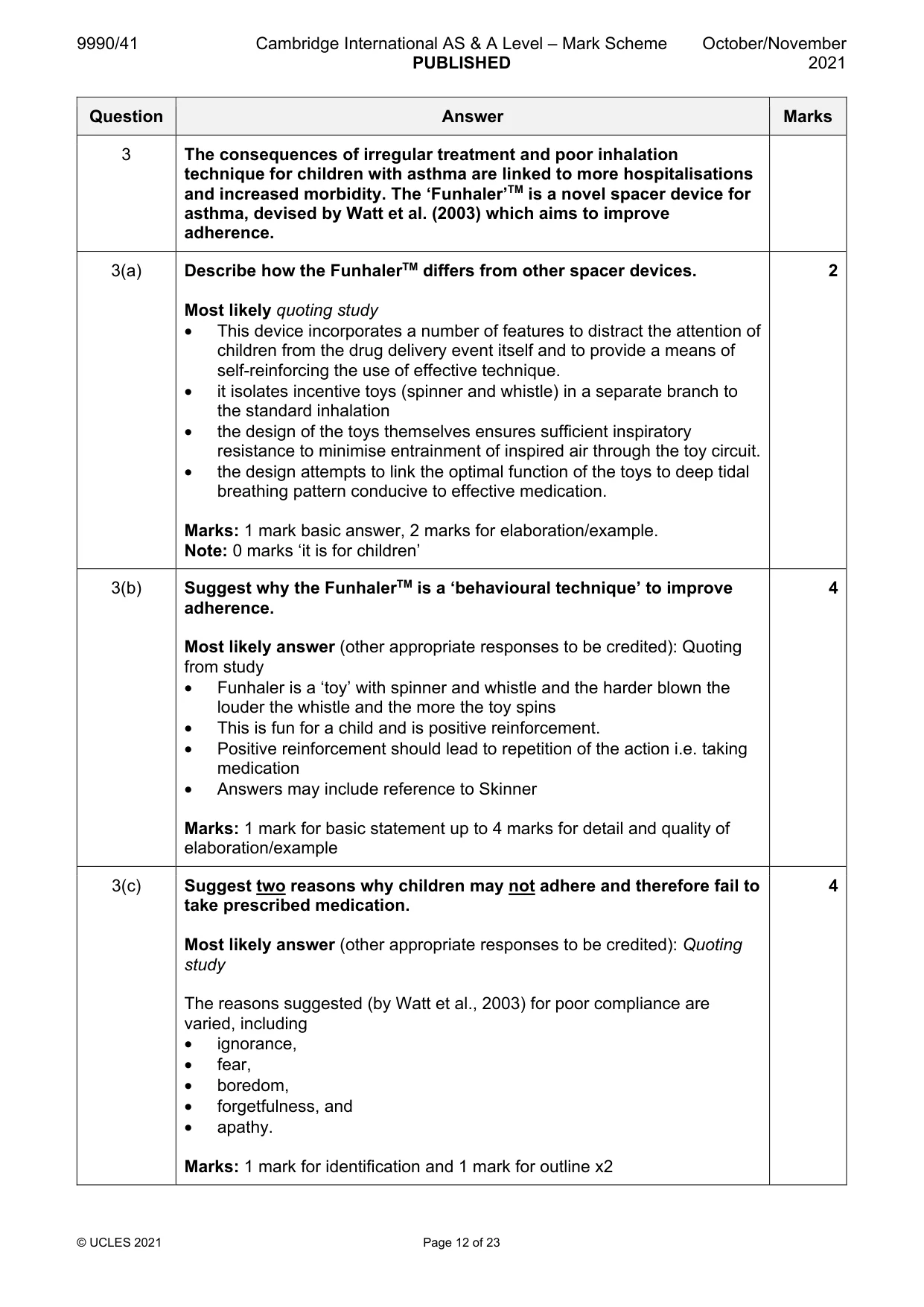
Mark scheme: 3 The consequences of irregular treatment and poor inhalation technique for children with asthma are linked to more hospitalisations and increased morbidity. The ‘Funhaler’TM is a novel spacer device for asthma, devised by Watt et al. (2003) which aims to improve adherence. 3(a) Describe how the FunhalerTM differs from other spacer devices. 2 Most likely quoting study • This device incorporates a number of features to distract the attention of children from the drug delivery event itself and to provide a means of self-reinforcing the use of effective technique. • it isolates incentive toys (spinner and whistle) in a separate branch to the standard inhalation • the design of the toys themselves ensures sufficient inspiratory resistance to minimise entrainment of inspired air through the toy circuit. • the design attempts to link the optimal function of the toys to deep tidal breathing pattern conducive to effective medication. Marks: 1 mark basic answer, 2 marks for elaboration/example. Note: 0 marks ‘it is for children’ 3(b) Suggest why the FunhalerTM is a ‘behavioural technique’ to improve 4 adherence. Most likely answer (other appropriate responses to be credited): Quoting from study • Funhaler is a ‘toy’ with spinner and whistle and the harder blown the louder the whistle and the more the toy spins • This is fun for a child and is positive reinforcement. • Positive reinforcement should lead to repetition of the action i.e. taking medication • Answers may include reference to Skinner Marks: 1 mark for basic statement up to 4 marks for detail and quality of elaboration/example 3(c) Suggest two reasons why children may not adhere and therefore fail to 4 take prescribed medication. Most likely answer (other appropriate responses to be credited): Quoting study The reasons suggested (by Watt et al., 2003) for poor compliance are varied, including • ignorance, • fear, • boredom, • forgetfulness, and • apathy. Marks: 1 mark for identification and 1 mark for outline x2 3(d) Discuss the advantages and disadvantages of conducting studies on 5 non-adherence in children. You should include a conclusion in your answer. Marks: Question requires discussion; always plural of each argument, and always requires conclusion. 1 mark for each advantage/disadvantage (however basic/detailed) which is related to the question (max 4 marks). 1 mark for conclusion. 2 marks max for two strengths and two weaknesses unrelated to the question. Conclusion: any appropriate conclusion drawn from the discussion that has been presented. 1 mark if appropriate. A conclusion is a ‘decision reached by reasoning’ and so a summary of points already made scores 0 marks. Most likely answer (other appropriate responses to be credited): Advantages • children are young and naïve and so are more likely to behave naturally, even in laboratory experiments. • children will not question what is happening. • children are not adhering so studies involving children are as appropriate as adults as participants. Disadvantages • children may not understand complex instructions and if they do… • they may not be able to explain what they are thinking or how they feel. • children may not exercise the right to withdraw; they may not understand a debriefing. • children may be psychologically harmed by a study which may not be evident for many years.
More questions on 2 Health promotion in schools and worksites
Q4 · An example of a question about the quality of working life from the QWL questionnaire…
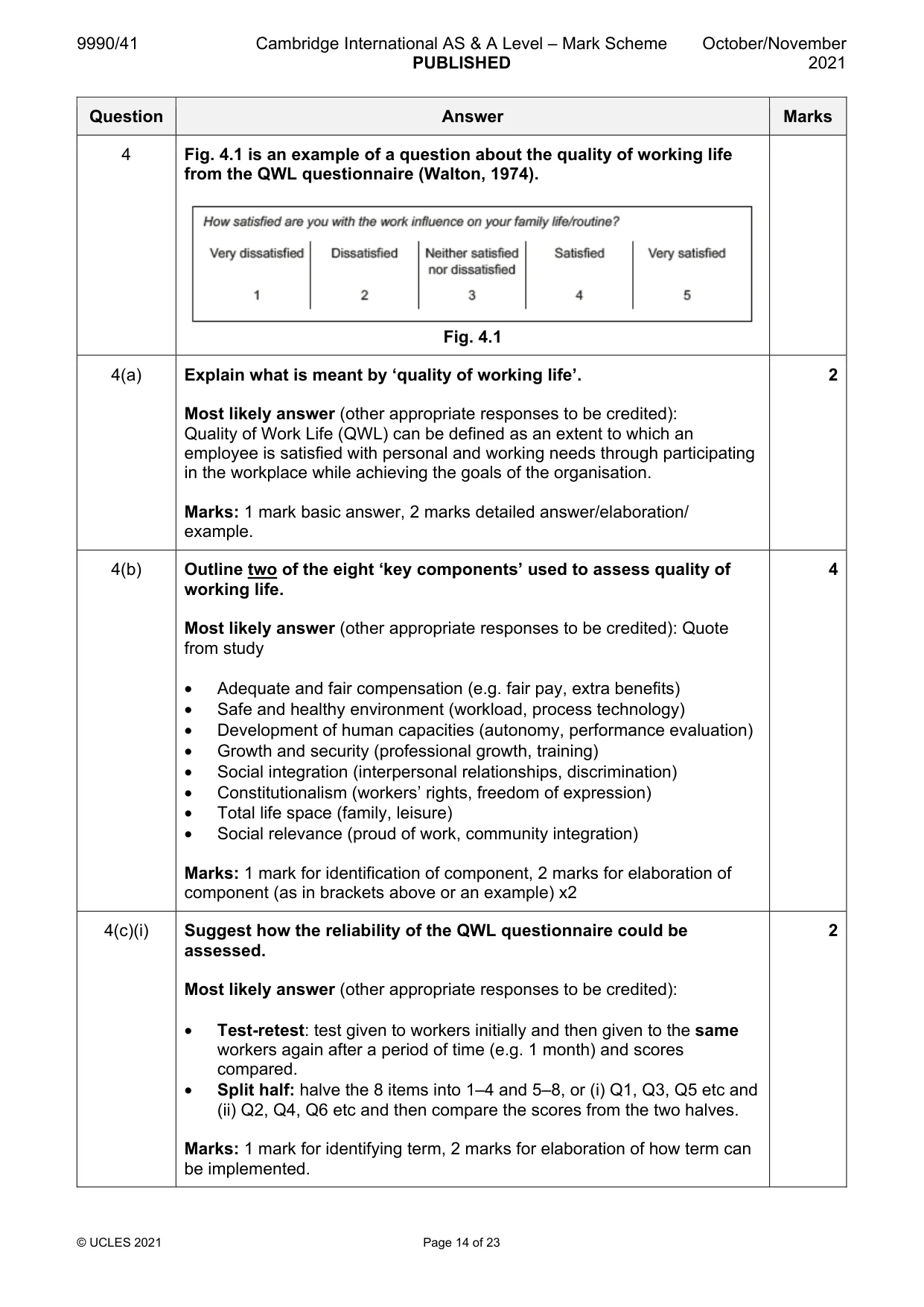
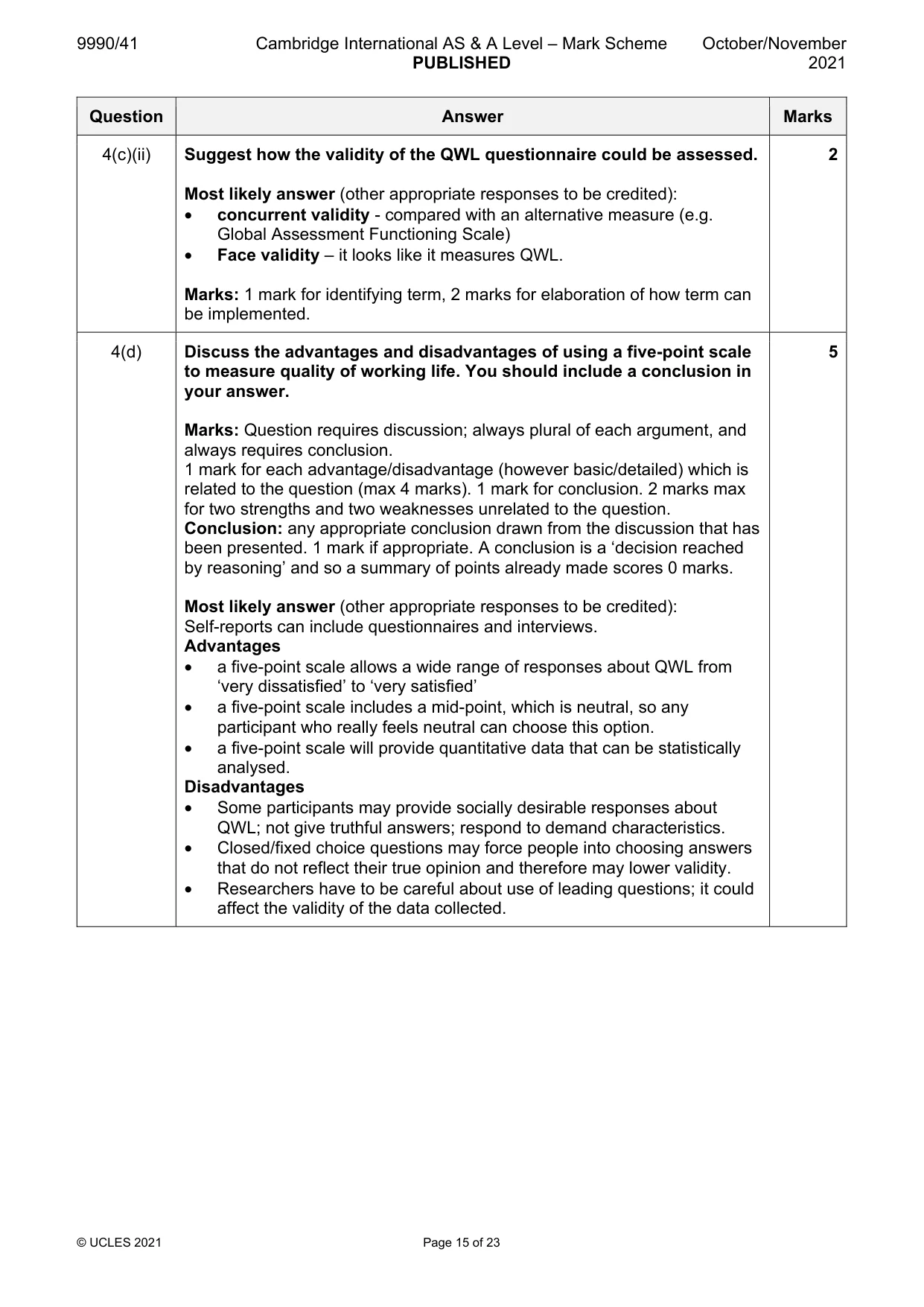
4 Fig. 4.1 is an example of a question about the quality of working life from the QWL questionnaire (Walton, 1974). How satisfied are you with the work influence on your family life/routine? Very dissatisfied Dissatisfied Neither satisfied Satisfied Very satisfied nor dissatisfied 1 2 3 4 5 Fig. 4.1 (a) Explain what is meant by ‘quality of working life’. [2] (b) Outline two of the eight ‘key components’ used to assess quality of working life. [4] (c) (i) Suggest how the reliability of the QWL questionnaire could be assessed. [2] (ii) Suggest how the validity of the QWL questionnaire could be assessed. [2] (d) Discuss the advantages and disadvantages of using a five-point scale to measure quality of working life. You should include a conclusion in your answer. [5]
Mark scheme: 4 Fig. 4.1 is an example of a question about the quality of working life from the QWL questionnaire (Walton, 1974). Fig. 4.1 4(a) Explain what is meant by ‘quality of working life’. 2 Most likely answer (other appropriate responses to be credited): Quality of Work Life (QWL) can be defined as an extent to which an employee is satisfied with personal and working needs through participating in the workplace while achieving the goals of the organisation. Marks: 1 mark basic answer, 2 marks detailed answer/elaboration/ example. 4(b) Outline two of the eight ‘key components’ used to assess quality of 4 working life. Most likely answer (other appropriate responses to be credited): Quote from study • Adequate and fair compensation (e.g. fair pay, extra benefits) • Safe and healthy environment (workload, process technology) • Development of human capacities (autonomy, performance evaluation) • Growth and security (professional growth, training) • Social integration (interpersonal relationships, discrimination) • Constitutionalism (workers’ rights, freedom of expression) • Total life space (family, leisure) • Social relevance (proud of work, community integration) Marks: 1 mark for identification of component, 2 marks for elaboration of component (as in brackets above or an example) x2 4(c)(i) Suggest how the reliability of the QWL questionnaire could be 2 assessed. Most likely answer (other appropriate responses to be credited): • Test-retest: test given to workers initially and then given to the same workers again after a period of time (e.g. 1 month) and scores compared. • Split half: halve the 8 items into 1–4 and 5–8, or (i) Q1, Q3, Q5 etc and (ii) Q2, Q4, Q6 etc and then compare the scores from the two halves. Marks: 1 mark for identifying term, 2 marks for elaboration of how term can be implemented. 4(c)(ii) Suggest how the validity of the QWL questionnaire could be assessed. 2 Most likely answer (other appropriate responses to be credited): • concurrent validity - compared with an alternative measure (e.g. Global Assessment Functioning Scale) • Face validity – it looks like it measures QWL. Marks: 1 mark for identifying term, 2 marks for elaboration of how term can be implemented. 4(d) Discuss the advantages and disadvantages of using a five-point scale 5 to measure quality of working life. You should include a conclusion in your answer. Marks: Question requires discussion; always plural of each argument, and always requires conclusion. 1 mark for each advantage/disadvantage (however basic/detailed) which is related to the question (max 4 marks). 1 mark for conclusion. 2 marks max for two strengths and two weaknesses unrelated to the question. Conclusion: any appropriate conclusion drawn from the discussion that has been presented. 1 mark if appropriate. A conclusion is a ‘decision reached by reasoning’ and so a summary of points already made scores 0 marks. Most likely answer (other appropriate responses to be credited): Self-reports can include questionnaires and interviews. Advantages • a five-point scale allows a wide range of responses about QWL from ‘very dissatisfied’ to ‘very satisfied’ • a five-point scale includes a mid-point, which is neutral, so any participant who really feels neutral can choose this option. • a five-point scale will provide quantitative data that can be statistically analysed. Disadvantages • Some participants may provide socially desirable responses about QWL; not give truthful answers; respond to demand characteristics. • Closed/fixed choice questions may force people into choosing answers that do not reflect their true opinion and therefore may lower validity. • Researchers have to be careful about use of leading questions; it could affect the validity of the data collected.
Q5 · Design a study to investigate the long-term effectiveness of applied tension
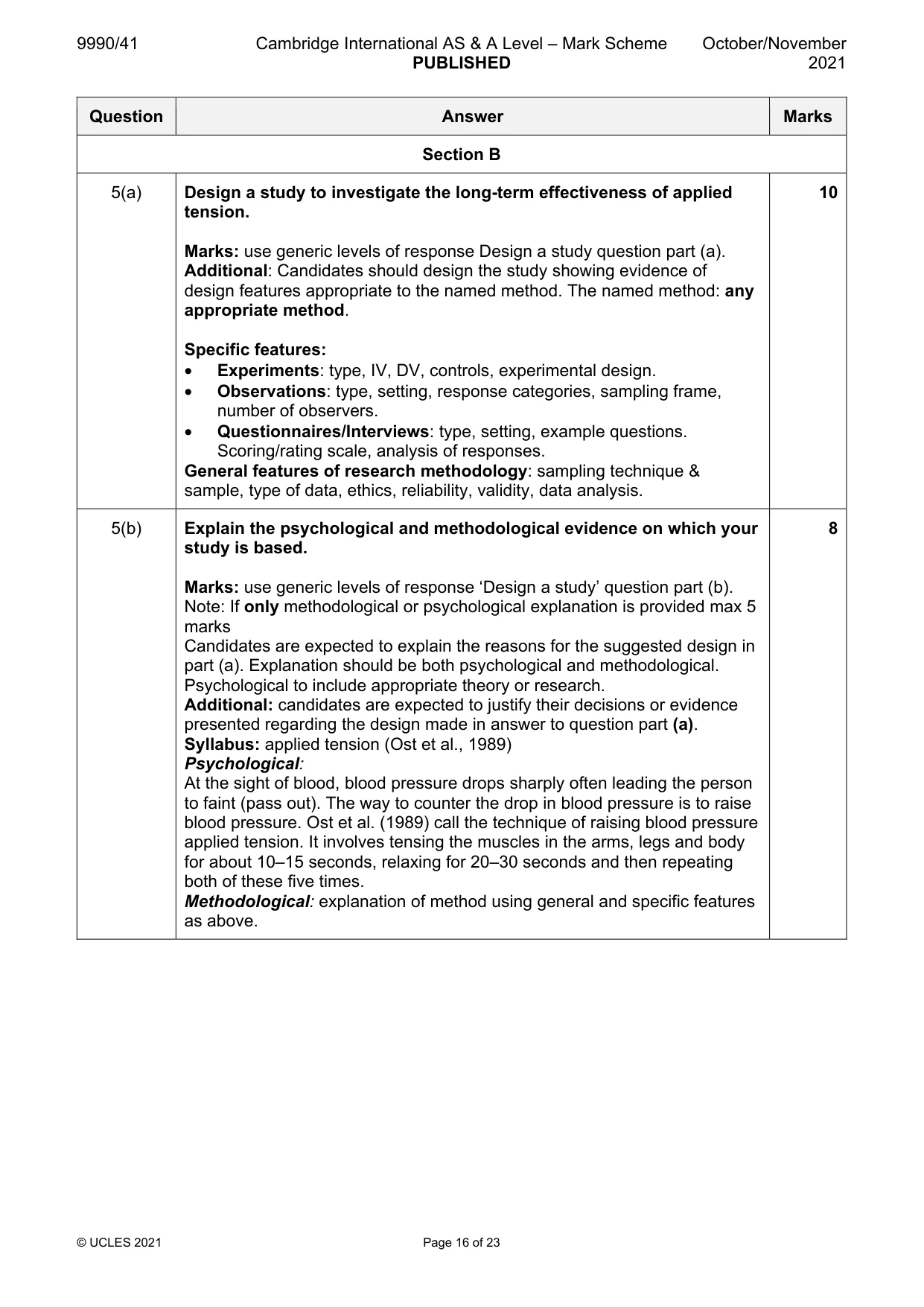
5 (a) Design a study to investigate the long-term effectiveness of applied tension. [10] (b) Explain the psychological and methodological evidence on which your study is based. [8] Psychology and consumer behaviour
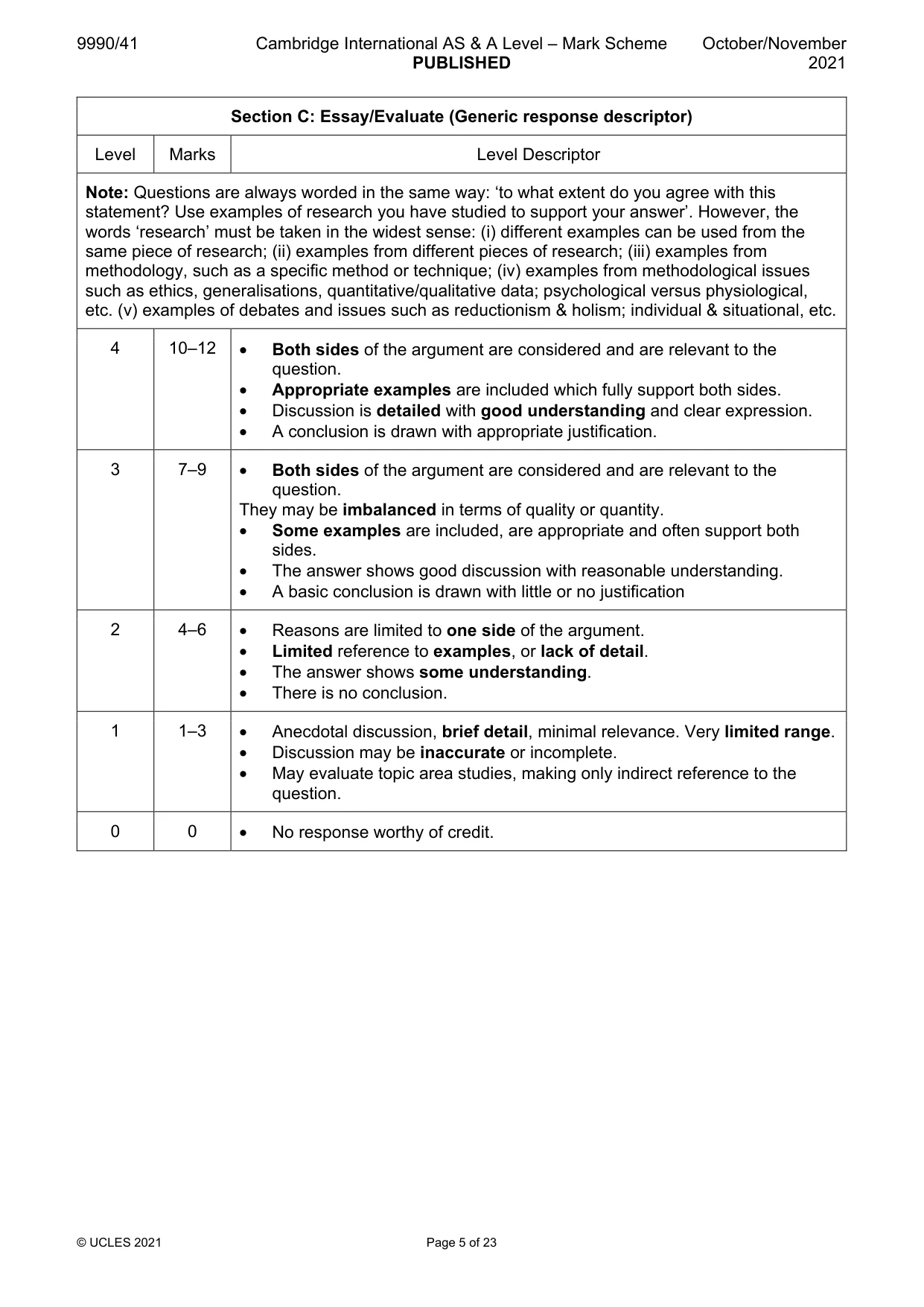
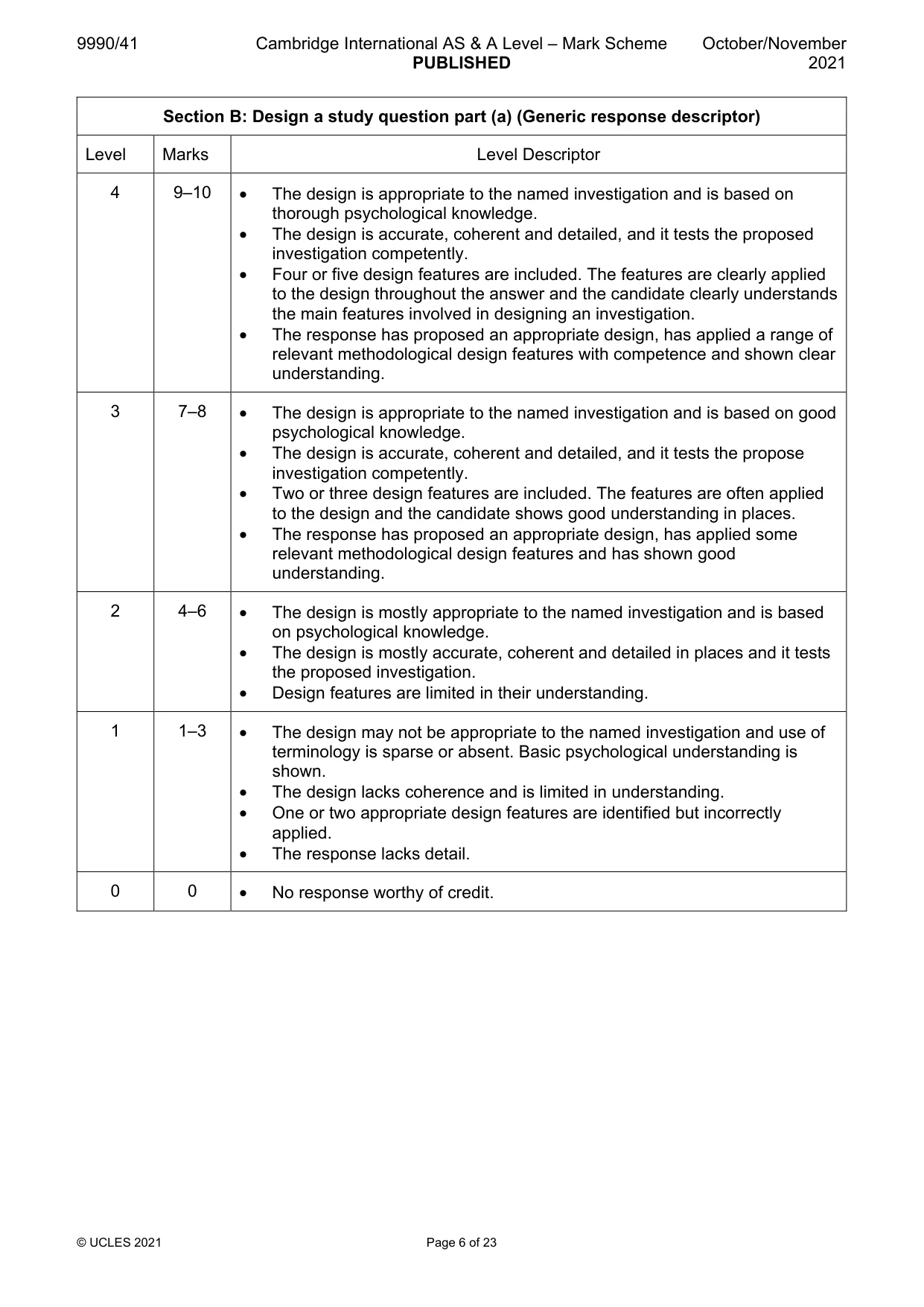
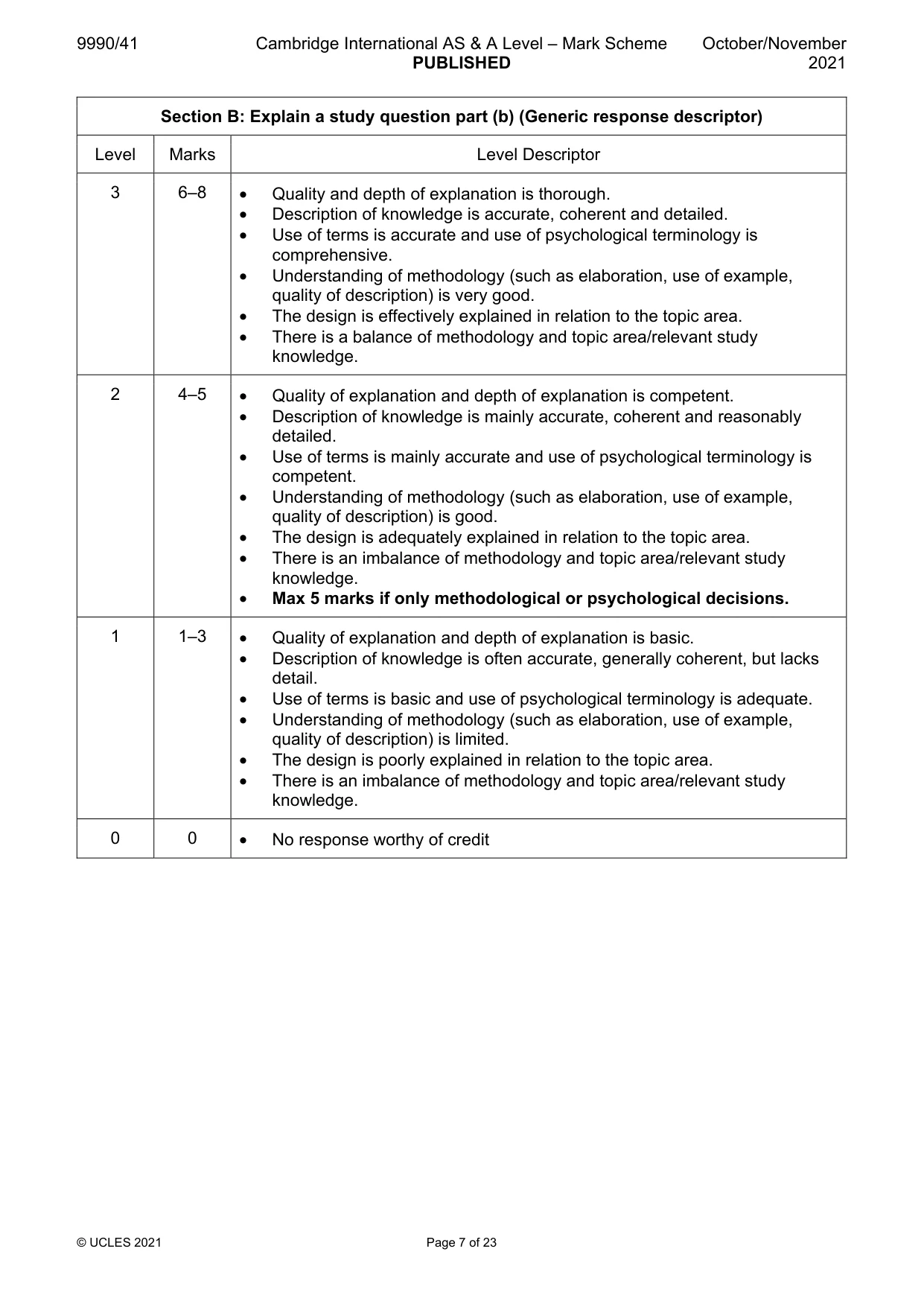
Mark scheme: 5(a) Design a study to investigate the long-term effectiveness of applied 10 tension. Marks: use generic levels of response Design a study question part (a). Additional: Candidates should design the study showing evidence of design features appropriate to the named method. The named method: any appropriate method. Specific features: • Experiments: type, IV, DV, controls, experimental design. • Observations: type, setting, response categories, sampling frame, number of observers. • Questionnaires/Interviews: type, setting, example questions. Scoring/rating scale, analysis of responses. General features of research methodology: sampling technique & sample, type of data, ethics, reliability, validity, data analysis. 5(b) Explain the psychological and methodological evidence on which your 8 study is based. Marks: use generic levels of response ‘Design a study’ question part (b). Note: If only methodological or psychological explanation is provided max 5 marks Candidates are expected to explain the reasons for the suggested design in part (a). Explanation should be both psychological and methodological. Psychological to include appropriate theory or research. Additional: candidates are expected to justify their decisions or evidence presented regarding the design made in answer to question part (a). Syllabus: applied tension (Ost et al., 1989) Psychological: At the sight of blood, blood pressure drops sharply often leading the person to faint (pass out). The way to counter the drop in blood pressure is to raise blood pressure. Ost et al. (1989) call the technique of raising blood pressure applied tension. It involves tensing the muscles in the arms, legs and body for about 10–15 seconds, relaxing for 20–30 seconds and then repeating both of these five times. Methodological: explanation of method using general and specific features as above.
More questions on Anxiety disorders and fear-related disorders
Q6 · Product placement can be used in different ways, in media such as films
6 Product placement can be used in different ways, in media such as films. (a) Design a study to investigate which of three chocolate products placed in a film in different ways will be noticed most by participants. [10] (b) Explain the psychological and methodological evidence on which your study is based. [8] Psychology and health
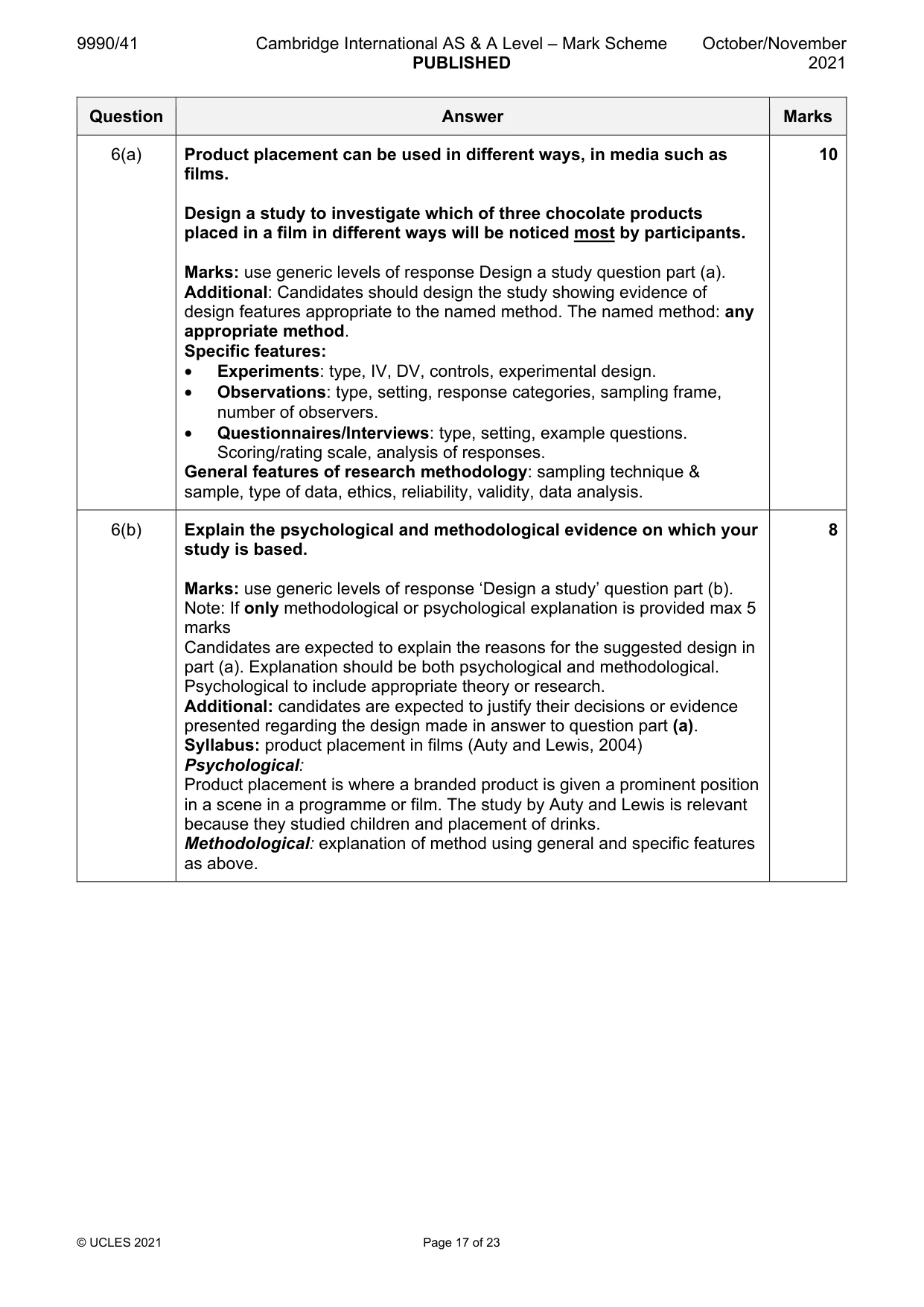
Mark scheme: 6(a) Product placement can be used in different ways, in media such as 10 films. Design a study to investigate which of three chocolate products placed in a film in different ways will be noticed most by participants. Marks: use generic levels of response Design a study question part (a). Additional: Candidates should design the study showing evidence of design features appropriate to the named method. The named method: any appropriate method. Specific features: • Experiments: type, IV, DV, controls, experimental design. • Observations: type, setting, response categories, sampling frame, number of observers. • Questionnaires/Interviews: type, setting, example questions. Scoring/rating scale, analysis of responses. General features of research methodology: sampling technique & sample, type of data, ethics, reliability, validity, data analysis. 6(b) Explain the psychological and methodological evidence on which your 8 study is based. Marks: use generic levels of response ‘Design a study’ question part (b). Note: If only methodological or psychological explanation is provided max 5 marks Candidates are expected to explain the reasons for the suggested design in part (a). Explanation should be both psychological and methodological. Psychological to include appropriate theory or research. Additional: candidates are expected to justify their decisions or evidence presented regarding the design made in answer to question part (a). Syllabus: product placement in films (Auty and Lewis, 2004) Psychological: Product placement is where a branded product is given a prominent position in a scene in a programme or film. The study by Auty and Lewis is relevant because they studied children and placement of drinks. Methodological: explanation of method using general and specific features as above.
Q7 · The health belief model provides many reasons to explain why people do not adhere to…
7 The health belief model provides many reasons to explain why people do not adhere to medical requests. (a) Design a study to investigate which reasons for non-adherence are most common in people from different age groups. [10] (b) Explain the psychological and methodological evidence on which your study is based. [8] Psychology and organisations
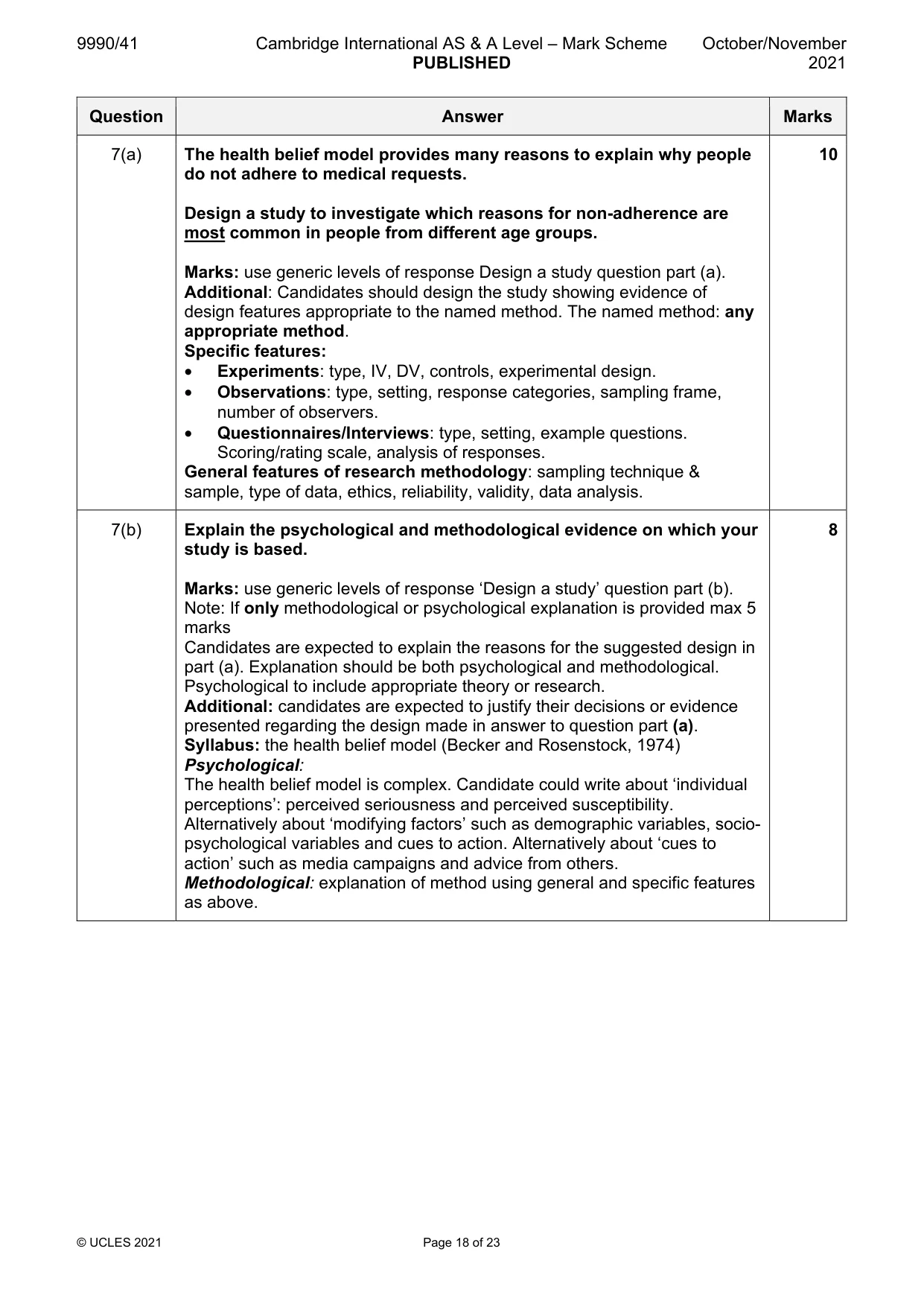
Mark scheme: 7(a) The health belief model provides many reasons to explain why people 10 do not adhere to medical requests. Design a study to investigate which reasons for non-adherence are most common in people from different age groups. Marks: use generic levels of response Design a study question part (a). Additional: Candidates should design the study showing evidence of design features appropriate to the named method. The named method: any appropriate method. Specific features: • Experiments: type, IV, DV, controls, experimental design. • Observations: type, setting, response categories, sampling frame, number of observers. • Questionnaires/Interviews: type, setting, example questions. Scoring/rating scale, analysis of responses. General features of research methodology: sampling technique & sample, type of data, ethics, reliability, validity, data analysis. 7(b) Explain the psychological and methodological evidence on which your 8 study is based. Marks: use generic levels of response ‘Design a study’ question part (b). Note: If only methodological or psychological explanation is provided max 5 marks Candidates are expected to explain the reasons for the suggested design in part (a). Explanation should be both psychological and methodological. Psychological to include appropriate theory or research. Additional: candidates are expected to justify their decisions or evidence presented regarding the design made in answer to question part (a). Syllabus: the health belief model (Becker and Rosenstock, 1974) Psychological: The health belief model is complex. Candidate could write about ‘individual perceptions’: perceived seriousness and perceived susceptibility. Alternatively about ‘modifying factors’ such as demographic variables, socio- psychological variables and cues to action. Alternatively about ‘cues to action’ such as media campaigns and advice from others. Methodological: explanation of method using general and specific features as above.
Q8 · When goal-setting, some organisations set workers targets and some organisations do not
8 When goal-setting, some organisations set workers targets and some organisations do not. (a) Design a study to investigate the extent to which setting targets motivates workers. [10] (b) Explain the psychological and methodological evidence on which your study is based. [8] Section C You must answer one question from this section. Psychology and abnormality
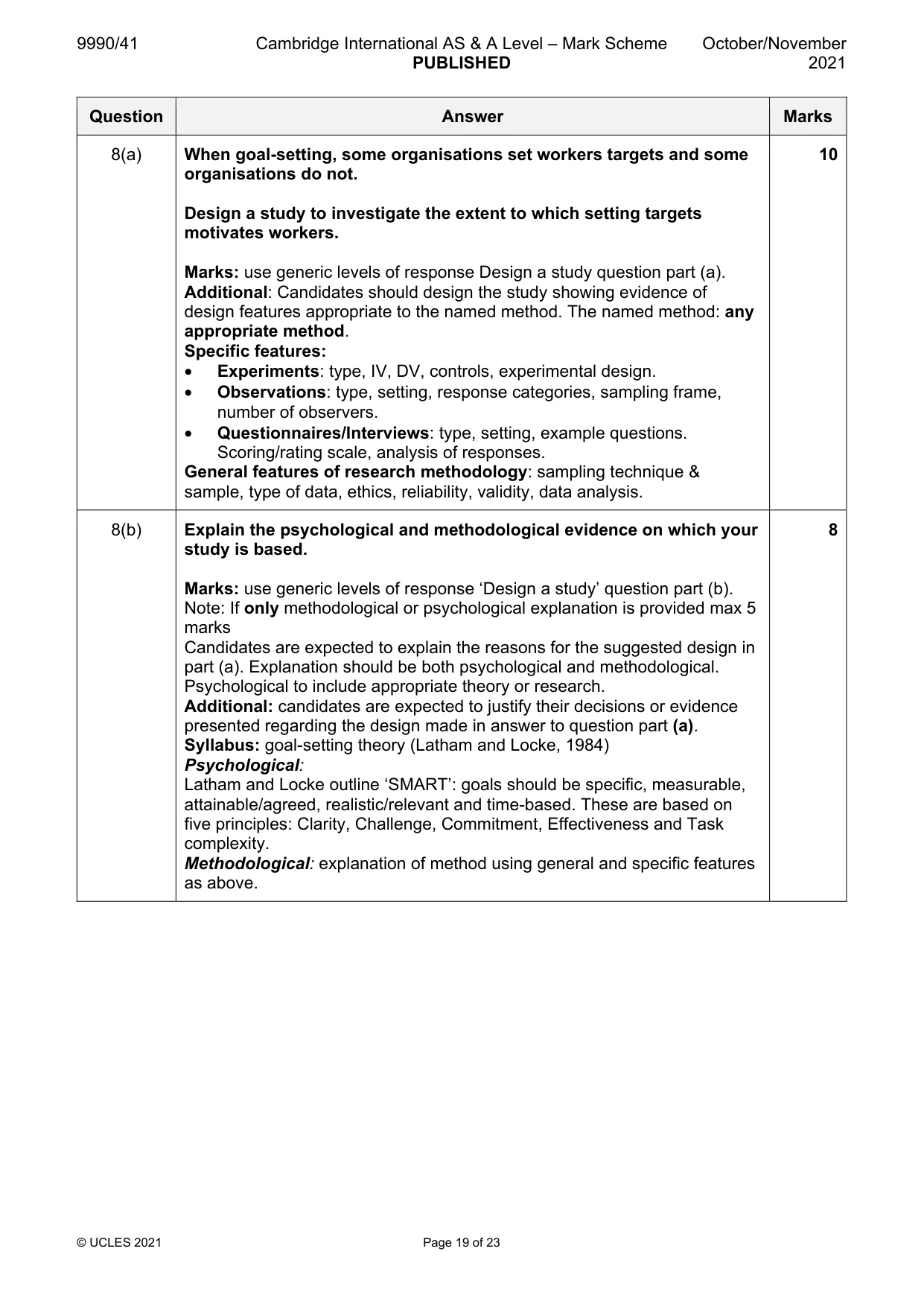
Mark scheme: 8(a) When goal-setting, some organisations set workers targets and some 10 organisations do not. Design a study to investigate the extent to which setting targets motivates workers. Marks: use generic levels of response Design a study question part (a). Additional: Candidates should design the study showing evidence of design features appropriate to the named method. The named method: any appropriate method. Specific features: • Experiments: type, IV, DV, controls, experimental design. • Observations: type, setting, response categories, sampling frame, number of observers. • Questionnaires/Interviews: type, setting, example questions. Scoring/rating scale, analysis of responses. General features of research methodology: sampling technique & sample, type of data, ethics, reliability, validity, data analysis. 8(b) Explain the psychological and methodological evidence on which your 8 study is based. Marks: use generic levels of response ‘Design a study’ question part (b). Note: If only methodological or psychological explanation is provided max 5 marks Candidates are expected to explain the reasons for the suggested design in part (a). Explanation should be both psychological and methodological. Psychological to include appropriate theory or research. Additional: candidates are expected to justify their decisions or evidence presented regarding the design made in answer to question part (a). Syllabus: goal-setting theory (Latham and Locke, 1984) Psychological: Latham and Locke outline ‘SMART’: goals should be specific, measurable, attainable/agreed, realistic/relevant and time-based. These are based on five principles: Clarity, Challenge, Commitment, Effectiveness and Task complexity. Methodological: explanation of method using general and specific features as above.
Q9 · ‘Even though little Hans was just one child, the psychoanalytic explanation of phobias…
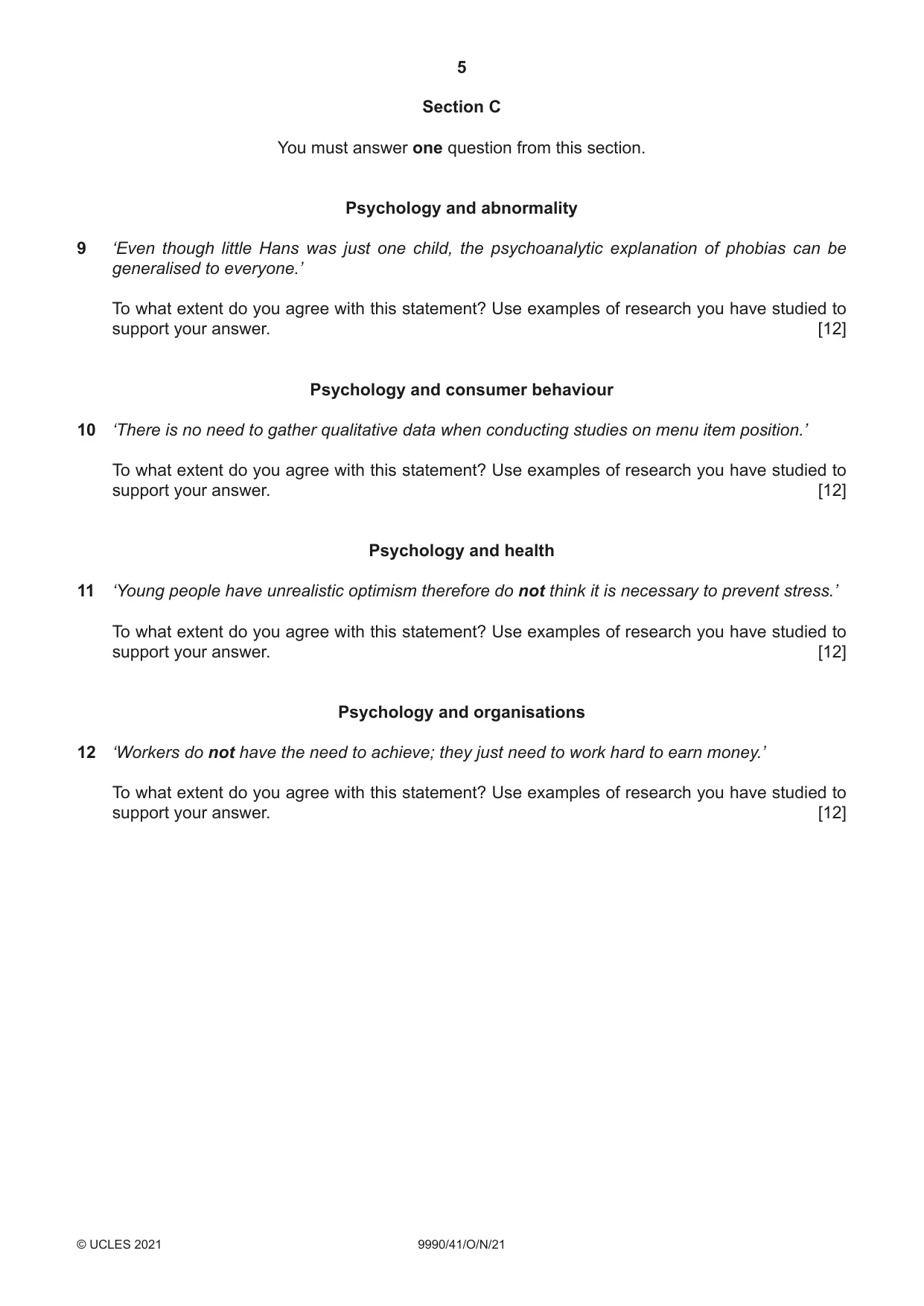
9 ‘Even though little Hans was just one child, the psychoanalytic explanation of phobias can be generalised to everyone.’ To what extent do you agree with this statement? Use examples of research you have studied to support your answer. [12] Psychology and consumer behaviour
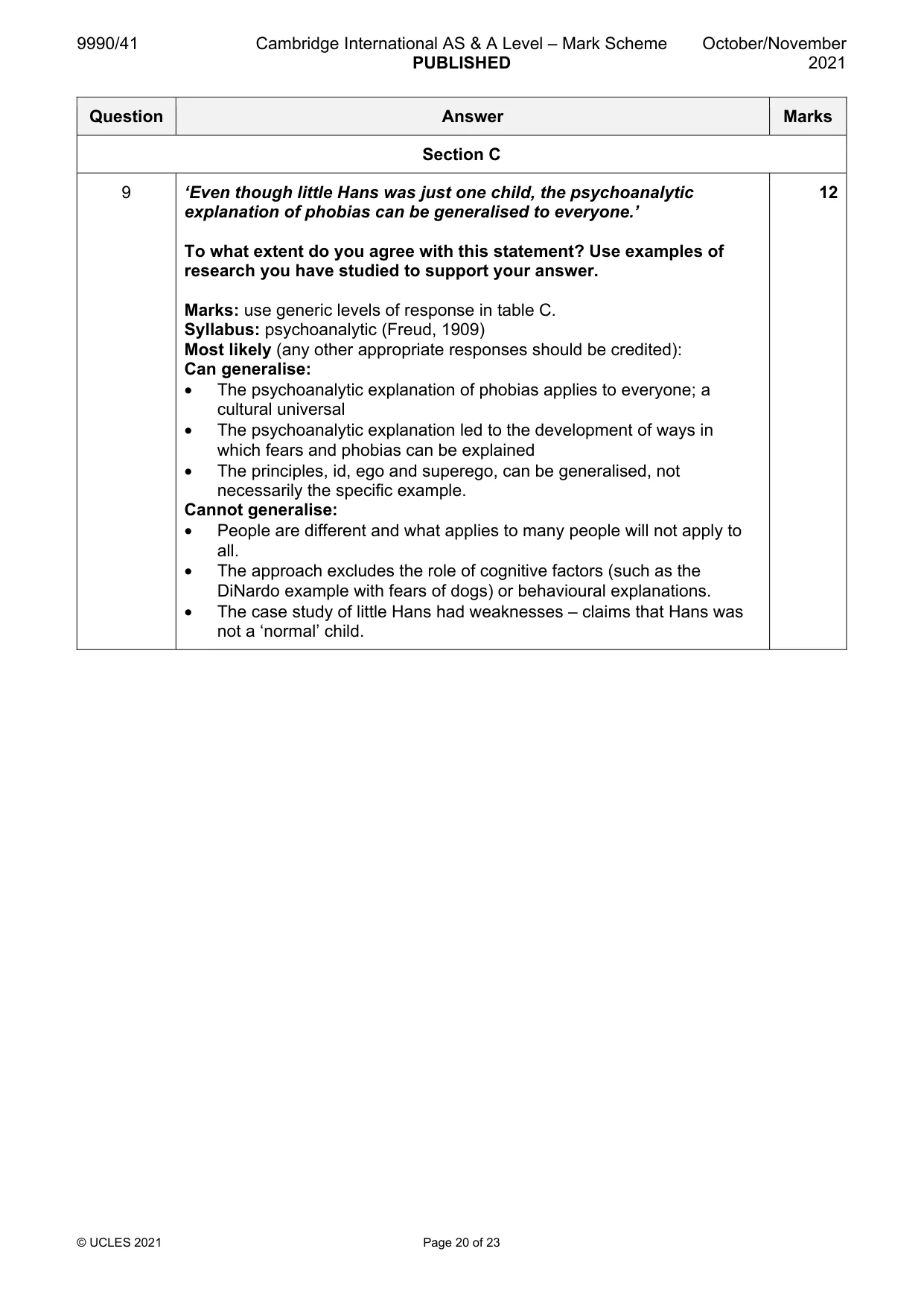
Mark scheme: 9 ‘Even though little Hans was just one child, the psychoanalytic 12 explanation of phobias can be generalised to everyone.’ To what extent do you agree with this statement? Use examples of research you have studied to support your answer. Marks: use generic levels of response in table C. Syllabus: psychoanalytic (Freud, 1909) Most likely (any other appropriate responses should be credited): Can generalise: • The psychoanalytic explanation of phobias applies to everyone; a cultural universal • The psychoanalytic explanation led to the development of ways in which fears and phobias can be explained • The principles, id, ego and superego, can be generalised, not necessarily the specific example. Cannot generalise: • People are different and what applies to many people will not apply to all. • The approach excludes the role of cognitive factors (such as the DiNardo example with fears of dogs) or behavioural explanations. • The case study of little Hans had weaknesses – claims that Hans was not a ‘normal’ child.
More questions on Anxiety disorders and fear-related disorders
Q10 · ‘There is no need to gather qualitative data when conducting studies on menu item…
10 ‘There is no need to gather qualitative data when conducting studies on menu item position.’ To what extent do you agree with this statement? Use examples of research you have studied to support your answer. [12] Psychology and health
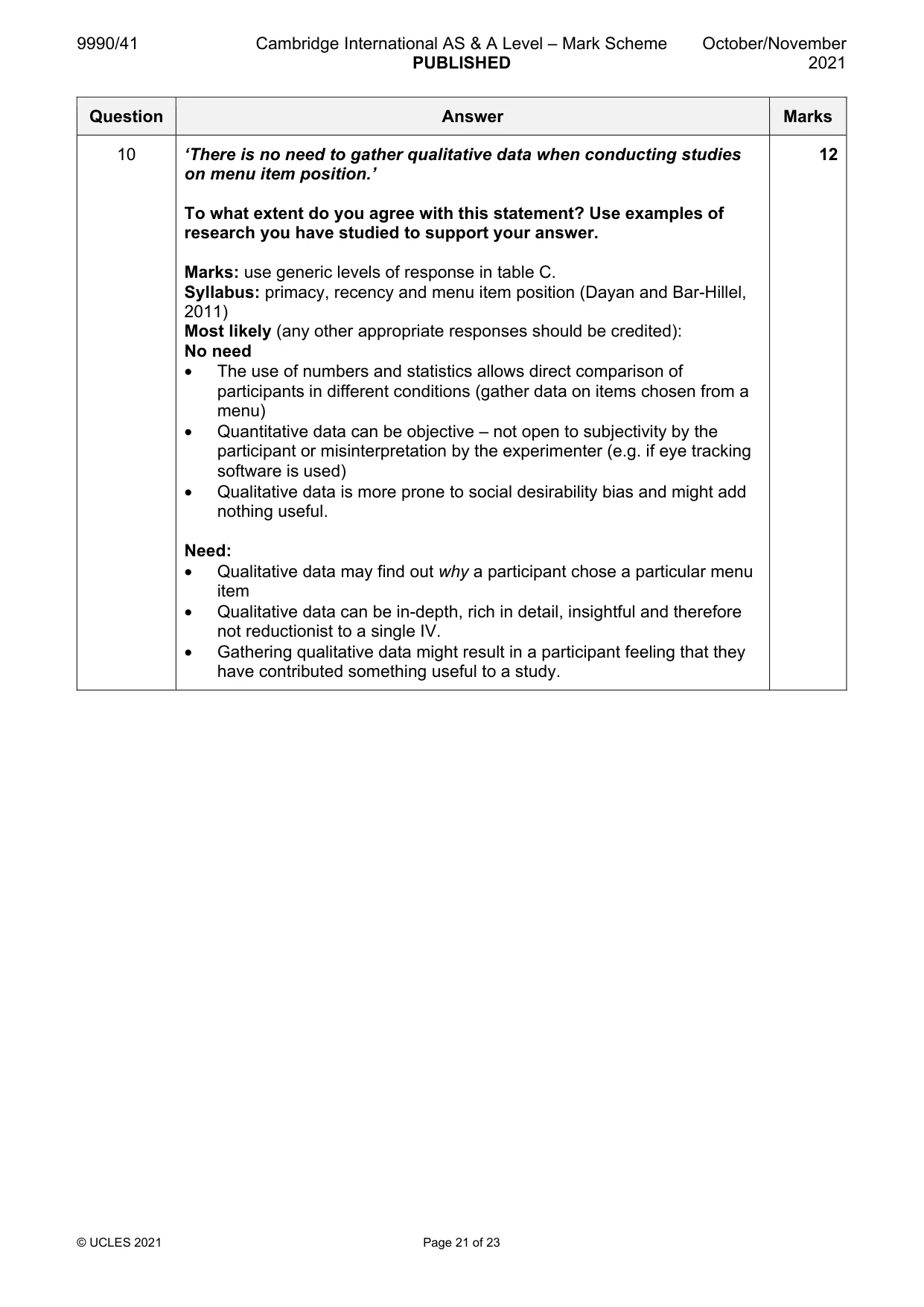
Mark scheme: 10 ‘There is no need to gather qualitative data when conducting studies 12 on menu item position.’ To what extent do you agree with this statement? Use examples of research you have studied to support your answer. Marks: use generic levels of response in table C. Syllabus: primacy, recency and menu item position (Dayan and Bar-Hillel, 2011) Most likely (any other appropriate responses should be credited): No need • The use of numbers and statistics allows direct comparison of participants in different conditions (gather data on items chosen from a menu) • Quantitative data can be objective – not open to subjectivity by the participant or misinterpretation by the experimenter (e.g. if eye tracking software is used) • Qualitative data is more prone to social desirability bias and might add nothing useful. Need: • Qualitative data may find out why a participant chose a particular menu item • Qualitative data can be in-depth, rich in detail, insightful and therefore not reductionist to a single IV. • Gathering qualitative data might result in a participant feeling that they have contributed something useful to a study.
Q11 · ‘Young people have unrealistic optimism therefore do not think it is necessary to prevent…
11 ‘Young people have unrealistic optimism therefore do not think it is necessary to prevent stress.’ To what extent do you agree with this statement? Use examples of research you have studied to support your answer. [12] Psychology and organisations
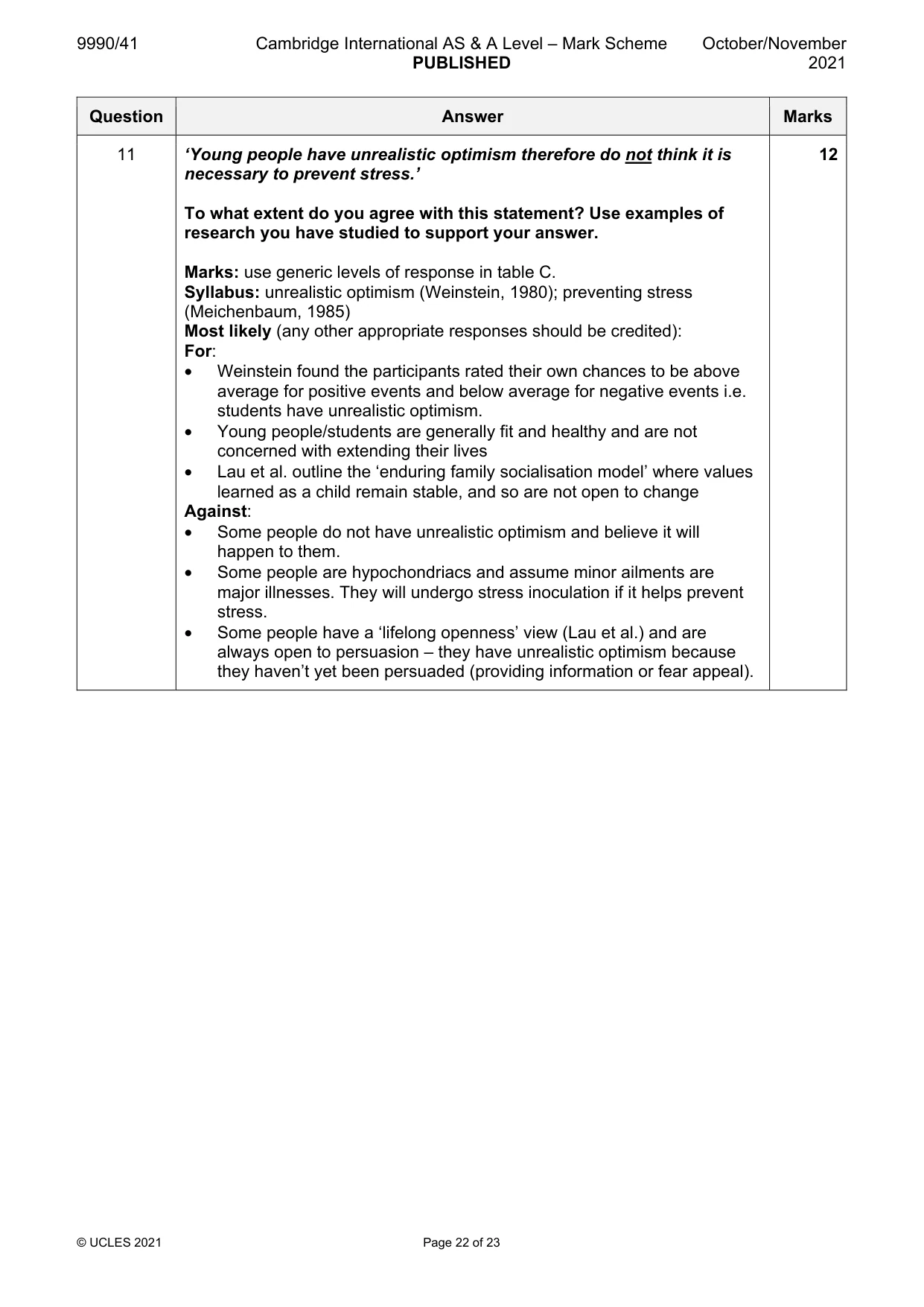
Mark scheme: 11 ‘Young people have unrealistic optimism therefore do not think it is 12 necessary to prevent stress.’ To what extent do you agree with this statement? Use examples of research you have studied to support your answer. Marks: use generic levels of response in table C. Syllabus: unrealistic optimism (Weinstein, 1980); preventing stress (Meichenbaum, 1985) Most likely (any other appropriate responses should be credited): For: • Weinstein found the participants rated their own chances to be above average for positive events and below average for negative events i.e. students have unrealistic optimism. • Young people/students are generally fit and healthy and are not concerned with extending their lives • Lau et al. outline the ‘enduring family socialisation model’ where values learned as a child remain stable, and so are not open to change Against: • Some people do not have unrealistic optimism and believe it will happen to them. • Some people are hypochondriacs and assume minor ailments are major illnesses. They will undergo stress inoculation if it helps prevent stress. • Some people have a ‘lifelong openness’ view (Lau et al.) and are always open to persuasion – they have unrealistic optimism because they haven’t yet been persuaded (providing information or fear appeal).
Q12 · ‘Workers do not have the need to achieve; they just need to work hard to earn money.’ To…
12 ‘Workers do not have the need to achieve; they just need to work hard to earn money.’ To what extent do you agree with this statement? Use examples of research you have studied to support your answer. [12]
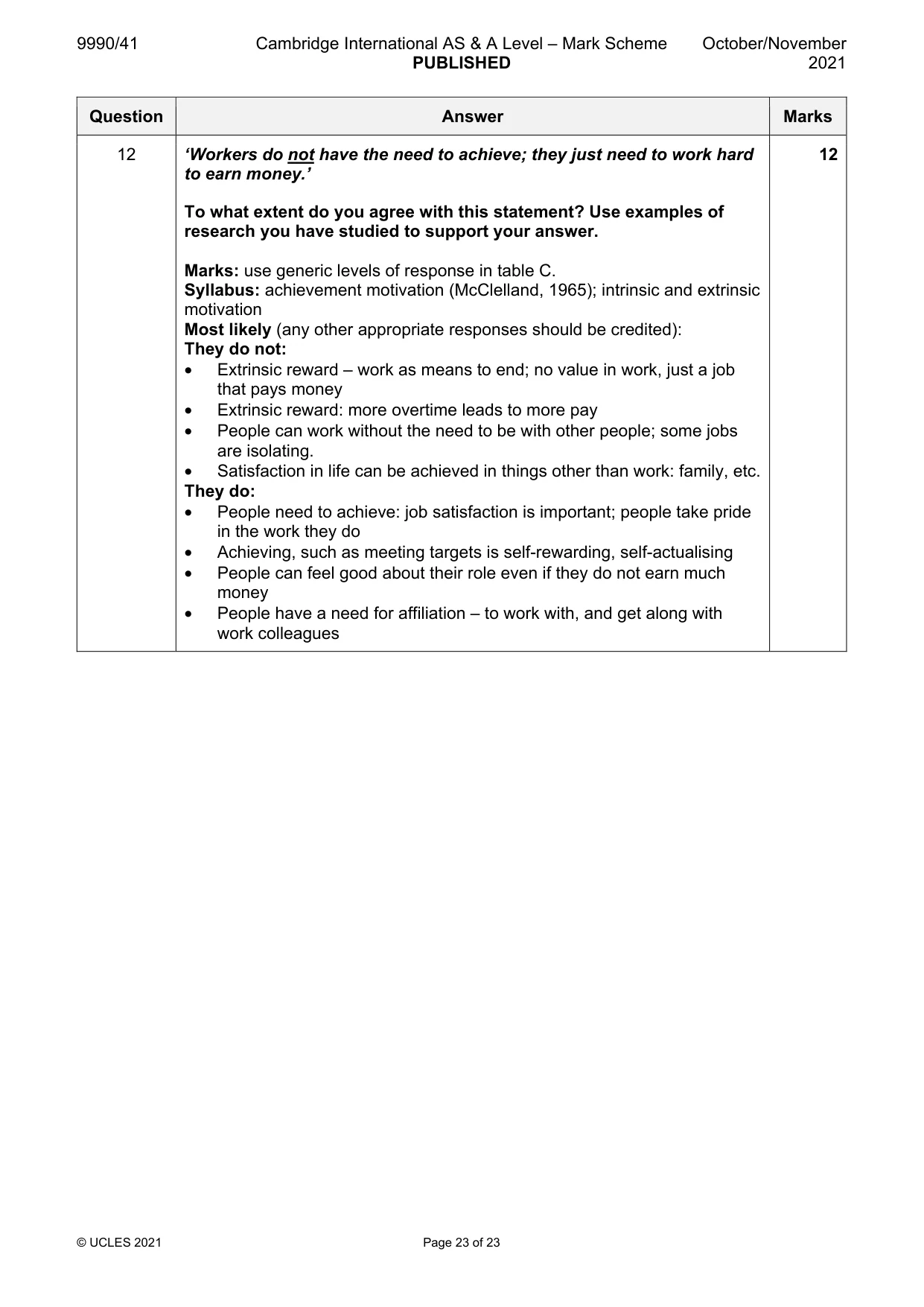
Mark scheme: 12 ‘Workers do not have the need to achieve; they just need to work hard 12 to earn money.’ To what extent do you agree with this statement? Use examples of research you have studied to support your answer. Marks: use generic levels of response in table C. Syllabus: achievement motivation (McClelland, 1965); intrinsic and extrinsic motivation Most likely (any other appropriate responses should be credited): They do not: • Extrinsic reward – work as means to end; no value in work, just a job that pays money • Extrinsic reward: more overtime leads to more pay • People can work without the need to be with other people; some jobs are isolating. • Satisfaction in life can be achieved in things other than work: family, etc. They do: • People need to achieve: job satisfaction is important; people take pride in the work they do • Achieving, such as meeting targets is self-rewarding, self-actualising • People can feel good about their role even if they do not earn much money • People have a need for affiliation – to work with, and get along with work colleagues
What was in this paper
The subtopics covered by these 12 questions, and how many questions each got. Open one in a new tab to see every Cambridge question on it.
What you needed in this session
Cambridge’s own grade thresholds for 2021 Oct/Nov, Paper 4 · Variant 1. A higher threshold means an easier paper — the bar moves with how the cohort did.