Cambridge A Level Psychology (from 2018) 9990 — 2019 Feb/March Paper 4 · Variant 2
9990/42/F/M/19 · 12 questions · 60 marks · ≈68 min
The question paper and its mark scheme, free to read here and free to download. This is Cambridge’s own paper, exactly as it was sat.
Question paper8 pages
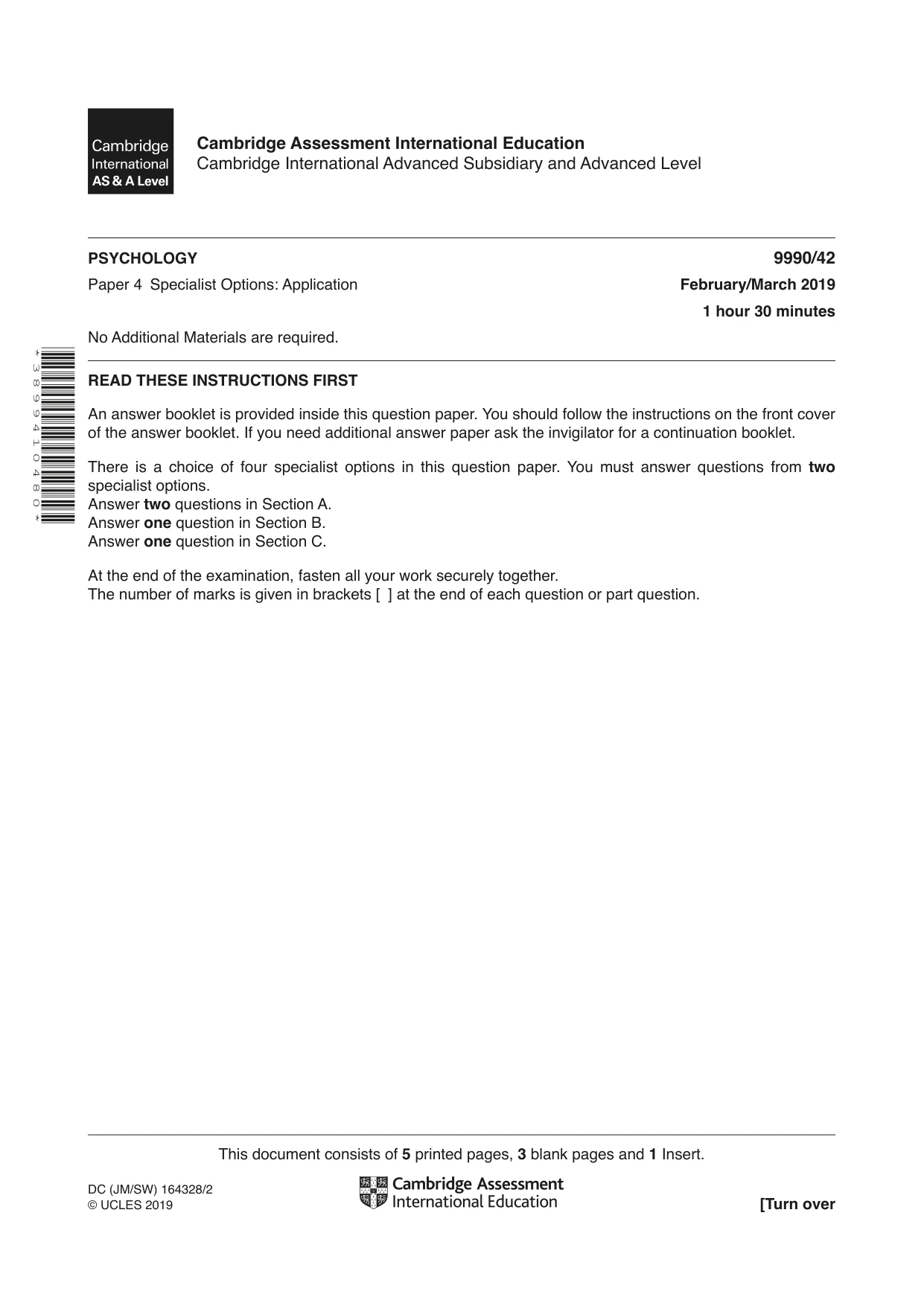



Mark scheme25 pages
Answers below. Sit the paper first if you are practising.

Questions as text
Q1 · Explanations of obsessive-compulsive disorder (OCD) genetic biomedical biochemical…
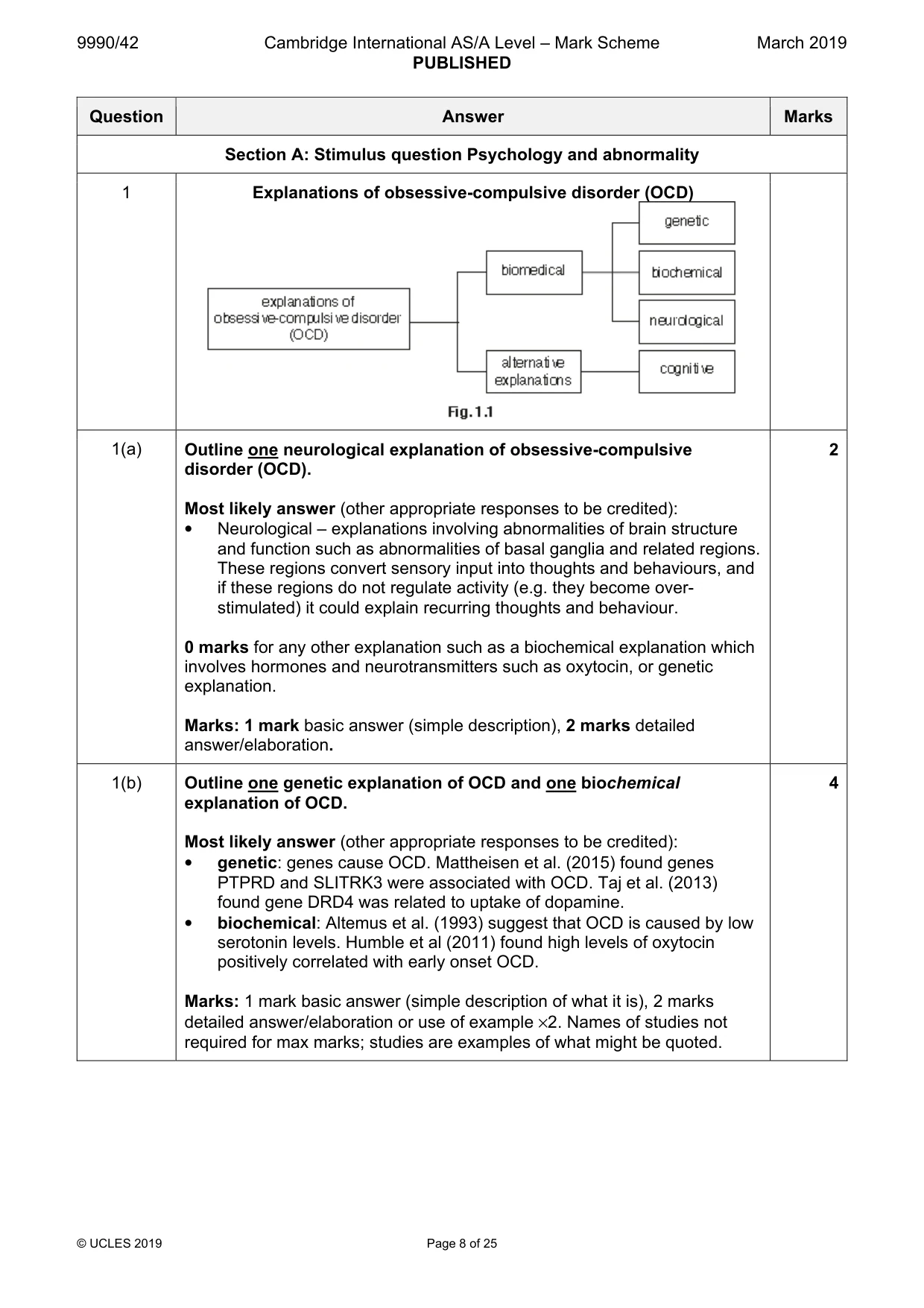
1 Explanations of obsessive-compulsive disorder (OCD) genetic biomedical biochemical explanations of obsessive-compulsive disorder neurological (OCD) alternative cognitive explanations Fig. 1.1 (a) Outline one neurological explanation of obsessive-compulsive disorder (OCD). [2] (b) Outline one genetic explanation of OCD and one biochemical explanation of OCD. [4] (c) Suggest two ways in which one biomedical explanation differs from cognitive explanations for OCD. [4] (d) Discuss the strengths and weaknesses of the biomedical explanation of OCD. You should include a conclusion in your answer. [5] Psychology and consumer behaviour
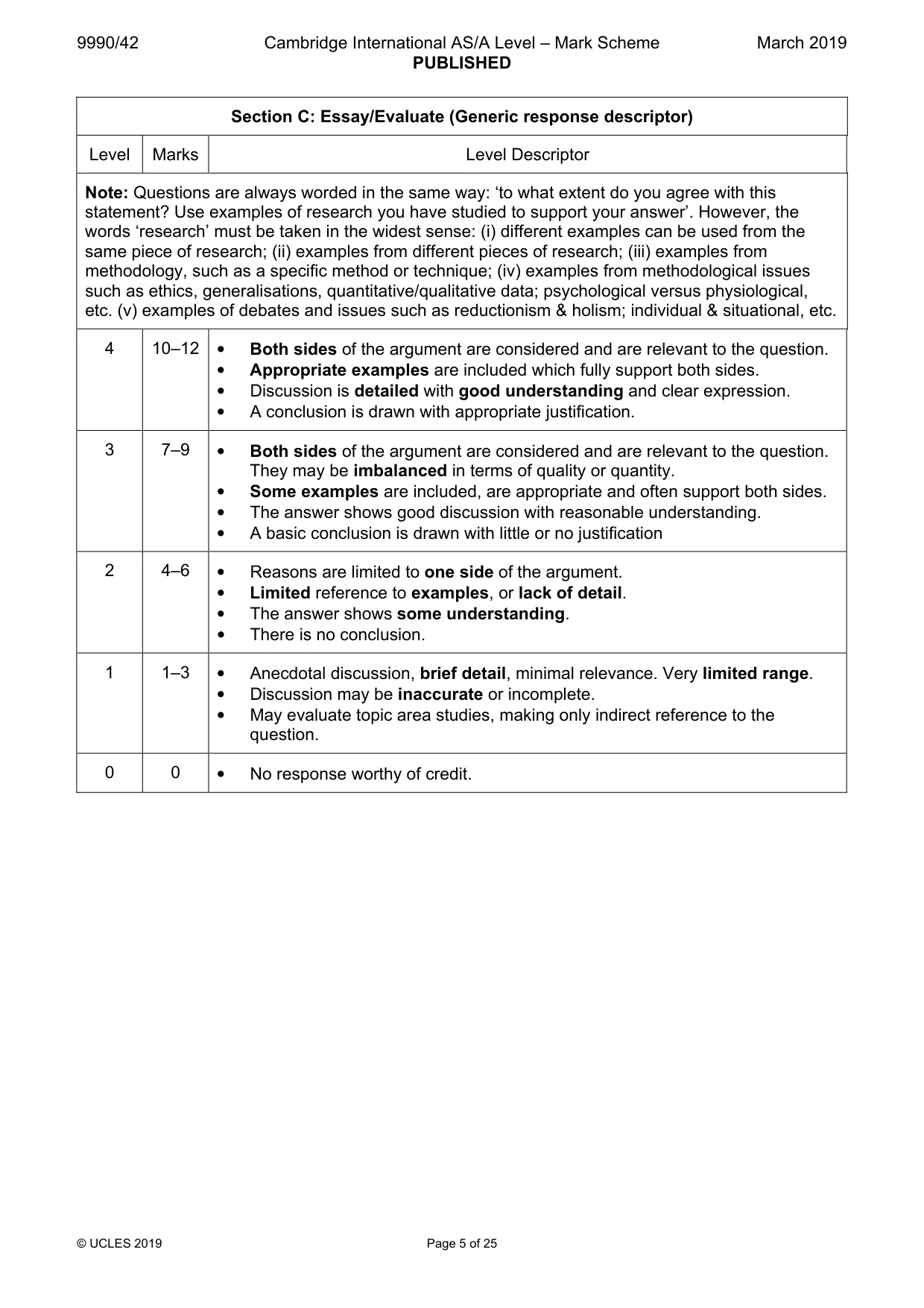
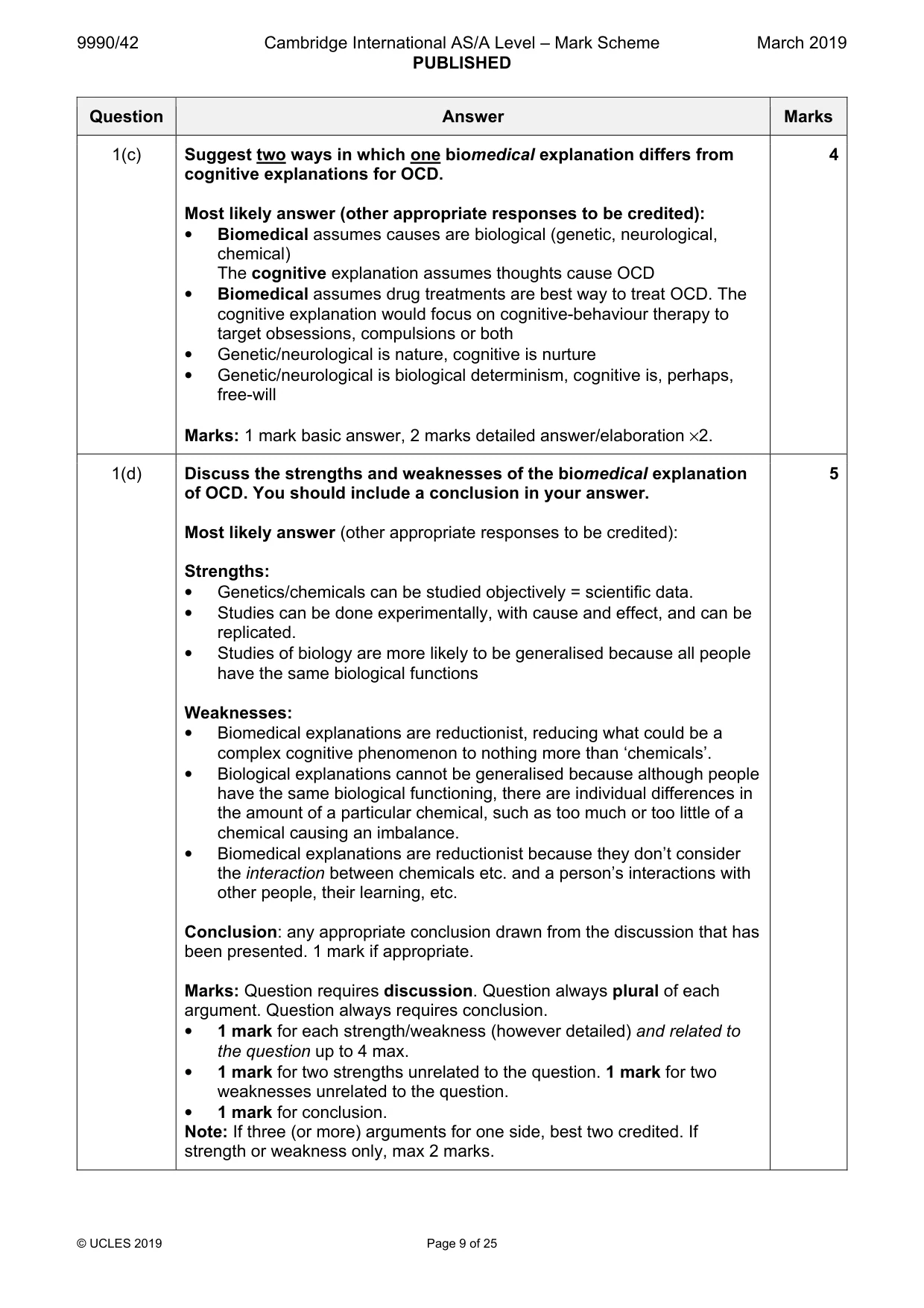
Mark scheme: Question Answer Marks Section A: Stimulus question Psychology and abnormality 1 Explanations of obsessive-compulsive disorder (OCD) 1(a) Outline one neurological explanation of obsessive-compulsive 2 disorder (OCD). Most likely answer (other appropriate responses to be credited): • Neurological – explanations involving abnormalities of brain structure and function such as abnormalities of basal ganglia and related regions. These regions convert sensory input into thoughts and behaviours, and if these regions do not regulate activity (e.g. they become over- stimulated) it could explain recurring thoughts and behaviour. 0 marks for any other explanation such as a biochemical explanation which involves hormones and neurotransmitters such as oxytocin, or genetic explanation. Marks: 1 mark basic answer (simple description), 2 marks detailed answer/elaboration. 1(b) Outline one genetic explanation of OCD and one biochemical 4 explanation of OCD. Most likely answer (other appropriate responses to be credited): • genetic: genes cause OCD. Mattheisen et al. (2015) found genes PTPRD and SLITRK3 were associated with OCD. Taj et al. (2013) found gene DRD4 was related to uptake of dopamine. • biochemical: Altemus et al. (1993) suggest that OCD is caused by low serotonin levels. Humble et al (2011) found high levels of oxytocin positively correlated with early onset OCD. Marks: 1 mark basic answer (simple description of what it is), 2 marks detailed answer/elaboration or use of example ×2. Names of studies not required for max marks; studies are examples of what might be quoted. 1(c) Suggest two ways in which one biomedical explanation differs from 4 cognitive explanations for OCD. Most likely answer (other appropriate responses to be credited): • Biomedical assumes causes are biological (genetic, neurological, chemical) The cognitive explanation assumes thoughts cause OCD • Biomedical assumes drug treatments are best way to treat OCD. The cognitive explanation would focus on cognitive-behaviour therapy to target obsessions, compulsions or both • Genetic/neurological is nature, cognitive is nurture • Genetic/neurological is biological determinism, cognitive is, perhaps, free-will Marks: 1 mark basic answer, 2 marks detailed answer/elaboration ×2. 1(d) Discuss the strengths and weaknesses of the biomedical explanation 5 of OCD. You should include a conclusion in your answer. Most likely answer (other appropriate responses to be credited): Strengths: • Genetics/chemicals can be studied objectively = scientific data. • Studies can be done experimentally, with cause and effect, and can be replicated. • Studies of biology are more likely to be generalised because all people have the same biological functions Weaknesses: • Biomedical explanations are reductionist, reducing what could be a complex cognitive phenomenon to nothing more than ‘chemicals’. • Biological explanations cannot be generalised because although people have the same biological functioning, there are individual differences in the amount of a particular chemical, such as too much or too little of a chemical causing an imbalance. • Biomedical explanations are reductionist because they don’t consider the interaction between chemicals etc. and a person’s interactions with other people, their learning, etc. Conclusion: any appropriate conclusion drawn from the discussion that has been presented. 1 mark if appropriate. Marks: Question requires discussion. Question always plural of each argument. Question always requires conclusion. • 1 mark for each strength/weakness (however detailed) and related to the question up to 4 max. • 1 mark for two strengths unrelated to the question. 1 mark for two weaknesses unrelated to the question. • 1 mark for conclusion. Note: If three (or more) arguments for one side, best two credited. If strength or weakness only, max 2 marks.
Q2 · The study by Atalay et al
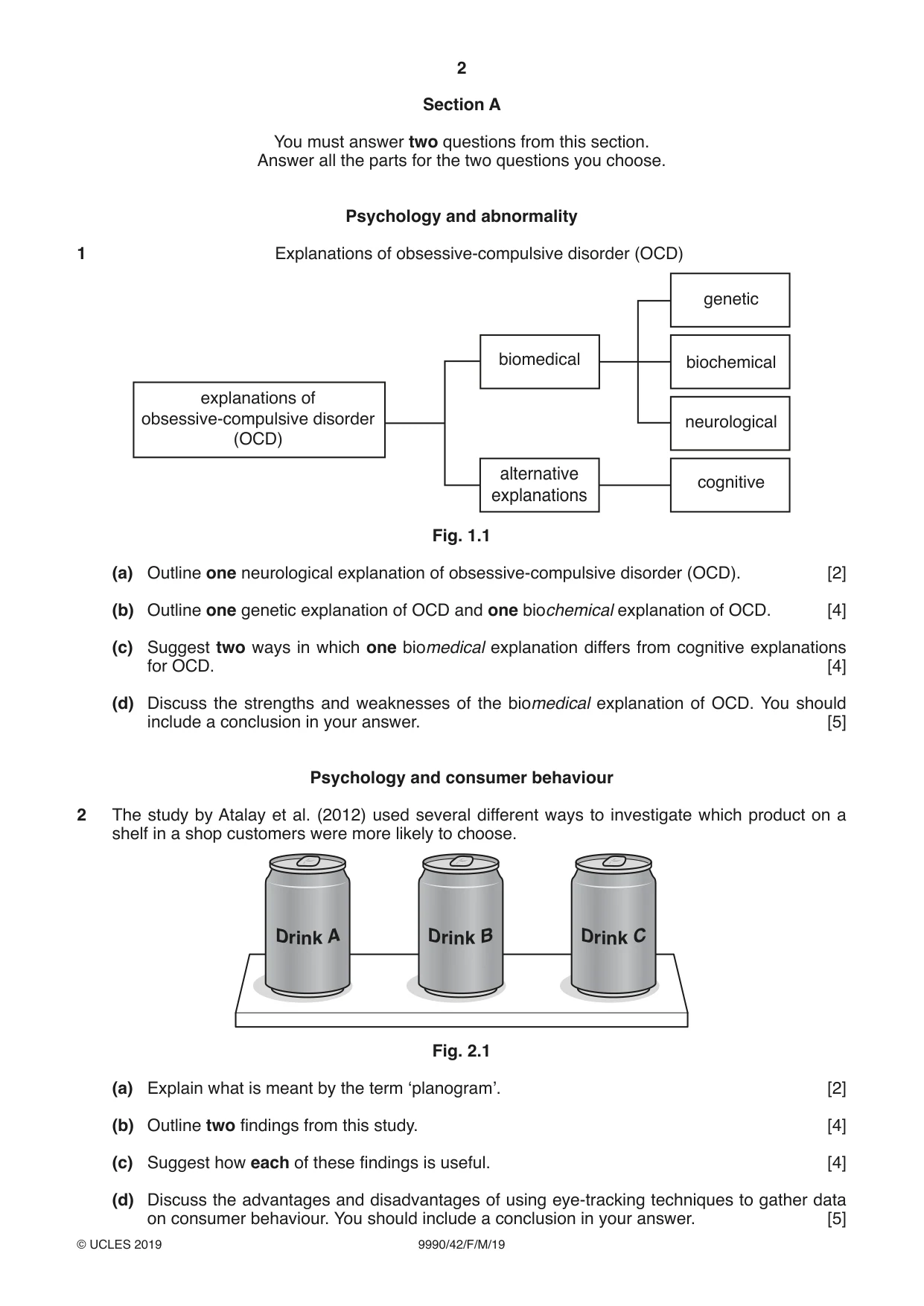
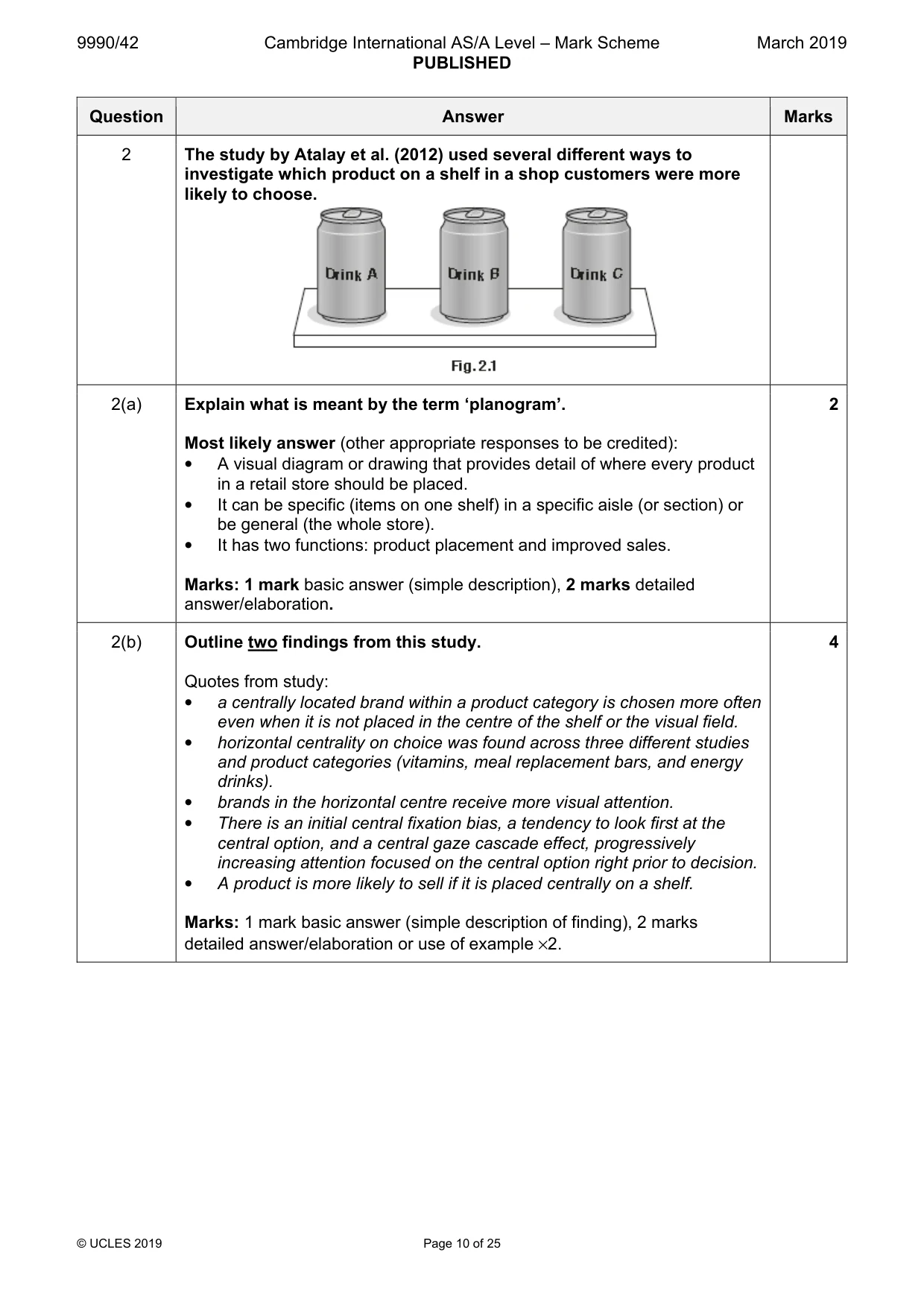
2 The study by Atalay et al. (2012) used several different ways to investigate which product on a shelf in a shop customers were more likely to choose. D rin k A D r in k B D r in k C Fig. 2.1 (a) Explain what is meant by the term ‘planogram’. [2] (b) Outline two findings from this study. [4] (c) Suggest how each of these findings is useful. [4] (d) Discuss the advantages and disadvantages of using eye-tracking techniques to gather data on consumer behaviour. You should include a conclusion in your answer. [5] Psychology and health
Mark scheme: 2(a) Explain what is meant by the term ‘planogram’. 2 Most likely answer (other appropriate responses to be credited): • A visual diagram or drawing that provides detail of where every product in a retail store should be placed. • It can be specific (items on one shelf) in a specific aisle (or section) or be general (the whole store). • It has two functions: product placement and improved sales. Marks: 1 mark basic answer (simple description), 2 marks detailed answer/elaboration. 2(b) Outline two findings from this study. 4 Quotes from study: • a centrally located brand within a product category is chosen more often even when it is not placed in the centre of the shelf or the visual field. • horizontal centrality on choice was found across three different studies and product categories (vitamins, meal replacement bars, and energy drinks). • brands in the horizontal centre receive more visual attention. • There is an initial central fixation bias, a tendency to look first at the central option, and a central gaze cascade effect, progressively increasing attention focused on the central option right prior to decision. • A product is more likely to sell if it is placed centrally on a shelf. Marks: 1 mark basic answer (simple description of finding), 2 marks detailed answer/elaboration or use of example ×2. 2(c) Suggest how each of these findings is useful. 4 Most likely answer (other appropriate responses to be credited): • Useful to seller: A product is more likely to sell if it is placed centrally on a shelf. • Useful to seller: ‘centrality’ applies to different products; possibly all products • Useful to seller: Products on promotion can be specifically placed to sell (maybe use multiple-pricing, etc.) • Useful to seller: Products which provide higher profit margins for the retailer/seller can be placed in a central position. • Useful methodology: eye tracking software is a useful tool in consumer research. Marks: 1 mark basic answer (simple use), 2 marks detailed answer/elaboration, or use of example ×2. 2(d) Discuss the advantages and disadvantages of using eye tracking 5 techniques to gather data on consumer behaviour. You should include a conclusion in your answer. Most likely answer (other appropriate responses to be credited, such as eye movement patterns): Advantages • Eye tracking is scientific equipment which is reliable. • Data recorded is objective: where the person looks is clear and unambiguous. • Data is quantitative and so comparisons can be made between participants and between studies. • It provides immediate feedback. • It is easy to use requiring no training. Disadvantages • Participants can choose to look in whatever direction they wish – they know their eve movements are being tracked. • There may be cultural differences in where people are socialised to look. • Data is where the participant has looked but it does not provide an explanation of why that person has looked in a particular direction. • Eye tracking is reductionist – product purchase isn’t just based on vision; some products smell and touch may be important. • It cannot be used with every participant, people with contact lenses or have long eye lashes • Eye movement may be subconscious and difficult to control at all times. Data may not be accurate Conclusion: any appropriate conclusion drawn from the discussion that has been presented. 1 mark if appropriate. Marks: Question requires discussion. Question always plural of each argument. Question always requires conclusion. • 1 mark for each strength/weakness (however detailed) and related to the question up to 4 max. • 1 mark for two strengths unrelated to the question. 1 mark for two weaknesses unrelated to the question. • 1 mark for conclusion. Note: If three (or more) arguments for one side, best two credited. If strength or weakness only, max 2 marks.
Q3 · The graph below is from the study by Yokley and Glenwick (1984) on the immunisation of…
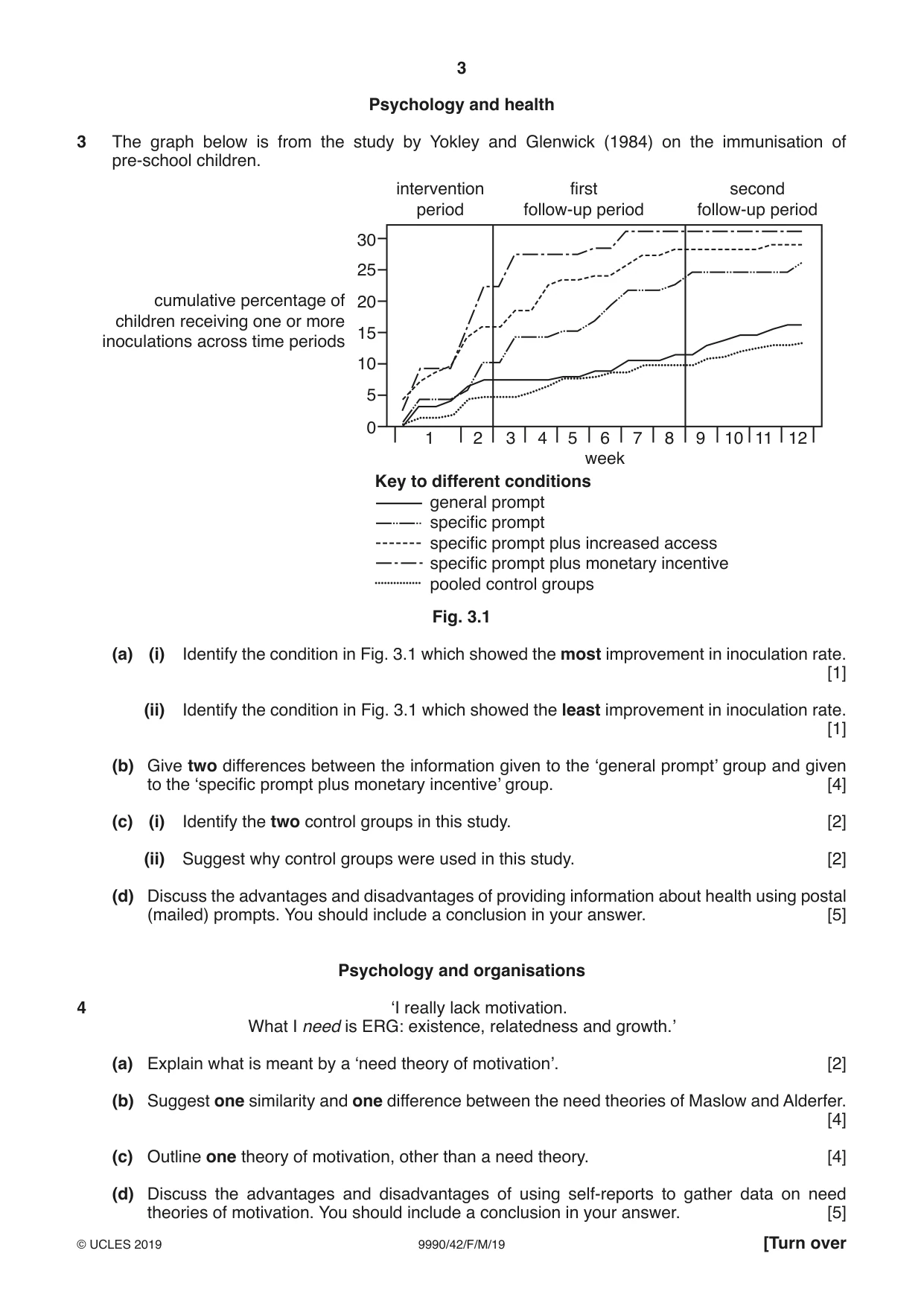
3 The graph below is from the study by Yokley and Glenwick (1984) on the immunisation of pre-school children. intervention first second period follow-up period follow-up period 30 25 cumulative percentage of 20 children receiving one or more 15 inoculations across time periods 10 5 0 1 2 3 4 5 6 7 8 9 10 11 12 week Key to different conditions general prompt specific prompt specific prompt plus increased access specific prompt plus monetary incentive pooled control groups Fig. 3.1 (a) (i) Identify the condition in Fig. 3.1 which showed the most improvement in inoculation rate. [1] (ii) Identify the condition in Fig. 3.1 which showed the least improvement in inoculation rate. [1] (b) Give two differences between the information given to the ‘general prompt’ group and given to the ‘specific prompt plus monetary incentive’ group. [4] (c) (i) Identify the two control groups in this study. [2] (ii) Suggest why control groups were used in this study. [2] (d) Discuss the advantages and disadvantages of providing information about health using postal (mailed) prompts. You should include a conclusion in your answer. [5] Psychology and organisations
Mark scheme: 3(a)(i) Identify the condition in Fig. 3.1 which showed the most improvement 1 in inoculation rate. Marks: 1 mark for: Most effective was the ‘specific prompt plus monetary incentive’. 3(a)(ii) Identify the condition in Fig. 3.1 which showed the least improvement 1 in inoculation rate. Marks: 1 mark for: Least effective was the ‘pooled control groups’. 3(b) Give two differences between the information given to the ‘general 4 prompt’ group and the ‘specific prompt plus monetary incentive’ group. Most likely answer (other appropriate responses to be credited): • MIG: monetary incentive (‘$175.00 in cash prizes’); GP: no monetary incentive. • MIG: details of specific immunisations needed; GP: standardisation immunisation schedule but not inoculations needed • MIG named child; GP: no named child. • ‘open for longer hours’ is incorrect as this applied to all conditions. Marks: 2 marks for difference (i.e. both sides must be stated for full marks) 1 mark if both sides are not stated or merely described. ×2 3(c)(i) Identify the two control groups in this study. 2 • Contact control group (n=189) telephone contact but no mailing, no prompt information. • No-contact control group (n=191) no contact at all. Marks: 1 mark for identification of each control group. Note: 0 marks for ‘pooled control groups’. This is repeating the words in the table (stem) showing no knowledge of either of these groups. 3(c)(ii) Suggest why control groups were used in this study. 2 • To see if there is a difference between experimental and control groups (1 mark) • As above, but with elaboration – to test effectiveness of different strategies using non-contact group as a baseline when nothing is done by health authorities (2 marks). Marks: 1 mark basic answer (simple description of control group), 2 marks detailed answer/elaboration or use of example. 3(d) Discuss the advantages and disadvantages of providing information 5 about health using postal (mailed) prompts. You should include a conclusion in your answer. Most likely answer (other appropriate responses to be credited): Advantages • Information can describe briefly or in more detail; can provide information or induce fear. • People can read at their own leisure (in their own home), think about and then make decisions (without pressure from anyone) • Prompts about health have been shown to be more effective then no prompts Disadvantages • People may not receive the mailing or receive it but never read it; • people read the information but not act on it (or forget to act on it) • people may delay acting (appraisal delay etc re Safer) Conclusion: any appropriate conclusion drawn from the discussion that has been presented. 1 mark if appropriate. Marks: Question requires discussion. Question always plural of each argument. Question always requires conclusion. • 1 mark for each strength/weakness (however detailed) and related to the question up to 4 max. • 1 mark for two strengths unrelated to the question. 1 mark for two weaknesses unrelated to the question. • 1 mark for conclusion. Note: If three (or more) arguments for one side, best two credited. If strength or weakness only, max 2 marks.
More questions on 2 Health promotion in schools and worksites
Q4 · ‘I really lack motivation
4 ‘I really lack motivation. What I need is ERG: existence, relatedness and growth.’ (a) Explain what is meant by a ‘need theory of motivation’. [2] (b) Suggest one similarity and one difference between the need theories of Maslow and Alderfer. [4] (c) Outline one theory of motivation, other than a need theory. [4] (d) Discuss the advantages and disadvantages of using self-reports to gather data on need theories of motivation. You should include a conclusion in your answer. [5]
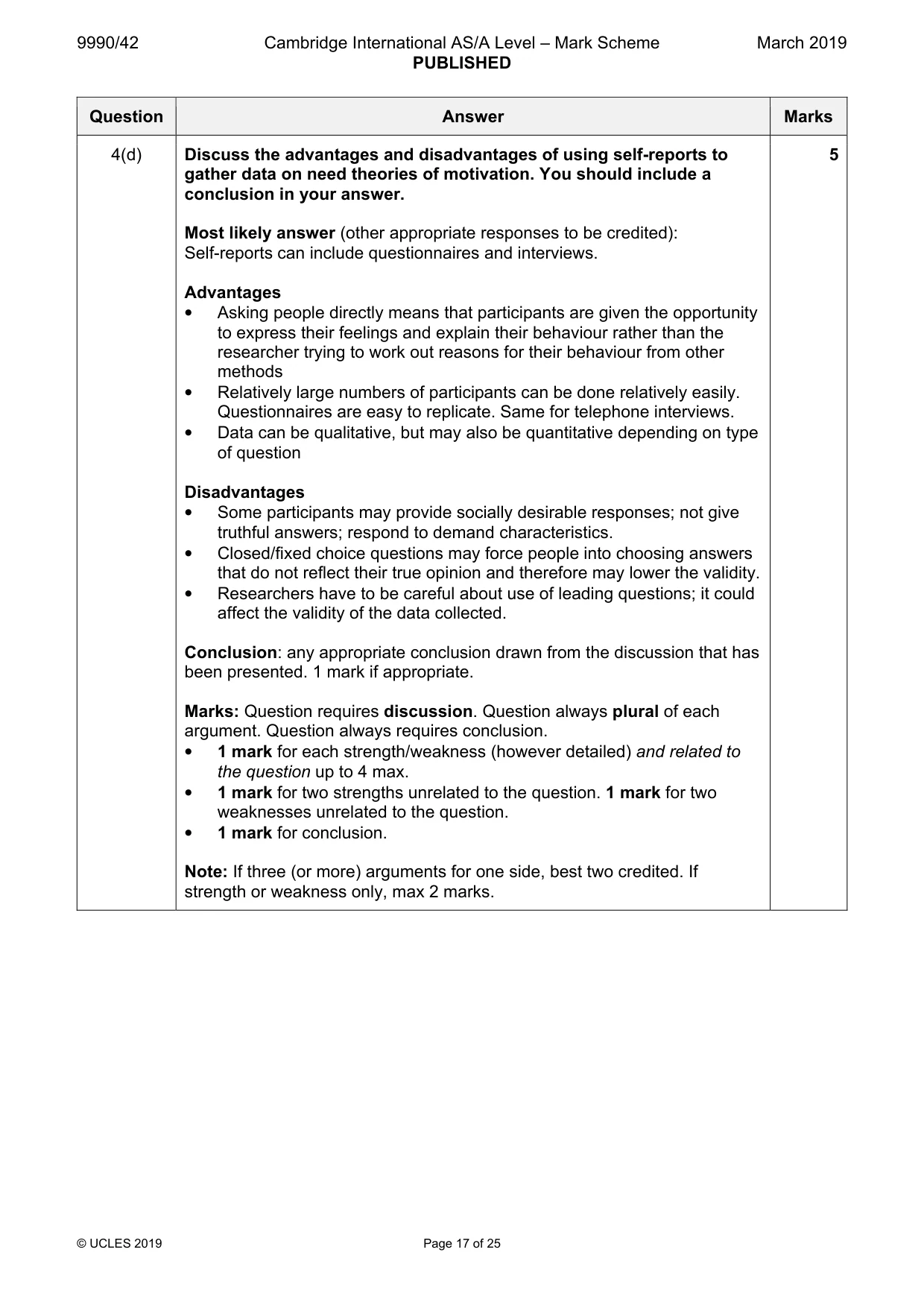
Mark scheme: 4(a) Explain what is meant by a ‘need theory of motivation’. 2 Most likely answer (other appropriate responses to be credited): A need is something that is necessary to live a healthy life. There are essential ‘physical’ needs for survival such as air, water, food and warmth. There are also ‘subjective’ needs (the concern here) such as the need to be ‘social’ and to self-actualise. These ‘subjective’ needs can vary from one culture to another. The syllabus lists three need theories (Maslow, Alderfer and McClelland) so candidates can use examples from any of these to support their answers if they wish. Marks: 1 mark basic answer (what a need is), 2 marks detailed answer/ elaboration/example. 4(b) Suggest one similarity and one difference between the need theories 4 of Maslow and Alderfer. Most likely answer (other appropriate responses to be credited): Similarity: • both are need theories and are needs that must be satisfied. • both have similar needs, just different words (e.g. physiological and safety = ERG ‘existence’ needs). Differences: • Maslow has 5 (8) needs, ERG has three needs (elaboration = identification of one or more needs) • Maslow – person stays at a need until it is fulfilled; ERG – person may have more than one need at a time. • Maslow – person moves up the hierarchy; ERG – person may revert to accomplish an earlier need (frustration- regression). Marks: 2 marks for difference; 2 marks for similarity (both sides must be stated for full marks) 1 mark if both sides are not stated or merely described. 4(c) Outline one theory of motivation, other than a need theory. 4 Most likely answer (other appropriate responses to be credited): • Cognitive/rational theories of motivation view workers as rational, decision-making beings who cognitively assess (think about) the costs and benefits before acting. • goal-setting theory by Latham and Locke believe that people can be motivated by setting goals and when it is achieved a sense of achievement results. Goal-setting has five principles: Clarity, challenge, commitment, effectiveness and task complexity. • The VIE (or expectancy) theory (Vroom, 1964) believes that workers are rational and decision making is guided by potential costs (negative outcomes) and rewards (positive outcomes) M = E × I × V or motivation = expectancy × instrumentality × valence. • Equity theory (Adams) When people feel fairly treated they are more likely to be motivated; when they feel unfairly treated they are prone to feelings of disaffection and demotivation. Employees seek to maintain equity between the inputs that they bring to a job and the outcomes that they receive from it against the perceived inputs and outcomes of others. Marks: 1–2 marks basic answer, 3–4 marks elaboration/example. Note: 0 marks for intrinsic/extrinsic motivation which are not theory. 4(d) Discuss the advantages and disadvantages of using self-reports to 5 gather data on need theories of motivation. You should include a conclusion in your answer. Most likely answer (other appropriate responses to be credited): Self-reports can include questionnaires and interviews. Advantages • Asking people directly means that participants are given the opportunity to express their feelings and explain their behaviour rather than the researcher trying to work out reasons for their behaviour from other methods • Relatively large numbers of participants can be done relatively easily. Questionnaires are easy to replicate. Same for telephone interviews. • Data can be qualitative, but may also be quantitative depending on type of question Disadvantages • Some participants may provide socially desirable responses; not give truthful answers; respond to demand characteristics. • Closed/fixed choice questions may force people into choosing answers that do not reflect their true opinion and therefore may lower the validity. • Researchers have to be careful about use of leading questions; it could affect the validity of the data collected. Conclusion: any appropriate conclusion drawn from the discussion that has been presented. 1 mark if appropriate. Marks: Question requires discussion. Question always plural of each argument. Question always requires conclusion. • 1 mark for each strength/weakness (however detailed) and related to the question up to 4 max. • 1 mark for two strengths unrelated to the question. 1 mark for two weaknesses unrelated to the question. • 1 mark for conclusion. Note: If three (or more) arguments for one side, best two credited. If strength or weakness only, max 2 marks.
Q5 · Design a study using a questionnaire to investigate the characteristics of hoarding…
5 (a) Design a study using a questionnaire to investigate the characteristics of hoarding behaviour. [10] (b) Explain the psychological and methodological evidence on which your study is based. [8] Psychology and consumer behaviour
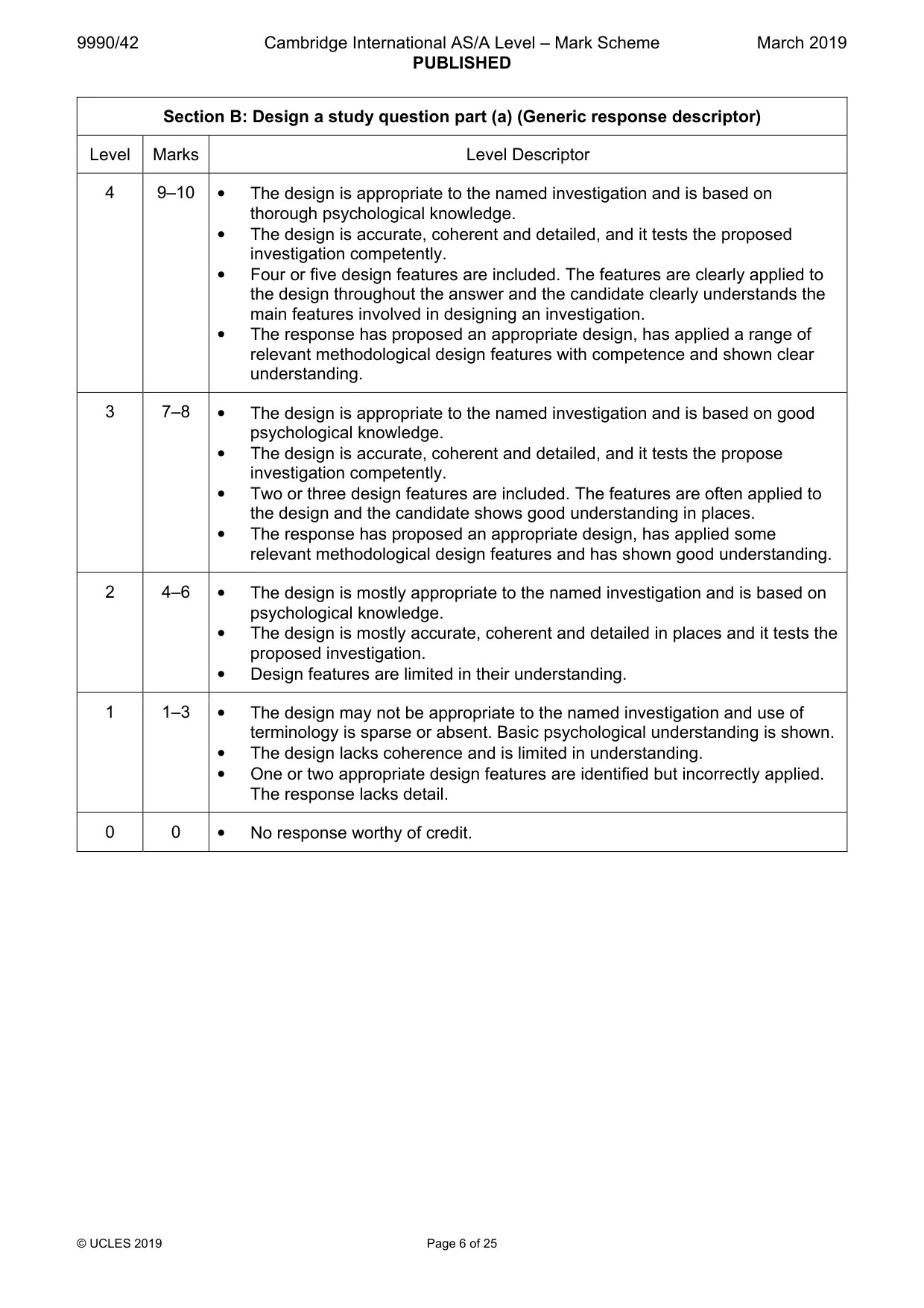
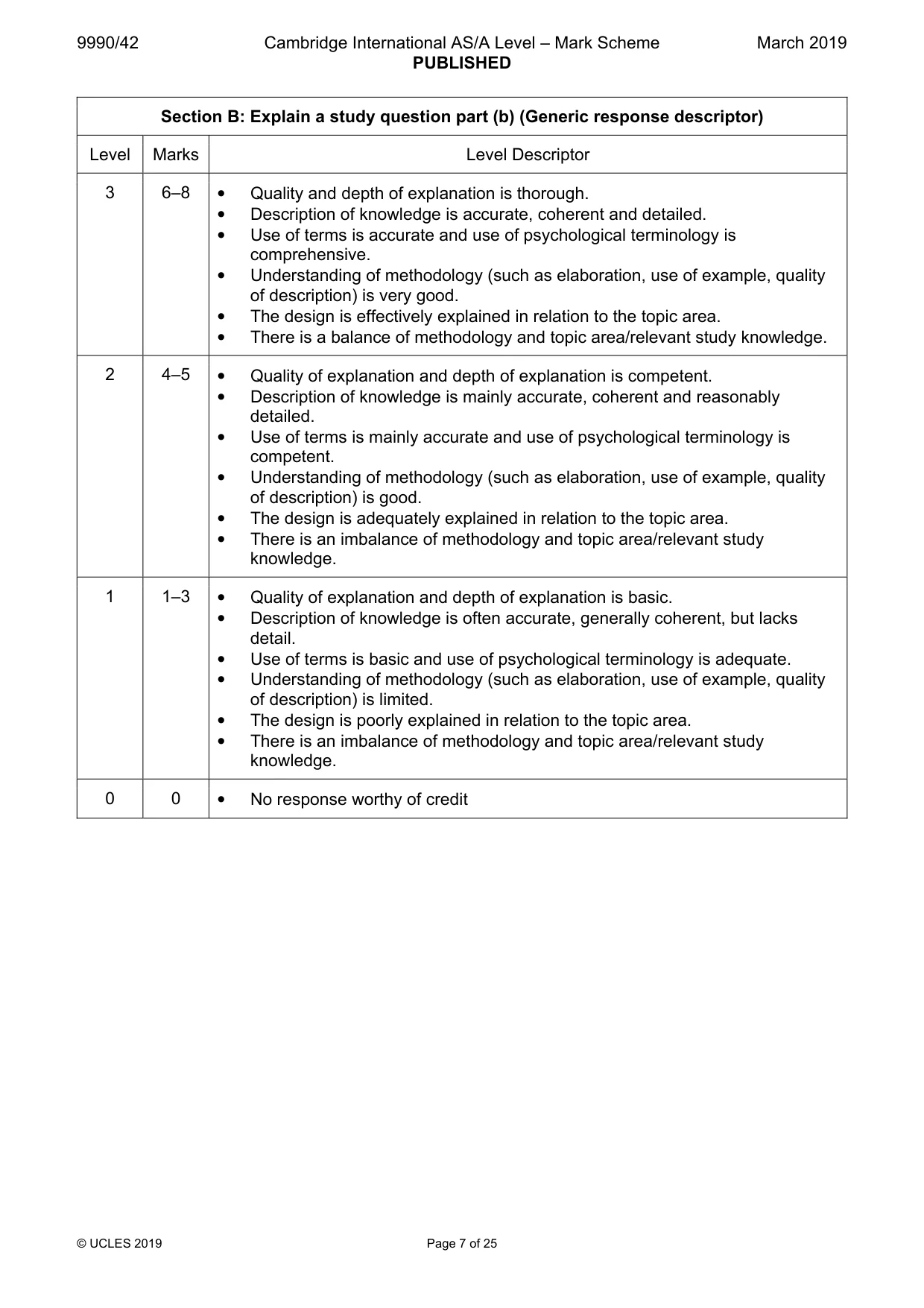
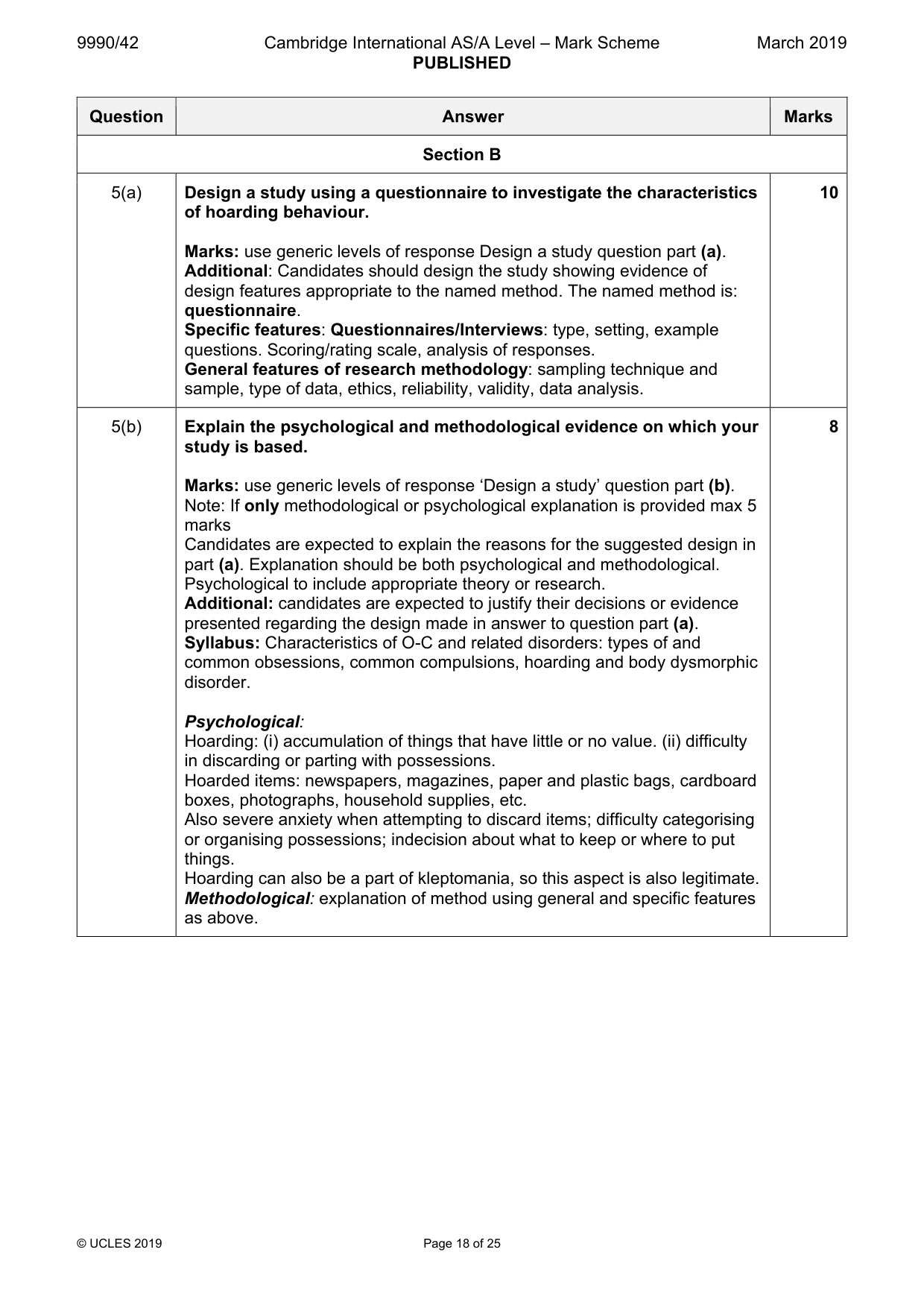
Mark scheme: 5(a) Design a study using a questionnaire to investigate the characteristics 10 of hoarding behaviour. Marks: use generic levels of response Design a study question part (a). Additional: Candidates should design the study showing evidence of design features appropriate to the named method. The named method is: questionnaire. Specific features: Questionnaires/Interviews: type, setting, example questions. Scoring/rating scale, analysis of responses. General features of research methodology: sampling technique and sample, type of data, ethics, reliability, validity, data analysis. 5(b) Explain the psychological and methodological evidence on which your 8 study is based. Marks: use generic levels of response ‘Design a study’ question part (b). Note: If only methodological or psychological explanation is provided max 5 marks Candidates are expected to explain the reasons for the suggested design in part (a). Explanation should be both psychological and methodological. Psychological to include appropriate theory or research. Additional: candidates are expected to justify their decisions or evidence presented regarding the design made in answer to question part (a). Syllabus: Characteristics of O-C and related disorders: types of and common obsessions, common compulsions, hoarding and body dysmorphic disorder. Psychological: Hoarding: (i) accumulation of things that have little or no value. (ii) difficulty in discarding or parting with possessions. Hoarded items: newspapers, magazines, paper and plastic bags, cardboard boxes, photographs, household supplies, etc. Also severe anxiety when attempting to discard items; difficulty categorising or organising possessions; indecision about what to keep or where to put things. Hoarding can also be a part of kleptomania, so this aspect is also legitimate. Methodological: explanation of method using general and specific features as above.
Q6 · Three decision-making strategies are compensatory, non-compensatory or partially…
6 Three decision-making strategies are compensatory, non-compensatory or partially compensatory. (a) Design a study to investigate which decision-making strategies people apply when buying a new mobile (cell) phone. [10] (b) Explain the psychological and methodological evidence on which your study is based. [8] Psychology and health
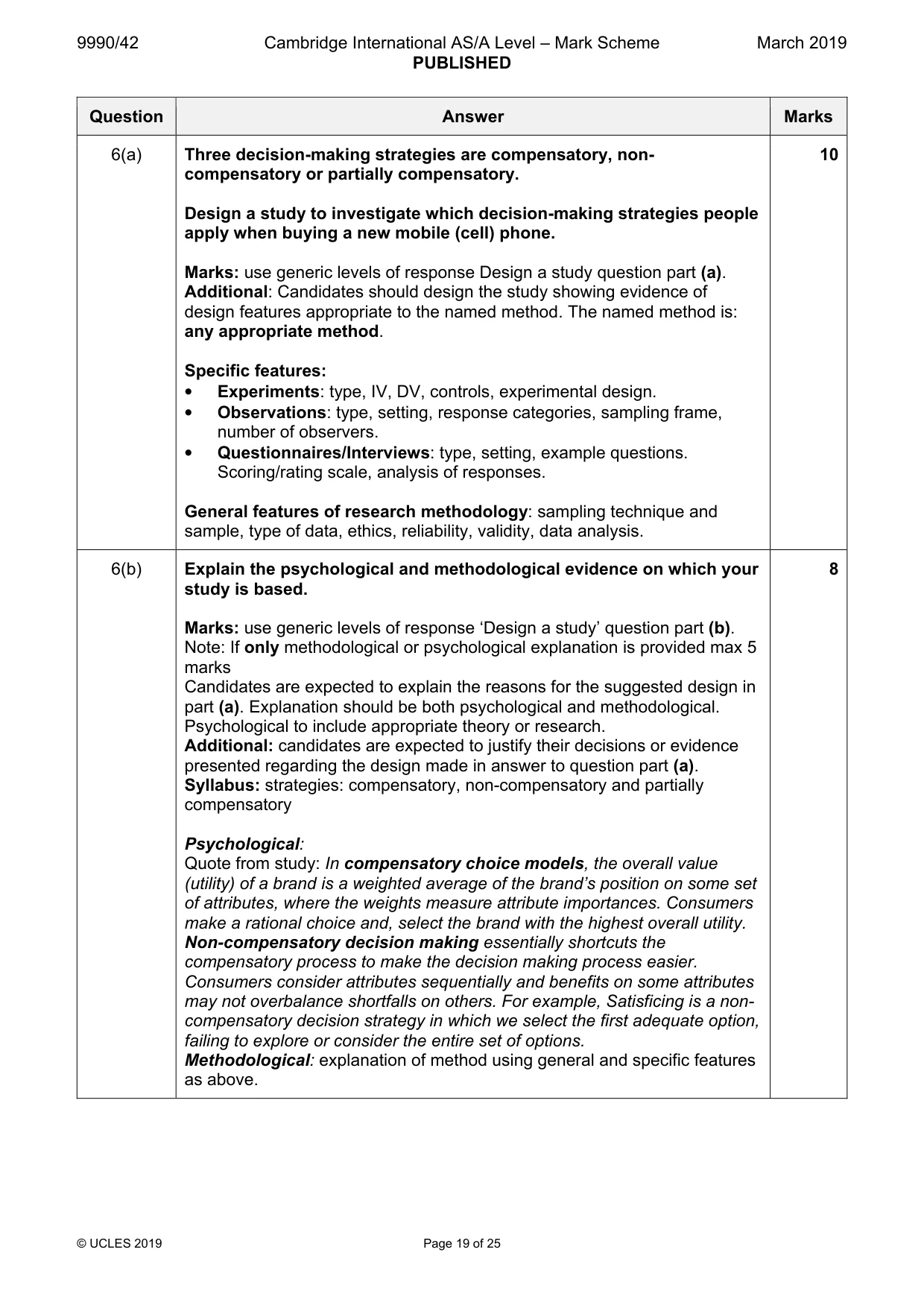
Mark scheme: 6(a) Three decision-making strategies are compensatory, non- 10 compensatory or partially compensatory. Design a study to investigate which decision-making strategies people apply when buying a new mobile (cell) phone. Marks: use generic levels of response Design a study question part (a). Additional: Candidates should design the study showing evidence of design features appropriate to the named method. The named method is: any appropriate method. Specific features: • Experiments: type, IV, DV, controls, experimental design. • Observations: type, setting, response categories, sampling frame, number of observers. • Questionnaires/Interviews: type, setting, example questions. Scoring/rating scale, analysis of responses. General features of research methodology: sampling technique and sample, type of data, ethics, reliability, validity, data analysis. 6(b) Explain the psychological and methodological evidence on which your 8 study is based. Marks: use generic levels of response ‘Design a study’ question part (b). Note: If only methodological or psychological explanation is provided max 5 marks Candidates are expected to explain the reasons for the suggested design in part (a). Explanation should be both psychological and methodological. Psychological to include appropriate theory or research. Additional: candidates are expected to justify their decisions or evidence presented regarding the design made in answer to question part (a). Syllabus: strategies: compensatory, non-compensatory and partially compensatory Psychological: Quote from study: In compensatory choice models, the overall value (utility) of a brand is a weighted average of the brand’s position on some set of attributes, where the weights measure attribute importances. Consumers make a rational choice and, select the brand with the highest overall utility. Non-compensatory decision making essentially shortcuts the compensatory process to make the decision making process easier. Consumers consider attributes sequentially and benefits on some attributes may not overbalance shortfalls on others. For example, Satisficing is a non- compensatory decision strategy in which we select the first adequate option, failing to explore or consider the entire set of options. Methodological: explanation of method using general and specific features as above.
Q7 · Design a field experiment to investigate the effectiveness of a reward system to reduce…
7 (a) Design a field experiment to investigate the effectiveness of a reward system to reduce the number of accidents in school science lessons. [10] (b) Explain the psychological and methodological evidence on which your experiment is based. [8] Psychology and organisations
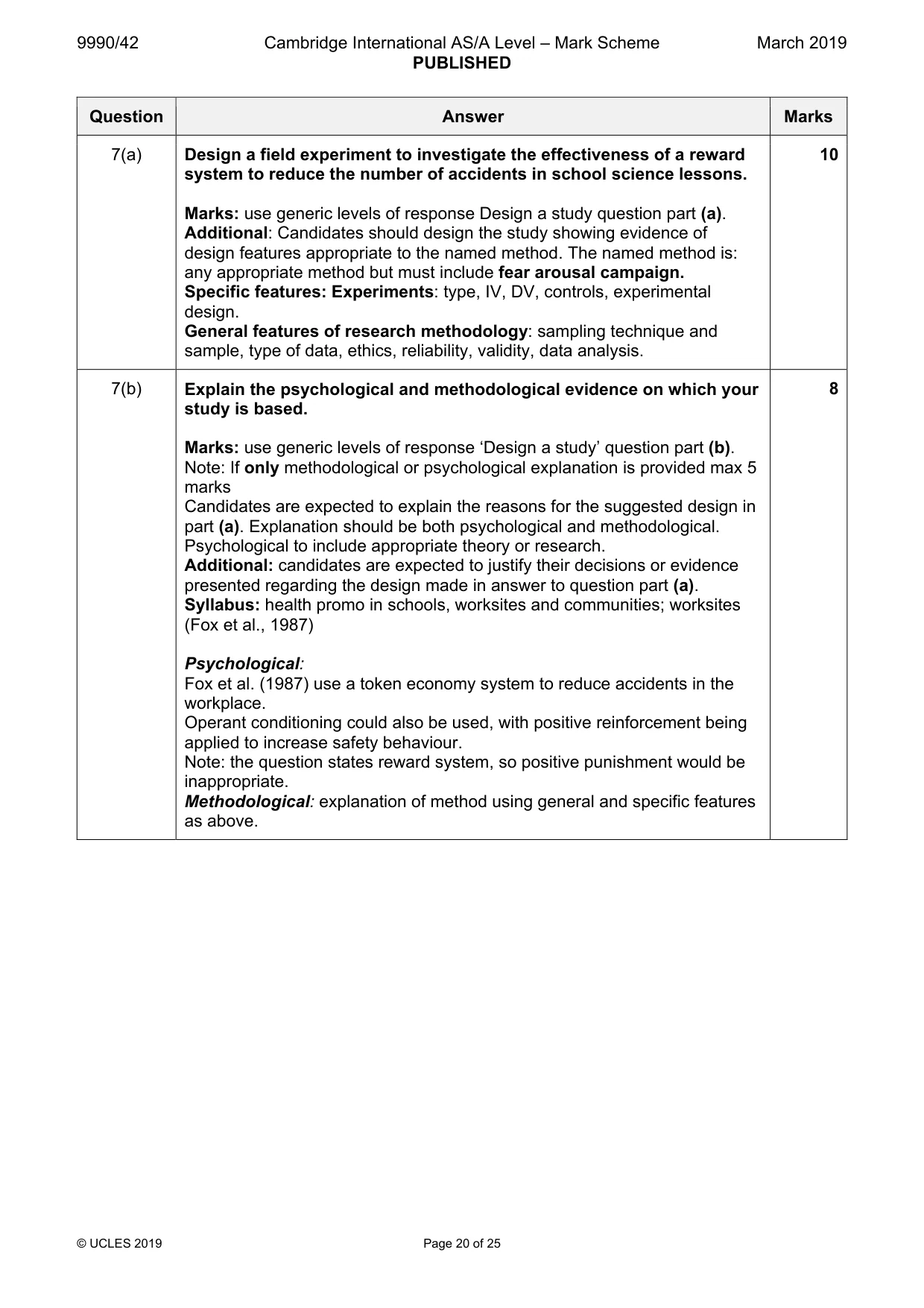
Mark scheme: 7(a) Design a field experiment to investigate the effectiveness of a reward 10 system to reduce the number of accidents in school science lessons. Marks: use generic levels of response Design a study question part (a). Additional: Candidates should design the study showing evidence of design features appropriate to the named method. The named method is: any appropriate method but must include fear arousal campaign. Specific features: Experiments: type, IV, DV, controls, experimental design. General features of research methodology: sampling technique and sample, type of data, ethics, reliability, validity, data analysis. 7(b) Explain the psychological and methodological evidence on which your 8 study is based. Marks: use generic levels of response ‘Design a study’ question part (b). Note: If only methodological or psychological explanation is provided max 5 marks Candidates are expected to explain the reasons for the suggested design in part (a). Explanation should be both psychological and methodological. Psychological to include appropriate theory or research. Additional: candidates are expected to justify their decisions or evidence presented regarding the design made in answer to question part (a). Syllabus: health promo in schools, worksites and communities; worksites (Fox et al., 1987) Psychological: Fox et al. (1987) use a token economy system to reduce accidents in the workplace. Operant conditioning could also be used, with positive reinforcement being applied to increase safety behaviour. Note: the question states reward system, so positive punishment would be inappropriate. Methodological: explanation of method using general and specific features as above.
Q8 · One cognitive limitation/error in group decision-making is a ‘sin of commission’
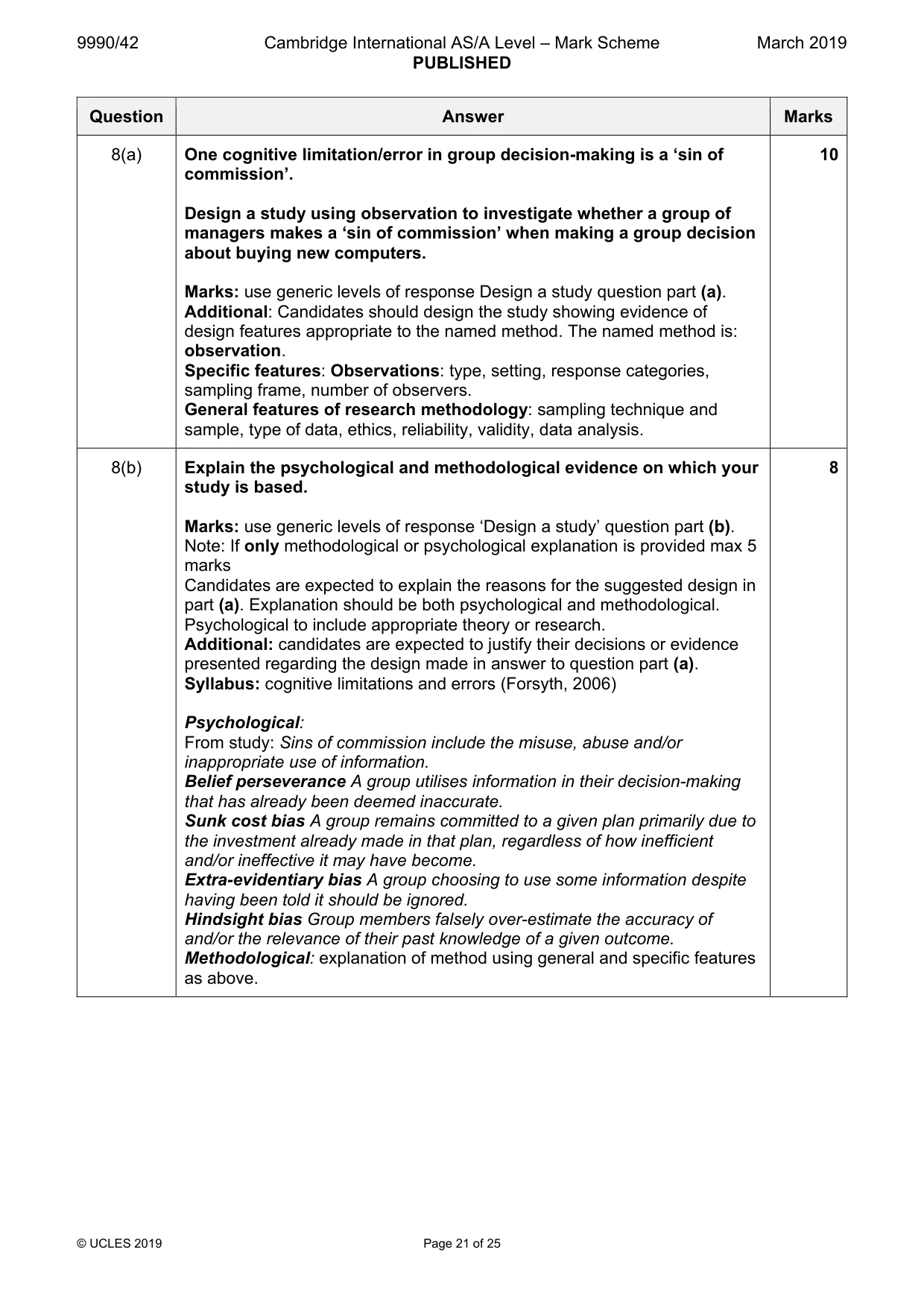
8 One cognitive limitation/error in group decision-making is a ‘sin of commission’. (a) Design a study using observation to investigate whether a group of managers makes a ‘sin of commission’ when making a group decision about buying new computers. [10] (b) Explain the psychological and methodological evidence on which your study is based. [8] Section C You must answer one question from this section. Psychology and abnormality
Mark scheme: 8(a) One cognitive limitation/error in group decision-making is a ‘sin of 10 commission’. Design a study using observation to investigate whether a group of managers makes a ‘sin of commission’ when making a group decision about buying new computers. Marks: use generic levels of response Design a study question part (a). Additional: Candidates should design the study showing evidence of design features appropriate to the named method. The named method is: observation. Specific features: Observations: type, setting, response categories, sampling frame, number of observers. General features of research methodology: sampling technique and sample, type of data, ethics, reliability, validity, data analysis. 8(b) Explain the psychological and methodological evidence on which your 8 study is based. Marks: use generic levels of response ‘Design a study’ question part (b). Note: If only methodological or psychological explanation is provided max 5 marks Candidates are expected to explain the reasons for the suggested design in part (a). Explanation should be both psychological and methodological. Psychological to include appropriate theory or research. Additional: candidates are expected to justify their decisions or evidence presented regarding the design made in answer to question part (a). Syllabus: cognitive limitations and errors (Forsyth, 2006) Psychological: From study: Sins of commission include the misuse, abuse and/or inappropriate use of information. Belief perseverance A group utilises information in their decision-making that has already been deemed inaccurate. Sunk cost bias A group remains committed to a given plan primarily due to the investment already made in that plan, regardless of how inefficient and/or ineffective it may have become. Extra-evidentiary bias A group choosing to use some information despite having been told it should be ignored. Hindsight bias Group members falsely over-estimate the accuracy of and/or the relevance of their past knowledge of a given outcome. Methodological: explanation of method using general and specific features as above.
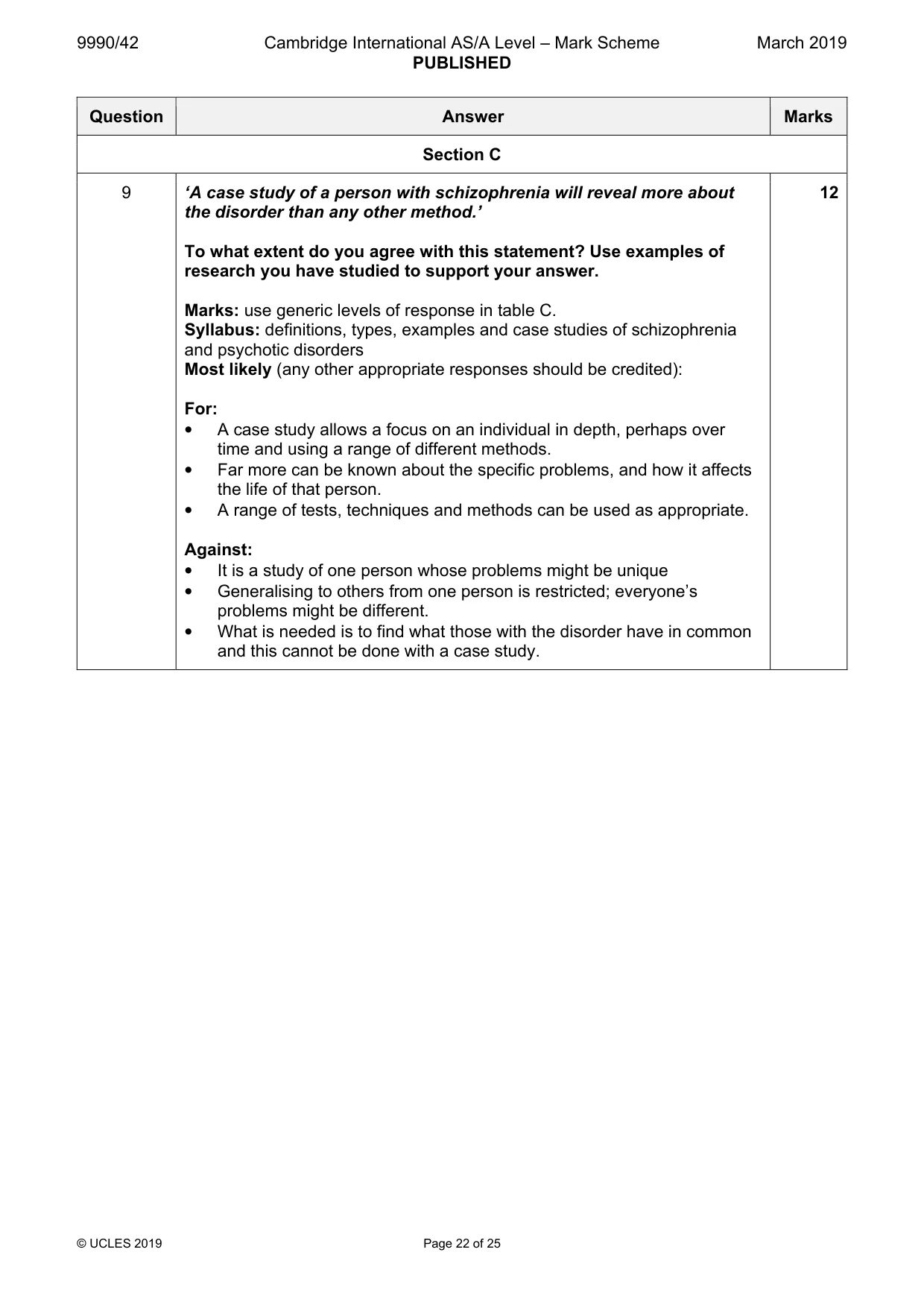
Q9 · ‘A case study of a person with schizophrenia will reveal more about the disorder than any…
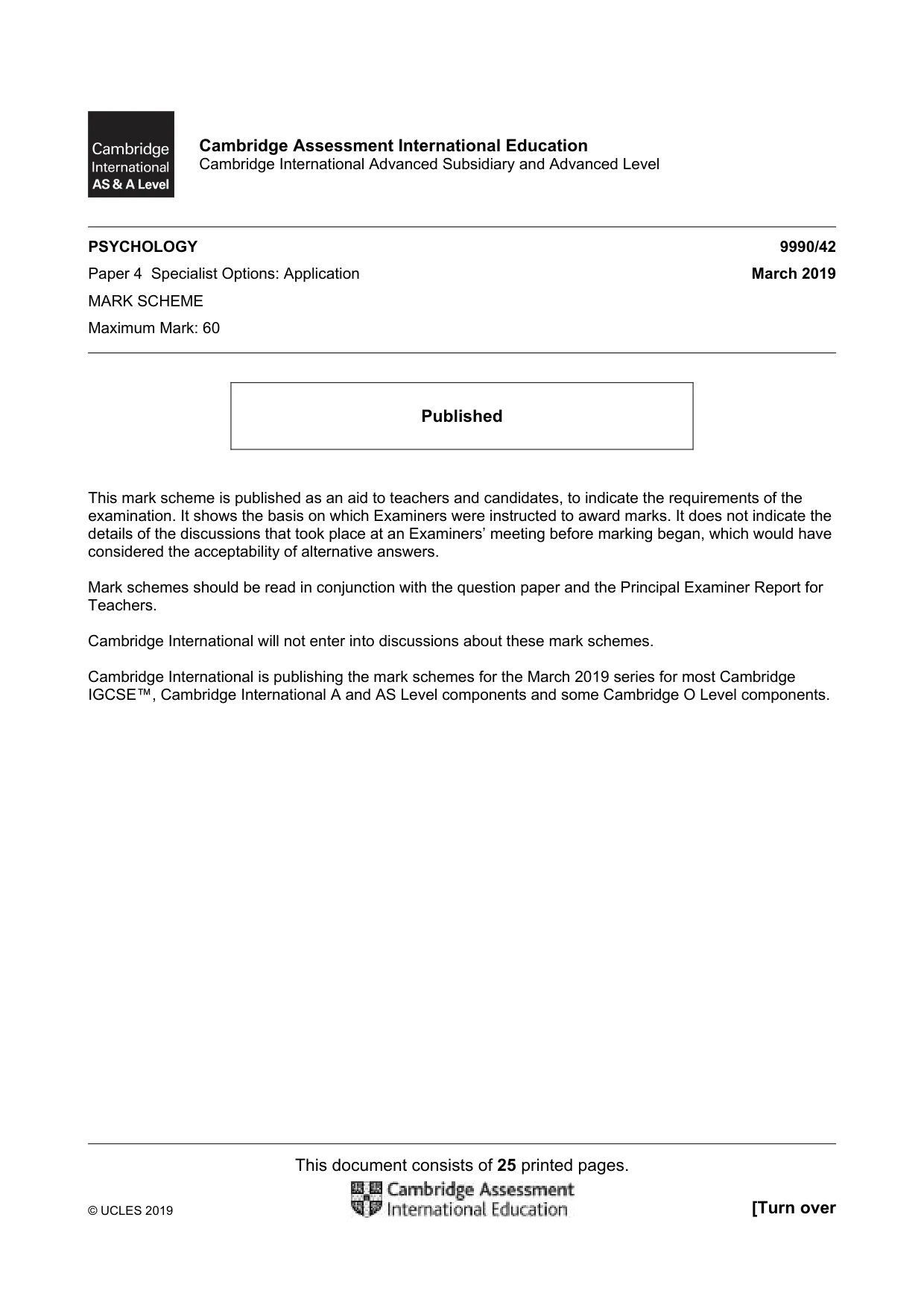
9 ‘A case study of a person with schizophrenia will reveal more about the disorder than any other method.’ To what extent do you agree with this statement? Use examples of research you have studied to support your answer. [12] Psychology and consumer behaviour
Mark scheme: 9 ‘A case study of a person with schizophrenia will reveal more about 12 the disorder than any other method.’ To what extent do you agree with this statement? Use examples of research you have studied to support your answer. Marks: use generic levels of response in table C. Syllabus: definitions, types, examples and case studies of schizophrenia and psychotic disorders Most likely (any other appropriate responses should be credited): For: • A case study allows a focus on an individual in depth, perhaps over time and using a range of different methods. • Far more can be known about the specific problems, and how it affects the life of that person. • A range of tests, techniques and methods can be used as appropriate. Against: • It is a study of one person whose problems might be unique • Generalising to others from one person is restricted; everyone’s problems might be different. • What is needed is to find what those with the disorder have in common and this cannot be done with a case study.
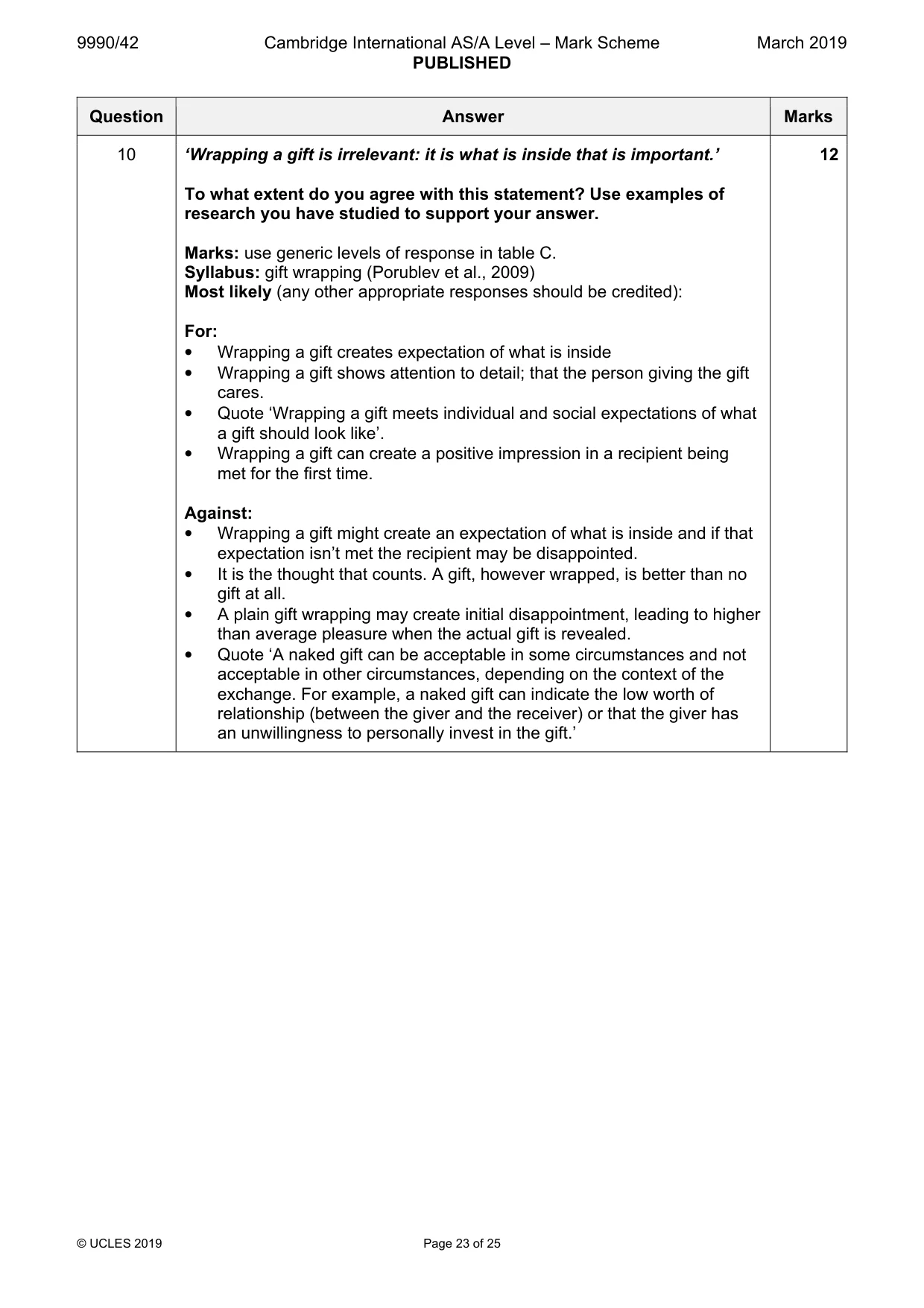
Q10 · ‘Wrapping a gift is irrelevant; it is what is inside that is important.’ To what extent…
10 ‘Wrapping a gift is irrelevant; it is what is inside that is important.’ To what extent do you agree with this statement? Use examples of research you have studied to support your answer. [12] Psychology and health
Mark scheme: 10 ‘Wrapping a gift is irrelevant: it is what is inside that is important.’ 12 To what extent do you agree with this statement? Use examples of research you have studied to support your answer. Marks: use generic levels of response in table C. Syllabus: gift wrapping (Porublev et al., 2009) Most likely (any other appropriate responses should be credited): For: • Wrapping a gift creates expectation of what is inside • Wrapping a gift shows attention to detail; that the person giving the gift cares. • Quote ‘Wrapping a gift meets individual and social expectations of what a gift should look like’. • Wrapping a gift can create a positive impression in a recipient being met for the first time. Against: • Wrapping a gift might create an expectation of what is inside and if that expectation isn’t met the recipient may be disappointed. • It is the thought that counts. A gift, however wrapped, is better than no gift at all. • A plain gift wrapping may create initial disappointment, leading to higher than average pleasure when the actual gift is revealed. • Quote ‘A naked gift can be acceptable in some circumstances and not acceptable in other circumstances, depending on the context of the exchange. For example, a naked gift can indicate the low worth of relationship (between the giver and the receiver) or that the giver has an unwillingness to personally invest in the gift.’
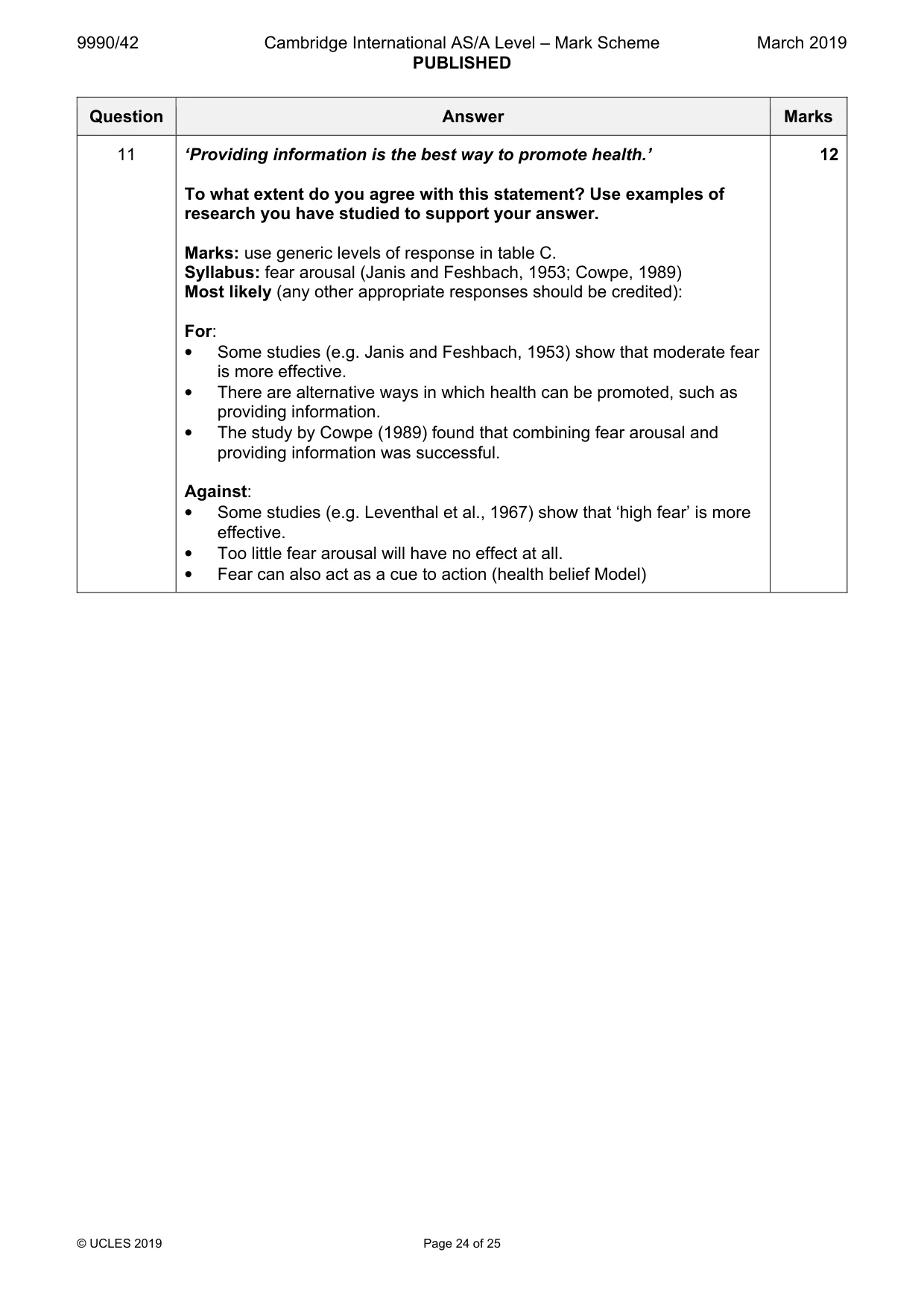
Q11 · ‘Providing information is the best way to promote health.’ To what extent do you agree…
11 ‘Providing information is the best way to promote health.’ To what extent do you agree with this statement? Use examples of research you have studied to support your answer. [12] Psychology and organisations
Mark scheme: 11 ‘Providing information is the best way to promote health.’ 12 To what extent do you agree with this statement? Use examples of research you have studied to support your answer. Marks: use generic levels of response in table C. Syllabus: fear arousal (Janis and Feshbach, 1953; Cowpe, 1989) Most likely (any other appropriate responses should be credited): For: • Some studies (e.g. Janis and Feshbach, 1953) show that moderate fear is more effective. • There are alternative ways in which health can be promoted, such as providing information. • The study by Cowpe (1989) found that combining fear arousal and providing information was successful. Against: • Some studies (e.g. Leventhal et al., 1967) show that ‘high fear’ is more effective. • Too little fear arousal will have no effect at all. • Fear can also act as a cue to action (health belief Model)
More questions on 2 Health promotion in schools and worksites
Q12 · ‘Belbin’s team role inventory is not a psychometric test.’ To what extent do you agree…
12 ‘Belbin’s team role inventory is not a psychometric test.’ To what extent do you agree with this statement? Use examples of research you have studied to support your answer. [12]
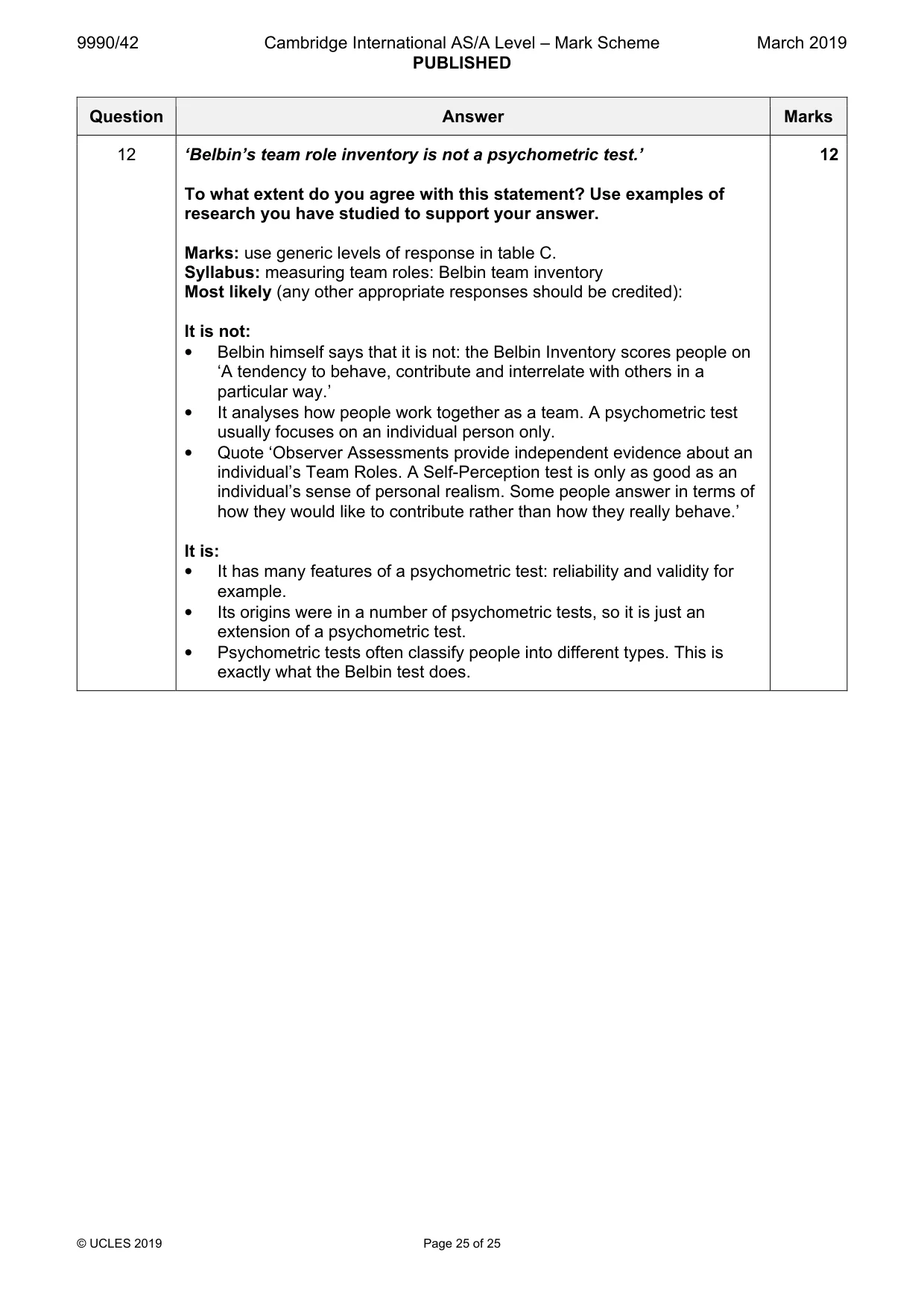
Mark scheme: 12 ‘Belbin’s team role inventory is not a psychometric test.’ 12 To what extent do you agree with this statement? Use examples of research you have studied to support your answer. Marks: use generic levels of response in table C. Syllabus: measuring team roles: Belbin team inventory Most likely (any other appropriate responses should be credited): It is not: • Belbin himself says that it is not: the Belbin Inventory scores people on ‘A tendency to behave, contribute and interrelate with others in a particular way.’ • It analyses how people work together as a team. A psychometric test usually focuses on an individual person only. • Quote ‘Observer Assessments provide independent evidence about an individual’s Team Roles. A Self-Perception test is only as good as an individual’s sense of personal realism. Some people answer in terms of how they would like to contribute rather than how they really behave.’ It is: • It has many features of a psychometric test: reliability and validity for example. • Its origins were in a number of psychometric tests, so it is just an extension of a psychometric test. • Psychometric tests often classify people into different types. This is exactly what the Belbin test does.
What was in this paper
The subtopics covered by these 12 questions, and how many questions each got. Open one in a new tab to see every Cambridge question on it.
What you needed in this session
Cambridge’s own grade thresholds for 2019 Feb/March, Paper 4 · Variant 2. A higher threshold means an easier paper — the bar moves with how the cohort did.