Cambridge A Level Psychology (from 2018) 9990 — 2025 May/June Paper 4 · Variant 2
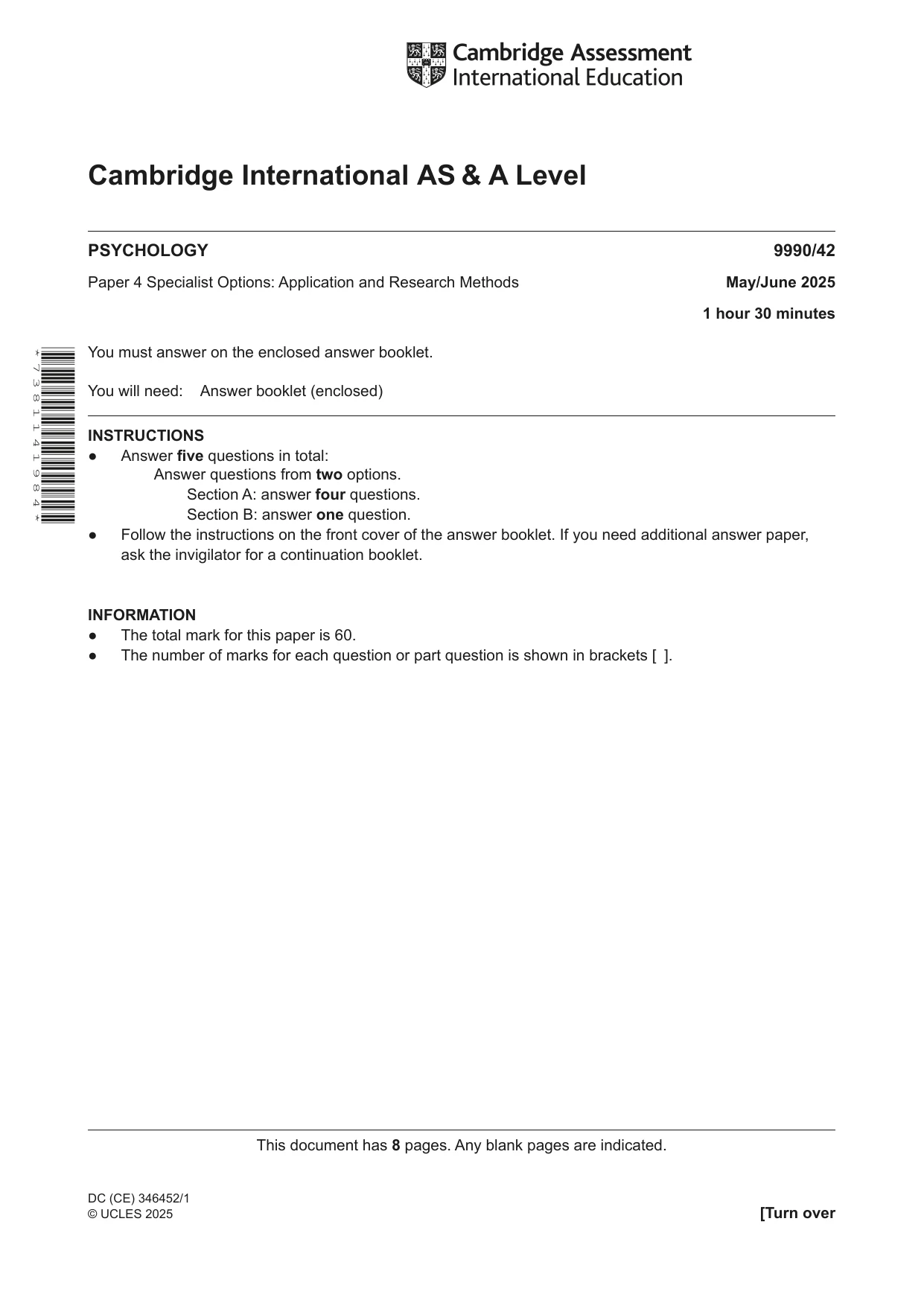
9990/42/M/J/25 · 12 questions · 60 marks · 90 min
The question paper and its mark scheme, free to read here and free to download. This is Cambridge’s own paper, exactly as it was sat.
Question paper8 pages



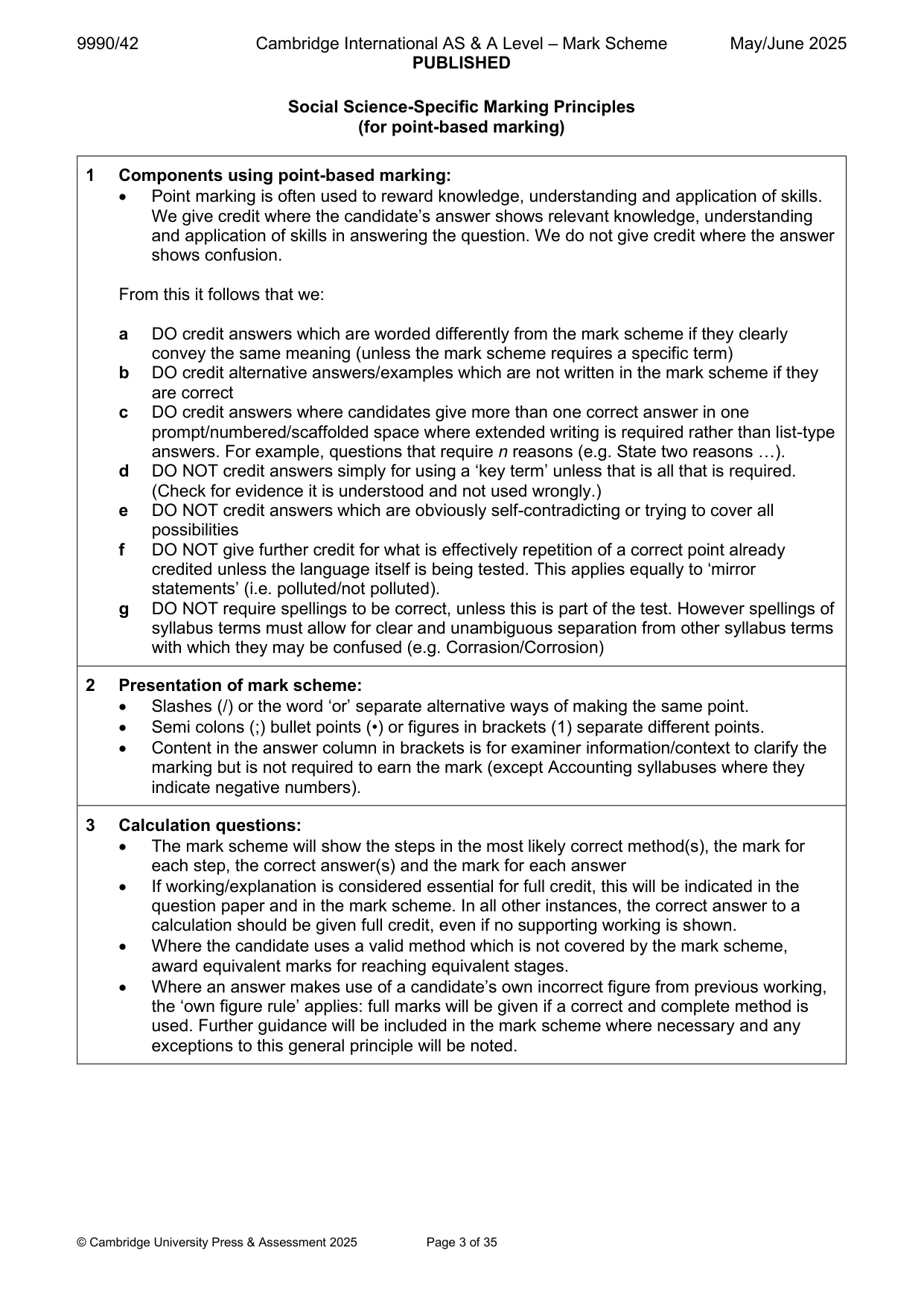
Mark scheme35 pages
Answers below. Sit the paper first if you are practising.

Questions as text
Q1 · In the key study by Freeman et al
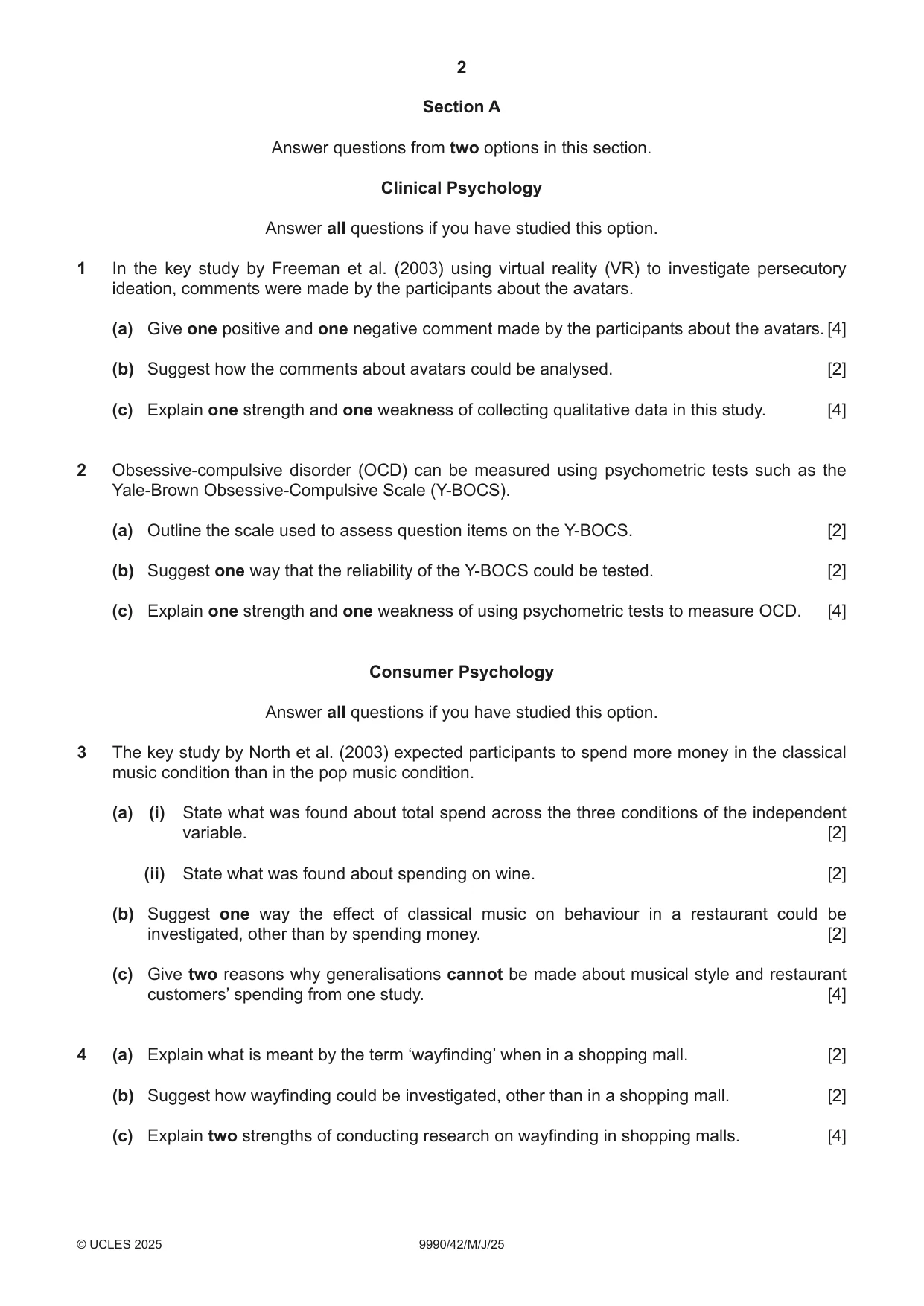
1 In the key study by Freeman et al. (2003) using virtual reality (VR) to investigate persecutory ideation, comments were made by the participants about the avatars. (a) Give one positive and one negative comment made by the participants about the avatars. [4] (b) Suggest how the comments about avatars could be analysed. [2] (c) Explain one strength and one weakness of collecting qualitative data in this study. [4]
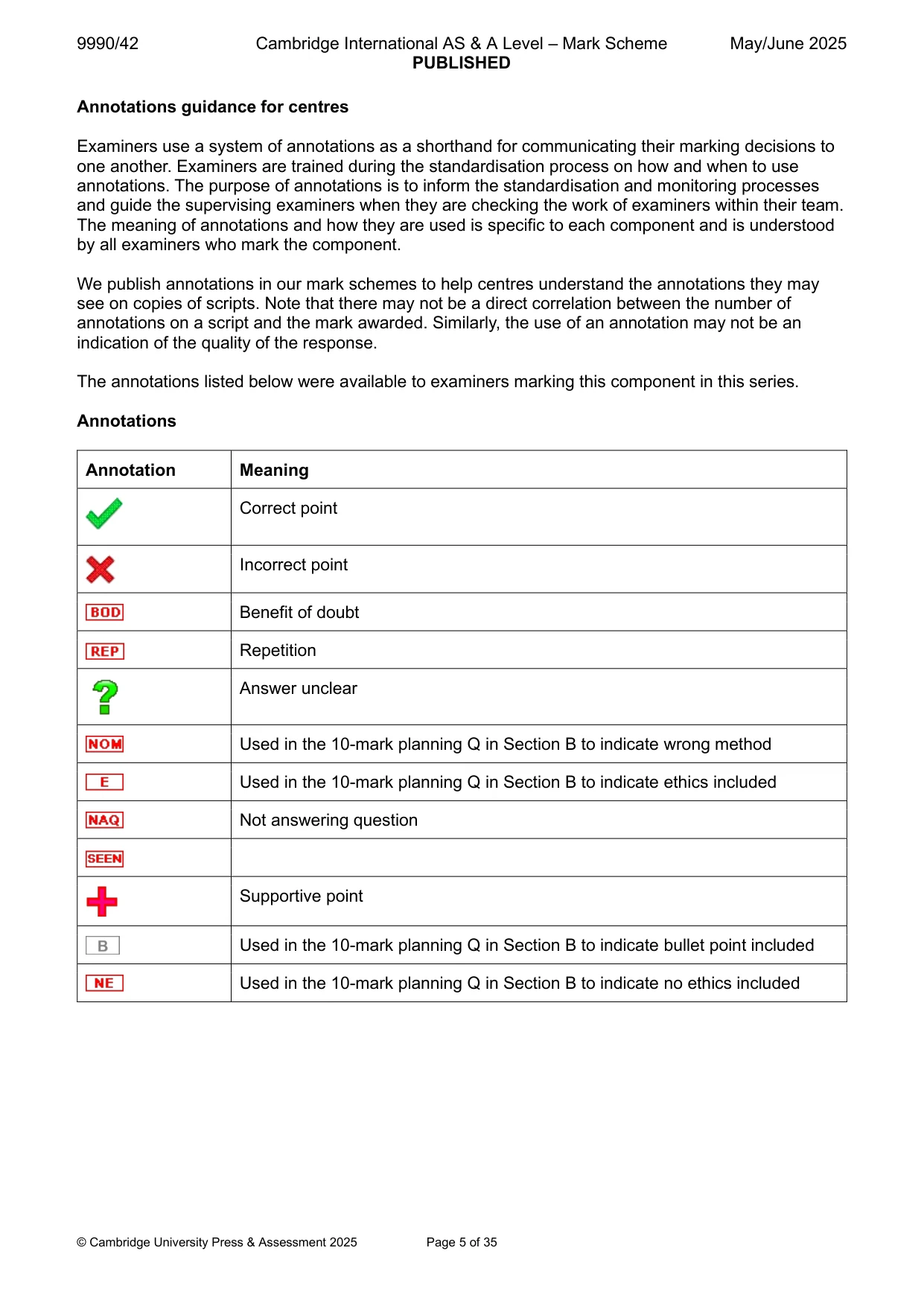
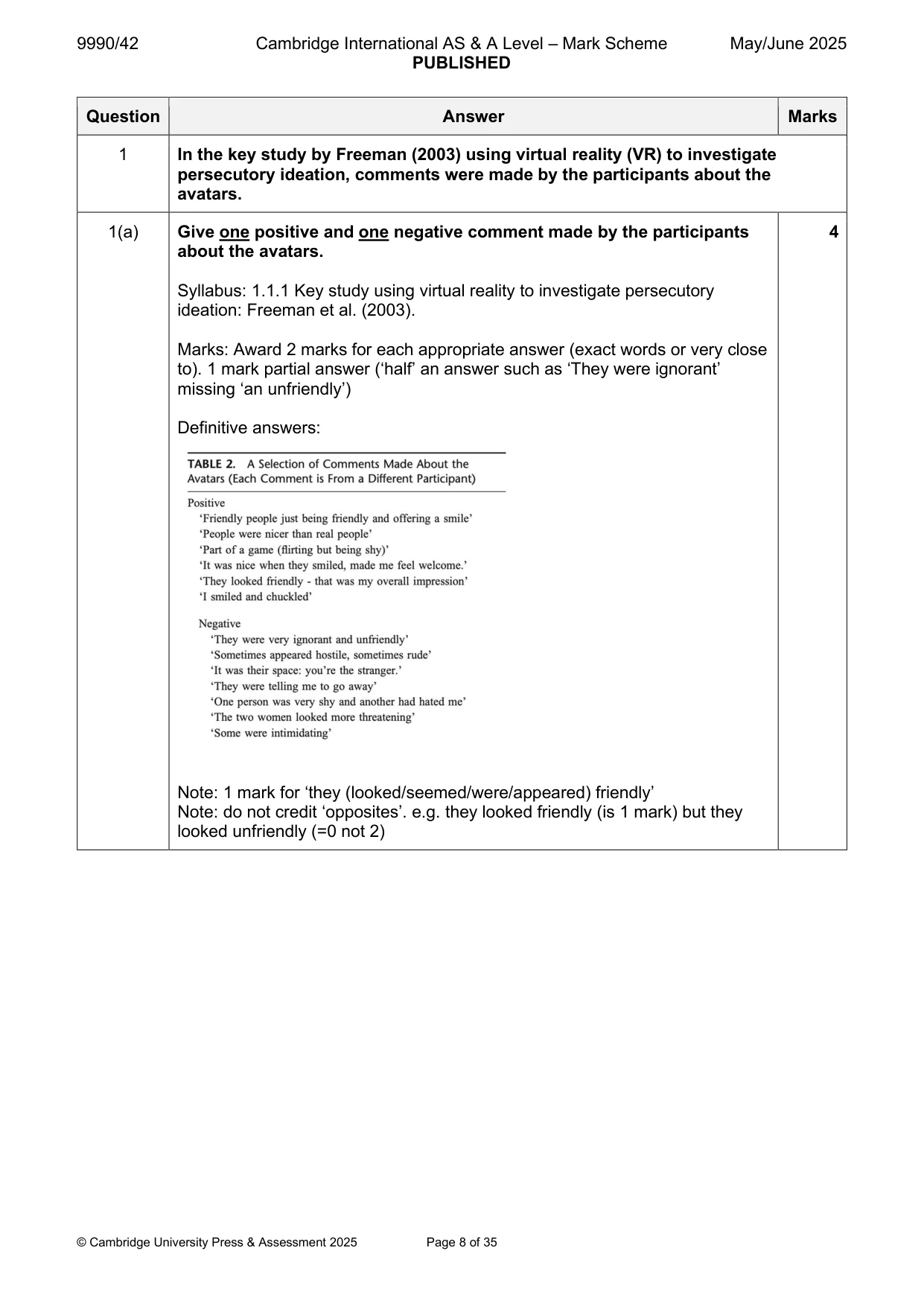
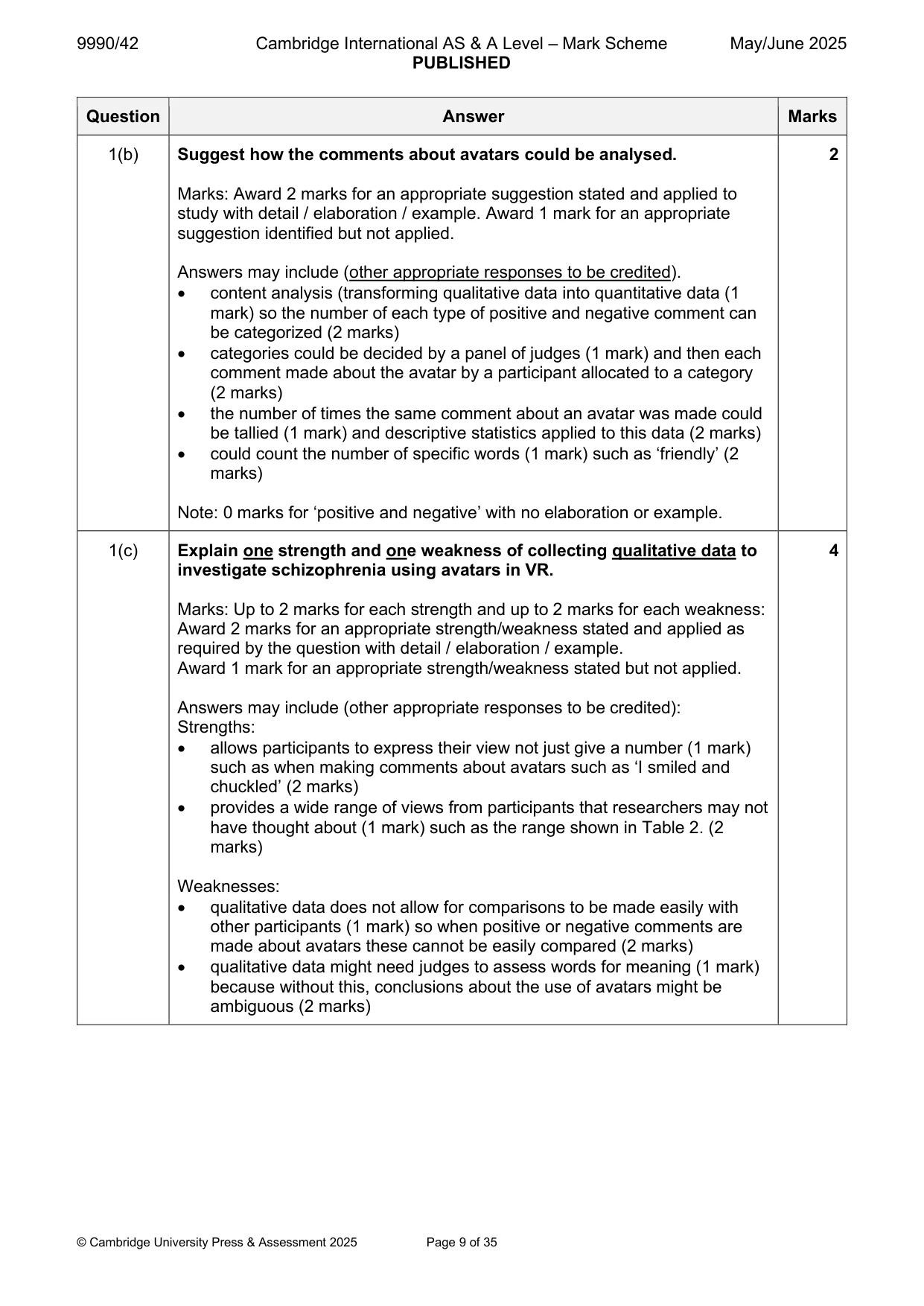
Mark scheme: Question Answer Marks 1 In the key study by Freeman (2003) using virtual reality (VR) to investigate persecutory ideation, comments were made by the participants about the avatars. 1(a) Give one positive and one negative comment made by the participants 4 about the avatars. Syllabus: 1.1.1 Key study using virtual reality to investigate persecutory ideation: Freeman et al. (2003). Marks: Award 2 marks for each appropriate answer (exact words or very close to). 1 mark partial answer (‘half’ an answer such as ‘They were ignorant’ missing ‘an unfriendly’) Definitive answers: Note: 1 mark for ‘they (looked/seemed/were/appeared) friendly’ Note: do not credit ‘opposites’. e.g. they looked friendly (is 1 mark) but they looked unfriendly (=0 not 2) 1(b) Suggest how the comments about avatars could be analysed. 2 Marks: Award 2 marks for an appropriate suggestion stated and applied to study with detail / elaboration / example. Award 1 mark for an appropriate suggestion identified but not applied. Answers may include (other appropriate responses to be credited). • content analysis (transforming qualitative data into quantitative data (1 mark) so the number of each type of positive and negative comment can be categorized (2 marks) • categories could be decided by a panel of judges (1 mark) and then each comment made about the avatar by a participant allocated to a category (2 marks) • the number of times the same comment about an avatar was made could be tallied (1 mark) and descriptive statistics applied to this data (2 marks) • could count the number of specific words (1 mark) such as ‘friendly’ (2 marks) Note: 0 marks for ‘positive and negative’ with no elaboration or example. 1(c) Explain one strength and one weakness of collecting qualitative data to 4 investigate schizophrenia using avatars in VR. Marks: Up to 2 marks for each strength and up to 2 marks for each weakness: Award 2 marks for an appropriate strength/weakness stated and applied as required by the question with detail / elaboration / example. Award 1 mark for an appropriate strength/weakness stated but not applied. Answers may include (other appropriate responses to be credited): Strengths: • allows participants to express their view not just give a number (1 mark) such as when making comments about avatars such as ‘I smiled and chuckled’ (2 marks) • provides a wide range of views from participants that researchers may not have thought about (1 mark) such as the range shown in Table 2. (2 marks) Weaknesses: • qualitative data does not allow for comparisons to be made easily with other participants (1 mark) so when positive or negative comments are made about avatars these cannot be easily compared (2 marks) • qualitative data might need judges to assess words for meaning (1 mark) because without this, conclusions about the use of avatars might be ambiguous (2 marks)
Q2 · Obsessive-compulsive disorder (OCD) can be measured using psychometric tests such as the…
2 Obsessive-compulsive disorder (OCD) can be measured using psychometric tests such as the Yale-Brown Obsessive-Compulsive Scale (Y-BOCS). (a) Outline the scale used to assess question items on the Y-BOCS. [2] (b) Suggest one way that the reliability of the Y-BOCS could be tested. [2] (c) Explain one strength and one weakness of using psychometric tests to measure OCD. [4] Consumer Psychology Answer all questions if you have studied this option.
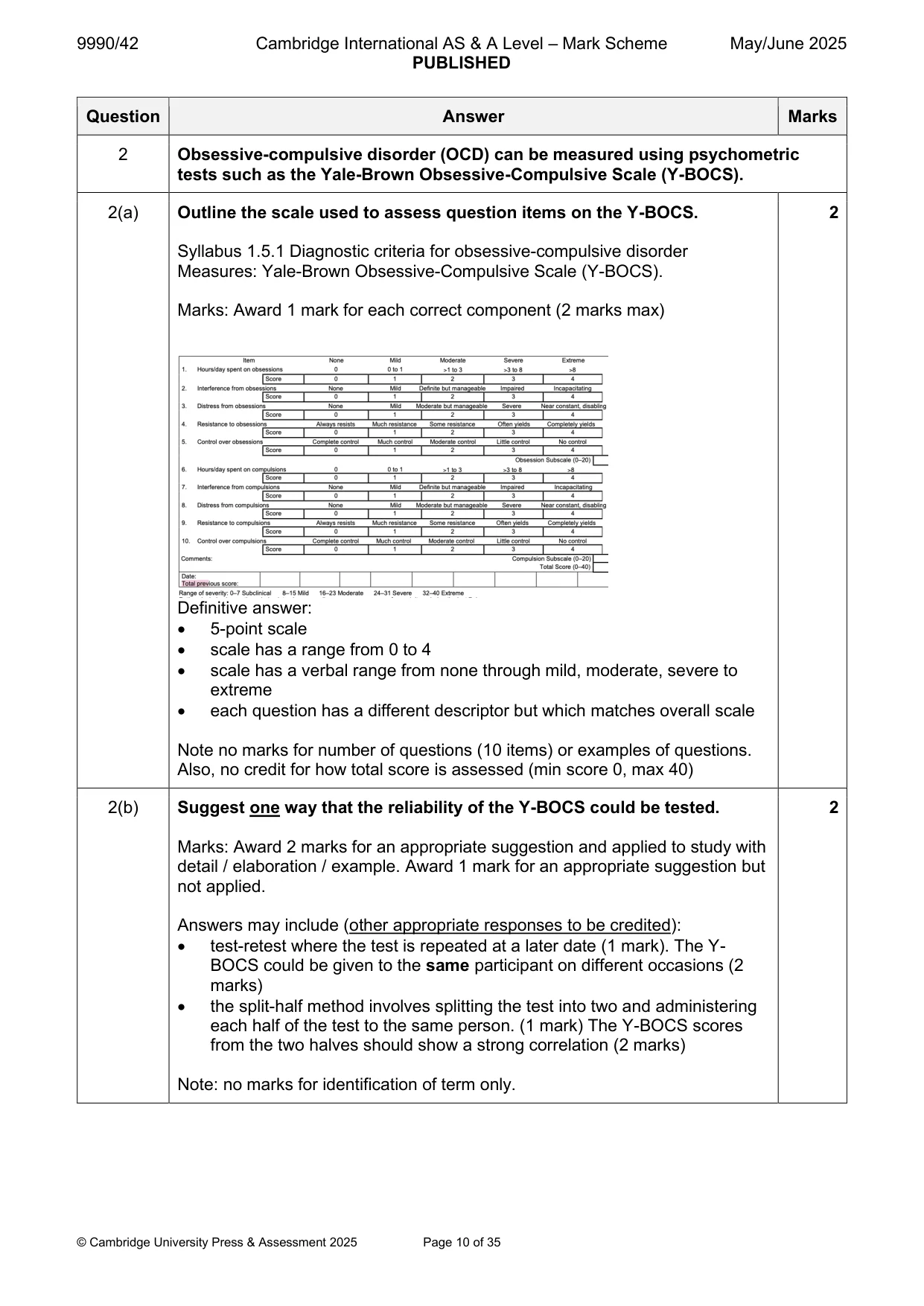
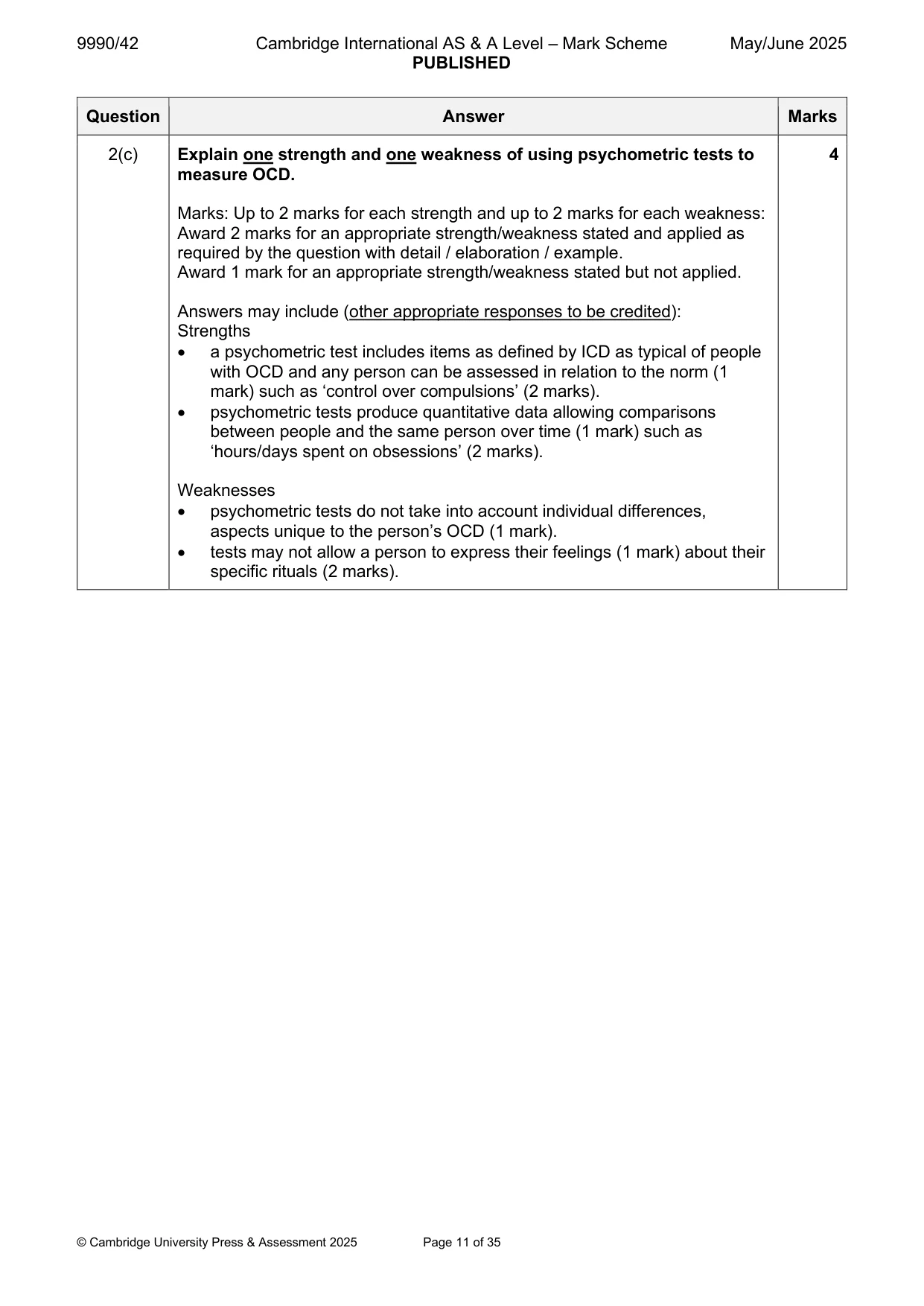
Mark scheme: 2(a) Outline the scale used to assess question items on the Y-BOCS. 2 Syllabus 1.5.1 Diagnostic criteria for obsessive-compulsive disorder Measures: Yale-Brown Obsessive-Compulsive Scale (Y-BOCS). Marks: Award 1 mark for each correct component (2 marks max) Definitive answer: • 5-point scale • scale has a range from 0 to 4 • scale has a verbal range from none through mild, moderate, severe to extreme • each question has a different descriptor but which matches overall scale Note no marks for number of questions (10 items) or examples of questions. Also, no credit for how total score is assessed (min score 0, max 40) 2(b) Suggest one way that the reliability of the Y-BOCS could be tested. 2 Marks: Award 2 marks for an appropriate suggestion and applied to study with detail / elaboration / example. Award 1 mark for an appropriate suggestion but not applied. Answers may include (other appropriate responses to be credited): • test-retest where the test is repeated at a later date (1 mark). The Y- BOCS could be given to the same participant on different occasions (2 marks) • the split-half method involves splitting the test into two and administering each half of the test to the same person. (1 mark) The Y-BOCS scores from the two halves should show a strong correlation (2 marks) Note: no marks for identification of term only. 2(c) Explain one strength and one weakness of using psychometric tests to 4 measure OCD. Marks: Up to 2 marks for each strength and up to 2 marks for each weakness: Award 2 marks for an appropriate strength/weakness stated and applied as required by the question with detail / elaboration / example. Award 1 mark for an appropriate strength/weakness stated but not applied. Answers may include (other appropriate responses to be credited): Strengths • a psychometric test includes items as defined by ICD as typical of people with OCD and any person can be assessed in relation to the norm (1 mark) such as ‘control over compulsions’ (2 marks). • psychometric tests produce quantitative data allowing comparisons between people and the same person over time (1 mark) such as ‘hours/days spent on obsessions’ (2 marks). Weaknesses • psychometric tests do not take into account individual differences, aspects unique to the person’s OCD (1 mark). • tests may not allow a person to express their feelings (1 mark) about their specific rituals (2 marks).
Q3 · The key study by North et al
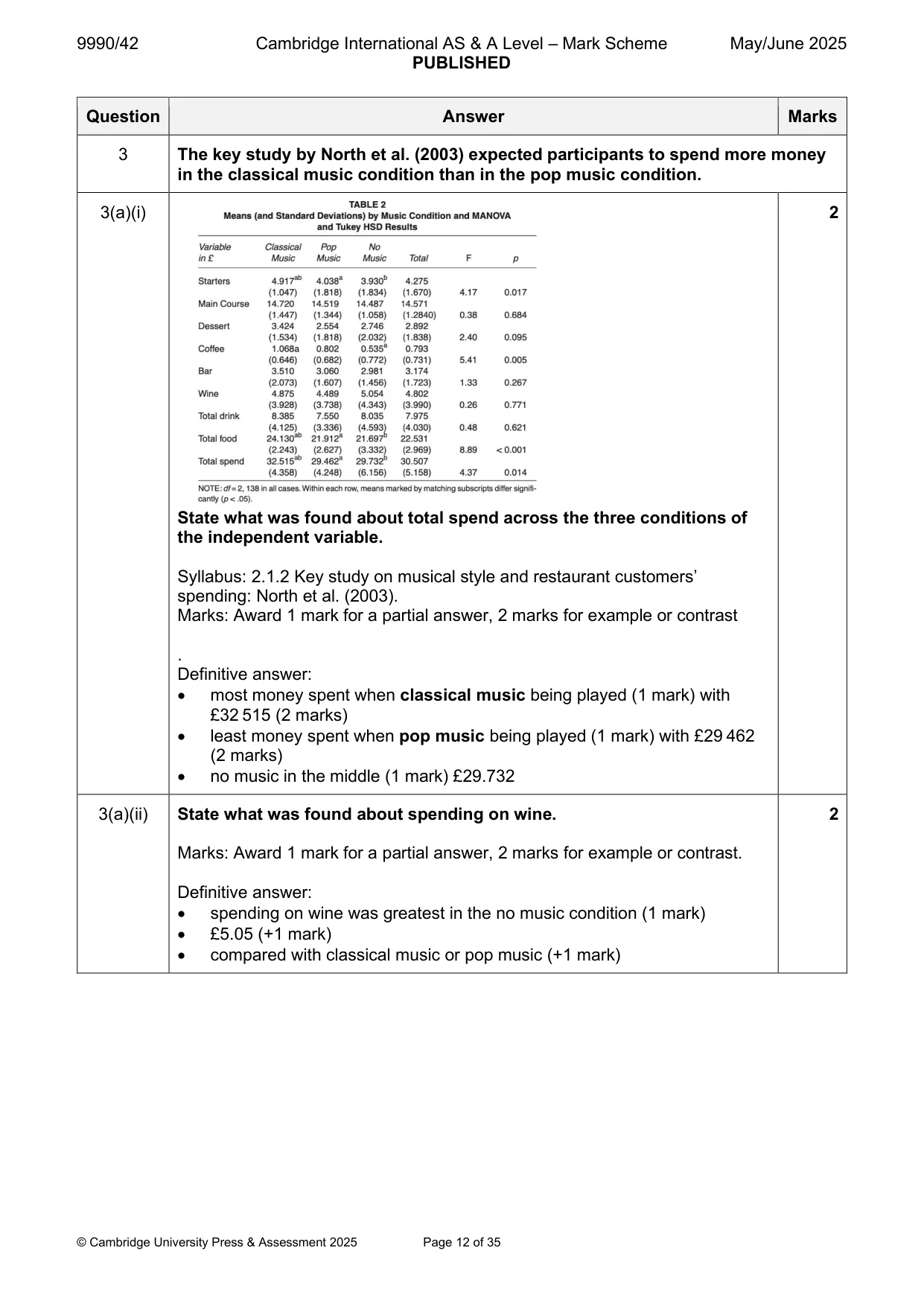
3 The key study by North et al. (2003) expected participants to spend more money in the classical music condition than in the pop music condition. (a) (i) State what was found about total spend across the three conditions of the independent variable. [2] (ii) State what was found about spending on wine. [2] (b) Suggest one way the effect of classical music on behaviour in a restaurant could be investigated, other than by spending money. [2] (c) Give two reasons why generalisations cannot be made about musical style and restaurant customers’ spending from one study. [4]
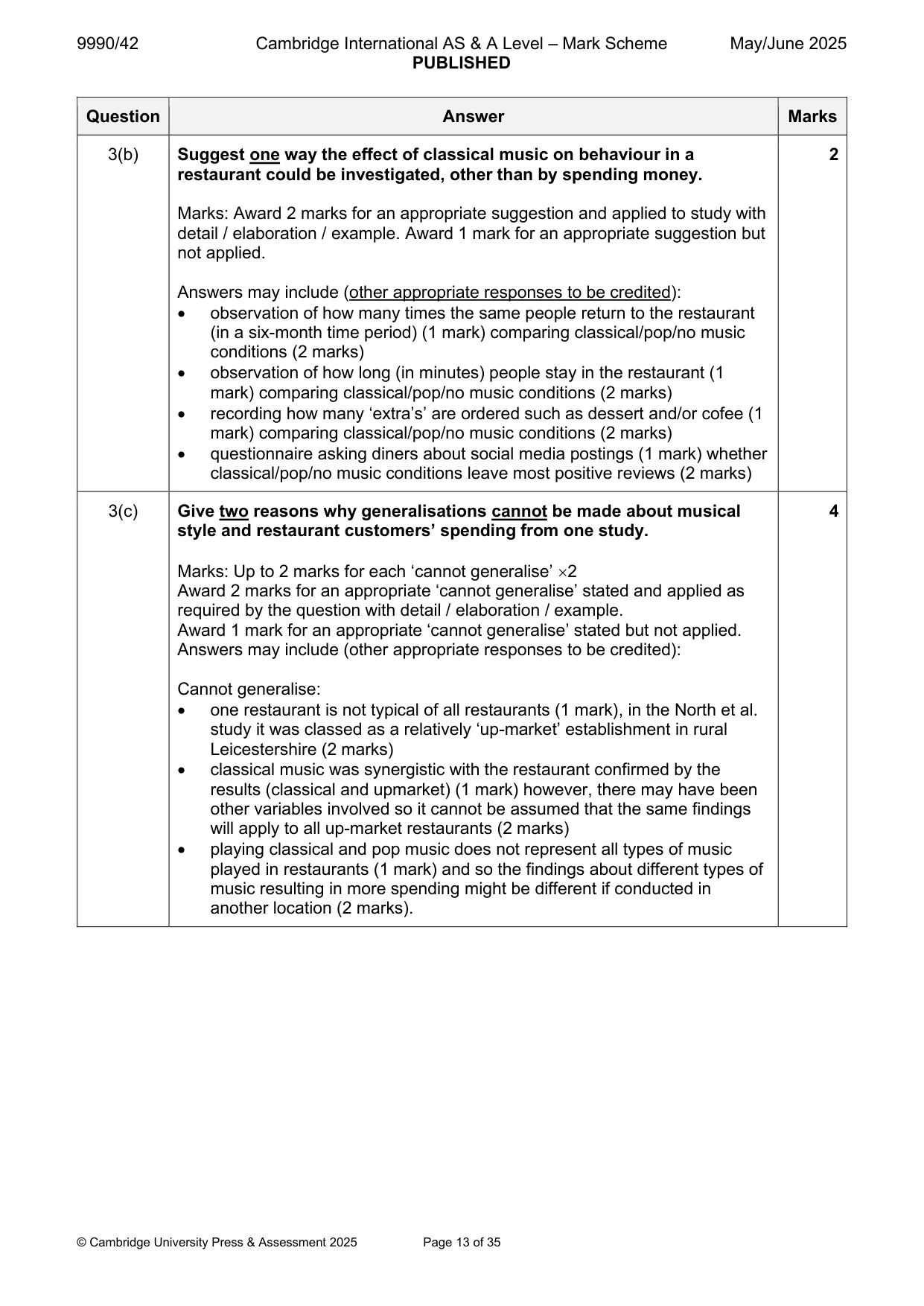
Mark scheme: 3(a)(i) 2 State what was found about total spend across the three conditions of the independent variable. Syllabus: 2.1.2 Key study on musical style and restaurant customers’ spending: North et al. (2003). Marks: Award 1 mark for a partial answer, 2 marks for example or contrast . Definitive answer: • most money spent when classical music being played (1 mark) with £32 515 (2 marks) • least money spent when pop music being played (1 mark) with £29 462 (2 marks) • no music in the middle (1 mark) £29.732 3(a)(ii) State what was found about spending on wine. 2 Marks: Award 1 mark for a partial answer, 2 marks for example or contrast. Definitive answer: • spending on wine was greatest in the no music condition (1 mark) • £5.05 (+1 mark) • compared with classical music or pop music (+1 mark) 3(b) Suggest one way the effect of classical music on behaviour in a 2 restaurant could be investigated, other than by spending money. Marks: Award 2 marks for an appropriate suggestion and applied to study with detail / elaboration / example. Award 1 mark for an appropriate suggestion but not applied. Answers may include (other appropriate responses to be credited): • observation of how many times the same people return to the restaurant (in a six-month time period) (1 mark) comparing classical/pop/no music conditions (2 marks) • observation of how long (in minutes) people stay in the restaurant (1 mark) comparing classical/pop/no music conditions (2 marks) • recording how many ‘extra’s’ are ordered such as dessert and/or cofee (1 mark) comparing classical/pop/no music conditions (2 marks) • questionnaire asking diners about social media postings (1 mark) whether classical/pop/no music conditions leave most positive reviews (2 marks) 3(c) Give two reasons why generalisations cannot be made about musical 4 style and restaurant customers’ spending from one study. Marks: Up to 2 marks for each ‘cannot generalise’ 2 Award 2 marks for an appropriate ‘cannot generalise’ stated and applied as required by the question with detail / elaboration / example. Award 1 mark for an appropriate ‘cannot generalise’ stated but not applied. Answers may include (other appropriate responses to be credited): Cannot generalise: • one restaurant is not typical of all restaurants (1 mark), in the North et al. study it was classed as a relatively ‘up-market’ establishment in rural Leicestershire (2 marks) • classical music was synergistic with the restaurant confirmed by the results (classical and upmarket) (1 mark) however, there may have been other variables involved so it cannot be assumed that the same findings will apply to all up-market restaurants (2 marks) • playing classical and pop music does not represent all types of music played in restaurants (1 mark) and so the findings about different types of music resulting in more spending might be different if conducted in another location (2 marks).
Q4 · Explain what is meant by the term ‘wayfinding’ when in a shopping mall
4 (a) Explain what is meant by the term ‘wayfinding’ when in a shopping mall. [2] (b) Suggest how wayfinding could be investigated, other than in a shopping mall. [2] (c) Explain two strengths of conducting research on wayfinding in shopping malls. [4] Health Psychology Answer all questions if you have studied this option.
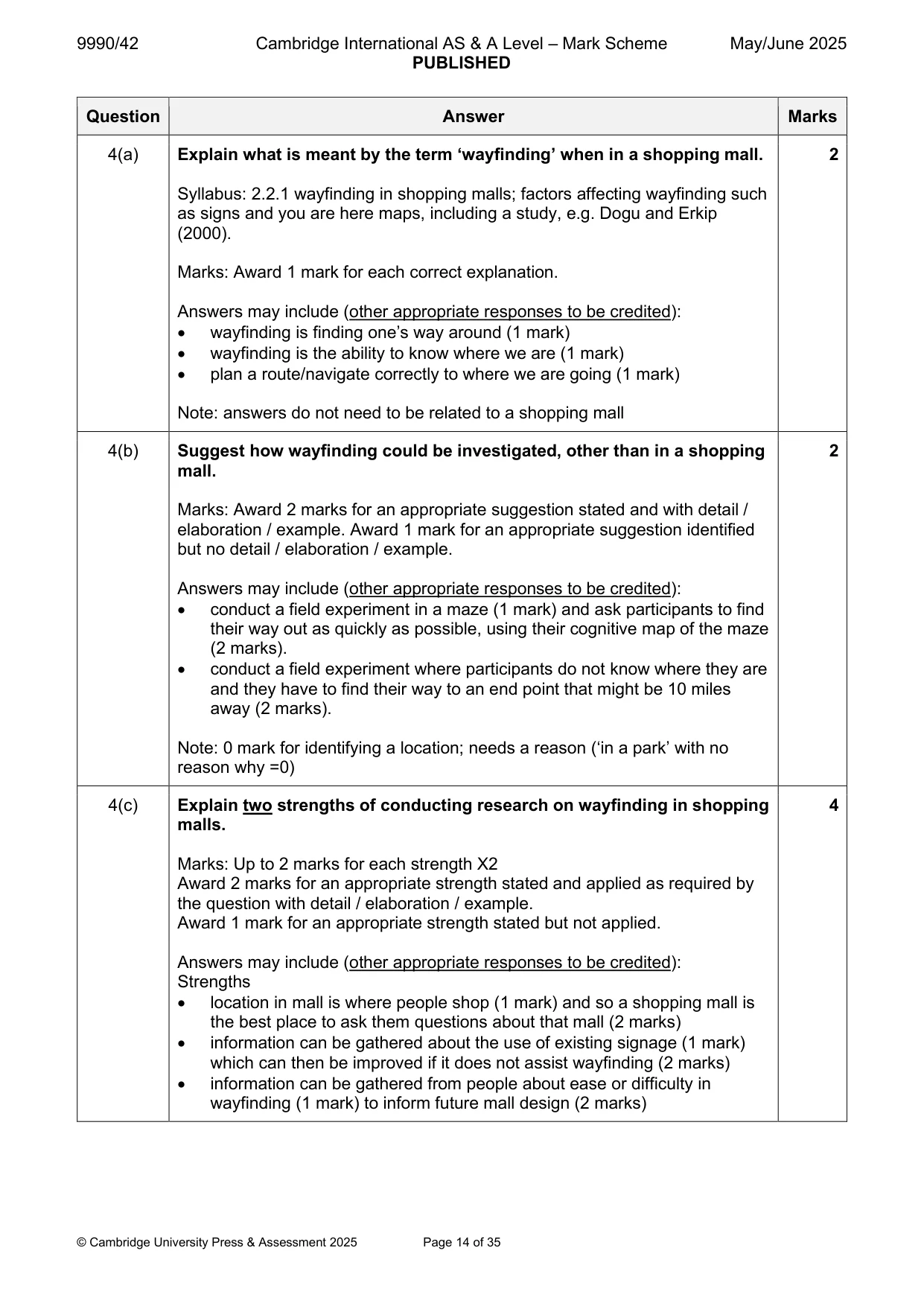
Mark scheme: 4(a) Explain what is meant by the term ‘wayfinding’ when in a shopping mall. 2 Syllabus: 2.2.1 wayfinding in shopping malls; factors affecting wayfinding such as signs and you are here maps, including a study, e.g. Dogu and Erkip (2000). Marks: Award 1 mark for each correct explanation. Answers may include (other appropriate responses to be credited): • wayfinding is finding one’s way around (1 mark) • wayfinding is the ability to know where we are (1 mark) • plan a route/navigate correctly to where we are going (1 mark) Note: answers do not need to be related to a shopping mall 4(b) Suggest how wayfinding could be investigated, other than in a shopping 2 mall. Marks: Award 2 marks for an appropriate suggestion stated and with detail / elaboration / example. Award 1 mark for an appropriate suggestion identified but no detail / elaboration / example. Answers may include (other appropriate responses to be credited): • conduct a field experiment in a maze (1 mark) and ask participants to find their way out as quickly as possible, using their cognitive map of the maze (2 marks). • conduct a field experiment where participants do not know where they are and they have to find their way to an end point that might be 10 miles away (2 marks). Note: 0 mark for identifying a location; needs a reason (‘in a park’ with no reason why =0) 4(c) Explain two strengths of conducting research on wayfinding in shopping 4 malls. Marks: Up to 2 marks for each strength X2 Award 2 marks for an appropriate strength stated and applied as required by the question with detail / elaboration / example. Award 1 mark for an appropriate strength stated but not applied. Answers may include (other appropriate responses to be credited): Strengths • location in mall is where people shop (1 mark) and so a shopping mall is the best place to ask them questions about that mall (2 marks) • information can be gathered about the use of existing signage (1 mark) which can then be improved if it does not assist wayfinding (2 marks) • information can be gathered from people about ease or difficulty in wayfinding (1 mark) to inform future mall design (2 marks)
Q5 · From the key study by Yokley and Glenwick (1984) on improving medical adherence using…
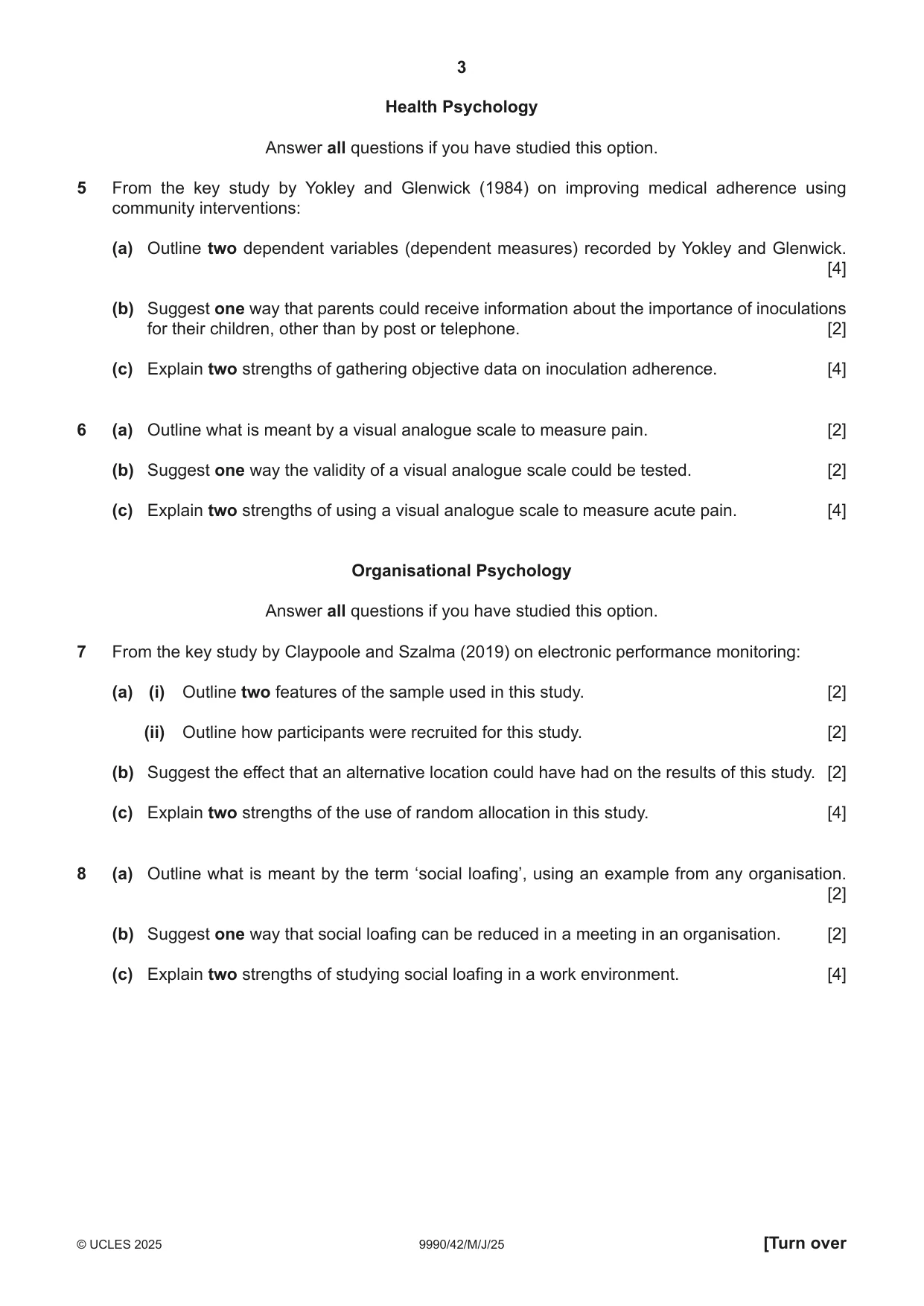
5 From the key study by Yokley and Glenwick (1984) on improving medical adherence using community interventions: (a) Outline two dependent variables (dependent measures) recorded by Yokley and Glenwick. [4] (b) Suggest one way that parents could receive information about the importance of inoculations for their children, other than by post or telephone. [2] (c) Explain two strengths of gathering objective data on inoculation adherence. [4]
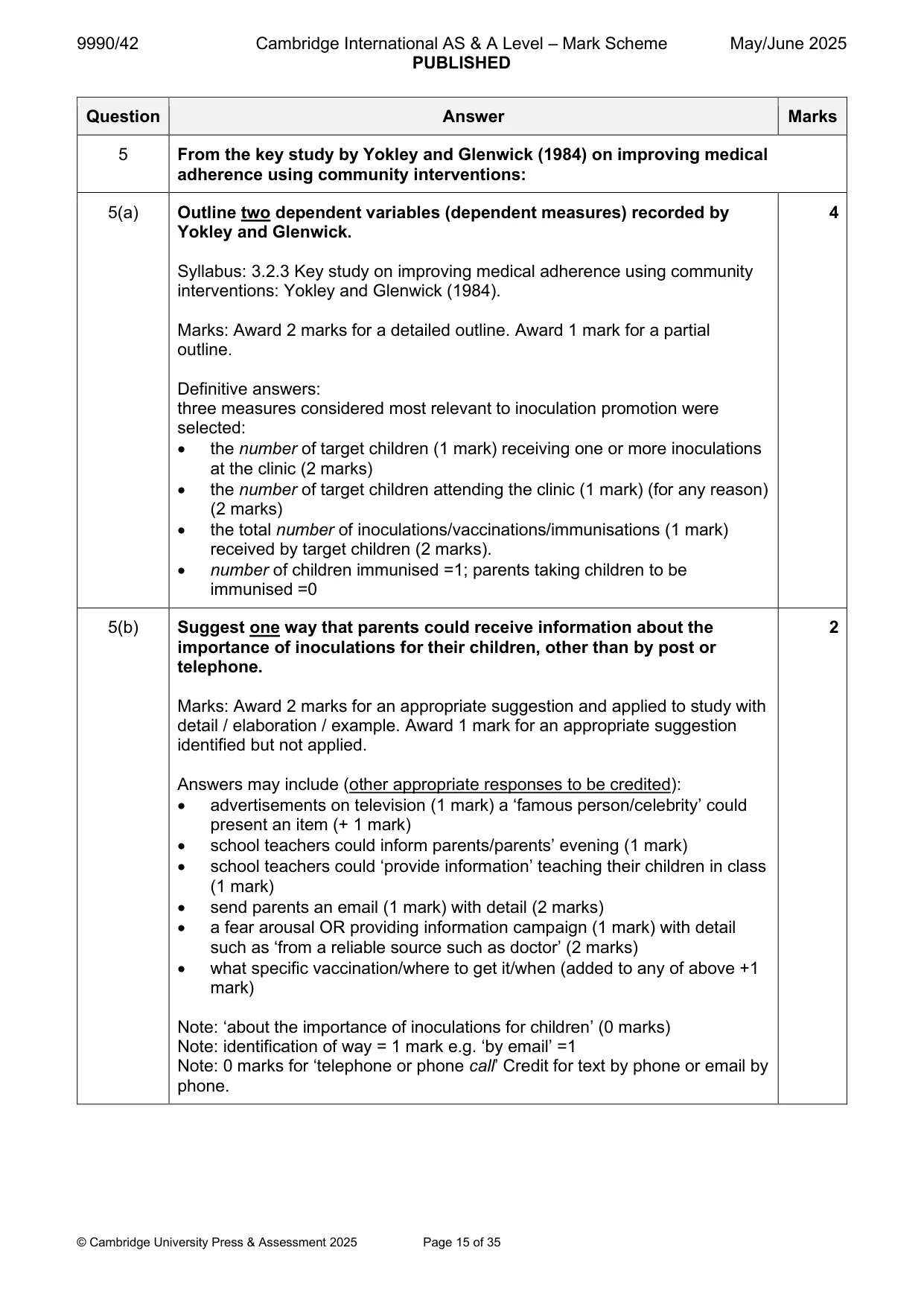
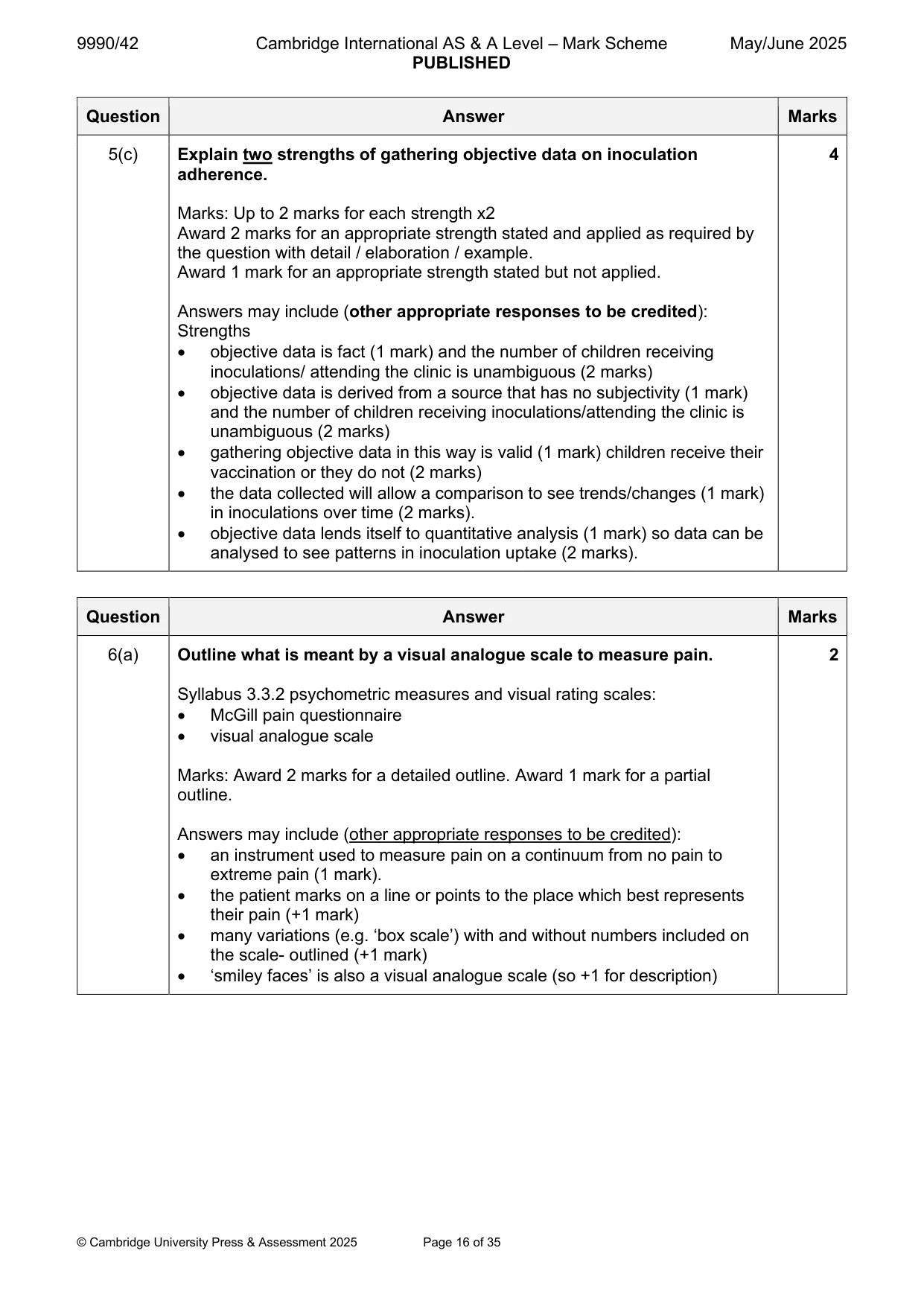
Mark scheme: 5(a) Outline two dependent variables (dependent measures) recorded by 4 Yokley and Glenwick. Syllabus: 3.2.3 Key study on improving medical adherence using community interventions: Yokley and Glenwick (1984). Marks: Award 2 marks for a detailed outline. Award 1 mark for a partial outline. Definitive answers: three measures considered most relevant to inoculation promotion were selected: • the number of target children (1 mark) receiving one or more inoculations at the clinic (2 marks) • the number of target children attending the clinic (1 mark) (for any reason) (2 marks) • the total number of inoculations/vaccinations/immunisations (1 mark) received by target children (2 marks). • number of children immunised =1; parents taking children to be immunised =0 5(b) Suggest one way that parents could receive information about the 2 importance of inoculations for their children, other than by post or telephone. Marks: Award 2 marks for an appropriate suggestion and applied to study with detail / elaboration / example. Award 1 mark for an appropriate suggestion identified but not applied. Answers may include (other appropriate responses to be credited): • advertisements on television (1 mark) a ‘famous person/celebrity’ could present an item (+ 1 mark) • school teachers could inform parents/parents’ evening (1 mark) • school teachers could ‘provide information’ teaching their children in class (1 mark) • send parents an email (1 mark) with detail (2 marks) • a fear arousal OR providing information campaign (1 mark) with detail such as ‘from a reliable source such as doctor’ (2 marks) • what specific vaccination/where to get it/when (added to any of above +1 mark) Note: ‘about the importance of inoculations for children’ (0 marks) Note: identification of way = 1 mark e.g. ‘by email’ =1 Note: 0 marks for ‘telephone or phone call’ Credit for text by phone or email by phone. 5(c) Explain two strengths of gathering objective data on inoculation 4 adherence. Marks: Up to 2 marks for each strength x2 Award 2 marks for an appropriate strength stated and applied as required by the question with detail / elaboration / example. Award 1 mark for an appropriate strength stated but not applied. Answers may include (other appropriate responses to be credited): Strengths • objective data is fact (1 mark) and the number of children receiving inoculations/ attending the clinic is unambiguous (2 marks) • objective data is derived from a source that has no subjectivity (1 mark) and the number of children receiving inoculations/attending the clinic is unambiguous (2 marks) • gathering objective data in this way is valid (1 mark) children receive their vaccination or they do not (2 marks) • the data collected will allow a comparison to see trends/changes (1 mark) in inoculations over time (2 marks). • objective data lends itself to quantitative analysis (1 mark) so data can be analysed to see patterns in inoculation uptake (2 marks).
More questions on 2 Health promotion in schools and worksites
Q6 · Outline what is meant by a visual analogue scale to measure pain
6 (a) Outline what is meant by a visual analogue scale to measure pain. [2] (b) Suggest one way the validity of a visual analogue scale could be tested. [2] (c) Explain two strengths of using a visual analogue scale to measure acute pain. [4] Organisational Psychology Answer all questions if you have studied this option.
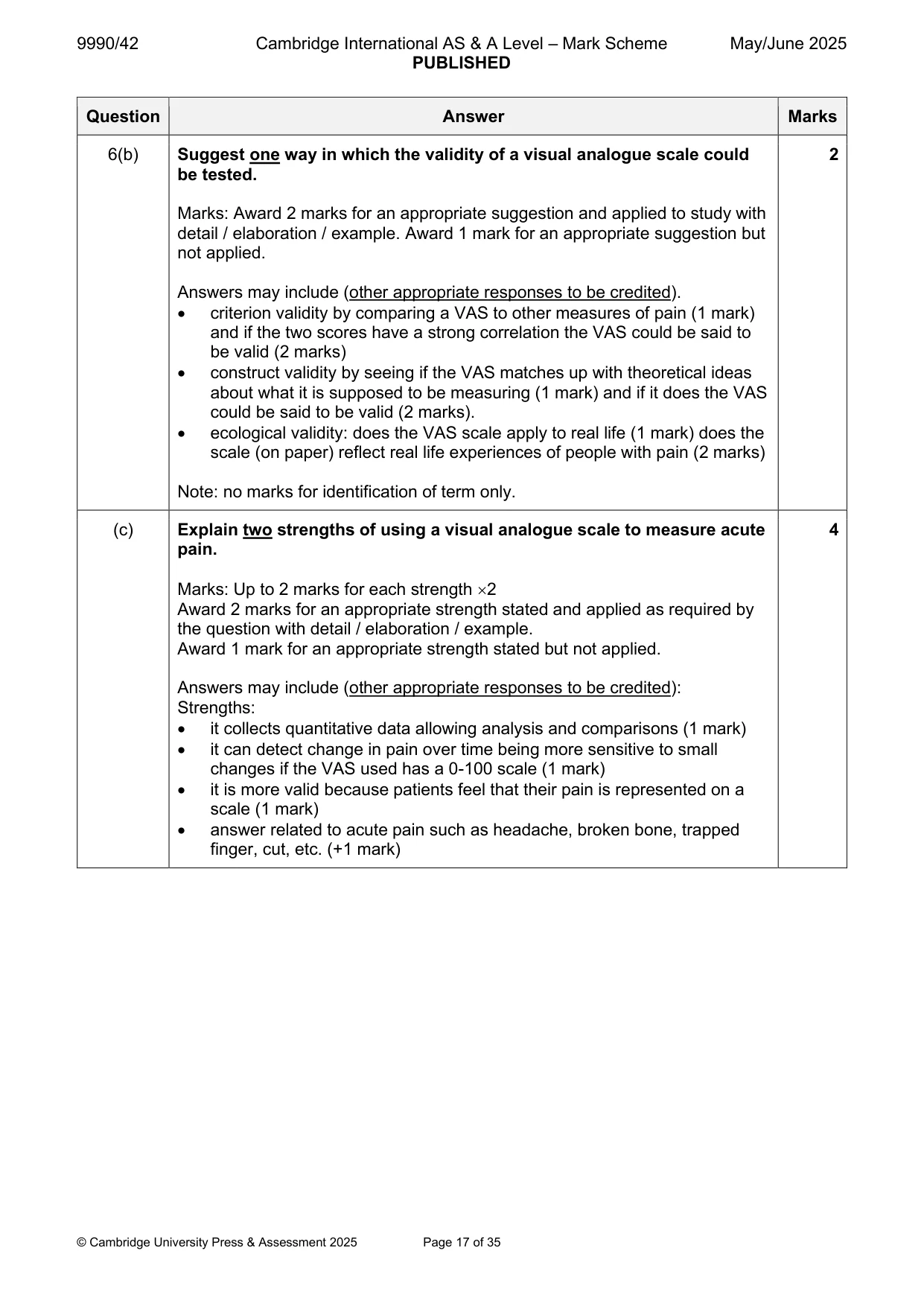
Mark scheme: 6(a) Outline what is meant by a visual analogue scale to measure pain. 2 Syllabus 3.3.2 psychometric measures and visual rating scales: • McGill pain questionnaire • visual analogue scale Marks: Award 2 marks for a detailed outline. Award 1 mark for a partial outline. Answers may include (other appropriate responses to be credited): • an instrument used to measure pain on a continuum from no pain to extreme pain (1 mark). • the patient marks on a line or points to the place which best represents their pain (+1 mark) • many variations (e.g. ‘box scale’) with and without numbers included on the scale- outlined (+1 mark) • ‘smiley faces’ is also a visual analogue scale (so +1 for description) 6(b) Suggest one way in which the validity of a visual analogue scale could 2 be tested. Marks: Award 2 marks for an appropriate suggestion and applied to study with detail / elaboration / example. Award 1 mark for an appropriate suggestion but not applied. Answers may include (other appropriate responses to be credited). • criterion validity by comparing a VAS to other measures of pain (1 mark) and if the two scores have a strong correlation the VAS could be said to be valid (2 marks) • construct validity by seeing if the VAS matches up with theoretical ideas about what it is supposed to be measuring (1 mark) and if it does the VAS could be said to be valid (2 marks). • ecological validity: does the VAS scale apply to real life (1 mark) does the scale (on paper) reflect real life experiences of people with pain (2 marks) Note: no marks for identification of term only. (c) Explain two strengths of using a visual analogue scale to measure acute 4 pain. Marks: Up to 2 marks for each strength 2 Award 2 marks for an appropriate strength stated and applied as required by the question with detail / elaboration / example. Award 1 mark for an appropriate strength stated but not applied. Answers may include (other appropriate responses to be credited): Strengths: • it collects quantitative data allowing analysis and comparisons (1 mark) • it can detect change in pain over time being more sensitive to small changes if the VAS used has a 0-100 scale (1 mark) • it is more valid because patients feel that their pain is represented on a scale (1 mark) • answer related to acute pain such as headache, broken bone, trapped finger, cut, etc. (+1 mark)
Q7 · From the key study by Claypoole and Szalma (2019) on electronic performance monitoring…
7 From the key study by Claypoole and Szalma (2019) on electronic performance monitoring: (a) (i) Outline two features of the sample used in this study. [2] (ii) Outline how participants were recruited for this study. [2] (b) Suggest the effect that an alternative location could have had on the results of this study. [2] (c) Explain two strengths of the use of random allocation in this study. [4]
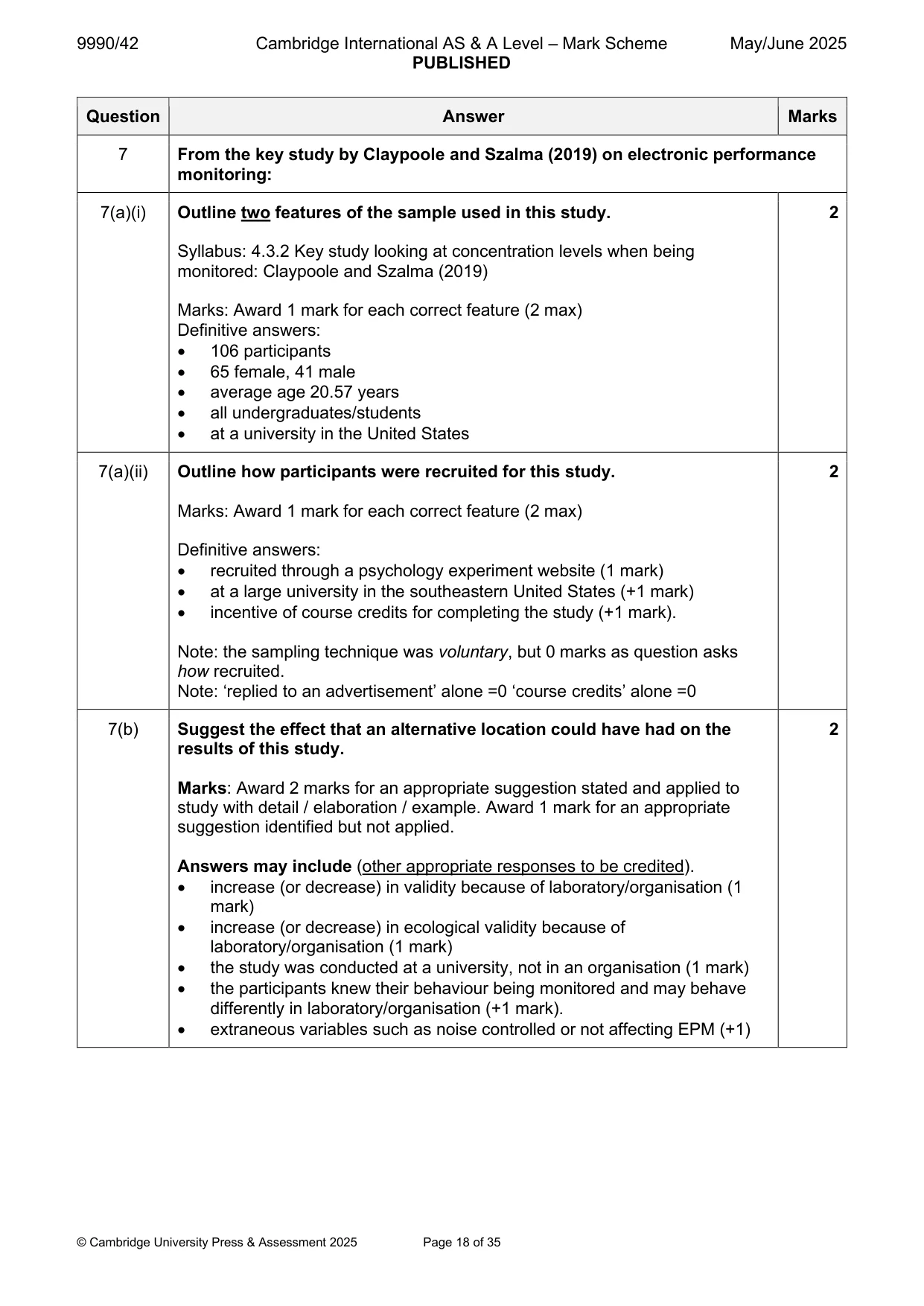
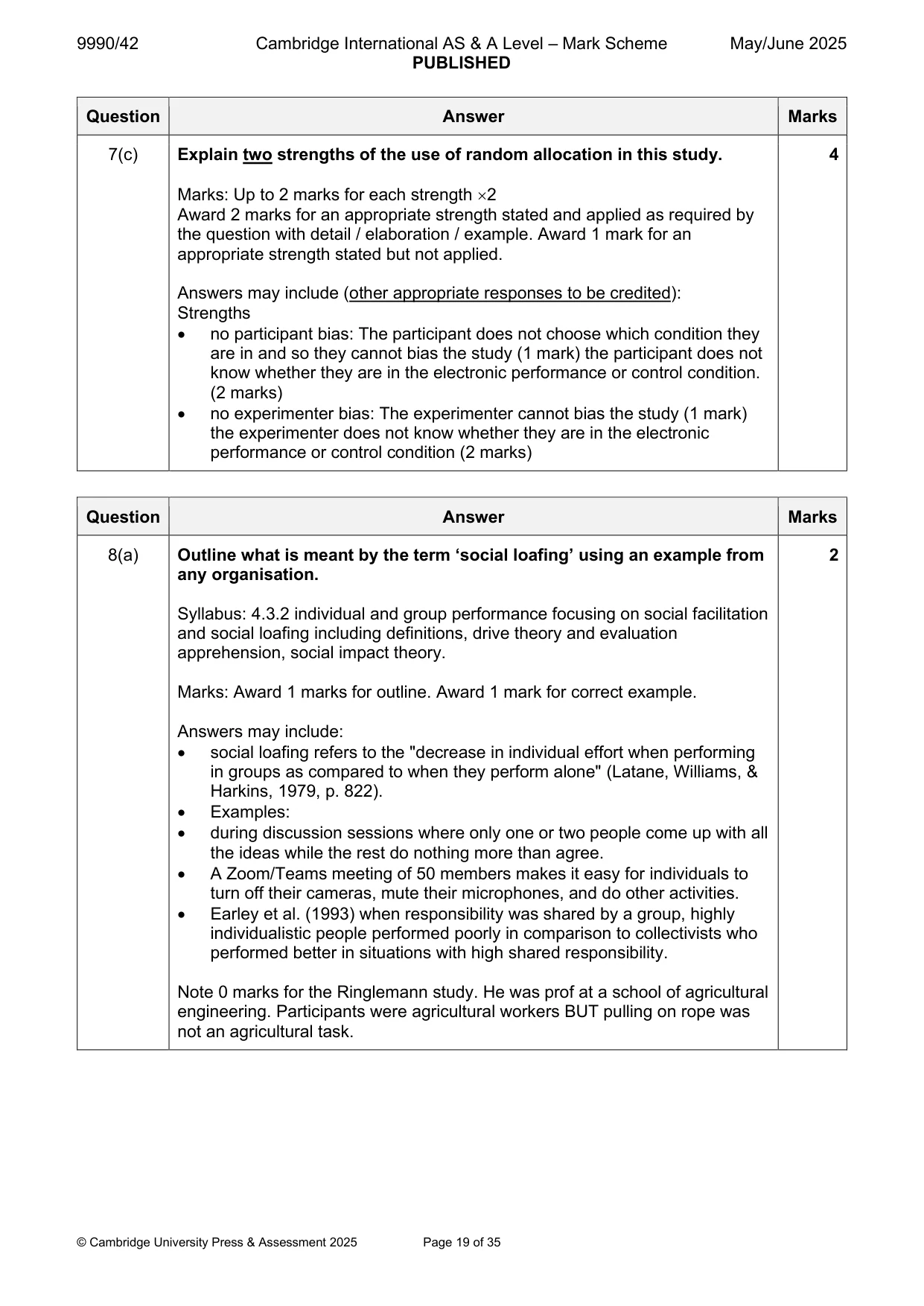
Mark scheme: 7(a)(i) Outline two features of the sample used in this study. 2 Syllabus: 4.3.2 Key study looking at concentration levels when being monitored: Claypoole and Szalma (2019) Marks: Award 1 mark for each correct feature (2 max) Definitive answers: • 106 participants • 65 female, 41 male • average age 20.57 years • all undergraduates/students • at a university in the United States 7(a)(ii) Outline how participants were recruited for this study. 2 Marks: Award 1 mark for each correct feature (2 max) Definitive answers: • recruited through a psychology experiment website (1 mark) • at a large university in the southeastern United States (+1 mark) • incentive of course credits for completing the study (+1 mark). Note: the sampling technique was voluntary, but 0 marks as question asks how recruited. Note: ‘replied to an advertisement’ alone =0 ‘course credits’ alone =0 7(b) Suggest the effect that an alternative location could have had on the 2 results of this study. Marks: Award 2 marks for an appropriate suggestion stated and applied to study with detail / elaboration / example. Award 1 mark for an appropriate suggestion identified but not applied. Answers may include (other appropriate responses to be credited). • increase (or decrease) in validity because of laboratory/organisation (1 mark) • increase (or decrease) in ecological validity because of laboratory/organisation (1 mark) • the study was conducted at a university, not in an organisation (1 mark) • the participants knew their behaviour being monitored and may behave differently in laboratory/organisation (+1 mark). • extraneous variables such as noise controlled or not affecting EPM (+1) 7(c) Explain two strengths of the use of random allocation in this study. 4 Marks: Up to 2 marks for each strength 2 Award 2 marks for an appropriate strength stated and applied as required by the question with detail / elaboration / example. Award 1 mark for an appropriate strength stated but not applied. Answers may include (other appropriate responses to be credited): Strengths • no participant bias: The participant does not choose which condition they are in and so they cannot bias the study (1 mark) the participant does not know whether they are in the electronic performance or control condition. (2 marks) • no experimenter bias: The experimenter cannot bias the study (1 mark) the experimenter does not know whether they are in the electronic performance or control condition (2 marks)
Q8 · Outline what is meant by the term ‘social loafing’, using an example from any organisation
8 (a) Outline what is meant by the term ‘social loafing’, using an example from any organisation. [2] (b) Suggest one way that social loafing can be reduced in a meeting in an organisation. [2] (c) Explain two strengths of studying social loafing in a work environment. [4]
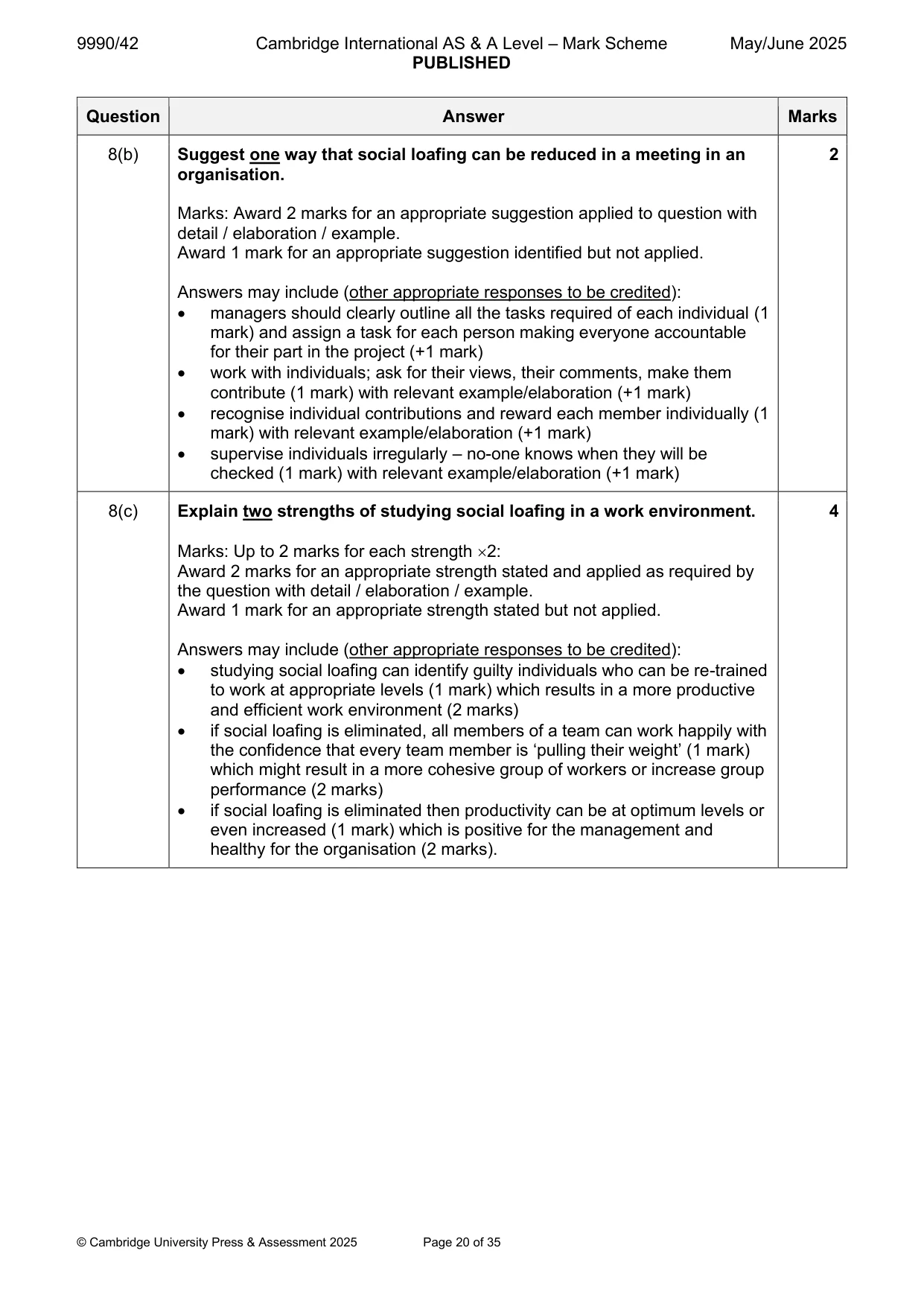
Mark scheme: 8(a) Outline what is meant by the term ‘social loafing’ using an example from 2 any organisation. Syllabus: 4.3.2 individual and group performance focusing on social facilitation and social loafing including definitions, drive theory and evaluation apprehension, social impact theory. Marks: Award 1 marks for outline. Award 1 mark for correct example. Answers may include: • social loafing refers to the "decrease in individual effort when performing in groups as compared to when they perform alone" (Latane, Williams, & Harkins, 1979, p. 822). • Examples: • during discussion sessions where only one or two people come up with all the ideas while the rest do nothing more than agree. • A Zoom/Teams meeting of 50 members makes it easy for individuals to turn off their cameras, mute their microphones, and do other activities. • Earley et al. (1993) when responsibility was shared by a group, highly individualistic people performed poorly in comparison to collectivists who performed better in situations with high shared responsibility. Note 0 marks for the Ringlemann study. He was prof at a school of agricultural engineering. Participants were agricultural workers BUT pulling on rope was not an agricultural task. 8(b) Suggest one way that social loafing can be reduced in a meeting in an 2 organisation. Marks: Award 2 marks for an appropriate suggestion applied to question with detail / elaboration / example. Award 1 mark for an appropriate suggestion identified but not applied. Answers may include (other appropriate responses to be credited): • managers should clearly outline all the tasks required of each individual (1 mark) and assign a task for each person making everyone accountable for their part in the project (+1 mark) • work with individuals; ask for their views, their comments, make them contribute (1 mark) with relevant example/elaboration (+1 mark) • recognise individual contributions and reward each member individually (1 mark) with relevant example/elaboration (+1 mark) • supervise individuals irregularly – no-one knows when they will be checked (1 mark) with relevant example/elaboration (+1 mark) 8(c) Explain two strengths of studying social loafing in a work environment. 4 Marks: Up to 2 marks for each strength 2: Award 2 marks for an appropriate strength stated and applied as required by the question with detail / elaboration / example. Award 1 mark for an appropriate strength stated but not applied. Answers may include (other appropriate responses to be credited): • studying social loafing can identify guilty individuals who can be re-trained to work at appropriate levels (1 mark) which results in a more productive and efficient work environment (2 marks) • if social loafing is eliminated, all members of a team can work happily with the confidence that every team member is ‘pulling their weight’ (1 mark) which might result in a more cohesive group of workers or increase group performance (2 marks) • if social loafing is eliminated then productivity can be at optimum levels or even increased (1 mark) which is positive for the management and healthy for the organisation (2 marks).
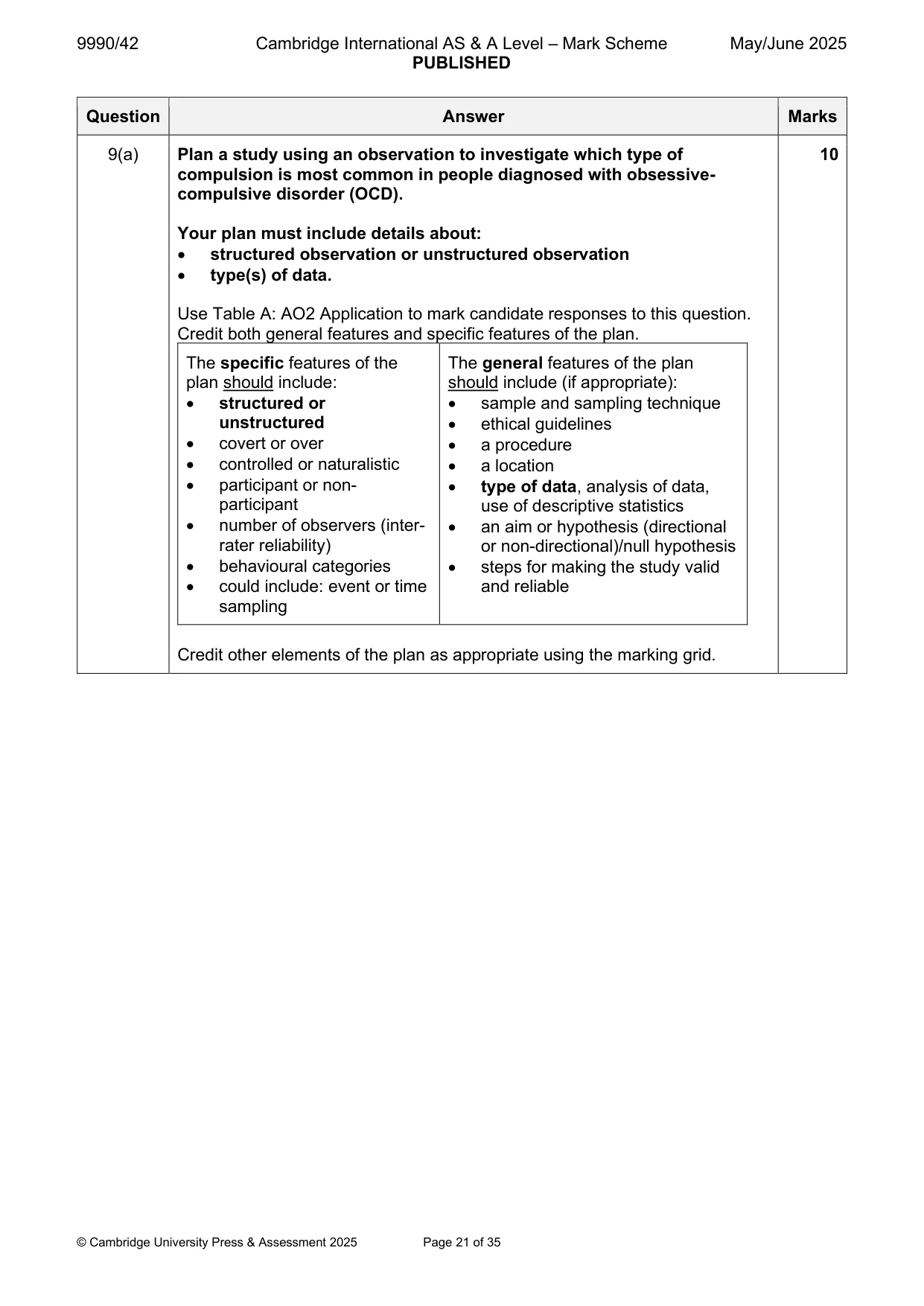
Q9 · Plan a study using an observation to investigate which type of compulsion is most common…
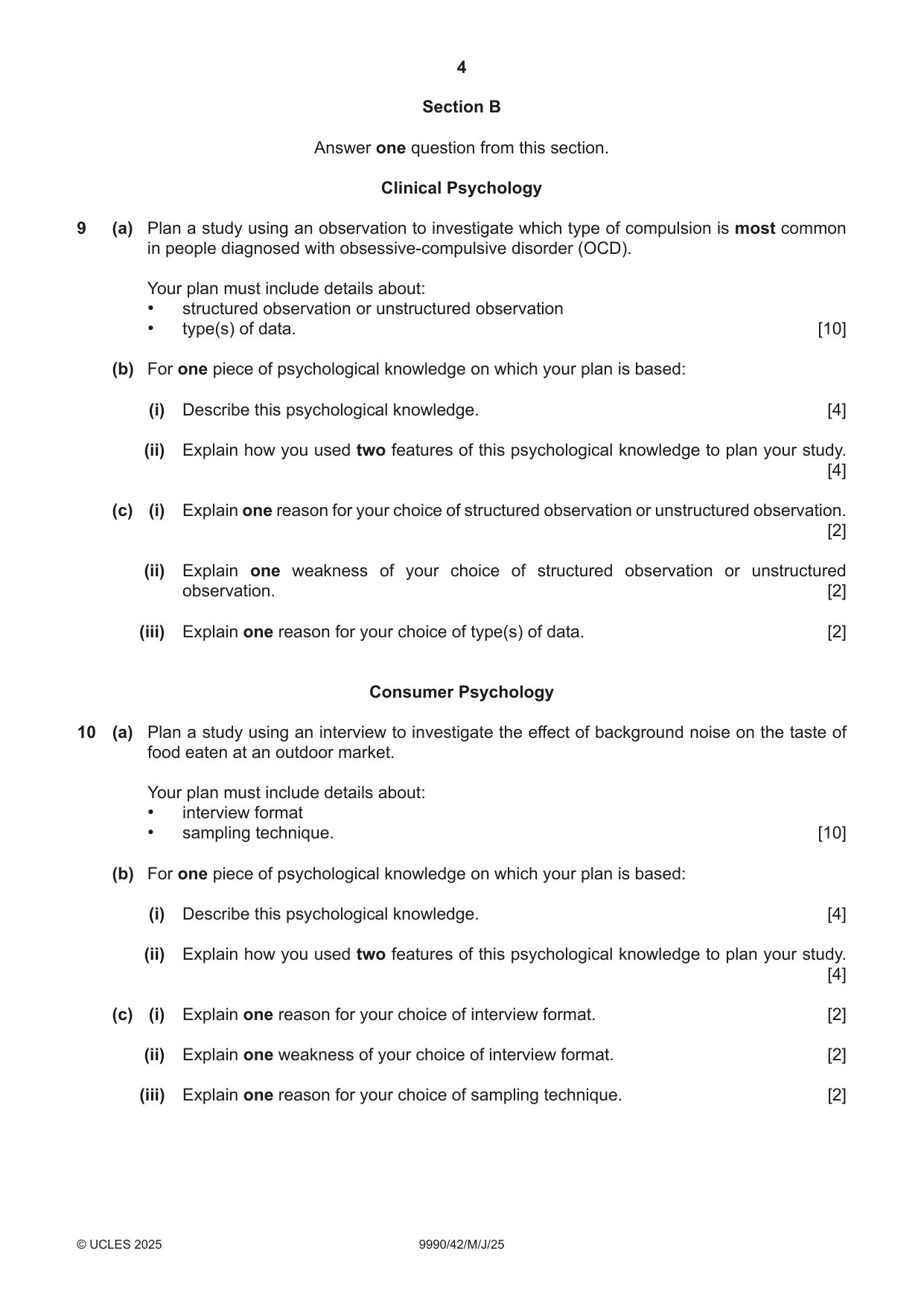
9 (a) Plan a study using an observation to investigate which type of compulsion is most common in people diagnosed with obsessive-compulsive disorder (OCD). Your plan must include details about: • structured observation or unstructured observation • type(s) of data. [10] (b) For one piece of psychological knowledge on which your plan is based: (i) Describe this psychological knowledge. [4] (ii) Explain how you used two features of this psychological knowledge to plan your study. [4] (c) (i) Explain one reason for your choice of structured observation or unstructured observation. [2] (ii) Explain one weakness of your choice of structured observation or unstructured observation. [2] (iii) Explain one reason for your choice of type(s) of data. [2] Consumer Psychology
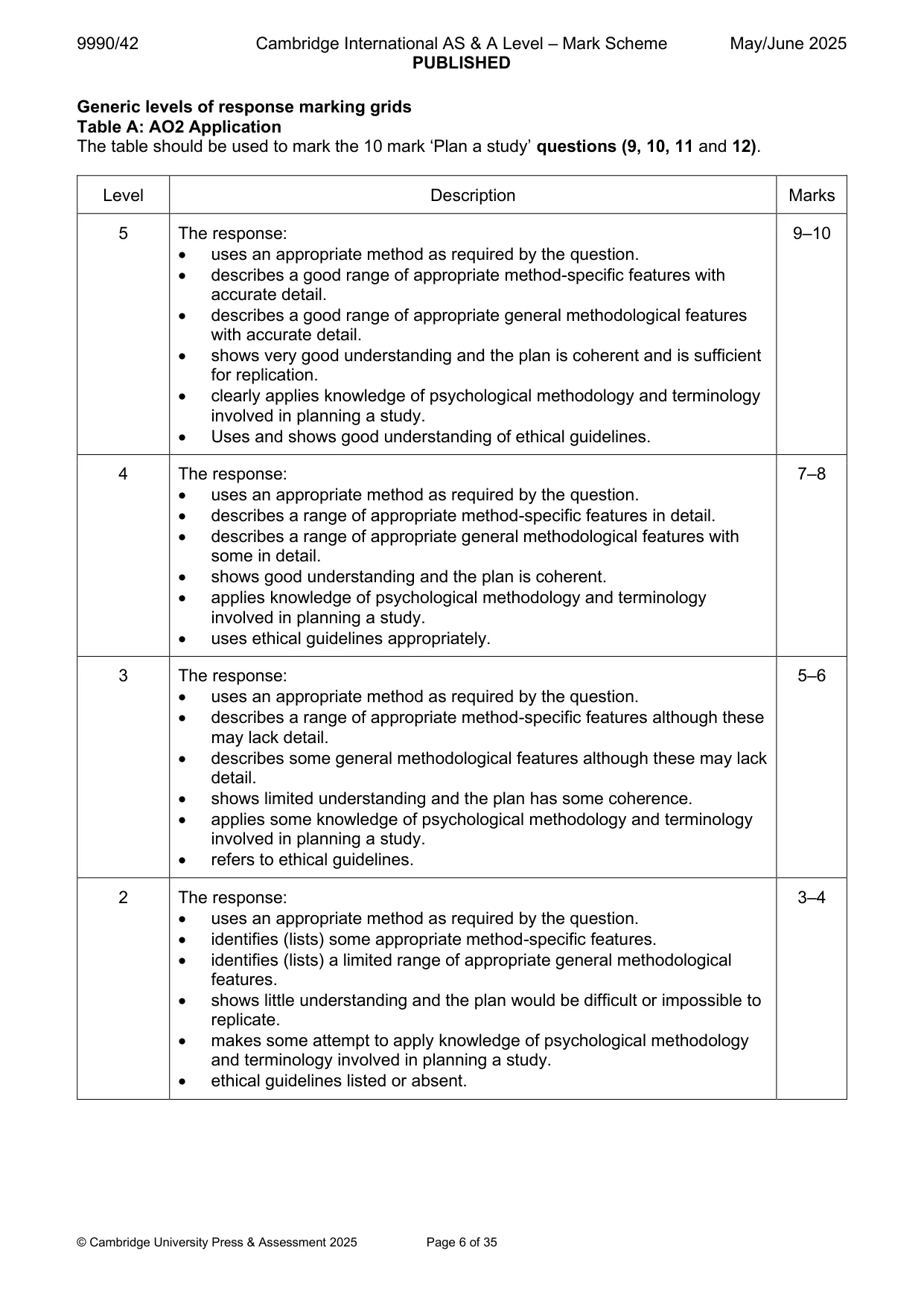
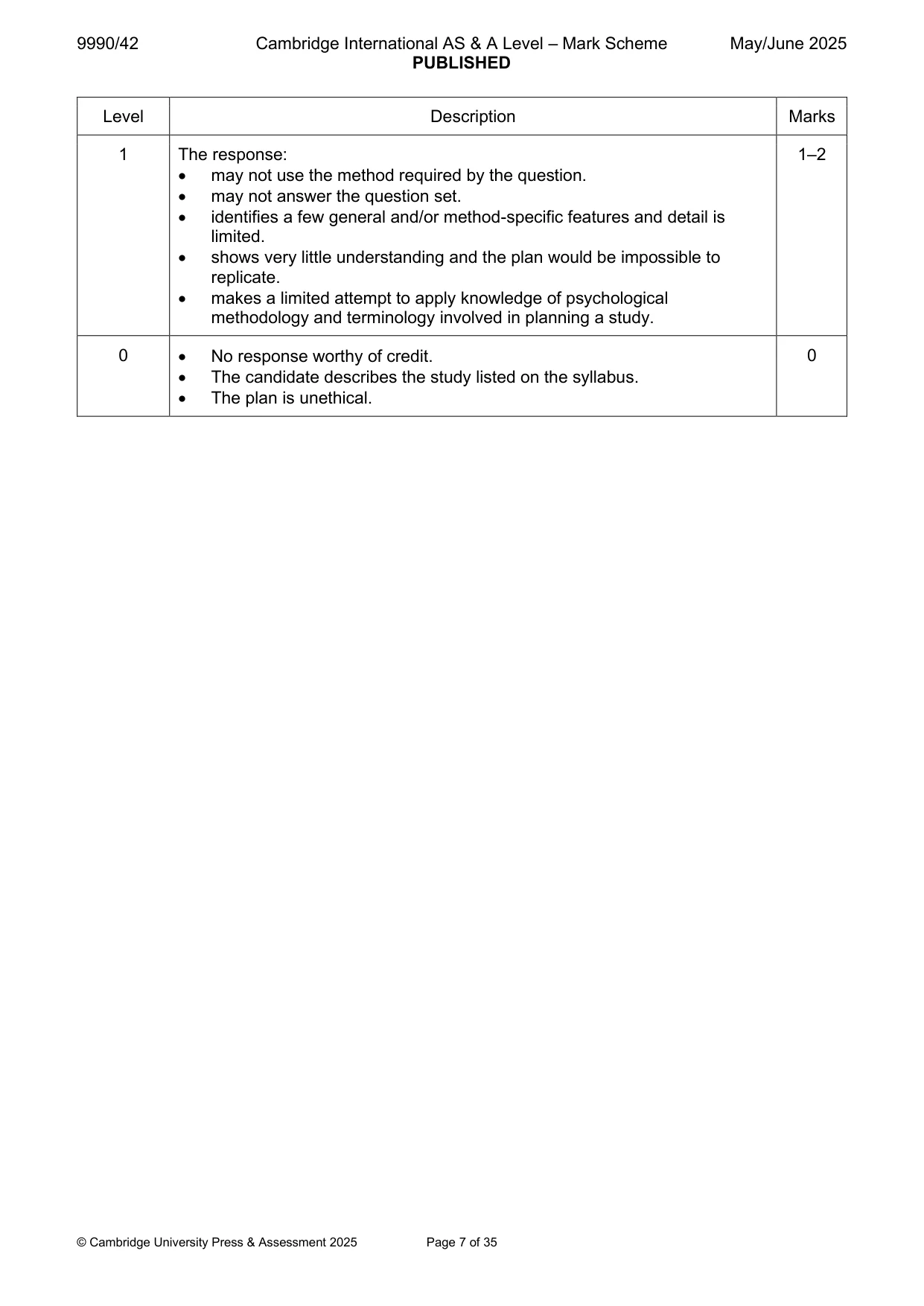
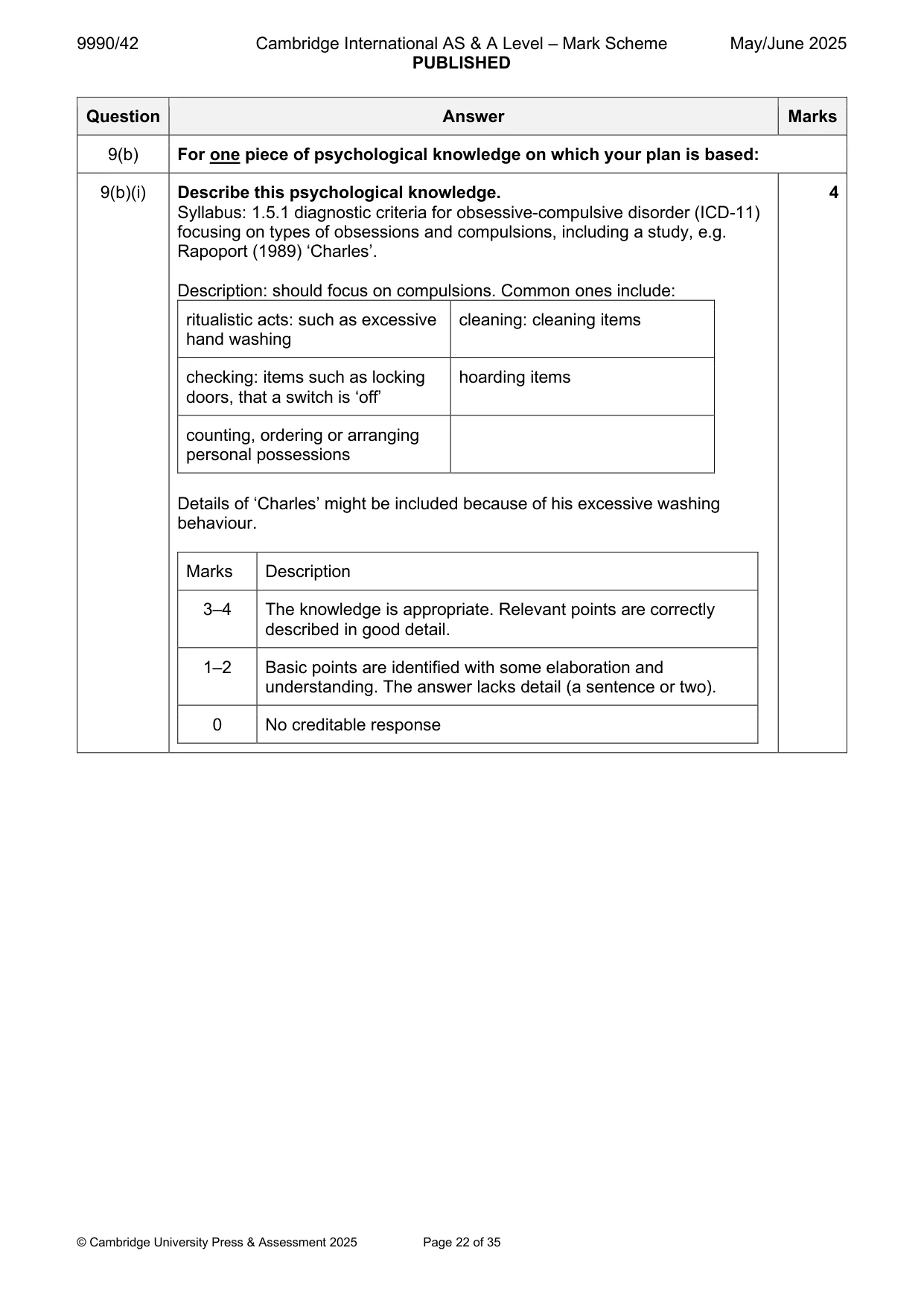
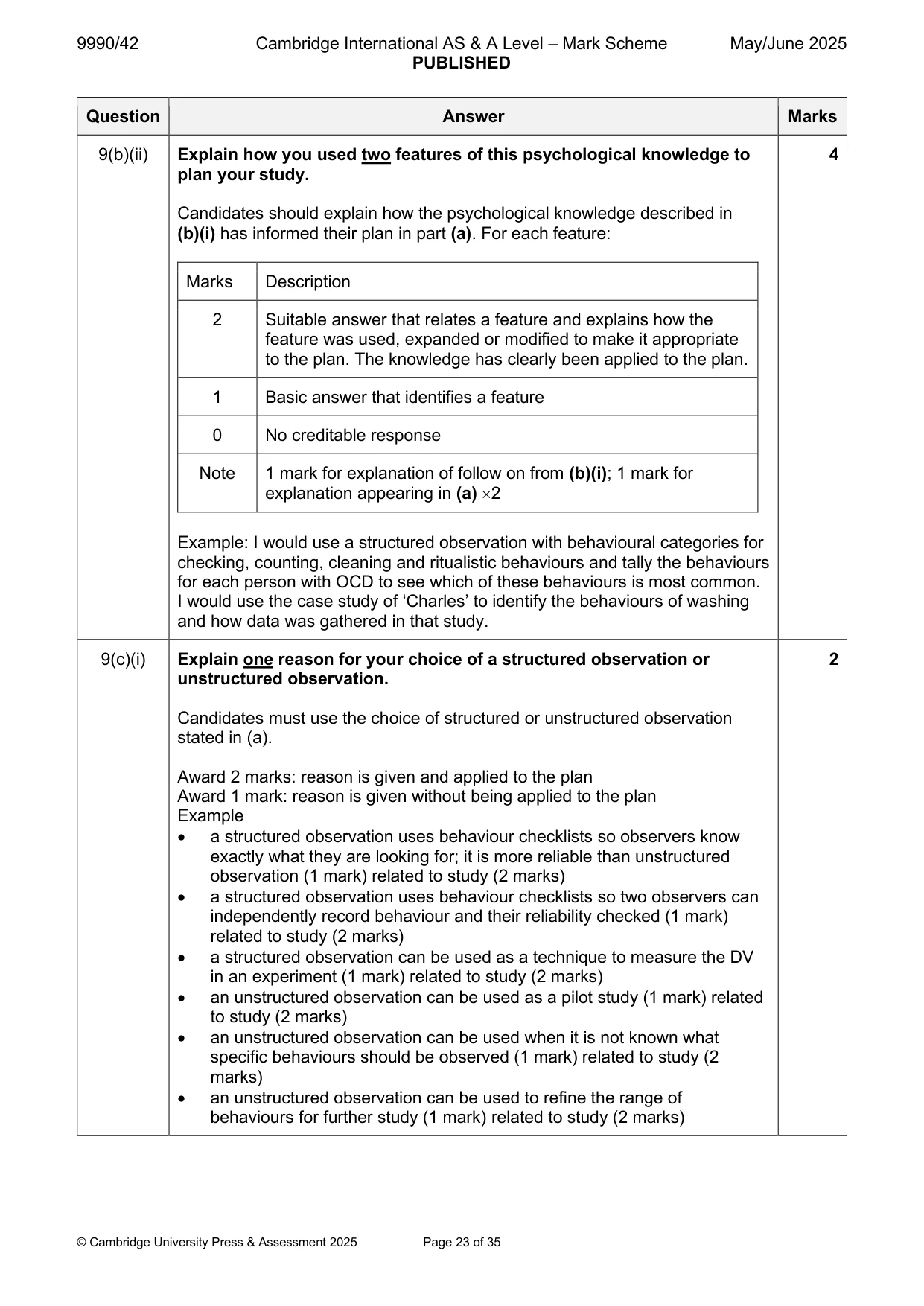
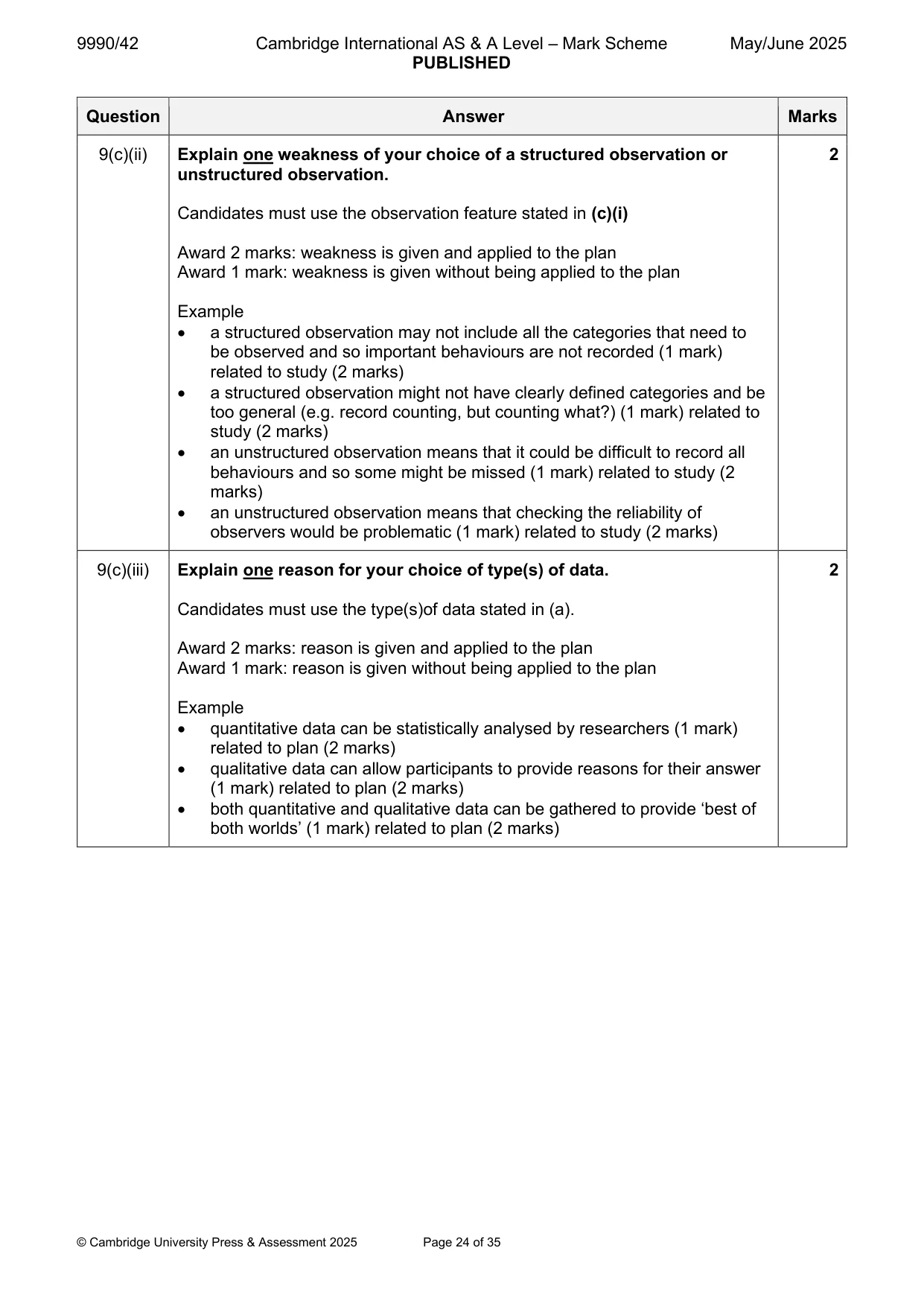
Mark scheme: 9(a) Plan a study using an observation to investigate which type of 10 compulsion is most common in people diagnosed with obsessive- compulsive disorder (OCD). Your plan must include details about: • structured observation or unstructured observation • type(s) of data. Use Table A: AO2 Application to mark candidate responses to this question. Credit both general features and specific features of the plan. The specific features of the The general features of the plan plan should include: should include (if appropriate): • structured or • sample and sampling technique unstructured • ethical guidelines • covert or over • a procedure • controlled or naturalistic • a location • participant or non- • type of data, analysis of data, participant use of descriptive statistics • number of observers (inter- • an aim or hypothesis (directional rater reliability) or non-directional)/null hypothesis • behavioural categories • steps for making the study valid • could include: event or time and reliable sampling Credit other elements of the plan as appropriate using the marking grid. 9(b) For one piece of psychological knowledge on which your plan is based: 9(b)(i) Describe this psychological knowledge. 4 Syllabus: 1.5.1 diagnostic criteria for obsessive-compulsive disorder (ICD-11) focusing on types of obsessions and compulsions, including a study, e.g. Rapoport (1989) ‘Charles’. Description: should focus on compulsions. Common ones include: ritualistic acts: such as excessive cleaning: cleaning items hand washing checking: items such as locking hoarding items doors, that a switch is ‘off’ counting, ordering or arranging personal possessions Details of ‘Charles’ might be included because of his excessive washing behaviour. Marks Description 3–4 The knowledge is appropriate. Relevant points are correctly described in good detail. 1–2 Basic points are identified with some elaboration and understanding. The answer lacks detail (a sentence or two). 0 No creditable response 9(b)(ii) Explain how you used two features of this psychological knowledge to 4 plan your study. Candidates should explain how the psychological knowledge described in (b)(i) has informed their plan in part (a). For each feature: Marks Description 2 Suitable answer that relates a feature and explains how the feature was used, expanded or modified to make it appropriate to the plan. The knowledge has clearly been applied to the plan. 1 Basic answer that identifies a feature 0 No creditable response Note 1 mark for explanation of follow on from (b)(i); 1 mark for explanation appearing in (a) 2 Example: I would use a structured observation with behavioural categories for checking, counting, cleaning and ritualistic behaviours and tally the behaviours for each person with OCD to see which of these behaviours is most common. I would use the case study of ‘Charles’ to identify the behaviours of washing and how data was gathered in that study. 9(c)(i) Explain one reason for your choice of a structured observation or 2 unstructured observation. Candidates must use the choice of structured or unstructured observation stated in (a). Award 2 marks: reason is given and applied to the plan Award 1 mark: reason is given without being applied to the plan Example • a structured observation uses behaviour checklists so observers know exactly what they are looking for; it is more reliable than unstructured observation (1 mark) related to study (2 marks) • a structured observation uses behaviour checklists so two observers can independently record behaviour and their reliability checked (1 mark) related to study (2 marks) • a structured observation can be used as a technique to measure the DV in an experiment (1 mark) related to study (2 marks) • an unstructured observation can be used as a pilot study (1 mark) related to study (2 marks) • an unstructured observation can be used when it is not known what specific behaviours should be observed (1 mark) related to study (2 marks) • an unstructured observation can be used to refine the range of behaviours for further study (1 mark) related to study (2 marks) 9(c)(ii) Explain one weakness of your choice of a structured observation or 2 unstructured observation. Candidates must use the observation feature stated in (c)(i) Award 2 marks: weakness is given and applied to the plan Award 1 mark: weakness is given without being applied to the plan Example • a structured observation may not include all the categories that need to be observed and so important behaviours are not recorded (1 mark) related to study (2 marks) • a structured observation might not have clearly defined categories and be too general (e.g. record counting, but counting what?) (1 mark) related to study (2 marks) • an unstructured observation means that it could be difficult to record all behaviours and so some might be missed (1 mark) related to study (2 marks) • an unstructured observation means that checking the reliability of observers would be problematic (1 mark) related to study (2 marks) 9(c)(iii) Explain one reason for your choice of type(s) of data. 2 Candidates must use the type(s)of data stated in (a). Award 2 marks: reason is given and applied to the plan Award 1 mark: reason is given without being applied to the plan Example • quantitative data can be statistically analysed by researchers (1 mark) related to plan (2 marks) • qualitative data can allow participants to provide reasons for their answer (1 mark) related to plan (2 marks) • both quantitative and qualitative data can be gathered to provide ‘best of both worlds’ (1 mark) related to plan (2 marks)
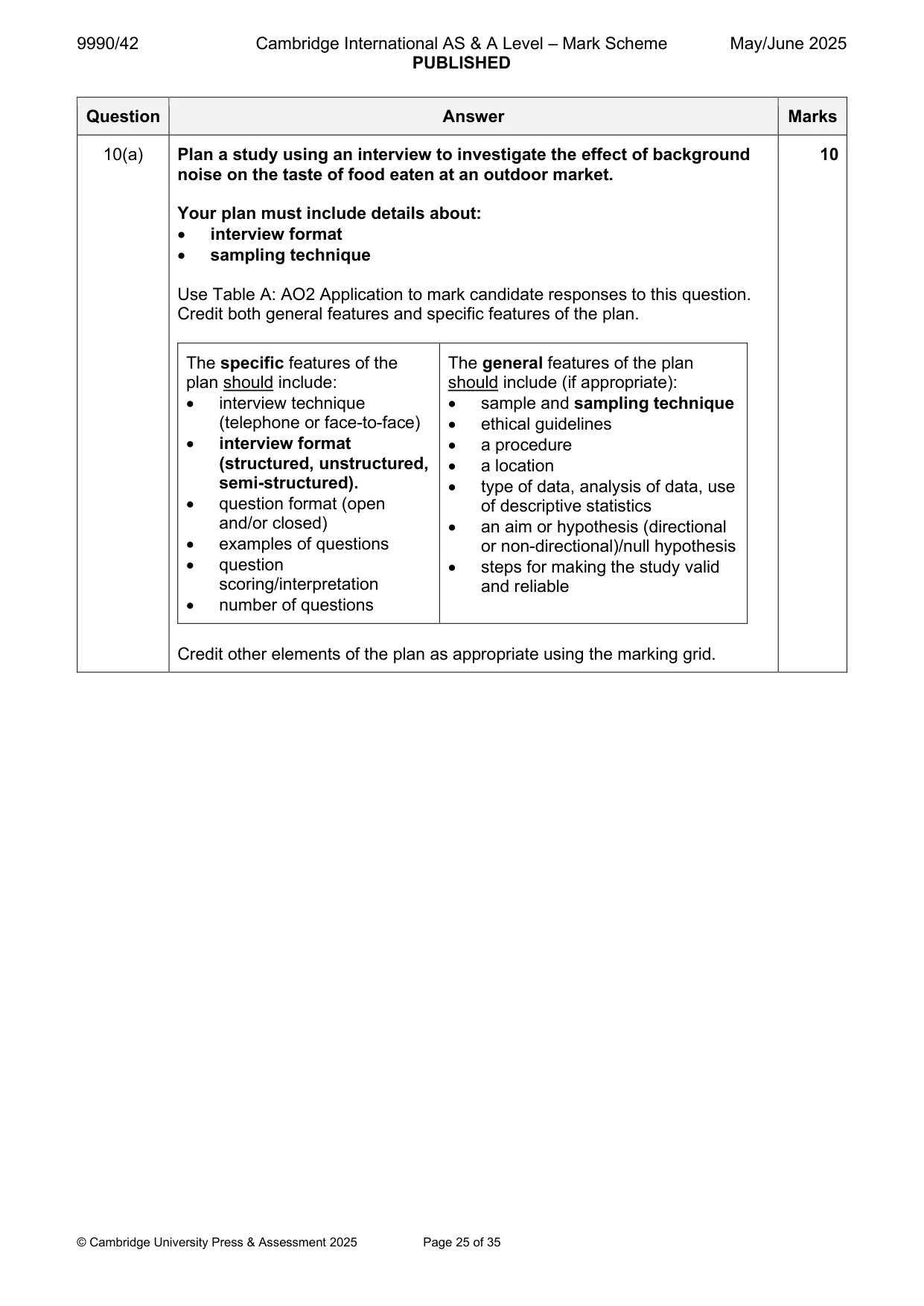
Q10 · Plan a study using an interview to investigate the effect of background noise on the…
10 (a) Plan a study using an interview to investigate the effect of background noise on the taste of food eaten at an outdoor market. Your plan must include details about: • interview format • sampling technique. [10] (b) For one piece of psychological knowledge on which your plan is based: (i) Describe this psychological knowledge. [4] (ii) Explain how you used two features of this psychological knowledge to plan your study. [4] (c) (i) Explain one reason for your choice of interview format. [2] (ii) Explain one weakness of your choice of interview format. [2] (iii) Explain one reason for your choice of sampling technique. [2] Health Psychology
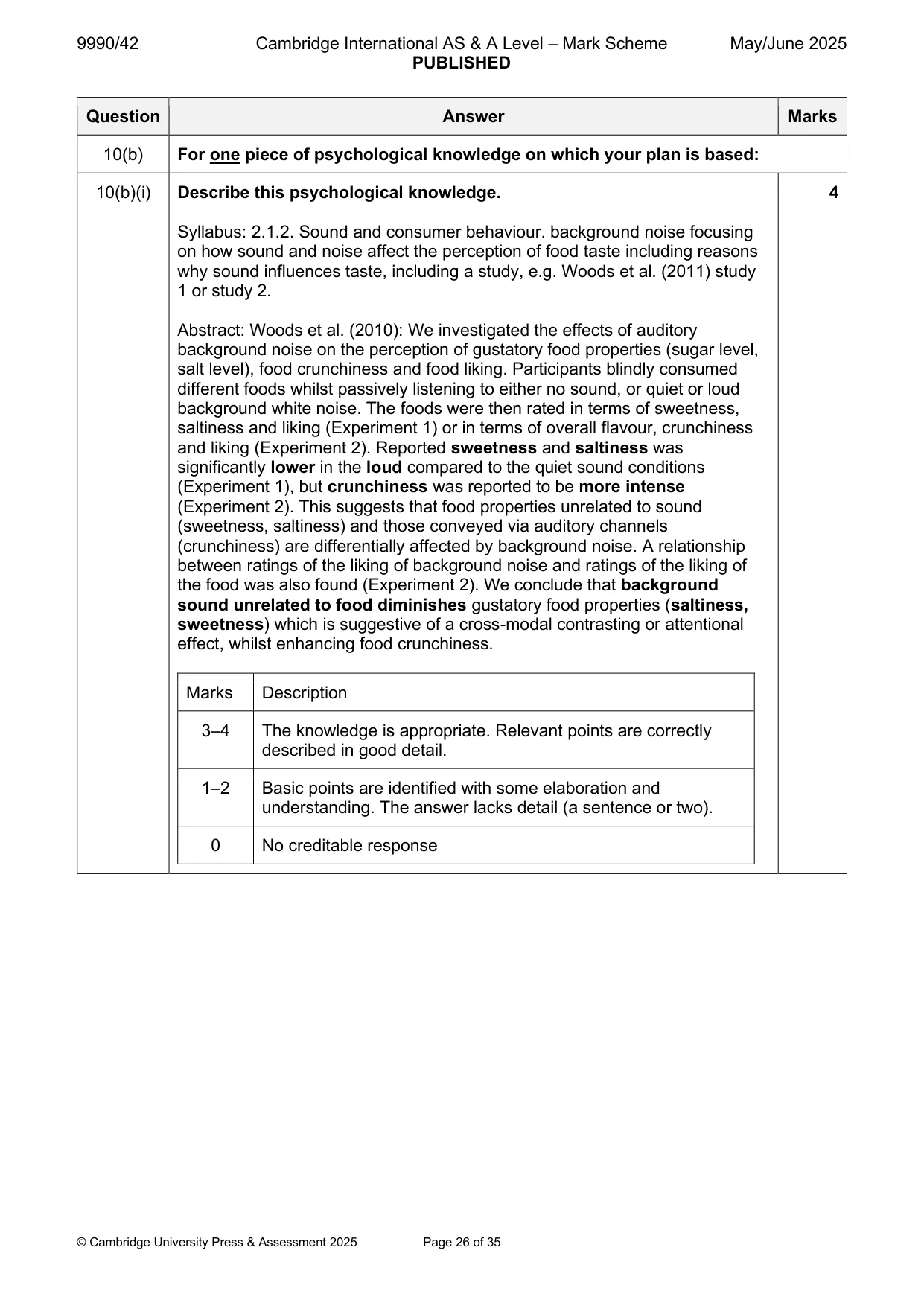
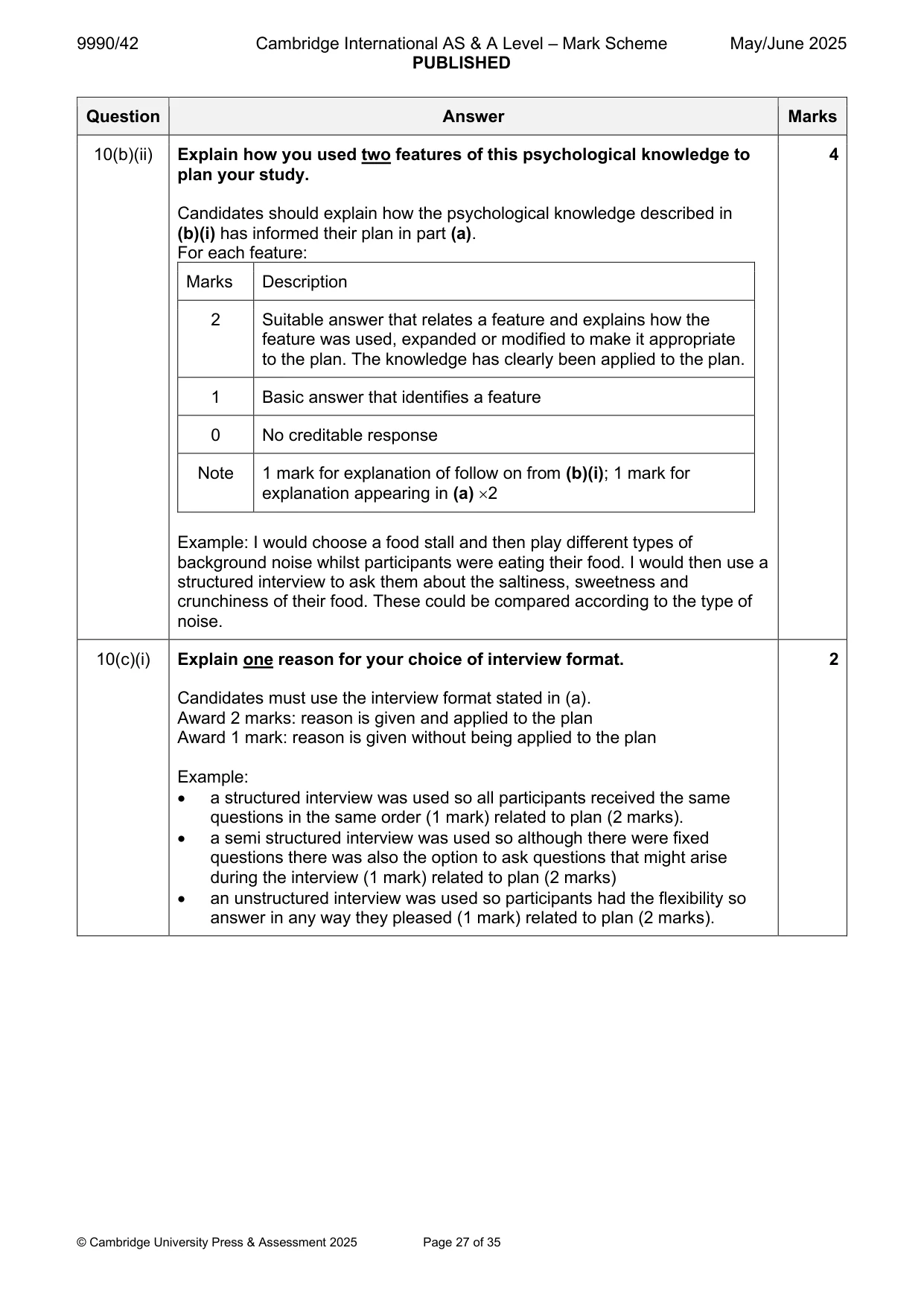
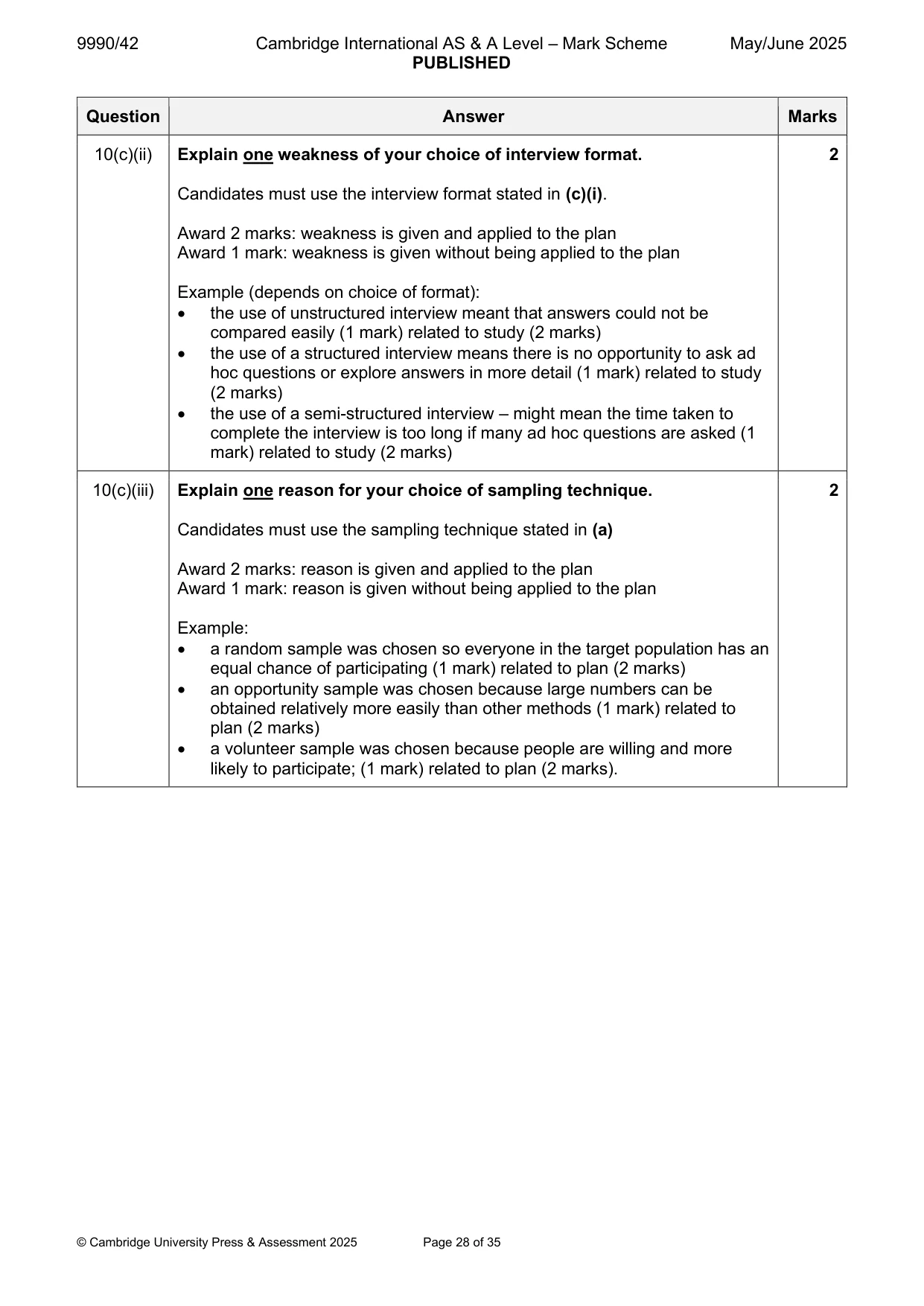
Mark scheme: 10(a) Plan a study using an interview to investigate the effect of background 10 noise on the taste of food eaten at an outdoor market. Your plan must include details about: • interview format • sampling technique Use Table A: AO2 Application to mark candidate responses to this question. Credit both general features and specific features of the plan. The specific features of the The general features of the plan plan should include: should include (if appropriate): • interview technique • sample and sampling technique (telephone or face-to-face) • ethical guidelines • interview format • a procedure (structured, unstructured, • a location semi-structured). • type of data, analysis of data, use • question format (open of descriptive statistics and/or closed) • an aim or hypothesis (directional • examples of questions or non-directional)/null hypothesis • question • steps for making the study valid scoring/interpretation and reliable • number of questions Credit other elements of the plan as appropriate using the marking grid. 10(b) For one piece of psychological knowledge on which your plan is based: 10(b)(i) Describe this psychological knowledge. 4 Syllabus: 2.1.2. Sound and consumer behaviour. background noise focusing on how sound and noise affect the perception of food taste including reasons why sound influences taste, including a study, e.g. Woods et al. (2011) study 1 or study 2. Abstract: Woods et al. (2010): We investigated the effects of auditory background noise on the perception of gustatory food properties (sugar level, salt level), food crunchiness and food liking. Participants blindly consumed different foods whilst passively listening to either no sound, or quiet or loud background white noise. The foods were then rated in terms of sweetness, saltiness and liking (Experiment 1) or in terms of overall flavour, crunchiness and liking (Experiment 2). Reported sweetness and saltiness was significantly lower in the loud compared to the quiet sound conditions (Experiment 1), but crunchiness was reported to be more intense (Experiment 2). This suggests that food properties unrelated to sound (sweetness, saltiness) and those conveyed via auditory channels (crunchiness) are differentially affected by background noise. A relationship between ratings of the liking of background noise and ratings of the liking of the food was also found (Experiment 2). We conclude that background sound unrelated to food diminishes gustatory food properties (saltiness, sweetness) which is suggestive of a cross-modal contrasting or attentional effect, whilst enhancing food crunchiness. Marks Description 3–4 The knowledge is appropriate. Relevant points are correctly described in good detail. 1–2 Basic points are identified with some elaboration and understanding. The answer lacks detail (a sentence or two). 0 No creditable response 10(b)(ii) Explain how you used two features of this psychological knowledge to 4 plan your study. Candidates should explain how the psychological knowledge described in (b)(i) has informed their plan in part (a). For each feature: Marks Description 2 Suitable answer that relates a feature and explains how the feature was used, expanded or modified to make it appropriate to the plan. The knowledge has clearly been applied to the plan. 1 Basic answer that identifies a feature 0 No creditable response Note 1 mark for explanation of follow on from (b)(i); 1 mark for explanation appearing in (a) 2 Example: I would choose a food stall and then play different types of background noise whilst participants were eating their food. I would then use a structured interview to ask them about the saltiness, sweetness and crunchiness of their food. These could be compared according to the type of noise. 10(c)(i) Explain one reason for your choice of interview format. 2 Candidates must use the interview format stated in (a). Award 2 marks: reason is given and applied to the plan Award 1 mark: reason is given without being applied to the plan Example: • a structured interview was used so all participants received the same questions in the same order (1 mark) related to plan (2 marks). • a semi structured interview was used so although there were fixed questions there was also the option to ask questions that might arise during the interview (1 mark) related to plan (2 marks) • an unstructured interview was used so participants had the flexibility so answer in any way they pleased (1 mark) related to plan (2 marks). 10(c)(ii) Explain one weakness of your choice of interview format. 2 Candidates must use the interview format stated in (c)(i). Award 2 marks: weakness is given and applied to the plan Award 1 mark: weakness is given without being applied to the plan Example (depends on choice of format): • the use of unstructured interview meant that answers could not be compared easily (1 mark) related to study (2 marks) • the use of a structured interview means there is no opportunity to ask ad hoc questions or explore answers in more detail (1 mark) related to study (2 marks) • the use of a semi-structured interview – might mean the time taken to complete the interview is too long if many ad hoc questions are asked (1 mark) related to study (2 marks) 10(c)(iii) Explain one reason for your choice of sampling technique. 2 Candidates must use the sampling technique stated in (a) Award 2 marks: reason is given and applied to the plan Award 1 mark: reason is given without being applied to the plan Example: • a random sample was chosen so everyone in the target population has an equal chance of participating (1 mark) related to plan (2 marks) • an opportunity sample was chosen because large numbers can be obtained relatively more easily than other methods (1 mark) related to plan (2 marks) • a volunteer sample was chosen because people are willing and more likely to participate; (1 mark) related to plan (2 marks).
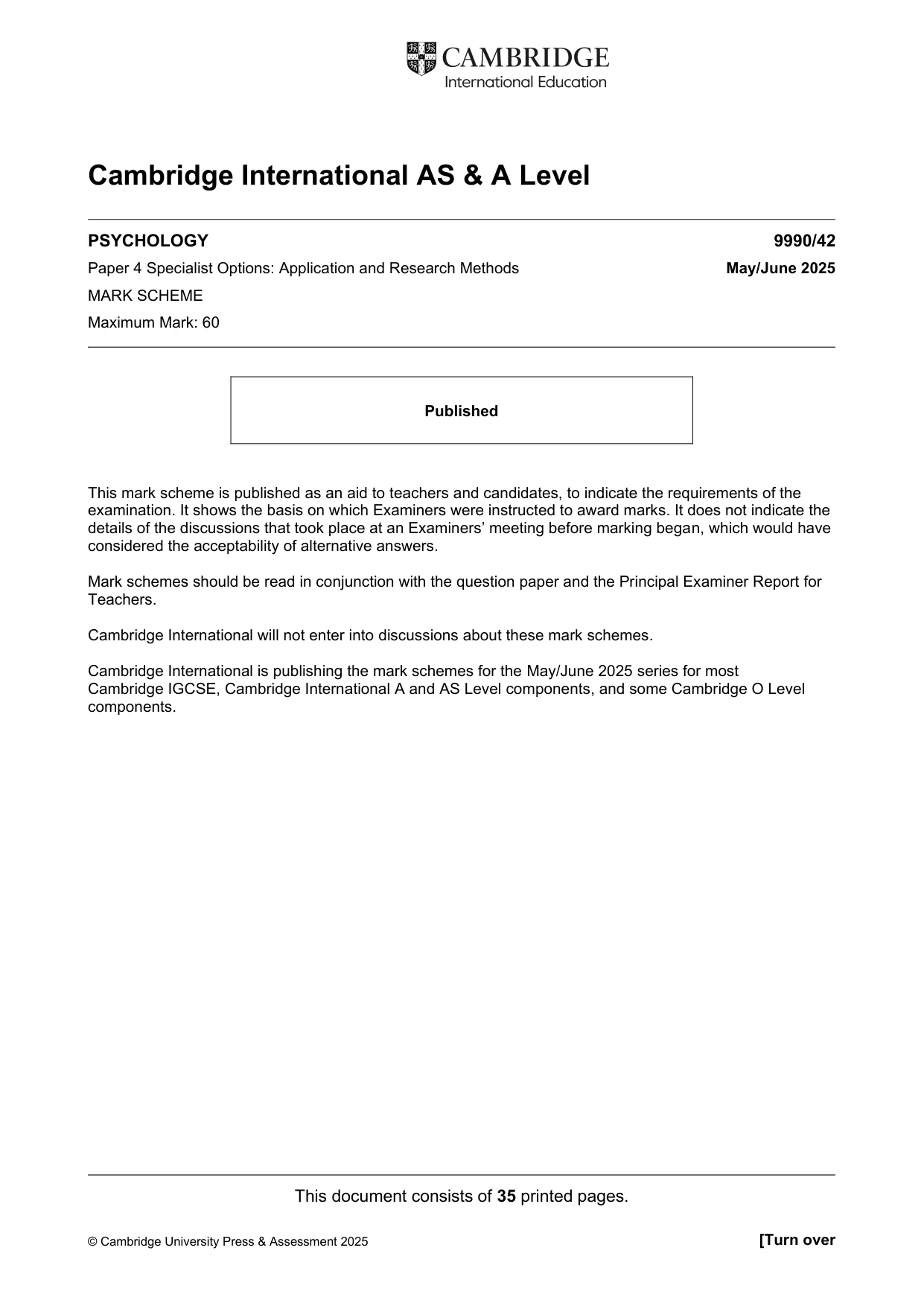
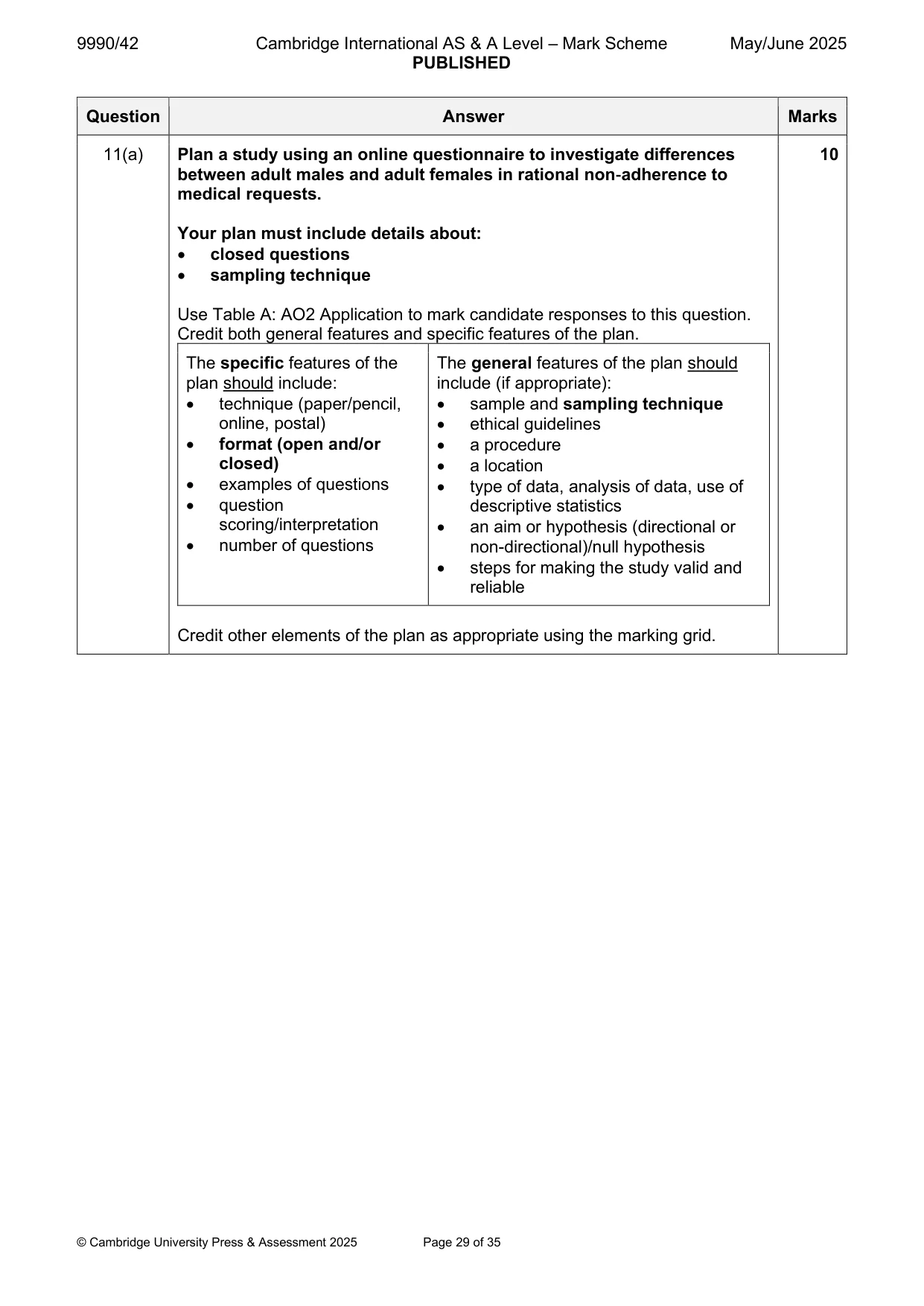
Q11 · Plan a study using an online questionnaire to investigate differences between adult males…
11 (a) Plan a study using an online questionnaire to investigate differences between adult males and adult females in rational non-adherence to medical advice. Your plan must include details about: • closed questions • sampling technique. [10] (b) For one piece of psychological knowledge on which your plan is based: (i) Describe this psychological knowledge. [4] (ii) Explain how you used two features of this psychological knowledge to plan your study. [4] (c) (i) Explain one reason for your choice of closed questions. [2] (ii) Explain one weakness of your choice of closed questions. [2] (iii) Explain one reason for your choice of sampling technique. [2] Organisational Psychology
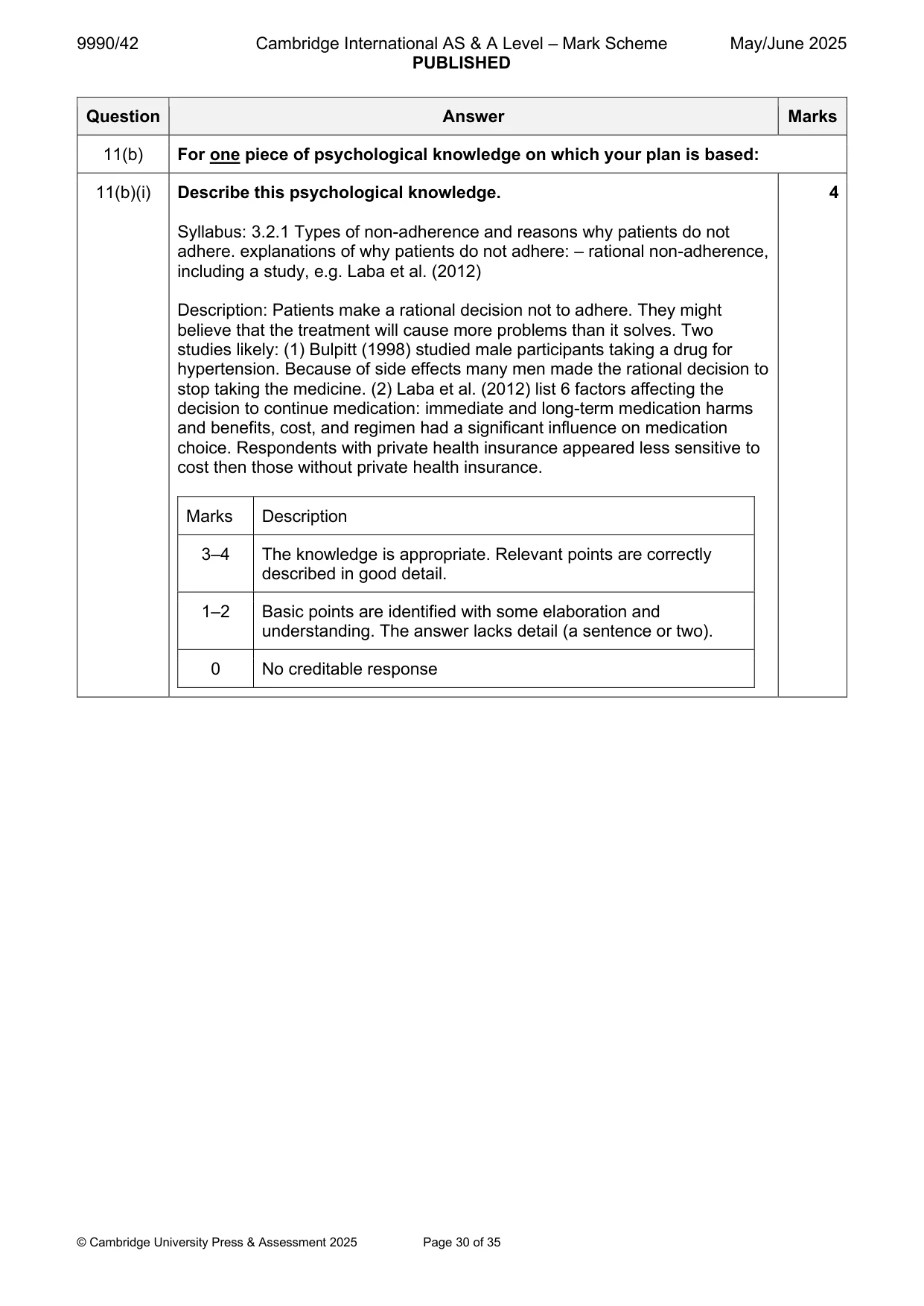
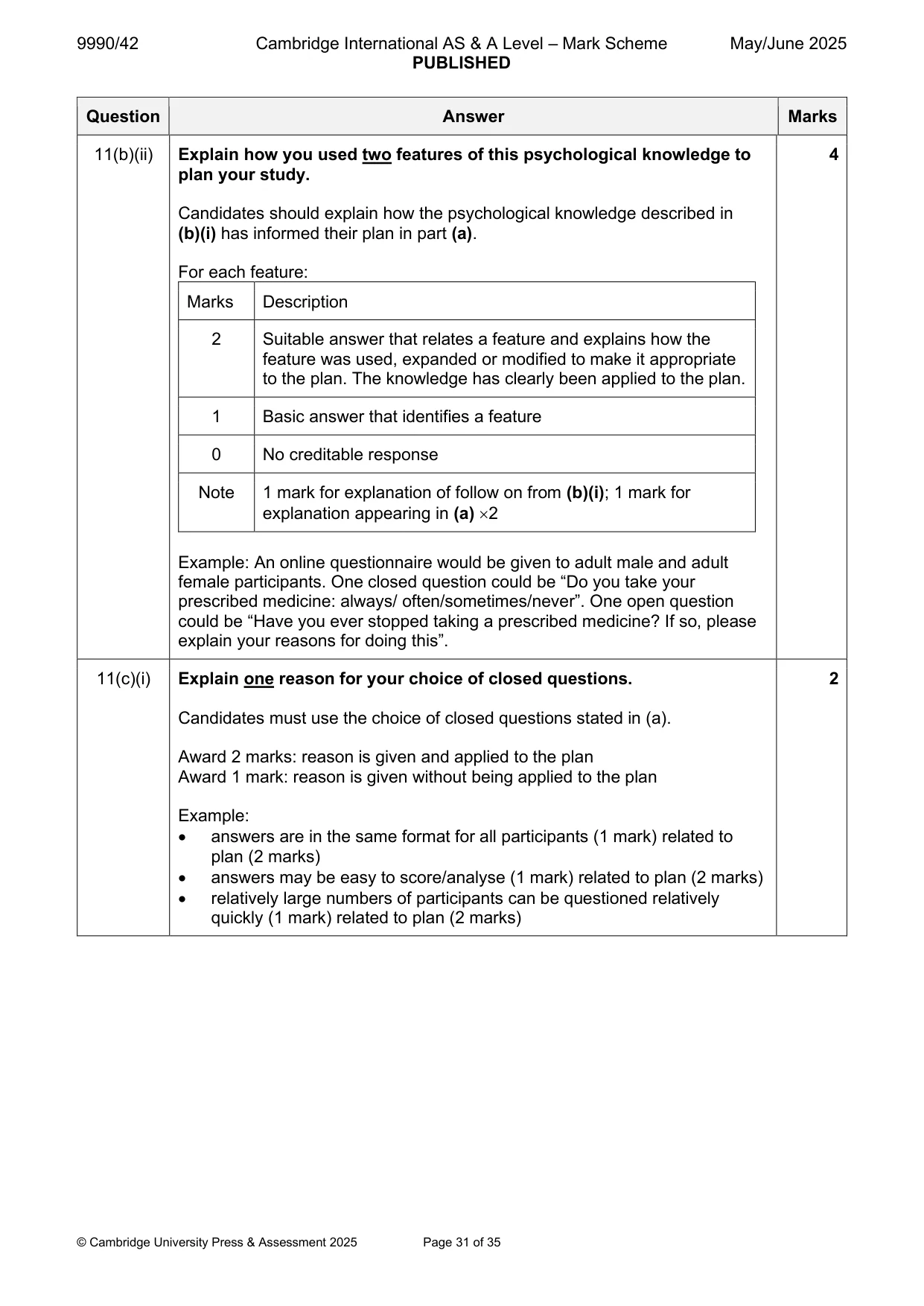
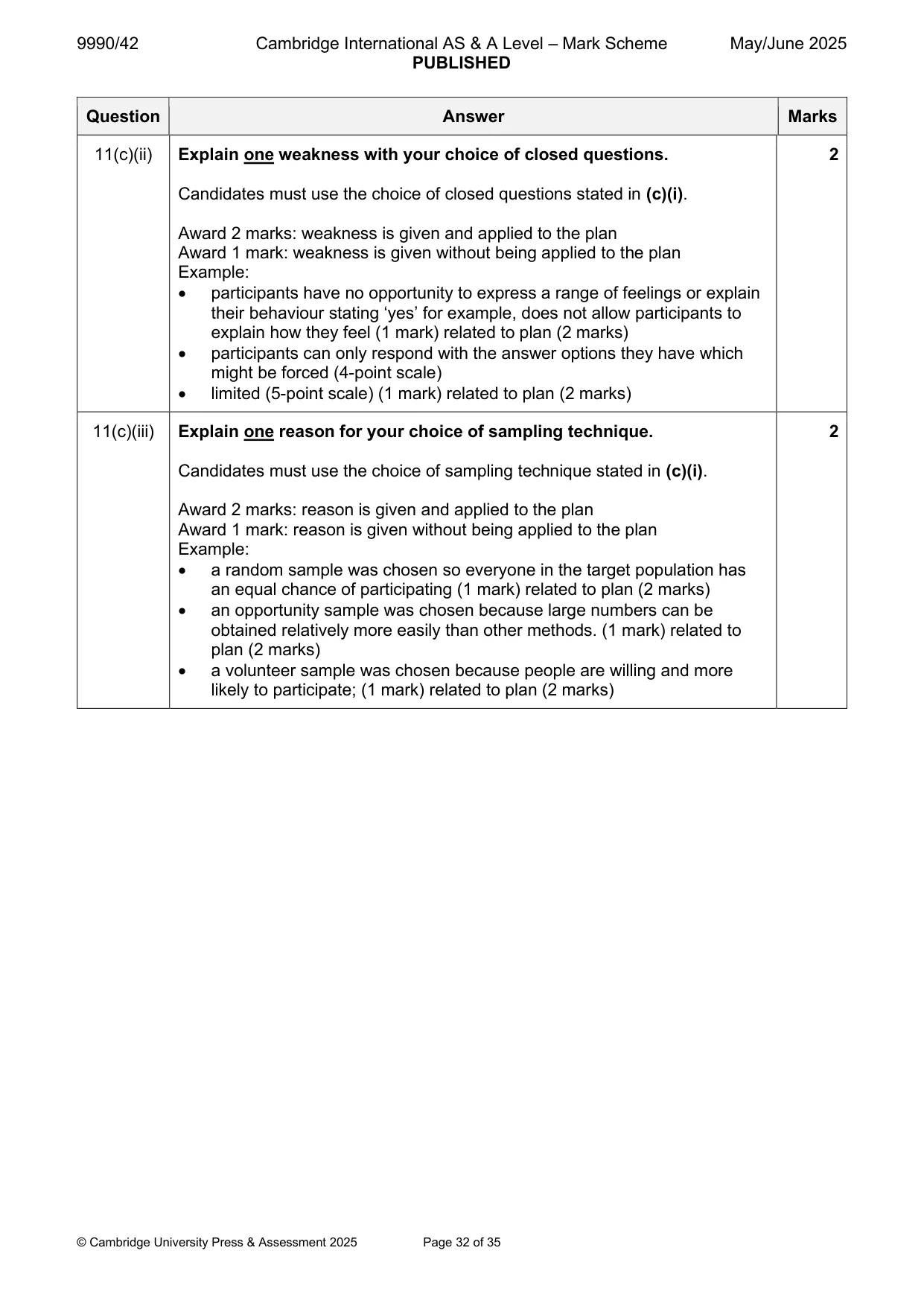
Mark scheme: 11(a) Plan a study using an online questionnaire to investigate differences 10 between adult males and adult females in rational non‑adherence to medical requests. Your plan must include details about: • closed questions • sampling technique Use Table A: AO2 Application to mark candidate responses to this question. Credit both general features and specific features of the plan. The specific features of the The general features of the plan should plan should include: include (if appropriate): • technique (paper/pencil, • sample and sampling technique online, postal) • ethical guidelines • format (open and/or • a procedure closed) • a location • examples of questions • type of data, analysis of data, use of • question descriptive statistics scoring/interpretation • an aim or hypothesis (directional or • number of questions non-directional)/null hypothesis • steps for making the study valid and reliable Credit other elements of the plan as appropriate using the marking grid. 11(b) For one piece of psychological knowledge on which your plan is based: 11(b)(i) Describe this psychological knowledge. 4 Syllabus: 3.2.1 Types of non-adherence and reasons why patients do not adhere. explanations of why patients do not adhere: – rational non-adherence, including a study, e.g. Laba et al. (2012) Description: Patients make a rational decision not to adhere. They might believe that the treatment will cause more problems than it solves. Two studies likely: (1) Bulpitt (1998) studied male participants taking a drug for hypertension. Because of side effects many men made the rational decision to stop taking the medicine. (2) Laba et al. (2012) list 6 factors affecting the decision to continue medication: immediate and long-term medication harms and benefits, cost, and regimen had a significant influence on medication choice. Respondents with private health insurance appeared less sensitive to cost then those without private health insurance. Marks Description 3–4 The knowledge is appropriate. Relevant points are correctly described in good detail. 1–2 Basic points are identified with some elaboration and understanding. The answer lacks detail (a sentence or two). 0 No creditable response 11(b)(ii) Explain how you used two features of this psychological knowledge to 4 plan your study. Candidates should explain how the psychological knowledge described in (b)(i) has informed their plan in part (a). For each feature: Marks Description 2 Suitable answer that relates a feature and explains how the feature was used, expanded or modified to make it appropriate to the plan. The knowledge has clearly been applied to the plan. 1 Basic answer that identifies a feature 0 No creditable response Note 1 mark for explanation of follow on from (b)(i); 1 mark for explanation appearing in (a) 2 Example: An online questionnaire would be given to adult male and adult female participants. One closed question could be “Do you take your prescribed medicine: always/ often/sometimes/never”. One open question could be “Have you ever stopped taking a prescribed medicine? If so, please explain your reasons for doing this”. 11(c)(i) Explain one reason for your choice of closed questions. 2 Candidates must use the choice of closed questions stated in (a). Award 2 marks: reason is given and applied to the plan Award 1 mark: reason is given without being applied to the plan Example: • answers are in the same format for all participants (1 mark) related to plan (2 marks) • answers may be easy to score/analyse (1 mark) related to plan (2 marks) • relatively large numbers of participants can be questioned relatively quickly (1 mark) related to plan (2 marks) 11(c)(ii) Explain one weakness with your choice of closed questions. 2 Candidates must use the choice of closed questions stated in (c)(i). Award 2 marks: weakness is given and applied to the plan Award 1 mark: weakness is given without being applied to the plan Example: • participants have no opportunity to express a range of feelings or explain their behaviour stating ‘yes’ for example, does not allow participants to explain how they feel (1 mark) related to plan (2 marks) • participants can only respond with the answer options they have which might be forced (4-point scale) • limited (5-point scale) (1 mark) related to plan (2 marks) 11(c)(iii) Explain one reason for your choice of sampling technique. 2 Candidates must use the choice of sampling technique stated in (c)(i). Award 2 marks: reason is given and applied to the plan Award 1 mark: reason is given without being applied to the plan Example: • a random sample was chosen so everyone in the target population has an equal chance of participating (1 mark) related to plan (2 marks) • an opportunity sample was chosen because large numbers can be obtained relatively more easily than other methods. (1 mark) related to plan (2 marks) • a volunteer sample was chosen because people are willing and more likely to participate; (1 mark) related to plan (2 marks)
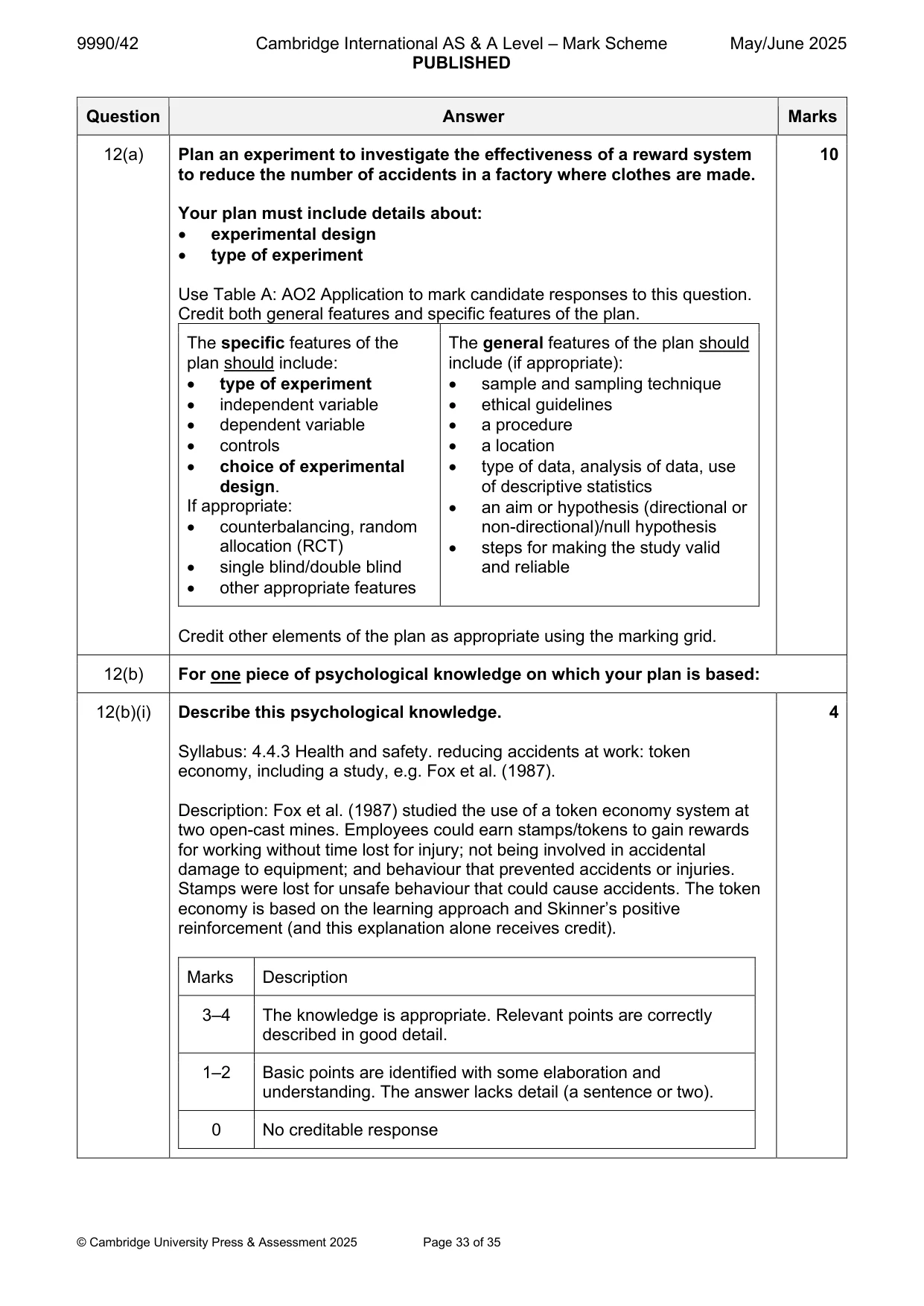
Q12 · Plan an experiment to investigate the effectiveness of a reward system to reduce the…
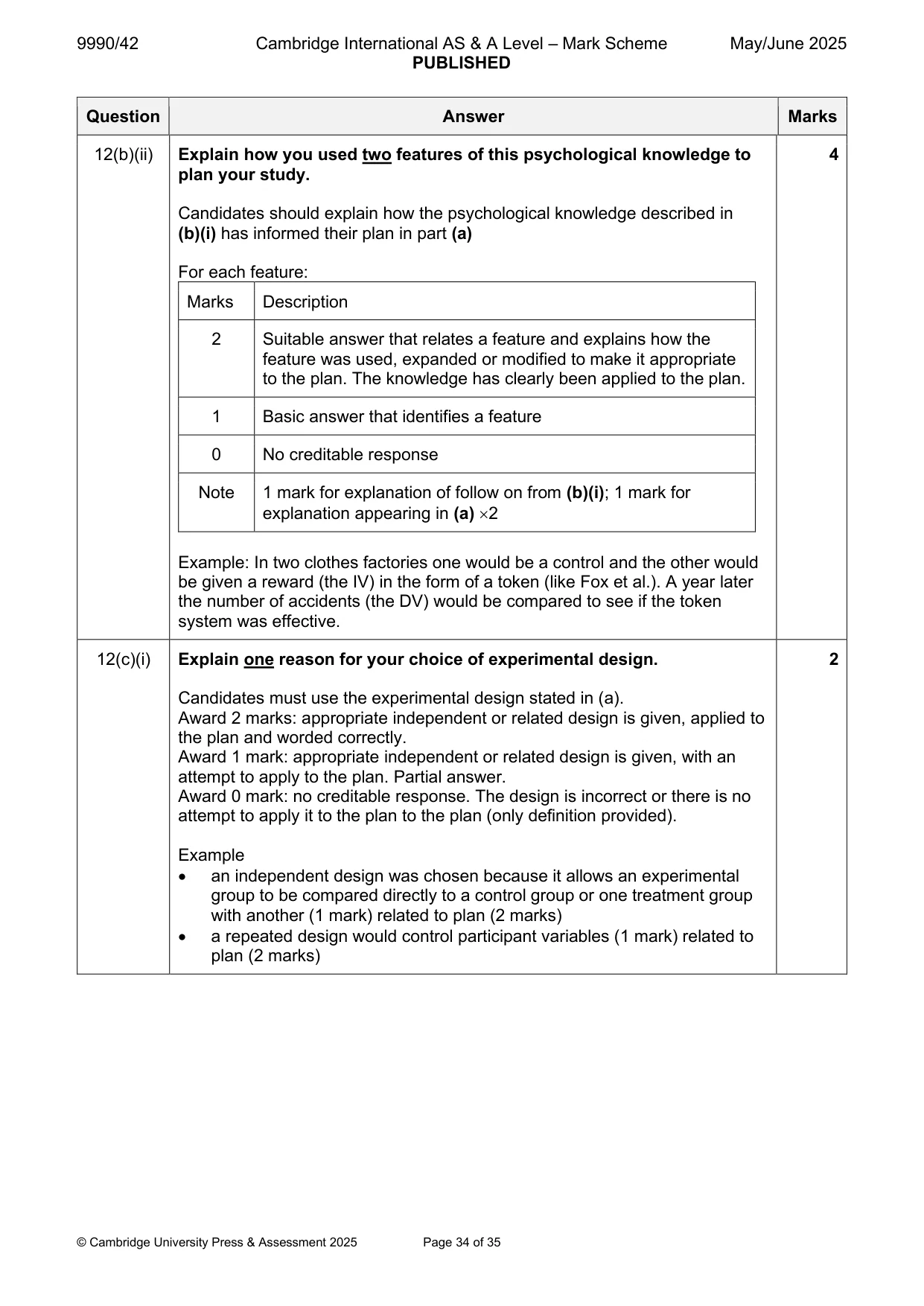
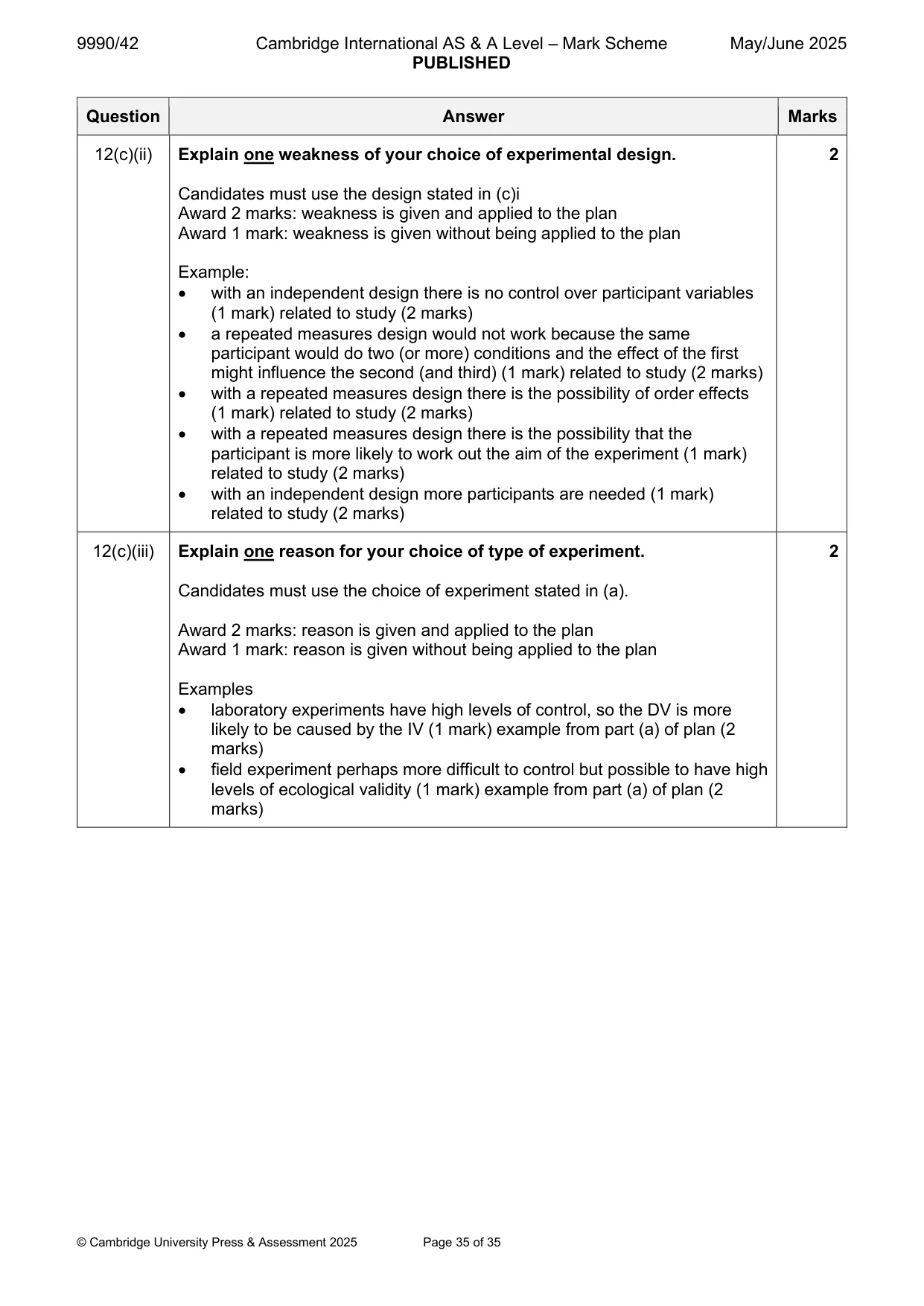
12 (a) Plan an experiment to investigate the effectiveness of a reward system to reduce the number of accidents in a factory where clothes are made. Your plan must include details about: • experimental design • type of experiment. [10] (b) For one piece of psychological knowledge on which your plan is based: (i) Describe this psychological knowledge. [4] (ii) Explain how you used two features of this psychological knowledge to plan your experiment. [4] (c) (i) Explain one reason for your choice of experimental design. [2] (ii) Explain one weakness of your choice of experimental design. [2] (iii) Explain one reason for your choice of type of experiment. [2]
Mark scheme: 12(a) Plan an experiment to investigate the effectiveness of a reward system 10 to reduce the number of accidents in a factory where clothes are made. Your plan must include details about: • experimental design • type of experiment Use Table A: AO2 Application to mark candidate responses to this question. Credit both general features and specific features of the plan. The specific features of the The general features of the plan should plan should include: include (if appropriate): • type of experiment • sample and sampling technique • independent variable • ethical guidelines • dependent variable • a procedure • controls • a location • choice of experimental • type of data, analysis of data, use design. of descriptive statistics If appropriate: • an aim or hypothesis (directional or • counterbalancing, random non-directional)/null hypothesis allocation (RCT) • steps for making the study valid • single blind/double blind and reliable • other appropriate features Credit other elements of the plan as appropriate using the marking grid. 12(b) For one piece of psychological knowledge on which your plan is based: 12(b)(i) Describe this psychological knowledge. 4 Syllabus: 4.4.3 Health and safety. reducing accidents at work: token economy, including a study, e.g. Fox et al. (1987). Description: Fox et al. (1987) studied the use of a token economy system at two open-cast mines. Employees could earn stamps/tokens to gain rewards for working without time lost for injury; not being involved in accidental damage to equipment; and behaviour that prevented accidents or injuries. Stamps were lost for unsafe behaviour that could cause accidents. The token economy is based on the learning approach and Skinner’s positive reinforcement (and this explanation alone receives credit). Marks Description 3–4 The knowledge is appropriate. Relevant points are correctly described in good detail. 1–2 Basic points are identified with some elaboration and understanding. The answer lacks detail (a sentence or two). 0 No creditable response 12(b)(ii) Explain how you used two features of this psychological knowledge to 4 plan your study. Candidates should explain how the psychological knowledge described in (b)(i) has informed their plan in part (a) For each feature: Marks Description 2 Suitable answer that relates a feature and explains how the feature was used, expanded or modified to make it appropriate to the plan. The knowledge has clearly been applied to the plan. 1 Basic answer that identifies a feature 0 No creditable response Note 1 mark for explanation of follow on from (b)(i); 1 mark for explanation appearing in (a) 2 Example: In two clothes factories one would be a control and the other would be given a reward (the IV) in the form of a token (like Fox et al.). A year later the number of accidents (the DV) would be compared to see if the token system was effective. 12(c)(i) Explain one reason for your choice of experimental design. 2 Candidates must use the experimental design stated in (a). Award 2 marks: appropriate independent or related design is given, applied to the plan and worded correctly. Award 1 mark: appropriate independent or related design is given, with an attempt to apply to the plan. Partial answer. Award 0 mark: no creditable response. The design is incorrect or there is no attempt to apply it to the plan to the plan (only definition provided). Example • an independent design was chosen because it allows an experimental group to be compared directly to a control group or one treatment group with another (1 mark) related to plan (2 marks) • a repeated design would control participant variables (1 mark) related to plan (2 marks) 12(c)(ii) Explain one weakness of your choice of experimental design. 2 Candidates must use the design stated in (c)i Award 2 marks: weakness is given and applied to the plan Award 1 mark: weakness is given without being applied to the plan Example: • with an independent design there is no control over participant variables (1 mark) related to study (2 marks) • a repeated measures design would not work because the same participant would do two (or more) conditions and the effect of the first might influence the second (and third) (1 mark) related to study (2 marks) • with a repeated measures design there is the possibility of order effects (1 mark) related to study (2 marks) • with a repeated measures design there is the possibility that the participant is more likely to work out the aim of the experiment (1 mark) related to study (2 marks) • with an independent design more participants are needed (1 mark) related to study (2 marks) 12(c)(iii) Explain one reason for your choice of type of experiment. 2 Candidates must use the choice of experiment stated in (a). Award 2 marks: reason is given and applied to the plan Award 1 mark: reason is given without being applied to the plan Examples • laboratory experiments have high levels of control, so the DV is more likely to be caused by the IV (1 mark) example from part (a) of plan (2 marks) • field experiment perhaps more difficult to control but possible to have high levels of ecological validity (1 mark) example from part (a) of plan (2 marks)
What was in this paper
The subtopics covered by these 12 questions, and how many questions each got. Open one in a new tab to see every Cambridge question on it.
What you needed in this session
Cambridge’s own grade thresholds for 2025 May/June, Paper 4 · Variant 2. A higher threshold means an easier paper — the bar moves with how the cohort did.