Cambridge A Level Psychology (from 2018) 9990 — 2022 May/June Paper 4 · Variant 2
9990/42/M/J/22 · 12 questions · 60 marks · ≈68 min
The question paper and its mark scheme, free to read here and free to download. This is Cambridge’s own paper, exactly as it was sat.
Question paper8 pages



Mark scheme24 pages
Answers below. Sit the paper first if you are practising.
Questions as text
Q1 · Schizophrenia can be treated with medical techniques and it can be managed with…
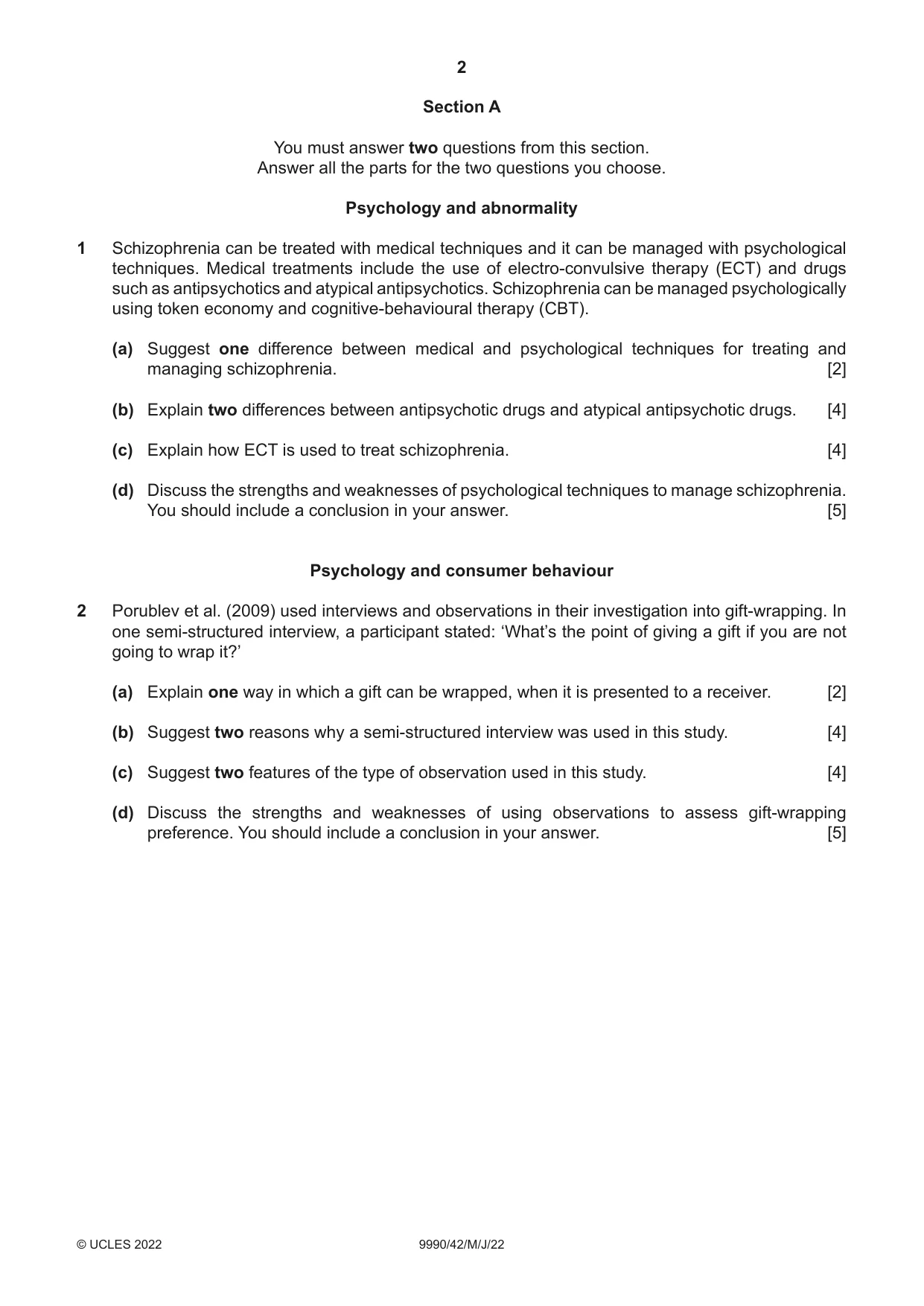
1 Schizophrenia can be treated with medical techniques and it can be managed with psychological techniques. Medical treatments include the use of electro-convulsive therapy (ECT) and drugs such as antipsychotics and atypical antipsychotics. Schizophrenia can be managed psychologically using token economy and cognitive-behavioural therapy (CBT). (a) Suggest one difference between medical and psychological techniques for treating and managing schizophrenia. [2] (b) Explain two differences between antipsychotic drugs and atypical antipsychotic drugs. [4] (c) Explain how ECT is used to treat schizophrenia. [4] (d) Discuss the strengths and weaknesses of psychological techniques to manage schizophrenia. You should include a conclusion in your answer. [5] Psychology and consumer behaviour
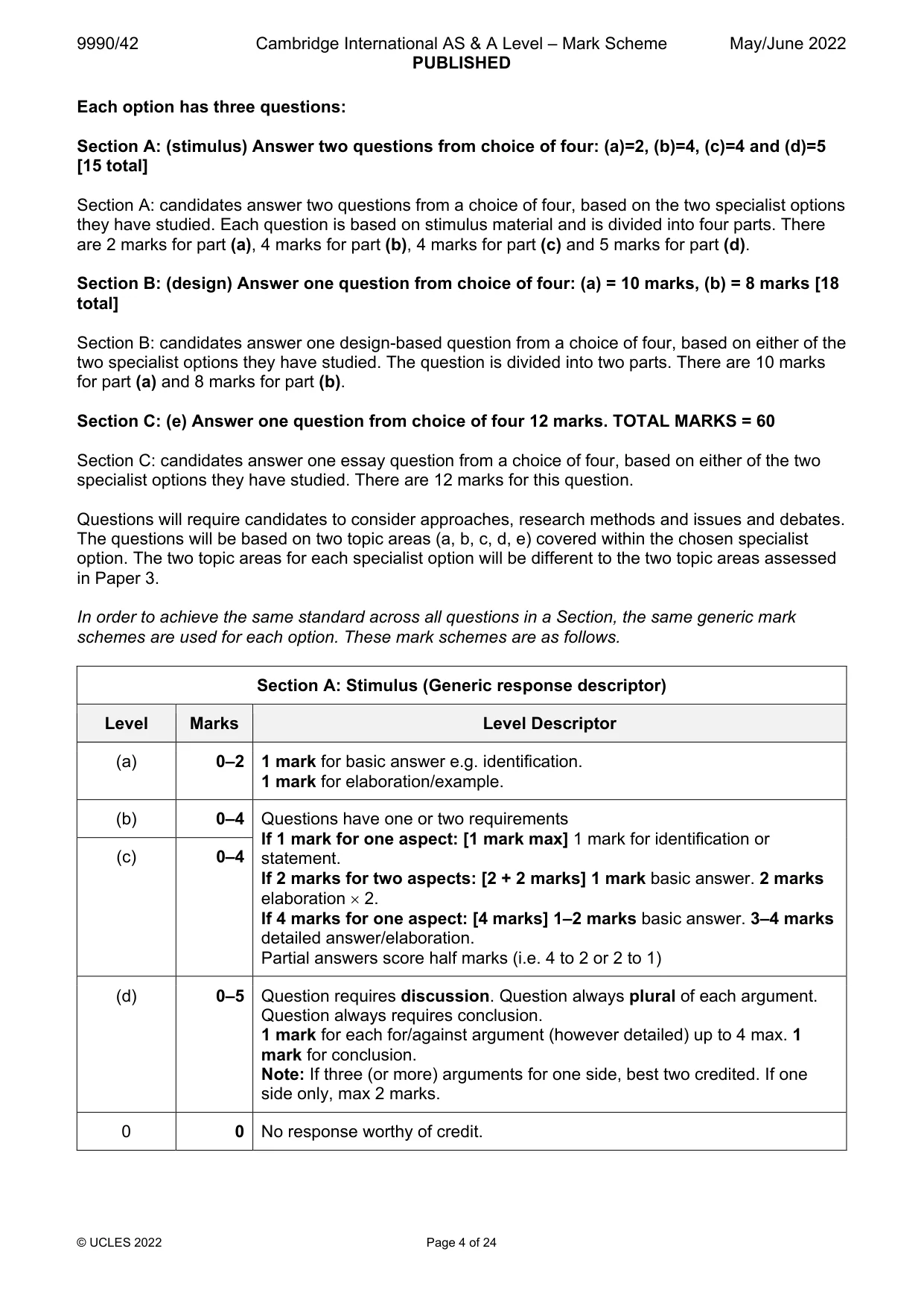
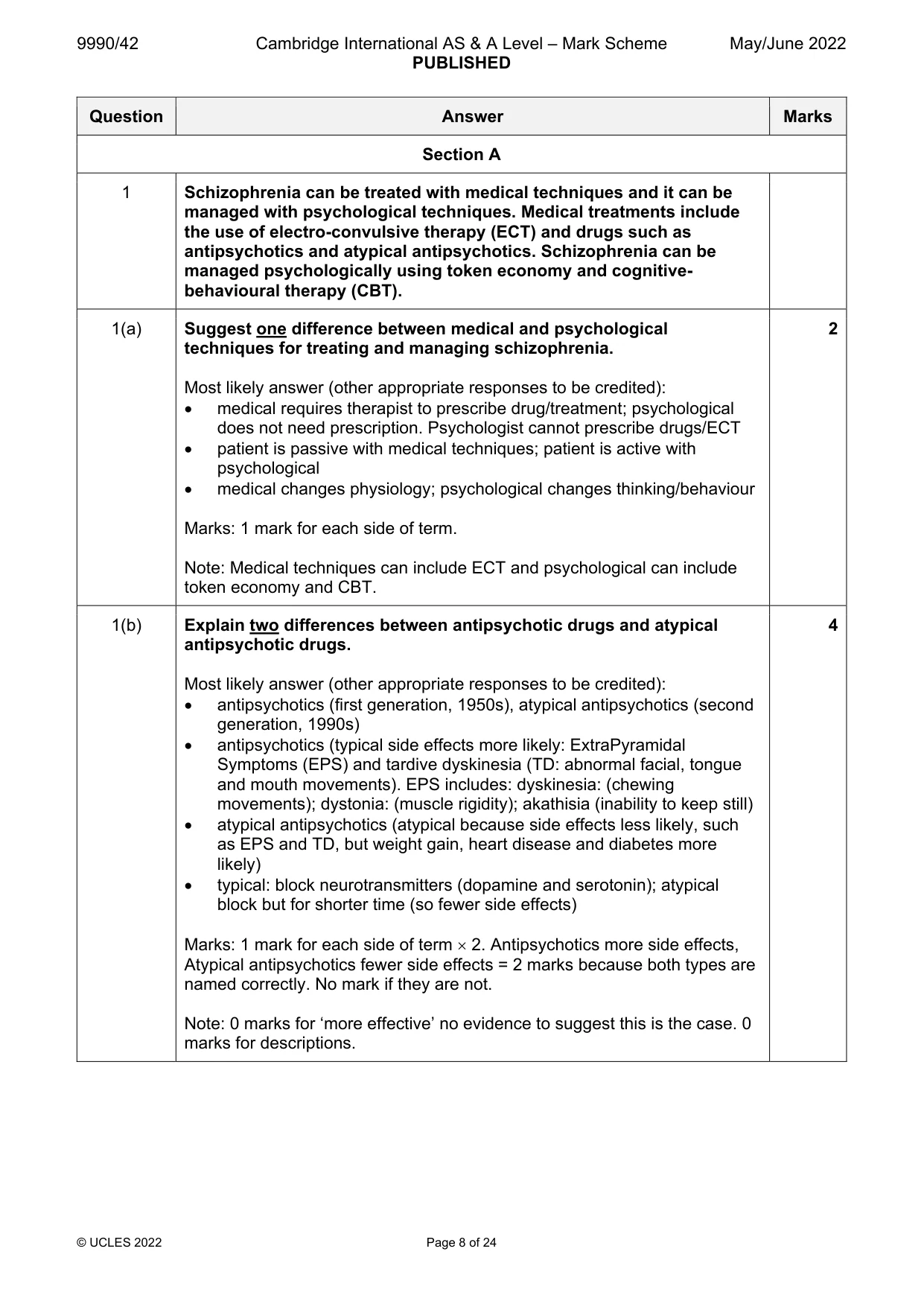
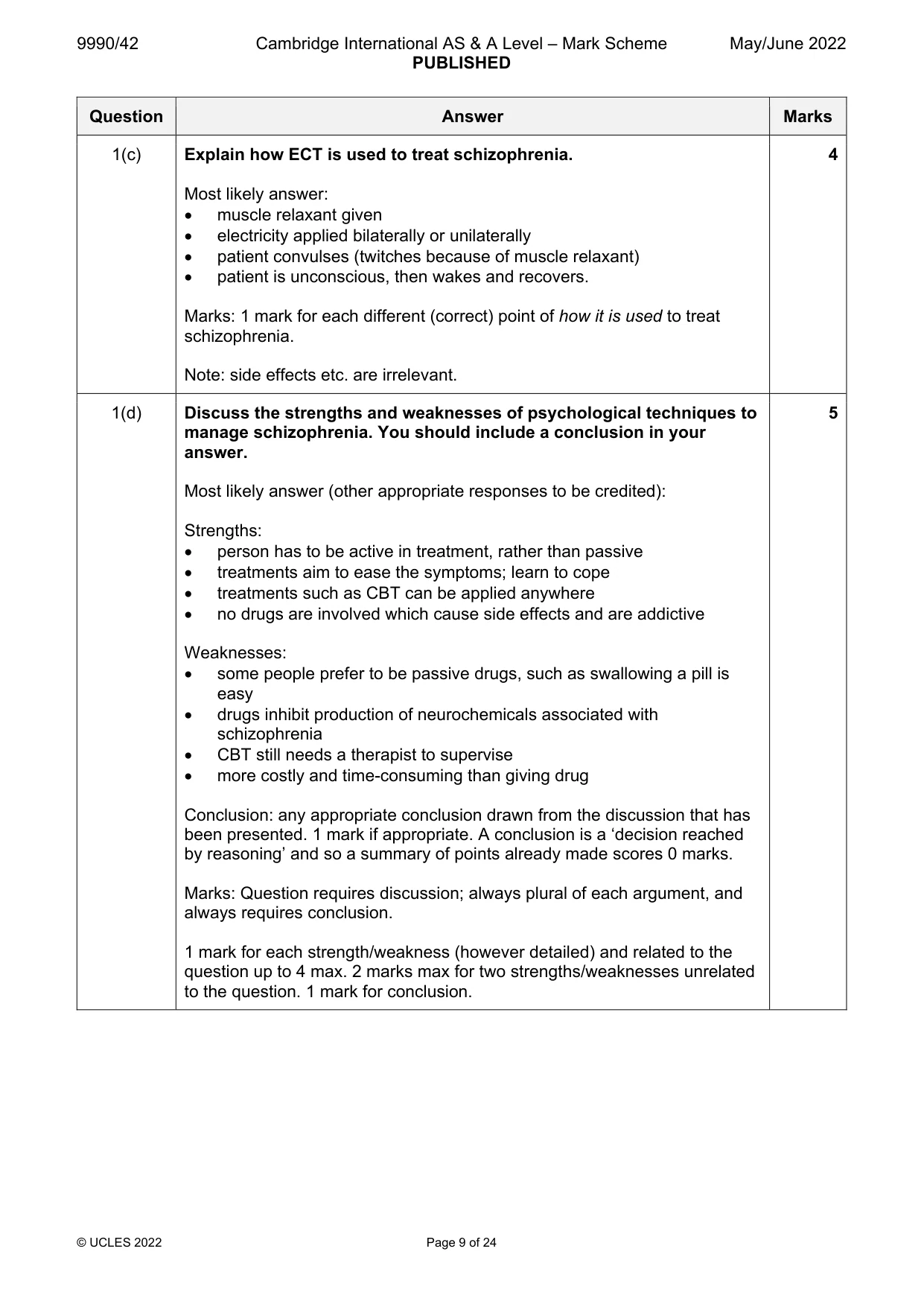
Mark scheme: Question Answer Marks Section A 1 Schizophrenia can be treated with medical techniques and it can be managed with psychological techniques. Medical treatments include the use of electro-convulsive therapy (ECT) and drugs such as antipsychotics and atypical antipsychotics. Schizophrenia can be managed psychologically using token economy and cognitive- behavioural therapy (CBT). 1(a) Suggest one difference between medical and psychological 2 techniques for treating and managing schizophrenia. Most likely answer (other appropriate responses to be credited): medical requires therapist to prescribe drug/treatment; psychological does not need prescription. Psychologist cannot prescribe drugs/ECT patient is passive with medical techniques; patient is active with psychological medical changes physiology; psychological changes thinking/behaviour Marks: 1 mark for each side of term. Note: Medical techniques can include ECT and psychological can include token economy and CBT. 1(b) Explain two differences between antipsychotic drugs and atypical 4 antipsychotic drugs. Most likely answer (other appropriate responses to be credited): antipsychotics (first generation, 1950s), atypical antipsychotics (second generation, 1990s) antipsychotics (typical side effects more likely: ExtraPyramidal Symptoms (EPS) and tardive dyskinesia (TD: abnormal facial, tongue and mouth movements). EPS includes: dyskinesia: (chewing movements); dystonia: (muscle rigidity); akathisia (inability to keep still) atypical antipsychotics (atypical because side effects less likely, such as EPS and TD, but weight gain, heart disease and diabetes more likely) typical: block neurotransmitters (dopamine and serotonin); atypical block but for shorter time (so fewer side effects) Marks: 1 mark for each side of term 2. Antipsychotics more side effects, Atypical antipsychotics fewer side effects = 2 marks because both types are named correctly. No mark if they are not. Note: 0 marks for ‘more effective’ no evidence to suggest this is the case. 0 marks for descriptions. 1(c) Explain how ECT is used to treat schizophrenia. 4 Most likely answer: muscle relaxant given electricity applied bilaterally or unilaterally patient convulses (twitches because of muscle relaxant) patient is unconscious, then wakes and recovers. Marks: 1 mark for each different (correct) point of how it is used to treat schizophrenia. Note: side effects etc. are irrelevant. 1(d) Discuss the strengths and weaknesses of psychological techniques to 5 manage schizophrenia. You should include a conclusion in your answer. Most likely answer (other appropriate responses to be credited): Strengths: person has to be active in treatment, rather than passive treatments aim to ease the symptoms; learn to cope treatments such as CBT can be applied anywhere no drugs are involved which cause side effects and are addictive Weaknesses: some people prefer to be passive drugs, such as swallowing a pill is easy drugs inhibit production of neurochemicals associated with schizophrenia CBT still needs a therapist to supervise more costly and time-consuming than giving drug Conclusion: any appropriate conclusion drawn from the discussion that has been presented. 1 mark if appropriate. A conclusion is a ‘decision reached by reasoning’ and so a summary of points already made scores 0 marks. Marks: Question requires discussion; always plural of each argument, and always requires conclusion. 1 mark for each strength/weakness (however detailed) and related to the question up to 4 max. 2 marks max for two strengths/weaknesses unrelated to the question. 1 mark for conclusion.
Question 2
2 Porublev et al. (2009) used interviews and observations in their investigation into gift-wrapping. In one semi-structured interview, a participant stated: ‘What’s the point of giving a gift if you are not going to wrap it?’ (a) Explain one way in which a gift can be wrapped, when it is presented to a receiver. [2] (b) Suggest two reasons why a semi-structured interview was used in this study. [4] (c) Suggest two features of the type of observation used in this study. [4] (d) Discuss the strengths and weaknesses of using observations to assess gift-wrapping preference. You should include a conclusion in your answer. [5] Psychology and health
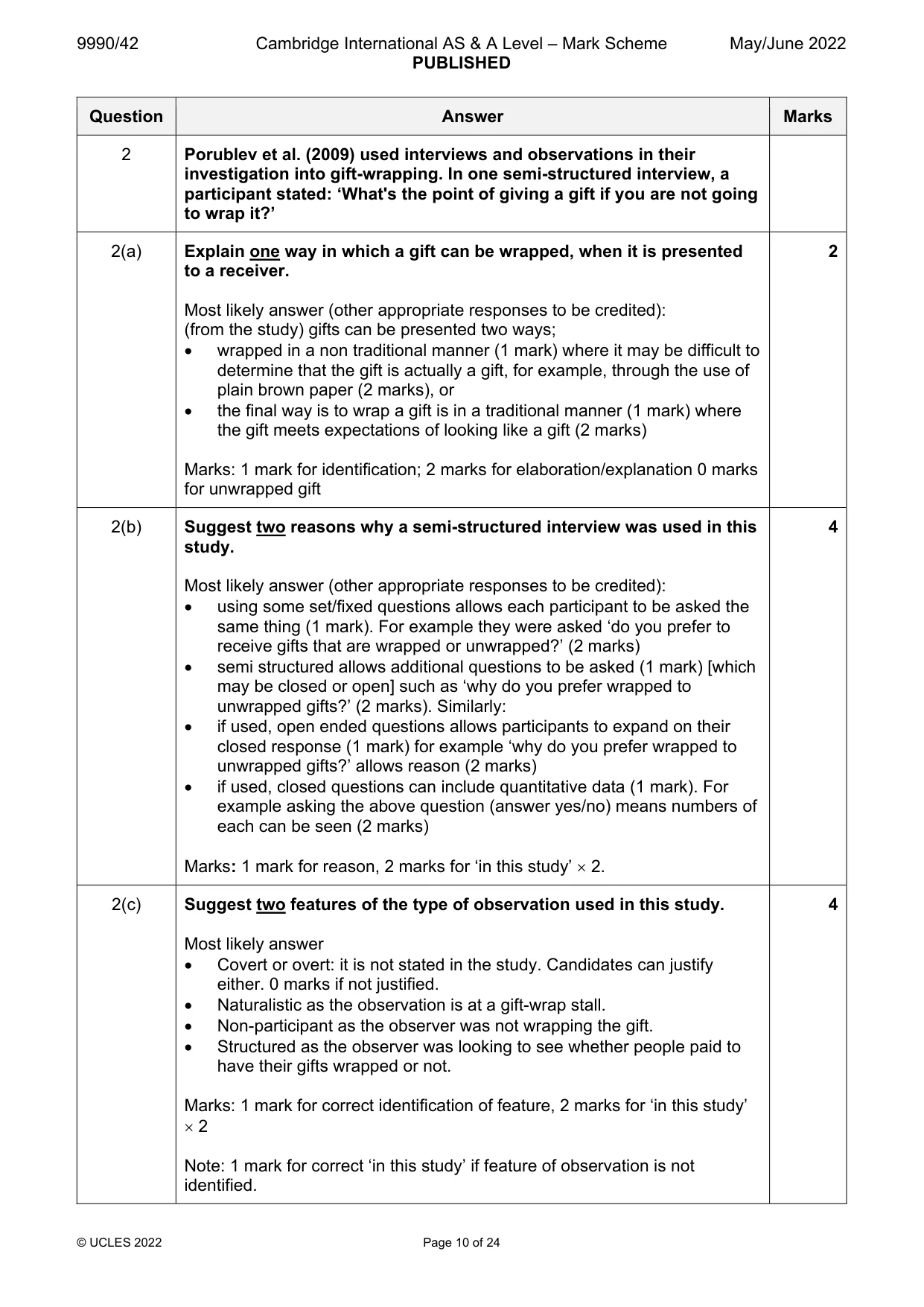
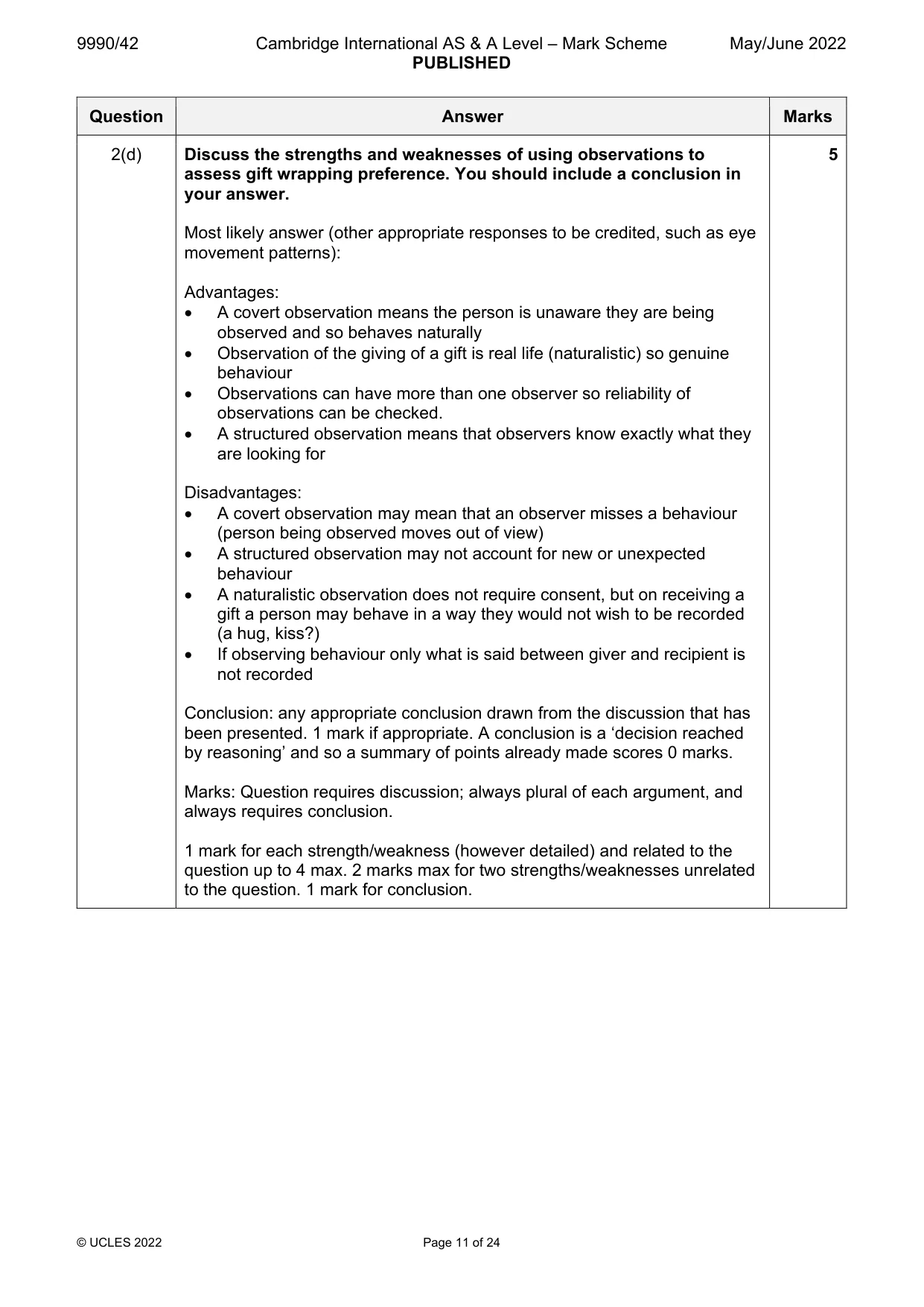
Mark scheme: 2 Porublev et al. (2009) used interviews and observations in their investigation into gift-wrapping. In one semi-structured interview, a participant stated: ‘What's the point of giving a gift if you are not going to wrap it?’ 2(a) Explain one way in which a gift can be wrapped, when it is presented 2 to a receiver. Most likely answer (other appropriate responses to be credited): (from the study) gifts can be presented two ways; wrapped in a non traditional manner (1 mark) where it may be difficult to determine that the gift is actually a gift, for example, through the use of plain brown paper (2 marks), or the final way is to wrap a gift is in a traditional manner (1 mark) where the gift meets expectations of looking like a gift (2 marks) Marks: 1 mark for identification; 2 marks for elaboration/explanation 0 marks for unwrapped gift 2(b) Suggest two reasons why a semi-structured interview was used in this 4 study. Most likely answer (other appropriate responses to be credited): using some set/fixed questions allows each participant to be asked the same thing (1 mark). For example they were asked ‘do you prefer to receive gifts that are wrapped or unwrapped?’ (2 marks) semi structured allows additional questions to be asked (1 mark) [which may be closed or open] such as ‘why do you prefer wrapped to unwrapped gifts?’ (2 marks). Similarly: if used, open ended questions allows participants to expand on their closed response (1 mark) for example ‘why do you prefer wrapped to unwrapped gifts?’ allows reason (2 marks) if used, closed questions can include quantitative data (1 mark). For example asking the above question (answer yes/no) means numbers of each can be seen (2 marks) Marks: 1 mark for reason, 2 marks for ‘in this study’ 2. 2(c) Suggest two features of the type of observation used in this study. 4 Most likely answer Covert or overt: it is not stated in the study. Candidates can justify either. 0 marks if not justified. Naturalistic as the observation is at a gift-wrap stall. Non-participant as the observer was not wrapping the gift. Structured as the observer was looking to see whether people paid to have their gifts wrapped or not. Marks: 1 mark for correct identification of feature, 2 marks for ‘in this study’ 2 Note: 1 mark for correct ‘in this study’ if feature of observation is not identified. 2(d) Discuss the strengths and weaknesses of using observations to 5 assess gift wrapping preference. You should include a conclusion in your answer. Most likely answer (other appropriate responses to be credited, such as eye movement patterns): Advantages: A covert observation means the person is unaware they are being observed and so behaves naturally Observation of the giving of a gift is real life (naturalistic) so genuine behaviour Observations can have more than one observer so reliability of observations can be checked. A structured observation means that observers know exactly what they are looking for Disadvantages: A covert observation may mean that an observer misses a behaviour (person being observed moves out of view) A structured observation may not account for new or unexpected behaviour A naturalistic observation does not require consent, but on receiving a gift a person may behave in a way they would not wish to be recorded (a hug, kiss?) If observing behaviour only what is said between giver and recipient is not recorded Conclusion: any appropriate conclusion drawn from the discussion that has been presented. 1 mark if appropriate. A conclusion is a ‘decision reached by reasoning’ and so a summary of points already made scores 0 marks. Marks: Question requires discussion; always plural of each argument, and always requires conclusion. 1 mark for each strength/weakness (however detailed) and related to the question up to 4 max. 2 marks max for two strengths/weaknesses unrelated to the question. 1 mark for conclusion.
Q3 · Biofeedback can be used for the management of stress
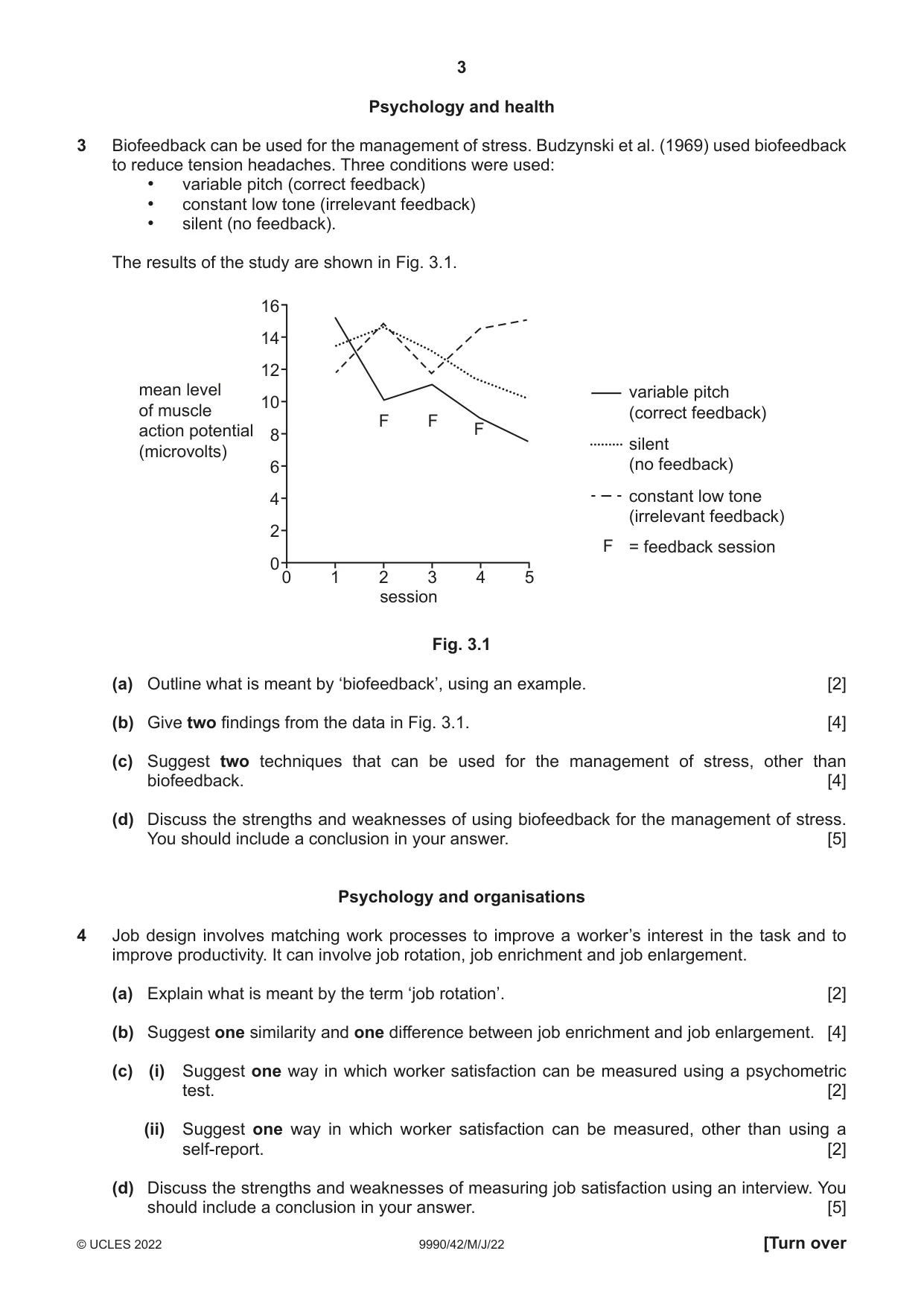
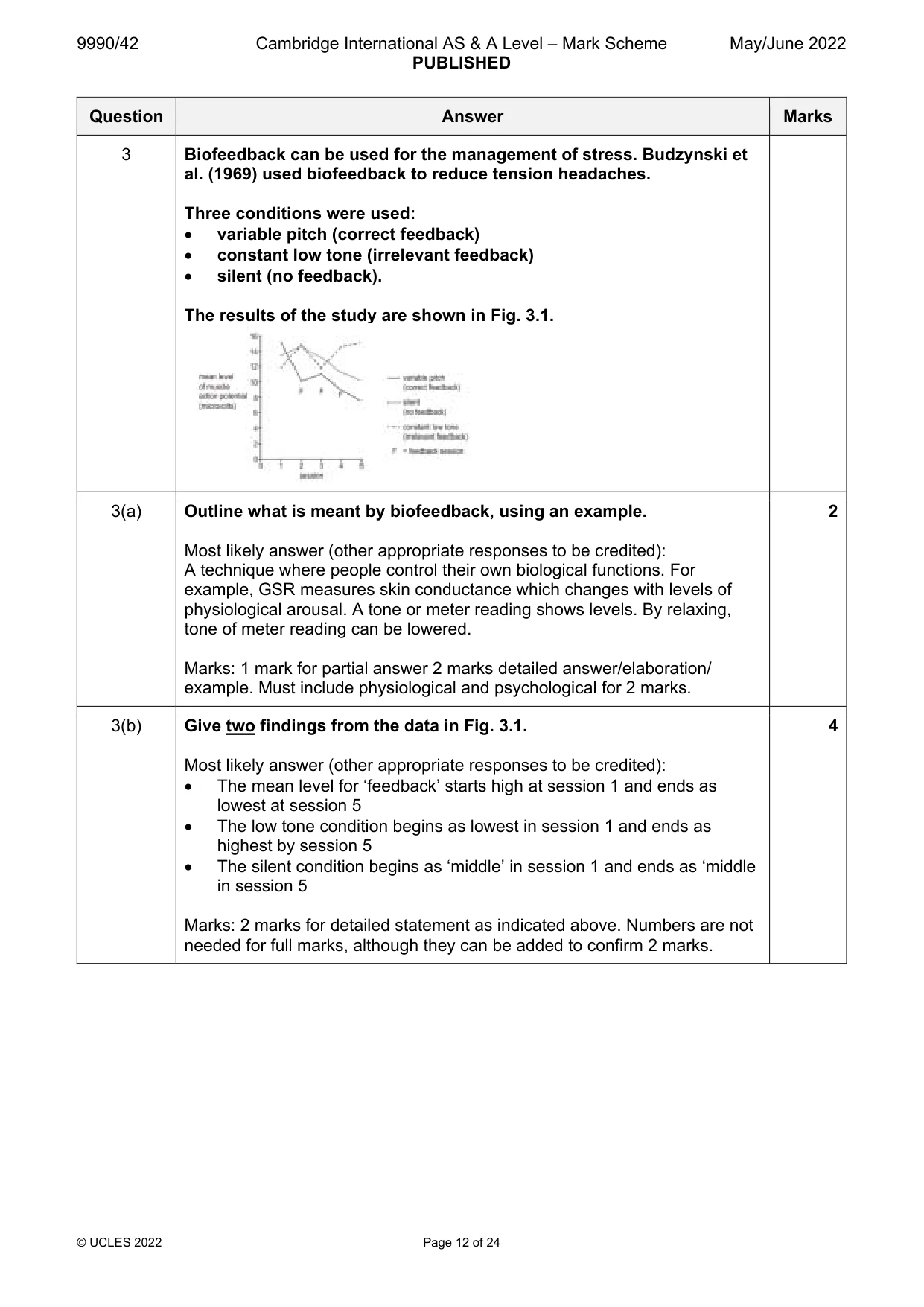
3 Biofeedback can be used for the management of stress. Budzynski et al. (1969) used biofeedback to reduce tension headaches. Three conditions were used: • variable pitch (correct feedback) • constant low tone (irrelevant feedback) • silent (no feedback). The results of the study are shown in Fig. 3.1. 16 14 12 mean level variable pitch 10 of muscle (correct feedback) F F action potential 8 F silent (microvolts) 6 (no feedback) 4 constant low tone (irrelevant feedback) 2 F = feedback session 00 1 2 3 4 5 session Fig. 3.1 (a) Outline what is meant by ‘biofeedback’, using an example. [2] (b) Give two findings from the data in Fig. 3.1. [4] (c) Suggest two techniques that can be used for the management of stress, other than biofeedback. [4] (d) Discuss the strengths and weaknesses of using biofeedback for the management of stress. You should include a conclusion in your answer. [5] Psychology and organisations
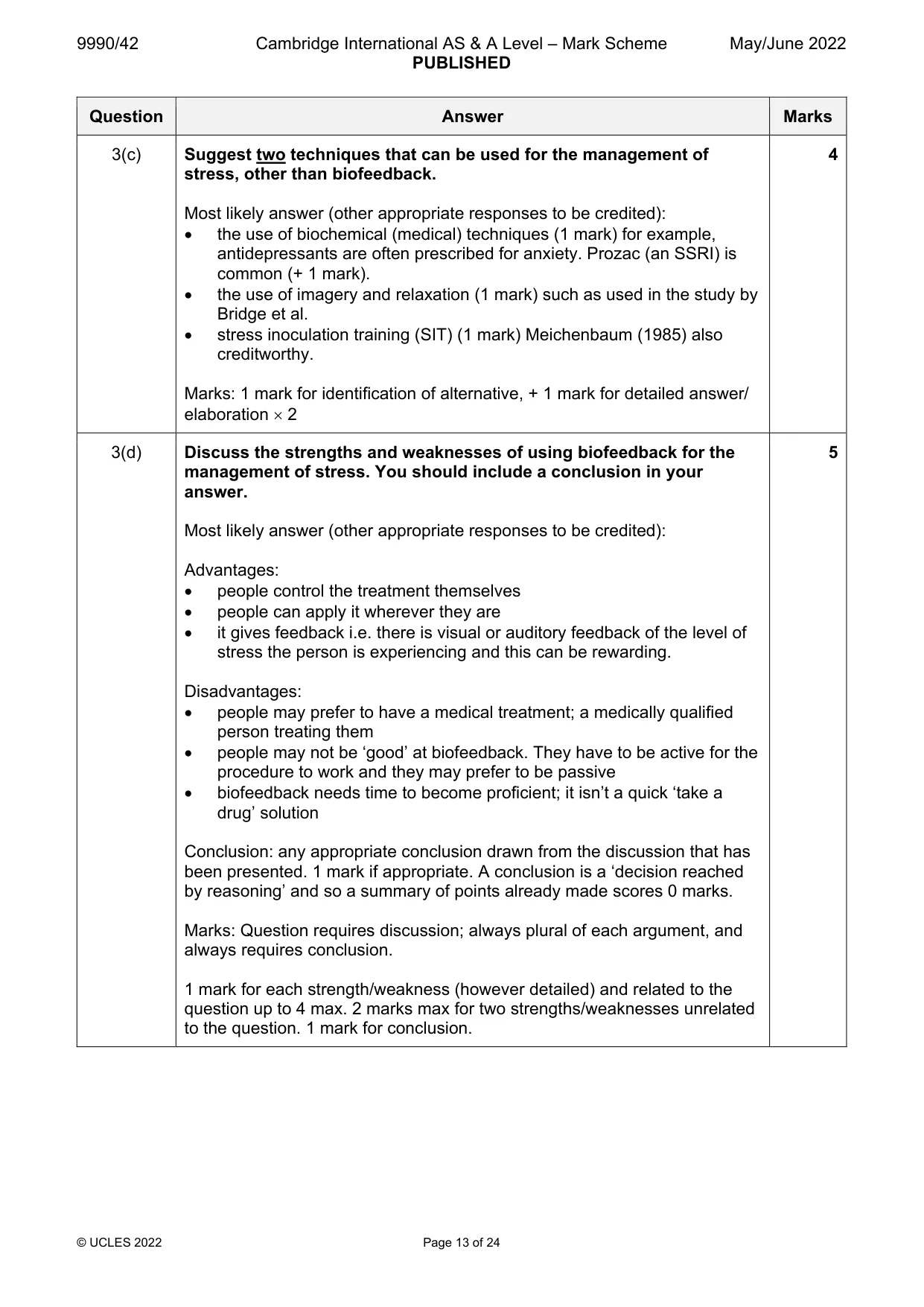
Mark scheme: 3 Biofeedback can be used for the management of stress. Budzynski et al. (1969) used biofeedback to reduce tension headaches. Three conditions were used: variable pitch (correct feedback) constant low tone (irrelevant feedback) silent (no feedback). The results of the study are shown in Fig. 3.1. 3(a) Outline what is meant by biofeedback, using an example. 2 Most likely answer (other appropriate responses to be credited): A technique where people control their own biological functions. For example, GSR measures skin conductance which changes with levels of physiological arousal. A tone or meter reading shows levels. By relaxing, tone of meter reading can be lowered. Marks: 1 mark for partial answer 2 marks detailed answer/elaboration/ example. Must include physiological and psychological for 2 marks. 3(b) Give two findings from the data in Fig. 3.1. 4 Most likely answer (other appropriate responses to be credited): The mean level for ‘feedback’ starts high at session 1 and ends as lowest at session 5 The low tone condition begins as lowest in session 1 and ends as highest by session 5 The silent condition begins as ‘middle’ in session 1 and ends as ‘middle in session 5 Marks: 2 marks for detailed statement as indicated above. Numbers are not needed for full marks, although they can be added to confirm 2 marks. 3(c) Suggest two techniques that can be used for the management of 4 stress, other than biofeedback. Most likely answer (other appropriate responses to be credited): the use of biochemical (medical) techniques (1 mark) for example, antidepressants are often prescribed for anxiety. Prozac (an SSRI) is common (+ 1 mark). the use of imagery and relaxation (1 mark) such as used in the study by Bridge et al. stress inoculation training (SIT) (1 mark) Meichenbaum (1985) also creditworthy. Marks: 1 mark for identification of alternative, + 1 mark for detailed answer/ elaboration 2 3(d) Discuss the strengths and weaknesses of using biofeedback for the 5 management of stress. You should include a conclusion in your answer. Most likely answer (other appropriate responses to be credited): Advantages: people control the treatment themselves people can apply it wherever they are it gives feedback i.e. there is visual or auditory feedback of the level of stress the person is experiencing and this can be rewarding. Disadvantages: people may prefer to have a medical treatment; a medically qualified person treating them people may not be ‘good’ at biofeedback. They have to be active for the procedure to work and they may prefer to be passive biofeedback needs time to become proficient; it isn’t a quick ‘take a drug’ solution Conclusion: any appropriate conclusion drawn from the discussion that has been presented. 1 mark if appropriate. A conclusion is a ‘decision reached by reasoning’ and so a summary of points already made scores 0 marks. Marks: Question requires discussion; always plural of each argument, and always requires conclusion. 1 mark for each strength/weakness (however detailed) and related to the question up to 4 max. 2 marks max for two strengths/weaknesses unrelated to the question. 1 mark for conclusion.
Q4 · Job design involves matching work processes to improve a worker’s interest in the task…
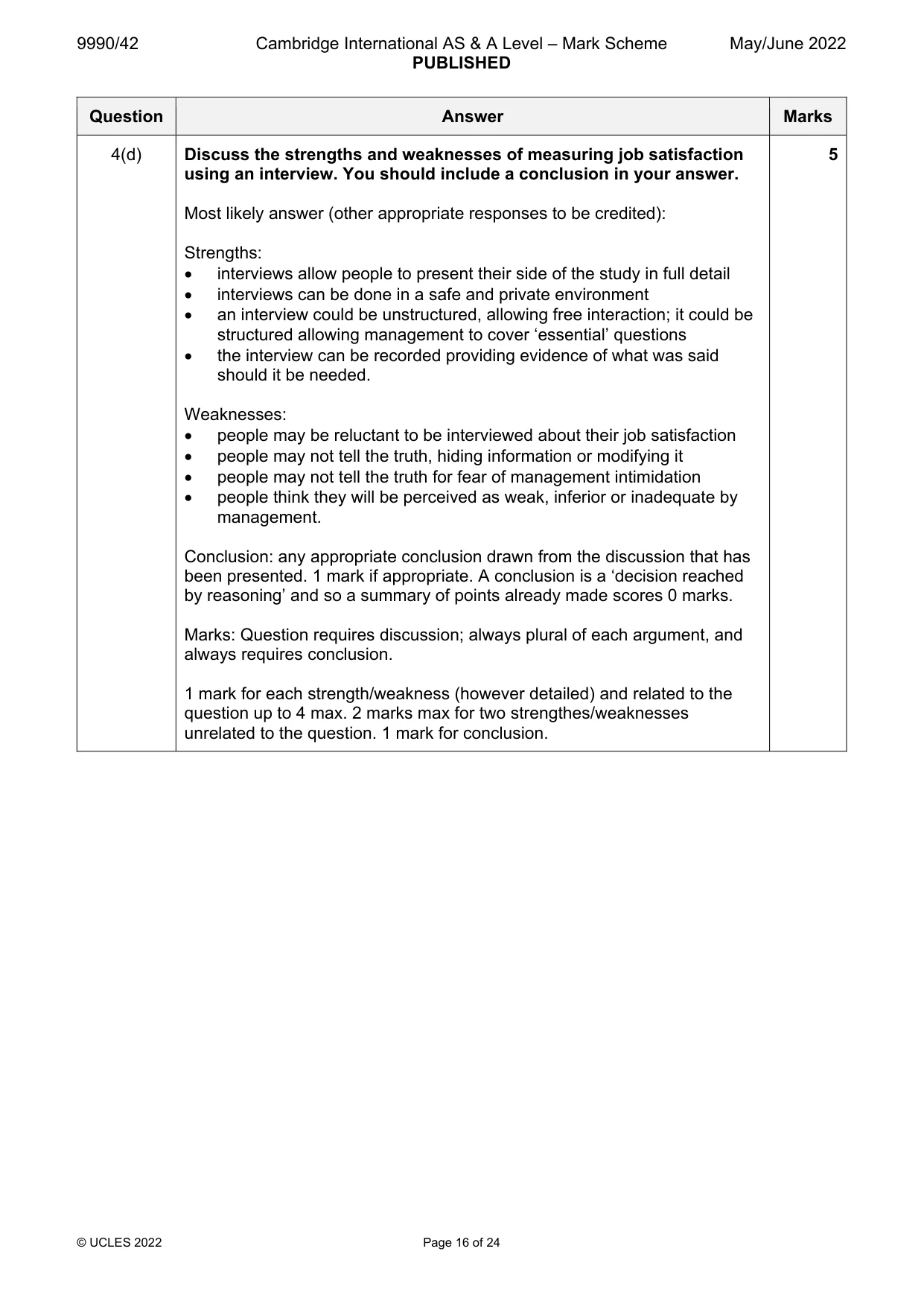
4 Job design involves matching work processes to improve a worker’s interest in the task and to improve productivity. It can involve job rotation, job enrichment and job enlargement. (a) Explain what is meant by the term ‘job rotation’. [2] (b) Suggest one similarity and one difference between job enrichment and job enlargement. [4] (c) (i) Suggest one way in which worker satisfaction can be measured using a psychometric test. [2] (ii) Suggest one way in which worker satisfaction can be measured, other than using a self-report. [2] (d) Discuss the strengths and weaknesses of measuring job satisfaction using an interview. You should include a conclusion in your answer. [5]
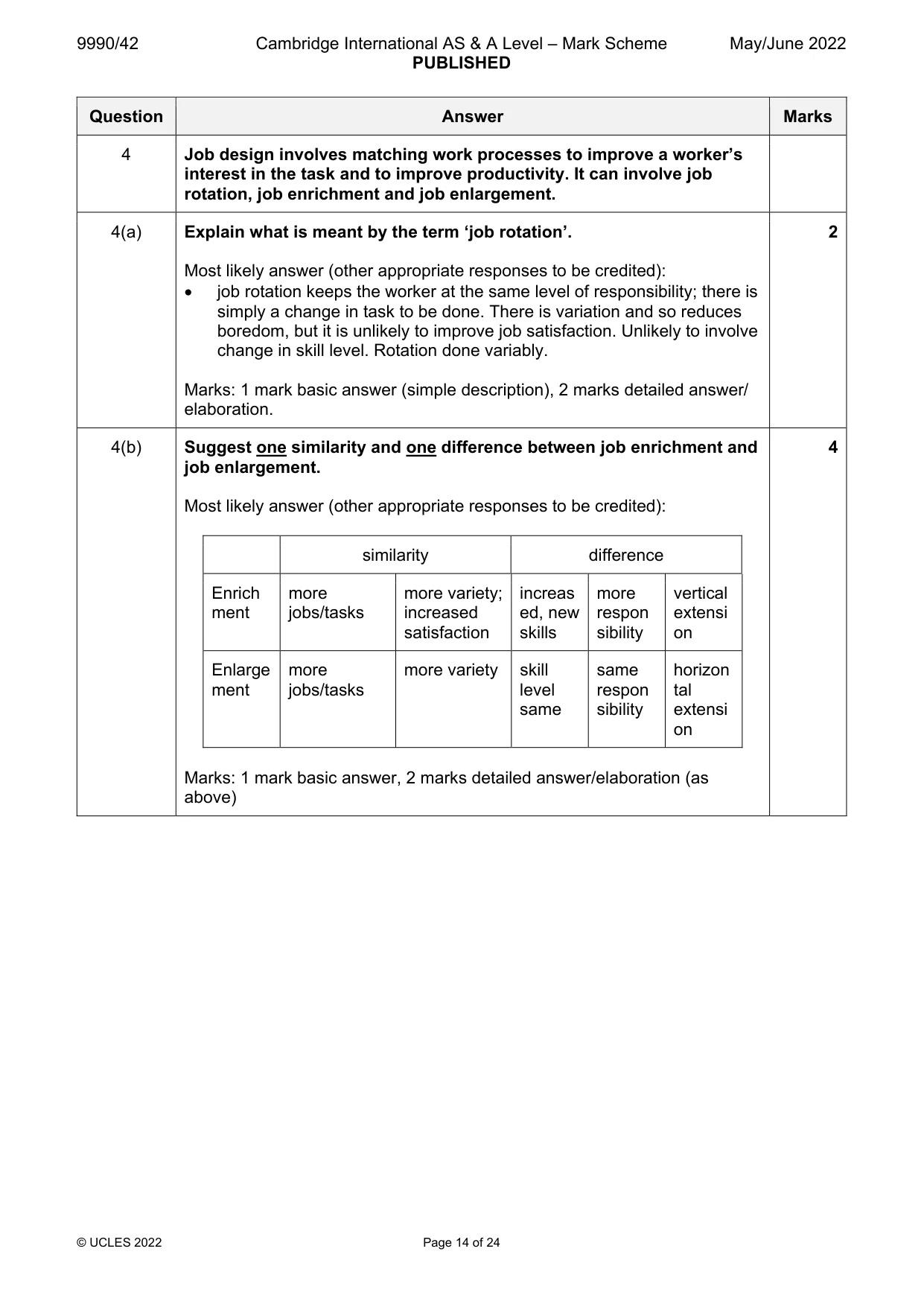
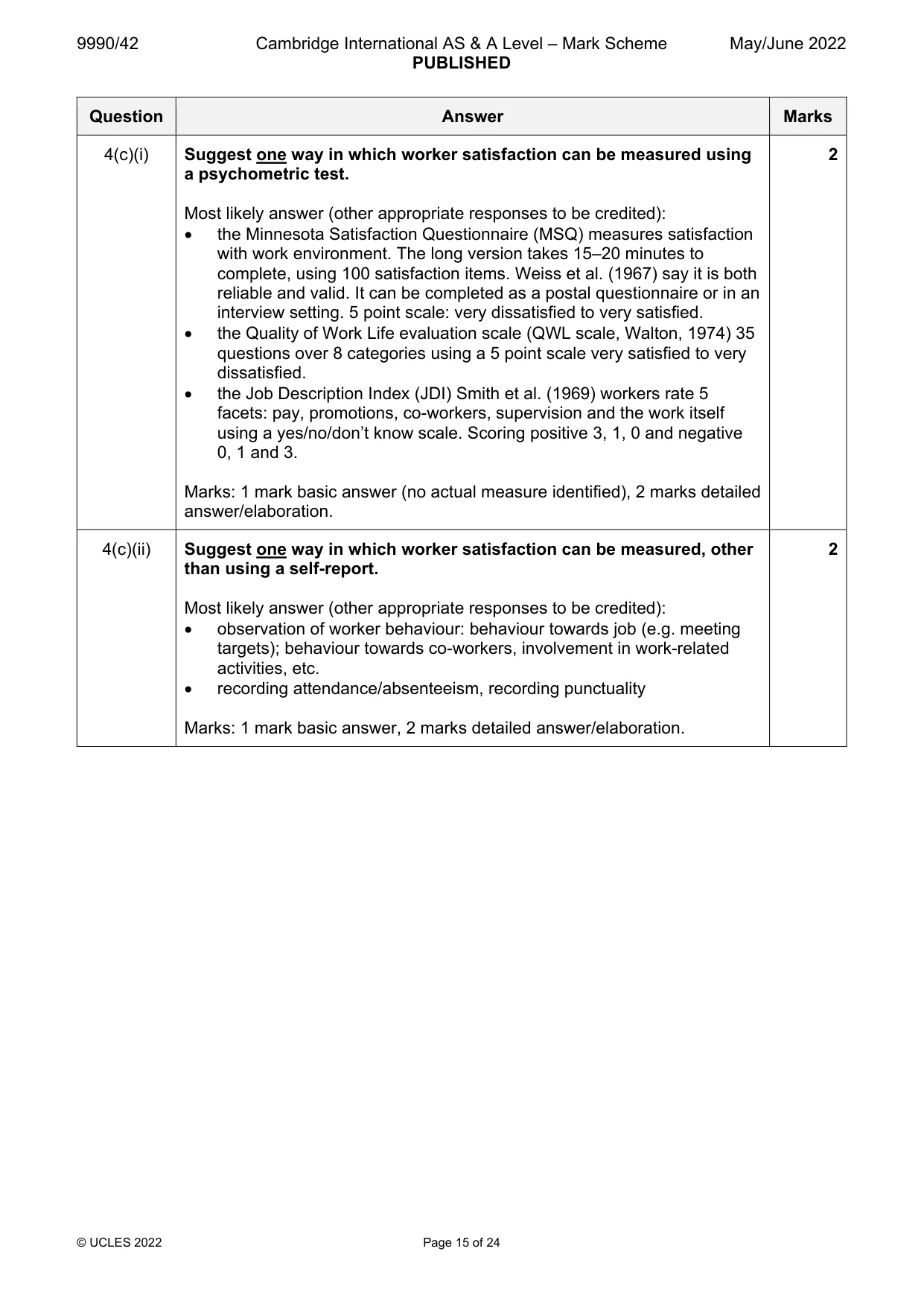
Mark scheme: 4 Job design involves matching work processes to improve a worker’s interest in the task and to improve productivity. It can involve job rotation, job enrichment and job enlargement. 4(a) Explain what is meant by the term ‘job rotation’. 2 Most likely answer (other appropriate responses to be credited): job rotation keeps the worker at the same level of responsibility; there is simply a change in task to be done. There is variation and so reduces boredom, but it is unlikely to improve job satisfaction. Unlikely to involve change in skill level. Rotation done variably. Marks: 1 mark basic answer (simple description), 2 marks detailed answer/ elaboration. 4(b) Suggest one similarity and one difference between job enrichment and 4 job enlargement. Most likely answer (other appropriate responses to be credited): similarity difference Enrich more more variety; increas more vertical ment jobs/tasks increased ed, new respon extensi satisfaction skills sibility on Enlarge more more variety skill same horizon ment jobs/tasks level respon tal same sibility extensi on Marks: 1 mark basic answer, 2 marks detailed answer/elaboration (as above) 4(c)(i) Suggest one way in which worker satisfaction can be measured using 2 a psychometric test. Most likely answer (other appropriate responses to be credited): the Minnesota Satisfaction Questionnaire (MSQ) measures satisfaction with work environment. The long version takes 15–20 minutes to complete, using 100 satisfaction items. Weiss et al. (1967) say it is both reliable and valid. It can be completed as a postal questionnaire or in an interview setting. 5 point scale: very dissatisfied to very satisfied. the Quality of Work Life evaluation scale (QWL scale, Walton, 1974) 35 questions over 8 categories using a 5 point scale very satisfied to very dissatisfied. the Job Description Index (JDI) Smith et al. (1969) workers rate 5 facets: pay, promotions, co-workers, supervision and the work itself using a yes/no/don’t know scale. Scoring positive 3, 1, 0 and negative 0, 1 and 3. Marks: 1 mark basic answer (no actual measure identified), 2 marks detailed answer/elaboration. 4(c)(ii) Suggest one way in which worker satisfaction can be measured, other 2 than using a self-report. Most likely answer (other appropriate responses to be credited): observation of worker behaviour: behaviour towards job (e.g. meeting targets); behaviour towards co-workers, involvement in work-related activities, etc. recording attendance/absenteeism, recording punctuality Marks: 1 mark basic answer, 2 marks detailed answer/elaboration. 4(d) Discuss the strengths and weaknesses of measuring job satisfaction 5 using an interview. You should include a conclusion in your answer. Most likely answer (other appropriate responses to be credited): Strengths: interviews allow people to present their side of the study in full detail interviews can be done in a safe and private environment an interview could be unstructured, allowing free interaction; it could be structured allowing management to cover ‘essential’ questions the interview can be recorded providing evidence of what was said should it be needed. Weaknesses: people may be reluctant to be interviewed about their job satisfaction people may not tell the truth, hiding information or modifying it people may not tell the truth for fear of management intimidation people think they will be perceived as weak, inferior or inadequate by management. Conclusion: any appropriate conclusion drawn from the discussion that has been presented. 1 mark if appropriate. A conclusion is a ‘decision reached by reasoning’ and so a summary of points already made scores 0 marks. Marks: Question requires discussion; always plural of each argument, and always requires conclusion. 1 mark for each strength/weakness (however detailed) and related to the question up to 4 max. 2 marks max for two strengthes/weaknesses unrelated to the question. 1 mark for conclusion.
Q5 · Design a study to investigate the effectiveness of chemical/drug treatments (MAOIs…
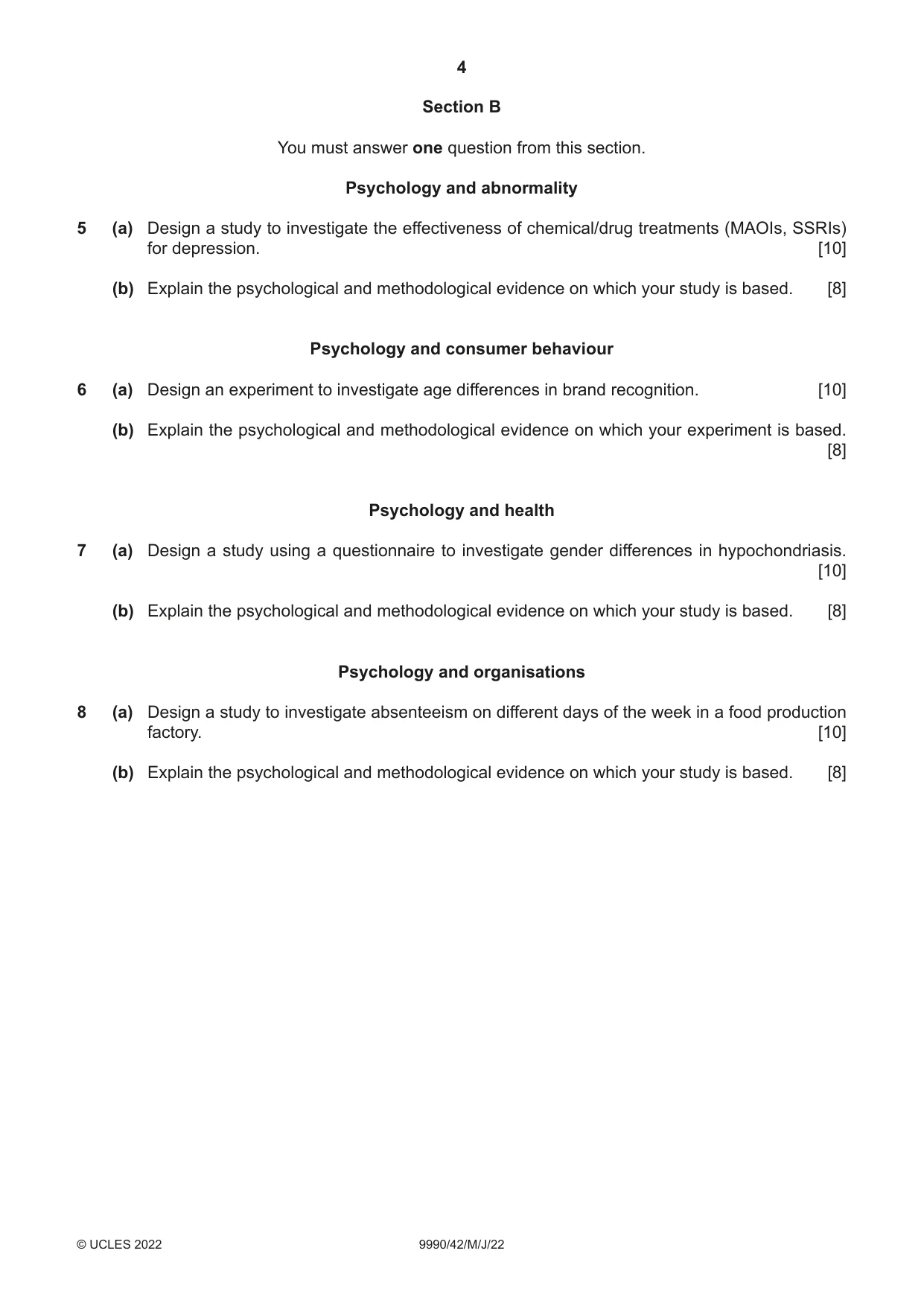
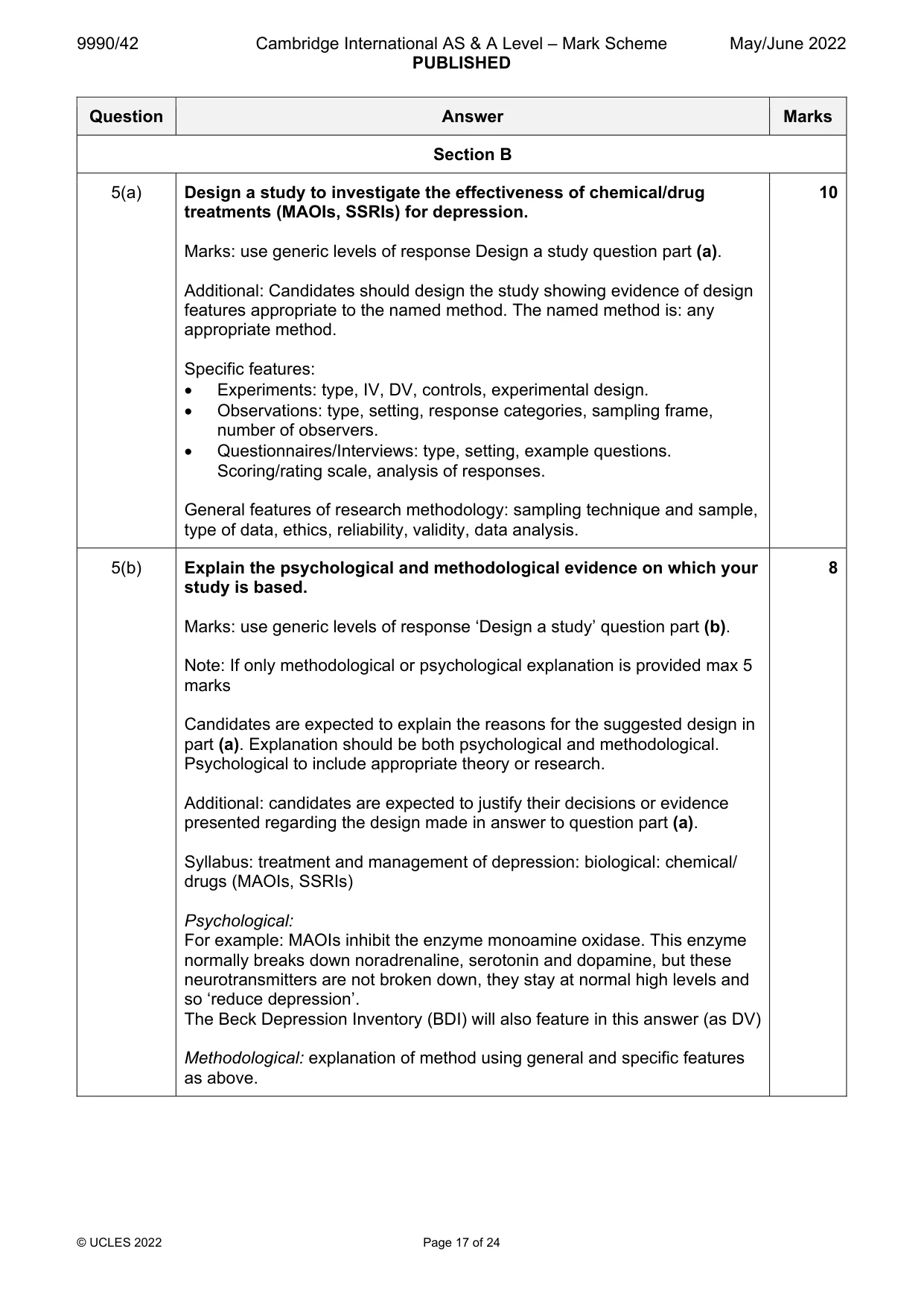
5 (a) Design a study to investigate the effectiveness of chemical/drug treatments (MAOIs, SSRIs) for depression. [10] (b) Explain the psychological and methodological evidence on which your study is based. [8] Psychology and consumer behaviour
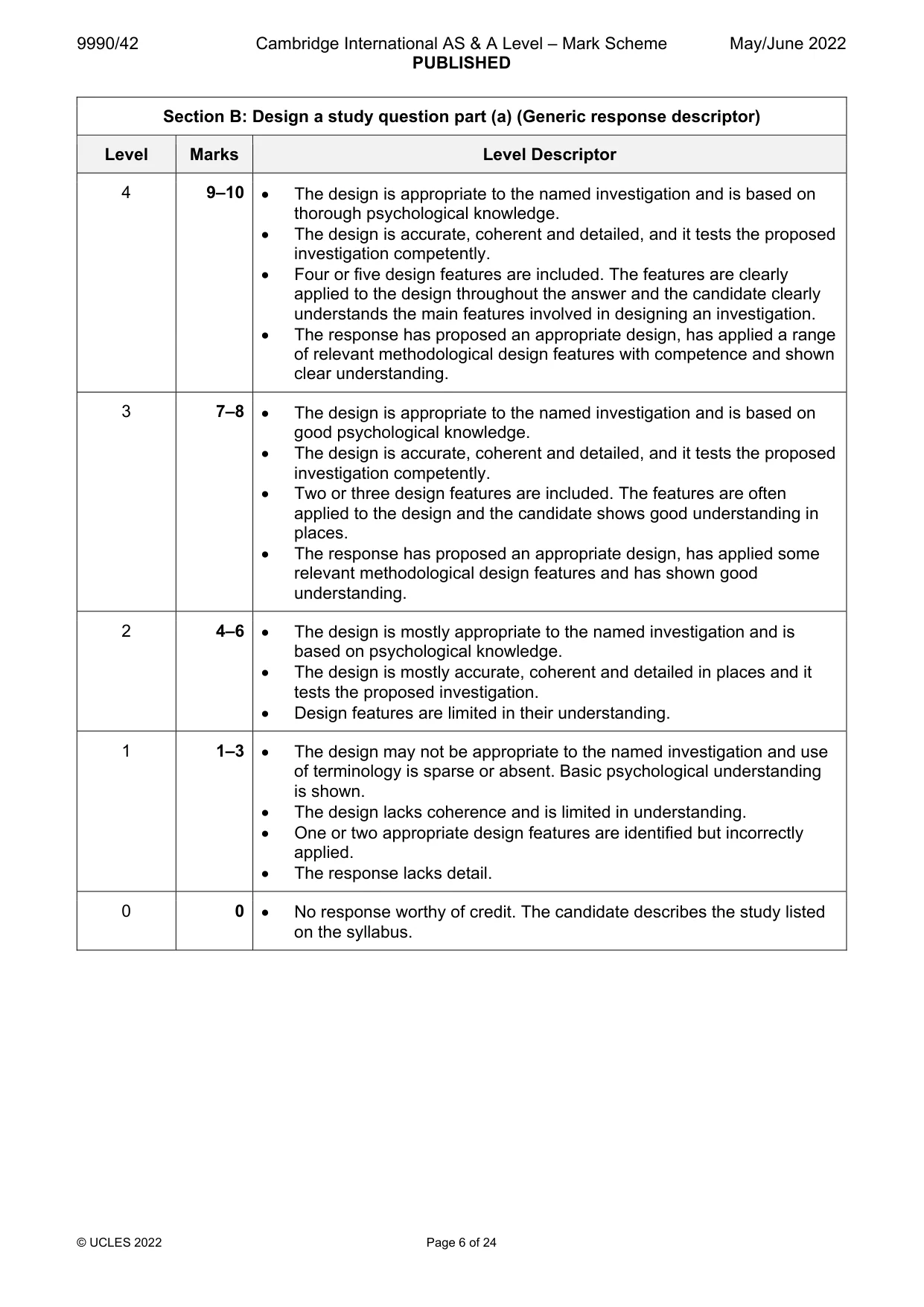
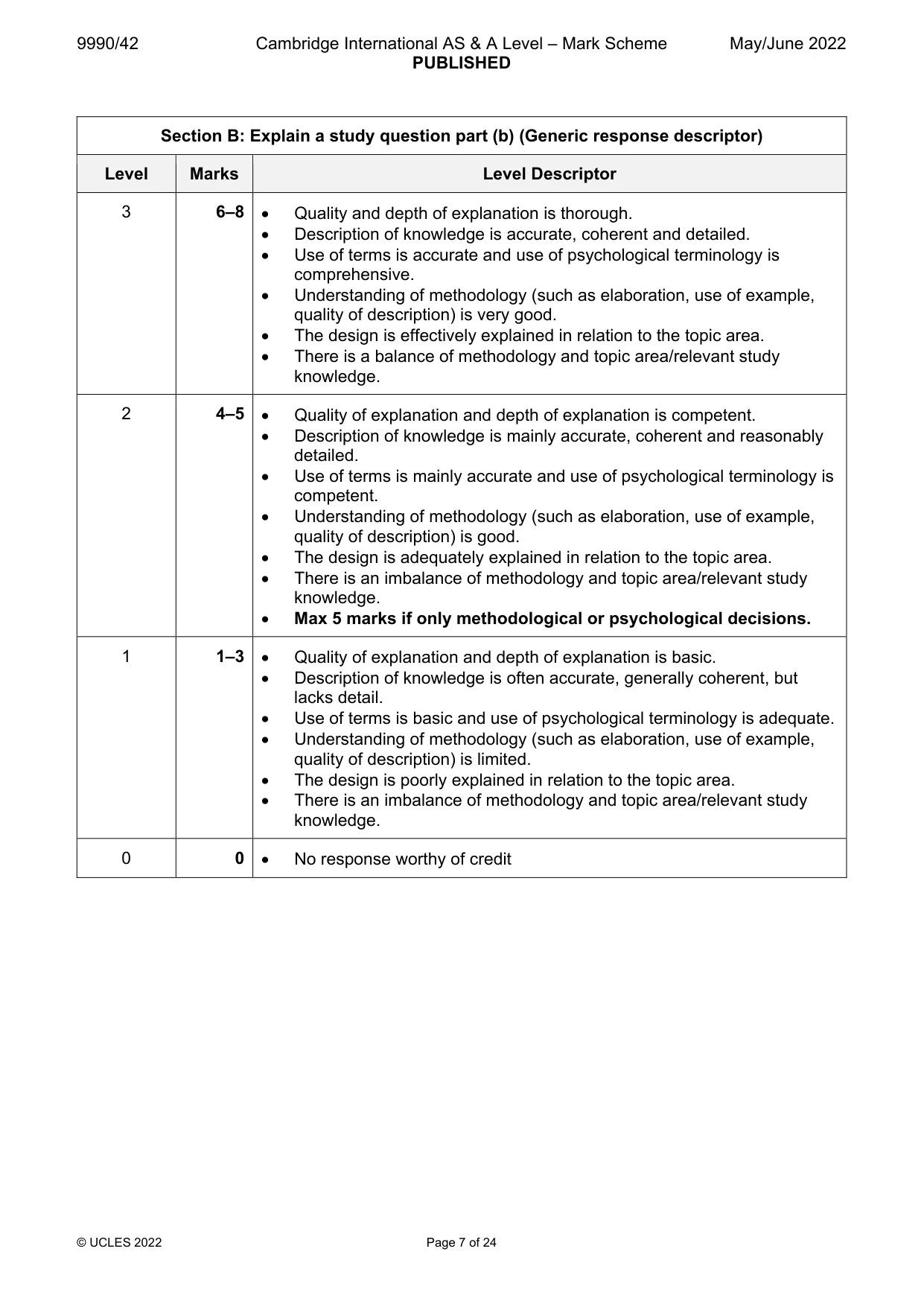
Mark scheme: 5(a) Design a study to investigate the effectiveness of chemical/drug 10 treatments (MAOIs, SSRIs) for depression. Marks: use generic levels of response Design a study question part (a). Additional: Candidates should design the study showing evidence of design features appropriate to the named method. The named method is: any appropriate method. Specific features: Experiments: type, IV, DV, controls, experimental design. Observations: type, setting, response categories, sampling frame, number of observers. Questionnaires/Interviews: type, setting, example questions. Scoring/rating scale, analysis of responses. General features of research methodology: sampling technique and sample, type of data, ethics, reliability, validity, data analysis. 5(b) Explain the psychological and methodological evidence on which your 8 study is based. Marks: use generic levels of response ‘Design a study’ question part (b). Note: If only methodological or psychological explanation is provided max 5 marks Candidates are expected to explain the reasons for the suggested design in part (a). Explanation should be both psychological and methodological. Psychological to include appropriate theory or research. Additional: candidates are expected to justify their decisions or evidence presented regarding the design made in answer to question part (a). Syllabus: treatment and management of depression: biological: chemical/ drugs (MAOIs, SSRIs) Psychological: For example: MAOIs inhibit the enzyme monoamine oxidase. This enzyme normally breaks down noradrenaline, serotonin and dopamine, but these neurotransmitters are not broken down, they stay at normal high levels and so ‘reduce depression’. The Beck Depression Inventory (BDI) will also feature in this answer (as DV) Methodological: explanation of method using general and specific features as above.
More questions on Mood (affective) disorders: depressive disorder (unipolar) and bipolar disorder
Q6 · Design an experiment to investigate age differences in brand recognition
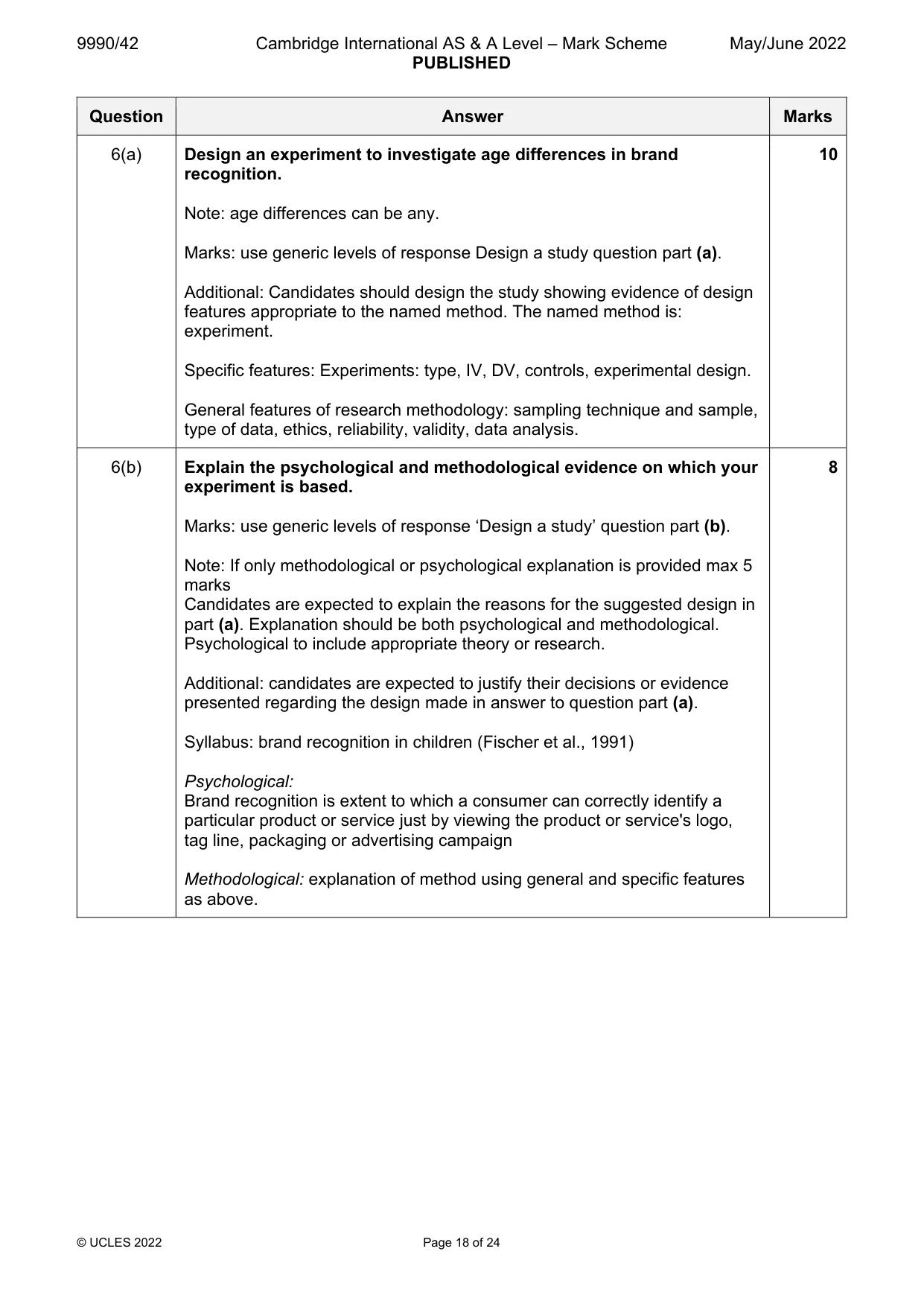
6 (a) Design an experiment to investigate age differences in brand recognition. [10] (b) Explain the psychological and methodological evidence on which your experiment is based. [8] Psychology and health
Mark scheme: 6(a) Design an experiment to investigate age differences in brand 10 recognition. Note: age differences can be any. Marks: use generic levels of response Design a study question part (a). Additional: Candidates should design the study showing evidence of design features appropriate to the named method. The named method is: experiment. Specific features: Experiments: type, IV, DV, controls, experimental design. General features of research methodology: sampling technique and sample, type of data, ethics, reliability, validity, data analysis. 6(b) Explain the psychological and methodological evidence on which your 8 experiment is based. Marks: use generic levels of response ‘Design a study’ question part (b). Note: If only methodological or psychological explanation is provided max 5 marks Candidates are expected to explain the reasons for the suggested design in part (a). Explanation should be both psychological and methodological. Psychological to include appropriate theory or research. Additional: candidates are expected to justify their decisions or evidence presented regarding the design made in answer to question part (a). Syllabus: brand recognition in children (Fischer et al., 1991) Psychological: Brand recognition is extent to which a consumer can correctly identify a particular product or service just by viewing the product or service's logo, tag line, packaging or advertising campaign Methodological: explanation of method using general and specific features as above.
Q7 · Design a study using a questionnaire to investigate gender differences in hypochondriasis
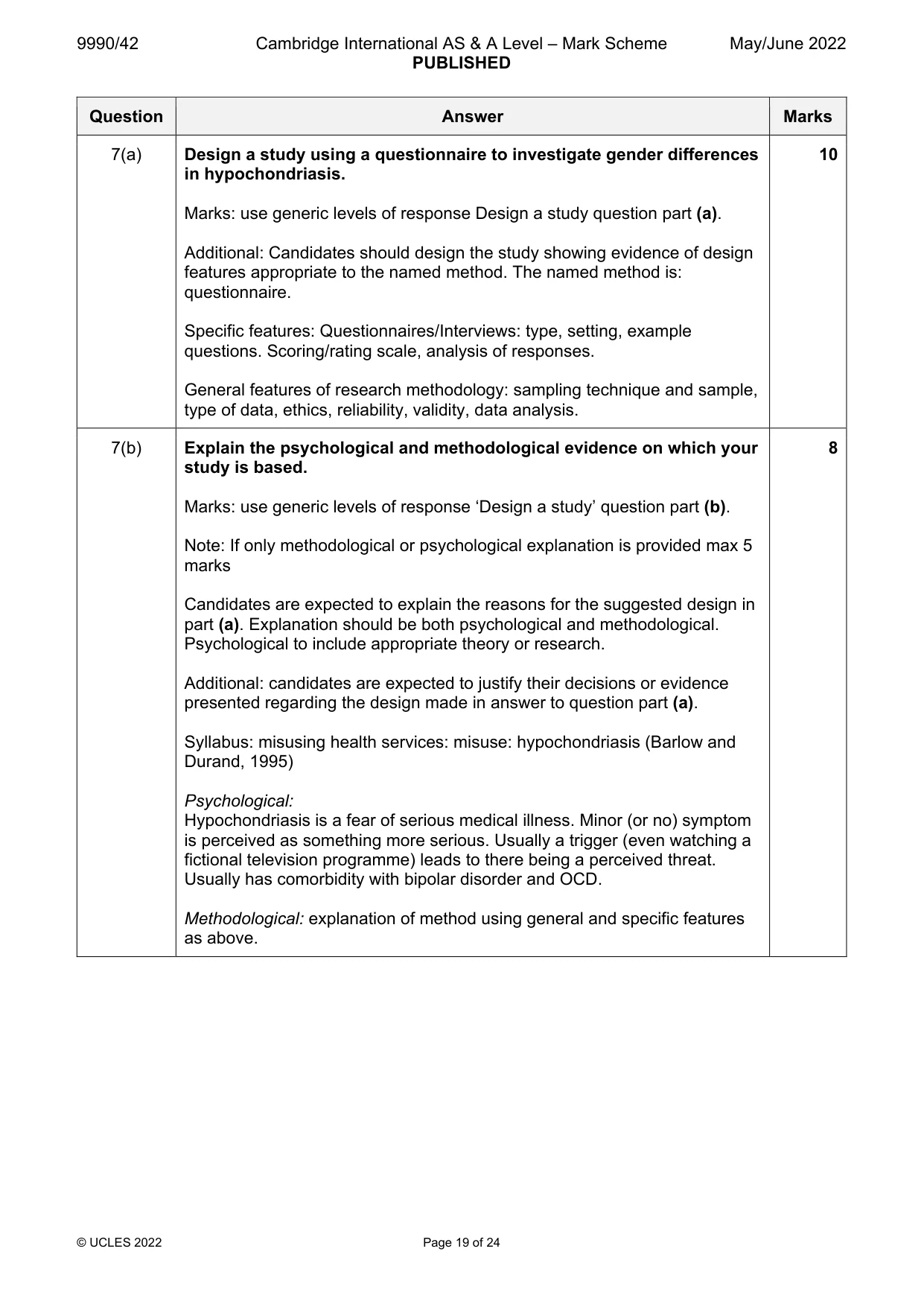
7 (a) Design a study using a questionnaire to investigate gender differences in hypochondriasis. [10] (b) Explain the psychological and methodological evidence on which your study is based. [8] Psychology and organisations
Mark scheme: 7(a) Design a study using a questionnaire to investigate gender differences 10 in hypochondriasis. Marks: use generic levels of response Design a study question part (a). Additional: Candidates should design the study showing evidence of design features appropriate to the named method. The named method is: questionnaire. Specific features: Questionnaires/Interviews: type, setting, example questions. Scoring/rating scale, analysis of responses. General features of research methodology: sampling technique and sample, type of data, ethics, reliability, validity, data analysis. 7(b) Explain the psychological and methodological evidence on which your 8 study is based. Marks: use generic levels of response ‘Design a study’ question part (b). Note: If only methodological or psychological explanation is provided max 5 marks Candidates are expected to explain the reasons for the suggested design in part (a). Explanation should be both psychological and methodological. Psychological to include appropriate theory or research. Additional: candidates are expected to justify their decisions or evidence presented regarding the design made in answer to question part (a). Syllabus: misusing health services: misuse: hypochondriasis (Barlow and Durand, 1995) Psychological: Hypochondriasis is a fear of serious medical illness. Minor (or no) symptom is perceived as something more serious. Usually a trigger (even watching a fictional television programme) leads to there being a perceived threat. Usually has comorbidity with bipolar disorder and OCD. Methodological: explanation of method using general and specific features as above.
More questions on Anxiety disorders and fear-related disorders
Q8 · Design a study to investigate absenteeism on different days of the week in a food…
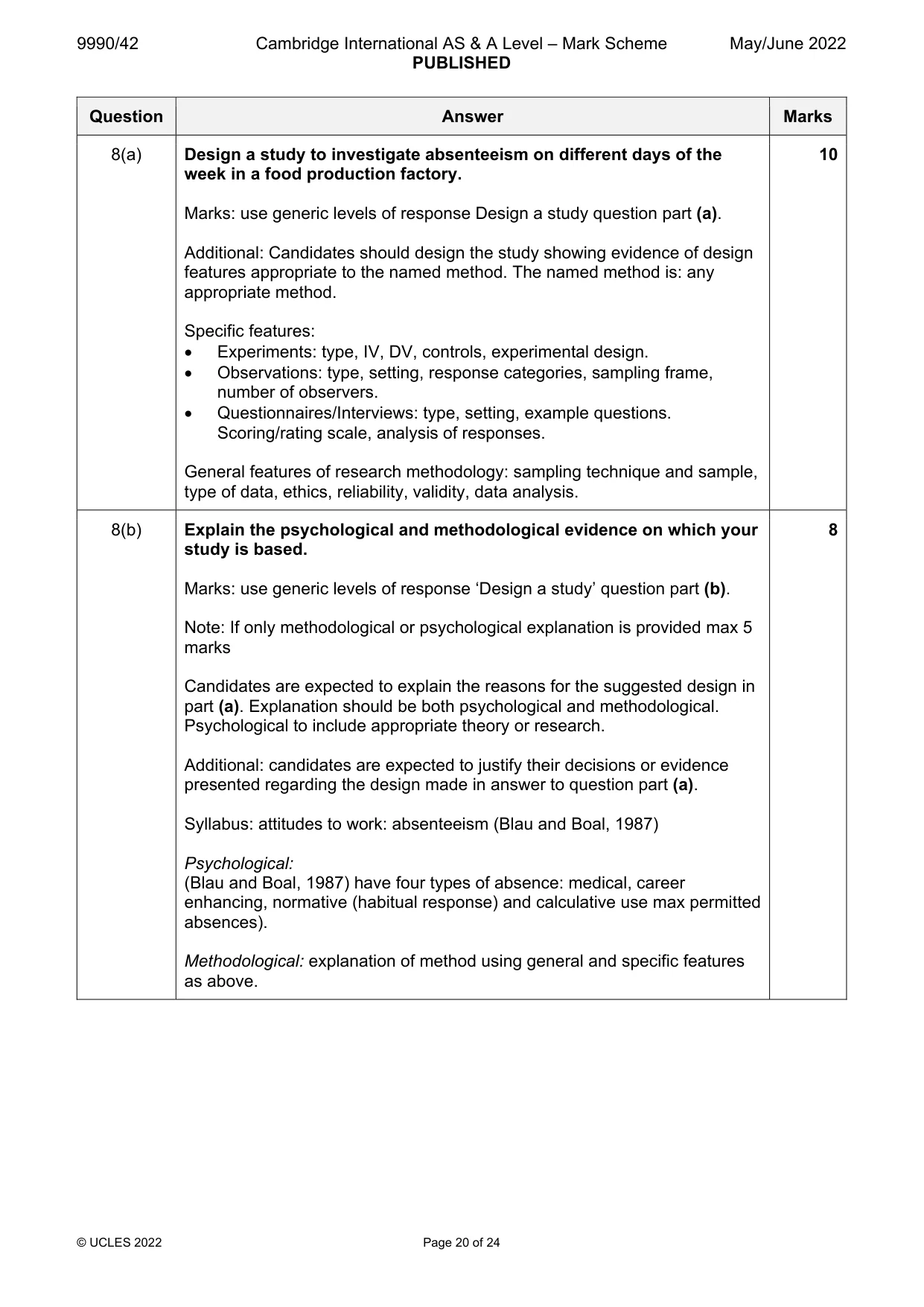
8 (a) Design a study to investigate absenteeism on different days of the week in a food production factory. [10] (b) Explain the psychological and methodological evidence on which your study is based. [8] Section C You must answer one question from this section. Psychology and abnormality
Mark scheme: 8(a) Design a study to investigate absenteeism on different days of the 10 week in a food production factory. Marks: use generic levels of response Design a study question part (a). Additional: Candidates should design the study showing evidence of design features appropriate to the named method. The named method is: any appropriate method. Specific features: Experiments: type, IV, DV, controls, experimental design. Observations: type, setting, response categories, sampling frame, number of observers. Questionnaires/Interviews: type, setting, example questions. Scoring/rating scale, analysis of responses. General features of research methodology: sampling technique and sample, type of data, ethics, reliability, validity, data analysis. 8(b) Explain the psychological and methodological evidence on which your 8 study is based. Marks: use generic levels of response ‘Design a study’ question part (b). Note: If only methodological or psychological explanation is provided max 5 marks Candidates are expected to explain the reasons for the suggested design in part (a). Explanation should be both psychological and methodological. Psychological to include appropriate theory or research. Additional: candidates are expected to justify their decisions or evidence presented regarding the design made in answer to question part (a). Syllabus: attitudes to work: absenteeism (Blau and Boal, 1987) Psychological: (Blau and Boal, 1987) have four types of absence: medical, career enhancing, normative (habitual response) and calculative use max permitted absences). Methodological: explanation of method using general and specific features as above.
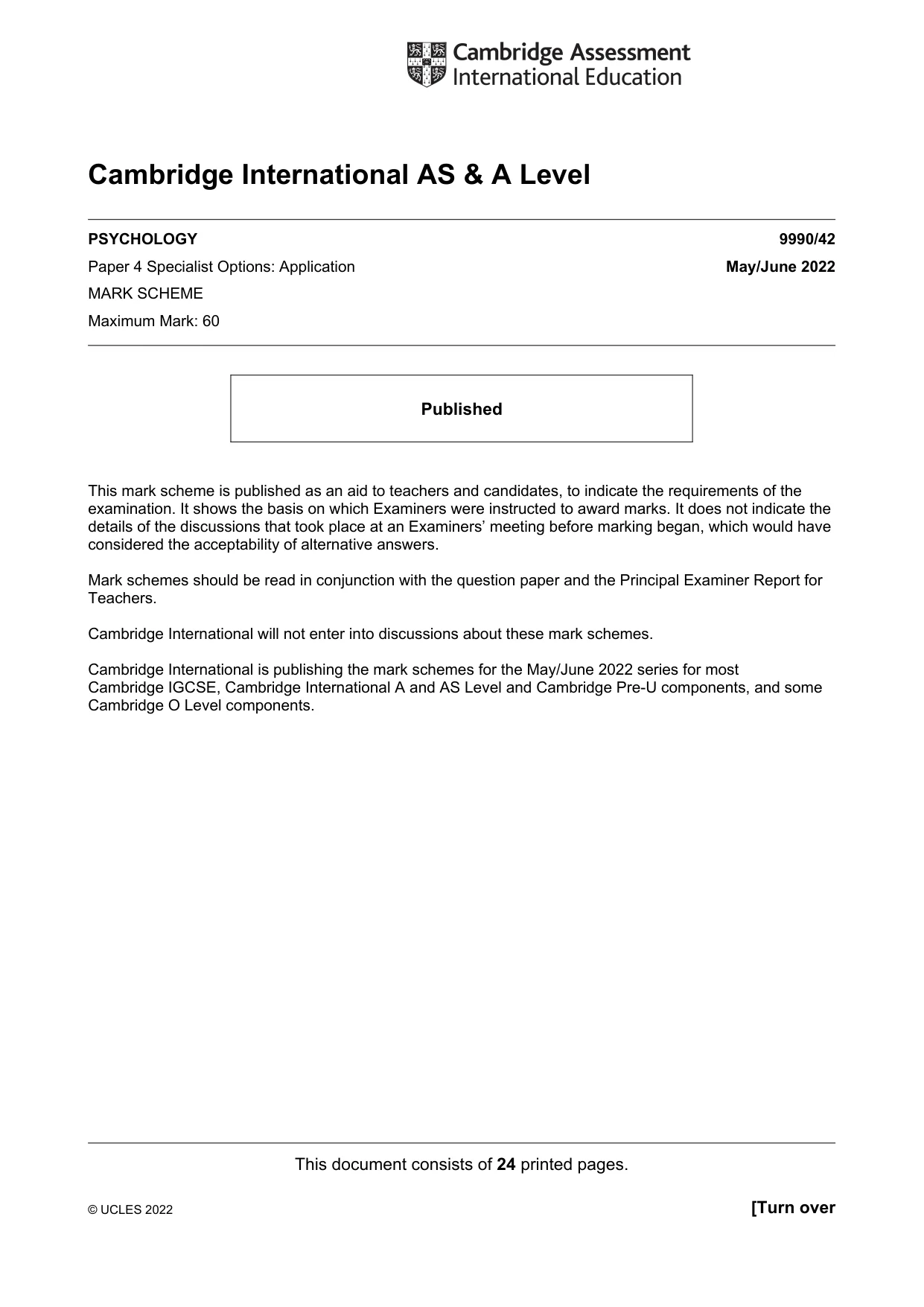
Q9 · ‘The nature versus nurture debate is irrelevant when explaining depression.’ To what…
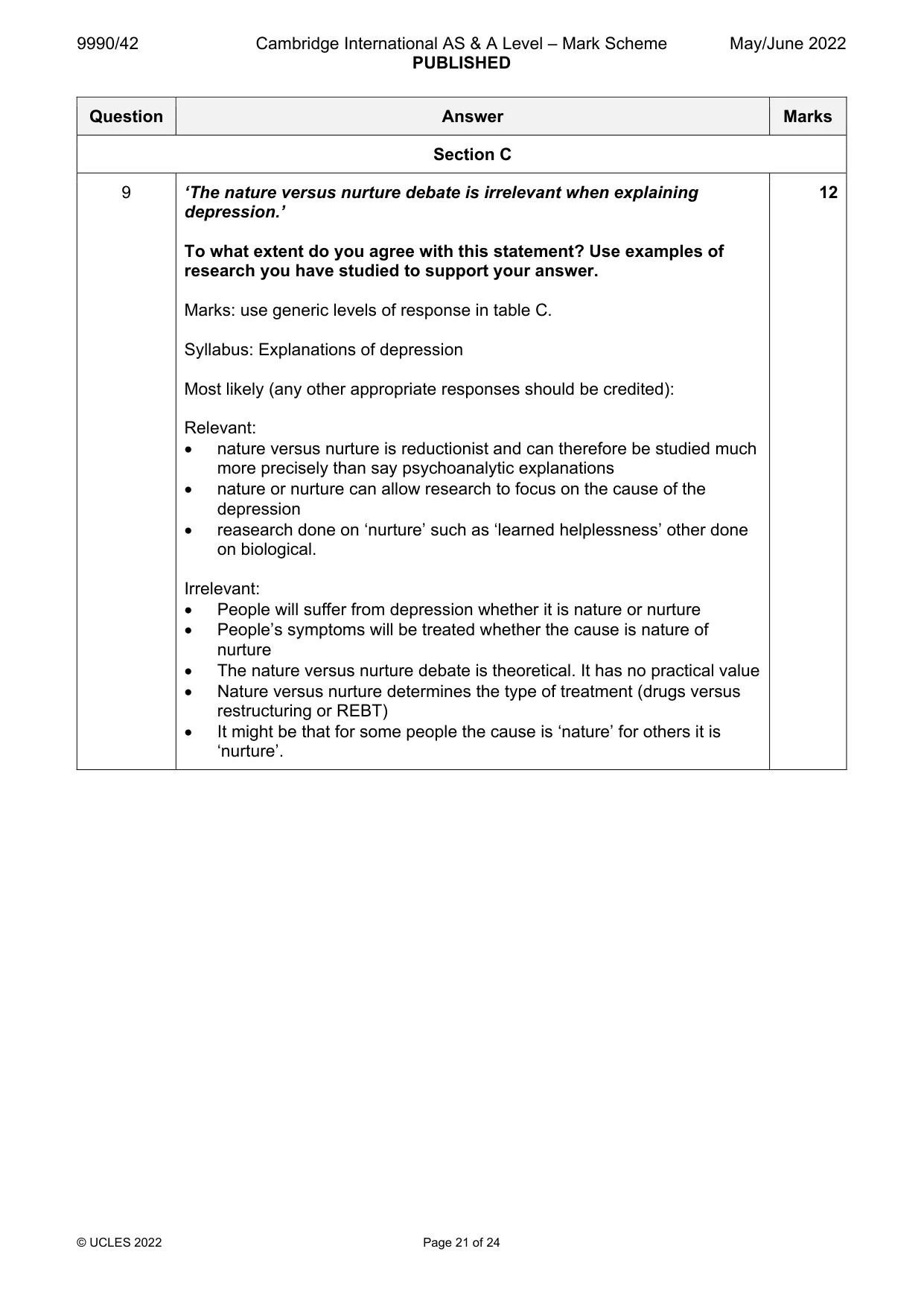
9 ‘The nature versus nurture debate is irrelevant when explaining depression.’ To what extent do you agree with this statement? Use examples of research you have studied to support your answer. [12] Psychology and consumer behaviour
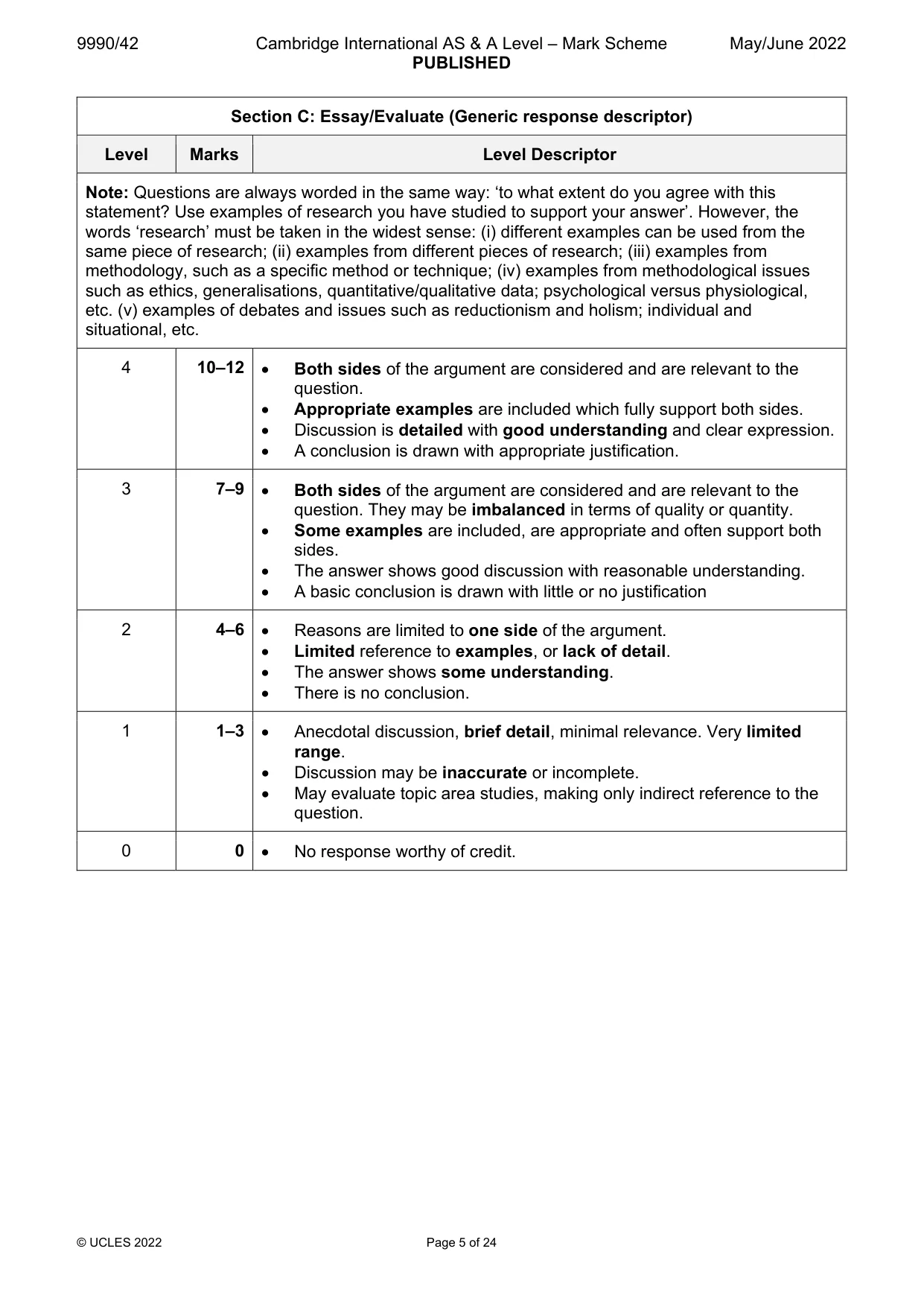
Mark scheme: 9 ‘The nature versus nurture debate is irrelevant when explaining 12 depression.’ To what extent do you agree with this statement? Use examples of research you have studied to support your answer. Marks: use generic levels of response in table C. Syllabus: Explanations of depression Most likely (any other appropriate responses should be credited): Relevant: nature versus nurture is reductionist and can therefore be studied much more precisely than say psychoanalytic explanations nature or nurture can allow research to focus on the cause of the depression reasearch done on ‘nurture’ such as ‘learned helplessness’ other done on biological. Irrelevant: People will suffer from depression whether it is nature or nurture People’s symptoms will be treated whether the cause is nature of nurture The nature versus nurture debate is theoretical. It has no practical value Nature versus nurture determines the type of treatment (drugs versus restructuring or REBT) It might be that for some people the cause is ‘nature’ for others it is ‘nurture’.
More questions on Mood (affective) disorders: depressive disorder (unipolar) and bipolar disorder
Q10 · ‘In all advertising media, there is only one effective way to advertise a product, for…
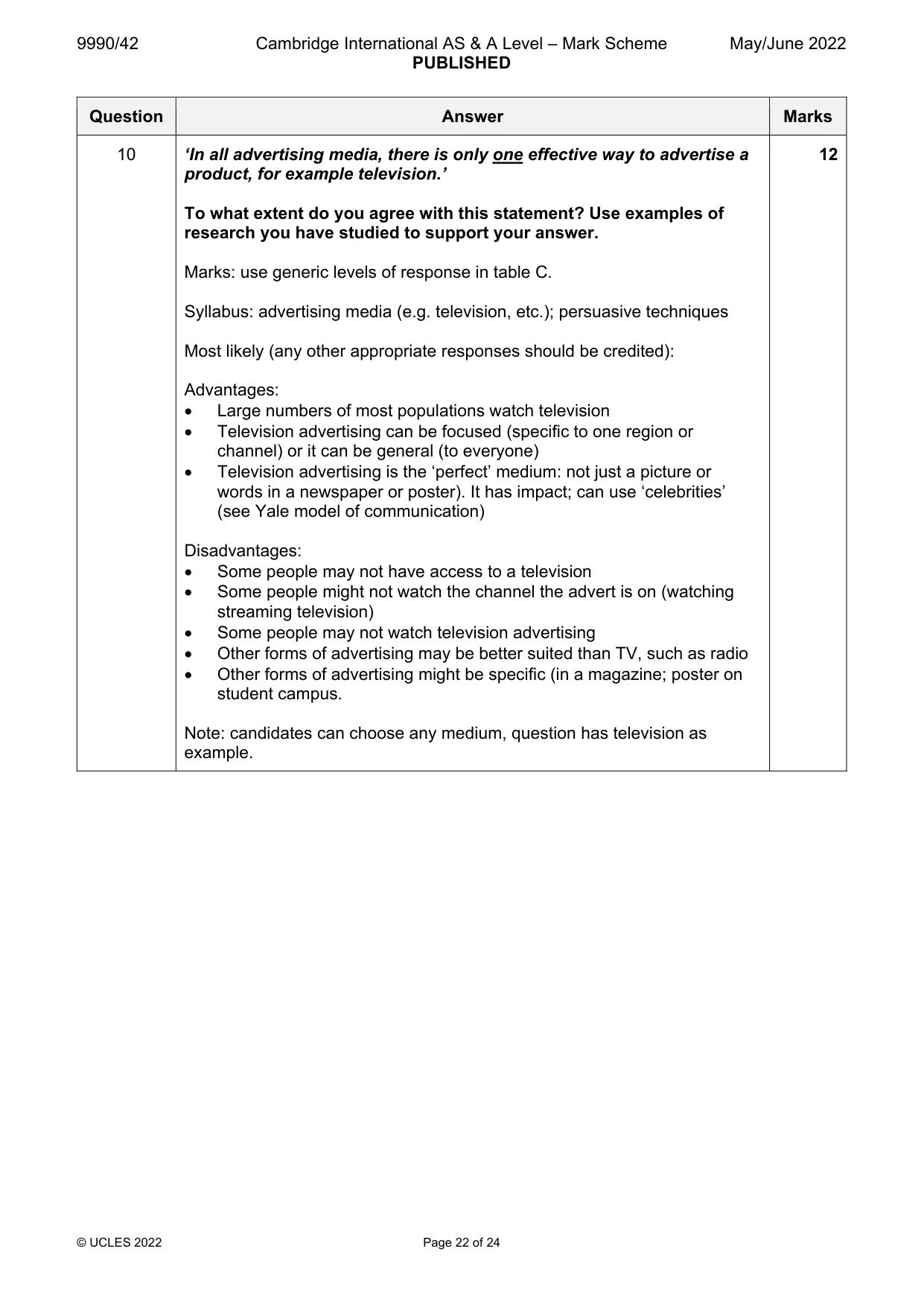
10 ‘In all advertising media, there is only one effective way to advertise a product, for example television.’ To what extent do you agree with this statement? Use examples of research you have studied to support your answer. [12] Psychology and health
Mark scheme: 10 ‘In all advertising media, there is only one effective way to advertise a 12 product, for example television.’ To what extent do you agree with this statement? Use examples of research you have studied to support your answer. Marks: use generic levels of response in table C. Syllabus: advertising media (e.g. television, etc.); persuasive techniques Most likely (any other appropriate responses should be credited): Advantages: Large numbers of most populations watch television Television advertising can be focused (specific to one region or channel) or it can be general (to everyone) Television advertising is the ‘perfect’ medium: not just a picture or words in a newspaper or poster). It has impact; can use ‘celebrities’ (see Yale model of communication) Disadvantages: Some people may not have access to a television Some people might not watch the channel the advert is on (watching streaming television) Some people may not watch television advertising Other forms of advertising may be better suited than TV, such as radio Other forms of advertising might be specific (in a magazine; poster on student campus. Note: candidates can choose any medium, question has television as example.
Q11 · ‘Psychological measures of stress are more valid and reliable than physiological…
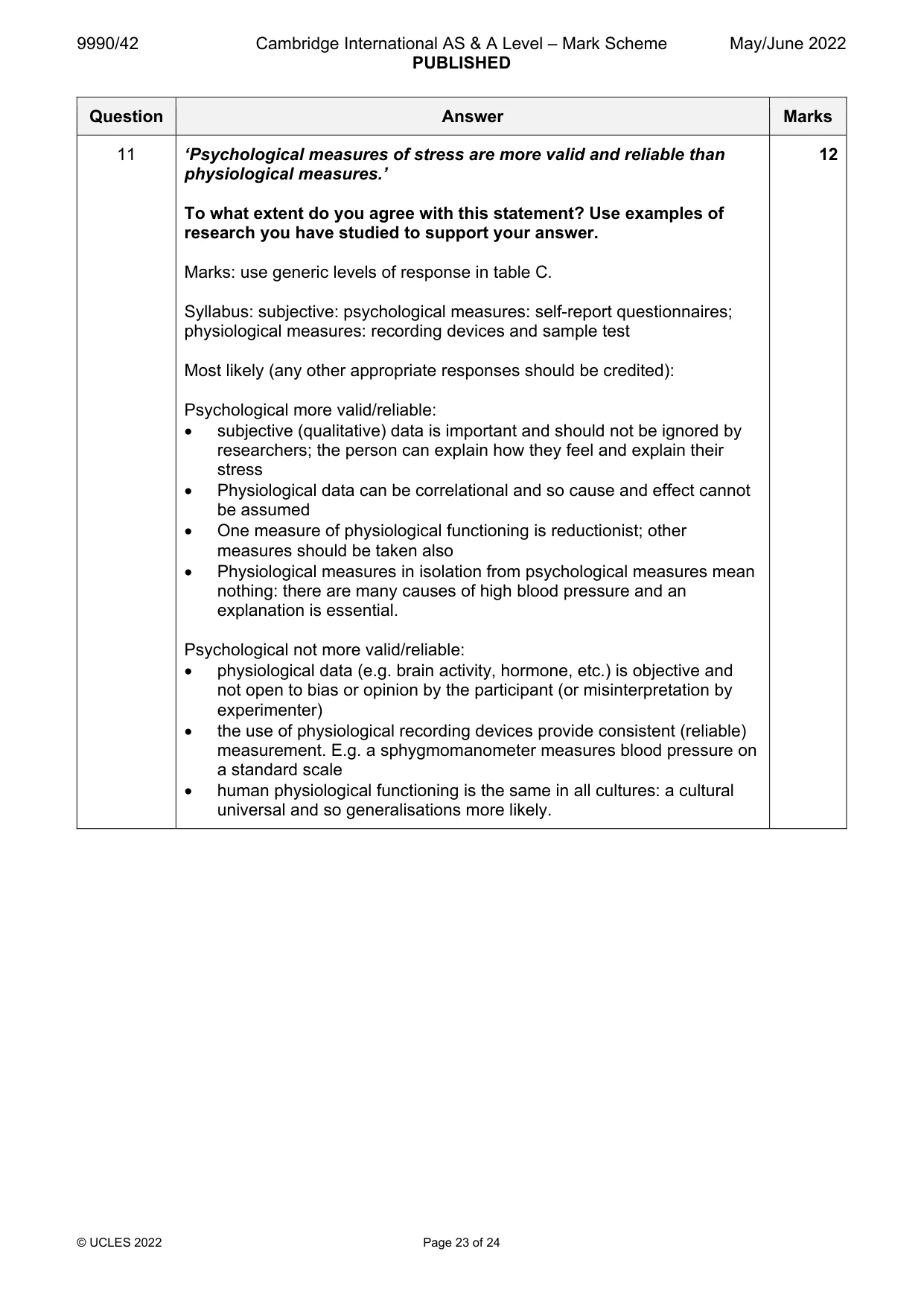
11 ‘Psychological measures of stress are more valid and reliable than physiological measures.’ To what extent do you agree with this statement? Use examples of research you have studied to support your answer. [12] Psychology and organisations
Mark scheme: 11 ‘Psychological measures of stress are more valid and reliable than 12 physiological measures.’ To what extent do you agree with this statement? Use examples of research you have studied to support your answer. Marks: use generic levels of response in table C. Syllabus: subjective: psychological measures: self-report questionnaires; physiological measures: recording devices and sample test Most likely (any other appropriate responses should be credited): Psychological more valid/reliable: subjective (qualitative) data is important and should not be ignored by researchers; the person can explain how they feel and explain their stress Physiological data can be correlational and so cause and effect cannot be assumed One measure of physiological functioning is reductionist; other measures should be taken also Physiological measures in isolation from psychological measures mean nothing: there are many causes of high blood pressure and an explanation is essential. Psychological not more valid/reliable: physiological data (e.g. brain activity, hormone, etc.) is objective and not open to bias or opinion by the participant (or misinterpretation by experimenter) the use of physiological recording devices provide consistent (reliable) measurement. E.g. a sphygmomanometer measures blood pressure on a standard scale human physiological functioning is the same in all cultures: a cultural universal and so generalisations more likely.
Q12 · ‘Belbin’s team role types are the perfect way to categorise people into team roles.’ To…
12 ‘Belbin’s team role types are the perfect way to categorise people into team roles.’ To what extent do you agree with this statement? Use examples of research you have studied to support your answer. [12]
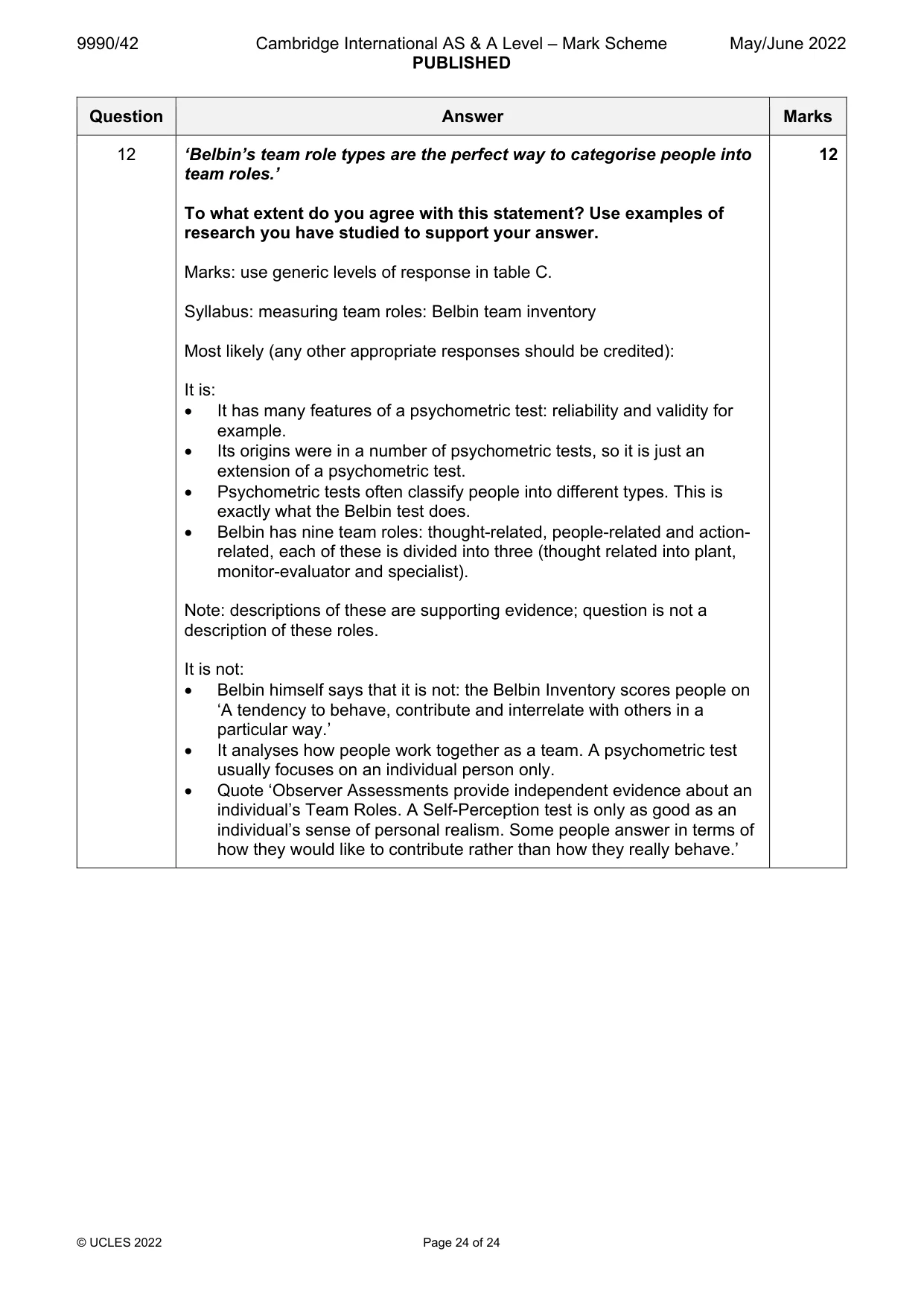
Mark scheme: 12 ‘Belbin’s team role types are the perfect way to categorise people into 12 team roles.’ To what extent do you agree with this statement? Use examples of research you have studied to support your answer. Marks: use generic levels of response in table C. Syllabus: measuring team roles: Belbin team inventory Most likely (any other appropriate responses should be credited): It is: It has many features of a psychometric test: reliability and validity for example. Its origins were in a number of psychometric tests, so it is just an extension of a psychometric test. Psychometric tests often classify people into different types. This is exactly what the Belbin test does. Belbin has nine team roles: thought-related, people-related and action- related, each of these is divided into three (thought related into plant, monitor-evaluator and specialist). Note: descriptions of these are supporting evidence; question is not a description of these roles. It is not: Belbin himself says that it is not: the Belbin Inventory scores people on ‘A tendency to behave, contribute and interrelate with others in a particular way.’ It analyses how people work together as a team. A psychometric test usually focuses on an individual person only. Quote ‘Observer Assessments provide independent evidence about an individual’s Team Roles. A Self-Perception test is only as good as an individual’s sense of personal realism. Some people answer in terms of how they would like to contribute rather than how they really behave.’
What was in this paper
The subtopics covered by these 12 questions, and how many questions each got. Open one in a new tab to see every Cambridge question on it.
What you needed in this session
Cambridge’s own grade thresholds for 2022 May/June, Paper 4 · Variant 2. A higher threshold means an easier paper — the bar moves with how the cohort did.