Cambridge A Level Psychology (from 2018) 9990 — 2023 Oct/Nov Paper 4 · Variant 2
9990/42/O/N/23 · 12 questions · 60 marks · ≈68 min
The question paper and its mark scheme, free to read here and free to download. This is Cambridge’s own paper, exactly as it was sat.
Question paper8 pages
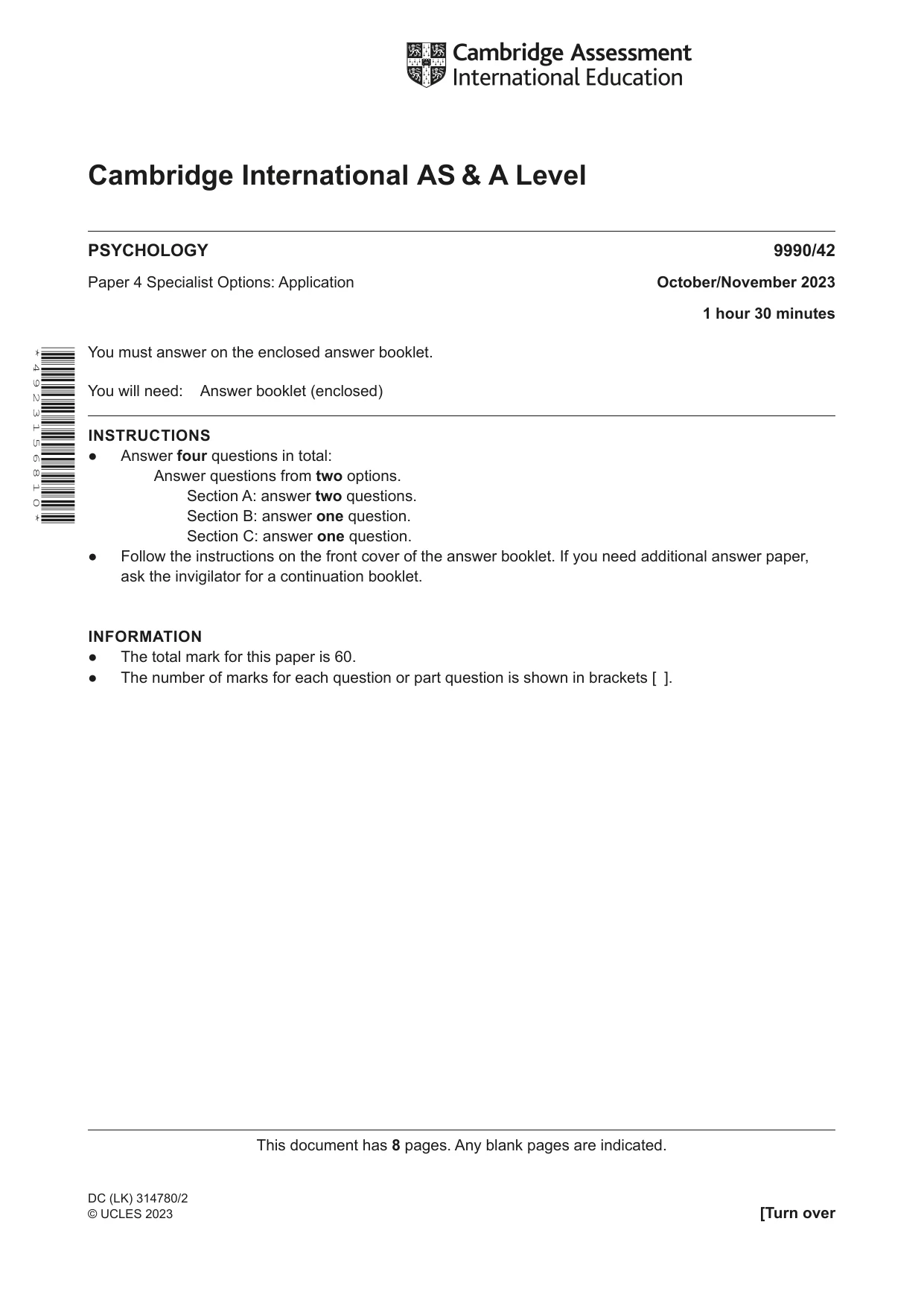



Mark scheme25 pages
Answers below. Sit the paper first if you are practising.

Questions as text
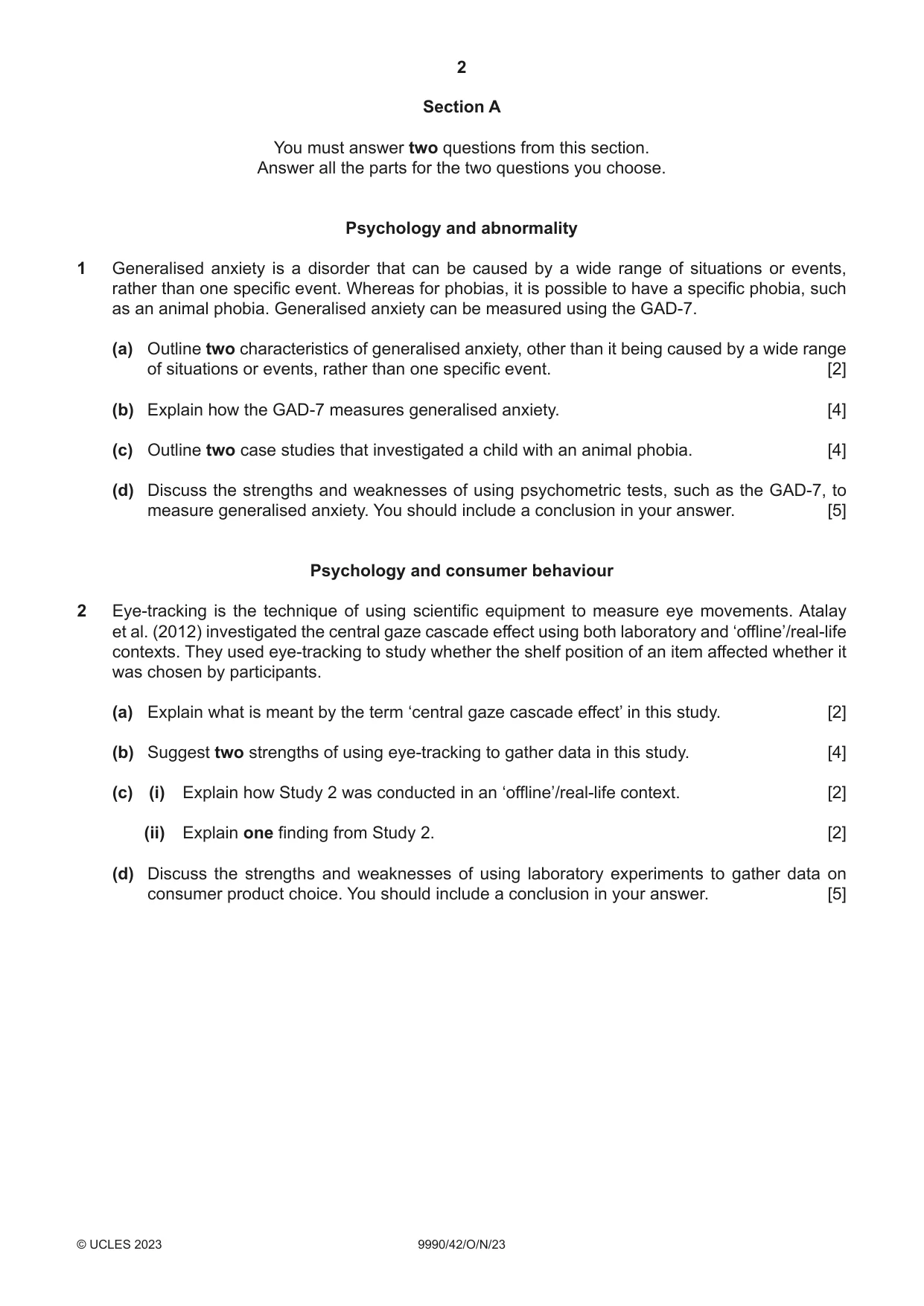
Q1 · Generalised anxiety is a disorder that can be caused by a wide range of situations or…
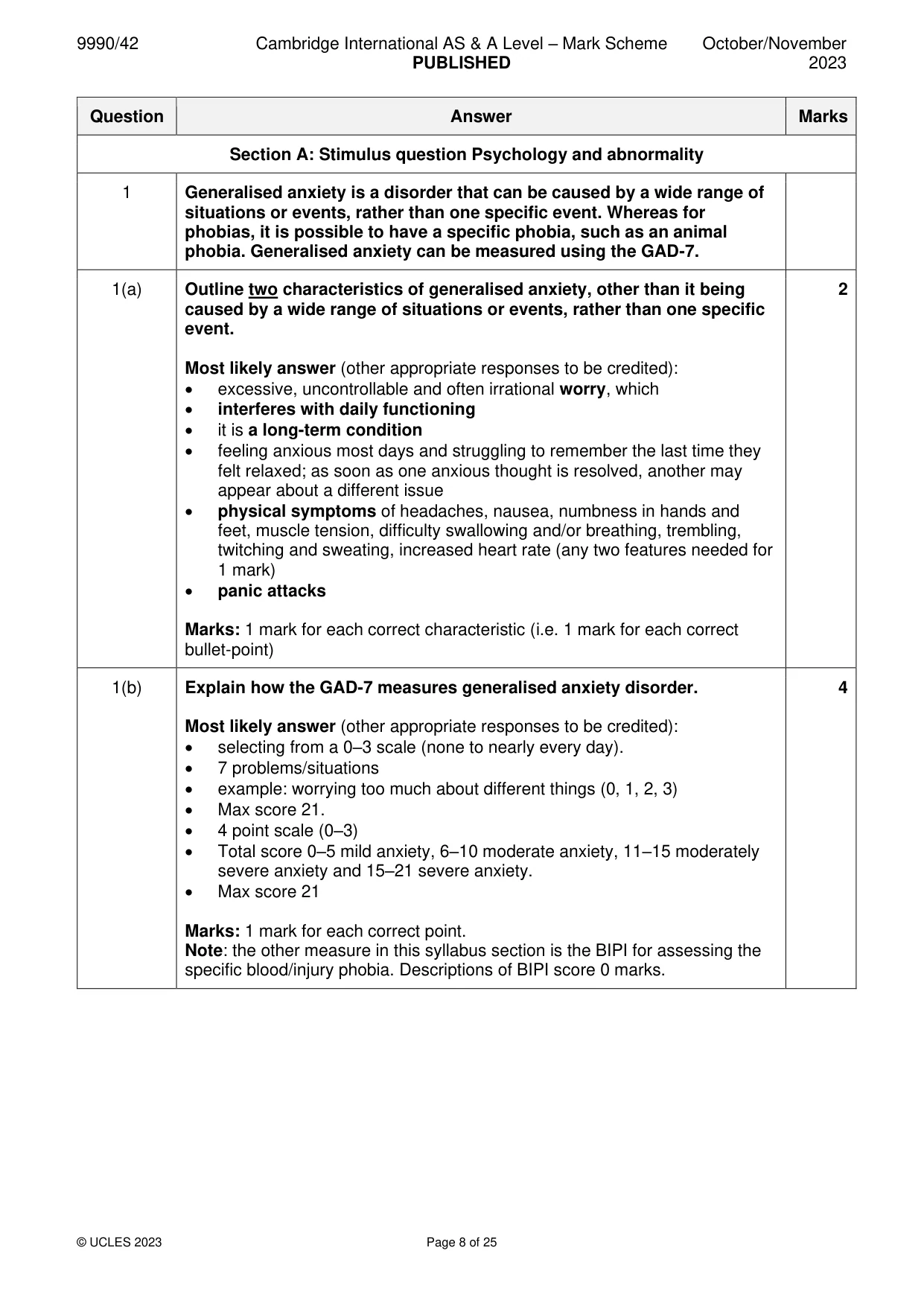
1 Generalised anxiety is a disorder that can be caused by a wide range of situations or events, rather than one specific event. Whereas for phobias, it is possible to have a specific phobia, such as an animal phobia. Generalised anxiety can be measured using the GAD-7. (a) Outline two characteristics of generalised anxiety, other than it being caused by a wide range of situations or events, rather than one specific event. [2] (b) Explain how the GAD-7 measures generalised anxiety. [4] (c) Outline two case studies that investigated a child with an animal phobia. [4] (d) Discuss the strengths and weaknesses of using psychometric tests, such as the GAD-7, to measure generalised anxiety. You should include a conclusion in your answer. [5] Psychology and consumer behaviour
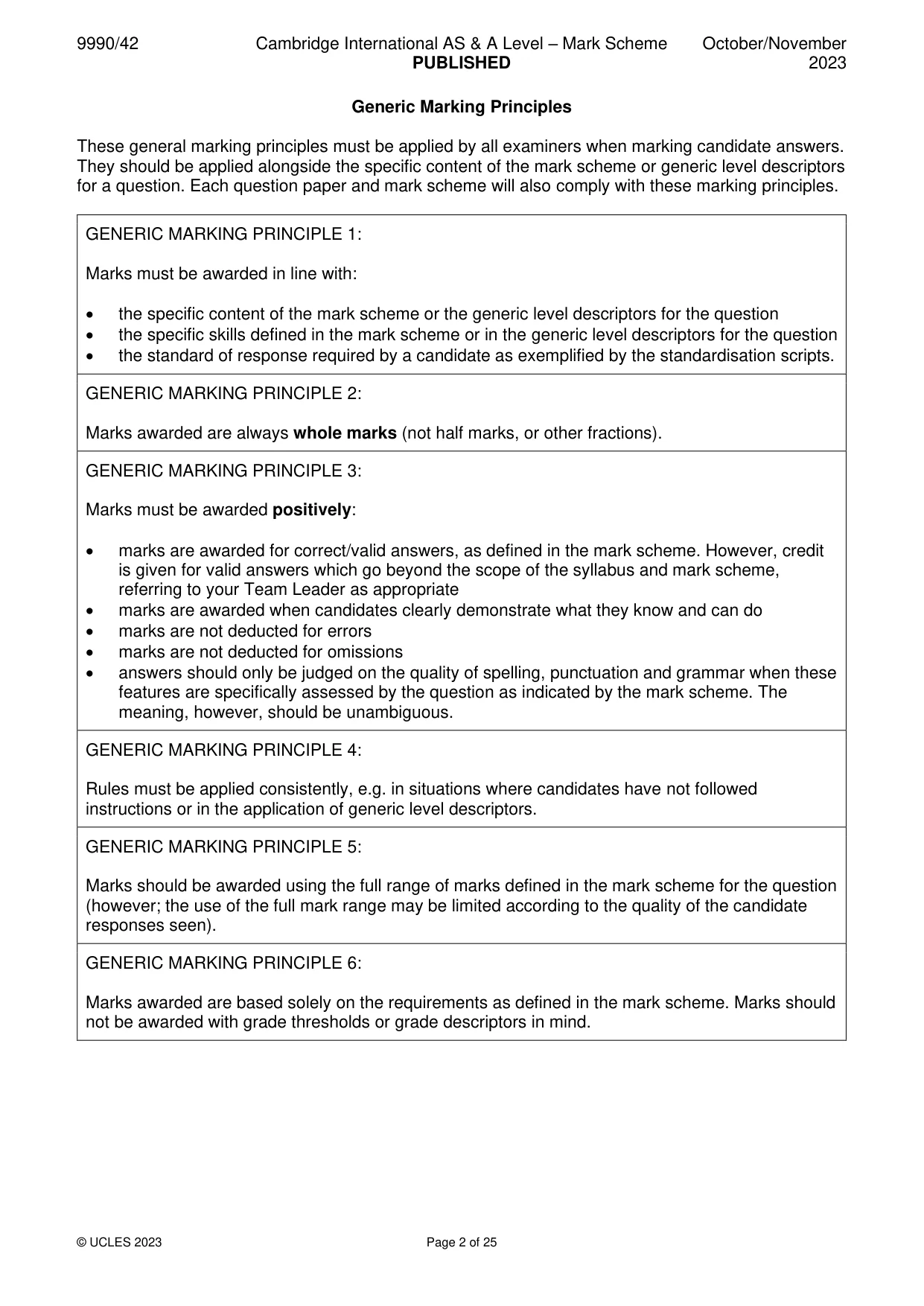
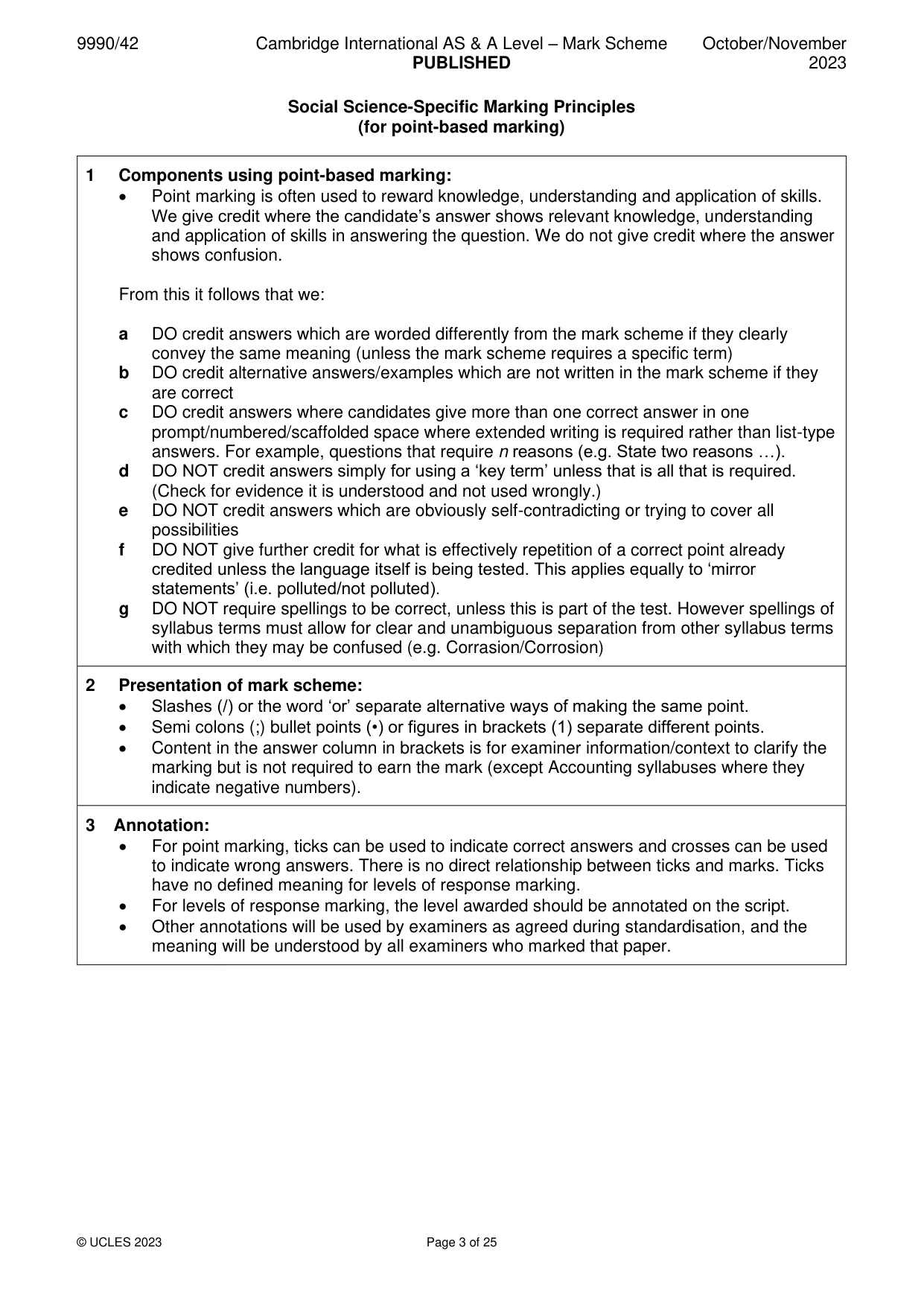
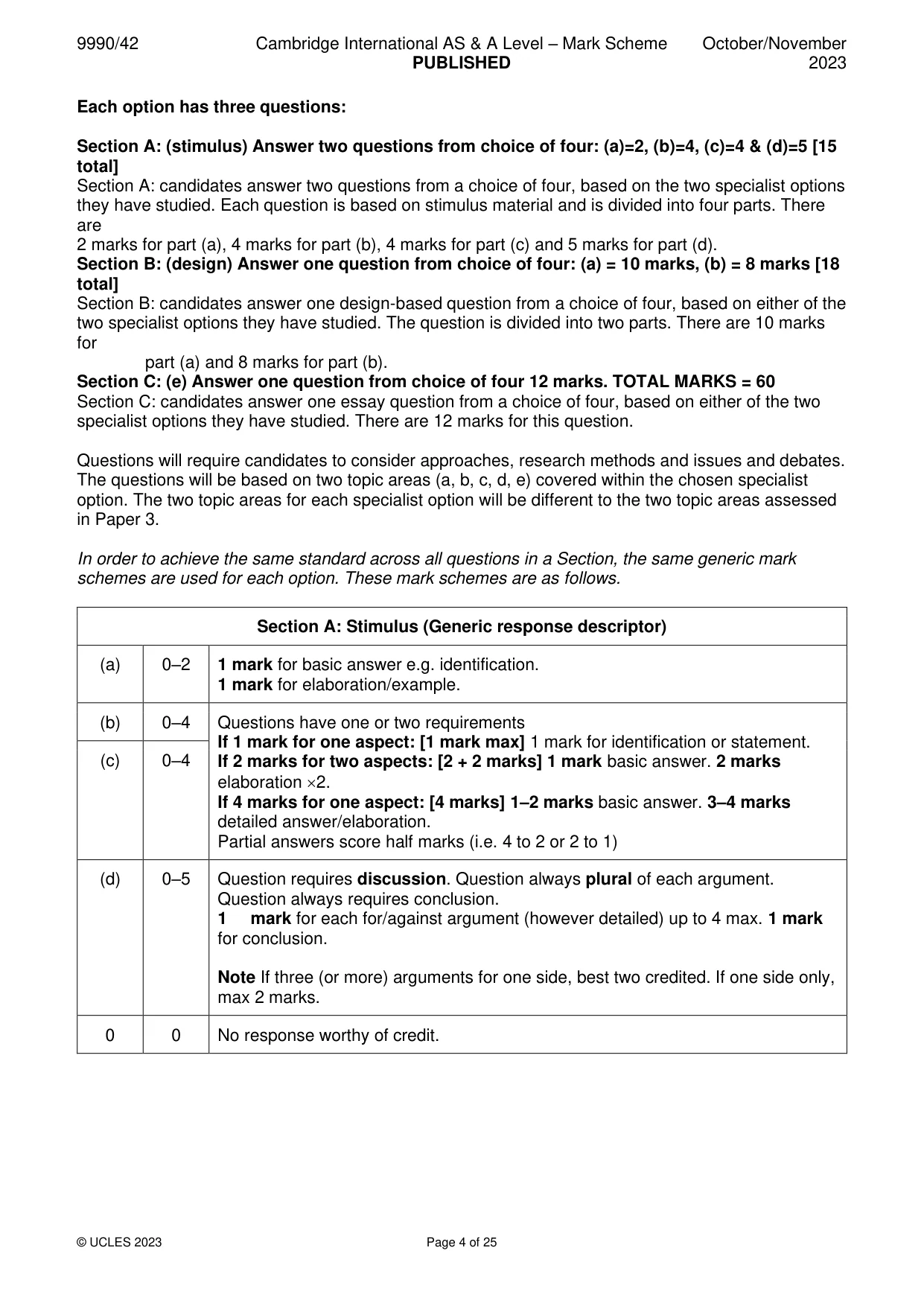
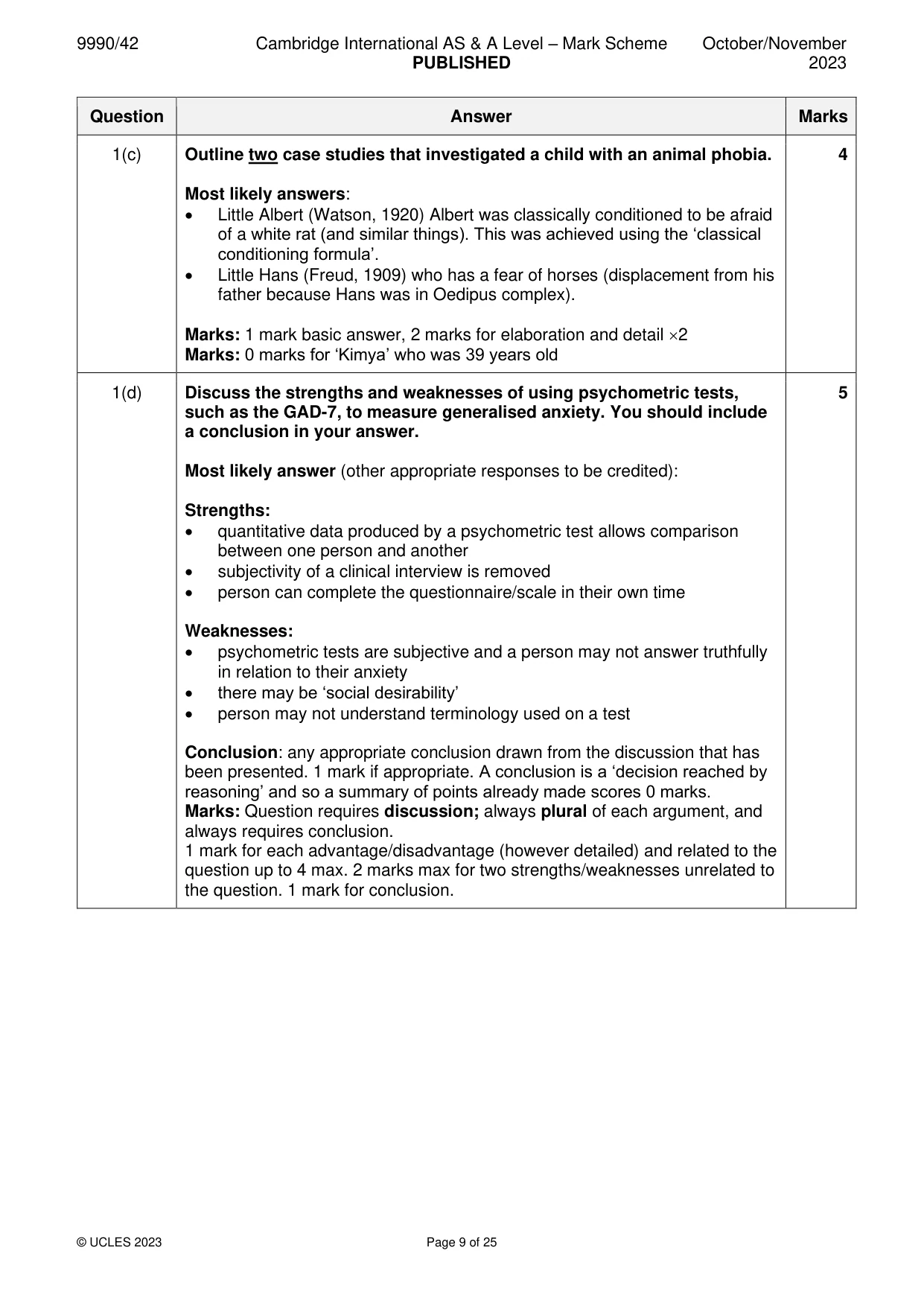
Mark scheme: Question Answer Marks Section A: Stimulus question Psychology and abnormality 1 Generalised anxiety is a disorder that can be caused by a wide range of situations or events, rather than one specific event. Whereas for phobias, it is possible to have a specific phobia, such as an animal phobia. Generalised anxiety can be measured using the GAD-7. 1(a) Outline two characteristics of generalised anxiety, other than it being 2 caused by a wide range of situations or events, rather than one specific event. Most likely answer (other appropriate responses to be credited): • excessive, uncontrollable and often irrational worry, which • interferes with daily functioning • it is a long-term condition • feeling anxious most days and struggling to remember the last time they felt relaxed; as soon as one anxious thought is resolved, another may appear about a different issue • physical symptoms of headaches, nausea, numbness in hands and feet, muscle tension, difficulty swallowing and/or breathing, trembling, twitching and sweating, increased heart rate (any two features needed for 1 mark) • panic attacks Marks: 1 mark for each correct characteristic (i.e. 1 mark for each correct bullet-point) 1(b) Explain how the GAD-7 measures generalised anxiety disorder. 4 Most likely answer (other appropriate responses to be credited): • selecting from a 0–3 scale (none to nearly every day). • 7 problems/situations • example: worrying too much about different things (0, 1, 2, 3) • Max score 21. • 4 point scale (0–3) • Total score 0–5 mild anxiety, 6–10 moderate anxiety, 11–15 moderately severe anxiety and 15–21 severe anxiety. • Max score 21 Marks: 1 mark for each correct point. Note: the other measure in this syllabus section is the BIPI for assessing the specific blood/injury phobia. Descriptions of BIPI score 0 marks. 1(c) Outline two case studies that investigated a child with an animal phobia. 4 Most likely answers: • Little Albert (Watson, 1920) Albert was classically conditioned to be afraid of a white rat (and similar things). This was achieved using the ‘classical conditioning formula’. • Little Hans (Freud, 1909) who has a fear of horses (displacement from his father because Hans was in Oedipus complex). Marks: 1 mark basic answer, 2 marks for elaboration and detail 2 Marks: 0 marks for ‘Kimya’ who was 39 years old 1(d) Discuss the strengths and weaknesses of using psychometric tests, 5 such as the GAD-7, to measure generalised anxiety. You should include a conclusion in your answer. Most likely answer (other appropriate responses to be credited): Strengths: • quantitative data produced by a psychometric test allows comparison between one person and another • subjectivity of a clinical interview is removed • person can complete the questionnaire/scale in their own time Weaknesses: • psychometric tests are subjective and a person may not answer truthfully in relation to their anxiety • there may be ‘social desirability’ • person may not understand terminology used on a test Conclusion: any appropriate conclusion drawn from the discussion that has been presented. 1 mark if appropriate. A conclusion is a ‘decision reached by reasoning’ and so a summary of points already made scores 0 marks. Marks: Question requires discussion; always plural of each argument, and always requires conclusion. 1 mark for each advantage/disadvantage (however detailed) and related to the question up to 4 max. 2 marks max for two strengths/weaknesses unrelated to the question. 1 mark for conclusion.
More questions on Anxiety disorders and fear-related disorders
Q2 · Eye-tracking is the technique of using scientific equipment to measure eye movements
2 Eye-tracking is the technique of using scientific equipment to measure eye movements. Atalay et al. (2012) investigated the central gaze cascade effect using both laboratory and ‘offline’/real-life contexts. They used eye-tracking to study whether the shelf position of an item affected whether it was chosen by participants. (a) Explain what is meant by the term ‘central gaze cascade effect’ in this study. [2] (b) Suggest two strengths of using eye-tracking to gather data in this study. [4] (c) (i) Explain how Study 2 was conducted in an ‘offline’/real-life context. [2] (ii) Explain one finding from Study 2. [2] (d) Discuss the strengths and weaknesses of using laboratory experiments to gather data on consumer product choice. You should include a conclusion in your answer. [5] Psychology and health
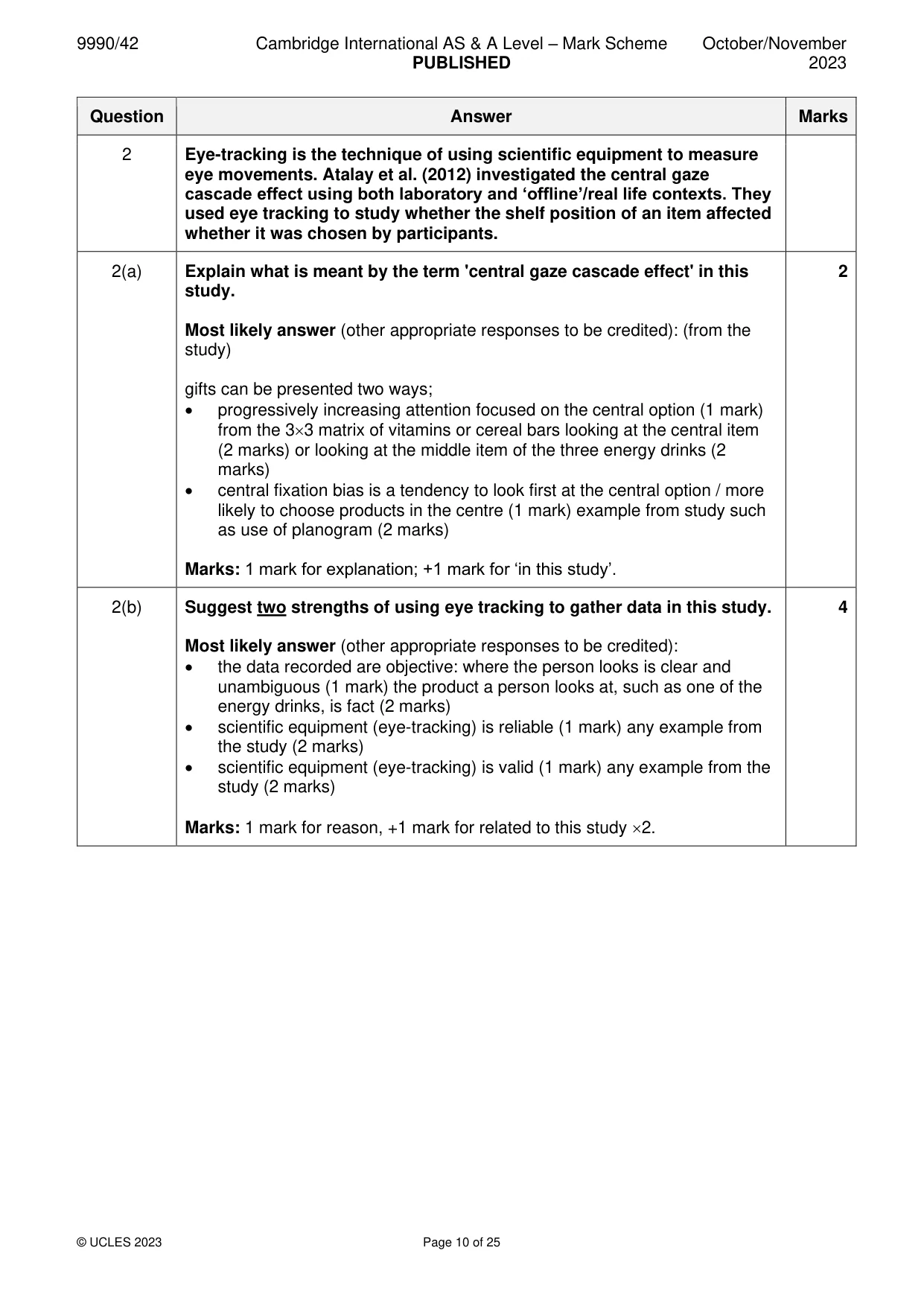
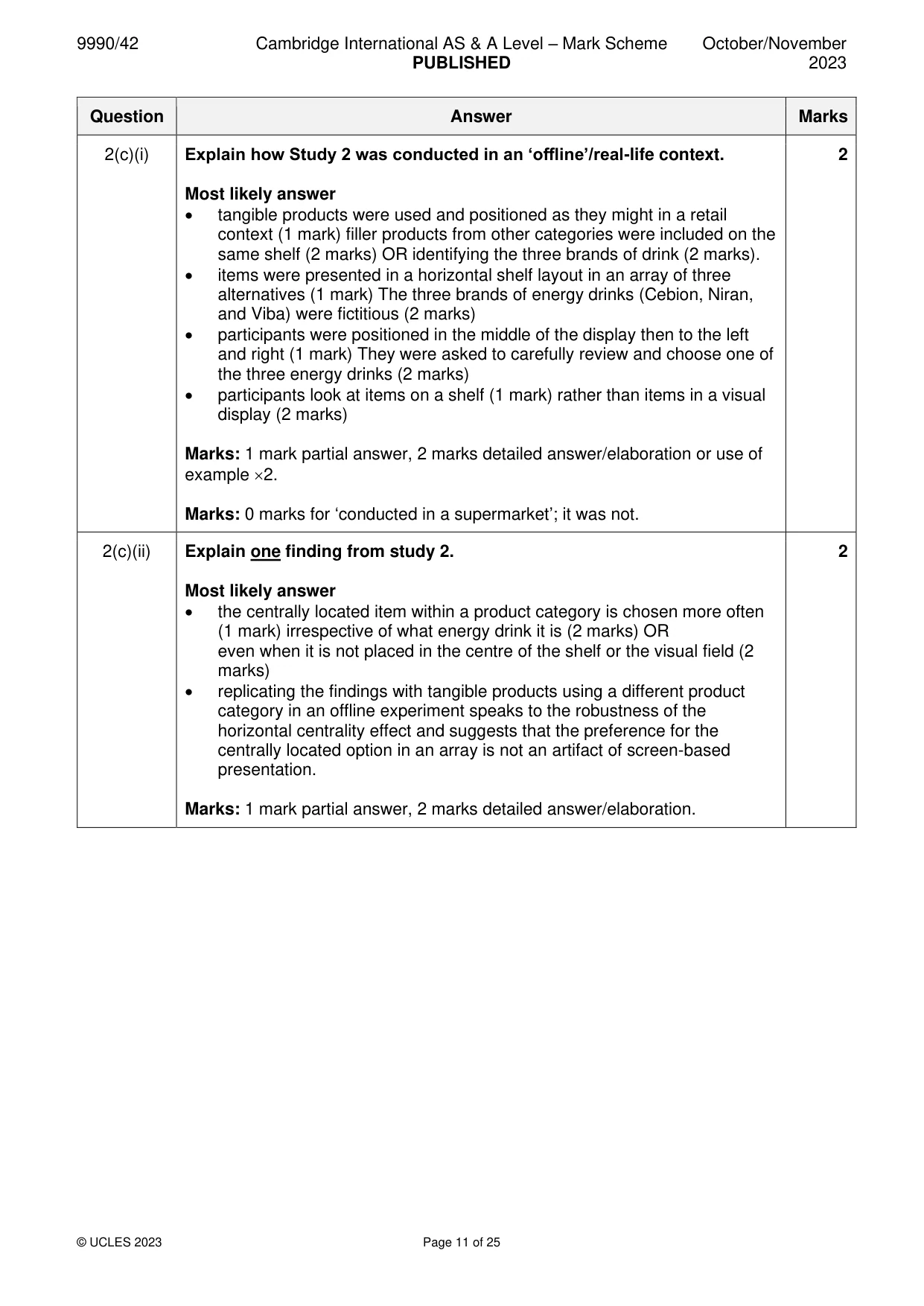
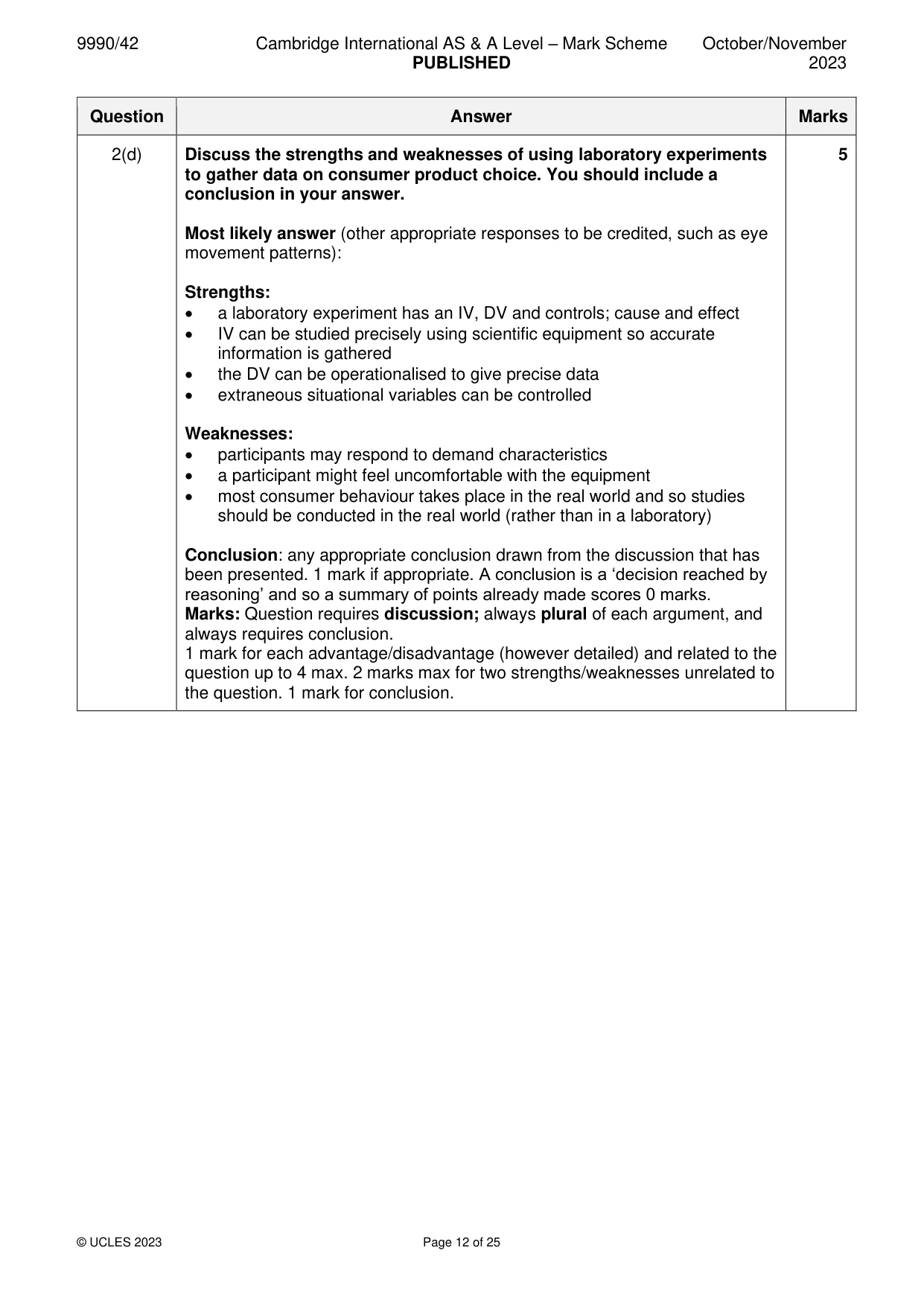
Mark scheme: 2 Eye-tracking is the technique of using scientific equipment to measure eye movements. Atalay et al. (2012) investigated the central gaze cascade effect using both laboratory and ‘offline’/real life contexts. They used eye tracking to study whether the shelf position of an item affected whether it was chosen by participants. 2(a) Explain what is meant by the term 'central gaze cascade effect' in this 2 study. Most likely answer (other appropriate responses to be credited): (from the study) gifts can be presented two ways; • progressively increasing attention focused on the central option (1 mark) from the 33 matrix of vitamins or cereal bars looking at the central item (2 marks) or looking at the middle item of the three energy drinks (2 marks) • central fixation bias is a tendency to look first at the central option / more likely to choose products in the centre (1 mark) example from study such as use of planogram (2 marks) Marks: 1 mark for explanation; +1 mark for ‘in this study’. 2(b) Suggest two strengths of using eye tracking to gather data in this study. 4 Most likely answer (other appropriate responses to be credited): • the data recorded are objective: where the person looks is clear and unambiguous (1 mark) the product a person looks at, such as one of the energy drinks, is fact (2 marks) • scientific equipment (eye-tracking) is reliable (1 mark) any example from the study (2 marks) • scientific equipment (eye-tracking) is valid (1 mark) any example from the study (2 marks) Marks: 1 mark for reason, +1 mark for related to this study 2. 2(c)(i) Explain how Study 2 was conducted in an ‘offline’/real-life context. 2 Most likely answer • tangible products were used and positioned as they might in a retail context (1 mark) filler products from other categories were included on the same shelf (2 marks) OR identifying the three brands of drink (2 marks). • items were presented in a horizontal shelf layout in an array of three alternatives (1 mark) The three brands of energy drinks (Cebion, Niran, and Viba) were fictitious (2 marks) • participants were positioned in the middle of the display then to the left and right (1 mark) They were asked to carefully review and choose one of the three energy drinks (2 marks) • participants look at items on a shelf (1 mark) rather than items in a visual display (2 marks) Marks: 1 mark partial answer, 2 marks detailed answer/elaboration or use of example 2. Marks: 0 marks for ‘conducted in a supermarket’; it was not. 2(c)(ii) Explain one finding from study 2. 2 Most likely answer • the centrally located item within a product category is chosen more often (1 mark) irrespective of what energy drink it is (2 marks) OR even when it is not placed in the centre of the shelf or the visual field (2 marks) • replicating the findings with tangible products using a different product category in an offline experiment speaks to the robustness of the horizontal centrality effect and suggests that the preference for the centrally located option in an array is not an artifact of screen-based presentation. Marks: 1 mark partial answer, 2 marks detailed answer/elaboration. 2(d) Discuss the strengths and weaknesses of using laboratory experiments 5 to gather data on consumer product choice. You should include a conclusion in your answer. Most likely answer (other appropriate responses to be credited, such as eye movement patterns): Strengths: • a laboratory experiment has an IV, DV and controls; cause and effect • IV can be studied precisely using scientific equipment so accurate information is gathered • the DV can be operationalised to give precise data • extraneous situational variables can be controlled Weaknesses: • participants may respond to demand characteristics • a participant might feel uncomfortable with the equipment • most consumer behaviour takes place in the real world and so studies should be conducted in the real world (rather than in a laboratory) Conclusion: any appropriate conclusion drawn from the discussion that has been presented. 1 mark if appropriate. A conclusion is a ‘decision reached by reasoning’ and so a summary of points already made scores 0 marks. Marks: Question requires discussion; always plural of each argument, and always requires conclusion. 1 mark for each advantage/disadvantage (however detailed) and related to the question up to 4 max. 2 marks max for two strengths/weaknesses unrelated to the question. 1 mark for conclusion.
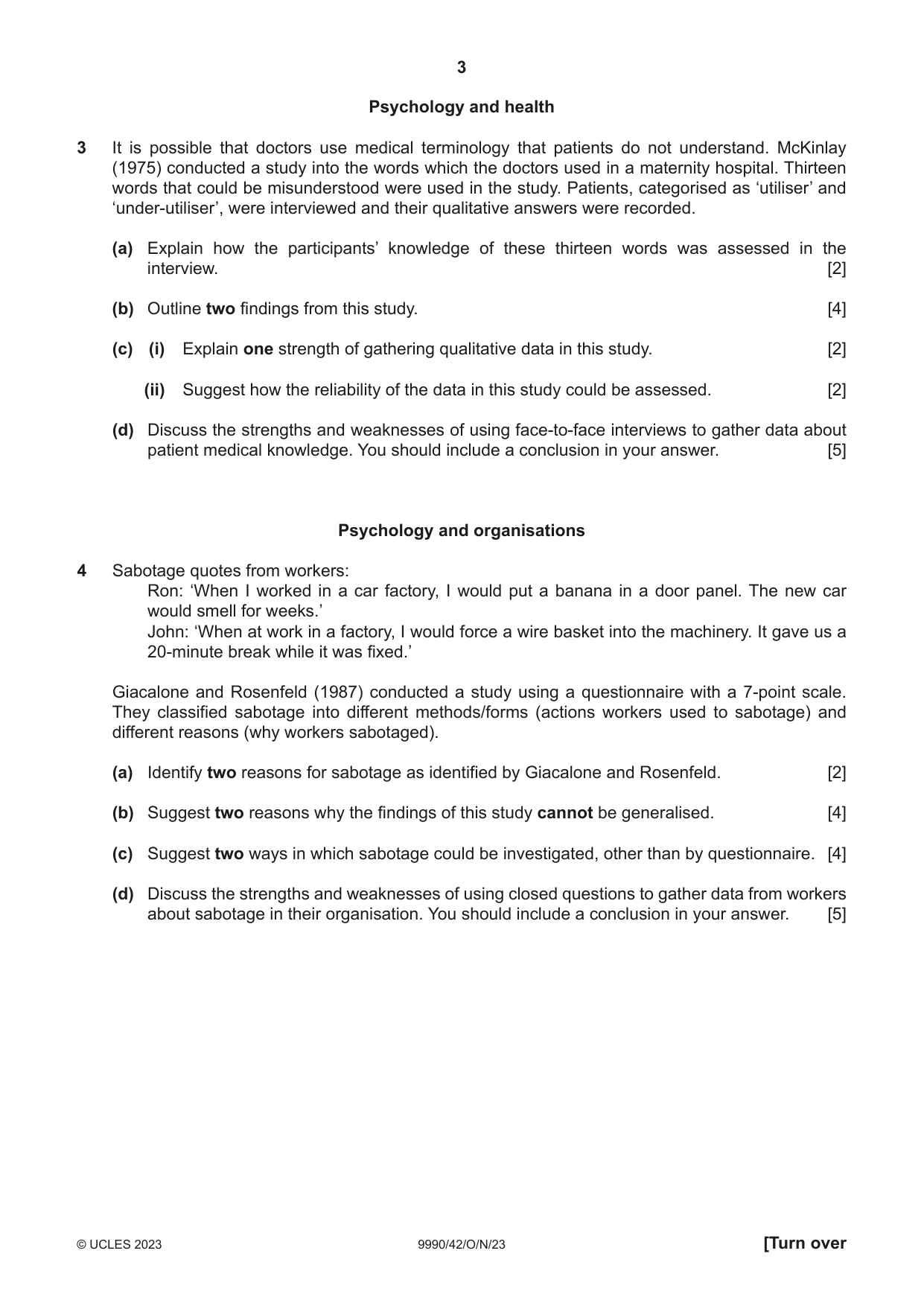
Q3 · It is possible that doctors use medical terminology that patients do not understand
3 It is possible that doctors use medical terminology that patients do not understand. McKinlay (1975) conducted a study into the words which the doctors used in a maternity hospital. Thirteen words that could be misunderstood were used in the study. Patients, categorised as ‘utiliser’ and ‘under-utiliser’, were interviewed and their qualitative answers were recorded. (a) Explain how the participants’ knowledge of these thirteen words was assessed in the interview. [2] (b) Outline two findings from this study. [4] (c) (i) Explain one strength of gathering qualitative data in this study. [2] (ii) Suggest how the reliability of the data in this study could be assessed. [2] (d) Discuss the strengths and weaknesses of using face-to-face interviews to gather data about patient medical knowledge. You should include a conclusion in your answer. [5] Psychology and organisations
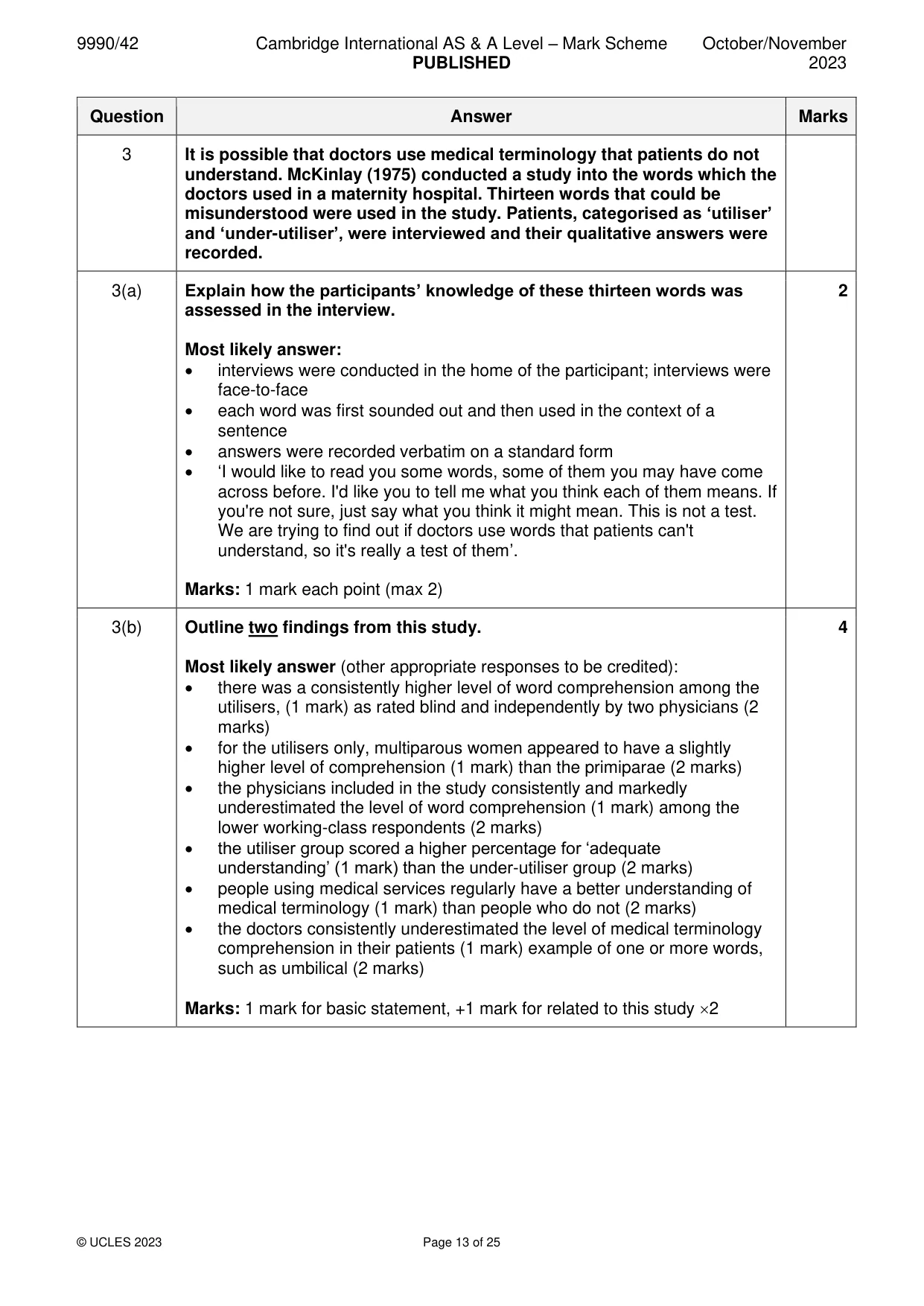
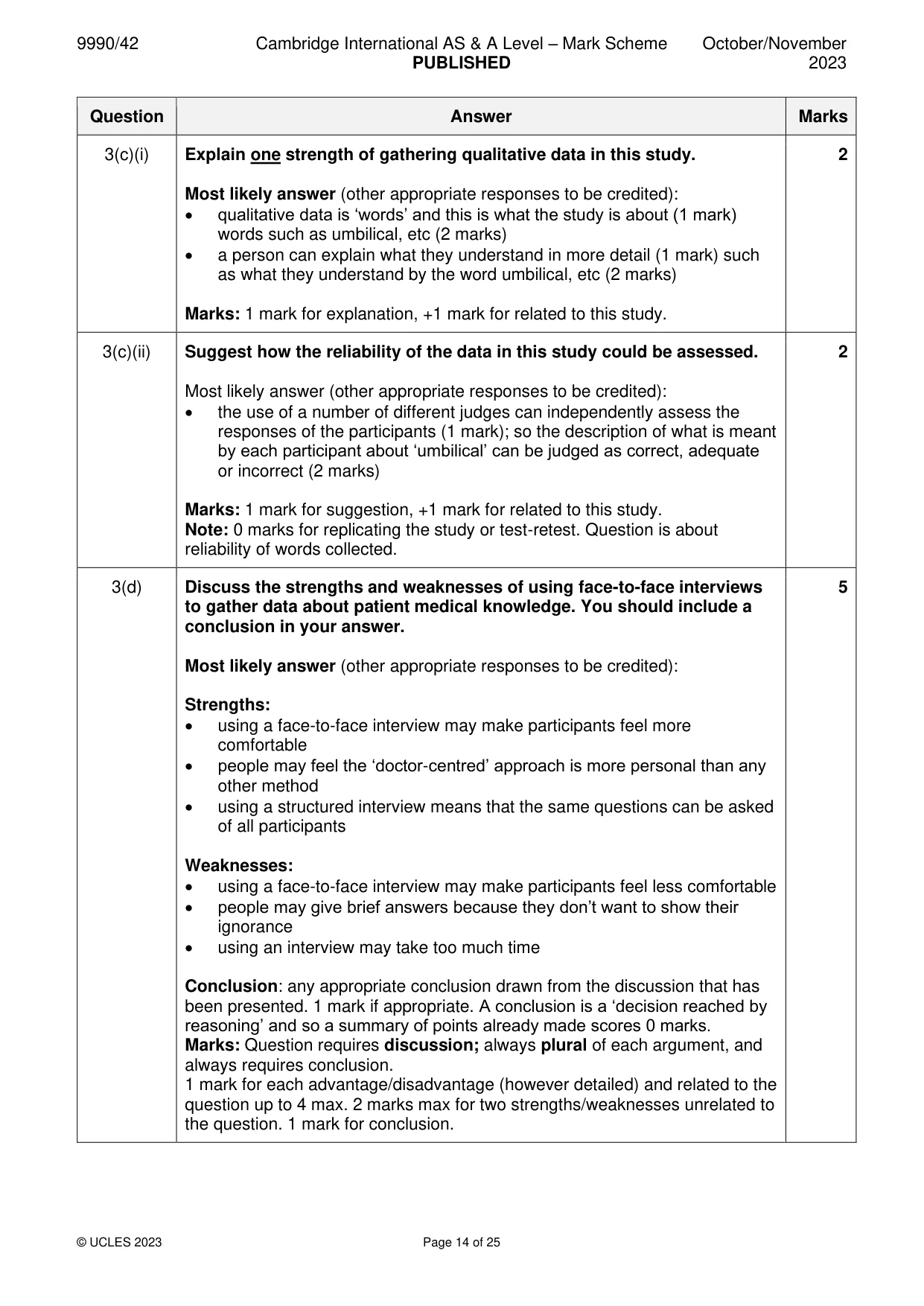
Mark scheme: 3 It is possible that doctors use medical terminology that patients do not understand. McKinlay (1975) conducted a study into the words which the doctors used in a maternity hospital. Thirteen words that could be misunderstood were used in the study. Patients, categorised as ‘utiliser’ and ‘under-utiliser’, were interviewed and their qualitative answers were recorded. 3(a) Explain how the participants’ knowledge of these thirteen words was 2 assessed in the interview. Most likely answer: • interviews were conducted in the home of the participant; interviews were face-to-face • each word was first sounded out and then used in the context of a sentence • answers were recorded verbatim on a standard form • ‘I would like to read you some words, some of them you may have come across before. I'd like you to tell me what you think each of them means. If you're not sure, just say what you think it might mean. This is not a test. We are trying to find out if doctors use words that patients can't understand, so it's really a test of them’. Marks: 1 mark each point (max 2) 3(b) Outline two findings from this study. 4 Most likely answer (other appropriate responses to be credited): • there was a consistently higher level of word comprehension among the utilisers, (1 mark) as rated blind and independently by two physicians (2 marks) • for the utilisers only, multiparous women appeared to have a slightly higher level of comprehension (1 mark) than the primiparae (2 marks) • the physicians included in the study consistently and markedly underestimated the level of word comprehension (1 mark) among the lower working-class respondents (2 marks) • the utiliser group scored a higher percentage for ‘adequate understanding’ (1 mark) than the under-utiliser group (2 marks) • people using medical services regularly have a better understanding of medical terminology (1 mark) than people who do not (2 marks) • the doctors consistently underestimated the level of medical terminology comprehension in their patients (1 mark) example of one or more words, such as umbilical (2 marks) Marks: 1 mark for basic statement, +1 mark for related to this study 2 3(c)(i) Explain one strength of gathering qualitative data in this study. 2 Most likely answer (other appropriate responses to be credited): • qualitative data is ‘words’ and this is what the study is about (1 mark) words such as umbilical, etc (2 marks) • a person can explain what they understand in more detail (1 mark) such as what they understand by the word umbilical, etc (2 marks) Marks: 1 mark for explanation, +1 mark for related to this study. 3(c)(ii) Suggest how the reliability of the data in this study could be assessed. 2 Most likely answer (other appropriate responses to be credited): • the use of a number of different judges can independently assess the responses of the participants (1 mark); so the description of what is meant by each participant about ‘umbilical’ can be judged as correct, adequate or incorrect (2 marks) Marks: 1 mark for suggestion, +1 mark for related to this study. Note: 0 marks for replicating the study or test-retest. Question is about reliability of words collected. 3(d) Discuss the strengths and weaknesses of using face-to-face interviews 5 to gather data about patient medical knowledge. You should include a conclusion in your answer. Most likely answer (other appropriate responses to be credited): Strengths: • using a face-to-face interview may make participants feel more comfortable • people may feel the ‘doctor-centred’ approach is more personal than any other method • using a structured interview means that the same questions can be asked of all participants Weaknesses: • using a face-to-face interview may make participants feel less comfortable • people may give brief answers because they don’t want to show their ignorance • using an interview may take too much time Conclusion: any appropriate conclusion drawn from the discussion that has been presented. 1 mark if appropriate. A conclusion is a ‘decision reached by reasoning’ and so a summary of points already made scores 0 marks. Marks: Question requires discussion; always plural of each argument, and always requires conclusion. 1 mark for each advantage/disadvantage (however detailed) and related to the question up to 4 max. 2 marks max for two strengths/weaknesses unrelated to the question. 1 mark for conclusion.
Q4 · Sabotage quotes from workers: Ron: ‘When I worked in a car factory, I would put a banana…
4 Sabotage quotes from workers: Ron: ‘When I worked in a car factory, I would put a banana in a door panel. The new car would smell for weeks.’ John: ‘When at work in a factory, I would force a wire basket into the machinery. It gave us a 20-minute break while it was fixed.’ Giacalone and Rosenfeld (1987) conducted a study using a questionnaire with a 7-point scale. They classified sabotage into different methods/forms (actions workers used to sabotage) and different reasons (why workers sabotaged). (a) Identify two reasons for sabotage as identified by Giacalone and Rosenfeld. [2] (b) Suggest two reasons why the findings of this study cannot be generalised. [4] (c) Suggest two ways in which sabotage could be investigated, other than by questionnaire. [4] (d) Discuss the strengths and weaknesses of using closed questions to gather data from workers about sabotage in their organisation. You should include a conclusion in your answer. [5]
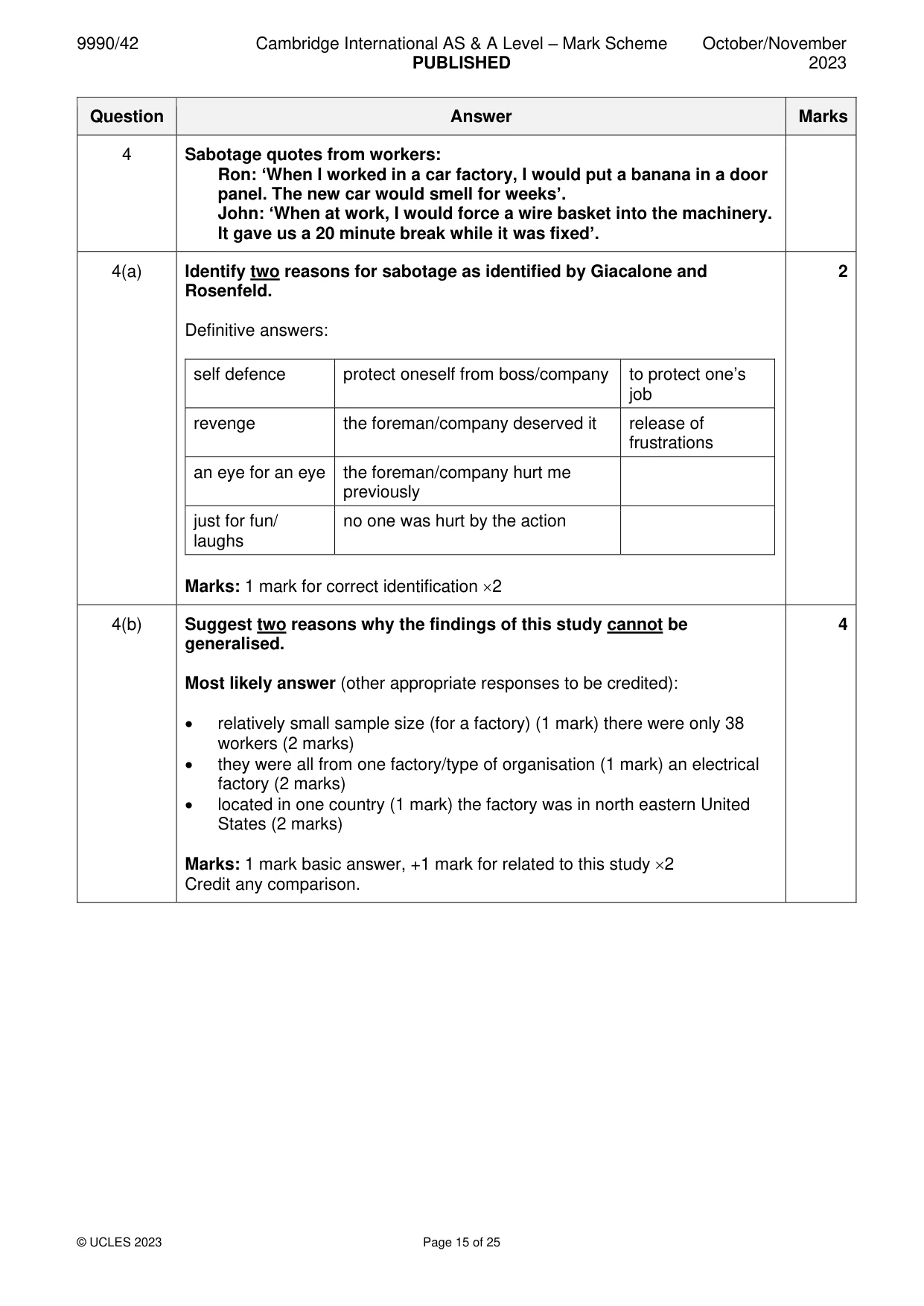
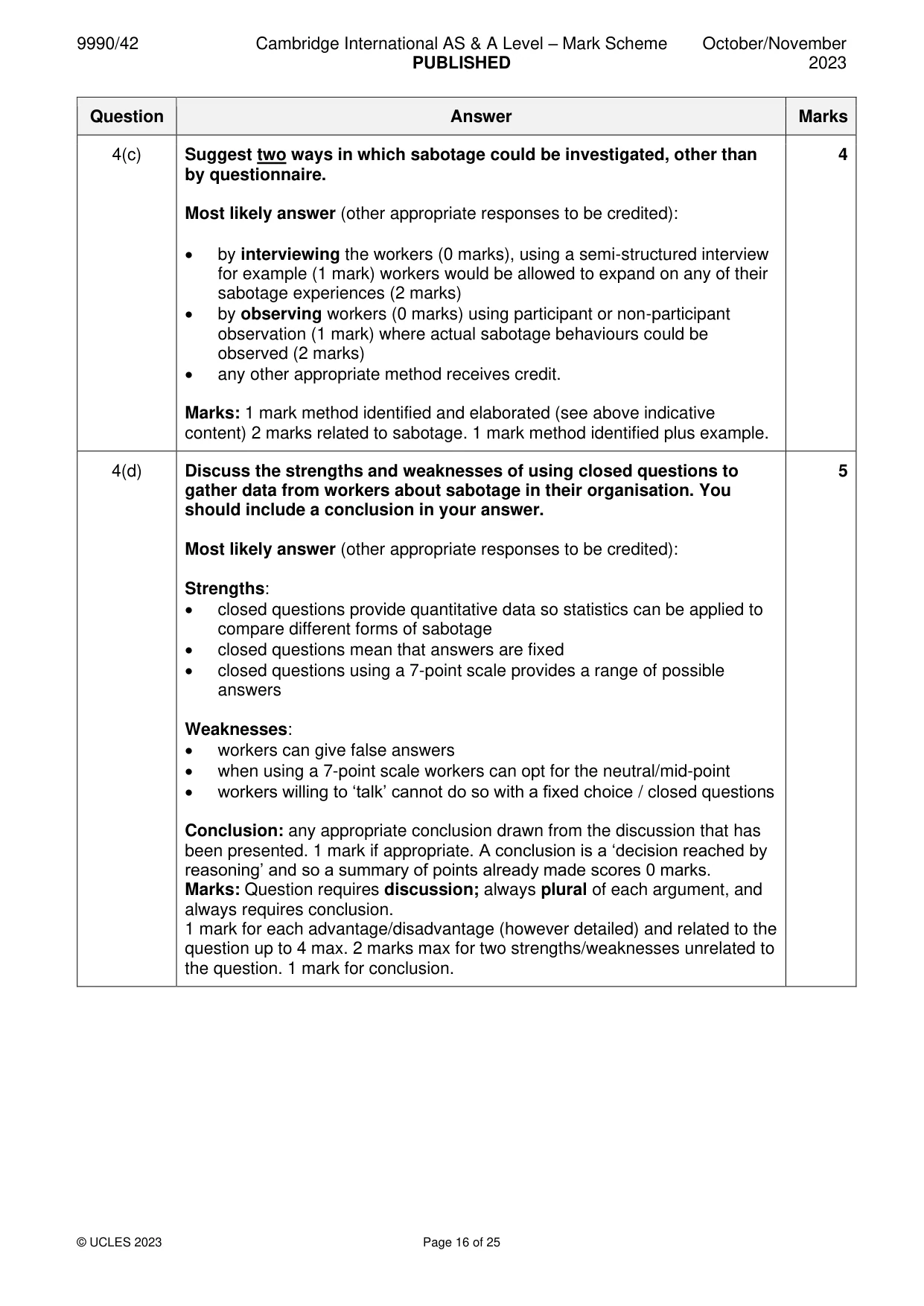
Mark scheme: 4 Sabotage quotes from workers: Ron: ‘When I worked in a car factory, I would put a banana in a door panel. The new car would smell for weeks’. John: ‘When at work, I would force a wire basket into the machinery. It gave us a 20 minute break while it was fixed’. 4(a) Identify two reasons for sabotage as identified by Giacalone and 2 Rosenfeld. Definitive answers: self defence protect oneself from boss/company to protect one’s job revenge the foreman/company deserved it release of frustrations an eye for an eye the foreman/company hurt me previously just for fun/ no one was hurt by the action laughs Marks: 1 mark for correct identification 2 4(b) Suggest two reasons why the findings of this study cannot be 4 generalised. Most likely answer (other appropriate responses to be credited): • relatively small sample size (for a factory) (1 mark) there were only 38 workers (2 marks) • they were all from one factory/type of organisation (1 mark) an electrical factory (2 marks) • located in one country (1 mark) the factory was in north eastern United States (2 marks) Marks: 1 mark basic answer, +1 mark for related to this study 2 Credit any comparison. 4(c) Suggest two ways in which sabotage could be investigated, other than 4 by questionnaire. Most likely answer (other appropriate responses to be credited): • by interviewing the workers (0 marks), using a semi-structured interview for example (1 mark) workers would be allowed to expand on any of their sabotage experiences (2 marks) • by observing workers (0 marks) using participant or non-participant observation (1 mark) where actual sabotage behaviours could be observed (2 marks) • any other appropriate method receives credit. Marks: 1 mark method identified and elaborated (see above indicative content) 2 marks related to sabotage. 1 mark method identified plus example. 4(d) Discuss the strengths and weaknesses of using closed questions to 5 gather data from workers about sabotage in their organisation. You should include a conclusion in your answer. Most likely answer (other appropriate responses to be credited): Strengths: • closed questions provide quantitative data so statistics can be applied to compare different forms of sabotage • closed questions mean that answers are fixed • closed questions using a 7-point scale provides a range of possible answers Weaknesses: • workers can give false answers • when using a 7-point scale workers can opt for the neutral/mid-point • workers willing to ‘talk’ cannot do so with a fixed choice / closed questions Conclusion: any appropriate conclusion drawn from the discussion that has been presented. 1 mark if appropriate. A conclusion is a ‘decision reached by reasoning’ and so a summary of points already made scores 0 marks. Marks: Question requires discussion; always plural of each argument, and always requires conclusion. 1 mark for each advantage/disadvantage (however detailed) and related to the question up to 4 max. 2 marks max for two strengths/weaknesses unrelated to the question. 1 mark for conclusion.
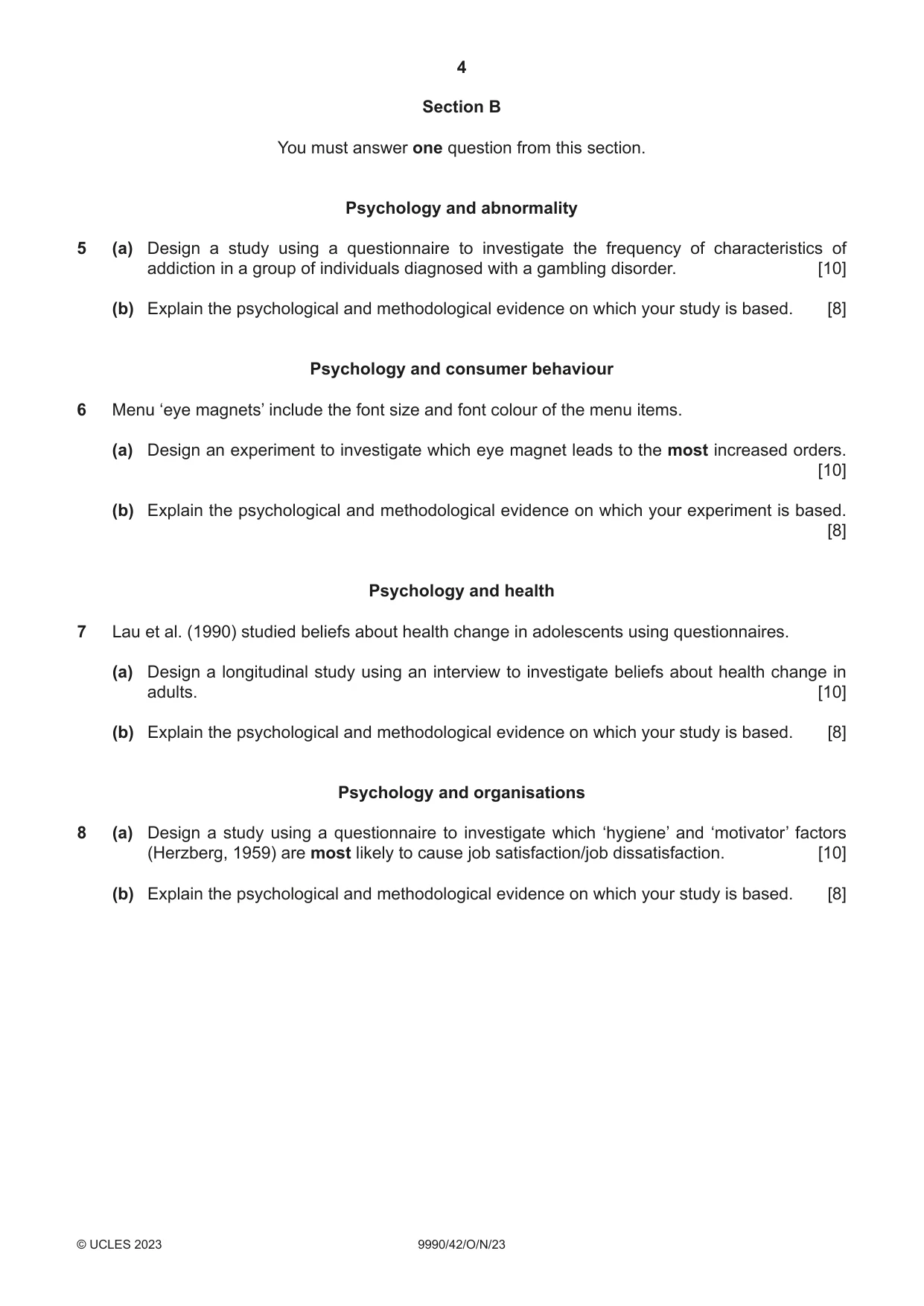
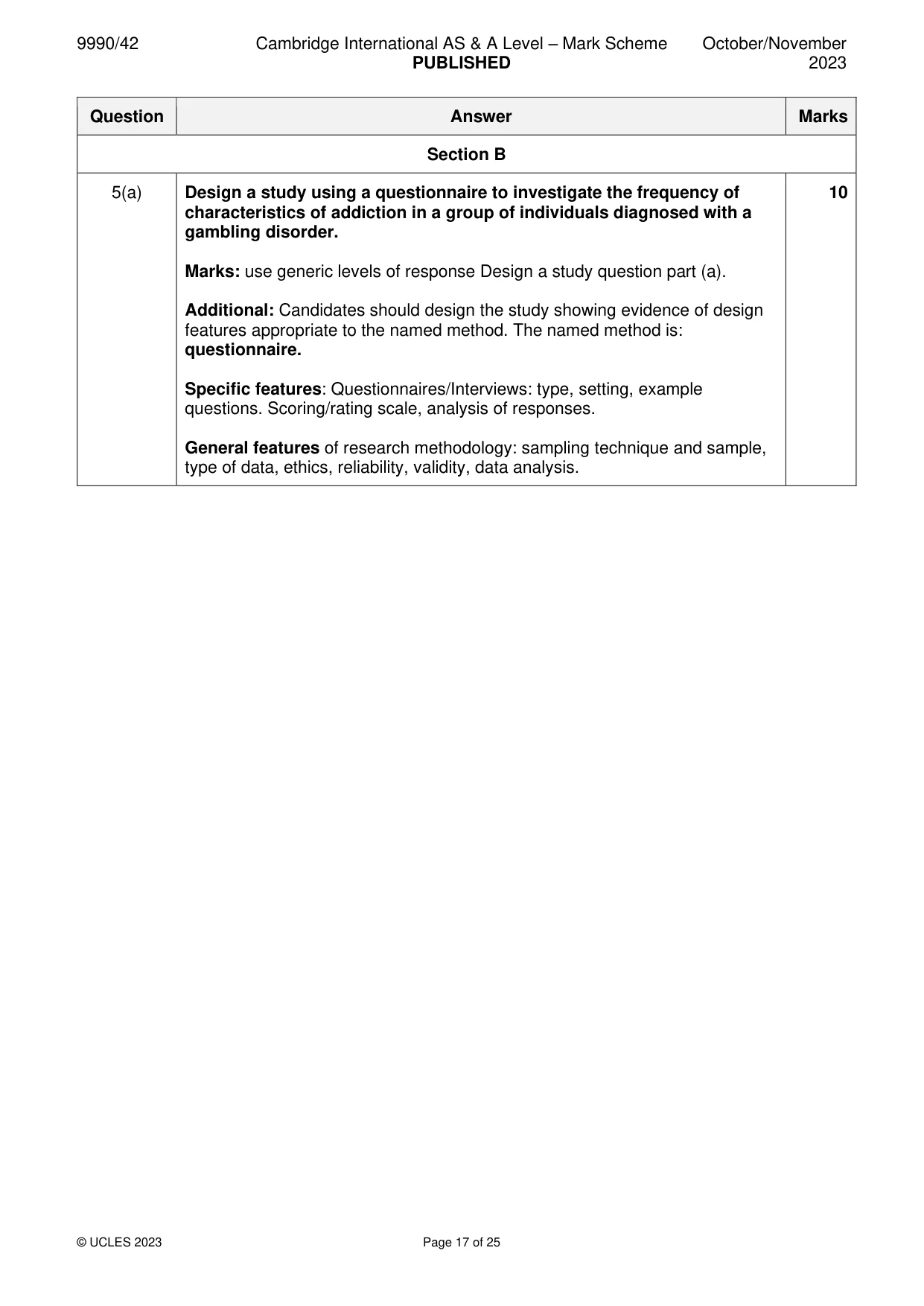
Q5 · Design a study using a questionnaire to investigate the frequency of characteristics of…
5 (a) Design a study using a questionnaire to investigate the frequency of characteristics of addiction in a group of individuals diagnosed with a gambling disorder. [10] (b) Explain the psychological and methodological evidence on which your study is based. [8] Psychology and consumer behaviour
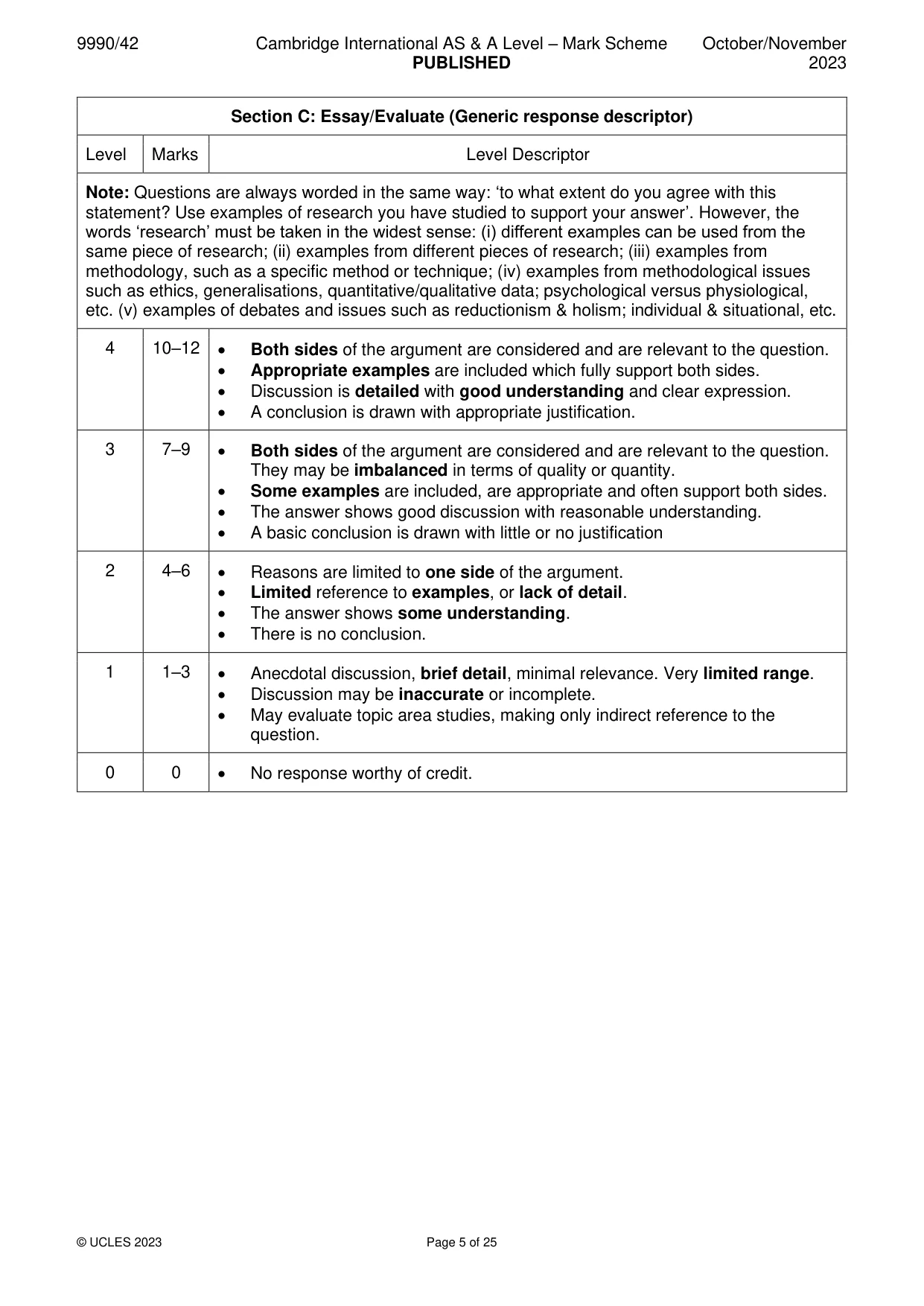
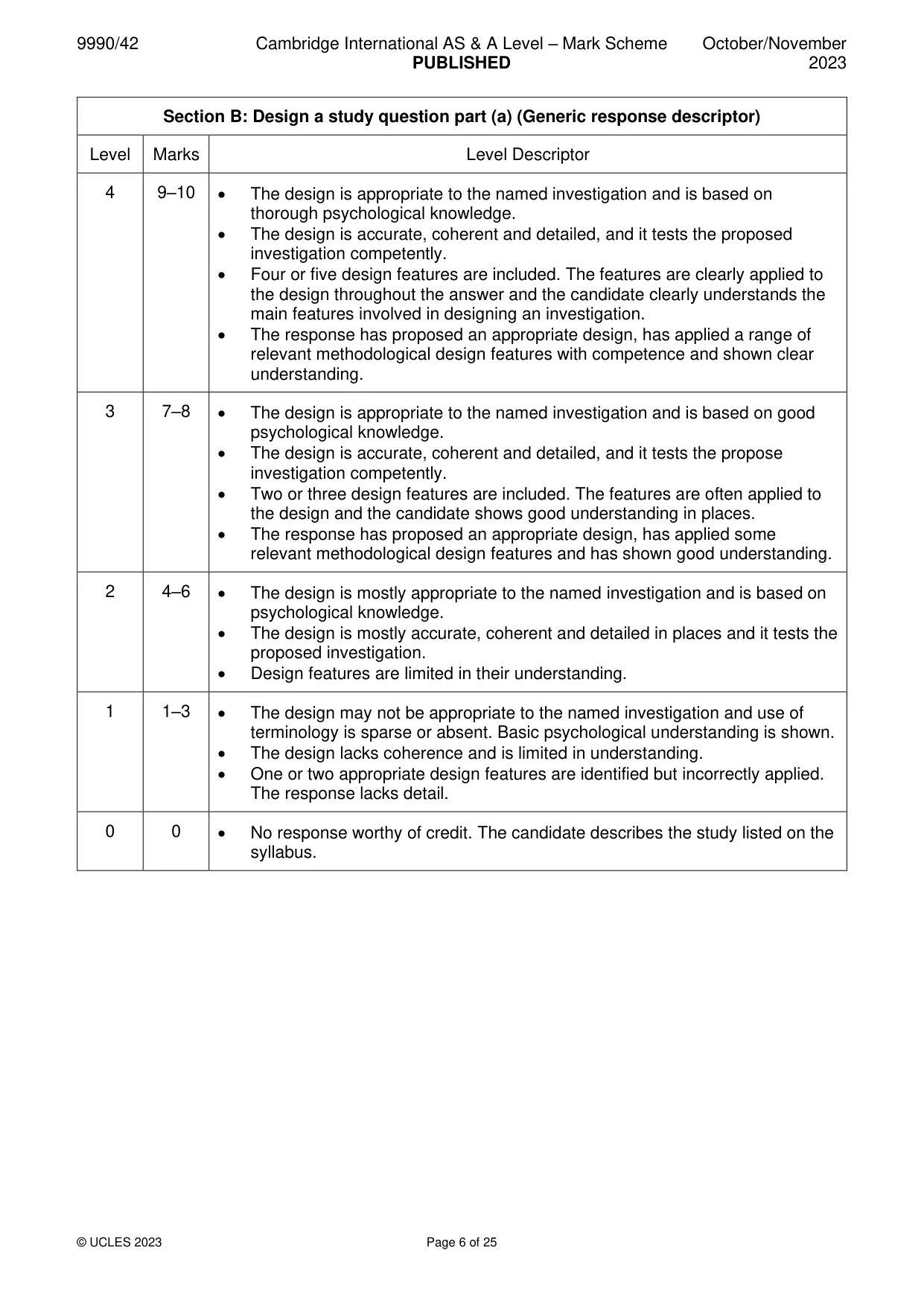
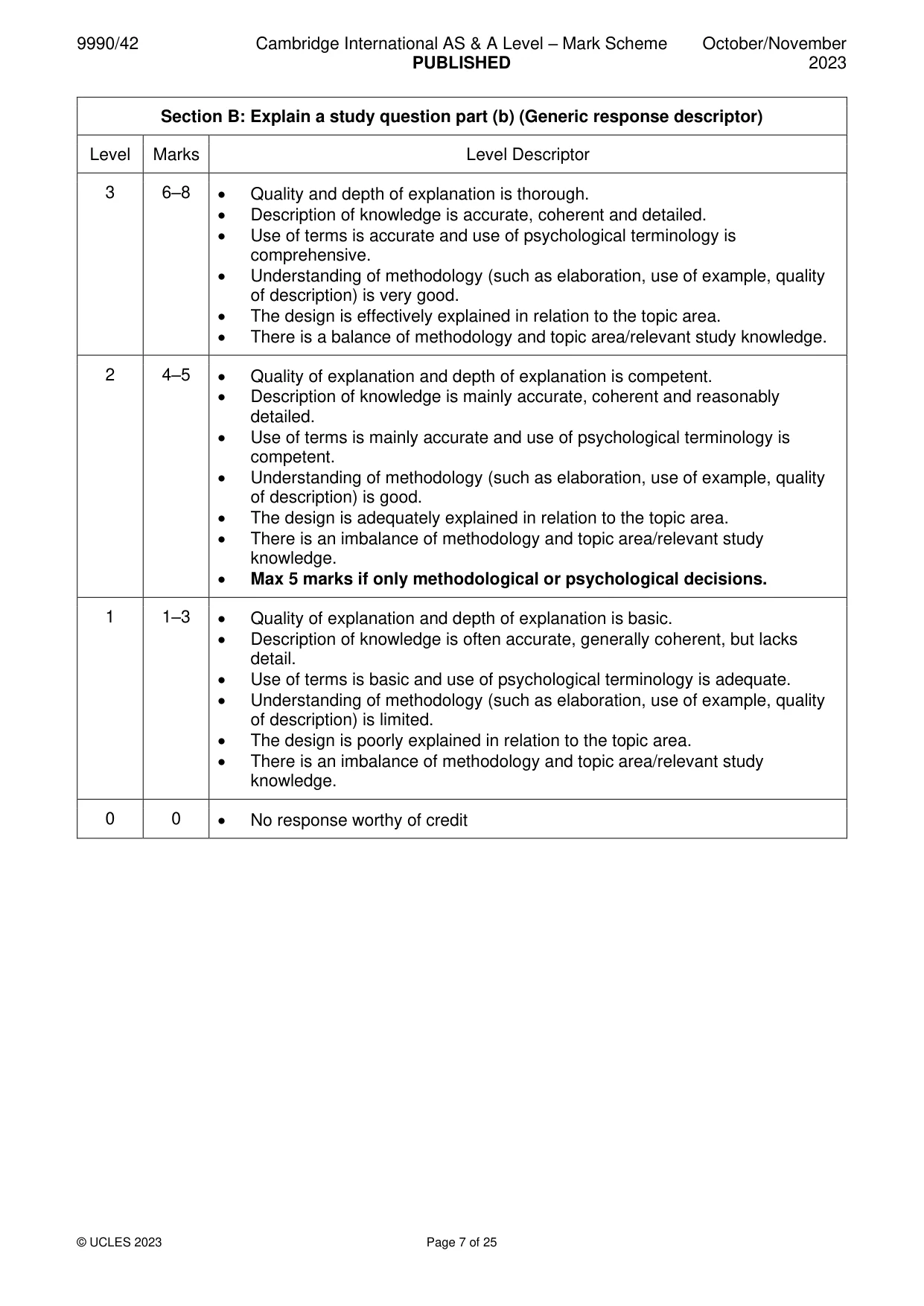
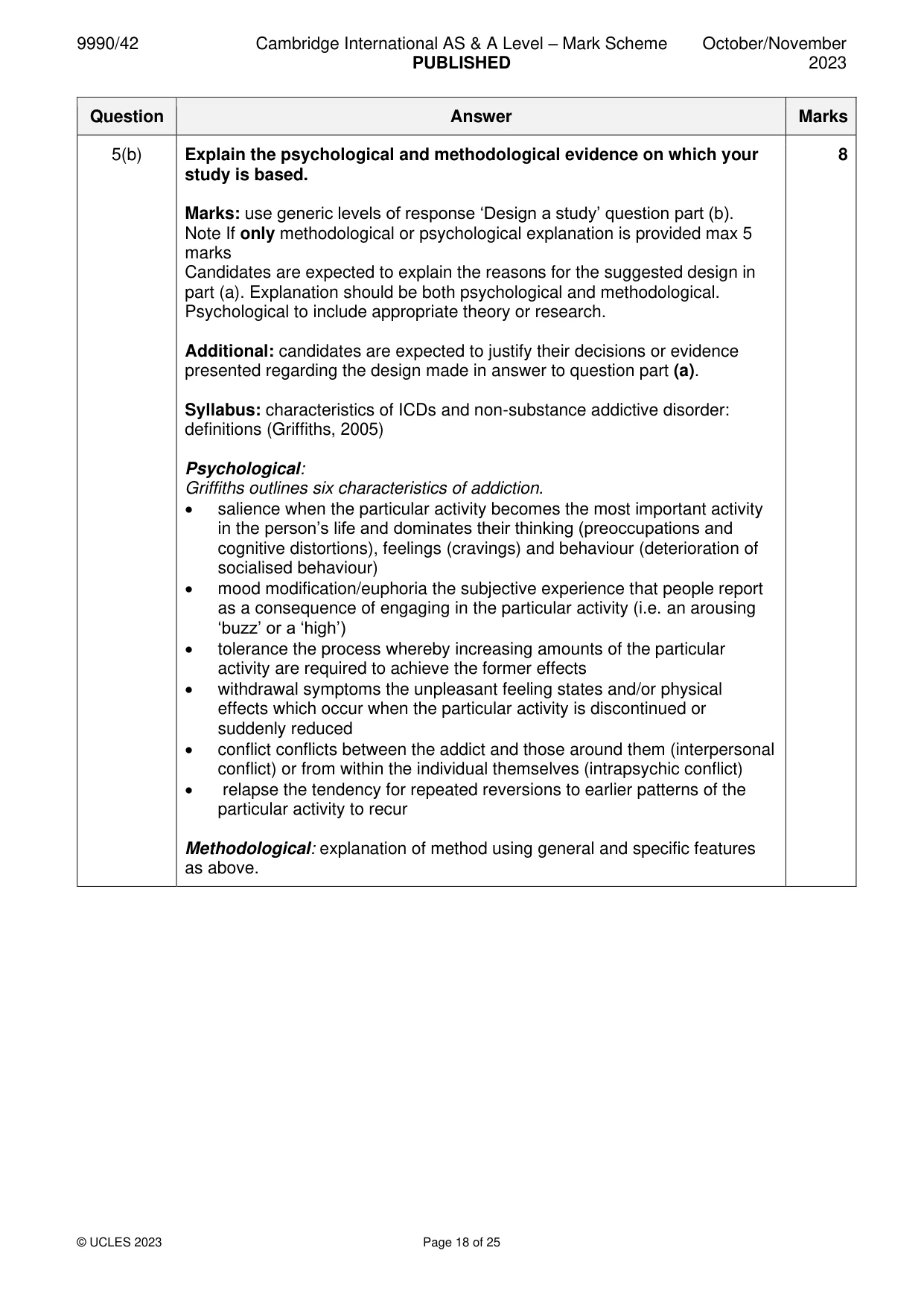
Mark scheme: 5(a) Design a study using a questionnaire to investigate the frequency of 10 characteristics of addiction in a group of individuals diagnosed with a gambling disorder. Marks: use generic levels of response Design a study question part (a). Additional: Candidates should design the study showing evidence of design features appropriate to the named method. The named method is: questionnaire. Specific features: Questionnaires/Interviews: type, setting, example questions. Scoring/rating scale, analysis of responses. General features of research methodology: sampling technique and sample, type of data, ethics, reliability, validity, data analysis. 5(b) Explain the psychological and methodological evidence on which your 8 study is based. Marks: use generic levels of response ‘Design a study’ question part (b). Note If only methodological or psychological explanation is provided max 5 marks Candidates are expected to explain the reasons for the suggested design in part (a). Explanation should be both psychological and methodological. Psychological to include appropriate theory or research. Additional: candidates are expected to justify their decisions or evidence presented regarding the design made in answer to question part (a). Syllabus: characteristics of ICDs and non-substance addictive disorder: definitions (Griffiths, 2005) Psychological: Griffiths outlines six characteristics of addiction. • salience when the particular activity becomes the most important activity in the person’s life and dominates their thinking (preoccupations and cognitive distortions), feelings (cravings) and behaviour (deterioration of socialised behaviour) • mood modification/euphoria the subjective experience that people report as a consequence of engaging in the particular activity (i.e. an arousing ‘buzz’ or a ‘high’) • tolerance the process whereby increasing amounts of the particular activity are required to achieve the former effects • withdrawal symptoms the unpleasant feeling states and/or physical effects which occur when the particular activity is discontinued or suddenly reduced • conflict conflicts between the addict and those around them (interpersonal conflict) or from within the individual themselves (intrapsychic conflict) • relapse the tendency for repeated reversions to earlier patterns of the particular activity to recur Methodological: explanation of method using general and specific features as above.
Q6 · Menu ‘eye magnets’ include the font size and font colour of the menu items
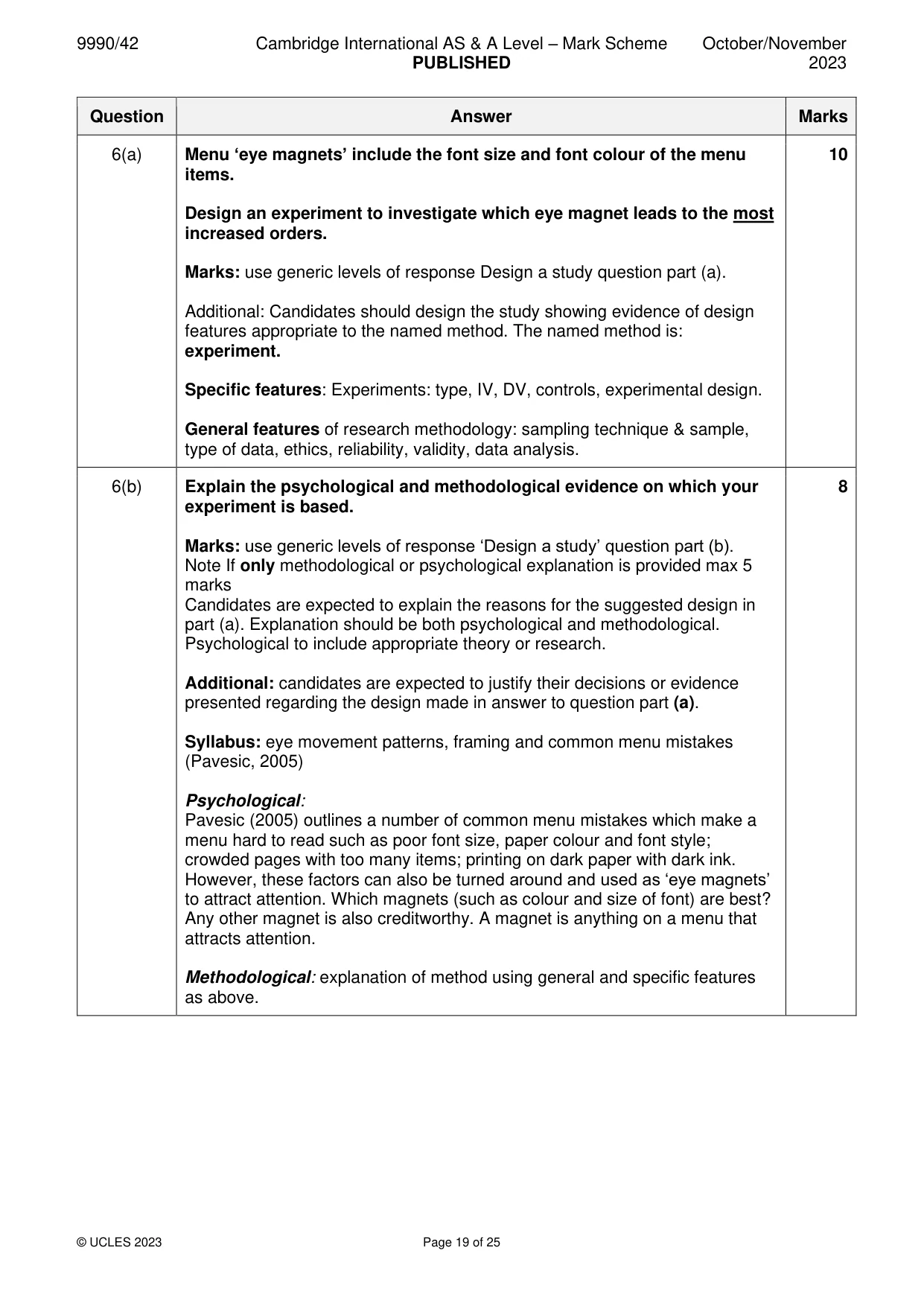
6 Menu ‘eye magnets’ include the font size and font colour of the menu items. (a) Design an experiment to investigate which eye magnet leads to the most increased orders. [10] (b) Explain the psychological and methodological evidence on which your experiment is based. [8] Psychology and health
Mark scheme: 6(a) Menu ‘eye magnets’ include the font size and font colour of the menu 10 items. Design an experiment to investigate which eye magnet leads to the most increased orders. Marks: use generic levels of response Design a study question part (a). Additional: Candidates should design the study showing evidence of design features appropriate to the named method. The named method is: experiment. Specific features: Experiments: type, IV, DV, controls, experimental design. General features of research methodology: sampling technique & sample, type of data, ethics, reliability, validity, data analysis. 6(b) Explain the psychological and methodological evidence on which your 8 experiment is based. Marks: use generic levels of response ‘Design a study’ question part (b). Note If only methodological or psychological explanation is provided max 5 marks Candidates are expected to explain the reasons for the suggested design in part (a). Explanation should be both psychological and methodological. Psychological to include appropriate theory or research. Additional: candidates are expected to justify their decisions or evidence presented regarding the design made in answer to question part (a). Syllabus: eye movement patterns, framing and common menu mistakes (Pavesic, 2005) Psychological: Pavesic (2005) outlines a number of common menu mistakes which make a menu hard to read such as poor font size, paper colour and font style; crowded pages with too many items; printing on dark paper with dark ink. However, these factors can also be turned around and used as ‘eye magnets’ to attract attention. Which magnets (such as colour and size of font) are best? Any other magnet is also creditworthy. A magnet is anything on a menu that attracts attention. Methodological: explanation of method using general and specific features as above.
Question 7
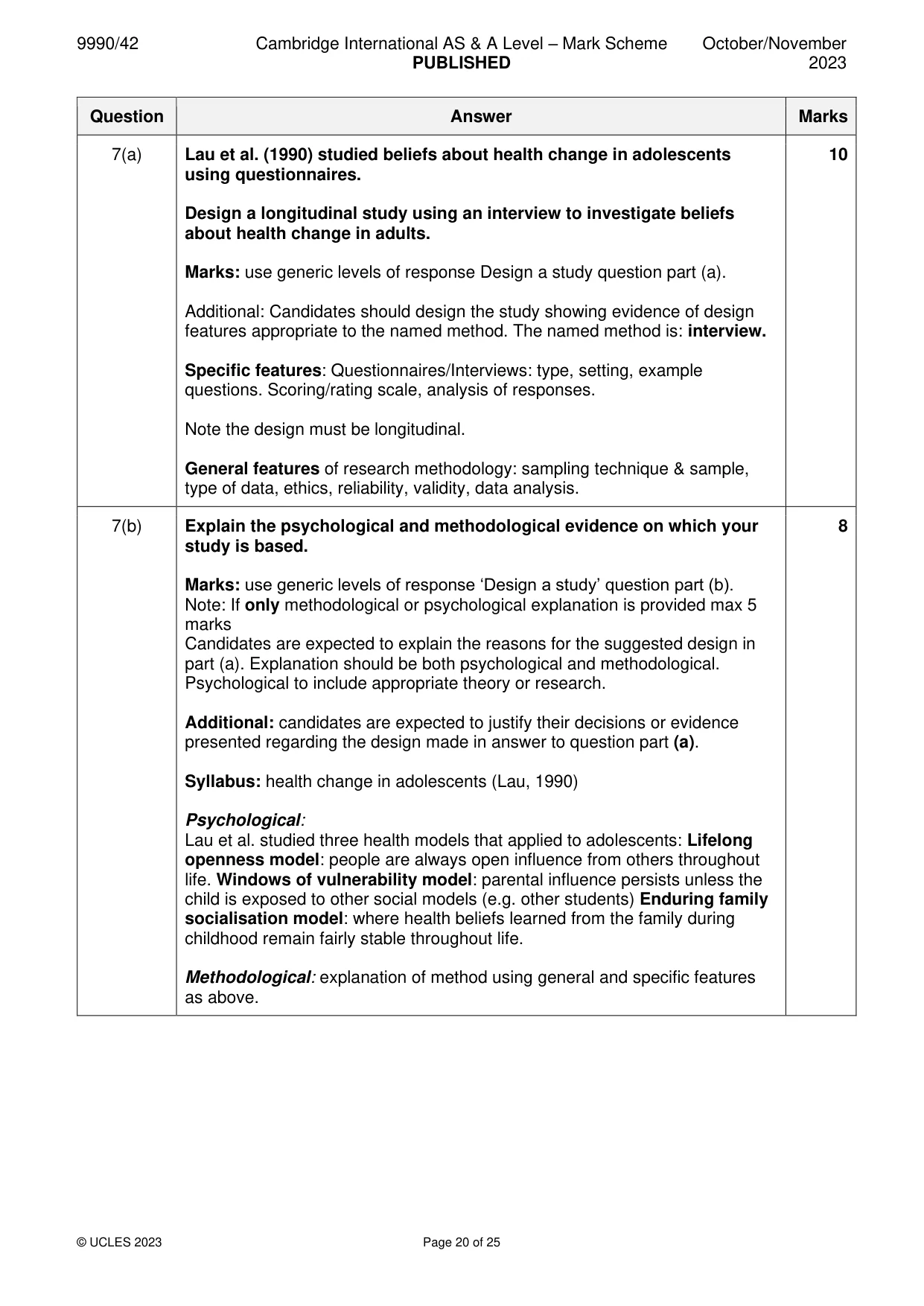
7 Lau et al. (1990) studied beliefs about health change in adolescents using questionnaires. (a) Design a longitudinal study using an interview to investigate beliefs about health change in adults. [10] (b) Explain the psychological and methodological evidence on which your study is based. [8] Psychology and organisations
Mark scheme: 7(a) Lau et al. (1990) studied beliefs about health change in adolescents 10 using questionnaires. Design a longitudinal study using an interview to investigate beliefs about health change in adults. Marks: use generic levels of response Design a study question part (a). Additional: Candidates should design the study showing evidence of design features appropriate to the named method. The named method is: interview. Specific features: Questionnaires/Interviews: type, setting, example questions. Scoring/rating scale, analysis of responses. Note the design must be longitudinal. General features of research methodology: sampling technique & sample, type of data, ethics, reliability, validity, data analysis. 7(b) Explain the psychological and methodological evidence on which your 8 study is based. Marks: use generic levels of response ‘Design a study’ question part (b). Note: If only methodological or psychological explanation is provided max 5 marks Candidates are expected to explain the reasons for the suggested design in part (a). Explanation should be both psychological and methodological. Psychological to include appropriate theory or research. Additional: candidates are expected to justify their decisions or evidence presented regarding the design made in answer to question part (a). Syllabus: health change in adolescents (Lau, 1990) Psychological: Lau et al. studied three health models that applied to adolescents: Lifelong openness model: people are always open influence from others throughout life. Windows of vulnerability model: parental influence persists unless the child is exposed to other social models (e.g. other students) Enduring family socialisation model: where health beliefs learned from the family during childhood remain fairly stable throughout life. Methodological: explanation of method using general and specific features as above.
More questions on 2 Health promotion in schools and worksites
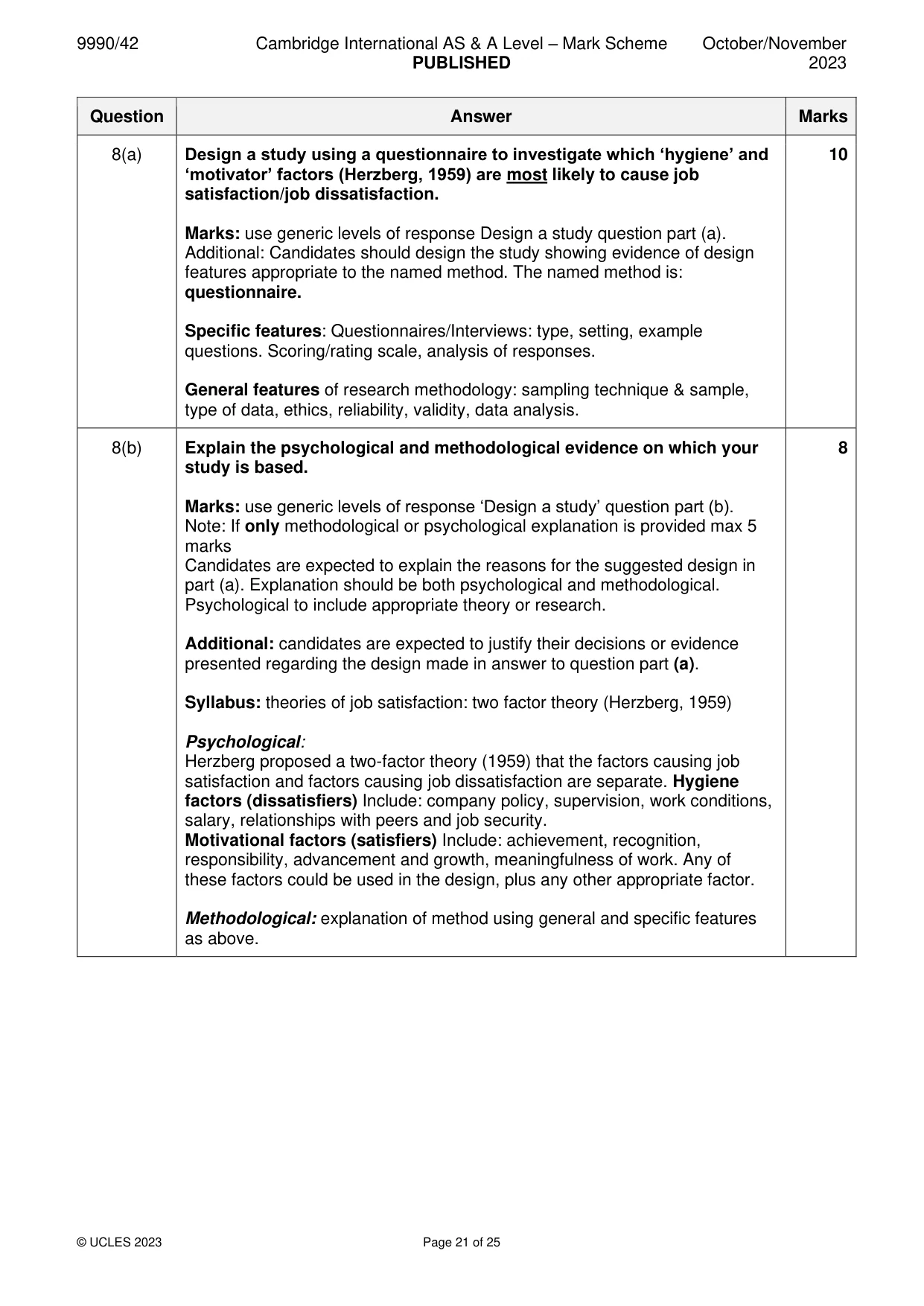
Q8 · Design a study using a questionnaire to investigate which ‘hygiene’ and ‘motivator’…
8 (a) Design a study using a questionnaire to investigate which ‘hygiene’ and ‘motivator’ factors (Herzberg, 1959) are most likely to cause job satisfaction/job dissatisfaction. [10] (b) Explain the psychological and methodological evidence on which your study is based. [8] Section C You must answer one question from this section. Psychology and abnormality
Mark scheme: 8(a) Design a study using a questionnaire to investigate which ‘hygiene’ and 10 ‘motivator’ factors (Herzberg, 1959) are most likely to cause job satisfaction/job dissatisfaction. Marks: use generic levels of response Design a study question part (a). Additional: Candidates should design the study showing evidence of design features appropriate to the named method. The named method is: questionnaire. Specific features: Questionnaires/Interviews: type, setting, example questions. Scoring/rating scale, analysis of responses. General features of research methodology: sampling technique & sample, type of data, ethics, reliability, validity, data analysis. 8(b) Explain the psychological and methodological evidence on which your 8 study is based. Marks: use generic levels of response ‘Design a study’ question part (b). Note: If only methodological or psychological explanation is provided max 5 marks Candidates are expected to explain the reasons for the suggested design in part (a). Explanation should be both psychological and methodological. Psychological to include appropriate theory or research. Additional: candidates are expected to justify their decisions or evidence presented regarding the design made in answer to question part (a). Syllabus: theories of job satisfaction: two factor theory (Herzberg, 1959) Psychological: Herzberg proposed a two-factor theory (1959) that the factors causing job satisfaction and factors causing job dissatisfaction are separate. Hygiene factors (dissatisfiers) Include: company policy, supervision, work conditions, salary, relationships with peers and job security. Motivational factors (satisfiers) Include: achievement, recognition, responsibility, advancement and growth, meaningfulness of work. Any of these factors could be used in the design, plus any other appropriate factor. Methodological: explanation of method using general and specific features as above.
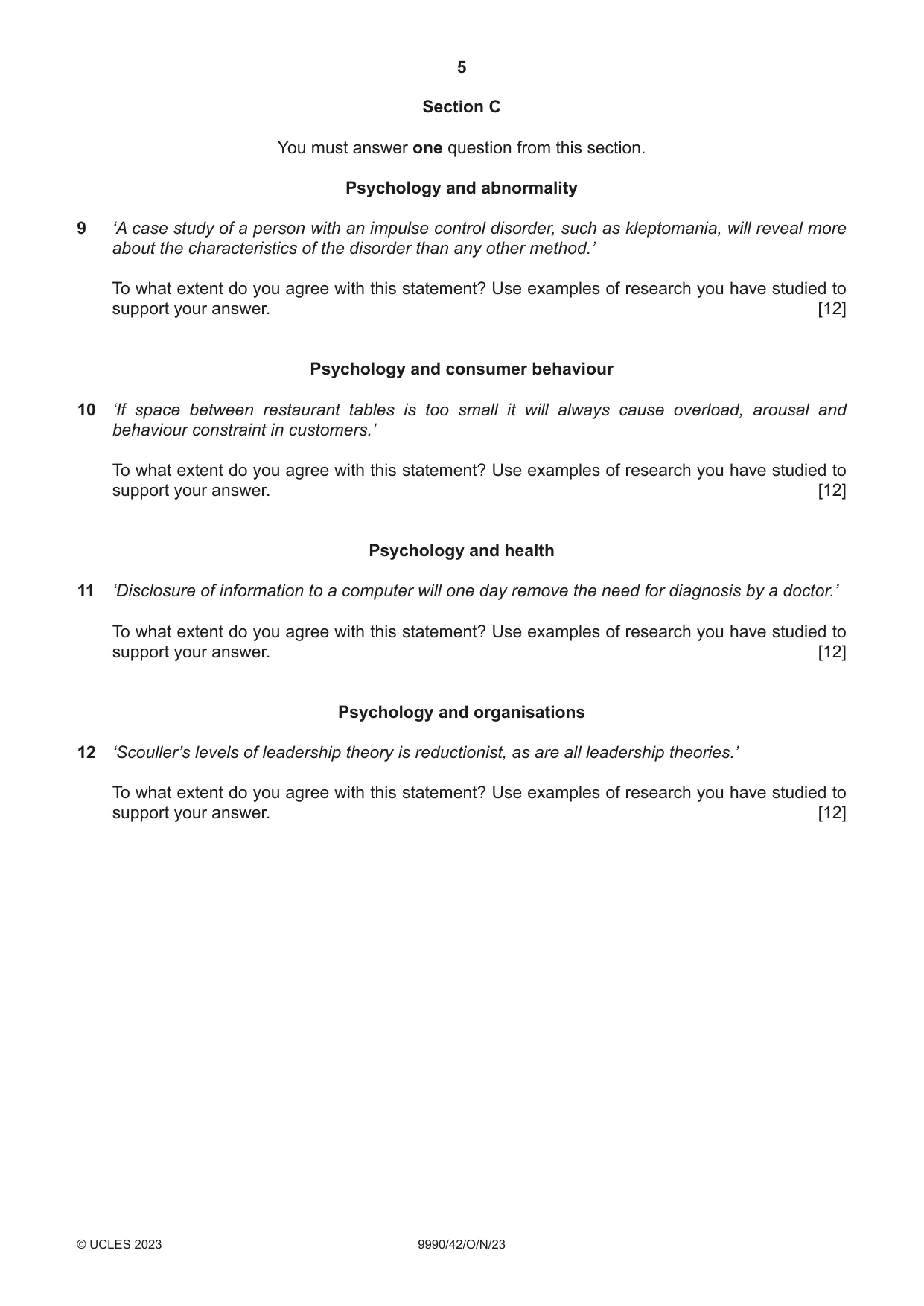
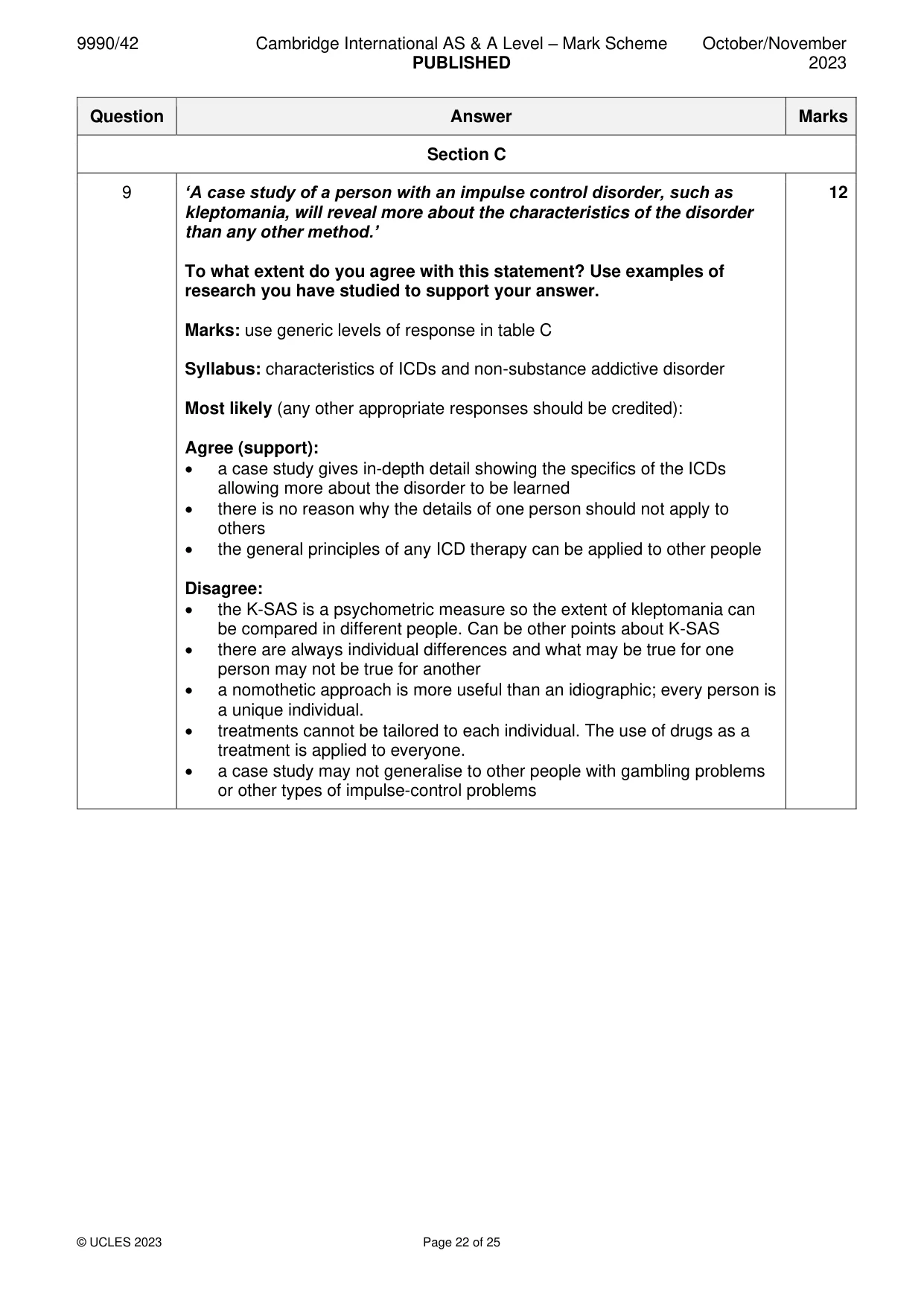
Q9 · ‘A case study of a person with an impulse control disorder, such as kleptomania, will…
9 ‘A case study of a person with an impulse control disorder, such as kleptomania, will reveal more about the characteristics of the disorder than any other method.’ To what extent do you agree with this statement? Use examples of research you have studied to support your answer. [12] Psychology and consumer behaviour
Mark scheme: 9 ‘A case study of a person with an impulse control disorder, such as 12 kleptomania, will reveal more about the characteristics of the disorder than any other method.’ To what extent do you agree with this statement? Use examples of research you have studied to support your answer. Marks: use generic levels of response in table C Syllabus: characteristics of ICDs and non-substance addictive disorder Most likely (any other appropriate responses should be credited): Agree (support): • a case study gives in-depth detail showing the specifics of the ICDs allowing more about the disorder to be learned • there is no reason why the details of one person should not apply to others • the general principles of any ICD therapy can be applied to other people Disagree: • the K-SAS is a psychometric measure so the extent of kleptomania can be compared in different people. Can be other points about K-SAS • there are always individual differences and what may be true for one person may not be true for another • a nomothetic approach is more useful than an idiographic; every person is a unique individual. • treatments cannot be tailored to each individual. The use of drugs as a treatment is applied to everyone. • a case study may not generalise to other people with gambling problems or other types of impulse-control problems
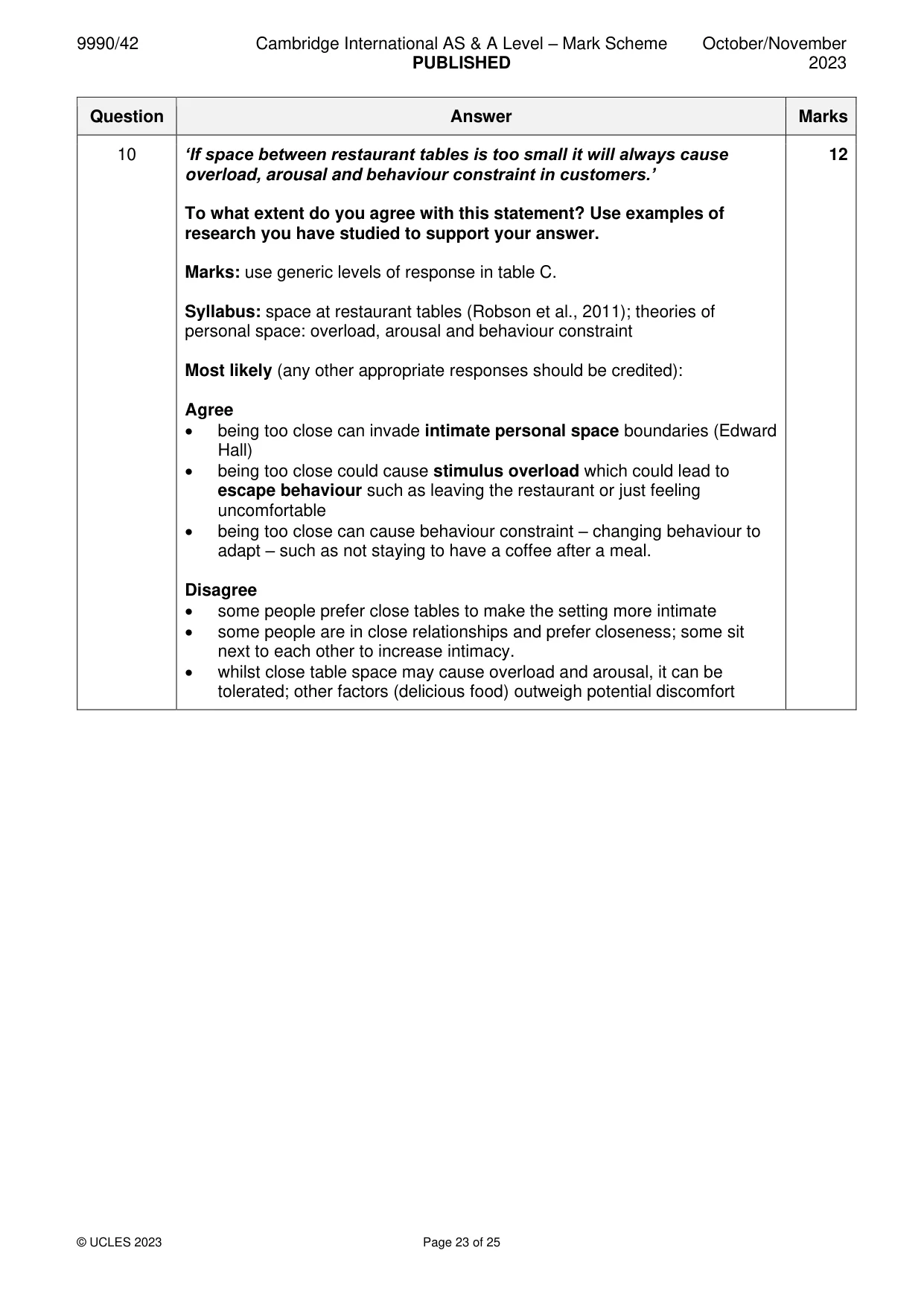
Q10 · ‘If space between restaurant tables is too small it will always cause overload, arousal…
10 ‘If space between restaurant tables is too small it will always cause overload, arousal and behaviour constraint in customers.’ To what extent do you agree with this statement? Use examples of research you have studied to support your answer. [12] Psychology and health
Mark scheme: 10 ‘If space between restaurant tables is too small it will always cause 12 overload, arousal and behaviour constraint in customers.’ To what extent do you agree with this statement? Use examples of research you have studied to support your answer. Marks: use generic levels of response in table C. Syllabus: space at restaurant tables (Robson et al., 2011); theories of personal space: overload, arousal and behaviour constraint Most likely (any other appropriate responses should be credited): Agree • being too close can invade intimate personal space boundaries (Edward Hall) • being too close could cause stimulus overload which could lead to escape behaviour such as leaving the restaurant or just feeling uncomfortable • being too close can cause behaviour constraint – changing behaviour to adapt – such as not staying to have a coffee after a meal. Disagree • some people prefer close tables to make the setting more intimate • some people are in close relationships and prefer closeness; some sit next to each other to increase intimacy. • whilst close table space may cause overload and arousal, it can be tolerated; other factors (delicious food) outweigh potential discomfort
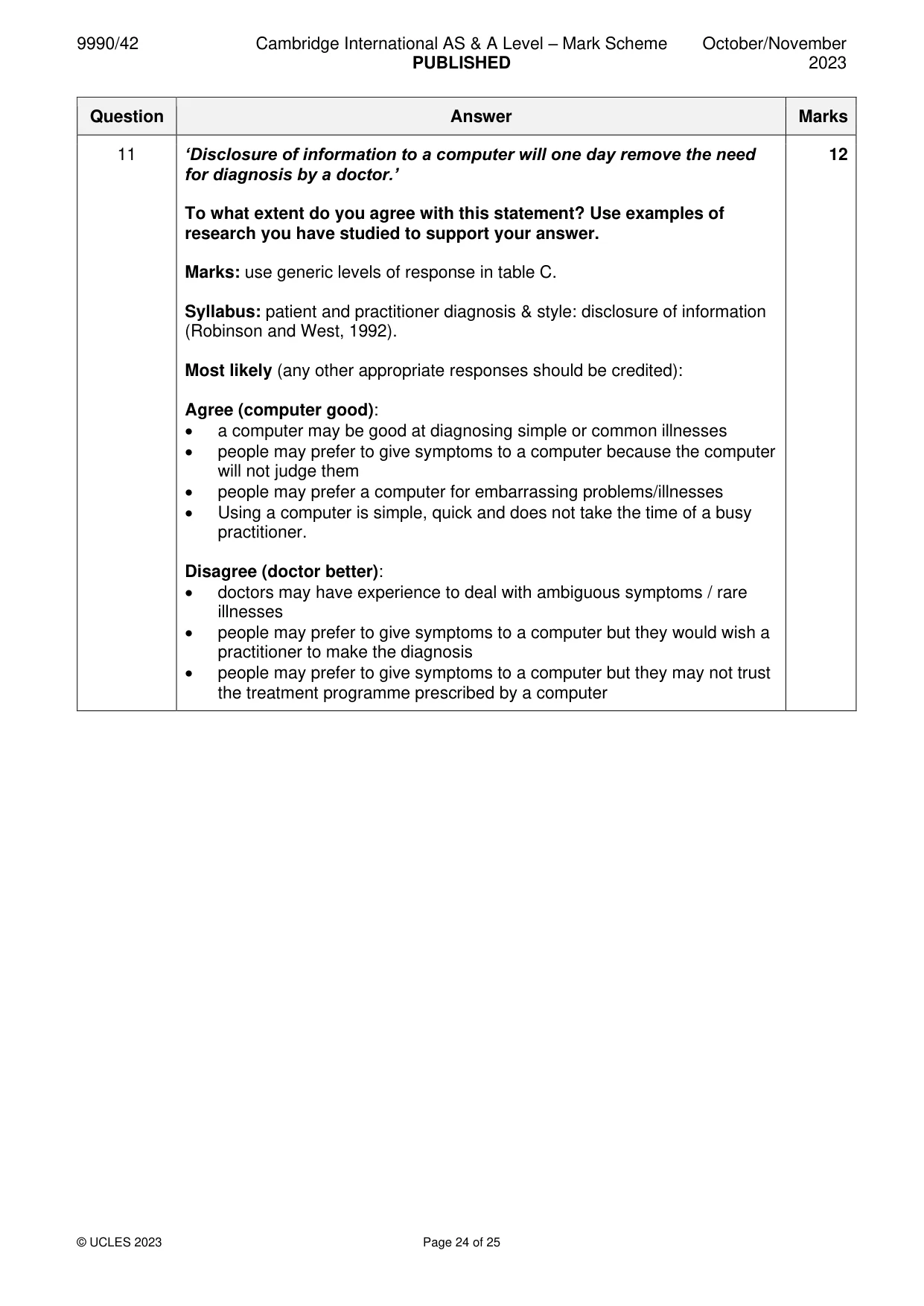
Q11 · ‘Disclosure of information to a computer will one day remove the need for diagnosis by a…
11 ‘Disclosure of information to a computer will one day remove the need for diagnosis by a doctor.’ To what extent do you agree with this statement? Use examples of research you have studied to support your answer. [12] Psychology and organisations
Mark scheme: 11 ‘Disclosure of information to a computer will one day remove the need 12 for diagnosis by a doctor.’ To what extent do you agree with this statement? Use examples of research you have studied to support your answer. Marks: use generic levels of response in table C. Syllabus: patient and practitioner diagnosis & style: disclosure of information (Robinson and West, 1992). Most likely (any other appropriate responses should be credited): Agree (computer good): • a computer may be good at diagnosing simple or common illnesses • people may prefer to give symptoms to a computer because the computer will not judge them • people may prefer a computer for embarrassing problems/illnesses • Using a computer is simple, quick and does not take the time of a busy practitioner. Disagree (doctor better): • doctors may have experience to deal with ambiguous symptoms / rare illnesses • people may prefer to give symptoms to a computer but they would wish a practitioner to make the diagnosis • people may prefer to give symptoms to a computer but they may not trust the treatment programme prescribed by a computer
Q12 · ‘Scouller’s levels of leadership theory is reductionist, as are all leadership theories.’…
12 ‘Scouller’s levels of leadership theory is reductionist, as are all leadership theories.’ To what extent do you agree with this statement? Use examples of research you have studied to support your answer. [12]
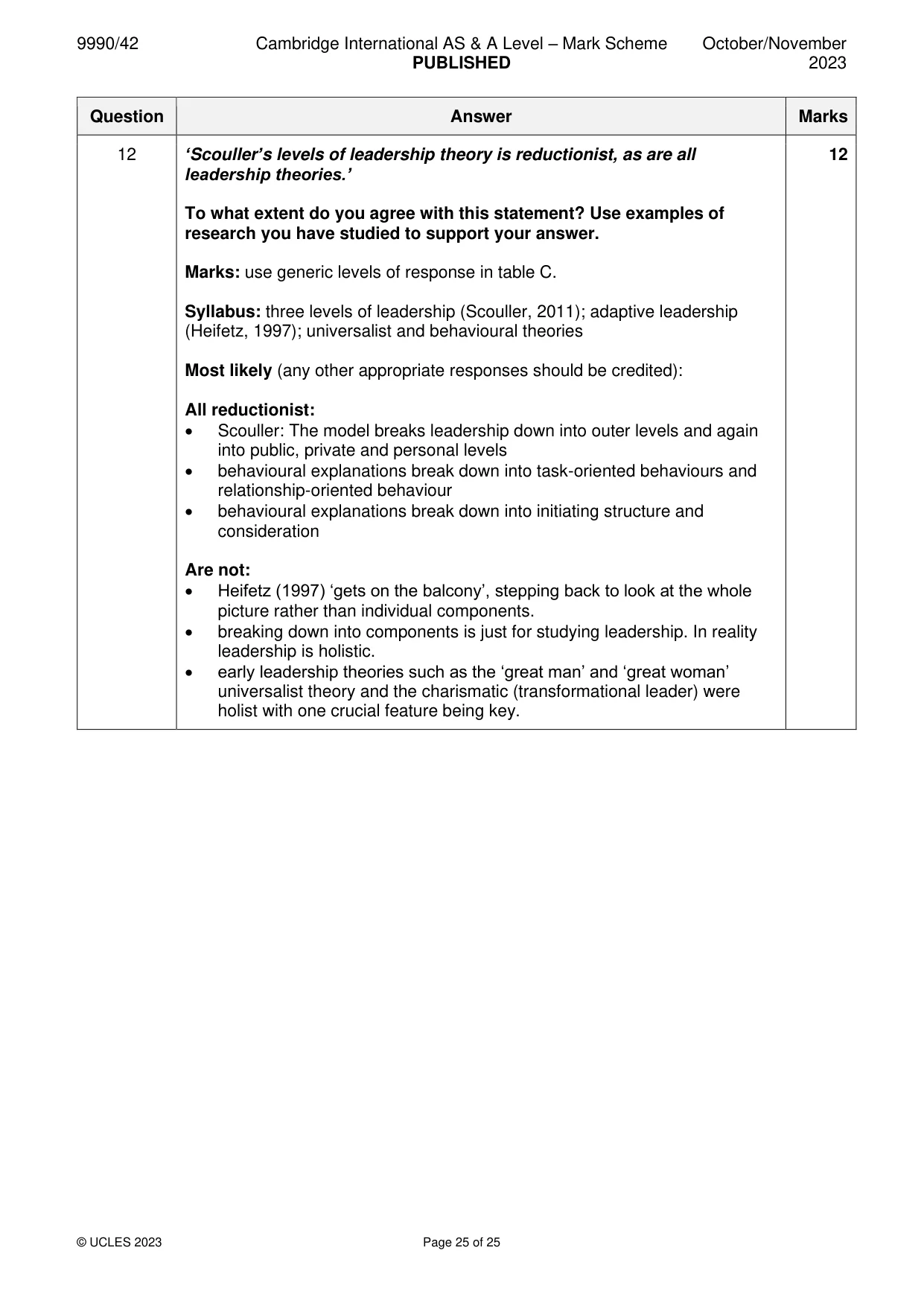
Mark scheme: 12 ‘Scouller’s levels of leadership theory is reductionist, as are all 12 leadership theories.’ To what extent do you agree with this statement? Use examples of research you have studied to support your answer. Marks: use generic levels of response in table C. Syllabus: three levels of leadership (Scouller, 2011); adaptive leadership (Heifetz, 1997); universalist and behavioural theories Most likely (any other appropriate responses should be credited): All reductionist: • Scouller: The model breaks leadership down into outer levels and again into public, private and personal levels • behavioural explanations break down into task-oriented behaviours and relationship-oriented behaviour • behavioural explanations break down into initiating structure and consideration Are not: • Heifetz (1997) ‘gets on the balcony’, stepping back to look at the whole picture rather than individual components. • breaking down into components is just for studying leadership. In reality leadership is holistic. • early leadership theories such as the ‘great man’ and ‘great woman’ universalist theory and the charismatic (transformational leader) were holist with one crucial feature being key.
What was in this paper
The subtopics covered by these 12 questions, and how many questions each got. Open one in a new tab to see every Cambridge question on it.
What you needed in this session
Cambridge’s own grade thresholds for 2023 Oct/Nov, Paper 4 · Variant 2. A higher threshold means an easier paper — the bar moves with how the cohort did.