Cambridge A Level Psychology (from 2018) 9990 — 2025 Oct/Nov Paper 4 · Variant 3
9990/43/O/N/25 · 12 questions · 168 marks · 90 min
The question paper and its mark scheme, free to read here and free to download. This is Cambridge’s own paper, exactly as it was sat.
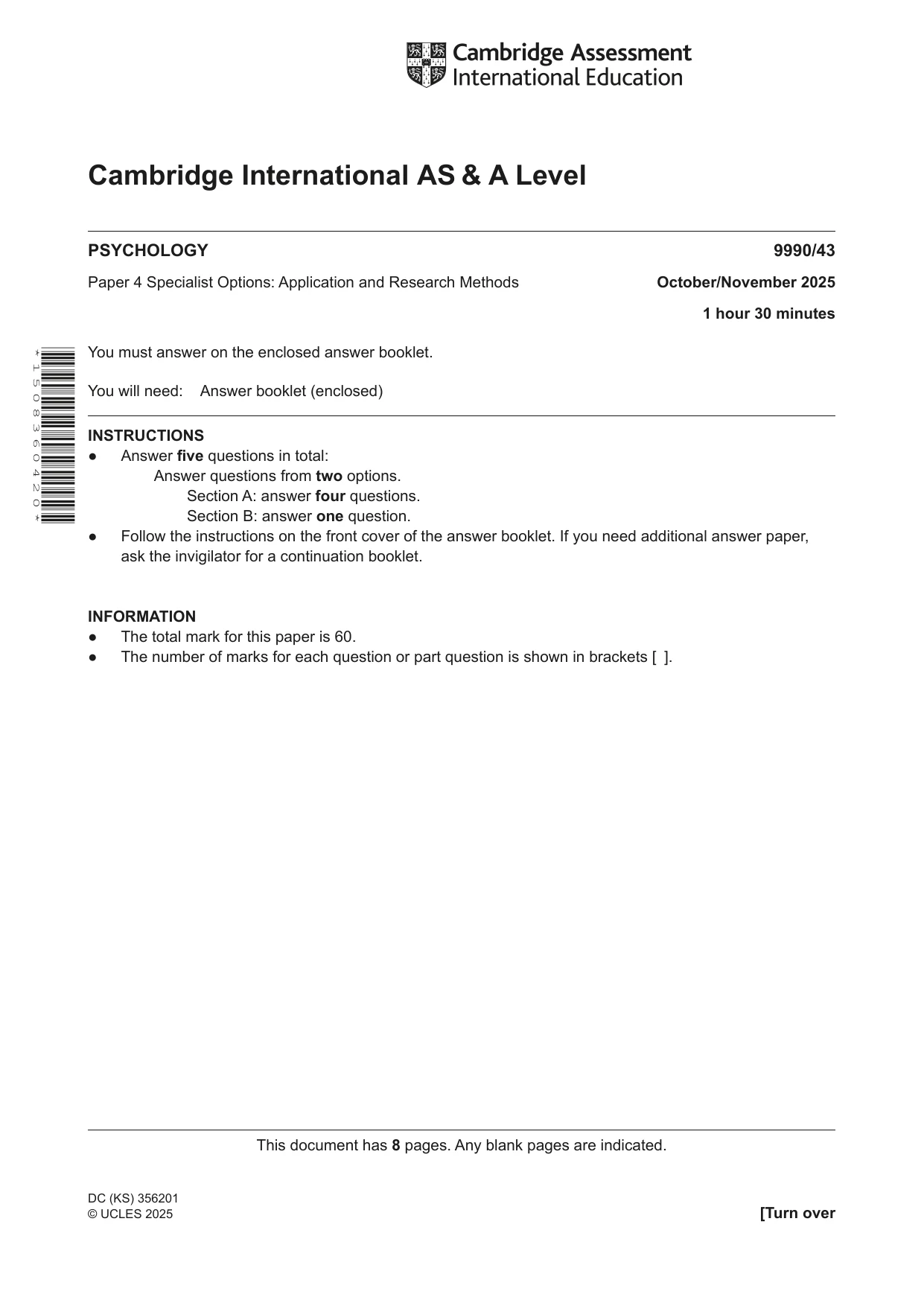
Question paper8 pages



Mark scheme35 pages
Answers below. Sit the paper first if you are practising.


Questions as text
Q1 · The key study by Grant et al
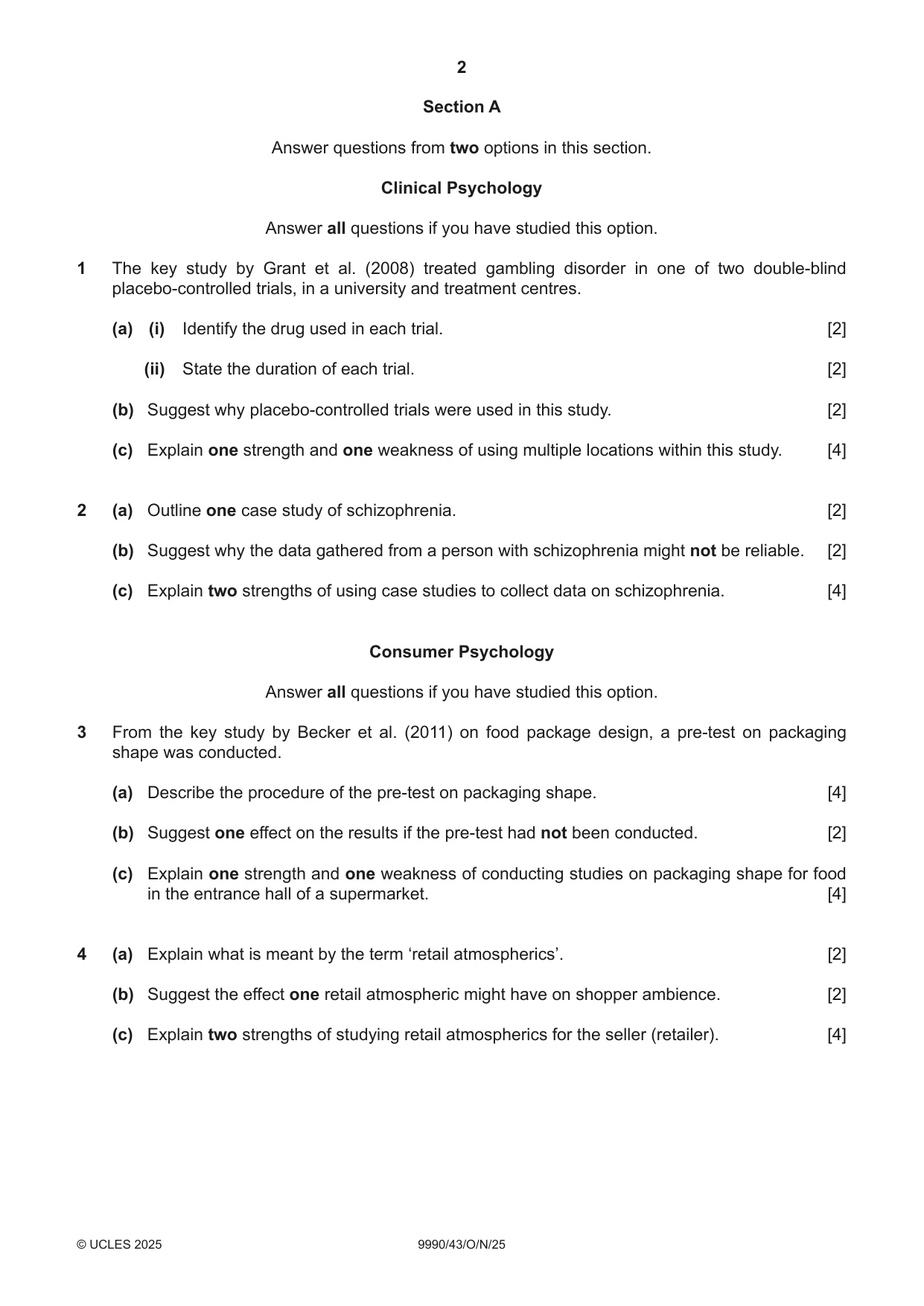
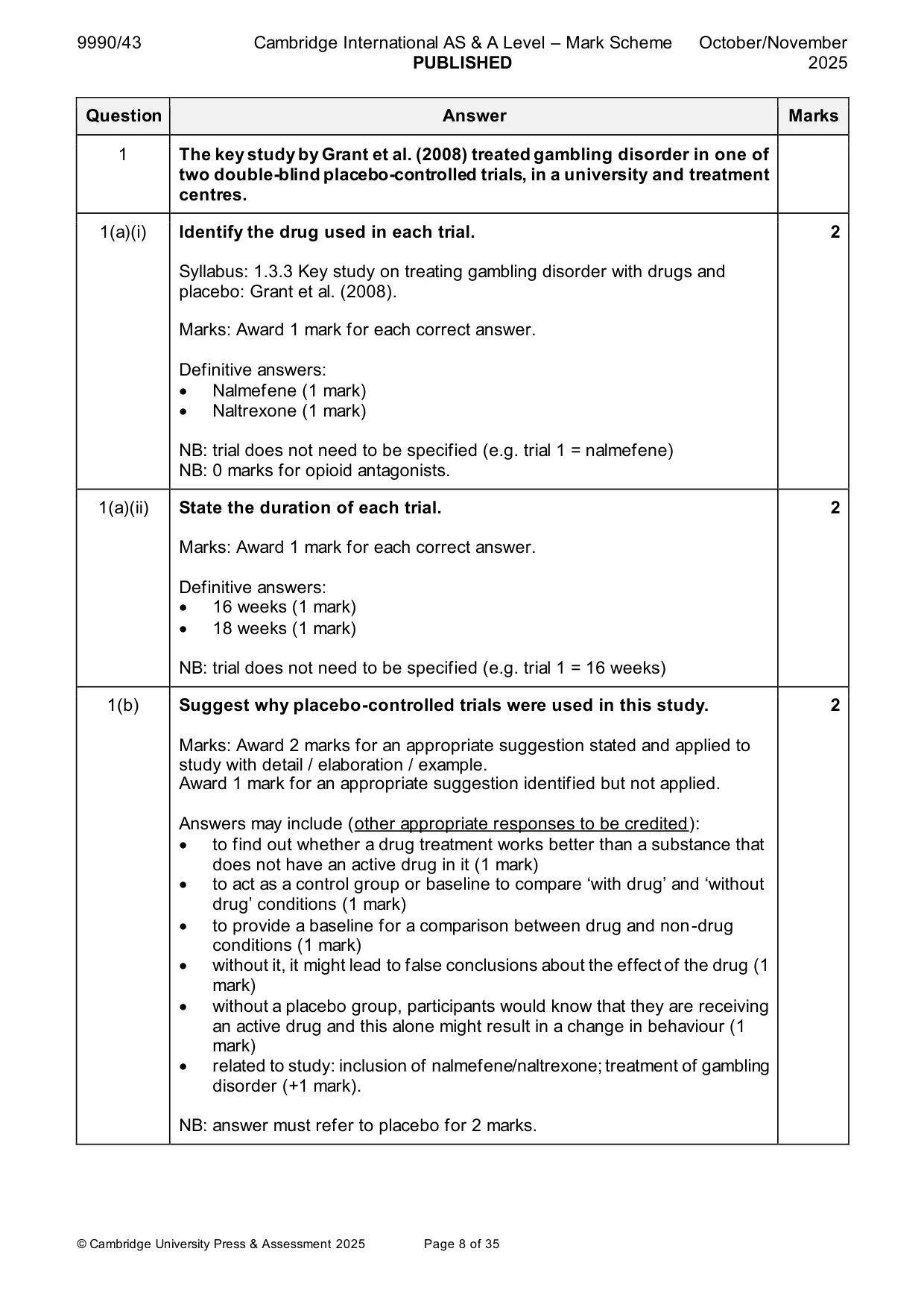
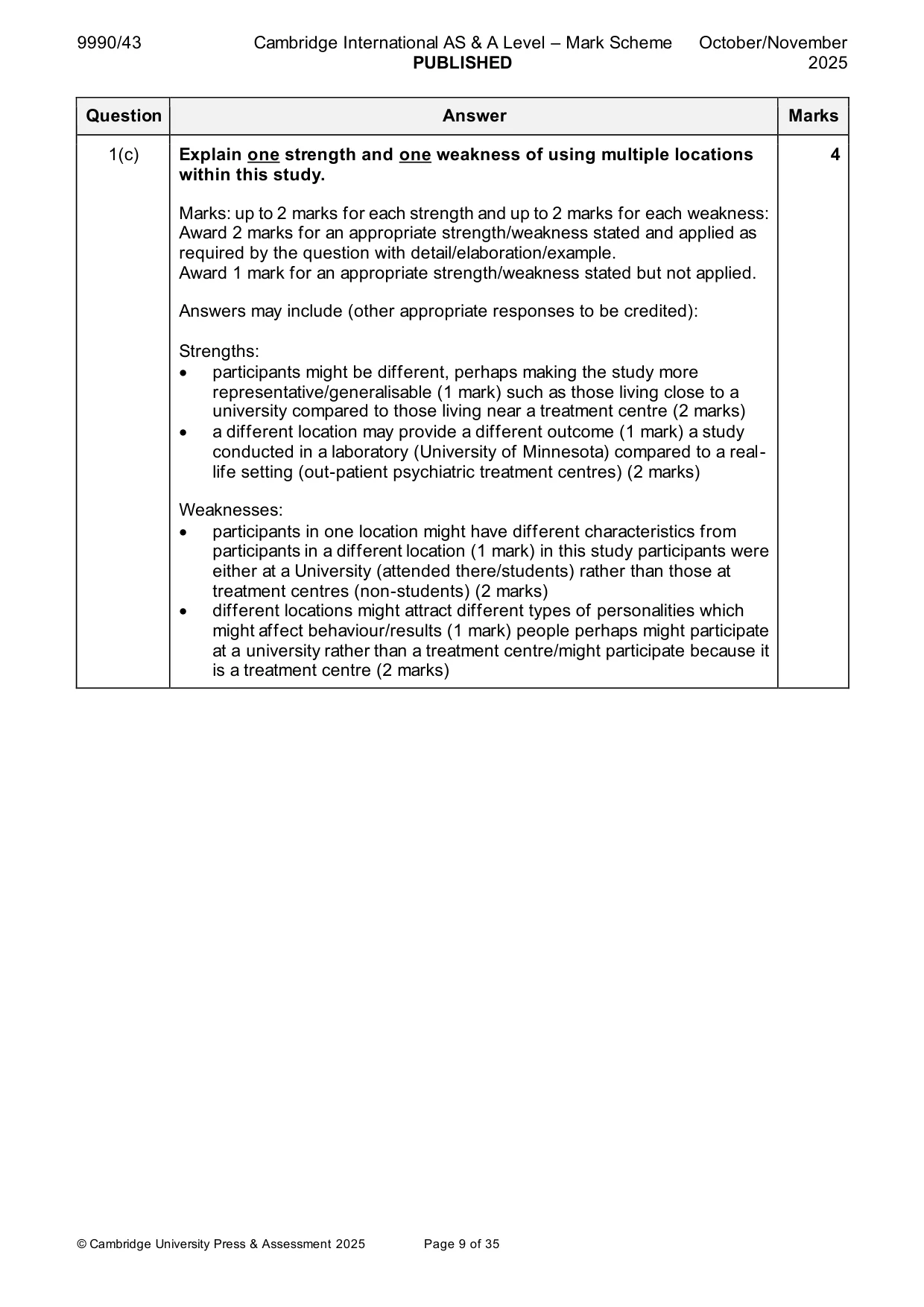
1 The key study by Grant et al. (2008) treated gambling disorder in one of two double-blind placebo-controlled trials, in a university and treatment centres. (a) (i) Identify the drug used in each trial. [2] (ii) State the duration of each trial. [2] (b) Suggest why placebo-controlled trials were used in this study. [2] (c) Explain one strength and one weakness of using multiple locations within this study. [4]
Mark scheme: Question Answer Marks 1 The key study by Grant et al. (2008) treated gambling disorder in one of two double-blind placebo-controlled trials, in a university and treatment centres. 1(a)(i) Identify the drug used in each trial. 2 Syllabus: 1.3.3 Key study on treating gambling disorder with drugs and placebo: Grant et al. (2008). Marks: Award 1 mark for each correct answer. Definitive answers: • Nalmefene (1 mark) • Naltrexone (1 mark) NB: trial does not need to be specified (e.g. trial 1 = nalmefene) NB: 0 marks for opioid antagonists. 1(a)(ii) State the duration of each trial. 2 Marks: Award 1 mark for each correct answer. Definitive answers: • 16 weeks (1 mark) • 18 weeks (1 mark) NB: trial does not need to be specified (e.g. trial 1 = 16 weeks) 1(b) Suggest why placebo-controlled trials were used in this study. 2 Marks: Award 2 marks for an appropriate suggestion stated and applied to study with detail / elaboration / example. Award 1 mark for an appropriate suggestion identified but not applied. Answers may include (other appropriate responses to be credited): • to find out whether a drug treatment works better than a substance that does not have an active drug in it (1 mark) • to act as a control group or baseline to compare ‘with drug’ and ‘without drug’ conditions (1 mark) • to provide a baseline for a comparison between drug and non-drug conditions (1 mark) • without it, it might lead to false conclusions about the effect of the drug (1 mark) • without a placebo group, participants would know that they are receiving an active drug and this alone might result in a change in behaviour (1 mark) • related to study: inclusion of nalmefene/naltrexone; treatment of gambling disorder (+1 mark). NB: answer must refer to placebo for 2 marks. 1(c) Explain one strength and one weakness of using multiple locations 4 within this study. Marks: up to 2 marks for each strength and up to 2 marks for each weakness: Award 2 marks for an appropriate strength/weakness stated and applied as required by the question with detail/elaboration/example. Award 1 mark for an appropriate strength/weakness stated but not applied. Answers may include (other appropriate responses to be credited): Strengths: • participants might be different, perhaps making the study more representative/generalisable (1 mark) such as those living close to a university compared to those living near a treatment centre (2 marks) • a different location may provide a different outcome (1 mark) a study conducted in a laboratory (University of Minnesota) compared to a real- life setting (out-patient psychiatric treatment centres) (2 marks) Weaknesses: • participants in one location might have different characteristics from participants in a different location (1 mark) in this study participants were either at a University (attended there/students) rather than those at treatment centres (non-students) (2 marks) • different locations might attract different types of personalities which might affect behaviour/results (1 mark) people perhaps might participate at a university rather than a treatment centre/might participate because it is a treatment centre (2 marks)
Q2 · Outline one case study of schizophrenia
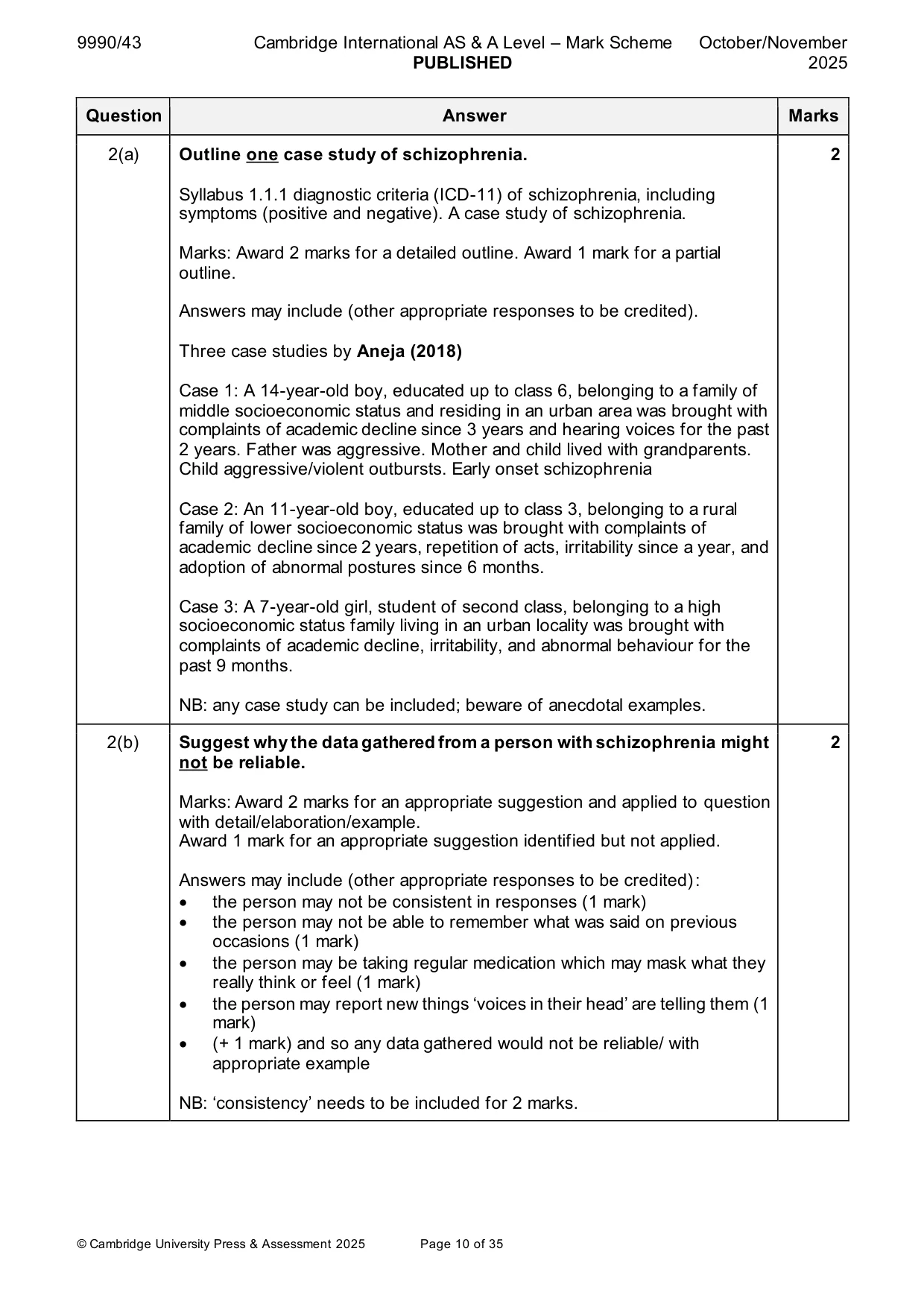
2 (a) Outline one case study of schizophrenia. [2] (b) Suggest why the data gathered from a person with schizophrenia might not be reliable. [2] (c) Explain two strengths of using case studies to collect data on schizophrenia. [4] Consumer Psychology Answer all questions if you have studied this option.
Mark scheme: 2(a) Outline one case study of schizophrenia. 2 Syllabus 1.1.1 diagnostic criteria (ICD-11) of schizophrenia, including symptoms (positive and negative). A case study of schizophrenia. Marks: Award 2 marks for a detailed outline. Award 1 mark for a partial outline. Answers may include (other appropriate responses to be credited). Three case studies by Aneja (2018) Case 1: A 14-year-old boy, educated up to class 6, belonging to a family of middle socioeconomic status and residing in an urban area was brought with complaints of academic decline since 3 years and hearing voices for the past 2 years. Father was aggressive. Mother and child lived with grandparents. Child aggressive/violent outbursts. Early onset schizophrenia Case 2: An 11-year-old boy, educated up to class 3, belonging to a rural family of lower socioeconomic status was brought with complaints of academic decline since 2 years, repetition of acts, irritability since a year, and adoption of abnormal postures since 6 months. Case 3: A 7-year-old girl, student of second class, belonging to a high socioeconomic status family living in an urban locality was brought with complaints of academic decline, irritability, and abnormal behaviour for the past 9 months. NB: any case study can be included; beware of anecdotal examples. 2(b) Suggest why the data gathered from a person with schizophrenia might 2 not be reliable. Marks: Award 2 marks for an appropriate suggestion and applied to question with detail/elaboration/example. Award 1 mark for an appropriate suggestion identified but not applied. Answers may include (other appropriate responses to be credited): • the person may not be consistent in responses (1 mark) • the person may not be able to remember what was said on previous occasions (1 mark) • the person may be taking regular medication which may mask what they really think or feel (1 mark) • the person may report new things ‘voices in their head’ are telling them (1 mark) • (+ 1 mark) and so any data gathered would not be reliable/ with appropriate example NB: ‘consistency’ needs to be included for 2 marks. 2(c) Explain two strengths of using case studies to collect data on 4 schizophrenia. Marks: up to 2 marks for each strength. Award 2 marks for an appropriate strength stated and applied as required by the question with detail/elaboration/example. Award 1 mark for an appropriate strength stated but not applied. Answers may include (other appropriate responses to be credited): Strengths: • a case study can be used as a pilot study (1 mark) • a participant is studied as part of their everyday life (1 mark), • a single participant can be studied in depth/detail (1 mark) • a participant may present a unique set of symptoms (1 mark) • strengths applied to individual candidate example (+1 mark)
Q3 · From the key study by Becker et al
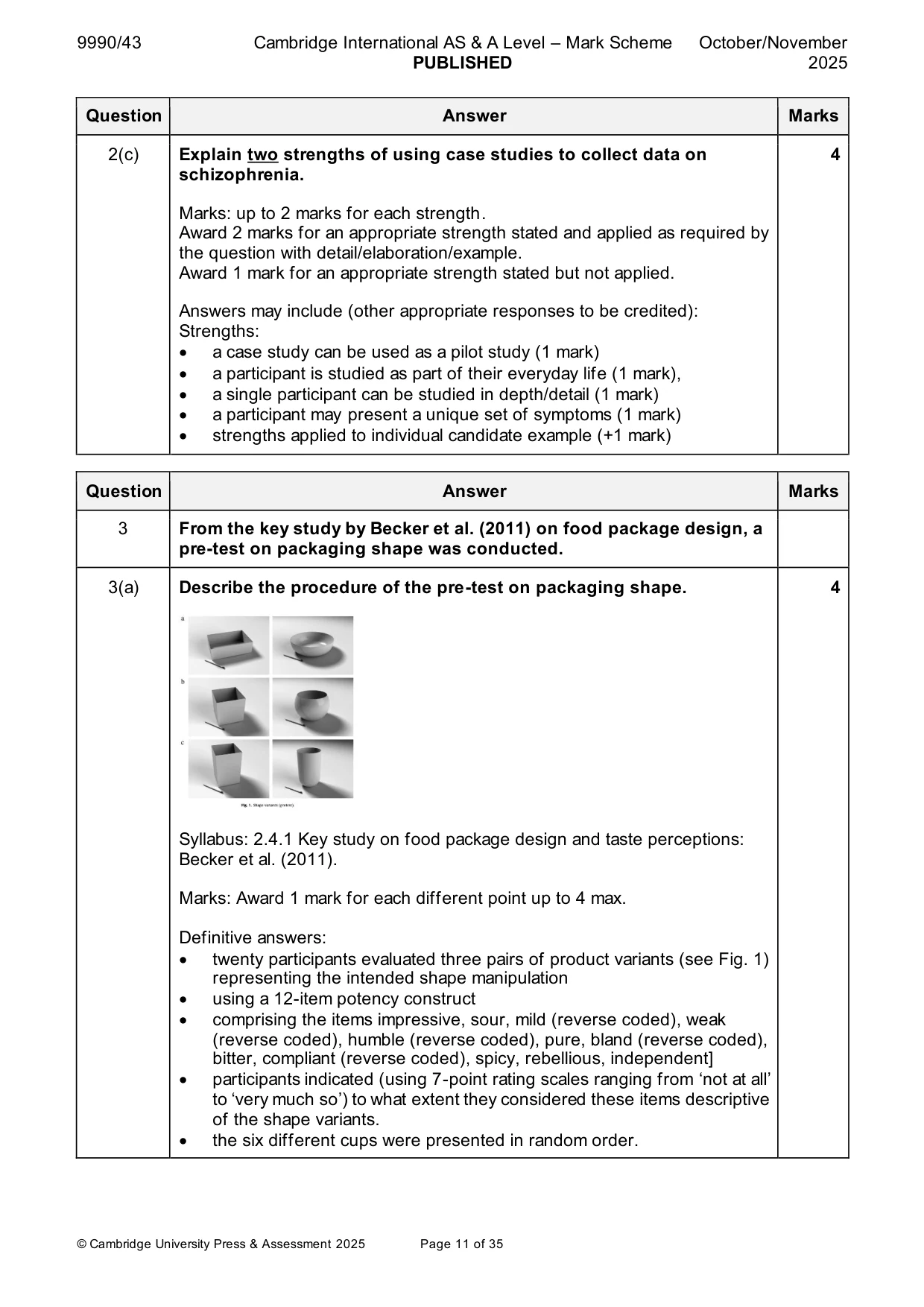
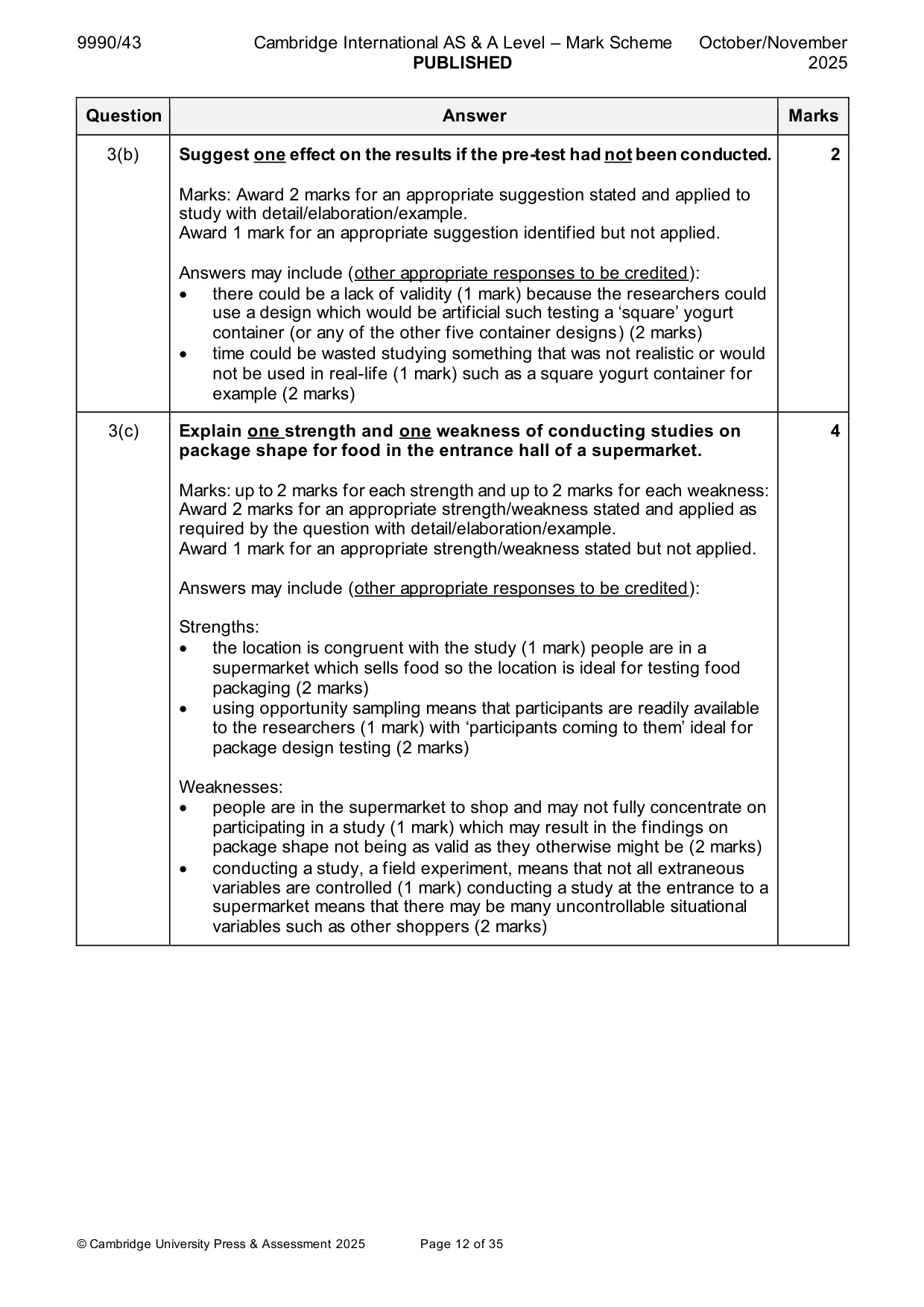
3 From the key study by Becker et al. (2011) on food package design, a pre-test on packaging shape was conducted. (a) Describe the procedure of the pre-test on packaging shape. [4] (b) Suggest one effect on the results if the pre-test had not been conducted. [2] (c) Explain one strength and one weakness of conducting studies on packaging shape for food in the entrance hall of a supermarket. [4]
Mark scheme: 3 From the key study by Becker et al. (2011) on food package design, a pre-test on packaging shape was conducted. 3(a) Describe the procedure of the pre-test on packaging shape. 4 Syllabus: 2.4.1 Key study on food package design and taste perceptions: Becker et al. (2011). Marks: Award 1 mark for each different point up to 4 max. Definitive answers: • twenty participants evaluated three pairs of product variants (see Fig. 1) representing the intended shape manipulation • using a 12-item potency construct • comprising the items impressive, sour, mild (reverse coded), weak (reverse coded), humble (reverse coded), pure, bland (reverse coded), bitter, compliant (reverse coded), spicy, rebellious, independent] • participants indicated (using 7-point rating scales ranging from ‘not at all’ to ‘very much so’) to what extent they considered these items descriptive of the shape variants. • the six different cups were presented in random order. 3(b) Suggest one effect on the results if the pre-test had not been conducted. 2 Marks: Award 2 marks for an appropriate suggestion stated and applied to study with detail/elaboration/example. Award 1 mark for an appropriate suggestion identified but not applied. Answers may include (other appropriate responses to be credited): • there could be a lack of validity (1 mark) because the researchers could use a design which would be artificial such testing a ‘square’ yogurt container (or any of the other five container designs) (2 marks) • time could be wasted studying something that was not realistic or would not be used in real-life (1 mark) such as a square yogurt container for example (2 marks) 3(c) Explain one strength and one weakness of conducting studies on 4 package shape for food in the entrance hall of a supermarket. Marks: up to 2 marks for each strength and up to 2 marks for each weakness: Award 2 marks for an appropriate strength/weakness stated and applied as required by the question with detail/elaboration/example. Award 1 mark for an appropriate strength/weakness stated but not applied. Answers may include (other appropriate responses to be credited): Strengths: • the location is congruent with the study (1 mark) people are in a supermarket which sells food so the location is ideal for testing food packaging (2 marks) • using opportunity sampling means that participants are readily available to the researchers (1 mark) with ‘participants coming to them’ ideal for package design testing (2 marks) Weaknesses: • people are in the supermarket to shop and may not fully concentrate on participating in a study (1 mark) which may result in the findings on package shape not being as valid as they otherwise might be (2 marks) • conducting a study, a field experiment, means that not all extraneous variables are controlled (1 mark) conducting a study at the entrance to a supermarket means that there may be many uncontrollable situational variables such as other shoppers (2 marks)
Q4 · Explain what is meant by the term ‘retail atmospherics’
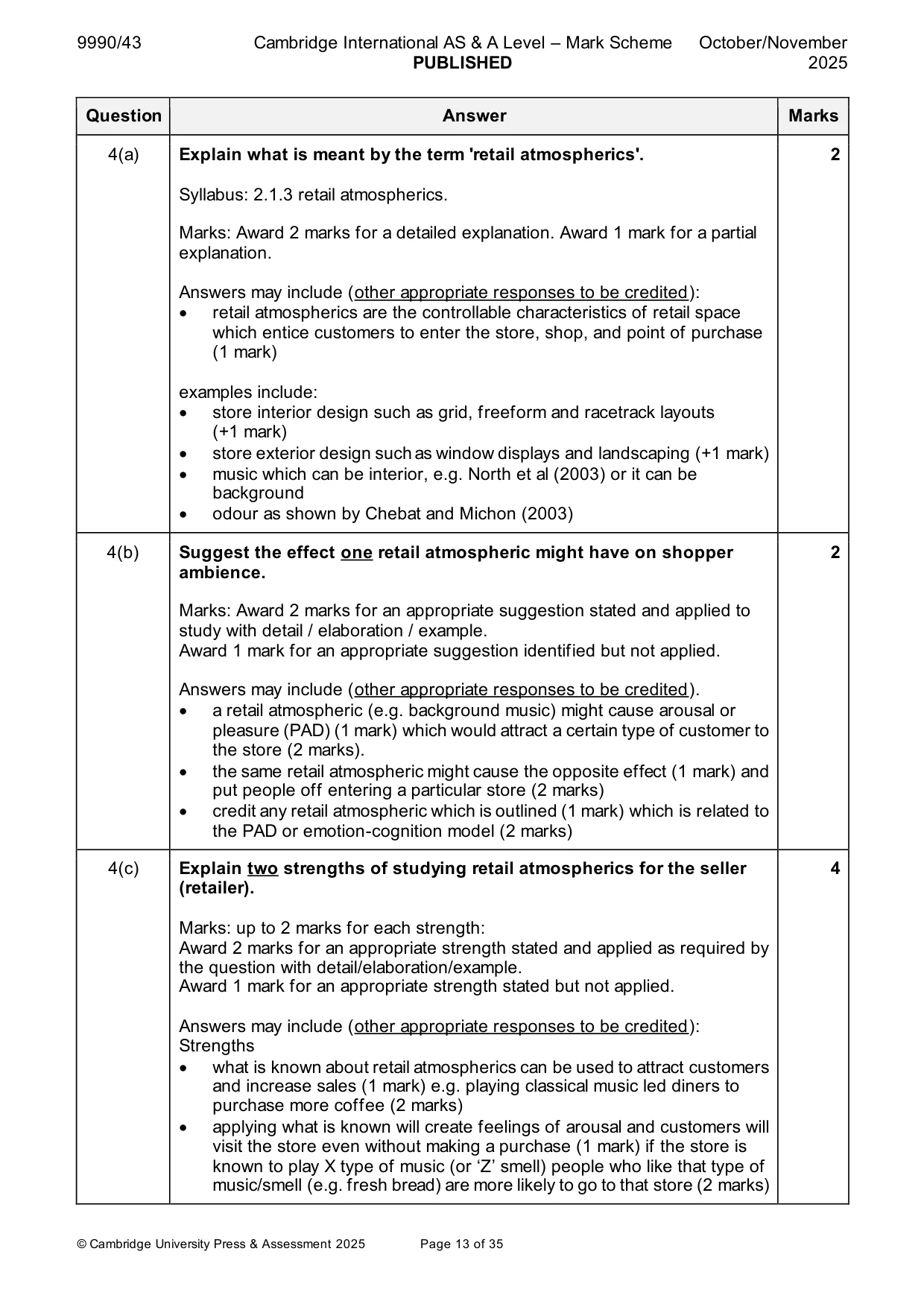
4 (a) Explain what is meant by the term ‘retail atmospherics’. [2] (b) Suggest the effect one retail atmospheric might have on shopper ambience. [2] (c) Explain two strengths of studying retail atmospherics for the seller (retailer). [4] Health Psychology Answer all questions if you have studied this option.
Mark scheme: 4(a) Explain what is meant by the term 'retail atmospherics'. 2 Syllabus: 2.1.3 retail atmospherics. Marks: Award 2 marks for a detailed explanation. Award 1 mark for a partial explanation. Answers may include (other appropriate responses to be credited): • retail atmospherics are the controllable characteristics of retail space which entice customers to enter the store, shop, and point of purchase (1 mark) examples include: • store interior design such as grid, freeform and racetrack layouts (+1 mark) • store exterior design such as window displays and landscaping (+1 mark) • music which can be interior, e.g. North et al (2003) or it can be background • odour as shown by Chebat and Michon (2003) 4(b) Suggest the effect one retail atmospheric might have on shopper 2 ambience. Marks: Award 2 marks for an appropriate suggestion stated and applied to study with detail / elaboration / example. Award 1 mark for an appropriate suggestion identified but not applied. Answers may include (other appropriate responses to be credited). • a retail atmospheric (e.g. background music) might cause arousal or pleasure (PAD) (1 mark) which would attract a certain type of customer to the store (2 marks). • the same retail atmospheric might cause the opposite effect (1 mark) and put people off entering a particular store (2 marks) • credit any retail atmospheric which is outlined (1 mark) which is related to the PAD or emotion-cognition model (2 marks) 4(c) Explain two strengths of studying retail atmospherics for the seller 4 (retailer). Marks: up to 2 marks for each strength: Award 2 marks for an appropriate strength stated and applied as required by the question with detail/elaboration/example. Award 1 mark for an appropriate strength stated but not applied. Answers may include (other appropriate responses to be credited): Strengths • what is known about retail atmospherics can be used to attract customers and increase sales (1 mark) e.g. playing classical music led diners to purchase more coffee (2 marks) • applying what is known will create feelings of arousal and customers will visit the store even without making a purchase (1 mark) if the store is known to play X type of music (or ‘Z’ smell) people who like that type of music/smell (e.g. fresh bread) are more likely to go to that store (2 marks)
Q5 · The key study by Bridge et al
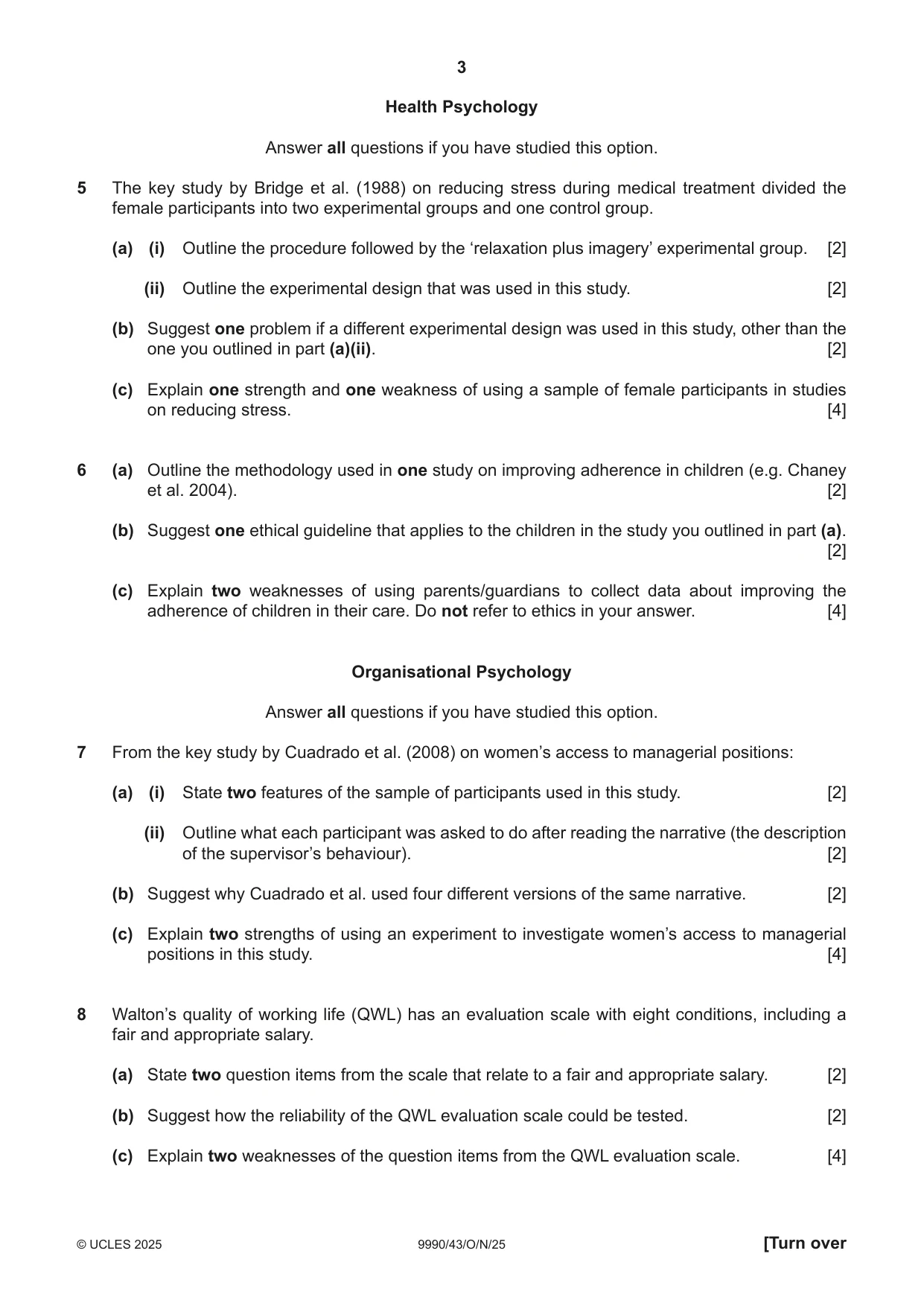
5 The key study by Bridge et al. (1988) on reducing stress during medical treatment divided the female participants into two experimental groups and one control group. (a) (i) Outline the procedure followed by the ‘relaxation plus imagery’ experimental group. [2] (ii) Outline the experimental design that was used in this study. [2] (b) Suggest one problem if a different experimental design was used in this study, other than the one you outlined in part (a)(ii). [2] (c) Explain one strength and one weakness of using a sample of female participants in studies on reducing stress. [4]
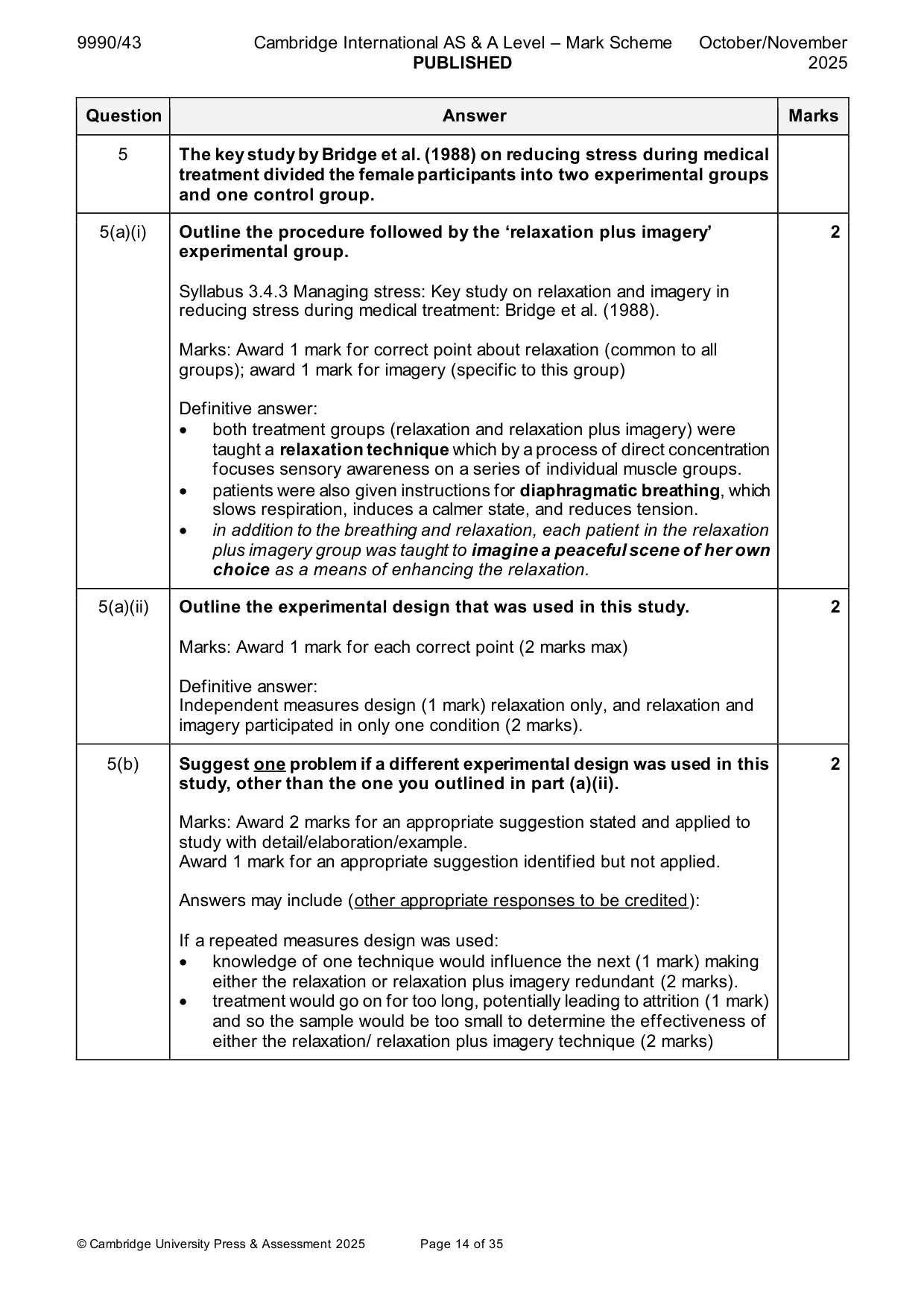
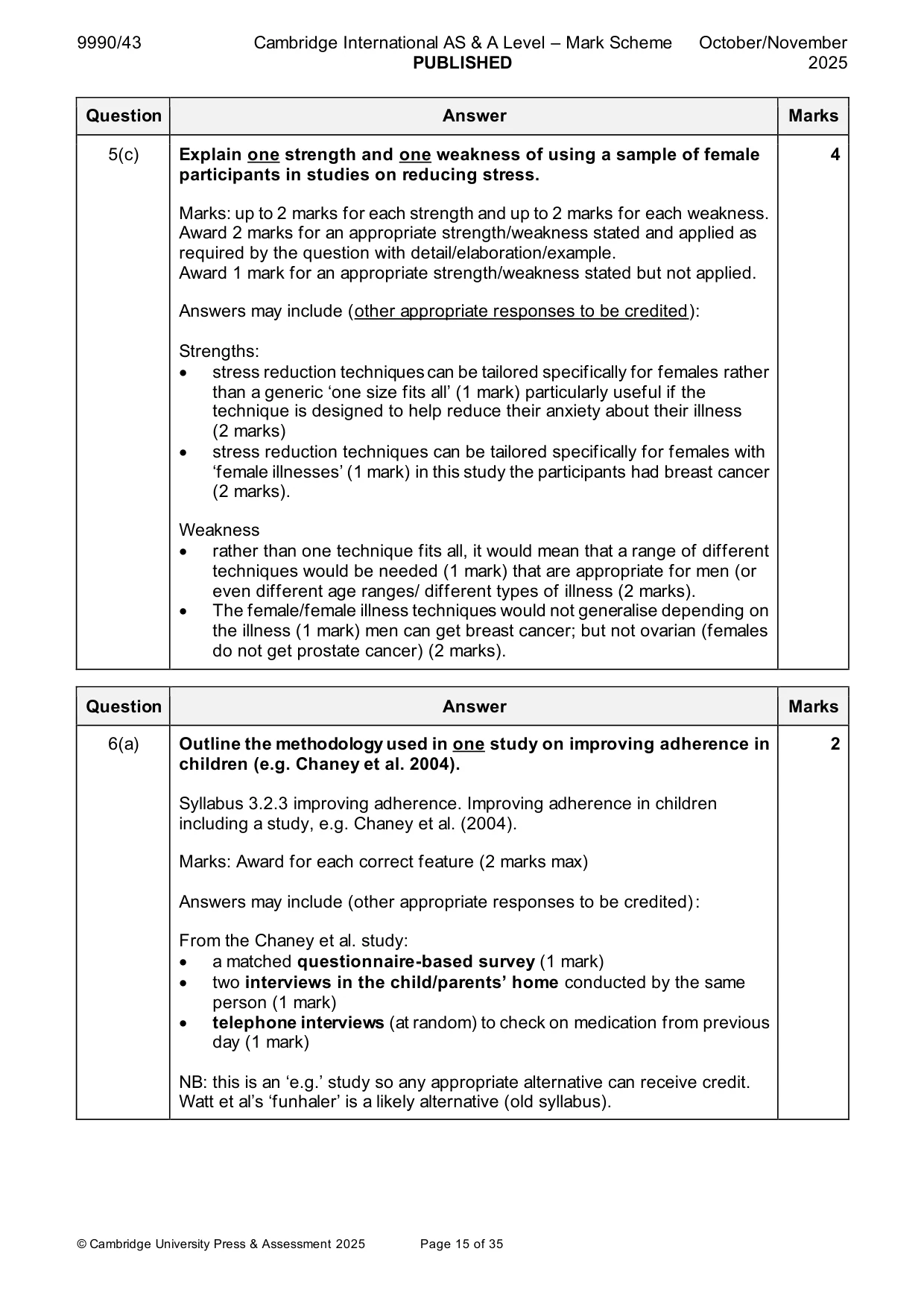
Mark scheme: 5 The key study by Bridge et al. (1988) on reducing stress during medical treatment divided the female participants into two experimental groups and one control group. 5(a)(i) Outline the procedure followed by the ‘relaxation plus imagery’ 2 experimental group. Syllabus 3.4.3 Managing stress: Key study on relaxation and imagery in reducing stress during medical treatment: Bridge et al. (1988). Marks: Award 1 mark for correct point about relaxation (common to all groups); award 1 mark for imagery (specific to this group) Definitive answer: • both treatment groups (relaxation and relaxation plus imagery) were taught a relaxation technique which by a process of direct concentration focuses sensory awareness on a series of individual muscle groups. • patients were also given instructions for diaphragmatic breathing, which slows respiration, induces a calmer state, and reduces tension. • in addition to the breathing and relaxation, each patient in the relaxation plus imagery group was taught to imagine a peaceful scene of her own choice as a means of enhancing the relaxation. 5(a)(ii) Outline the experimental design that was used in this study. 2 Marks: Award 1 mark for each correct point (2 marks max) Definitive answer: Independent measures design (1 mark) relaxation only, and relaxation and imagery participated in only one condition (2 marks). 5(b) Suggest one problem if a different experimental design was used in this 2 study, other than the one you outlined in part (a)(ii). Marks: Award 2 marks for an appropriate suggestion stated and applied to study with detail/elaboration/example. Award 1 mark for an appropriate suggestion identified but not applied. Answers may include (other appropriate responses to be credited): If a repeated measures design was used: • knowledge of one technique would influence the next (1 mark) making either the relaxation or relaxation plus imagery redundant (2 marks). • treatment would go on for too long, potentially leading to attrition (1 mark) and so the sample would be too small to determine the effectiveness of either the relaxation/ relaxation plus imagery technique (2 marks) 5(c) Explain one strength and one weakness of using a sample of female 4 participants in studies on reducing stress. Marks: up to 2 marks for each strength and up to 2 marks for each weakness. Award 2 marks for an appropriate strength/weakness stated and applied as required by the question with detail/elaboration/example. Award 1 mark for an appropriate strength/weakness stated but not applied. Answers may include (other appropriate responses to be credited): Strengths: • stress reduction techniques can be tailored specifically for females rather than a generic ‘one size fits all’ (1 mark) particularly useful if the technique is designed to help reduce their anxiety about their illness (2 marks) • stress reduction techniques can be tailored specifically for females with ‘female illnesses’ (1 mark) in this study the participants had breast cancer (2 marks). Weakness • rather than one technique fits all, it would mean that a range of different techniques would be needed (1 mark) that are appropriate for men (or even different age ranges/ different types of illness (2 marks). • The female/female illness techniques would not generalise depending on the illness (1 mark) men can get breast cancer; but not ovarian (females do not get prostate cancer) (2 marks).
Q6 · Outline the methodology used in one study on improving adherence in children (e.g
6 (a) Outline the methodology used in one study on improving adherence in children (e.g. Chaney et al. 2004). [2] (b) Suggest one ethical guideline that applies to the children in the study you outlined in part (a). [2] (c) Explain two weaknesses of using parents/guardians to collect data about improving the adherence of children in their care. Do not refer to ethics in your answer. [4] Organisational Psychology Answer all questions if you have studied this option.
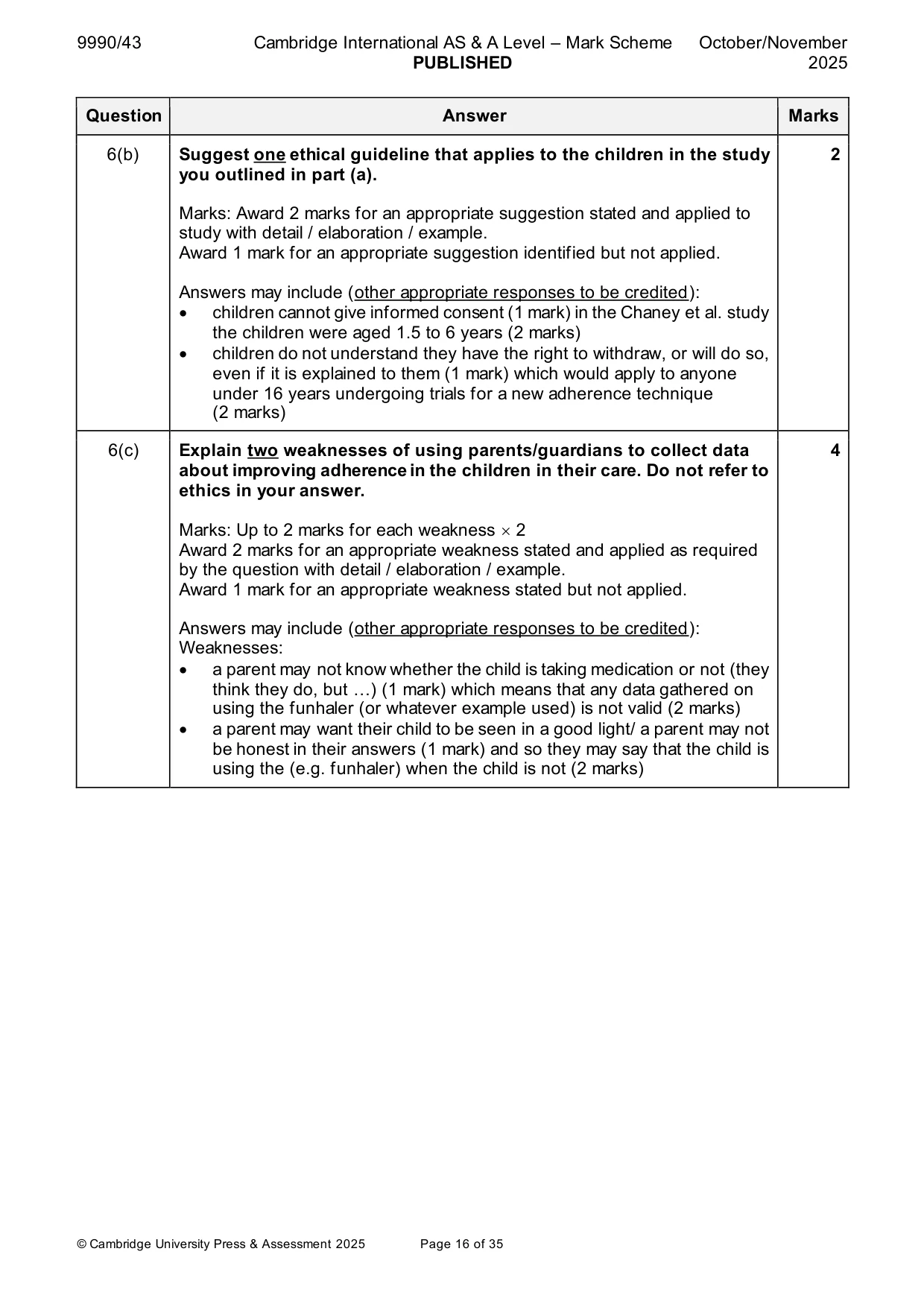
Mark scheme: 6(a) Outline the methodology used in one study on improving adherence in 2 children (e.g. Chaney et al. 2004). Syllabus 3.2.3 improving adherence. Improving adherence in children including a study, e.g. Chaney et al. (2004). Marks: Award for each correct feature (2 marks max) Answers may include (other appropriate responses to be credited): From the Chaney et al. study: • a matched questionnaire-based survey (1 mark) • two interviews in the child/parents’ home conducted by the same person (1 mark) • telephone interviews (at random) to check on medication from previous day (1 mark) NB: this is an ‘e.g.’ study so any appropriate alternative can receive credit. Watt et al’s ‘funhaler’ is a likely alternative (old syllabus). 6(b) Suggest one ethical guideline that applies to the children in the study 2 you outlined in part (a). Marks: Award 2 marks for an appropriate suggestion stated and applied to study with detail / elaboration / example. Award 1 mark for an appropriate suggestion identified but not applied. Answers may include (other appropriate responses to be credited): • children cannot give informed consent (1 mark) in the Chaney et al. study the children were aged 1.5 to 6 years (2 marks) • children do not understand they have the right to withdraw, or will do so, even if it is explained to them (1 mark) which would apply to anyone under 16 years undergoing trials for a new adherence technique (2 marks) 6(c) Explain two weaknesses of using parents/guardians to collect data 4 about improving adherence in the children in their care. Do not refer to ethics in your answer. Marks: Up to 2 marks for each weakness 2 Award 2 marks for an appropriate weakness stated and applied as required by the question with detail / elaboration / example. Award 1 mark for an appropriate weakness stated but not applied. Answers may include (other appropriate responses to be credited): Weaknesses: • a parent may not know whether the child is taking medication or not (they think they do, but …) (1 mark) which means that any data gathered on using the funhaler (or whatever example used) is not valid (2 marks) • a parent may want their child to be seen in a good light/ a parent may not be honest in their answers (1 mark) and so they may say that the child is using the (e.g. funhaler) when the child is not (2 marks)
Q7 · From the key study by Cuadrado et al
7 From the key study by Cuadrado et al. (2008) on women’s access to managerial positions: (a) (i) State two features of the sample of participants used in this study. [2] (ii) Outline what each participant was asked to do after reading the narrative (the description of the supervisor’s behaviour). [2] (b) Suggest why Cuadrado et al. used four different versions of the same narrative. [2] (c) Explain two strengths of using an experiment to investigate women’s access to managerial positions in this study. [4]
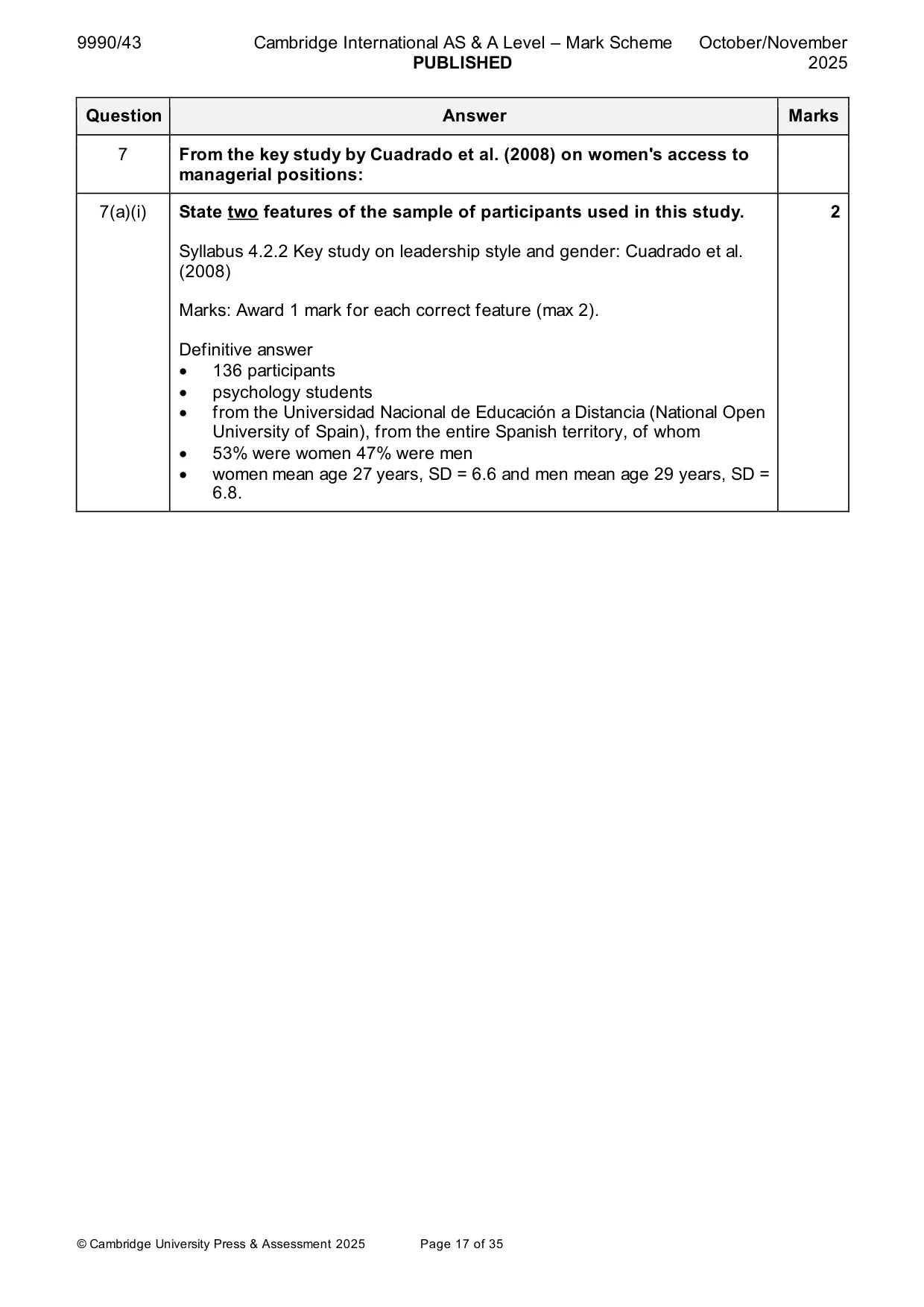
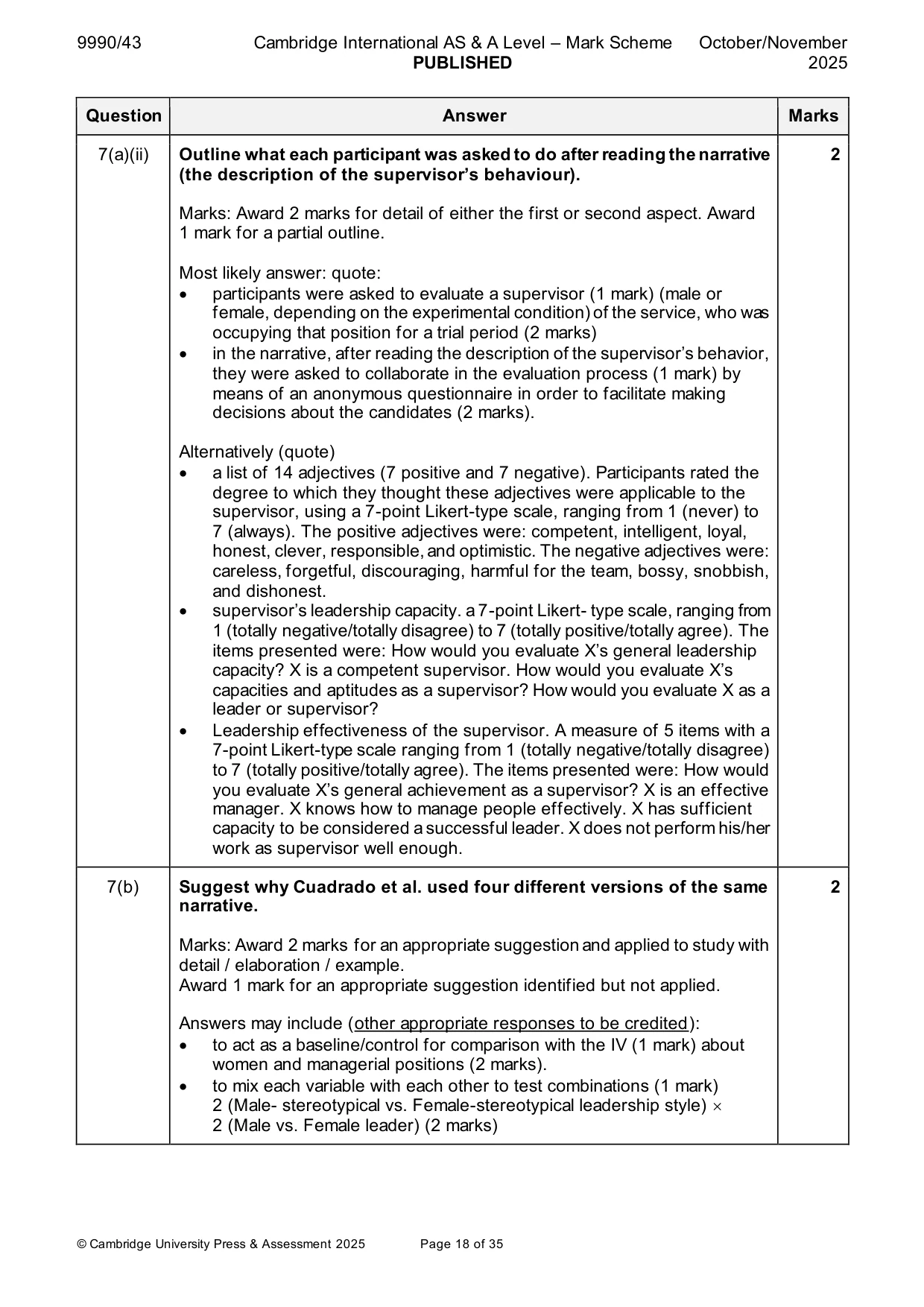
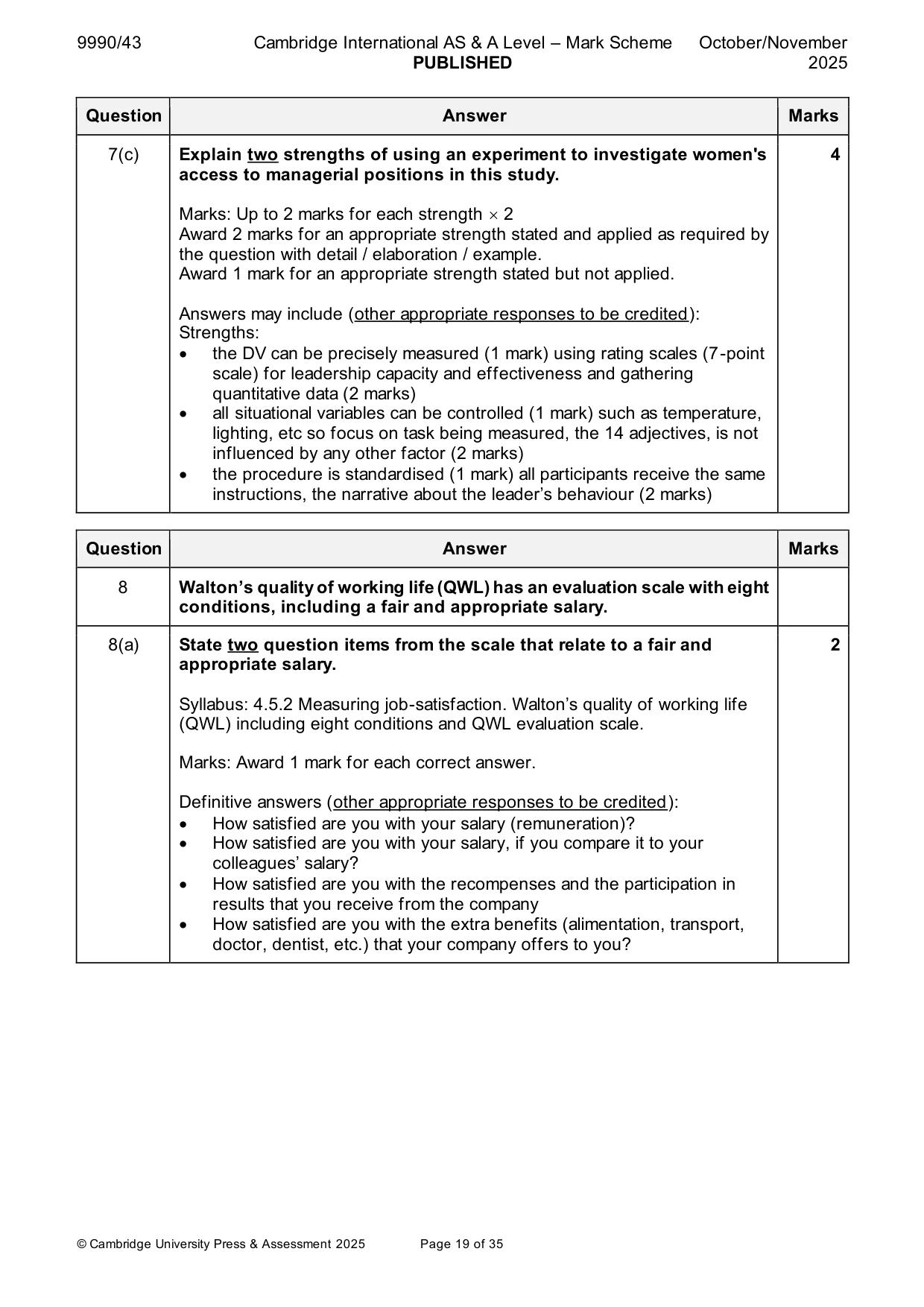
Mark scheme: 7 From the key study by Cuadrado et al. (2008) on women's access to managerial positions: 7(a)(i) State two features of the sample of participants used in this study. 2 Syllabus 4.2.2 Key study on leadership style and gender: Cuadrado et al. (2008) Marks: Award 1 mark for each correct feature (max 2). Definitive answer • 136 participants • psychology students • from the Universidad Nacional de Educación a Distancia (National Open University of Spain), from the entire Spanish territory, of whom • 53% were women 47% were men • women mean age 27 years, SD = 6.6 and men mean age 29 years, SD = 6.8. 7(a)(ii) Outline what each participant was asked to do after reading the narrative 2 (the description of the supervisor’s behaviour). Marks: Award 2 marks for detail of either the first or second aspect. Award 1 mark for a partial outline. Most likely answer: quote: • participants were asked to evaluate a supervisor (1 mark) (male or female, depending on the experimental condition) of the service, who was occupying that position for a trial period (2 marks) • in the narrative, after reading the description of the supervisor’s behavior, they were asked to collaborate in the evaluation process (1 mark) by means of an anonymous questionnaire in order to facilitate making decisions about the candidates (2 marks). Alternatively (quote) • a list of 14 adjectives (7 positive and 7 negative). Participants rated the degree to which they thought these adjectives were applicable to the supervisor, using a 7-point Likert-type scale, ranging from 1 (never) to 7 (always). The positive adjectives were: competent, intelligent, loyal, honest, clever, responsible, and optimistic. The negative adjectives were: careless, forgetful, discouraging, harmful for the team, bossy, snobbish, and dishonest. • supervisor’s leadership capacity. a 7-point Likert- type scale, ranging from 1 (totally negative/totally disagree) to 7 (totally positive/totally agree). The items presented were: How would you evaluate X’s general leadership capacity? X is a competent supervisor. How would you evaluate X’s capacities and aptitudes as a supervisor? How would you evaluate X as a leader or supervisor? • Leadership effectiveness of the supervisor. A measure of 5 items with a 7-point Likert-type scale ranging from 1 (totally negative/totally disagree) to 7 (totally positive/totally agree). The items presented were: How would you evaluate X’s general achievement as a supervisor? X is an effective manager. X knows how to manage people effectively. X has sufficient capacity to be considered a successful leader. X does not perform his/her work as supervisor well enough. 7(b) Suggest why Cuadrado et al. used four different versions of the same 2 narrative. Marks: Award 2 marks for an appropriate suggestion and applied to study with detail / elaboration / example. Award 1 mark for an appropriate suggestion identified but not applied. Answers may include (other appropriate responses to be credited): • to act as a baseline/control for comparison with the IV (1 mark) about women and managerial positions (2 marks). • to mix each variable with each other to test combinations (1 mark) 2 (Male- stereotypical vs. Female-stereotypical leadership style) 2 (Male vs. Female leader) (2 marks) 7(c) Explain two strengths of using an experiment to investigate women's 4 access to managerial positions in this study. Marks: Up to 2 marks for each strength 2 Award 2 marks for an appropriate strength stated and applied as required by the question with detail / elaboration / example. Award 1 mark for an appropriate strength stated but not applied. Answers may include (other appropriate responses to be credited): Strengths: • the DV can be precisely measured (1 mark) using rating scales (7-point scale) for leadership capacity and effectiveness and gathering quantitative data (2 marks) • all situational variables can be controlled (1 mark) such as temperature, lighting, etc so focus on task being measured, the 14 adjectives, is not influenced by any other factor (2 marks) • the procedure is standardised (1 mark) all participants receive the same instructions, the narrative about the leader’s behaviour (2 marks)
Q8 · Walton’s quality of working life (QWL) has an evaluation scale with eight conditions…
8 Walton’s quality of working life (QWL) has an evaluation scale with eight conditions, including a fair and appropriate salary. (a) State two question items from the scale that relate to a fair and appropriate salary. [2] (b) Suggest how the reliability of the QWL evaluation scale could be tested. [2] (c) Explain two weaknesses of the question items from the QWL evaluation scale. [4]
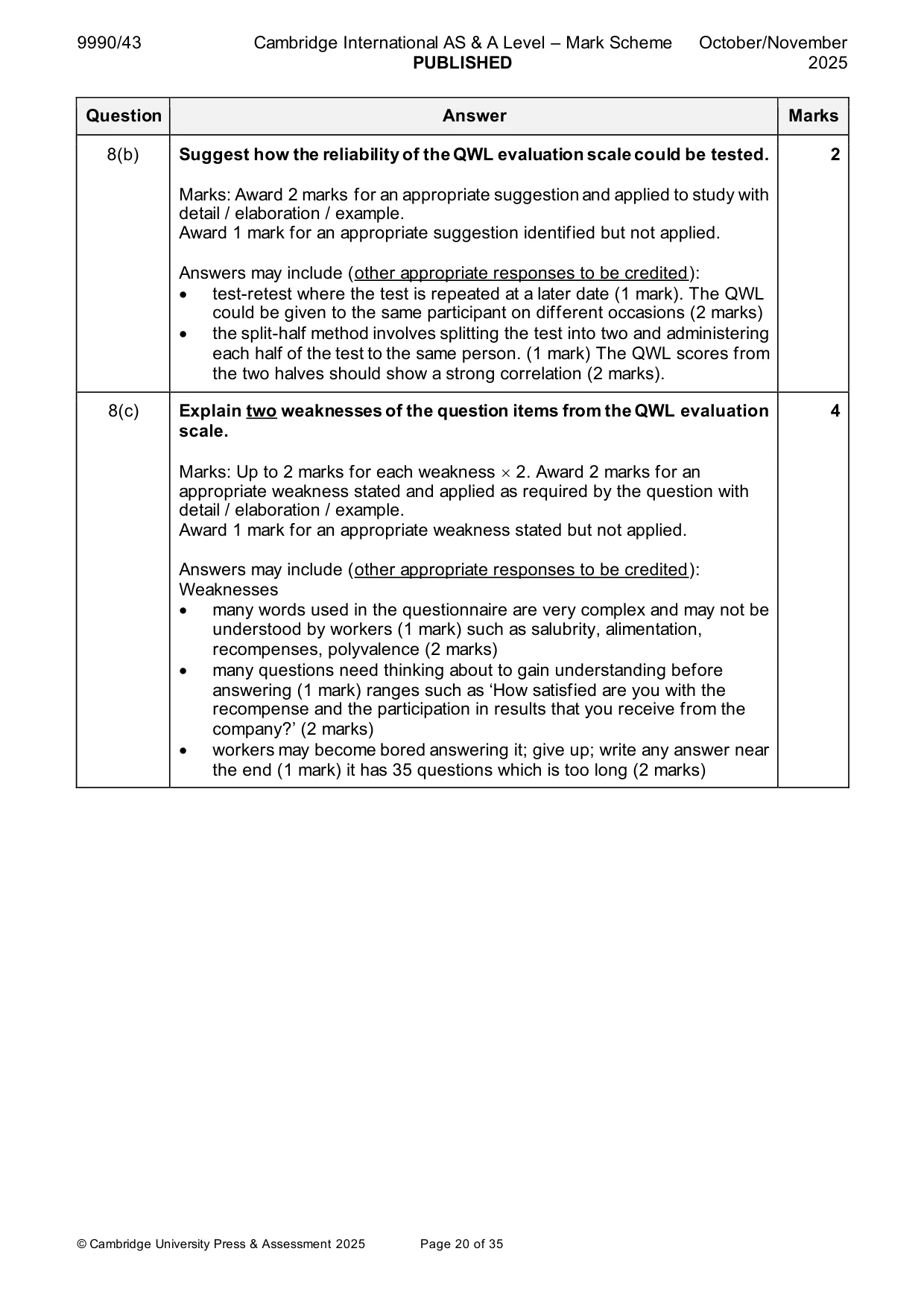
Mark scheme: 8 Walton’s quality of working life (QWL) has an evaluation scale with eight conditions, including a fair and appropriate salary. 8(a) State two question items from the scale that relate to a fair and 2 appropriate salary. Syllabus: 4.5.2 Measuring job-satisfaction. Walton’s quality of working life (QWL) including eight conditions and QWL evaluation scale. Marks: Award 1 mark for each correct answer. Definitive answers (other appropriate responses to be credited): • How satisfied are you with your salary (remuneration)? • How satisfied are you with your salary, if you compare it to your colleagues’ salary? • How satisfied are you with the recompenses and the participation in results that you receive from the company • How satisfied are you with the extra benefits (alimentation, transport, doctor, dentist, etc.) that your company offers to you? 8(b) Suggest how the reliability of the QWL evaluation scale could be tested. 2 Marks: Award 2 marks for an appropriate suggestion and applied to study with detail / elaboration / example. Award 1 mark for an appropriate suggestion identified but not applied. Answers may include (other appropriate responses to be credited): • test-retest where the test is repeated at a later date (1 mark). The QWL could be given to the same participant on different occasions (2 marks) • the split-half method involves splitting the test into two and administering each half of the test to the same person. (1 mark) The QWL scores from the two halves should show a strong correlation (2 marks). 8(c) Explain two weaknesses of the question items from the QWL evaluation 4 scale. Marks: Up to 2 marks for each weakness 2. Award 2 marks for an appropriate weakness stated and applied as required by the question with detail / elaboration / example. Award 1 mark for an appropriate weakness stated but not applied. Answers may include (other appropriate responses to be credited): Weaknesses • many words used in the questionnaire are very complex and may not be understood by workers (1 mark) such as salubrity, alimentation, recompenses, polyvalence (2 marks) • many questions need thinking about to gain understanding before answering (1 mark) ranges such as ‘How satisfied are you with the recompense and the participation in results that you receive from the company?’ (2 marks) • workers may become bored answering it; give up; write any answer near the end (1 mark) it has 35 questions which is too long (2 marks)
Q9 · Plan a study using a structured observation to investigate the effectiveness of imaginal…
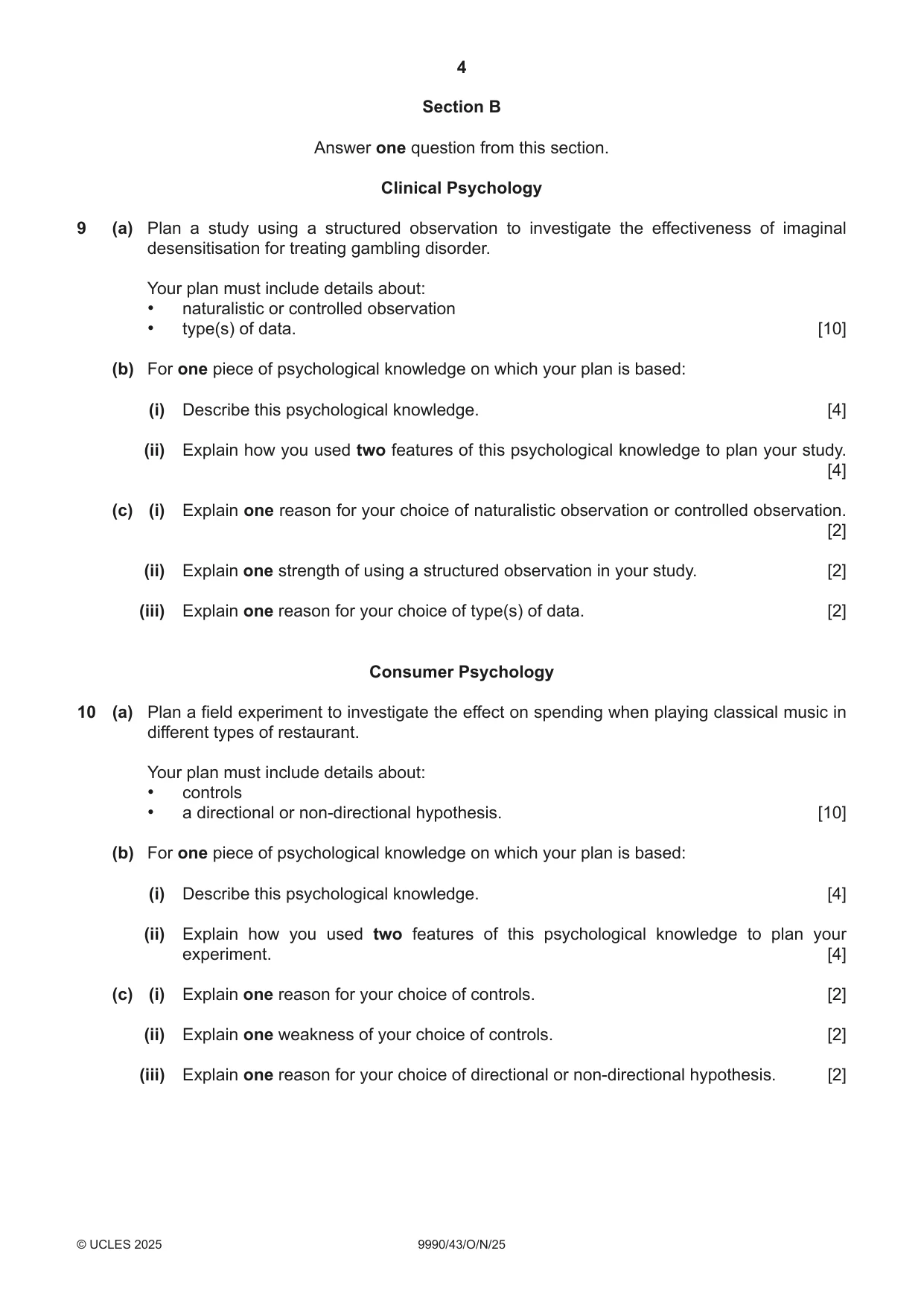
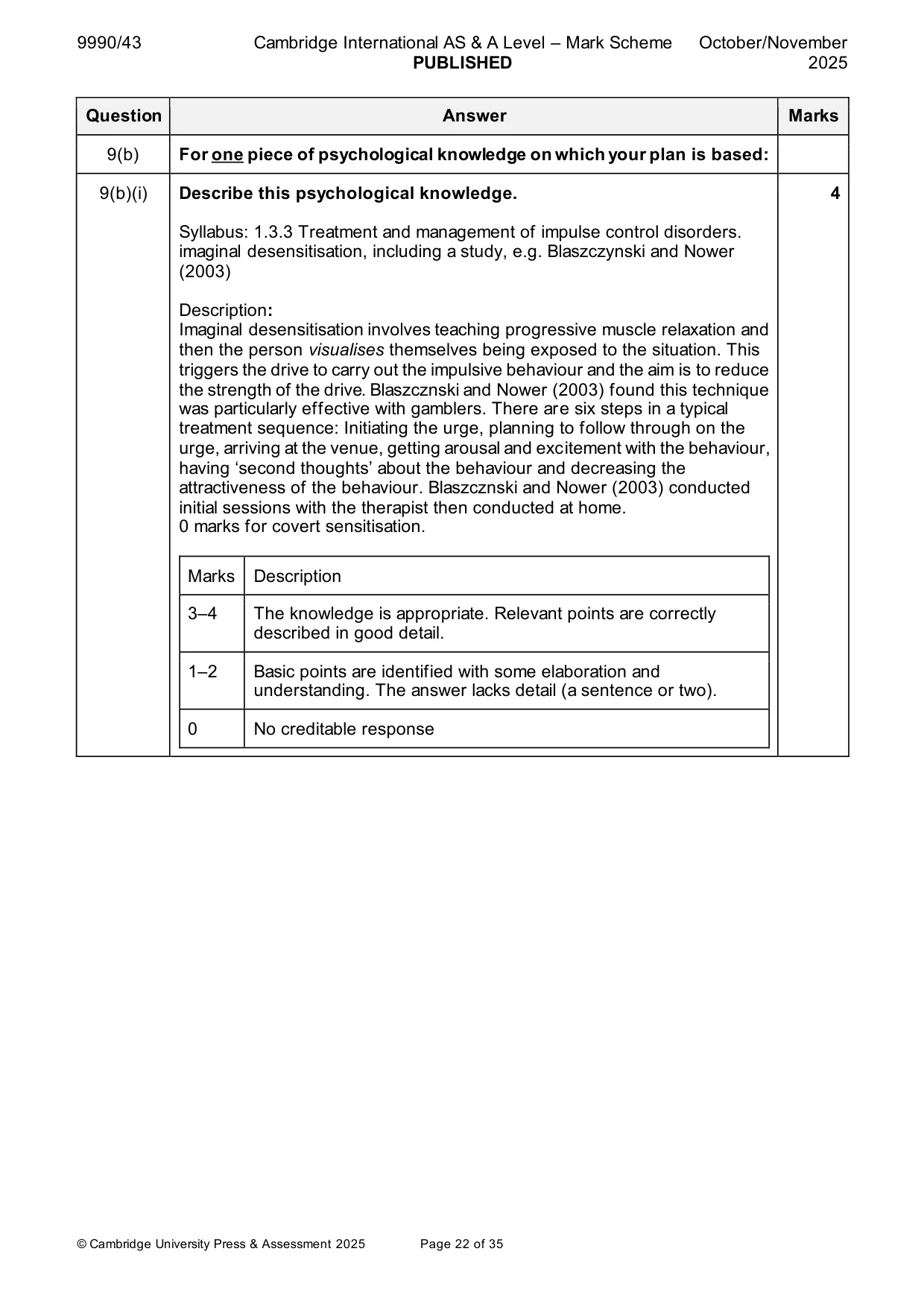
9 (a) Plan a study using a structured observation to investigate the effectiveness of imaginal desensitisation for treating gambling disorder. Your plan must include details about: • naturalistic or controlled observation • type(s) of data. [10] (b) For one piece of psychological knowledge on which your plan is based: (i) Describe this psychological knowledge. [4] (ii) Explain how you used two features of this psychological knowledge to plan your study. [4] (c) (i) Explain one reason for your choice of naturalistic observation or controlled observation. [2] (ii) Explain one strength of using a structured observation in your study. [2] (iii) Explain one reason for your choice of type(s) of data. [2] Consumer Psychology
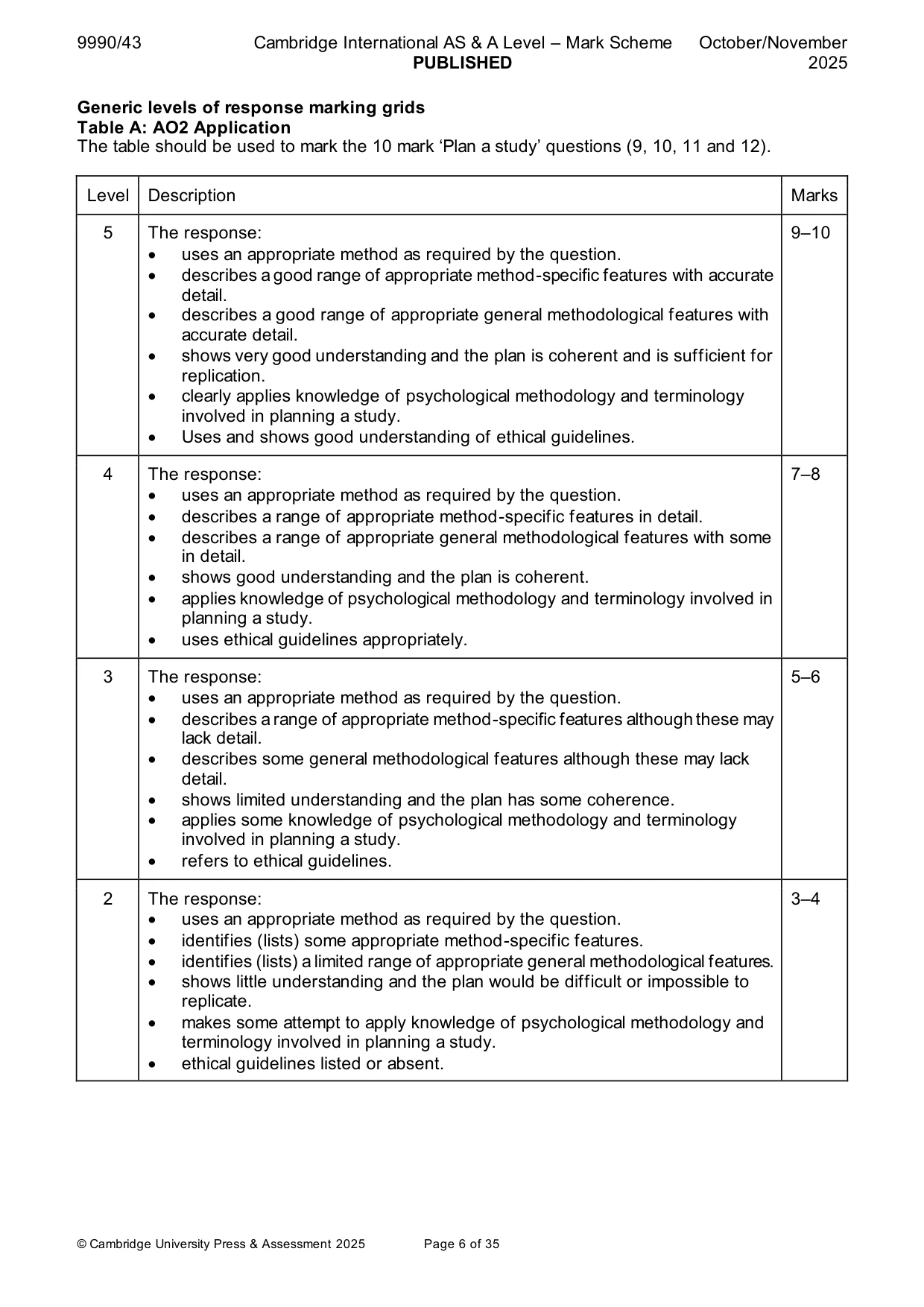
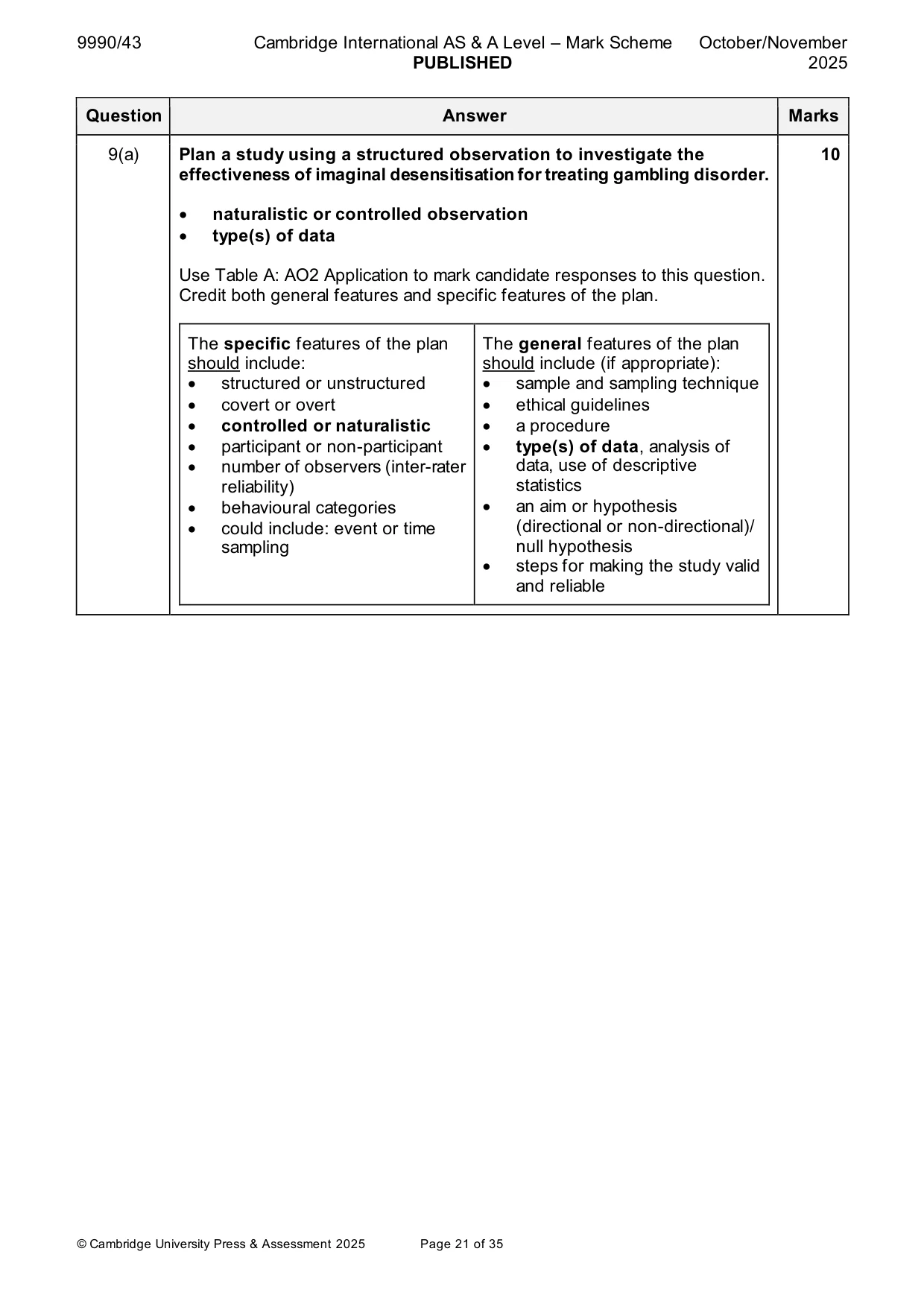
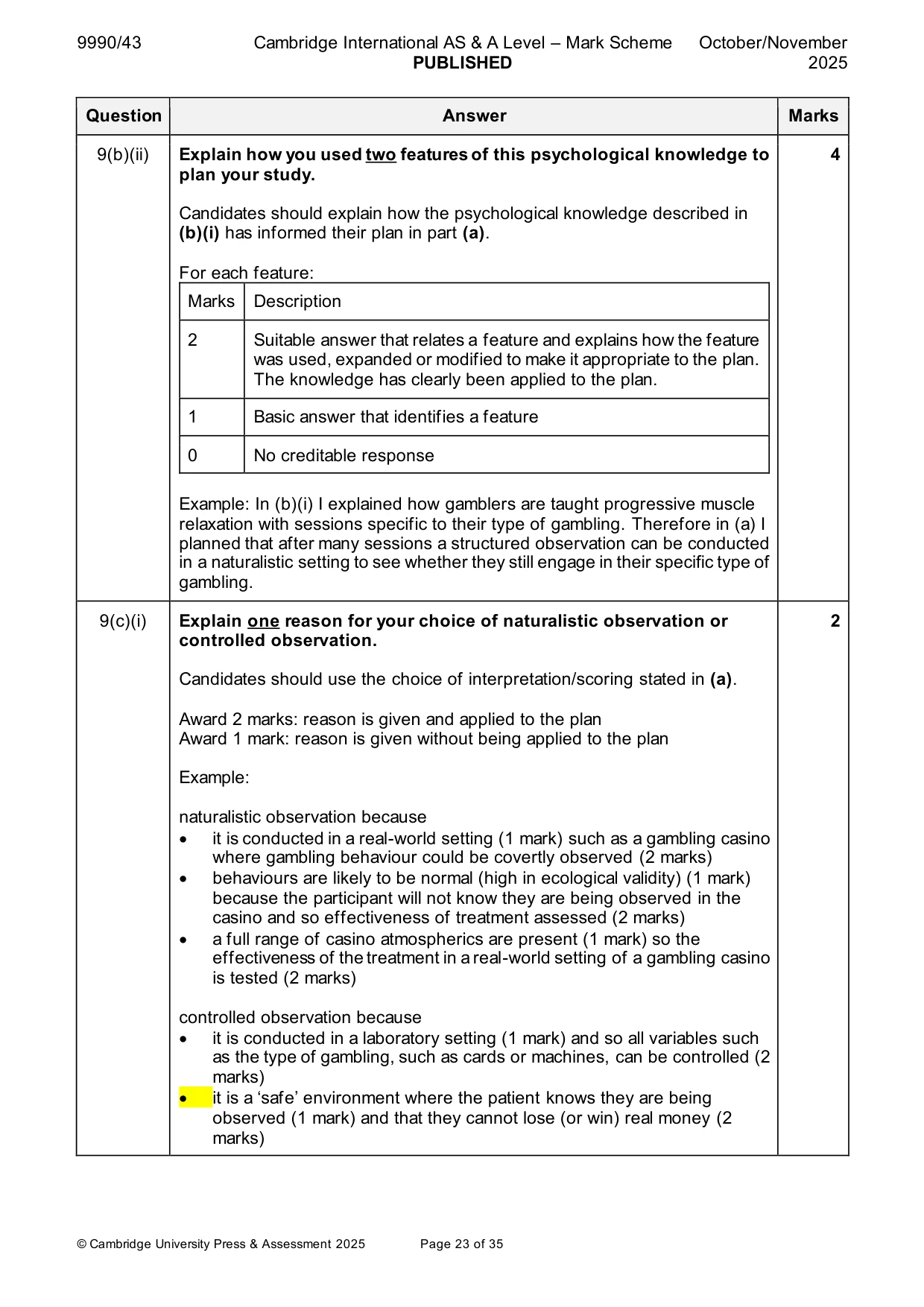
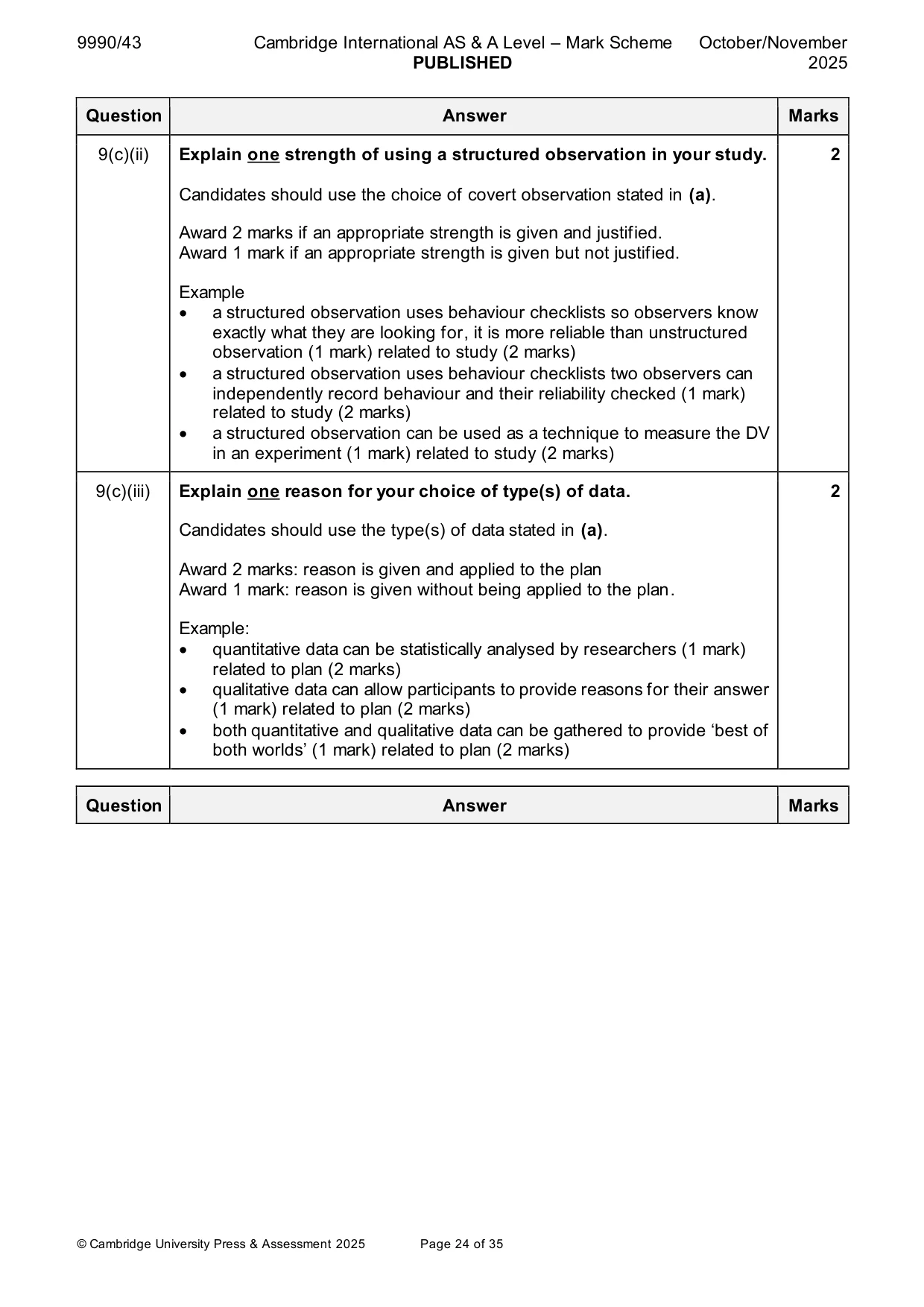
Mark scheme: 9(a) Plan a study using a structured observation to investigate the 10 effectiveness of imaginal desensitisation for treating gambling disorder. • naturalistic or controlled observation • type(s) of data Use Table A: AO2 Application to mark candidate responses to this question. Credit both general features and specific features of the plan. The specific features of the plan The general features of the plan should include: should include (if appropriate): • structured or unstructured • sample and sampling technique • covert or overt • ethical guidelines • controlled or naturalistic • a procedure • participant or non-participant • type(s) of data, analysis of • number of observers (inter-rater data, use of descriptive reliability) statistics • behavioural categories • an aim or hypothesis • could include: event or time (directional or non-directional)/ sampling null hypothesis • steps for making the study valid and reliable 9(b) For one piece of psychological knowledge on which your plan is based: 9(b)(i) Describe this psychological knowledge. 4 Syllabus: 1.3.3 Treatment and management of impulse control disorders. imaginal desensitisation, including a study, e.g. Blaszczynski and Nower (2003) Description: Imaginal desensitisation involves teaching progressive muscle relaxation and then the person visualises themselves being exposed to the situation. This triggers the drive to carry out the impulsive behaviour and the aim is to reduce the strength of the drive. Blaszcznski and Nower (2003) found this technique was particularly effective with gamblers. There are six steps in a typical treatment sequence: Initiating the urge, planning to follow through on the urge, arriving at the venue, getting arousal and excitement with the behaviour, having ‘second thoughts’ about the behaviour and decreasing the attractiveness of the behaviour. Blaszcznski and Nower (2003) conducted initial sessions with the therapist then conducted at home. 0 marks for covert sensitisation. Marks Description 3–4 The knowledge is appropriate. Relevant points are correctly described in good detail. 1–2 Basic points are identified with some elaboration and understanding. The answer lacks detail (a sentence or two). 0 No creditable response 9(b)(ii) Explain how you used two features of this psychological knowledge to 4 plan your study. Candidates should explain how the psychological knowledge described in (b)(i) has informed their plan in part (a). For each feature: Marks Description 2 Suitable answer that relates a feature and explains how the feature was used, expanded or modified to make it appropriate to the plan. The knowledge has clearly been applied to the plan. 1 Basic answer that identifies a feature 0 No creditable response Example: In (b)(i) I explained how gamblers are taught progressive muscle relaxation with sessions specific to their type of gambling. Therefore in (a) I planned that after many sessions a structured observation can be conducted in a naturalistic setting to see whether they still engage in their specific type of gambling. 9(c)(i) Explain one reason for your choice of naturalistic observation or 2 controlled observation. Candidates should use the choice of interpretation/scoring stated in (a). Award 2 marks: reason is given and applied to the plan Award 1 mark: reason is given without being applied to the plan Example: naturalistic observation because • it is conducted in a real-world setting (1 mark) such as a gambling casino where gambling behaviour could be covertly observed (2 marks) • behaviours are likely to be normal (high in ecological validity) (1 mark) because the participant will not know they are being observed in the casino and so effectiveness of treatment assessed (2 marks) • a full range of casino atmospherics are present (1 mark) so the effectiveness of the treatment in a real-world setting of a gambling casino is tested (2 marks) controlled observation because • it is conducted in a laboratory setting (1 mark) and so all variables such as the type of gambling, such as cards or machines, can be controlled (2 marks) • it is a ‘safe’ environment where the patient knows they are being observed (1 mark) and that they cannot lose (or win) real money (2 marks) 9(c)(ii) Explain one strength of using a structured observation in your study. 2 Candidates should use the choice of covert observation stated in (a). Award 2 marks if an appropriate strength is given and justified. Award 1 mark if an appropriate strength is given but not justified. Example • a structured observation uses behaviour checklists so observers know exactly what they are looking for, it is more reliable than unstructured observation (1 mark) related to study (2 marks) • a structured observation uses behaviour checklists two observers can independently record behaviour and their reliability checked (1 mark) related to study (2 marks) • a structured observation can be used as a technique to measure the DV in an experiment (1 mark) related to study (2 marks) 9(c)(iii) Explain one reason for your choice of type(s) of data. 2 Candidates should use the type(s) of data stated in (a). Award 2 marks: reason is given and applied to the plan Award 1 mark: reason is given without being applied to the plan. Example: • quantitative data can be statistically analysed by researchers (1 mark) related to plan (2 marks) • qualitative data can allow participants to provide reasons for their answer (1 mark) related to plan (2 marks) • both quantitative and qualitative data can be gathered to provide ‘best of both worlds’ (1 mark) related to plan (2 marks) Question Answer Marks
Q10 · Plan a field experiment to investigate the effect on spending when playing classical…
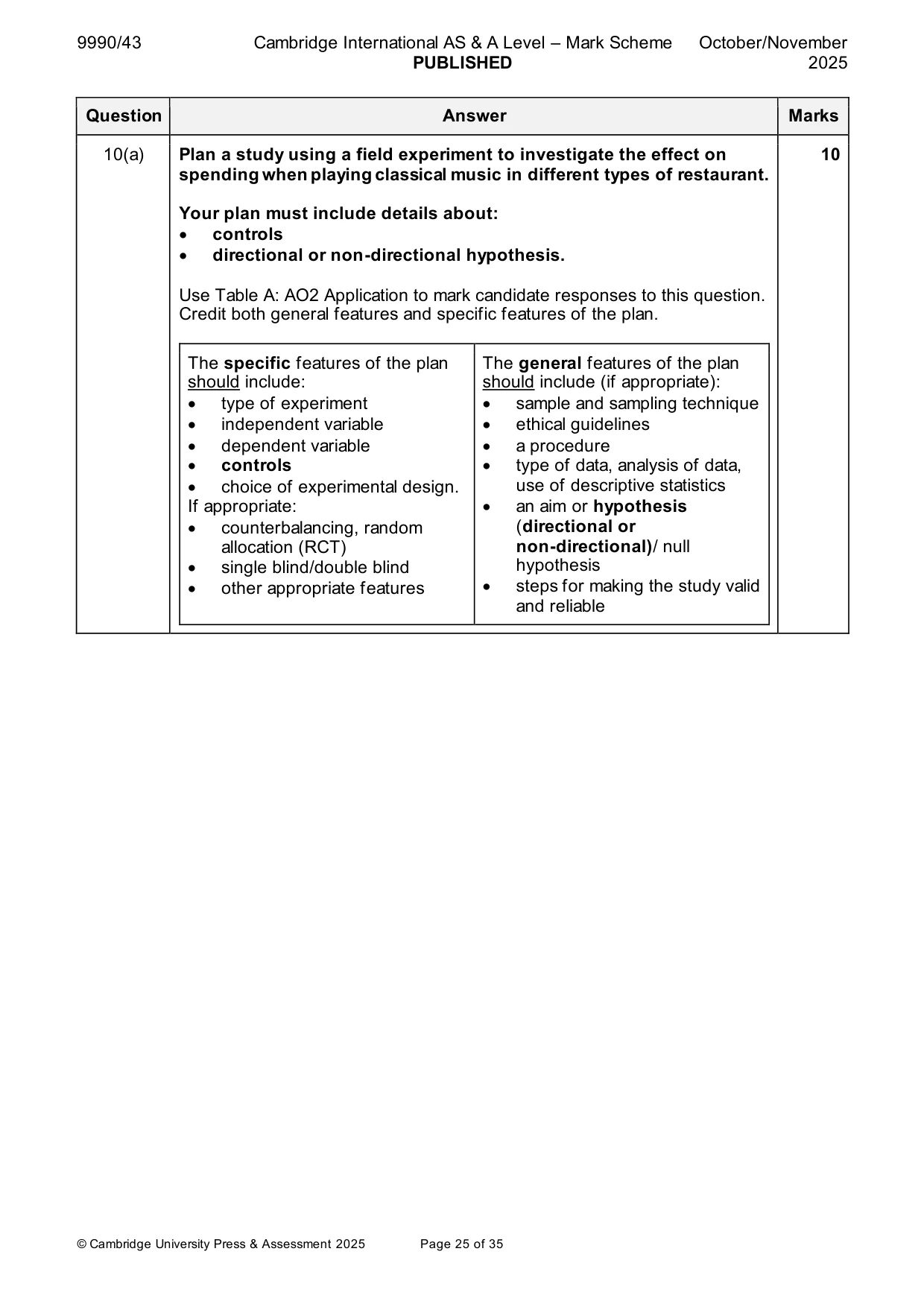
10 (a) Plan a field experiment to investigate the effect on spending when playing classical music in different types of restaurant. Your plan must include details about: • controls • a directional or non-directional hypothesis. [10] (b) For one piece of psychological knowledge on which your plan is based: (i) Describe this psychological knowledge. [4] (ii) Explain how you used two features of this psychological knowledge to plan your experiment. [4] (c) (i) Explain one reason for your choice of controls. [2] (ii) Explain one weakness of your choice of controls. [2] (iii) Explain one reason for your choice of directional or non-directional hypothesis. [2] Health Psychology
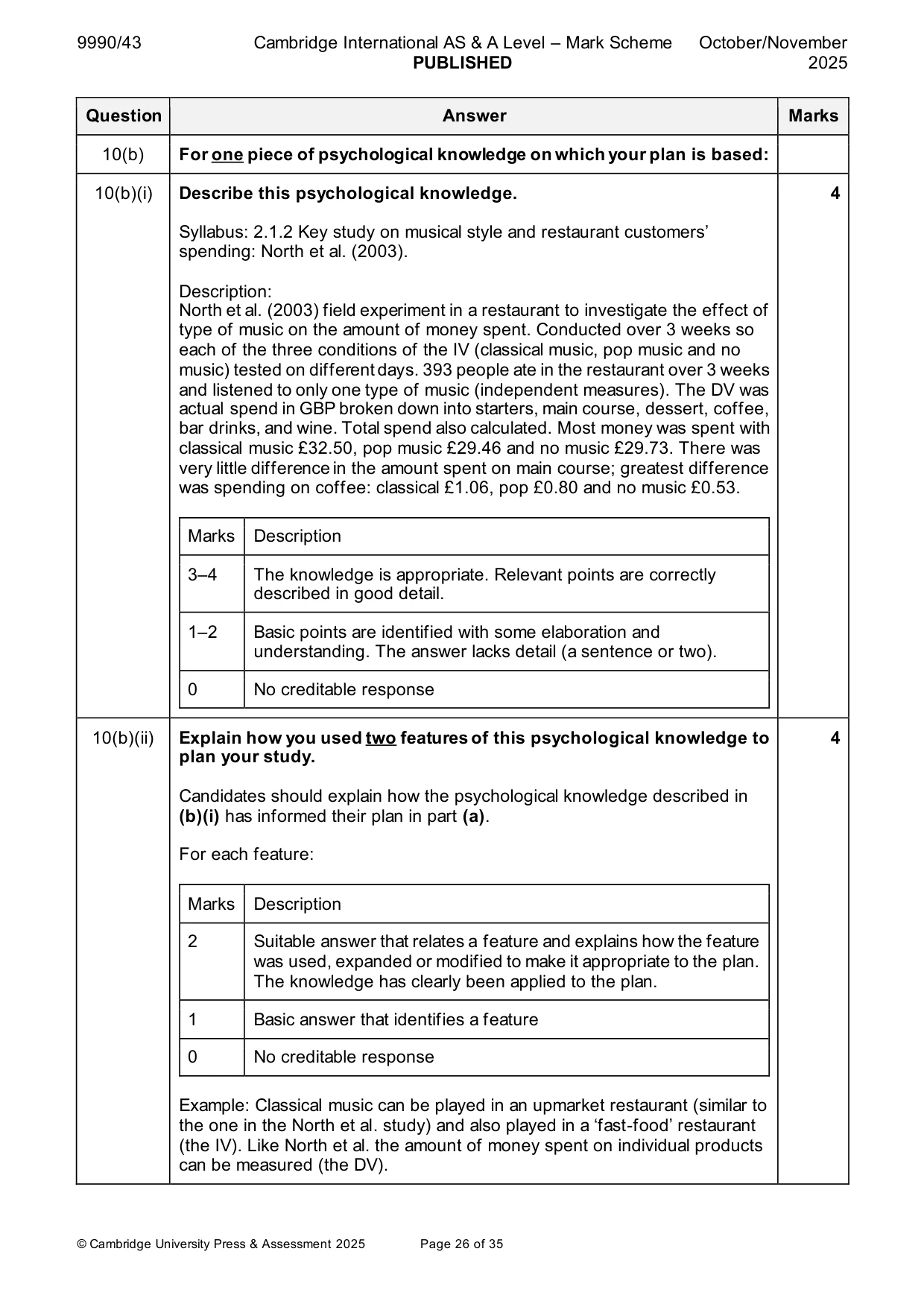
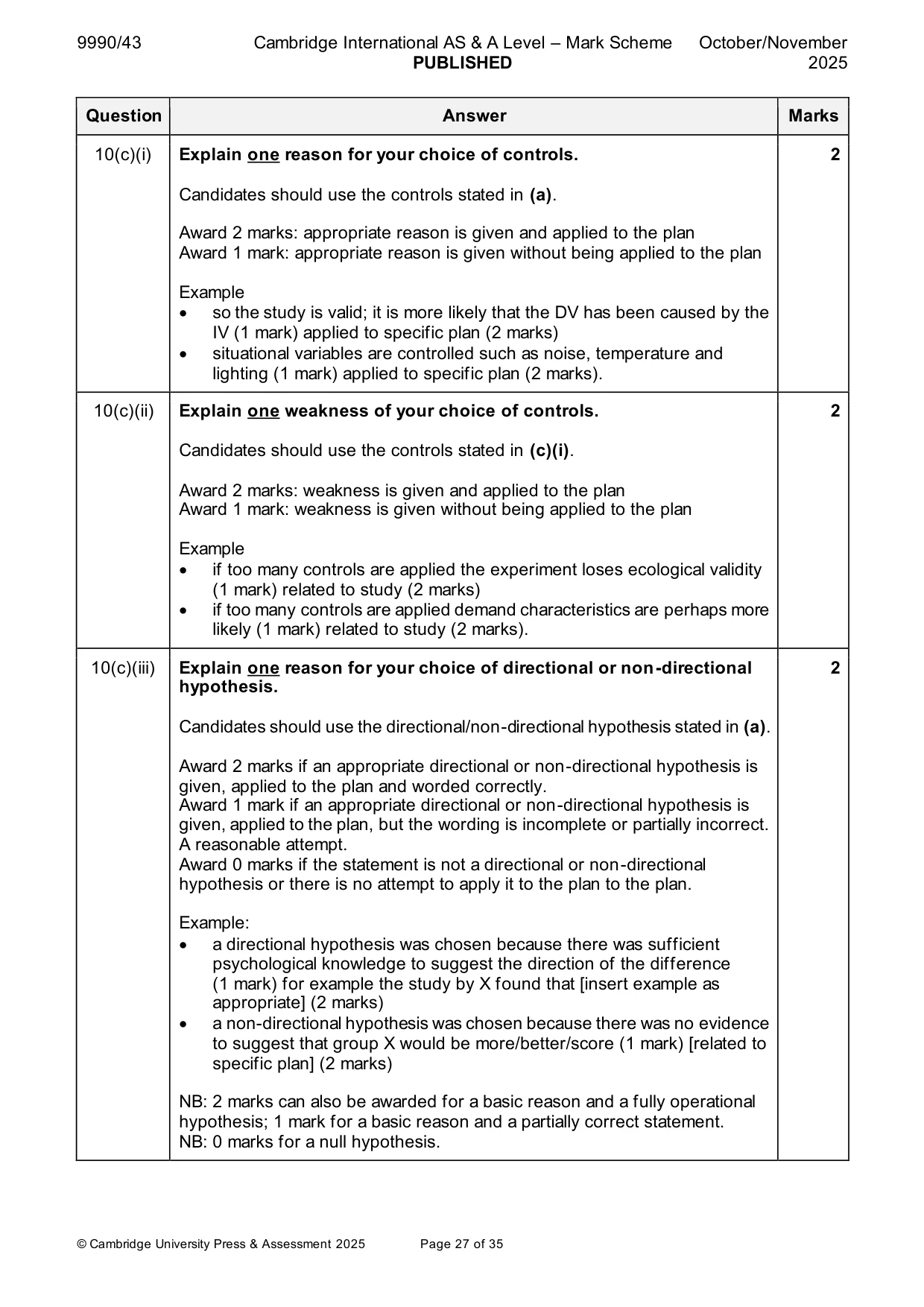
Mark scheme: 10(a) Plan a study using a field experiment to investigate the effect on 10 spending when playing classical music in different types of restaurant. Your plan must include details about: • controls • directional or non-directional hypothesis. Use Table A: AO2 Application to mark candidate responses to this question. Credit both general features and specific features of the plan. The specific features of the plan The general features of the plan should include: should include (if appropriate): • type of experiment • sample and sampling technique • independent variable • ethical guidelines • dependent variable • a procedure • controls • type of data, analysis of data, • choice of experimental design. use of descriptive statistics If appropriate: • an aim or hypothesis • counterbalancing, random (directional or allocation (RCT) non-directional)/ null • single blind/double blind hypothesis • other appropriate features • steps for making the study valid and reliable 10(b) For one piece of psychological knowledge on which your plan is based: 10(b)(i) Describe this psychological knowledge. 4 Syllabus: 2.1.2 Key study on musical style and restaurant customers’ spending: North et al. (2003). Description: North et al. (2003) field experiment in a restaurant to investigate the effect of type of music on the amount of money spent. Conducted over 3 weeks so each of the three conditions of the IV (classical music, pop music and no music) tested on different days. 393 people ate in the restaurant over 3 weeks and listened to only one type of music (independent measures). The DV was actual spend in GBP broken down into starters, main course, dessert, coffee, bar drinks, and wine. Total spend also calculated. Most money was spent with classical music £32.50, pop music £29.46 and no music £29.73. There was very little difference in the amount spent on main course; greatest difference was spending on coffee: classical £1.06, pop £0.80 and no music £0.53. Marks Description 3–4 The knowledge is appropriate. Relevant points are correctly described in good detail. 1–2 Basic points are identified with some elaboration and understanding. The answer lacks detail (a sentence or two). 0 No creditable response 10(b)(ii) Explain how you used two features of this psychological knowledge to 4 plan your study. Candidates should explain how the psychological knowledge described in (b)(i) has informed their plan in part (a). For each feature: Marks Description 2 Suitable answer that relates a feature and explains how the feature was used, expanded or modified to make it appropriate to the plan. The knowledge has clearly been applied to the plan. 1 Basic answer that identifies a feature 0 No creditable response Example: Classical music can be played in an upmarket restaurant (similar to the one in the North et al. study) and also played in a ‘fast-food’ restaurant (the IV). Like North et al. the amount of money spent on individual products can be measured (the DV). 10(c)(i) Explain one reason for your choice of controls. 2 Candidates should use the controls stated in (a). Award 2 marks: appropriate reason is given and applied to the plan Award 1 mark: appropriate reason is given without being applied to the plan Example • so the study is valid; it is more likely that the DV has been caused by the IV (1 mark) applied to specific plan (2 marks) • situational variables are controlled such as noise, temperature and lighting (1 mark) applied to specific plan (2 marks). 10(c)(ii) Explain one weakness of your choice of controls. 2 Candidates should use the controls stated in (c)(i). Award 2 marks: weakness is given and applied to the plan Award 1 mark: weakness is given without being applied to the plan Example • if too many controls are applied the experiment loses ecological validity (1 mark) related to study (2 marks) • if too many controls are applied demand characteristics are perhaps more likely (1 mark) related to study (2 marks). 10(c)(iii) Explain one reason for your choice of directional or non-directional 2 hypothesis. Candidates should use the directional/non-directional hypothesis stated in (a). Award 2 marks if an appropriate directional or non-directional hypothesis is given, applied to the plan and worded correctly. Award 1 mark if an appropriate directional or non-directional hypothesis is given, applied to the plan, but the wording is incomplete or partially incorrect. A reasonable attempt. Award 0 marks if the statement is not a directional or non-directional hypothesis or there is no attempt to apply it to the plan to the plan. Example: • a directional hypothesis was chosen because there was sufficient psychological knowledge to suggest the direction of the difference (1 mark) for example the study by X found that [insert example as appropriate] (2 marks) • a non-directional hypothesis was chosen because there was no evidence to suggest that group X would be more/better/score (1 mark) [related to specific plan] (2 marks) NB: 2 marks can also be awarded for a basic reason and a fully operational hypothesis; 1 mark for a basic reason and a partially correct statement. NB: 0 marks for a null hypothesis.
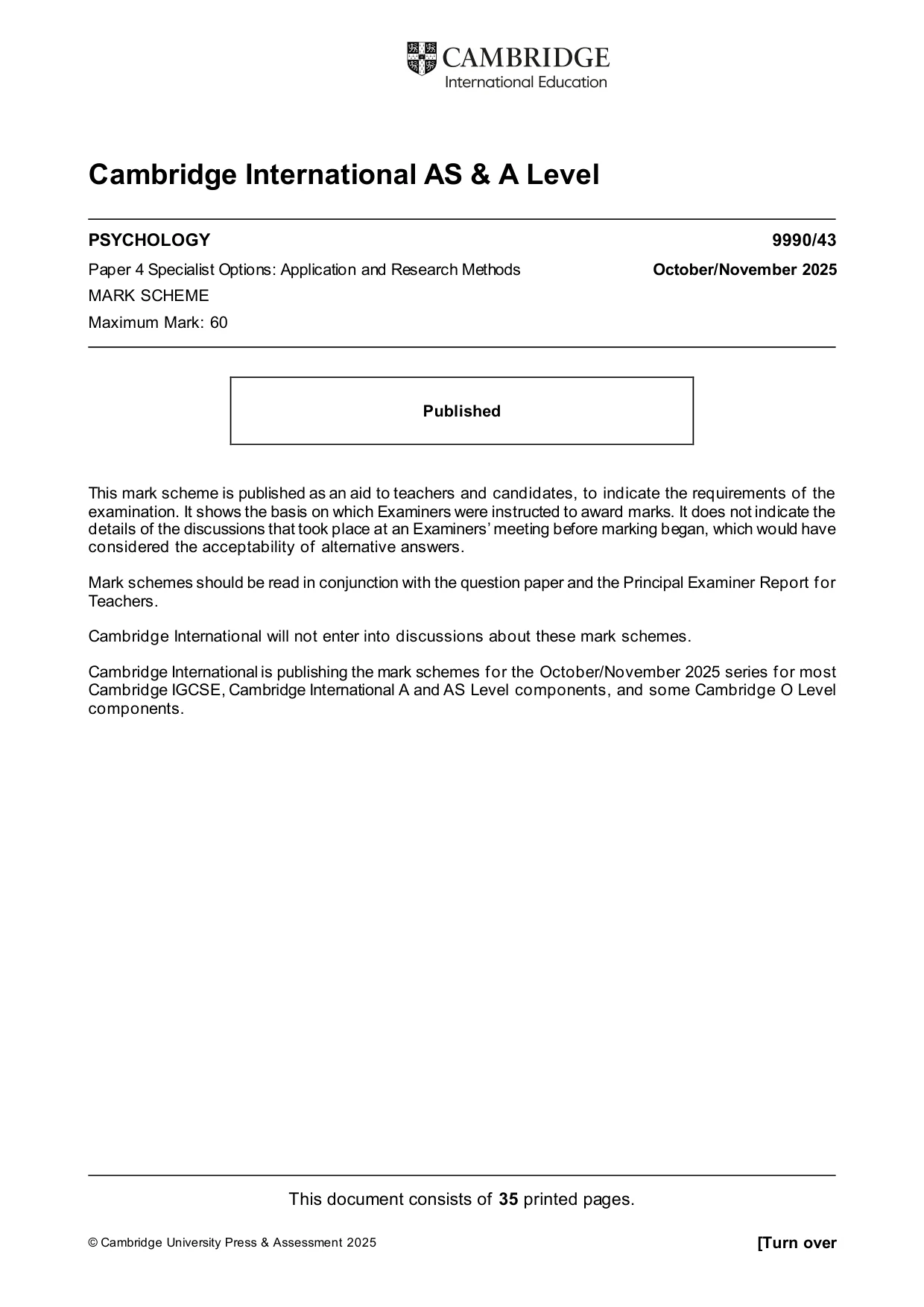
Q11 · Plan an experiment to investigate the effectiveness of biofeedback to manage stress in…
11 (a) Plan an experiment to investigate the effectiveness of biofeedback to manage stress in university students. Your plan must include details about: • experimental design • dependent variable. [10] (b) For one piece of psychological knowledge on which your plan is based: (i) Describe this psychological knowledge. [4] (ii) Explain how you used two features of this psychological knowledge to plan your experiment. [4] (c) (i) Explain one reason for your choice of experimental design. [2] (ii) Explain one weakness of your choice of experimental design. [2] (iii) Explain one reason for your choice of dependent variable. [2] Organisational Psychology
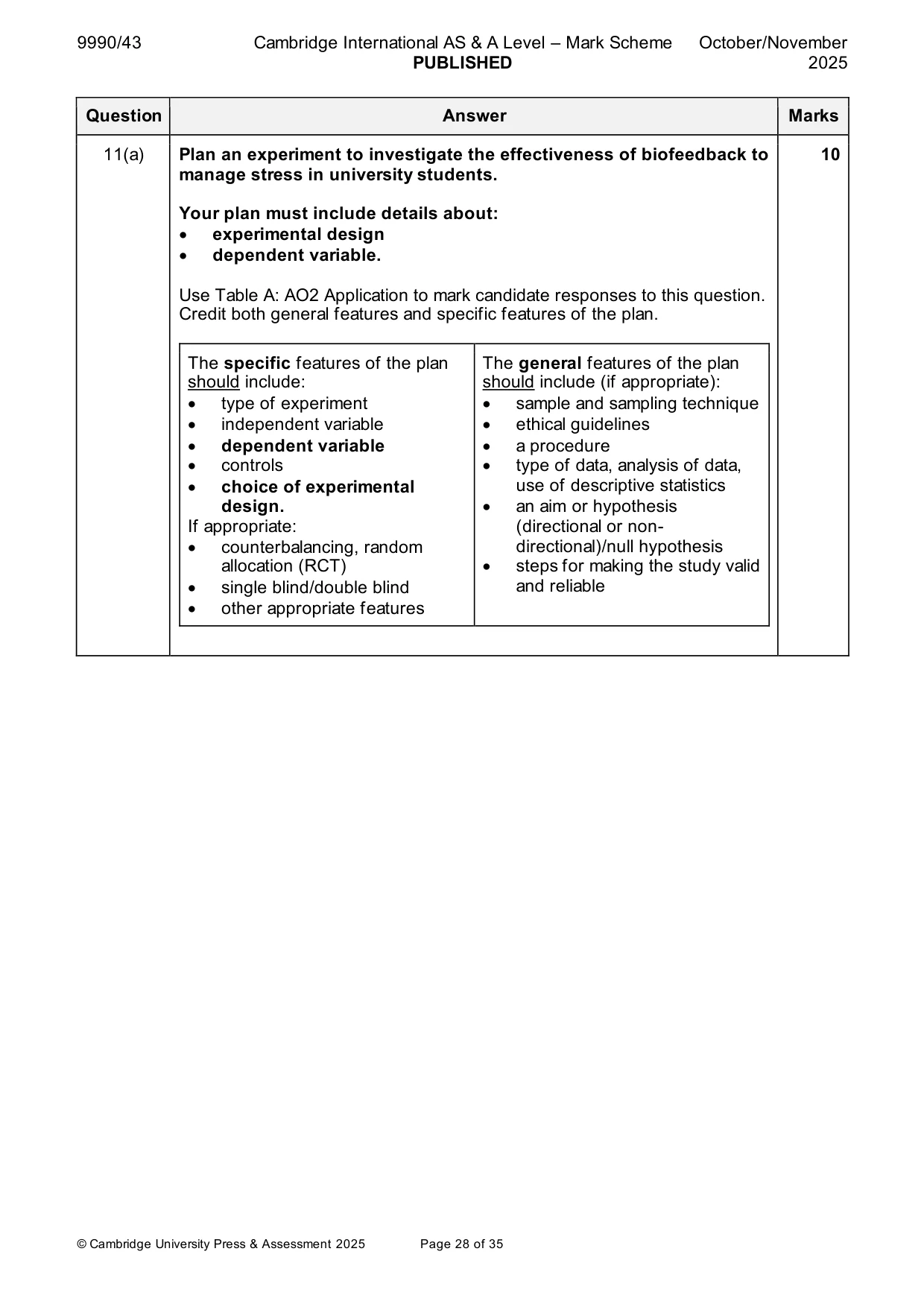
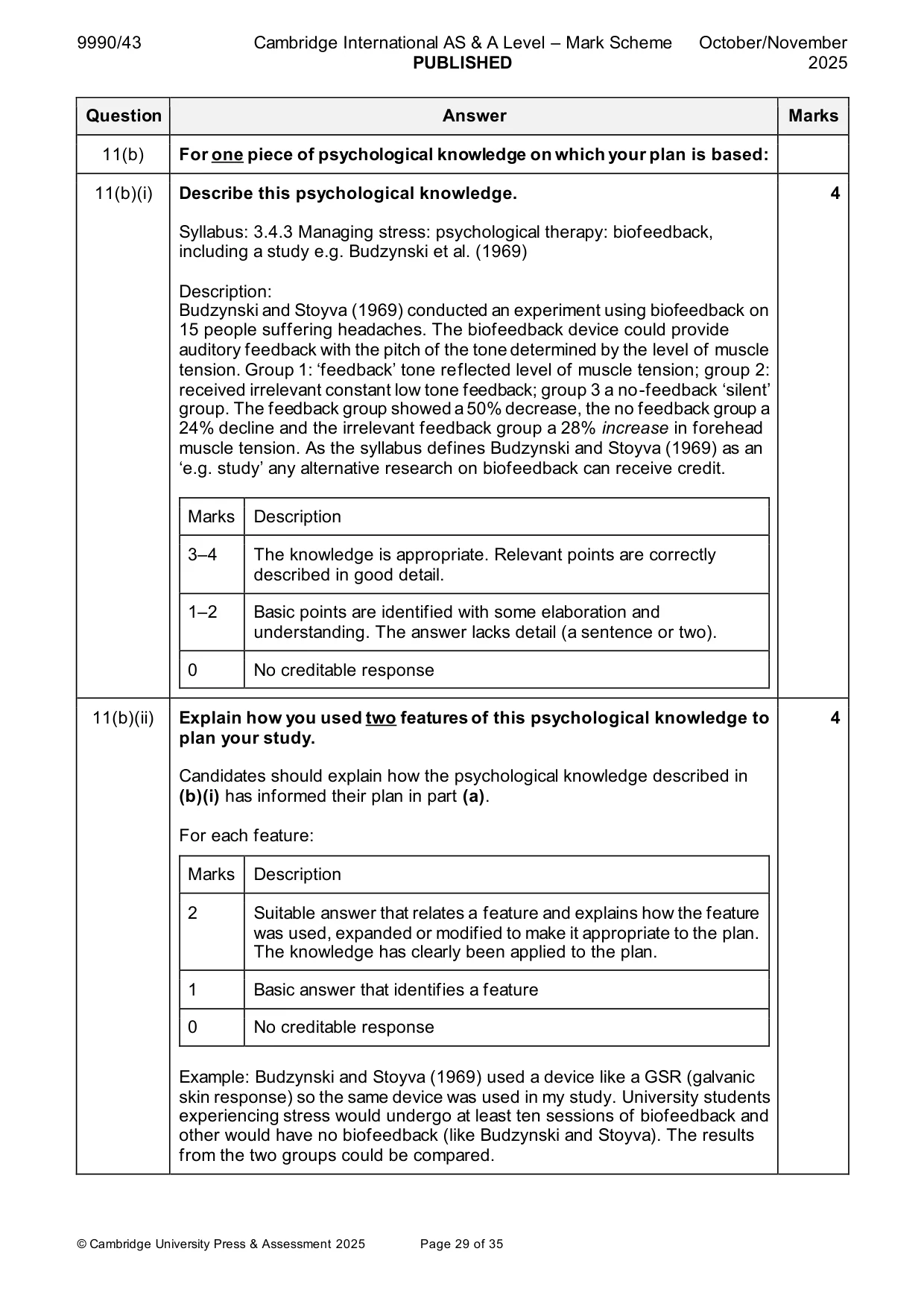
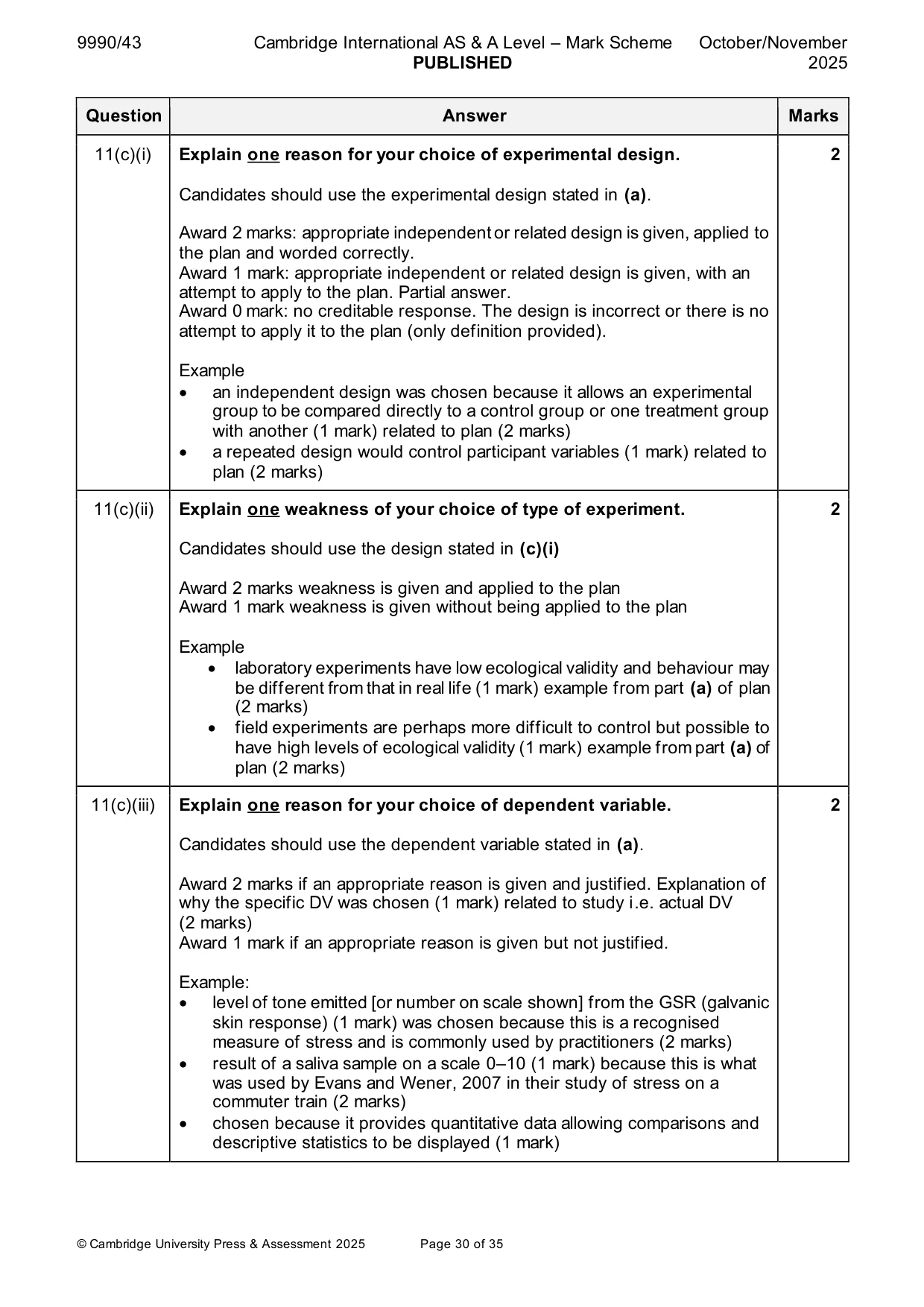
Mark scheme: 11(a) Plan an experiment to investigate the effectiveness of biofeedback to 10 manage stress in university students. Your plan must include details about: • experimental design • dependent variable. Use Table A: AO2 Application to mark candidate responses to this question. Credit both general features and specific features of the plan. The specific features of the plan The general features of the plan should include: should include (if appropriate): • type of experiment • sample and sampling technique • independent variable • ethical guidelines • dependent variable • a procedure • controls • type of data, analysis of data, • choice of experimental use of descriptive statistics design. • an aim or hypothesis If appropriate: (directional or non- • counterbalancing, random directional)/null hypothesis allocation (RCT) • steps for making the study valid • single blind/double blind and reliable • other appropriate features 11(b) For one piece of psychological knowledge on which your plan is based: 11(b)(i) Describe this psychological knowledge. 4 Syllabus: 3.4.3 Managing stress: psychological therapy: biofeedback, including a study e.g. Budzynski et al. (1969) Description: Budzynski and Stoyva (1969) conducted an experiment using biofeedback on 15 people suffering headaches. The biofeedback device could provide auditory feedback with the pitch of the tone determined by the level of muscle tension. Group 1: ‘feedback’ tone reflected level of muscle tension; group 2: received irrelevant constant low tone feedback; group 3 a no-feedback ‘silent’ group. The feedback group showed a 50% decrease, the no feedback group a 24% decline and the irrelevant feedback group a 28% increase in forehead muscle tension. As the syllabus defines Budzynski and Stoyva (1969) as an ‘e.g. study’ any alternative research on biofeedback can receive credit. Marks Description 3–4 The knowledge is appropriate. Relevant points are correctly described in good detail. 1–2 Basic points are identified with some elaboration and understanding. The answer lacks detail (a sentence or two). 0 No creditable response 11(b)(ii) Explain how you used two features of this psychological knowledge to 4 plan your study. Candidates should explain how the psychological knowledge described in (b)(i) has informed their plan in part (a). For each feature: Marks Description 2 Suitable answer that relates a feature and explains how the feature was used, expanded or modified to make it appropriate to the plan. The knowledge has clearly been applied to the plan. 1 Basic answer that identifies a feature 0 No creditable response Example: Budzynski and Stoyva (1969) used a device like a GSR (galvanic skin response) so the same device was used in my study. University students experiencing stress would undergo at least ten sessions of biofeedback and other would have no biofeedback (like Budzynski and Stoyva). The results from the two groups could be compared. 11(c)(i) Explain one reason for your choice of experimental design. 2 Candidates should use the experimental design stated in (a). Award 2 marks: appropriate independent or related design is given, applied to the plan and worded correctly. Award 1 mark: appropriate independent or related design is given, with an attempt to apply to the plan. Partial answer. Award 0 mark: no creditable response. The design is incorrect or there is no attempt to apply it to the plan (only definition provided). Example • an independent design was chosen because it allows an experimental group to be compared directly to a control group or one treatment group with another (1 mark) related to plan (2 marks) • a repeated design would control participant variables (1 mark) related to plan (2 marks) 11(c)(ii) Explain one weakness of your choice of type of experiment. 2 Candidates should use the design stated in (c)(i) Award 2 marks weakness is given and applied to the plan Award 1 mark weakness is given without being applied to the plan Example • laboratory experiments have low ecological validity and behaviour may be different from that in real life (1 mark) example from part (a) of plan (2 marks) • field experiments are perhaps more difficult to control but possible to have high levels of ecological validity (1 mark) example from part (a) of plan (2 marks) 11(c)(iii) Explain one reason for your choice of dependent variable. 2 Candidates should use the dependent variable stated in (a). Award 2 marks if an appropriate reason is given and justified. Explanation of why the specific DV was chosen (1 mark) related to study i.e. actual DV (2 marks) Award 1 mark if an appropriate reason is given but not justified. Example: • level of tone emitted [or number on scale shown] from the GSR (galvanic skin response) (1 mark) was chosen because this is a recognised measure of stress and is commonly used by practitioners (2 marks) • result of a saliva sample on a scale 0–10 (1 mark) because this is what was used by Evans and Wener, 2007 in their study of stress on a commuter train (2 marks) • chosen because it provides quantitative data allowing comparisons and descriptive statistics to be displayed (1 mark)
Q12 · Plan a study using a questionnaire to investigate levels of job satisfaction following a…
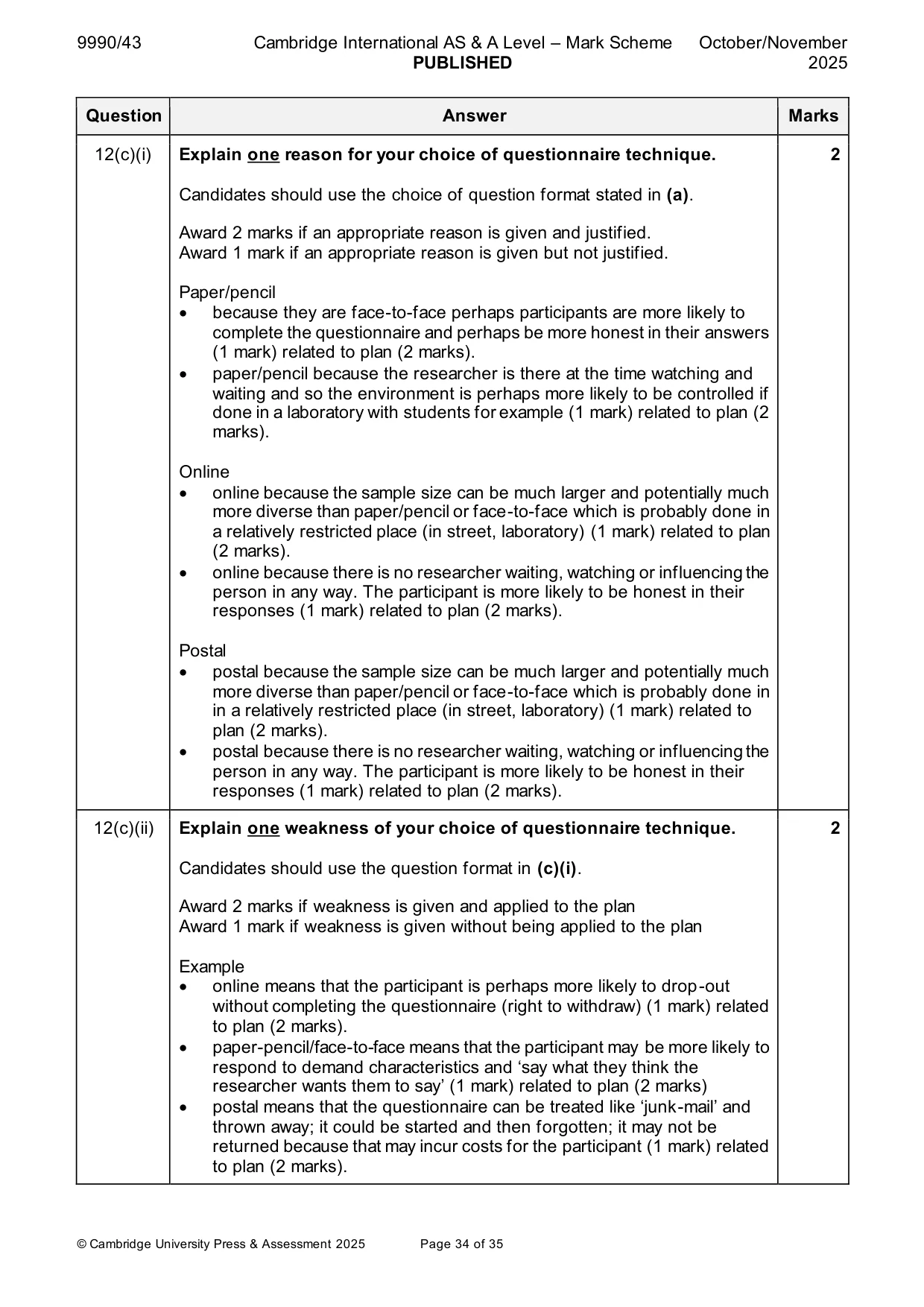
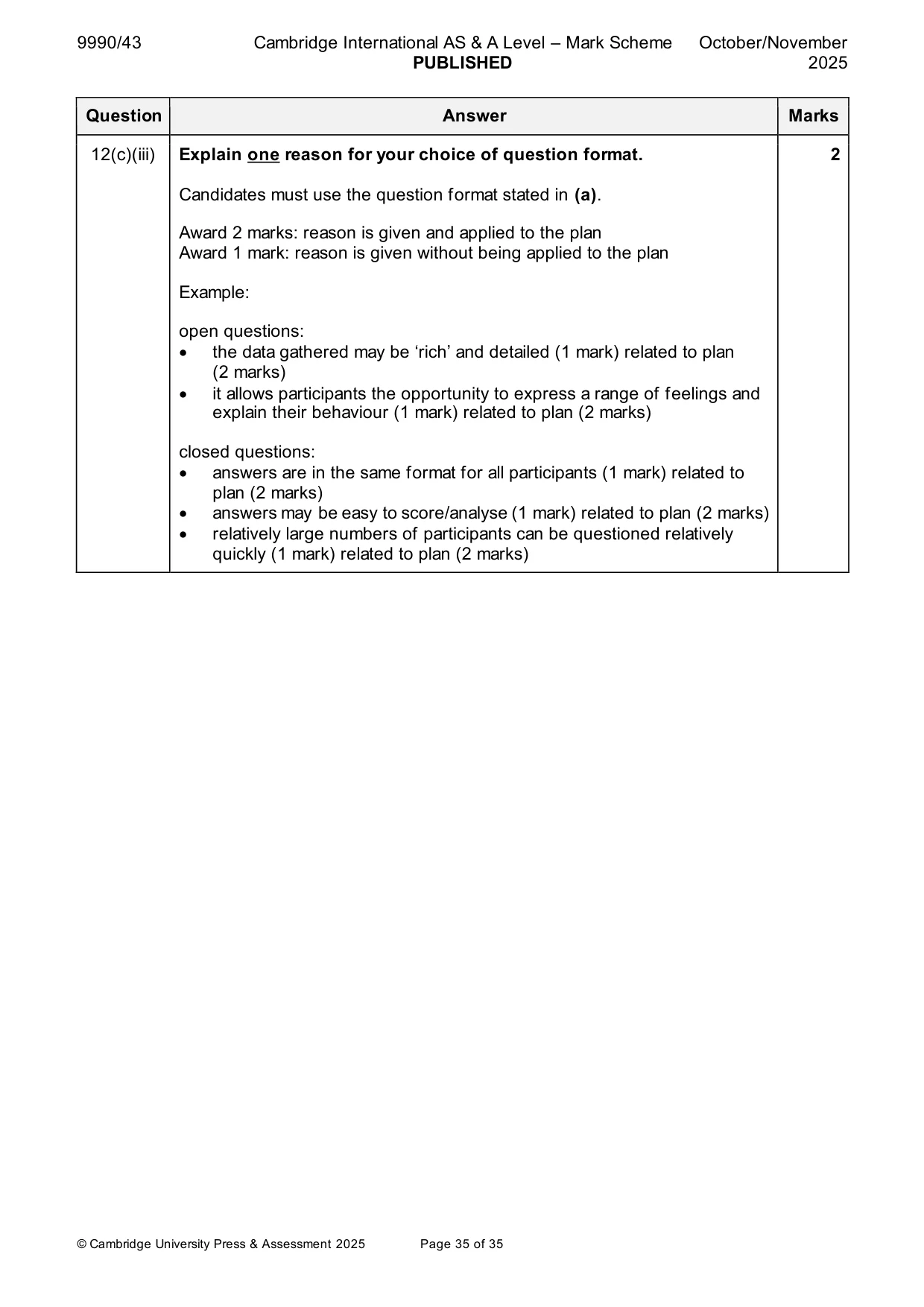
12 (a) Plan a study using a questionnaire to investigate levels of job satisfaction following a job enlargement. Your plan must include details about: • questionnaire technique • question format. [10] (b) For one piece of psychological knowledge on which your plan is based: (i) Describe this psychological knowledge. [4] (ii) Explain how you used two features of this psychological knowledge to plan your study. [4] (c) (i) Explain one reason for your choice of questionnaire technique. [2] (ii) Explain one weakness of your choice of questionnaire technique. [2] (iii) Explain one reason for your choice of question format. [2]
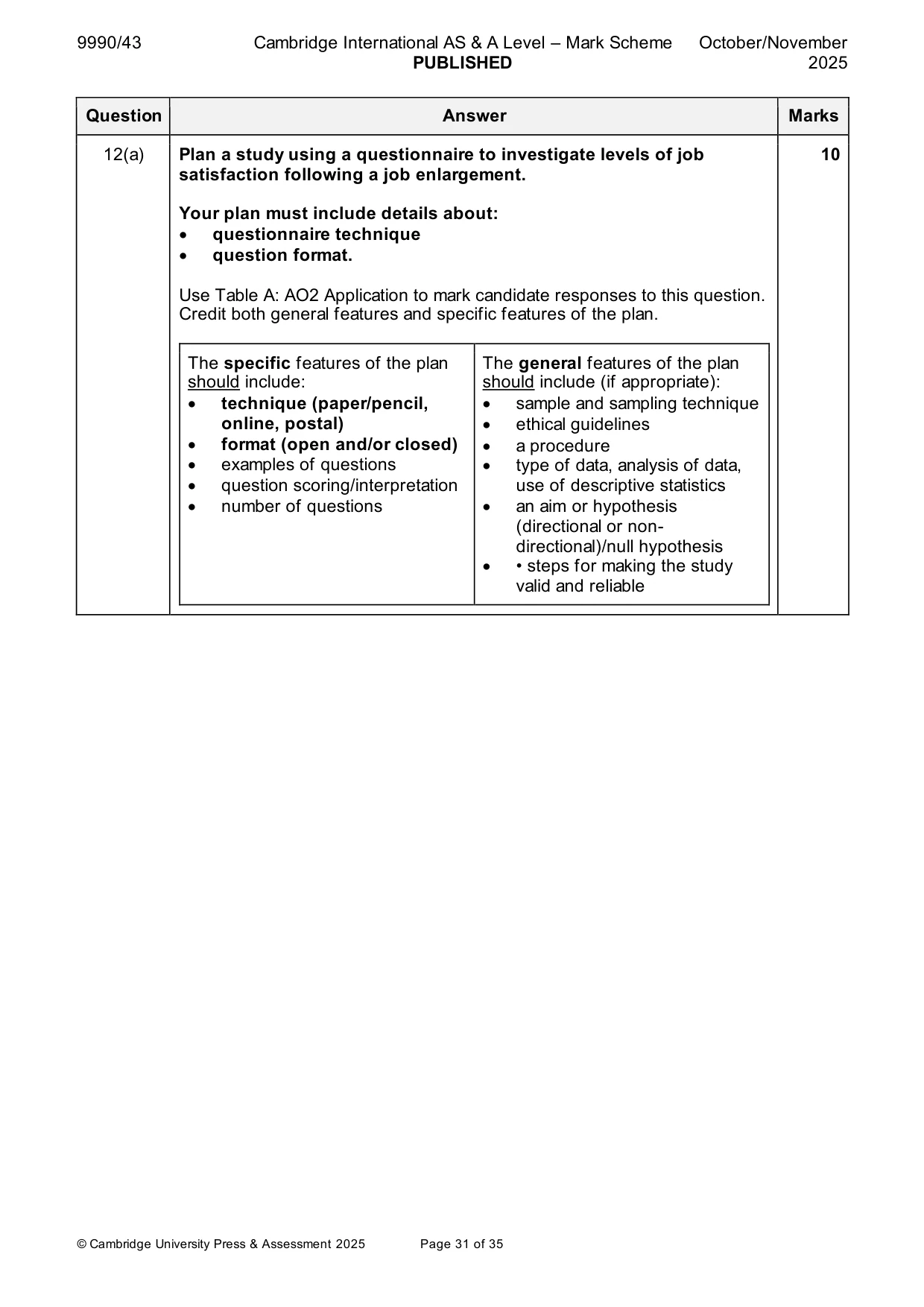
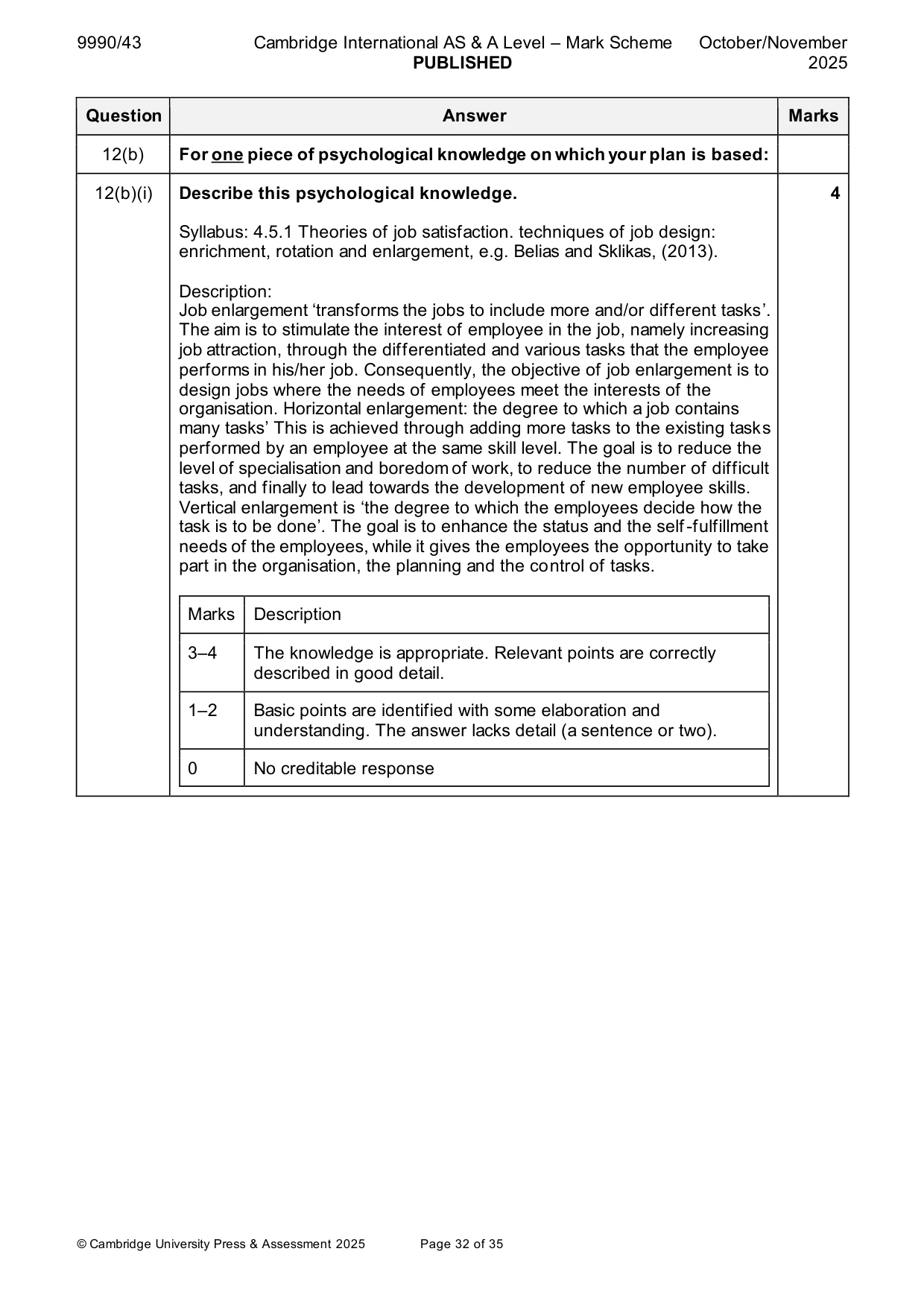
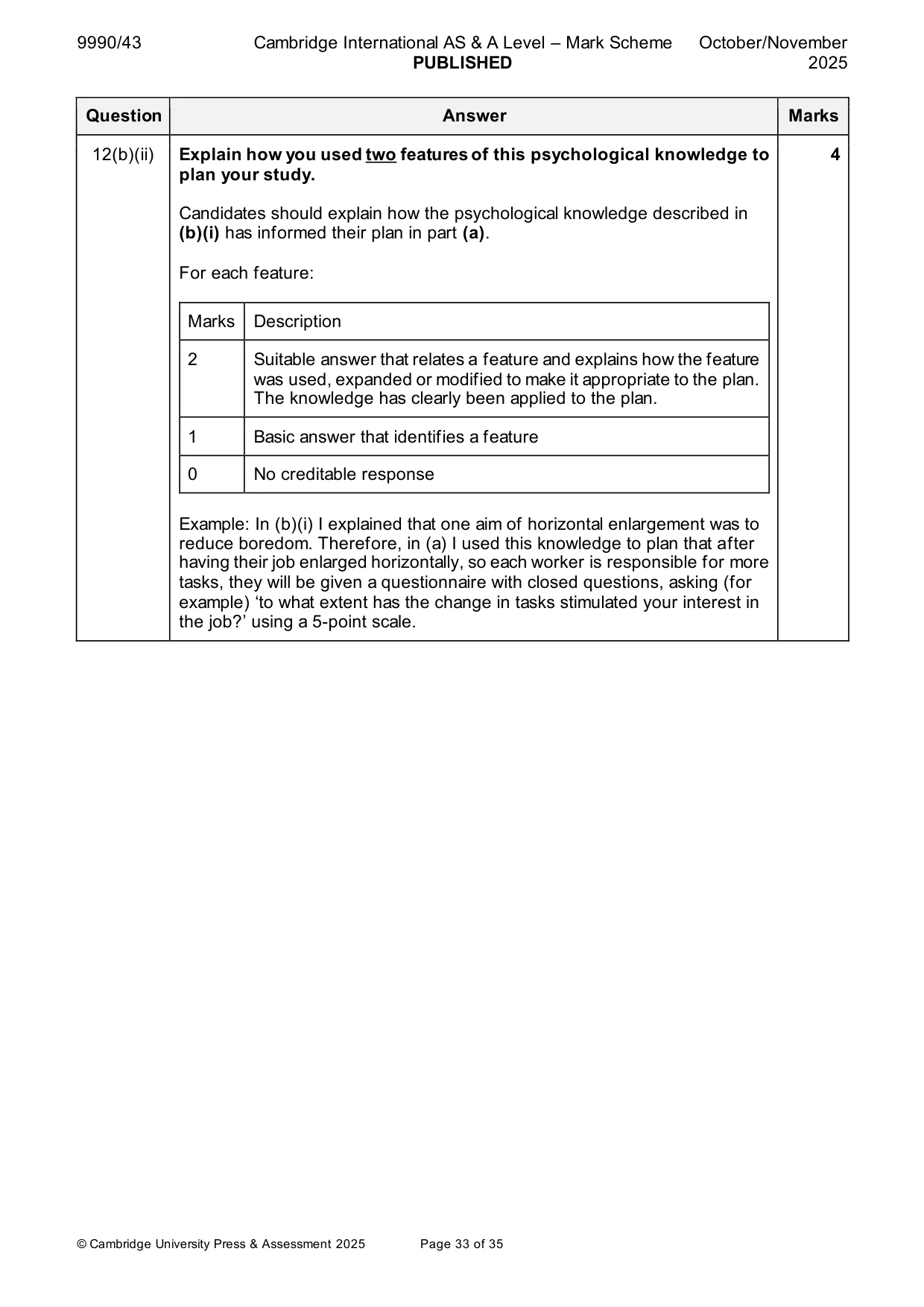
Mark scheme: 12(a) Plan a study using a questionnaire to investigate levels of job 10 satisfaction following a job enlargement. Your plan must include details about: • questionnaire technique • question format. Use Table A: AO2 Application to mark candidate responses to this question. Credit both general features and specific features of the plan. The specific features of the plan The general features of the plan should include: should include (if appropriate): • technique (paper/pencil, • sample and sampling technique online, postal) • ethical guidelines • format (open and/or closed) • a procedure • examples of questions • type of data, analysis of data, • question scoring/interpretation use of descriptive statistics • number of questions • an aim or hypothesis (directional or non- directional)/null hypothesis • • steps for making the study valid and reliable 12(b) For one piece of psychological knowledge on which your plan is based: 12(b)(i) Describe this psychological knowledge. 4 Syllabus: 4.5.1 Theories of job satisfaction. techniques of job design: enrichment, rotation and enlargement, e.g. Belias and Sklikas, (2013). Description: Job enlargement ‘transforms the jobs to include more and/or different tasks’. The aim is to stimulate the interest of employee in the job, namely increasing job attraction, through the differentiated and various tasks that the employee performs in his/her job. Consequently, the objective of job enlargement is to design jobs where the needs of employees meet the interests of the organisation. Horizontal enlargement: the degree to which a job contains many tasks’ This is achieved through adding more tasks to the existing tasks performed by an employee at the same skill level. The goal is to reduce the level of specialisation and boredom of work, to reduce the number of difficult tasks, and finally to lead towards the development of new employee skills. Vertical enlargement is ‘the degree to which the employees decide how the task is to be done’. The goal is to enhance the status and the self-fulfillment needs of the employees, while it gives the employees the opportunity to take part in the organisation, the planning and the control of tasks. Marks Description 3–4 The knowledge is appropriate. Relevant points are correctly described in good detail. 1–2 Basic points are identified with some elaboration and understanding. The answer lacks detail (a sentence or two). 0 No creditable response 12(b)(ii) Explain how you used two features of this psychological knowledge to 4 plan your study. Candidates should explain how the psychological knowledge described in (b)(i) has informed their plan in part (a). For each feature: Marks Description 2 Suitable answer that relates a feature and explains how the feature was used, expanded or modified to make it appropriate to the plan. The knowledge has clearly been applied to the plan. 1 Basic answer that identifies a feature 0 No creditable response Example: In (b)(i) I explained that one aim of horizontal enlargement was to reduce boredom. Therefore, in (a) I used this knowledge to plan that after having their job enlarged horizontally, so each worker is responsible for more tasks, they will be given a questionnaire with closed questions, asking (for example) ‘to what extent has the change in tasks stimulated your interest in the job?’ using a 5-point scale. 12(c)(i) Explain one reason for your choice of questionnaire technique. 2 Candidates should use the choice of question format stated in (a). Award 2 marks if an appropriate reason is given and justified. Award 1 mark if an appropriate reason is given but not justified. Paper/pencil • because they are face-to-face perhaps participants are more likely to complete the questionnaire and perhaps be more honest in their answers (1 mark) related to plan (2 marks). • paper/pencil because the researcher is there at the time watching and waiting and so the environment is perhaps more likely to be controlled if done in a laboratory with students for example (1 mark) related to plan (2 marks). Online • online because the sample size can be much larger and potentially much more diverse than paper/pencil or face-to-face which is probably done in a relatively restricted place (in street, laboratory) (1 mark) related to plan (2 marks). • online because there is no researcher waiting, watching or influencing the person in any way. The participant is more likely to be honest in their responses (1 mark) related to plan (2 marks). Postal • postal because the sample size can be much larger and potentially much more diverse than paper/pencil or face-to-face which is probably done in in a relatively restricted place (in street, laboratory) (1 mark) related to plan (2 marks). • postal because there is no researcher waiting, watching or influencing the person in any way. The participant is more likely to be honest in their responses (1 mark) related to plan (2 marks). 12(c)(ii) Explain one weakness of your choice of questionnaire technique. 2 Candidates should use the question format in (c)(i). Award 2 marks if weakness is given and applied to the plan Award 1 mark if weakness is given without being applied to the plan Example • online means that the participant is perhaps more likely to drop-out without completing the questionnaire (right to withdraw) (1 mark) related to plan (2 marks). • paper-pencil/face-to-face means that the participant may be more likely to respond to demand characteristics and ‘say what they think the researcher wants them to say’ (1 mark) related to plan (2 marks) • postal means that the questionnaire can be treated like ‘junk-mail’ and thrown away; it could be started and then forgotten; it may not be returned because that may incur costs for the participant (1 mark) related to plan (2 marks). 12(c)(iii) Explain one reason for your choice of question format. 2 Candidates must use the question format stated in (a). Award 2 marks: reason is given and applied to the plan Award 1 mark: reason is given without being applied to the plan Example: open questions: • the data gathered may be ‘rich’ and detailed (1 mark) related to plan (2 marks) • it allows participants the opportunity to express a range of feelings and explain their behaviour (1 mark) related to plan (2 marks) closed questions: • answers are in the same format for all participants (1 mark) related to plan (2 marks) • answers may be easy to score/analyse (1 mark) related to plan (2 marks) • relatively large numbers of participants can be questioned relatively quickly (1 mark) related to plan (2 marks)
What was in this paper
The subtopics covered by these 12 questions, and how many questions each got. Open one in a new tab to see every Cambridge question on it.