Cambridge A Level Psychology (from 2018) 9990 — 2020 Feb/March Paper 4 · Variant 2
9990/42/F/M/20 · 12 questions · 60 marks · ≈68 min
The question paper and its mark scheme, free to read here and free to download. This is Cambridge’s own paper, exactly as it was sat.
Question paper8 pages



Mark scheme23 pages
Answers below. Sit the paper first if you are practising.
Questions as text
Q1 · The Beck depression inventory (BDI) includes 21 items, all of which are assessed on a…
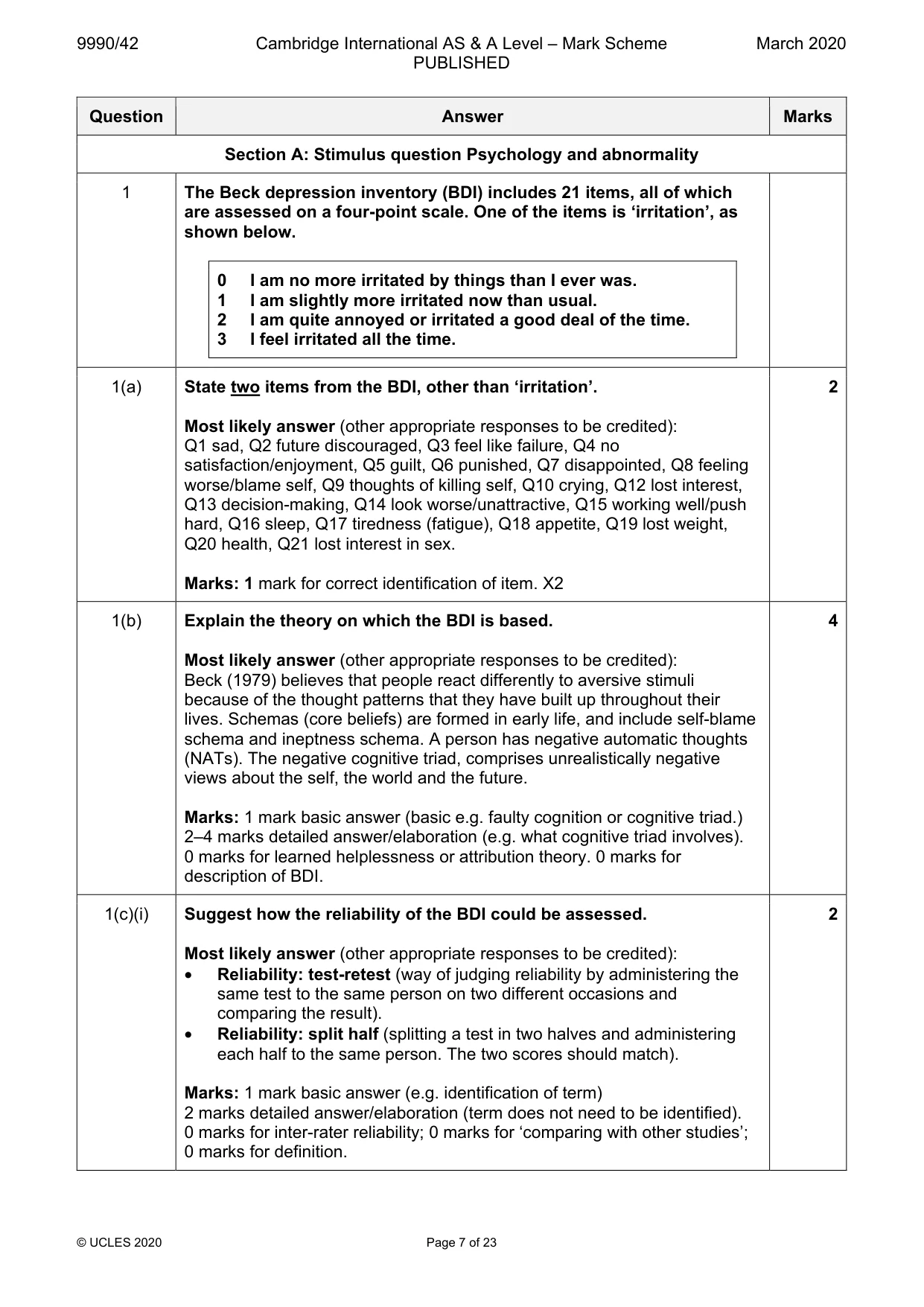
1 The Beck depression inventory (BDI) includes 21 items, all of which are assessed on a four-point scale. One of the items is ‘irritation’, as shown below. 0 I am no more irritated by things than I ever was. 1 I am slightly more irritated now than usual. 2 I am quite annoyed or irritated a good deal of the time. 3 I feel irritated all the time. (a) State two items from the BDI, other than ‘irritation’. [2] (b) Explain the theory on which the BDI is based. [4] (c) (i) Suggest how the reliability of the BDI could be assessed. [2] (ii) Suggest how the validity of the BDI could be assessed. [2] (d) Discuss the strengths and weaknesses of using self-report questionnaires to measure depression. You should include a conclusion in your answer. [5] Psychology and consumer behaviour
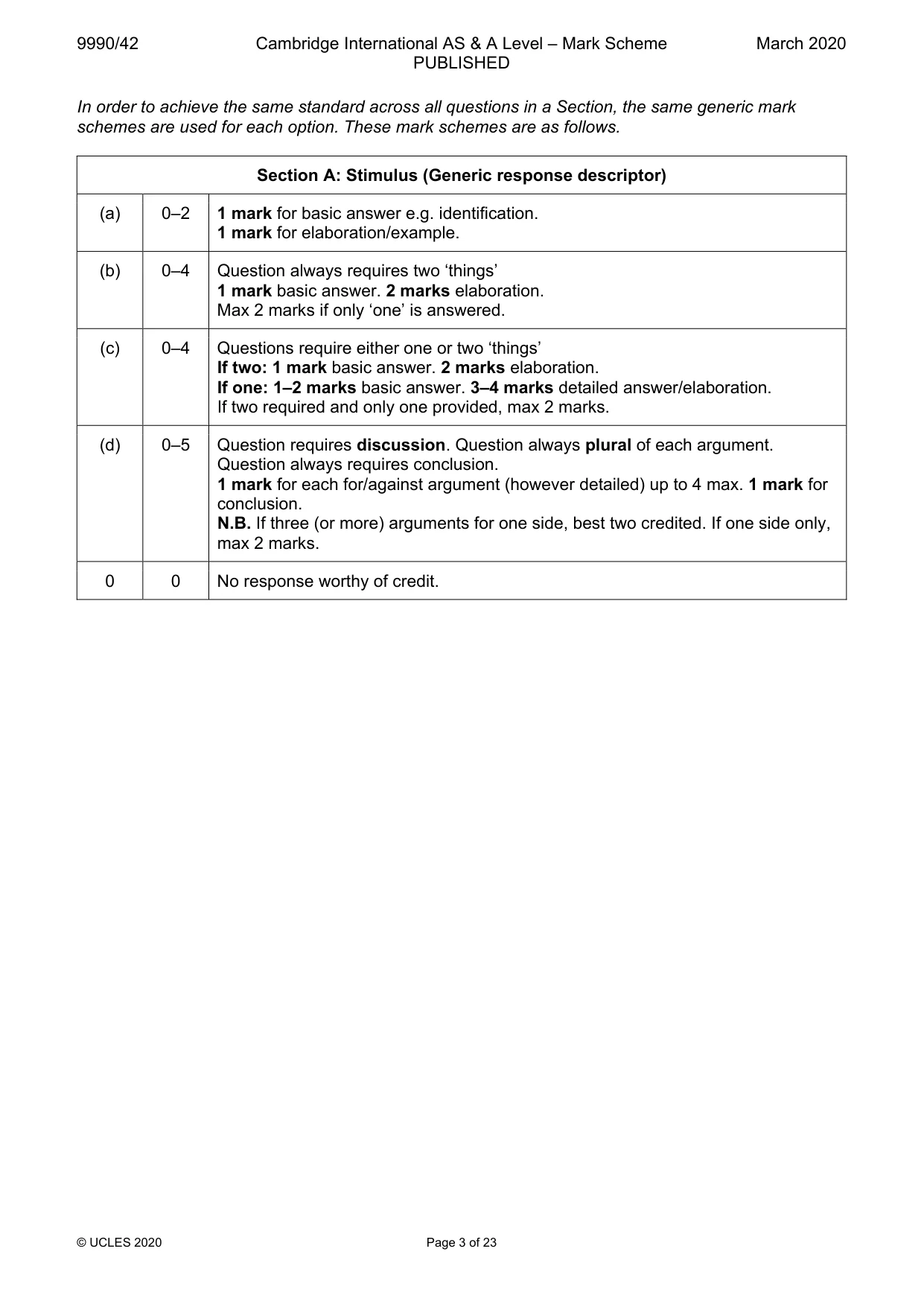
Mark scheme: Question Answer Marks Section A: Stimulus question Psychology and abnormality 1 The Beck depression inventory (BDI) includes 21 items, all of which are assessed on a four-point scale. One of the items is ‘irritation’, as shown below. 0 I am no more irritated by things than I ever was. 1 I am slightly more irritated now than usual. 2 I am quite annoyed or irritated a good deal of the time. 3 I feel irritated all the time. 1(a) State two items from the BDI, other than ‘irritation’. 2 Most likely answer (other appropriate responses to be credited): Q1 sad, Q2 future discouraged, Q3 feel like failure, Q4 no satisfaction/enjoyment, Q5 guilt, Q6 punished, Q7 disappointed, Q8 feeling worse/blame self, Q9 thoughts of killing self, Q10 crying, Q12 lost interest, Q13 decision-making, Q14 look worse/unattractive, Q15 working well/push hard, Q16 sleep, Q17 tiredness (fatigue), Q18 appetite, Q19 lost weight, Q20 health, Q21 lost interest in sex. Marks: 1 mark for correct identification of item. X2 1(b) Explain the theory on which the BDI is based. 4 Most likely answer (other appropriate responses to be credited): Beck (1979) believes that people react differently to aversive stimuli because of the thought patterns that they have built up throughout their lives. Schemas (core beliefs) are formed in early life, and include self-blame schema and ineptness schema. A person has negative automatic thoughts (NATs). The negative cognitive triad, comprises unrealistically negative views about the self, the world and the future. Marks: 1 mark basic answer (basic e.g. faulty cognition or cognitive triad.) 2–4 marks detailed answer/elaboration (e.g. what cognitive triad involves). 0 marks for learned helplessness or attribution theory. 0 marks for description of BDI. 1(c)(i) Suggest how the reliability of the BDI could be assessed. 2 Most likely answer (other appropriate responses to be credited): • Reliability: test-retest (way of judging reliability by administering the same test to the same person on two different occasions and comparing the result). • Reliability: split half (splitting a test in two halves and administering each half to the same person. The two scores should match). Marks: 1 mark basic answer (e.g. identification of term) 2 marks detailed answer/elaboration (term does not need to be identified). 0 marks for inter-rater reliability; 0 marks for ‘comparing with other studies’; 0 marks for definition. 1(c)(ii) Suggest how the validity of the BDI could be assessed. 2 Most likely answer (other appropriate responses to be credited): • Validity: concurrent validity – compared with an alternative measure • Face validity – it looks like it measures depression. • Other types of validity, but not ecological validity. Marks: 1 mark basic answer (e.g. identification of term), 2 marks detailed answer/elaboration. 1(d) Discuss the strengths and weaknesses of using self-report 5 questionnaires to measure depression. You should include a conclusion in your answer. Most likely answer (other appropriate responses to be credited): Strengths • Asking people directly means that participants are given the opportunity to express their feelings and explain their behaviour rather than the researcher trying to work out reasons for their behaviour from other methods • Relatively large numbers of participants can be done relatively easily. Questionnaires are easy to replicate. • Data can be qualitative, but may also be quantitative depending on type of question • Quantitative data (as used in this inventory) can be scored and compared to all other people completing the questionnaire. Weaknesses: • Some participants may provide socially desirable responses; not give truthful answers; respond to demand characteristics. • Closed/fixed choice questions may force people into choosing answers that do not reflect their true opinion and therefore may lower the validity. • Researchers have to be careful about use of leading questions; it could affect the validity of the data collected. Conclusion: any appropriate conclusion drawn from the discussion that has been presented. 1 mark if appropriate. A conclusion is a ‘decision reached by reasoning’ and so a summary of points already made scores 0 marks. Marks: Question requires discussion; always plural of each argument, and always requires conclusion. 1 mark for each advantage/disadvantage (however detailed) and related to the question up to 4 max. 2 marks max for two strengths/weaknesses unrelated to the question. 1 mark for conclusion.
More questions on Mood (affective) disorders: depressive disorder (unipolar) and bipolar disorder
Q2 · A company wants to increase sales of canned soup
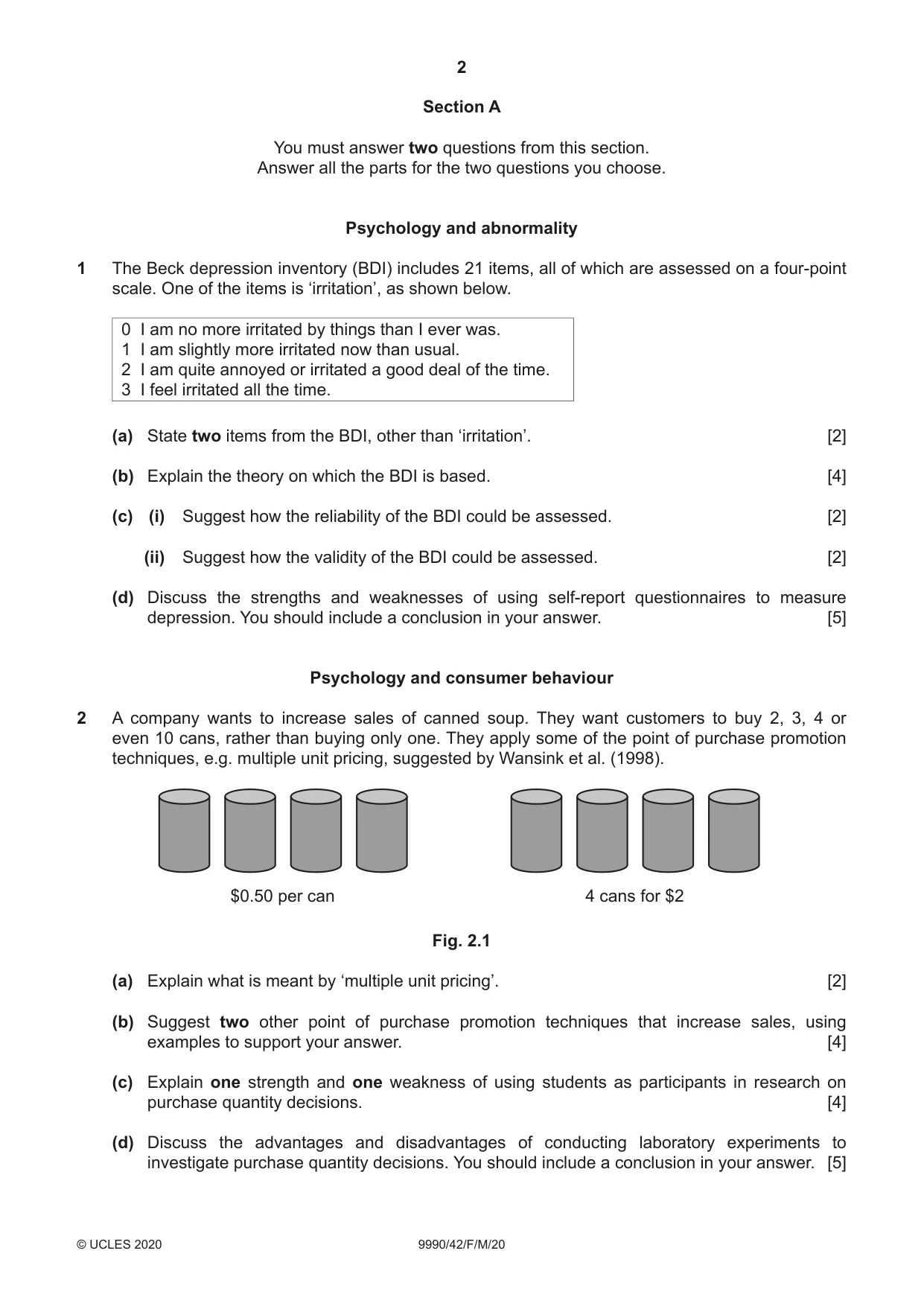
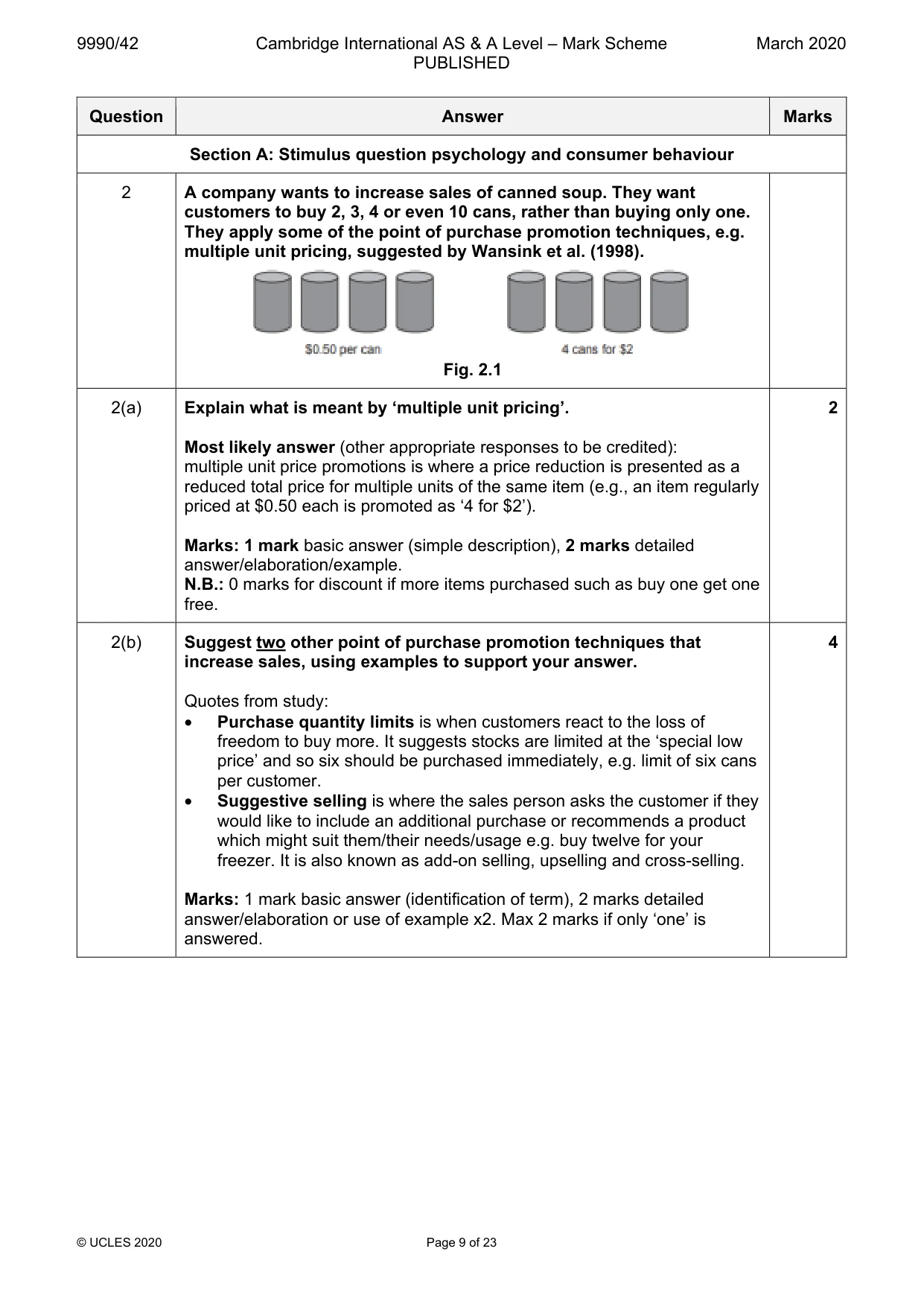
2 A company wants to increase sales of canned soup. They want customers to buy 2, 3, 4 or even 10 cans, rather than buying only one. They apply some of the point of purchase promotion techniques, e.g. multiple unit pricing, suggested by Wansink et al. (1998). $0.50 per can 4 cans for $2 Fig. 2.1 (a) Explain what is meant by ‘multiple unit pricing’. [2] (b) Suggest two other point of purchase promotion techniques that increase sales, using examples to support your answer. [4] (c) Explain one strength and one weakness of using students as participants in research on purchase quantity decisions. [4] (d) Discuss the advantages and disadvantages of conducting laboratory experiments to investigate purchase quantity decisions. You should include a conclusion in your answer. [5] Psychology and health
Mark scheme: 2 A company wants to increase sales of canned soup. They want customers to buy 2, 3, 4 or even 10 cans, rather than buying only one. They apply some of the point of purchase promotion techniques, e.g. multiple unit pricing, suggested by Wansink et al. (1998). Fig. 2.1 2(a) Explain what is meant by ‘multiple unit pricing’. 2 Most likely answer (other appropriate responses to be credited): multiple unit price promotions is where a price reduction is presented as a reduced total price for multiple units of the same item (e.g., an item regularly priced at $0.50 each is promoted as ‘4 for $2’). Marks: 1 mark basic answer (simple description), 2 marks detailed answer/elaboration/example. N.B.: 0 marks for discount if more items purchased such as buy one get one free. 2(b) Suggest two other point of purchase promotion techniques that 4 increase sales, using examples to support your answer. Quotes from study: • Purchase quantity limits is when customers react to the loss of freedom to buy more. It suggests stocks are limited at the ‘special low price’ and so six should be purchased immediately, e.g. limit of six cans per customer. • Suggestive selling is where the sales person asks the customer if they would like to include an additional purchase or recommends a product which might suit them/their needs/usage e.g. buy twelve for your freezer. It is also known as add-on selling, upselling and cross-selling. Marks: 1 mark basic answer (identification of term), 2 marks detailed answer/elaboration or use of example x2. Max 2 marks if only ‘one’ is answered. 2(c) Explain one strength and one weakness of using students as 4 participants in research on purchase quantity decisions. Most likely answer (other appropriate responses to be credited): Strengths: • students may have limited resources, like many other people and may purchase more items if it is a bargain. • students are readily available to researchers and they are consumers like anyone else. Students may have limited resources and be restricted in what they purchase. Weaknesses: • students may be single people with no dependents (children) and so purchase a limited range of items. • Students, being younger, may not be experienced shoppers and be less experienced with sales ‘tricks of the trade’. Marks: 1 mark basic answer, 2 marks detailed answer/elaboration or use of example x2. Max 2 marks if only ‘one’ is answered. 2(d) Discuss the advantages and disadvantages of conducting laboratory 5 experiments to investigate purchase quantity decisions. You should include a conclusion in your answer. Most likely answer (other appropriate responses to be credited, such as eye movement patterns): Advantages: • a laboratory experiment has an IV, DV and controls; • laboratory experiments are reductionist so one variable can be isolated and studied. • participants know they are taking part in a study (so give consent but not informed consent). • IV can be studied precisely using scientific equipment • Extraneous situational variables can be controlled Disadvantages: • Most consumer behaviour (e.g. shopping) takes place in the real world and so studies should be conducted in the real world (rather than in a laboratory). • It may be reductionist to isolate variables to study (i.e. the IV) when many other variables that are controlled may contribute to consumer behaviour as a whole. • Participants may respond to demand characteristics. Conclusion: any appropriate conclusion drawn from the discussion that has been presented. 1 mark if appropriate. A conclusion is a ‘decision reached by reasoning’ and so a summary of points already made scores 0 marks. Marks: Question requires discussion; always plural of each argument, and always requires conclusion. 1 mark for each advantage/disadvantage (however detailed) and related to the question up to 4 max. 2 marks max for two strengths/weaknesses unrelated to the question. 1 mark for conclusion.
Q3 · Describe your pain Fig
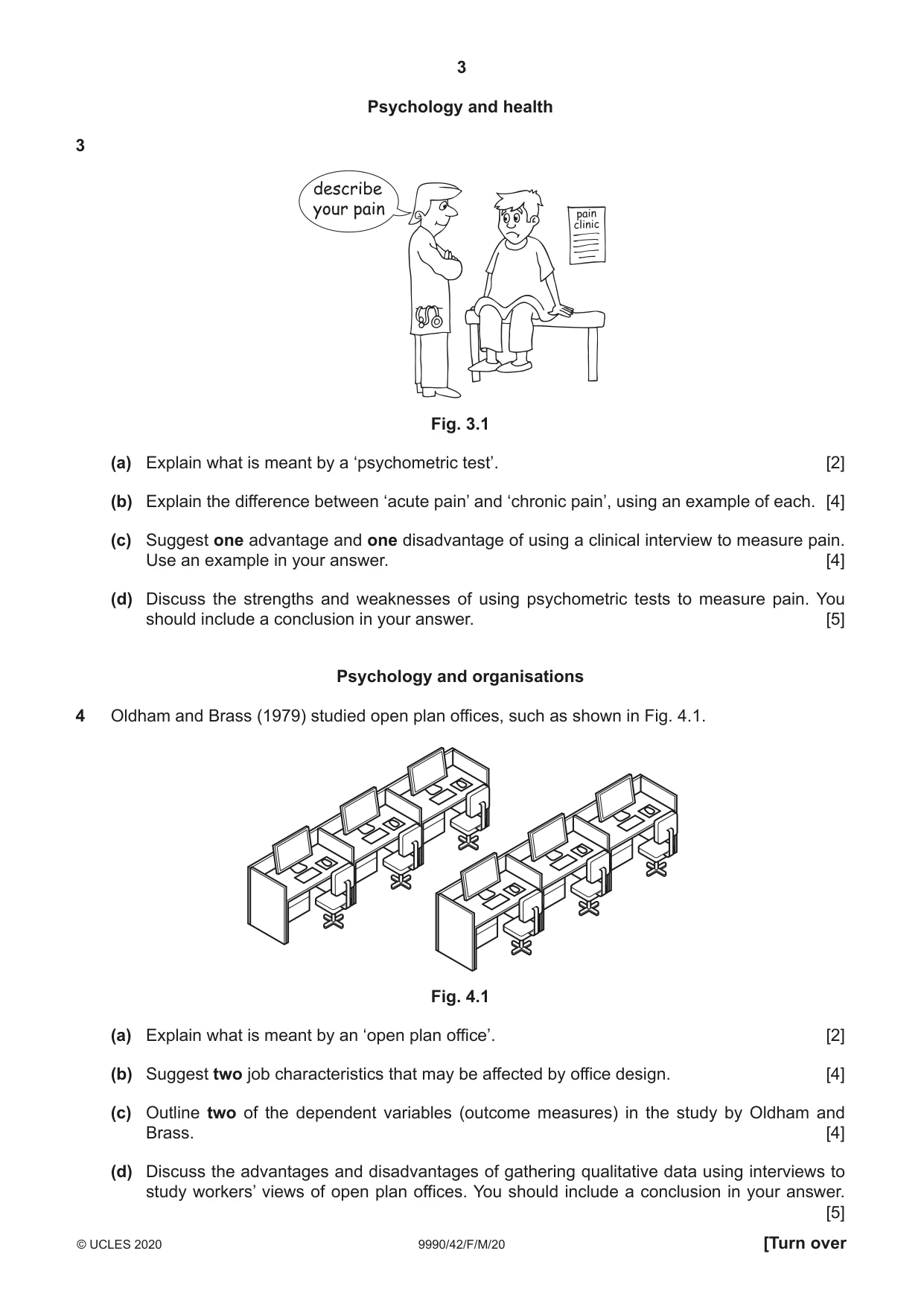
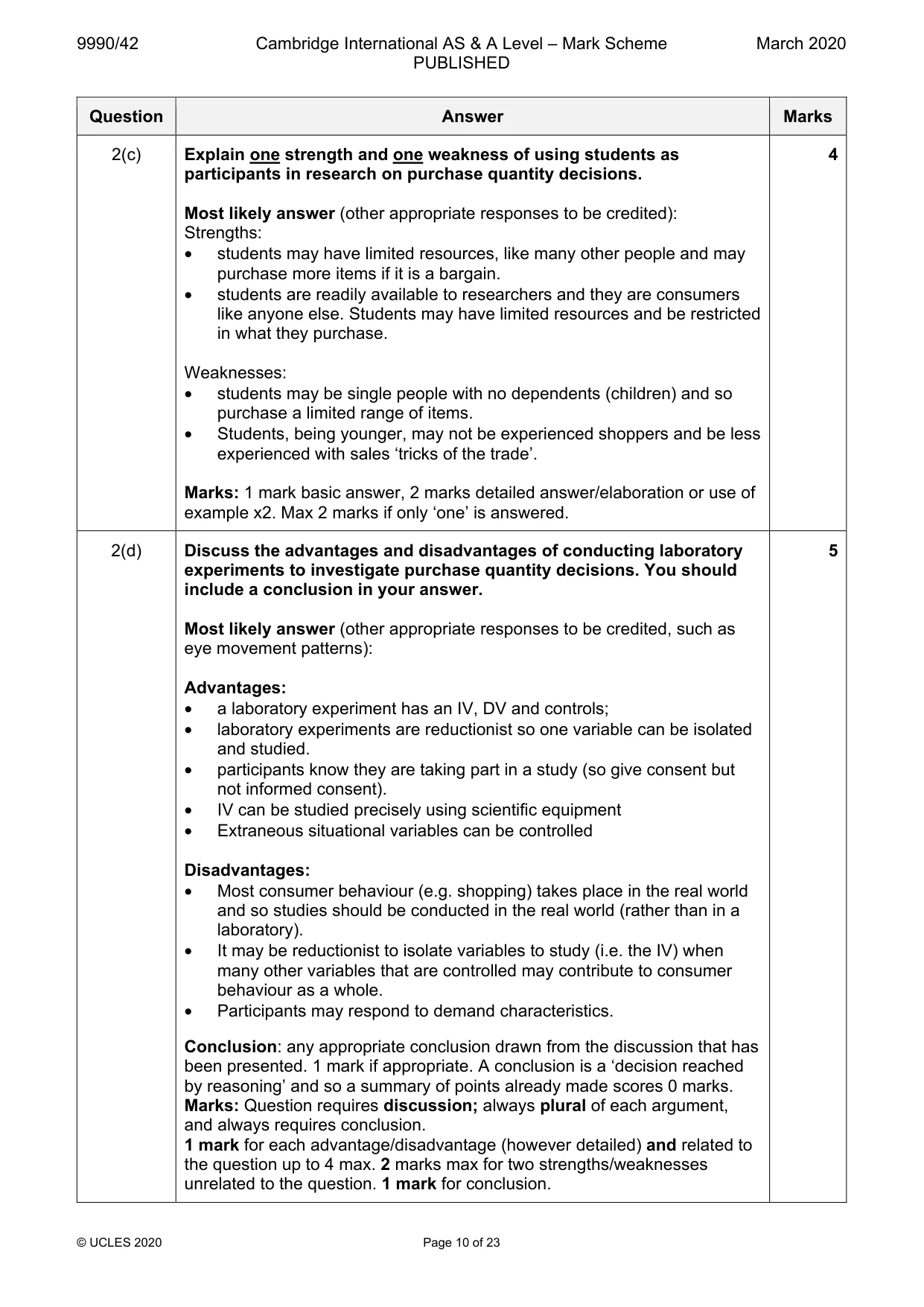
3 describe your pain Fig. 3.1 (a) Explain what is meant by a ‘psychometric test’. [2] (b) Explain the difference between ‘acute pain’ and ‘chronic pain’, using an example of each. [4] (c) Suggest one advantage and one disadvantage of using a clinical interview to measure pain. Use an example in your answer. [4] (d) Discuss the strengths and weaknesses of using psychometric tests to measure pain. You should include a conclusion in your answer. [5] Psychology and organisations
Mark scheme: 3 3(a) Explain what is meant by the term ‘psychometric test’. 2 Most likely answer (other appropriate responses to be credited): A psychometric test is a ‘measure of the mind’; more importantly it is both valid and reliable. Psychometric tests are standardised, and so comparable with a sample of results already obtained. Marks: 1 mark for ‘measure of mind’; 2 marks detailed answer/elaboration/ example e.g. MPQ. 3(b) Explain the difference between ‘acute pain’ and ‘chronic pain’, using 4 an example of each. Most likely answer (other appropriate responses to be credited): • Acute pain: short-term, temporary (e.g. finger trapped in a door) • Chronic pain: long term (3 months or more) e.g. arthritis. Marks: 2 marks for acute versus chronic difference; 2 marks for example of each. 3(c) Suggest one advantage and one disadvantage of using a clinical 4 interview to measure pain. Use an example in your answer. Marks: 1 mark for identification of each control group. Advantage • Patient can explain in detail how their pain feels • Practitioner can hear from the patient themselves • Patient is part of the assessment process. It is their pain. Disadvantage • Patient may not be able to adequately describe their pain (limited terminology) • Practitioner may misinterpret description if non-medical terminology is used. • Pain experience is not comparable if no psychometric measure is used. Marks: 1 mark for advantage and 1 mark for example; 1 mark for disadvantage and 1 mark for example. 2 marks for one example if detailed and appropriate. 3(d) Discuss the strengths and weaknesses of using psychometric tests to 5 measure pain. You should include a conclusion in your answer. Most likely answer (other appropriate responses to be credited): Strengths: • quantitative data allows comparison between one person and another • subjectivity of a clinical interview is said to be removed. • person can complete the questionnaire/scale in their own time Weaknesses: • quantitative data results from subjective estimation by person • person may exaggerate extent of pain to receive more medication or be treated faster. • person may not understand terminology used, such as ‘lancinating’. • person cannot express how they really feel or are experiencing the pain. • completing a questionnaire may not be appropriate for a person in severe pain. Conclusion: any appropriate conclusion drawn from the discussion that has been presented. 1 mark if appropriate. A conclusion is a ‘decision reached by reasoning’ and so a summary of points already made scores 0 marks. N.B.: credit MPQ, PPQ as examples and alternative measures for examples, such as clinical interview. No credit for qualitative data as this is not a psychometric measure. Marks: Question requires discussion; always plural of each argument, and always requires conclusion. 1 mark for each advantage/disadvantage (however detailed) and related to the question up to 4 max. 2 marks max for two strengths/weaknesses unrelated to the question. 1 mark for conclusion.
Q4 · Oldham and Brass (1979) studied open plan offices, such as shown in Fig
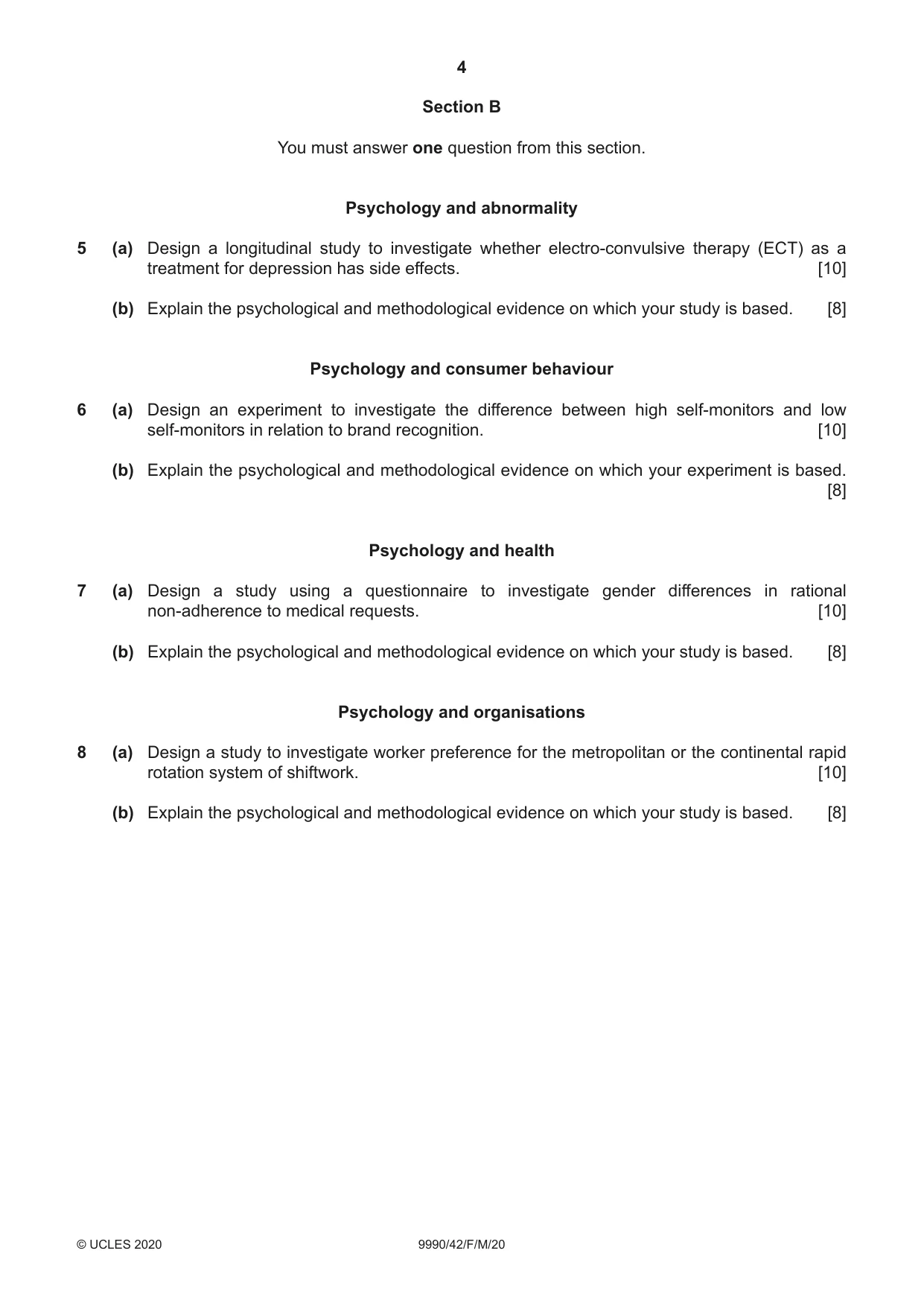
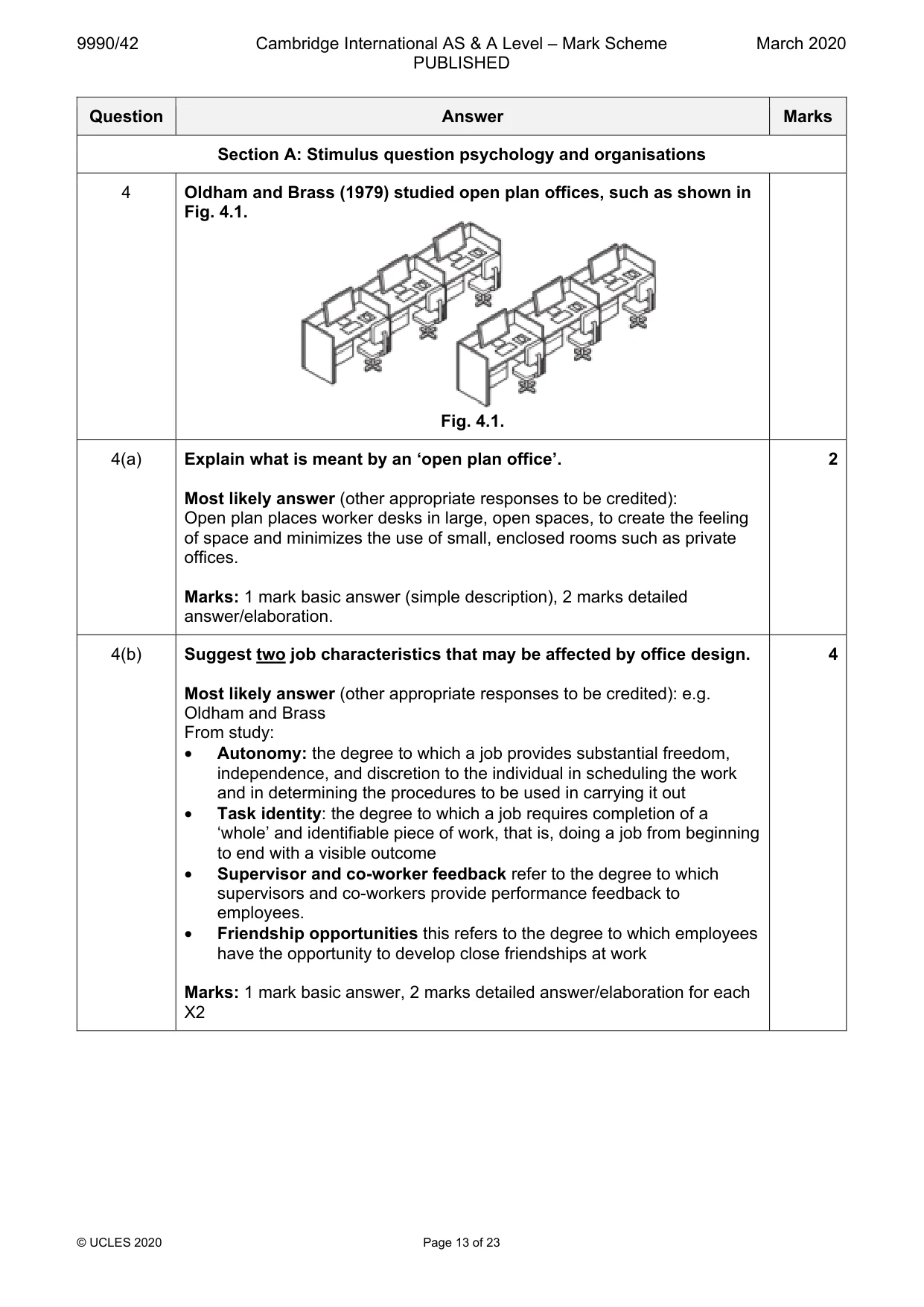
4 Oldham and Brass (1979) studied open plan offices, such as shown in Fig. 4.1. Fig. 4.1 (a) Explain what is meant by an ‘open plan office’. [2] (b) Suggest two job characteristics that may be affected by office design. [4] (c) Outline two of the dependent variables (outcome measures) in the study by Oldham and Brass. [4] (d) Discuss the advantages and disadvantages of gathering qualitative data using interviews to study workers’ views of open plan offices. You should include a conclusion in your answer. [5]
Mark scheme: 4 Oldham and Brass (1979) studied open plan offices, such as shown in Fig. 4.1. Fig. 4.1. 4(a) Explain what is meant by an ‘open plan office’. 2 Most likely answer (other appropriate responses to be credited): Open plan places worker desks in large, open spaces, to create the feeling of space and minimizes the use of small, enclosed rooms such as private offices. Marks: 1 mark basic answer (simple description), 2 marks detailed answer/elaboration. 4(b) Suggest two job characteristics that may be affected by office design. 4 Most likely answer (other appropriate responses to be credited): e.g. Oldham and Brass From study: • Autonomy: the degree to which a job provides substantial freedom, independence, and discretion to the individual in scheduling the work and in determining the procedures to be used in carrying it out • Task identity: the degree to which a job requires completion of a ‘whole’ and identifiable piece of work, that is, doing a job from beginning to end with a visible outcome • Supervisor and co-worker feedback refer to the degree to which supervisors and co-workers provide performance feedback to employees. • Friendship opportunities this refers to the degree to which employees have the opportunity to develop close friendships at work Marks: 1 mark basic answer, 2 marks detailed answer/elaboration for each X2 4(c) Outline two of the dependent variables (outcome measures) in the 4 study by Oldham and Brass. Most likely answer (other appropriate responses to be credited): The outcome measures are as follows: • Work satisfaction is the degree to which an employee is satisfied and happy with the job. This variable was measured with nine items from the JDS, which were designed to tap ‘general’ and ‘growth’ satisfactions at work. The nine items were averaged to form a work satisfaction index. • Interpersonal satisfaction is the degree to which an employee is satisfied with co-workers and supervisors at work. Six items from the ‘social’ and ‘supervisory’ satisfaction sections of the JDS were averaged to form the measure of interpersonal satisfaction. • Internal work motivation is the degree to which an individual experiences positive internal feelings when performing effectively on the job. Six items were averaged to form the measure of internal motivation. This measure has been found to relate substantially to measures of employees' work performance Marks: 1 mark basic answer, 2 marks detailed answer/elaboration x2. 4(d) Discuss the advantages and disadvantages of gathering qualitative 5 data using interviews to study workers’ views of open plan offices. You should include a conclusion in your answer. Most likely answer (other appropriate responses to be credited): Self-reports can include questionnaires and interviews. Advantages • Asking people directly means that participants are given the opportunity to express their feelings and explain their experiences rather than the researcher trying to work out reasons for their behaviour from other methods • People can give as much information as they wish, but they can also say little or nothing if they wish. • Data can be qualitative, but may also be quantitative depending on type of question Disadvantages • Some participants may provide socially desirable responses; not give truthful answers; respond to demand characteristics. • Qualitative data tends not to lead to the calculation of statistics to allow comparison. • Researchers have to be careful about use of leading questions; it could affect the validity of the data collected. Conclusion: any appropriate conclusion drawn from the discussion that has been presented. 1 mark if appropriate. A conclusion is a ‘decision reached by reasoning’ and so a summary of points already made scores 0 marks. Marks: Question requires discussion; always plural of each argument, and always requires conclusion. 1 mark for each advantage/disadvantage (however detailed) and related to the question up to 4 max. 2 marks max for two strengths/weaknesses unrelated to the question. 1 mark for conclusion.
Q5 · Design a longitudinal study to investigate whether electro-convulsive therapy (ECT) as a…
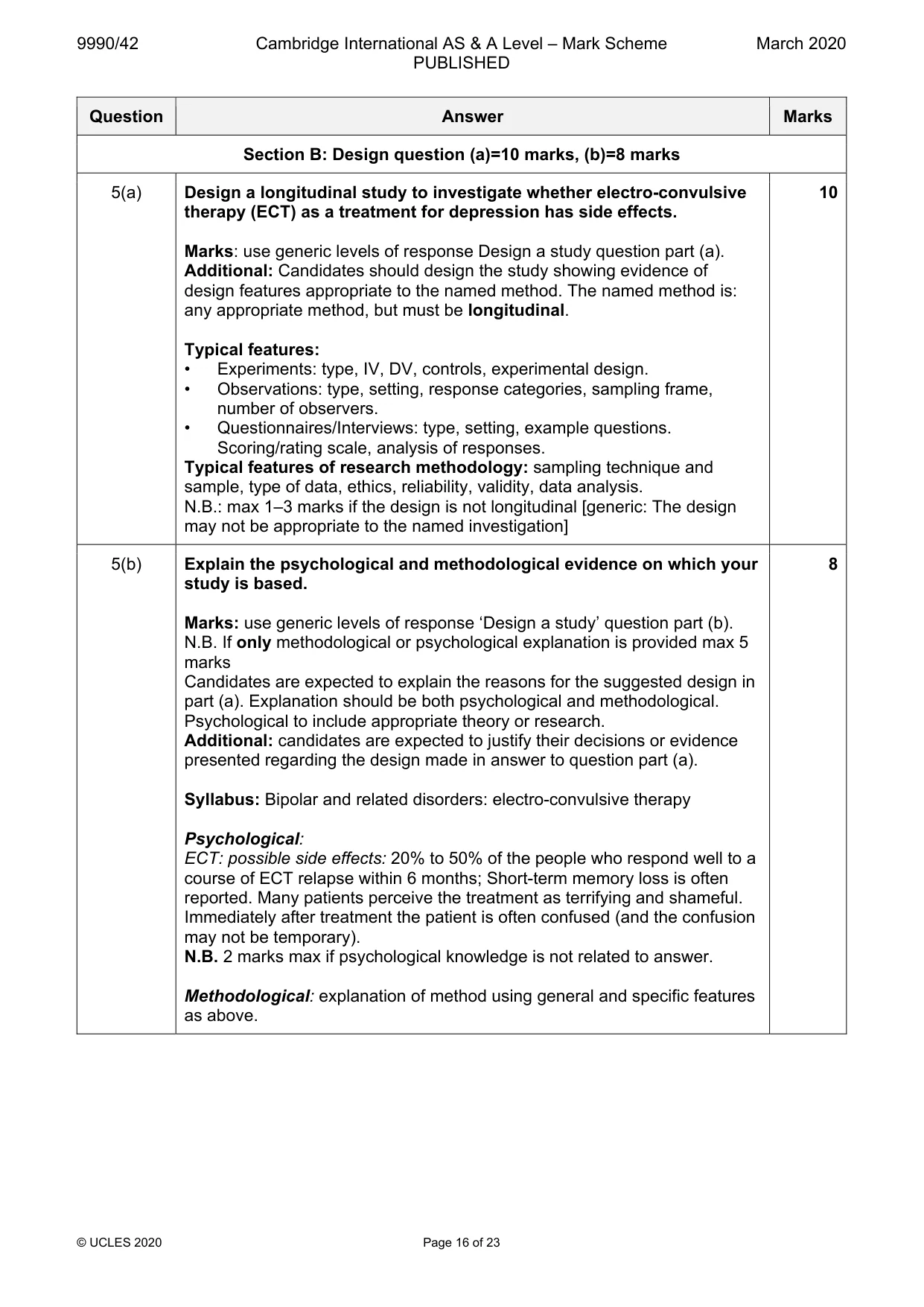
5 (a) Design a longitudinal study to investigate whether electro-convulsive therapy (ECT) as a treatment for depression has side effects. [10] (b) Explain the psychological and methodological evidence on which your study is based. [8] Psychology and consumer behaviour
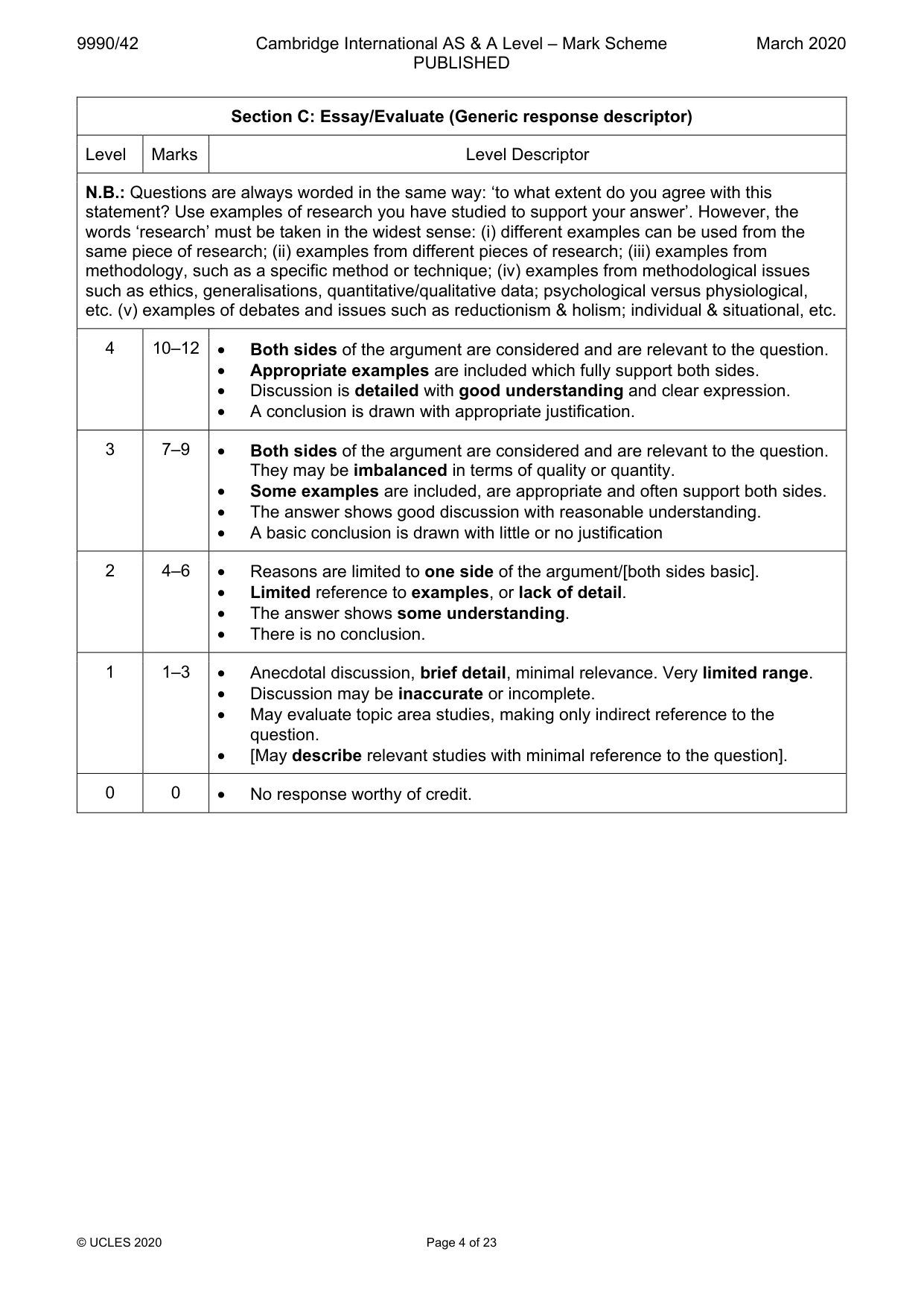
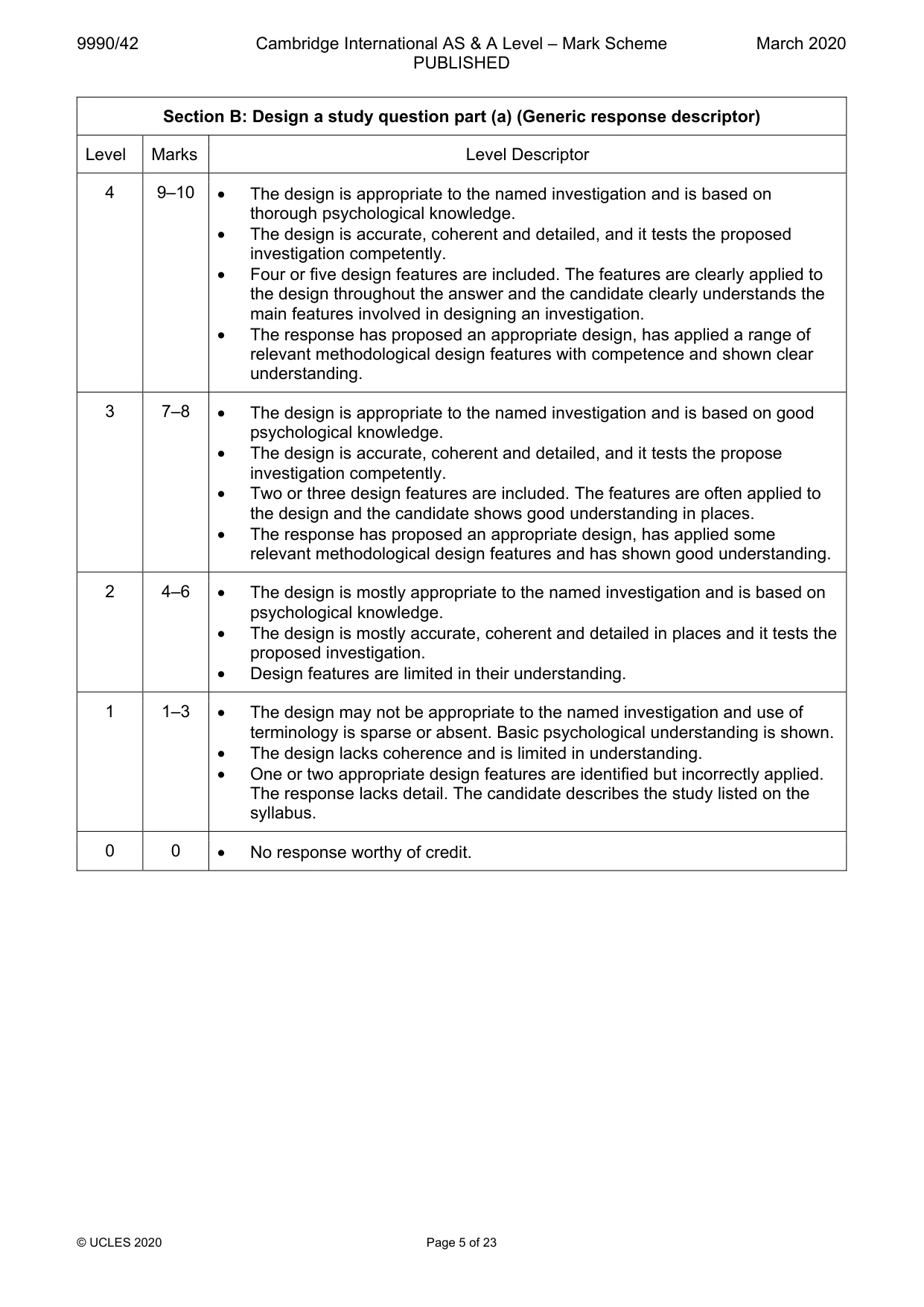
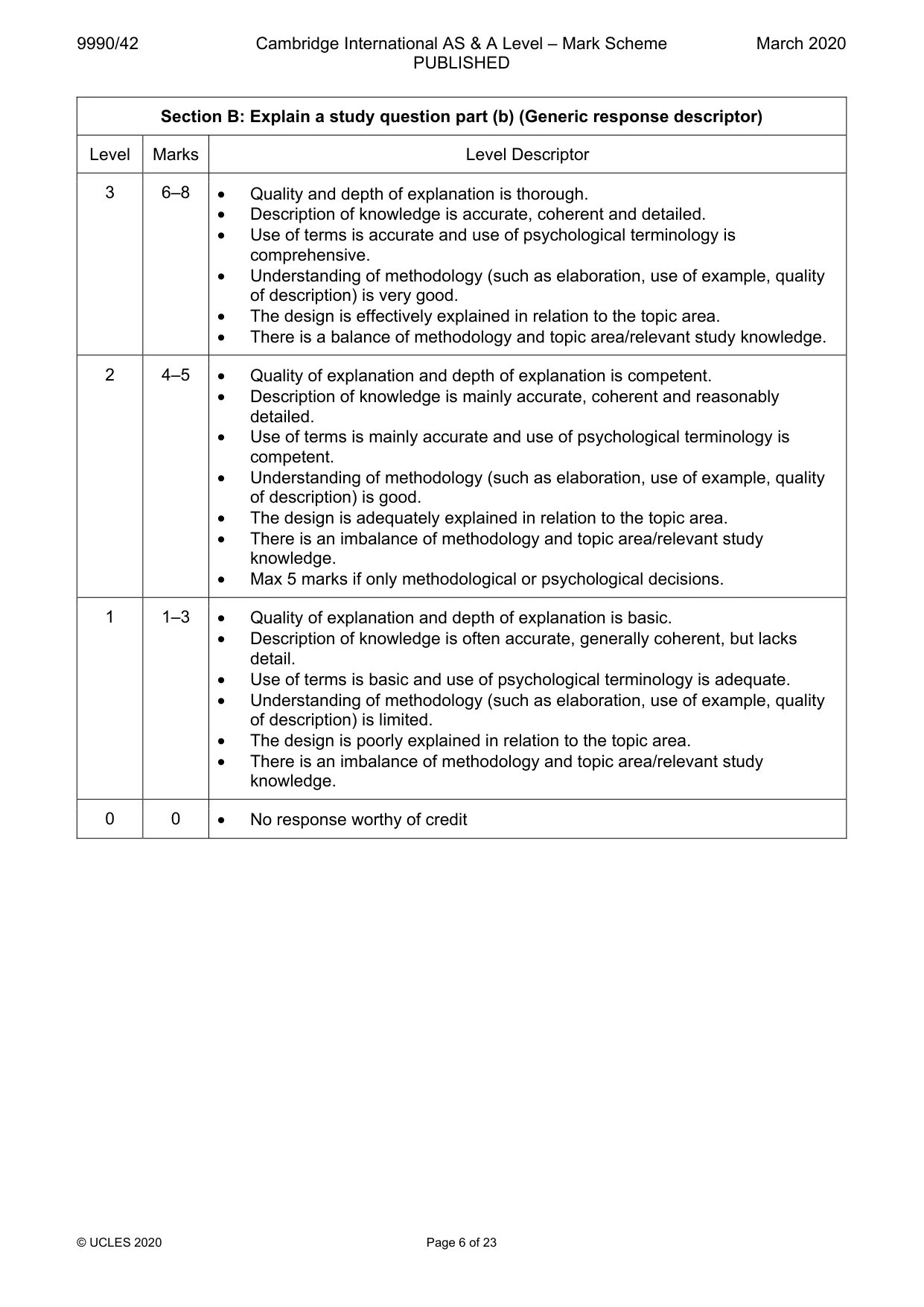
Mark scheme: 5(a) Design a longitudinal study to investigate whether electro-convulsive 10 therapy (ECT) as a treatment for depression has side effects. Marks: use generic levels of response Design a study question part (a). Additional: Candidates should design the study showing evidence of design features appropriate to the named method. The named method is: any appropriate method, but must be longitudinal. Typical features: • Experiments: type, IV, DV, controls, experimental design. • Observations: type, setting, response categories, sampling frame, number of observers. • Questionnaires/Interviews: type, setting, example questions. Scoring/rating scale, analysis of responses. Typical features of research methodology: sampling technique and sample, type of data, ethics, reliability, validity, data analysis. N.B.: max 1–3 marks if the design is not longitudinal [generic: The design may not be appropriate to the named investigation] 5(b) Explain the psychological and methodological evidence on which your 8 study is based. Marks: use generic levels of response ‘Design a study’ question part (b). N.B. If only methodological or psychological explanation is provided max 5 marks Candidates are expected to explain the reasons for the suggested design in part (a). Explanation should be both psychological and methodological. Psychological to include appropriate theory or research. Additional: candidates are expected to justify their decisions or evidence presented regarding the design made in answer to question part (a). Syllabus: Bipolar and related disorders: electro-convulsive therapy Psychological: ECT: possible side effects: 20% to 50% of the people who respond well to a course of ECT relapse within 6 months; Short-term memory loss is often reported. Many patients perceive the treatment as terrifying and shameful. Immediately after treatment the patient is often confused (and the confusion may not be temporary). N.B. 2 marks max if psychological knowledge is not related to answer. Methodological: explanation of method using general and specific features as above.
More questions on Mood (affective) disorders: depressive disorder (unipolar) and bipolar disorder
Q6 · Design an experiment to investigate the difference between high self-monitors and low…
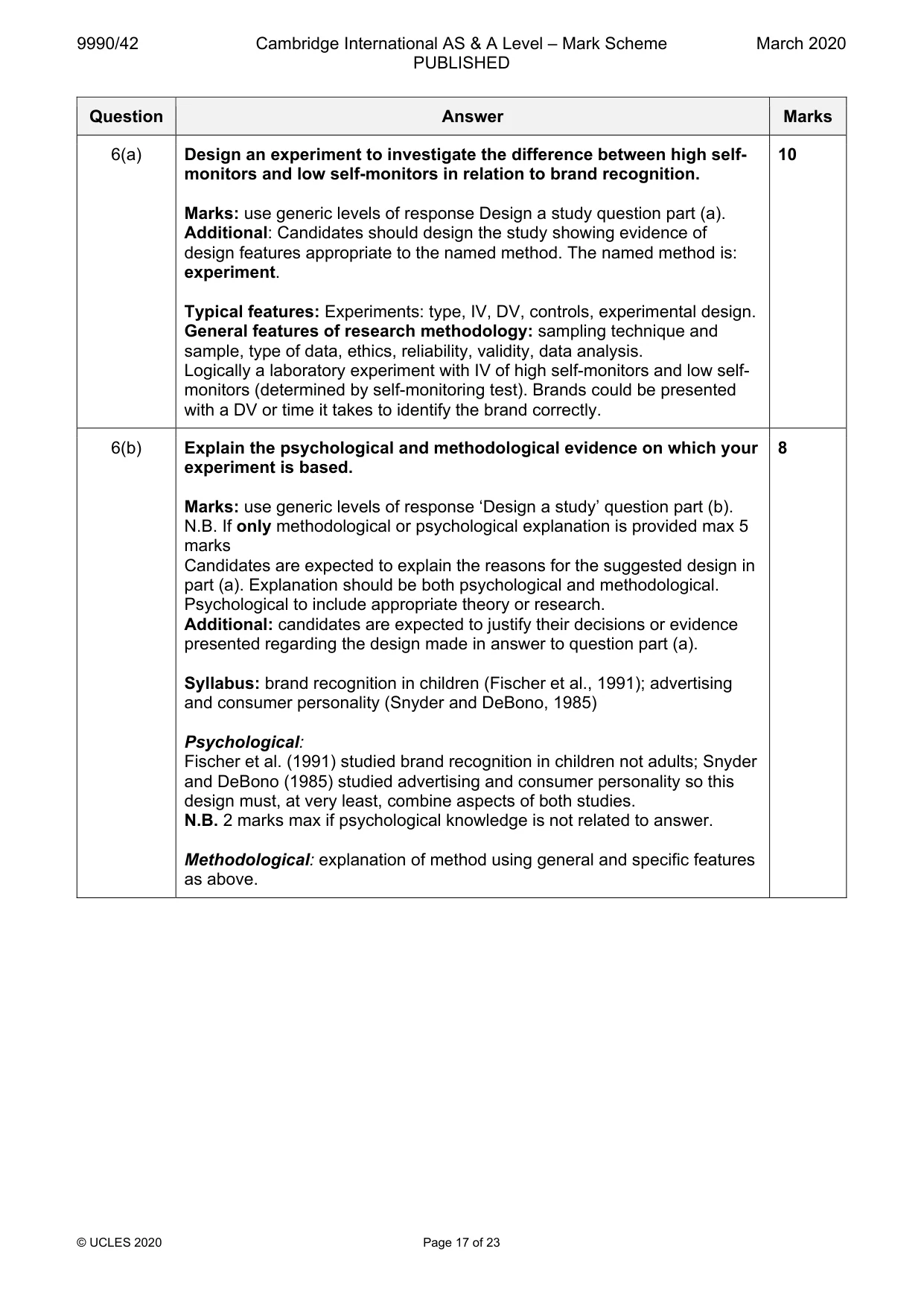
6 (a) Design an experiment to investigate the difference between high self-monitors and low self-monitors in relation to brand recognition. [10] (b) Explain the psychological and methodological evidence on which your experiment is based. [8] Psychology and health
Mark scheme: 6(a) Design an experiment to investigate the difference between high self- 10 monitors and low self-monitors in relation to brand recognition. Marks: use generic levels of response Design a study question part (a). Additional: Candidates should design the study showing evidence of design features appropriate to the named method. The named method is: experiment. Typical features: Experiments: type, IV, DV, controls, experimental design. General features of research methodology: sampling technique and sample, type of data, ethics, reliability, validity, data analysis. Logically a laboratory experiment with IV of high self-monitors and low self- monitors (determined by self-monitoring test). Brands could be presented with a DV or time it takes to identify the brand correctly. 6(b) Explain the psychological and methodological evidence on which your 8 experiment is based. Marks: use generic levels of response ‘Design a study’ question part (b). N.B. If only methodological or psychological explanation is provided max 5 marks Candidates are expected to explain the reasons for the suggested design in part (a). Explanation should be both psychological and methodological. Psychological to include appropriate theory or research. Additional: candidates are expected to justify their decisions or evidence presented regarding the design made in answer to question part (a). Syllabus: brand recognition in children (Fischer et al., 1991); advertising and consumer personality (Snyder and DeBono, 1985) Psychological: Fischer et al. (1991) studied brand recognition in children not adults; Snyder and DeBono (1985) studied advertising and consumer personality so this design must, at very least, combine aspects of both studies. N.B. 2 marks max if psychological knowledge is not related to answer. Methodological: explanation of method using general and specific features as above.
Q7 · Design a study using a questionnaire to investigate gender differences in rational…
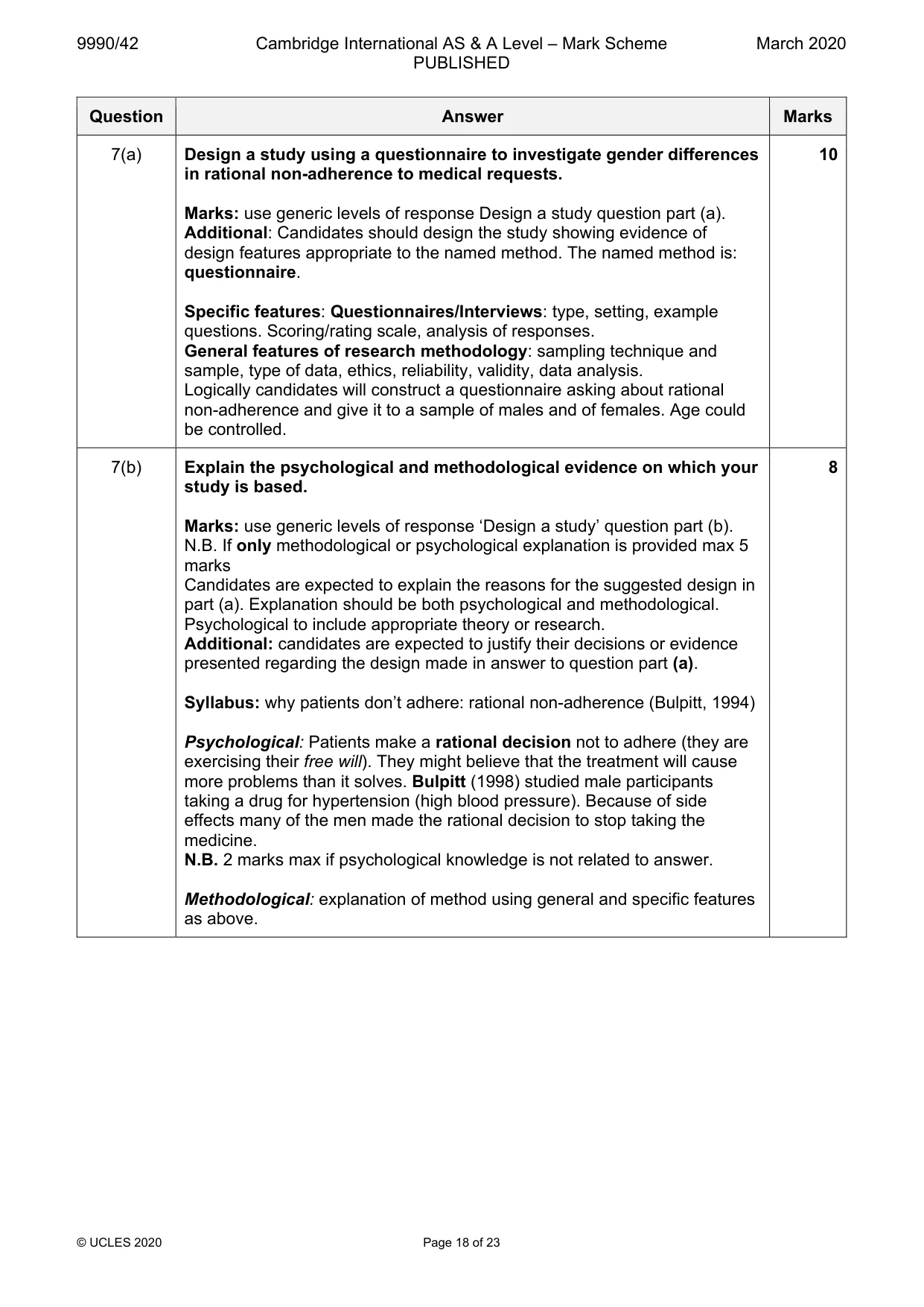
7 (a) Design a study using a questionnaire to investigate gender differences in rational non-adherence to medical requests. [10] (b) Explain the psychological and methodological evidence on which your study is based. [8] Psychology and organisations
Mark scheme: 7(a) Design a study using a questionnaire to investigate gender differences 10 in rational non-adherence to medical requests. Marks: use generic levels of response Design a study question part (a). Additional: Candidates should design the study showing evidence of design features appropriate to the named method. The named method is: questionnaire. Specific features: Questionnaires/Interviews: type, setting, example questions. Scoring/rating scale, analysis of responses. General features of research methodology: sampling technique and sample, type of data, ethics, reliability, validity, data analysis. Logically candidates will construct a questionnaire asking about rational non-adherence and give it to a sample of males and of females. Age could be controlled. 7(b) Explain the psychological and methodological evidence on which your 8 study is based. Marks: use generic levels of response ‘Design a study’ question part (b). N.B. If only methodological or psychological explanation is provided max 5 marks Candidates are expected to explain the reasons for the suggested design in part (a). Explanation should be both psychological and methodological. Psychological to include appropriate theory or research. Additional: candidates are expected to justify their decisions or evidence presented regarding the design made in answer to question part (a). Syllabus: why patients don’t adhere: rational non-adherence (Bulpitt, 1994) Psychological: Patients make a rational decision not to adhere (they are exercising their free will). They might believe that the treatment will cause more problems than it solves. Bulpitt (1998) studied male participants taking a drug for hypertension (high blood pressure). Because of side effects many of the men made the rational decision to stop taking the medicine. N.B. 2 marks max if psychological knowledge is not related to answer. Methodological: explanation of method using general and specific features as above.
Q8 · Design a study to investigate worker preference for the metropolitan or the continental…
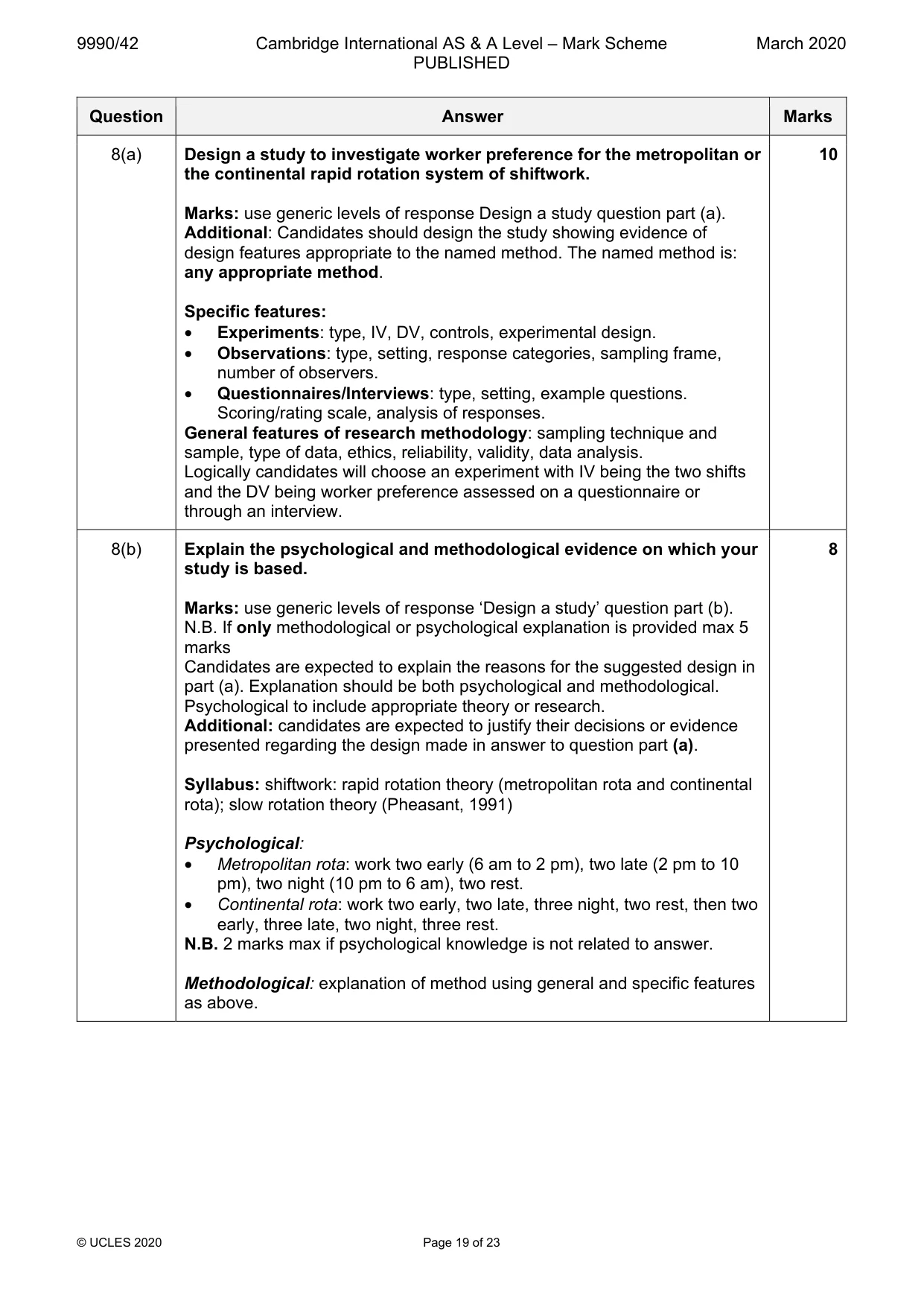
8 (a) Design a study to investigate worker preference for the metropolitan or the continental rapid rotation system of shiftwork. [10] (b) Explain the psychological and methodological evidence on which your study is based. [8] Section C You must answer one question from this section. Psychology and abnormality
Mark scheme: 8(a) Design a study to investigate worker preference for the metropolitan or 10 the continental rapid rotation system of shiftwork. Marks: use generic levels of response Design a study question part (a). Additional: Candidates should design the study showing evidence of design features appropriate to the named method. The named method is: any appropriate method. Specific features: • Experiments: type, IV, DV, controls, experimental design. • Observations: type, setting, response categories, sampling frame, number of observers. • Questionnaires/Interviews: type, setting, example questions. Scoring/rating scale, analysis of responses. General features of research methodology: sampling technique and sample, type of data, ethics, reliability, validity, data analysis. Logically candidates will choose an experiment with IV being the two shifts and the DV being worker preference assessed on a questionnaire or through an interview. 8(b) Explain the psychological and methodological evidence on which your 8 study is based. Marks: use generic levels of response ‘Design a study’ question part (b). N.B. If only methodological or psychological explanation is provided max 5 marks Candidates are expected to explain the reasons for the suggested design in part (a). Explanation should be both psychological and methodological. Psychological to include appropriate theory or research. Additional: candidates are expected to justify their decisions or evidence presented regarding the design made in answer to question part (a). Syllabus: shiftwork: rapid rotation theory (metropolitan rota and continental rota); slow rotation theory (Pheasant, 1991) Psychological: • Metropolitan rota: work two early (6 am to 2 pm), two late (2 pm to 10 pm), two night (10 pm to 6 am), two rest. • Continental rota: work two early, two late, three night, two rest, then two early, three late, two night, three rest. N.B. 2 marks max if psychological knowledge is not related to answer. Methodological: explanation of method using general and specific features as above.
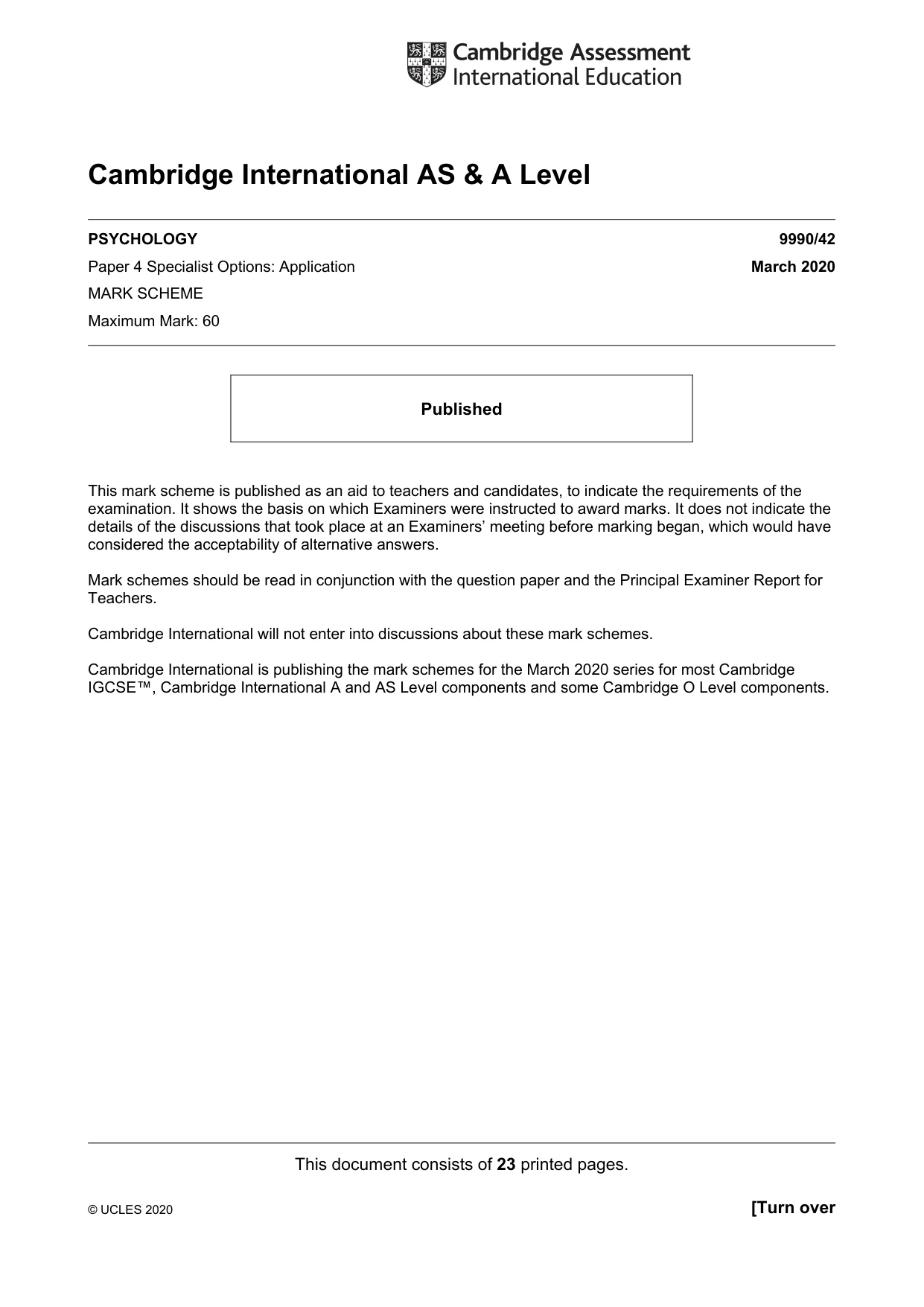
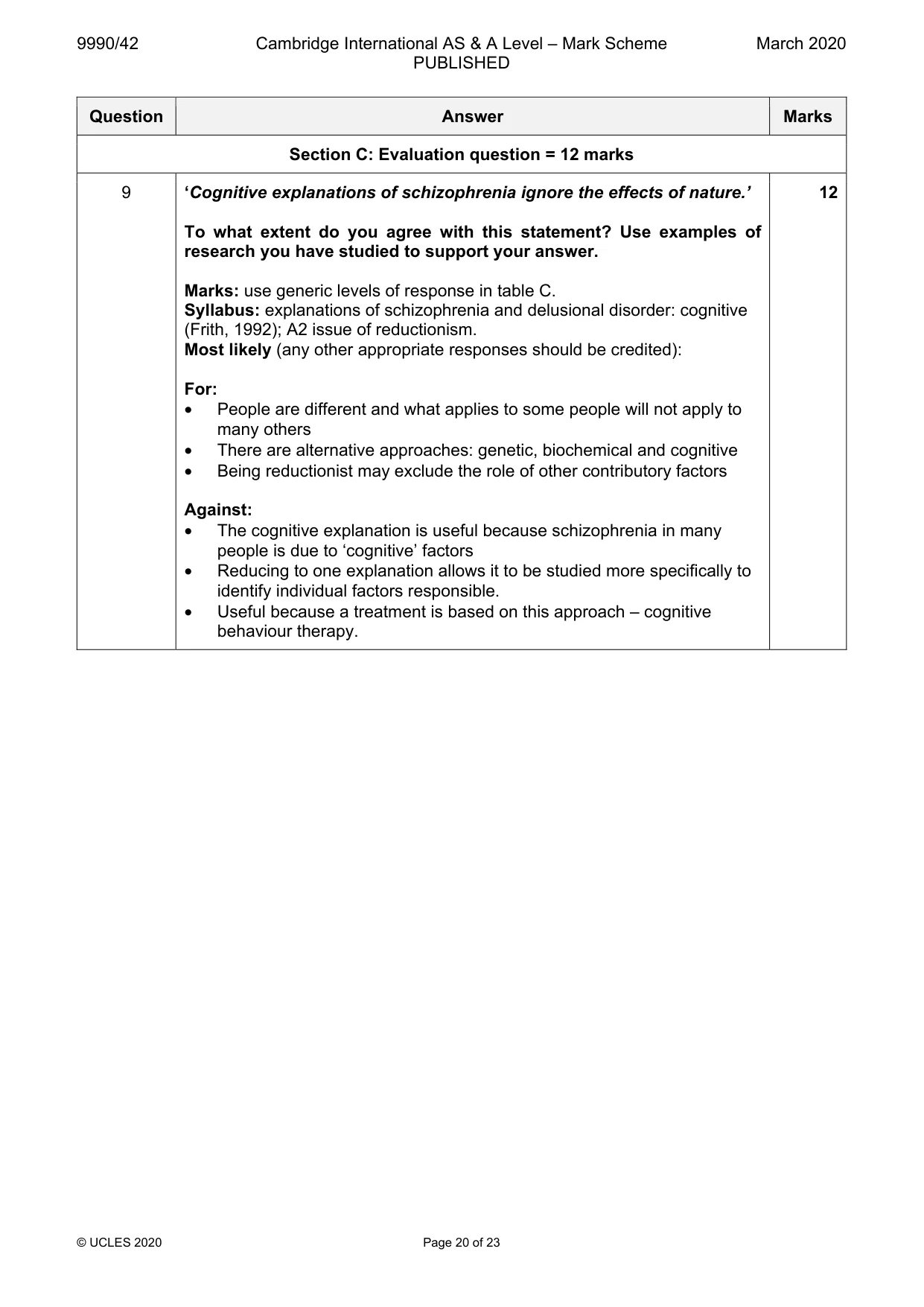
Q9 · ‘Cognitive explanations of schizophrenia ignore the effects of nature.’ To what extent do…
9 ‘Cognitive explanations of schizophrenia ignore the effects of nature.’ To what extent do you agree with this statement? Use examples of research you have studied to support your answer. [12] Psychology and consumer behaviour
Mark scheme: 9 ‘Cognitive explanations of schizophrenia ignore the effects of nature.’ 12 To what extent do you agree with this statement? Use examples of research you have studied to support your answer. Marks: use generic levels of response in table C. Syllabus: explanations of schizophrenia and delusional disorder: cognitive (Frith, 1992); A2 issue of reductionism. Most likely (any other appropriate responses should be credited): For: • People are different and what applies to some people will not apply to many others • There are alternative approaches: genetic, biochemical and cognitive • Being reductionist may exclude the role of other contributory factors Against: • The cognitive explanation is useful because schizophrenia in many people is due to ‘cognitive’ factors • Reducing to one explanation allows it to be studied more specifically to identify individual factors responsible. • Useful because a treatment is based on this approach – cognitive behaviour therapy.
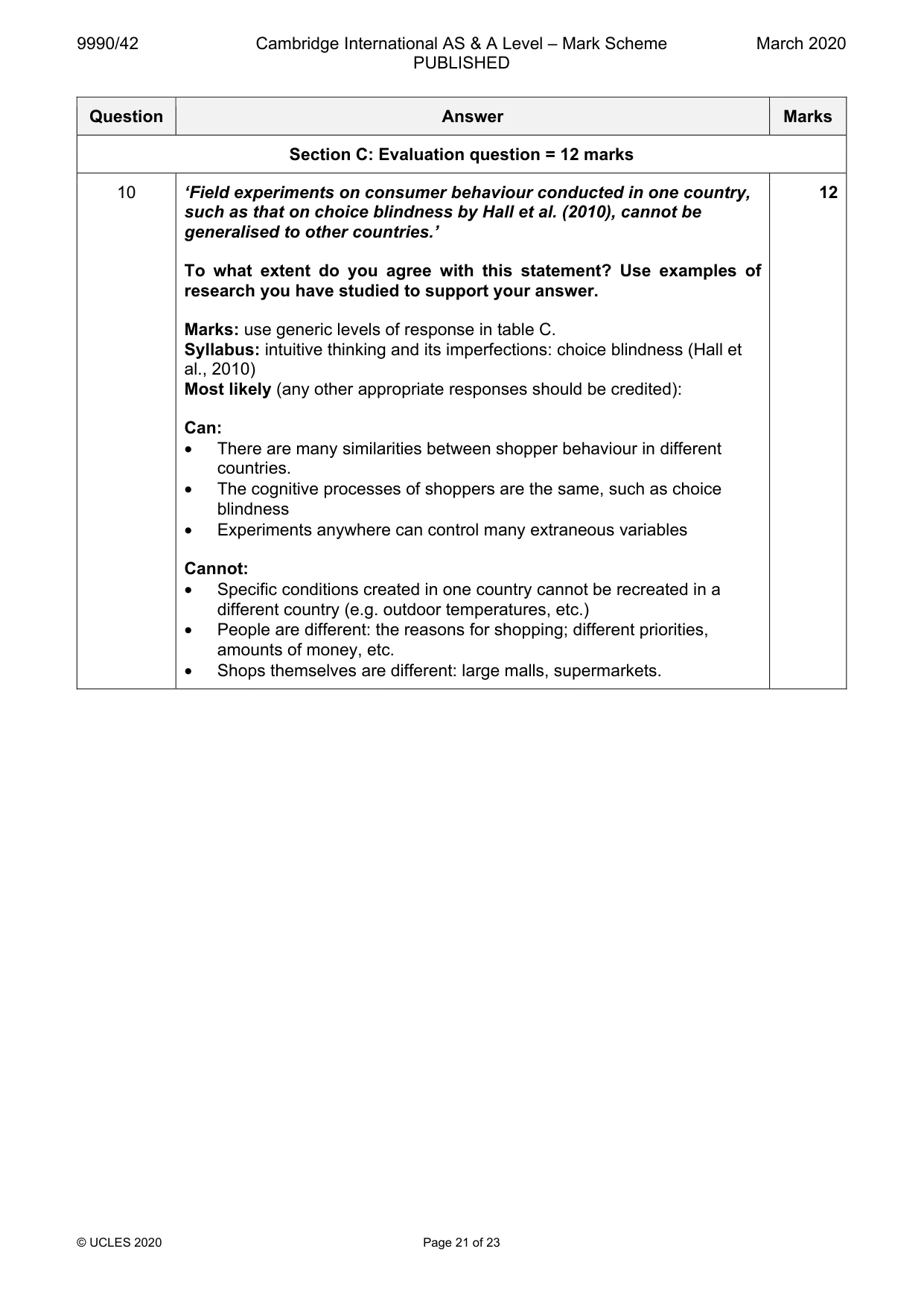
Q10 · ‘Field experiments on consumer behaviour conducted in one country, such as that on choice…
10 ‘Field experiments on consumer behaviour conducted in one country, such as that on choice blindness by Hall et al. (2010), cannot be generalised to other countries.’ To what extent do you agree with this statement? Use examples of research you have studied to support your answer. [12] Psychology and health
Mark scheme: 10 ‘Field experiments on consumer behaviour conducted in one country, 12 such as that on choice blindness by Hall et al. (2010), cannot be generalised to other countries.’ To what extent do you agree with this statement? Use examples of research you have studied to support your answer. Marks: use generic levels of response in table C. Syllabus: intuitive thinking and its imperfections: choice blindness (Hall et al., 2010) Most likely (any other appropriate responses should be credited): Can: • There are many similarities between shopper behaviour in different countries. • The cognitive processes of shoppers are the same, such as choice blindness • Experiments anywhere can control many extraneous variables Cannot: • Specific conditions created in one country cannot be recreated in a different country (e.g. outdoor temperatures, etc.) • People are different: the reasons for shopping; different priorities, amounts of money, etc. • Shops themselves are different: large malls, supermarkets.
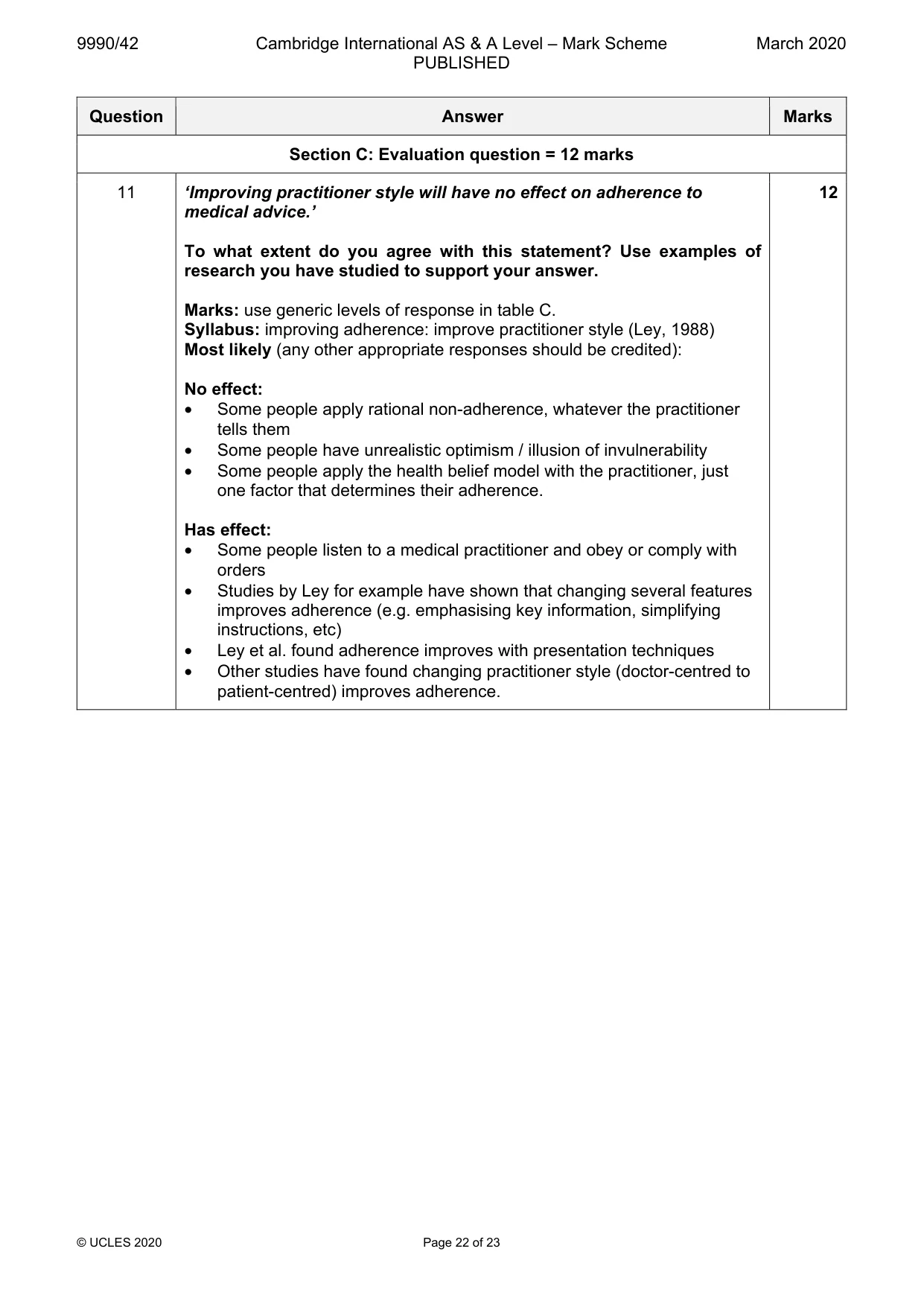
Q11 · ‘Improving practitioner style will have no effect on adherence to medical advice.’ To…
11 ‘Improving practitioner style will have no effect on adherence to medical advice.’ To what extent do you agree with this statement? Use examples of research you have studied to support your answer. [12] Psychology and organisations
Mark scheme: 11 ‘Improving practitioner style will have no effect on adherence to 12 medical advice.’ To what extent do you agree with this statement? Use examples of research you have studied to support your answer. Marks: use generic levels of response in table C. Syllabus: improving adherence: improve practitioner style (Ley, 1988) Most likely (any other appropriate responses should be credited): No effect: • Some people apply rational non-adherence, whatever the practitioner tells them • Some people have unrealistic optimism / illusion of invulnerability • Some people apply the health belief model with the practitioner, just one factor that determines their adherence. Has effect: • Some people listen to a medical practitioner and obey or comply with orders • Studies by Ley for example have shown that changing several features improves adherence (e.g. emphasising key information, simplifying instructions, etc) • Ley et al. found adherence improves with presentation techniques • Other studies have found changing practitioner style (doctor-centred to patient-centred) improves adherence.
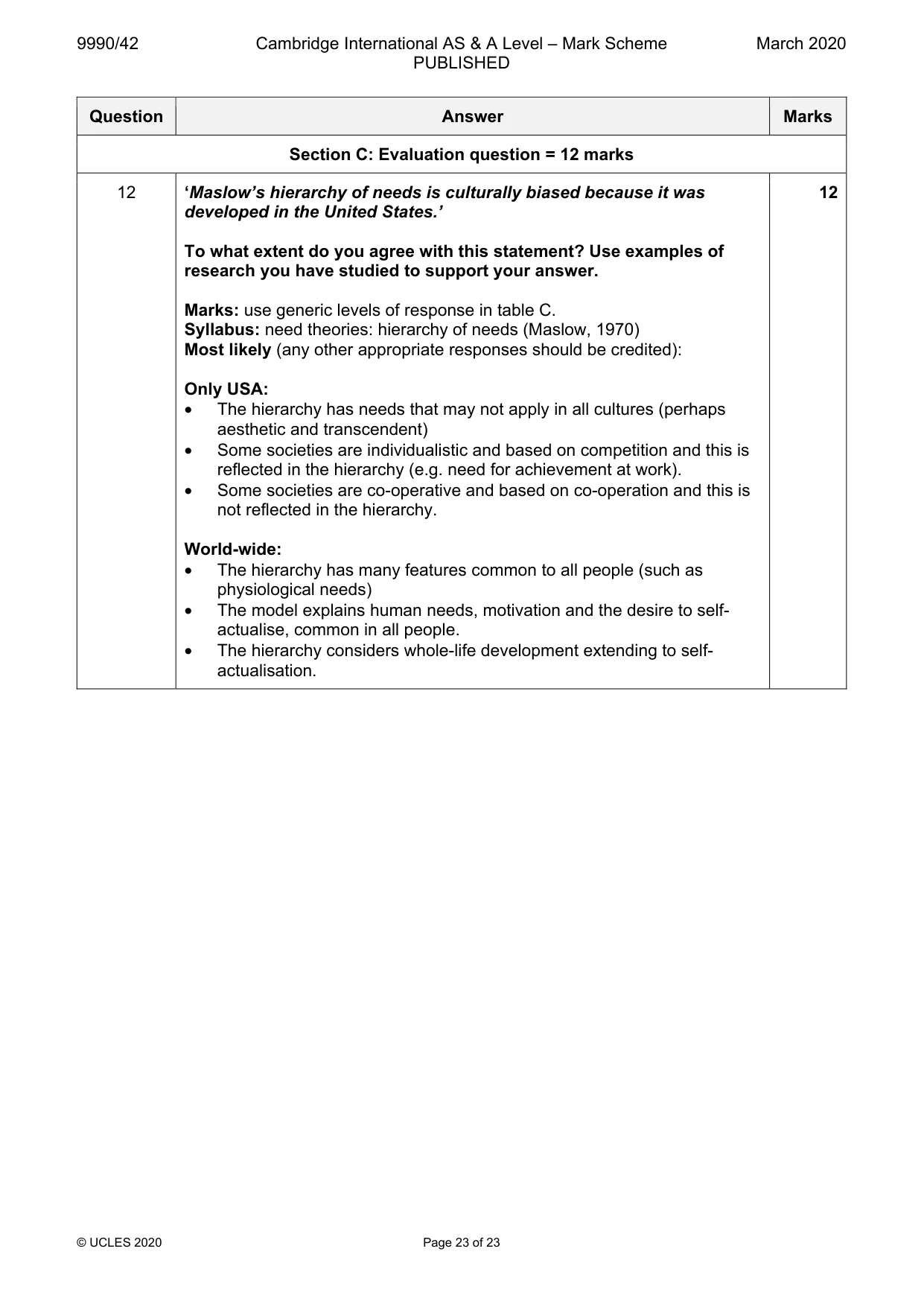
Q12 · ‘Maslow’s hierarchy of needs is culturally biased because it was developed in the United…
12 ‘Maslow’s hierarchy of needs is culturally biased because it was developed in the United States.’ To what extent do you agree with this statement? Use examples of research you have studied to support your answer. [12]
Mark scheme: 12 ‘Maslow’s hierarchy of needs is culturally biased because it was 12 developed in the United States.’ To what extent do you agree with this statement? Use examples of research you have studied to support your answer. Marks: use generic levels of response in table C. Syllabus: need theories: hierarchy of needs (Maslow, 1970) Most likely (any other appropriate responses should be credited): Only USA: • The hierarchy has needs that may not apply in all cultures (perhaps aesthetic and transcendent) • Some societies are individualistic and based on competition and this is reflected in the hierarchy (e.g. need for achievement at work). • Some societies are co-operative and based on co-operation and this is not reflected in the hierarchy. World-wide: • The hierarchy has many features common to all people (such as physiological needs) • The model explains human needs, motivation and the desire to self- actualise, common in all people. • The hierarchy considers whole-life development extending to self- actualisation.
What was in this paper
The subtopics covered by these 12 questions, and how many questions each got. Open one in a new tab to see every Cambridge question on it.
What you needed in this session
Cambridge’s own grade thresholds for 2020 Feb/March, Paper 4 · Variant 2. A higher threshold means an easier paper — the bar moves with how the cohort did.