Cambridge A Level Psychology (from 2018) 9990 — 2024 May/June Paper 4 · Variant 2
9990/42/M/J/24 · 12 questions · 60 marks · 90 min
The question paper and its mark scheme, free to read here and free to download. This is Cambridge’s own paper, exactly as it was sat.
Question paper8 pages
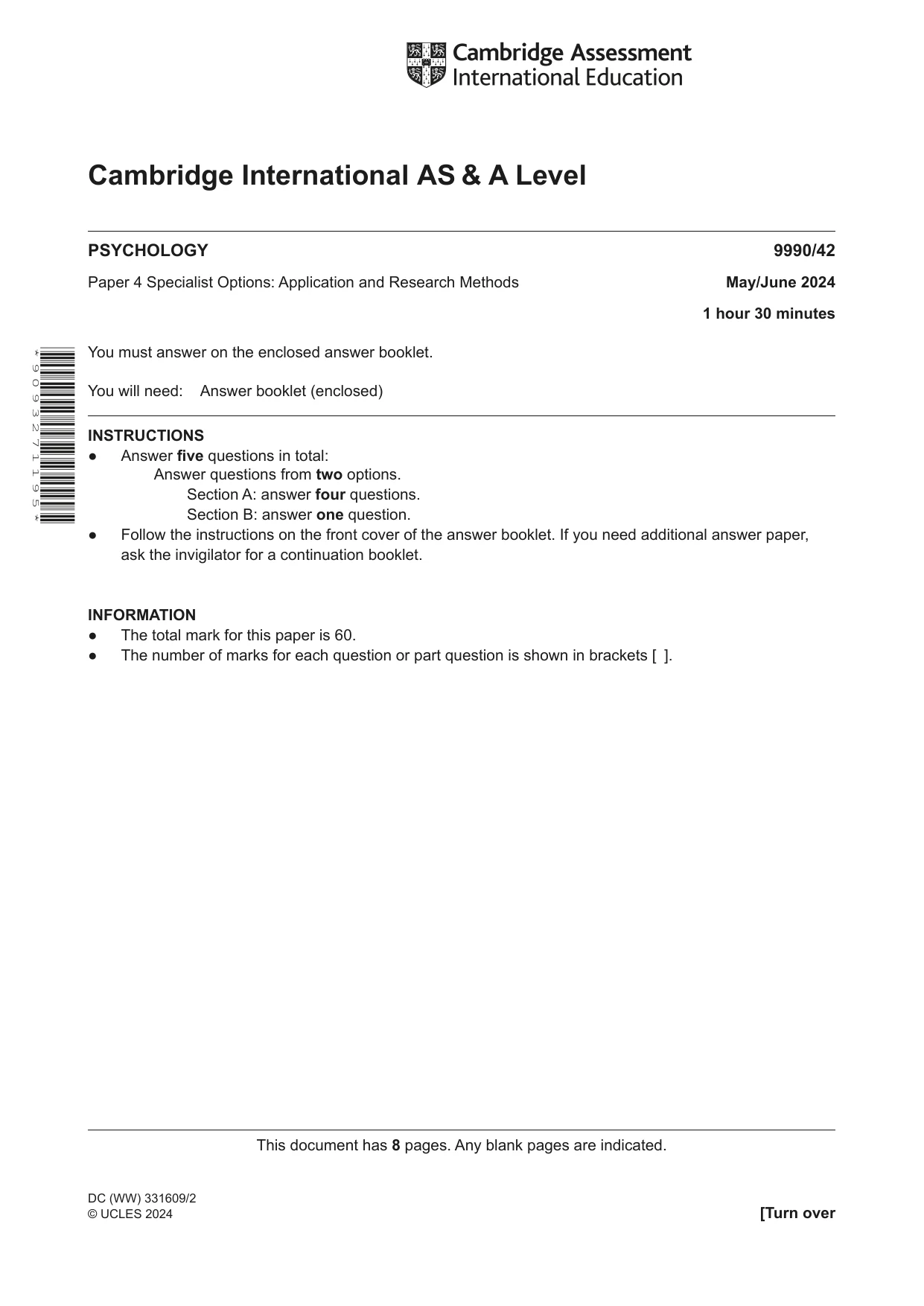
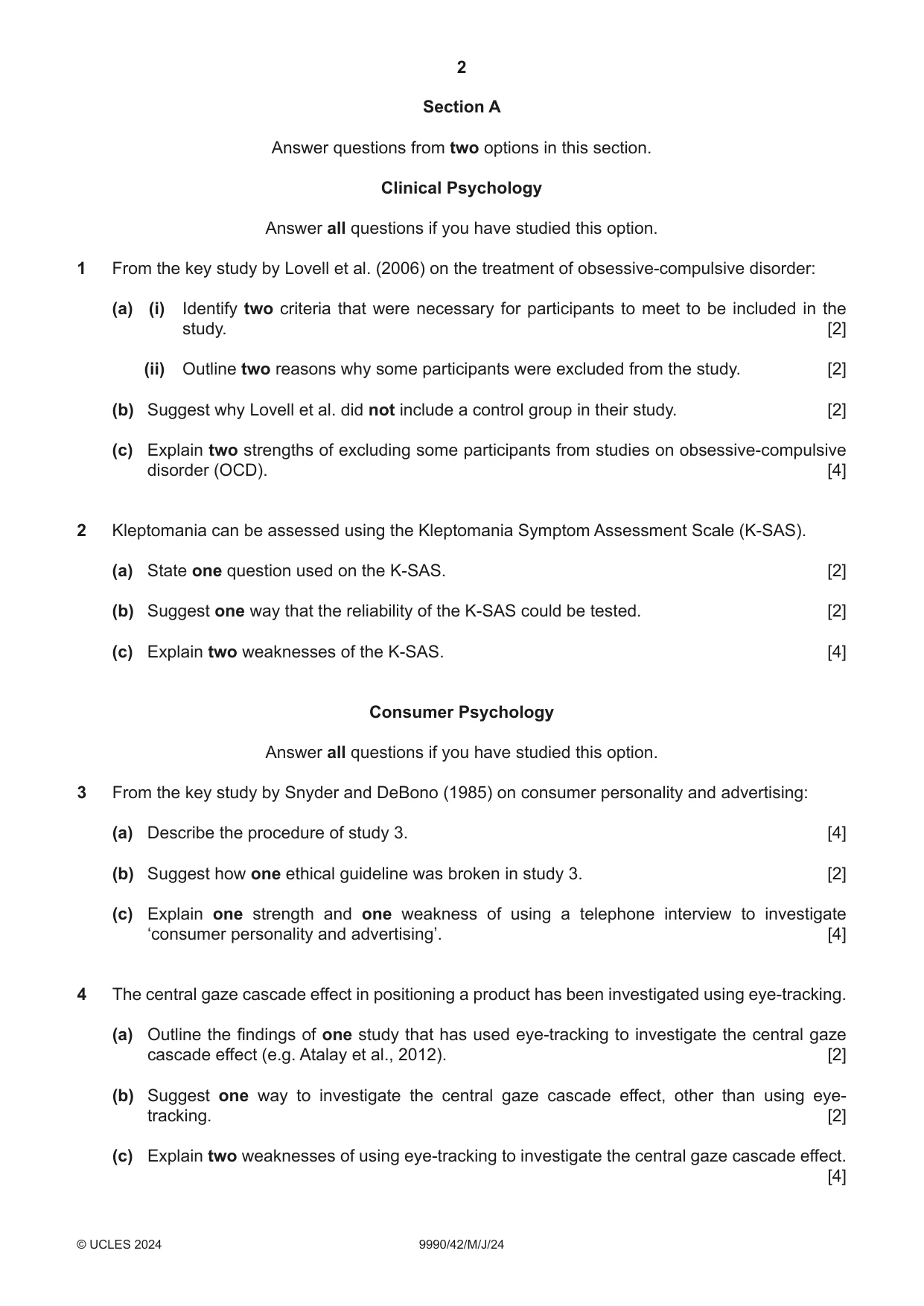
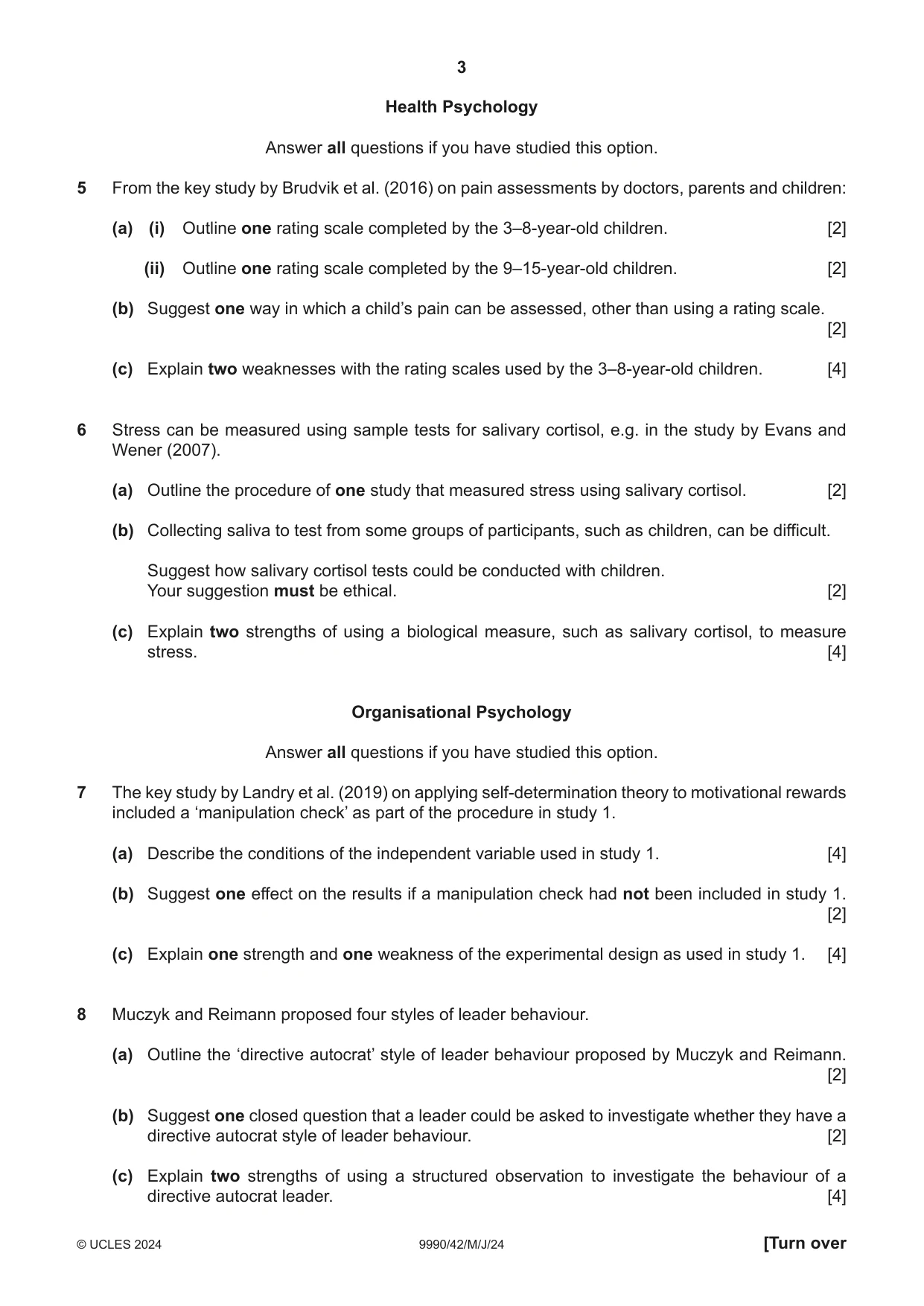
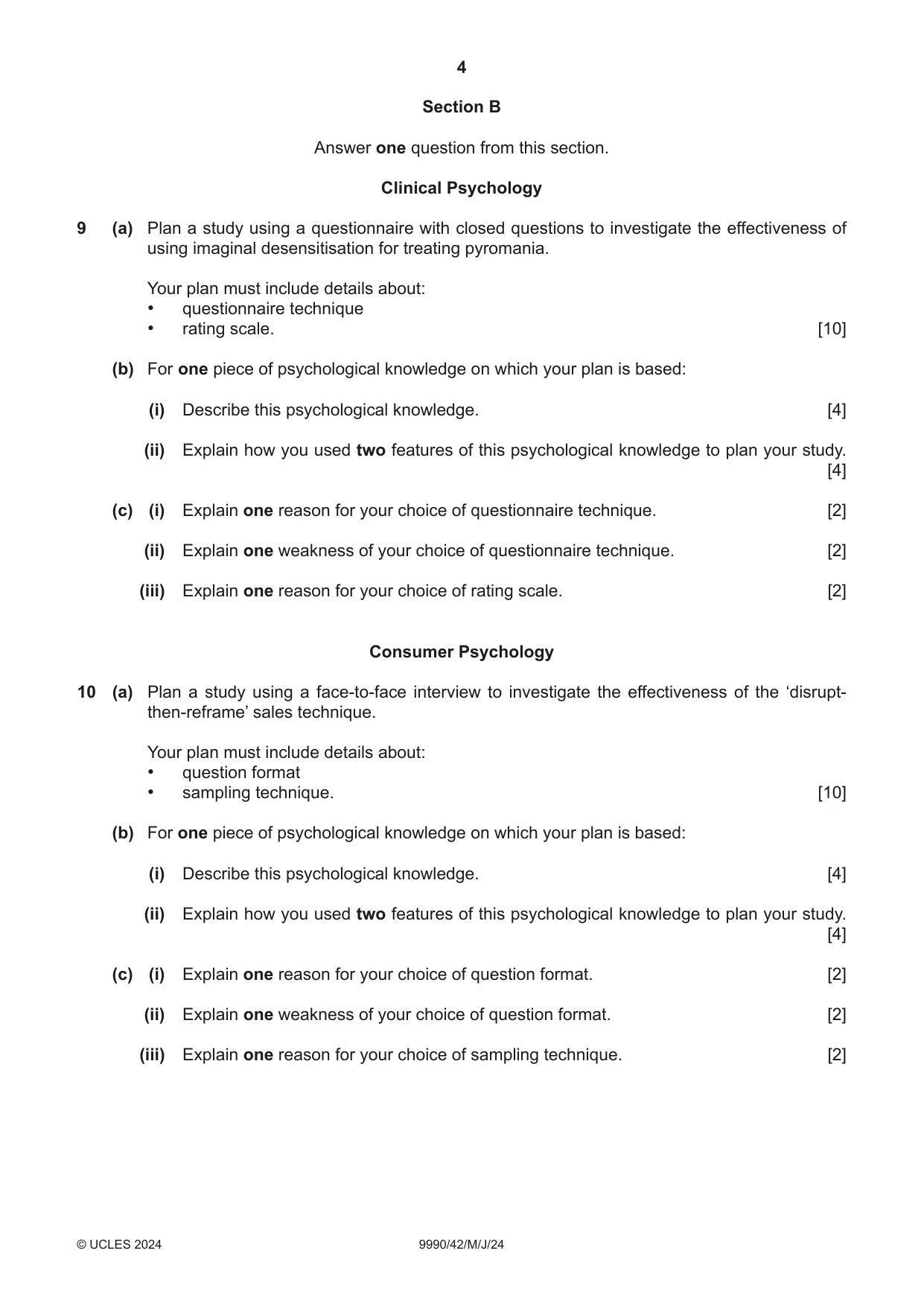



Mark scheme34 pages
Answers below. Sit the paper first if you are practising.
Questions as text
Q1 · From the key study by Lovell et al
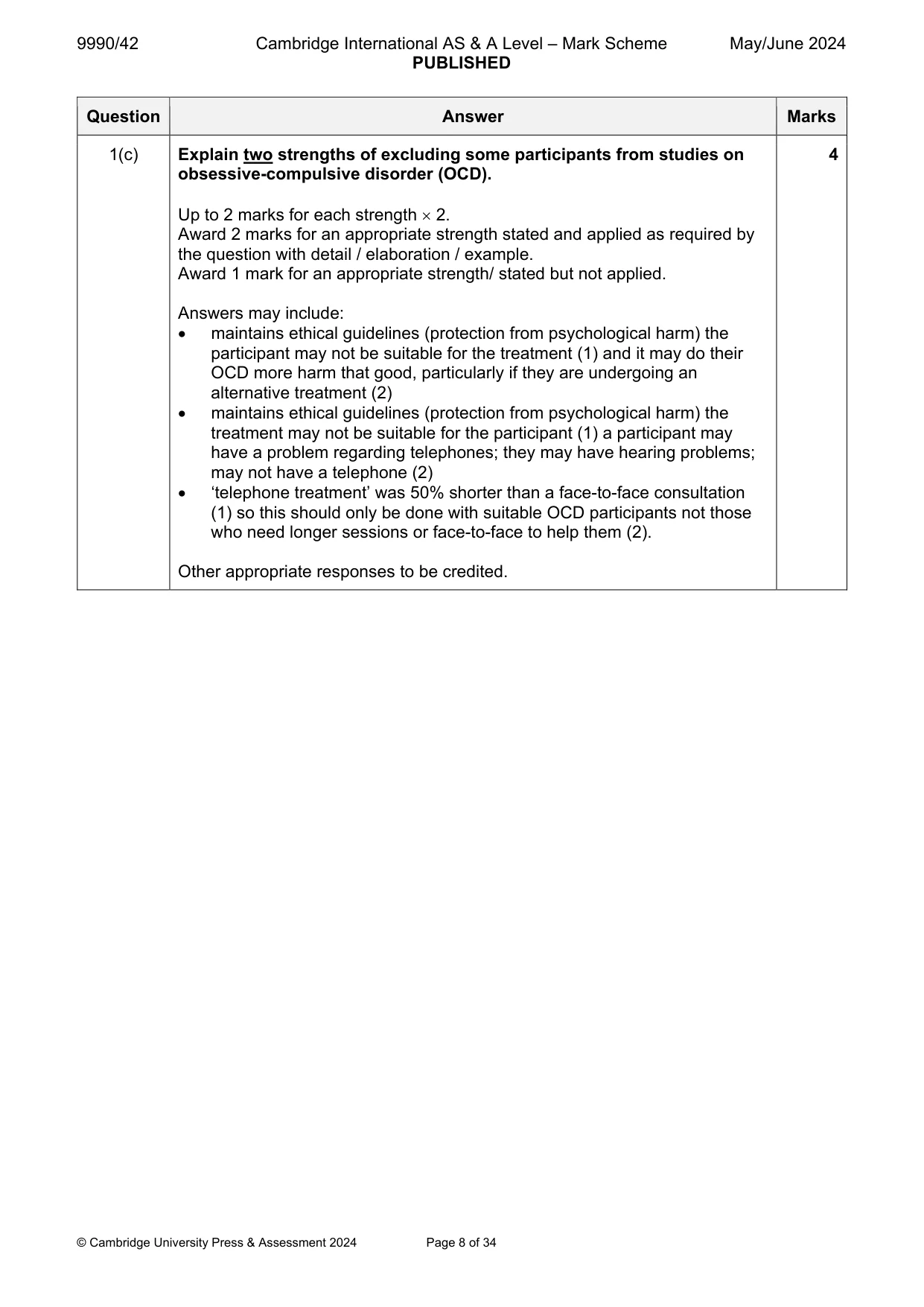
1 From the key study by Lovell et al. (2006) on the treatment of obsessive-compulsive disorder: (a) (i) Identify two criteria that were necessary for participants to meet to be included in the study. [2] (ii) Outline two reasons why some participants were excluded from the study. [2] (b) Suggest why Lovell et al. did not include a control group in their study. [2] (c) Explain two strengths of excluding some participants from studies on obsessive-compulsive disorder (OCD). [4]
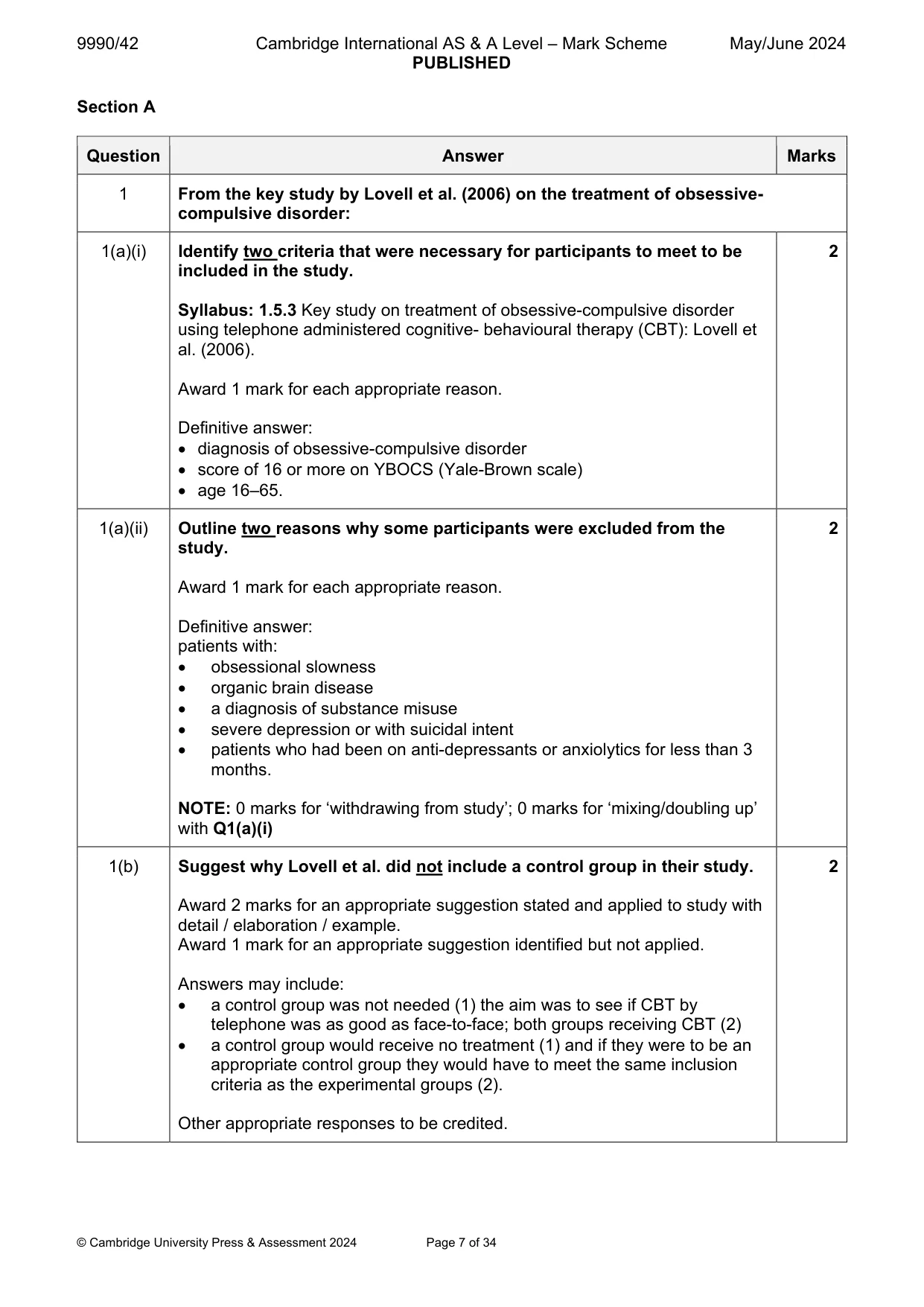
Mark scheme: Question Answer Marks 1 From the key study by Lovell et al. (2006) on the treatment of obsessive- compulsive disorder: 1(a)(i) Identify two criteria that were necessary for participants to meet to be 2 included in the study. Syllabus: 1.5.3 Key study on treatment of obsessive-compulsive disorder using telephone administered cognitive- behavioural therapy (CBT): Lovell et al. (2006). Award 1 mark for each appropriate reason. Definitive answer: diagnosis of obsessive-compulsive disorder score of 16 or more on YBOCS (Yale-Brown scale) age 16–65. 1(a)(ii) Outline two reasons why some participants were excluded from the 2 study. Award 1 mark for each appropriate reason. Definitive answer: patients with: obsessional slowness organic brain disease a diagnosis of substance misuse severe depression or with suicidal intent patients who had been on anti-depressants or anxiolytics for less than 3 months. NOTE: 0 marks for ‘withdrawing from study’; 0 marks for ‘mixing/doubling up’ with Q1(a)(i) 1(b) Suggest why Lovell et al. did not include a control group in their study. 2 Award 2 marks for an appropriate suggestion stated and applied to study with detail / elaboration / example. Award 1 mark for an appropriate suggestion identified but not applied. Answers may include: a control group was not needed (1) the aim was to see if CBT by telephone was as good as face-to-face; both groups receiving CBT (2) a control group would receive no treatment (1) and if they were to be an appropriate control group they would have to meet the same inclusion criteria as the experimental groups (2). Other appropriate responses to be credited. 1(c) Explain two strengths of excluding some participants from studies on 4 obsessive-compulsive disorder (OCD). Up to 2 marks for each strength 2. Award 2 marks for an appropriate strength stated and applied as required by the question with detail / elaboration / example. Award 1 mark for an appropriate strength/ stated but not applied. Answers may include: maintains ethical guidelines (protection from psychological harm) the participant may not be suitable for the treatment (1) and it may do their OCD more harm that good, particularly if they are undergoing an alternative treatment (2) maintains ethical guidelines (protection from psychological harm) the treatment may not be suitable for the participant (1) a participant may have a problem regarding telephones; they may have hearing problems; may not have a telephone (2) ‘telephone treatment’ was 50% shorter than a face-to-face consultation (1) so this should only be done with suitable OCD participants not those who need longer sessions or face-to-face to help them (2). Other appropriate responses to be credited.
Q2 · Kleptomania can be assessed using the Kleptomania Symptom Assessment Scale (K-SAS)
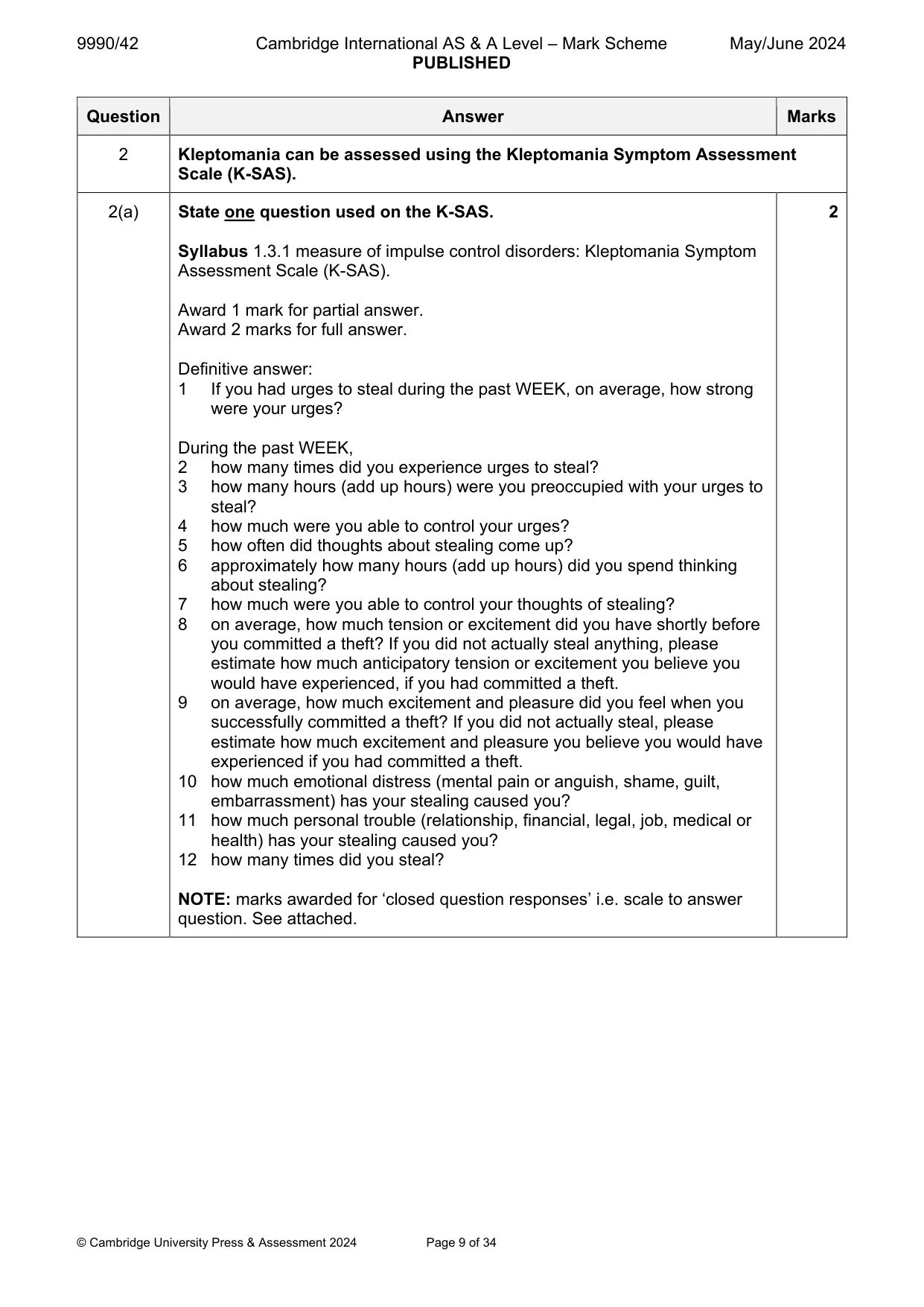
2 Kleptomania can be assessed using the Kleptomania Symptom Assessment Scale (K-SAS). (a) State one question used on the K-SAS. [2] (b) Suggest one way that the reliability of the K-SAS could be tested. [2] (c) Explain two weaknesses of the K-SAS. [4] Consumer Psychology Answer all questions if you have studied this option.
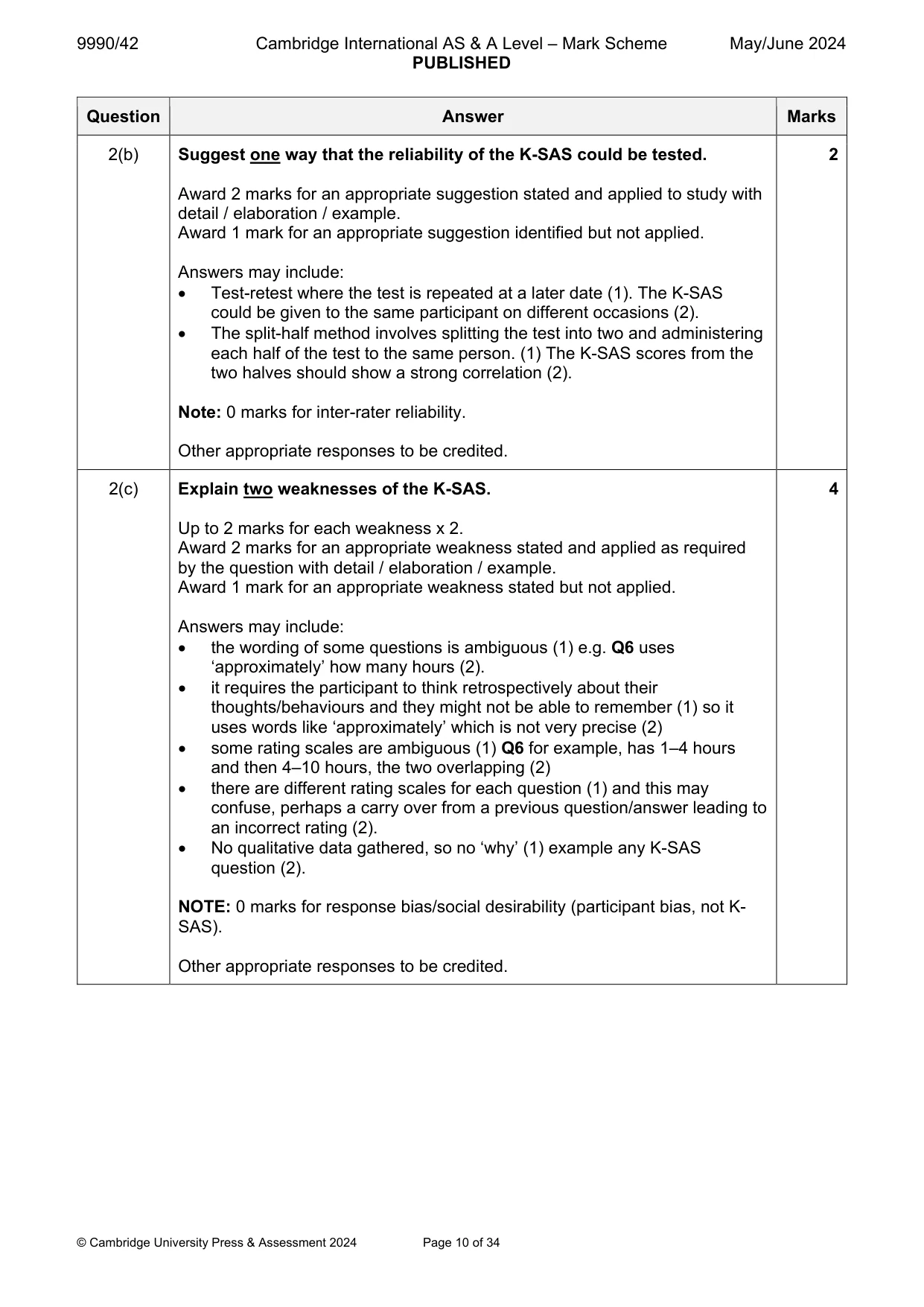
Mark scheme: 2(a) State one question used on the K-SAS. 2 Syllabus 1.3.1 measure of impulse control disorders: Kleptomania Symptom Assessment Scale (K-SAS). Award 1 mark for partial answer. Award 2 marks for full answer. Definitive answer: 1 If you had urges to steal during the past WEEK, on average, how strong were your urges? During the past WEEK, 2 how many times did you experience urges to steal? 3 how many hours (add up hours) were you preoccupied with your urges to steal? 4 how much were you able to control your urges? 5 how often did thoughts about stealing come up? 6 approximately how many hours (add up hours) did you spend thinking about stealing? 7 how much were you able to control your thoughts of stealing? 8 on average, how much tension or excitement did you have shortly before you committed a theft? If you did not actually steal anything, please estimate how much anticipatory tension or excitement you believe you would have experienced, if you had committed a theft. 9 on average, how much excitement and pleasure did you feel when you successfully committed a theft? If you did not actually steal, please estimate how much excitement and pleasure you believe you would have experienced if you had committed a theft. 10 how much emotional distress (mental pain or anguish, shame, guilt, embarrassment) has your stealing caused you? 11 how much personal trouble (relationship, financial, legal, job, medical or health) has your stealing caused you? 12 how many times did you steal? NOTE: marks awarded for ‘closed question responses’ i.e. scale to answer question. See attached. 2(b) Suggest one way that the reliability of the K-SAS could be tested. 2 Award 2 marks for an appropriate suggestion stated and applied to study with detail / elaboration / example. Award 1 mark for an appropriate suggestion identified but not applied. Answers may include: Test-retest where the test is repeated at a later date (1). The K-SAS could be given to the same participant on different occasions (2). The split-half method involves splitting the test into two and administering each half of the test to the same person. (1) The K-SAS scores from the two halves should show a strong correlation (2). Note: 0 marks for inter-rater reliability. Other appropriate responses to be credited. 2(c) Explain two weaknesses of the K-SAS. 4 Up to 2 marks for each weakness x 2. Award 2 marks for an appropriate weakness stated and applied as required by the question with detail / elaboration / example. Award 1 mark for an appropriate weakness stated but not applied. Answers may include: the wording of some questions is ambiguous (1) e.g. Q6 uses ‘approximately’ how many hours (2). it requires the participant to think retrospectively about their thoughts/behaviours and they might not be able to remember (1) so it uses words like ‘approximately’ which is not very precise (2) some rating scales are ambiguous (1) Q6 for example, has 1–4 hours and then 4–10 hours, the two overlapping (2) there are different rating scales for each question (1) and this may confuse, perhaps a carry over from a previous question/answer leading to an incorrect rating (2). No qualitative data gathered, so no ‘why’ (1) example any K-SAS question (2). NOTE: 0 marks for response bias/social desirability (participant bias, not K- SAS). Other appropriate responses to be credited.
Q3 · From the key study by Snyder and DeBono (1985) on consumer personality and advertising…
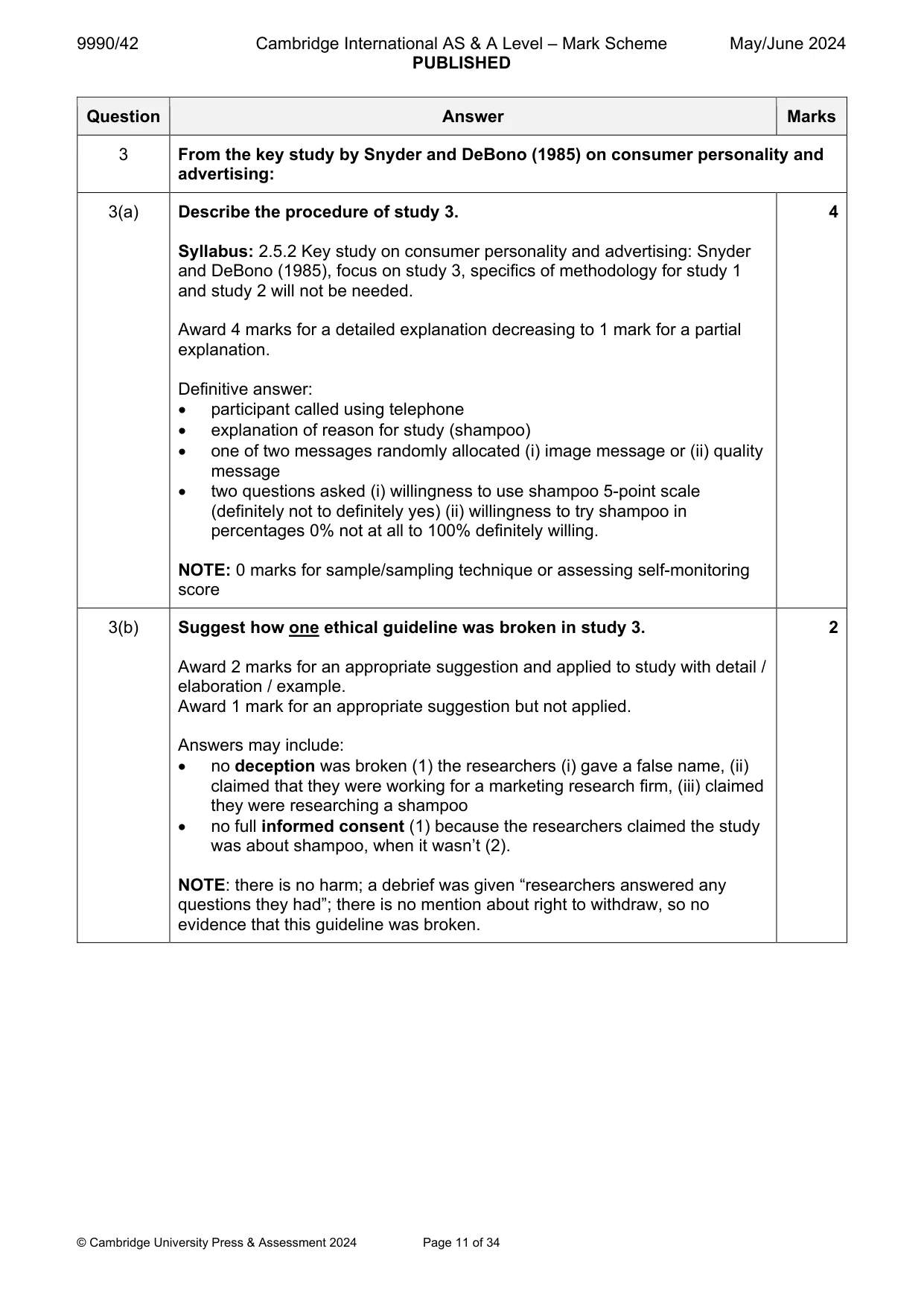
3 From the key study by Snyder and DeBono (1985) on consumer personality and advertising: (a) Describe the procedure of study 3. [4] (b) Suggest how one ethical guideline was broken in study 3. [2] (c) Explain one strength and one weakness of using a telephone interview to investigate ‘consumer personality and advertising’. [4]
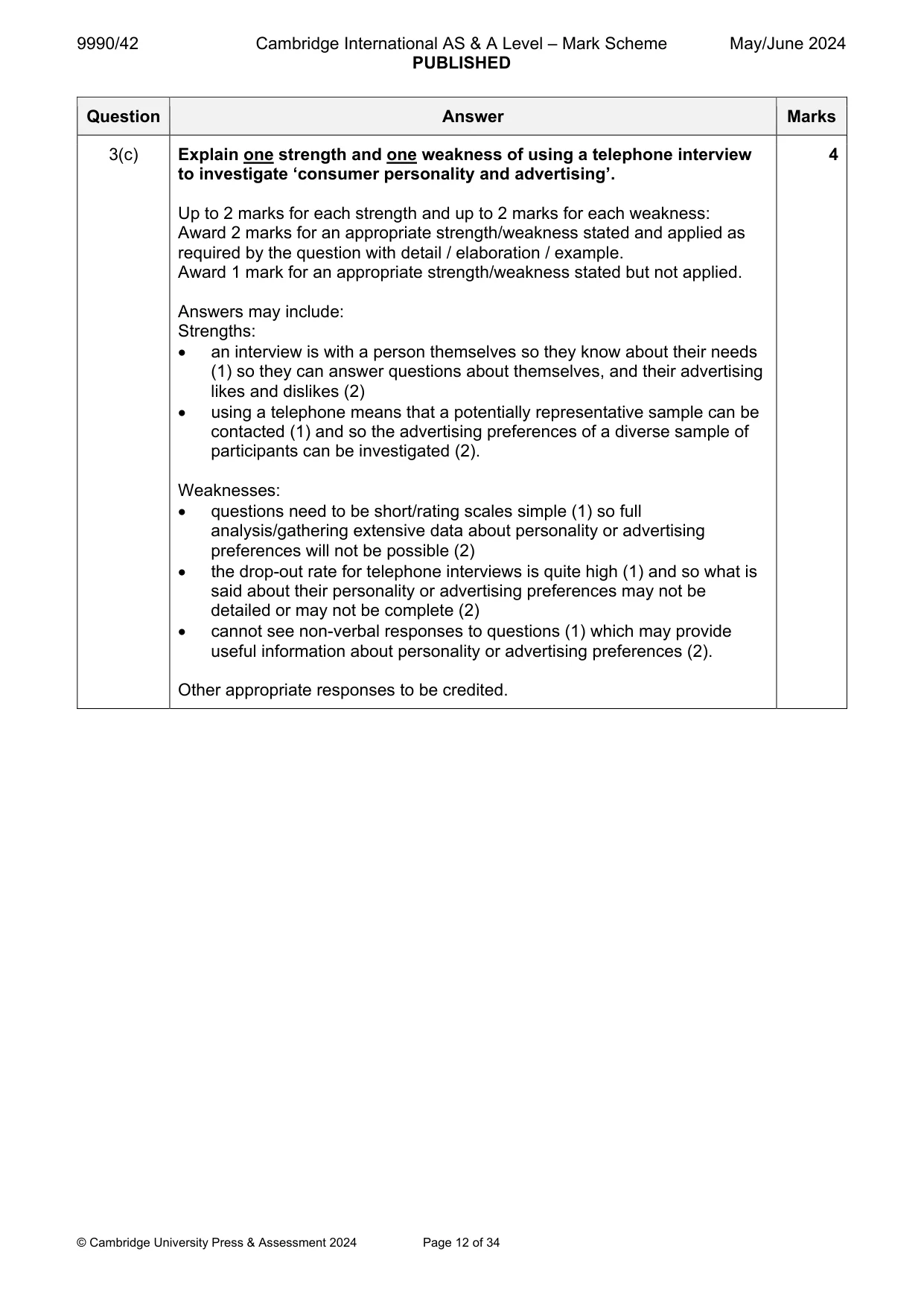
Mark scheme: 3(a) Describe the procedure of study 3. 4 Syllabus: 2.5.2 Key study on consumer personality and advertising: Snyder and DeBono (1985), focus on study 3, specifics of methodology for study 1 and study 2 will not be needed. Award 4 marks for a detailed explanation decreasing to 1 mark for a partial explanation. Definitive answer: participant called using telephone explanation of reason for study (shampoo) one of two messages randomly allocated (i) image message or (ii) quality message two questions asked (i) willingness to use shampoo 5-point scale (definitely not to definitely yes) (ii) willingness to try shampoo in percentages 0% not at all to 100% definitely willing. NOTE: 0 marks for sample/sampling technique or assessing self-monitoring score 3(b) Suggest how one ethical guideline was broken in study 3. 2 Award 2 marks for an appropriate suggestion and applied to study with detail / elaboration / example. Award 1 mark for an appropriate suggestion but not applied. Answers may include: no deception was broken (1) the researchers (i) gave a false name, (ii) claimed that they were working for a marketing research firm, (iii) claimed they were researching a shampoo no full informed consent (1) because the researchers claimed the study was about shampoo, when it wasn’t (2). NOTE: there is no harm; a debrief was given “researchers answered any questions they had”; there is no mention about right to withdraw, so no evidence that this guideline was broken. 3(c) Explain one strength and one weakness of using a telephone interview 4 to investigate ‘consumer personality and advertising’. Up to 2 marks for each strength and up to 2 marks for each weakness: Award 2 marks for an appropriate strength/weakness stated and applied as required by the question with detail / elaboration / example. Award 1 mark for an appropriate strength/weakness stated but not applied. Answers may include: Strengths: an interview is with a person themselves so they know about their needs (1) so they can answer questions about themselves, and their advertising likes and dislikes (2) using a telephone means that a potentially representative sample can be contacted (1) and so the advertising preferences of a diverse sample of participants can be investigated (2). Weaknesses: questions need to be short/rating scales simple (1) so full analysis/gathering extensive data about personality or advertising preferences will not be possible (2) the drop-out rate for telephone interviews is quite high (1) and so what is said about their personality or advertising preferences may not be detailed or may not be complete (2) cannot see non-verbal responses to questions (1) which may provide useful information about personality or advertising preferences (2). Other appropriate responses to be credited.
Q4 · The central gaze cascade effect in positioning a product has been investigated using…
4 The central gaze cascade effect in positioning a product has been investigated using eye-tracking. (a) Outline the findings of one study that has used eye-tracking to investigate the central gaze cascade effect (e.g. Atalay et al., 2012). [2] (b) Suggest one way to investigate the central gaze cascade effect, other than using eye- tracking. [2] (c) Explain two weaknesses of using eye-tracking to investigate the central gaze cascade effect. [4] Health Psychology Answer all questions if you have studied this option.
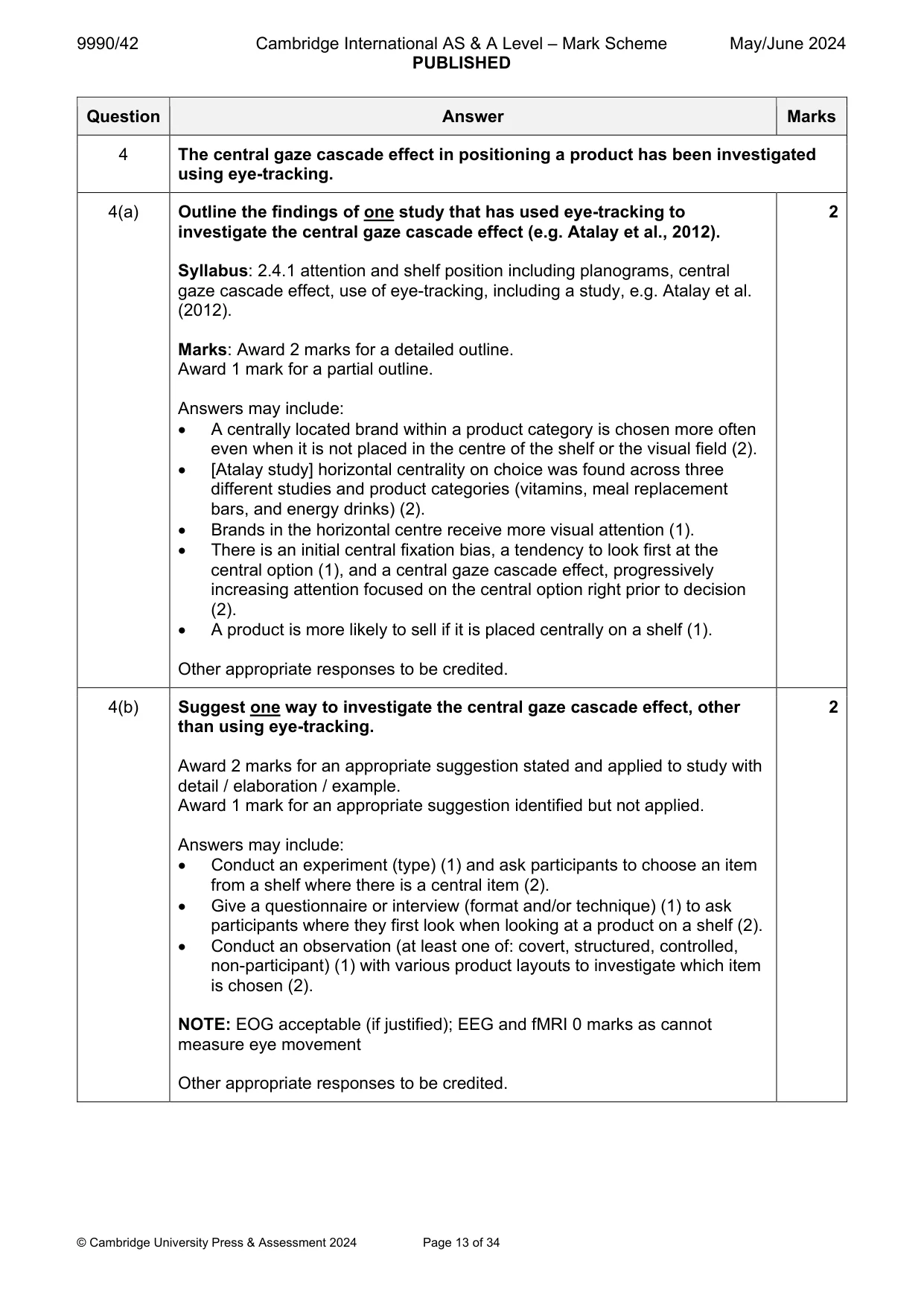
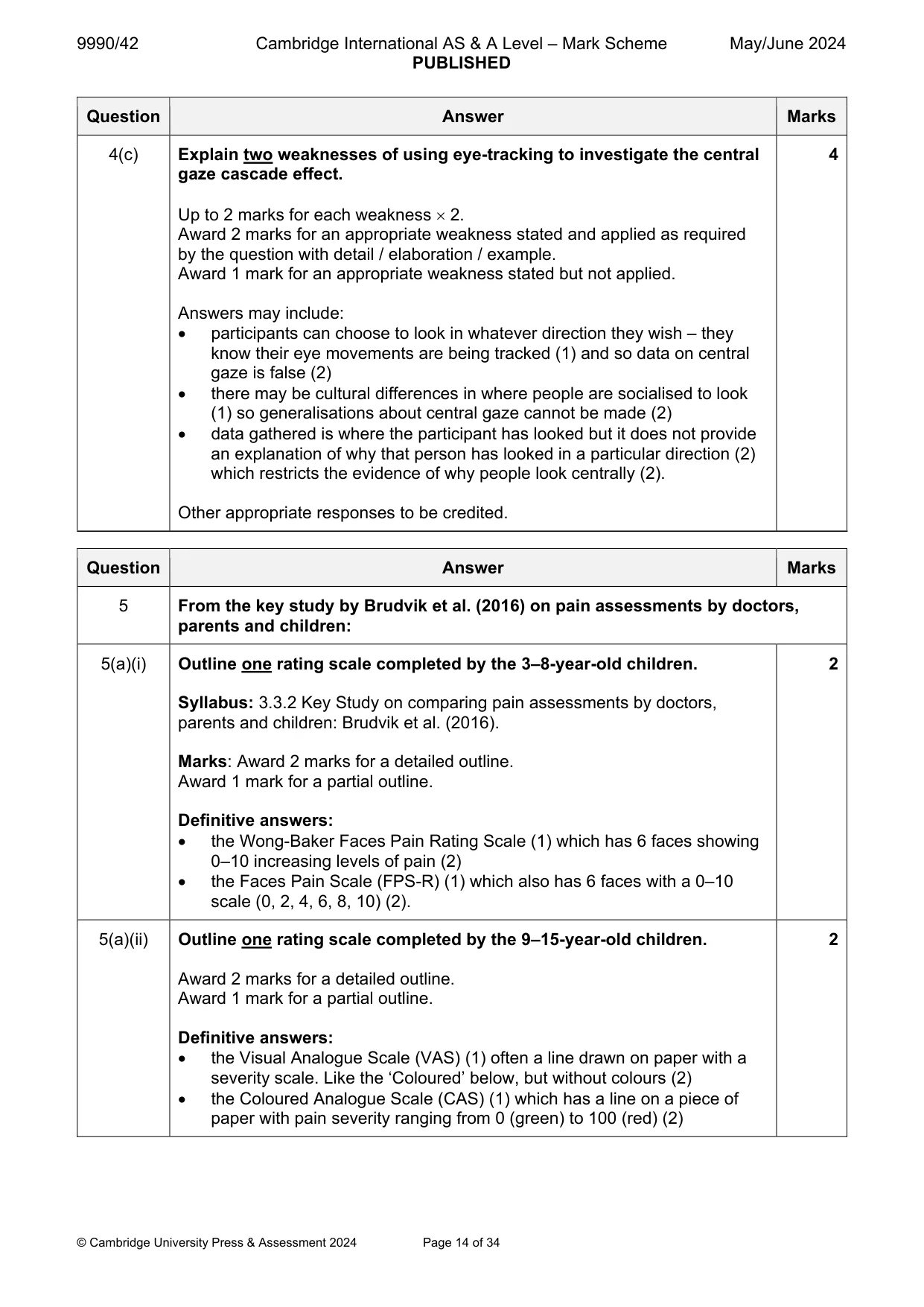
Mark scheme: 4(a) Outline the findings of one study that has used eye-tracking to 2 investigate the central gaze cascade effect (e.g. Atalay et al., 2012). Syllabus: 2.4.1 attention and shelf position including planograms, central gaze cascade effect, use of eye-tracking, including a study, e.g. Atalay et al. (2012). Marks: Award 2 marks for a detailed outline. Award 1 mark for a partial outline. Answers may include: A centrally located brand within a product category is chosen more often even when it is not placed in the centre of the shelf or the visual field (2). [Atalay study] horizontal centrality on choice was found across three different studies and product categories (vitamins, meal replacement bars, and energy drinks) (2). Brands in the horizontal centre receive more visual attention (1). There is an initial central fixation bias, a tendency to look first at the central option (1), and a central gaze cascade effect, progressively increasing attention focused on the central option right prior to decision (2). A product is more likely to sell if it is placed centrally on a shelf (1). Other appropriate responses to be credited. 4(b) Suggest one way to investigate the central gaze cascade effect, other 2 than using eye-tracking. Award 2 marks for an appropriate suggestion stated and applied to study with detail / elaboration / example. Award 1 mark for an appropriate suggestion identified but not applied. Answers may include: Conduct an experiment (type) (1) and ask participants to choose an item from a shelf where there is a central item (2). Give a questionnaire or interview (format and/or technique) (1) to ask participants where they first look when looking at a product on a shelf (2). Conduct an observation (at least one of: covert, structured, controlled, non-participant) (1) with various product layouts to investigate which item is chosen (2). NOTE: EOG acceptable (if justified); EEG and fMRI 0 marks as cannot measure eye movement Other appropriate responses to be credited. 4(c) Explain two weaknesses of using eye-tracking to investigate the central 4 gaze cascade effect. Up to 2 marks for each weakness 2. Award 2 marks for an appropriate weakness stated and applied as required by the question with detail / elaboration / example. Award 1 mark for an appropriate weakness stated but not applied. Answers may include: participants can choose to look in whatever direction they wish – they know their eye movements are being tracked (1) and so data on central gaze is false (2) there may be cultural differences in where people are socialised to look (1) so generalisations about central gaze cannot be made (2) data gathered is where the participant has looked but it does not provide an explanation of why that person has looked in a particular direction (2) which restricts the evidence of why people look centrally (2). Other appropriate responses to be credited.
Q5 · From the key study by Brudvik et al
5 From the key study by Brudvik et al. (2016) on pain assessments by doctors, parents and children: (a) (i) Outline one rating scale completed by the 3–8-year-old children. [2] (ii) Outline one rating scale completed by the 9–15-year-old children. [2] (b) Suggest one way in which a child’s pain can be assessed, other than using a rating scale. [2] (c) Explain two weaknesses with the rating scales used by the 3–8-year-old children. [4]
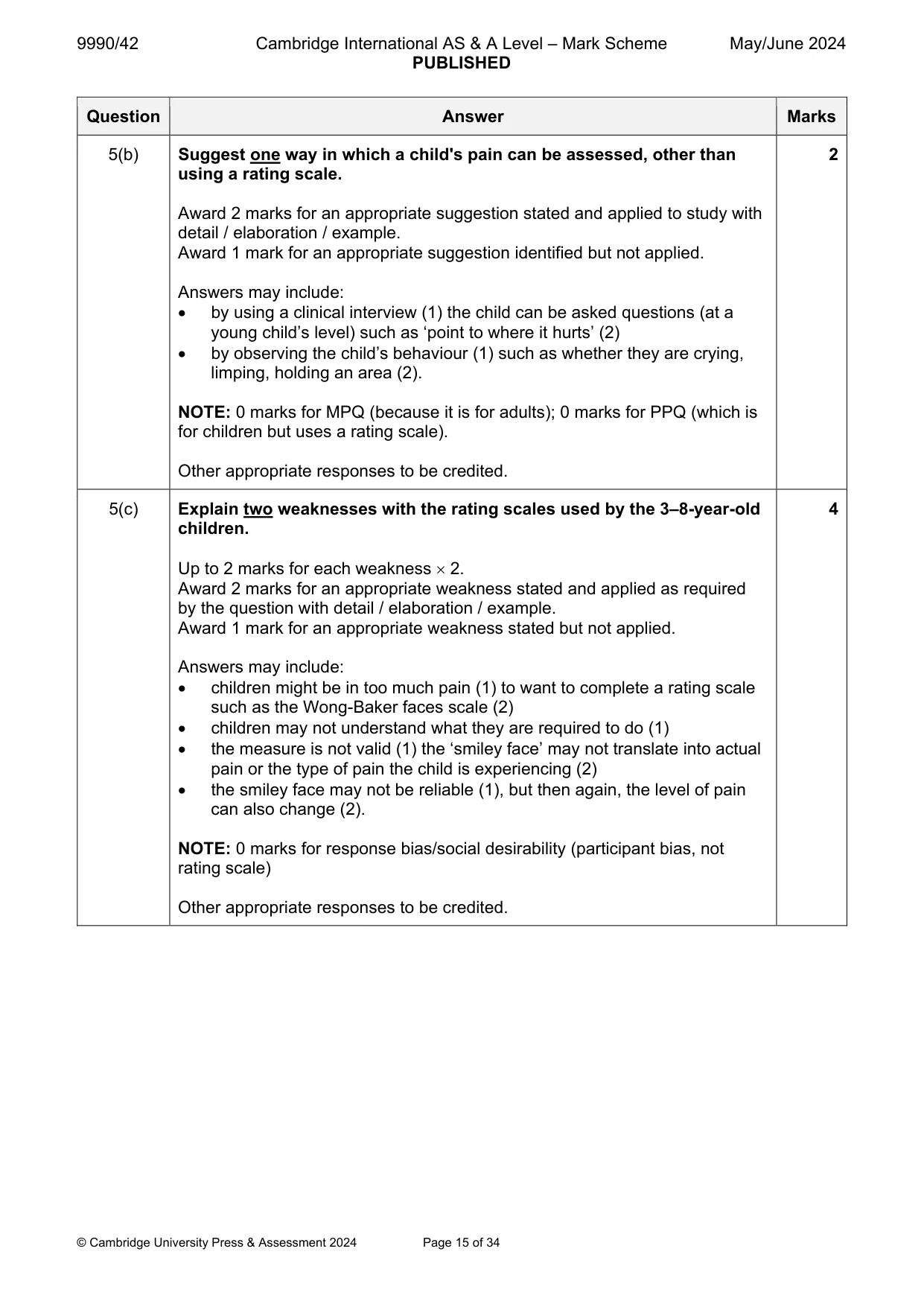
Mark scheme: 5(a)(i) Outline one rating scale completed by the 3–8-year-old children. 2 Syllabus: 3.3.2 Key Study on comparing pain assessments by doctors, parents and children: Brudvik et al. (2016). Marks: Award 2 marks for a detailed outline. Award 1 mark for a partial outline. Definitive answers: the Wong-Baker Faces Pain Rating Scale (1) which has 6 faces showing 0–10 increasing levels of pain (2) the Faces Pain Scale (FPS-R) (1) which also has 6 faces with a 0–10 scale (0, 2, 4, 6, 8, 10) (2). 5(a)(ii) Outline one rating scale completed by the 9–15-year-old children. 2 Award 2 marks for a detailed outline. Award 1 mark for a partial outline. Definitive answers: the Visual Analogue Scale (VAS) (1) often a line drawn on paper with a severity scale. Like the ‘Coloured’ below, but without colours (2) the Coloured Analogue Scale (CAS) (1) which has a line on a piece of paper with pain severity ranging from 0 (green) to 100 (red) (2) 5(b) Suggest one way in which a child's pain can be assessed, other than 2 using a rating scale. Award 2 marks for an appropriate suggestion stated and applied to study with detail / elaboration / example. Award 1 mark for an appropriate suggestion identified but not applied. Answers may include: by using a clinical interview (1) the child can be asked questions (at a young child’s level) such as ‘point to where it hurts’ (2) by observing the child’s behaviour (1) such as whether they are crying, limping, holding an area (2). NOTE: 0 marks for MPQ (because it is for adults); 0 marks for PPQ (which is for children but uses a rating scale). Other appropriate responses to be credited. 5(c) Explain two weaknesses with the rating scales used by the 3–8-year-old 4 children. Up to 2 marks for each weakness 2. Award 2 marks for an appropriate weakness stated and applied as required by the question with detail / elaboration / example. Award 1 mark for an appropriate weakness stated but not applied. Answers may include: children might be in too much pain (1) to want to complete a rating scale such as the Wong-Baker faces scale (2) children may not understand what they are required to do (1) the measure is not valid (1) the ‘smiley face’ may not translate into actual pain or the type of pain the child is experiencing (2) the smiley face may not be reliable (1), but then again, the level of pain can also change (2). NOTE: 0 marks for response bias/social desirability (participant bias, not rating scale) Other appropriate responses to be credited.
Q6 · Stress can be measured using sample tests for salivary cortisol, e.g
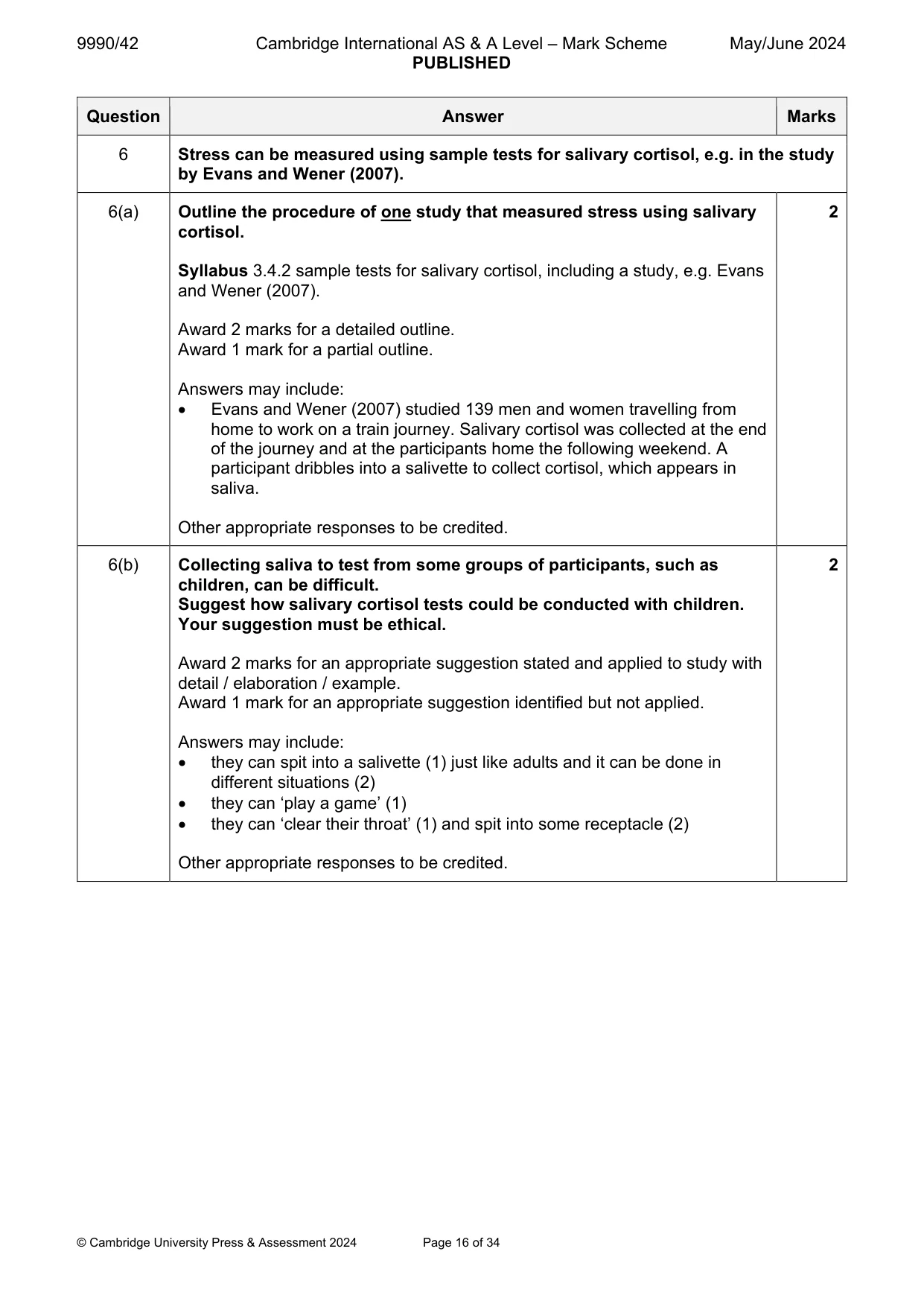
6 Stress can be measured using sample tests for salivary cortisol, e.g. in the study by Evans and Wener (2007). (a) Outline the procedure of one study that measured stress using salivary cortisol. [2] (b) Collecting saliva to test from some groups of participants, such as children, can be difficult. Suggest how salivary cortisol tests could be conducted with children. Your suggestion must be ethical. [2] (c) Explain two strengths of using a biological measure, such as salivary cortisol, to measure stress. [4] Organisational Psychology Answer all questions if you have studied this option.
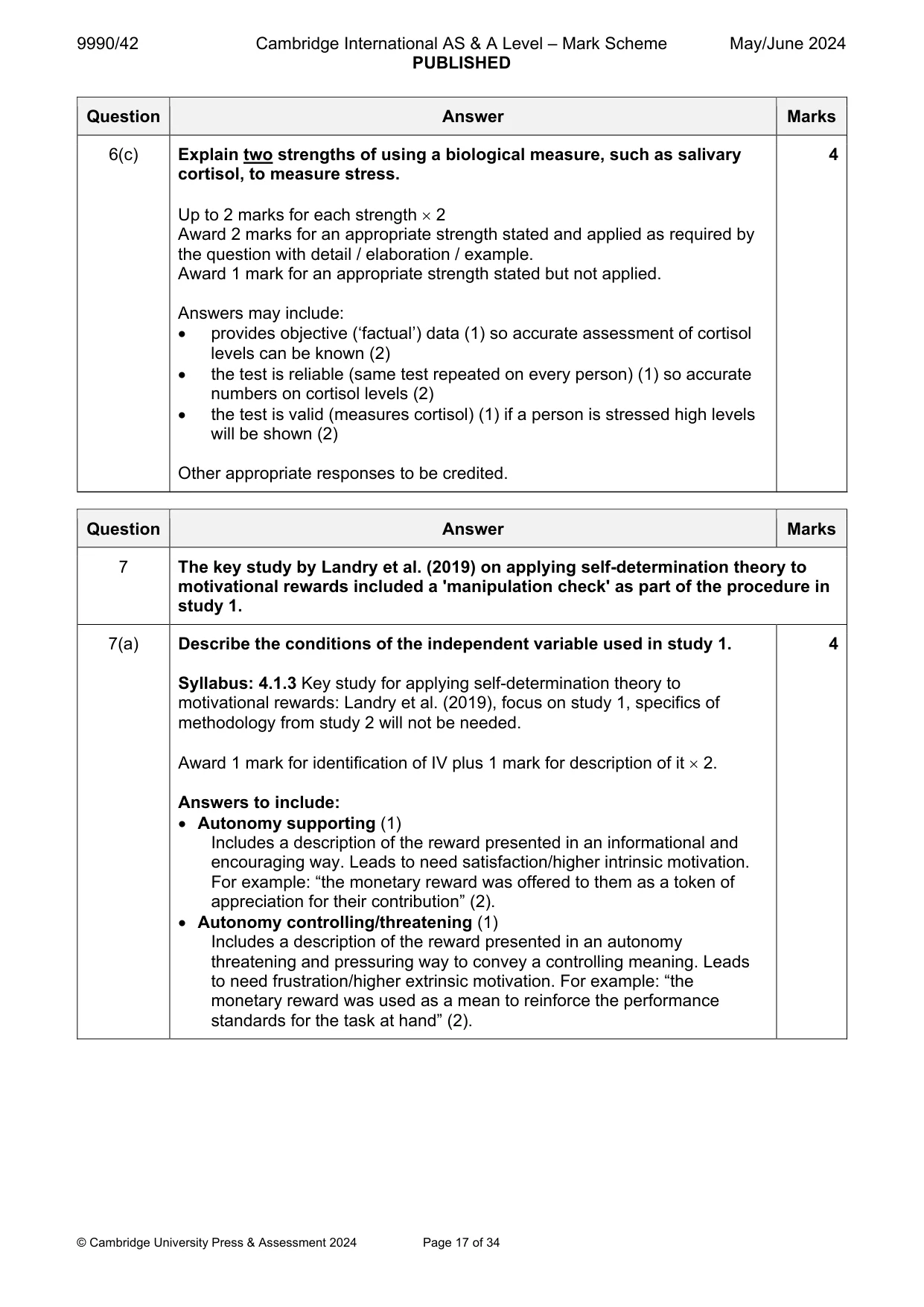
Mark scheme: 6(a) Outline the procedure of one study that measured stress using salivary 2 cortisol. Syllabus 3.4.2 sample tests for salivary cortisol, including a study, e.g. Evans and Wener (2007). Award 2 marks for a detailed outline. Award 1 mark for a partial outline. Answers may include: Evans and Wener (2007) studied 139 men and women travelling from home to work on a train journey. Salivary cortisol was collected at the end of the journey and at the participants home the following weekend. A participant dribbles into a salivette to collect cortisol, which appears in saliva. Other appropriate responses to be credited. 6(b) Collecting saliva to test from some groups of participants, such as 2 children, can be difficult. Suggest how salivary cortisol tests could be conducted with children. Your suggestion must be ethical. Award 2 marks for an appropriate suggestion stated and applied to study with detail / elaboration / example. Award 1 mark for an appropriate suggestion identified but not applied. Answers may include: they can spit into a salivette (1) just like adults and it can be done in different situations (2) they can ‘play a game’ (1) they can ‘clear their throat’ (1) and spit into some receptacle (2) Other appropriate responses to be credited. 6(c) Explain two strengths of using a biological measure, such as salivary 4 cortisol, to measure stress. Up to 2 marks for each strength 2 Award 2 marks for an appropriate strength stated and applied as required by the question with detail / elaboration / example. Award 1 mark for an appropriate strength stated but not applied. Answers may include: provides objective (‘factual’) data (1) so accurate assessment of cortisol levels can be known (2) the test is reliable (same test repeated on every person) (1) so accurate numbers on cortisol levels (2) the test is valid (measures cortisol) (1) if a person is stressed high levels will be shown (2) Other appropriate responses to be credited.
Q7 · The key study by Landry et al
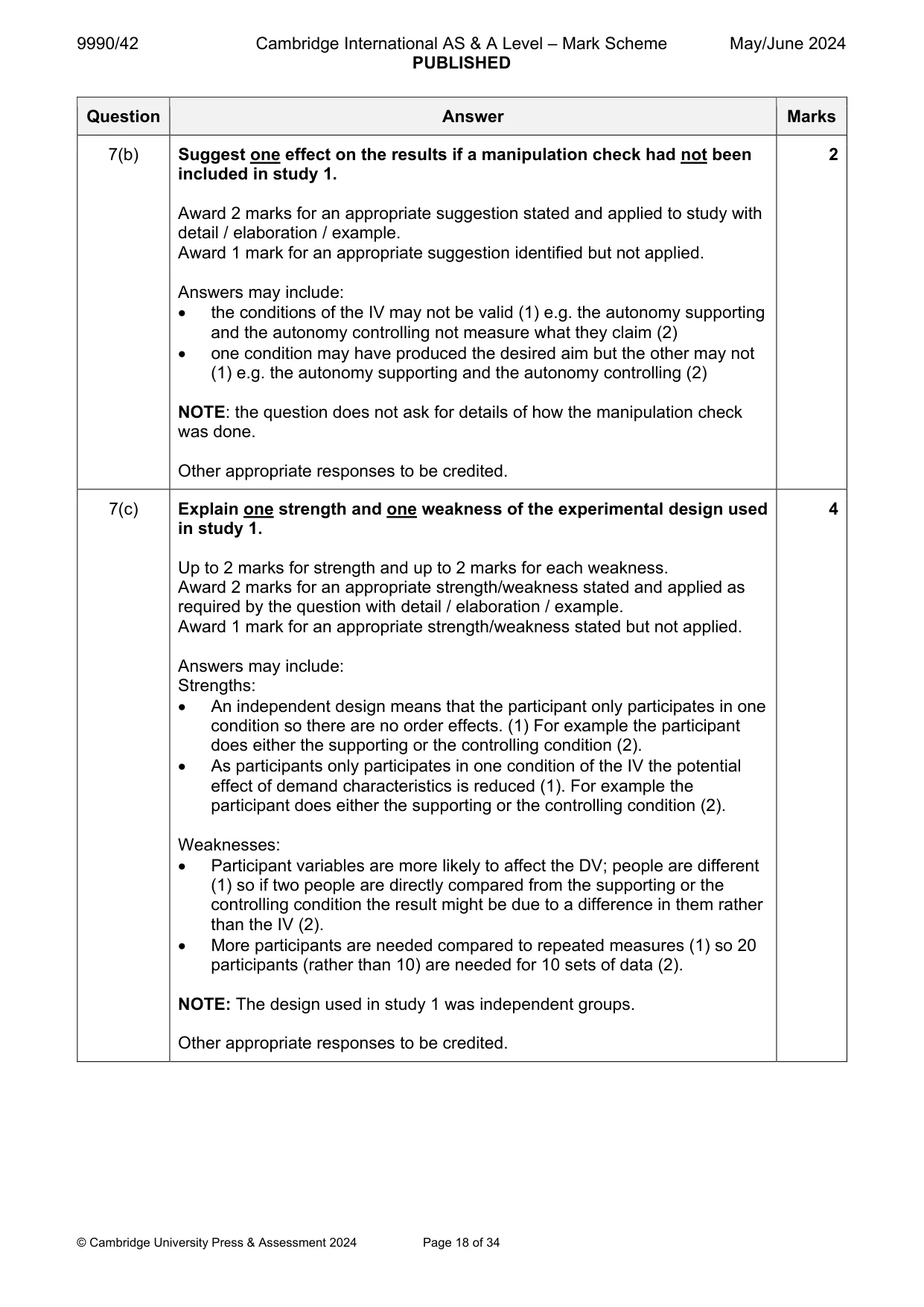
7 The key study by Landry et al. (2019) on applying self-determination theory to motivational rewards included a ‘manipulation check’ as part of the procedure in study 1. (a) Describe the conditions of the independent variable used in study 1. [4] (b) Suggest one effect on the results if a manipulation check had not been included in study 1. [2] (c) Explain one strength and one weakness of the experimental design as used in study 1. [4]
Mark scheme: 7(a) Describe the conditions of the independent variable used in study 1. 4 Syllabus: 4.1.3 Key study for applying self-determination theory to motivational rewards: Landry et al. (2019), focus on study 1, specifics of methodology from study 2 will not be needed. Award 1 mark for identification of IV plus 1 mark for description of it 2. Answers to include: Autonomy supporting (1) Includes a description of the reward presented in an informational and encouraging way. Leads to need satisfaction/higher intrinsic motivation. For example: “the monetary reward was offered to them as a token of appreciation for their contribution” (2). Autonomy controlling/threatening (1) Includes a description of the reward presented in an autonomy threatening and pressuring way to convey a controlling meaning. Leads to need frustration/higher extrinsic motivation. For example: “the monetary reward was used as a mean to reinforce the performance standards for the task at hand” (2). 7(b) Suggest one effect on the results if a manipulation check had not been 2 included in study 1. Award 2 marks for an appropriate suggestion stated and applied to study with detail / elaboration / example. Award 1 mark for an appropriate suggestion identified but not applied. Answers may include: the conditions of the IV may not be valid (1) e.g. the autonomy supporting and the autonomy controlling not measure what they claim (2) one condition may have produced the desired aim but the other may not (1) e.g. the autonomy supporting and the autonomy controlling (2) NOTE: the question does not ask for details of how the manipulation check was done. Other appropriate responses to be credited. 7(c) Explain one strength and one weakness of the experimental design used 4 in study 1. Up to 2 marks for strength and up to 2 marks for each weakness. Award 2 marks for an appropriate strength/weakness stated and applied as required by the question with detail / elaboration / example. Award 1 mark for an appropriate strength/weakness stated but not applied. Answers may include: Strengths: An independent design means that the participant only participates in one condition so there are no order effects. (1) For example the participant does either the supporting or the controlling condition (2). As participants only participates in one condition of the IV the potential effect of demand characteristics is reduced (1). For example the participant does either the supporting or the controlling condition (2). Weaknesses: Participant variables are more likely to affect the DV; people are different (1) so if two people are directly compared from the supporting or the controlling condition the result might be due to a difference in them rather than the IV (2). More participants are needed compared to repeated measures (1) so 20 participants (rather than 10) are needed for 10 sets of data (2). NOTE: The design used in study 1 was independent groups. Other appropriate responses to be credited.
Q8 · Muczyk and Reimann proposed four styles of leader behaviour
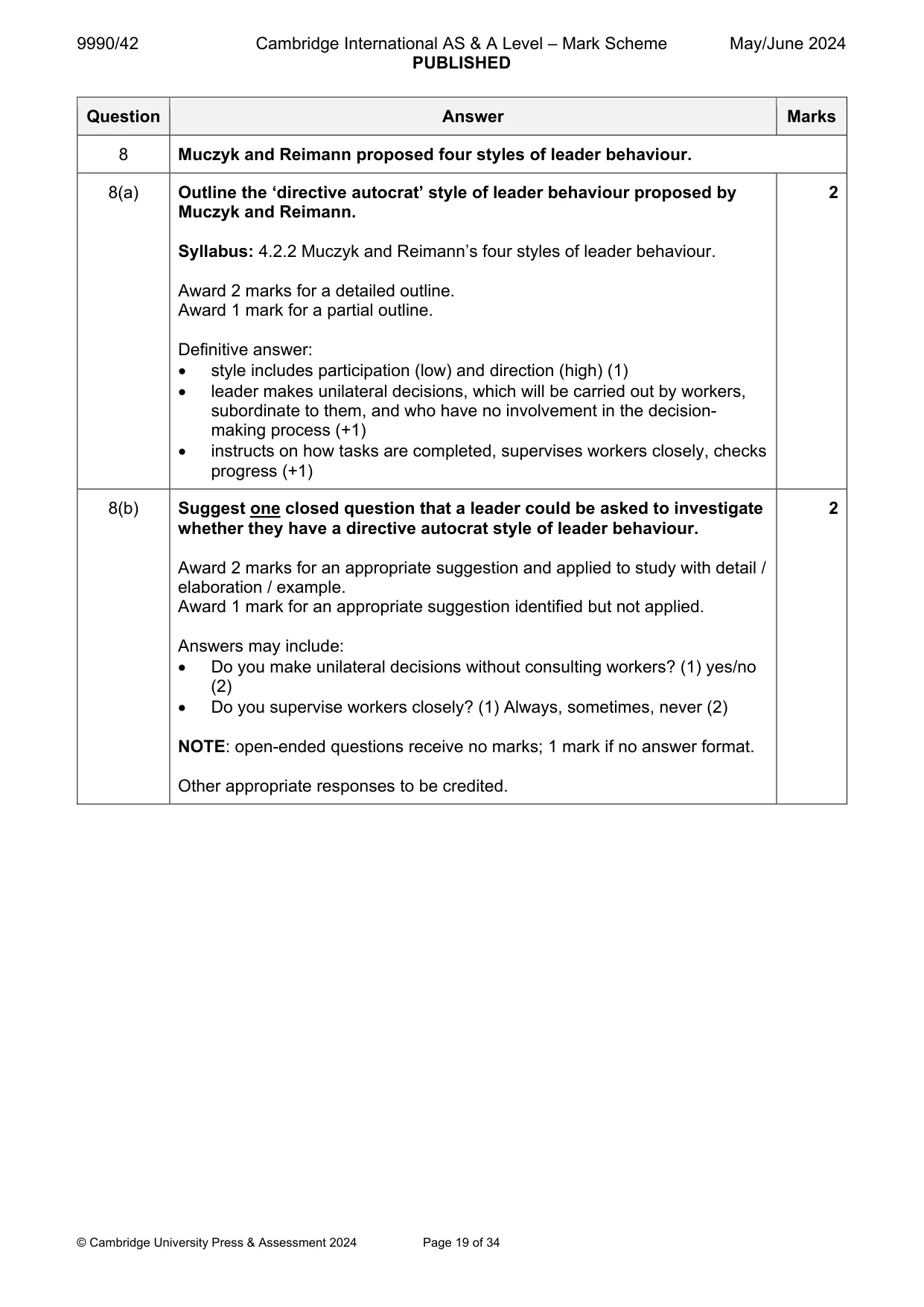
8 Muczyk and Reimann proposed four styles of leader behaviour. (a) Outline the ‘directive autocrat’ style of leader behaviour proposed by Muczyk and Reimann. [2] (b) Suggest one closed question that a leader could be asked to investigate whether they have a directive autocrat style of leader behaviour. [2] (c) Explain two strengths of using a structured observation to investigate the behaviour of a directive autocrat leader. [4]
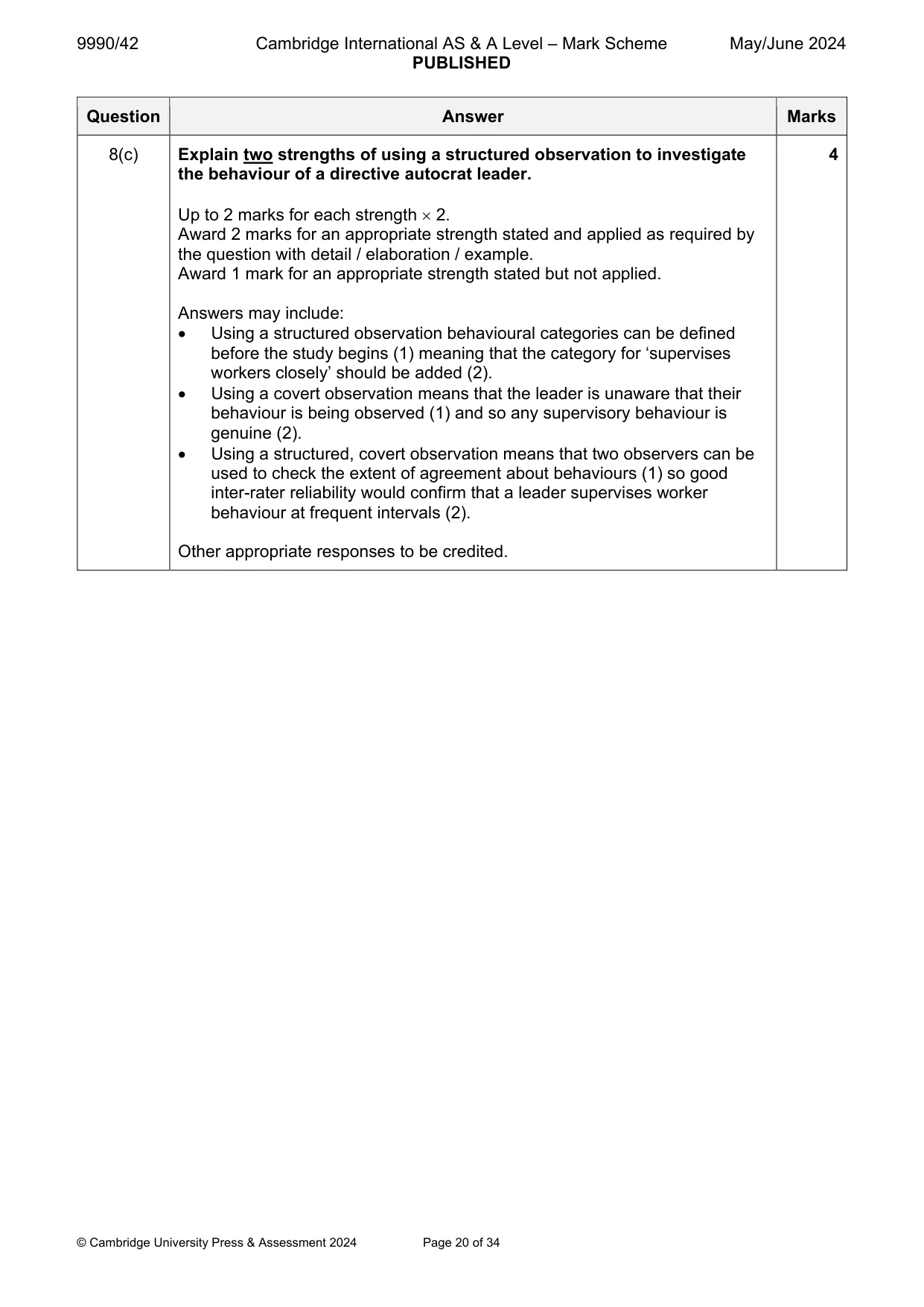
Mark scheme: 8(a) Outline the ‘directive autocrat’ style of leader behaviour proposed by 2 Muczyk and Reimann. Syllabus: 4.2.2 Muczyk and Reimann’s four styles of leader behaviour. Award 2 marks for a detailed outline. Award 1 mark for a partial outline. Definitive answer: style includes participation (low) and direction (high) (1) leader makes unilateral decisions, which will be carried out by workers, subordinate to them, and who have no involvement in the decision- making process (+1) instructs on how tasks are completed, supervises workers closely, checks progress (+1) 8(b) Suggest one closed question that a leader could be asked to investigate 2 whether they have a directive autocrat style of leader behaviour. Award 2 marks for an appropriate suggestion and applied to study with detail / elaboration / example. Award 1 mark for an appropriate suggestion identified but not applied. Answers may include: Do you make unilateral decisions without consulting workers? (1) yes/no (2) Do you supervise workers closely? (1) Always, sometimes, never (2) NOTE: open-ended questions receive no marks; 1 mark if no answer format. Other appropriate responses to be credited. 8(c) Explain two strengths of using a structured observation to investigate 4 the behaviour of a directive autocrat leader. Up to 2 marks for each strength 2. Award 2 marks for an appropriate strength stated and applied as required by the question with detail / elaboration / example. Award 1 mark for an appropriate strength stated but not applied. Answers may include: Using a structured observation behavioural categories can be defined before the study begins (1) meaning that the category for ‘supervises workers closely’ should be added (2). Using a covert observation means that the leader is unaware that their behaviour is being observed (1) and so any supervisory behaviour is genuine (2). Using a structured, covert observation means that two observers can be used to check the extent of agreement about behaviours (1) so good inter-rater reliability would confirm that a leader supervises worker behaviour at frequent intervals (2). Other appropriate responses to be credited.
Q9 · Plan a study using a questionnaire with closed questions to investigate the effectiveness…
9 (a) Plan a study using a questionnaire with closed questions to investigate the effectiveness of using imaginal desensitisation for treating pyromania. Your plan must include details about: • questionnaire technique • rating scale. [10] (b) For one piece of psychological knowledge on which your plan is based: (i) Describe this psychological knowledge. [4] (ii) Explain how you used two features of this psychological knowledge to plan your study. [4] (c) (i) Explain one reason for your choice of questionnaire technique. [2] (ii) Explain one weakness of your choice of questionnaire technique. [2] (iii) Explain one reason for your choice of rating scale. [2] Consumer Psychology
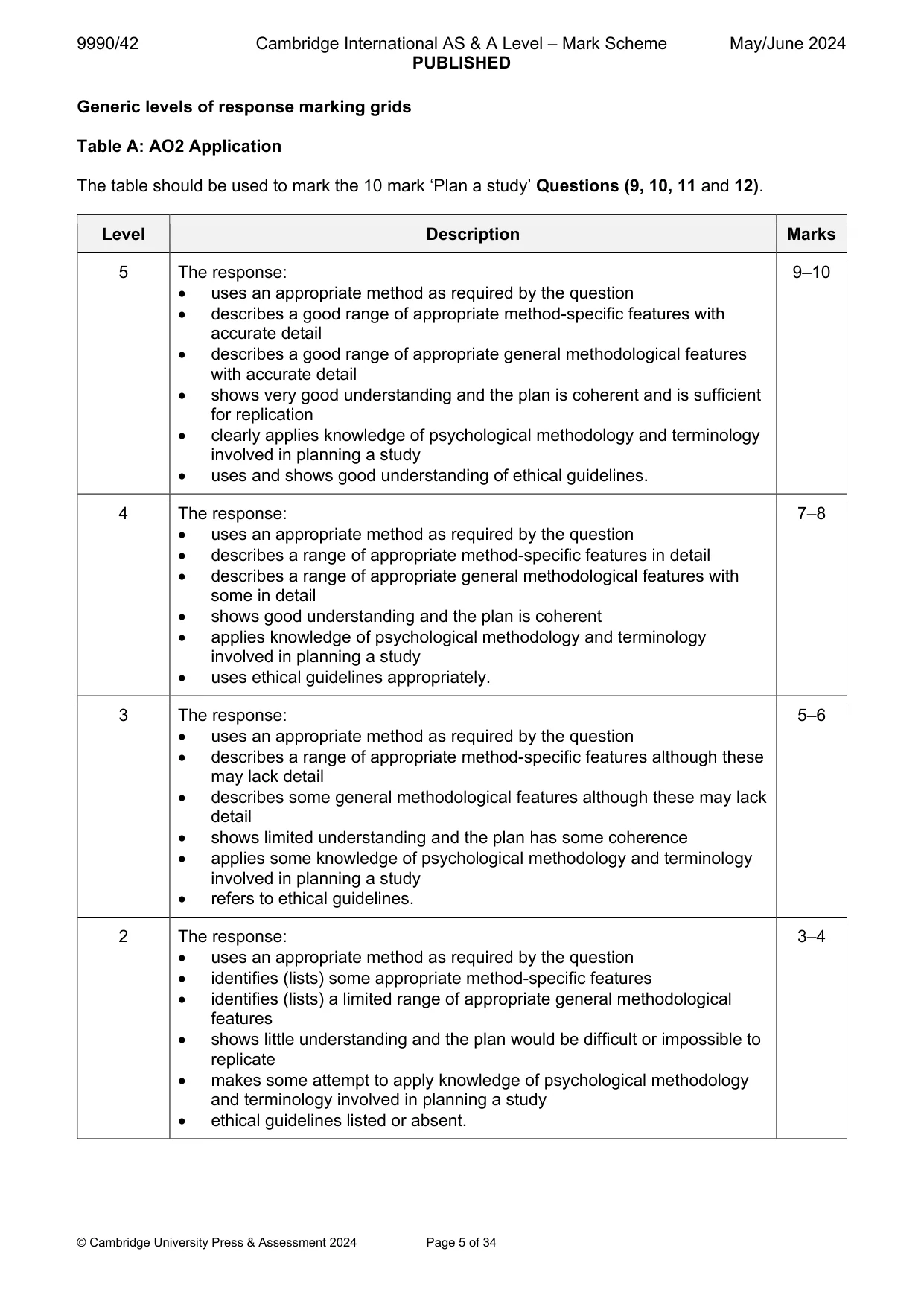
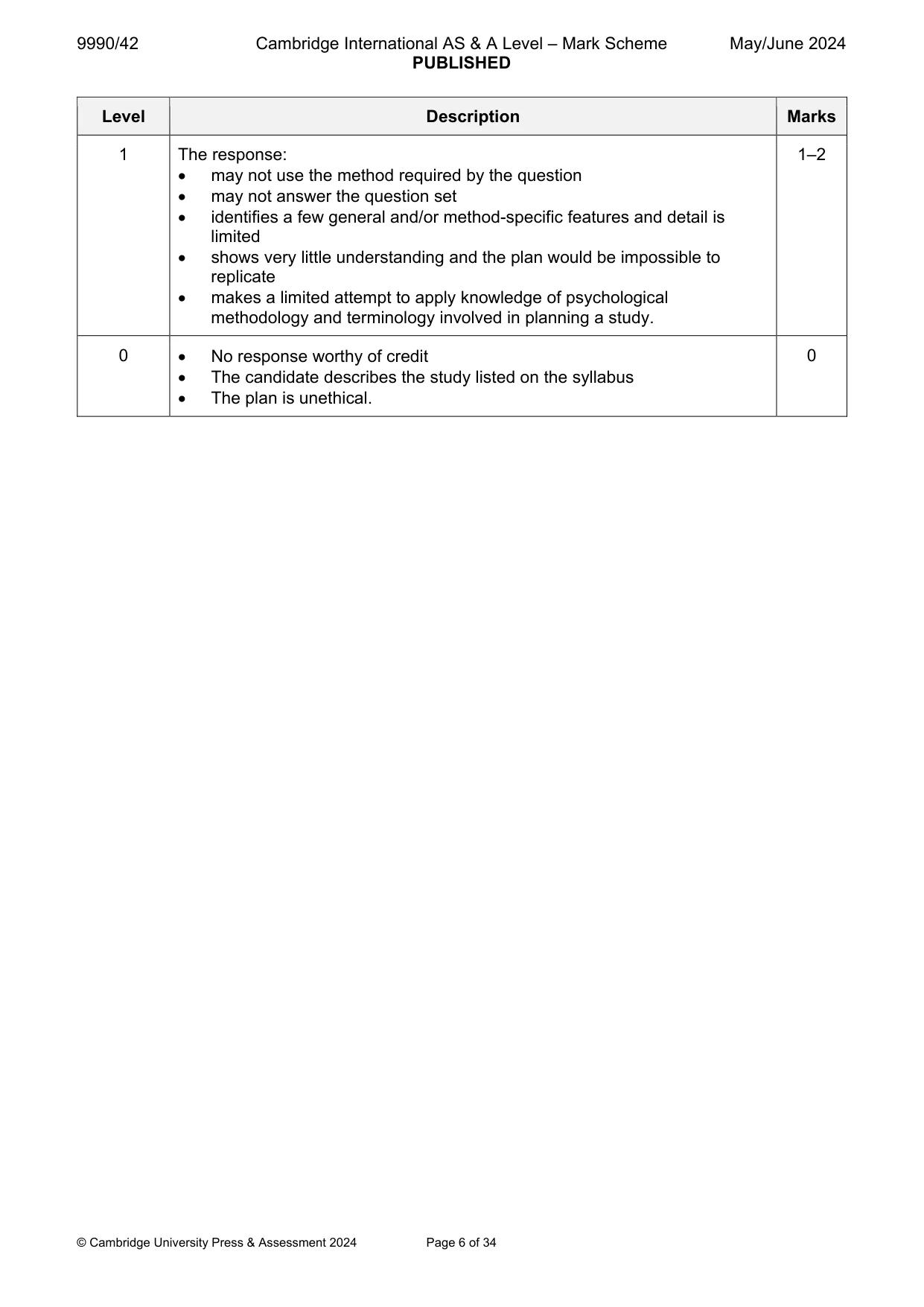
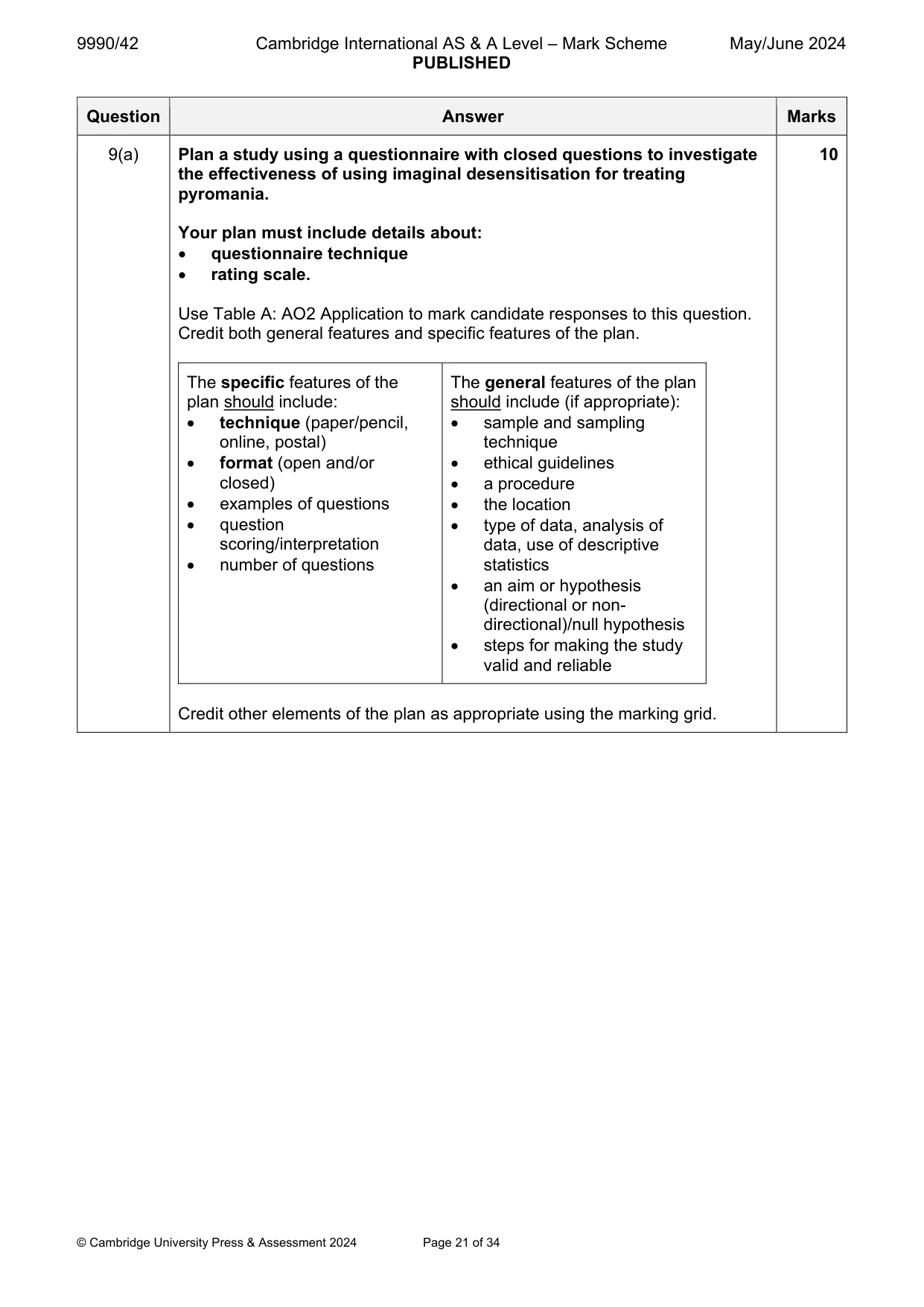
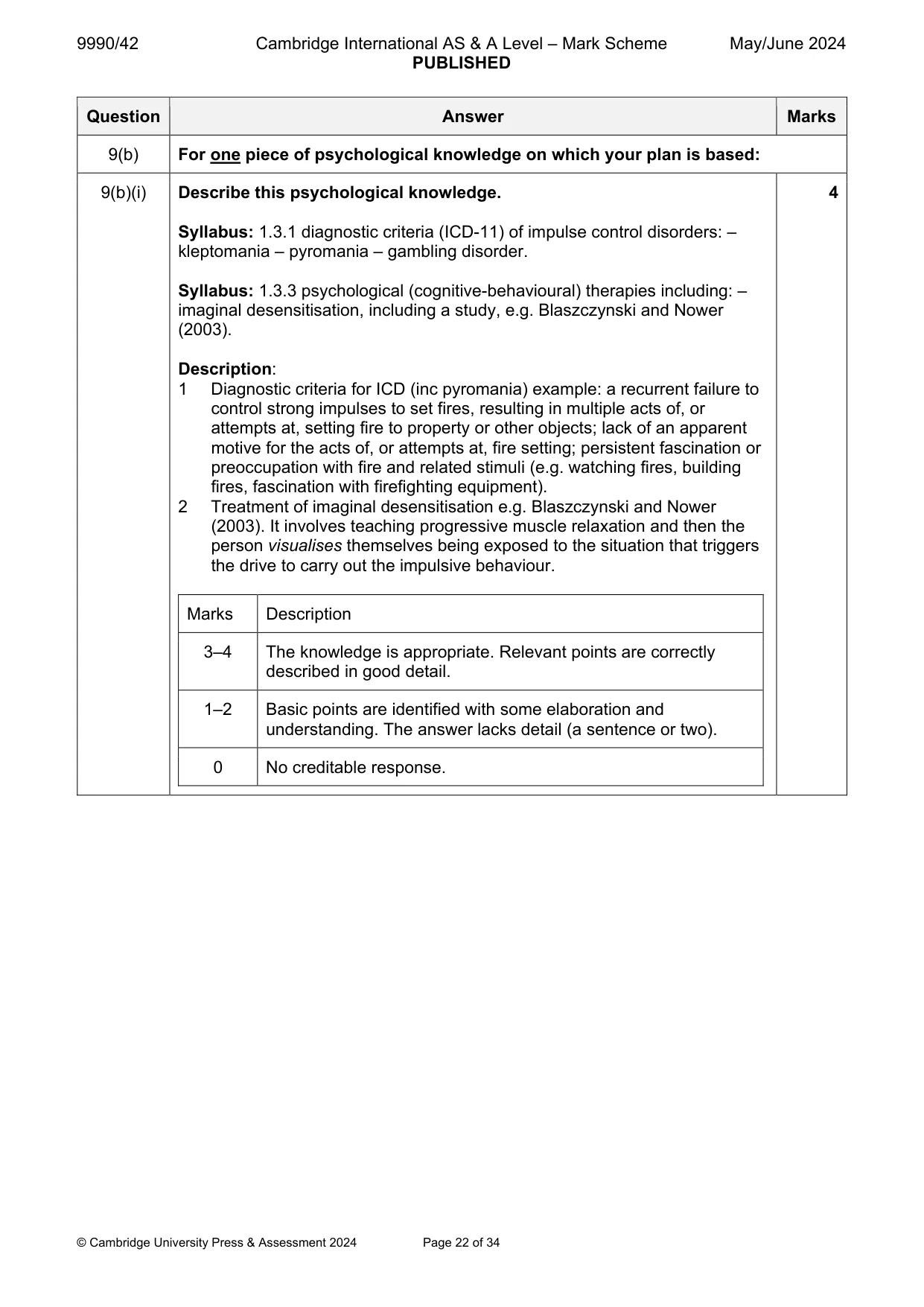
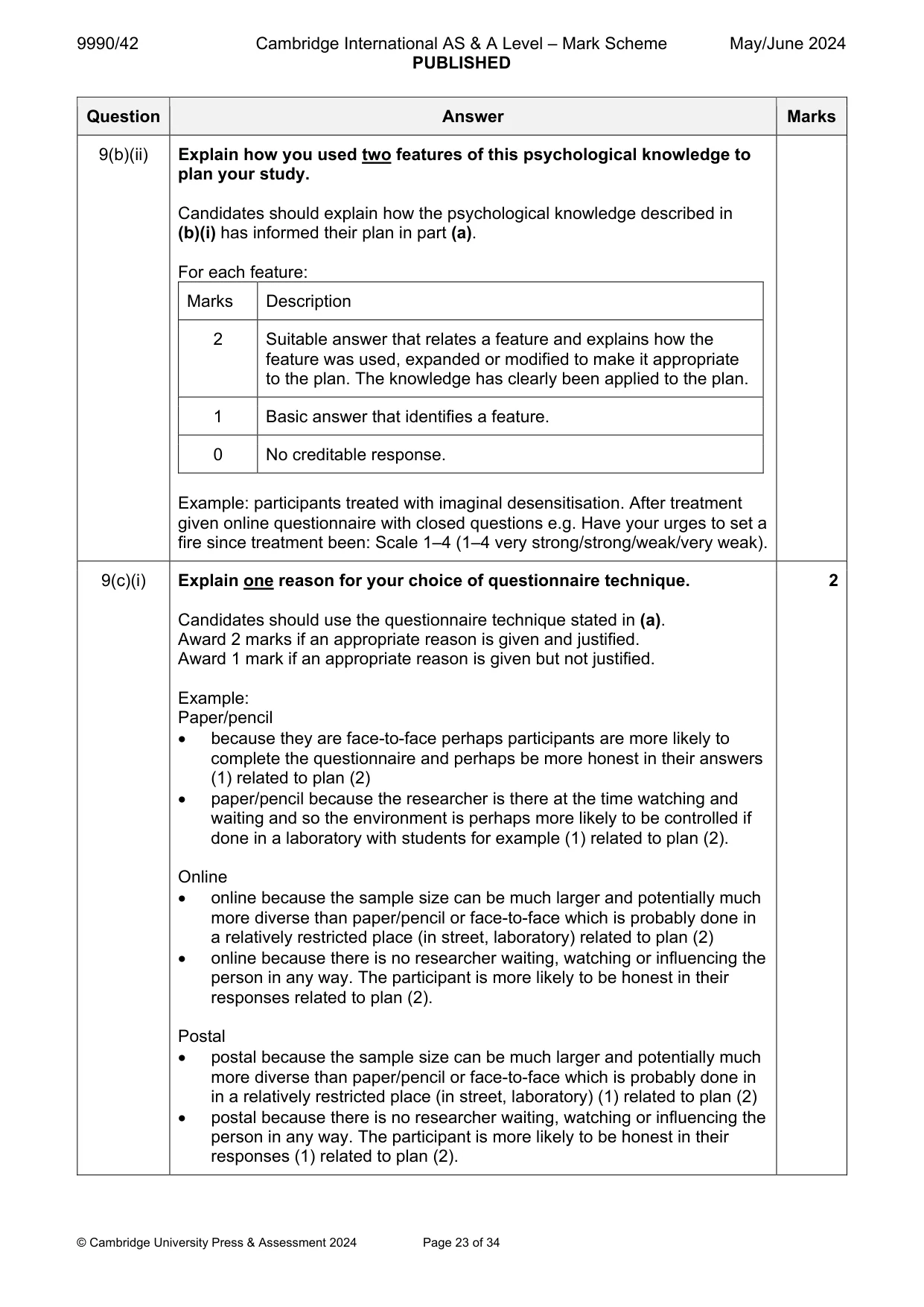
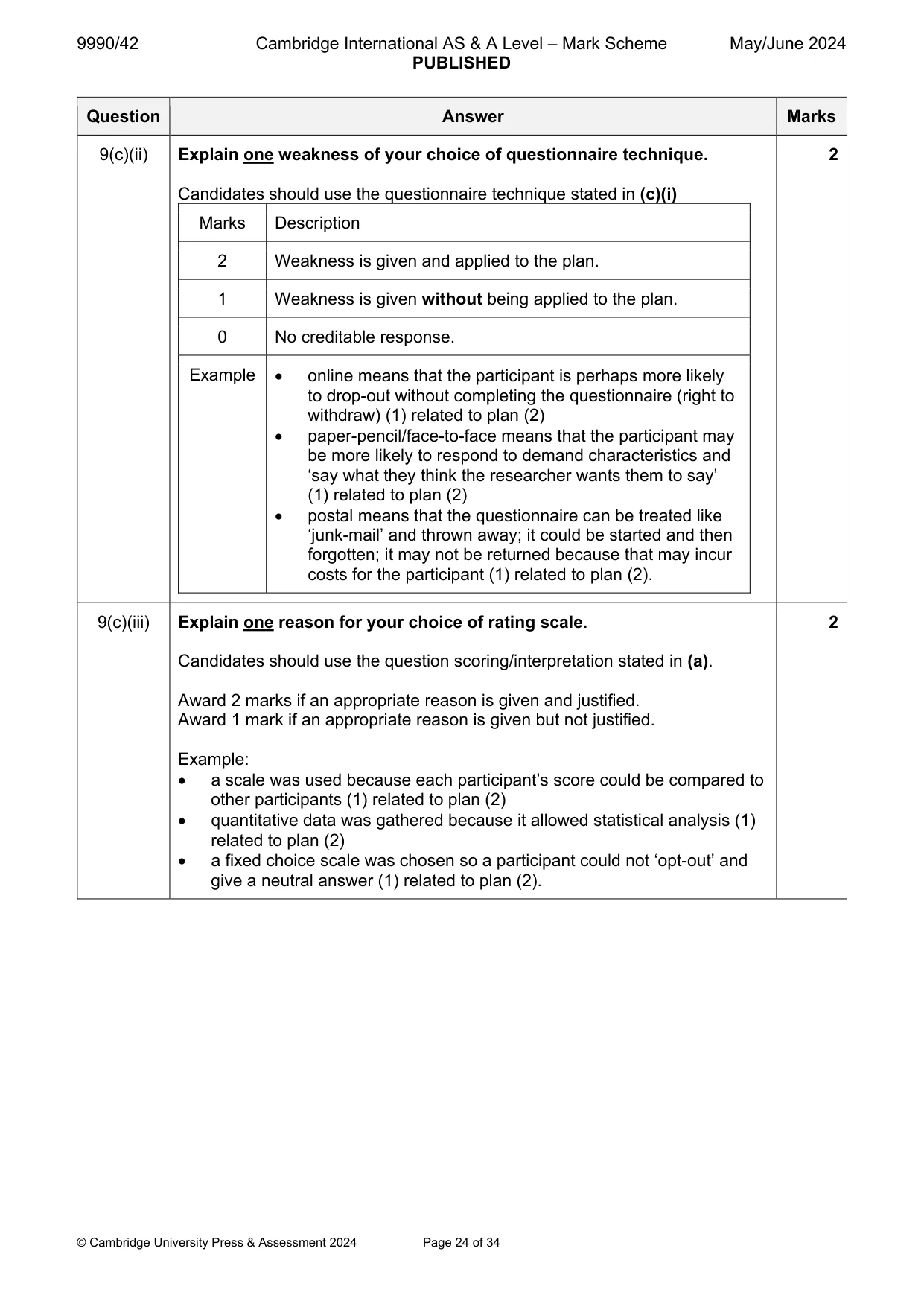
Mark scheme: 9(a) Plan a study using a questionnaire with closed questions to investigate 10 the effectiveness of using imaginal desensitisation for treating pyromania. Your plan must include details about: questionnaire technique rating scale. Use Table A: AO2 Application to mark candidate responses to this question. Credit both general features and specific features of the plan. The specific features of the The general features of the plan plan should include: should include (if appropriate): technique (paper/pencil, sample and sampling online, postal) technique format (open and/or ethical guidelines closed) a procedure examples of questions the location question type of data, analysis of scoring/interpretation data, use of descriptive number of questions statistics an aim or hypothesis (directional or non- directional)/null hypothesis steps for making the study valid and reliable Credit other elements of the plan as appropriate using the marking grid. 9(b) For one piece of psychological knowledge on which your plan is based: 9(b)(i) Describe this psychological knowledge. 4 Syllabus: 1.3.1 diagnostic criteria (ICD-11) of impulse control disorders: – kleptomania – pyromania – gambling disorder. Syllabus: 1.3.3 psychological (cognitive-behavioural) therapies including: – imaginal desensitisation, including a study, e.g. Blaszczynski and Nower (2003). Description: 1 Diagnostic criteria for ICD (inc pyromania) example: a recurrent failure to control strong impulses to set fires, resulting in multiple acts of, or attempts at, setting fire to property or other objects; lack of an apparent motive for the acts of, or attempts at, fire setting; persistent fascination or preoccupation with fire and related stimuli (e.g. watching fires, building fires, fascination with firefighting equipment). 2 Treatment of imaginal desensitisation e.g. Blaszczynski and Nower (2003). It involves teaching progressive muscle relaxation and then the person visualises themselves being exposed to the situation that triggers the drive to carry out the impulsive behaviour. Marks Description 3–4 The knowledge is appropriate. Relevant points are correctly described in good detail. 1–2 Basic points are identified with some elaboration and understanding. The answer lacks detail (a sentence or two). 0 No creditable response. 9(b)(ii) Explain how you used two features of this psychological knowledge to plan your study. Candidates should explain how the psychological knowledge described in (b)(i) has informed their plan in part (a). For each feature: Marks Description 2 Suitable answer that relates a feature and explains how the feature was used, expanded or modified to make it appropriate to the plan. The knowledge has clearly been applied to the plan. 1 Basic answer that identifies a feature. 0 No creditable response. Example: participants treated with imaginal desensitisation. After treatment given online questionnaire with closed questions e.g. Have your urges to set a fire since treatment been: Scale 1–4 (1–4 very strong/strong/weak/very weak). 9(c)(i) Explain one reason for your choice of questionnaire technique. 2 Candidates should use the questionnaire technique stated in (a). Award 2 marks if an appropriate reason is given and justified. Award 1 mark if an appropriate reason is given but not justified. Example: Paper/pencil because they are face-to-face perhaps participants are more likely to complete the questionnaire and perhaps be more honest in their answers (1) related to plan (2) paper/pencil because the researcher is there at the time watching and waiting and so the environment is perhaps more likely to be controlled if done in a laboratory with students for example (1) related to plan (2). Online online because the sample size can be much larger and potentially much more diverse than paper/pencil or face-to-face which is probably done in a relatively restricted place (in street, laboratory) related to plan (2) online because there is no researcher waiting, watching or influencing the person in any way. The participant is more likely to be honest in their responses related to plan (2). Postal postal because the sample size can be much larger and potentially much more diverse than paper/pencil or face-to-face which is probably done in in a relatively restricted place (in street, laboratory) (1) related to plan (2) postal because there is no researcher waiting, watching or influencing the person in any way. The participant is more likely to be honest in their responses (1) related to plan (2). 9(c)(ii) Explain one weakness of your choice of questionnaire technique. 2 Candidates should use the questionnaire technique stated in (c)(i) Marks Description 2 Weakness is given and applied to the plan. 1 Weakness is given without being applied to the plan. 0 No creditable response. Example online means that the participant is perhaps more likely to drop-out without completing the questionnaire (right to withdraw) (1) related to plan (2) paper-pencil/face-to-face means that the participant may be more likely to respond to demand characteristics and ‘say what they think the researcher wants them to say’ (1) related to plan (2) postal means that the questionnaire can be treated like ‘junk-mail’ and thrown away; it could be started and then forgotten; it may not be returned because that may incur costs for the participant (1) related to plan (2). 9(c)(iii) Explain one reason for your choice of rating scale. 2 Candidates should use the question scoring/interpretation stated in (a). Award 2 marks if an appropriate reason is given and justified. Award 1 mark if an appropriate reason is given but not justified. Example: a scale was used because each participant’s score could be compared to other participants (1) related to plan (2) quantitative data was gathered because it allowed statistical analysis (1) related to plan (2) a fixed choice scale was chosen so a participant could not ‘opt-out’ and give a neutral answer (1) related to plan (2).
Q10 · Plan a study using a face-to-face interview to investigate the effectiveness of the…
10 (a) Plan a study using a face-to-face interview to investigate the effectiveness of the ‘disrupt- then-reframe’ sales technique. Your plan must include details about: • question format • sampling technique. [10] (b) For one piece of psychological knowledge on which your plan is based: (i) Describe this psychological knowledge. [4] (ii) Explain how you used two features of this psychological knowledge to plan your study. [4] (c) (i) Explain one reason for your choice of question format. [2] (ii) Explain one weakness of your choice of question format. [2] (iii) Explain one reason for your choice of sampling technique. [2] Health Psychology
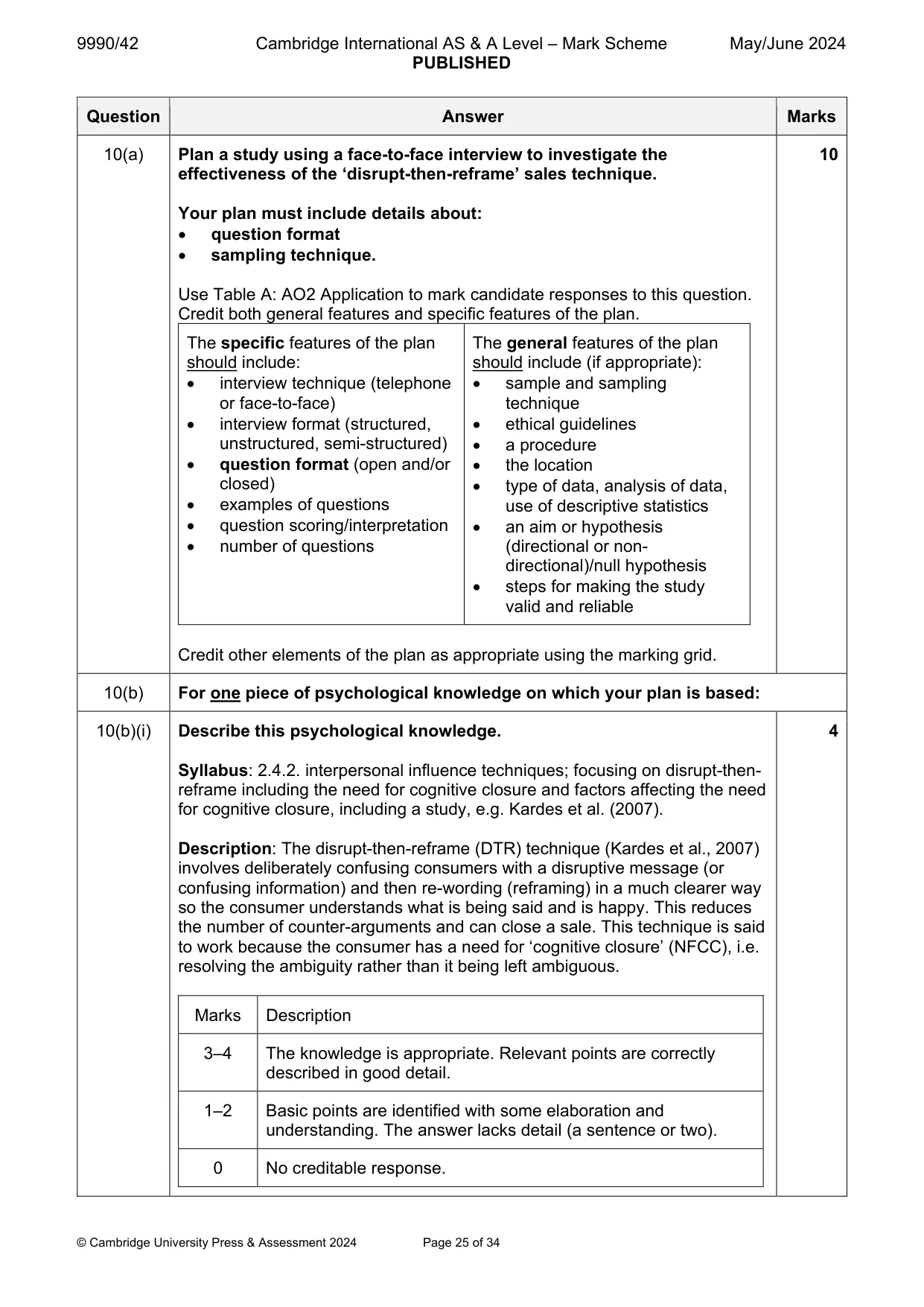
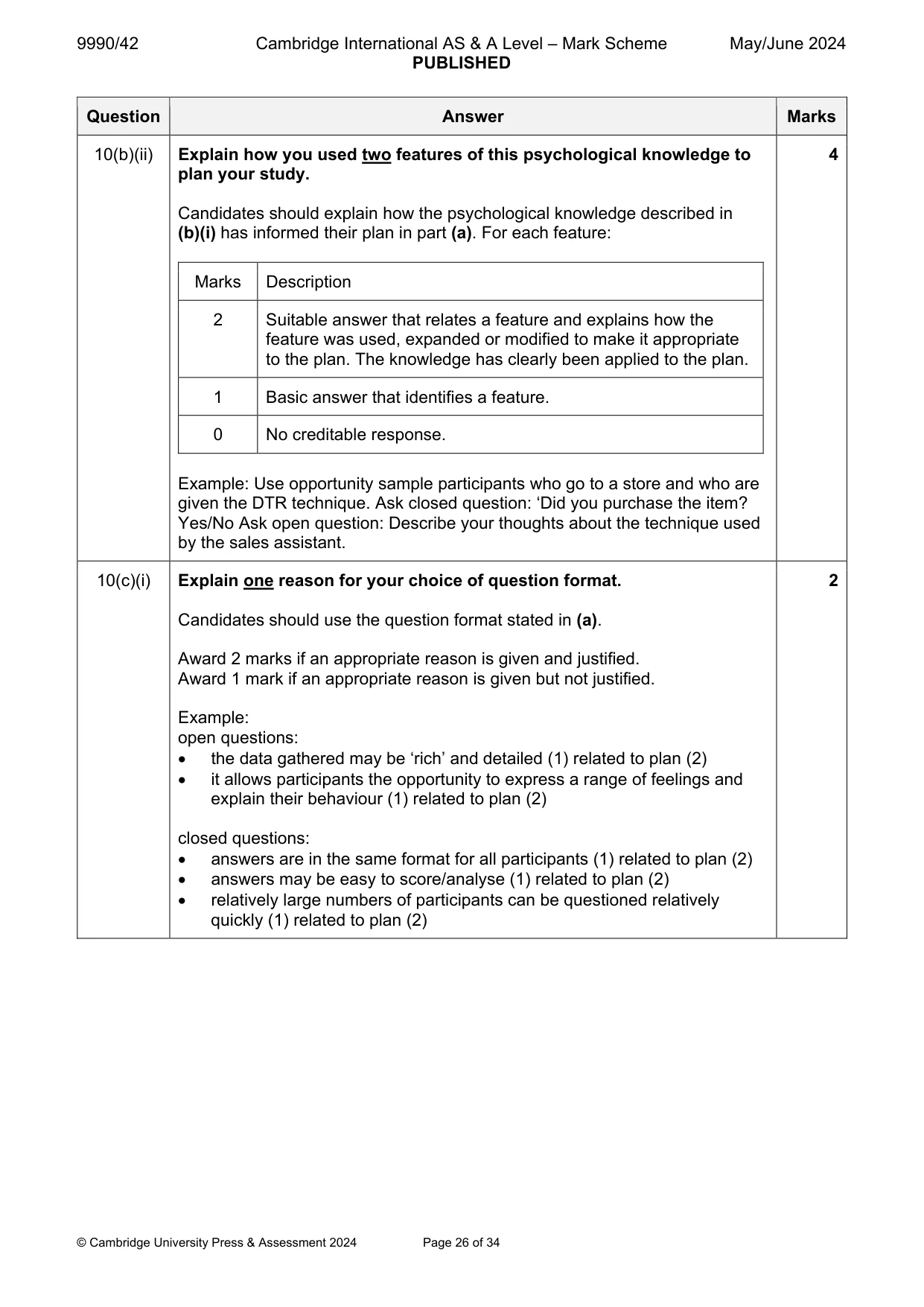
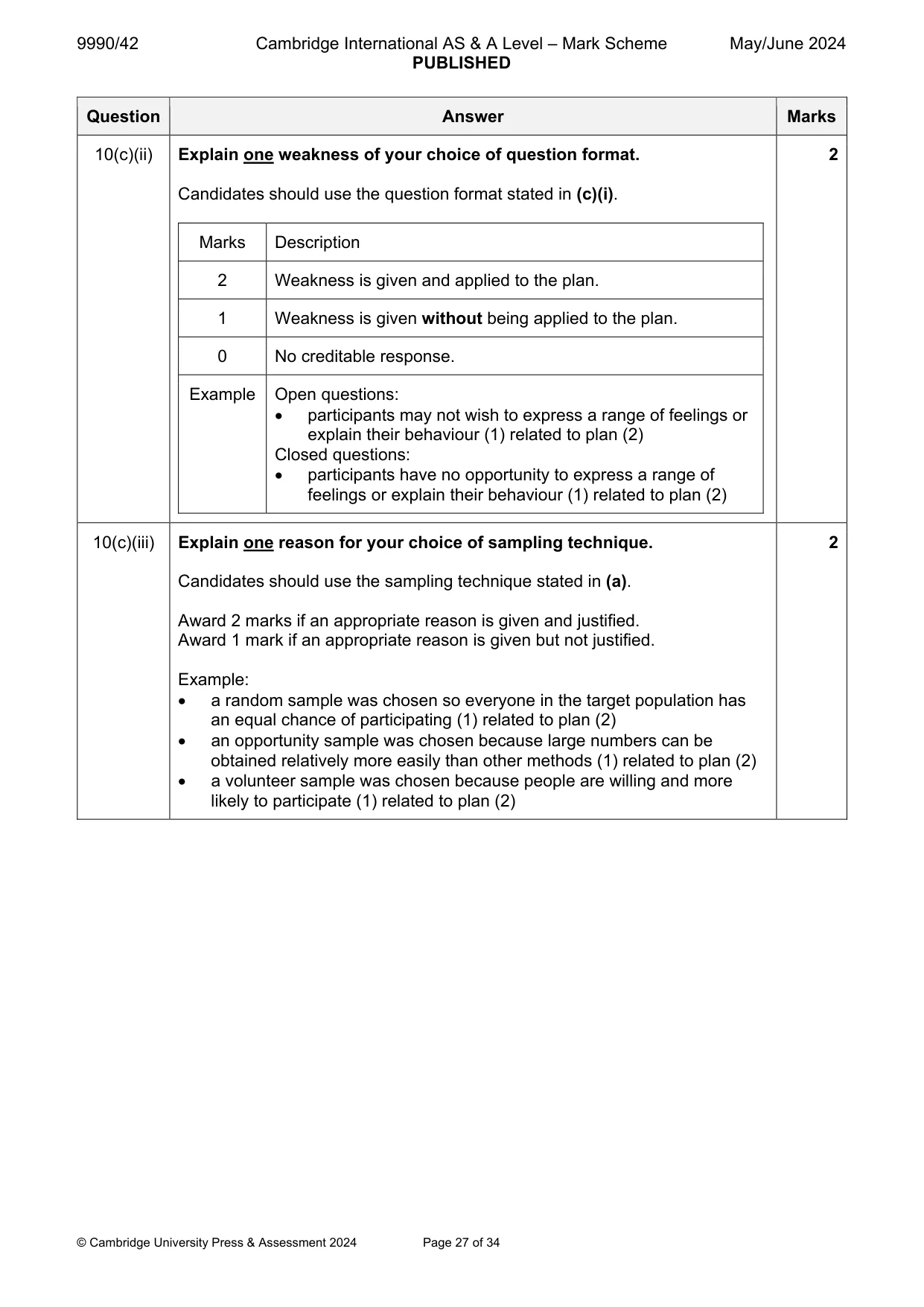
Mark scheme: 10(a) Plan a study using a face-to-face interview to investigate the 10 effectiveness of the ‘disrupt-then-reframe’ sales technique. Your plan must include details about: question format sampling technique. Use Table A: AO2 Application to mark candidate responses to this question. Credit both general features and specific features of the plan. The specific features of the plan The general features of the plan should include: should include (if appropriate): interview technique (telephone sample and sampling or face-to-face) technique interview format (structured, ethical guidelines unstructured, semi-structured) a procedure question format (open and/or the location closed) type of data, analysis of data, examples of questions use of descriptive statistics question scoring/interpretation an aim or hypothesis number of questions (directional or non- directional)/null hypothesis steps for making the study valid and reliable Credit other elements of the plan as appropriate using the marking grid. 10(b) For one piece of psychological knowledge on which your plan is based: 10(b)(i) Describe this psychological knowledge. 4 Syllabus: 2.4.2. interpersonal influence techniques; focusing on disrupt-then- reframe including the need for cognitive closure and factors affecting the need for cognitive closure, including a study, e.g. Kardes et al. (2007). Description: The disrupt-then-reframe (DTR) technique (Kardes et al., 2007) involves deliberately confusing consumers with a disruptive message (or confusing information) and then re-wording (reframing) in a much clearer way so the consumer understands what is being said and is happy. This reduces the number of counter-arguments and can close a sale. This technique is said to work because the consumer has a need for ‘cognitive closure’ (NFCC), i.e. resolving the ambiguity rather than it being left ambiguous. Marks Description 3–4 The knowledge is appropriate. Relevant points are correctly described in good detail. 1–2 Basic points are identified with some elaboration and understanding. The answer lacks detail (a sentence or two). 0 No creditable response. 10(b)(ii) Explain how you used two features of this psychological knowledge to 4 plan your study. Candidates should explain how the psychological knowledge described in (b)(i) has informed their plan in part (a). For each feature: Marks Description 2 Suitable answer that relates a feature and explains how the feature was used, expanded or modified to make it appropriate to the plan. The knowledge has clearly been applied to the plan. 1 Basic answer that identifies a feature. 0 No creditable response. Example: Use opportunity sample participants who go to a store and who are given the DTR technique. Ask closed question: ‘Did you purchase the item? Yes/No Ask open question: Describe your thoughts about the technique used by the sales assistant. 10(c)(i) Explain one reason for your choice of question format. 2 Candidates should use the question format stated in (a). Award 2 marks if an appropriate reason is given and justified. Award 1 mark if an appropriate reason is given but not justified. Example: open questions: the data gathered may be ‘rich’ and detailed (1) related to plan (2) it allows participants the opportunity to express a range of feelings and explain their behaviour (1) related to plan (2) closed questions: answers are in the same format for all participants (1) related to plan (2) answers may be easy to score/analyse (1) related to plan (2) relatively large numbers of participants can be questioned relatively quickly (1) related to plan (2) 10(c)(ii) Explain one weakness of your choice of question format. 2 Candidates should use the question format stated in (c)(i). Marks Description 2 Weakness is given and applied to the plan. 1 Weakness is given without being applied to the plan. 0 No creditable response. Example Open questions: participants may not wish to express a range of feelings or explain their behaviour (1) related to plan (2) Closed questions: participants have no opportunity to express a range of feelings or explain their behaviour (1) related to plan (2) 10(c)(iii) Explain one reason for your choice of sampling technique. 2 Candidates should use the sampling technique stated in (a). Award 2 marks if an appropriate reason is given and justified. Award 1 mark if an appropriate reason is given but not justified. Example: a random sample was chosen so everyone in the target population has an equal chance of participating (1) related to plan (2) an opportunity sample was chosen because large numbers can be obtained relatively more easily than other methods (1) related to plan (2) a volunteer sample was chosen because people are willing and more likely to participate (1) related to plan (2)
Q11 · Plan a study using a semi-structured interview to investigate whether stress inoculation…
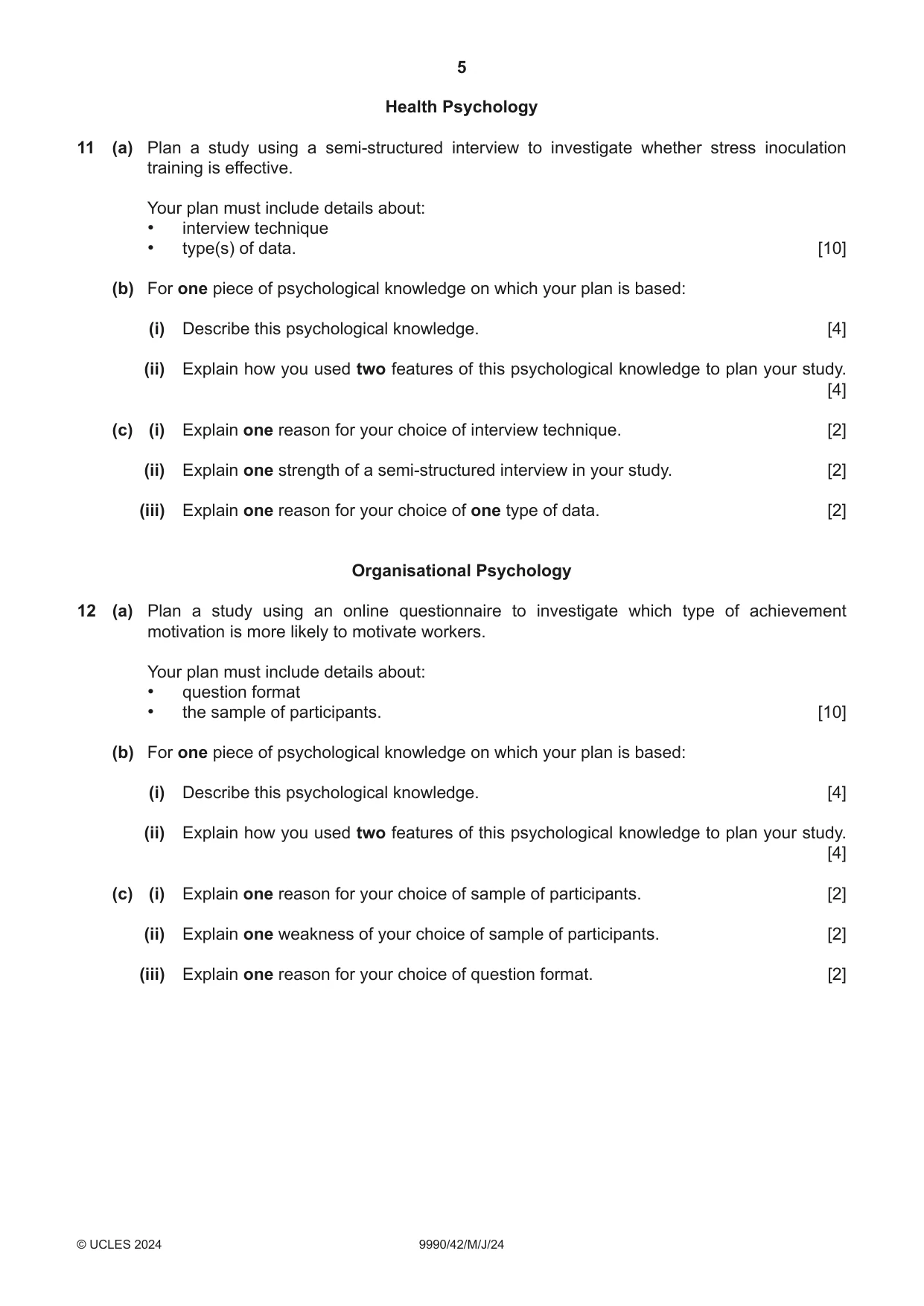
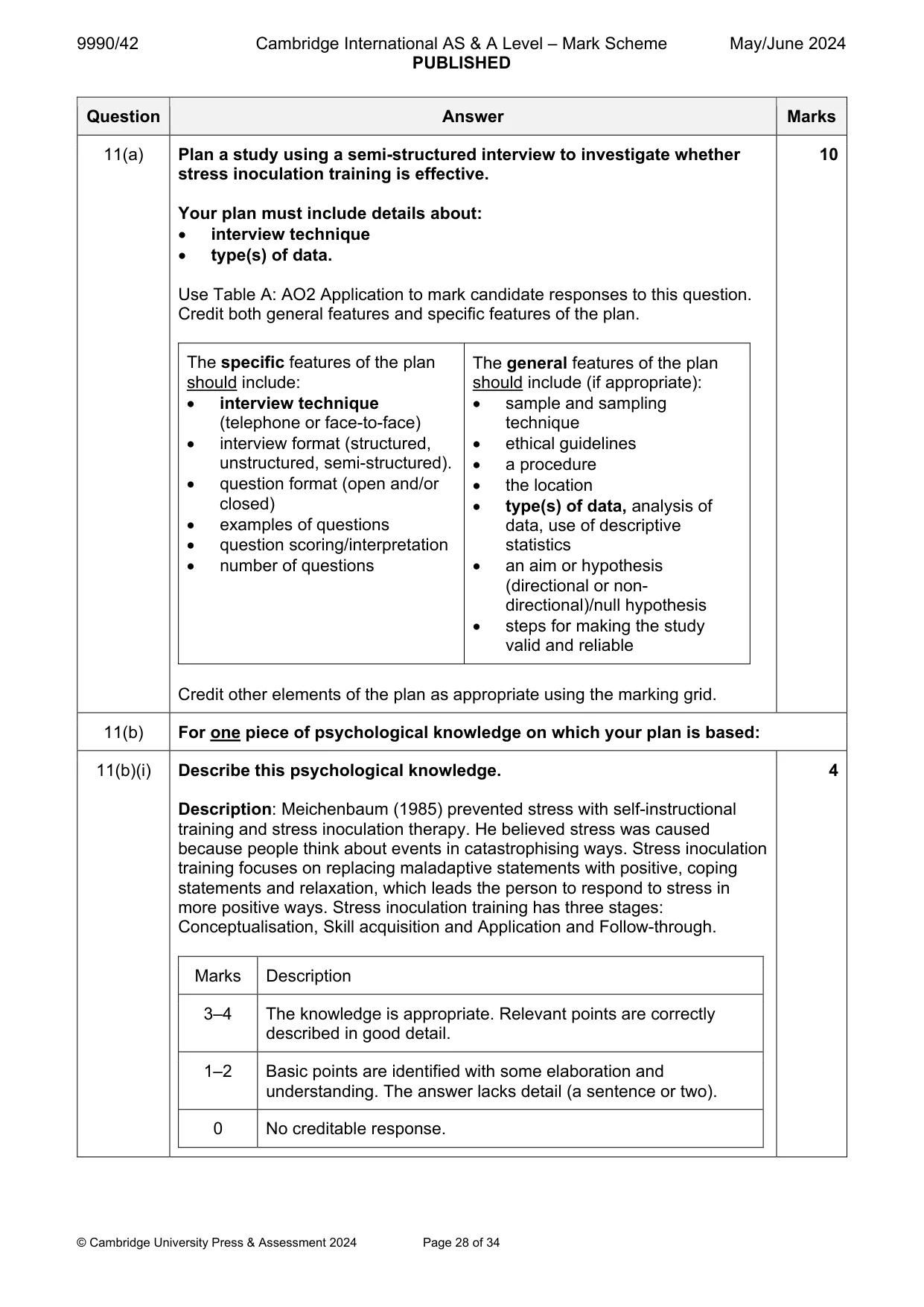
11 (a) Plan a study using a semi-structured interview to investigate whether stress inoculation training is effective. Your plan must include details about: • interview technique • type(s) of data. [10] (b) For one piece of psychological knowledge on which your plan is based: (i) Describe this psychological knowledge. [4] (ii) Explain how you used two features of this psychological knowledge to plan your study. [4] (c) (i) Explain one reason for your choice of interview technique. [2] (ii) Explain one strength of a semi-structured interview in your study. [2] (iii) Explain one reason for your choice of one type of data. [2] Organisational Psychology
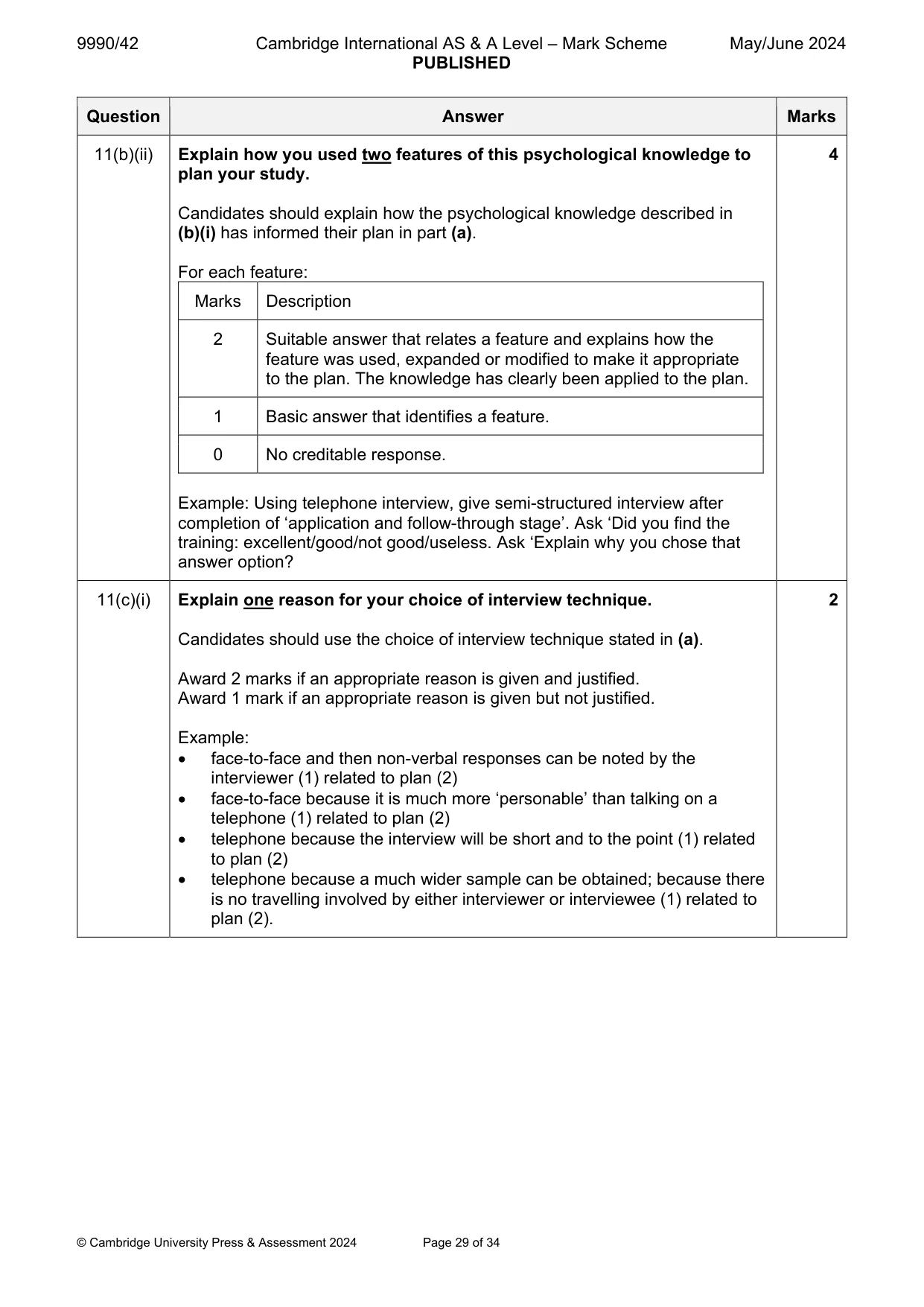
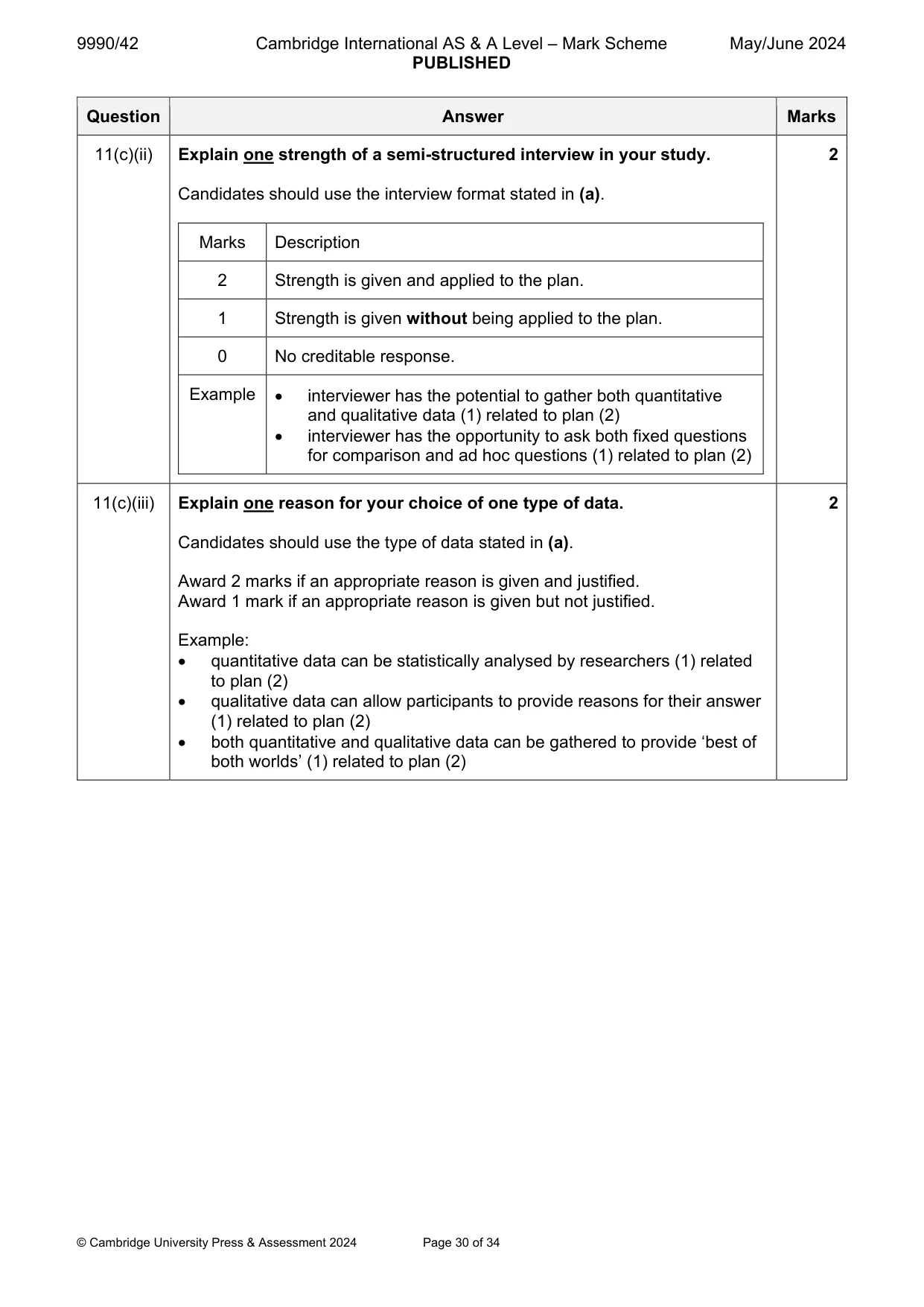
Mark scheme: 11(a) Plan a study using a semi-structured interview to investigate whether 10 stress inoculation training is effective. Your plan must include details about: interview technique type(s) of data. Use Table A: AO2 Application to mark candidate responses to this question. Credit both general features and specific features of the plan. The specific features of the plan The general features of the plan should include: should include (if appropriate): interview technique sample and sampling (telephone or face-to-face) technique interview format (structured, ethical guidelines unstructured, semi-structured). a procedure question format (open and/or the location closed) type(s) of data, analysis of examples of questions data, use of descriptive question scoring/interpretation statistics number of questions an aim or hypothesis (directional or non- directional)/null hypothesis steps for making the study valid and reliable Credit other elements of the plan as appropriate using the marking grid. 11(b) For one piece of psychological knowledge on which your plan is based: 11(b)(i) Describe this psychological knowledge. 4 Description: Meichenbaum (1985) prevented stress with self-instructional training and stress inoculation therapy. He believed stress was caused because people think about events in catastrophising ways. Stress inoculation training focuses on replacing maladaptive statements with positive, coping statements and relaxation, which leads the person to respond to stress in more positive ways. Stress inoculation training has three stages: Conceptualisation, Skill acquisition and Application and Follow-through. Marks Description 3–4 The knowledge is appropriate. Relevant points are correctly described in good detail. 1–2 Basic points are identified with some elaboration and understanding. The answer lacks detail (a sentence or two). 0 No creditable response. 11(b)(ii) Explain how you used two features of this psychological knowledge to 4 plan your study. Candidates should explain how the psychological knowledge described in (b)(i) has informed their plan in part (a). For each feature: Marks Description 2 Suitable answer that relates a feature and explains how the feature was used, expanded or modified to make it appropriate to the plan. The knowledge has clearly been applied to the plan. 1 Basic answer that identifies a feature. 0 No creditable response. Example: Using telephone interview, give semi-structured interview after completion of ‘application and follow-through stage’. Ask ‘Did you find the training: excellent/good/not good/useless. Ask ‘Explain why you chose that answer option? 11(c)(i) Explain one reason for your choice of interview technique. 2 Candidates should use the choice of interview technique stated in (a). Award 2 marks if an appropriate reason is given and justified. Award 1 mark if an appropriate reason is given but not justified. Example: face-to-face and then non-verbal responses can be noted by the interviewer (1) related to plan (2) face-to-face because it is much more ‘personable’ than talking on a telephone (1) related to plan (2) telephone because the interview will be short and to the point (1) related to plan (2) telephone because a much wider sample can be obtained; because there is no travelling involved by either interviewer or interviewee (1) related to plan (2). 11(c)(ii) Explain one strength of a semi-structured interview in your study. 2 Candidates should use the interview format stated in (a). Marks Description 2 Strength is given and applied to the plan. 1 Strength is given without being applied to the plan. 0 No creditable response. Example interviewer has the potential to gather both quantitative and qualitative data (1) related to plan (2) interviewer has the opportunity to ask both fixed questions for comparison and ad hoc questions (1) related to plan (2) 11(c)(iii) Explain one reason for your choice of one type of data. 2 Candidates should use the type of data stated in (a). Award 2 marks if an appropriate reason is given and justified. Award 1 mark if an appropriate reason is given but not justified. Example: quantitative data can be statistically analysed by researchers (1) related to plan (2) qualitative data can allow participants to provide reasons for their answer (1) related to plan (2) both quantitative and qualitative data can be gathered to provide ‘best of both worlds’ (1) related to plan (2)
Q12 · Plan a study using an online questionnaire to investigate which type of achievement…
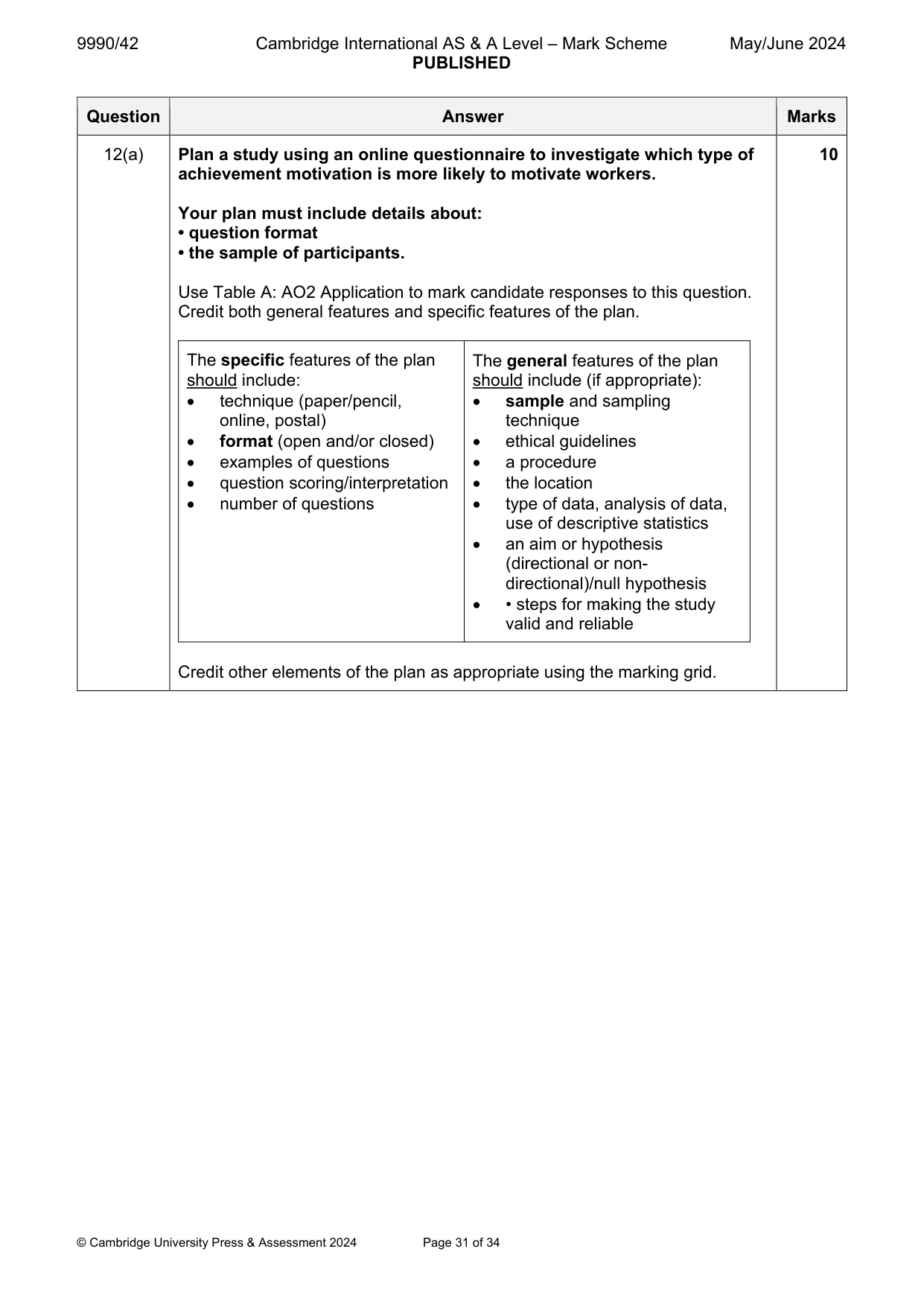
12 (a) Plan a study using an online questionnaire to investigate which type of achievement motivation is more likely to motivate workers. Your plan must include details about: • question format • the sample of participants. [10] (b) For one piece of psychological knowledge on which your plan is based: (i) Describe this psychological knowledge. [4] (ii) Explain how you used two features of this psychological knowledge to plan your study. [4] (c) (i) Explain one reason for your choice of sample of participants. [2] (ii) Explain one weakness of your choice of sample of participants. [2] (iii) Explain one reason for your choice of question format. [2]
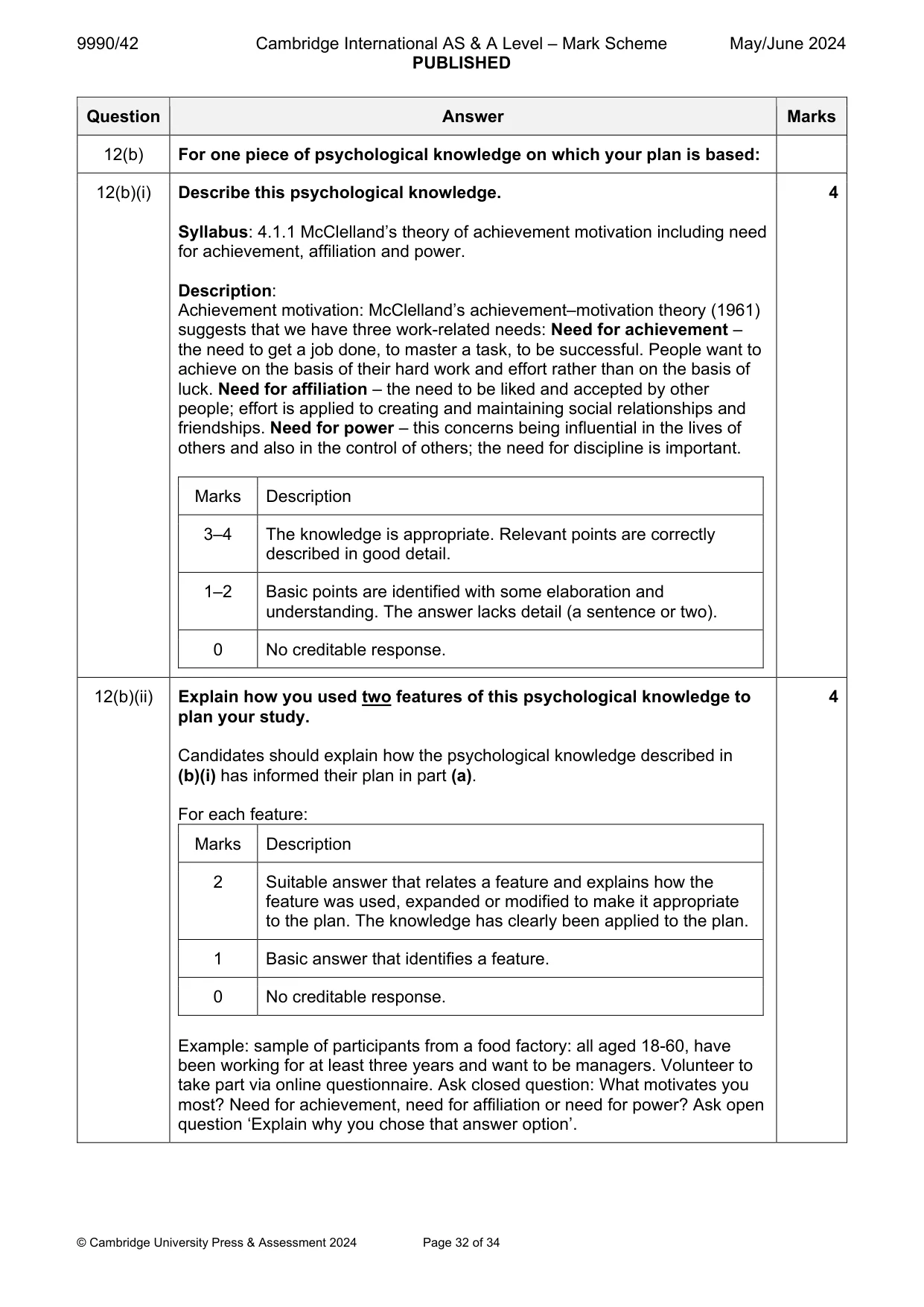
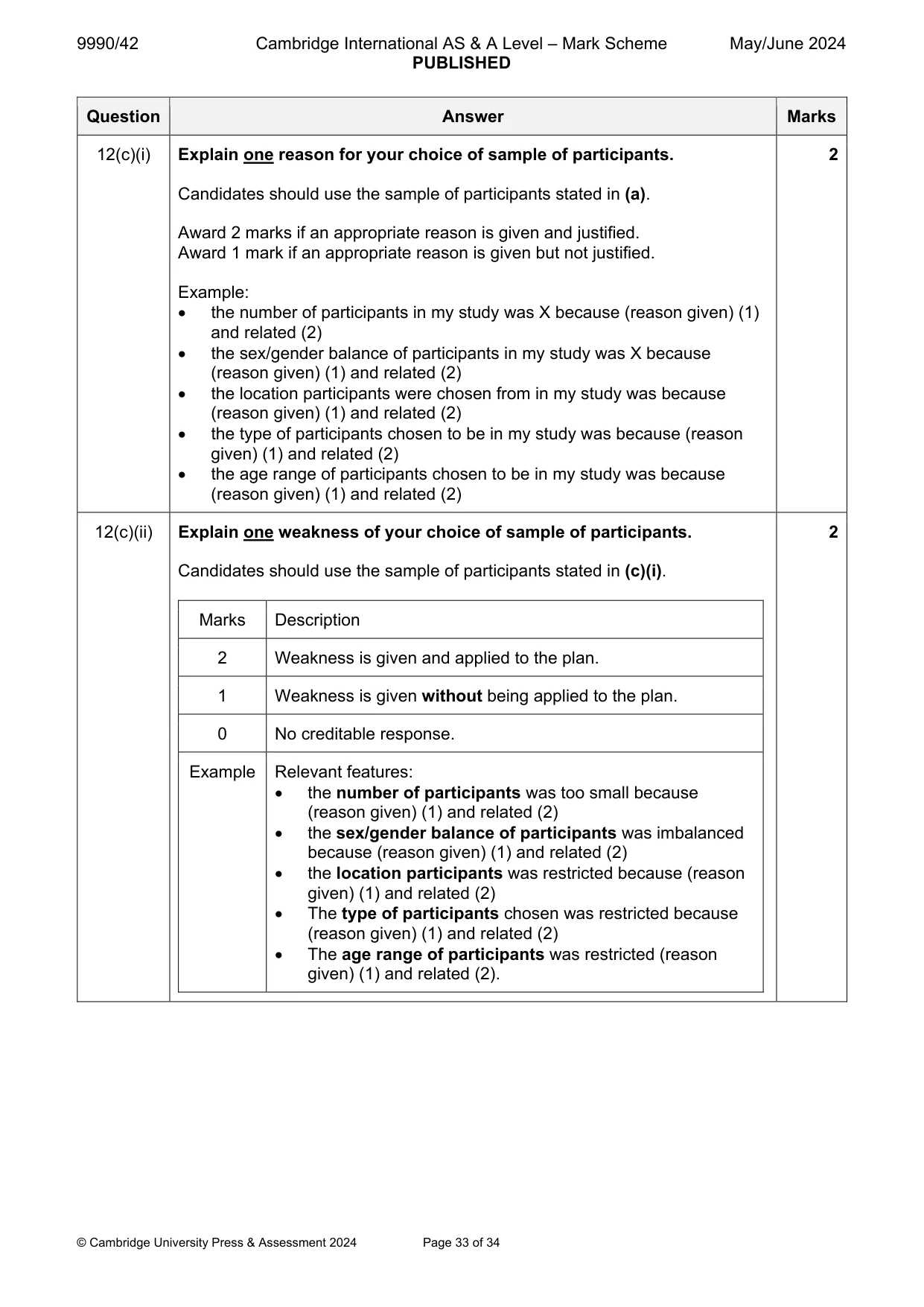
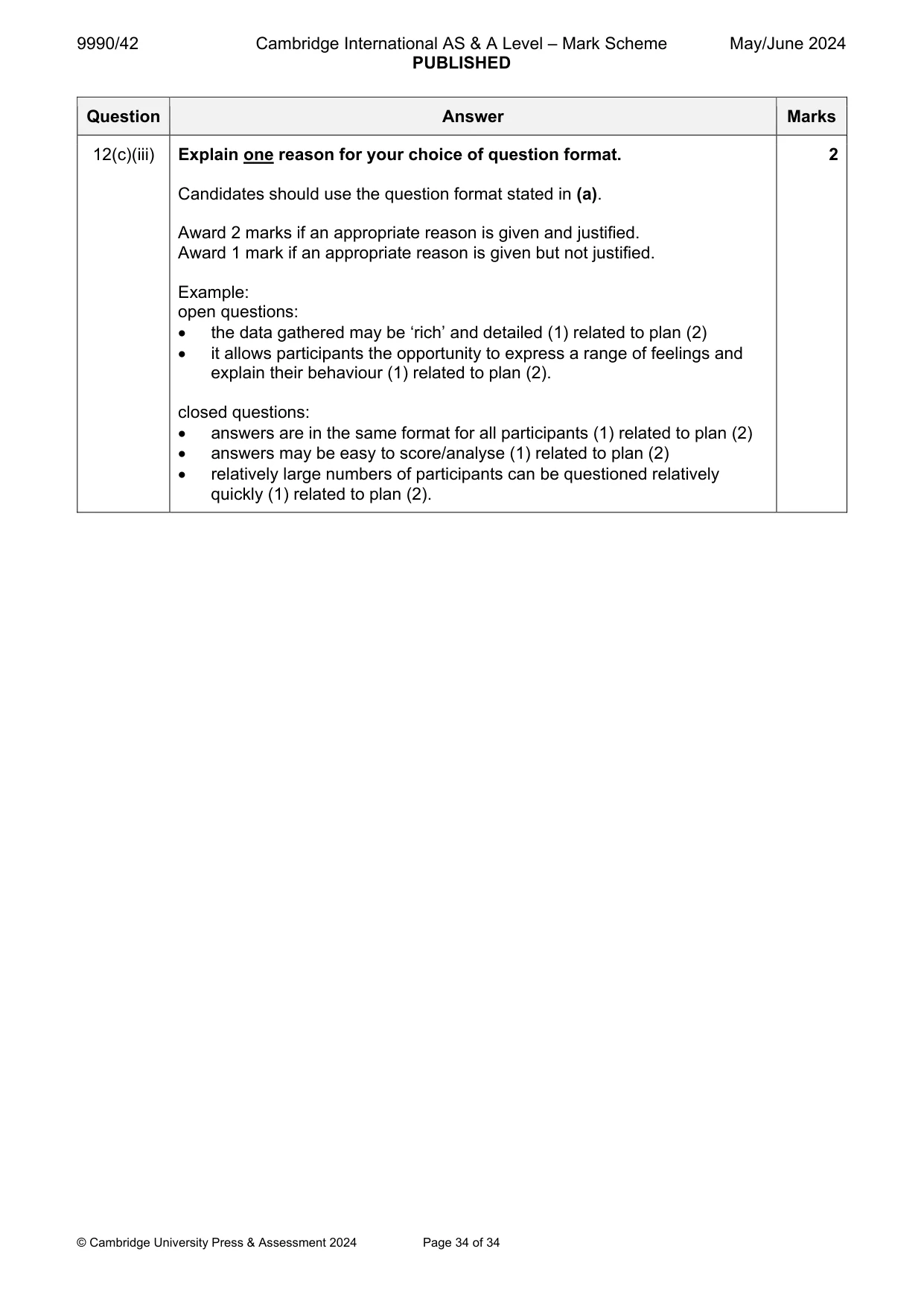
Mark scheme: 12(a) Plan a study using an online questionnaire to investigate which type of 10 achievement motivation is more likely to motivate workers. Your plan must include details about: • question format • the sample of participants. Use Table A: AO2 Application to mark candidate responses to this question. Credit both general features and specific features of the plan. The specific features of the plan The general features of the plan should include: should include (if appropriate): technique (paper/pencil, sample and sampling online, postal) technique format (open and/or closed) ethical guidelines examples of questions a procedure question scoring/interpretation the location number of questions type of data, analysis of data, use of descriptive statistics an aim or hypothesis (directional or non- directional)/null hypothesis • steps for making the study valid and reliable Credit other elements of the plan as appropriate using the marking grid. 12(b) For one piece of psychological knowledge on which your plan is based: 12(b)(i) Describe this psychological knowledge. 4 Syllabus: 4.1.1 McClelland’s theory of achievement motivation including need for achievement, affiliation and power. Description: Achievement motivation: McClelland’s achievement–motivation theory (1961) suggests that we have three work-related needs: Need for achievement – the need to get a job done, to master a task, to be successful. People want to achieve on the basis of their hard work and effort rather than on the basis of luck. Need for affiliation – the need to be liked and accepted by other people; effort is applied to creating and maintaining social relationships and friendships. Need for power – this concerns being influential in the lives of others and also in the control of others; the need for discipline is important. Marks Description 3–4 The knowledge is appropriate. Relevant points are correctly described in good detail. 1–2 Basic points are identified with some elaboration and understanding. The answer lacks detail (a sentence or two). 0 No creditable response. 12(b)(ii) Explain how you used two features of this psychological knowledge to 4 plan your study. Candidates should explain how the psychological knowledge described in (b)(i) has informed their plan in part (a). For each feature: Marks Description 2 Suitable answer that relates a feature and explains how the feature was used, expanded or modified to make it appropriate to the plan. The knowledge has clearly been applied to the plan. 1 Basic answer that identifies a feature. 0 No creditable response. Example: sample of participants from a food factory: all aged 18-60, have been working for at least three years and want to be managers. Volunteer to take part via online questionnaire. Ask closed question: What motivates you most? Need for achievement, need for affiliation or need for power? Ask open question ‘Explain why you chose that answer option’. 12(c)(i) Explain one reason for your choice of sample of participants. 2 Candidates should use the sample of participants stated in (a). Award 2 marks if an appropriate reason is given and justified. Award 1 mark if an appropriate reason is given but not justified. Example: the number of participants in my study was X because (reason given) (1) and related (2) the sex/gender balance of participants in my study was X because (reason given) (1) and related (2) the location participants were chosen from in my study was because (reason given) (1) and related (2) the type of participants chosen to be in my study was because (reason given) (1) and related (2) the age range of participants chosen to be in my study was because (reason given) (1) and related (2) 12(c)(ii) Explain one weakness of your choice of sample of participants. 2 Candidates should use the sample of participants stated in (c)(i). Marks Description 2 Weakness is given and applied to the plan. 1 Weakness is given without being applied to the plan. 0 No creditable response. Example Relevant features: the number of participants was too small because (reason given) (1) and related (2) the sex/gender balance of participants was imbalanced because (reason given) (1) and related (2) the location participants was restricted because (reason given) (1) and related (2) The type of participants chosen was restricted because (reason given) (1) and related (2) The age range of participants was restricted (reason given) (1) and related (2). 12(c)(iii) Explain one reason for your choice of question format. 2 Candidates should use the question format stated in (a). Award 2 marks if an appropriate reason is given and justified. Award 1 mark if an appropriate reason is given but not justified. Example: open questions: the data gathered may be ‘rich’ and detailed (1) related to plan (2) it allows participants the opportunity to express a range of feelings and explain their behaviour (1) related to plan (2). closed questions: answers are in the same format for all participants (1) related to plan (2) answers may be easy to score/analyse (1) related to plan (2) relatively large numbers of participants can be questioned relatively quickly (1) related to plan (2).
What was in this paper
The subtopics covered by these 12 questions, and how many questions each got. Open one in a new tab to see every Cambridge question on it.
What you needed in this session
Cambridge’s own grade thresholds for 2024 May/June, Paper 4 · Variant 2. A higher threshold means an easier paper — the bar moves with how the cohort did.