Cambridge A Level Psychology (from 2018) 9990 — 2024 Feb/March Paper 4 · Variant 2
9990/42/F/M/24 · 12 questions · 60 marks · 90 min
The question paper and its mark scheme, free to read here and free to download. This is Cambridge’s own paper, exactly as it was sat.
Question paper8 pages



Mark scheme36 pages
Answers below. Sit the paper first if you are practising.
Questions as text
Q1 · From the key study by Grant et al
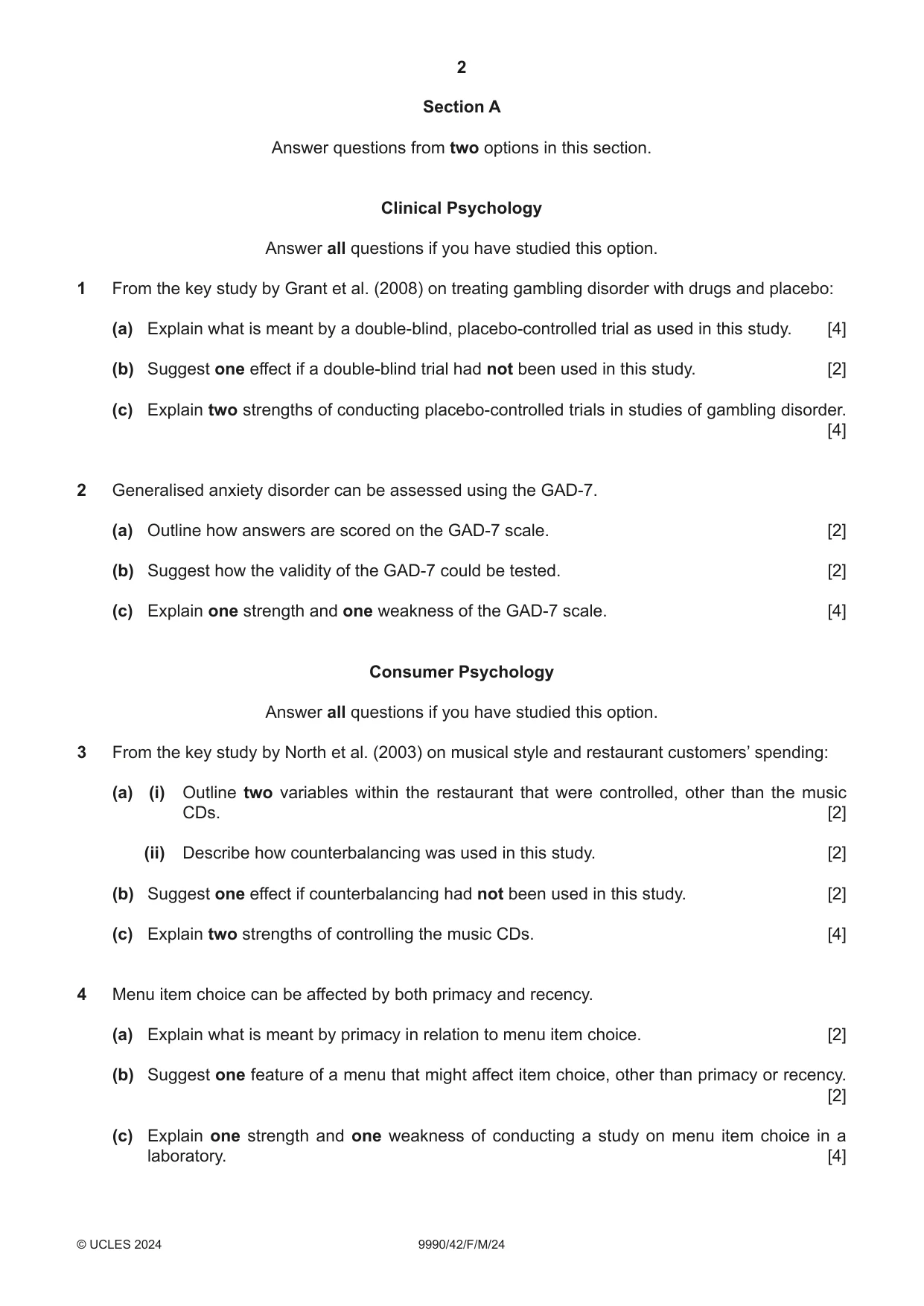
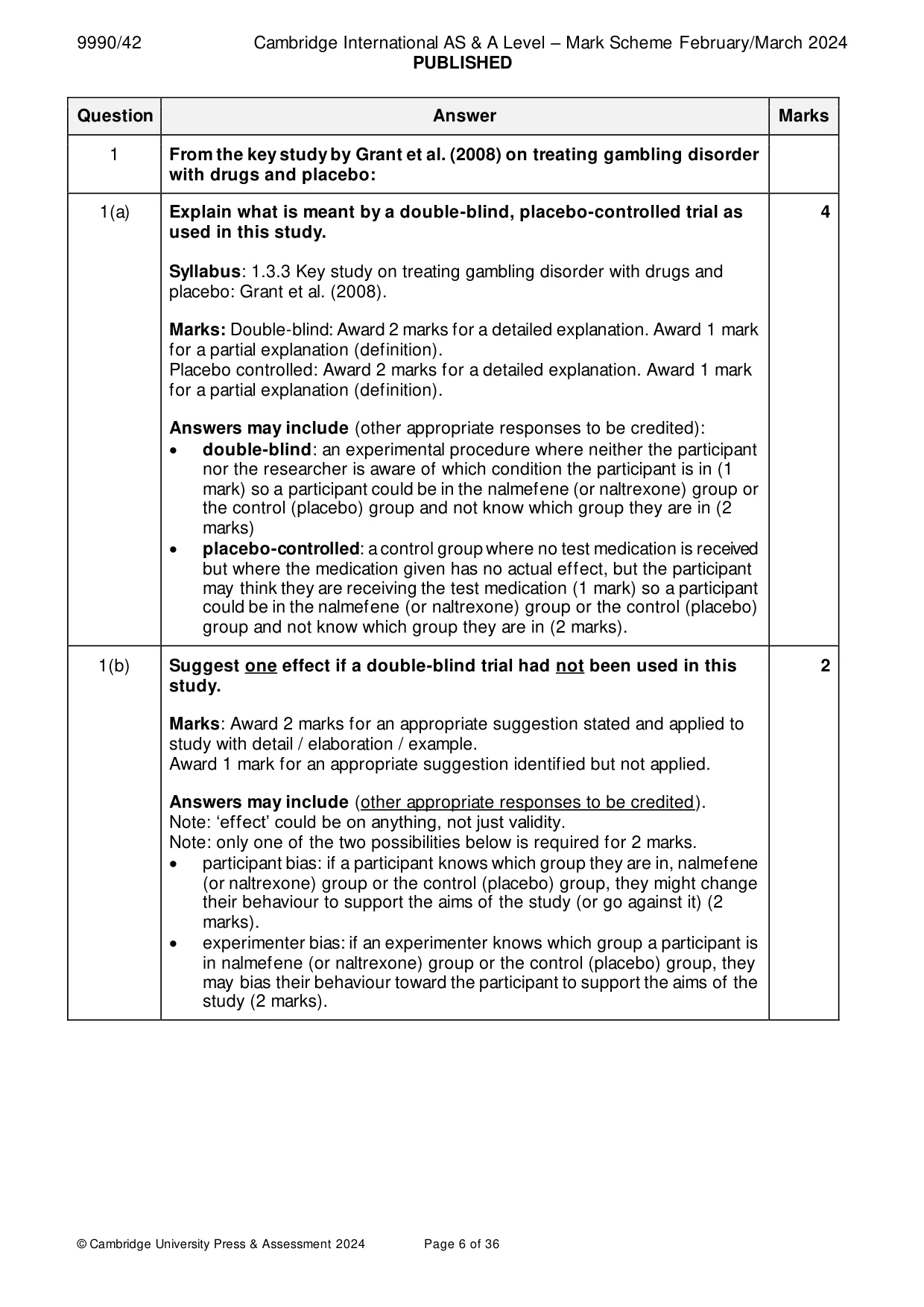
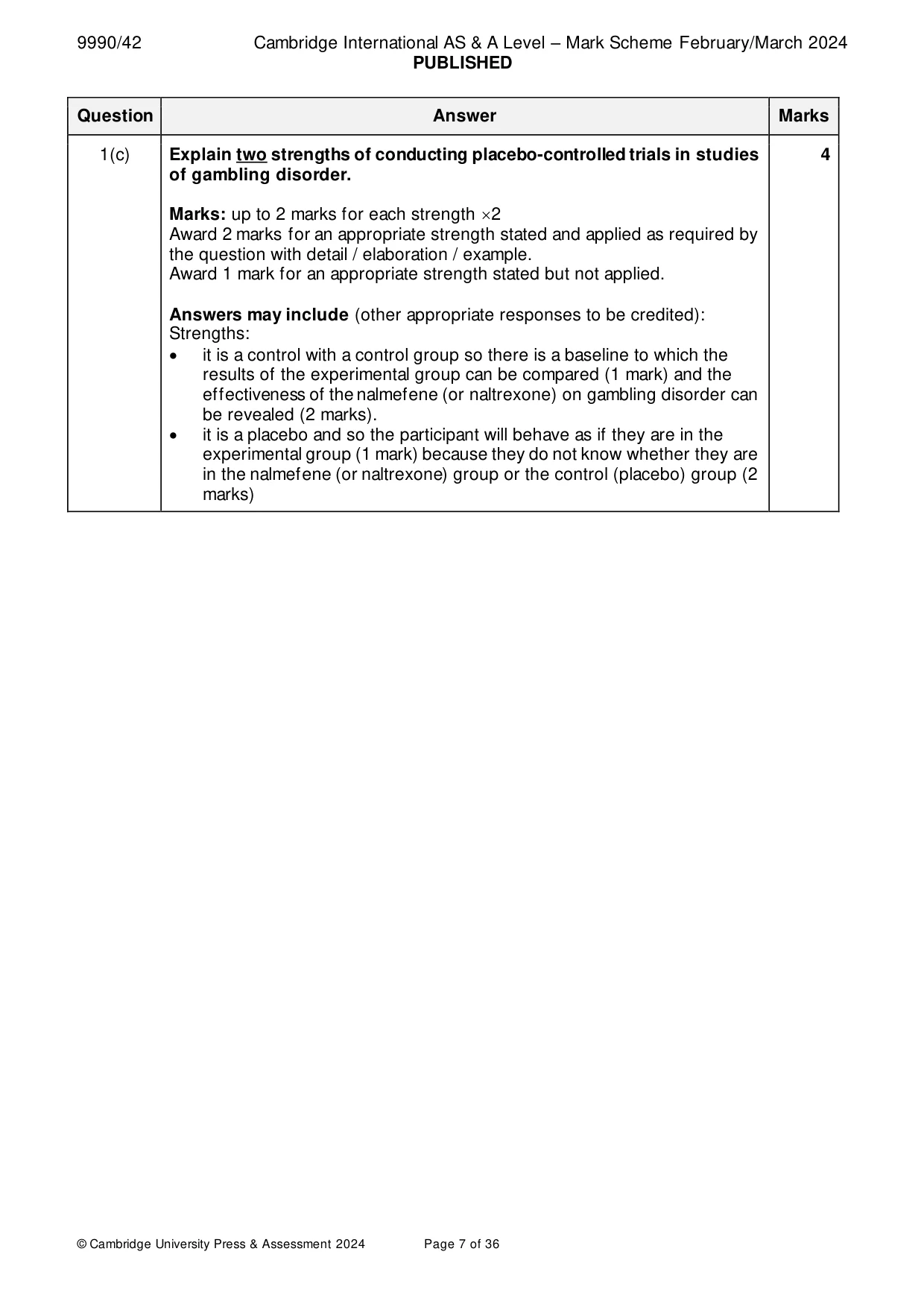
1 From the key study by Grant et al. (2008) on treating gambling disorder with drugs and placebo: (a) Explain what is meant by a double-blind, placebo-controlled trial as used in this study. [4] (b) Suggest one effect if a double-blind trial had not been used in this study. [2] (c) Explain two strengths of conducting placebo-controlled trials in studies of gambling disorder. [4]
Mark scheme: Question Answer Marks 1 From the key study by Grant et al. (2008) on treating gambling disorder with drugs and placebo: 1(a) Explain what is meant by a double-blind, placebo-controlled trial as 4 used in this study. Syllabus: 1.3.3 Key study on treating gambling disorder with drugs and placebo: Grant et al. (2008). Marks: Double-blind: Award 2 marks for a detailed explanation. Award 1 mark for a partial explanation (definition). Placebo controlled: Award 2 marks for a detailed explanation. Award 1 mark for a partial explanation (definition). Answers may include (other appropriate responses to be credited): • double-blind: an experimental procedure where neither the participant nor the researcher is aware of which condition the participant is in (1 mark) so a participant could be in the nalmefene (or naltrexone) group or the control (placebo) group and not know which group they are in (2 marks) • placebo-controlled: a control group where no test medication is received but where the medication given has no actual effect, but the participant may think they are receiving the test medication (1 mark) so a participant could be in the nalmefene (or naltrexone) group or the control (placebo) group and not know which group they are in (2 marks). 1(b) Suggest one effect if a double-blind trial had not been used in this 2 study. Marks: Award 2 marks for an appropriate suggestion stated and applied to study with detail / elaboration / example. Award 1 mark for an appropriate suggestion identified but not applied. Answers may include (other appropriate responses to be credited). Note: ‘effect’ could be on anything, not just validity. Note: only one of the two possibilities below is required for 2 marks. • participant bias: if a participant knows which group they are in, nalmefene (or naltrexone) group or the control (placebo) group, they might change their behaviour to support the aims of the study (or go against it) (2 marks). • experimenter bias: if an experimenter knows which group a participant is in nalmefene (or naltrexone) group or the control (placebo) group, they may bias their behaviour toward the participant to support the aims of the study (2 marks). 1(c) Explain two strengths of conducting placebo-controlled trials in studies 4 of gambling disorder. Marks: up to 2 marks for each strength 2 Award 2 marks for an appropriate strength stated and applied as required by the question with detail / elaboration / example. Award 1 mark for an appropriate strength stated but not applied. Answers may include (other appropriate responses to be credited): Strengths: • it is a control with a control group so there is a baseline to which the results of the experimental group can be compared (1 mark) and the effectiveness of the nalmefene (or naltrexone) on gambling disorder can be revealed (2 marks). • it is a placebo and so the participant will behave as if they are in the experimental group (1 mark) because they do not know whether they are in the nalmefene (or naltrexone) group or the control (placebo) group (2 marks)
Q2 · Generalised anxiety disorder can be assessed using the GAD-7
2 Generalised anxiety disorder can be assessed using the GAD-7. (a) Outline how answers are scored on the GAD-7 scale. [2] (b) Suggest how the validity of the GAD-7 could be tested. [2] (c) Explain one strength and one weakness of the GAD-7 scale. [4] Consumer Psychology Answer all questions if you have studied this option.
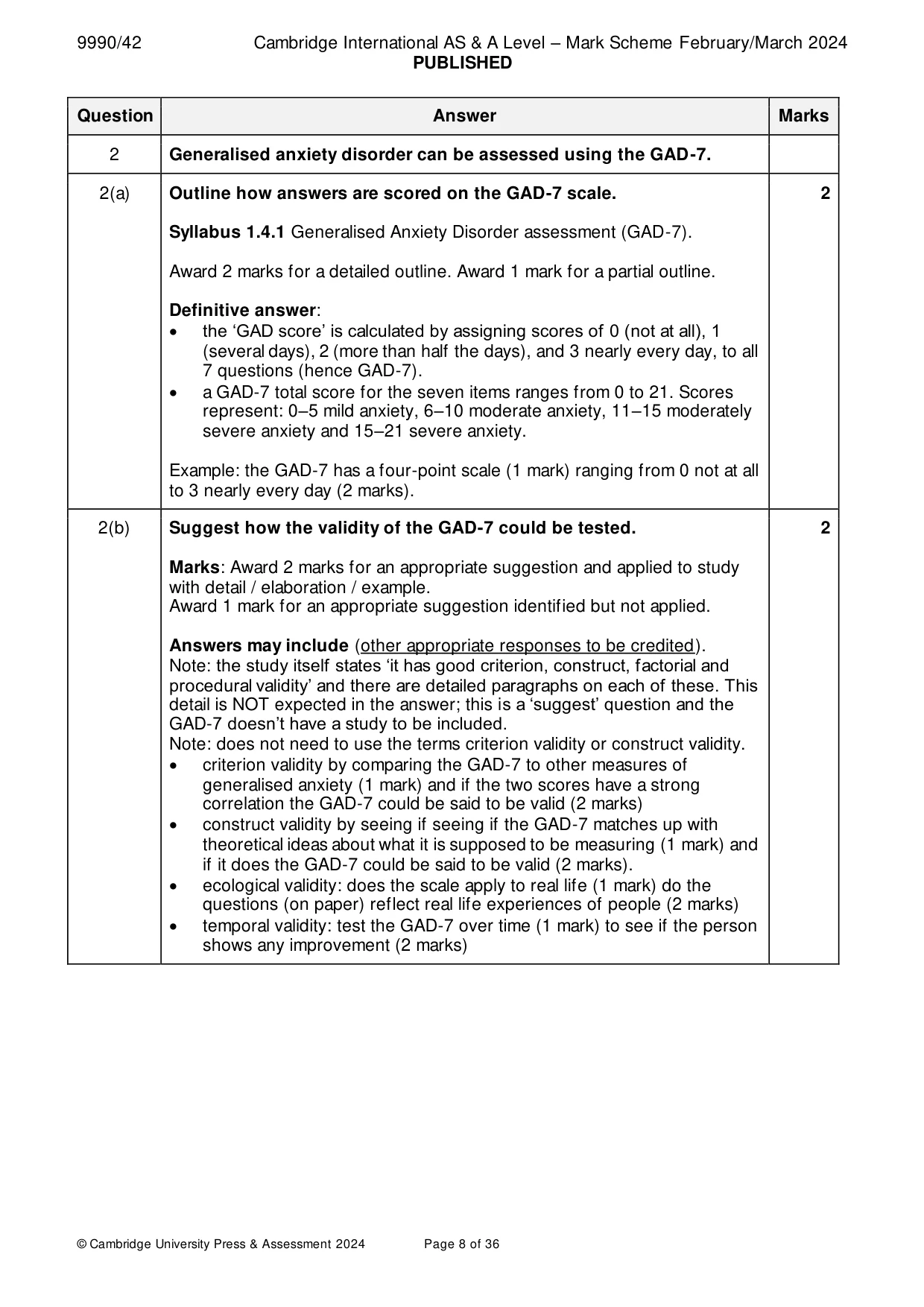
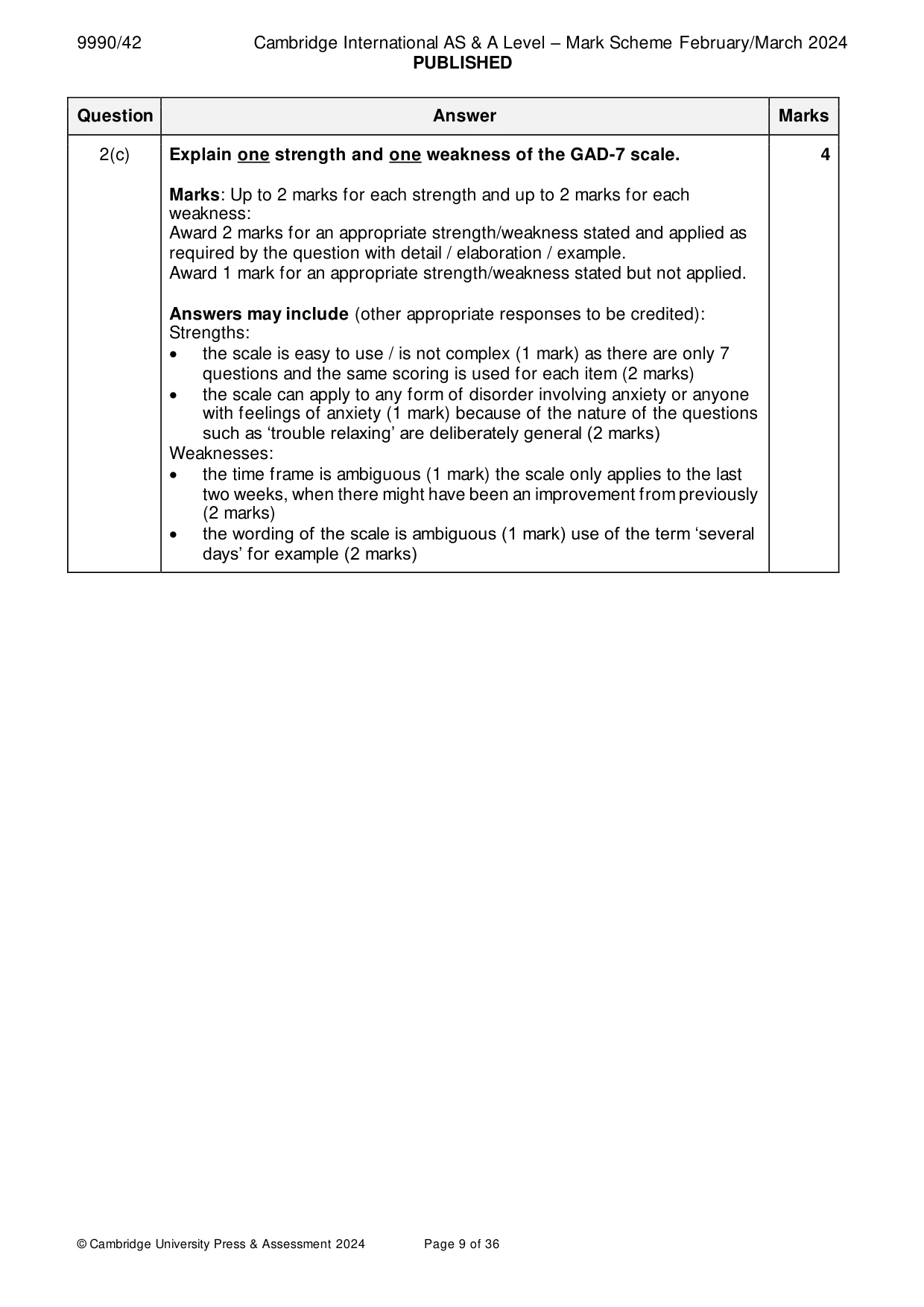
Mark scheme: 2 Generalised anxiety disorder can be assessed using the GAD-7. 2(a) Outline how answers are scored on the GAD-7 scale. 2 Syllabus 1.4.1 Generalised Anxiety Disorder assessment (GAD-7). Award 2 marks for a detailed outline. Award 1 mark for a partial outline. Definitive answer: • the ‘GAD score’ is calculated by assigning scores of 0 (not at all), 1 (several days), 2 (more than half the days), and 3 nearly every day, to all 7 questions (hence GAD-7). • a GAD-7 total score for the seven items ranges from 0 to 21. Scores represent: 0–5 mild anxiety, 6–10 moderate anxiety, 11–15 moderately severe anxiety and 15–21 severe anxiety. Example: the GAD-7 has a four-point scale (1 mark) ranging from 0 not at all to 3 nearly every day (2 marks). 2(b) Suggest how the validity of the GAD-7 could be tested. 2 Marks: Award 2 marks for an appropriate suggestion and applied to study with detail / elaboration / example. Award 1 mark for an appropriate suggestion identified but not applied. Answers may include (other appropriate responses to be credited). Note: the study itself states ‘it has good criterion, construct, factorial and procedural validity’ and there are detailed paragraphs on each of these. This detail is NOT expected in the answer; this is a ‘suggest’ question and the GAD-7 doesn’t have a study to be included. Note: does not need to use the terms criterion validity or construct validity. • criterion validity by comparing the GAD-7 to other measures of generalised anxiety (1 mark) and if the two scores have a strong correlation the GAD-7 could be said to be valid (2 marks) • construct validity by seeing if seeing if the GAD-7 matches up with theoretical ideas about what it is supposed to be measuring (1 mark) and if it does the GAD-7 could be said to be valid (2 marks). • ecological validity: does the scale apply to real life (1 mark) do the questions (on paper) reflect real life experiences of people (2 marks) • temporal validity: test the GAD-7 over time (1 mark) to see if the person shows any improvement (2 marks) 2(c) Explain one strength and one weakness of the GAD-7 scale. 4 Marks: Up to 2 marks for each strength and up to 2 marks for each weakness: Award 2 marks for an appropriate strength/weakness stated and applied as required by the question with detail / elaboration / example. Award 1 mark for an appropriate strength/weakness stated but not applied. Answers may include (other appropriate responses to be credited): Strengths: • the scale is easy to use / is not complex (1 mark) as there are only 7 questions and the same scoring is used for each item (2 marks) • the scale can apply to any form of disorder involving anxiety or anyone with feelings of anxiety (1 mark) because of the nature of the questions such as ‘trouble relaxing’ are deliberately general (2 marks) Weaknesses: • the time frame is ambiguous (1 mark) the scale only applies to the last two weeks, when there might have been an improvement from previously (2 marks) • the wording of the scale is ambiguous (1 mark) use of the term ‘several days’ for example (2 marks)
More questions on Anxiety disorders and fear-related disorders
Q3 · From the key study by North et al
3 From the key study by North et al. (2003) on musical style and restaurant customers’ spending: (a) (i) Outline two variables within the restaurant that were controlled, other than the music CDs. [2] (ii) Describe how counterbalancing was used in this study. [2] (b) Suggest one effect if counterbalancing had not been used in this study. [2] (c) Explain two strengths of controlling the music CDs. [4]
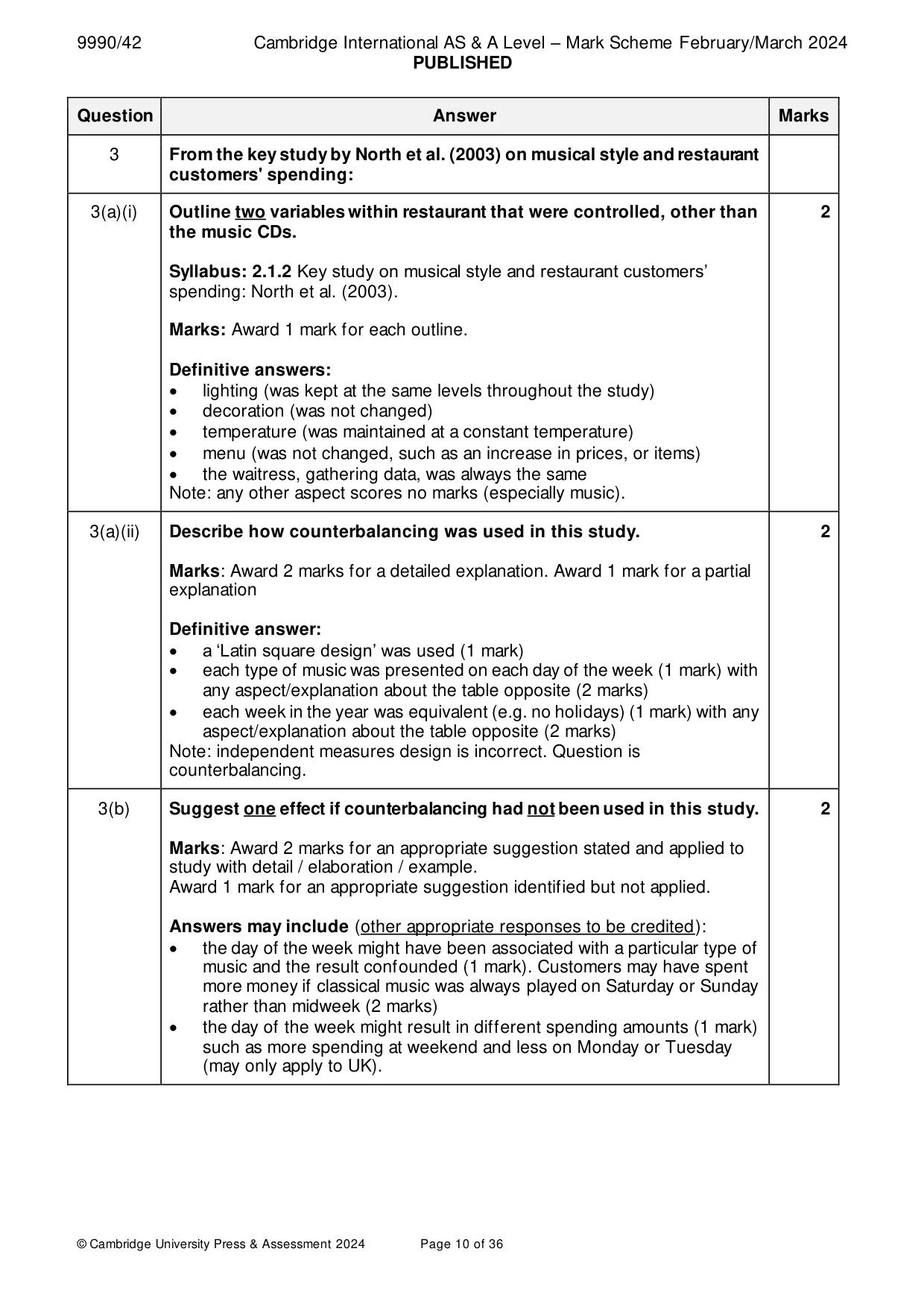
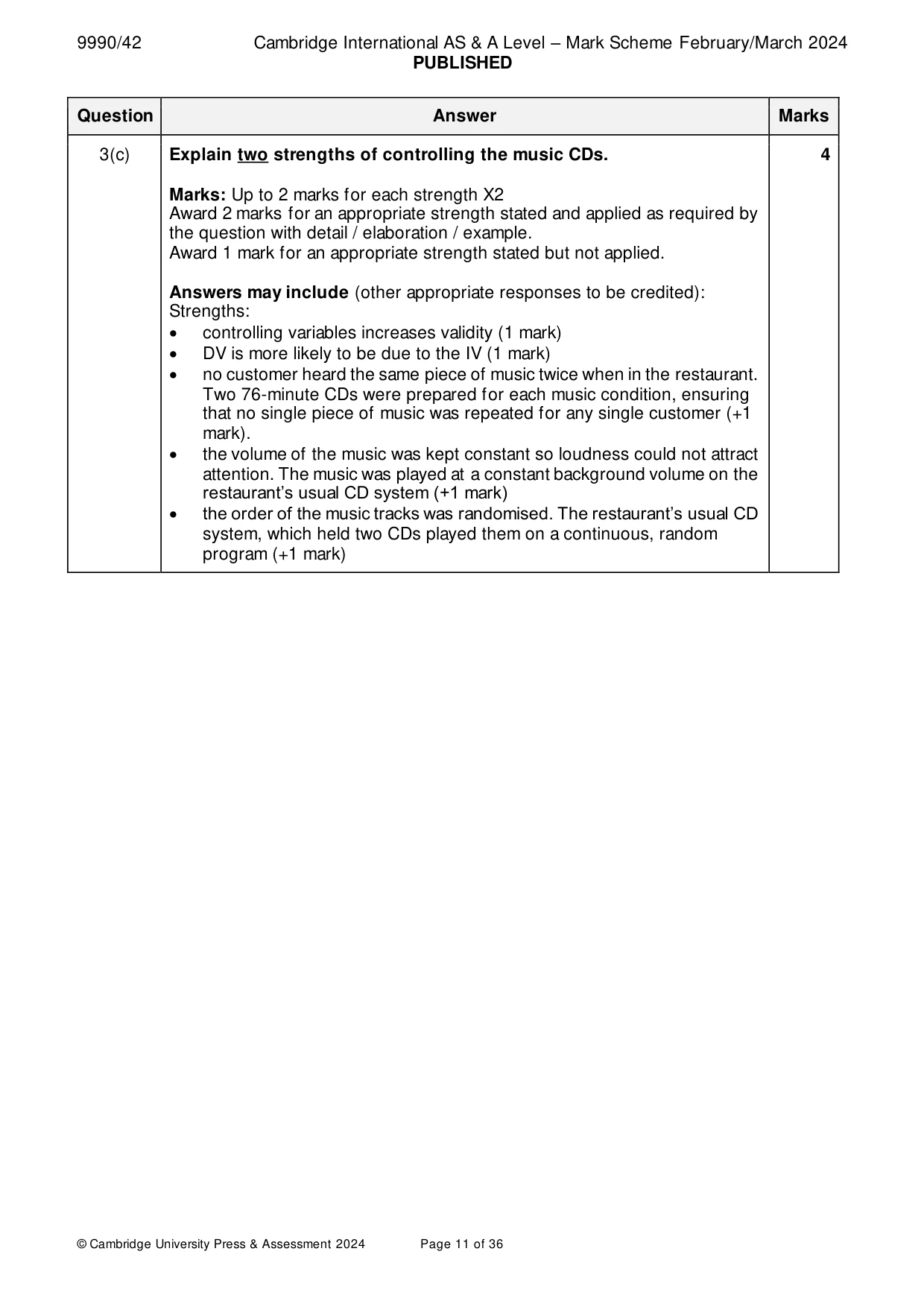
Mark scheme: 3 From the key study by North et al. (2003) on musical style and restaurant customers' spending: 3(a)(i) Outline two variables within restaurant that were controlled, other than 2 the music CDs. Syllabus: 2.1.2 Key study on musical style and restaurant customers’ spending: North et al. (2003). Marks: Award 1 mark for each outline. Definitive answers: • lighting (was kept at the same levels throughout the study) • decoration (was not changed) • temperature (was maintained at a constant temperature) • menu (was not changed, such as an increase in prices, or items) • the waitress, gathering data, was always the same Note: any other aspect scores no marks (especially music). 3(a)(ii) Describe how counterbalancing was used in this study. 2 Marks: Award 2 marks for a detailed explanation. Award 1 mark for a partial explanation Definitive answer: • a ‘Latin square design’ was used (1 mark) • each type of music was presented on each day of the week (1 mark) with any aspect/explanation about the table opposite (2 marks) • each week in the year was equivalent (e.g. no holidays) (1 mark) with any aspect/explanation about the table opposite (2 marks) Note: independent measures design is incorrect. Question is counterbalancing. 3(b) Suggest one effect if counterbalancing had not been used in this study. 2 Marks: Award 2 marks for an appropriate suggestion stated and applied to study with detail / elaboration / example. Award 1 mark for an appropriate suggestion identified but not applied. Answers may include (other appropriate responses to be credited): • the day of the week might have been associated with a particular type of music and the result confounded (1 mark). Customers may have spent more money if classical music was always played on Saturday or Sunday rather than midweek (2 marks) • the day of the week might result in different spending amounts (1 mark) such as more spending at weekend and less on Monday or Tuesday (may only apply to UK). 3(c) Explain two strengths of controlling the music CDs. 4 Marks: Up to 2 marks for each strength X2 Award 2 marks for an appropriate strength stated and applied as required by the question with detail / elaboration / example. Award 1 mark for an appropriate strength stated but not applied. Answers may include (other appropriate responses to be credited): Strengths: • controlling variables increases validity (1 mark) • DV is more likely to be due to the IV (1 mark) • no customer heard the same piece of music twice when in the restaurant. Two 76-minute CDs were prepared for each music condition, ensuring that no single piece of music was repeated for any single customer (+1 mark). • the volume of the music was kept constant so loudness could not attract attention. The music was played at a constant background volume on the restaurant’s usual CD system (+1 mark) • the order of the music tracks was randomised. The restaurant’s usual CD system, which held two CDs played them on a continuous, random program (+1 mark)
Q4 · Menu item choice can be affected by both primacy and recency
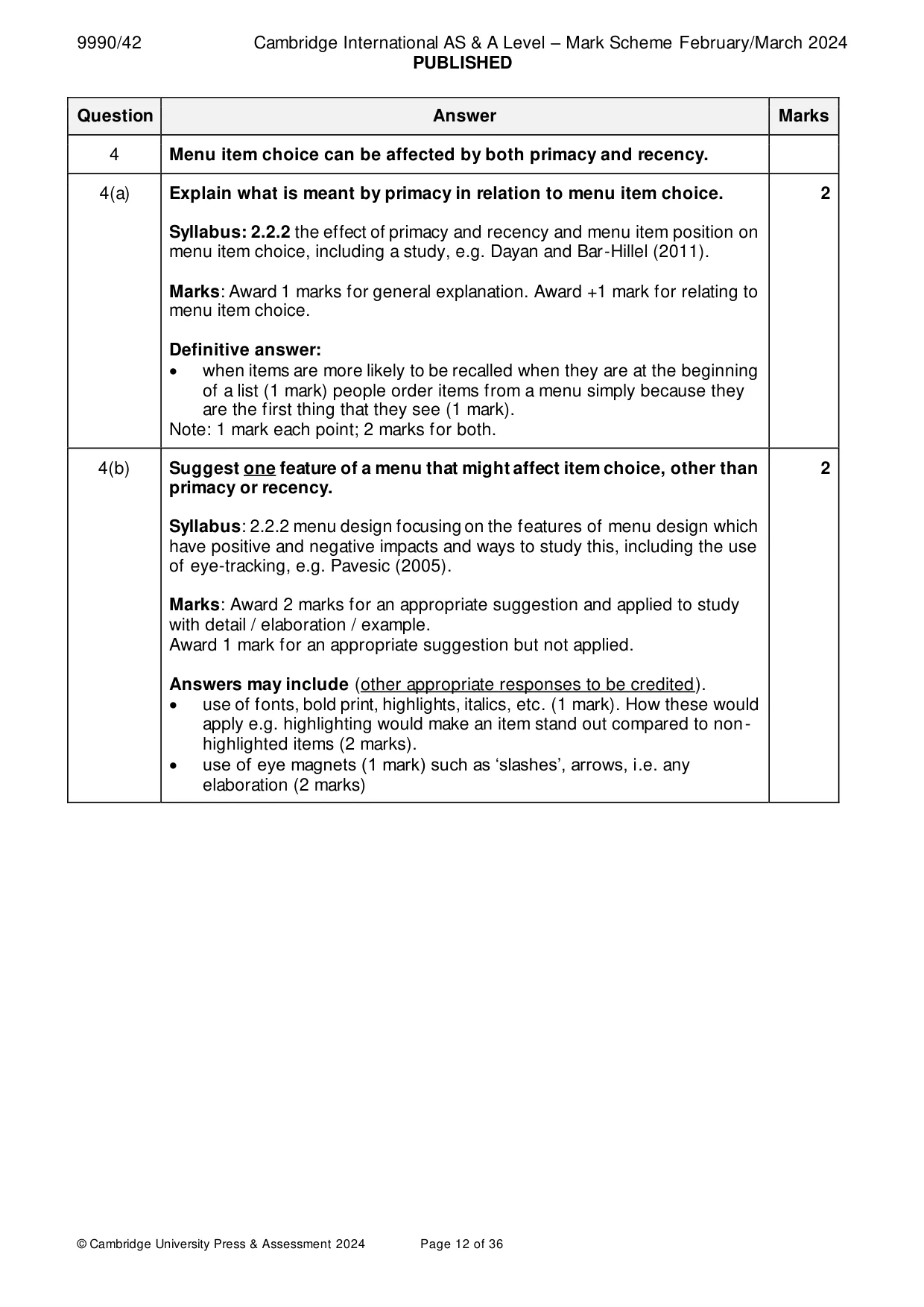
4 Menu item choice can be affected by both primacy and recency. (a) Explain what is meant by primacy in relation to menu item choice. [2] (b) Suggest one feature of a menu that might affect item choice, other than primacy or recency. [2] (c) Explain one strength and one weakness of conducting a study on menu item choice in a laboratory. [4] Health Psychology Answer all questions if you have studied this option.
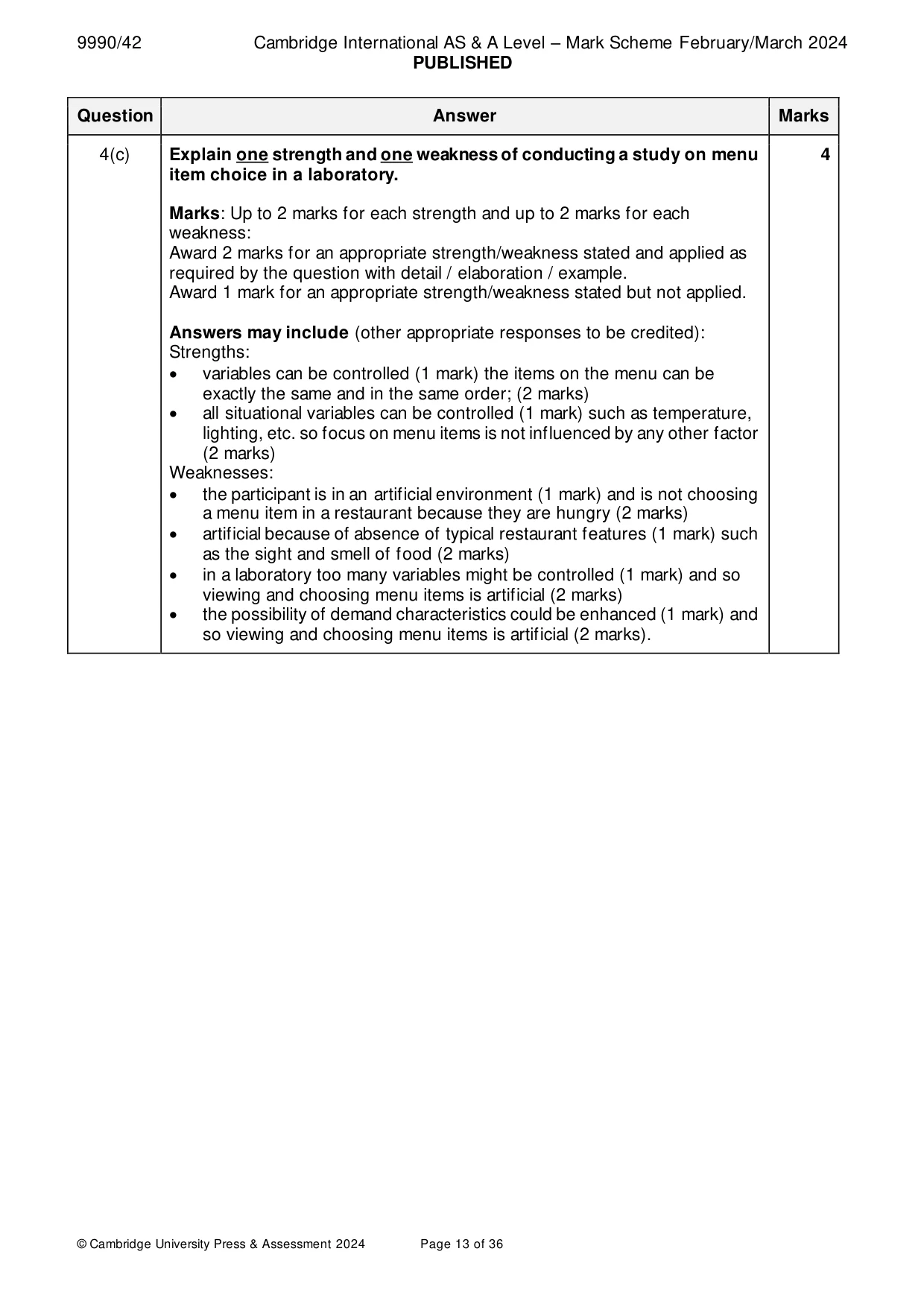
Mark scheme: 4 Menu item choice can be affected by both primacy and recency. 4(a) Explain what is meant by primacy in relation to menu item choice. 2 Syllabus: 2.2.2 the effect of primacy and recency and menu item position on menu item choice, including a study, e.g. Dayan and Bar-Hillel (2011). Marks: Award 1 marks for general explanation. Award +1 mark for relating to menu item choice. Definitive answer: • when items are more likely to be recalled when they are at the beginning of a list (1 mark) people order items from a menu simply because they are the first thing that they see (1 mark). Note: 1 mark each point; 2 marks for both. 4(b) Suggest one feature of a menu that might affect item choice, other than 2 primacy or recency. Syllabus: 2.2.2 menu design focusing on the features of menu design which have positive and negative impacts and ways to study this, including the use of eye-tracking, e.g. Pavesic (2005). Marks: Award 2 marks for an appropriate suggestion and applied to study with detail / elaboration / example. Award 1 mark for an appropriate suggestion but not applied. Answers may include (other appropriate responses to be credited). • use of fonts, bold print, highlights, italics, etc. (1 mark). How these would apply e.g. highlighting would make an item stand out compared to non- highlighted items (2 marks). • use of eye magnets (1 mark) such as ‘slashes’, arrows, i.e. any elaboration (2 marks) 4(c) Explain one strength and one weakness of conducting a study on menu 4 item choice in a laboratory. Marks: Up to 2 marks for each strength and up to 2 marks for each weakness: Award 2 marks for an appropriate strength/weakness stated and applied as required by the question with detail / elaboration / example. Award 1 mark for an appropriate strength/weakness stated but not applied. Answers may include (other appropriate responses to be credited): Strengths: • variables can be controlled (1 mark) the items on the menu can be exactly the same and in the same order; (2 marks) • all situational variables can be controlled (1 mark) such as temperature, lighting, etc. so focus on menu items is not influenced by any other factor (2 marks) Weaknesses: • the participant is in an artificial environment (1 mark) and is not choosing a menu item in a restaurant because they are hungry (2 marks) • artificial because of absence of typical restaurant features (1 mark) such as the sight and smell of food (2 marks) • in a laboratory too many variables might be controlled (1 mark) and so viewing and choosing menu items is artificial (2 marks) • the possibility of demand characteristics could be enhanced (1 mark) and so viewing and choosing menu items is artificial (2 marks).
Q5 · From the key study by Yokley and Glenwick (1984) on improving medical adherence using…
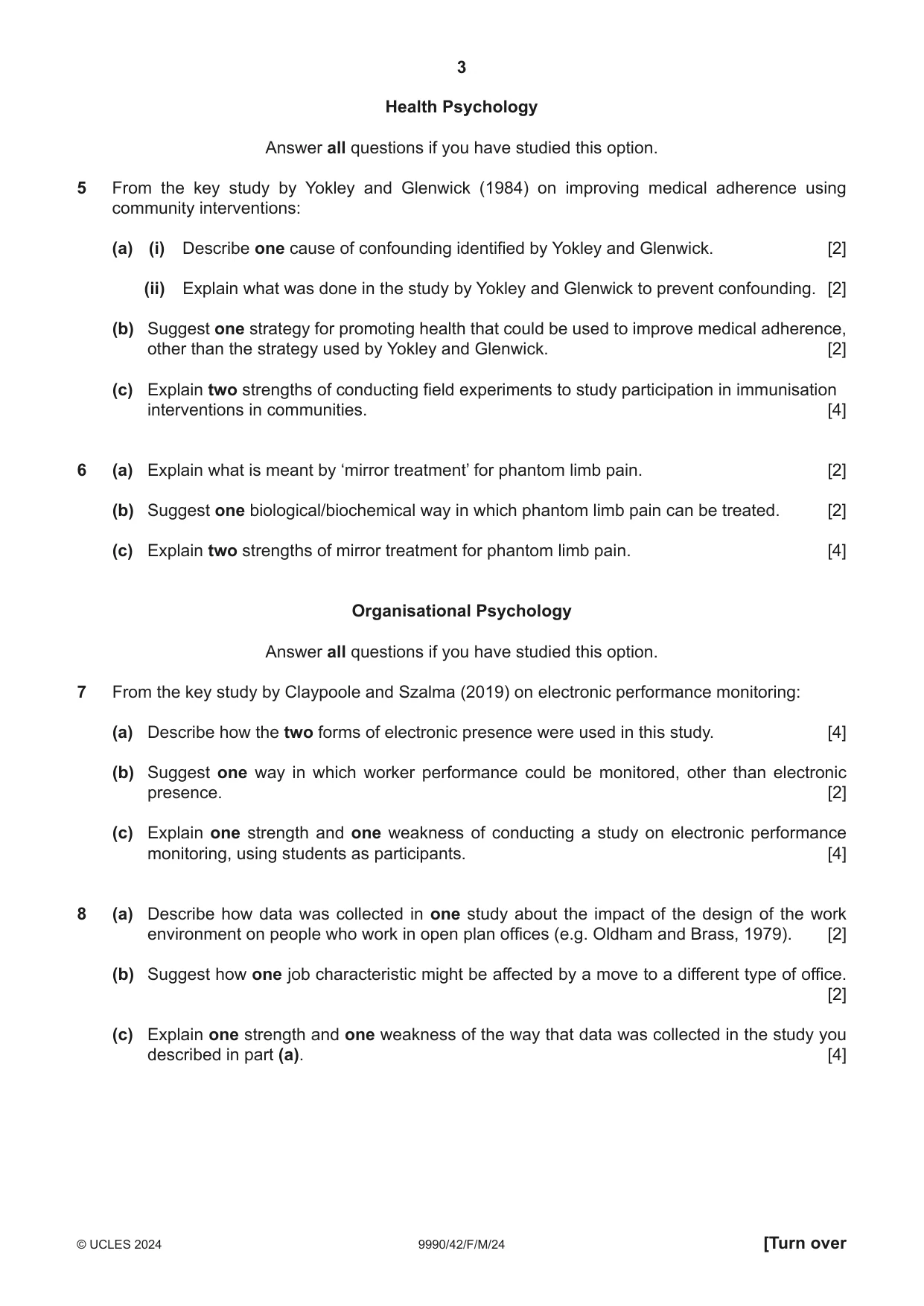
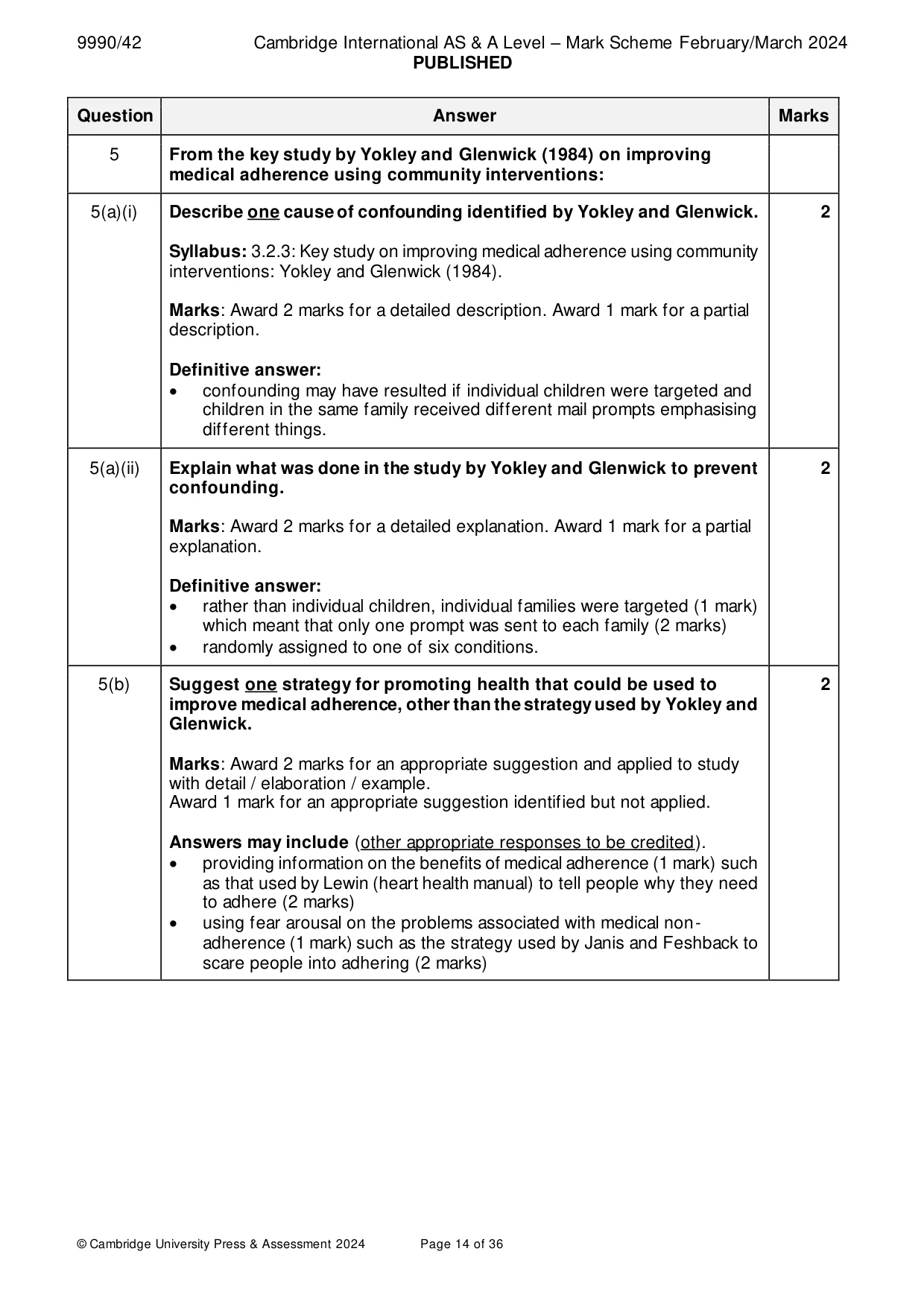
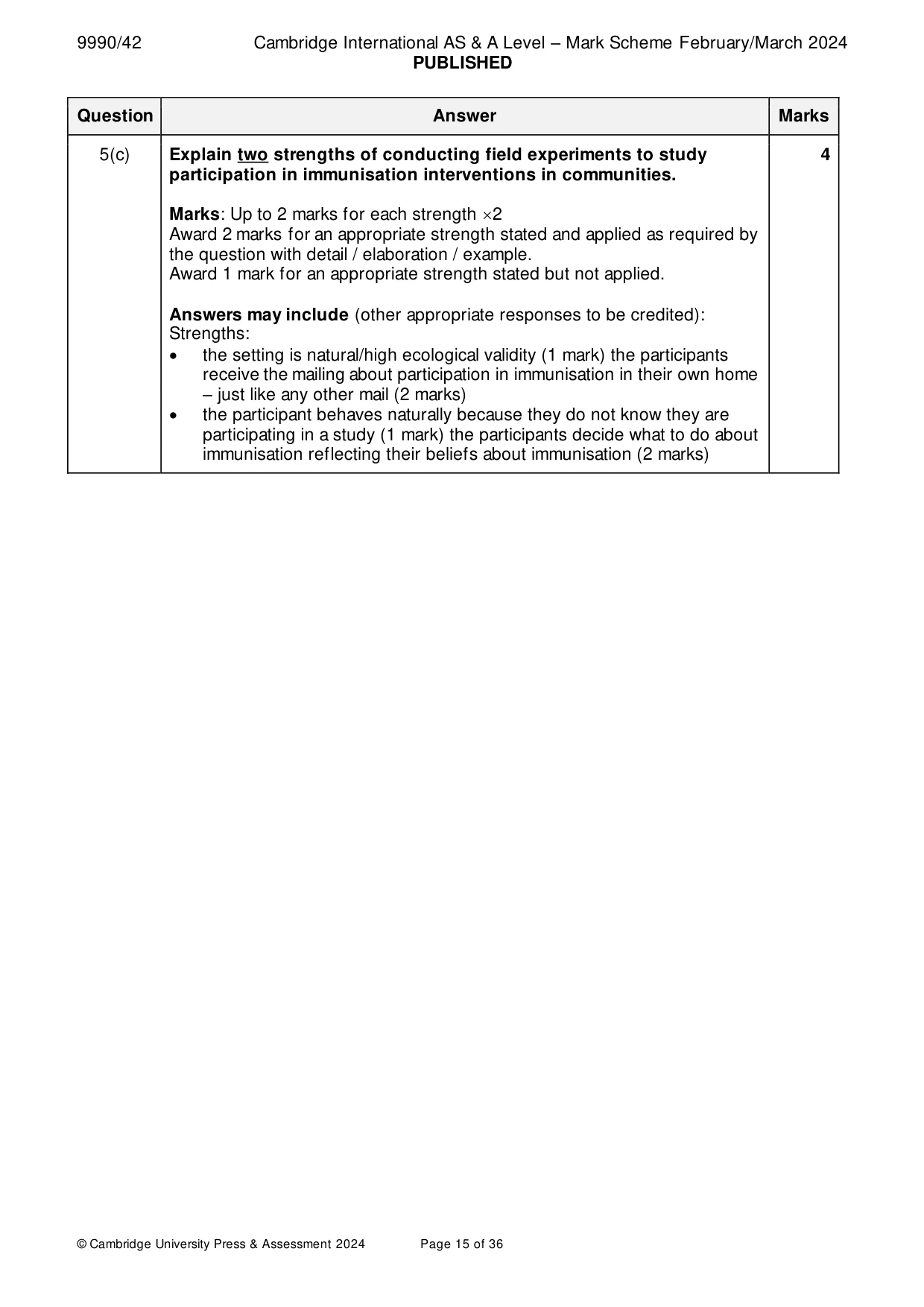
5 From the key study by Yokley and Glenwick (1984) on improving medical adherence using community interventions: (a) (i) Describe one cause of confounding identified by Yokley and Glenwick. [2] (ii) Explain what was done in the study by Yokley and Glenwick to prevent confounding. [2] (b) Suggest one strategy for promoting health that could be used to improve medical adherence, other than the strategy used by Yokley and Glenwick. [2] (c) Explain two strengths of conducting field experiments to study participation in immunisation interventions in communities. [4]
Mark scheme: 5 From the key study by Yokley and Glenwick (1984) on improving medical adherence using community interventions: 5(a)(i) Describe one cause of confounding identified by Yokley and Glenwick. 2 Syllabus: 3.2.3: Key study on improving medical adherence using community interventions: Yokley and Glenwick (1984). Marks: Award 2 marks for a detailed description. Award 1 mark for a partial description. Definitive answer: • confounding may have resulted if individual children were targeted and children in the same family received different mail prompts emphasising different things. 5(a)(ii) Explain what was done in the study by Yokley and Glenwick to prevent 2 confounding. Marks: Award 2 marks for a detailed explanation. Award 1 mark for a partial explanation. Definitive answer: • rather than individual children, individual families were targeted (1 mark) which meant that only one prompt was sent to each family (2 marks) • randomly assigned to one of six conditions. 5(b) Suggest one strategy for promoting health that could be used to 2 improve medical adherence, other than the strategy used by Yokley and Glenwick. Marks: Award 2 marks for an appropriate suggestion and applied to study with detail / elaboration / example. Award 1 mark for an appropriate suggestion identified but not applied. Answers may include (other appropriate responses to be credited). • providing information on the benefits of medical adherence (1 mark) such as that used by Lewin (heart health manual) to tell people why they need to adhere (2 marks) • using fear arousal on the problems associated with medical non- adherence (1 mark) such as the strategy used by Janis and Feshback to scare people into adhering (2 marks) 5(c) Explain two strengths of conducting field experiments to study 4 participation in immunisation interventions in communities. Marks: Up to 2 marks for each strength 2 Award 2 marks for an appropriate strength stated and applied as required by the question with detail / elaboration / example. Award 1 mark for an appropriate strength stated but not applied. Answers may include (other appropriate responses to be credited): Strengths: • the setting is natural/high ecological validity (1 mark) the participants receive the mailing about participation in immunisation in their own home – just like any other mail (2 marks) • the participant behaves naturally because they do not know they are participating in a study (1 mark) the participants decide what to do about immunisation reflecting their beliefs about immunisation (2 marks)
More questions on 2 Health promotion in schools and worksites
Q6 · Explain what is meant by ‘mirror treatment’ for phantom limb pain
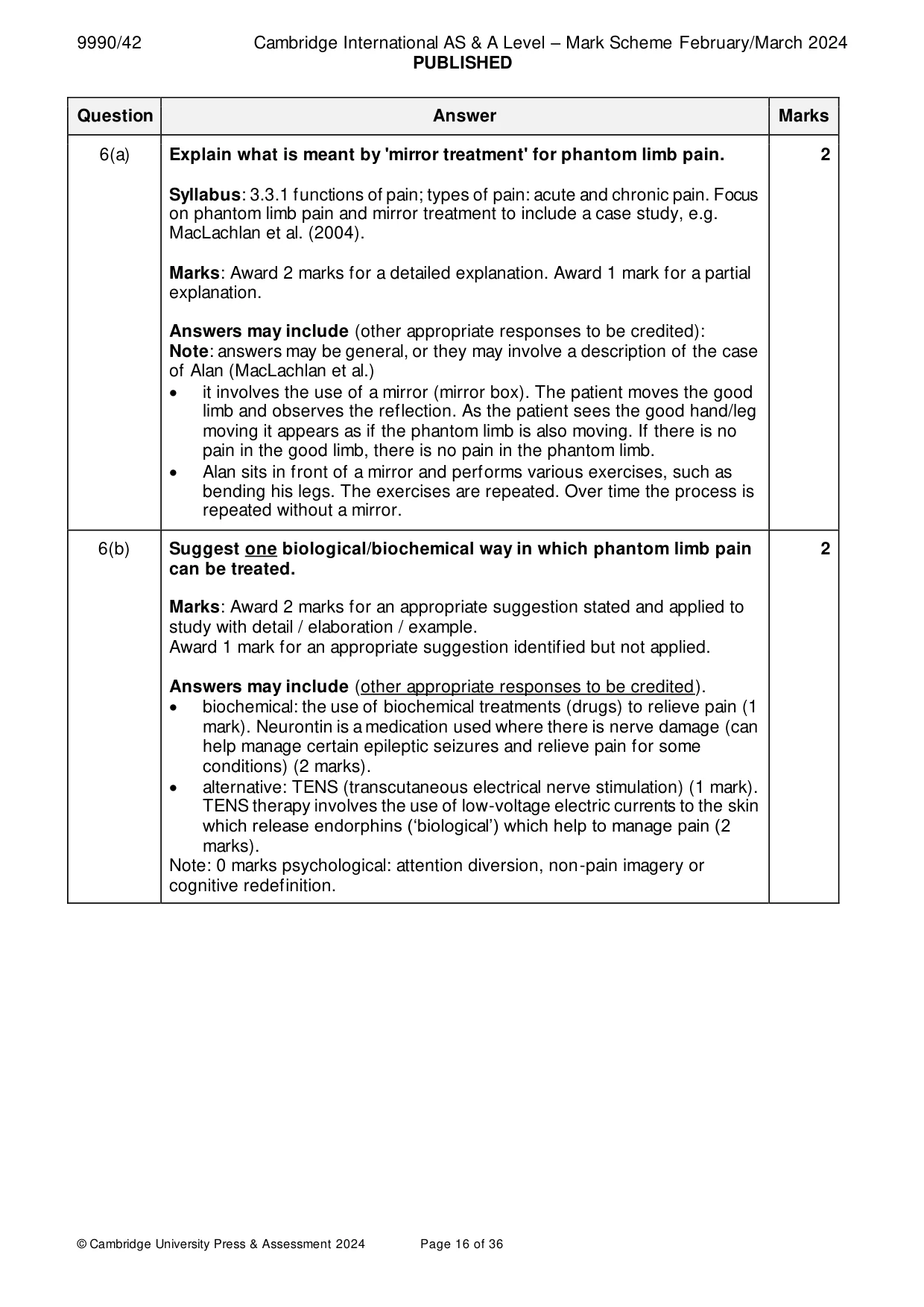
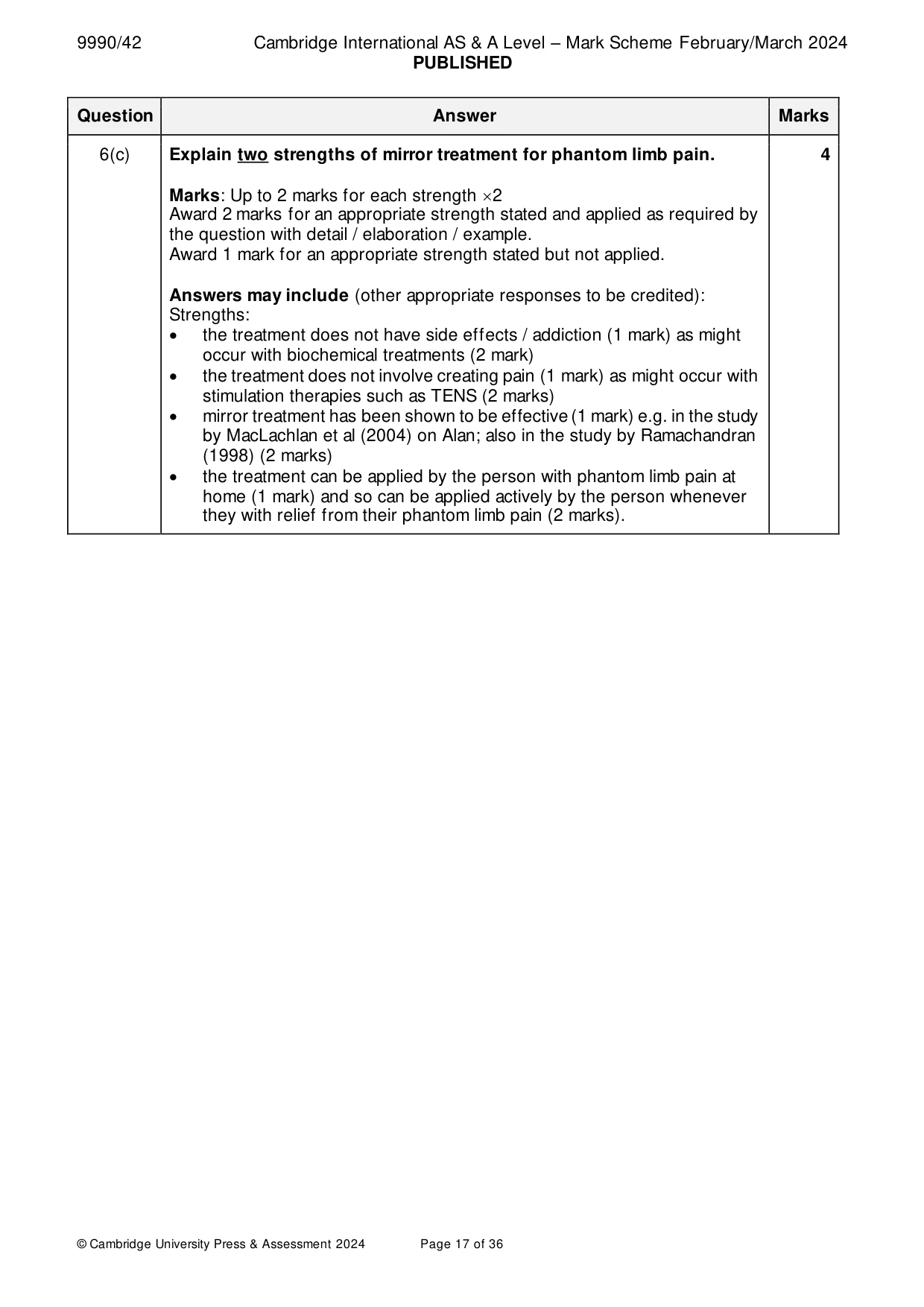
6 (a) Explain what is meant by ‘mirror treatment’ for phantom limb pain. [2] (b) Suggest one biological/biochemical way in which phantom limb pain can be treated. [2] (c) Explain two strengths of mirror treatment for phantom limb pain. [4] Organisational Psychology Answer all questions if you have studied this option.
Mark scheme: 6(a) Explain what is meant by 'mirror treatment' for phantom limb pain. 2 Syllabus: 3.3.1 functions of pain; types of pain: acute and chronic pain. Focus on phantom limb pain and mirror treatment to include a case study, e.g. MacLachlan et al. (2004). Marks: Award 2 marks for a detailed explanation. Award 1 mark for a partial explanation. Answers may include (other appropriate responses to be credited): Note: answers may be general, or they may involve a description of the case of Alan (MacLachlan et al.) • it involves the use of a mirror (mirror box). The patient moves the good limb and observes the reflection. As the patient sees the good hand/leg moving it appears as if the phantom limb is also moving. If there is no pain in the good limb, there is no pain in the phantom limb. • Alan sits in front of a mirror and performs various exercises, such as bending his legs. The exercises are repeated. Over time the process is repeated without a mirror. 6(b) Suggest one biological/biochemical way in which phantom limb pain 2 can be treated. Marks: Award 2 marks for an appropriate suggestion stated and applied to study with detail / elaboration / example. Award 1 mark for an appropriate suggestion identified but not applied. Answers may include (other appropriate responses to be credited). • biochemical: the use of biochemical treatments (drugs) to relieve pain (1 mark). Neurontin is a medication used where there is nerve damage (can help manage certain epileptic seizures and relieve pain for some conditions) (2 marks). • alternative: TENS (transcutaneous electrical nerve stimulation) (1 mark). TENS therapy involves the use of low-voltage electric currents to the skin which release endorphins (‘biological’) which help to manage pain (2 marks). Note: 0 marks psychological: attention diversion, non-pain imagery or cognitive redefinition. 6(c) Explain two strengths of mirror treatment for phantom limb pain. 4 Marks: Up to 2 marks for each strength 2 Award 2 marks for an appropriate strength stated and applied as required by the question with detail / elaboration / example. Award 1 mark for an appropriate strength stated but not applied. Answers may include (other appropriate responses to be credited): Strengths: • the treatment does not have side effects / addiction (1 mark) as might occur with biochemical treatments (2 mark) • the treatment does not involve creating pain (1 mark) as might occur with stimulation therapies such as TENS (2 marks) • mirror treatment has been shown to be effective (1 mark) e.g. in the study by MacLachlan et al (2004) on Alan; also in the study by Ramachandran (1998) (2 marks) • the treatment can be applied by the person with phantom limb pain at home (1 mark) and so can be applied actively by the person whenever they with relief from their phantom limb pain (2 marks).
Q7 · From the key study by Claypoole and Szalma (2019) on electronic performance monitoring…
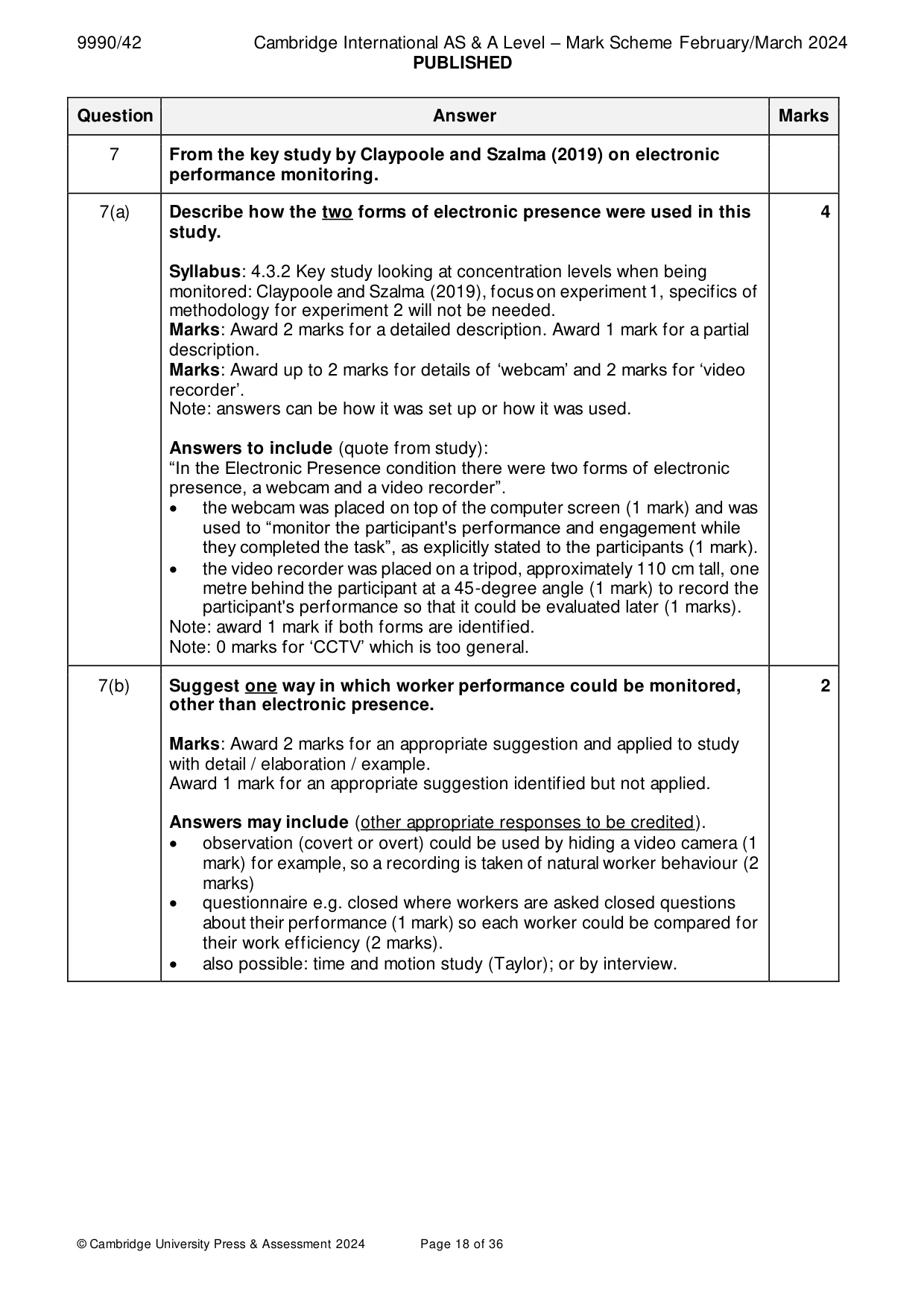
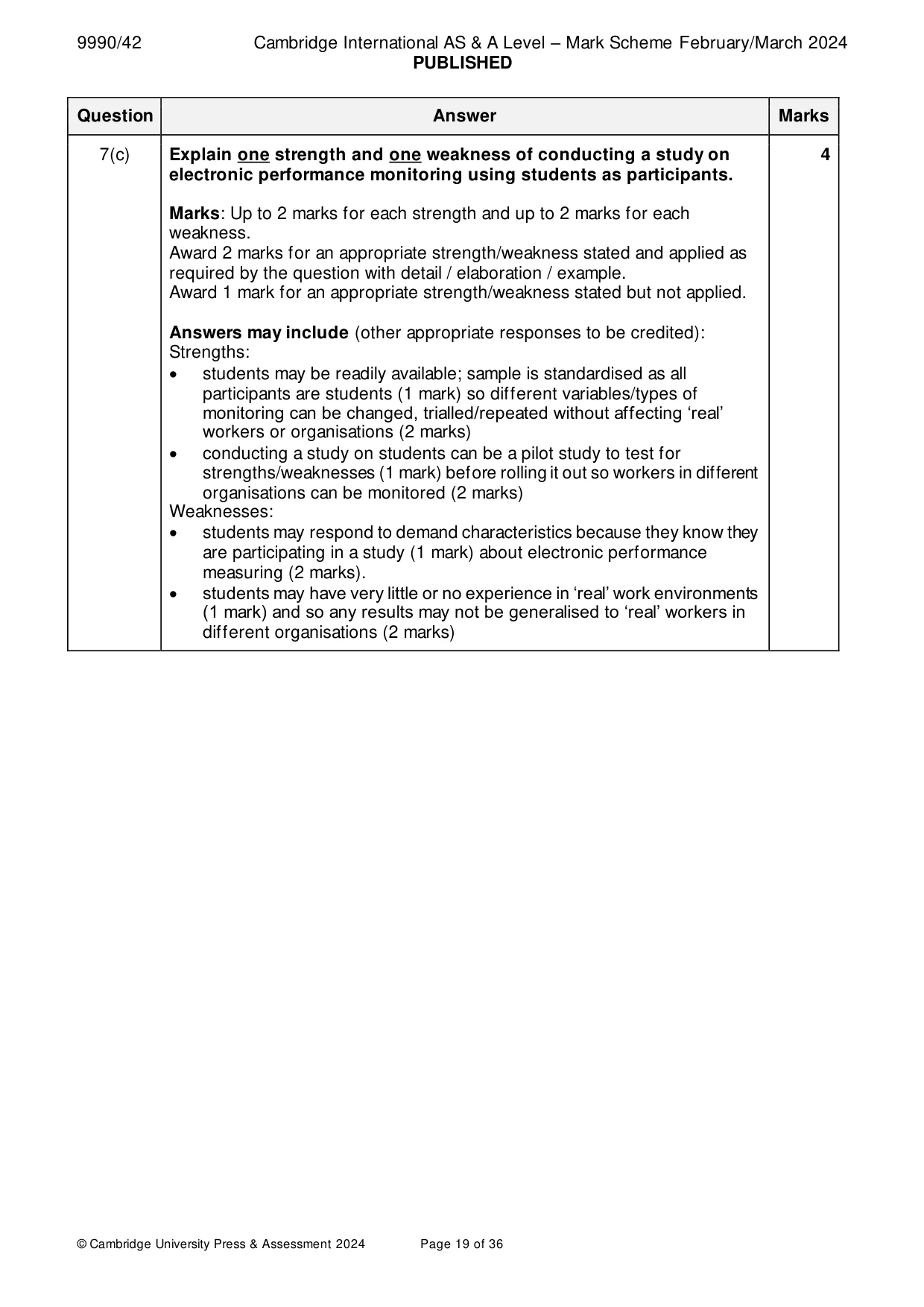
7 From the key study by Claypoole and Szalma (2019) on electronic performance monitoring: (a) Describe how the two forms of electronic presence were used in this study. [4] (b) Suggest one way in which worker performance could be monitored, other than electronic presence. [2] (c) Explain one strength and one weakness of conducting a study on electronic performance monitoring, using students as participants. [4]
Mark scheme: 7 From the key study by Claypoole and Szalma (2019) on electronic performance monitoring. 7(a) Describe how the two forms of electronic presence were used in this 4 study. Syllabus: 4.3.2 Key study looking at concentration levels when being monitored: Claypoole and Szalma (2019), focus on experiment 1, specifics of methodology for experiment 2 will not be needed. Marks: Award 2 marks for a detailed description. Award 1 mark for a partial description. Marks: Award up to 2 marks for details of ‘webcam’ and 2 marks for ‘video recorder’. Note: answers can be how it was set up or how it was used. Answers to include (quote from study): “In the Electronic Presence condition there were two forms of electronic presence, a webcam and a video recorder”. • the webcam was placed on top of the computer screen (1 mark) and was used to “monitor the participant's performance and engagement while they completed the task”, as explicitly stated to the participants (1 mark). • the video recorder was placed on a tripod, approximately 110 cm tall, one metre behind the participant at a 45-degree angle (1 mark) to record the participant's performance so that it could be evaluated later (1 marks). Note: award 1 mark if both forms are identified. Note: 0 marks for ‘CCTV’ which is too general. 7(b) Suggest one way in which worker performance could be monitored, 2 other than electronic presence. Marks: Award 2 marks for an appropriate suggestion and applied to study with detail / elaboration / example. Award 1 mark for an appropriate suggestion identified but not applied. Answers may include (other appropriate responses to be credited). • observation (covert or overt) could be used by hiding a video camera (1 mark) for example, so a recording is taken of natural worker behaviour (2 marks) • questionnaire e.g. closed where workers are asked closed questions about their performance (1 mark) so each worker could be compared for their work efficiency (2 marks). • also possible: time and motion study (Taylor); or by interview. 7(c) Explain one strength and one weakness of conducting a study on 4 electronic performance monitoring using students as participants. Marks: Up to 2 marks for each strength and up to 2 marks for each weakness. Award 2 marks for an appropriate strength/weakness stated and applied as required by the question with detail / elaboration / example. Award 1 mark for an appropriate strength/weakness stated but not applied. Answers may include (other appropriate responses to be credited): Strengths: • students may be readily available; sample is standardised as all participants are students (1 mark) so different variables/types of monitoring can be changed, trialled/repeated without affecting ‘real’ workers or organisations (2 marks) • conducting a study on students can be a pilot study to test for strengths/weaknesses (1 mark) before rolling it out so workers in different organisations can be monitored (2 marks) Weaknesses: • students may respond to demand characteristics because they know they are participating in a study (1 mark) about electronic performance measuring (2 marks). • students may have very little or no experience in ‘real’ work environments (1 mark) and so any results may not be generalised to ‘real’ workers in different organisations (2 marks)
Q8 · Describe how data was collected in one study about the impact of the design of the work…
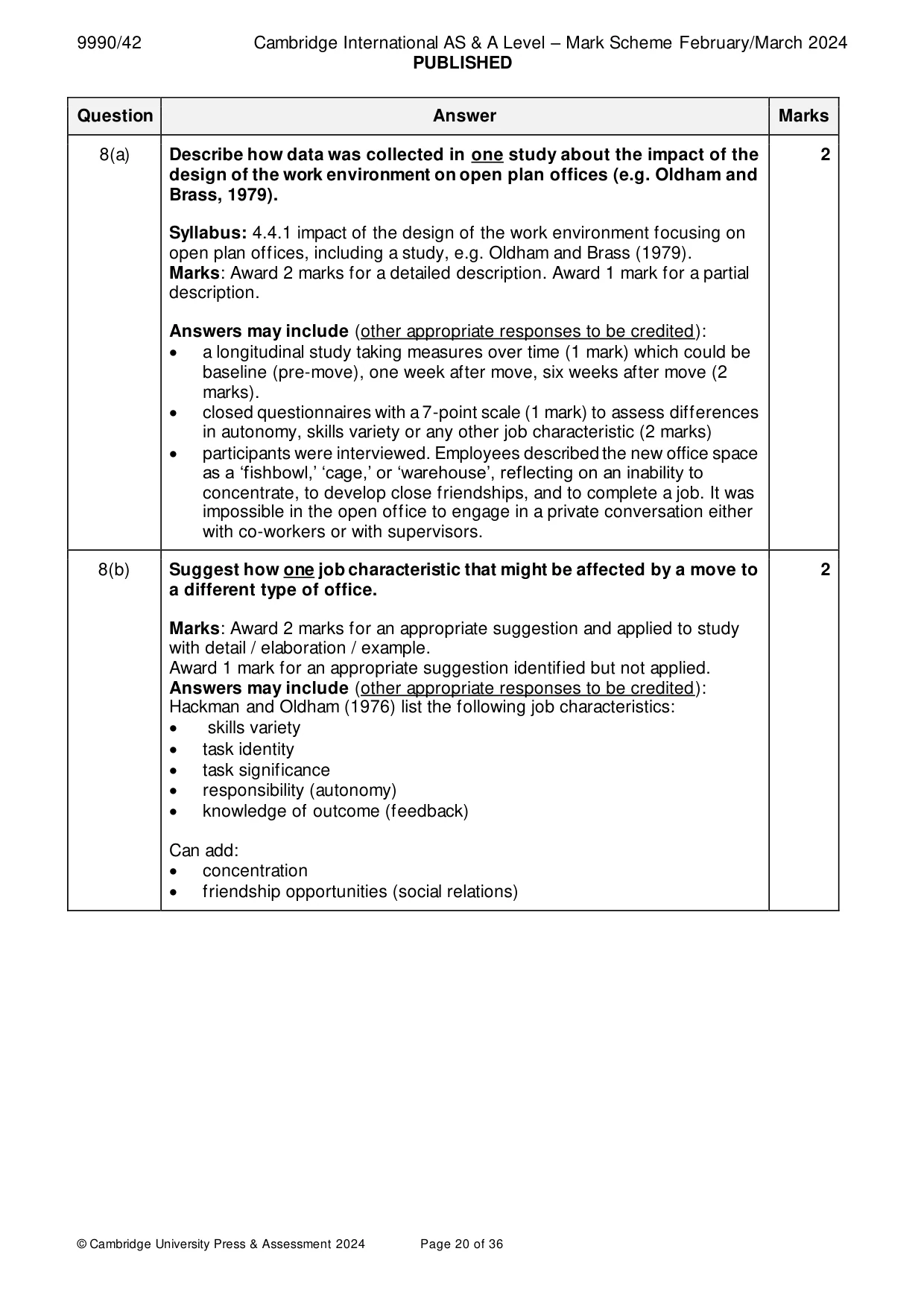
8 (a) Describe how data was collected in one study about the impact of the design of the work environment on people who work in open plan offices (e.g. Oldham and Brass, 1979). [2] (b) Suggest how one job characteristic might be affected by a move to a different type of office. [2] (c) Explain one strength and one weakness of the way that data was collected in the study you described in part (a). [4]
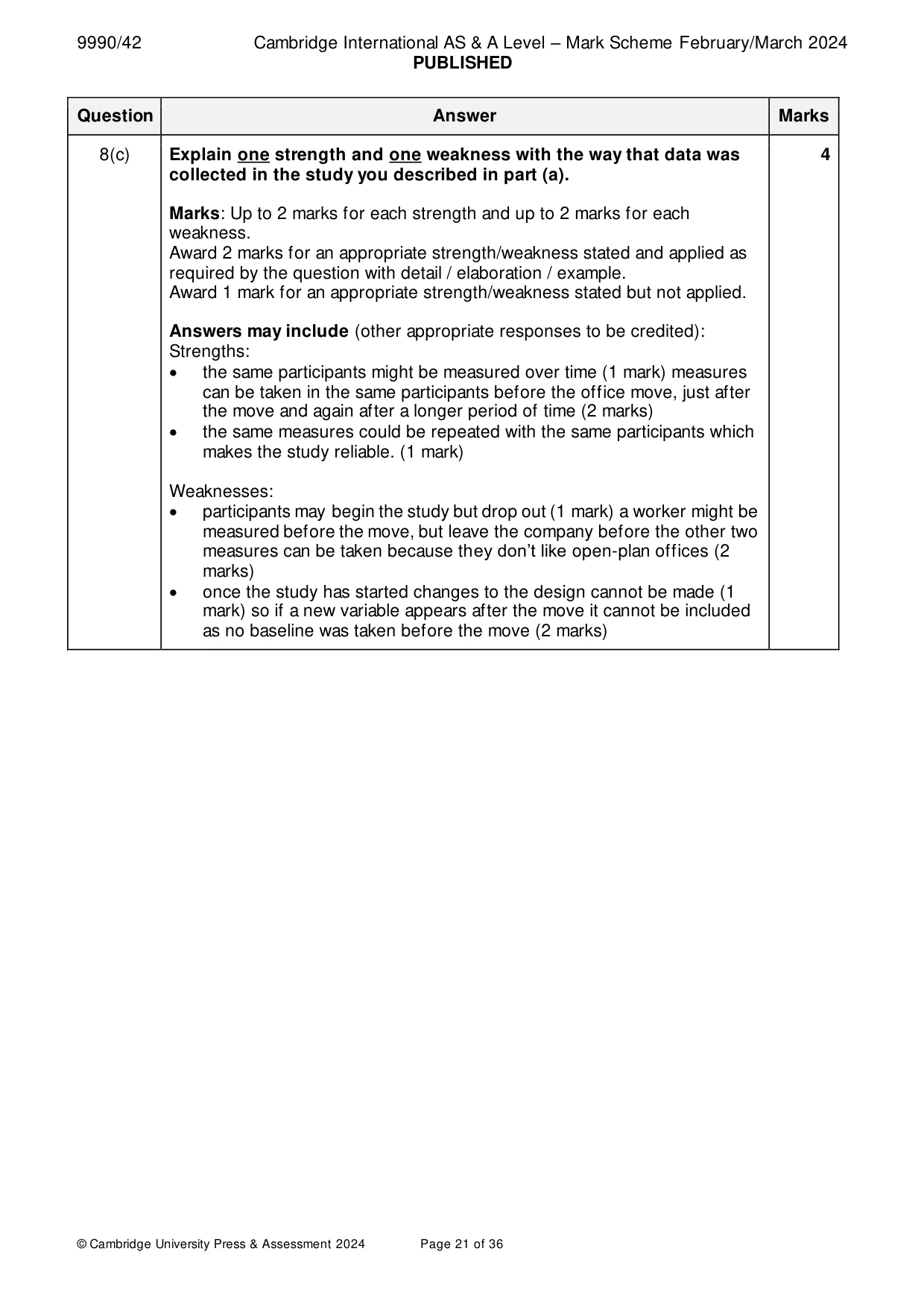
Mark scheme: 8(a) Describe how data was collected in one study about the impact of the 2 design of the work environment on open plan offices (e.g. Oldham and Brass, 1979). Syllabus: 4.4.1 impact of the design of the work environment focusing on open plan offices, including a study, e.g. Oldham and Brass (1979). Marks: Award 2 marks for a detailed description. Award 1 mark for a partial description. Answers may include (other appropriate responses to be credited): • a longitudinal study taking measures over time (1 mark) which could be baseline (pre-move), one week after move, six weeks after move (2 marks). • closed questionnaires with a 7-point scale (1 mark) to assess differences in autonomy, skills variety or any other job characteristic (2 marks) • participants were interviewed. Employees described the new office space as a ‘fishbowl,’ ‘cage,’ or ‘warehouse’, reflecting on an inability to concentrate, to develop close friendships, and to complete a job. It was impossible in the open office to engage in a private conversation either with co-workers or with supervisors. 8(b) Suggest how one job characteristic that might be affected by a move to 2 a different type of office. Marks: Award 2 marks for an appropriate suggestion and applied to study with detail / elaboration / example. Award 1 mark for an appropriate suggestion identified but not applied. Answers may include (other appropriate responses to be credited): Hackman and Oldham (1976) list the following job characteristics: • skills variety • task identity • task significance • responsibility (autonomy) • knowledge of outcome (feedback) Can add: • concentration • friendship opportunities (social relations) 8(c) Explain one strength and one weakness with the way that data was 4 collected in the study you described in part (a). Marks: Up to 2 marks for each strength and up to 2 marks for each weakness. Award 2 marks for an appropriate strength/weakness stated and applied as required by the question with detail / elaboration / example. Award 1 mark for an appropriate strength/weakness stated but not applied. Answers may include (other appropriate responses to be credited): Strengths: • the same participants might be measured over time (1 mark) measures can be taken in the same participants before the office move, just after the move and again after a longer period of time (2 marks) • the same measures could be repeated with the same participants which makes the study reliable. (1 mark) Weaknesses: • participants may begin the study but drop out (1 mark) a worker might be measured before the move, but leave the company before the other two measures can be taken because they don’t like open-plan offices (2 marks) • once the study has started changes to the design cannot be made (1 mark) so if a new variable appears after the move it cannot be included as no baseline was taken before the move (2 marks)
Q9 · Plan a covert observation to investigate the effectiveness of covert sensitisation for…
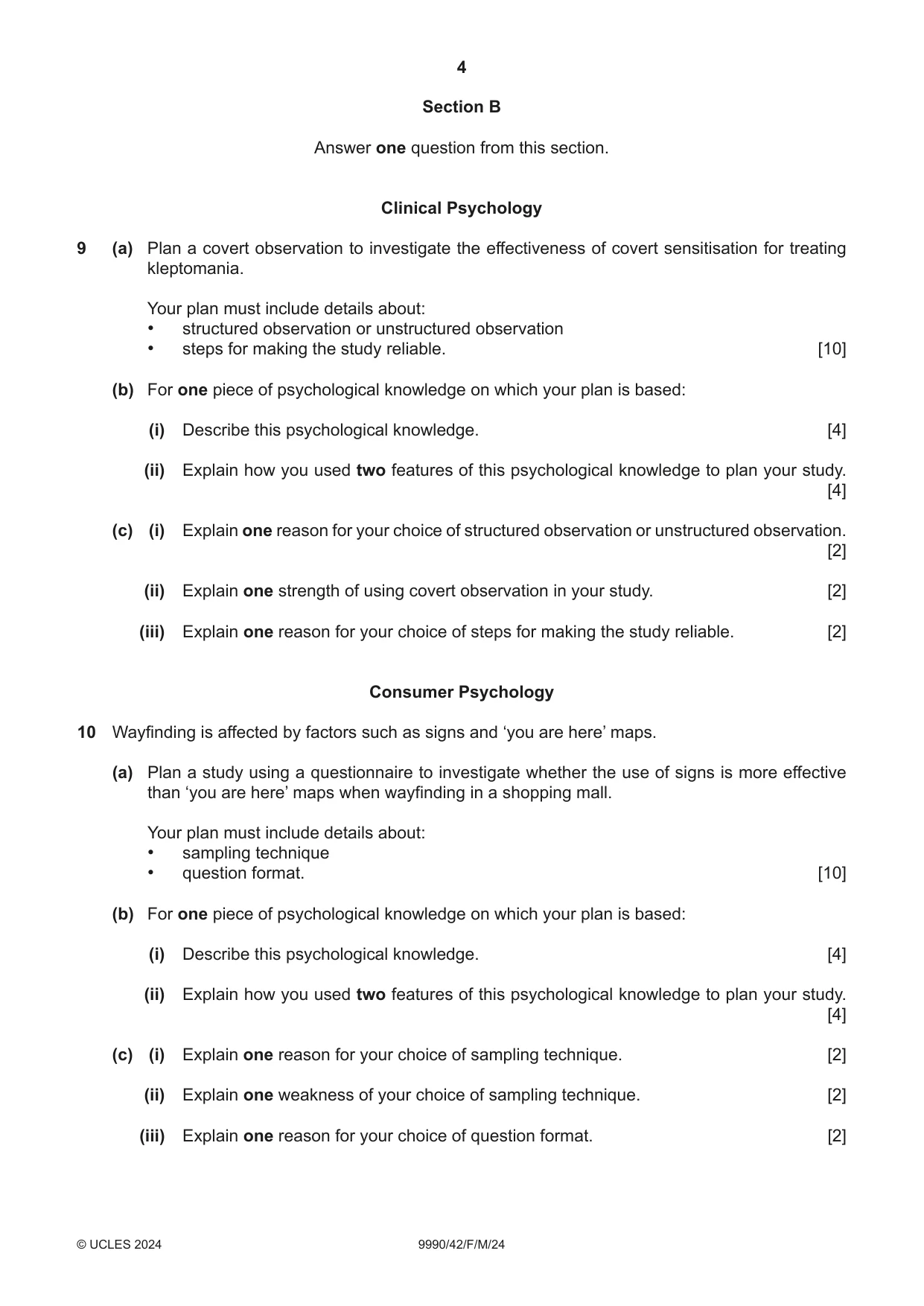
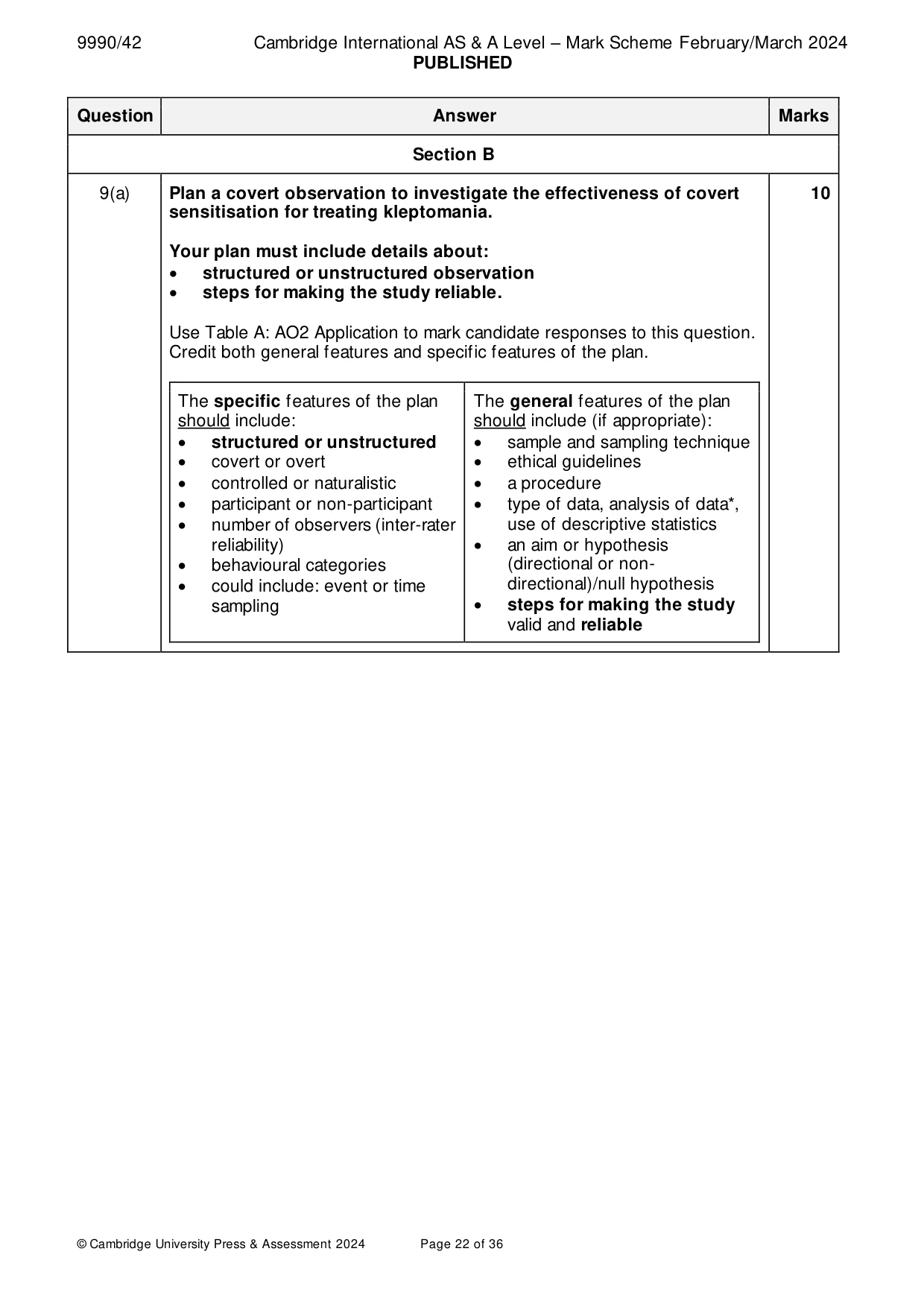
9 (a) Plan a covert observation to investigate the effectiveness of covert sensitisation for treating kleptomania. Your plan must include details about: • structured observation or unstructured observation • steps for making the study reliable. [10] (b) For one piece of psychological knowledge on which your plan is based: (i) Describe this psychological knowledge. [4] (ii) Explain how you used two features of this psychological knowledge to plan your study. [4] (c) (i) Explain one reason for your choice of structured observation or unstructured observation. [2] (ii) Explain one strength of using covert observation in your study. [2] (iii) Explain one reason for your choice of steps for making the study reliable. [2] Consumer Psychology
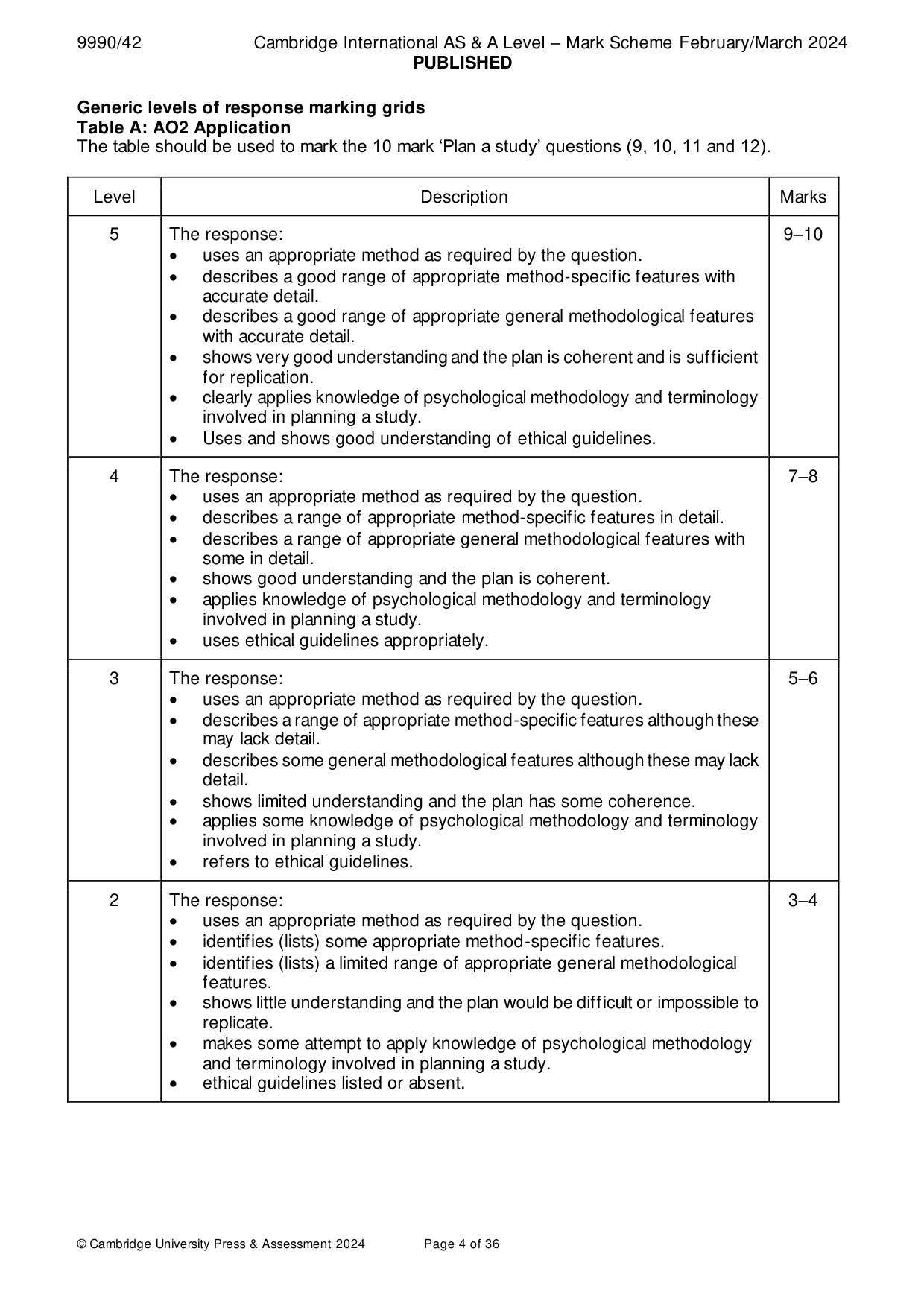
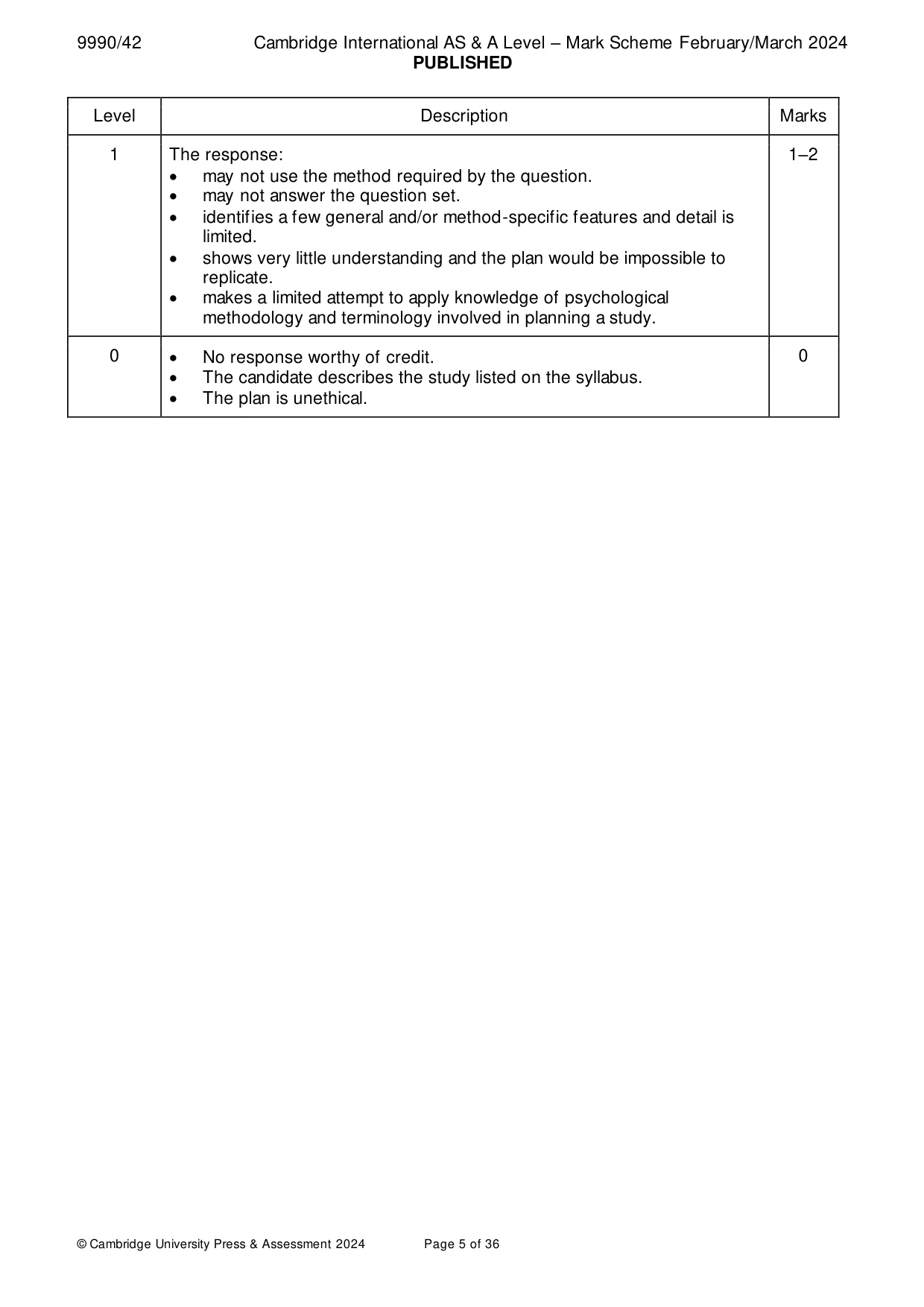
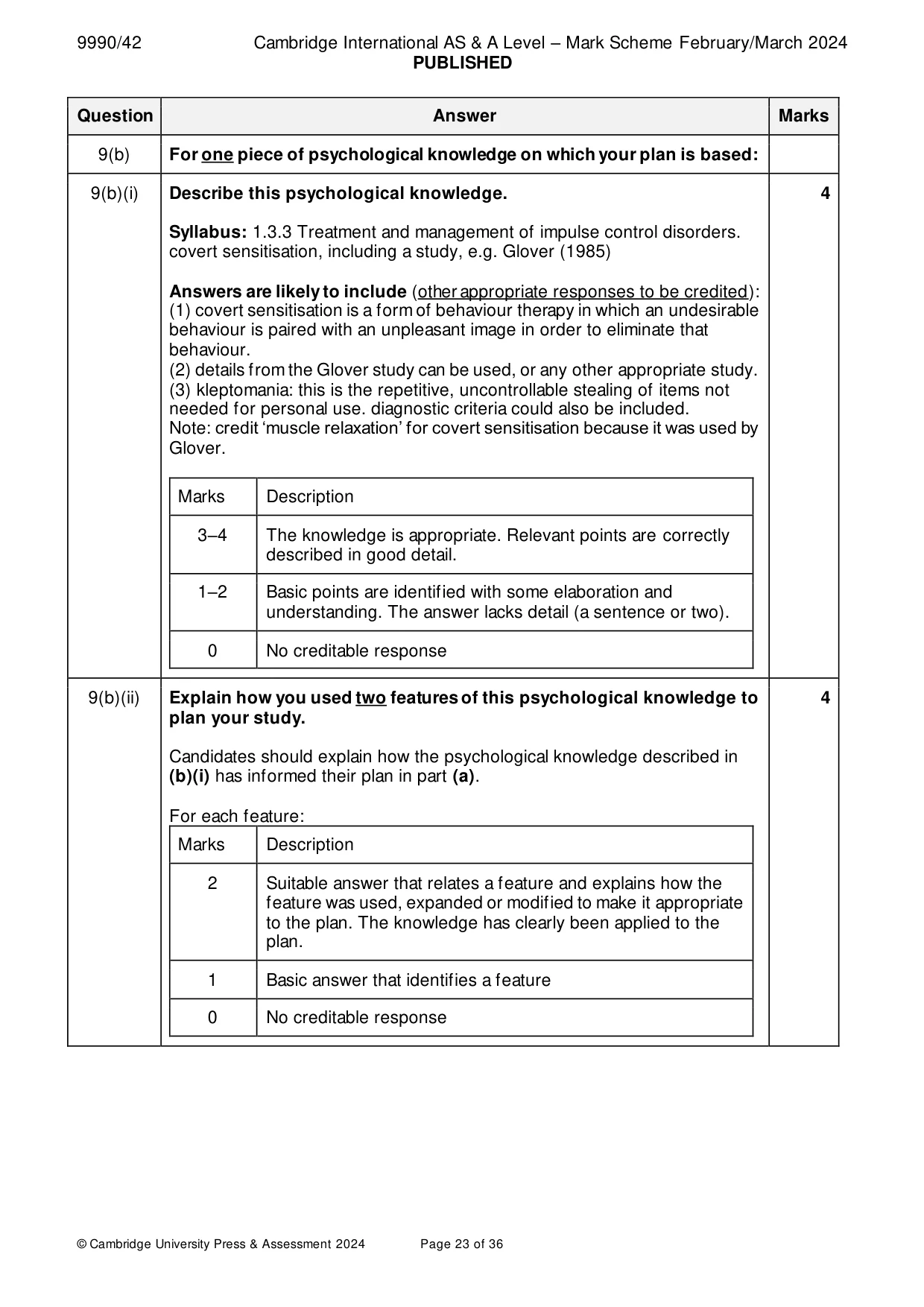
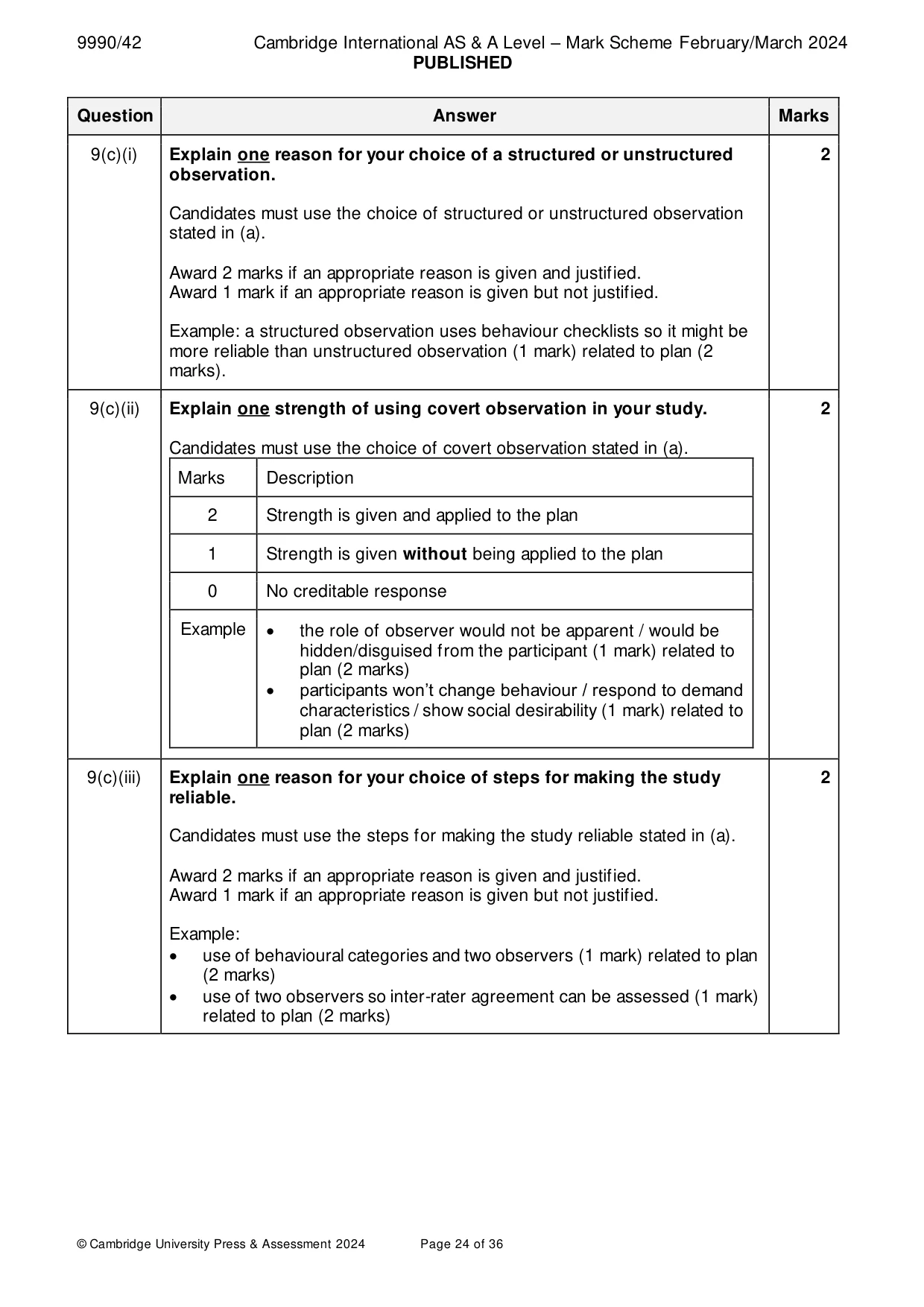
Mark scheme: 9(a) Plan a covert observation to investigate the effectiveness of covert 10 sensitisation for treating kleptomania. Your plan must include details about: • structured or unstructured observation • steps for making the study reliable. Use Table A: AO2 Application to mark candidate responses to this question. Credit both general features and specific features of the plan. The specific features of the plan The general features of the plan should include: should include (if appropriate): • structured or unstructured • sample and sampling technique • covert or overt • ethical guidelines • controlled or naturalistic • a procedure • participant or non-participant • type of data, analysis of data*, • number of observers (inter-rater use of descriptive statistics reliability) • an aim or hypothesis • behavioural categories (directional or non- • could include: event or time directional)/null hypothesis sampling • steps for making the study valid and reliable 9(b) For one piece of psychological knowledge on which your plan is based: 9(b)(i) Describe this psychological knowledge. 4 Syllabus: 1.3.3 Treatment and management of impulse control disorders. covert sensitisation, including a study, e.g. Glover (1985) Answers are likely to include (other appropriate responses to be credited): (1) covert sensitisation is a form of behaviour therapy in which an undesirable behaviour is paired with an unpleasant image in order to eliminate that behaviour. (2) details from the Glover study can be used, or any other appropriate study. (3) kleptomania: this is the repetitive, uncontrollable stealing of items not needed for personal use. diagnostic criteria could also be included. Note: credit ‘muscle relaxation’ for covert sensitisation because it was used by Glover. Marks Description 3–4 The knowledge is appropriate. Relevant points are correctly described in good detail. 1–2 Basic points are identified with some elaboration and understanding. The answer lacks detail (a sentence or two). 0 No creditable response 9(b)(ii) Explain how you used two features of this psychological knowledge to 4 plan your study. Candidates should explain how the psychological knowledge described in (b)(i) has informed their plan in part (a). For each feature: Marks Description 2 Suitable answer that relates a feature and explains how the feature was used, expanded or modified to make it appropriate to the plan. The knowledge has clearly been applied to the plan. 1 Basic answer that identifies a feature 0 No creditable response 9(c)(i) Explain one reason for your choice of a structured or unstructured 2 observation. Candidates must use the choice of structured or unstructured observation stated in (a). Award 2 marks if an appropriate reason is given and justified. Award 1 mark if an appropriate reason is given but not justified. Example: a structured observation uses behaviour checklists so it might be more reliable than unstructured observation (1 mark) related to plan (2 marks). 9(c)(ii) Explain one strength of using covert observation in your study. 2 Candidates must use the choice of covert observation stated in (a). Marks Description 2 Strength is given and applied to the plan 1 Strength is given without being applied to the plan 0 No creditable response Example • the role of observer would not be apparent / would be hidden/disguised from the participant (1 mark) related to plan (2 marks) • participants won’t change behaviour / respond to demand characteristics / show social desirability (1 mark) related to plan (2 marks) 9(c)(iii) Explain one reason for your choice of steps for making the study 2 reliable. Candidates must use the steps for making the study reliable stated in (a). Award 2 marks if an appropriate reason is given and justified. Award 1 mark if an appropriate reason is given but not justified. Example: • use of behavioural categories and two observers (1 mark) related to plan (2 marks) • use of two observers so inter-rater agreement can be assessed (1 mark) related to plan (2 marks)
Q10 · Wayfinding is affected by factors such as signs and ‘you are here’ maps
10 Wayfinding is affected by factors such as signs and ‘you are here’ maps. (a) Plan a study using a questionnaire to investigate whether the use of signs is more effective than ‘you are here’ maps when wayfinding in a shopping mall. Your plan must include details about: • sampling technique • question format. [10] (b) For one piece of psychological knowledge on which your plan is based: (i) Describe this psychological knowledge. [4] (ii) Explain how you used two features of this psychological knowledge to plan your study. [4] (c) (i) Explain one reason for your choice of sampling technique. [2] (ii) Explain one weakness of your choice of sampling technique. [2] (iii) Explain one reason for your choice of question format. [2] Health Psychology
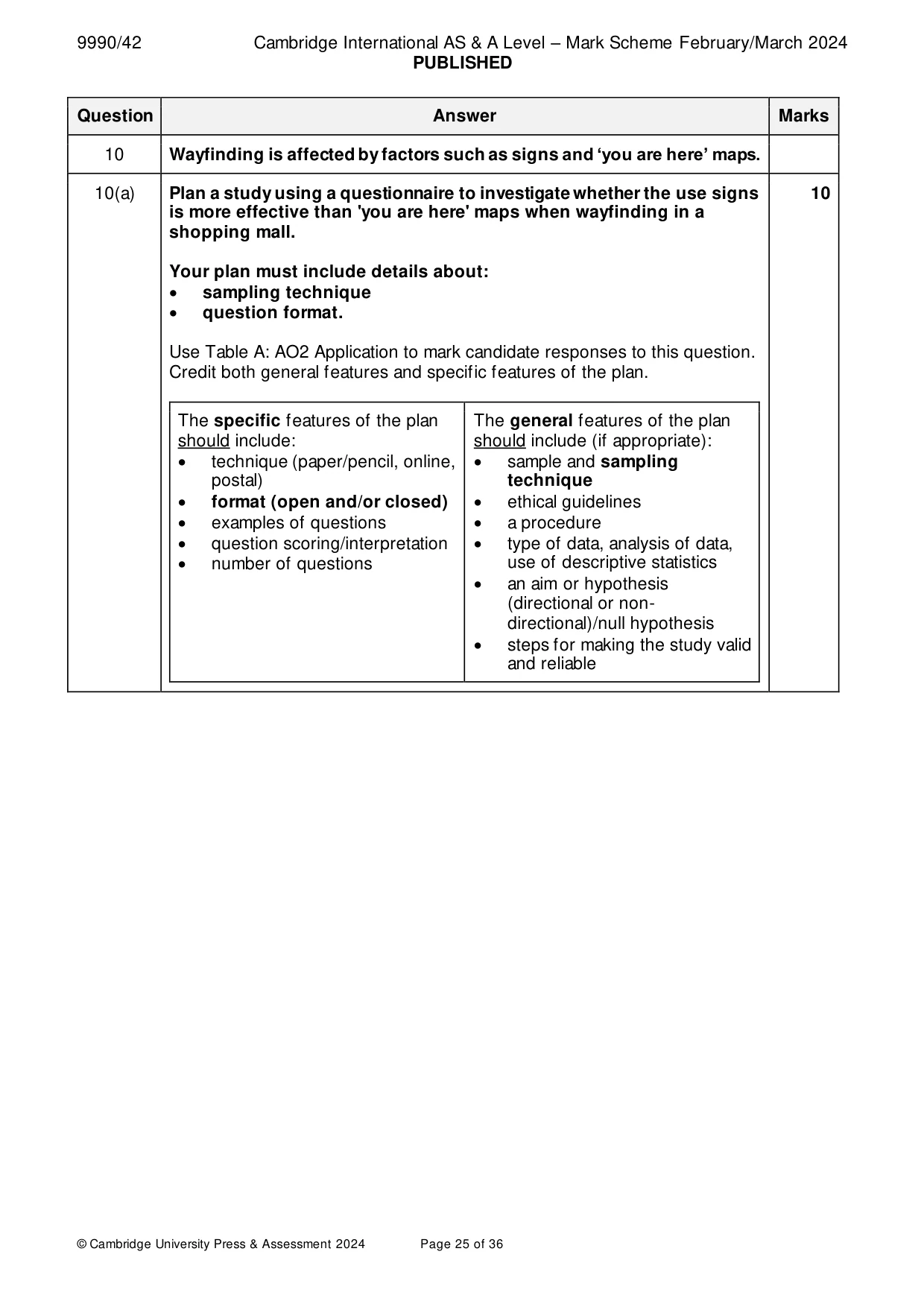
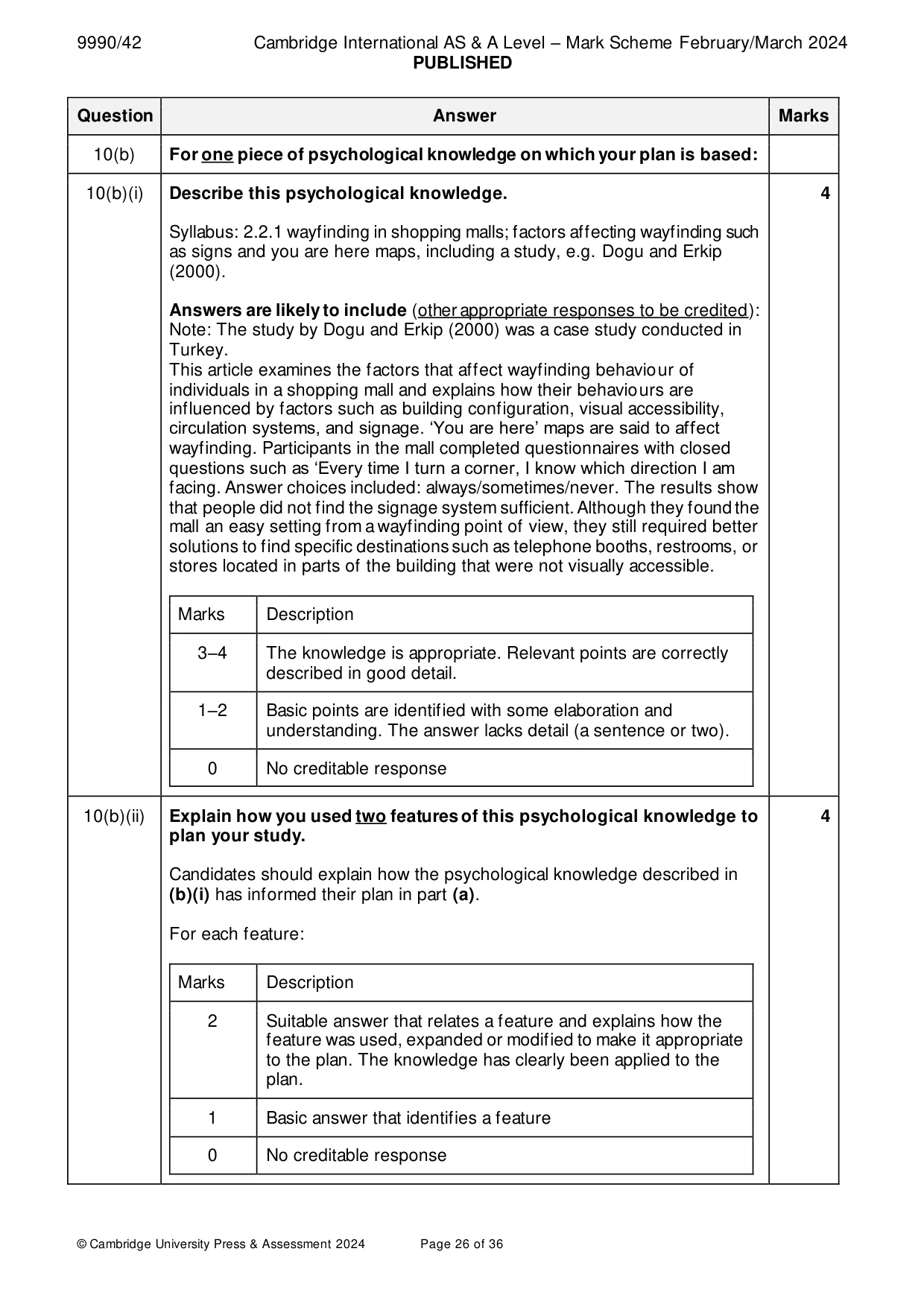
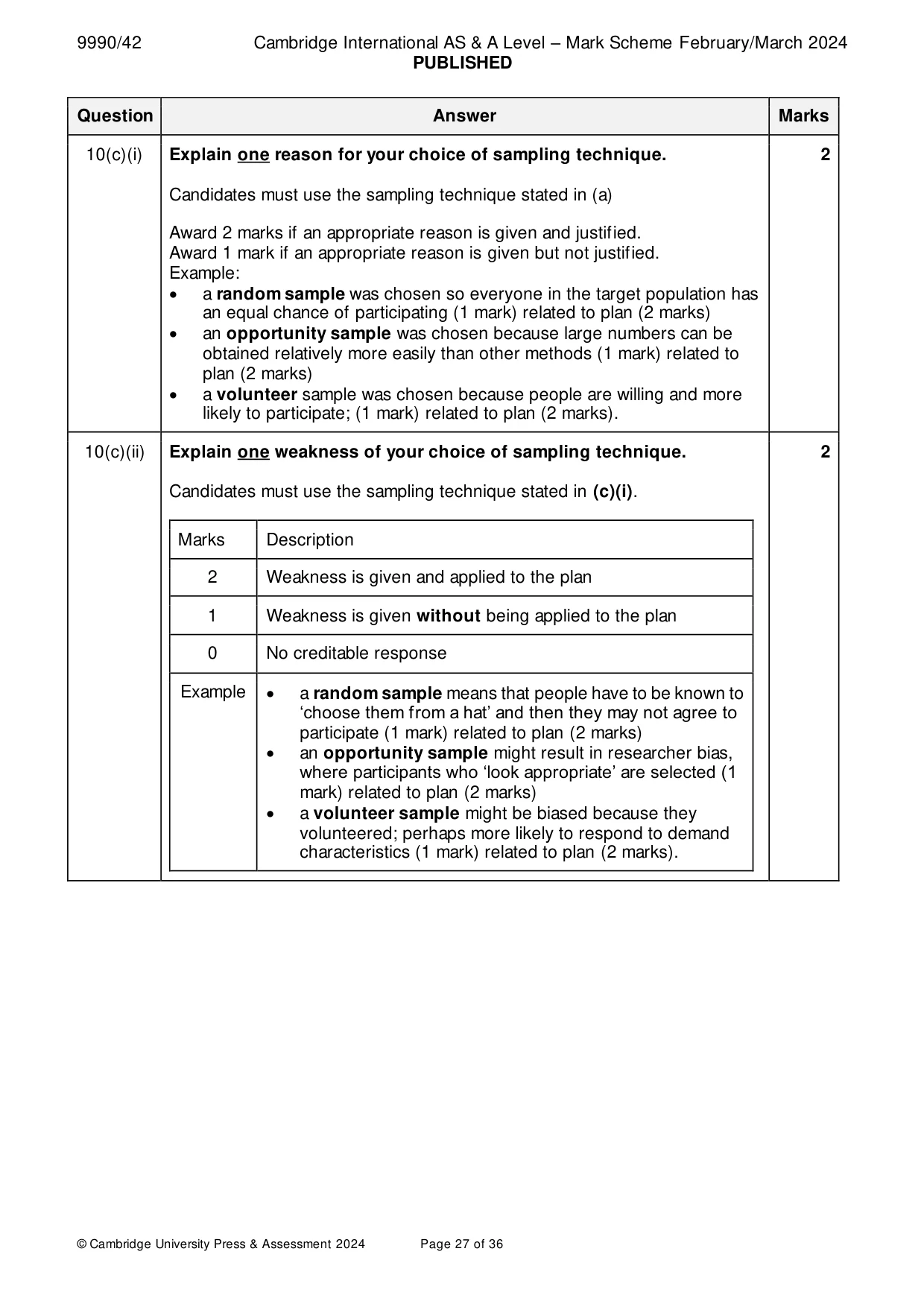
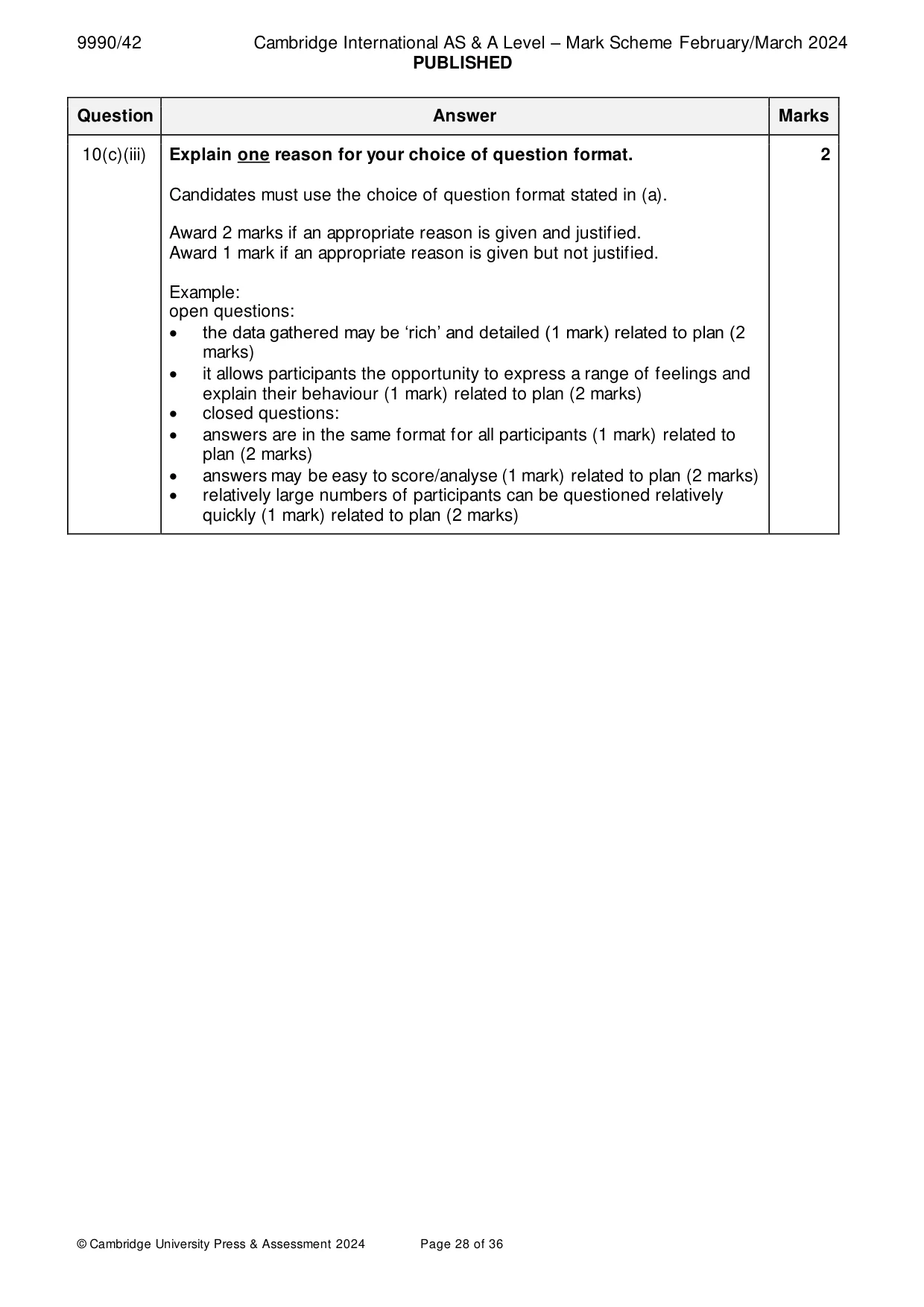
Mark scheme: 10 Wayfinding is affected by factors such as signs and ‘you are here’ maps. 10(a) Plan a study using a questionnaire to investigate whether the use signs 10 is more effective than 'you are here' maps when wayfinding in a shopping mall. Your plan must include details about: • sampling technique • question format. Use Table A: AO2 Application to mark candidate responses to this question. Credit both general features and specific features of the plan. The specific features of the plan The general features of the plan should include: should include (if appropriate): • technique (paper/pencil, online, • sample and sampling postal) technique • format (open and/or closed) • ethical guidelines • examples of questions • a procedure • question scoring/interpretation • type of data, analysis of data, • number of questions use of descriptive statistics • an aim or hypothesis (directional or non- directional)/null hypothesis • steps for making the study valid and reliable 10(b) For one piece of psychological knowledge on which your plan is based: 10(b)(i) Describe this psychological knowledge. 4 Syllabus: 2.2.1 wayfinding in shopping malls; factors affecting wayfinding such as signs and you are here maps, including a study, e.g. Dogu and Erkip (2000). Answers are likely to include (other appropriate responses to be credited): Note: The study by Dogu and Erkip (2000) was a case study conducted in Turkey. This article examines the factors that affect wayfinding behaviour of individuals in a shopping mall and explains how their behaviours are influenced by factors such as building configuration, visual accessibility, circulation systems, and signage. ‘You are here’ maps are said to affect wayfinding. Participants in the mall completed questionnaires with closed questions such as ‘Every time I turn a corner, I know which direction I am facing. Answer choices included: always/sometimes/never. The results show that people did not find the signage system sufficient. Although they found the mall an easy setting from a wayfinding point of view, they still required better solutions to find specific destinations such as telephone booths, restrooms, or stores located in parts of the building that were not visually accessible. Marks Description 3–4 The knowledge is appropriate. Relevant points are correctly described in good detail. 1–2 Basic points are identified with some elaboration and understanding. The answer lacks detail (a sentence or two). 0 No creditable response 10(b)(ii) Explain how you used two features of this psychological knowledge to 4 plan your study. Candidates should explain how the psychological knowledge described in (b)(i) has informed their plan in part (a). For each feature: Marks Description 2 Suitable answer that relates a feature and explains how the feature was used, expanded or modified to make it appropriate to the plan. The knowledge has clearly been applied to the plan. 1 Basic answer that identifies a feature 0 No creditable response 10(c)(i) Explain one reason for your choice of sampling technique. 2 Candidates must use the sampling technique stated in (a) Award 2 marks if an appropriate reason is given and justified. Award 1 mark if an appropriate reason is given but not justified. Example: • a random sample was chosen so everyone in the target population has an equal chance of participating (1 mark) related to plan (2 marks) • an opportunity sample was chosen because large numbers can be obtained relatively more easily than other methods (1 mark) related to plan (2 marks) • a volunteer sample was chosen because people are willing and more likely to participate; (1 mark) related to plan (2 marks). 10(c)(ii) Explain one weakness of your choice of sampling technique. 2 Candidates must use the sampling technique stated in (c)(i). Marks Description 2 Weakness is given and applied to the plan 1 Weakness is given without being applied to the plan 0 No creditable response Example • a random sample means that people have to be known to ‘choose them from a hat’ and then they may not agree to participate (1 mark) related to plan (2 marks) • an opportunity sample might result in researcher bias, where participants who ‘look appropriate’ are selected (1 mark) related to plan (2 marks) • a volunteer sample might be biased because they volunteered; perhaps more likely to respond to demand characteristics (1 mark) related to plan (2 marks). 10(c)(iii) Explain one reason for your choice of question format. 2 Candidates must use the choice of question format stated in (a). Award 2 marks if an appropriate reason is given and justified. Award 1 mark if an appropriate reason is given but not justified. Example: open questions: • the data gathered may be ‘rich’ and detailed (1 mark) related to plan (2 marks) • it allows participants the opportunity to express a range of feelings and explain their behaviour (1 mark) related to plan (2 marks) • closed questions: • answers are in the same format for all participants (1 mark) related to plan (2 marks) • answers may be easy to score/analyse (1 mark) related to plan (2 marks) • relatively large numbers of participants can be questioned relatively quickly (1 mark) related to plan (2 marks)
Q11 · Plan a field experiment to investigate which psychological treatment is the most…
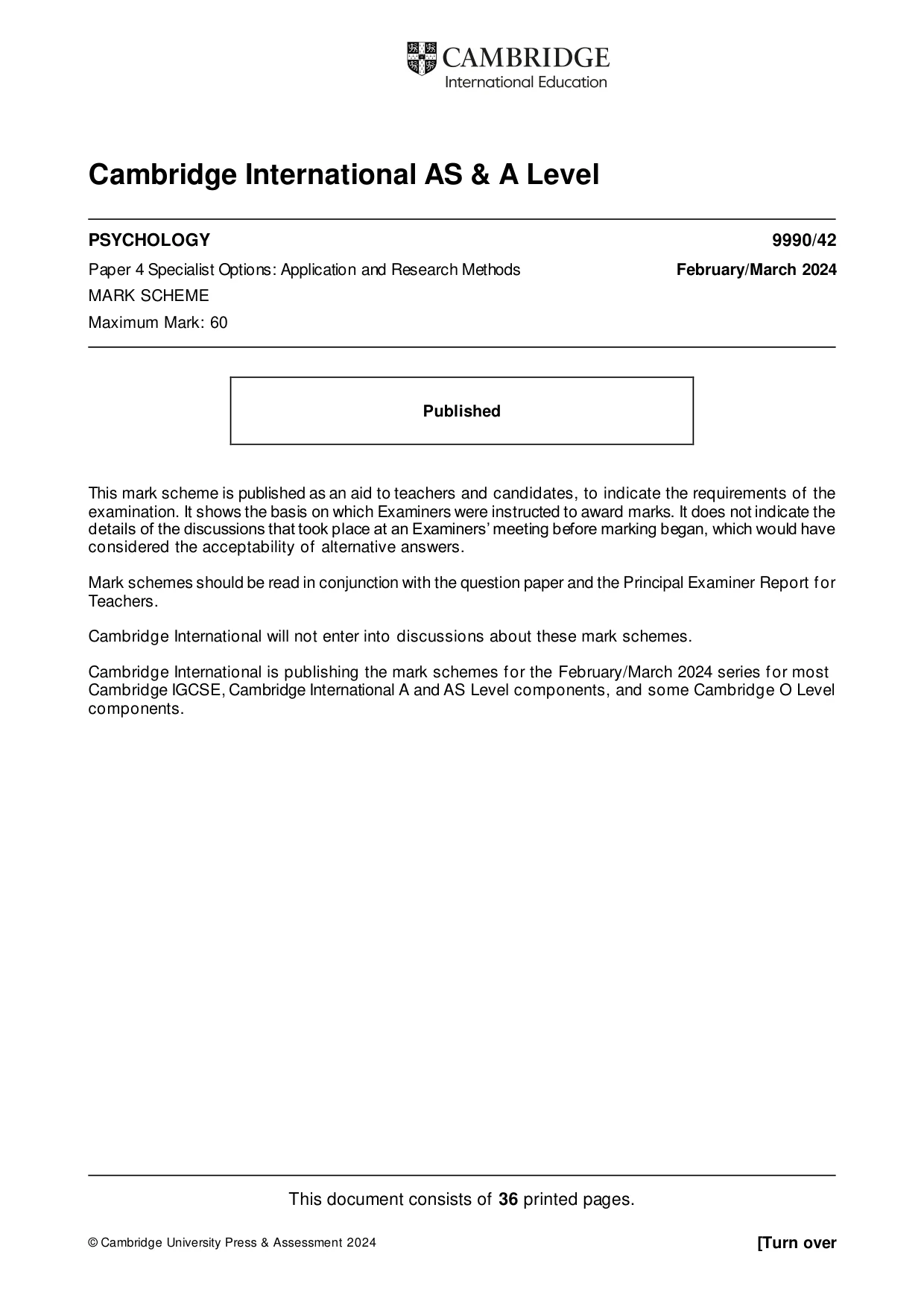
11 (a) Plan a field experiment to investigate which psychological treatment is the most effective for managing pain. Your plan must include details about: • experimental design • directional or non-directional hypothesis. [10] (b) For one piece of psychological knowledge on which your plan is based: (i) Describe this psychological knowledge. [4] (ii) Explain how you used two features of this psychological knowledge to plan your experiment. [4] (c) (i) Explain one reason for your choice of experimental design. [2] (ii) Explain one weakness of your choice of experimental design. [2] (iii) Explain one reason for your choice of directional or non-directional hypothesis. [2] Organisational Psychology
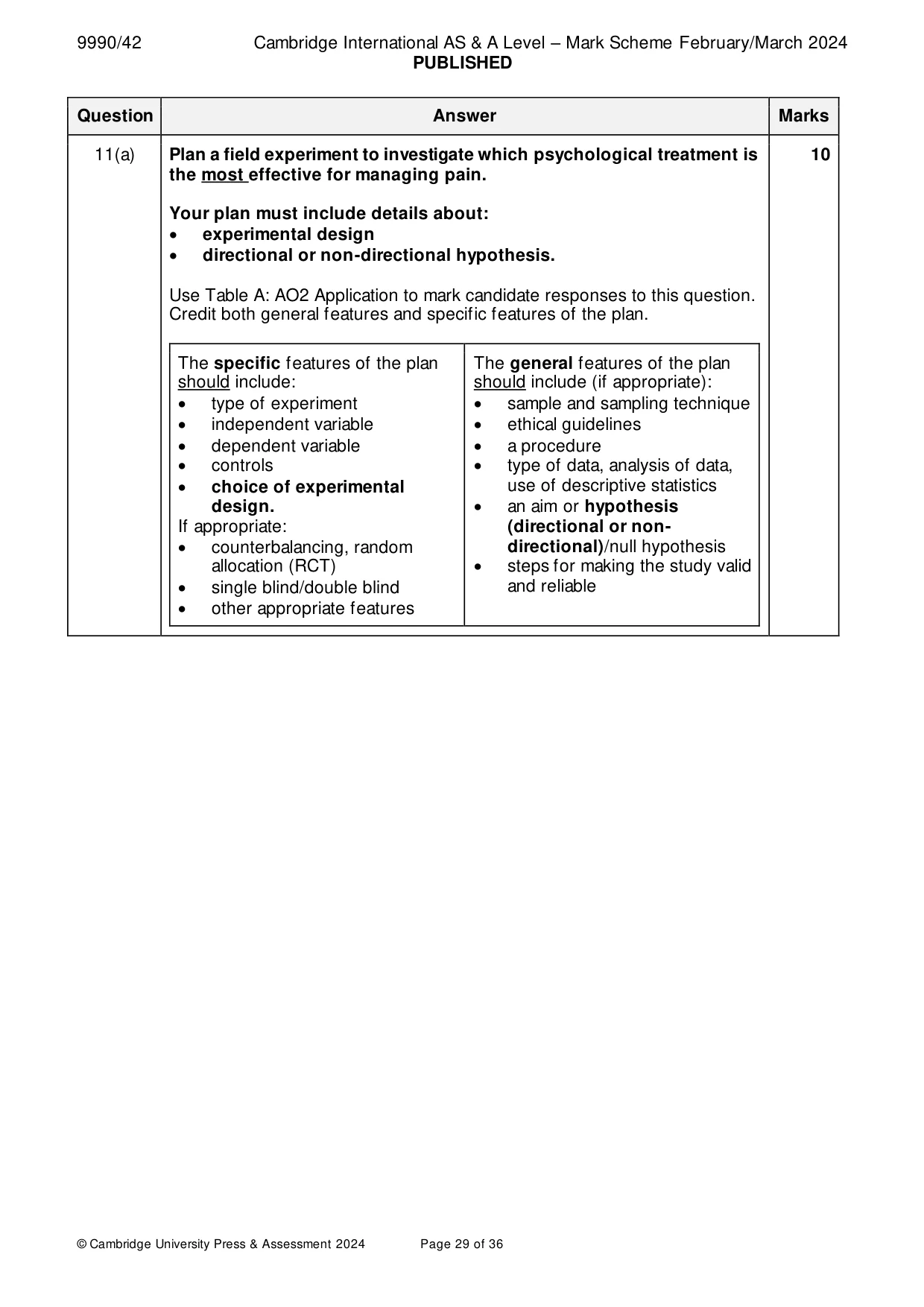
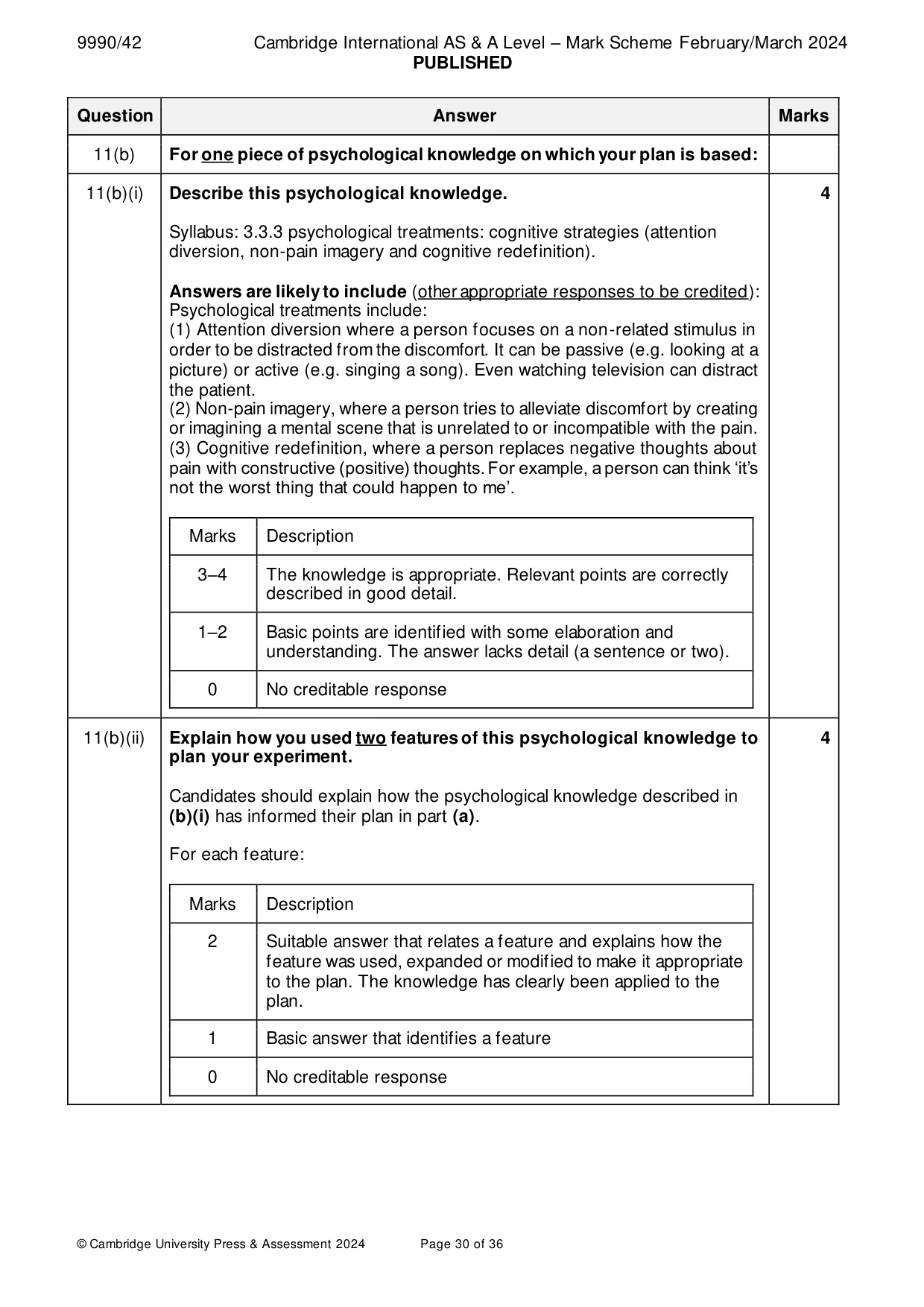
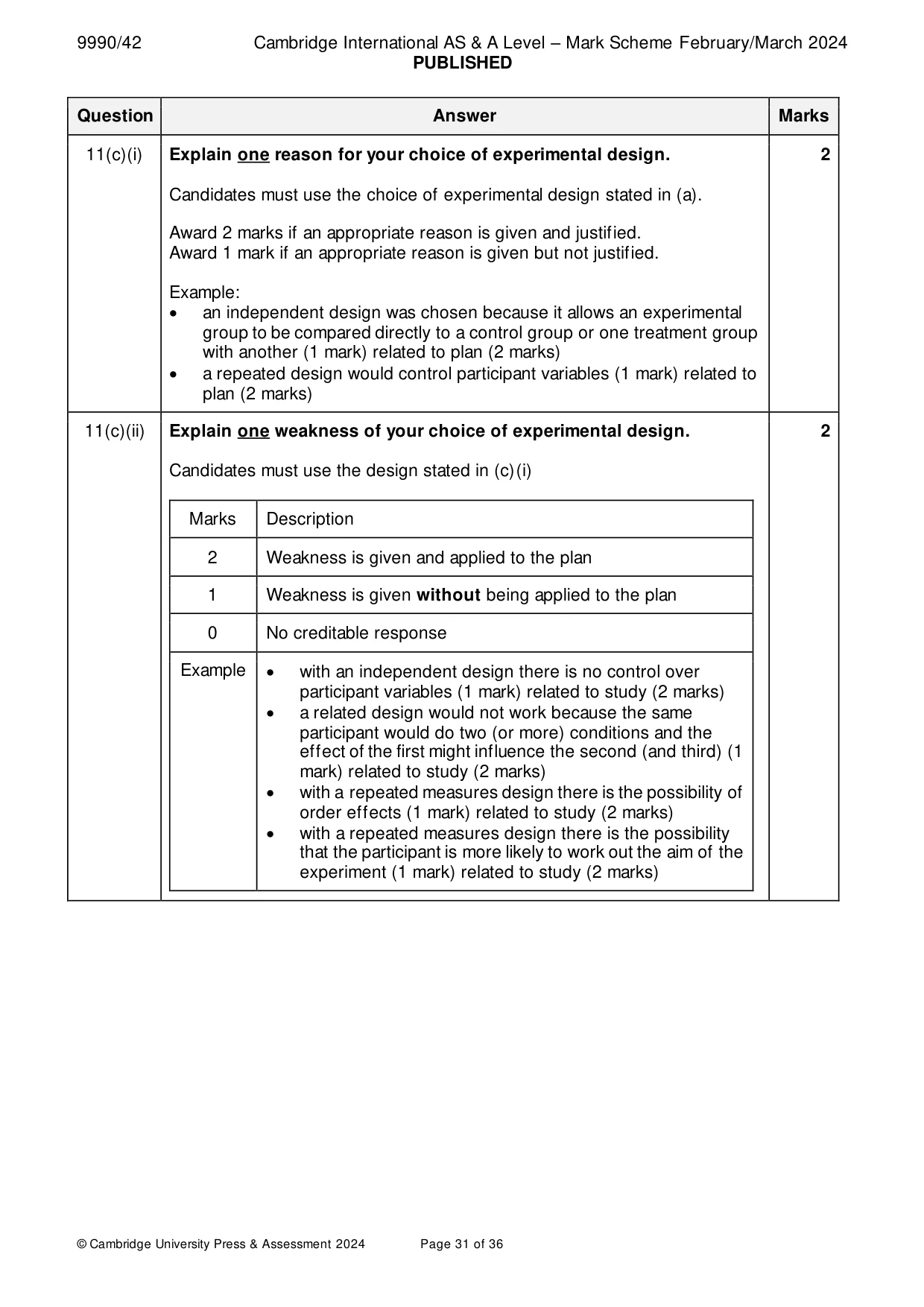
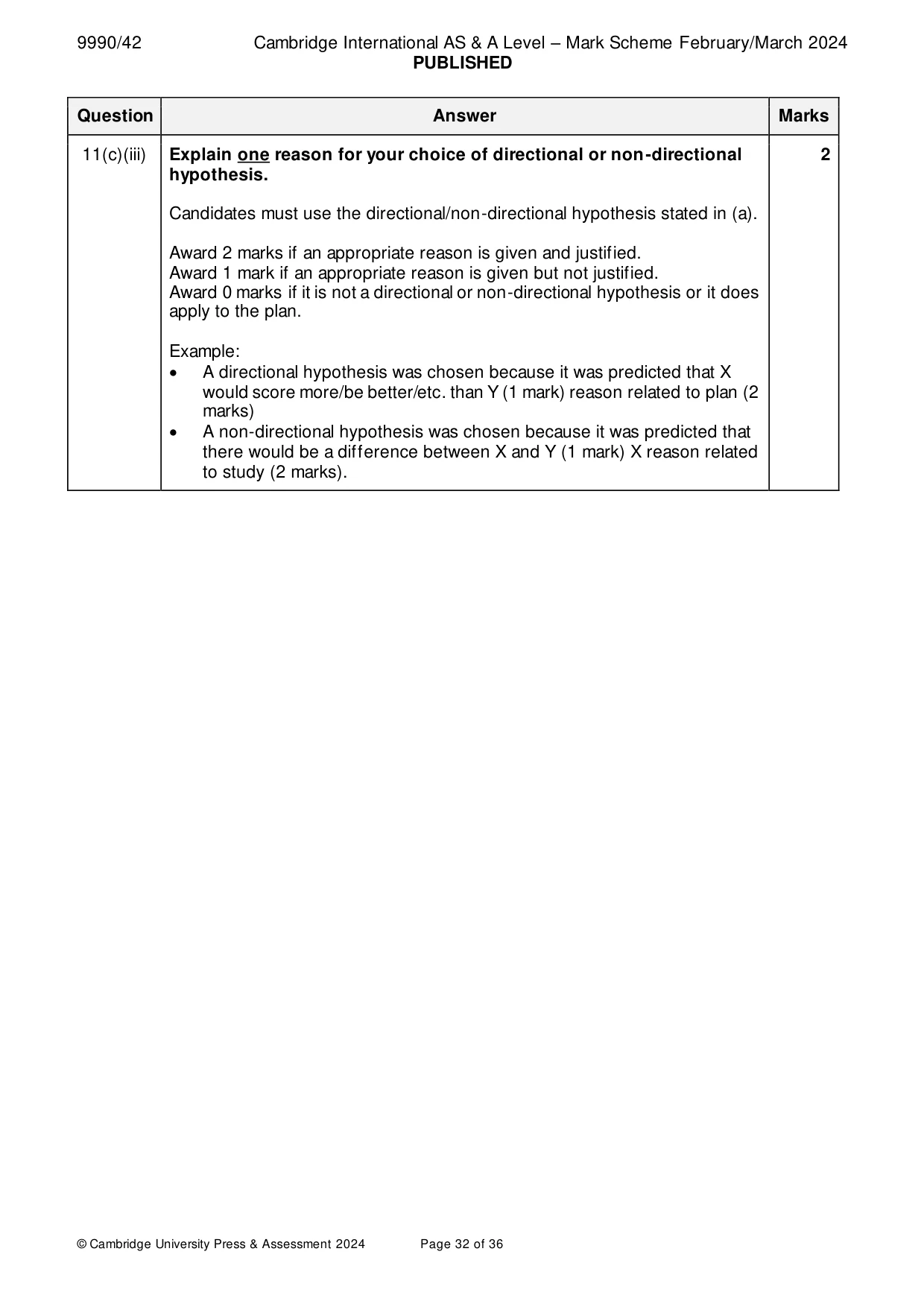
Mark scheme: 11(a) Plan a field experiment to investigate which psychological treatment is 10 the most effective for managing pain. Your plan must include details about: • experimental design • directional or non-directional hypothesis. Use Table A: AO2 Application to mark candidate responses to this question. Credit both general features and specific features of the plan. The specific features of the plan The general features of the plan should include: should include (if appropriate): • type of experiment • sample and sampling technique • independent variable • ethical guidelines • dependent variable • a procedure • controls • type of data, analysis of data, • choice of experimental use of descriptive statistics design. • an aim or hypothesis If appropriate: (directional or non- • counterbalancing, random directional)/null hypothesis allocation (RCT) • steps for making the study valid • single blind/double blind and reliable • other appropriate features 11(b) For one piece of psychological knowledge on which your plan is based: 11(b)(i) Describe this psychological knowledge. 4 Syllabus: 3.3.3 psychological treatments: cognitive strategies (attention diversion, non-pain imagery and cognitive redefinition). Answers are likely to include (other appropriate responses to be credited): Psychological treatments include: (1) Attention diversion where a person focuses on a non-related stimulus in order to be distracted from the discomfort. It can be passive (e.g. looking at a picture) or active (e.g. singing a song). Even watching television can distract the patient. (2) Non-pain imagery, where a person tries to alleviate discomfort by creating or imagining a mental scene that is unrelated to or incompatible with the pain. (3) Cognitive redefinition, where a person replaces negative thoughts about pain with constructive (positive) thoughts. For example, a person can think ‘it’s not the worst thing that could happen to me’. Marks Description 3–4 The knowledge is appropriate. Relevant points are correctly described in good detail. 1–2 Basic points are identified with some elaboration and understanding. The answer lacks detail (a sentence or two). 0 No creditable response 11(b)(ii) Explain how you used two features of this psychological knowledge to 4 plan your experiment. Candidates should explain how the psychological knowledge described in (b)(i) has informed their plan in part (a). For each feature: Marks Description 2 Suitable answer that relates a feature and explains how the feature was used, expanded or modified to make it appropriate to the plan. The knowledge has clearly been applied to the plan. 1 Basic answer that identifies a feature 0 No creditable response 11(c)(i) Explain one reason for your choice of experimental design. 2 Candidates must use the choice of experimental design stated in (a). Award 2 marks if an appropriate reason is given and justified. Award 1 mark if an appropriate reason is given but not justified. Example: • an independent design was chosen because it allows an experimental group to be compared directly to a control group or one treatment group with another (1 mark) related to plan (2 marks) • a repeated design would control participant variables (1 mark) related to plan (2 marks) 11(c)(ii) Explain one weakness of your choice of experimental design. 2 Candidates must use the design stated in (c)(i) Marks Description 2 Weakness is given and applied to the plan 1 Weakness is given without being applied to the plan 0 No creditable response Example • with an independent design there is no control over participant variables (1 mark) related to study (2 marks) • a related design would not work because the same participant would do two (or more) conditions and the effect of the first might influence the second (and third) (1 mark) related to study (2 marks) • with a repeated measures design there is the possibility of order effects (1 mark) related to study (2 marks) • with a repeated measures design there is the possibility that the participant is more likely to work out the aim of the experiment (1 mark) related to study (2 marks) 11(c)(iii) Explain one reason for your choice of directional or non-directional 2 hypothesis. Candidates must use the directional/non-directional hypothesis stated in (a). Award 2 marks if an appropriate reason is given and justified. Award 1 mark if an appropriate reason is given but not justified. Award 0 marks if it is not a directional or non-directional hypothesis or it does apply to the plan. Example: • A directional hypothesis was chosen because it was predicted that X would score more/be better/etc. than Y (1 mark) reason related to plan (2 marks) • A non-directional hypothesis was chosen because it was predicted that there would be a difference between X and Y (1 mark) X reason related to study (2 marks).
Q12 · Within each 24-hour period, workers in different offices have different work patterns…
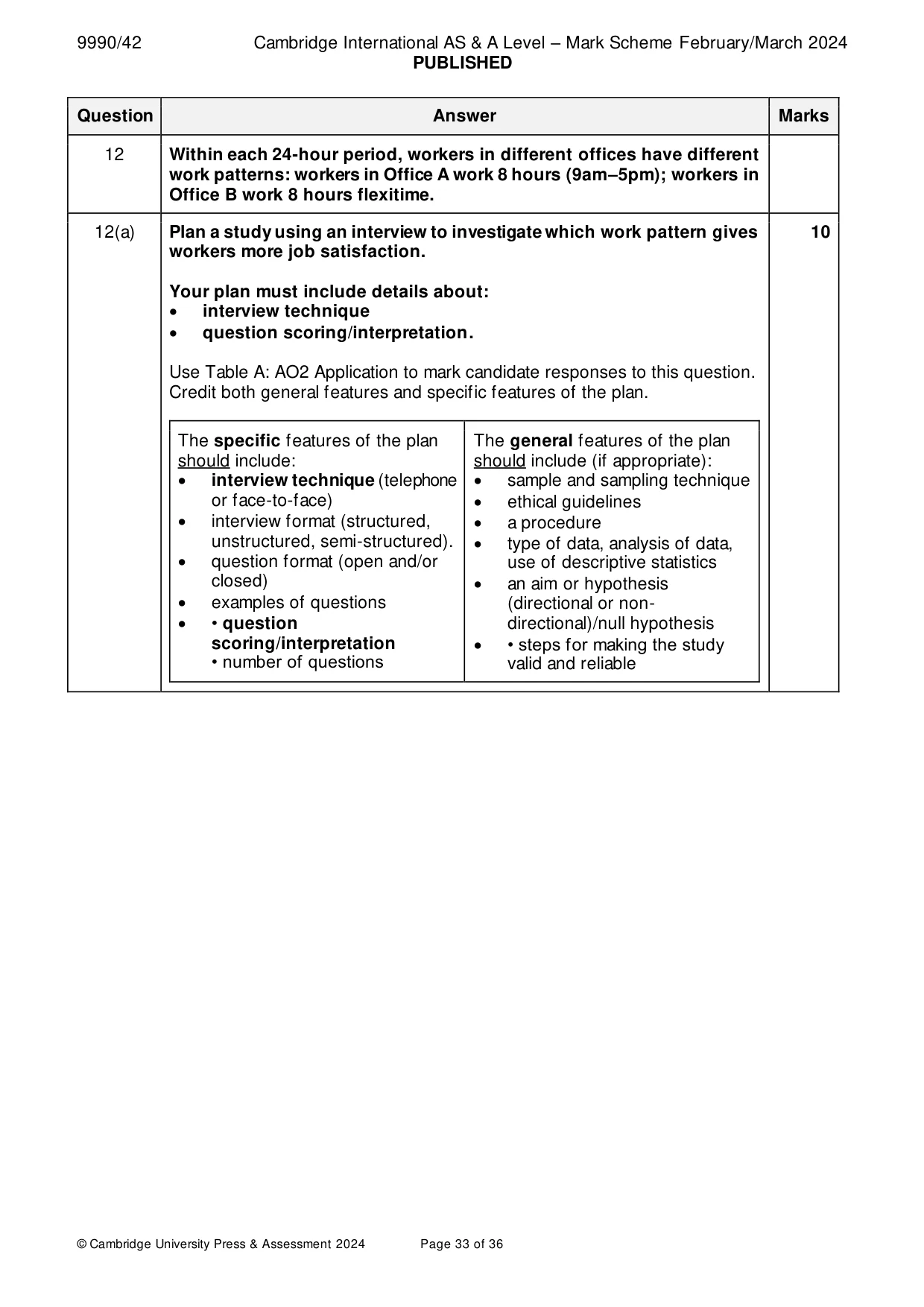
12 Within each 24-hour period, workers in different offices have different work patterns: workers in Office A work 8 hours (9 am–5 pm); workers in Office B work 8 hours flexitime. (a) Plan a study using an interview to investigate which work pattern gives workers more job satisfaction. Your plan must include details about: • interview technique • question scoring/interpretation. [10] (b) For one piece of psychological knowledge on which your plan is based: (i) Describe this psychological knowledge. [4] (ii) Explain how you used two features of this psychological knowledge to plan your study. [4] (c) (i) Explain one reason for your choice of interview technique. [2] (ii) Explain one weakness of your choice of interview technique. [2] (iii) Explain one reason for your choice of question scoring/interpretation. [2]
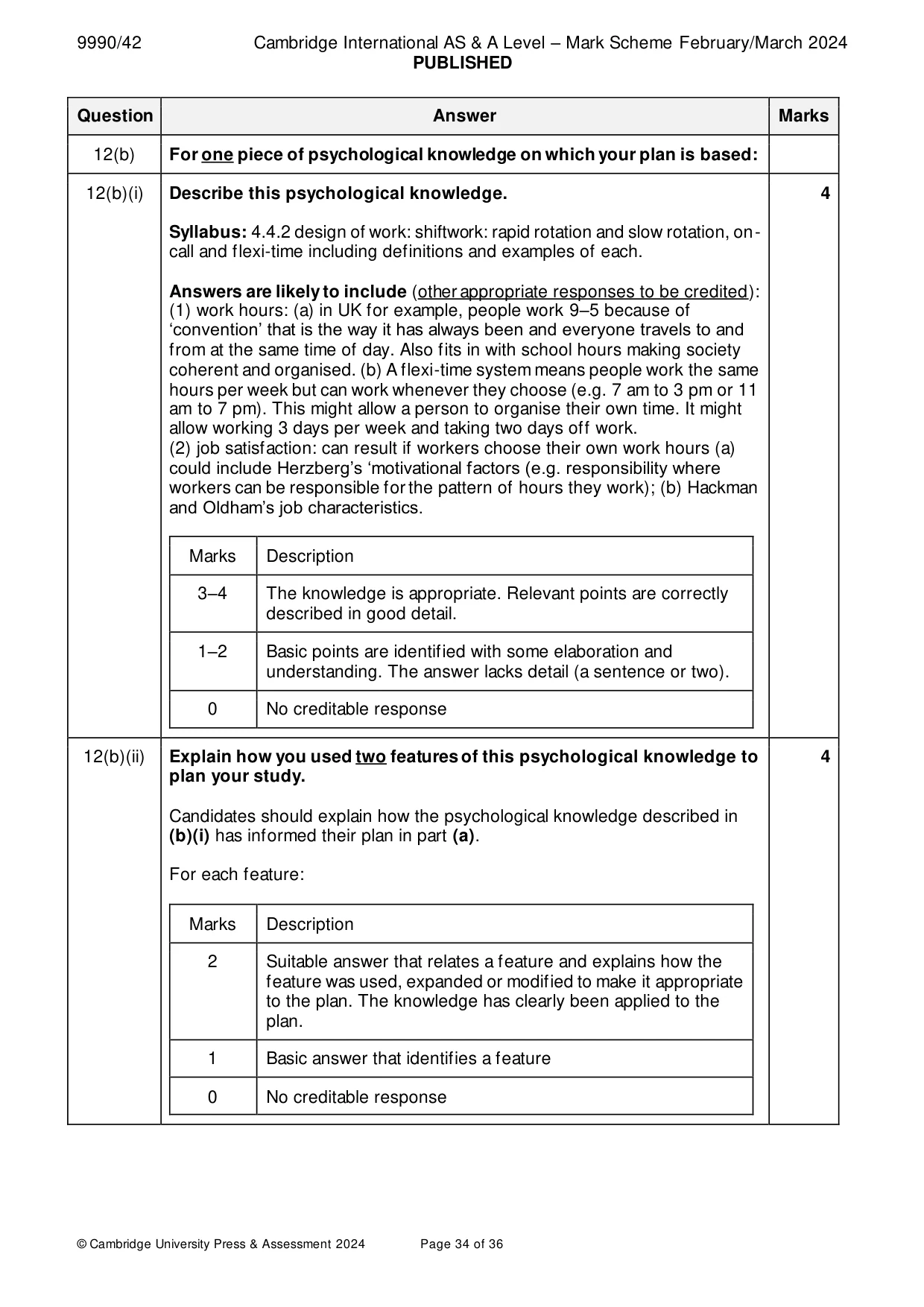
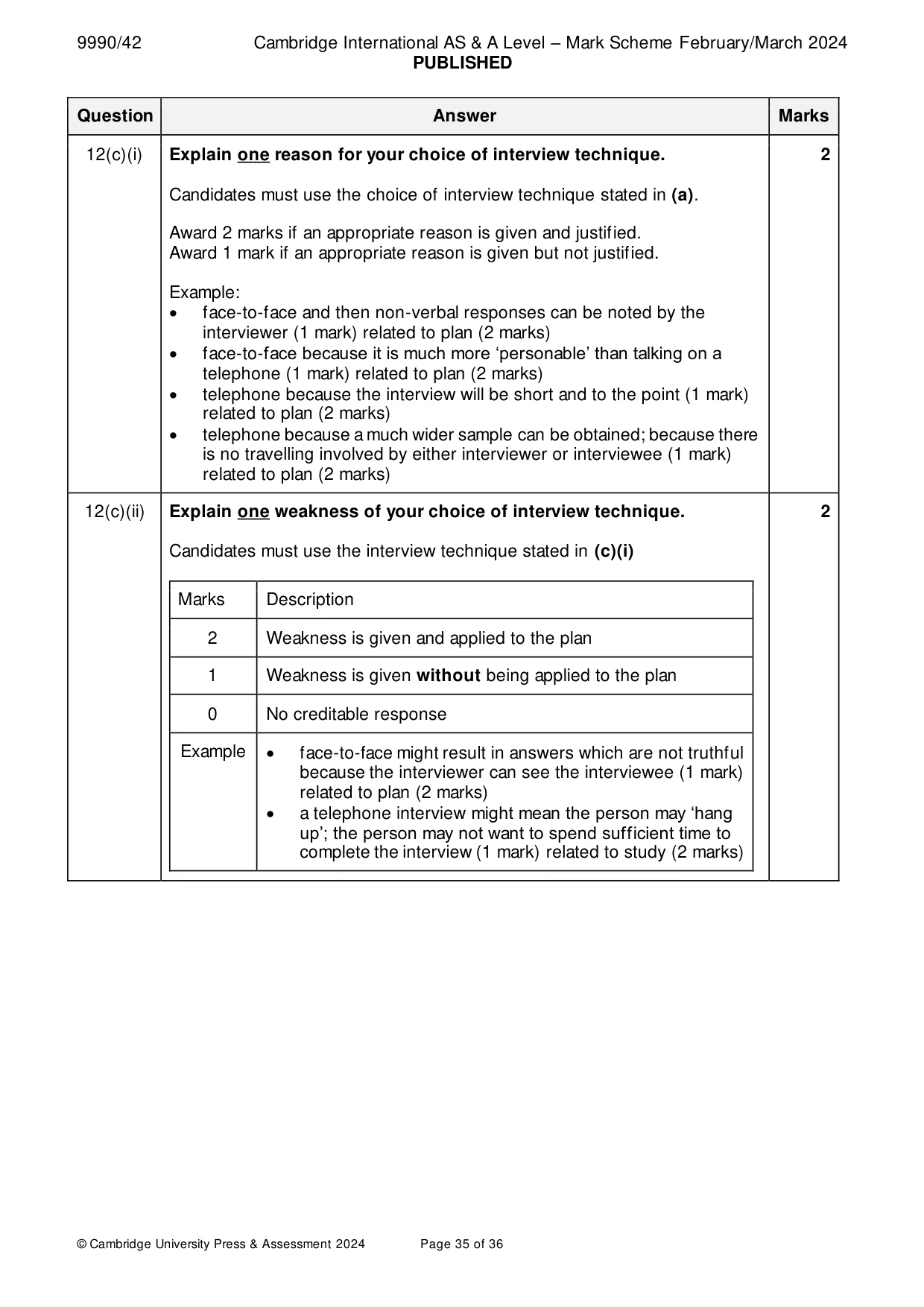
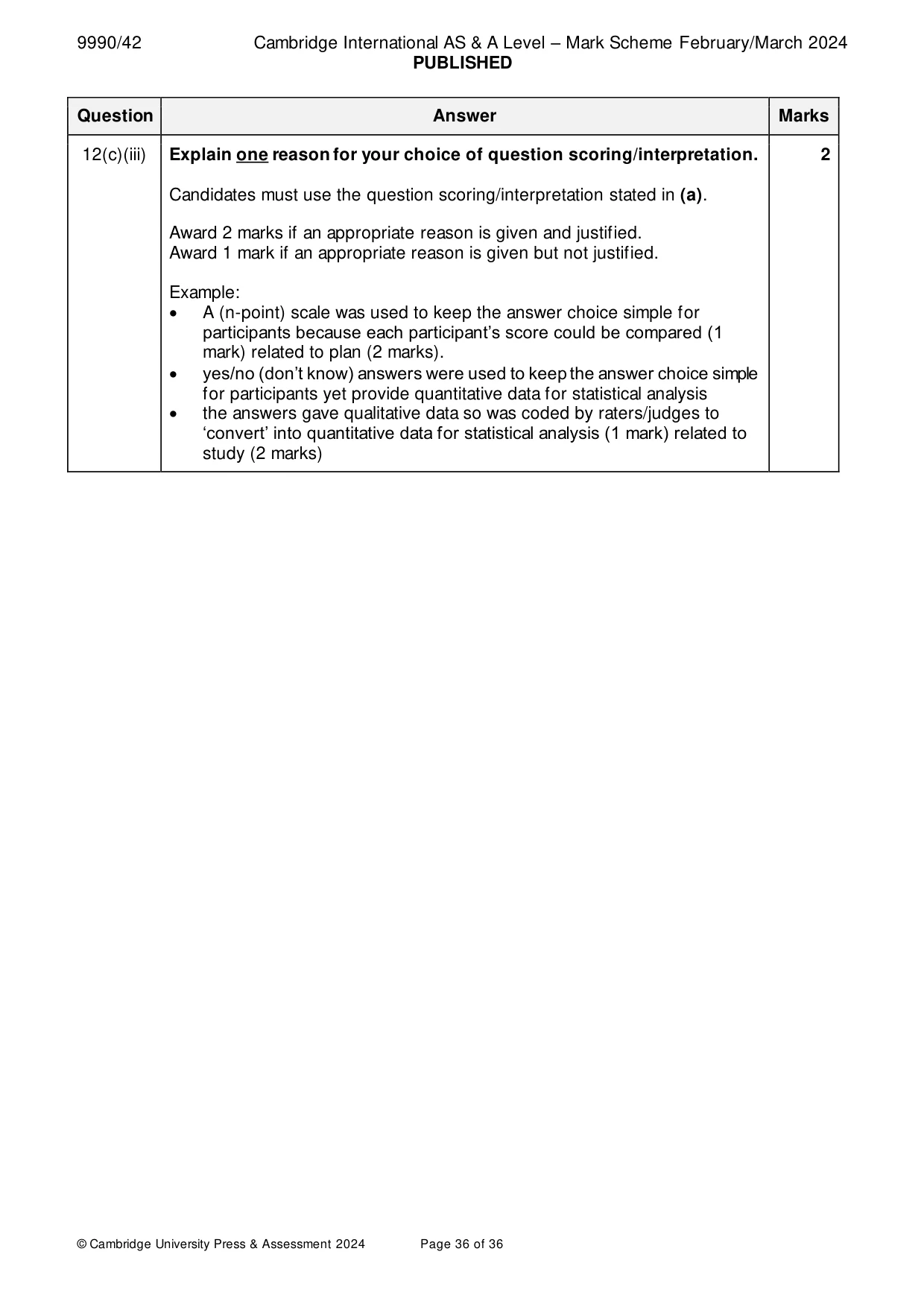
Mark scheme: 12 Within each 24-hour period, workers in different offices have different work patterns: workers in Office A work 8 hours (9am–5pm); workers in Office B work 8 hours flexitime. 12(a) Plan a study using an interview to investigate which work pattern gives 10 workers more job satisfaction. Your plan must include details about: • interview technique • question scoring/interpretation. Use Table A: AO2 Application to mark candidate responses to this question. Credit both general features and specific features of the plan. The specific features of the plan The general features of the plan should include: should include (if appropriate): • interview technique (telephone • sample and sampling technique or face-to-face) • ethical guidelines • interview format (structured, • a procedure unstructured, semi-structured). • type of data, analysis of data, • question format (open and/or use of descriptive statistics closed) • an aim or hypothesis • examples of questions (directional or non- • • question directional)/null hypothesis scoring/interpretation • • steps for making the study • number of questions valid and reliable 12(b) For one piece of psychological knowledge on which your plan is based: 12(b)(i) Describe this psychological knowledge. 4 Syllabus: 4.4.2 design of work: shiftwork: rapid rotation and slow rotation, on- call and flexi-time including definitions and examples of each. Answers are likely to include (other appropriate responses to be credited): (1) work hours: (a) in UK for example, people work 9–5 because of ‘convention’ that is the way it has always been and everyone travels to and from at the same time of day. Also fits in with school hours making society coherent and organised. (b) A flexi-time system means people work the same hours per week but can work whenever they choose (e.g. 7 am to 3 pm or 11 am to 7 pm). This might allow a person to organise their own time. It might allow working 3 days per week and taking two days off work. (2) job satisfaction: can result if workers choose their own work hours (a) could include Herzberg’s ‘motivational factors (e.g. responsibility where workers can be responsible for the pattern of hours they work); (b) Hackman and Oldham’s job characteristics. Marks Description 3–4 The knowledge is appropriate. Relevant points are correctly described in good detail. 1–2 Basic points are identified with some elaboration and understanding. The answer lacks detail (a sentence or two). 0 No creditable response 12(b)(ii) Explain how you used two features of this psychological knowledge to 4 plan your study. Candidates should explain how the psychological knowledge described in (b)(i) has informed their plan in part (a). For each feature: Marks Description 2 Suitable answer that relates a feature and explains how the feature was used, expanded or modified to make it appropriate to the plan. The knowledge has clearly been applied to the plan. 1 Basic answer that identifies a feature 0 No creditable response 12(c)(i) Explain one reason for your choice of interview technique. 2 Candidates must use the choice of interview technique stated in (a). Award 2 marks if an appropriate reason is given and justified. Award 1 mark if an appropriate reason is given but not justified. Example: • face-to-face and then non-verbal responses can be noted by the interviewer (1 mark) related to plan (2 marks) • face-to-face because it is much more ‘personable’ than talking on a telephone (1 mark) related to plan (2 marks) • telephone because the interview will be short and to the point (1 mark) related to plan (2 marks) • telephone because a much wider sample can be obtained; because there is no travelling involved by either interviewer or interviewee (1 mark) related to plan (2 marks) 12(c)(ii) Explain one weakness of your choice of interview technique. 2 Candidates must use the interview technique stated in (c)(i) Marks Description 2 Weakness is given and applied to the plan 1 Weakness is given without being applied to the plan 0 No creditable response Example • face-to-face might result in answers which are not truthful because the interviewer can see the interviewee (1 mark) related to plan (2 marks) • a telephone interview might mean the person may ‘hang up’; the person may not want to spend sufficient time to complete the interview (1 mark) related to study (2 marks) 12(c)(iii) Explain one reason for your choice of question scoring/interpretation. 2 Candidates must use the question scoring/interpretation stated in (a). Award 2 marks if an appropriate reason is given and justified. Award 1 mark if an appropriate reason is given but not justified. Example: • A (n-point) scale was used to keep the answer choice simple for participants because each participant’s score could be compared (1 mark) related to plan (2 marks). • yes/no (don’t know) answers were used to keep the answer choice simple for participants yet provide quantitative data for statistical analysis • the answers gave qualitative data so was coded by raters/judges to ‘convert’ into quantitative data for statistical analysis (1 mark) related to study (2 marks)
What was in this paper
The subtopics covered by these 12 questions, and how many questions each got. Open one in a new tab to see every Cambridge question on it.
What you needed in this session
Cambridge’s own grade thresholds for 2024 Feb/March, Paper 4 · Variant 2. A higher threshold means an easier paper — the bar moves with how the cohort did.