Questions as text
Q1 · The following particles are used to describe the structure of an atom 9702/23 May/June 2017
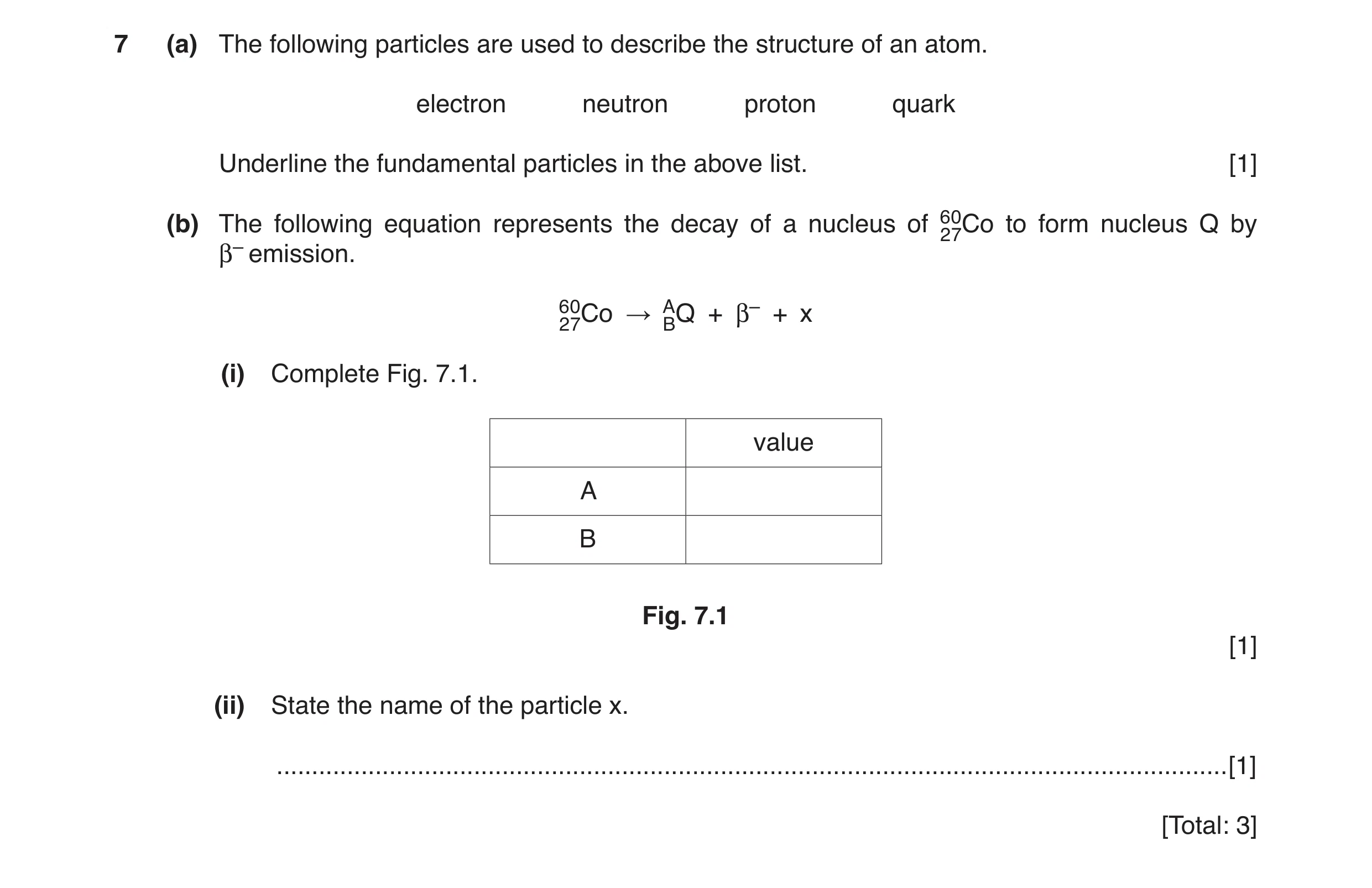
7 (a) The following particles are used to describe the structure of an atom. electron neutron proton quark Underline the fundamental particles in the above list. [1] (b) The following equation represents the decay of a nucleus of 6207Co to form nucleus Q by β– emission. 6 2 07Co → ABQ + β– + x (i) Complete Fig. 7.1. value A B Fig. 7.1 [1] (ii) State the name of the particle x. … [1] [Total: 3]
3 marks
Mark scheme: 7(a) electron and quark both underlined/clearly indicated and no others B1 7(b)(i) value A 60 B 28 both correct B1 7(b)(ii) (electron) antineutrino B1
This question in 9702/23 May/June 2017
Q2 · A neutron within a nucleus decays to produce a proton, a β– particle and an (electron)… 9702/21 Oct/Nov 2017
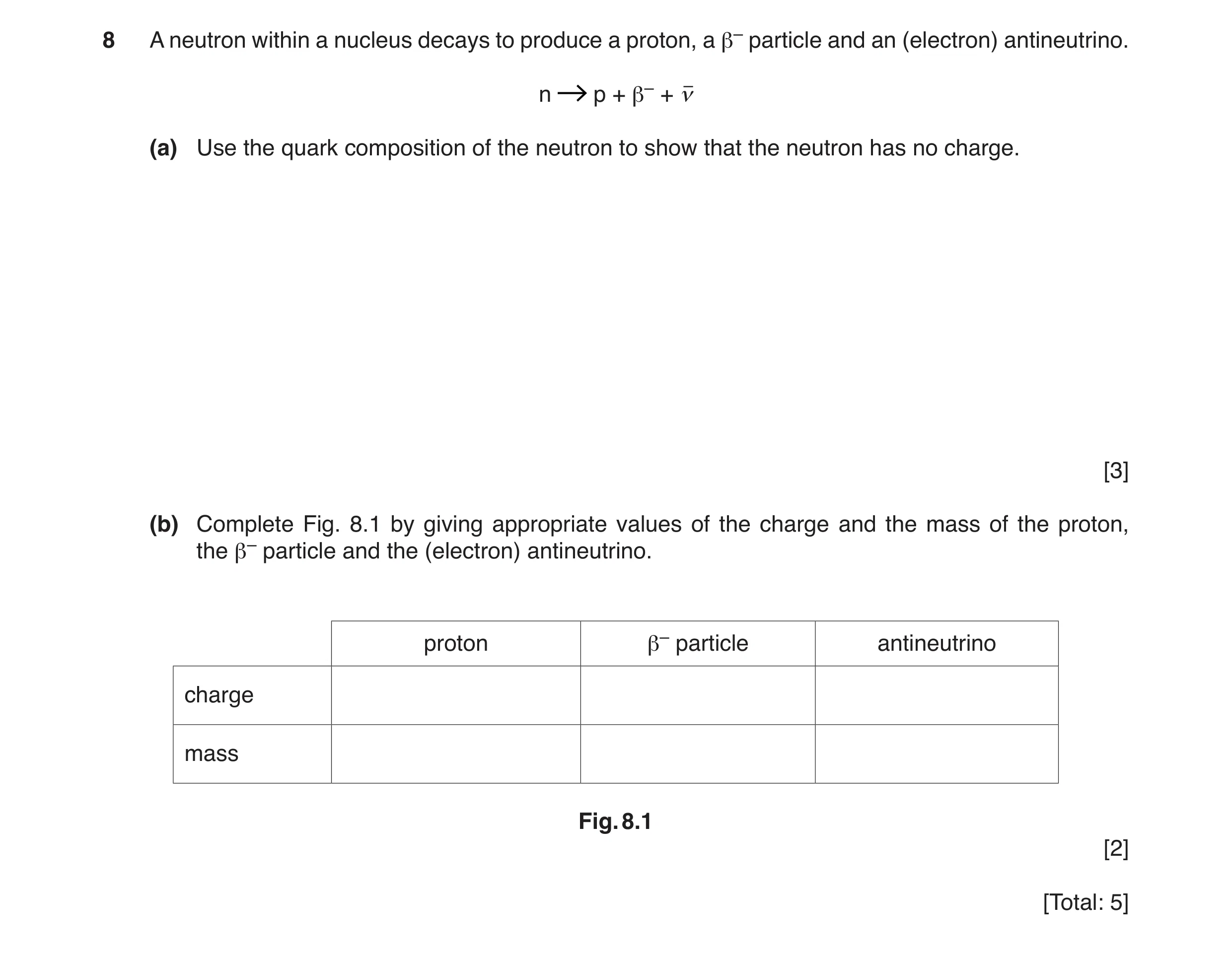
8 A neutron within a nucleus decays to produce a proton, a β– particle and an (electron) antineutrino. n p + β– + ν– (a) Use the quark composition of the neutron to show that the neutron has no charge. [3] (b) Complete Fig. 8.1 by giving appropriate values of the charge and the mass of the proton, the β– particle and the (electron) antineutrino. proton β– particle antineutrino charge mass Fig. 8.1 [2] [Total: 5]
5 marks
Mark scheme: 8(a) (quark structure is) up, down, down/udd B1 up/u has charge +⅔(e), down/d has charge –⅓(e) C1 +⅔e –⅓e –⅓e = 0 A1 8(b) charge: p +1.6(0) × 10–19 (C) or +e β– –1.6(0) × 10–19 (C) or –e ν zero/0 B1 mass: p 1.67 × 10⁻²⁷ (kg)/1.7 × 10–27 (kg) β– 9.1(1) × 10–31 (kg) ν very small/zero/0 B1
This question in 9702/21 Oct/Nov 2017
Q3 · A stationary nucleus X decays by emitting a β+ particle to form a nucleus of carbon-13 (… 9702/22 Oct/Nov 2017
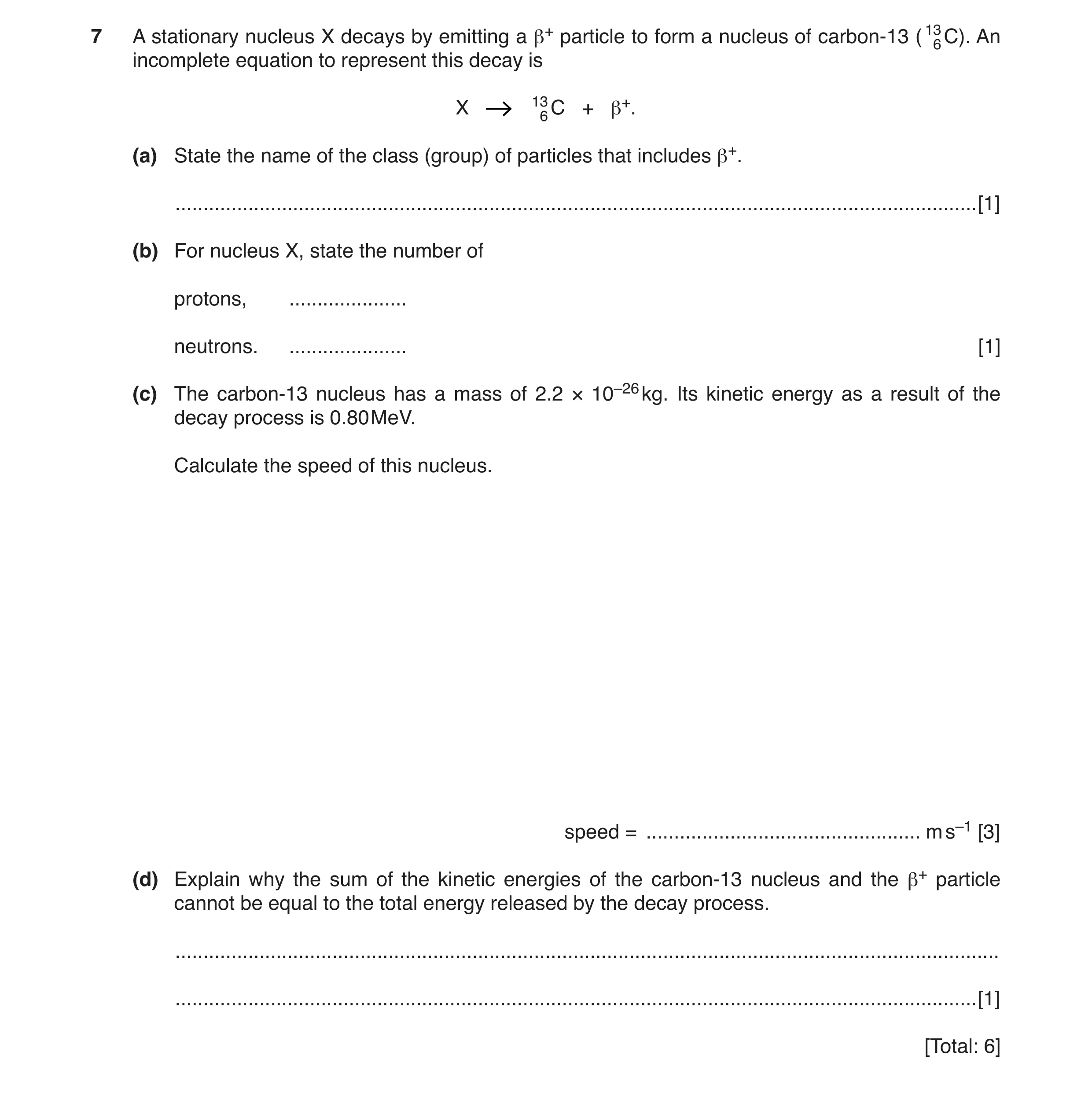
7 A stationary nucleus X decays by emitting a β+ particle to form a nucleus of carbon-13 ( 136 C). An incomplete equation to represent this decay is X 136 C + β+. (a) State the name of the class (group) of particles that includes β+. … [1] (b) For nucleus X, state the number of protons, … neutrons. … [1] (c) The carbon-13 nucleus has a mass of 2.2 × 10⁻²⁶ kg. Its kinetic energy as a result of the decay process is 0.80 MeV. Calculate the speed of this nucleus. speed = … m s–1 [3] (d) Explain why the sum of the kinetic energies of the carbon-13 nucleus and the β+ particle cannot be equal to the total energy released by the decay process. … … [1] [Total: 6]
6 marks
Mark scheme: 7(a) lepton(s) B1 7(b) protons: 7 and neutrons: 6 A1 7(c) E = ½mv2 C1 = 0.80 × 106 × 1.60 × 10–19 C1 = 1.28 × 10⁻¹³ (J) v2 = 2 × 1.28 × 10–13 / 2.2 × 10⁻²⁶ v = 3.4 × 10⁶ m s–1 A1 7(d) an (electron) neutrino/ν(e) is also produced (and this has energy) B1
This question in 9702/22 Oct/Nov 2017
Q4 · A β– particle from a radioactive source is travelling in a vacuum with kinetic energy 460… 9702/21 May/June 2018
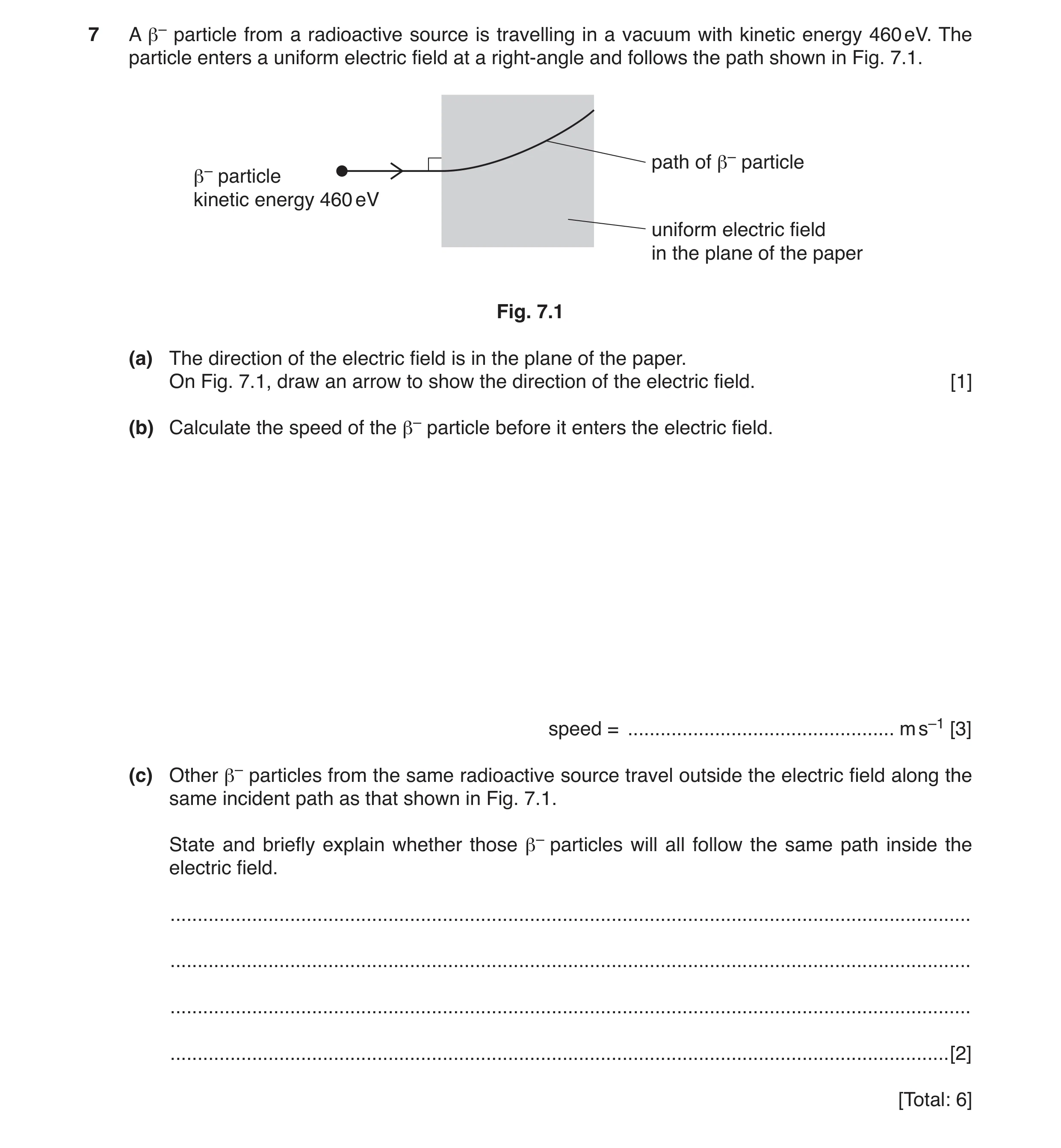
7 A β– particle from a radioactive source is travelling in a vacuum with kinetic energy 460 eV. The particle enters a uniform electric field at a right-angle and follows the path shown in Fig. 7.1. path of β– particle β– particle kinetic energy 460 eV uniform electric field in the plane of the paper Fig. 7.1 (a) The direction of the electric field is in the plane of the paper. On Fig. 7.1, draw an arrow to show the direction of the electric field. [1] (b) Calculate the speed of the β– particle before it enters the electric field. speed = … m s–1 [3] (c) Other β– particles from the same radioactive source travel outside the electric field along the same incident path as that shown in Fig. 7.1. State and briefly explain whether those β– particles will all follow the same path inside the electric field. … … … … [2] [Total: 6]
6 marks
Mark scheme: 7(a) arrow pointing vertically down the page B1 7(b) E = ½mv2 C1 E = 460 × 1.60 × 10–19 (= 7.36 × 10⁻¹⁷ (J)) C1 v = [(2 × 460 × 1.60 × 10–19) / (9.11 × 10⁻³¹)]½ = 1.3 × 10⁷ m s–1 A1 7(c) β– particles have range of/different/various speeds/velocities/momenta/energies M1 so they follow different paths A1
This question in 9702/21 May/June 2018
Q5 · A stationary nucleus X decays to form nucleus Y, as shown by the equation X Y + β– + ν 9702/22 May/June 2018
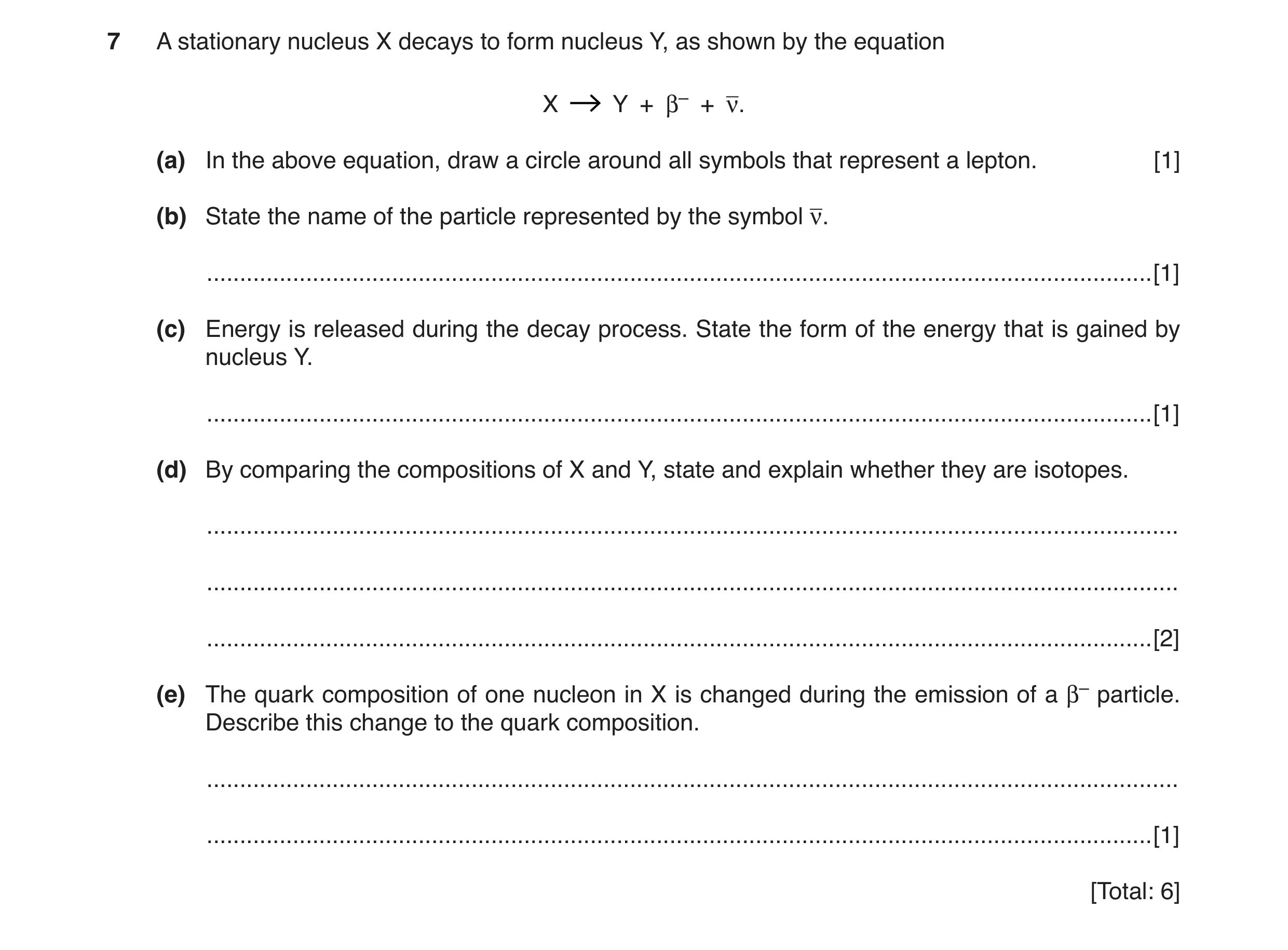
7 A stationary nucleus X decays to form nucleus Y, as shown by the equation X Y + β– + ν. (a) In the above equation, draw a circle around all symbols that represent a lepton. [1] (b) State the name of the particle represented by the symbol ν. … [1] (c) Energy is released during the decay process. State the form of the energy that is gained by nucleus Y. … [1] (d) By comparing the compositions of X and Y, state and explain whether they are isotopes. … … … [2] (e) The quark composition of one nucleon in X is changed during the emission of a β– particle. Describe this change to the quark composition. … … [1] [Total: 6]
6 marks
Mark scheme: 7(a) B1 7(b) (electron) antineutrino B1 7(c) kinetic (energy) B1 7(d) Y has one more proton (and one less neutron)/X has one less proton (and one more neutron) or Y has more protons (and fewer neutrons)/X has fewer protons (and more neutrons) or a neutron changes to a proton or the number of protons increases M1 (so) not isotopes A1 7(e) up down down changes to up up down or udd → uud or down changes to up or d → u B1
This question in 9702/22 May/June 2018
Q6 · A graph of nucleon number A against proton number Z is shown in Fig 9702/23 May/June 2018
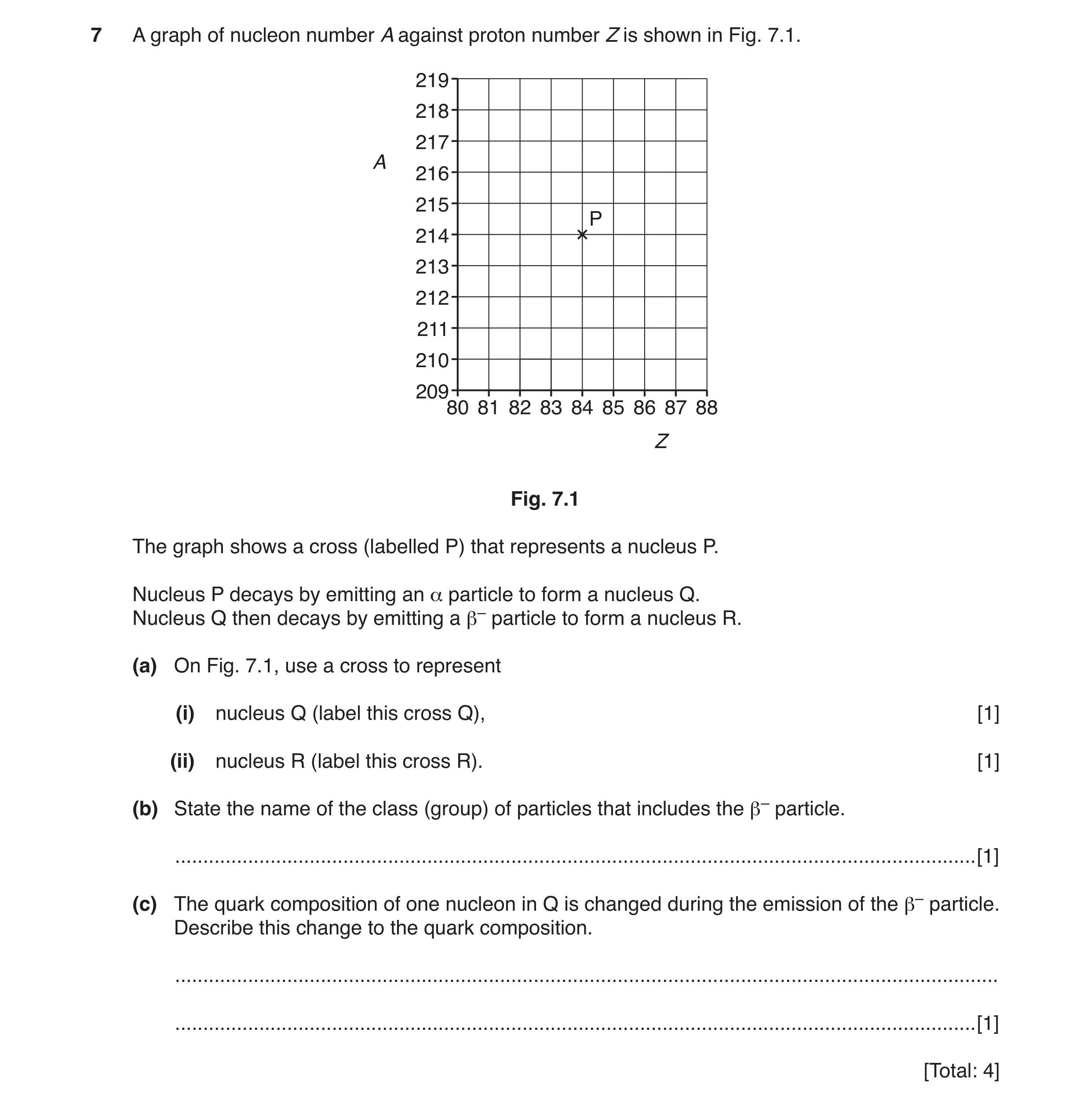
7 A graph of nucleon number A against proton number Z is shown in Fig. 7.1. 219 218 217 A 216 215 P 214 213 212 211 210 20980 81 82 83 84 85 86 87 88 Z Fig. 7.1 The graph shows a cross (labelled P) that represents a nucleus P. Nucleus P decays by emitting an α particle to form a nucleus Q. Nucleus Q then decays by emitting a β– particle to form a nucleus R. (a) On Fig. 7.1, use a cross to represent (i) nucleus Q (label this cross Q), [1] (ii) nucleus R (label this cross R). [1] (b) State the name of the class (group) of particles that includes the β– particle. … [1] (c) The quark composition of one nucleon in Q is changed during the emission of the β– particle. Describe this change to the quark composition. … … [1] [Total: 4]
4 marks
Mark scheme: 7(a)(i) Q plotted at (82, 210) A1 7(a)(ii) R plotted at (83, 210) A1 7(b) lepton(s) B1 7(c) up down down changes to up up down or udd → uud or down changes to up or d → u B1
This question in 9702/23 May/June 2018
Q7 · In the following list, underline all particles that are leptons 9702/22 Oct/Nov 2018
8 (a) In the following list, underline all particles that are leptons. antineutrino positron proton quark [1] γ radiation. (b) A stationary nucleus of magnesium-27, 2712Mg, decays by emitting a β– particle and An incomplete equation to represent this decay is 2712Mg X + β– + γ. (i) State the nucleon number and the proton number of nucleus X. nucleon number = … proton number = … [2] (ii) State the name of the interaction that gives rise to this decay. … [1] (iii) State two possible reasons why the sum of the kinetic energy of the β– particle and the energy of the γ radiation is less than the total energy released during the decay of the magnesium nucleus. 1. … … 2. … … [2] [Total: 6]
6 marks
Mark scheme: 8(a) antineutrino and positron both underlined (and no other particles) B1 8(b)(i) nucleon number = 27 A1 proton number = 13 A1 8(b)(ii) weak (nuclear force/interaction) B1 8(b)(iii) an (electron) antineutrino / ( ) e ν is produced (and this has energy) B1 X has kinetic energy B1
This question in 9702/22 Oct/Nov 2018
Question 8 9702/23 Oct/Nov 2018
6 (a) Define the coulomb. … … [1] (b) An electric current is a flow of charge carriers. In the following list, underline the possible charges for a charge carrier. 8.0 × 10⁻¹⁹ C 4.0 × 10⁻¹⁹ C 1.6 × 10⁻¹⁹ C 1.6 × 10⁻²⁰ C [1] (c) The diameter of a wire ST varies linearly with distance along the wire as shown in Fig. 6.1. S T current I current I d 2d drift speed vs Fig. 6.1 There is a current I in the wire. At end S of the wire, the diameter is d and the average drift speed of the free electrons is vs. At end T of the wire, the diameter is 2d. On Fig. 6.2, sketch a graph to show the variation of the average drift speed with position along the wire between S and T. 1.00vs 0.75vs average drift 0.50vs speed 0.25vs 0 S T position along wire Fig. 6.2 [2] [Total: 4]
4 marks
Mark scheme: 6(a) (coulomb is an) ampere second B1 6(b) 8.0 × 10⁻¹⁹ C and 1.6 × 10⁻¹⁹ C both underlined (and no others underlined) B1 6(c) line drawn between (S, 1.00vs) and (T, 0.25vs) M1 line with decreasing magnitude of gradient A1
This question in 9702/23 Oct/Nov 2018
Q9 · The names of four particles are listed below 9702/22 Feb/March 2019
7 (a) The names of four particles are listed below. alpha beta-plus neutron proton State the name(s) of the particle(s) in this list that: (i) are not fundamental … [1] (ii) do not experience an electric force when situated in an electric field … [1] (iii) has the largest ratio of charge to mass. … [1] (b) A hadron has a charge of +e where e is the elementary charge. The hadron is composed of only two quarks. One of these quarks is an antidown ( d ) quark. By considering charge, state and explain the name (flavour) of the other quark. … … [3] [Total: 6]
6 marks
Mark scheme: 7(a)(i) alpha, neutron and proton B1 7(a)(ii) neutron B1 7(a)(iii) beta plus or β+ B1 7(b) d has charge (+)⅓ e C1 (so) other quark has charge = e – ⅓ e = (+)⅔ e M1 other quark is an up / u A1
This question in 9702/22 Feb/March 2019
Q10 · State what is meant by a field line (line of force) in an electric field 9702/22 May/June 2019
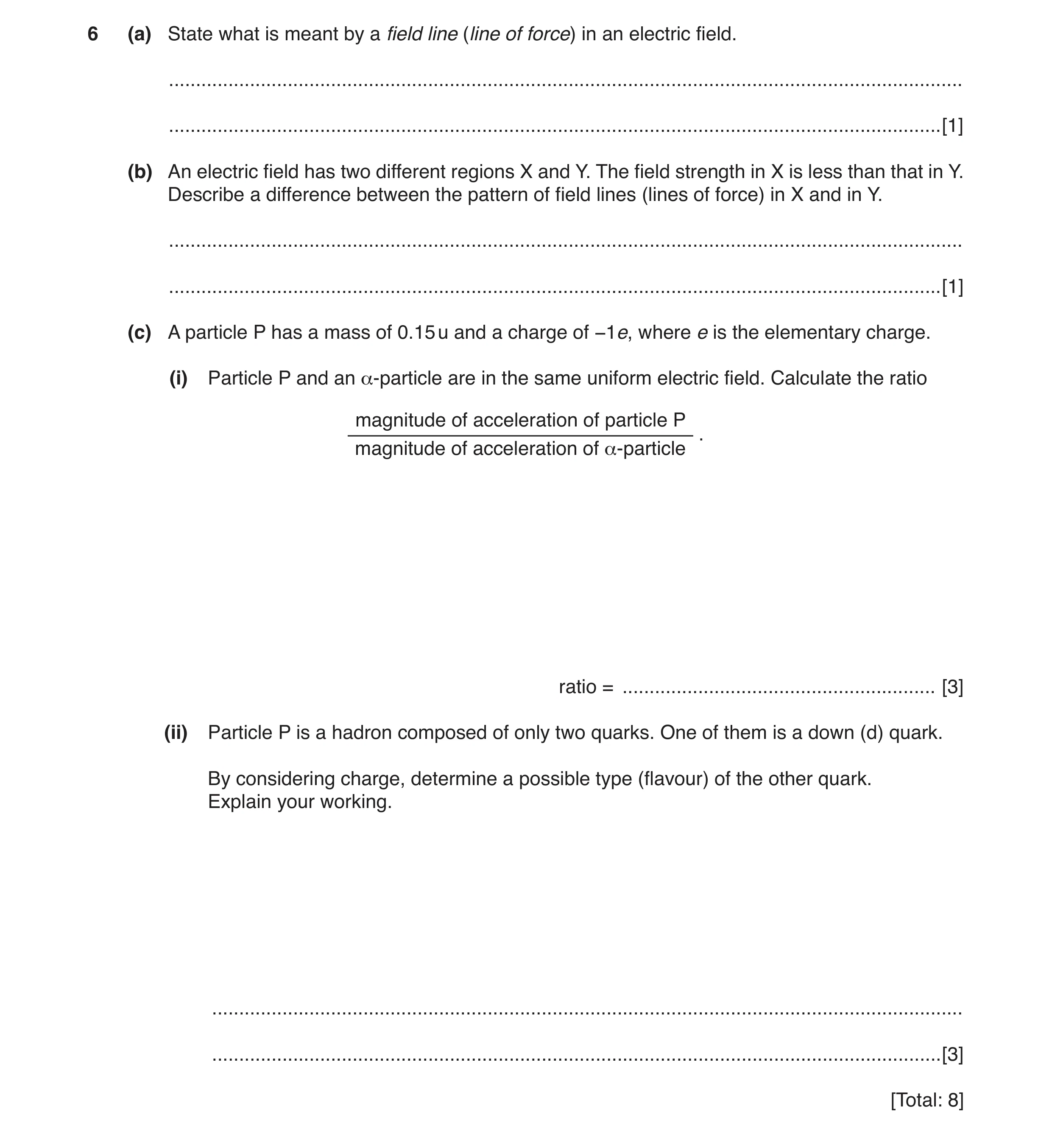
6 (a) State what is meant by a field line (line of force) in an electric field. … … [1] (b) An electric field has two different regions X and Y. The field strength in X is less than that in Y. Describe a difference between the pattern of field lines (lines of force) in X and in Y. … … [1] (c) A particle P has a mass of 0.15 u and a charge of −1e, where e is the elementary charge. (i) Particle P and an α-particle are in the same uniform electric field. Calculate the ratio magnitude of acceleration of particle P . magnitude of acceleration of α-particle ratio = … [3] (ii) Particle P is a hadron composed of only two quarks. One of them is a down (d) quark. By considering charge, determine a possible type (flavour) of the other quark. Explain your working. … … [3] [Total: 8]
8 marks
Mark scheme: 6(a) path/direction in which a (free) positive charge will move B1 6(b) (lines) closer together in Y/further apart in X B1 6(c)(i) a = Eq / m or F = Eq and F = ma C1 ratio = (1e / 0.15 u) × (4 u / 2e) or 1 / 0.15 × 4 / 2 C1 ratio = 13 A1 6(c)(ii) down quark charge is –(1 / 3)e C1 – (1 / 3)e + q = –1e so q = –(2 / 3)e A1 (–(2 / 3)e is) anti-up / u (quark) (allow charm or top antiquark) B1
This question in 9702/22 May/June 2019
Q11 · The decay of a nucleus 1835Ar by β+ emission is represented by 1835Ar X + β+ + Y 9702/21 Oct/Nov 2019
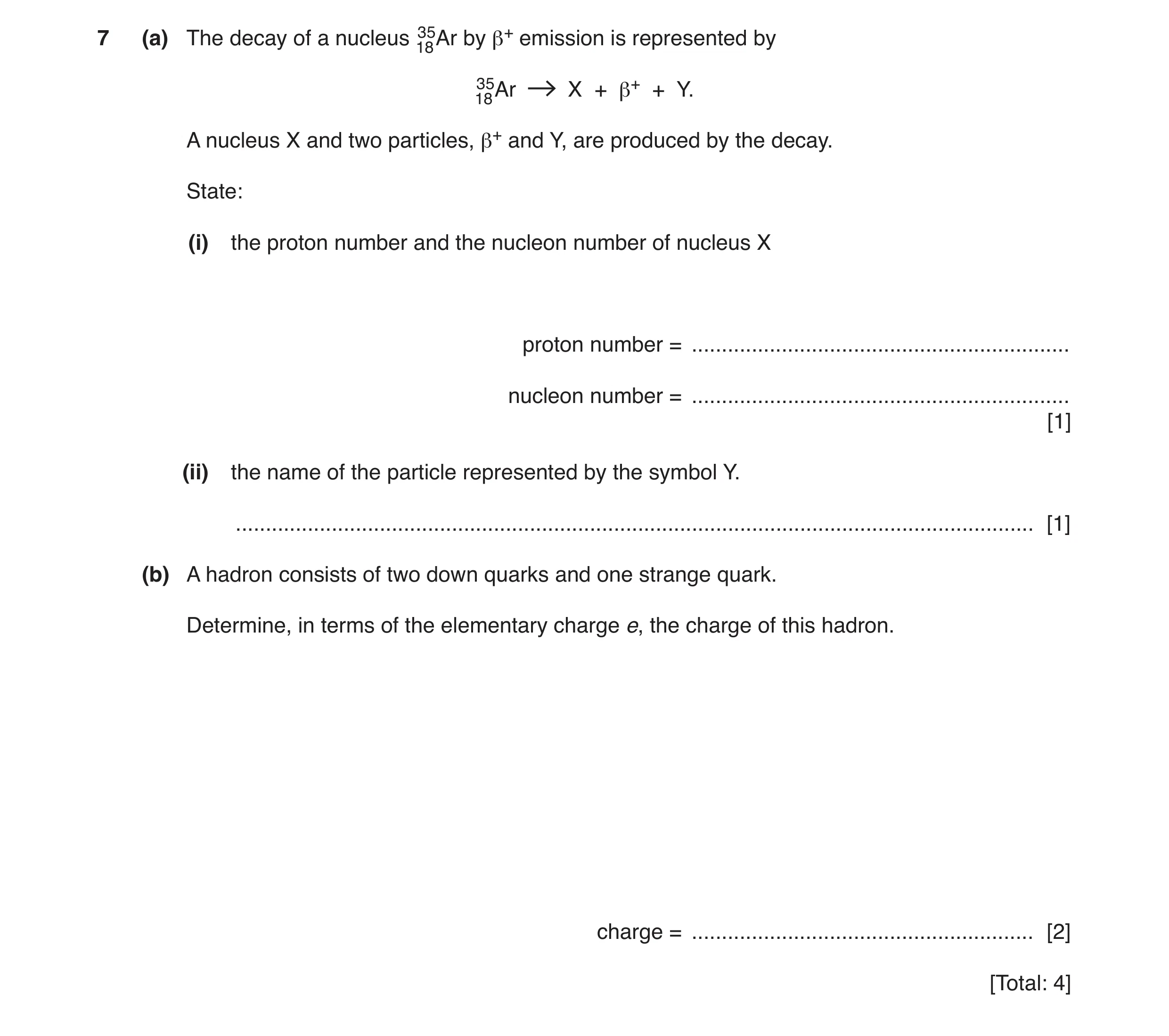
7 (a) The decay of a nucleus 1835Ar by β+ emission is represented by 1835Ar X + β+ + Y. A nucleus X and two particles, β+ and Y, are produced by the decay. State: (i) the proton number and the nucleon number of nucleus X proton number = … nucleon number = … [1] (ii) the name of the particle represented by the symbol Y. … [1] (b) A hadron consists of two down quarks and one strange quark. Determine, in terms of the elementary charge e, the charge of this hadron. charge = … [2] [Total: 4]
4 marks
Mark scheme: 7(a)(i) proton number = 17 and nucleon number = 35 A1 7(a)(ii) (electron) neutrino B1 7(b) d/down (quark charge) is –⅓(e) or two d/down (quark charges) is –⅔(e) or s/strange (quark charge) is –⅓(e) C1 charge = –⅓(e) –⅓(e) –⅓(e) = –1(e) A1
This question in 9702/21 Oct/Nov 2019
Q12 · State and explain whether a neutron is a fundamental particle 9702/22 Feb/March 2020
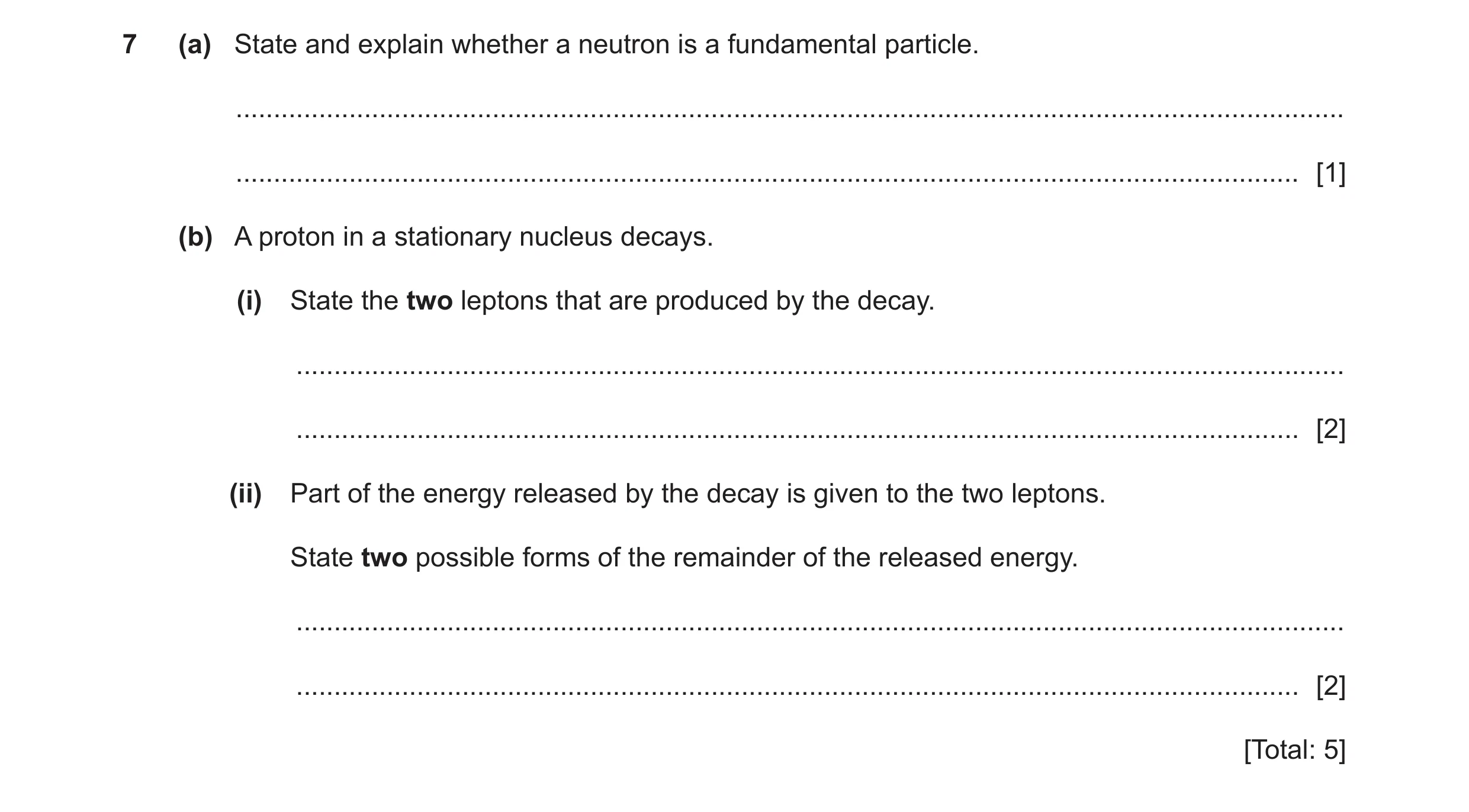
7 (a) State and explain whether a neutron is a fundamental particle. … … [1] (b) A proton in a stationary nucleus decays. (i) State the two leptons that are produced by the decay. … … [2] (ii) Part of the energy released by the decay is given to the two leptons. State two possible forms of the remainder of the released energy. … … [2] [Total: 5]
5 marks
Mark scheme: 7(a) made up of quarks (so) not a fundamental particle B1 7(b)(i) beta plus / β+ (particle) B1 (electron) neutrino / ν(e) B1 7(b)(ii) kinetic energy of nucleus B1 gamma / γ radiation B1
This question in 9702/22 Feb/March 2020
Q13 · State a similarity and a difference between a down quark and a down antiquark 9702/21 Oct/Nov 2020
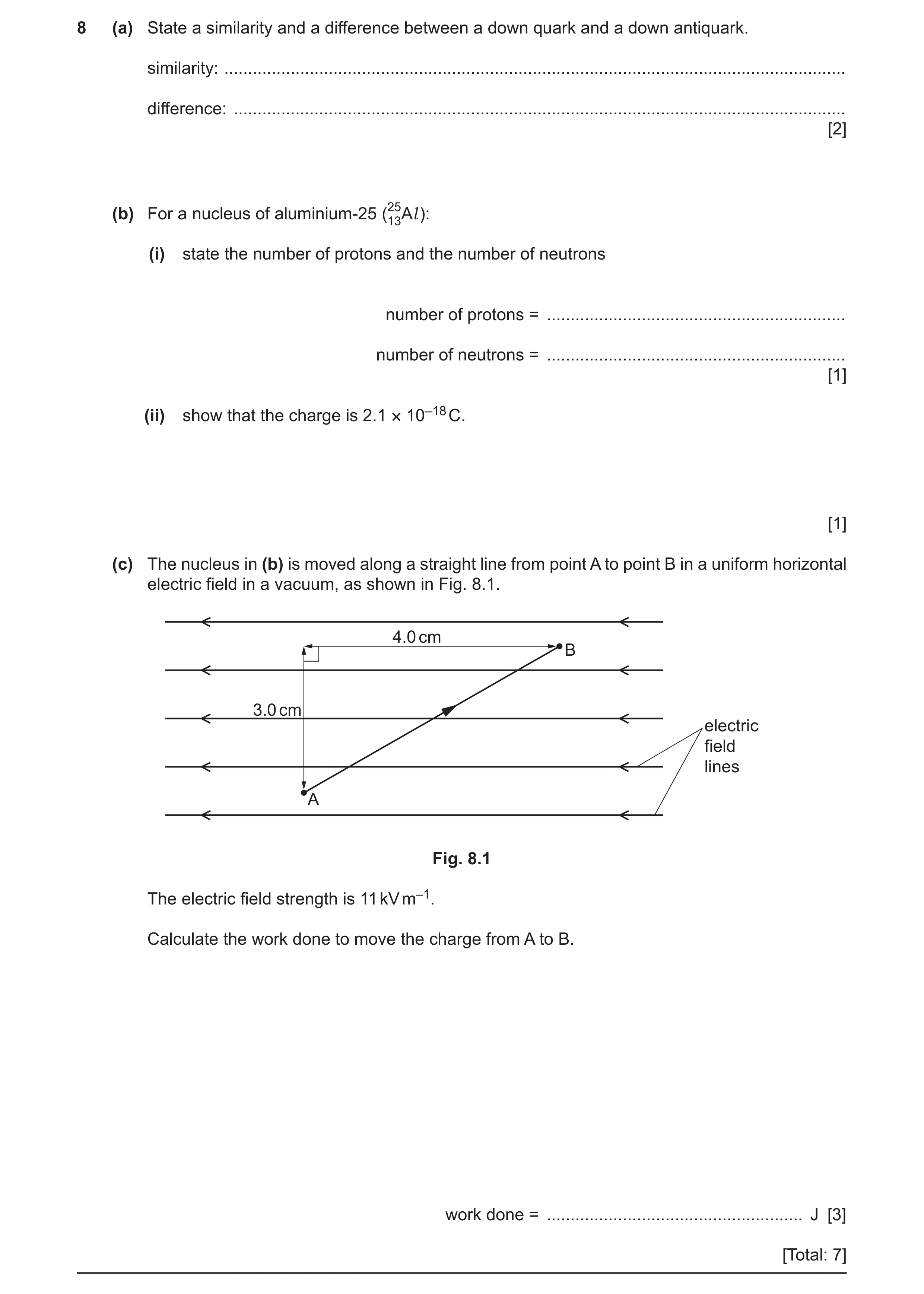
8 (a) State a similarity and a difference between a down quark and a down antiquark. similarity: … difference: … [2] (b) For a nucleus of aluminium-25 (2513Al ): (i) state the number of protons and the number of neutrons number of protons = … number of neutrons = … [1] (ii) show that the charge is 2.1 × 10⁻¹⁸ C. [1] (c) The nucleus in (b) is moved along a straight line from point A to point B in a uniform horizontal electric field in a vacuum, as shown in Fig. 8.1. 4.0 cm B 3.0 cm electric field lines A Fig. 8.1 The electric field strength is 11 kV m–1. Calculate the work done to move the charge from A to B. work done = … J [3] [Total: 7]
7 marks
Mark scheme: 8(a) similarity: same/equal mass or same/equal (magnitude of) charge or both fundamental (particles) B1 difference: opposite (sign of) charge or one is matter and the other is antimatter B1 8(b)(i) number of protons = 13 and number of neutrons = 12 A1 8(b)(ii) (charge =) 13 × 1.60 × 10–19 (C) = 2.1 × 10⁻¹⁸ (C) A1 8(c) force = 11 × 103 × 2.1 × 10–18 C1 work done = 11 × 103 × 2.1 × 10–18 × 0.04 C1 = 9.2 × 10⁻¹⁶ J A1
This question in 9702/21 Oct/Nov 2020
Q14 · The results of the α-particle scattering experiment provide evidence for the structure of… 9702/22 Feb/March 2021
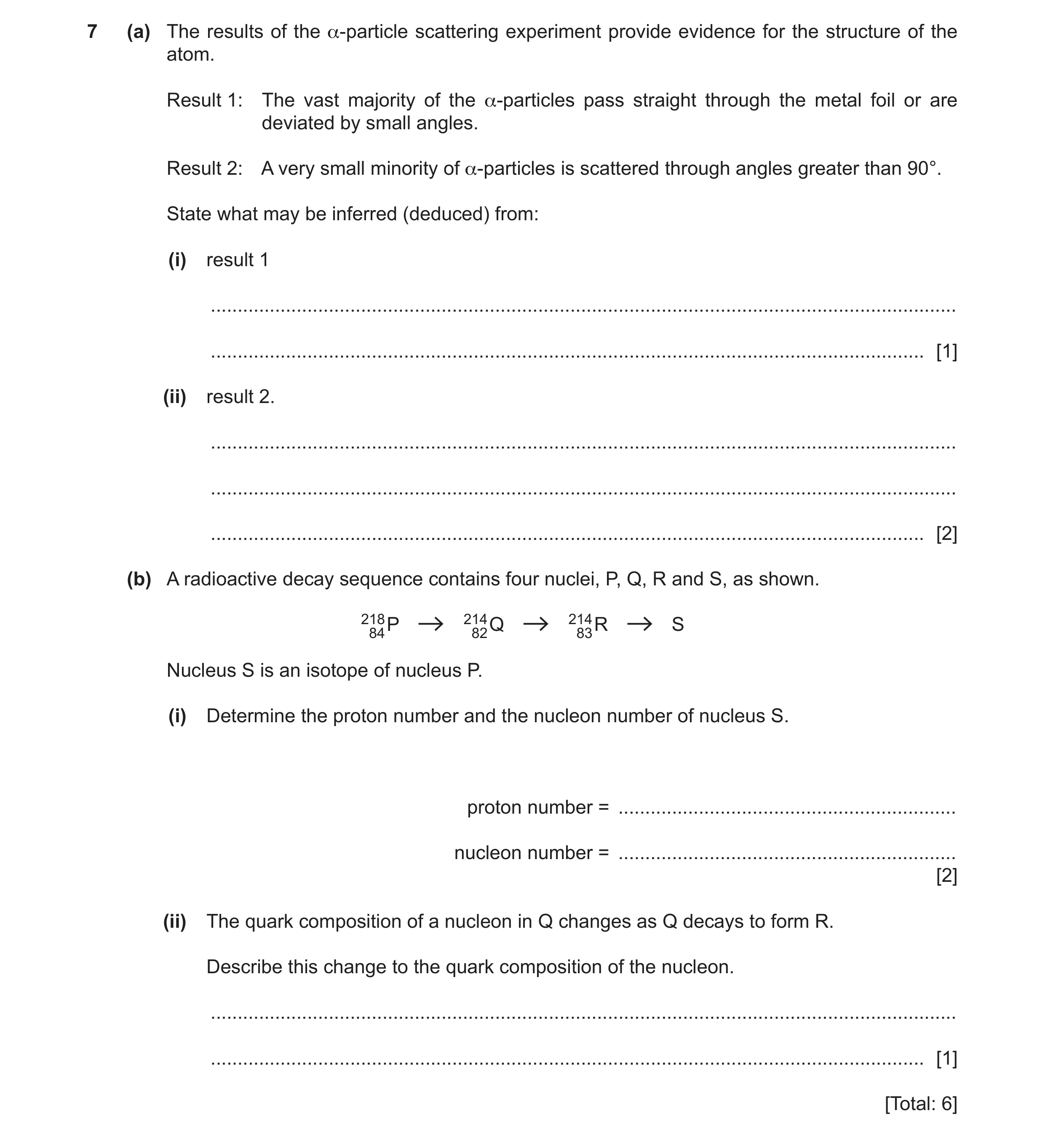
7 (a) The results of the α-particle scattering experiment provide evidence for the structure of the atom. Result 1: The vast majority of the α-particles pass straight through the metal foil or are deviated by small angles. Result 2: A very small minority of α-particles is scattered through angles greater than 90°. State what may be inferred (deduced) from: (i) result 1 … … [1] (ii) result 2. … … … [2] (b) A radioactive decay sequence contains four nuclei, P, Q, R and S, as shown. 21884 P 21482 Q 21483 R S Nucleus S is an isotope of nucleus P. (i) Determine the proton number and the nucleon number of nucleus S. proton number = … nucleon number = … [2] (ii) The quark composition of a nucleon in Q changes as Q decays to form R. Describe this change to the quark composition of the nucleon. … … [1] [Total: 6]
6 marks
Mark scheme: 7(a)(i) most of the atom is empty space or the nucleus (volume) is very small compared to the atom B1 7(a)(ii) the nucleus is charged B1 the mass is concentrated in nucleus / small region / small volume / small core or the majority of the mass is in nucleus / small region / small volume / small core B1 7(b)(i) proton number = 84 A1 nucleon number = 214 A1 7(b)(ii) up down down changes to up up down / udd → uud or down changes to up / d → u B1
This question in 9702/22 Feb/March 2021
Q15 · One of the results of the α-particle scattering experiment is that a very small minority… 9702/22 May/June 2021
6 (a) One of the results of the α-particle scattering experiment is that a very small minority of the α-particles are scattered through angles greater than 90°. State what may be inferred about the structure of the atom from this result. … … … … [2] (b) An α-particle is made up of other particles. One of these particles is a proton. State and explain whether a proton is a fundamental particle. … … [1] (c) A radioactive source produces a beam of α-particles in a vacuum. The average current produced by the beam is 6.9 × 10⁻⁹ A. Calculate the average number of α-particles passing a fixed point in the beam in a time of 1.0 minute. number = … [3] (d) The α-particles in the vacuum in (c) enter a uniform electric field. The α-particles enter the field with their velocity in the same direction as the field. State and explain whether the magnitude of the acceleration of an α-particle due to the field decreases, increases or stays constant as the α-particle moves through the field. … … … [2] (e) A nucleus X is an isotope of a nucleus Y. The mass of nucleus X is greater than that of Y. Both of the nuclei are in the same uniform electric field. State and explain whether the magnitude of the electric force acting on nucleus X is greater than, less than or the same as that acting on nucleus Y. … … … [2] [Total: 10]
10 marks
Mark scheme: 6(a) the nucleus is charged B1 the majority of the mass (of atom) is in the nucleus B1 6(b) made up of quarks (so) not a fundamental particle B1 6(c) (Q =) 6.9 × 10–9 × 60 C1 number = (6.9 × 10–9 × 60) / (2 × 1.60 × 10–19) C1 = 1.3 × 10¹² A1 6(d) (magnitude of electric) force is constant B1 (so magnitude of) acceleration is constant B1 6(e) (nuclei have) same charge/same number of protons B1 (so) same (magnitude of) force B1
This question in 9702/22 May/June 2021
Q16 · State the quark composition of: (i) a proton … [1] (ii) a neutron … [1] (iii) an… 9702/23 May/June 2021
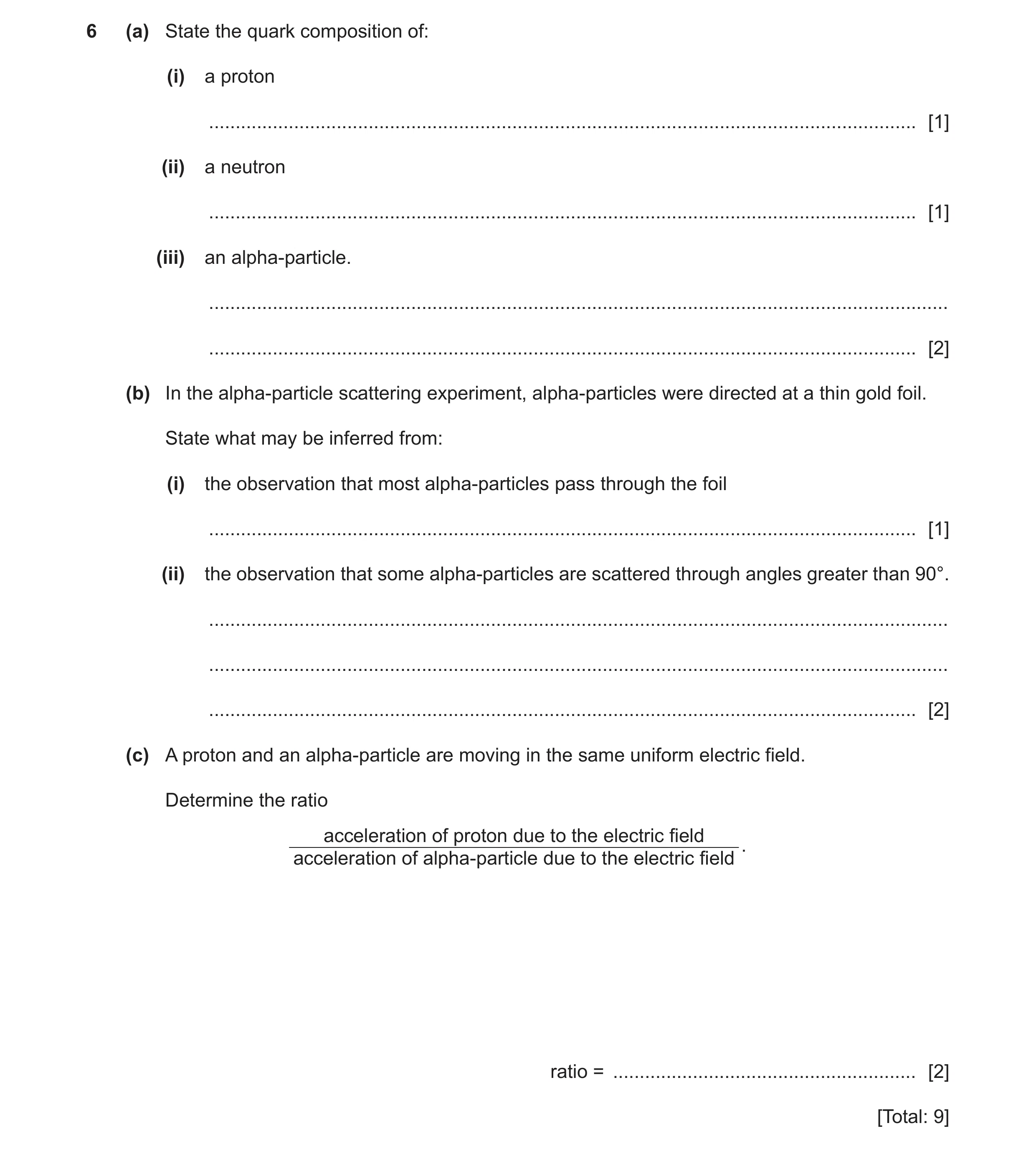
6 (a) State the quark composition of: (i) a proton … [1] (ii) a neutron … [1] (iii) an alpha-particle. … … [2] (b) In the alpha-particle scattering experiment, alpha-particles were directed at a thin gold foil. State what may be inferred from: (i) the observation that most alpha-particles pass through the foil … [1] (ii) the observation that some alpha-particles are scattered through angles greater than 90°. … … … [2] (c) A proton and an alpha-particle are moving in the same uniform electric field. Determine the ratio acceleration of proton due to the electric field . acceleration of alpha-particle due to the electric field ratio = … [2] [Total: 9]
9 marks
Mark scheme: 6(a)(i) up up down B1 6(a)(ii) up down down B1 6(a)(iii) (alpha-particle is) 2 protons and 2 neutrons C1 6 up, 6 down A1 6(b)(i) most of an atom is empty space or the nucleus (volume) is (very) small compared with the atom B1 6(b)(ii) the nucleus is charged B1 the majority of the mass of atom is in the nucleus B1 6(c) F = Eq and a = F / m C1 a = Eq / m ratio = (e / m) / (2e / 4m) = 2 A1
This question in 9702/23 May/June 2021
Q17 · A lepton is an example of a fundamental particle 9702/21 Oct/Nov 2022
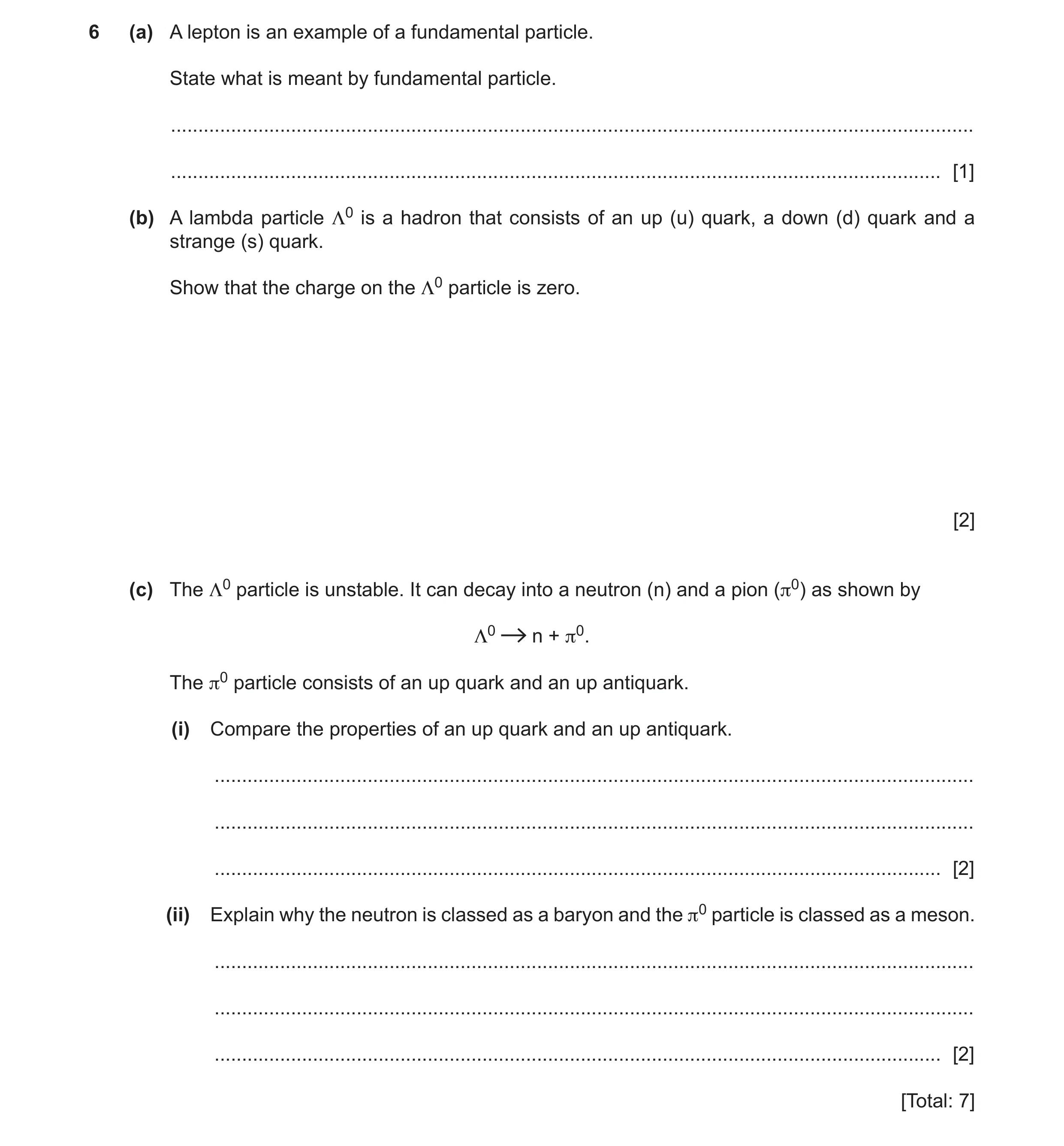
6 (a) A lepton is an example of a fundamental particle. State what is meant by fundamental particle. … … [1] (b) A lambda particle Λ0 is a hadron that consists of an up (u) quark, a down (d) quark and a strange (s) quark. Show that the charge on the Λ0 particle is zero. [2] (c) The Λ0 particle is unstable. It can decay into a neutron (n) and a pion (π0) as shown by Λ0 n + π0. The π0 particle consists of an up quark and an up antiquark. (i) Compare the properties of an up quark and an up antiquark. … … … [2] (ii) Explain why the neutron is classed as a baryon and the π0 particle is classed as a meson. … … … [2] [Total: 7]
7 marks
Mark scheme: 6(a) particle with no internal structure / particle which cannot be broken down into anything smaller A1 6(b) 2 1 1 C1 charges: u = ( + ) ( e ) or d = − ( e ) or s = − ( e ) 3 3 3 2 1 1 A1 ( + ) ( e ) − ( e ) − ( e ) = 0 ( e ) 3 3 3 6(c)(i) • same/equal mass B2 • same/equal (magnitude of) charge • both fundamental (particles) • opposite (sign of) charge • one is matter and the other is antimatter Any two points, 1 mark each. 6(c)(ii) neutron/baryon consists of three quarks B1 pion/meson consists of one quark and one antiquark B1
This question in 9702/21 Oct/Nov 2022
Q18 · The nuclide 146C (carbon-14) is unstable and undergoes β– decay, emitting a high-energy… 9702/23 Oct/Nov 2022
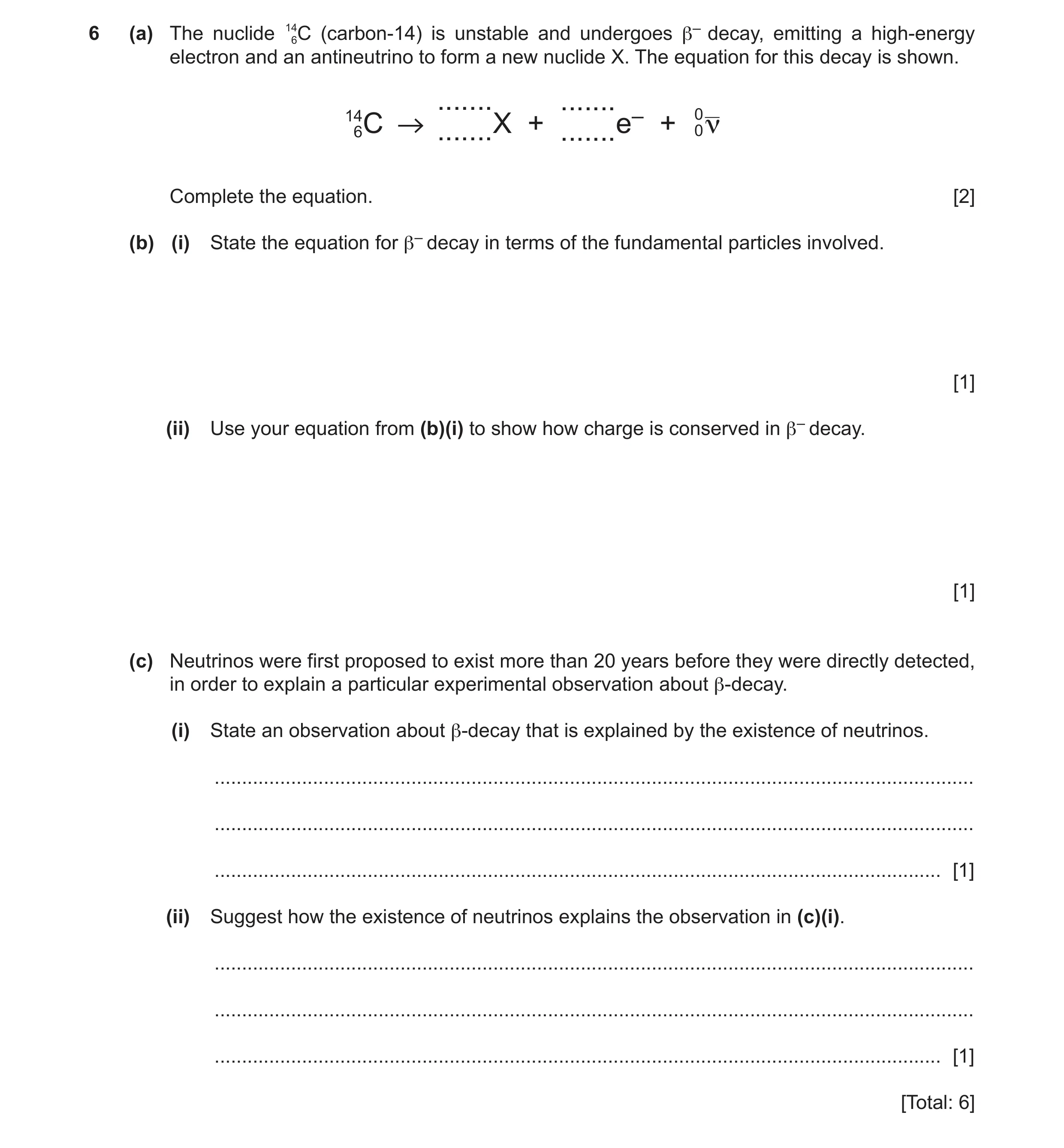
6 (a) The nuclide 146C (carbon-14) is unstable and undergoes β– decay, emitting a high-energy electron and an antineutrino to form a new nuclide X. The equation for this decay is shown. … … 0 14 0ν 6C … X + … e– + Complete the equation. [2] (b) (i) State the equation for β– decay in terms of the fundamental particles involved. [1] (ii) Use your equation from (b)(i) to show how charge is conserved in β– decay. [1] (c) Neutrinos were first proposed to exist more than 20 years before they were directly detected, in order to explain a particular experimental observation about β-decay. (i) State an observation about β-decay that is explained by the existence of neutrinos. … … … [1] (ii) Suggest how the existence of neutrinos explains the observation in (c)(i). … … … [1] [Total: 6]
6 marks
Mark scheme: 6(a) 14 7 X B1 -1e0 – B1 6(b)(i) d → u + e– + ν or udd → uud + e– + ν B1 6(b)(ii) –1 / 3 (e) = + 2 / 3 (e) – 1(e) (+ 0) B1 or 2 / 3 (e) – 1 / 3 (e) – 1 / 3 (e) = 2 / 3 (e) + 2 / 3 (e) – 1 / 3 (e) – 1 (e) (+ 0) 6(c)(i) electrons / -particles (emitted from the nucleus) have a (continuous) range of / different (kinetic) energies B1 6(c)(ii) the (emitted) neutrinos take varying amounts of the (same total) energy (released in the decay) B1
This question in 9702/23 Oct/Nov 2022
Q19 · Nuclei X and Y are different isotopes of the same element 9702/22 Feb/March 2023
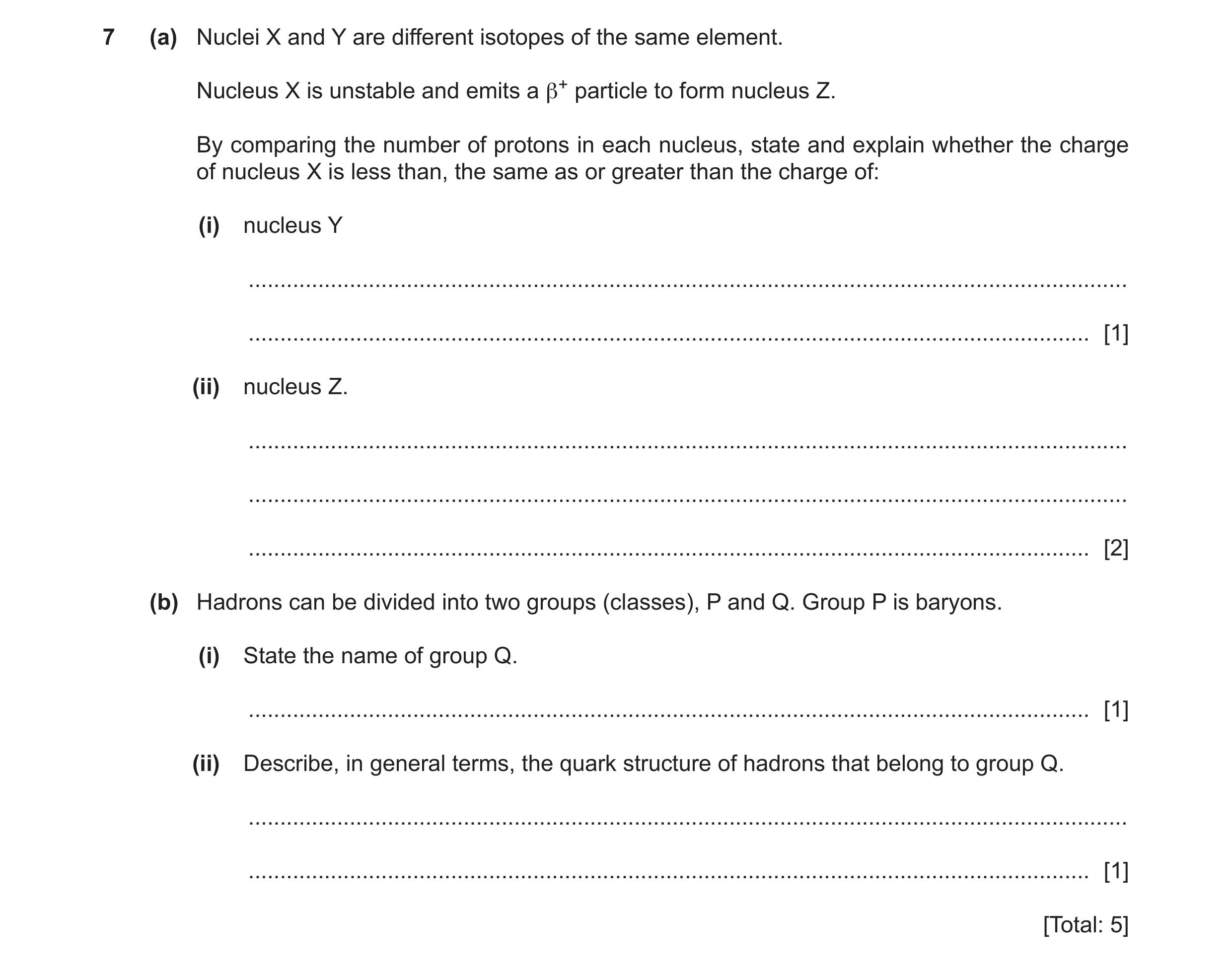
7 (a) Nuclei X and Y are different isotopes of the same element. Nucleus X is unstable and emits a β+ particle to form nucleus Z. By comparing the number of protons in each nucleus, state and explain whether the charge of nucleus X is less than, the same as or greater than the charge of: (i) nucleus Y … … [1] (ii) nucleus Z. … … … [2] (b) Hadrons can be divided into two groups (classes), P and Q. Group P is baryons. (i) State the name of group Q. … [1] (ii) Describe, in general terms, the quark structure of hadrons that belong to group Q. … … [1] [Total: 5]
5 marks
Mark scheme: 7(a)(i) X has same number of protons as Y (and so) charge of X is the same as the charge of Y B1 7(a)(ii) X has (one) more proton (than Z) M1 (so) X has greater charge (than Z) A1 7(b)(i) meson(s) B1 7(b)(ii) one quark and one antiquark B1
This question in 9702/22 Feb/March 2023
Q20 · Nucleus P and nucleus Q are isotopes of the same element 9702/22 May/June 2023
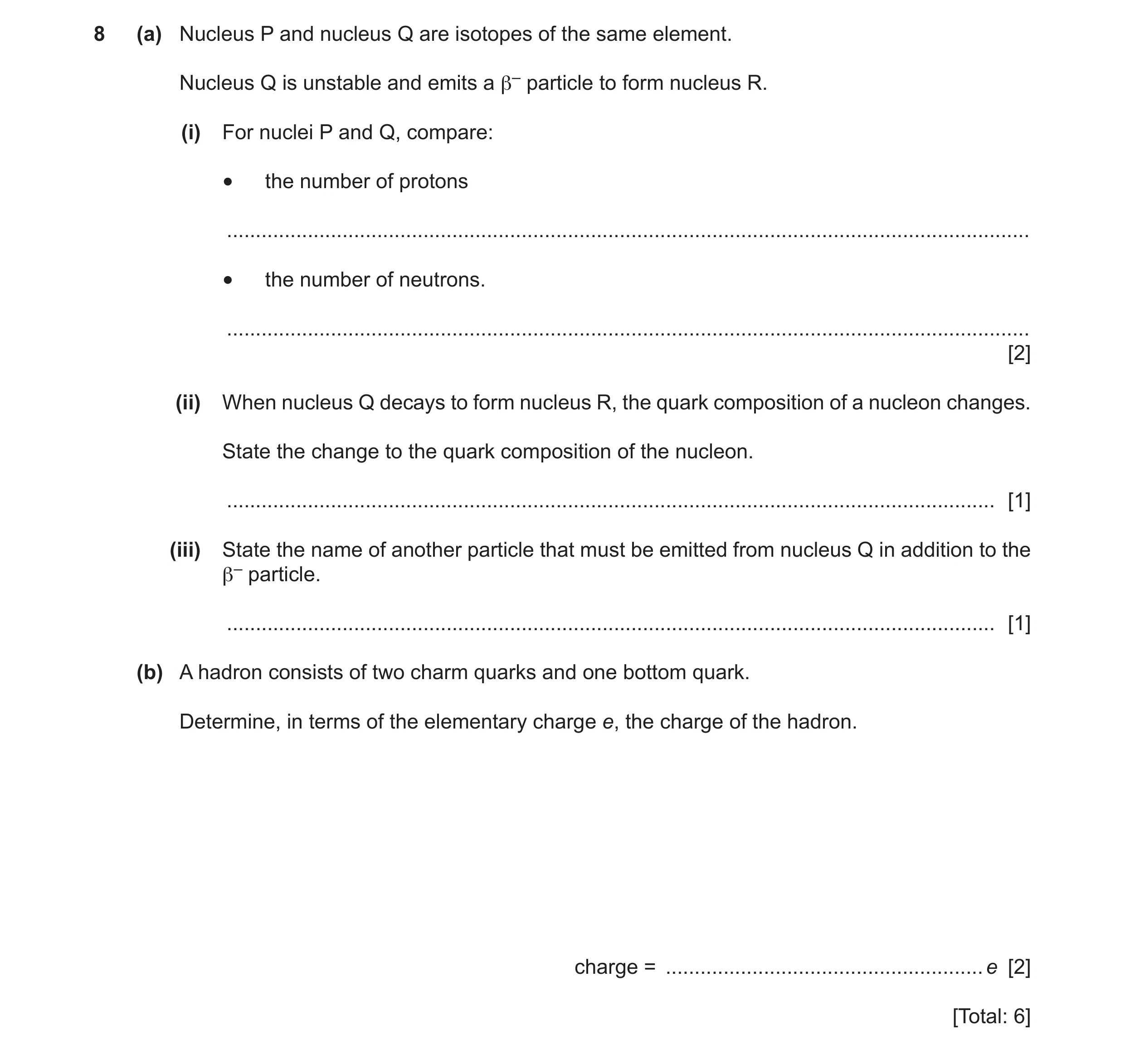
8 (a) Nucleus P and nucleus Q are isotopes of the same element. Nucleus Q is unstable and emits a β– particle to form nucleus R. (i) For nuclei P and Q, compare: the number of protons • … the number of neutrons. • … [2] (ii) When nucleus Q decays to form nucleus R, the quark composition of a nucleon changes. State the change to the quark composition of the nucleon. … [1] (iii) State the name of another particle that must be emitted from nucleus Q in addition to the β– particle. … [1] (b) A hadron consists of two charm quarks and one bottom quark. Determine, in terms of the elementary charge e, the charge of the hadron. charge = … e [2] [Total: 6]
6 marks
Mark scheme: 8(a)(i) number of protons: equal/same B1 number of neutrons: unequal/different B1 8(a)(ii) down (quark) changes to up (quark) or up down down (quarks) change to up up down (quarks) B1 8(a)(iii) (electron) antineutrino B1 8(b) charm (quark charge) is ()2/3(e) or 2 charm (quark charges) is ()4/3(e) or bottom (quark charge) is –1/3(e) C1 charge = 2/3(e) 2/3(e) –1/3(e) = (+)1(e) A1
This question in 9702/22 May/June 2023
Q21 · Incomplete data for three flavours (types) of quark 9702/23 May/June 2023
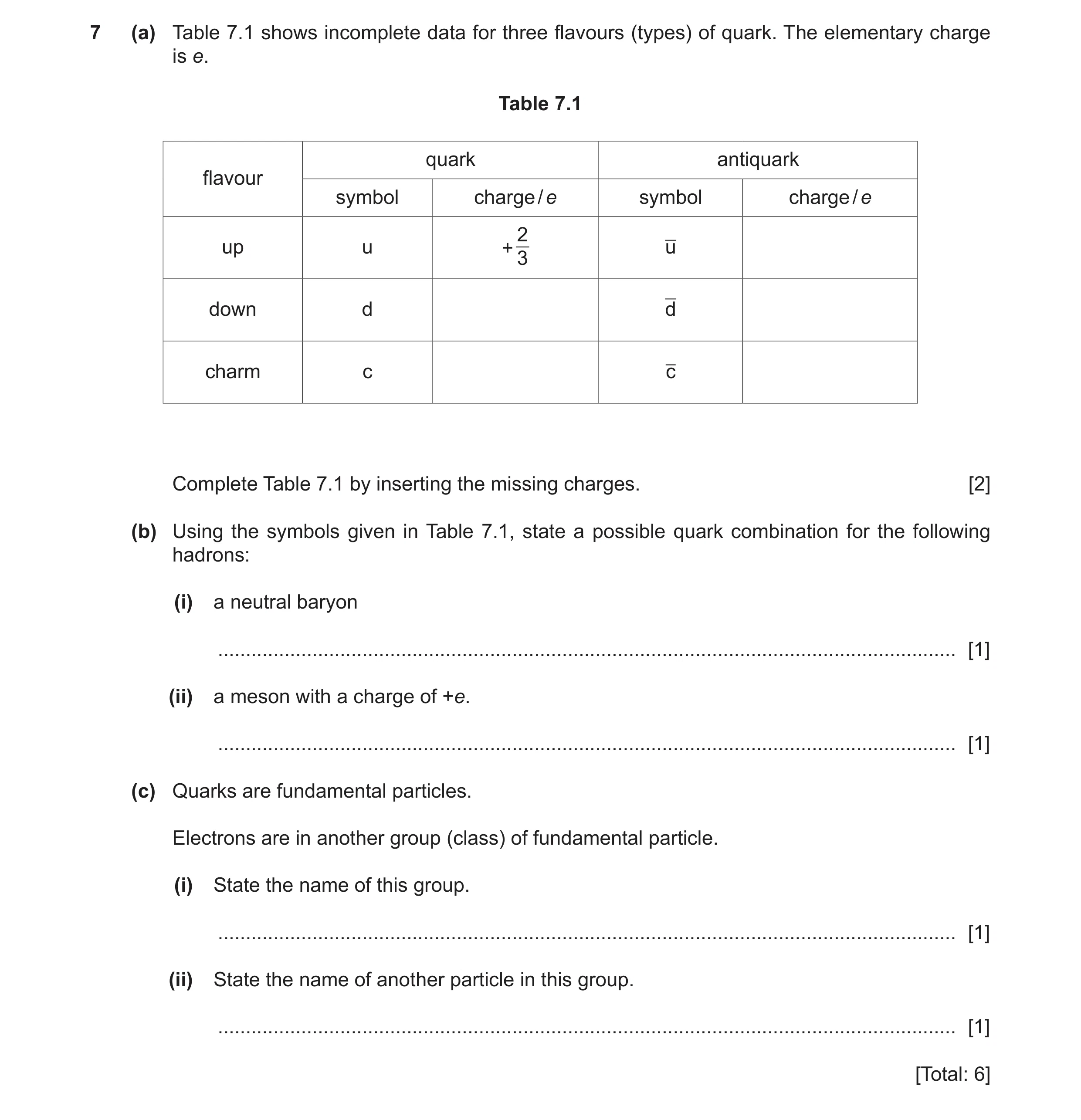
7 (a) Table 7.1 shows incomplete data for three flavours (types) of quark. The elementary charge is e. Table 7.1 quark antiquark flavour symbol charge / e symbol charge / e 2 up u + u 3 down d d charm c c Complete Table 7.1 by inserting the missing charges. [2] (b) Using the symbols given in Table 7.1, state a possible quark combination for the following hadrons: (i) a neutral baryon … [1] (ii) a meson with a charge of +e. … [1] (c) Quarks are fundamental particles. Electrons are in another group (class) of fundamental particle. (i) State the name of this group. … [1] (ii) State the name of another particle in this group. … [1] [Total: 6]
6 marks
Mark scheme: 7(a) down charge = –1/3(e) and charm charge = (+)2/3(e) B1 all antiquarks have opposite sign and same (non-zero) magnitude of charge as the corresponding quarks B1 7(b)(i) udd or cdd B1 7(b)(ii) ud or cd B1 7(c)(i) lepton(s) B1 7(c)(ii) positron / neutrino / antineutrino B1
This question in 9702/23 May/June 2023
Q22 · The results of the α-particle scattering experiment led to the development of the nuclear… 9702/21 Oct/Nov 2023
7 (a) The results of the α-particle scattering experiment led to the development of the nuclear model for the atom. State the results that suggested that most of the mass of the atom is concentrated in a very small region and most of the atom is empty space. … … … … [2] (b) State the composition of γ-radiation. … [1] (c) Table 7.1 lists the names of three particles and possible classifications for them. Table 7.1 classification particle name baryon hadron lepton neutrino neutron positron Complete Table 7.1 by placing ticks (3) in the boxes to indicate the classifications that apply to each particle. [2] (d) The discovery of a particle with an unusual charge was an important step in the development of the theory of quarks. The particle is a hadron with a mass of 2.19 × 10⁻²⁷ kg and a charge of +2e, where e is the elementary charge. (i) Calculate the mass, in u, of the particle. Give your answer to three significant figures. mass = … u [1] (ii) Determine a possible quark composition of a hadron with a charge of +2e. Explain your reasoning. [2] [Total: 8]
8 marks
Mark scheme: 7(a) a (very) small proportion of (alpha) particles are deflected (back) through large angles / angles greater than 90° B1 a large proportion of (alpha) particles pass straight through / deflected by small angles B1 7(b) electromagnetic wave / electromagnetic radiation A1 7(c) neutrino classified as a lepton only and positron classified as a lepton only B1 neutron classified as a baryon and a hadron and not as a lepton B1 7(d)(i) 1.32 u A1 7(d)(ii) working states or implies 3 quarks and each quark has a charge of (+) ⅔(e) B1 any combination of 3 quarks comprised of one or more of up / charm / top B1
This question in 9702/21 Oct/Nov 2023
Q23 · State the name of the class (group) of fundamental particles that contains a neutrino 9702/22 Feb/March 2024
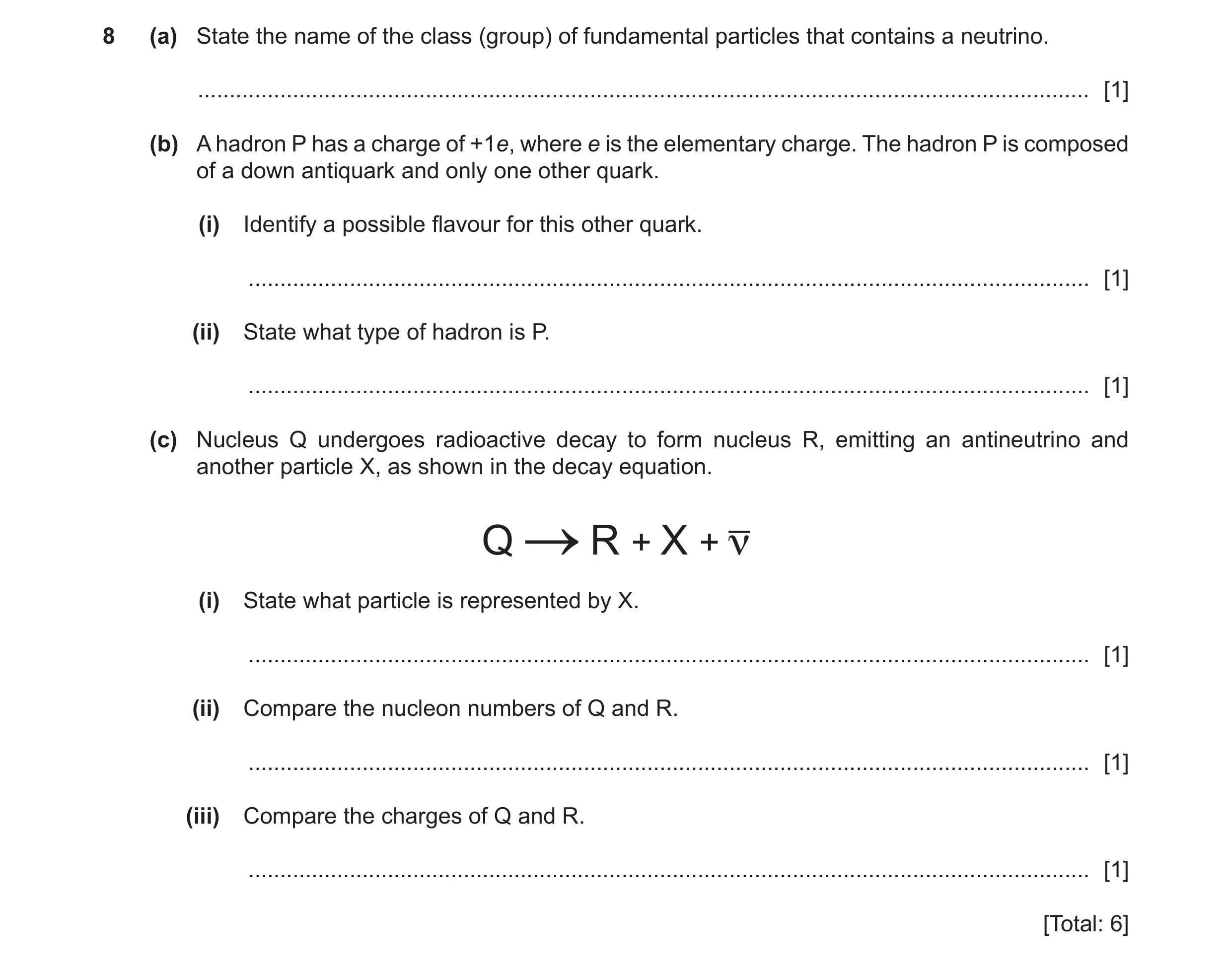
8 (a) State the name of the class (group) of fundamental particles that contains a neutrino. … [1] (b) A hadron P has a charge of +1e, where e is the elementary charge. The hadron P is composed of a down antiquark and only one other quark. (i) Identify a possible flavour for this other quark. … [1] (ii) State what type of hadron is P. … [1] (c) Nucleus Q undergoes radioactive decay to form nucleus R, emitting an antineutrino and another particle X, as shown in the decay equation. Q R + X + ν (i) State what particle is represented by X. … [1] (ii) Compare the nucleon numbers of Q and R. … [1] (iii) Compare the charges of Q and R. … [1] [Total: 6]
6 marks
Mark scheme: 8(a) lepton(s) B1 8(b)(i) up or top or charm B1 8(b)(ii) meson(s) B1 8(c)(i) – (particle) or electron B1 8(c)(ii) equal B1 8(c)(iii) (the charge of) R is greater (than Q) B1
This question in 9702/22 Feb/March 2024
Q24 · A particle Q and a particle R are each composed of one quark and one antiquark 9702/22 May/June 2024
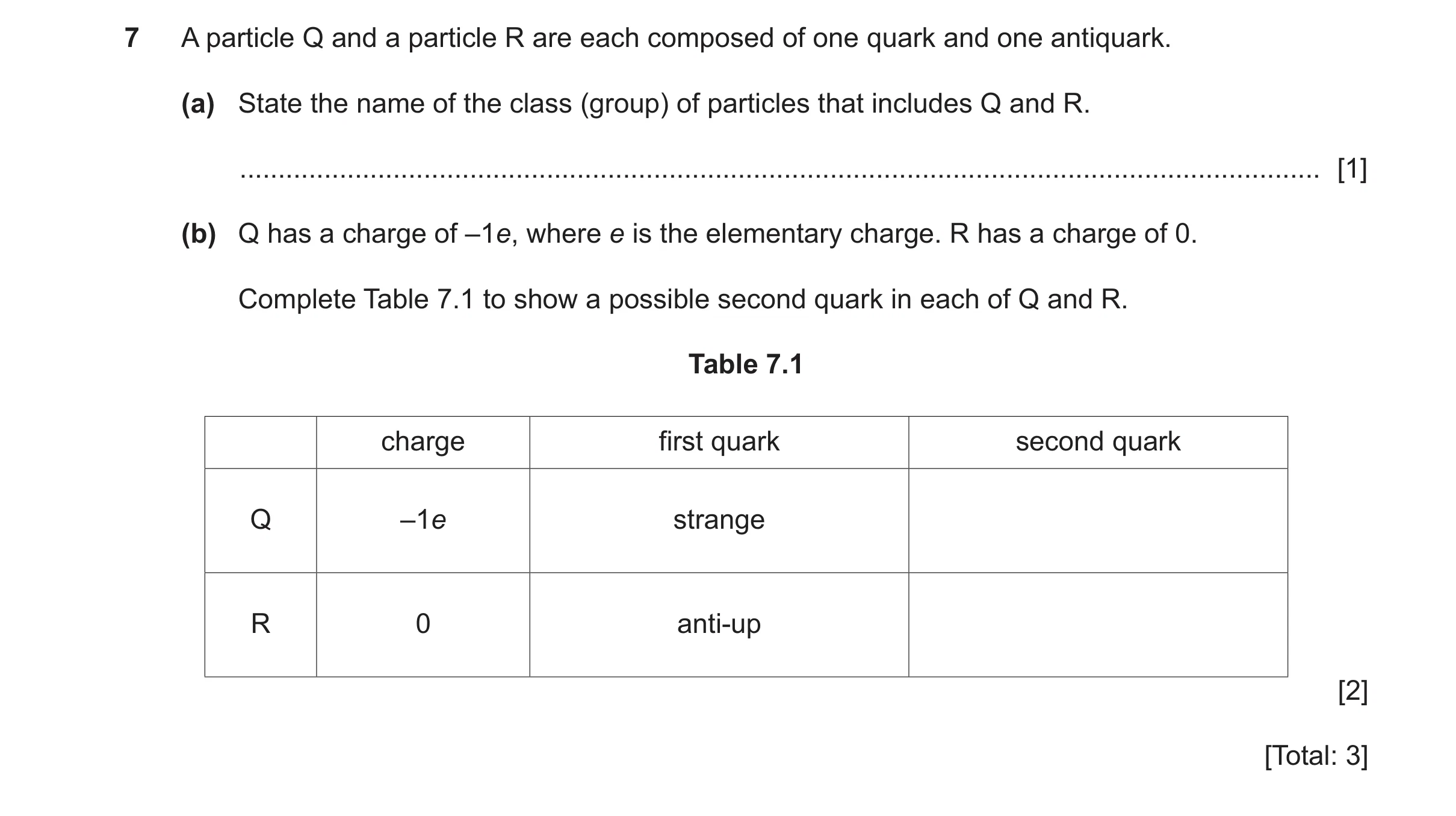
7 A particle Q and a particle R are each composed of one quark and one antiquark. (a) State the name of the class (group) of particles that includes Q and R. … [1] (b) Q has a charge of –1e, where e is the elementary charge. R has a charge of 0. Complete Table 7.1 to show a possible second quark in each of Q and R. Table 7.1 charge first quark second quark Q –1e strange R 0 anti-up [2] [Total: 3]
3 marks
Mark scheme: 7(a) meson(s) or hadron(s) B1 7(b) Q: anti-up or anti-charm or anti-top B1 R: up or charm or top B1
This question in 9702/22 May/June 2024
Q25 · Nuclei of an isotope of samarium (Sm) each contain 62 protons and 85 neutrons 9702/23 May/June 2024
6 Nuclei of an isotope of samarium (Sm) each contain 62 protons and 85 neutrons. (a) State the nuclide notation in the form AZX for this isotope of samarium. [1] (b) This isotope of samarium is radioactive and decays by emitting particles. Gamma-radiation is not emitted. The energy spectrum of the emitted particles is shown in Fig. 6.1. number of particles 0 0 kinetic energy of particle Fig. 6.1 (i) Explain how Fig. 6.1 shows that this isotope of samarium emits α-particles and does not emit β-particles. … … … … [2] (ii) This isotope of samarium decays to an isotope of neodymium (Nd). Give the radioactive decay equation for this decay. Include the nucleon and proton numbers of all the particles involved. [2] (c) A baryon is composed of three quarks which all have different flavours. The baryon has a charge of 0. Two of the quarks in the baryon are an up quark and a bottom quark. (i) Determine, in terms of the elementary charge e, the charge on the third quark in the baryon. charge = … e [2] (ii) State a possible flavour for the third quark in the baryon. … [1] [Total: 8]
8 marks
Mark scheme: 6(a) 147 62Sm 6(b)(i) the (kinetic) energy of the particles is discrete / has only one value (so must be alpha) B1 and beta particles have a (continuous) range of (kinetic) energies (so can’t be beta) B1 6(b)(ii) 147 143 4 62 60 2 Sm Nd values for Sm and Nd correct with no other extra particles on either side of the equation A1 4 2 correct A1 6(c)(i) up quark charge is +(2 / 3) (e) or bottom quark charge is –(1 / 3) (e) C1 0 = +(2 / 3) (e) – (1 / 3) (e) + q (so) charge (on third quark must be) –(1 / 3) (e) A1 6(c)(ii) down or strange A1
This question in 9702/23 May/June 2024
Q26 · Complete Table 7.1 to show the charges, in terms of the elementary charge e, on each of… 9702/23 Oct/Nov 2024
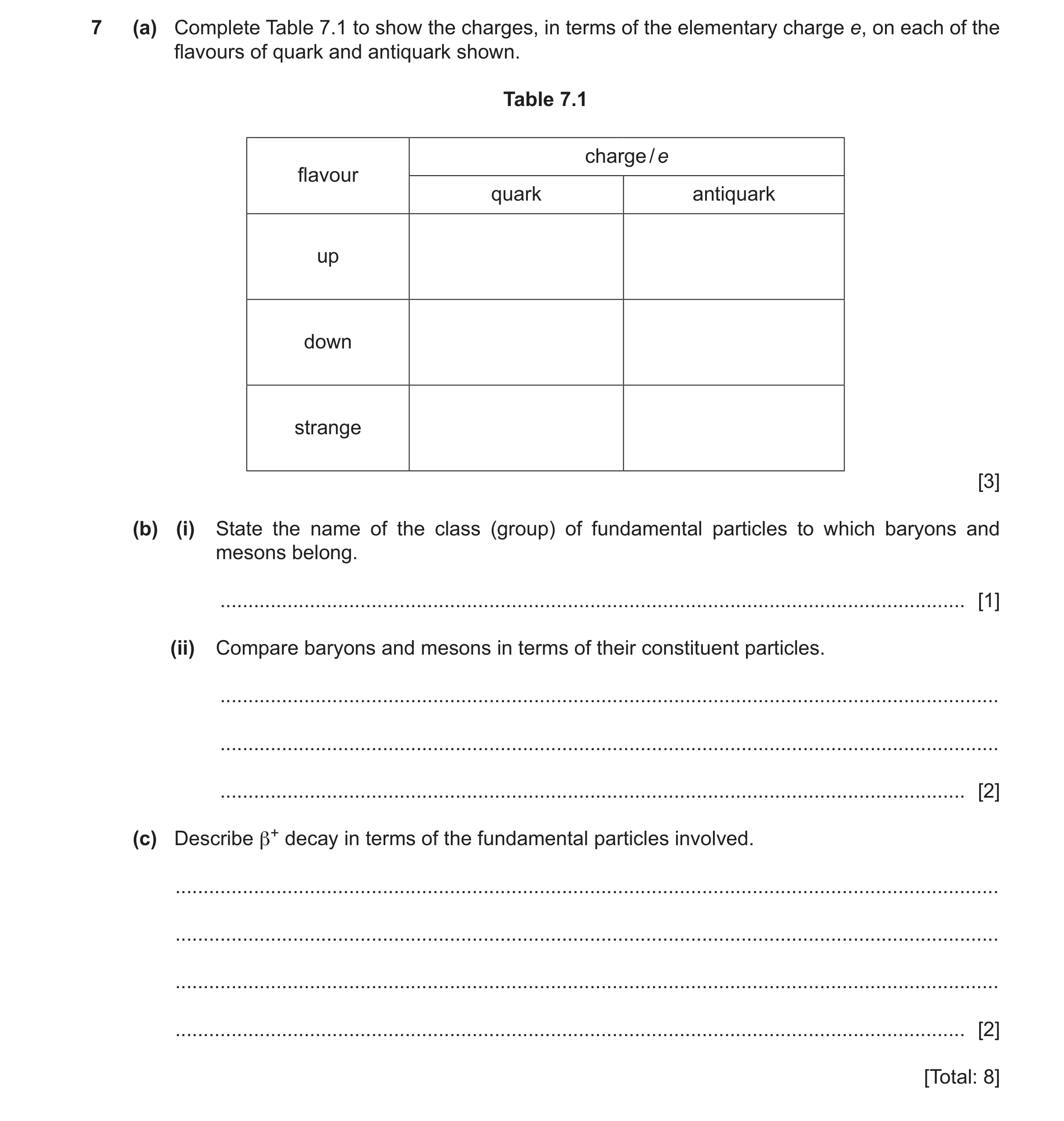
7 (a) Complete Table 7.1 to show the charges, in terms of the elementary charge e, on each of the flavours of quark and antiquark shown. Table 7.1 charge / e flavour quark antiquark up down strange [3] (b) (i) State the name of the class (group) of fundamental particles to which baryons and mesons belong. … [1] (ii) Compare baryons and mesons in terms of their constituent particles. … … … [2] (c) Describe β+ decay in terms of the fundamental particles involved. … … … … [2] [Total: 8]
8 marks
Mark scheme: 7(a) up quark charge = (+) 2 / 3 and down quark charge = −1 / 3 B1 strange quark charge = −1 / 3 B1 up antiquark charge = –2 / 3 B1 and down antiquark charge = (+) 1 / 3 and strange antiquark charge = (+) 1 / 3 7(b)(i) hadron(s) B1 7(b)(ii) baryons composed of three quarks B1 or baryons composed of three antiquarks mesons composed of one quark and one antiquark B1 7(c) up quark changes to a down quark B1 positron and (electron) neutrino (emitted) B1
This question in 9702/23 Oct/Nov 2024
Q27 · State what is meant by a fundamental particle 9702/22 May/June 2025
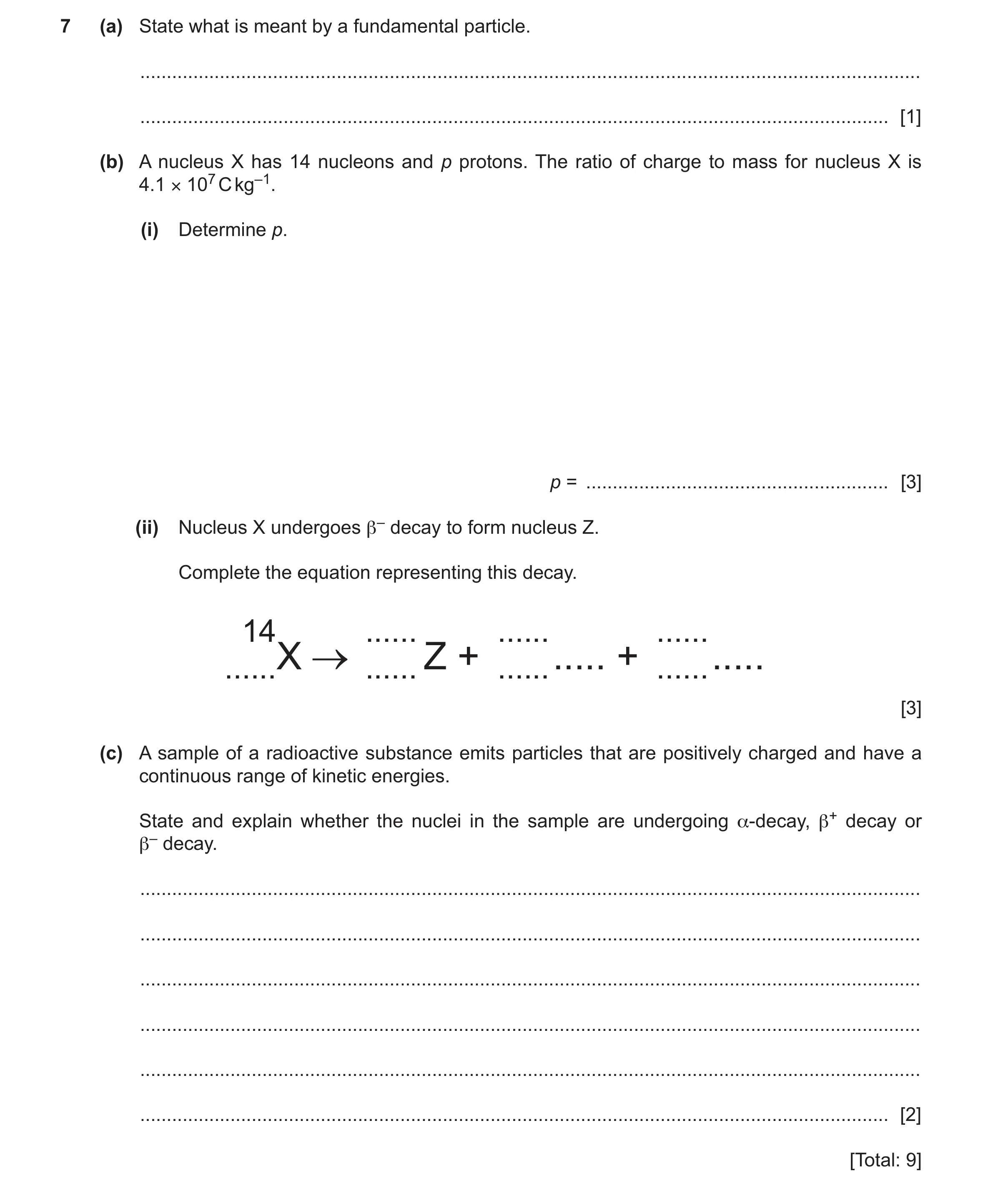
7 (a) State what is meant by a fundamental particle. … … [1] (b) A nucleus X has 14 nucleons and p protons. The ratio of charge to mass for nucleus X is 4.1 × 10⁷ C kg–1. (i) Determine p. p = … [3] (ii) Nucleus X undergoes β– decay to form nucleus Z. Complete the equation representing this decay. 14 … … … … X … Z + … … + … … [3] (c) A sample of a radioactive substance emits particles that are positively charged and have a continuous range of kinetic energies. State and explain whether the nuclei in the sample are undergoing α-decay, β+ decay or β– decay. … … … … … … [2] [Total: 9]
9 marks
Mark scheme: 7(a) (a particle that) cannot be divided/subdivided (into smaller particles) B1 7(b)(i) (p e) / (14u) = 4.1 107 C1 p = (4.1 107 14 1.66 10–27) / (1.60 10–19) C1 p = 6 (answer should be an integer) A1 7(b)(ii) 14 6 X → 147 Z B1 0 ( − ) 0 ( − ) B1 − 1e or −1 00v ( e ) B1 7(c) (the nuclei are undergoing) + decay B1 A correct explanation in terms of charge and a correct explanation in terms of energy B1 Explanations in terms of charge: • (particles / decay) positively charged so cannot be – • (particles / decay) positively charged so could be / is + • – (particles / decay) are negatively charged • + (particles / decay) are positively charged Explanations in terms of energy: • range of energies so not (particles / decay) • range of energies so is (particles / decay) • (particles / decay) have a range of energies • (particles / decay) have discrete energies / not range of energies
This question in 9702/22 May/June 2025
Q28 · An antiparticle equivalent of the neutron is called the antineutron 9702/23 May/June 2025
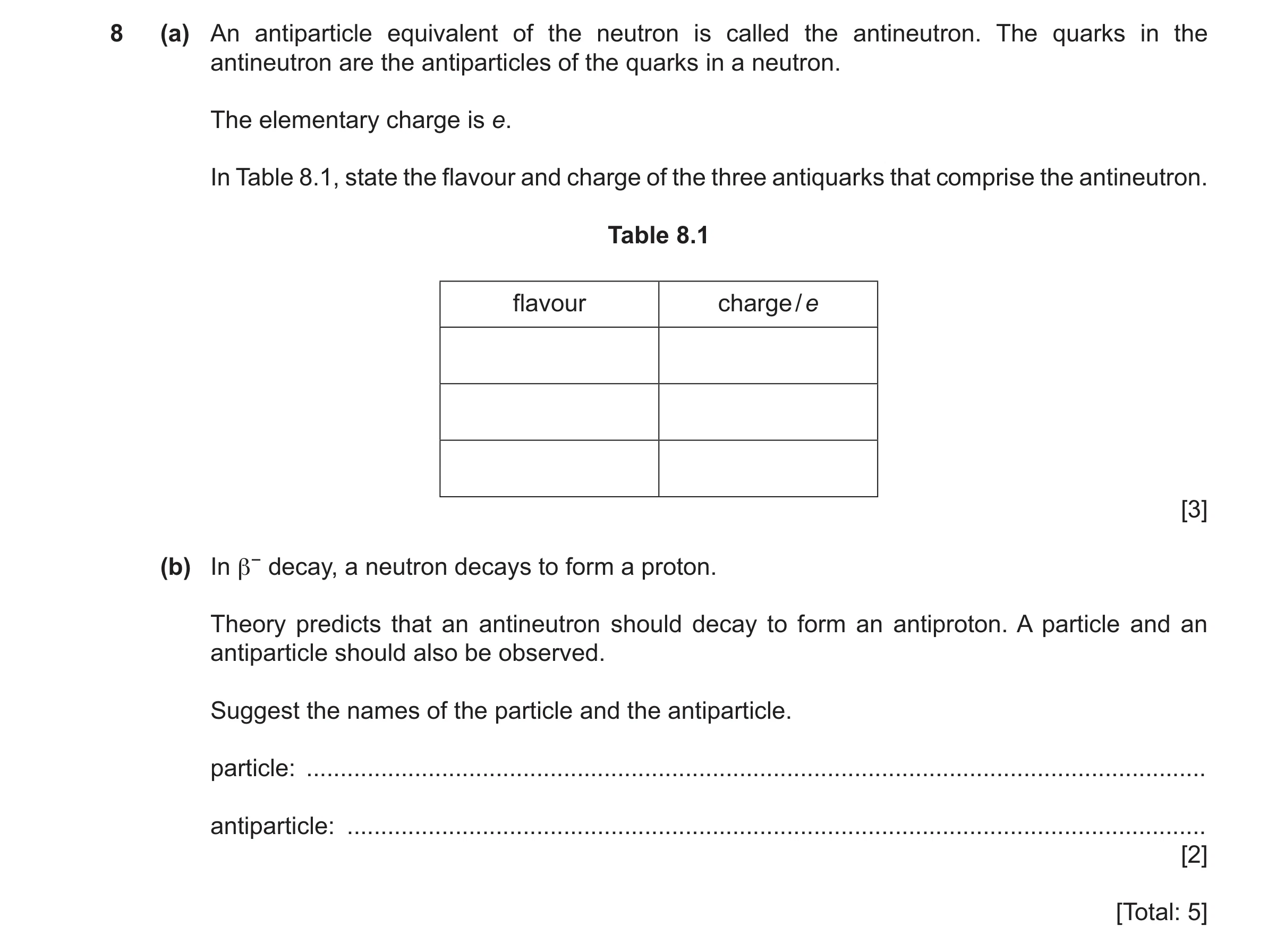
8 (a) An antiparticle equivalent of the neutron is called the antineutron. The quarks in the antineutron are the antiparticles of the quarks in a neutron. The elementary charge is e. In Table 8.1, state the flavour and charge of the three antiquarks that comprise the antineutron. Table 8.1 flavour charge / e [3] (b) In β− decay, a neutron decays to form a proton. Theory predicts that an antineutron should decay to form an antiproton. A particle and an antiparticle should also be observed. Suggest the names of the particle and the antiparticle. particle: … antiparticle: … [2] [Total: 5]
5 marks
Mark scheme: 8(a) flavour charge / e up / u 2 − 3 down / d 1 ( + ) 3 down / d 1 ( + ) 3 3 correct quark flavours B1 Charge on anti-up quark –⅔(e) B1 Charge on anti-down quark (+)⅓(e) B1 8(b) particle: (electron) neutrino B1 antiparticle: positron B1
This question in 9702/23 May/June 2025
Q29 · State what is meant by a fundamental particle 9702/22 Oct/Nov 2025
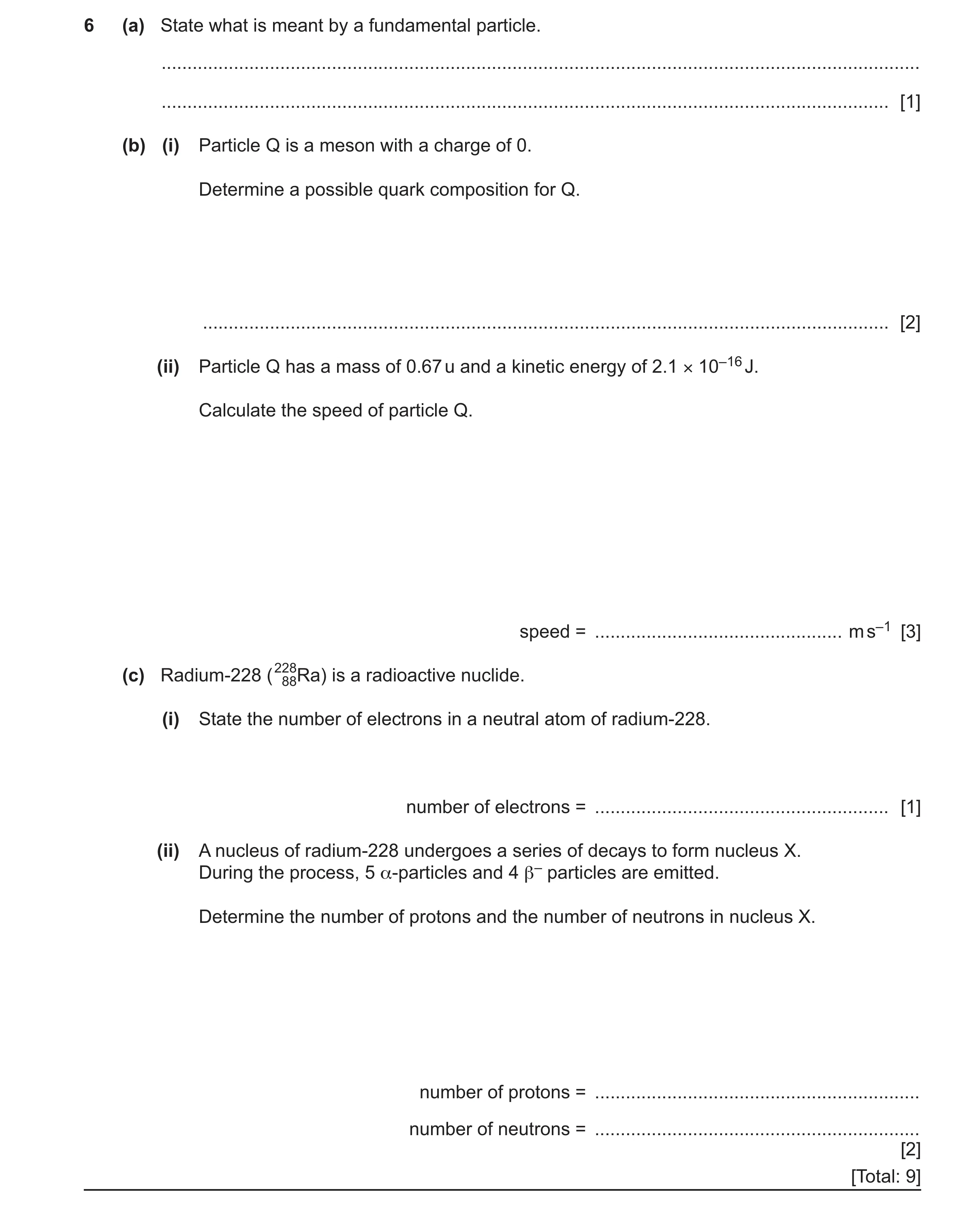
6 (a) State what is meant by a fundamental particle. … … [1] (b) (i) Particle Q is a meson with a charge of 0. Determine a possible quark composition for Q. … [2] (ii) Particle Q has a mass of 0.67 u and a kinetic energy of 2.1 × 10⁻¹⁶ J. Calculate the speed of particle Q. speed = … m s–1 [3] (c) Radium-228 (22888Ra) is a radioactive nuclide. (i) State the number of electrons in a neutral atom of radium-228. number of electrons = … [1] (ii) A nucleus of radium-228 undergoes a series of decays to form nucleus X. During the process, 5 α-particles and 4 β– particles are emitted. Determine the number of protons and the number of neutrons in nucleus X. number of protons = … number of neutrons = … [2] [Total: 9]
9 marks
Mark scheme: 6(a) (a particle that) cannot be divided / subdivided (into smaller particles) B1 6(b)(i) any combination of one quark and one antiquark C1 up / charm / top and antiup / anticharm / antitop A1 or down / strange / bottom and antidown / antistrange / antibottom 6(b)(ii) 1 C1 E(K) = mv2 2 1 2 C1 2.1 10–16 = 0.67 1.66 10–27 v 2 v = 6.1 105 m s–1 A1 6(c)(i) number of electrons = 88 A1 6(c)(ii) (number of nucleons = 228 – 5 × 4 = 208) A1 number of protons = 88 – (5 × 2) + 4 = 82 number of neutrons= 208 – 82 = 126 A1 = 126
This question in 9702/22 Oct/Nov 2025
Q30 · The nuclide 1H is an isotope of hydrogen that is called tritium 9702/23 Oct/Nov 2025
6 The nuclide 1H is an isotope of hydrogen that is called tritium. (a) (i) Determine the numbers of protons, neutrons and electrons in a neutral atom of tritium. number of protons = … number of neutrons = … number of electrons = … [2] (ii) Draw a labelled diagram to represent a simple model of the arrangement of the protons, neutrons and electrons in a tritium atom. [2] (b) Tritium is radioactive and undergoes β– decay to form an isotope of helium (He). Gamma radiation is not emitted during this decay. (i) Complete the equation to represent the radioactive decay of tritium. 3 … … 0 1H … He + … β + 0X [2] (ii) State the name of particle X. … [1] (c) Determine the quark composition of a tritium nucleus. … … [2] [Total: 9]
9 marks
Mark scheme: 6(a)(i) numbers of protons and electrons both = 1 A1 number of neutrons = 2 A1 6(a)(ii) diagram shows 2 neutrons and 1 proton labelled and forming a nucleus B1 diagram shows 1 electron labelled and separated from the nucleus (not touching the proton and neutrons) B1 6(b)(i) helium nucleus: top line = 3 and bottom line = 2 A1 beta particle: top line = 0 and bottom line = –1 A1 6(b)(ii) (electron) antineutrino B1 6(c) proton: up up down C1 or neutron: up down down (tritium:) 4 up, 5 down A1
This question in 9702/23 Oct/Nov 2025
Q31 · Four alpha particles W, X, Y and Z moving towards a gold nucleus that is in thin gold foil 9702/24 Oct/Nov 2025
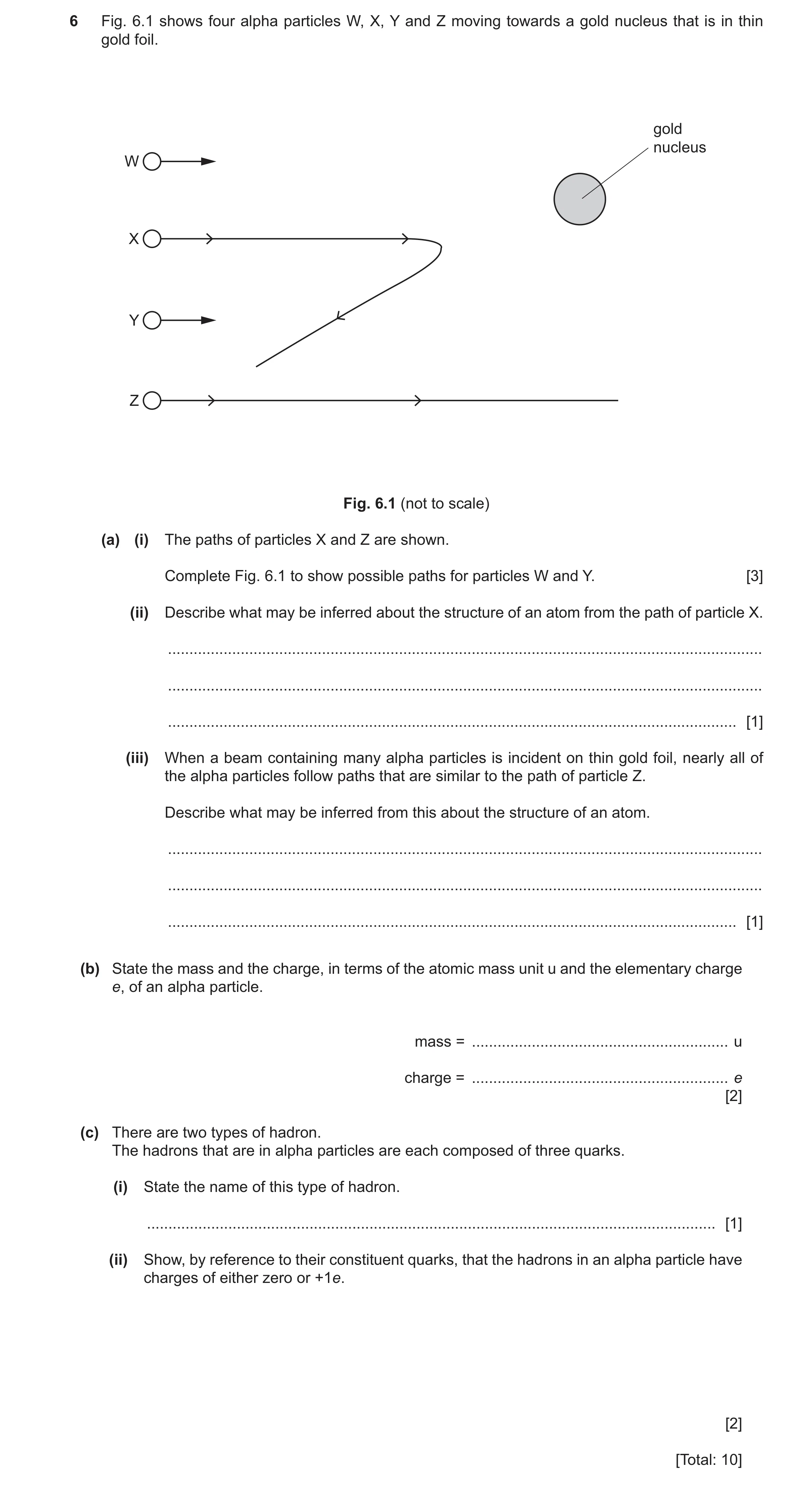
6 Fig. 6.1 shows four alpha particles W, X, Y and Z moving towards a gold nucleus that is in thin gold foil. gold nucleus W X Y Z Fig. 6.1 (not to scale) (a) (i) The paths of particles X and Z are shown. Complete Fig. 6.1 to show possible paths for particles W and Y. [3] (ii) Describe what may be inferred about the structure of an atom from the path of particle X. … … … [1] (iii) When a beam containing many alpha particles is incident on thin gold foil, nearly all of the alpha particles follow paths that are similar to the path of particle Z. Describe what may be inferred from this about the structure of an atom. … … … [1] (b) State the mass and the charge, in terms of the atomic mass unit u and the elementary charge e, of an alpha particle. mass = … u charge = … e [2] (c) There are two types of hadron. The hadrons that are in alpha particles are each composed of three quarks. (i) State the name of this type of hadron. … [1] (ii) Show, by reference to their constituent quarks, that the hadrons in an alpha particle have charges of either zero or +1e. [2] [Total: 10]
10 marks
Mark scheme: 6(a)(i) W deflects upwards B1 W has deflection that is the mirror image of X B1 Y deflects downwards less than X B1 or path of Y is parallel to particle Z 6(a)(ii) nucleus has most of the mass of the atom B1 or nucleus is charged 6(a)(iii) atom is mostly empty space B1 or nucleus occupies a very small proportion of the space in the atom 6(b) mass = 4 u A1 charge = (+)2e A1 6(c)(i) baryon B1 6(c)(ii) 2 1 C1 charge on up quark = (+) (e) and charge on down quark = − (e) 3 3 (proton is up up down and neutron is up down down) A1 2 1 2 1 2 e − 1 = 1e and 1 e − 2 e = 0 3 3 3 3
This question in 9702/24 Oct/Nov 2025
 1 / 32
 2 / 32
 3 / 32
 4 / 32
 5 / 32
 6 / 32
![Question 7: (a) In the following list, underline all particles that are leptons. antineutrino positron proton quark [1] γ radiation. (b) A stationary n…](https://img.pastlit.com/crops/df1ce26c-921f-4dd6-985a-f2e585807553/q8.webp) 7 / 32
7 / 32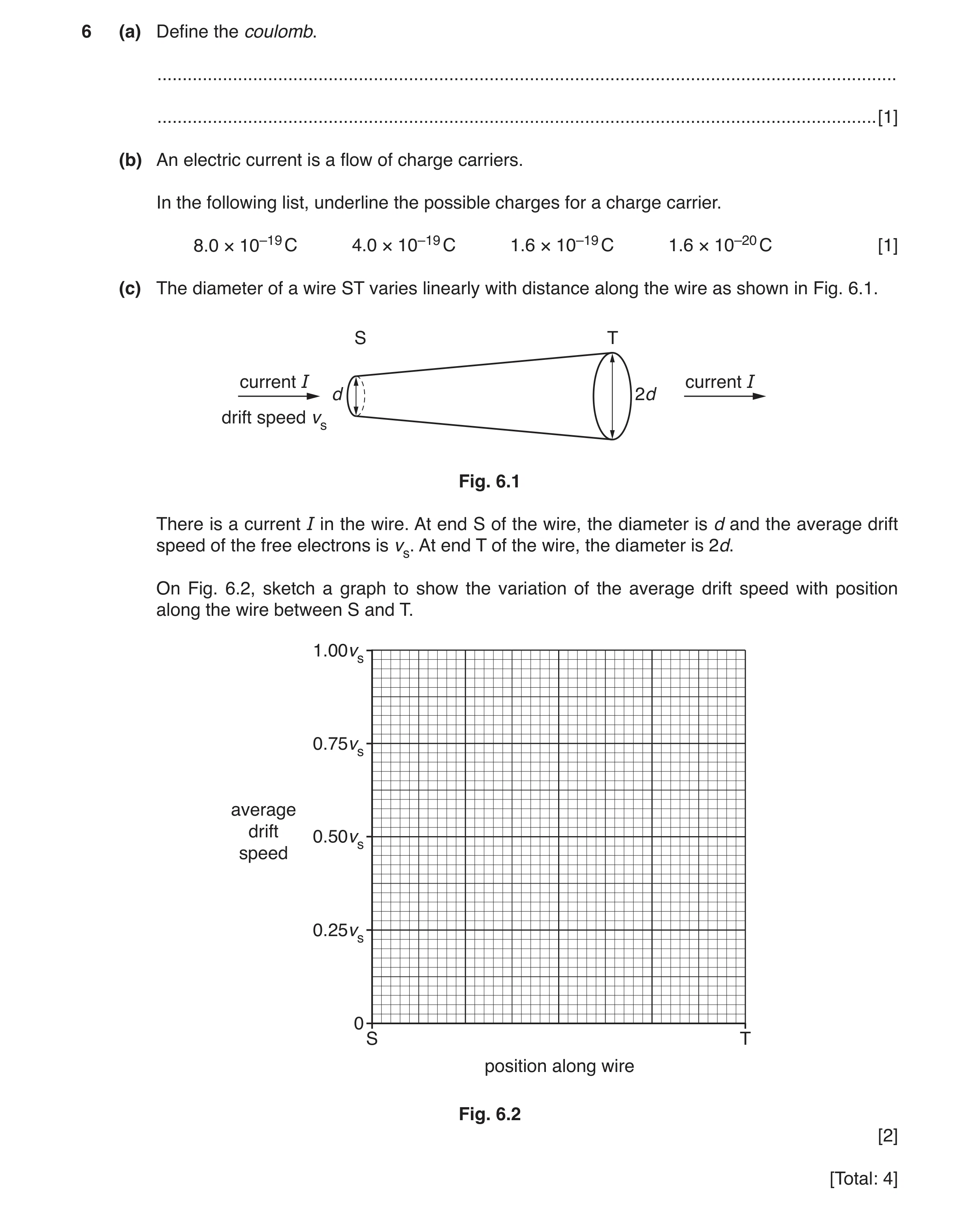 8 / 32
 9 / 32
 10 / 32
 11 / 32
 12 / 32
 13 / 32
 14 / 32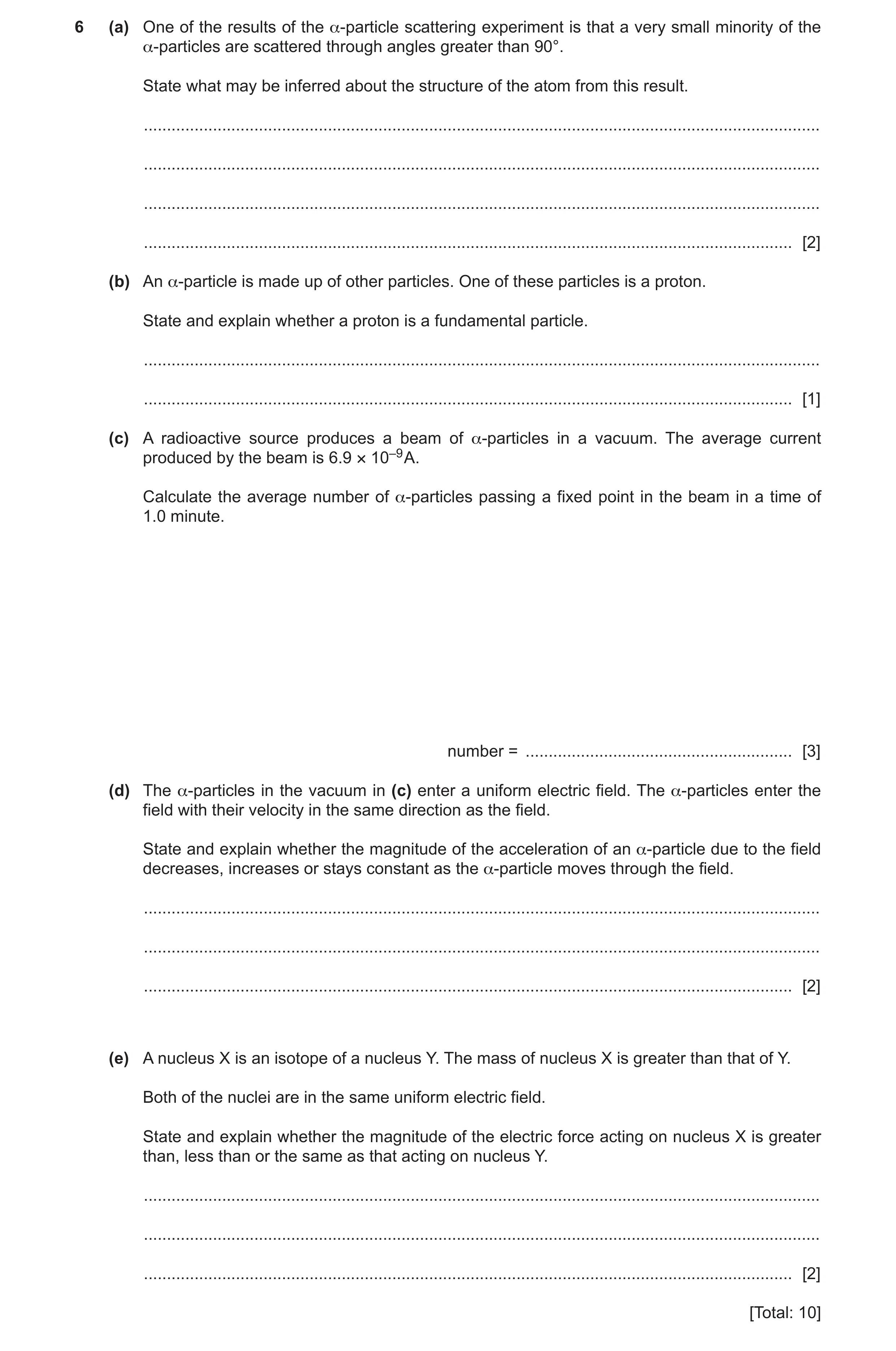
 16 / 32
 17 / 32
 18 / 32
 19 / 32
 20 / 32
 21 / 32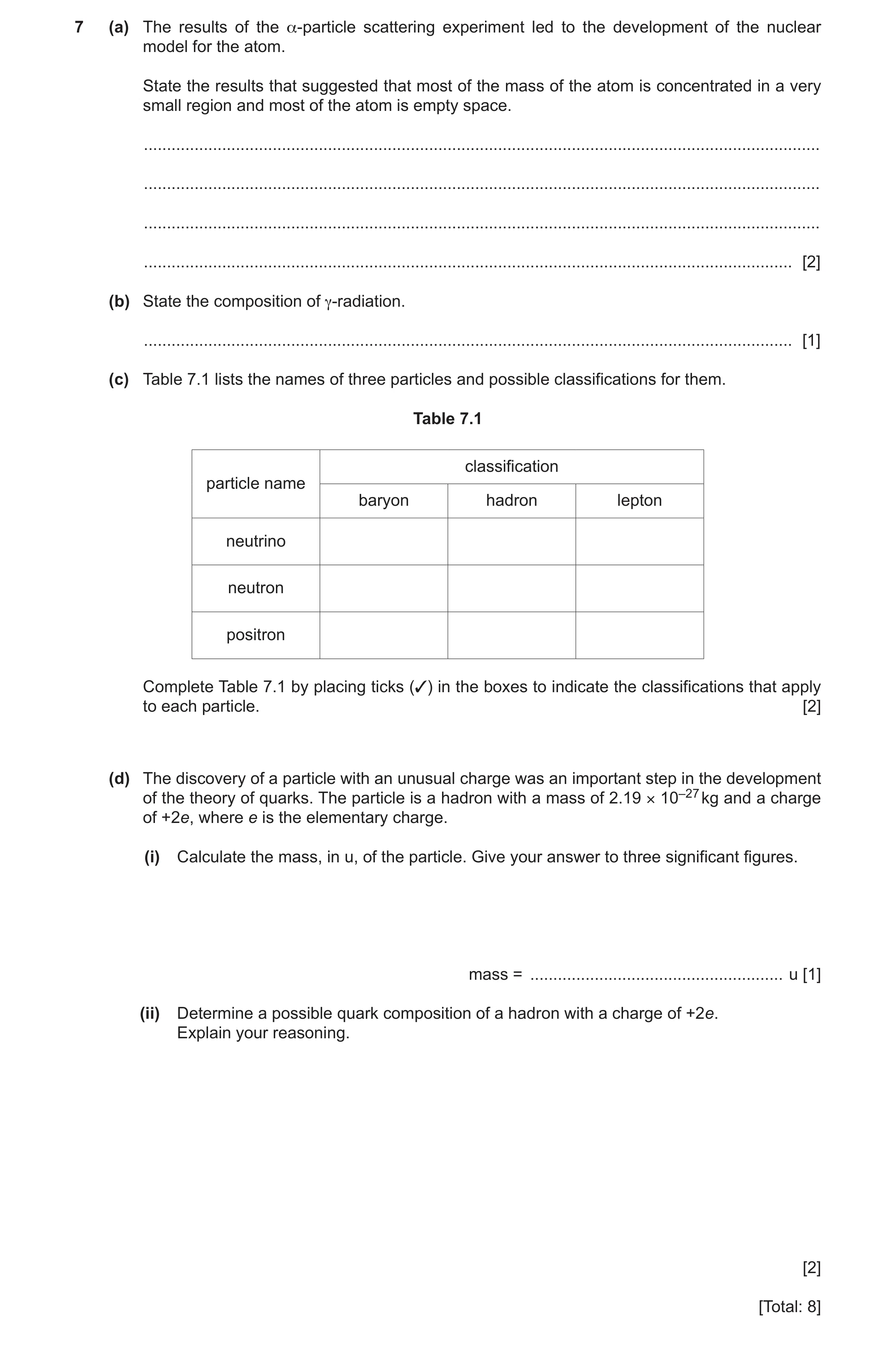
 23 / 32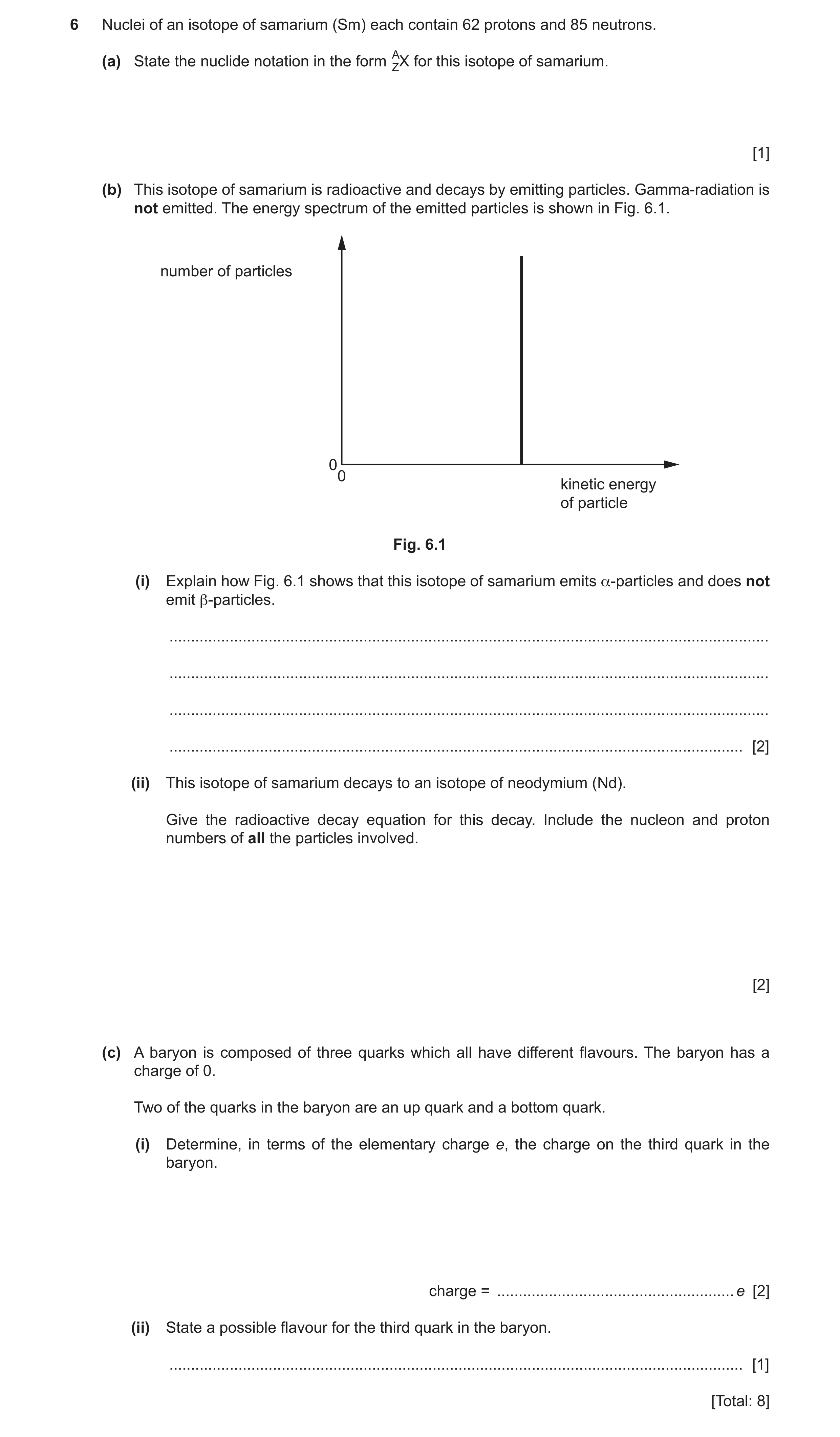
 26 / 32
 27 / 32
 28 / 32
 29 / 32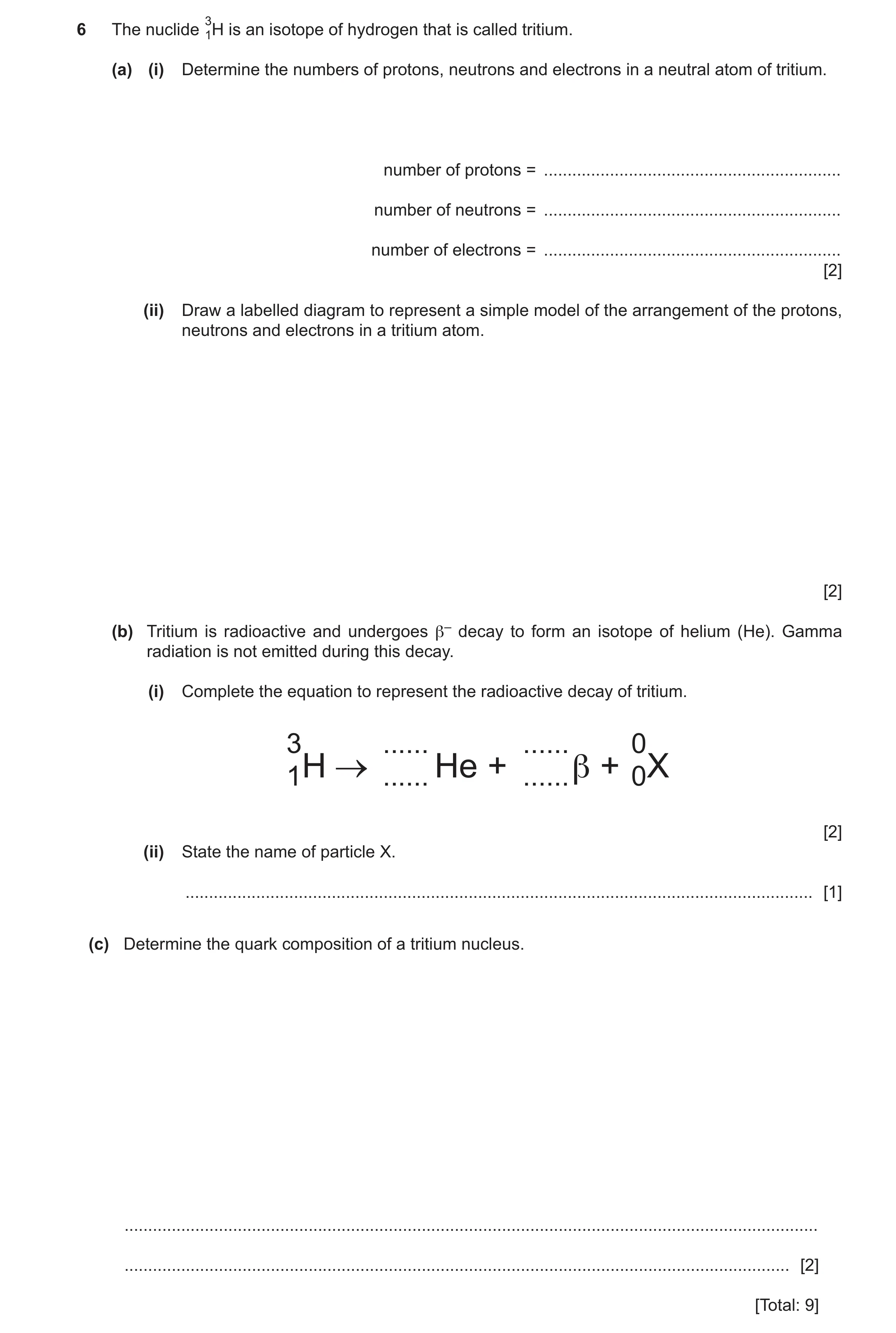
 3
3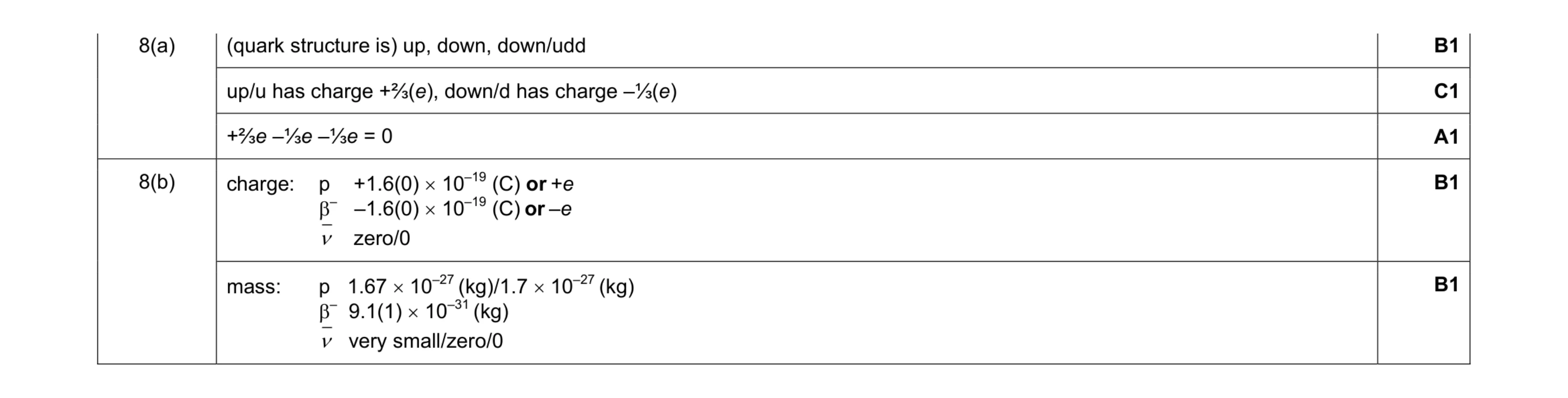 5
5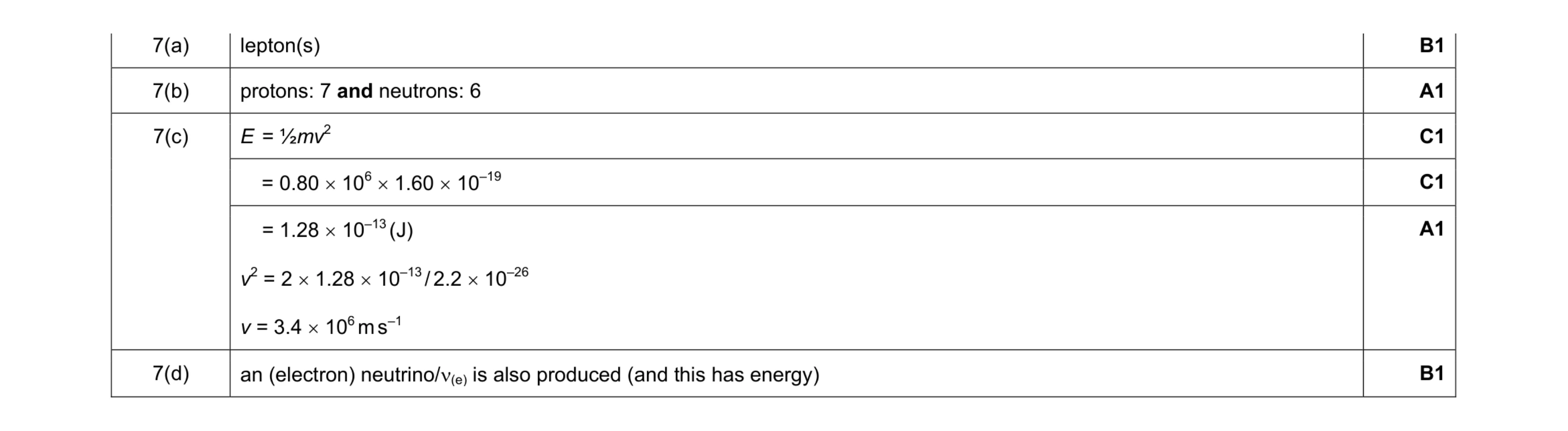 6
6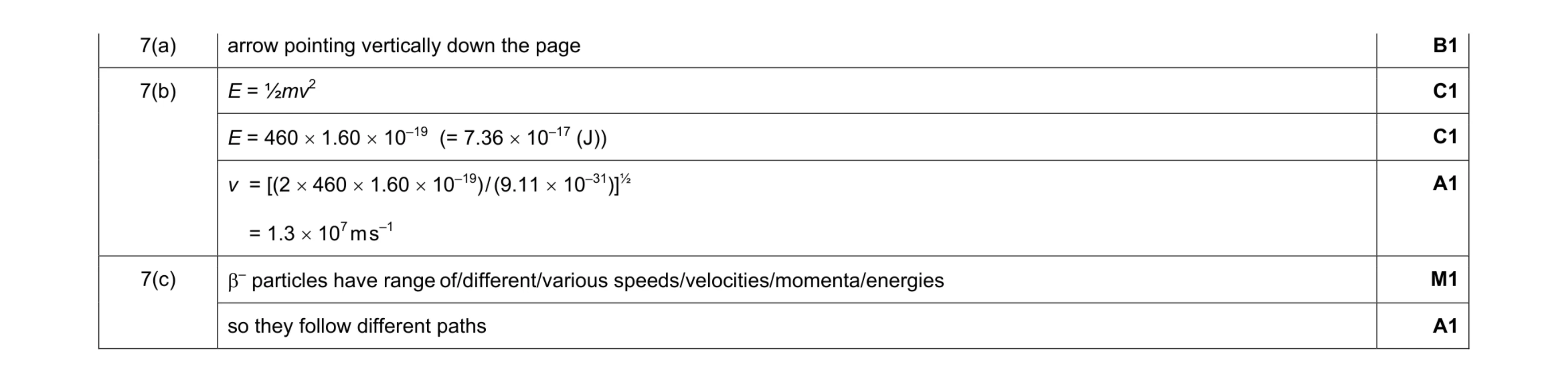 6
6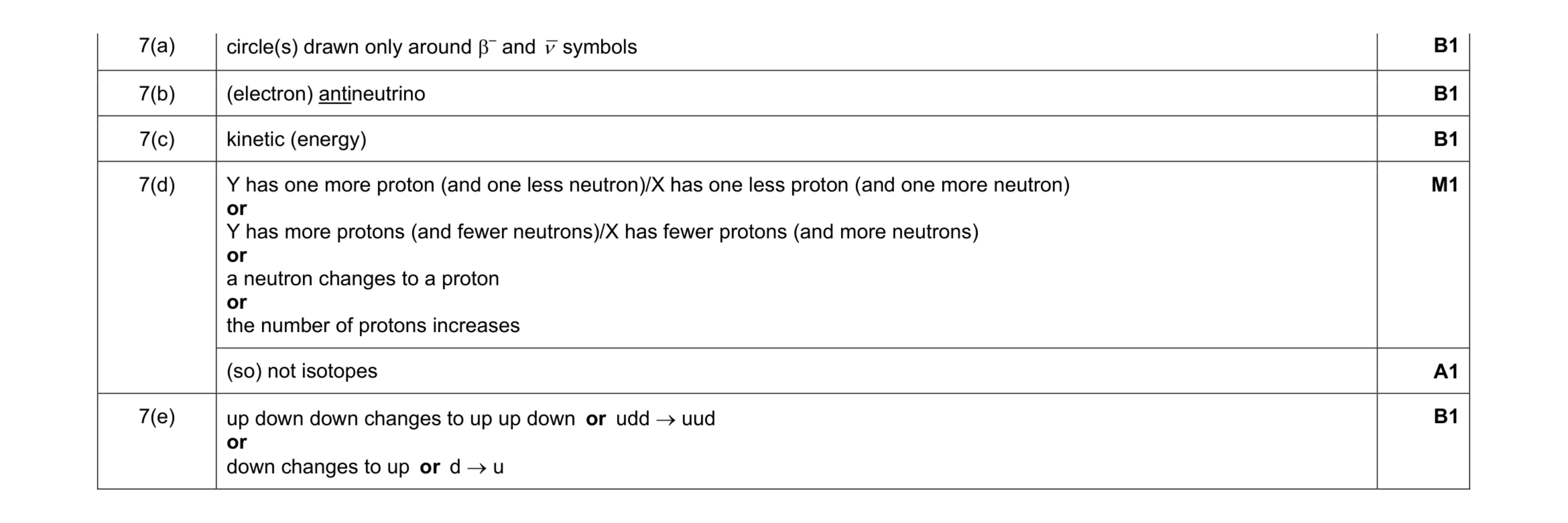 6
6 4
4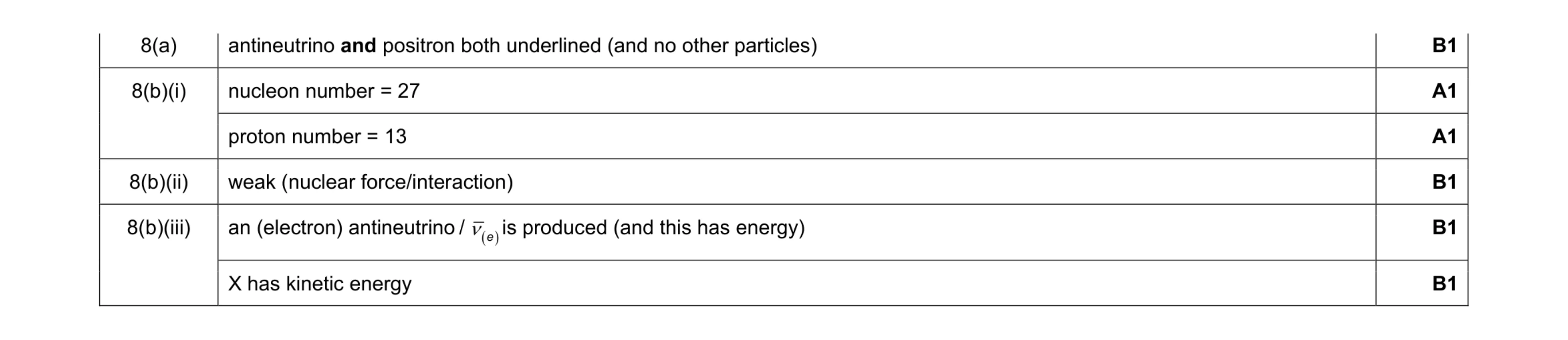 6
6 4
4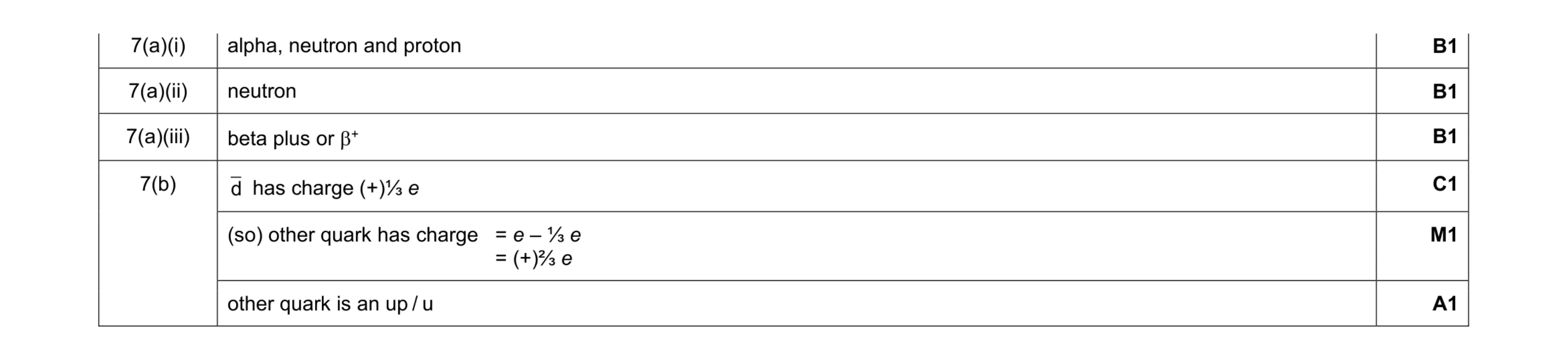 6
6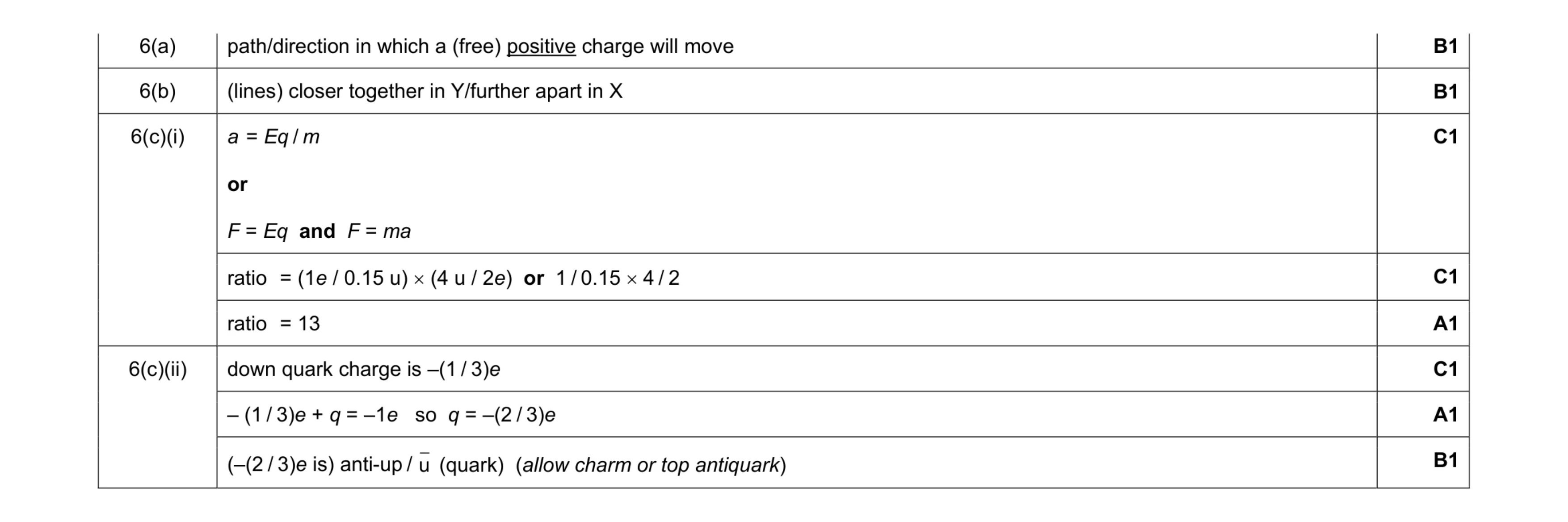 8
8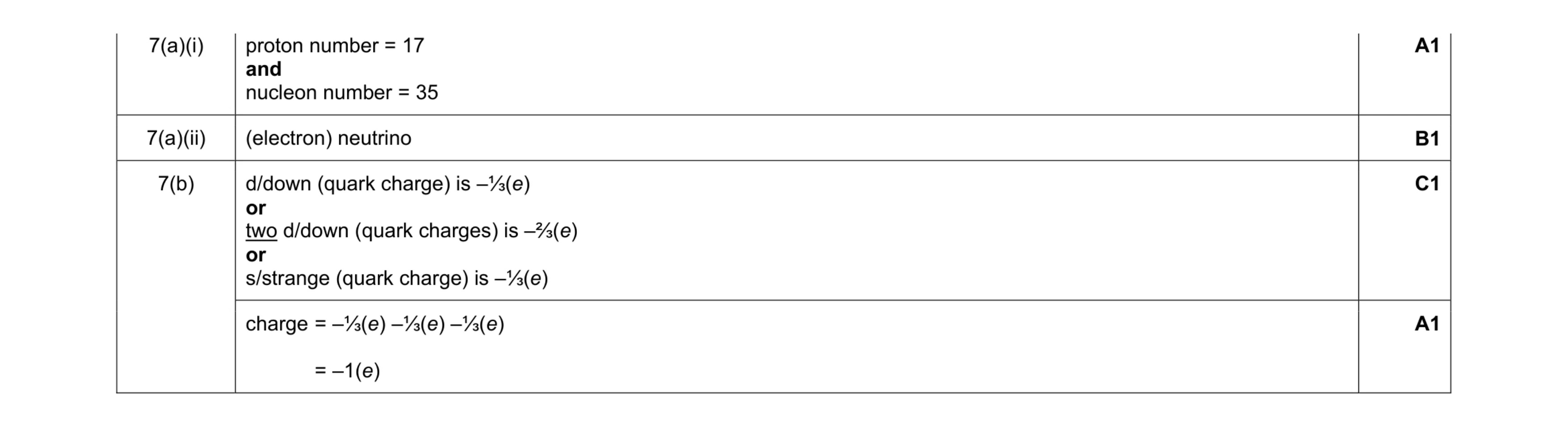 4
4 5
5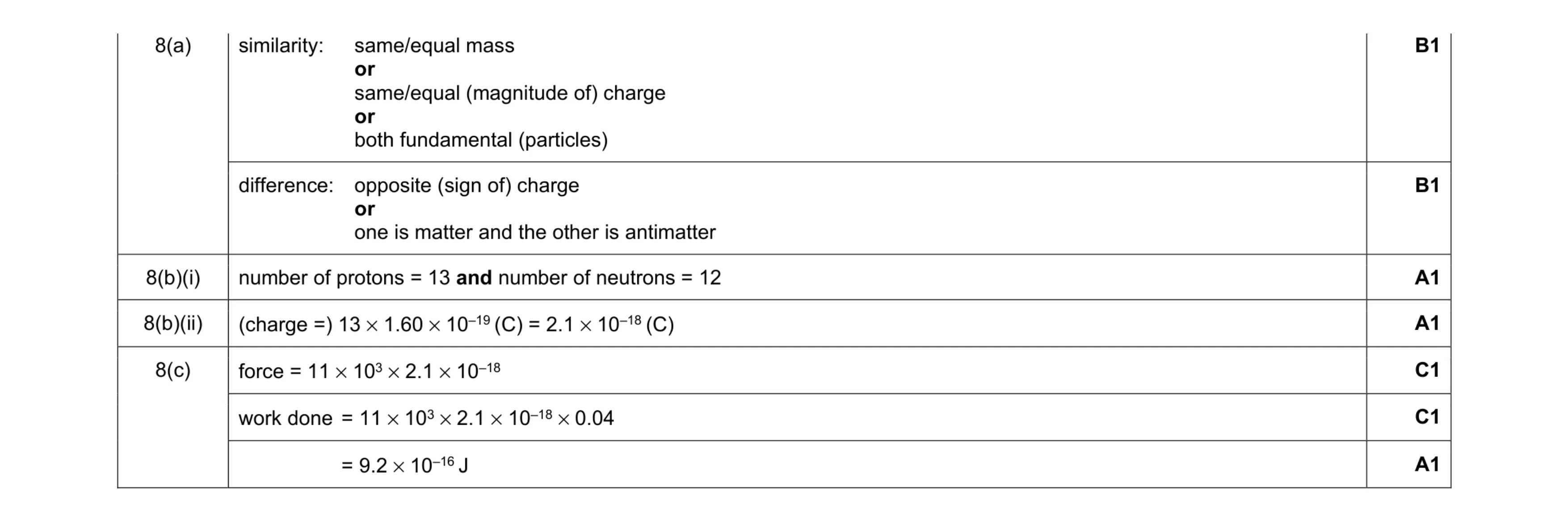 7
7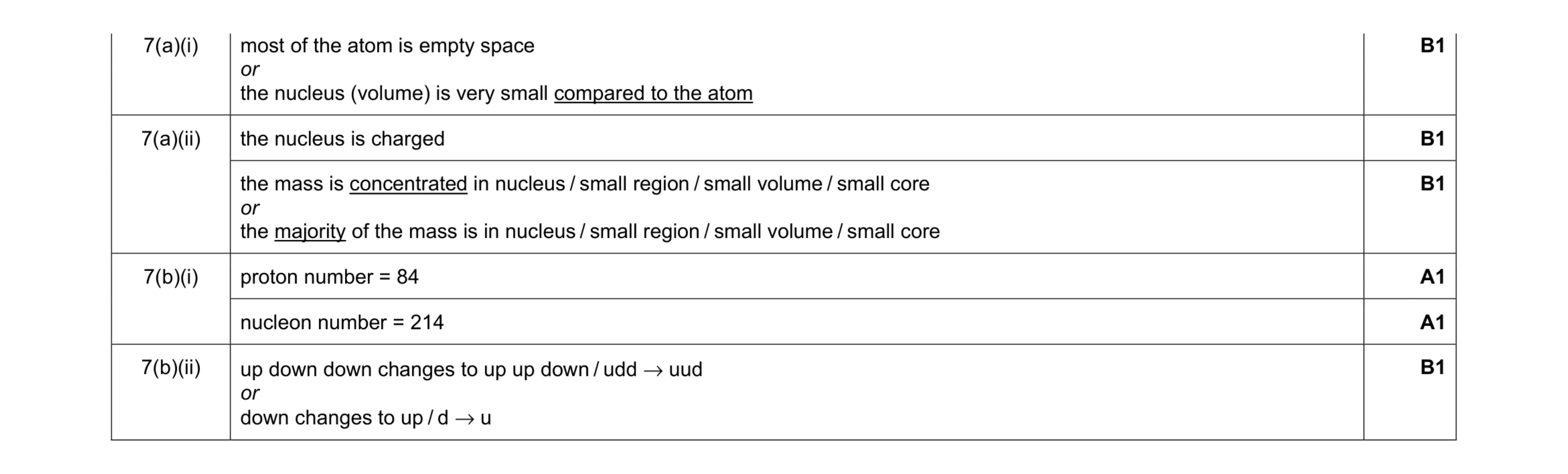 6
6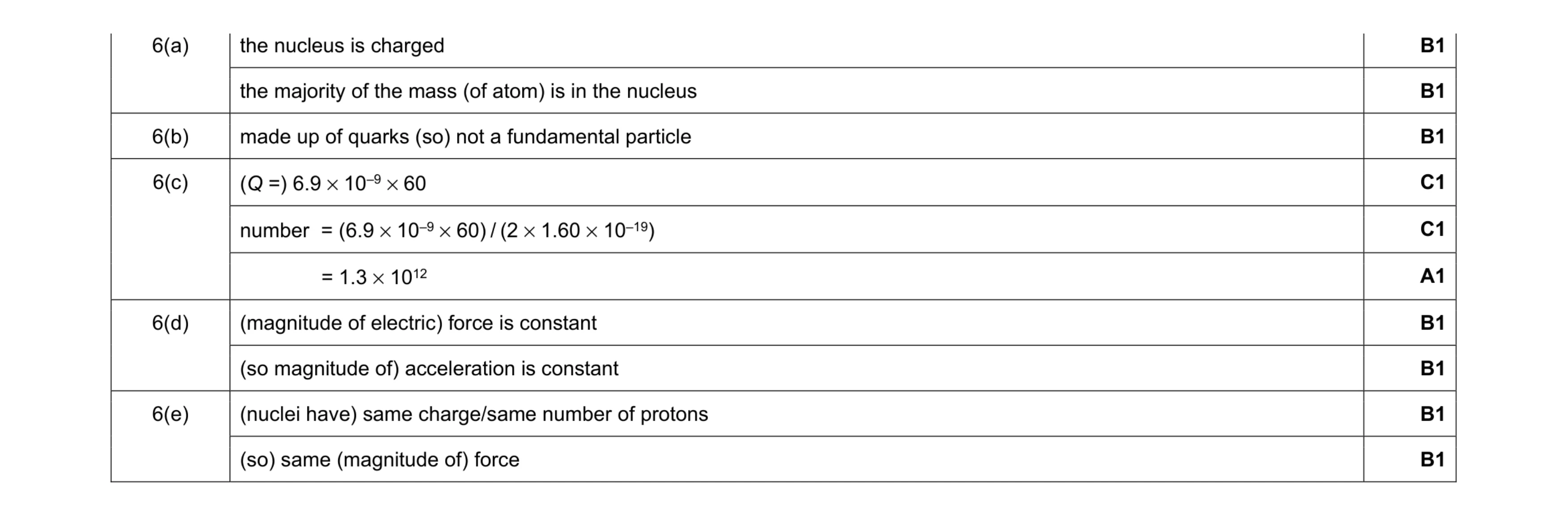 10
10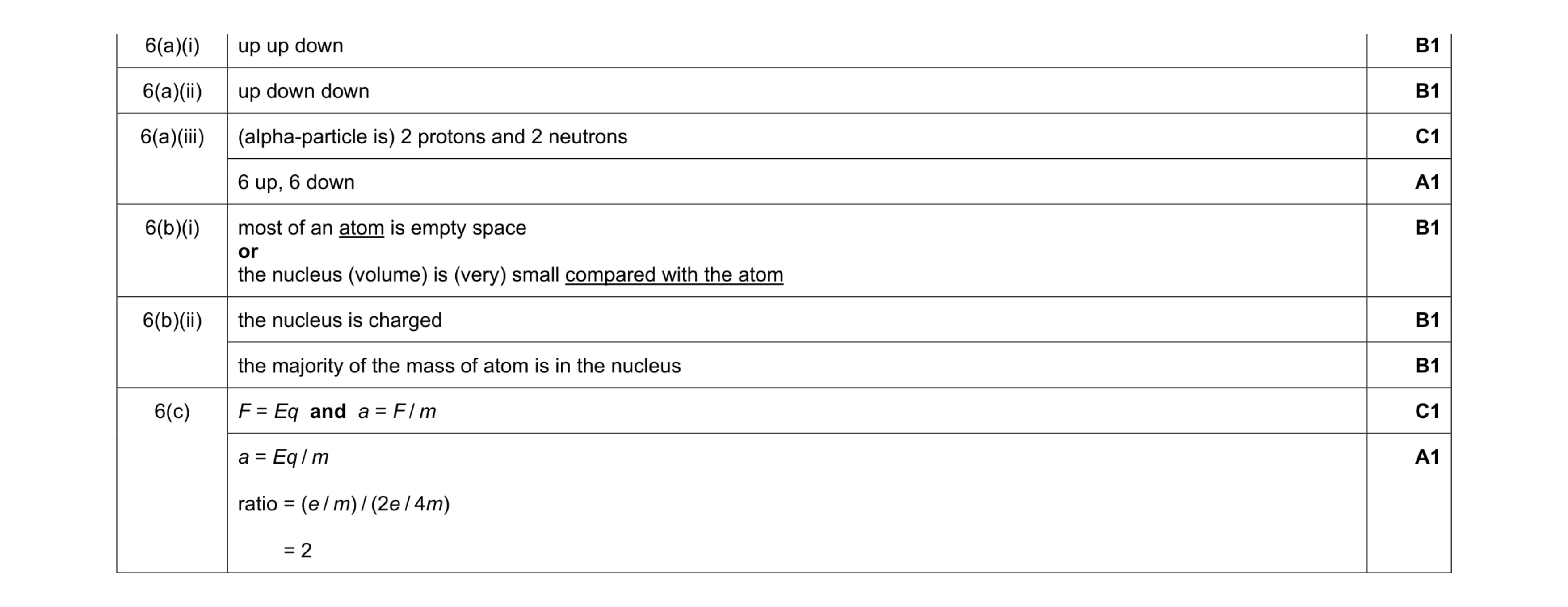 9
9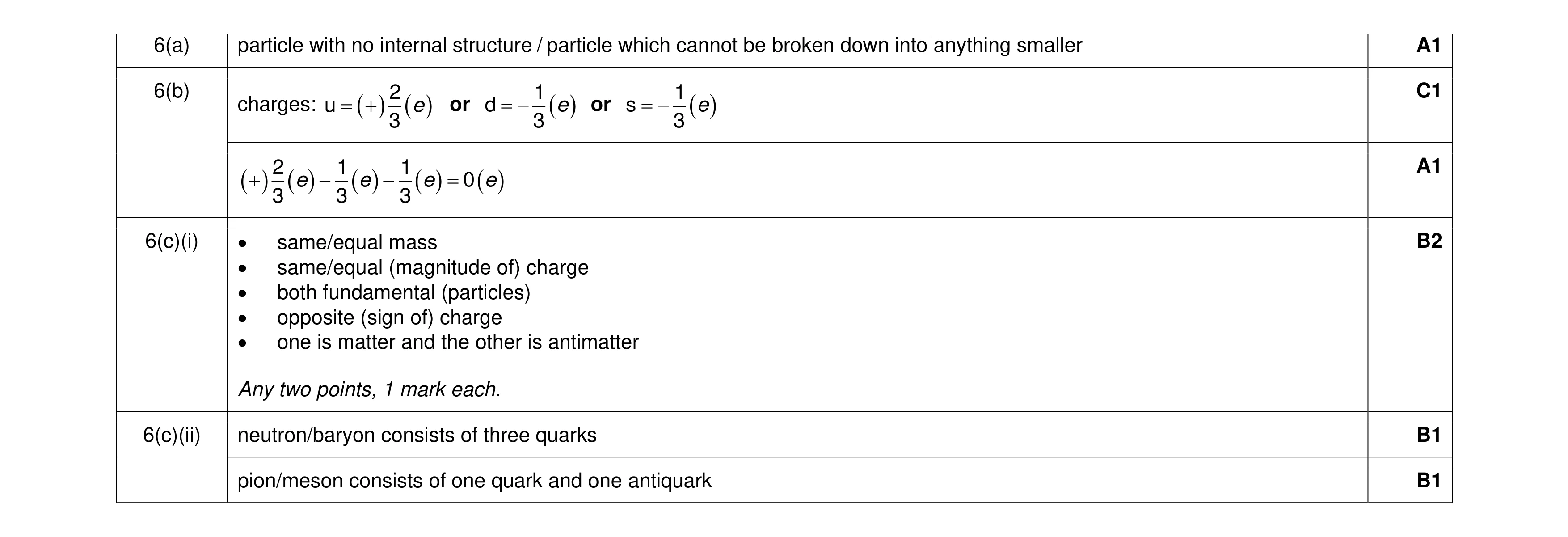 7
7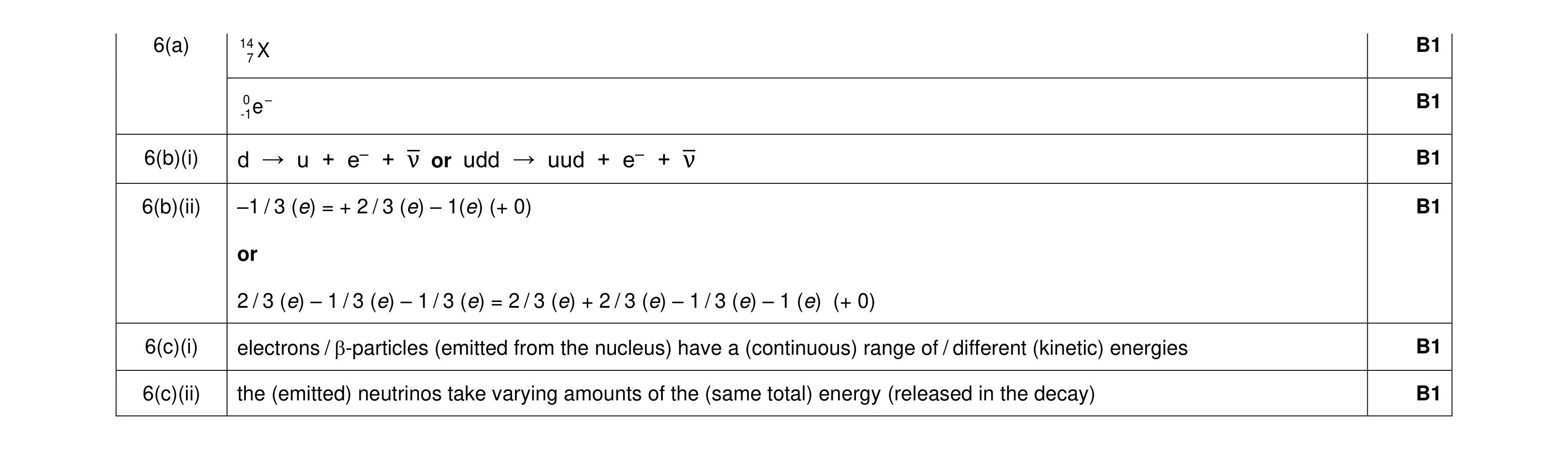 6
6 5
5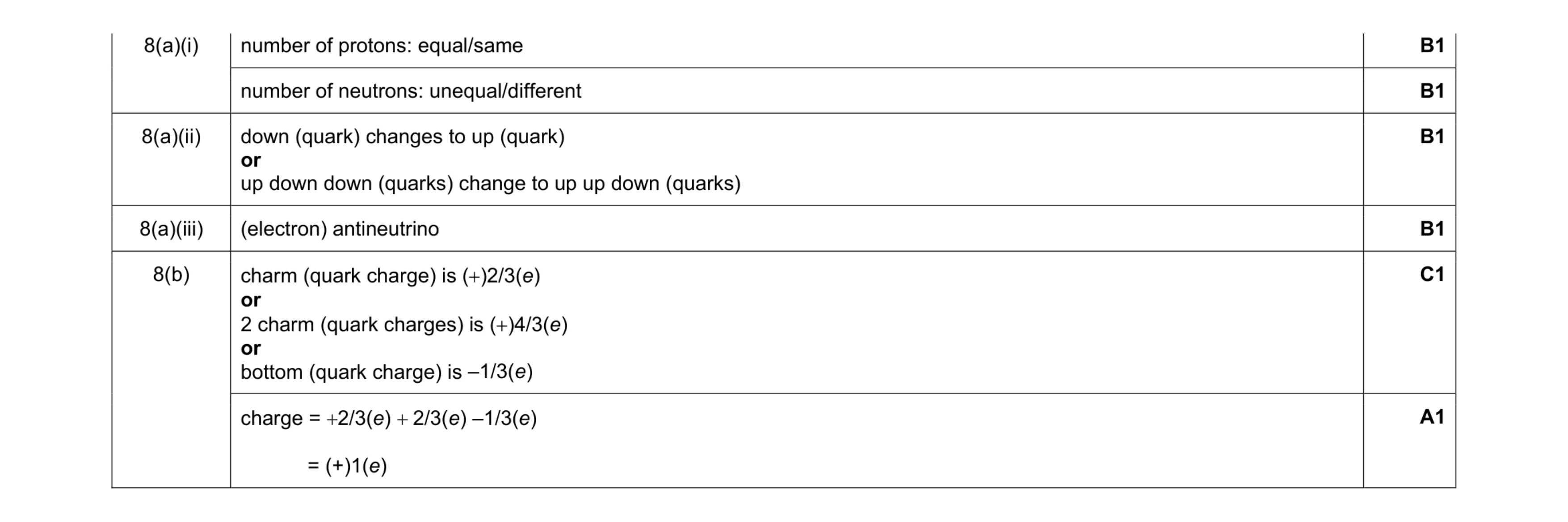 6
6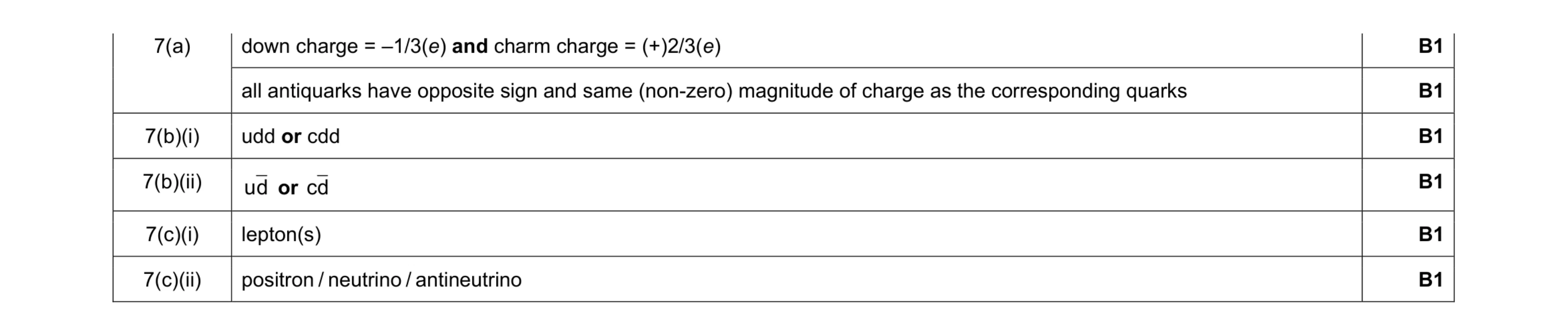 6
6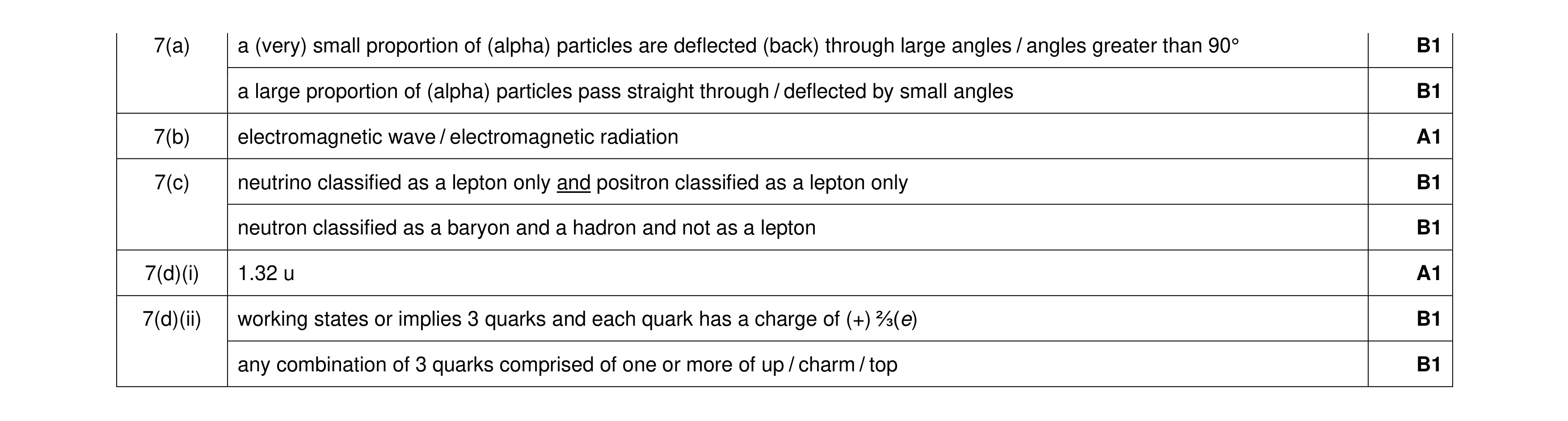 8
8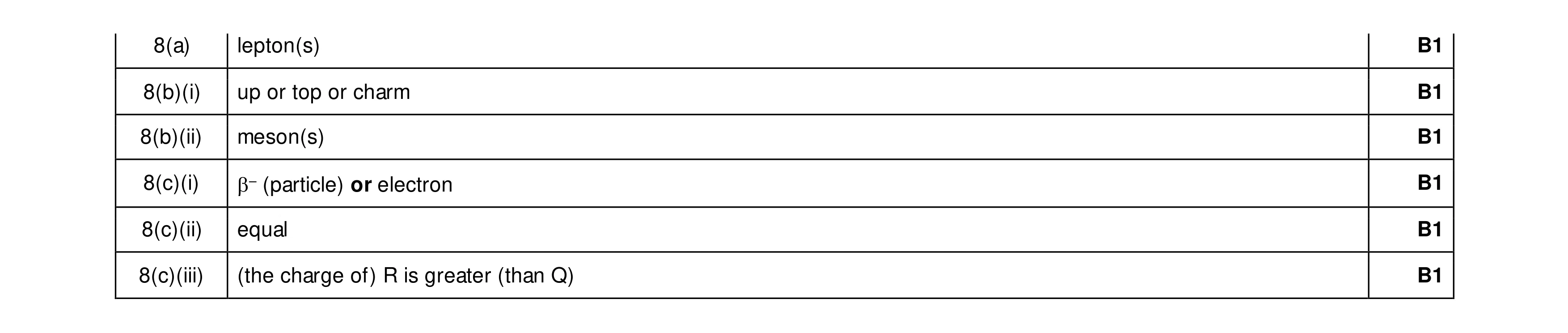 6
6 3
3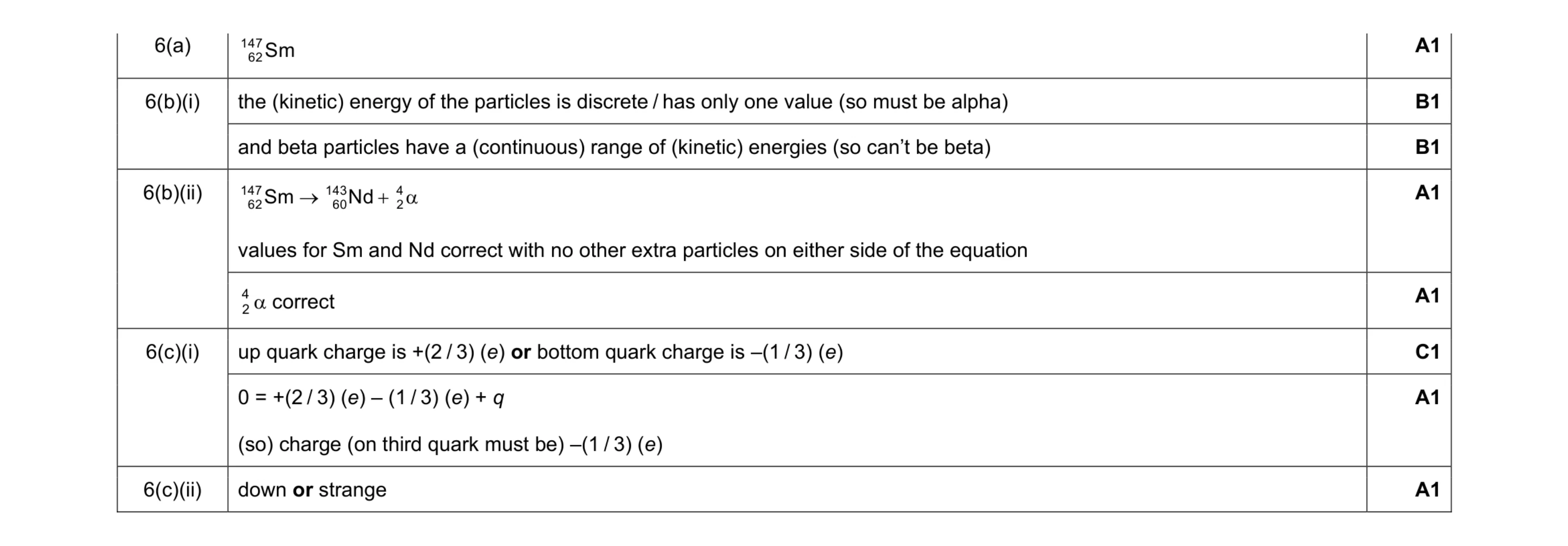 8
8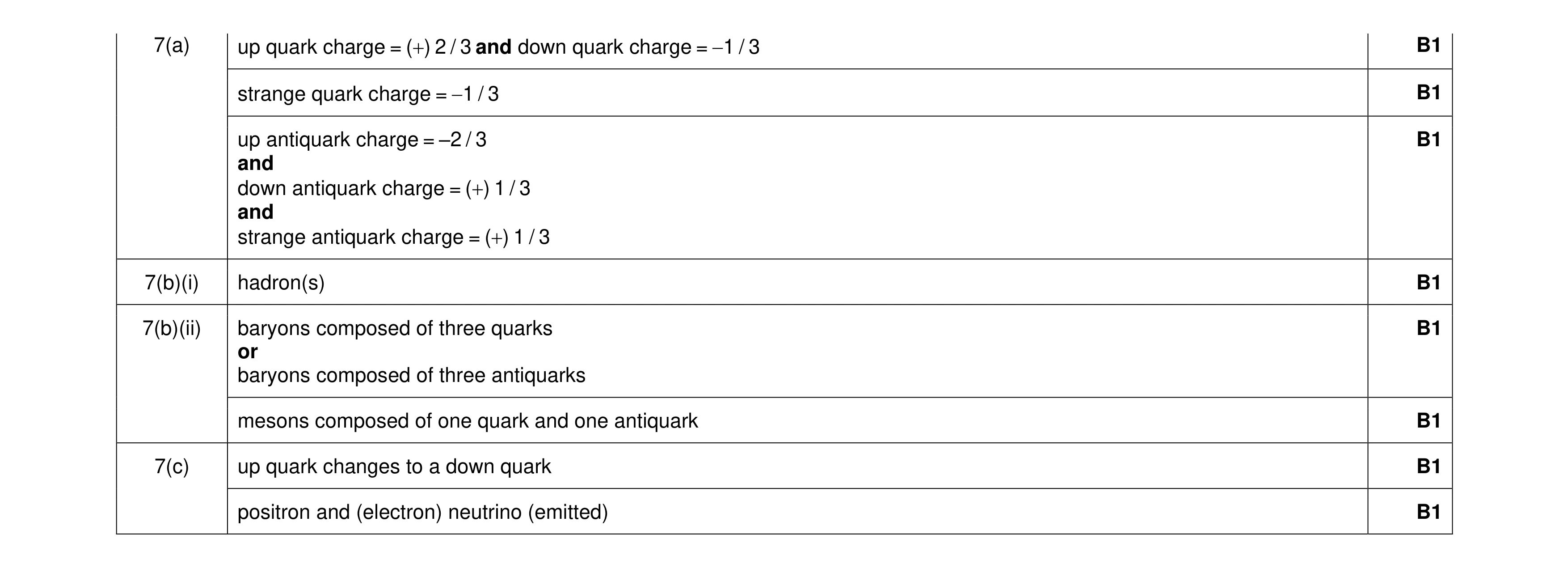 8
8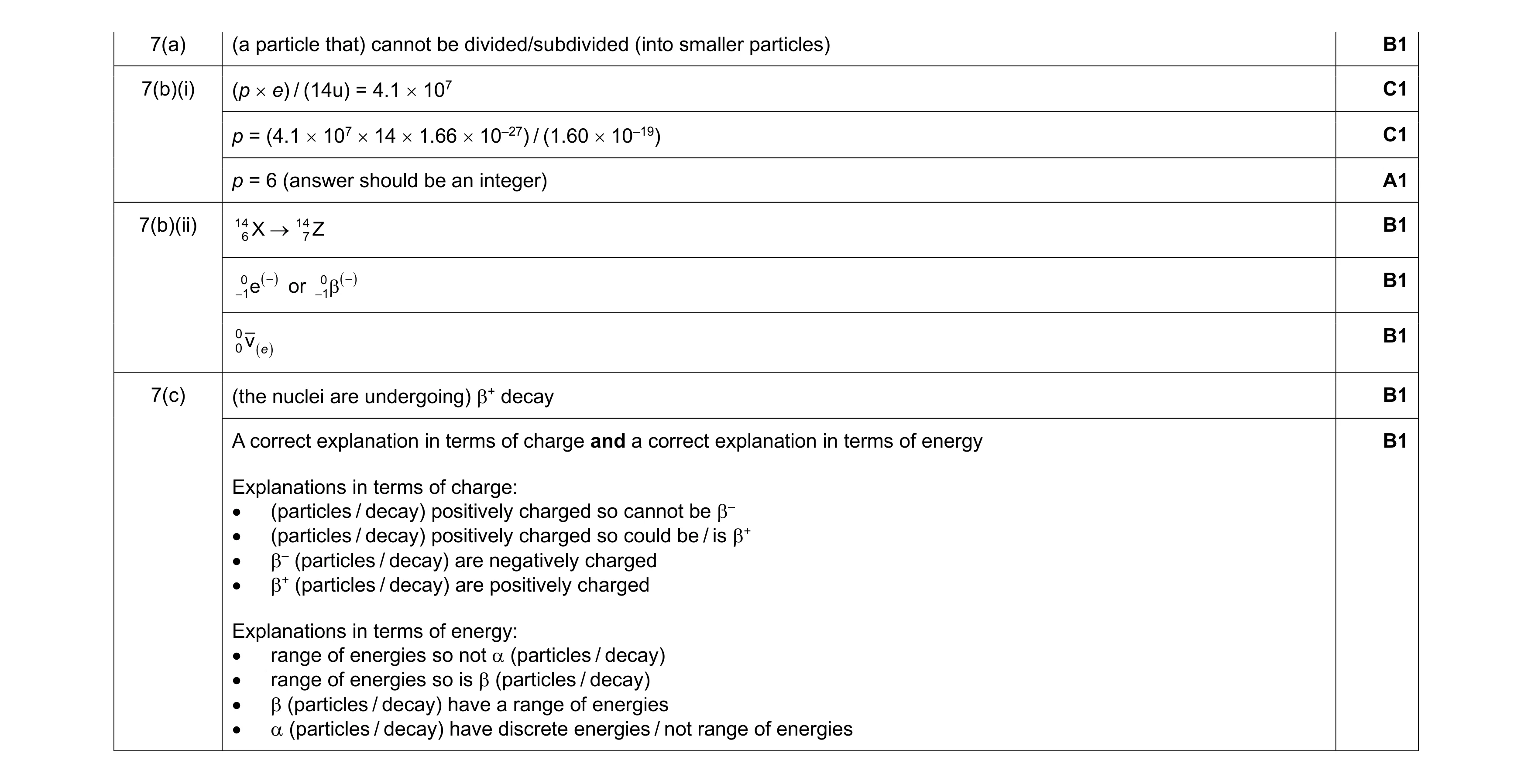 9
9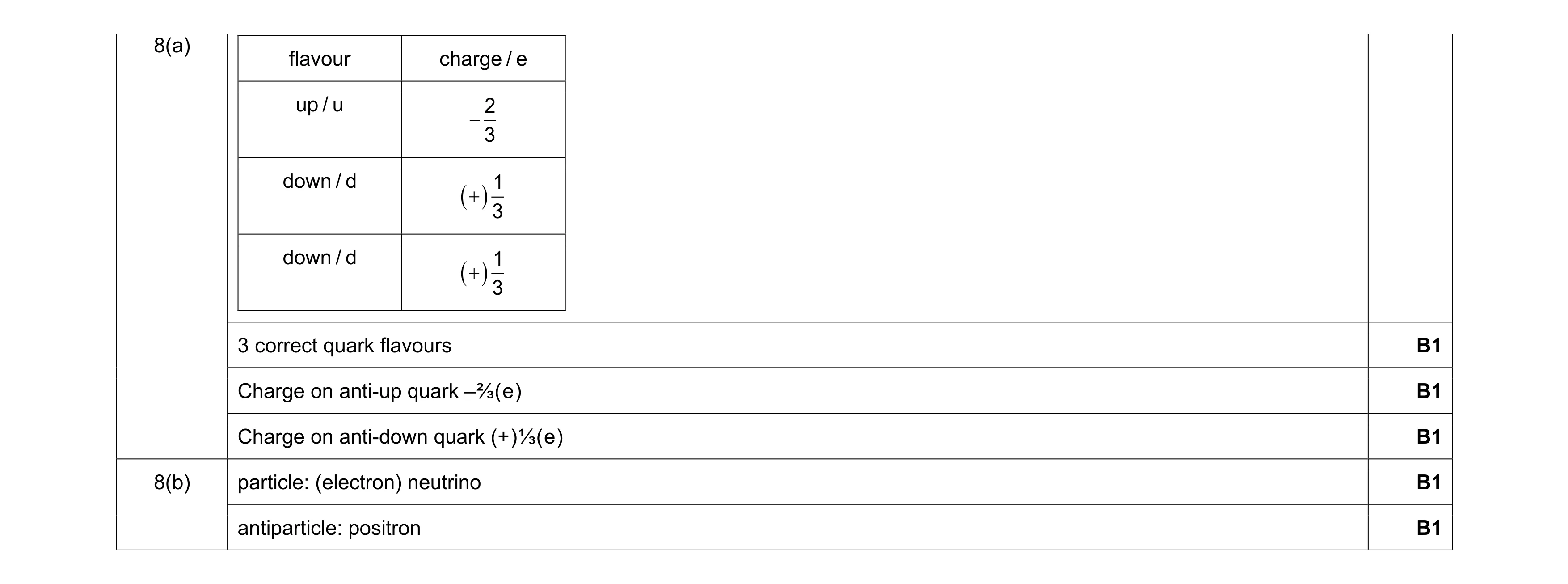 5
5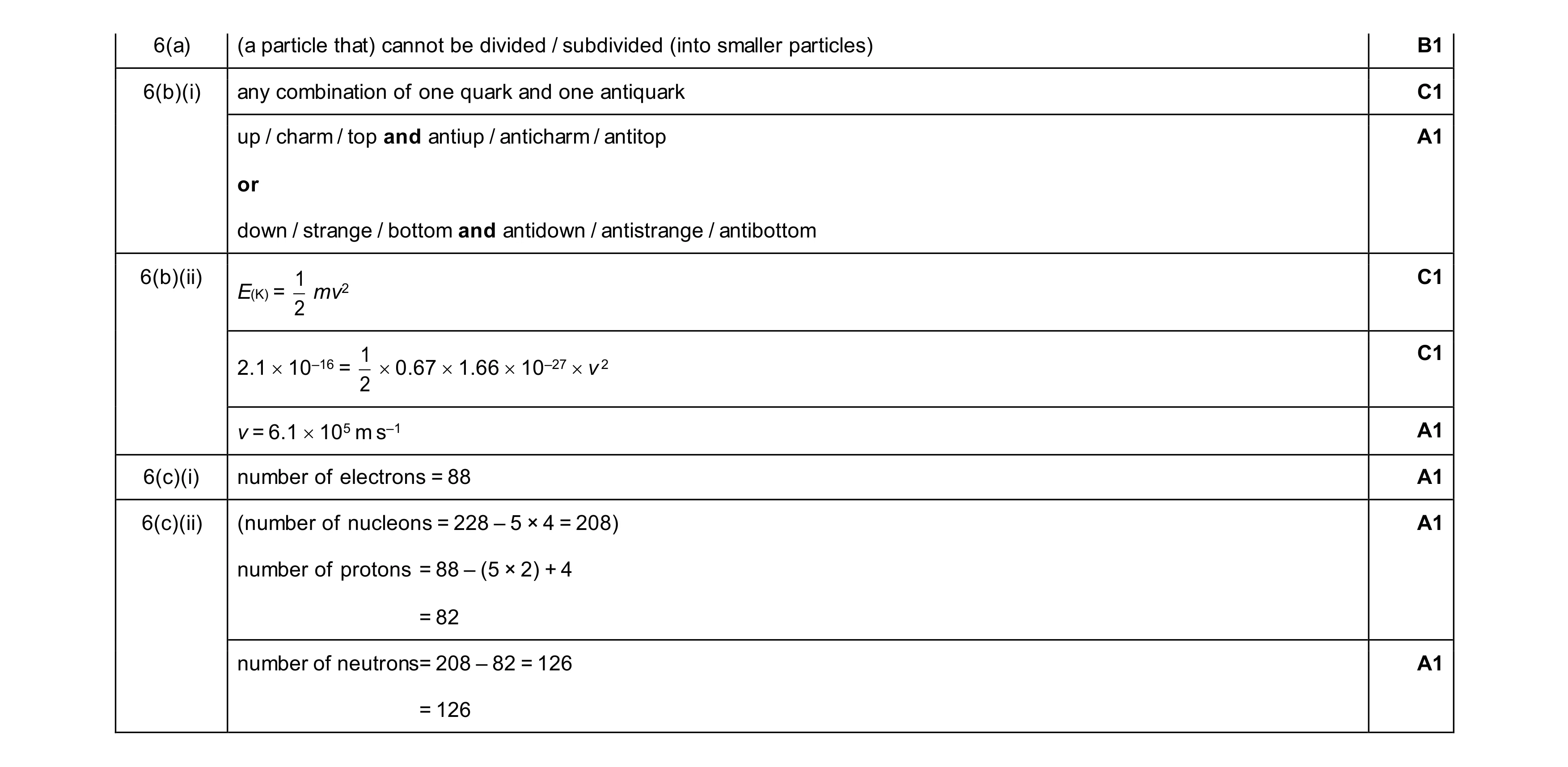 9
9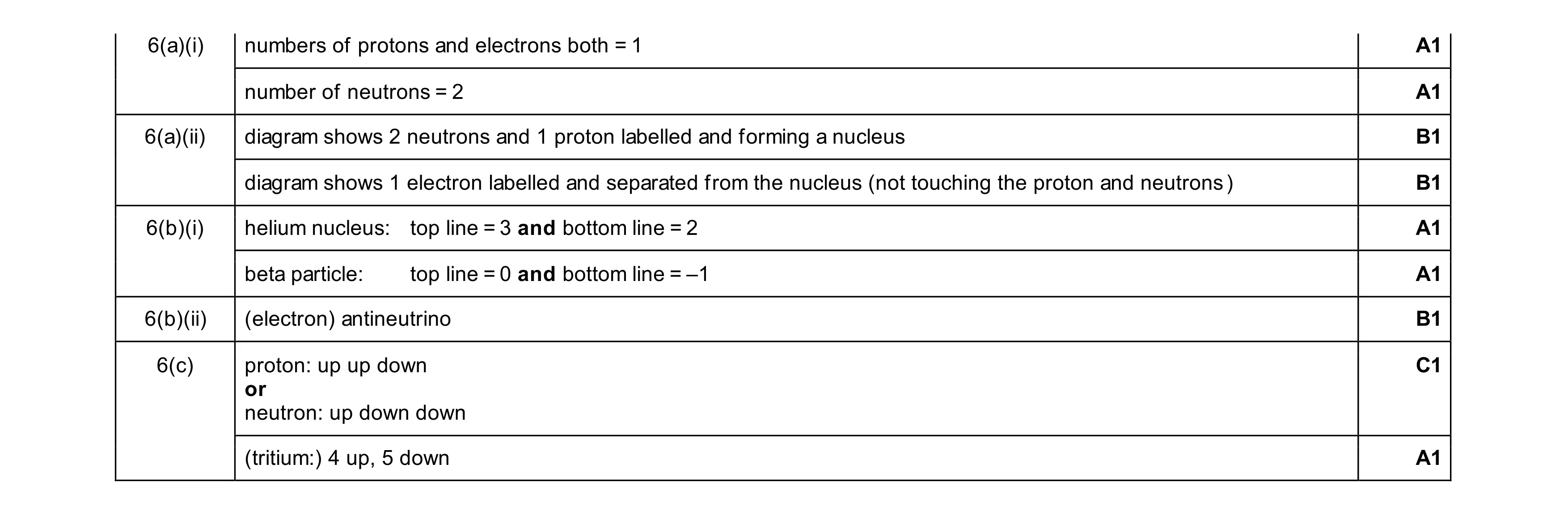 9
9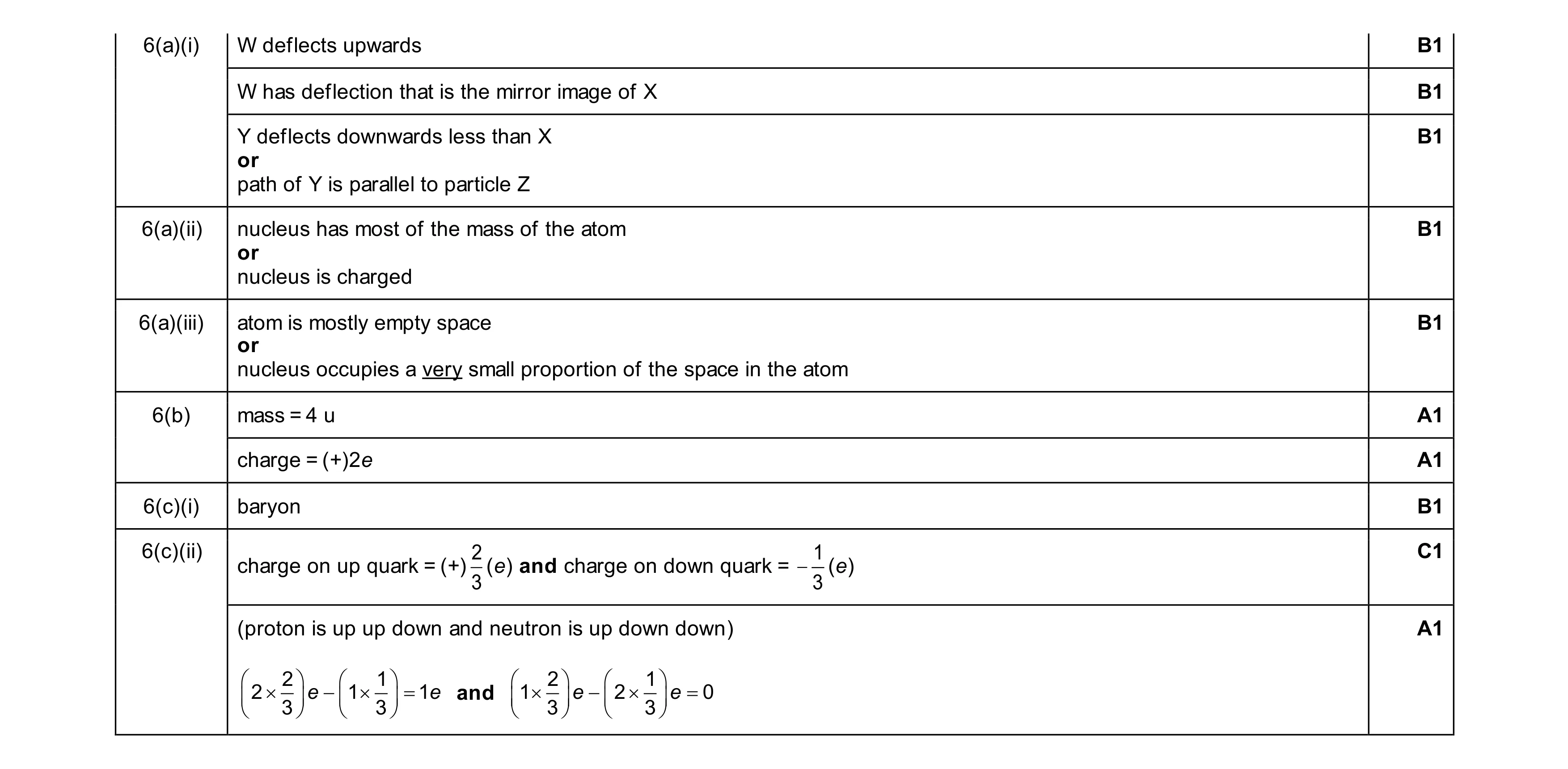 10
10