Cambridge A Level Physics 9702 — 2018 May/June Paper 2 · Variant 3
9702/23/M/J/18 · 7 questions · 60 marks · ≈68 min
The question paper and its mark scheme, free to read here and free to download. This is Cambridge’s own paper, exactly as it was sat.
Question paper16 pages
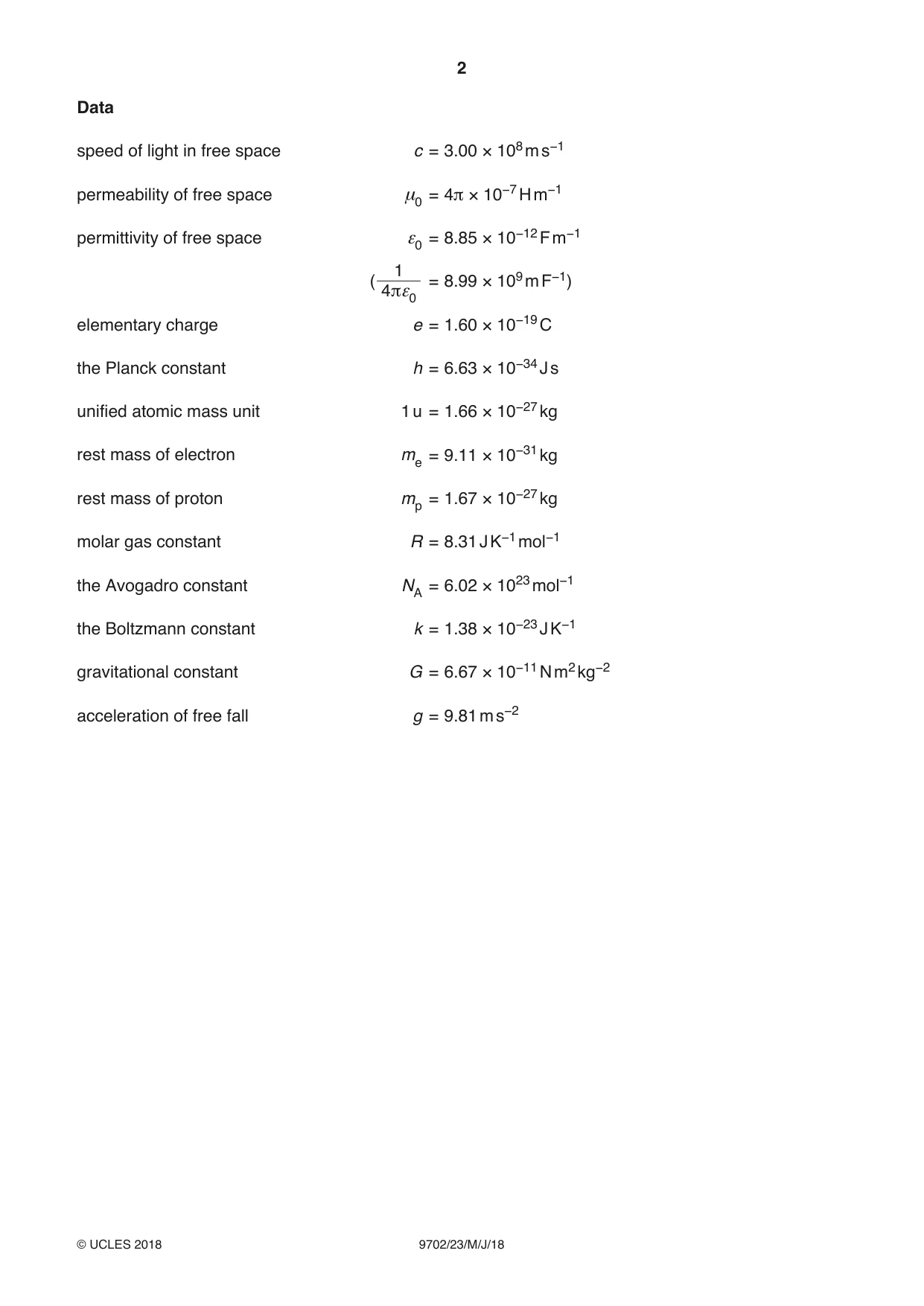
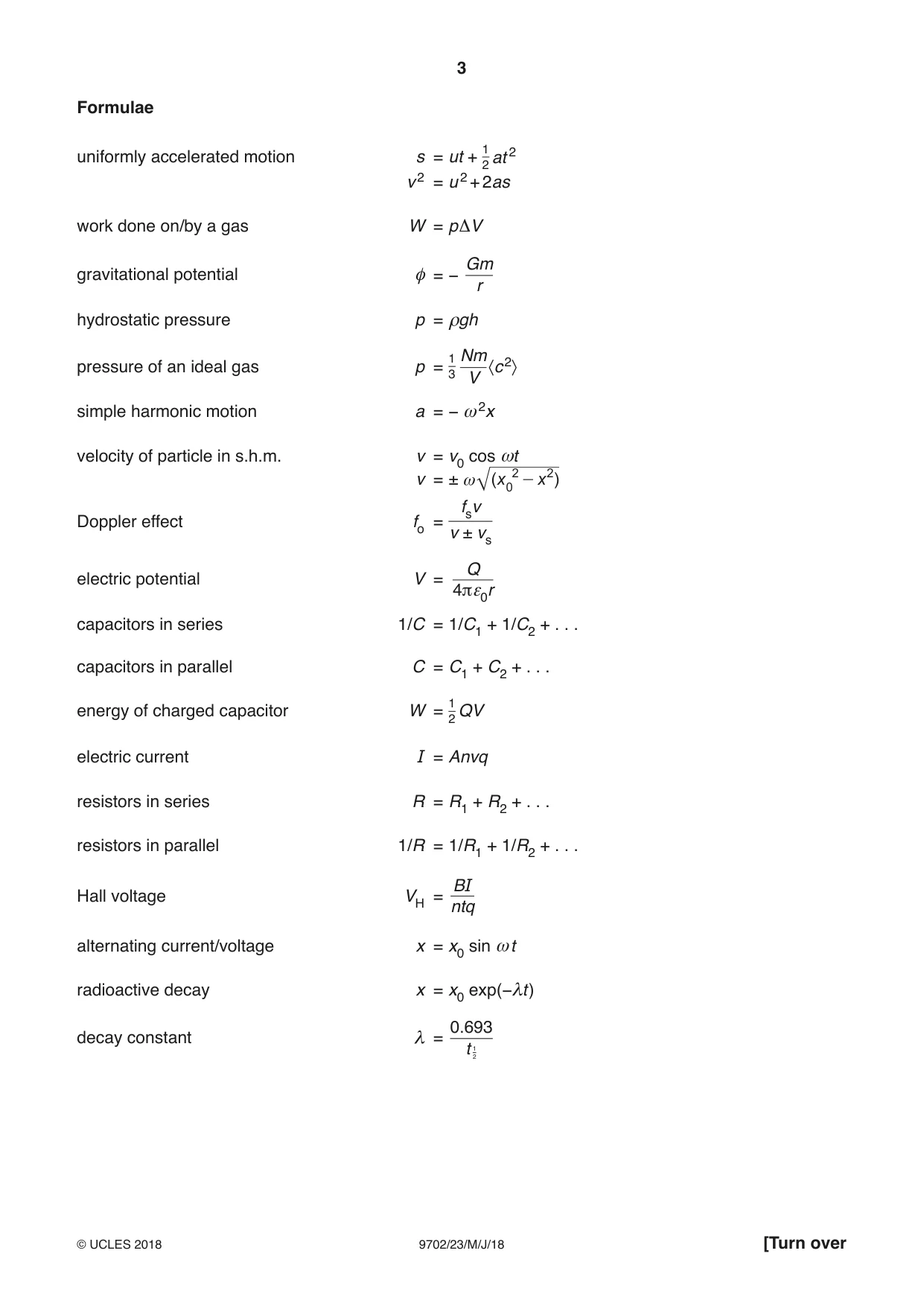

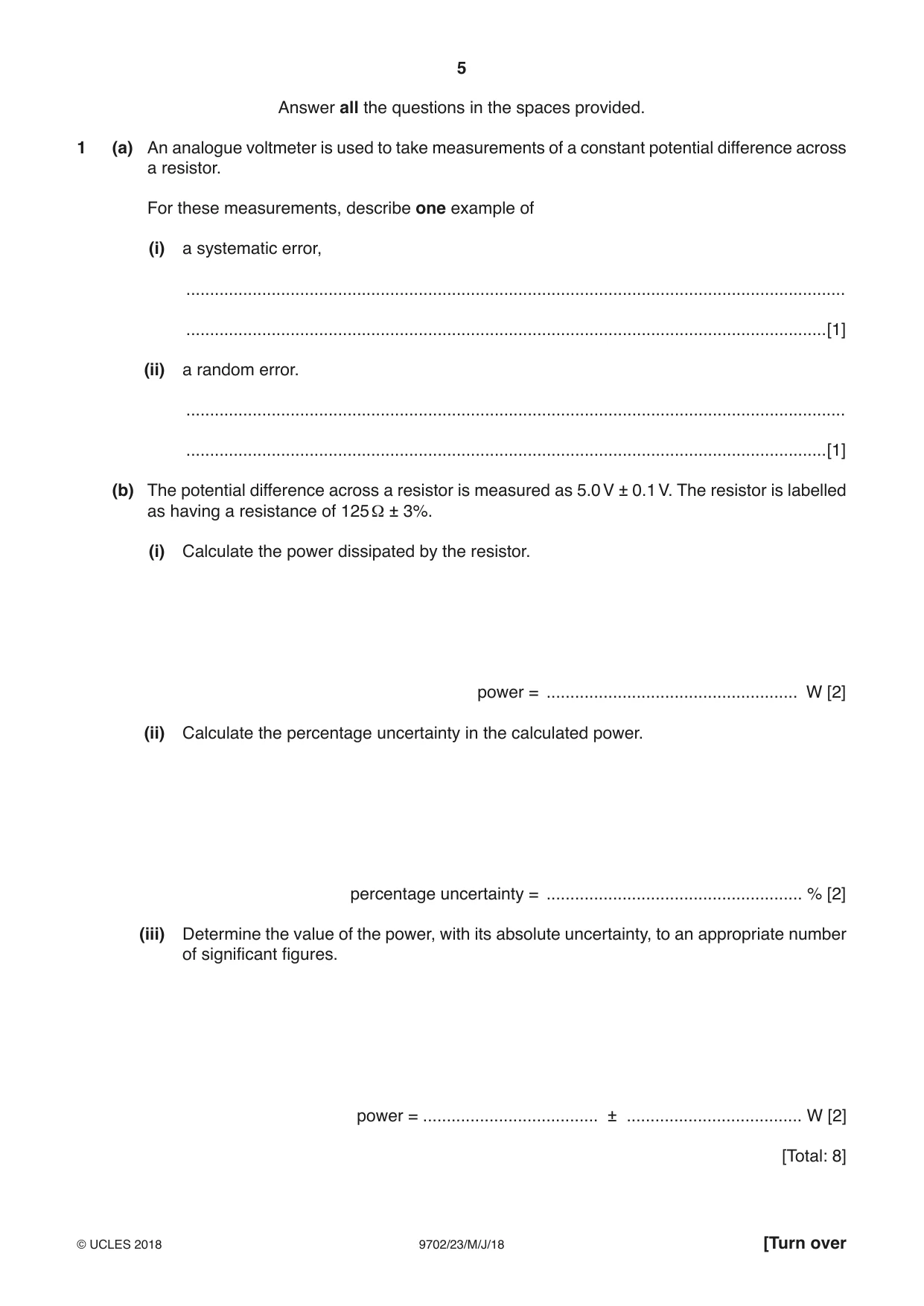
Mark scheme10 pages
Answers below. Sit the paper first if you are practising.
Questions as text
Q1 · An analogue voltmeter is used to take measurements of a constant potential difference…
1 (a) An analogue voltmeter is used to take measurements of a constant potential difference across a resistor. For these measurements, describe one example of (i) a systematic error, ........................................................................................................................................... .......................................................................................................................................[1] (ii) a random error. ........................................................................................................................................... .......................................................................................................................................[1] (b) The potential difference across a resistor is measured as 5.0 V ± 0.1 V. The resistor is labelled as having a resistance of 125 Ω ± 3%. (i) Calculate the power dissipated by the resistor. power = ..................................................... W [2] (ii) Calculate the percentage uncertainty in the calculated power. percentage uncertainty = ...................................................... % [2] (iii) Determine the value of the power, with its absolute uncertainty, to an appropriate number of significant figures. power = ..................................... ± ..................................... W [2] [Total: 8]
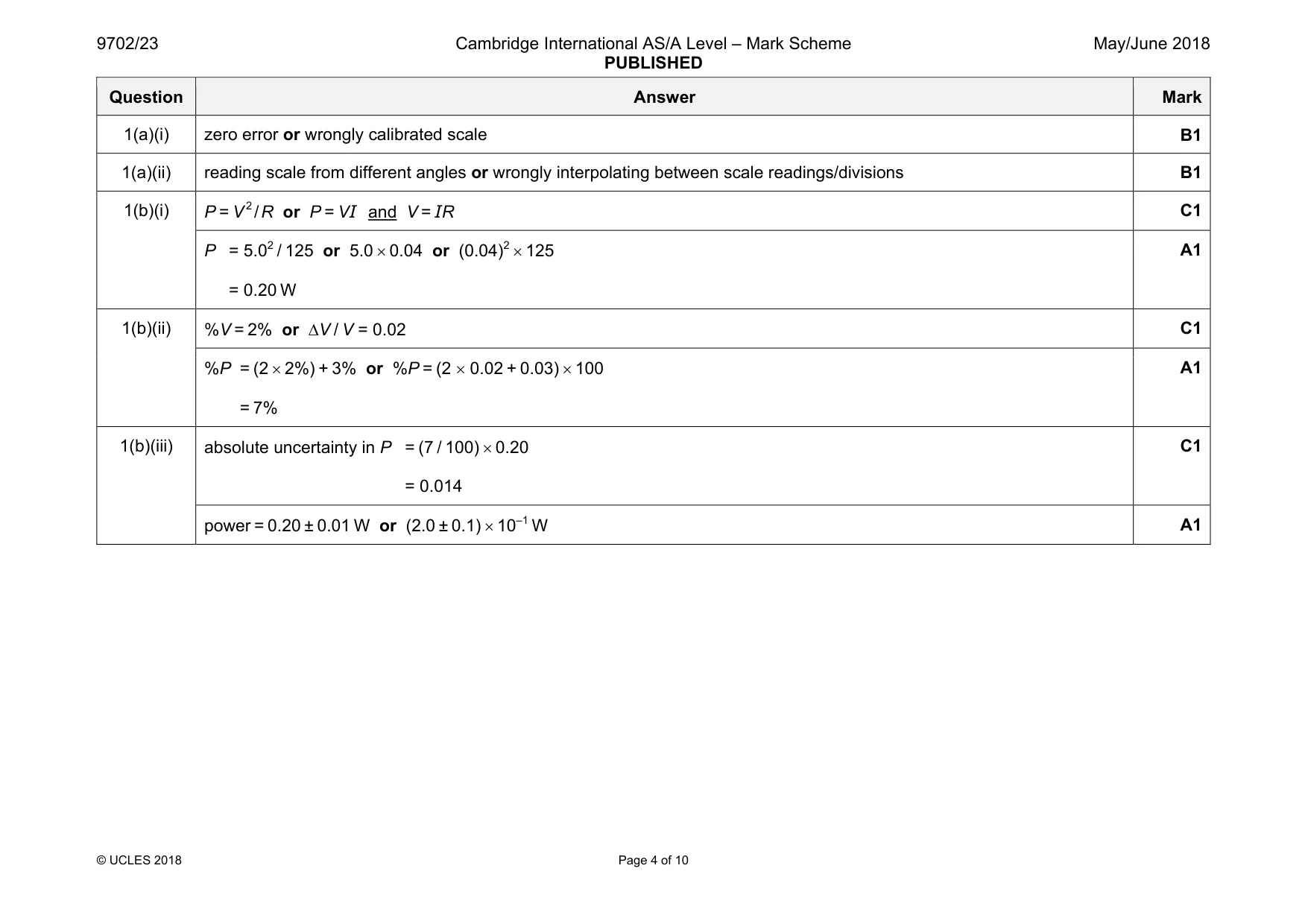
Mark scheme: 1(a)(i) zero error or wrongly calibrated scale B1 1(a)(ii) reading scale from different angles or wrongly interpolating between scale readings/divisions B1 1(b)(i) P = V 2 / R or P = VI and V = IR C1 P = 5.02 / 125 or 5.0 × 0.04 or (0.04)2 × 125 = 0.20 W A1 1(b)(ii) %V = 2% or ∆V / V = 0.02 C1 %P = (2 × 2%) + 3% or %P = (2 × 0.02 + 0.03) × 100 = 7% A1 1(b)(iii) absolute uncertainty in P = (7 / 100) × 0.20 = 0.014 C1 power = 0.20 ± 0.01 W or (2.0 ± 0.1) × 10–1 W A1
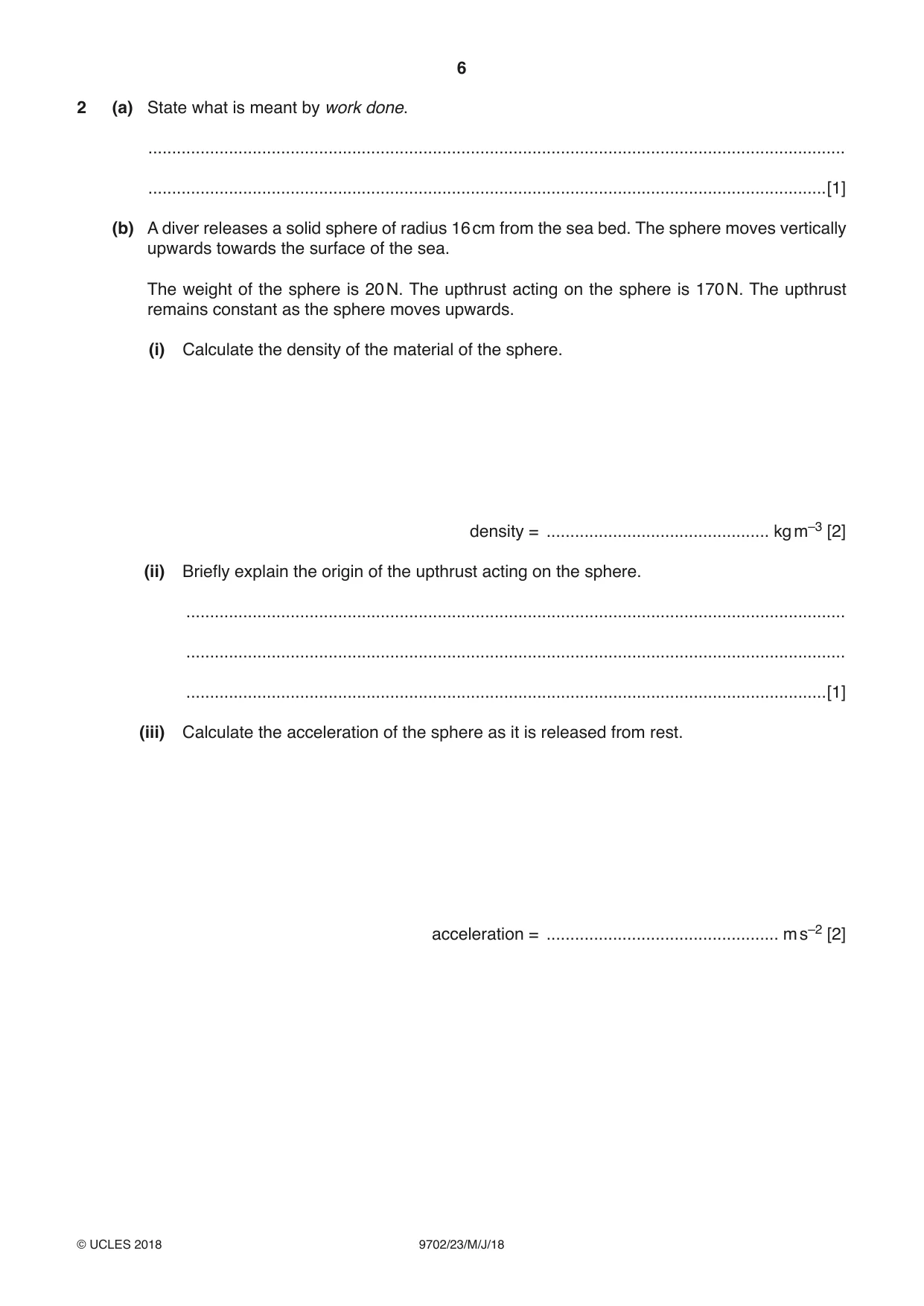
Q2 · State what is meant by work done
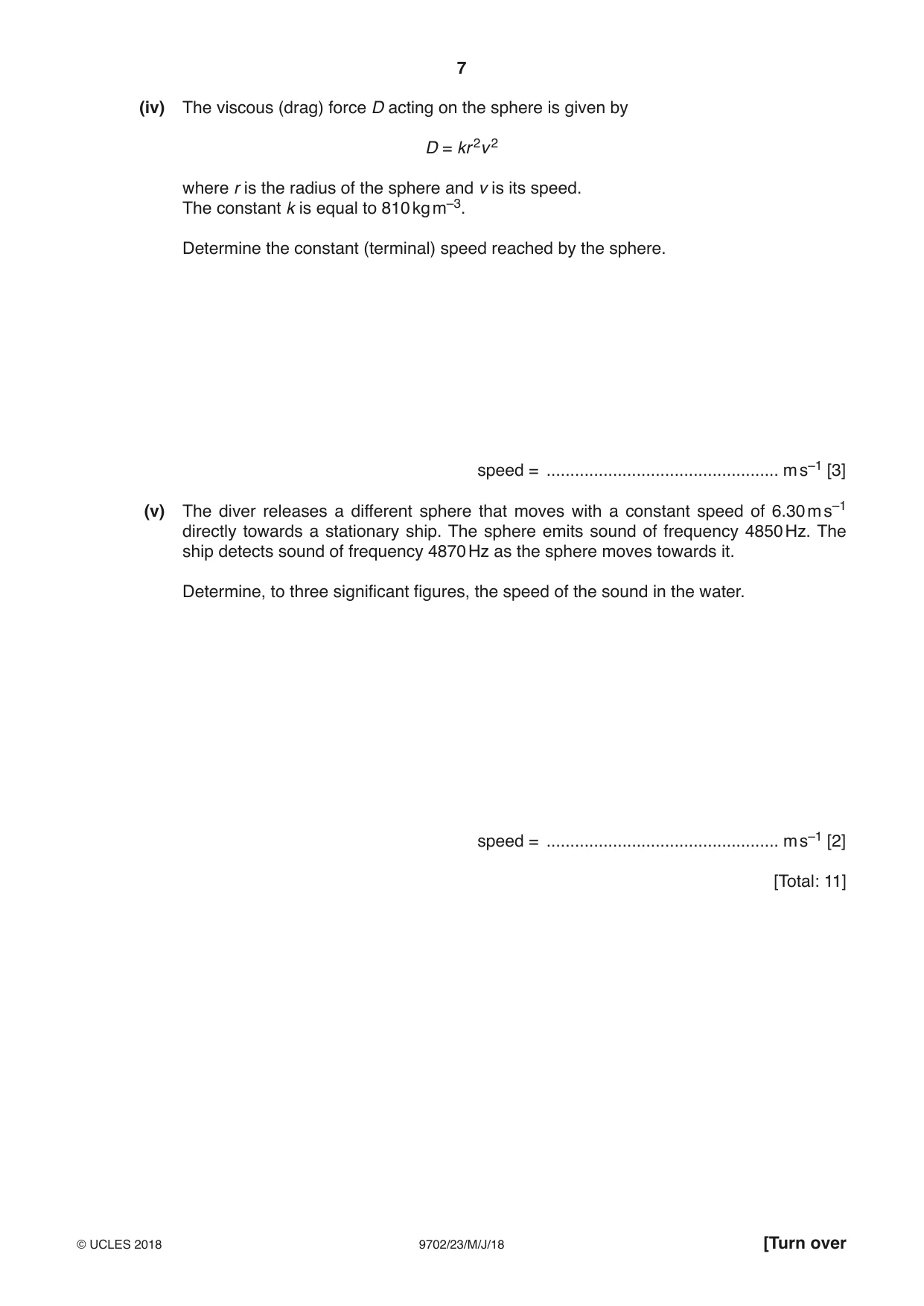
2 (a) State what is meant by work done. ................................................................................................................................................... ...............................................................................................................................................[1] (b) A diver releases a solid sphere of radius 16 cm from the sea bed. The sphere moves vertically upwards towards the surface of the sea. The weight of the sphere is 20 N. The upthrust acting on the sphere is 170 N. The upthrust remains constant as the sphere moves upwards. (i) Calculate the density of the material of the sphere. density = ............................................... kg m–3 [2] (ii) Briefly explain the origin of the upthrust acting on the sphere. ........................................................................................................................................... ........................................................................................................................................... .......................................................................................................................................[1] (iii) Calculate the acceleration of the sphere as it is released from rest. acceleration = ................................................. m s–2 [2] (iv) The viscous (drag) force D acting on the sphere is given by D = kr 2v 2 where r is the radius of the sphere and v is its speed. The constant k is equal to 810 kg m–3. Determine the constant (terminal) speed reached by the sphere. speed = ................................................. m s–1 [3] (v) The diver releases a different sphere that moves with a constant speed of 6.30 m s–1 directly towards a stationary ship. The sphere emits sound of frequency 4850 Hz. The ship detects sound of frequency 4870 Hz as the sphere moves towards it. Determine, to three significant figures, the speed of the sound in the water. speed = ................................................. m s–1 [2] [Total: 11]
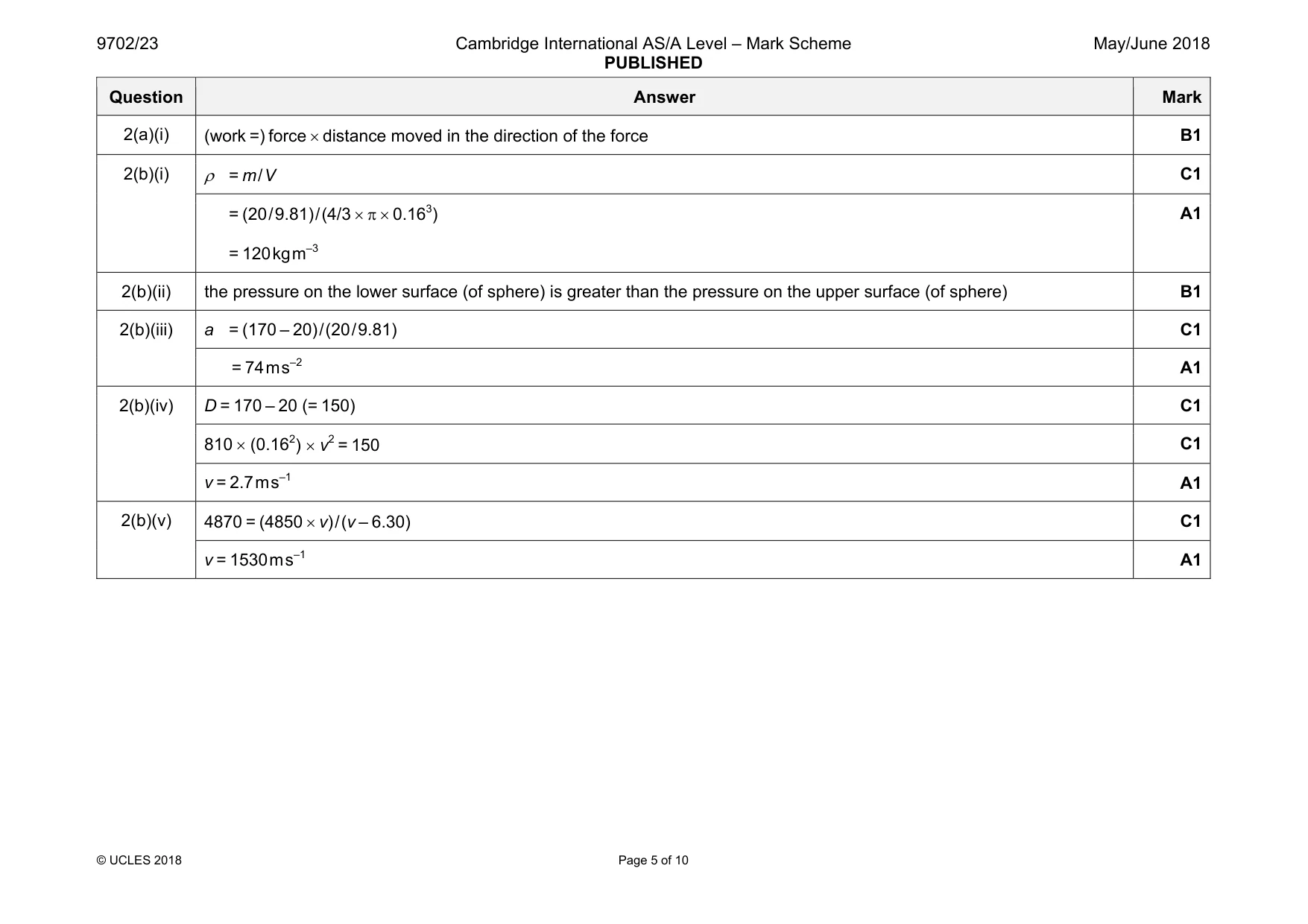
Mark scheme: 2(a)(i) B1 2(b)(i) ρ = m / V C1 = (20 / 9.81) / (4/3 × π × 0.163) = 120 kg m–3 A1 2(b)(ii) the pressure on the lower surface (of sphere) is greater than the pressure on the upper surface (of sphere) B1 2(b)(iii) a = (170 – 20) / (20 / 9.81) C1 = 74 m s–2 A1 2(b)(iv) D = 170 – 20 (= 150) C1 810 × (0.162) × v2 = 150 C1 v = 2.7 m s–1 A1 2(b)(v) 4870 = (4850 × v) / (v – 6.30) C1 v = 1530 m s–1 A1
Q3 · A ball is thrown vertically upwards towards a ceiling and then rebounds, as illustrated…
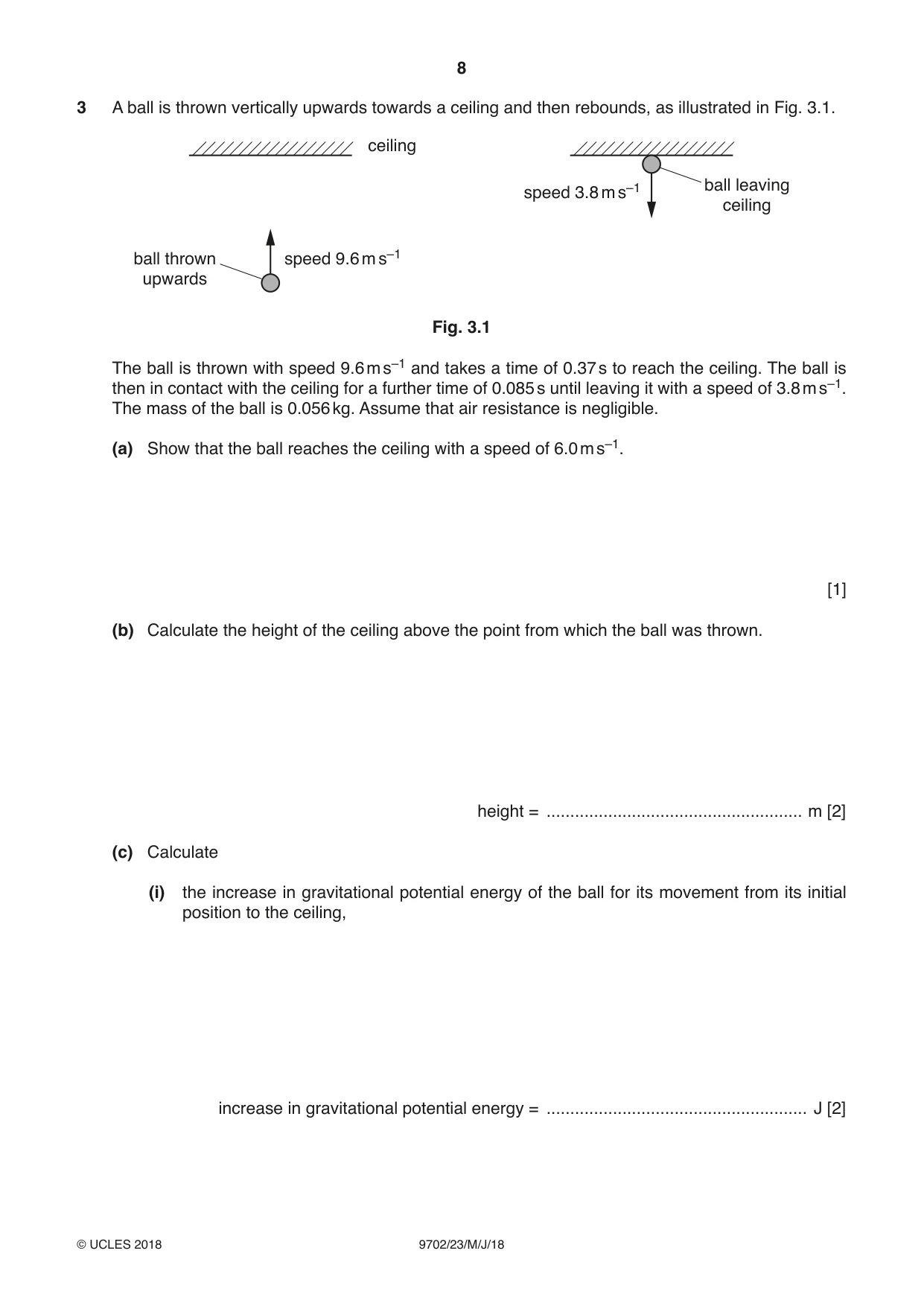
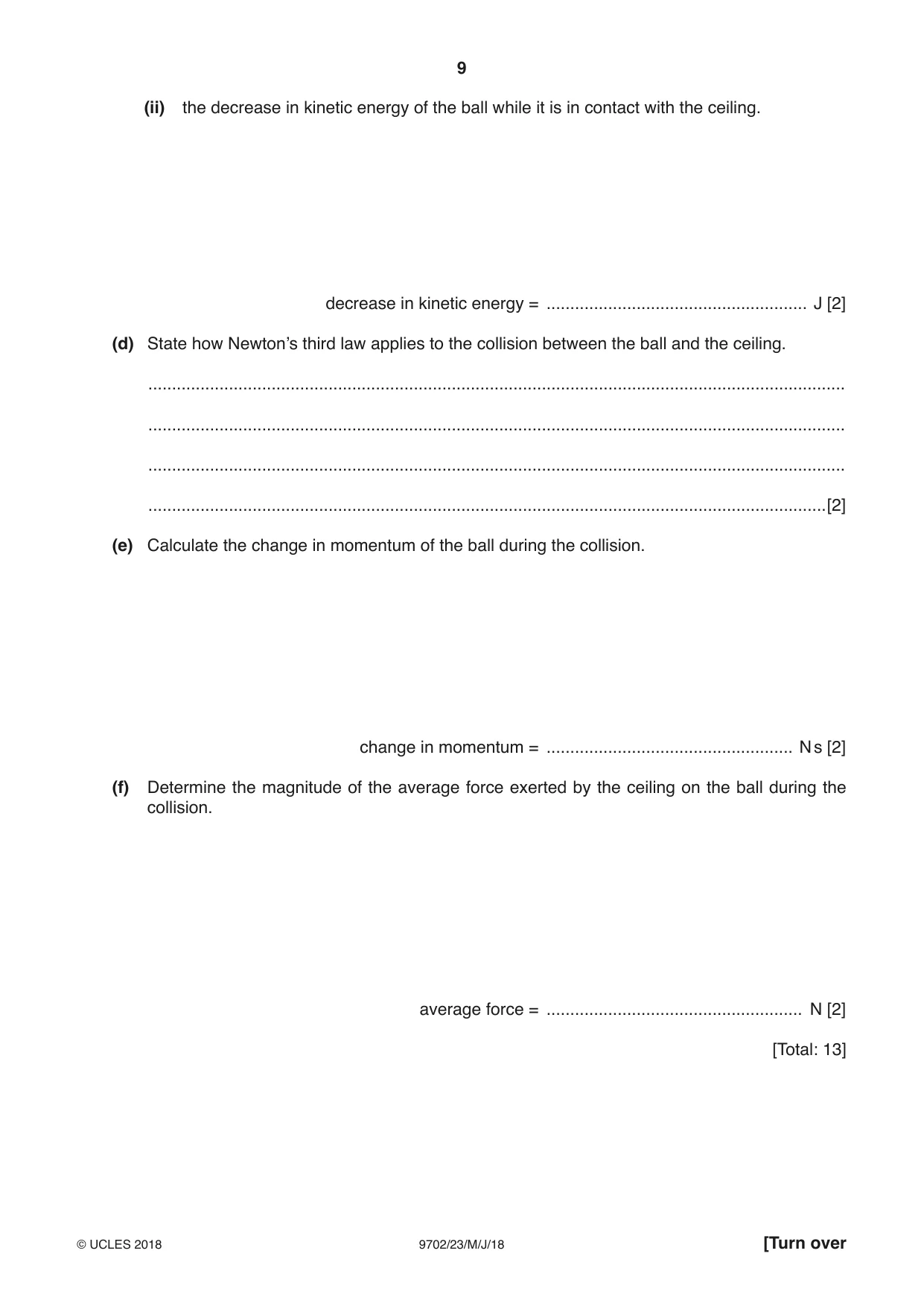
3 A ball is thrown vertically upwards towards a ceiling and then rebounds, as illustrated in Fig. 3.1. ceiling ball leaving speed 3.8 m s–1 ceiling ball thrown speed 9.6 m s–1 upwards Fig. 3.1 The ball is thrown with speed 9.6 m s–1 and takes a time of 0.37 s to reach the ceiling. The ball is then in contact with the ceiling for a further time of 0.085 s until leaving it with a speed of 3.8 m s–1. The mass of the ball is 0.056 kg. Assume that air resistance is negligible. (a) Show that the ball reaches the ceiling with a speed of 6.0 m s–1. [1] (b) Calculate the height of the ceiling above the point from which the ball was thrown. height = ...................................................... m [2] (c) Calculate (i) the increase in gravitational potential energy of the ball for its movement from its initial position to the ceiling, increase in gravitational potential energy = ....................................................... J [2] (ii) the decrease in kinetic energy of the ball while it is in contact with the ceiling. decrease in kinetic energy = ....................................................... J [2] (d) State how Newton’s third law applies to the collision between the ball and the ceiling. ................................................................................................................................................... ................................................................................................................................................... ................................................................................................................................................... ...............................................................................................................................................[2] (e) Calculate the change in momentum of the ball during the collision. change in momentum = .................................................... N s [2] (f) Determine the magnitude of the average force exerted by the ceiling on the ball during the collision. average force = ...................................................... N [2] [Total: 13]
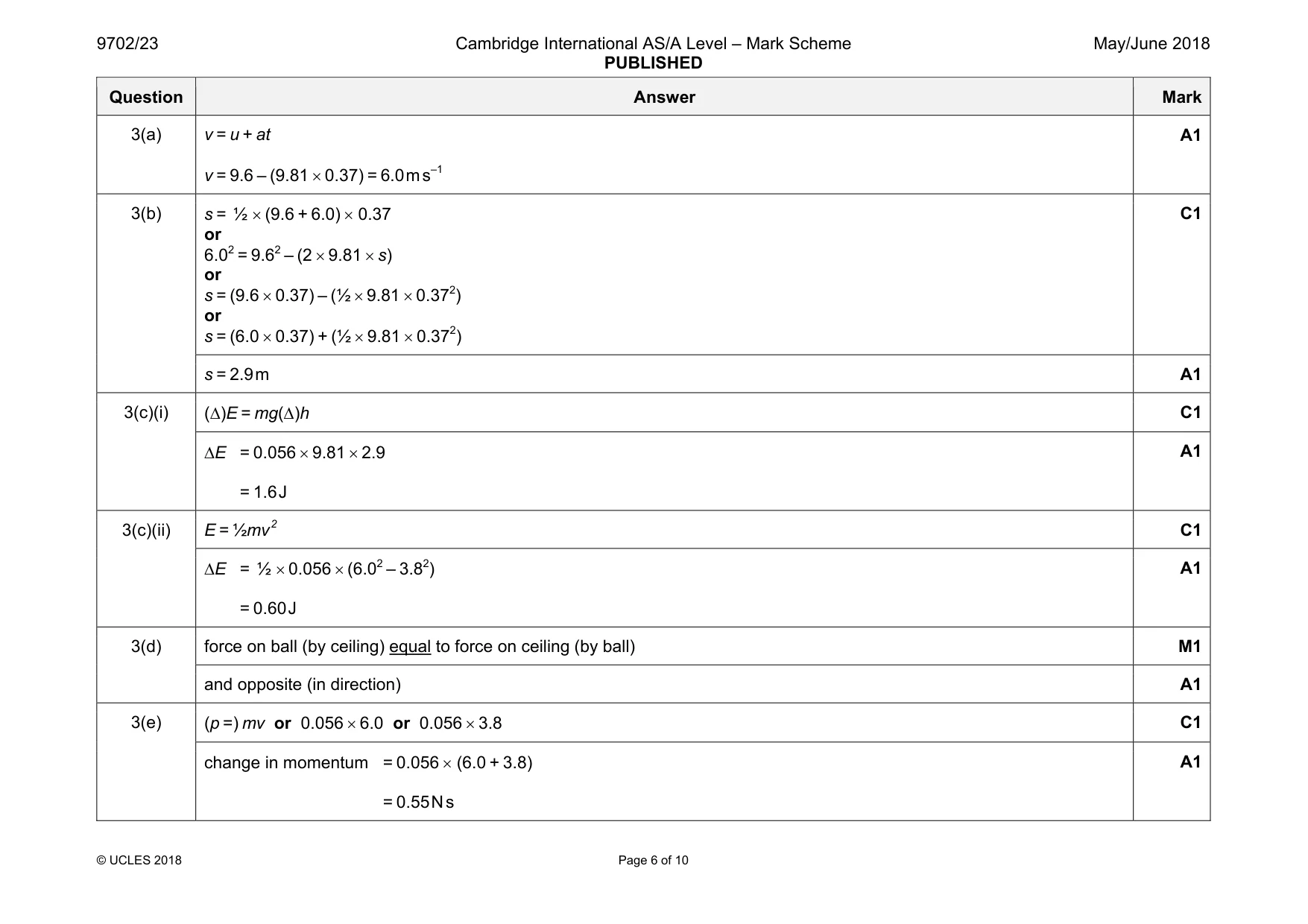
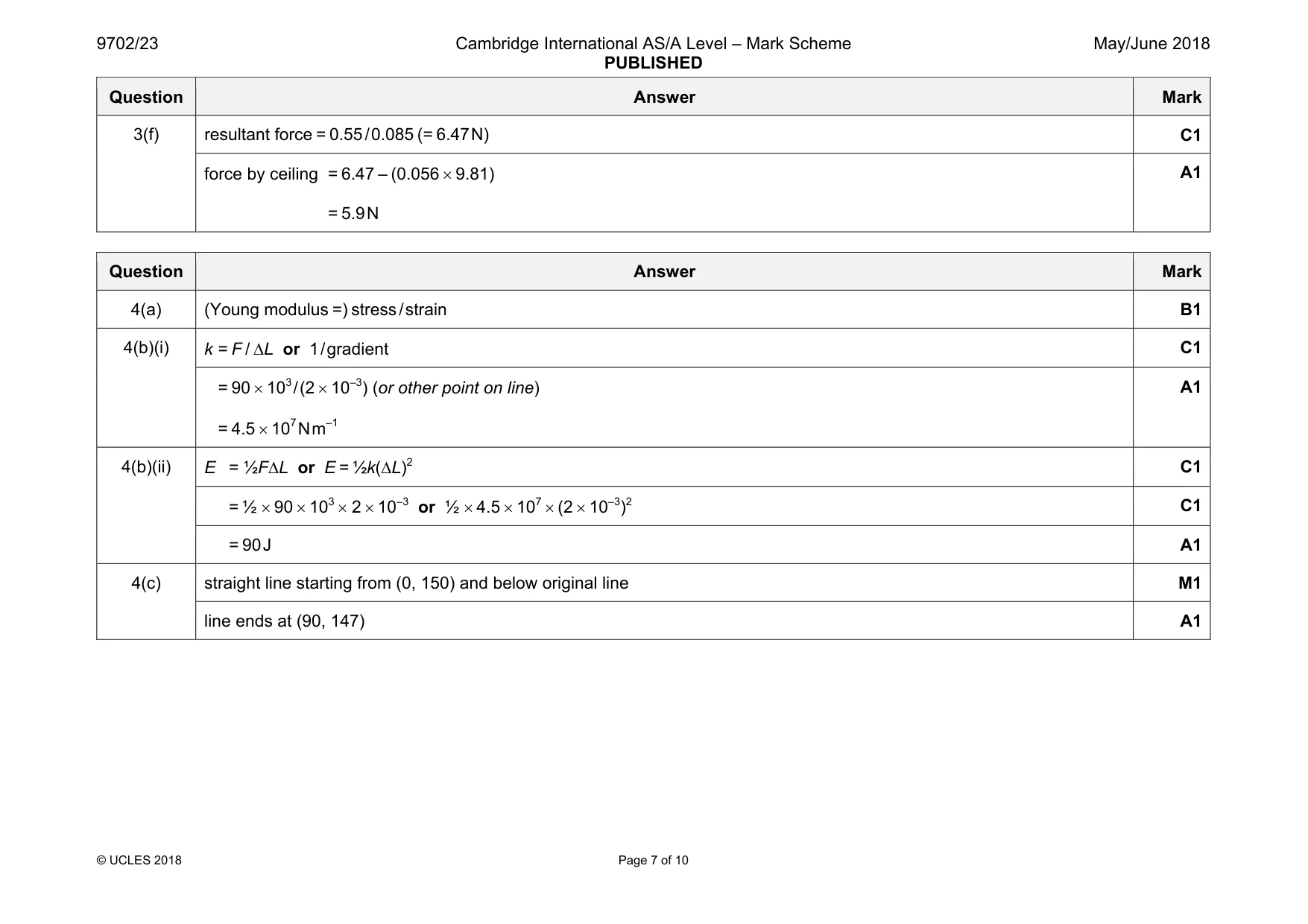
Mark scheme: 3(a) v = u + at v = 9.6 – (9.81 × 0.37) = 6.0 m s–1 A1 3(b) s = ½ × (9.6 + 6.0) × 0.37 or 6.02 = 9.62 – (2 × 9.81 × s) or s = (9.6 × 0.37) – (½ × 9.81 × 0.372) or s = (6.0 × 0.37) + (½ × 9.81 × 0.372) C1 s = 2.9 m A1 3(c)(i) (∆)E = mg(∆)h C1 ∆E = 0.056 × 9.81 × 2.9 = 1.6 J A1 3(c)(ii) E = ½mv 2 C1 ∆E = ½ × 0.056 × (6.02 – 3.82) = 0.60 J A1 3(d) force on ball (by ceiling) equal to force on ceiling (by ball) M1 and opposite (in direction) A1 3(e) (p =) mv or 0.056 × 6.0 or 0.056 × 3.8 C1 change in momentum = 0.056 × (6.0 + 3.8) = 0.55 N s A1 Question Answer Mark 3(f) resultant force = 0.55 / 0.085 (= 6.47 N) C1 force by ceiling = 6.47 – (0.056 × 9.81) = 5.9 N A1
More questions on Gravitational potential energy and kinetic energy
Q4 · Define the Young modulus of a material
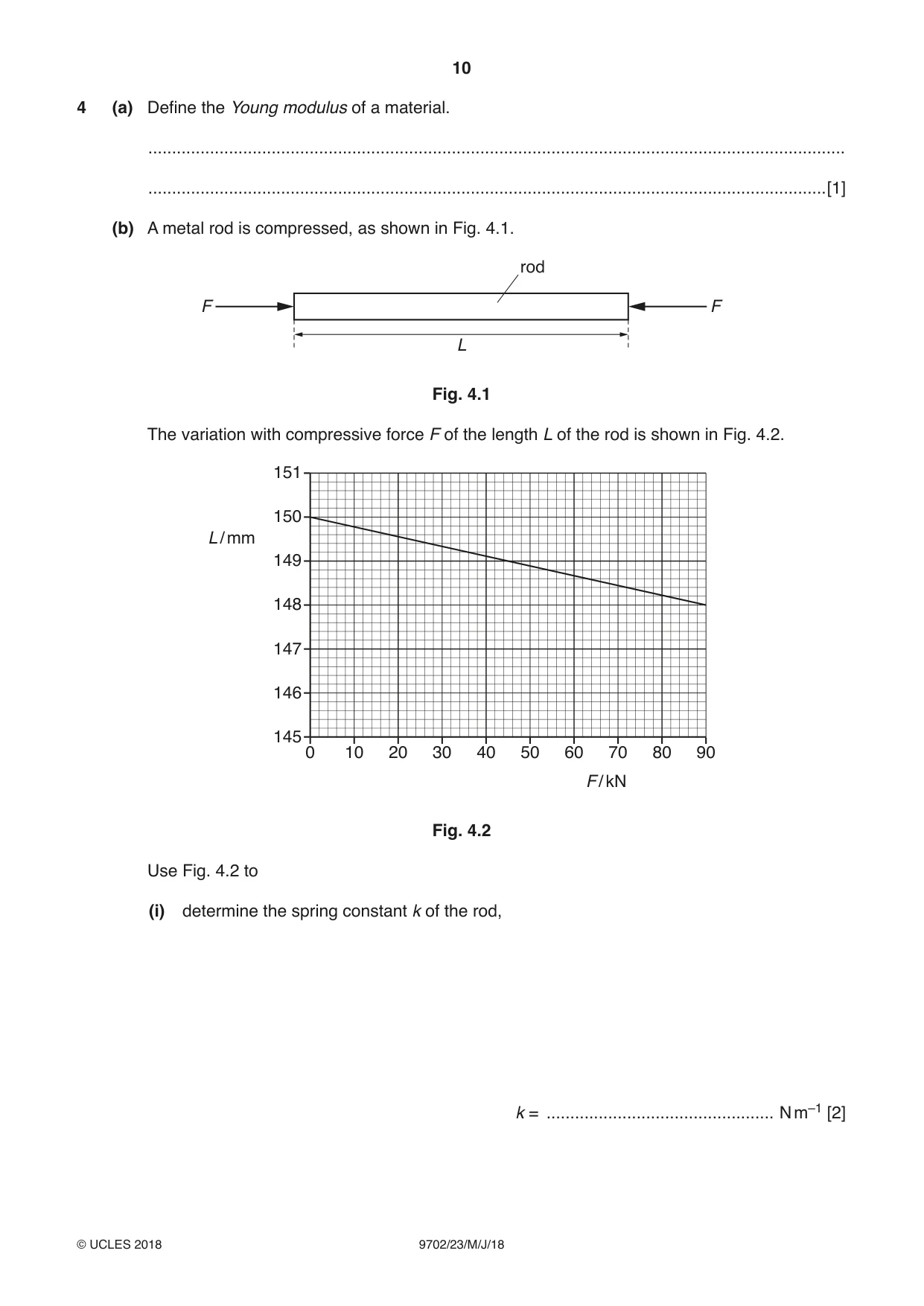
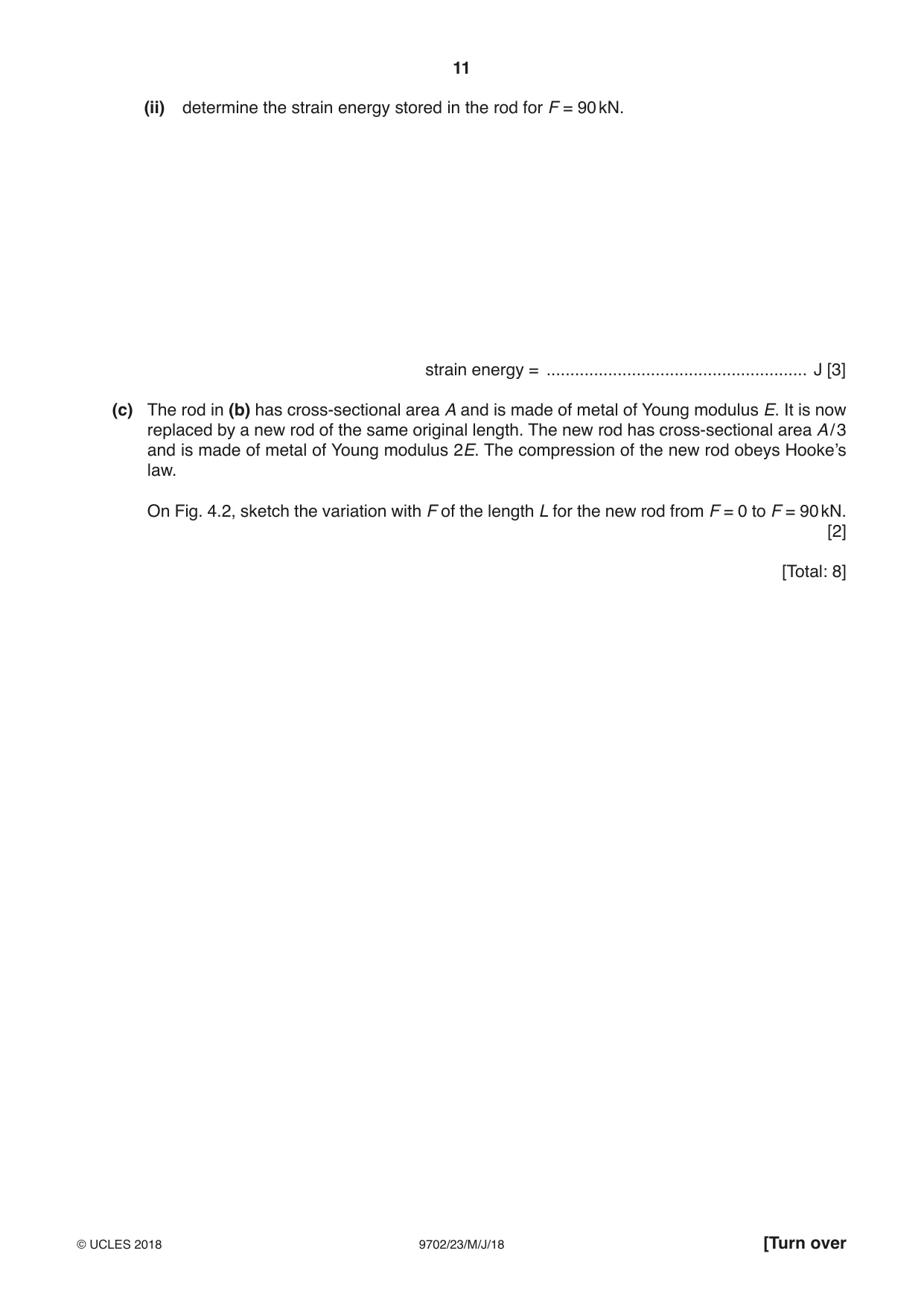
4 (a) Define the Young modulus of a material. ................................................................................................................................................... ...............................................................................................................................................[1] (b) A metal rod is compressed, as shown in Fig. 4.1. rod F F L Fig. 4.1 The variation with compressive force F of the length L of the rod is shown in Fig. 4.2. 151 150 L / mm 149 148 147 146 145 0 10 20 30 40 50 60 70 80 90 F / kN Fig. 4.2 Use Fig. 4.2 to (i) determine the spring constant k of the rod, k = ................................................ N m–1 [2] (ii) determine the strain energy stored in the rod for F = 90 kN. strain energy = ....................................................... J [3] (c) The rod in (b) has cross-sectional area A and is made of metal of Young modulus E. It is now replaced by a new rod of the same original length. The new rod has cross-sectional area A / 3 and is made of metal of Young modulus 2E. The compression of the new rod obeys Hooke’s law. On Fig. 4.2, sketch the variation with F of the length L for the new rod from F = 0 to F = 90 kN. [2] [Total: 8]
Mark scheme: 4(a) (Young modulus =) stress / strain B1 4(b)(i) k = F / ∆L or 1 / gradient C1 = 90 × 103 / (2 × 10⁻³) (or other point on line) = 4.5 × 10⁷ N m–1 A1 4(b)(ii) E = ½F∆L or E = ½k(∆L)2 C1 = ½ × 90 × 103 × 2 × 10–3 or ½ × 4.5 × 107 × (2 × 10–3)2 C1 = 90 J A1 4(c) straight line starting from (0, 150) and below original line M1 line ends at (90, 147) A1
Q5 · State the relationship between the intensity and the amplitude of a wave
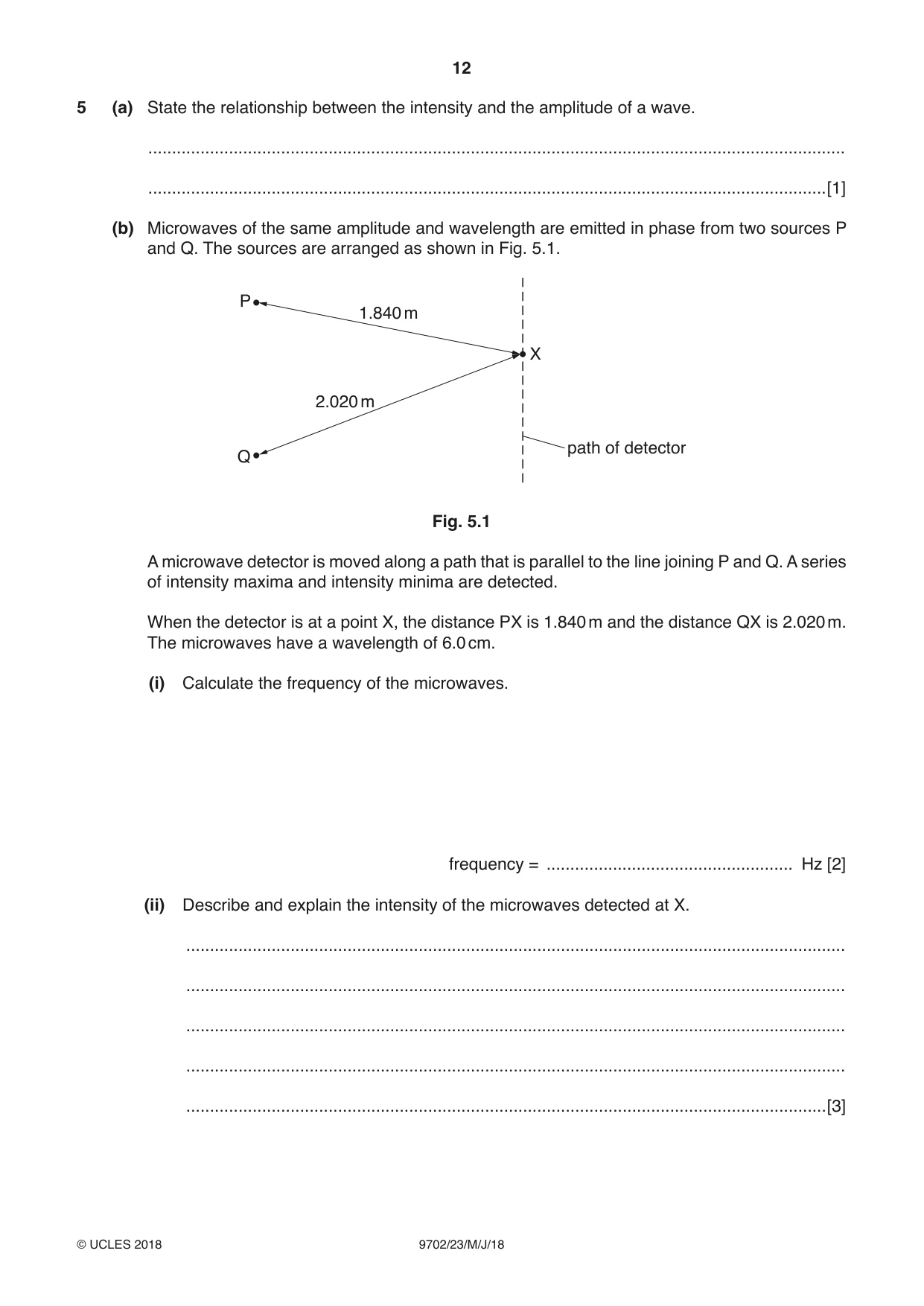
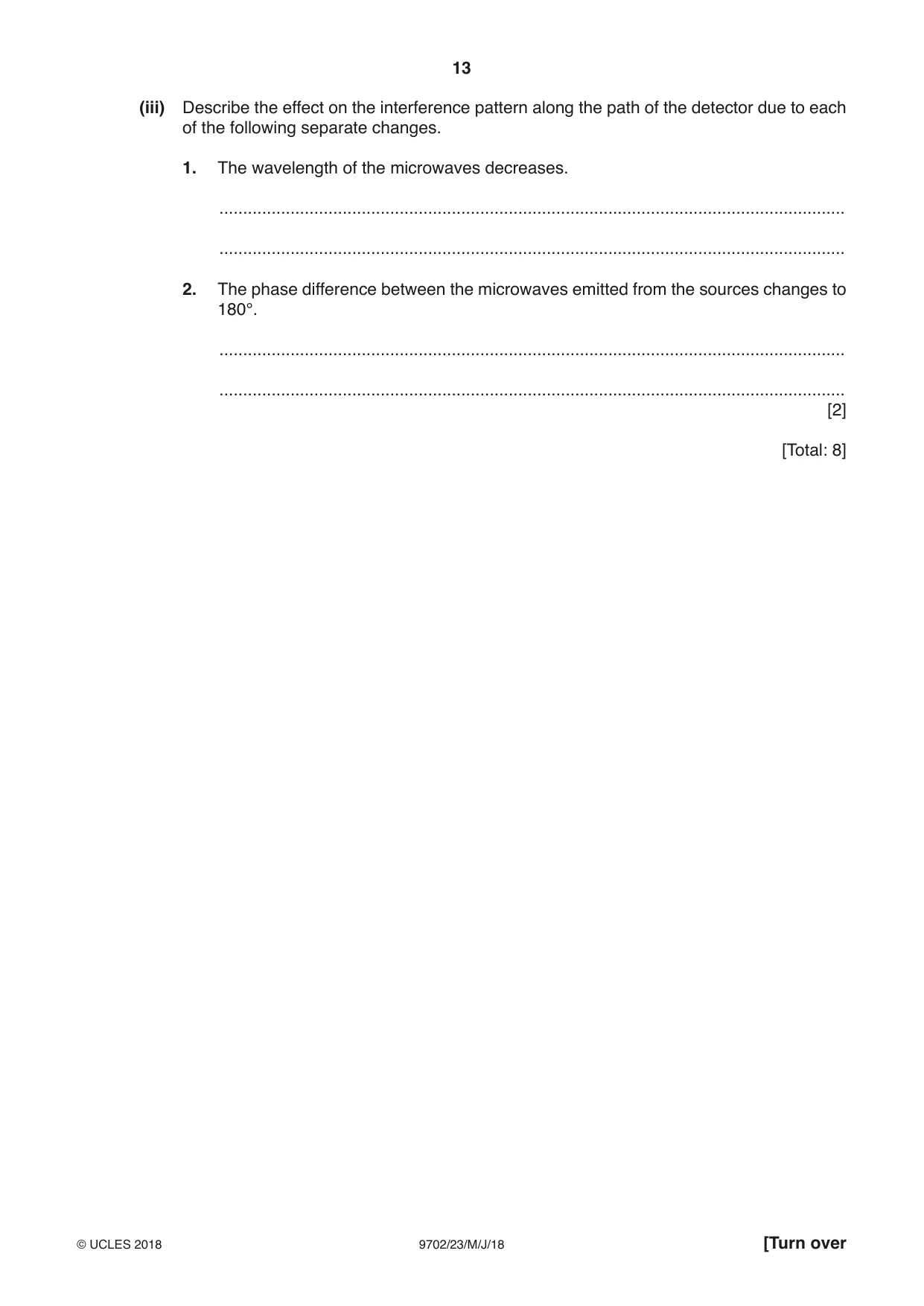
5 (a) State the relationship between the intensity and the amplitude of a wave. ................................................................................................................................................... ...............................................................................................................................................[1] (b) Microwaves of the same amplitude and wavelength are emitted in phase from two sources P and Q. The sources are arranged as shown in Fig. 5.1. P 1.840 m X 2.020 m path of detector Q Fig. 5.1 A microwave detector is moved along a path that is parallel to the line joining P and Q. A series of intensity maxima and intensity minima are detected. When the detector is at a point X, the distance PX is 1.840 m and the distance QX is 2.020 m. The microwaves have a wavelength of 6.0 cm. (i) Calculate the frequency of the microwaves. frequency = .................................................... Hz [2] (ii) Describe and explain the intensity of the microwaves detected at X. ........................................................................................................................................... ........................................................................................................................................... ........................................................................................................................................... ........................................................................................................................................... .......................................................................................................................................[3] (iii) Describe the effect on the interference pattern along the path of the detector due to each of the following separate changes. 1. The wavelength of the microwaves decreases. .................................................................................................................................... .................................................................................................................................... 2. The phase difference between the microwaves emitted from the sources changes to 180°. .................................................................................................................................... .................................................................................................................................... [2] [Total: 8]
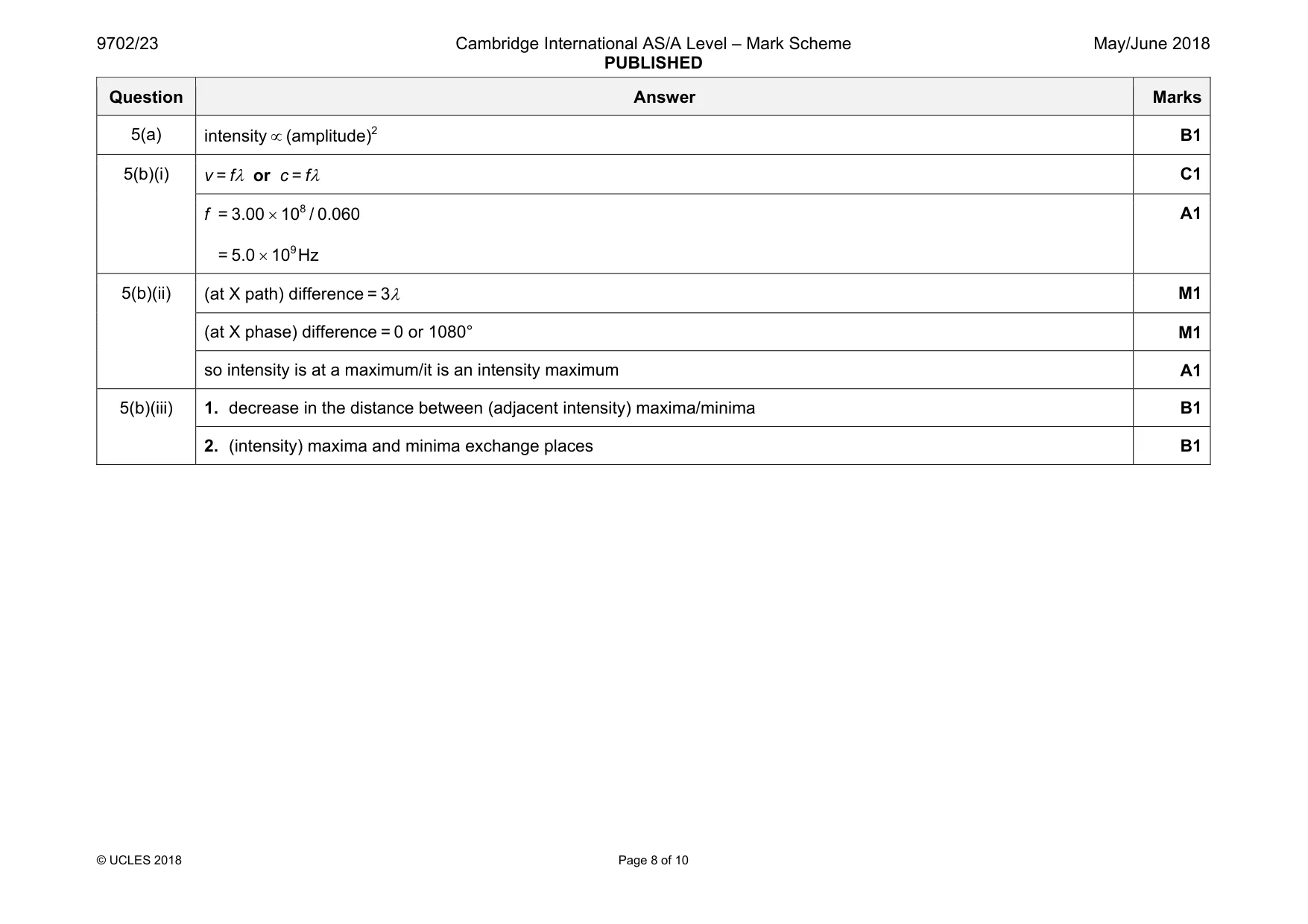
Mark scheme: 5(a) B1 5(b)(i) v = fλ or c = fλ C1 f = 3.00 × 10⁸ / 0.060 = 5.0 × 10⁹ Hz A1 5(b)(ii) (at X path) difference = 3λ M1 (at X phase) difference = 0 or 1080° M1 so intensity is at a maximum/it is an intensity maximum A1 5(b)(iii) 1. decrease in the distance between (adjacent intensity) maxima/minima B1 2. (intensity) maxima and minima exchange places B1
Q6 · A wire X has a constant resistance per unit length of 3.0 Ω m–1 and a diameter of 0.48 mm
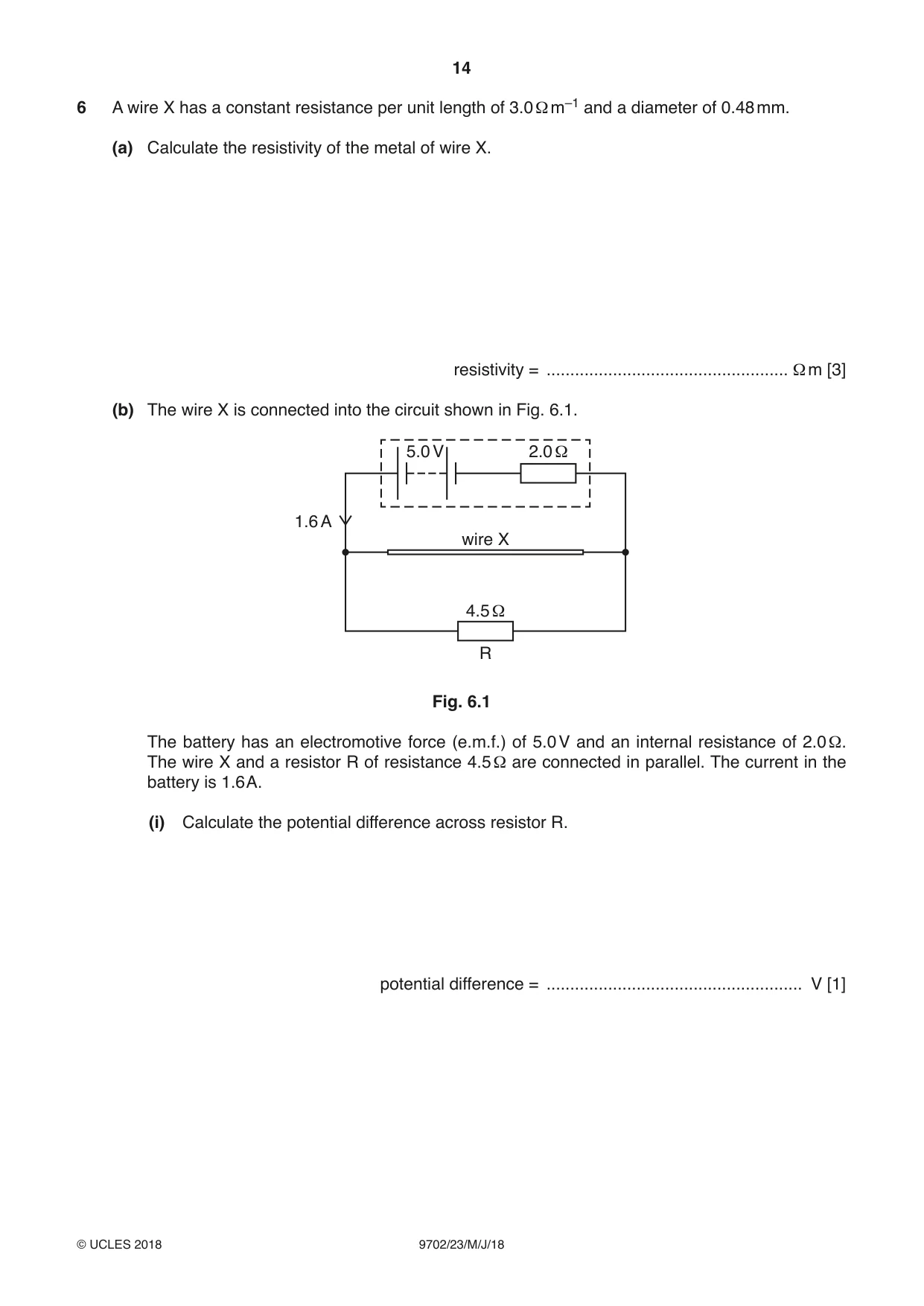
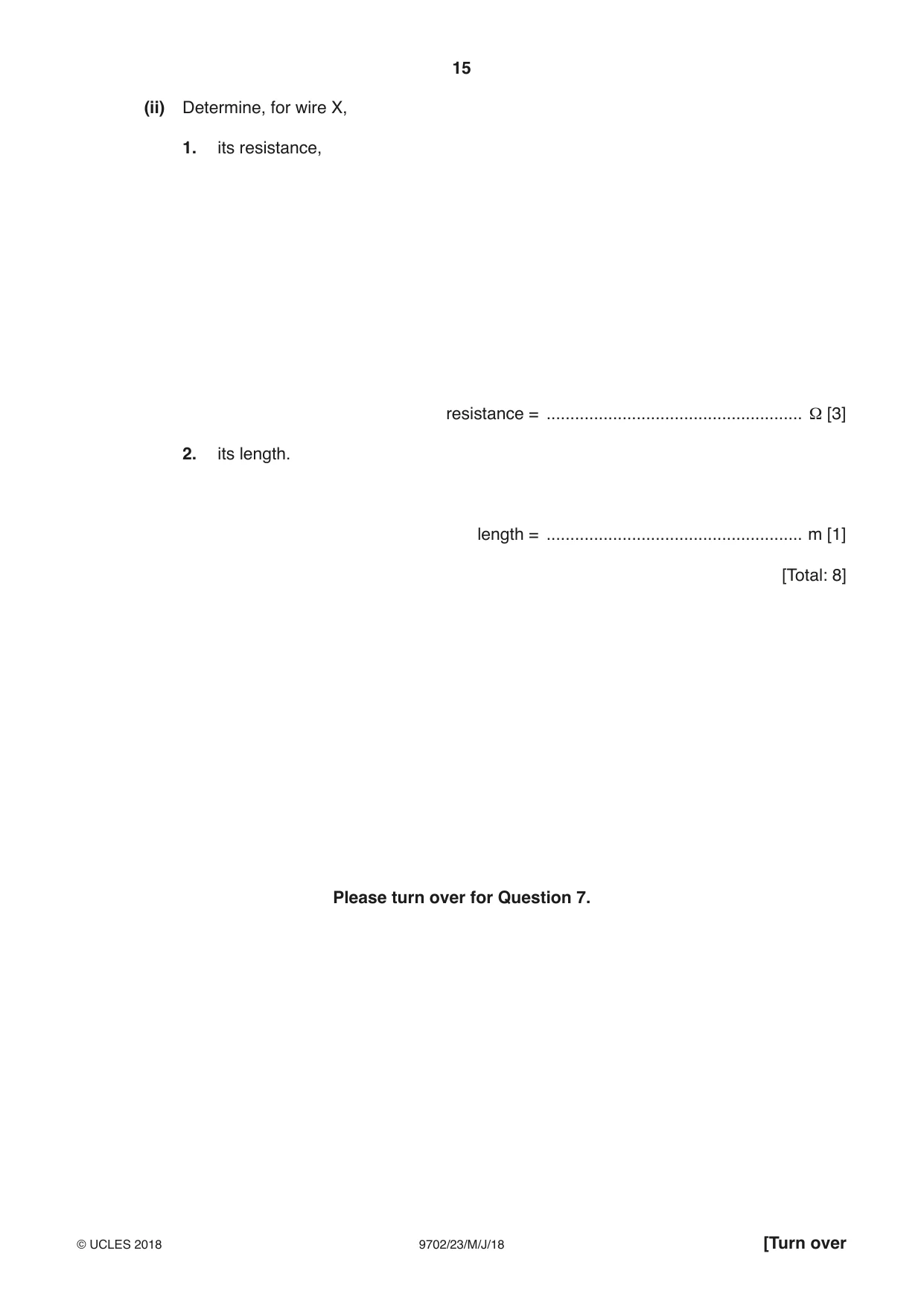
6 A wire X has a constant resistance per unit length of 3.0 Ω m–1 and a diameter of 0.48 mm. (a) Calculate the resistivity of the metal of wire X. resistivity = ................................................... Ω m [3] (b) The wire X is connected into the circuit shown in Fig. 6.1. 5.0 V 2.0 Ω 1.6 A wire X 4.5 Ω R Fig. 6.1 The battery has an electromotive force (e.m.f.) of 5.0 V and an internal resistance of 2.0 Ω. The wire X and a resistor R of resistance 4.5 Ω are connected in parallel. The current in the battery is 1.6 A. (i) Calculate the potential difference across resistor R. potential difference = ...................................................... V [1] (ii) Determine, for wire X, 1. its resistance, resistance = ...................................................... Ω [3] 2. its length. length = ...................................................... m [1] [Total: 8] Please turn over for Question 7.
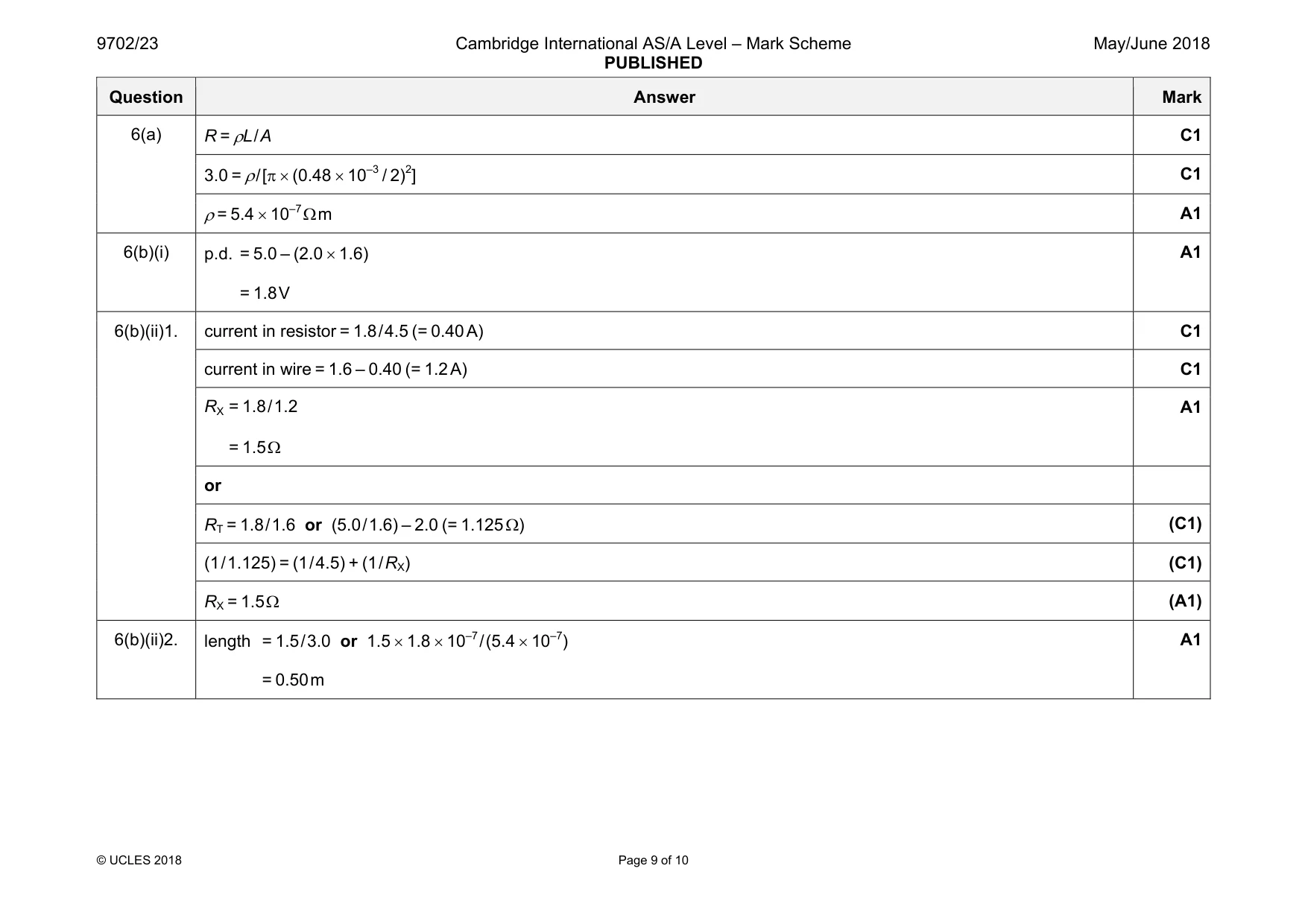
Mark scheme: 6(a) C1 3.0 = ρ / [π × (0.48 × 10⁻³ / 2)2] C1 ρ = 5.4 × 10⁻⁷ Ω m A1 6(b)(i) p.d. = 5.0 – (2.0 × 1.6) = 1.8 V A1 6(b)(ii)1. current in resistor = 1.8 / 4.5 (= 0.40 A) C1 current in wire = 1.6 – 0.40 (= 1.2 A) C1 RX = 1.8 / 1.2 = 1.5 Ω A1 or RT = 1.8 / 1.6 or (5.0 / 1.6) – 2.0 (= 1.125 Ω) (C1) (1 / 1.125) = (1 / 4.5) + (1 / RX) (C1) RX = 1.5 Ω (A1) 6(b)(ii)2. length = 1.5 / 3.0 or 1.5 × 1.8 × 10–7 / (5.4 × 10⁻⁷) = 0.50 m A1
Q7 · A graph of nucleon number A against proton number Z is shown in Fig
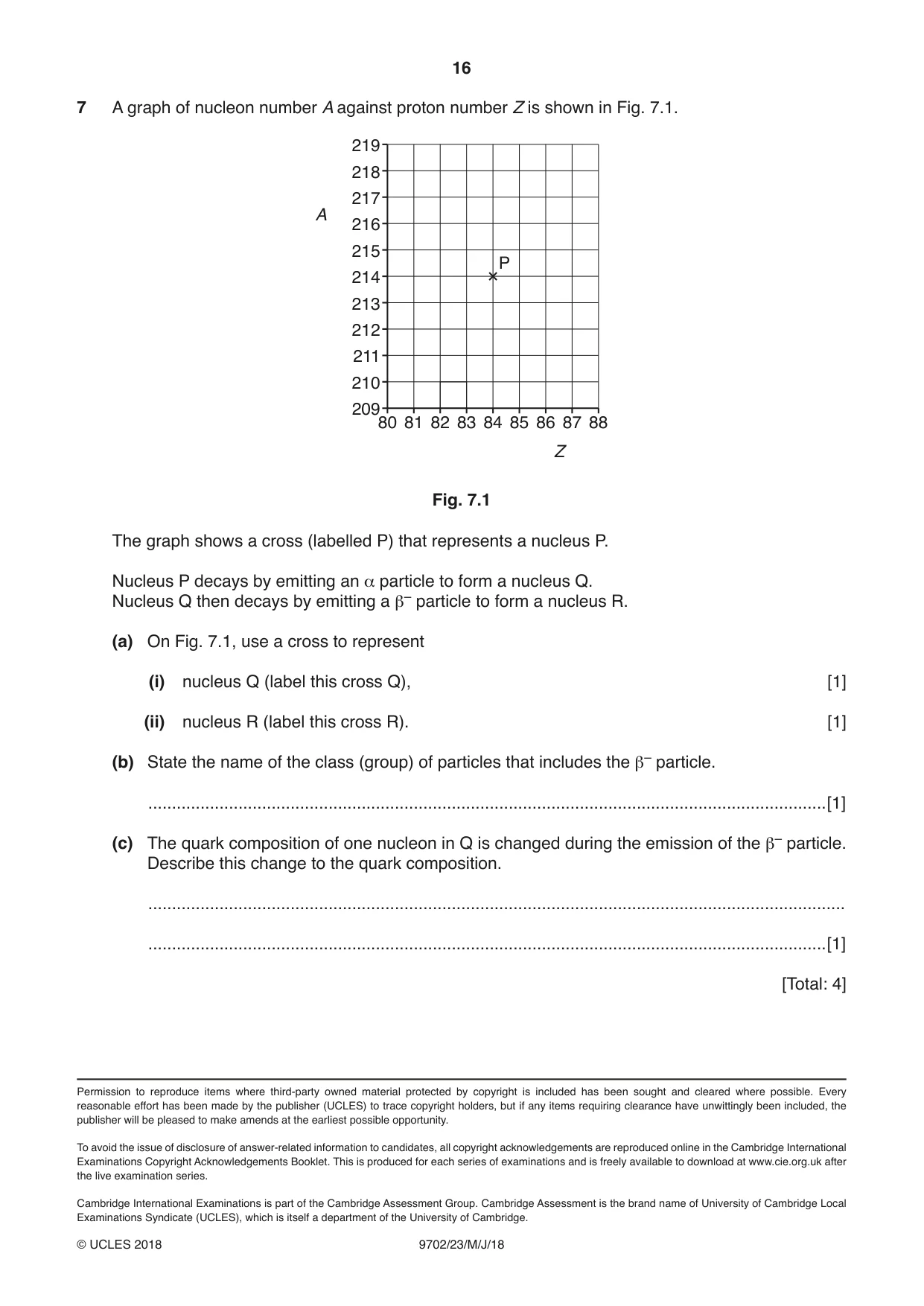
7 A graph of nucleon number A against proton number Z is shown in Fig. 7.1. 219 218 217 A 216 215 P 214 213 212 211 210 20980 81 82 83 84 85 86 87 88 Z Fig. 7.1 The graph shows a cross (labelled P) that represents a nucleus P. Nucleus P decays by emitting an α particle to form a nucleus Q. Nucleus Q then decays by emitting a β– particle to form a nucleus R. (a) On Fig. 7.1, use a cross to represent (i) nucleus Q (label this cross Q), [1] (ii) nucleus R (label this cross R). [1] (b) State the name of the class (group) of particles that includes the β– particle. ...............................................................................................................................................[1] (c) The quark composition of one nucleon in Q is changed during the emission of the β– particle. Describe this change to the quark composition. ................................................................................................................................................... ...............................................................................................................................................[1] [Total: 4]
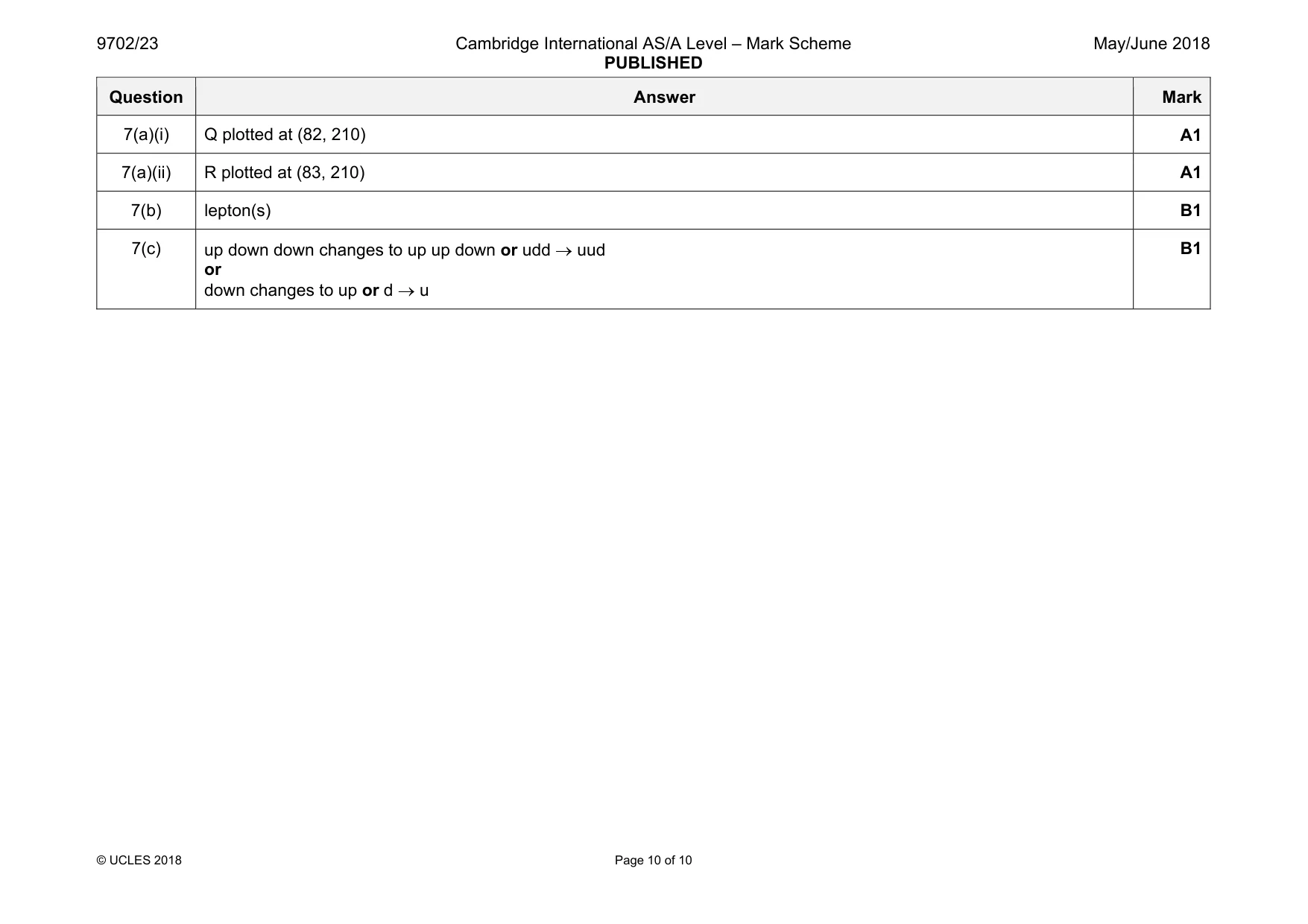
Mark scheme: 7(a)(i) Q plotted at (82, 210) A1 7(a)(ii) R plotted at (83, 210) A1 7(b) lepton(s) B1 7(c) up down down changes to up up down or udd → uud or down changes to up or d → u B1
What was in this paper
The subtopics covered by these 7 questions, and how many questions each got. Open one in a new tab to see every Cambridge question on it.
What you needed in this session
Cambridge’s own grade thresholds for 2018 May/June, Paper 2 · Variant 3. A higher threshold means an easier paper — the bar moves with how the cohort did.