Cambridge A Level Physics 9702 — 2019 May/June Paper 2 · Variant 2
9702/22/M/J/19 · 6 questions · 60 marks · ≈68 min
The question paper and its mark scheme, free to read here and free to download. This is Cambridge’s own paper, exactly as it was sat.
Question paper16 pages
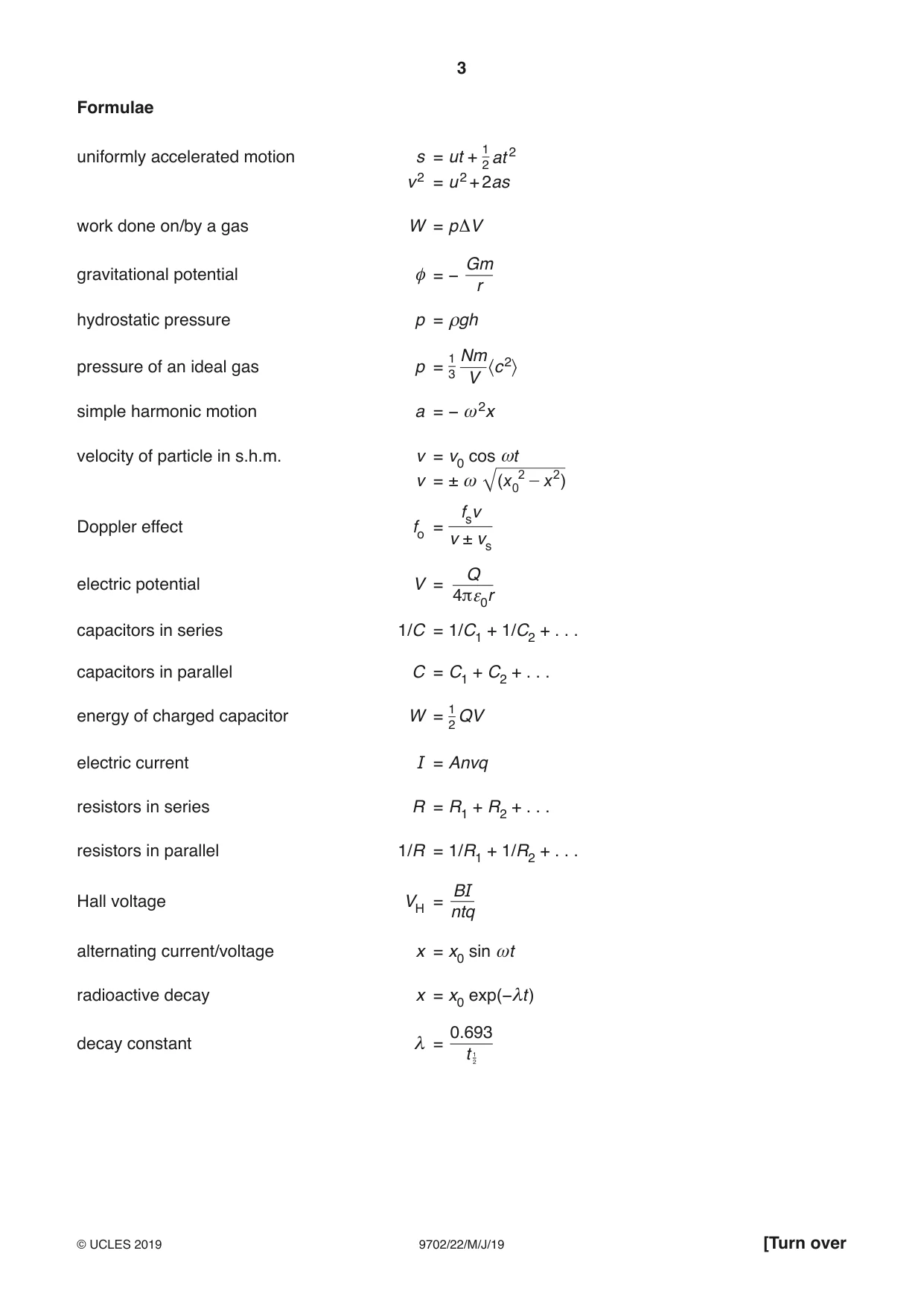


Mark scheme10 pages
Answers below. Sit the paper first if you are practising.
Questions as text
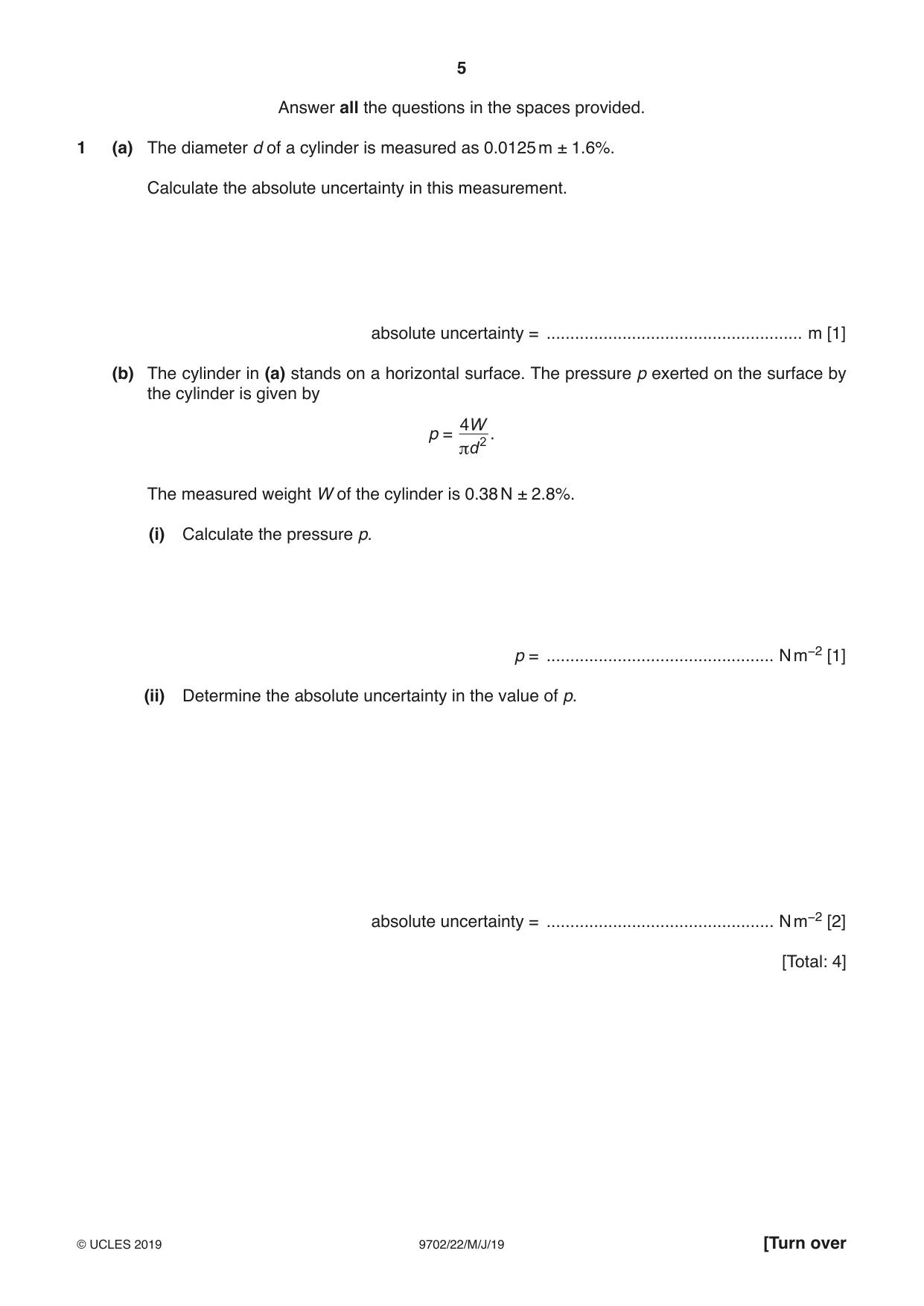
Q1 · The diameter d of a cylinder is measured as 0.0125 m ± 1.6%
1 (a) The diameter d of a cylinder is measured as 0.0125 m ± 1.6%. Calculate the absolute uncertainty in this measurement. absolute uncertainty = ...................................................... m [1] (b) The cylinder in (a) stands on a horizontal surface. The pressure p exerted on the surface by the cylinder is given by 4 W p = 2 . π d The measured weight W of the cylinder is 0.38 N ± 2.8%. (i) Calculate the pressure p. p = ................................................ N m−2 [1] (ii) Determine the absolute uncertainty in the value of p. absolute uncertainty = ................................................ N m−2 [2] [Total: 4]
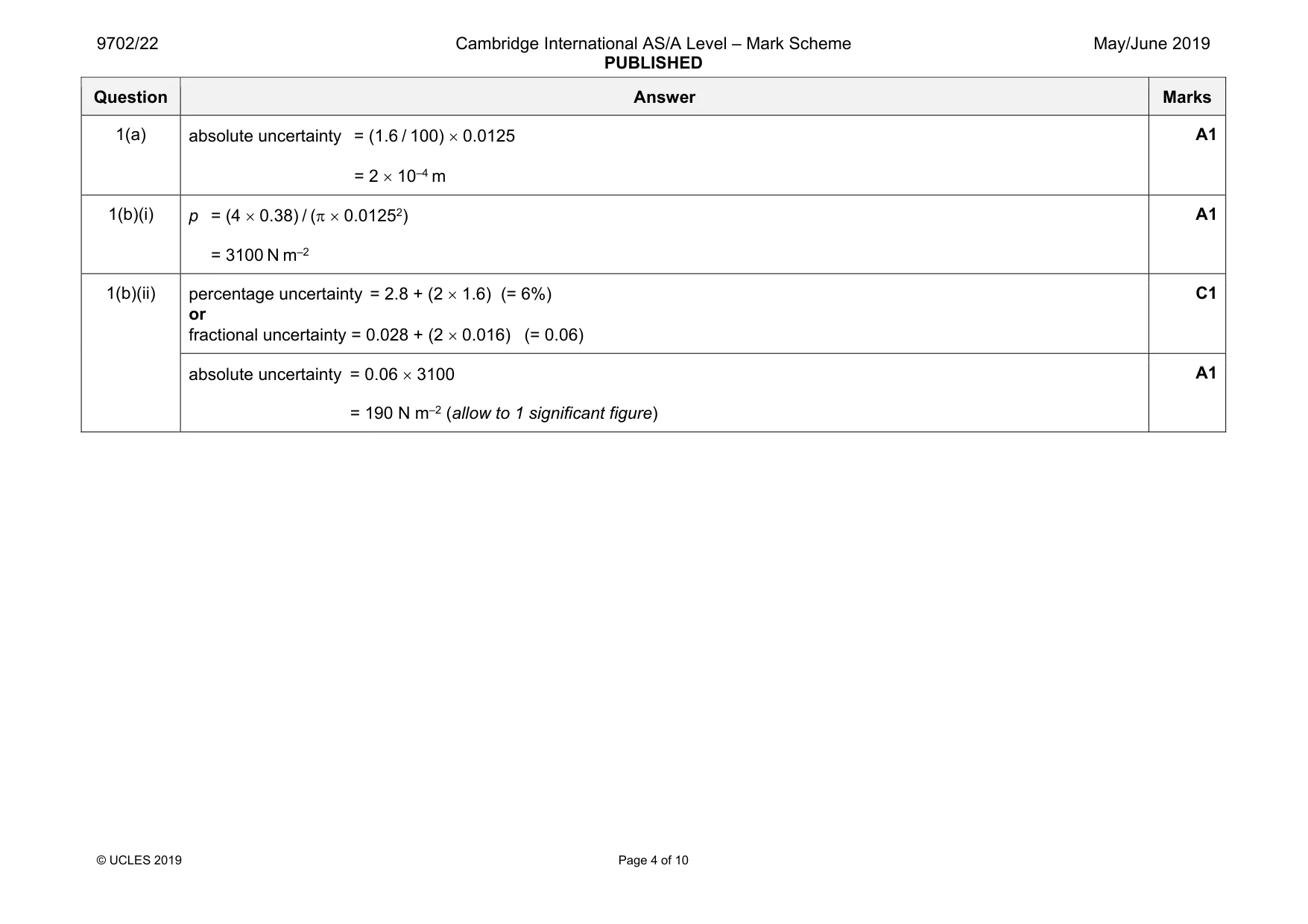
Mark scheme: 1(a) = 2 × 10⁻⁴ m A1 1(b)(i) p = (4 × 0.38) / (π × 0.01252) = 3100 N m–2 A1 1(b)(ii) percentage uncertainty = 2.8 + (2 × 1.6) (= 6%) or fractional uncertainty = 0.028 + (2 × 0.016) (= 0.06) C1 absolute uncertainty = 0.06 × 3100 = 190 N m–2 (allow to 1 significant figure) A1
Q2 · State Newton’s second law of motion
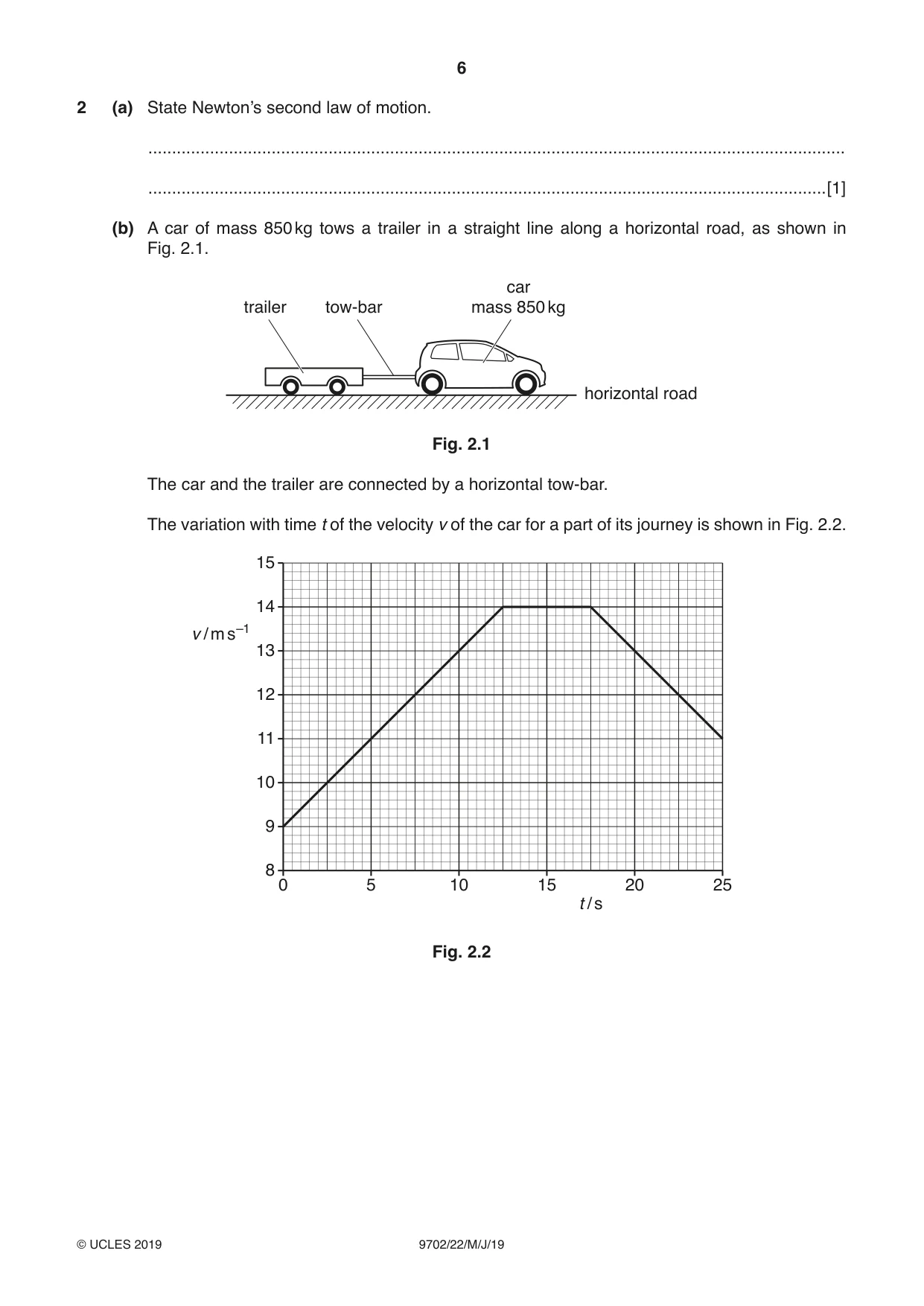
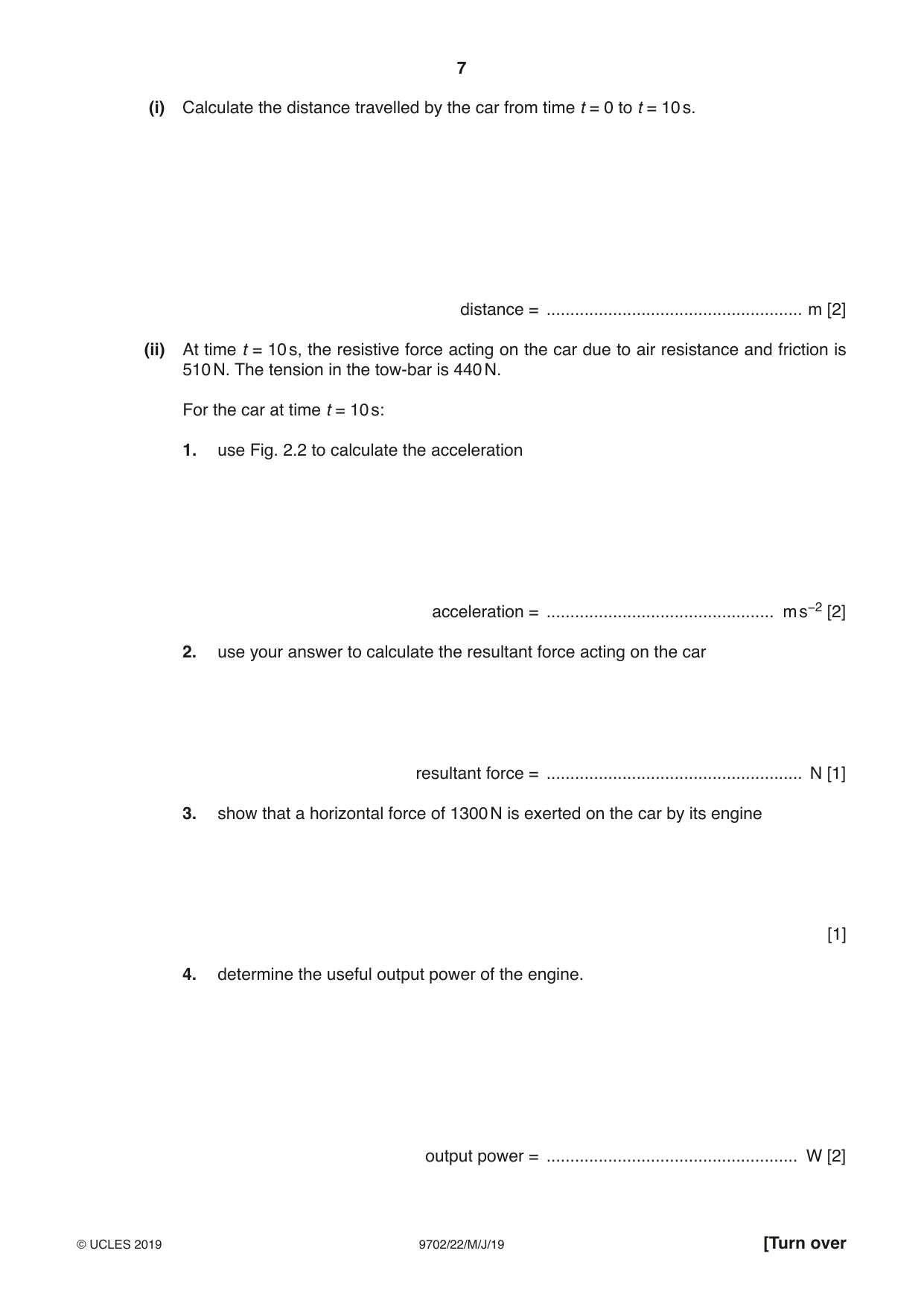
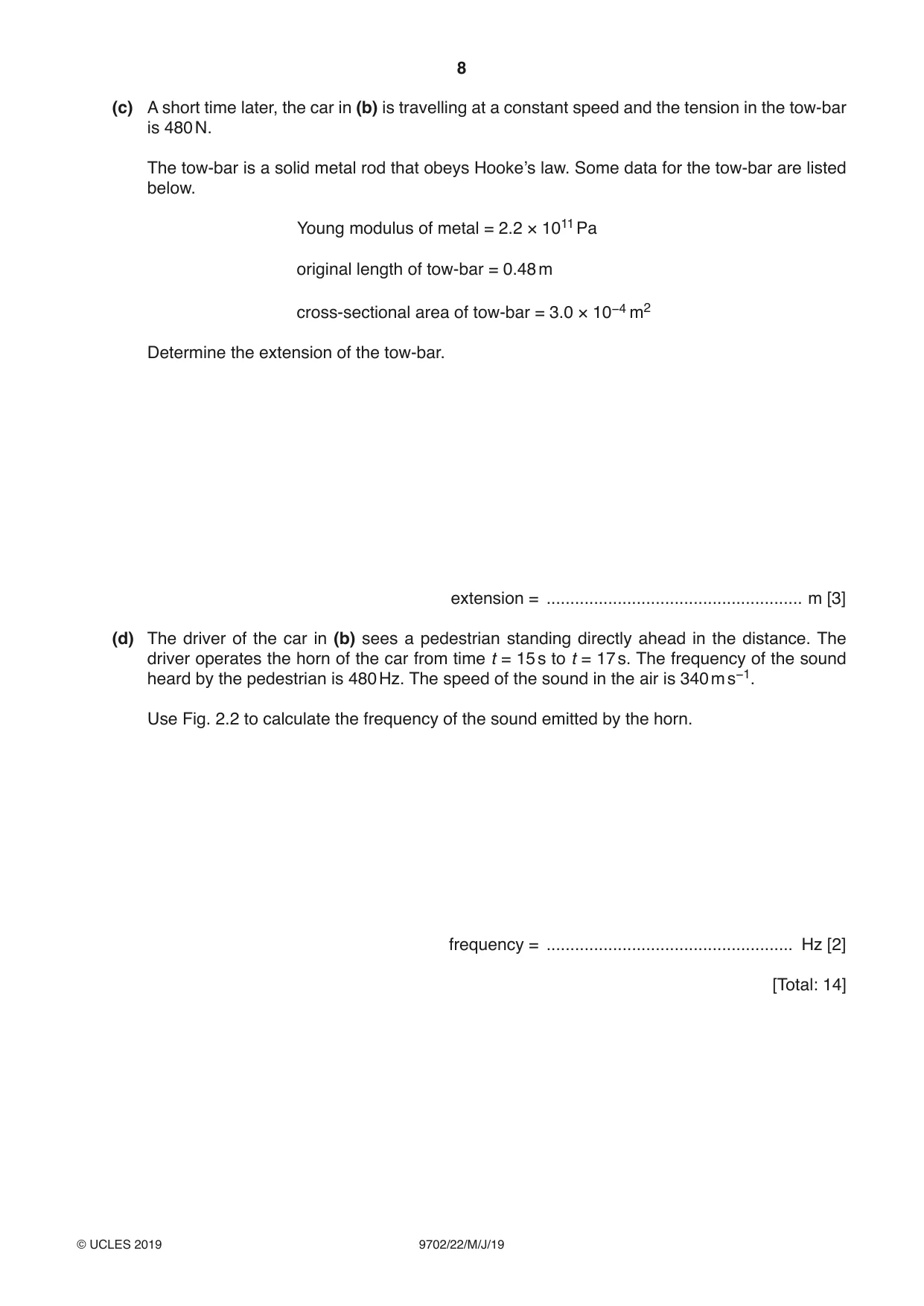
2 (a) State Newton’s second law of motion. ................................................................................................................................................... ...............................................................................................................................................[1] (b) A car of mass 850 kg tows a trailer in a straight line along a horizontal road, as shown in Fig. 2.1. car trailer tow-bar mass 850 kg horizontal road Fig. 2.1 The car and the trailer are connected by a horizontal tow-bar. The variation with time t of the velocity v of the car for a part of its journey is shown in Fig. 2.2. 15 14 v / m s–1 13 12 11 10 9 8 0 5 10 15 20 25 t / s Fig. 2.2 (i) Calculate the distance travelled by the car from time t = 0 to t = 10 s. distance = ...................................................... m [2] (ii) At time t = 10 s, the resistive force acting on the car due to air resistance and friction is 510 N. The tension in the tow-bar is 440 N. For the car at time t = 10 s: 1. use Fig. 2.2 to calculate the acceleration acceleration = ................................................ m s−2 [2] 2. use your answer to calculate the resultant force acting on the car resultant force = ...................................................... N [1] 3. show that a horizontal force of 1300 N is exerted on the car by its engine [1] 4. determine the useful output power of the engine. output power = ..................................................... W [2] (c) A short time later, the car in (b) is travelling at a constant speed and the tension in the tow-bar is 480 N. The tow-bar is a solid metal rod that obeys Hooke’s law. Some data for the tow-bar are listed below. Young modulus of metal = 2.2 × 10¹¹ Pa original length of tow-bar = 0.48 m cross-sectional area of tow-bar = 3.0 × 10⁻⁴ m2 Determine the extension of the tow-bar. extension = ...................................................... m [3] (d) The driver of the car in (b) sees a pedestrian standing directly ahead in the distance. The driver operates the horn of the car from time t = 15 s to t = 17 s. The frequency of the sound heard by the pedestrian is 480 Hz. The speed of the sound in the air is 340 m s−1. Use Fig. 2.2 to calculate the frequency of the sound emitted by the horn. frequency = .................................................... Hz [2] [Total: 14]
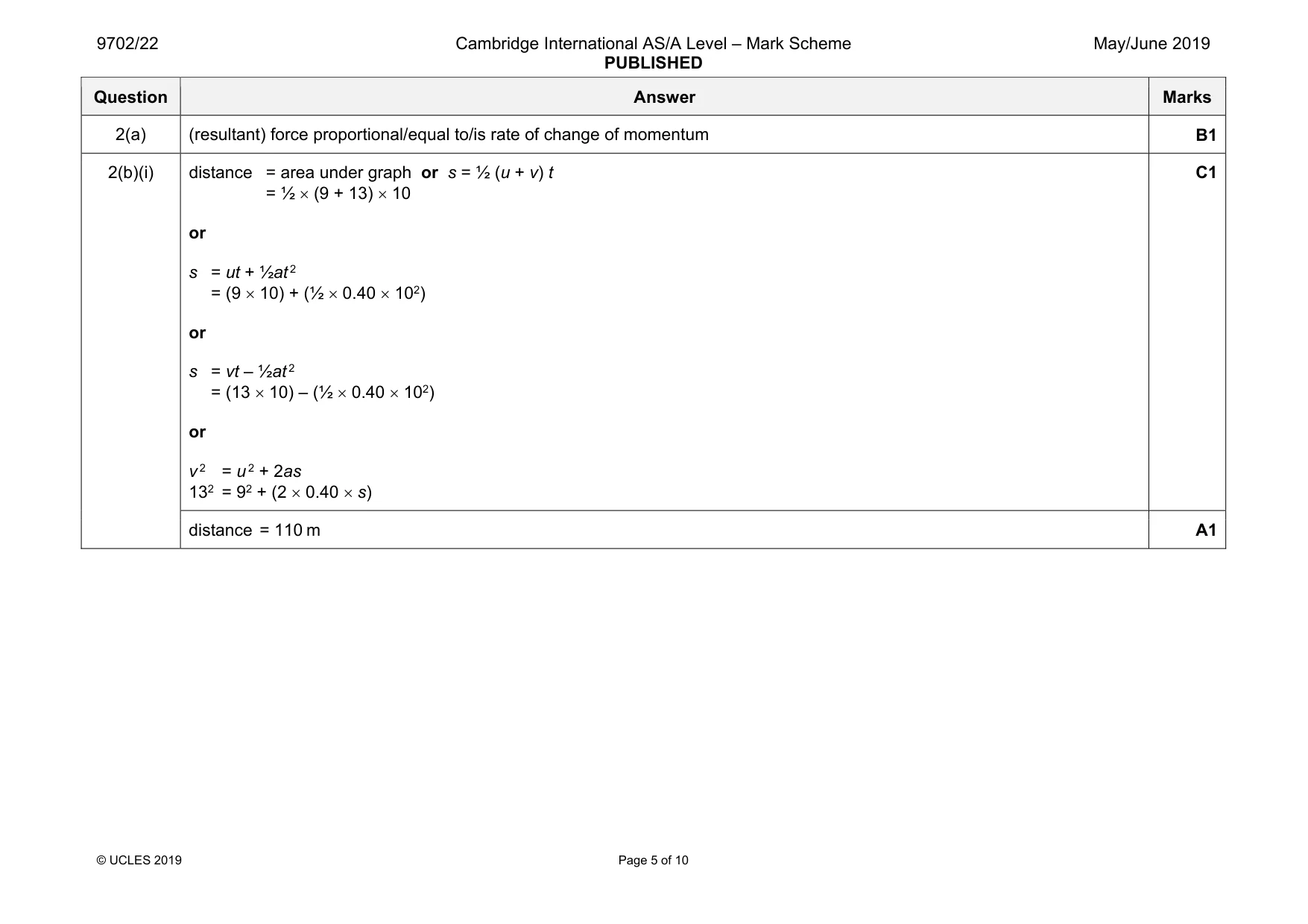
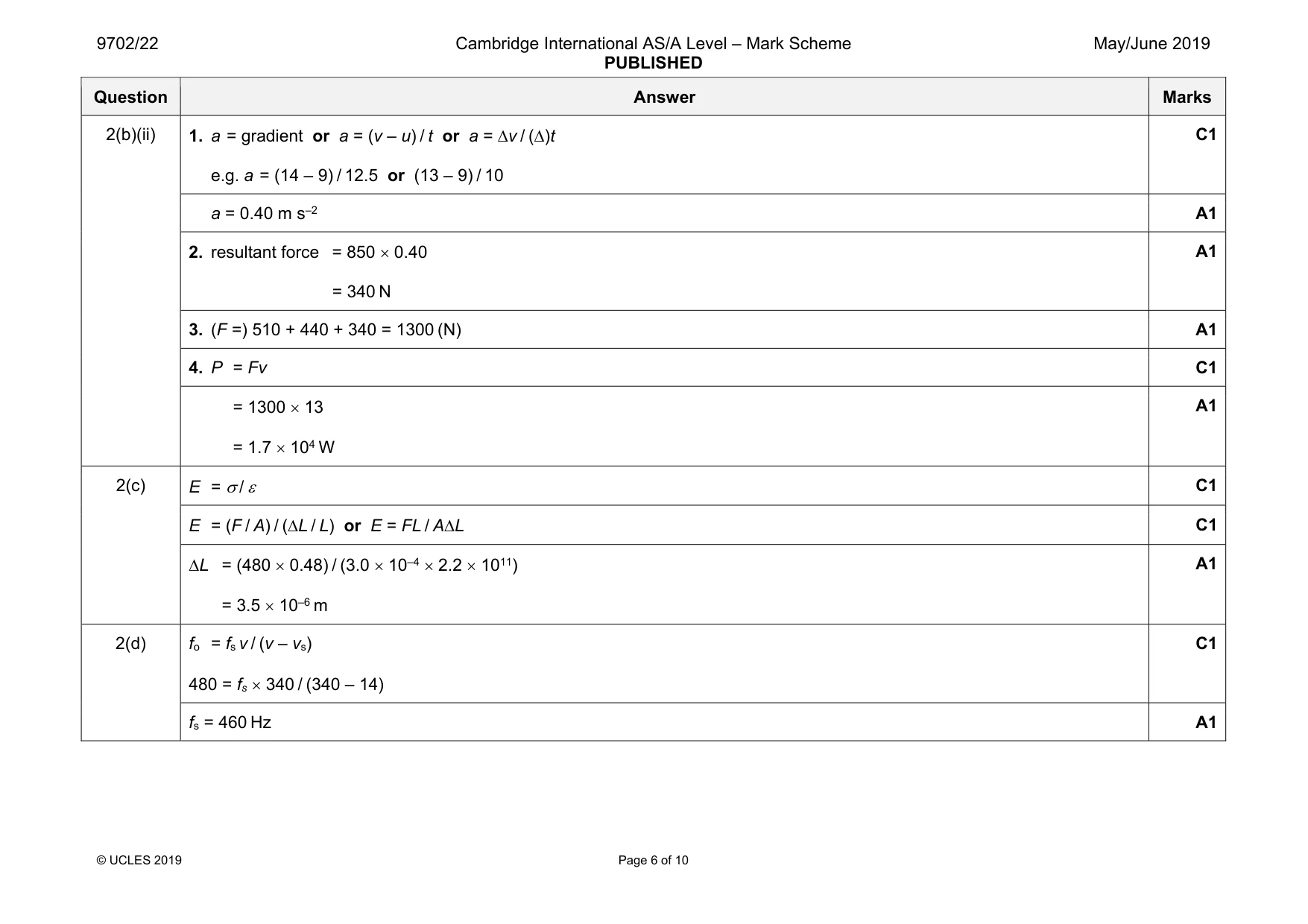
Mark scheme: 2(a) (resultant) force proportional/equal to/is rate of change of momentum B1 2(b)(i) distance = area under graph or s = ½ (u + v) t = ½ × (9 + 13) × 10 or s = ut + ½at 2 = (9 × 10) + (½ × 0.40 × 10²) or s = vt – ½at 2 = (13 × 10) – (½ × 0.40 × 10²) or v 2 = u 2 + 2as 132 = 92 + (2 × 0.40 × s) C1 distance = 110 m A1 Question Answer Marks 2(b)(ii) 1. a = gradient or a = (v – u) / t or a = ∆v / (∆)t e.g. a = (14 – 9) / 12.5 or (13 – 9) / 10 C1 a = 0.40 m s–2 A1 2. resultant force = 850 × 0.40 = 340 N A1 3. (F =) 510 + 440 + 340 = 1300 (N) A1 4. P = Fv C1 = 1300 × 13 = 1.7 × 10⁴ W A1 2(c) E = σ / ε C1 E = (F / A) / (∆L / L) or E = FL / A∆L C1 ∆L = (480 × 0.48) / (3.0 × 10–4 × 2.2 × 1011) = 3.5 × 10⁻⁶ m A1 2(d) fo = fs v / (v – vs) 480 = fs × 340 / (340 – 14) C1 fs = 460 Hz A1
Q3 · State what is meant by the centre of gravity of a body
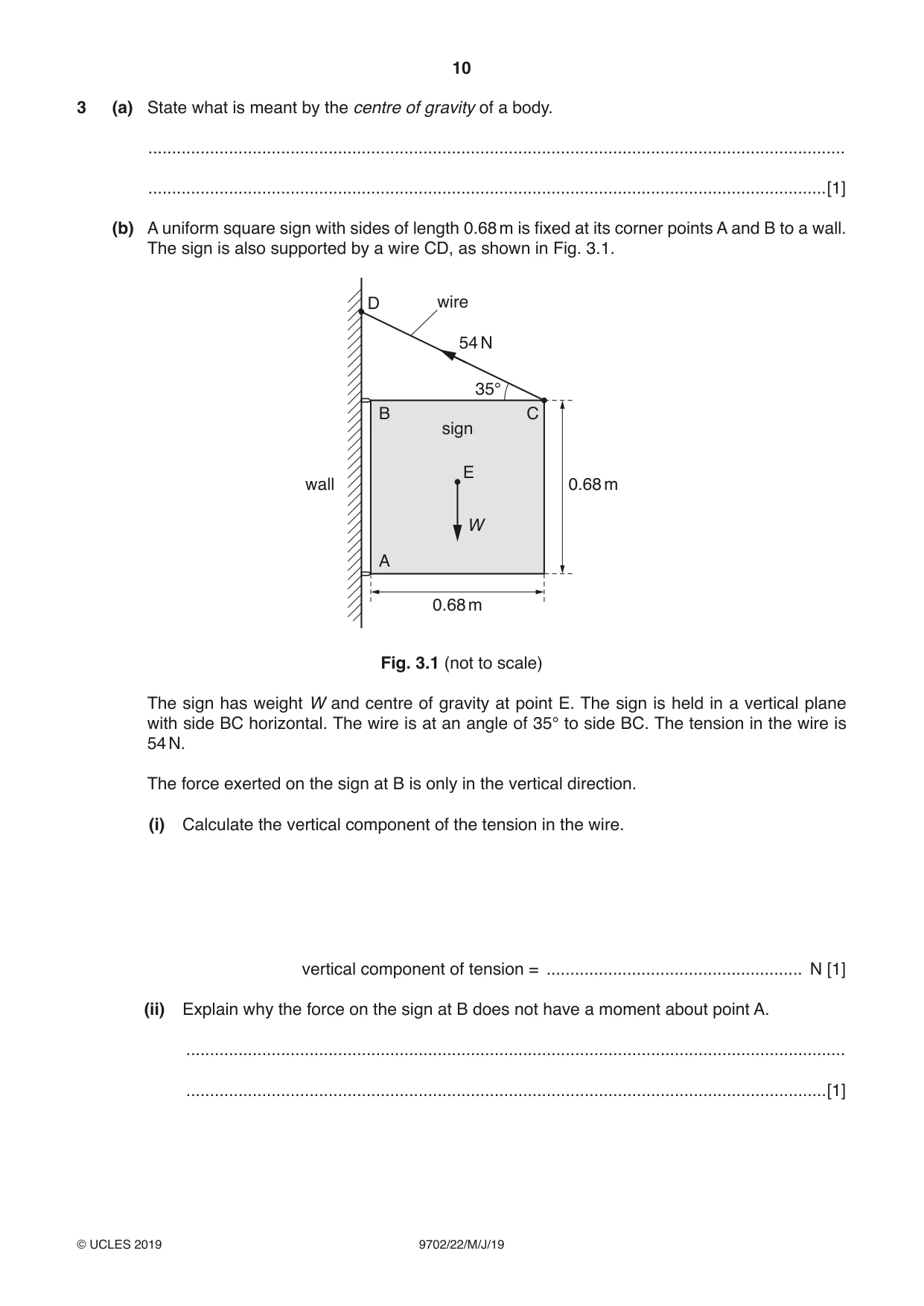
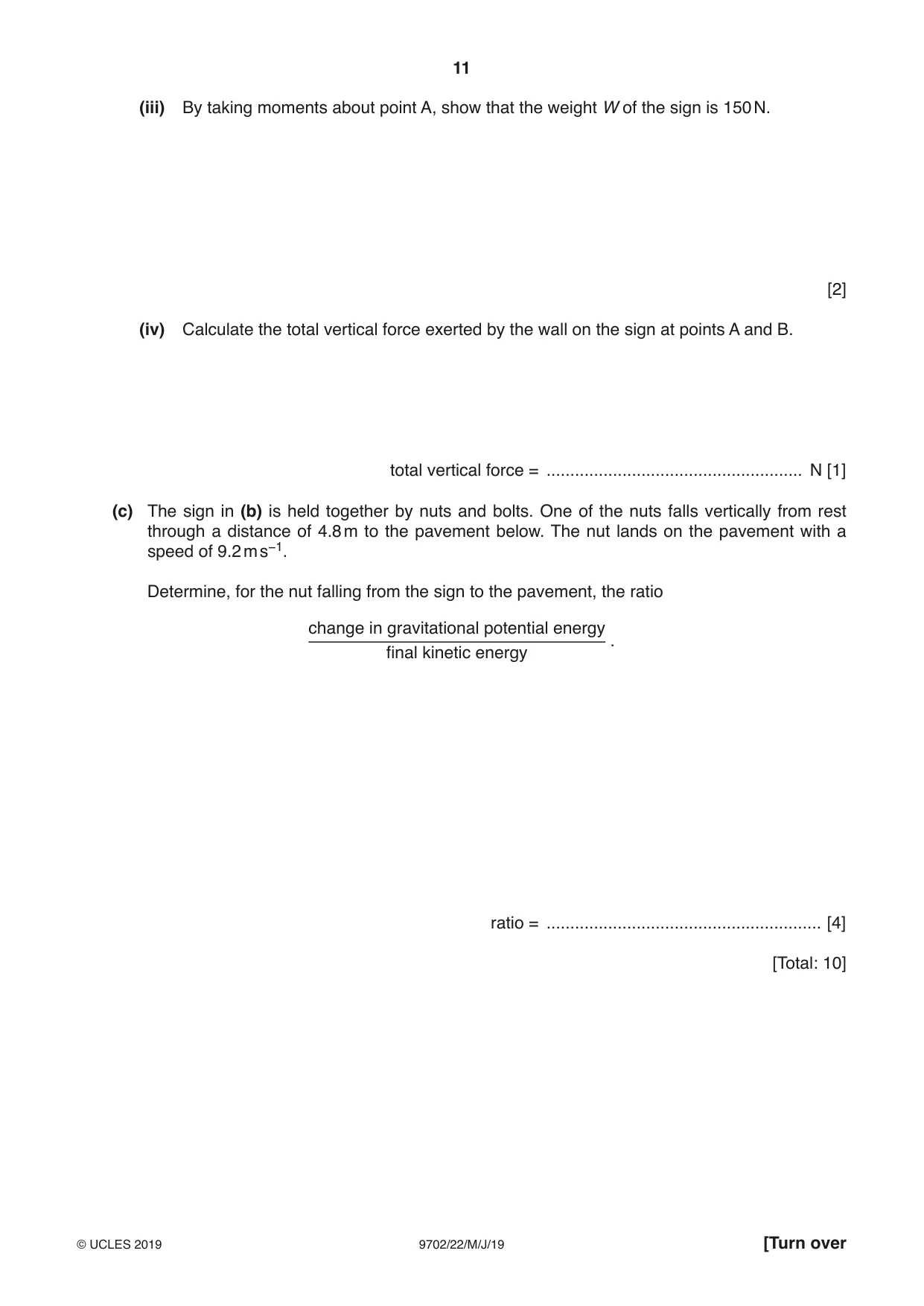
3 (a) State what is meant by the centre of gravity of a body. ................................................................................................................................................... ...............................................................................................................................................[1] (b) A uniform square sign with sides of length 0.68 m is fixed at its corner points A and B to a wall. The sign is also supported by a wire CD, as shown in Fig. 3.1. D wire 54 N 35° B C sign E wall 0.68 m W A 0.68 m Fig. 3.1 (not to scale) The sign has weight W and centre of gravity at point E. The sign is held in a vertical plane with side BC horizontal. The wire is at an angle of 35° to side BC. The tension in the wire is 54 N. The force exerted on the sign at B is only in the vertical direction. (i) Calculate the vertical component of the tension in the wire. vertical component of tension = ...................................................... N [1] (ii) Explain why the force on the sign at B does not have a moment about point A. ........................................................................................................................................... .......................................................................................................................................[1] (iii) By taking moments about point A, show that the weight W of the sign is 150 N. [2] (iv) Calculate the total vertical force exerted by the wall on the sign at points A and B. total vertical force = ...................................................... N [1] (c) The sign in (b) is held together by nuts and bolts. One of the nuts falls vertically from rest through a distance of 4.8 m to the pavement below. The nut lands on the pavement with a speed of 9.2 m s−1. Determine, for the nut falling from the sign to the pavement, the ratio change in gravitational potential energy . final kinetic energy ratio = .......................................................... [4] [Total: 10]
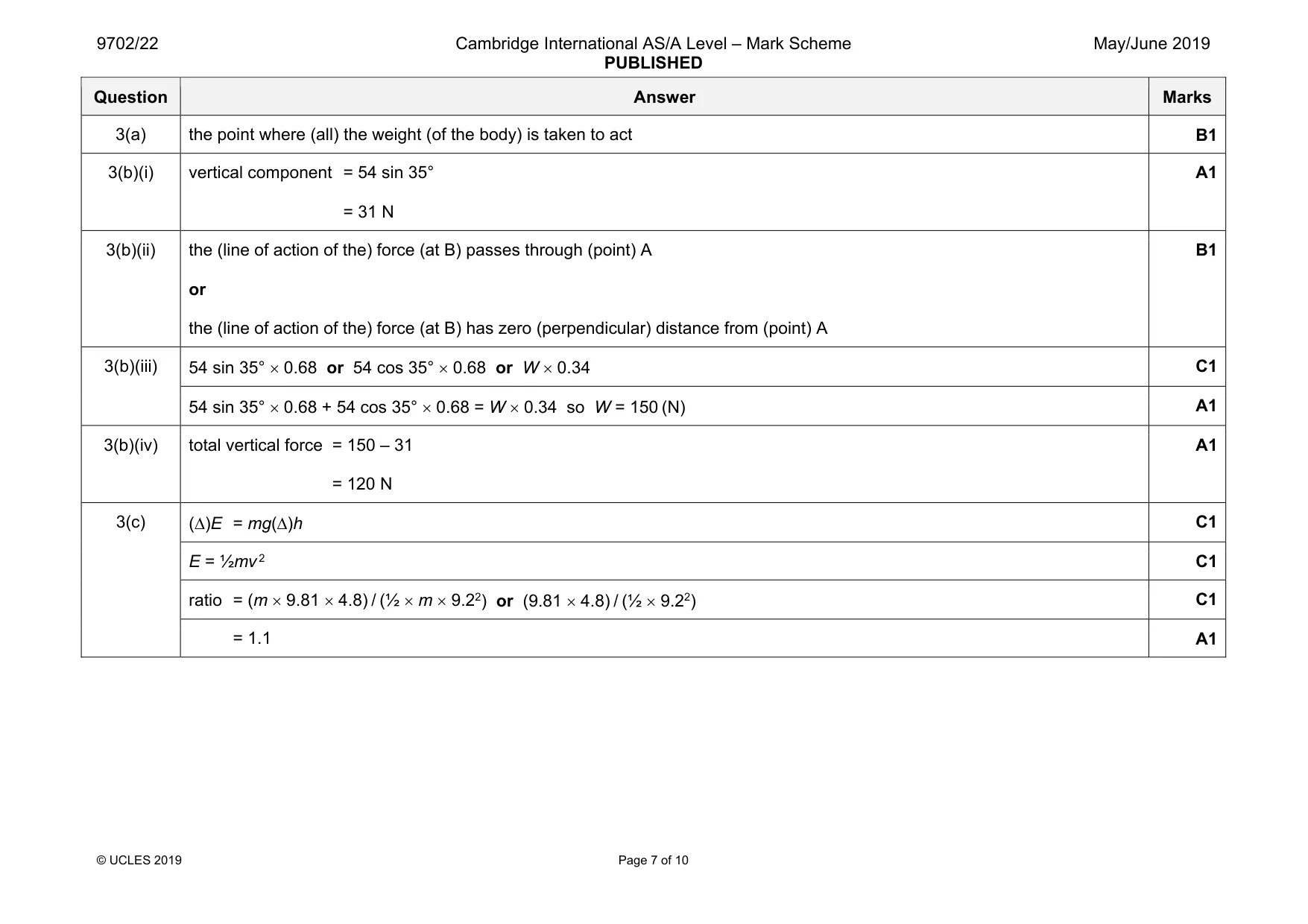
Mark scheme: 3(a) the point where (all) the weight (of the body) is taken to act B1 3(b)(i) vertical component = 54 sin 35° = 31 N A1 3(b)(ii) the (line of action of the) force (at B) passes through (point) A or the (line of action of the) force (at B) has zero (perpendicular) distance from (point) A B1 3(b)(iii) 54 sin 35° × 0.68 or 54 cos 35° × 0.68 or W × 0.34 C1 54 sin 35° × 0.68 + 54 cos 35° × 0.68 = W × 0.34 so W = 150 (N) A1 3(b)(iv) total vertical force = 150 – 31 = 120 N A1 3(c) (∆)E = mg(∆)h C1 E = ½mv 2 C1 ratio = (m × 9.81 × 4.8) / (½ × m × 9.22) or (9.81 × 4.8) / (½ × 9.22) C1 = 1.1 A1
Q4 · For a progressive water wave, state what is meant by: (i) displacement…
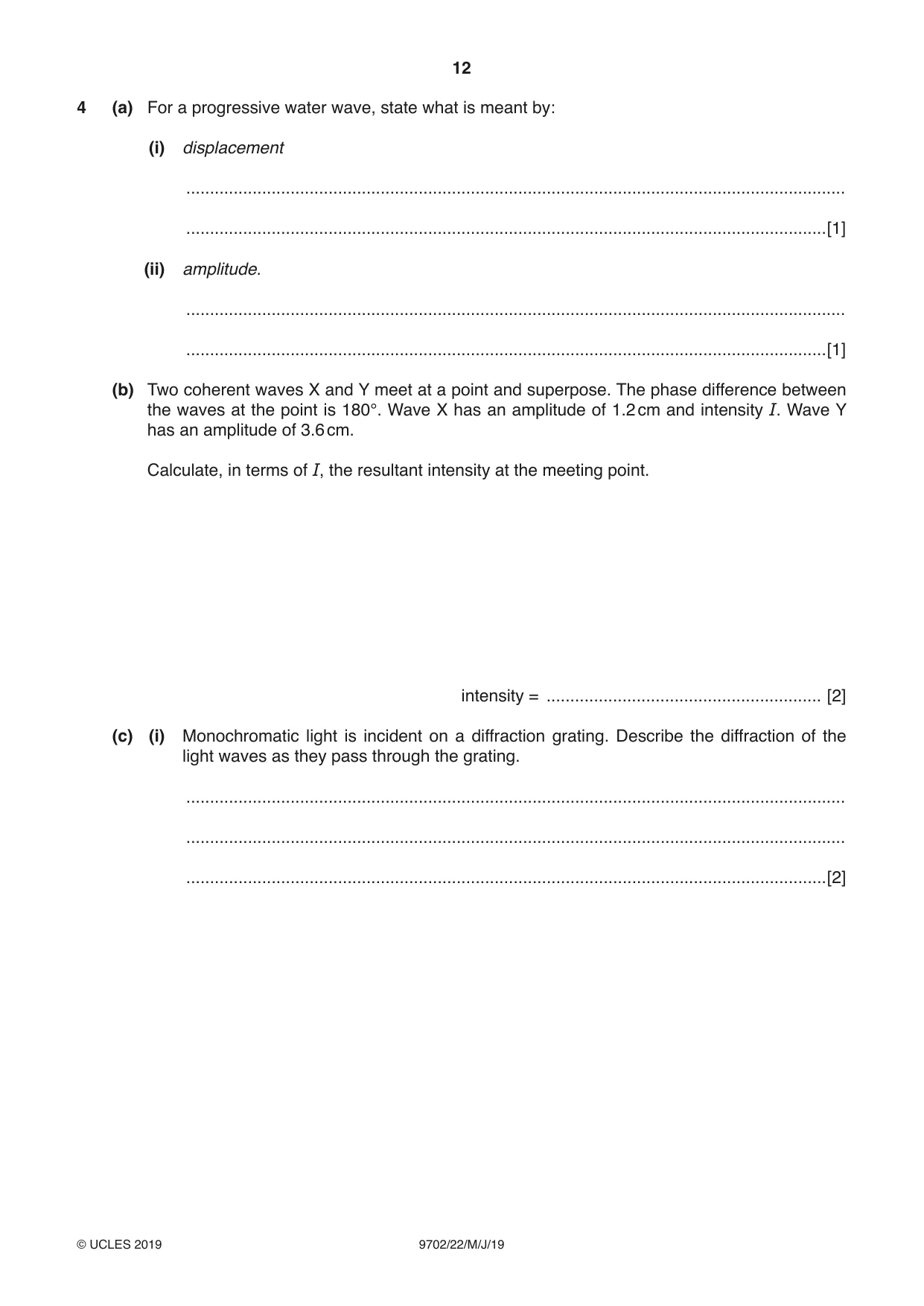
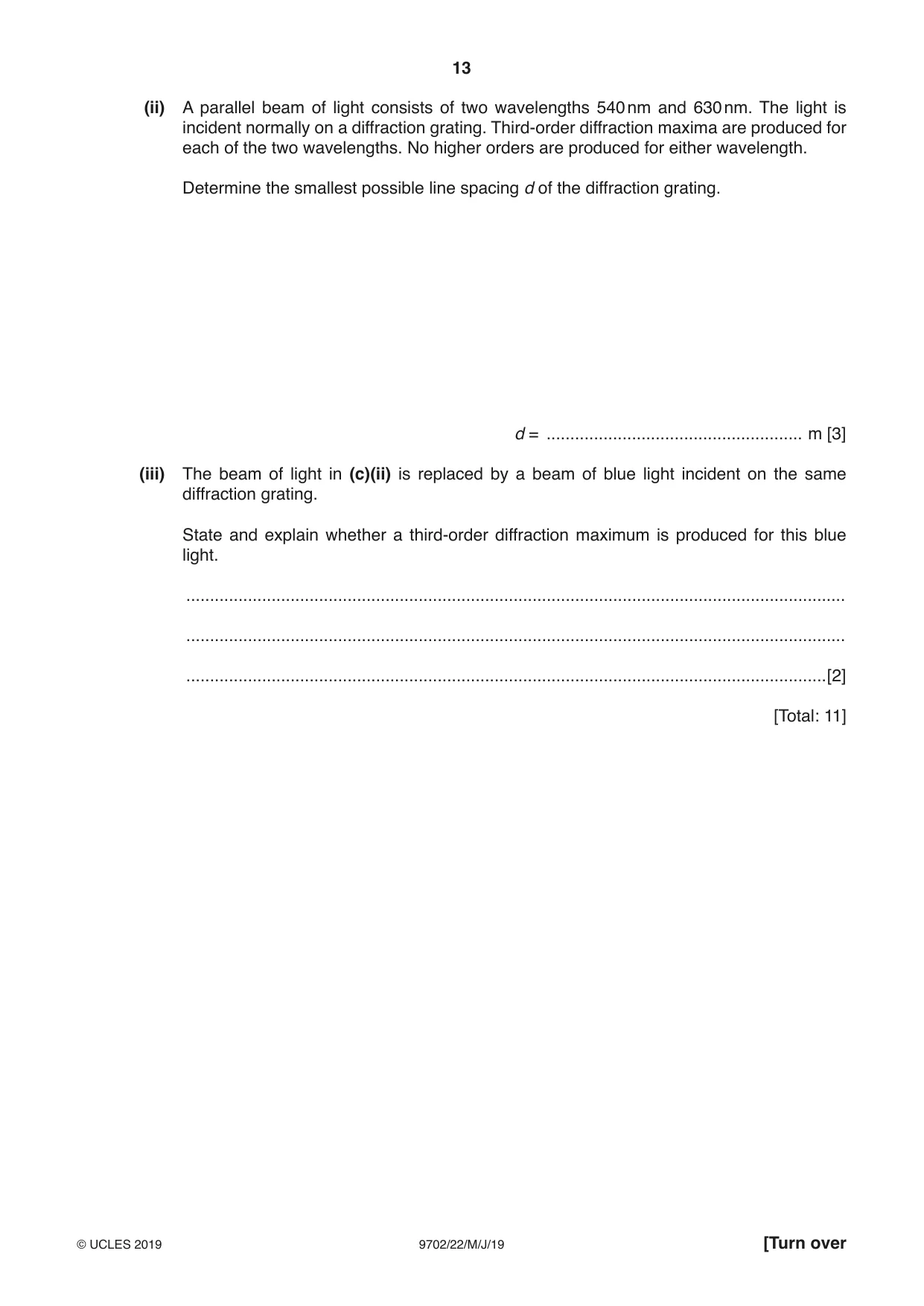
4 (a) For a progressive water wave, state what is meant by: (i) displacement ........................................................................................................................................... .......................................................................................................................................[1] (ii) amplitude. ........................................................................................................................................... .......................................................................................................................................[1] (b) Two coherent waves X and Y meet at a point and superpose. The phase difference between the waves at the point is 180°. Wave X has an amplitude of 1.2 cm and intensity I. Wave Y has an amplitude of 3.6 cm. Calculate, in terms of I, the resultant intensity at the meeting point. intensity = .......................................................... [2] (c) (i) Monochromatic light is incident on a diffraction grating. Describe the diffraction of the light waves as they pass through the grating. ........................................................................................................................................... ........................................................................................................................................... .......................................................................................................................................[2] (ii) A parallel beam of light consists of two wavelengths 540 nm and 630 nm. The light is incident normally on a diffraction grating. Third-order diffraction maxima are produced for each of the two wavelengths. No higher orders are produced for either wavelength. Determine the smallest possible line spacing d of the diffraction grating. d = ...................................................... m [3] (iii) The beam of light in (c)(ii) is replaced by a beam of blue light incident on the same diffraction grating. State and explain whether a third-order diffraction maximum is produced for this blue light. ........................................................................................................................................... ........................................................................................................................................... .......................................................................................................................................[2] [Total: 11]
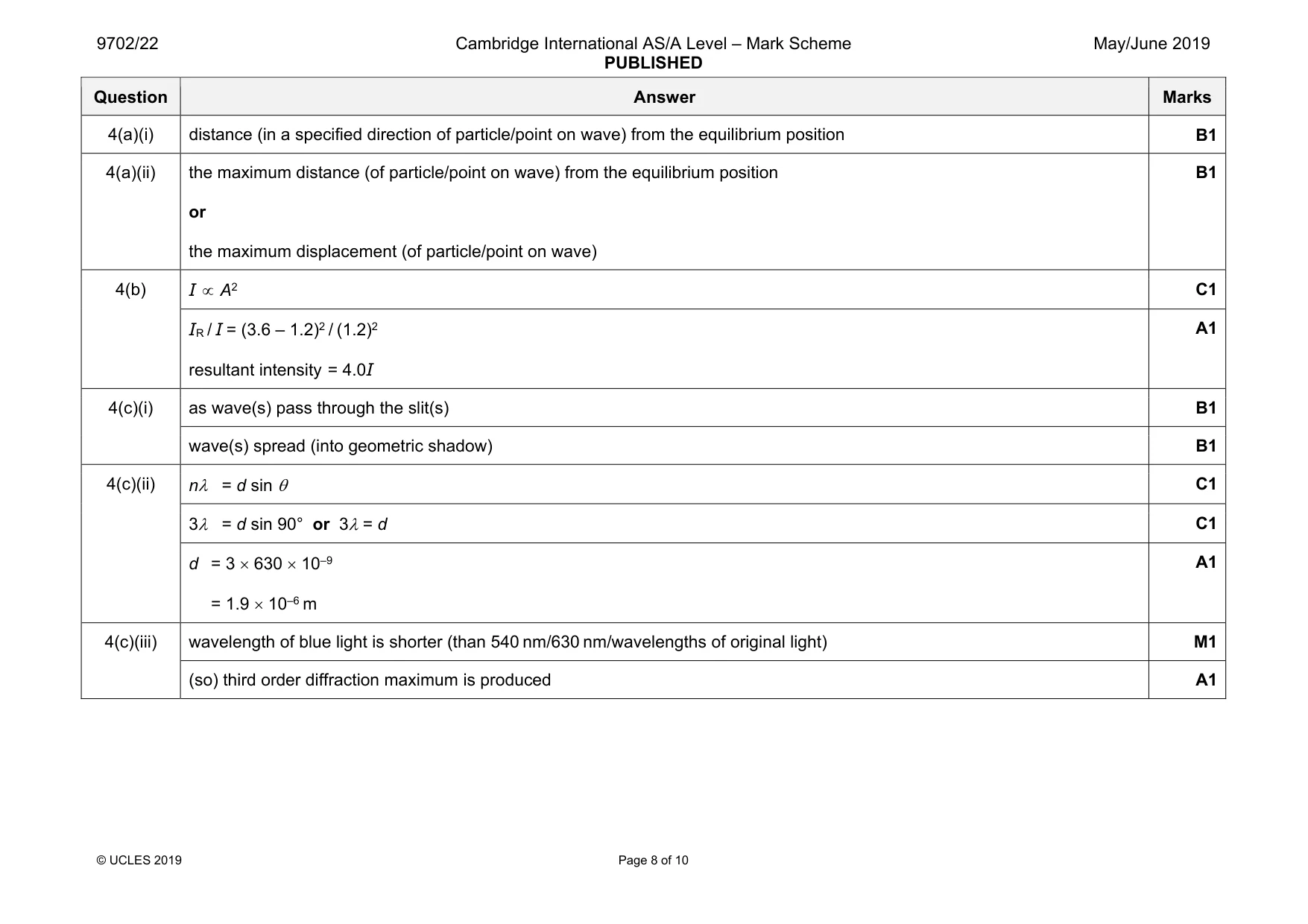
Mark scheme: 4(a)(i) distance (in a specified direction of particle/point on wave) from the equilibrium position B1 4(a)(ii) the maximum distance (of particle/point on wave) from the equilibrium position or the maximum displacement (of particle/point on wave) B1 4(b) I ∝ A2 C1 IR / I = (3.6 – 1.2)2 / (1.2)2 resultant intensity = 4.0I A1 4(c)(i) as wave(s) pass through the slit(s) B1 wave(s) spread (into geometric shadow) B1 4(c)(ii) nλ = d sin θ C1 3λ = d sin 90° or 3λ = d C1 d = 3 × 630 × 10–9 = 1.9 × 10⁻⁶ m A1 4(c)(iii) wavelength of blue light is shorter (than 540 nm/630 nm/wavelengths of original light) M1 (so) third order diffraction maximum is produced A1
Q5 · State Kirchhoff’s second law
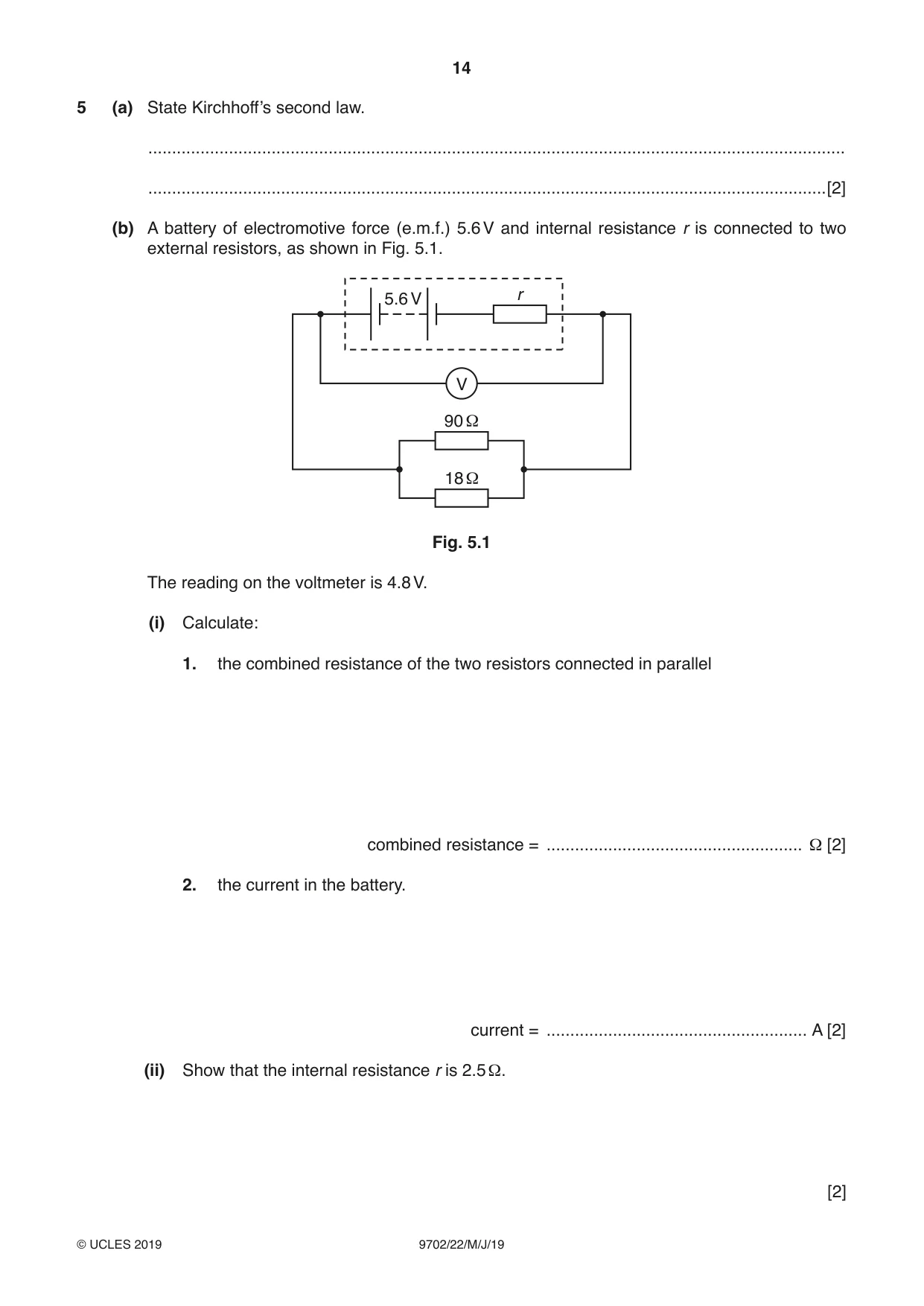
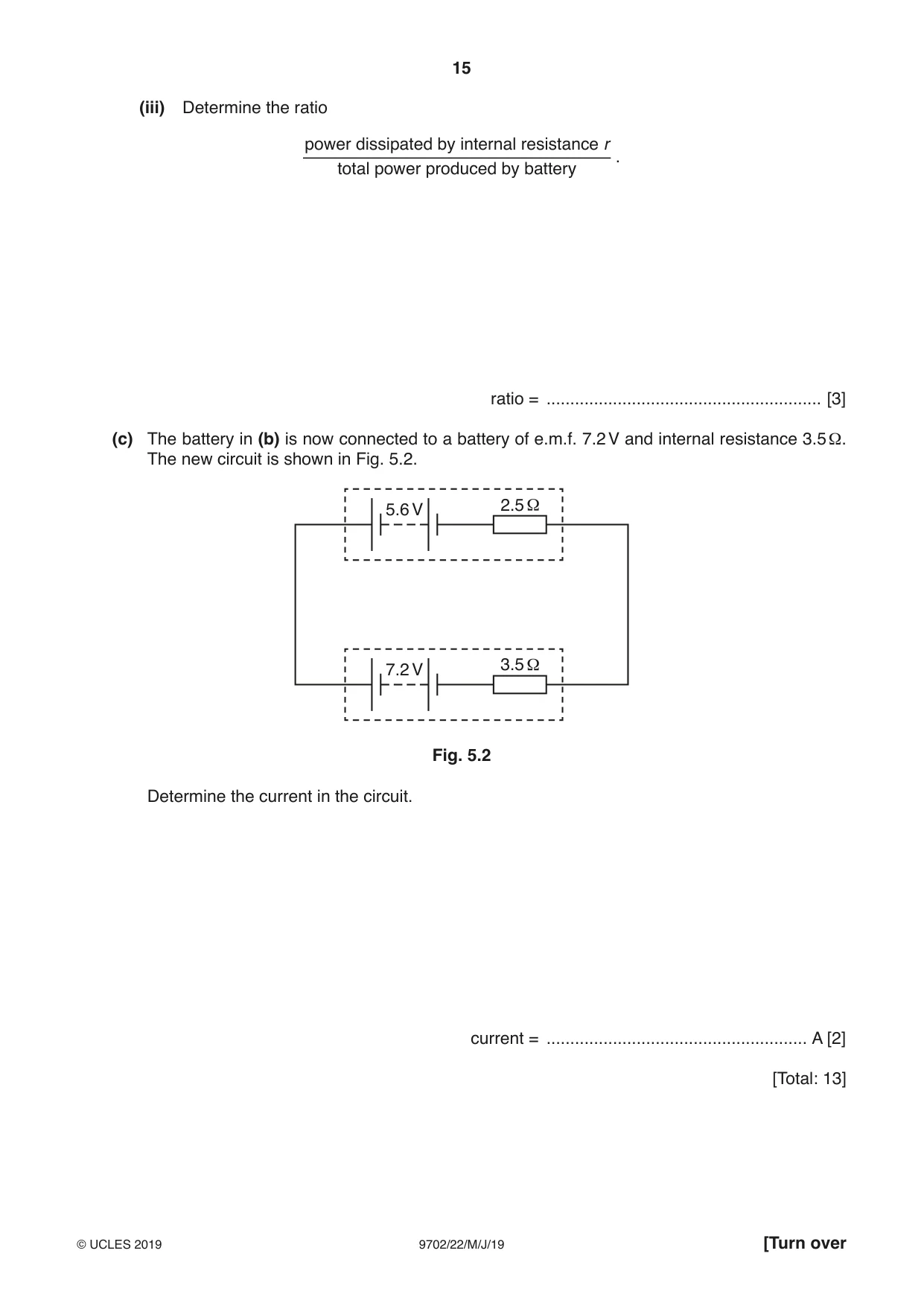
5 (a) State Kirchhoff’s second law. ................................................................................................................................................... ...............................................................................................................................................[2] (b) A battery of electromotive force (e.m.f.) 5.6 V and internal resistance r is connected to two external resistors, as shown in Fig. 5.1. 5.6 V r V 90 18 Fig. 5.1 The reading on the voltmeter is 4.8 V. (i) Calculate: 1. the combined resistance of the two resistors connected in parallel combined resistance = ...................................................... Ω [2] 2. the current in the battery. current = ....................................................... A [2] (ii) Show that the internal resistance r is 2.5 Ω. [2] (iii) Determine the ratio power dissipated by internal resistance r . total power produced by battery ratio = .......................................................... [3] (c) The battery in (b) is now connected to a battery of e.m.f. 7.2 V and internal resistance 3.5 Ω. The new circuit is shown in Fig. 5.2. 5.6 V 2.5 3.5 7.2 V Fig. 5.2 Determine the current in the circuit. current = ....................................................... A [2] [Total: 13]
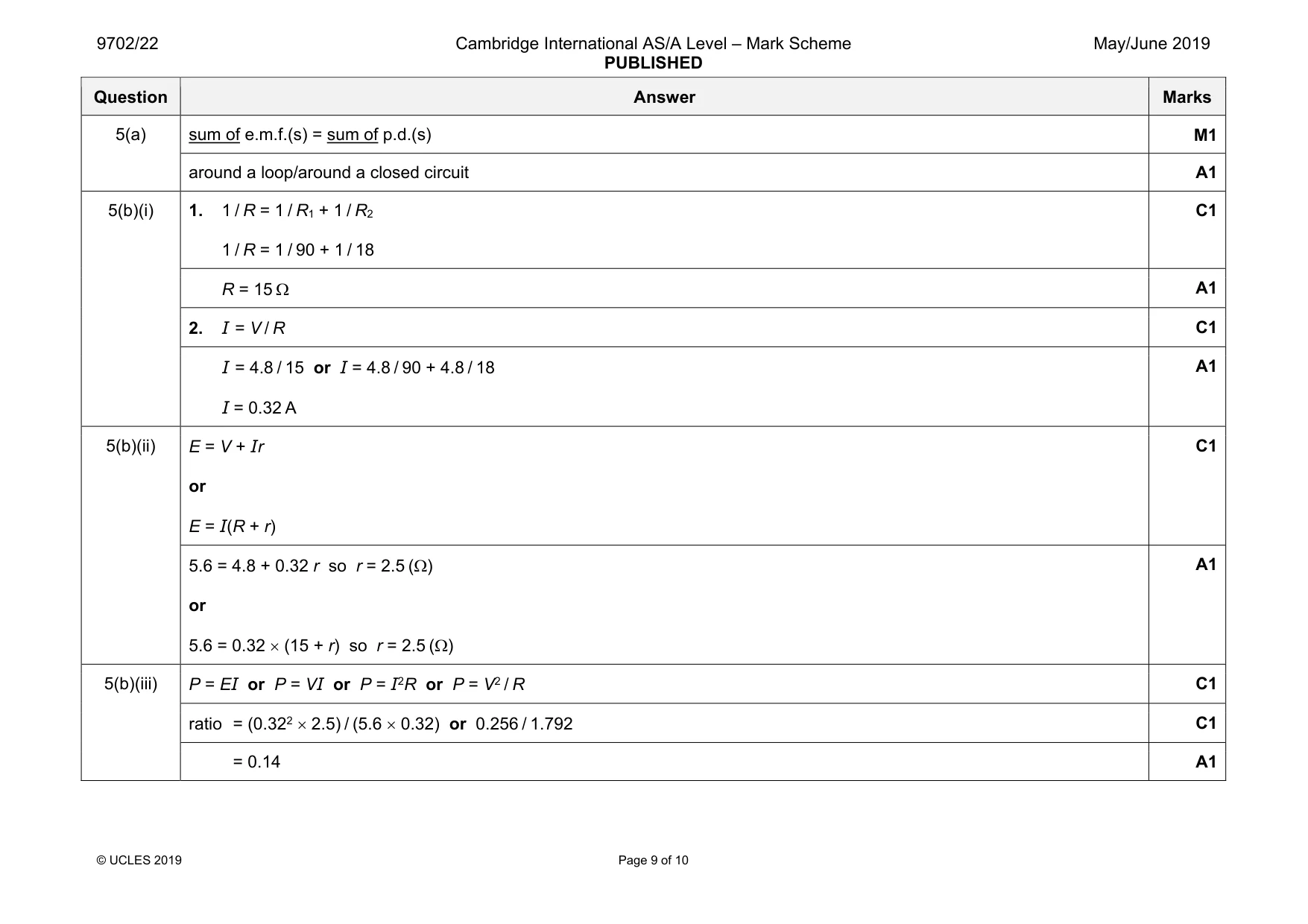
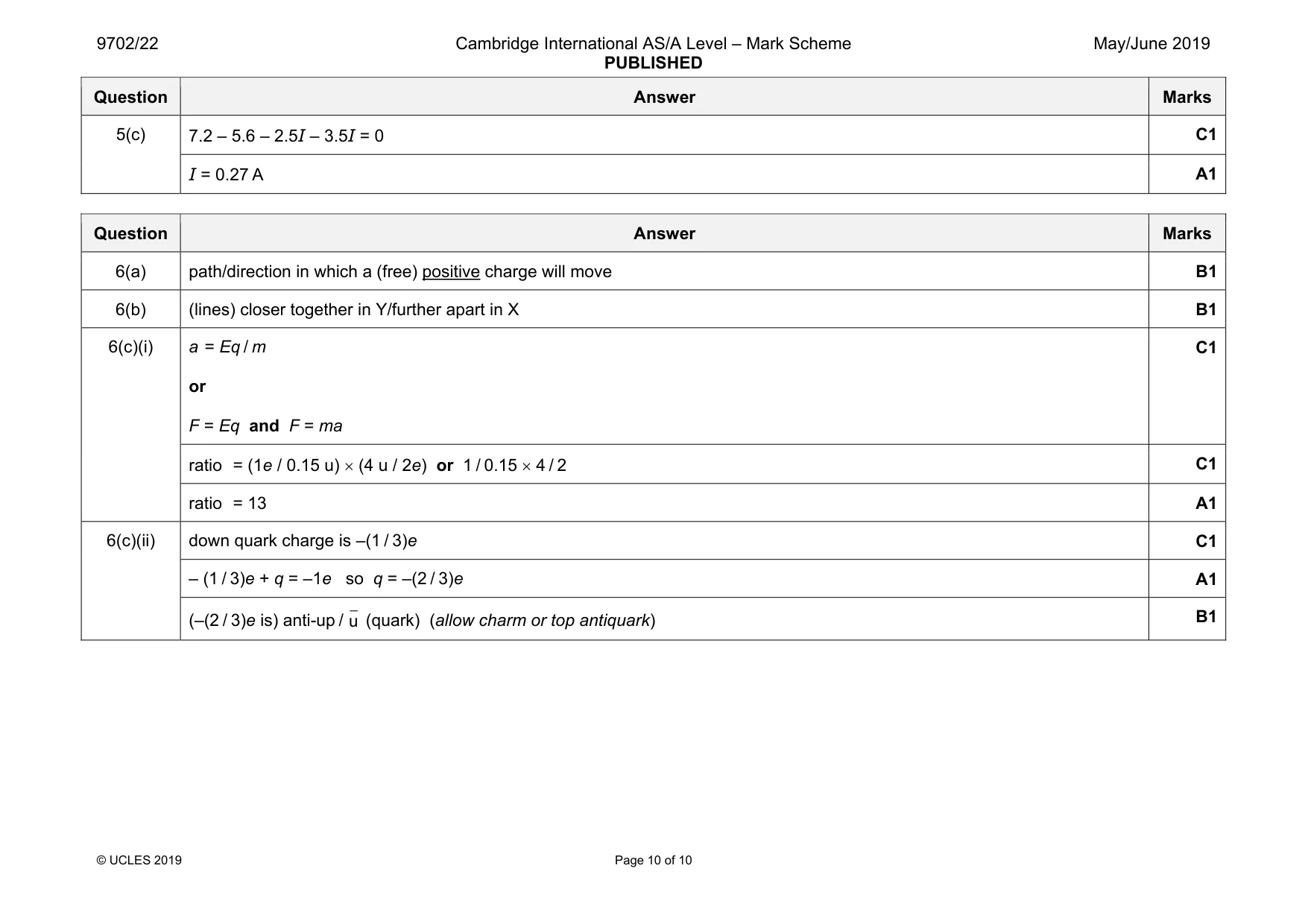
Mark scheme: 5(a) sum of e.m.f.(s) = sum of p.d.(s) M1 around a loop/around a closed circuit A1 5(b)(i) 1. 1 / R = 1 / R1 + 1 / R2 1 / R = 1 / 90 + 1 / 18 C1 R = 15 Ω A1 2. I = V / R C1 I = 4.8 / 15 or I = 4.8 / 90 + 4.8 / 18 I = 0.32 A A1 5(b)(ii) E = V + Ir or E = I(R + r) C1 5.6 = 4.8 + 0.32 r so r = 2.5 (Ω) or 5.6 = 0.32 × (15 + r) so r = 2.5 (Ω) A1 5(b)(iii) P = EI or P = VI or P = I2R or P = V2 / R C1 ratio = (0.322 × 2.5) / (5.6 × 0.32) or 0.256 / 1.792 C1 = 0.14 A1 Question Answer Marks 5(c) 7.2 – 5.6 – 2.5I – 3.5I = 0 C1 I = 0.27 A A1
Q6 · State what is meant by a field line (line of force) in an electric field
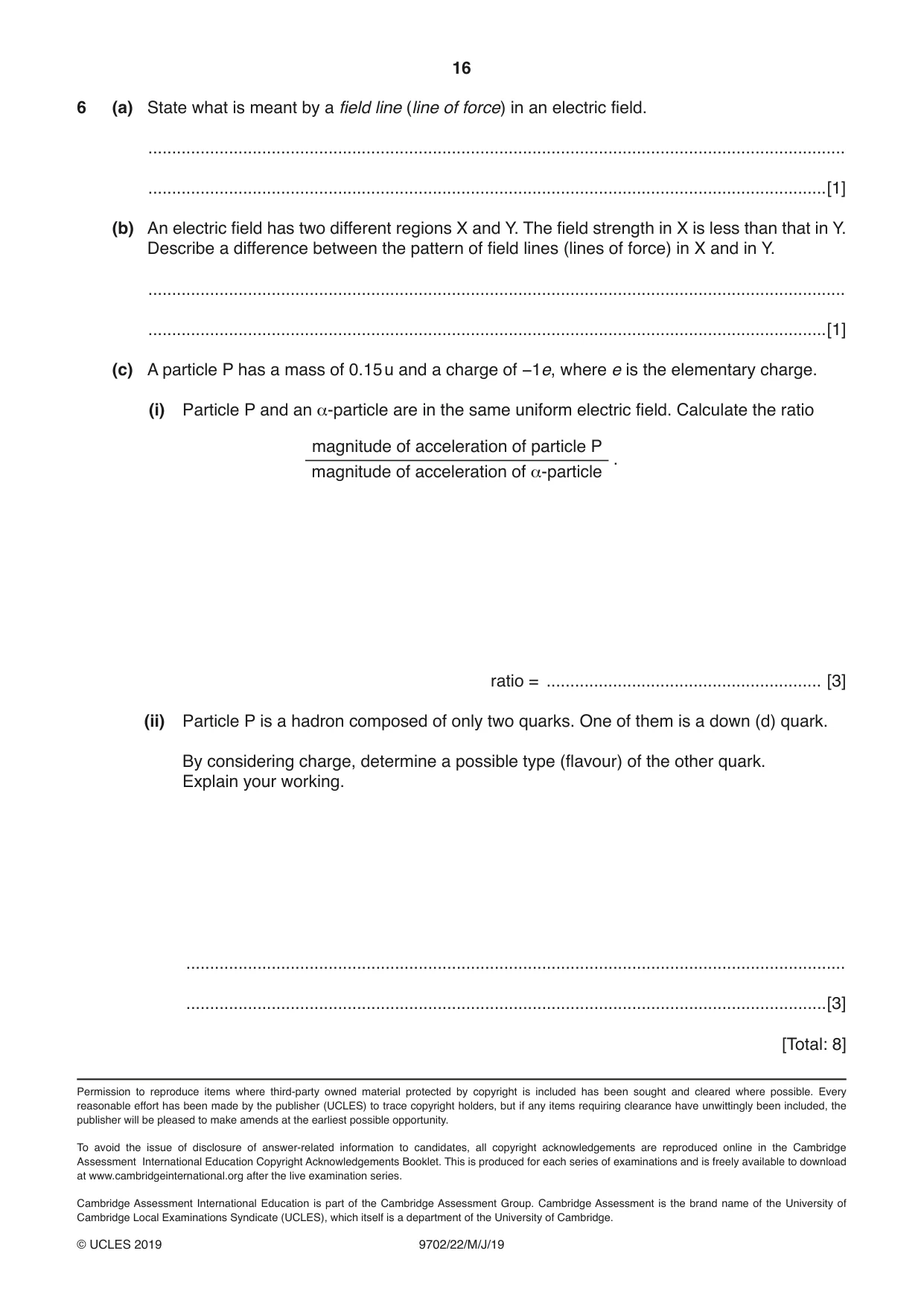
6 (a) State what is meant by a field line (line of force) in an electric field. ................................................................................................................................................... ...............................................................................................................................................[1] (b) An electric field has two different regions X and Y. The field strength in X is less than that in Y. Describe a difference between the pattern of field lines (lines of force) in X and in Y. ................................................................................................................................................... ...............................................................................................................................................[1] (c) A particle P has a mass of 0.15 u and a charge of −1e, where e is the elementary charge. (i) Particle P and an α-particle are in the same uniform electric field. Calculate the ratio magnitude of acceleration of particle P . magnitude of acceleration of α-particle ratio = .......................................................... [3] (ii) Particle P is a hadron composed of only two quarks. One of them is a down (d) quark. By considering charge, determine a possible type (flavour) of the other quark. Explain your working. ........................................................................................................................................... .......................................................................................................................................[3] [Total: 8]
Mark scheme: 6(a) path/direction in which a (free) positive charge will move B1 6(b) (lines) closer together in Y/further apart in X B1 6(c)(i) a = Eq / m or F = Eq and F = ma C1 ratio = (1e / 0.15 u) × (4 u / 2e) or 1 / 0.15 × 4 / 2 C1 ratio = 13 A1 6(c)(ii) down quark charge is –(1 / 3)e C1 – (1 / 3)e + q = –1e so q = –(2 / 3)e A1 (–(2 / 3)e is) anti-up / u (quark) (allow charm or top antiquark) B1
What was in this paper
The subtopics covered by these 6 questions, and how many questions each got. Open one in a new tab to see every Cambridge question on it.
What you needed in this session
Cambridge’s own grade thresholds for 2019 May/June, Paper 2 · Variant 2. A higher threshold means an easier paper — the bar moves with how the cohort did.