Cambridge A Level Physics 9702 — 2024 May/June Paper 2 · Variant 2
9702/22/M/J/24 · 7 questions · 60 marks · ≈68 min
The question paper and its mark scheme, free to read here and free to download. This is Cambridge’s own paper, exactly as it was sat.
Question paper16 pages

Mark scheme12 pages
Answers below. Sit the paper first if you are practising.
Questions as text
Q1 · The list below shows some SI quantities
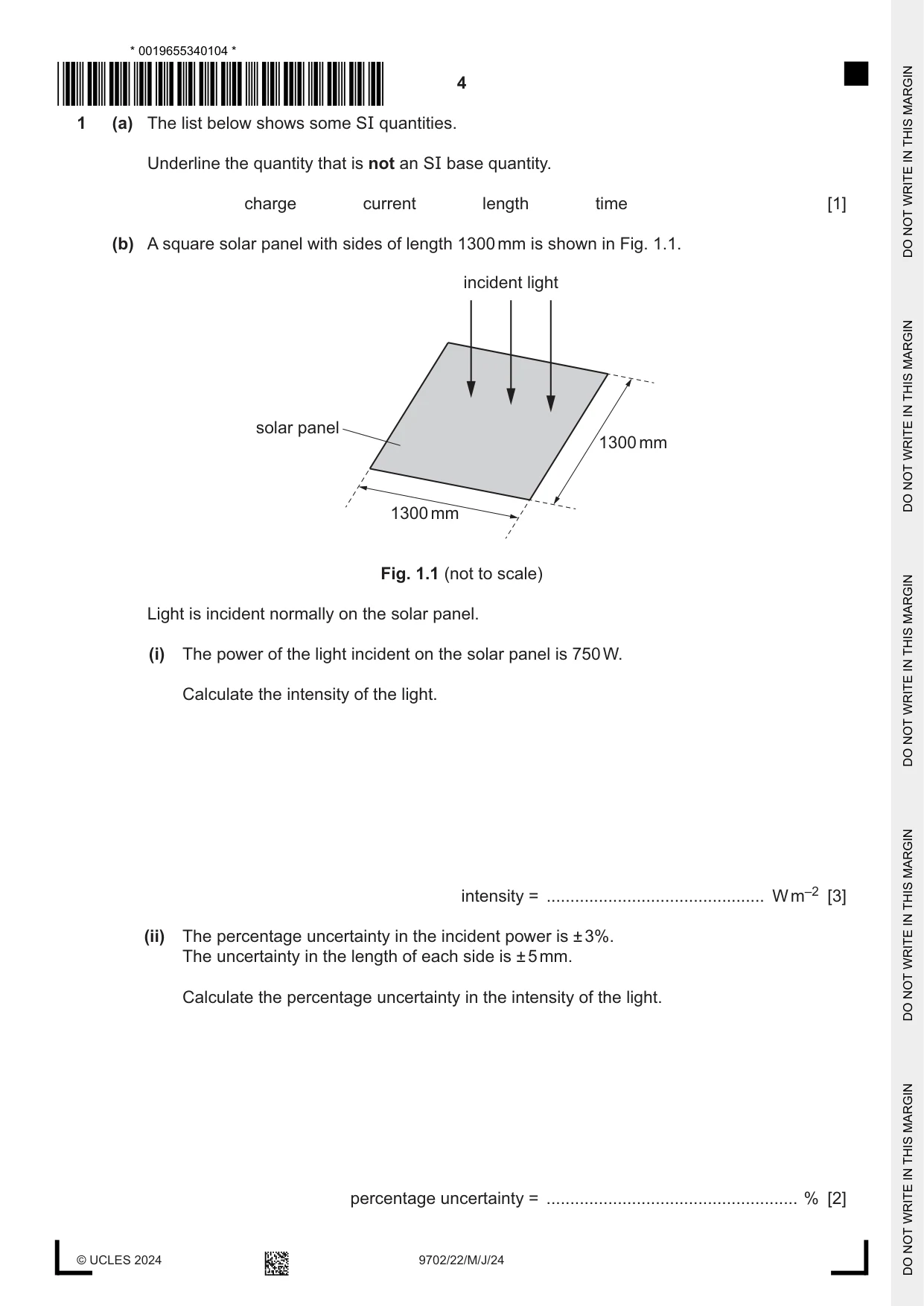
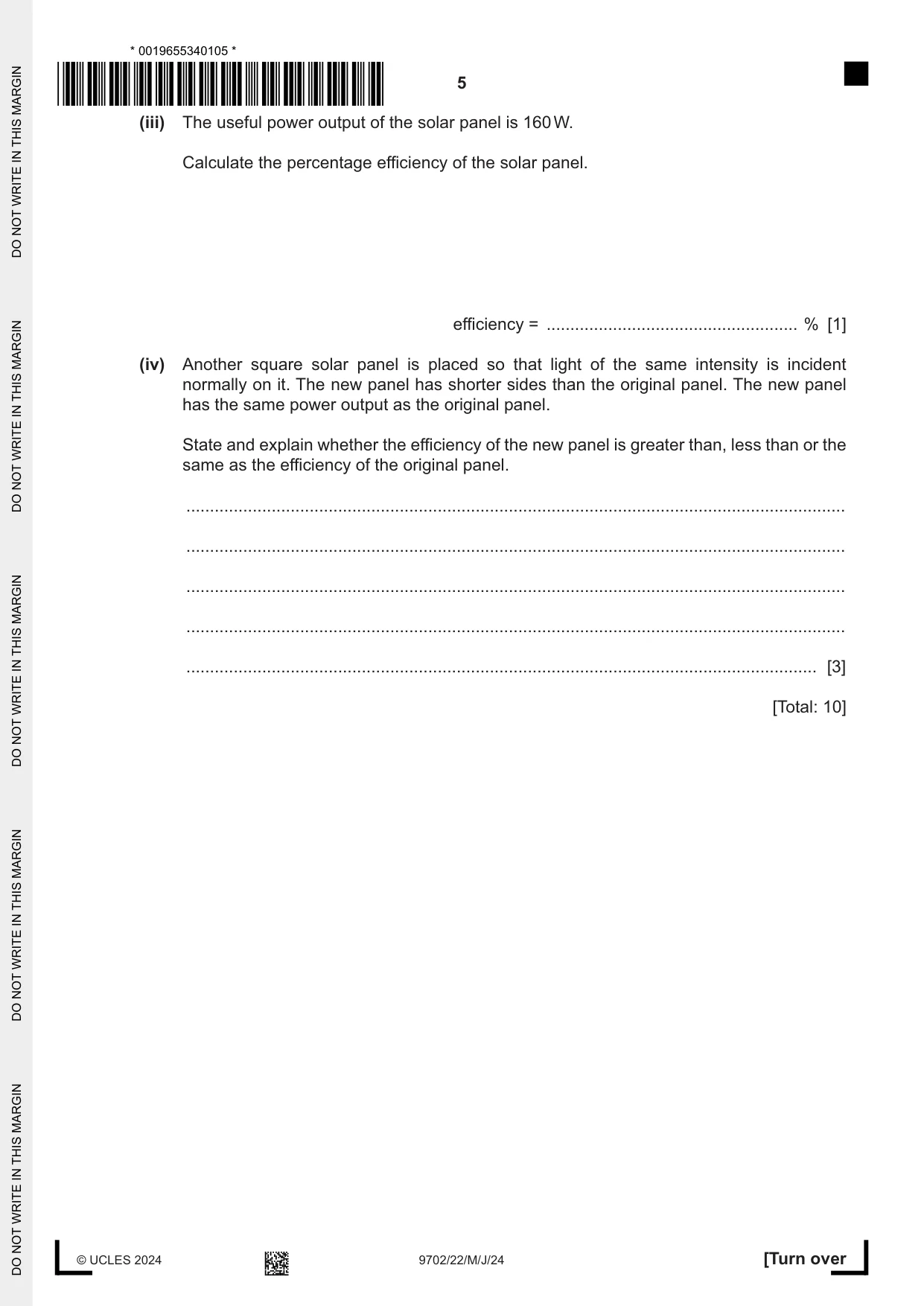
1 (a) The list below shows some SI quantities. Underline the quantity that is not an SI base quantity. charge current length time [1] (b) A square solar panel with sides of length 1300 mm is shown in Fig. 1.1. incident light solar panel 1300 mm 1300 mm Fig. 1.1 (not to scale) Light is incident normally on the solar panel. (i) The power of the light incident on the solar panel is 750 W. Calculate the intensity of the light. intensity = .............................................. W m–2 [3] (ii) The percentage uncertainty in the incident power is ± 3%. The uncertainty in the length of each side is ± 5 mm. Calculate the percentage uncertainty in the intensity of the light. percentage uncertainty = ..................................................... % [2] (iii) The useful power output of the solar panel is 160 W. Calculate the percentage efficiency of the solar panel. efficiency = ..................................................... % [1] (iv) Another square solar panel is placed so that light of the same intensity is incident normally on it. The new panel has shorter sides than the original panel. The new panel has the same power output as the original panel. State and explain whether the efficiency of the new panel is greater than, less than or the same as the efficiency of the original panel. ........................................................................................................................................... ........................................................................................................................................... ........................................................................................................................................... ........................................................................................................................................... ..................................................................................................................................... [3] [Total: 10]
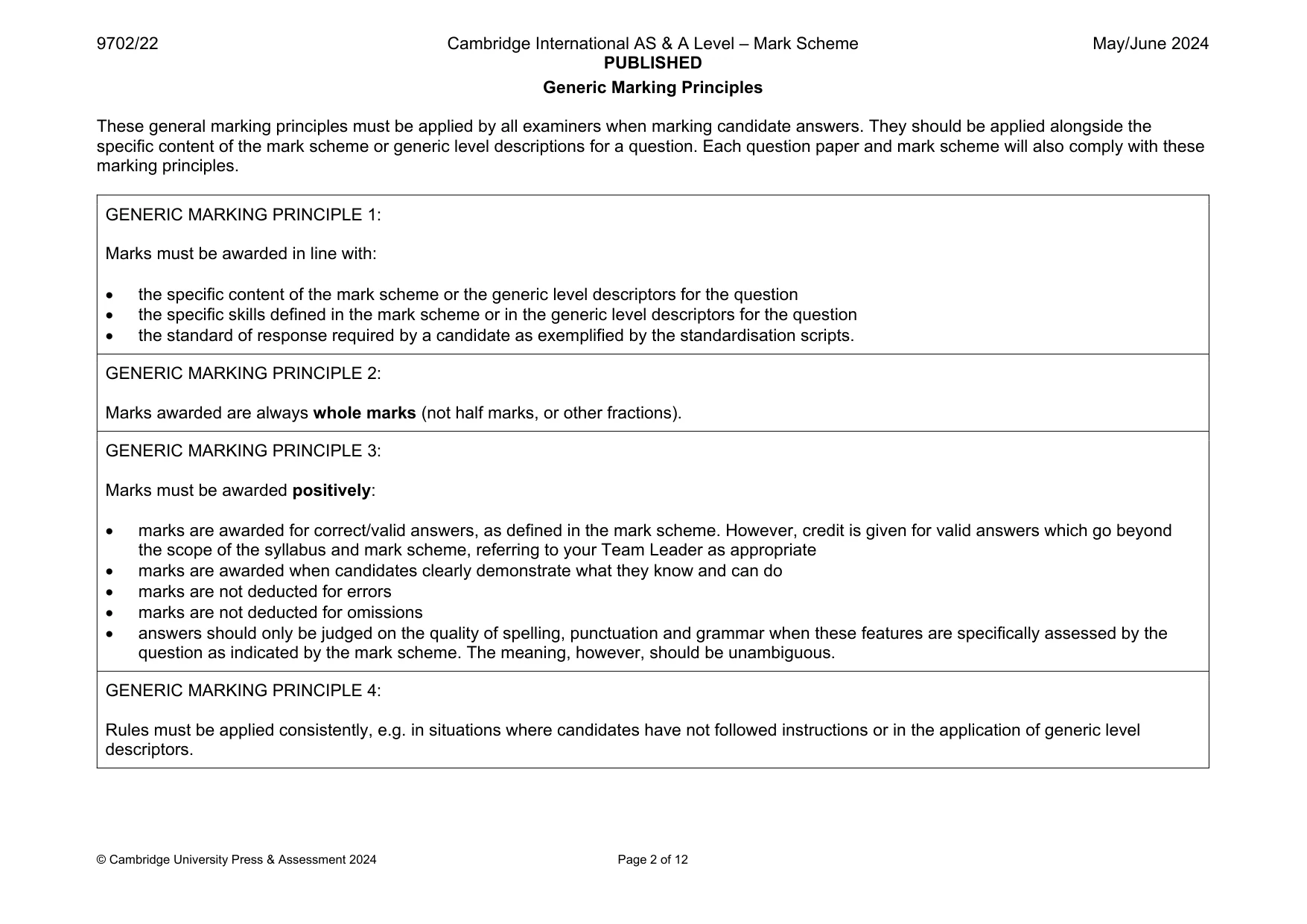
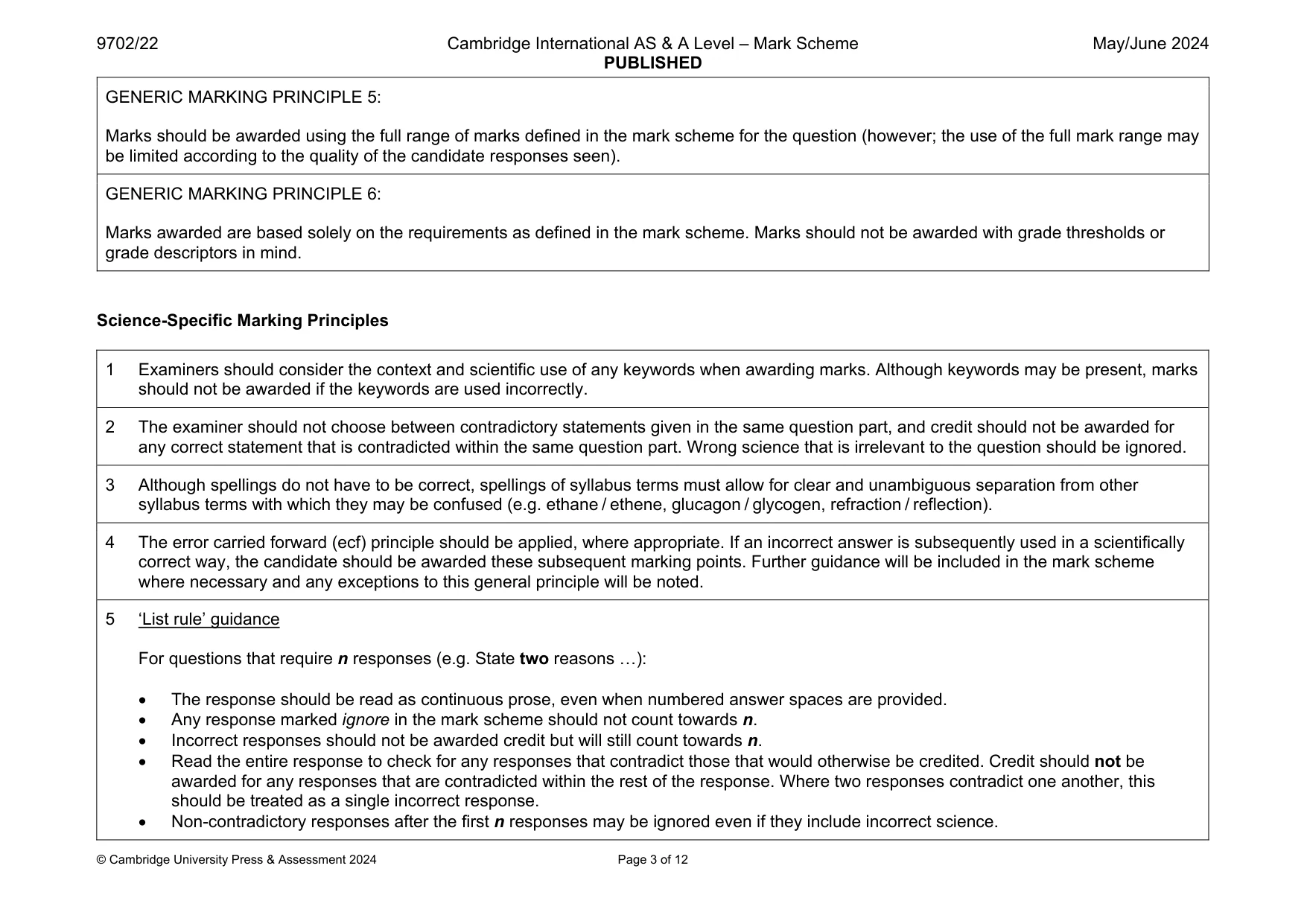
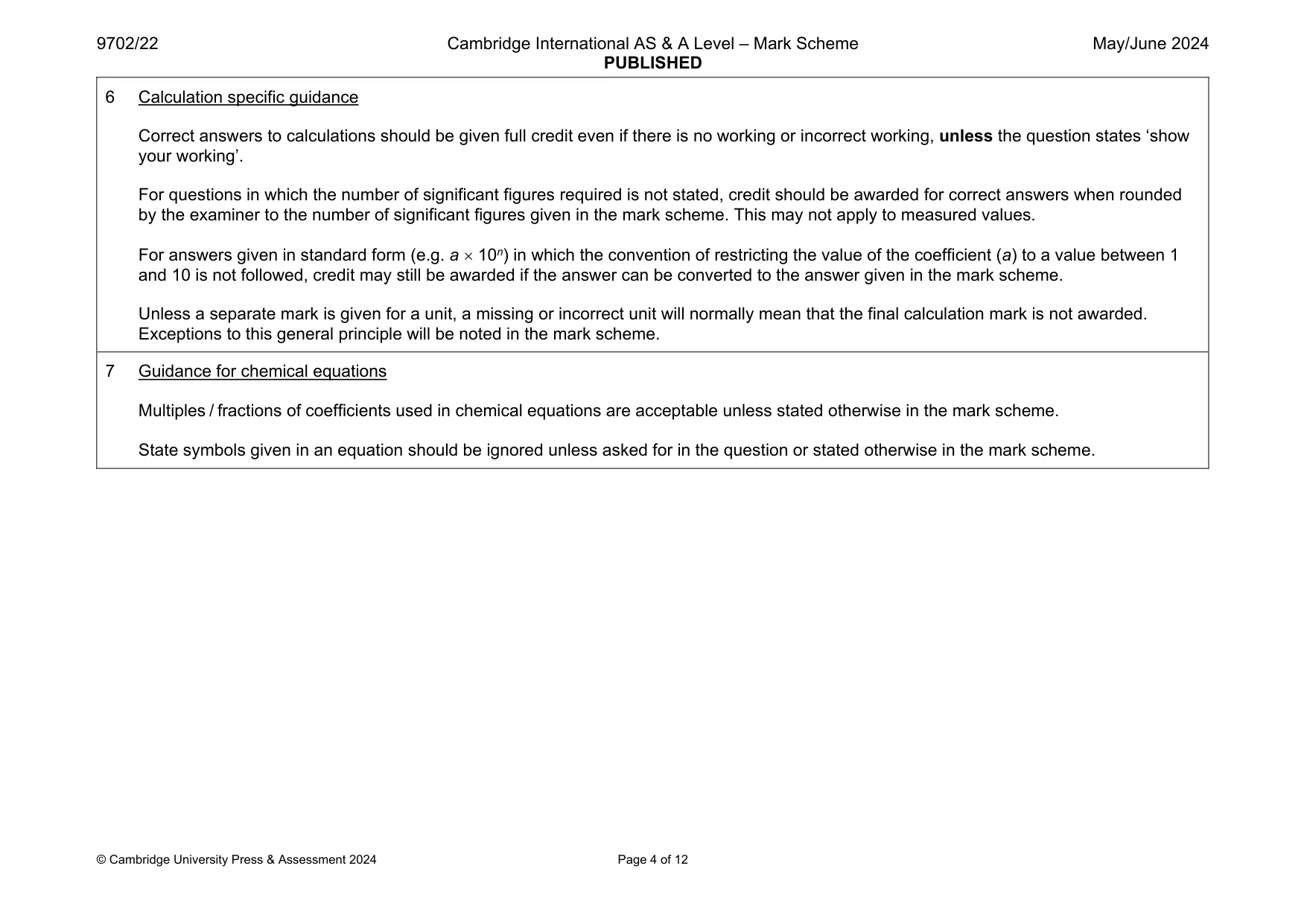
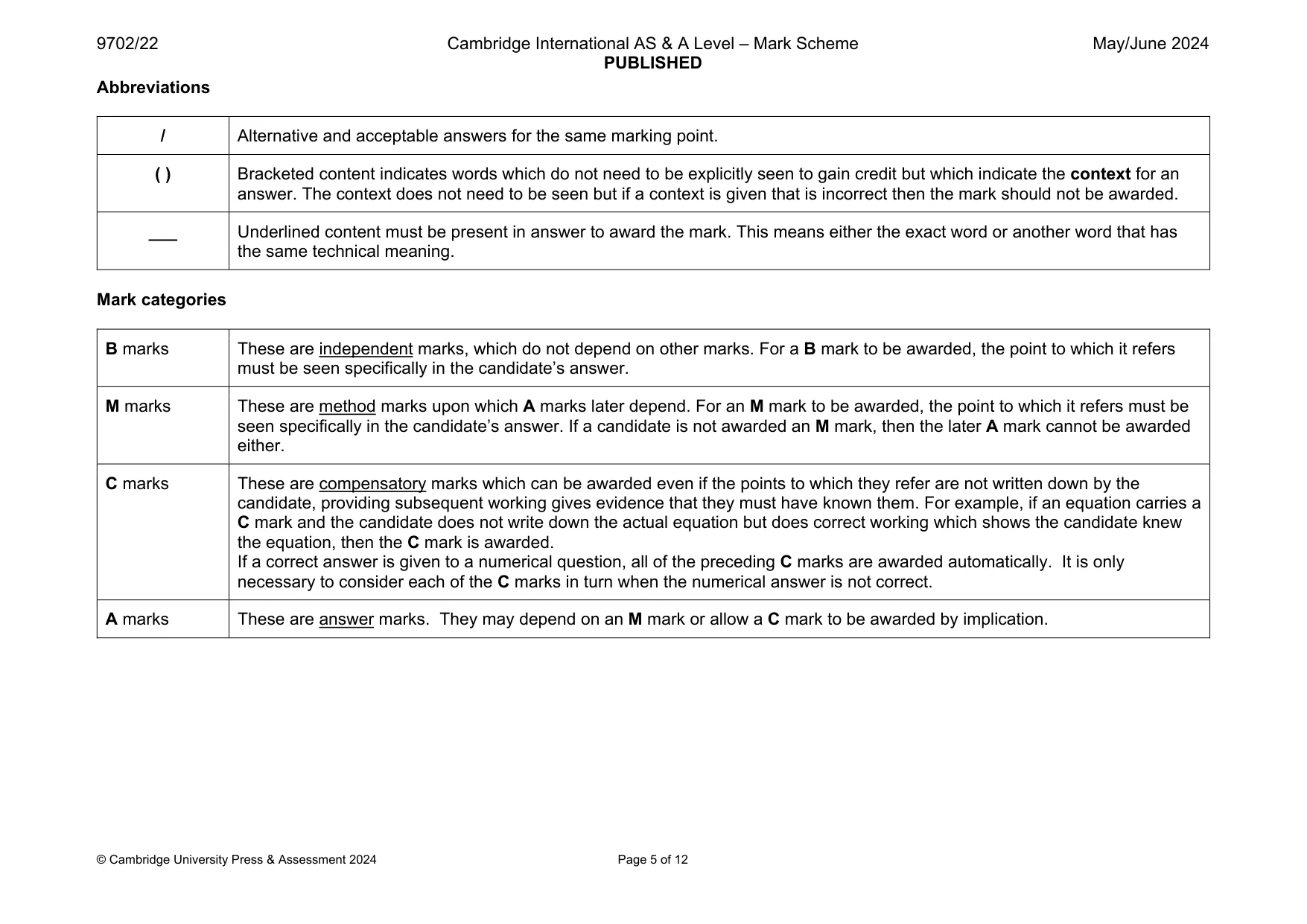
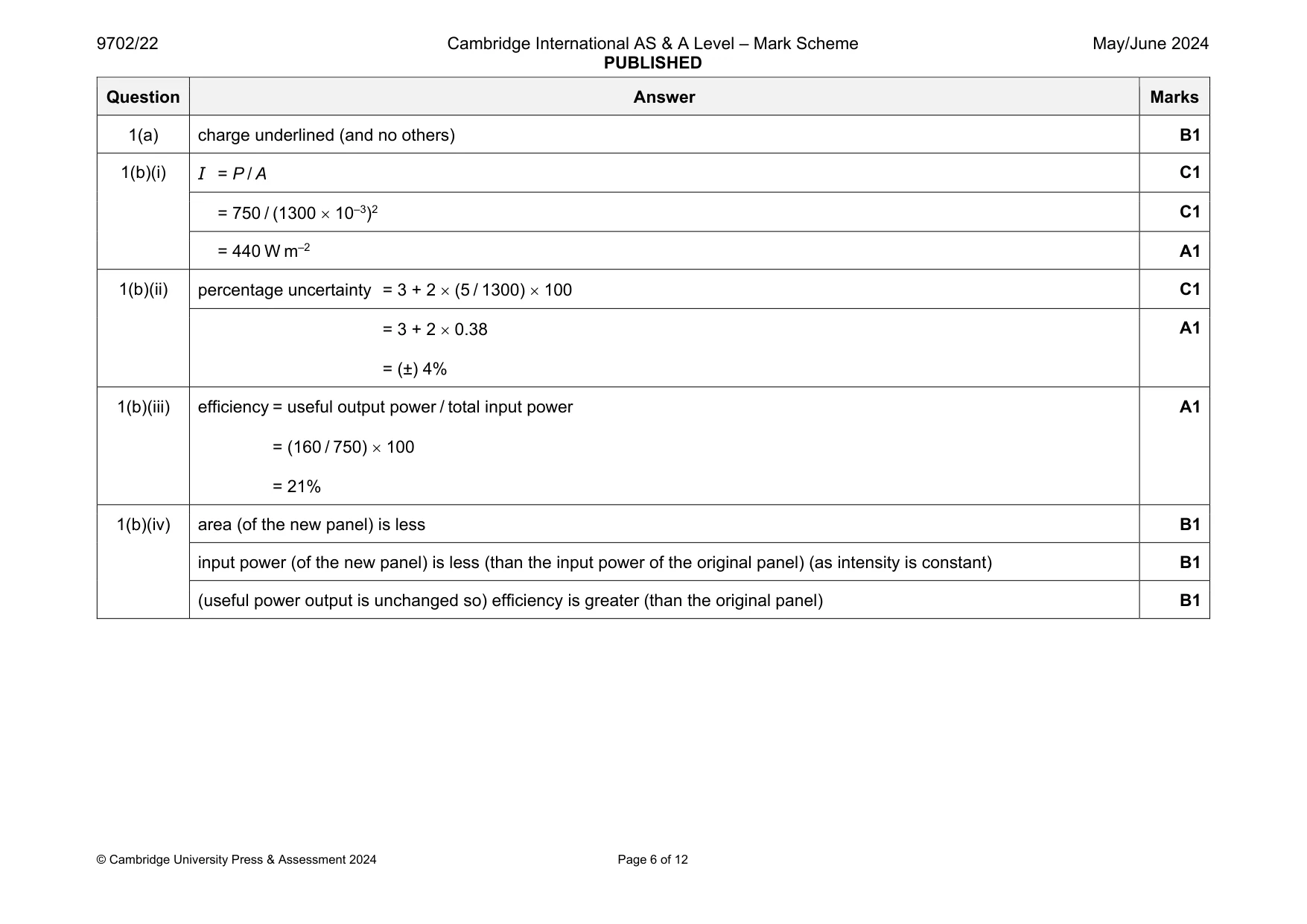
Mark scheme: 1(a) charge underlined (and no others) B1 1(b)(i) I = P / A C1 = 750 / (1300 10–3)2 C1 = 440 W m–2 A1 1(b)(ii) percentage uncertainty = 3 + 2 (5 / 1300) 100 C1 = 3 + 2 0.38 = (±) 4% A1 1(b)(iii) efficiency = useful output power / total input power = (160 / 750) 100 = 21% A1 1(b)(iv) area (of the new panel) is less B1 input power (of the new panel) is less (than the input power of the original panel) (as intensity is constant) B1 (useful power output is unchanged so) efficiency is greater (than the original panel) B1
Q2 · A skydiver jumps from an aircraft at time t = 0 and falls vertically downwards
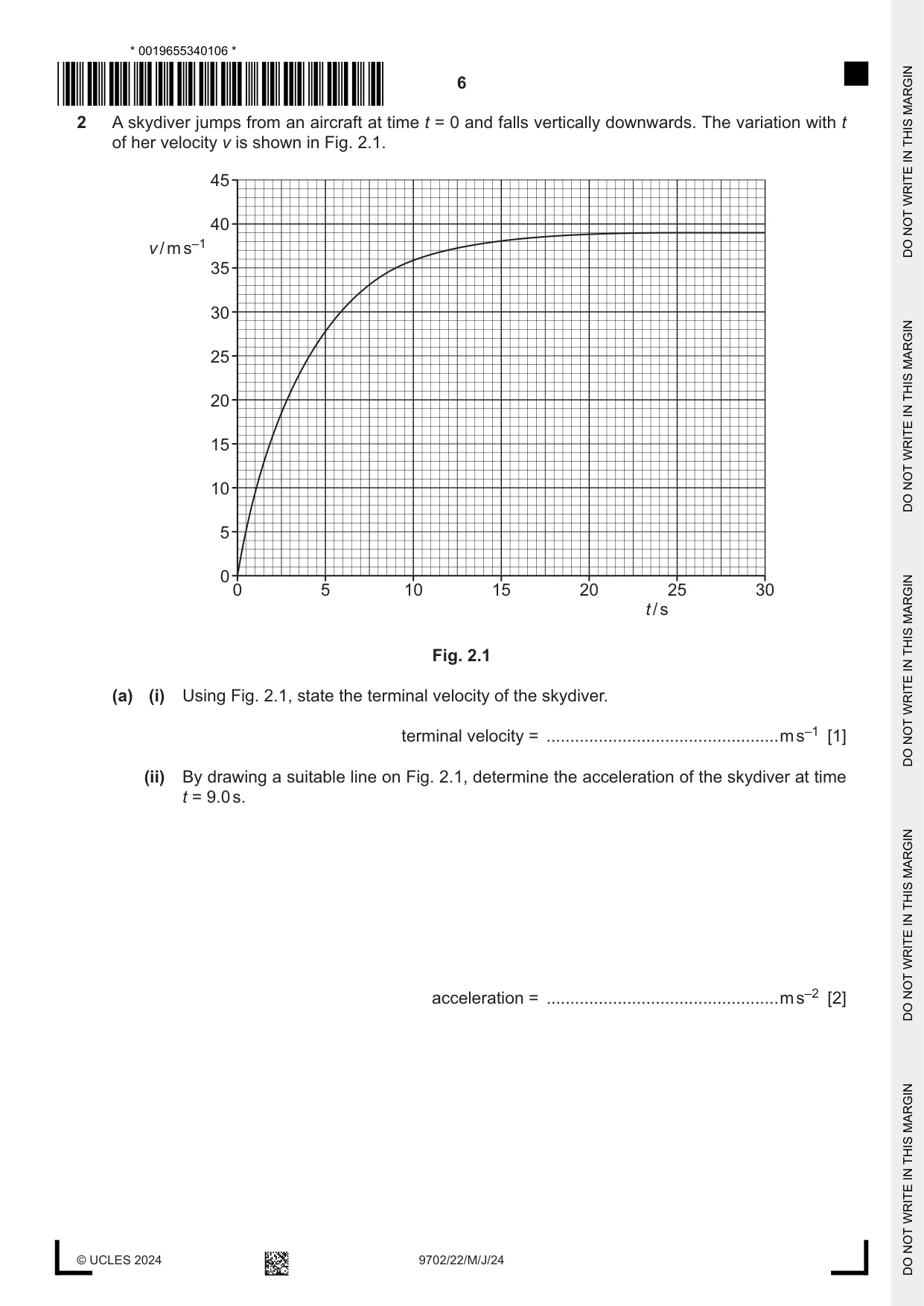
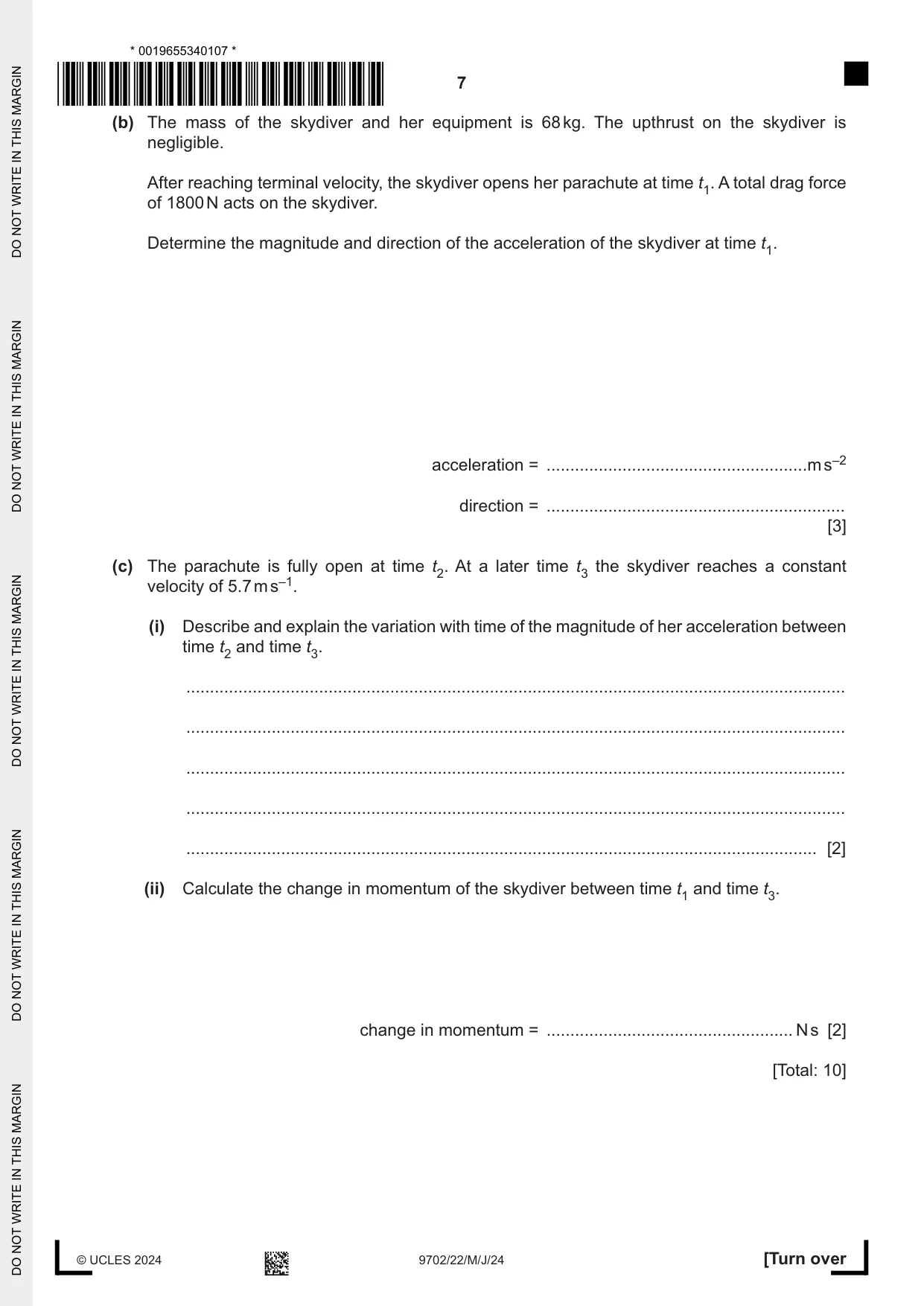
2 A skydiver jumps from an aircraft at time t = 0 and falls vertically downwards. The variation with t of her velocity v is shown in Fig. 2.1. 45 40 v / m s–1 35 30 25 20 15 10 5 0 0 5 10 15 20 25 30 t / s Fig. 2.1 (a) (i) Using Fig. 2.1, state the terminal velocity of the skydiver. terminal velocity = .................................................m s–1 [1] (ii) By drawing a suitable line on Fig. 2.1, determine the acceleration of the skydiver at time t = 9.0 s. acceleration = .................................................m s–2 [2] (b) The mass of the skydiver and her equipment is 68 kg. The upthrust on the skydiver is negligible. After reaching terminal velocity, the skydiver opens her parachute at time t1. A total drag force of 1800 N acts on the skydiver. Determine the magnitude and direction of the acceleration of the skydiver at time t1. acceleration = .......................................................m s–2 direction = ............................................................... [3] (c) The parachute is fully open at time t2. At a later time t3 the skydiver reaches a constant velocity of 5.7 m s–1. (i) Describe and explain the variation with time of the magnitude of her acceleration between time t2 and time t3. ........................................................................................................................................... ........................................................................................................................................... ........................................................................................................................................... ........................................................................................................................................... ..................................................................................................................................... [2] (ii) Calculate the change in momentum of the skydiver between time t1 and time t3. change in momentum = .................................................... N s [2] [Total: 10]
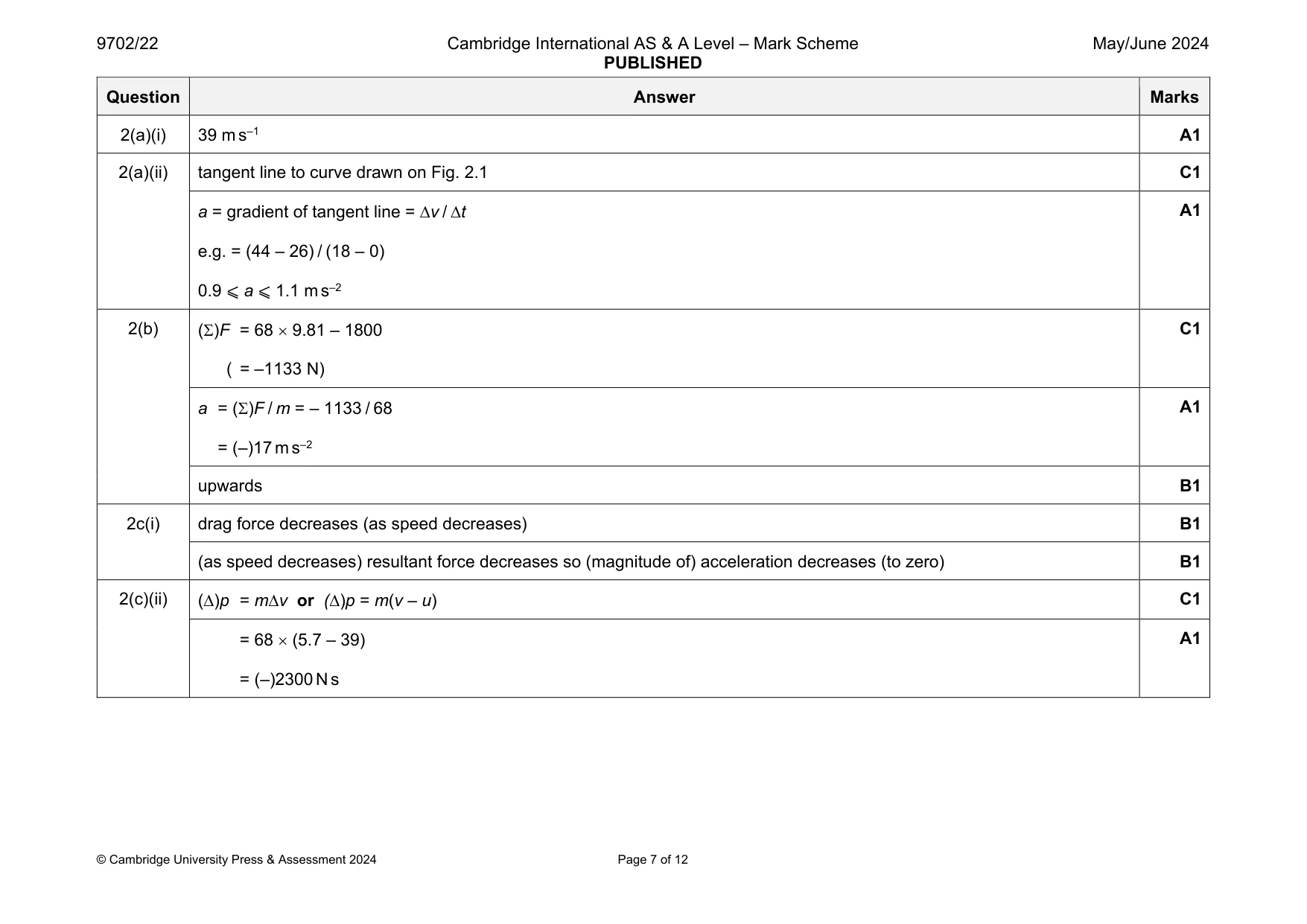
Mark scheme: 2(a)(i) 39 m s–1 A1 2(a)(ii) tangent line to curve drawn on Fig. 2.1 C1 a = gradient of tangent line = v / t e.g. = (44 – 26) / (18 – 0) 0.9 ⩽ a ⩽ 1.1 m s–2 A1 2(b) ()F = 68 9.81 – 1800 ( = –1133 N) C1 a = ()F / m = – 1133 / 68 = (–)17 m s–2 A1 upwards B1 2c(i) drag force decreases (as speed decreases) B1 (as speed decreases) resultant force decreases so (magnitude of) acceleration decreases (to zero) B1 2(c)(ii) ()p = mv or ()p = m(v – u) C1 = 68 (5.7 – 39) = (–)2300 N s A1
Q3 · Lightning occurs when charge builds up in the atmosphere, creating a potential difference…
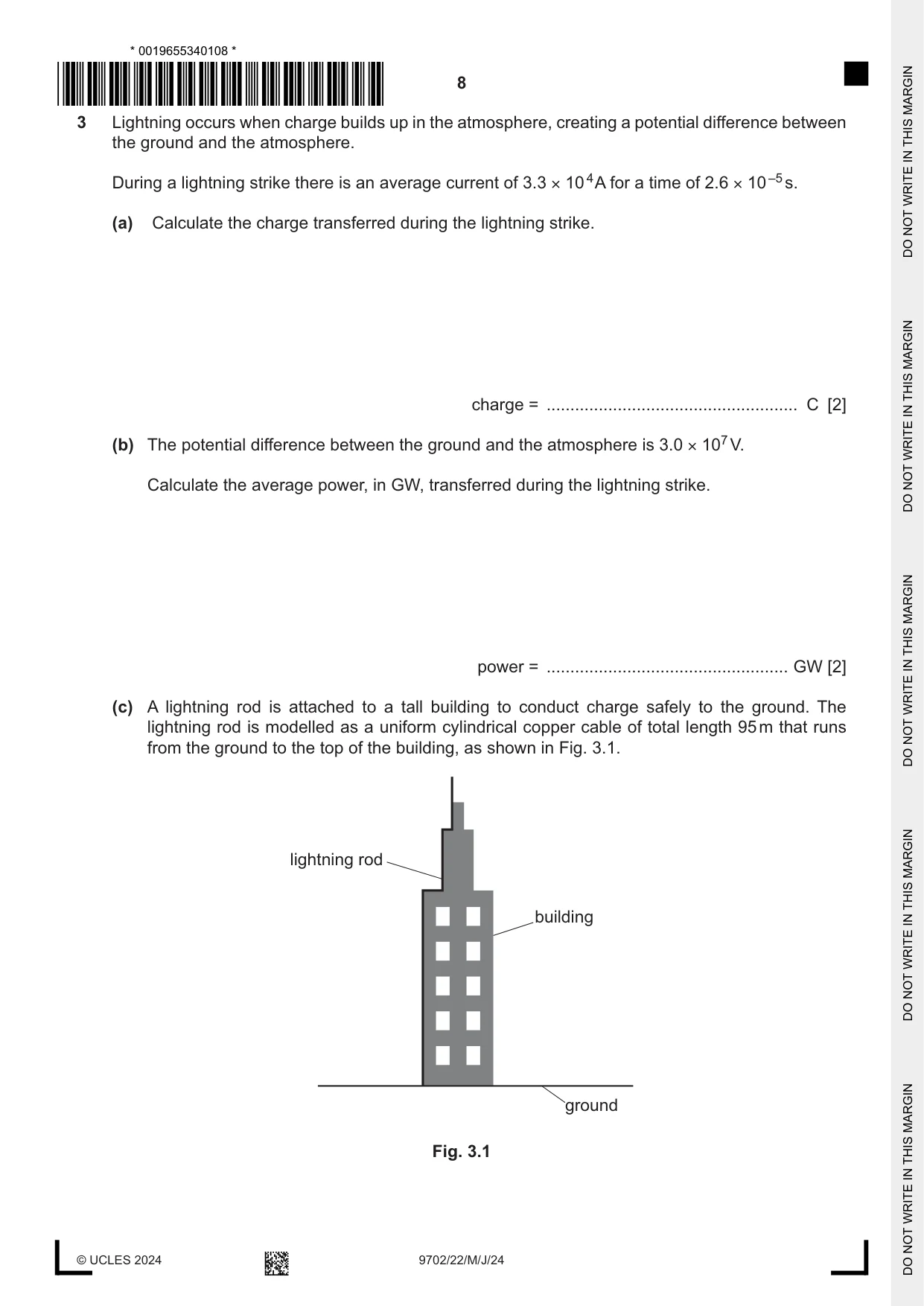
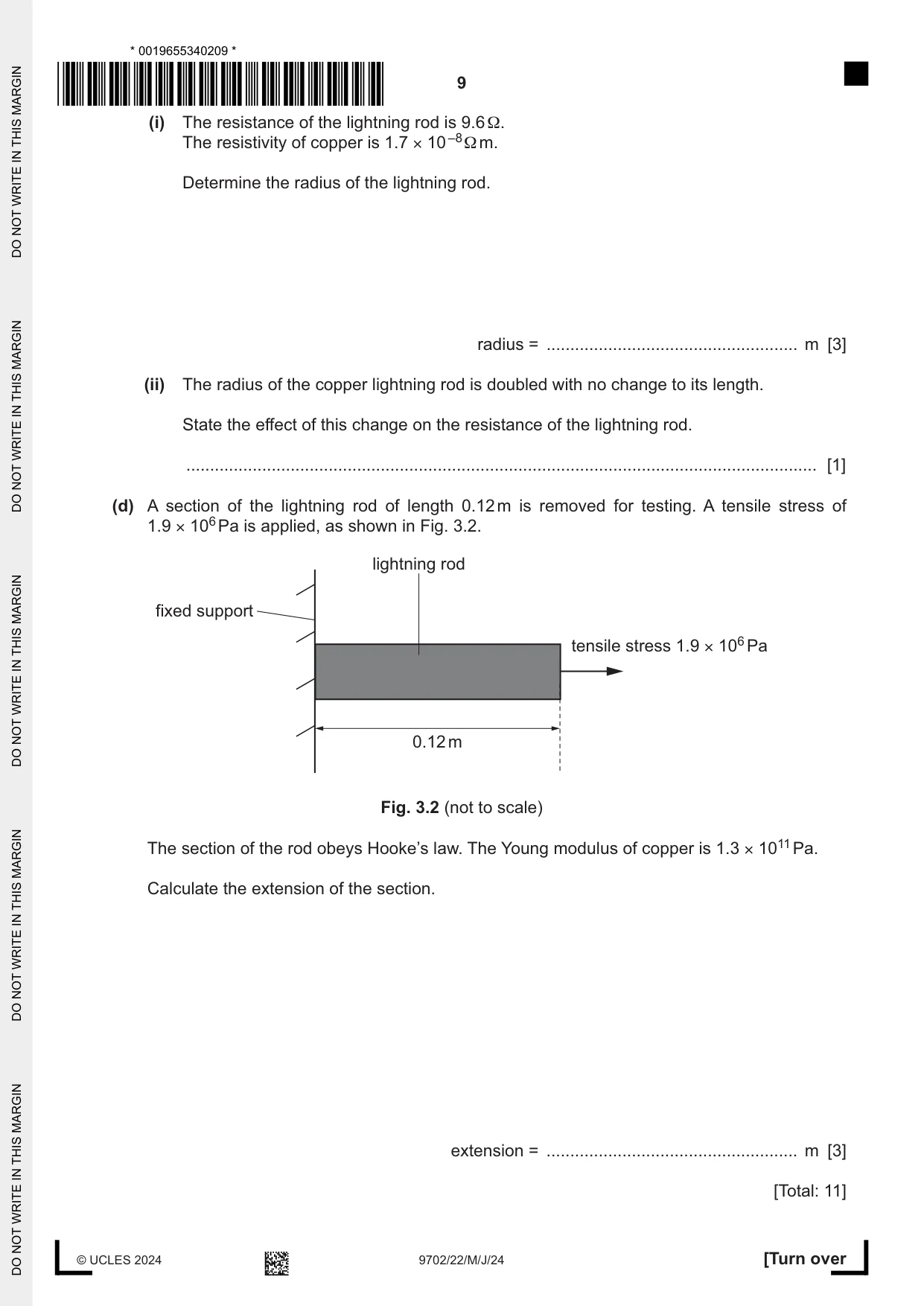
3 Lightning occurs when charge builds up in the atmosphere, creating a potential difference between the ground and the atmosphere. During a lightning strike there is an average current of 3.3 × 10 4 A for a time of 2.6 × 10 –5 s. (a) Calculate the charge transferred during the lightning strike. charge = ..................................................... C [2] (b) The potential difference between the ground and the atmosphere is 3.0 × 10⁷ V. Calculate the average power, in GW, transferred during the lightning strike. power = ................................................... GW [2] (c) A lightning rod is attached to a tall building to conduct charge safely to the ground. The lightning rod is modelled as a uniform cylindrical copper cable of total length 95 m that runs from the ground to the top of the building, as shown in Fig. 3.1. lightning rod building ground Fig. 3.1 (i) The resistance of the lightning rod is 9.6 Ω. The resistivity of copper is 1.7 × 10 –8 Ω m. Determine the radius of the lightning rod. radius = ..................................................... m [3] (ii) The radius of the copper lightning rod is doubled with no change to its length. State the effect of this change on the resistance of the lightning rod. ..................................................................................................................................... [1] (d) A section of the lightning rod of length 0.12 m is removed for testing. A tensile stress of 1.9 × 10⁶ Pa is applied, as shown in Fig. 3.2. lightning rod fixed support tensile stress 1.9 × 10⁶ Pa 0.12 m Fig. 3.2 (not to scale) The section of the rod obeys Hooke’s law. The Young modulus of copper is 1.3 × 10¹¹ Pa. Calculate the extension of the section. extension = ..................................................... m [3] [Total: 11]
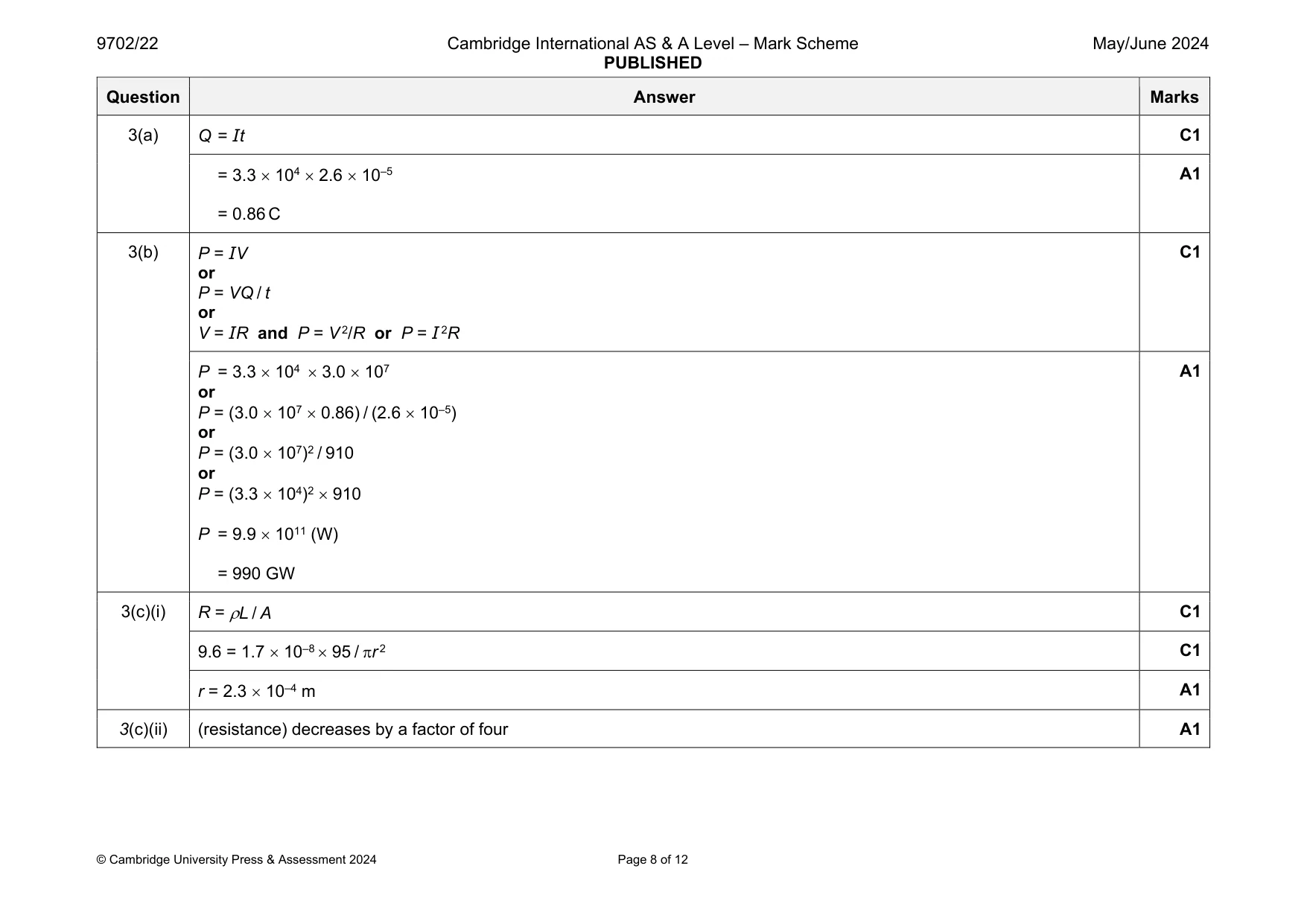
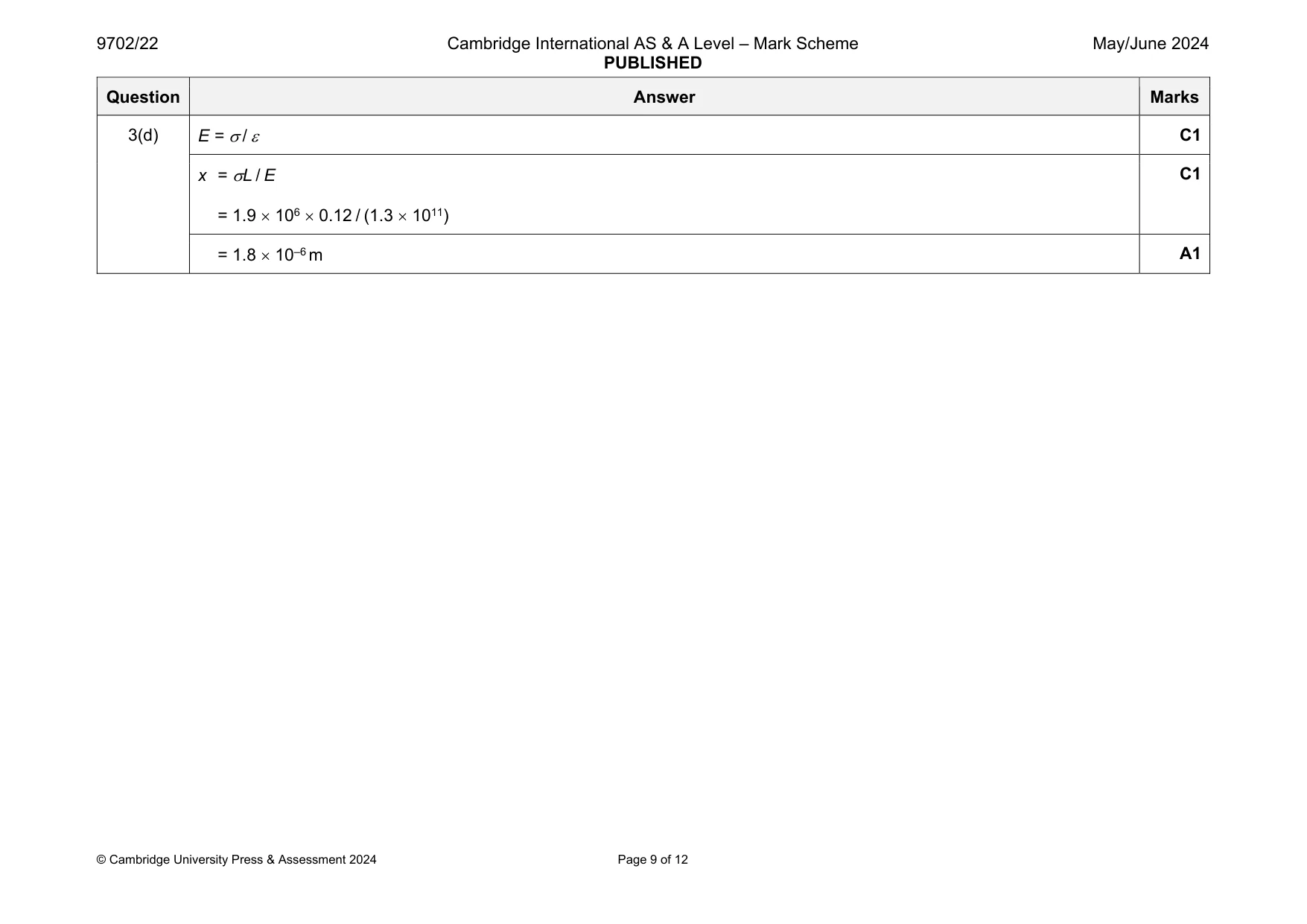
Mark scheme: 3(a) C1 = 3.3 104 2.6 10–5 = 0.86 C A1 3(b) P = IV or P = VQ / t or V = IR and P = V 2/R or P = I 2R C1 P = 3.3 104 3.0 107 or P = (3.0 107 0.86) / (2.6 10–5) or P = (3.0 107)2 / 910 or P = (3.3 104)2 910 P = 9.9 1011 (W) = 990 GW A1 3(c)(i) R = L / A C1 9.6 = 1.7 10–8 95 / r 2 C1 r = 2.3 10–4 m A1 3(c)(ii) (resistance) decreases by a factor of four A1 Question Answer Marks 3(d) E = / C1 x = L / E = 1.9 106 0.12 / (1.3 1011) C1 = 1.8 10–6 m A1
Q4 · A pinball machine uses a spring to launch a small metal ball of mass 4.5 × 10 –2 kg up a…
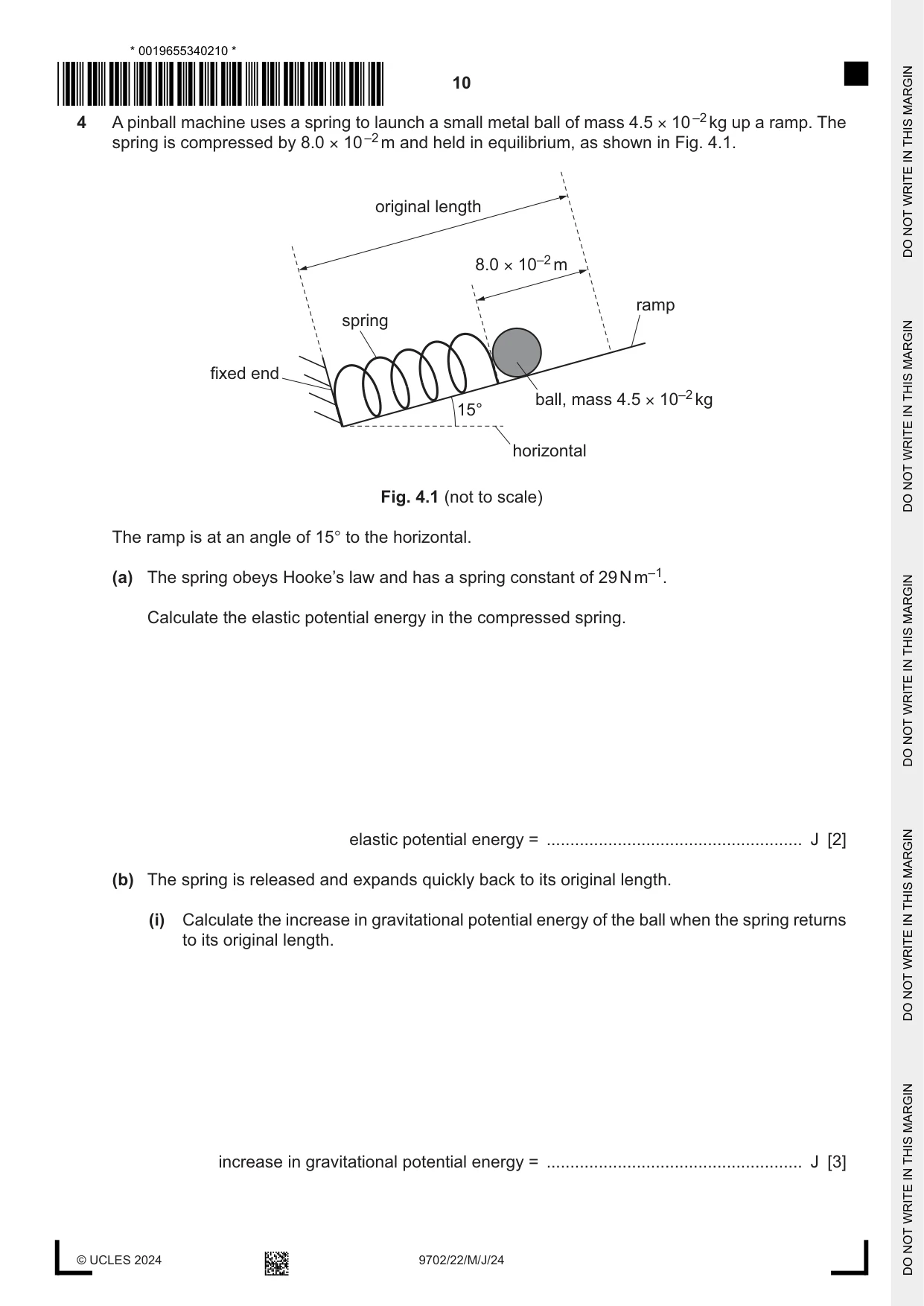
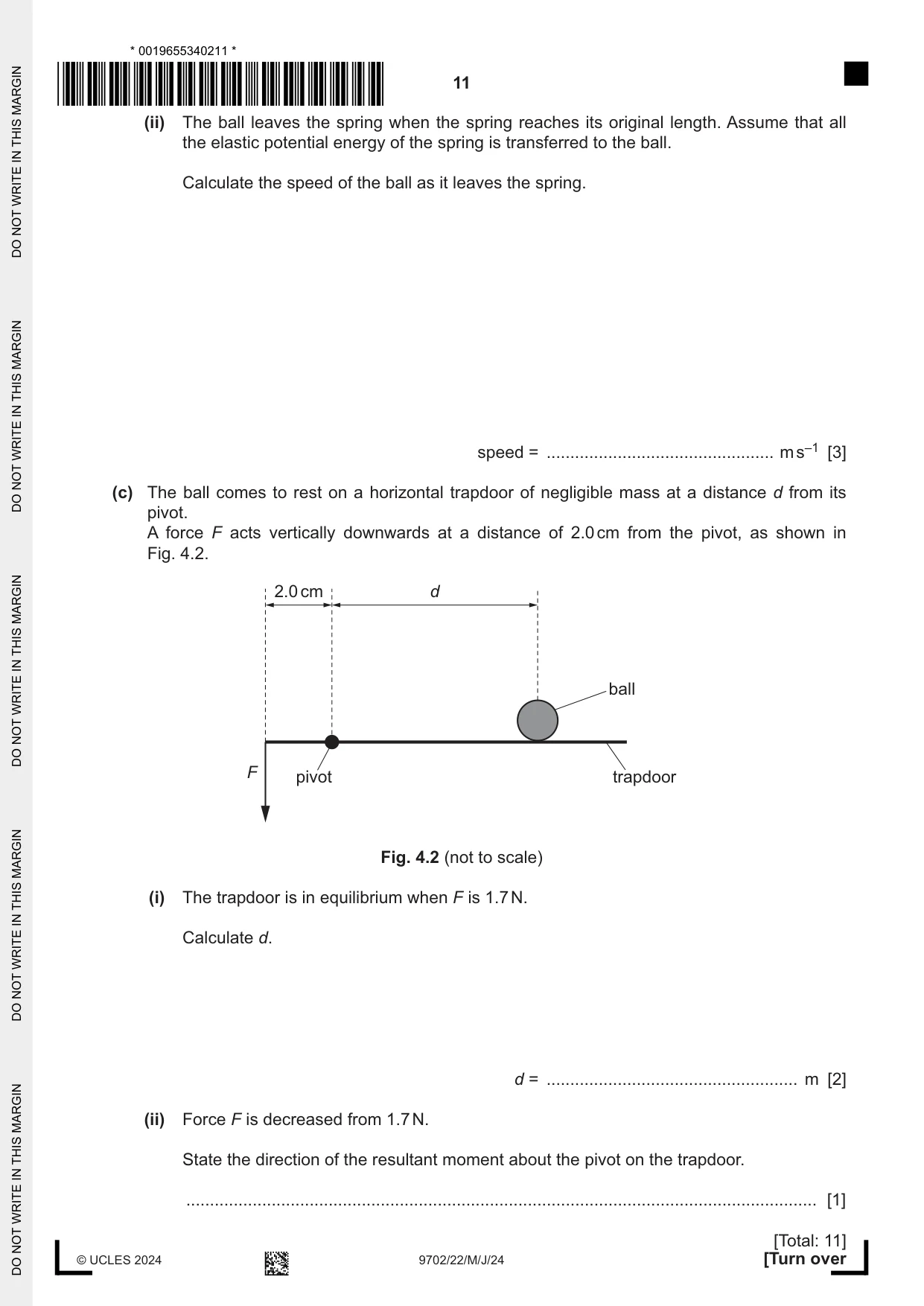
4 A pinball machine uses a spring to launch a small metal ball of mass 4.5 × 10 –2 kg up a ramp. The spring is compressed by 8.0 × 10 –2 m and held in equilibrium, as shown in Fig. 4.1. original length 8.0 × 10⁻² m ramp spring fixed end ball, mass 4.5 × 10⁻² kg 15° horizontal Fig. 4.1 (not to scale) The ramp is at an angle of 15° to the horizontal. (a) The spring obeys Hooke’s law and has a spring constant of 29 N m–1. Calculate the elastic potential energy in the compressed spring. elastic potential energy = ...................................................... J [2] (b) The spring is released and expands quickly back to its original length. (i) Calculate the increase in gravitational potential energy of the ball when the spring returns to its original length. increase in gravitational potential energy = ...................................................... J [3] (ii) The ball leaves the spring when the spring reaches its original length. Assume that all the elastic potential energy of the spring is transferred to the ball. Calculate the speed of the ball as it leaves the spring. speed = ................................................ m s–1 [3] (c) The ball comes to rest on a horizontal trapdoor of negligible mass at a distance d from its pivot. A force F acts vertically downwards at a distance of 2.0 cm from the pivot, as shown in Fig. 4.2. 2.0 cm d ball F pivot trapdoor Fig. 4.2 (not to scale) (i) The trapdoor is in equilibrium when F is 1.7 N. Calculate d. d = ..................................................... m [2] (ii) Force F is decreased from 1.7 N. State the direction of the resultant moment about the pivot on the trapdoor. ..................................................................................................................................... [1] [Total: 11]
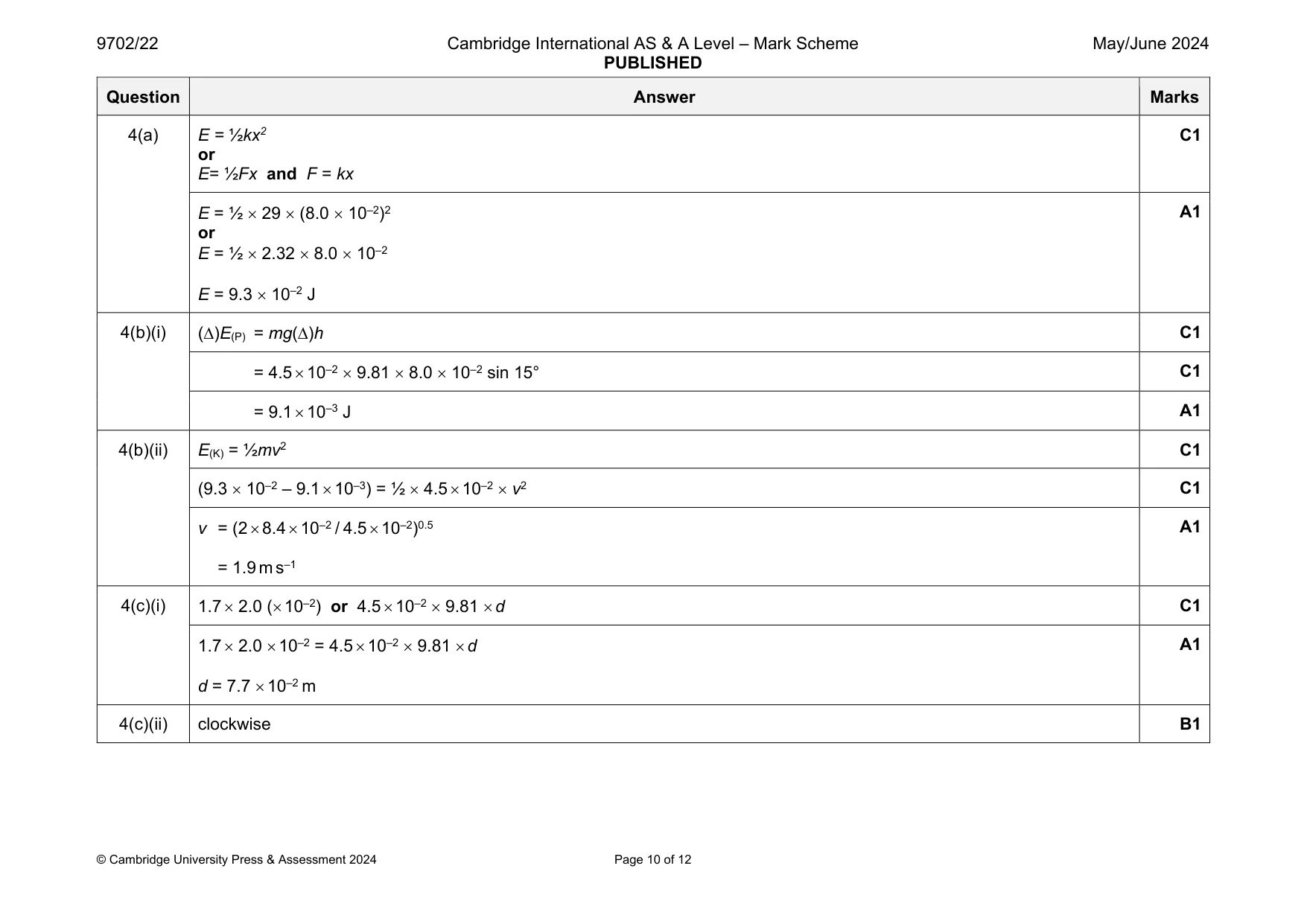
Mark scheme: 4(a) E = ½kx2 or E= ½Fx and F = kx C1 E = ½ 29 (8.0 10–2)2 or E = ½ 2.32 8.0 10–2 E = 9.3 10–2 J A1 4(b)(i) ()E(P) = mg()h C1 = 4.5 10–2 9.81 8.0 10–2 sin 15° C1 = 9.1 10–3 J A1 4(b)(ii) E(K) = ½mv2 C1 (9.3 10–2 – 9.1 10–3) = ½ 4.5 10–2 v2 C1 v = (2 8.4 10–2 / 4.5 10–2)0.5 = 1.9 m s–1 A1 4(c)(i) 1.7 2.0 ( 10–2) or 4.5 10–2 9.81 d C1 1.7 2.0 10–2 = 4.5 10–2 9.81 d d = 7.7 10–2 m A1 4(c)(ii) clockwise B1
More questions on Gravitational potential energy and kinetic energy
Q5 · State Kirchhoff’s second law
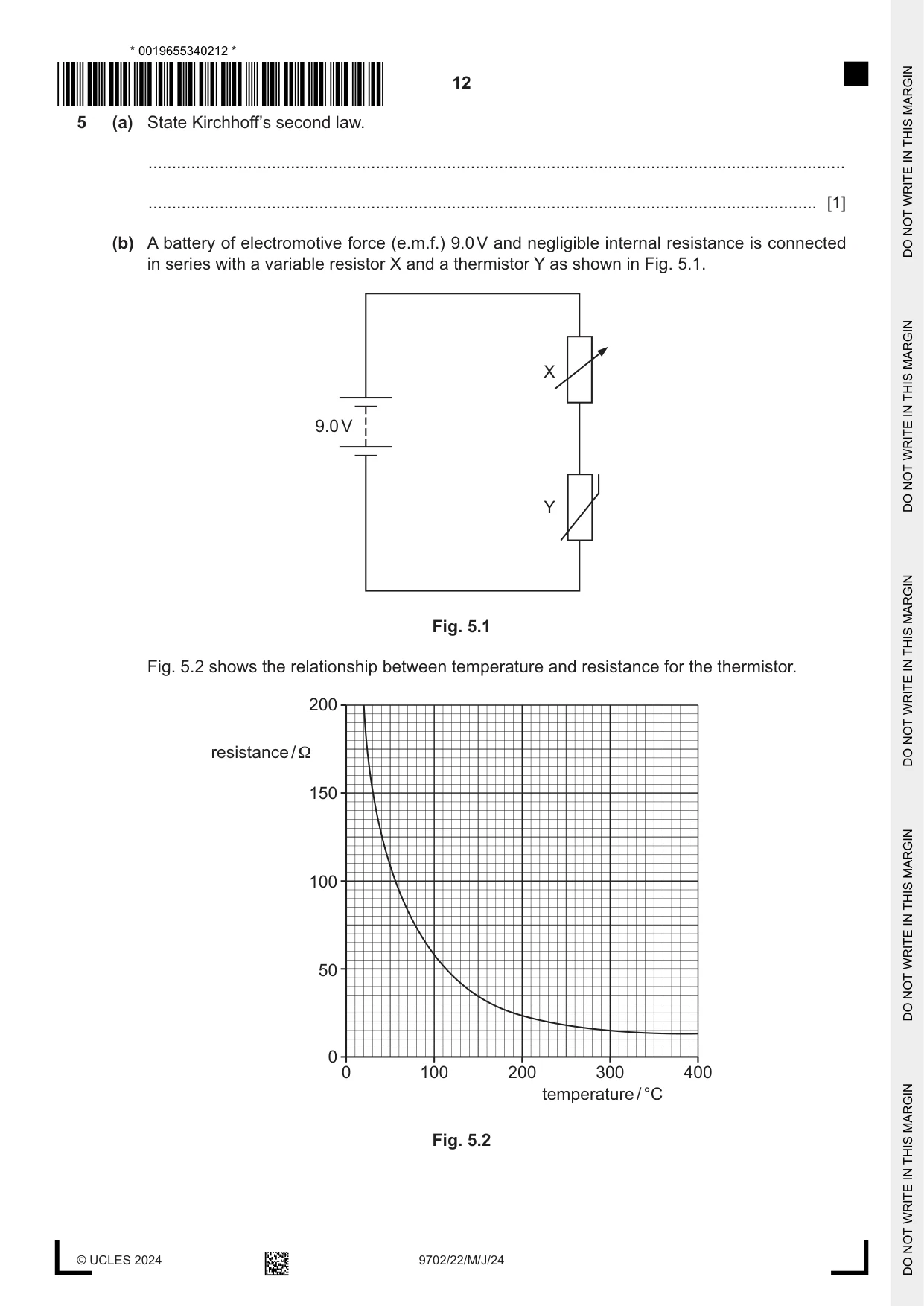
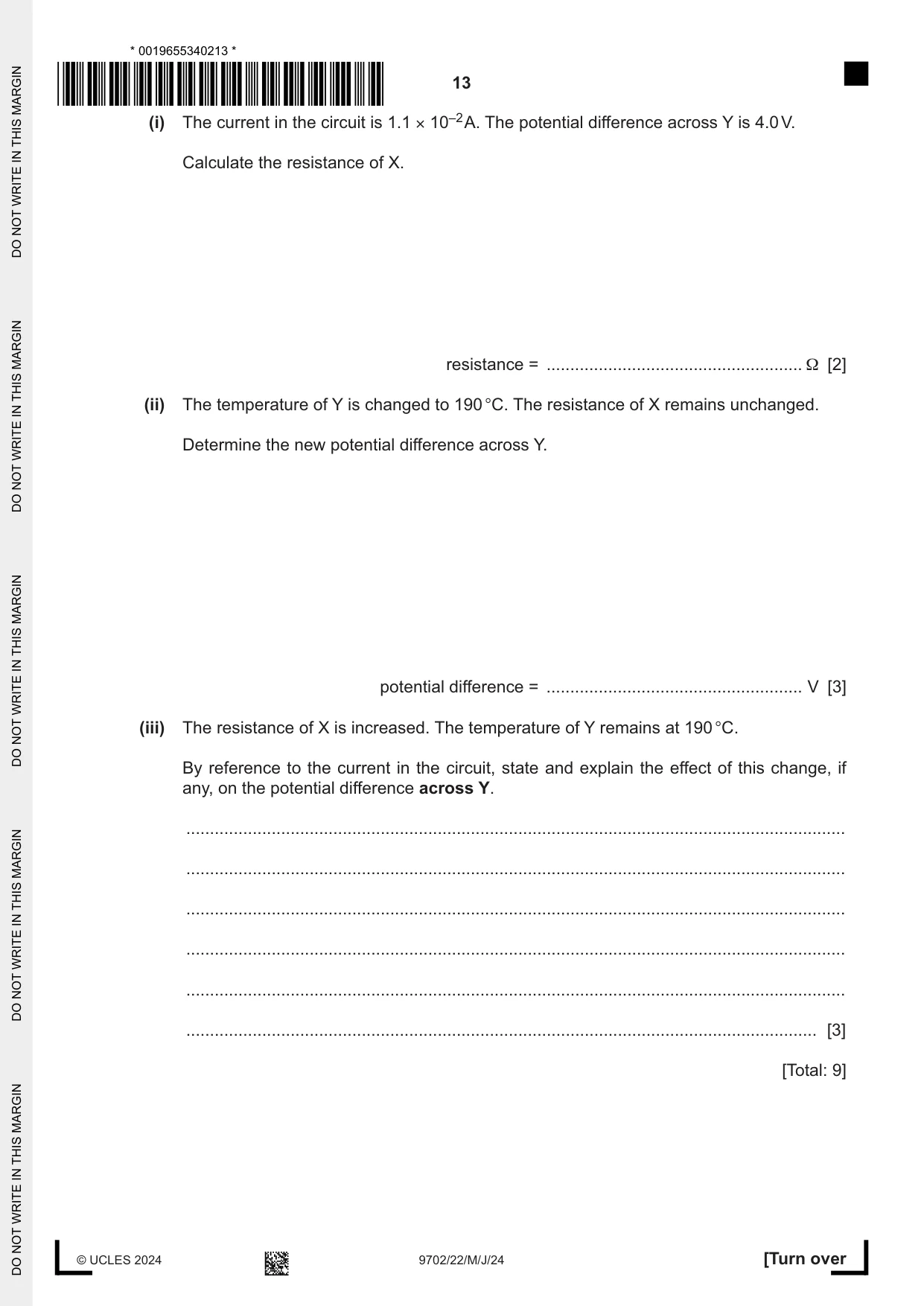
5 (a) State Kirchhoff’s second law. ................................................................................................................................................... ............................................................................................................................................. [1] (b) A battery of electromotive force (e.m.f.) 9.0 V and negligible internal resistance is connected in series with a variable resistor X and a thermistor Y as shown in Fig. 5.1. X 9.0 V Y Fig. 5.1 Fig. 5.2 shows the relationship between temperature and resistance for the thermistor. 200 resistance / Ω 150 100 50 0 0 100 200 300 400 temperature / °C Fig. 5.2 (i) The current in the circuit is 1.1 × 10⁻² A. The potential difference across Y is 4.0 V. Calculate the resistance of X. resistance = ...................................................... Ω [2] (ii) The temperature of Y is changed to 190 °C. The resistance of X remains unchanged. Determine the new potential difference across Y. potential difference = ...................................................... V [3] (iii) The resistance of X is increased. The temperature of Y remains at 190 °C. By reference to the current in the circuit, state and explain the effect of this change, if any, on the potential difference across Y. ........................................................................................................................................... ........................................................................................................................................... ........................................................................................................................................... ........................................................................................................................................... ........................................................................................................................................... ..................................................................................................................................... [3] [Total: 9]
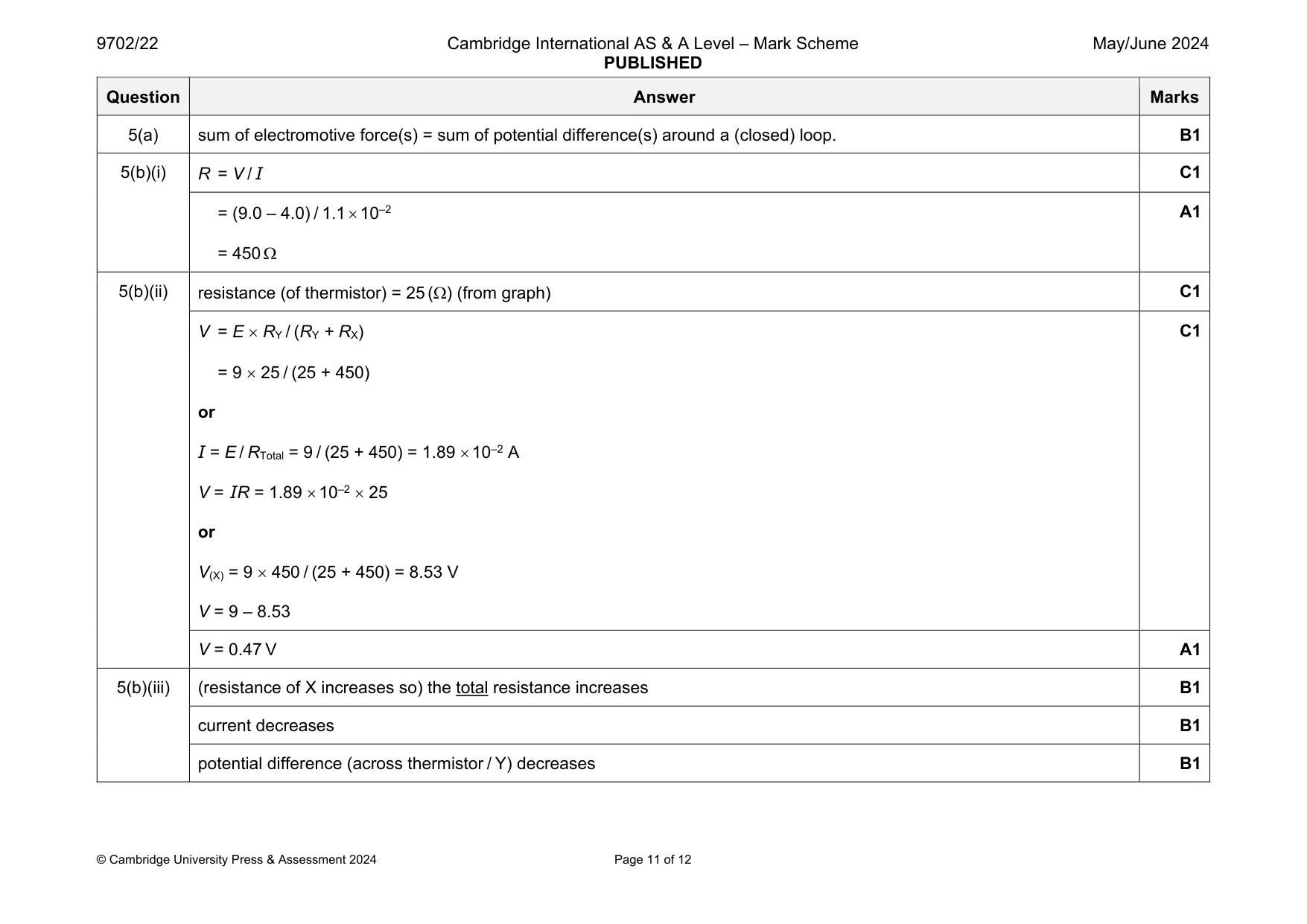
Mark scheme: 5(a) sum of electromotive force(s) = sum of potential difference(s) around a (closed) loop. B1 5(b)(i) R = V / I C1 = (9.0 – 4.0) / 1.1 10–2 = 450 A1 5(b)(ii) resistance (of thermistor) = 25 () (from graph) C1 V = E RY / (RY + RX) = 9 25 / (25 + 450) or I = E / RTotal = 9 / (25 + 450) = 1.89 10–2 A V = IR = 1.89 10–2 25 or V(X) = 9 450 / (25 + 450) = 8.53 V V = 9 – 8.53 C1 V = 0.47 V A1 5(b)(iii) (resistance of X increases so) the total resistance increases B1 current decreases B1 potential difference (across thermistor / Y) decreases B1
Q6 · Light of a single frequency is incident normally on a diffraction grating
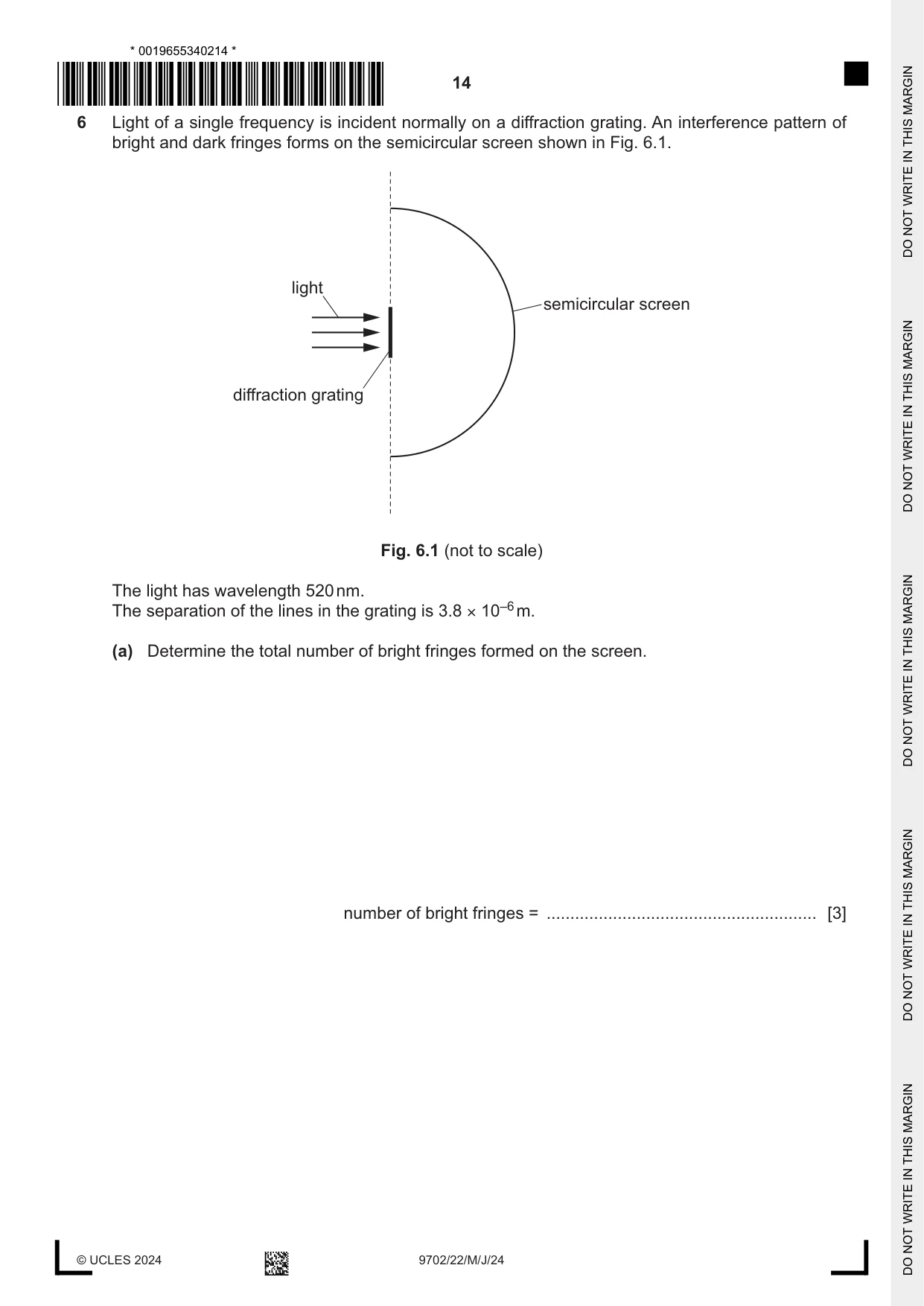
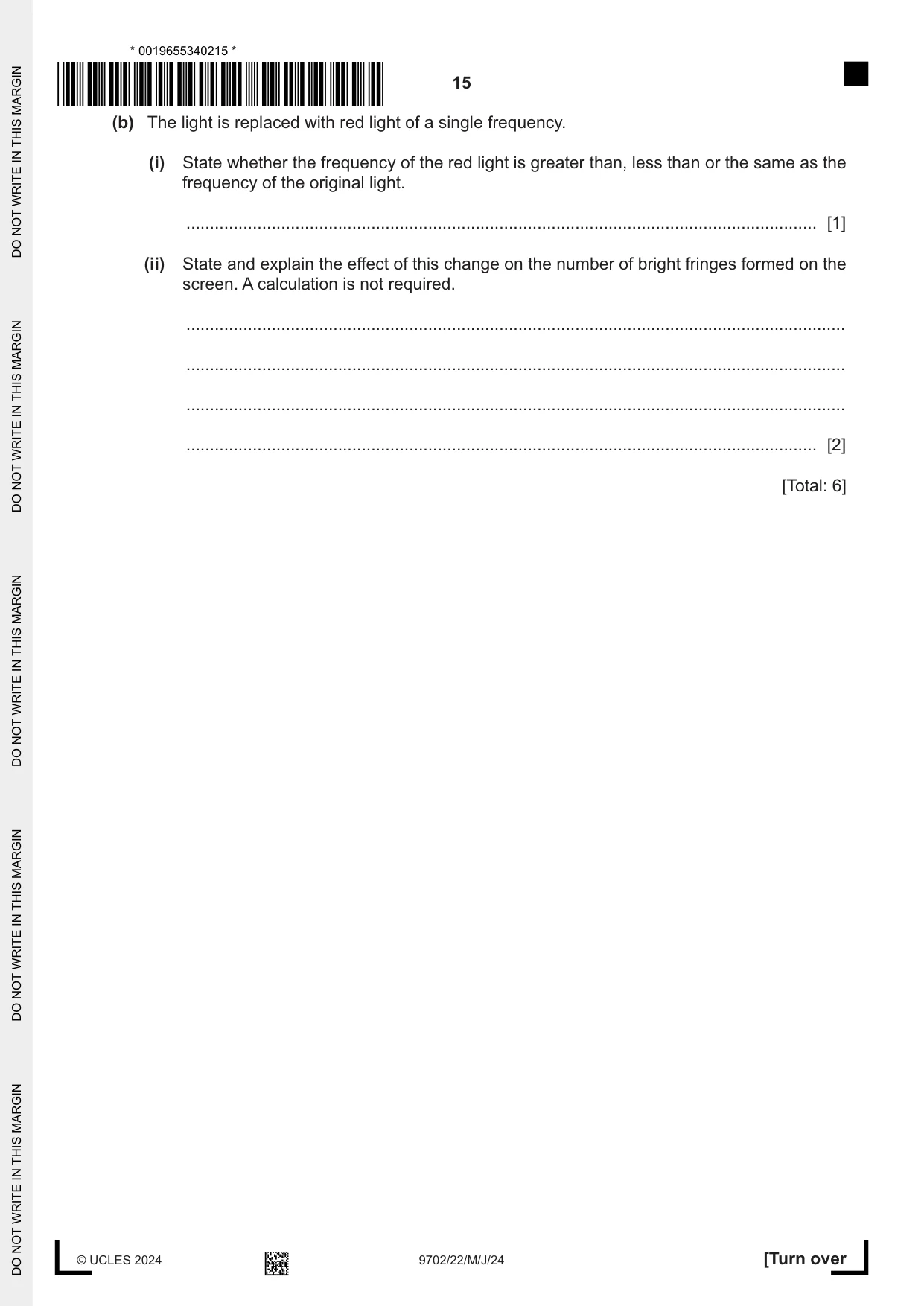
6 Light of a single frequency is incident normally on a diffraction grating. An interference pattern of bright and dark fringes forms on the semicircular screen shown in Fig. 6.1. light semicircular screen diffraction grating Fig. 6.1 (not to scale) The light has wavelength 520 nm. The separation of the lines in the grating is 3.8 × 10⁻⁶ m. (a) Determine the total number of bright fringes formed on the screen. number of bright fringes = ......................................................... [3] (b) The light is replaced with red light of a single frequency. (i) State whether the frequency of the red light is greater than, less than or the same as the frequency of the original light. ..................................................................................................................................... [1] (ii) State and explain the effect of this change on the number of bright fringes formed on the screen. A calculation is not required. ........................................................................................................................................... ........................................................................................................................................... ........................................................................................................................................... ..................................................................................................................................... [2] [Total: 6]
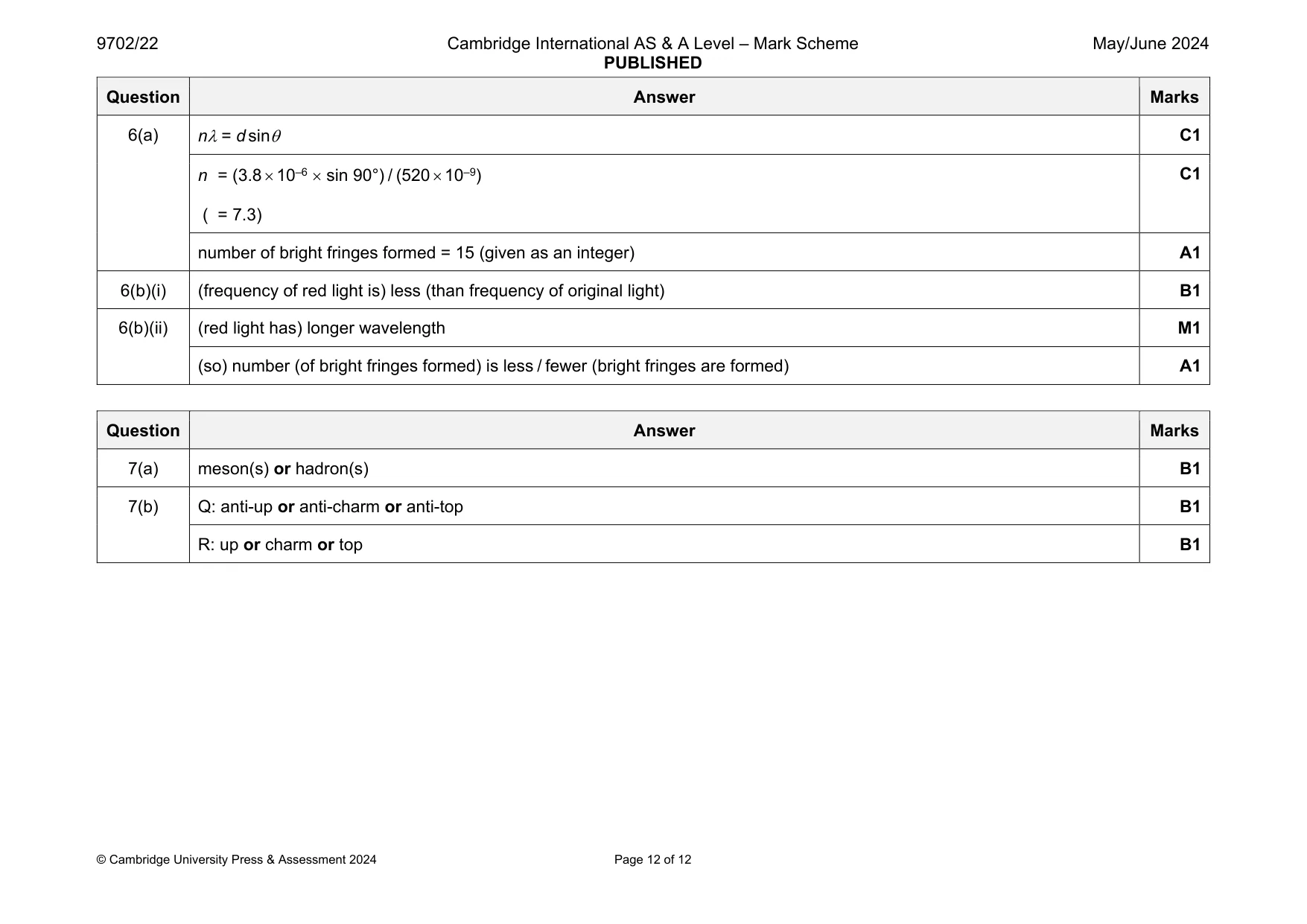
Mark scheme: 6(a) C1 n = (3.8 10–6 sin 90°) / (520 10–9) ( = 7.3) C1 number of bright fringes formed = 15 (given as an integer) A1 6(b)(i) (frequency of red light is) less (than frequency of original light) B1 6(b)(ii) (red light has) longer wavelength M1 (so) number (of bright fringes formed) is less / fewer (bright fringes are formed) A1
Q7 · A particle Q and a particle R are each composed of one quark and one antiquark
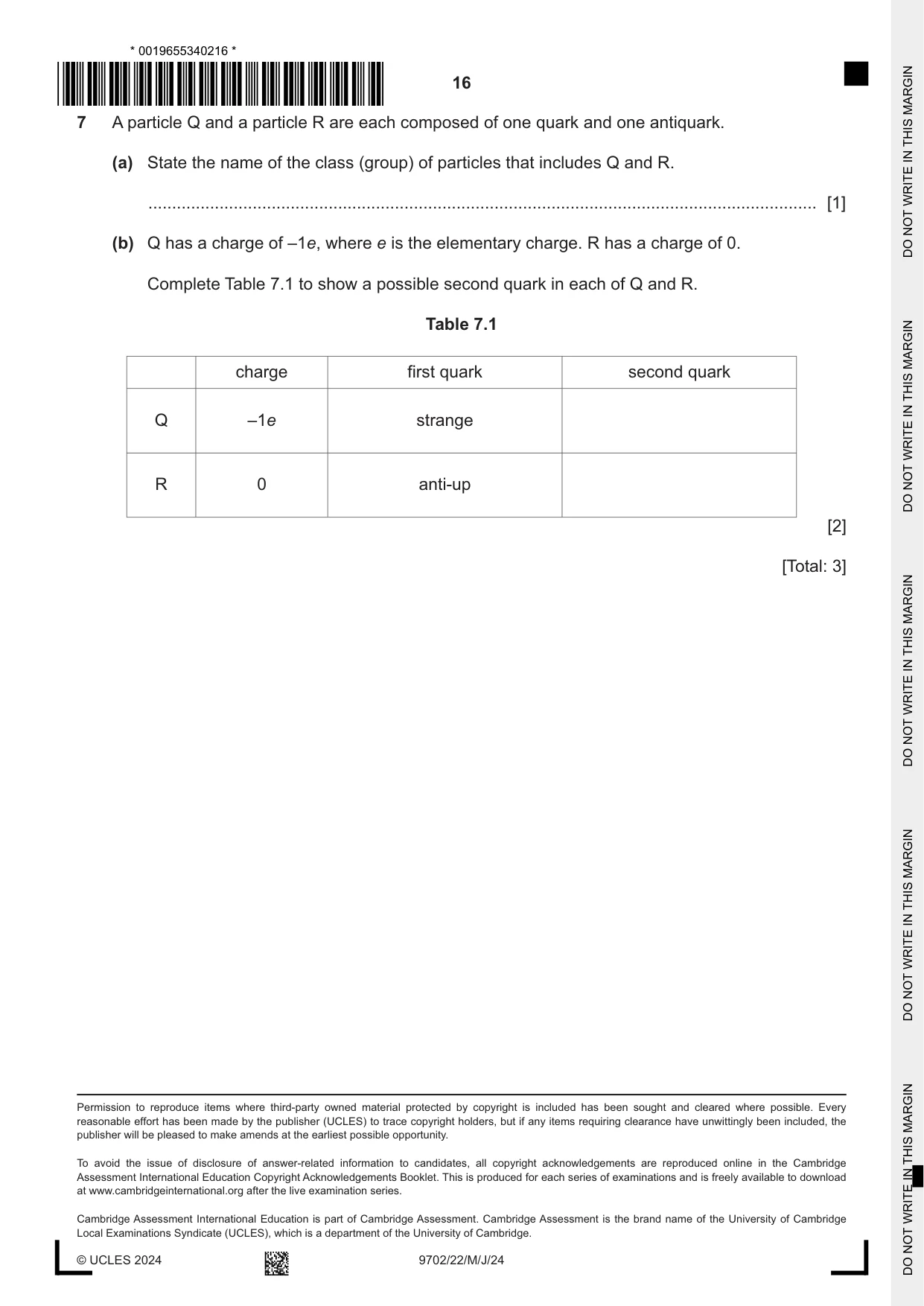
7 A particle Q and a particle R are each composed of one quark and one antiquark. (a) State the name of the class (group) of particles that includes Q and R. ............................................................................................................................................. [1] (b) Q has a charge of –1e, where e is the elementary charge. R has a charge of 0. Complete Table 7.1 to show a possible second quark in each of Q and R. Table 7.1 charge first quark second quark Q –1e strange R 0 anti-up [2] [Total: 3]
Mark scheme: 7(a) meson(s) or hadron(s) B1 7(b) Q: anti-up or anti-charm or anti-top B1 R: up or charm or top B1
What was in this paper
The subtopics covered by these 7 questions, and how many questions each got. Open one in a new tab to see every Cambridge question on it.
What you needed in this session
Cambridge’s own grade thresholds for 2024 May/June, Paper 2 · Variant 2. A higher threshold means an easier paper — the bar moves with how the cohort did.