Cambridge A Level Physics 9702 — 2020 Oct/Nov Paper 2 · Variant 2
9702/22/O/N/20 · 7 questions · 60 marks · ≈68 min
The question paper and its mark scheme, free to read here and free to download. This is Cambridge’s own paper, exactly as it was sat.
Question paper20 pages

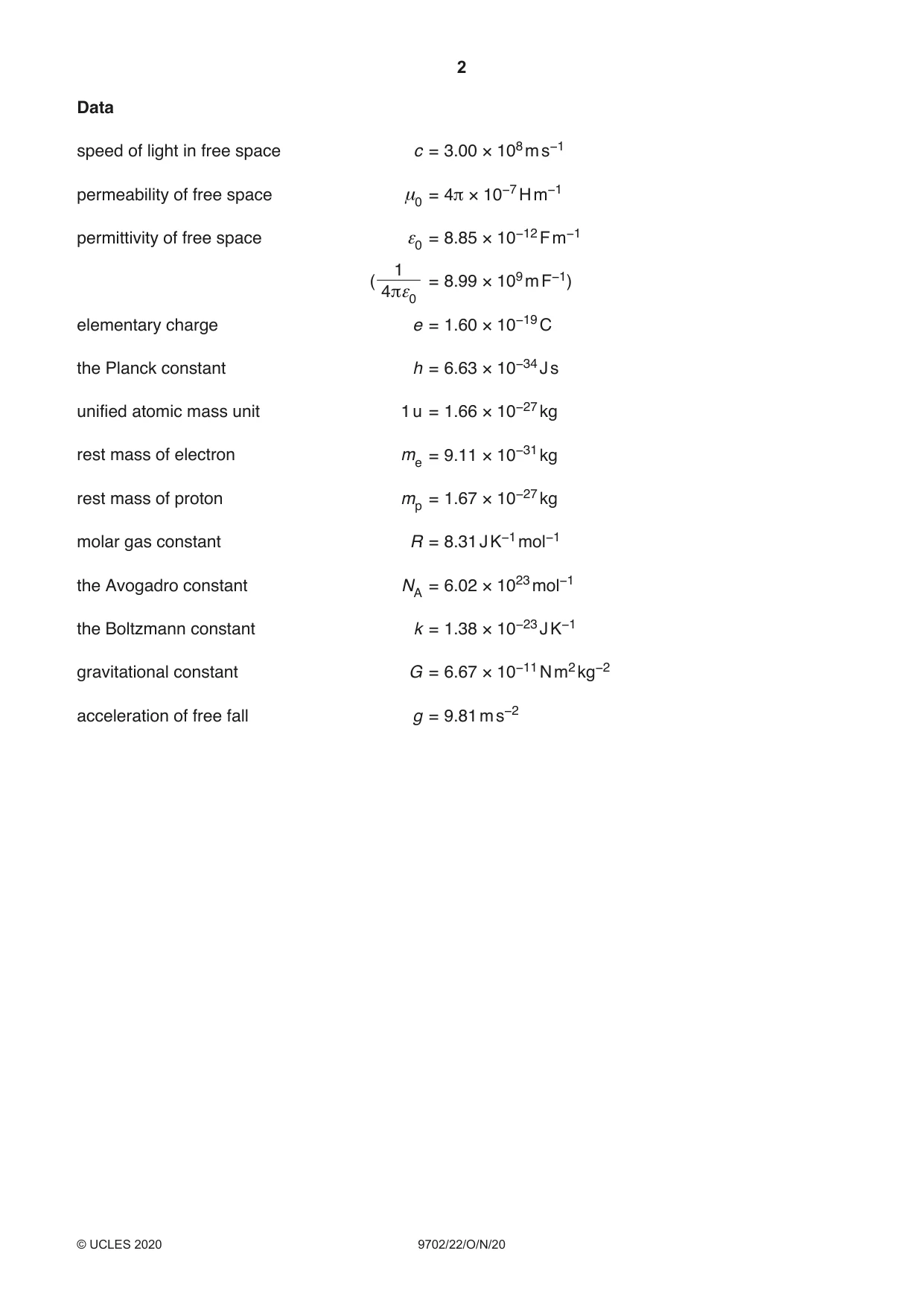
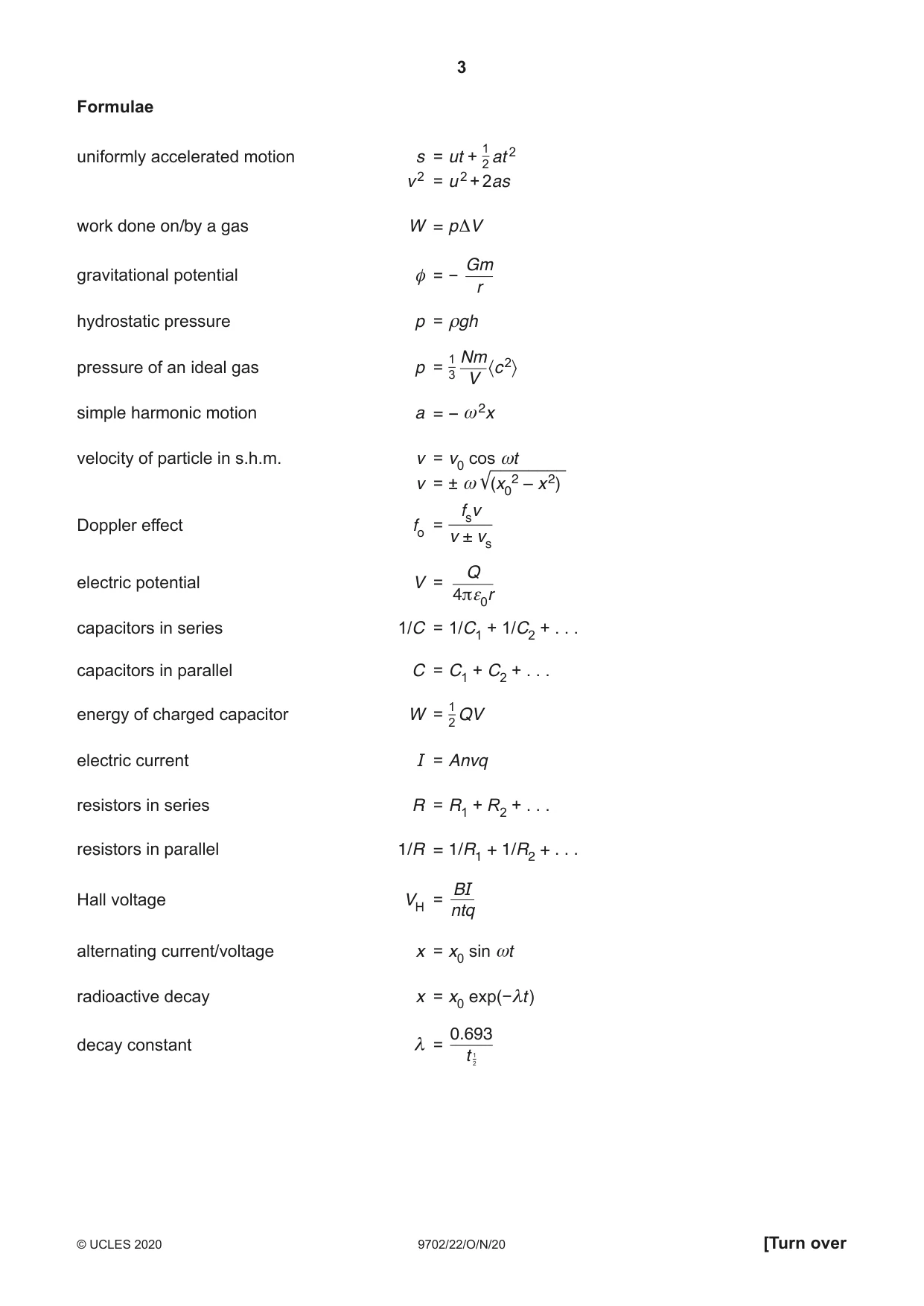


Mark scheme12 pages
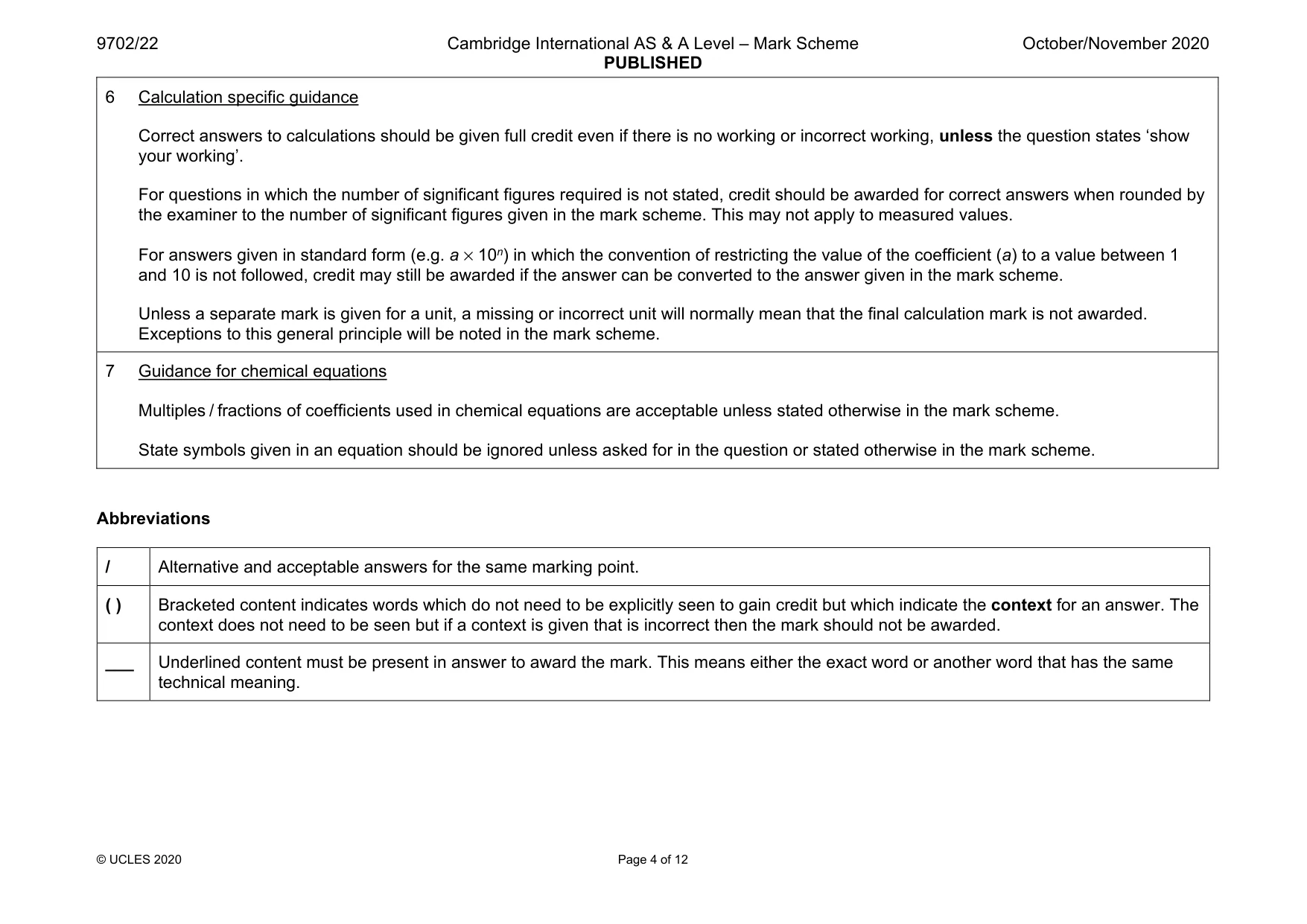
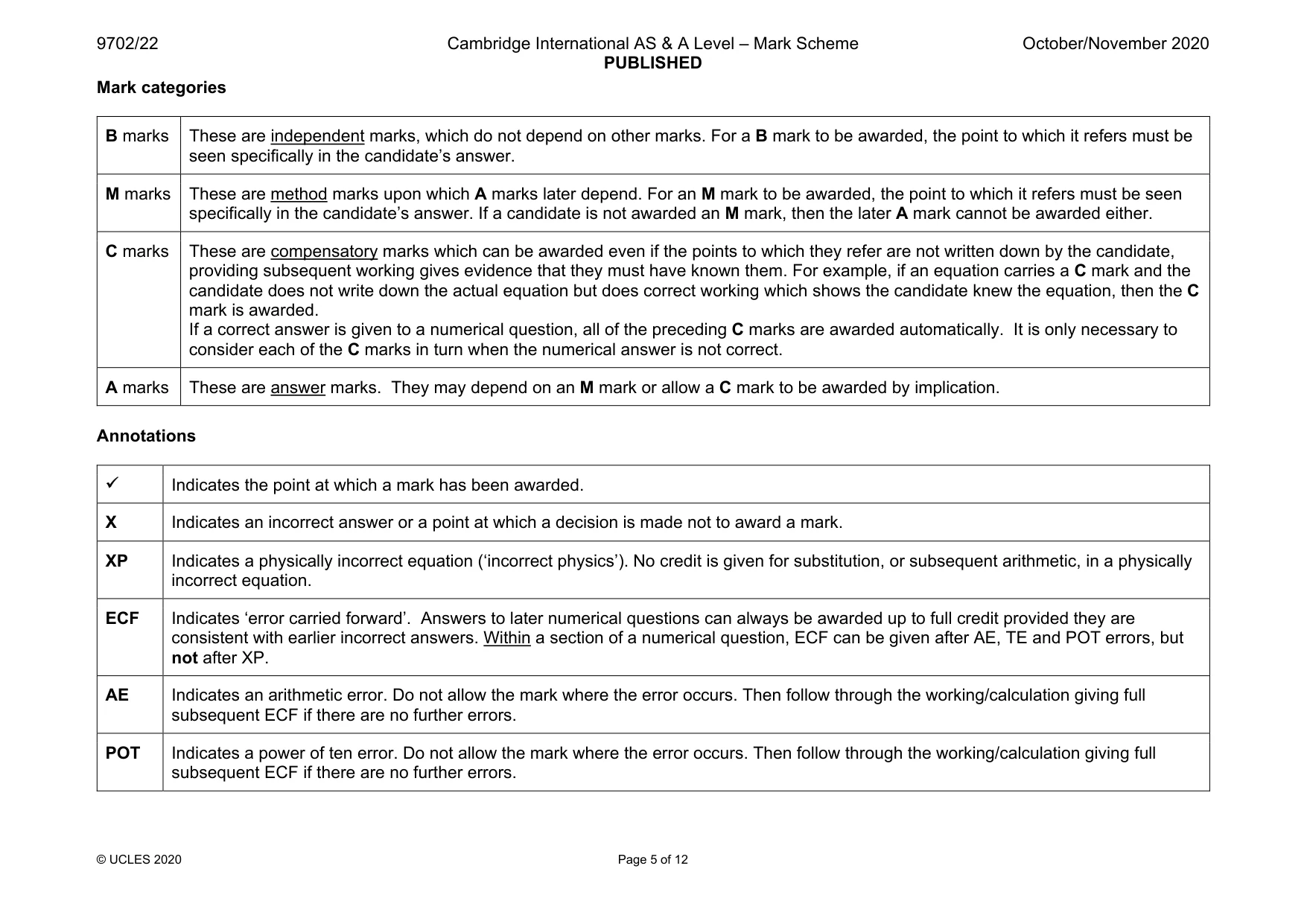
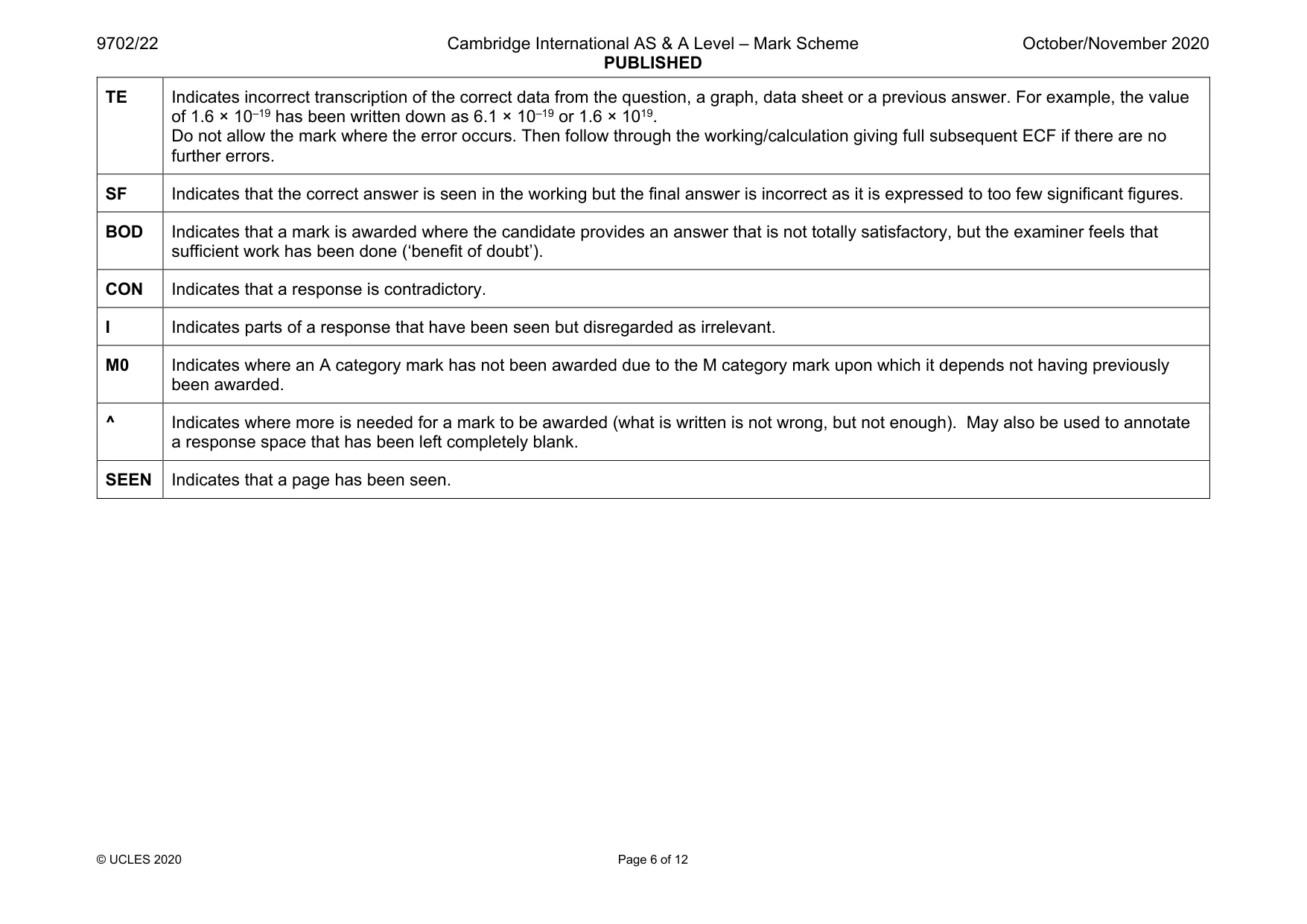
Answers below. Sit the paper first if you are practising.
Questions as text
Q1 · Complete Table 1.1 by putting a tick (3) in the appropriate column to indicate whether…
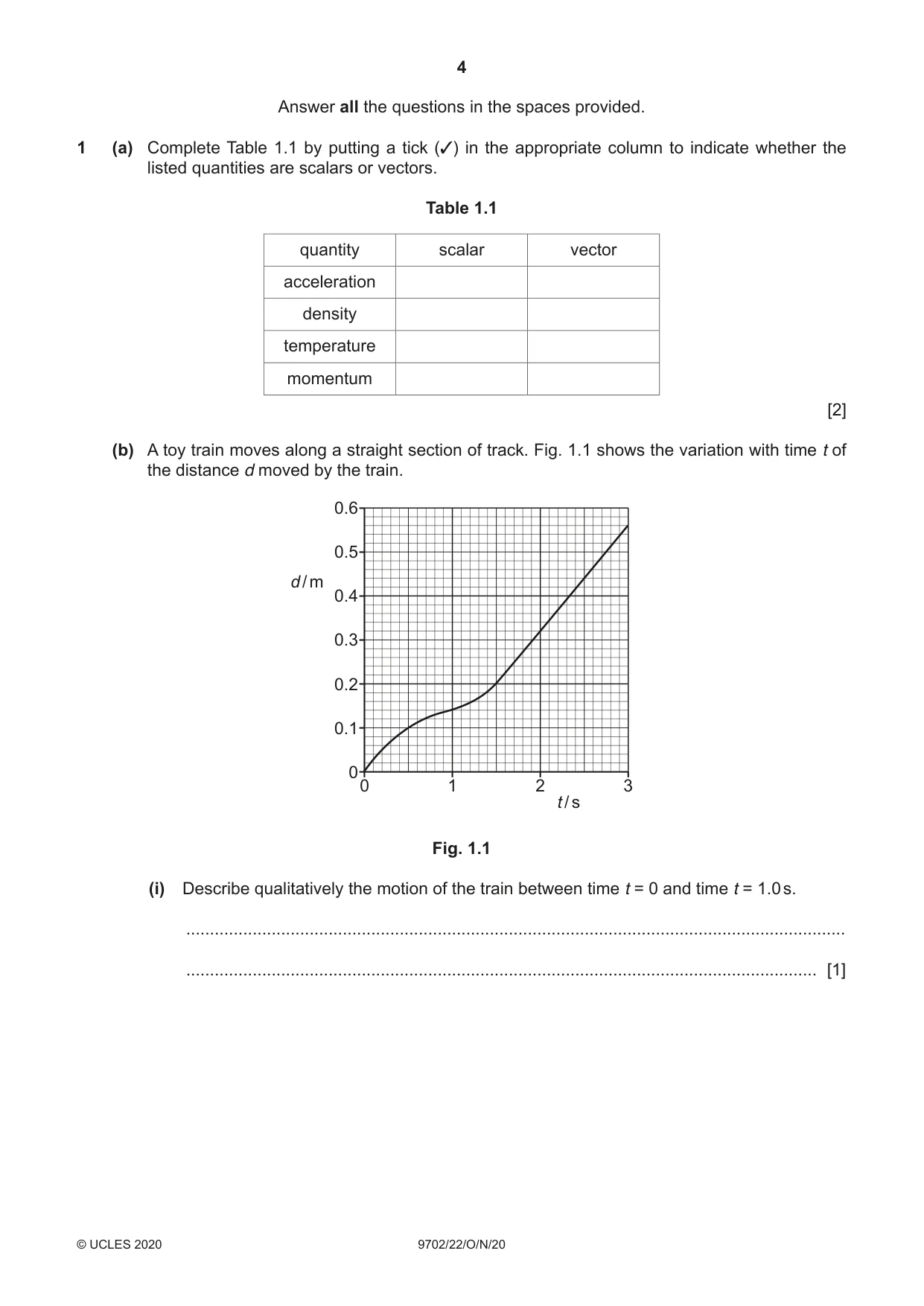
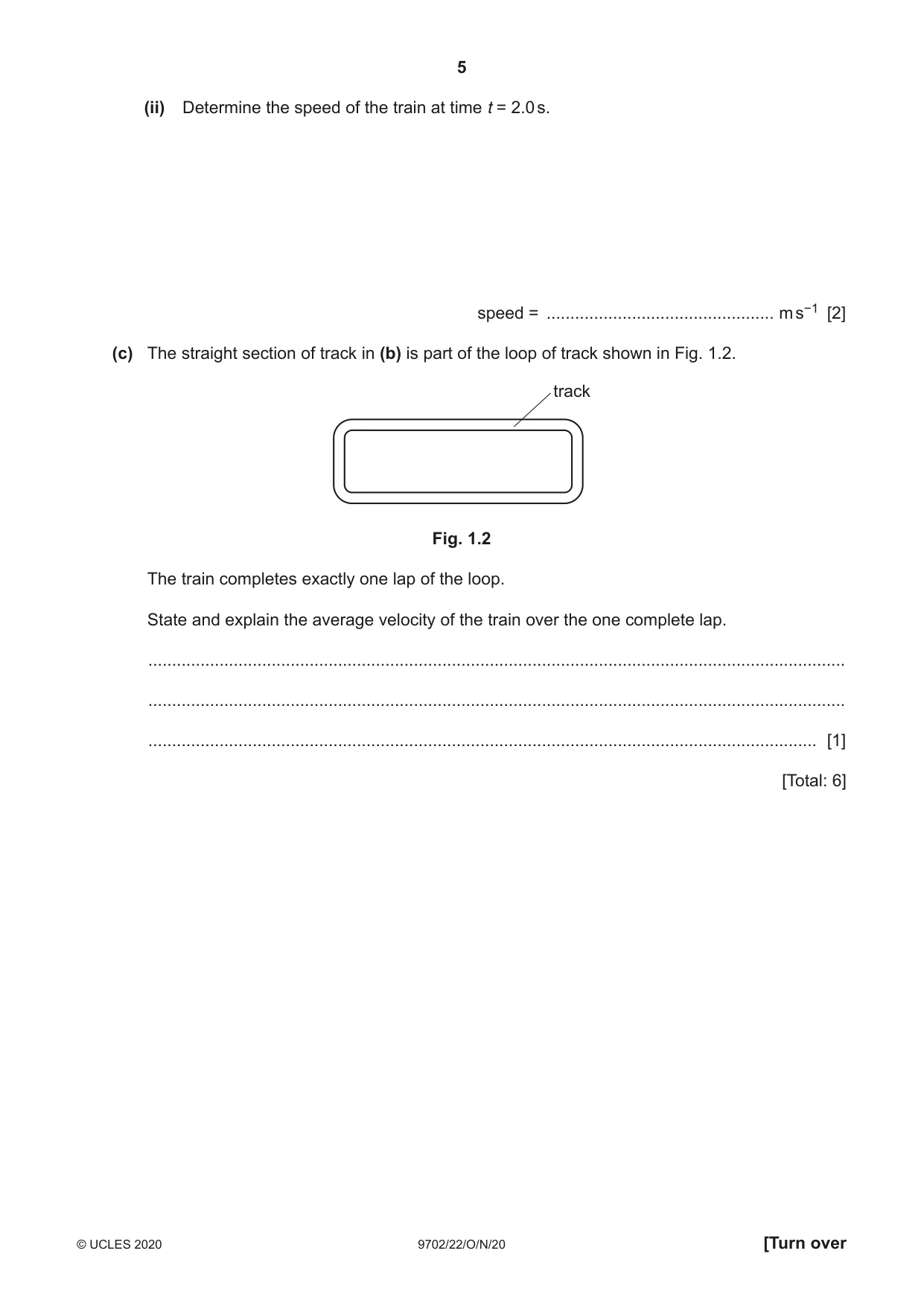
1 (a) Complete Table 1.1 by putting a tick (3) in the appropriate column to indicate whether the listed quantities are scalars or vectors. Table 1.1 quantity scalar vector acceleration density temperature momentum [2] (b) A toy train moves along a straight section of track. Fig. 1.1 shows the variation with time t of the distance d moved by the train. 0.6 0.5 d / m 0.4 0.3 0.2 0.1 0 0 1 2 3 t / s Fig. 1.1 (i) Describe qualitatively the motion of the train between time t = 0 and time t = 1.0 s. ........................................................................................................................................... ..................................................................................................................................... [1] (ii) Determine the speed of the train at time t = 2.0 s. speed = ................................................ m s−1 [2] (c) The straight section of track in (b) is part of the loop of track shown in Fig. 1.2. track Fig. 1.2 The train completes exactly one lap of the loop. State and explain the average velocity of the train over the one complete lap. ................................................................................................................................................... ................................................................................................................................................... ............................................................................................................................................. [1] [Total: 6]
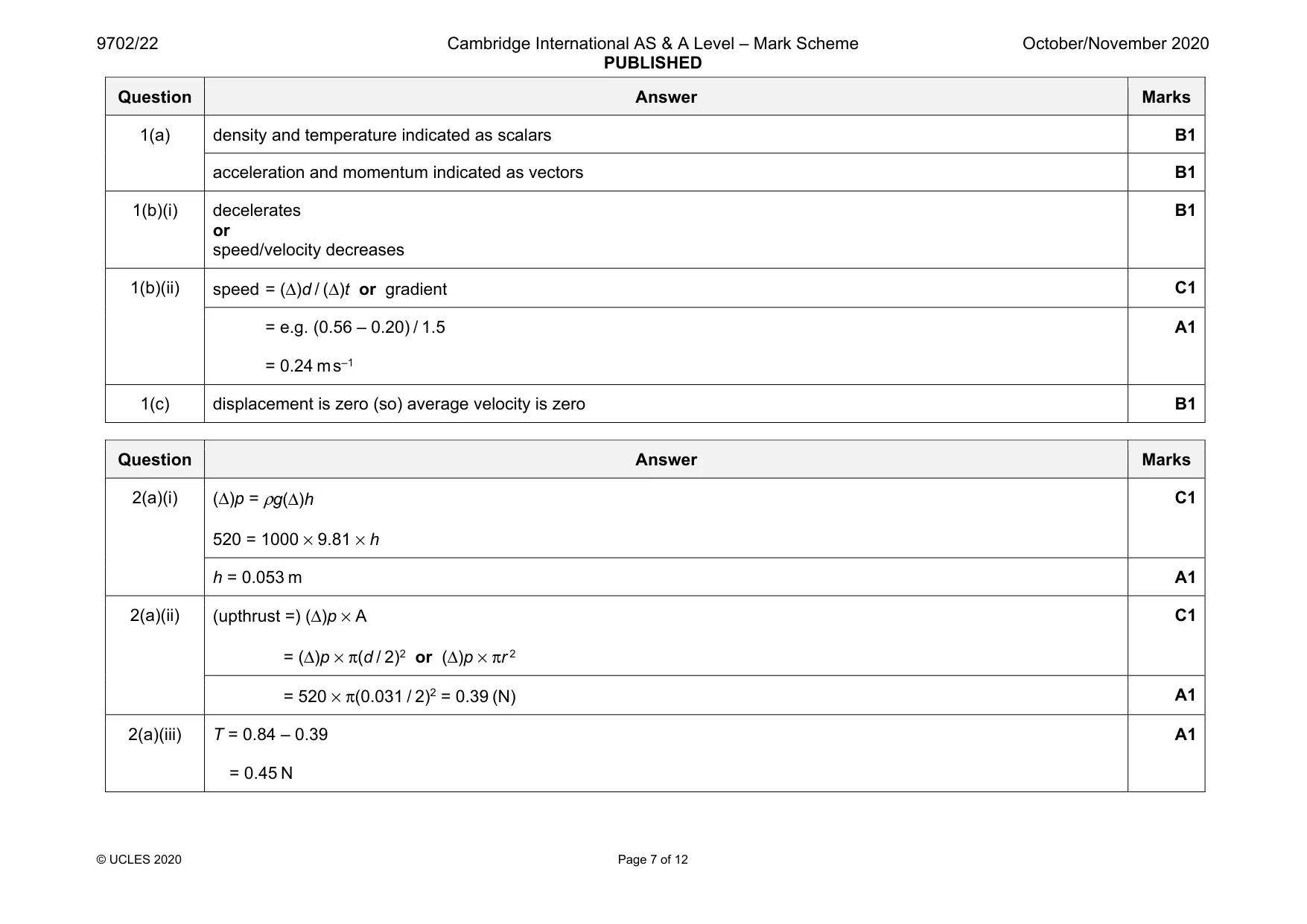
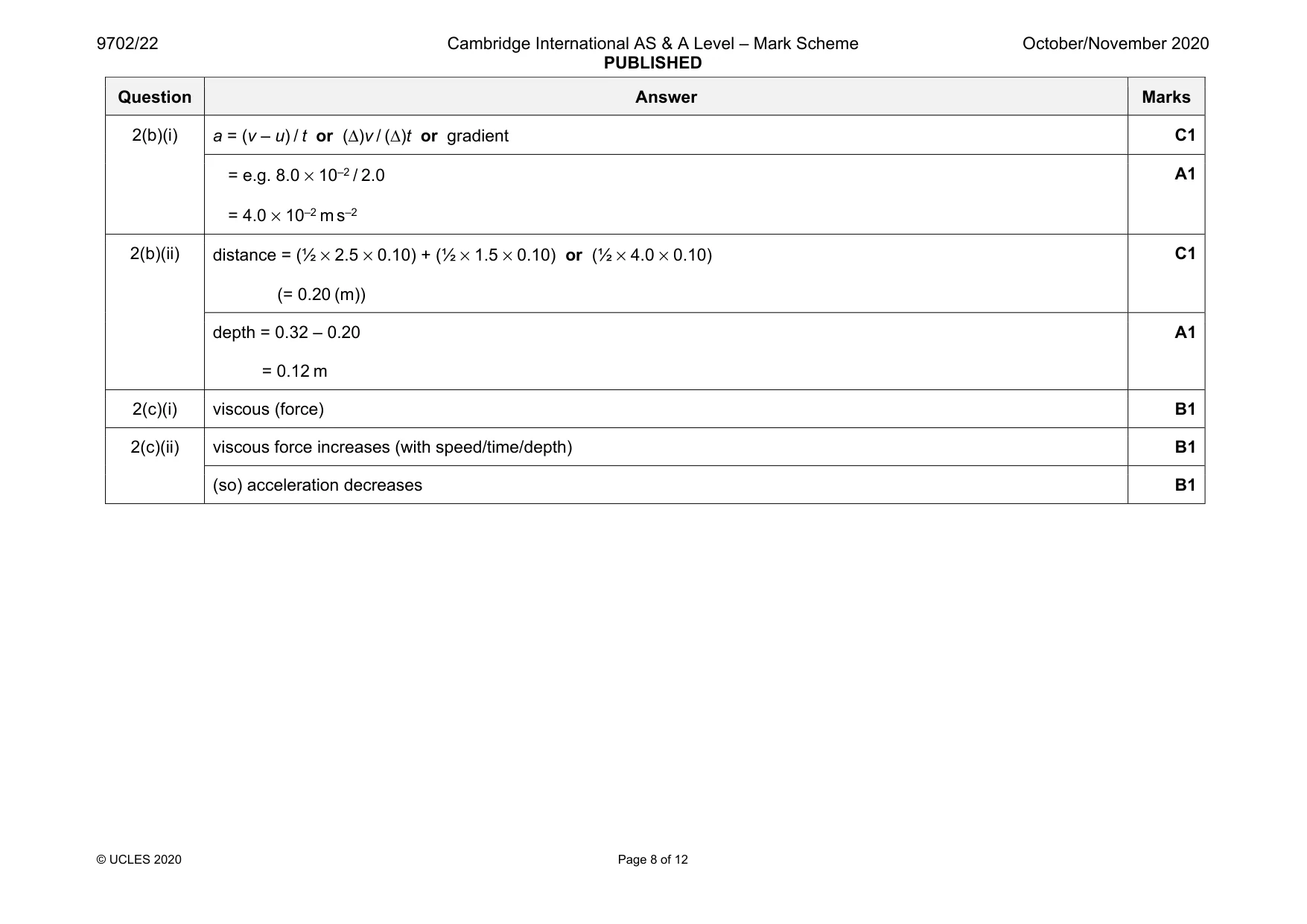
Mark scheme: 1(a) density and temperature indicated as scalars B1 acceleration and momentum indicated as vectors B1 1(b)(i) decelerates or speed/velocity decreases B1 1(b)(ii) speed = (Δ)d / (Δ)t or gradient C1 = e.g. (0.56 – 0.20) / 1.5 = 0.24 m s–1 A1 1(c) displacement is zero (so) average velocity is zero B1
Q2 · A cylinder is suspended from the end of a string
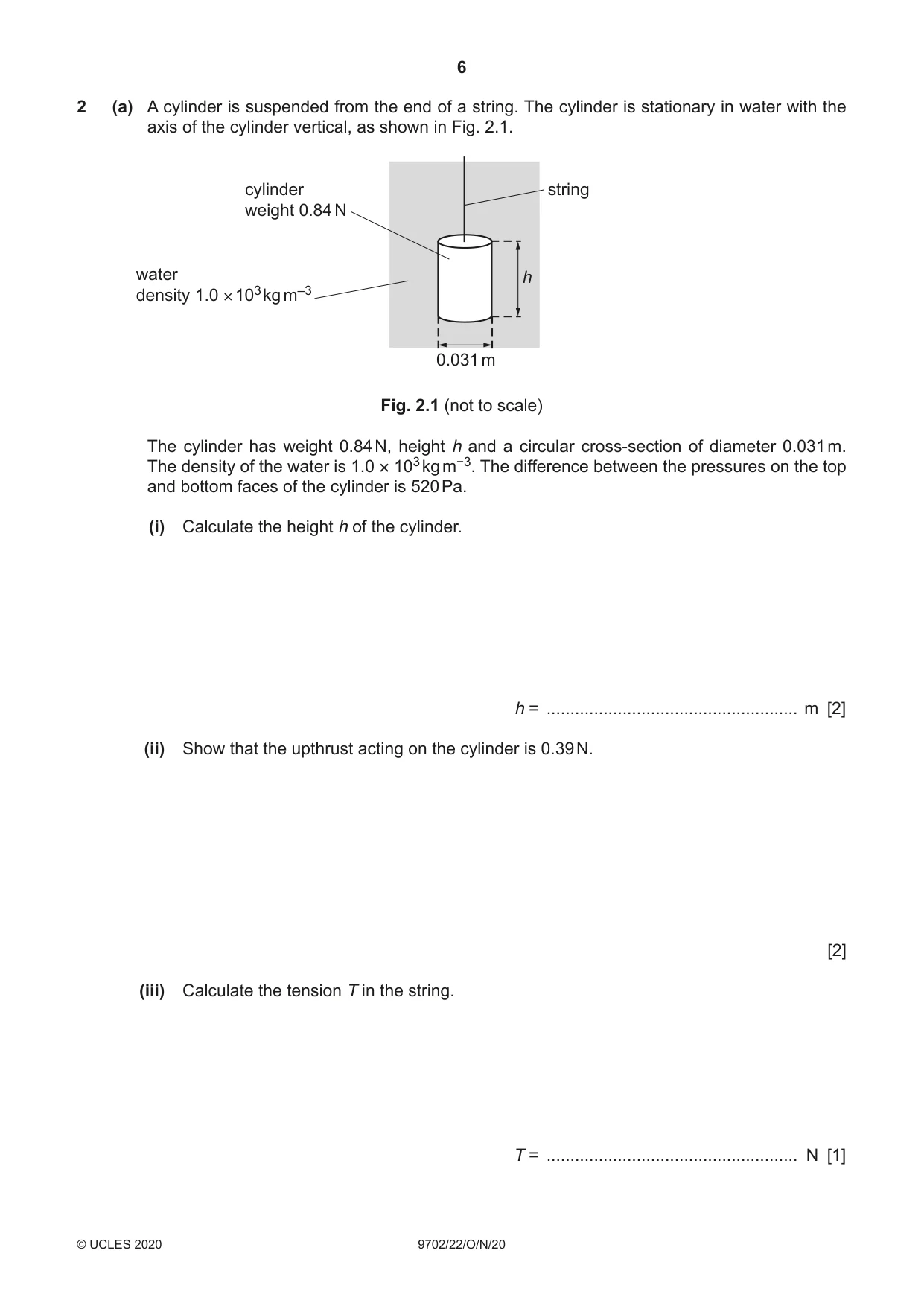
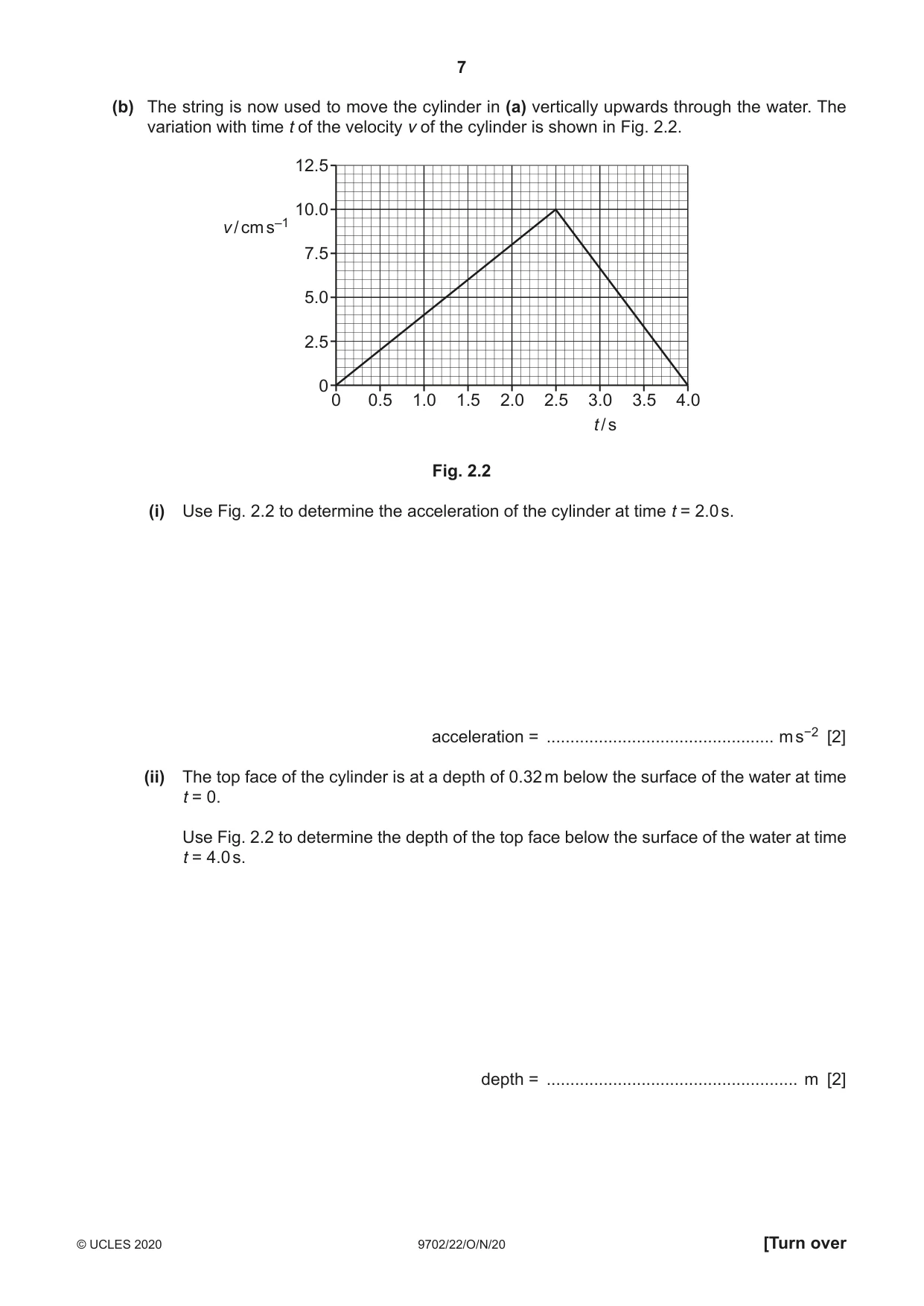
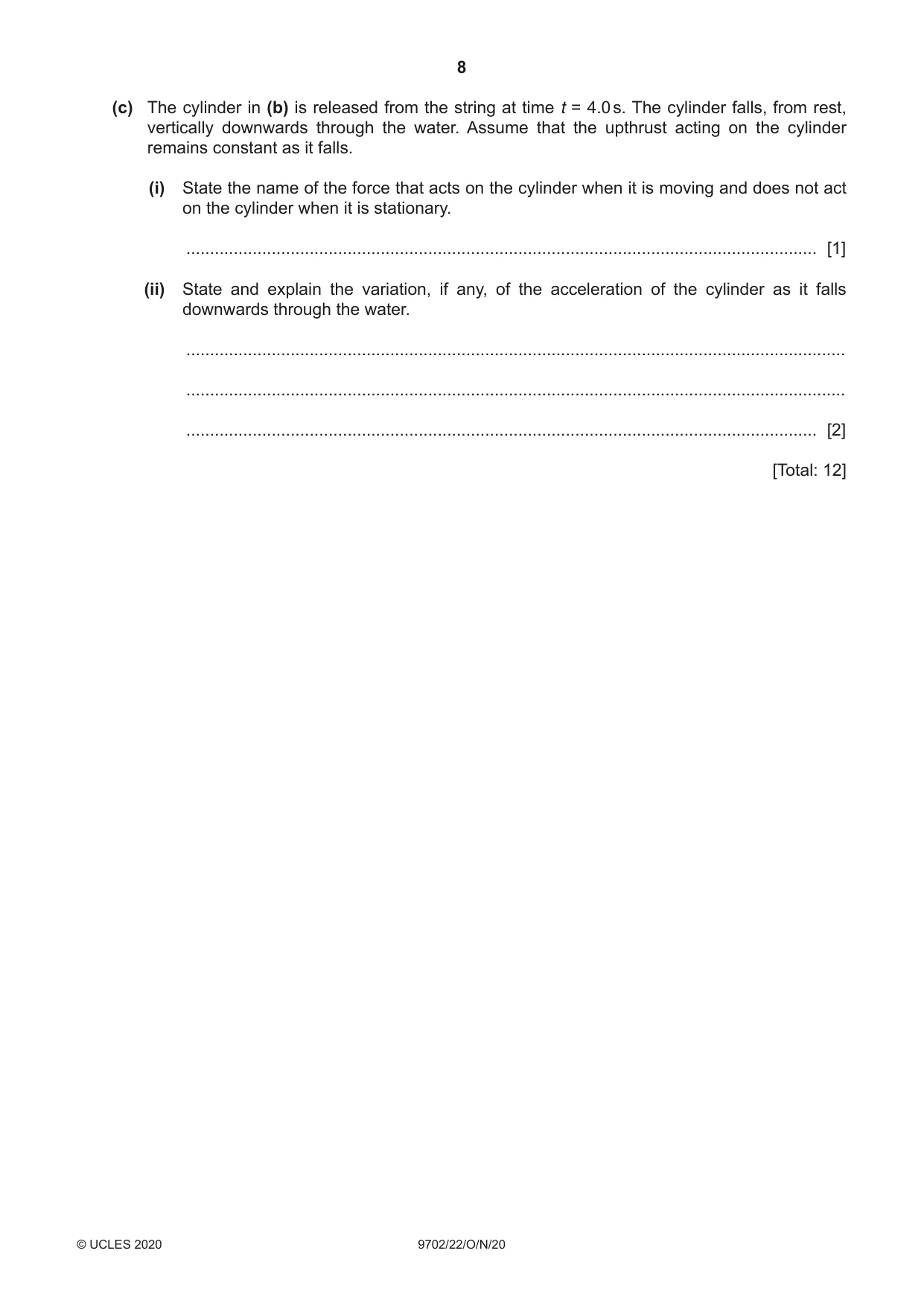
2 (a) A cylinder is suspended from the end of a string. The cylinder is stationary in water with the axis of the cylinder vertical, as shown in Fig. 2.1. cylinder string weight 0.84 N water h density 1.0 × 10³ kg m–3 0.031 m Fig. 2.1 (not to scale) The cylinder has weight 0.84 N, height h and a circular cross-section of diameter 0.031 m. The density of the water is 1.0 × 10³ kg m−3. The difference between the pressures on the top and bottom faces of the cylinder is 520 Pa. (i) Calculate the height h of the cylinder. h = ..................................................... m [2] (ii) Show that the upthrust acting on the cylinder is 0.39 N. [2] (iii) Calculate the tension T in the string. T = ..................................................... N [1] (b) The string is now used to move the cylinder in (a) vertically upwards through the water. The variation with time t of the velocity v of the cylinder is shown in Fig. 2.2. 12.5 10.0 v / cm s–1 7.5 5.0 2.5 0 0 0.5 1.0 1.5 2.0 2.5 3.0 3.5 4.0 t / s Fig. 2.2 (i) Use Fig. 2.2 to determine the acceleration of the cylinder at time t = 2.0 s. acceleration = ................................................ m s−2 [2] (ii) The top face of the cylinder is at a depth of 0.32 m below the surface of the water at time t = 0. Use Fig. 2.2 to determine the depth of the top face below the surface of the water at time t = 4.0 s. depth = ..................................................... m [2] (c) The cylinder in (b) is released from the string at time t = 4.0 s. The cylinder falls, from rest, vertically downwards through the water. Assume that the upthrust acting on the cylinder remains constant as it falls. (i) State the name of the force that acts on the cylinder when it is moving and does not act on the cylinder when it is stationary. ..................................................................................................................................... [1] (ii) State and explain the variation, if any, of the acceleration of the cylinder as it falls downwards through the water. ........................................................................................................................................... ........................................................................................................................................... ..................................................................................................................................... [2] [Total: 12]
Mark scheme: 2(a)(i) (Δ)p = ρg(Δ)h 520 = 1000 × 9.81 × h C1 h = 0.053 m A1 2(a)(ii) (upthrust =) (Δ)p × A = (Δ)p × π(d / 2)2 or (Δ)p × πr 2 C1 = 520 × π(0.031 / 2)2 = 0.39 (N) A1 2(a)(iii) T = 0.84 – 0.39 = 0.45 N A1 Question Answer Marks 2(b)(i) a = (v – u) / t or (Δ)v / (∆)t or gradient C1 = e.g. 8.0 × 10⁻² / 2.0 = 4.0 × 10⁻² m s–2 A1 2(b)(ii) distance = (½ × 2.5 × 0.10) + (½ × 1.5 × 0.10) or (½ × 4.0 × 0.10) (= 0.20 (m)) C1 depth = 0.32 – 0.20 = 0.12 m A1 2(c)(i) viscous (force) B1 2(c)(ii) viscous force increases (with speed/time/depth) B1 (so) acceleration decreases B1
Q3 · A spring is fixed at one end and is compressed by applying a force to the other end
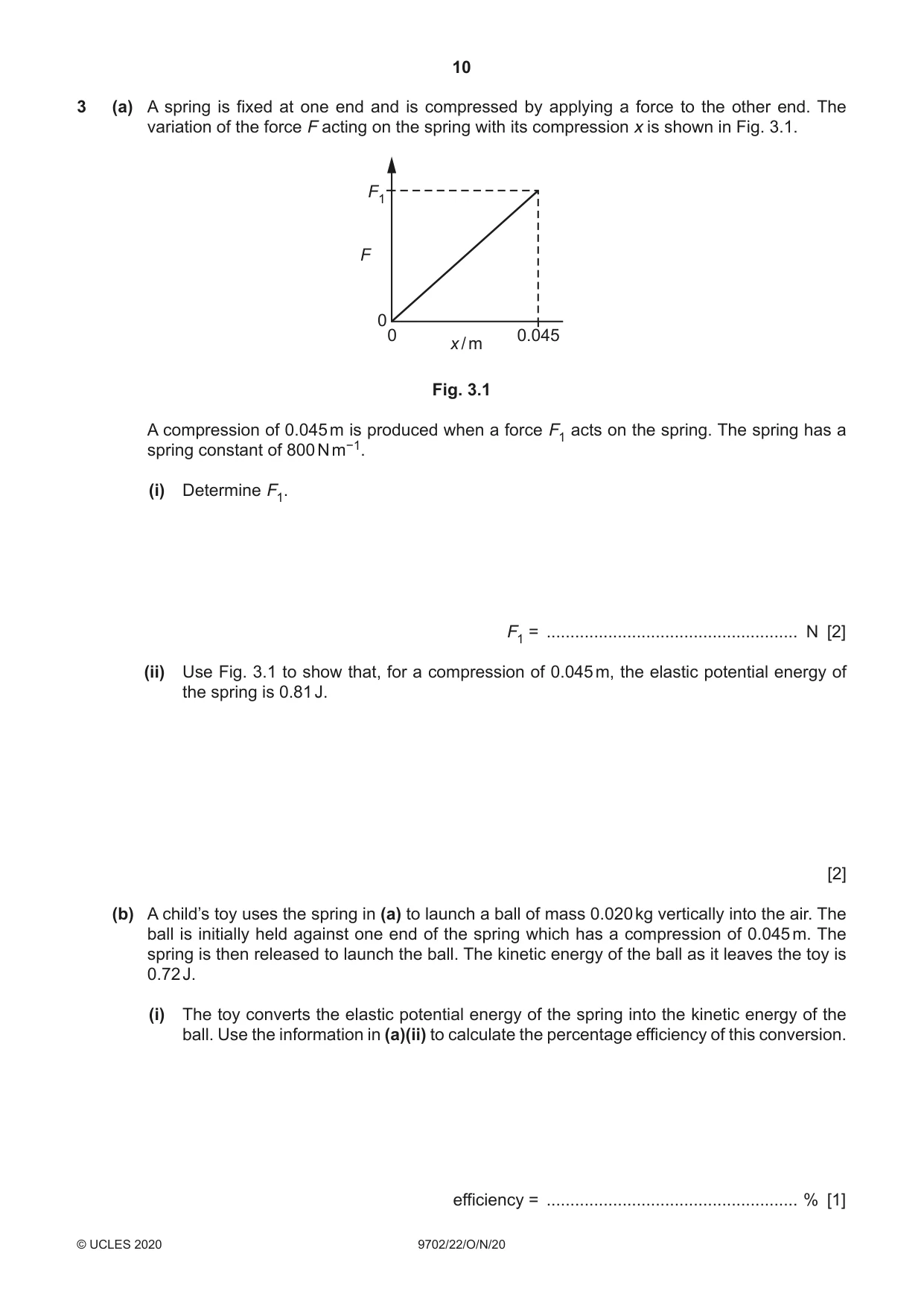
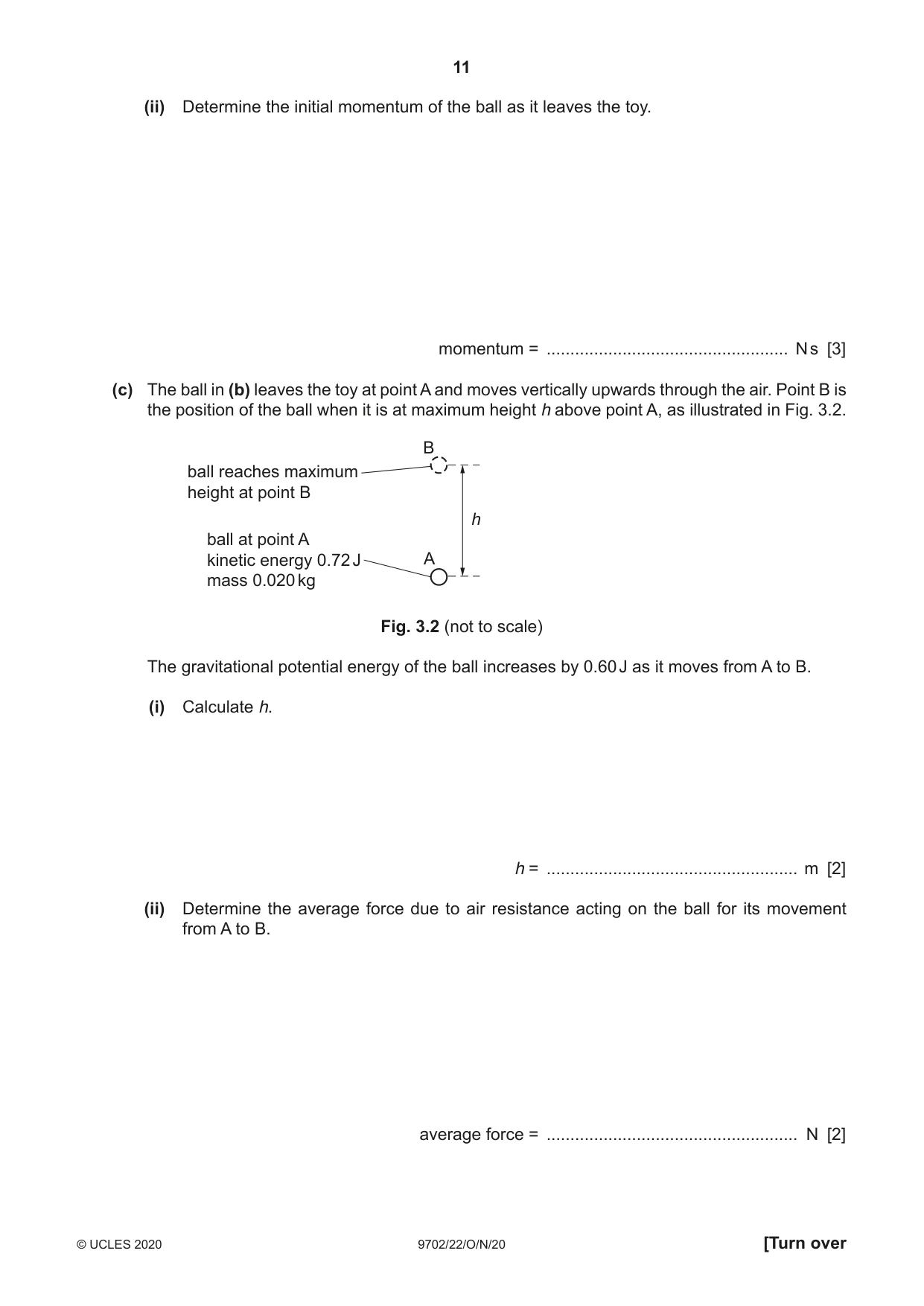
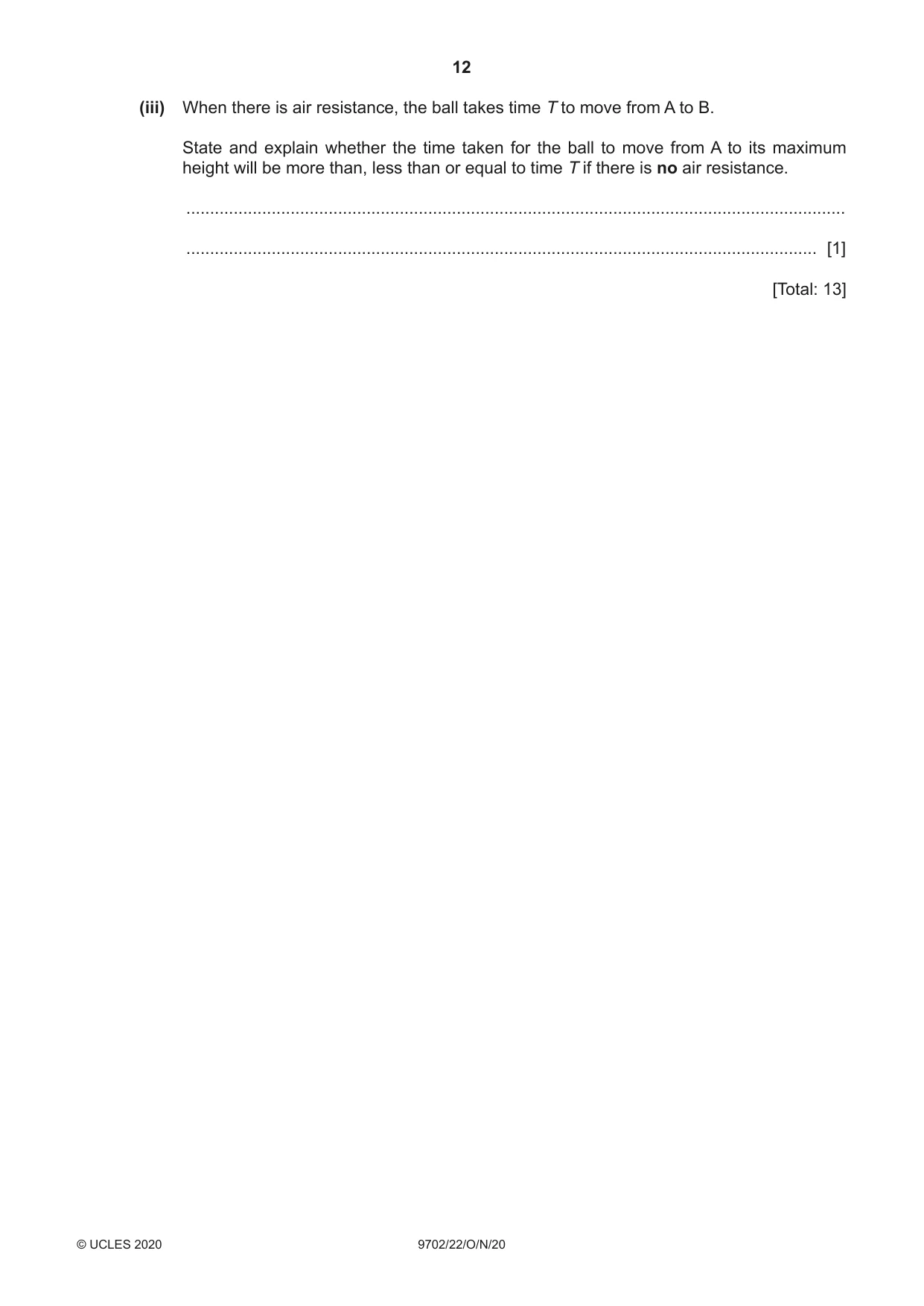
3 (a) A spring is fixed at one end and is compressed by applying a force to the other end. The variation of the force F acting on the spring with its compression x is shown in Fig. 3.1. F1 F 0 0 0.045 x / m Fig. 3.1 A compression of 0.045 m is produced when a force F1 acts on the spring. The spring has a spring constant of 800 N m−1. (i) Determine F1. F1 = ..................................................... N [2] (ii) Use Fig. 3.1 to show that, for a compression of 0.045 m, the elastic potential energy of the spring is 0.81 J. [2] (b) A child’s toy uses the spring in (a) to launch a ball of mass 0.020 kg vertically into the air. The ball is initially held against one end of the spring which has a compression of 0.045 m. The spring is then released to launch the ball. The kinetic energy of the ball as it leaves the toy is 0.72 J. (i) The toy converts the elastic potential energy of the spring into the kinetic energy of the ball. Use the information in (a)(ii) to calculate the percentage efficiency of this conversion. efficiency = ..................................................... % [1] (ii) Determine the initial momentum of the ball as it leaves the toy. momentum = ................................................... N s [3] (c) The ball in (b) leaves the toy at point A and moves vertically upwards through the air. Point B is the position of the ball when it is at maximum height h above point A, as illustrated in Fig. 3.2. B ball reaches maximum height at point B h ball at point A kinetic energy 0.72 J A mass 0.020 kg Fig. 3.2 (not to scale) The gravitational potential energy of the ball increases by 0.60 J as it moves from A to B. (i) Calculate h. h = ..................................................... m [2] (ii) Determine the average force due to air resistance acting on the ball for its movement from A to B. average force = ..................................................... N [2] (iii) When there is air resistance, the ball takes time T to move from A to B. State and explain whether the time taken for the ball to move from A to its maximum height will be more than, less than or equal to time T if there is no air resistance. ........................................................................................................................................... ..................................................................................................................................... [1] [Total: 13]
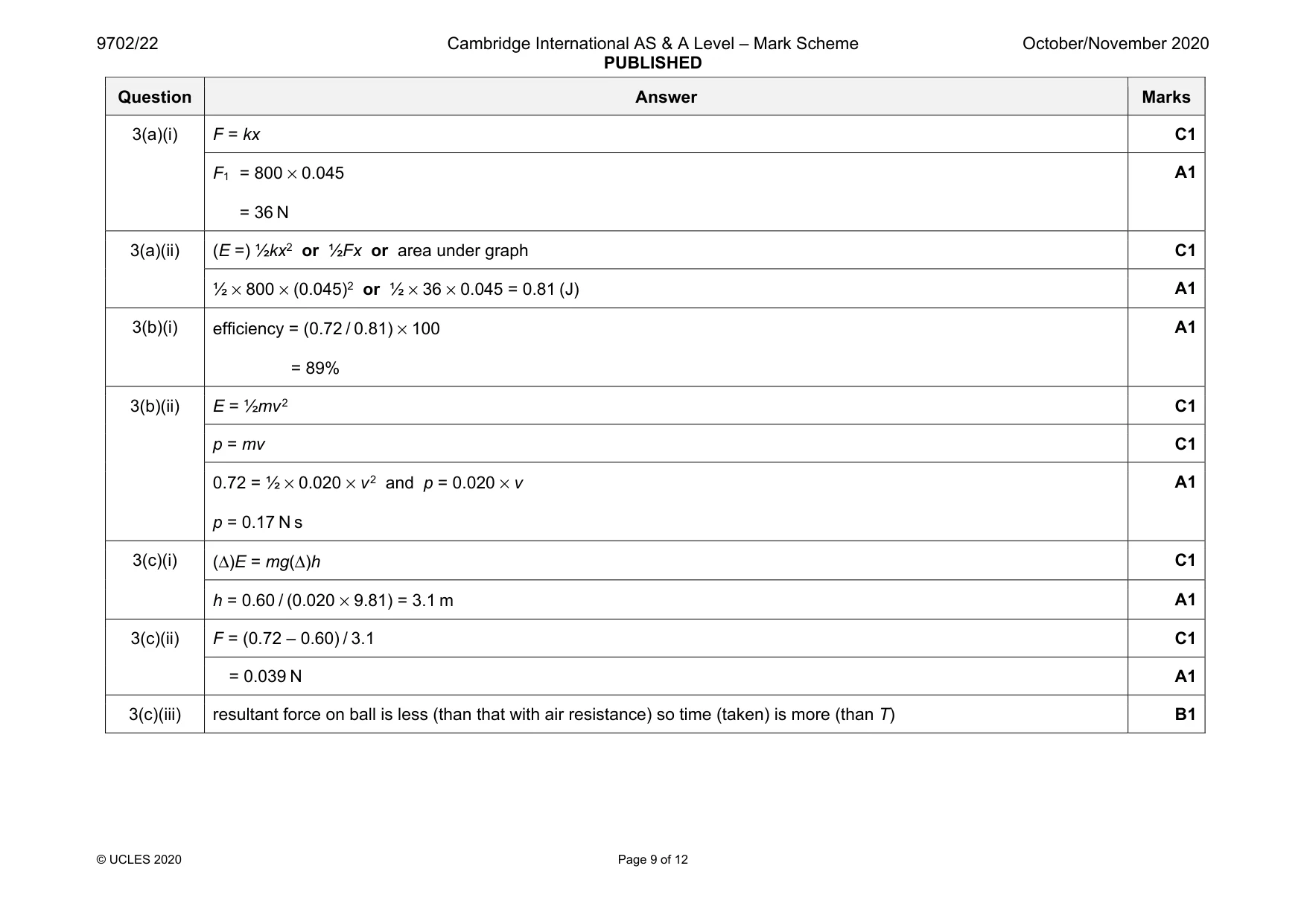
Mark scheme: 3(a)(i) F = kx C1 F1 = 800 × 0.045 = 36 N A1 3(a)(ii) (E =) ½kx2 or ½Fx or area under graph C1 ½ × 800 × (0.045)2 or ½ × 36 × 0.045 = 0.81 (J) A1 3(b)(i) efficiency = (0.72 / 0.81) × 100 = 89% A1 3(b)(ii) E = ½mv 2 C1 p = mv C1 0.72 = ½ × 0.020 × v 2 and p = 0.020 × v p = 0.17 N s A1 3(c)(i) (Δ)E = mg(Δ)h C1 h = 0.60 / (0.020 × 9.81) = 3.1 m A1 3(c)(ii) F = (0.72 – 0.60) / 3.1 C1 = 0.039 N A1 3(c)(iii) resultant force on ball is less (than that with air resistance) so time (taken) is more (than T) B1
Q4 · A rigid plank is used to make a ramp between two different horizontal levels of ground…
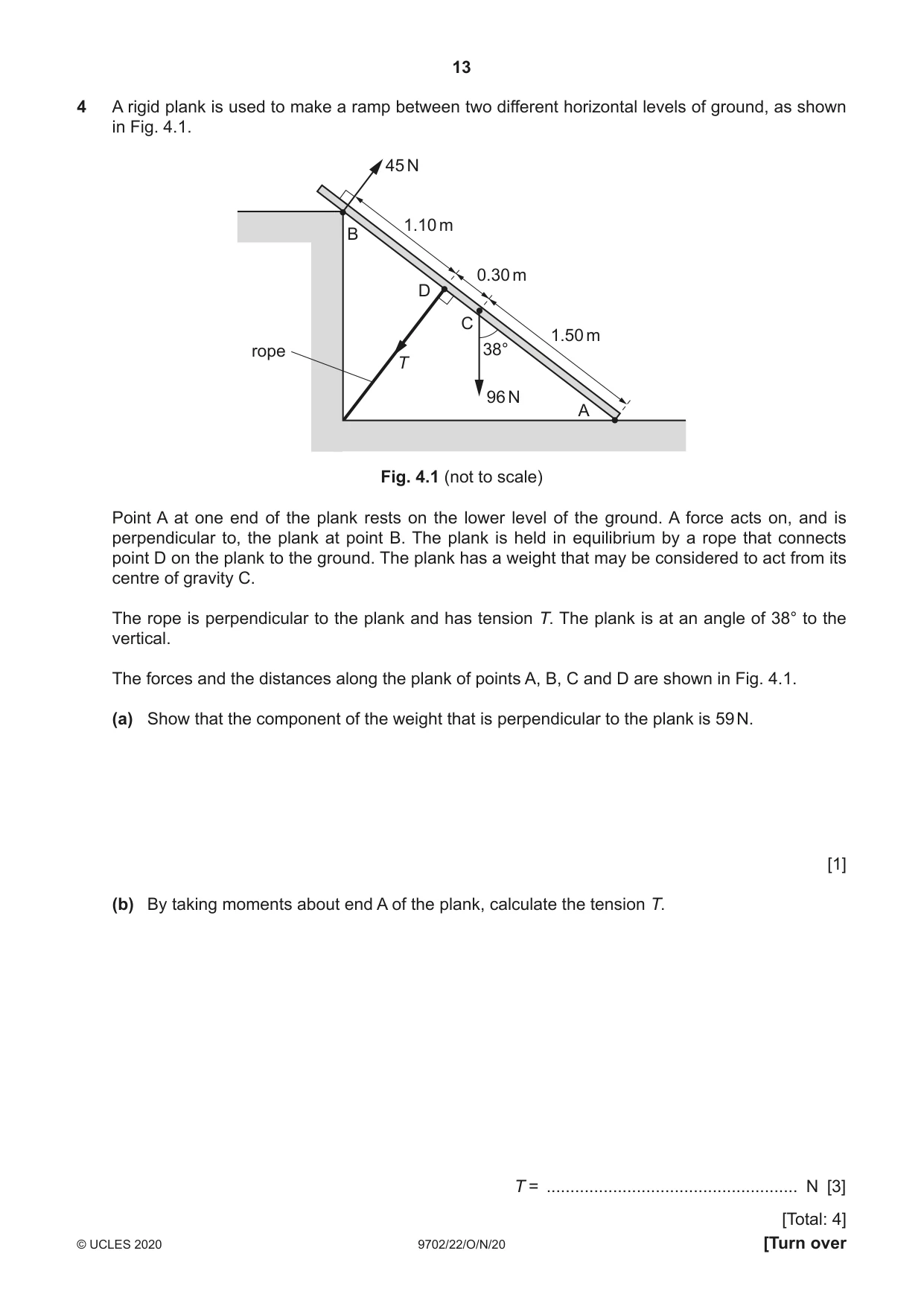
4 A rigid plank is used to make a ramp between two different horizontal levels of ground, as shown in Fig. 4.1. 45 N 1.10 m B 0.30 m D C 1.50 m rope 38° T 96 N A Fig. 4.1 (not to scale) Point A at one end of the plank rests on the lower level of the ground. A force acts on, and is perpendicular to, the plank at point B. The plank is held in equilibrium by a rope that connects point D on the plank to the ground. The plank has a weight that may be considered to act from its centre of gravity C. The rope is perpendicular to the plank and has tension T. The plank is at an angle of 38° to the vertical. The forces and the distances along the plank of points A, B, C and D are shown in Fig. 4.1. (a) Show that the component of the weight that is perpendicular to the plank is 59 N. [1] (b) By taking moments about end A of the plank, calculate the tension T. T = ..................................................... N [3] [Total: 4]
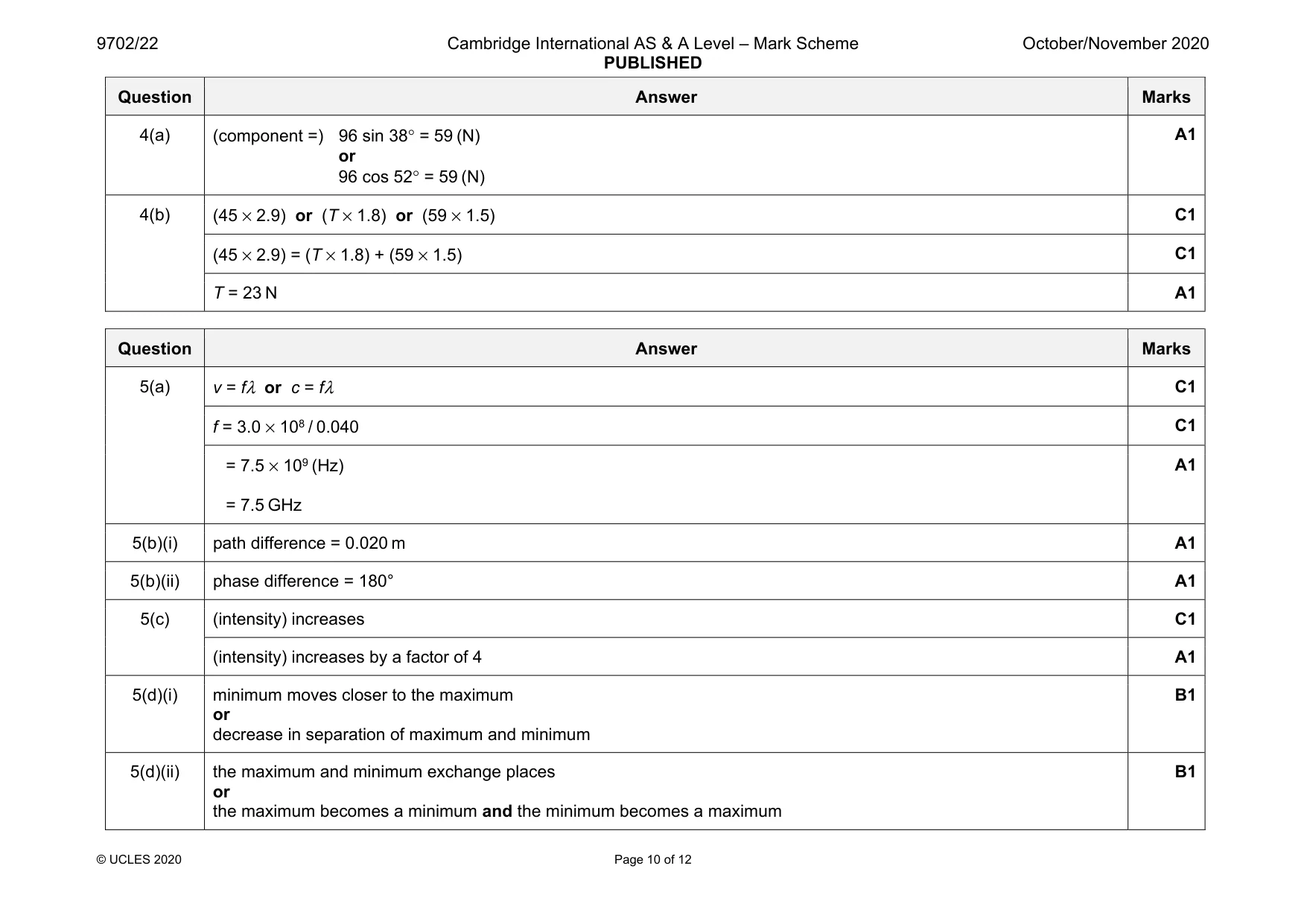
Mark scheme: 4(a) (component =) 96 sin 38° = 59 (N) or 96 cos 52° = 59 (N) 4(b) (45 × 2.9) or (T × 1.8) or (59 × 1.5) C1 (45 × 2.9) = (T × 1.8) + (59 × 1.5) C1 T = 23 N A1
Q5 · Microwaves with the same wavelength and amplitude are emitted in phase from two sources X…
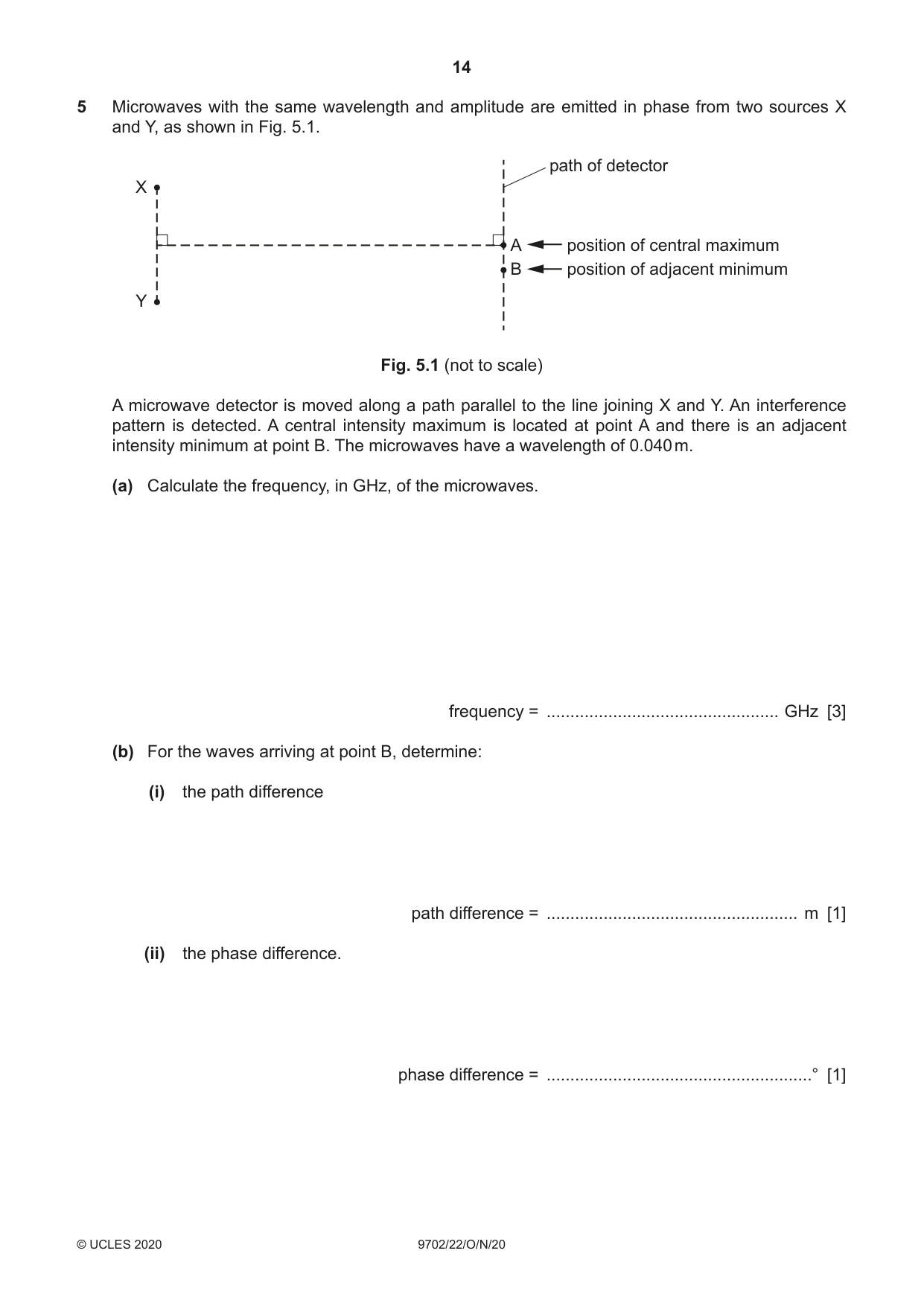
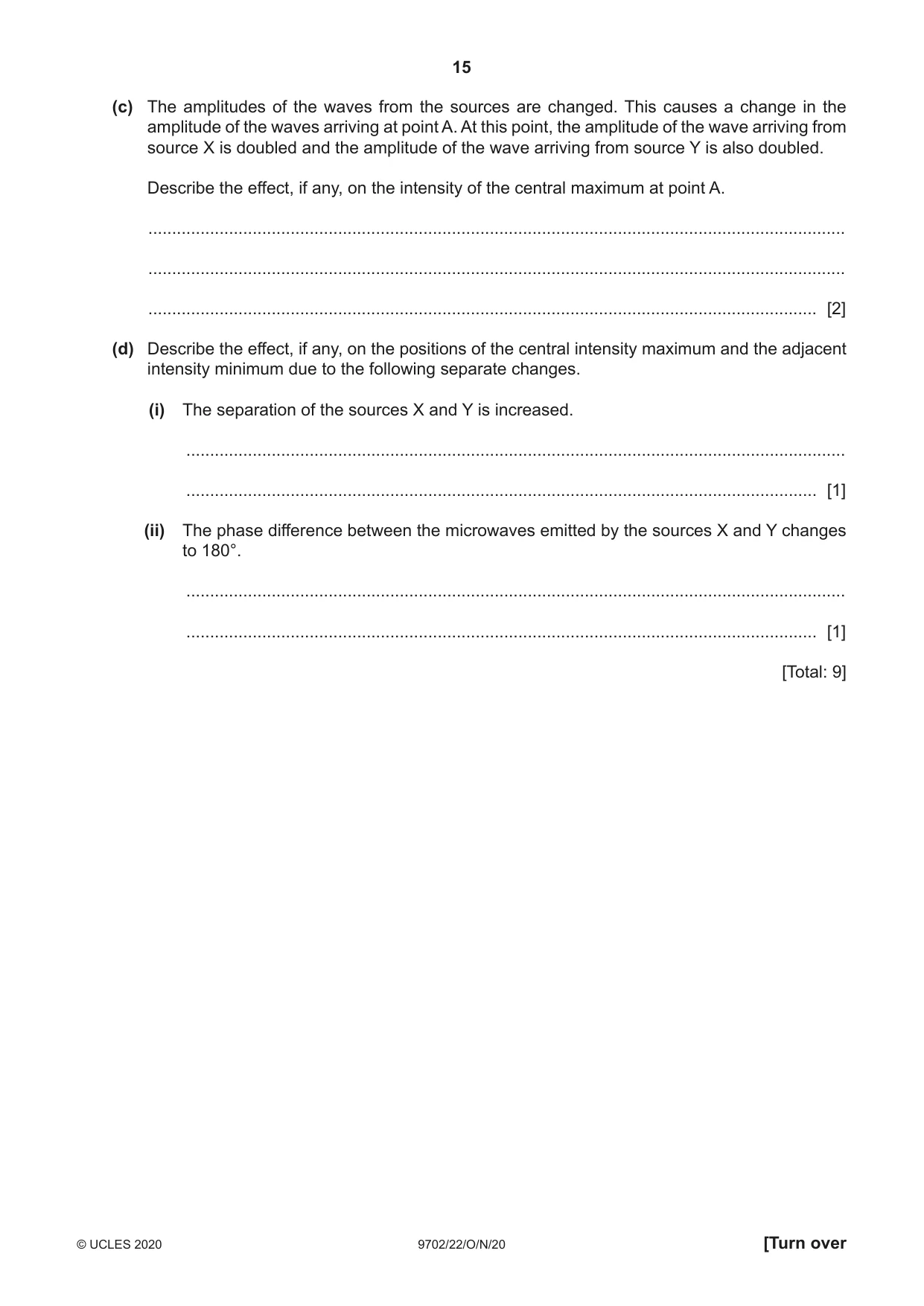
5 Microwaves with the same wavelength and amplitude are emitted in phase from two sources X and Y, as shown in Fig. 5.1. path of detector X A position of central maximum B position of adjacent minimum Y Fig. 5.1 (not to scale) A microwave detector is moved along a path parallel to the line joining X and Y. An interference pattern is detected. A central intensity maximum is located at point A and there is an adjacent intensity minimum at point B. The microwaves have a wavelength of 0.040 m. (a) Calculate the frequency, in GHz, of the microwaves. frequency = ................................................. GHz [3] (b) For the waves arriving at point B, determine: (i) the path difference path difference = ..................................................... m [1] (ii) the phase difference. phase difference = ........................................................° [1] (c) The amplitudes of the waves from the sources are changed. This causes a change in the amplitude of the waves arriving at point A. At this point, the amplitude of the wave arriving from source X is doubled and the amplitude of the wave arriving from source Y is also doubled. Describe the effect, if any, on the intensity of the central maximum at point A. ................................................................................................................................................... ................................................................................................................................................... ............................................................................................................................................. [2] (d) Describe the effect, if any, on the positions of the central intensity maximum and the adjacent intensity minimum due to the following separate changes. (i) The separation of the sources X and Y is increased. ........................................................................................................................................... ..................................................................................................................................... [1] (ii) The phase difference between the microwaves emitted by the sources X and Y changes to 180°. ........................................................................................................................................... ..................................................................................................................................... [1] [Total: 9]
Mark scheme: 5(a) v = fλ or c = fλ C1 f = 3.0 × 10⁸ / 0.040 C1 = 7.5 × 10⁹ (Hz) = 7.5 GHz A1 5(b)(i) path difference = 0.020 m A1 5(b)(ii) phase difference = 180° A1 5(c) (intensity) increases C1 (intensity) increases by a factor of 4 A1 5(d)(i) minimum moves closer to the maximum or decrease in separation of maximum and minimum B1 5(d)(ii) the maximum and minimum exchange places or the maximum becomes a minimum and the minimum becomes a maximum B1
Q6 · A network of three resistors of resistances R1, R2 and R3 is shown in Fig
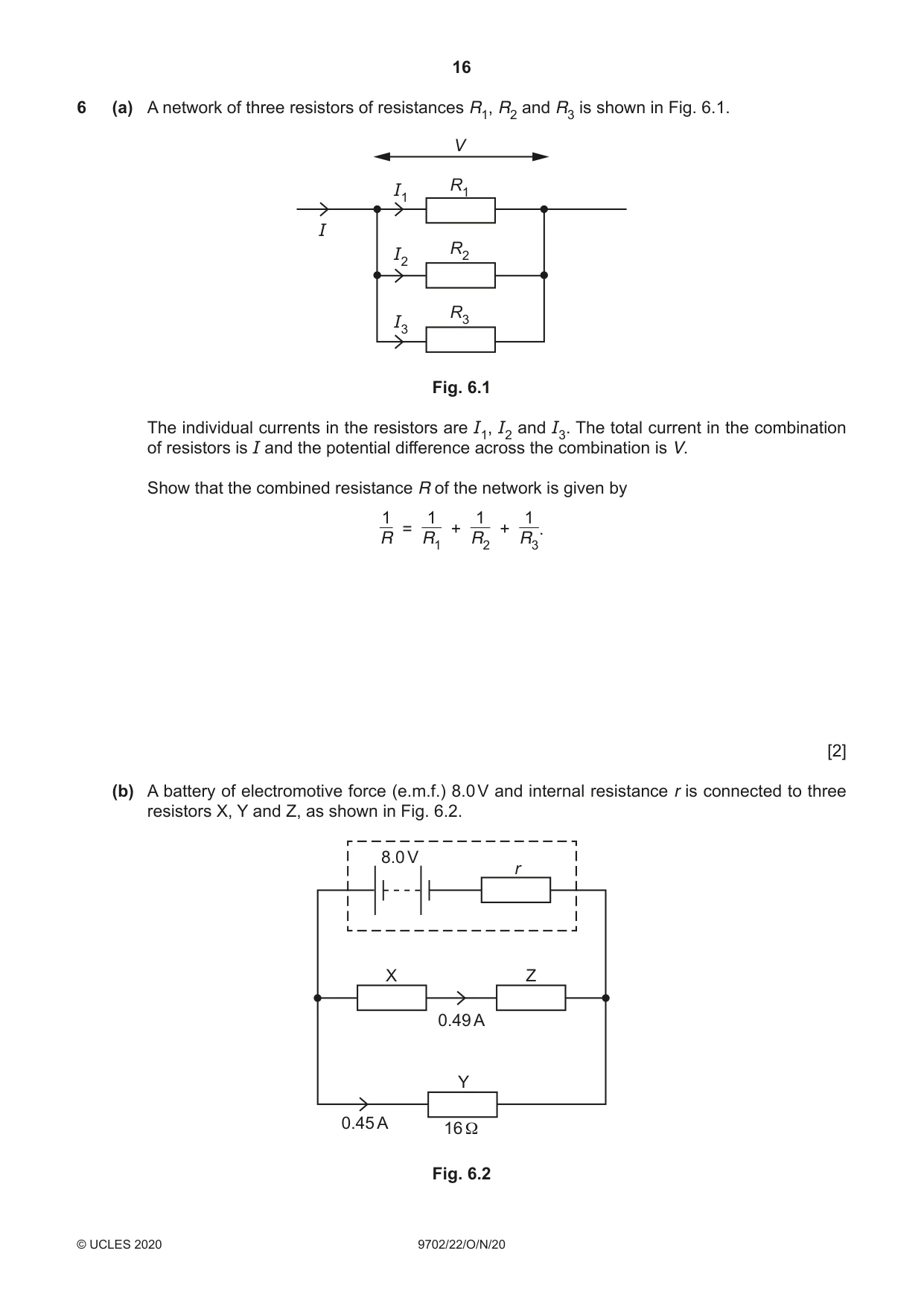
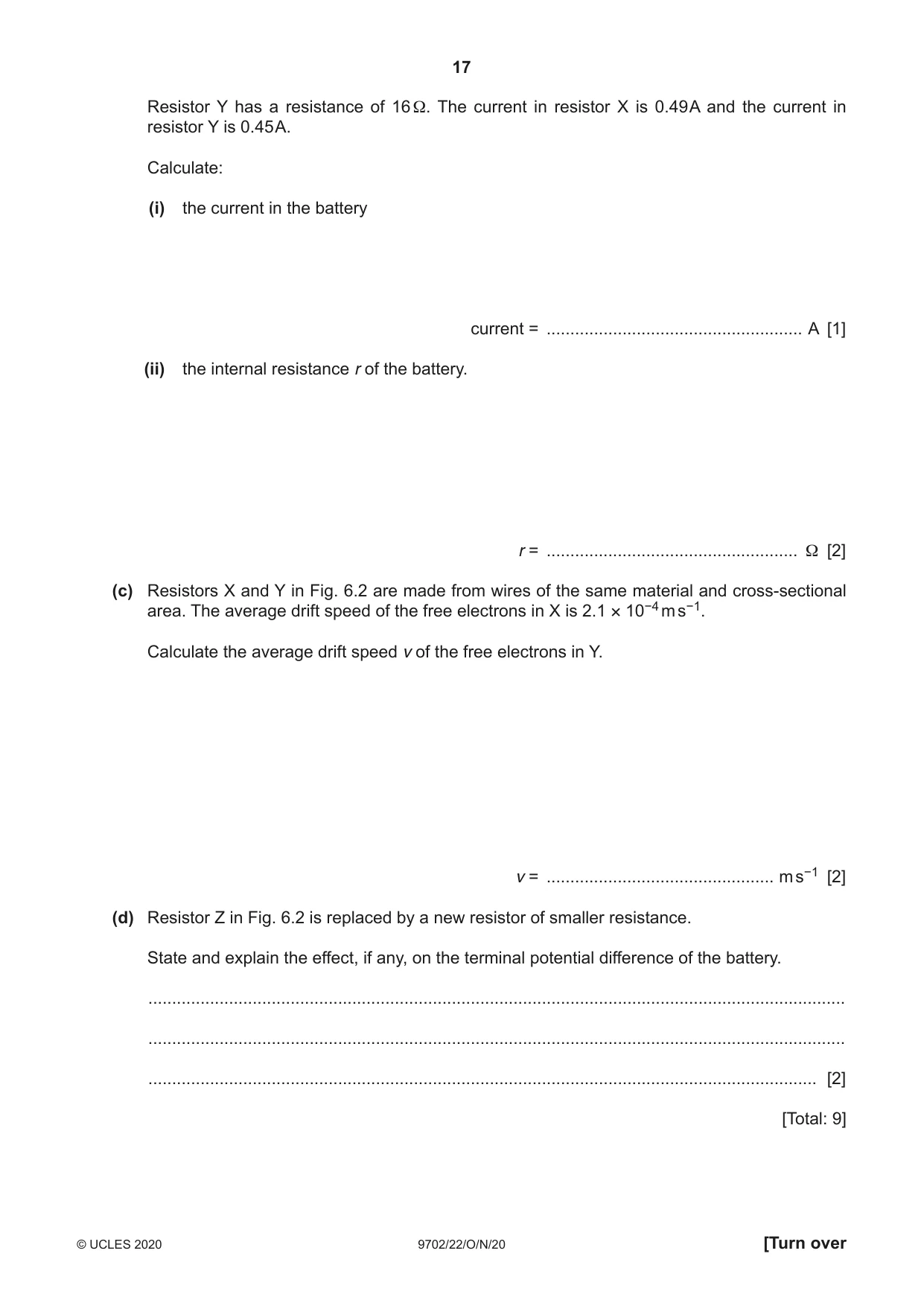
6 (a) A network of three resistors of resistances R1, R2 and R3 is shown in Fig. 6.1. V I1 R1 I R2 I2 R3 I3 Fig. 6.1 The individual currents in the resistors are I1, I2 and I3. The total current in the combination of resistors is I and the potential difference across the combination is V. Show that the combined resistance R of the network is given by 1 1 1 1 = + + . R R1 R2 R3 [2] (b) A battery of electromotive force (e.m.f.) 8.0 V and internal resistance r is connected to three resistors X, Y and Z, as shown in Fig. 6.2. 8.0 V r X Z 0.49 A Y 0.45 A 16 Ω Fig. 6.2 Resistor Y has a resistance of 16 Ω. The current in resistor X is 0.49 A and the current in resistor Y is 0.45 A. Calculate: (i) the current in the battery current = ...................................................... A [1] (ii) the internal resistance r of the battery. r = ..................................................... Ω [2] (c) Resistors X and Y in Fig. 6.2 are made from wires of the same material and cross-sectional area. The average drift speed of the free electrons in X is 2.1 × 10⁻⁴ m s−1. Calculate the average drift speed v of the free electrons in Y. v = ................................................ m s−1 [2] (d) Resistor Z in Fig. 6.2 is replaced by a new resistor of smaller resistance. State and explain the effect, if any, on the terminal potential difference of the battery. ................................................................................................................................................... ................................................................................................................................................... ............................................................................................................................................. [2] [Total: 9]
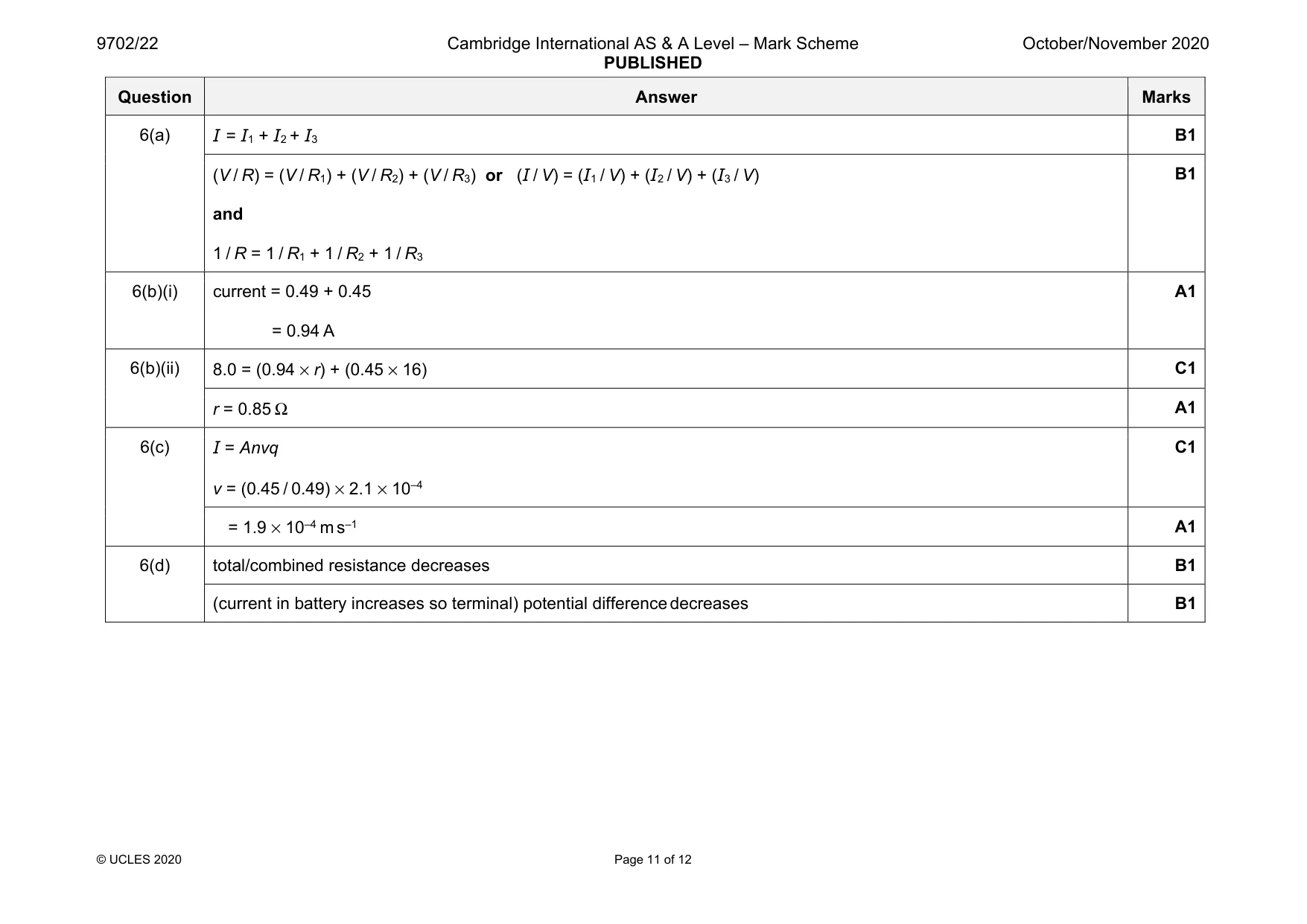
Mark scheme: 6(a) B1 (V / R) = (V / R1) + (V / R2) + (V / R3) or (I / V) = (I1 / V) + (I2 / V) + (I3 / V) and 1 / R = 1 / R1 + 1 / R2 + 1 / R3 B1 6(b)(i) current = 0.49 + 0.45 = 0.94 A A1 6(b)(ii) 8.0 = (0.94 × r) + (0.45 × 16) C1 r = 0.85 Ω A1 6(c) I = Anvq v = (0.45 / 0.49) × 2.1 × 10–4 C1 = 1.9 × 10⁻⁴ m s–1 A1 6(d) total/combined resistance decreases B1 (current in battery increases so terminal) potential difference decreases B1
Q7 · State a similarity and a difference between an up quark and an up antiquark
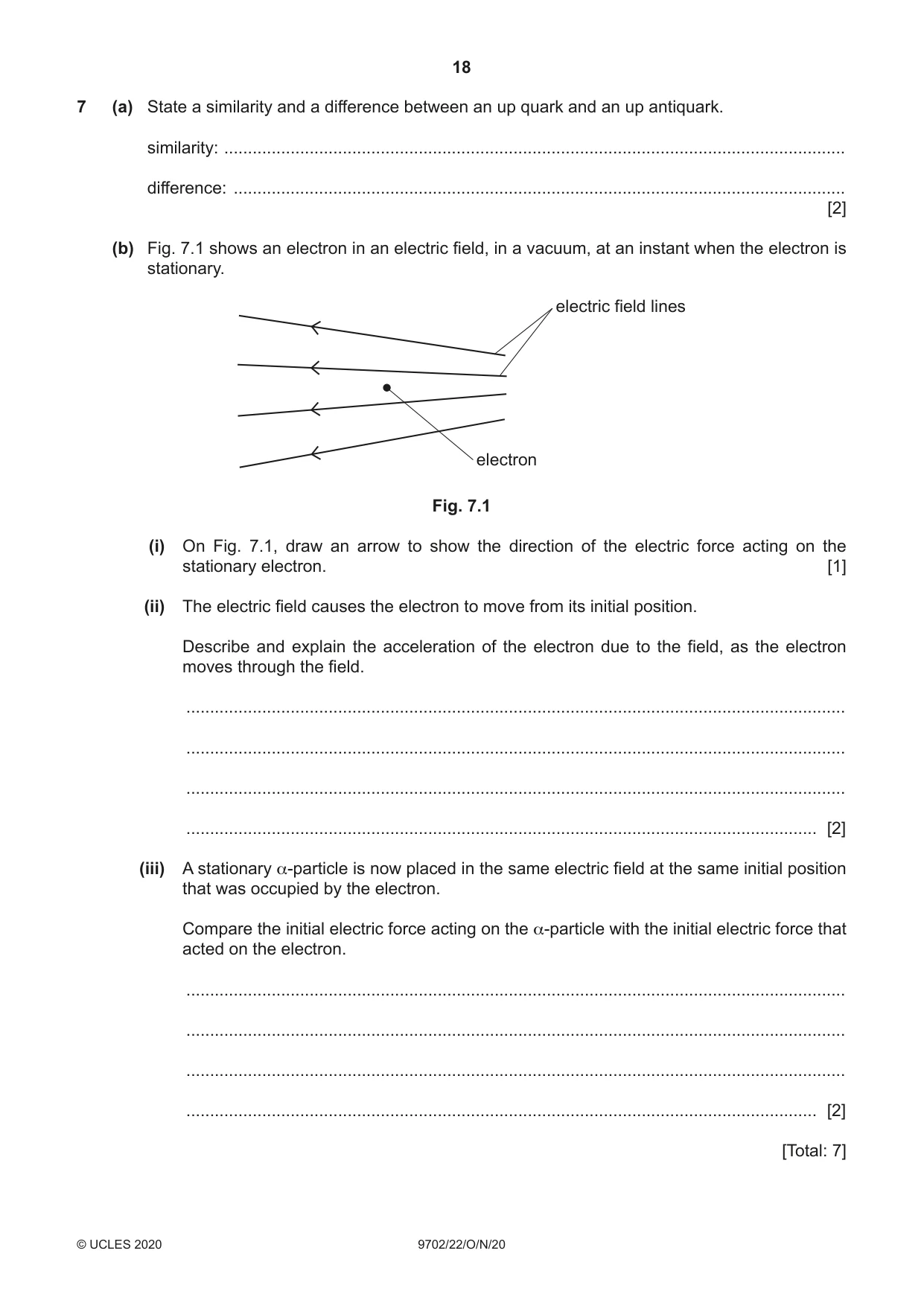
7 (a) State a similarity and a difference between an up quark and an up antiquark. similarity: ................................................................................................................................... difference: ................................................................................................................................. [2] (b) Fig. 7.1 shows an electron in an electric field, in a vacuum, at an instant when the electron is stationary. electric field lines electron Fig. 7.1 (i) On Fig. 7.1, draw an arrow to show the direction of the electric force acting on the stationary electron. [1] (ii) The electric field causes the electron to move from its initial position. Describe and explain the acceleration of the electron due to the field, as the electron moves through the field. ........................................................................................................................................... ........................................................................................................................................... ........................................................................................................................................... ..................................................................................................................................... [2] (iii) A stationary α-particle is now placed in the same electric field at the same initial position that was occupied by the electron. Compare the initial electric force acting on the α-particle with the initial electric force that acted on the electron. ........................................................................................................................................... ........................................................................................................................................... ........................................................................................................................................... ..................................................................................................................................... [2] [Total: 7]
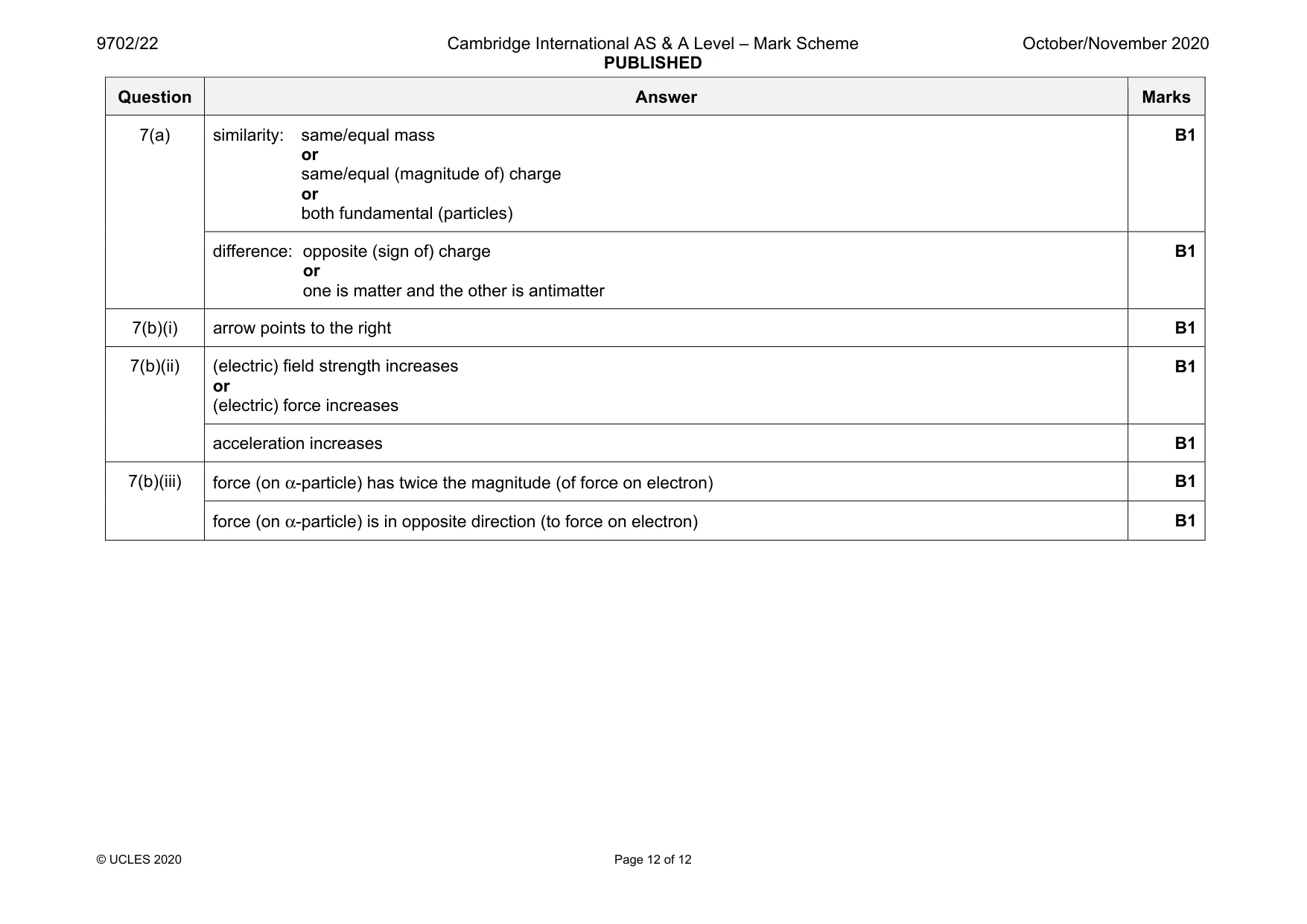
Mark scheme: 7(a) similarity: same/equal mass or same/equal (magnitude of) charge or both fundamental (particles) B1 difference: opposite (sign of) charge or one is matter and the other is antimatter B1 7(b)(i) arrow points to the right B1 7(b)(ii) (electric) field strength increases or (electric) force increases B1 acceleration increases B1 7(b)(iii) force (on α-particle) has twice the magnitude (of force on electron) B1 force (on α-particle) is in opposite direction (to force on electron) B1
What was in this paper
The subtopics covered by these 7 questions, and how many questions each got. Open one in a new tab to see every Cambridge question on it.
What you needed in this session
Cambridge’s own grade thresholds for 2020 Oct/Nov, Paper 2 · Variant 2. A higher threshold means an easier paper — the bar moves with how the cohort did.