Cambridge A Level Physics 9702 — 2022 Oct/Nov Paper 2 · Variant 1
9702/21/O/N/22 · 6 questions · 60 marks · ≈68 min
The question paper and its mark scheme, free to read here and free to download. This is Cambridge’s own paper, exactly as it was sat.
Question paper20 pages




Mark scheme12 pages
Answers below. Sit the paper first if you are practising.
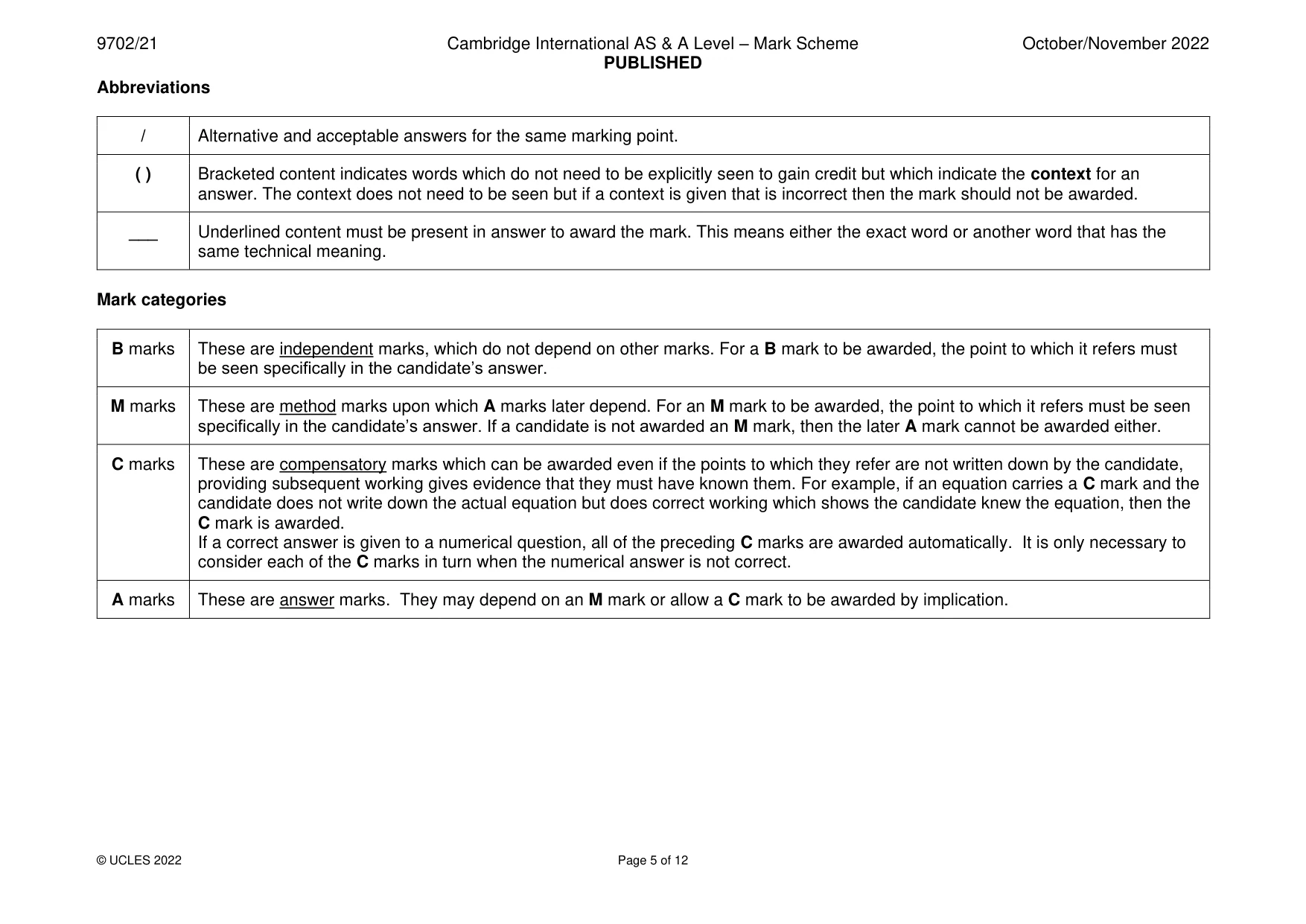
Questions as text
Q1 · The boxes in Fig
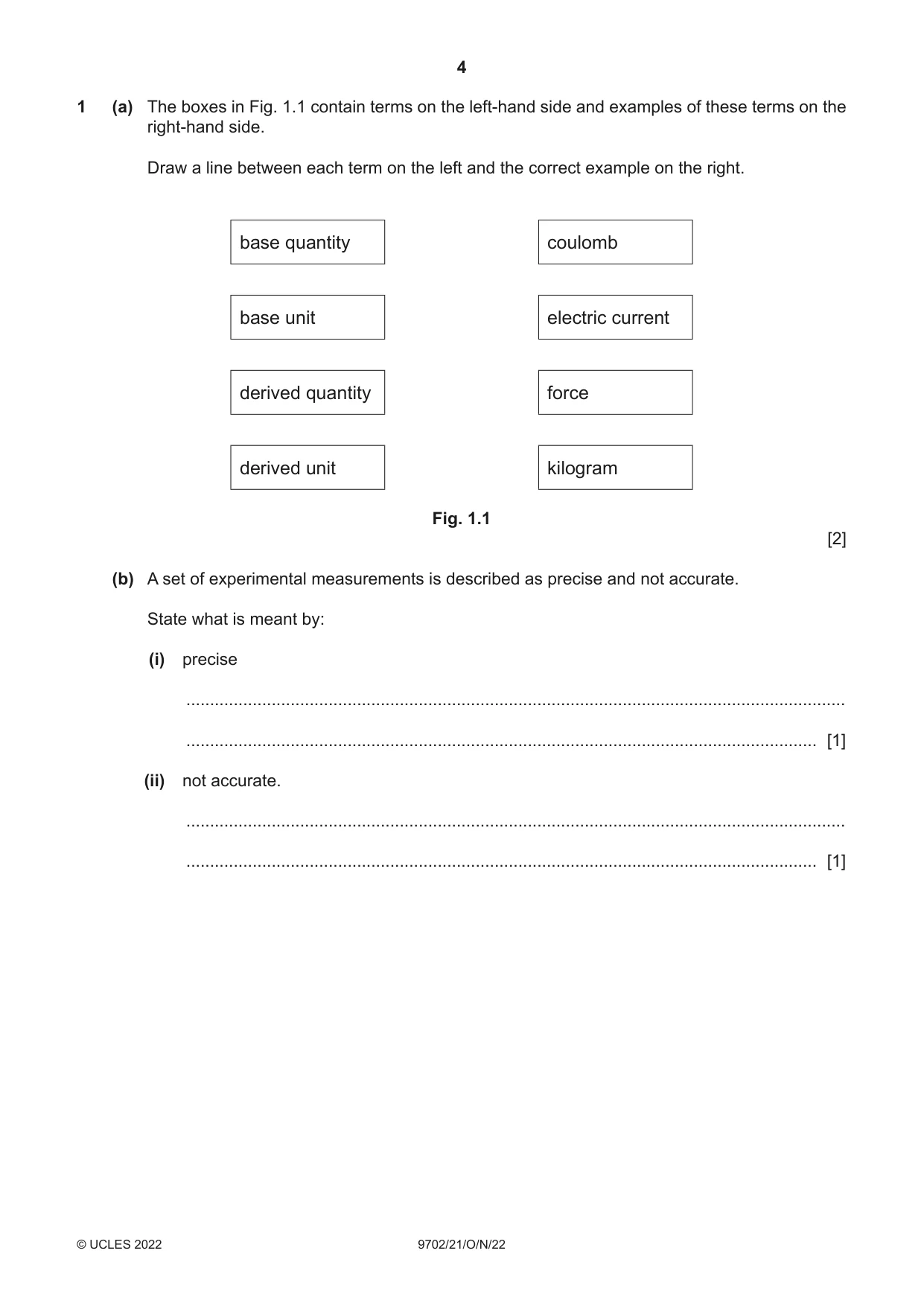
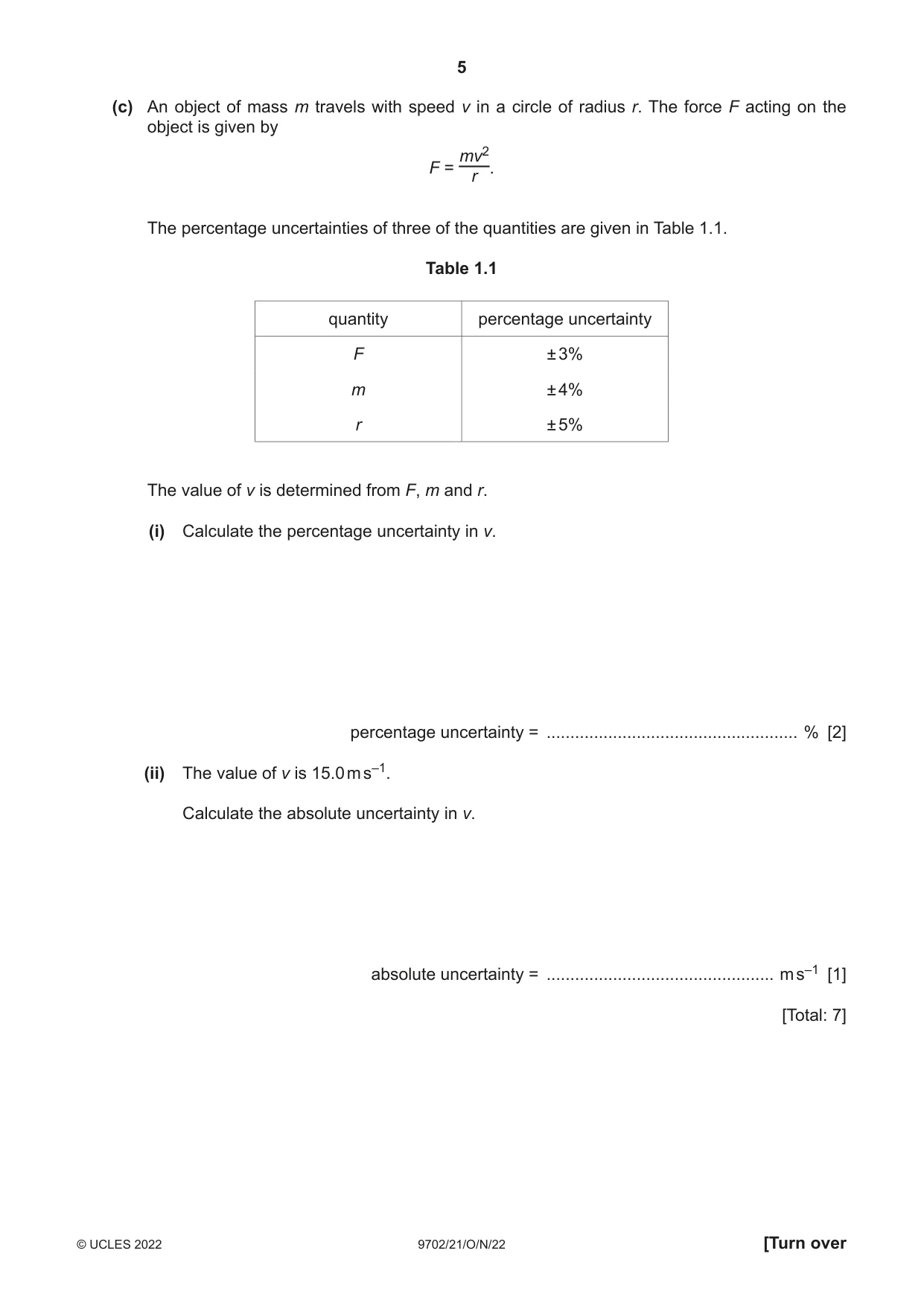
1 (a) The boxes in Fig. 1.1 contain terms on the left-hand side and examples of these terms on the right-hand side. Draw a line between each term on the left and the correct example on the right. base quantity coulomb base unit electric current derived quantity force derived unit kilogram Fig. 1.1 [2] (b) A set of experimental measurements is described as precise and not accurate. State what is meant by: (i) precise ........................................................................................................................................... ..................................................................................................................................... [1] (ii) not accurate. ........................................................................................................................................... ..................................................................................................................................... [1] (c) An object of mass m travels with speed v in a circle of radius r. The force F acting on the object is given by mv2 F = . r The percentage uncertainties of three of the quantities are given in Table 1.1. Table 1.1 quantity percentage uncertainty F ± 3% m ± 4% r ± 5% The value of v is determined from F, m and r. (i) Calculate the percentage uncertainty in v. percentage uncertainty = ..................................................... % [2] (ii) The value of v is 15.0 m s–1. Calculate the absolute uncertainty in v. absolute uncertainty = ................................................ m s–1 [1] [Total: 7]
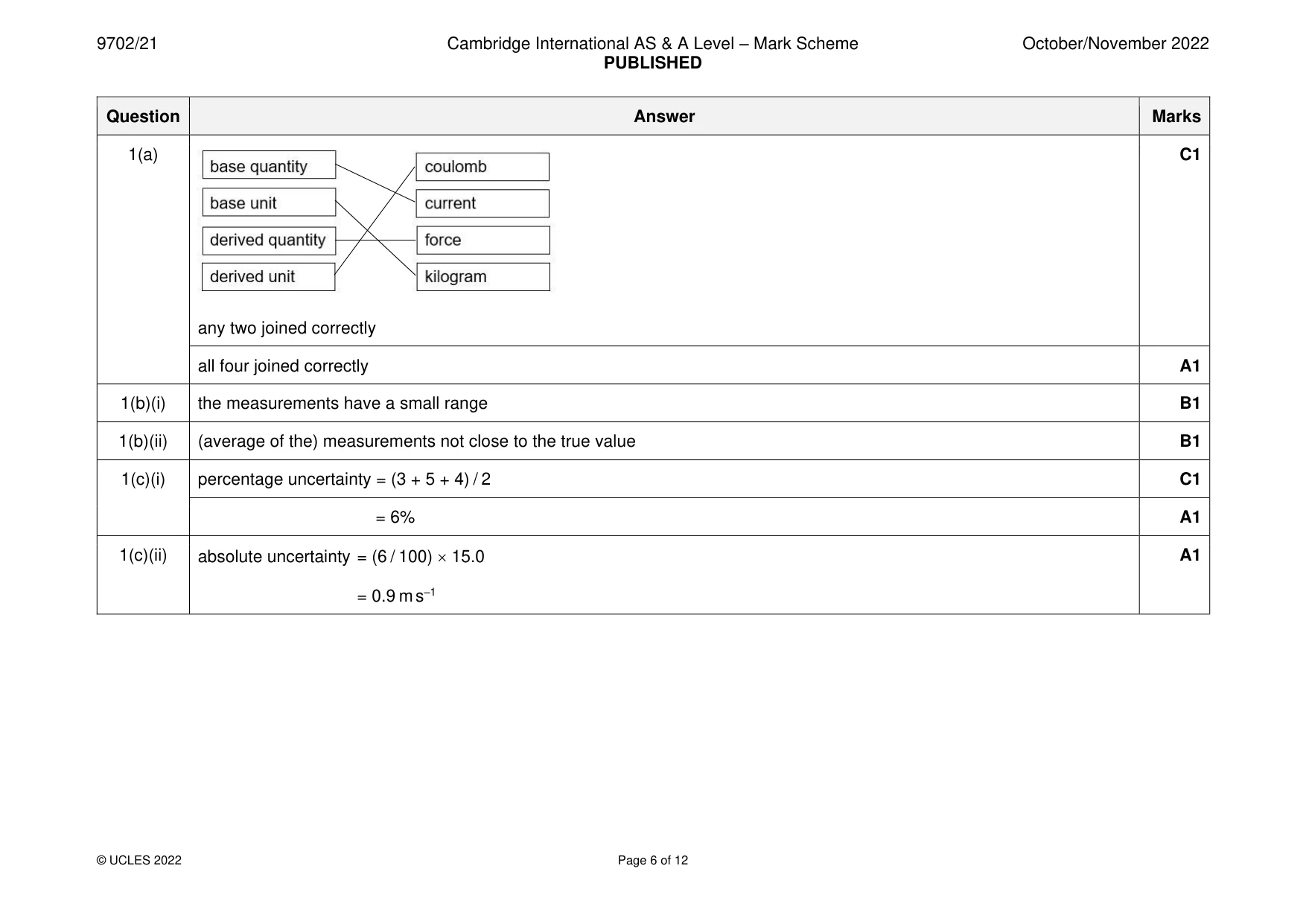
Mark scheme: Question Answer Marks 1(a) C1 any two joined correctly all four joined correctly A1 1(b)(i) the measurements have a small range B1 1(b)(ii) (average of the) measurements not close to the true value B1 1(c)(i) percentage uncertainty = (3 + 5 + 4) / 2 C1 = 6% A1 1(c)(ii) absolute uncertainty = (6 / 100) 15.0 A1 = 0.9 ms–1
Q2 · A steel ball is projected horizontally from the top of a table, as shown in Fig
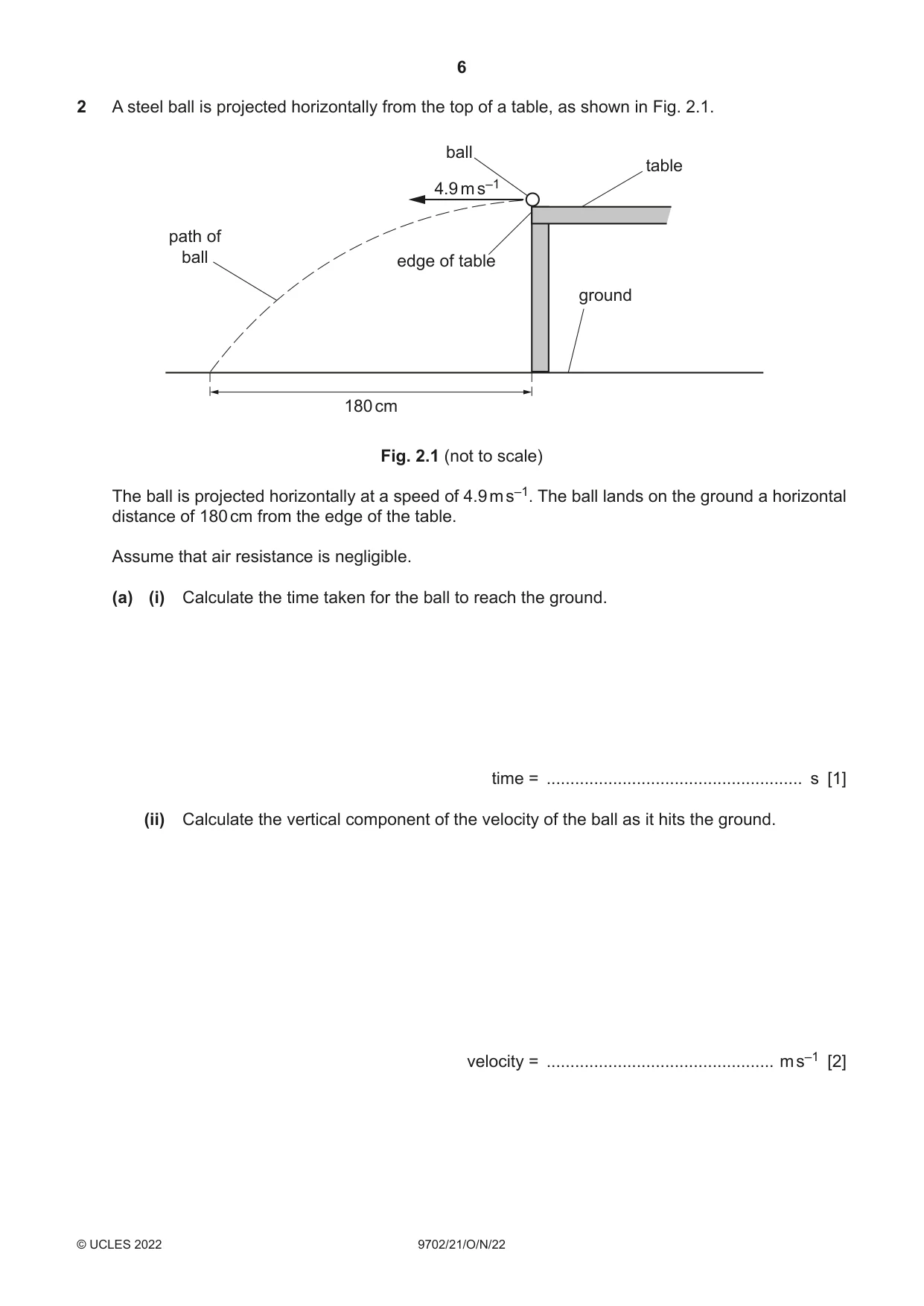
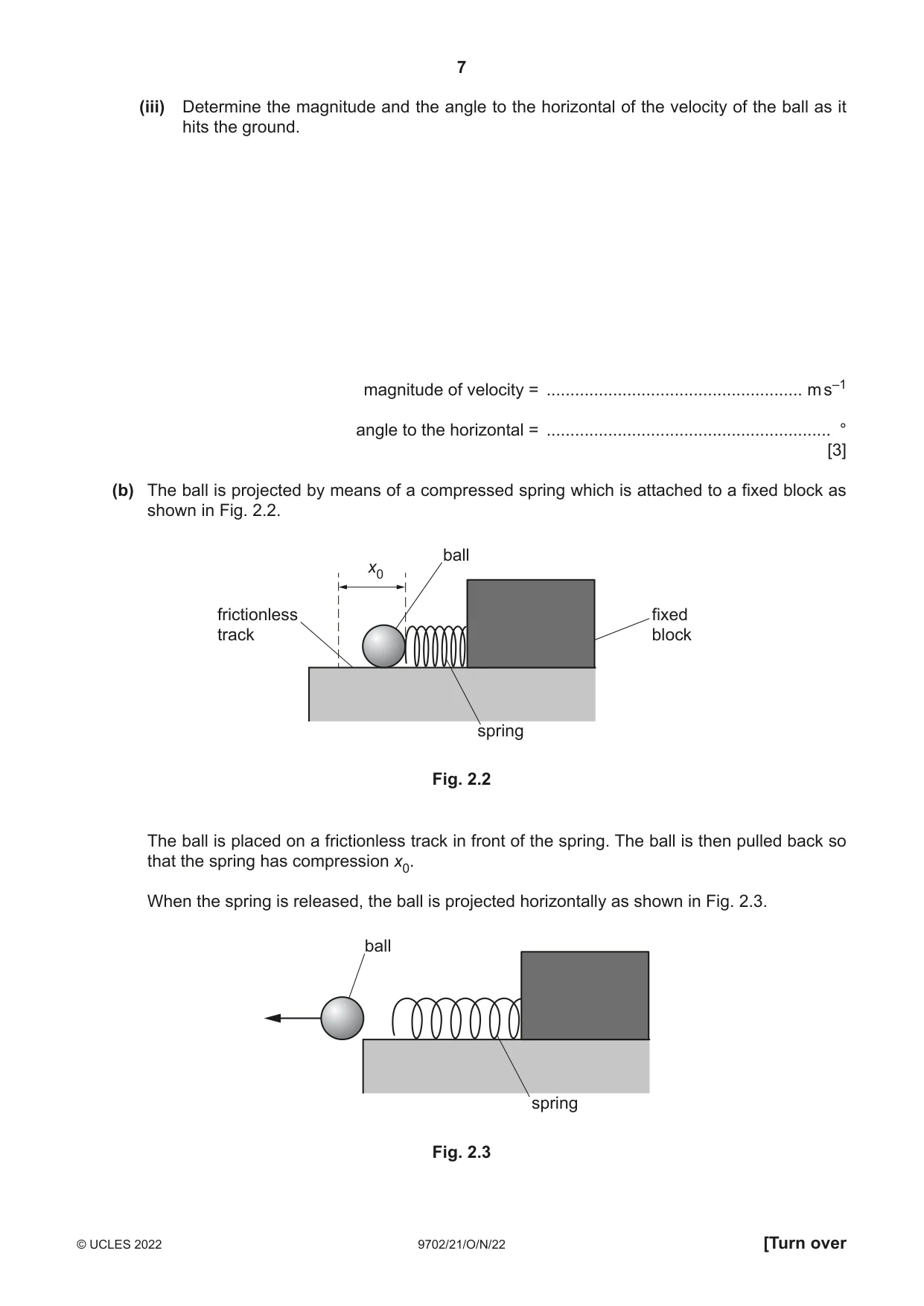
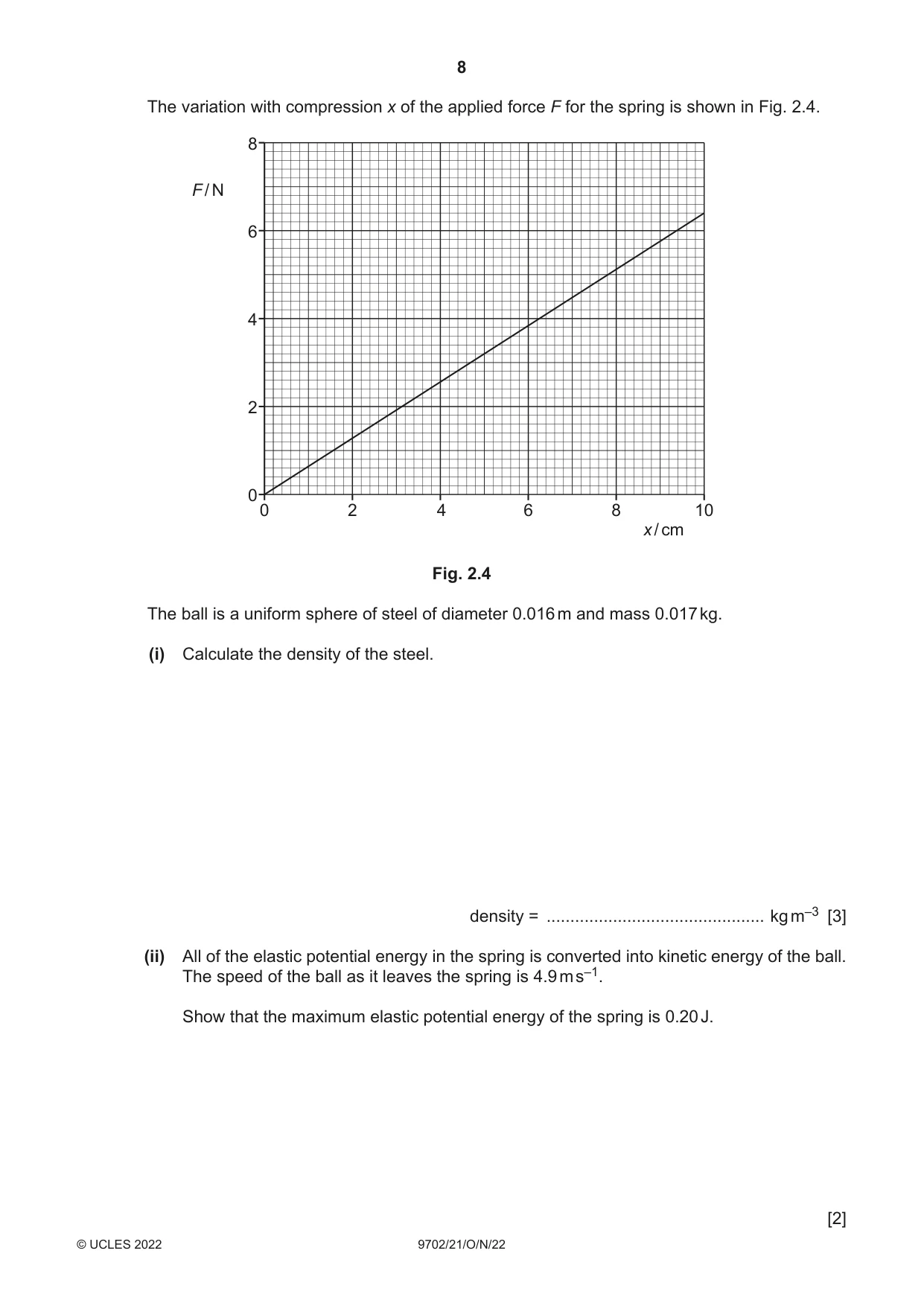
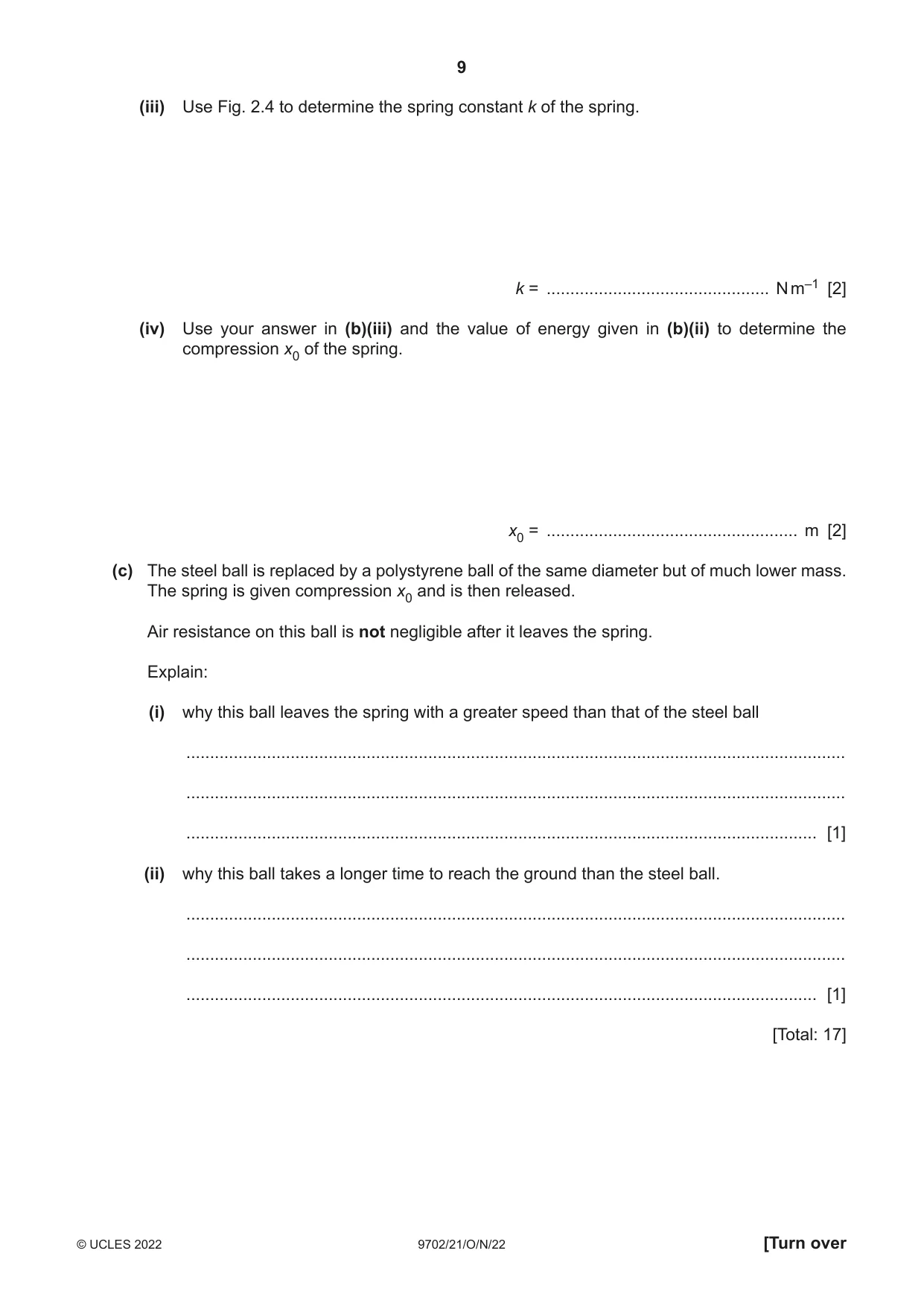
2 A steel ball is projected horizontally from the top of a table, as shown in Fig. 2.1. ball table 4.9 m s–1 path of ball edge of table ground 180 cm Fig. 2.1 (not to scale) The ball is projected horizontally at a speed of 4.9 m s–1. The ball lands on the ground a horizontal distance of 180 cm from the edge of the table. Assume that air resistance is negligible. (a) (i) Calculate the time taken for the ball to reach the ground. time = ...................................................... s [1] (ii) Calculate the vertical component of the velocity of the ball as it hits the ground. velocity = ................................................ m s–1 [2] (iii) Determine the magnitude and the angle to the horizontal of the velocity of the ball as it hits the ground. magnitude of velocity = ...................................................... m s–1 angle to the horizontal = ............................................................ ° [3] (b) The ball is projected by means of a compressed spring which is attached to a fixed block as shown in Fig. 2.2. ball x0 frictionless fixed track block spring Fig. 2.2 The ball is placed on a frictionless track in front of the spring. The ball is then pulled back so that the spring has compression x0. When the spring is released, the ball is projected horizontally as shown in Fig. 2.3. ball spring Fig. 2.3 The variation with compression x of the applied force F for the spring is shown in Fig. 2.4. 8 F / N 6 4 2 0 0 2 4 6 8 10 x / cm Fig. 2.4 The ball is a uniform sphere of steel of diameter 0.016 m and mass 0.017 kg. (i) Calculate the density of the steel. density = .............................................. kg m–3 [3] (ii) All of the elastic potential energy in the spring is converted into kinetic energy of the ball. The speed of the ball as it leaves the spring is 4.9 m s–1. Show that the maximum elastic potential energy of the spring is 0.20 J. [2] (iii) Use Fig. 2.4 to determine the spring constant k of the spring. k = ............................................... N m–1 [2] (iv) Use your answer in (b)(iii) and the value of energy given in (b)(ii) to determine the compression x0 of the spring. x0 = ..................................................... m [2] (c) The steel ball is replaced by a polystyrene ball of the same diameter but of much lower mass. The spring is given compression x0 and is then released. Air resistance on this ball is not negligible after it leaves the spring. Explain: (i) why this ball leaves the spring with a greater speed than that of the steel ball ........................................................................................................................................... ........................................................................................................................................... ..................................................................................................................................... [1] (ii) why this ball takes a longer time to reach the ground than the steel ball. ........................................................................................................................................... ........................................................................................................................................... ..................................................................................................................................... [1] [Total: 17]
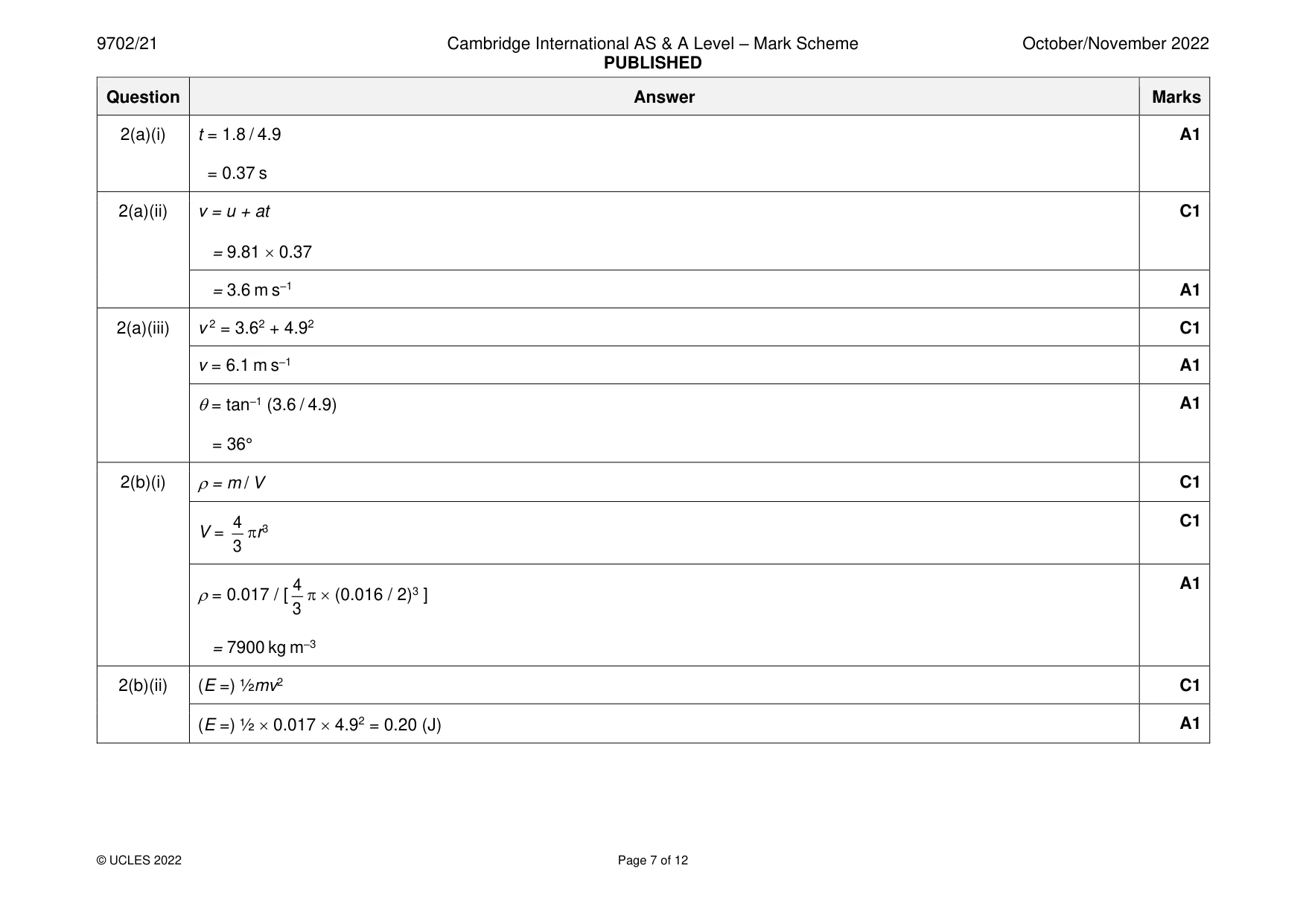
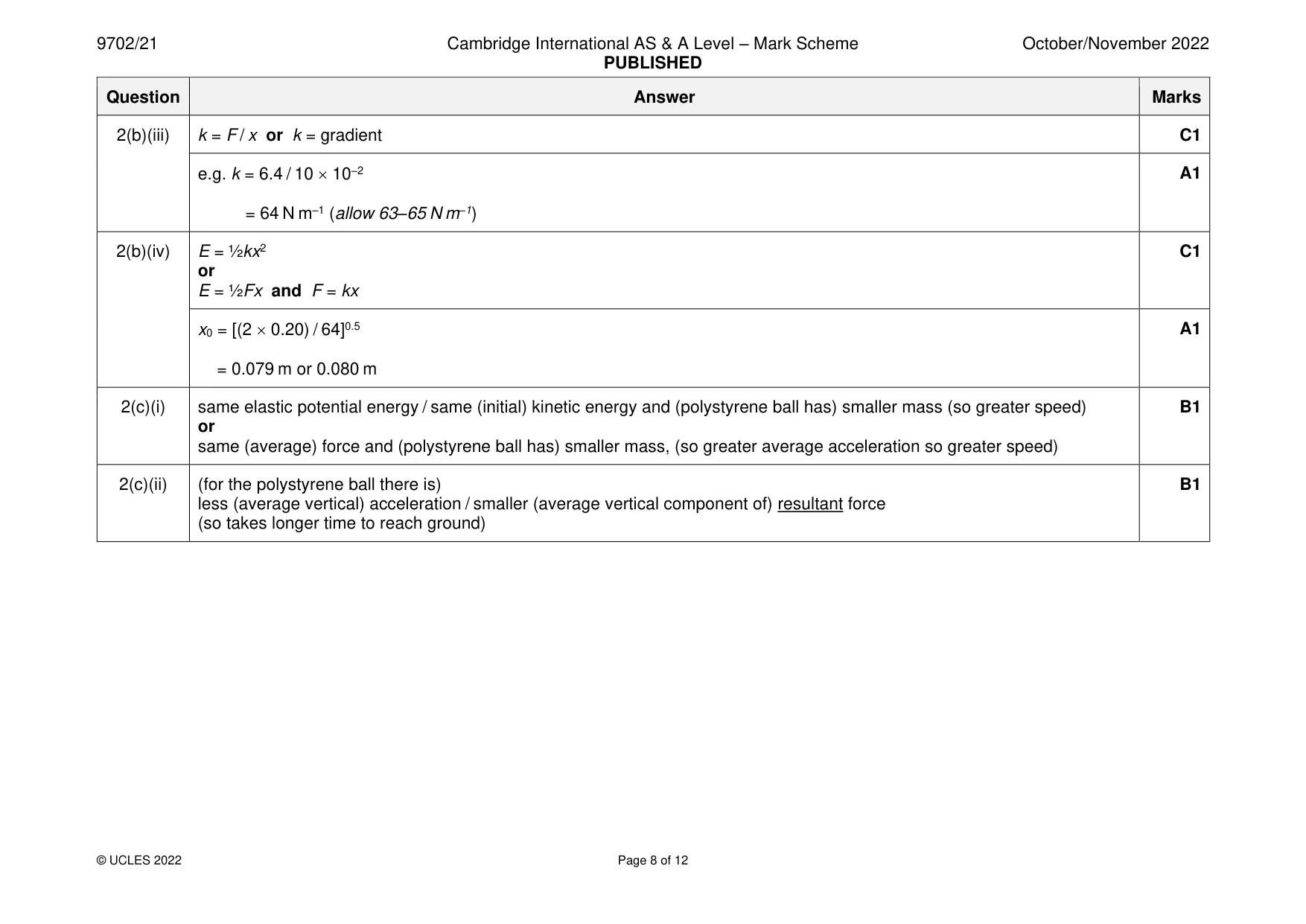
Mark scheme: 2(a)(i) t = 1.8 / 4.9 A1 = 0.37 s 2(a)(ii) v = u + at C1 = 9.81 0.37 = 3.6 m s–1 A1 2(a)(iii) v 2 = 3.62 + 4.92 C1 v = 6.1 m s–1 A1 = tan–1 (3.6 / 4.9) A1 = 36° 2(b)(i) = m / V C1 4 C1 V = r3 3 4 A1 = 0.017 / [ (0.016 / 2)3 ] 3 = 7900 kg m–3 2(b)(ii) (E =) ½mv2 C1 (E =) ½ 0.017 4.92 = 0.20 (J) A1 2(b)(iii) k = F / x or k = gradient C1 e.g. k = 6.4 / 10 10–2 A1 = 64 N m–1 (allow 63–65 N m–1) 2(b)(iv) E = ½kx2 C1 or E = ½Fx and F = kx x0 = [(2 0.20) / 64]0.5 A1 = 0.079 m or 0.080 m 2(c)(i) same elastic potential energy / same (initial) kinetic energy and (polystyrene ball has) smaller mass (so greater speed) B1 or same (average) force and (polystyrene ball has) smaller mass, (so greater average acceleration so greater speed) 2(c)(ii) (for the polystyrene ball there is) B1 less (average vertical) acceleration / smaller (average vertical component of) resultant force (so takes longer time to reach ground)
Question 3
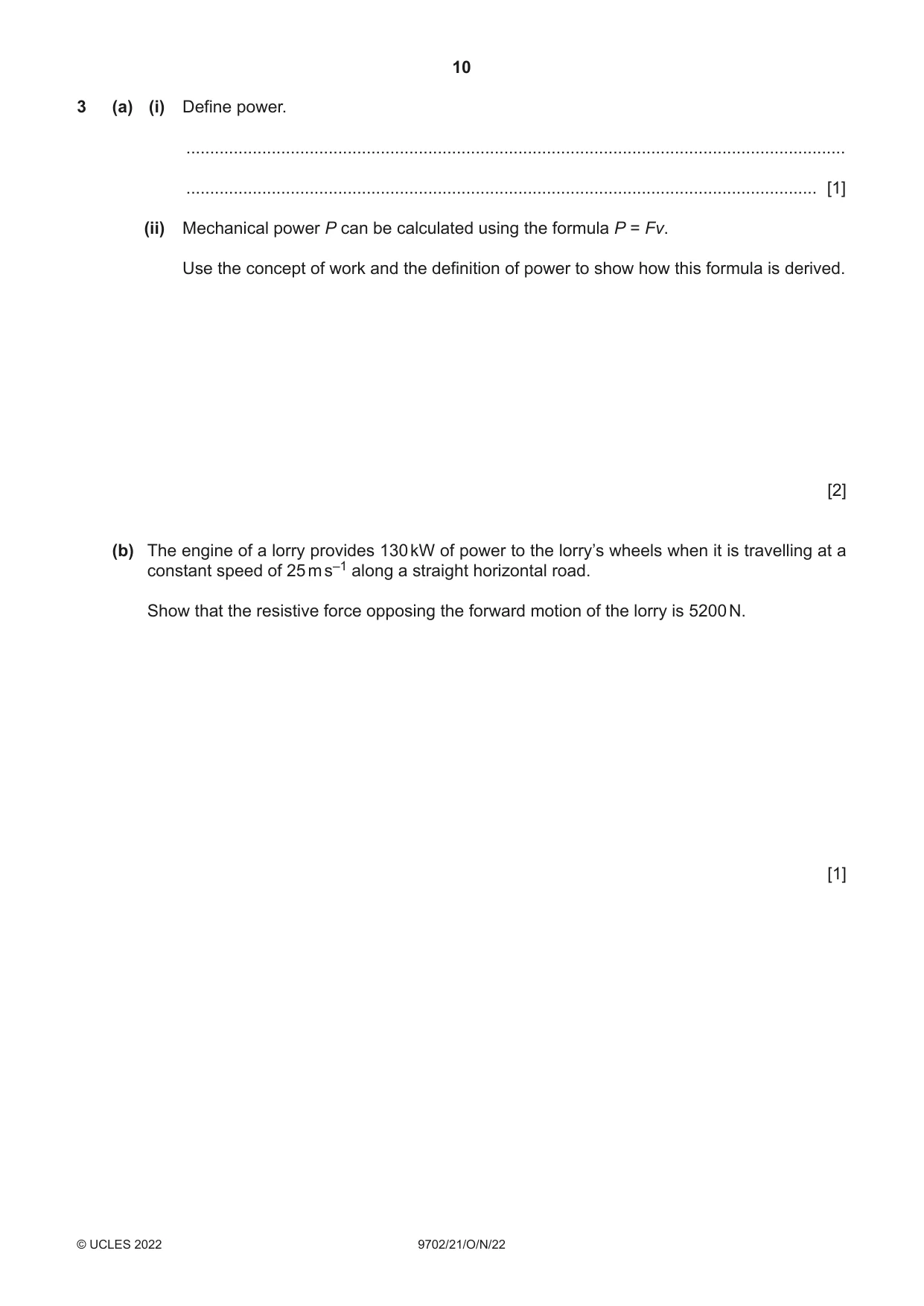
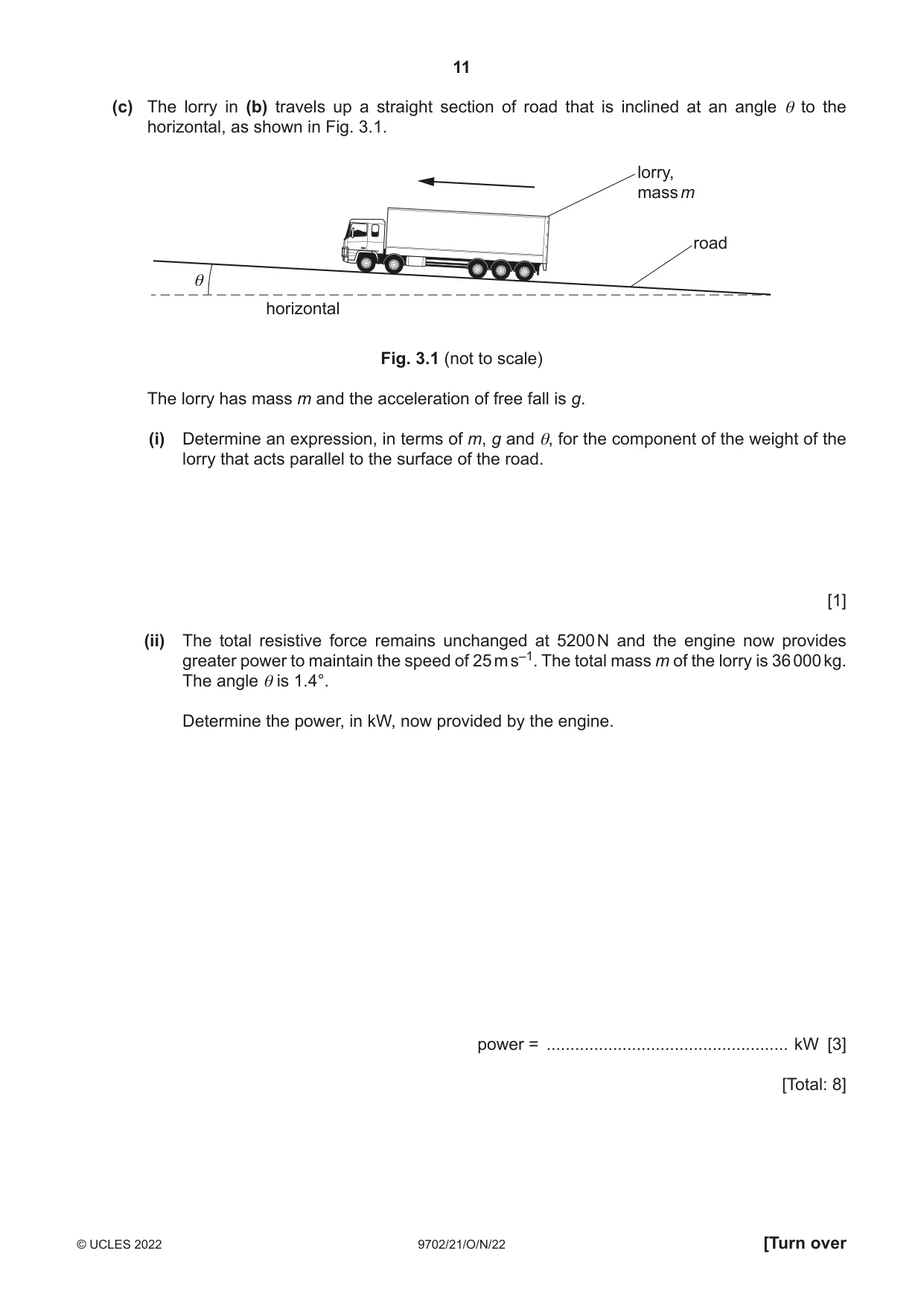
3 (a) (i) Define power. ........................................................................................................................................... ..................................................................................................................................... [1] (ii) Mechanical power P can be calculated using the formula P = Fv. Use the concept of work and the definition of power to show how this formula is derived. [2] (b) The engine of a lorry provides 130 kW of power to the lorry’s wheels when it is travelling at a constant speed of 25 m s–1 along a straight horizontal road. Show that the resistive force opposing the forward motion of the lorry is 5200 N. [1] (c) The lorry in (b) travels up a straight section of road that is inclined at an angle θ to the horizontal, as shown in Fig. 3.1. lorry, mass m road θ horizontal Fig. 3.1 (not to scale) The lorry has mass m and the acceleration of free fall is g. (i) Determine an expression, in terms of m, g and θ, for the component of the weight of the lorry that acts parallel to the surface of the road. [1] (ii) The total resistive force remains unchanged at 5200 N and the engine now provides greater power to maintain the speed of 25 m s–1. The total mass m of the lorry is 36 000 kg. The angle θ is 1.4°. Determine the power, in kW, now provided by the engine. power = ................................................... kW [3] [Total: 8]
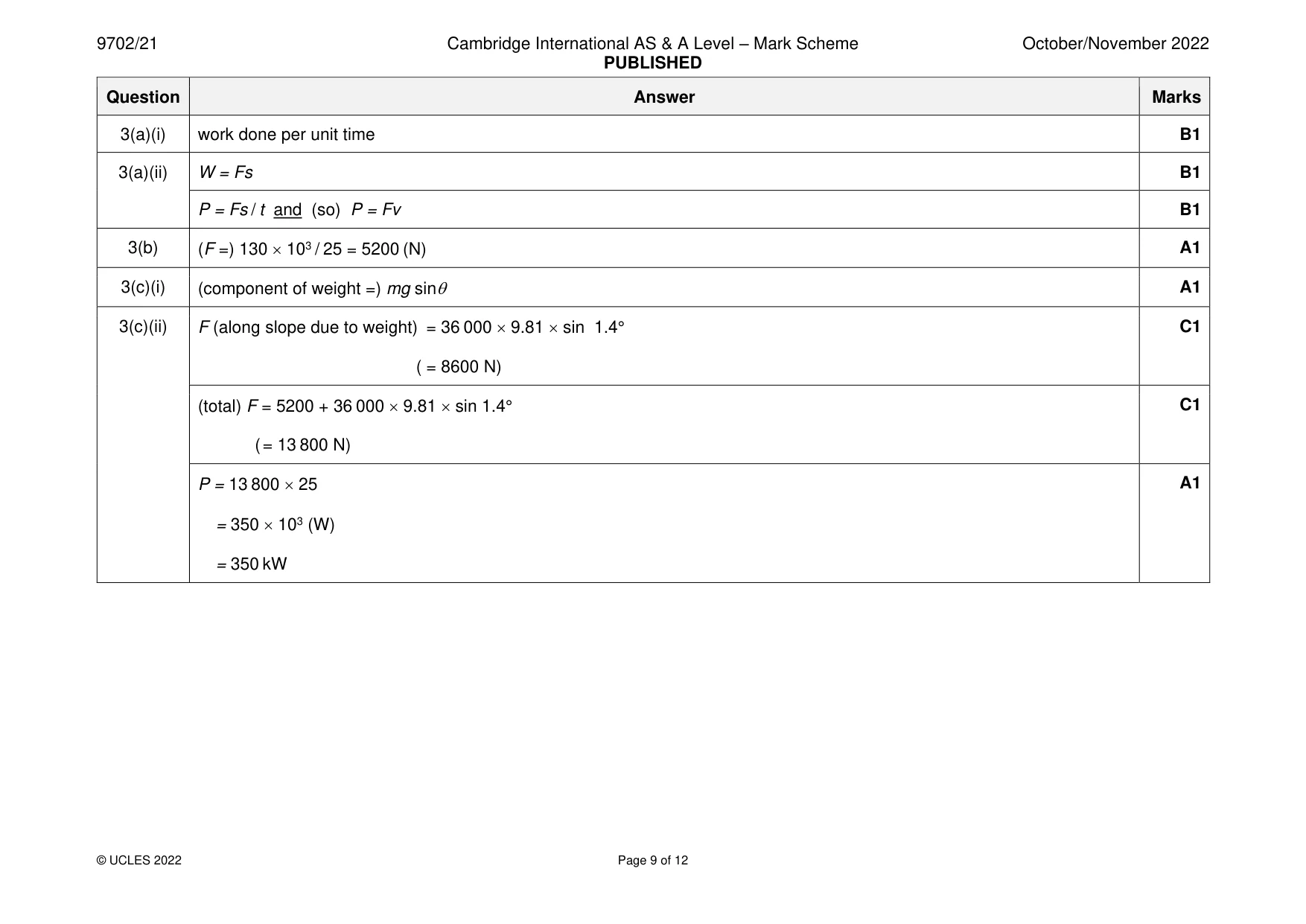
Mark scheme: 3(a)(i) work done per unit time B1 3(a)(ii) W = Fs B1 P = Fs / t and (so) P = Fv B1 3(b) (F =) 130 103 / 25 = 5200 (N) A1 3(c)(i) (component of weight =) mg sin A1 3(c)(ii) F (along slope due to weight) = 36 000 9.81 sin 1.4° C1 ( = 8600 N) (total) F = 5200 + 36 000 9.81 sin 1.4° C1 ( = 13 800 N) P = 13 800 25 A1 = 350 103 (W) = 350 kW
Q4 · Polarisation is a phenomenon associated with light waves but not with sound waves
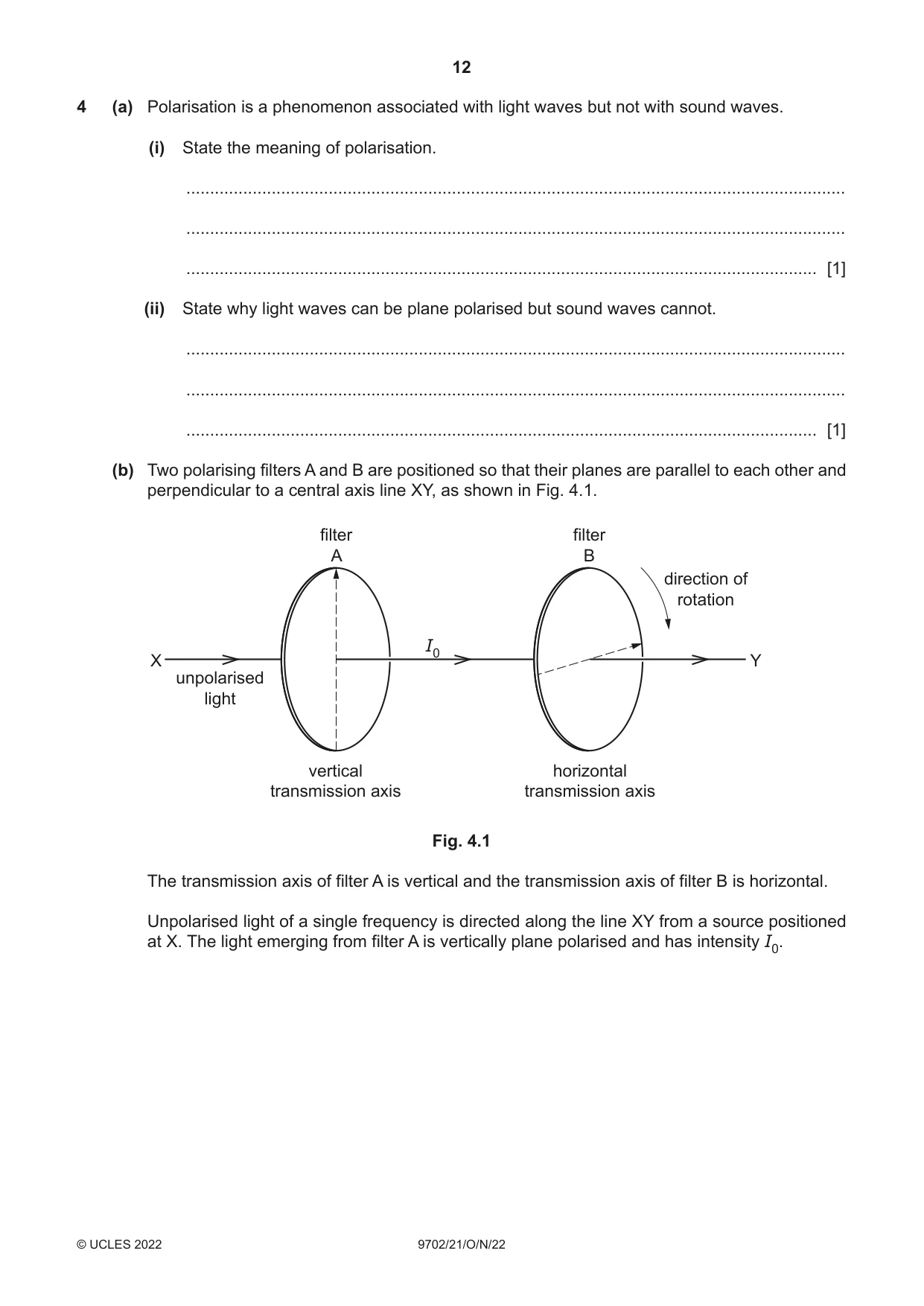
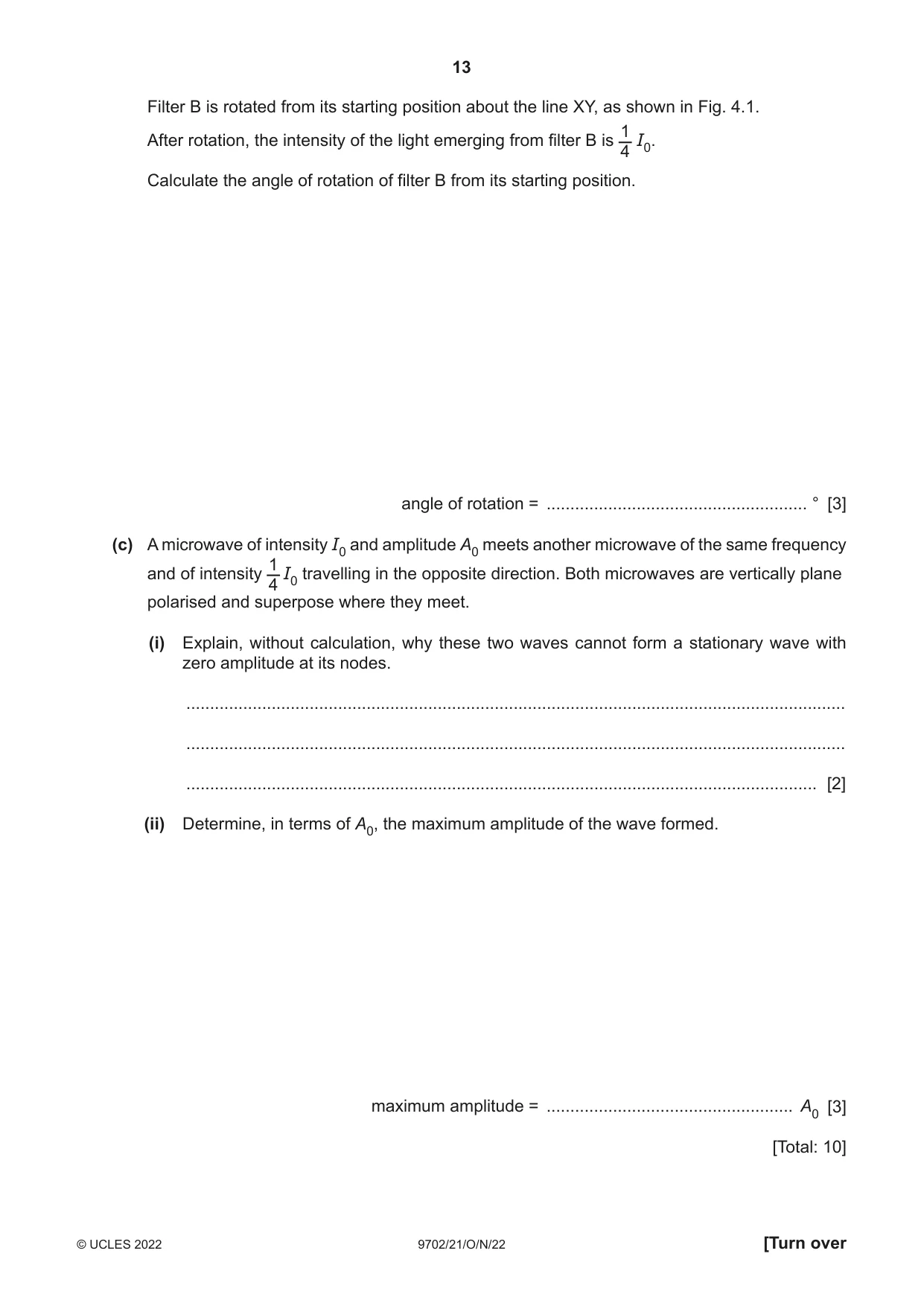
4 (a) Polarisation is a phenomenon associated with light waves but not with sound waves. (i) State the meaning of polarisation. ........................................................................................................................................... ........................................................................................................................................... ..................................................................................................................................... [1] (ii) State why light waves can be plane polarised but sound waves cannot. ........................................................................................................................................... ........................................................................................................................................... ..................................................................................................................................... [1] (b) Two polarising filters A and B are positioned so that their planes are parallel to each other and perpendicular to a central axis line XY, as shown in Fig. 4.1. filter filter A B direction of rotation I0 X Y unpolarised light vertical horizontal transmission axis transmission axis Fig. 4.1 The transmission axis of filter A is vertical and the transmission axis of filter B is horizontal. Unpolarised light of a single frequency is directed along the line XY from a source positioned at X. The light emerging from filter A is vertically plane polarised and has intensity I0. Filter B is rotated from its starting position about the line XY, as shown in Fig. 4.1. 1 After rotation, the intensity of the light emerging from filter B is I0. 4 Calculate the angle of rotation of filter B from its starting position. angle of rotation = ....................................................... ° [3] (c) A microwave of intensity I0 and amplitude A0 meets another microwave of the same frequency 1 and of intensity I0 travelling in the opposite direction. Both microwaves are vertically plane 4 polarised and superpose where they meet. (i) Explain, without calculation, why these two waves cannot form a stationary wave with zero amplitude at its nodes. ........................................................................................................................................... ........................................................................................................................................... ..................................................................................................................................... [2] (ii) Determine, in terms of A0, the maximum amplitude of the wave formed. maximum amplitude = .................................................... A0 [3] [Total: 10]
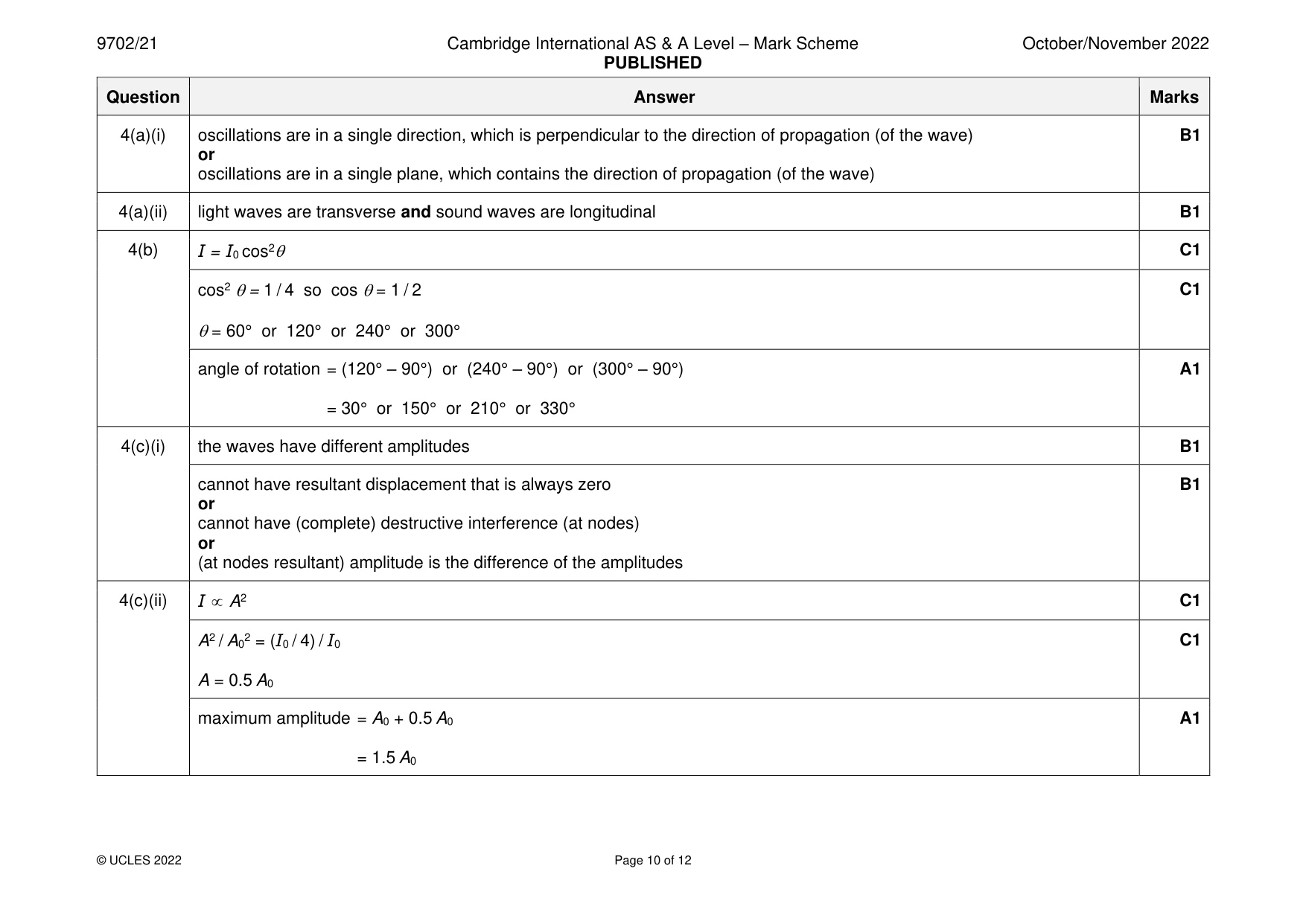
Mark scheme: 4(a)(i) oscillations are in a single direction, which is perpendicular to the direction of propagation (of the wave) B1 or oscillations are in a single plane, which contains the direction of propagation (of the wave) 4(a)(ii) light waves are transverse and sound waves are longitudinal B1 4(b) I = I0 cos2 C1 cos2 = 1 / 4 so cos = 1 / 2 C1 = 60° or 120° or 240° or 300° angle of rotation = (120° – 90°) or (240° – 90°) or (300° – 90°) A1 = 30° or 150° or 210° or 330° 4(c)(i) the waves have different amplitudes B1 cannot have resultant displacement that is always zero B1 or cannot have (complete) destructive interference (at nodes) or (at nodes resultant) amplitude is the difference of the amplitudes 4(c)(ii) I A2 C1 A2 / A02 = (I0 / 4) / I0 C1 A = 0.5 A0 maximum amplitude = A0 + 0.5 A0 A1 = 1.5 A0
Question 5
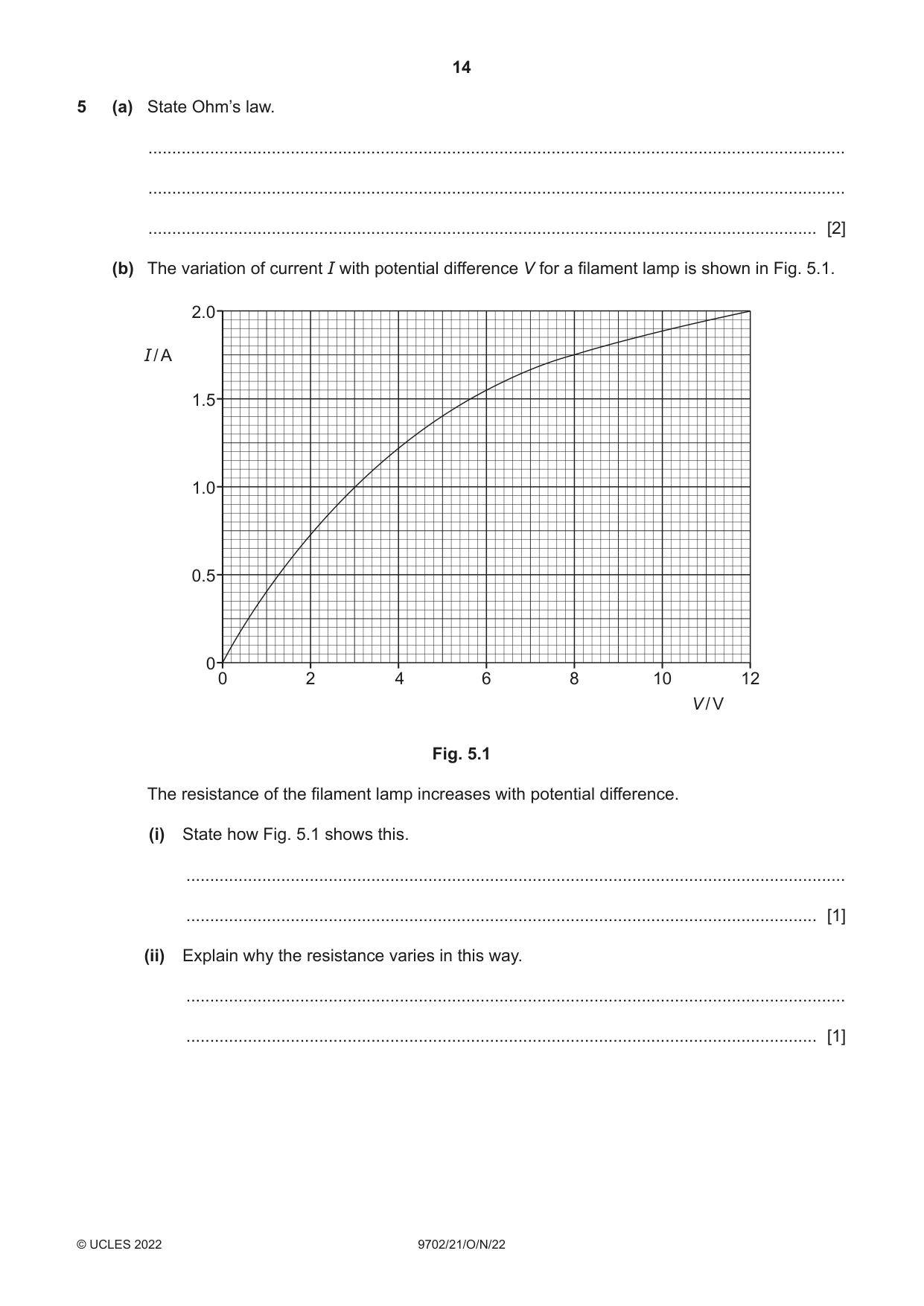
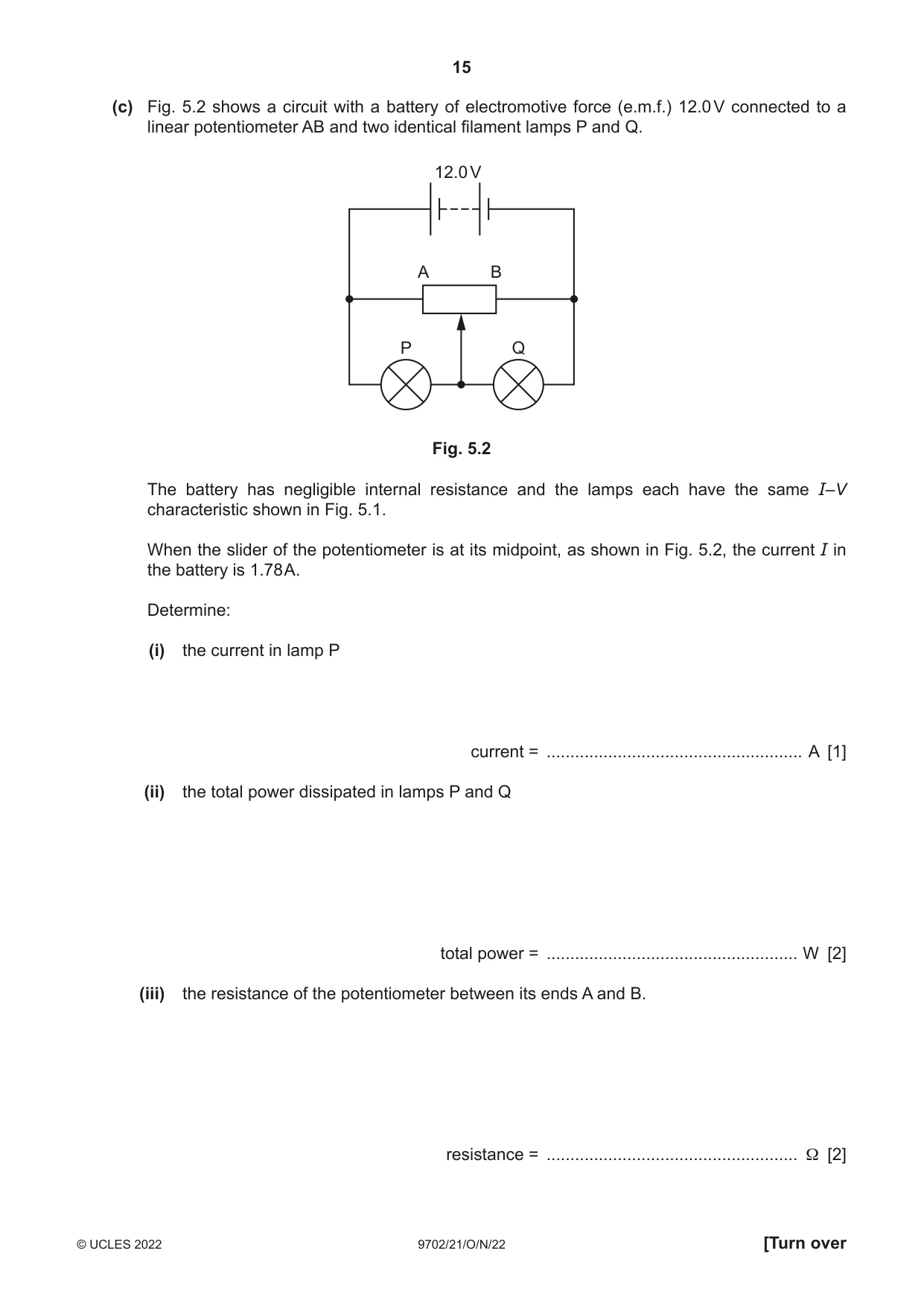
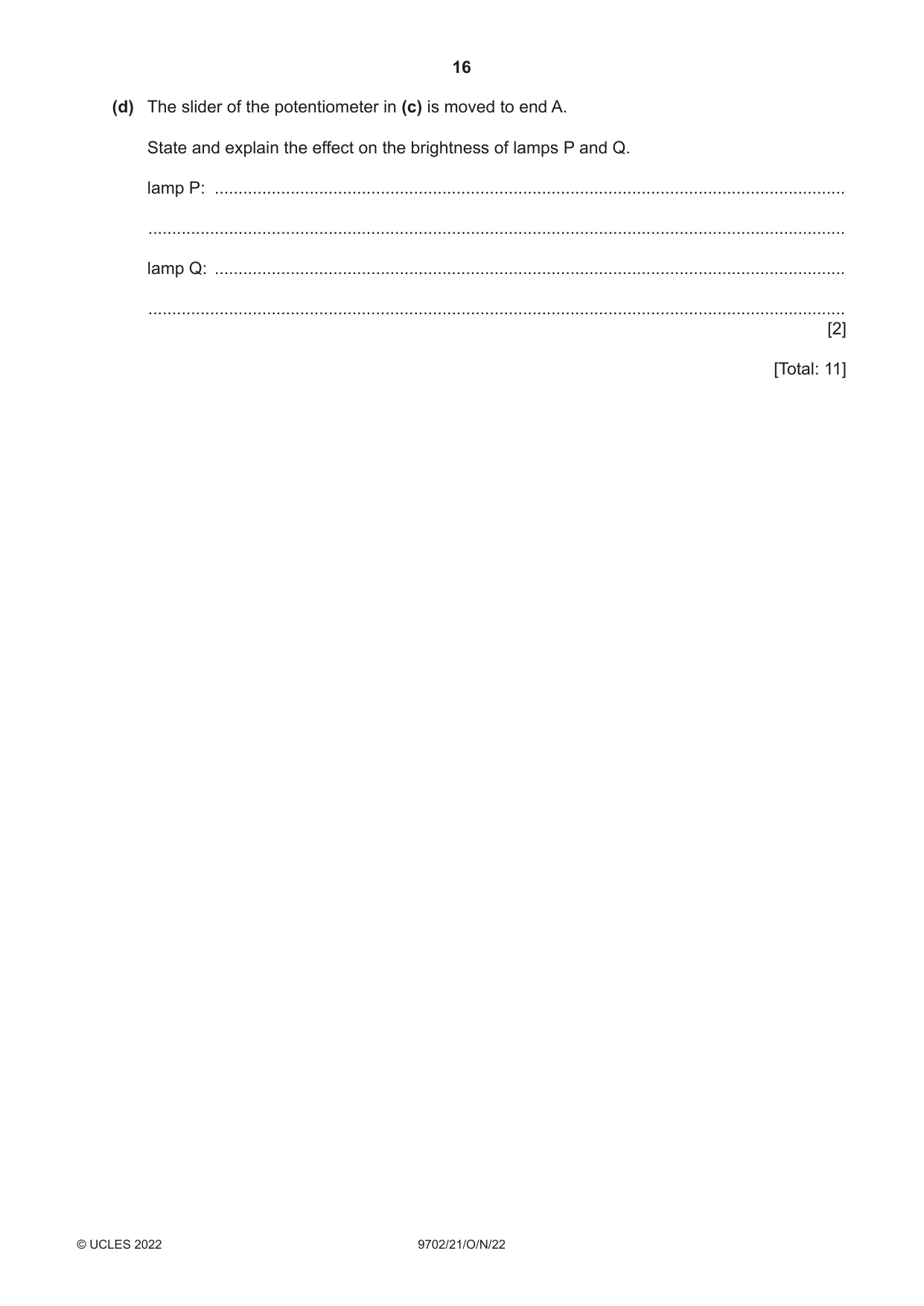
5 (a) State Ohm’s law. ................................................................................................................................................... ................................................................................................................................................... ............................................................................................................................................. [2] (b) The variation of current I with potential difference V for a filament lamp is shown in Fig. 5.1. 2.0 I / A 1.5 1.0 0.5 0 0 2 4 6 8 10 12 V / V Fig. 5.1 The resistance of the filament lamp increases with potential difference. (i) State how Fig. 5.1 shows this. ........................................................................................................................................... ..................................................................................................................................... [1] (ii) Explain why the resistance varies in this way. ........................................................................................................................................... ..................................................................................................................................... [1] (c) Fig. 5.2 shows a circuit with a battery of electromotive force (e.m.f.) 12.0 V connected to a linear potentiometer AB and two identical filament lamps P and Q. 12.0 V A B P Q Fig. 5.2 The battery has negligible internal resistance and the lamps each have the same I–V characteristic shown in Fig. 5.1. When the slider of the potentiometer is at its midpoint, as shown in Fig. 5.2, the current I in the battery is 1.78 A. Determine: (i) the current in lamp P current = ...................................................... A [1] (ii) the total power dissipated in lamps P and Q total power = ..................................................... W [2] (iii) the resistance of the potentiometer between its ends A and B. resistance = ..................................................... Ω [2] (d) The slider of the potentiometer in (c) is moved to end A. State and explain the effect on the brightness of lamps P and Q. lamp P: ..................................................................................................................................... ................................................................................................................................................... lamp Q: ..................................................................................................................................... ................................................................................................................................................... [2] [Total: 11]
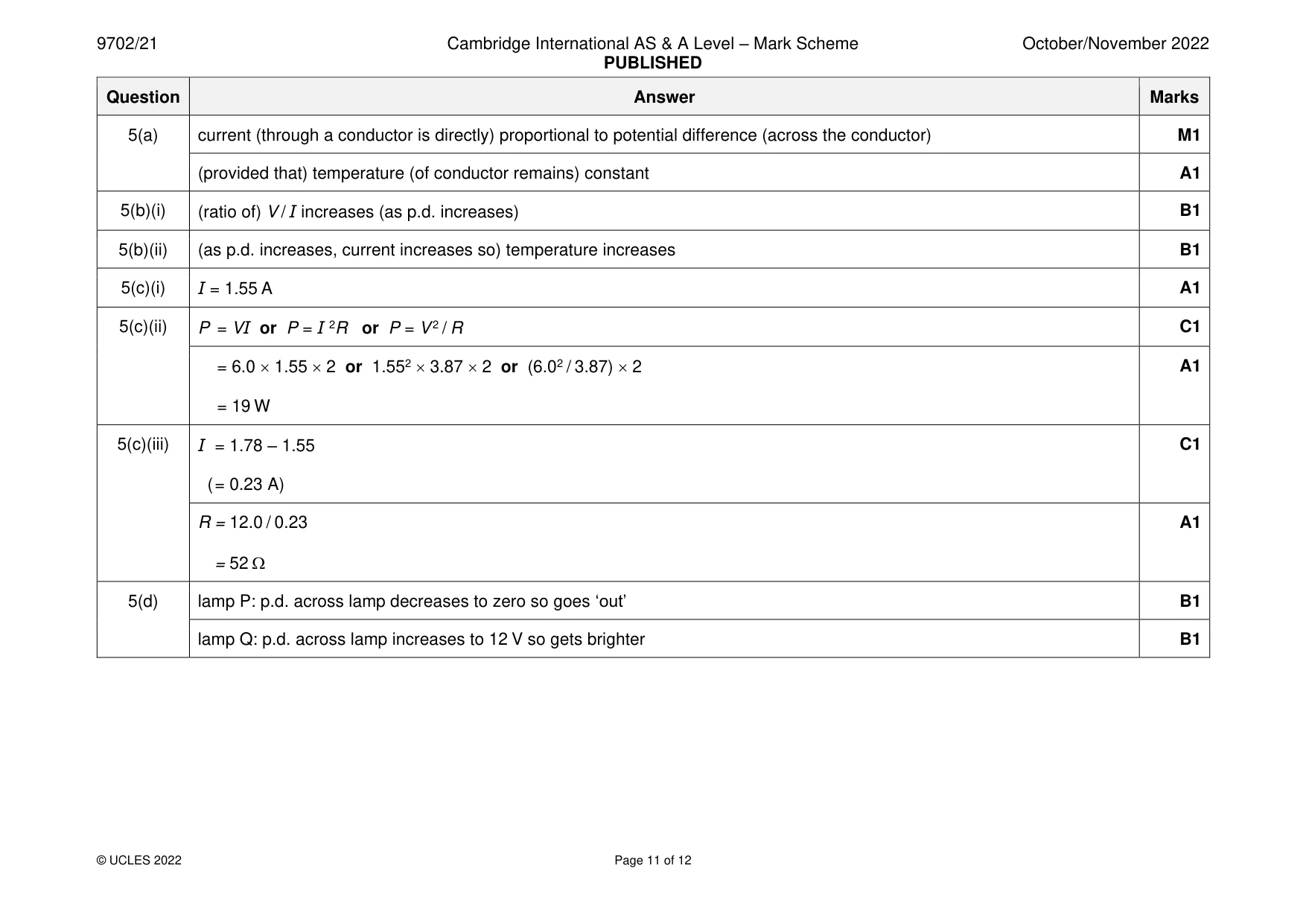
Mark scheme: 5(a) current (through a conductor is directly) proportional to potential difference (across the conductor) M1 (provided that) temperature (of conductor remains) constant A1 5(b)(i) (ratio of) V / I increases (as p.d. increases) B1 5(b)(ii) (as p.d. increases, current increases so) temperature increases B1 5(c)(i) I = 1.55 A A1 5(c)(ii) P = VI or P = I 2R or P = V 2 / R C1 = 6.0 1.55 2 or 1.552 3.87 2 or (6.02 / 3.87) 2 A1 = 19 W 5(c)(iii) I = 1.78 – 1.55 C1 ( = 0.23 A) R = 12.0 / 0.23 A1 = 52 5(d) lamp P: p.d. across lamp decreases to zero so goes ‘out’ B1 lamp Q: p.d. across lamp increases to 12 V so gets brighter B1
Q6 · A lepton is an example of a fundamental particle
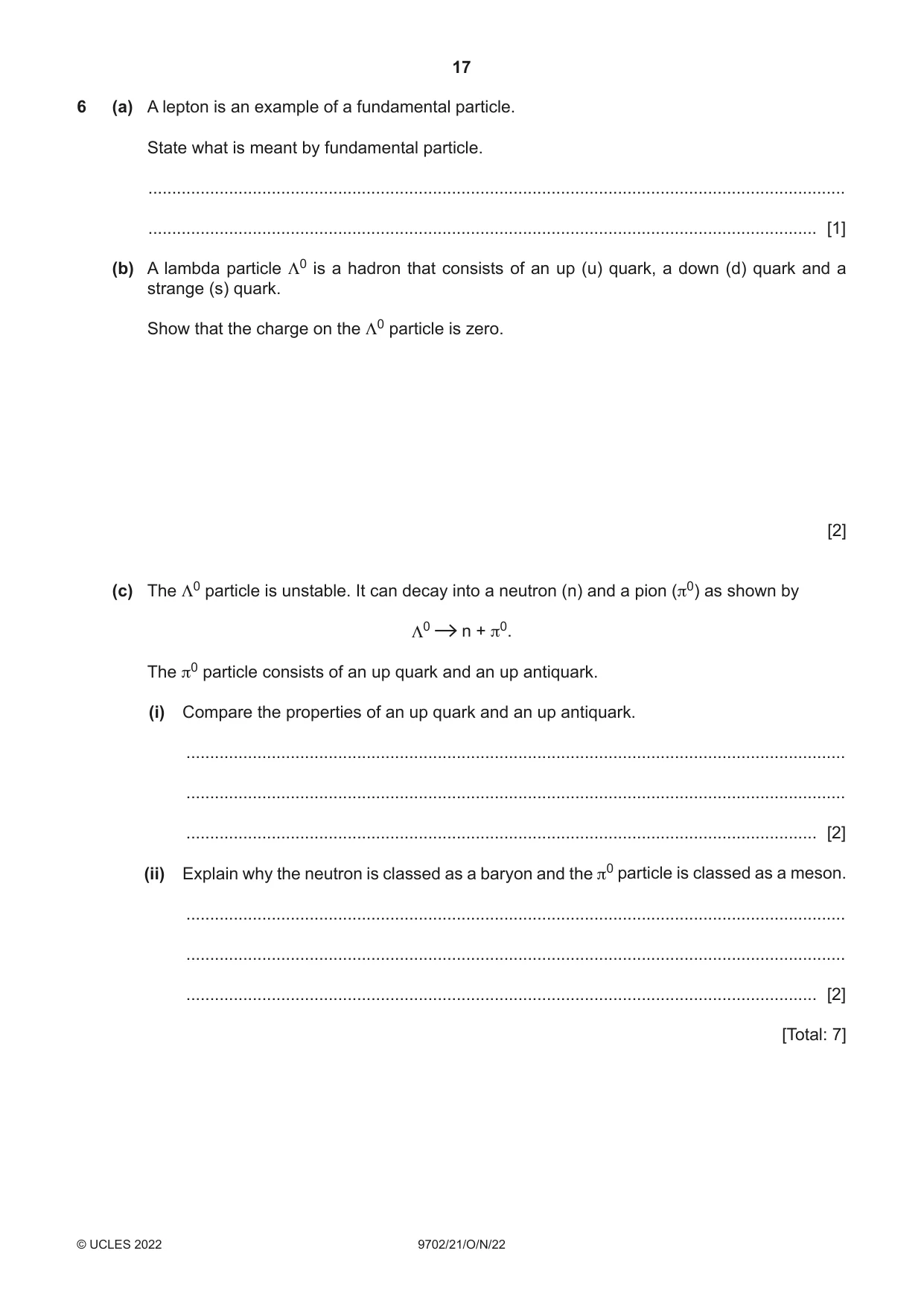
6 (a) A lepton is an example of a fundamental particle. State what is meant by fundamental particle. ................................................................................................................................................... ............................................................................................................................................. [1] (b) A lambda particle Λ0 is a hadron that consists of an up (u) quark, a down (d) quark and a strange (s) quark. Show that the charge on the Λ0 particle is zero. [2] (c) The Λ0 particle is unstable. It can decay into a neutron (n) and a pion (π0) as shown by Λ0 n + π0. The π0 particle consists of an up quark and an up antiquark. (i) Compare the properties of an up quark and an up antiquark. ........................................................................................................................................... ........................................................................................................................................... ..................................................................................................................................... [2] (ii) Explain why the neutron is classed as a baryon and the π0 particle is classed as a meson. ........................................................................................................................................... ........................................................................................................................................... ..................................................................................................................................... [2] [Total: 7]
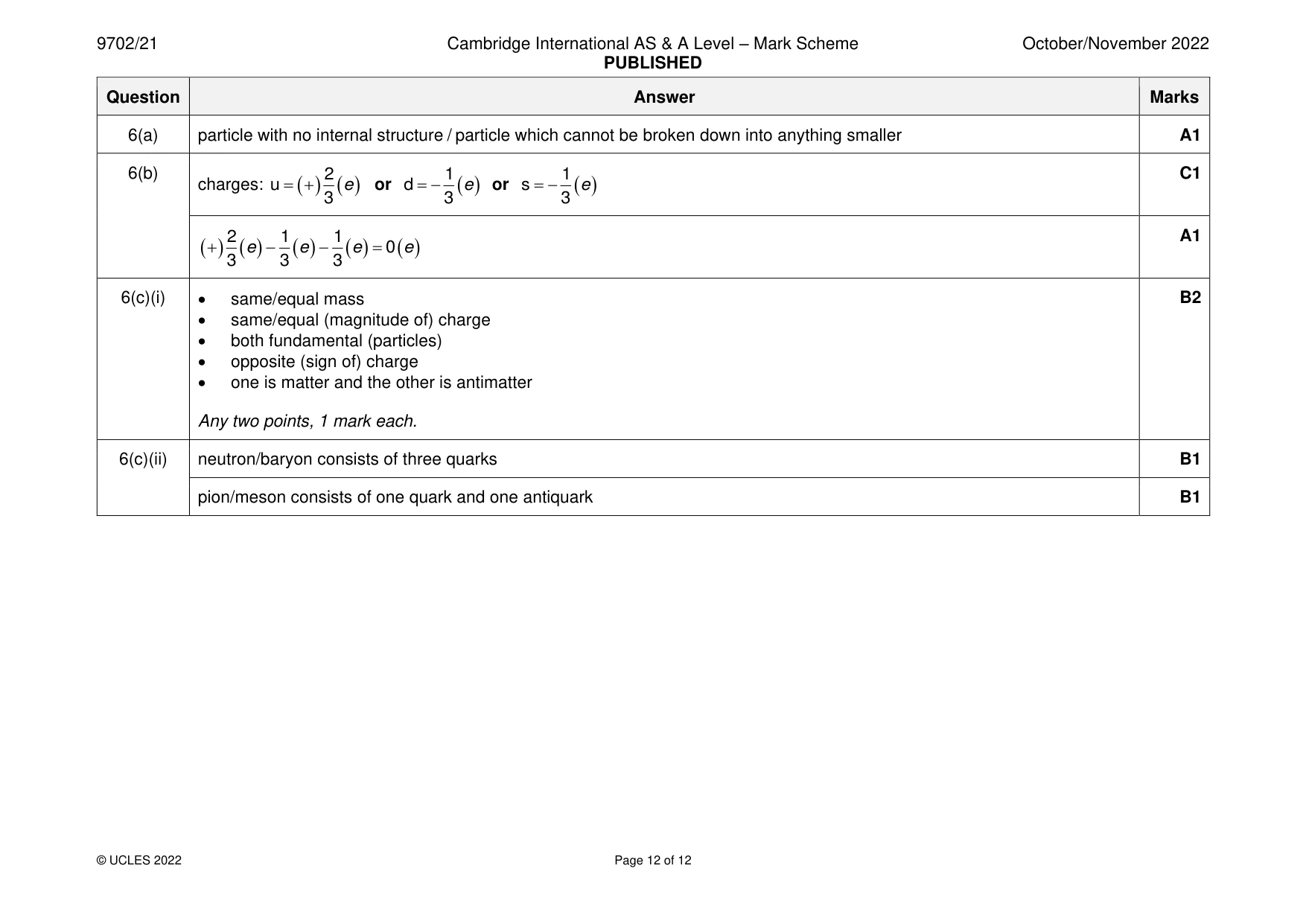
Mark scheme: 6(a) particle with no internal structure / particle which cannot be broken down into anything smaller A1 6(b) 2 1 1 C1 charges: u = ( + ) ( e ) or d = − ( e ) or s = − ( e ) 3 3 3 2 1 1 A1 ( + ) ( e ) − ( e ) − ( e ) = 0 ( e ) 3 3 3 6(c)(i) • same/equal mass B2 • same/equal (magnitude of) charge • both fundamental (particles) • opposite (sign of) charge • one is matter and the other is antimatter Any two points, 1 mark each. 6(c)(ii) neutron/baryon consists of three quarks B1 pion/meson consists of one quark and one antiquark B1
What was in this paper
The subtopics covered by these 6 questions, and how many questions each got. Open one in a new tab to see every Cambridge question on it.
What you needed in this session
Cambridge’s own grade thresholds for 2022 Oct/Nov, Paper 2 · Variant 1. A higher threshold means an easier paper — the bar moves with how the cohort did.