Cambridge A Level Physics 9702 — 2019 Oct/Nov Paper 2 · Variant 1
9702/21/O/N/19 · 7 questions · 60 marks · ≈68 min
The question paper and its mark scheme, free to read here and free to download. This is Cambridge’s own paper, exactly as it was sat.
Question paper16 pages

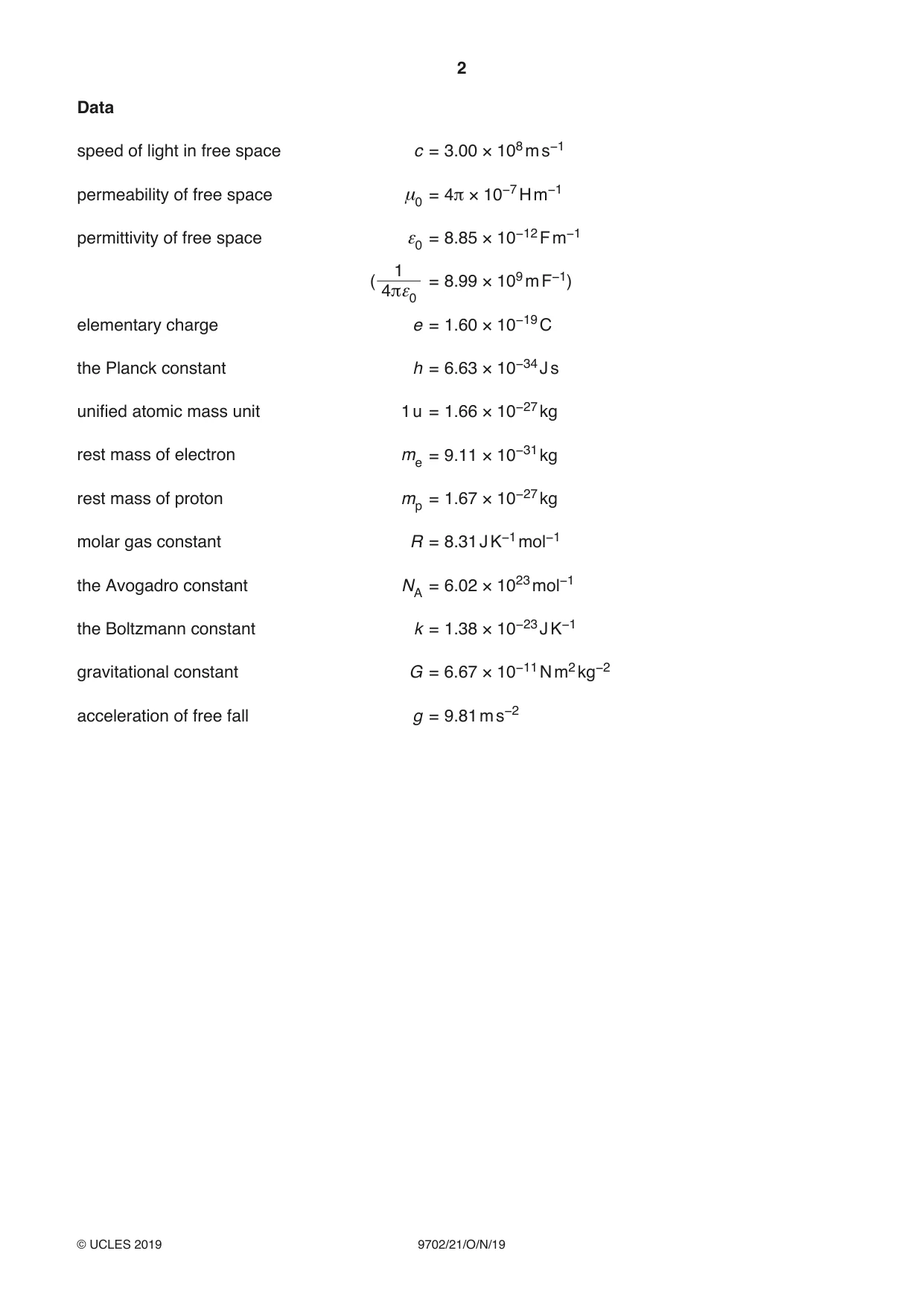
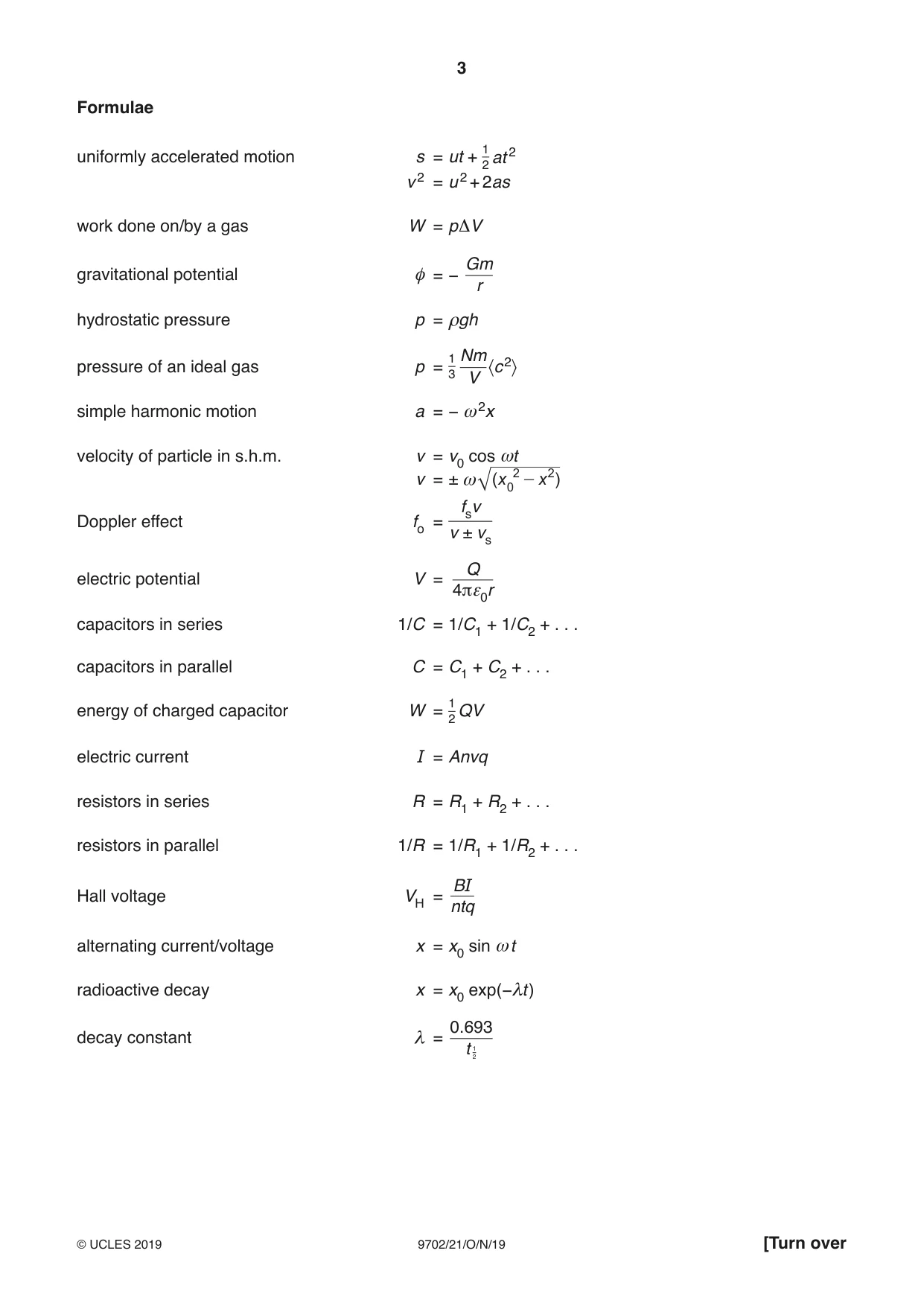

Mark scheme11 pages
Answers below. Sit the paper first if you are practising.

Questions as text
Q1 · Make estimates of: (i) the mass, in g, of a new pencil mass =…
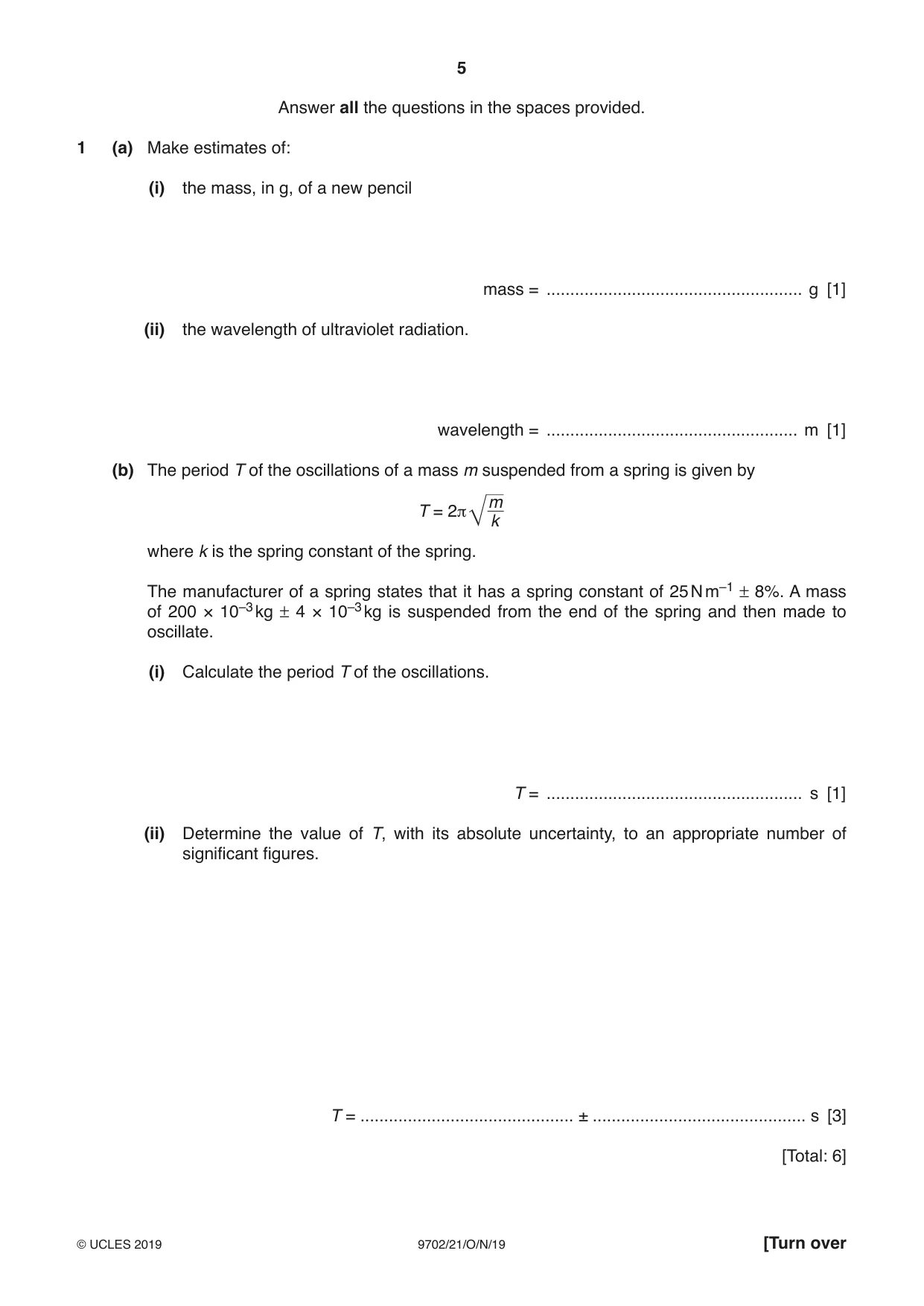
1 (a) Make estimates of: (i) the mass, in g, of a new pencil mass = ...................................................... g [1] (ii) the wavelength of ultraviolet radiation. wavelength = ..................................................... m [1] (b) The period T of the oscillations of a mass m suspended from a spring is given by m T = 2π k where k is the spring constant of the spring. The manufacturer of a spring states that it has a spring constant of 25 N m–1 ± 8%. A mass of 200 × 10–3 kg ± 4 × 10⁻³ kg is suspended from the end of the spring and then made to oscillate. (i) Calculate the period T of the oscillations. T = ...................................................... s [1] (ii) Determine the value of T, with its absolute uncertainty, to an appropriate number of significant figures. T = ............................................. ± ............................................. s [3] [Total: 6]
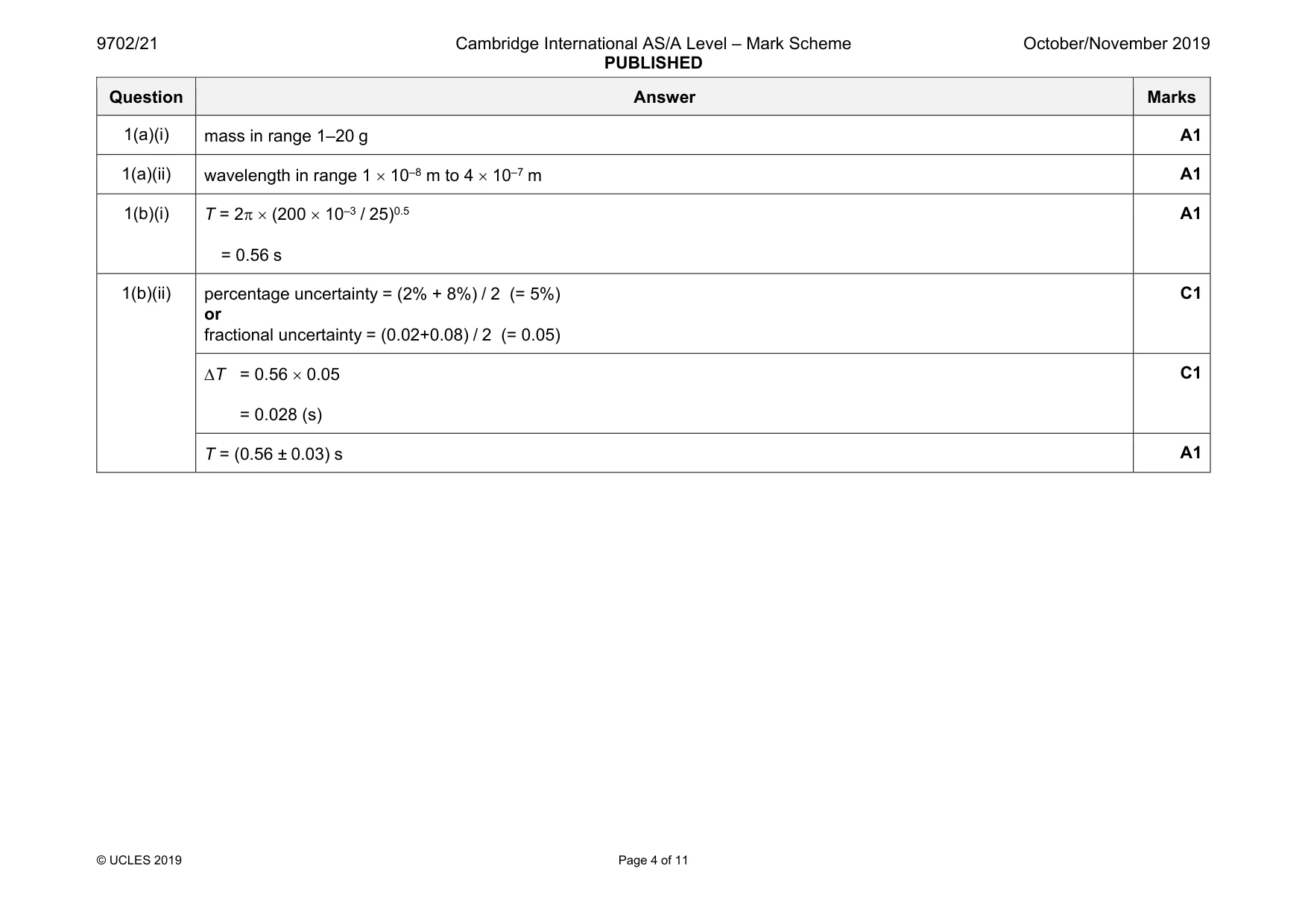
Mark scheme: 1(a)(i) A1 1(a)(ii) wavelength in range 1 × 10⁻⁸ m to 4 × 10⁻⁷ m A1 1(b)(i) T = 2π × (200 × 10–3 / 25)0.5 = 0.56 s A1 1(b)(ii) percentage uncertainty = (2% + 8%) / 2 (= 5%) or fractional uncertainty = (0.02+0.08) / 2 (= 0.05) C1 ∆T = 0.56 × 0.05 = 0.028 (s) C1 T = (0.56 ± 0.03) s A1
Q2 · A small charged glass bead of weight 5.4 × 10⁻⁵ N is initially at rest at point A in a…
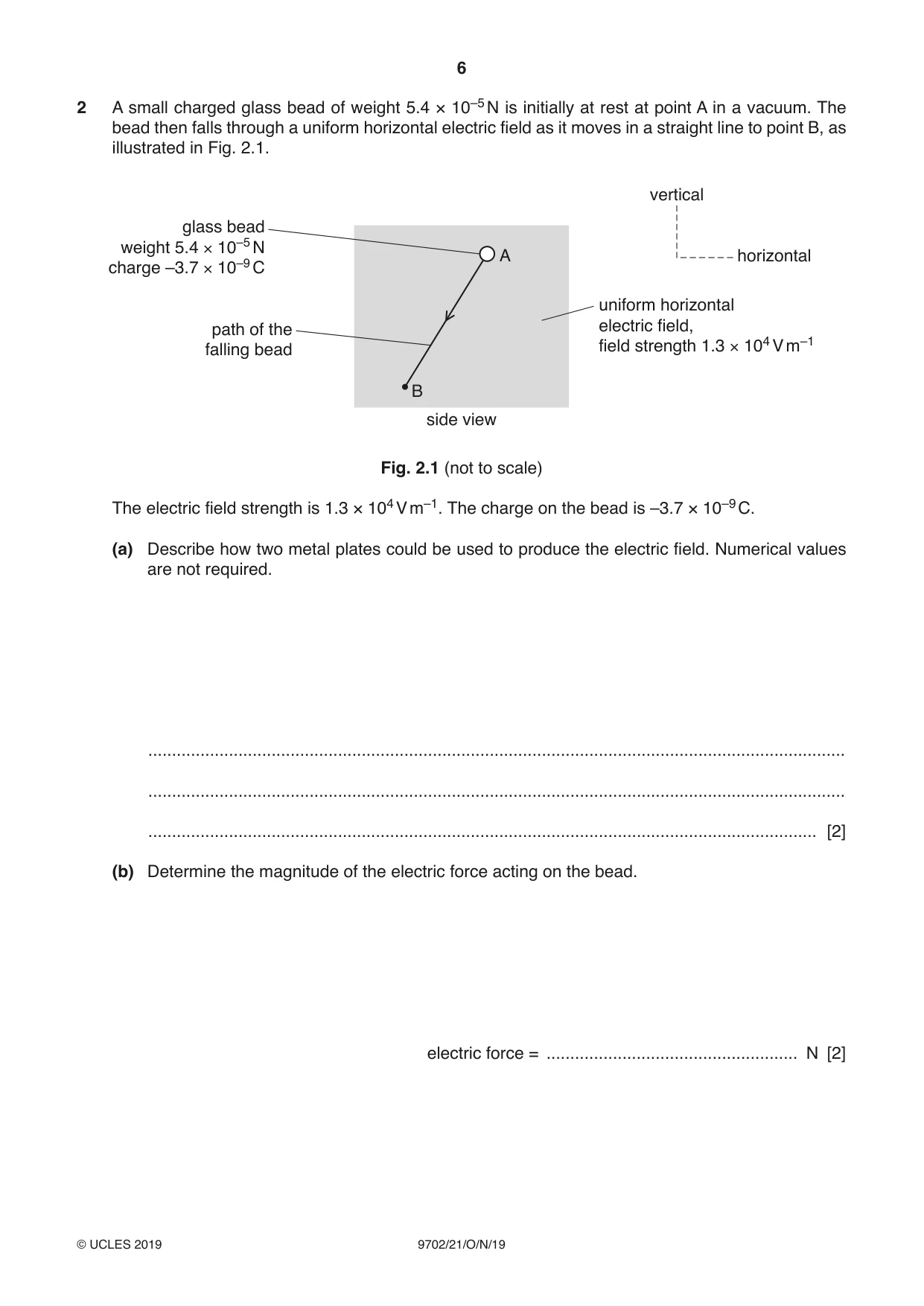
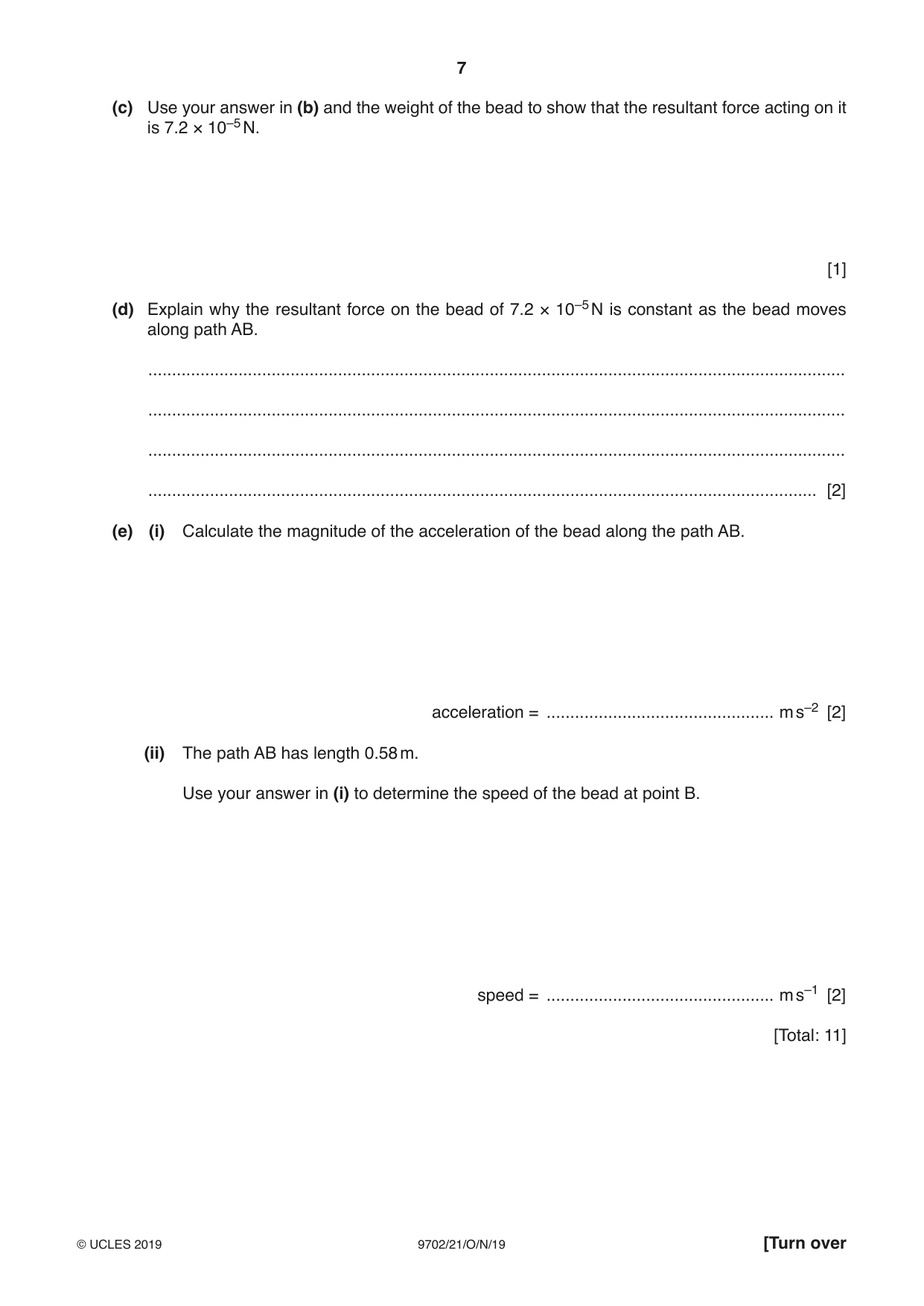
2 A small charged glass bead of weight 5.4 × 10⁻⁵ N is initially at rest at point A in a vacuum. The bead then falls through a uniform horizontal electric field as it moves in a straight line to point B, as illustrated in Fig. 2.1. vertical glass bead weight 5.4 × 10⁻⁵ N A horizontal charge –3.7 × 10⁻⁹ C uniform horizontal path of the electric field, × 104 V m–1 falling bead field strength 1.3 B side view Fig. 2.1 (not to scale) The electric field strength is 1.3 × 10⁴ V m–1. The charge on the bead is –3.7 × 10⁻⁹ C. (a) Describe how two metal plates could be used to produce the electric field. Numerical values are not required. ................................................................................................................................................... ................................................................................................................................................... ............................................................................................................................................. [2] (b) Determine the magnitude of the electric force acting on the bead. electric force = ..................................................... N [2] (c) Use your answer in (b) and the weight of the bead to show that the resultant force acting on it is 7.2 × 10⁻⁵ N. [1] (d) Explain why the resultant force on the bead of 7.2 × 10⁻⁵ N is constant as the bead moves along path AB. ................................................................................................................................................... ................................................................................................................................................... ................................................................................................................................................... ............................................................................................................................................. [2] (e) (i) Calculate the magnitude of the acceleration of the bead along the path AB. acceleration = ................................................ m s–2 [2] (ii) The path AB has length 0.58 m. Use your answer in (i) to determine the speed of the bead at point B. speed = ................................................ m s–1 [2] [Total: 11]
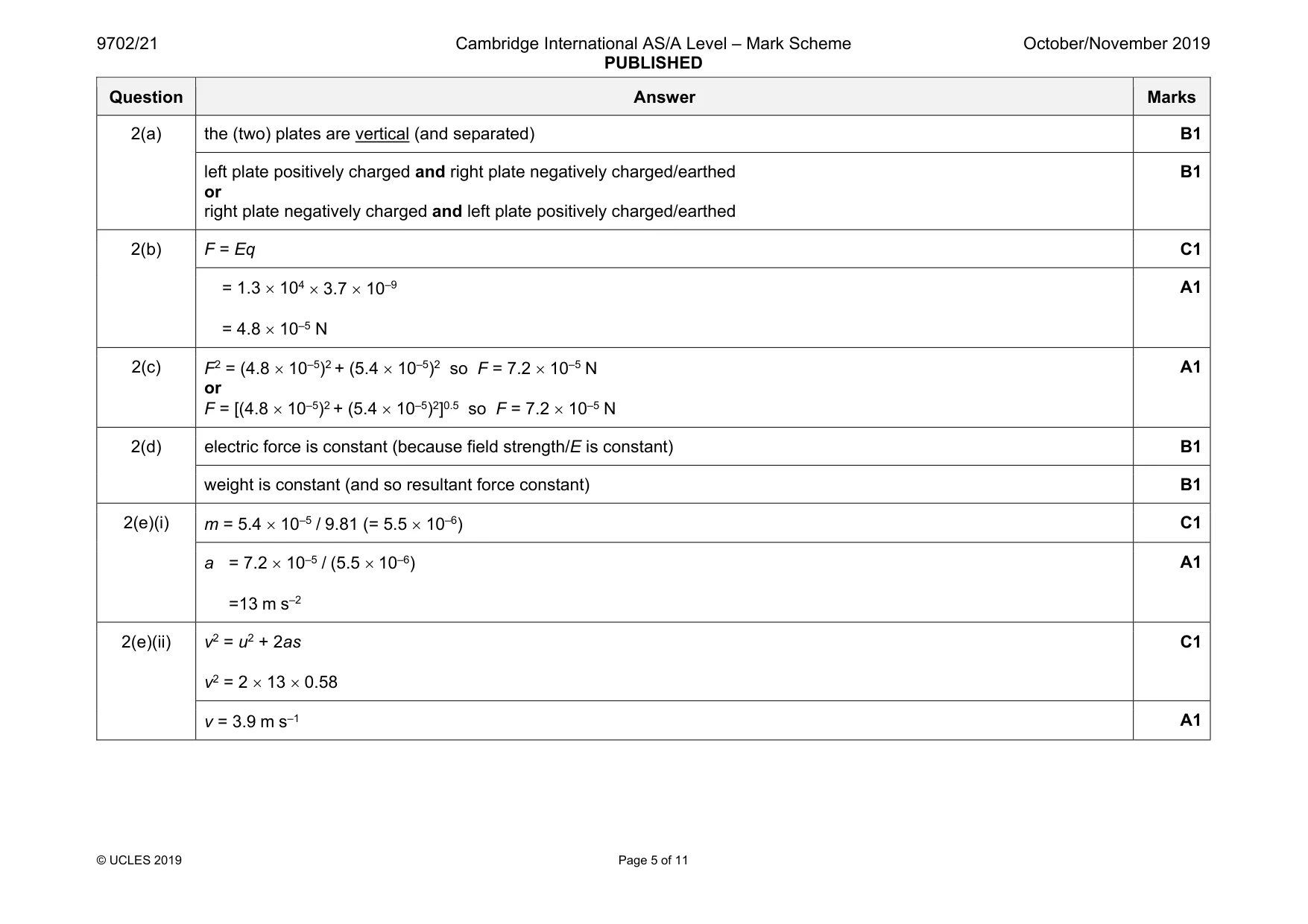
Mark scheme: 2(a) the (two) plates are vertical (and separated) B1 left plate positively charged and right plate negatively charged/earthed or right plate negatively charged and left plate positively charged/earthed B1 2(b) F = Eq C1 = 1.3 × 104 × 3.7 × 10–9 = 4.8 × 10⁻⁵ N A1 2(c) F2 = (4.8 × 10⁻⁵)2 + (5.4 × 10⁻⁵)2 so F = 7.2 × 10⁻⁵ N or F = [(4.8 × 10⁻⁵)2 + (5.4 × 10⁻⁵)2]0.5 so F = 7.2 × 10⁻⁵ N A1 2(d) electric force is constant (because field strength/E is constant) B1 weight is constant (and so resultant force constant) B1 2(e)(i) m = 5.4 × 10⁻⁵ / 9.81 (= 5.5 × 10⁻⁶) C1 a = 7.2 × 10⁻⁵ / (5.5 × 10⁻⁶) =13 m s–2 A1 2(e)(ii) v2 = u2 + 2as v2 = 2 × 13 × 0.58 C1 v = 3.9 m s–1 A1
Q3 · A small remote-controlled model aircraft has two propellers, each of diameter 16 cm
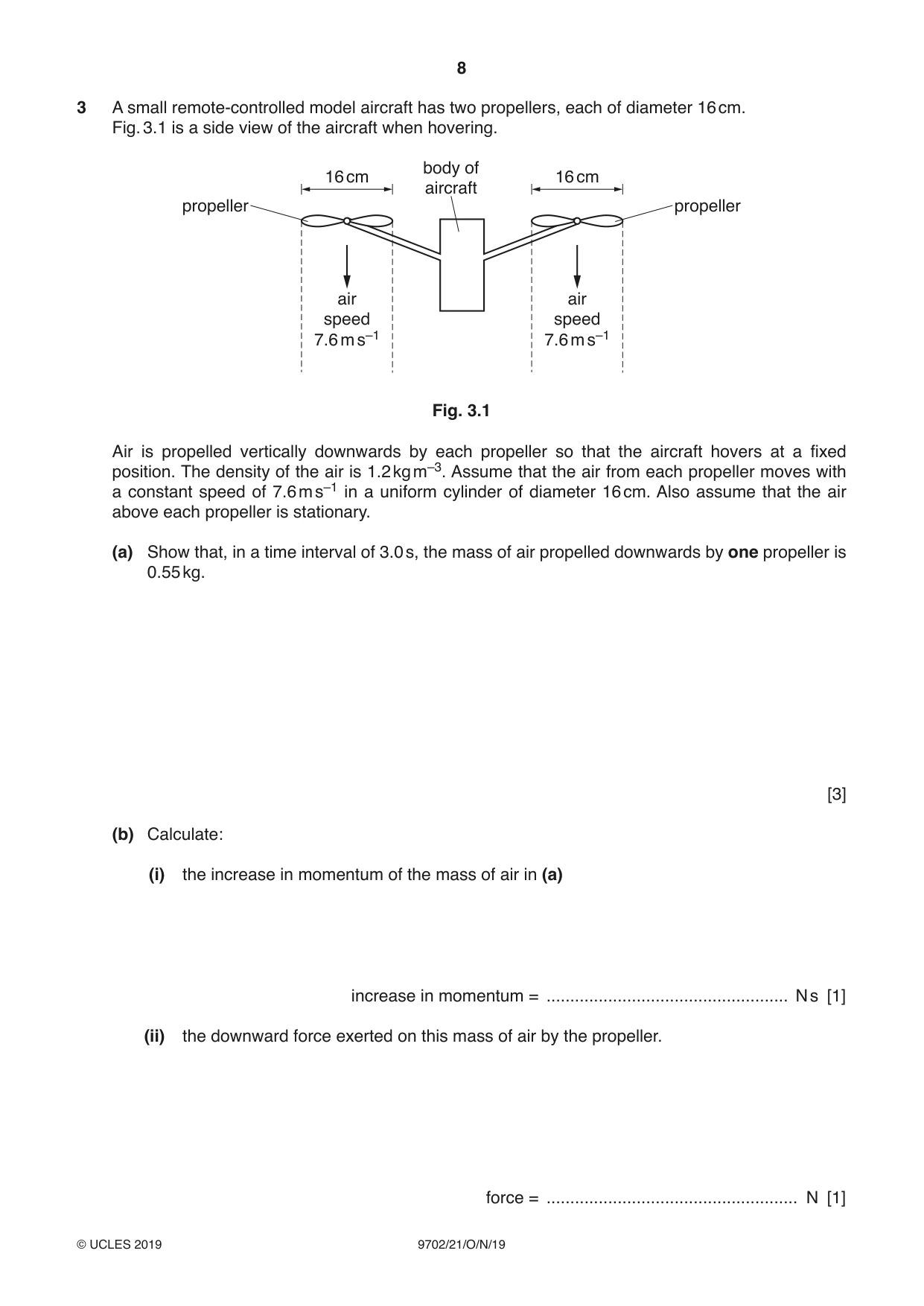
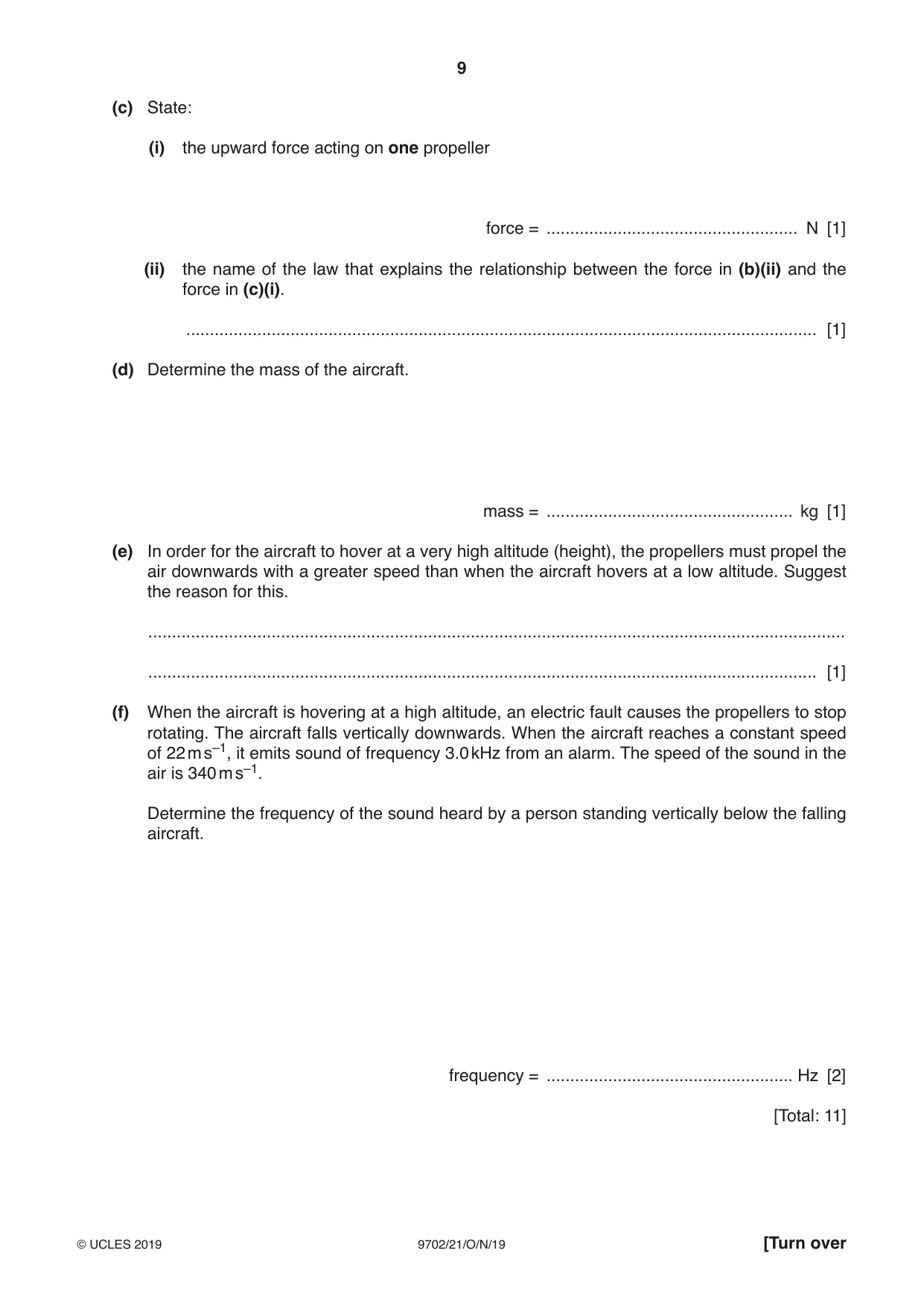
3 A small remote-controlled model aircraft has two propellers, each of diameter 16 cm. Fig. 3.1 is a side view of the aircraft when hovering. body of 16 cm 16 cm aircraft propeller propeller air air speed speed 7.6 m s–1 7.6 m s–1 Fig. 3.1 Air is propelled vertically downwards by each propeller so that the aircraft hovers at a fixed position. The density of the air is 1.2 kg m–3. Assume that the air from each propeller moves with a constant speed of 7.6 m s–1 in a uniform cylinder of diameter 16 cm. Also assume that the air above each propeller is stationary. (a) Show that, in a time interval of 3.0 s, the mass of air propelled downwards by one propeller is 0.55 kg. [3] (b) Calculate: (i) the increase in momentum of the mass of air in (a) increase in momentum = ................................................... N s [1] (ii) the downward force exerted on this mass of air by the propeller. force = ..................................................... N [1] (c) State: (i) the upward force acting on one propeller force = ..................................................... N [1] (ii) the name of the law that explains the relationship between the force in (b)(ii) and the force in (c)(i). ..................................................................................................................................... [1] (d) Determine the mass of the aircraft. mass = .................................................... kg [1] (e) In order for the aircraft to hover at a very high altitude (height), the propellers must propel the air downwards with a greater speed than when the aircraft hovers at a low altitude. Suggest the reason for this. ................................................................................................................................................... ............................................................................................................................................. [1] (f) When the aircraft is hovering at a high altitude, an electric fault causes the propellers to stop rotating. The aircraft falls vertically downwards. When the aircraft reaches a constant speed of 22 m s–1, it emits sound of frequency 3.0 kHz from an alarm. The speed of the sound in the air is 340 m s–1. Determine the frequency of the sound heard by a person standing vertically below the falling aircraft. frequency = .................................................... Hz [2] [Total: 11]
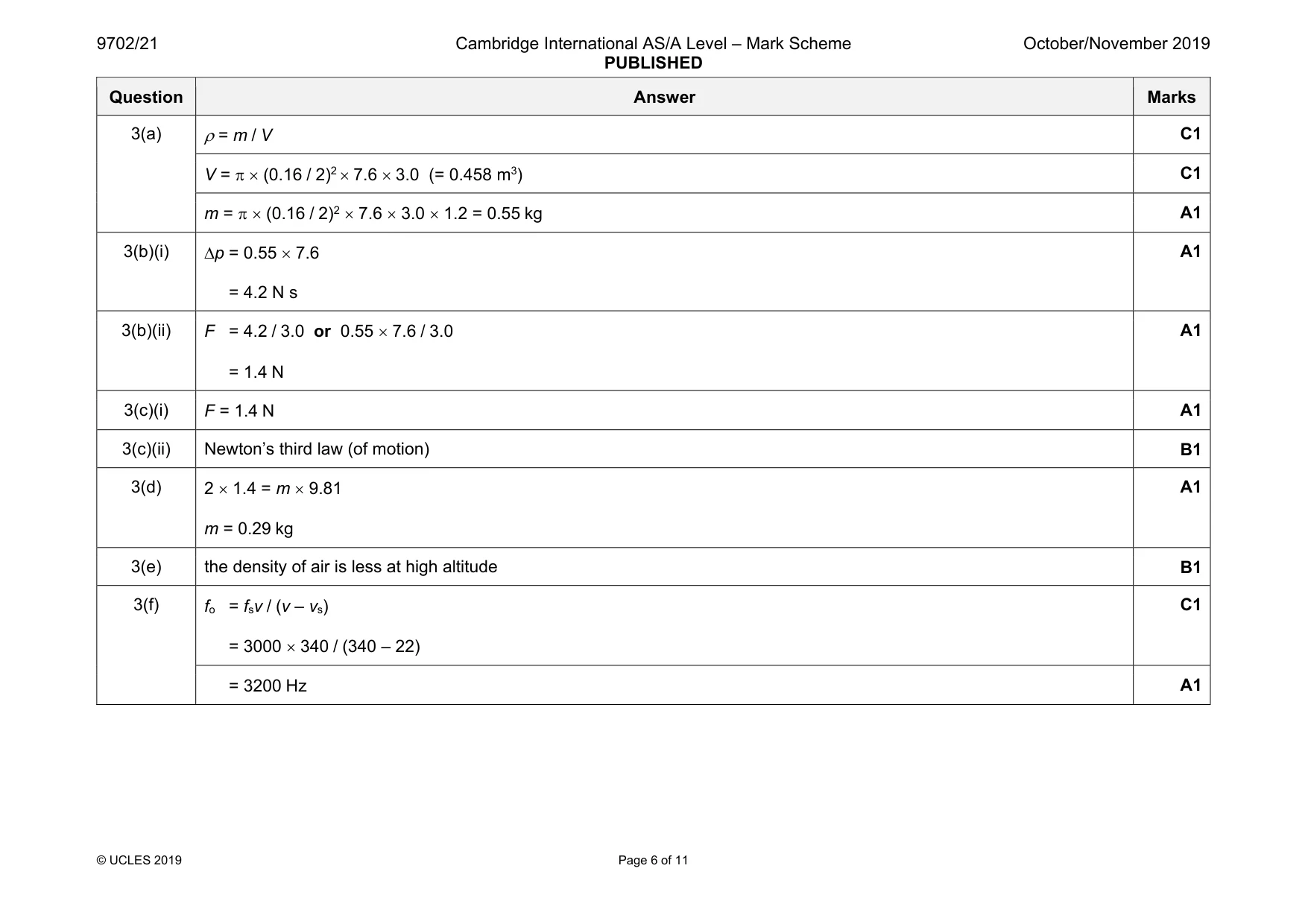
Mark scheme: 3(a) C1 V = π × (0.16 / 2)2 × 7.6 × 3.0 (= 0.458 m3) C1 m = π × (0.16 / 2)2 × 7.6 × 3.0 × 1.2 = 0.55 kg A1 3(b)(i) ∆p = 0.55 × 7.6 = 4.2 N s A1 3(b)(ii) F = 4.2 / 3.0 or 0.55 × 7.6 / 3.0 = 1.4 N A1 3(c)(i) F = 1.4 N A1 3(c)(ii) Newton’s third law (of motion) B1 3(d) 2 × 1.4 = m × 9.81 m = 0.29 kg A1 3(e) the density of air is less at high altitude B1 3(f) fo = fsv / (v – vs) = 3000 × 340 / (340 – 22) C1 = 3200 Hz A1
Q4 · The variation with extension x of the force F applied to a spring is shown in Fig
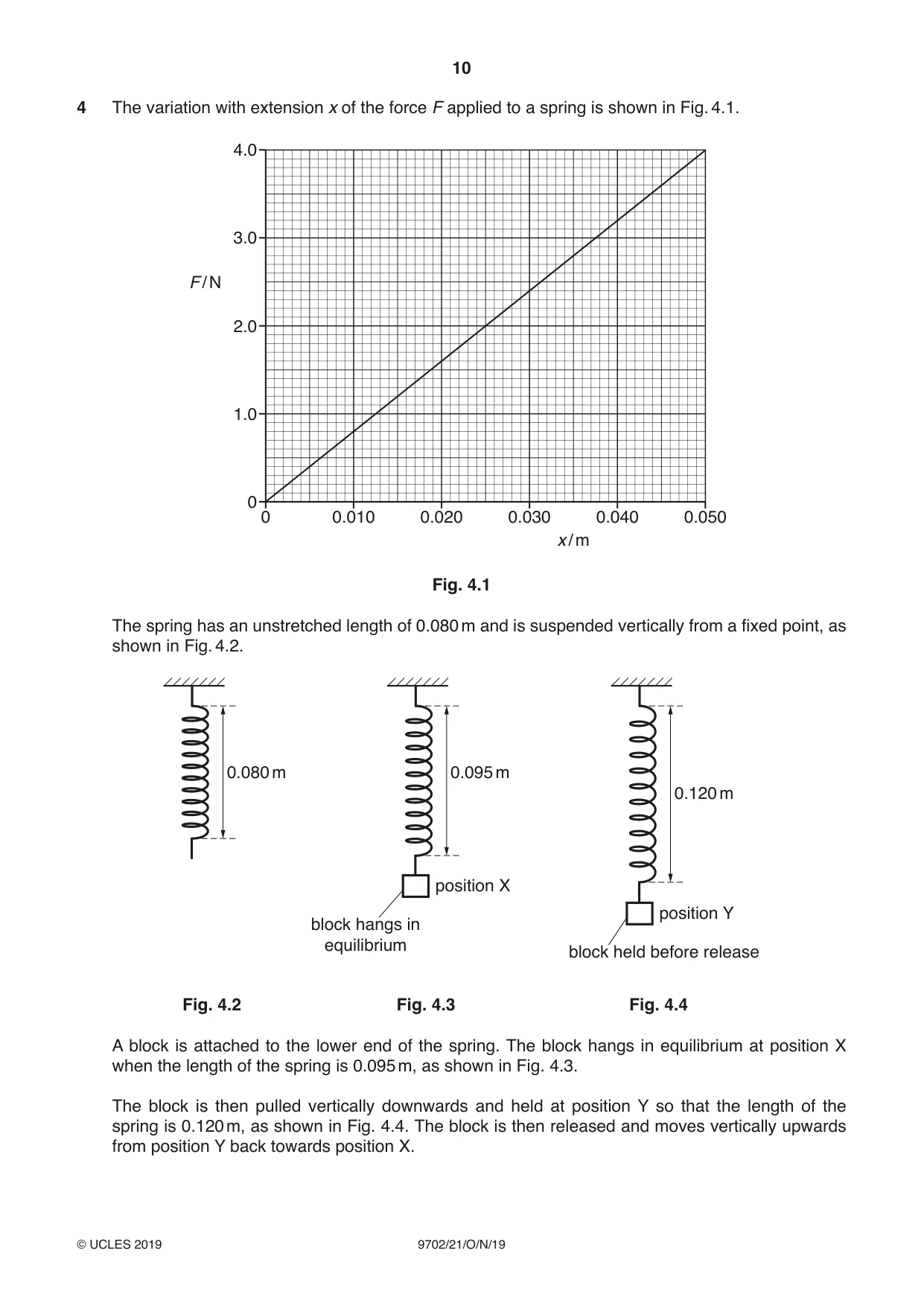
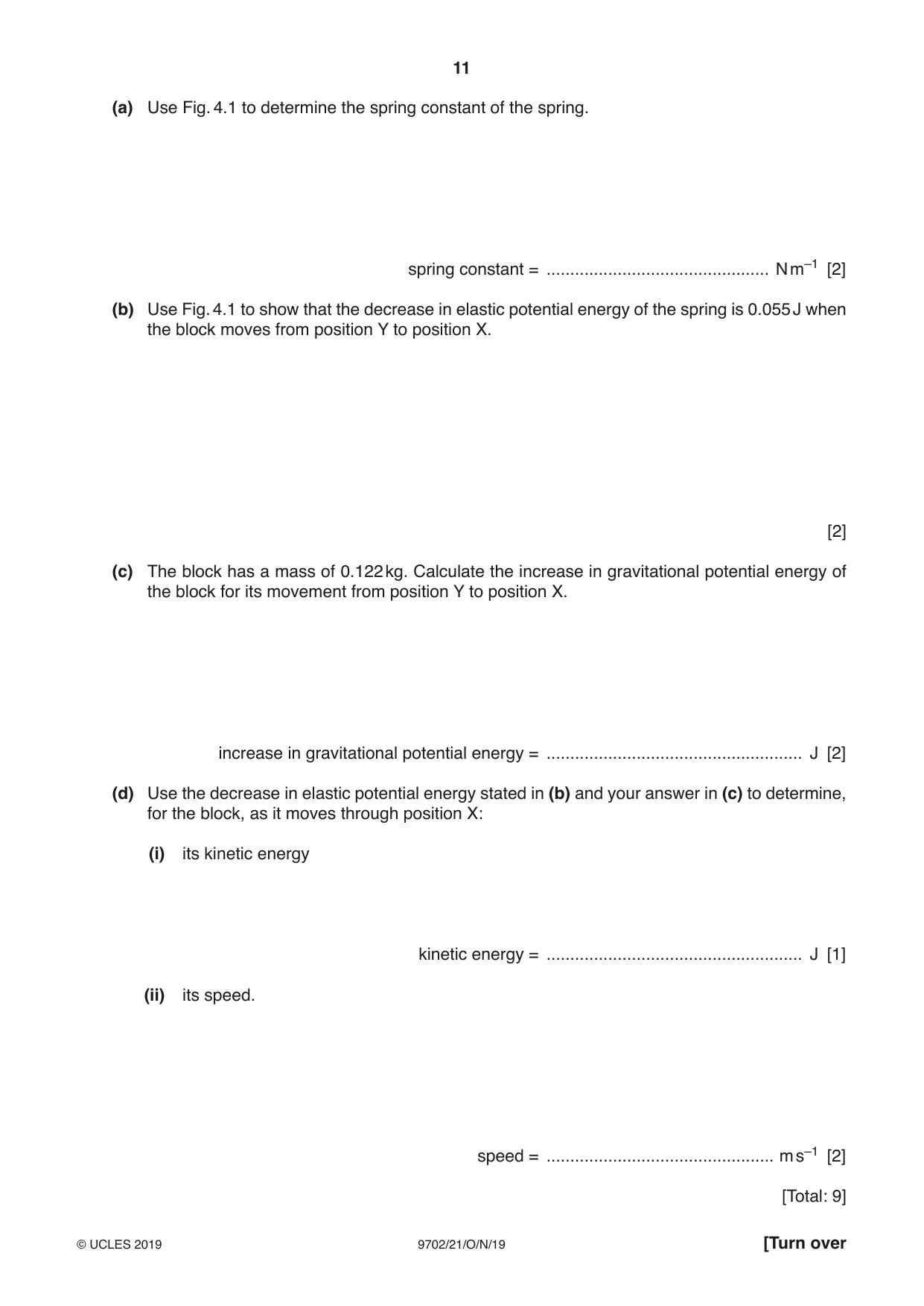
4 The variation with extension x of the force F applied to a spring is shown in Fig. 4.1. 4.0 3.0 F / N 2.0 1.0 0 0 0.010 0.020 0.030 0.040 0.050 x / m Fig. 4.1 The spring has an unstretched length of 0.080 m and is suspended vertically from a fixed point, as shown in Fig. 4.2. 0.080 m 0.095 m 0.120 m position X position Y block hangs in equilibrium block held before release Fig. 4.2 Fig. 4.3 Fig. 4.4 A block is attached to the lower end of the spring. The block hangs in equilibrium at position X when the length of the spring is 0.095 m, as shown in Fig. 4.3. The block is then pulled vertically downwards and held at position Y so that the length of the spring is 0.120 m, as shown in Fig. 4.4. The block is then released and moves vertically upwards from position Y back towards position X. (a) Use Fig. 4.1 to determine the spring constant of the spring. spring constant = ............................................... N m–1 [2] (b) Use Fig. 4.1 to show that the decrease in elastic potential energy of the spring is 0.055 J when the block moves from position Y to position X. [2] (c) The block has a mass of 0.122 kg. Calculate the increase in gravitational potential energy of the block for its movement from position Y to position X. increase in gravitational potential energy = ...................................................... J [2] (d) Use the decrease in elastic potential energy stated in (b) and your answer in (c) to determine, for the block, as it moves through position X: (i) its kinetic energy kinetic energy = ...................................................... J [1] (ii) its speed. speed = ................................................ m s–1 [2] [Total: 9]
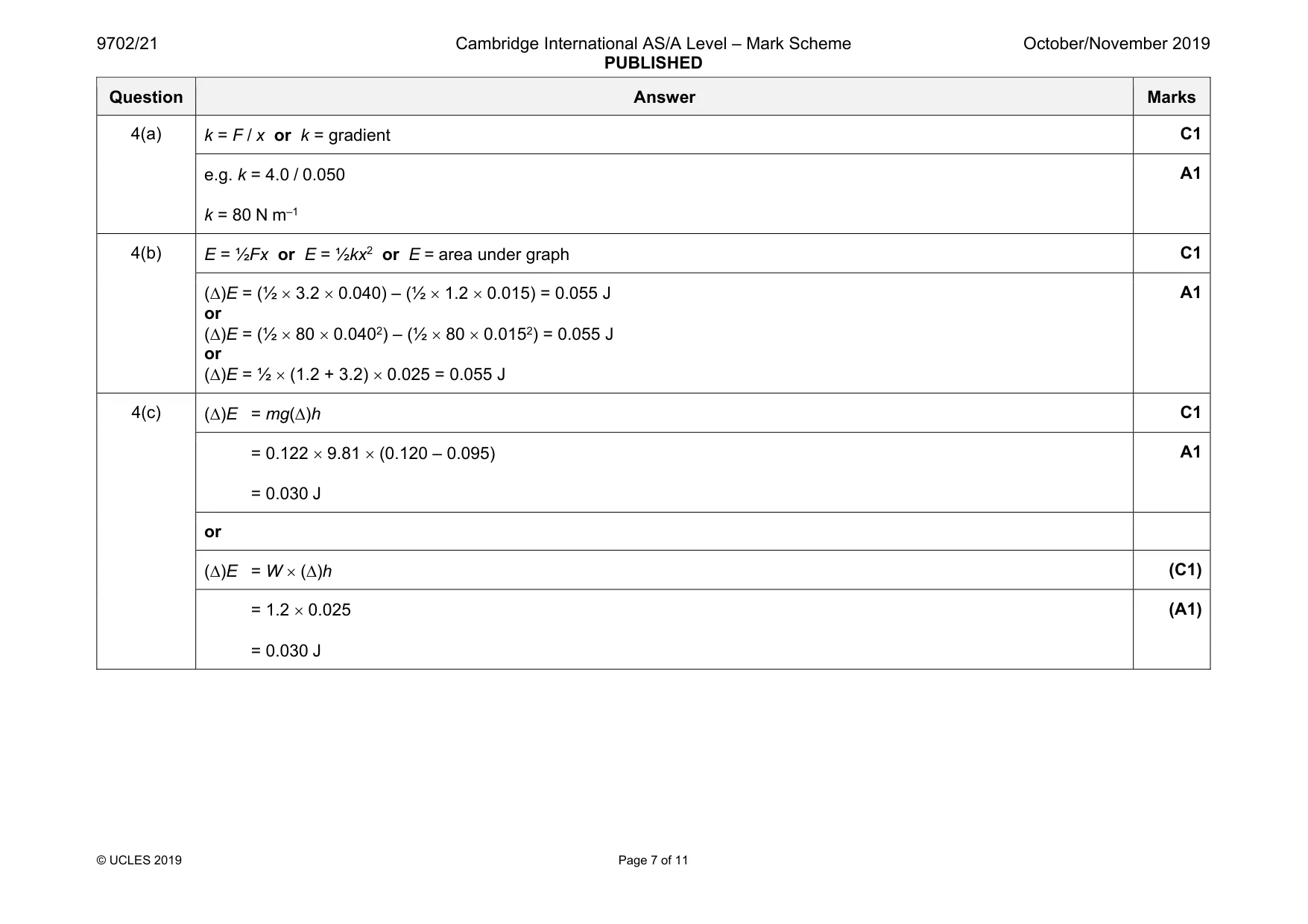
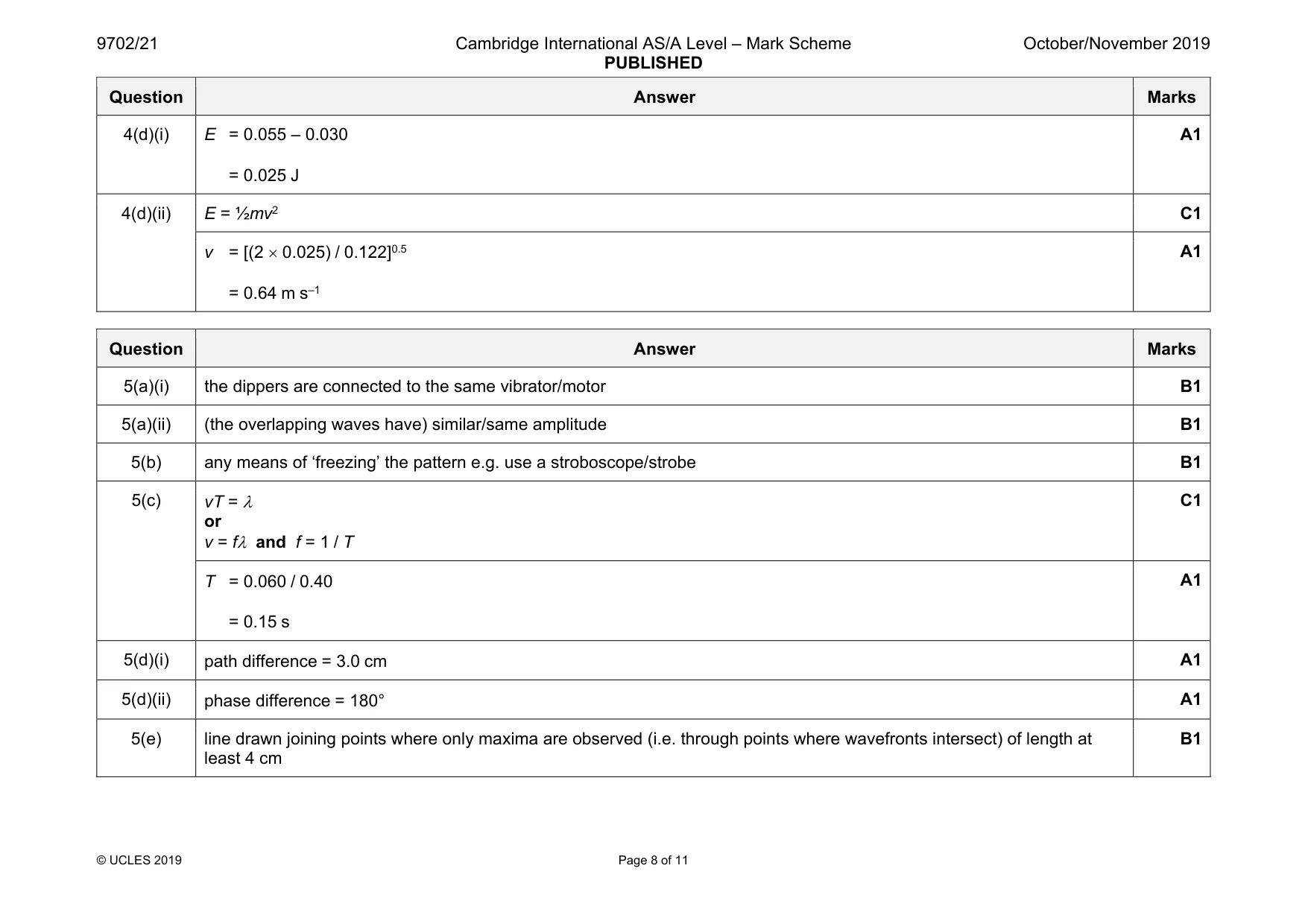
Mark scheme: 4(a) C1 e.g. k = 4.0 / 0.050 k = 80 N m–1 A1 4(b) E = ½Fx or E = ½kx2 or E = area under graph C1 (∆)E = (½ × 3.2 × 0.040) – (½ × 1.2 × 0.015) = 0.055 J or (∆)E = (½ × 80 × 0.0402) – (½ × 80 × 0.0152) = 0.055 J or (∆)E = ½ × (1.2 + 3.2) × 0.025 = 0.055 J A1 4(c) (∆)E = mg(∆)h C1 = 0.122 × 9.81 × (0.120 – 0.095) = 0.030 J A1 or (∆)E = W × (∆)h (C1) = 1.2 × 0.025 = 0.030 J (A1) Question Answer Marks 4(d)(i) E = 0.055 – 0.030 = 0.025 J A1 4(d)(ii) E = ½mv2 C1 v = [(2 × 0.025) / 0.122]0.5 = 0.64 m s–1 A1
Q5 · A ripple tank is used to demonstrate the interference of water waves
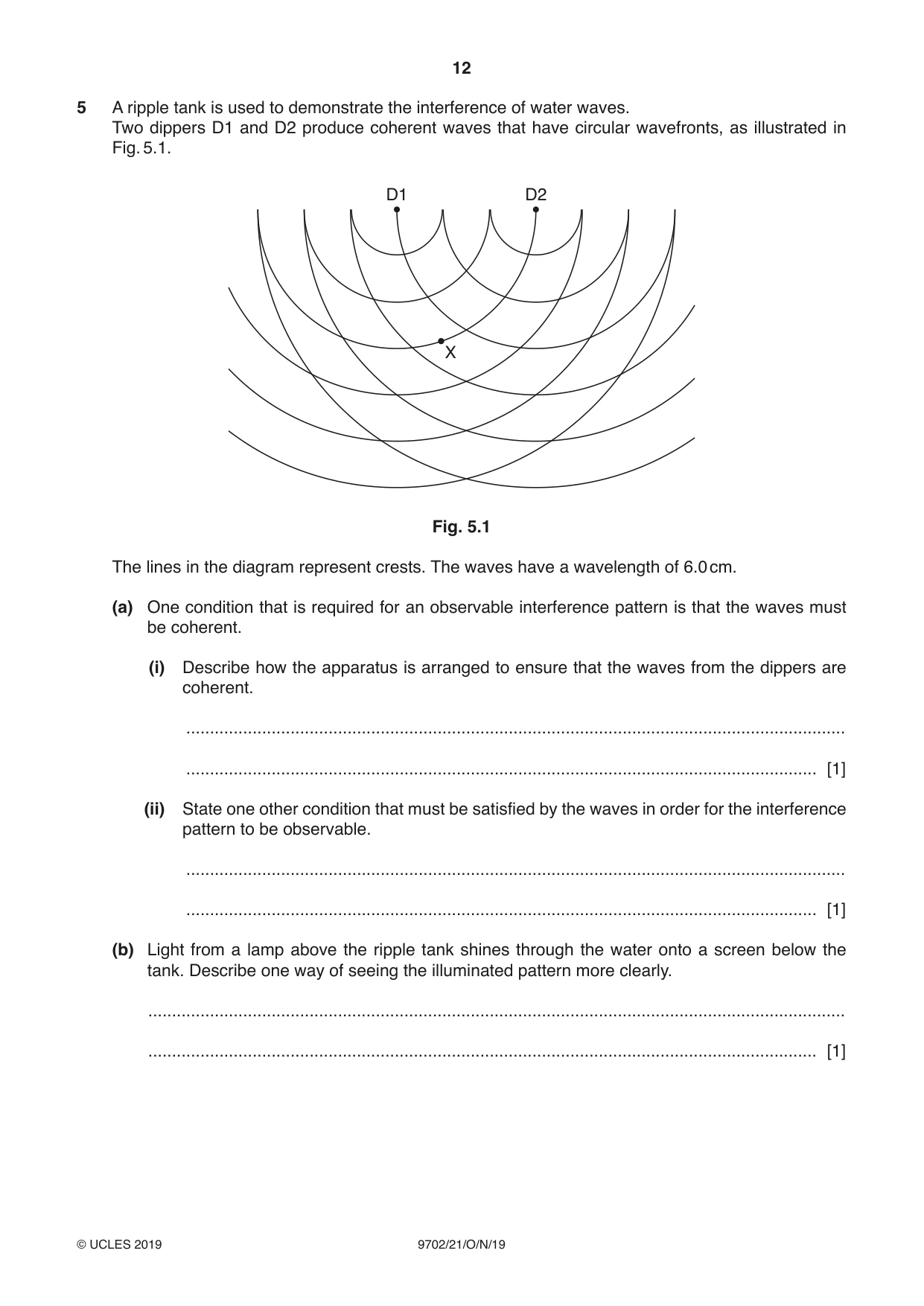
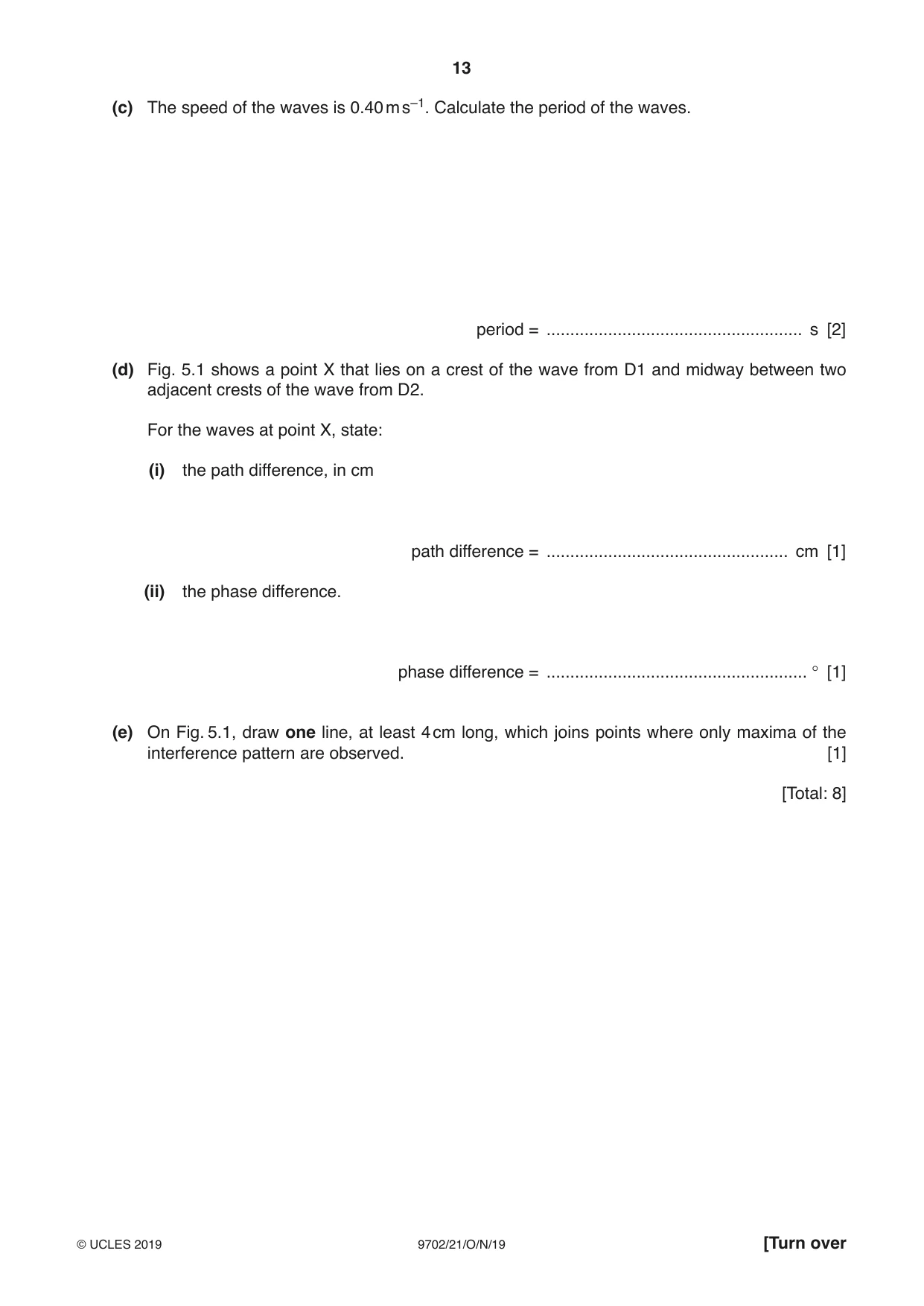
5 A ripple tank is used to demonstrate the interference of water waves. Two dippers D1 and D2 produce coherent waves that have circular wavefronts, as illustrated in Fig. 5.1. D1 D2 X Fig. 5.1 The lines in the diagram represent crests. The waves have a wavelength of 6.0 cm. (a) One condition that is required for an observable interference pattern is that the waves must be coherent. (i) Describe how the apparatus is arranged to ensure that the waves from the dippers are coherent. ........................................................................................................................................... ..................................................................................................................................... [1] (ii) State one other condition that must be satisfied by the waves in order for the interference pattern to be observable. ........................................................................................................................................... ..................................................................................................................................... [1] (b) Light from a lamp above the ripple tank shines through the water onto a screen below the tank. Describe one way of seeing the illuminated pattern more clearly. ................................................................................................................................................... ............................................................................................................................................. [1] (c) The speed of the waves is 0.40 m s–1. Calculate the period of the waves. period = ...................................................... s [2] (d) Fig. 5.1 shows a point X that lies on a crest of the wave from D1 and midway between two adjacent crests of the wave from D2. For the waves at point X, state: (i) the path difference, in cm path difference = ................................................... cm [1] (ii) the phase difference. phase difference = ....................................................... ° [1] (e) On Fig. 5.1, draw one line, at least 4 cm long, which joins points where only maxima of the interference pattern are observed. [1] [Total: 8]
Mark scheme: 5(a)(i) the dippers are connected to the same vibrator/motor B1 5(a)(ii) (the overlapping waves have) similar/same amplitude B1 5(b) any means of ‘freezing’ the pattern e.g. use a stroboscope/strobe B1 5(c) vT = λ or v = fλ and f = 1 / T C1 T = 0.060 / 0.40 = 0.15 s A1 5(d)(i) path difference = 3.0 cm A1 5(d)(ii) phase difference = 180° A1 5(e) line drawn joining points where only maxima are observed (i.e. through points where wavefronts intersect) of length at least 4 cm B1
Q6 · Define electric potential difference (p.d.)
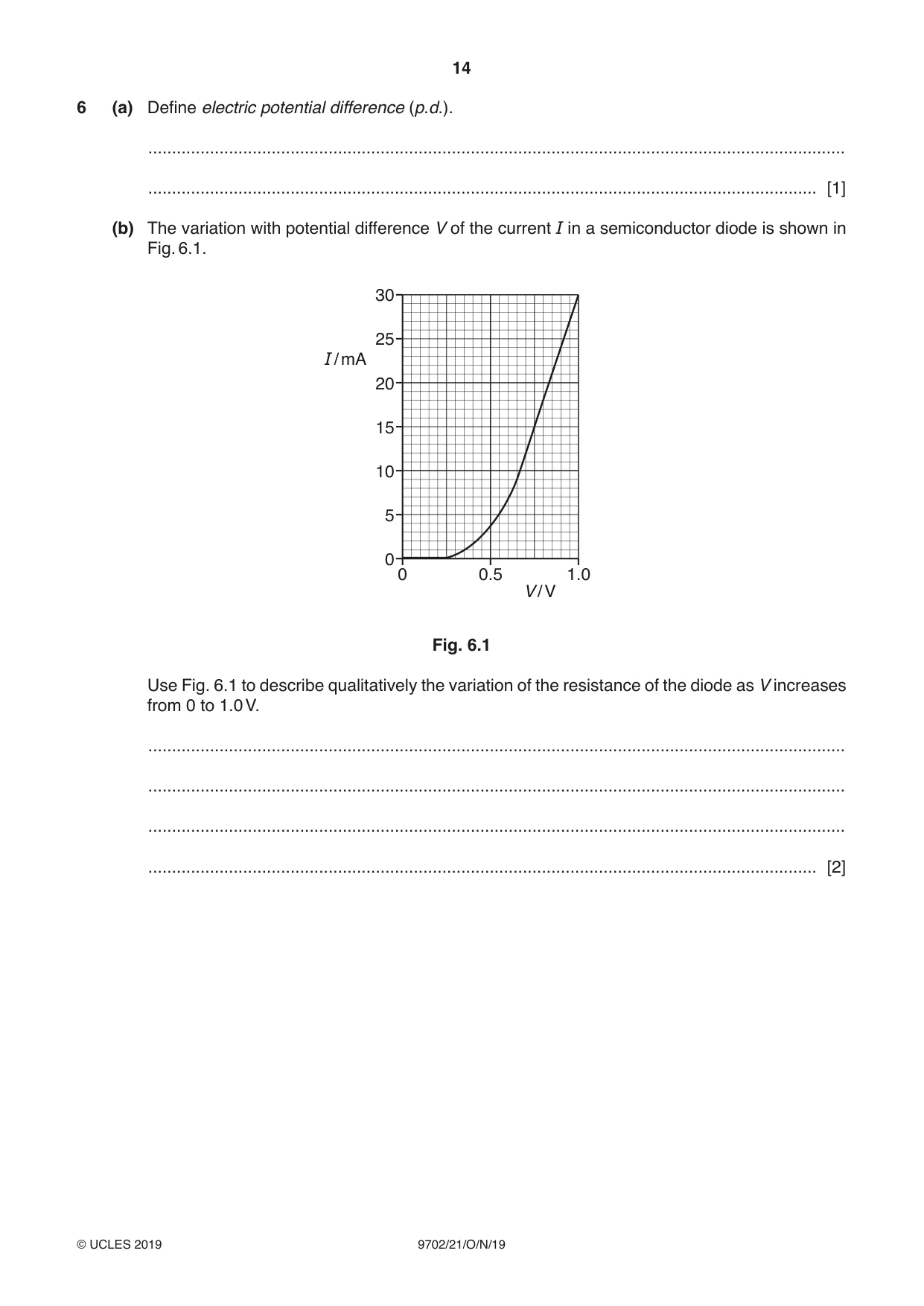
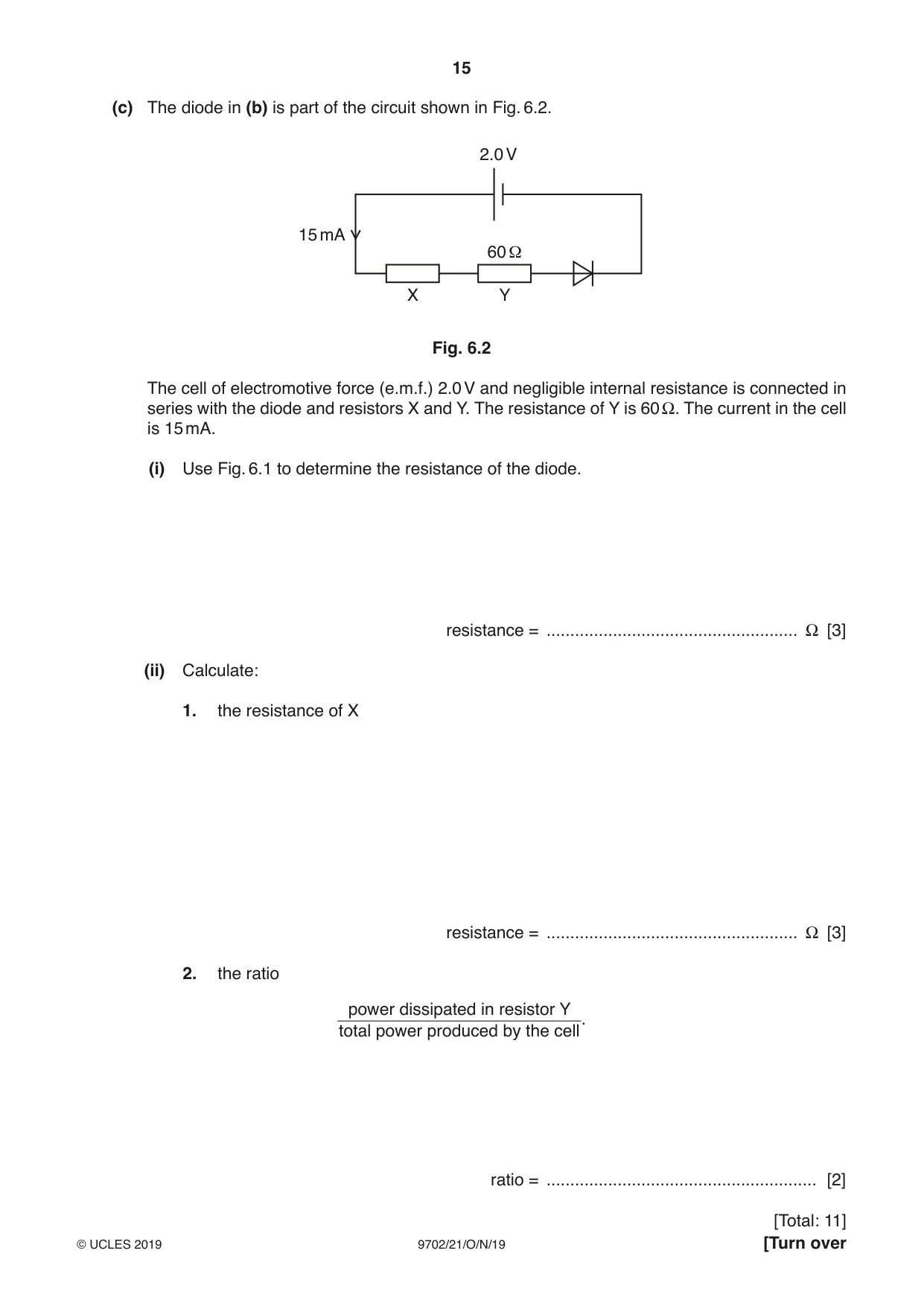
6 (a) Define electric potential difference (p.d.). ................................................................................................................................................... ............................................................................................................................................. [1] (b) The variation with potential difference V of the current I in a semiconductor diode is shown in Fig. 6.1. 30 25 I / mA 20 15 10 5 0 0 0.5 1.0 V / V Fig. 6.1 Use Fig. 6.1 to describe qualitatively the variation of the resistance of the diode as V increases from 0 to 1.0 V. ................................................................................................................................................... ................................................................................................................................................... ................................................................................................................................................... ............................................................................................................................................. [2] (c) The diode in (b) is part of the circuit shown in Fig. 6.2. 2.0 V 15 mA 60 Ω X Y Fig. 6.2 The cell of electromotive force (e.m.f.) 2.0 V and negligible internal resistance is connected in series with the diode and resistors X and Y. The resistance of Y is 60 Ω. The current in the cell is 15 mA. (i) Use Fig. 6.1 to determine the resistance of the diode. resistance = ..................................................... Ω [3] (ii) Calculate: 1. the resistance of X resistance = ..................................................... Ω [3] 2. the ratio power dissipated in resistor Y total power produced by the cell. ratio = ......................................................... [2]
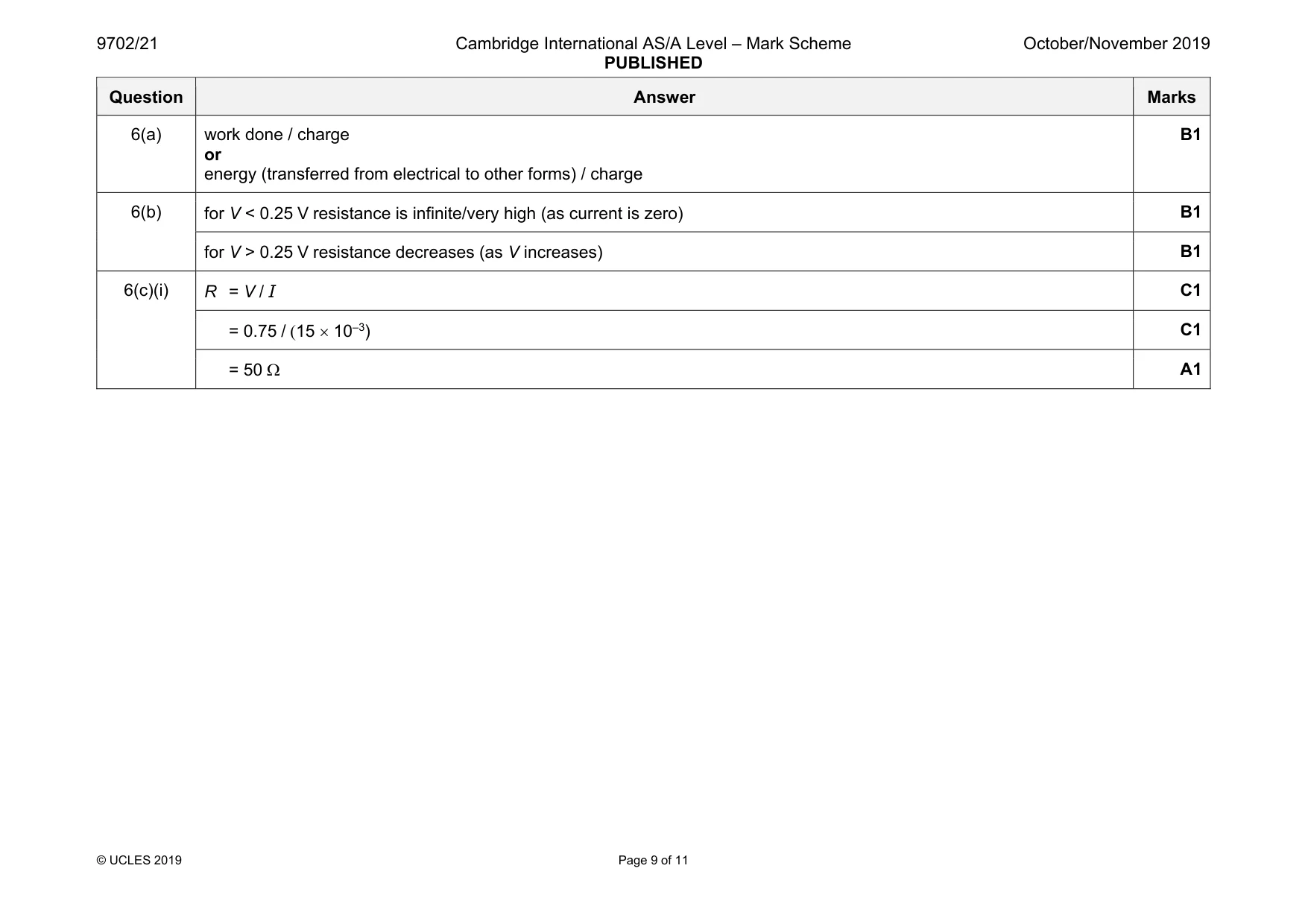
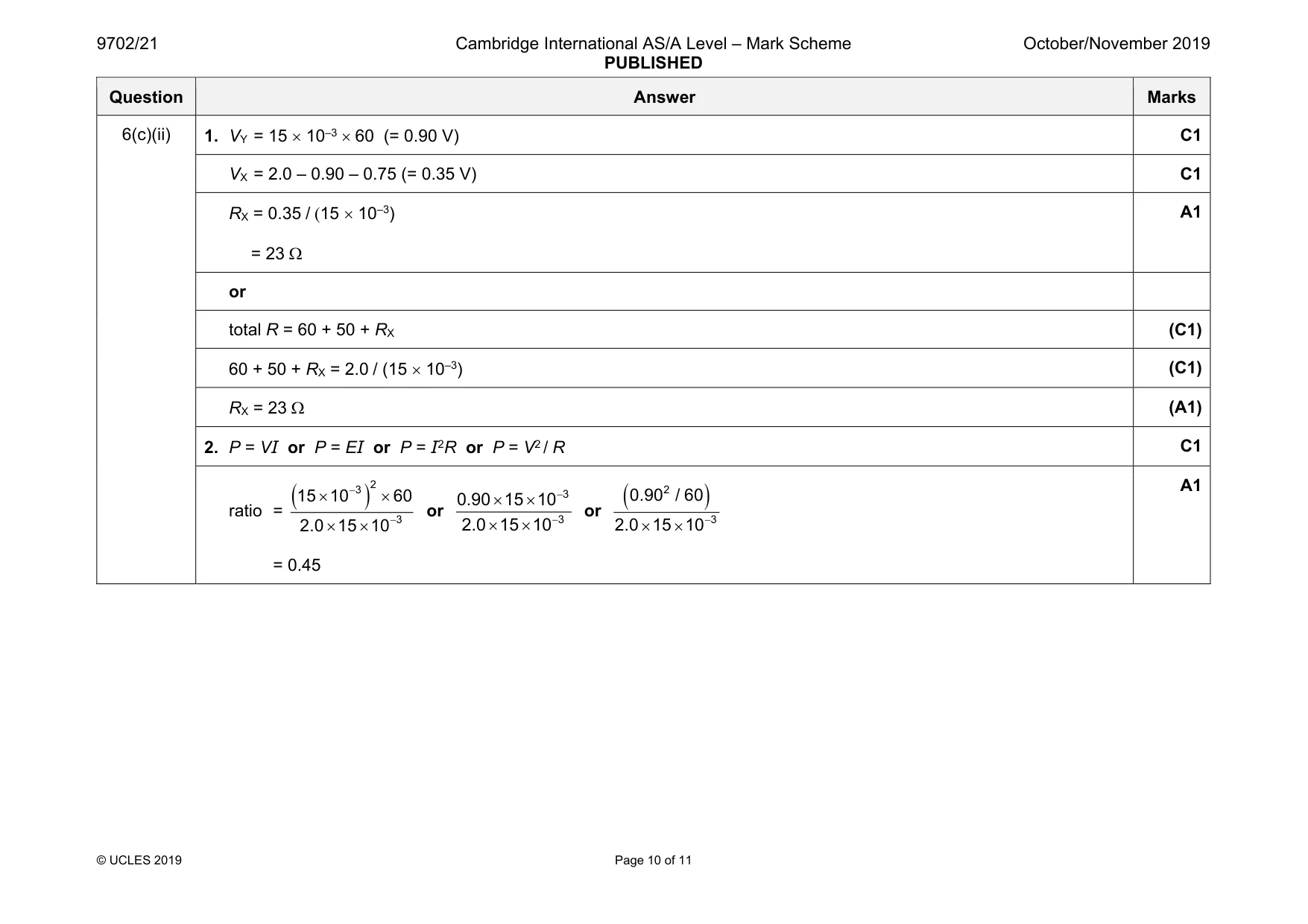
Mark scheme: 6(a) work done / charge or energy (transferred from electrical to other forms) / charge B1 6(b) for V < 0.25 V resistance is infinite/very high (as current is zero) B1 for V > 0.25 V resistance decreases (as V increases) B1 6(c)(i) R = V / I C1 = 0.75 / (15 × 10–3) C1 = 50 Ω A1 Question Answer Marks 6(c)(ii) 1. VY = 15 × 10–3 × 60 (= 0.90 V) C1 VX = 2.0 – 0.90 – 0.75 (= 0.35 V) C1 RX = 0.35 / (15 × 10–3) = 23 Ω A1 or total R = 60 + 50 + RX (C1) 60 + 50 + RX = 2.0 / (15 × 10–3) (C1) RX = 23 Ω (A1) 2. P = VI or P = EI or P = I2R or P = V2 / R C1 ratio = ( ) 2 3 3 15 10 60 2.0 15 10 − − × × × × or 3 3 0.90 15 10 2.0 15 10 − − × × × × or ( ) 2 3 0.90 / 60 2.0 15 10− × × = 0.45 A1
Q7 · The decay of a nucleus 1835Ar by β+ emission is represented by 1835Ar X + β+ + Y
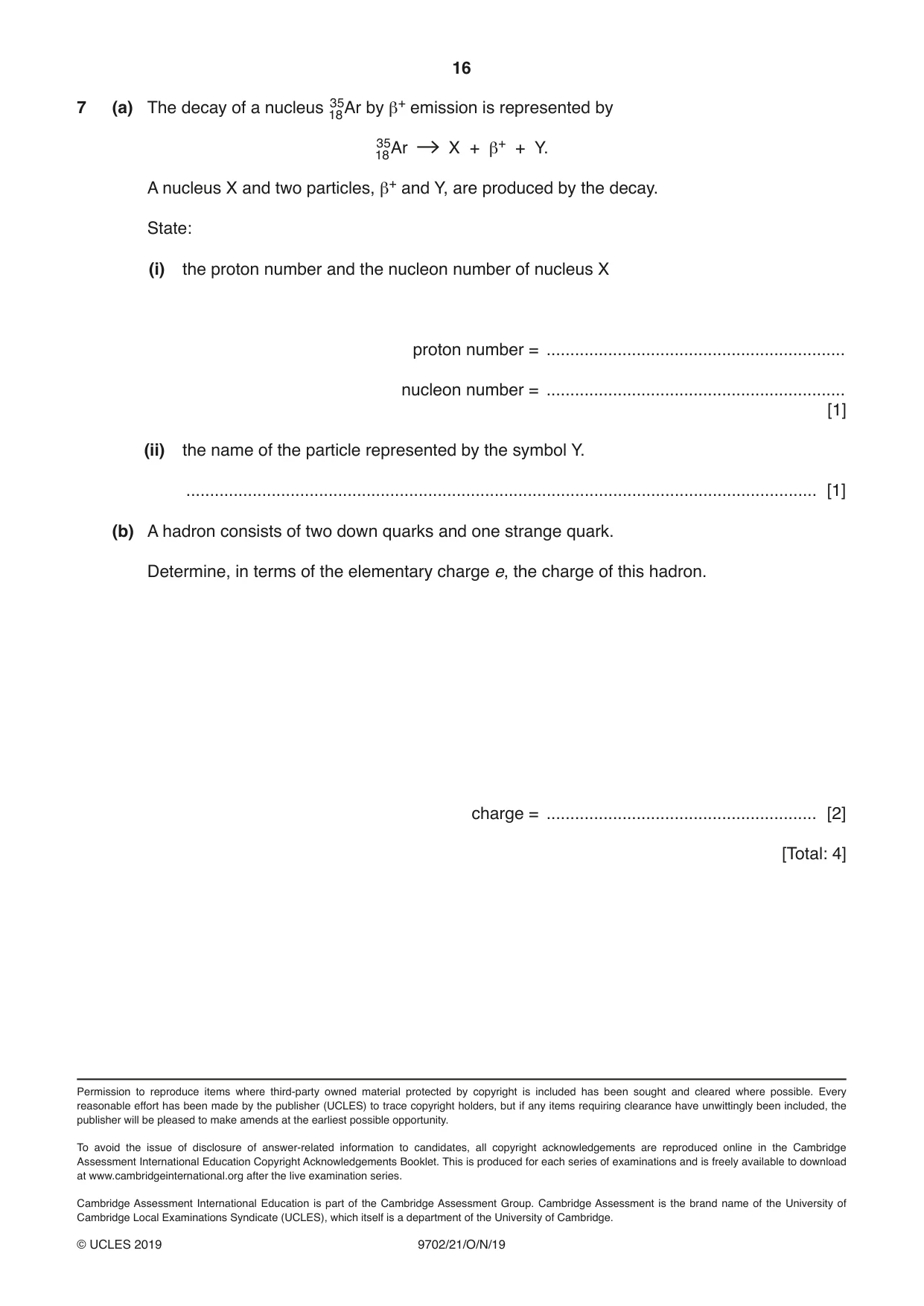
7 (a) The decay of a nucleus 1835Ar by β+ emission is represented by 1835Ar X + β+ + Y. A nucleus X and two particles, β+ and Y, are produced by the decay. State: (i) the proton number and the nucleon number of nucleus X proton number = ............................................................... nucleon number = ............................................................... [1] (ii) the name of the particle represented by the symbol Y. ..................................................................................................................................... [1] (b) A hadron consists of two down quarks and one strange quark. Determine, in terms of the elementary charge e, the charge of this hadron. charge = ......................................................... [2] [Total: 4]
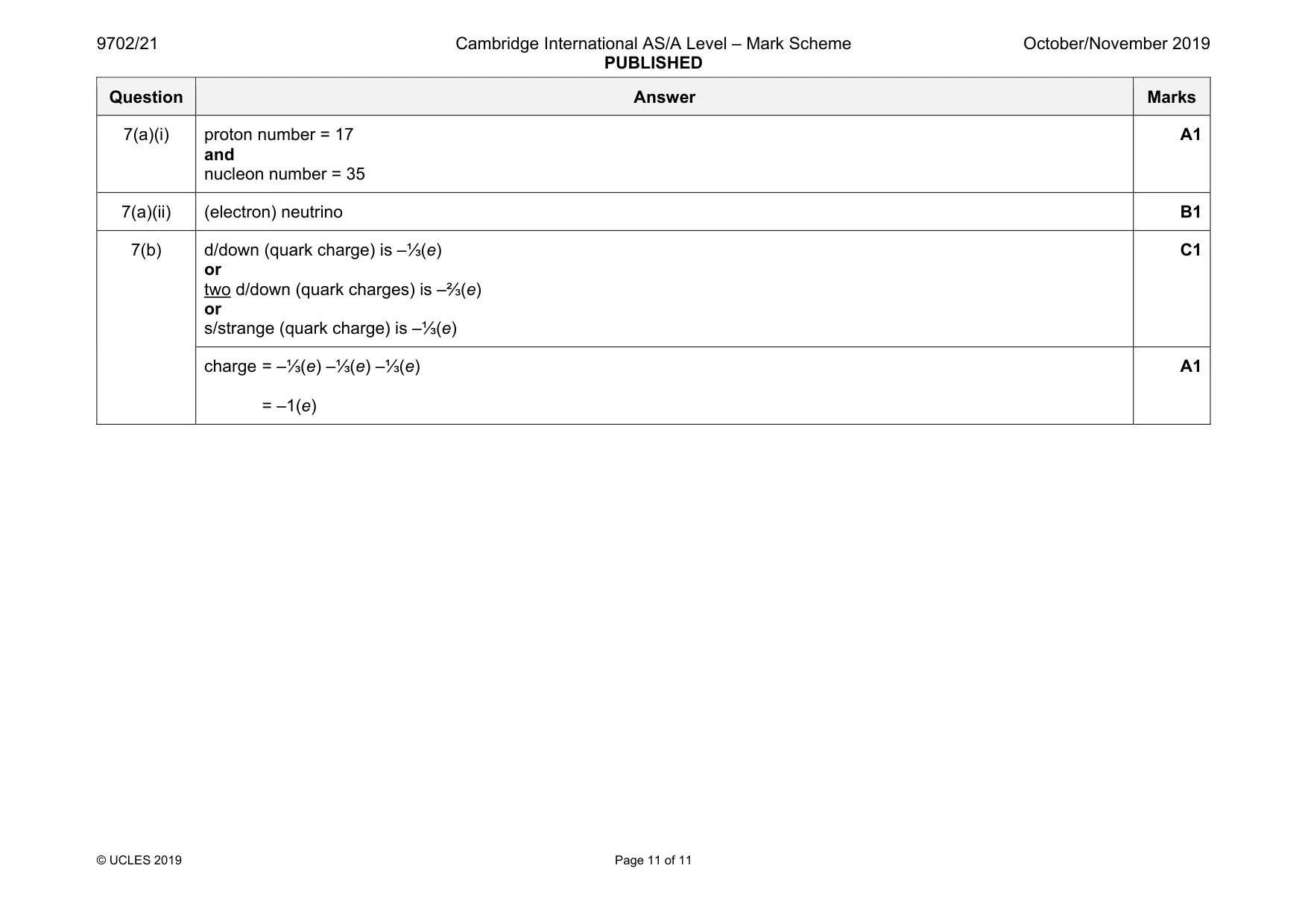
Mark scheme: 7(a)(i) proton number = 17 and nucleon number = 35 A1 7(a)(ii) (electron) neutrino B1 7(b) d/down (quark charge) is –⅓(e) or two d/down (quark charges) is –⅔(e) or s/strange (quark charge) is –⅓(e) C1 charge = –⅓(e) –⅓(e) –⅓(e) = –1(e) A1
What was in this paper
The subtopics covered by these 7 questions, and how many questions each got. Open one in a new tab to see every Cambridge question on it.
What you needed in this session
Cambridge’s own grade thresholds for 2019 Oct/Nov, Paper 2 · Variant 1. A higher threshold means an easier paper — the bar moves with how the cohort did.