Cambridge A Level Physics 9702 — 2020 Feb/March Paper 2 · Variant 2
9702/22/F/M/20 · 7 questions · 60 marks · ≈68 min
The question paper and its mark scheme, free to read here and free to download. This is Cambridge’s own paper, exactly as it was sat.
Question paper16 pages
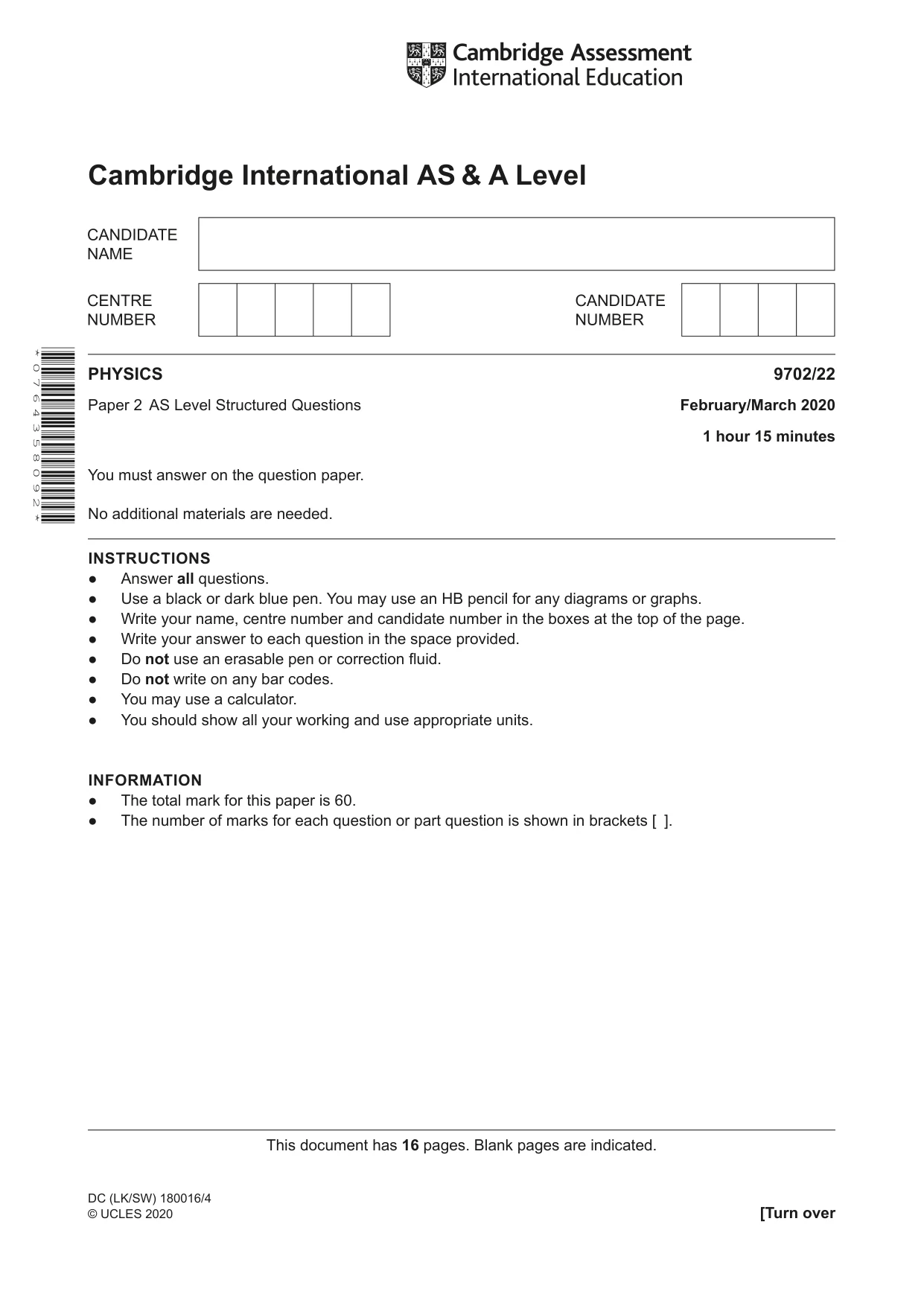
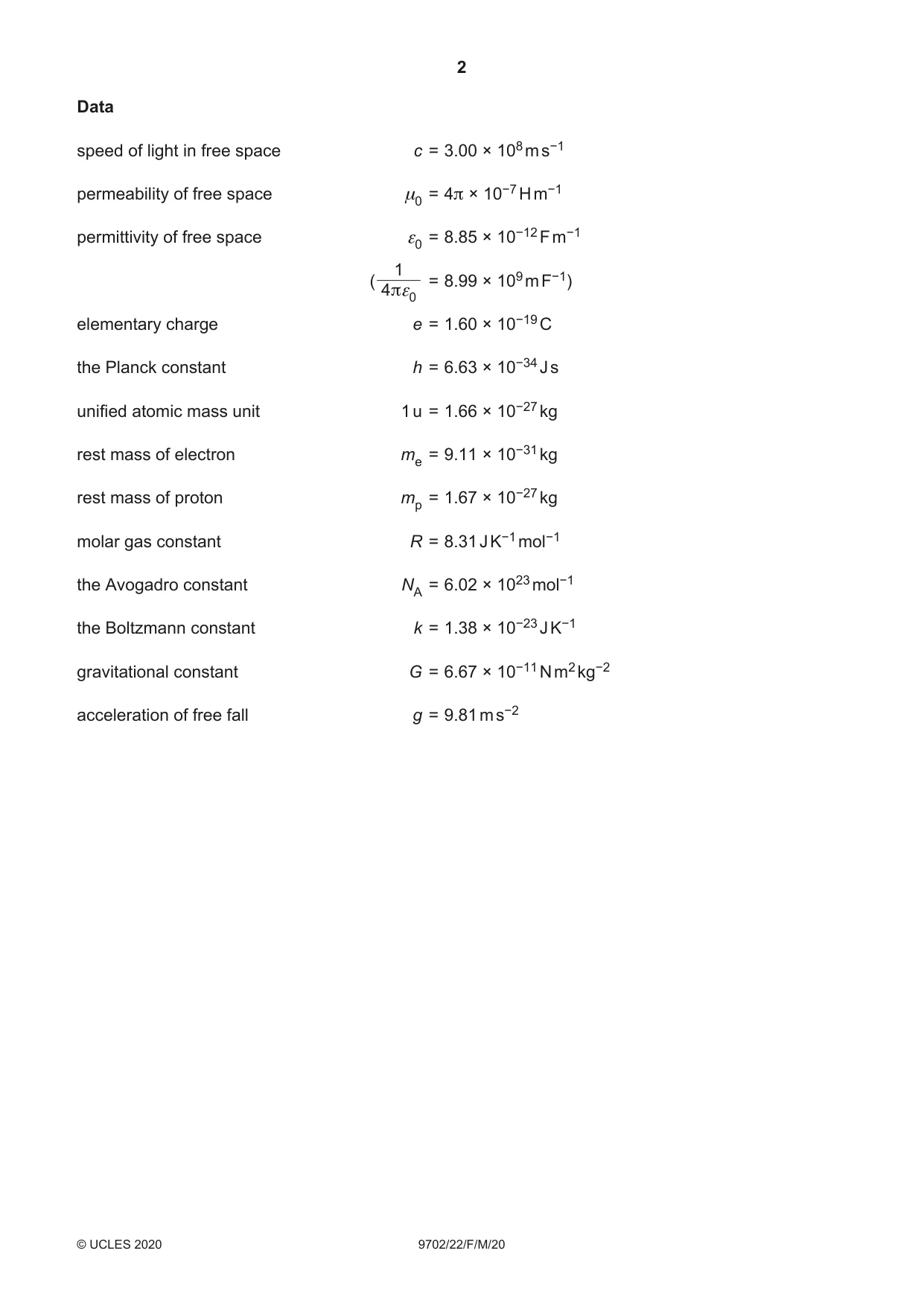
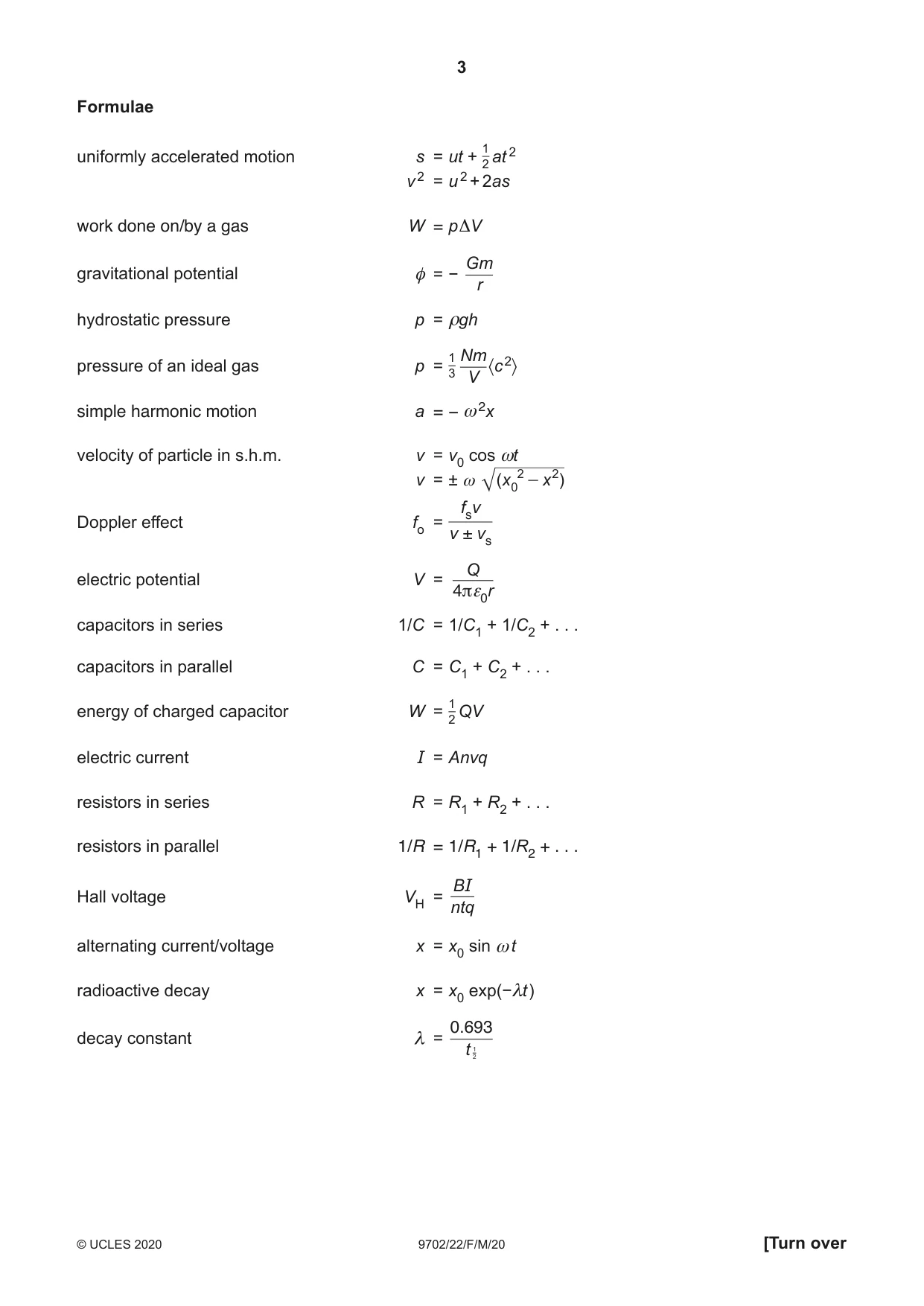
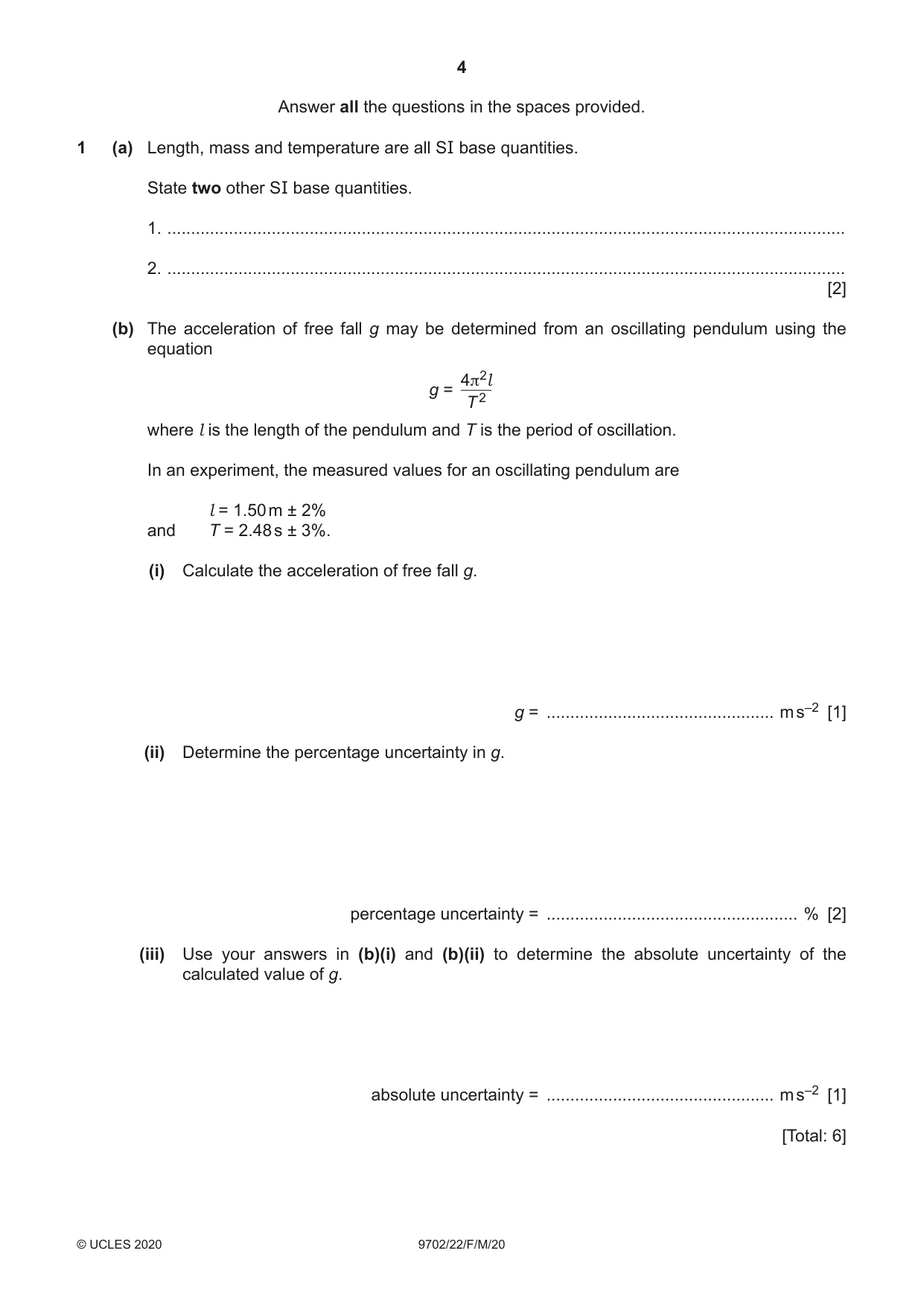

Mark scheme14 pages
Answers below. Sit the paper first if you are practising.
Questions as text
Q1 · Length, mass and temperature are all SI base quantities
1 (a) Length, mass and temperature are all SI base quantities. State two other SI base quantities. 1. ............................................................................................................................................... 2. ............................................................................................................................................... [2] (b) The acceleration of free fall g may be determined from an oscillating pendulum using the equation 4π2l g = T 2 where l is the length of the pendulum and T is the period of oscillation. In an experiment, the measured values for an oscillating pendulum are l = 1.50 m ± 2% and T = 2.48 s ± 3%. (i) Calculate the acceleration of free fall g. g = ................................................ m s–2 [1] (ii) Determine the percentage uncertainty in g. percentage uncertainty = ..................................................... % [2] (iii) Use your answers in (b)(i) and (b)(ii) to determine the absolute uncertainty of the calculated value of g. absolute uncertainty = ................................................ m s–2 [1] [Total: 6]
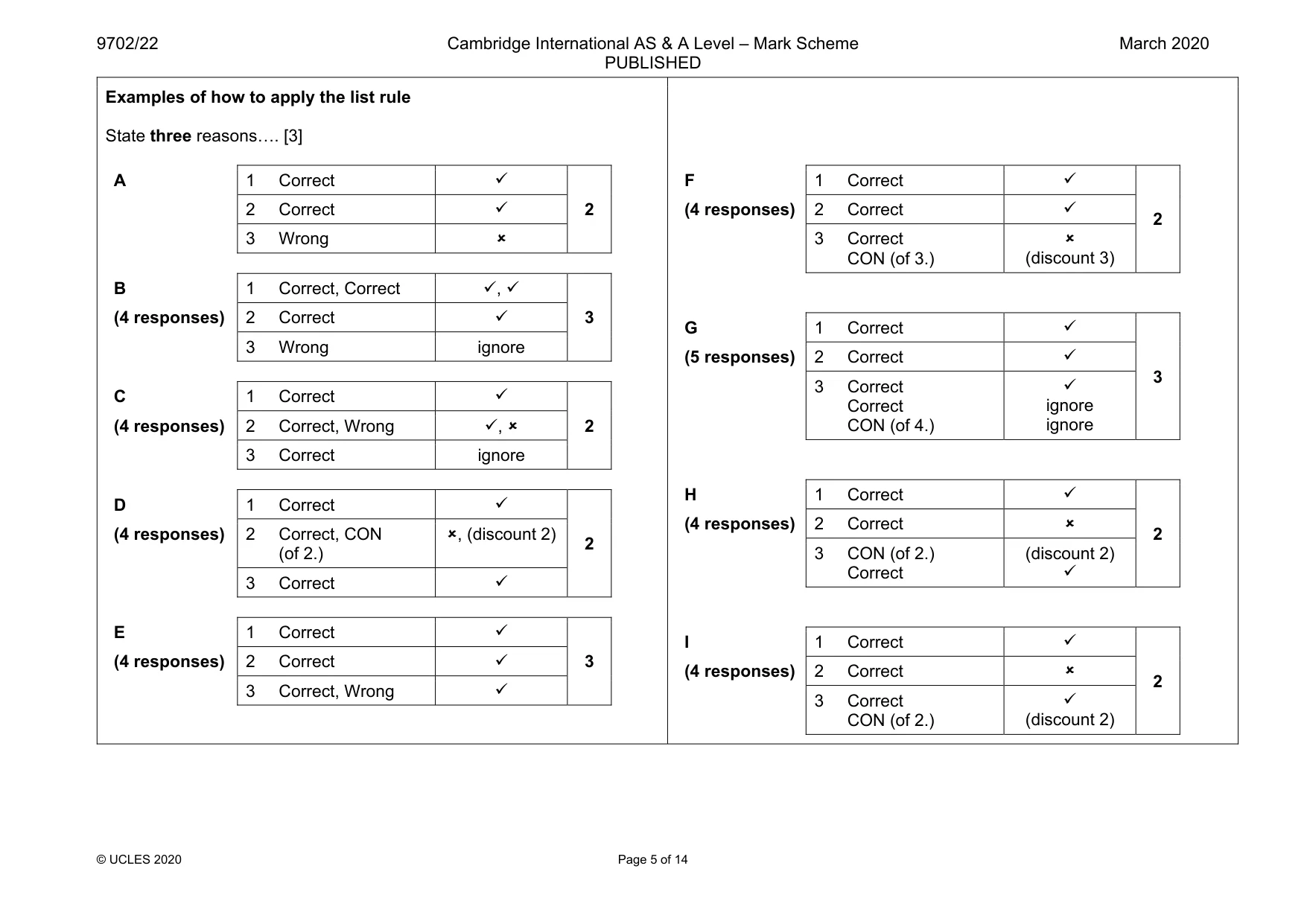
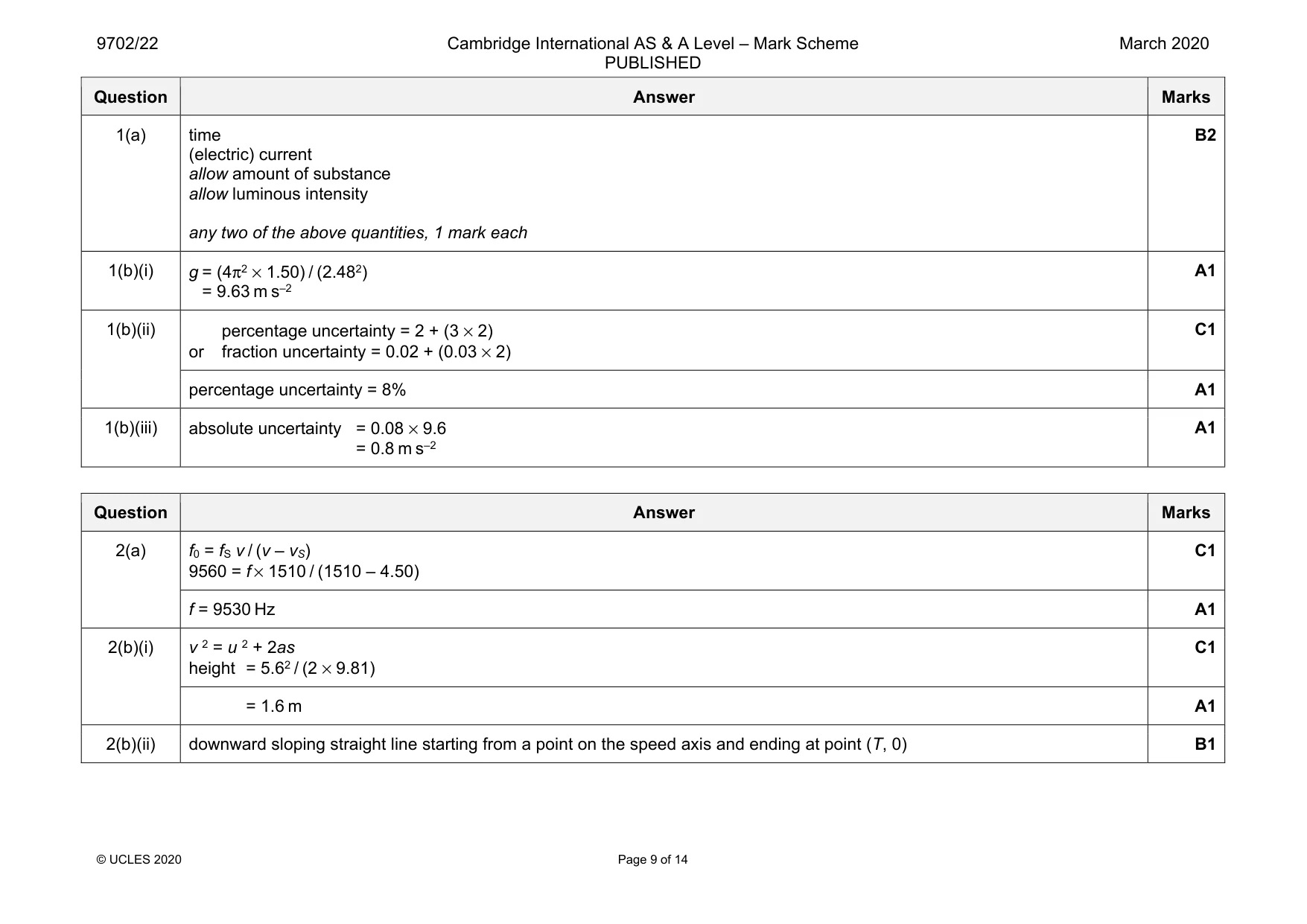
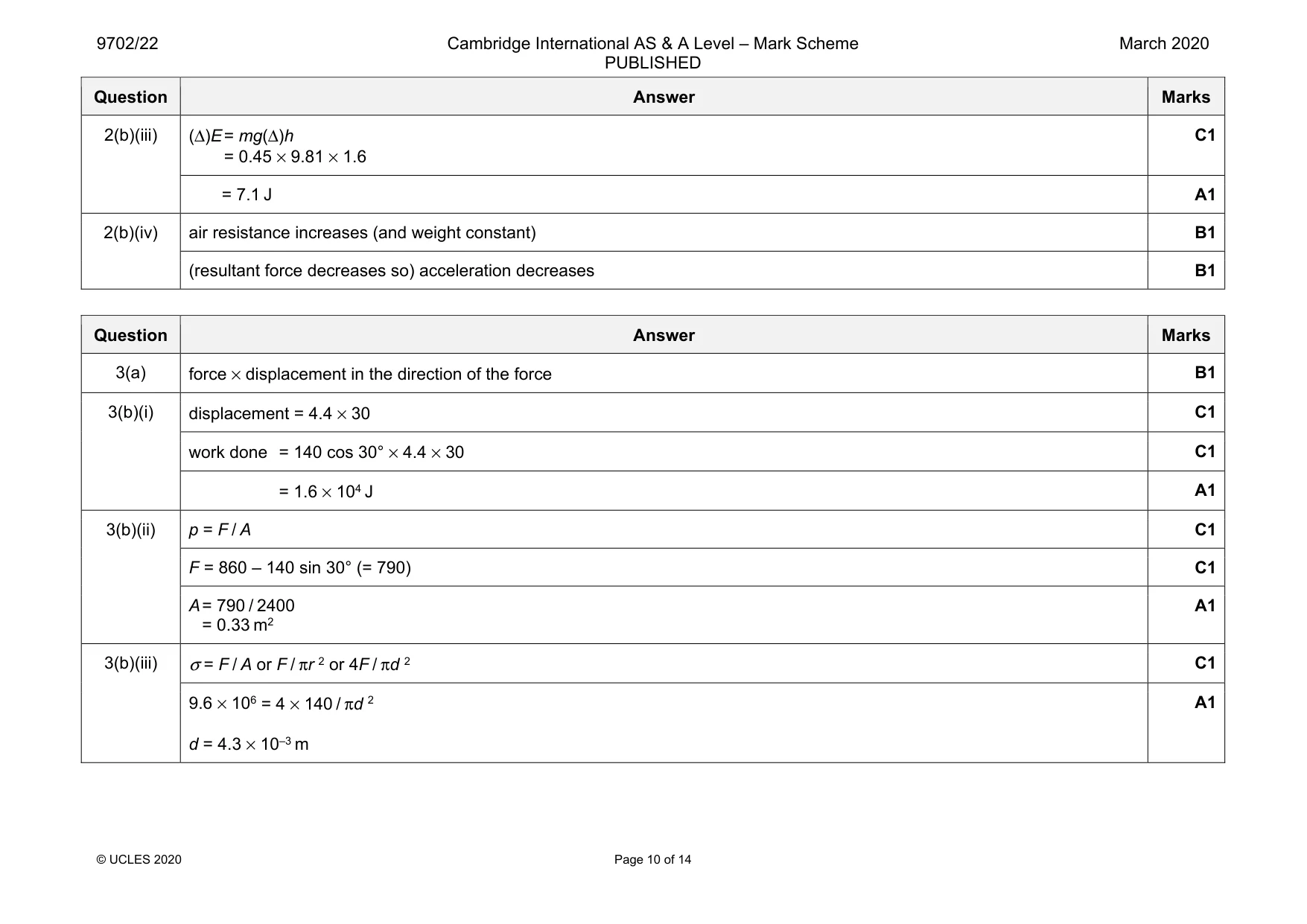
Mark scheme: 1(a) time (electric) current allow amount of substance allow luminous intensity any two of the above quantities, 1 mark each B2 1(b)(i) g = (4π2 × 1.50) / (2.482) = 9.63 m s–2 A1 1(b)(ii) percentage uncertainty = 2 + (3 × 2) or fraction uncertainty = 0.02 + (0.03 × 2) C1 percentage uncertainty = 8% A1 1(b)(iii) absolute uncertainty = 0.08 × 9.6 = 0.8 m s–2 A1
Q2 · A dolphin is swimming under water at a constant speed of 4.50 m s–1
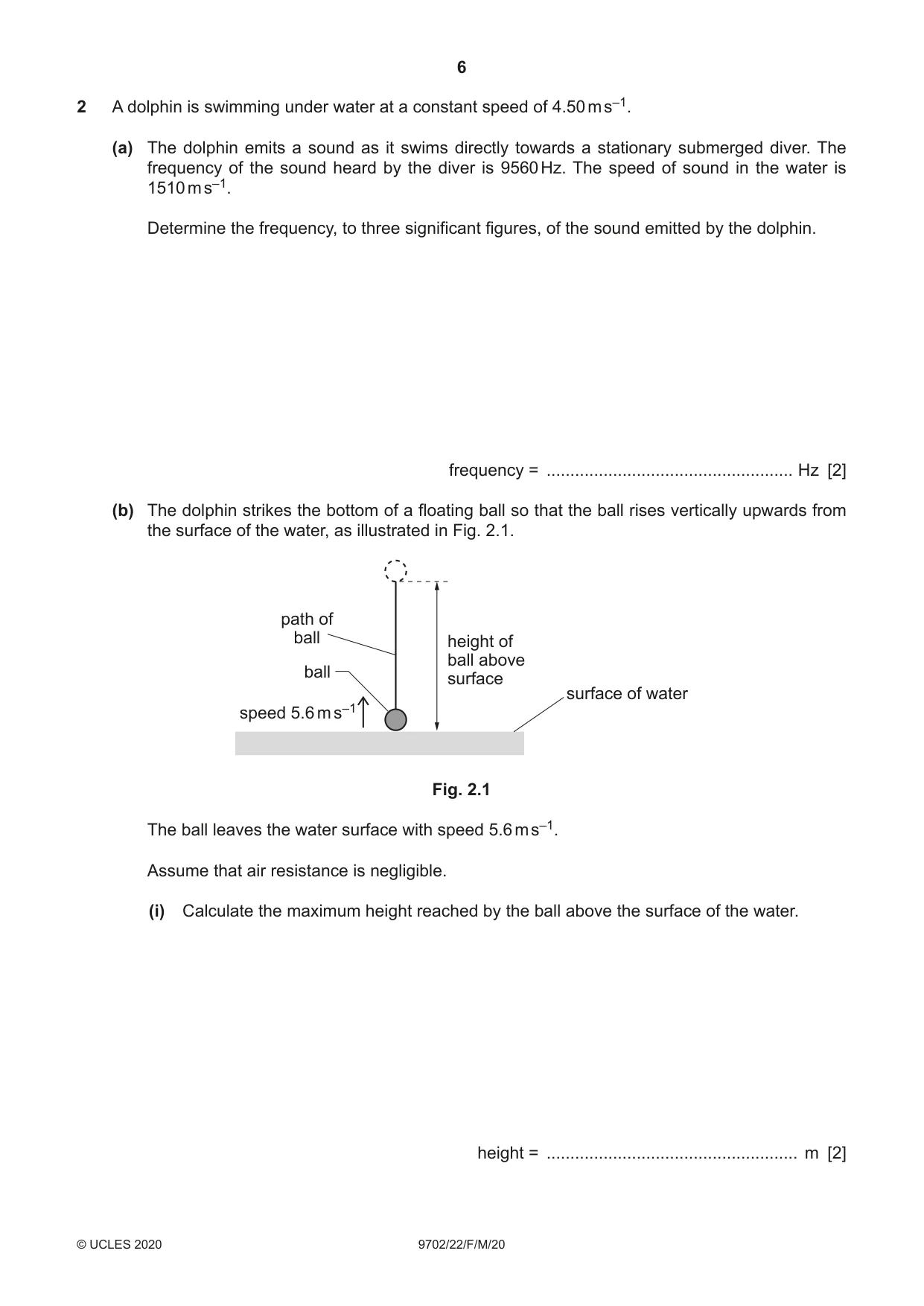
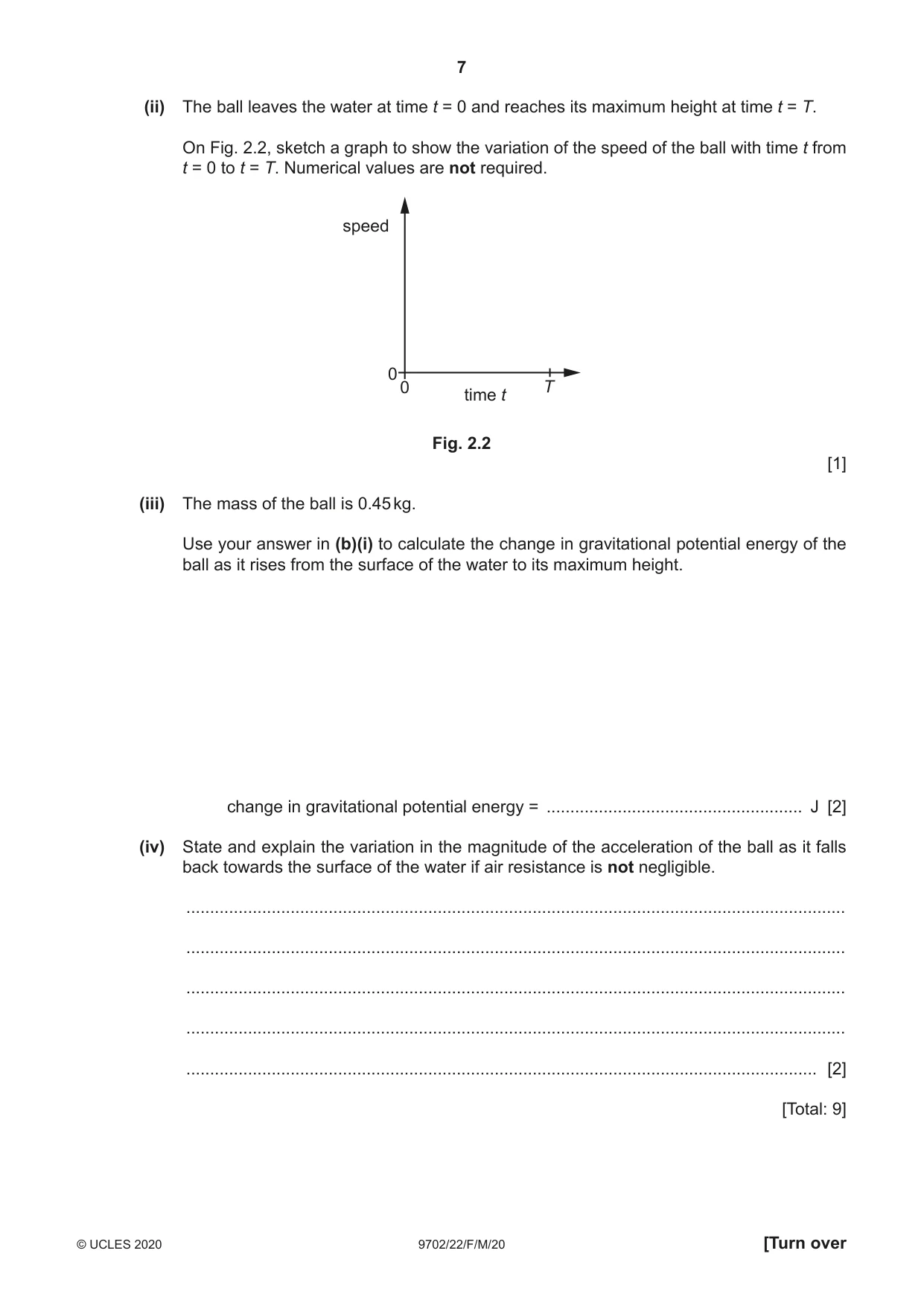
2 A dolphin is swimming under water at a constant speed of 4.50 m s–1. (a) The dolphin emits a sound as it swims directly towards a stationary submerged diver. The frequency of the sound heard by the diver is 9560 Hz. The speed of sound in the water is 1510 m s–1. Determine the frequency, to three significant figures, of the sound emitted by the dolphin. frequency = .................................................... Hz [2] (b) The dolphin strikes the bottom of a floating ball so that the ball rises vertically upwards from the surface of the water, as illustrated in Fig. 2.1. path of ball height of ball above ball surface surface of water speed 5.6 m s–1 Fig. 2.1 The ball leaves the water surface with speed 5.6 m s–1. Assume that air resistance is negligible. (i) Calculate the maximum height reached by the ball above the surface of the water. height = ..................................................... m [2] (ii) The ball leaves the water at time t = 0 and reaches its maximum height at time t = T. On Fig. 2.2, sketch a graph to show the variation of the speed of the ball with time t from t = 0 to t = T. Numerical values are not required. speed 0 0 T time t Fig. 2.2 [1] (iii) The mass of the ball is 0.45 kg. Use your answer in (b)(i) to calculate the change in gravitational potential energy of the ball as it rises from the surface of the water to its maximum height. change in gravitational potential energy = ...................................................... J [2] (iv) State and explain the variation in the magnitude of the acceleration of the ball as it falls back towards the surface of the water if air resistance is not negligible. ........................................................................................................................................... ........................................................................................................................................... ........................................................................................................................................... ........................................................................................................................................... ..................................................................................................................................... [2] [Total: 9]
Mark scheme: 2(a) f0 = fS v / (v – vS) 9560 = f × 1510 / (1510 – 4.50) C1 f = 9530 Hz A1 2(b)(i) v 2 = u 2 + 2as height = 5.62 / (2 × 9.81) C1 = 1.6 m A1 2(b)(ii) downward sloping straight line starting from a point on the speed axis and ending at point (T, 0) B1 Question Answer Marks 2(b)(iii) (Δ)E = mg(Δ)h = 0.45 × 9.81 × 1.6 C1 = 7.1 J A1 2(b)(iv) air resistance increases (and weight constant) B1 (resultant force decreases so) acceleration decreases B1
Q3 · State what is meant by work done
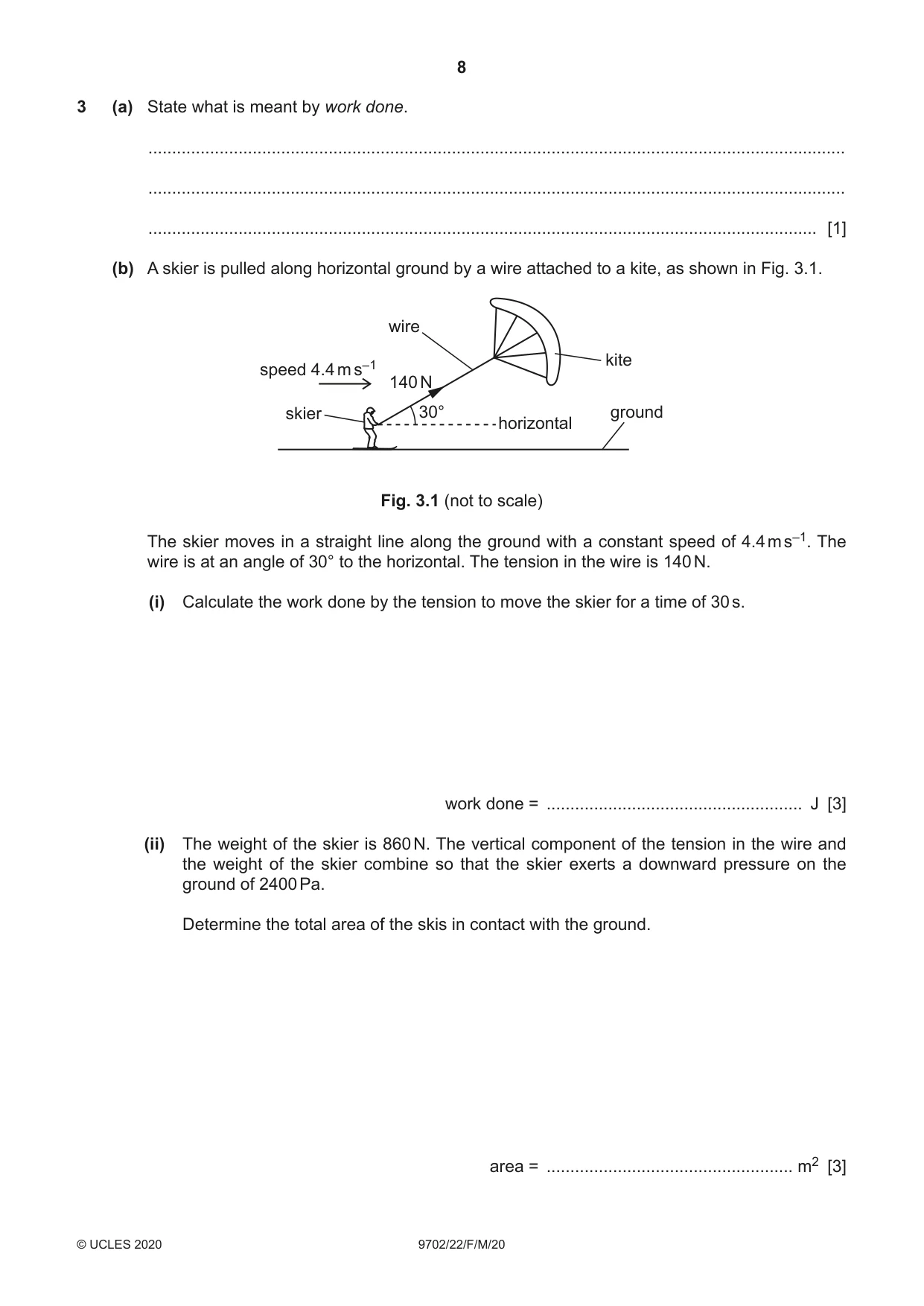
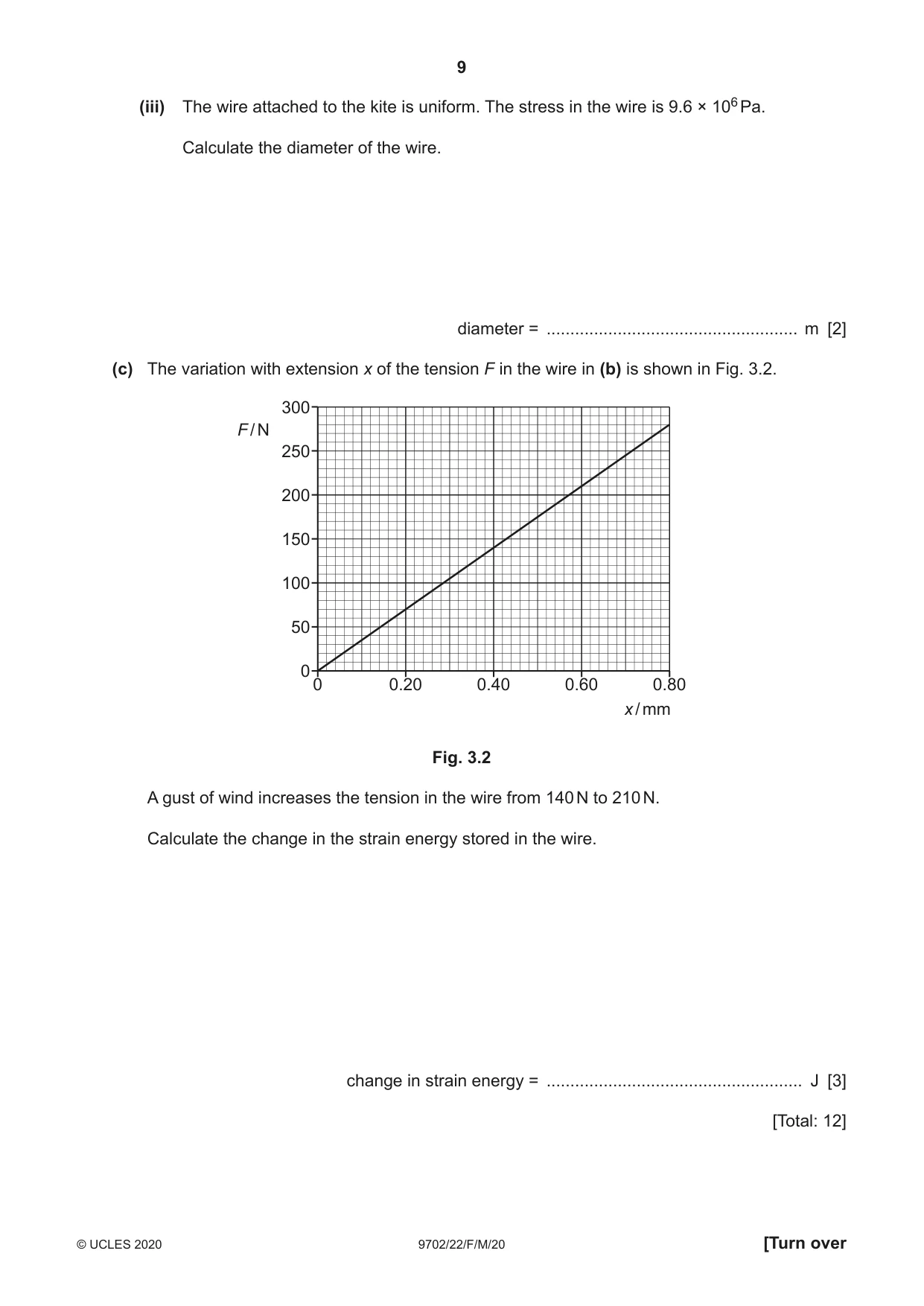
3 (a) State what is meant by work done. ................................................................................................................................................... ................................................................................................................................................... ............................................................................................................................................. [1] (b) A skier is pulled along horizontal ground by a wire attached to a kite, as shown in Fig. 3.1. wire kite speed 4.4 m s–1 140 N skier 30° ground horizontal Fig. 3.1 (not to scale) The skier moves in a straight line along the ground with a constant speed of 4.4 m s–1. The wire is at an angle of 30° to the horizontal. The tension in the wire is 140 N. (i) Calculate the work done by the tension to move the skier for a time of 30 s. work done = ...................................................... J [3] (ii) The weight of the skier is 860 N. The vertical component of the tension in the wire and the weight of the skier combine so that the skier exerts a downward pressure on the ground of 2400 Pa. Determine the total area of the skis in contact with the ground. area = .................................................... m2 [3] (iii) The wire attached to the kite is uniform. The stress in the wire is 9.6 × 10⁶ Pa. Calculate the diameter of the wire. diameter = ..................................................... m [2] (c) The variation with extension x of the tension F in the wire in (b) is shown in Fig. 3.2. 300 F / N 250 200 150 100 50 0 0 0.20 0.40 0.60 0.80 x / mm Fig. 3.2 A gust of wind increases the tension in the wire from 140 N to 210 N. Calculate the change in the strain energy stored in the wire. change in strain energy = ...................................................... J [3] [Total: 12]
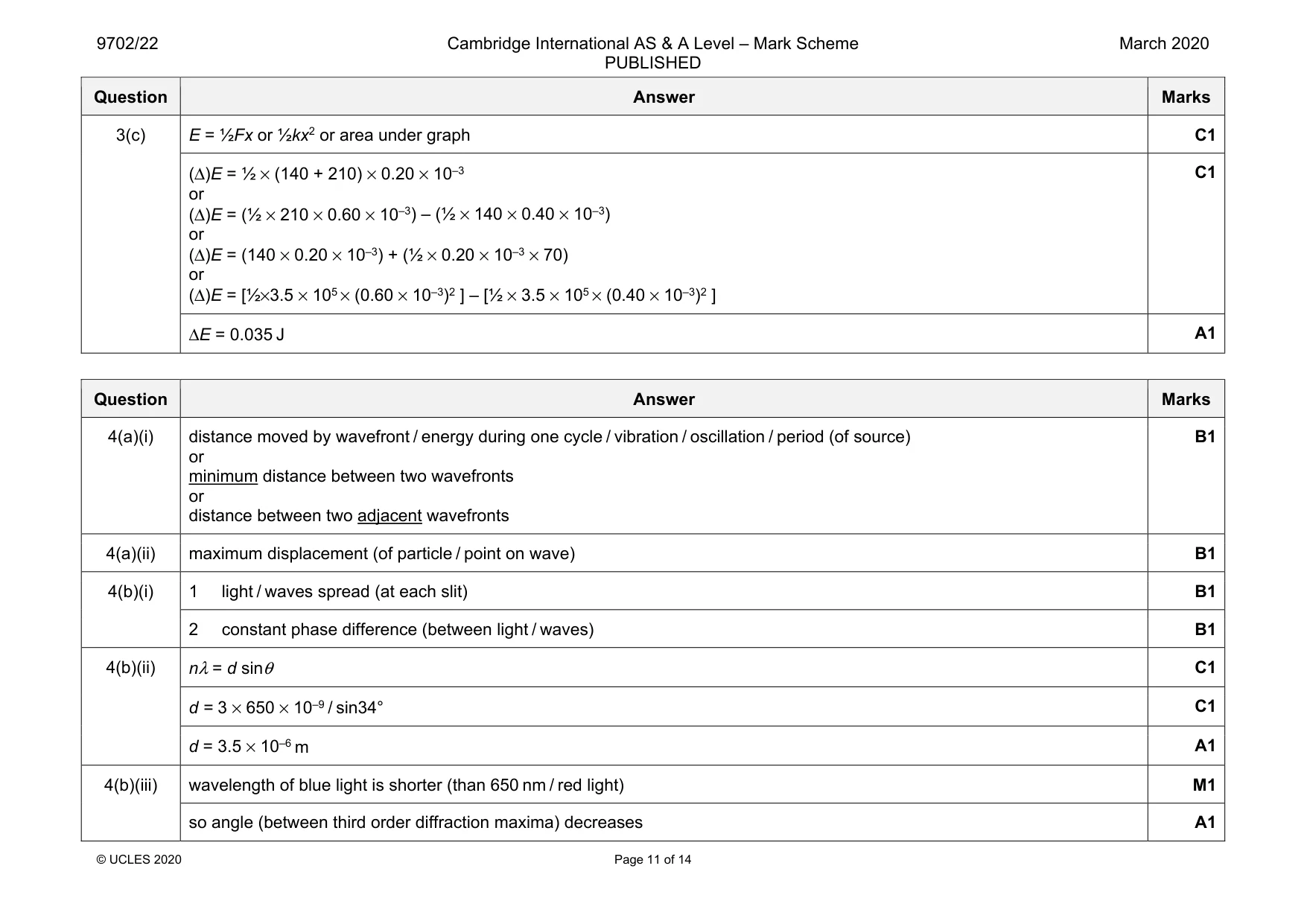
Mark scheme: 3(a) force × displacement in the direction of the force B1 3(b)(i) displacement = 4.4 × 30 C1 work done = 140 cos 30° × 4.4 × 30 C1 = 1.6 × 10⁴ J A1 3(b)(ii) p = F / A C1 F = 860 – 140 sin 30° (= 790) C1 A = 790 / 2400 = 0.33 m2 A1 3(b)(iii) σ = F / A or F / πr 2 or 4F / πd 2 C1 9.6 × 106 = 4 × 140 / πd 2 d = 4.3 × 10⁻³ m A1 Question Answer Marks 3(c) E = ½Fx or ½kx2 or area under graph C1 (Δ)E = ½ × (140 + 210) × 0.20 × 10–3 or (Δ)E = (½ × 210 × 0.60 × 10–3) – (½ × 140 × 0.40 × 10–3) or (Δ)E = (140 × 0.20 × 10–3) + (½ × 0.20 × 10–3 × 70) or (Δ)E = [½×3.5 × 105 × (0.60 × 10–3)2 ] – [½ × 3.5 × 105 × (0.40 × 10–3)2 ] C1 ΔE = 0.035 J A1
Q4 · For a progressive wave, state what is meant by: (i) the wavelength…
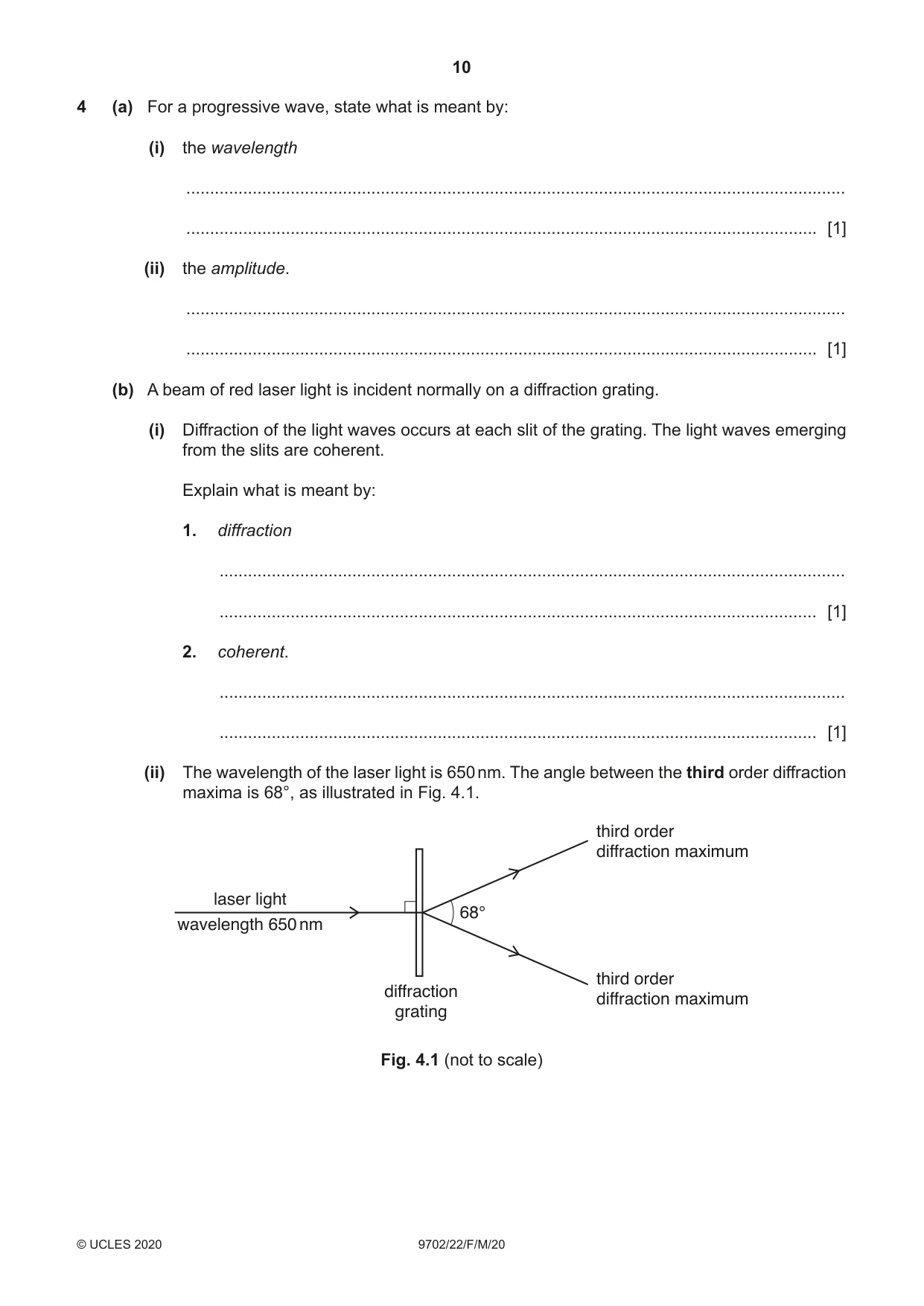
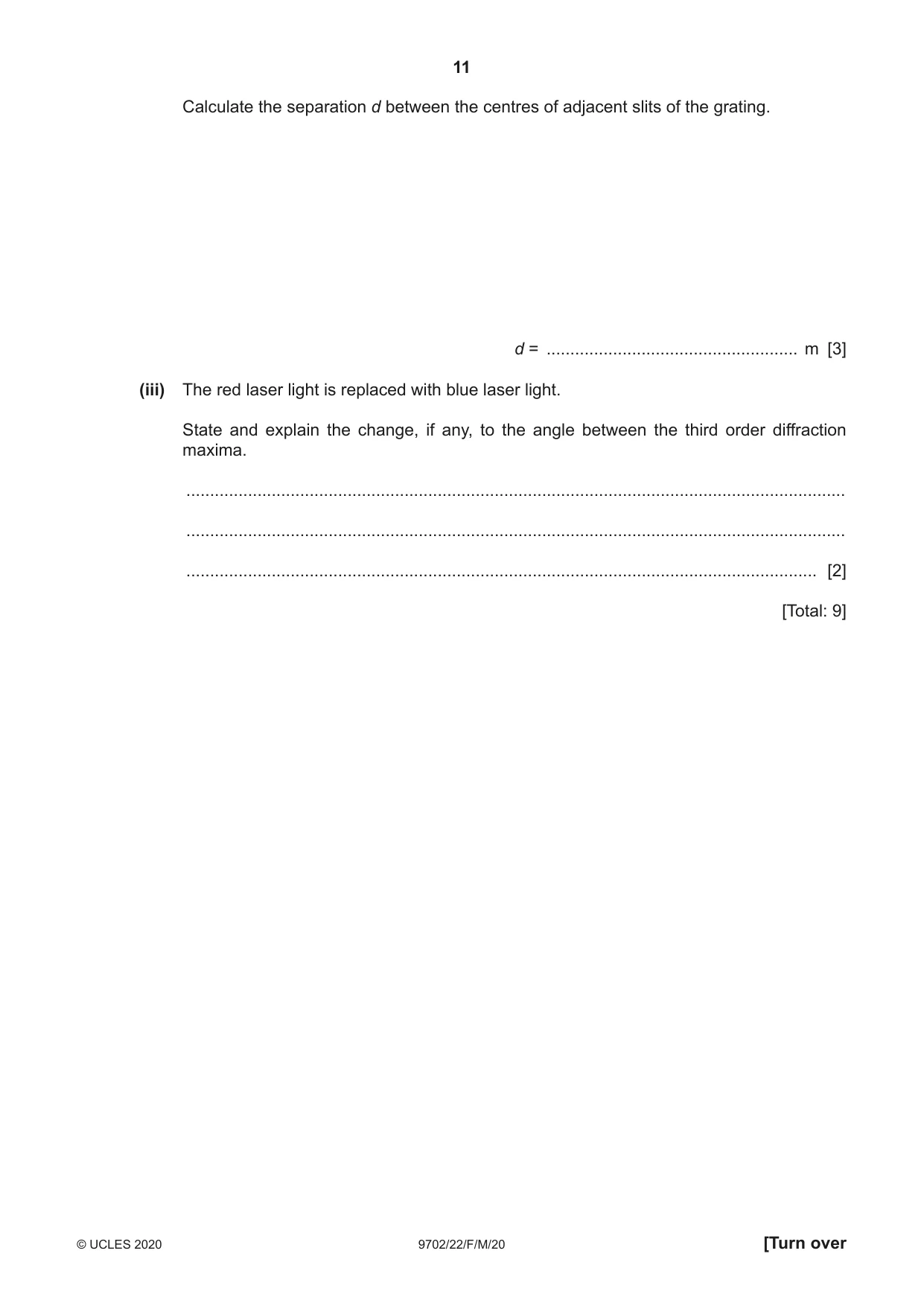
4 (a) For a progressive wave, state what is meant by: (i) the wavelength ........................................................................................................................................... ..................................................................................................................................... [1] (ii) the amplitude. ........................................................................................................................................... ..................................................................................................................................... [1] (b) A beam of red laser light is incident normally on a diffraction grating. (i) Diffraction of the light waves occurs at each slit of the grating. The light waves emerging from the slits are coherent. Explain what is meant by: 1. diffraction .................................................................................................................................... .............................................................................................................................. [1] 2. coherent. .................................................................................................................................... .............................................................................................................................. [1] (ii) The wavelength of the laser light is 650 nm. The angle between the third order diffraction maxima is 68°, as illustrated in Fig. 4.1. third order diffraction maximum laser light 68° wavelength 650 nm third order diffraction diffraction maximum grating Fig. 4.1 (not to scale) Calculate the separation d between the centres of adjacent slits of the grating. d = ..................................................... m [3] (iii) The red laser light is replaced with blue laser light. State and explain the change, if any, to the angle between the third order diffraction maxima. ........................................................................................................................................... ........................................................................................................................................... ..................................................................................................................................... [2] [Total: 9]
Mark scheme: 4(a)(i) distance moved by wavefront / energy during one cycle / vibration / oscillation / period (of source) or minimum distance between two wavefronts or distance between two adjacent wavefronts B1 4(a)(ii) maximum displacement (of particle / point on wave) B1 4(b)(i) 1 light / waves spread (at each slit) B1 2 constant phase difference (between light / waves) B1 4(b)(ii) nλ = d sinθ C1 d = 3 × 650 × 10–9 / sin34° C1 d = 3.5 × 10⁻⁶ m A1 4(b)(iii) wavelength of blue light is shorter (than 650 nm / red light) M1 so angle (between third order diffraction maxima) decreases A1
Question 5
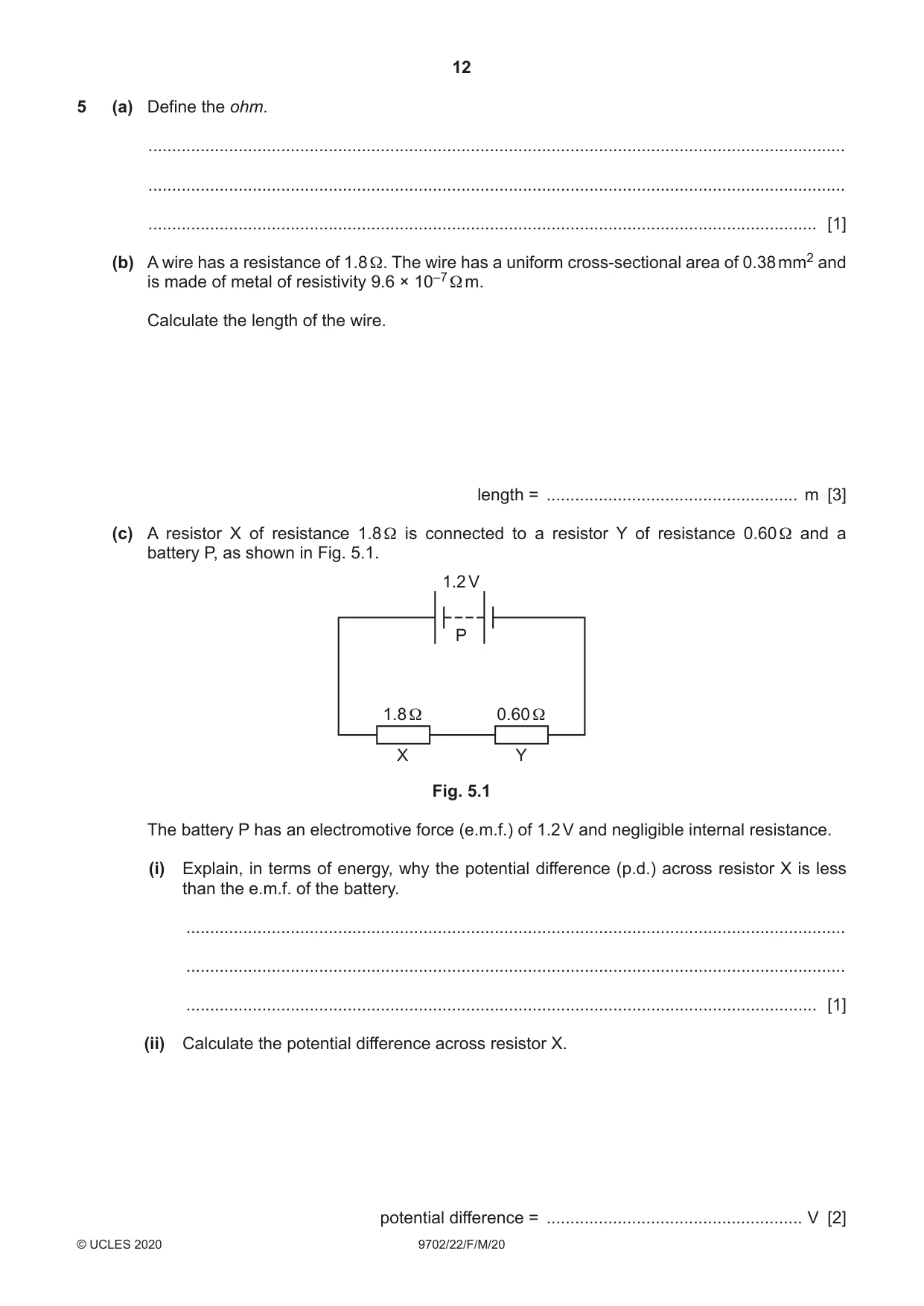
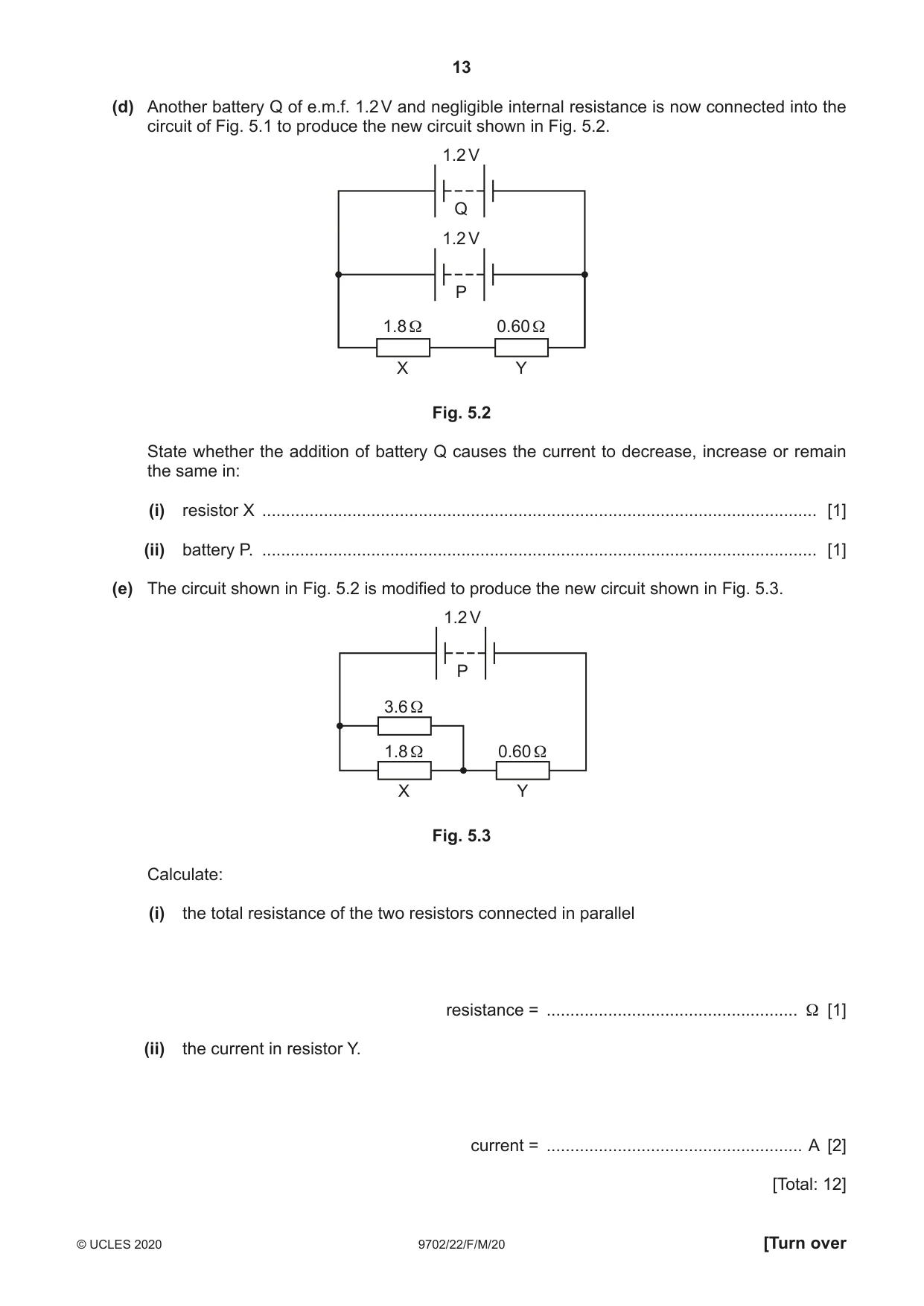
5 (a) Define the ohm. ................................................................................................................................................... ................................................................................................................................................... ............................................................................................................................................. [1] (b) A wire has a resistance of 1.8 Ω. The wire has a uniform cross-sectional area of 0.38 mm2 and is made of metal of resistivity 9.6 × 10⁻⁷ Ω m. Calculate the length of the wire. length = ..................................................... m [3] (c) A resistor X of resistance 1.8 Ω is connected to a resistor Y of resistance 0.60 Ω and a battery P, as shown in Fig. 5.1. 1.2 V P 1.8 Ω 0.60 Ω X Y Fig. 5.1 The battery P has an electromotive force (e.m.f.) of 1.2 V and negligible internal resistance. (i) Explain, in terms of energy, why the potential difference (p.d.) across resistor X is less than the e.m.f. of the battery. ........................................................................................................................................... ........................................................................................................................................... ..................................................................................................................................... [1] (ii) Calculate the potential difference across resistor X. potential difference = ...................................................... V [2] (d) Another battery Q of e.m.f. 1.2 V and negligible internal resistance is now connected into the circuit of Fig. 5.1 to produce the new circuit shown in Fig. 5.2. 1.2 V Q 1.2 V P 1.8 Ω 0.60 Ω X Y Fig. 5.2 State whether the addition of battery Q causes the current to decrease, increase or remain the same in: (i) resistor X ..................................................................................................................... [1] (ii) battery P. ..................................................................................................................... [1] (e) The circuit shown in Fig. 5.2 is modified to produce the new circuit shown in Fig. 5.3. 1.2 V P 3.6 Ω 1.8 Ω 0.60 Ω X Y Fig. 5.3 Calculate: (i) the total resistance of the two resistors connected in parallel resistance = ..................................................... Ω [1] (ii) the current in resistor Y. current = ...................................................... A [2] [Total: 12]
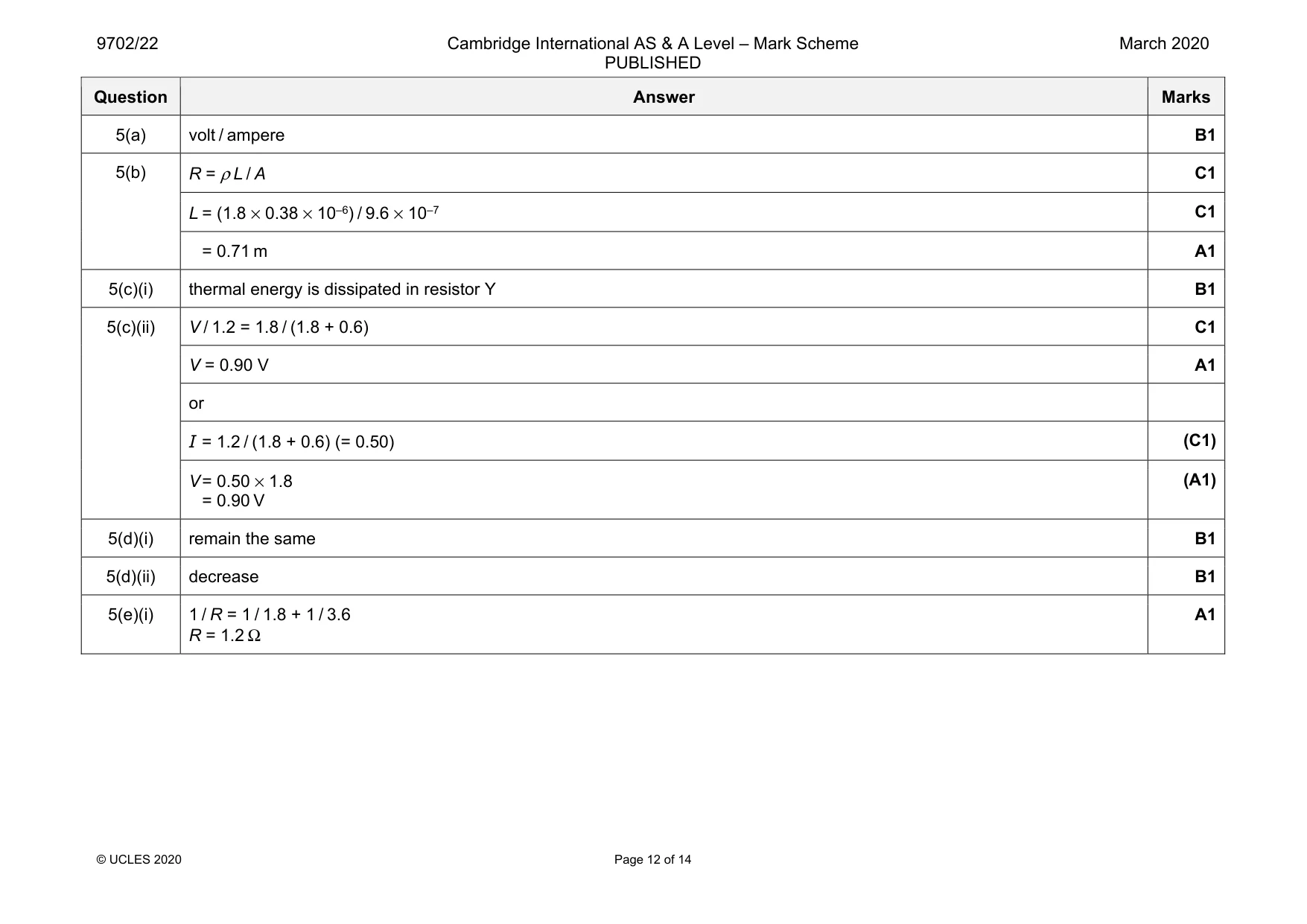
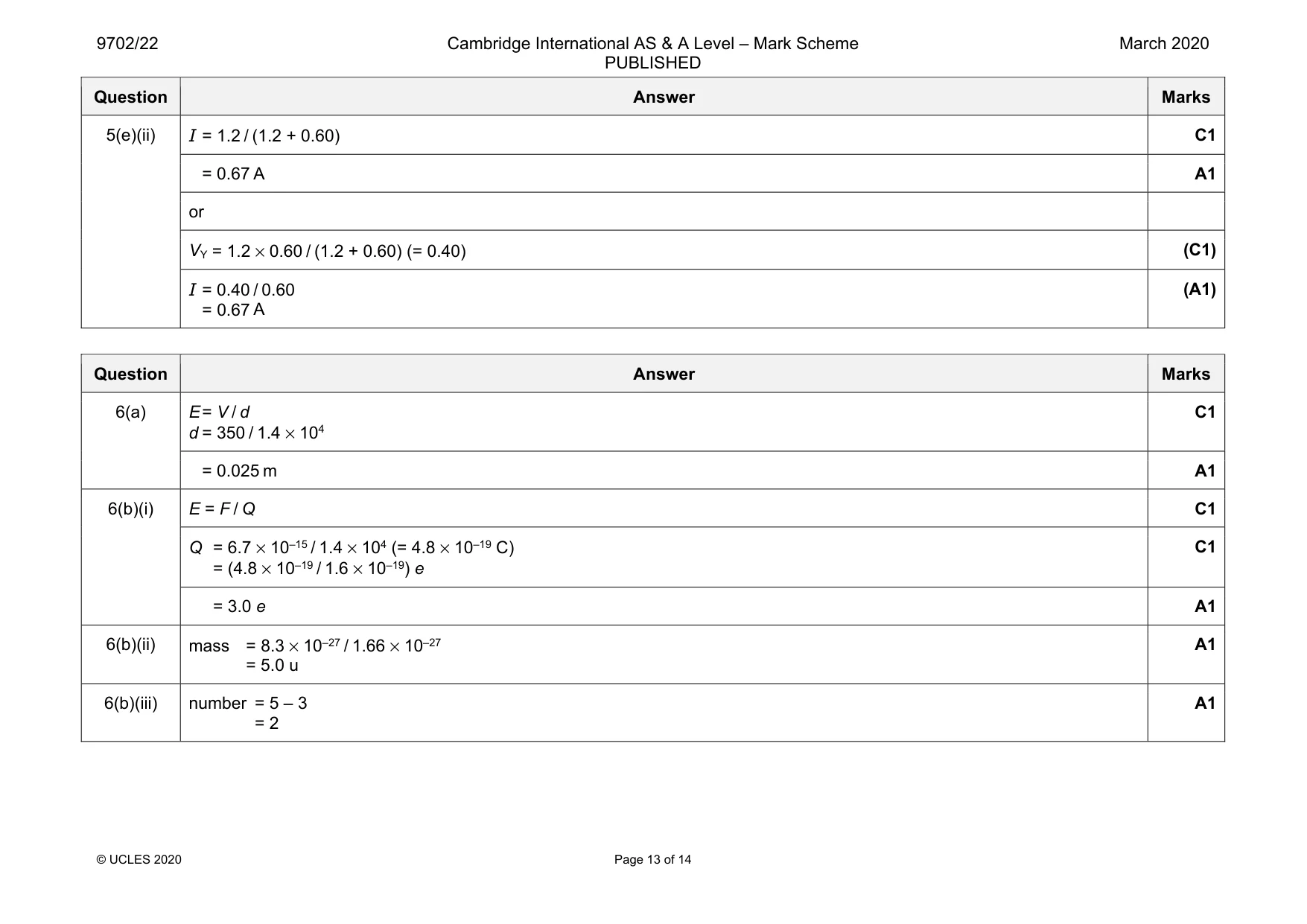
Mark scheme: 5(a) volt / ampere B1 5(b) R = ρ L / A C1 L = (1.8 × 0.38 × 10–6) / 9.6 × 10⁻⁷ C1 = 0.71 m A1 5(c)(i) thermal energy is dissipated in resistor Y B1 5(c)(ii) V / 1.2 = 1.8 / (1.8 + 0.6) C1 V = 0.90 V A1 or I = 1.2 / (1.8 + 0.6) (= 0.50) (C1) V = 0.50 × 1.8 = 0.90 V (A1) 5(d)(i) remain the same B1 5(d)(ii) decrease B1 5(e)(i) 1 / R = 1 / 1.8 + 1 / 3.6 R = 1.2 Ω A1 Question Answer Marks 5(e)(ii) I = 1.2 / (1.2 + 0.60) C1 = 0.67 A A1 or VY = 1.2 × 0.60 / (1.2 + 0.60) (= 0.40) (C1) I = 0.40 / 0.60 = 0.67 A (A1)
Q6 · A uniform electric field is produced between two parallel metal plates
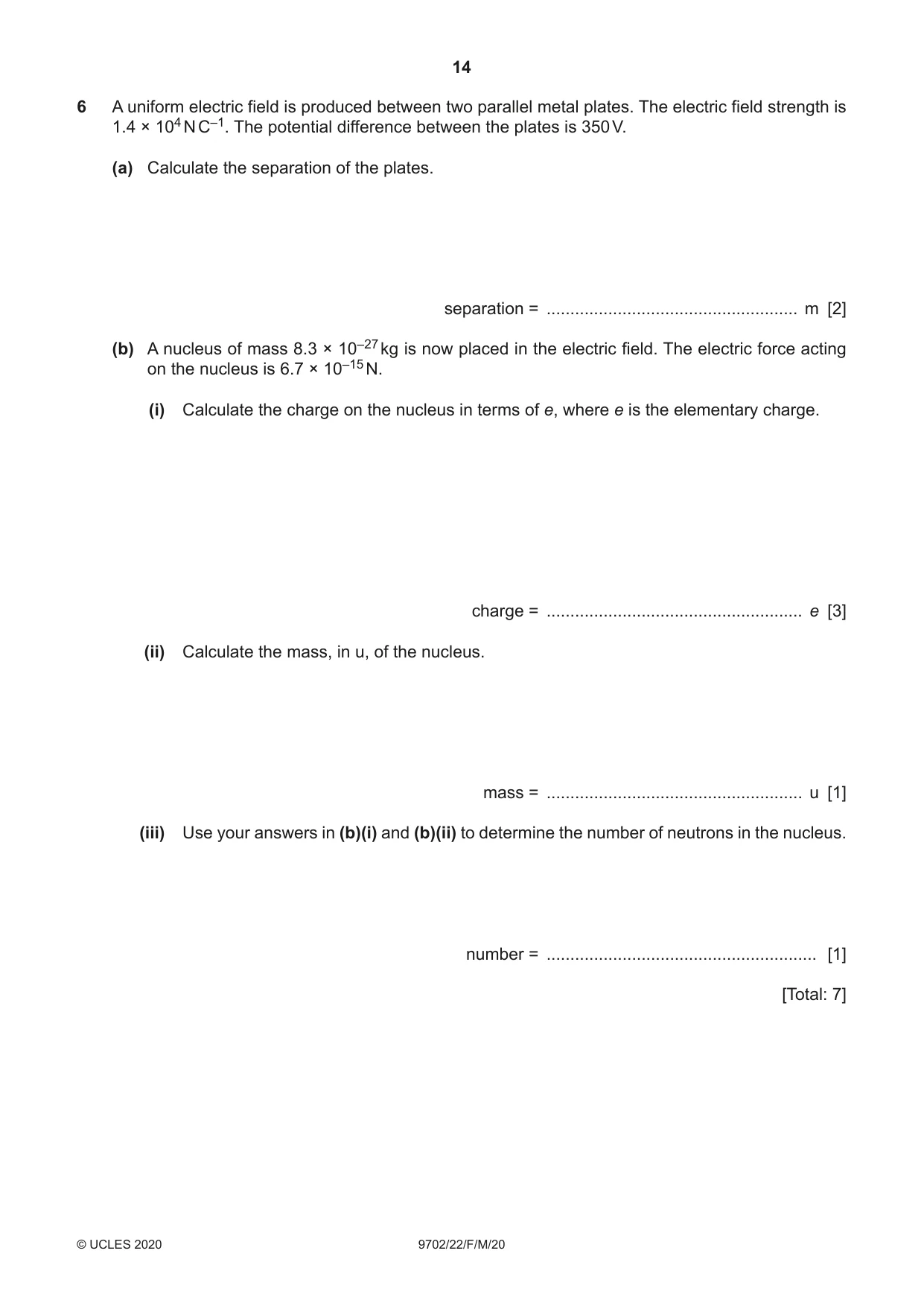
6 A uniform electric field is produced between two parallel metal plates. The electric field strength is 1.4 × 10⁴ N C–1. The potential difference between the plates is 350 V. (a) Calculate the separation of the plates. separation = ..................................................... m [2] (b) A nucleus of mass 8.3 × 10⁻²⁷ kg is now placed in the electric field. The electric force acting on the nucleus is 6.7 × 10⁻¹⁵ N. (i) Calculate the charge on the nucleus in terms of e, where e is the elementary charge. charge = ...................................................... e [3] (ii) Calculate the mass, in u, of the nucleus. mass = ...................................................... u [1] (iii) Use your answers in (b)(i) and (b)(ii) to determine the number of neutrons in the nucleus. number = ......................................................... [1] [Total: 7]
Mark scheme: 6(a) E = V / d d = 350 / 1.4 × 10⁴ C1 = 0.025 m A1 6(b)(i) E = F / Q C1 Q = 6.7 × 10⁻¹⁵ / 1.4 × 10⁴ (= 4.8 × 10⁻¹⁹ C) = (4.8 × 10⁻¹⁹ / 1.6 × 10⁻¹⁹) e C1 = 3.0 e A1 6(b)(ii) mass = 8.3 × 10⁻²⁷ / 1.66 × 10–27 = 5.0 u A1 6(b)(iii) number = 5 – 3 = 2 A1
Q7 · State and explain whether a neutron is a fundamental particle
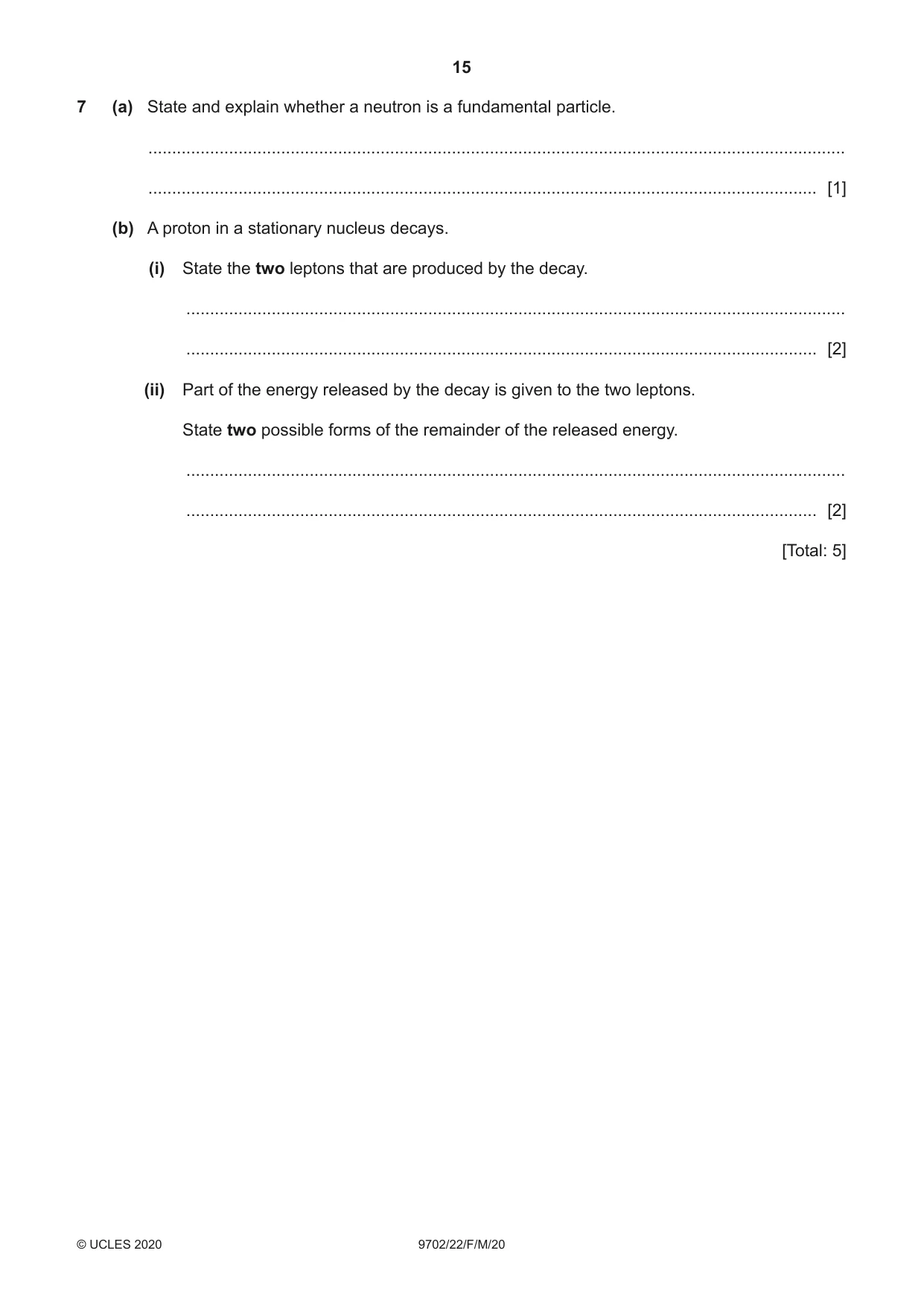
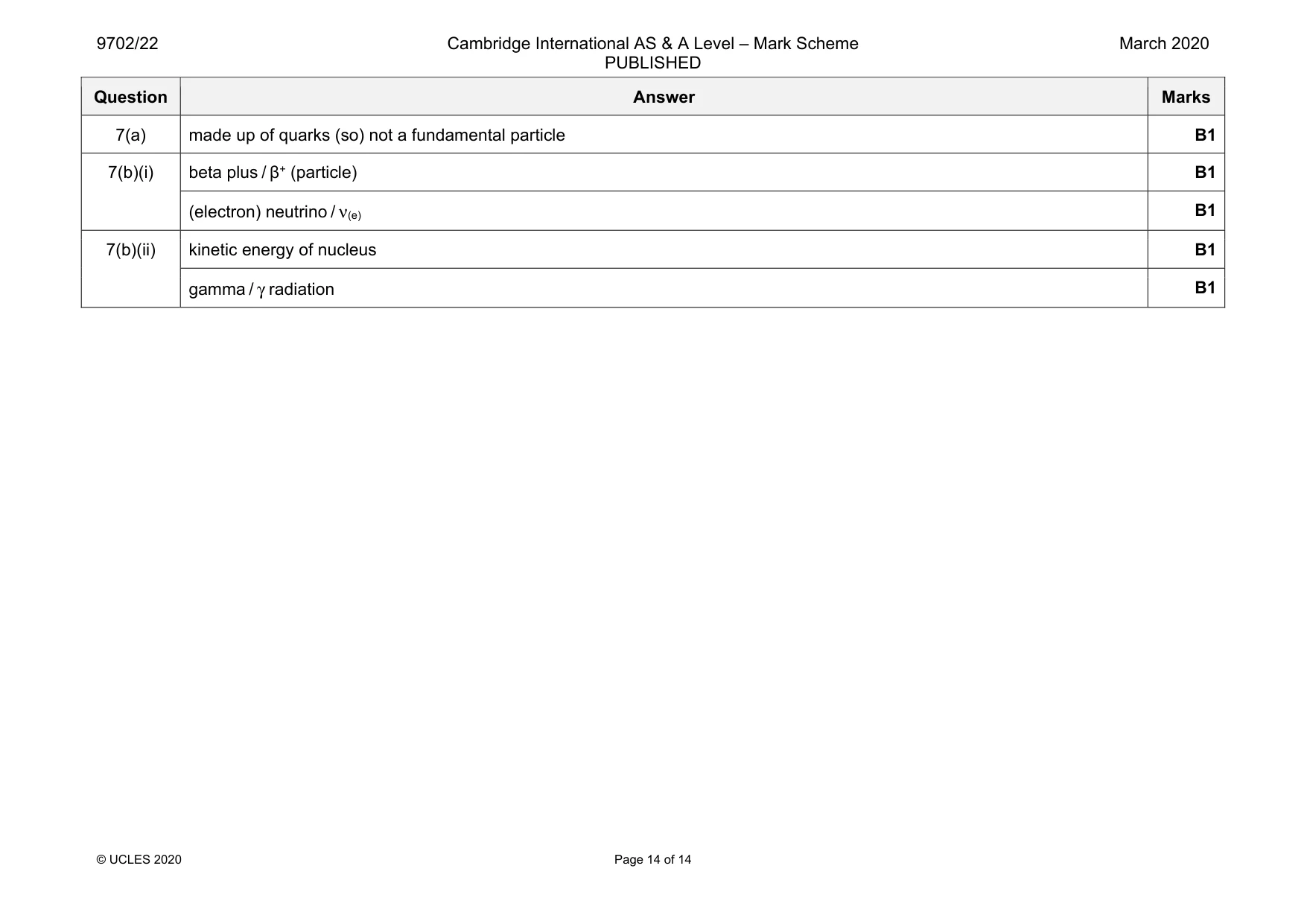
7 (a) State and explain whether a neutron is a fundamental particle. ................................................................................................................................................... ............................................................................................................................................. [1] (b) A proton in a stationary nucleus decays. (i) State the two leptons that are produced by the decay. ........................................................................................................................................... ..................................................................................................................................... [2] (ii) Part of the energy released by the decay is given to the two leptons. State two possible forms of the remainder of the released energy. ........................................................................................................................................... ..................................................................................................................................... [2] [Total: 5]
Mark scheme: 7(a) made up of quarks (so) not a fundamental particle B1 7(b)(i) beta plus / β+ (particle) B1 (electron) neutrino / ν(e) B1 7(b)(ii) kinetic energy of nucleus B1 gamma / γ radiation B1
What was in this paper
The subtopics covered by these 7 questions, and how many questions each got. Open one in a new tab to see every Cambridge question on it.
What you needed in this session
Cambridge’s own grade thresholds for 2020 Feb/March, Paper 2 · Variant 2. A higher threshold means an easier paper — the bar moves with how the cohort did.