Cambridge A Level Physics 9702 — 2017 Oct/Nov Paper 2 · Variant 1
9702/21/O/N/17 · 8 questions · 60 marks · ≈68 min
The question paper and its mark scheme, free to read here and free to download. This is Cambridge’s own paper, exactly as it was sat.
Question paper16 pages

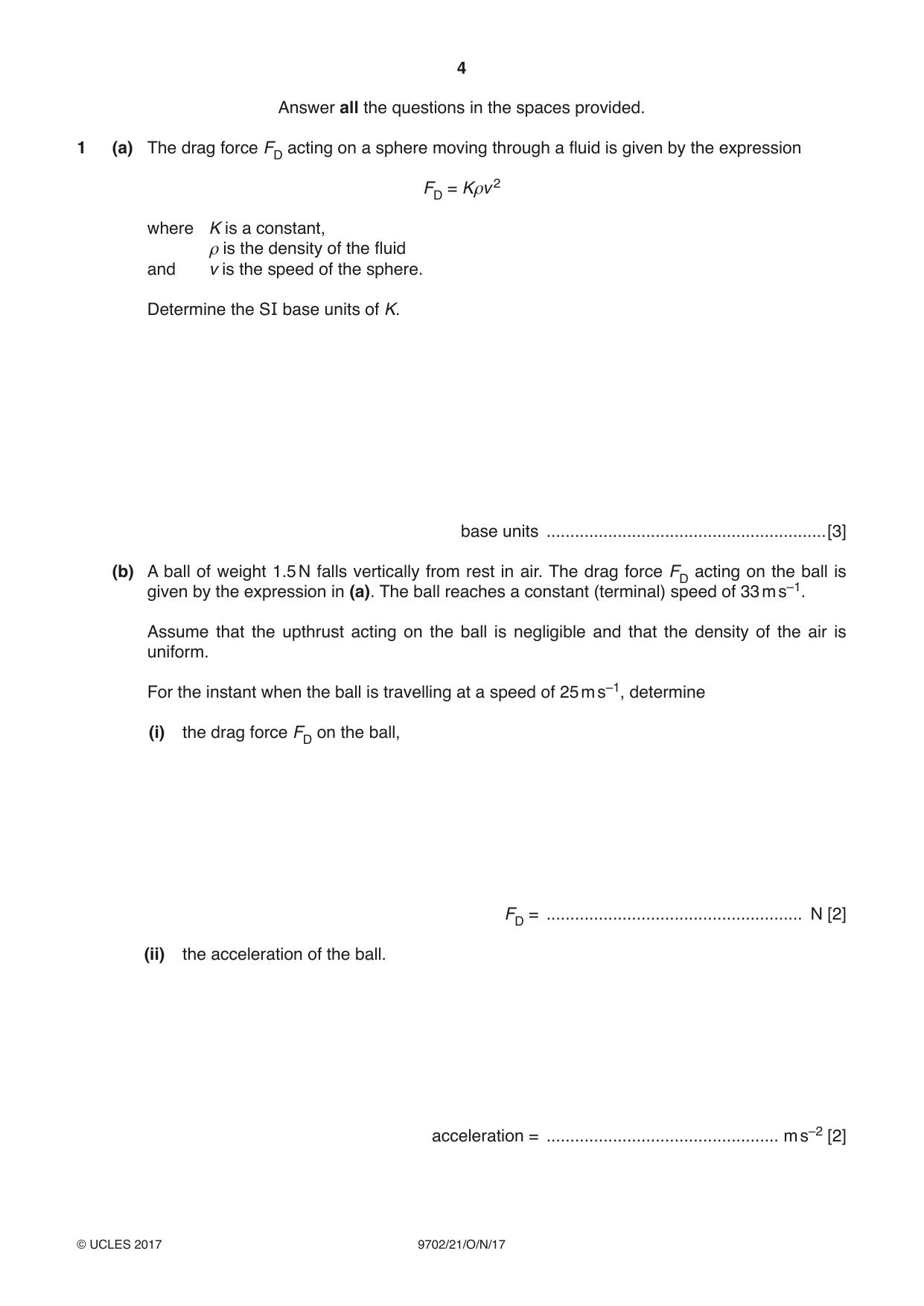
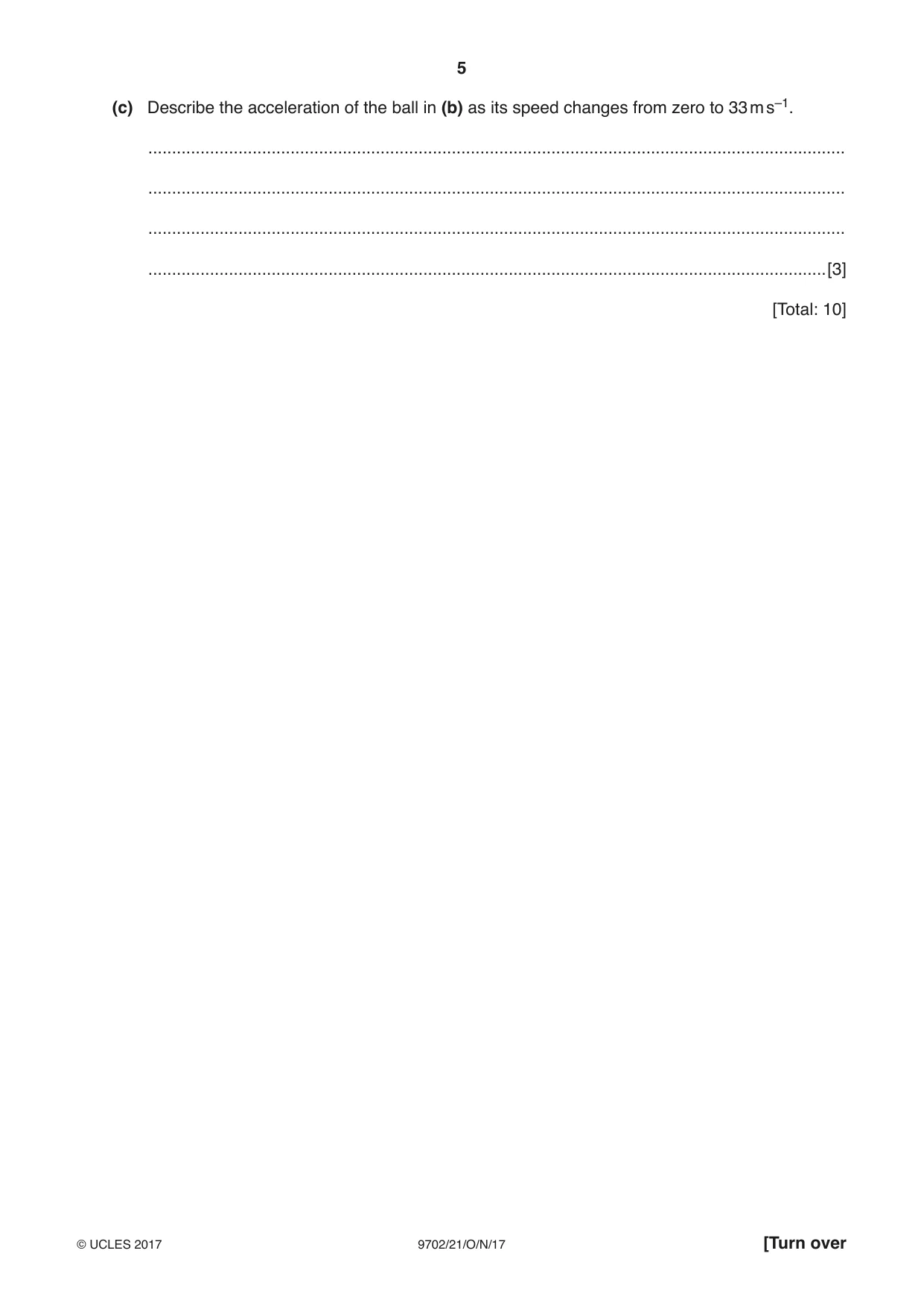
Mark scheme8 pages
Answers below. Sit the paper first if you are practising.
Questions as text
Q1 · The drag force FD acting on a sphere moving through a fluid is given by the expression FD…
1 (a) The drag force FD acting on a sphere moving through a fluid is given by the expression FD = Kρv 2 where K is a constant, ρ is the density of the fluid and v is the speed of the sphere. Determine the SI base units of K. base units ...........................................................[3] (b) A ball of weight 1.5 N falls vertically from rest in air. The drag force F D acting on the ball is given by the expression in (a). The ball reaches a constant (terminal) speed of 33 m s–1. Assume that the upthrust acting on the ball is negligible and that the density of the air is uniform. For the instant when the ball is travelling at a speed of 25 m s–1, determine (i) the drag force FD on the ball, FD = ...................................................... N [2] (ii) the acceleration of the ball. acceleration = ................................................. m s–2 [2] (c) Describe the acceleration of the ball in (b) as its speed changes from zero to 33 m s–1. ................................................................................................................................................... ................................................................................................................................................... ................................................................................................................................................... ...............................................................................................................................................[3] [Total: 10]
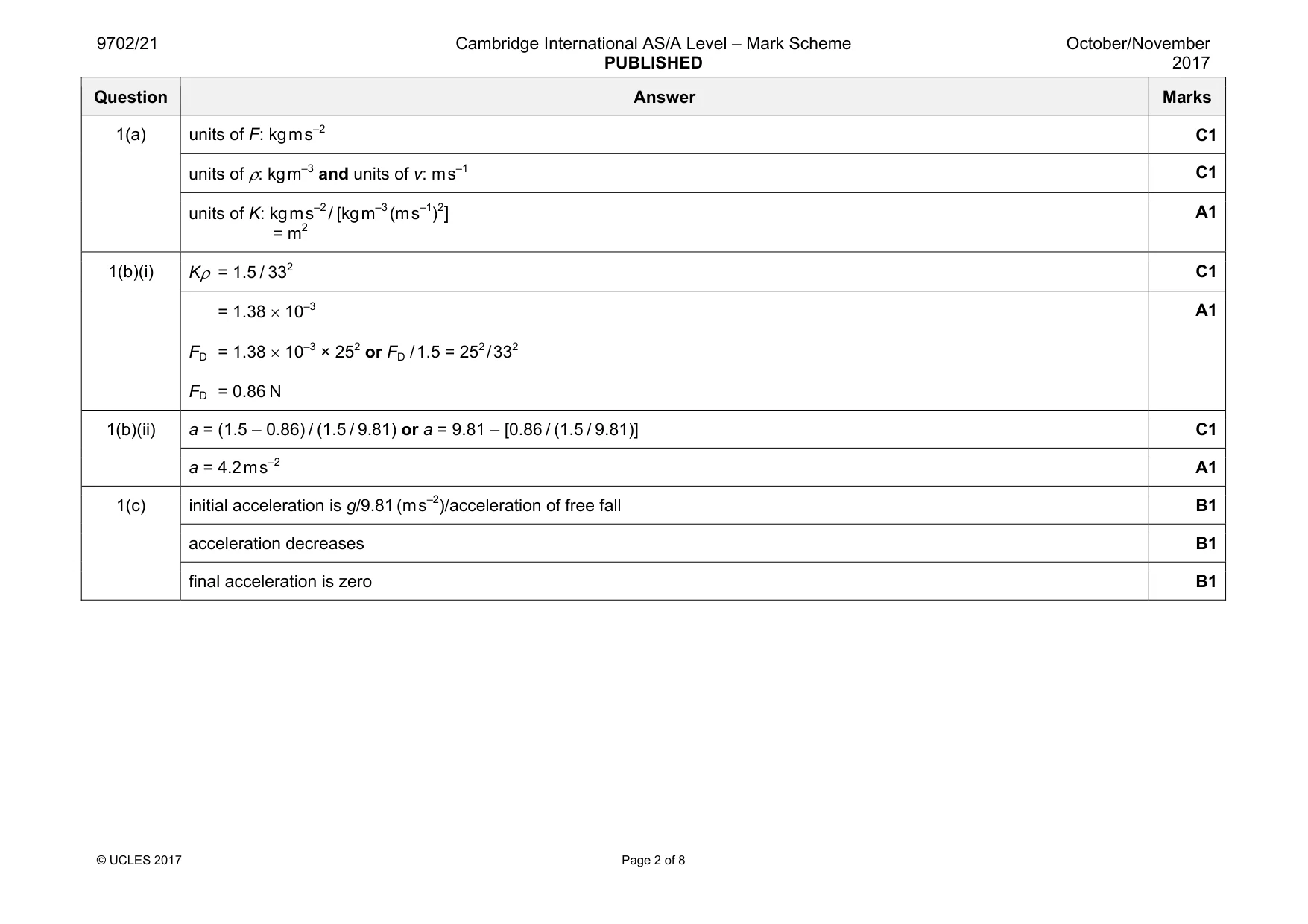
Mark scheme: 1(a) C1 units of ρ: kg m–3 and units of v: m s–1 C1 units of K: kg m s–2 / [kg m–3 (m s–1)2] = m2 A1 1(b)(i) Kρ = 1.5 / 332 C1 = 1.38 × 10⁻³ FD = 1.38 × 10–3 × 252 or FD / 1.5 = 252 / 332 FD = 0.86 N A1 1(b)(ii) a = (1.5 – 0.86) / (1.5 / 9.81) or a = 9.81 – [0.86 / (1.5 / 9.81)] C1 a = 4.2 m s–2 A1 1(c) initial acceleration is g/9.81 (m s–2)/acceleration of free fall B1 acceleration decreases B1 final acceleration is zero B1
Q2 · The variation with time t of the velocity v of two cars P and Q is shown in Fig
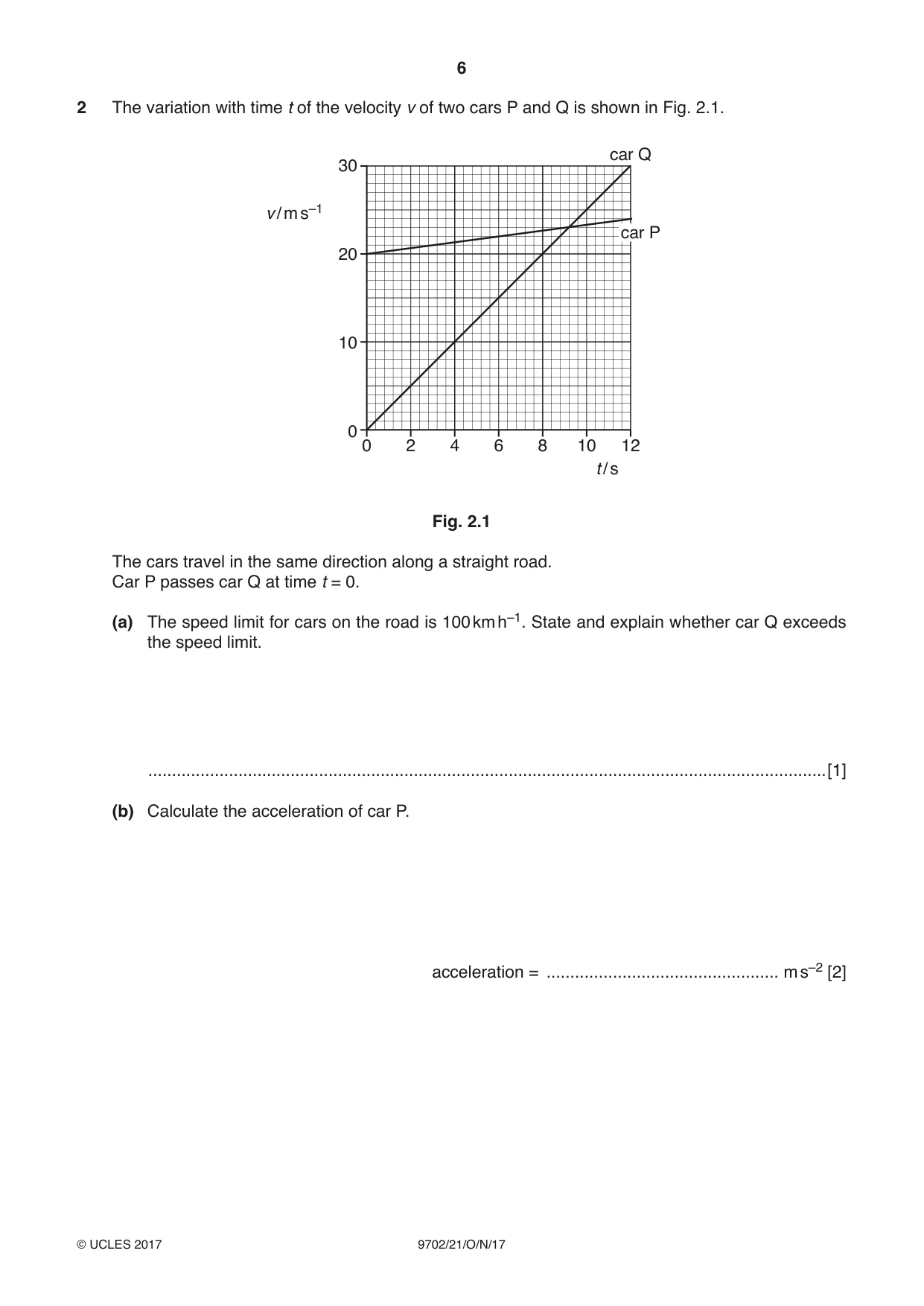
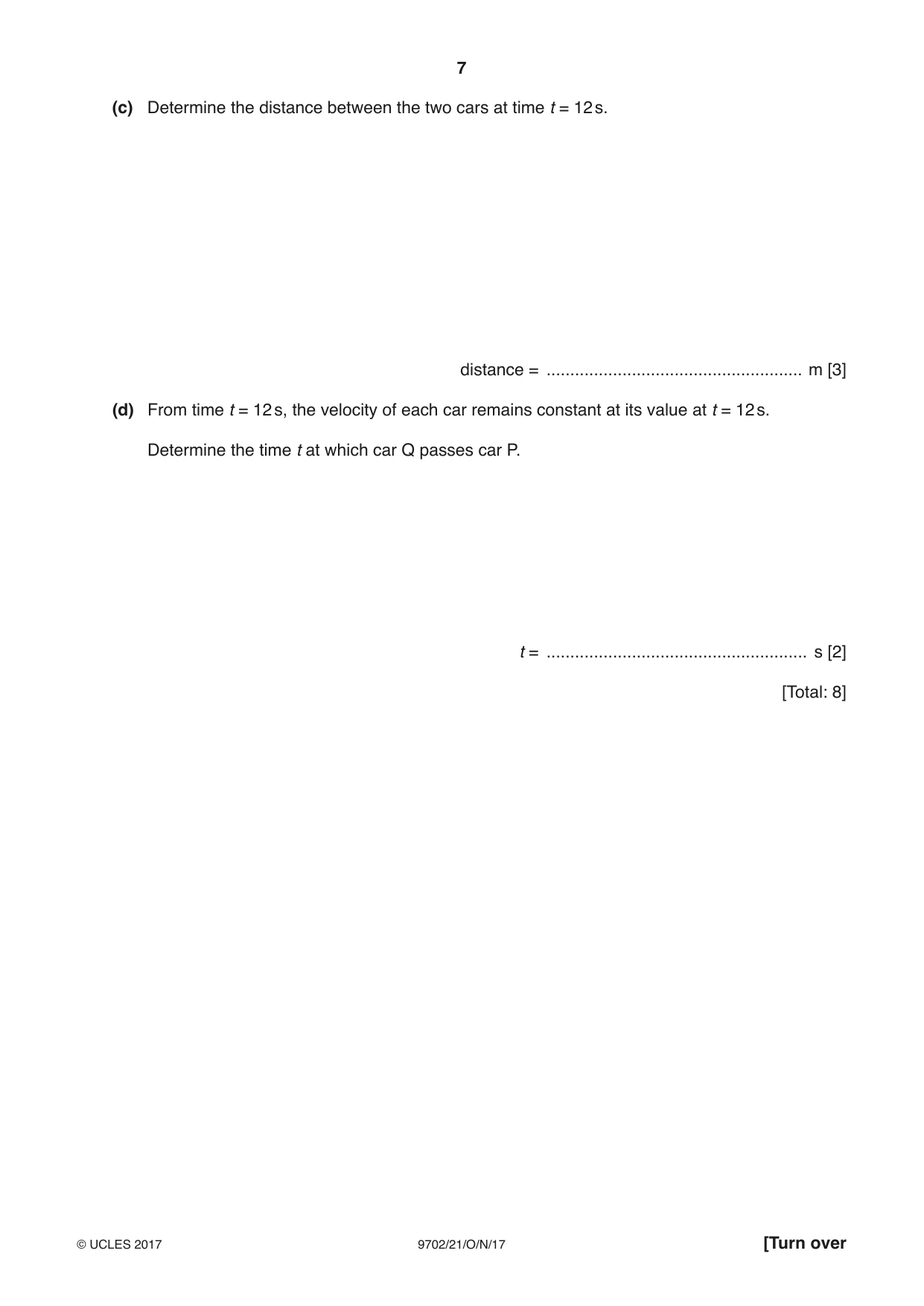
2 The variation with time t of the velocity v of two cars P and Q is shown in Fig. 2.1. car Q 30 v / m s–1 car P 20 10 0 0 2 4 6 8 10 12 t / s Fig. 2.1 The cars travel in the same direction along a straight road. Car P passes car Q at time t = 0. (a) The speed limit for cars on the road is 100 km h–1. State and explain whether car Q exceeds the speed limit. ...............................................................................................................................................[1] (b) Calculate the acceleration of car P. acceleration = ................................................. m s–2 [2] (c) Determine the distance between the two cars at time t = 12 s. distance = ...................................................... m [3] (d) From time t = 12 s, the velocity of each car remains constant at its value at t = 12 s. Determine the time t at which car Q passes car P. t = ....................................................... s [2] [Total: 8]
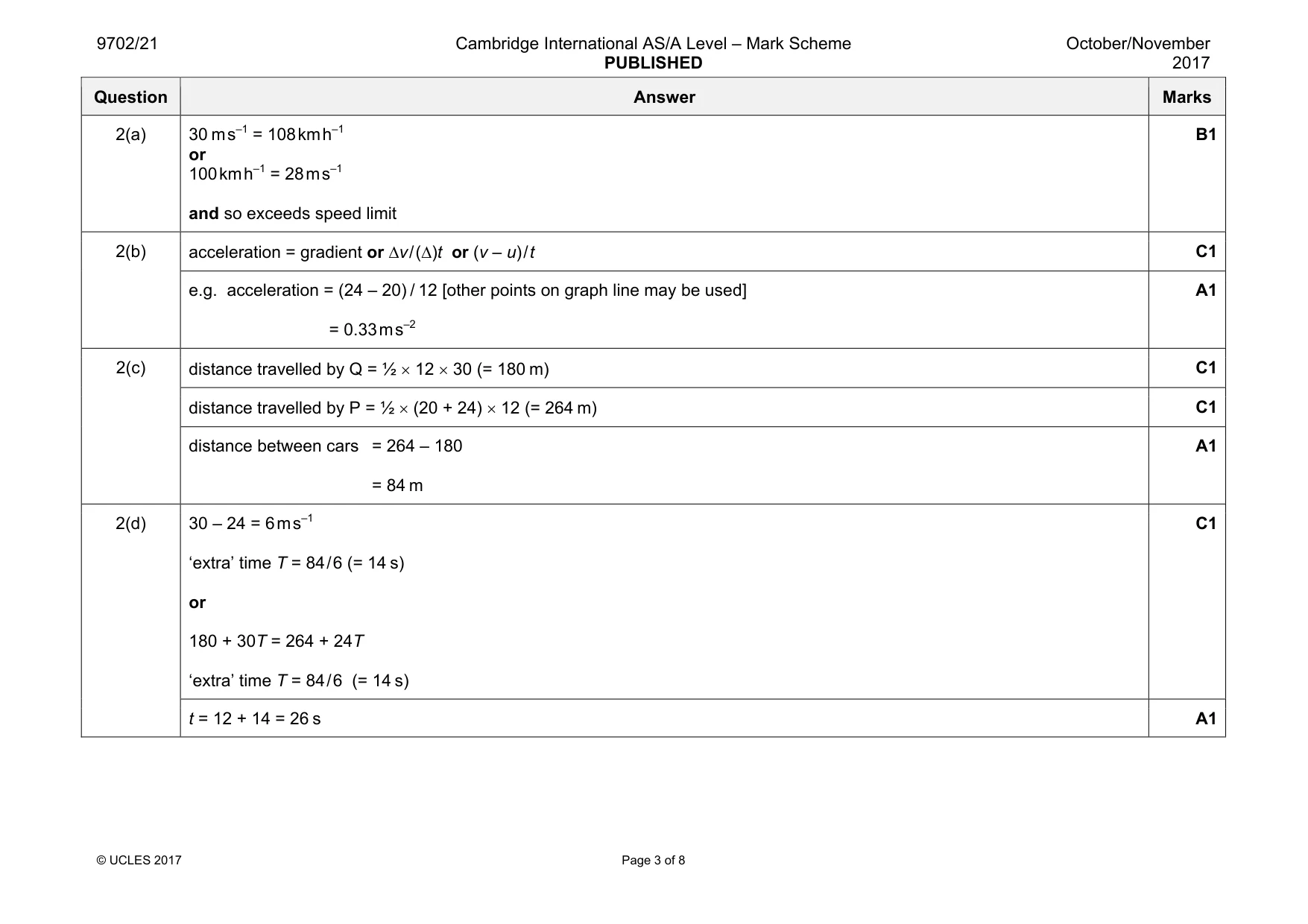
Mark scheme: 2(a) or 100 km h–1 = 28 m s–1 and so exceeds speed limit B1 2(b) acceleration = gradient or ∆v / (∆)t or (v – u) / t C1 e.g. acceleration = (24 – 20) / 12 [other points on graph line may be used] = 0.33 m s–2 A1 2(c) distance travelled by Q = ½ × 12 × 30 (= 180 m) C1 distance travelled by P = ½ × (20 + 24) × 12 (= 264 m) C1 distance between cars = 264 – 180 = 84 m A1 2(d) 30 – 24 = 6 m s–1 ‘extra’ time T = 84 / 6 (= 14 s) or 180 + 30T = 264 + 24T ‘extra’ time T = 84 / 6 (= 14 s) C1 t = 12 + 14 = 26 s A1
Q3 · State the difference between a stationary wave and a progressive wave in terms of (i) the…
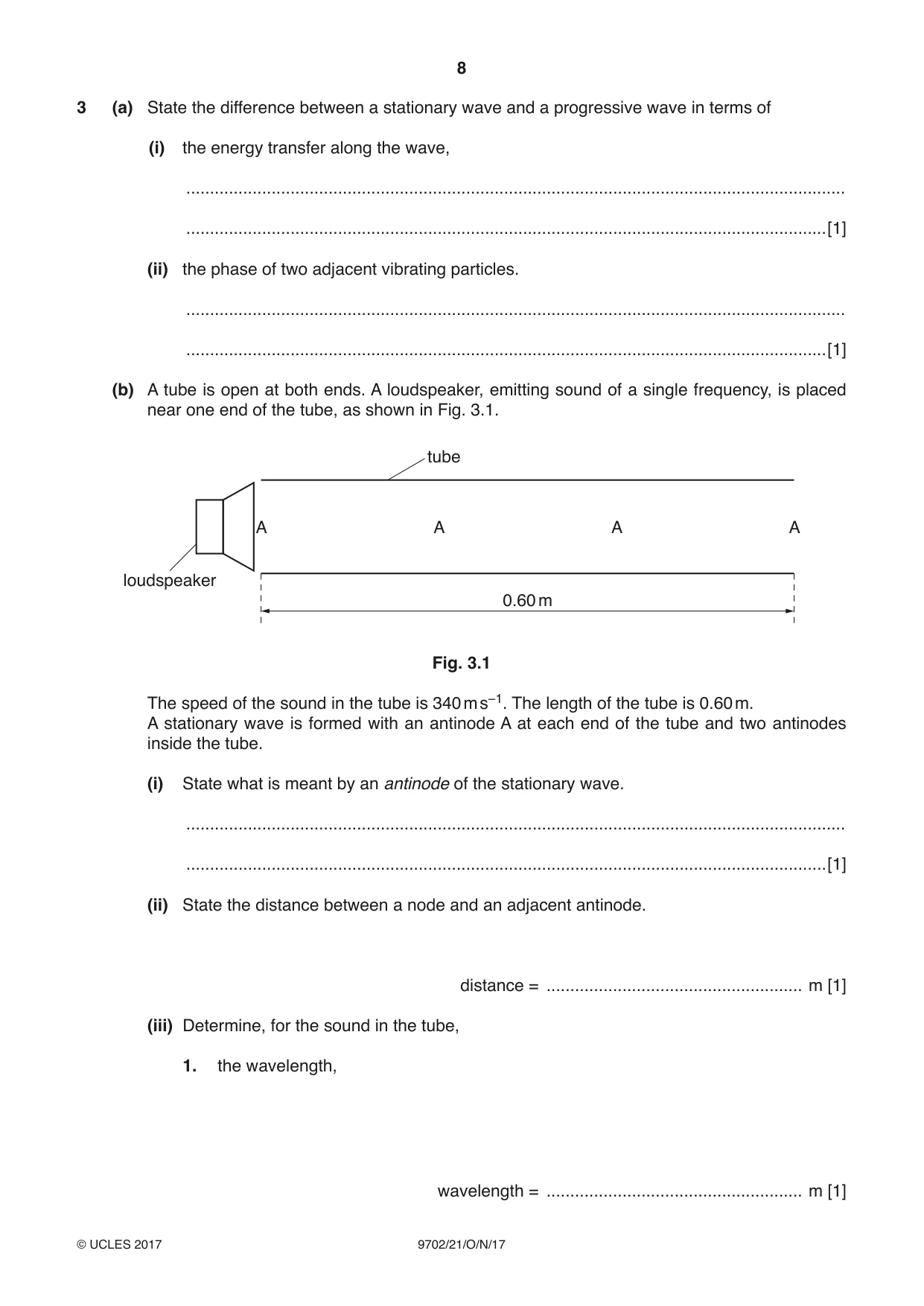
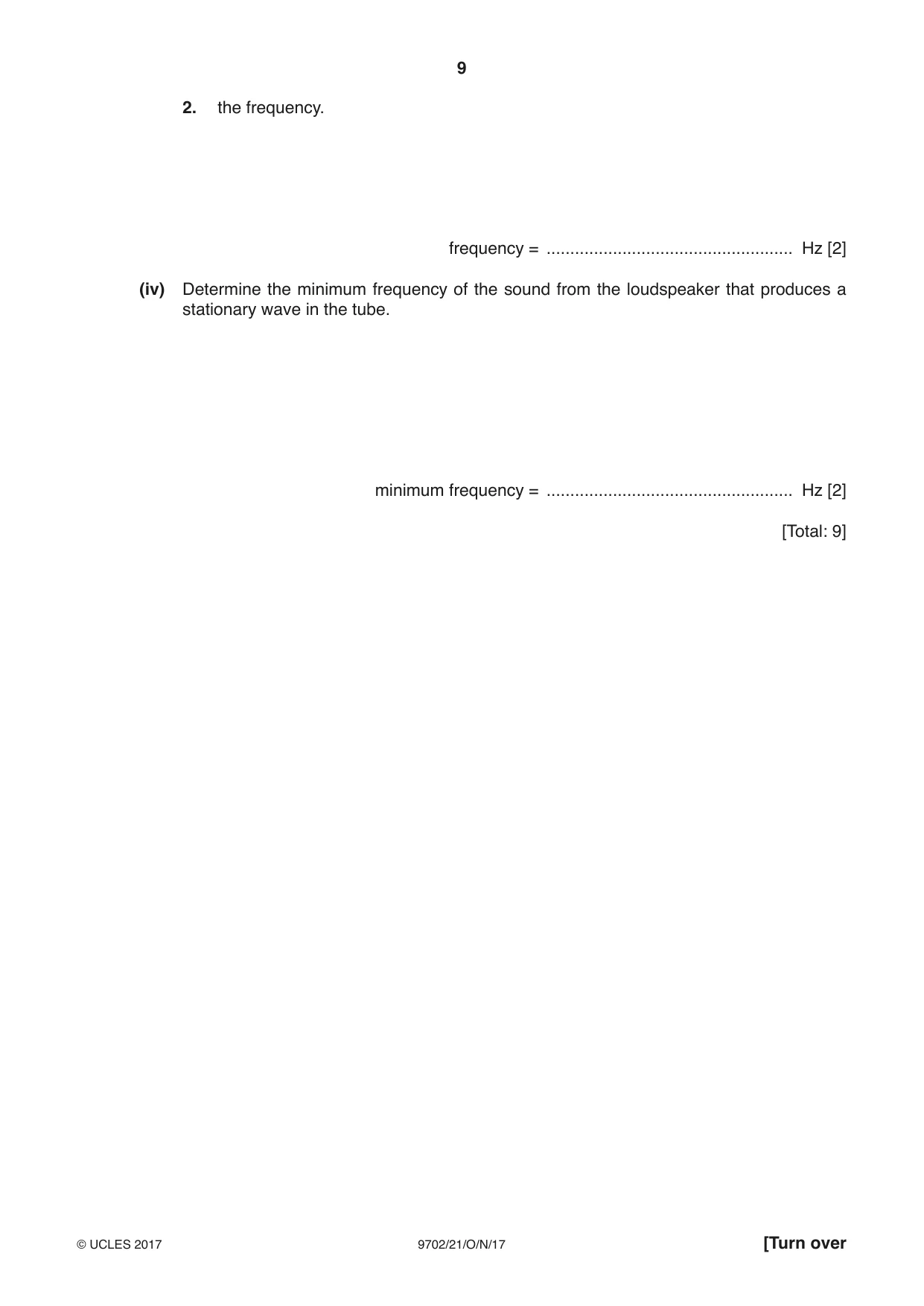
3 (a) State the difference between a stationary wave and a progressive wave in terms of (i) the energy transfer along the wave, ........................................................................................................................................... .......................................................................................................................................[1] (ii) the phase of two adjacent vibrating particles. ........................................................................................................................................... .......................................................................................................................................[1] (b) A tube is open at both ends. A loudspeaker, emitting sound of a single frequency, is placed near one end of the tube, as shown in Fig. 3.1. tube A A A A loudspeaker 0.60 m Fig. 3.1 The speed of the sound in the tube is 340 m s–1. The length of the tube is 0.60 m. A stationary wave is formed with an antinode A at each end of the tube and two antinodes inside the tube. (i) State what is meant by an antinode of the stationary wave. ........................................................................................................................................... .......................................................................................................................................[1] (ii) State the distance between a node and an adjacent antinode. distance = ...................................................... m [1] (iii) Determine, for the sound in the tube, 1. the wavelength, wavelength = ...................................................... m [1] 2. the frequency. frequency = .................................................... Hz [2] (iv) Determine the minimum frequency of the sound from the loudspeaker that produces a stationary wave in the tube. minimum frequency = .................................................... Hz [2] [Total: 9]
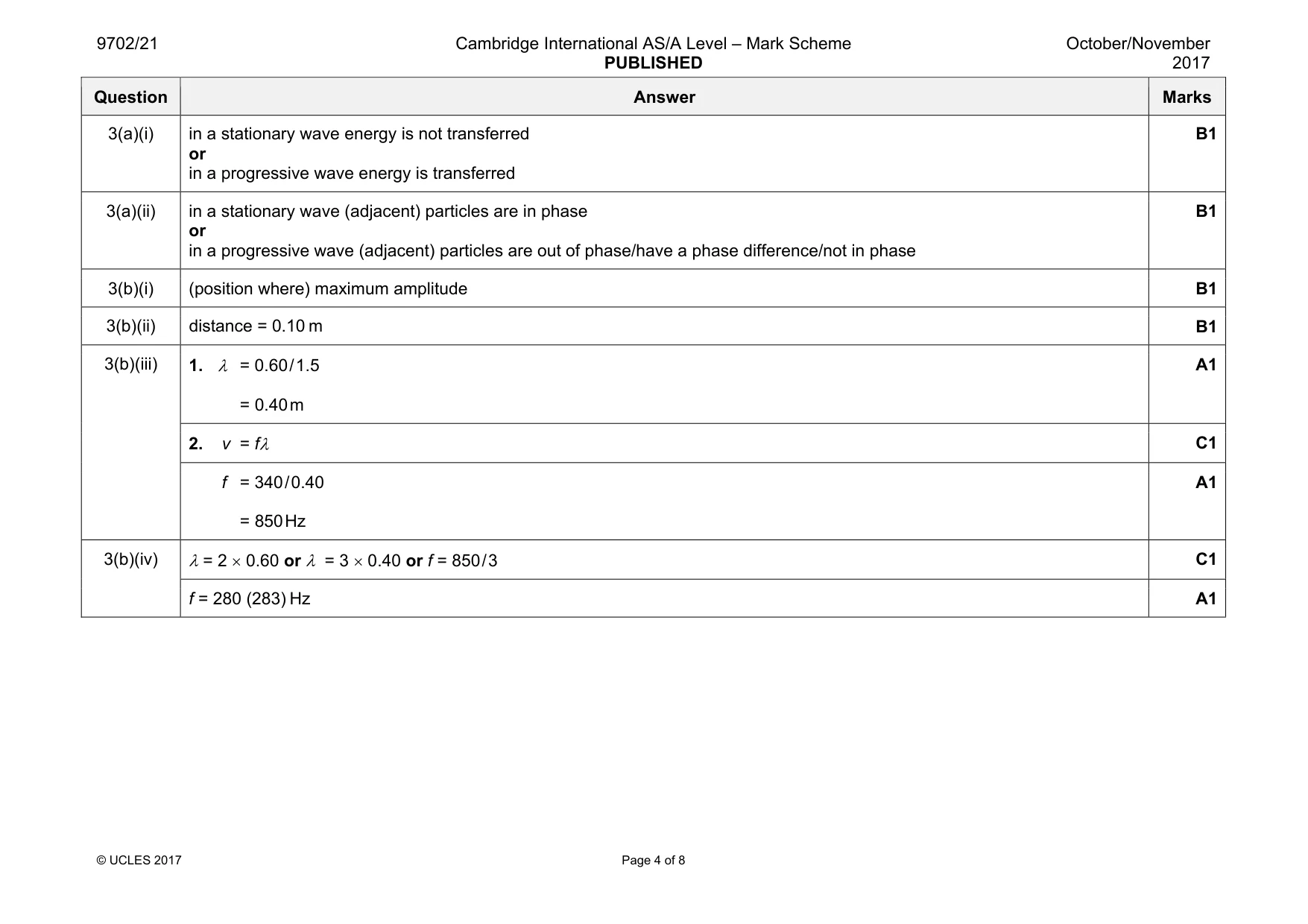
Mark scheme: 3(a)(i) in a stationary wave energy is not transferred or in a progressive wave energy is transferred B1 3(a)(ii) in a stationary wave (adjacent) particles are in phase or in a progressive wave (adjacent) particles are out of phase/have a phase difference/not in phase B1 3(b)(i) (position where) maximum amplitude B1 3(b)(ii) distance = 0.10 m B1 3(b)(iii) 1. λ = 0.60 / 1.5 = 0.40 m A1 2. v = fλ C1 f = 340 / 0.40 = 850 Hz A1 3(b)(iv) λ = 2 × 0.60 or λ = 3 × 0.40 or f = 850 / 3 C1 f = 280 (283) Hz A1
Question 4
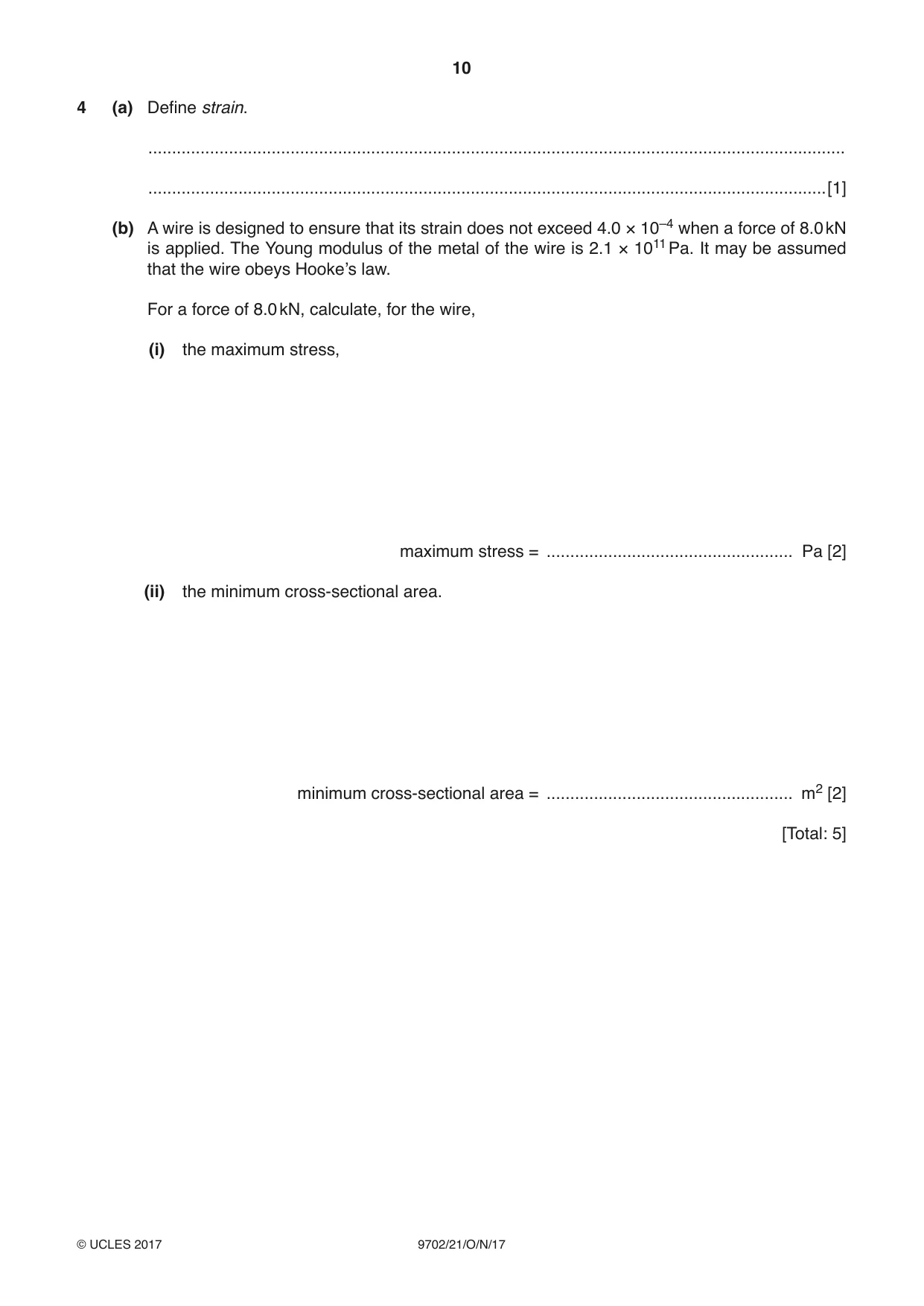
4 (a) Define strain. ................................................................................................................................................... ...............................................................................................................................................[1] (b) A wire is designed to ensure that its strain does not exceed 4.0 × 10⁻⁴ when a force of 8.0 kN is applied. The Young modulus of the metal of the wire is 2.1 × 10¹¹ Pa. It may be assumed that the wire obeys Hooke’s law. For a force of 8.0 kN, calculate, for the wire, (i) the maximum stress, maximum stress = .................................................... Pa [2] (ii) the minimum cross-sectional area. minimum cross-sectional area = .................................................... m2 [2] [Total: 5]
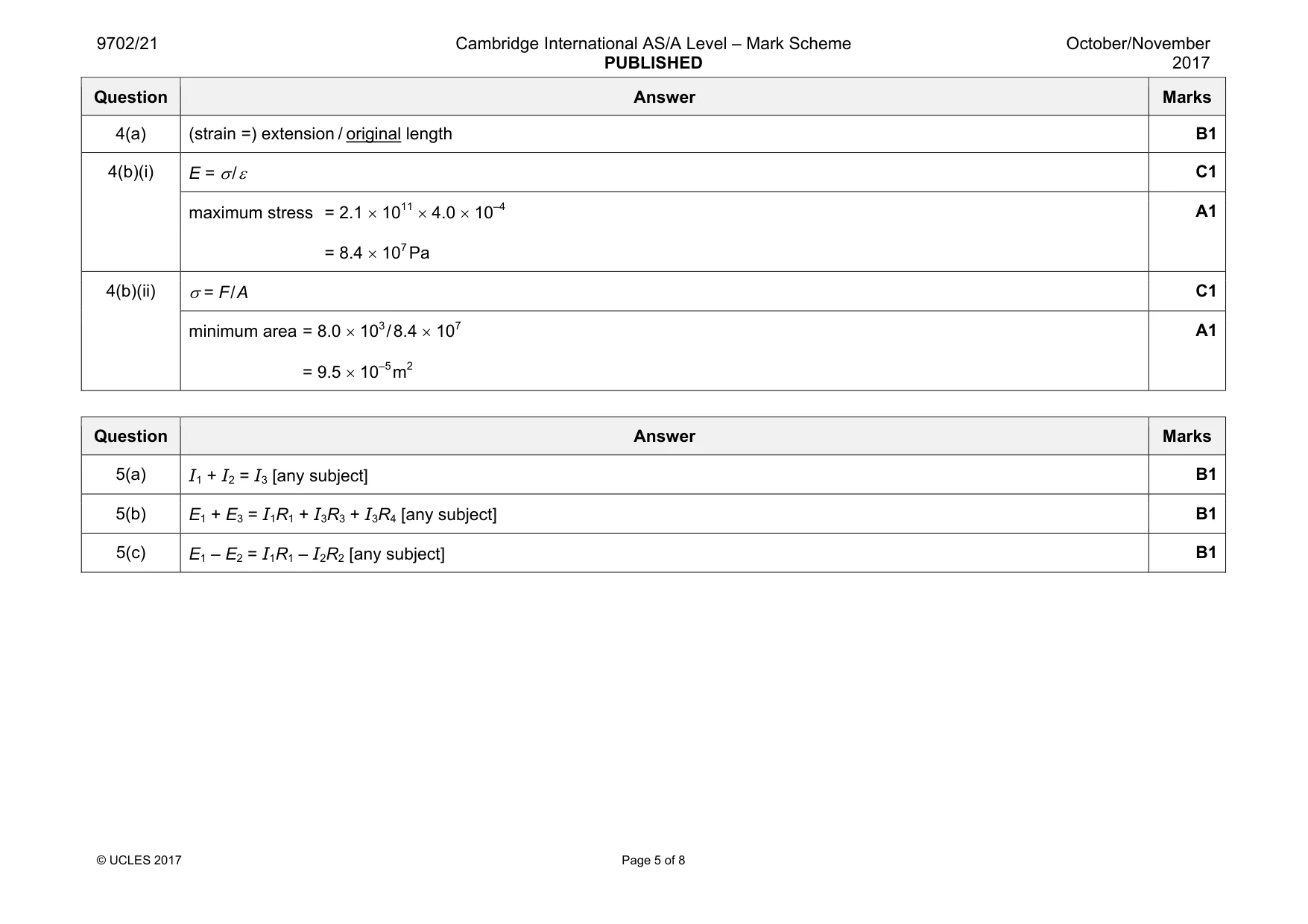
Mark scheme: 4(a) (strain =) extension / original length B1 4(b)(i) E = σ / ε C1 maximum stress = 2.1 × 1011 × 4.0 × 10–4 = 8.4 × 10⁷ Pa A1 4(b)(ii) σ = F / A C1 minimum area = 8.0 × 10³ / 8.4 × 107 = 9.5 × 10⁻⁵ m2 A1
Q5 · Three cells of electromotive forces (e.m.f.) E1, E2 and E3 are connected into a circuit…
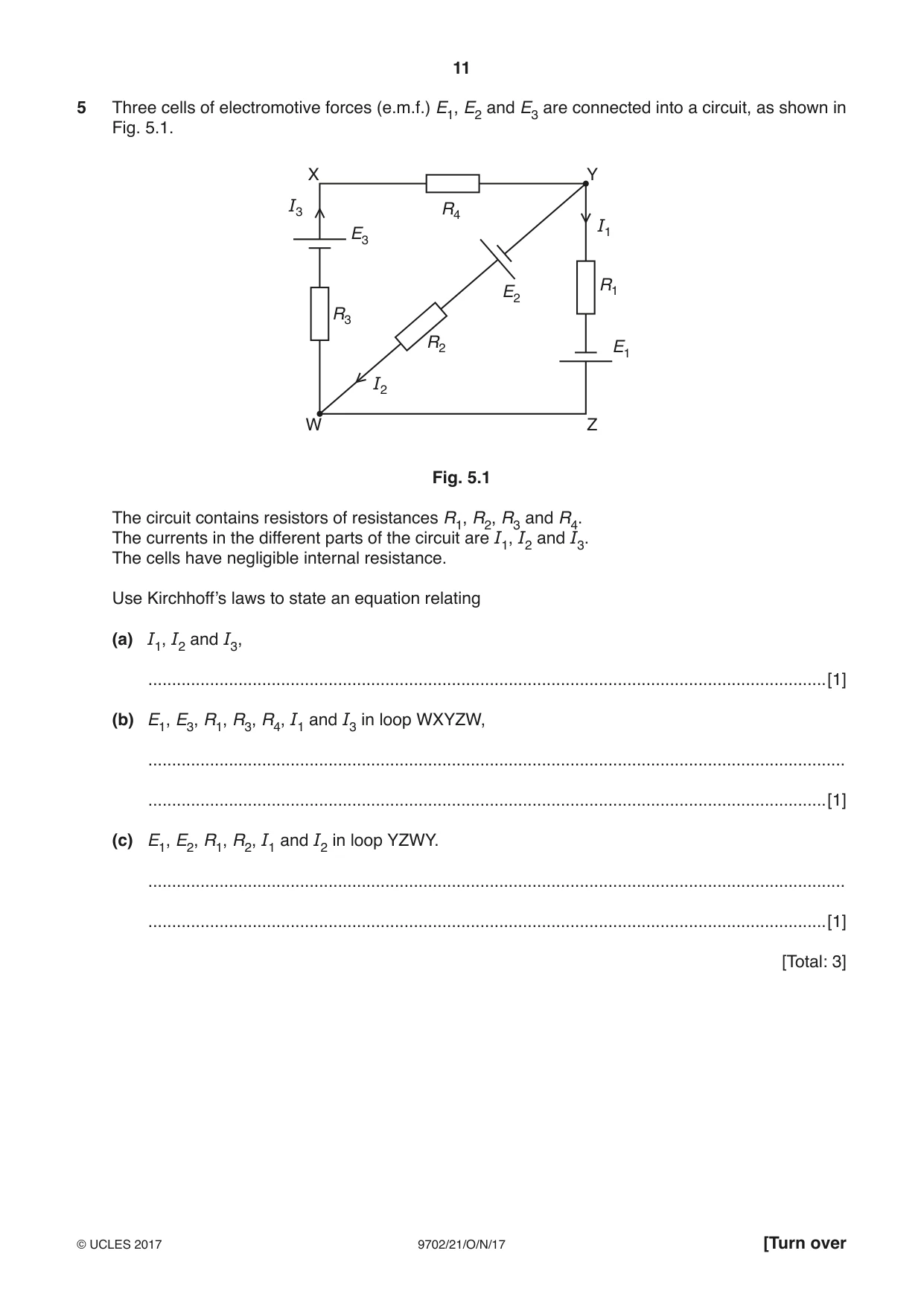
5 Three cells of electromotive forces (e.m.f.) E1, E2 and E3 are connected into a circuit, as shown in Fig. 5.1. X Y I3 R4 I1 E3 R1 E2 R3 R2 E1 I2 W Z Fig. 5.1 The circuit contains resistors of resistances R1, R2, R3 and R4. The currents in the different parts of the circuit are I1, I2 and I3. The cells have negligible internal resistance. Use Kirchhoff’s laws to state an equation relating (a) I1, I2 and I3, ...............................................................................................................................................[1] (b) E1, E3, R1, R3, R4, I1 and I3 in loop WXYZW, ................................................................................................................................................... ...............................................................................................................................................[1] (c) E1, E2, R1, R2, I1 and I2 in loop YZWY. ................................................................................................................................................... ...............................................................................................................................................[1] [Total: 3]
Mark scheme: 5(a) B1 5(b) E1 + E3 = I1R1 + I3R3 + I3R4 [any subject] B1 5(c) E1 – E2 = I1R1 – I2R2 [any subject] B1
Q6 · Define electric field strength
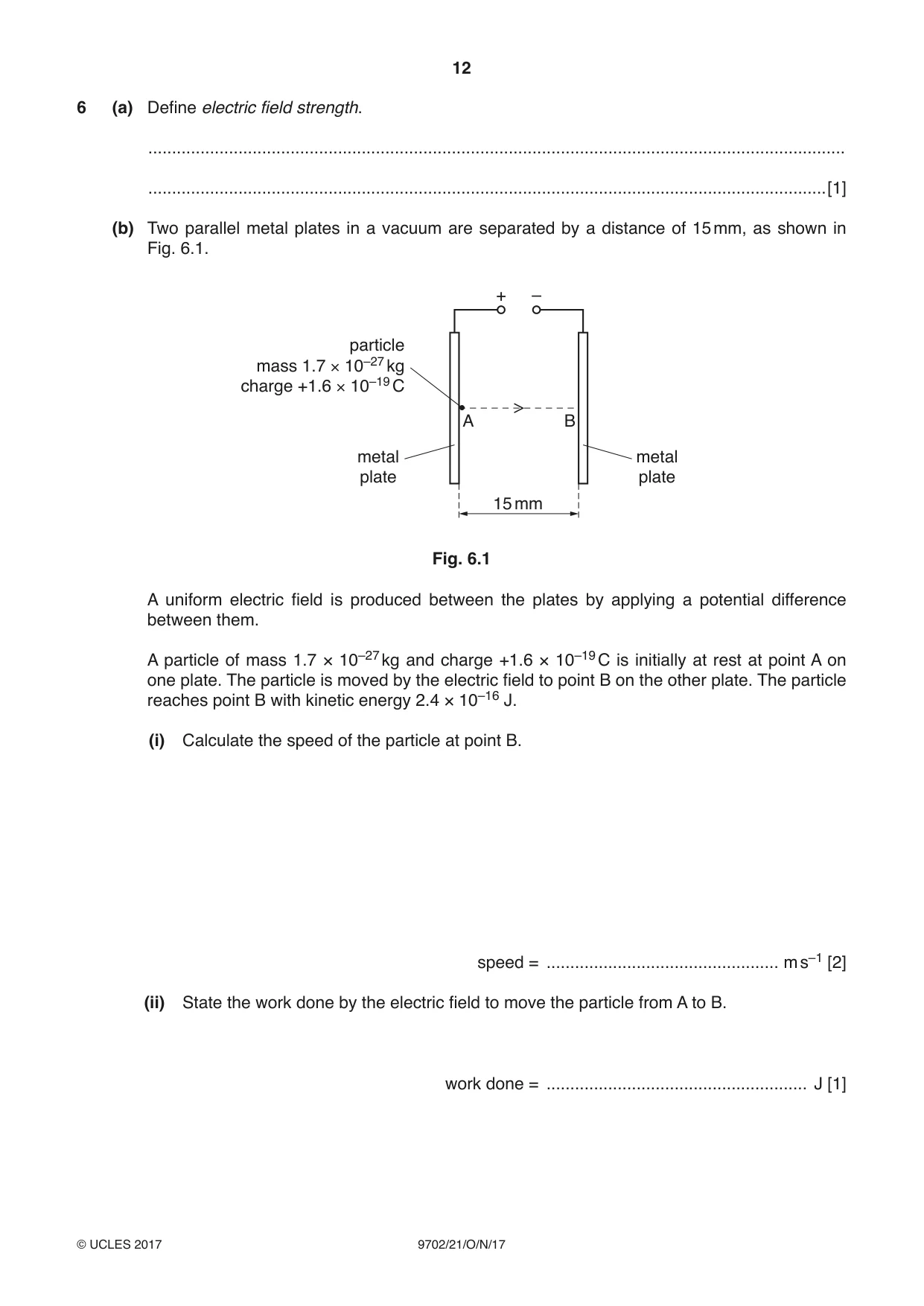
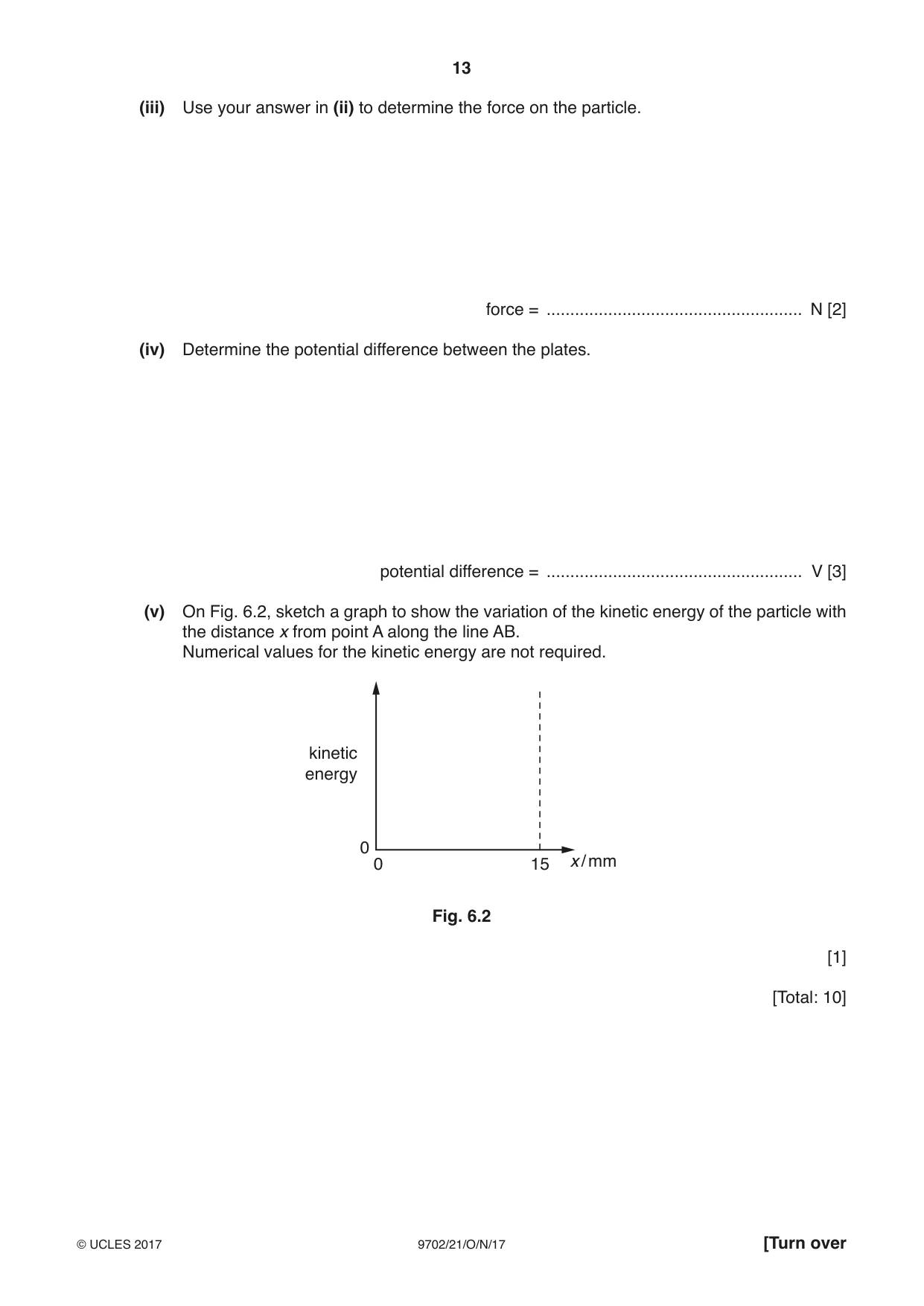
6 (a) Define electric field strength. ................................................................................................................................................... ...............................................................................................................................................[1] (b) Two parallel metal plates in a vacuum are separated by a distance of 15 mm, as shown in Fig. 6.1. + – particle mass 1.7 × 10⁻²⁷ kg charge +1.6 × 10⁻¹⁹ C A B metal metal plate plate 15 mm Fig. 6.1 A uniform electric field is produced between the plates by applying a potential difference between them. A particle of mass 1.7 × 10⁻²⁷ kg and charge +1.6 × 10⁻¹⁹ C is initially at rest at point A on one plate. The particle is moved by the electric field to point B on the other plate. The particle reaches point B with kinetic energy 2.4 × 10⁻¹⁶ J. (i) Calculate the speed of the particle at point B. speed = ................................................. m s–1 [2] (ii) State the work done by the electric field to move the particle from A to B. work done = ....................................................... J [1] (iii) Use your answer in (ii) to determine the force on the particle. force = ...................................................... N [2] (iv) Determine the potential difference between the plates. potential difference = ...................................................... V [3] (v) On Fig. 6.2, sketch a graph to show the variation of the kinetic energy of the particle with the distance x from point A along the line AB. Numerical values for the kinetic energy are not required. kinetic energy 0 0 15 x / mm Fig. 6.2 [1] [Total: 10]
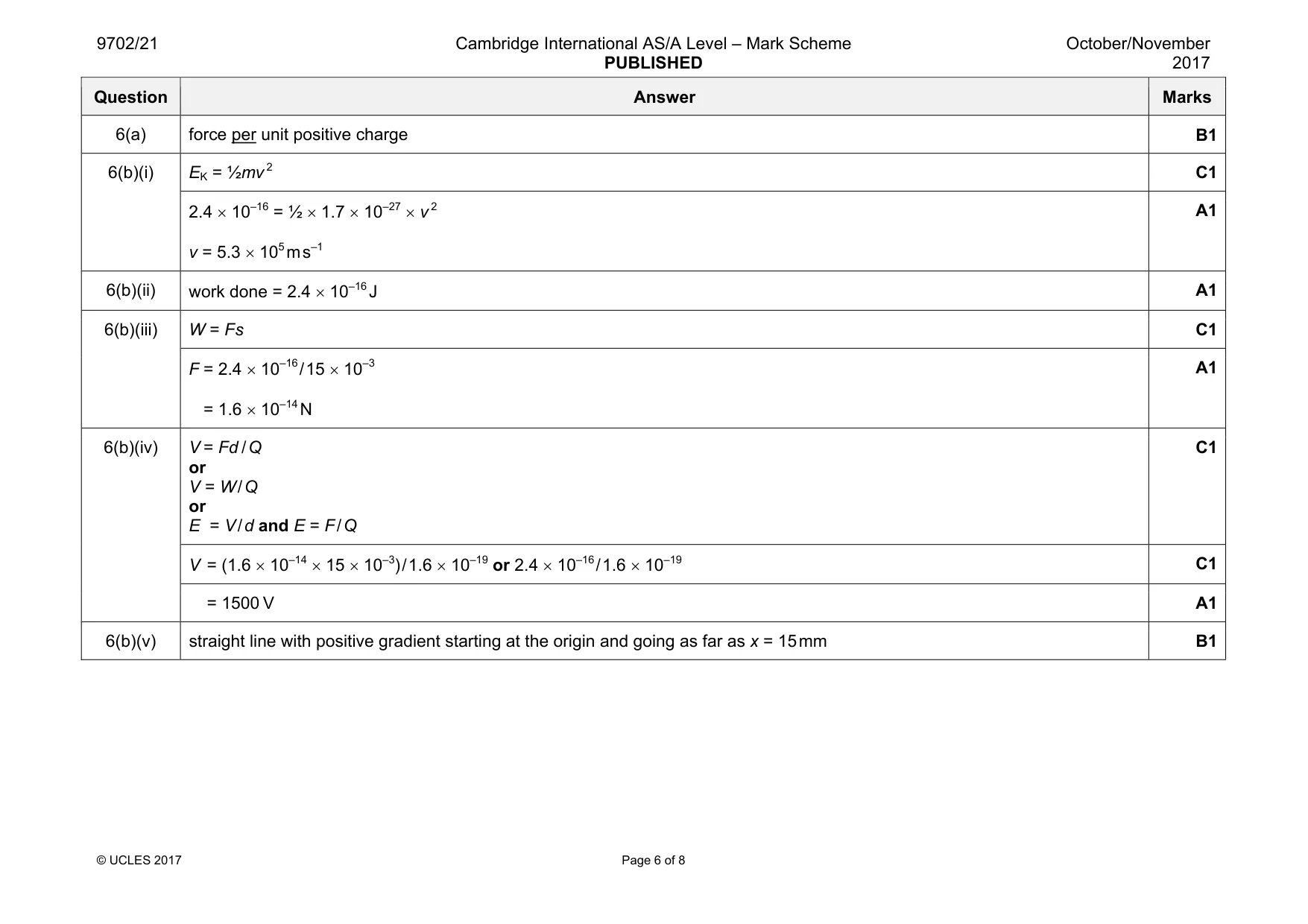
Mark scheme: 6(a) force per unit positive charge B1 6(b)(i) EK = ½mv 2 C1 2.4 × 10–16 = ½ × 1.7 × 10⁻²⁷ × v 2 v = 5.3 × 10⁵ m s–1 A1 6(b)(ii) work done = 2.4 × 10⁻¹⁶ J A1 6(b)(iii) W = Fs C1 F = 2.4 × 10⁻¹⁶ / 15 × 10–3 = 1.6 × 10⁻¹⁴ N A1 6(b)(iv) V = Fd / Q or V = W / Q or E = V / d and E = F / Q C1 V = (1.6 × 10–14 × 15 × 10–3) / 1.6 × 10⁻¹⁹ or 2.4 × 10⁻¹⁶ / 1.6 × 10⁻¹⁹ C1 = 1500 V A1 6(b)(v) straight line with positive gradient starting at the origin and going as far as x = 15 mm B1
Question 7
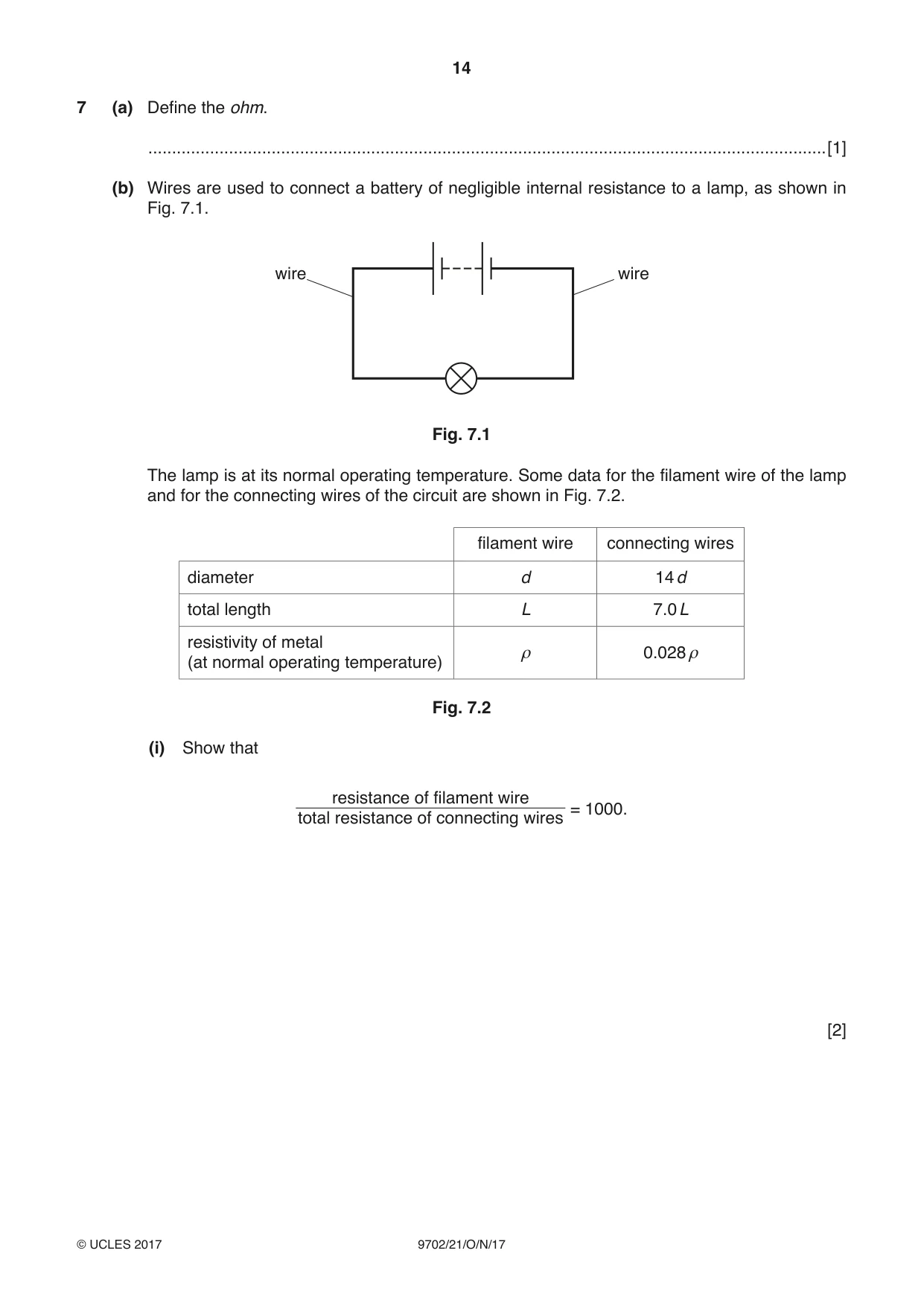
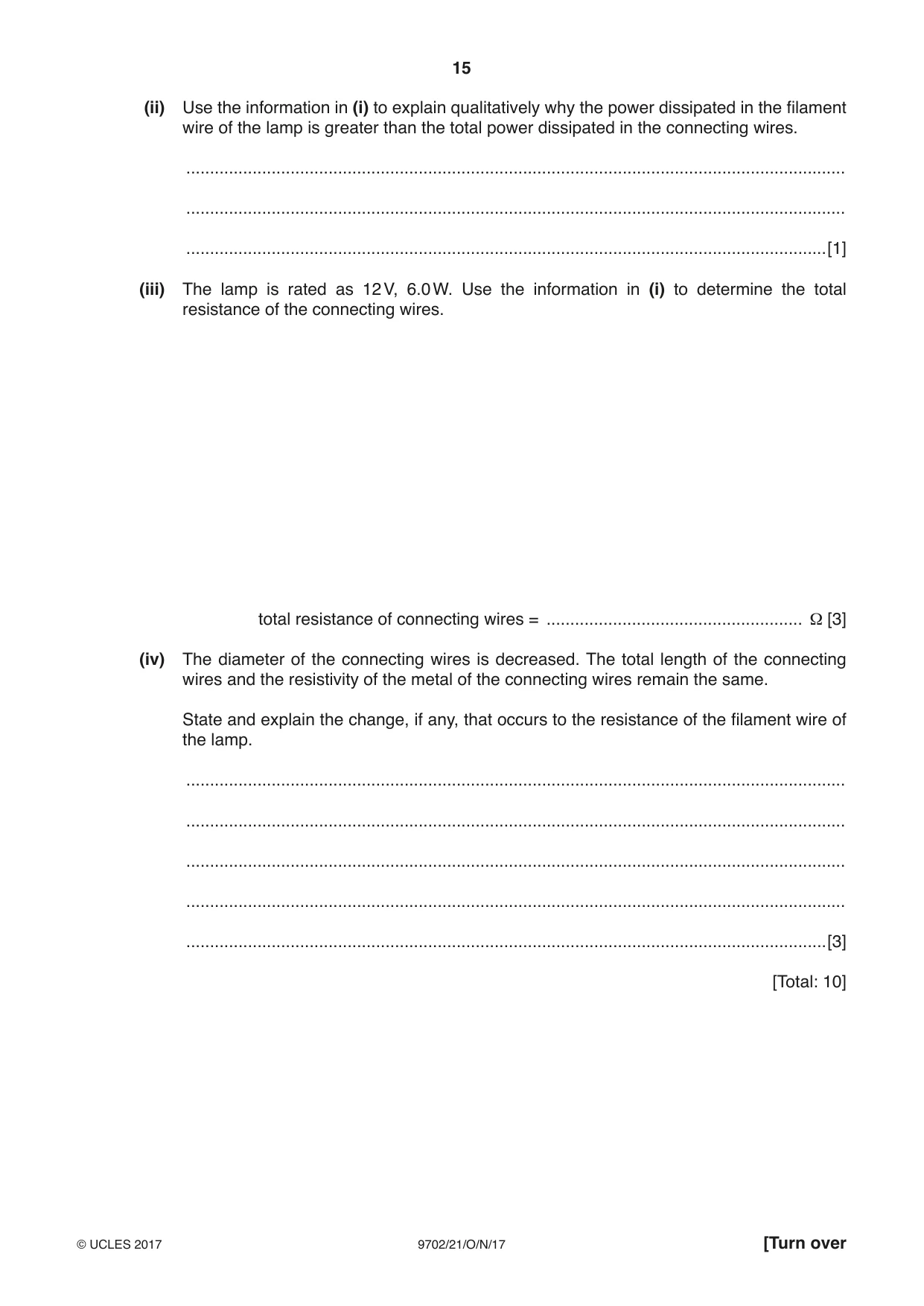
7 (a) Define the ohm. ...............................................................................................................................................[1] (b) Wires are used to connect a battery of negligible internal resistance to a lamp, as shown in Fig. 7.1. wire wire Fig. 7.1 The lamp is at its normal operating temperature. Some data for the filament wire of the lamp and for the connecting wires of the circuit are shown in Fig. 7.2. filament wire connecting wires diameter d 14 d total length L 7.0 L resistivity of metal ρ 0.028 ρ (at normal operating temperature) Fig. 7.2 (i) Show that resistance of filament wire = 1000. total resistance of connecting wires [2] (ii) Use the information in (i) to explain qualitatively why the power dissipated in the filament wire of the lamp is greater than the total power dissipated in the connecting wires. ........................................................................................................................................... ........................................................................................................................................... .......................................................................................................................................[1] (iii) The lamp is rated as 12 V, 6.0 W. Use the information in (i) to determine the total resistance of the connecting wires. total resistance of connecting wires = ...................................................... Ω [3] (iv) The diameter of the connecting wires is decreased. The total length of the connecting wires and the resistivity of the metal of the connecting wires remain the same. State and explain the change, if any, that occurs to the resistance of the filament wire of the lamp. ........................................................................................................................................... ........................................................................................................................................... ........................................................................................................................................... ........................................................................................................................................... .......................................................................................................................................[3] [Total: 10]
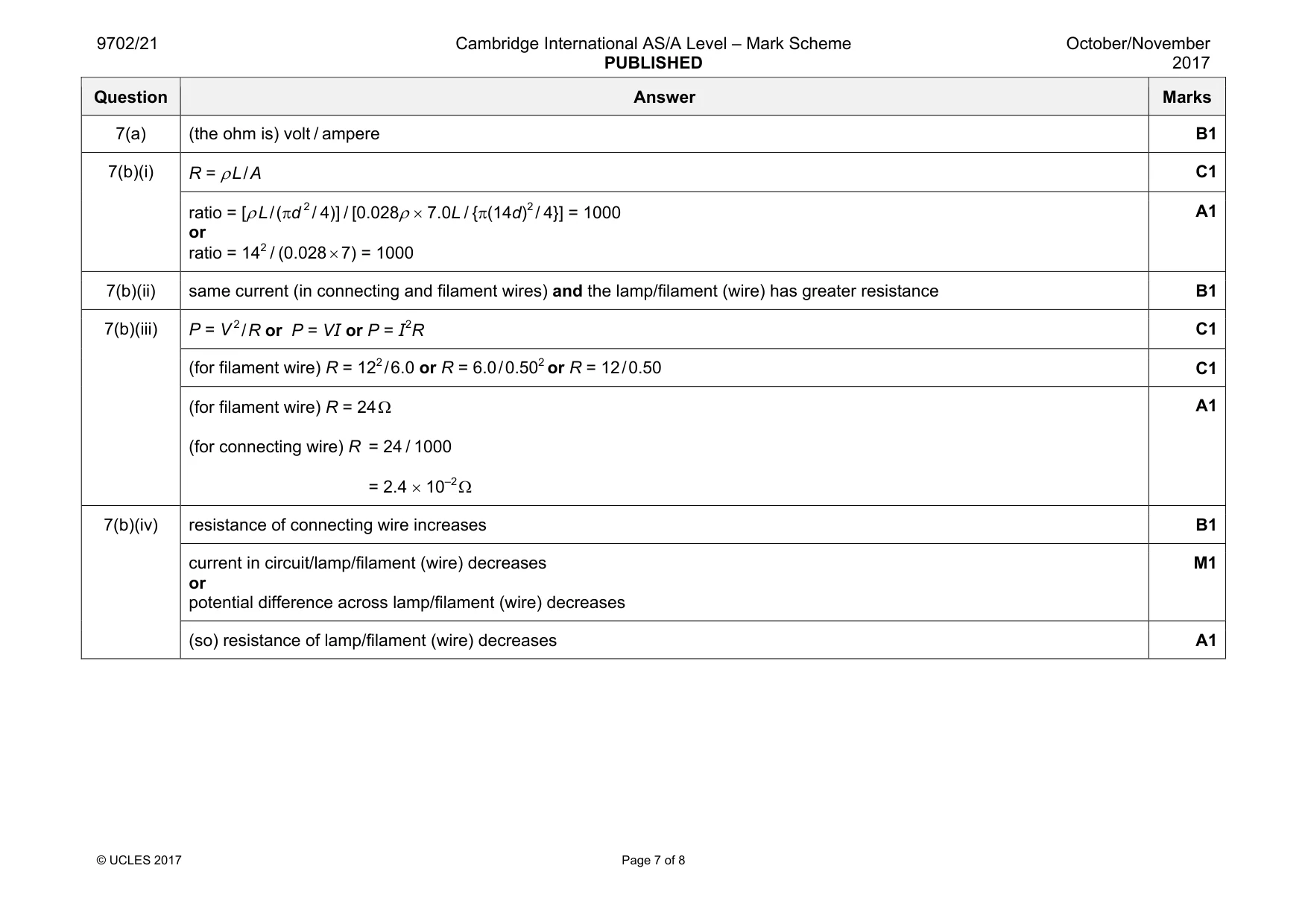
Mark scheme: 7(a) (the ohm is) volt / ampere B1 7(b)(i) R = ρ L / A C1 ratio = [ρ L / (πd 2 / 4)] / [0.028ρ × 7.0L / {π(14d)2/ 4}] = 1000 or ratio = 142 / (0.028 × 7) = 1000 A1 7(b)(ii) same current (in connecting and filament wires) and the lamp/filament (wire) has greater resistance B1 7(b)(iii) P = V 2 / R or P = VI or P = I2R C1 (for filament wire) R = 122 / 6.0 or R = 6.0 / 0.502 or R = 12 / 0.50 C1 (for filament wire) R = 24 Ω (for connecting wire) R = 24 / 1000 = 2.4 × 10⁻² Ω A1 7(b)(iv) resistance of connecting wire increases B1 current in circuit/lamp/filament (wire) decreases or potential difference across lamp/filament (wire) decreases M1 (so) resistance of lamp/filament (wire) decreases A1
Q8 · A neutron within a nucleus decays to produce a proton, a β– particle and an (electron)…
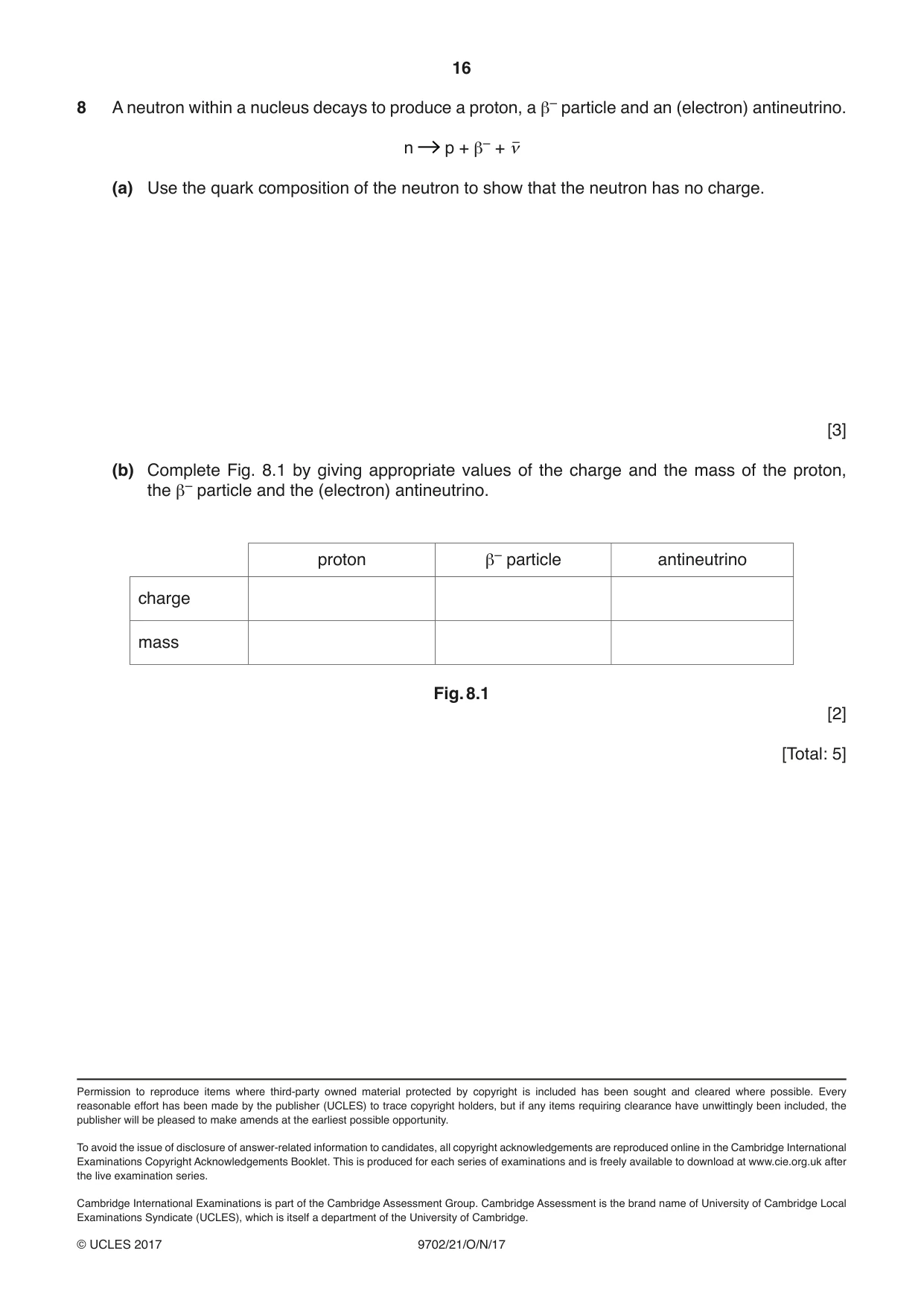
8 A neutron within a nucleus decays to produce a proton, a β– particle and an (electron) antineutrino. n p + β– + ν– (a) Use the quark composition of the neutron to show that the neutron has no charge. [3] (b) Complete Fig. 8.1 by giving appropriate values of the charge and the mass of the proton, the β– particle and the (electron) antineutrino. proton β– particle antineutrino charge mass Fig. 8.1 [2] [Total: 5]
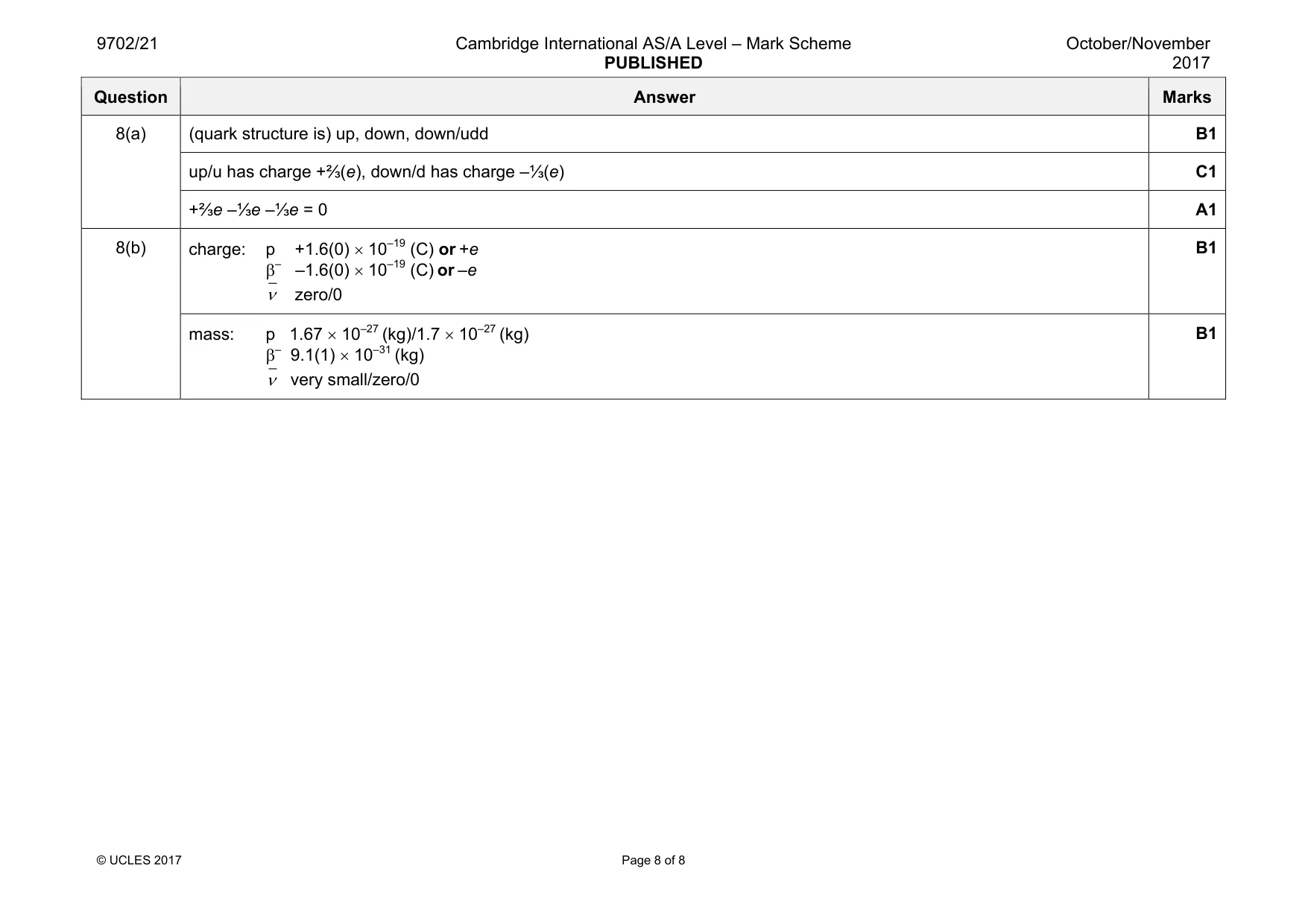
Mark scheme: 8(a) (quark structure is) up, down, down/udd B1 up/u has charge +⅔(e), down/d has charge –⅓(e) C1 +⅔e –⅓e –⅓e = 0 A1 8(b) charge: p +1.6(0) × 10–19 (C) or +e β– –1.6(0) × 10–19 (C) or –e ν zero/0 B1 mass: p 1.67 × 10⁻²⁷ (kg)/1.7 × 10–27 (kg) β– 9.1(1) × 10–31 (kg) ν very small/zero/0 B1
What was in this paper
The subtopics covered by these 8 questions, and how many questions each got. Open one in a new tab to see every Cambridge question on it.
What you needed in this session
Cambridge’s own grade thresholds for 2017 Oct/Nov, Paper 2 · Variant 1. A higher threshold means an easier paper — the bar moves with how the cohort did.