Cambridge A Level Physics 9702 — 2024 Feb/March Paper 2 · Variant 2
9702/22/F/M/24 · 8 questions · 60 marks · ≈68 min
The question paper and its mark scheme, free to read here and free to download. This is Cambridge’s own paper, exactly as it was sat.
Question paper16 pages


Mark scheme13 pages
Answers below. Sit the paper first if you are practising.
Questions as text
Q1 · Table 1.1 lists some SI quantities
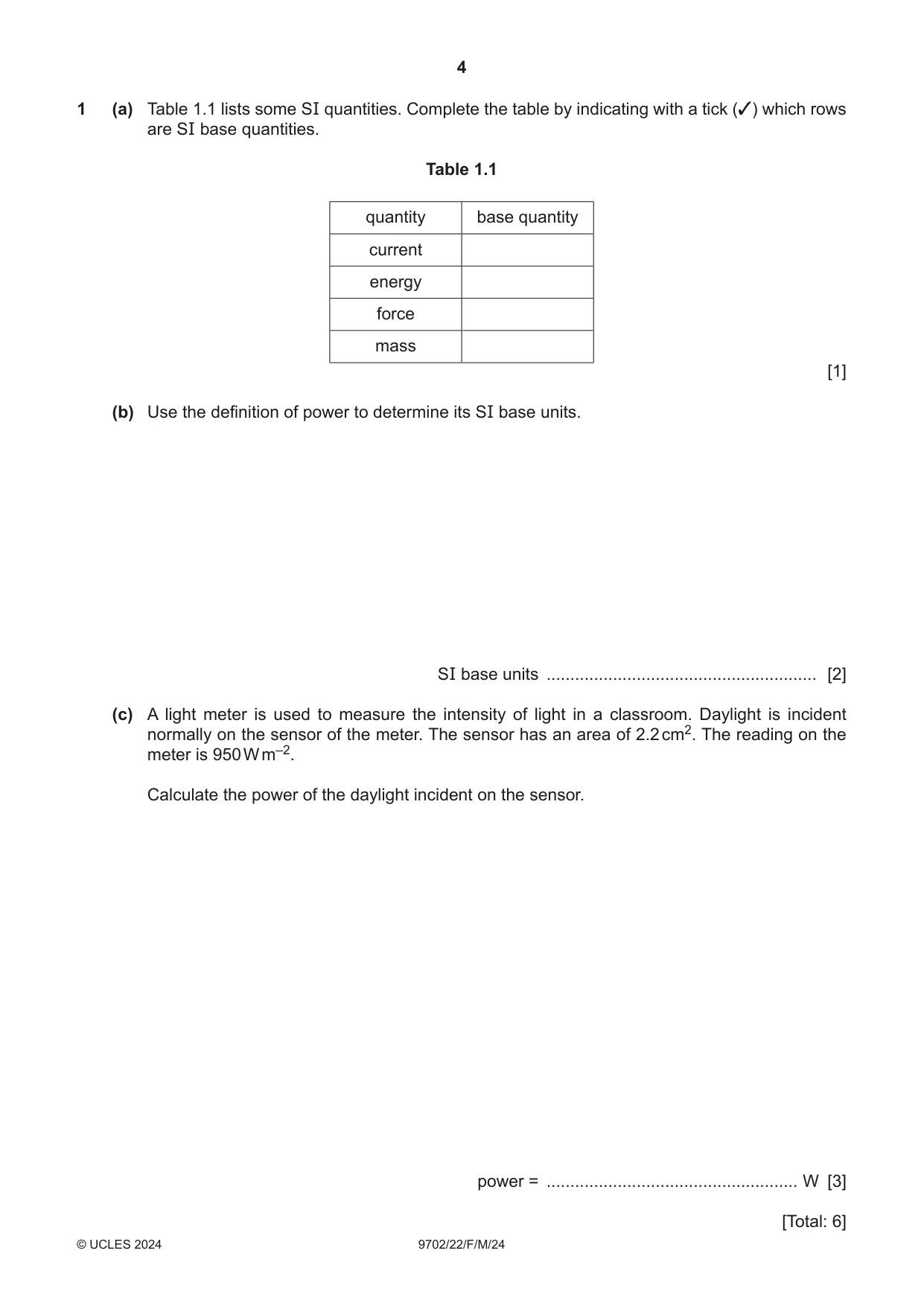
1 (a) Table 1.1 lists some SI quantities. Complete the table by indicating with a tick (✓) which rows are SI base quantities. Table 1.1 quantity base quantity current energy force mass [1] (b) Use the definition of power to determine its SI base units. SI base units ......................................................... [2] (c) A light meter is used to measure the intensity of light in a classroom. Daylight is incident normally on the sensor of the meter. The sensor has an area of 2.2 cm2. The reading on the meter is 950 W m–2. Calculate the power of the daylight incident on the sensor. power = ..................................................... W [3] [Total: 6]
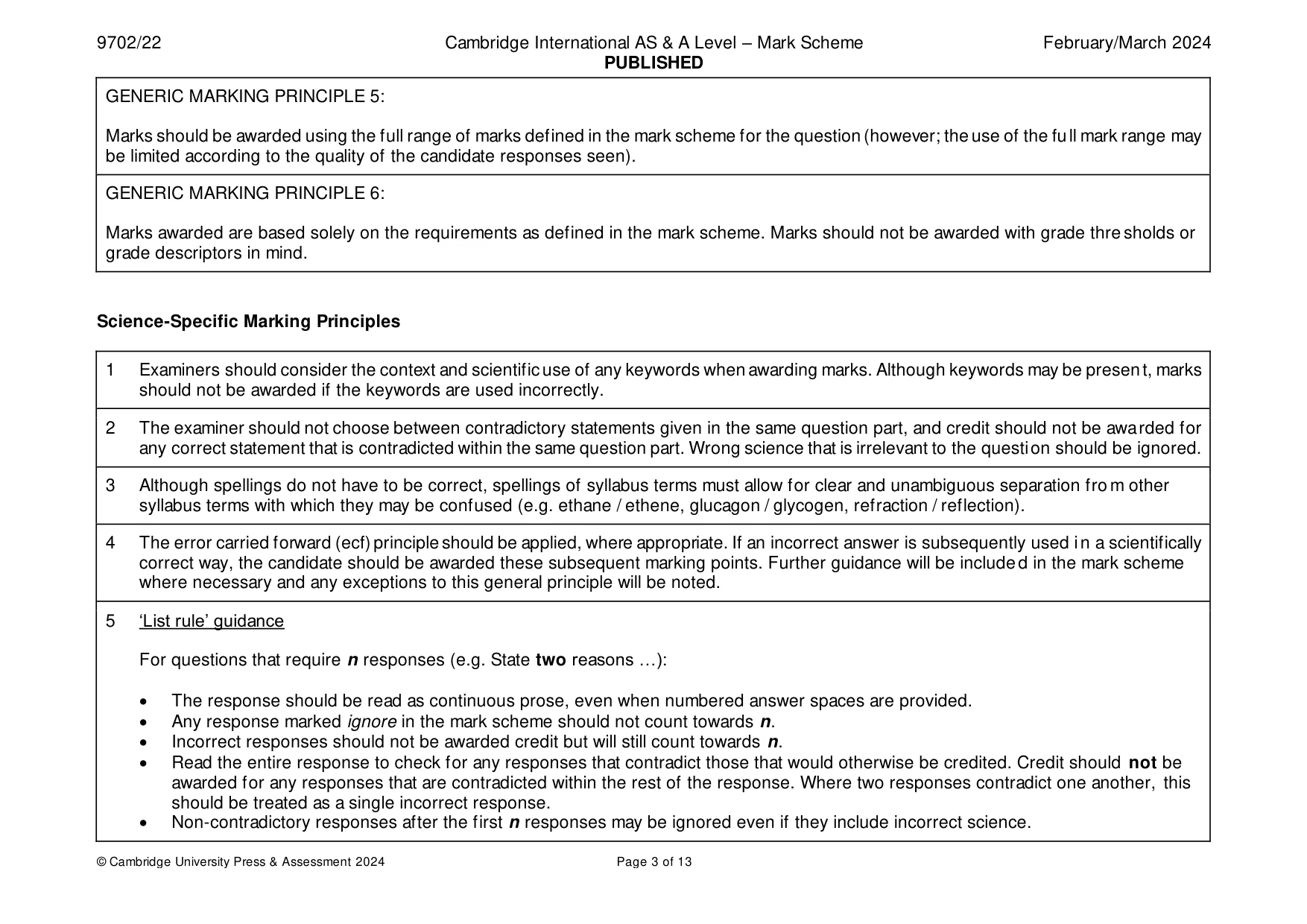
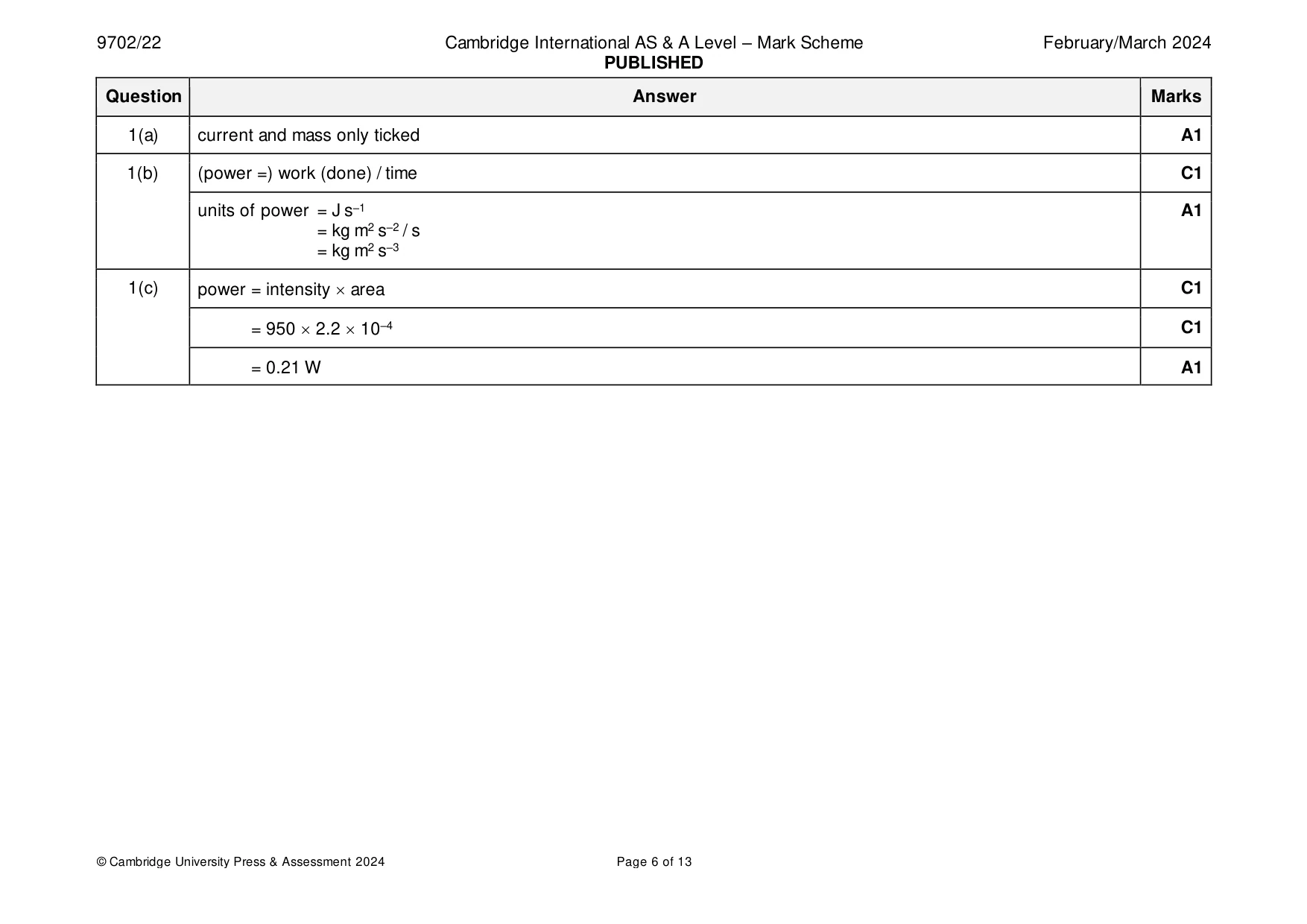
Mark scheme: Question Answer Marks 1(a) current and mass only ticked A1 1(b) (power =) work (done) / time C1 units of power = J s–1 A1 = kg m2 s–2 / s = kg m2 s–3 1(c) power = intensity area C1 = 950 2.2 10–4 C1 = 0.21 W A1
Question 2
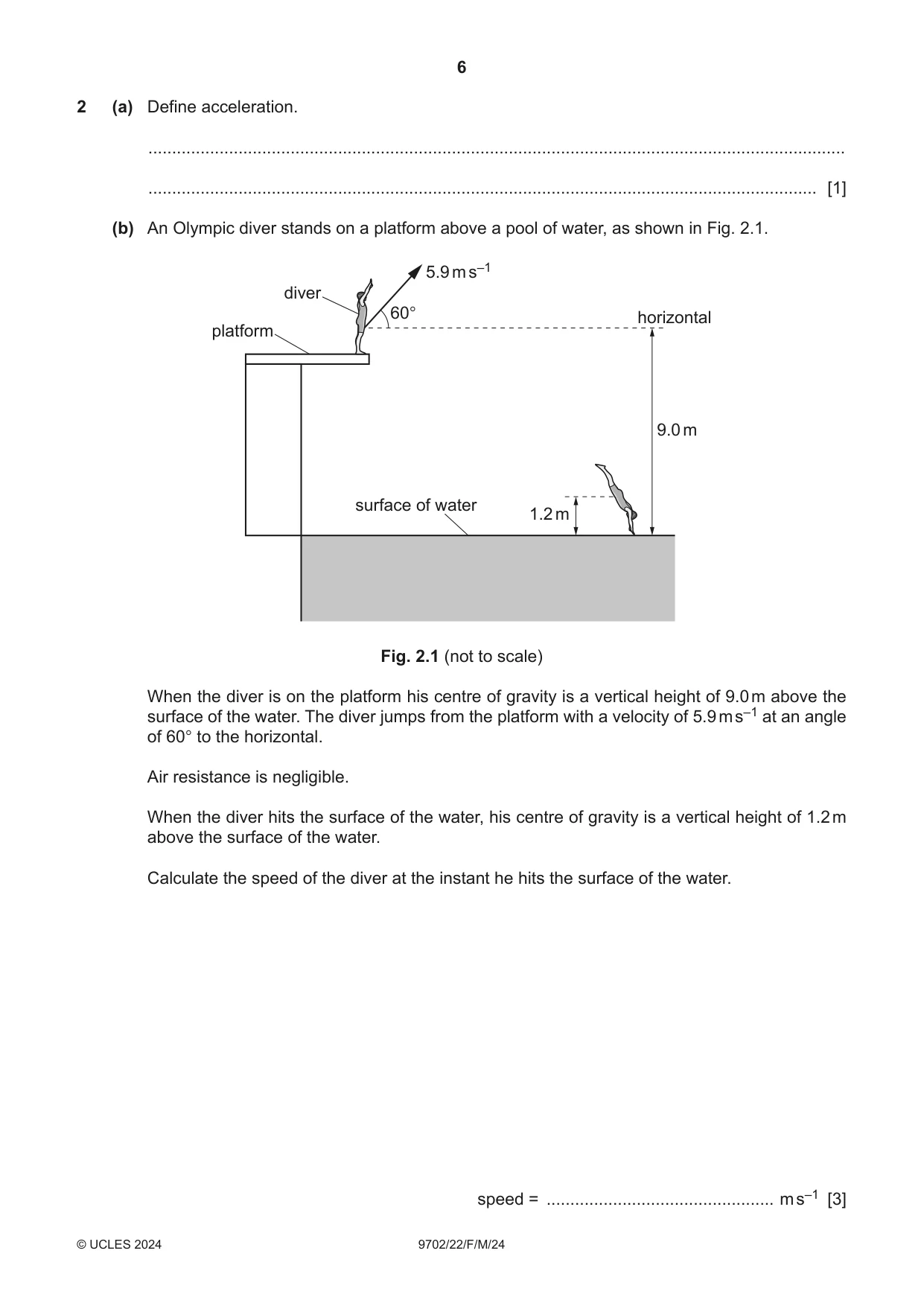
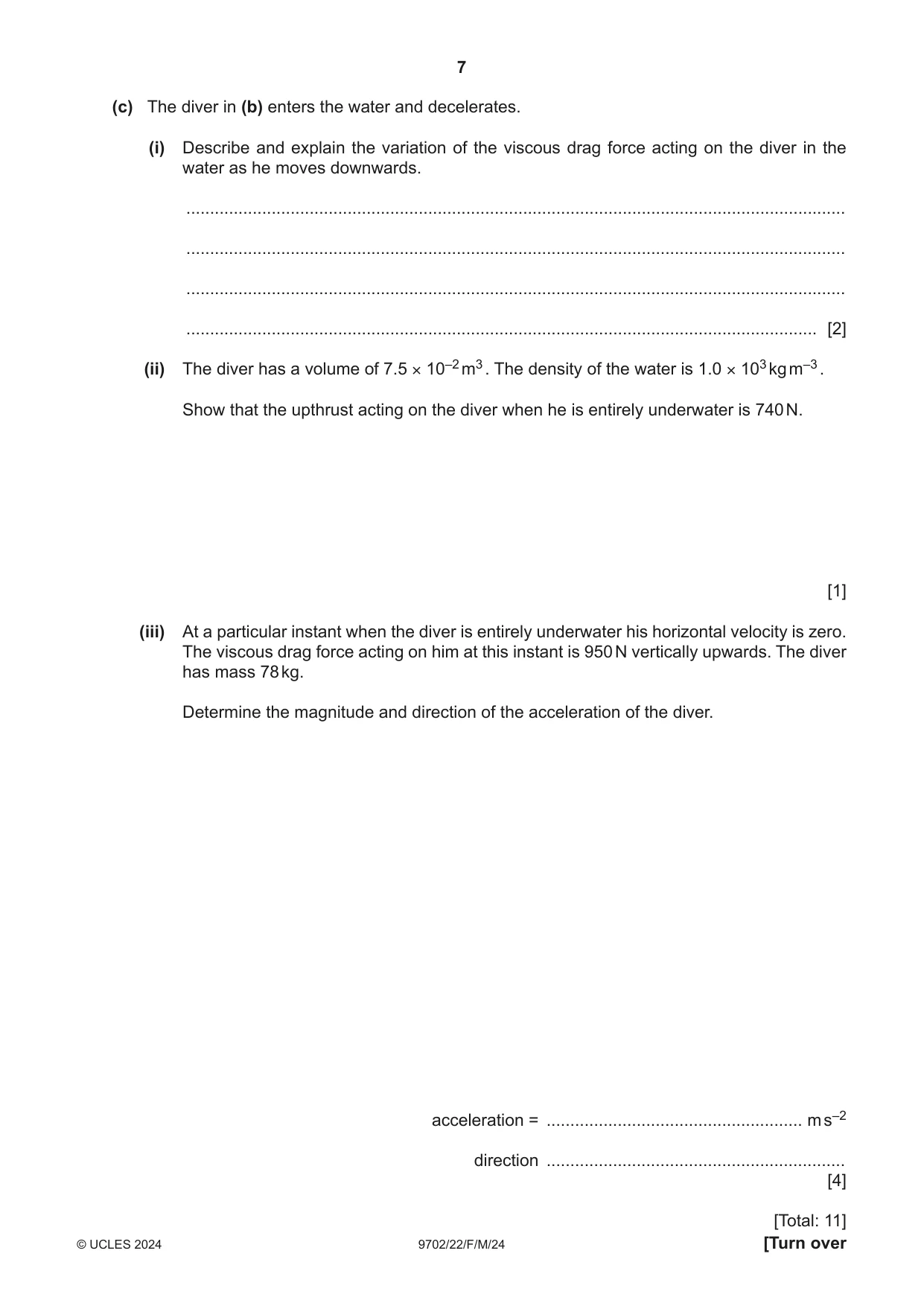
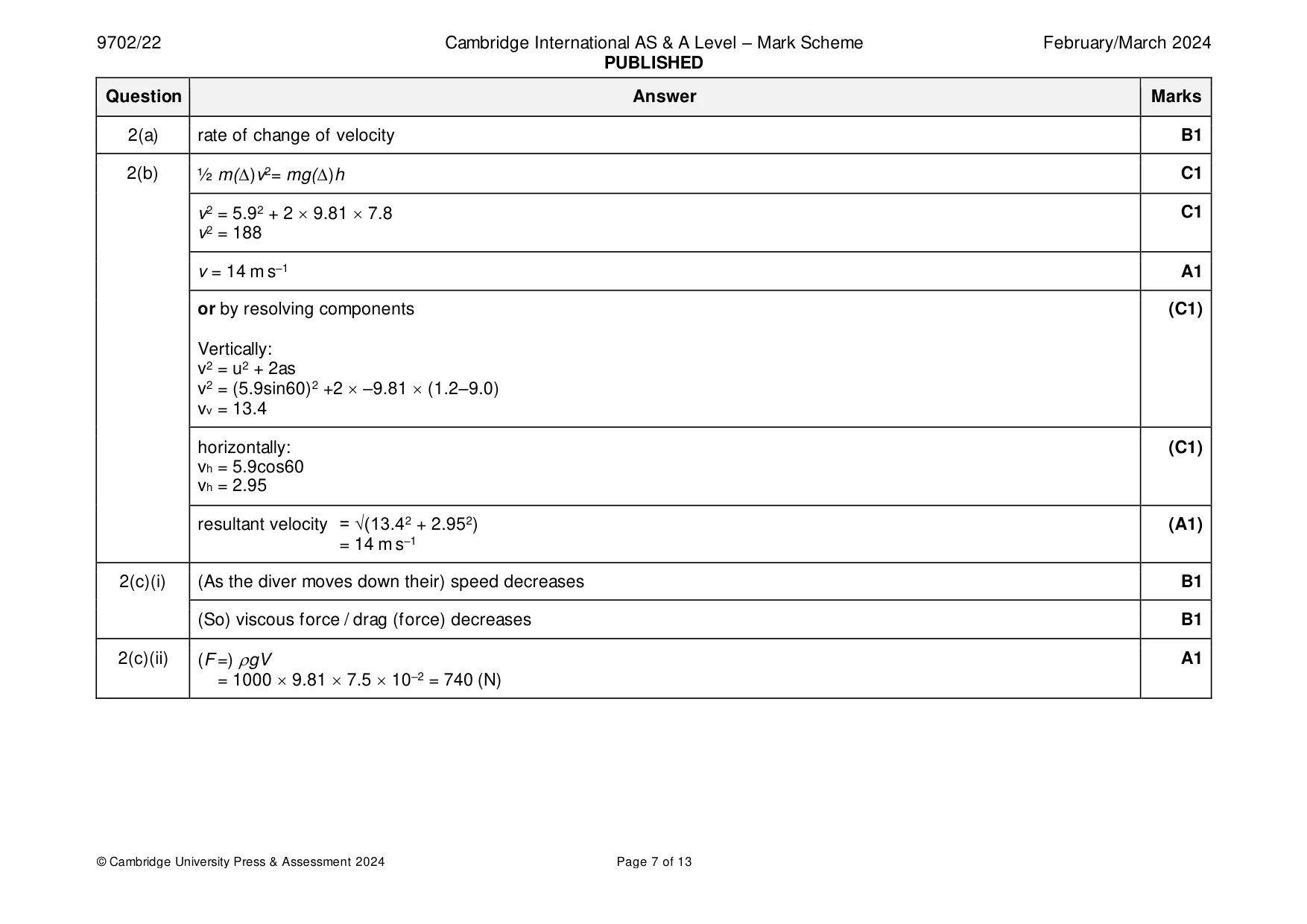
2 (a) Define acceleration. ................................................................................................................................................... ............................................................................................................................................. [1] (b) An Olympic diver stands on a platform above a pool of water, as shown in Fig. 2.1. 5.9 m s–1 diver 60° horizontal platform 9.0 m surface of water 1.2 m Fig. 2.1 (not to scale) When the diver is on the platform his centre of gravity is a vertical height of 9.0 m above the surface of the water. The diver jumps from the platform with a velocity of 5.9 m s–1 at an angle of 60° to the horizontal. Air resistance is negligible. When the diver hits the surface of the water, his centre of gravity is a vertical height of 1.2 m above the surface of the water. Calculate the speed of the diver at the instant he hits the surface of the water. speed = ................................................ m s–1 [3] (c) The diver in (b) enters the water and decelerates. (i) Describe and explain the variation of the viscous drag force acting on the diver in the water as he moves downwards. ........................................................................................................................................... ........................................................................................................................................... ........................................................................................................................................... ..................................................................................................................................... [2] (ii) The diver has a volume of 7.5 × 10⁻² m3 . The density of the water is 1.0 × 10³ kg m–3 . Show that the upthrust acting on the diver when he is entirely underwater is 740 N. [1] (iii) At a particular instant when the diver is entirely underwater his horizontal velocity is zero. The viscous drag force acting on him at this instant is 950 N vertically upwards. The diver has mass 78 kg. Determine the magnitude and direction of the acceleration of the diver. acceleration = ...................................................... m s–2 direction ............................................................... [4] [Total: 11]
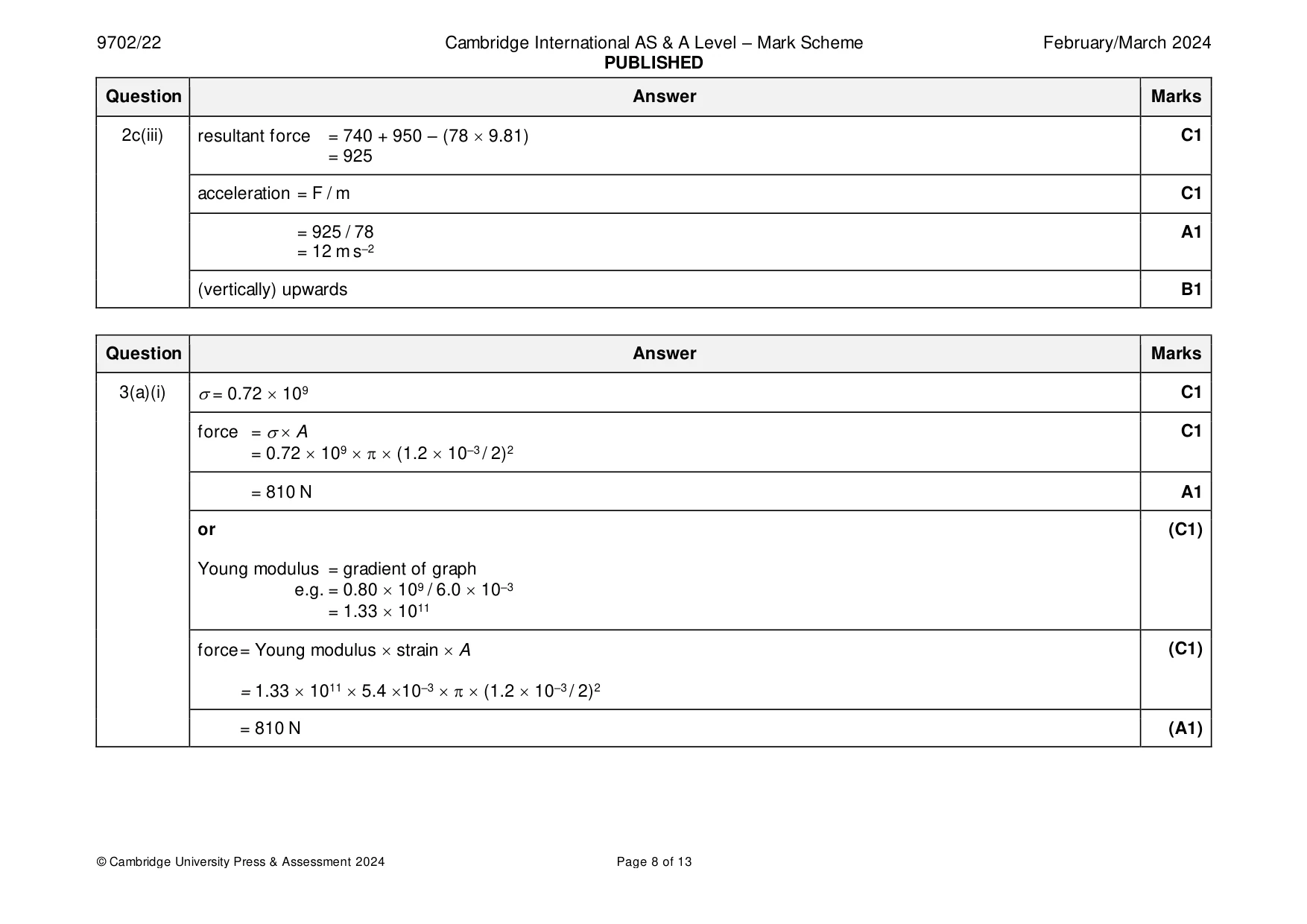
Mark scheme: 2(a) rate of change of velocity B1 2(b) ½ m()v2= mg()h C1 v2 = 5.92 + 2 9.81 7.8 C1 v2 = 188 v = 14 m s–1 A1 or by resolving components (C1) Vertically: v2 = u2 + 2as v2 = (5.9sin60)2 +2 –9.81 (1.2–9.0) vv = 13.4 horizontally: (C1) vh = 5.9cos60 vh = 2.95 resultant velocity = √(13.42 + 2.952) (A1) = 14 m s–1 2(c)(i) (As the diver moves down their) speed decreases B1 (So) viscous force / drag (force) decreases B1 2(c)(ii) (F =) gV A1 = 1000 9.81 7.5 10–2 = 740 (N)
Q3 · A thin metal wire X, of diameter 1.2 × 10⁻³ m, is used to suspend a model planet, as…
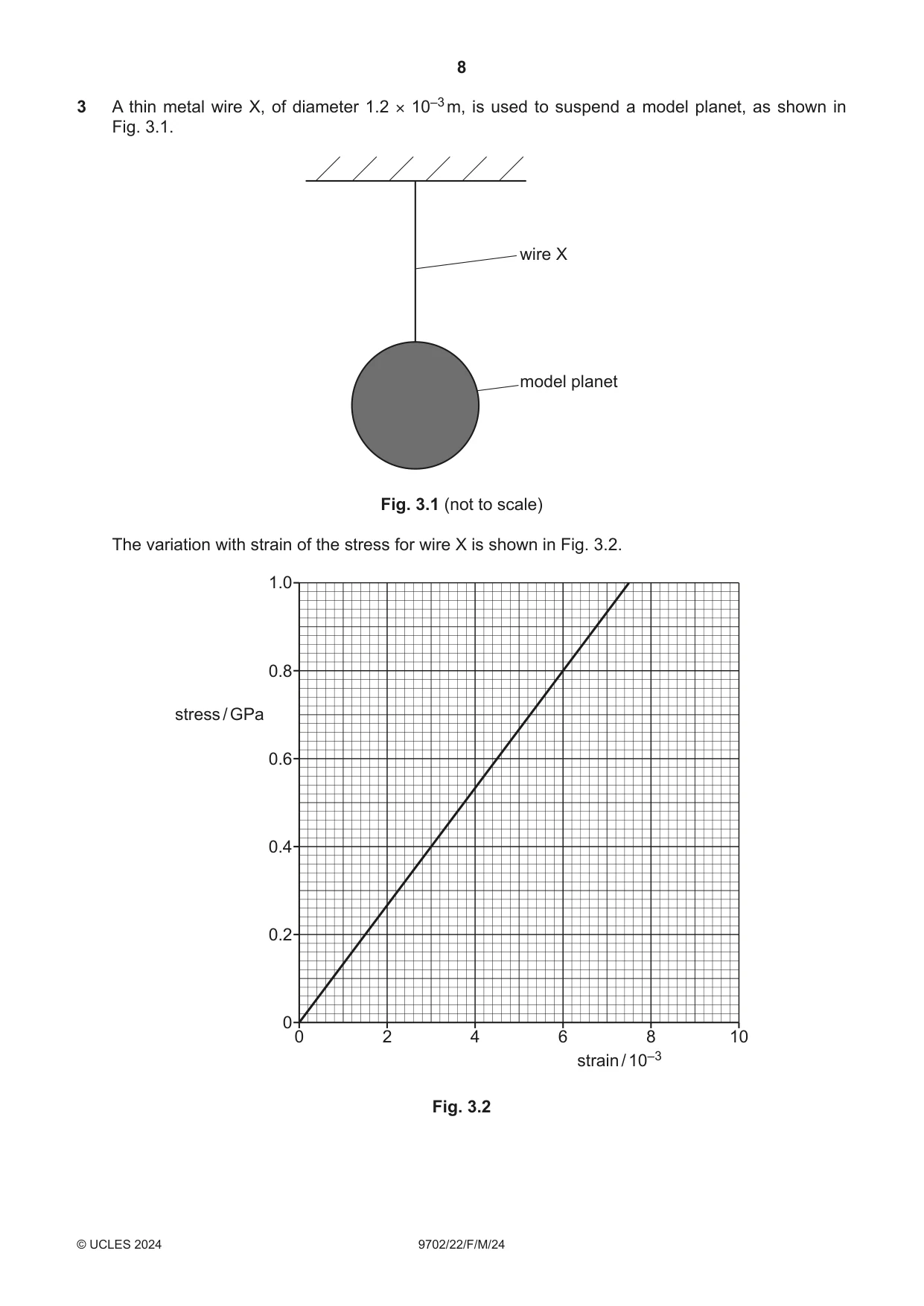
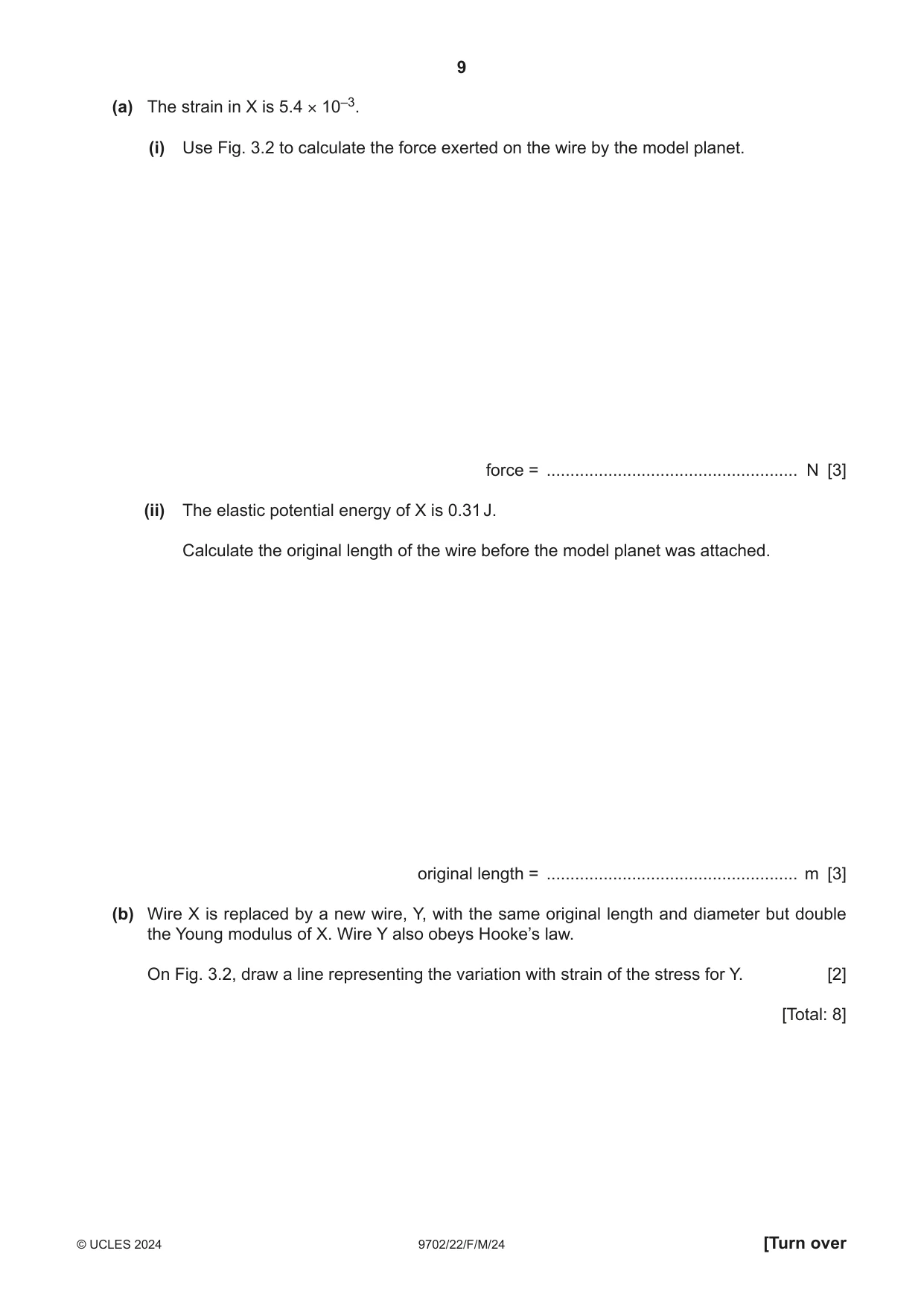
3 A thin metal wire X, of diameter 1.2 × 10⁻³ m, is used to suspend a model planet, as shown in Fig. 3.1. wire X model planet Fig. 3.1 (not to scale) The variation with strain of the stress for wire X is shown in Fig. 3.2. 1.0 0.8 stress / GPa 0.6 0.4 0.2 0 0 2 4 6 8 10 strain / 10–3 Fig. 3.2 (a) The strain in X is 5.4 × 10⁻³. (i) Use Fig. 3.2 to calculate the force exerted on the wire by the model planet. force = ..................................................... N [3] (ii) The elastic potential energy of X is 0.31 J. Calculate the original length of the wire before the model planet was attached. original length = ..................................................... m [3] (b) Wire X is replaced by a new wire, Y, with the same original length and diameter but double the Young modulus of X. Wire Y also obeys Hooke’s law. On Fig. 3.2, draw a line representing the variation with strain of the stress for Y. [2] [Total: 8]
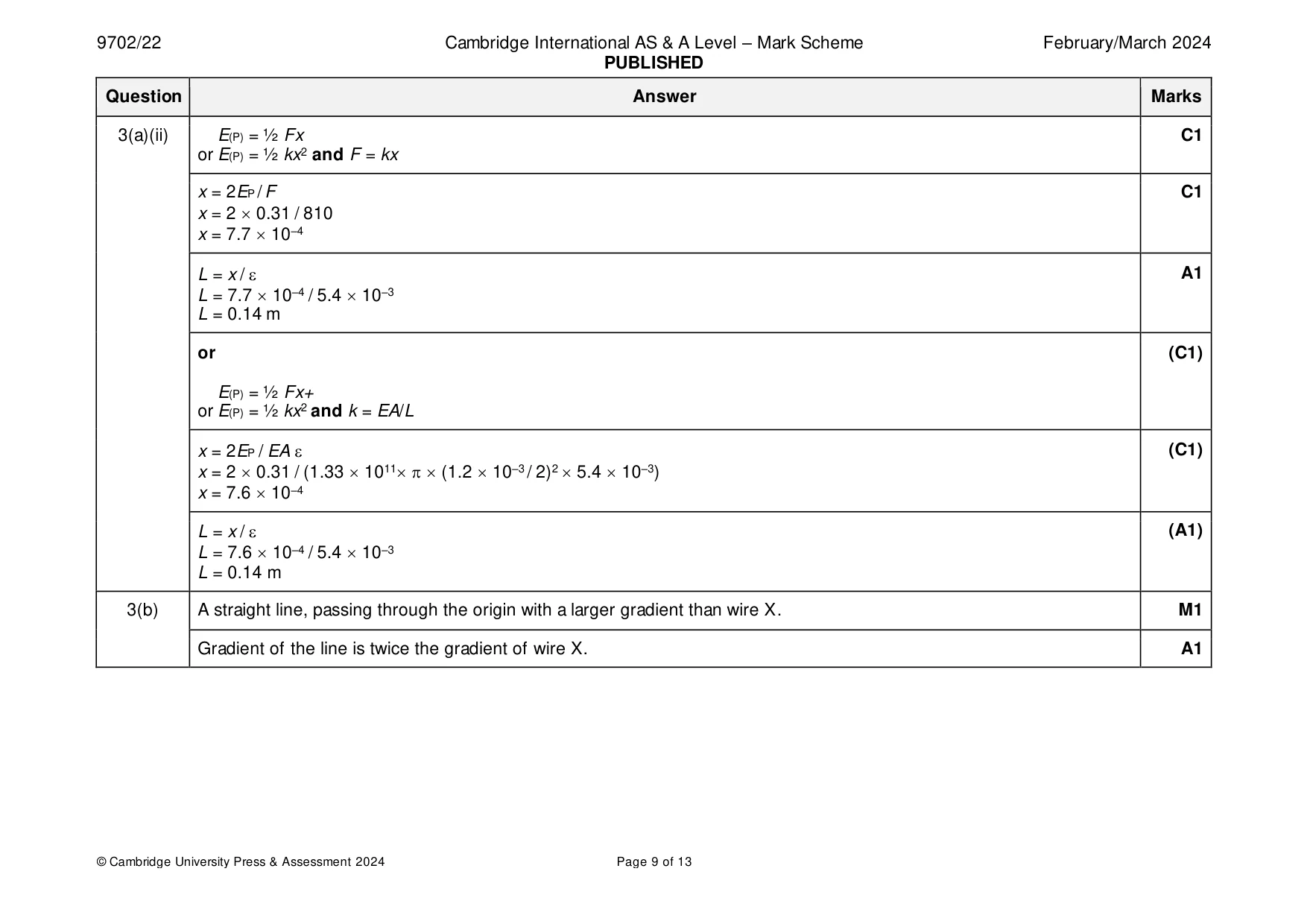
Mark scheme: 3(a)(i) = 0.72 109 C1 force = A C1 = 0.72 109 (1.2 10–3 / 2)2 = 810 N A1 or (C1) Young modulus = gradient of graph e.g. = 0.80 109 / 6.0 10–3 = 1.33 1011 force = Young modulus strain A (C1) = 1.33 1011 5.4 10–3 (1.2 10–3 / 2)2 = 810 N (A1) 3(a)(ii) E(P) = ½ Fx C1 or E(P) = ½ kx2 and F = kx x = 2EP / F C1 x = 2 0.31 / 810 x = 7.7 10–4 L = x / A1 L = 7.7 10–4 / 5.4 10–3 L = 0.14 m or (C1) E(P) = ½ Fx+ or E(P) = ½ kx2 and k = EA/L x = 2EP / EA (C1) x = 2 0.31 / (1.33 1011 (1.2 10–3 / 2)2 5.4 10–3) x = 7.6 10–4 L = x / (A1) L = 7.6 10–4 / 5.4 10–3 L = 0.14 m 3(b) A straight line, passing through the origin with a larger gradient than wire X. M1 Gradient of the line is twice the gradient of wire X. A1
Q4 · A nucleus P undergoes α-decay to form nucleus Q
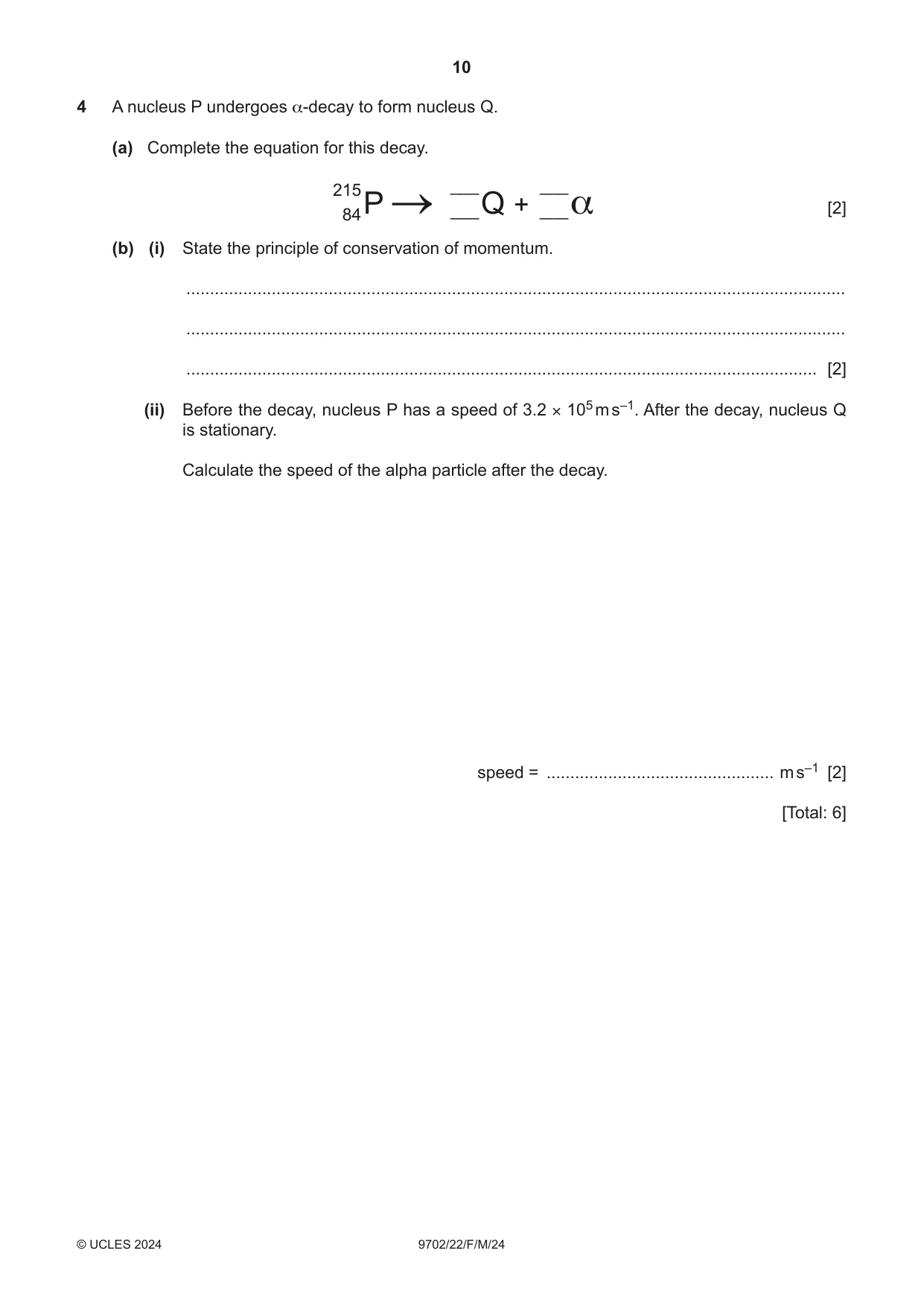
4 A nucleus P undergoes α-decay to form nucleus Q. (a) Complete the equation for this decay. ___ ___ 215 [2] ___ Q + ___ α 84 P (b) (i) State the principle of conservation of momentum. ........................................................................................................................................... ........................................................................................................................................... ..................................................................................................................................... [2] (ii) Before the decay, nucleus P has a speed of 3.2 × 10⁵ m s–1. After the decay, nucleus Q is stationary. Calculate the speed of the alpha particle after the decay. speed = ................................................ m s–1 [2] [Total: 6]
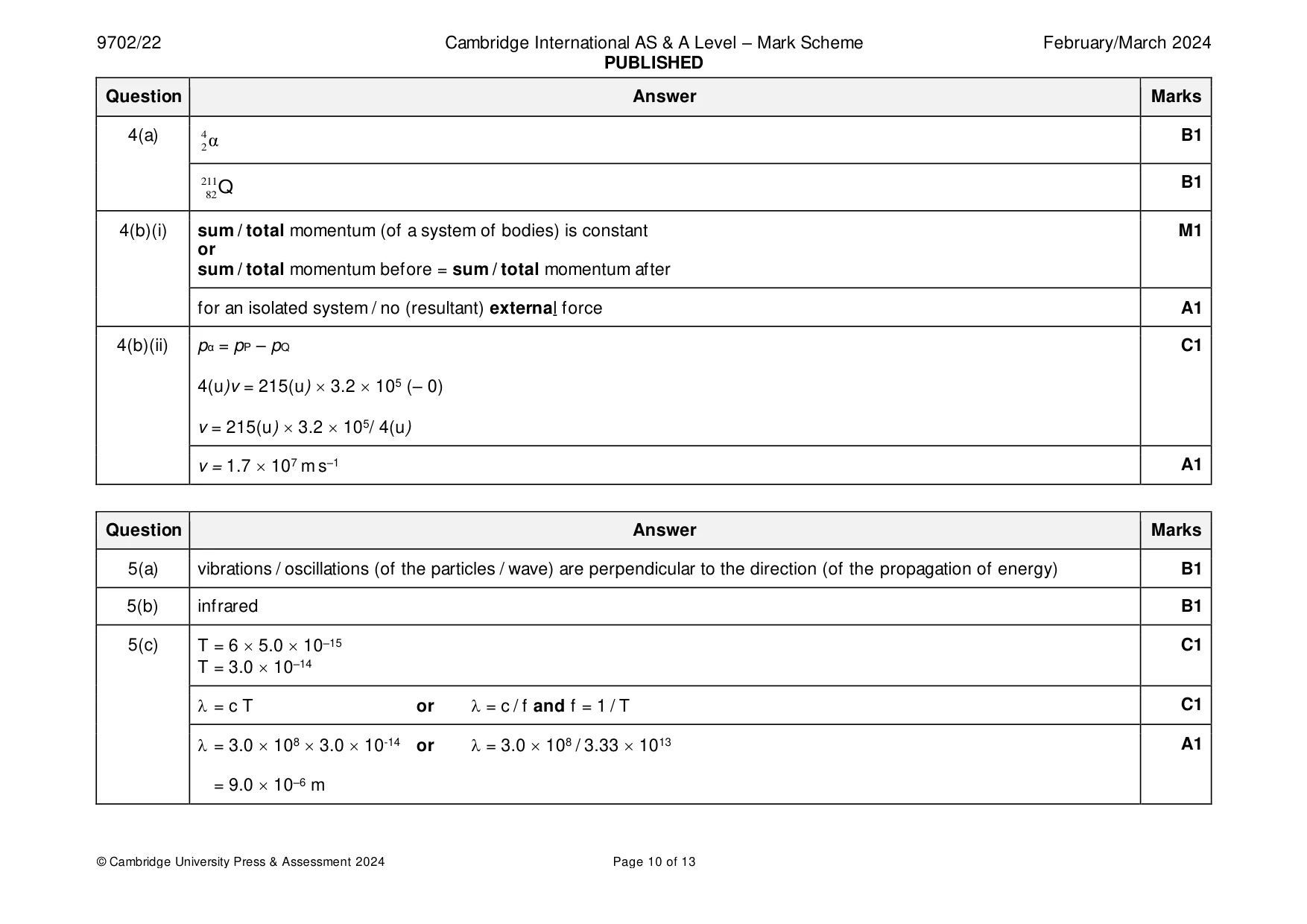
Mark scheme: 4(a) 4 B1 2α 21182Q B1 4(b)(i) sum / total momentum (of a system of bodies) is constant M1 or sum / total momentum before = sum / total momentum after for an isolated system / no (resultant) external force A1 4(b)(ii) pα = pP – pQ C1 4(u)v = 215(u) 3.2 105 (– 0) v = 215(u) 3.2 105/ 4(u) v = 1.7 107 m s–1 A1
Q5 · By reference to the direction of propagation of energy, state what is meant by a…
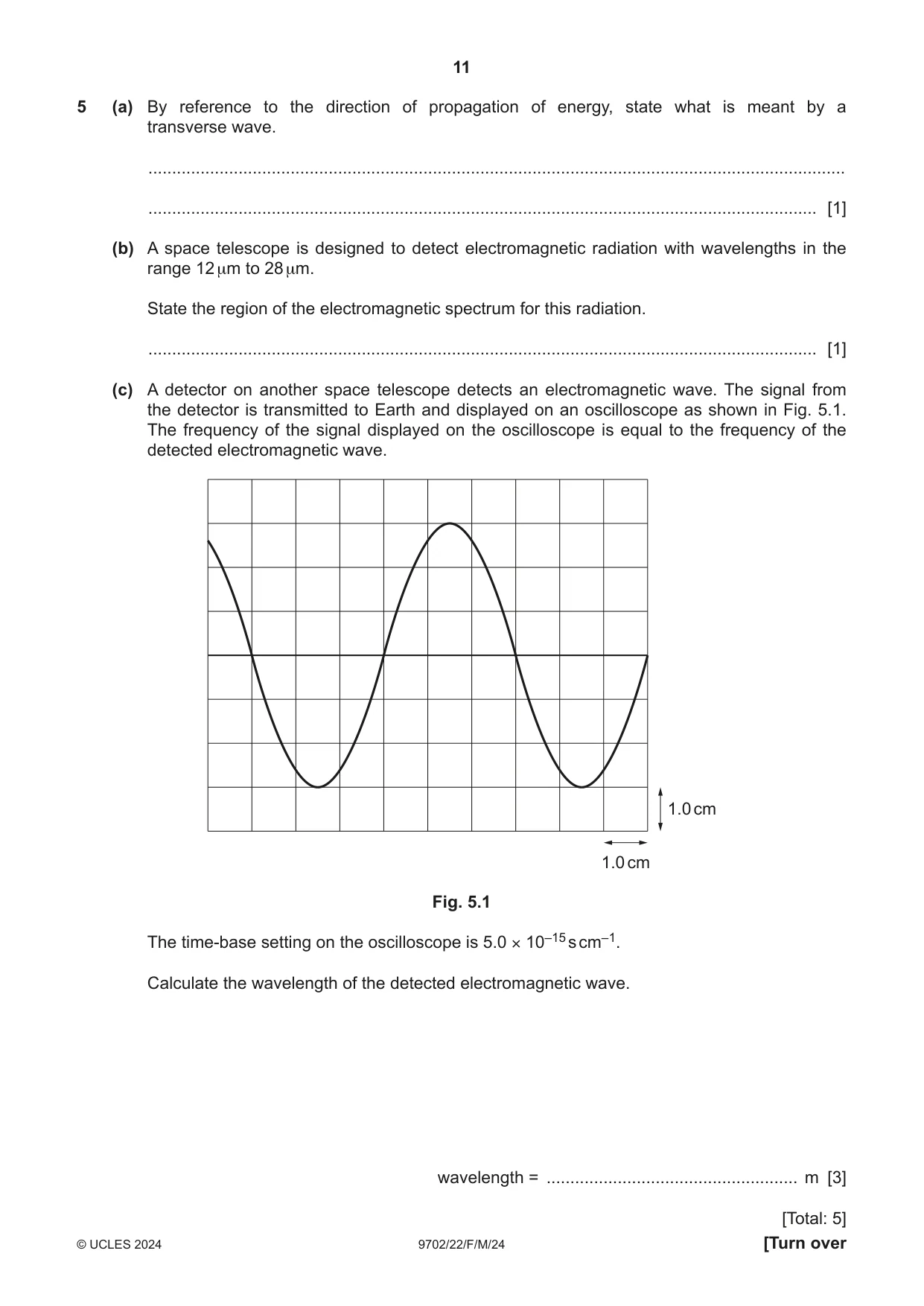
5 (a) By reference to the direction of propagation of energy, state what is meant by a transverse wave. ................................................................................................................................................... ............................................................................................................................................. [1] (b) A space telescope is designed to detect electromagnetic radiation with wavelengths in the range 12 μm to 28 μm. State the region of the electromagnetic spectrum for this radiation. ............................................................................................................................................. [1] (c) A detector on another space telescope detects an electromagnetic wave. The signal from the detector is transmitted to Earth and displayed on an oscilloscope as shown in Fig. 5.1. The frequency of the signal displayed on the oscilloscope is equal to the frequency of the detected electromagnetic wave. 1.0 cm 1.0 cm Fig. 5.1 The time-base setting on the oscilloscope is 5.0 × 10⁻¹⁵ s cm–1. Calculate the wavelength of the detected electromagnetic wave. wavelength = ..................................................... m [3] [Total: 5]
Mark scheme: 5(a) vibrations / oscillations (of the particles / wave) are perpendicular to the direction (of the propagation of energy) B1 5(b) infrared B1 5(c) T = 6 5.0 10–15 C1 T = 3.0 10–14 = c T or = c / f and f = 1 / T C1 = 3.0 108 3.0 10-14 or = 3.0 108 / 3.33 1013 A1 = 9.0 10–6 m
Q6 · Coherent visible light of a single frequency is incident normally on a double slit
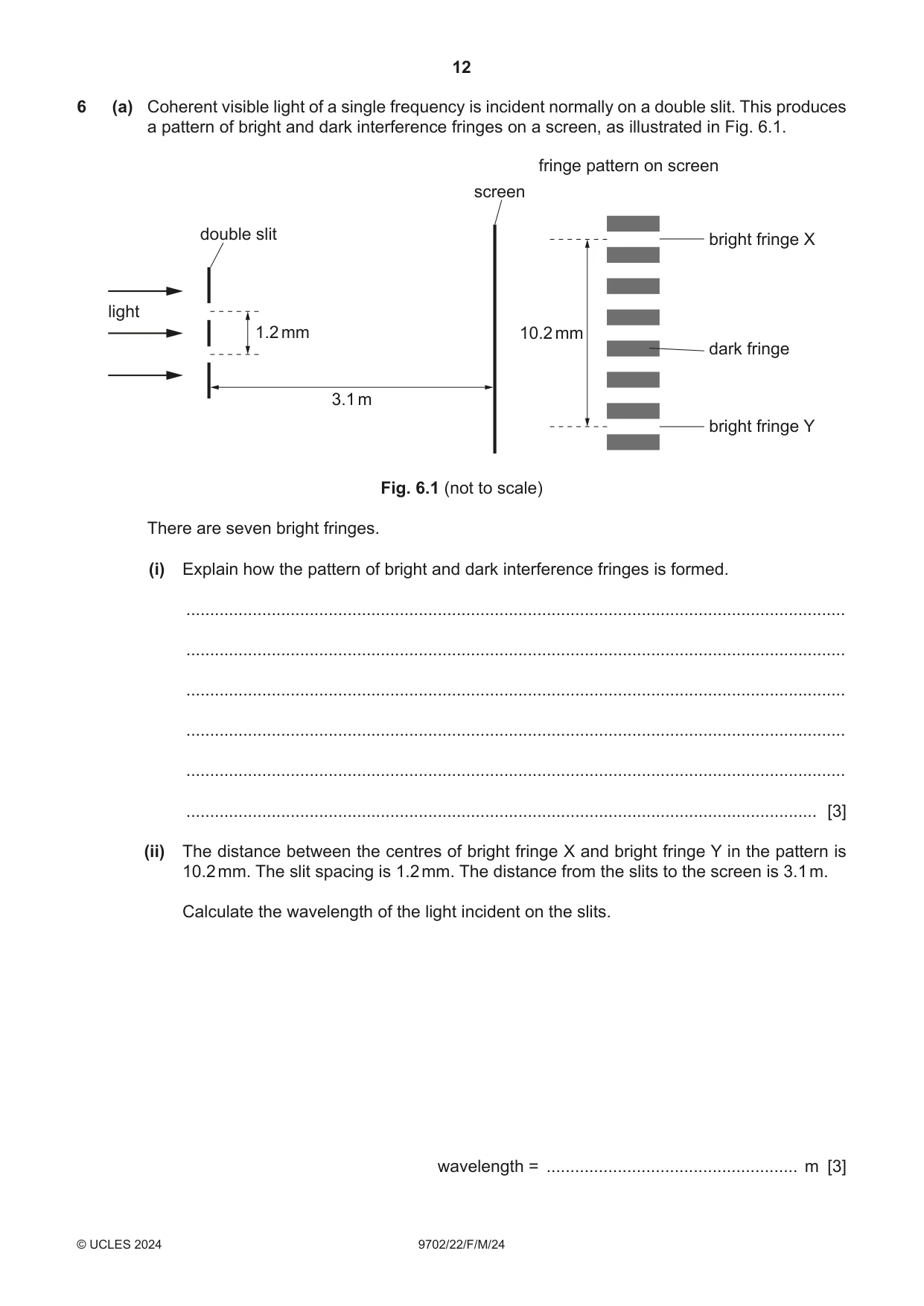
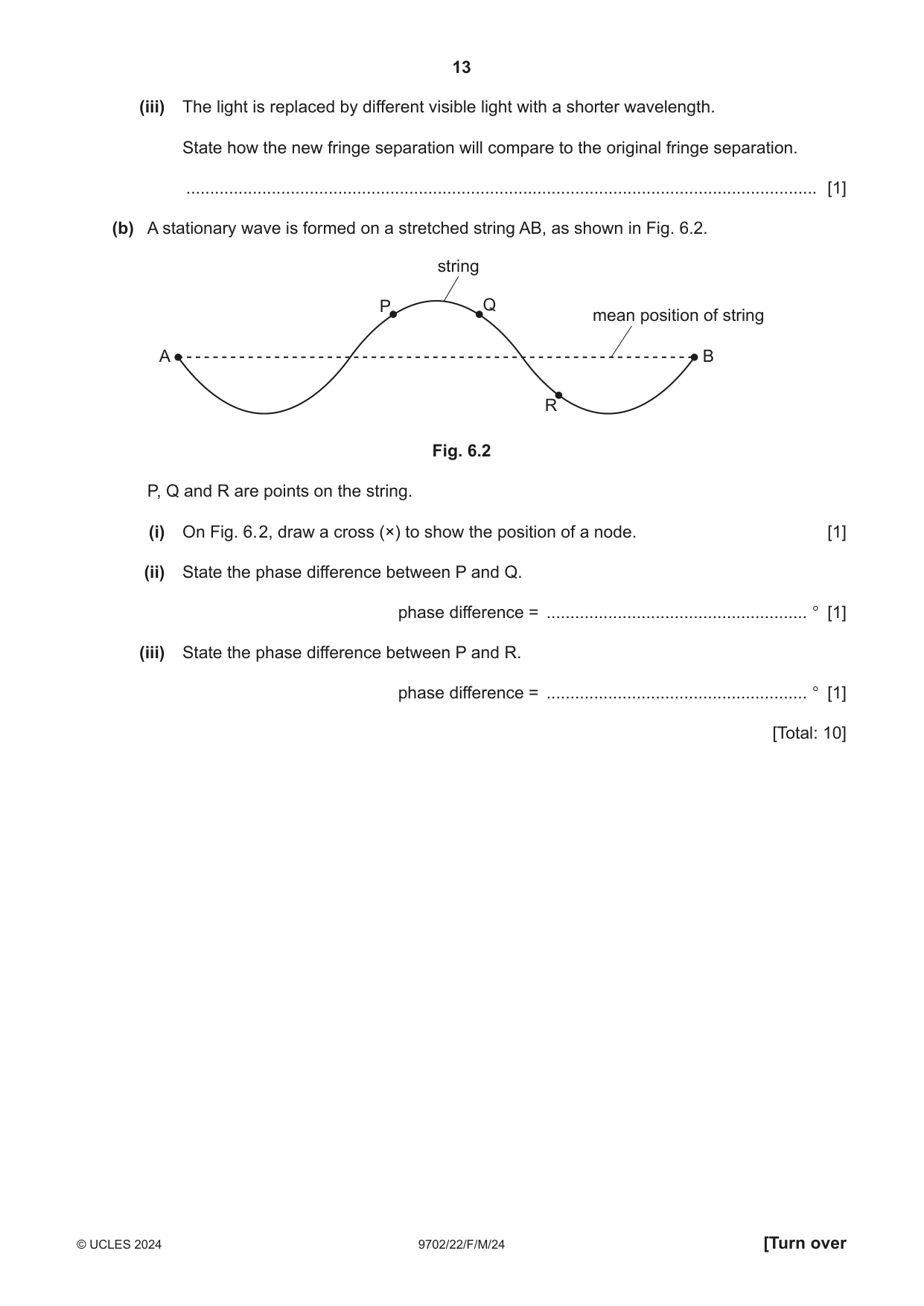
6 (a) Coherent visible light of a single frequency is incident normally on a double slit. This produces a pattern of bright and dark interference fringes on a screen, as illustrated in Fig. 6.1. fringe pattern on screen screen double slit bright fringe X light 1.2 mm 10.2 mm dark fringe 3.1 m bright fringe Y Fig. 6.1 (not to scale) There are seven bright fringes. (i) Explain how the pattern of bright and dark interference fringes is formed. ........................................................................................................................................... ........................................................................................................................................... ........................................................................................................................................... ........................................................................................................................................... ........................................................................................................................................... ..................................................................................................................................... [3] (ii) The distance between the centres of bright fringe X and bright fringe Y in the pattern is 10.2 mm. The slit spacing is 1.2 mm. The distance from the slits to the screen is 3.1 m. Calculate the wavelength of the light incident on the slits. wavelength = ..................................................... m [3] (iii) The light is replaced by different visible light with a shorter wavelength. State how the new fringe separation will compare to the original fringe separation. ..................................................................................................................................... [1] (b) A stationary wave is formed on a stretched string AB, as shown in Fig. 6.2. string P Q mean position of string A B R Fig. 6.2 P, Q and R are points on the string. (i) On Fig. 6. 2, draw a cross (×) to show the position of a node. [1] (ii) State the phase difference between P and Q. phase difference = ....................................................... ° [1] (iii) State the phase difference between P and R. phase difference = ....................................................... ° [1] [Total: 10]
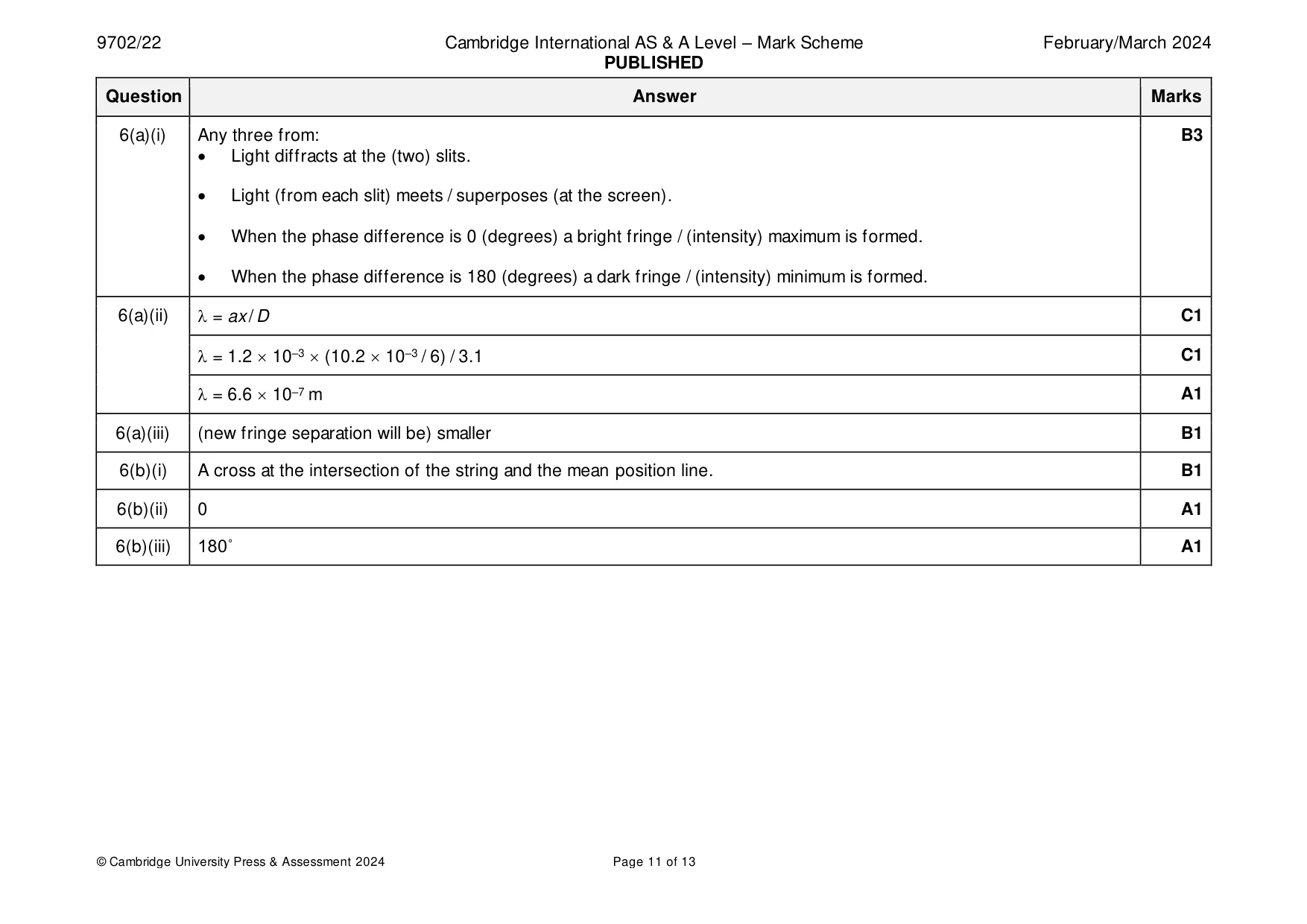
Mark scheme: 6(a)(i) Any three from: B3 • Light diffracts at the (two) slits. • Light (from each slit) meets / superposes (at the screen). • When the phase difference is 0 (degrees) a bright fringe / (intensity) maximum is formed. • When the phase difference is 180 (degrees) a dark fringe / (intensity) minimum is formed. 6(a)(ii) = ax / D C1 = 1.2 10–3 (10.2 10–3 / 6) / 3.1 C1 = 6.6 10–7 m A1 6(a)(iii) (new fringe separation will be) smaller B1 6(b)(i) A cross at the intersection of the string and the mean position line. B1 6(b)(ii) 0 A1 6(b)(iii) 180˚ A1
Q7 · Define electric potential difference
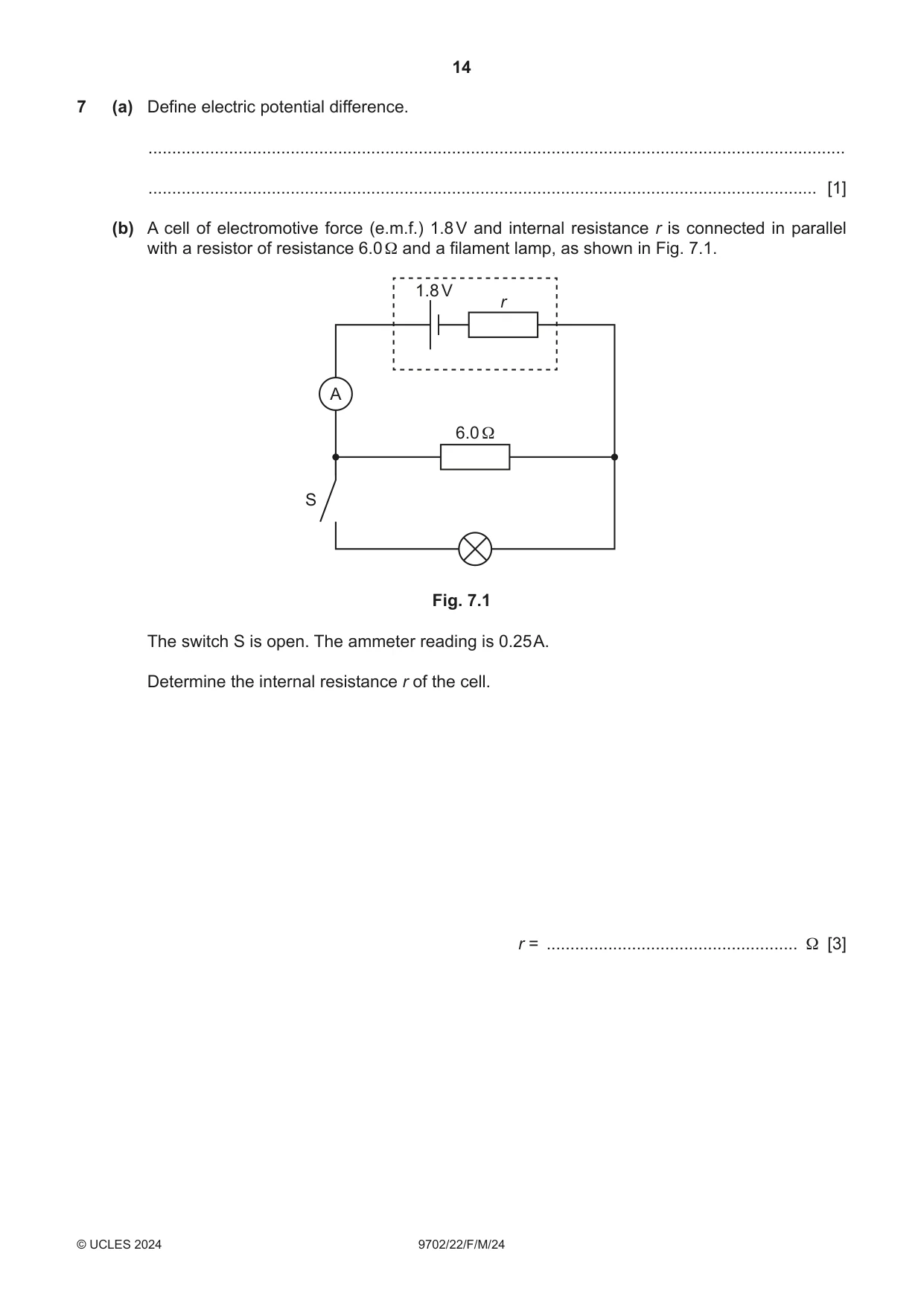
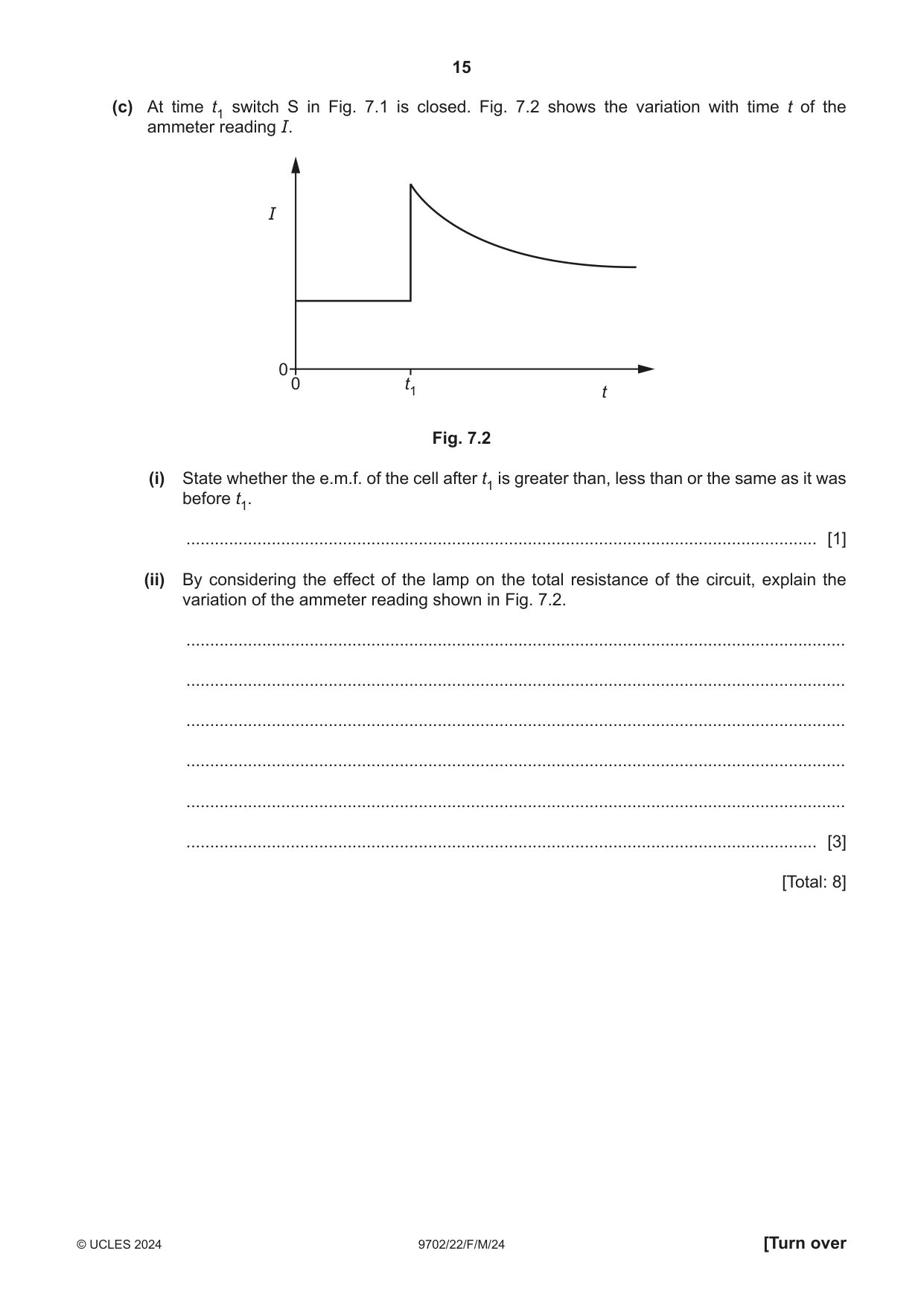
7 (a) Define electric potential difference. ................................................................................................................................................... ............................................................................................................................................. [1] (b) A cell of electromotive force (e.m.f.) 1.8 V and internal resistance r is connected in parallel with a resistor of resistance 6.0 Ω and a filament lamp, as shown in Fig. 7.1. 1.8 V r A 6.0 Ω S Fig. 7.1 The switch S is open. The ammeter reading is 0.25 A. Determine the internal resistance r of the cell. r = ..................................................... Ω [3] (c) At time t1 switch S in Fig. 7.1 is closed. Fig. 7.2 shows the variation with time t of the ammeter reading I. I 0 0 t1 t Fig. 7.2 (i) State whether the e.m.f. of the cell after t1 is greater than, less than or the same as it was before t1. ..................................................................................................................................... [1] (ii) By considering the effect of the lamp on the total resistance of the circuit, explain the variation of the ammeter reading shown in Fig. 7.2. ........................................................................................................................................... ........................................................................................................................................... ........................................................................................................................................... ........................................................................................................................................... ........................................................................................................................................... ..................................................................................................................................... [3] [Total: 8]
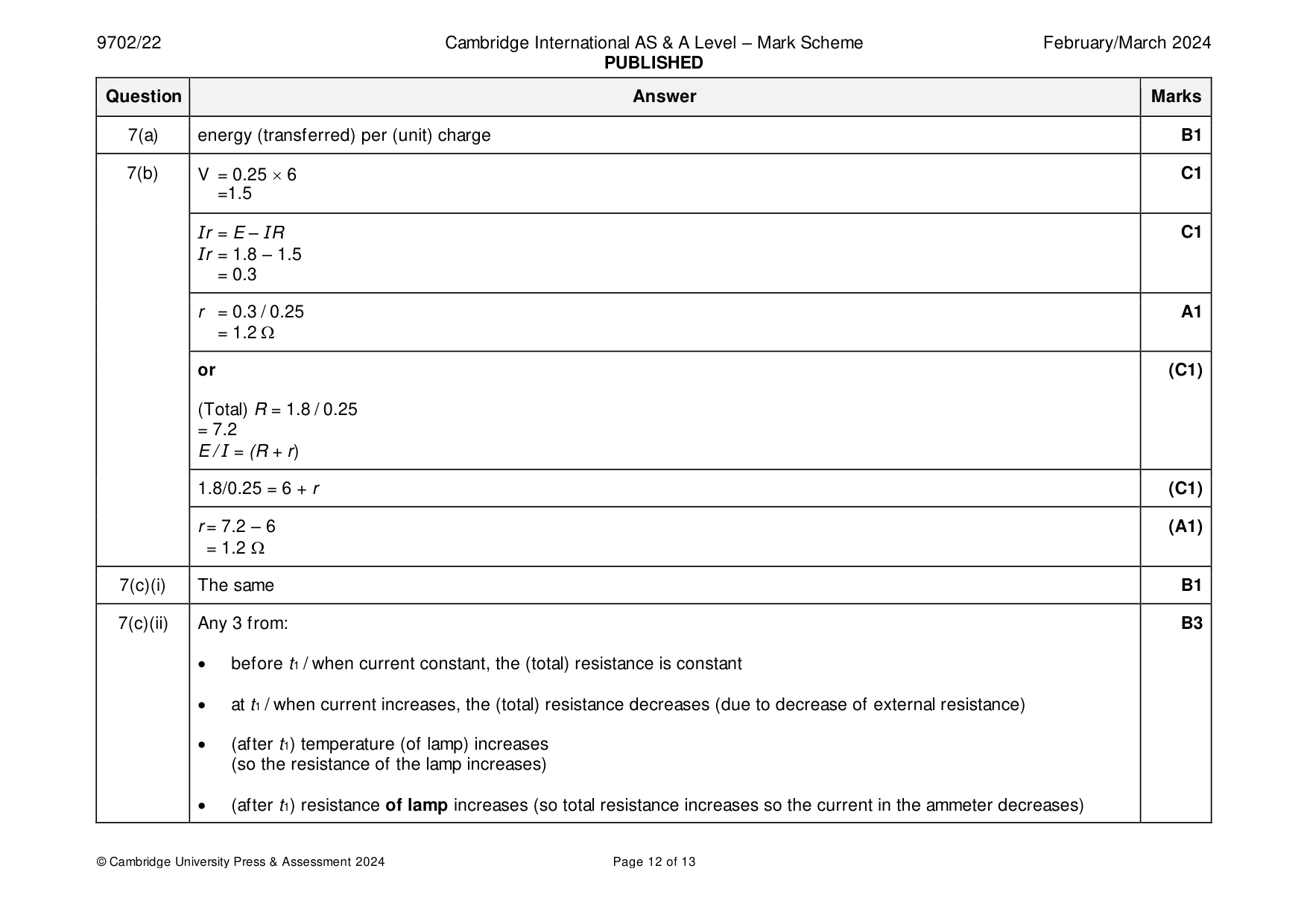
Mark scheme: 7(a) energy (transferred) per (unit) charge B1 7(b) V = 0.25 6 C1 =1.5 Ir = E – IR C1 Ir = 1.8 – 1.5 = 0.3 r = 0.3 / 0.25 A1 = 1.2 or (C1) (Total) R = 1.8 / 0.25 = 7.2 E / I = (R + r) 1.8/0.25 = 6 + r (C1) r = 7.2 – 6 (A1) = 1.2 7(c)(i) The same B1 7(c)(ii) Any 3 from: B3 • before t1 / when current constant, the (total) resistance is constant • at t1 / when current increases, the (total) resistance decreases (due to decrease of external resistance) • (after t1) temperature (of lamp) increases (so the resistance of the lamp increases) • (after t1) resistance of lamp increases (so total resistance increases so the current in the ammeter decreases)
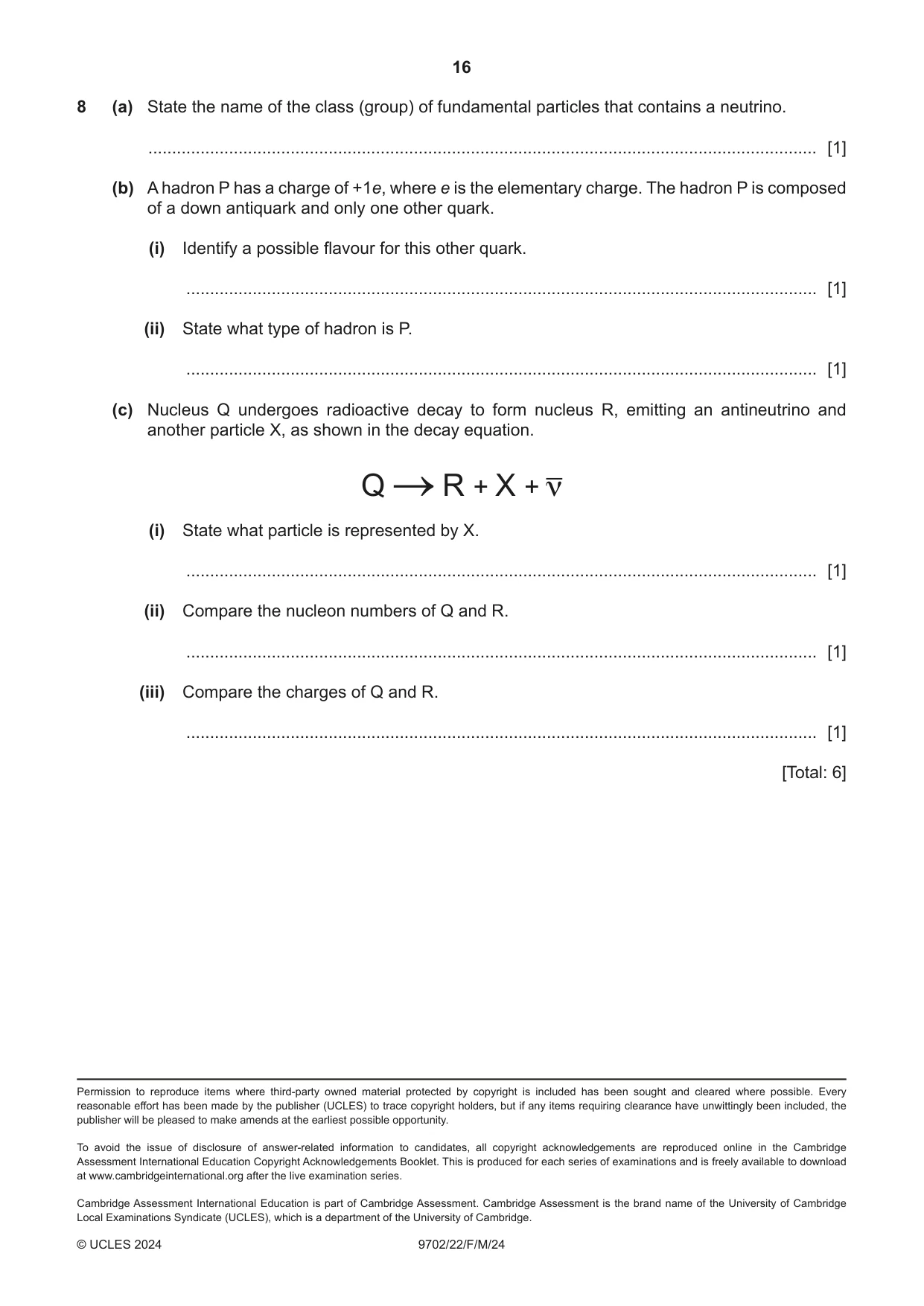
Q8 · State the name of the class (group) of fundamental particles that contains a neutrino
8 (a) State the name of the class (group) of fundamental particles that contains a neutrino. ............................................................................................................................................. [1] (b) A hadron P has a charge of +1e, where e is the elementary charge. The hadron P is composed of a down antiquark and only one other quark. (i) Identify a possible flavour for this other quark. ..................................................................................................................................... [1] (ii) State what type of hadron is P. ..................................................................................................................................... [1] (c) Nucleus Q undergoes radioactive decay to form nucleus R, emitting an antineutrino and another particle X, as shown in the decay equation. Q R + X + ν (i) State what particle is represented by X. ..................................................................................................................................... [1] (ii) Compare the nucleon numbers of Q and R. ..................................................................................................................................... [1] (iii) Compare the charges of Q and R. ..................................................................................................................................... [1] [Total: 6]
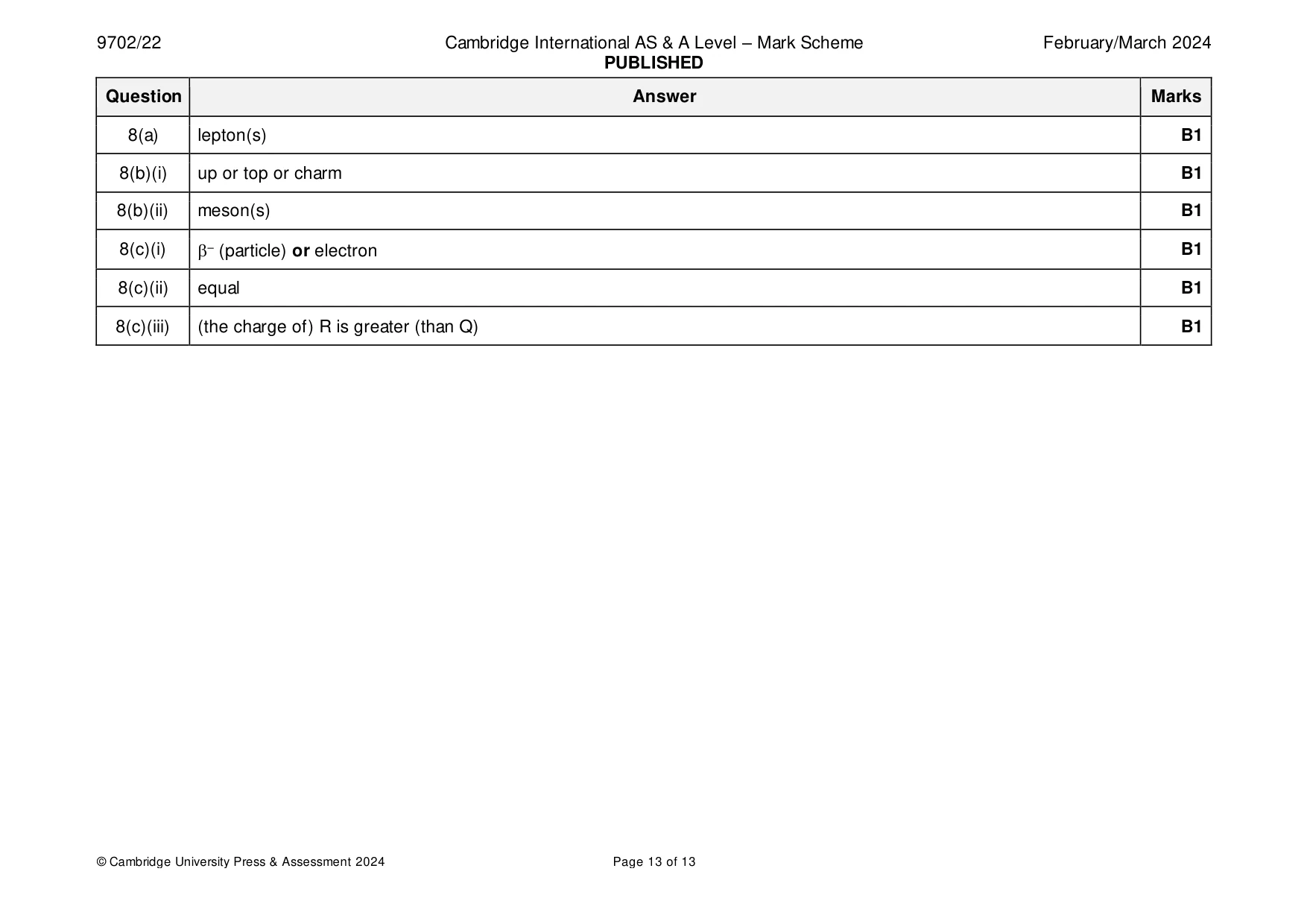
Mark scheme: 8(a) lepton(s) B1 8(b)(i) up or top or charm B1 8(b)(ii) meson(s) B1 8(c)(i) – (particle) or electron B1 8(c)(ii) equal B1 8(c)(iii) (the charge of) R is greater (than Q) B1
What was in this paper
The subtopics covered by these 8 questions, and how many questions each got. Open one in a new tab to see every Cambridge question on it.
What you needed in this session
Cambridge’s own grade thresholds for 2024 Feb/March, Paper 2 · Variant 2. A higher threshold means an easier paper — the bar moves with how the cohort did.