Cambridge A Level Physics 9702 — 2019 Feb/March Paper 2 · Variant 2
9702/22/F/M/19 · 7 questions · 60 marks · ≈68 min
The question paper and its mark scheme, free to read here and free to download. This is Cambridge’s own paper, exactly as it was sat.
Question paper16 pages

Mark scheme9 pages
Answers below. Sit the paper first if you are practising.
Questions as text
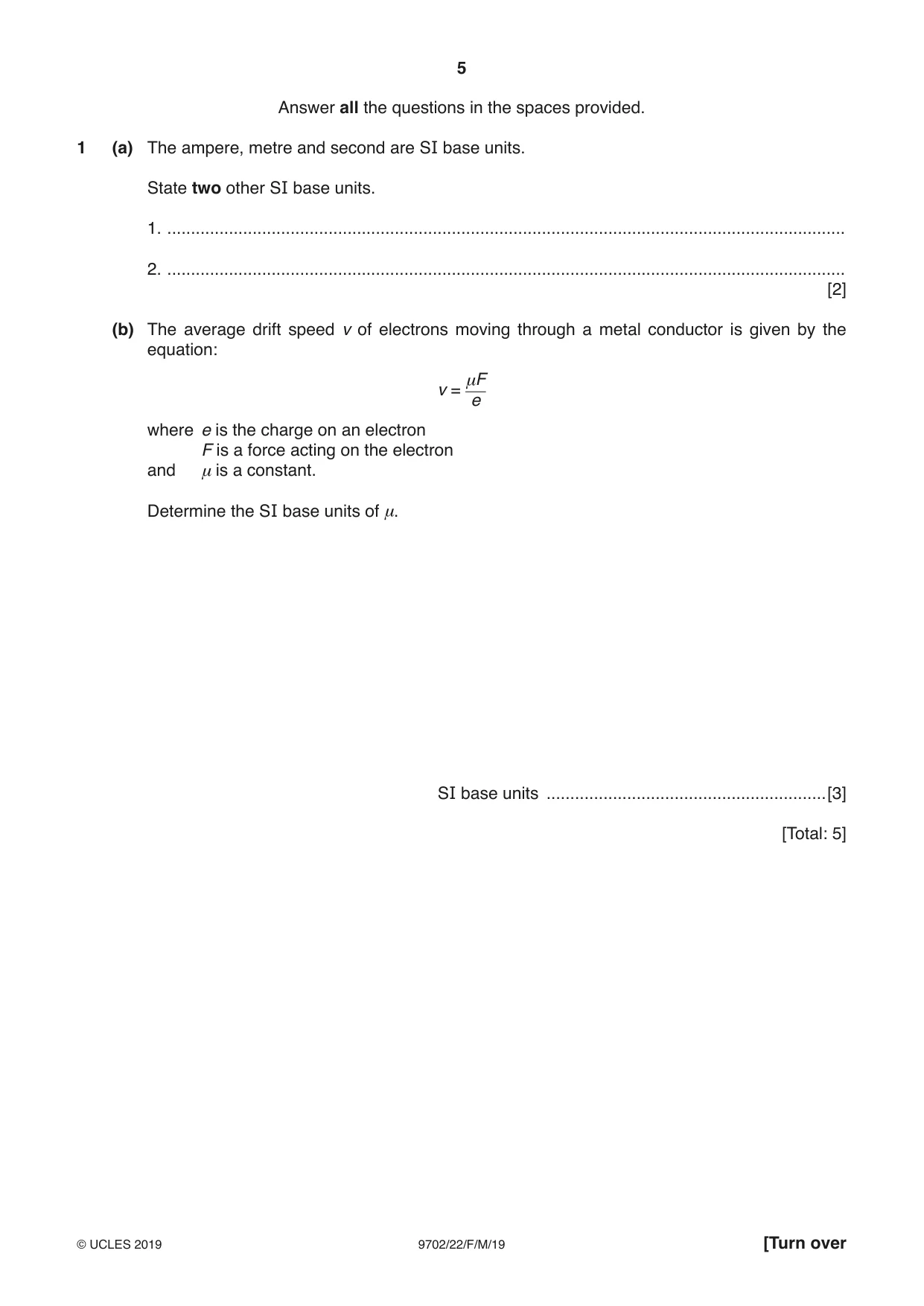
Q1 · The ampere, metre and second are SI base units
1 (a) The ampere, metre and second are SI base units. State two other SI base units. 1. ............................................................................................................................................... 2. ............................................................................................................................................... [2] (b) The average drift speed v of electrons moving through a metal conductor is given by the equation: μF v = e where e is the charge on an electron F is a force acting on the electron and μ is a constant. Determine the SI base units of μ. SI base units ...........................................................[3] [Total: 5]
Mark scheme: 1(a) kilogram / kg B1 kelvin / K B1 1(b) units for v: m s–1 and units for F: kg m s–2 C1 units for e: A s C1 units for µ: m s–1 A s / kg m s–2 = A kg–1 s2 A1
Question 2
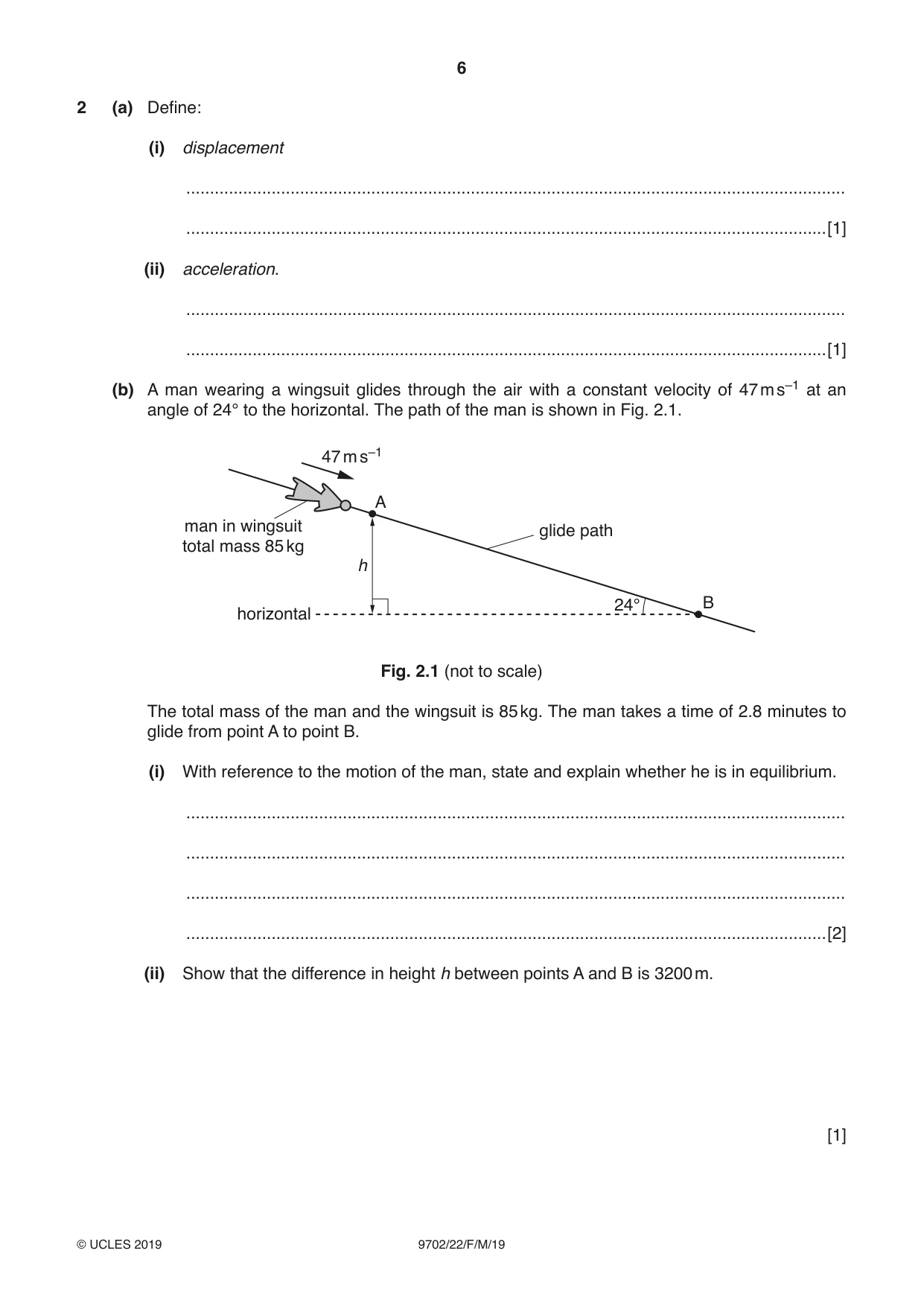
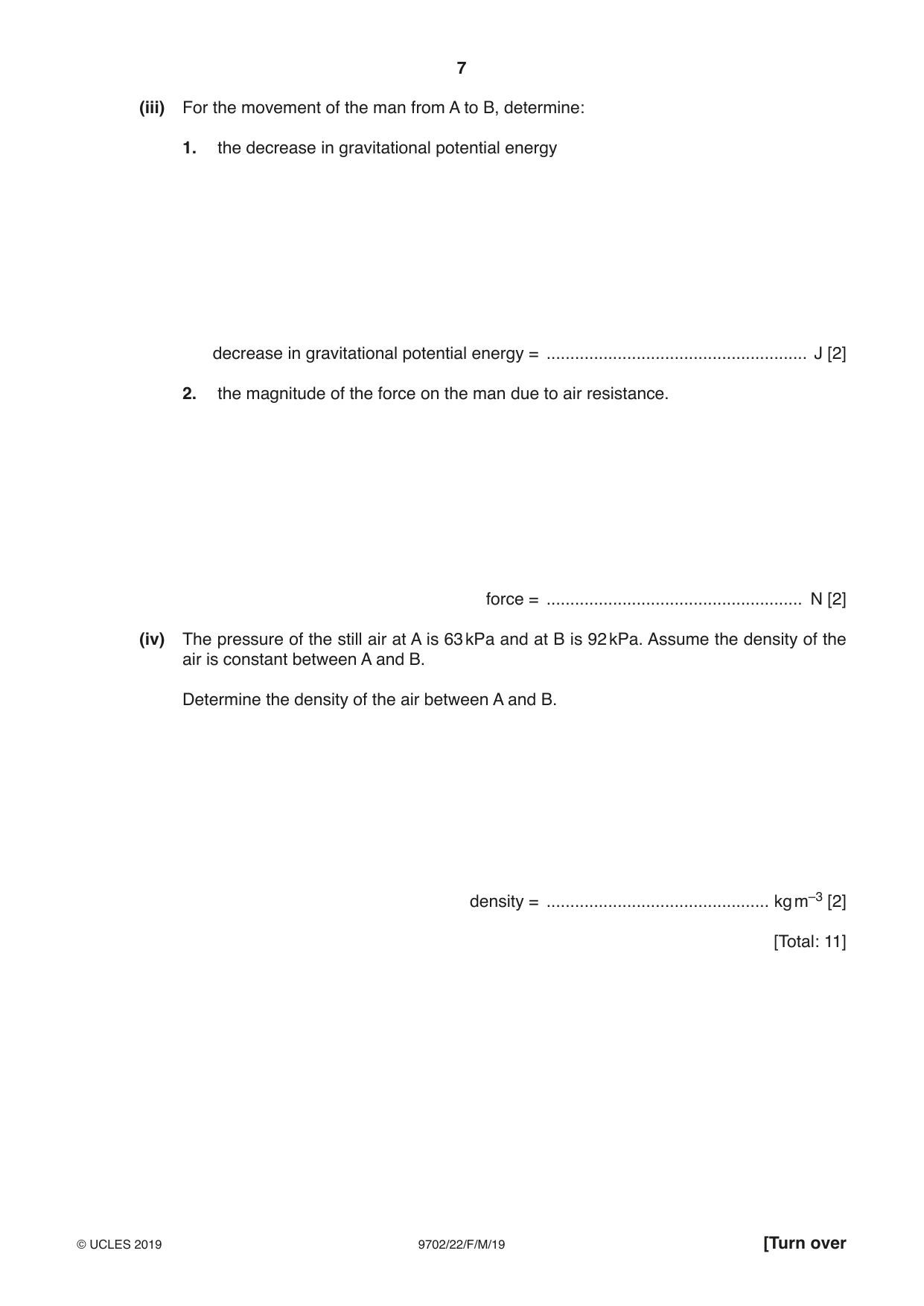
2 (a) Define: (i) displacement ........................................................................................................................................... .......................................................................................................................................[1] (ii) acceleration. ........................................................................................................................................... .......................................................................................................................................[1] (b) A man wearing a wingsuit glides through the air with a constant velocity of 47 m s–1 at an angle of 24° to the horizontal. The path of the man is shown in Fig. 2.1. 47 m s–1 A man in wingsuit glide path total mass 85 kg h 24° B horizontal Fig. 2.1 (not to scale) The total mass of the man and the wingsuit is 85 kg. The man takes a time of 2.8 minutes to glide from point A to point B. (i) With reference to the motion of the man, state and explain whether he is in equilibrium. ........................................................................................................................................... ........................................................................................................................................... ........................................................................................................................................... .......................................................................................................................................[2] (ii) Show that the difference in height h between points A and B is 3200 m. [1] (iii) For the movement of the man from A to B, determine: 1. the decrease in gravitational potential energy decrease in gravitational potential energy = ....................................................... J [2] 2. the magnitude of the force on the man due to air resistance. force = ...................................................... N [2] (iv) The pressure of the still air at A is 63 kPa and at B is 92 kPa. Assume the density of the air is constant between A and B. Determine the density of the air between A and B. density = ............................................... kg m–3 [2] [Total: 11]
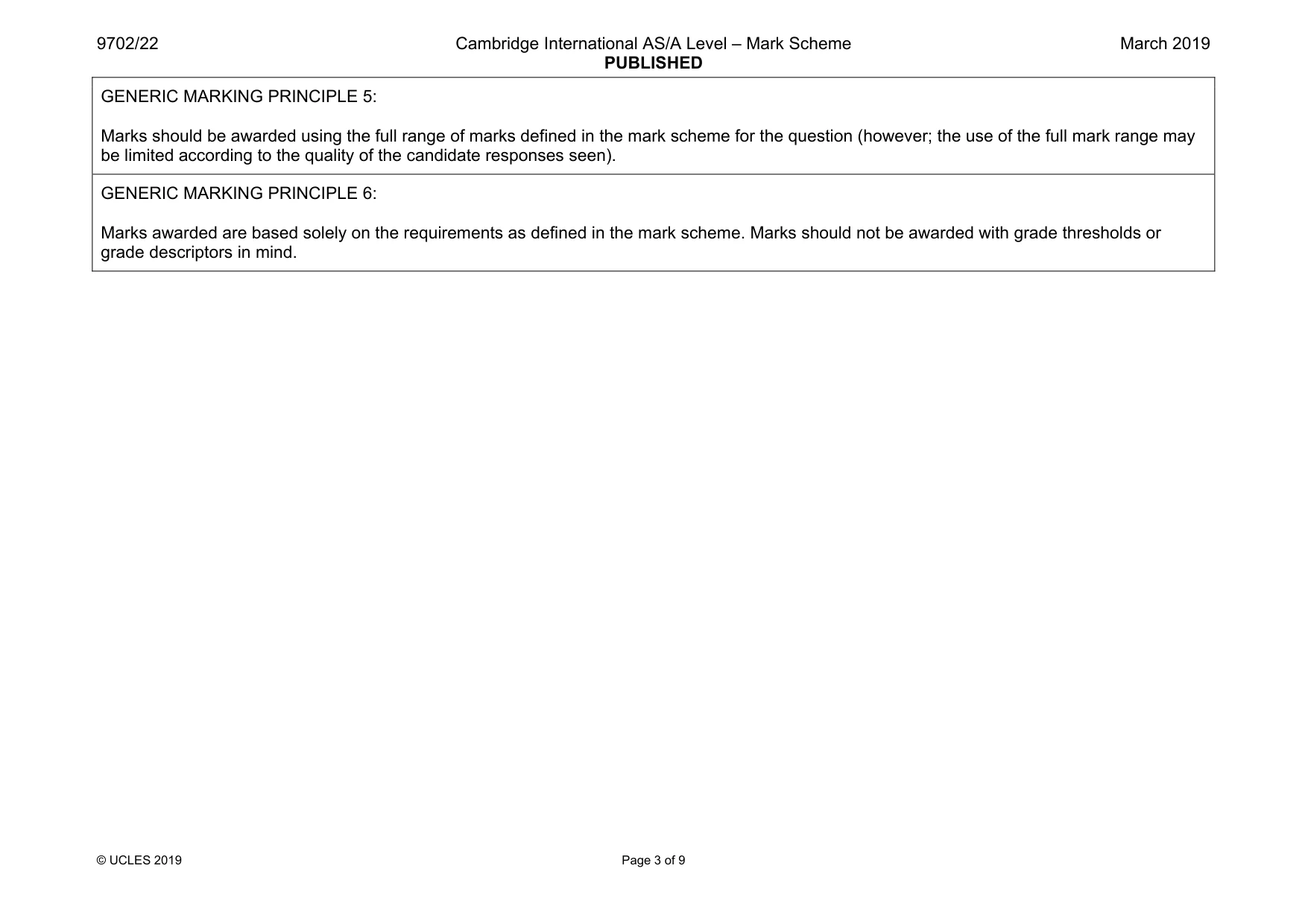
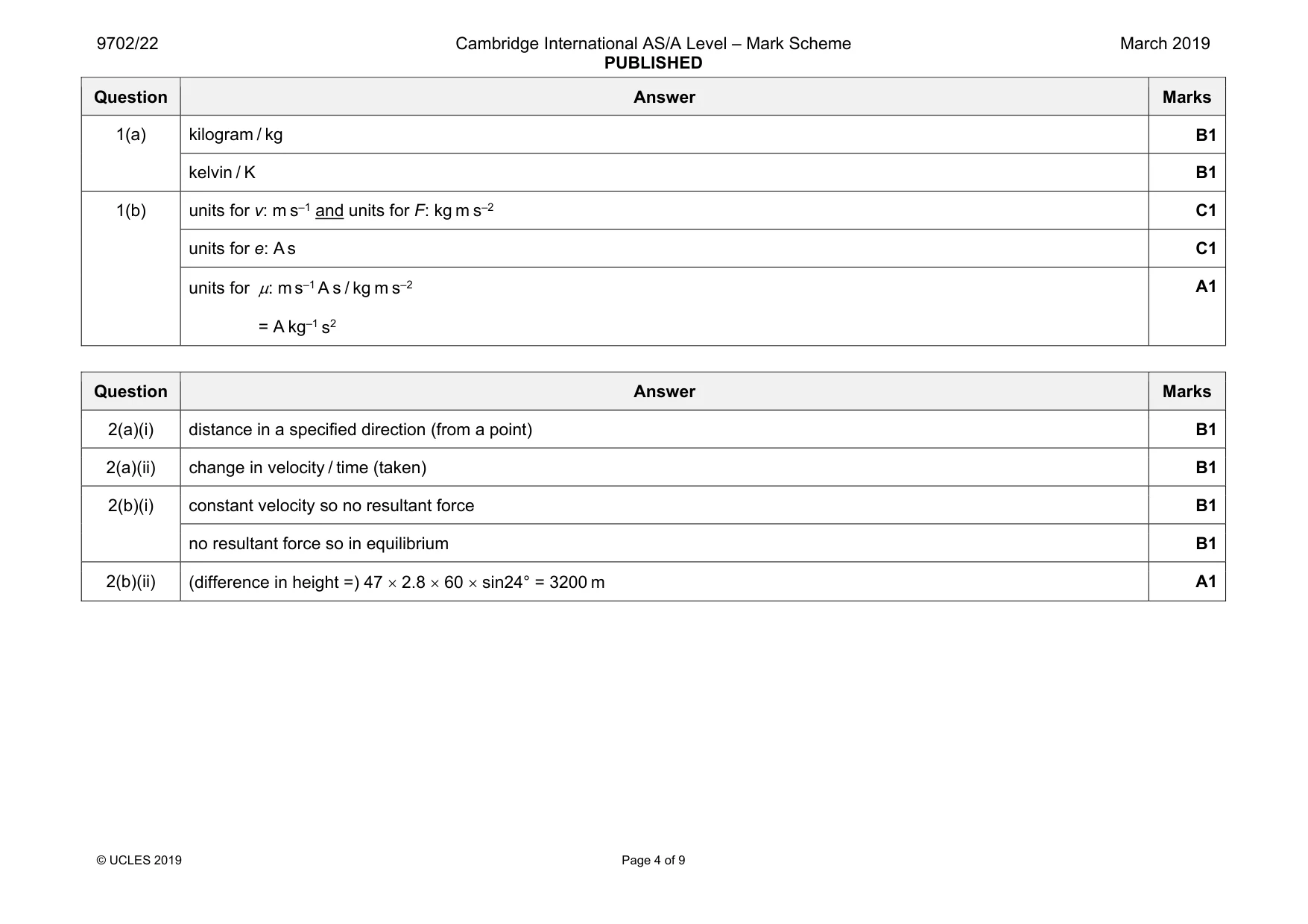
Mark scheme: 2(a)(i) distance in a specified direction (from a point) B1 2(a)(ii) change in velocity / time (taken) B1 2(b)(i) constant velocity so no resultant force B1 no resultant force so in equilibrium B1 2(b)(ii) (difference in height =) 47 × 2.8 × 60 × sin24° = 3200 m A1 Question Answer Marks 2(b)(iii) 1 (∆)E = mg(∆)h = 85 × 9.81 × 3200 C1 = 2.7 × 10⁶ J A1 2 In terms of energy: work done = 2.7 × 10⁶ J force = 2.7 × 10⁶ / (47 × 2.8 × 60) C1 = 340 N A1 In terms of forces: component of weight along path = force due to air resistance force = 85 × 9.81 × sin24° (C1) = 340 N (A1) 2(b)(iv) (∆)p = ρg(∆)h (92 – 63) × 103 = ρ × 9.81 × 3200 C1 ρ = 0.92 kg m–3 A1
Q3 · Two balls, X and Y, move along a horizontal frictionless surface, as illustrated in Fig
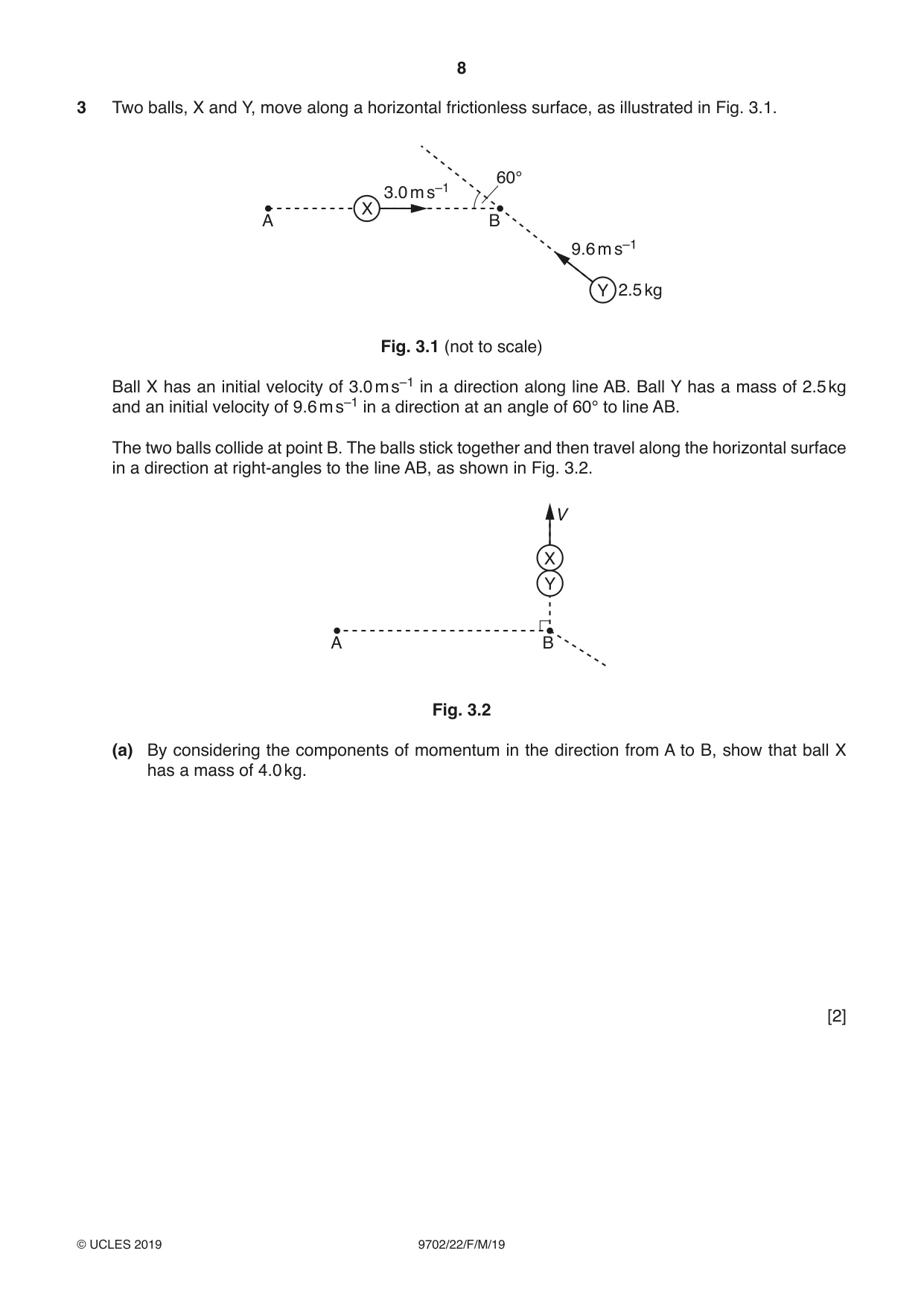
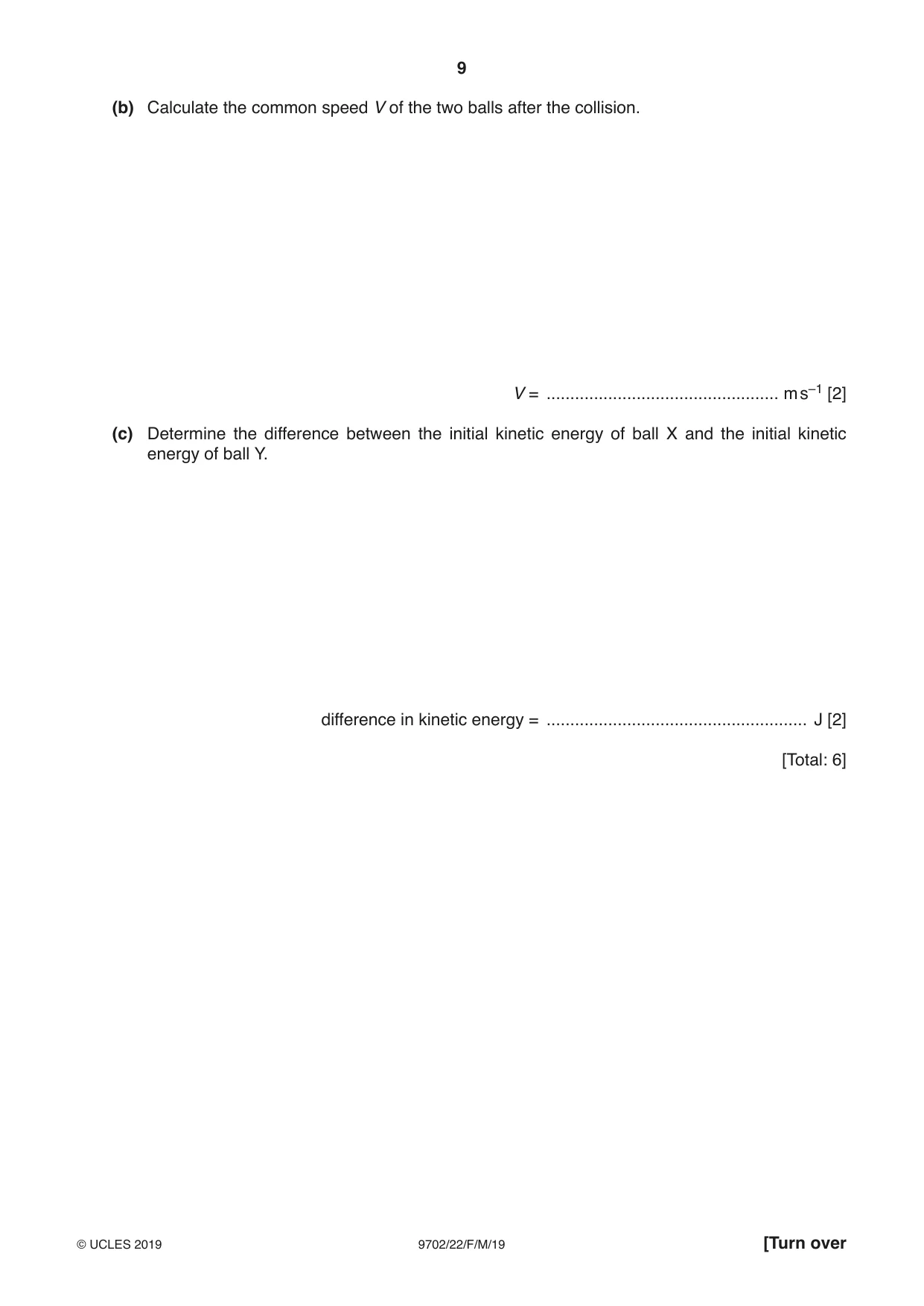
3 Two balls, X and Y, move along a horizontal frictionless surface, as illustrated in Fig. 3.1. 60° 3.0 m s–1 X A B 9.6 m s–1 Y 2.5 kg Fig. 3.1 (not to scale) Ball X has an initial velocity of 3.0 m s–1 in a direction along line AB. Ball Y has a mass of 2.5 kg and an initial velocity of 9.6 m s–1 in a direction at an angle of 60° to line AB. The two balls collide at point B. The balls stick together and then travel along the horizontal surface in a direction at right-angles to the line AB, as shown in Fig. 3.2. V X Y A B Fig. 3.2 (a) By considering the components of momentum in the direction from A to B, show that ball X has a mass of 4.0 kg. [2] (b) Calculate the common speed V of the two balls after the collision. V = ................................................. m s–1 [2] (c) Determine the difference between the initial kinetic energy of ball X and the initial kinetic energy of ball Y. difference in kinetic energy = ....................................................... J [2] [Total: 6]
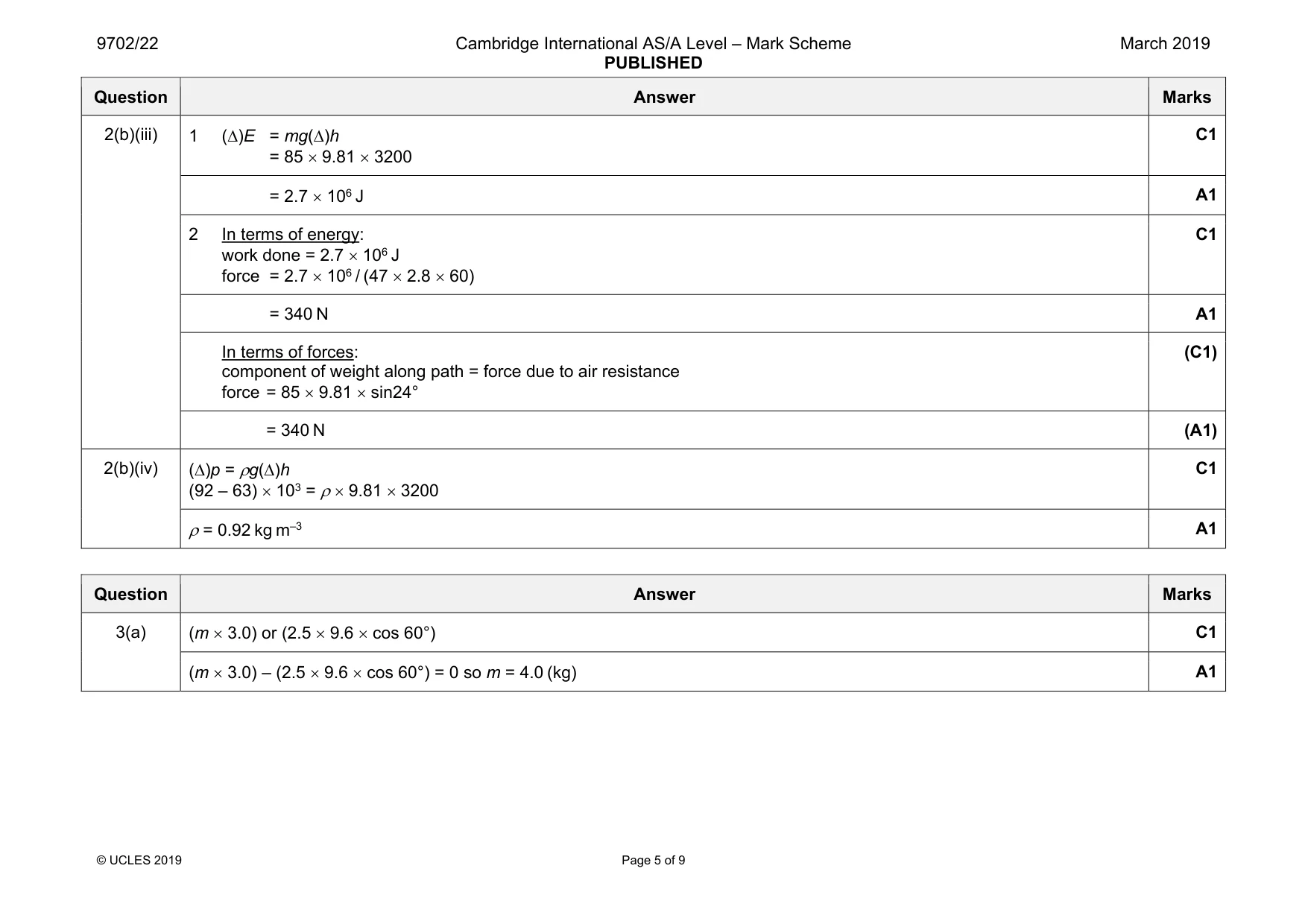
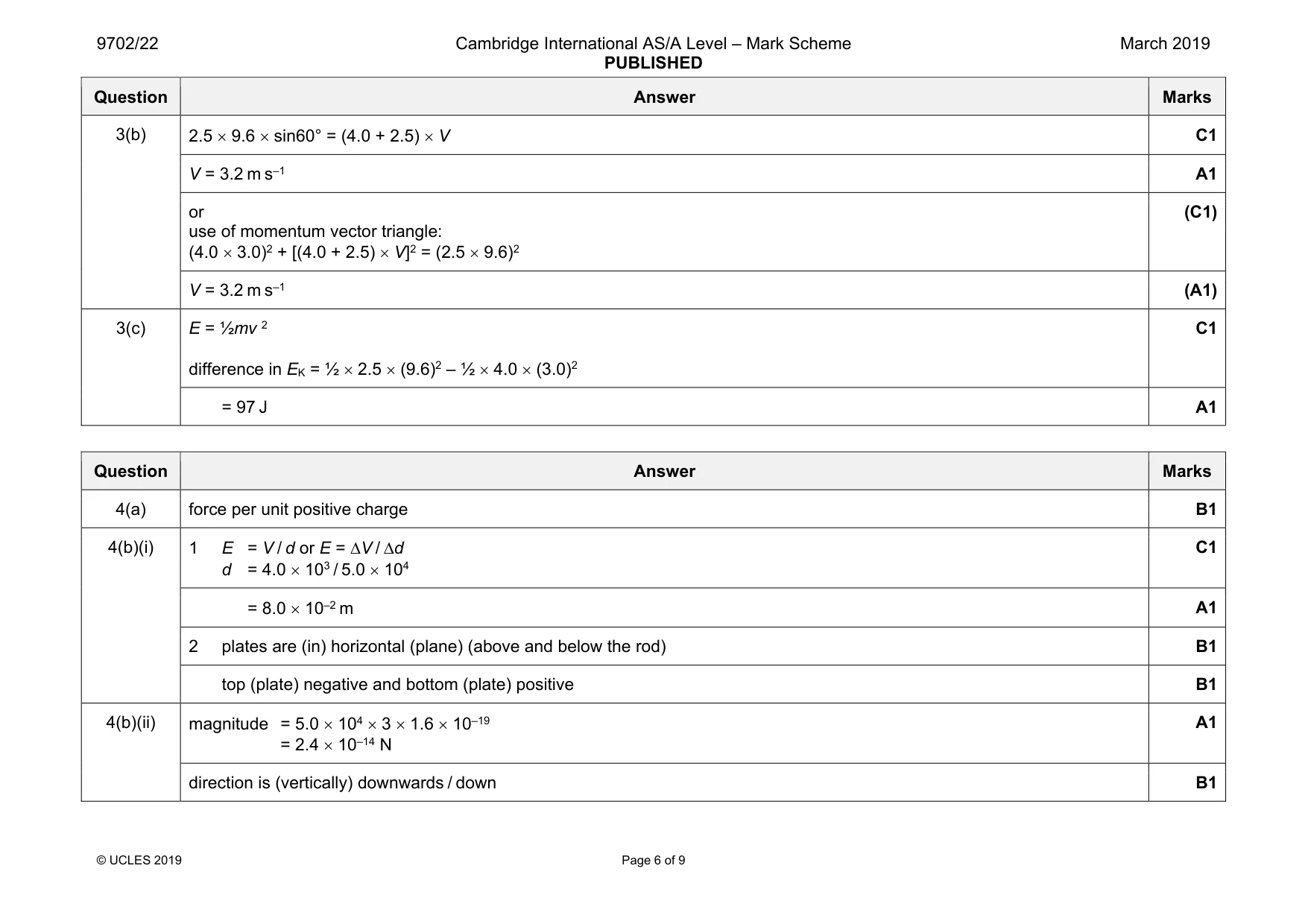
Mark scheme: 3(a) C1 (m × 3.0) – (2.5 × 9.6 × cos 60°) = 0 so m = 4.0 (kg) A1 Question Answer Marks 3(b) 2.5 × 9.6 × sin60° = (4.0 + 2.5) × V C1 V = 3.2 m s–1 A1 or use of momentum vector triangle: (4.0 × 3.0)2 + [(4.0 + 2.5) × V]2 = (2.5 × 9.6)2 (C1) V = 3.2 m s–1 (A1) 3(c) E = ½mv 2 difference in EK = ½ × 2.5 × (9.6)2 – ½ × 4.0 × (3.0)2 C1 = 97 J A1
Q4 · Define electric field strength
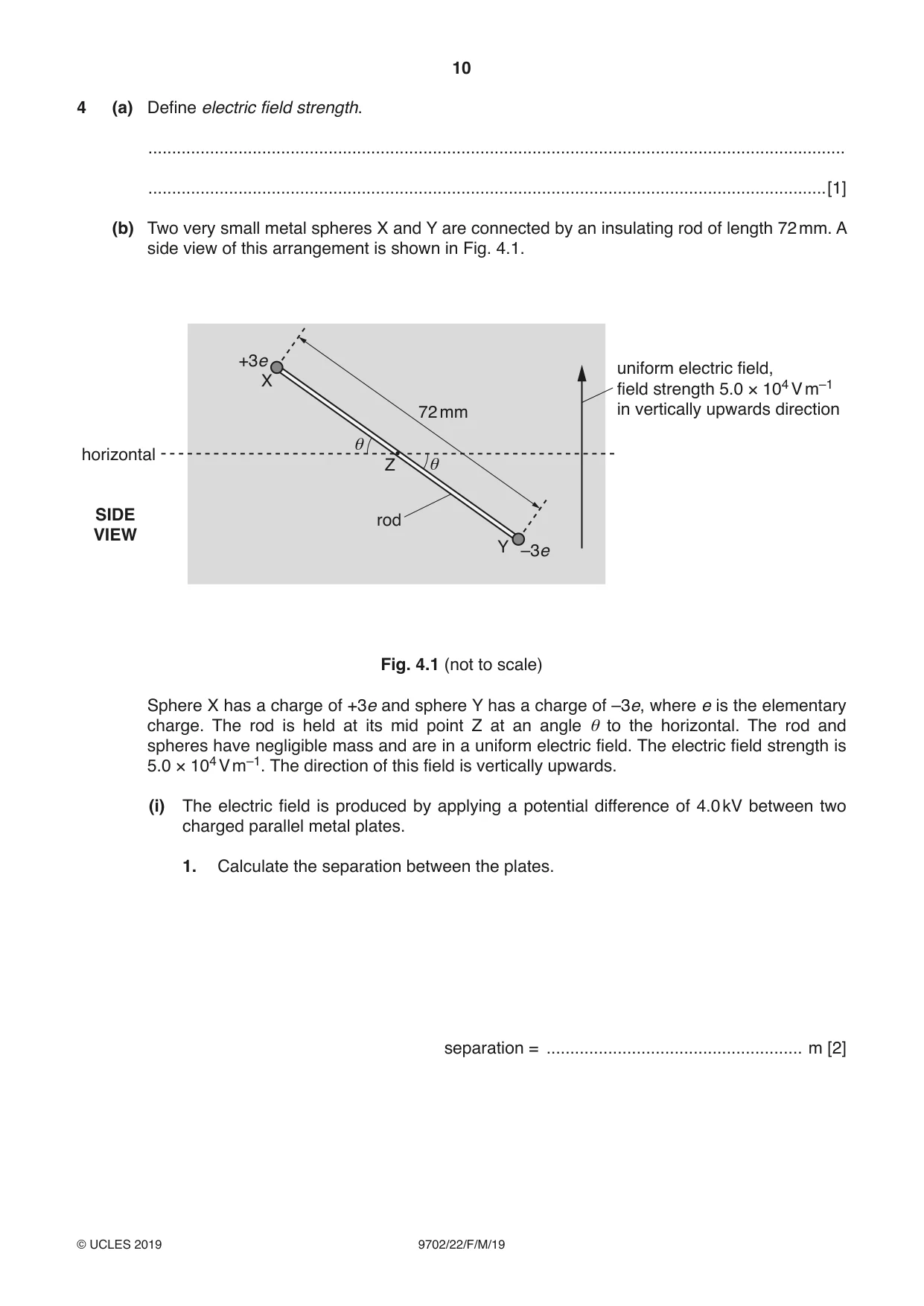
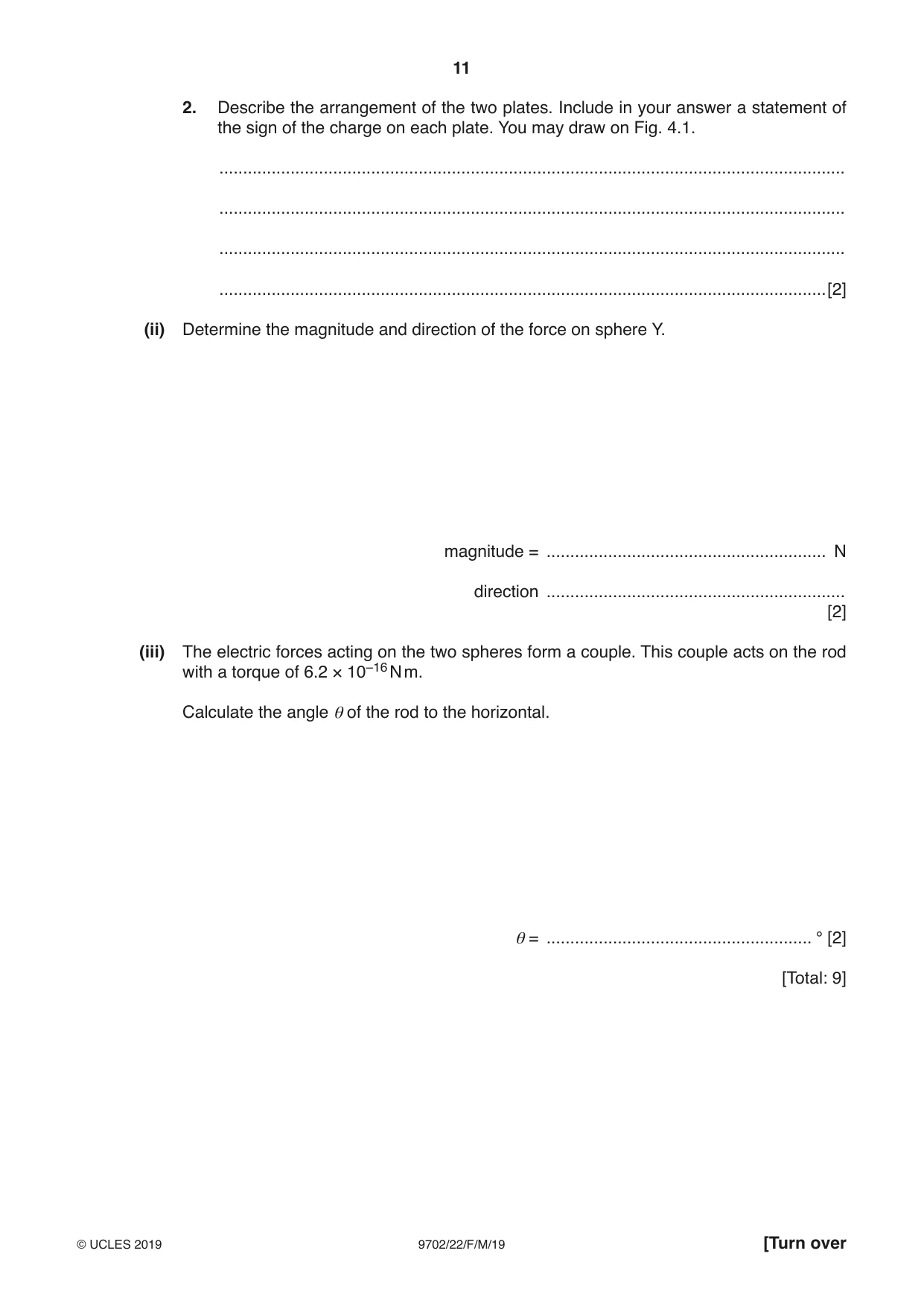
4 (a) Define electric field strength. ................................................................................................................................................... ...............................................................................................................................................[1] (b) Two very small metal spheres X and Y are connected by an insulating rod of length 72 mm. A side view of this arrangement is shown in Fig. 4.1. +3e uniform electric field, X field strength 5.0 × 10⁴ V m–1 72 mm in vertically upwards direction θ horizontal Z θ SIDE rod VIEW Y –3e Fig. 4.1 (not to scale) Sphere X has a charge of +3e and sphere Y has a charge of –3e, where e is the elementary charge. The rod is held at its mid point Z at an angle θ to the horizontal. The rod and spheres have negligible mass and are in a uniform electric field. The electric field strength is 5.0 × 10⁴ V m–1. The direction of this field is vertically upwards. (i) The electric field is produced by applying a potential difference of 4.0 kV between two charged parallel metal plates. 1. Calculate the separation between the plates. separation = ...................................................... m [2] 2. Describe the arrangement of the two plates. Include in your answer a statement of the sign of the charge on each plate. You may draw on Fig. 4.1. .................................................................................................................................... .................................................................................................................................... .................................................................................................................................... ................................................................................................................................[2] (ii) Determine the magnitude and direction of the force on sphere Y. magnitude = ........................................................... N direction ............................................................... [2] (iii) The electric forces acting on the two spheres form a couple. This couple acts on the rod with a torque of 6.2 × 10⁻¹⁶ N m. Calculate the angle θ of the rod to the horizontal. θ = ........................................................ ° [2] [Total: 9]
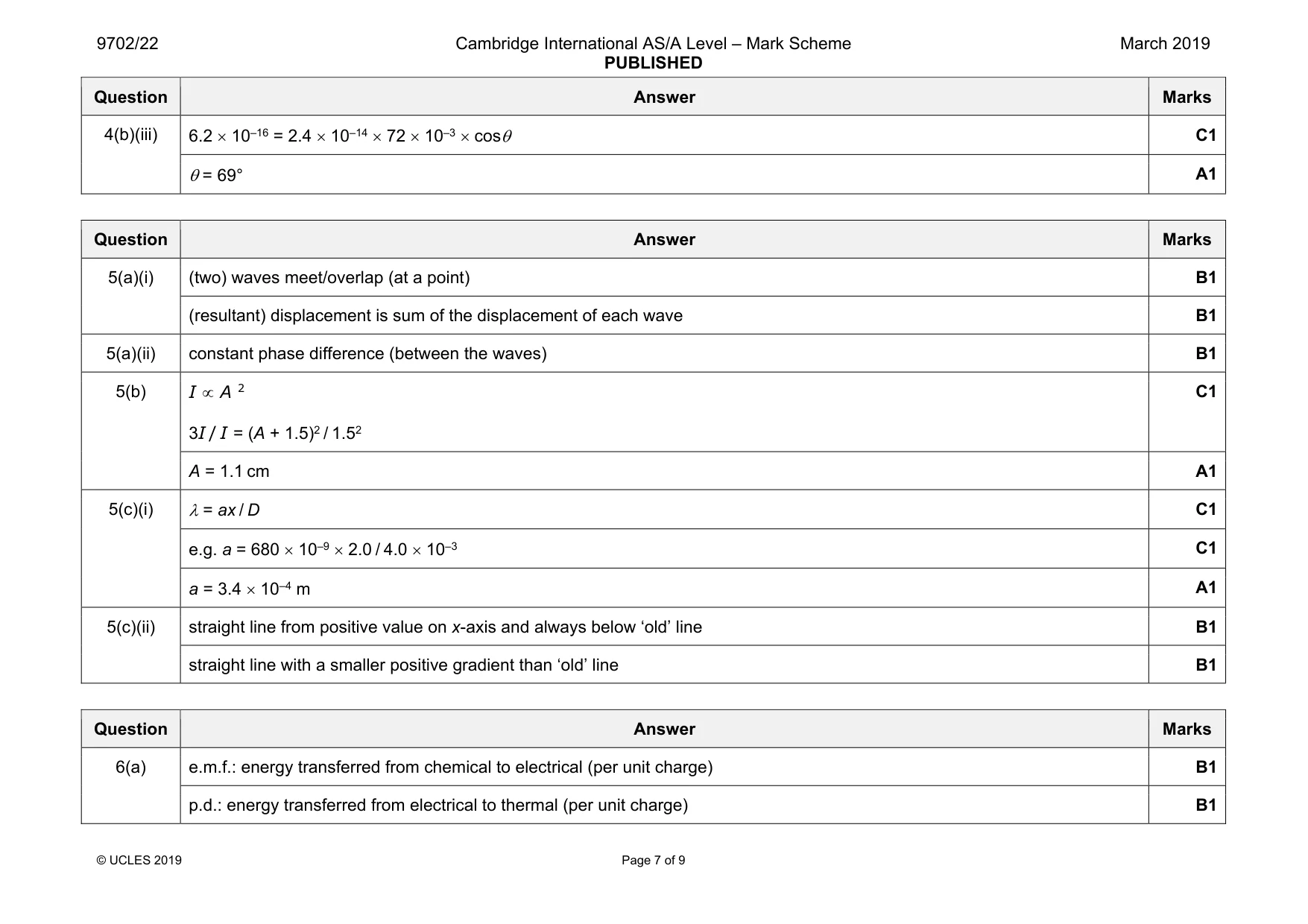
Mark scheme: 4(a) force per unit positive charge B1 4(b)(i) 1 E = V / d or E = ∆V / ∆d d = 4.0 × 10³ / 5.0 × 10⁴ C1 = 8.0 × 10⁻² m A1 2 plates are (in) horizontal (plane) (above and below the rod) B1 top (plate) negative and bottom (plate) positive B1 4(b)(ii) magnitude = 5.0 × 104 × 3 × 1.6 × 10–19 = 2.4 × 10⁻¹⁴ N A1 direction is (vertically) downwards / down B1 Question Answer Marks 4(b)(iii) 6.2 × 10–16 = 2.4 × 10–14 × 72 × 10–3 × cosθ C1 θ = 69° A1
Q5 · By reference to two waves, state: (i) the principle of superposition…
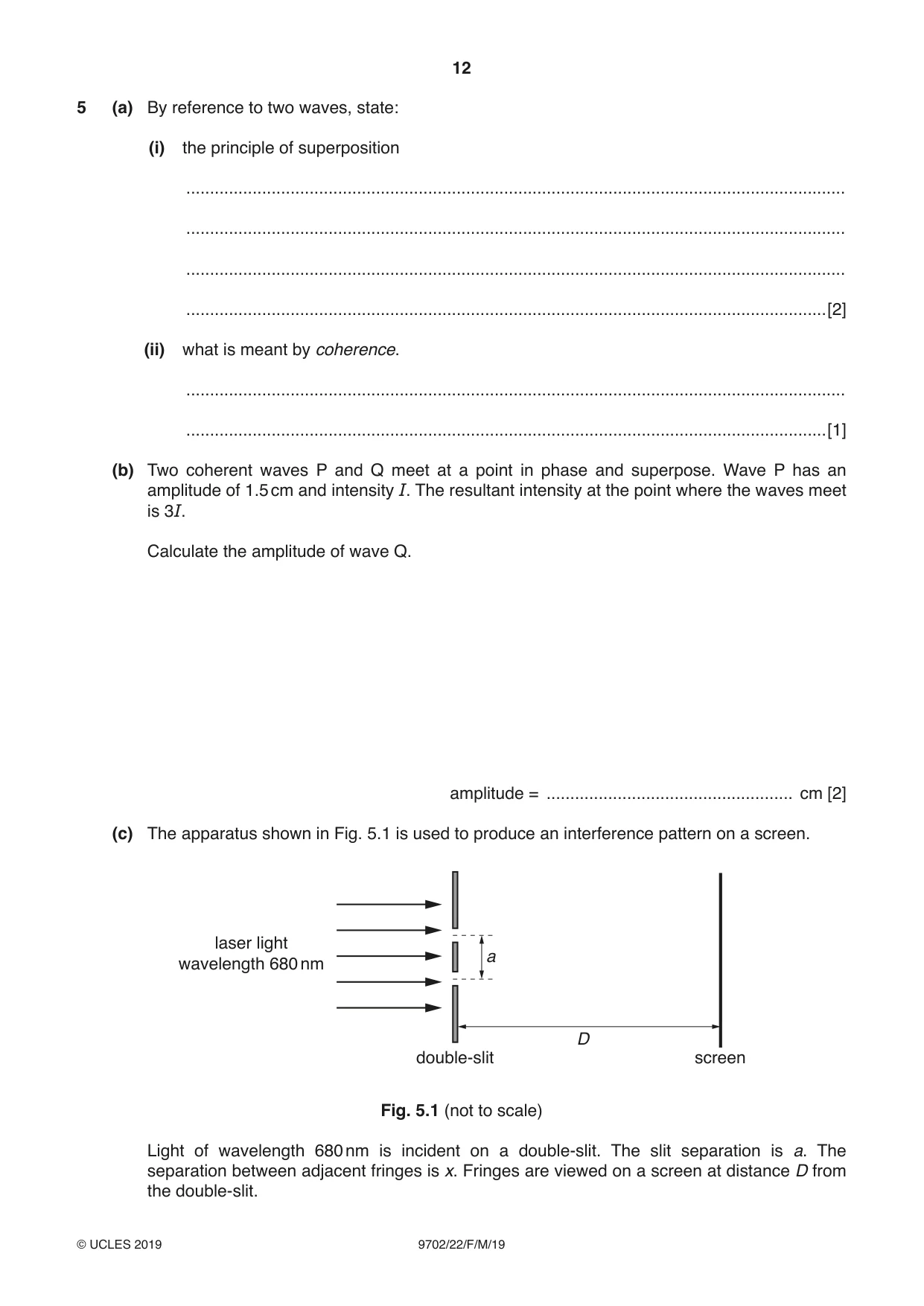
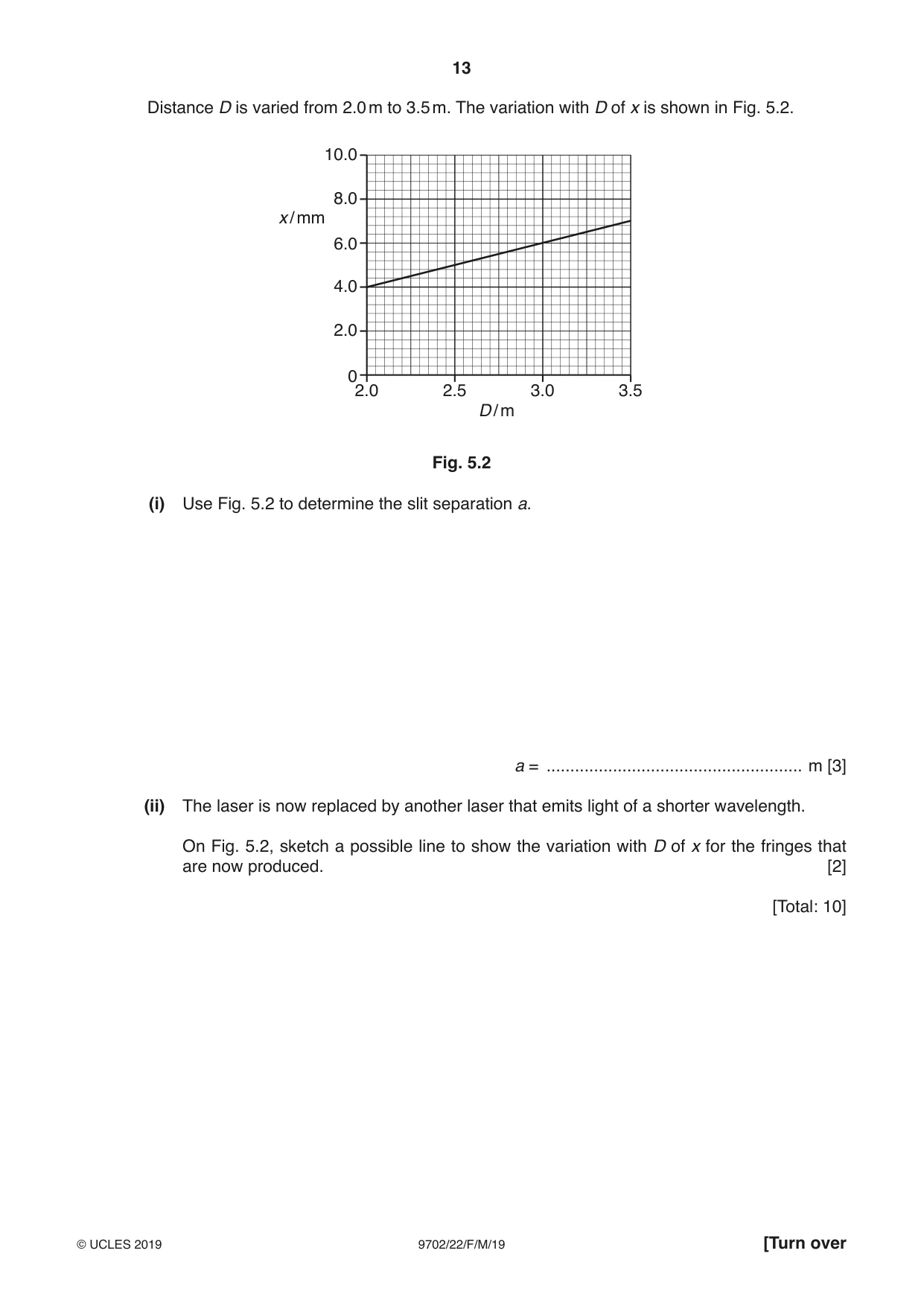
5 (a) By reference to two waves, state: (i) the principle of superposition ........................................................................................................................................... ........................................................................................................................................... ........................................................................................................................................... .......................................................................................................................................[2] (ii) what is meant by coherence. ........................................................................................................................................... .......................................................................................................................................[1] (b) Two coherent waves P and Q meet at a point in phase and superpose. Wave P has an amplitude of 1.5 cm and intensity I. The resultant intensity at the point where the waves meet is 3I. Calculate the amplitude of wave Q. amplitude = .................................................... cm [2] (c) The apparatus shown in Fig. 5.1 is used to produce an interference pattern on a screen. laser light a wavelength 680 nm D double-slit screen Fig. 5.1 (not to scale) Light of wavelength 680 nm is incident on a double-slit. The slit separation is a. The separation between adjacent fringes is x. Fringes are viewed on a screen at distance D from the double-slit. Distance D is varied from 2.0 m to 3.5 m. The variation with D of x is shown in Fig. 5.2. 10.0 8.0 x / mm 6.0 4.0 2.0 0 2.0 2.5 3.0 3.5 D / m Fig. 5.2 (i) Use Fig. 5.2 to determine the slit separation a. a = ...................................................... m [3] (ii) The laser is now replaced by another laser that emits light of a shorter wavelength. On Fig. 5.2, sketch a possible line to show the variation with D of x for the fringes that are now produced. [2] [Total: 10]
Mark scheme: 5(a)(i) (two) waves meet/overlap (at a point) B1 (resultant) displacement is sum of the displacement of each wave B1 5(a)(ii) constant phase difference (between the waves) B1 5(b) I ∝ A 2 3I / I = (A + 1.5)2 / 1.52 C1 A = 1.1 cm A1 5(c)(i) λ = ax / D C1 e.g. a = 680 × 10–9 × 2.0 / 4.0 × 10⁻³ C1 a = 3.4 × 10⁻⁴ m A1 5(c)(ii) straight line from positive value on x-axis and always below ‘old’ line B1 straight line with a smaller positive gradient than ‘old’ line B1
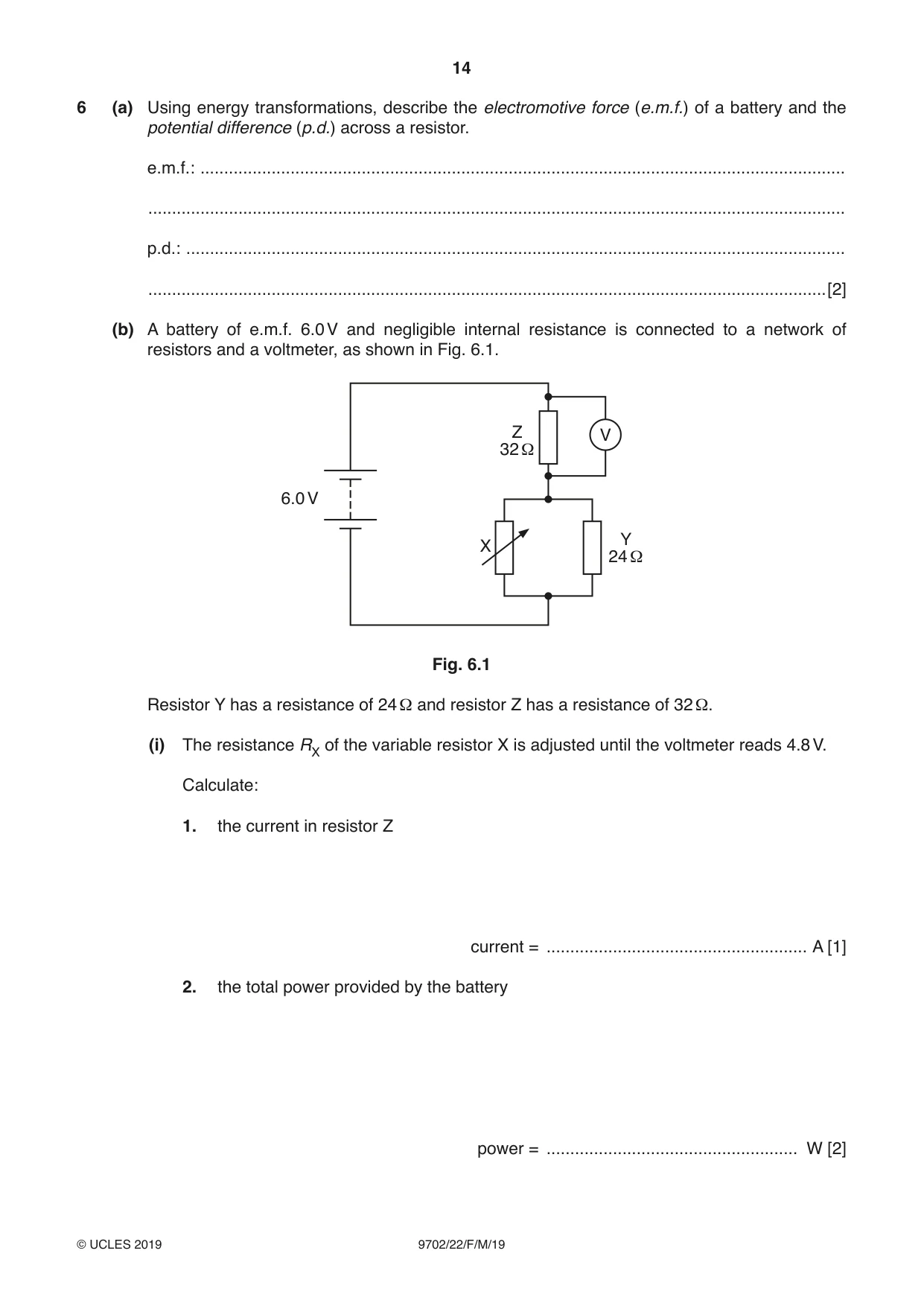
Q6 · Using energy transformations, describe the electromotive force (e.m.f.) of a battery and…
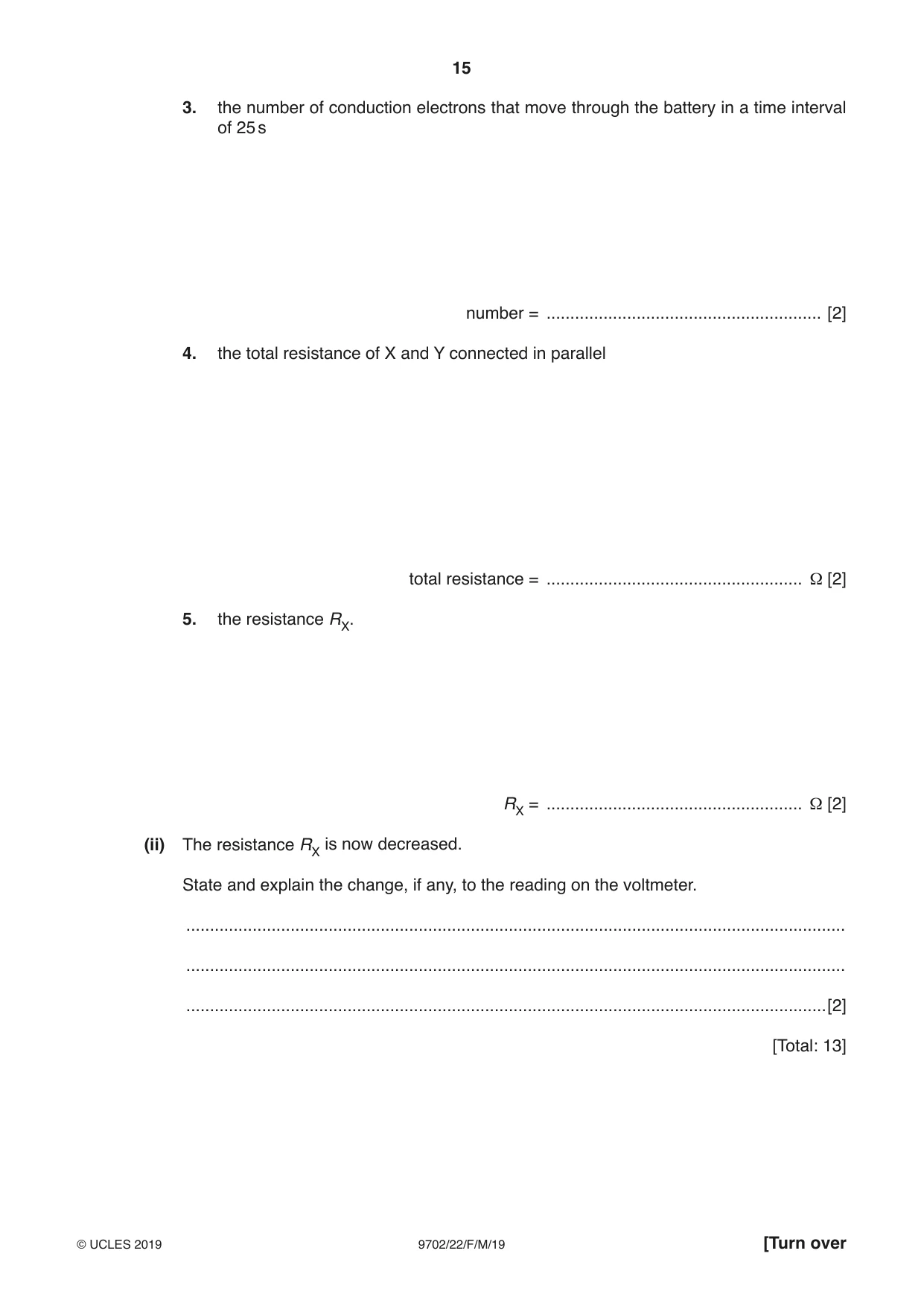
6 (a) Using energy transformations, describe the electromotive force (e.m.f.) of a battery and the potential difference (p.d.) across a resistor. e.m.f.: ........................................................................................................................................ ................................................................................................................................................... p.d.: ........................................................................................................................................... ...............................................................................................................................................[2] (b) A battery of e.m.f. 6.0 V and negligible internal resistance is connected to a network of resistors and a voltmeter, as shown in Fig. 6.1. Z V 32 Ω 6.0 V Y X 24 Ω Fig. 6.1 Resistor Y has a resistance of 24 Ω and resistor Z has a resistance of 32 Ω. (i) The resistance RX of the variable resistor X is adjusted until the voltmeter reads 4.8 V. Calculate: 1. the current in resistor Z current = ....................................................... A [1] 2. the total power provided by the battery power = ..................................................... W [2] 3. the number of conduction electrons that move through the battery in a time interval of 25 s number = .......................................................... [2] 4. the total resistance of X and Y connected in parallel total resistance = ...................................................... Ω [2] 5. the resistance RX. Ω [2] RX = ...................................................... (ii) The resistance RX is now decreased. State and explain the change, if any, to the reading on the voltmeter. ........................................................................................................................................... ........................................................................................................................................... .......................................................................................................................................[2] [Total: 13]
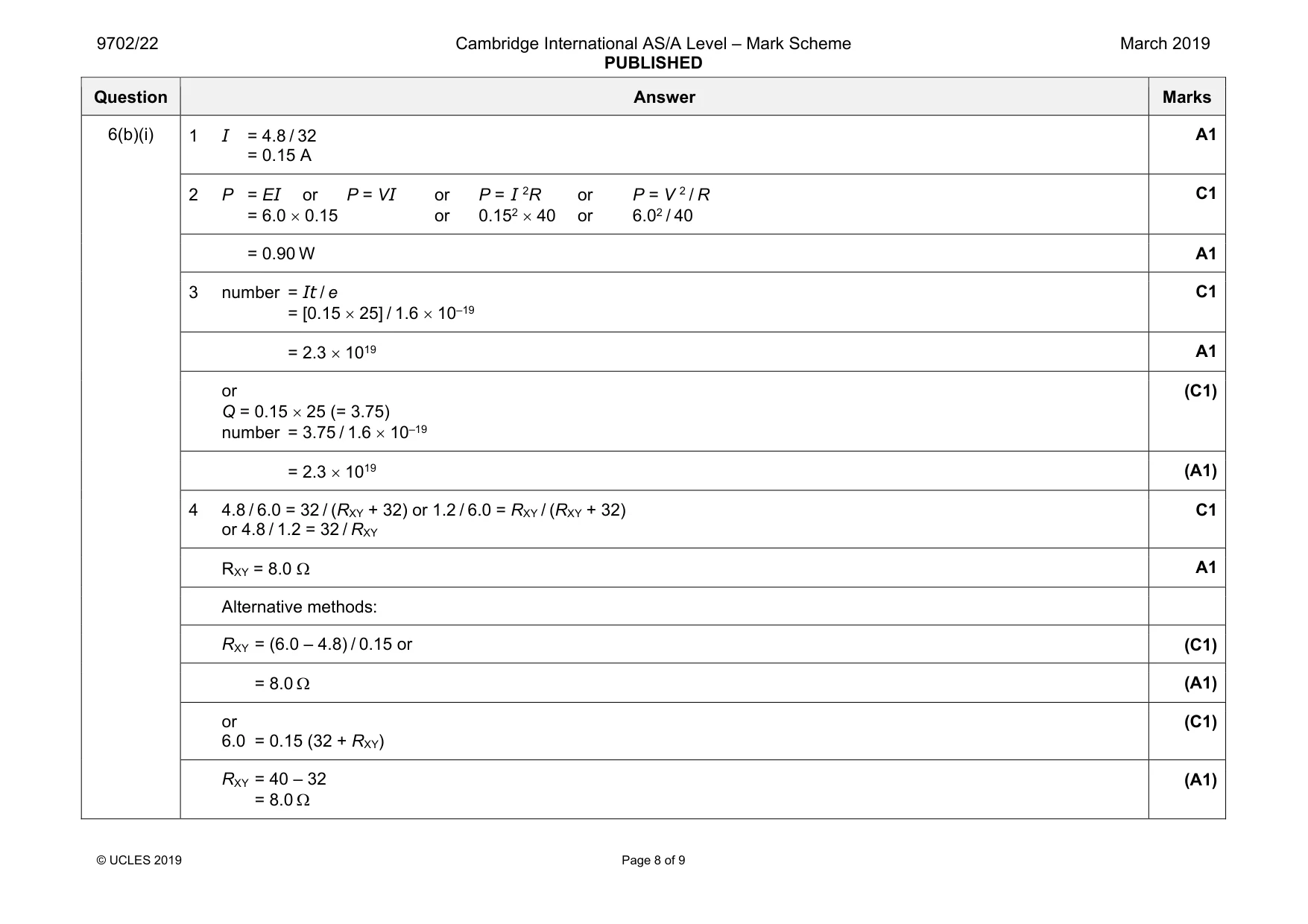
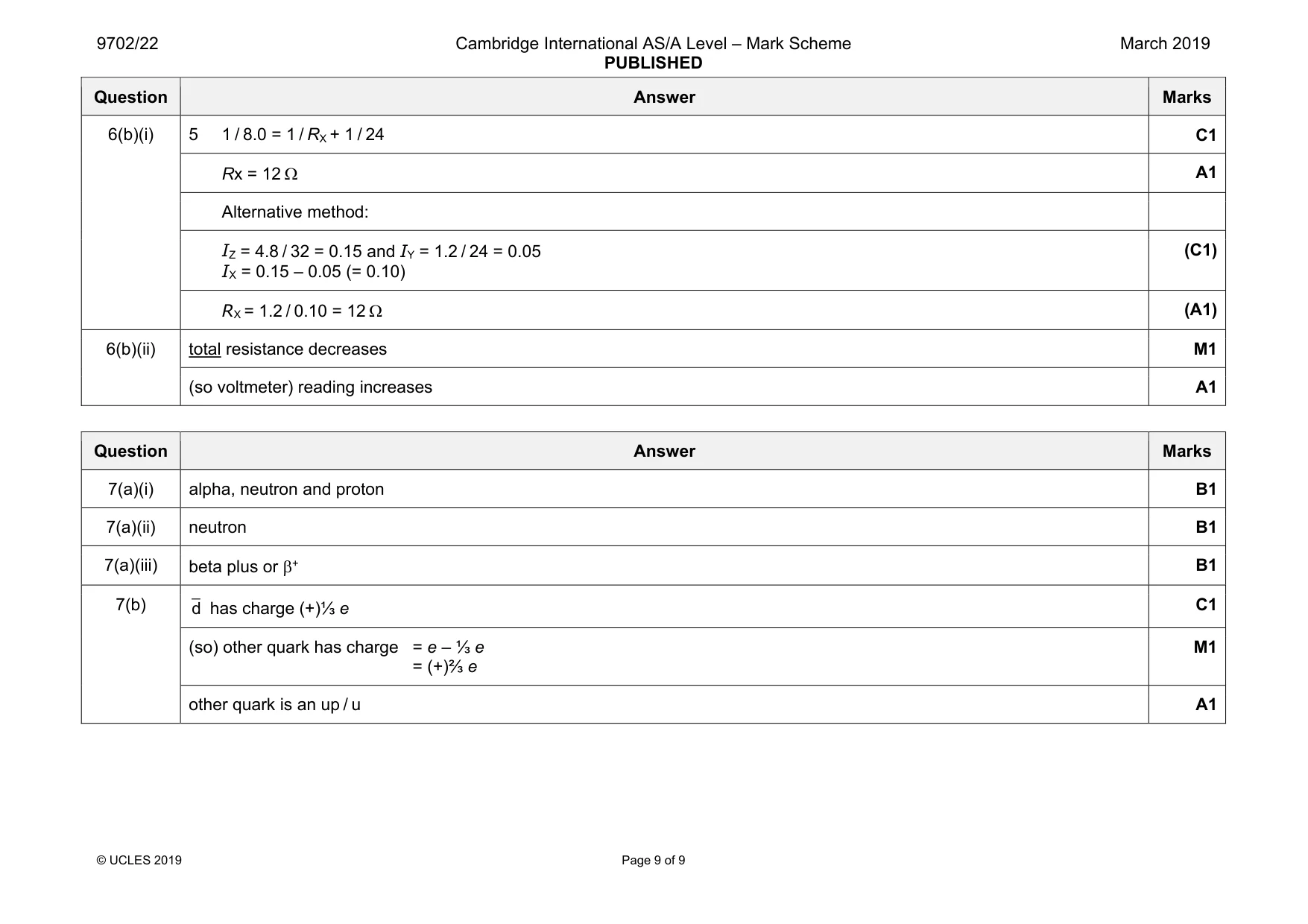
Mark scheme: 6(a) e.m.f.: energy transferred from chemical to electrical (per unit charge) B1 p.d.: energy transferred from electrical to thermal (per unit charge) B1 Question Answer Marks 6(b)(i) 1 I = 4.8 / 32 = 0.15 A A1 2 P = EI or P = VI or P = I 2R or P = V 2 / R = 6.0 × 0.15 or 0.152 × 40 or 6.02 / 40 C1 = 0.90 W A1 3 number = It / e = [0.15 × 25] / 1.6 × 10⁻¹⁹ C1 = 2.3 × 10¹⁹ A1 or Q = 0.15 × 25 (= 3.75) number = 3.75 / 1.6 × 10⁻¹⁹ (C1) = 2.3 × 10¹⁹ (A1) 4 4.8 / 6.0 = 32 / (RXY + 32) or 1.2 / 6.0 = RXY / (RXY + 32) or 4.8 / 1.2 = 32 / RXY C1 RXY = 8.0 Ω A1 Alternative methods: RXY = (6.0 – 4.8) / 0.15 or (C1) = 8.0 Ω (A1) or 6.0 = 0.15 (32 + RXY) (C1) RXY = 40 – 32 = 8.0 Ω (A1) Question Answer Marks 6(b)(i) 5 1 / 8.0 = 1 / RX + 1 / 24 C1 Rx = 12 Ω A1 Alternative method: IZ = 4.8 / 32 = 0.15 and IY = 1.2 / 24 = 0.05 IX = 0.15 – 0.05 (= 0.10) (C1) RX = 1.2 / 0.10 = 12 Ω (A1) 6(b)(ii) total resistance decreases M1 (so voltmeter) reading increases A1
Q7 · The names of four particles are listed below
7 (a) The names of four particles are listed below. alpha beta-plus neutron proton State the name(s) of the particle(s) in this list that: (i) are not fundamental .......................................................................................................................................[1] (ii) do not experience an electric force when situated in an electric field .......................................................................................................................................[1] (iii) has the largest ratio of charge to mass. .......................................................................................................................................[1] (b) A hadron has a charge of +e where e is the elementary charge. The hadron is composed of only two quarks. One of these quarks is an antidown ( d ) quark. By considering charge, state and explain the name (flavour) of the other quark. ................................................................................................................................................... ...............................................................................................................................................[3] [Total: 6]
Mark scheme: 7(a)(i) alpha, neutron and proton B1 7(a)(ii) neutron B1 7(a)(iii) beta plus or β+ B1 7(b) d has charge (+)⅓ e C1 (so) other quark has charge = e – ⅓ e = (+)⅔ e M1 other quark is an up / u A1
What was in this paper
The subtopics covered by these 7 questions, and how many questions each got. Open one in a new tab to see every Cambridge question on it.
What you needed in this session
Cambridge’s own grade thresholds for 2019 Feb/March, Paper 2 · Variant 2. A higher threshold means an easier paper — the bar moves with how the cohort did.