Cambridge A Level Physics 9702 — 2021 Oct/Nov Paper 2 · Variant 3
9702/23/O/N/21 · 6 questions · 60 marks · ≈68 min
The question paper and its mark scheme, free to read here and free to download. This is Cambridge’s own paper, exactly as it was sat.
Question paper16 pages
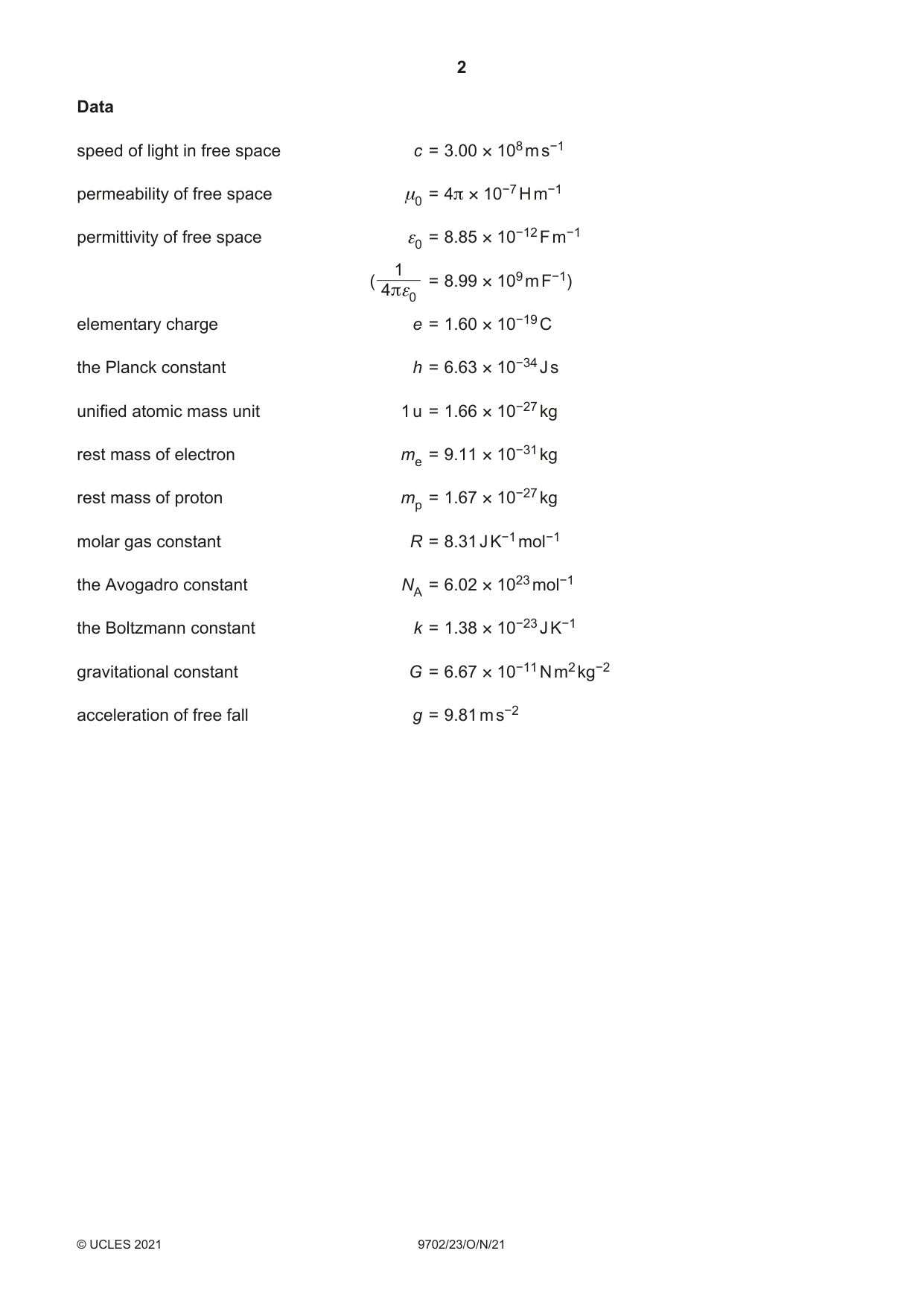
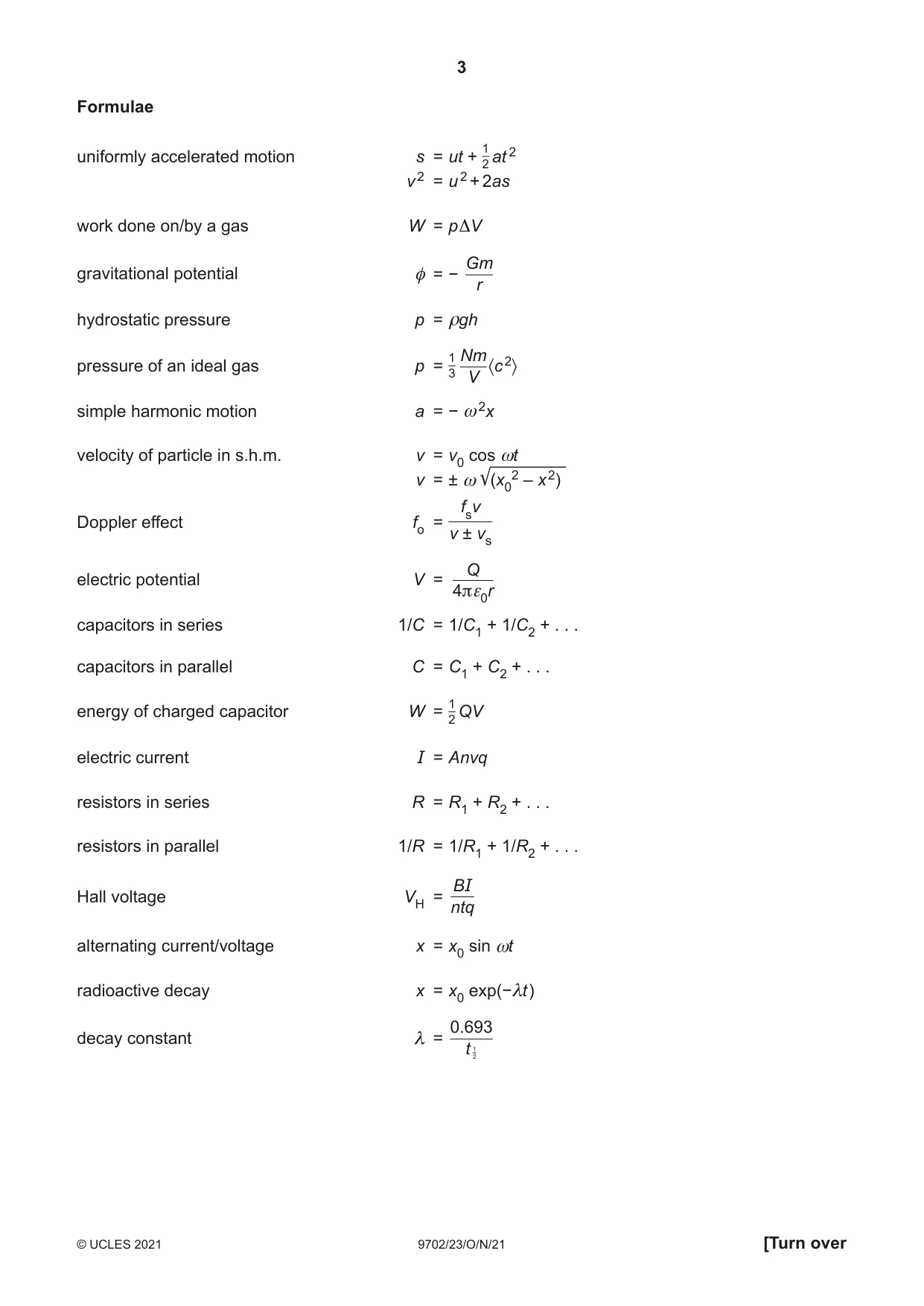
Mark scheme12 pages
Answers below. Sit the paper first if you are practising.
Questions as text
Q1 · A solid cylinder of weight 24 N is made of material of density 850 kg m–3
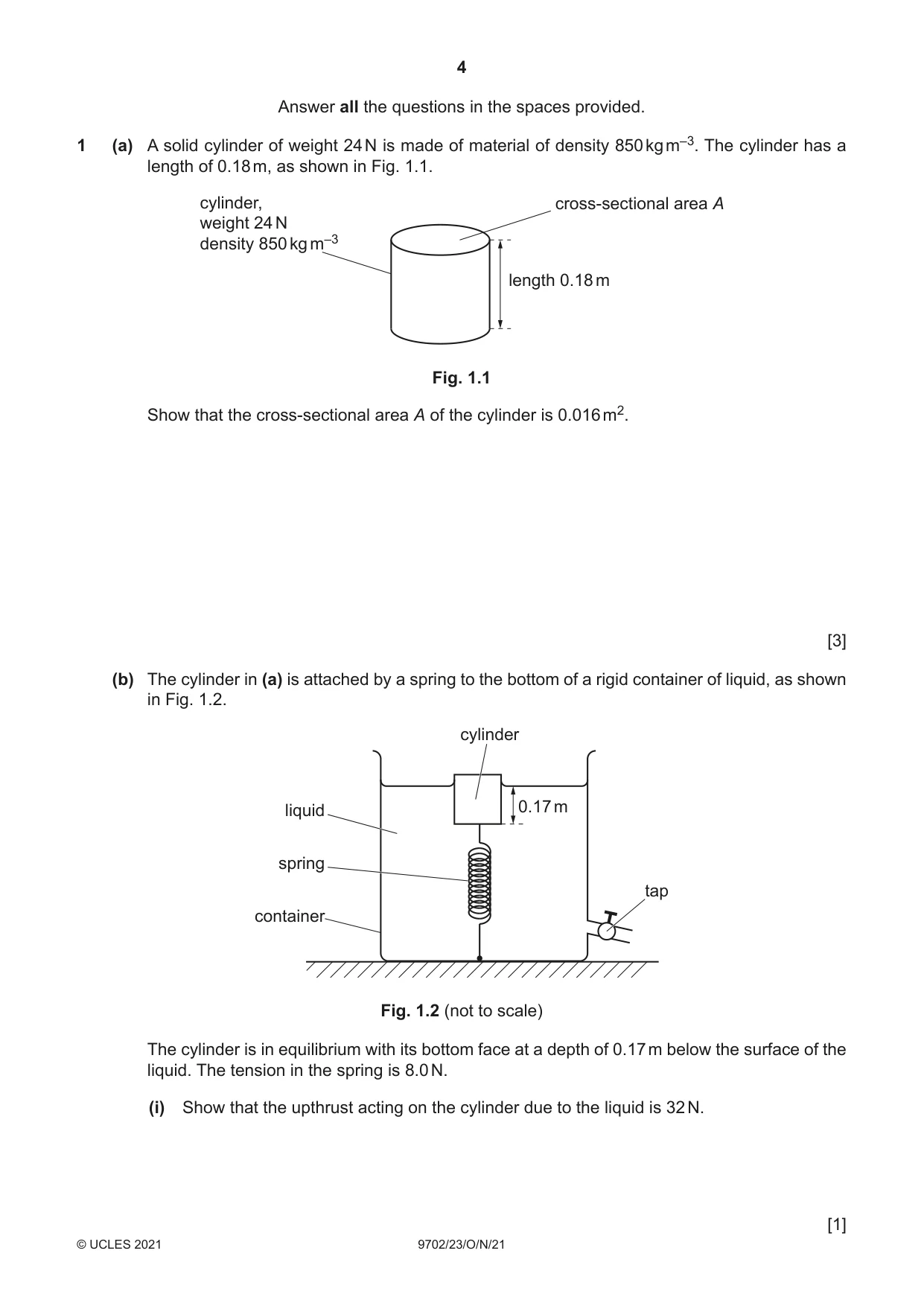
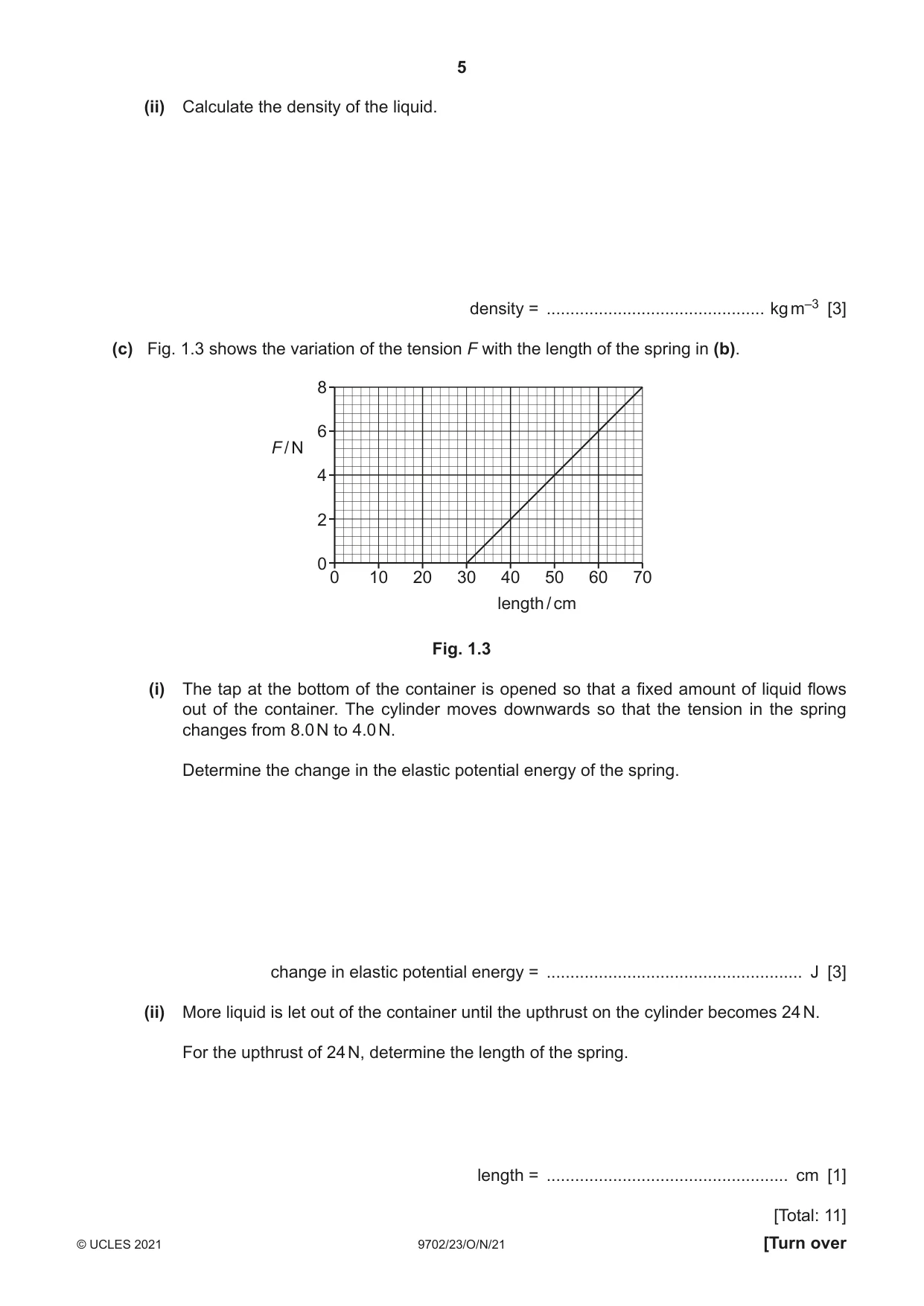
1 (a) A solid cylinder of weight 24 N is made of material of density 850 kg m–3. The cylinder has a length of 0.18 m, as shown in Fig. 1.1. cylinder, cross-sectional area A weight 24 N density 850 kg m–3 length 0.18 m Fig. 1.1 Show that the cross-sectional area A of the cylinder is 0.016 m2. [3] (b) The cylinder in (a) is attached by a spring to the bottom of a rigid container of liquid, as shown in Fig. 1.2. cylinder liquid 0.17 m spring tap container Fig. 1.2 (not to scale) The cylinder is in equilibrium with its bottom face at a depth of 0.17 m below the surface of the liquid. The tension in the spring is 8.0 N. (i) Show that the upthrust acting on the cylinder due to the liquid is 32 N. [1] (ii) Calculate the density of the liquid. density = .............................................. kg m–3 [3] (c) Fig. 1.3 shows the variation of the tension F with the length of the spring in (b). 8 6 F / N 4 2 0 0 10 20 30 40 50 60 70 length / cm Fig. 1.3 (i) The tap at the bottom of the container is opened so that a fixed amount of liquid flows out of the container. The cylinder moves downwards so that the tension in the spring changes from 8.0 N to 4.0 N. Determine the change in the elastic potential energy of the spring. change in elastic potential energy = ...................................................... J [3] (ii) More liquid is let out of the container until the upthrust on the cylinder becomes 24 N. For the upthrust of 24 N, determine the length of the spring. length = ................................................... cm [1] [Total: 11]
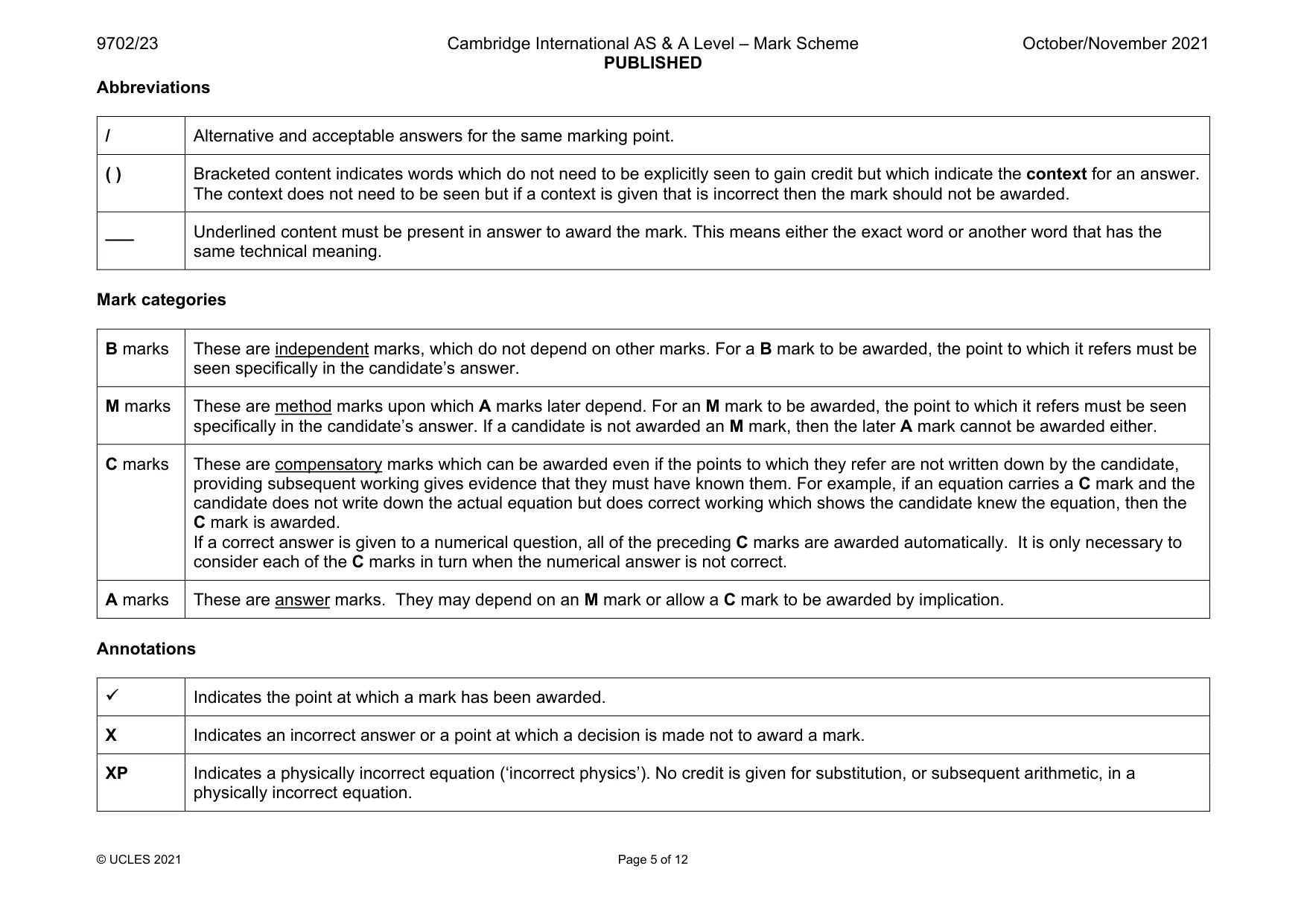
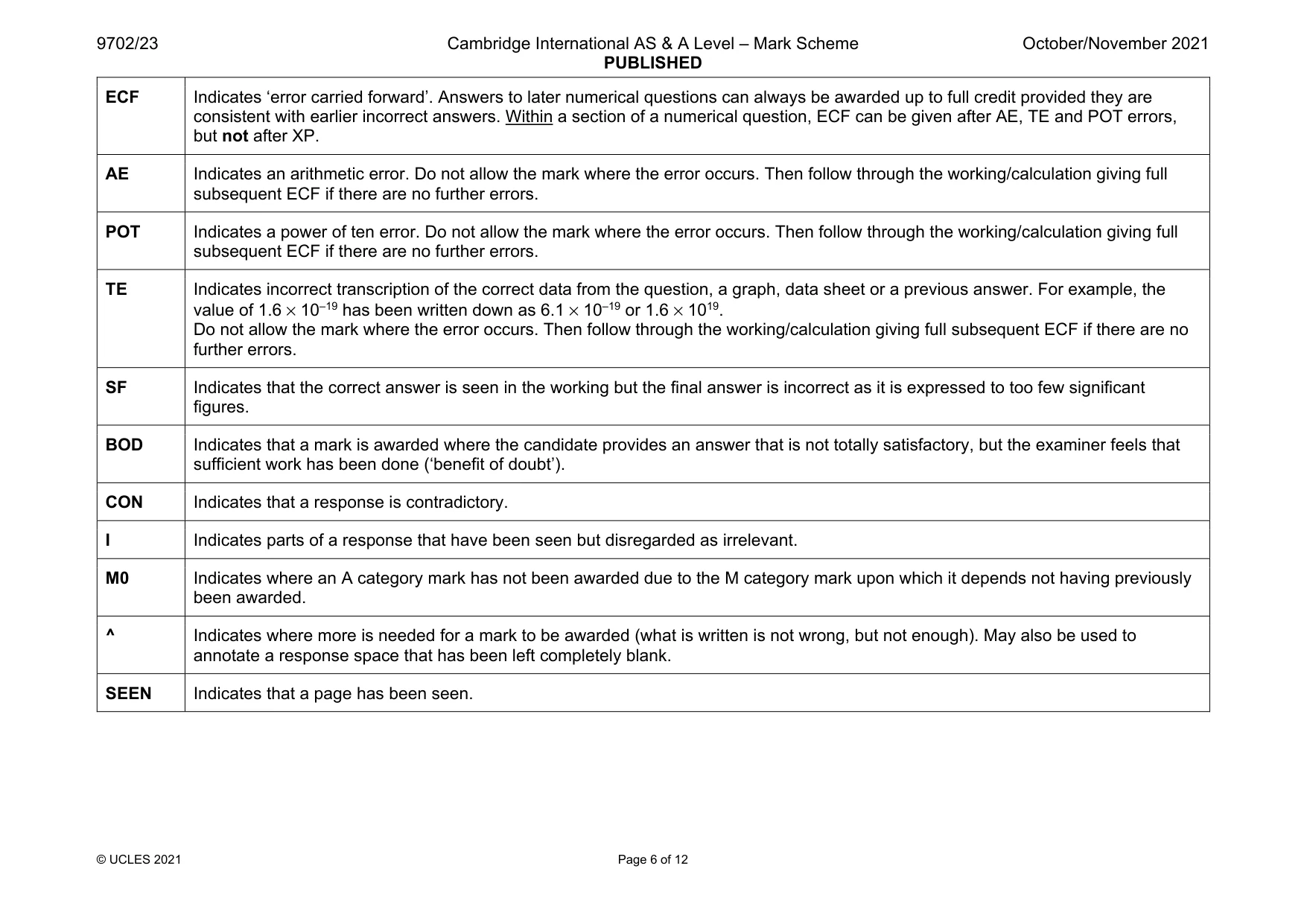
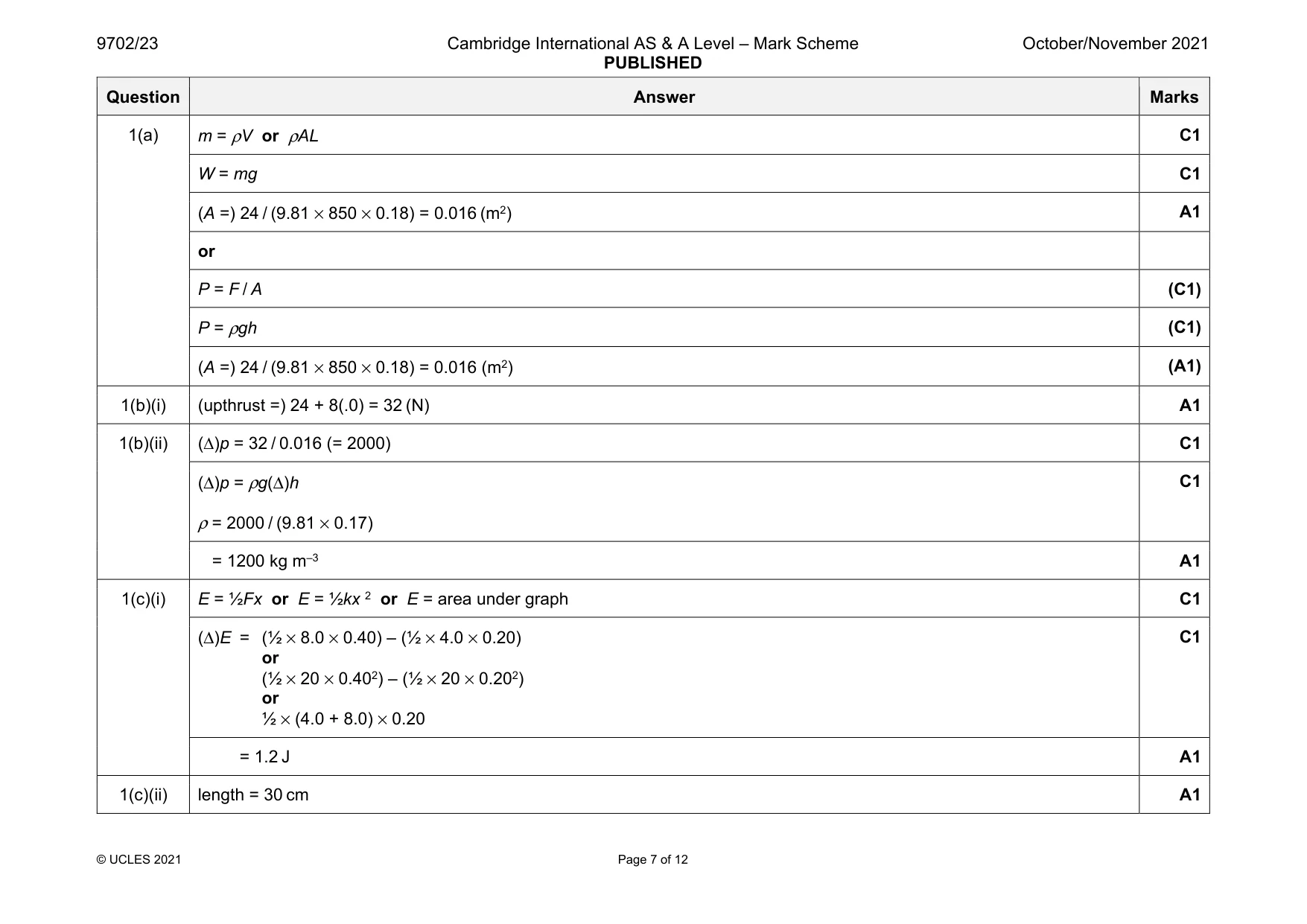
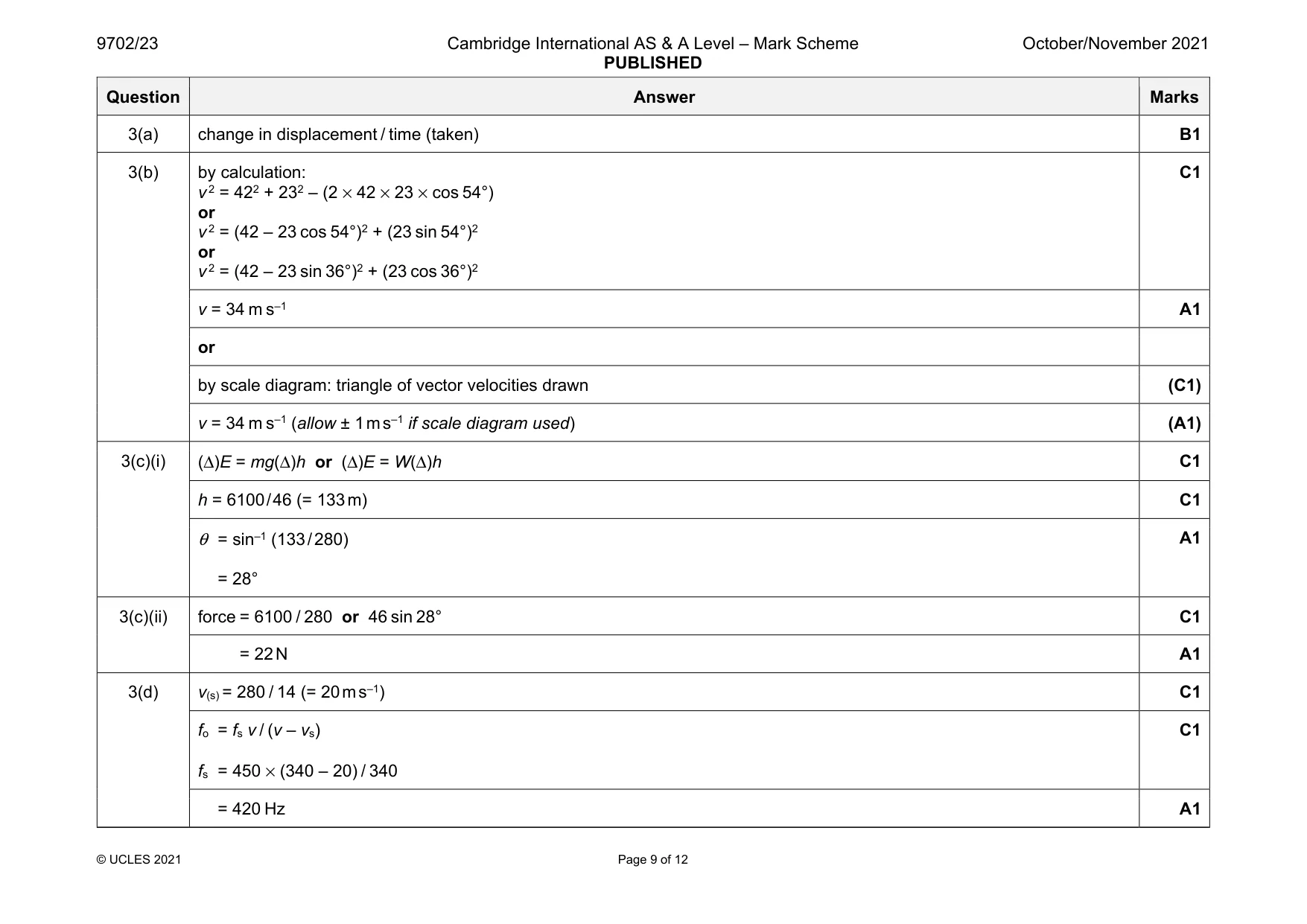
Mark scheme: 1(a) m = ρV or ρAL C1 W = mg C1 (A =) 24 / (9.81 × 850 × 0.18) = 0.016 (m2) A1 or P = F / A (C1) P = ρgh (C1) (A =) 24 / (9.81 × 850 × 0.18) = 0.016 (m2) (A1) 1(b)(i) (upthrust =) 24 + 8(.0) = 32 (N) A1 1(b)(ii) (∆)p = 32 / 0.016 (= 2000) C1 (Δ)p = ρg(Δ)h ρ = 2000 / (9.81 × 0.17) C1 = 1200 kg m–3 A1 1(c)(i) E = ½Fx or E = ½kx 2 or E = area under graph C1 (Δ)E = (½ × 8.0 × 0.40) – (½ × 4.0 × 0.20) or (½ × 20 × 0.402) – (½ × 20 × 0.202) or ½ × (4.0 + 8.0) × 0.20 C1 = 1.2 J A1 1(c)(ii) length = 30 cm A1
Q2 · State what is meant by work done
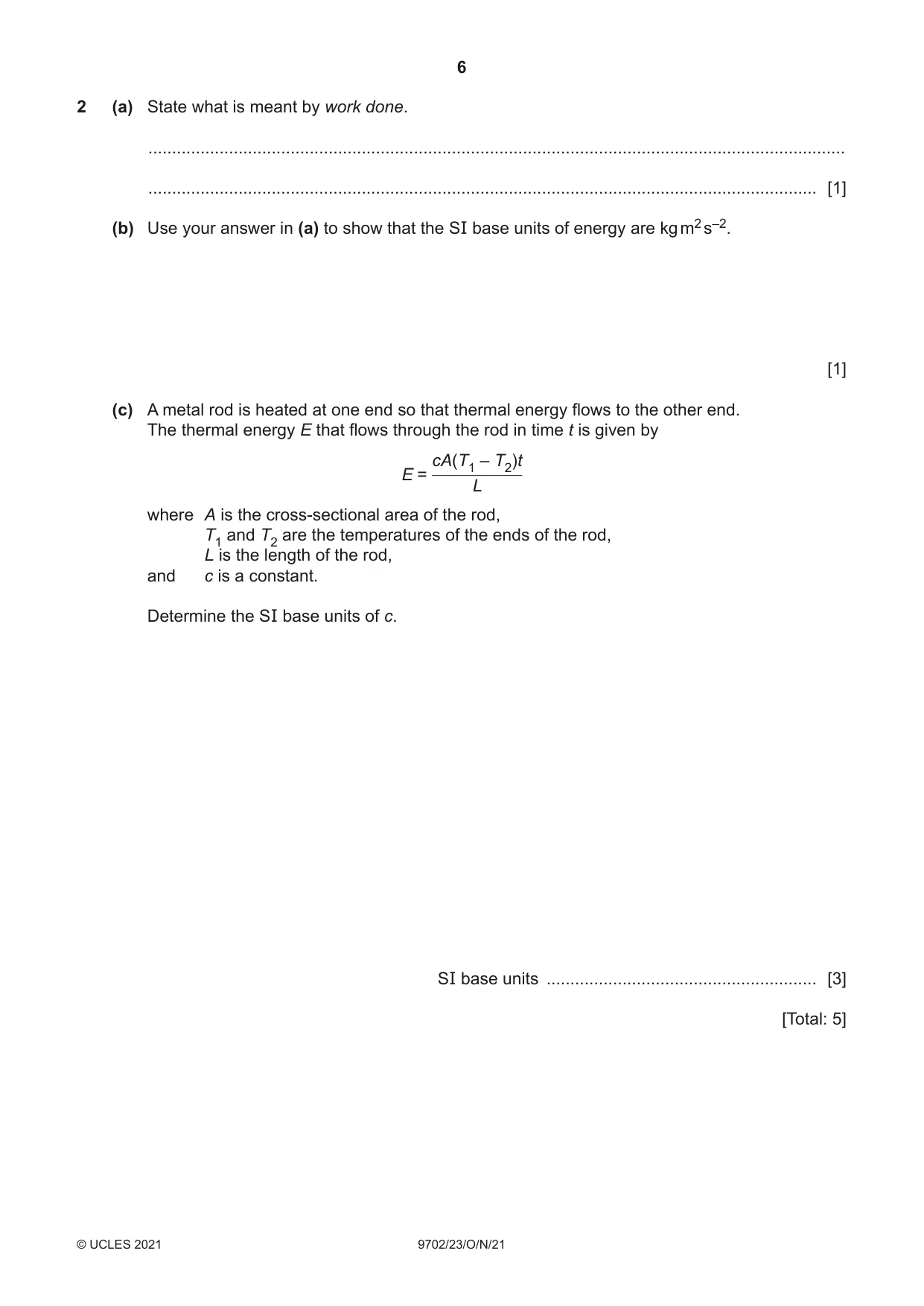
2 (a) State what is meant by work done. ................................................................................................................................................... ............................................................................................................................................. [1] (b) Use your answer in (a) to show that the SI base units of energy are kg m2 s–2. [1] (c) A metal rod is heated at one end so that thermal energy flows to the other end. The thermal energy E that flows through the rod in time t is given by cA(T1 – T2)t E = L where A is the cross-sectional area of the rod, T1 and T2 are the temperatures of the ends of the rod, L is the length of the rod, and c is a constant. Determine the SI base units of c. SI base units ......................................................... [3] [Total: 5]
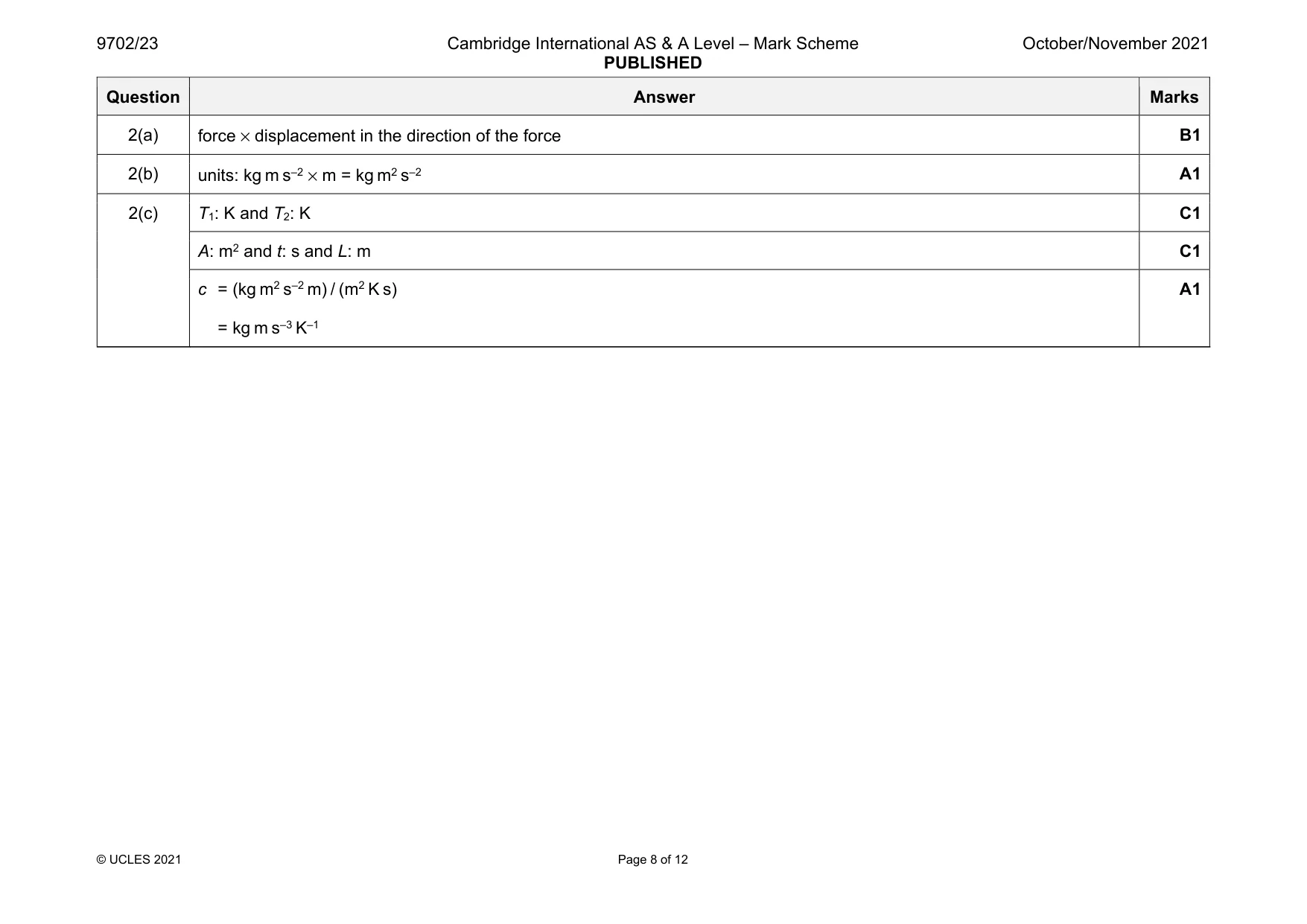
Mark scheme: 2(a) force × displacement in the direction of the force B1 2(b) units: kg m s–2 × m = kg m2 s–2 A1 2(c) T1: K and T2: K C1 A: m2 and t: s and L: m C1 c = (kg m2 s–2 m) / (m2 K s) = kg m s–3 K–1 A1
More questions on Specific heat capacity and specific latent heat
Question 3
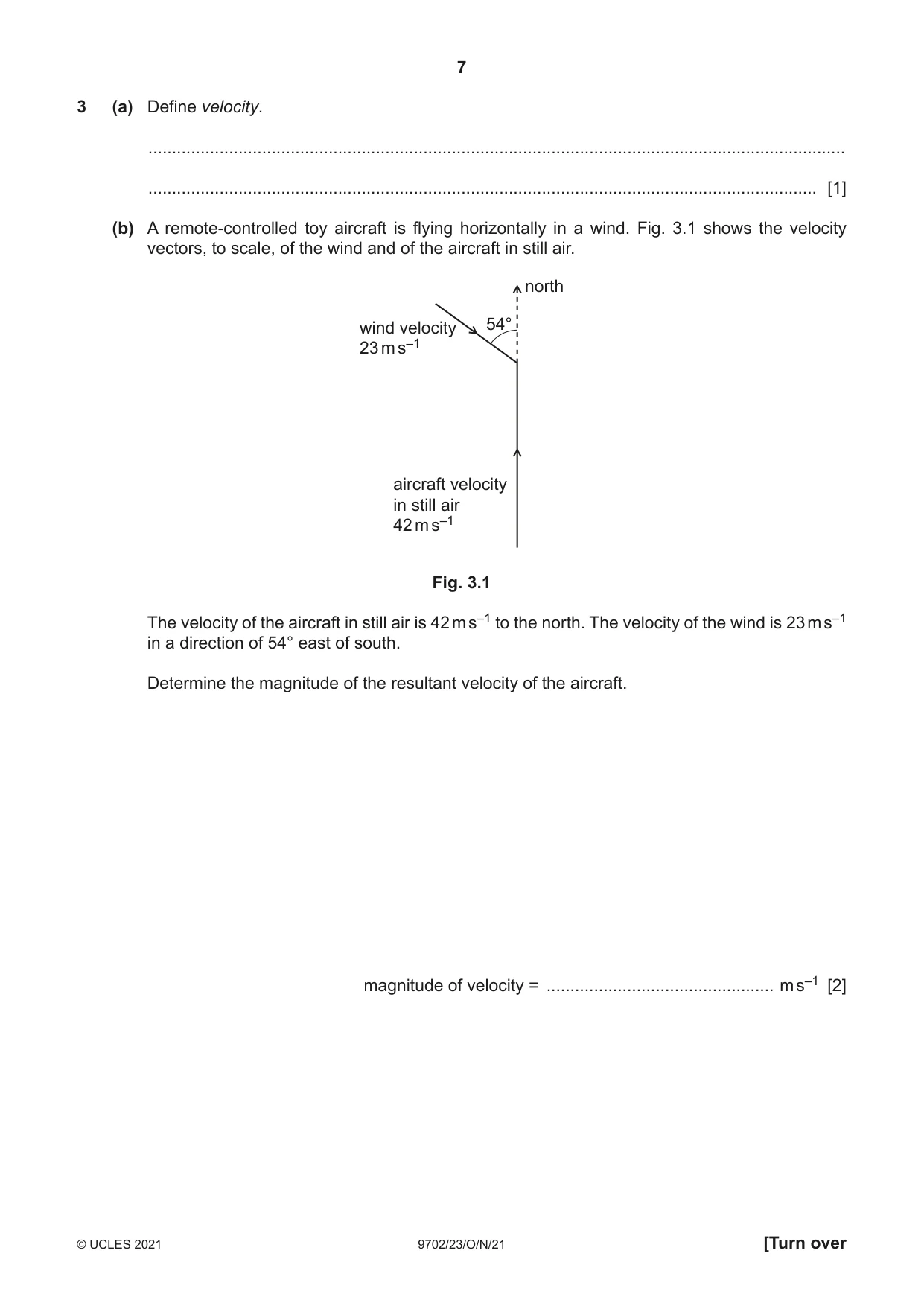
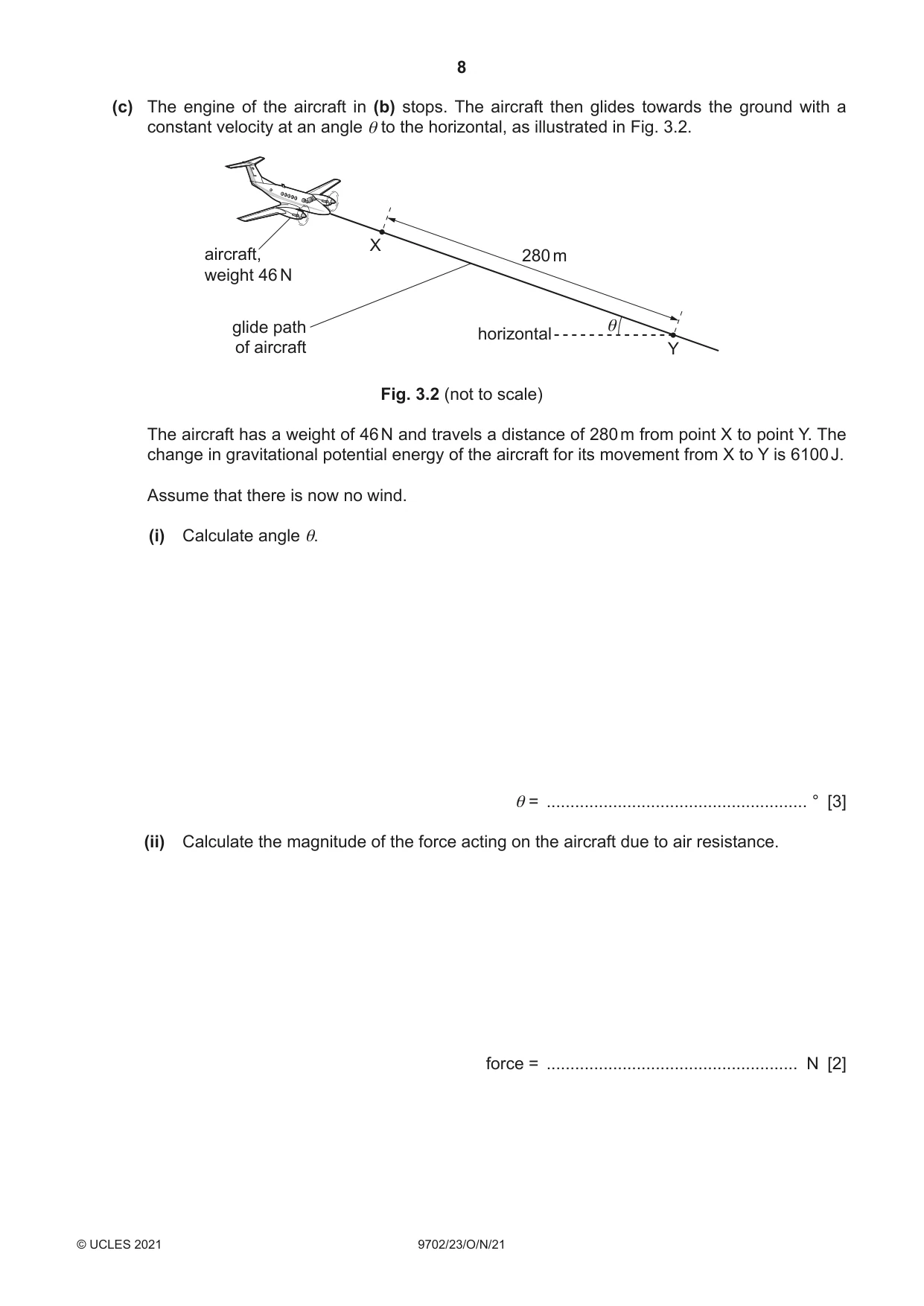
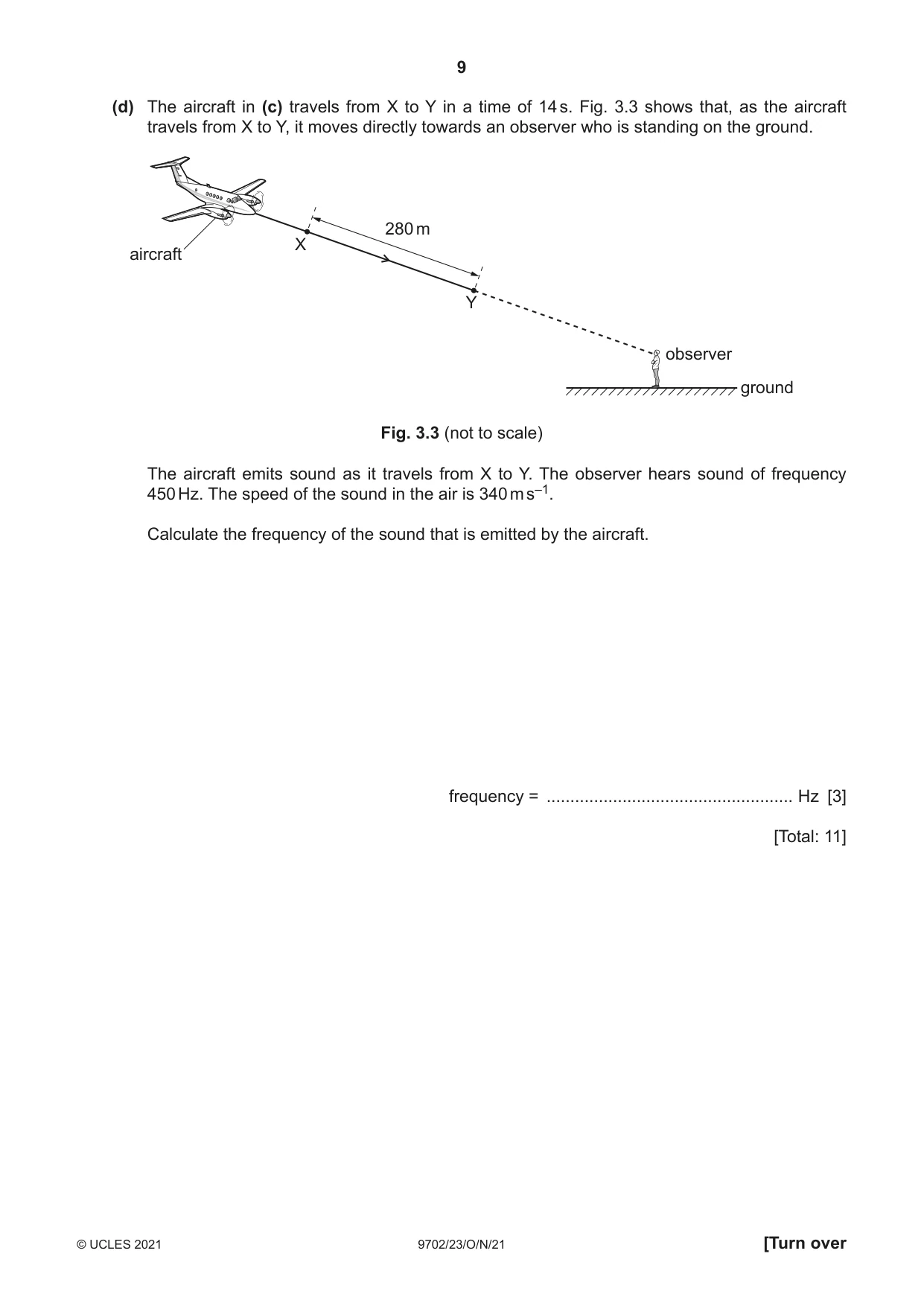
3 (a) Define velocity. ................................................................................................................................................... ............................................................................................................................................. [1] (b) A remote-controlled toy aircraft is flying horizontally in a wind. Fig. 3.1 shows the velocity vectors, to scale, of the wind and of the aircraft in still air. north wind velocity 54° 23 m s–1 aircraft velocity in still air 42 m s–1 Fig. 3.1 The velocity of the aircraft in still air is 42 m s–1 to the north. The velocity of the wind is 23 m s–1 in a direction of 54° east of south. Determine the magnitude of the resultant velocity of the aircraft. magnitude of velocity = ................................................ m s–1 [2] (c) The engine of the aircraft in (b) stops. The aircraft then glides towards the ground with a constant velocity at an angle θ to the horizontal, as illustrated in Fig. 3.2. X aircraft, 280 m weight 46 N glide path θ horizontal of aircraft Y Fig. 3.2 (not to scale) The aircraft has a weight of 46 N and travels a distance of 280 m from point X to point Y. The change in gravitational potential energy of the aircraft for its movement from X to Y is 6100 J. Assume that there is now no wind. (i) Calculate angle θ. θ = ....................................................... ° [3] (ii) Calculate the magnitude of the force acting on the aircraft due to air resistance. force = ..................................................... N [2] (d) The aircraft in (c) travels from X to Y in a time of 14 s. Fig. 3.3 shows that, as the aircraft travels from X to Y, it moves directly towards an observer who is standing on the ground. 280 m X aircraft Y observer ground Fig. 3.3 (not to scale) The aircraft emits sound as it travels from X to Y. The observer hears sound of frequency 450 Hz. The speed of the sound in the air is 340 m s–1. Calculate the frequency of the sound that is emitted by the aircraft. frequency = .................................................... Hz [3] [Total: 11]
Mark scheme: 3(a) change in displacement / time (taken) B1 3(b) by calculation: v 2 = 422 + 232 – (2 × 42 × 23 × cos 54°) or v 2 = (42 – 23 cos 54°)2 + (23 sin 54°)2 or v 2 = (42 – 23 sin 36°)2 + (23 cos 36°)2 C1 v = 34 m s–1 A1 or by scale diagram: triangle of vector velocities drawn (C1) v = 34 m s–1 (allow ± 1 m s–1 if scale diagram used) (A1) 3(c)(i) (Δ)E = mg(Δ)h or (Δ)E = W(Δ)h C1 h = 6100 / 46 (= 133 m) C1 θ = sin–1 (133 / 280) = 28° A1 3(c)(ii) force = 6100 / 280 or 46 sin 28° C1 = 22 N A1 3(d) v(s) = 280 / 14 (= 20 m s–1) C1 fo = fs v / (v – vs) fs = 450 × (340 – 20) / 340 C1 = 420 Hz A1
More questions on Gravitational potential energy and kinetic energy
Q4 · An α-particle moves in a straight line through a vacuum with a constant speed of 4.1 ×…
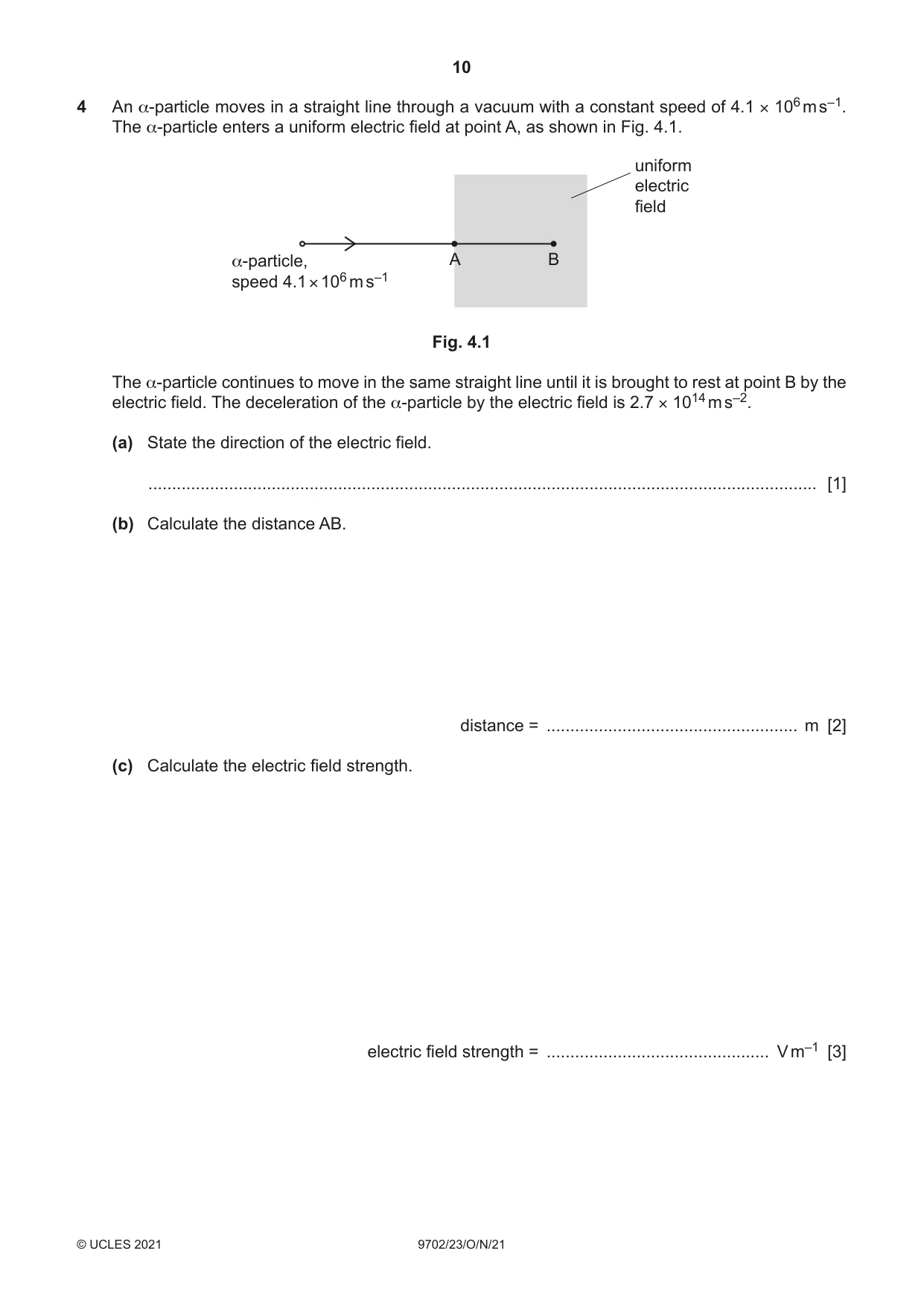
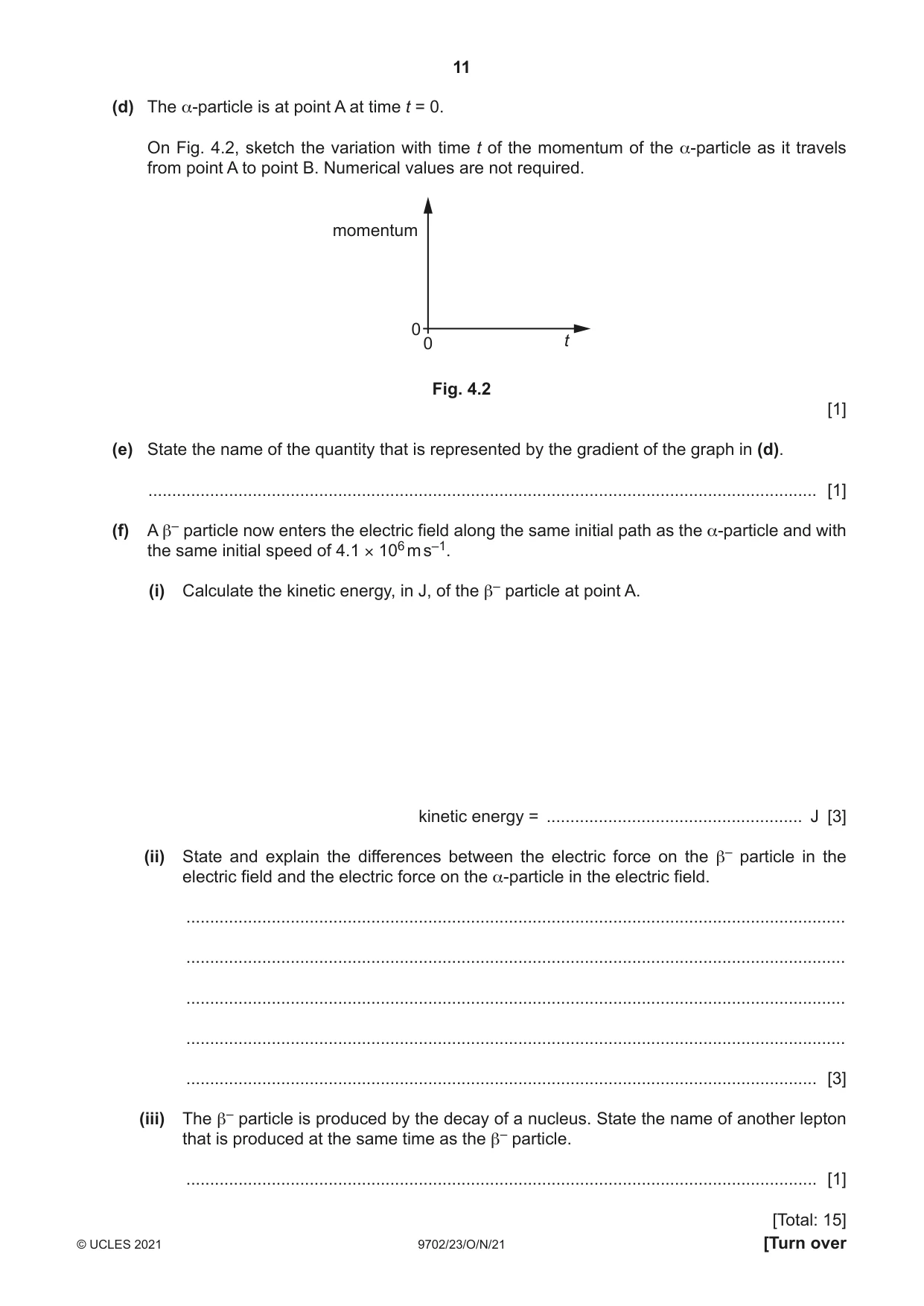
4 An α-particle moves in a straight line through a vacuum with a constant speed of 4.1 × 10⁶ m s–1. The α-particle enters a uniform electric field at point A, as shown in Fig. 4.1. uniform electric field α-particle, A B speed 4.1 × 10⁶ m s–1 Fig. 4.1 The α-particle continues to move in the same straight line until it is brought to rest at point B by the electric field. The deceleration of the α-particle by the electric field is 2.7 × 10¹⁴ m s–2. (a) State the direction of the electric field. ............................................................................................................................................. [1] (b) Calculate the distance AB. distance = ..................................................... m [2] (c) Calculate the electric field strength. electric field strength = ............................................... V m–1 [3] (d) The α-particle is at point A at time t = 0. On Fig. 4.2, sketch the variation with time t of the momentum of the α-particle as it travels from point A to point B. Numerical values are not required. momentum 00 t Fig. 4.2 [1] (e) State the name of the quantity that is represented by the gradient of the graph in (d). ............................................................................................................................................. [1] (f) A β– particle now enters the electric field along the same initial path as the α-particle and with the same initial speed of 4.1 × 10⁶ m s–1. (i) Calculate the kinetic energy, in J, of the β– particle at point A. kinetic energy = ...................................................... J [3] (ii) State and explain the differences between the electric force on the β– particle in the electric field and the electric force on the α-particle in the electric field. ........................................................................................................................................... ........................................................................................................................................... ........................................................................................................................................... ........................................................................................................................................... ..................................................................................................................................... [3] (iii) The β– particle is produced by the decay of a nucleus. State the name of another lepton that is produced at the same time as the β– particle. ..................................................................................................................................... [1] [Total: 15]
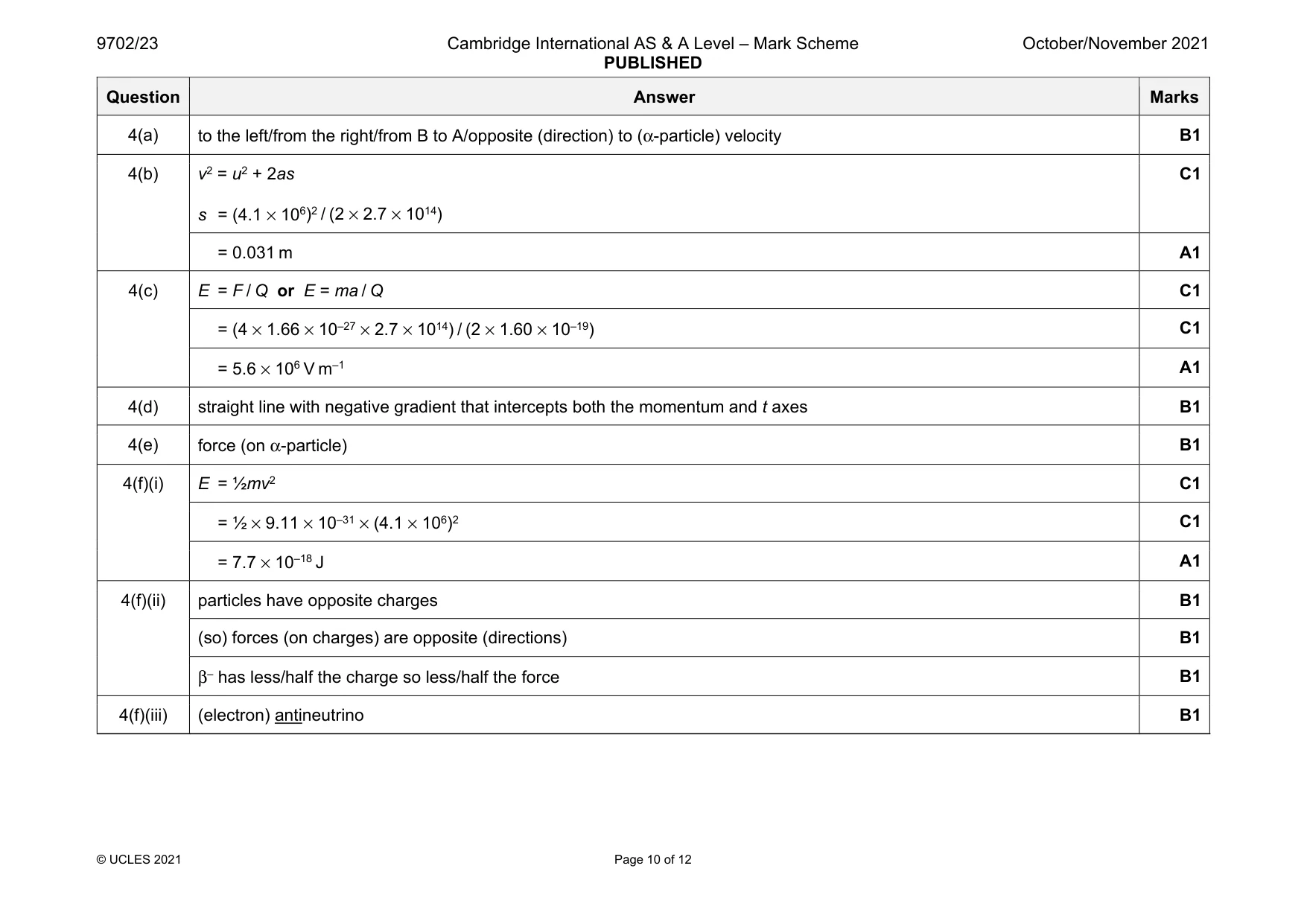
Mark scheme: 4(a) to the left/from the right/from B to A/opposite (direction) to (α-particle) velocity B1 4(b) v2 = u2 + 2as s = (4.1 × 10⁶)2 / (2 × 2.7 × 1014) C1 = 0.031 m A1 4(c) E = F / Q or E = ma / Q C1 = (4 × 1.66 × 10–27 × 2.7 × 1014) / (2 × 1.60 × 10–19) C1 = 5.6 × 10⁶ V m–1 A1 4(d) straight line with negative gradient that intercepts both the momentum and t axes B1 4(e) force (on α-particle) B1 4(f)(i) E = ½mv2 C1 = ½ × 9.11 × 10–31 × (4.1 × 106)2 C1 = 7.7 × 10⁻¹⁸ J A1 4(f)(ii) particles have opposite charges B1 (so) forces (on charges) are opposite (directions) B1 β– has less/half the charge so less/half the force B1 4(f)(iii) (electron) antineutrino B1
Q5 · For a progressive wave on a stretched string, state what is meant by amplitude
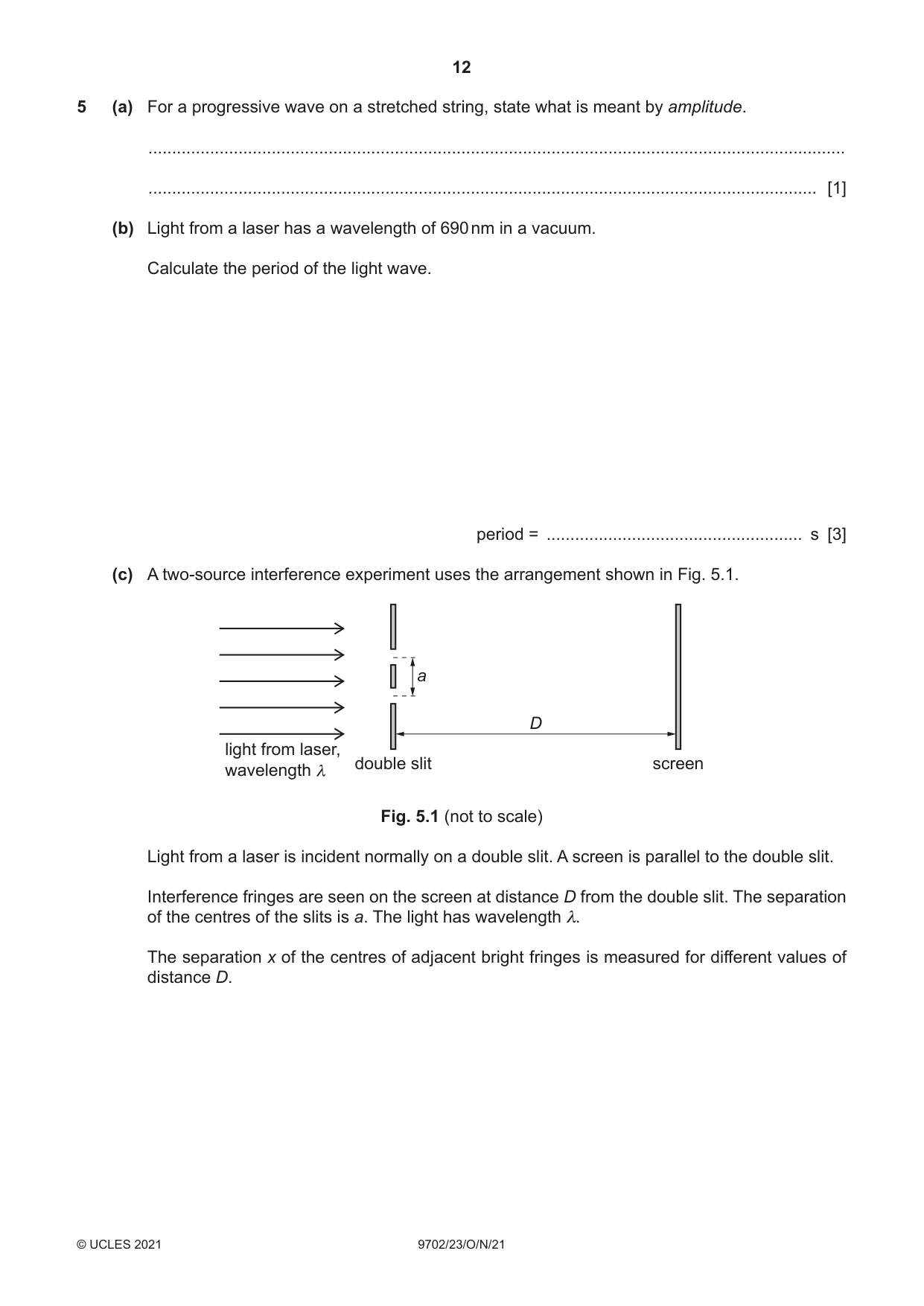
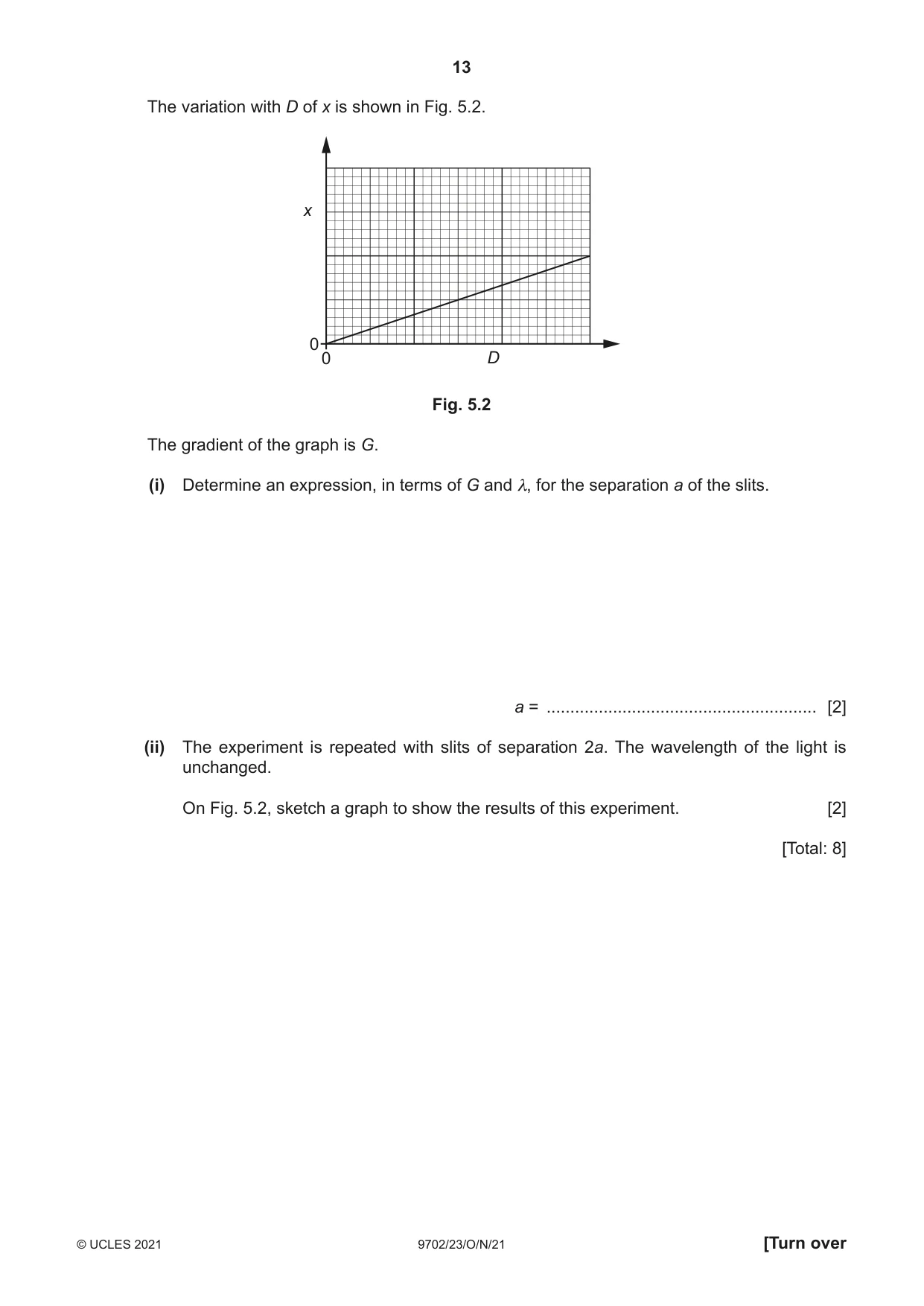
5 (a) For a progressive wave on a stretched string, state what is meant by amplitude. ................................................................................................................................................... ............................................................................................................................................. [1] (b) Light from a laser has a wavelength of 690 nm in a vacuum. Calculate the period of the light wave. period = ...................................................... s [3] (c) A two-source interference experiment uses the arrangement shown in Fig. 5.1. a D light from laser, double slit screen wavelength λ Fig. 5.1 (not to scale) Light from a laser is incident normally on a double slit. A screen is parallel to the double slit. Interference fringes are seen on the screen at distance D from the double slit. The separation of the centres of the slits is a. The light has wavelength λ. The separation x of the centres of adjacent bright fringes is measured for different values of distance D. The variation with D of x is shown in Fig. 5.2. x 0 0 D Fig. 5.2 The gradient of the graph is G. (i) Determine an expression, in terms of G and λ, for the separation a of the slits. a = ......................................................... [2] (ii) The experiment is repeated with slits of separation 2a. The wavelength of the light is unchanged. On Fig. 5.2, sketch a graph to show the results of this experiment. [2] [Total: 8]
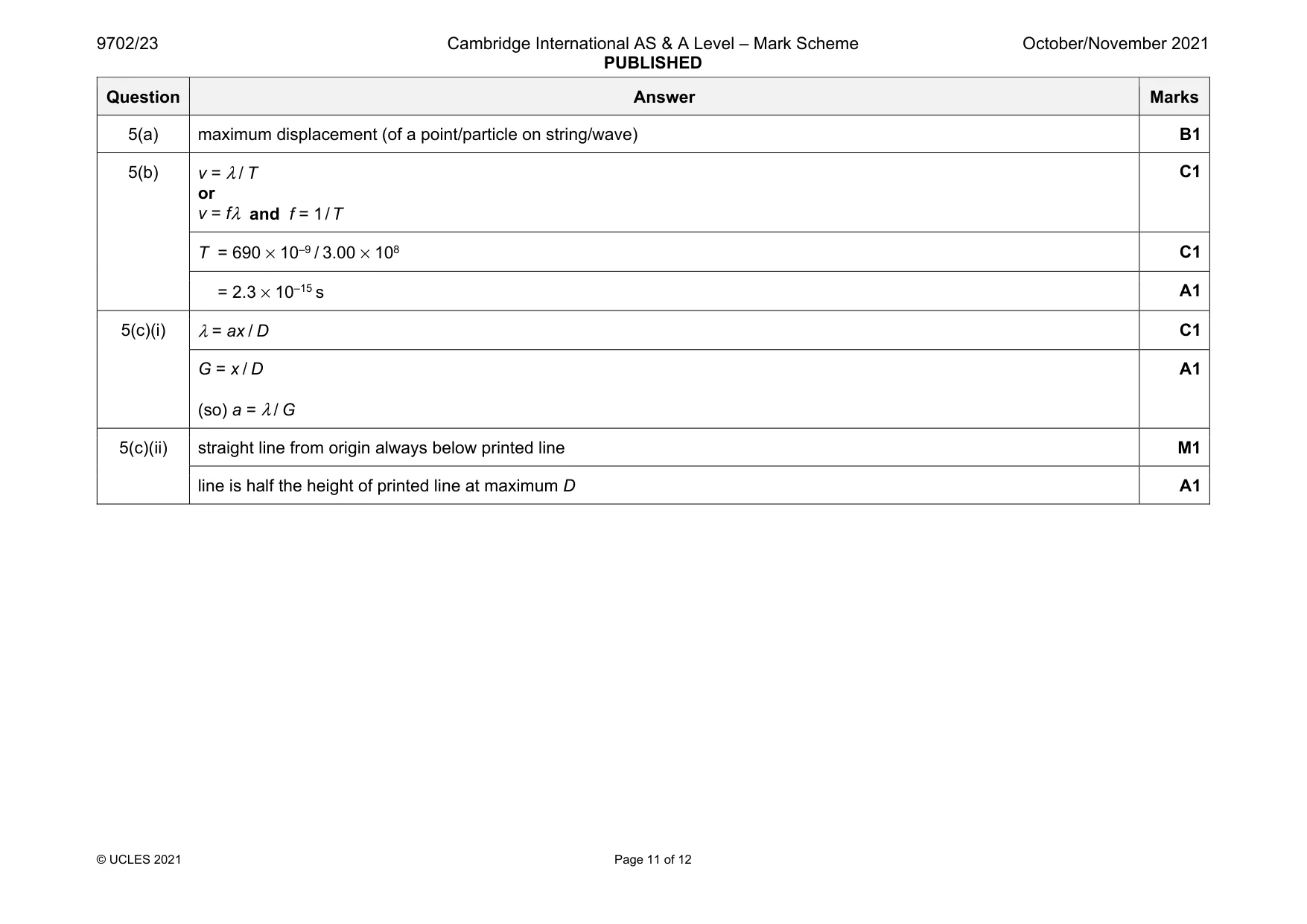
Mark scheme: 5(a) maximum displacement (of a point/particle on string/wave) B1 5(b) v = λ / T or v = fλ and f = 1 / T C1 T = 690 × 10–9 / 3.00 × 10⁸ C1 = 2.3 × 10⁻¹⁵ s A1 5(c)(i) λ = ax / D C1 G = x / D (so) a = λ / G A1 5(c)(ii) straight line from origin always below printed line M1 line is half the height of printed line at maximum D A1
Q6 · A resistance wire of uniform cross-sectional area 3.3 × 10⁻⁷ m2 and length 2.0 m is made…
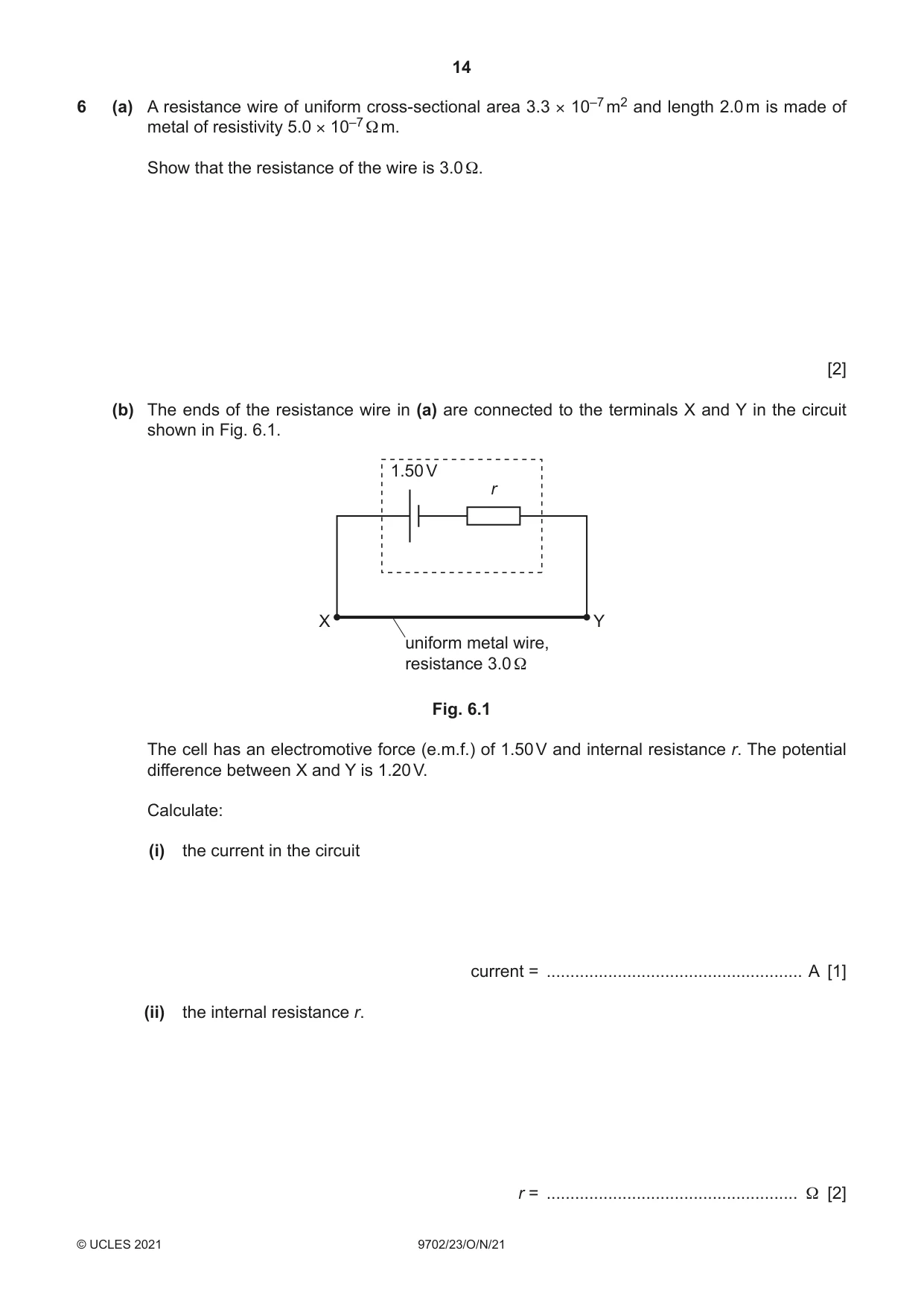
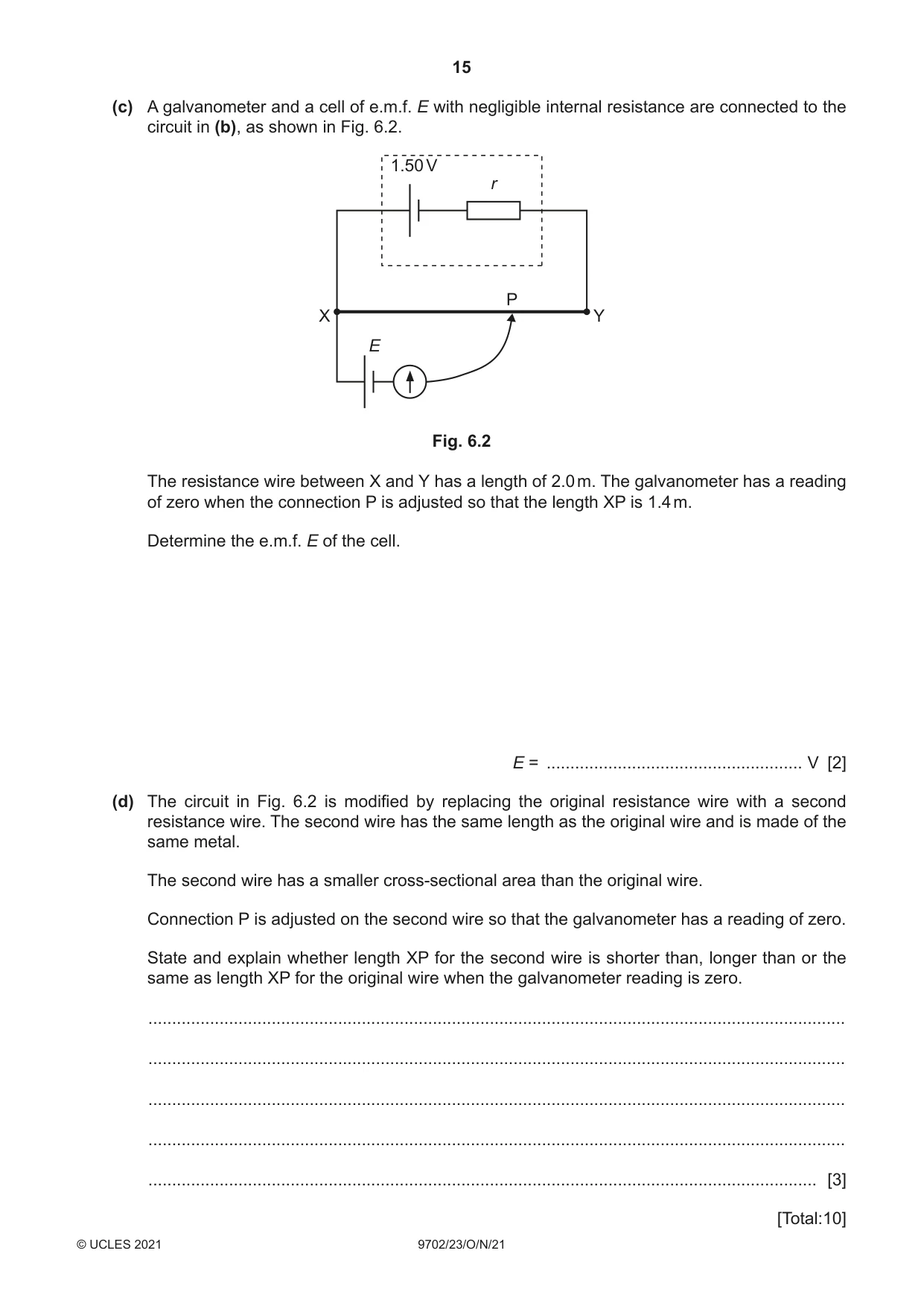
6 (a) A resistance wire of uniform cross-sectional area 3.3 × 10⁻⁷ m2 and length 2.0 m is made of metal of resistivity 5.0 × 10⁻⁷ Ω m. Show that the resistance of the wire is 3.0 Ω. [2] (b) The ends of the resistance wire in (a) are connected to the terminals X and Y in the circuit shown in Fig. 6.1. 1.50 V r X Y uniform metal wire, resistance 3.0 Ω Fig. 6.1 The cell has an electromotive force (e.m.f.) of 1.50 V and internal resistance r. The potential difference between X and Y is 1.20 V. Calculate: (i) the current in the circuit current = ...................................................... A [1] (ii) the internal resistance r. r = ..................................................... Ω [2] (c) A galvanometer and a cell of e.m.f. E with negligible internal resistance are connected to the circuit in (b), as shown in Fig. 6.2. 1.50 V r P X Y E Fig. 6.2 The resistance wire between X and Y has a length of 2.0 m. The galvanometer has a reading of zero when the connection P is adjusted so that the length XP is 1.4 m. Determine the e.m.f. E of the cell. E = ...................................................... V [2] (d) The circuit in Fig. 6.2 is modified by replacing the original resistance wire with a second resistance wire. The second wire has the same length as the original wire and is made of the same metal. The second wire has a smaller cross-sectional area than the original wire. Connection P is adjusted on the second wire so that the galvanometer has a reading of zero. State and explain whether length XP for the second wire is shorter than, longer than or the same as length XP for the original wire when the galvanometer reading is zero. ................................................................................................................................................... ................................................................................................................................................... ................................................................................................................................................... ................................................................................................................................................... ............................................................................................................................................. [3]
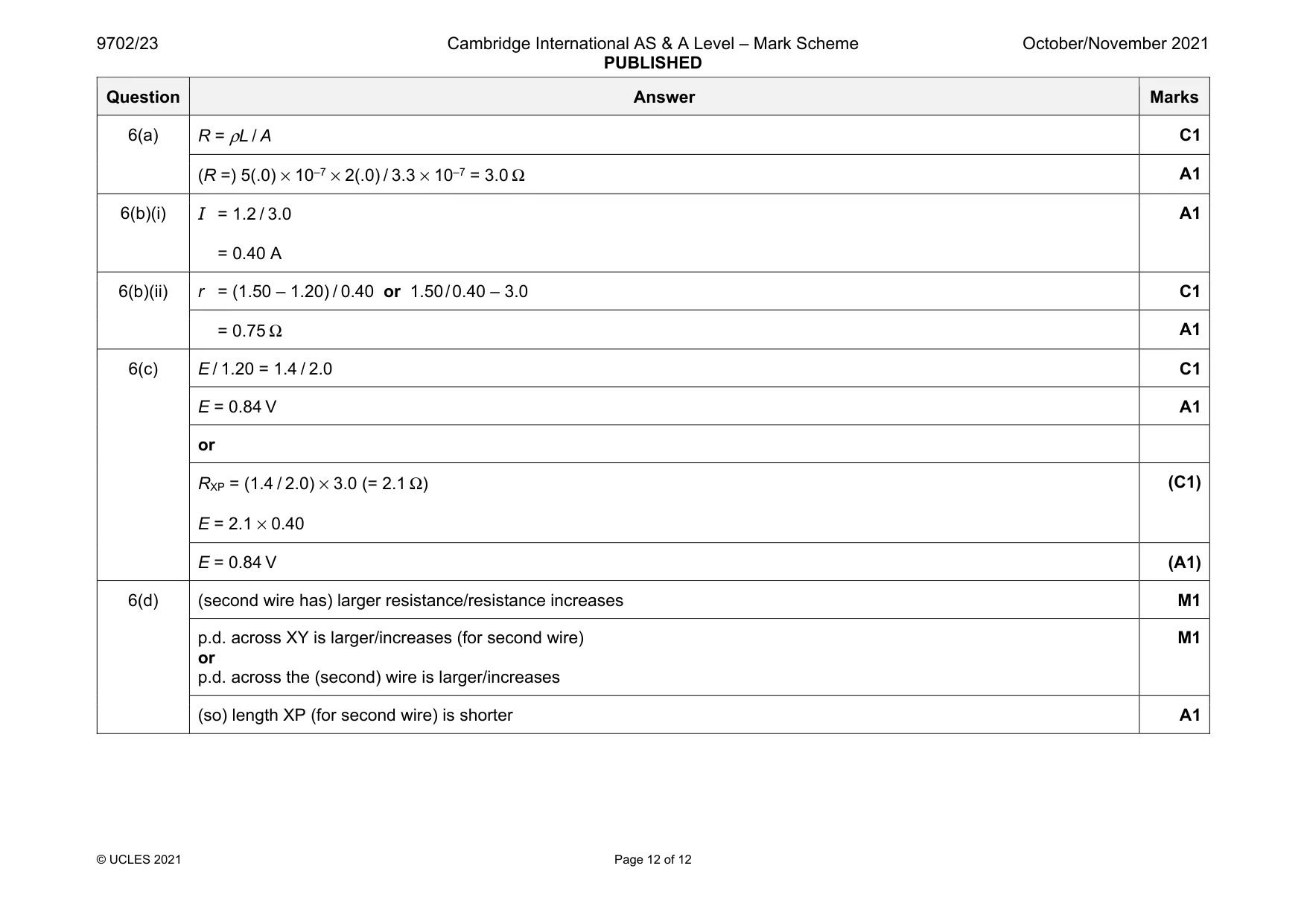
Mark scheme: 6(a) R = ρL / A C1 (R =) 5(.0) × 10–7 × 2(.0) / 3.3 × 10–7 = 3.0 Ω A1 6(b)(i) I = 1.2 / 3.0 = 0.40 A A1 6(b)(ii) r = (1.50 – 1.20) / 0.40 or 1.50 / 0.40 – 3.0 C1 = 0.75 Ω A1 6(c) E / 1.20 = 1.4 / 2.0 C1 E = 0.84 V A1 or RXP = (1.4 / 2.0) × 3.0 (= 2.1 Ω) E = 2.1 × 0.40 (C1) E = 0.84 V (A1) 6(d) (second wire has) larger resistance/resistance increases M1 p.d. across XY is larger/increases (for second wire) or p.d. across the (second) wire is larger/increases M1 (so) length XP (for second wire) is shorter A1
What was in this paper
The subtopics covered by these 6 questions, and how many questions each got. Open one in a new tab to see every Cambridge question on it.
What you needed in this session
Cambridge’s own grade thresholds for 2021 Oct/Nov, Paper 2 · Variant 3. A higher threshold means an easier paper — the bar moves with how the cohort did.