Cambridge A Level Physics 9702 — 2024 Oct/Nov Paper 2 · Variant 3
9702/23/O/N/24 · 7 questions · 60 marks · ≈68 min
The question paper and its mark scheme, free to read here and free to download. This is Cambridge’s own paper, exactly as it was sat.
Question paper16 pages
Mark scheme12 pages
Answers below. Sit the paper first if you are practising.
Questions as text
Question 1
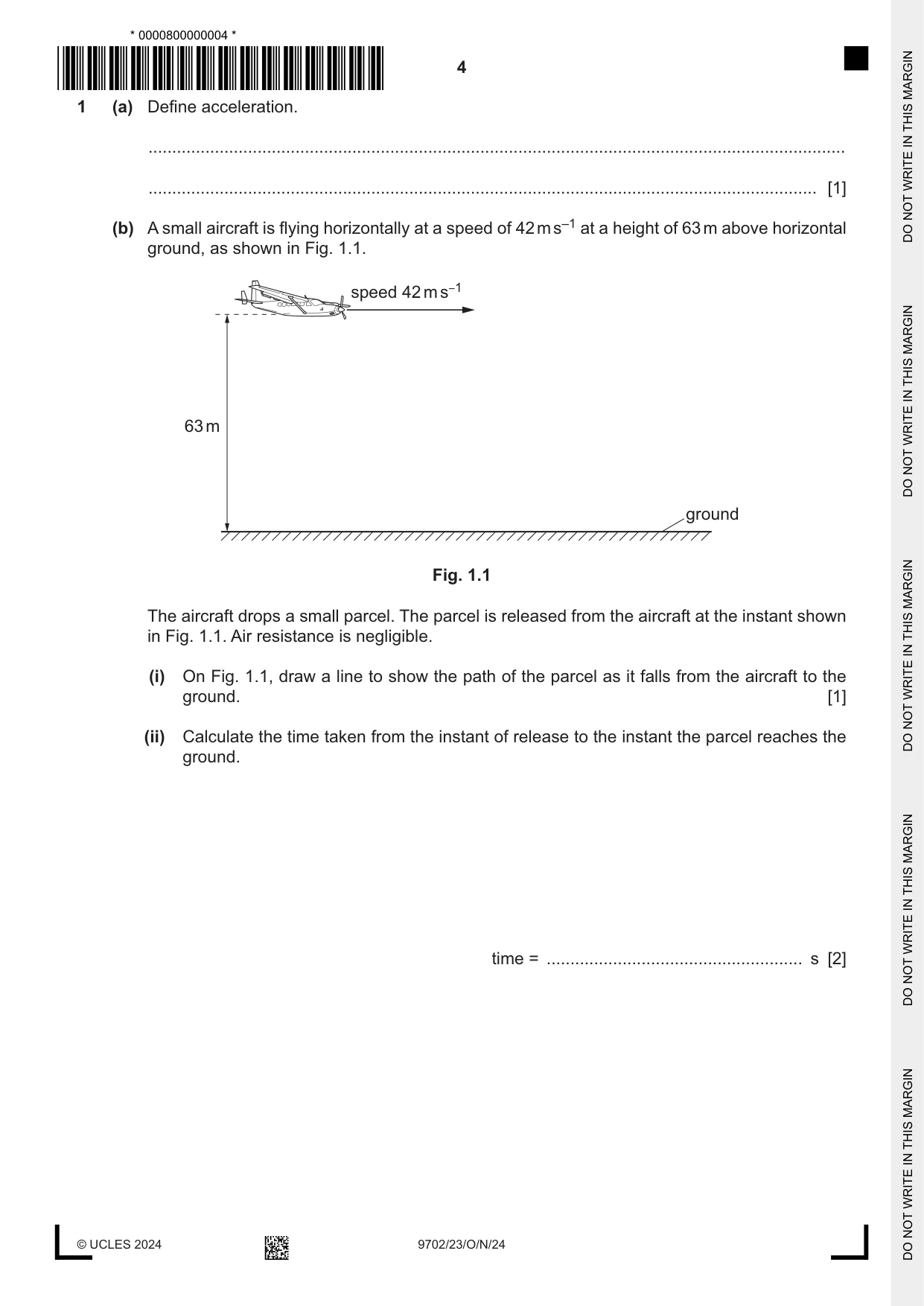
1 (a) Define acceleration. ................................................................................................................................................... ............................................................................................................................................. [1] (b) A small aircraft is flying horizontally at a speed of 42 m s–1 at a height of 63 m above horizontal ground, as shown in Fig. 1.1. speed 42 m s–1 63 m ground Fig. 1.1 The aircraft drops a small parcel. The parcel is released from the aircraft at the instant shown in Fig. 1.1. Air resistance is negligible. (i) On Fig. 1.1, draw a line to show the path of the parcel as it falls from the aircraft to the ground. [1] (ii) Calculate the time taken from the instant of release to the instant the parcel reaches the ground. time = ...................................................... s [2] (iii) Calculate the vertical component of the velocity of the parcel immediately before it reaches the ground. vertical component of velocity = ................................................ m s–1 [1] (iv) Determine the speed at which the parcel reaches the ground. speed = ................................................ m s–1 [2] [Total: 7]
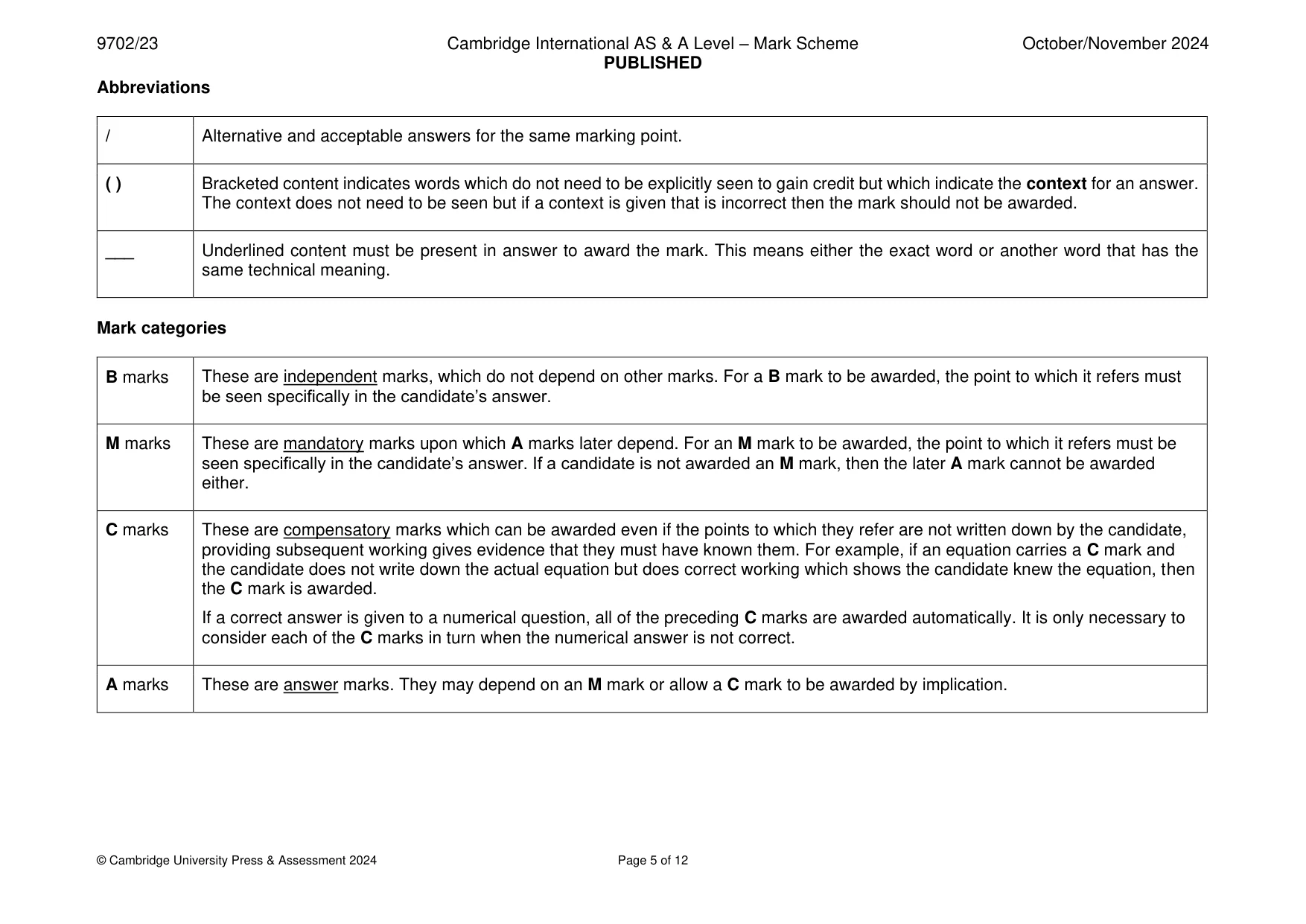
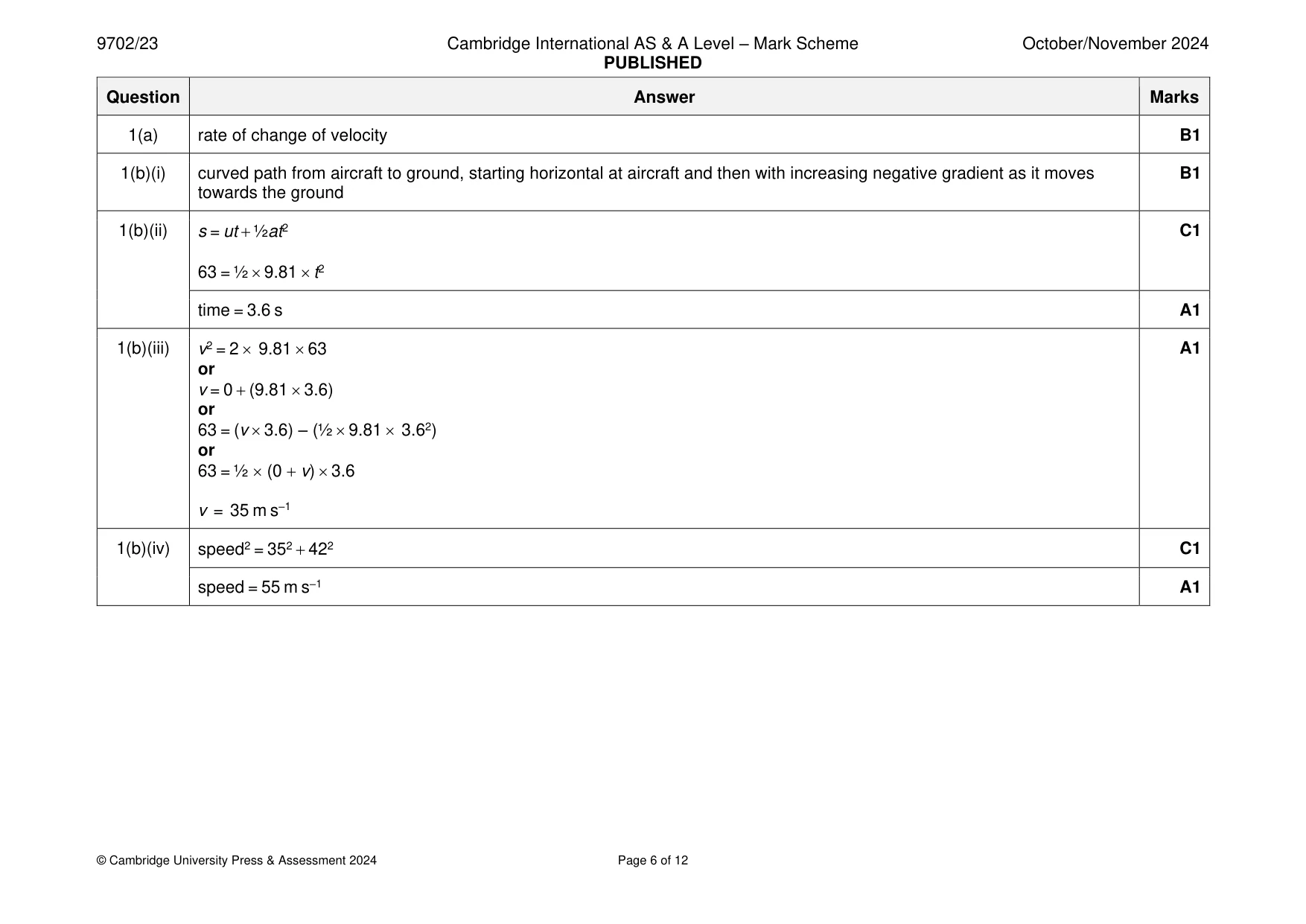
Mark scheme: Question Answer Marks 1(a) rate of change of velocity B1 1(b)(i) curved path from aircraft to ground, starting horizontal at aircraft and then with increasing negative gradient as it moves B1 towards the ground 1(b)(ii) s = ut + ½at2 C1 63 = ½ 9.81 t2 time = 3.6 s A1 1(b)(iii) v2 = 2 9.81 63 A1 or v = 0 + (9.81 3.6) or 63 = (v 3.6) – (½ 9.81 3.62) or 63 = ½ (0 + v) 3.6 v = 35 m s–1 1(b)(iv) speed2 = 352 + 422 C1 speed = 55 m s–1 A1
Q2 · State the principle of conservation of momentum
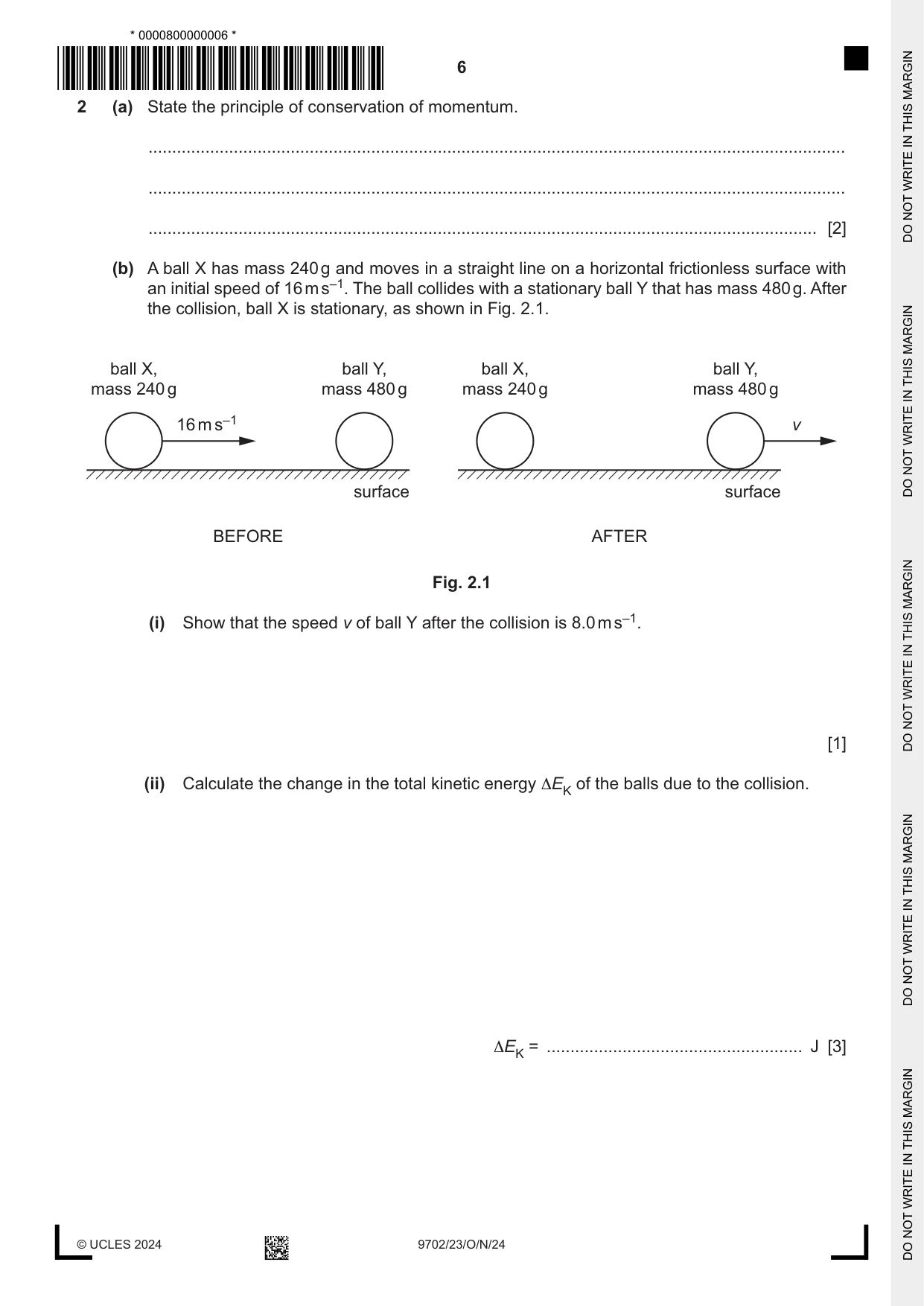
2 (a) State the principle of conservation of momentum. ................................................................................................................................................... ................................................................................................................................................... ............................................................................................................................................. [2] (b) A ball X has mass 240 g and moves in a straight line on a horizontal frictionless surface with an initial speed of 16 m s–1. The ball collides with a stationary ball Y that has mass 480 g. After the collision, ball X is stationary, as shown in Fig. 2.1. ball X, ball Y, ball X, ball Y, mass 240 g mass 480 g mass 240 g mass 480 g 16 m s–1 v surface surface BEFORE AFTER Fig. 2.1 (i) Show that the speed v of ball Y after the collision is 8.0 m s–1. [1] (ii) Calculate the change in the total kinetic energy ∆EK of the balls due to the collision. ∆EK = ...................................................... J [3] (c) The collision in (b) lasts for a time of 2.0 ms. Assume that the contact force between the balls is constant during this time. (i) Determine the magnitude and direction of the force exerted on ball X by ball Y during the collision. magnitude = ........................................................... N direction ............................................................... [3] (ii) Compare the magnitude and direction of the force exerted on ball Y by ball X during the collision with the answers in (c)(i). No further calculations are required. ........................................................................................................................................... ........................................................................................................................................... ..................................................................................................................................... [2] [Total: 11]
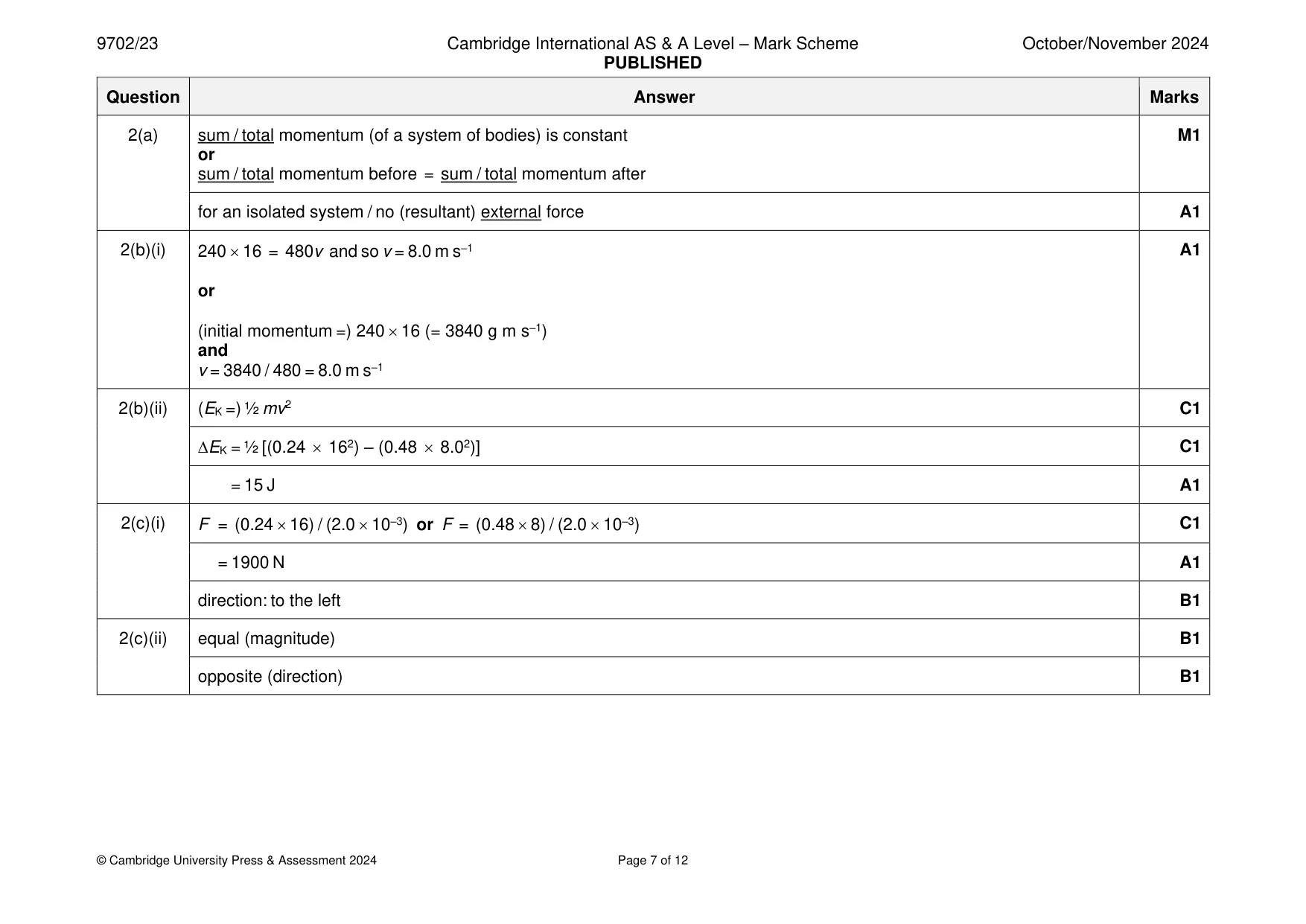
Mark scheme: 2(a) sum / total momentum (of a system of bodies) is constant M1 or sum / total momentum before = sum / total momentum after for an isolated system / no (resultant) external force A1 2(b)(i) 240 16 = 480v and so v = 8.0 m s–1 A1 or (initial momentum =) 240 16 (= 3840 g m s–1) and v = 3840 / 480 = 8.0 m s–1 2(b)(ii) (EK =) ½ mv2 C1 EK = ½ [(0.24 162) – (0.48 8.02)] C1 = 15 J A1 2(c)(i) F = (0.24 16) / (2.0 10–3) or F = (0.48 8) / (2.0 10–3) C1 = 1900 N A1 direction: to the left B1 2(c)(ii) equal (magnitude) B1 opposite (direction) B1
Q3 · State the principle of moments
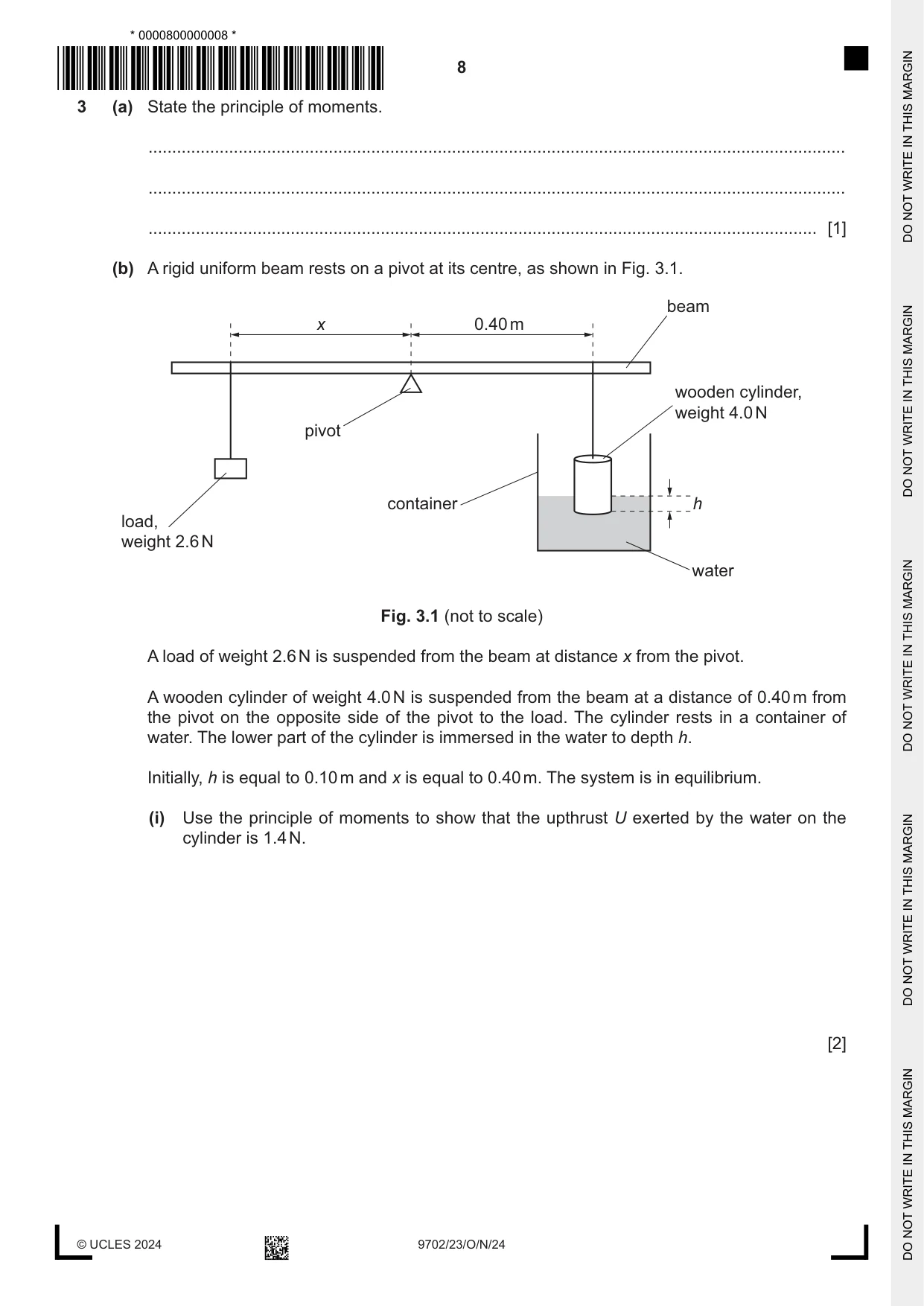
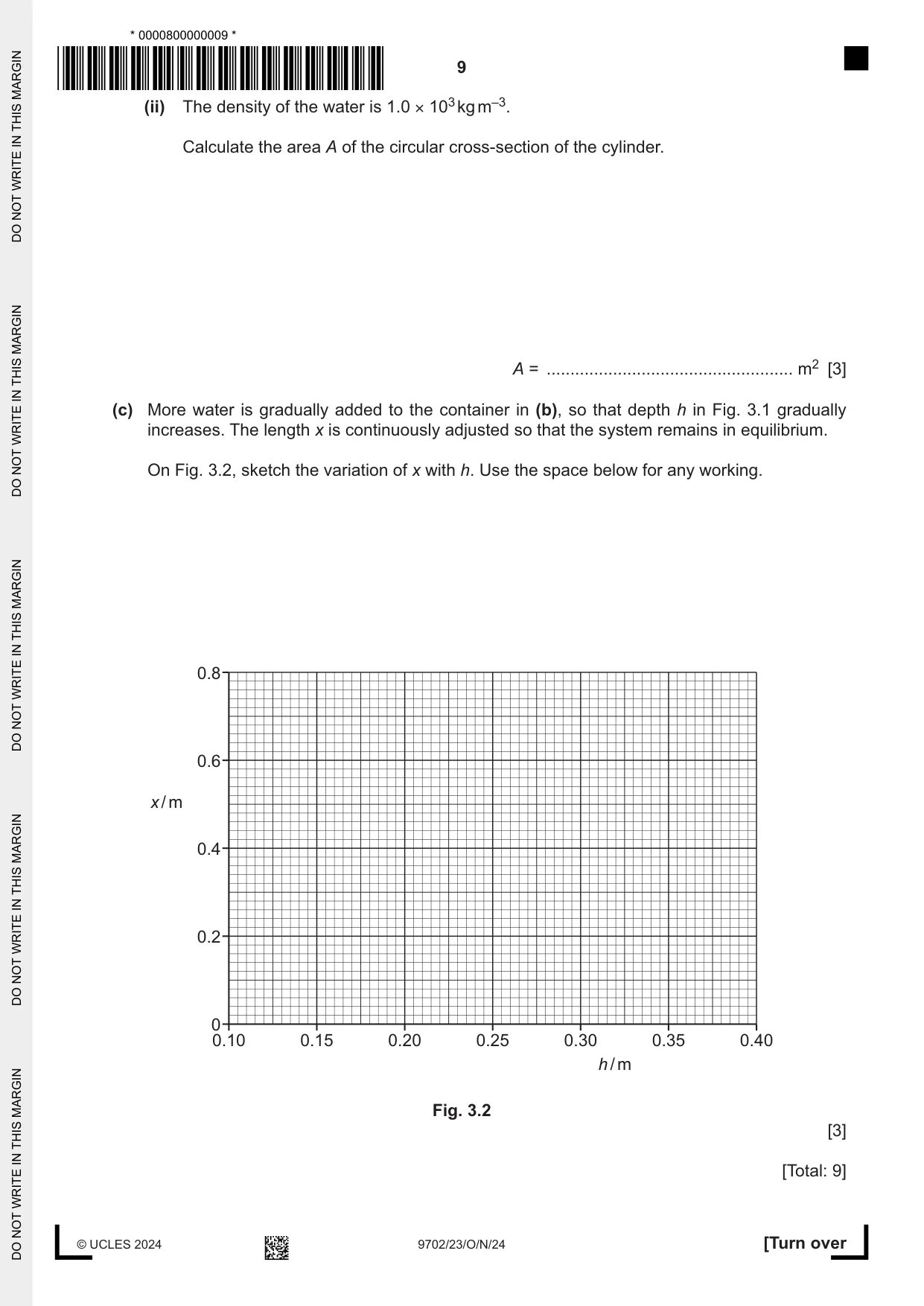
3 (a) State the principle of moments. ................................................................................................................................................... ................................................................................................................................................... ............................................................................................................................................. [1] (b) A rigid uniform beam rests on a pivot at its centre, as shown in Fig. 3.1. beam x 0.40 m wooden cylinder, weight 4.0 N pivot container h load, weight 2.6 N water Fig. 3.1 (not to scale) A load of weight 2.6 N is suspended from the beam at distance x from the pivot. A wooden cylinder of weight 4.0 N is suspended from the beam at a distance of 0.40 m from the pivot on the opposite side of the pivot to the load. The cylinder rests in a container of water. The lower part of the cylinder is immersed in the water to depth h. Initially, h is equal to 0.10 m and x is equal to 0.40 m. The system is in equilibrium. (i) Use the principle of moments to show that the upthrust U exerted by the water on the cylinder is 1.4 N. [2] (ii) The density of the water is 1.0 × 10³ kg m–3. Calculate the area A of the circular cross-section of the cylinder. A = .................................................... m2 [3] (c) More water is gradually added to the container in (b), so that depth h in Fig. 3.1 gradually increases. The length x is continuously adjusted so that the system remains in equilibrium. On Fig. 3.2, sketch the variation of x with h. Use the space below for any working. 0.8 0.6 x / m 0.4 0.2 0 0.10 0.15 0.20 0.25 0.30 0.35 0.40 h / m Fig. 3.2 [3] [Total: 9]
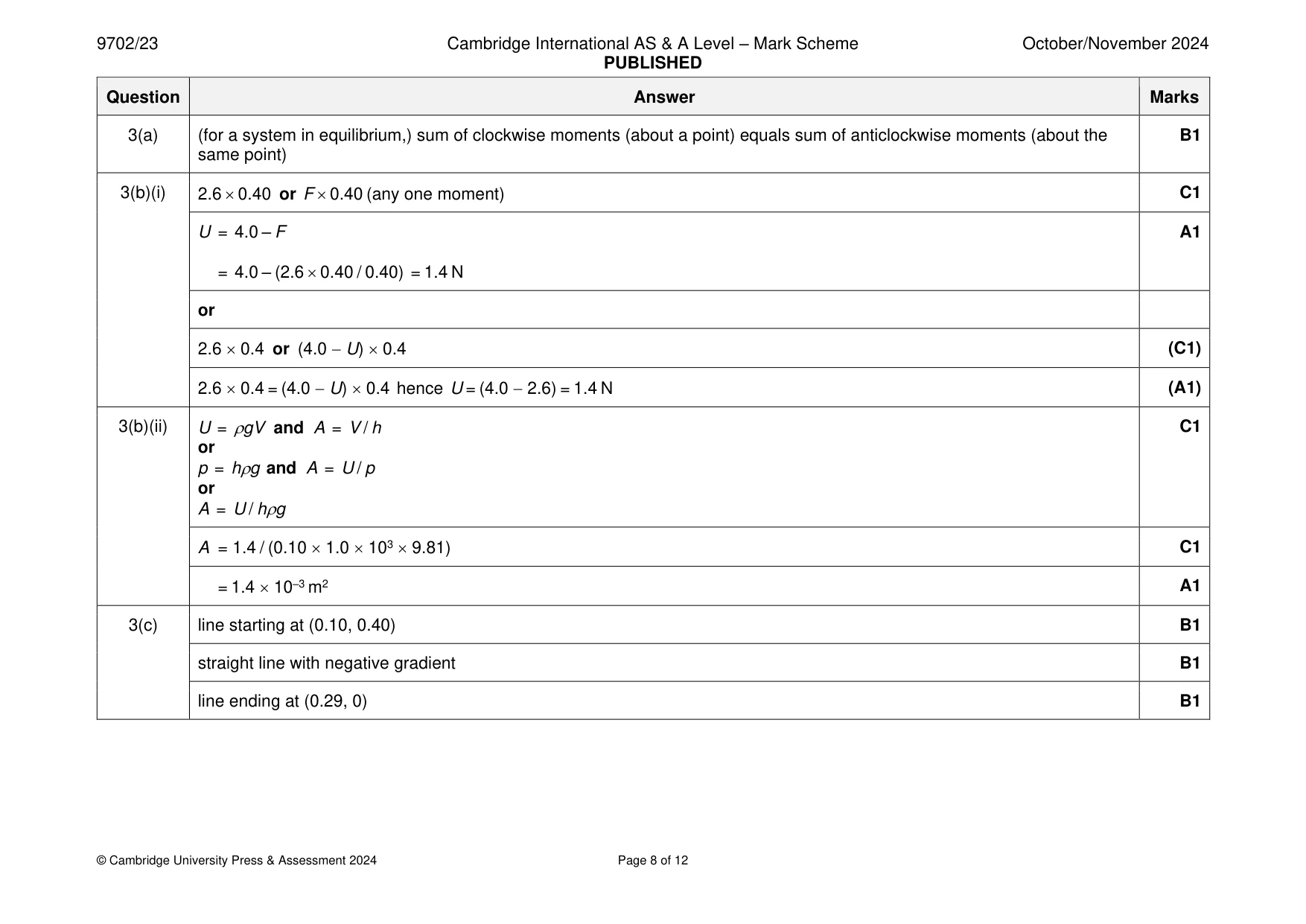
Mark scheme: 3(a) (for a system in equilibrium,) sum of clockwise moments (about a point) equals sum of anticlockwise moments (about the B1 same point) 3(b)(i) 2.6 0.40 or F 0.40 (any one moment) C1 U = 4.0 – F A1 = 4.0 – (2.6 0.40 / 0.40) = 1.4 N or 2.6 0.4 or (4.0 − U) 0.4 (C1) 2.6 0.4 = (4.0 − U) 0.4 hence U = (4.0 − 2.6) = 1.4 N (A1) 3(b)(ii) U = gV and A = V / h C1 or p = hg and A = U / p or A = U / hg A = 1.4 / (0.10 1.0 103 9.81) C1 = 1.4 10–3 m2 A1 3(c) line starting at (0.10, 0.40) B1 straight line with negative gradient B1 line ending at (0.29, 0) B1
Question 4
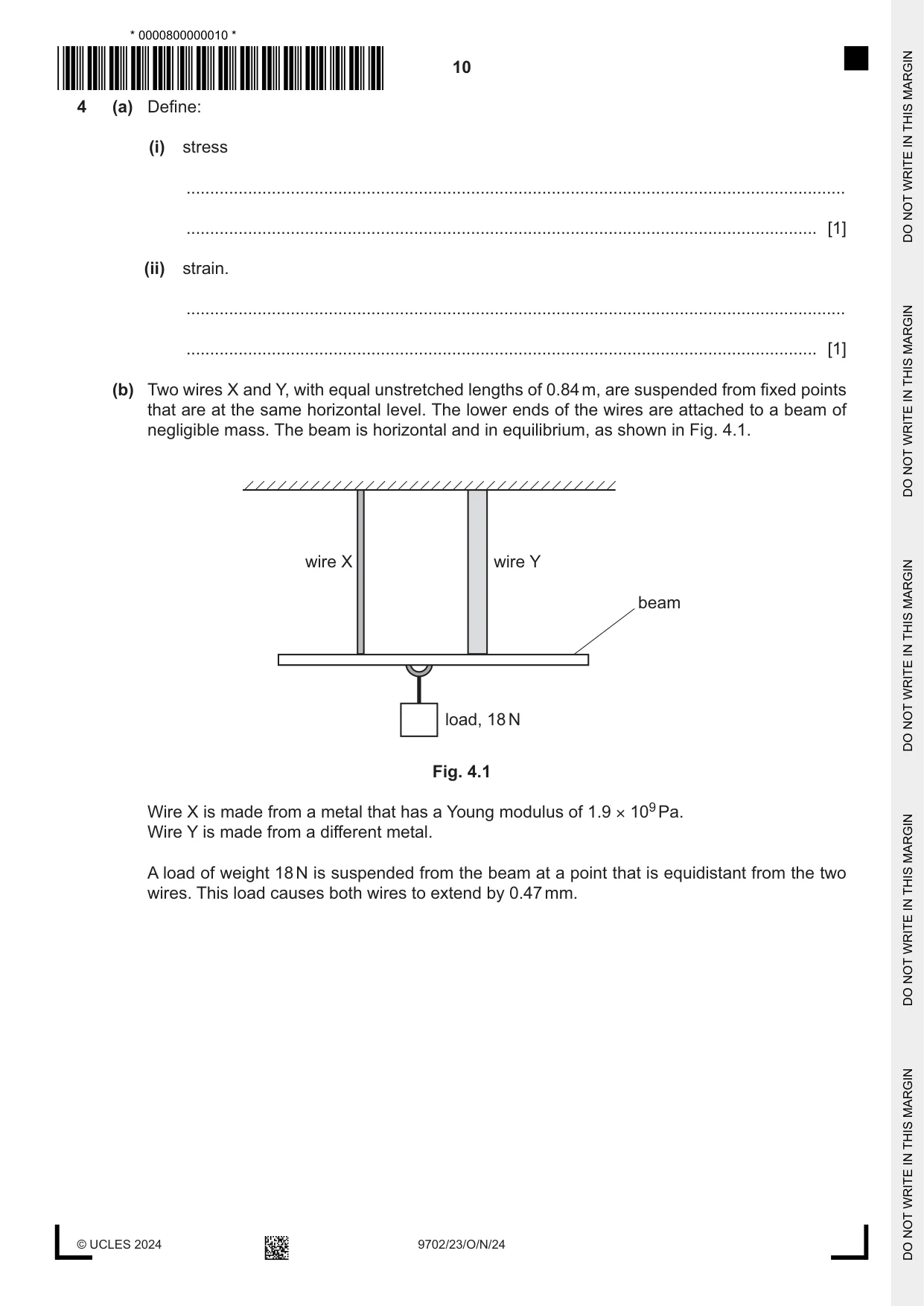
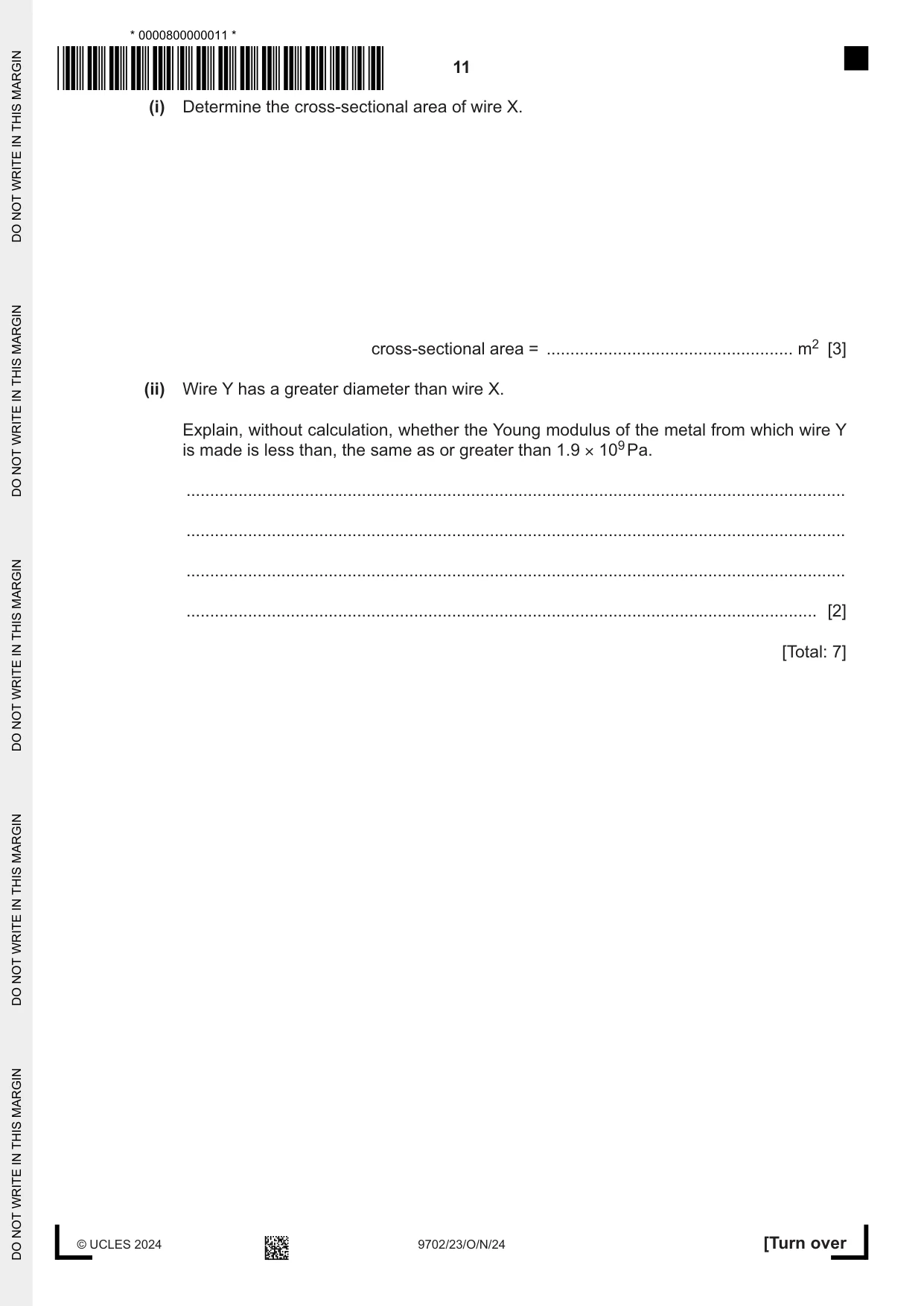
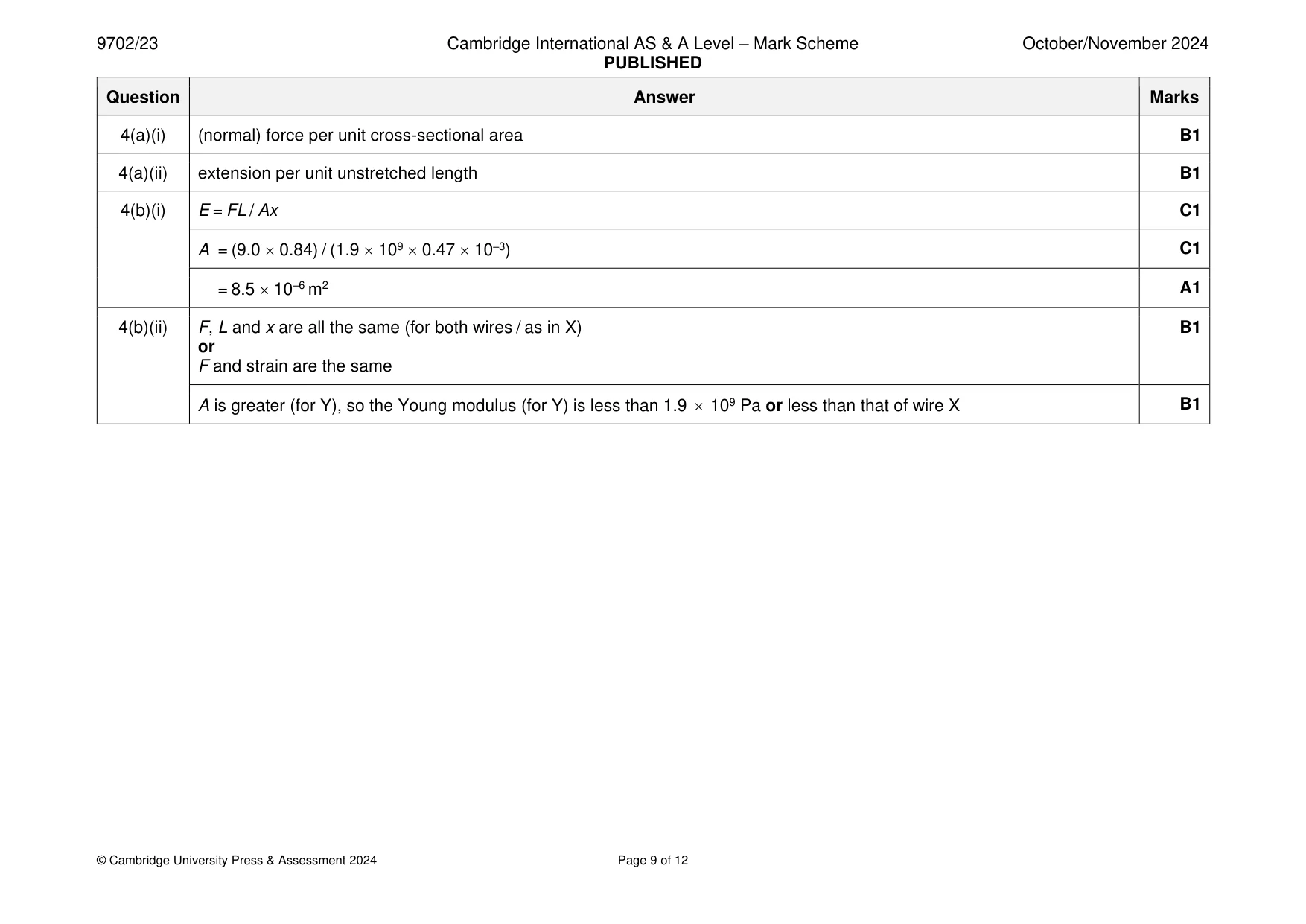
4 (a) Define: (i) stress ........................................................................................................................................... ..................................................................................................................................... [1] (ii) strain. ........................................................................................................................................... ..................................................................................................................................... [1] (b) Two wires X and Y, with equal unstretched lengths of 0.84 m, are suspended from fixed points that are at the same horizontal level. The lower ends of the wires are attached to a beam of negligible mass. The beam is horizontal and in equilibrium, as shown in Fig. 4.1. wire X wire Y beam load, 18 N Fig. 4.1 Wire X is made from a metal that has a Young modulus of 1.9 × 10⁹ Pa. Wire Y is made from a different metal. A load of weight 18 N is suspended from the beam at a point that is equidistant from the two wires. This load causes both wires to extend by 0.47 mm. (i) Determine the cross-sectional area of wire X. cross-sectional area = .................................................... m2 [3] (ii) Wire Y has a greater diameter than wire X. Explain, without calculation, whether the Young modulus of the metal from which wire Y is made is less than, the same as or greater than 1.9 × 10⁹ Pa. ........................................................................................................................................... ........................................................................................................................................... ........................................................................................................................................... ..................................................................................................................................... [2] [Total: 7]
Mark scheme: 4(a)(i) (normal) force per unit cross-sectional area B1 4(a)(ii) extension per unit unstretched length B1 4(b)(i) E = FL / Ax C1 A = (9.0 0.84) / (1.9 109 0.47 10–3) C1 = 8.5 10–6 m2 A1 4(b)(ii) F, L and x are all the same (for both wires / as in X) B1 or F and strain are the same A is greater (for Y), so the Young modulus (for Y) is less than 1.9 109 Pa or less than that of wire X B1
Q5 · A stationary wave is formed on a string XY that has a length of 0.48 m
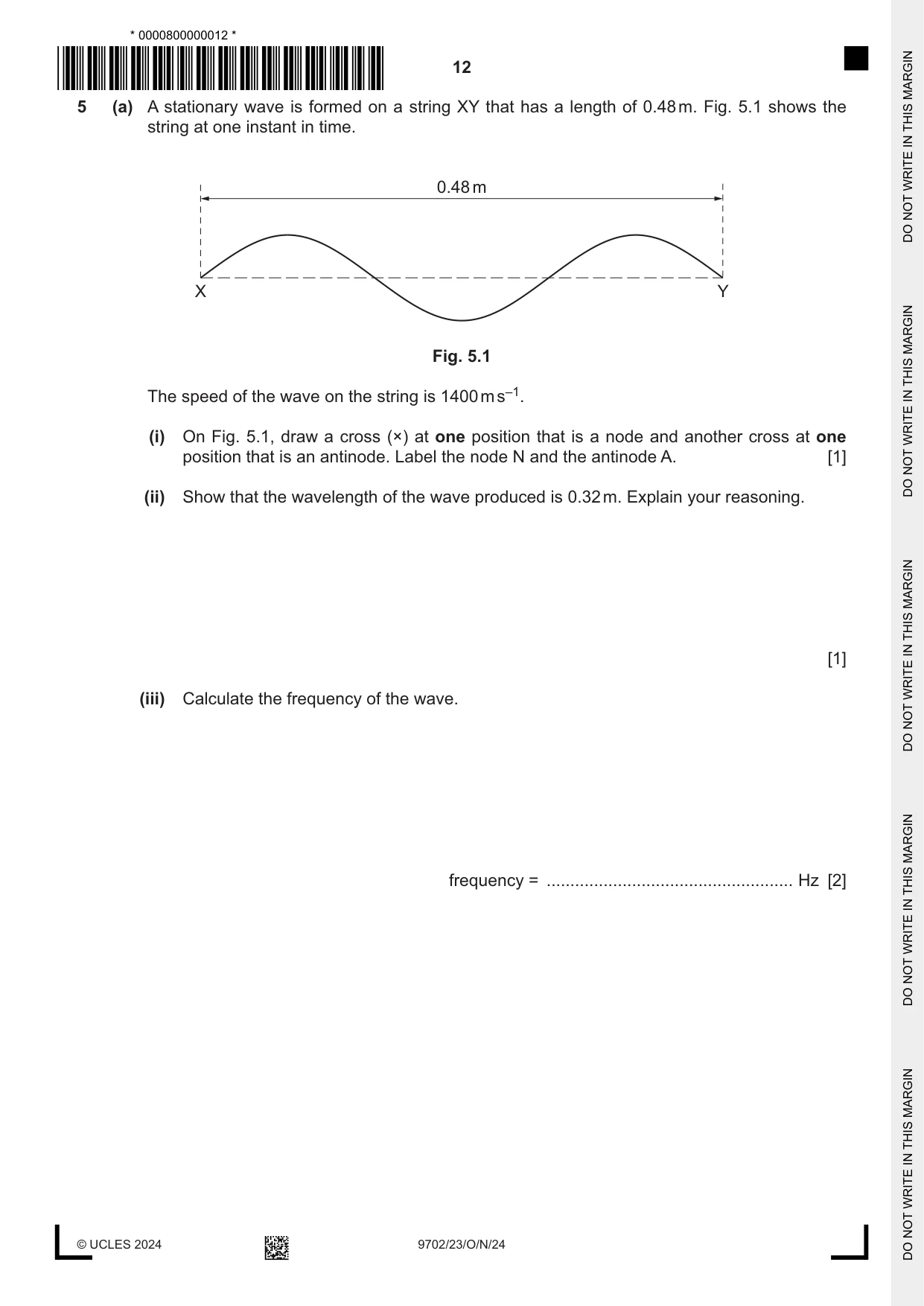
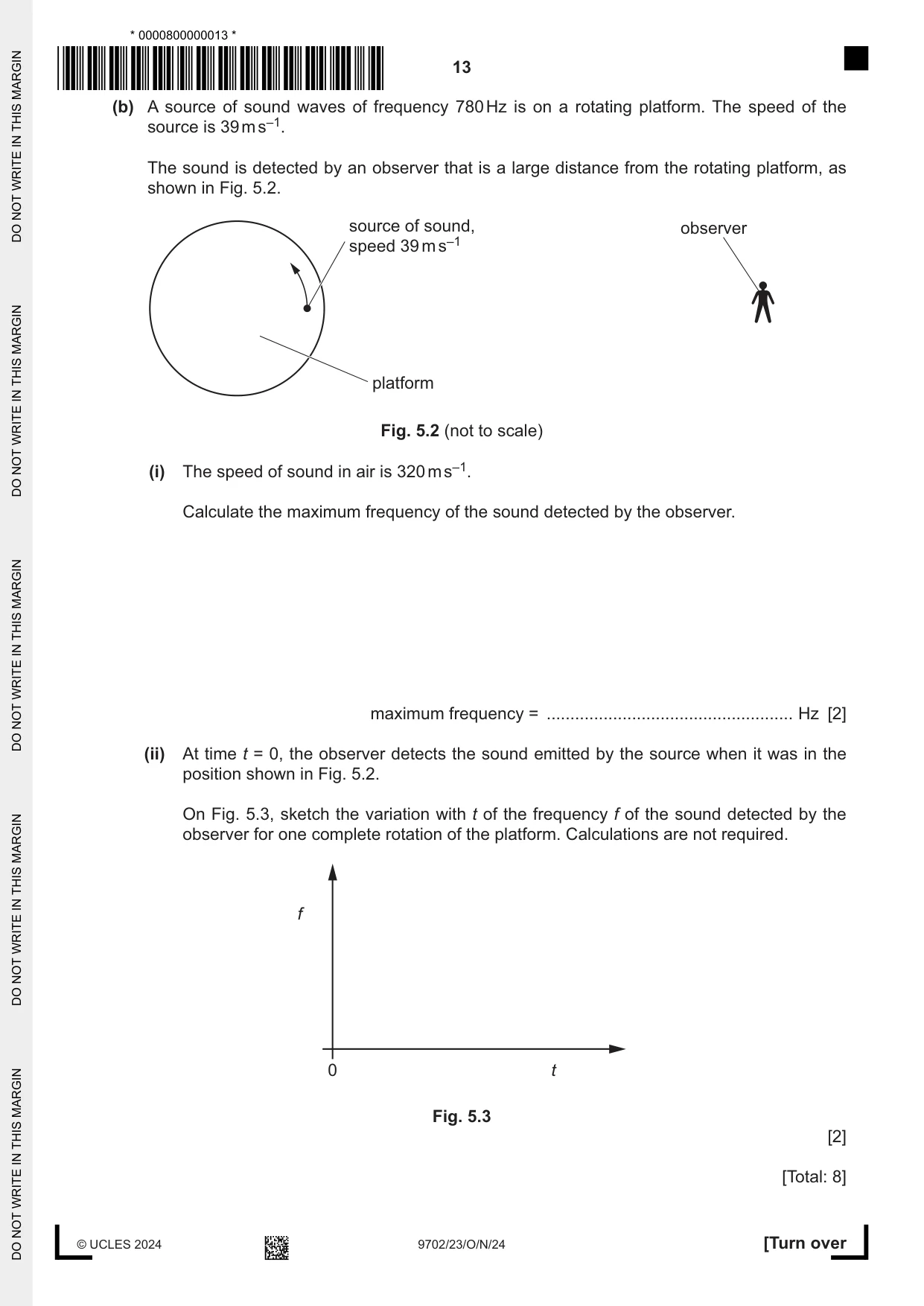
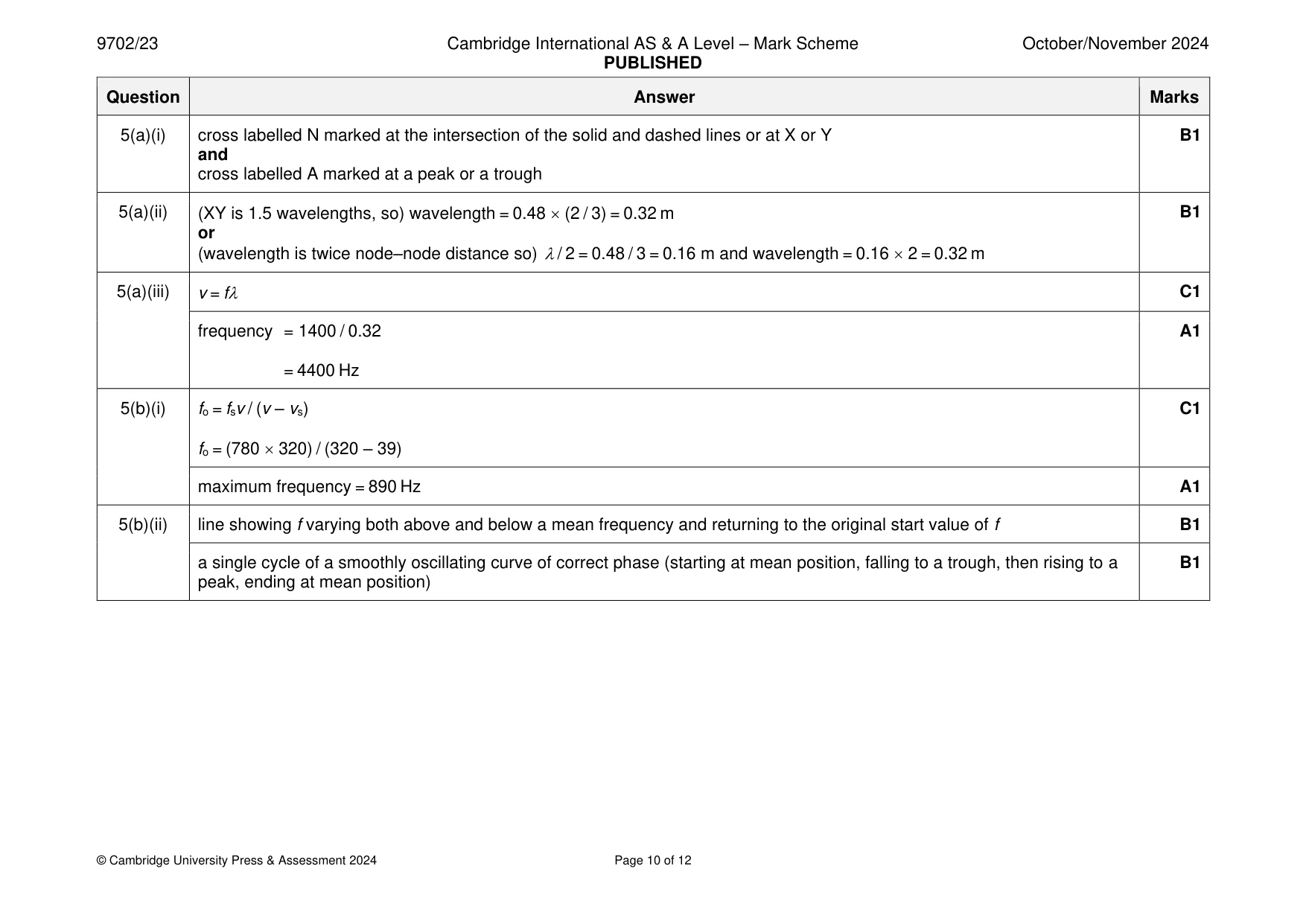
5 (a) A stationary wave is formed on a string XY that has a length of 0.48 m. Fig. 5.1 shows the string at one instant in time. 0.48 m X Y Fig. 5.1 The speed of the wave on the string is 1400 m s–1. (i) On Fig. 5.1, draw a cross (×) at one position that is a node and another cross at one position that is an antinode. Label the node N and the antinode A. [1] (ii) Show that the wavelength of the wave produced is 0.32 m. Explain your reasoning. [1] (iii) Calculate the frequency of the wave. frequency = .................................................... Hz [2] (b) A source of sound waves of frequency 780 Hz is on a rotating platform. The speed of the source is 39 m s–1. The sound is detected by an observer that is a large distance from the rotating platform, as shown in Fig. 5.2. source of sound, observer speed 39 m s–1 platform Fig. 5.2 (not to scale) (i) The speed of sound in air is 320 m s–1. Calculate the maximum frequency of the sound detected by the observer. maximum frequency = .................................................... Hz [2] (ii) At time t = 0, the observer detects the sound emitted by the source when it was in the position shown in Fig. 5.2. On Fig. 5.3, sketch the variation with t of the frequency f of the sound detected by the observer for one complete rotation of the platform. Calculations are not required. f 0 t Fig. 5.3 [2] [Total: 8]
Mark scheme: 5(a)(i) cross labelled N marked at the intersection of the solid and dashed lines or at X or Y B1 and cross labelled A marked at a peak or a trough 5(a)(ii) (XY is 1.5 wavelengths, so) wavelength = 0.48 (2 / 3) = 0.32 m B1 or (wavelength is twice node–node distance so) / 2 = 0.48 / 3 = 0.16 m and wavelength = 0.16 2 = 0.32 m 5(a)(iii) v = f C1 frequency = 1400 / 0.32 A1 = 4400 Hz 5(b)(i) fo = fsv / (v – vs) C1 fo = (780 320) / (320 – 39) maximum frequency = 890 Hz A1 5(b)(ii) line showing f varying both above and below a mean frequency and returning to the original start value of f B1 a single cycle of a smoothly oscillating curve of correct phase (starting at mean position, falling to a trough, then rising to a B1 peak, ending at mean position)
Question 6
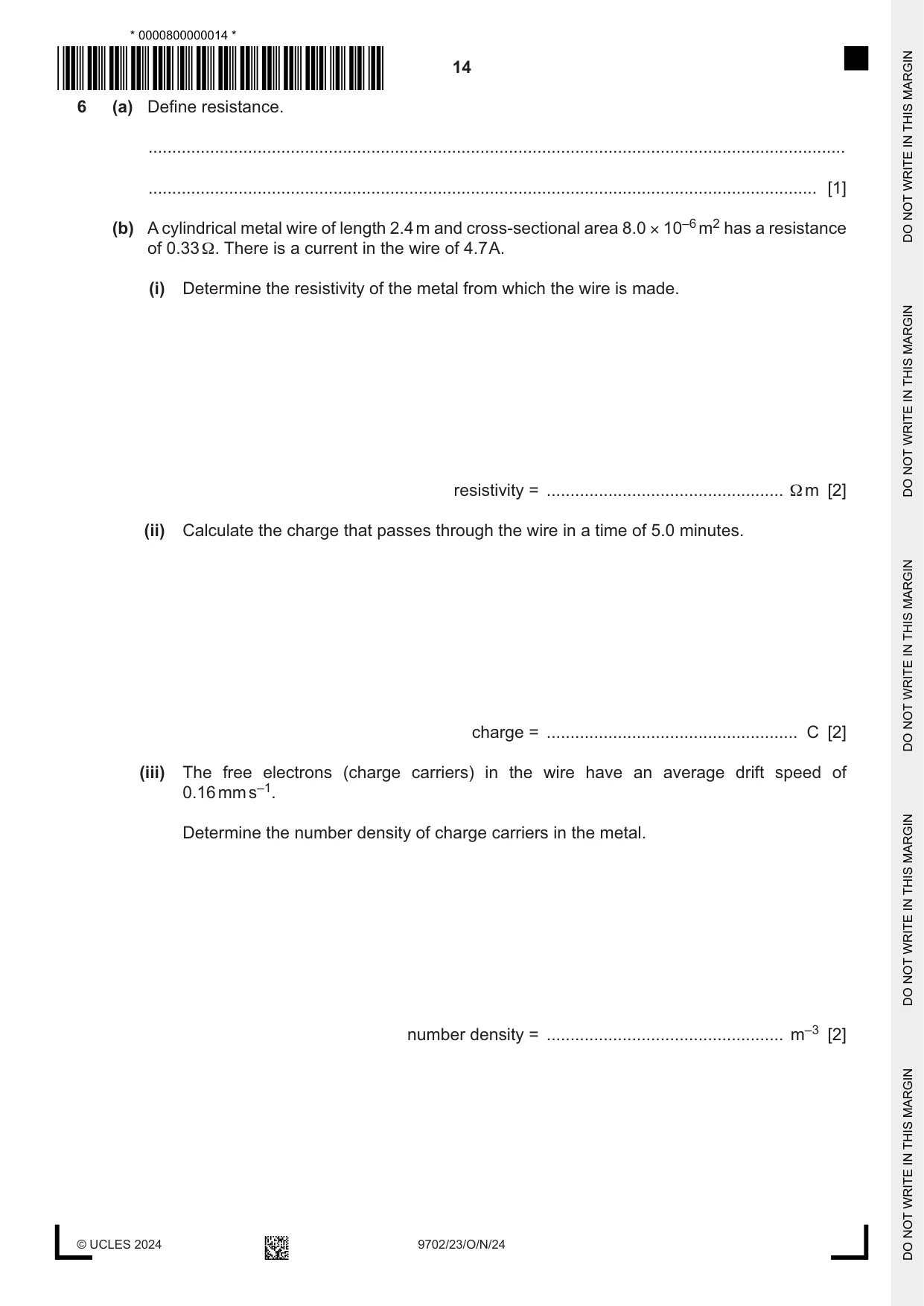
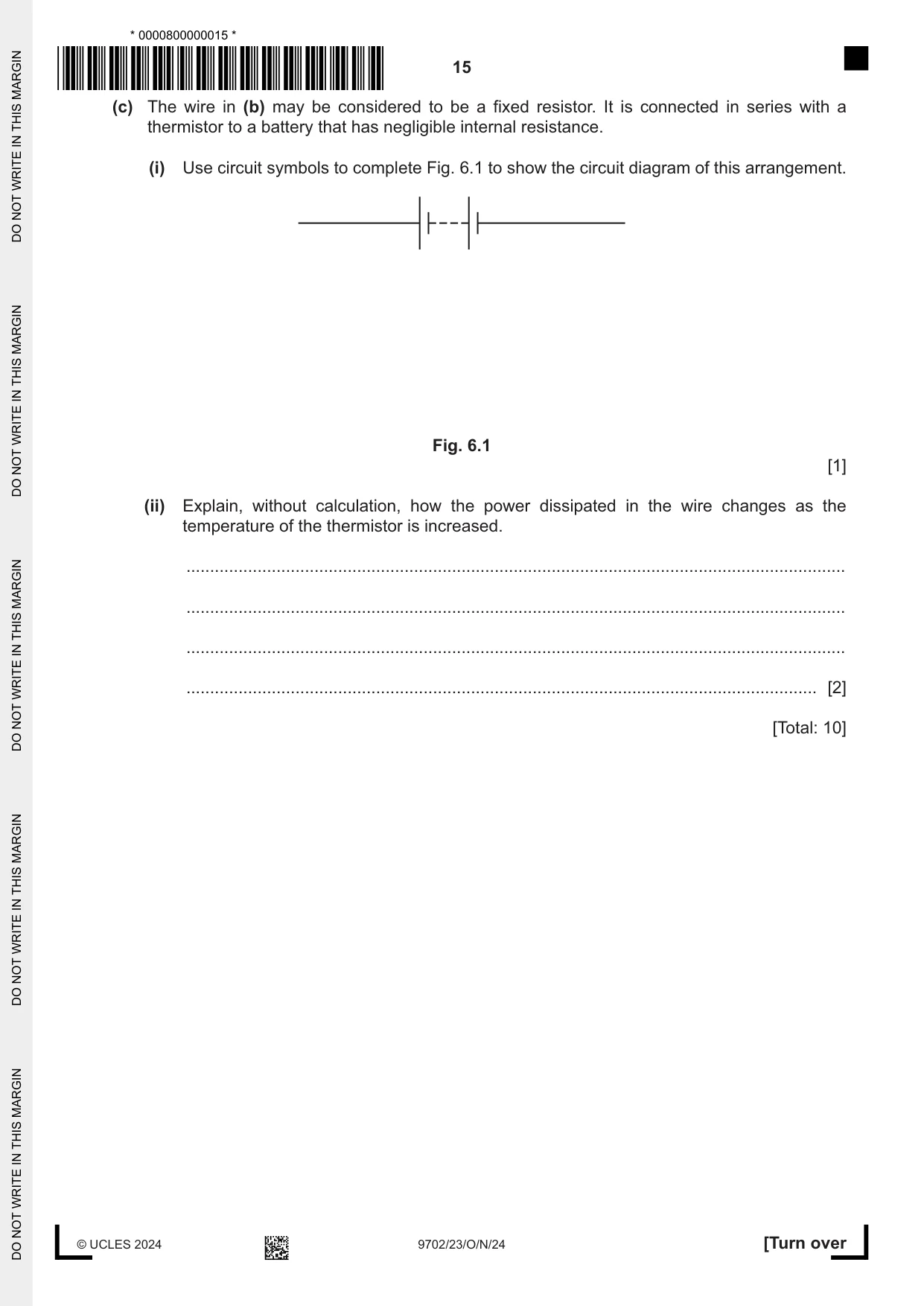
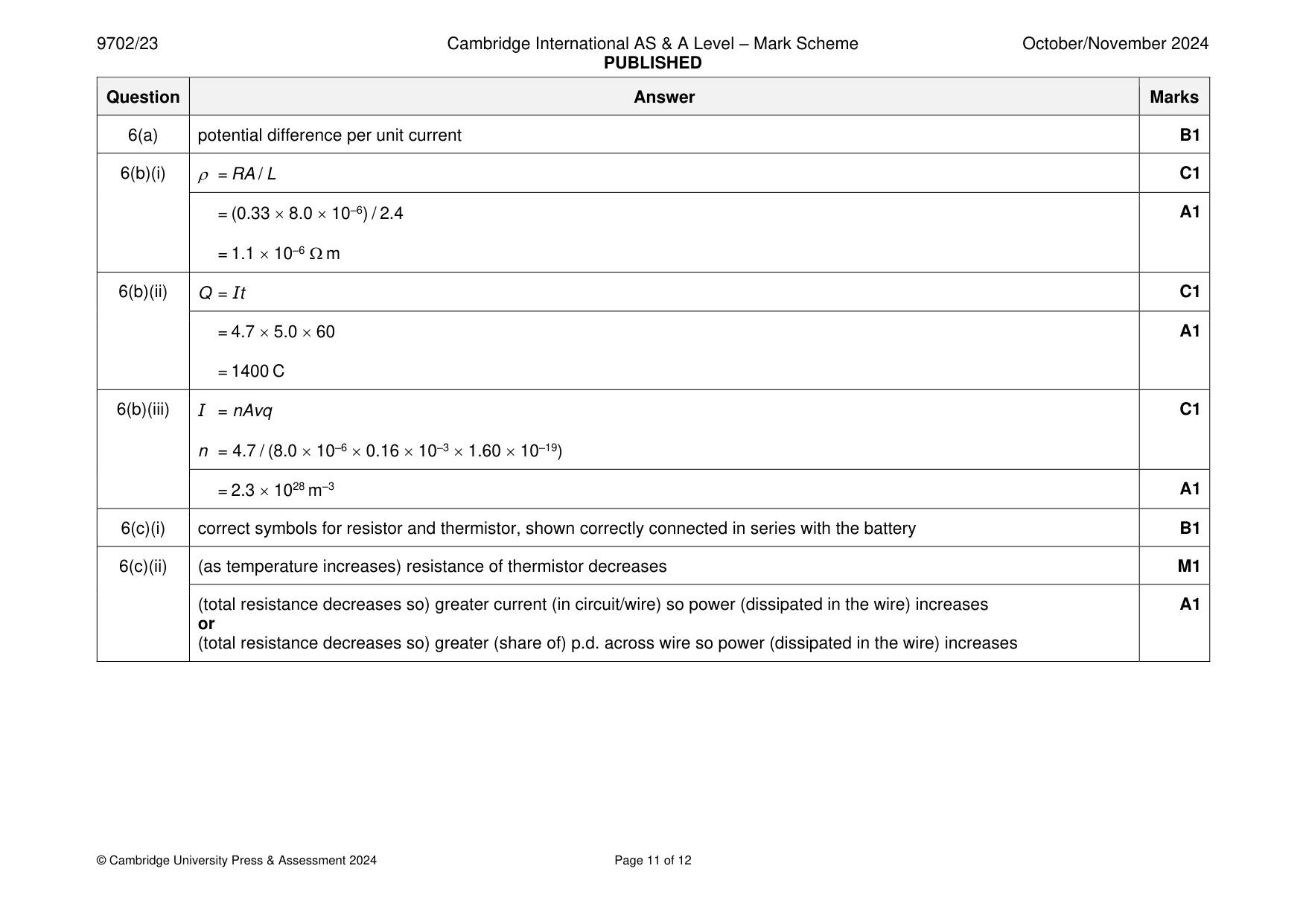
6 (a) Define resistance. ................................................................................................................................................... ............................................................................................................................................. [1] (b) A cylindrical metal wire of length 2.4 m and cross-sectional area 8.0 × 10⁻⁶ m2 has a resistance of 0.33 Ω. There is a current in the wire of 4.7 A. (i) Determine the resistivity of the metal from which the wire is made. resistivity = .................................................. Ω m [2] (ii) Calculate the charge that passes through the wire in a time of 5.0 minutes. charge = ..................................................... C [2] (iii) The free electrons (charge carriers) in the wire have an average drift speed of 0.16 mm s–1. Determine the number density of charge carriers in the metal. number density = .................................................. m–3 [2] (c) The wire in (b) may be considered to be a fixed resistor. It is connected in series with a thermistor to a battery that has negligible internal resistance. (i) Use circuit symbols to complete Fig. 6.1 to show the circuit diagram of this arrangement. Fig. 6.1 [1] (ii) Explain, without calculation, how the power dissipated in the wire changes as the temperature of the thermistor is increased. ........................................................................................................................................... ........................................................................................................................................... ........................................................................................................................................... ..................................................................................................................................... [2] [Total: 10]
Mark scheme: 6(a) potential difference per unit current B1 6(b)(i) = RA / L C1 = (0.33 8.0 10–6) / 2.4 A1 = 1.1 10–6 m 6(b)(ii) Q = It C1 = 4.7 5.0 60 A1 = 1400 C 6(b)(iii) I = nAvq C1 n = 4.7 / (8.0 10–6 0.16 10–3 1.60 10–19) = 2.3 1028 m–3 A1 6(c)(i) correct symbols for resistor and thermistor, shown correctly connected in series with the battery B1 6(c)(ii) (as temperature increases) resistance of thermistor decreases M1 (total resistance decreases so) greater current (in circuit/wire) so power (dissipated in the wire) increases A1 or (total resistance decreases so) greater (share of) p.d. across wire so power (dissipated in the wire) increases
Q7 · Complete Table 7.1 to show the charges, in terms of the elementary charge e, on each of…
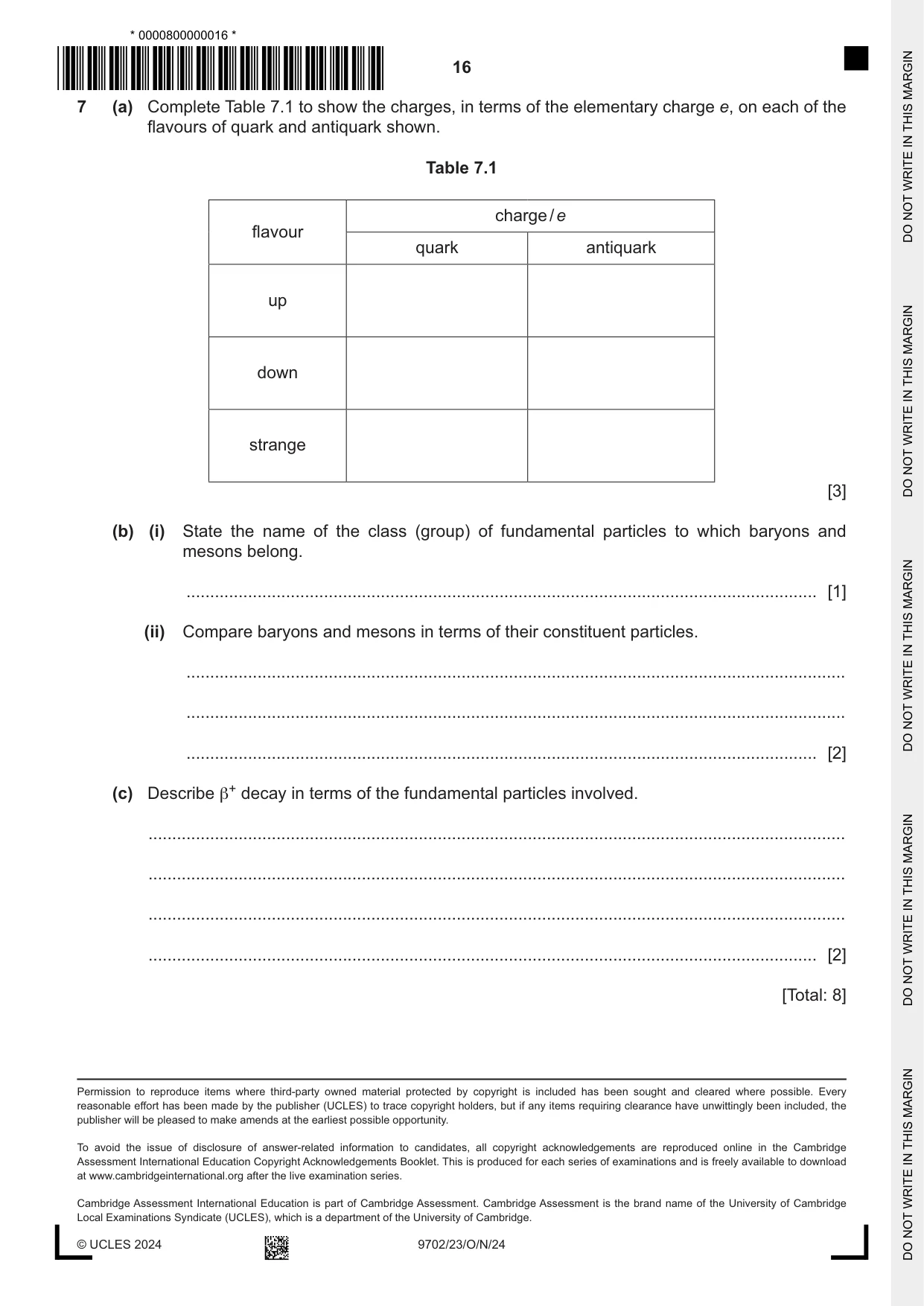
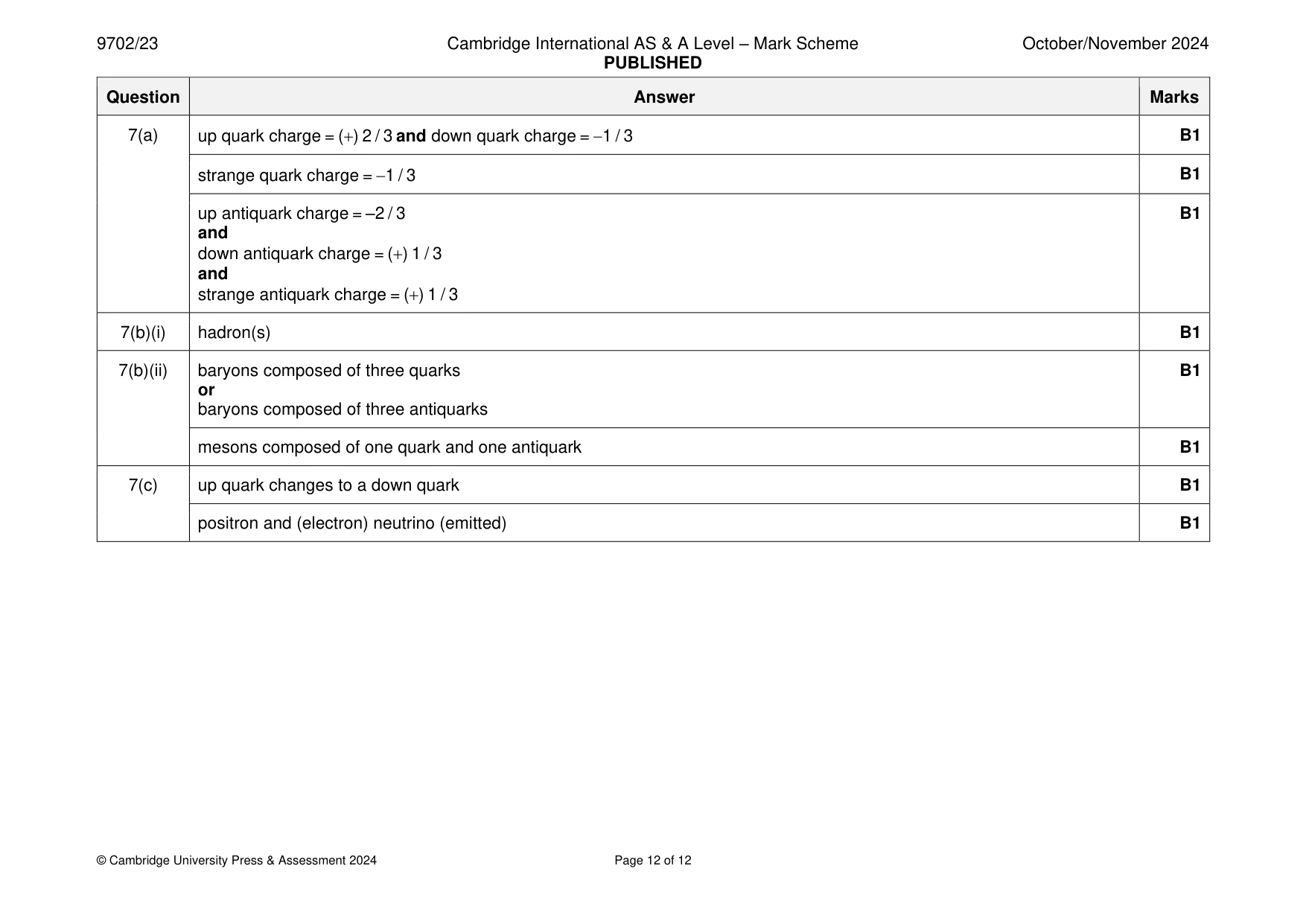
7 (a) Complete Table 7.1 to show the charges, in terms of the elementary charge e, on each of the flavours of quark and antiquark shown. Table 7.1 charge / e flavour quark antiquark up down strange [3] (b) (i) State the name of the class (group) of fundamental particles to which baryons and mesons belong. ..................................................................................................................................... [1] (ii) Compare baryons and mesons in terms of their constituent particles. ........................................................................................................................................... ........................................................................................................................................... ..................................................................................................................................... [2] (c) Describe β+ decay in terms of the fundamental particles involved. ................................................................................................................................................... ................................................................................................................................................... ................................................................................................................................................... ............................................................................................................................................. [2] [Total: 8]
Mark scheme: 7(a) up quark charge = (+) 2 / 3 and down quark charge = −1 / 3 B1 strange quark charge = −1 / 3 B1 up antiquark charge = –2 / 3 B1 and down antiquark charge = (+) 1 / 3 and strange antiquark charge = (+) 1 / 3 7(b)(i) hadron(s) B1 7(b)(ii) baryons composed of three quarks B1 or baryons composed of three antiquarks mesons composed of one quark and one antiquark B1 7(c) up quark changes to a down quark B1 positron and (electron) neutrino (emitted) B1
What was in this paper
The subtopics covered by these 7 questions, and how many questions each got. Open one in a new tab to see every Cambridge question on it.
What you needed in this session
Cambridge’s own grade thresholds for 2024 Oct/Nov, Paper 2 · Variant 3. A higher threshold means an easier paper — the bar moves with how the cohort did.