Cambridge A Level Physics 9702 — 2022 Oct/Nov Paper 2 · Variant 3
9702/23/O/N/22 · 6 questions · 60 marks · ≈68 min
The question paper and its mark scheme, free to read here and free to download. This is Cambridge’s own paper, exactly as it was sat.
Question paper16 pages
Mark scheme14 pages
Answers below. Sit the paper first if you are practising.
Questions as text
Q1 · The rate of flow Q of a liquid along a narrow pipe of length L and radius r is given by…
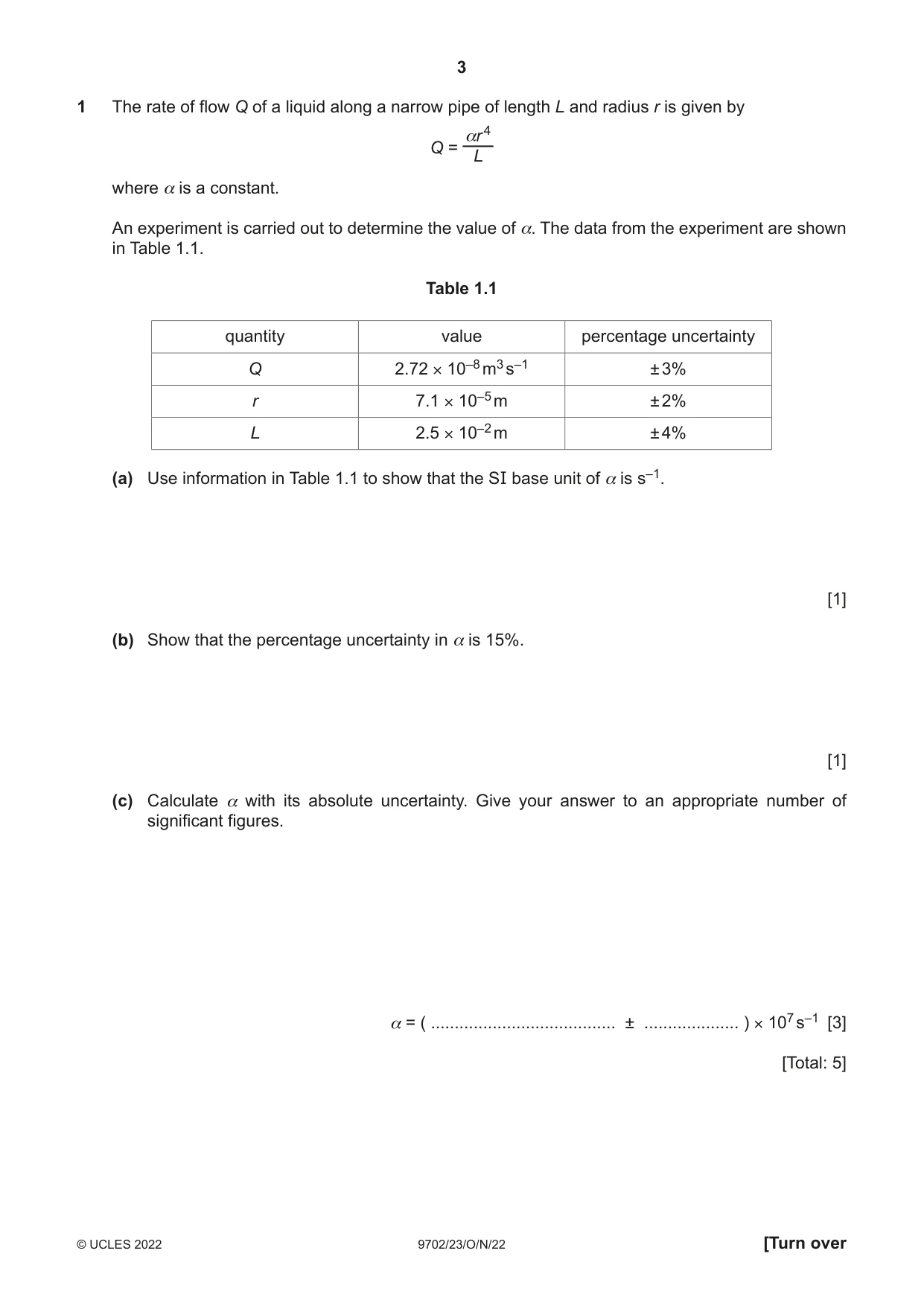
1 The rate of flow Q of a liquid along a narrow pipe of length L and radius r is given by αr 4 Q = L where α is a constant. An experiment is carried out to determine the value of α. The data from the experiment are shown in Table 1.1. Table 1.1 quantity value percentage uncertainty Q 2.72 × 10⁻⁸ m3 s–1 ± 3% r 7.1 × 10⁻⁵ m ± 2% L 2.5 × 10⁻² m ± 4% (a) Use information in Table 1.1 to show that the SI base unit of α is s–1. [1] (b) Show that the percentage uncertainty in α is 15%. [1] (c) Calculate α with its absolute uncertainty. Give your answer to an appropriate number of significant figures. α = ( ....................................... ± .................... ) × 107 s–1 [3] [Total: 5]
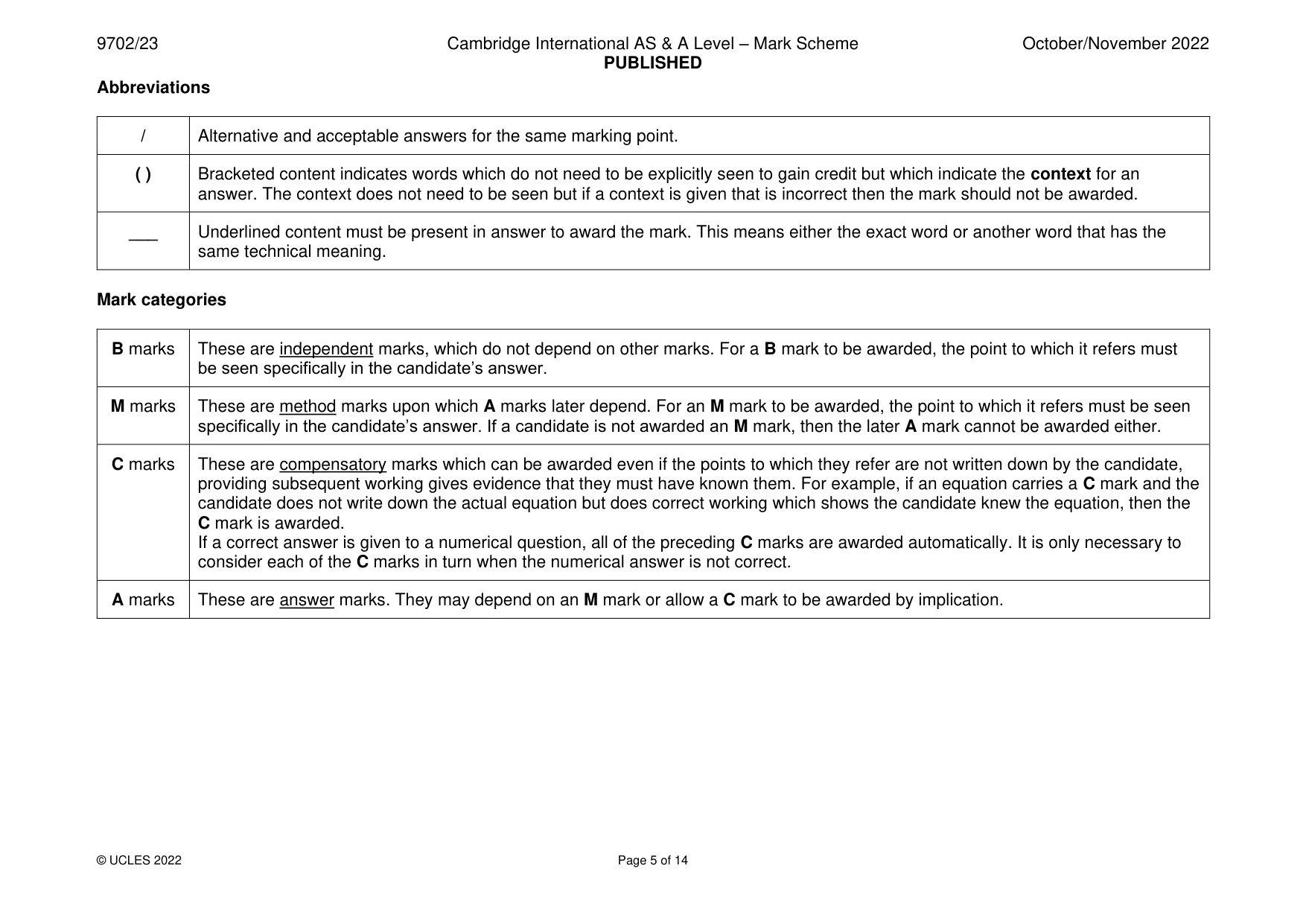
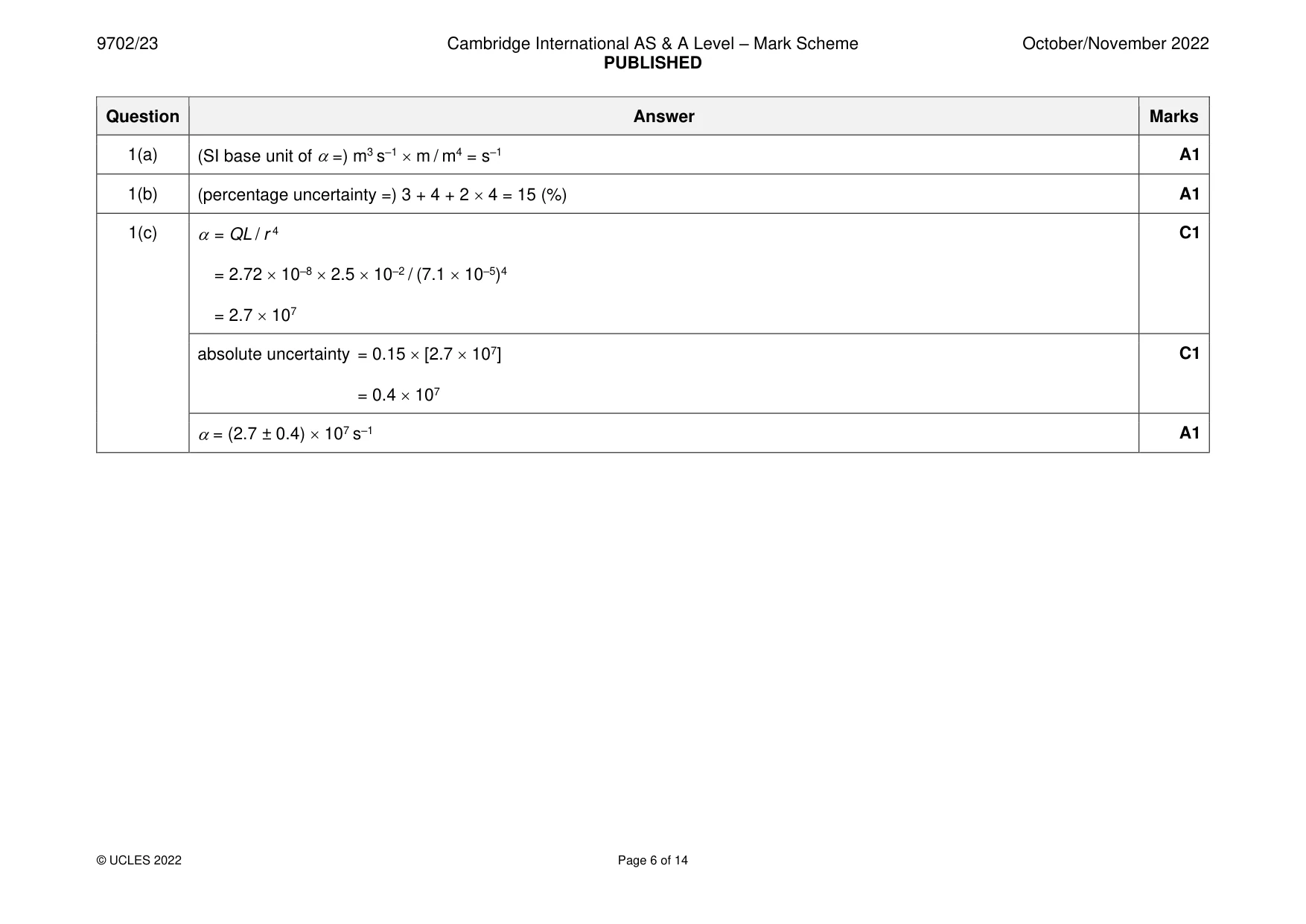
Mark scheme: Question Answer Marks 1(a) (SI base unit of =) m3 s–1 m / m4 = s–1 A1 1(b) (percentage uncertainty =) 3 + 4 + 2 4 = 15 (%) A1 1(c) = QL / r 4 C1 = 2.72 10–8 2.5 10–2 / (7.1 10–5)4 = 2.7 107 absolute uncertainty = 0.15 [2.7 107] C1 = 0.4 107 = (2.7 ± 0.4) 107 s–1 A1
Q2 · The engine of a toy rocket pushes gases vertically downwards and this results in the…
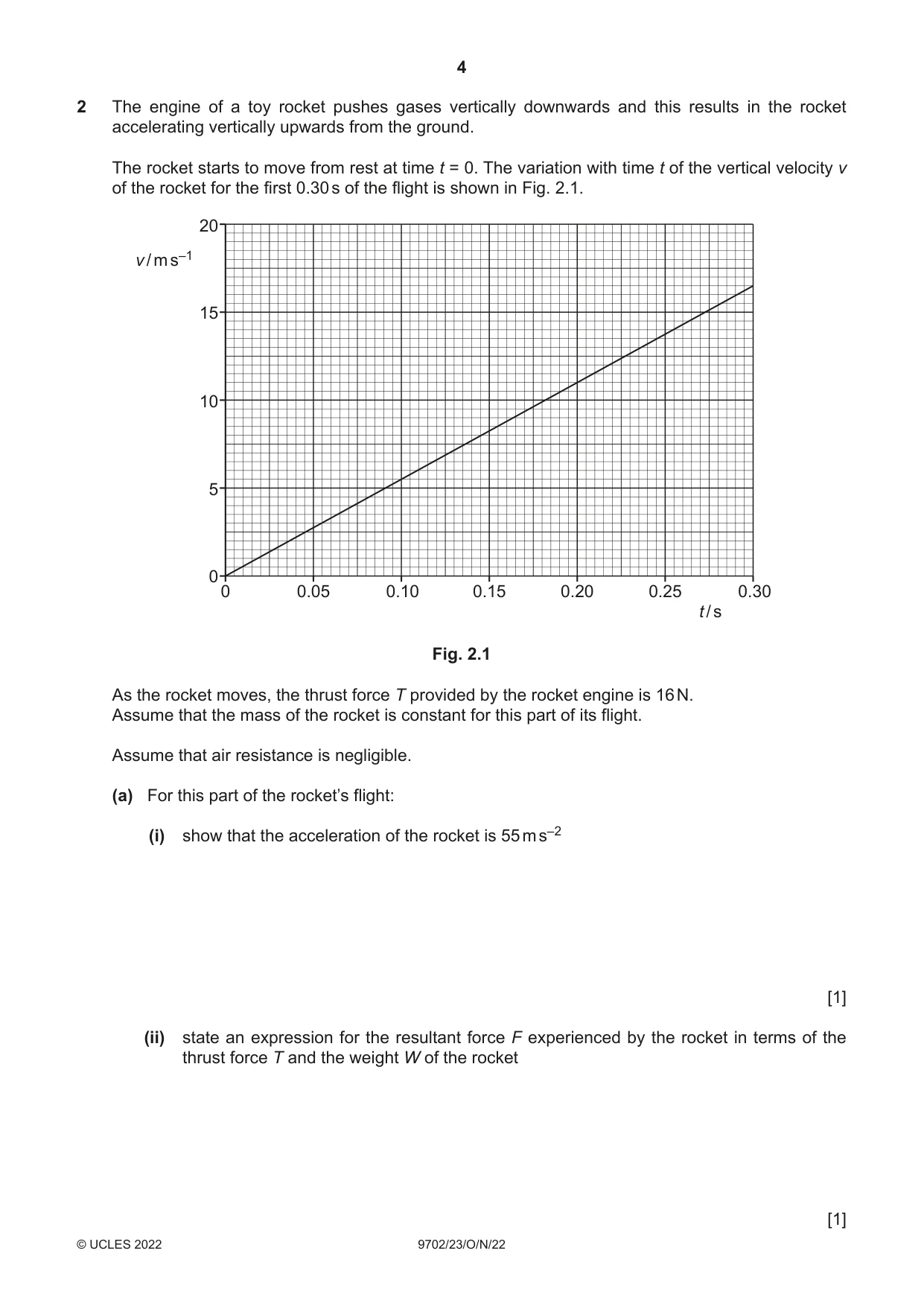
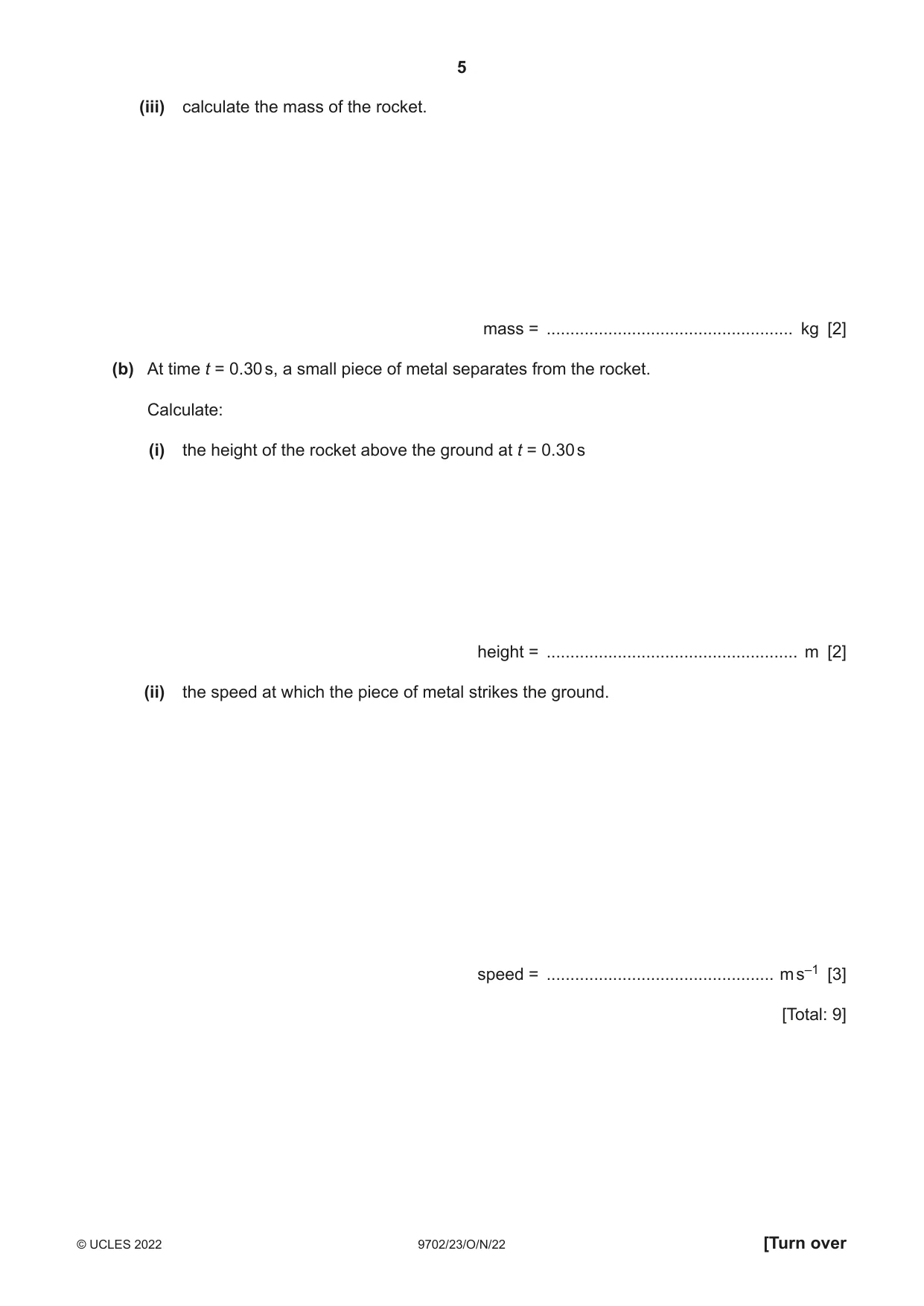
2 The engine of a toy rocket pushes gases vertically downwards and this results in the rocket accelerating vertically upwards from the ground. The rocket starts to move from rest at time t = 0. The variation with time t of the vertical velocity v of the rocket for the first 0.30 s of the flight is shown in Fig. 2.1. 20 v / m s–1 15 10 5 0 0 0.05 0.10 0.15 0.20 0.25 0.30 t / s Fig. 2.1 As the rocket moves, the thrust force T provided by the rocket engine is 16 N. Assume that the mass of the rocket is constant for this part of its flight. Assume that air resistance is negligible. (a) For this part of the rocket’s flight: (i) show that the acceleration of the rocket is 55 m s–2 [1] (ii) state an expression for the resultant force F experienced by the rocket in terms of the thrust force T and the weight W of the rocket [1] (iii) calculate the mass of the rocket. mass = .................................................... kg [2] (b) At time t = 0.30 s, a small piece of metal separates from the rocket. Calculate: (i) the height of the rocket above the ground at t = 0.30 s height = ..................................................... m [2] (ii) the speed at which the piece of metal strikes the ground. speed = ................................................ m s–1 [3] [Total: 9]
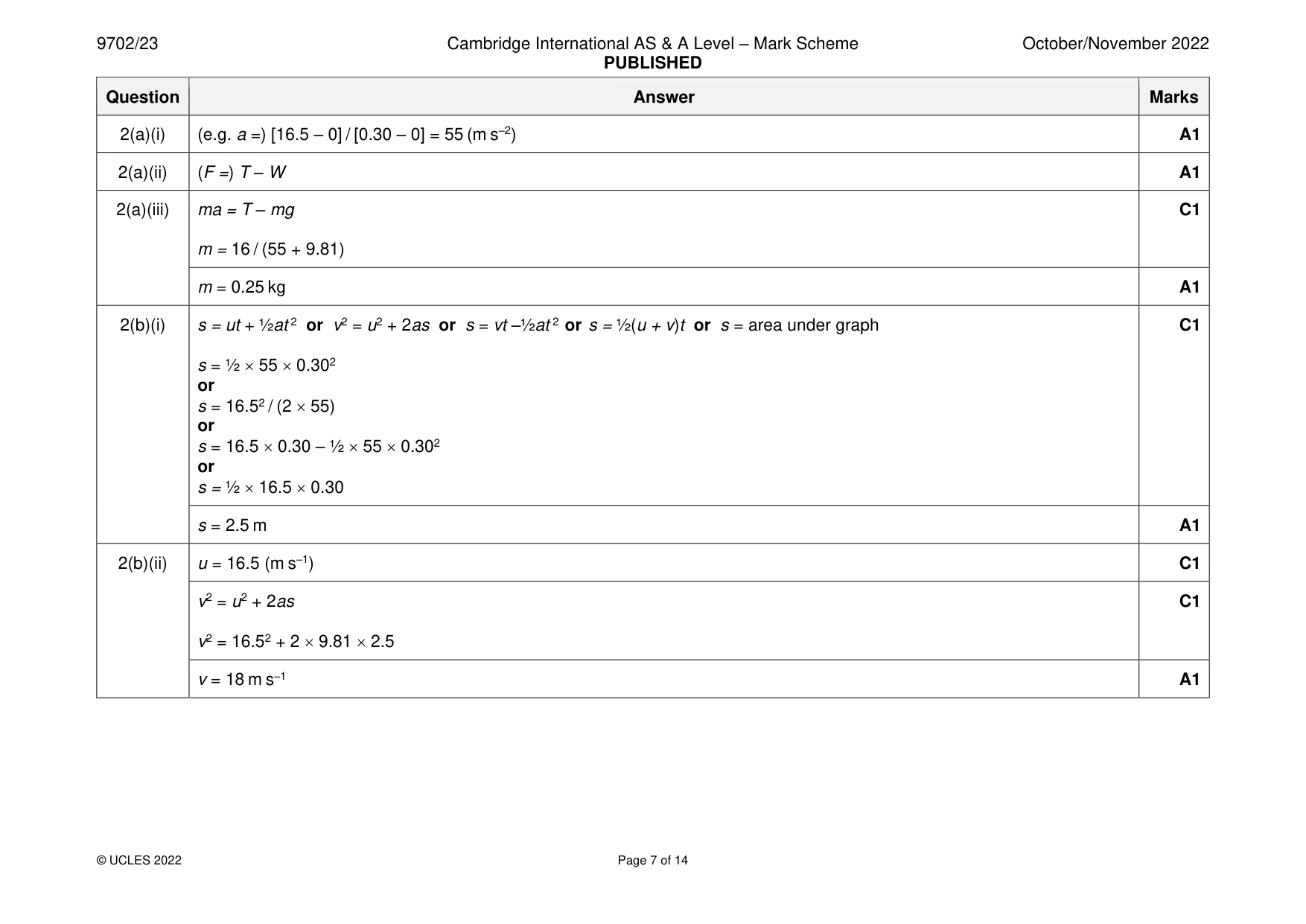
Mark scheme: 2(a)(i) (e.g. a =) [16.5 – 0] / [0.30 – 0] = 55 (m s–2) A1 2(a)(ii) (F =) T – W A1 2(a)(iii) ma = T – mg C1 m = 16 / (55 + 9.81) m = 0.25 kg A1 2(b)(i) s = ut + ½at 2 or v2 = u2 + 2as or s = vt –½at 2 or s = ½(u + v)t or s = area under graph C1 s = ½ 55 0.302 or s = 16.52 / (2 55) or s = 16.5 0.30 – ½ 55 0.302 or s = ½ 16.5 0.30 s = 2.5 m A1 2(b)(ii) u = 16.5 (m s–1) C1 v2 = u2 + 2as C1 v2 = 16.52 + 2 9.81 2.5 v = 18 m s–1 A1
Q3 · State the principle of moments
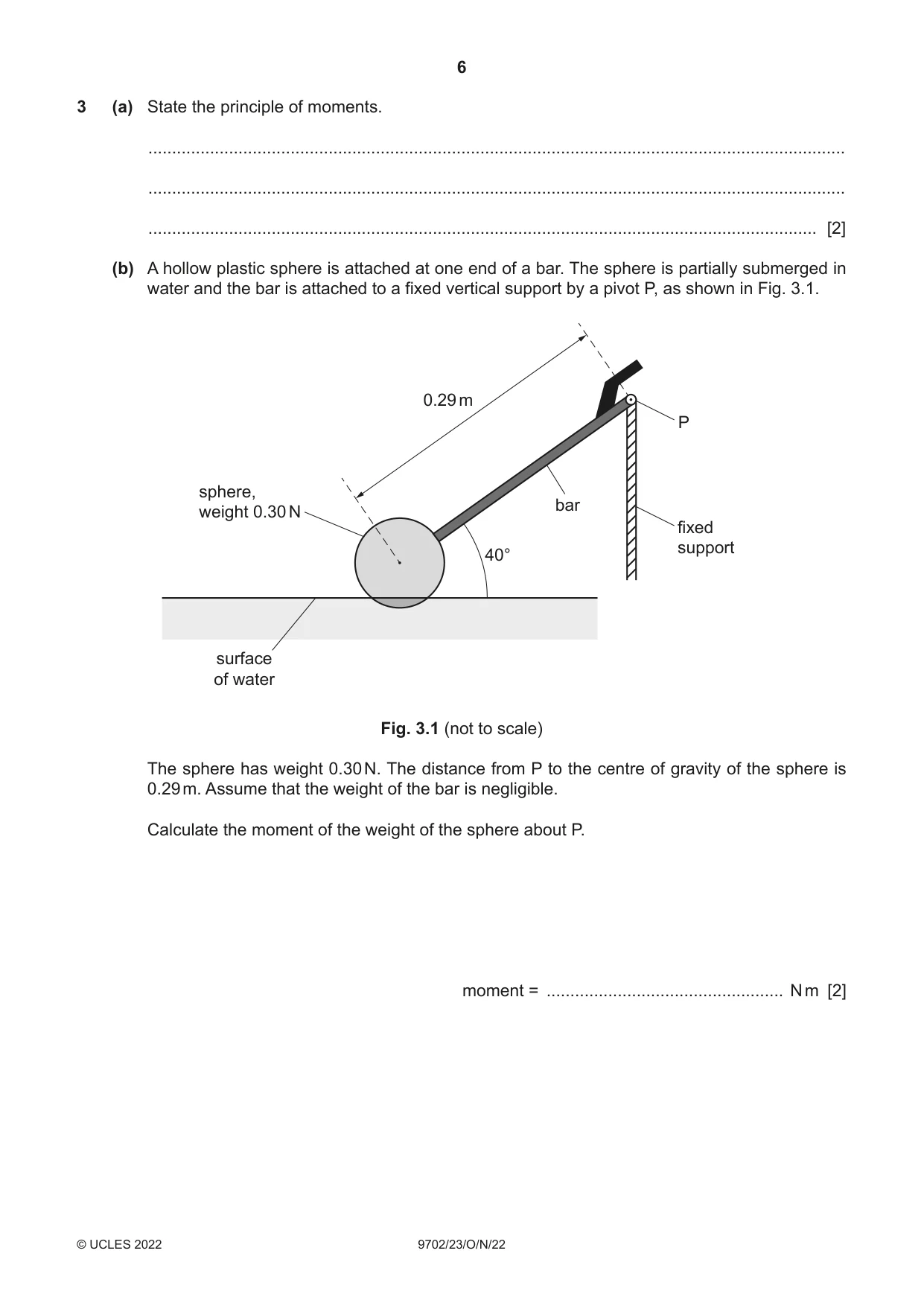
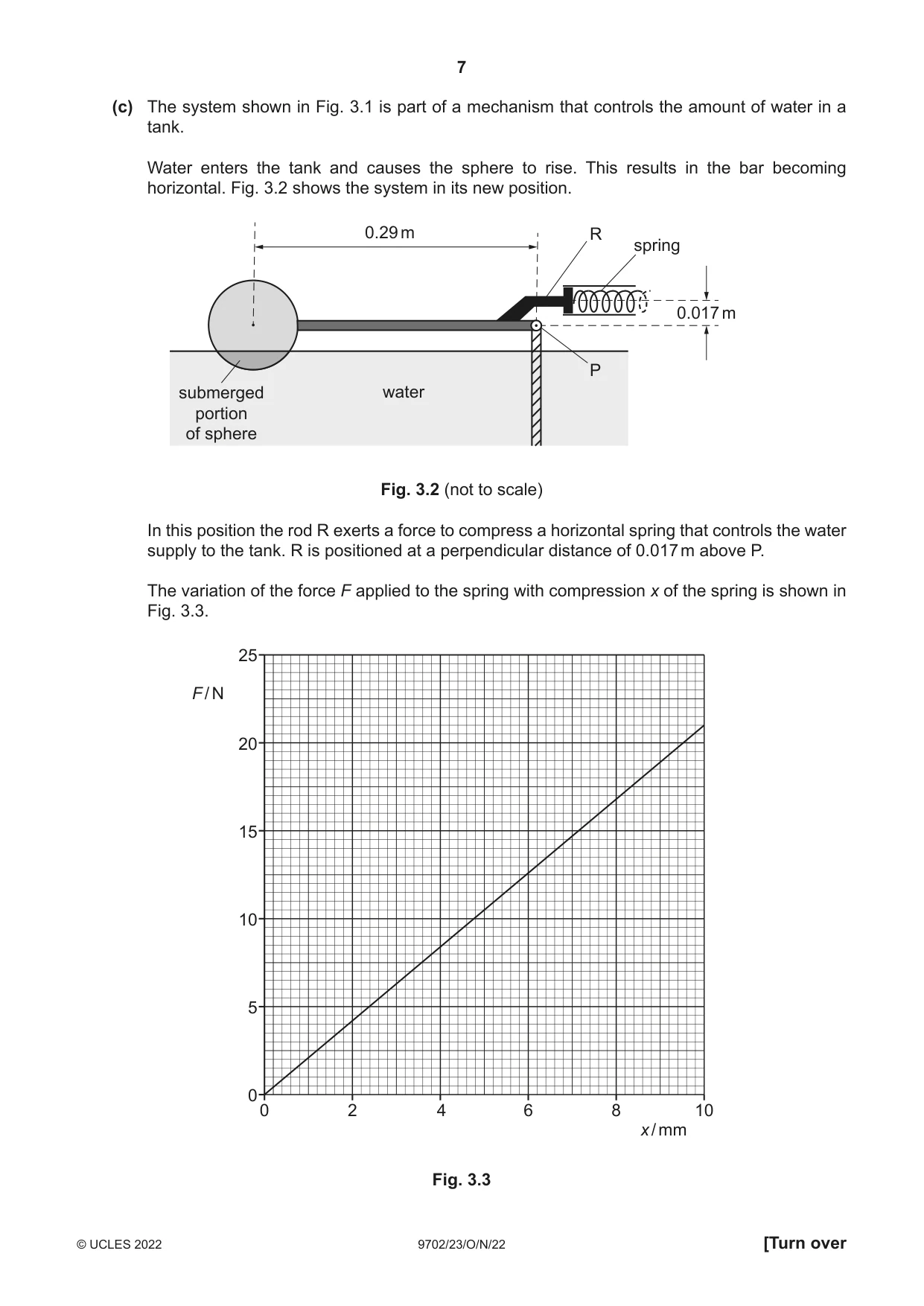
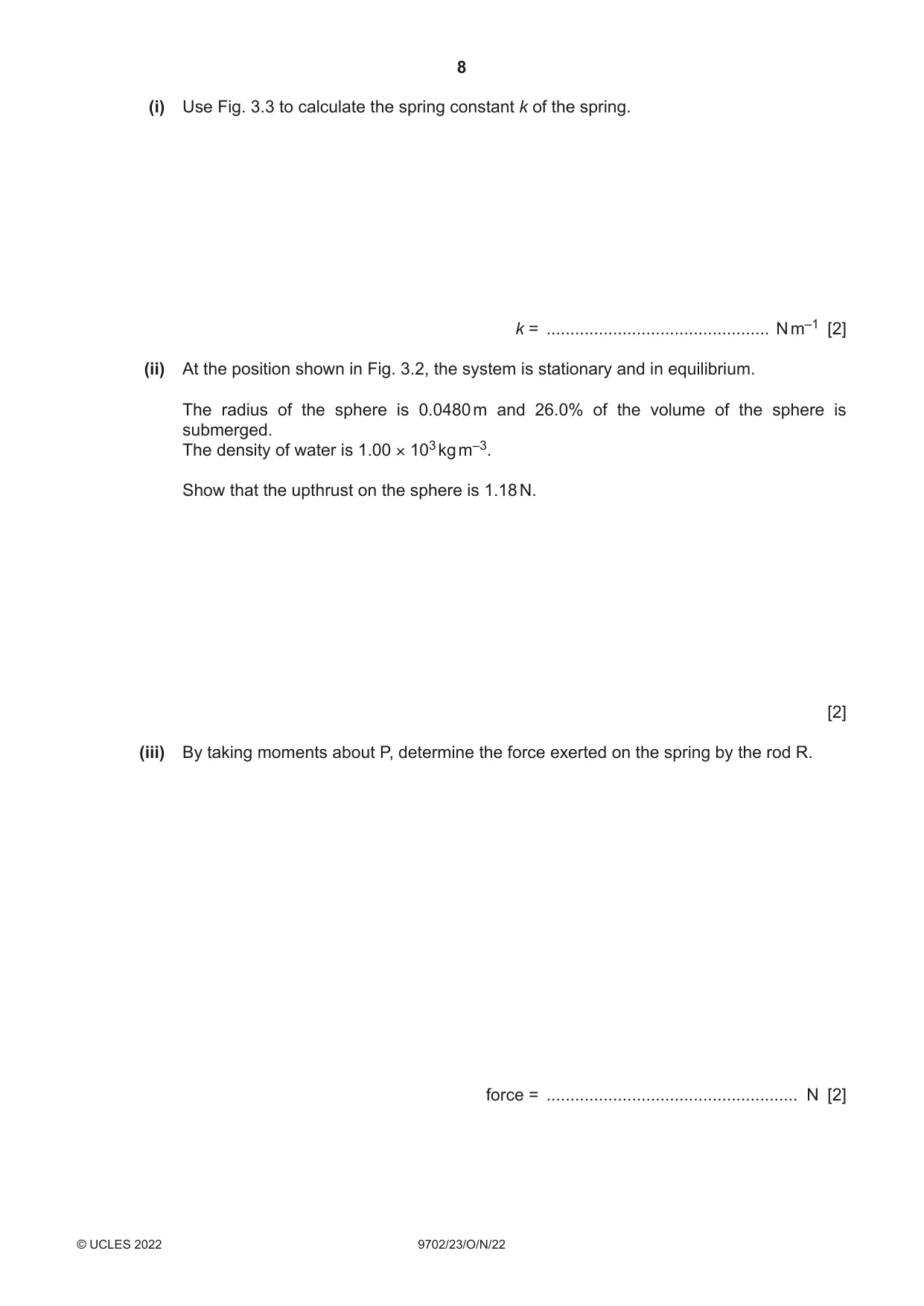
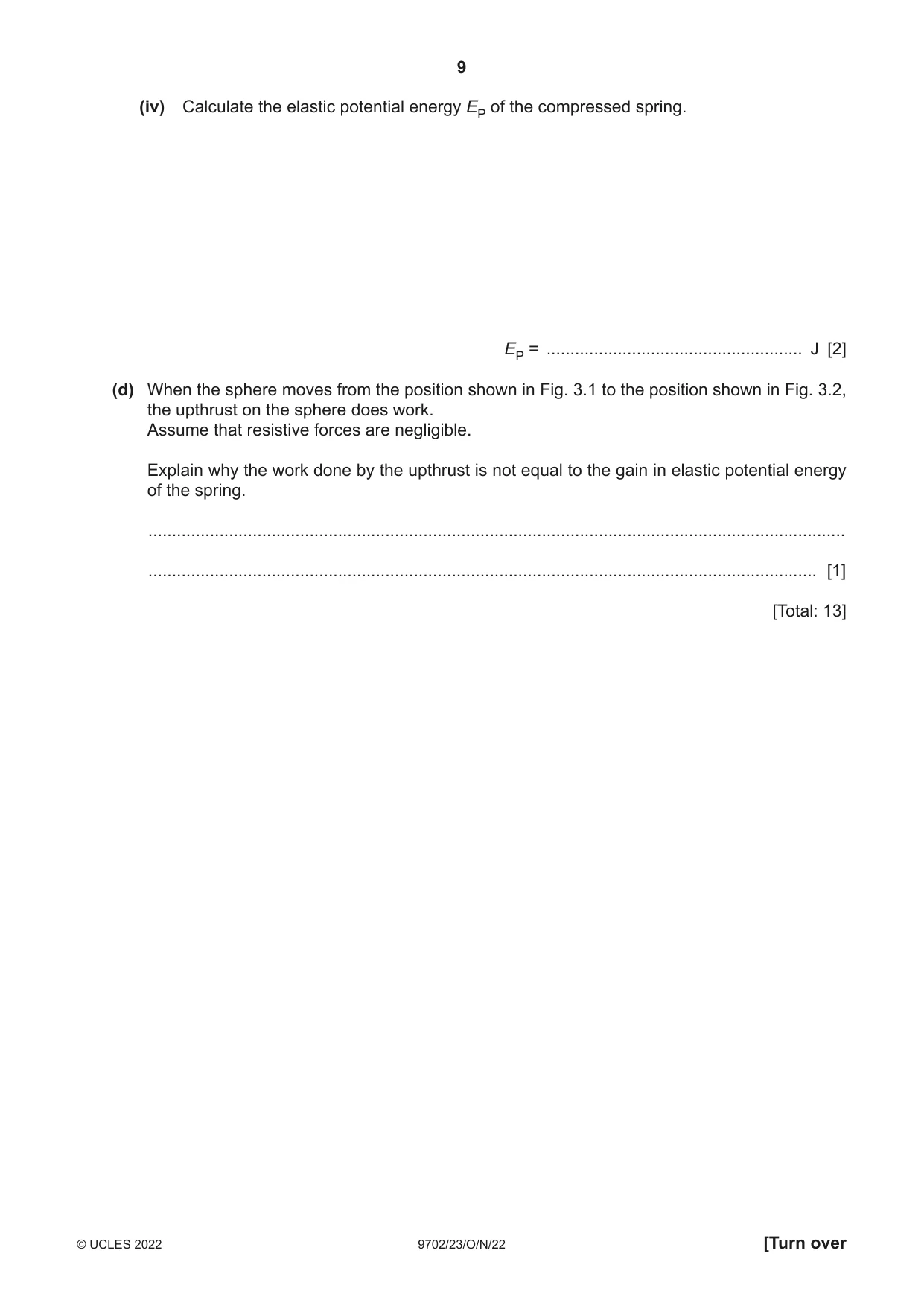
3 (a) State the principle of moments. ................................................................................................................................................... ................................................................................................................................................... ............................................................................................................................................. [2] (b) A hollow plastic sphere is attached at one end of a bar. The sphere is partially submerged in water and the bar is attached to a fixed vertical support by a pivot P, as shown in Fig. 3.1. 0.29 m P sphere, bar weight 0.30 N fixed support 40° surface of water Fig. 3.1 (not to scale) The sphere has weight 0.30 N. The distance from P to the centre of gravity of the sphere is 0.29 m. Assume that the weight of the bar is negligible. Calculate the moment of the weight of the sphere about P. moment = .................................................. N m [2] (c) The system shown in Fig. 3.1 is part of a mechanism that controls the amount of water in a tank. Water enters the tank and causes the sphere to rise. This results in the bar becoming horizontal. Fig. 3.2 shows the system in its new position. 0.29 m R spring 0.017 m P submerged water portion of sphere Fig. 3.2 (not to scale) In this position the rod R exerts a force to compress a horizontal spring that controls the water supply to the tank. R is positioned at a perpendicular distance of 0.017 m above P. The variation of the force F applied to the spring with compression x of the spring is shown in Fig. 3.3. 25 F / N 20 15 10 5 0 0 2 4 6 8 10 x / mm Fig. 3.3 (i) Use Fig. 3.3 to calculate the spring constant k of the spring. k = ............................................... N m–1 [2] (ii) At the position shown in Fig. 3.2, the system is stationary and in equilibrium. The radius of the sphere is 0.0480 m and 26.0% of the volume of the sphere is submerged. The density of water is 1.00 × 10³ kg m–3. Show that the upthrust on the sphere is 1.18 N. [2] (iii) By taking moments about P, determine the force exerted on the spring by the rod R. force = ..................................................... N [2] (iv) Calculate the elastic potential energy EP of the compressed spring. EP = ...................................................... J [2] (d) When the sphere moves from the position shown in Fig. 3.1 to the position shown in Fig. 3.2, the upthrust on the sphere does work. Assume that resistive forces are negligible. Explain why the work done by the upthrust is not equal to the gain in elastic potential energy of the spring. ................................................................................................................................................... ............................................................................................................................................. [1] [Total: 13]
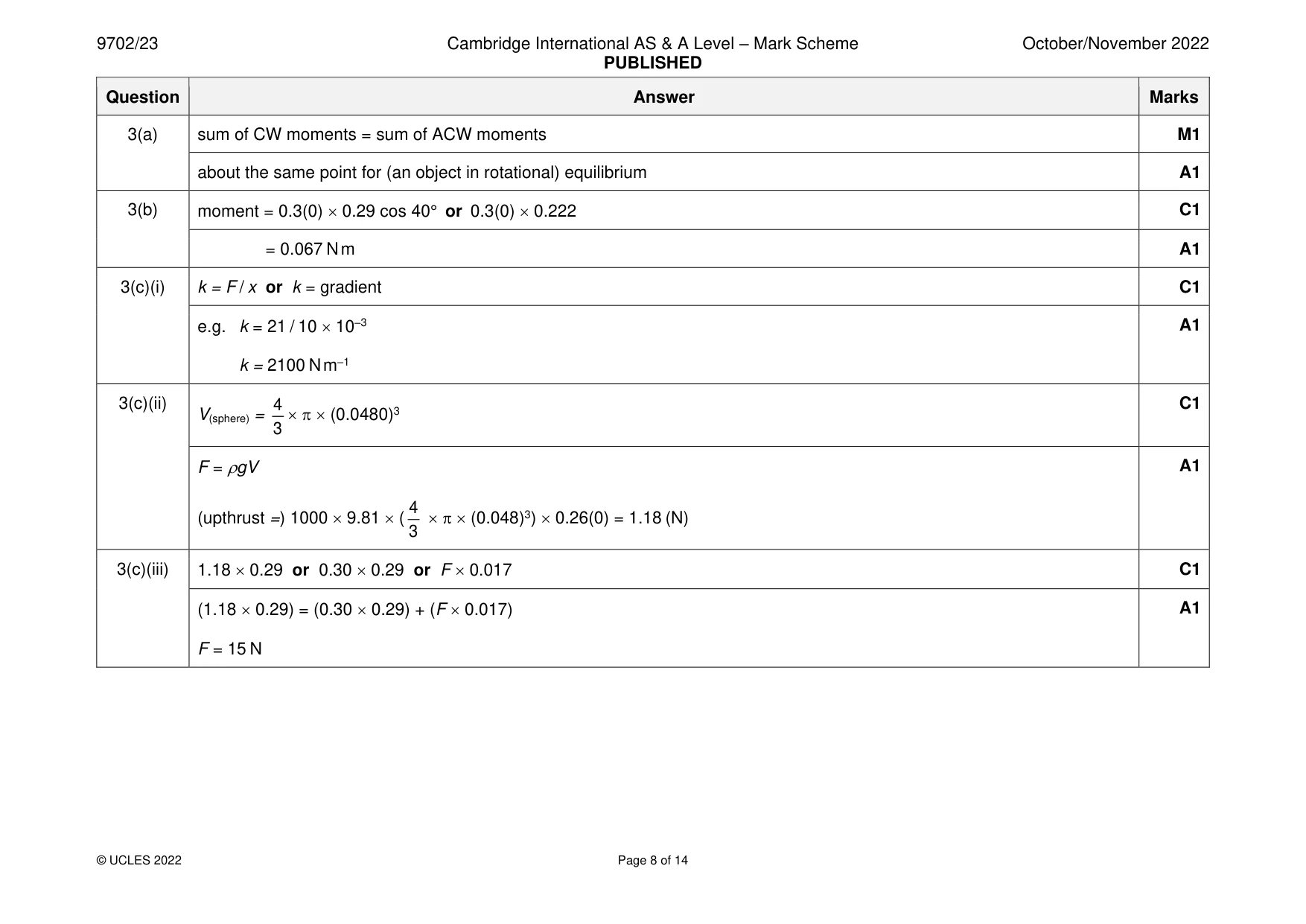
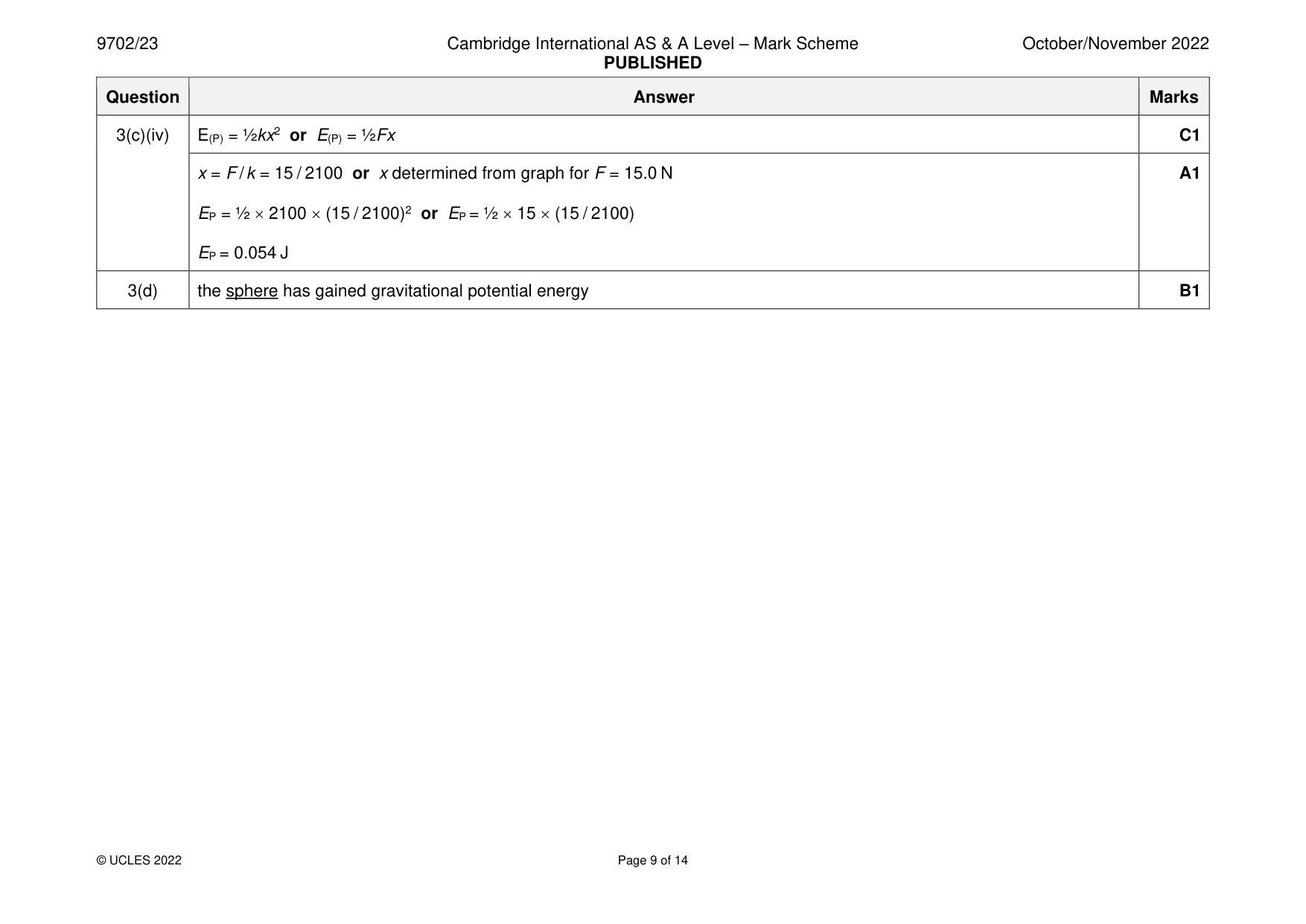
Mark scheme: 3(a) sum of CW moments = sum of ACW moments M1 about the same point for (an object in rotational) equilibrium A1 3(b) moment = 0.3(0) 0.29 cos 40° or 0.3(0) 0.222 C1 = 0.067 N m A1 3(c)(i) k = F / x or k = gradient C1 e.g. k = 21 / 10 10–3 A1 k = 2100 N m–1 3(c)(ii) 4 C1 V(sphere) = (0.0480)3 3 F = gV A1 4 (upthrust =) 1000 9.81 ( (0.048)3) 0.26(0) = 1.18 (N) 3 3(c)(iii) 1.18 0.29 or 0.30 0.29 or F 0.017 C1 (1.18 0.29) = (0.30 0.29) + (F 0.017) A1 F = 15 N 3(c)(iv) E(P) = ½kx2 or E(P) = ½Fx C1 x = F / k = 15 / 2100 or x determined from graph for F = 15.0 N A1 EP = ½ 2100 (15 / 2100)2 or EP = ½ 15 (15 / 2100) EP = 0.054 J 3(d) the sphere has gained gravitational potential energy B1
Q4 · A progressive longitudinal wave travels through a medium from left to right
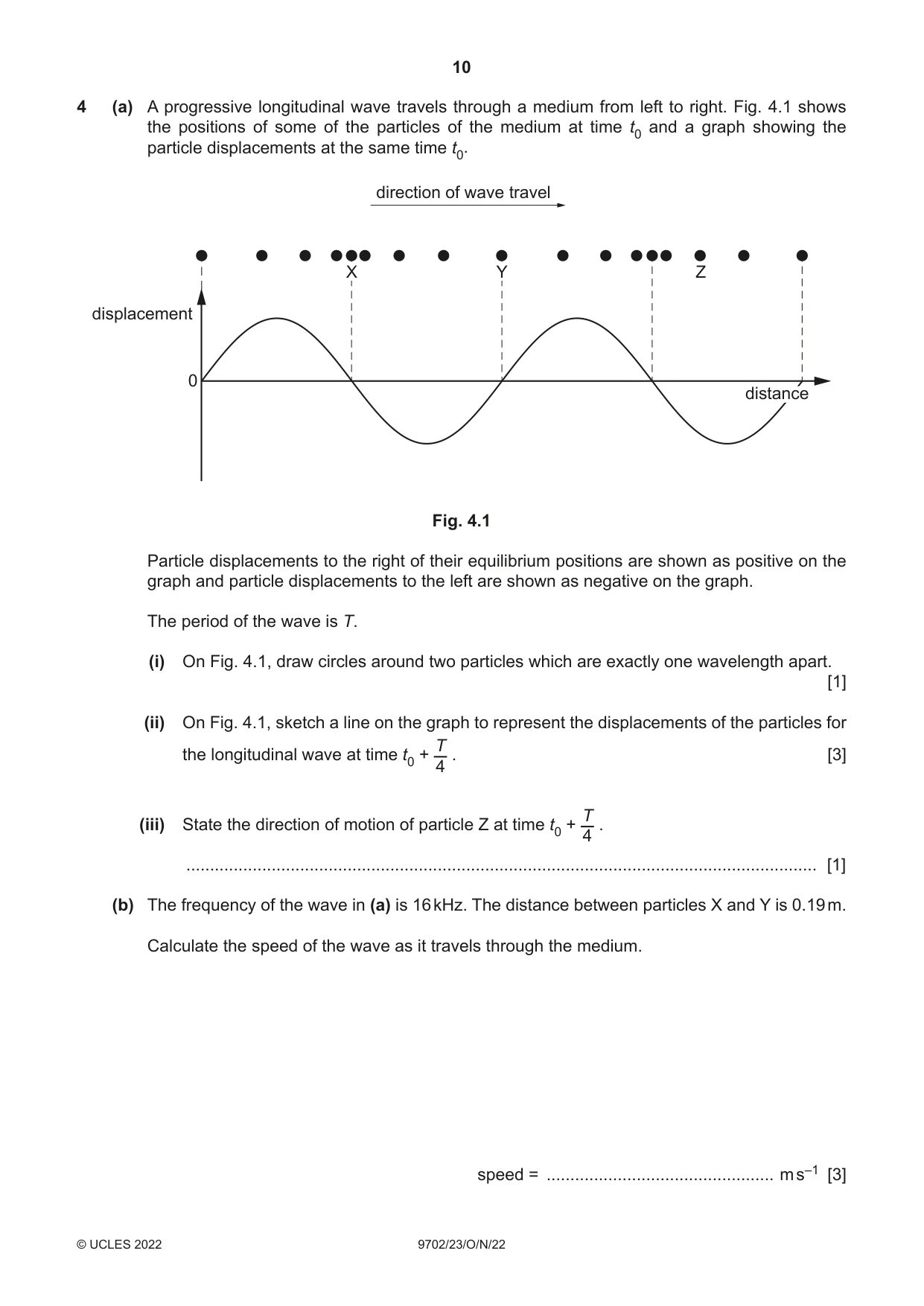
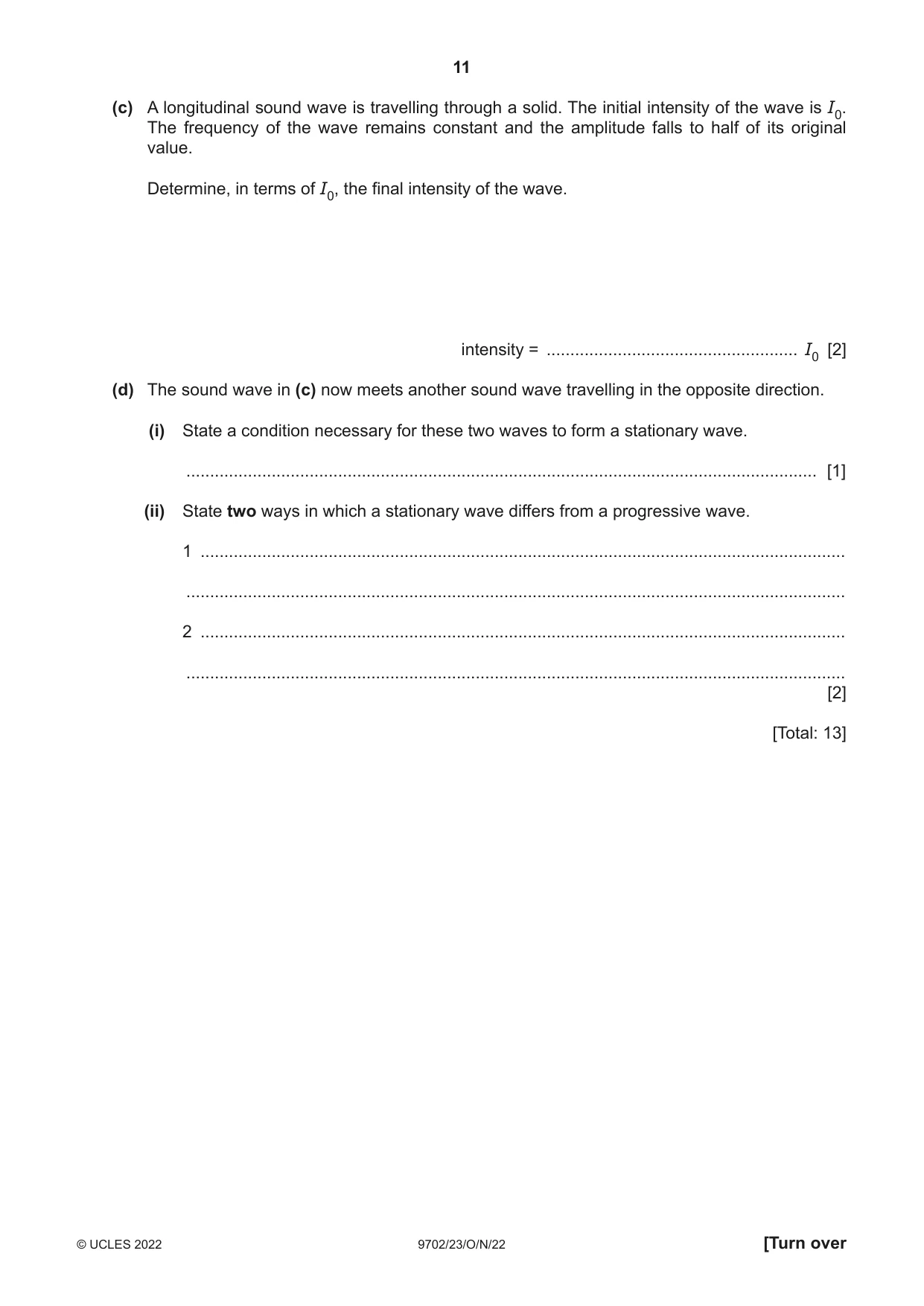
4 (a) A progressive longitudinal wave travels through a medium from left to right. Fig. 4.1 shows the positions of some of the particles of the medium at time t0 and a graph showing the particle displacements at the same time t0. direction of wave travel X Y Z displacement 0 distance Fig. 4.1 Particle displacements to the right of their equilibrium positions are shown as positive on the graph and particle displacements to the left are shown as negative on the graph. The period of the wave is T. (i) On Fig. 4.1, draw circles around two particles which are exactly one wavelength apart. [1] (ii) On Fig. 4.1, sketch a line on the graph to represent the displacements of the particles for T the longitudinal wave at time t0 + . [3] 4 T (iii) State the direction of motion of particle Z at time t0 + . 4 ..................................................................................................................................... [1] (b) The frequency of the wave in (a) is 16 kHz. The distance between particles X and Y is 0.19 m. Calculate the speed of the wave as it travels through the medium. speed = ................................................ m s–1 [3] (c) A longitudinal sound wave is travelling through a solid. The initial intensity of the wave is I0. The frequency of the wave remains constant and the amplitude falls to half of its original value. Determine, in terms of I0, the final intensity of the wave. intensity = ..................................................... I0 [2] (d) The sound wave in (c) now meets another sound wave travelling in the opposite direction. (i) State a condition necessary for these two waves to form a stationary wave. ..................................................................................................................................... [1] (ii) State two ways in which a stationary wave differs from a progressive wave. 1 ........................................................................................................................................ ........................................................................................................................................... 2 ........................................................................................................................................ ........................................................................................................................................... [2] [Total: 13]
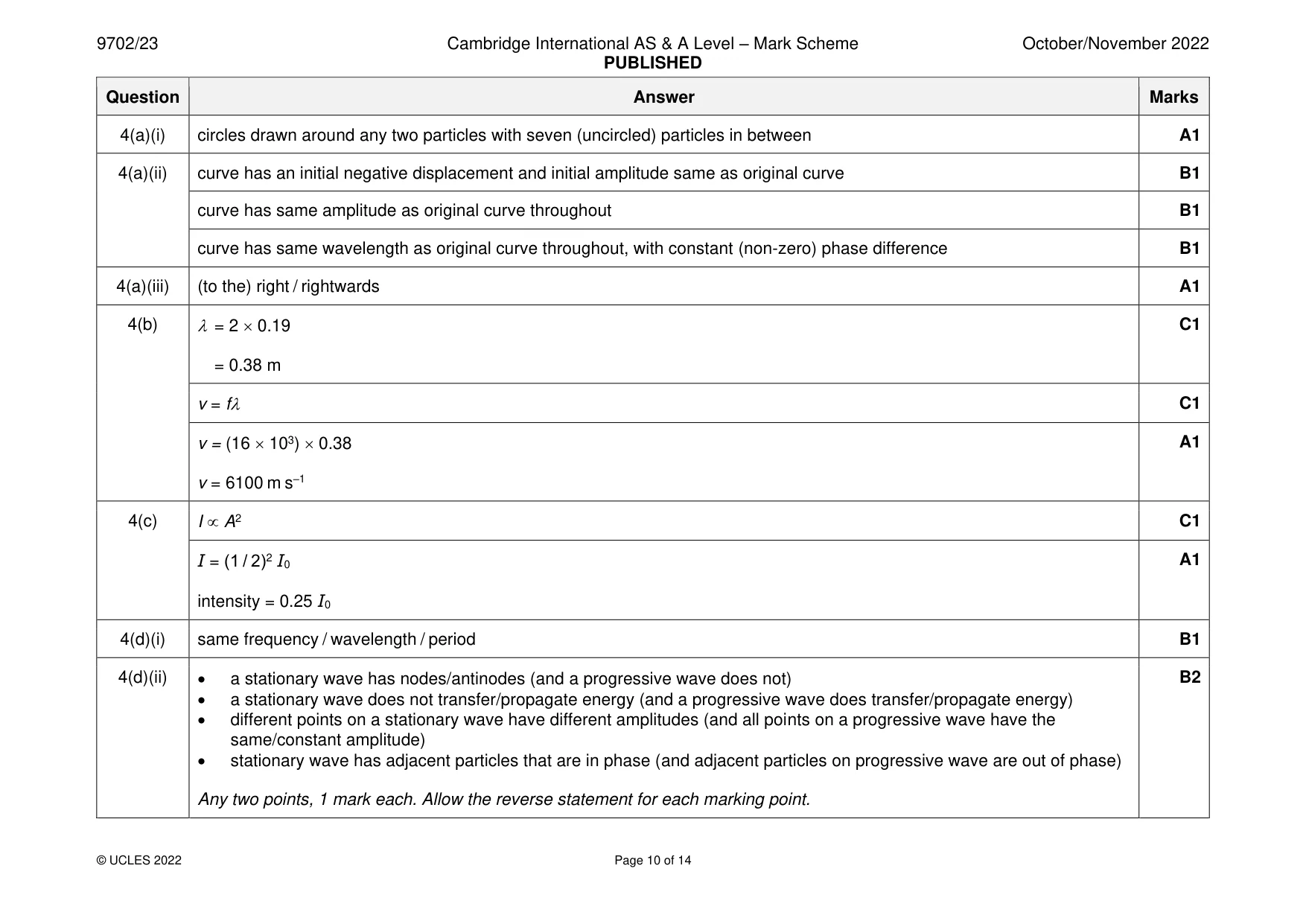
Mark scheme: 4(a)(i) circles drawn around any two particles with seven (uncircled) particles in between A1 4(a)(ii) curve has an initial negative displacement and initial amplitude same as original curve B1 curve has same amplitude as original curve throughout B1 curve has same wavelength as original curve throughout, with constant (non-zero) phase difference B1 4(a)(iii) (to the) right / rightwards A1 4(b) = 2 0.19 C1 = 0.38 m v = f C1 v = (16 103) 0.38 A1 v = 6100 m s–1 4(c) I A2 C1 I = (1 / 2)2 I0 A1 intensity = 0.25 I0 4(d)(i) same frequency / wavelength / period B1 4(d)(ii) • a stationary wave has nodes/antinodes (and a progressive wave does not) B2 • a stationary wave does not transfer/propagate energy (and a progressive wave does transfer/propagate energy) • different points on a stationary wave have different amplitudes (and all points on a progressive wave have the same/constant amplitude) • stationary wave has adjacent particles that are in phase (and adjacent particles on progressive wave are out of phase) Any two points, 1 mark each. Allow the reverse statement for each marking point.
Q5 · State Kirchhoff’s second law
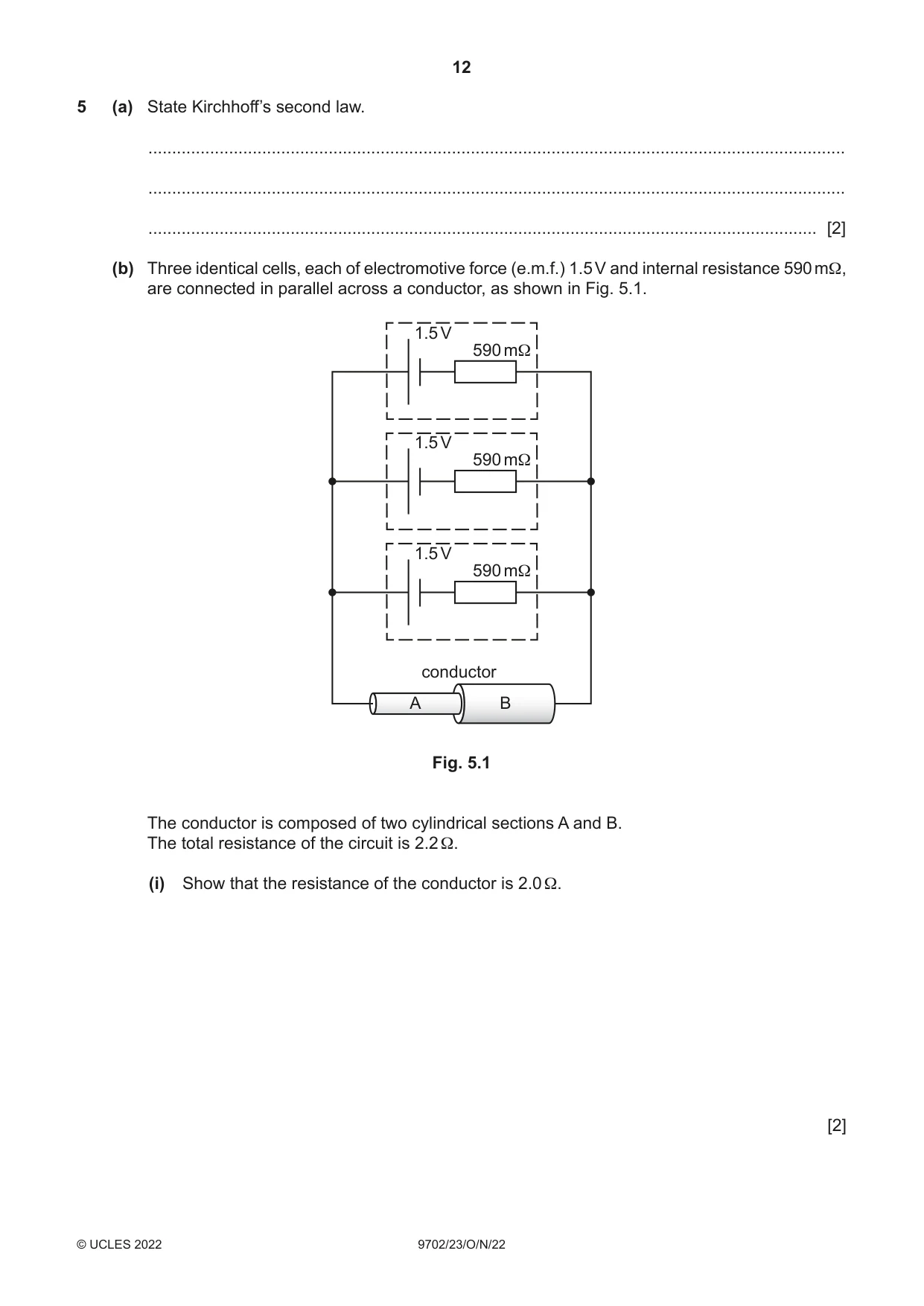
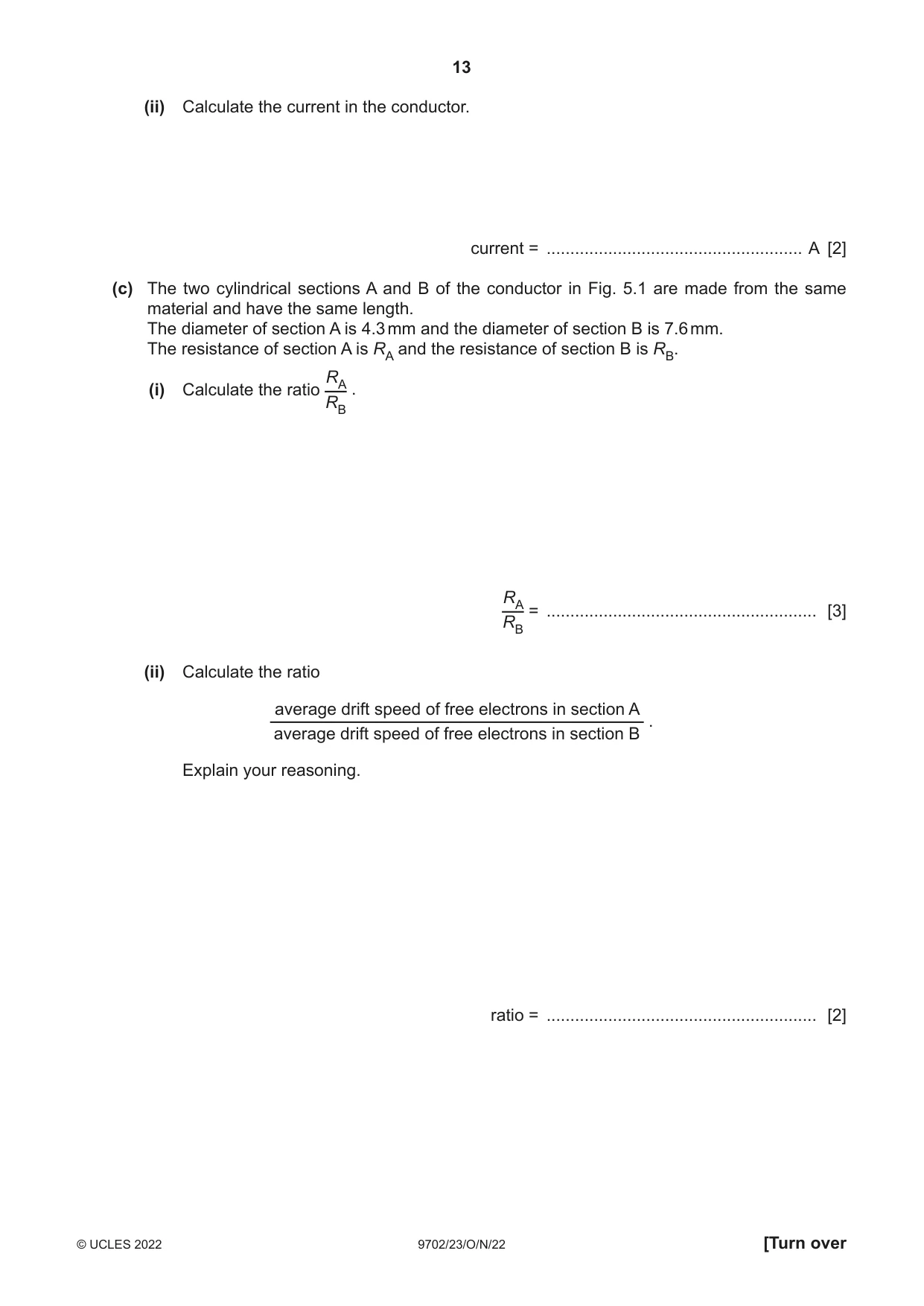
5 (a) State Kirchhoff’s second law. ................................................................................................................................................... ................................................................................................................................................... ............................................................................................................................................. [2] (b) Three identical cells, each of electromotive force (e.m.f.) 1.5 V and internal resistance 590 mΩ, are connected in parallel across a conductor, as shown in Fig. 5.1. 1.5 V 590 mΩ 1.5 V 590 mΩ 1.5 V 590 mΩ conductor A B Fig. 5.1 The conductor is composed of two cylindrical sections A and B. The total resistance of the circuit is 2.2 Ω. (i) Show that the resistance of the conductor is 2.0 Ω. [2] (ii) Calculate the current in the conductor. current = ...................................................... A [2] (c) The two cylindrical sections A and B of the conductor in Fig. 5.1 are made from the same material and have the same length.
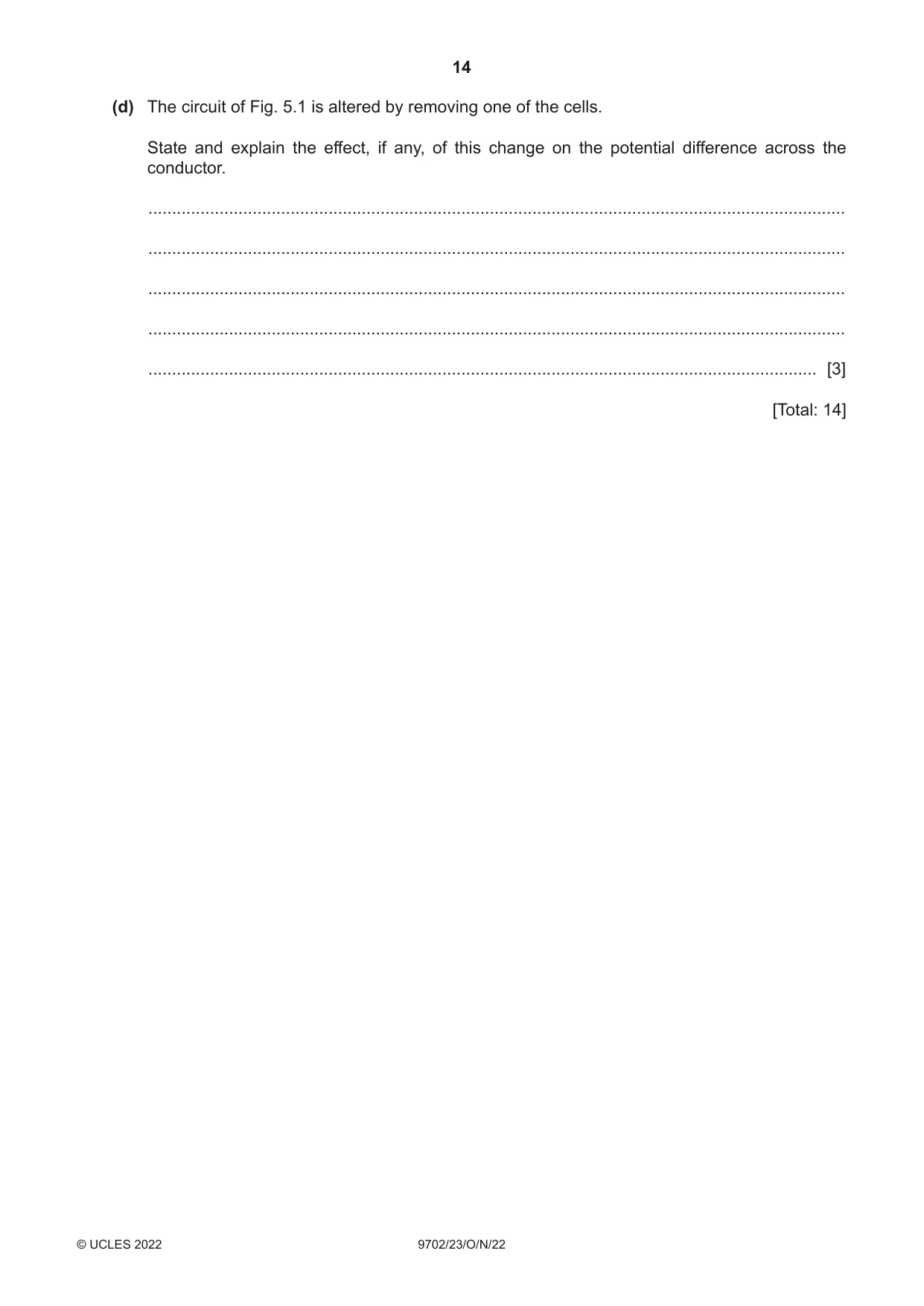
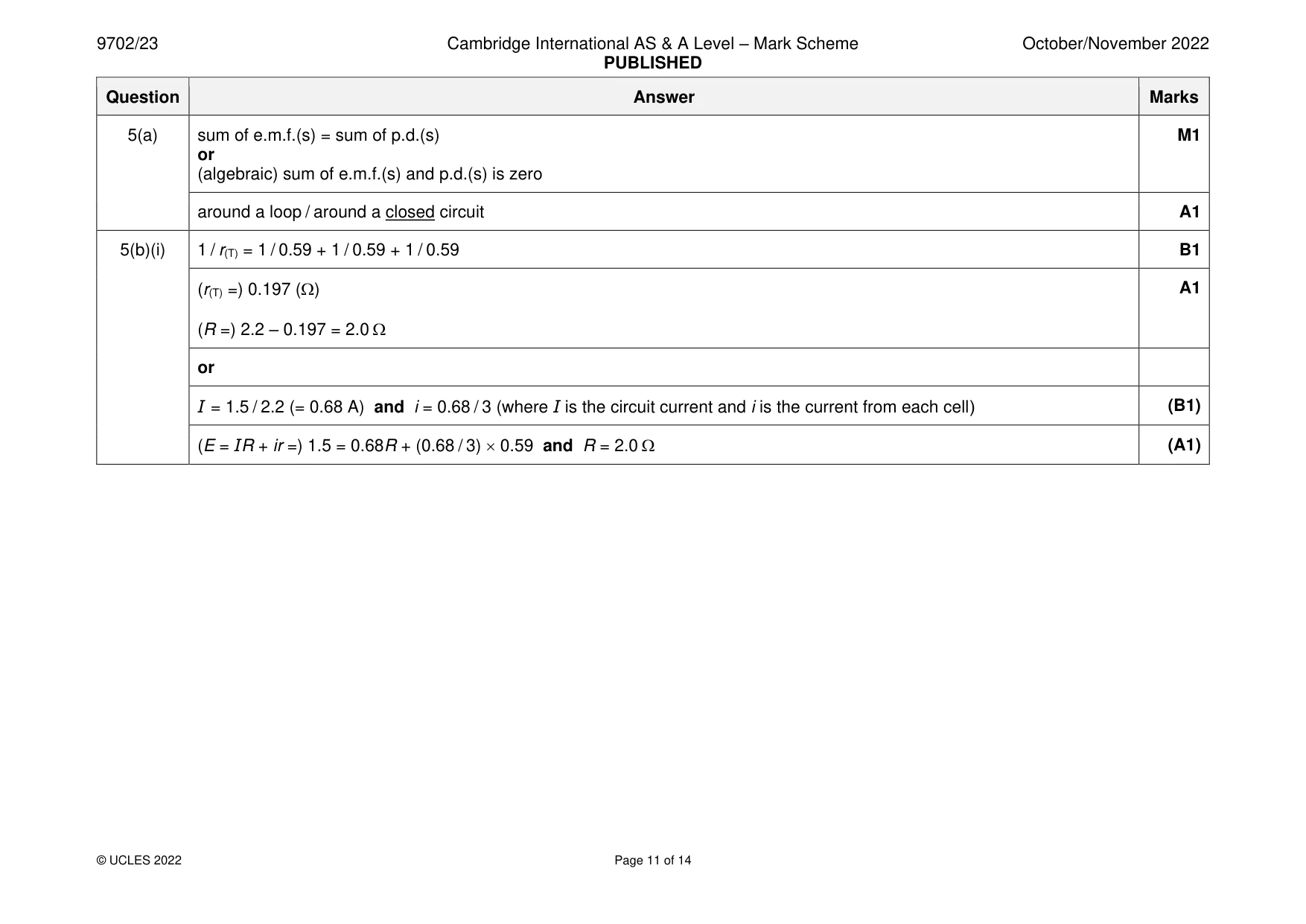
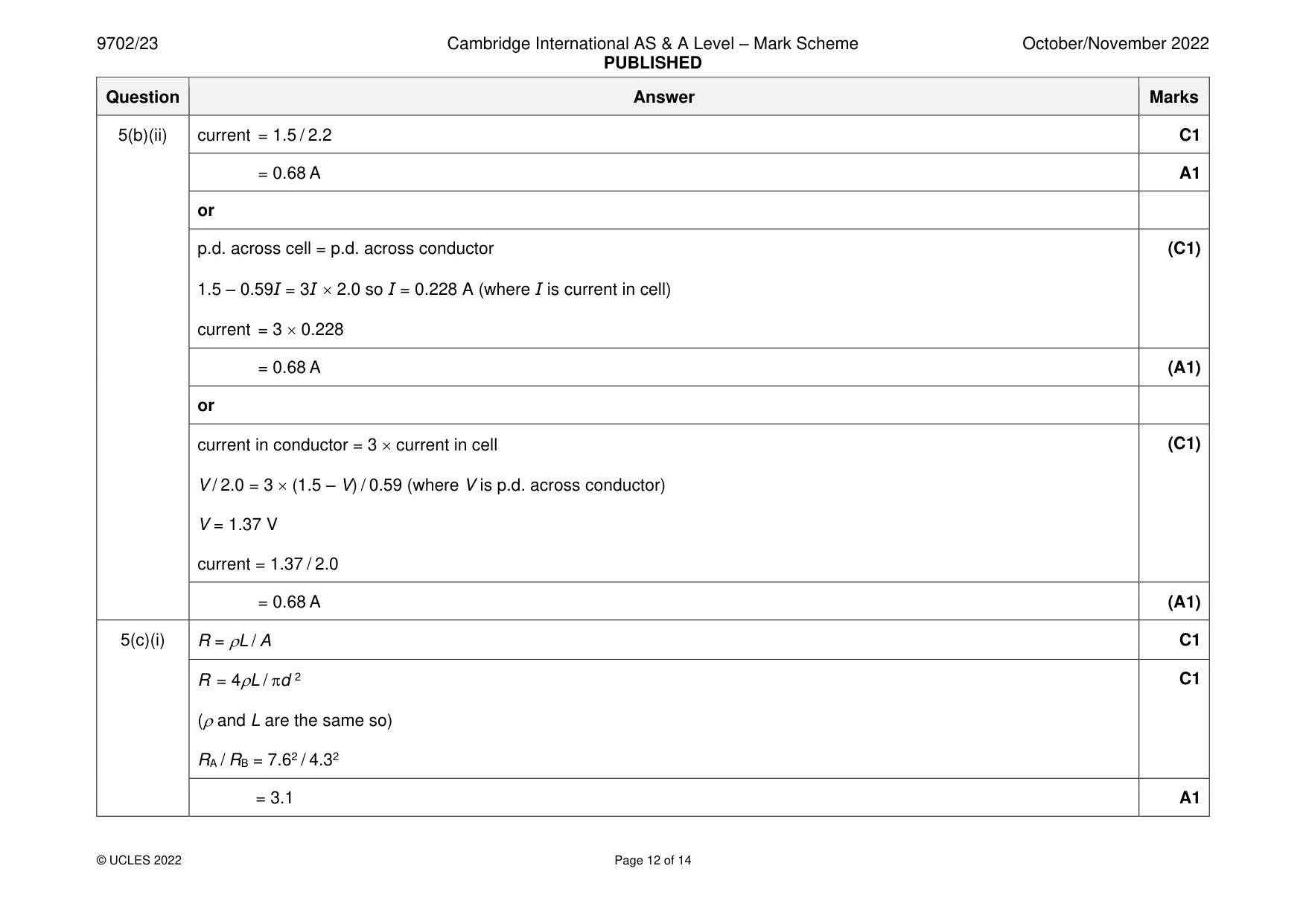
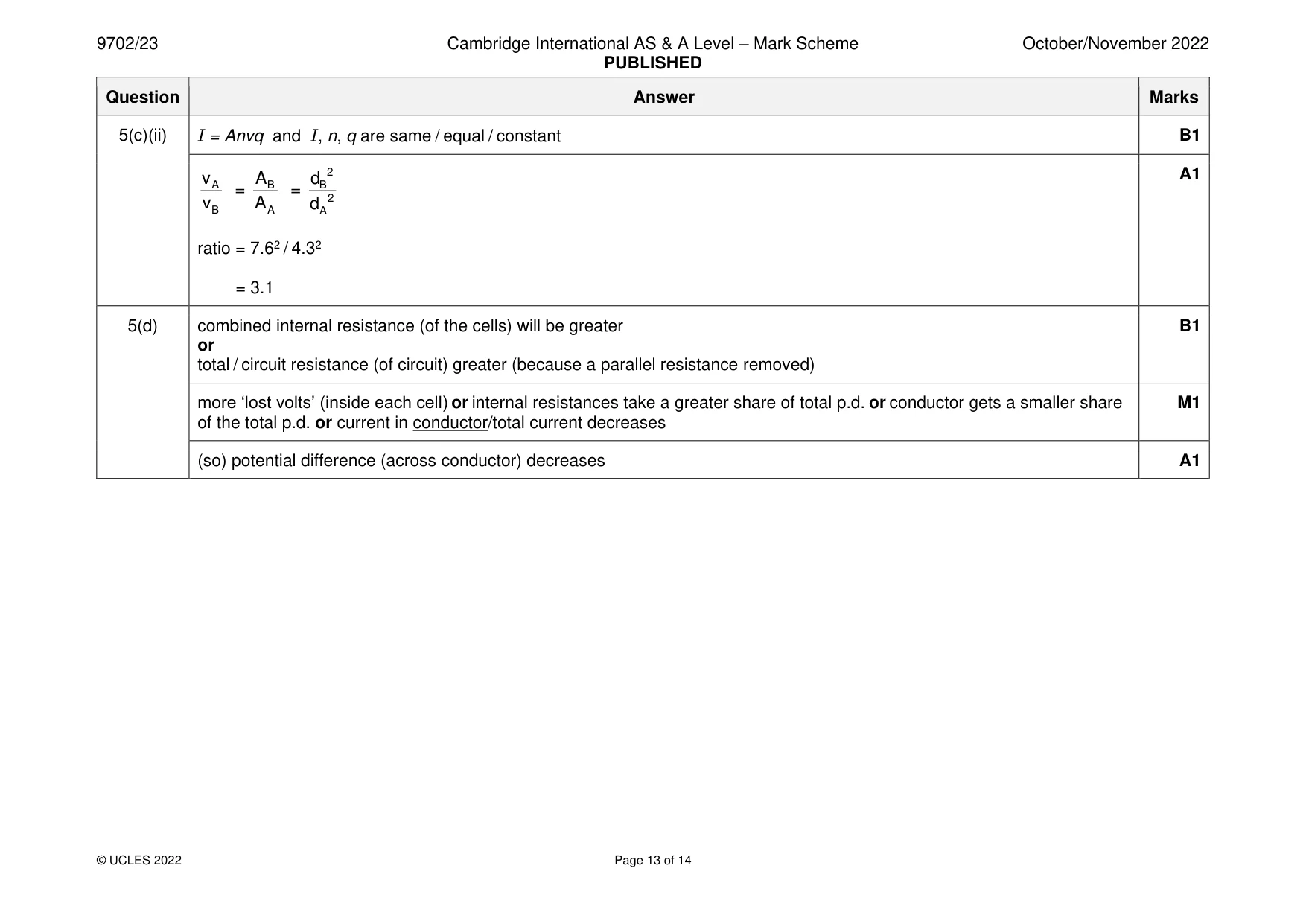
Mark scheme: 5(a) sum of e.m.f.(s) = sum of p.d.(s) M1 or (algebraic) sum of e.m.f.(s) and p.d.(s) is zero around a loop / around a closed circuit A1 5(b)(i) 1 / r(T) = 1 / 0.59 + 1 / 0.59 + 1 / 0.59 B1 (r(T) =) 0.197 () A1 (R =) 2.2 – 0.197 = 2.0 or I = 1.5 / 2.2 (= 0.68 A) and i = 0.68 / 3 (where I is the circuit current and i is the current from each cell) (B1) (E = IR + ir =) 1.5 = 0.68R + (0.68 / 3) 0.59 and R = 2.0 (A1) 5(b)(ii) current = 1.5 / 2.2 C1 = 0.68 A A1 or p.d. across cell = p.d. across conductor (C1) 1.5 – 0.59I = 3I 2.0 so I = 0.228 A (where I is current in cell) current = 3 0.228 = 0.68 A (A1) or current in conductor = 3 current in cell (C1) V / 2.0 = 3 (1.5 – V) / 0.59 (where V is p.d. across conductor) V = 1.37 V current = 1.37 / 2.0 = 0.68 A (A1) 5(c)(i) R = L / A C1 R = 4L / d 2 C1 (and L are the same so) RA / RB = 7.62 / 4.32 = 3.1 A1 5(c)(ii) I = Anvq and I, n, q are same / equal / constant B1 v A A B dB 2 A1 = = v B A A dA 2 ratio = 7.62 / 4.32 = 3.1 5(d) combined internal resistance (of the cells) will be greater B1 or total / circuit resistance (of circuit) greater (because a parallel resistance removed) more ‘lost volts’ (inside each cell) or internal resistances take a greater share of total p.d. or conductor gets a smaller share M1 of the total p.d. or current in conductor/total current decreases (so) potential difference (across conductor) decreases A1
Q6 · The nuclide 146C (carbon-14) is unstable and undergoes β– decay, emitting a high-energy…
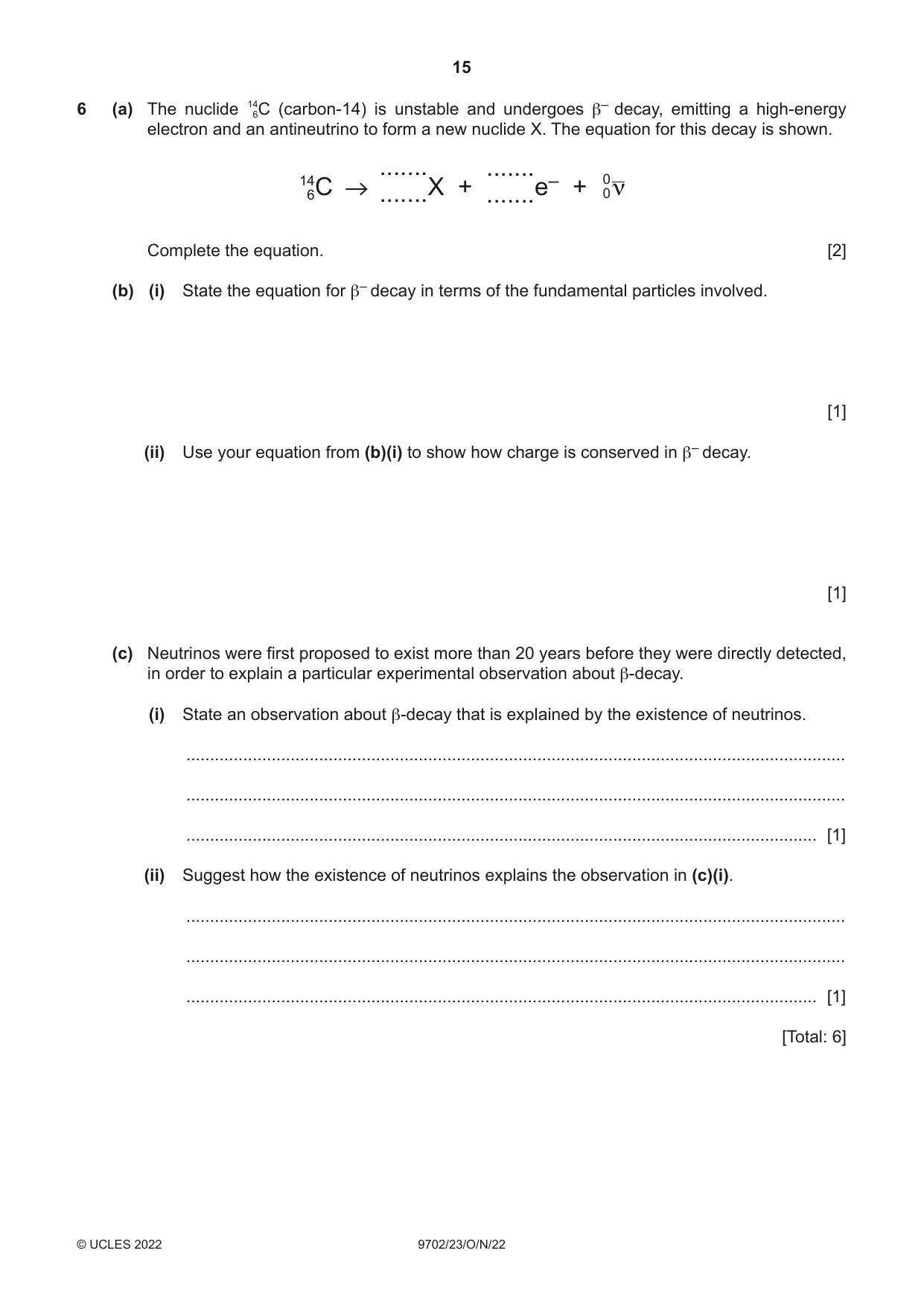
6 (a) The nuclide 146C (carbon-14) is unstable and undergoes β– decay, emitting a high-energy electron and an antineutrino to form a new nuclide X. The equation for this decay is shown. ....... ....... 0 14 0ν 6C .......X + .......e– + Complete the equation. [2] (b) (i) State the equation for β– decay in terms of the fundamental particles involved. [1] (ii) Use your equation from (b)(i) to show how charge is conserved in β– decay. [1] (c) Neutrinos were first proposed to exist more than 20 years before they were directly detected, in order to explain a particular experimental observation about β-decay. (i) State an observation about β-decay that is explained by the existence of neutrinos. ........................................................................................................................................... ........................................................................................................................................... ..................................................................................................................................... [1] (ii) Suggest how the existence of neutrinos explains the observation in (c)(i). ........................................................................................................................................... ........................................................................................................................................... ..................................................................................................................................... [1] [Total: 6]
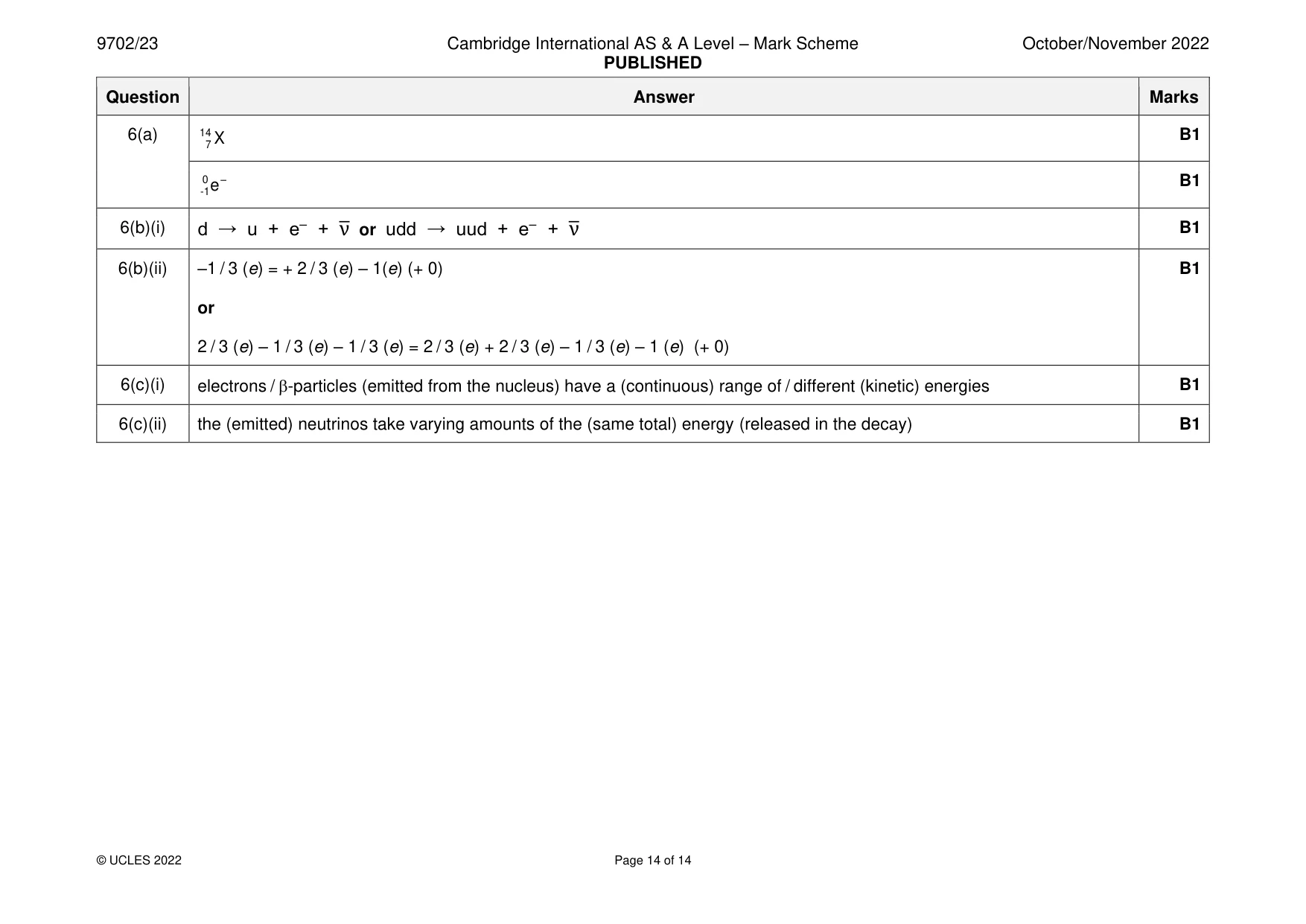
Mark scheme: 6(a) 14 7 X B1 -1e0 – B1 6(b)(i) d → u + e– + ν or udd → uud + e– + ν B1 6(b)(ii) –1 / 3 (e) = + 2 / 3 (e) – 1(e) (+ 0) B1 or 2 / 3 (e) – 1 / 3 (e) – 1 / 3 (e) = 2 / 3 (e) + 2 / 3 (e) – 1 / 3 (e) – 1 (e) (+ 0) 6(c)(i) electrons / -particles (emitted from the nucleus) have a (continuous) range of / different (kinetic) energies B1 6(c)(ii) the (emitted) neutrinos take varying amounts of the (same total) energy (released in the decay) B1
What was in this paper
The subtopics covered by these 6 questions, and how many questions each got. Open one in a new tab to see every Cambridge question on it.
What you needed in this session
Cambridge’s own grade thresholds for 2022 Oct/Nov, Paper 2 · Variant 3. A higher threshold means an easier paper — the bar moves with how the cohort did.