Questions as text
Q1 · A government proposes to introduce a road congestion charge which would require private… 9708/11 May/June 2006
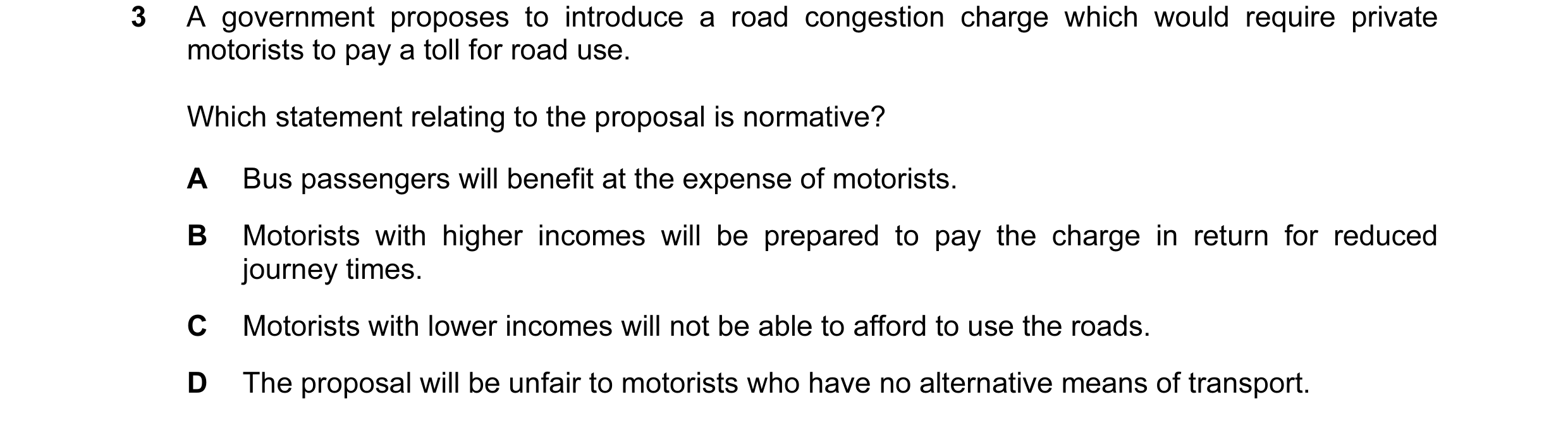
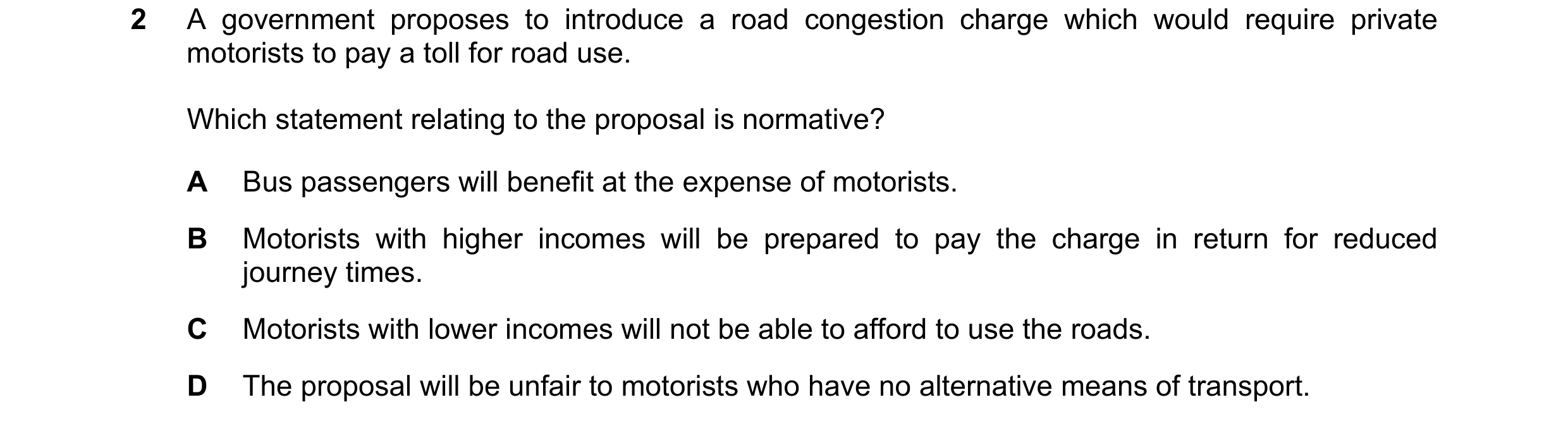
3 A government proposes to introduce a road congestion charge which would require private motorists to pay a toll for road use. Which statement relating to the proposal is normative? A Bus passengers will benefit at the expense of motorists. B Motorists with higher incomes will be prepared to pay the charge in return for reduced journey times. C Motorists with lower incomes will not be able to afford to use the roads. D The proposal will be unfair to motorists who have no alternative means of transport.
1 marks
Answer: D
This question in 9708/11 May/June 2006
Q2 · In economics a statement is positive if A it assumes current economic conditions remain… 9708/11 Oct/Nov 2006
3 In economics a statement is positive if A it assumes current economic conditions remain unchanged. B it concerns the factual outcomes of an economic action. C it examines the desirability of government economic policy. D it is based upon the opinion of an economic adviser.
1 marks
Answer: B
This question in 9708/11 Oct/Nov 2006
Q3 · Which is a normative statement? 9708/11 Oct/Nov 2007
2 Which is a normative statement? A Inflation can be reduced only by increasing the level of unemployment. B An increase in the rate of inflation will lead inevitably to an increase in unemployment. C Unemployment is more harmful than inflation. D If unemployment is reduced below a certain level, this will lead to higher inflation.
1 marks
Answer: C
This question in 9708/11 Oct/Nov 2007
Q4 · In which situation would an economist assume ceteris paribus? 9708/11 Oct/Nov 2007
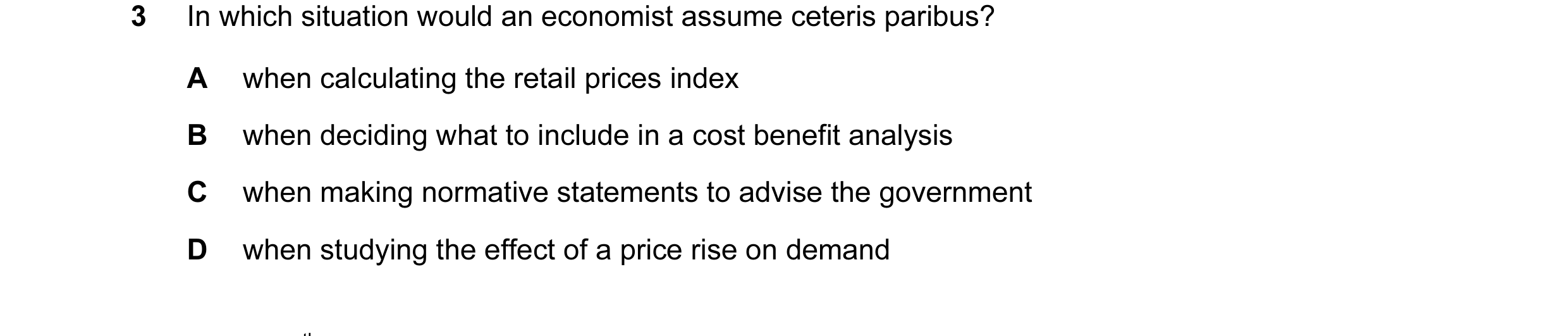
3 In which situation would an economist assume ceteris paribus? A when calculating the retail prices index B when deciding what to include in a cost benefit analysis C when making normative statements to advise the government D when studying the effect of a price rise on demand
1 marks
Answer: D
This question in 9708/11 Oct/Nov 2007
Q5 · Which of the following is a normative statement? 9708/11 May/June 2008
3 Which of the following is a normative statement? A If firms spend more on advertising, sales volume may not rise. B If firms raise prices, profits will rise. C The government should reduce taxes on spending so that economic welfare will rise. D Export volumes will rise if the government lowers the exchange rate.
1 marks
Answer: C
This question in 9708/11 May/June 2008
Q6 · What must be true of a positive statement? 9708/11 May/June 2009
3 What must be true of a positive statement? A It is one that can be shown to be correct or incorrect. B It is one that deals with positive changes in economic well being. C It is one that is true by definition. D It is one with which everyone is in agreement.
1 marks
Answer: A
This question in 9708/11 May/June 2009
Q7 · What does the concept of ceteris paribus allow economists to do? 9708/11 Oct/Nov 2009
3 What does the concept of ceteris paribus allow economists to do? A calculate the monetary value of consumer surplus B distinguish between economic and free goods C distinguish between normative and positive statements D isolate the effect of one variable on another variable
1 marks
Answer: D
This question in 9708/11 Oct/Nov 2009
Q8 · What does the concept of ceteris paribus allow economists to do? 9708/12 Oct/Nov 2009
2 What does the concept of ceteris paribus allow economists to do? A calculate the monetary value of consumer surplus B distinguish between economic and free goods C distinguish between normative and positive statements D isolate the effect of one variable on another variable
1 marks
Answer: D
This question in 9708/12 Oct/Nov 2009
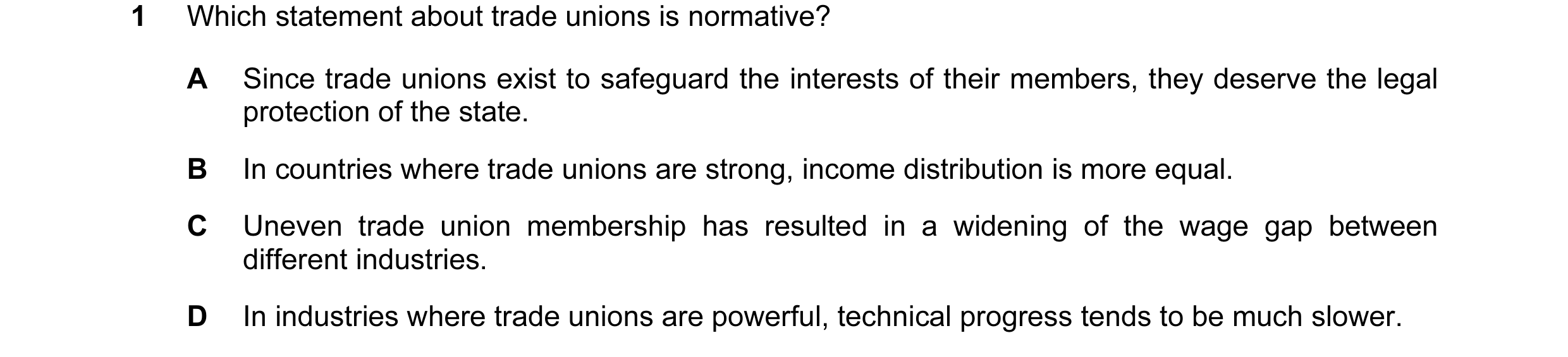
Q9 · Which statement about trade unions is normative? 9708/11 May/June 2010
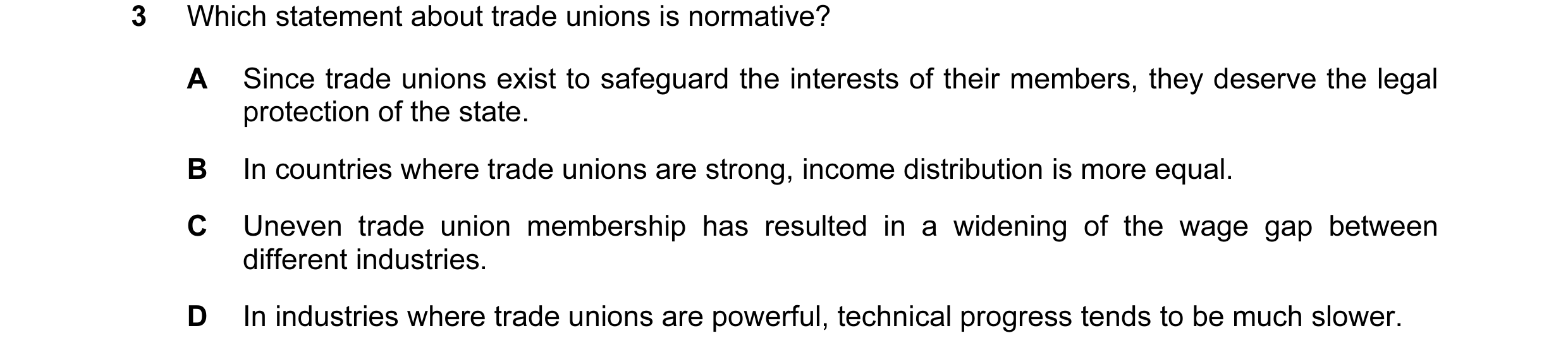
3 Which statement about trade unions is normative? A Since trade unions exist to safeguard the interests of their members, they deserve the legal protection of the state. B In countries where trade unions are strong, income distribution is more equal. C Uneven trade union membership has resulted in a widening of the wage gap between different industries. D In industries where trade unions are powerful, technical progress tends to be much slower.
1 marks
Answer: A
This question in 9708/11 May/June 2010
Q10 · Which statement about trade unions is normative? 9708/12 May/June 2010
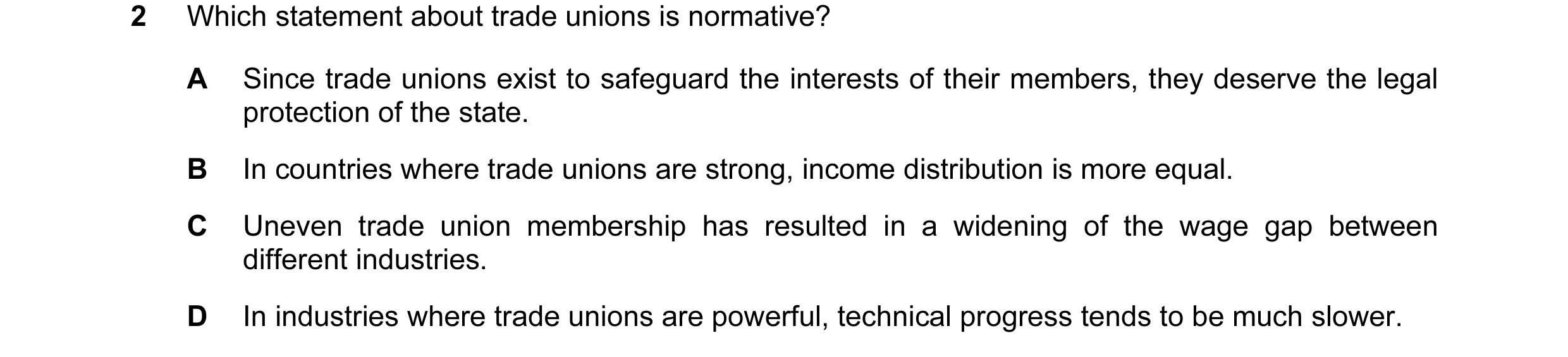
2 Which statement about trade unions is normative? A Since trade unions exist to safeguard the interests of their members, they deserve the legal protection of the state. B In countries where trade unions are strong, income distribution is more equal. C Uneven trade union membership has resulted in a widening of the wage gap between different industries. D In industries where trade unions are powerful, technical progress tends to be much slower.
1 marks
Answer: A
This question in 9708/12 May/June 2010
Q11 · Which statement about trade unions is normative? 9708/13 May/June 2010
1 Which statement about trade unions is normative? A Since trade unions exist to safeguard the interests of their members, they deserve the legal protection of the state. B In countries where trade unions are strong, income distribution is more equal. C Uneven trade union membership has resulted in a widening of the wage gap between different industries. D In industries where trade unions are powerful, technical progress tends to be much slower.
1 marks
Answer: A
This question in 9708/13 May/June 2010
Q12 · Which is a normative statement? 9708/11 May/June 2011
4 Which is a normative statement? A An increase in the rate of inflation will lead inevitably to an increase in unemployment. B A reduction in unemployment below a certain level will lead to higher inflation. C Inflation can be reduced only by increasing the level of unemployment. D Unemployment is more harmful than inflation.
1 marks
Answer: D
This question in 9708/11 May/June 2011
Q13 · Which is a normative statement? 9708/12 May/June 2011
3 Which is a normative statement? A An increase in the rate of inflation will lead inevitably to an increase in unemployment. B A reduction in unemployment below a certain level will lead to higher inflation. C Inflation can be reduced only by increasing the level of unemployment. D Unemployment is more harmful than inflation.
1 marks
Answer: D
This question in 9708/12 May/June 2011
Q14 · Which is a normative statement? 9708/13 May/June 2011
2 Which is a normative statement? A An increase in the rate of inflation will lead inevitably to an increase in unemployment. B A reduction in unemployment below a certain level will lead to higher inflation. C Inflation can be reduced only by increasing the level of unemployment. D Unemployment is more harmful than inflation.
1 marks
Answer: D
This question in 9708/13 May/June 2011
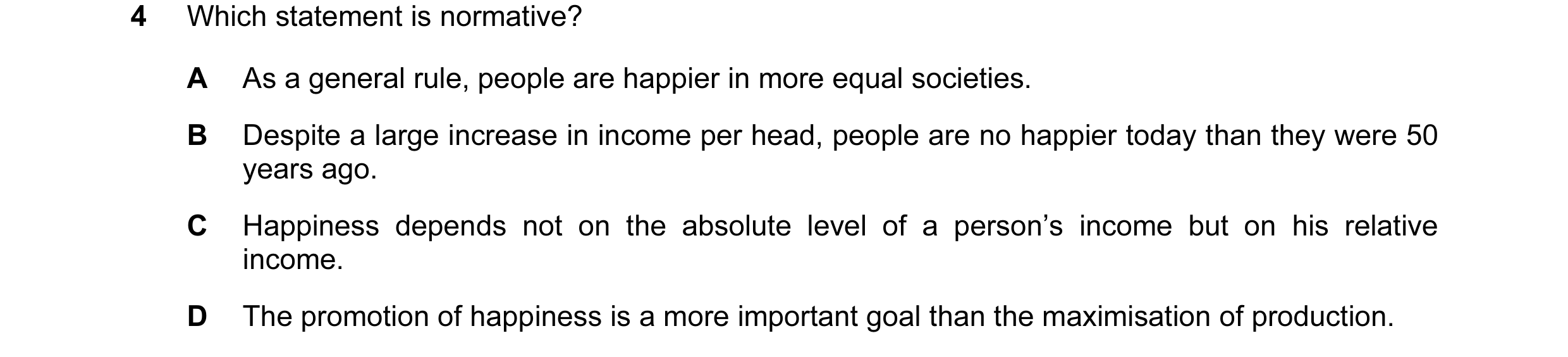
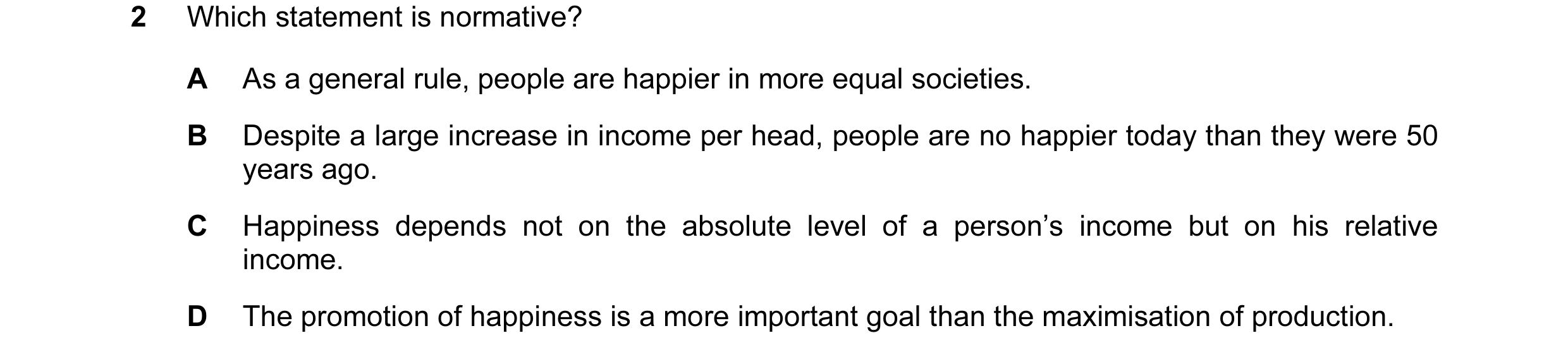
Q15 · Which statement is normative? 9708/11 Oct/Nov 2011
4 Which statement is normative? A As a general rule, people are happier in more equal societies. B Despite a large increase in income per head, people are no happier today than they were 50 years ago. C Happiness depends not on the absolute level of a person’s income but on his relative income. D The promotion of happiness is a more important goal than the maximisation of production.
1 marks
Answer: D
This question in 9708/11 Oct/Nov 2011
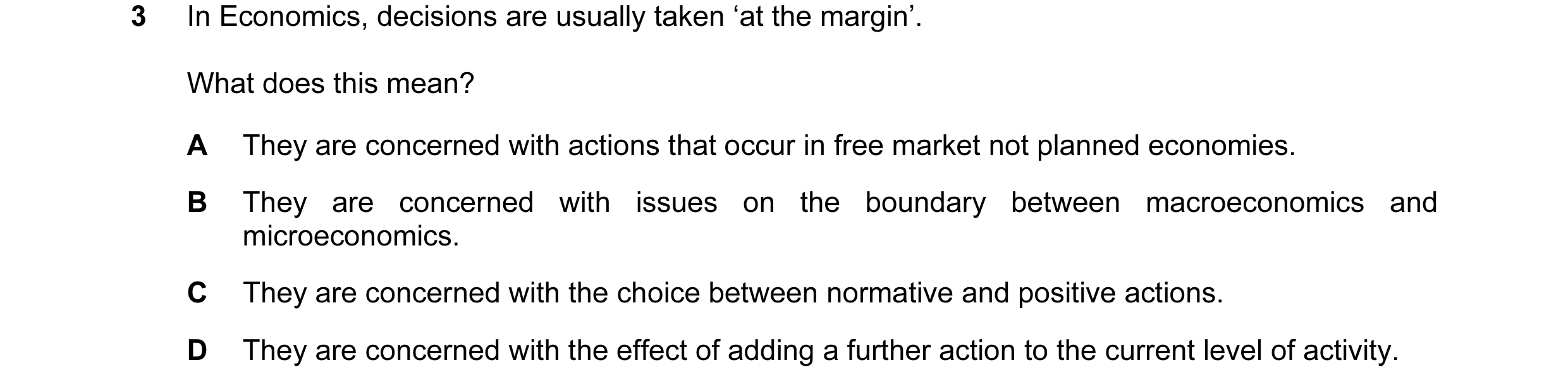
Q16 · In Economics, decisions are usually taken ‘at the margin’ 9708/12 Oct/Nov 2011
3 In Economics, decisions are usually taken ‘at the margin’. What does this mean? A They are concerned with actions that occur in free market not planned economies. B They are concerned with issues on the boundary between macroeconomics and microeconomics. C They are concerned with the choice between normative and positive actions. D They are concerned with the effect of adding a further action to the current level of activity.
1 marks
Answer: D
This question in 9708/12 Oct/Nov 2011
Q17 · Which statement is normative? 9708/13 Oct/Nov 2011
2 Which statement is normative? A As a general rule, people are happier in more equal societies. B Despite a large increase in income per head, people are no happier today than they were 50 years ago. C Happiness depends not on the absolute level of a person’s income but on his relative income. D The promotion of happiness is a more important goal than the maximisation of production.
1 marks
Answer: D
This question in 9708/13 Oct/Nov 2011
Q18 · Skilled actors deserve to receive a high income because they bring pleasure to people who… 9708/11 May/June 2012
4 Skilled actors deserve to receive a high income because they bring pleasure to people who attend the theatre. What can be concluded about this statement? A It is a normative statement because both services and goods are economic outputs. B It is a normative statement because it expresses an opinion. C It is a positive statement because actors do bring pleasure to people. D It is a positive statement because greater skill results in higher pay.
1 marks
Answer: B
This question in 9708/11 May/June 2012
Q19 · Skilled actors deserve to receive a high income because they bring pleasure to people who… 9708/13 May/June 2012
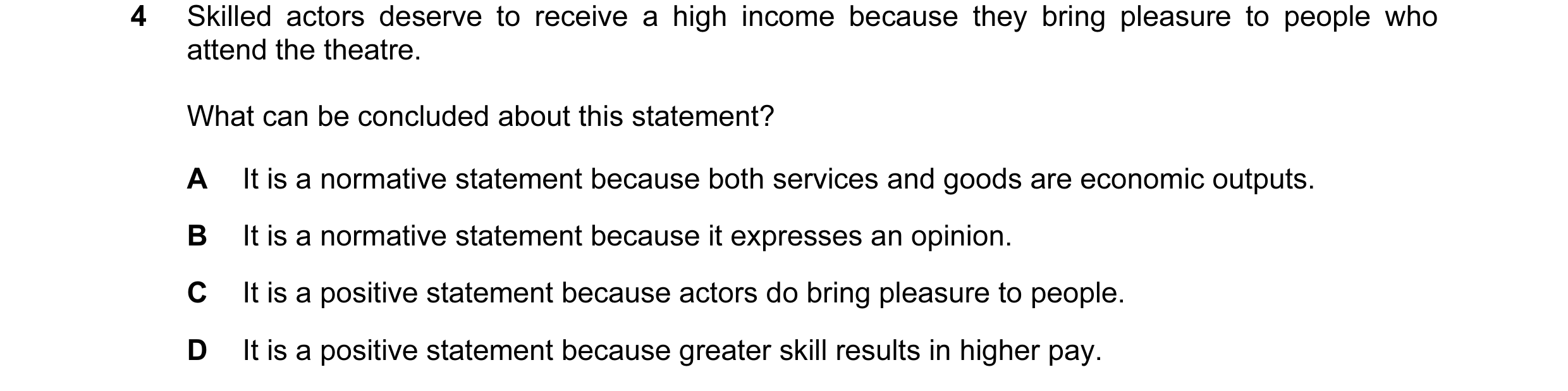
4 Skilled actors deserve to receive a high income because they bring pleasure to people who attend the theatre. What can be concluded about this statement? A It is a normative statement because both services and goods are economic outputs. B It is a normative statement because it expresses an opinion. C It is a positive statement because actors do bring pleasure to people. D It is a positive statement because greater skill results in higher pay.
1 marks
Answer: B
This question in 9708/13 May/June 2012
Q20 · In the recession of 2011 some governments decided to reduce expenditure and decrease the… 9708/13 May/June 2013
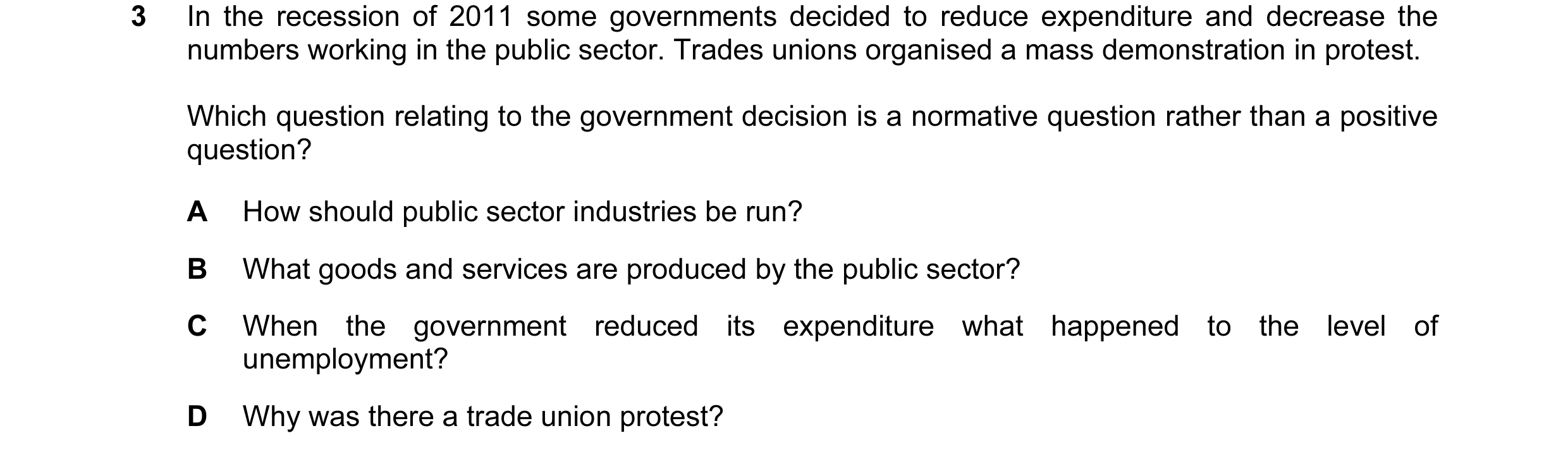
3 In the recession of 2011 some governments decided to reduce expenditure and decrease the numbers working in the public sector. Trades unions organised a mass demonstration in protest. Which question relating to the government decision is a normative question rather than a positive question? A How should public sector industries be run? B What goods and services are produced by the public sector? C When the government reduced its expenditure what happened to the level of unemployment? D Why was there a trade union protest?
1 marks
Answer: A
This question in 9708/13 May/June 2013
Q21 · Which is a normative statement? 9708/12 May/June 2014
3 Which is a normative statement? A A reduction in unemployment below a certain level will lead to higher inflation. B An increase in the rate of inflation will lead inevitably to an increase in unemployment. C Inflation can be reduced only by increasing the level of unemployment. D Unemployment is more harmful to economic welfare than inflation.
1 marks
Answer: D
This question in 9708/12 May/June 2014
Q22 · Unemployment among young people in Spain was 56.1% in June 2013 9708/11 Oct/Nov 2015
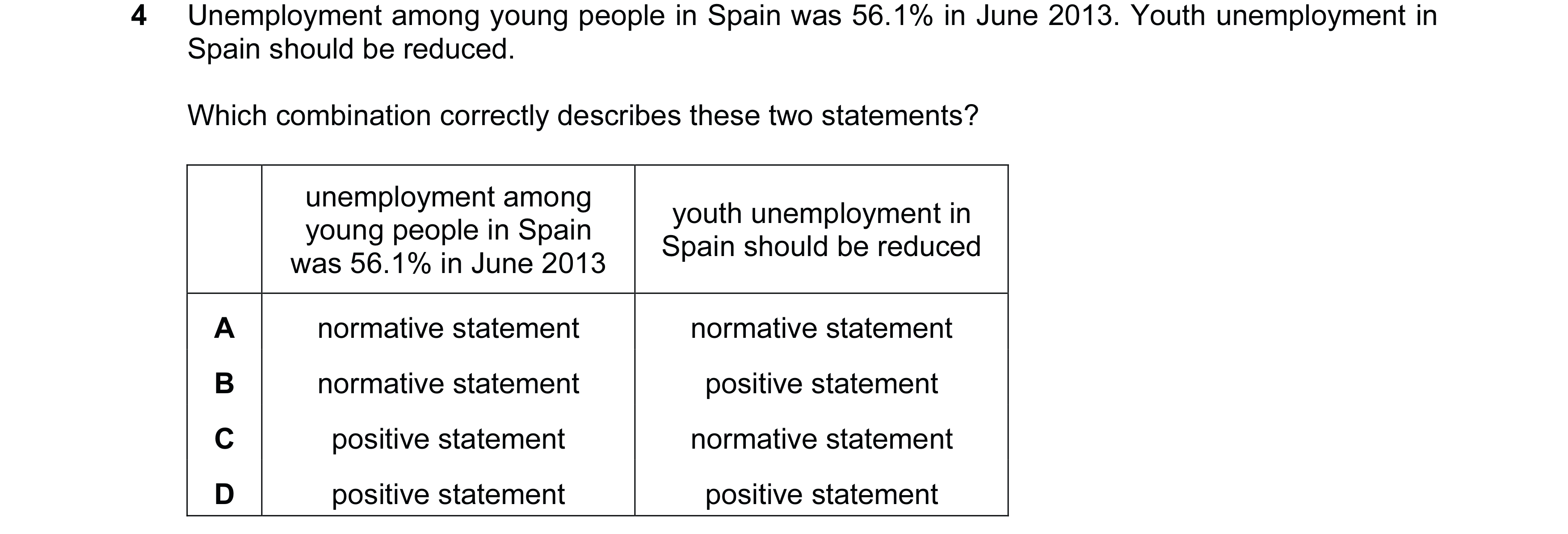
4 Unemployment among young people in Spain was 56.1% in June 2013. Youth unemployment in Spain should be reduced. Which combination correctly describes these two statements? unemployment among youth unemployment in young people in Spain Spain should be reduced was 56.1% in June 2013 A normative statement normative statement B normative statement positive statement C positive statement normative statement D positive statement positive statement
1 marks
Answer: C
This question in 9708/11 Oct/Nov 2015
Q23 · What is an example of the use of ceteris paribus? 9708/13 May/June 2017
1 What is an example of the use of ceteris paribus? A The rate of increase in wage rates equals the rate of increase in price levels. B There is a constant rise in both wage rates and price levels. C Wage rates and the price level remain constant at their original levels. D Wage rates rise when the only change is a rise in prices.
1 marks
Answer: D
This question in 9708/13 May/June 2017
Q24 · What is always true of a positive statement? 9708/13 May/June 2017
2 What is always true of a positive statement? A It is based on statistical data. B It is possible to test its validity. C It is the only basis for economic policy. D It overrides any normative statement.
1 marks
Answer: B
This question in 9708/13 May/June 2017
Q25 · A teacher asks four students to fill in the gaps in the following sentence 9708/11 Oct/Nov 2017
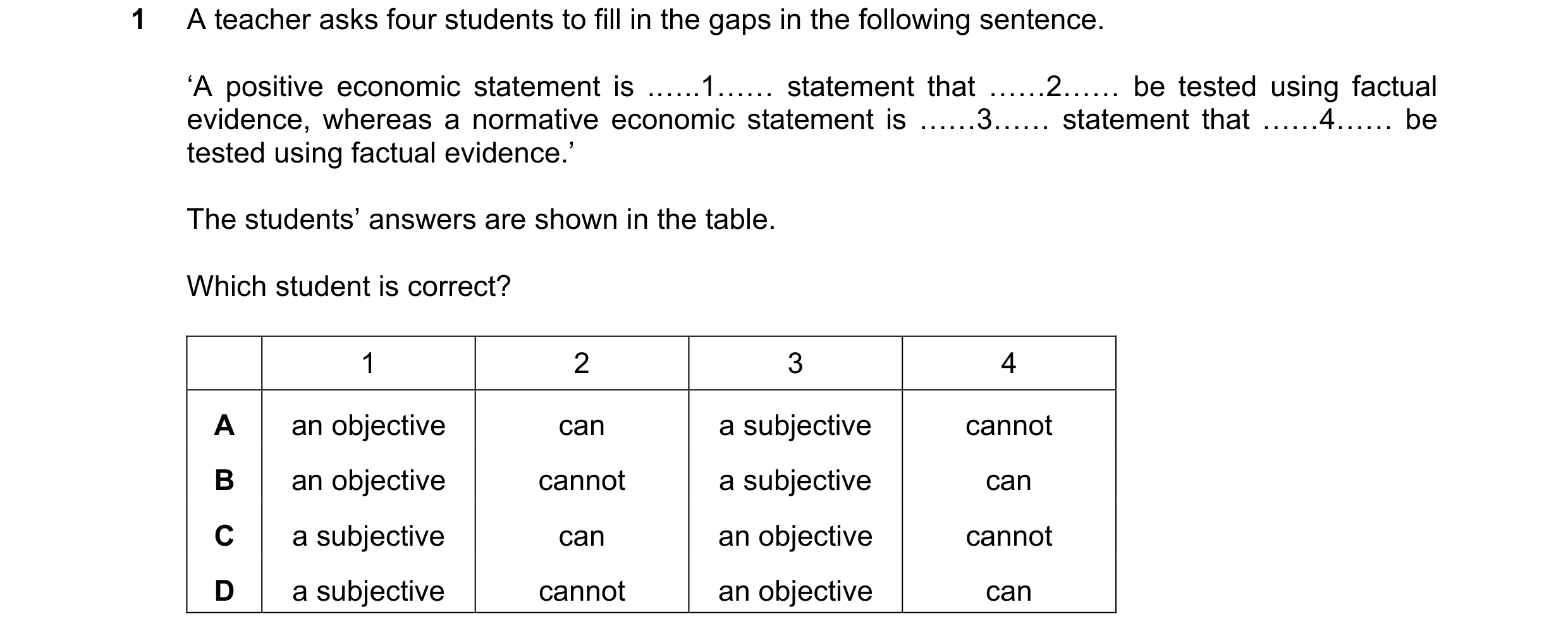
1 A teacher asks four students to fill in the gaps in the following sentence. ‘A positive economic statement is .«..1«« statement that ««2«« be tested using factual evidence, whereas a normative economic statement is ««3«« statement that ««4«« be tested using factual evidence.’ The students’ answers are shown in the table. Which student is correct? 1 2 3 4 A an objective can a subjective cannot B an objective cannot a subjective can C a subjective can an objective cannot D a subjective cannot an objective can
1 marks
Answer: A
This question in 9708/11 Oct/Nov 2017
Q26 · A government decides to subsidise farms producing milk in its country 9708/12 Oct/Nov 2017
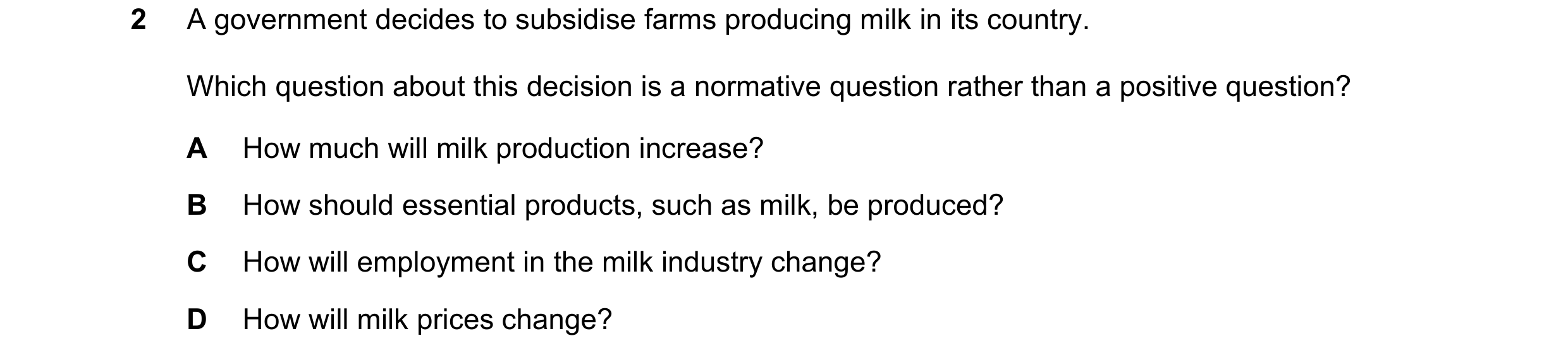
2 A government decides to subsidise farms producing milk in its country. Which question about this decision is a normative question rather than a positive question? A How much will milk production increase? B How should essential products, such as milk, be produced? C How will employment in the milk industry change? D How will milk prices change?
1 marks
Answer: B
This question in 9708/12 Oct/Nov 2017
Q27 · Which statement about economics is not correct? 9708/12 Feb/March 2018
1 Which statement about economics is not correct? A Economic actions can produce unexpected side effects. B Economic thinking is usually based on logical reasoning at the margin. C The use of scarce resources to produce a good always has a cost. D The value of a good or service involves a purely objective judgement.
1 marks
Answer: D
This question in 9708/12 Feb/March 2018
Q28 · A ««1«« economic statement is an objective statement that ««2«« be tested using factual… 9708/11 May/June 2018
2 A ««1«« economic statement is an objective statement that ««2«« be tested using factual evidence, whereas a ««3«« economic statement is a subjective statement that ««4«« be tested using factual evidence. Which words complete gaps 1, 2, 3 and 4? 1 2 3 4 A normative can positive cannot B normative cannot positive can C positive can normative cannot D positive cannot normative can
1 marks
Answer: C
This question in 9708/11 May/June 2018
Q29 · The statements refer to the proposal to build another runway at London’s Heathrow airport 9708/12 May/June 2018
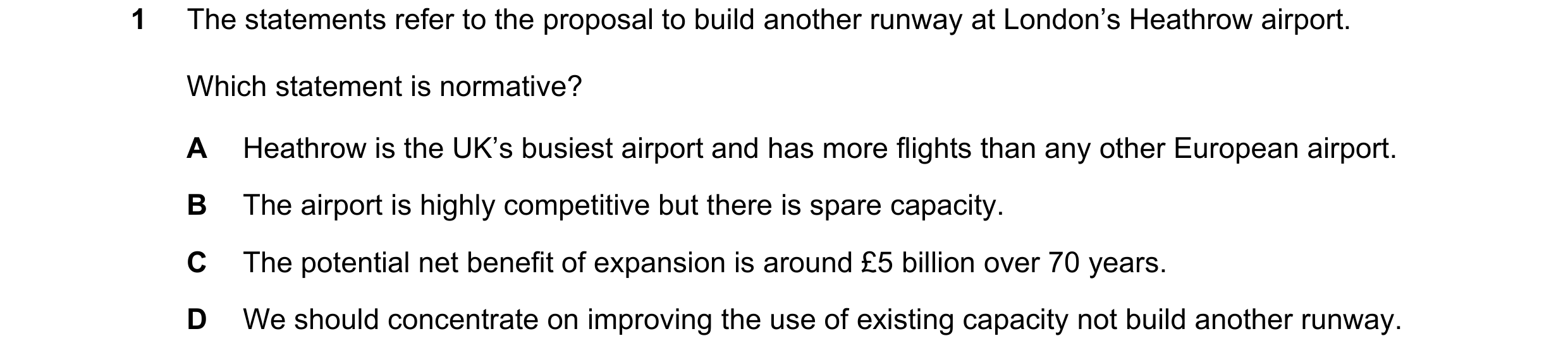
1 The statements refer to the proposal to build another runway at London’s Heathrow airport. Which statement is normative? A Heathrow is the UK’s busiest airport and has more flights than any other European airport. B The airport is highly competitive but there is spare capacity. C The potential net benefit of expansion is around £5 billion over 70 years. D We should concentrate on improving the use of existing capacity not build another runway.
1 marks
Answer: D
This question in 9708/12 May/June 2018
Q30 · A government proposes to introduce a road congestion charge which would require private… 9708/13 May/June 2018
2 A government proposes to introduce a road congestion charge which would require private motorists to pay a toll for road use. Which statement relating to the proposal is normative? A Bus passengers will benefit at the expense of motorists. B Motorists with higher incomes will be prepared to pay the charge in return for reduced journey times. C Motorists with lower incomes will not be able to afford to use the roads. D The proposal will be unfair to motorists who have no alternative means of transport.
1 marks
Answer: D
This question in 9708/13 May/June 2018
Q31 · The demand for a product is inversely related to its price, ceteris paribus 9708/11 Oct/Nov 2018
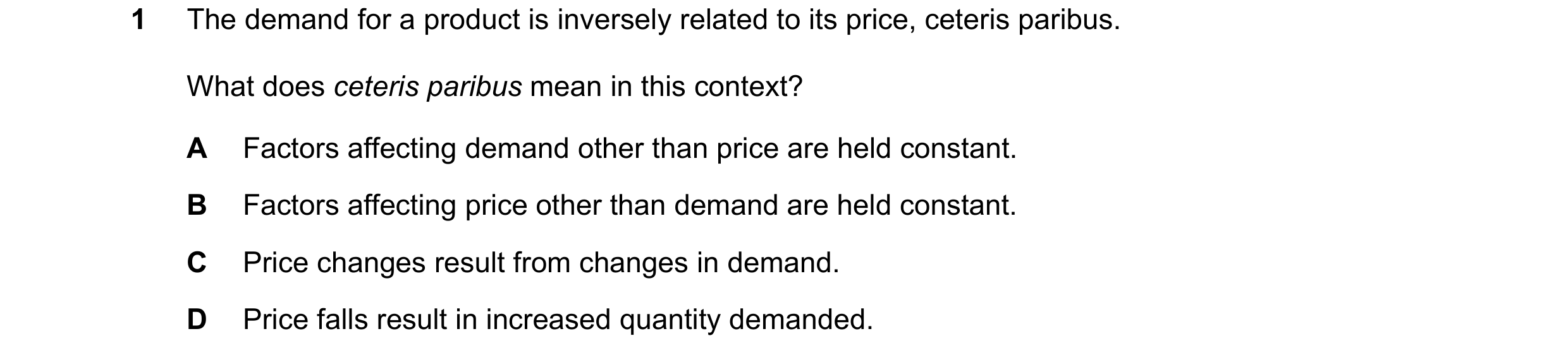
1 The demand for a product is inversely related to its price, ceteris paribus. What does ceteris paribus mean in this context? A Factors affecting demand other than price are held constant. B Factors affecting price other than demand are held constant. C Price changes result from changes in demand. D Price falls result in increased quantity demanded.
1 marks
Answer: A
This question in 9708/11 Oct/Nov 2018
Q32 · Which statement by a company is normative? 9708/12 Oct/Nov 2018
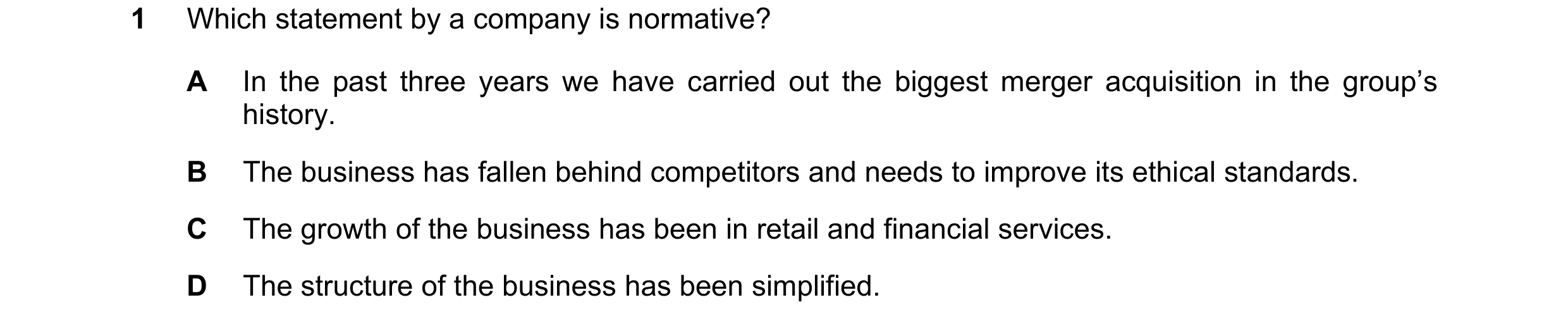
1 Which statement by a company is normative? A In the past three years we have carried out the biggest merger acquisition in the group’s history. B The business has fallen behind competitors and needs to improve its ethical standards. C The growth of the business has been in retail and financial services. D The structure of the business has been simplified.
1 marks
Answer: B
This question in 9708/12 Oct/Nov 2018
Q33 · The statements are from a report by a water company that supplies water to homes and… 9708/13 Oct/Nov 2018
1 The statements are from a report by a water company that supplies water to homes and businesses. Which statement is normative? A It is important that we continue to invest in our infrastructure. B Our investment will have wider benefits, attracting visitors to the region. C We are investing more than ever in the region. D We use local suppliers on construction projects which boosts the local economy.
1 marks
Answer: A
This question in 9708/13 Oct/Nov 2018
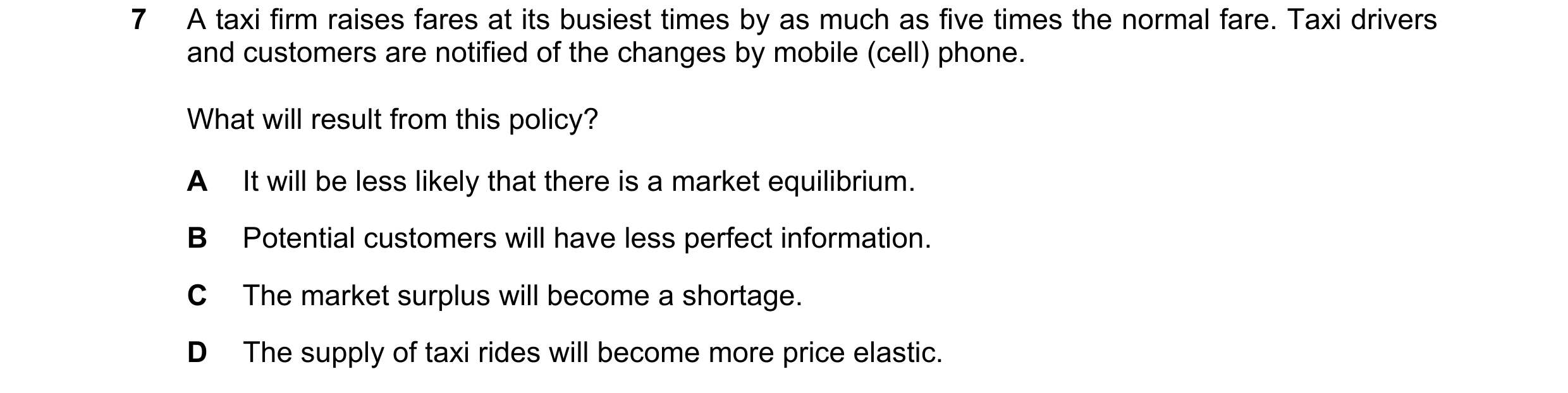
Q34 · A taxi firm raises fares at its busiest times by as much as five times the normal fare 9708/12 Feb/March 2019
7 A taxi firm raises fares at its busiest times by as much as five times the normal fare. Taxi drivers and customers are notified of the changes by mobile (cell) phone. What will result from this policy? A It will be less likely that there is a market equilibrium. B Potential customers will have less perfect information. C The market surplus will become a shortage. D The supply of taxi rides will become more price elastic.
1 marks
Answer: D
This question in 9708/12 Feb/March 2019
Q35 · Which statement is not a positive economic statement? 9708/11 May/June 2019
3 Which statement is not a positive economic statement? A An increase in the rate of income tax decreases the wish to save. B An increase in the rate of income tax has a greater impact the greater the level of income. C An increase in the rate of income tax causes more hours of work to be supplied. D An increase in the rate of income tax is the fairest way to finance the national health service.
1 marks
Answer: D
This question in 9708/11 May/June 2019
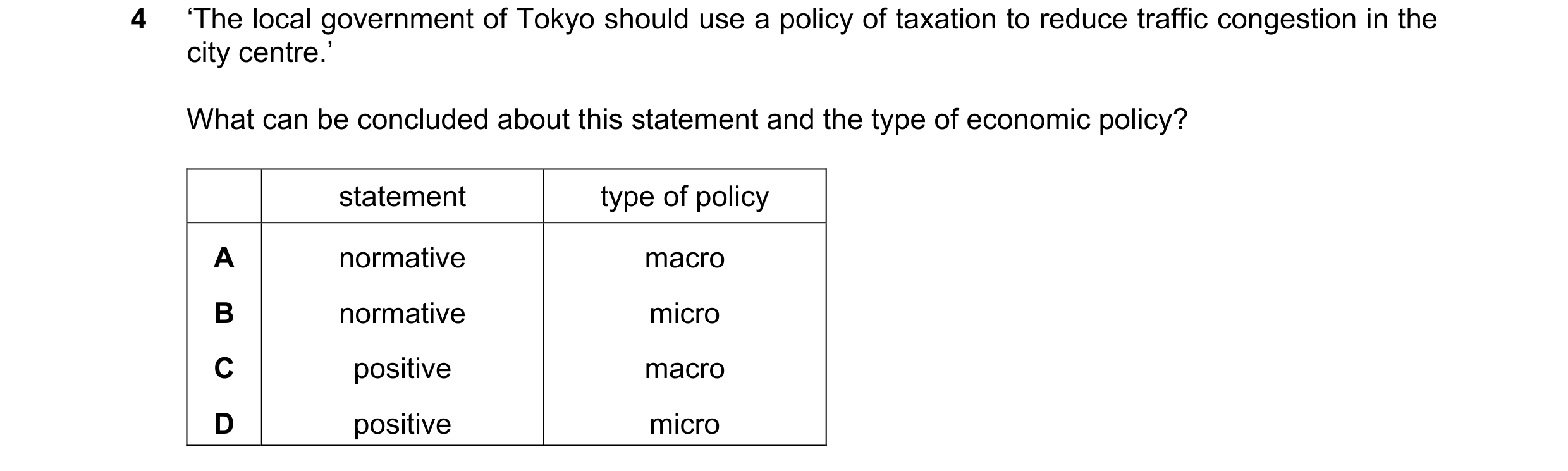
Q36 · ‘The local government of Tokyo should use a policy of taxation to reduce traffic… 9708/13 May/June 2019
4 ‘The local government of Tokyo should use a policy of taxation to reduce traffic congestion in the city centre.’ What can be concluded about this statement and the type of economic policy? statement type of policy A normative macro B normative micro C positive macro D positive micro
1 marks
Answer: B
This question in 9708/13 May/June 2019
Q37 · What is correct for a normative statement? 9708/11 Oct/Nov 2019
1 What is correct for a normative statement? A It is objective and based on fact. B It is objective and can be proved correct. C It is subjective and based on opinion. D It is subjective and can be reliably tested.
1 marks
Answer: C
This question in 9708/11 Oct/Nov 2019
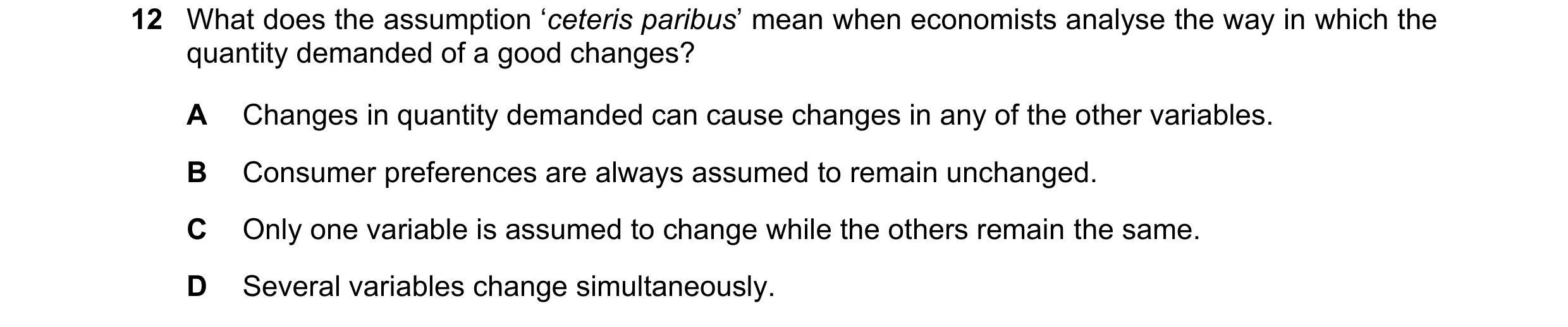
Q38 · What does the assumption ‘ceteris paribus’ mean when economists analyse the way in which… 9708/11 Oct/Nov 2019
12 What does the assumption ‘ceteris paribus’ mean when economists analyse the way in which the quantity demanded of a good changes? A Changes in quantity demanded can cause changes in any of the other variables. B Consumer preferences are always assumed to remain unchanged. C Only one variable is assumed to change while the others remain the same. D Several variables change simultaneously.
1 marks
Answer: C
This question in 9708/11 Oct/Nov 2019
Q39 · Which is a normative economic statement? 9708/12 Oct/Nov 2019
4 Which is a normative economic statement? A Money is the least liquid form of wealth. B Some firms are subsidised by the government. C Some workers earn more than others. D Taxes are the best way to discourage smoking.
1 marks
Answer: D
This question in 9708/12 Oct/Nov 2019
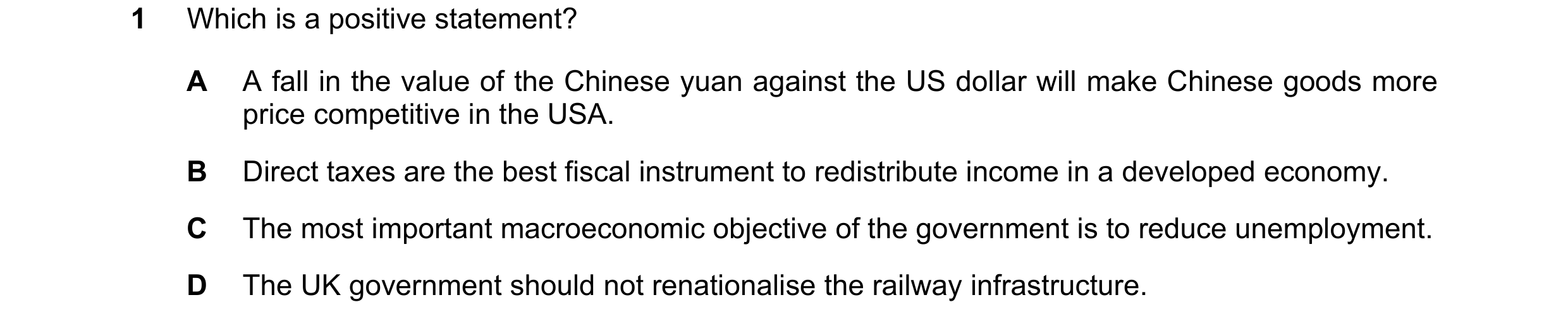
Q40 · Which is a positive statement? 9708/13 Oct/Nov 2019
1 Which is a positive statement? A A fall in the value of the Chinese yuan against the US dollar will make Chinese goods more price competitive in the USA. B Direct taxes are the best fiscal instrument to redistribute income in a developed economy. C The most important macroeconomic objective of the government is to reduce unemployment. D The UK government should not renationalise the railway infrastructure.
1 marks
Answer: A
This question in 9708/13 Oct/Nov 2019
Q41 · A newspaper article contains the following comments 9708/12 Feb/March 2020
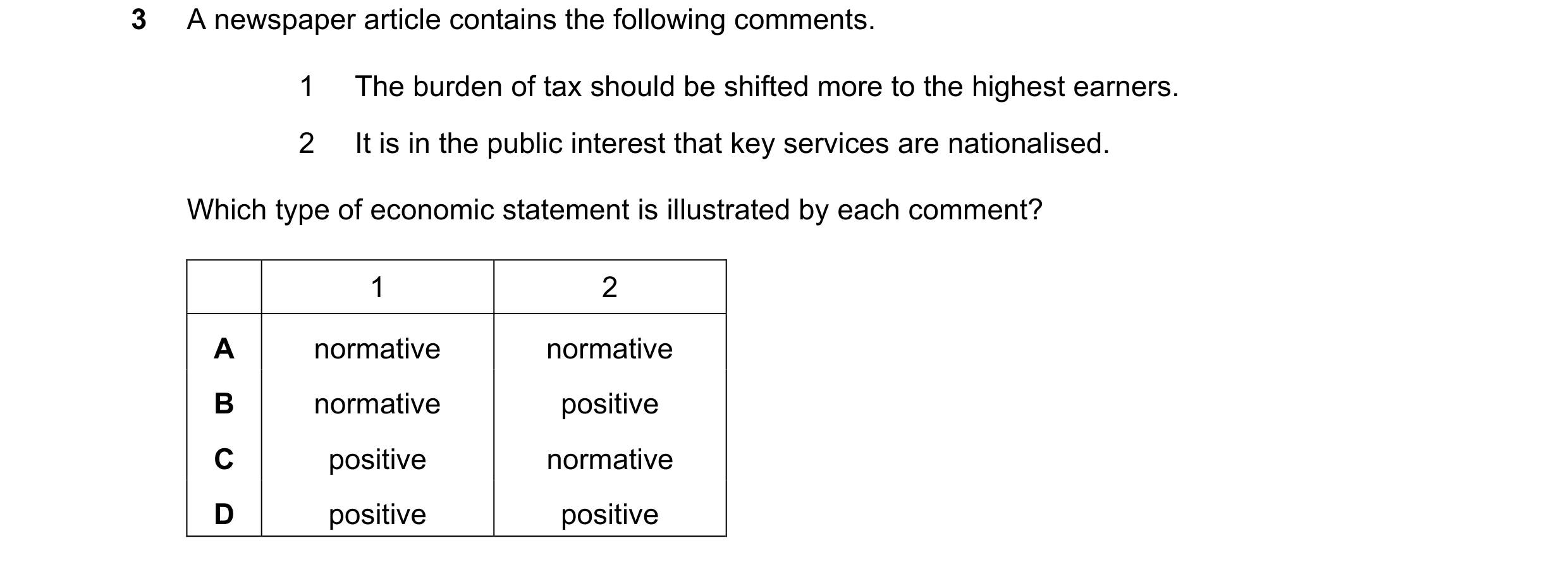
3 A newspaper article contains the following comments. 1 The burden of tax should be shifted more to the highest earners. 2 It is in the public interest that key services are nationalised. Which type of economic statement is illustrated by each comment? 1 2 A normative normative B normative positive C positive normative D positive positive
1 marks
Answer: A
This question in 9708/12 Feb/March 2020
Q42 · Which statement is correct? 9708/11 May/June 2020
2 Which statement is correct? A Normative economics concerns the description of economic models. B Normative economics is objective and factual. C Positive economics can be tested by data and evidence. D Positive economics is subjective and offers a value judgement.
1 marks
Answer: C
This question in 9708/11 May/June 2020
Q43 · Which statement is normative? 9708/12 May/June 2020
4 Which statement is normative? A A minimum wage is the correct government policy to increase the incomes of the lowest paid workers. B A minimum wage is the lowest amount that employers can legally pay their workers. C In Pakistan, a minimum wage of 15 000 Pakistani Rupees per month was set on 1 June 2016. D Setting the minimum wage rate above the equilibrium will result in an excess supply of workers.
1 marks
Answer: A
This question in 9708/12 May/June 2020
Q44 · Which is a normative statement? 9708/13 May/June 2020
4 Which is a normative statement? A If interest rates fall consumption is likely to increase. B If interest rates fall consumption will definitely increase. C Interest rates and consumption are usually inversely related. D The rate of interest should be reduced.
1 marks
Answer: D
This question in 9708/13 May/June 2020
Q45 · Which comment relating to the introduction of charges for previously free medical… 9708/11 Oct/Nov 2020
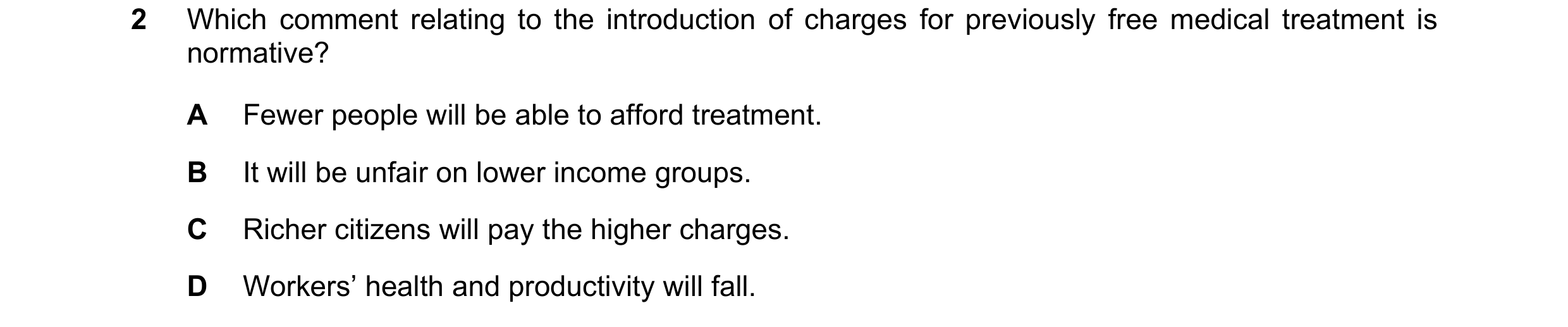
2 Which comment relating to the introduction of charges for previously free medical treatment is normative? A Fewer people will be able to afford treatment. B It will be unfair on lower income groups. C Richer citizens will pay the higher charges. D Workers’ health and productivity will fall.
1 marks
Answer: B
This question in 9708/11 Oct/Nov 2020
Q46 · Below are two statements 9708/12 Oct/Nov 2020
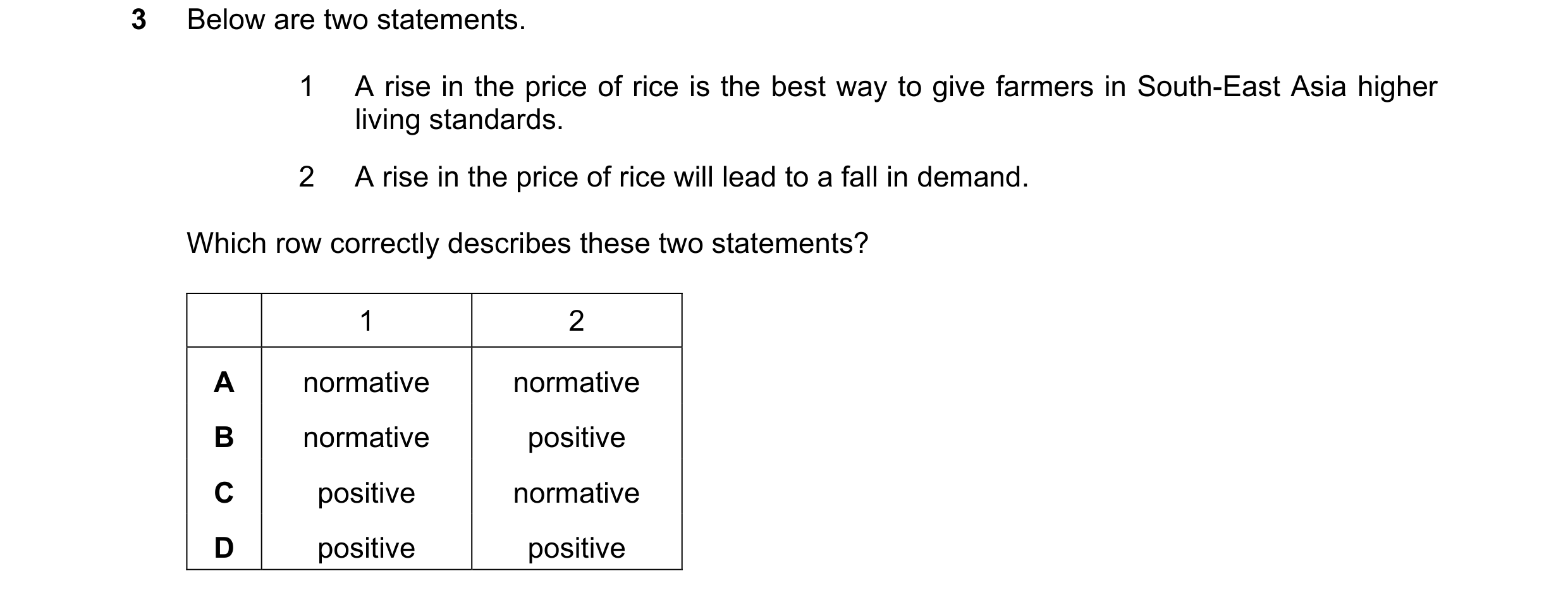
3 Below are two statements. 1 A rise in the price of rice is the best way to give farmers in South-East Asia higher living standards. 2 A rise in the price of rice will lead to a fall in demand. Which row correctly describes these two statements? 1 2 A normative normative B normative positive C positive normative D positive positive
1 marks
Answer: B
This question in 9708/12 Oct/Nov 2020
Q47 · Which statement is a positive statement? 9708/12 Feb/March 2021
4 Which statement is a positive statement? A The distribution of income and wealth in most western European countries is unequal. B The government ought to increase income tax on high earners. C There should be more legal rights given to workers to protect their status in the workplace. D Wages of those on low incomes should be increased.
1 marks
Answer: A
This question in 9708/12 Feb/March 2021
Q48 · Which statement would be classified by an economist as a positive statement? 9708/12 May/June 2021
4 Which statement would be classified by an economist as a positive statement? A Balancing the budget cannot be more important than reducing inflation. B Maintaining the real income of pensioners needs to be a priority. C The government should increase indirect taxation. D The government will not increase direct taxation.
1 marks
Answer: D
This question in 9708/12 May/June 2021
Q49 · Which statement is a normative statement? 9708/13 May/June 2021
2 Which statement is a normative statement? A China has never had a balance of payments surplus. B Higher interest rates might reduce investment. C Perfect competition is allocatively efficient. D Welfare payments should be increased.
1 marks
Answer: D
This question in 9708/13 May/June 2021
Q50 · Which statement is a positive statement? 9708/13 Oct/Nov 2021
4 Which statement is a positive statement? A Low inflation is preferable to low unemployment as a government aim. B Low inflation will provide a more stable macro economy. C The government must intervene in all markets to improve resource allocation. D The government should cut income tax so living standards can improve.
1 marks
Answer: B
This question in 9708/13 Oct/Nov 2021
Q51 · What is a normative economic action based on? 9708/12 Feb/March 2022
2 What is a normative economic action based on? A fact B market forces C opinion D price changes
1 marks
Answer: C
This question in 9708/12 Feb/March 2022
Q52 · Demand curves are drawn ceteris paribus 9708/12 Feb/March 2022
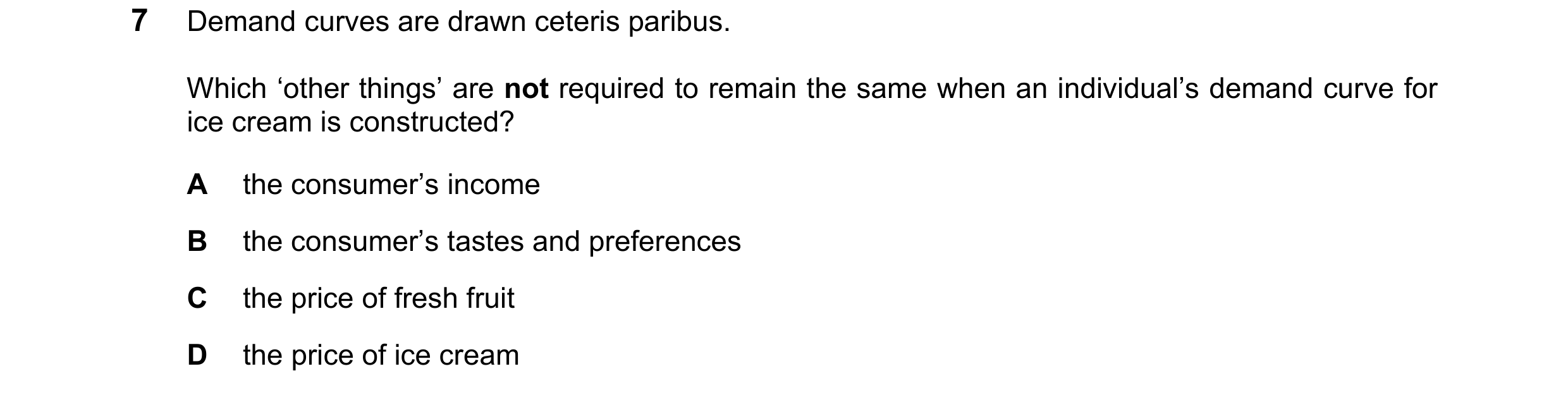
7 Demand curves are drawn ceteris paribus. Which ‘other things’ are not required to remain the same when an individual’s demand curve for ice cream is constructed? A the consumer’s income B the consumer’s tastes and preferences C the price of fresh fruit D the price of ice cream
1 marks
Answer: D
This question in 9708/12 Feb/March 2022
Q53 · The Indian government operates a pension scheme 9708/11 May/June 2022
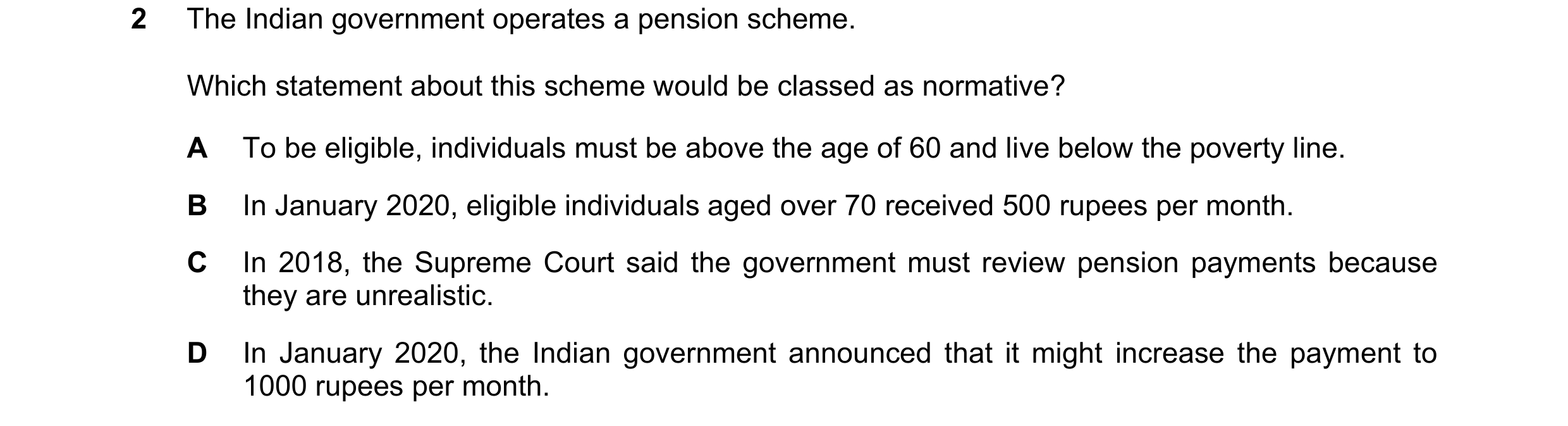
2 The Indian government operates a pension scheme. Which statement about this scheme would be classed as normative? A To be eligible, individuals must be above the age of 60 and live below the poverty line. B In January 2020, eligible individuals aged over 70 received 500 rupees per month. C In 2018, the Supreme Court said the government must review pension payments because they are unrealistic. D In January 2020, the Indian government announced that it might increase the payment to 1000 rupees per month.
1 marks
Answer: C
This question in 9708/11 May/June 2022
Q54 · Which list has the most words that are more likely to relate to a positive statement than… 9708/12 May/June 2022
1 Which list has the most words that are more likely to relate to a positive statement than to a normative statement? A describe, better, should, value, emotion B bias, objective, ought, opinion, tastes C contestable, is, motive, subjective, moral D actual, ethics, fact, was, testable
1 marks
Answer: D
This question in 9708/12 May/June 2022
Q55 · The table shows the amount of direct taxes that different households in the UK paid in… 9708/13 May/June 2022
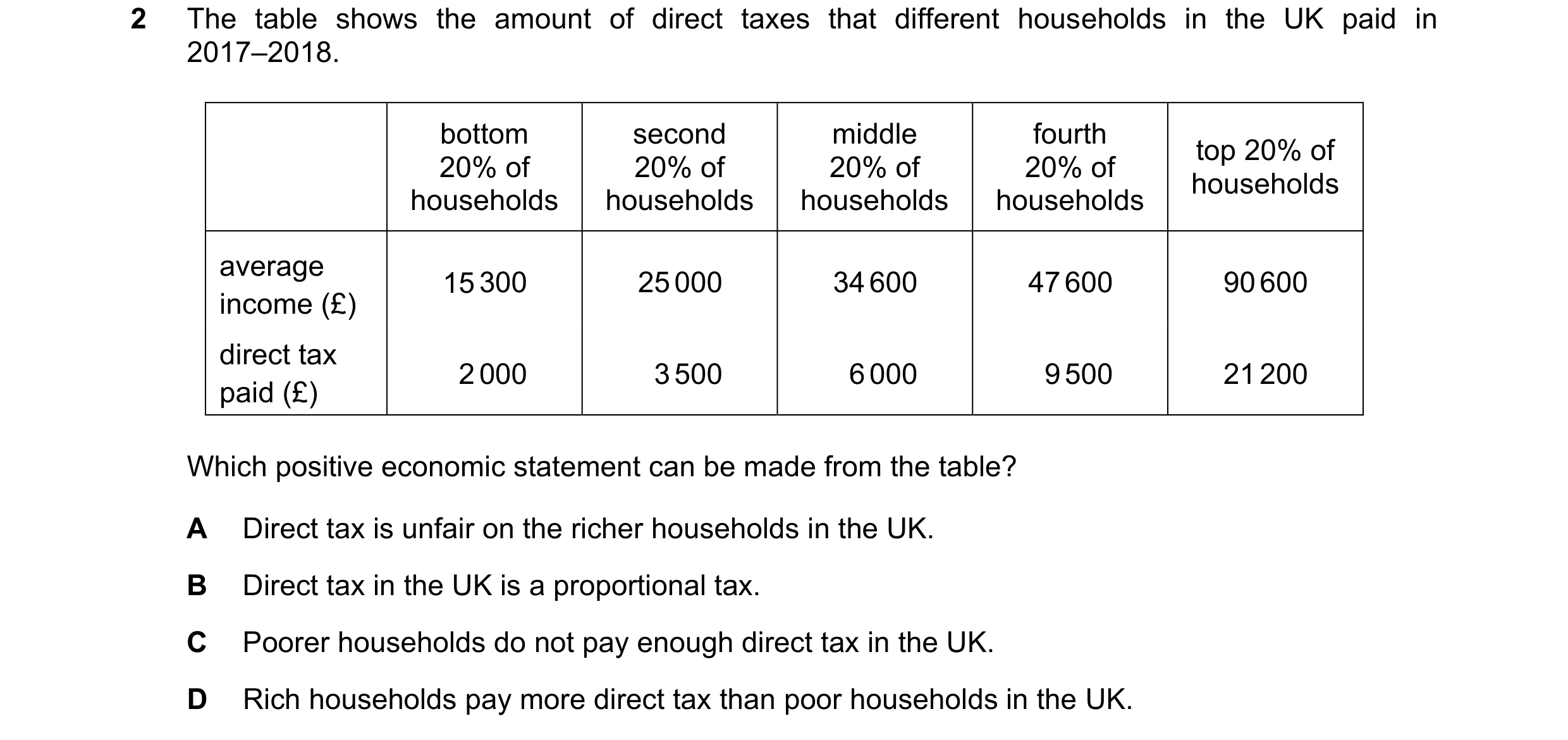
2 The table shows the amount of direct taxes that different households in the UK paid in 2017–2018. bottom second middle fourth top 20% of 20% of 20% of 20% of 20% of households households households households households average 15 300 25 000 34 600 47 600 90 600 income (£) direct tax 2 000 3 500 6 000 9 500 21 200 paid (£) Which positive economic statement can be made from the table? A Direct tax is unfair on the richer households in the UK. B Direct tax in the UK is a proportional tax. C Poorer households do not pay enough direct tax in the UK. D Rich households pay more direct tax than poor households in the UK.
1 marks
Answer: D
This question in 9708/13 May/June 2022
Q56 · What does the assumption ‘ceteris paribus’ mean when economists analyse the way in which… 9708/13 May/June 2022
12 What does the assumption ‘ceteris paribus’ mean when economists analyse the way in which the quantity demanded of a good changes? A Changes in quantity demanded can cause changes in any of the other variables. B Consumer preferences are always assumed to remain unchanged. C Only one variable is assumed to change while the others remain the same. D Several variables change simultaneously.
1 marks
Answer: C
This question in 9708/13 May/June 2022
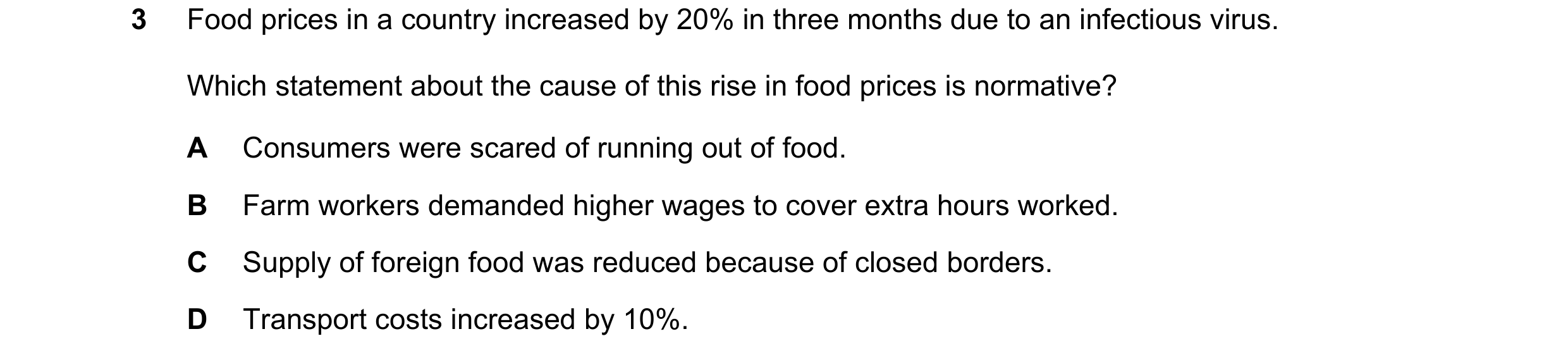
Q57 · Food prices in a country increased by 20% in three months due to an infectious virus 9708/11 Oct/Nov 2022
3 Food prices in a country increased by 20% in three months due to an infectious virus. Which statement about the cause of this rise in food prices is normative? A Consumers were scared of running out of food. B Farm workers demanded higher wages to cover extra hours worked. C Supply of foreign food was reduced because of closed borders. D Transport costs increased by 10%.
1 marks
Answer: A
This question in 9708/11 Oct/Nov 2022
Q58 · What is a normative statement? 9708/12 Oct/Nov 2022
4 What is a normative statement? A A firm receiving a government subsidy will increase the supply of a good. B Negative externalities are the most serious market failure. C A rise in incomes will lead to a rise in demand for normal goods. D A rise in the additional rate of income tax will decrease the incentive to work.
1 marks
Answer: B
This question in 9708/12 Oct/Nov 2022
Q59 · The table states the consequences of two macroeconomic policies 9708/12 Feb/March 2023
3 The table states the consequences of two macroeconomic policies. What correctly identifies whether the statements are normative or positive? a depreciation of an a rise in the minimum exchange rate will wage rate will cause cause the balance of unemployment to rise payments to improve A normative normative B normative positive C positive normative D positive positive
1 marks
Answer: D
This question in 9708/12 Feb/March 2023
Q60 · Which statement is a normative statement? 9708/12 Feb/March 2024
2 Which statement is a normative statement? A Aggregate demand will increase following a decrease in interest rates. B A rise in unemployment will decrease inflationary pressures. C The incentive to work will rise if benefit payments are reduced. D Unsustainable economic growth is more harmful to the economy than hyperinflation.
1 marks
Answer: D
This question in 9708/12 Feb/March 2024
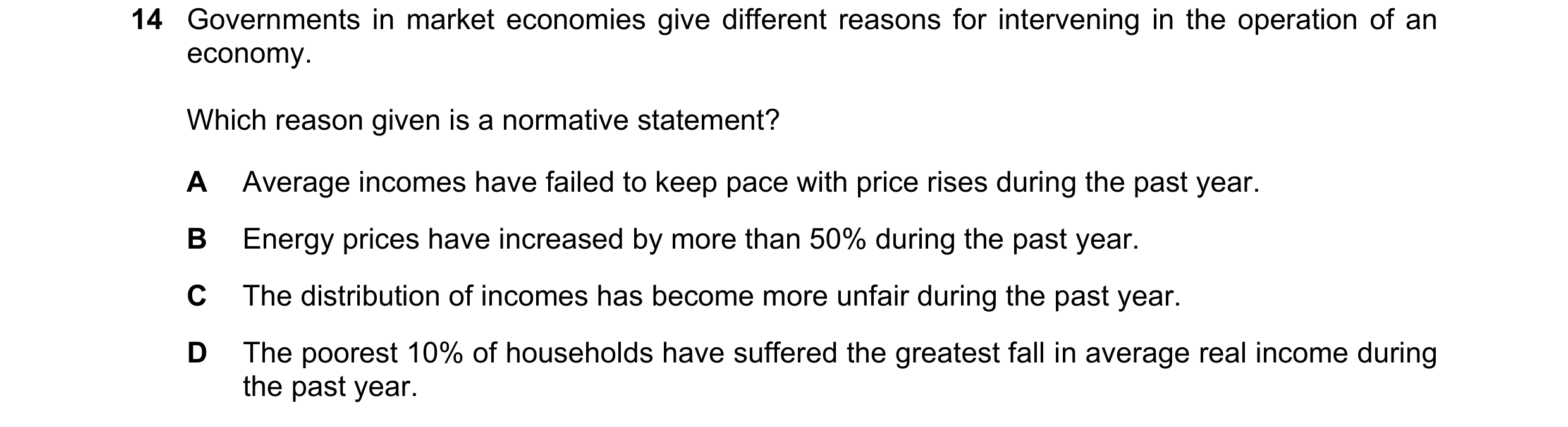
Q61 · Governments in market economies give different reasons for intervening in the operation… 9708/11 May/June 2024
14 Governments in market economies give different reasons for intervening in the operation of an economy. Which reason given is a normative statement? A Average incomes have failed to keep pace with price rises during the past year. B Energy prices have increased by more than 50% during the past year. C The distribution of incomes has become more unfair during the past year. D The poorest 10% of households have suffered the greatest fall in average real income during the past year.
1 marks
Answer: C
This question in 9708/11 May/June 2024
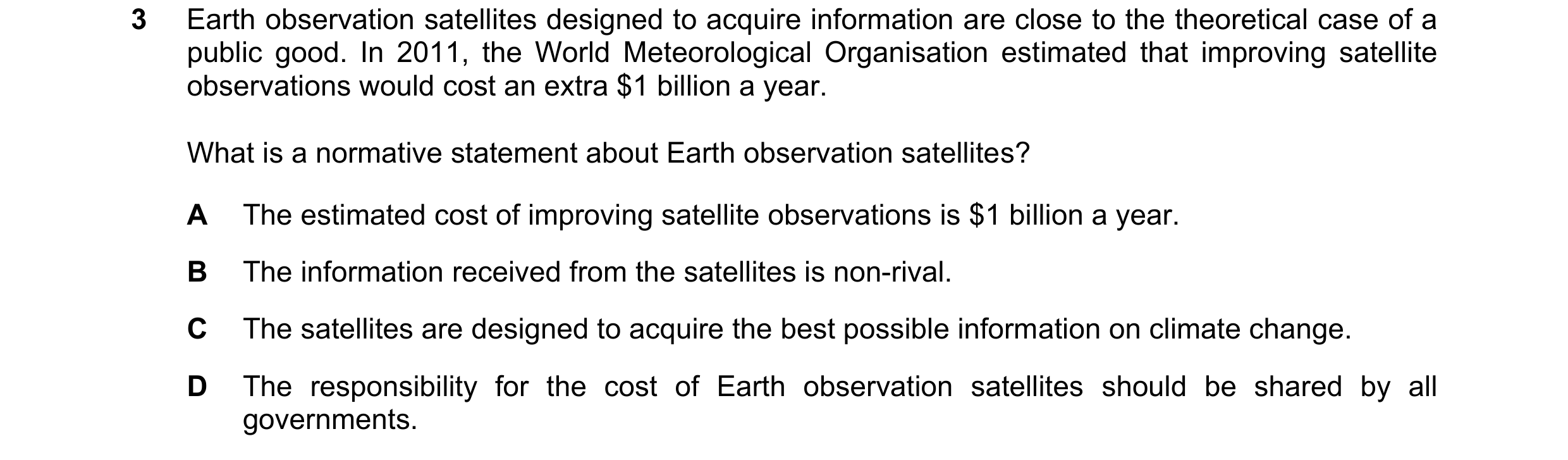
Q62 · Earth observation satellites designed to acquire information are close to the theoretical… 9708/12 May/June 2024
3 Earth observation satellites designed to acquire information are close to the theoretical case of a public good. In 2011, the World Meteorological Organisation estimated that improving satellite observations would cost an extra $1 billion a year. What is a normative statement about Earth observation satellites? A The estimated cost of improving satellite observations is $1 billion a year. B The information received from the satellites is non-rival. C The satellites are designed to acquire the best possible information on climate change. D The responsibility for the cost of Earth observation satellites should be shared by all governments.
1 marks
Answer: D
This question in 9708/12 May/June 2024
Q63 · What is true about a government’s macroeconomic objectives? 9708/12 May/June 2024
20 What is true about a government’s macroeconomic objectives? A Economic growth ensures a more even distribution of income. B Increasing output ensures that more workers are employed. C Choosing between macroeconomic objectives requires a normative decision. D A stable rate of inflation means zero inflation is required.
1 marks
Answer: C
This question in 9708/12 May/June 2024
Q64 · Which statement is a normative statement? 9708/11 Oct/Nov 2024
1 Which statement is a normative statement? A The annual rate of inflation in Malaysia increased from 2.8% in May 2022 to 3.4%. B The annual rate of inflation was 3.4% in Malaysia, lower than the 7.7% annual rate of inflation for Thailand. C The Malaysian Central Bank raised interest rates from 2.0% to 2.25% on 6 July 2022. D The rise in interest rates in Malaysia in July 2022 is expected to only have a small impact on the rate of inflation.
1 marks
Answer: D
This question in 9708/11 Oct/Nov 2024
Q65 · Which statement is positive? 9708/12 Oct/Nov 2024
4 Which statement is positive? A All taxes should be proportional to income. B A progressive tax is a fair tax. C Greater equality of income is desirable. D Income inequality is decreasing.
1 marks
Answer: D
This question in 9708/12 Oct/Nov 2024
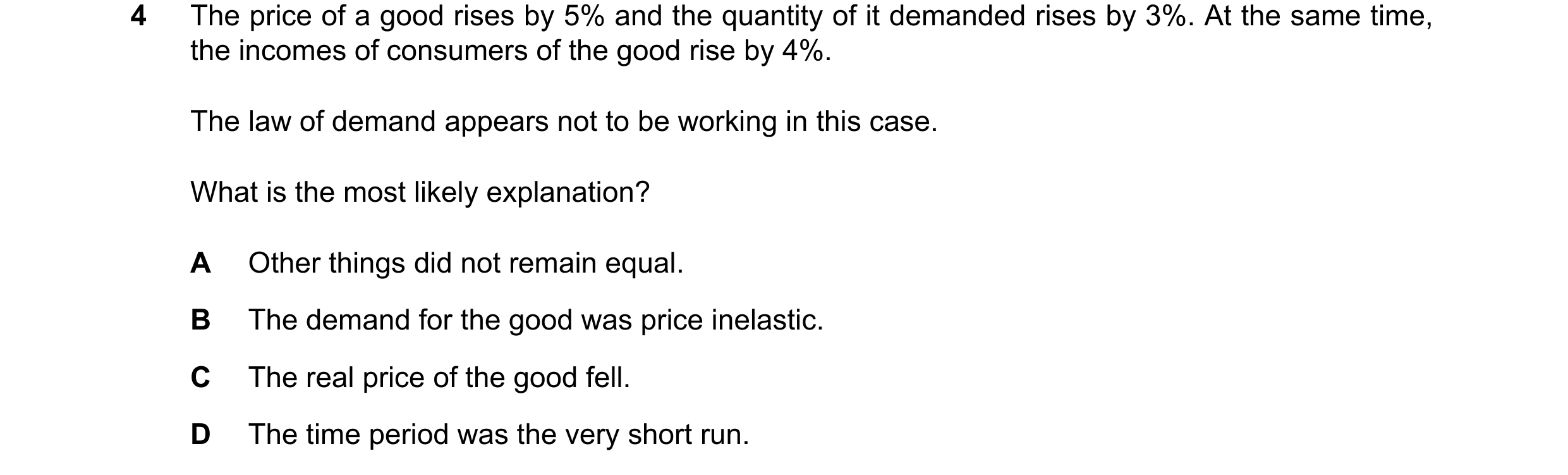
Q66 · The price of a good rises by 5% and the quantity of it demanded rises by 3% 9708/12 Feb/March 2025
4 The price of a good rises by 5% and the quantity of it demanded rises by 3%. At the same time, the incomes of consumers of the good rise by 4%. The law of demand appears not to be working in this case. What is the most likely explanation? A Other things did not remain equal. B The demand for the good was price inelastic. C The real price of the good fell. D The time period was the very short run.
1 marks
Answer: A
This question in 9708/12 Feb/March 2025
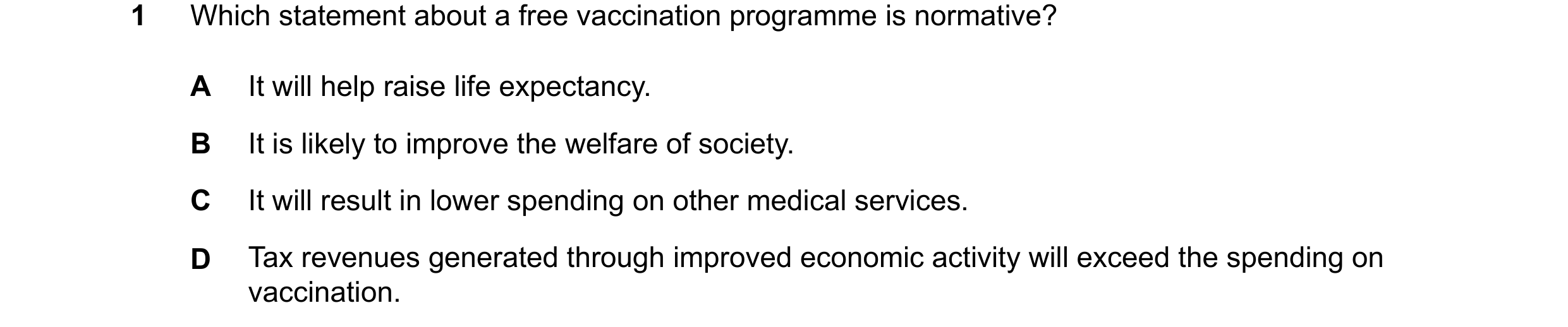
Q67 · Which statement about a free vaccination programme is normative? 9708/11 May/June 2025
1 Which statement about a free vaccination programme is normative? A It will help raise life expectancy. B It is likely to improve the welfare of society. C It will result in lower spending on other medical services. D Tax revenues generated through improved economic activity will exceed the spending on vaccination.
1 marks
Answer: B
This question in 9708/11 May/June 2025
Q68 · What is the best definition of a positive economic statement? 9708/12 May/June 2025
1 What is the best definition of a positive economic statement? A A statement that is based on fact and can be tested. B A statement that attempts to influence economic decisions. C A statement that is subjective and cannot be confirmed. D An encouraging economic update in the opinion of the central bank.
1 marks
Answer: A
This question in 9708/12 May/June 2025
Q69 · What is an example of a normative statement? 9708/11 Oct/Nov 2025
1 What is an example of a normative statement? A Indirect taxes are cheap to collect. B Indirect taxes are taxes on income. C Indirect taxes are unfair. D Indirect taxes increase inequality.
1 marks
Answer: C
This question in 9708/11 Oct/Nov 2025
Q70 · What is an example of a normative statement? 9708/12 Oct/Nov 2025
1 What is an example of a normative statement? A Government expenditure is an injection into the circular flow of income. B Government expenditure in India in 2022 was 29% of gross domestic product. C The best policy measure to reduce inflation is a reduction in government expenditure. D The United States of America is the country with the highest military expenditure.
1 marks
Answer: C
This question in 9708/12 Oct/Nov 2025
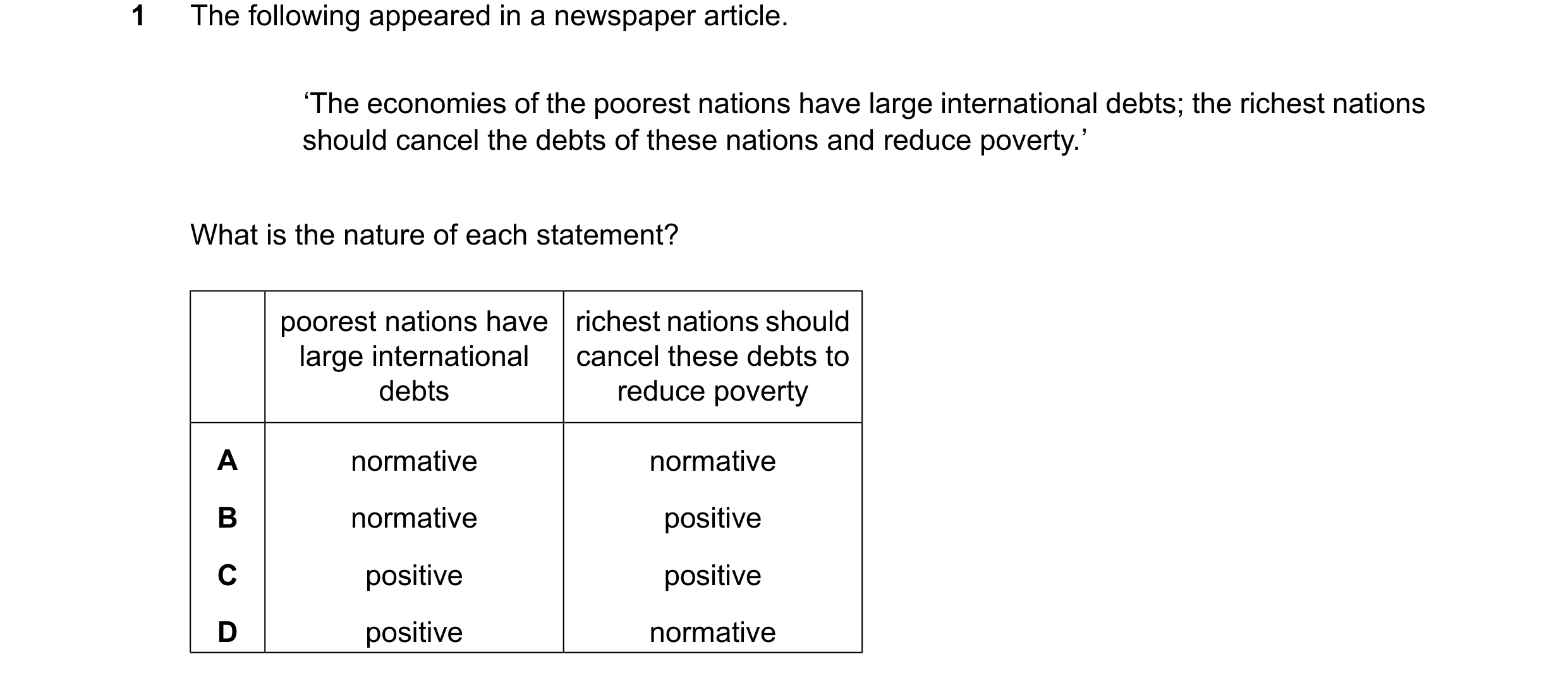
Q71 · The following appeared in a newspaper article 9708/13 Oct/Nov 2025
1 The following appeared in a newspaper article. ‘The economies of the poorest nations have large international debts; the richest nations should cancel the debts of these nations and reduce poverty.’ What is the nature of each statement? poorest nations have richest nations should large international cancel these debts to debts reduce poverty A normative normative B normative positive C positive positive D positive normative
1 marks
Answer: D
This question in 9708/13 Oct/Nov 2025



 1 / 14

 2 / 14

 3 / 14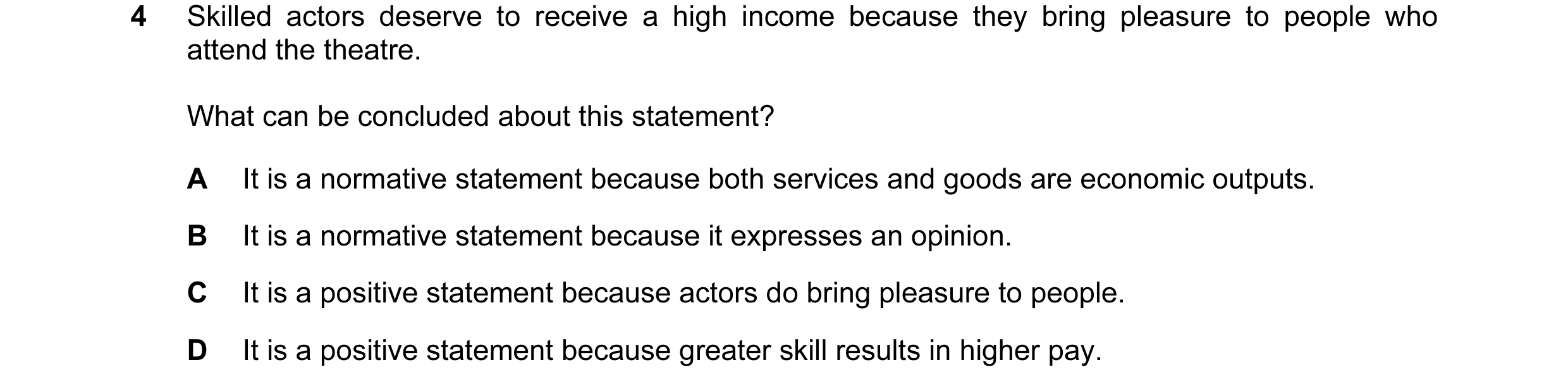

 4 / 14

 5 / 14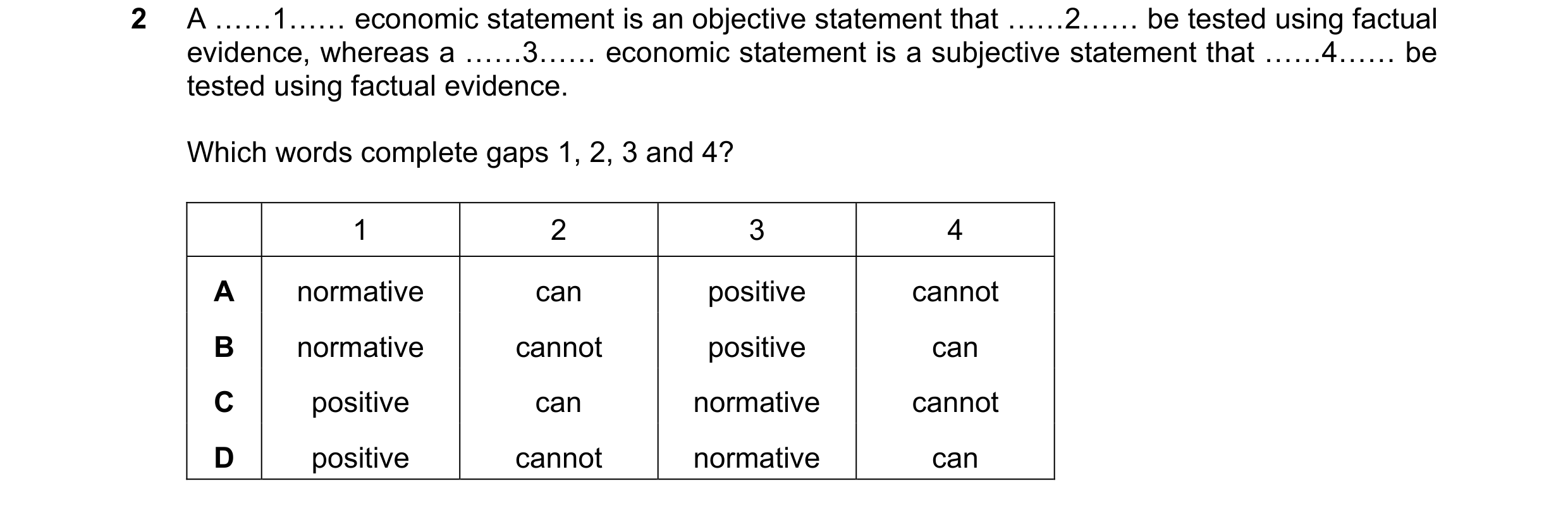
 6 / 14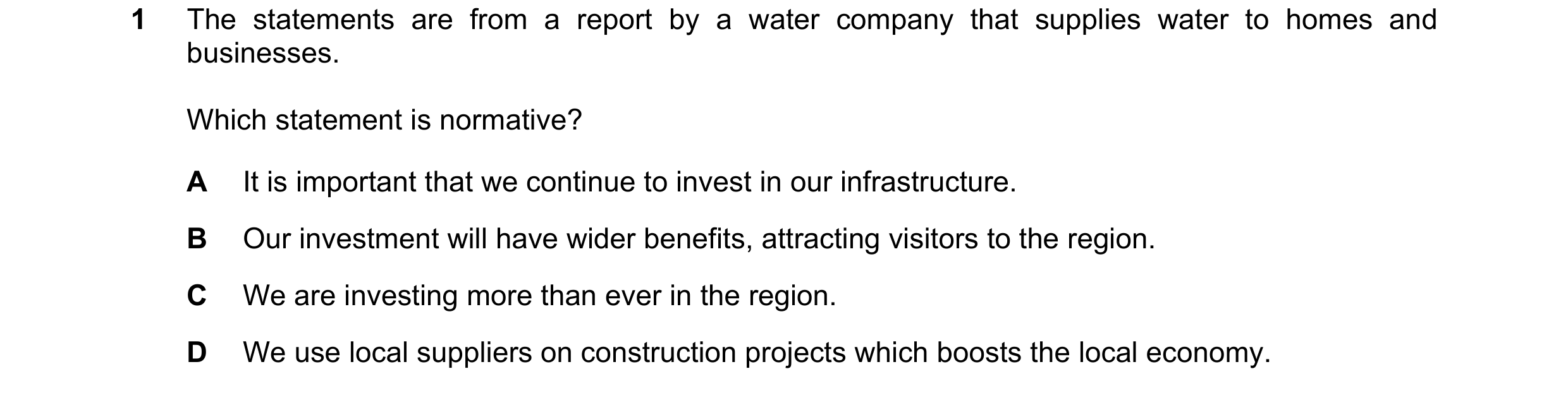

 7 / 14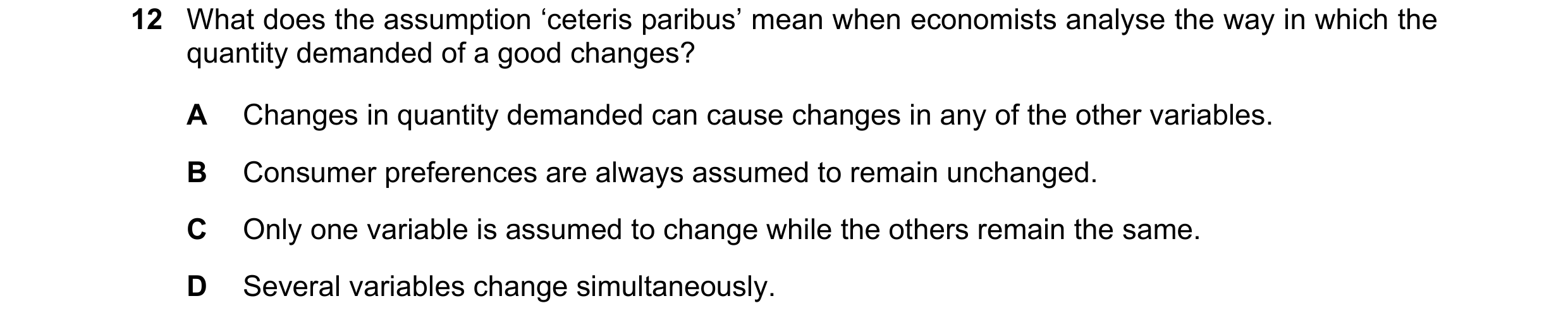

 8 / 14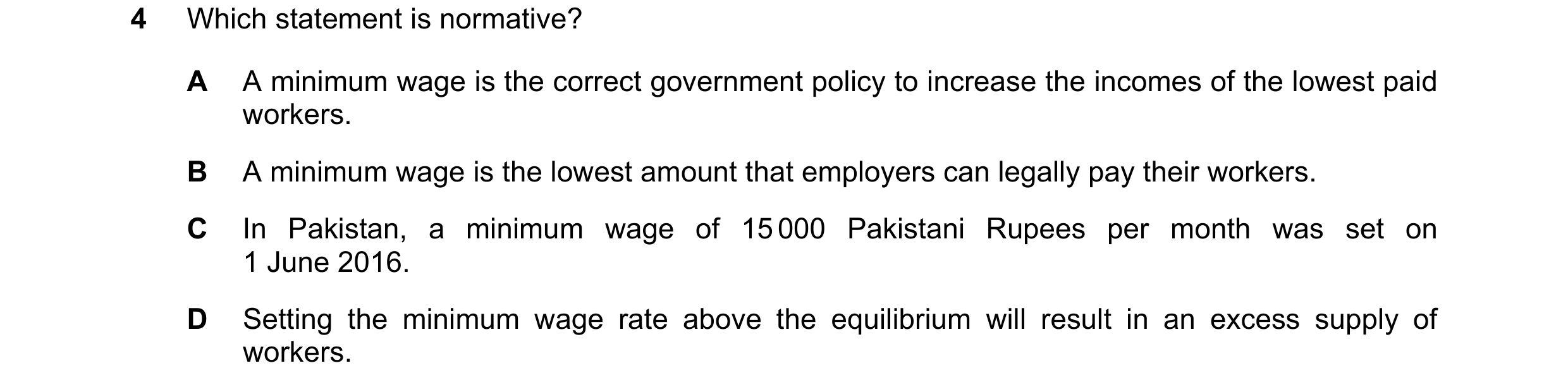

 9 / 14



 10 / 14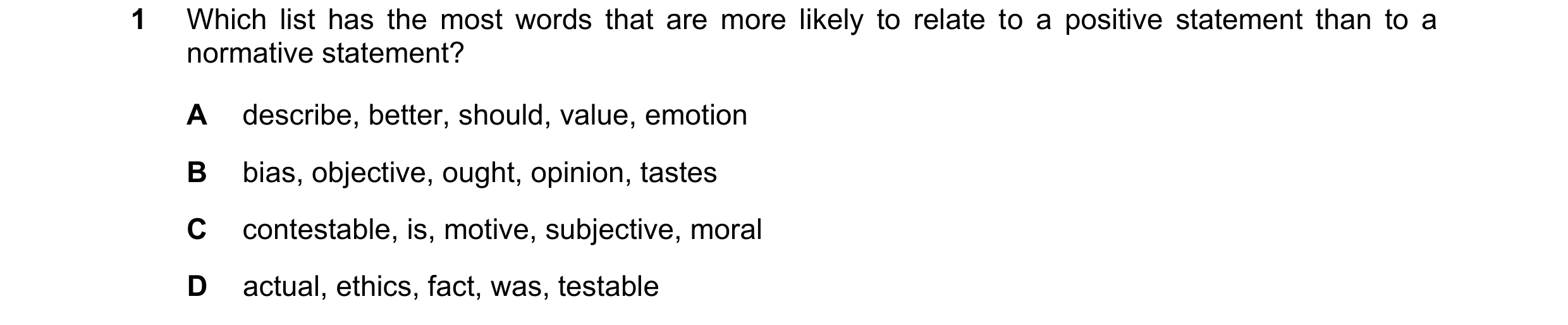
 11 / 14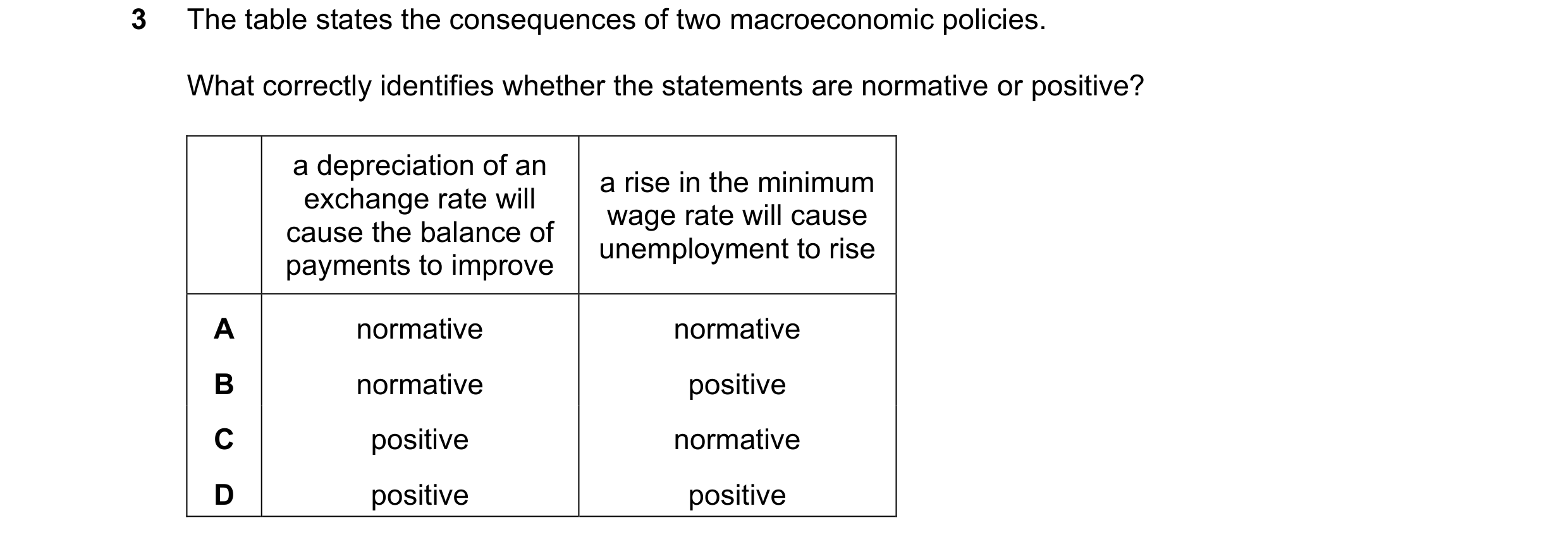

 12 / 14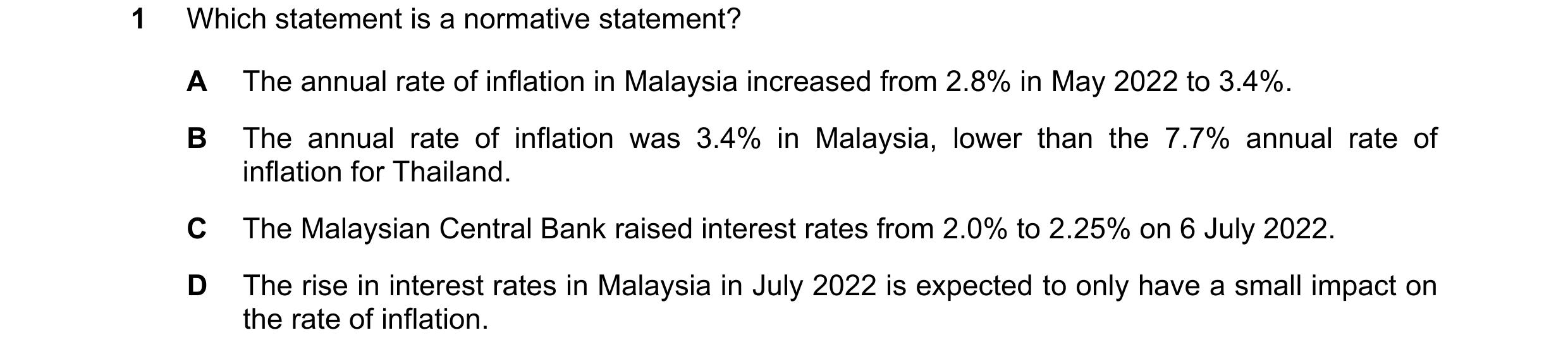

 13 / 14

 14 / 14