Questions as text
Q1 · Ice is made by freezing some water in the freezing compartment of a refrigerator 0654/41 Oct/Nov 2018
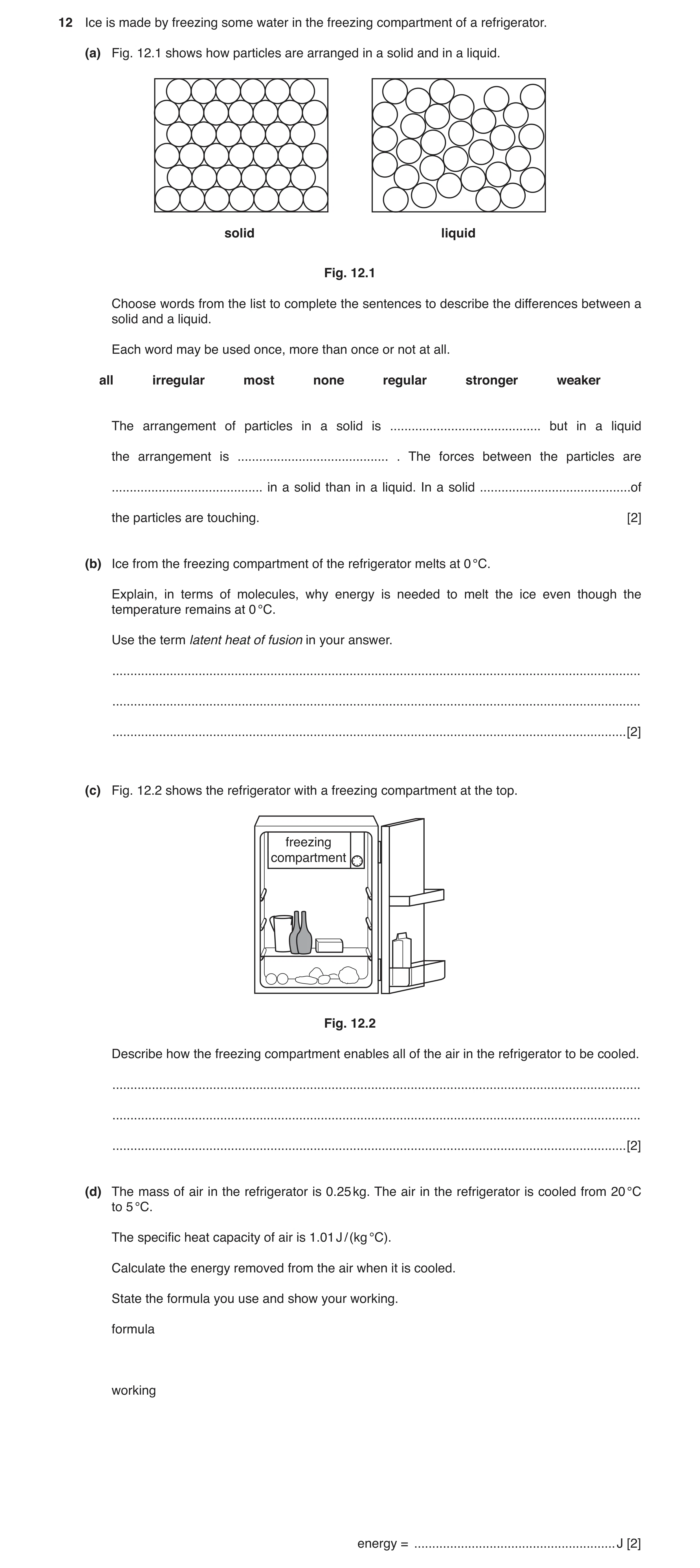
12 Ice is made by freezing some water in the freezing compartment of a refrigerator. (a) Fig. 12.1 shows how particles are arranged in a solid and in a liquid. solid liquid Fig. 12.1 Choose words from the list to complete the sentences to describe the differences between a solid and a liquid. Each word may be used once, more than once or not at all. all irregular most none regular stronger weaker The arrangement of particles in a solid is … but in a liquid the arrangement is … . The forces between the particles are … in a solid than in a liquid. In a solid … of the particles are touching. [2] (b) Ice from the freezing compartment of the refrigerator melts at 0 °C. Explain, in terms of molecules, why energy is needed to melt the ice even though the temperature remains at 0 °C. Use the term latent heat of fusion in your answer. … … … [2] (c) Fig. 12.2 shows the refrigerator with a freezing compartment at the top. freezing compartment Fig. 12.2 Describe how the freezing compartment enables all of the air in the refrigerator to be cooled. … … … [2] (d) The mass of air in the refrigerator is 0.25 kg. The air in the refrigerator is cooled from 20 °C to 5 °C. The specific heat capacity of air is 1.01 J / (kg °C). Calculate the energy removed from the air when it is cooled. State the formula you use and show your working. formula working energy = … J [2]
8 marks
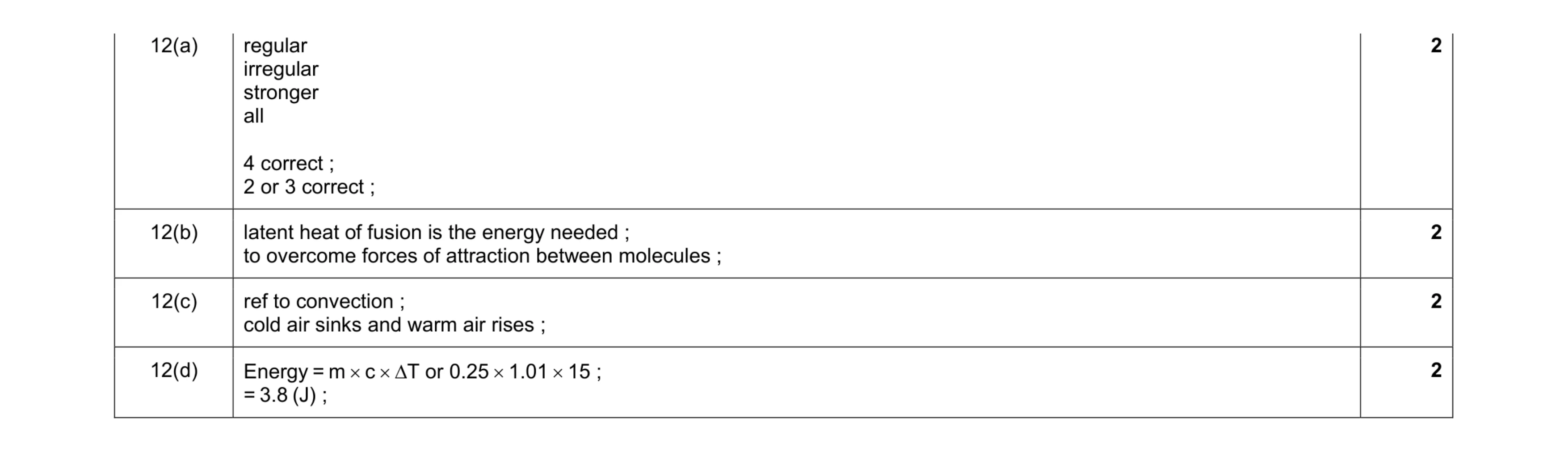
Mark scheme: 12(a) regular irregular stronger all 4 correct ; 2 or 3 correct ; 2 12(b) latent heat of fusion is the energy needed ; to overcome forces of attraction between molecules ; 2 12(c) ref to convection ; cold air sinks and warm air rises ; 2 12(d) Energy = m × c × ∆T or 0.25 × 1.01 × 15 ; = 3.8 (J) ; 2
This question in 0654/41 Oct/Nov 2018
Q2 · A bicycle with a front lamp A and a rear lamp B powered by the same battery 0654/42 Oct/Nov 2018
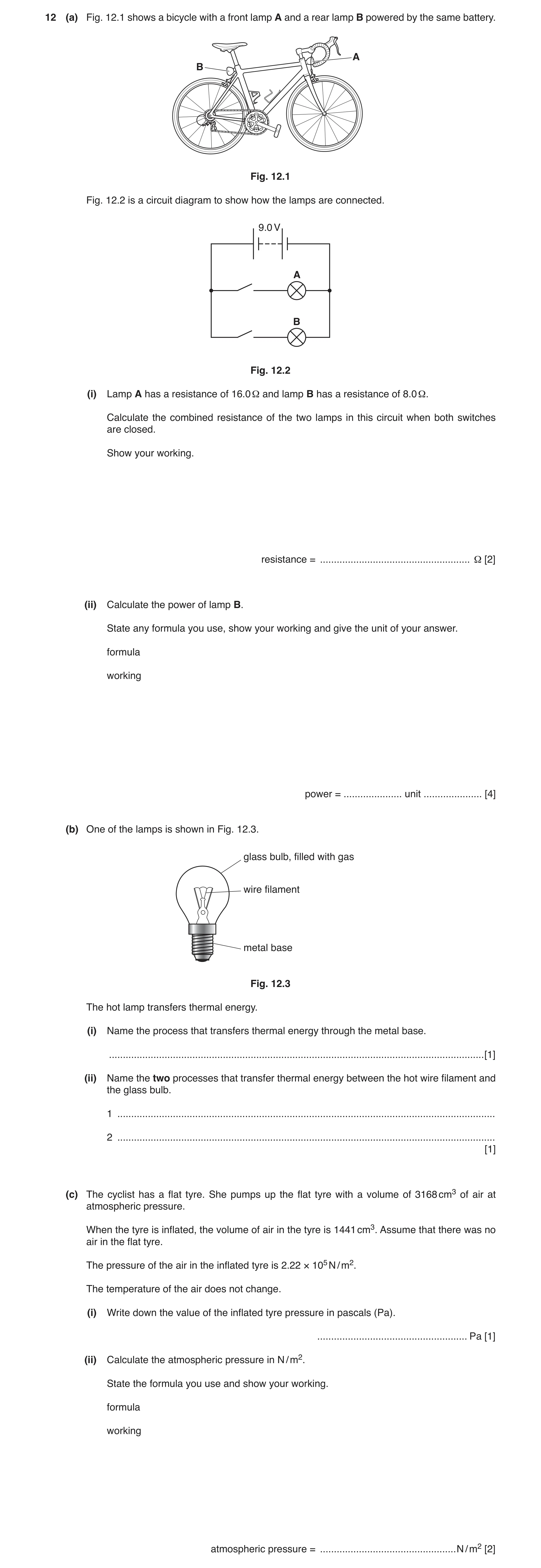
12 (a) Fig. 12.1 shows a bicycle with a front lamp A and a rear lamp B powered by the same battery. A B Fig. 12.1 Fig. 12.2 is a circuit diagram to show how the lamps are connected. 9.0 V A B Fig. 12.2 (i) Lamp A has a resistance of 16.0 Ω and lamp B has a resistance of 8.0 Ω. Calculate the combined resistance of the two lamps in this circuit when both switches are closed. Show your working. resistance = … Ω [2] (ii) Calculate the power of lamp B. State any formula you use, show your working and give the unit of your answer. formula working power = … unit … [4] (b) One of the lamps is shown in Fig. 12.3. glass bulb, filled with gas wire filament metal base Fig. 12.3 The hot lamp transfers thermal energy. (i) Name the process that transfers thermal energy through the metal base. … [1] (ii) Name the two processes that transfer thermal energy between the hot wire filament and the glass bulb. 1 … 2 … [1] (c) The cyclist has a flat tyre. She pumps up the flat tyre with a volume of 3168 cm3 of air at atmospheric pressure. When the tyre is inflated, the volume of air in the tyre is 1441 cm3. Assume that there was no air in the flat tyre. The pressure of the air in the inflated tyre is 2.22 × 10⁵ N / m2. The temperature of the air does not change. (i) Write down the value of the inflated tyre pressure in pascals (Pa). … Pa [1] (ii) Calculate the atmospheric pressure in N / m2. State the formula you use and show your working. formula working atmospheric pressure = … N / m2 [2]
11 marks
Mark scheme: 12(a)(i) 5.3(3) (Ω) ; 2 12(a)(ii) current = voltage / resistance or 9 / 8 OR 1.1(25) (A) ; power = voltage × current or 9 × 1.125 ; = 10(.125) ; Watts / W ; 4 12(b)(i) conduction ; 1 12(b)(ii) convection AND radiation ; 1 12(c)(i) 2.22 × 10⁵ (Pa) ; 1 12(c)(ii) P1 = (P2 × V2) / V1 or (2.22 × 105× 1441) / 3168 ; = 1.01 × 10⁵ (N / m2) ; 2
This question in 0654/42 Oct/Nov 2018
Q3 · The body of a car is usually made from steel 0654/43 Oct/Nov 2018
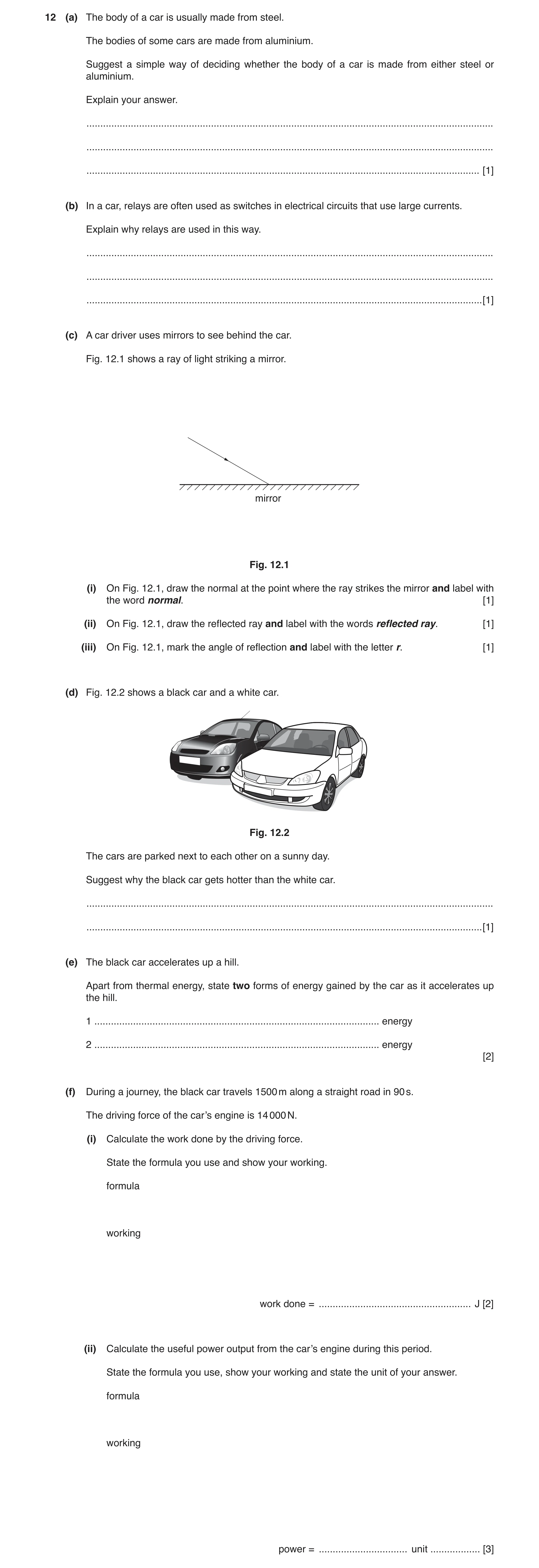
12 (a) The body of a car is usually made from steel. The bodies of some cars are made from aluminium. Suggest a simple way of deciding whether the body of a car is made from either steel or aluminium. Explain your answer. … … … [1] (b) In a car, relays are often used as switches in electrical circuits that use large currents. Explain why relays are used in this way. … … … [1] (c) A car driver uses mirrors to see behind the car. Fig. 12.1 shows a ray of light striking a mirror. mirror Fig. 12.1 (i) On Fig. 12.1, draw the normal at the point where the ray strikes the mirror and label with the word normal. [1] (ii) On Fig. 12.1, draw the reflected ray and label with the words reflected ray. [1] (iii) On Fig. 12.1, mark the angle of reflection and label with the letter r. [1] (d) Fig. 12.2 shows a black car and a white car. Fig. 12.2 The cars are parked next to each other on a sunny day. Suggest why the black car gets hotter than the white car. … … [1] (e) The black car accelerates up a hill. Apart from thermal energy, state two forms of energy gained by the car as it accelerates up the hill. 1 … energy 2 … energy [2] (f) During a journey, the black car travels 1500 m along a straight road in 90 s. The driving force of the car’s engine is 14 000 N. (i) Calculate the work done by the driving force. State the formula you use and show your working. formula working work done = … J [2] (ii) Calculate the useful power output from the car’s engine during this period. State the formula you use, show your working and state the unit of your answer. formula working power = … unit … [3]
13 marks
Mark scheme: 12(a) use a magnet (no mark) steel is magnetic / attracted to a magnet ; 1 12(b) to switch high current circuits using a small current circuit / so a high current circuit can be switched safely / so that a switch with a low current rating can be used to switch a high current ; 1 12(c)(i) normal drawn and labelled ; 1 12(c)(ii) reflected ray drawn with approx. correct angle of reflection ; 1 12(c)(iii) correctly labelled angle of reflection ; 1 12(d) black surfaces are better absorbers of thermal radiation (than white surfaces) / white surfaces are better reflectors of thermal radiation (than black surfaces) ; 1 12(e) kinetic ; gravitational (potential) ; 2 12(f)(i) work = force × distance or 14 000 × 1500 ; = 21 000 000 (J) ; 2 12(f)(ii) power = energy time or work time or 21000000 90 ; = 230 000 ; W ; 3
This question in 0654/43 Oct/Nov 2018
Q4 · During a mission to the Moon in 1971, an astronaut dropped a feather and a hammer 0654/41 May/June 2019
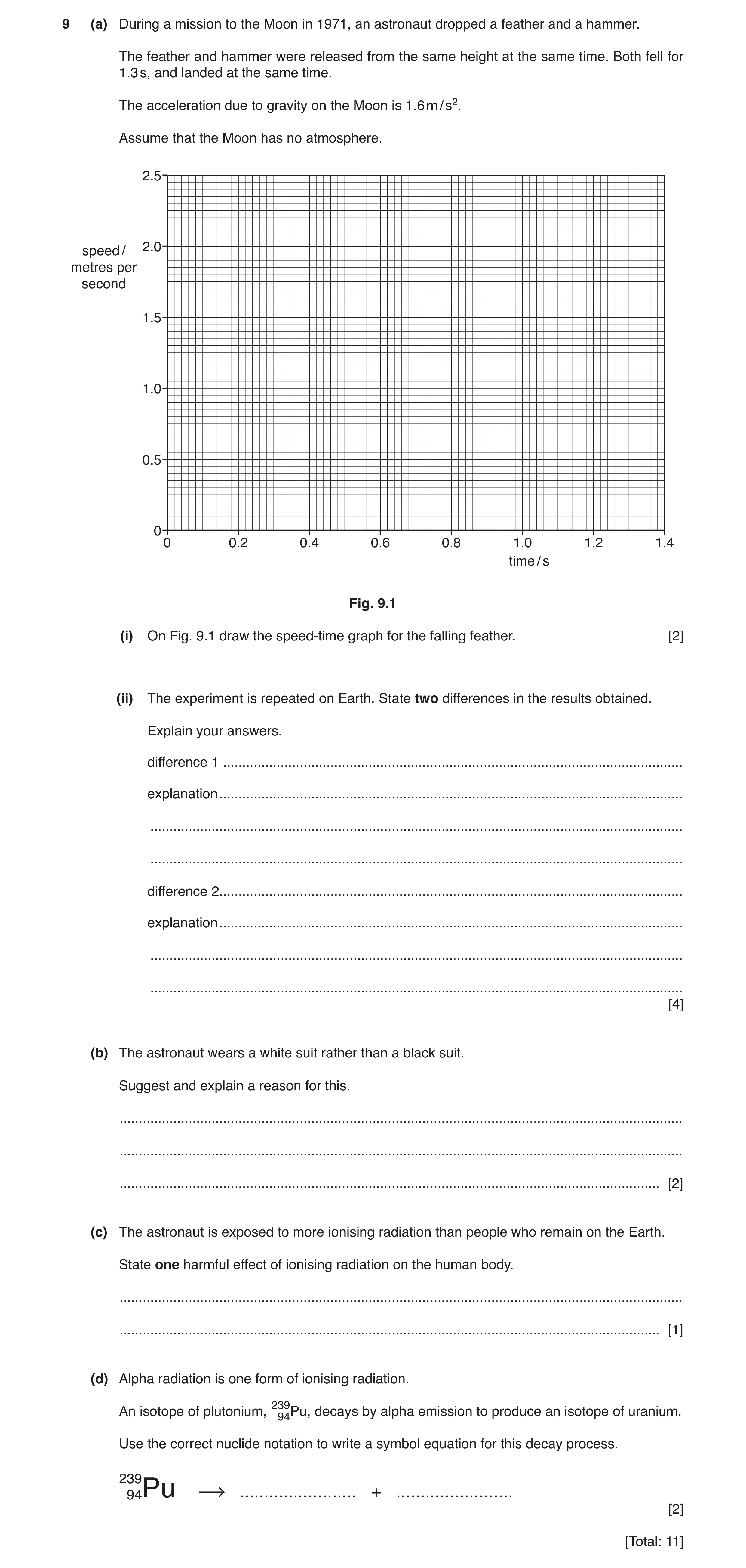
9 (a) During a mission to the Moon in 1971, an astronaut dropped a feather and a hammer. The feather and hammer were released from the same height at the same time. Both fell for 1.3 s, and landed at the same time. The acceleration due to gravity on the Moon is 1.6 m / s2. Assume that the Moon has no atmosphere. 2.5 2.0 speed / metres per second 1.5 1.0 0.5 0 0 0.2 0.4 0.6 0.8 1.0 1.2 1.4 time / s Fig. 9.1 (i) On Fig. 9.1 draw the speed-time graph for the falling feather. [2] (ii) The experiment is repeated on Earth. State two differences in the results obtained. Explain your answers. difference 1 … explanation … … … difference 2 … explanation … … … [4] (b) The astronaut wears a white suit rather than a black suit. Suggest and explain a reason for this. … … … [2] (c) The astronaut is exposed to more ionising radiation than people who remain on the Earth. State one harmful effect of ionising radiation on the human body. … … [1] (d) Alpha radiation is one form of ionising radiation. 239 An isotope of plutonium, 94Pu, decays by alpha emission to produce an isotope of uranium. Use the correct nuclide notation to write a symbol equation for this decay process. 239 … + … 94Pu [2] [Total: 11]
11 marks
Mark scheme: 9(a)(i) straight line from 0,0 through 1.0, 1.6 ; stopping at t = 1.3 ; 2 9(a)(ii) hammer falls faster on Earth than on the Moon ; gravity on Earth greater ; feather falls slower on Earth than on Moon ; reference to air resistance on Earth ; hammer falls faster than feather on Earth ; reference to air resistance on Earth ; max 4 9(b) astronaut stays cooler in white / would get very hot in black ; white surfaces are better reflectors of thermal radiation (than black surfaces) / black surfaces are better absorbers of thermal radiation (than white surfaces) ; 2 9(c) cancer/mutation ; 1 9(d) ; ; 2
This question in 0654/41 May/June 2019
Q5 · In 1971, an astronaut hit a golf ball on the surface of the Moon 0654/42 May/June 2019
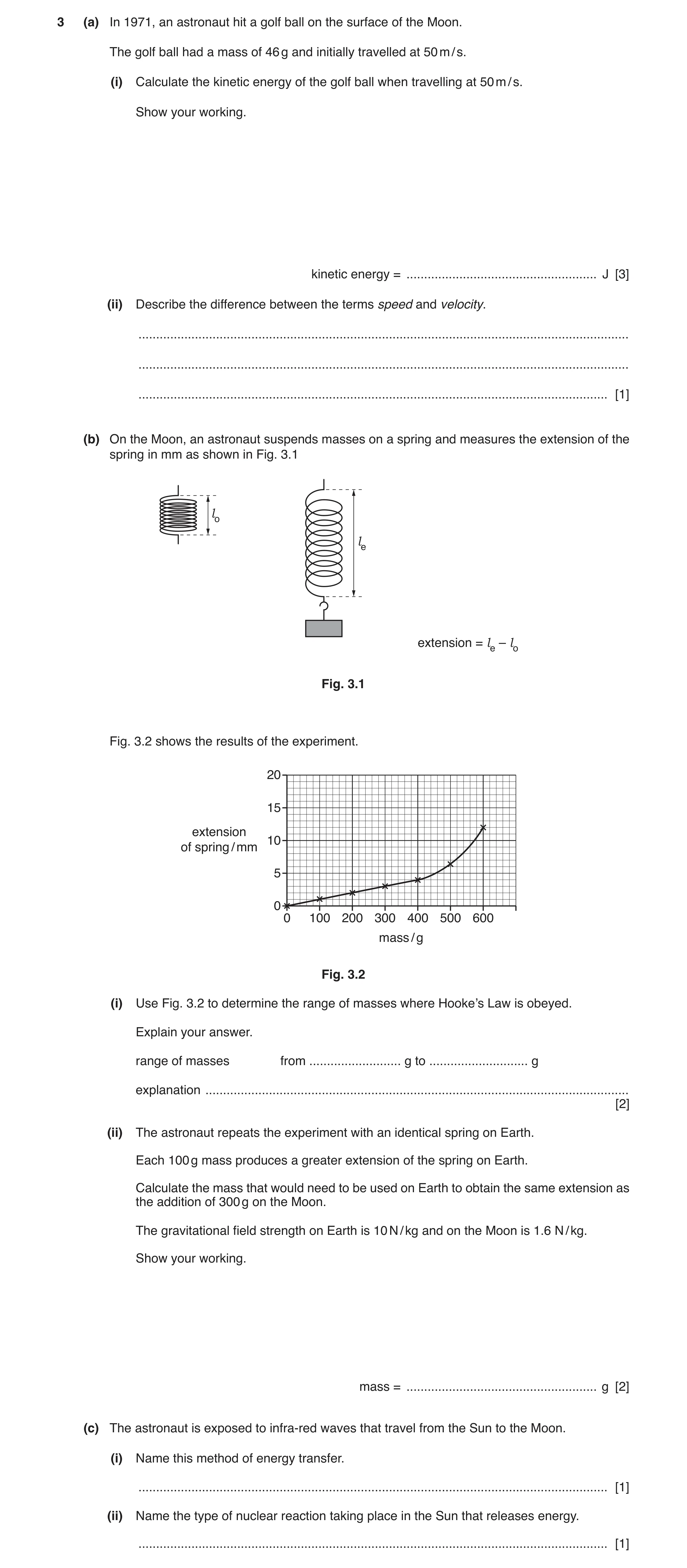
3 (a) In 1971, an astronaut hit a golf ball on the surface of the Moon. The golf ball had a mass of 46 g and initially travelled at 50 m / s. (i) Calculate the kinetic energy of the golf ball when travelling at 50 m / s. Show your working. kinetic energy = … J [3] (ii) Describe the difference between the terms speed and velocity. … … … [1] (b) On the Moon, an astronaut suspends masses on a spring and measures the extension of the spring in mm as shown in Fig. 3.1 lo le extension = le – lo Fig. 3.1 Fig. 3.2 shows the results of the experiment. 20 15 extension 10 of spring / mm 5 0 0 100 200 300 400 500 600 mass / g Fig. 3.2 (i) Use Fig. 3.2 to determine the range of masses where Hooke’s Law is obeyed. Explain your answer. range of masses from … g to … g explanation … [2] (ii) The astronaut repeats the experiment with an identical spring on Earth. Each 100 g mass produces a greater extension of the spring on Earth. Calculate the mass that would need to be used on Earth to obtain the same extension as the addition of 300 g on the Moon. The gravitational field strength on Earth is 10 N / kg and on the Moon is 1.6 N / kg. Show your working. mass = … g [2] (c) The astronaut is exposed to infra-red waves that travel from the Sun to the Moon. (i) Name this method of energy transfer. … [1] (ii) Name the type of nuclear reaction taking place in the Sun that releases energy. … [1]
10 marks
Mark scheme: 3(a)(i) g to kg conversion ; (KE) = ½ mv2 / ½ × 0.046 × 50 × 50 ; = 57.5 (J) ; 3 3(a)(ii) speed has magnitude (only) and velocity has magnitude and direction ; 1 3(b)(i) from 0 to 400 g ; extension directly proportional to mass / straight line ; 2 3(b)(ii) working e.g. 1.6 / 10 × 300 ; = 48 (g) ; 2 3(c)(i) radiation ; 1 3(c)(ii) fusion ; 1
This question in 0654/42 May/June 2019
Q6 · A potato being baked in the oven of an electric cooker 0654/41 Oct/Nov 2019
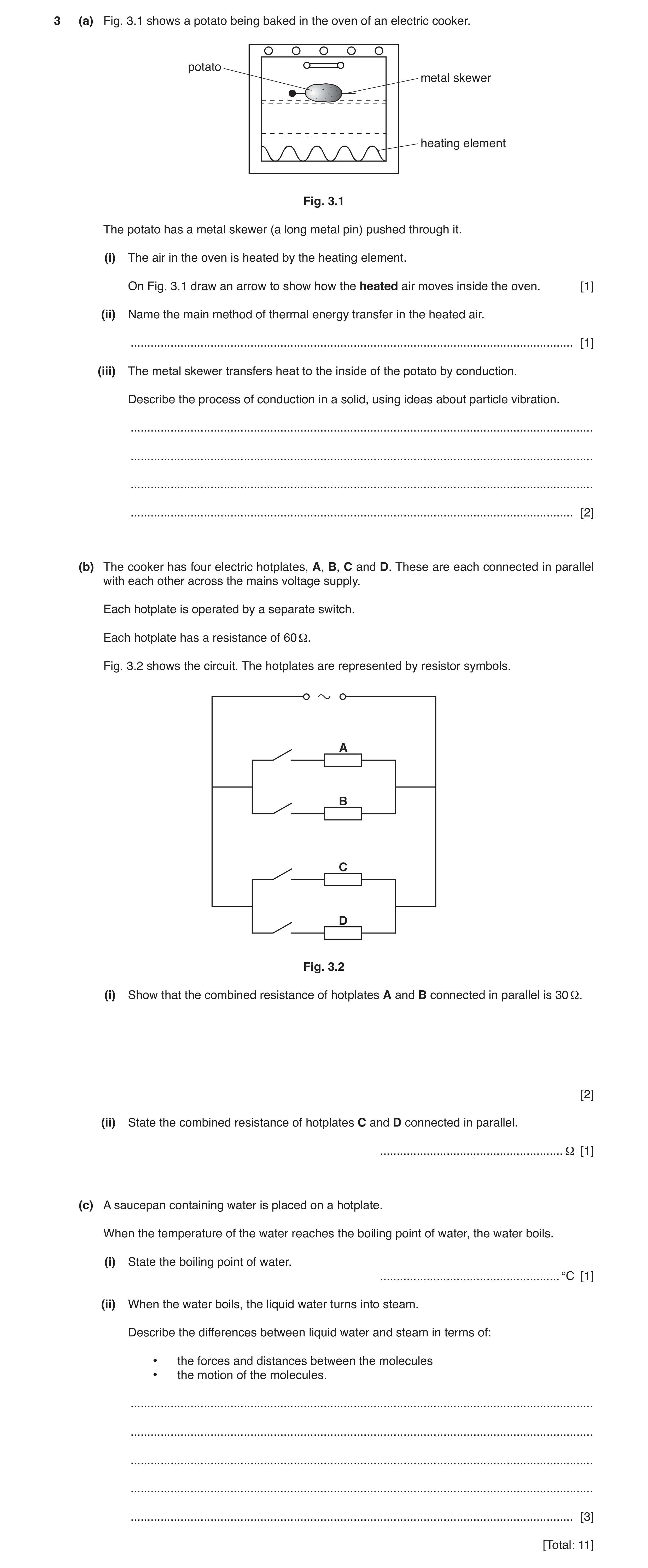
3 (a) Fig. 3.1 shows a potato being baked in the oven of an electric cooker. potato metal skewer heating element Fig. 3.1 The potato has a metal skewer (a long metal pin) pushed through it. (i) The air in the oven is heated by the heating element. On Fig. 3.1 draw an arrow to show how the heated air moves inside the oven. [1] (ii) Name the main method of thermal energy transfer in the heated air. … [1] (iii) The metal skewer transfers heat to the inside of the potato by conduction. Describe the process of conduction in a solid, using ideas about particle vibration. … … … … [2] (b) The cooker has four electric hotplates, A, B, C and D. These are each connected in parallel with each other across the mains voltage supply. Each hotplate is operated by a separate switch. Each hotplate has a resistance of 60 Ω. Fig. 3.2 shows the circuit. The hotplates are represented by resistor symbols. A B C D Fig. 3.2 (i) Show that the combined resistance of hotplates A and B connected in parallel is 30 Ω. [2] (ii) State the combined resistance of hotplates C and D connected in parallel. … Ω [1] (c) A saucepan containing water is placed on a hotplate. When the temperature of the water reaches the boiling point of water, the water boils. (i) State the boiling point of water. … °C [1] (ii) When the water boils, the liquid water turns into steam. Describe the differences between liquid water and steam in terms of: • the forces and distances between the molecules • the motion of the molecules. … … … … … [3] [Total: 11]
11 marks
Mark scheme: 3(a)(i) arrow showing heated air rising ; 1 3(a)(ii) convection ; 1 3(a)(iii) particles vibrate more / gain energy ; this vibration is passed through metal ; 2 3(b)(i) use of correct formula ; evidence of correct working ; 2 3(b)(ii) 30 Ω ; 1 3(c)(i) 100 (°C) ; 1 3(c)(ii) stronger forces of attraction between water molecules in liquid ; water molecules are closer together in liquid ; water molecules have greater freedom of movement / collide less frequently in steam / owtte ; 3
This question in 0654/41 Oct/Nov 2019
Question 7 0654/42 Oct/Nov 2019
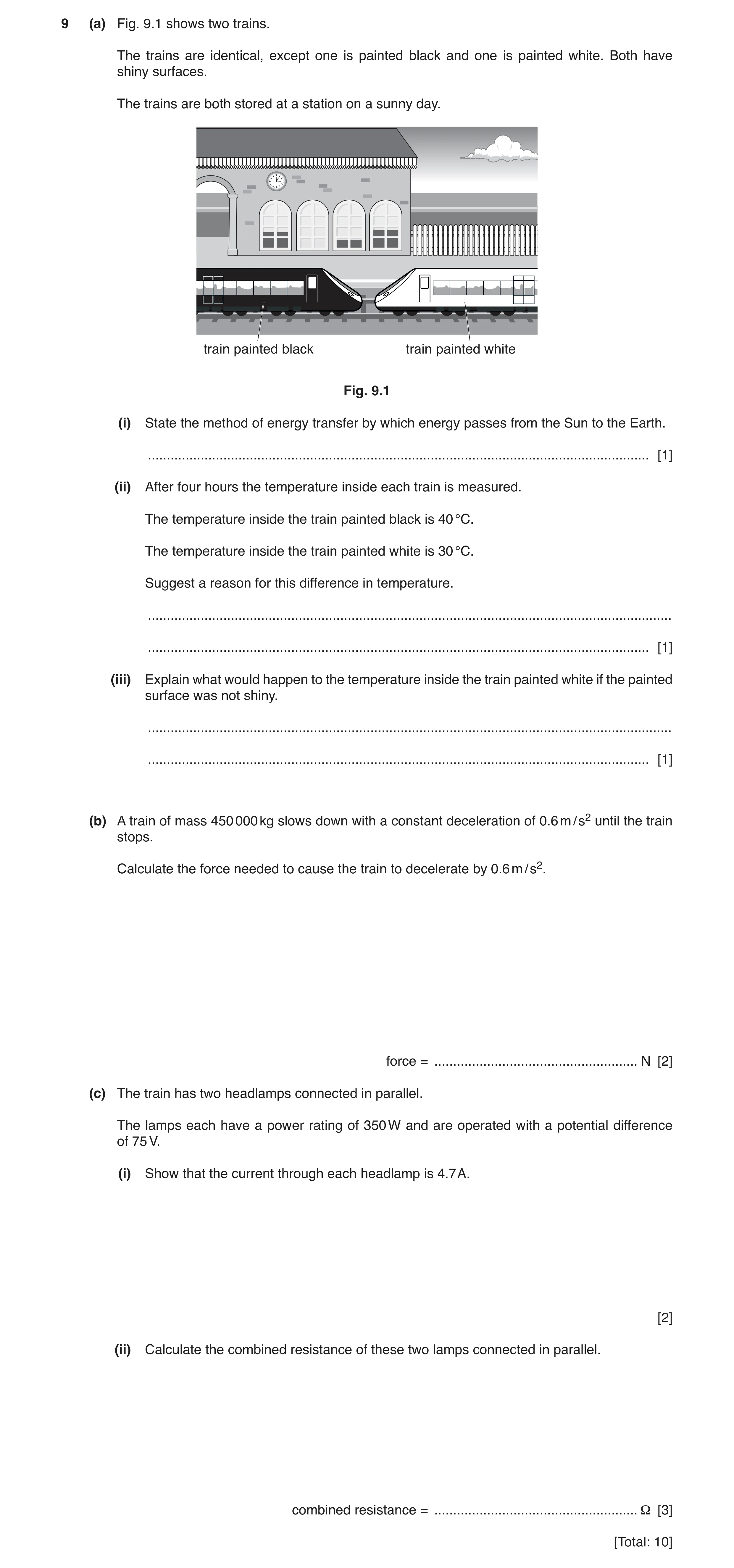
9 (a) Fig. 9.1 shows two trains. The trains are identical, except one is painted black and one is painted white. Both have shiny surfaces. The trains are both stored at a station on a sunny day. train painted black train painted white Fig. 9.1 (i) State the method of energy transfer by which energy passes from the Sun to the Earth. … [1] (ii) After four hours the temperature inside each train is measured. The temperature inside the train painted black is 40 °C. The temperature inside the train painted white is 30 °C. Suggest a reason for this difference in temperature. … … [1] (iii) Explain what would happen to the temperature inside the train painted white if the painted surface was not shiny. … … [1] (b) A train of mass 450 000 kg slows down with a constant deceleration of 0.6 m / s2 until the train stops. Calculate the force needed to cause the train to decelerate by 0.6 m / s2. force = … N [2] (c) The train has two headlamps connected in parallel. The lamps each have a power rating of 350 W and are operated with a potential difference of 75 V. (i) Show that the current through each headlamp is 4.7 A. [2] (ii) Calculate the combined resistance of these two lamps connected in parallel. combined resistance = … Ω [3] [Total: 10]
10 marks
Mark scheme: 9(a)(i) radiation ; 1 9(a)(ii) black surfaces absorb, heat / thermal energy / infra-red more than white surfaces / ORA ; 1 9(a)(iii) white train would be hotter (than previously) because dull surfaces are poorer reflectors of radiation ; 1 9(b) force = mass × acceleration or 450 000 × 0.6 ; = 270 000 (N) ; 2 9(c)(i) (current =) power / voltage ; = 350 / 75 ; (= 4.67 / 4.7 A ) 2 9(c)(ii) (resistance of lamp =) voltage / current or 75 / 4.7 = 16.0 (Ω) ; 1 / RT = 1 / R1 + 1 / R2 or 1 / 16.0 + 1 / 16.0 ; = 8.0 (Ω) ; OR use of R = V / I ; (combined resistance =) voltage / total current or 75 / (2 × 4.7) ; = 8.0 (Ω) ; 3
This question in 0654/42 Oct/Nov 2019
Q8 · A bar magnet suspended by a spring above a coil that is connected to a voltmeter 0654/43 Oct/Nov 2019
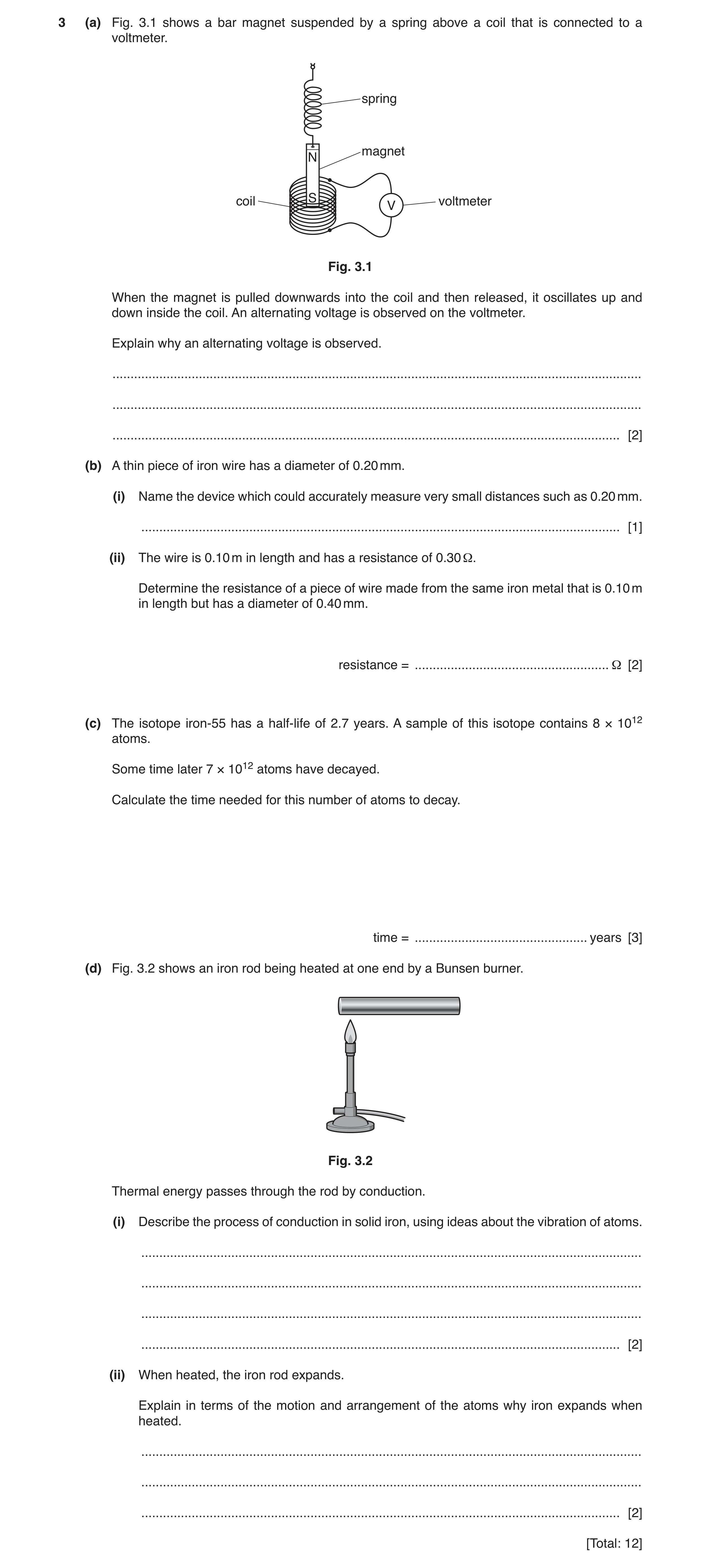
3 (a) Fig. 3.1 shows a bar magnet suspended by a spring above a coil that is connected to a voltmeter. spring magnet N coil S voltmeter V Fig. 3.1 When the magnet is pulled downwards into the coil and then released, it oscillates up and down inside the coil. An alternating voltage is observed on the voltmeter. Explain why an alternating voltage is observed. … … … [2] (b) A thin piece of iron wire has a diameter of 0.20 mm. (i) Name the device which could accurately measure very small distances such as 0.20 mm. … [1] (ii) The wire is 0.10 m in length and has a resistance of 0.30 Ω. Determine the resistance of a piece of wire made from the same iron metal that is 0.10 m in length but has a diameter of 0.40 mm. resistance = … Ω [2] (c) The isotope iron-55 has a half-life of 2.7 years. A sample of this isotope contains 8 × 10¹² atoms. Some time later 7 × 10¹² atoms have decayed. Calculate the time needed for this number of atoms to decay. time = … years [3] (d) Fig. 3.2 shows an iron rod being heated at one end by a Bunsen burner. Fig. 3.2 Thermal energy passes through the rod by conduction. (i) Describe the process of conduction in solid iron, using ideas about the vibration of atoms. … … … … [2] (ii) When heated, the iron rod expands. Explain in terms of the motion and arrangement of the atoms why iron expands when heated. … … … [2] [Total: 12]
12 marks
Mark scheme: 3(a) voltage induced as coil cuts magnetic field / induced as magnetic field in coil changes ; voltage reverses when magnet changes direction ; 2 3(b)(i) micrometer screw gauge ; 1 3(b)(ii) doubling diameter quadruples CSA / evidence of dividing by 4 ; 0.075 (Ω) ; 2 3(c) 1 × 10¹² atoms undecayed ; 3 half-lives ; (3 × 2.7) = 8.1 (years) ; 3 3(d)(i) (incident energy / energy gained, makes) atoms vibrate more ; this vibration is passed through metal ; 2 3(d)(ii) atoms have greater (amplitude of) vibration ; about a fixed point so take up more space / (average) distance between particles increases / owtte ; 2
This question in 0654/43 Oct/Nov 2019
Q9 · A gardener cuts grass with an electric mower 0654/43 Oct/Nov 2019
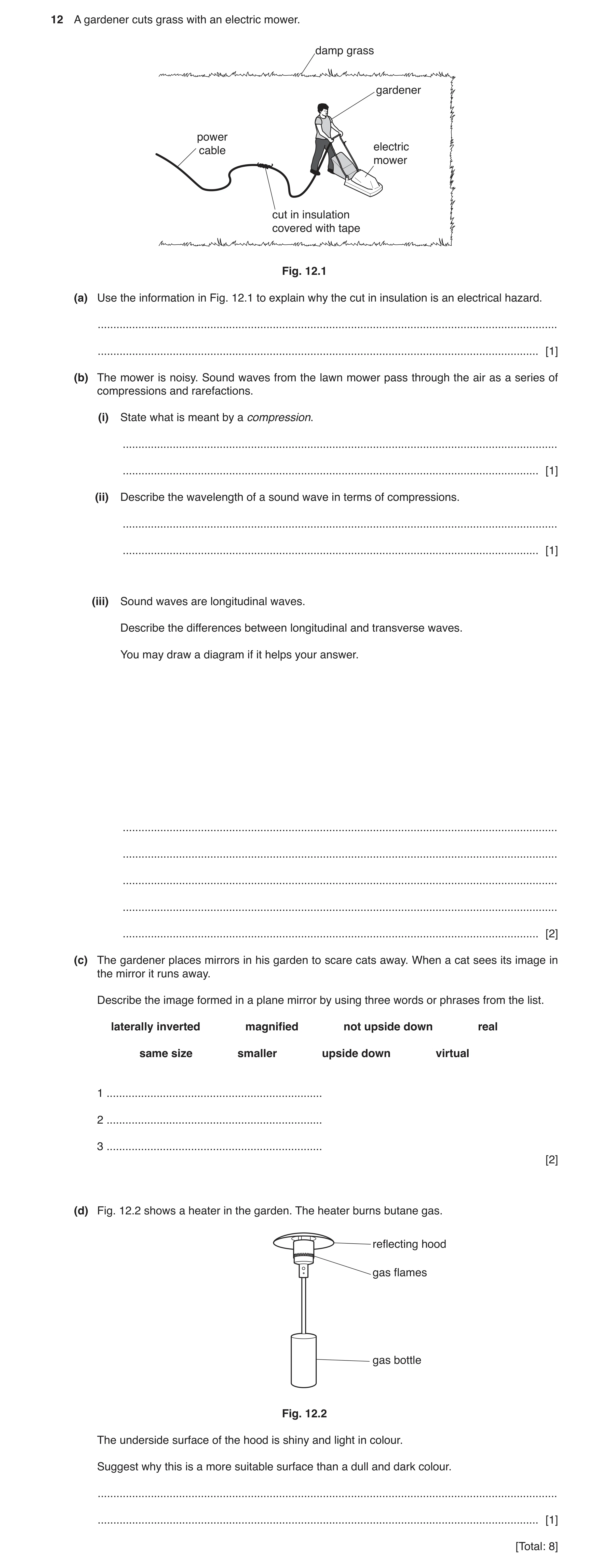
12 A gardener cuts grass with an electric mower. damp grass gardener power electric cable mower cut in insulation covered with tape Fig. 12.1 (a) Use the information in Fig. 12.1 to explain why the cut in insulation is an electrical hazard. … … [1] (b) The mower is noisy. Sound waves from the lawn mower pass through the air as a series of compressions and rarefactions. (i) State what is meant by a compression. … … [1] (ii) Describe the wavelength of a sound wave in terms of compressions. … … [1] (iii) Sound waves are longitudinal waves. Describe the differences between longitudinal and transverse waves. You may draw a diagram if it helps your answer. … … … … … [2] (c) The gardener places mirrors in his garden to scare cats away. When a cat sees its image in the mirror it runs away. Describe the image formed in a plane mirror by using three words or phrases from the list. laterally inverted magnified not upside down real same size smaller upside down virtual 1 … 2 … 3 … [2] (d) Fig. 12.2 shows a heater in the garden. The heater burns butane gas. reflecting hood gas flames gas bottle Fig. 12.2 The underside surface of the hood is shiny and light in colour. Suggest why this is a more suitable surface than a dull and dark colour. … … [1] [Total: 8]
8 marks
Mark scheme: 12(a) tape repair may let in water / short circuit / fire / electrocution ; 1 12(b)(i) region of high pressure / region of a high concentration of molecules ; 1 12(b)(ii) distance between two successive compressions ; 1 12(b)(iii) transverse waves – direction of propagation perpendicular to direction of oscillation ; longitudinal – direction of propagation parallel to direction of oscillation ; 2 12(c) Any 3 from laterally inverted ; same size ; virtual ; not upside down ; max 2 2 12(d) shiny / light surface will reflect more thermal energy / dull / dark surface will absorb more thermal energy ; 1
This question in 0654/43 Oct/Nov 2019
Q10 · Describe how thermal energy passes through copper by conduction 0654/41 May/June 2020
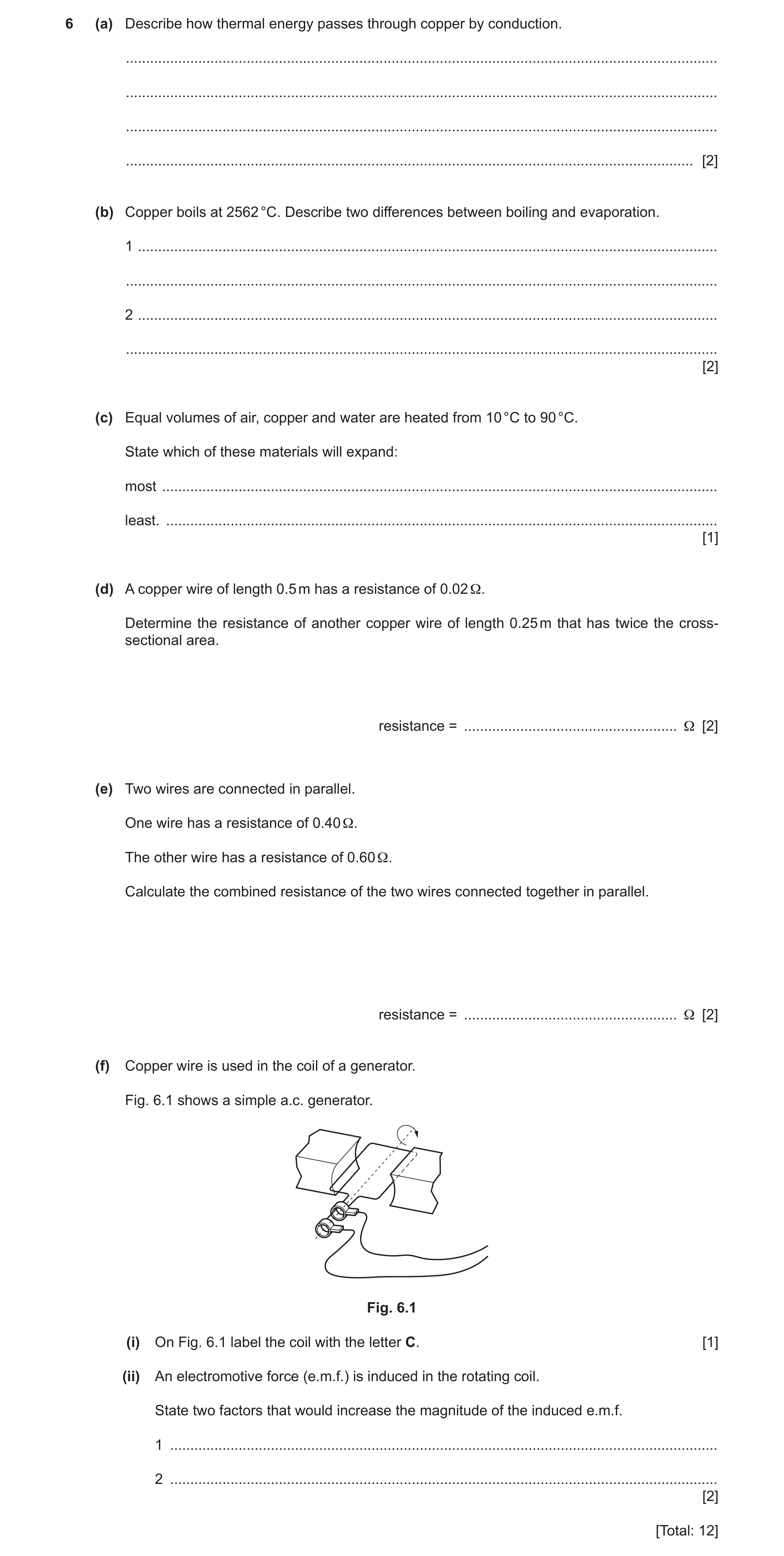
6 (a) Describe how thermal energy passes through copper by conduction. … … … … [2] (b) Copper boils at 2562 °C. Describe two differences between boiling and evaporation. 1 … … 2 … … [2] (c) Equal volumes of air, copper and water are heated from 10 °C to 90 °C. State which of these materials will expand: most … least. … [1] (d) A copper wire of length 0.5 m has a resistance of 0.02 Ω. Determine the resistance of another copper wire of length 0.25 m that has twice the cross- sectional area. resistance = … Ω [2] (e) Two wires are connected in parallel. One wire has a resistance of 0.40 Ω. The other wire has a resistance of 0.60 Ω. Calculate the combined resistance of the two wires connected together in parallel. resistance = … Ω [2] (f) Copper wire is used in the coil of a generator. Fig. 6.1 shows a simple a.c. generator. Fig. 6.1 (i) On Fig. 6.1 label the coil with the letter C. [1] (ii) An electromotive force (e.m.f.) is induced in the rotating coil. State two factors that would increase the magnitude of the induced e.m.f. 1 … 2 … [2] [Total: 12]
12 marks
Mark scheme: 6(a) thermal energy transferred as (vibrational) energy of atoms ; vibrations passed from atom to atom ; delocalised electrons transfer energy ; max 2 Question Answer Marks 6(b) evaporation can occur at any temperature / boiling occurs at the boiling point; evaporation happens only at the surface / boiling occurs throughout the liquid; during boiling all / most moleculaes have enough energy to leave / evaporation only lets the molecules with the greatest kinetic energy escape; evaporation can occur using the internal energy of the system / boiling requires a(n external) source of heat; evaporation is a slow process / boiling is a rapid process; evaporation produces cooling / boiling does not produce cooling; max 2 6(c) most – air and least copper ; 1 6(d) evidence of division by 2 twice; 0.005 (Ω) ; 2 6(e) 1/RT = 1/R1 + 1/R2 or RT = R1 R2 /R1 + R2 or correct substitution; 0.24 (Ω) ; 2 6(f)(i) coil labelled correctly; 1 6(f)(ii) rotate coil faster ; increase magnetic field strength ; 2
This question in 0654/41 May/June 2020
Q11 · A laptop computer and charger 0654/41 Oct/Nov 2020
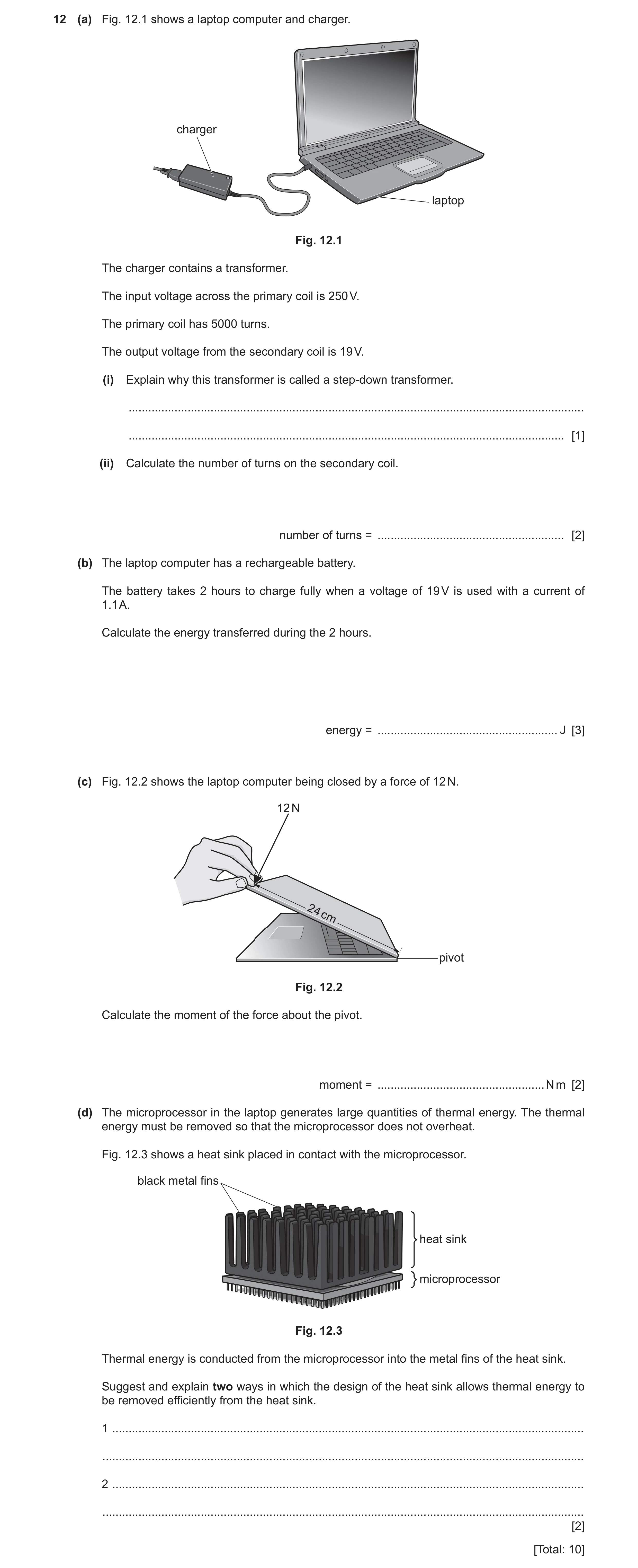
12 (a) Fig. 12.1 shows a laptop computer and charger. charger laptop Fig. 12.1 The charger contains a transformer. The input voltage across the primary coil is 250 V. The primary coil has 5000 turns. The output voltage from the secondary coil is 19 V. (i) Explain why this transformer is called a step‑down transformer. … … [1] (ii) Calculate the number of turns on the secondary coil. number of turns = … [2] (b) The laptop computer has a rechargeable battery. The battery takes 2 hours to charge fully when a voltage of 19 V is used with a current of 1.1 A. Calculate the energy transferred during the 2 hours. energy = … J [3] (c) Fig. 12.2 shows the laptop computer being closed by a force of 12 N. 12 N 24 cm pivot Fig. 12.2 Calculate the moment of the force about the pivot. moment = … N m [2] (d) The microprocessor in the laptop generates large quantities of thermal energy. The thermal energy must be removed so that the microprocessor does not overheat. Fig. 12.3 shows a heat sink placed in contact with the microprocessor. black metal fins heat sink microprocessor Fig. 12.3 Thermal energy is conducted from the microprocessor into the metal fins of the heat sink. Suggest and explain two ways in which the design of the heat sink allows thermal energy to be removed efficiently from the heat sink. 1 … … 2 … … [2] [Total: 10]
10 marks
Mark scheme: 12(a)(i) voltage is lowered ; 1 12(a)(ii) (NS =) NPVS/VP or 5000 × 19/250 ; number of coils = 380 ; 2 12(b) 2 hours = 2 × 3600 = 7200 s; (energy =) VIt / 19 × 1.1 × 7200 ; (energy =) 150 000 (J) ; 3 12(c) (moment =) force × (perpendicular) distance or 12 × 24(/100) ; 2.9 (Nm) ; 2 Question Answer Marks 12(d) black surfaces are good emitters of thermal energy ; large surface area enables efficient convection; 2
This question in 0654/41 Oct/Nov 2020
Q12 · A hot water storage tank in a house 0654/43 Oct/Nov 2020
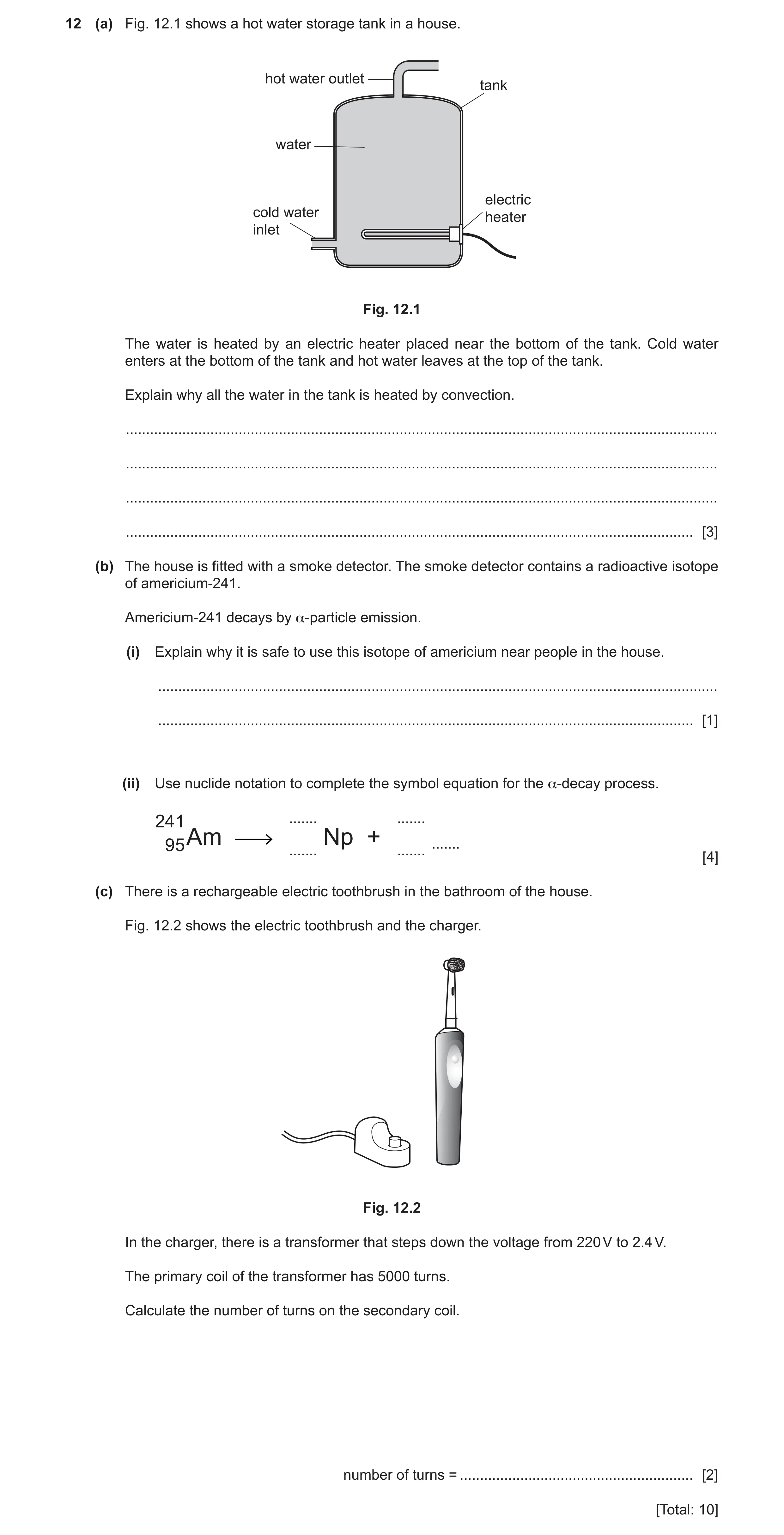
12 (a) Fig. 12.1 shows a hot water storage tank in a house. hot water outlet tank water electric cold water heater inlet Fig. 12.1 The water is heated by an electric heater placed near the bottom of the tank. Cold water enters at the bottom of the tank and hot water leaves at the top of the tank. Explain why all the water in the tank is heated by convection. … … … … [3] (b) The house is fitted with a smoke detector. The smoke detector contains a radioactive isotope of americium-241. Americium-241 decays by α-particle emission. (i) Explain why it is safe to use this isotope of americium near people in the house. … … [1] (ii) Use nuclide notation to complete the symbol equation for the α-decay process. 241 … … Am Np + … 95 … … [4] (c) There is a rechargeable electric toothbrush in the bathroom of the house. Fig. 12.2 shows the electric toothbrush and the charger. Fig. 12.2 In the charger, there is a transformer that steps down the voltage from 220 V to 2.4 V. The primary coil of the transformer has 5000 turns. Calculate the number of turns on the secondary coil. number of turns = … [2] [Total: 10]
10 marks
Mark scheme: 12(a) hot water is less dense / expands ; less dense water rises ORA ; cold water sinks ; 3 12(b)(i) alpha particles have low penetration; 1 12(b)(ii) 241 95 Au → + 237 4 93 2 He Np mass numbers and proton numbers correct: 237 ; 93 ; 4 ; 2He ; 4 12(c) (NS =) NPVS / VP or 5000 x 2.4 / 220 ; 54.5 / 54 / 55 turns; 2
This question in 0654/43 Oct/Nov 2020
Q13 · Metals are good conductors of thermal energy 0654/42 May/June 2021
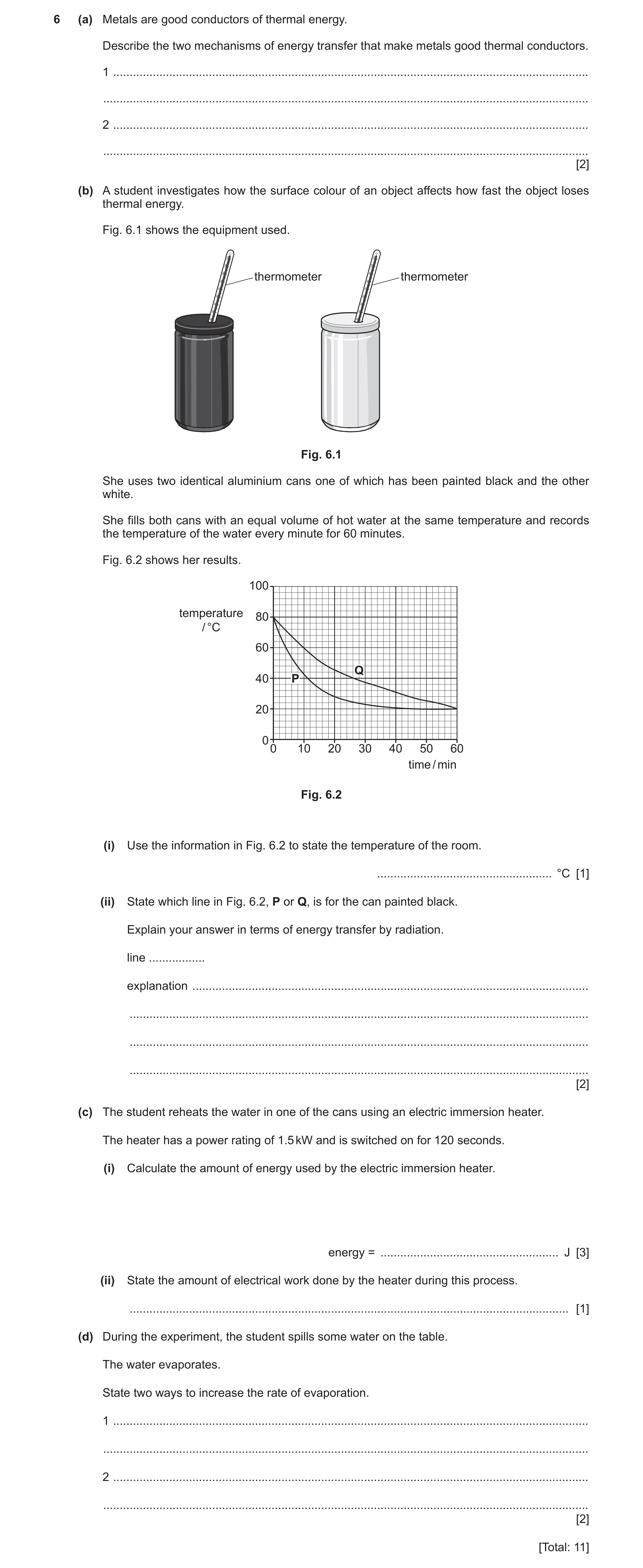
6 (a) Metals are good conductors of thermal energy. Describe the two mechanisms of energy transfer that make metals good thermal conductors. 1 … … 2 … … [2] (b) A student investigates how the surface colour of an object affects how fast the object loses thermal energy. Fig. 6.1 shows the equipment used. thermometer thermometer Fig. 6.1 She uses two identical aluminium cans one of which has been painted black and the other white. She fills both cans with an equal volume of hot water at the same temperature and records the temperature of the water every minute for 60 minutes. Fig. 6.2 shows her results. 100 temperature 80 / °C 60 Q 40 P 20 0 0 10 20 30 40 50 60 time / min Fig. 6.2 (i) Use the information in Fig. 6.2 to state the temperature of the room. … °C [1] (ii) State which line in Fig. 6.2, P or Q, is for the can painted black. Explain your answer in terms of energy transfer by radiation. line … explanation … … … … [2] (c) The student reheats the water in one of the cans using an electric immersion heater. The heater has a power rating of 1.5 kW and is switched on for 120 seconds. (i) Calculate the amount of energy used by the electric immersion heater. energy = … J [3] (ii) State the amount of electrical work done by the heater during this process. … [1] (d) During the experiment, the student spills some water on the table. The water evaporates. State two ways to increase the rate of evaporation. 1 … … 2 … … [2] [Total: 11]
11 marks
Mark scheme: 6(a) vibration of particles / atoms / ions ; transfer by electrons ; 2 6(b)(i) 20(°C) ; 1 6(b)(ii) P, takes less time to cool to room temp / cools quicker ; black emits, radiation / heat energy / energy, more quickly than white ; 2 6(c)(i) 1500 / 1.5 × 10³ ; (E =) Pxt / 1500 × 120 ; 180 000 (J) ; 3 6(c)(ii) 180 000 (J) ; 1 6(d) any two from: increase temperature ; increase surface area ; draught over surface ; AVP ; 2
This question in 0654/42 May/June 2021
Q14 · A kettle and the label on the bottom of the kettle 0654/43 May/June 2021
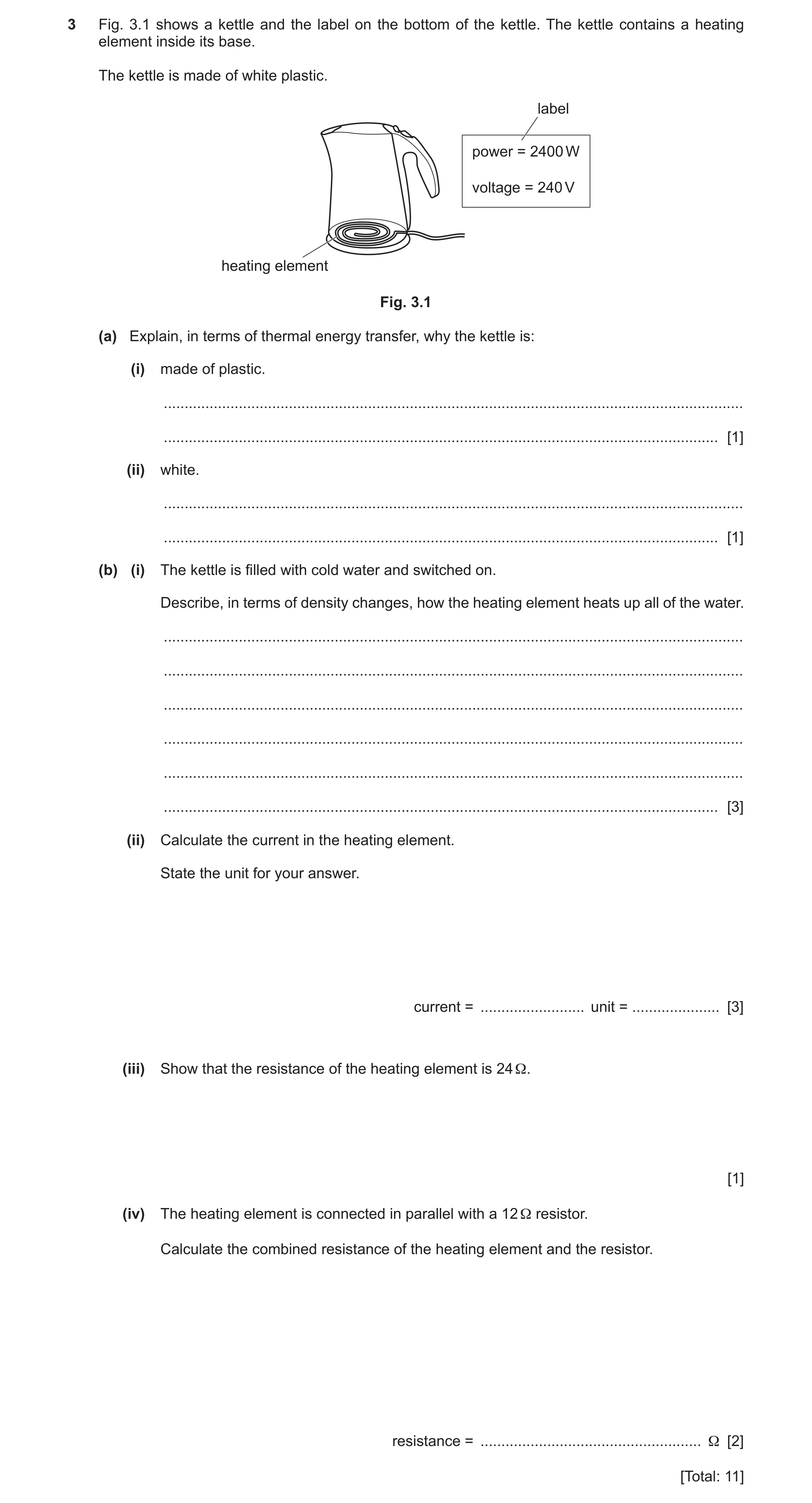
3 Fig. 3.1 shows a kettle and the label on the bottom of the kettle. The kettle contains a heating element inside its base. The kettle is made of white plastic. label power = 2400 W voltage = 240 V heating element Fig. 3.1 (a) Explain, in terms of thermal energy transfer, why the kettle is: (i) made of plastic. … … [1] (ii) white. … … [1] (b) (i) The kettle is filled with cold water and switched on. Describe, in terms of density changes, how the heating element heats up all of the water. … … … … … … [3] (ii) Calculate the current in the heating element. State the unit for your answer. current = … unit = … [3] (iii) Show that the resistance of the heating element is 24 Ω. [1] (iv) The heating element is connected in parallel with a 12 Ω resistor. Calculate the combined resistance of the heating element and the resistor. resistance = … Ω [2] [Total: 11]
11 marks
Mark scheme: 3(a)(i) (plastic is a) poor conductor / good insulator (of thermal energy) ; 1 3(a)(ii) (white objects) emit less (thermal) radiation ; 1 3(b)(i) convection (currents); water at the bottom is heated and density decreases ; hot water then rises and displaces (cold) water towards heater ; 3 Question Answer Marks 3(b)(ii) (I =) P / V or 2400 / 240 ; 10 ; A / amps / amperes ; 3 3(b)(iii) 240 / 10 ; 1 3(b)(iv) 1 / R = 1 / R1 + 1 / R2 / 1 / 24 + 1 / 12 ; or 1 2 1 2 R R R R + or 24 12 24 12 × + ; 8 (Ω) ; 2
This question in 0654/43 May/June 2021
Question 15 0654/42 Feb/March 2022
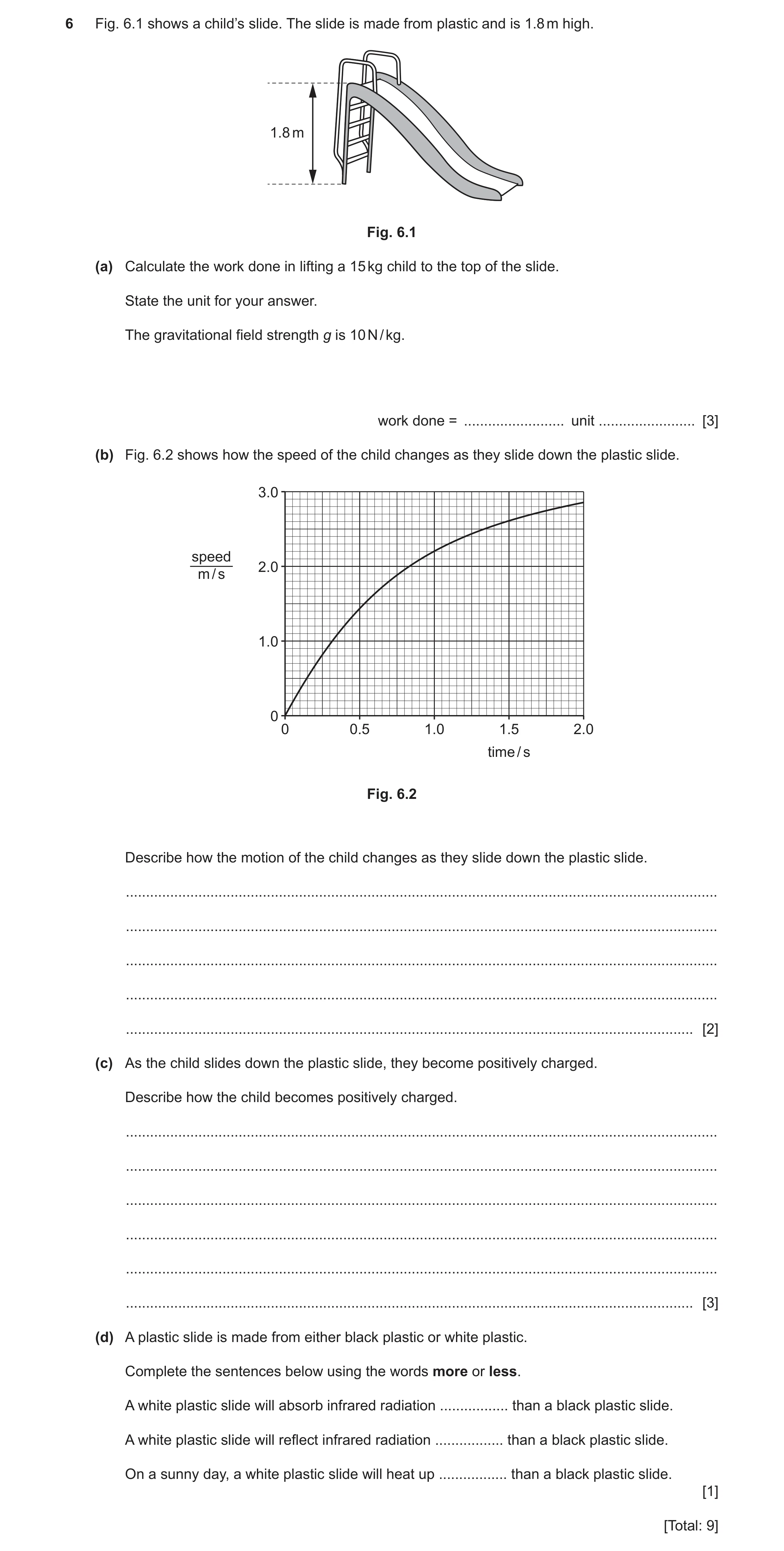
6 Fig. 6.1 shows a child’s slide. The slide is made from plastic and is 1.8 m high. 1.8 m Fig. 6.1 (a) Calculate the work done in lifting a 15 kg child to the top of the slide. State the unit for your answer. The gravitational field strength g is 10 N / kg. work done = … unit … [3] (b) Fig. 6.2 shows how the speed of the child changes as they slide down the plastic slide. 3.0 speed 2.0 m / s 1.0 0 0 0.5 1.0 1.5 2.0 time / s Fig. 6.2 Describe how the motion of the child changes as they slide down the plastic slide. … … … … … [2] (c) As the child slides down the plastic slide, they become positively charged. Describe how the child becomes positively charged. … … … … … … [3] (d) A plastic slide is made from either black plastic or white plastic. Complete the sentences below using the words more or less. A white plastic slide will absorb infrared radiation … than a black plastic slide. A white plastic slide will reflect infrared radiation … than a black plastic slide. On a sunny day, a white plastic slide will heat up … than a black plastic slide. [1] [Total: 9]
9 marks
Mark scheme: 6(a) (Wd =) mgh or 15 × 10 × 1.8 ; (Wd = ) 270 ; Joules / J ; 6(b) acceleration ; non-constant acceleration / high then low acceleration ; 2 6(c) transfer of electrons ; from the child / to the slide ; due to friction ; 3 6(d) less more less ; 1
This question in 0654/42 Feb/March 2022
Q16 · A student investigates the effect of changing temperature on the current through a… 0654/41 Oct/Nov 2022
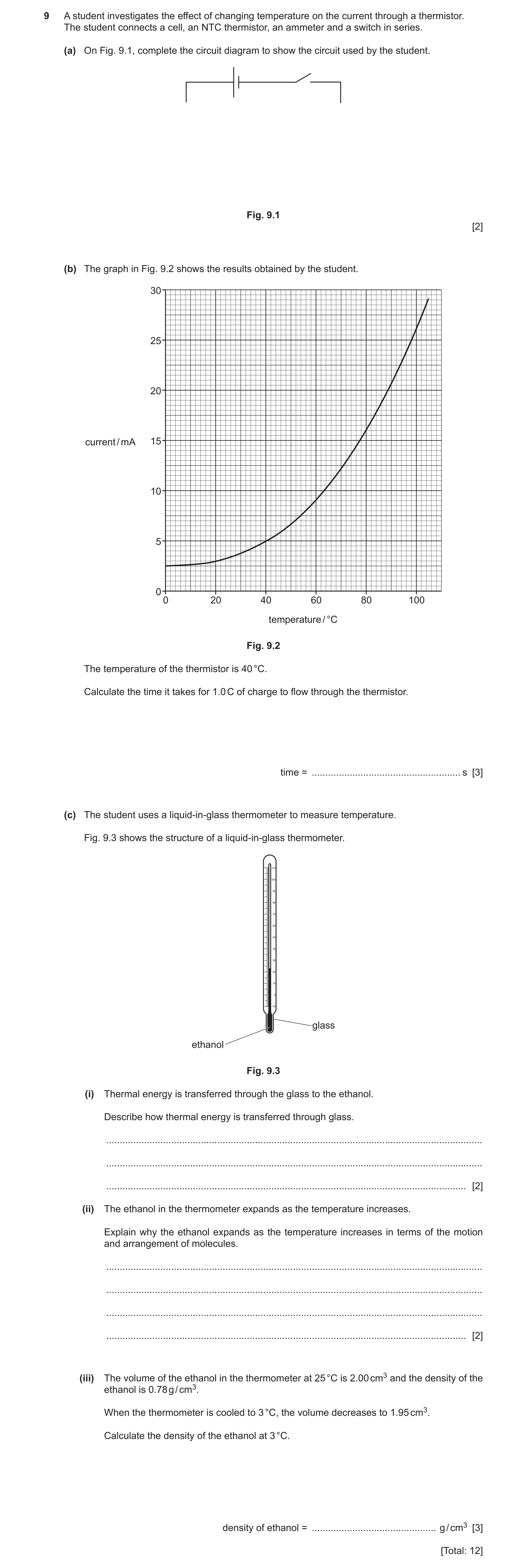
9 A student investigates the effect of changing temperature on the current through a thermistor. The student connects a cell, an NTC thermistor, an ammeter and a switch in series. (a) On Fig. 9.1, complete the circuit diagram to show the circuit used by the student. Fig. 9.1 [2] (b) The graph in Fig. 9.2 shows the results obtained by the student. 30 25 20 current / mA 15 10 5 0 0 20 40 60 80 100 temperature / °C Fig. 9.2 The temperature of the thermistor is 40 °C. Calculate the time it takes for 1.0 C of charge to flow through the thermistor. time = … s [3] (c) The student uses a liquid-in-glass thermometer to measure temperature. Fig. 9.3 shows the structure of a liquid-in-glass thermometer. glass ethanol Fig. 9.3 (i) Thermal energy is transferred through the glass to the ethanol. Describe how thermal energy is transferred through glass. … … … [2] (ii) The ethanol in the thermometer expands as the temperature increases. Explain why the ethanol expands as the temperature increases in terms of the motion and arrangement of molecules. … … … … [2] (iii) The volume of the ethanol in the thermometer at 25 °C is 2.00 cm3 and the density of the ethanol is 0.78 g / cm3. When the thermometer is cooled to 3 °C, the volume decreases to 1.95 cm3. Calculate the density of the ethanol at 3 °C. density of ethanol = … g / cm3 [3] [Total: 12]
12 marks
Mark scheme: 9(a) 2 correct symbols ; correct circuit ; 9(b) (from graph I =) 5 (mA) / 0.005 (A) ; 3 (t =) Q / I or 1 / 0.005 ; (t =) 200 (s) ; 9(c)(i) conduction ; 2 vibrations passed from particle to particle ; 9(c)(ii) kinetic energy / speed of molecules increases ; 2 molecules move further apart ; 9(c)(iii) (m =) ρ V OR 0.78 2.0 OR 1.56 (g) ; 3 (ρ =) m / V OR 1.56 / 1.95 ; (ρ =) 0.80 (g / cm3) ;
This question in 0654/41 Oct/Nov 2022
Q17 · A temporary zebra enclosure in a wildlife conservation park 0654/42 Oct/Nov 2022
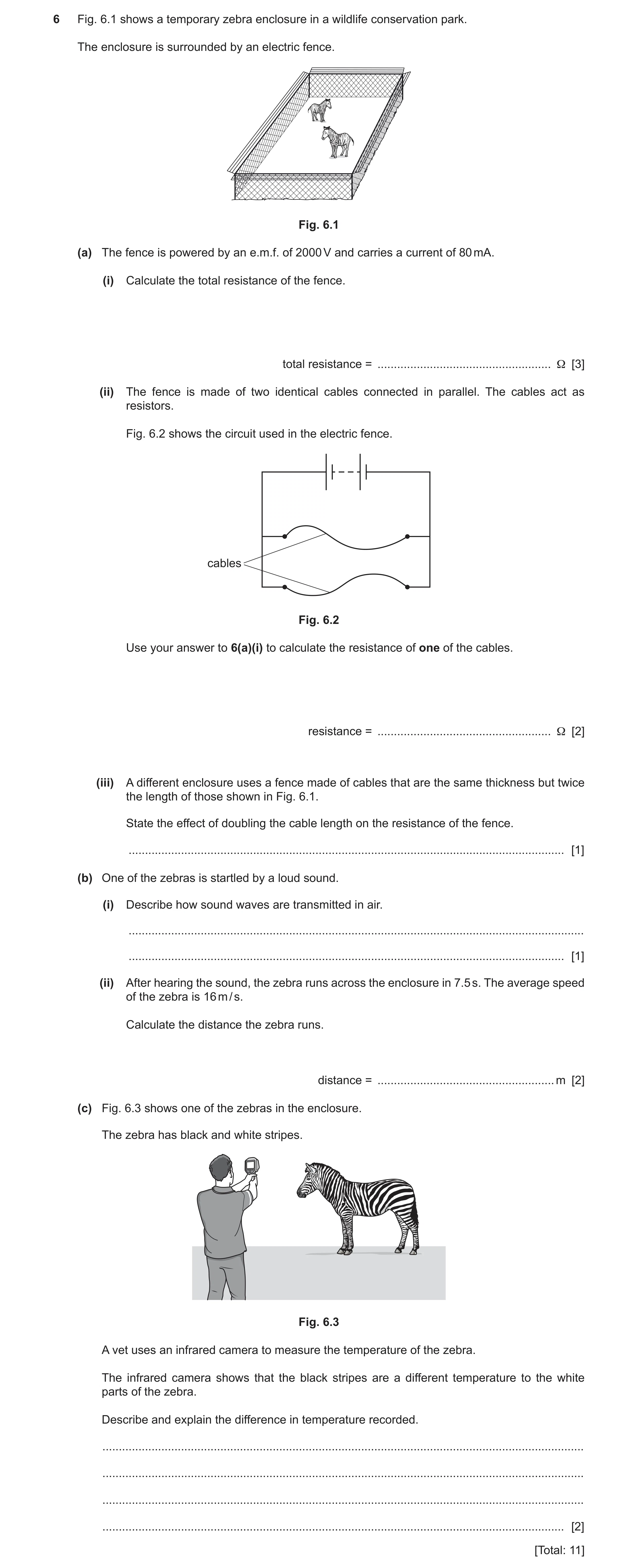
6 Fig. 6.1 shows a temporary zebra enclosure in a wildlife conservation park. The enclosure is surrounded by an electric fence. Fig. 6.1 (a) The fence is powered by an e.m.f. of 2000 V and carries a current of 80 mA. (i) Calculate the total resistance of the fence. total resistance = … Ω [3] (ii) The fence is made of two identical cables connected in parallel. The cables act as resistors. Fig. 6.2 shows the circuit used in the electric fence. cables Fig. 6.2 Use your answer to 6(a)(i) to calculate the resistance of one of the cables. resistance = … Ω [2] (iii) A different enclosure uses a fence made of cables that are the same thickness but twice the length of those shown in Fig. 6.1. State the effect of doubling the cable length on the resistance of the fence. … [1] (b) One of the zebras is startled by a loud sound. (i) Describe how sound waves are transmitted in air. … … [1] (ii) After hearing the sound, the zebra runs across the enclosure in 7.5 s. The average speed of the zebra is 16 m / s. Calculate the distance the zebra runs. distance = … m [2] (c) Fig. 6.3 shows one of the zebras in the enclosure. The zebra has black and white stripes. Fig. 6.3 A vet uses an infrared camera to measure the temperature of the zebra. The infrared camera shows that the black stripes are a different temperature to the white parts of the zebra. Describe and explain the difference in temperature recorded. … … … … [2] [Total: 11]
11 marks
Mark scheme: 6(a)(i) (I =) 0.08 A ; 3 (R =) V / I or 2000 / 0.08 ; (R =) 25000 (Ω) ; 6(a)(ii) use of 1 / RT =1 / R + 1 / R ; 2 (R =) 50000 (Ω) ; 6(a)(iii) (resistance) doubles ; 1 6(b)(i) rarefaction and compressions ; 1 6(b)(ii) (d =) v t or 167.5 ; 2 (d =) 120 (m) ; 6(c) black will show the higher temperature / ORA ; 2 black emits more (infrared) radiation than white ;
This question in 0654/42 Oct/Nov 2022
Q18 · A marble staircase made up of 17 steps 0654/43 Oct/Nov 2022
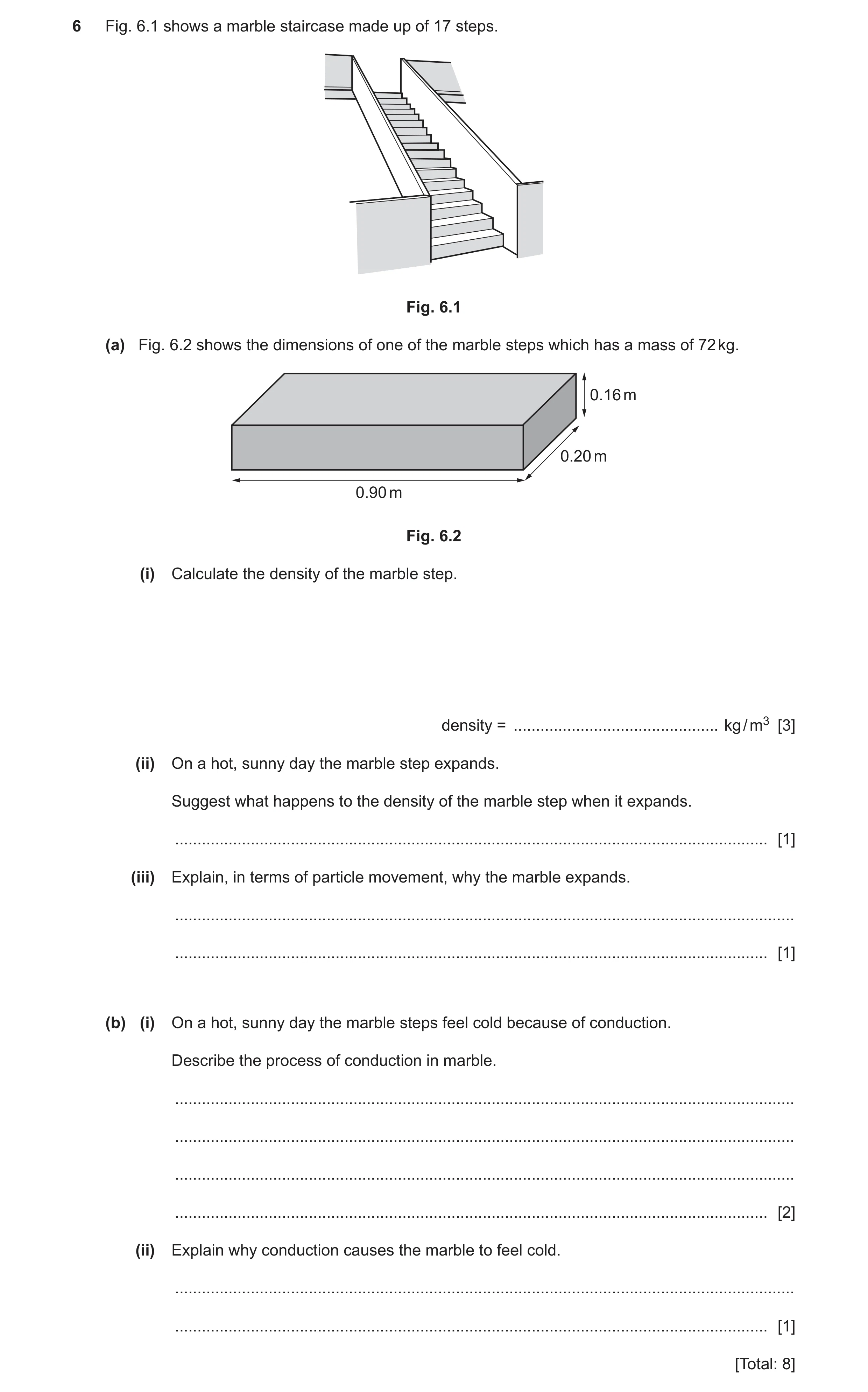
6 Fig. 6.1 shows a marble staircase made up of 17 steps. Fig. 6.1 (a) Fig. 6.2 shows the dimensions of one of the marble steps which has a mass of 72 kg. 0.16 m 0.20 m 0.90 m Fig. 6.2 (i) Calculate the density of the marble step. density = … kg / m3 [3] (ii) On a hot, sunny day the marble step expands. Suggest what happens to the density of the marble step when it expands. … [1] (iii) Explain, in terms of particle movement, why the marble expands. … … [1] (b) (i) On a hot, sunny day the marble steps feel cold because of conduction. Describe the process of conduction in marble. … … … … [2] (ii) Explain why conduction causes the marble to feel cold. … … [1] [Total: 8]
8 marks
Mark scheme: 6(a)(i) (V =) 0.16 0.20 0.90 or 0.0288 (m3) ; 3 ( =) m / V or 72 / 0.0288 ; 2500 (kg / m3) ; 6(a)(ii) decreases ; 1 6(a)(iii) particles move further apart ; 1 6(b)(i) (conduction is) caused by particle vibrations ; 2 vibrations passed from one particle to the next ; 6(b)(ii) thermal energy is moved away from the hand / surface ; 1
This question in 0654/43 Oct/Nov 2022
Q19 · A simple circuit containing a heater and a thermistor 0654/42 Feb/March 2023
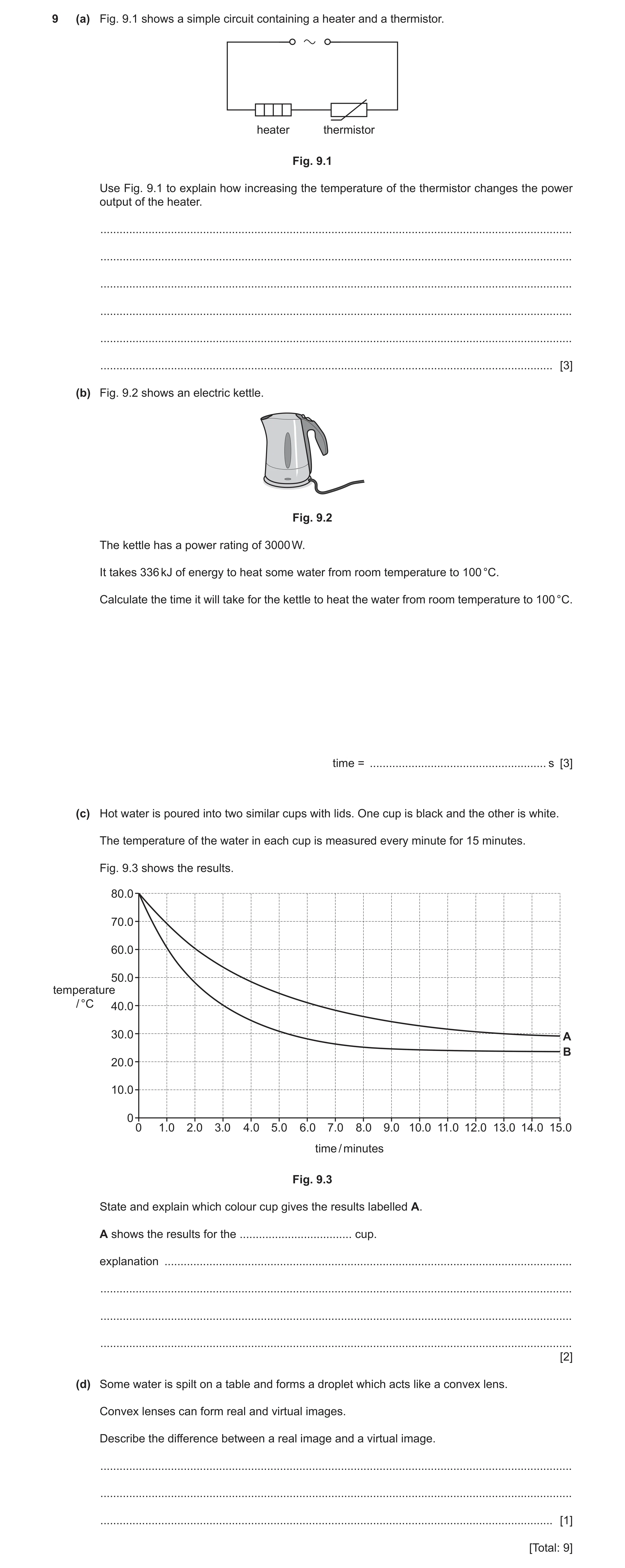
9 (a) Fig. 9.1 shows a simple circuit containing a heater and a thermistor. heater thermistor Fig. 9.1 Use Fig. 9.1 to explain how increasing the temperature of the thermistor changes the power output of the heater. … … … … … … [3] (b) Fig. 9.2 shows an electric kettle. Fig. 9.2 The kettle has a power rating of 3000 W. It takes 336 kJ of energy to heat some water from room temperature to 100 °C. Calculate the time it will take for the kettle to heat the water from room temperature to 100 °C. time = … s [3] (c) Hot water is poured into two similar cups with lids. One cup is black and the other is white. The temperature of the water in each cup is measured every minute for 15 minutes. Fig. 9.3 shows the results. 80.0 70.0 60.0 50.0 temperature / °C 40.0 30.0 A B 20.0 10.0 0 0 1.0 2.0 3.0 4.0 5.0 6.0 7.0 8.0 9.0 10.0 11.0 12.0 13.0 14.0 15.0 time / minutes Fig. 9.3 State and explain which colour cup gives the results labelled A. A shows the results for the … cup. explanation … … … … [2] (d) Some water is spilt on a table and forms a droplet which acts like a convex lens. Convex lenses can form real and virtual images. Describe the difference between a real image and a virtual image. … … … [1] [Total: 9]
9 marks
Mark scheme: 9(a) resistance of thermistor decreases; 3 current / potential difference, of the heater increases ; power output increases ; 9(b) evidence of unit conversion or 336 000 (J) 3 evidence of (t =) E / P (in any form) or 336 000 / 3000 ; (t =) 112 (s) ; 9(c) white (cup) and 2 white emits less, (IR) radiation / thermal energy, than black ; white / A, cools down more slowly (in 15 minutes) ; 9(d) a real image can be formed on a screen / is formed from real rays of light / is formed from converging rays / AVP ; 1
This question in 0654/42 Feb/March 2023
Q20 · A boiler that uses combustion of natural gas to heat water 0654/41 May/June 2023
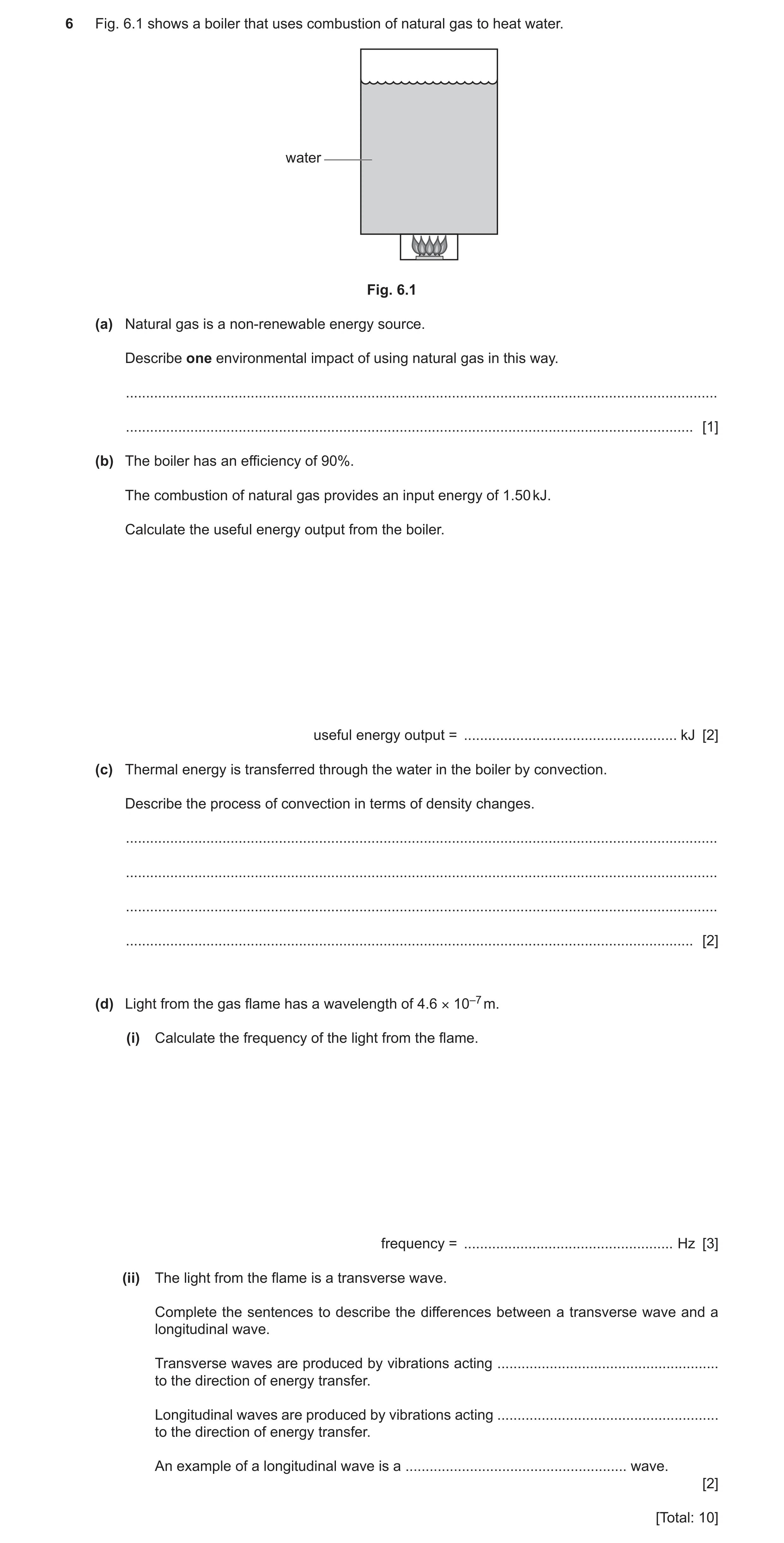
6 Fig. 6.1 shows a boiler that uses combustion of natural gas to heat water. water Fig. 6.1 (a) Natural gas is a non‑renewable energy source. Describe one environmental impact of using natural gas in this way. … … [1] (b) The boiler has an efficiency of 90%. The combustion of natural gas provides an input energy of 1.50 kJ. Calculate the useful energy output from the boiler. useful energy output = … kJ [2] (c) Thermal energy is transferred through the water in the boiler by convection. Describe the process of convection in terms of density changes. … … … … [2] (d) Light from the gas flame has a wavelength of 4.6 × 10⁻⁷ m. (i) Calculate the frequency of the light from the flame. frequency = … Hz [3] (ii) The light from the flame is a transverse wave. Complete the sentences to describe the differences between a transverse wave and a longitudinal wave. Transverse waves are produced by vibrations acting … to the direction of energy transfer. Longitudinal waves are produced by vibrations acting … to the direction of energy transfer. An example of a longitudinal wave is a … wave. [2] [Total: 10]
10 marks
Mark scheme: 6(a) (releases CO2) contributes to global warming / causes climate change / (enhanced) greenhouse effect ; 1 6(b) (output = ) efficiency input / 0.9 1.50 ; (output = ) 1.35 (kJ) ; 2 6(c) density of water decreases as it is heated ; less dense / heated water rises ; 2 6(d)(i) 3 108 (m / s) ; (frequency = ) speed / wavelength / 3 108/4.6 10–7 ; (frequency = ) 6.5 1014 (Hz) ; 3 6(d)(ii) perpendicular and parallel ; sound ; 2
This question in 0654/41 May/June 2023
Q21 · An iceberg floating in the sea 0654/43 May/June 2023
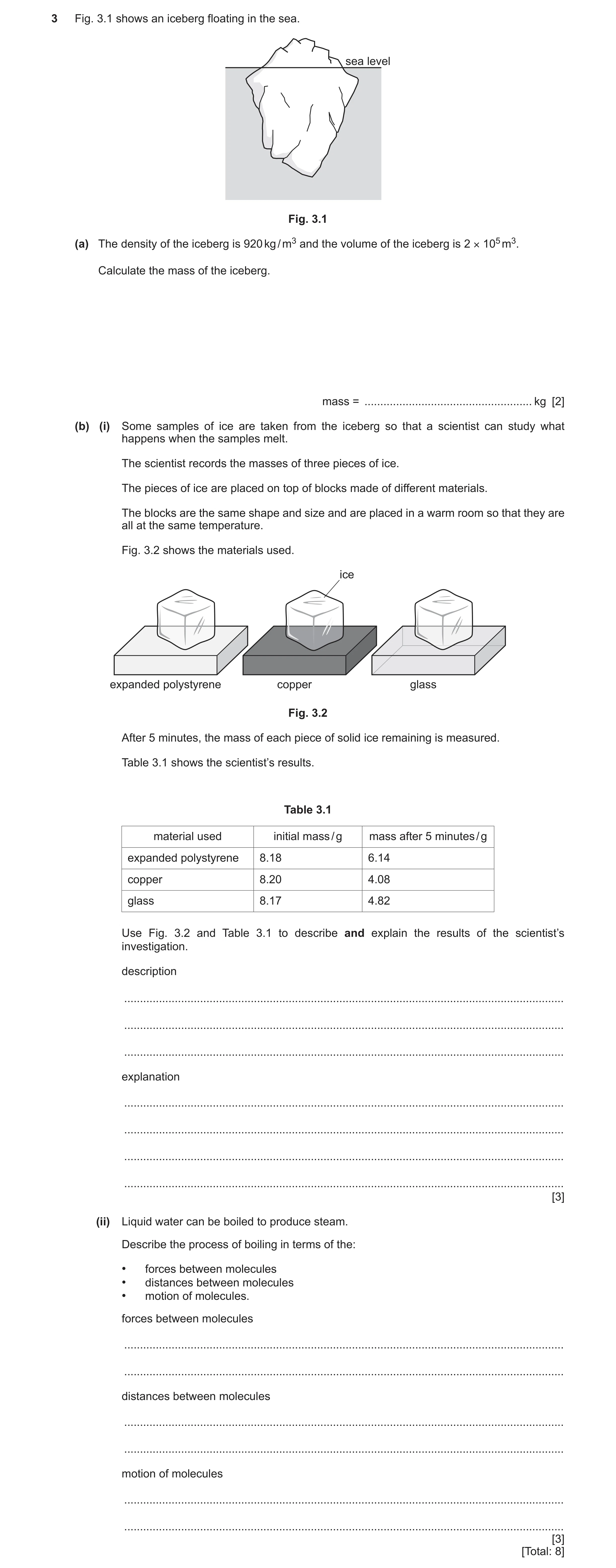
3 Fig. 3.1 shows an iceberg floating in the sea. sea level Fig. 3.1 (a) The density of the iceberg is 920 kg / m3 and the volume of the iceberg is 2 × 10⁵ m3. Calculate the mass of the iceberg. mass = … kg [2] (b) (i) Some samples of ice are taken from the iceberg so that a scientist can study what happens when the samples melt. The scientist records the masses of three pieces of ice. The pieces of ice are placed on top of blocks made of different materials. The blocks are the same shape and size and are placed in a warm room so that they are all at the same temperature. Fig. 3.2 shows the materials used. ice expanded polystyrene copper glass Fig. 3.2 After 5 minutes, the mass of each piece of solid ice remaining is measured. Table 3.1 shows the scientist’s results. Table 3.1 material used initial mass / g mass after 5 minutes / g expanded polystyrene 8.18 6.14 copper 8.20 4.08 glass 8.17 4.82 Use Fig. 3.2 and Table 3.1 to describe and explain the results of the scientist’s investigation. description … … … explanation … … … … [3] (ii) Liquid water can be boiled to produce steam. Describe the process of boiling in terms of the: • forces between molecules • distances between molecules • motion of molecules. forces between molecules … … distances between molecules … … motion of molecules … … [3] [Total: 8]
8 marks
Mark scheme: 3(a) (m =) 1.84 108 (kg) ; 3(b)(i) any three from: changes in mass calculated: polystyrene: 2.04 g, copper: 4.12 g, glass: 3.35 g ; copper melts the most / polystyrene melts the least ; copper is a good conductor / polystyrene is an, insulator / poor conductor ; maximum (rate of) energy transfer in copper / minimum energy transfer in polystyrene ; copper is a metal / expanded polystyrene contains trapped air ; 3 3(b)(ii) (forces between molecules) decrease ; (distance between molecules) increase ; (molecules) become free to move / move out of container ; 3
This question in 0654/43 May/June 2023
Q22 · A student is investigating electromagnetic induction by dropping a magnet through a coil… 0654/41 Oct/Nov 2023
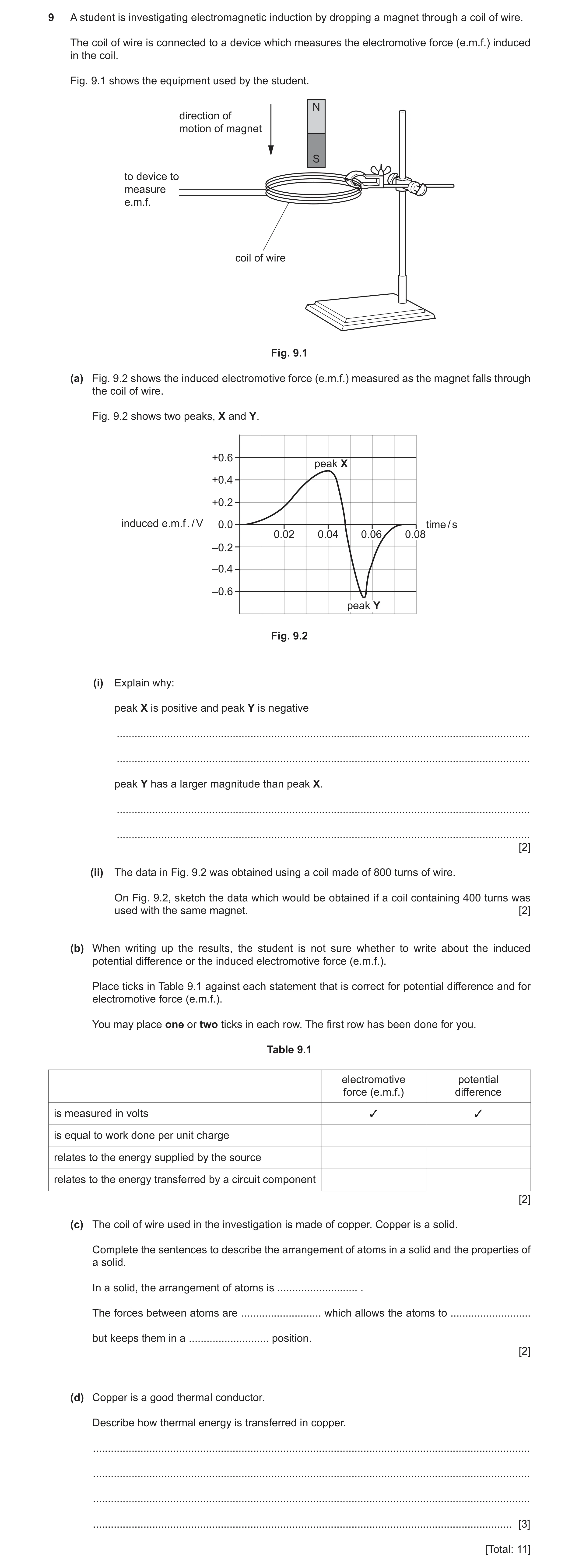
9 A student is investigating electromagnetic induction by dropping a magnet through a coil of wire. The coil of wire is connected to a device which measures the electromotive force (e.m.f.) induced in the coil. Fig. 9.1 shows the equipment used by the student. N direction of motion of magnet S to device to measure e.m.f. coil of wire Fig. 9.1 (a) Fig. 9.2 shows the induced electromotive force (e.m.f.) measured as the magnet falls through the coil of wire. Fig. 9.2 shows two peaks, X and Y. +0.6 peak X +0.4 +0.2 induced e.m.f . / V 0.0 time / s 0.02 0.04 0.06 0.08 –0.2 –0.4 –0.6 peak Y Fig. 9.2 (i) Explain why: peak X is positive and peak Y is negative … … peak Y has a larger magnitude than peak X. … … [2] (ii) The data in Fig. 9.2 was obtained using a coil made of 800 turns of wire. On Fig. 9.2, sketch the data which would be obtained if a coil containing 400 turns was used with the same magnet. [2] (b) When writing up the results, the student is not sure whether to write about the induced potential difference or the induced electromotive force (e.m.f.). Place ticks in Table 9.1 against each statement that is correct for potential difference and for electromotive force (e.m.f.). You may place one or two ticks in each row. The first row has been done for you. Table 9.1 electromotive potential force (e.m.f.) difference is measured in volts 3 3 is equal to work done per unit charge relates to the energy supplied by the source relates to the energy transferred by a circuit component [2] (c) The coil of wire used in the investigation is made of copper. Copper is a solid. Complete the sentences to describe the arrangement of atoms in a solid and the properties of a solid. In a solid, the arrangement of atoms is … . The forces between atoms are … which allows the atoms to … but keeps them in a … position. [2] (d) Copper is a good thermal conductor. Describe how thermal energy is transferred in copper. … … … … [3] [Total: 11]
11 marks
Mark scheme: 9(a)(i) (peak X is positive and peak Y is negative) 2 S causes peak (X) and N causes peak (Y) (as it passes through coil) ; (peak Y has a larger magnitude than X) (idea that) the magnet is increasing in velocity / speed ; 9(a)(ii) 2 same shape graph drawn with line crossing x-axis at same point ; both peaks lower than original ; 9(b) 2 electromotive potential force (e.m.f.) difference is measured in volts ✓ ✓ is equal to work done per unit charge ✓ ✓ relates to the energy supplied by the source ✓ relates to the energy transferred by a circuit component ✓ ;; 9(c) regular / ordered / a lattice 2 strong vibrate fixed ;; four correct = 2 marks two or three correct = 1 mark 9(d) atoms vibrate ; 3 (idea that) vibrations passed on to next atom ; (idea of) transfer by (free) electrons ;
This question in 0654/41 Oct/Nov 2023
Q23 · A circuit used by students investigating how the resistance of a metal wire varies with… 0654/42 Oct/Nov 2023
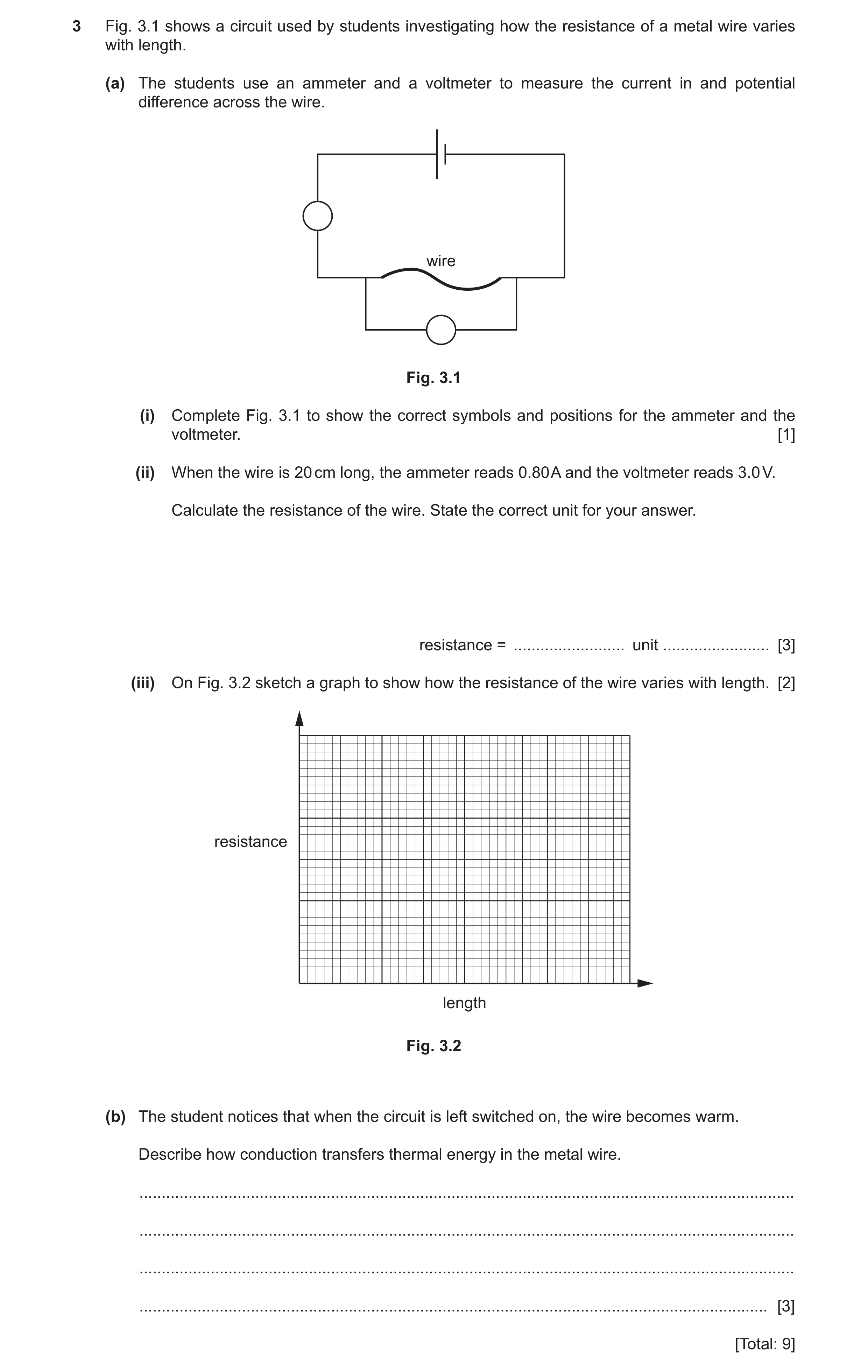
3 Fig. 3.1 shows a circuit used by students investigating how the resistance of a metal wire varies with length. (a) The students use an ammeter and a voltmeter to measure the current in and potential difference across the wire. wire Fig. 3.1 (i) Complete Fig. 3.1 to show the correct symbols and positions for the ammeter and the voltmeter. [1] (ii) When the wire is 20 cm long, the ammeter reads 0.80 A and the voltmeter reads 3.0 V. Calculate the resistance of the wire. State the correct unit for your answer. resistance = … unit … [3] (iii) On Fig. 3.2 sketch a graph to show how the resistance of the wire varies with length. [2] resistance length Fig. 3.2 (b) The student notices that when the circuit is left switched on, the wire becomes warm. Describe how conduction transfers thermal energy in the metal wire. … … … … [3] [Total: 9]
9 marks
Mark scheme: 3(a)(i) 1 ; 3(a)(ii) (R =) V ÷ I / 3(.0) ÷ 0.8(0) ; 3 R =) 3.8 ; ohms / ; 3(a)(iii) 2 positive gradient ; straight line ; 3(b) atoms vibrate ; 3 (idea that) vibrations passed on to next atom ; (idea of) transfer by (free) electrons ;
This question in 0654/42 Oct/Nov 2023
Question 24 0654/43 Oct/Nov 2023
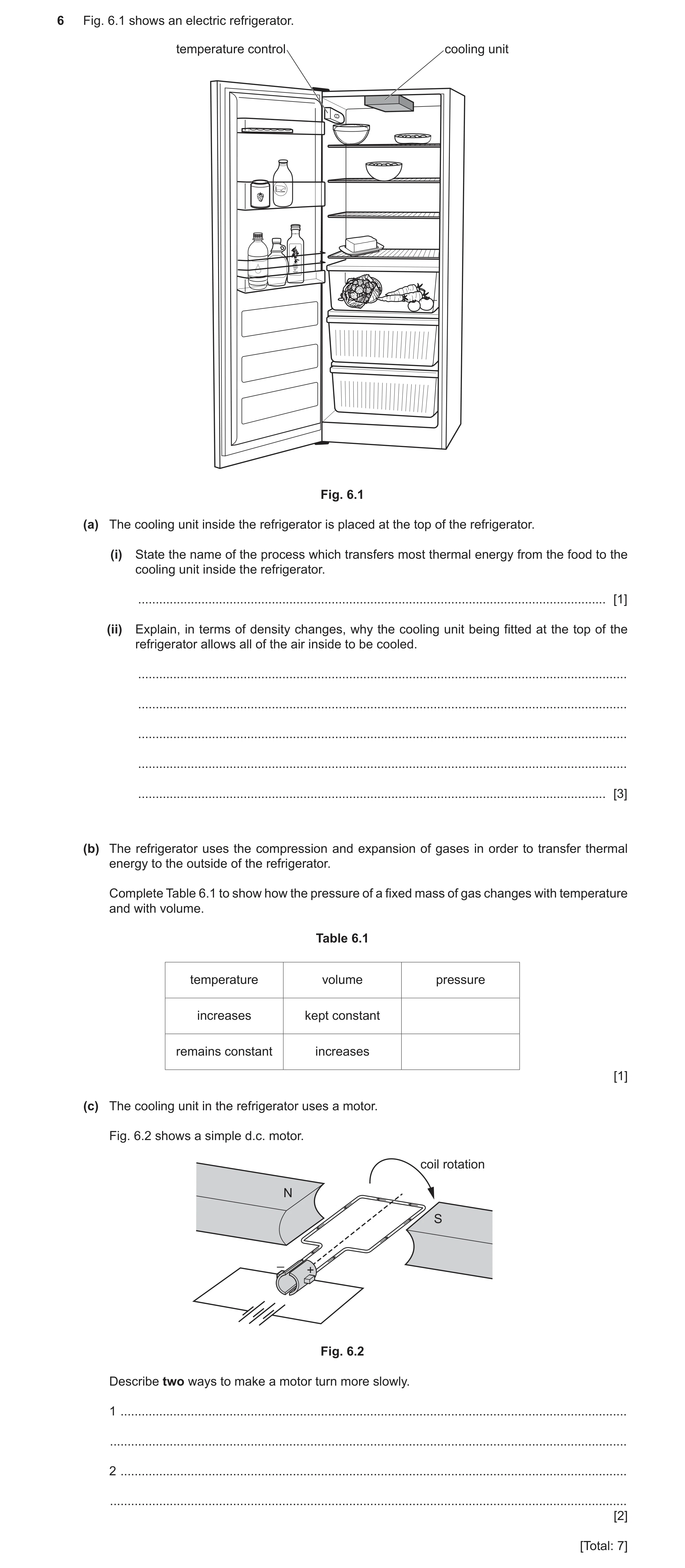
6 Fig. 6.1 shows an electric refrigerator. temperature control cooling unit Fig. 6.1 (a) The cooling unit inside the refrigerator is placed at the top of the refrigerator. (i) State the name of the process which transfers most thermal energy from the food to the cooling unit inside the refrigerator. … [1] (ii) Explain, in terms of density changes, why the cooling unit being fitted at the top of the refrigerator allows all of the air inside to be cooled. … … … … … [3] (b) The refrigerator uses the compression and expansion of gases in order to transfer thermal energy to the outside of the refrigerator. Complete Table 6.1 to show how the pressure of a fixed mass of gas changes with temperature and with volume. Table 6.1 temperature volume pressure increases kept constant remains constant increases [1] (c) The cooling unit in the refrigerator uses a motor. Fig. 6.2 shows a simple d.c. motor. coil rotation N S _ + Fig. 6.2 Describe two ways to make a motor turn more slowly. 1 … … 2 … … [2] [Total: 7]
7 marks
Mark scheme: 6(a)(i) convection ; 1 6(a)(ii) air (at the top) is cooled and its density increases ; 3 the cooled air falls ; warm(er) air has lower density and moves upwards ; 6(b) 1 temperature volume pressure increases kept constant increases remains constant increases decreases both correct ; 6(c) any two from: 2 decrease the current in the coil ; use fewer turns on the coil ; use a weaker magnet / magnetic field ;
This question in 0654/43 Oct/Nov 2023
Q25 · Two identical infrared heating lamps that are heating two metal cubes 0654/42 Feb/March 2024
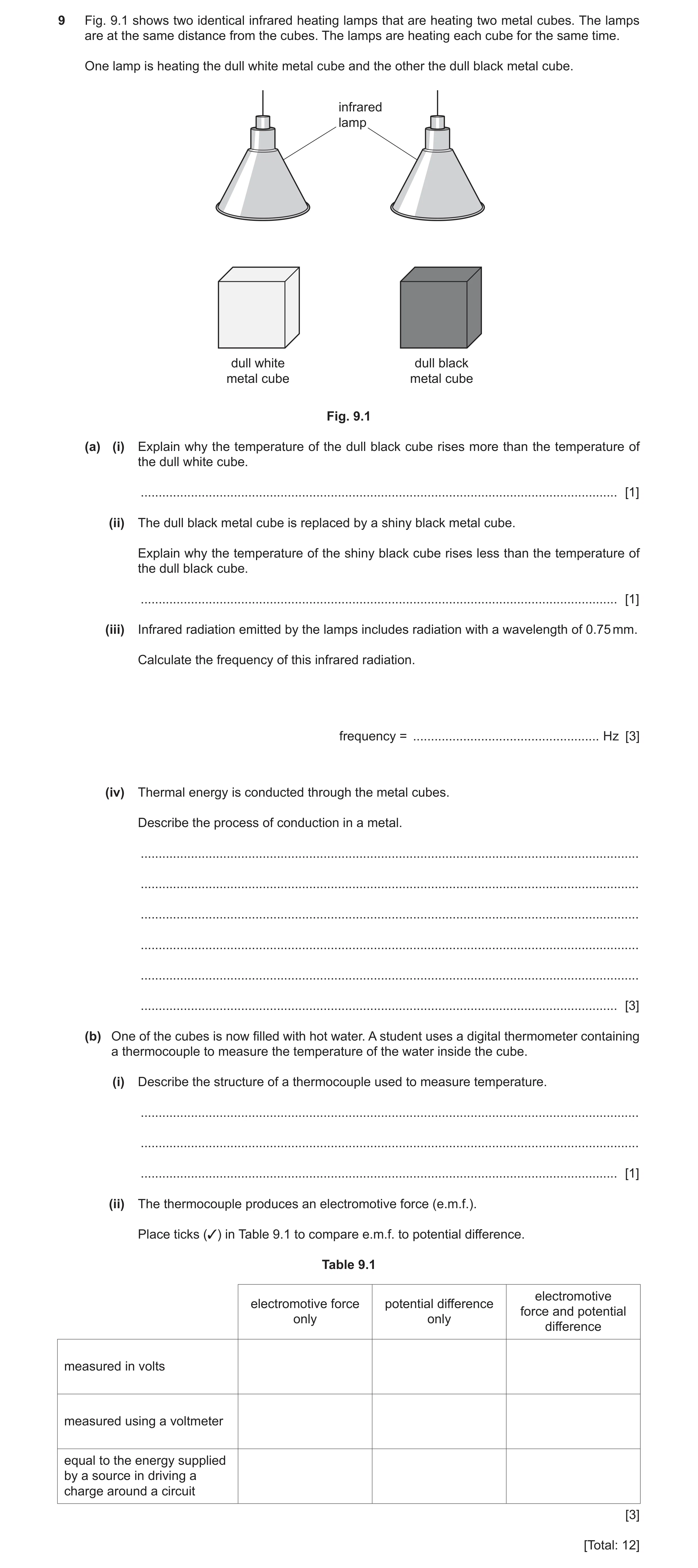
9 Fig. 9.1 shows two identical infrared heating lamps that are heating two metal cubes. The lamps are at the same distance from the cubes. The lamps are heating each cube for the same time. One lamp is heating the dull white metal cube and the other the dull black metal cube. infrared lamp dull white dull black metal cube metal cube Fig. 9.1 (a) (i) Explain why the temperature of the dull black cube rises more than the temperature of the dull white cube. … [1] (ii) The dull black metal cube is replaced by a shiny black metal cube. Explain why the temperature of the shiny black cube rises less than the temperature of the dull black cube. … [1] (iii) Infrared radiation emitted by the lamps includes radiation with a wavelength of 0.75 mm. Calculate the frequency of this infrared radiation. frequency = … Hz [3] (iv) Thermal energy is conducted through the metal cubes. Describe the process of conduction in a metal. … … … … … … [3] (b) One of the cubes is now filled with hot water. A student uses a digital thermometer containing a thermocouple to measure the temperature of the water inside the cube. (i) Describe the structure of a thermocouple used to measure temperature. … … … [1] (ii) The thermocouple produces an electromotive force (e.m.f.). Place ticks (✓) in Table 9.1 to compare e.m.f. to potential difference. Table 9.1 electromotive electromotive force potential difference force and potential only only difference measured in volts measured using a voltmeter equal to the energy supplied by a source in driving a charge around a circuit [3] [Total: 12]
12 marks
Mark scheme: 9(a)(i) dull black (cube) absorbs (thermal / infrared) radiation better than dull white (cube) ; 1 9(a)(ii) shiny black (cube) reflects radiation (rather than absorbs as the dull surface of black cube does) ; 1 9(a)(iii) use of 3.0 108 (m / s) ; 3 (f =) v / / 3.0 108 / 0.75 10–3 ; (f =) 4.0 1011 (Hz) ; 9(a)(iv) vibrations (of ions / atoms) ; 3 passes from one ion / atom to the next ; also by electrons moving through metal ; 9(b)(i) two different metal wires joined at two junctions at different temperatures ; 1 9(b)(ii) electromotive force and potential difference ticked ; 3 electromotive force and potential difference ticked ; electromotive force only ticked ;
This question in 0654/42 Feb/March 2024
Q26 · A student investigates the properties of graphite 0654/41 Oct/Nov 2024
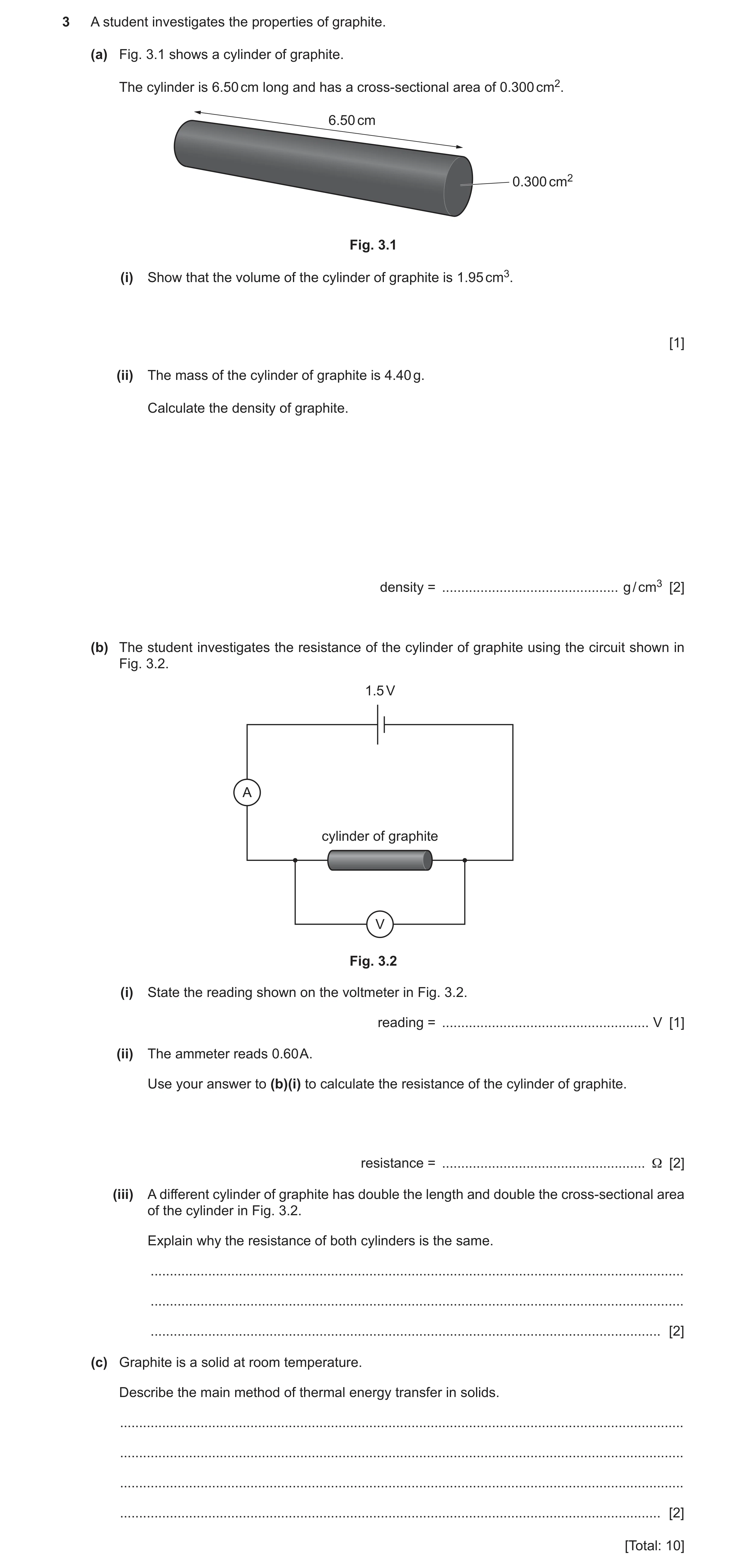
3 A student investigates the properties of graphite. (a) Fig. 3.1 shows a cylinder of graphite. The cylinder is 6.50 cm long and has a cross‑sectional area of 0.300 cm2. 6.50 cm 0.300 cm2 Fig. 3.1 (i) Show that the volume of the cylinder of graphite is 1.95 cm3. [1] (ii) The mass of the cylinder of graphite is 4.40 g. Calculate the density of graphite. density = … g / cm3 [2] (b) The student investigates the resistance of the cylinder of graphite using the circuit shown in Fig. 3.2. 1.5 V A cylinder of graphite V Fig. 3.2 (i) State the reading shown on the voltmeter in Fig. 3.2. reading = … V [1] (ii) The ammeter reads 0.60 A. Use your answer to (b)(i) to calculate the resistance of the cylinder of graphite. resistance = … Ω [2] (iii) A different cylinder of graphite has double the length and double the cross‑sectional area of the cylinder in Fig. 3.2. Explain why the resistance of both cylinders is the same. … … … [2] (c) Graphite is a solid at room temperature. Describe the main method of thermal energy transfer in solids. … … … … [2] [Total: 10]
10 marks
Mark scheme: 3(a)(i) (volume =) 6.5(0) 0.3(00) ; 1 3(a)(ii) m 2 evidence of = or 4.4(0) ÷ 1.95 ; V 2.26 (g / cm3) ; 3(b)(i) 1.5 (V) ; 1 3(b)(ii) evidence of R = V ÷ I or 1.5 ÷ 0.6(0) ; 2 2.5 () ; 3(b)(iii) (idea that) doubling the length doubles the resistance ; 2 (idea that) doubling the (cross-sectional) area halves the resistance ; 3(c) any two from: 2 atoms vibrate ; (idea that) vibrations passed on to next atom ; (idea of) transfer by (free) electrons ;
This question in 0654/41 Oct/Nov 2024
Q27 · Describe one similarity and two differences between boiling and evaporation 0654/41 May/June 2025
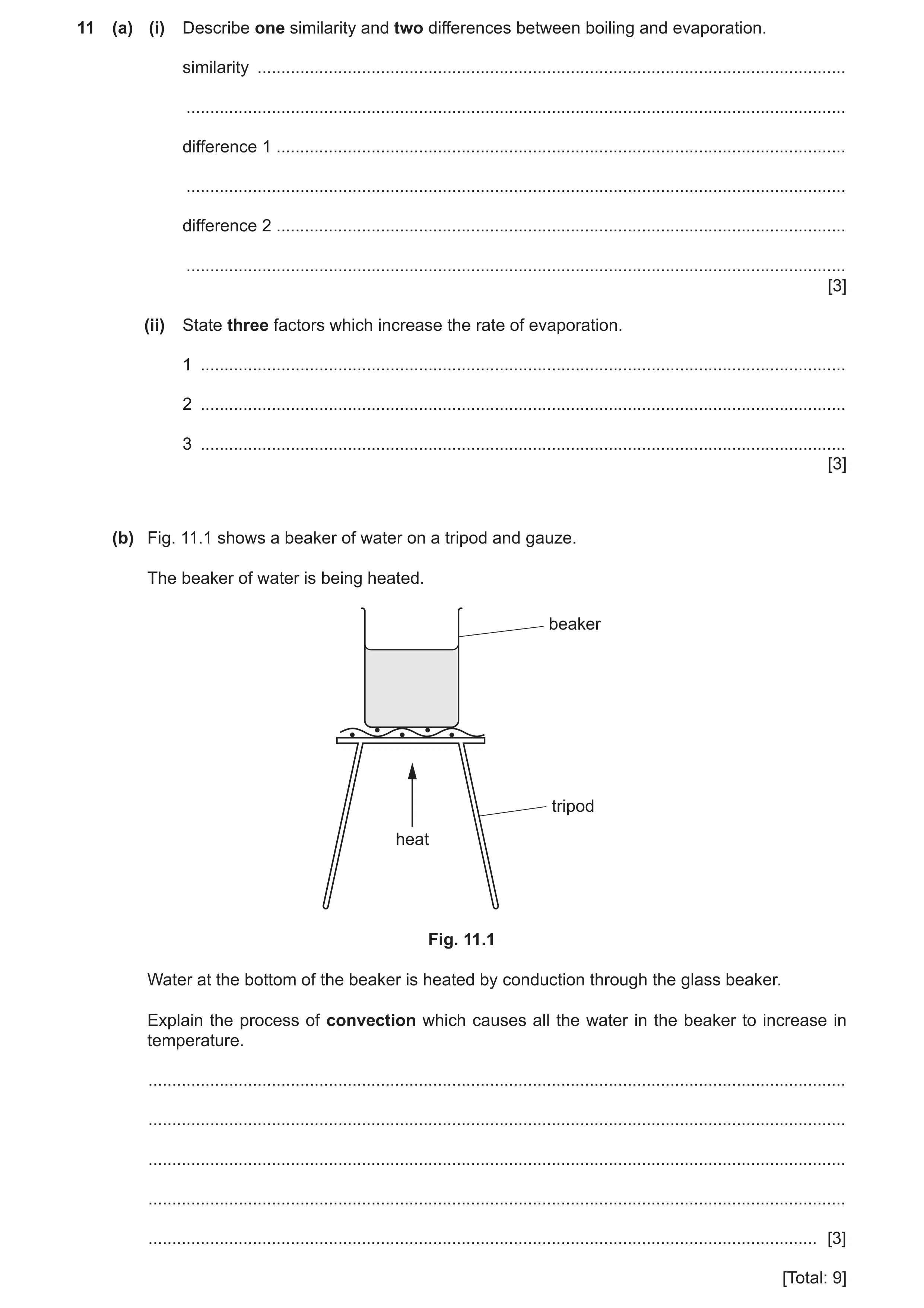
11 (a) (i) Describe one similarity and two differences between boiling and evaporation. similarity … … difference 1 … … difference 2 … … [3] (ii) State three factors which increase the rate of evaporation. 1 … 2 … 3 … [3] (b) Fig. 11.1 shows a beaker of water on a tripod and gauze. The beaker of water is being heated. beaker tripod heat Fig. 11.1 Water at the bottom of the beaker is heated by conduction through the glass beaker. Explain the process of convection which causes all the water in the beaker to increase in temperature. … … … … … [3] [Total: 9]
9 marks
Mark scheme: 11(a)(i) similarity 3 both are liquid to gas ; any two from: differences boiling occurs at the boiling point and evaporation occurs below the boiling point ; boiling occurs within the liquid and evaporation occurs at the surface of the liquid ; boiling is a fast(er) process and evaporation is a slow(er) process ; boiling forms bubbles and evaporation does not form bubbles ; 11(a)(ii) increased temperature ; 3 increased surface area ; increased air movement (over liquid surface) ; 11(b) heated water becomes less dense ; 3 and rises ; cold / more dense water sinks;
This question in 0654/41 May/June 2025
Q28 · A diagram of a water wave 0654/43 May/June 2025
11 (a) Fig. 11.1 shows a diagram of a water wave. On Fig. 11.1, mark the amplitude and the wavelength of the wave using double-headed arrows (↔ or ↕). Label the amplitude A and the wavelength W. surface of water Fig. 11.1 [2] (b) A water wave has a wavelength of 0.078 m. The frequency of the wave is 0.50 Hz. Calculate the wave speed. wave speed = … m / s [2] (c) (i) Lenses refract light. Complete the ray diagram for the lens in Fig. 11.2 to show the location of the image formed. Draw the image formed with an arrow. converging lens object F F F = principal focus Fig. 11.2 [3] (ii) In another experiment, an object is placed at a distance of less than the focal length from a thin converging lens. Describe the characteristics of the image formed. … … [2] (d) The Sun transfers energy via infrared waves to the Earth. The Earth emits infrared radiation into space. State and explain what happens to the temperature of the Earth during the daytime and during the nighttime. daytime … … nighttime … … [3] [Total: 12]
12 marks
Mark scheme: 11(a) wavelength correct; 2 amplitude correct; 11(b) evidence of v = f or v = 0.5 0.078; 2 0.039 (m/s); 11(c)(i) any 2 from 3 ray parallel to principal axis and refracted through focal point; straight ray from top of object through centre of lens; ray through principal focus and refracted parallel of the principal axis; AND inverted image with arrow in correct location; 11(c)(ii) any two from: 2 upright; magnified; virtual; 11(d) rises in daytime and falls in nighttime; 3 day: energy in (to Earth) energy out (from Earth); night: energy in (to Earth) > energy out (from Earth);
This question in 0654/43 May/June 2025
 46 / 48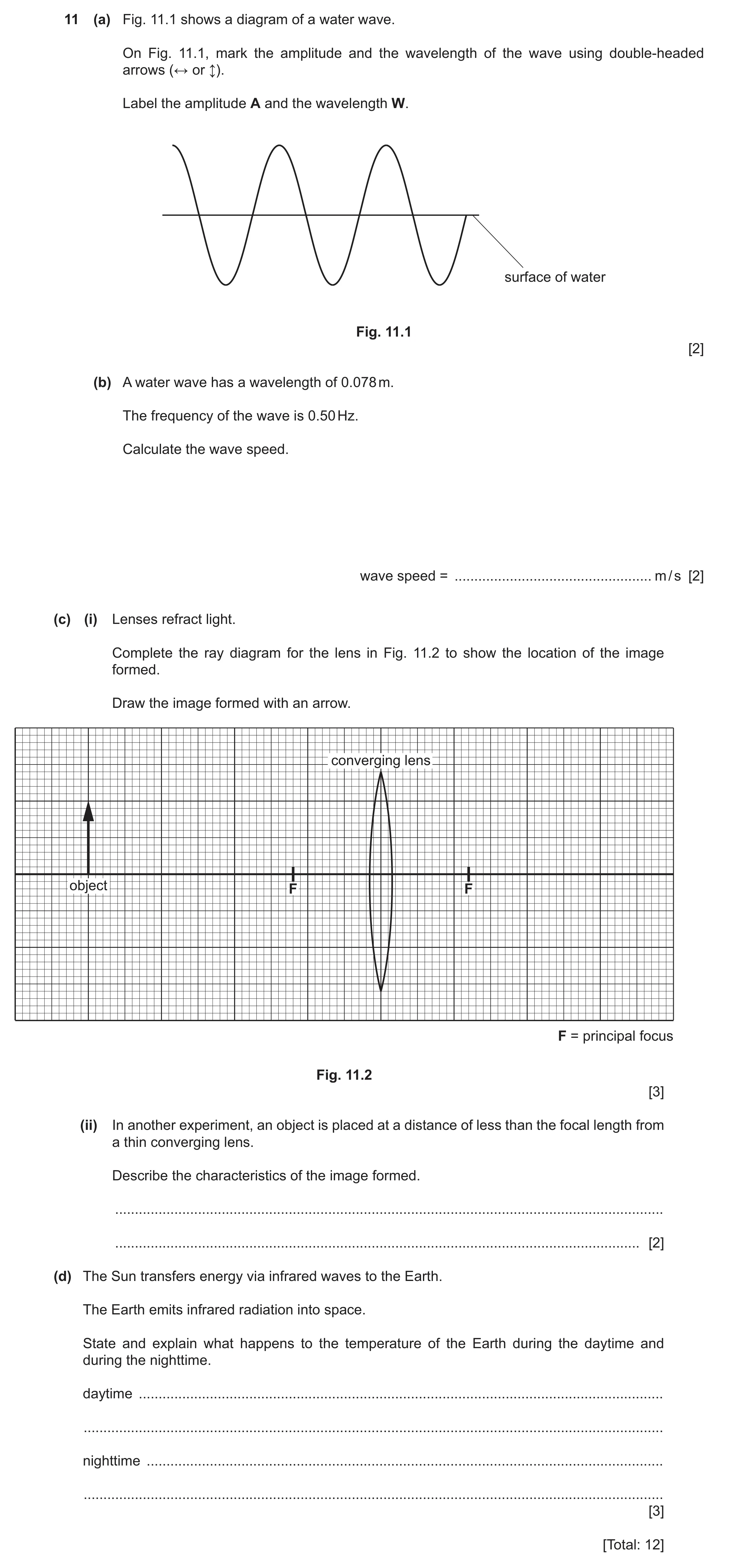
 8
8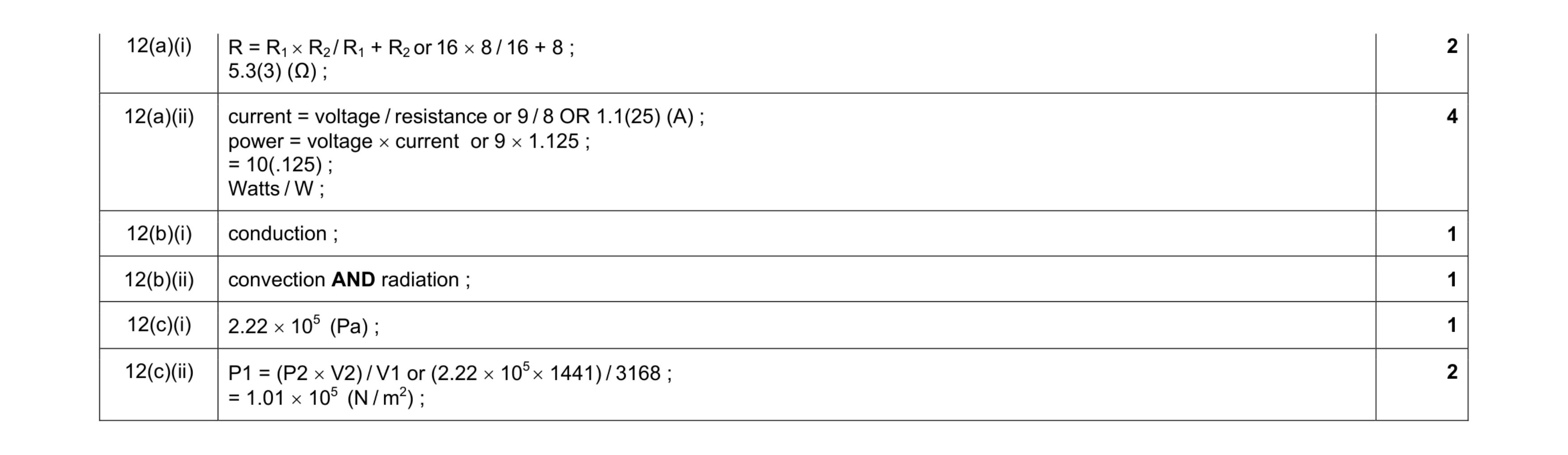 11
11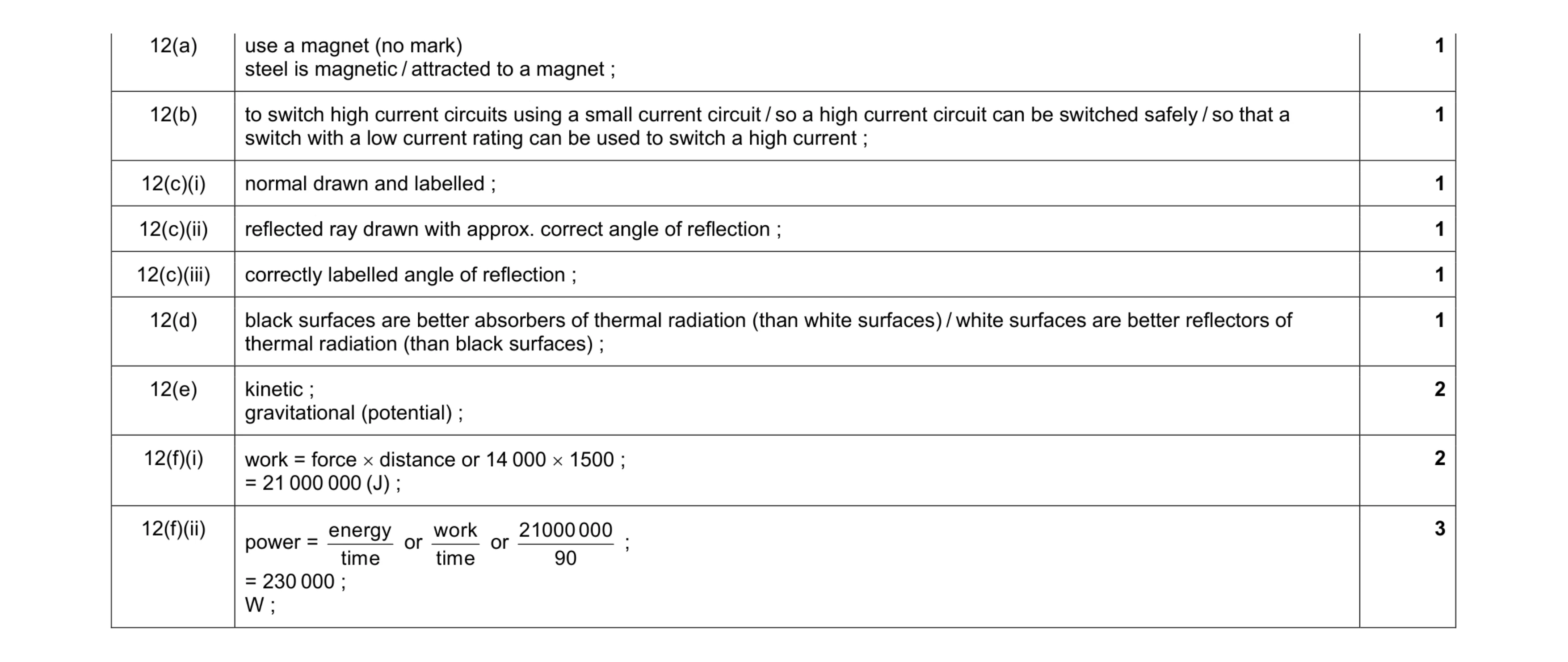 13
13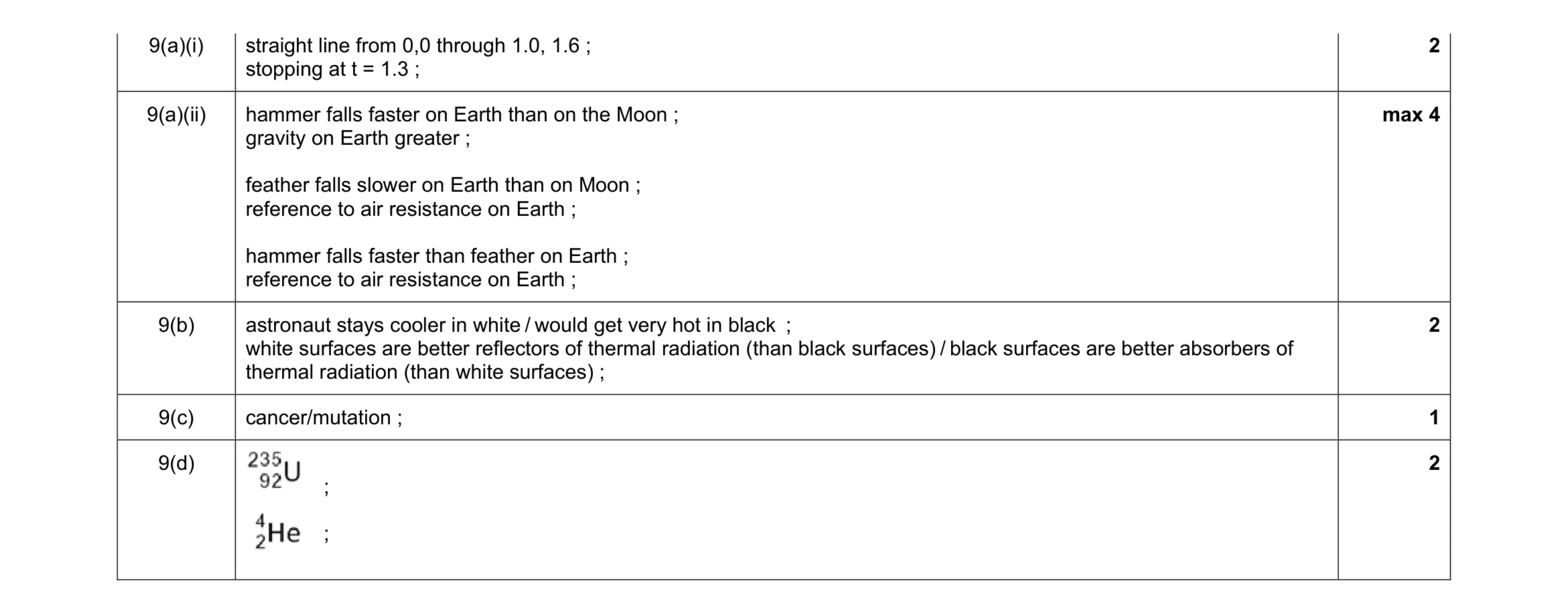 11
11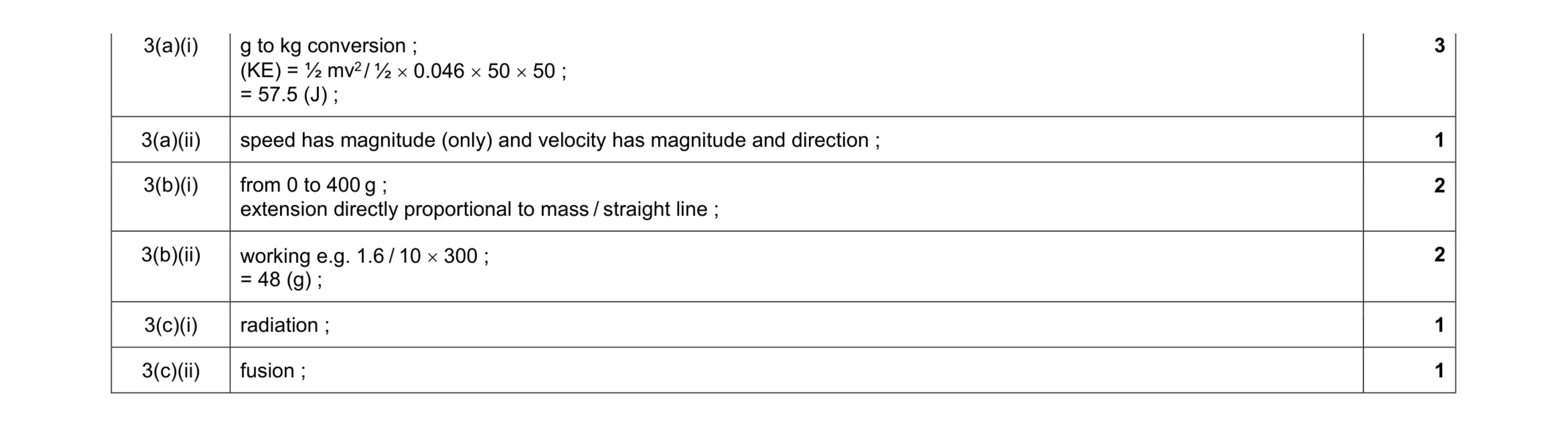 10
10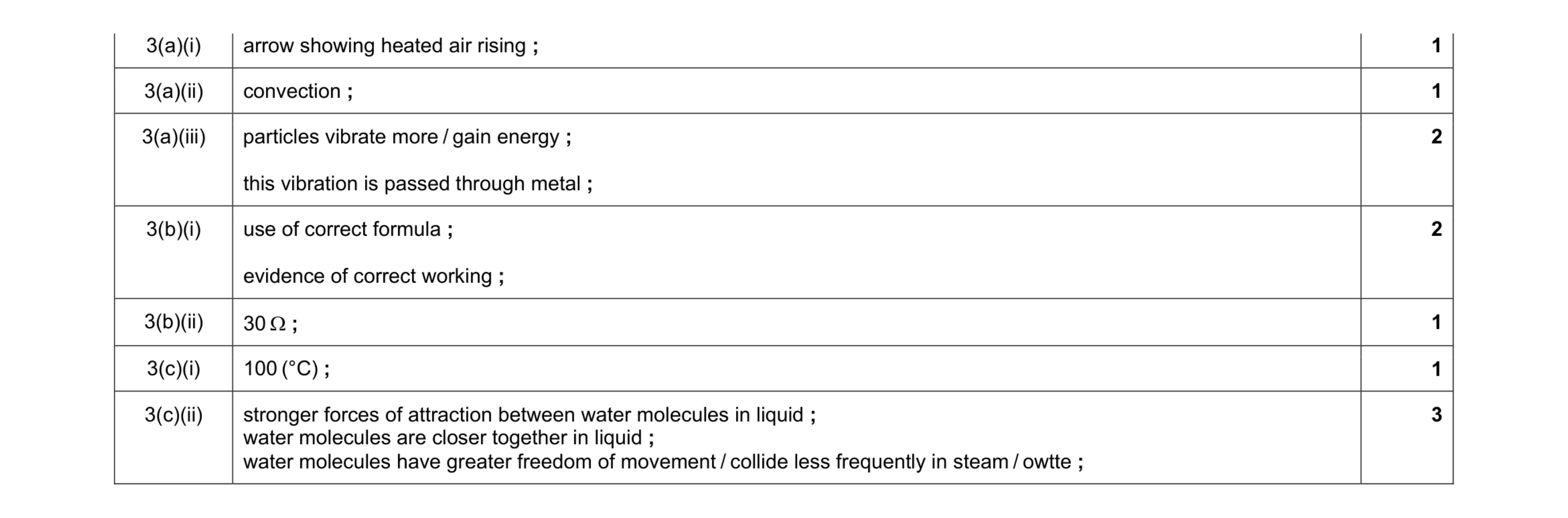 11
11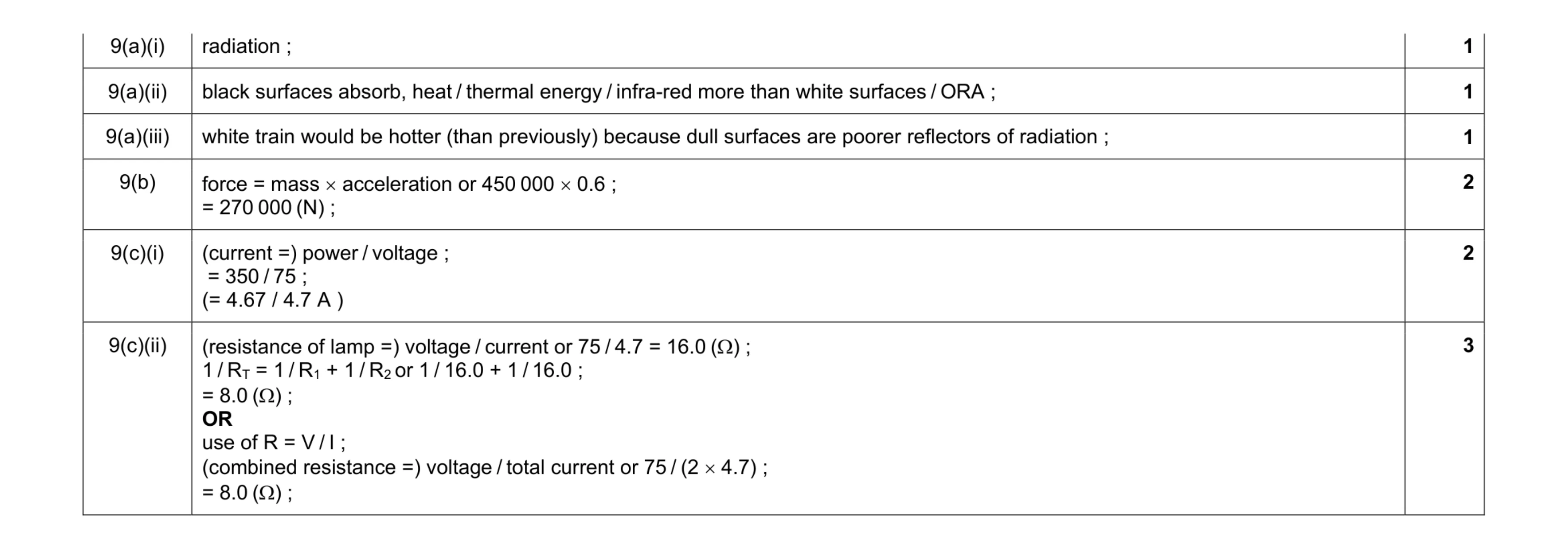 10
10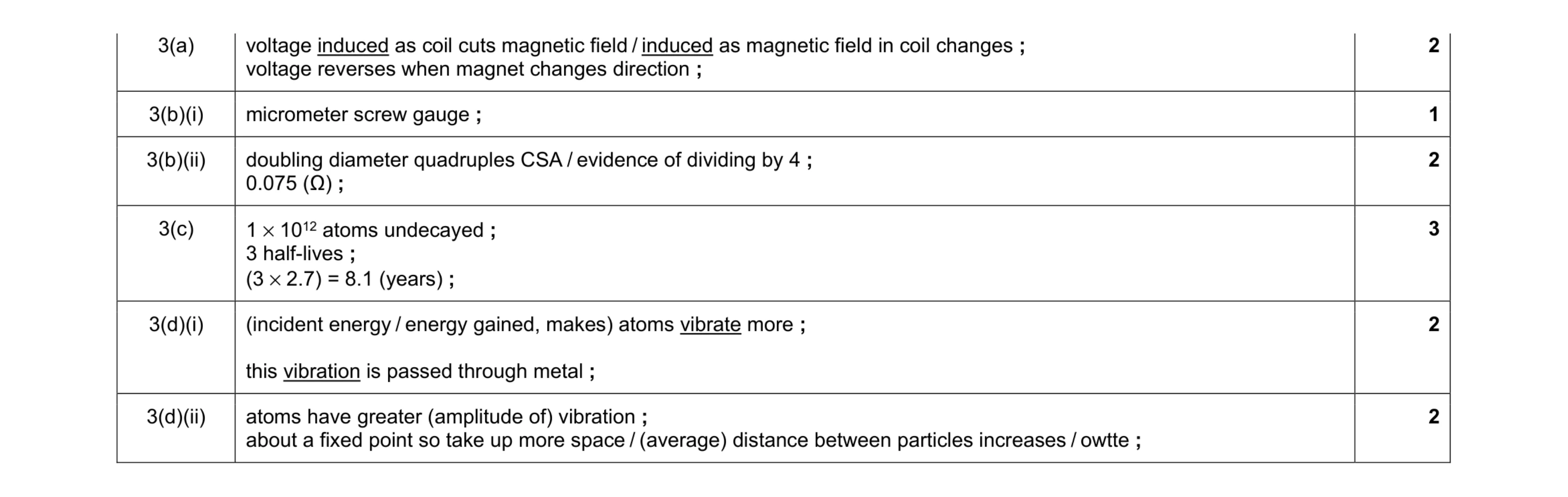 12
12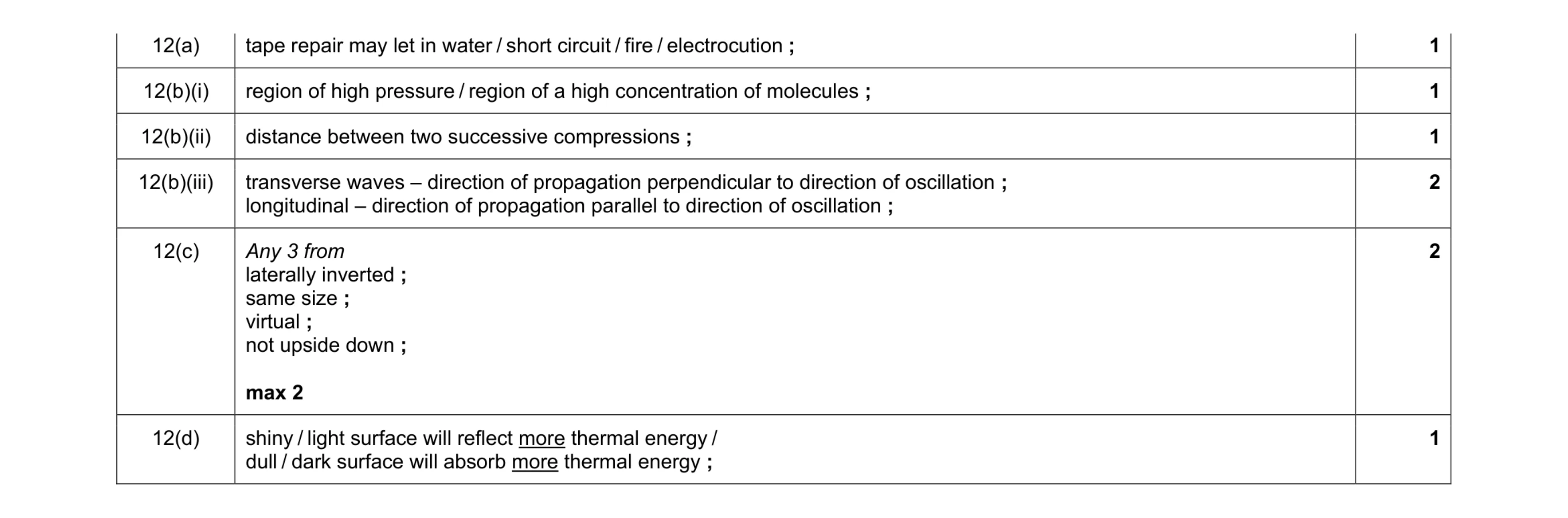 8
8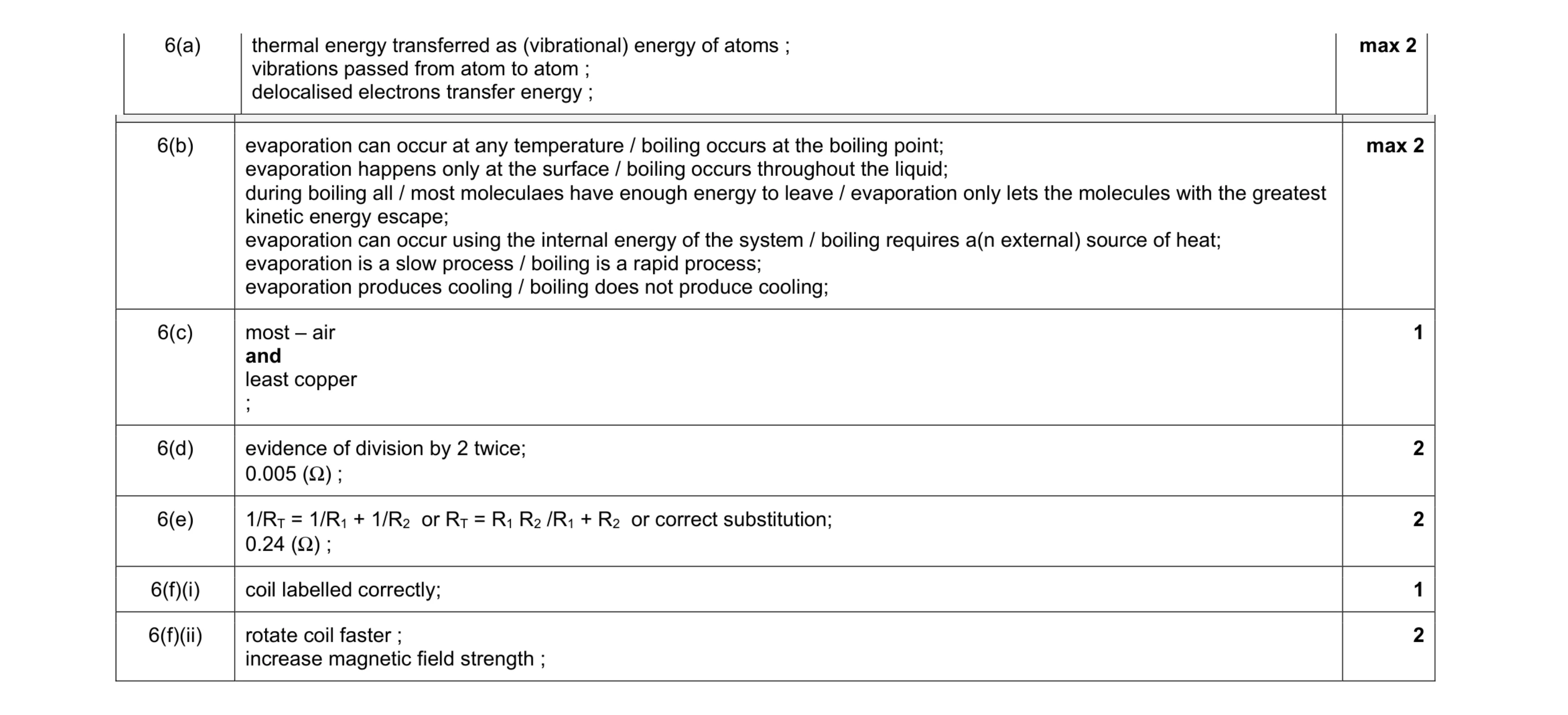 12
12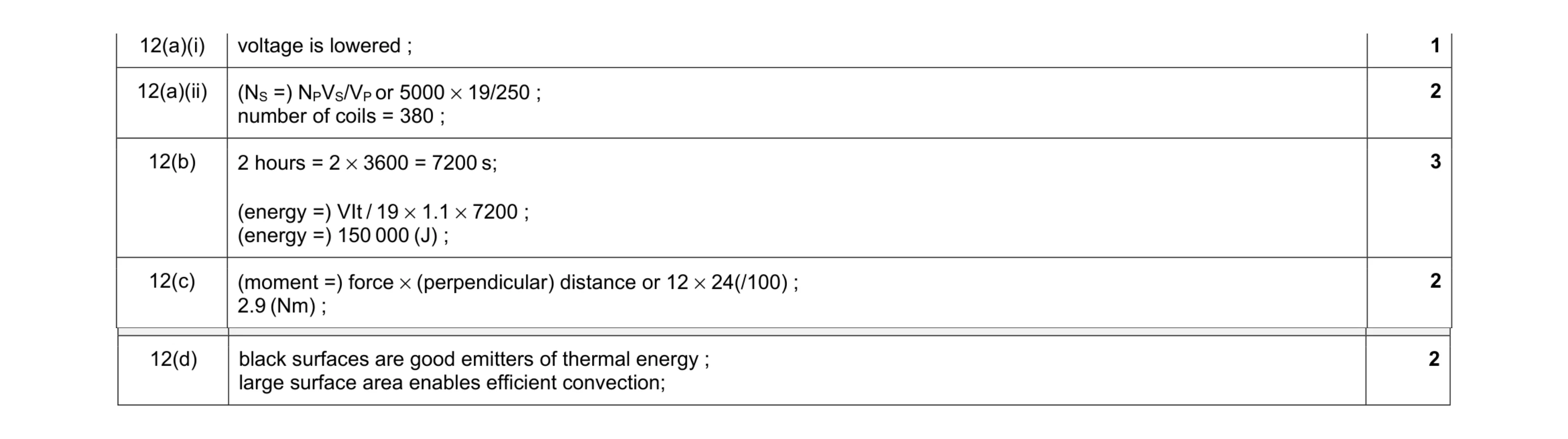 10
10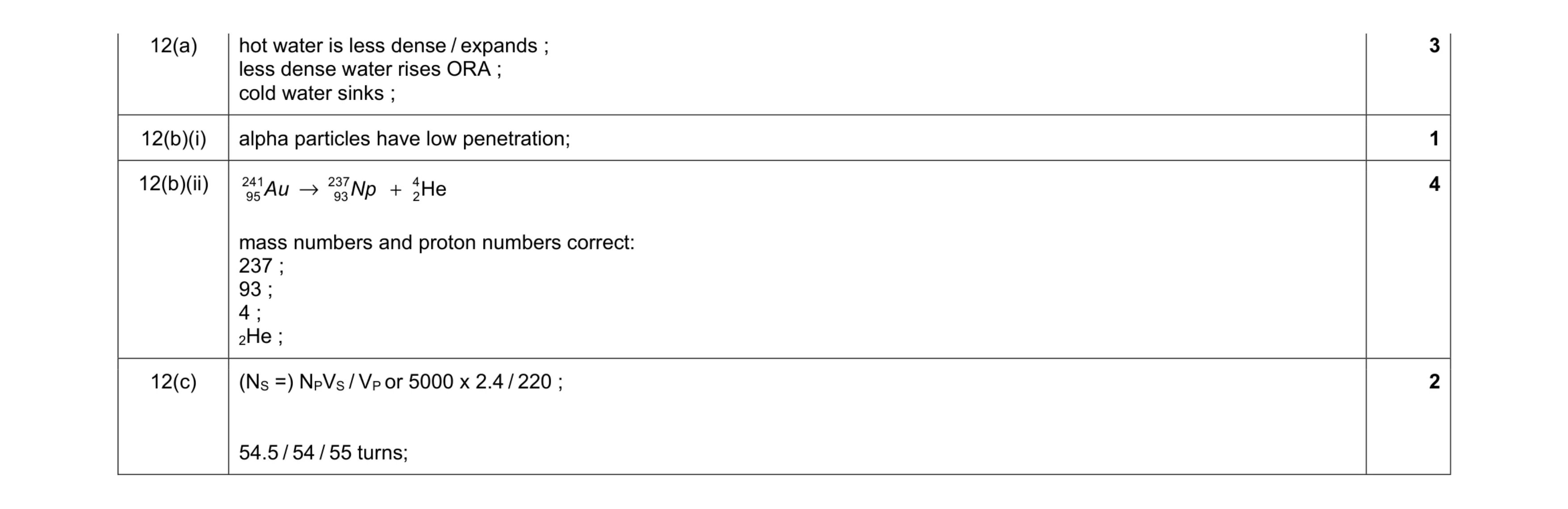 10
10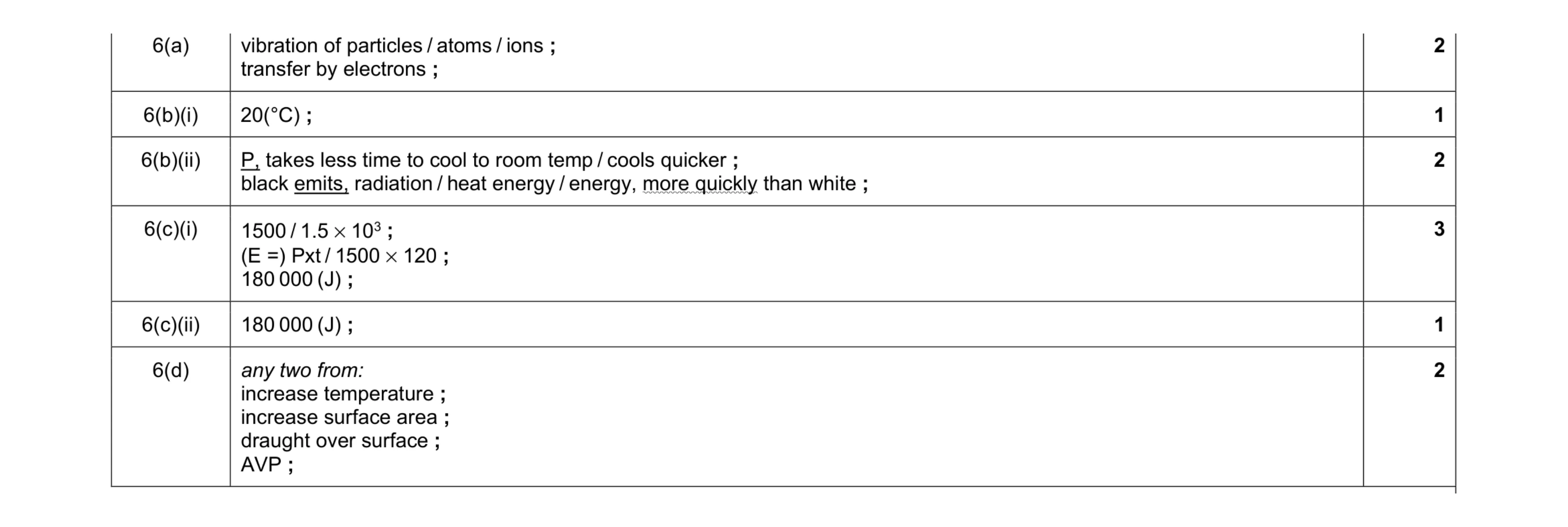 11
11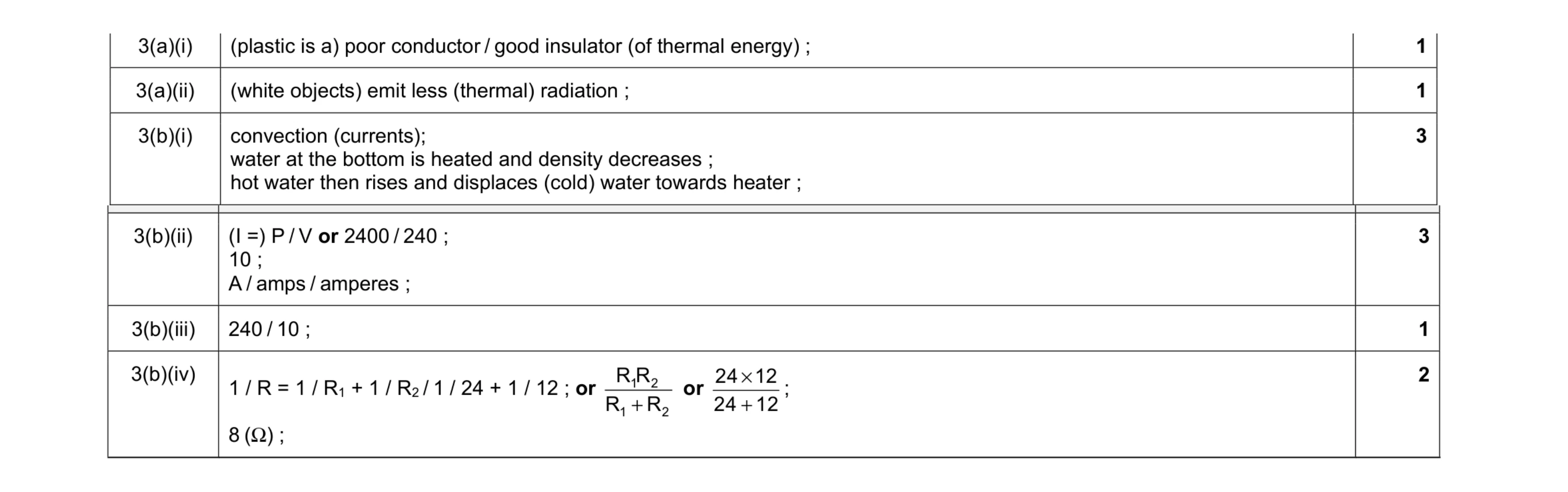 11
11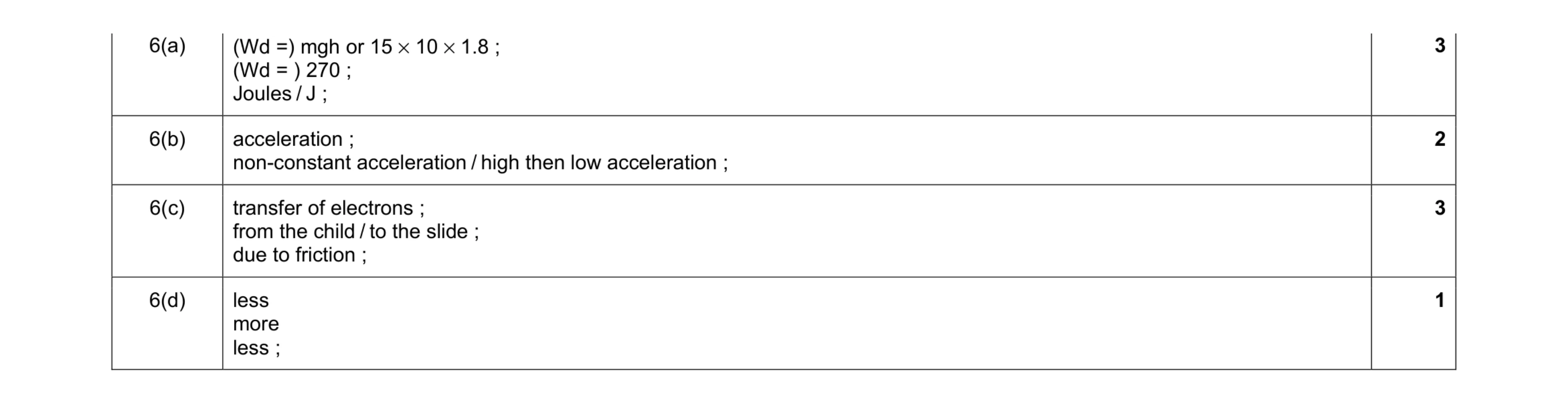 9
9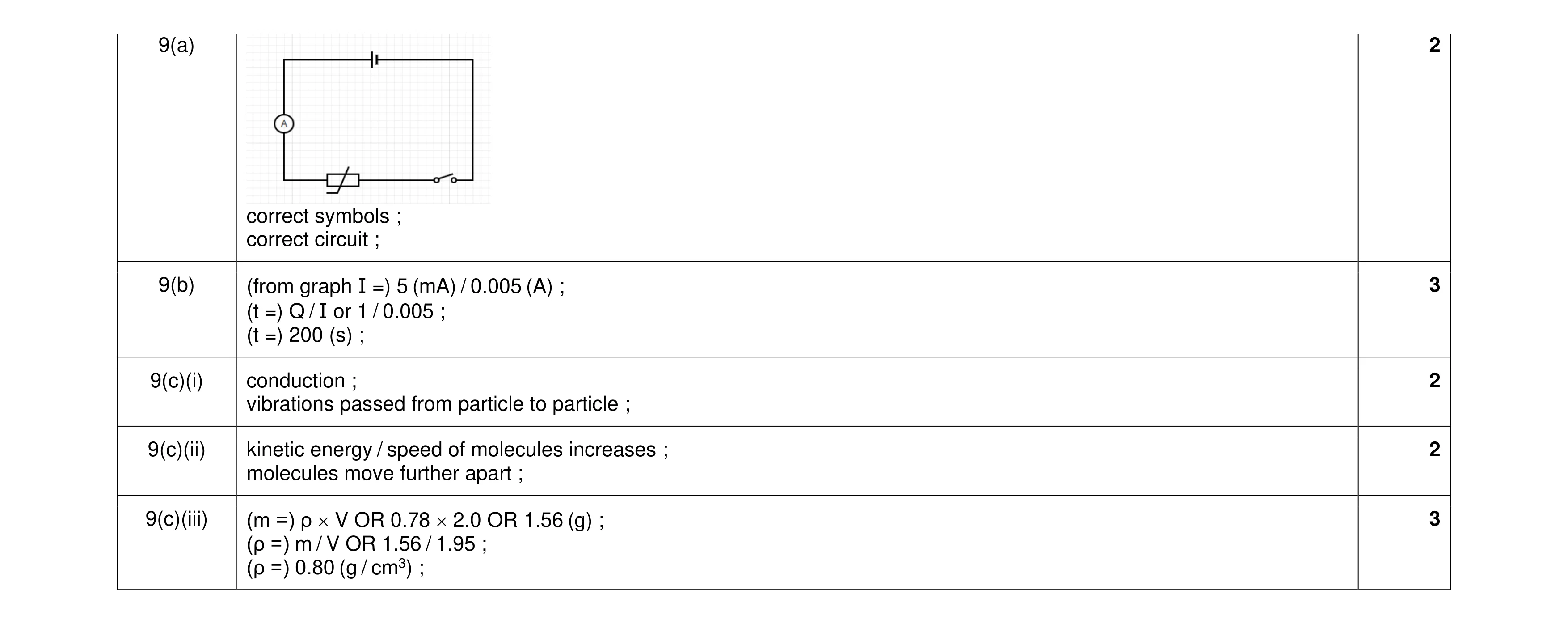 12
12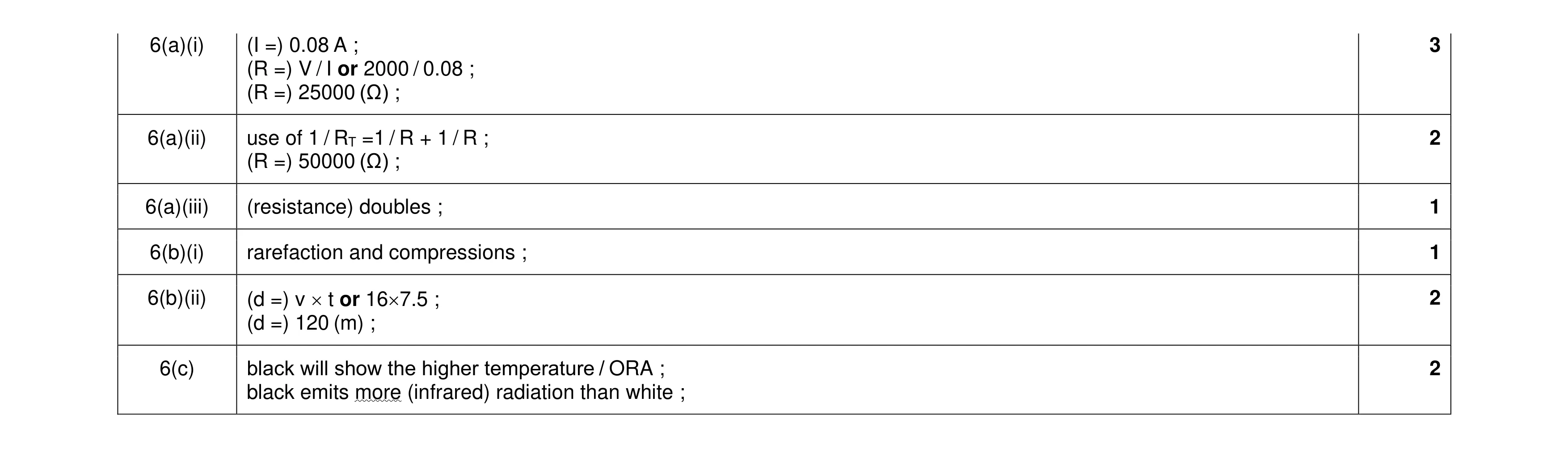 11
11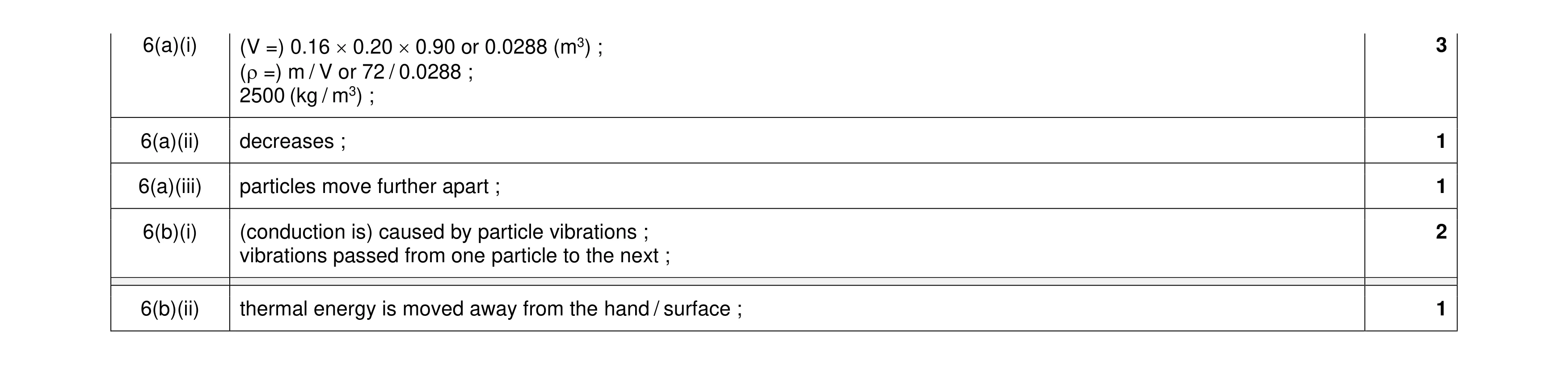 8
8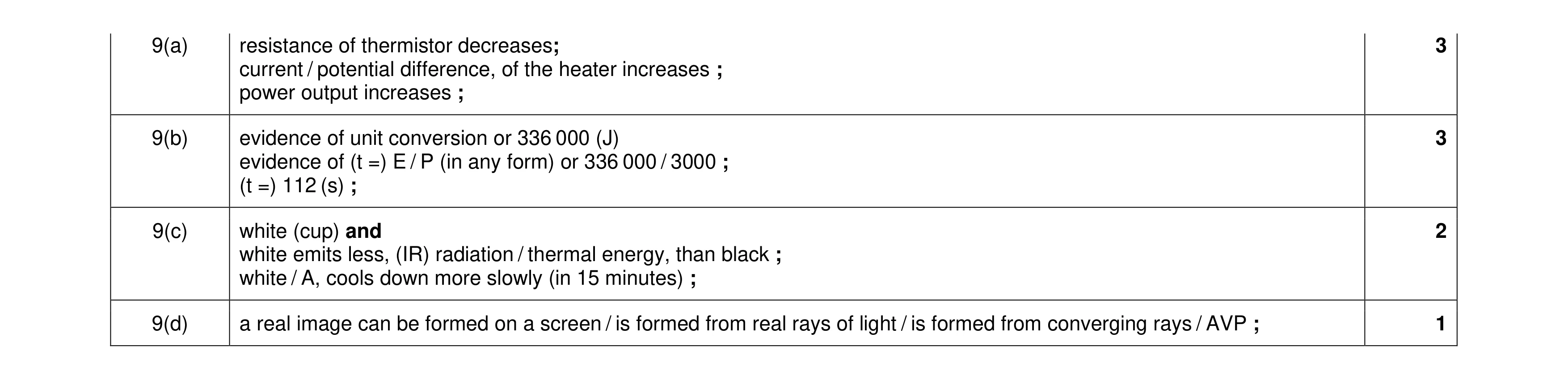 9
9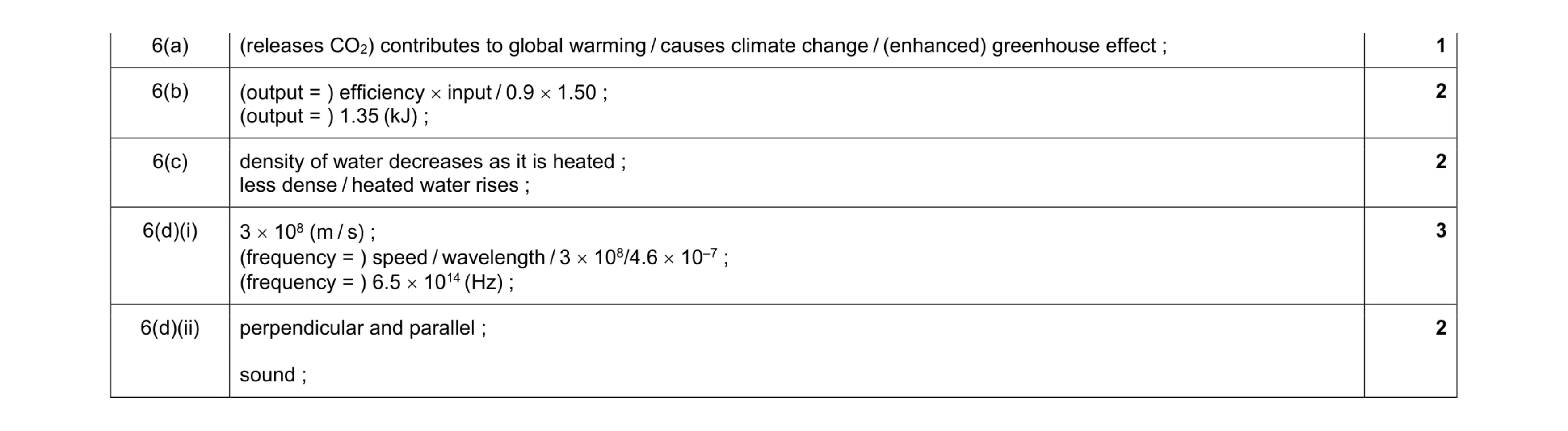 10
10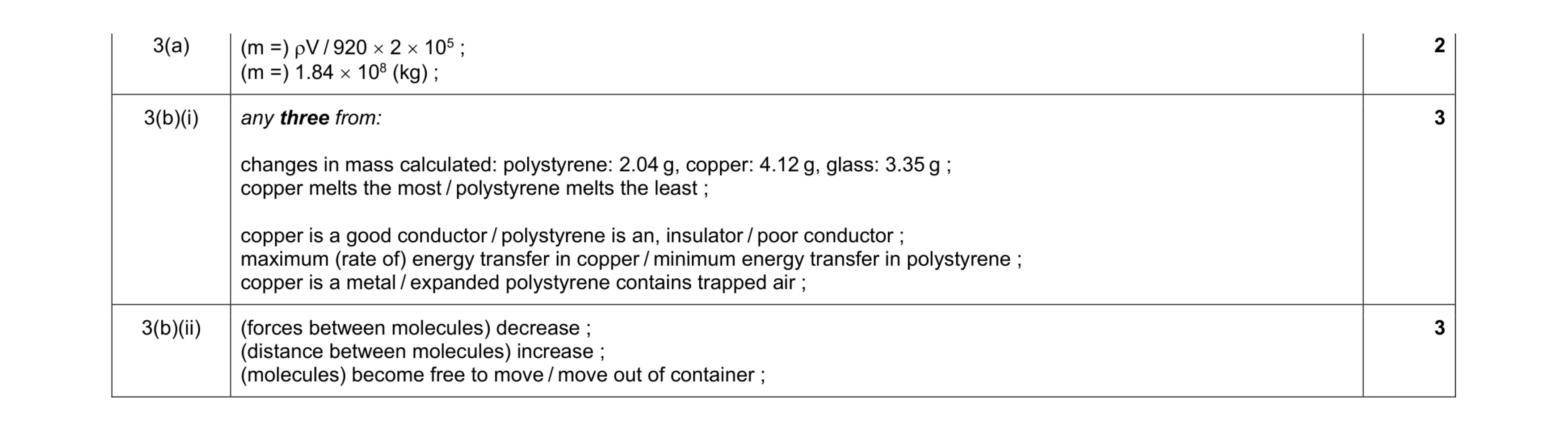 8
8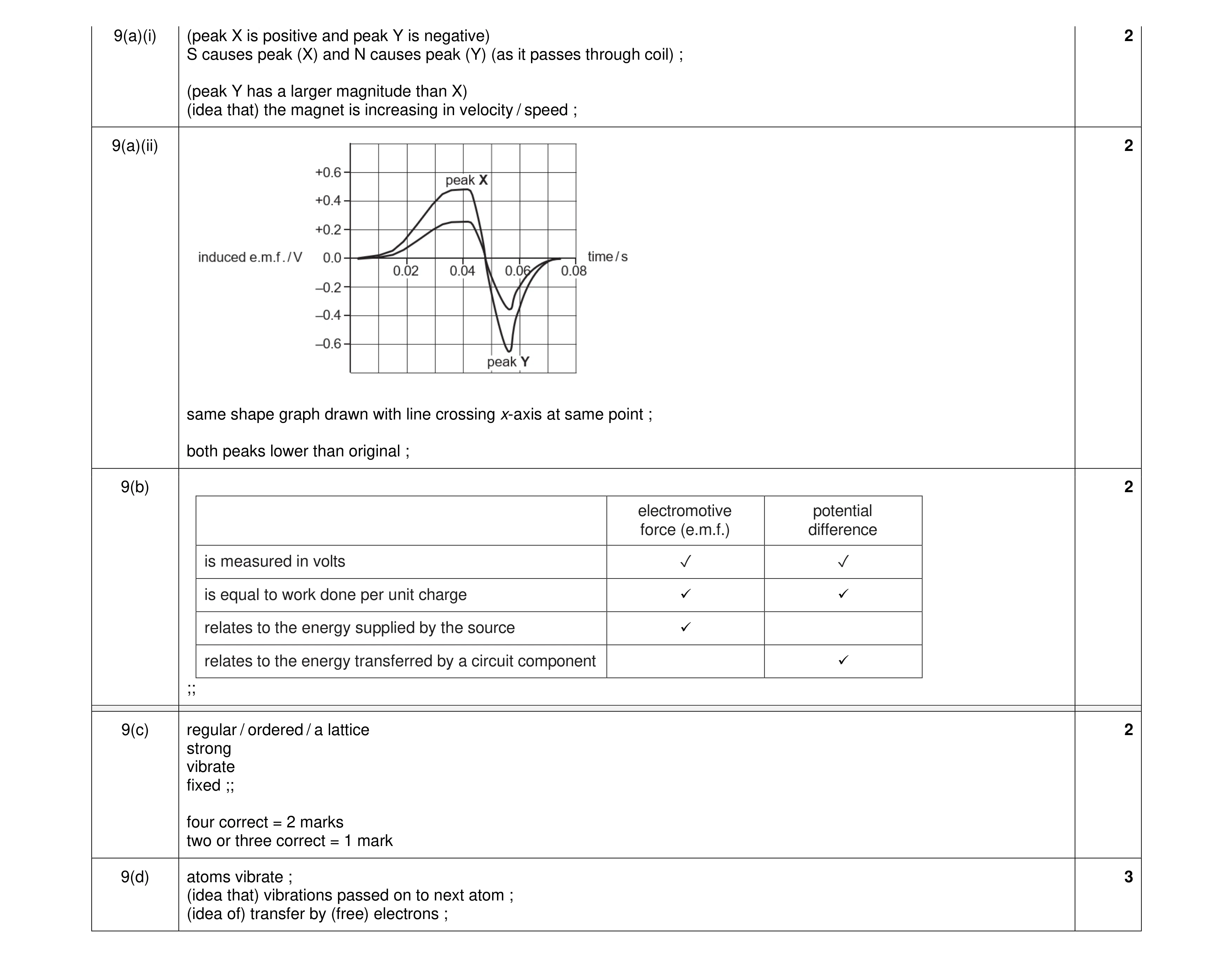 11
11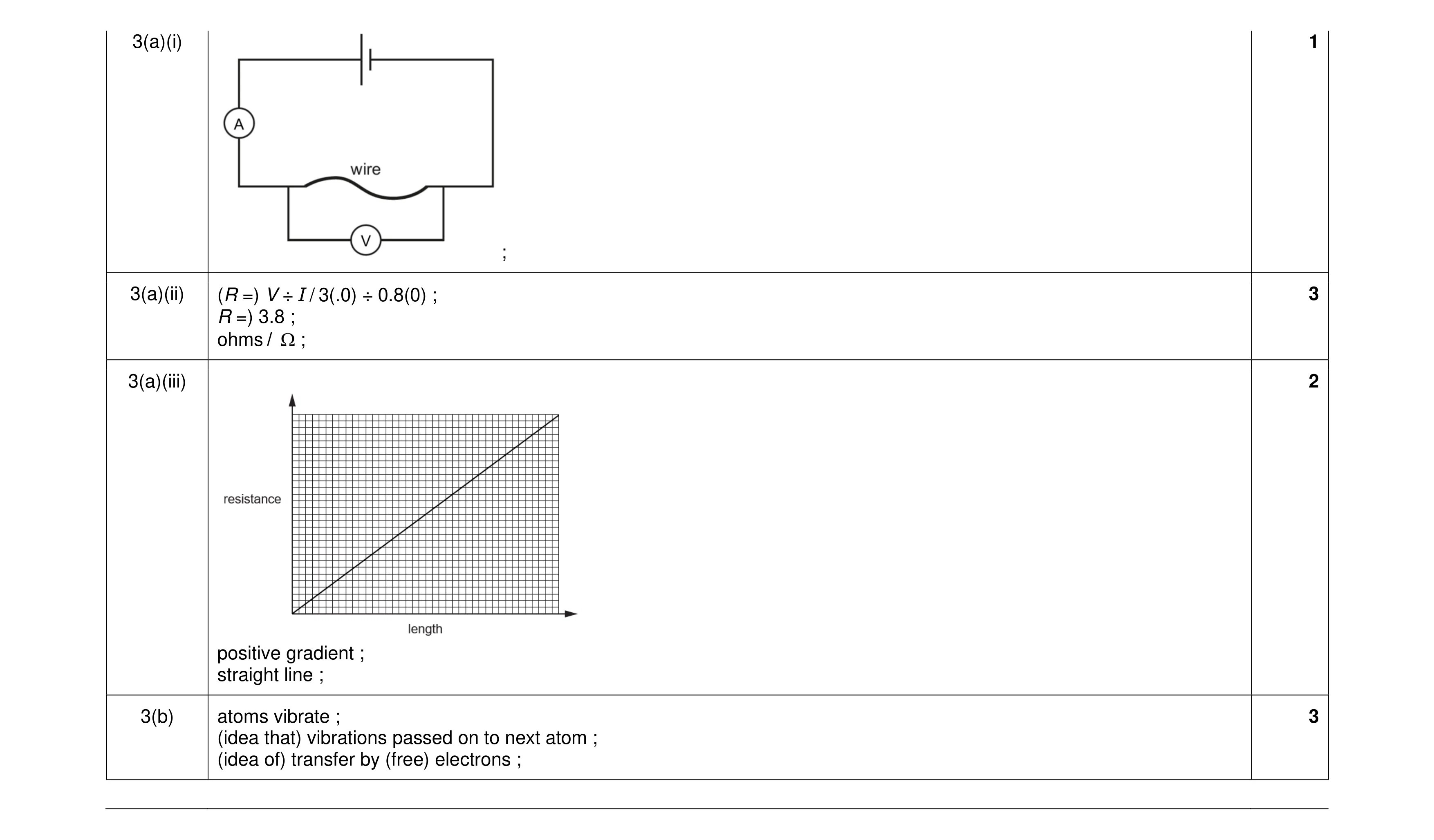 9
9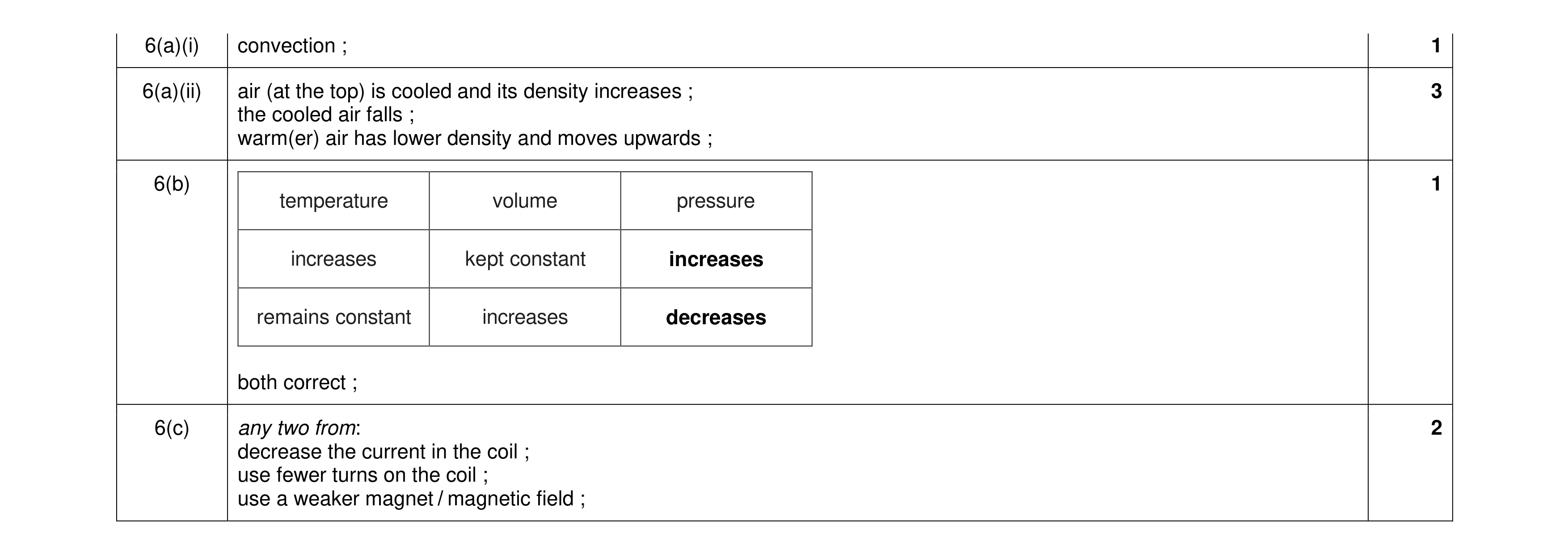 7
7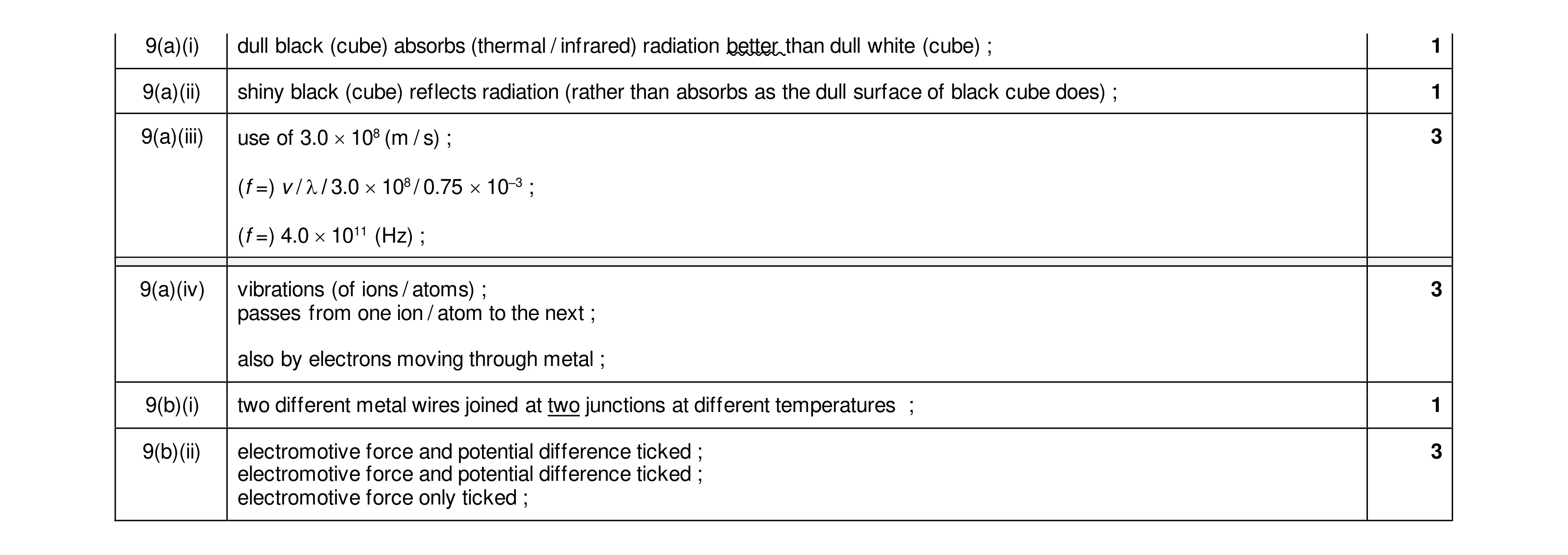 12
12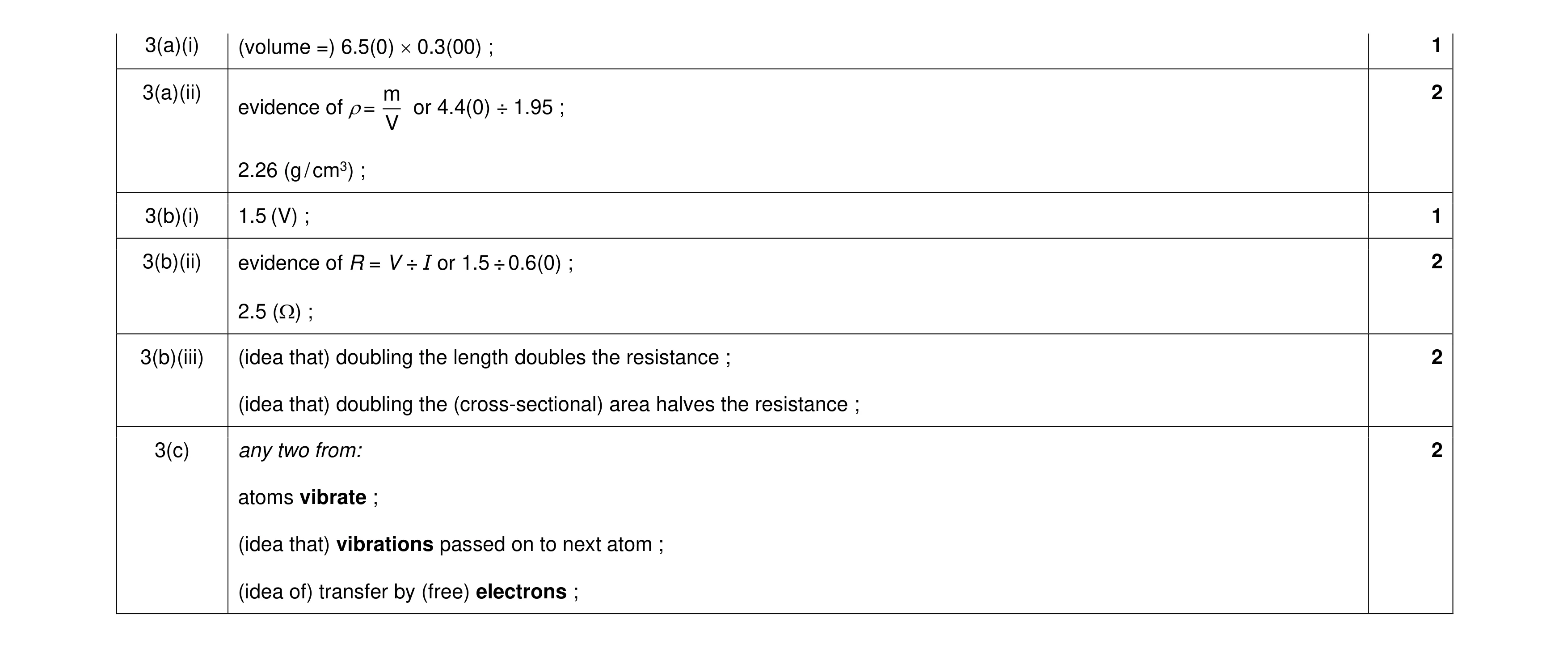 10
10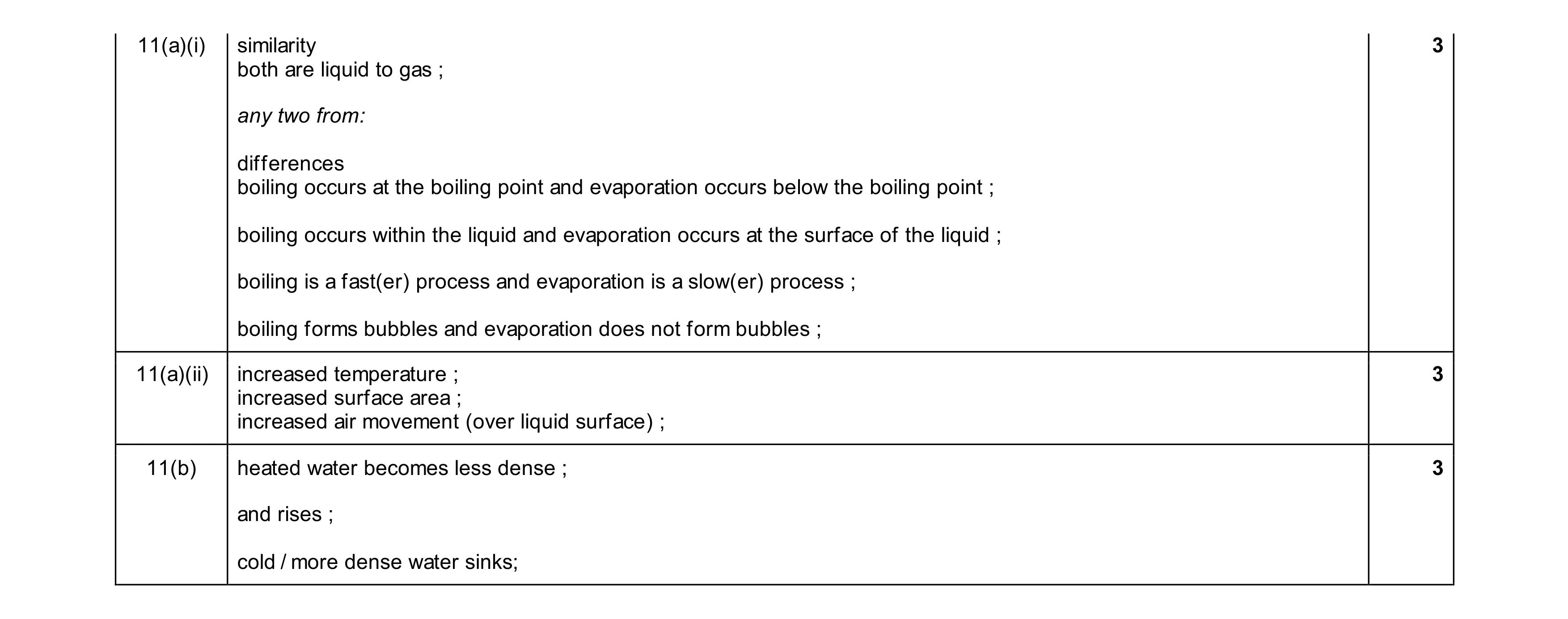 9
9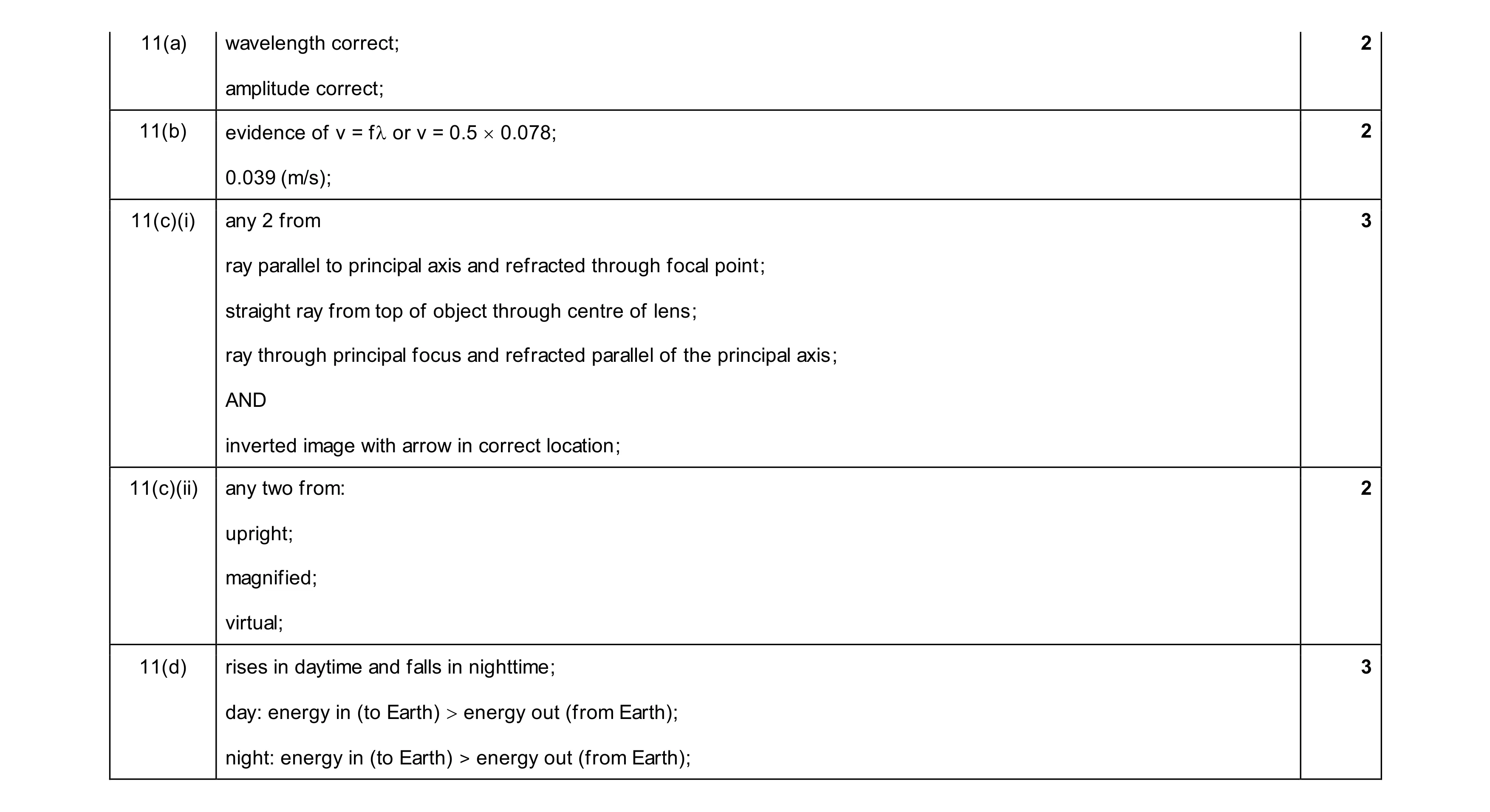 12
12