Questions as text
Question 1 0654/31 May/June 2017
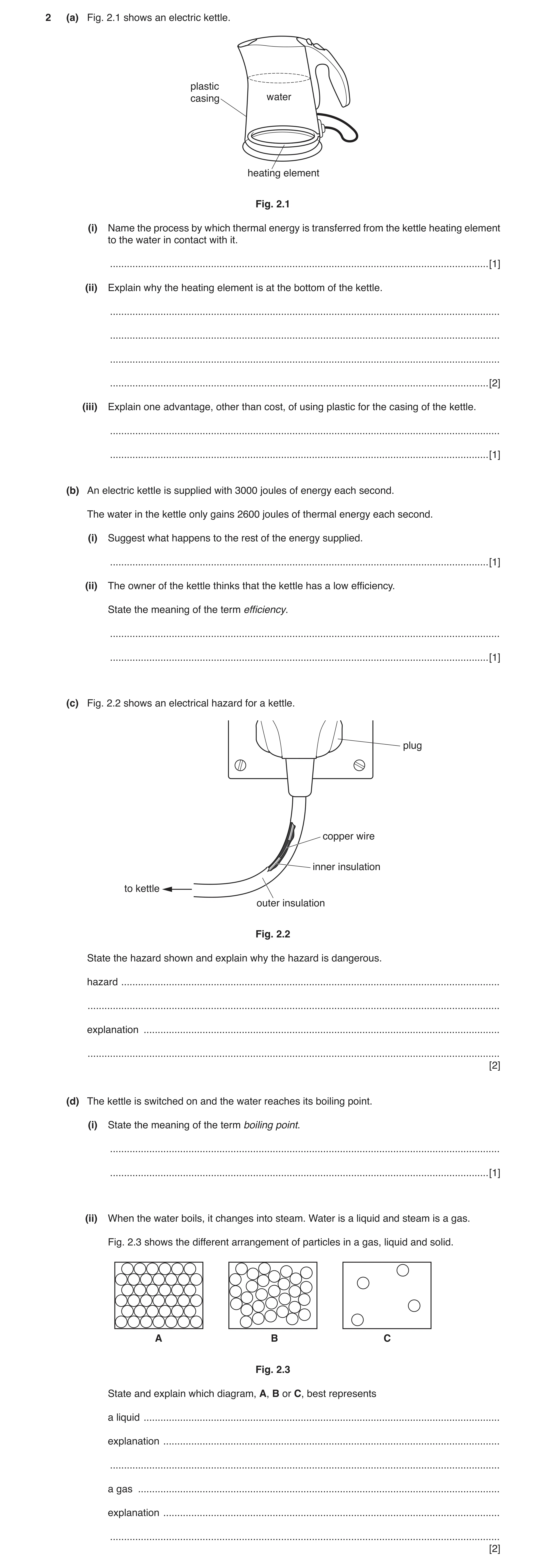
2 (a) Fig. 2.1 shows an electric kettle. plastic casing water heating element Fig. 2.1 (i) Name the process by which thermal energy is transferred from the kettle heating element to the water in contact with it. … [1] (ii) Explain why the heating element is at the bottom of the kettle. … … … … [2] (iii) Explain one advantage, other than cost, of using plastic for the casing of the kettle. … … [1] (b) An electric kettle is supplied with 3000 joules of energy each second. The water in the kettle only gains 2600 joules of thermal energy each second. (i) Suggest what happens to the rest of the energy supplied. … [1] (ii) The owner of the kettle thinks that the kettle has a low efficiency. State the meaning of the term efficiency. … … [1] (c) Fig. 2.2 shows an electrical hazard for a kettle. plug copper wire inner insulation to kettle outer insulation Fig. 2.2 State the hazard shown and explain why the hazard is dangerous. hazard … … explanation … … [2] (d) The kettle is switched on and the water reaches its boiling point. (i) State the meaning of the term boiling point. … … [1] (ii) When the water boils, it changes into steam. Water is a liquid and steam is a gas. Fig. 2.3 shows the different arrangement of particles in a gas, liquid and solid. A B C Fig. 2.3 State and explain which diagram, A, B or C, best represents a liquid … explanation … … a gas … explanation … … [2]
11 marks
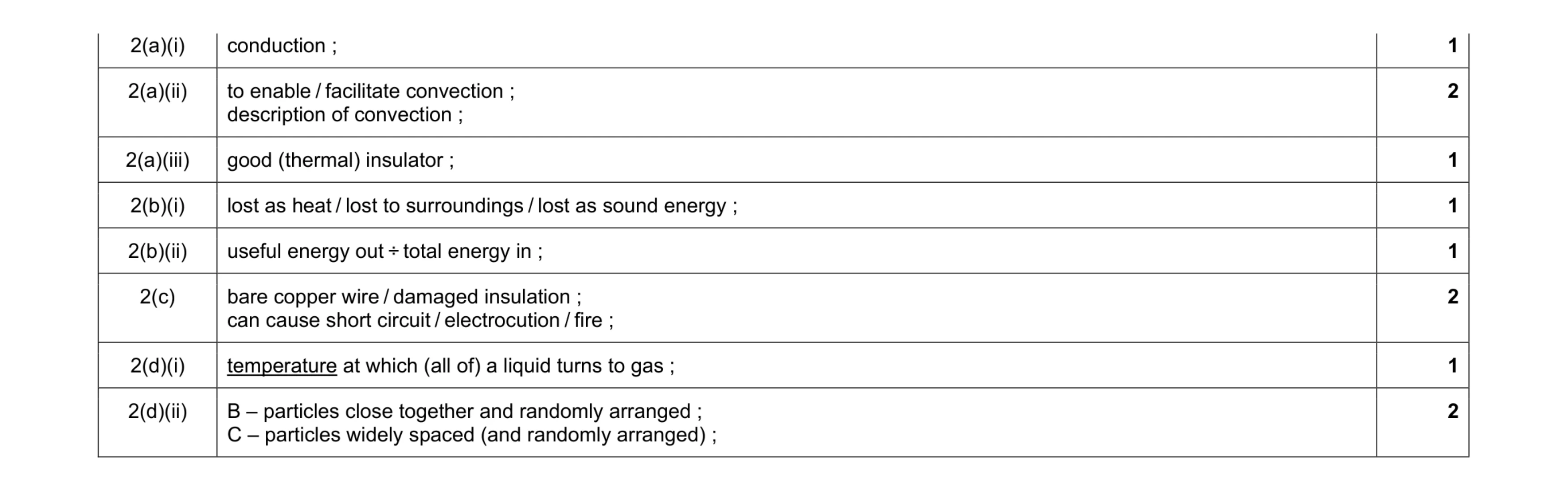
Mark scheme: 2(a)(i) conduction ; 1 2(a)(ii) to enable / facilitate convection ; description of convection ; 2 2(a)(iii) good (thermal) insulator ; 1 2(b)(i) lost as heat / lost to surroundings / lost as sound energy ; 1 2(b)(ii) useful energy out ÷ total energy in ; 1 2(c) bare copper wire / damaged insulation ; can cause short circuit / electrocution / fire ; 2 2(d)(i) temperature at which (all of) a liquid turns to gas ; 1 2(d)(ii) B – particles close together and randomly arranged ; C – particles widely spaced (and randomly arranged) ; 2
This question in 0654/31 May/June 2017
Q2 · A house has solar panels fitted on the roof 0654/33 May/June 2017
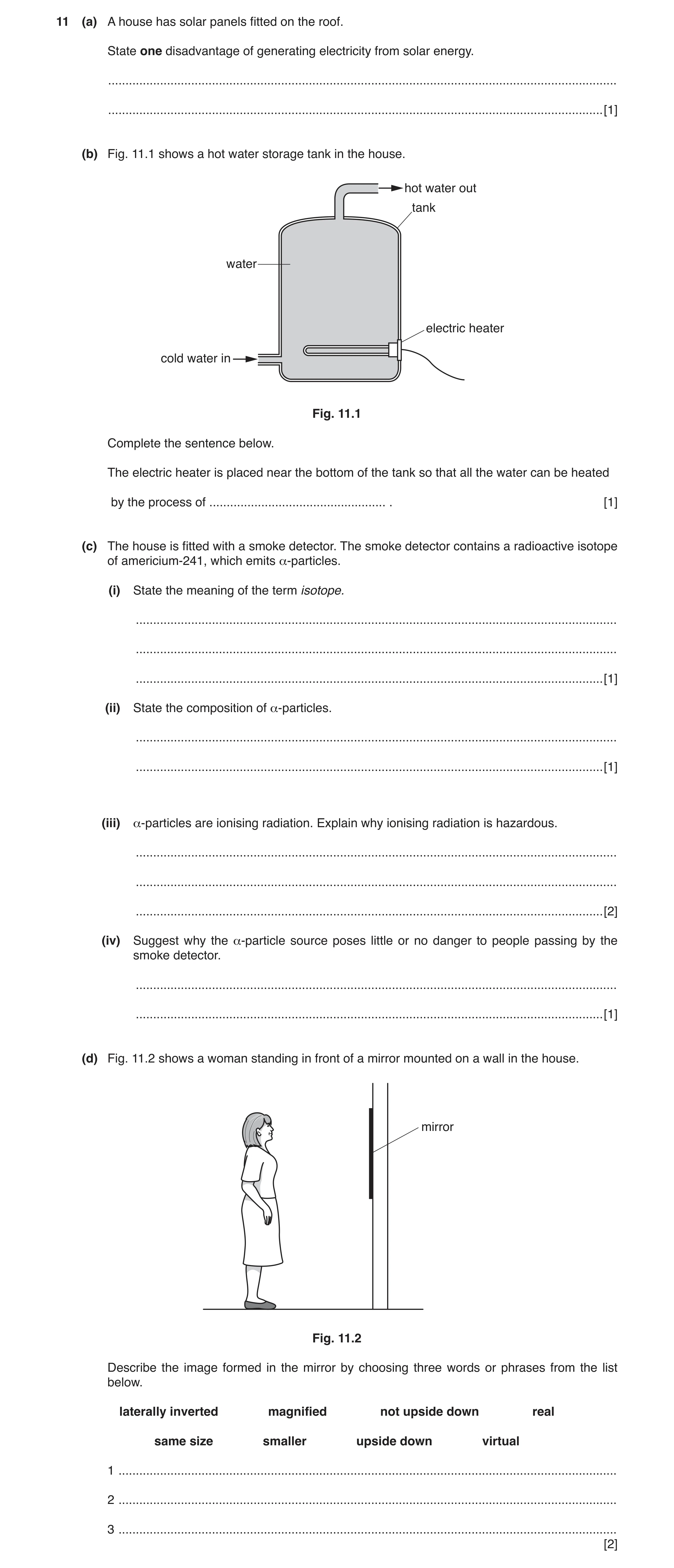
11 (a) A house has solar panels fitted on the roof. State one disadvantage of generating electricity from solar energy. … … [1] (b) Fig. 11.1 shows a hot water storage tank in the house. hot water out tank water electric heater cold water in Fig. 11.1 Complete the sentence below. The electric heater is placed near the bottom of the tank so that all the water can be heated by the process of … . [1] (c) The house is fitted with a smoke detector. The smoke detector contains a radioactive isotope of americium-241, which emits α-particles. (i) State the meaning of the term isotope. … … … [1] (ii) State the composition of α-particles. … … [1] (iii) α-particles are ionising radiation. Explain why ionising radiation is hazardous. … … … [2] (iv) Suggest why the α-particle source poses little or no danger to people passing by the smoke detector. … … [1] (d) Fig. 11.2 shows a woman standing in front of a mirror mounted on a wall in the house. mirror Fig. 11.2 Describe the image formed in the mirror by choosing three words or phrases from the list below. laterally inverted magnified not upside down real same size smaller upside down virtual 1 … 2 … 3 … [2]
9 marks
Mark scheme: 11(a) doesn’t work at night / when there is little light ; 1 11(b) convection ; 1 11(c)(i) atoms of the same element that have same proton number but different neutron number etc. ; 1 11(c)(ii) 2p + 2n / helium nucleus ; 1 11(c)(iii) ionises atoms / molecules in cells ; causes mutation / cancer ; 2 11(c)(iv) alpha particles are absorbed by 5cm of air ; 1 11(d) laterally inverted same size not upside down virtual one correct one mark ; all three correct two marks ; 2
This question in 0654/33 May/June 2017
Q3 · Many houses in colder countries are designed to conserve thermal energy 0654/31 Oct/Nov 2017
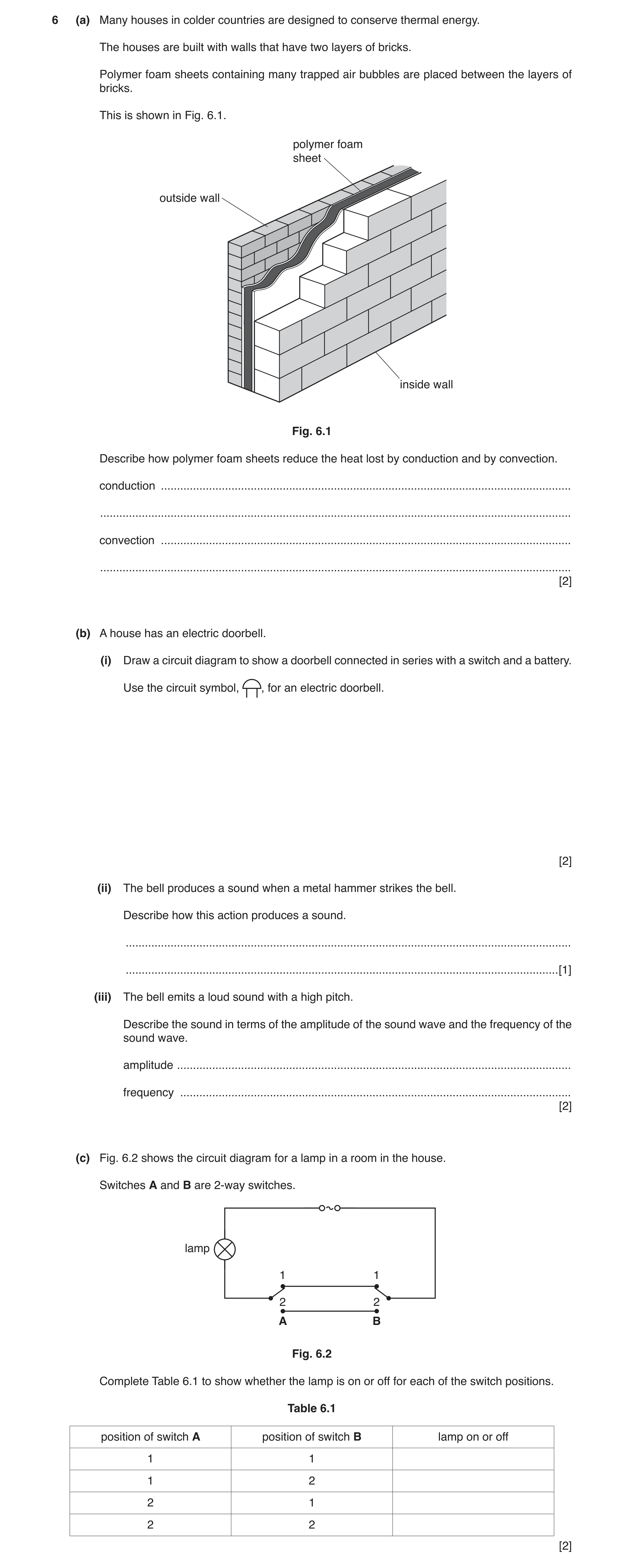
6 (a) Many houses in colder countries are designed to conserve thermal energy. The houses are built with walls that have two layers of bricks. Polymer foam sheets containing many trapped air bubbles are placed between the layers of bricks. This is shown in Fig. 6.1. polymer foam sheet outside wall inside wall Fig. 6.1 Describe how polymer foam sheets reduce the heat lost by conduction and by convection. conduction … … convection … … [2] (b) A house has an electric doorbell. (i) Draw a circuit diagram to show a doorbell connected in series with a switch and a battery. Use the circuit symbol, , for an electric doorbell. [2] (ii) The bell produces a sound when a metal hammer strikes the bell. Describe how this action produces a sound. … … [1] (iii) The bell emits a loud sound with a high pitch. Describe the sound in terms of the amplitude of the sound wave and the frequency of the sound wave. amplitude … frequency … [2] (c) Fig. 6.2 shows the circuit diagram for a lamp in a room in the house. Switches A and B are 2-way switches. lamp 1 1 2 2 A B Fig. 6.2 Complete Table 6.1 to show whether the lamp is on or off for each of the switch positions. Table 6.1 position of switch A position of switch B lamp on or off 1 1 1 2 2 1 2 2 [2]
9 marks
Mark scheme: 6(a) conduction – polymer / foam / air is a poor heat conductor / is an insulator ; convection – (trapped) air is unable to move by convection ; 2 6(b)(i) all symbols correct ; circuit correctly connected ; 2 6(b)(ii) something vibrates ; 1 6(b)(iii) large amplitude ; high frequency ; 2 6(c) on off off on 2 or 3 correct ; 4 correct ; 2
This question in 0654/31 Oct/Nov 2017
Q4 · A bus gets very hot as it travels on a sunny day 0654/31 Oct/Nov 2018
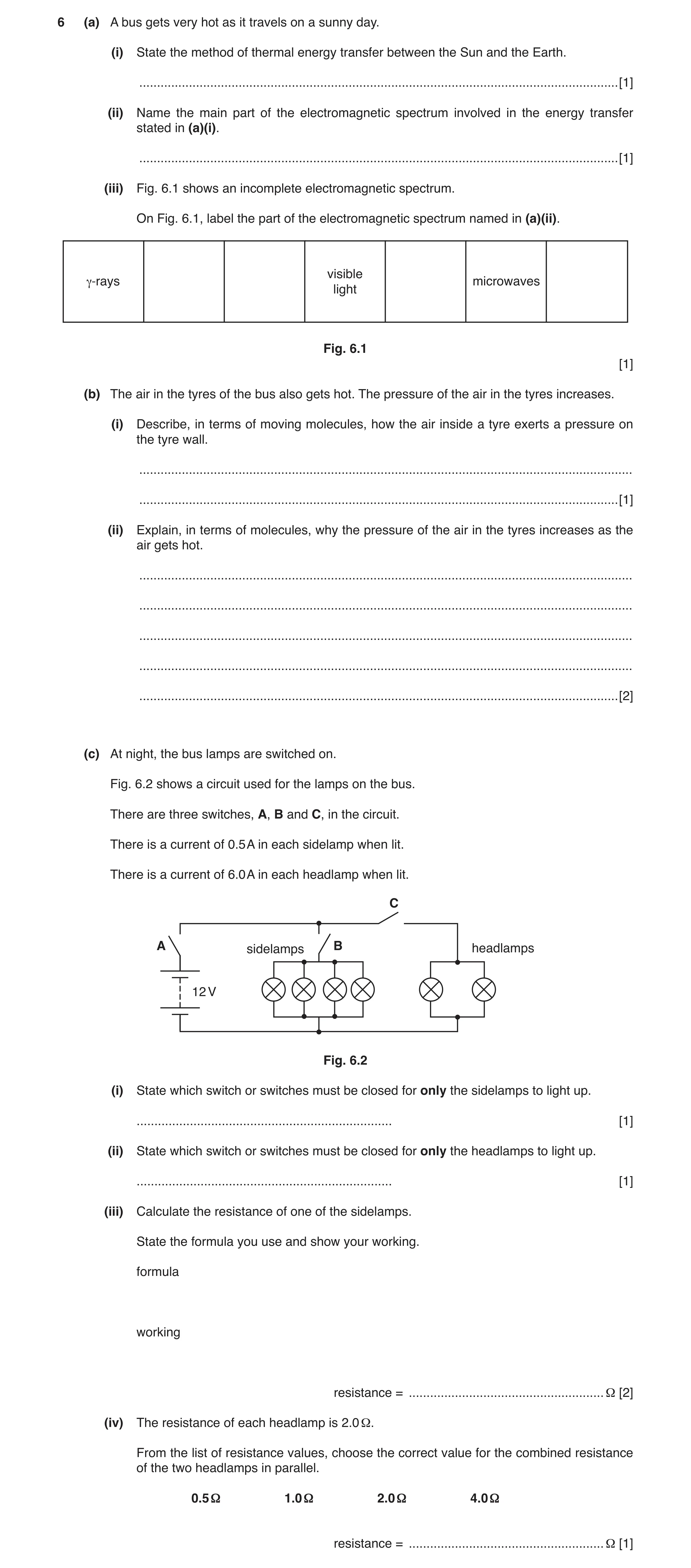
6 (a) A bus gets very hot as it travels on a sunny day. (i) State the method of thermal energy transfer between the Sun and the Earth. … [1] (ii) Name the main part of the electromagnetic spectrum involved in the energy transfer stated in (a)(i). … [1] (iii) Fig. 6.1 shows an incomplete electromagnetic spectrum. On Fig. 6.1, label the part of the electromagnetic spectrum named in (a)(ii). visible γ-rays microwaves light Fig. 6.1 [1] (b) The air in the tyres of the bus also gets hot. The pressure of the air in the tyres increases. (i) Describe, in terms of moving molecules, how the air inside a tyre exerts a pressure on the tyre wall. … … [1] (ii) Explain, in terms of molecules, why the pressure of the air in the tyres increases as the air gets hot. … … … … … [2] (c) At night, the bus lamps are switched on. Fig. 6.2 shows a circuit used for the lamps on the bus. There are three switches, A, B and C, in the circuit. There is a current of 0.5 A in each sidelamp when lit. There is a current of 6.0 A in each headlamp when lit. C A sidelamps B headlamps 12 V Fig. 6.2 (i) State which switch or switches must be closed for only the sidelamps to light up. … [1] (ii) State which switch or switches must be closed for only the headlamps to light up. … [1] (iii) Calculate the resistance of one of the sidelamps. State the formula you use and show your working. formula working resistance = … Ω [2] (iv) The resistance of each headlamp is 2.0 Ω. From the list of resistance values, choose the correct value for the combined resistance of the two headlamps in parallel. 0.5 Ω 1.0 Ω 2.0 Ω 4.0 Ω resistance = … Ω [1]
11 marks
Mark scheme: 6(a)(i) radiation ; 1 6(a)(ii) infrared ; 1 6(a)(iii) between visible and microwaves ; 1 6(b)(i) pressure caused by collisions with tyre wall ; 1 6(b)(ii) thermal energy causes particles to move faster / particles have more KE ; more frequent collisions / collisions exert a greater force; max 2 6(c)(i) A and B ; 1 6(c)(ii) A and C ; 1 6(c)(iii) resistance = voltage / current or 12 / 0.5 ; = 24 (Ω) ; 2 6(c)(iv) 1 (Ω) ; 1
This question in 0654/31 Oct/Nov 2018
Q5 · A metal saucepan containing water is placed onto the hot‑plate of an electric cooker 0654/32 Oct/Nov 2018
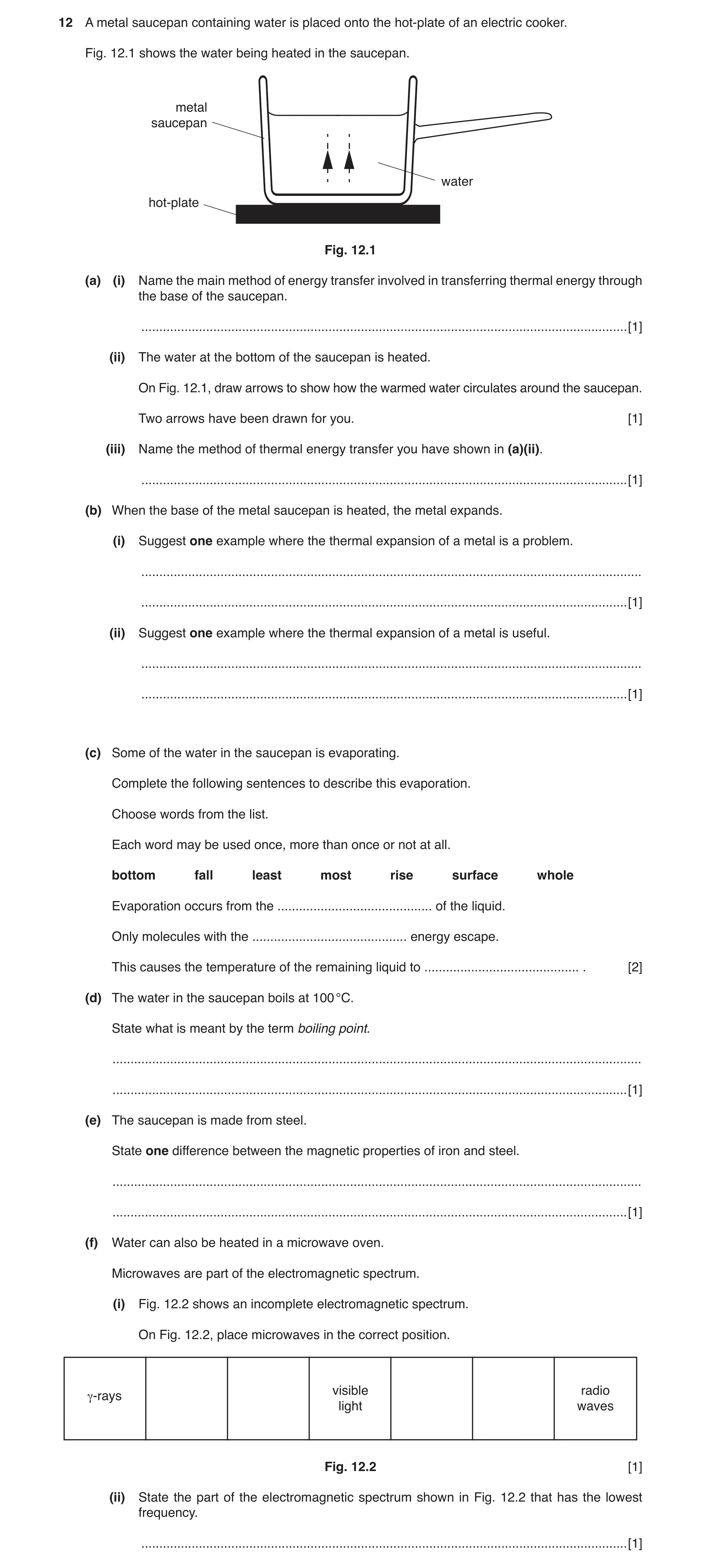
12 A metal saucepan containing water is placed onto the hot‑plate of an electric cooker. Fig. 12.1 shows the water being heated in the saucepan. metal saucepan water hot-plate Fig. 12.1 (a) (i) Name the main method of energy transfer involved in transferring thermal energy through the base of the saucepan. … [1] (ii) The water at the bottom of the saucepan is heated. On Fig. 12.1, draw arrows to show how the warmed water circulates around the saucepan. Two arrows have been drawn for you. [1] (iii) Name the method of thermal energy transfer you have shown in (a)(ii). … [1] (b) When the base of the metal saucepan is heated, the metal expands. (i) Suggest one example where the thermal expansion of a metal is a problem. … … [1] (ii) Suggest one example where the thermal expansion of a metal is useful. … … [1] (c) Some of the water in the saucepan is evaporating. Complete the following sentences to describe this evaporation. Choose words from the list. Each word may be used once, more than once or not at all. bottom fall least most rise surface whole Evaporation occurs from the … of the liquid. Only molecules with the … energy escape. This causes the temperature of the remaining liquid to … . [2] (d) The water in the saucepan boils at 100 °C. State what is meant by the term boiling point. … … [1] (e) The saucepan is made from steel. State one difference between the magnetic properties of iron and steel. … … [1] (f) Water can also be heated in a microwave oven. Microwaves are part of the electromagnetic spectrum. (i) Fig. 12.2 shows an incomplete electromagnetic spectrum. On Fig. 12.2, place microwaves in the correct position. visible radioγ-rays light waves Fig. 12.2 [1] (ii) State the part of the electromagnetic spectrum shown in Fig. 12.2 that has the lowest frequency. … [1]
11 marks
Mark scheme: 12(a)(i) conduction; 1 12(a)(ii) convection current drawn; 1 12(a)(iii) convection; 1 12(b)(i) railway tracks / overhead power cables; 1 12(b)(ii) thermostat / thermometer; 1 12(c) surface most fall 1 or 2 correct; 3 correct; 2 12(d) temperature at which a liquid changes into a gas; 1 12(e) iron loses magnetism quicker than steel steel is magnetised more slowly than iron; 1 12(f)(i) box to the left of radio waves; 1 12(f)(ii) radio waves; 1
This question in 0654/32 Oct/Nov 2018
Q6 · Some ice has been made by freezing water 0654/33 Oct/Nov 2018
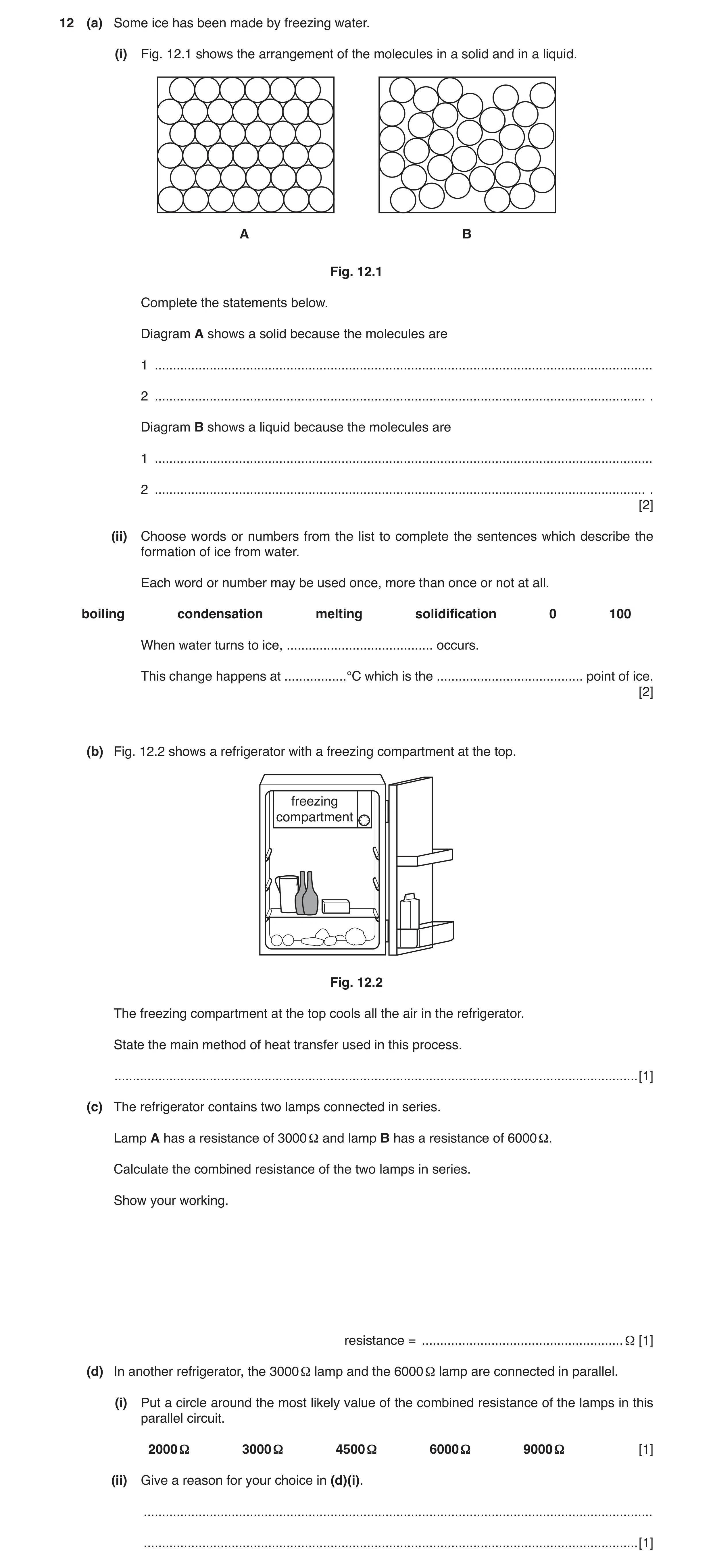
12 (a) Some ice has been made by freezing water. (i) Fig. 12.1 shows the arrangement of the molecules in a solid and in a liquid. A B Fig. 12.1 Complete the statements below. Diagram A shows a solid because the molecules are 1 … 2 … . Diagram B shows a liquid because the molecules are 1 … 2 … . [2] (ii) Choose words or numbers from the list to complete the sentences which describe the formation of ice from water. Each word or number may be used once, more than once or not at all. boiling condensation melting solidification 0 100 When water turns to ice, … occurs. This change happens at … °C which is the … point of ice. [2] (b) Fig. 12.2 shows a refrigerator with a freezing compartment at the top. freezing compartment Fig. 12.2 The freezing compartment at the top cools all the air in the refrigerator. State the main method of heat transfer used in this process. … [1] (c) The refrigerator contains two lamps connected in series. Lamp A has a resistance of 3000 Ω and lamp B has a resistance of 6000 Ω. Calculate the combined resistance of the two lamps in series. Show your working. resistance = … Ω [1] (d) In another refrigerator, the 3000 Ω lamp and the 6000 Ω lamp are connected in parallel. (i) Put a circle around the most likely value of the combined resistance of the lamps in this parallel circuit. 2000 Ω 3000 Ω 4500 Ω 6000 Ω 9000 Ω [1] (ii) Give a reason for your choice in (d)(i). … … [1]
8 marks
Mark scheme: 12(a)(i) Solid: close-packed regular arrangement Liquid: close-packed irregular arrangement 2 or 3 correct ; 4 correct ; 2 12(a)(ii) solidification 0 Melting 2 correct ; 3 correct ; 2 12(b) convection ; 1 12(c) = 9000 (Ω) ; 1 12(d)(i) 2000 Ω ; 1 12(d)(ii) combined resistance in parallel is less than resistance of either resistance ; 1
This question in 0654/33 Oct/Nov 2018
Q7 · Solids, liquids and gases have different properties 0654/32 May/June 2020
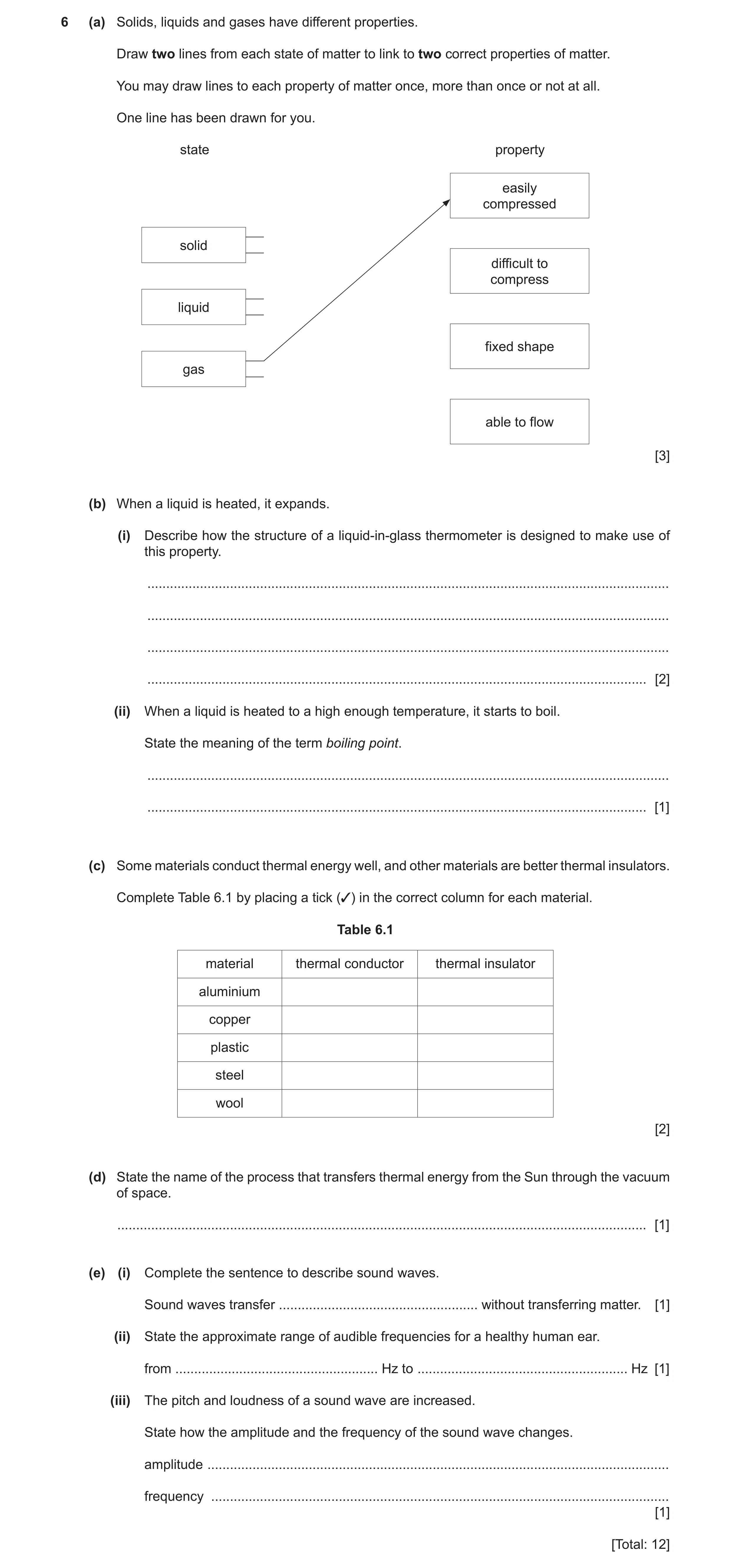
6 (a) Solids, liquids and gases have different properties. Draw two lines from each state of matter to link to two correct properties of matter. You may draw lines to each property of matter once, more than once or not at all. One line has been drawn for you. state property easily compressed solid difficult to compress liquid fixed shape gas able to flow [3] (b) When a liquid is heated, it expands. (i) Describe how the structure of a liquid-in-glass thermometer is designed to make use of this property. … … … … [2] (ii) When a liquid is heated to a high enough temperature, it starts to boil. State the meaning of the term boiling point. … … [1] (c) Some materials conduct thermal energy well, and other materials are better thermal insulators. Complete Table 6.1 by placing a tick (3) in the correct column for each material. Table 6.1 material thermal conductor thermal insulator aluminium copper plastic steel wool [2] (d) State the name of the process that transfers thermal energy from the Sun through the vacuum of space. … [1] (e) (i) Complete the sentence to describe sound waves. Sound waves transfer … without transferring matter. [1] (ii) State the approximate range of audible frequencies for a healthy human ear. from … Hz to … Hz [1] (iii) The pitch and loudness of a sound wave are increased. State how the amplitude and the frequency of the sound wave changes. amplitude … frequency … [1] [Total: 12]
12 marks
Mark scheme: 6(a) solid: difficult to compress and fixed shape; liquid: difficult to compress and able to flow; gas: easily compressed and able to flow 3 6(b)(i) liquid can be held in a tube; as it is heated or cools it rises up or falls down the tube; 2 6(b)(ii) the temperature at which a liquid turns to a gas; 1 6(c) material thermal conductor thermal insulator aluminium √ copper √ plastic √ steel √ wool √ ;; 3 correct for 1 mark all correct for 2 marks 2 6(d) radiation; 1 Question Answer Marks 6(e)(i) energy; 1 6(e)(ii) 20 to 20 000; 1 6(e)(iii) amplitude increases and frequency increases; 1
This question in 0654/32 May/June 2020
Q8 · Solids, liquids and gases have different properties 0654/33 May/June 2020
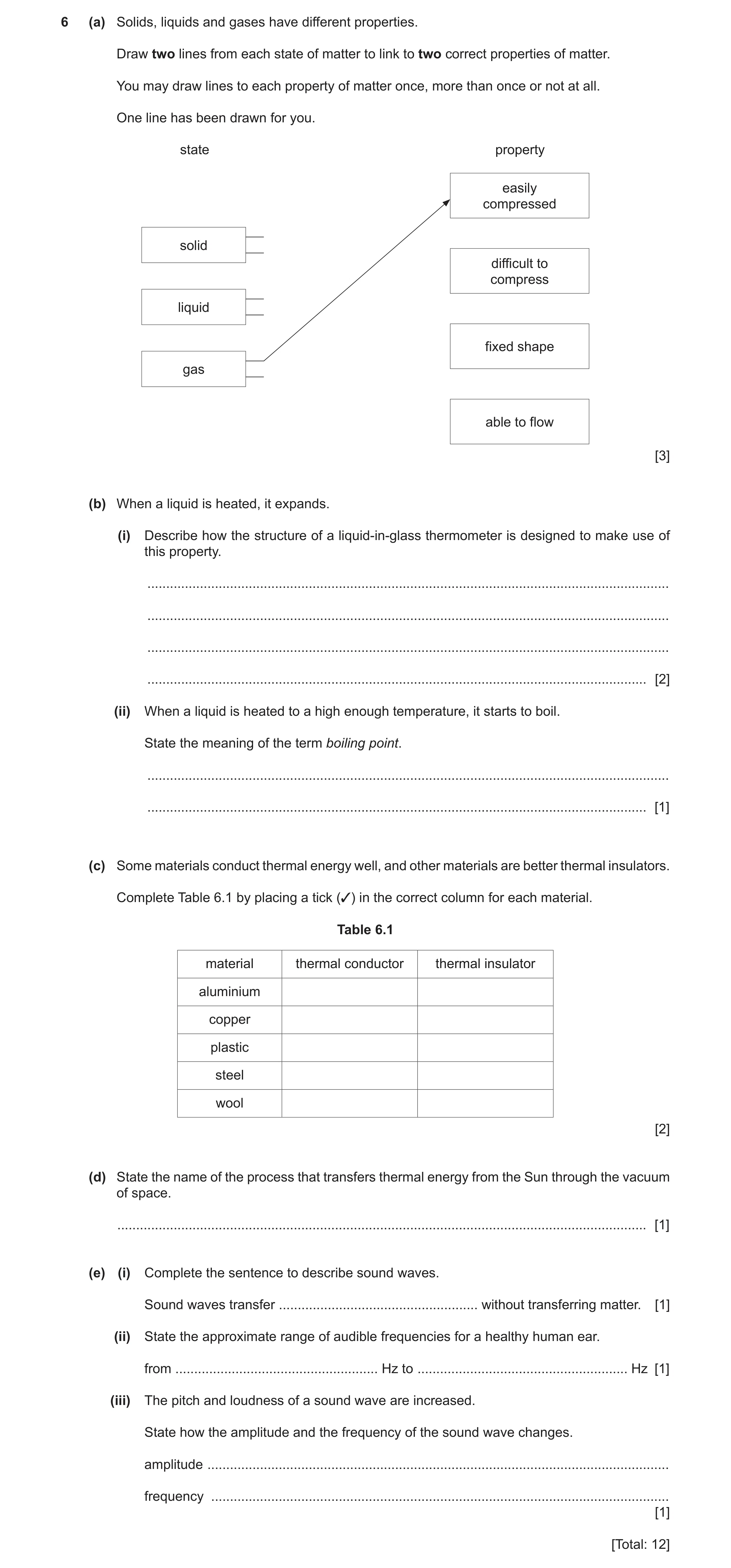
6 (a) Solids, liquids and gases have different properties. Draw two lines from each state of matter to link to two correct properties of matter. You may draw lines to each property of matter once, more than once or not at all. One line has been drawn for you. state property easily compressed solid difficult to compress liquid fixed shape gas able to flow [3] (b) When a liquid is heated, it expands. (i) Describe how the structure of a liquid-in-glass thermometer is designed to make use of this property. … … … … [2] (ii) When a liquid is heated to a high enough temperature, it starts to boil. State the meaning of the term boiling point. … … [1] (c) Some materials conduct thermal energy well, and other materials are better thermal insulators. Complete Table 6.1 by placing a tick (3) in the correct column for each material. Table 6.1 material thermal conductor thermal insulator aluminium copper plastic steel wool [2] (d) State the name of the process that transfers thermal energy from the Sun through the vacuum of space. … [1] (e) (i) Complete the sentence to describe sound waves. Sound waves transfer … without transferring matter. [1] (ii) State the approximate range of audible frequencies for a healthy human ear. from … Hz to … Hz [1] (iii) The pitch and loudness of a sound wave are increased. State how the amplitude and the frequency of the sound wave changes. amplitude … frequency … [1] [Total: 12]
12 marks
Mark scheme: 6(a) solid: difficult to compress and fixed shape; liquid: difficult to compress and able to flow; gas: easily compressed and able to flow 3 6(b)(i) liquid can be held in a tube; as it is heated or cools it rises up or falls down the tube; 2 6(b)(ii) the temperature at which a liquid turns to a gas; 1 6(c) material thermal conductor thermal insulator aluminium √ copper √ plastic √ steel √ wool √ ;; 3 correct for 1 mark all correct for 2 marks 2 6(d) radiation; 1 Question Answer Marks 6(e)(i) energy; 1 6(e)(ii) 20 to 20 000; 1 6(e)(iii) amplitude increases and frequency increases; 1
This question in 0654/33 May/June 2020
Q9 · A building is kept warm by heating its solid concrete floor 0654/32 Oct/Nov 2020
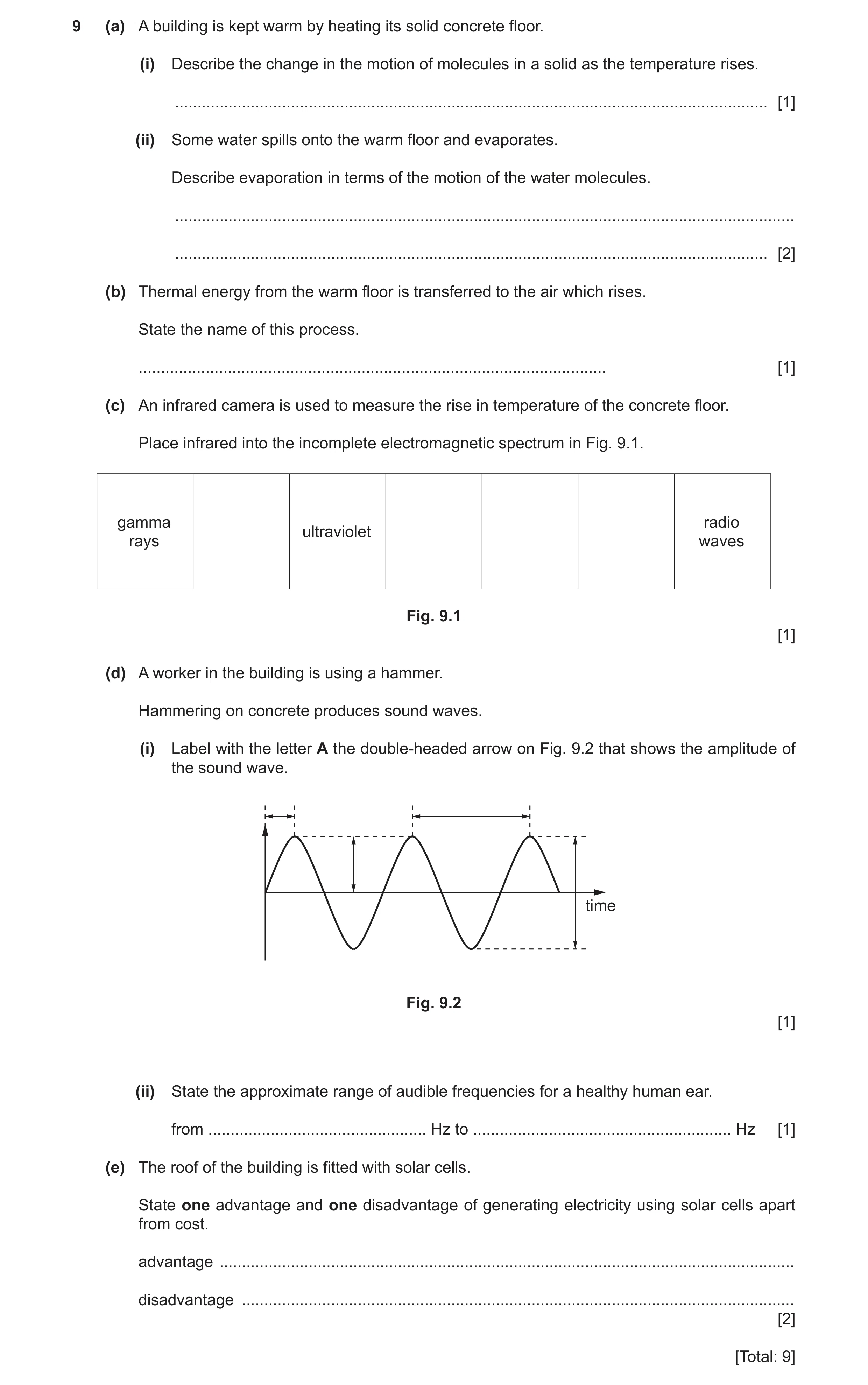
9 (a) A building is kept warm by heating its solid concrete floor. (i) Describe the change in the motion of molecules in a solid as the temperature rises. … [1] (ii) Some water spills onto the warm floor and evaporates. Describe evaporation in terms of the motion of the water molecules. … … [2] (b) Thermal energy from the warm floor is transferred to the air which rises. State the name of this process. … [1] (c) An infrared camera is used to measure the rise in temperature of the concrete floor. Place infrared into the incomplete electromagnetic spectrum in Fig. 9.1. gamma radio ultraviolet rays waves Fig. 9.1 [1] (d) A worker in the building is using a hammer. Hammering on concrete produces sound waves. (i) Label with the letter A the double-headed arrow on Fig. 9.2 that shows the amplitude of the sound wave. time Fig. 9.2 [1] (ii) State the approximate range of audible frequencies for a healthy human ear. from … Hz to … Hz [1] (e) The roof of the building is fitted with solar cells. State one advantage and one disadvantage of generating electricity using solar cells apart from cost. advantage … disadvantage … [2] [Total: 9]
9 marks
Mark scheme: 9(a)(i) increased vibration; 1 9(a)(ii) escape of more energetic molecules; from the surface of the liquid; 2 9(b) convection; 1 9(c) gamma rays ultraviolet infrared; 1 9(d)(i) A on the arrow from the x axis to the top of the crest; 1 9(d)(ii) 20 (Hz) to 20 000 (Hz); 1 9(e) advantage: renewable ; disadvantage: does not work in the dark / less electricity produced when it is cloudy; 2
This question in 0654/32 Oct/Nov 2020
Q10 · An information booklet about an electric oven states that the weight of the oven is 50 kg 0654/32 Feb/March 2021
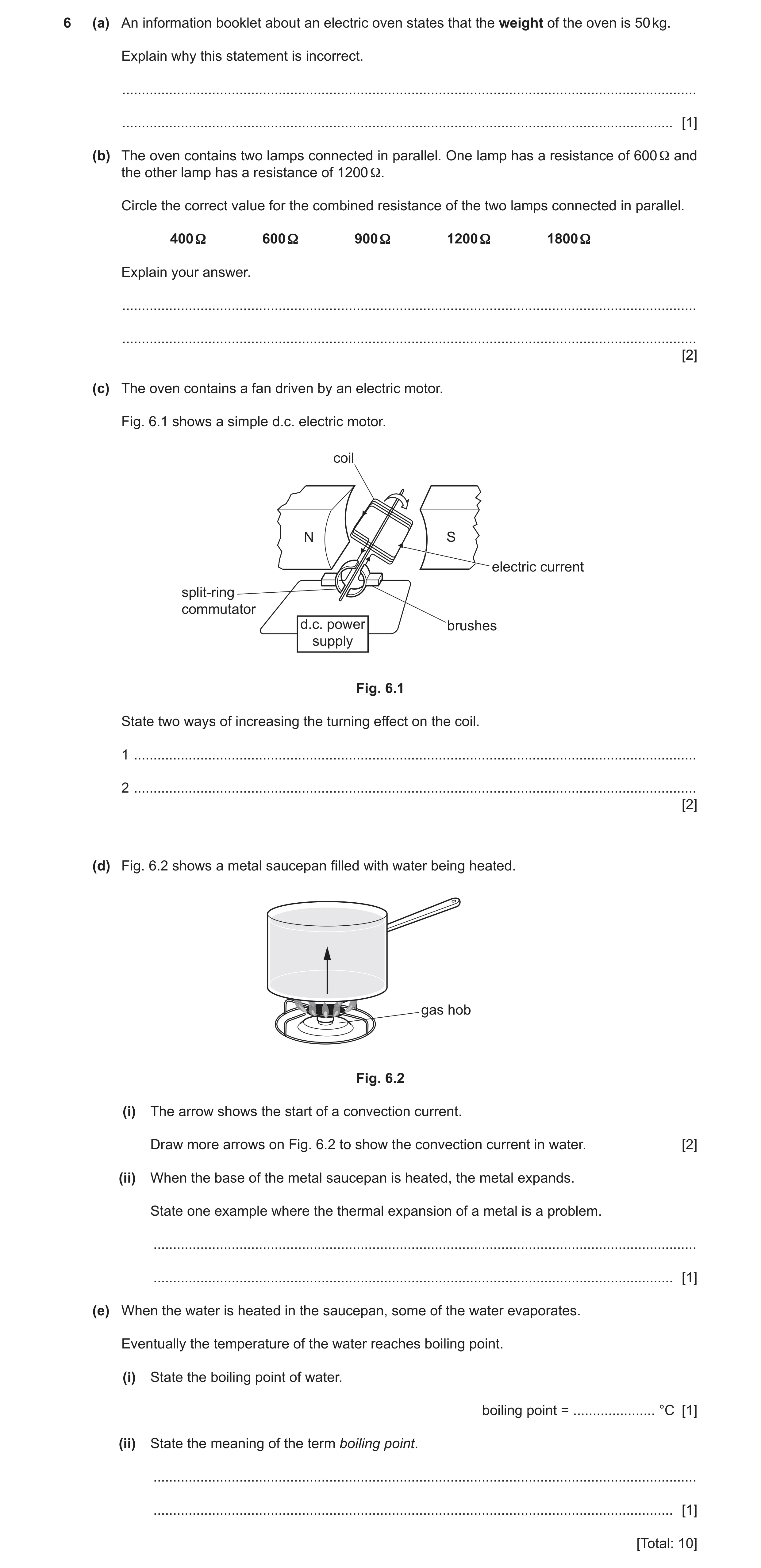
6 (a) An information booklet about an electric oven states that the weight of the oven is 50 kg. Explain why this statement is incorrect. … … [1] (b) The oven contains two lamps connected in parallel. One lamp has a resistance of 600 Ω and the other lamp has a resistance of 1200 Ω. Circle the correct value for the combined resistance of the two lamps connected in parallel. 400 Ω 600 Ω 900 Ω 1200 Ω 1800 Ω Explain your answer. … … [2] (c) The oven contains a fan driven by an electric motor. Fig. 6.1 shows a simple d.c. electric motor. coil N S electric current split-ring commutator d.c. power brushes supply Fig. 6.1 State two ways of increasing the turning effect on the coil. 1 … 2 … [2] (d) Fig. 6.2 shows a metal saucepan filled with water being heated. gas hob Fig. 6.2 (i) The arrow shows the start of a convection current. Draw more arrows on Fig. 6.2 to show the convection current in water. [2] (ii) When the base of the metal saucepan is heated, the metal expands. State one example where the thermal expansion of a metal is a problem. … … [1] (e) When the water is heated in the saucepan, some of the water evaporates. Eventually the temperature of the water reaches boiling point. (i) State the boiling point of water. boiling point = … °C [1] (ii) State the meaning of the term boiling point. … … [1] [Total: 10]
10 marks
Mark scheme: 6(a) mass is measured in kg / weight is measured in Newtons ; 1 6(b) 400 Ω; combined resistances of two resistors in parallel is less than the resistance of either of them; 2 6(c) larger current through coil; greater magnetic field; more turns; max 2 2 6(d)(i) arrow(s) to the right and or left; arrow(s) moving downwards ; 2 6(d)(ii) railway tracks / bridges; 1 6(e)(i) 100 (°C) ; 1 6(e)(ii) the temperature at which a liquid changes into a gas ; 1
This question in 0654/32 Feb/March 2021
Q11 · A car has two identical headlamps 0654/31 May/June 2021
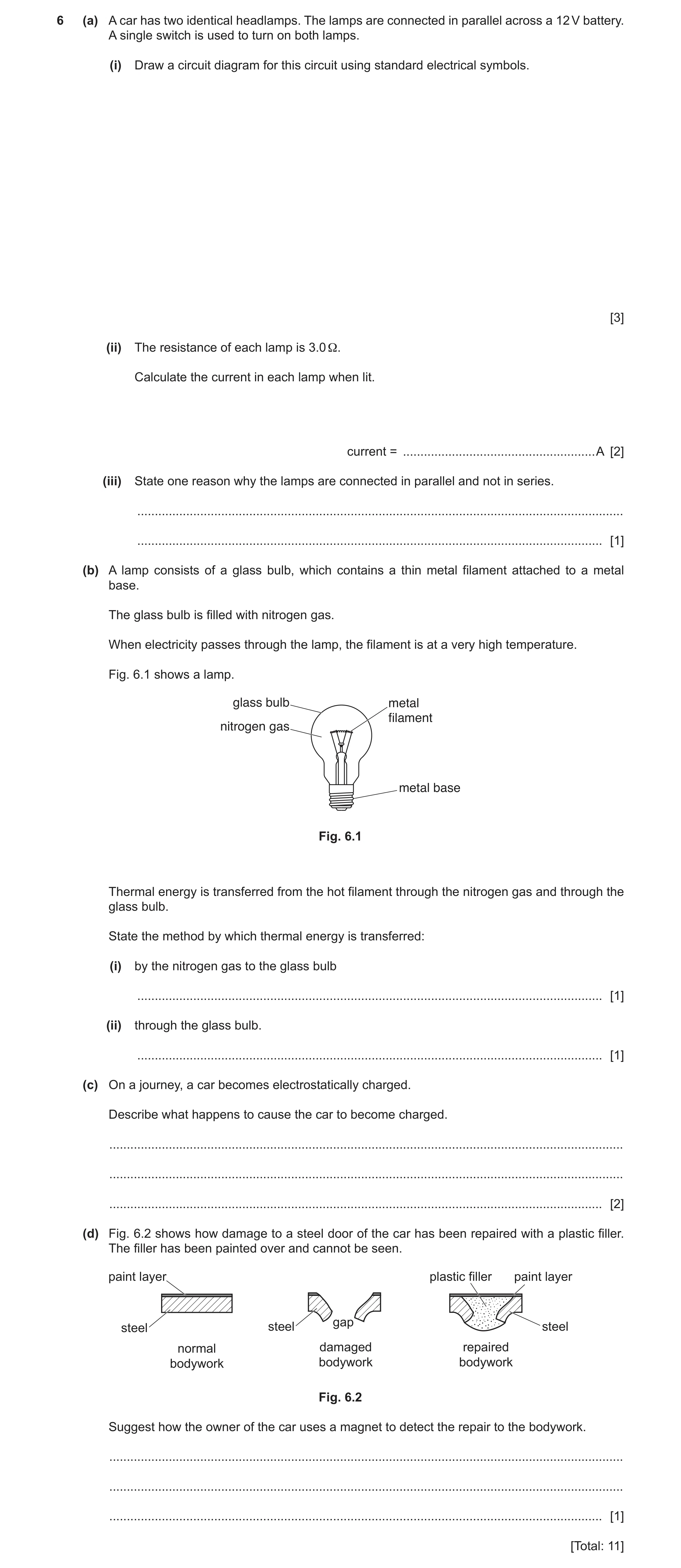
6 (a) A car has two identical headlamps. The lamps are connected in parallel across a 12 V battery. A single switch is used to turn on both lamps. (i) Draw a circuit diagram for this circuit using standard electrical symbols. [3] (ii) The resistance of each lamp is 3.0 Ω. Calculate the current in each lamp when lit. current = … A [2] (iii) State one reason why the lamps are connected in parallel and not in series. … … [1] (b) A lamp consists of a glass bulb, which contains a thin metal filament attached to a metal base. The glass bulb is filled with nitrogen gas. When electricity passes through the lamp, the filament is at a very high temperature. Fig. 6.1 shows a lamp. glass bulb metal filament nitrogen gas metal base Fig. 6.1 Thermal energy is transferred from the hot filament through the nitrogen gas and through the glass bulb. State the method by which thermal energy is transferred: (i) by the nitrogen gas to the glass bulb … [1] (ii) through the glass bulb. … [1] (c) On a journey, a car becomes electrostatically charged. Describe what happens to cause the car to become charged. … … … [2] (d) Fig. 6.2 shows how damage to a steel door of the car has been repaired with a plastic filler. The filler has been painted over and cannot be seen. paint layer plastic filler paint layer gap steel steel steel normal damaged repaired bodywork bodywork bodywork Fig. 6.2 Suggest how the owner of the car uses a magnet to detect the repair to the bodywork. … … … [1] [Total: 11]
11 marks
Mark scheme: 6(a)(i) all symbols correct ; lamps in parallel ; switch controls both lamps ; 3 6(a)(ii) current = voltage / resistance or 12 / 3 ; = 4 (A) ; 2 6(a)(iii) if one lamp fails the other will still light / so both lamps get the full battery emf ; 1 6(b)(i) convection ; 1 6(b)(ii) conduction; 1 6(c) friction ; electron transfer ; 2 6(d) less attraction over filled area ; 1
This question in 0654/31 May/June 2021
Q12 · A student constructs a circuit containing two lamps in parallel connected across two… 0654/31 Oct/Nov 2021
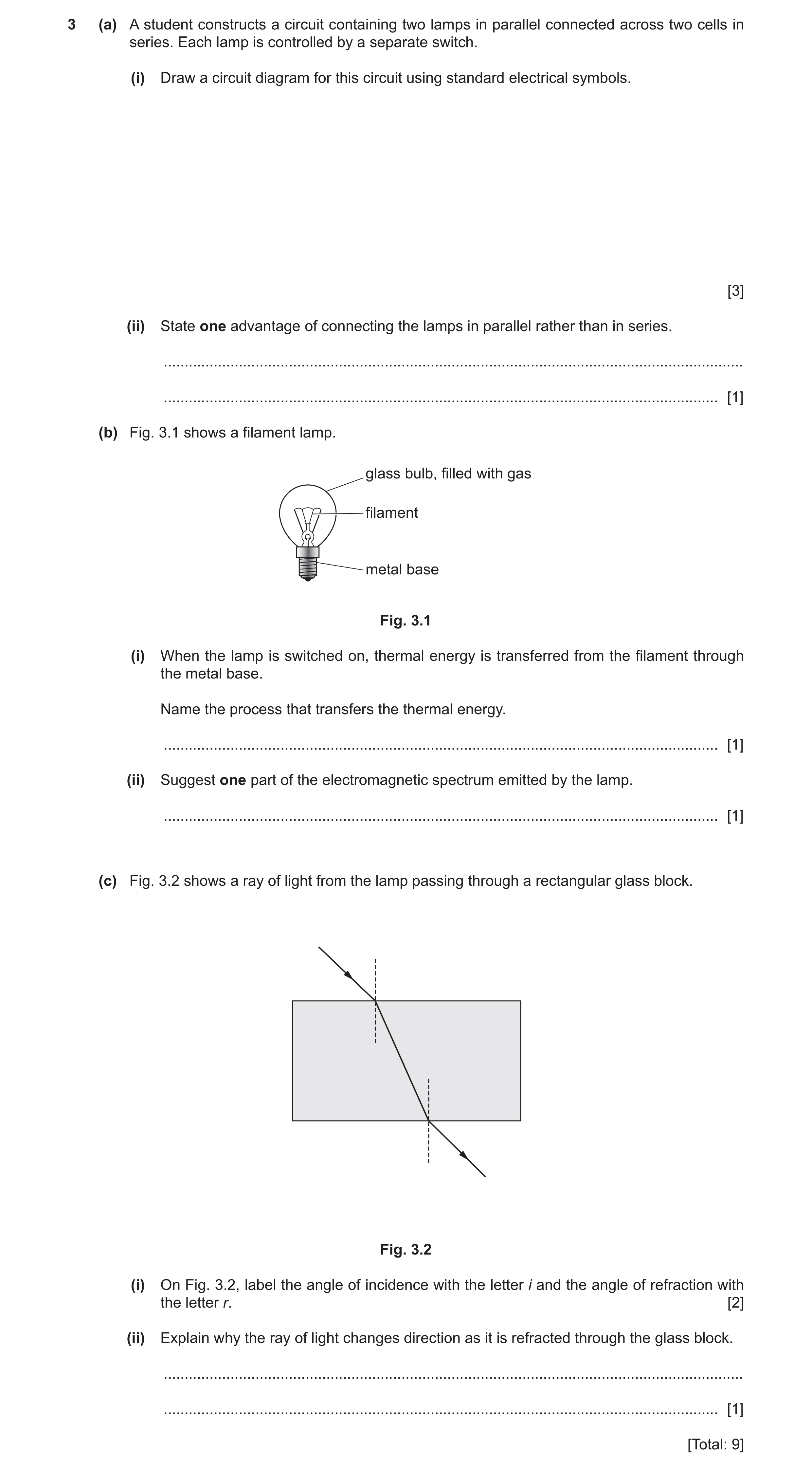
3 (a) A student constructs a circuit containing two lamps in parallel connected across two cells in series. Each lamp is controlled by a separate switch. (i) Draw a circuit diagram for this circuit using standard electrical symbols. [3] (ii) State one advantage of connecting the lamps in parallel rather than in series. … … [1] (b) Fig. 3.1 shows a filament lamp. glass bulb, filled with gas filament metal base Fig. 3.1 (i) When the lamp is switched on, thermal energy is transferred from the filament through the metal base. Name the process that transfers the thermal energy. … [1] (ii) Suggest one part of the electromagnetic spectrum emitted by the lamp. … [1] (c) Fig. 3.2 shows a ray of light from the lamp passing through a rectangular glass block. Fig. 3.2 (i) On Fig. 3.2, label the angle of incidence with the letter i and the angle of refraction with the letter r. [2] (ii) Explain why the ray of light changes direction as it is refracted through the glass block. … … [1] [Total: 9]
9 marks
Mark scheme: 3(a)(i) all symbols correct ; lamps in parallel ; both switches in correct place ; 3 3(a)(ii) if one lamp fails the other will still light / so both lamps get the full battery voltage ; 1 3(b)(i) conduction ; 1 3(b)(ii) visible light / infrared ; 1 3(c)(i) i positioned between incident ray and normal ; r positioned between refracted ray and normal ; 2 3(c)(ii) change of speed ; 1
This question in 0654/31 Oct/Nov 2021
Question 13 0654/31 Oct/Nov 2021
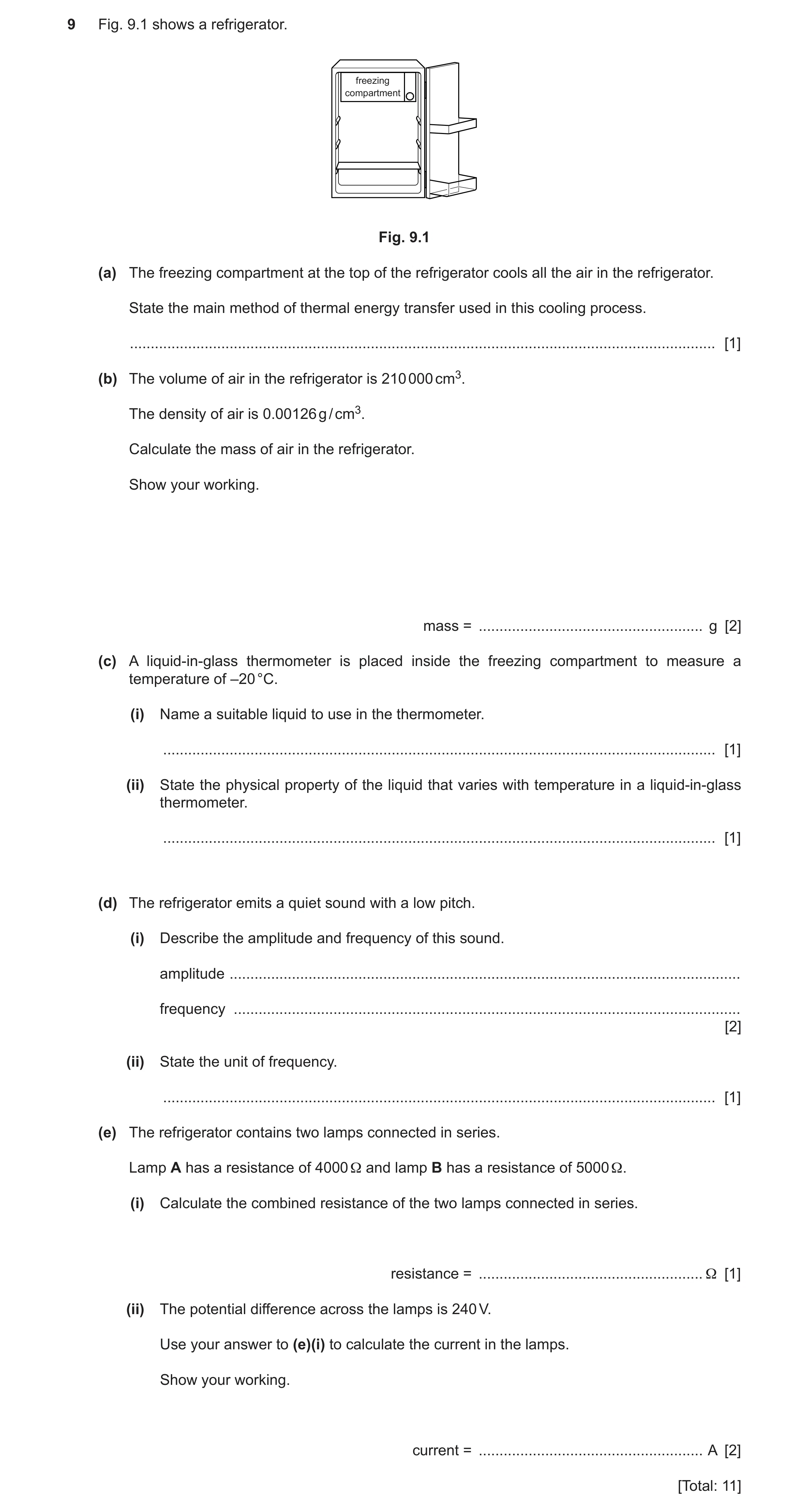
9 Fig. 9.1 shows a refrigerator. freezing compartment Fig. 9.1 (a) The freezing compartment at the top of the refrigerator cools all the air in the refrigerator. State the main method of thermal energy transfer used in this cooling process. … [1] (b) The volume of air in the refrigerator is 210 000 cm3. The density of air is 0.00126 g / cm3. Calculate the mass of air in the refrigerator. Show your working. mass = … g [2] (c) A liquid-in-glass thermometer is placed inside the freezing compartment to measure a temperature of –20 °C. (i) Name a suitable liquid to use in the thermometer. … [1] (ii) State the physical property of the liquid that varies with temperature in a liquid-in-glass thermometer. … [1] (d) The refrigerator emits a quiet sound with a low pitch. (i) Describe the amplitude and frequency of this sound. amplitude … frequency … [2] (ii) State the unit of frequency. … [1] (e) The refrigerator contains two lamps connected in series. Lamp A has a resistance of 4000 Ω and lamp B has a resistance of 5000 Ω. (i) Calculate the combined resistance of the two lamps connected in series. resistance = … Ω [1] (ii) The potential difference across the lamps is 240 V. Use your answer to (e)(i) to calculate the current in the lamps. Show your working. current = … A [2] [Total: 11]
11 marks
Mark scheme: 9(a) convection ; 1 9(b) mass = density × volume or 0.00126 × 210 000 ; = 265 g ; 2 9(c)(i) mercury / alcohol ; 1 9(c)(ii) volume ; 1 9(d)(i) small amplitude ; low frequency ; 2 9(d)(ii) hertz ; 1 9(e)(i) 9000 Ω ; 1 Question Answer Marks 9(e)(ii) current = voltage / resistance or 240 / 9000 ; 0.027 (A) ; 2
This question in 0654/31 Oct/Nov 2021
Q14 · An electric heater containing two heating elements 0654/32 Oct/Nov 2021
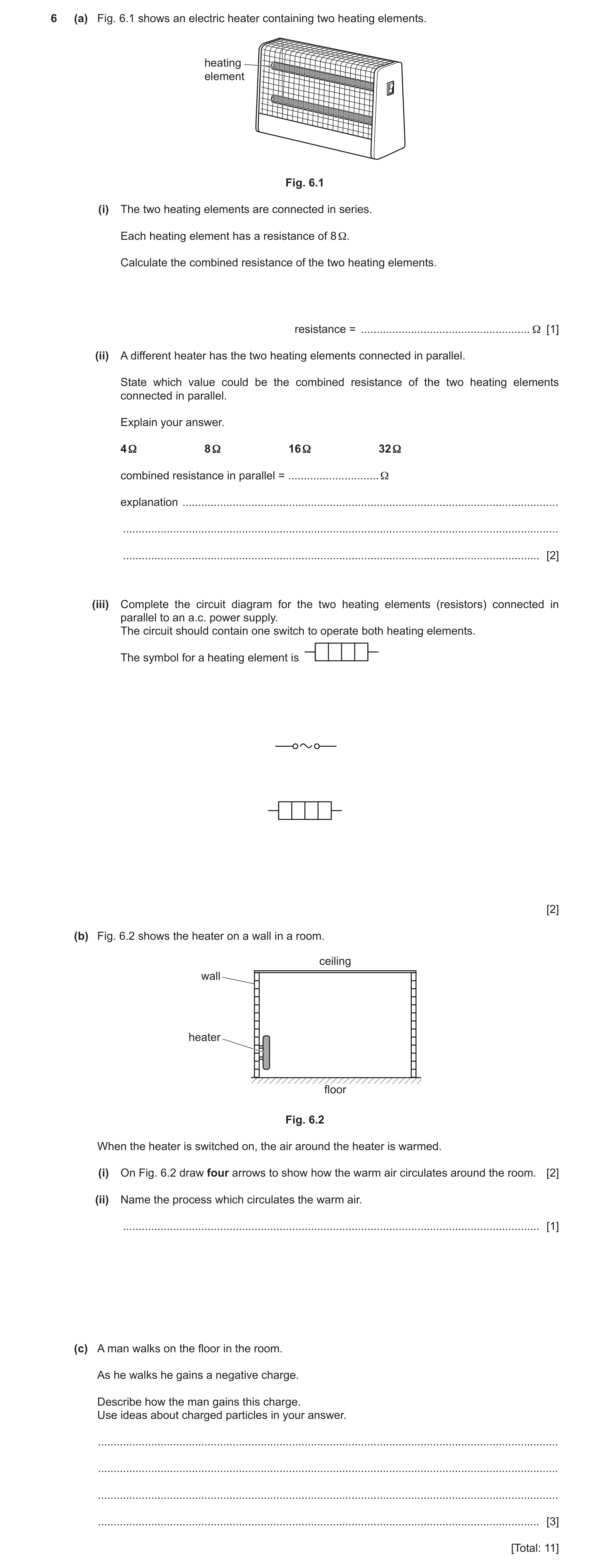
6 (a) Fig. 6.1 shows an electric heater containing two heating elements. heating element Fig. 6.1 (i) The two heating elements are connected in series. Each heating element has a resistance of 8 Ω. Calculate the combined resistance of the two heating elements. resistance = … Ω [1] (ii) A different heater has the two heating elements connected in parallel. State which value could be the combined resistance of the two heating elements connected in parallel. Explain your answer. 4 Ω 8 Ω 16 Ω 32 Ω combined resistance in parallel = … Ω explanation … … … [2] (iii) Complete the circuit diagram for the two heating elements (resistors) connected in parallel to an a.c. power supply. The circuit should contain one switch to operate both heating elements. The symbol for a heating element is [2] (b) Fig. 6.2 shows the heater on a wall in a room. ceiling wall heater floor Fig. 6.2 When the heater is switched on, the air around the heater is warmed. (i) On Fig. 6.2 draw four arrows to show how the warm air circulates around the room. [2] (ii) Name the process which circulates the warm air. … [1] (c) A man walks on the floor in the room. As he walks he gains a negative charge. Describe how the man gains this charge. Use ideas about charged particles in your answer. … … … … [3] [Total: 11]
11 marks
Mark scheme: 6(a)(i) 16 (Ω) ; 1 6(a)(ii) 4 (Ω) ; combined resistance is less than either individual resistance ; 2 6(a)(iii) heaters (resistors) in parallel ; switch controls both heaters with correct symbol and all else correct ; 2 6(b)(i) two arrow: upwards near heater and arrow downwards to the right of heater ; two horizontal arrows: from left to right near ceiling and from right to left near floor ; 2 6(b)(ii) convection ; 1 6(c) friction ; electrons transferred ; from floor to man ; 3
This question in 0654/32 Oct/Nov 2021
Q15 · Water in a saucepan on an electric cooker 0654/33 Oct/Nov 2021
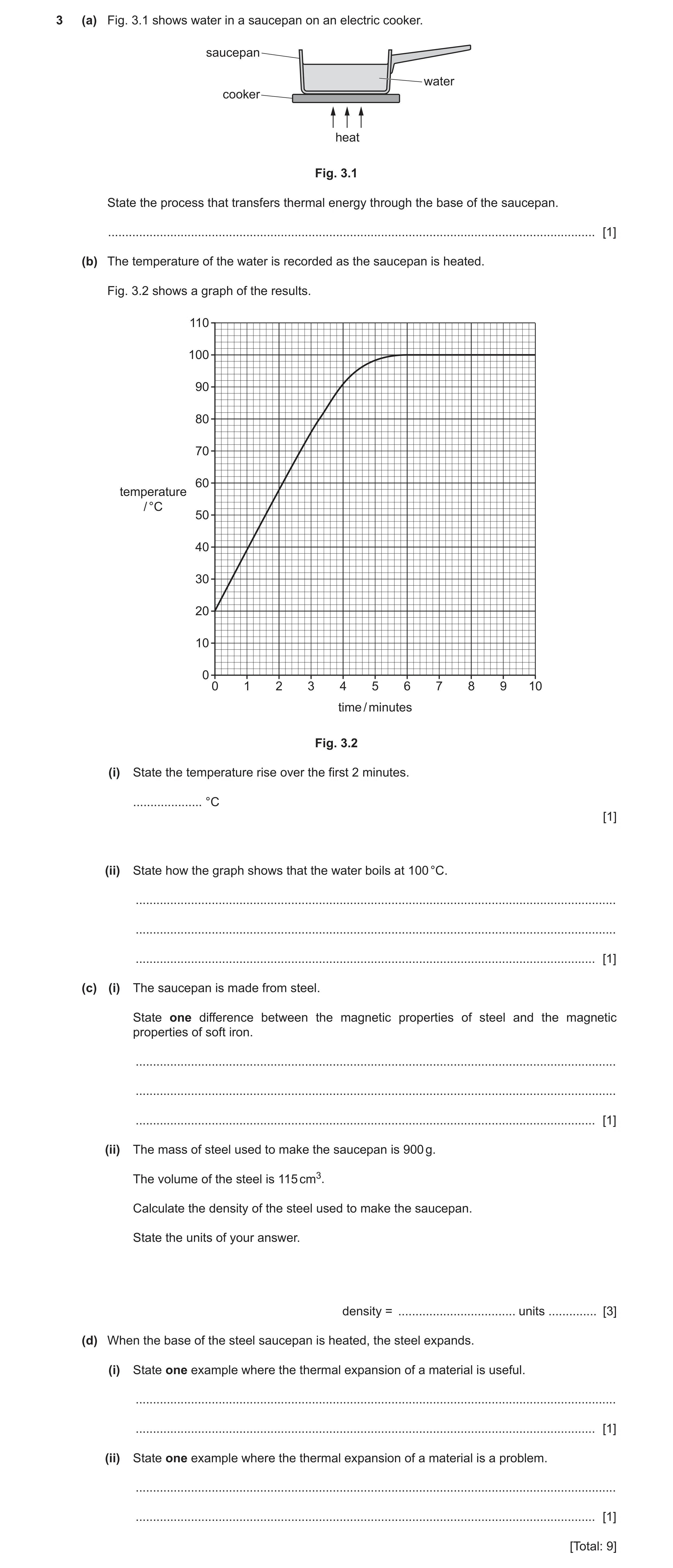
3 (a) Fig. 3.1 shows water in a saucepan on an electric cooker. saucepan water cooker heat Fig. 3.1 State the process that transfers thermal energy through the base of the saucepan. … [1] (b) The temperature of the water is recorded as the saucepan is heated. Fig. 3.2 shows a graph of the results. 110 100 90 80 70 60 temperature / °C 50 40 30 20 10 0 0 1 2 3 4 5 6 7 8 9 10 time / minutes Fig. 3.2 (i) State the temperature rise over the first 2 minutes. … °C [1] (ii) State how the graph shows that the water boils at 100 °C. … … … [1] (c) (i) The saucepan is made from steel. State one difference between the magnetic properties of steel and the magnetic properties of soft iron. … … … [1] (ii) The mass of steel used to make the saucepan is 900 g. The volume of the steel is 115 cm3. Calculate the density of the steel used to make the saucepan. State the units of your answer. density = … units … [3] (d) When the base of the steel saucepan is heated, the steel expands. (i) State one example where the thermal expansion of a material is useful. … … [1] (ii) State one example where the thermal expansion of a material is a problem. … … [1] [Total: 9]
9 marks
Mark scheme: 3(a)(i) conduction ; 1 3(b)(i) 38 °C ; 1 3(b)(ii) temperature stops increasing ; 1 3(c)(i) (soft) iron is magnetised quickly / steel is magnetised slowly ; or (soft) iron loses its magnetism quickly / steel loses magnetism slowly ; 1 3(c)(ii) density = mass ÷ volume or mass value ÷ volume value or 900 ÷ 115 ; 7.83 ; g / cm3 ; 3 3(d)(i) (liquid in glass) thermometers / bimetallic strips ; 1 3(d)(ii) bridges / roads / overhead electricity cables etc. ; 1
This question in 0654/33 Oct/Nov 2021
Question 16 0654/32 Feb/March 2022
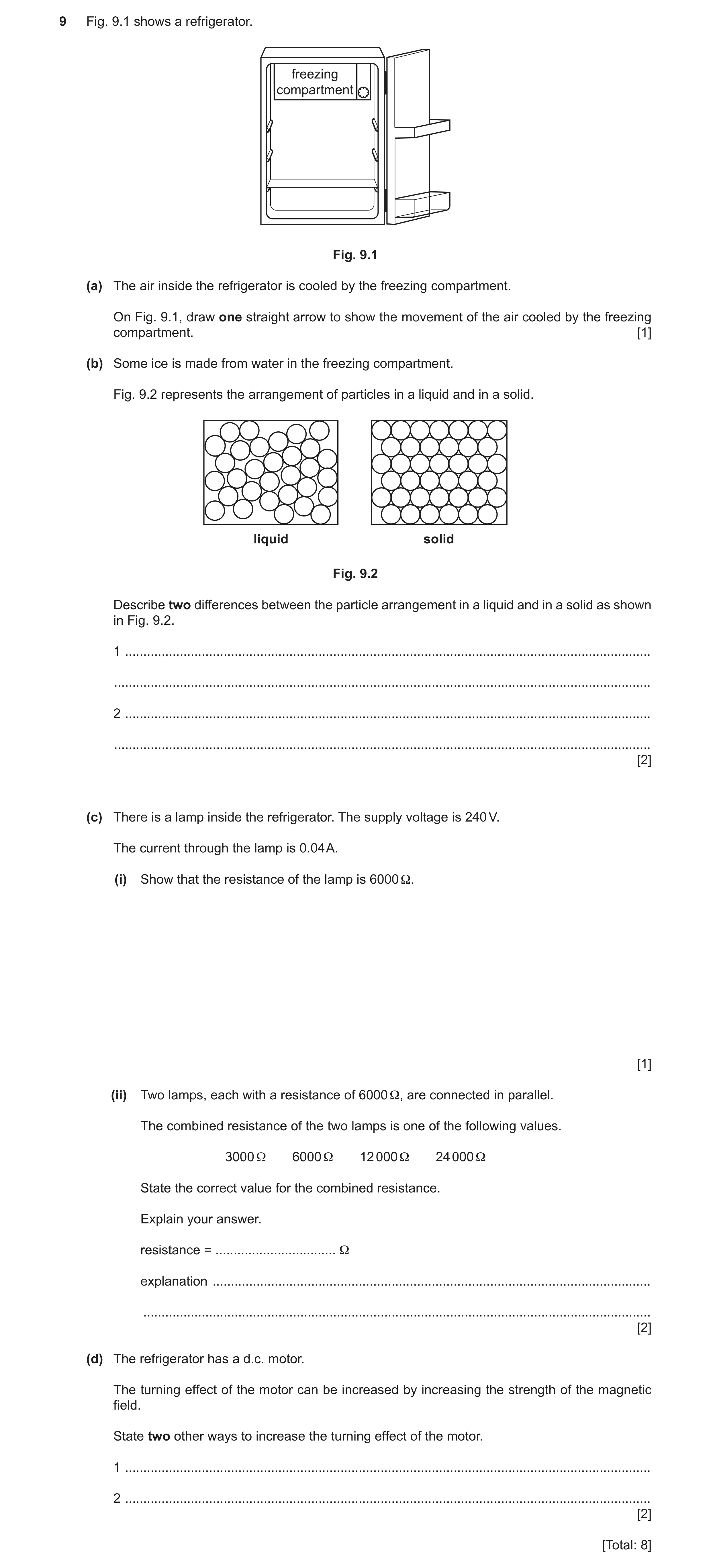
9 Fig. 9.1 shows a refrigerator. freezing compartment Fig. 9.1 (a) The air inside the refrigerator is cooled by the freezing compartment. On Fig. 9.1, draw one straight arrow to show the movement of the air cooled by the freezing compartment. [1] (b) Some ice is made from water in the freezing compartment. Fig. 9.2 represents the arrangement of particles in a liquid and in a solid. liquid solid Fig. 9.2 Describe two differences between the particle arrangement in a liquid and in a solid as shown in Fig. 9.2. 1 … … 2 … … [2] (c) There is a lamp inside the refrigerator. The supply voltage is 240 V. The current through the lamp is 0.04 A. (i) Show that the resistance of the lamp is 6000 Ω. [1] (ii) Two lamps, each with a resistance of 6000 Ω, are connected in parallel. The combined resistance of the two lamps is one of the following values. 3000 Ω 6000 Ω 12 000 Ω 24 000 Ω State the correct value for the combined resistance. Explain your answer. resistance = … Ω explanation … … [2] (d) The refrigerator has a d.c. motor. The turning effect of the motor can be increased by increasing the strength of the magnetic field. State two other ways to increase the turning effect of the motor. 1 … 2 … [2] [Total: 8]
8 marks
Mark scheme: 9(a) vertical arrow downwards; 1 9(b) solid has regular arrangement / liquid has irregular arrangement; particles are further apart in a liquid; 2 9(c)(i) (R = V / I =) 240 / 0.04 ; 1 9(c)(ii) 3000 Ω; combined resistance of two resistors in parallel is less than that of either resistor by itself; 2 9(d) increase current; increase number of turns on coil; 2
This question in 0654/32 Feb/March 2022
Q17 · Four forces, P, Q, R and S, acting on a bus travelling along a level road at constant… 0654/32 Feb/March 2022
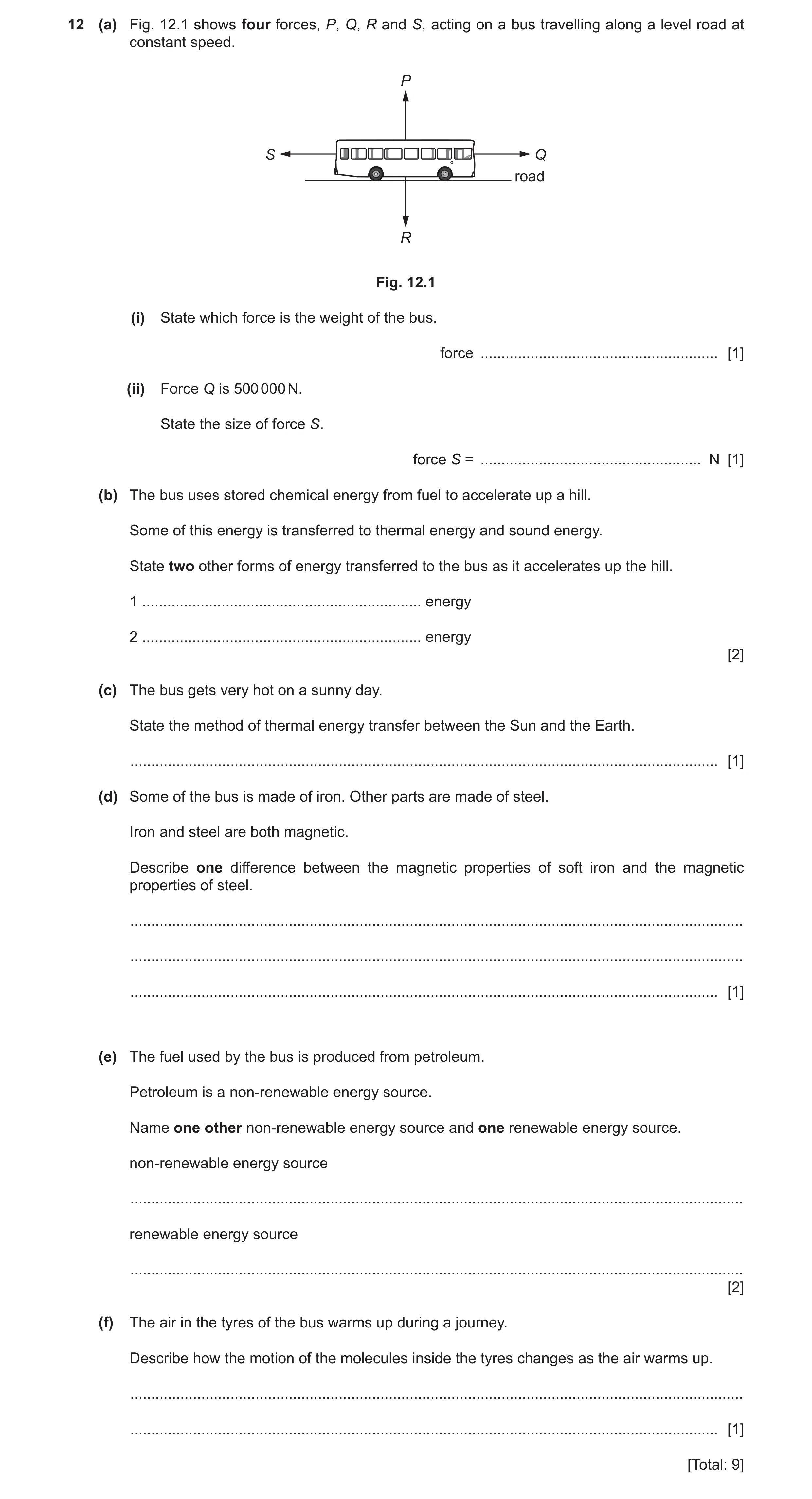
12 (a) Fig. 12.1 shows four forces, P, Q, R and S, acting on a bus travelling along a level road at constant speed. P S Q road R Fig. 12.1 (i) State which force is the weight of the bus. force … [1] (ii) Force Q is 500 000 N. State the size of force S. force S = … N [1] (b) The bus uses stored chemical energy from fuel to accelerate up a hill. Some of this energy is transferred to thermal energy and sound energy. State two other forms of energy transferred to the bus as it accelerates up the hill. 1 … energy 2 … energy [2] (c) The bus gets very hot on a sunny day. State the method of thermal energy transfer between the Sun and the Earth. … [1] (d) Some of the bus is made of iron. Other parts are made of steel. Iron and steel are both magnetic. Describe one difference between the magnetic properties of soft iron and the magnetic properties of steel. … … … [1] (e) The fuel used by the bus is produced from petroleum. Petroleum is a non-renewable energy source. Name one other non-renewable energy source and one renewable energy source. non-renewable energy source … renewable energy source … [2] (f) The air in the tyres of the bus warms up during a journey. Describe how the motion of the molecules inside the tyres changes as the air warms up. … … [1] [Total: 9]
9 marks
Mark scheme: 12(a)(i) R; 1 12(a)(ii) 500 000 N; 1 12(b) kinetic energy; gravitational potential energy; 2 12(c) radiation; 1 12(d) iron magnetises quicker / iron loses magnetism quicker; 1 Question Answer Marks 12(e) coal / natural gas; hydroelectric / solar / tidal / waves / geothermal / biogas / wind; 2 12(f) gain KE / move faster; 1
This question in 0654/32 Feb/March 2022
Q18 · Table 9.1 contains descriptions of a solid, a liquid and a gas 0654/32 May/June 2022
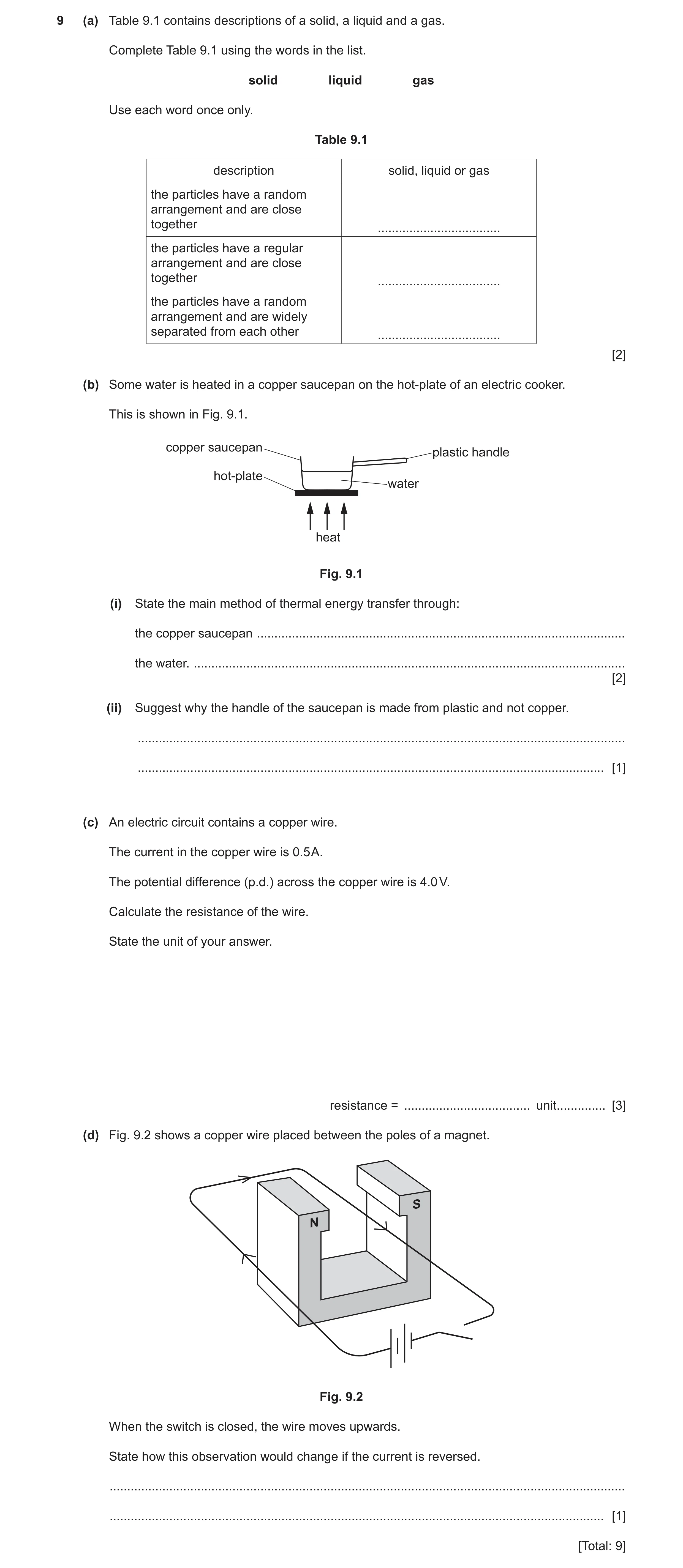
9 (a) Table 9.1 contains descriptions of a solid, a liquid and a gas. Complete Table 9.1 using the words in the list. solid liquid gas Use each word once only. Table 9.1 description solid, liquid or gas the particles have a random arrangement and are close together … the particles have a regular arrangement and are close together … the particles have a random arrangement and are widely separated from each other … [2] (b) Some water is heated in a copper saucepan on the hot-plate of an electric cooker. This is shown in Fig. 9.1. copper saucepan plastic handle hot-plate water heat Fig. 9.1 (i) State the main method of thermal energy transfer through: the copper saucepan … the water. … [2] (ii) Suggest why the handle of the saucepan is made from plastic and not copper. … … [1] (c) An electric circuit contains a copper wire. The current in the copper wire is 0.5 A. The potential difference (p.d.) across the copper wire is 4.0 V. Calculate the resistance of the wire. State the unit of your answer. resistance = … unit … [3] (d) Fig. 9.2 shows a copper wire placed between the poles of a magnet. S N Fig. 9.2 When the switch is closed, the wire moves upwards. State how this observation would change if the current is reversed. … … [1] [Total: 9]
9 marks
Mark scheme: 9(a) the particles have a random arrangement and are close together = liquid the particles have a regular arrangement and are close together = solid the particles are widely separated from each other = gas 2 9(b)(i) conduction; convection; 2 9(b)(ii) plastic is an insulator (so you don’t burn your hand); 1 Question Answer Marks 9(c) R = V / I (in any form) or 4.0 / 0.5; resistance = 8; ; 3 9(d) wire moves down / opposite way; 1
This question in 0654/32 May/June 2022
Q19 · Table 9.1 contains descriptions of a solid, a liquid and a gas 0654/33 May/June 2022
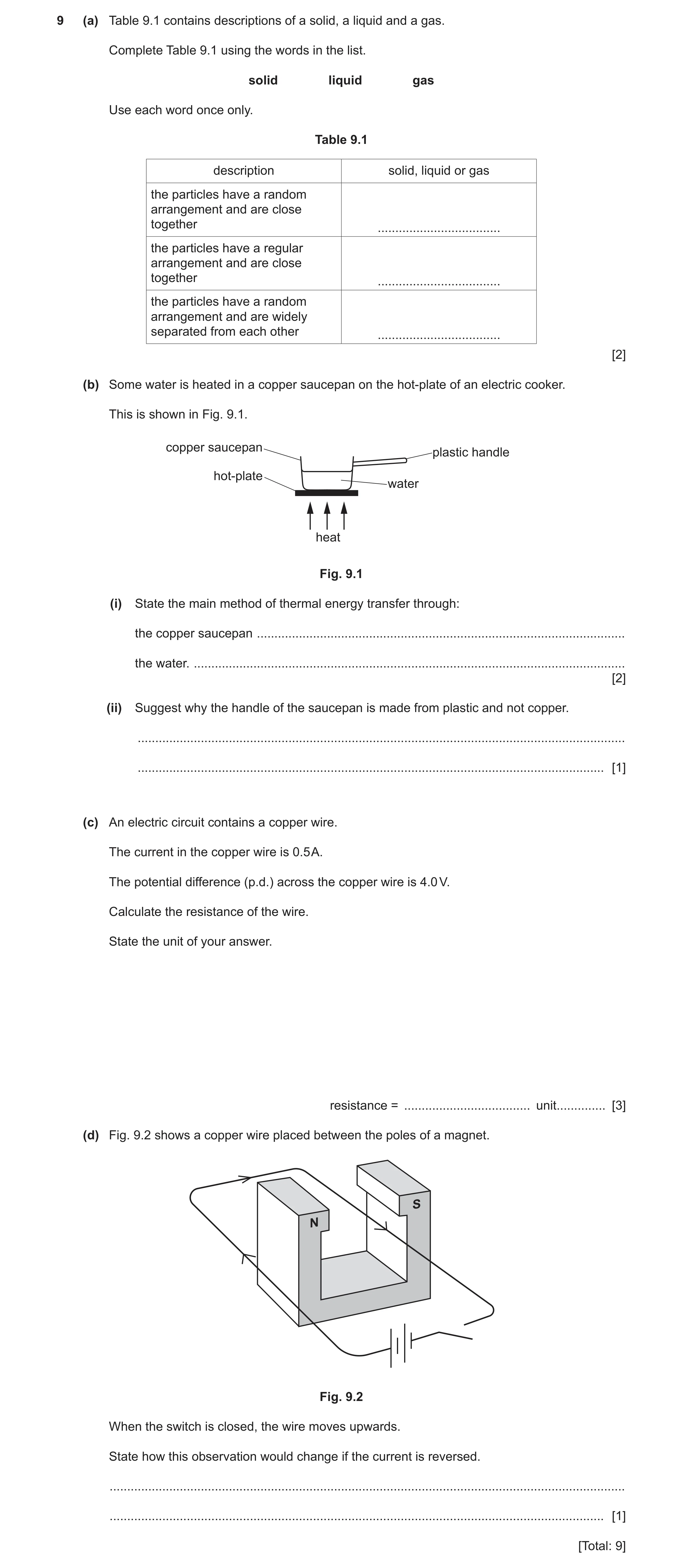
9 (a) Table 9.1 contains descriptions of a solid, a liquid and a gas. Complete Table 9.1 using the words in the list. solid liquid gas Use each word once only. Table 9.1 description solid, liquid or gas the particles have a random arrangement and are close together … the particles have a regular arrangement and are close together … the particles have a random arrangement and are widely separated from each other … [2] (b) Some water is heated in a copper saucepan on the hot-plate of an electric cooker. This is shown in Fig. 9.1. copper saucepan plastic handle hot-plate water heat Fig. 9.1 (i) State the main method of thermal energy transfer through: the copper saucepan … the water. … [2] (ii) Suggest why the handle of the saucepan is made from plastic and not copper. … … [1] (c) An electric circuit contains a copper wire. The current in the copper wire is 0.5 A. The potential difference (p.d.) across the copper wire is 4.0 V. Calculate the resistance of the wire. State the unit of your answer. resistance = … unit … [3] (d) Fig. 9.2 shows a copper wire placed between the poles of a magnet. S N Fig. 9.2 When the switch is closed, the wire moves upwards. State how this observation would change if the current is reversed. … … [1] [Total: 9]
9 marks
Mark scheme: 9(a) the particles have a random arrangement and are close together = liquid the particles have a regular arrangement and are close together = solid the particles are widely separated from each other = gas 2 9(b)(i) conduction; convection; 2 9(b)(ii) plastic is an insulator (so you don’t burn your hand); 1 Question Answer Marks 9(c) R = V / I (in any form) or 4.0 / 0.5; resistance = 8; ; 3 9(d) wire moves down / opposite way; 1
This question in 0654/33 May/June 2022
Q20 · An electric heater is used to heat a classroom in a school 0654/32 Oct/Nov 2022
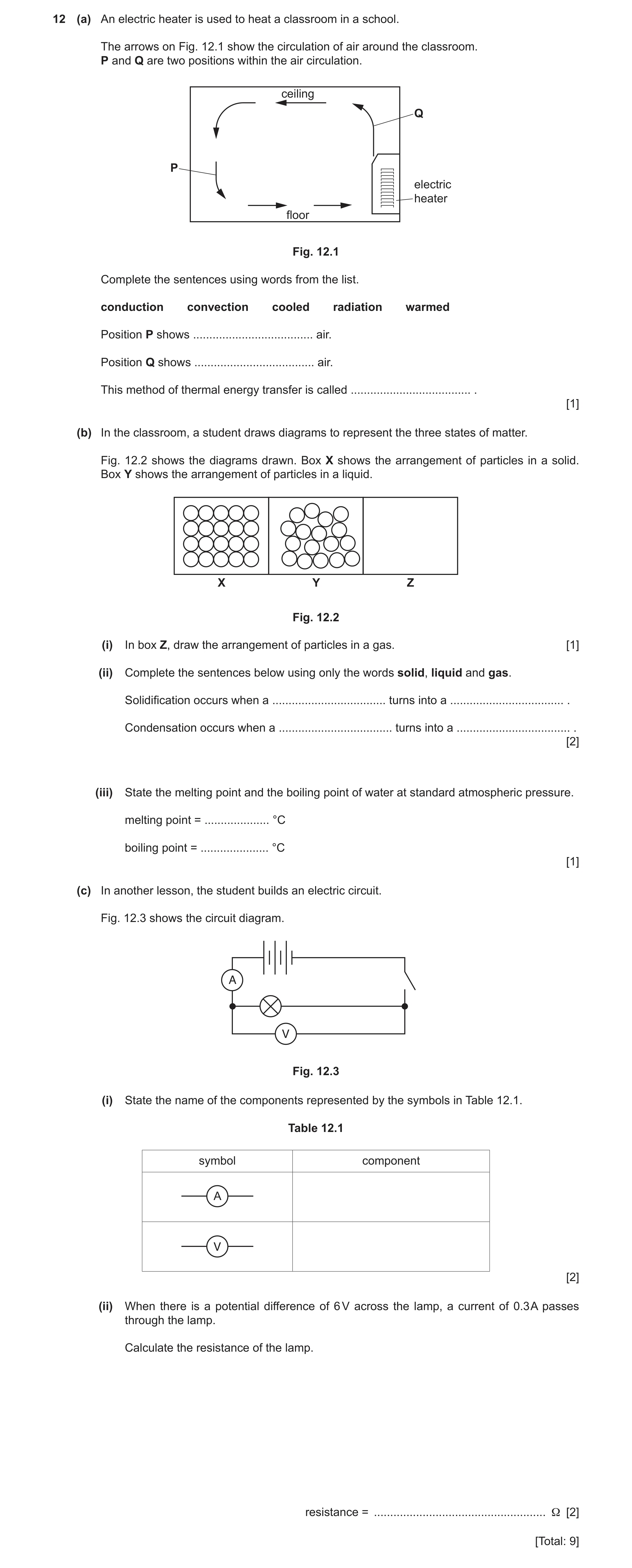
12 (a) An electric heater is used to heat a classroom in a school. The arrows on Fig. 12.1 show the circulation of air around the classroom. P and Q are two positions within the air circulation. ceiling Q P electric heater floor Fig. 12.1 Complete the sentences using words from the list. conduction convection cooled radiation warmed Position P shows … air. Position Q shows … air. This method of thermal energy transfer is called … . [1] (b) In the classroom, a student draws diagrams to represent the three states of matter. Fig. 12.2 shows the diagrams drawn. Box X shows the arrangement of particles in a solid. Box Y shows the arrangement of particles in a liquid. X Y Z Fig. 12.2 (i) In box Z, draw the arrangement of particles in a gas. [1] (ii) Complete the sentences below using only the words solid, liquid and gas. Solidification occurs when a … turns into a … . Condensation occurs when a … turns into a … . [2] (iii) State the melting point and the boiling point of water at standard atmospheric pressure. melting point = … °C boiling point = … °C [1] (c) In another lesson, the student builds an electric circuit. Fig. 12.3 shows the circuit diagram. A V Fig. 12.3 (i) State the name of the components represented by the symbols in Table 12.1. Table 12.1 symbol component A V [2] (ii) When there is a potential difference of 6 V across the lamp, a current of 0.3 A passes through the lamp. Calculate the resistance of the lamp. resistance = … Ω [2] [Total: 9]
9 marks
Mark scheme: 12(a) cooled ; 1 warmed ; convection ; all correct ; 12(b)(i) 1 random arrangement and widely spaced ; 12(b)(ii) liquid and 2 solid ; gas and liquid ; 12(b)(iii) 0 °C and 100 °C ; 1 12(c)(i) ammeter ; 2 voltmeter ; 12(c)(ii) R = V ÷ I (symbols or words) or 6 ÷ 0.3 ; 2 R = 20 () ;
This question in 0654/32 Oct/Nov 2022
Q21 · A room in a house has an electric heater 0654/32 Feb/March 2023
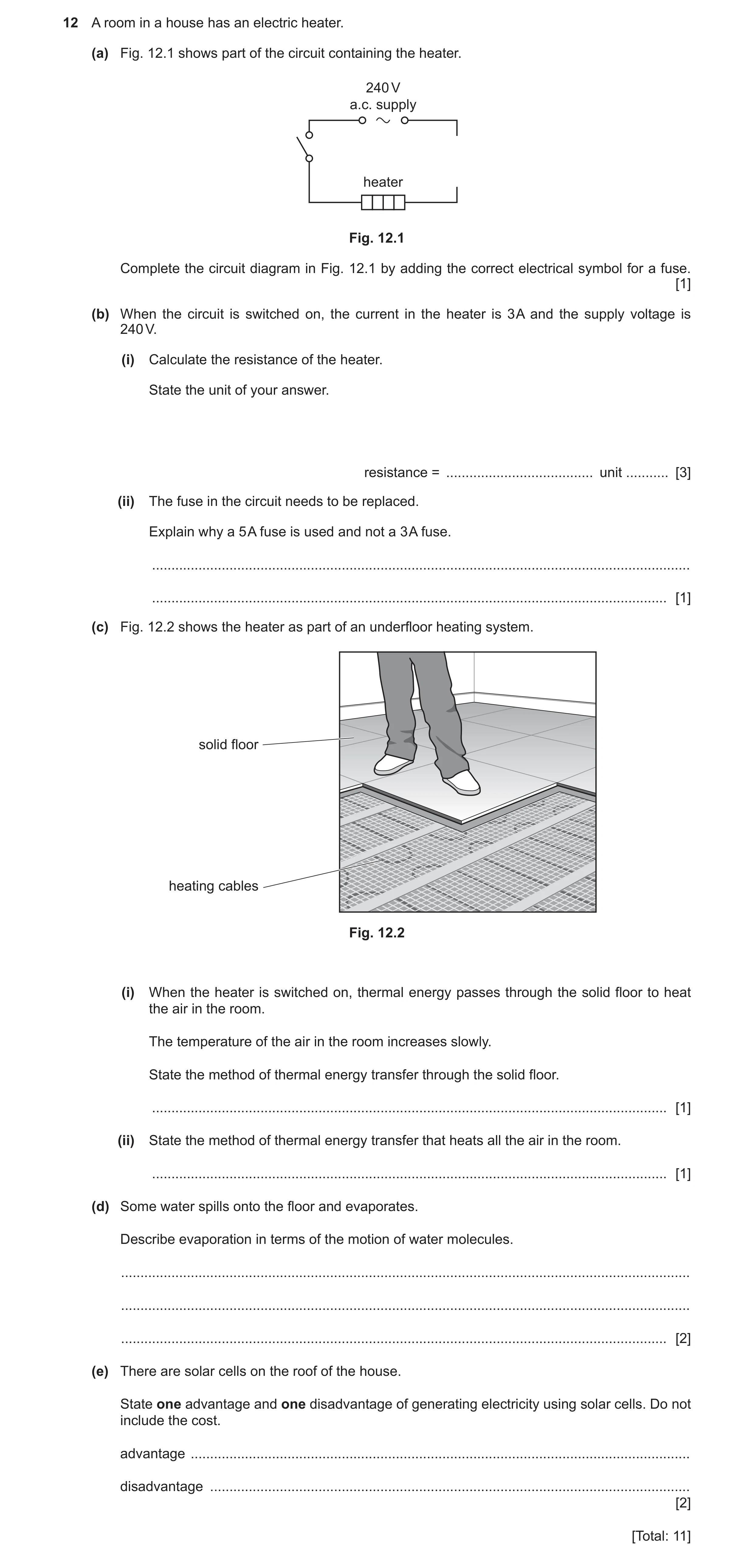
12 A room in a house has an electric heater. (a) Fig. 12.1 shows part of the circuit containing the heater. 240 V a.c. supply heater Fig. 12.1 Complete the circuit diagram in Fig. 12.1 by adding the correct electrical symbol for a fuse. [1] (b) When the circuit is switched on, the current in the heater is 3 A and the supply voltage is 240 V. (i) Calculate the resistance of the heater. State the unit of your answer. resistance = … unit … [3] (ii) The fuse in the circuit needs to be replaced. Explain why a 5 A fuse is used and not a 3 A fuse. … … [1] (c) Fig. 12.2 shows the heater as part of an underfloor heating system. solid floor heating cables Fig. 12.2 (i) When the heater is switched on, thermal energy passes through the solid floor to heat the air in the room. The temperature of the air in the room increases slowly. State the method of thermal energy transfer through the solid floor. … [1] (ii) State the method of thermal energy transfer that heats all the air in the room. … [1] (d) Some water spills onto the floor and evaporates. Describe evaporation in terms of the motion of water molecules. … … … [2] (e) There are solar cells on the roof of the house. State one advantage and one disadvantage of generating electricity using solar cells. Do not include the cost. advantage … disadvantage … [2] [Total: 11]
11 marks
Mark scheme: 12(a) fuse inserted in gap using the correct symbol ; 1 12(b)(i) evidence of resistance = voltage / current (in any form) or 240 / 3 ; 3 = 80 ; / ohms ; 12(b)(ii) fuse needs to be slightly greater than maximum current (or it would blow in normal use) ; 1 12(c)(i) conduction ; 1 12(c)(ii) convection ; 1 12(d) faster moving / most energetic molecules (leave) ; 2 (leave) from the surface of the liquid ; 12(e) renewable energy / does not produce CO2 etc ; 2 need sunlight / only works during the day etc ;
This question in 0654/32 Feb/March 2023
Q22 · A double electric hotplate used to heat food 0654/33 Oct/Nov 2023
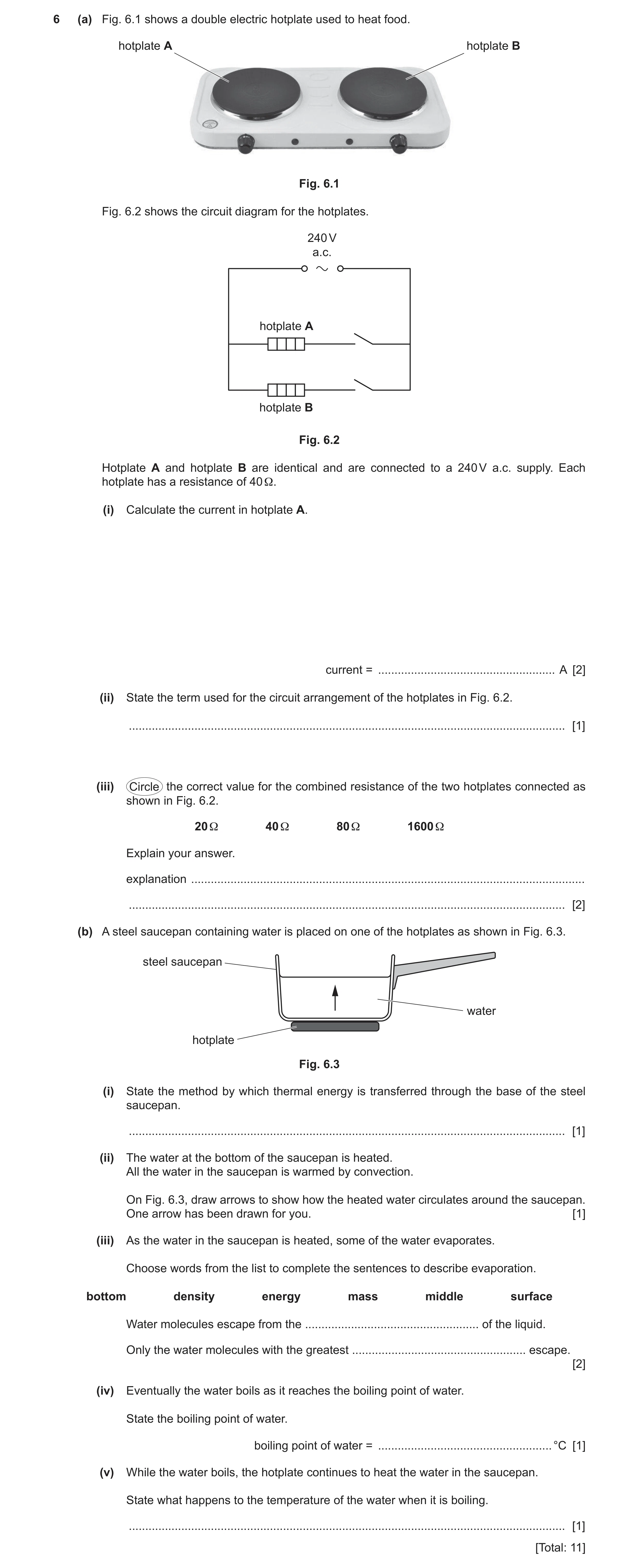
6 (a) Fig. 6.1 shows a double electric hotplate used to heat food. hotplate A hotplate B Fig. 6.1 Fig. 6.2 shows the circuit diagram for the hotplates. 240 V a.c. hotplate A hotplate B Fig. 6.2 Hotplate A and hotplate B are identical and are connected to a 240 V a.c. supply. Each hotplate has a resistance of 40 Ω. (i) Calculate the current in hotplate A. current = … A [2] (ii) State the term used for the circuit arrangement of the hotplates in Fig. 6.2. … [1] (iii) Circle the correct value for the combined resistance of the two hotplates connected as shown in Fig. 6.2. 20 Ω 40 Ω 80 Ω 1600 Ω Explain your answer. explanation … … [2] (b) A steel saucepan containing water is placed on one of the hotplates as shown in Fig. 6.3. steel saucepan water hotplate Fig. 6.3 (i) State the method by which thermal energy is transferred through the base of the steel saucepan. … [1] (ii) The water at the bottom of the saucepan is heated. All the water in the saucepan is warmed by convection. On Fig. 6.3, draw arrows to show how the heated water circulates around the saucepan. One arrow has been drawn for you. [1] (iii) As the water in the saucepan is heated, some of the water evaporates. Choose words from the list to complete the sentences to describe evaporation. bottom density energy mass middle surface Water molecules escape from the … of the liquid. Only the water molecules with the greatest … escape. [2] (iv) Eventually the water boils as it reaches the boiling point of water. State the boiling point of water. boiling point of water = … °C [1] (v) While the water boils, the hotplate continues to heat the water in the saucepan. State what happens to the temperature of the water when it is boiling. … [1] [Total: 11]
11 marks
Mark scheme: 6(a)(i) current = voltage resistance (in any form) / 240 40 ; 2 = 6 (A) ; 6(a)(ii) parallel ; 1 6(a)(iii) 20 () ; 2 combined resistance is less than either individual resistor ; 6(b)(i) conduction ; 1 6(b)(ii) arrows continue upwards and then go to left and / or right and then down ; 1 6(b)(iii) surface ; 2 energy ; 6(b)(iv) 100 (C) ; 1 6(b)(v) no change in temperature ; 1
This question in 0654/33 Oct/Nov 2023
Q23 · A student investigates the properties of five materials: copper ice iron plastic wood… 0654/32 Feb/March 2024
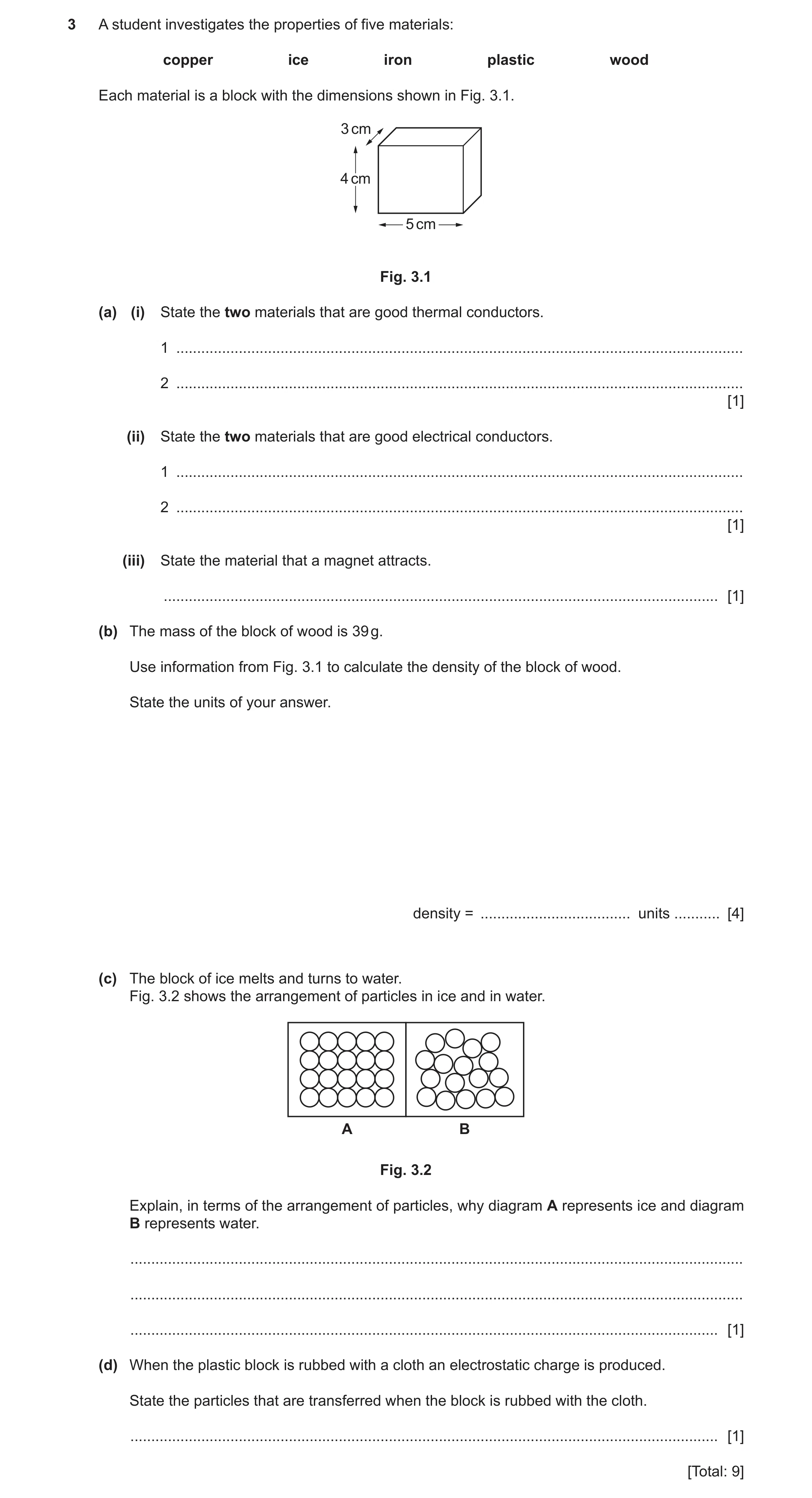
3 A student investigates the properties of five materials: copper ice iron plastic wood Each material is a block with the dimensions shown in Fig. 3.1. 3 cm 4 cm 5 cm Fig. 3.1 (a) (i) State the two materials that are good thermal conductors. 1 … 2 … [1] (ii) State the two materials that are good electrical conductors. 1 … 2 … [1] (iii) State the material that a magnet attracts. … [1] (b) The mass of the block of wood is 39 g. Use information from Fig. 3.1 to calculate the density of the block of wood. State the units of your answer. density = … units … [4] (c) The block of ice melts and turns to water. Fig. 3.2 shows the arrangement of particles in ice and in water. A B Fig. 3.2 Explain, in terms of the arrangement of particles, why diagram A represents ice and diagram B represents water. … … … [1] (d) When the plastic block is rubbed with a cloth an electrostatic charge is produced. State the particles that are transferred when the block is rubbed with the cloth. … [1] [Total: 9]
9 marks
Mark scheme: 3(a)(i) copper and iron ; 1 3(a)(ii) copper and iron ; 1 3(a)(iii) iron ; 1 3(b) volume = 3 4 5 = 60 cm3 ; 4 density = mass / volume (in any form) or 39 / 60 ; = 0.65 ; g / cm3 ; 3(c) ice – particles arranged regularly 1 and water – particles arranged irregularly ; 3(d) electrons ; 1
This question in 0654/32 Feb/March 2024
Q24 · Water in a steel saucepan being heated on an electric cooker 0654/32 May/June 2024
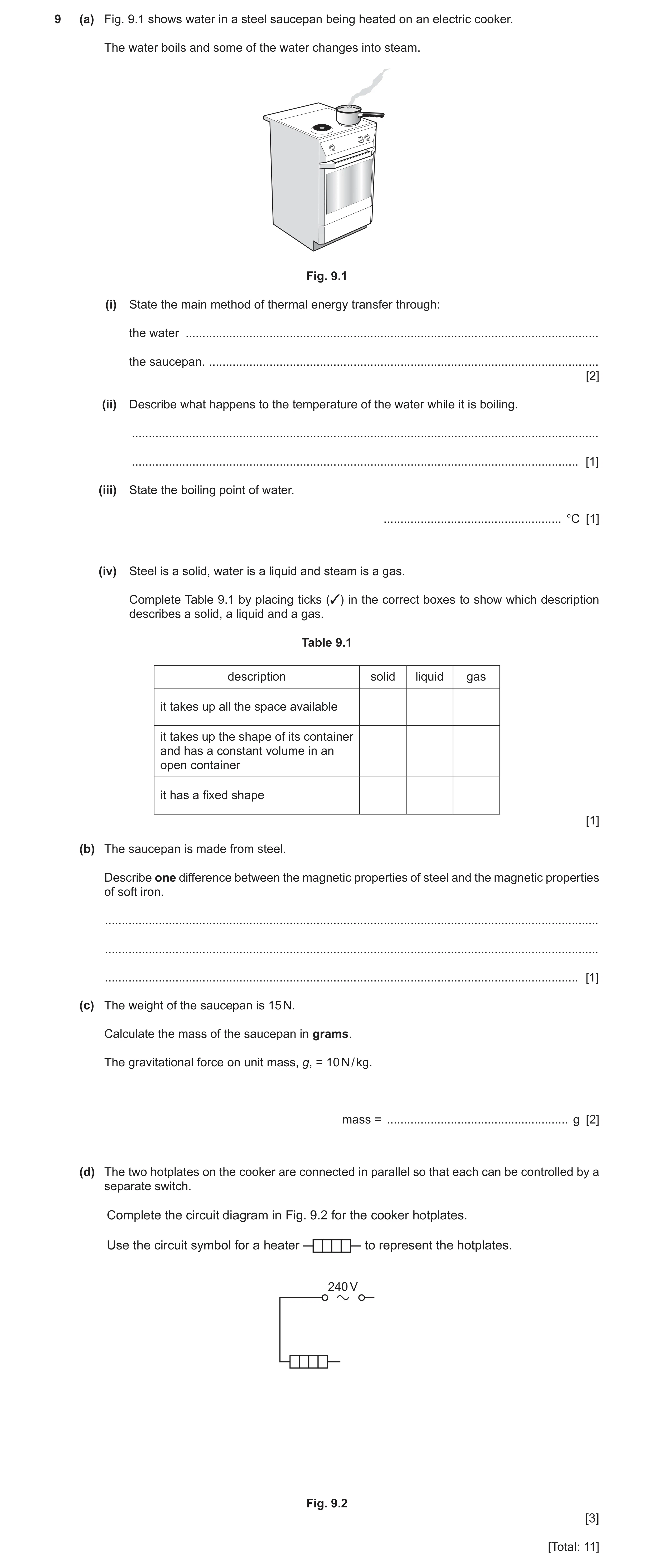
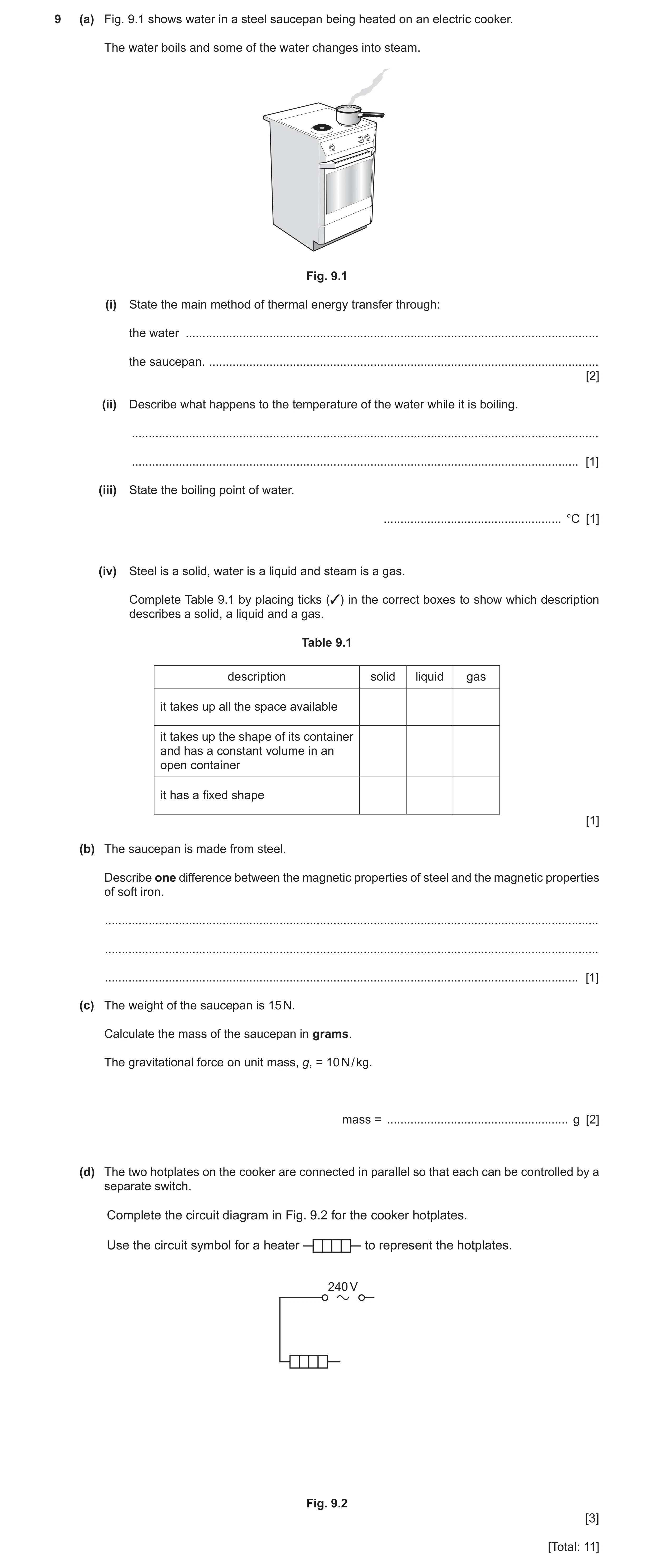
9 (a) Fig. 9.1 shows water in a steel saucepan being heated on an electric cooker. The water boils and some of the water changes into steam. Fig. 9.1 (i) State the main method of thermal energy transfer through: the water … the saucepan. … [2] (ii) Describe what happens to the temperature of the water while it is boiling. … … [1] (iii) State the boiling point of water. … °C [1] (iv) Steel is a solid, water is a liquid and steam is a gas. Complete Table 9.1 by placing ticks (✓) in the correct boxes to show which description describes a solid, a liquid and a gas. Table 9.1 description solid liquid gas it takes up all the space available it takes up the shape of its container and has a constant volume in an open container it has a fixed shape [1] (b) The saucepan is made from steel. Describe one difference between the magnetic properties of steel and the magnetic properties of soft iron. … … … [1] (c) The weight of the saucepan is 15 N. Calculate the mass of the saucepan in grams. The gravitational force on unit mass, g, = 10 N / kg. mass = … g [2] (d) The two hotplates on the cooker are connected in parallel so that each can be controlled by a separate switch. Complete the circuit diagram in Fig. 9.2 for the cooker hotplates. Use the circuit symbol for a heater to represent the hotplates. 240 V Fig. 9.2 [3] [Total: 11]
11 marks
Mark scheme: 9(a)(i) convection ; conduction ; 2 9(a)(ii) remains constant / remains at 100 ºC ; 1 9(a)(iii) 100 ºC ; 1 Question Answer Marks 9(a)(iv) description solid liquid gas it takes up all the space available it takes up the shape of its container and has a constant volume It has a fixed shape ; 1 9(b) steel retains its magnetism better / iron loses its magnetism more readily ; 1 9(c) m = W / g (in any form) or 15 / 10 or 1.5 ; = 1500 (g) ; 2 9(d) correct symbol for switch ; second heater connected in parallel ; each heater controlled by a separate switch ; 3
This question in 0654/32 May/June 2024
Q25 · Water in a steel saucepan being heated on an electric cooker 0654/33 May/June 2024
9 (a) Fig. 9.1 shows water in a steel saucepan being heated on an electric cooker. The water boils and some of the water changes into steam. Fig. 9.1 (i) State the main method of thermal energy transfer through: the water … the saucepan. … [2] (ii) Describe what happens to the temperature of the water while it is boiling. … … [1] (iii) State the boiling point of water. … °C [1] (iv) Steel is a solid, water is a liquid and steam is a gas. Complete Table 9.1 by placing ticks (✓) in the correct boxes to show which description describes a solid, a liquid and a gas. Table 9.1 description solid liquid gas it takes up all the space available it takes up the shape of its container and has a constant volume in an open container it has a fixed shape [1] (b) The saucepan is made from steel. Describe one difference between the magnetic properties of steel and the magnetic properties of soft iron. … … … [1] (c) The weight of the saucepan is 15 N. Calculate the mass of the saucepan in grams. The gravitational force on unit mass, g, = 10 N / kg. mass = … g [2] (d) The two hotplates on the cooker are connected in parallel so that each can be controlled by a separate switch. Complete the circuit diagram in Fig. 9.2 for the cooker hotplates. Use the circuit symbol for a heater to represent the hotplates. 240 V Fig. 9.2 [3] [Total: 11]
11 marks
Mark scheme: 9(a)(i) convection ; conduction ; 2 9(a)(ii) remains constant / remains at 100 ºC ; 1 9(a)(iii) 100 ºC ; 1 Question Answer Marks 9(a)(iv) description solid liquid gas it takes up all the space available it takes up the shape of its container and has a constant volume It has a fixed shape ; 1 9(b) steel retains its magnetism better / iron loses its magnetism more readily ; 1 9(c) m = W / g (in any form) or 15 / 10 or 1.5 ; = 1500 (g) ; 2 9(d) correct symbol for switch ; second heater connected in parallel ; each heater controlled by a separate switch ; 3
This question in 0654/33 May/June 2024
Q26 · Visible light travels 1.5 × 10⁸ km from the Sun to the Earth 0654/31 Oct/Nov 2024
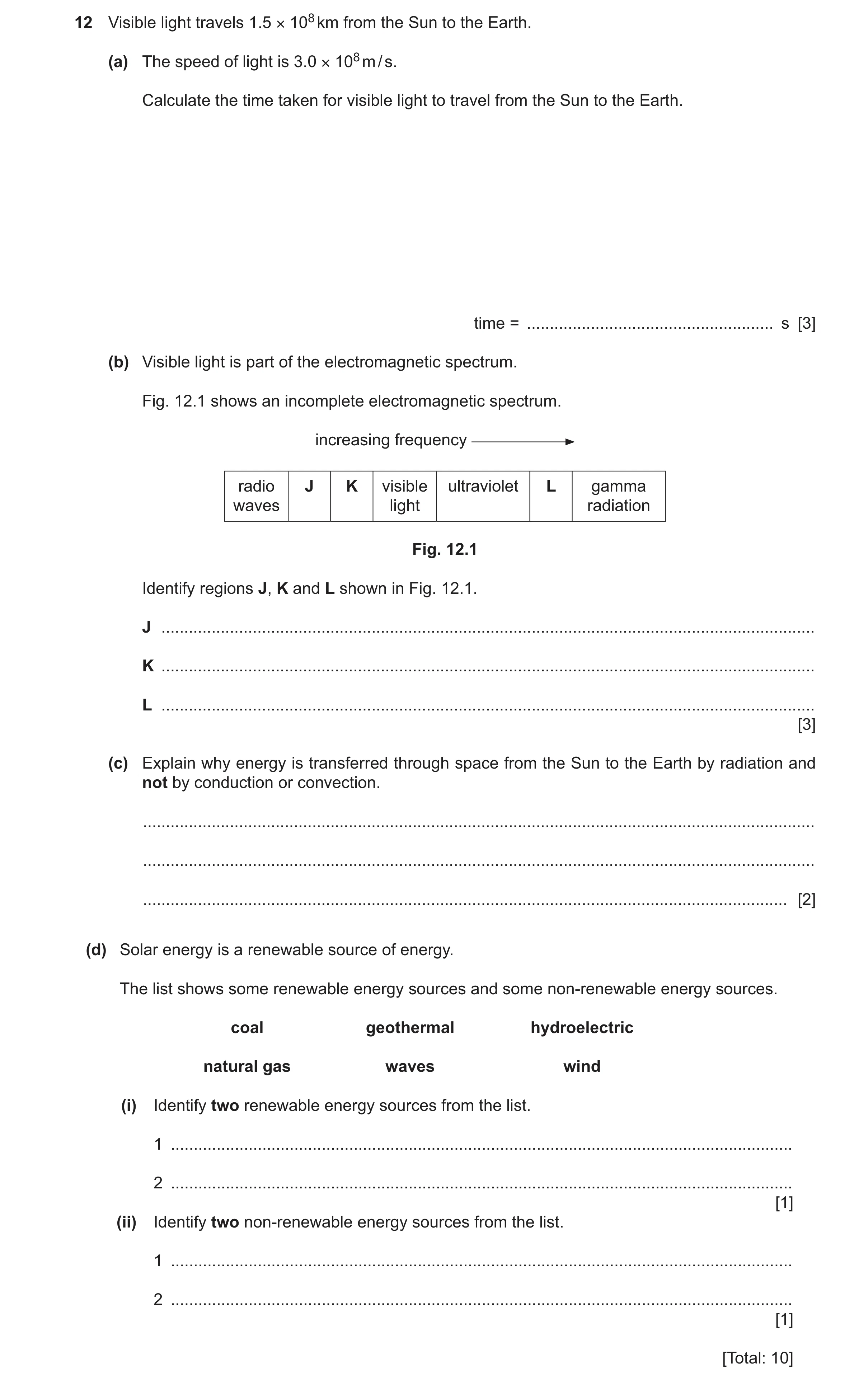
12 Visible light travels 1.5 × 10⁸ km from the Sun to the Earth. (a) The speed of light is 3.0 × 10⁸ m / s. Calculate the time taken for visible light to travel from the Sun to the Earth. time = … s [3] (b) Visible light is part of the electromagnetic spectrum. Fig. 12.1 shows an incomplete electromagnetic spectrum. increasing frequency radio J K visible ultraviolet L gamma waves light radiation Fig. 12.1 Identify regions J, K and L shown in Fig. 12.1. J … K … L … [3] (c) Explain why energy is transferred through space from the Sun to the Earth by radiation and not by conduction or convection. … … … [2] (d) Solar energy is a renewable source of energy. The list shows some renewable energy sources and some non-renewable energy sources. coal geothermal hydroelectric natural gas waves wind (i) Identify two renewable energy sources from the list. 1 … 2 … [1] (ii) Identify two non-renewable energy sources from the list. 1 … 2 … [1] [Total: 10]
10 marks
Mark scheme: 12(a) evidence of, unit conversion km to m ; 3 evidence of, time = distance ÷ speed / 1.5 1011 ÷ 3.0 108 ; 500 (s) ; 12(b) J = microwaves ; 3 K = infrared (radiation) ; L = X-rays ; 12(c) space is a vacuum ; 2 radiation does not need a medium to pass through / conduction and convection need a medium to pass through ; 12(d)(i) any two from: 1 geothermal hydroelectric waves wind ;; 12(d)(ii) coal AND natural gas ; 1
This question in 0654/31 Oct/Nov 2024
Q27 · An electric heater used in a classroom in a school 0654/32 Oct/Nov 2024
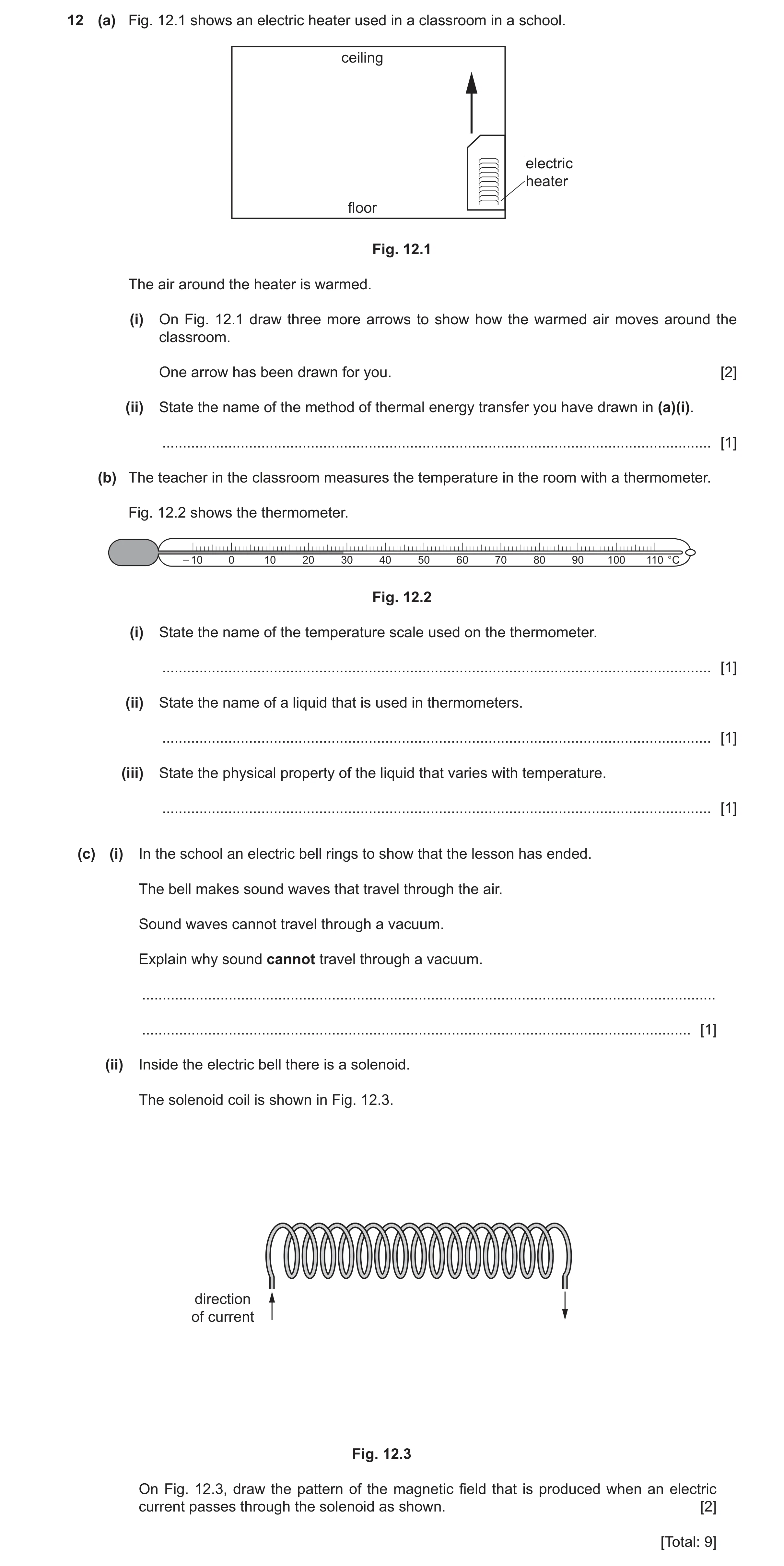
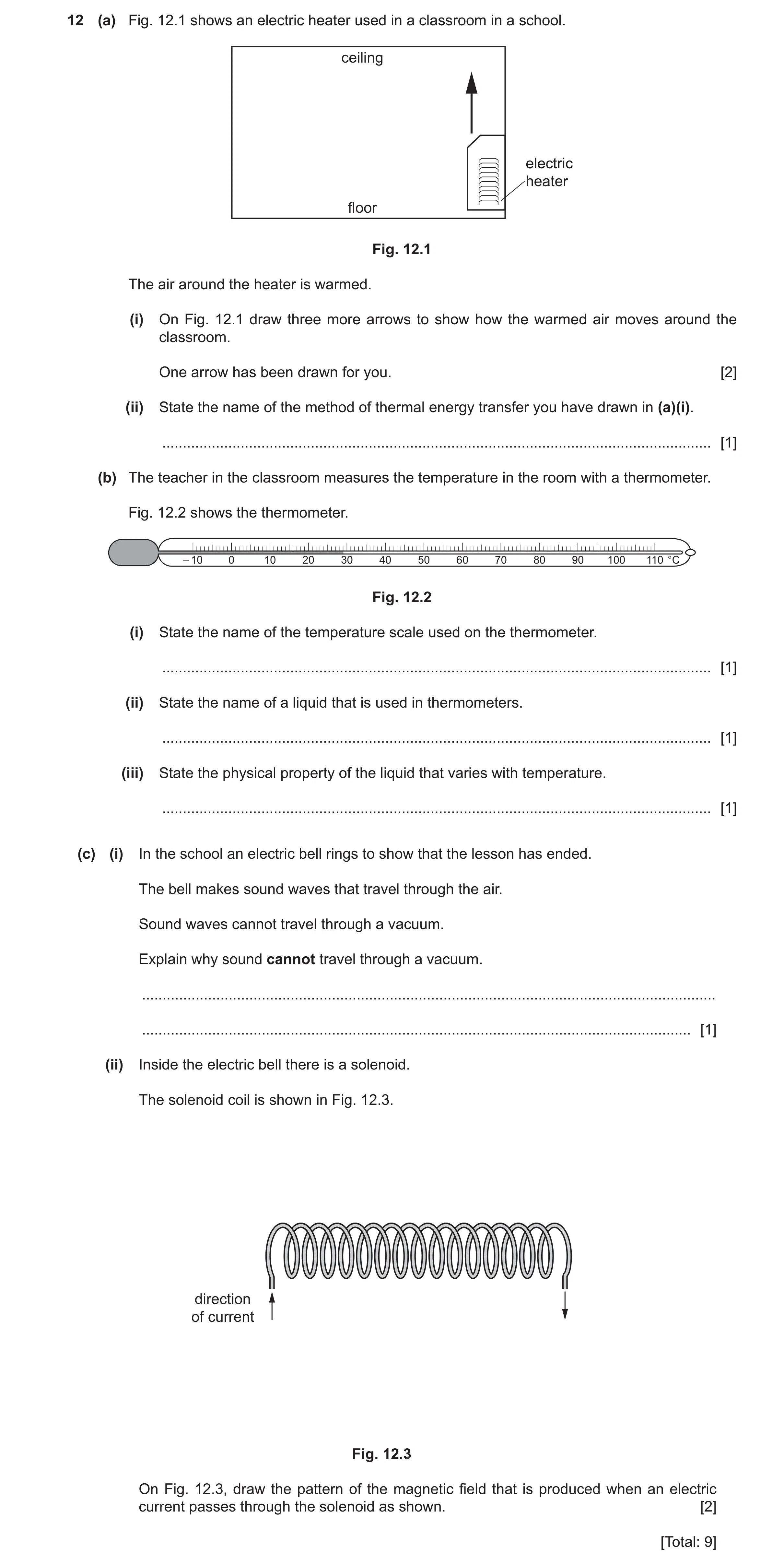
12 (a) Fig. 12.1 shows an electric heater used in a classroom in a school. ceiling electric heater floor Fig. 12.1 The air around the heater is warmed. (i) On Fig. 12.1 draw three more arrows to show how the warmed air moves around the classroom. One arrow has been drawn for you. [2] (ii) State the name of the method of thermal energy transfer you have drawn in (a)(i). … [1] (b) The teacher in the classroom measures the temperature in the room with a thermometer. Fig. 12.2 shows the thermometer. – 10 0 10 20 30 40 50 60 70 80 90 100 110 °C Fig. 12.2 (i) State the name of the temperature scale used on the thermometer. … [1] (ii) State the name of a liquid that is used in thermometers. … [1] (iii) State the physical property of the liquid that varies with temperature. … [1] (c) (i) In the school an electric bell rings to show that the lesson has ended. The bell makes sound waves that travel through the air. Sound waves cannot travel through a vacuum. Explain why sound cannot travel through a vacuum. … … [1] (ii) Inside the electric bell there is a solenoid. The solenoid coil is shown in Fig. 12.3. direction of current Fig. 12.3 On Fig. 12.3, draw the pattern of the magnetic field that is produced when an electric current passes through the solenoid as shown. [2] [Total: 9]
9 marks
Mark scheme: 12(a)(i) arrow 2 across the top then dropping down then left to right along floor 1 mark for any one correct arrow ; 1 mark for all three arrows correct ; 12(a)(ii) convection ; 1 12(b)(i) celsius ; 1 12(b)(ii) alcohol or mercury ; 1 12(b)(iii) volume / density ; 1 12(c)(i) There is no medium (for the propagation of the sound wave) ; 1 12(c)(ii) at least two lines going all the way through coil ; 2 line curving upwards and line curving downwards ;
This question in 0654/32 Oct/Nov 2024
Q28 · An electric heater used in a classroom in a school 0654/33 Oct/Nov 2024
12 (a) Fig. 12.1 shows an electric heater used in a classroom in a school. ceiling electric heater floor Fig. 12.1 The air around the heater is warmed. (i) On Fig. 12.1 draw three more arrows to show how the warmed air moves around the classroom. One arrow has been drawn for you. [2] (ii) State the name of the method of thermal energy transfer you have drawn in (a)(i). … [1] (b) The teacher in the classroom measures the temperature in the room with a thermometer. Fig. 12.2 shows the thermometer. – 10 0 10 20 30 40 50 60 70 80 90 100 110 °C Fig. 12.2 (i) State the name of the temperature scale used on the thermometer. … [1] (ii) State the name of a liquid that is used in thermometers. … [1] (iii) State the physical property of the liquid that varies with temperature. … [1] (c) (i) In the school an electric bell rings to show that the lesson has ended. The bell makes sound waves that travel through the air. Sound waves cannot travel through a vacuum. Explain why sound cannot travel through a vacuum. … … [1] (ii) Inside the electric bell there is a solenoid. The solenoid coil is shown in Fig. 12.3. direction of current Fig. 12.3 On Fig. 12.3, draw the pattern of the magnetic field that is produced when an electric current passes through the solenoid as shown. [2] [Total: 9]
9 marks
Mark scheme: 12(a)(i) arrow 2 across the top then dropping down then left to right along floor 1 mark for any one correct arrow ; 1 mark for all three arrows correct ; 12(a)(ii) convection ; 1 12(b)(i) celsius ; 1 12(b)(ii) alcohol or mercury ; 1 12(b)(iii) volume / density ; 1 12(c)(i) There is no medium (for the propagation of the sound wave) ; 1 12(c)(ii) at least two lines going all the way through coil ; 2 line curving upwards and line curving downwards ;
This question in 0654/33 Oct/Nov 2024
Question 29 0654/32 Feb/March 2025
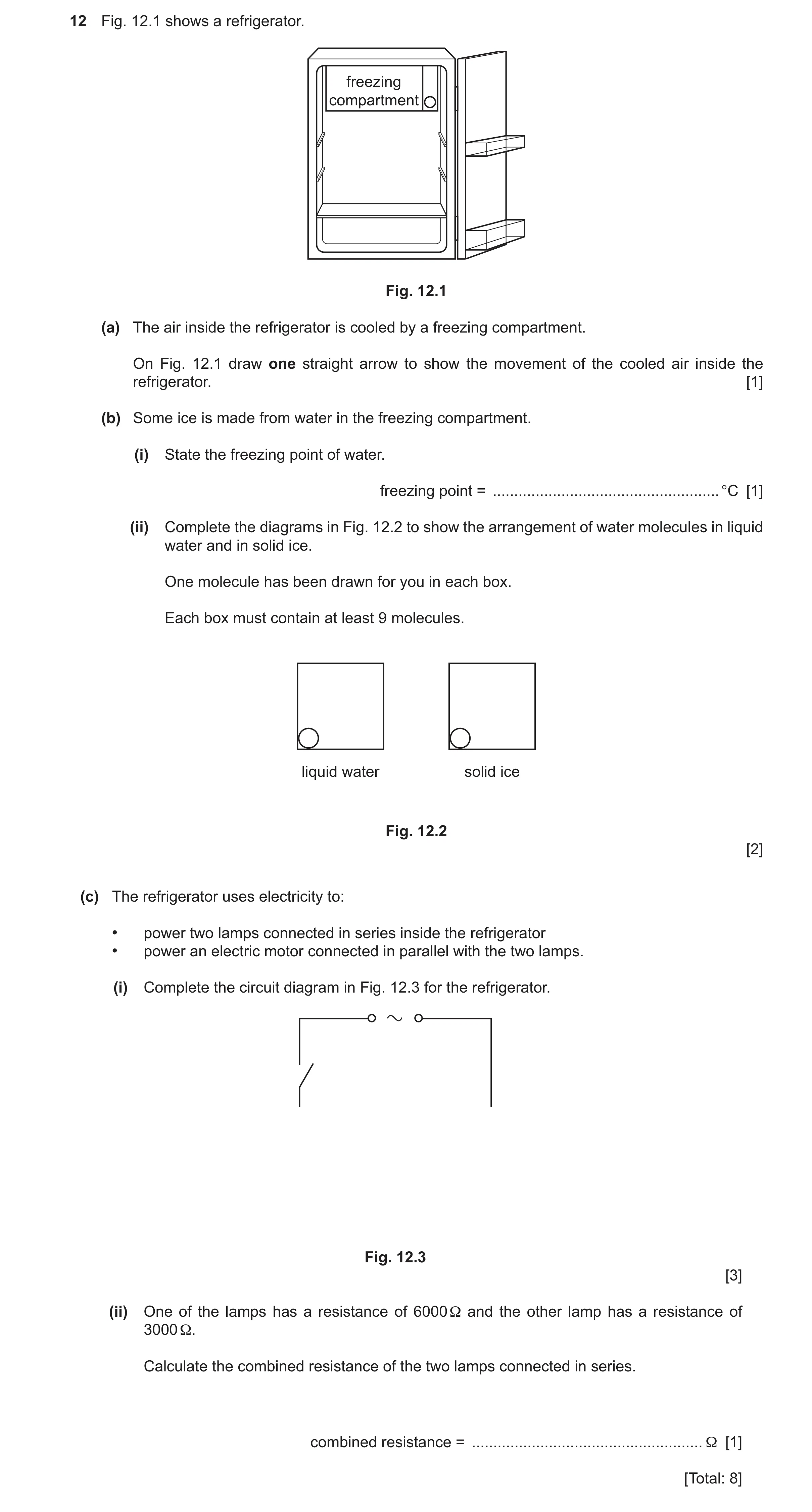
12 Fig. 12.1 shows a refrigerator. freezing compartment Fig. 12.1 (a) The air inside the refrigerator is cooled by a freezing compartment. On Fig. 12.1 draw one straight arrow to show the movement of the cooled air inside the refrigerator. [1] (b) Some ice is made from water in the freezing compartment. (i) State the freezing point of water. freezing point = … °C [1] (ii) Complete the diagrams in Fig. 12.2 to show the arrangement of water molecules in liquid water and in solid ice. One molecule has been drawn for you in each box. Each box must contain at least 9 molecules. liquid water solid ice Fig. 12.2 [2] (c) The refrigerator uses electricity to: • power two lamps connected in series inside the refrigerator • power an electric motor connected in parallel with the two lamps. (i) Complete the circuit diagram in Fig. 12.3 for the refrigerator. Fig. 12.3 [3] (ii) One of the lamps has a resistance of 6000 Ω and the other lamp has a resistance of 3000 Ω. Calculate the combined resistance of the two lamps connected in series. combined resistance = … Ω [1] [Total: 8]
8 marks
Mark scheme: 12(a) arrow going downwards ; 1 12(b)(i) 0 (°C) ; 1 12(b)(ii) liquid – (at least) 9 particles (all) touching and random arrangement ; 2 solid – (at least) 9 particles all touching and regular arrangement ; 12(c)(i) correct symbols for motor and lamps ; 3 lamps in series with each other ; motor in parallel with lamps ; 12(c)(ii) 9000 () ; 1
This question in 0654/32 Feb/March 2025
Q30 · An electric kettle with a heating element 0654/32 Oct/Nov 2025
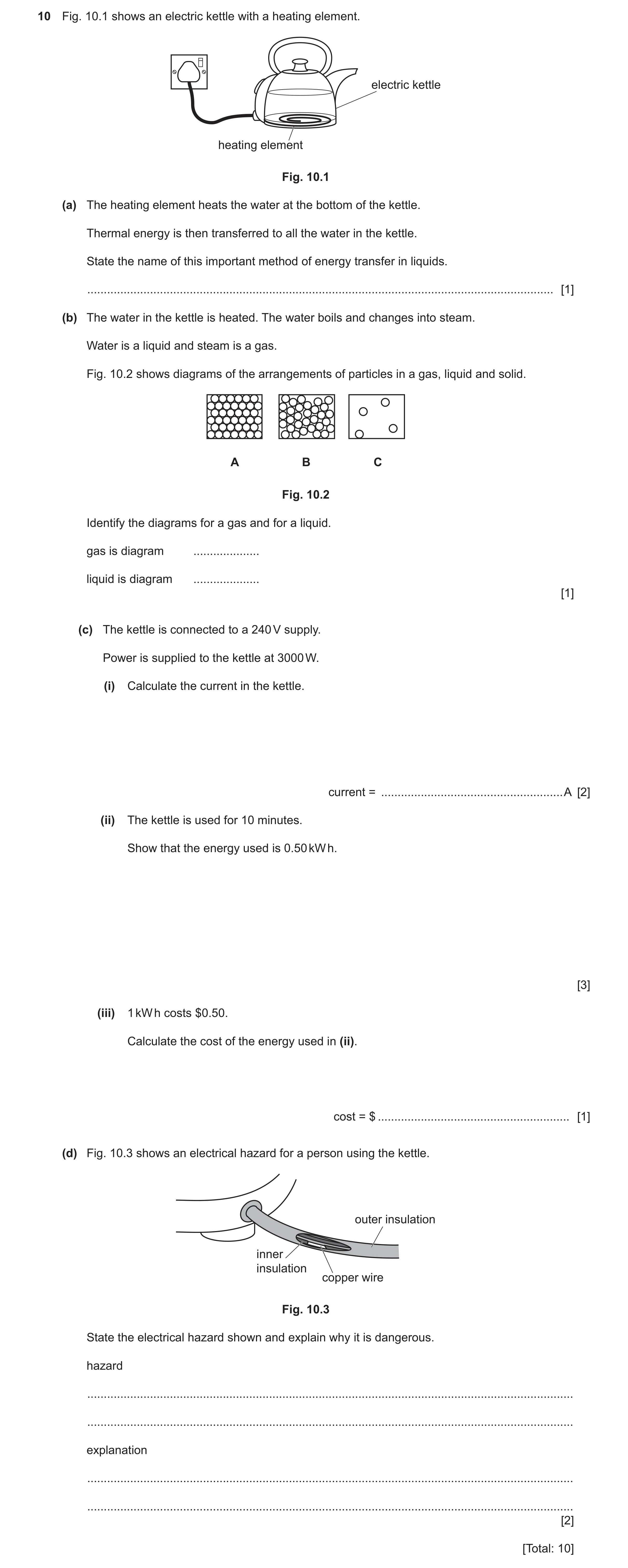
10 Fig. 10.1 shows an electric kettle with a heating element. electric kettle heating element Fig. 10.1 (a) The heating element heats the water at the bottom of the kettle. Thermal energy is then transferred to all the water in the kettle. State the name of this important method of energy transfer in liquids. … [1] (b) The water in the kettle is heated. The water boils and changes into steam. Water is a liquid and steam is a gas. Fig. 10.2 shows diagrams of the arrangements of particles in a gas, liquid and solid. A B C Fig. 10.2 Identify the diagrams for a gas and for a liquid. gas is diagram … liquid is diagram … [1] (c) The kettle is connected to a 240 V supply. Power is supplied to the kettle at 3000 W. (i) Calculate the current in the kettle. current = … A [2] (ii) The kettle is used for 10 minutes. Show that the energy used is 0.50 kW h. [3] (iii) 1 kW h costs $0.50. Calculate the cost of the energy used in (ii). cost = $ … [1] (d) Fig. 10.3 shows an electrical hazard for a person using the kettle. outer insulation inner insulation copper wire Fig. 10.3 State the electrical hazard shown and explain why it is dangerous. hazard … … explanation … … [2] [Total: 10]
10 marks
Mark scheme: 10(a) convection ; 1 10(b) (gas is diagram) C and (liquid is diagram) B ; 1 10(c)(i) P = IV (in any form) 2 OR (current =) 3000 / 240 ; 12.5 (A) ; 10(c)(ii) energy = power time (in any form) ; 3 conversion of minutes to hours ; conversion of W to kW ; (= 0.5 kWh) 10(c)(iii) ($) 0.25 ; 1 10(d) insulation damaged / exposed (live) wire / AW ; 2 electric shock ;
This question in 0654/32 Oct/Nov 2025
Q31 · An electric kettle with a heating element 0654/33 Oct/Nov 2025
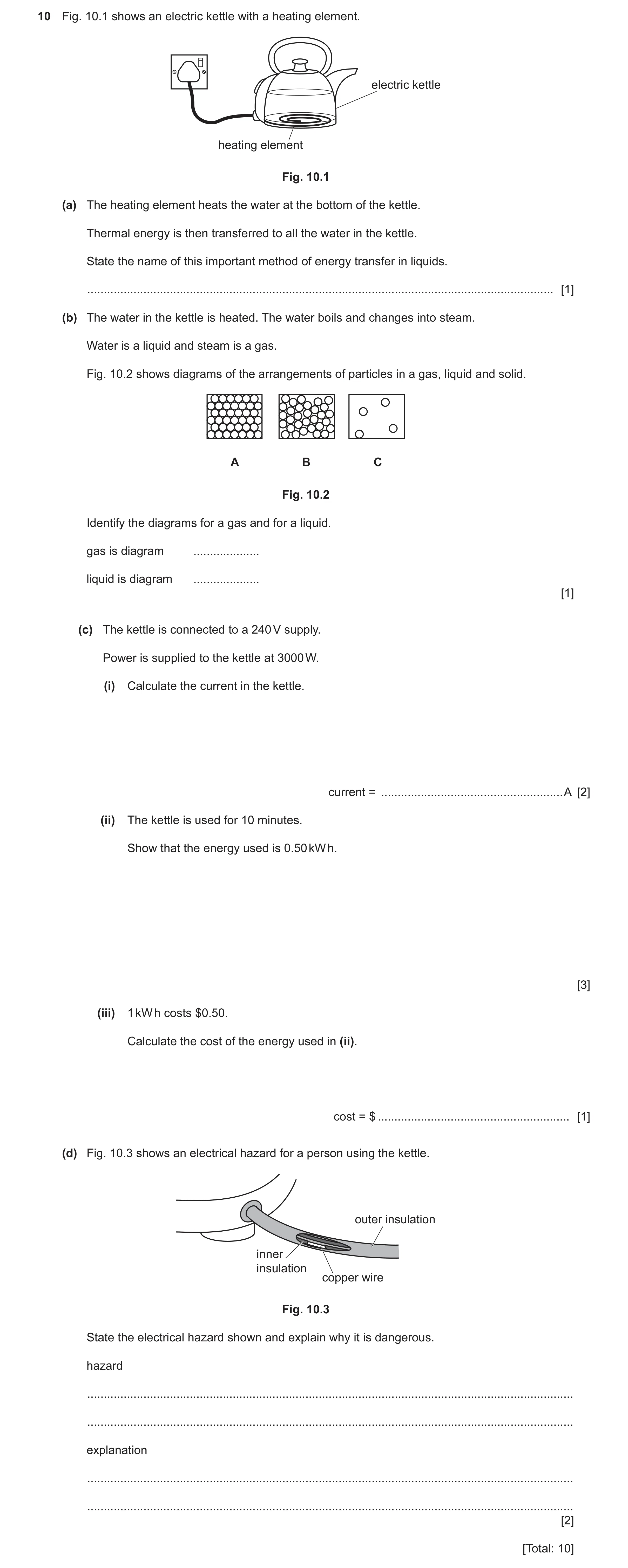
10 Fig. 10.1 shows an electric kettle with a heating element. electric kettle heating element Fig. 10.1 (a) The heating element heats the water at the bottom of the kettle. Thermal energy is then transferred to all the water in the kettle. State the name of this important method of energy transfer in liquids. … [1] (b) The water in the kettle is heated. The water boils and changes into steam. Water is a liquid and steam is a gas. Fig. 10.2 shows diagrams of the arrangements of particles in a gas, liquid and solid. A B C Fig. 10.2 Identify the diagrams for a gas and for a liquid. gas is diagram … liquid is diagram … [1] (c) The kettle is connected to a 240 V supply. Power is supplied to the kettle at 3000 W. (i) Calculate the current in the kettle. current = … A [2] (ii) The kettle is used for 10 minutes. Show that the energy used is 0.50 kW h. [3] (iii) 1 kW h costs $0.50. Calculate the cost of the energy used in (ii). cost = $ … [1] (d) Fig. 10.3 shows an electrical hazard for a person using the kettle. outer insulation inner insulation copper wire Fig. 10.3 State the electrical hazard shown and explain why it is dangerous. hazard … … explanation … … [2] [Total: 10]
10 marks
Mark scheme: 10(a) convection ; 1 10(b) (gas is diagram) C and (liquid is diagram) B ; 1 10(c)(i) P = IV (in any form) 2 OR (current =) 3000 / 240 ; 12.5 (A) ; 10(c)(ii) energy = power time (in any form) ; 3 conversion of minutes to hours ; conversion of W to kW ; (= 0.5 kWh) 10(c)(iii) ($) 0.25 ; 1 10(d) insulation damaged / exposed (live) wire / AW ; 2 electric shock ;
This question in 0654/33 Oct/Nov 2025
Q32 · A student runs 100 m 0654/33 Oct/Nov 2025
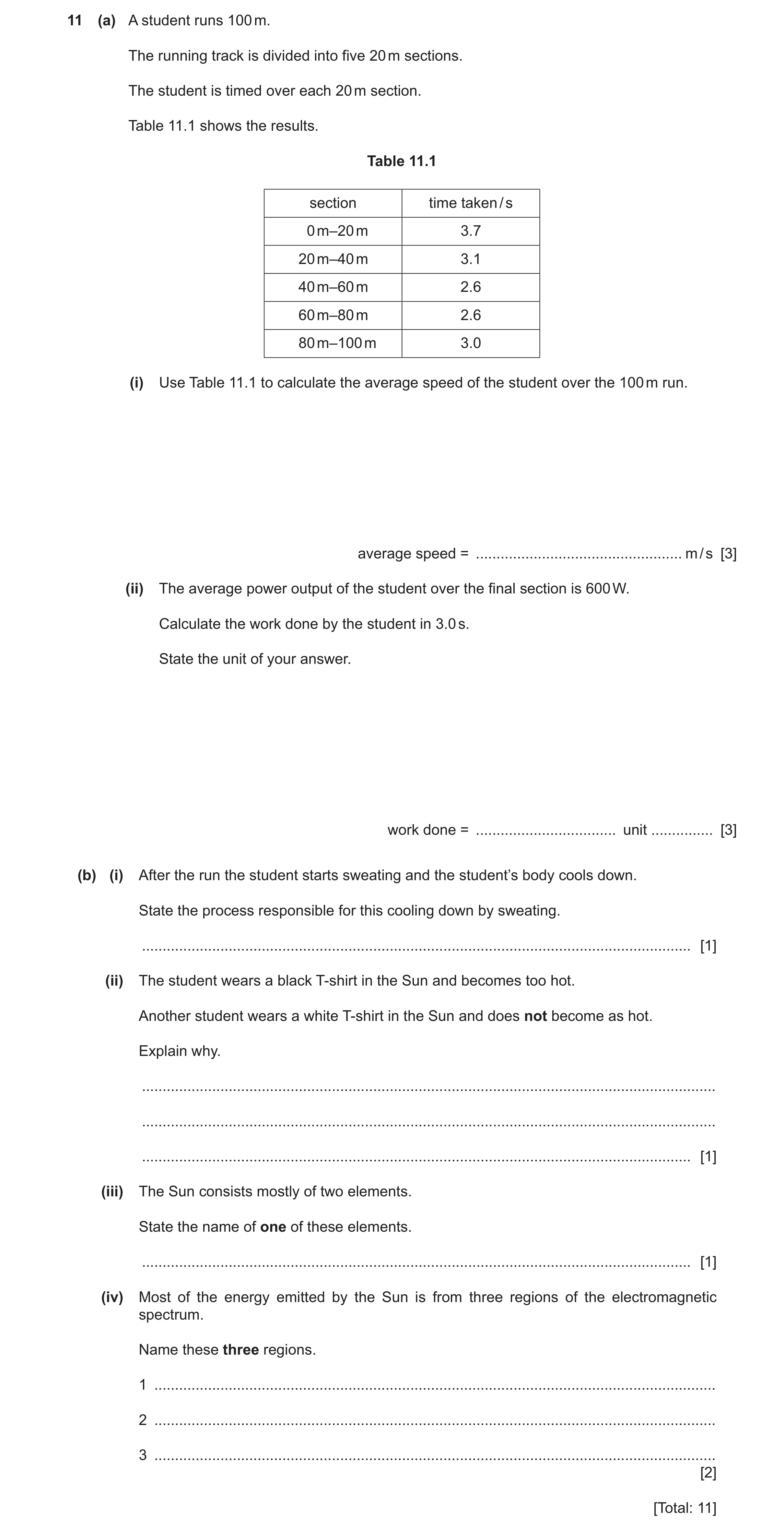
11 (a) A student runs 100 m. The running track is divided into five 20 m sections. The student is timed over each 20 m section. Table 11.1 shows the results. Table 11.1 section time taken / s 0 m–20 m 3.7 20 m–40 m 3.1 40 m–60 m 2.6 60 m–80 m 2.6 80 m–100 m 3.0 (i) Use Table 11.1 to calculate the average speed of the student over the 100 m run. average speed = … m / s [3] (ii) The average power output of the student over the final section is 600 W. Calculate the work done by the student in 3.0 s. State the unit of your answer. work done = … unit … [3] (b) (i) After the run the student starts sweating and the student’s body cools down. State the process responsible for this cooling down by sweating. … [1] (ii) The student wears a black T‑shirt in the Sun and becomes too hot. Another student wears a white T‑shirt in the Sun and does not become as hot. Explain why. … … … [1] (iii) The Sun consists mostly of two elements. State the name of one of these elements. … [1] (iv) Most of the energy emitted by the Sun is from three regions of the electromagnetic spectrum. Name these three regions. 1 … 2 … 3 … [2] [Total: 11]
11 marks
Mark scheme: 11(a)(i) evidence of total time = 15 (s) ; 3 v = s / t (in any form) OR (average speed =) 100 / 15 ; 6.7 (m / s) ; 11(a)(ii) P = W / t (in any form) 3 OR (work done =) 600 3.0 ; 1800 ; J ; 11(b)(i) evaporation ; 1 11(b)(ii) white absorbs less (thermal) radiation / white reflects more (thermal) radiation / ORA ; 1 11(b)(iii) helium or hydrogen ; 1 11(b)(iv) infrared 2 (visible) light ultraviolet 1 or 2 correct – 1 mark all 3 correct – 2 marks
This question in 0654/33 Oct/Nov 2025
 11
11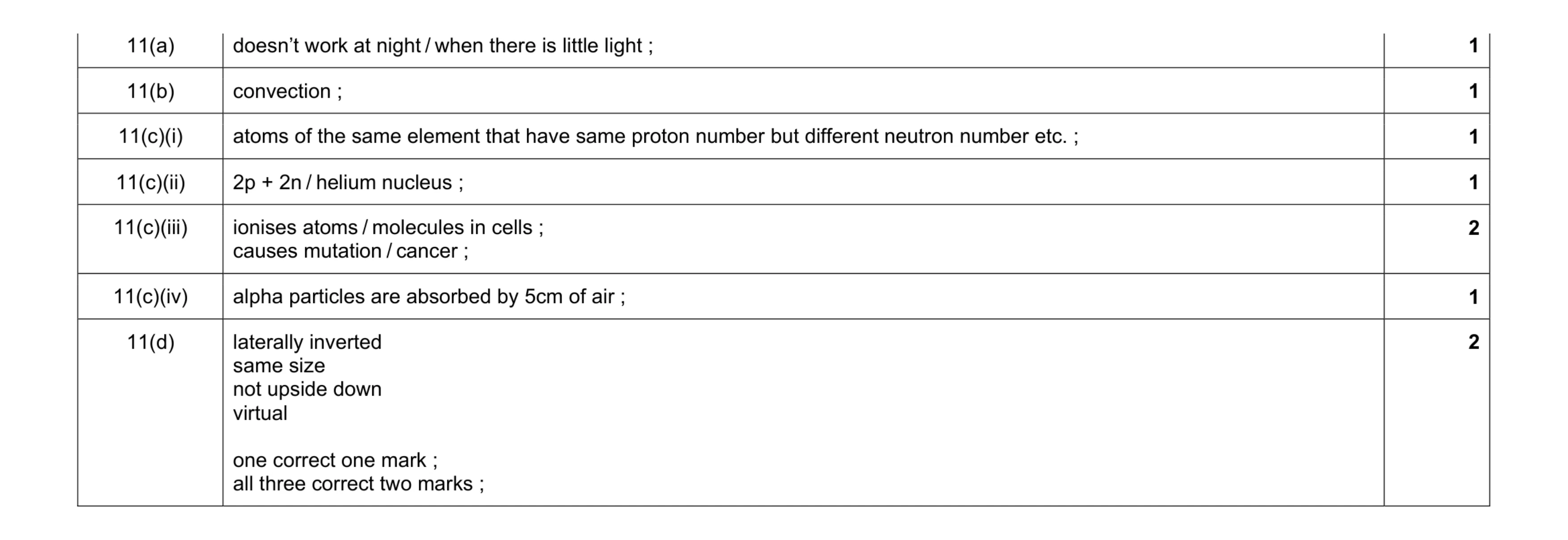 9
9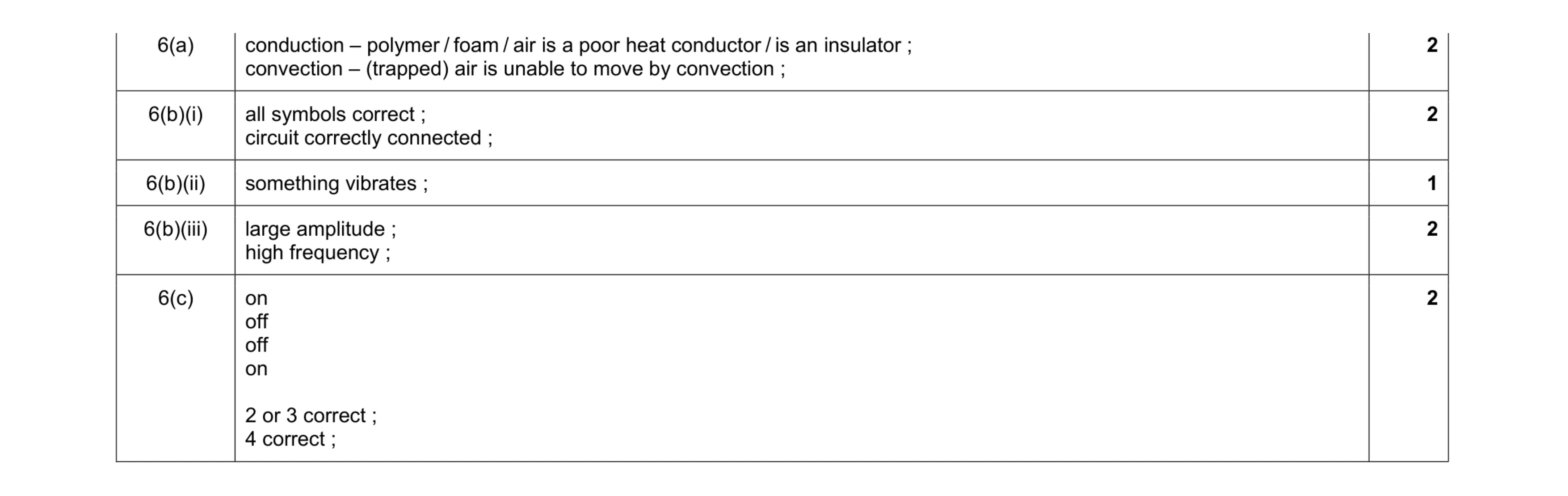 9
9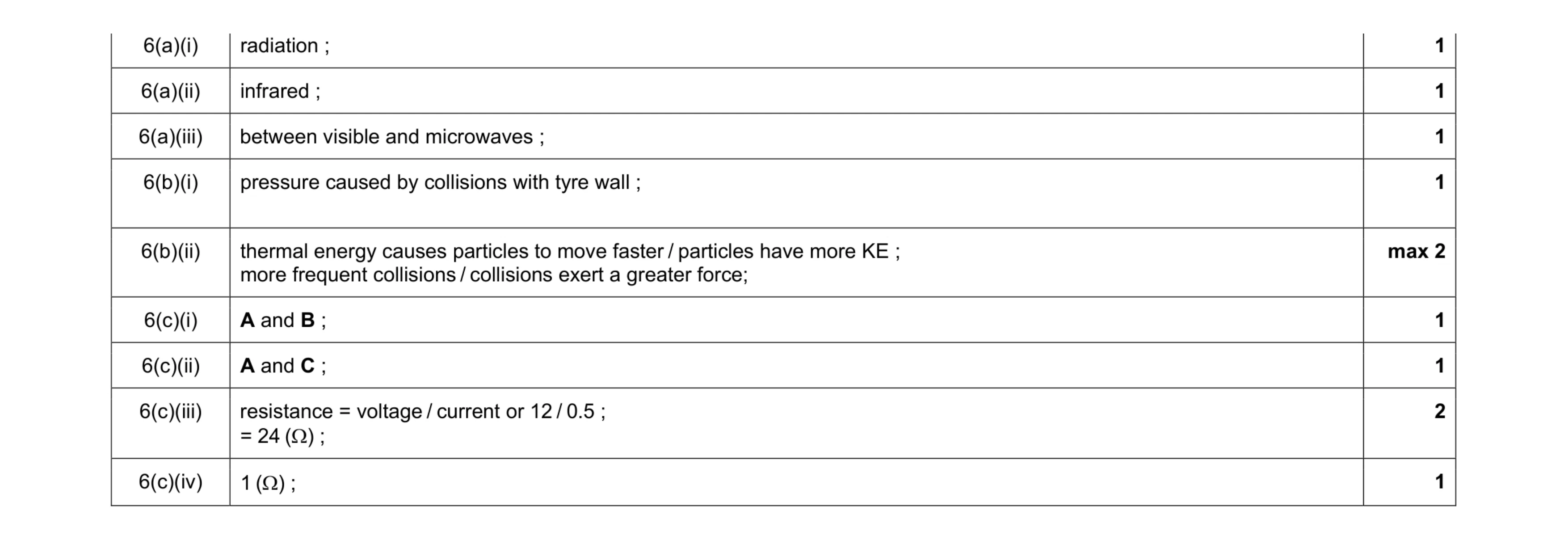 11
11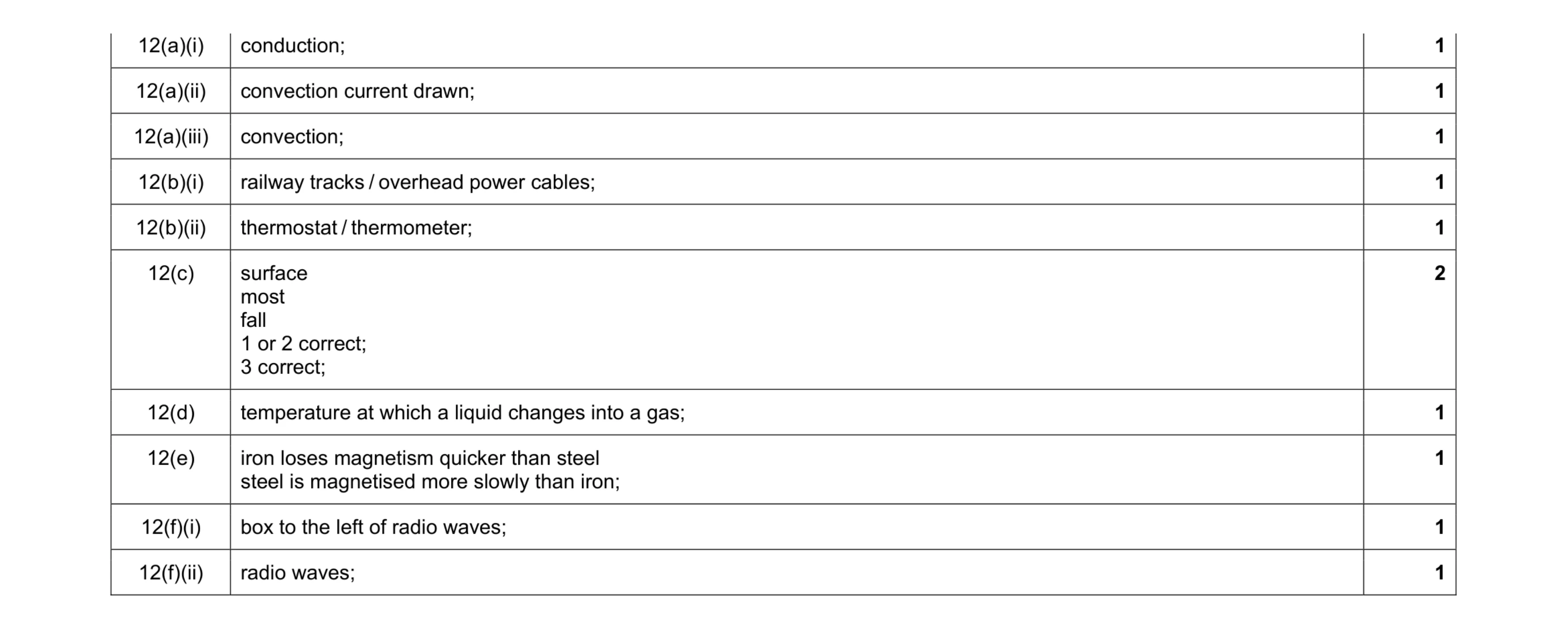 11
11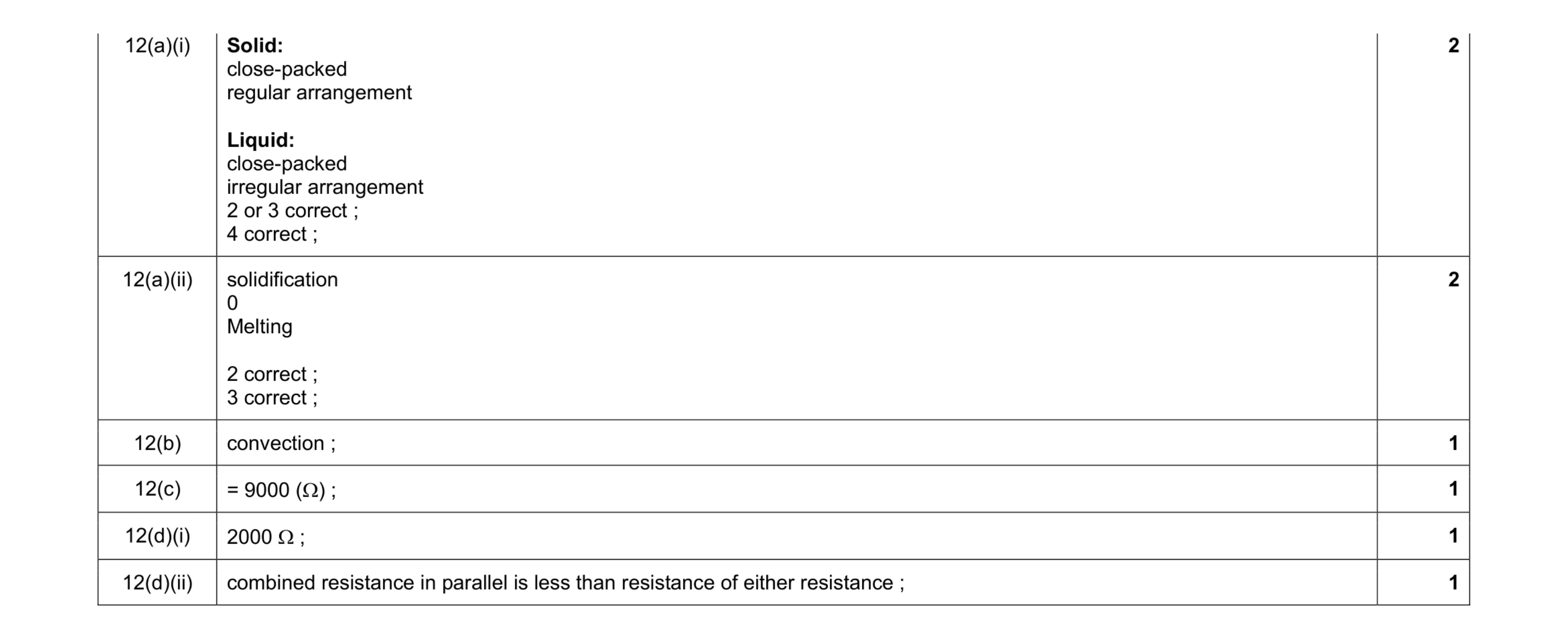 8
8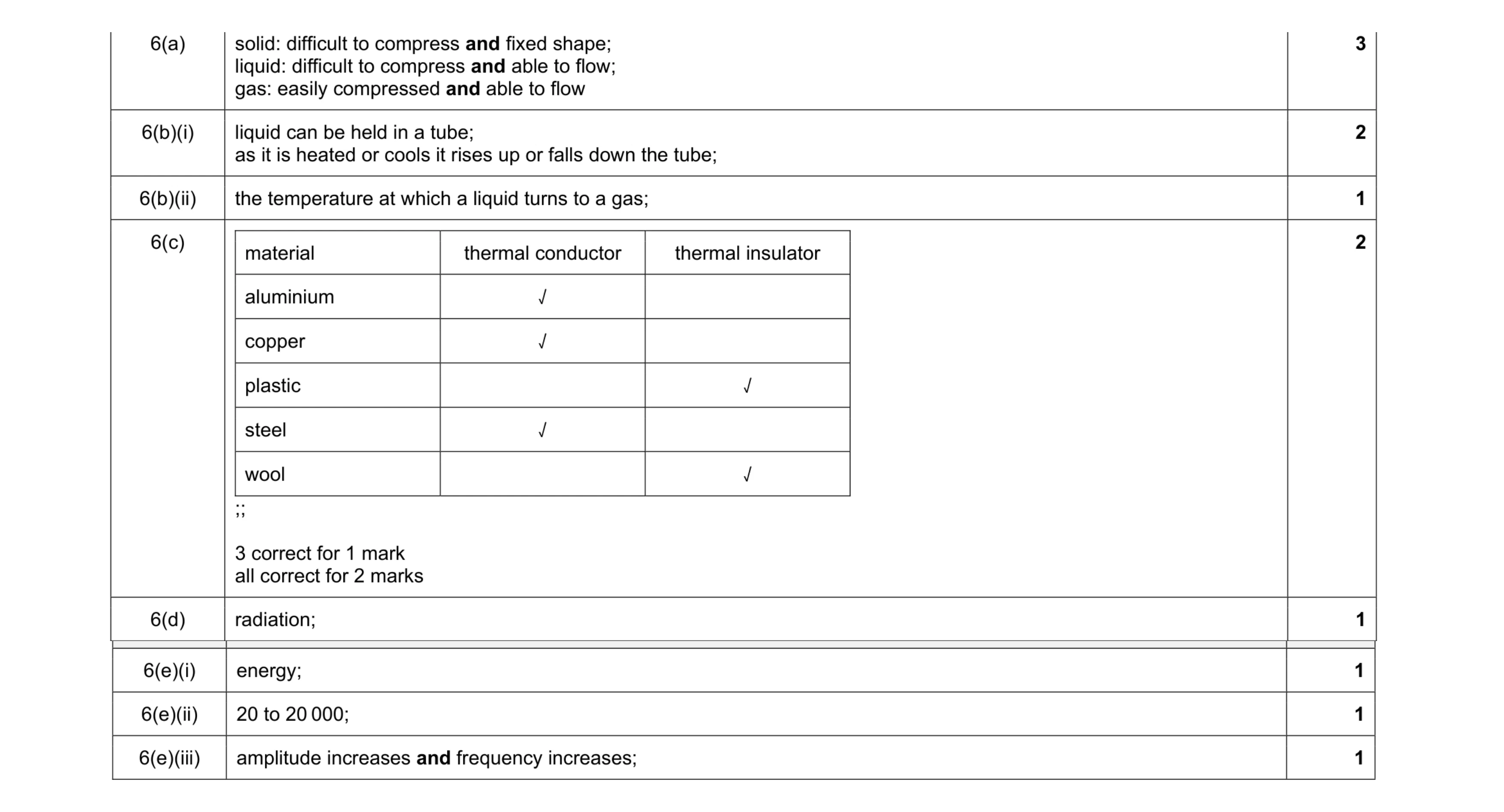 12
12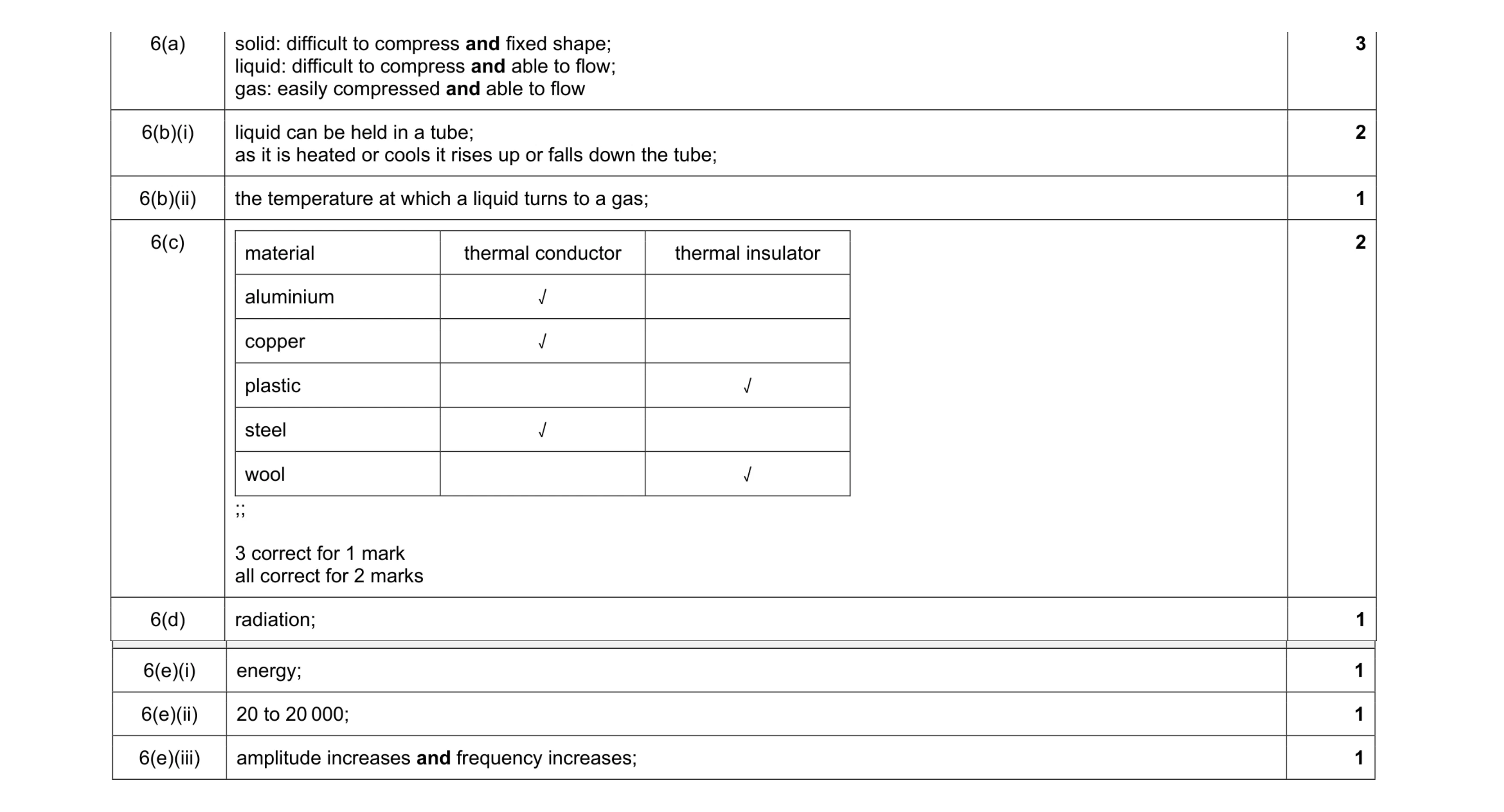 12
12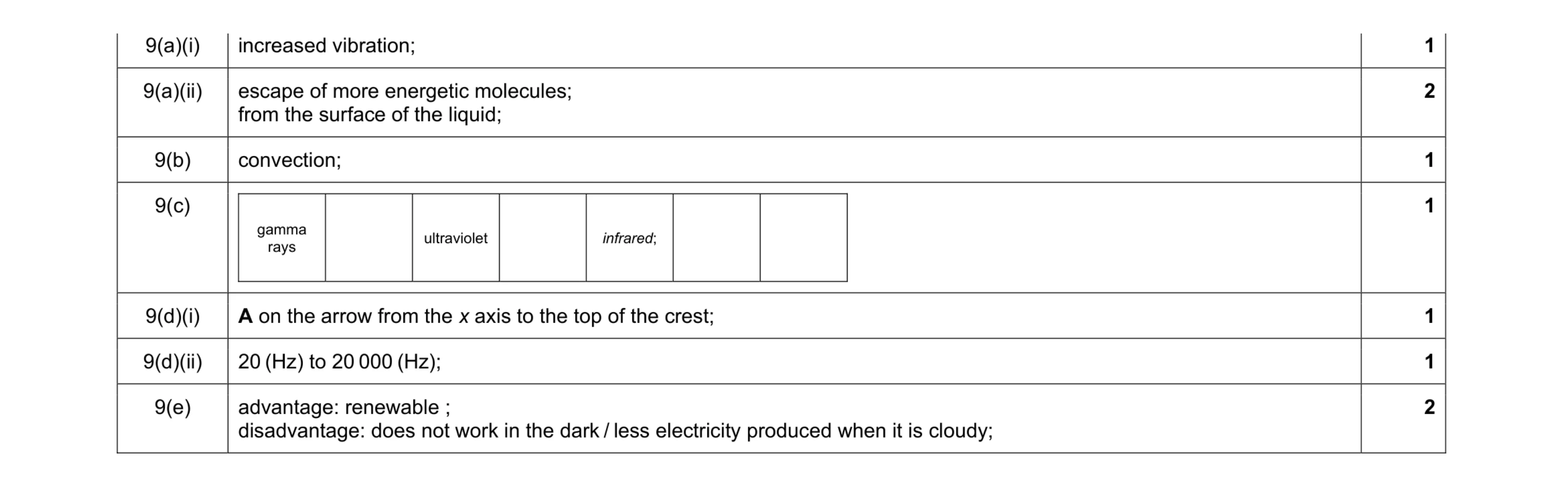 9
9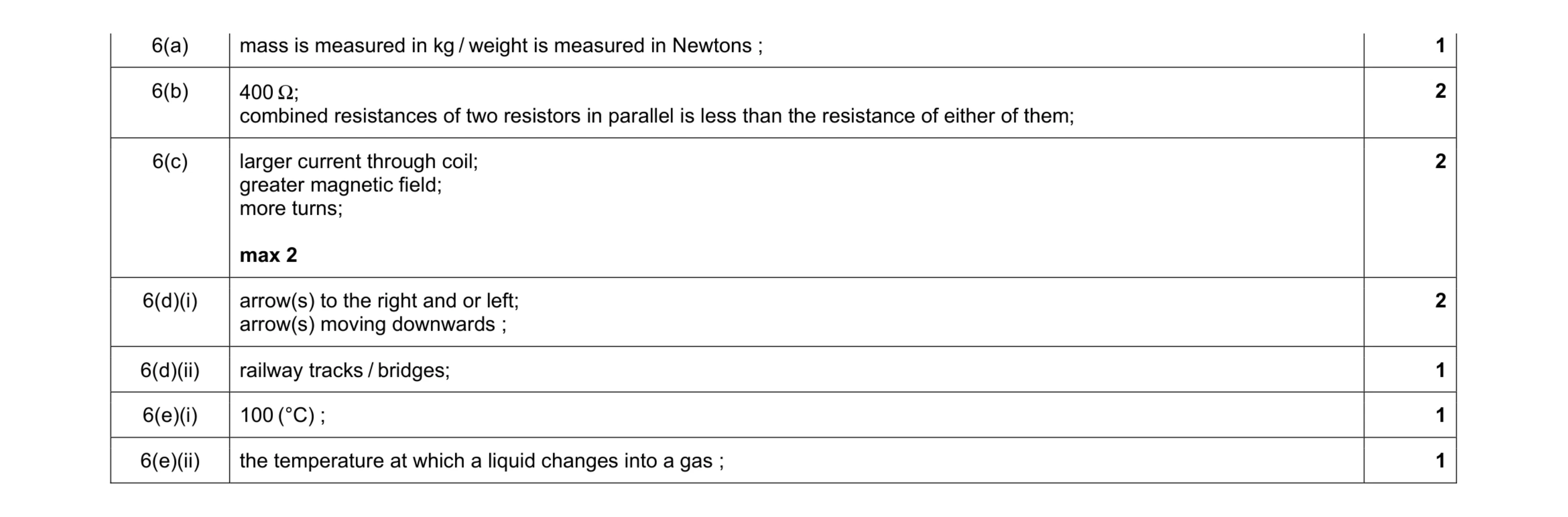 10
10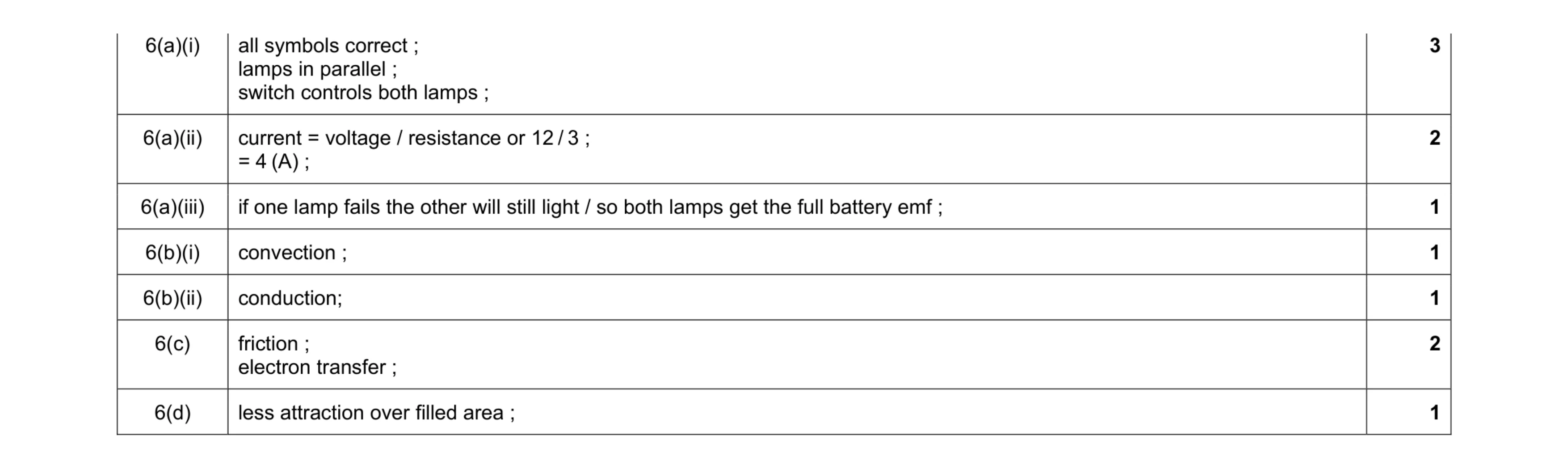 11
11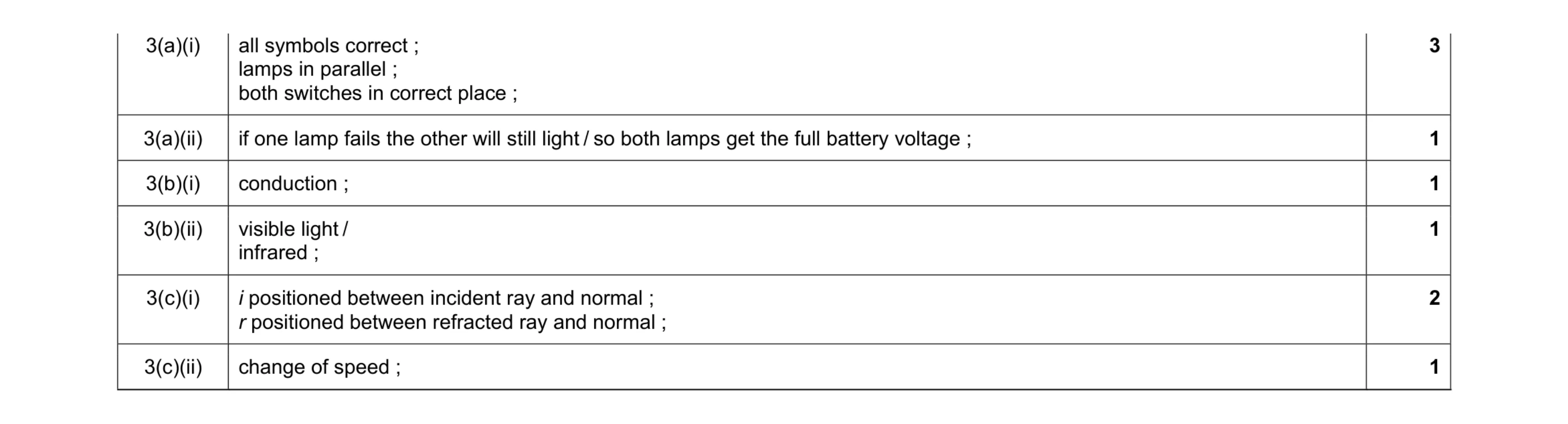 9
9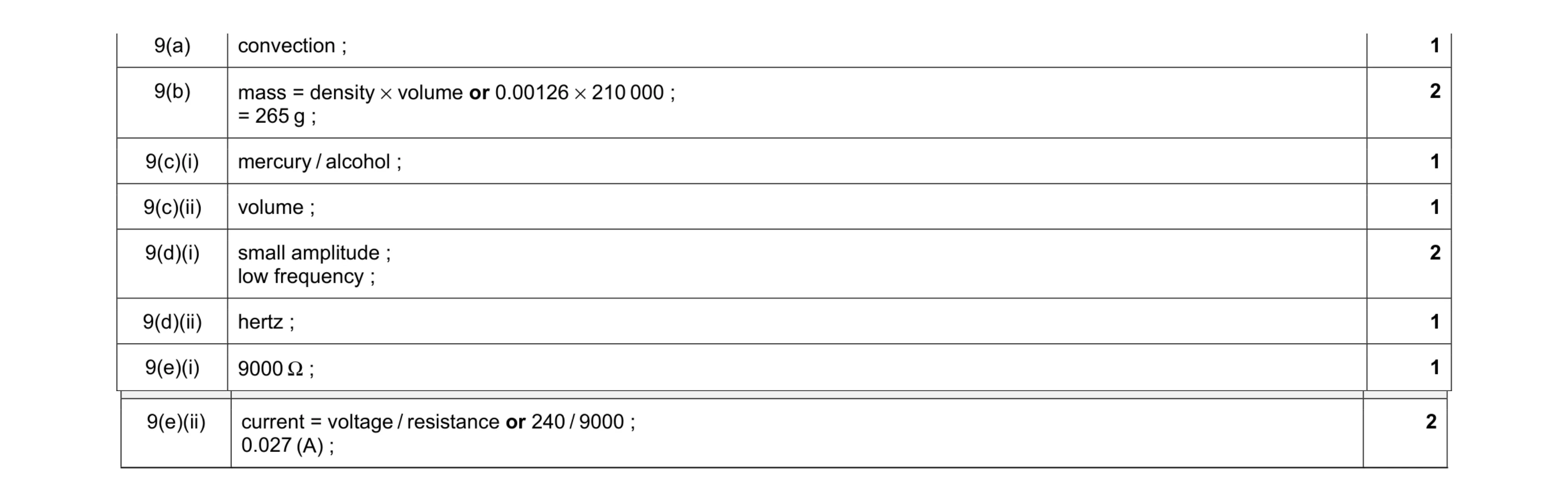 11
11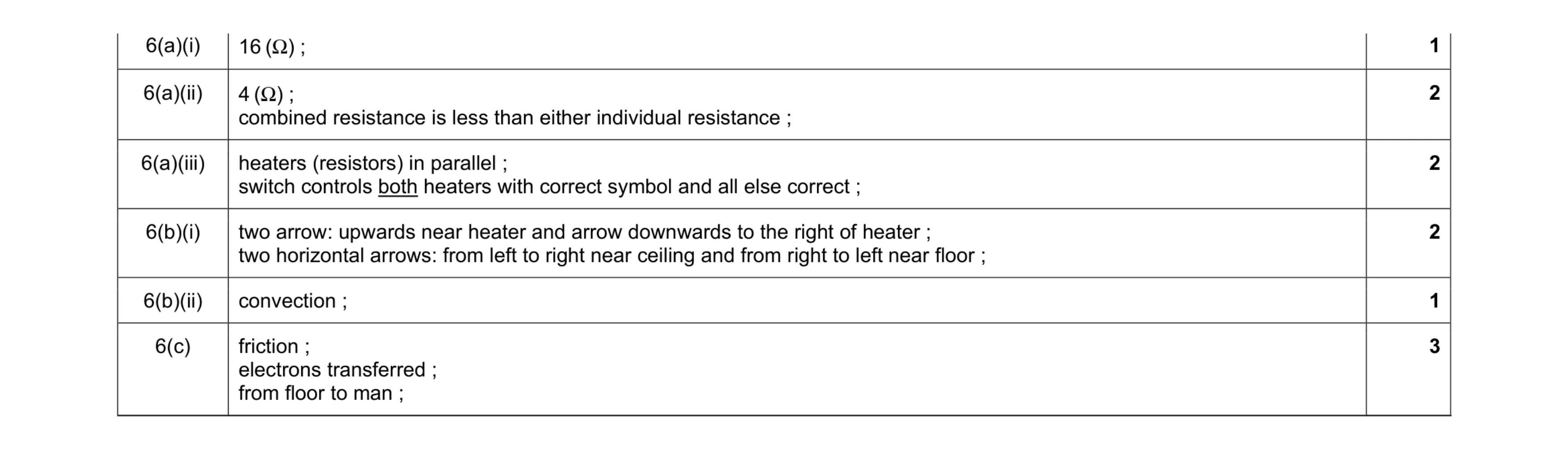 11
11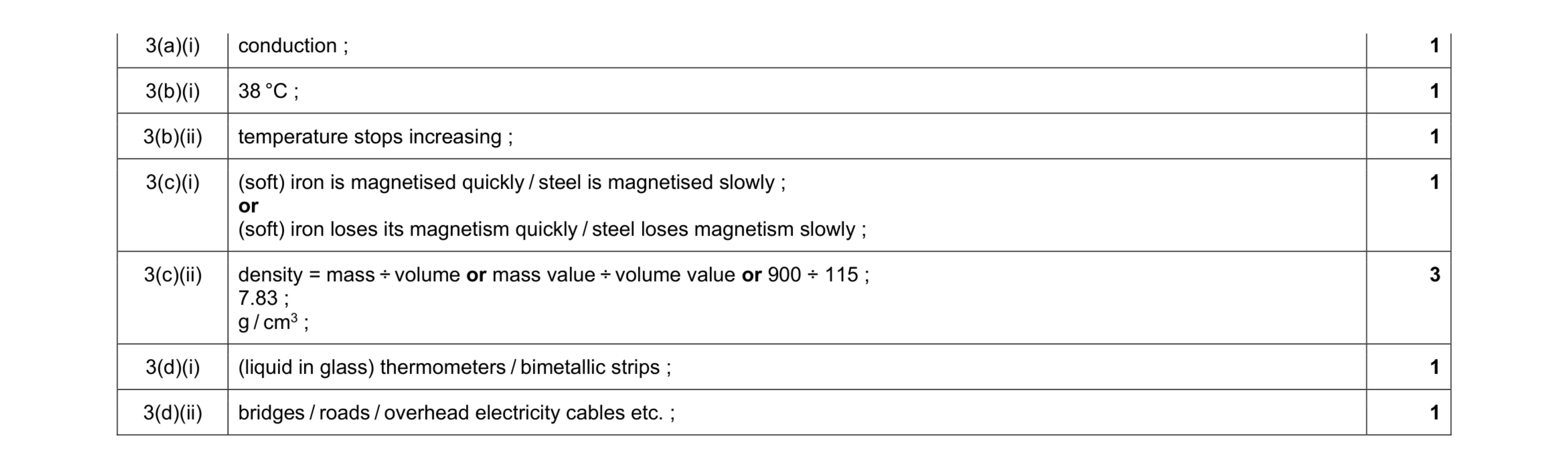 9
9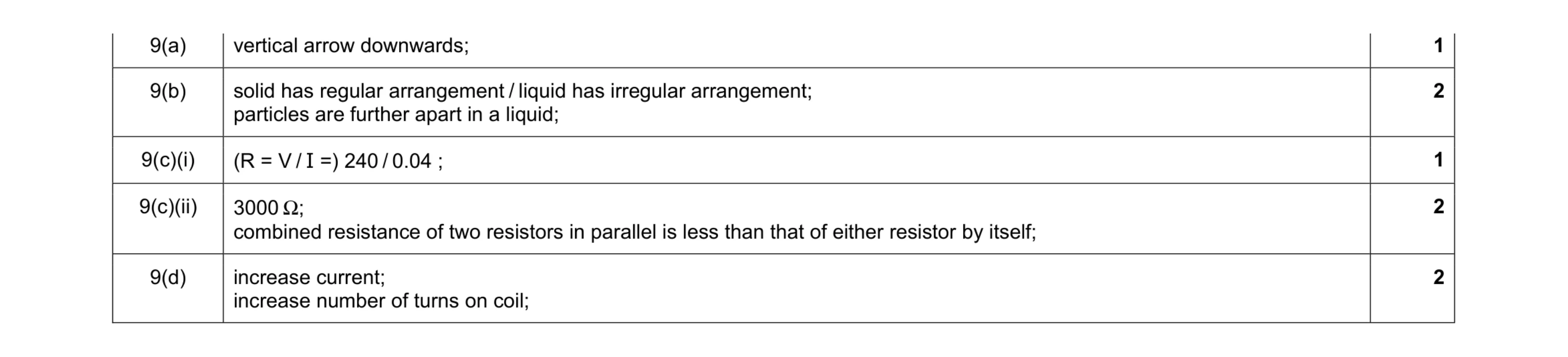 8
8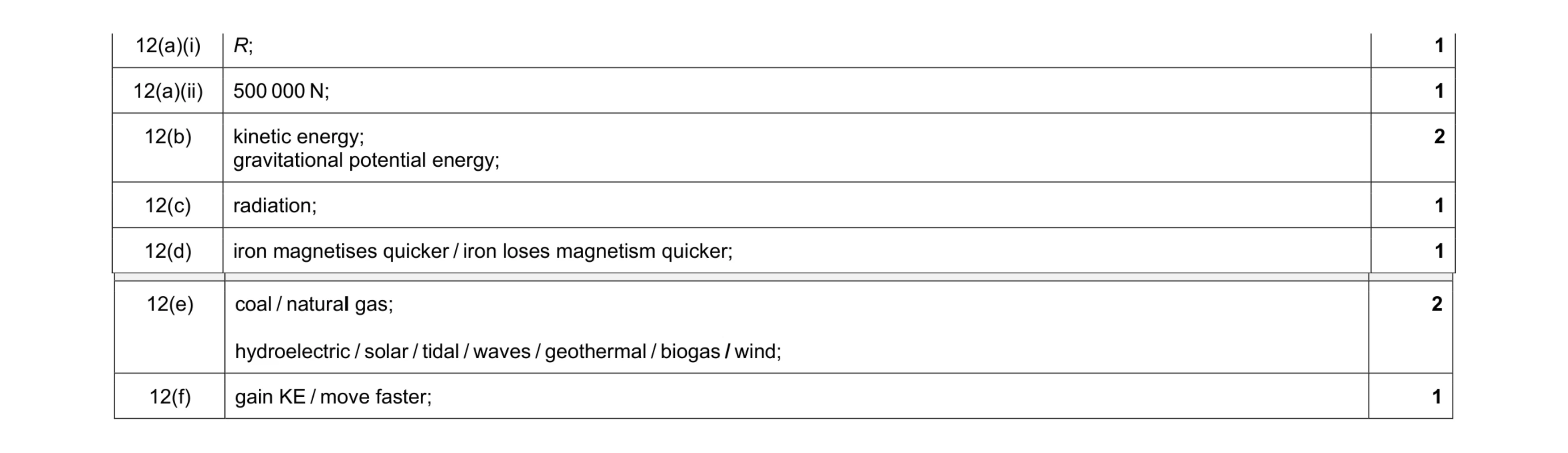 9
9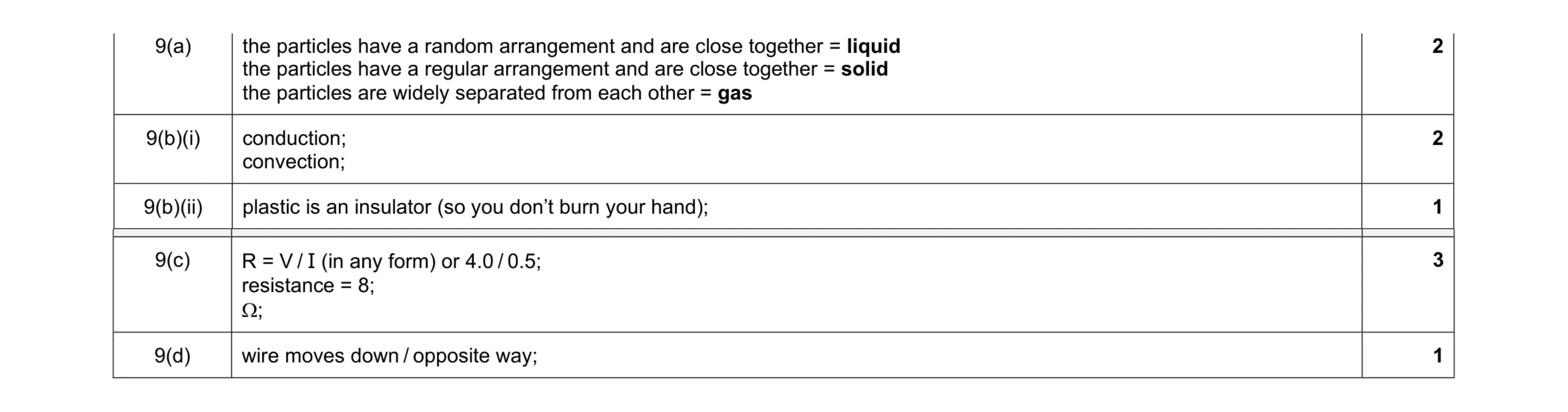 9
9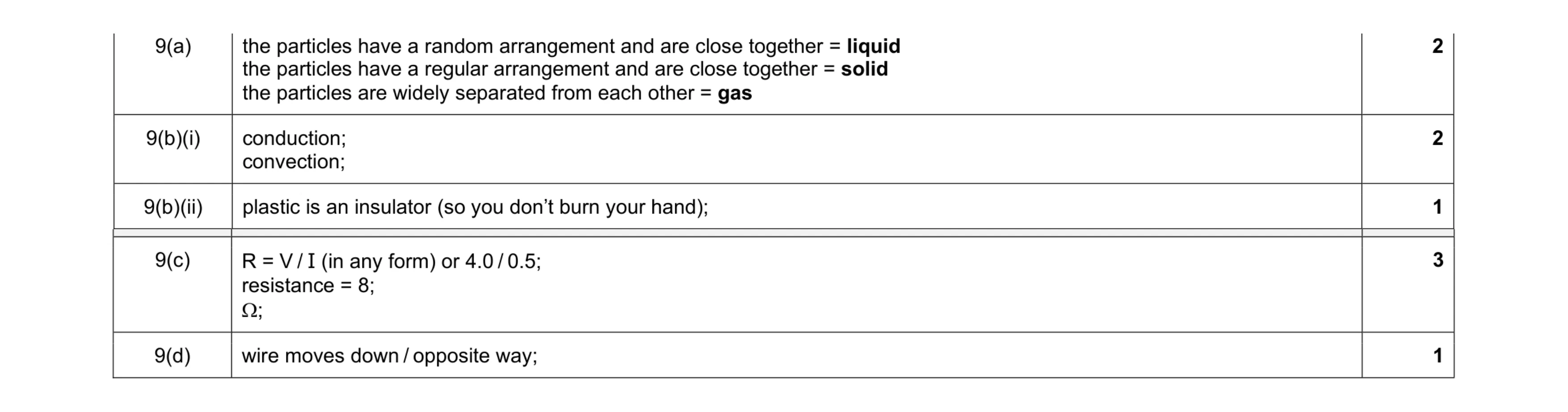 9
9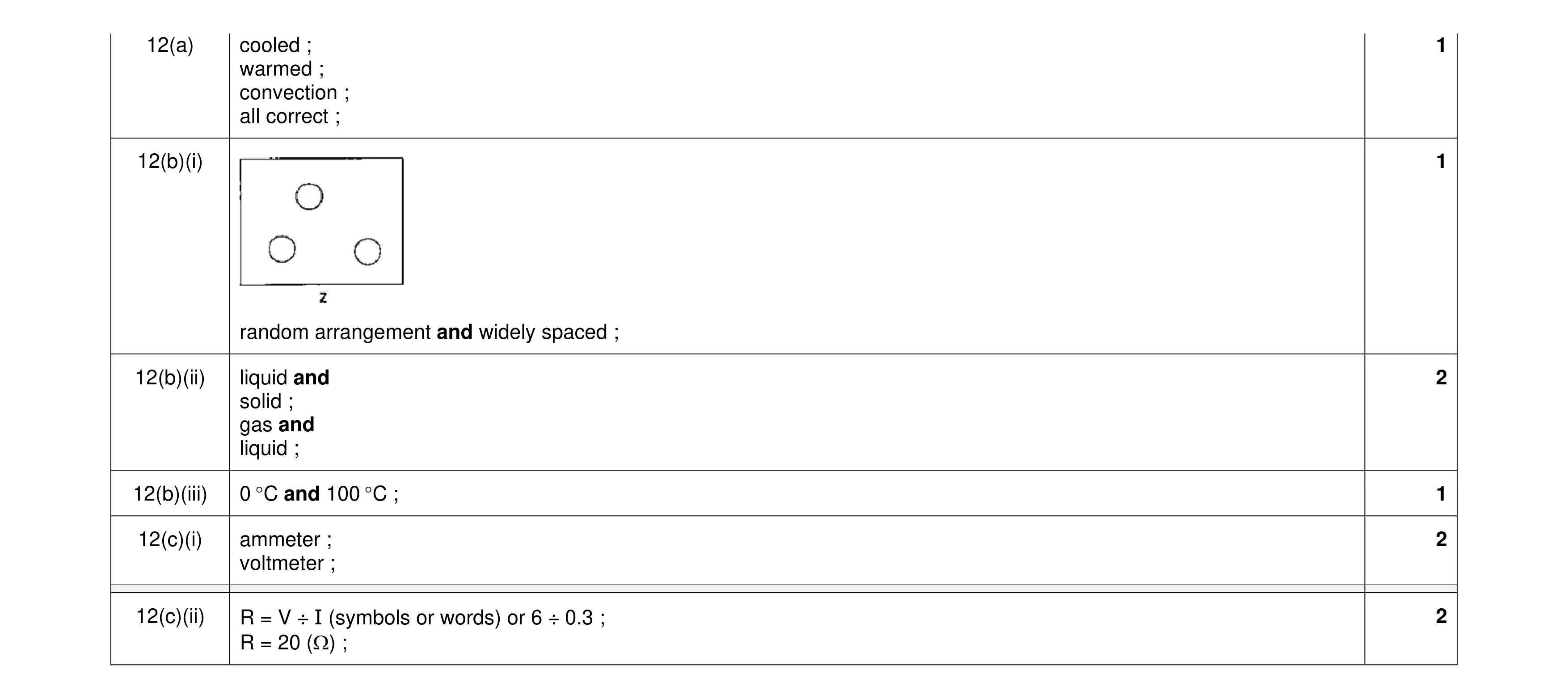 9
9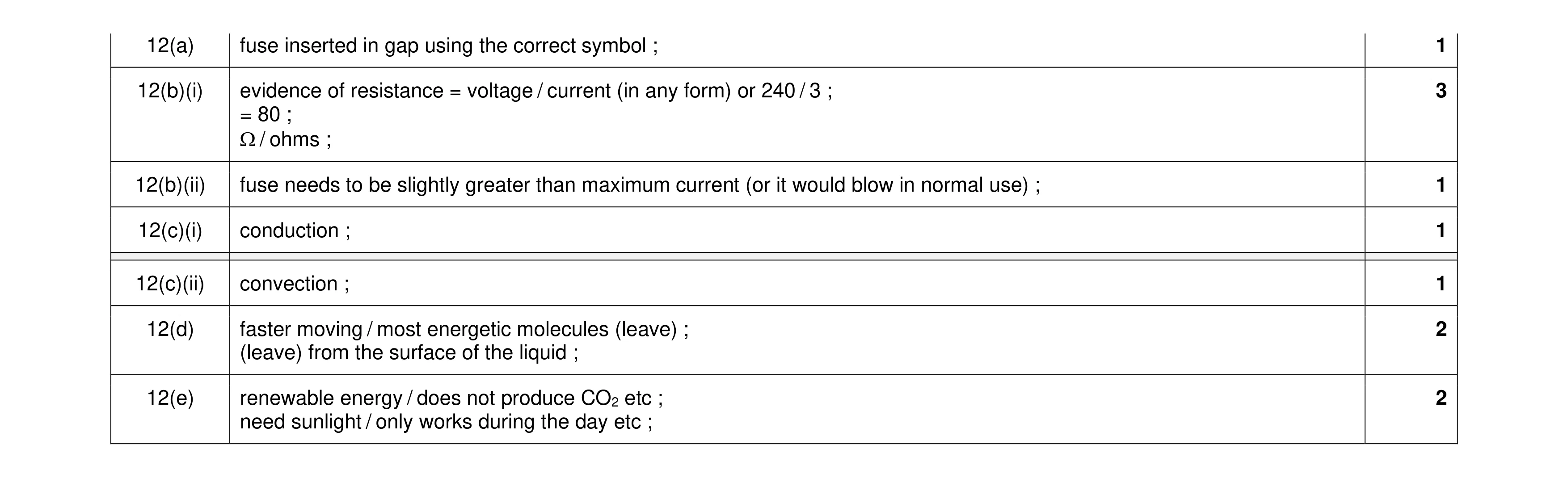 11
11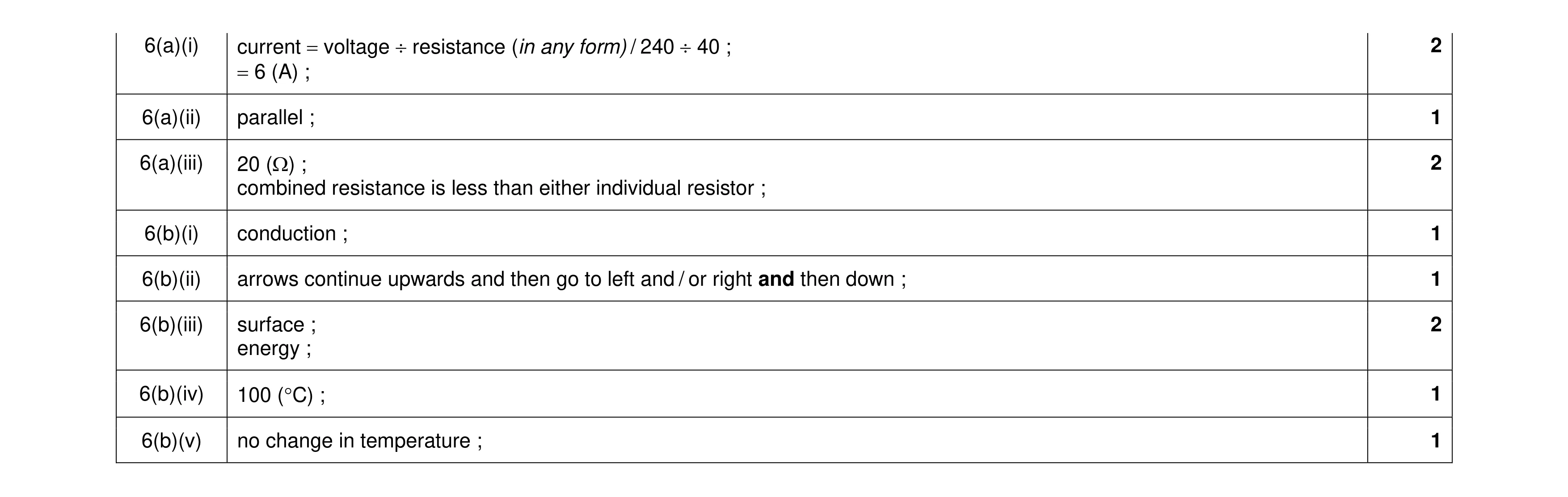 11
11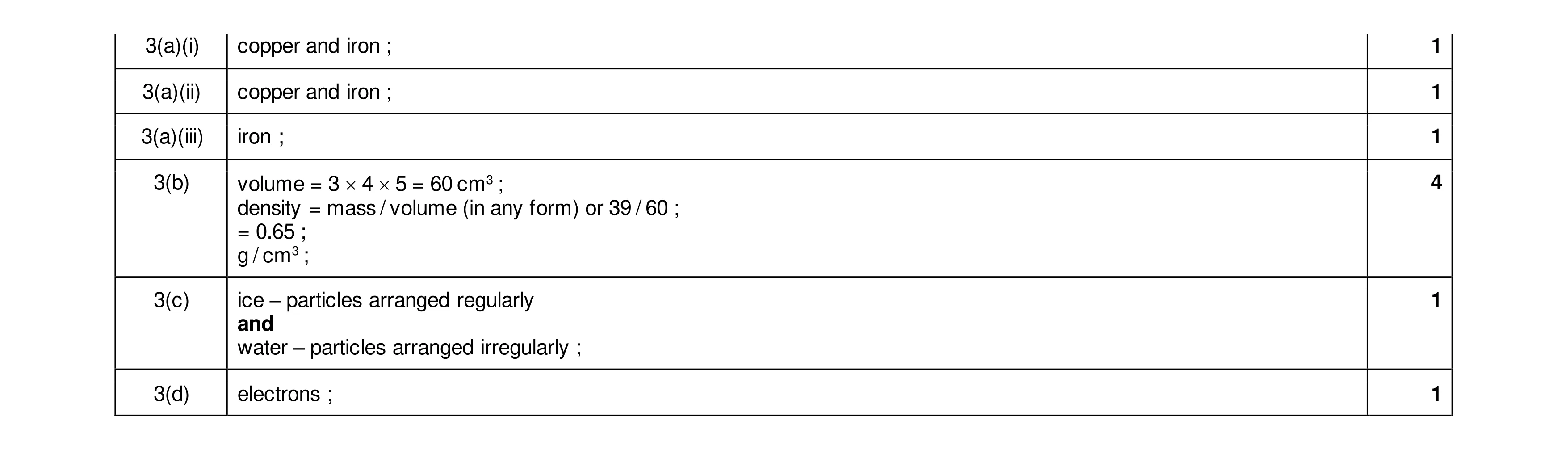 9
9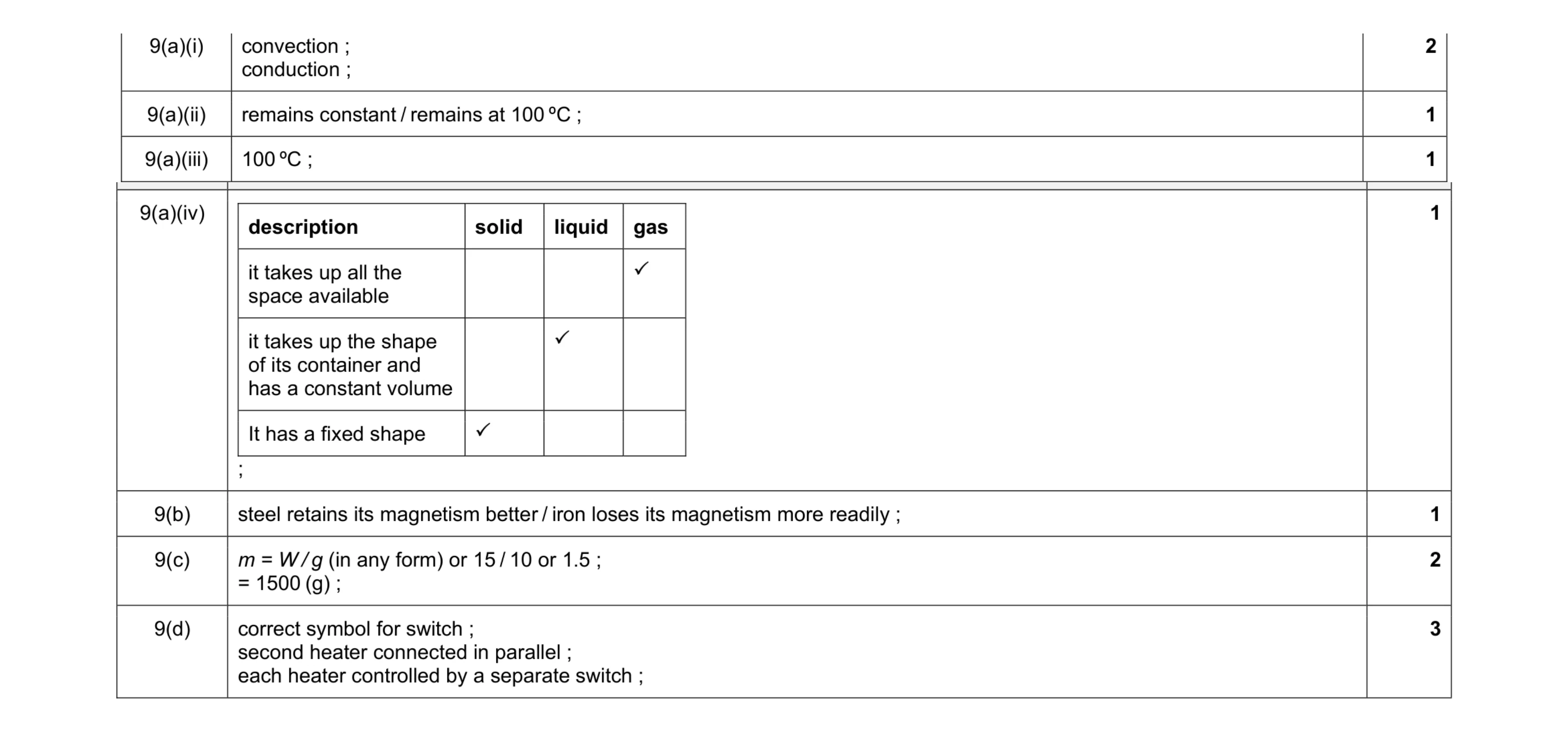 11
11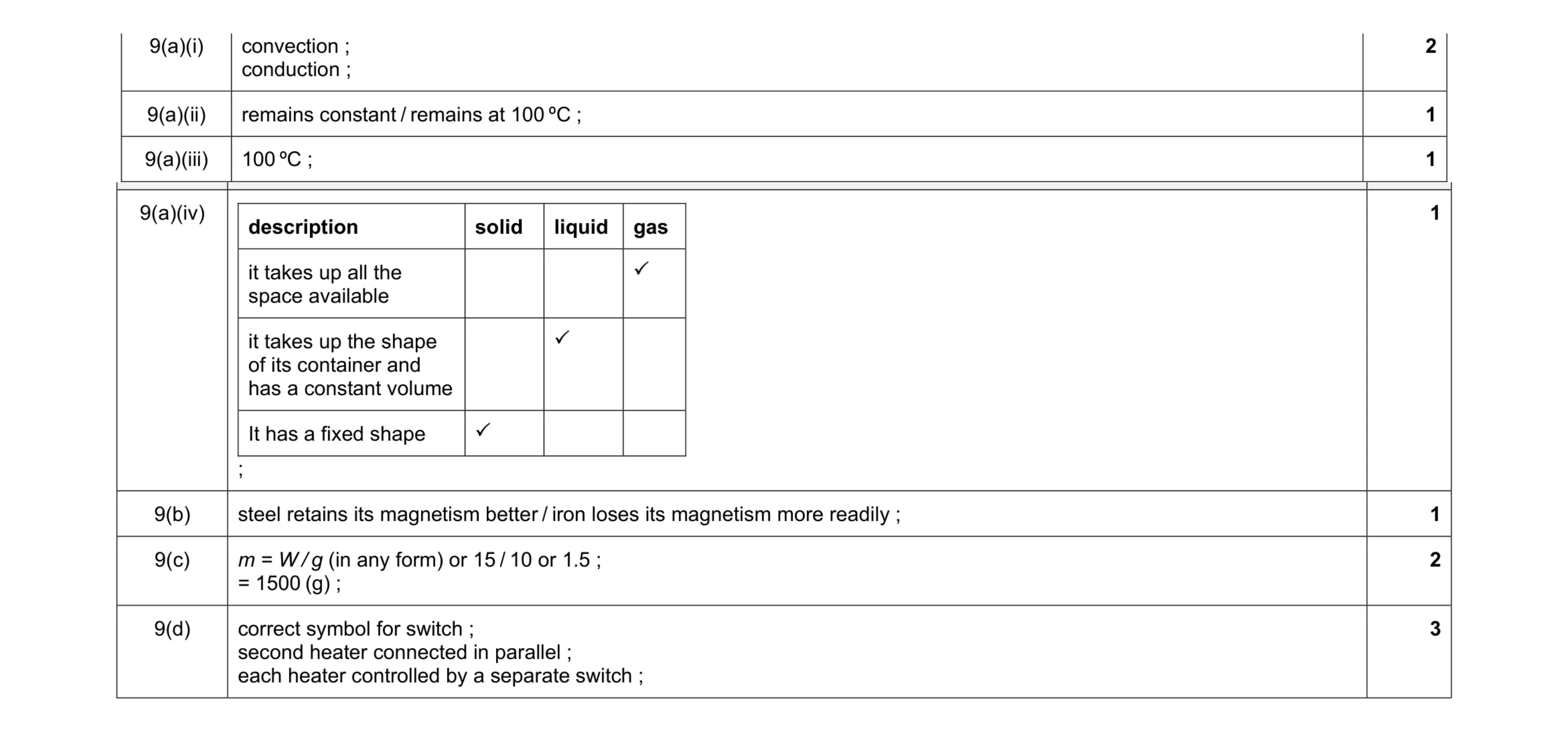 11
11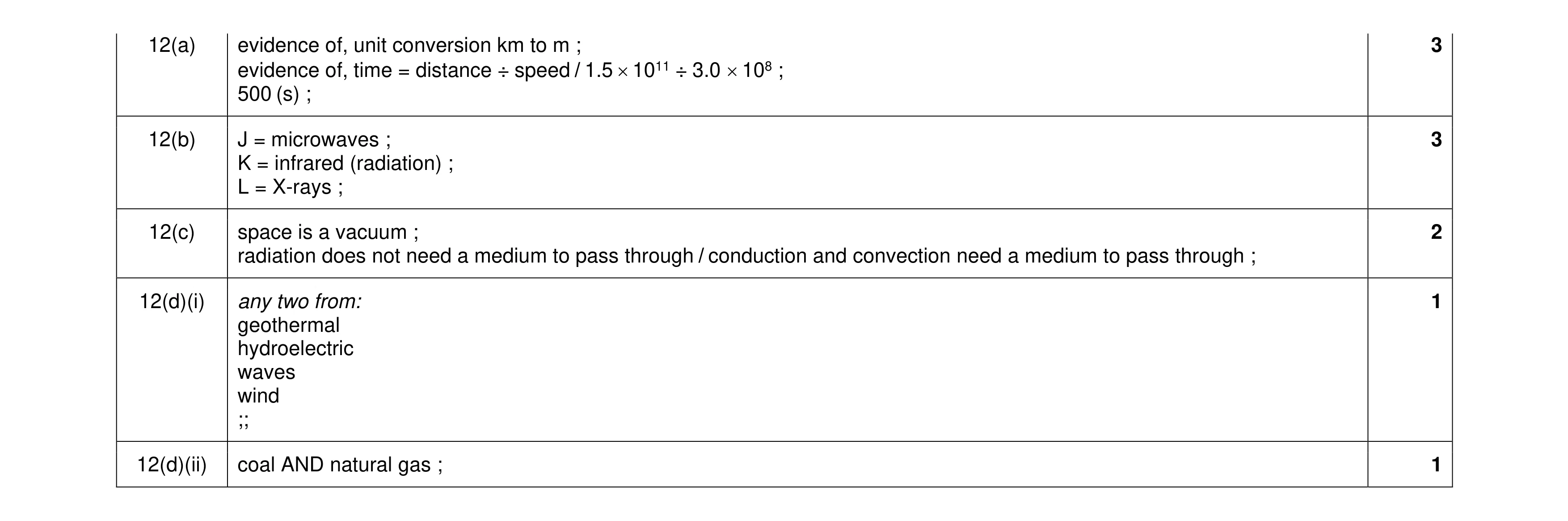 10
10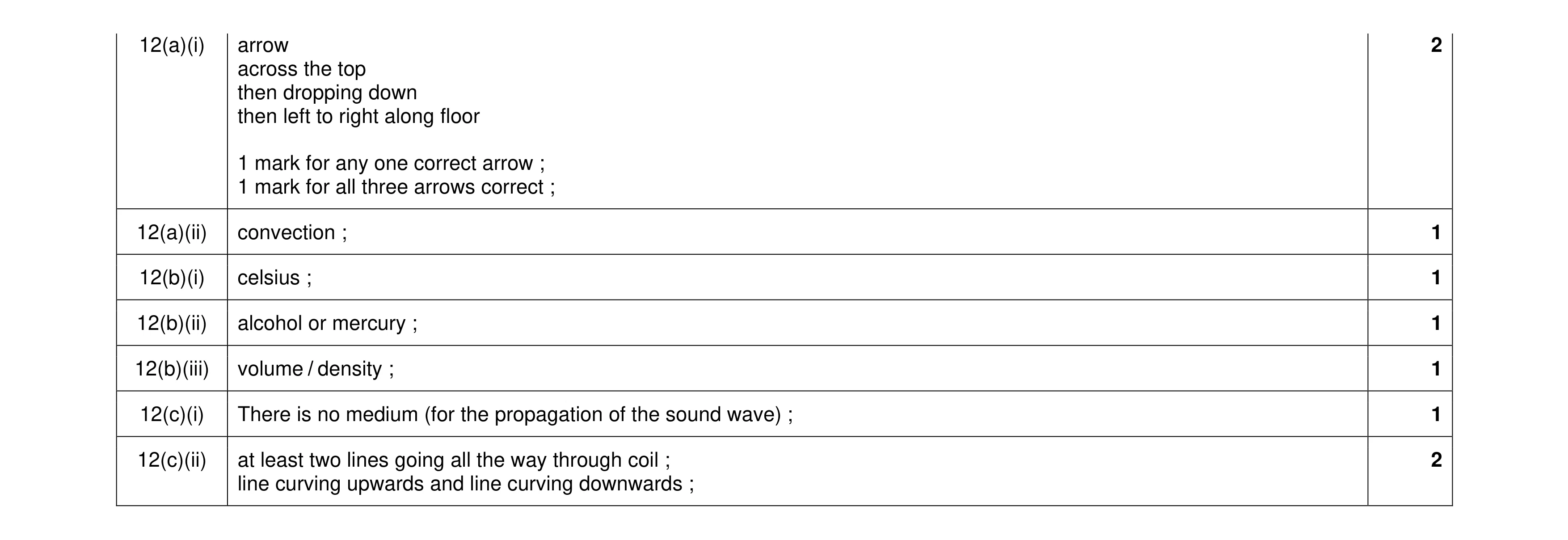 9
9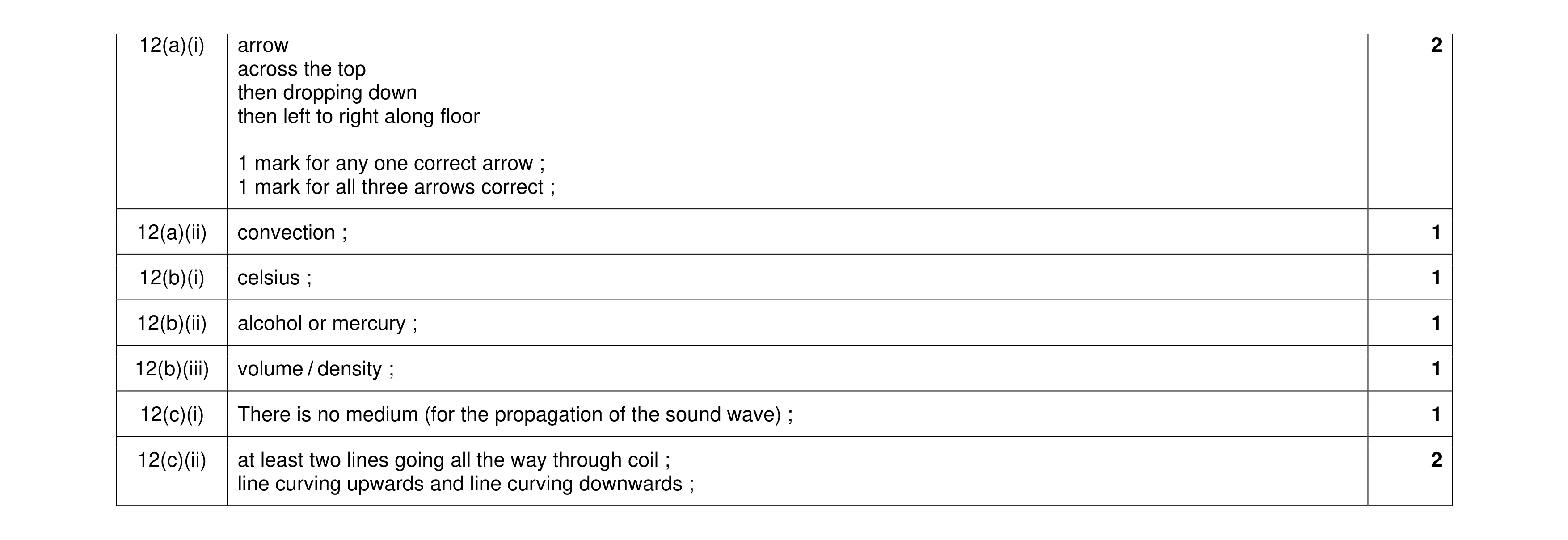 9
9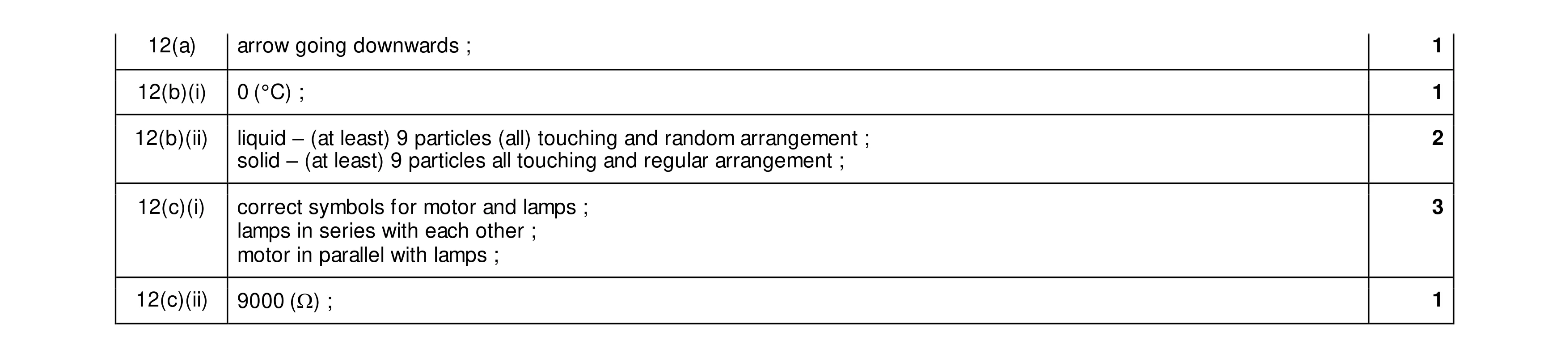 8
8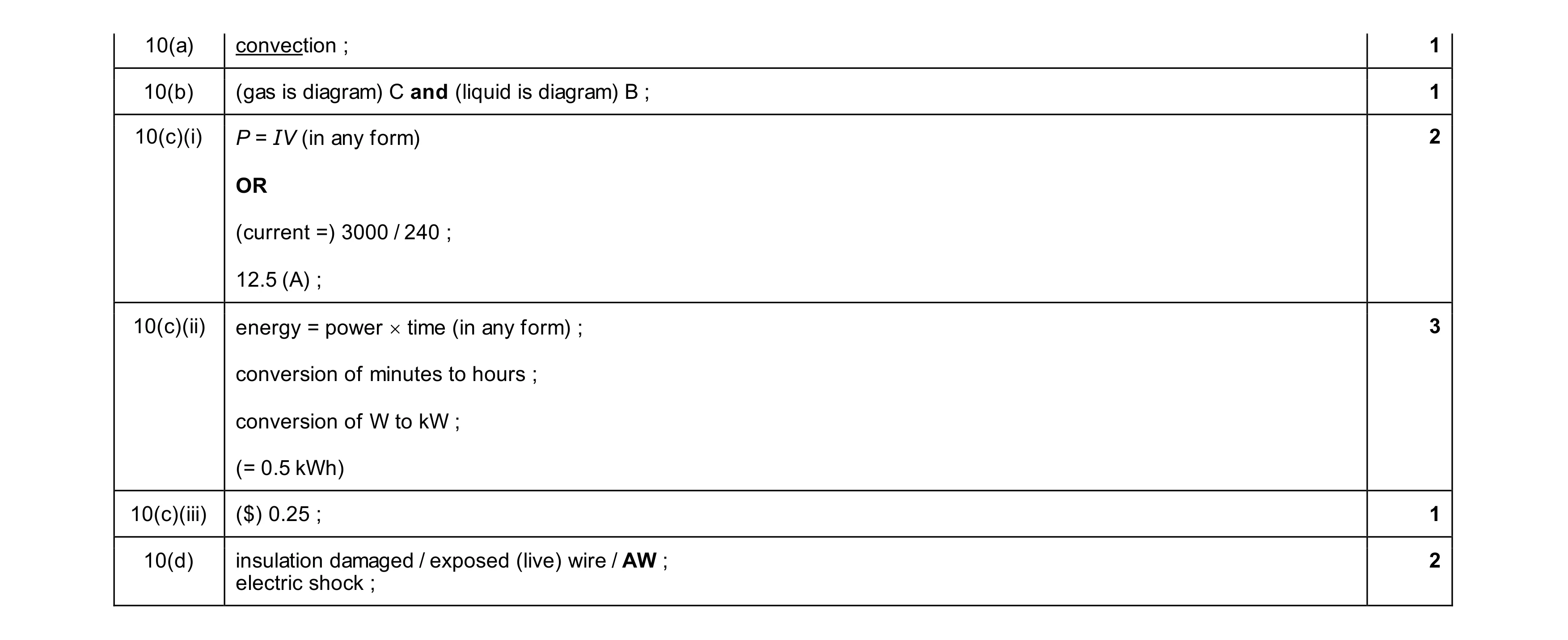 10
10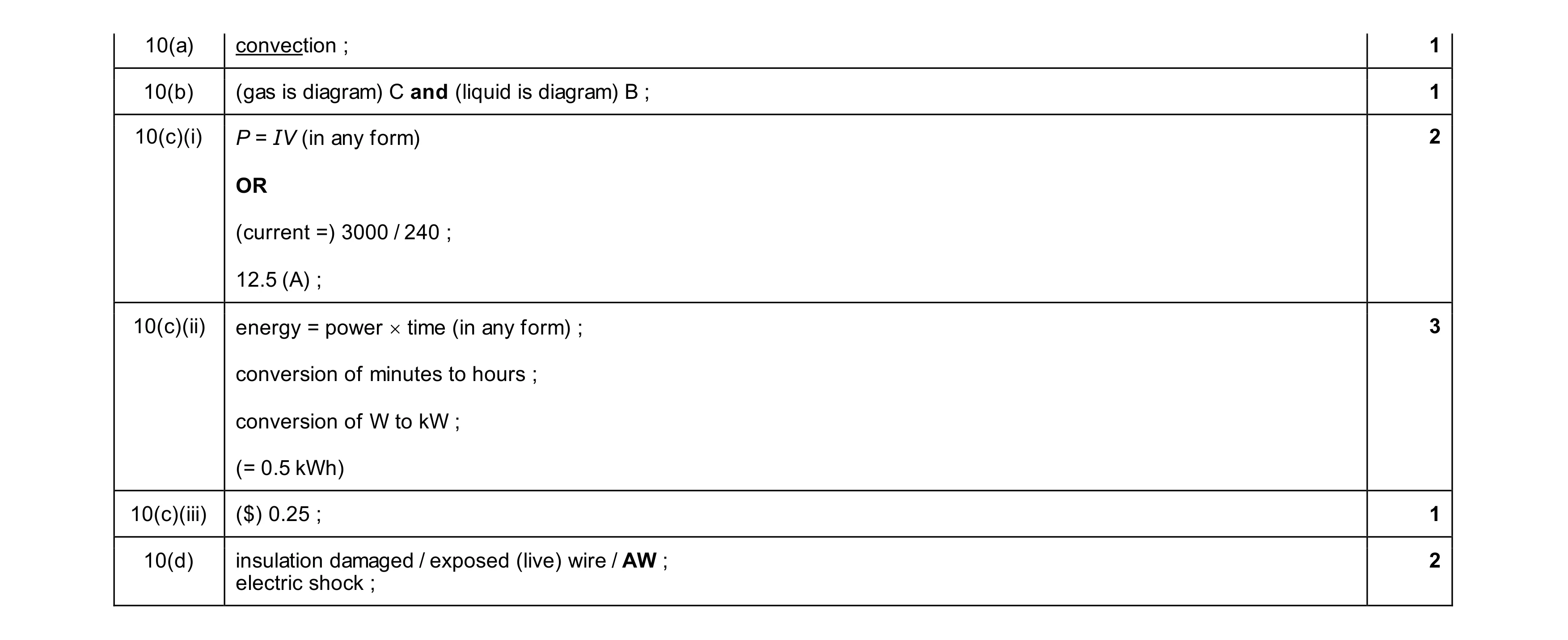 10
10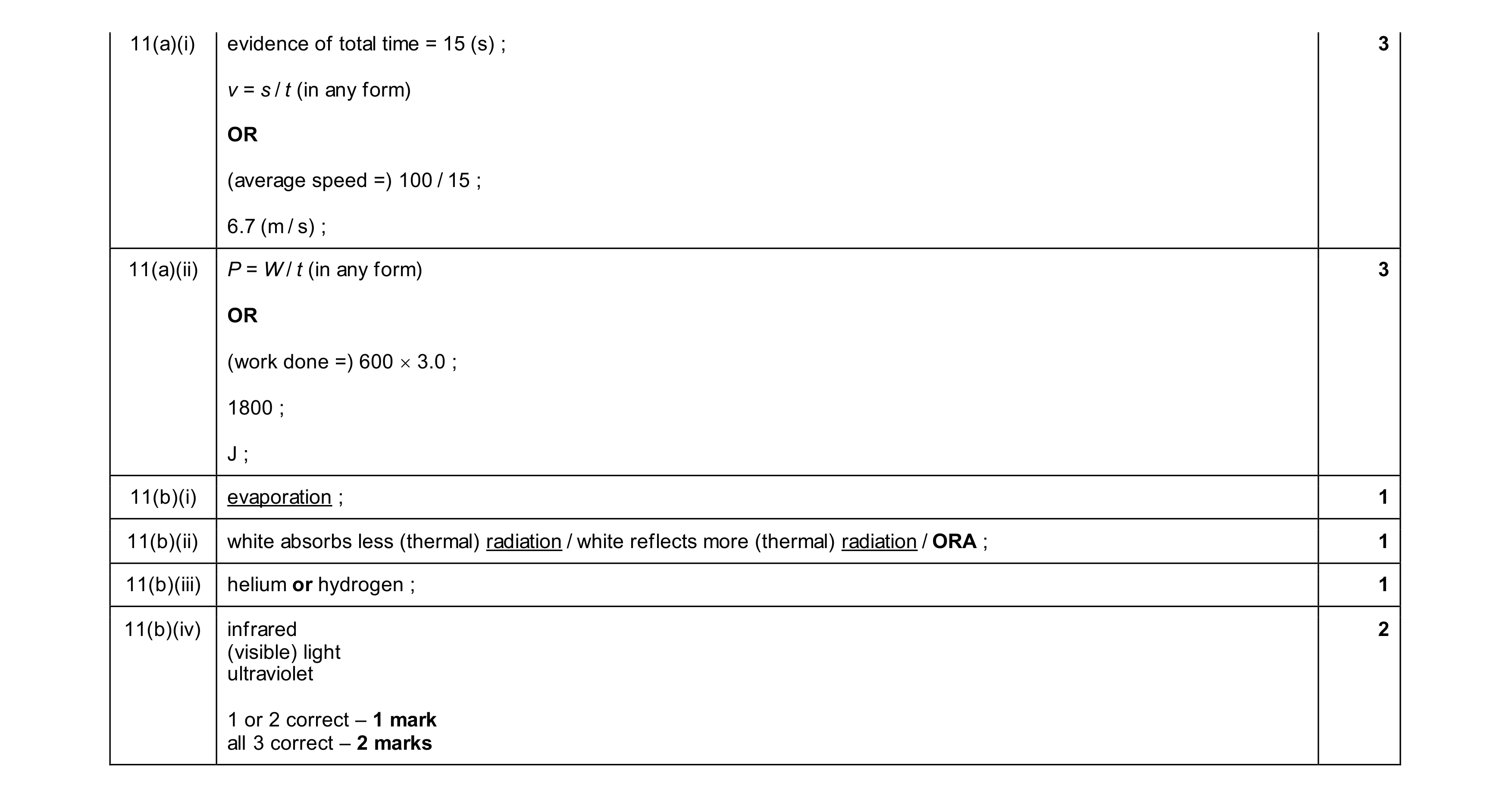 11
11