Questions as text
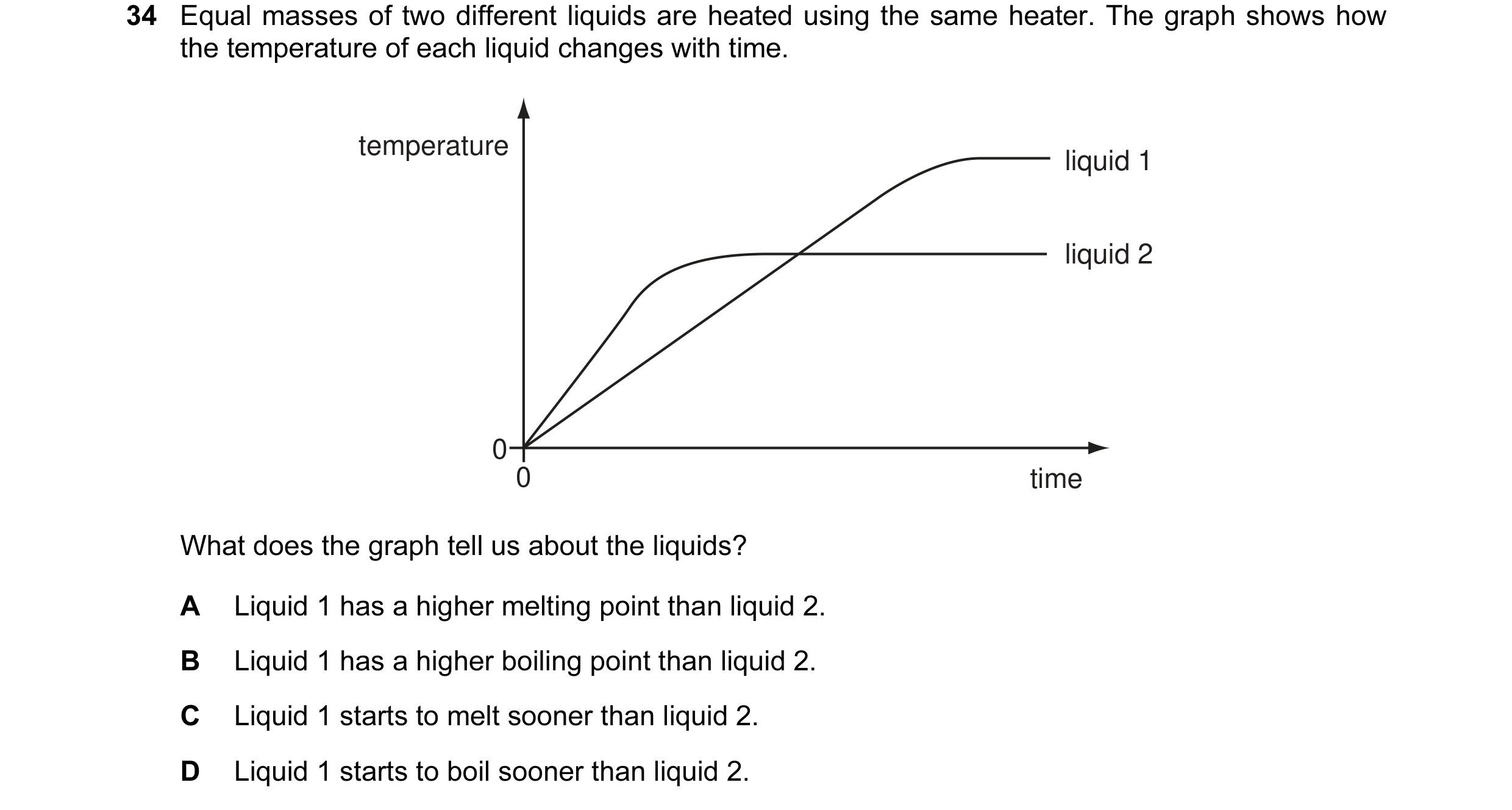
Q1 · Equal masses of two different liquids are heated using the same heater 0654/11 Oct/Nov 2008
34 Equal masses of two different liquids are heated using the same heater. The graph shows how the temperature of each liquid changes with time. temperature liquid 1 liquid 2 0 0 time What does the graph tell us about the liquids? A Liquid 1 has a higher melting point than liquid 2. B Liquid 1 has a higher boiling point than liquid 2. C Liquid 1 starts to melt sooner than liquid 2. D Liquid 1 starts to boil sooner than liquid 2.
1 marks
Answer: B
This question in 0654/11 Oct/Nov 2008
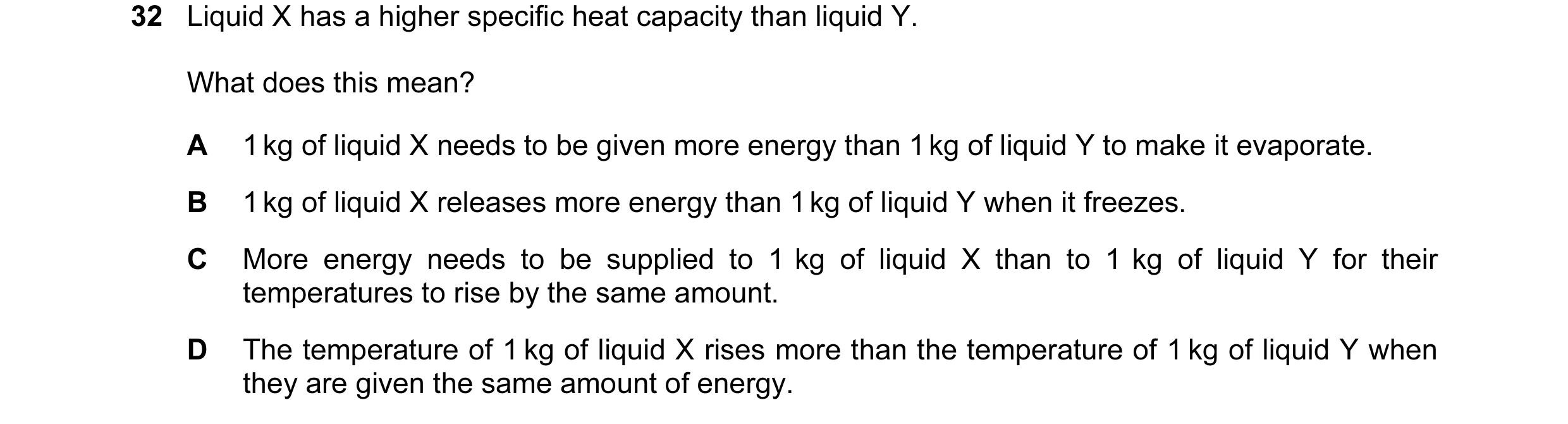
Q2 · Liquid X has a higher specific heat capacity than liquid Y 0654/11 May/June 2010
32 Liquid X has a higher specific heat capacity than liquid Y. What does this mean? A 1 kg of liquid X needs to be given more energy than 1 kg of liquid Y to make it evaporate. B 1 kg of liquid X releases more energy than 1 kg of liquid Y when it freezes. C More energy needs to be supplied to 1 kg of liquid X than to 1 kg of liquid Y for their temperatures to rise by the same amount. D The temperature of 1 kg of liquid X rises more than the temperature of 1 kg of liquid Y when they are given the same amount of energy.
1 marks
Answer: C
This question in 0654/11 May/June 2010
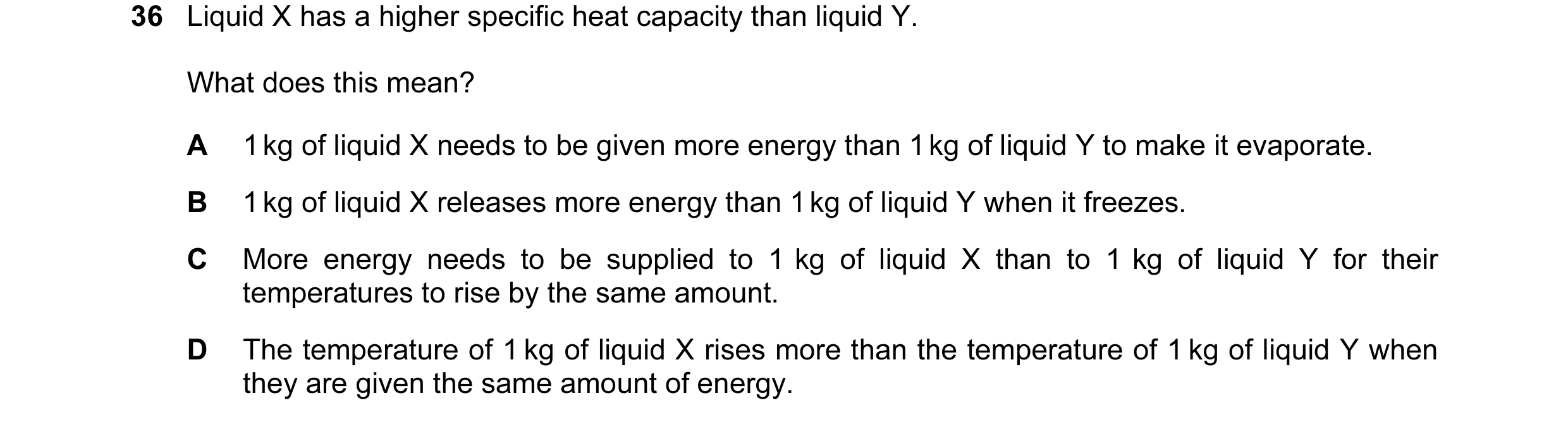
Q3 · Liquid X has a higher specific heat capacity than liquid Y 0654/12 May/June 2010
36 Liquid X has a higher specific heat capacity than liquid Y. What does this mean? A 1 kg of liquid X needs to be given more energy than 1 kg of liquid Y to make it evaporate. B 1 kg of liquid X releases more energy than 1 kg of liquid Y when it freezes. C More energy needs to be supplied to 1 kg of liquid X than to 1 kg of liquid Y for their temperatures to rise by the same amount. D The temperature of 1 kg of liquid X rises more than the temperature of 1 kg of liquid Y when they are given the same amount of energy.
1 marks
Answer: C
This question in 0654/12 May/June 2010
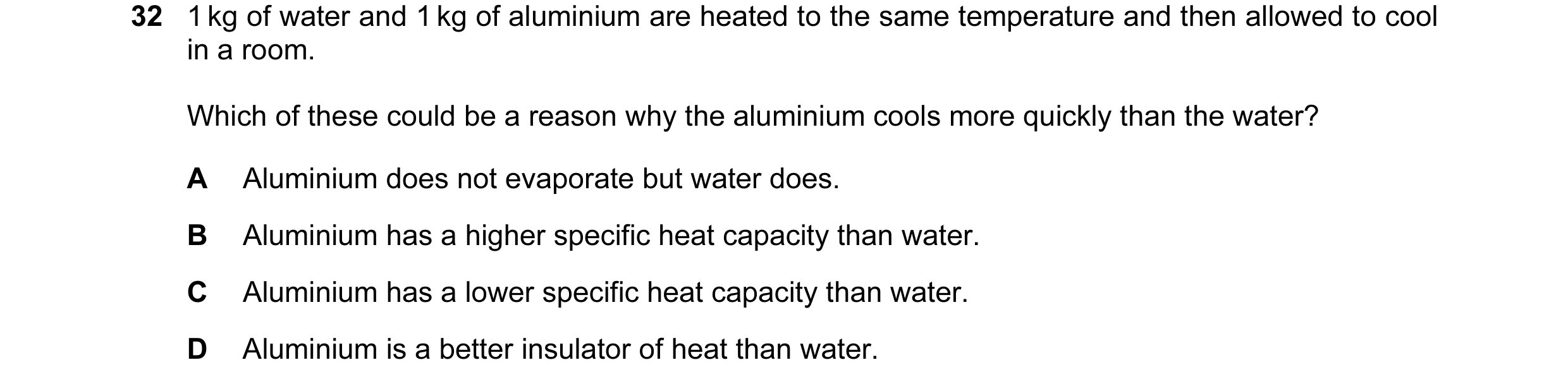
Q4 · 1 kg of water and 1 kg of aluminium are heated to the same temperature and then allowed… 0654/11 Oct/Nov 2010
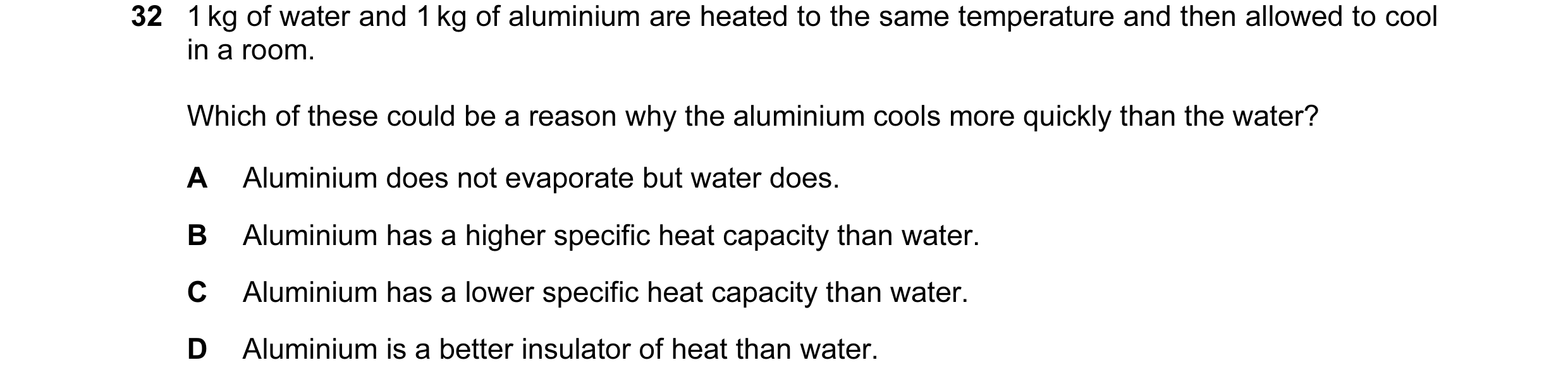
32 1 kg of water and 1 kg of aluminium are heated to the same temperature and then allowed to cool in a room. Which of these could be a reason why the aluminium cools more quickly than the water? A Aluminium does not evaporate but water does. B Aluminium has a higher specific heat capacity than water. C Aluminium has a lower specific heat capacity than water. D Aluminium is a better insulator of heat than water.
1 marks
Answer: C
This question in 0654/11 Oct/Nov 2010
Q5 · 1 kg of water and 1 kg of aluminium are heated to the same temperature and then allowed… 0654/12 Oct/Nov 2010
35 1 kg of water and 1 kg of aluminium are heated to the same temperature and then allowed to cool in a room. Which of these could be a reason why the aluminium cools more quickly than the water? A Aluminium does not evaporate but water does. B Aluminium has a higher specific heat capacity than water. C Aluminium has a lower specific heat capacity than water. D Aluminium is a better insulator of heat than water.
1 marks
Answer: C
This question in 0654/12 Oct/Nov 2010
Q6 · 1 kg of water and 1 kg of aluminium are heated to the same temperature and then allowed… 0654/13 Oct/Nov 2010
32 1 kg of water and 1 kg of aluminium are heated to the same temperature and then allowed to cool in a room. Which of these could be a reason why the aluminium cools more quickly than the water? A Aluminium does not evaporate but water does. B Aluminium has a higher specific heat capacity than water. C Aluminium has a lower specific heat capacity than water. D Aluminium is a better insulator of heat than water.
1 marks
Answer: C
This question in 0654/13 Oct/Nov 2010
Q7 · What happens to the temperature of a substance as it is melting and as it is boiling? 0654/12 May/June 2012
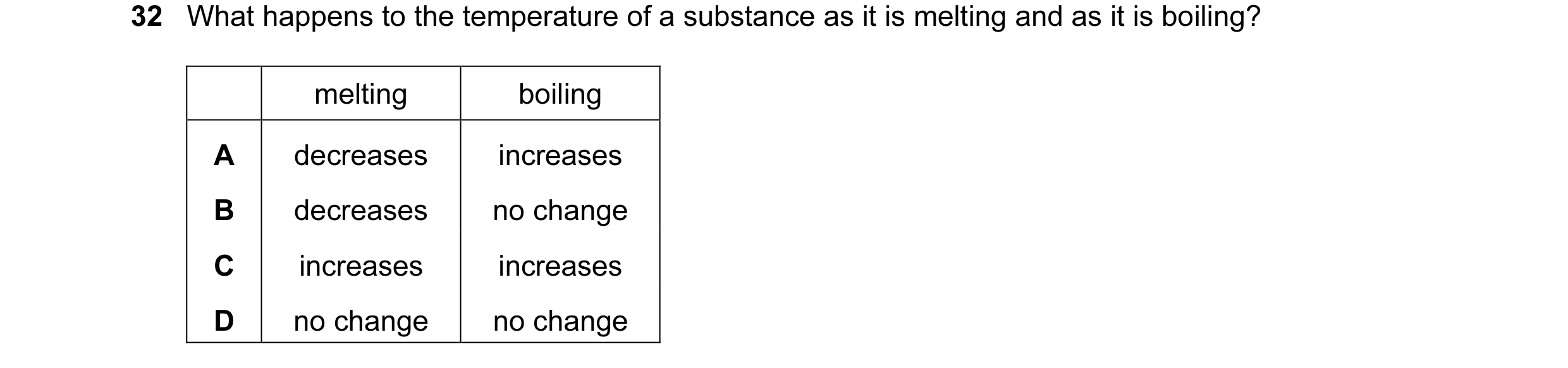
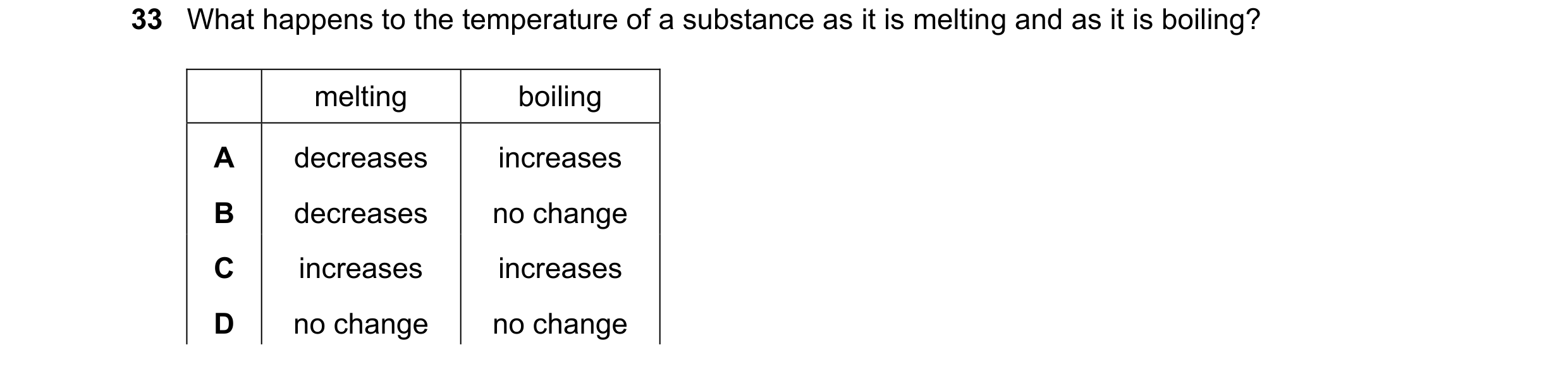
32 What happens to the temperature of a substance as it is melting and as it is boiling? melting boiling A decreases increases B decreases no change C increases increases D no change no change
1 marks
Answer: D
This question in 0654/12 May/June 2012
Q8 · What happens to the temperature of a substance as it is melting and as it is boiling? 0654/13 May/June 2012
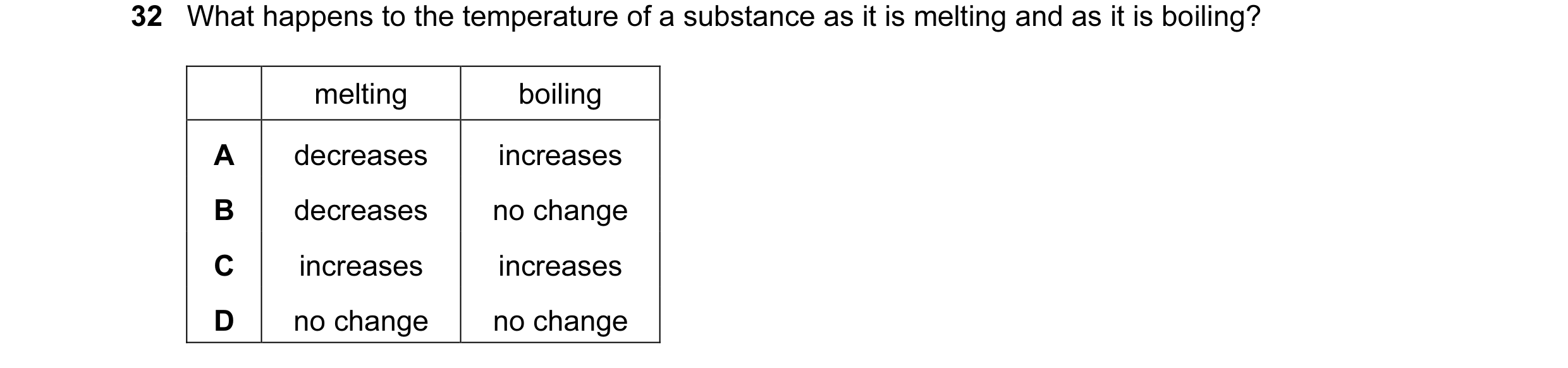
32 What happens to the temperature of a substance as it is melting and as it is boiling? melting boiling A decreases increases B decreases no change C increases increases D no change no change
1 marks
Answer: D
This question in 0654/13 May/June 2012
Q9 · Which row shows what happens to the temperature of a solid as it melts and what happens… 0654/11 May/June 2013
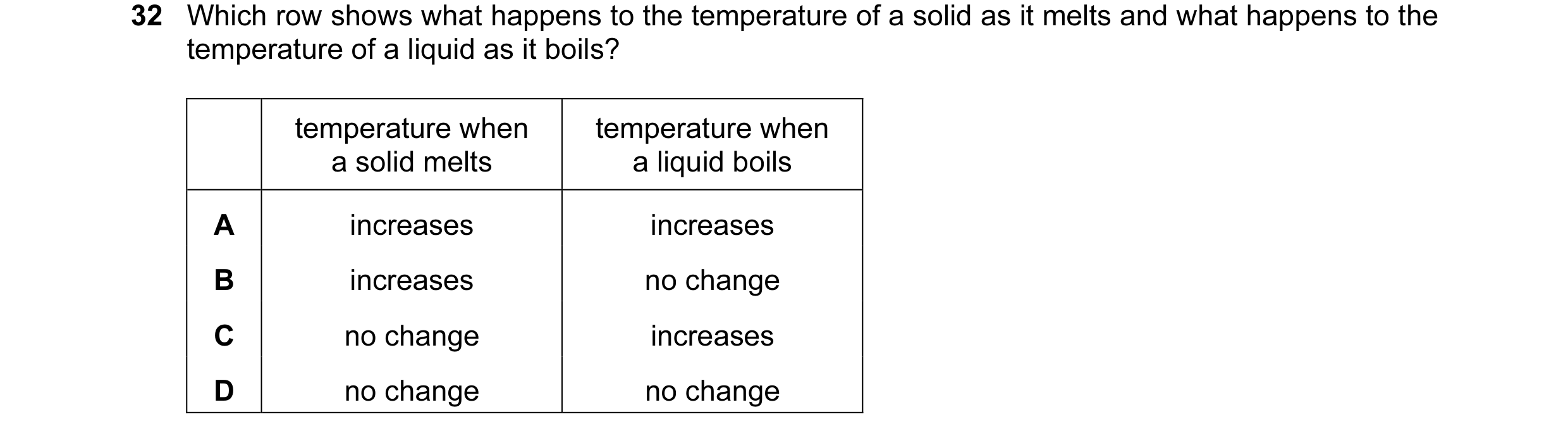
32 Which row shows what happens to the temperature of a solid as it melts and what happens to the temperature of a liquid as it boils? temperature when temperature when a solid melts a liquid boils A increases increases B increases no change C no change increases D no change no change
1 marks
Answer: D
This question in 0654/11 May/June 2013
Q10 · Which row shows what happens to the temperature of a solid as it melts and what happens… 0654/13 May/June 2013
31 Which row shows what happens to the temperature of a solid as it melts and what happens to the temperature of a liquid as it boils? temperature when temperature when a solid melts a liquid boils A increases increases B increases no change C no change increases D no change no change
1 marks
Answer: D
This question in 0654/13 May/June 2013
Q11 · A sample of liquid is allowed to cool for 20 minutes 0654/11 Oct/Nov 2013
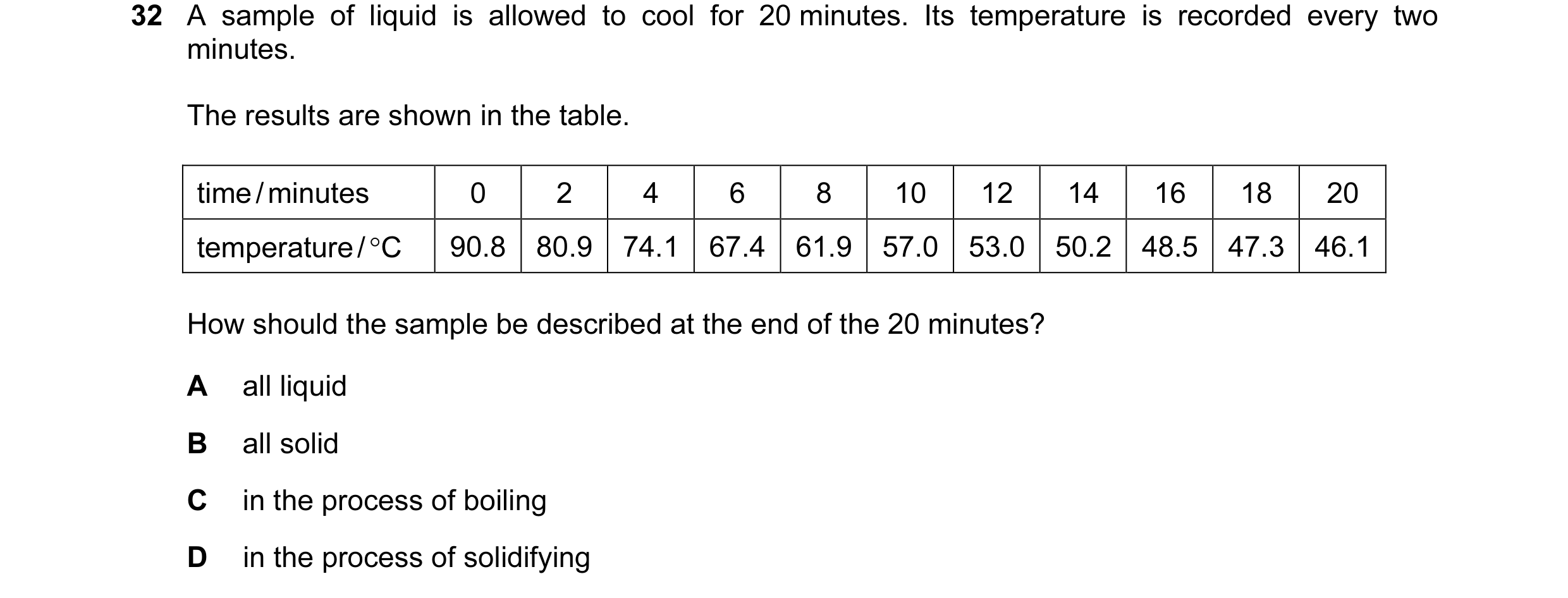
32 A sample of liquid is allowed to cool for 20 minutes. Its temperature is recorded every two minutes. The results are shown in the table. time / minutes 0 2 4 6 8 10 12 14 16 18 20 temperature / °C 90.8 80.9 74.1 67.4 61.9 57.0 53.0 50.2 48.5 47.3 46.1 How should the sample be described at the end of the 20 minutes? A all liquid B all solid C in the process of boiling D in the process of solidifying
1 marks
Answer: A
This question in 0654/11 Oct/Nov 2013
Q12 · Two identical metal rods are 25 cm long at room temperature (20 °C) 0654/13 Oct/Nov 2013
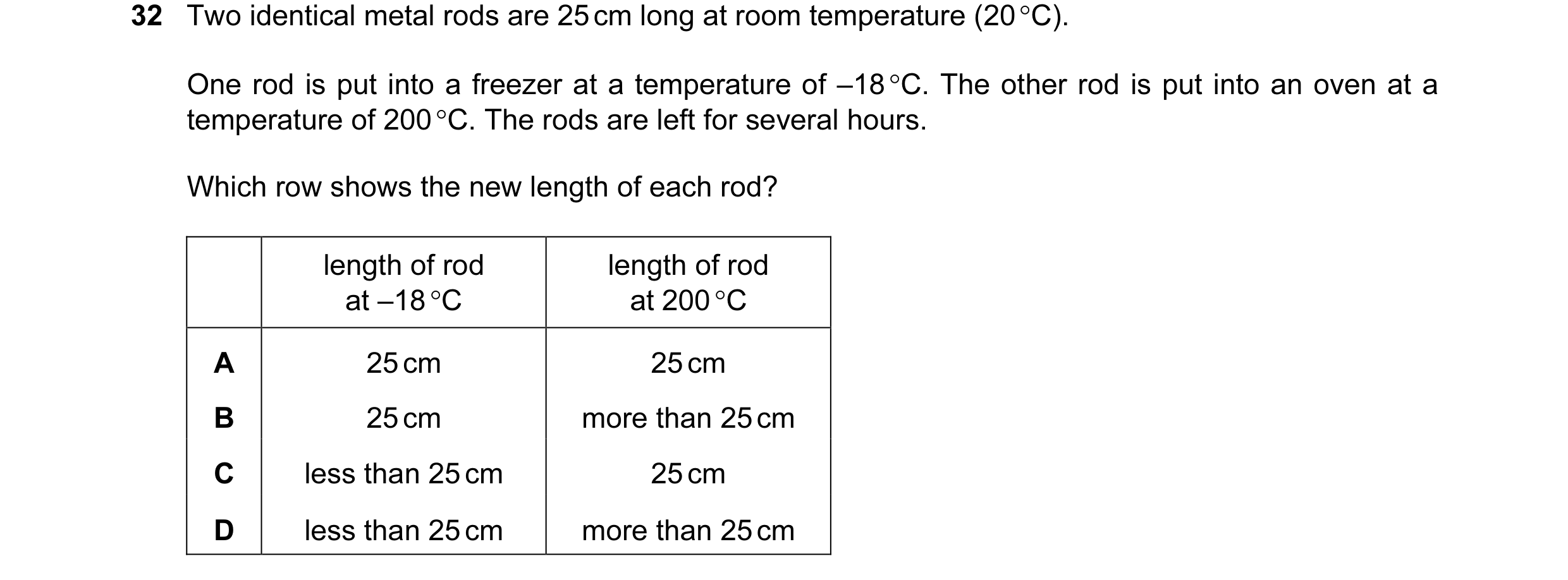
32 Two identical metal rods are 25 cm long at room temperature (20 °C). One rod is put into a freezer at a temperature of –18 °C. The other rod is put into an oven at a temperature of 200 °C. The rods are left for several hours. Which row shows the new length of each rod? length of rod length of rod at –18 °C at 200 °C A 25 cm 25 cm B 25 cm more than 25 cm C less than 25 cm 25 cm D less than 25 cm more than 25 cm
1 marks
Answer: D
This question in 0654/13 Oct/Nov 2013
Q13 · A metal wheel has to be fitted to an axle made from the same metal 0654/11 May/June 2014
32 A metal wheel has to be fitted to an axle made from the same metal. The axle is larger than the hole in the wheel. wheel axle hole Which action could make it possible to fit the axle in the hole? A cooling the axle only B cooling the axle and cooling the wheel by the same temperature change C heating the axle only D heating the axle and heating the wheel by the same temperature change
1 marks
Answer: A
This question in 0654/11 May/June 2014
Q14 · A metal wheel has to be fitted to an axle made from the same metal 0654/12 May/June 2014
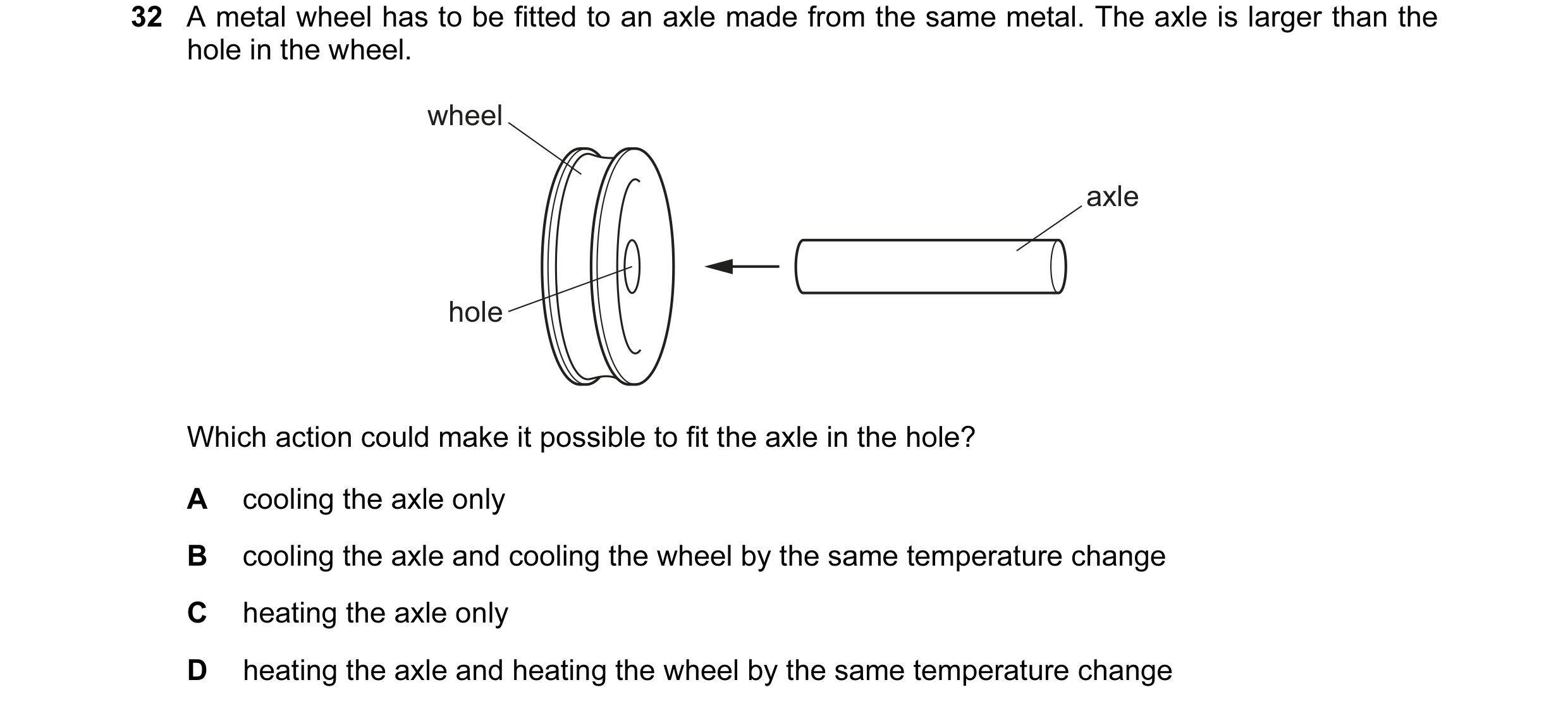
32 A metal wheel has to be fitted to an axle made from the same metal. The axle is larger than the hole in the wheel. wheel axle hole Which action could make it possible to fit the axle in the hole? A cooling the axle only B cooling the axle and cooling the wheel by the same temperature change C heating the axle only D heating the axle and heating the wheel by the same temperature change
1 marks
Answer: A
This question in 0654/12 May/June 2014
Q15 · A metal wheel has to be fitted to an axle made from the same metal 0654/13 May/June 2014
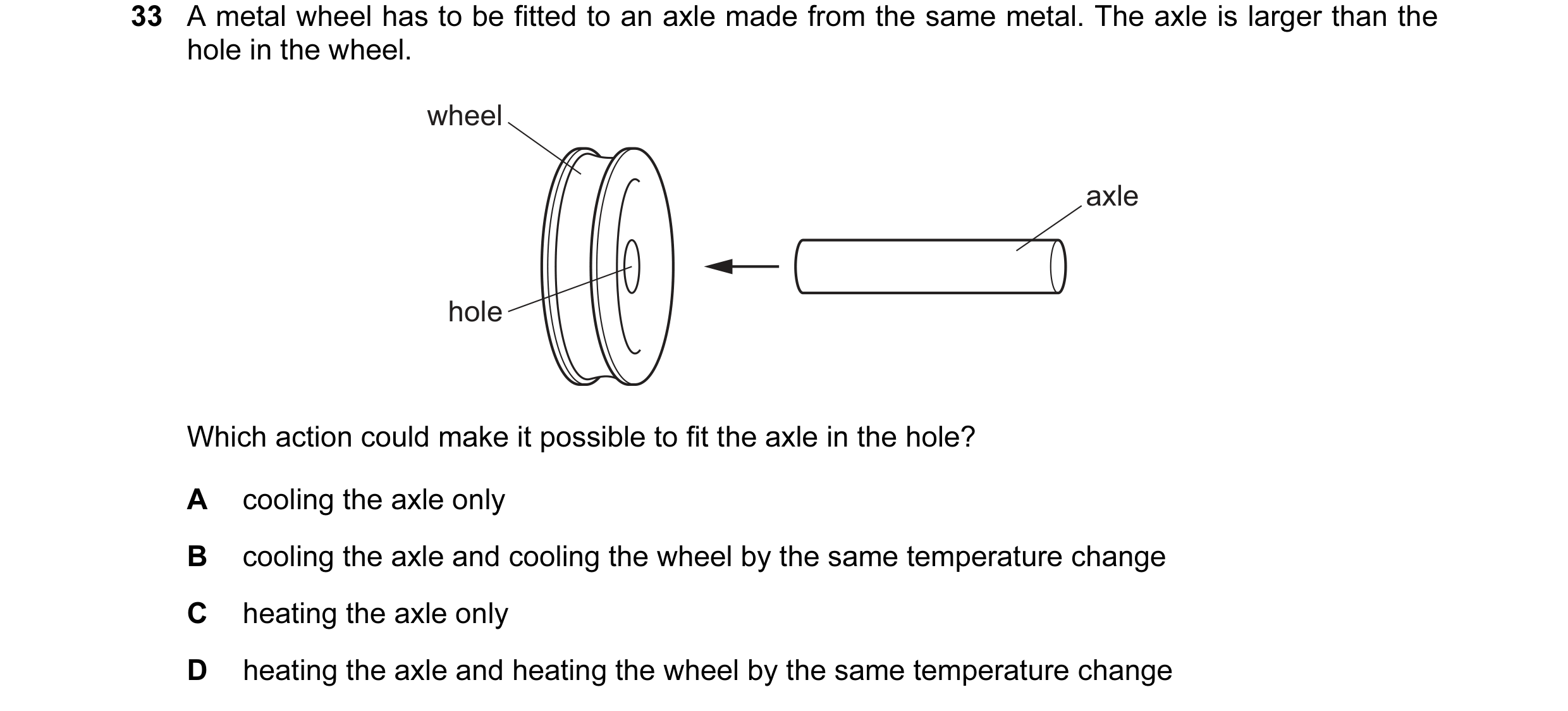
33 A metal wheel has to be fitted to an axle made from the same metal. The axle is larger than the hole in the wheel. wheel axle hole Which action could make it possible to fit the axle in the hole? A cooling the axle only B cooling the axle and cooling the wheel by the same temperature change C heating the axle only D heating the axle and heating the wheel by the same temperature change
1 marks
Answer: A
This question in 0654/13 May/June 2014
Q16 · Four students write statements about melting and boiling 0654/13 Oct/Nov 2014
31 Four students write statements about melting and boiling. Which statement is not correct? A A liquid only evaporates when it has reached its boiling point. B Heat energy is needed to melt a solid. C When a solid is melting, its temperature does not change. D When a substance is a liquid, its temperature will not rise above its boiling point.
1 marks
Answer: A
This question in 0654/13 Oct/Nov 2014
Q17 · A student carries out an experiment to find the melting point of wax 0654/11 Oct/Nov 2015
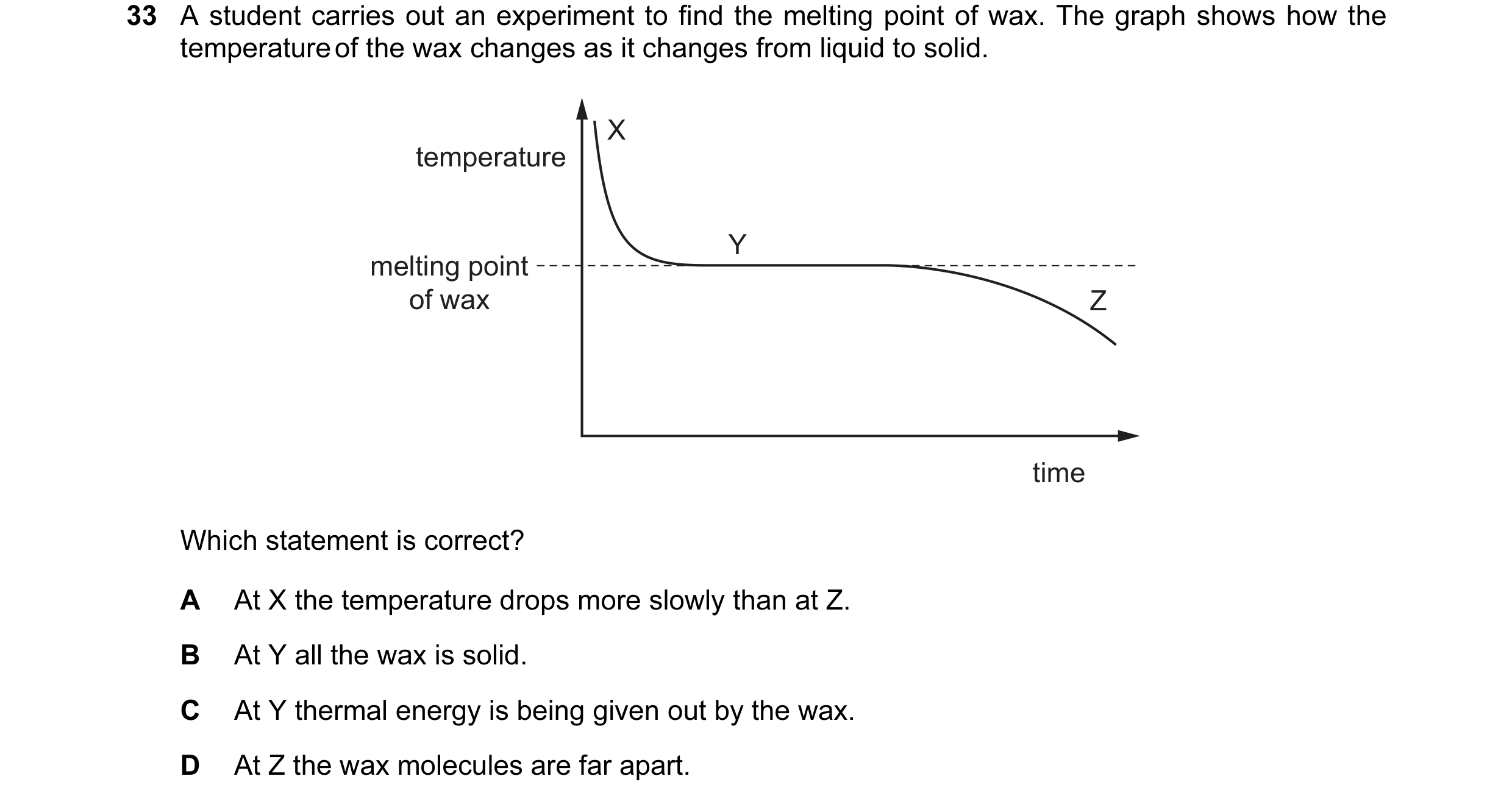
33 A student carries out an experiment to find the melting point of wax. The graph shows how the temperature of the wax changes as it changes from liquid to solid. X temperature Y melting point of wax Z time Which statement is correct? A At X the temperature drops more slowly than at Z. B At Y all the wax is solid. C At Y thermal energy is being given out by the wax. D At Z the wax molecules are far apart.
1 marks
Answer: C
This question in 0654/11 Oct/Nov 2015
Q18 · Evaporation occurs when molecules escape from a liquid surface into the air above it 0654/12 Oct/Nov 2015
32 Evaporation occurs when molecules escape from a liquid surface into the air above it. During this process the temperature of the liquid falls. Why does the temperature of the liquid fall? A The molecules in the vapour expand because the pressure is less. B The molecules left in the liquid have more space to move around. C The molecules move more slowly when they escape into the air. D The molecules with the highest energies escape into the air.
1 marks
Answer: D
This question in 0654/12 Oct/Nov 2015
Q19 · A beaker containing ice and a thermometer is left in a warm room for 15 minutes 0654/12 Oct/Nov 2015
33 A beaker containing ice and a thermometer is left in a warm room for 15 minutes. There is no liquid water in the beaker until 5 minutes have passed. After 15 minutes some ice is still visible. ice ice water start of after after experiment 5 minutes 15 minutes Which graph shows how the thermometer reading changes? A B temperature temperature / °C / °C 0 0 0 5 10 15 0 5 10 15 time / min time / min C D temperature temperature / °C / °C 0 0 0 5 10 15 0 5 10 15 time / min time / min
1 marks
Answer: A
This question in 0654/12 Oct/Nov 2015
Q20 · On a warm day, a swimmer climbs out of a swimming pool into the open air and water… 0654/13 Oct/Nov 2015
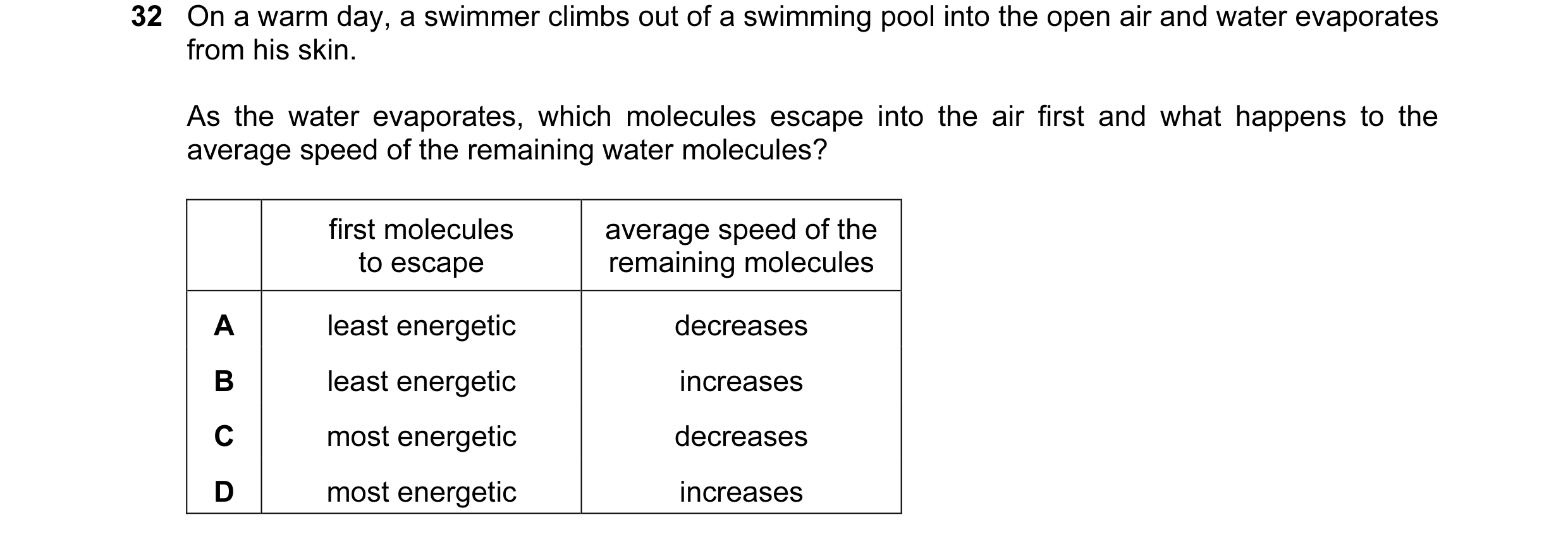
32 On a warm day, a swimmer climbs out of a swimming pool into the open air and water evaporates from his skin. As the water evaporates, which molecules escape into the air first and what happens to the average speed of the remaining water molecules? first molecules average speed of the to escape remaining molecules A least energetic decreases B least energetic increases C most energetic decreases D most energetic increases
1 marks
Answer: C
This question in 0654/13 Oct/Nov 2015
Q21 · A sample of a solid is heated for 12 minutes and its temperature noted every minute 0654/13 Oct/Nov 2015
33 A sample of a solid is heated for 12 minutes and its temperature noted every minute. The results are shown in the table. time / min 0 1 2 3 4 5 6 7 8 9 10 11 12 temperature / °C 11.5 16.1 22.1 31.0 31.1 31.1 31.1 31.3 45.0 65.2 66.2 66.3 66.3 How should the sample be described at the end of the 12 minutes? A all solid B in the process of melting C all liquid D in the process of boiling
1 marks
Answer: D
This question in 0654/13 Oct/Nov 2015
Q22 · A substance is a gas when its temperature is 65 °C 0654/13 May/June 2016
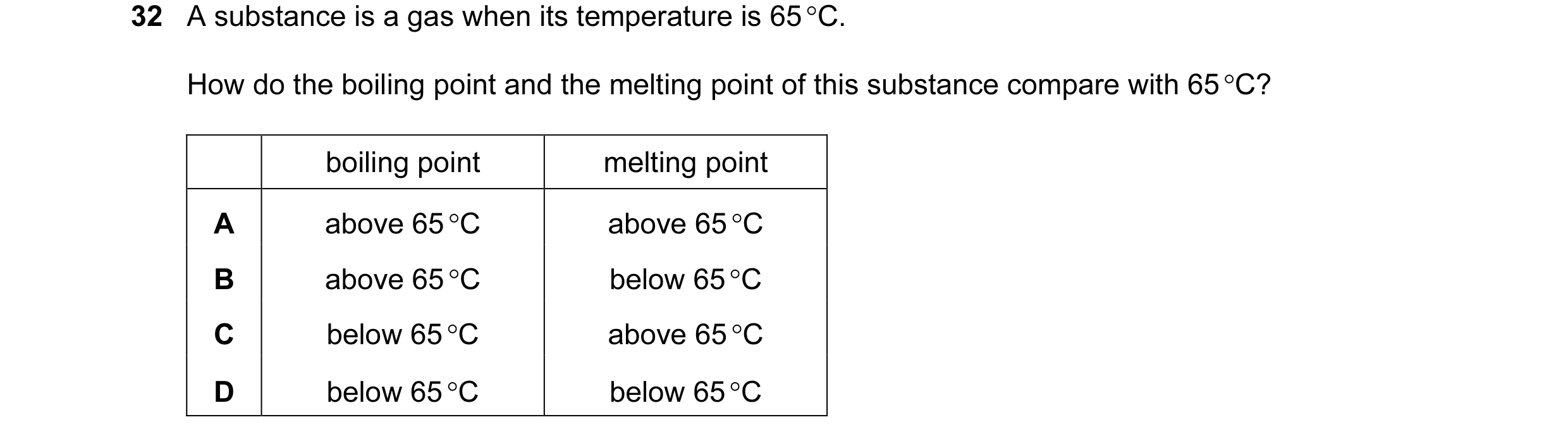
32 A substance is a gas when its temperature is 65 °C. How do the boiling point and the melting point of this substance compare with 65 °C? boiling point melting point A above 65 °C above 65 °C B above 65 °C below 65 °C C below 65 °C above 65 °C D below 65 °C below 65 °C
1 marks
Answer: D
This question in 0654/13 May/June 2016
Q23 · The diagram shows a bridge on a cold day 0654/13 Oct/Nov 2016
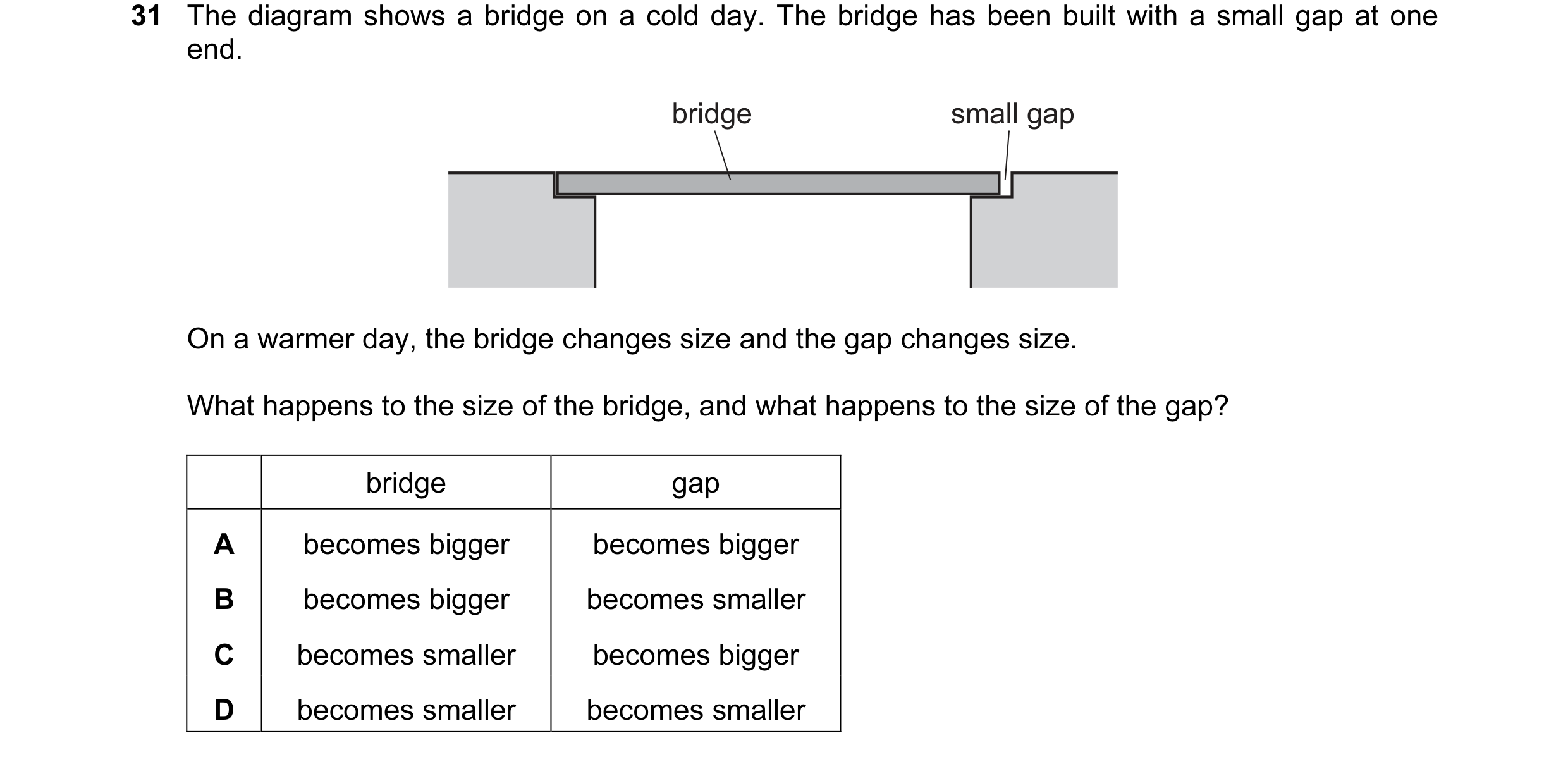
31 The diagram shows a bridge on a cold day. The bridge has been built with a small gap at one end. bridge small gap On a warmer day, the bridge changes size and the gap changes size. What happens to the size of the bridge, and what happens to the size of the gap? bridge gap A becomes bigger becomes bigger B becomes bigger becomes smaller C becomes smaller becomes bigger D becomes smaller becomes smaller
1 marks
Answer: B
This question in 0654/13 Oct/Nov 2016
Q24 · A solid sample of a material in a container is supplied with thermal energy at a constant… 0654/13 May/June 2017
31 A solid sample of a material in a container is supplied with thermal energy at a constant rate. The temperature of the material is recorded every two minutes for 20 minutes. The results are shown in the table. time / min 0 2 4 6 8 10 12 14 16 18 20 temperature / °C 53.7 55.9 58.0 60.1 62.1 62.1 62.1 64.0 66.9 69.0 70.9 How should the sample be described at the end of the 20 minutes? A all solid B all liquid C all gas D in the process of melting
1 marks
Answer: B
This question in 0654/13 May/June 2017
Q25 · Which two processes both require an input of energy? 0654/13 Oct/Nov 2017
32 Which two processes both require an input of energy? A boiling and condensation B boiling and melting C condensation and solidification D melting and solidification
1 marks
Answer: B
This question in 0654/13 Oct/Nov 2017
Q26 · An axle is slightly larger than the hole in a wheel made from the same metal 0654/11 Oct/Nov 2018
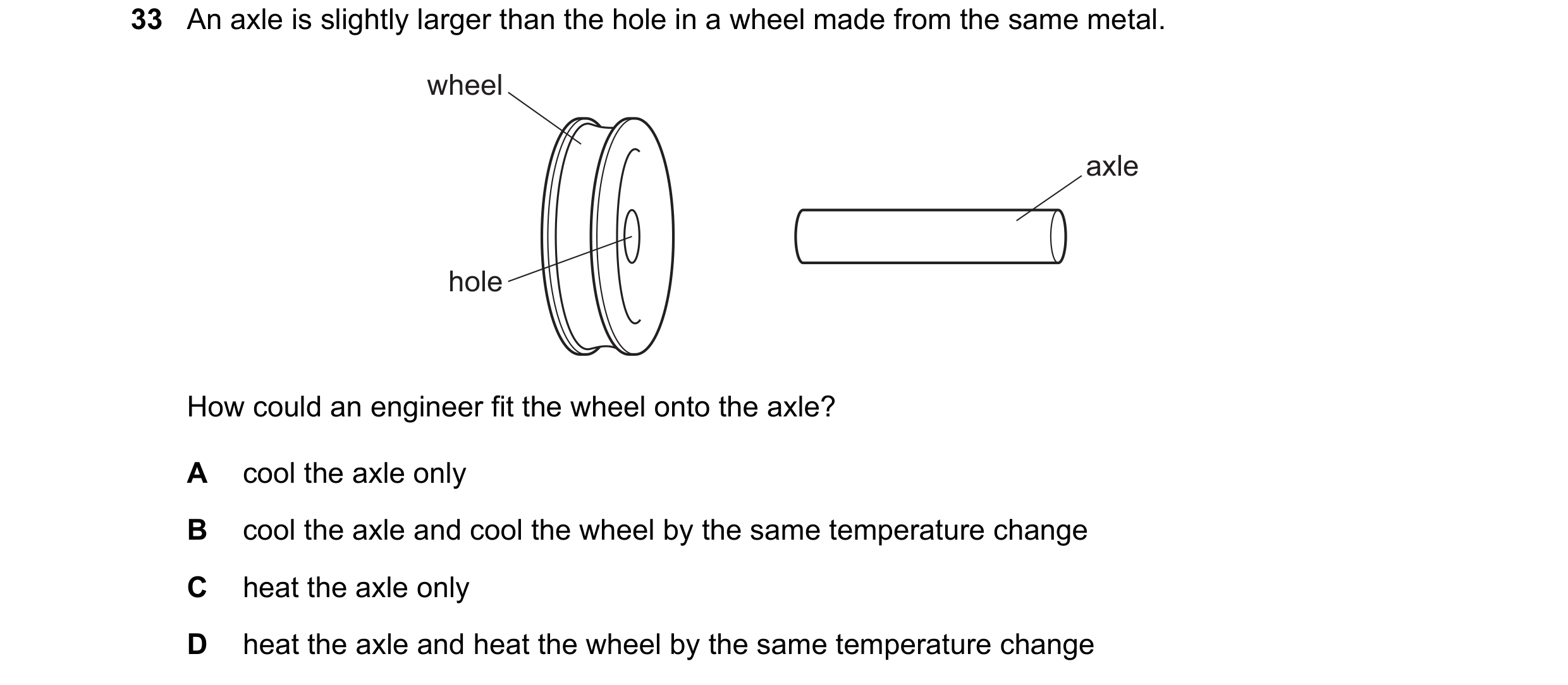
33 An axle is slightly larger than the hole in a wheel made from the same metal. wheel axle hole How could an engineer fit the wheel onto the axle? A cool the axle only B cool the axle and cool the wheel by the same temperature change C heat the axle only D heat the axle and heat the wheel by the same temperature change
1 marks
Answer: A
This question in 0654/11 Oct/Nov 2018
Q27 · An axle is slightly larger than the hole in a wheel made from the same metal 0654/12 Oct/Nov 2018
32 An axle is slightly larger than the hole in a wheel made from the same metal. wheel axle hole How could an engineer fit the wheel onto the axle? A cool the axle only B cool the axle and cool the wheel by the same temperature change C heat the axle only D heat the axle and heat the wheel by the same temperature change
1 marks
Answer: A
This question in 0654/12 Oct/Nov 2018
Q28 · An axle is slightly larger than the hole in a wheel made from the same metal 0654/13 Oct/Nov 2018
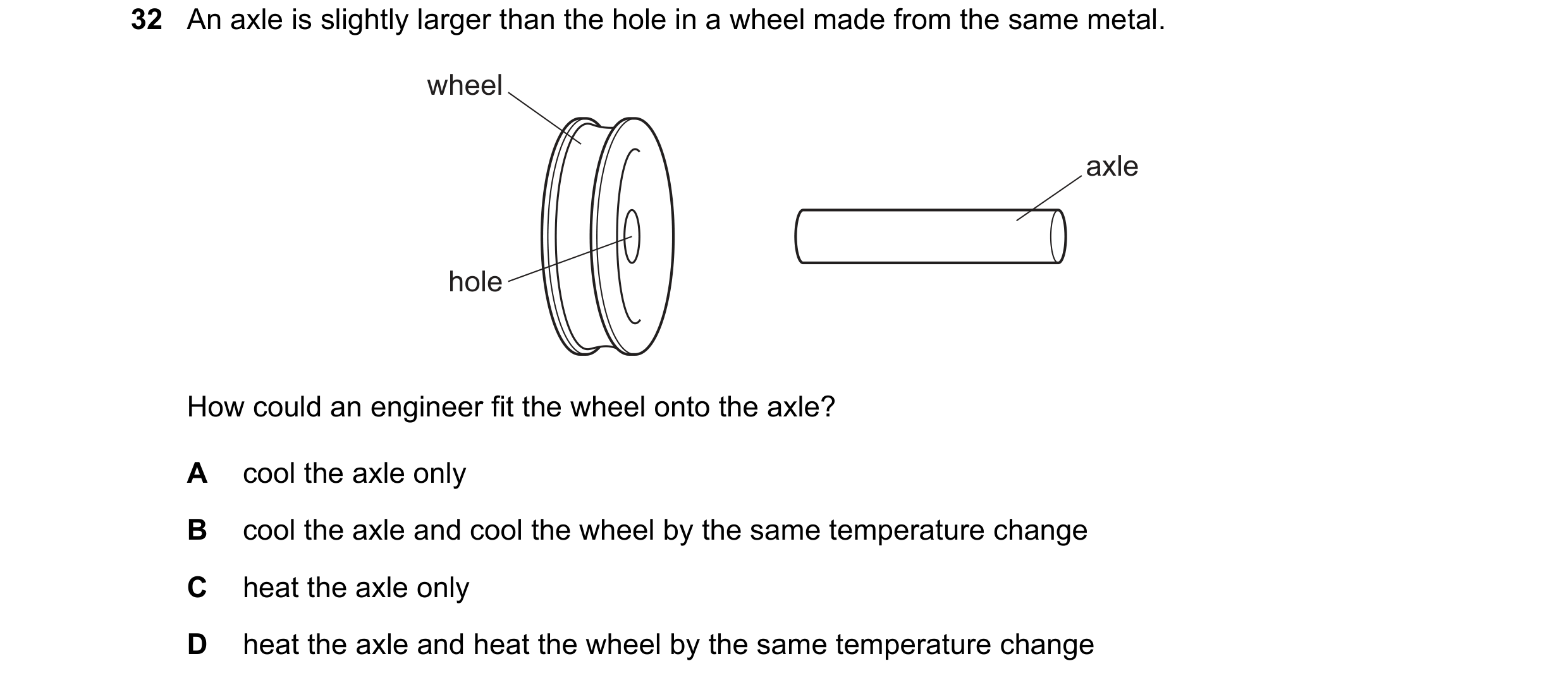
32 An axle is slightly larger than the hole in a wheel made from the same metal. wheel axle hole How could an engineer fit the wheel onto the axle? A cool the axle only B cool the axle and cool the wheel by the same temperature change C heat the axle only D heat the axle and heat the wheel by the same temperature change
1 marks
Answer: A
This question in 0654/13 Oct/Nov 2018
Q29 · A liquid-in-glass thermometer contains mercury 0654/11 May/June 2020
32 A liquid-in-glass thermometer contains mercury. The thermometer is moved from cold water into hot water. What happens to the mercury? A It contracts. B It expands. C It freezes. D It melts.
1 marks
Answer: B
This question in 0654/11 May/June 2020
Q30 · Ice is taken from a freezer 0654/13 Oct/Nov 2020
31 Ice is taken from a freezer. After some time the ice starts to melt. What is the temperature of the ice as it melts? A –10 C B 0 C C 20 C D 100 C
1 marks
Answer: B
This question in 0654/13 Oct/Nov 2020
Q31 · A beaker of water at 60 C is placed in a freezer 0654/12 Feb/March 2021
32 A beaker of water at 60 C is placed in a freezer. The graph shows how the temperature of the water changes with time. In which labelled section of the graph are both water and ice present in the beaker? 60 temperature / °C A B 0 0 time C D
1 marks
Answer: B
This question in 0654/12 Feb/March 2021
Q32 · What happens to the temperature of a substance as it is melting and as it is boiling? 0654/11 May/June 2022
33 What happens to the temperature of a substance as it is melting and as it is boiling? melting boiling A decreases increases B decreases no change C increases increases D no change no change
1 marks
Answer: D
This question in 0654/11 May/June 2022
Q33 · What are used as the fixed points on the Celsius scale of temperature? 0654/12 May/June 2022
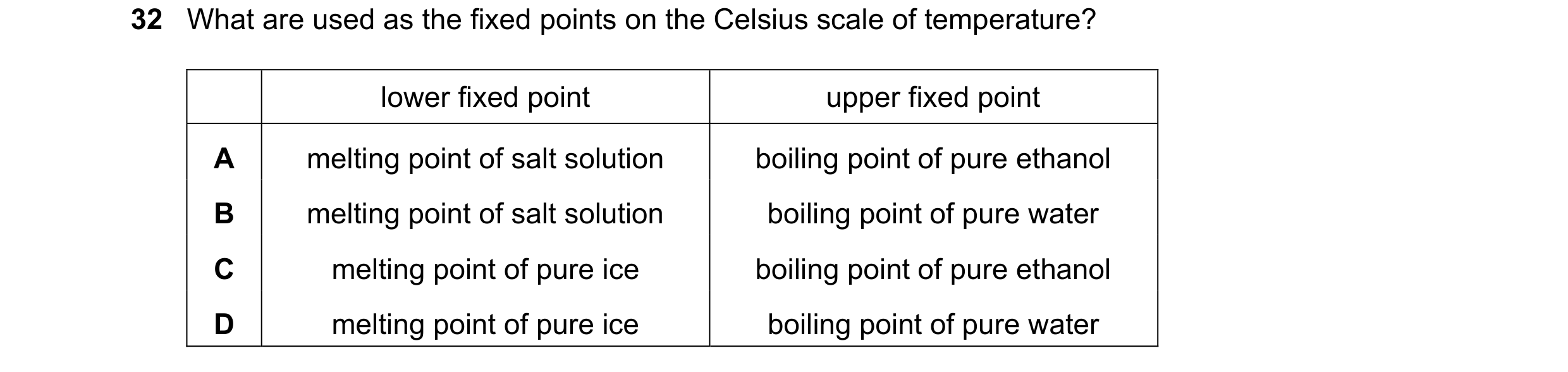
32 What are used as the fixed points on the Celsius scale of temperature? lower fixed point upper fixed point A melting point of salt solution boiling point of pure ethanol B melting point of salt solution boiling point of pure water C melting point of pure ice boiling point of pure ethanol D melting point of pure ice boiling point of pure water
1 marks
Answer: D
This question in 0654/12 May/June 2022
Q34 · What are used as the fixed points on the Celsius scale of temperature? 0654/13 May/June 2022
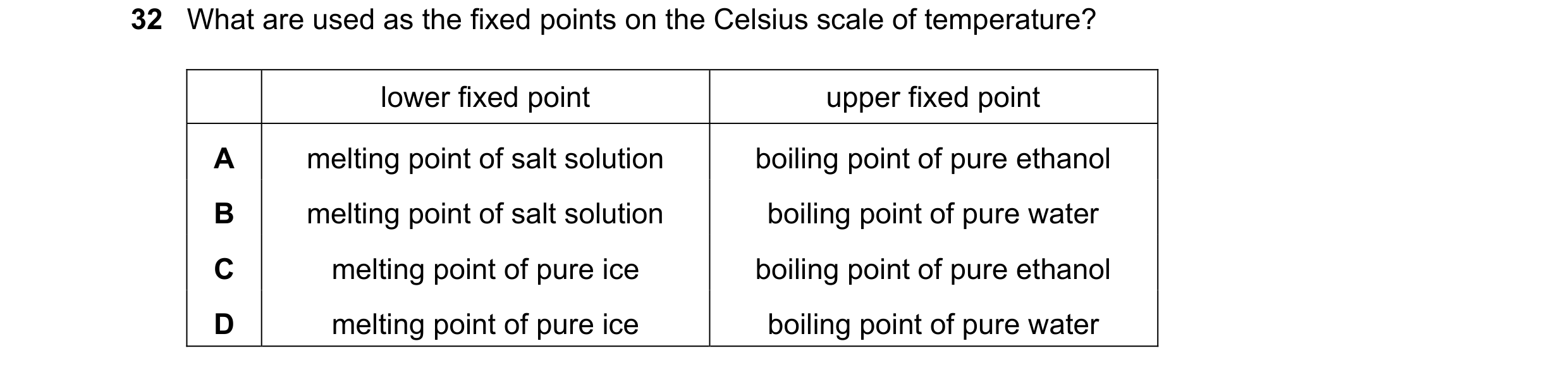
32 What are used as the fixed points on the Celsius scale of temperature? lower fixed point upper fixed point A melting point of salt solution boiling point of pure ethanol B melting point of salt solution boiling point of pure water C melting point of pure ice boiling point of pure ethanol D melting point of pure ice boiling point of pure water
1 marks
Answer: D
This question in 0654/13 May/June 2022
Q35 · Which statement about the relative thermal expansion of solids, liquids and gases is… 0654/12 Oct/Nov 2023
33 Which statement about the relative thermal expansion of solids, liquids and gases is correct? A Solids expand least, gases expand most. B Solids expand least, liquids expand most. C Gases expand least, liquids expand most. D Gases expand least, solids expand most.
1 marks
Answer: A
This question in 0654/12 Oct/Nov 2023
Q36 · In a liquid-in-glass thermometer, which physical property of the liquid is used to… 0654/12 Feb/March 2024
31 In a liquid-in-glass thermometer, which physical property of the liquid is used to measure temperature? A colour B mass C pressure D volume
1 marks
Answer: D
This question in 0654/12 Feb/March 2024
Q37 · A glass jar in a warm room has a metal lid that is easy to remove 0654/11 May/June 2024
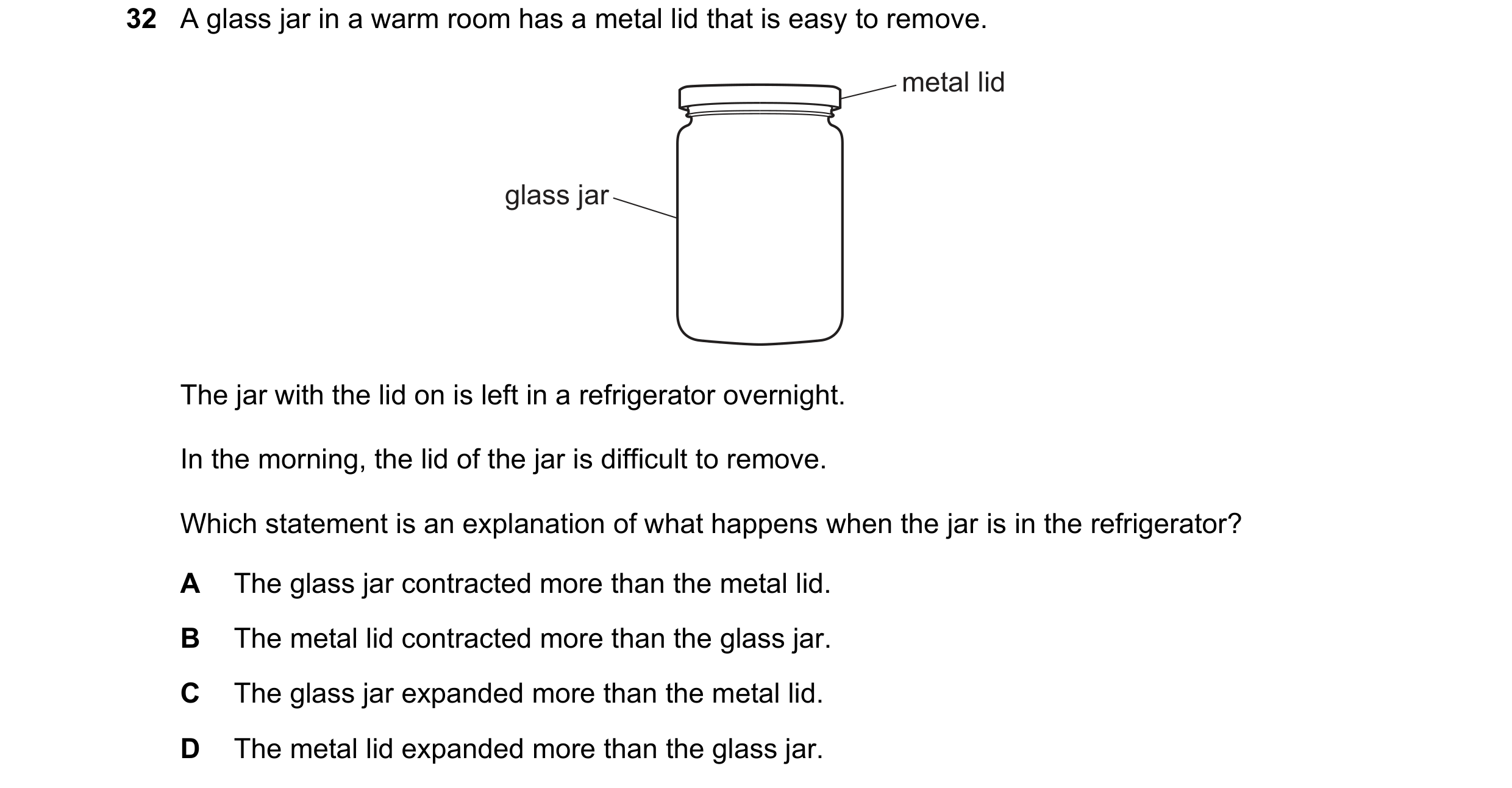
32 A glass jar in a warm room has a metal lid that is easy to remove. metal lid glass jar The jar with the lid on is left in a refrigerator overnight. In the morning, the lid of the jar is difficult to remove. Which statement is an explanation of what happens when the jar is in the refrigerator? A The glass jar contracted more than the metal lid. B The metal lid contracted more than the glass jar. C The glass jar expanded more than the metal lid. D The metal lid expanded more than the glass jar.
1 marks
Answer: B
This question in 0654/11 May/June 2024
Q38 · A copper disc has a hole at its centre that is slightly too small to fit over a copper… 0654/12 May/June 2024
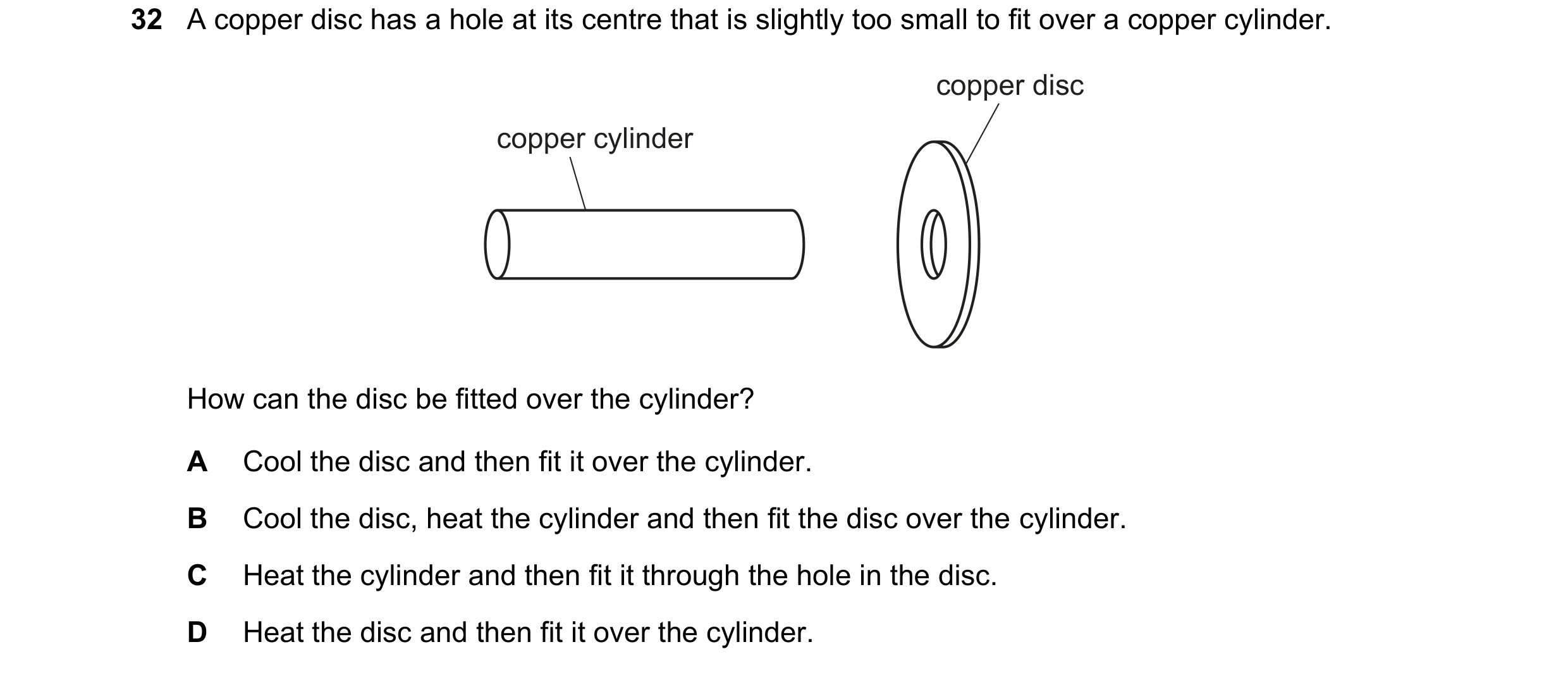
32 A copper disc has a hole at its centre that is slightly too small to fit over a copper cylinder. copper disc copper cylinder How can the disc be fitted over the cylinder? A Cool the disc and then fit it over the cylinder. B Cool the disc, heat the cylinder and then fit the disc over the cylinder. C Heat the cylinder and then fit it through the hole in the disc. D Heat the disc and then fit it over the cylinder.
1 marks
Answer: D
This question in 0654/12 May/June 2024
Q39 · A copper disc has a hole at its centre that is slightly too small to fit over a copper… 0654/13 May/June 2024
32 A copper disc has a hole at its centre that is slightly too small to fit over a copper cylinder. copper disc copper cylinder How can the disc be fitted over the cylinder? A Cool the disc and then fit it over the cylinder. B Cool the disc, heat the cylinder and then fit the disc over the cylinder. C Heat the cylinder and then fit it through the hole in the disc. D Heat the disc and then fit it over the cylinder.
1 marks
Answer: D
This question in 0654/13 May/June 2024
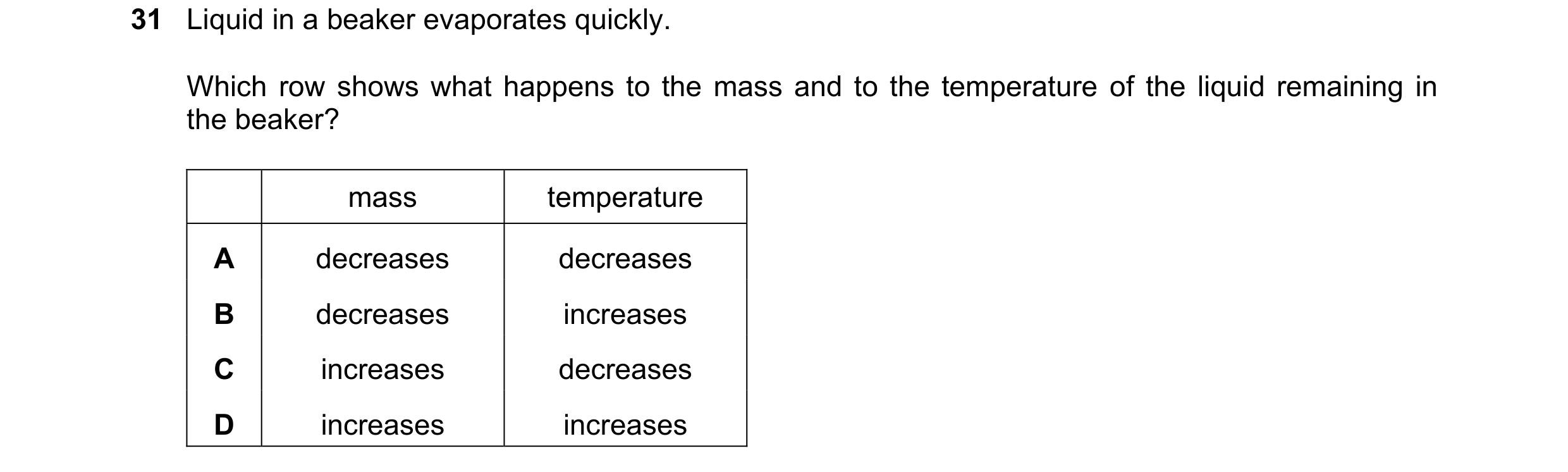
Q40 · Liquid in a beaker evaporates quickly 0654/12 May/June 2025
31 Liquid in a beaker evaporates quickly. Which row shows what happens to the mass and to the temperature of the liquid remaining in the beaker? mass temperature A decreases decreases B decreases increases C increases decreases D increases increases
1 marks
Answer: A
This question in 0654/12 May/June 2025
 1 / 12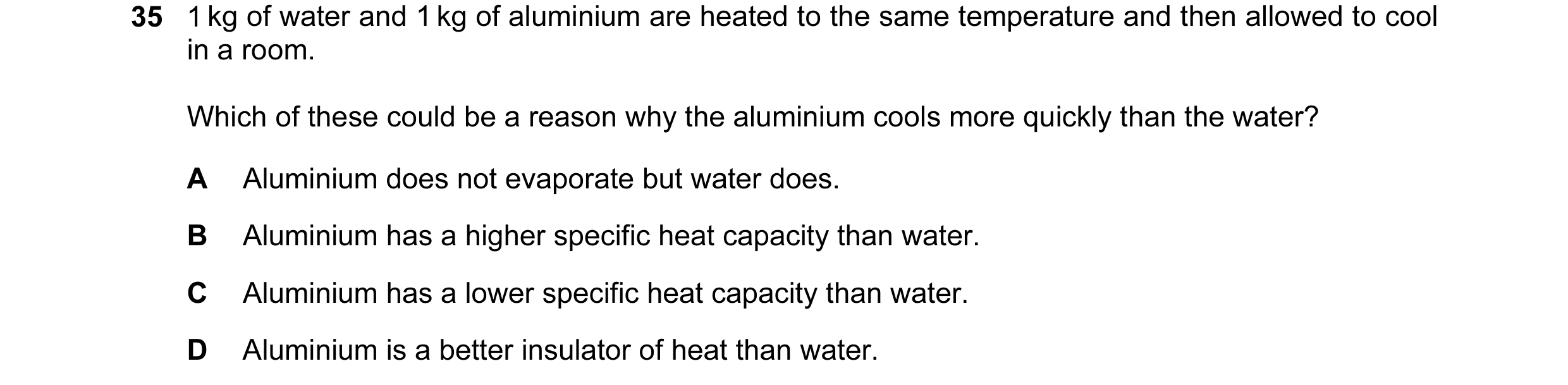
 2 / 12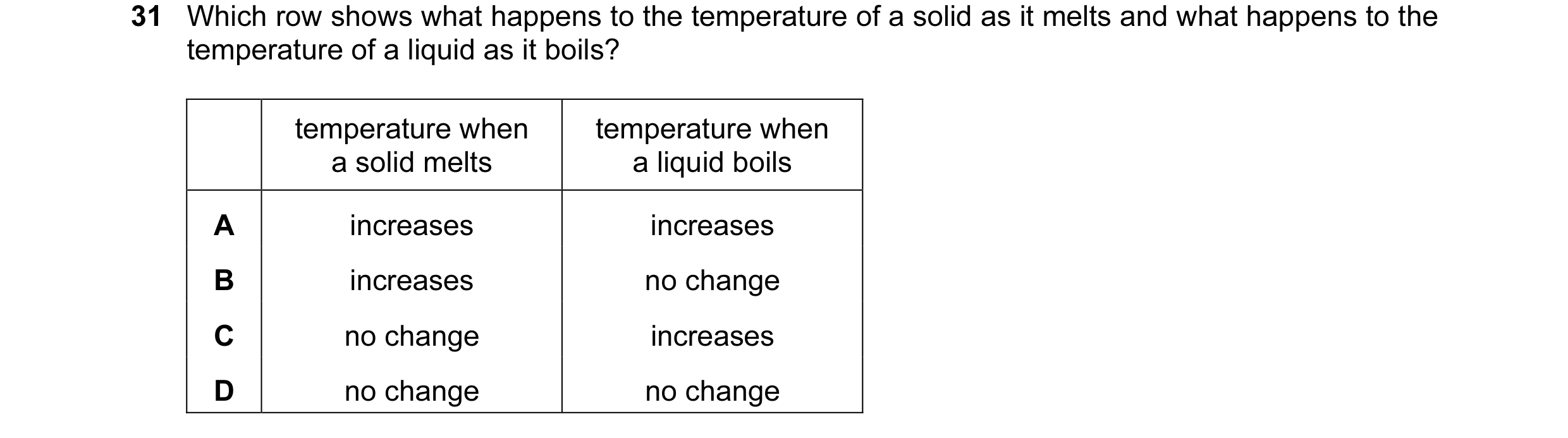
 3 / 12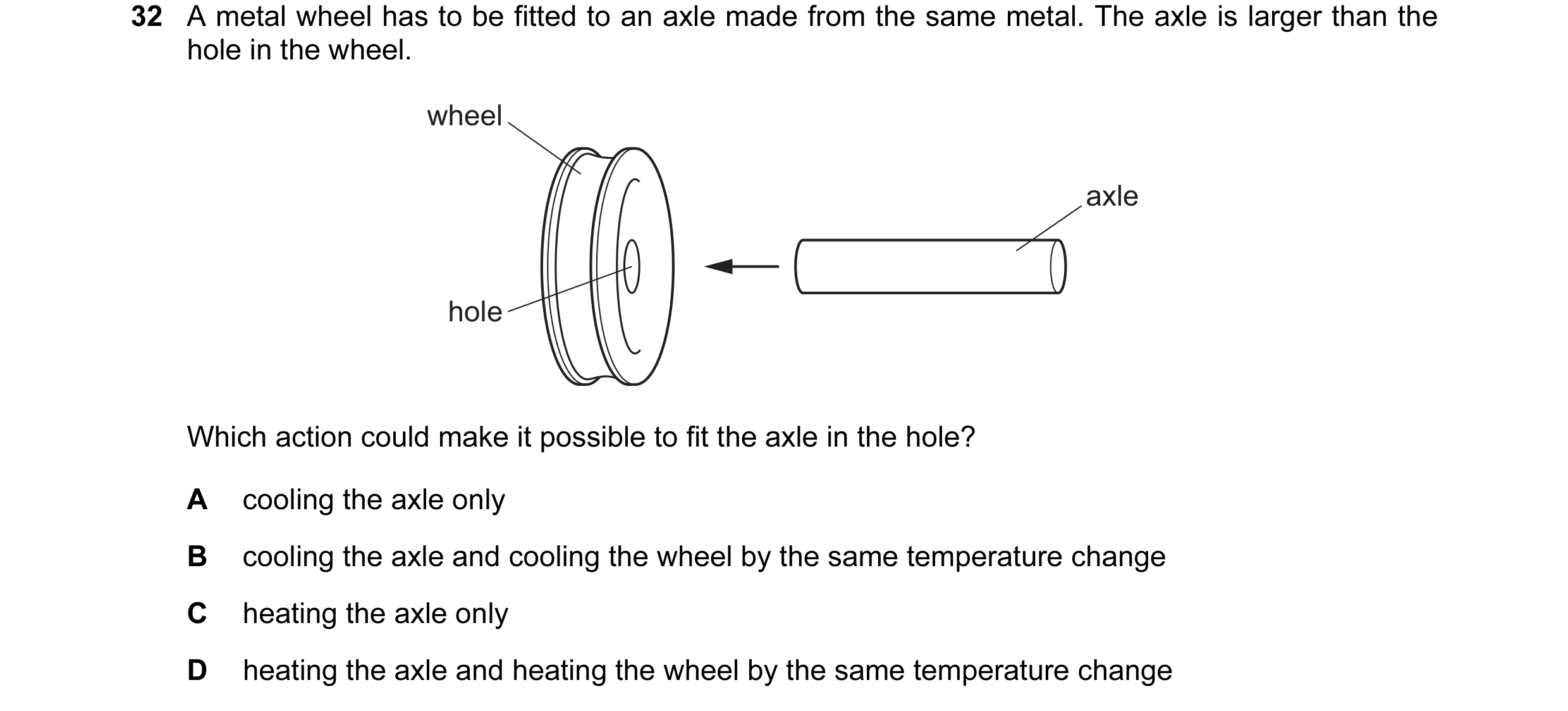
 4 / 12
 5 / 12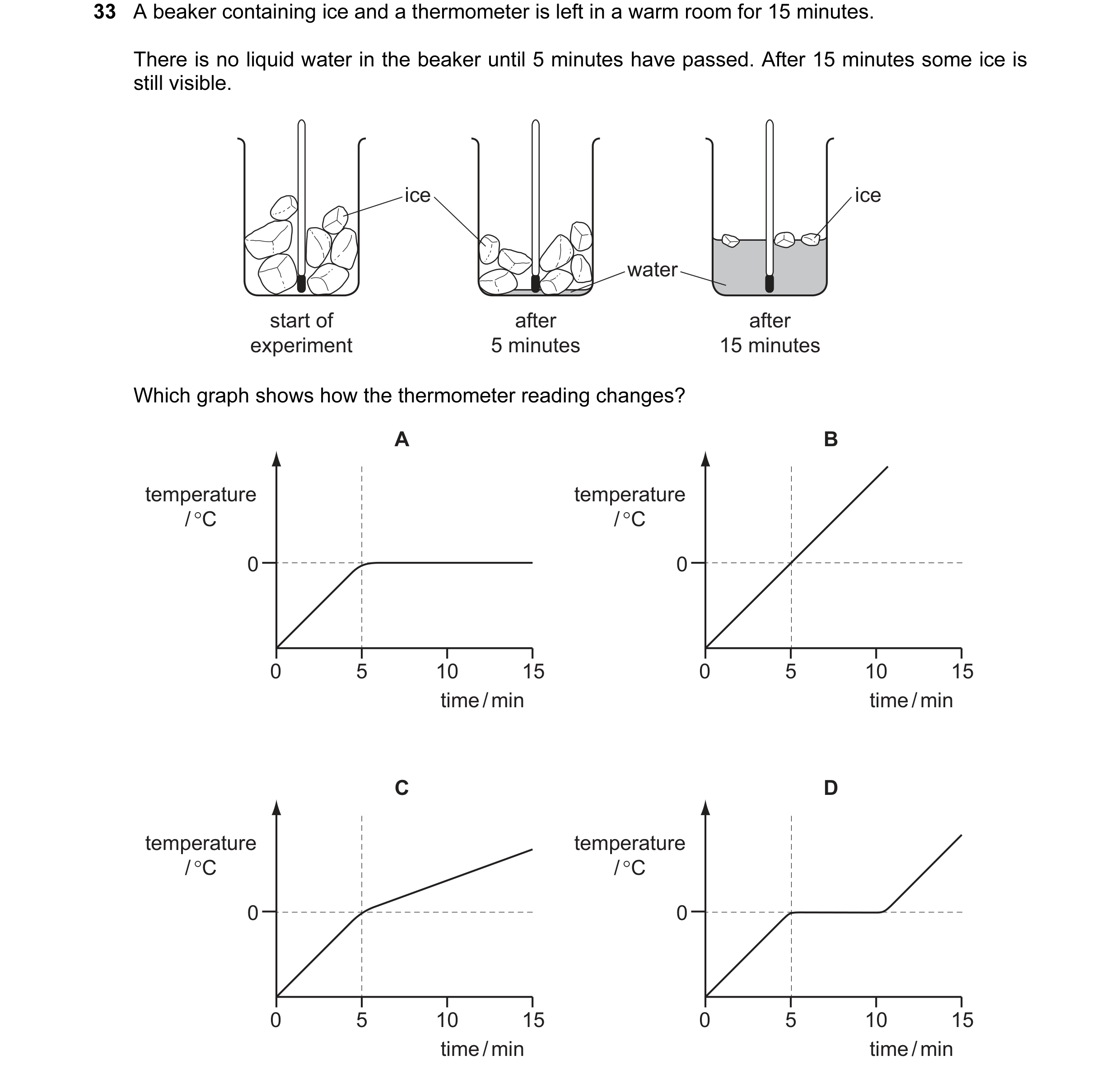
 6 / 12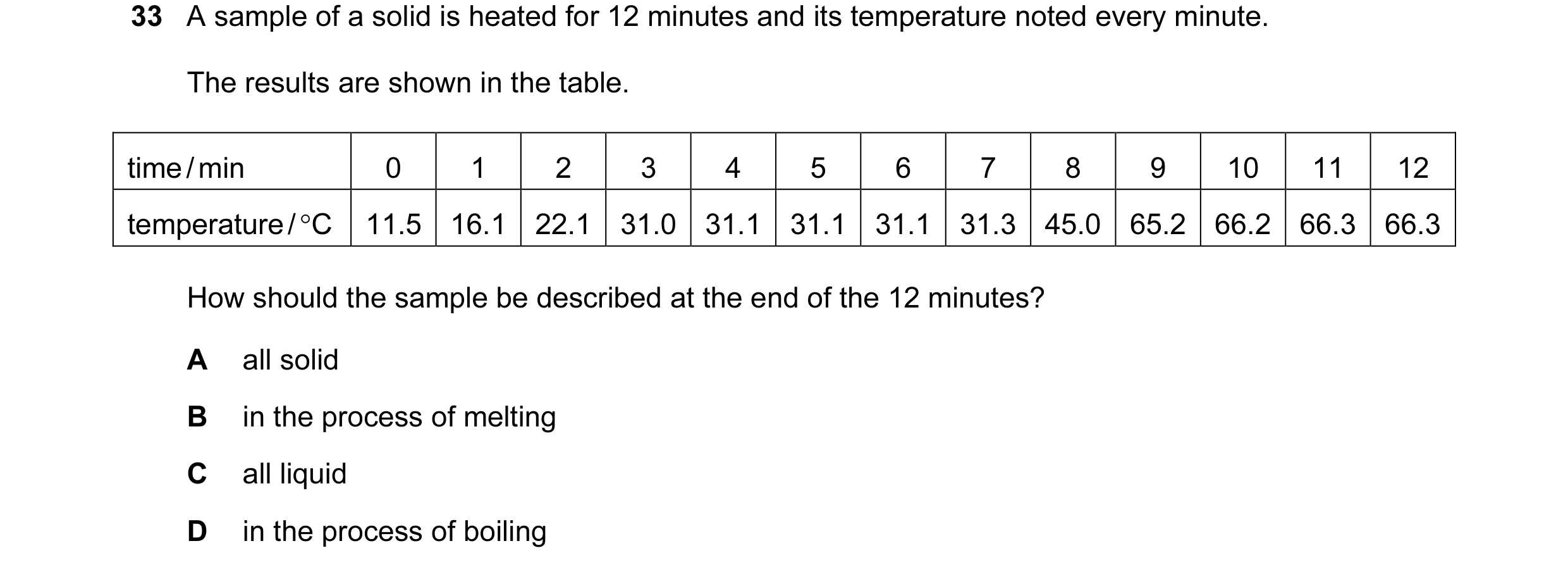
 7 / 12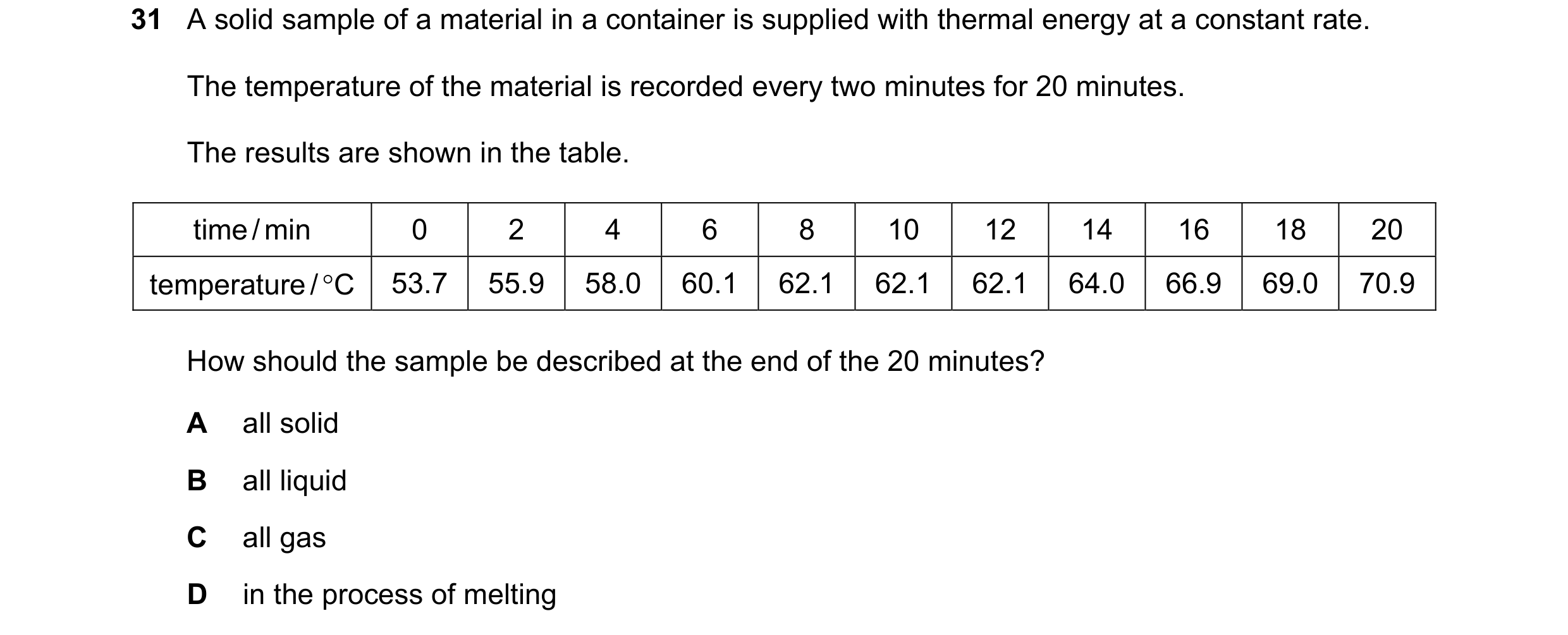

 8 / 12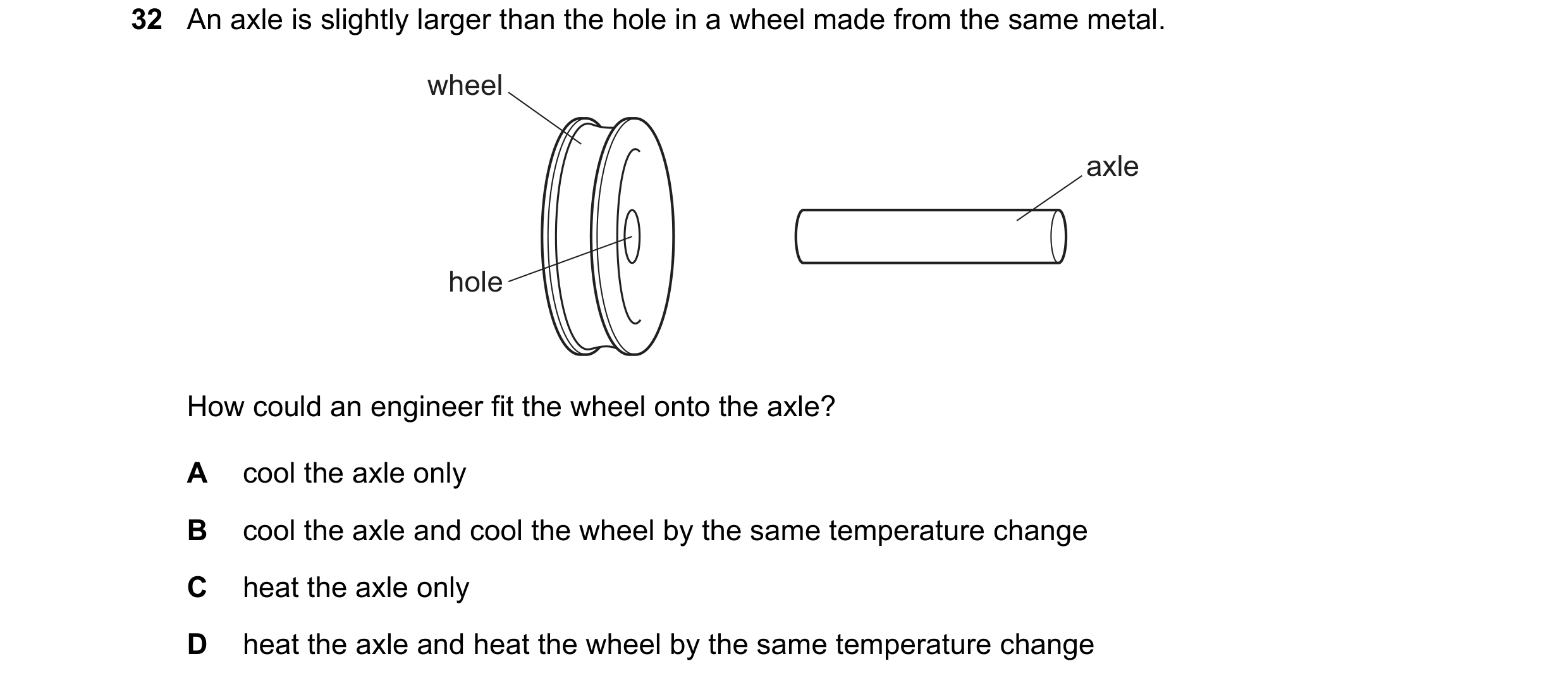
 9 / 12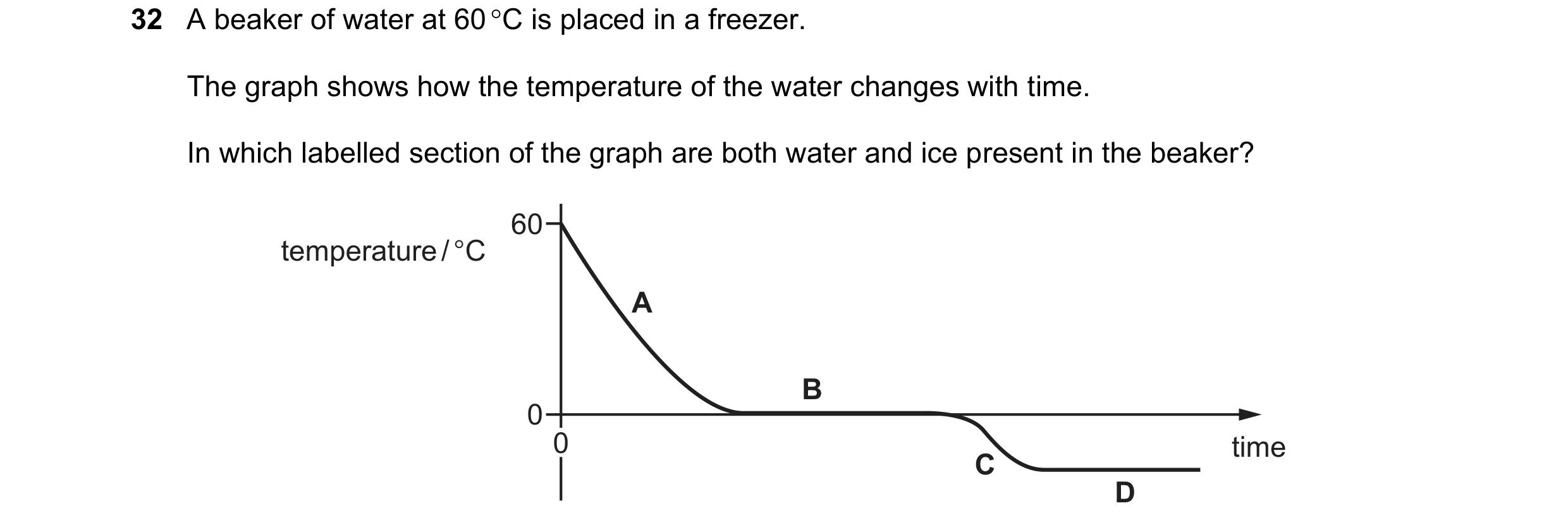
 10 / 12
 11 / 12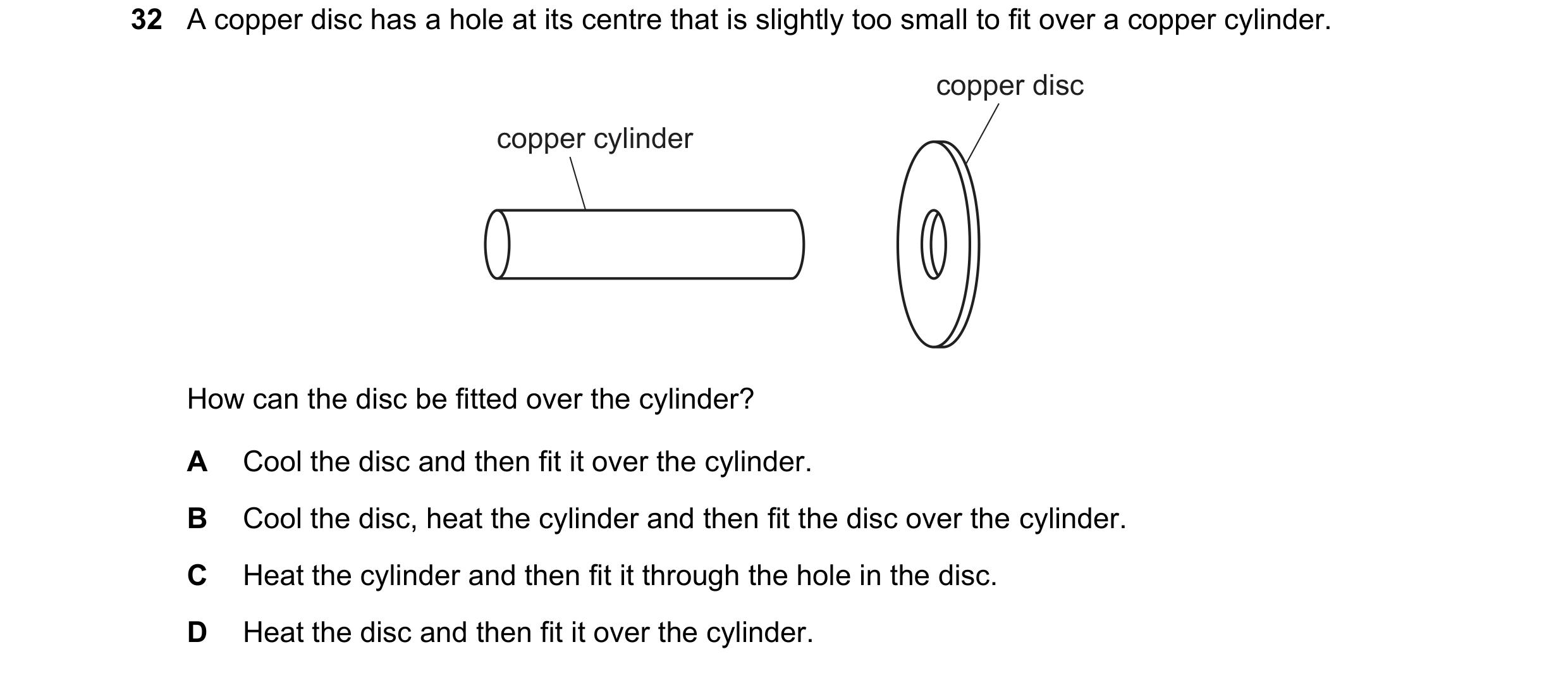
 12 / 12