Questions as text
Q1 · A student plans an experiment to calculate the specific heat capacity of water by heating… 0654/41 May/June 2017
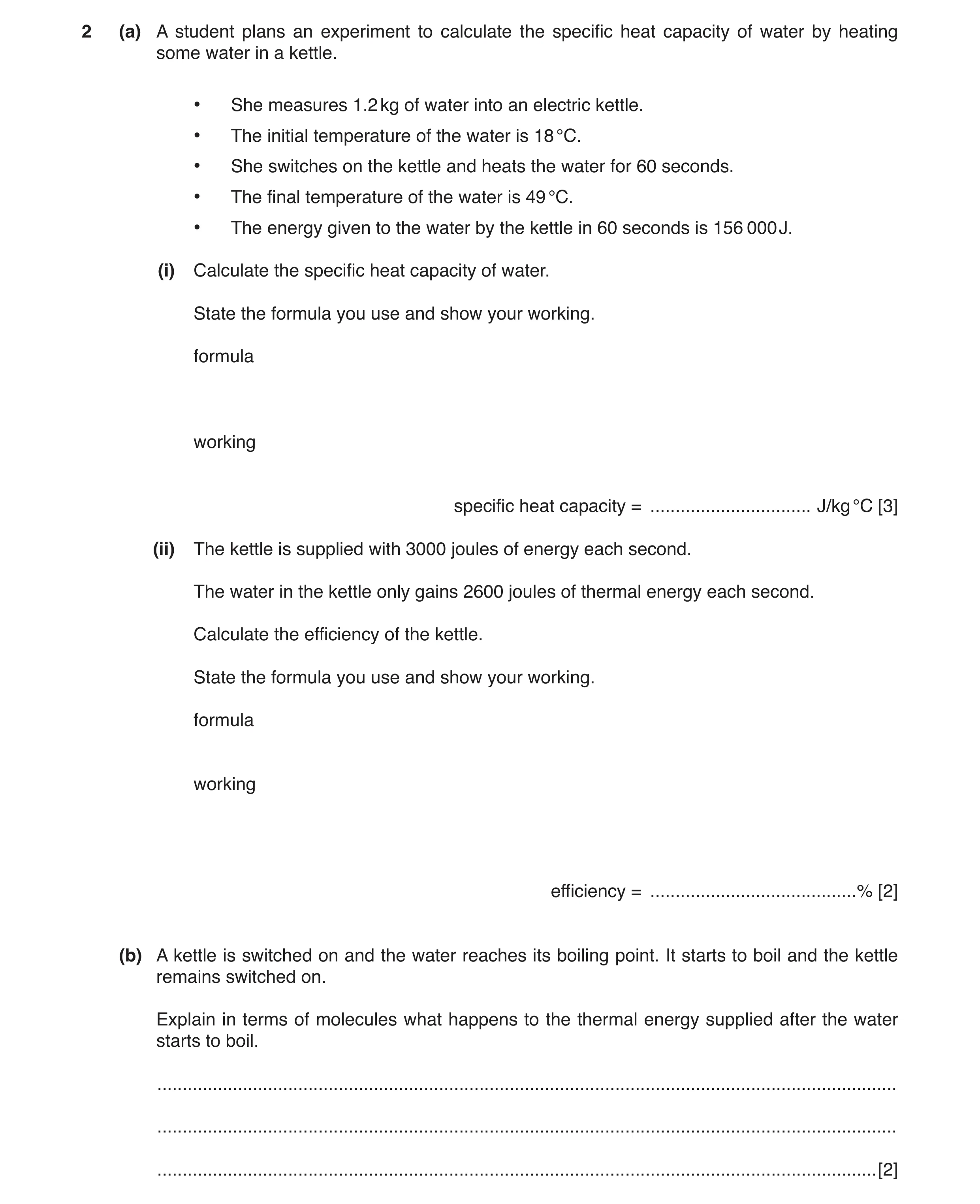
2 (a) A student plans an experiment to calculate the specific heat capacity of water by heating some water in a kettle. • She measures 1.2 kg of water into an electric kettle. • The initial temperature of the water is 18 °C. • She switches on the kettle and heats the water for 60 seconds. • The final temperature of the water is 49 °C. • The energy given to the water by the kettle in 60 seconds is 156 000 J. (i) Calculate the specific heat capacity of water. State the formula you use and show your working. formula working specific heat capacity = … J/kg °C [3] (ii) The kettle is supplied with 3000 joules of energy each second. The water in the kettle only gains 2600 joules of thermal energy each second. Calculate the efficiency of the kettle. State the formula you use and show your working. formula working efficiency = … % [2] (b) A kettle is switched on and the water reaches its boiling point. It starts to boil and the kettle remains switched on. Explain in terms of molecules what happens to the thermal energy supplied after the water starts to boil. … … … [2]
7 marks
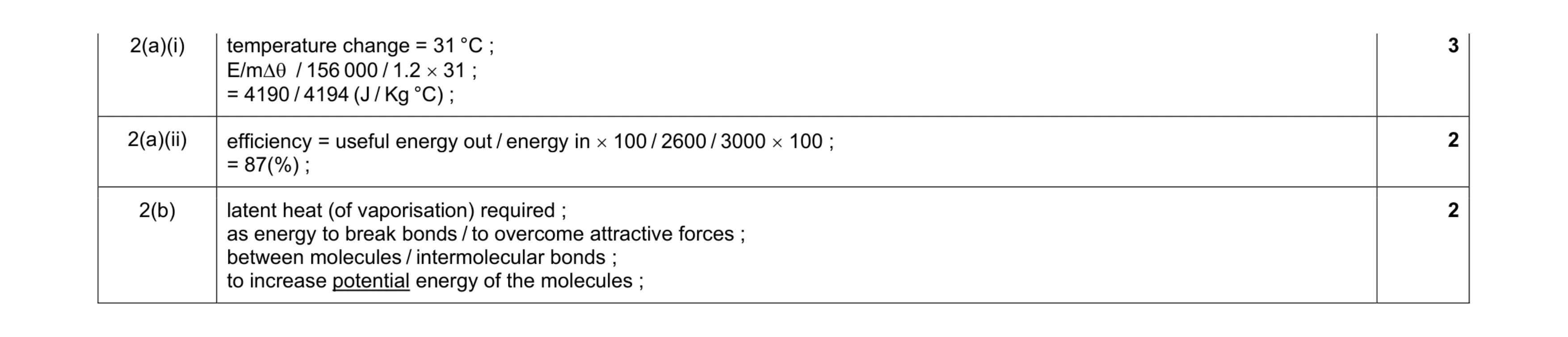
Mark scheme: 2(a)(i) temperature change = 31 °C ; E/m∆θ / 156 000 / 1.2 × 31 ; = 4190 / 4194 (J / Kg °C) ; 3 2(a)(ii) efficiency = useful energy out / energy in × 100 / 2600 / 3000 × 100 ; = 87(%) ; 2 2(b) latent heat (of vaporisation) required ; as energy to break bonds / to overcome attractive forces ; between molecules / intermolecular bonds ; to increase potential energy of the molecules ; 2
This question in 0654/41 May/June 2017
Q2 · A list of metals is shown below 0654/42 May/June 2017
3 (a) A list of metals is shown below. aluminium copper iron lead uranium From the list of metals choose one to match each description. Each metal can be used once, more than once or not at all. (i) It may be easily magnetised. … [1] (ii) It is used as a fuel in nuclear power stations. … [1] (iii) It is used in the core of a transformer. … [1] (b) Copper has a boiling point of 2562 °C. (i) State the meaning of the term boiling point. … … [1] (ii) When a liquid boils, energy is required but the temperature remains the same. Explain what is happening in terms of molecules. Use the term latent heat in your answer. … … … … [2] 64 (c) An isotope of copper has a nuclide notation 29 Cu and decays by the emission of β-particles to produce an isotope of zinc. Use the correct nuclide notation to write a symbol equation for this decay process. 29 Cu64 → … + … [3] (d) A block of copper has a mass of 44.8 g and a volume of 5.0 cm3. (i) Calculate the density of the block of copper. State the formula you use and show your working. formula working density = … g / cm3 [2] (ii) State the weight of the block of copper. (g = 10 N / kg) … N [1] (iii) The block of copper is resting on a desk. The area of the block in contact with the desk is 0.01 m2. Calculate the pressure exerted by the block on the desk. State the formula you use and show your working. formula working pressure = … N / m2 [2]
14 marks
Mark scheme: 3(a)(i) iron ; 1 3(a)(ii) uranium ; 1 3(a)(iii) iron ; 1 3(b)(i) temperature at which all of a liquid turns to a gas ; 1 3(b)(ii) latent heat of vapourisation ; to break bonds / to overcome attractive forces ; between the molecules / intermolecular bonds ; to increase potential energy of the molecules ; max 2 3(c) 64 30Zn ;; 0 1β − ; 3 3(d)(i) density = mass / volume or 44.8 / 5.0 ; = 8.96 (g / cm3) ; 2 3(d)(ii) 0.448 (N) ; 1 3(d)(iii) pressure = force / area or 0.448 / 0.01 ; = 44.8 (N / m2) ; 2
This question in 0654/42 May/June 2017
Q3 · A snowboarder moving down a ski slope 0654/41 Oct/Nov 2017
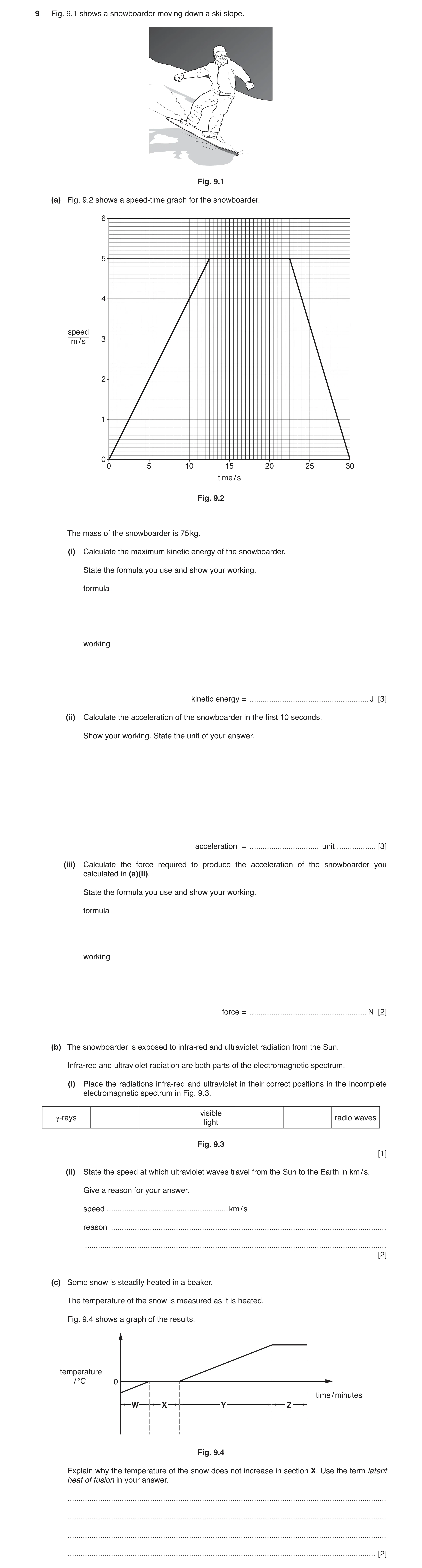
9 Fig. 9.1 shows a snowboarder moving down a ski slope. Fig. 9.1 (a) Fig. 9.2 shows a speed-time graph for the snowboarder. 6 5 4 speed 3 m / s 2 1 0 0 5 10 15 20 25 30 time / s Fig. 9.2 The mass of the snowboarder is 75 kg. (i) Calculate the maximum kinetic energy of the snowboarder. State the formula you use and show your working. formula working kinetic energy = … J [3] (ii) Calculate the acceleration of the snowboarder in the first 10 seconds. Show your working. State the unit of your answer. acceleration = … unit … [3] (iii) Calculate the force required to produce the acceleration of the snowboarder you calculated in (a)(ii). State the formula you use and show your working. formula working force = … N [2] (b) The snowboarder is exposed to infra-red and ultraviolet radiation from the Sun. Infra-red and ultraviolet radiation are both parts of the electromagnetic spectrum. (i) Place the radiations infra-red and ultraviolet in their correct positions in the incomplete electromagnetic spectrum in Fig. 9.3. visible γ-rays radio waves light Fig. 9.3 [1] (ii) State the speed at which ultraviolet waves travel from the Sun to the Earth in km / s. Give a reason for your answer. speed … km / s reason … … [2] (c) Some snow is steadily heated in a beaker. The temperature of the snow is measured as it is heated. Fig. 9.4 shows a graph of the results. temperature / °C 0 time / minutes W X Y Z Fig. 9.4 Explain why the temperature of the snow does not increase in section X. Use the term latent heat of fusion in your answer. … … … … [2]
13 marks
Mark scheme: 9(a)(i) maximum speed = 5.0 m/s ; KE = ½ mv2 OR ½ × 75 × 5 × 5 ; = 940 (J) ; 3 9(a)(ii) v t ∆ OR 4/10 OR 5/12.5 ; = 0.4 ; m/s2 ; 3 9(a)(iii) F = ma OR = 75 × 0.4 ; = 30 (N) ; 2 9(b)(i) ultraviolet written in correct box AND infra-red written in correct box ; 1 9(b)(ii) 300 000 (km/s) ; because all electromagnetic waves travel at this speed ; 2 9(c) latent heat of fusion required to melt snow ; to break bonds (between molecules)/to overcome attractive forces (between molecules) / to increase potential energy of the molecules ; 2
This question in 0654/41 Oct/Nov 2017
Q4 · An electric cooker connected to a mains supply of 240 V has a power input of 6000 W 0654/43 Oct/Nov 2017
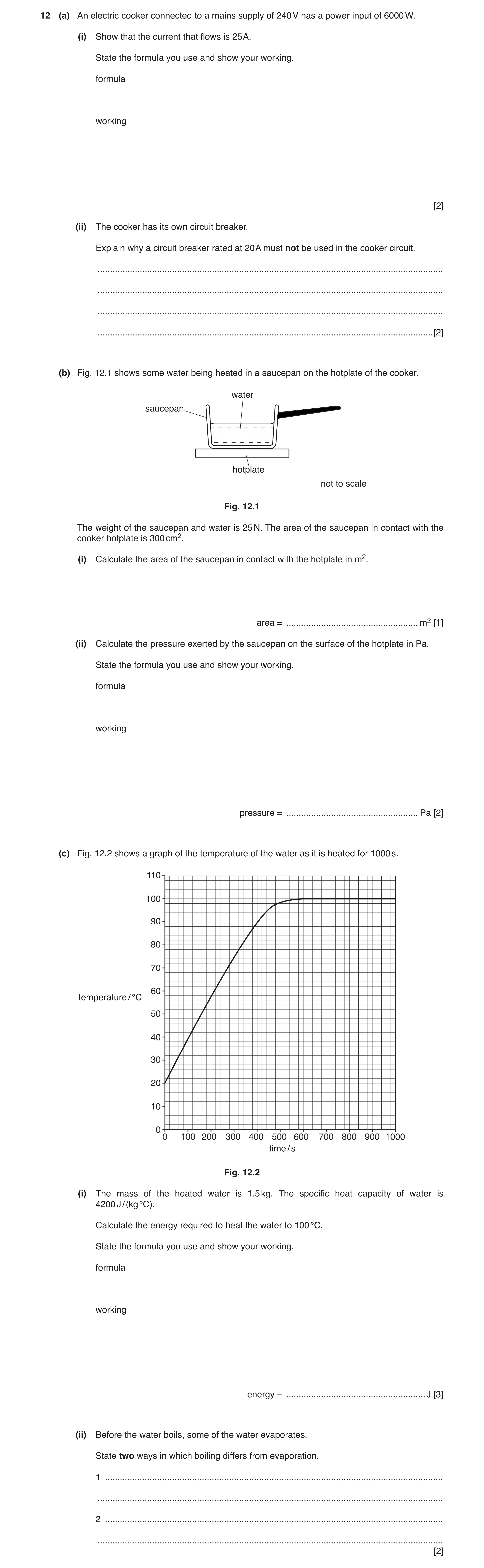
12 (a) An electric cooker connected to a mains supply of 240 V has a power input of 6000 W. (i) Show that the current that flows is 25 A. State the formula you use and show your working. formula working [2] (ii) The cooker has its own circuit breaker. Explain why a circuit breaker rated at 20 A must not be used in the cooker circuit. … … … … [2] (b) Fig. 12.1 shows some water being heated in a saucepan on the hotplate of the cooker. water saucepan hotplate not to scale Fig. 12.1 The weight of the saucepan and water is 25 N. The area of the saucepan in contact with the cooker hotplate is 300 cm2. (i) Calculate the area of the saucepan in contact with the hotplate in m2. area = … m2 [1] (ii) Calculate the pressure exerted by the saucepan on the surface of the hotplate in Pa. State the formula you use and show your working. formula working pressure = … Pa [2] (c) Fig. 12.2 shows a graph of the temperature of the water as it is heated for 1000 s. 110 100 90 80 70 60 temperature / °C 50 40 30 20 10 0 0 100 200 300 400 500 600 700 800 900 1000 time / s Fig. 12.2 (i) The mass of the heated water is 1.5 kg. The specific heat capacity of water is 4200 J / (kg °C). Calculate the energy required to heat the water to 100 °C. State the formula you use and show your working. formula working energy = … J [3] (ii) Before the water boils, some of the water evaporates. State two ways in which boiling differs from evaporation. 1 … … 2 … … [2]
12 marks
Mark scheme: 12(a)(i) P V = I ; = 6000 240 ; 2 12(a)(ii) breaker would trip at working current ; breaking current should be more than current rating of device OR 20A < 25A / working current ; 2 12(b)(i) 0.03 (m2) ; 1 12(b)(ii) F P A = OR 25 0.03 ; = 830 (Pa) ; 2 12(c)(i) temp rise = 80°C ; E = m c ∆T OR 1.5 × 4200 × 80 ; = 504 000 (J) ; 3 Question Answer Marks 12(c)(ii) evaporation can occur at any temperature / boiling only happens at the boiling point ; evaporation happens only at the surface / boiling happens throughout the liquid ; boiling takes energy in to occur / evaporation lets only the molecules with the highest kinetic energy out ; evaporation can occur using the internal energy of the system / boiling requires an external source of heat ; evaporation produces cooling / boiling does not produce cooling ; evaporation is a slow process / boiling is a rapid process ; max 2
This question in 0654/43 Oct/Nov 2017
Q5 · Ice is made by freezing some water in the freezing compartment of a refrigerator 0654/41 Oct/Nov 2018
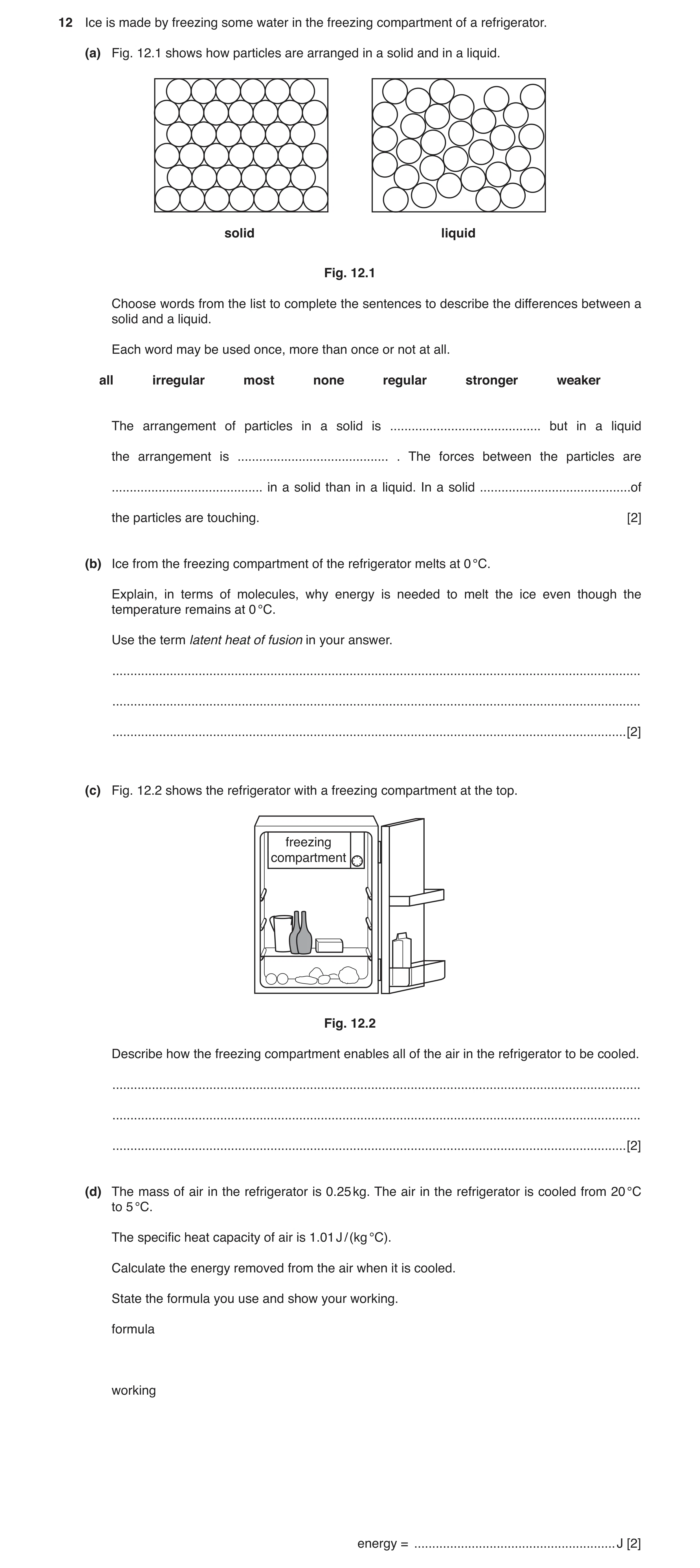
12 Ice is made by freezing some water in the freezing compartment of a refrigerator. (a) Fig. 12.1 shows how particles are arranged in a solid and in a liquid. solid liquid Fig. 12.1 Choose words from the list to complete the sentences to describe the differences between a solid and a liquid. Each word may be used once, more than once or not at all. all irregular most none regular stronger weaker The arrangement of particles in a solid is … but in a liquid the arrangement is … . The forces between the particles are … in a solid than in a liquid. In a solid … of the particles are touching. [2] (b) Ice from the freezing compartment of the refrigerator melts at 0 °C. Explain, in terms of molecules, why energy is needed to melt the ice even though the temperature remains at 0 °C. Use the term latent heat of fusion in your answer. … … … [2] (c) Fig. 12.2 shows the refrigerator with a freezing compartment at the top. freezing compartment Fig. 12.2 Describe how the freezing compartment enables all of the air in the refrigerator to be cooled. … … … [2] (d) The mass of air in the refrigerator is 0.25 kg. The air in the refrigerator is cooled from 20 °C to 5 °C. The specific heat capacity of air is 1.01 J / (kg °C). Calculate the energy removed from the air when it is cooled. State the formula you use and show your working. formula working energy = … J [2]
8 marks
Mark scheme: 12(a) regular irregular stronger all 4 correct ; 2 or 3 correct ; 2 12(b) latent heat of fusion is the energy needed ; to overcome forces of attraction between molecules ; 2 12(c) ref to convection ; cold air sinks and warm air rises ; 2 12(d) Energy = m × c × ∆T or 0.25 × 1.01 × 15 ; = 3.8 (J) ; 2
This question in 0654/41 Oct/Nov 2018
Q6 · In the school science laboratory, a student investigates how the resistance of a circuit… 0654/43 Oct/Nov 2018
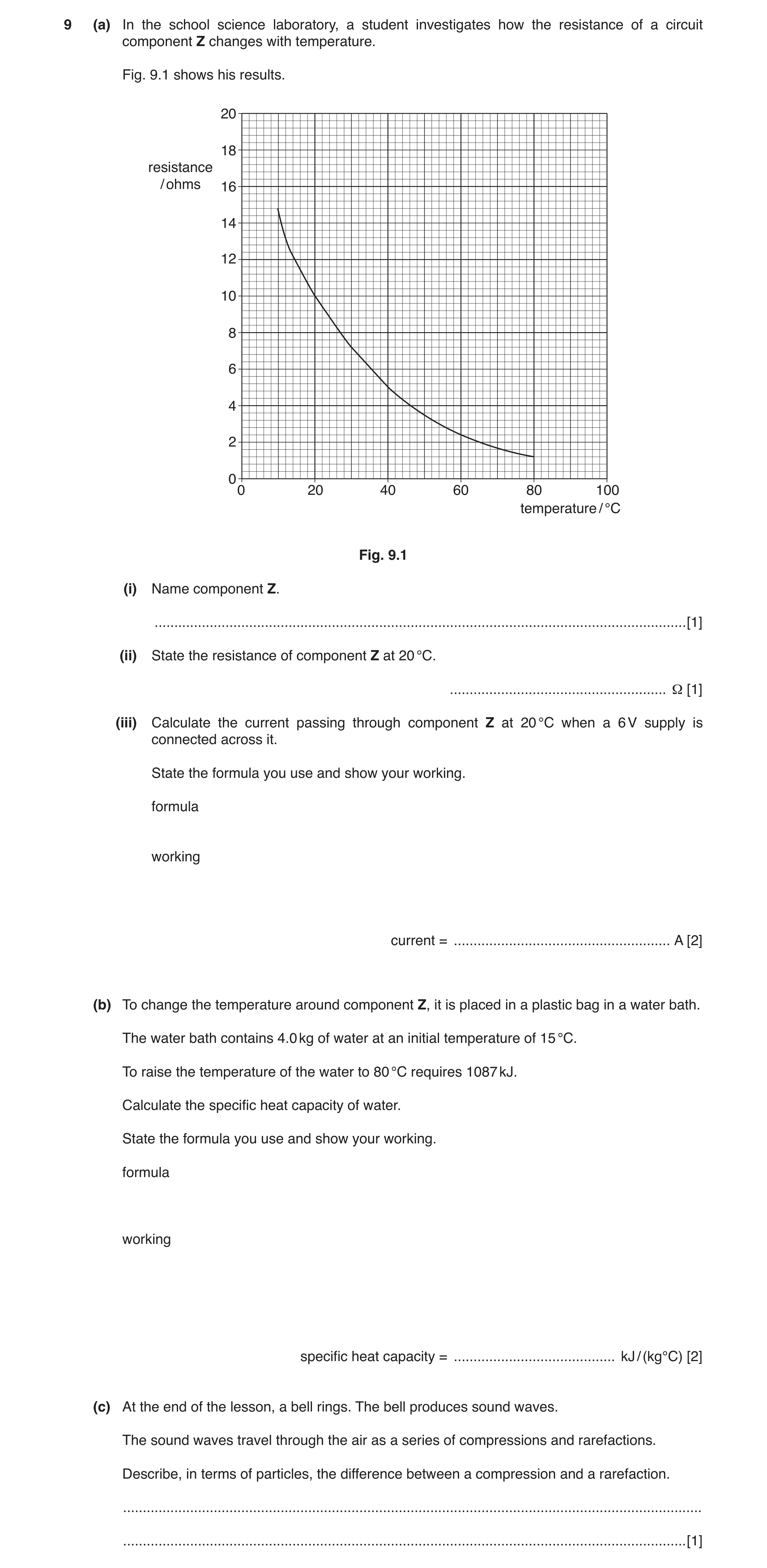
9 (a) In the school science laboratory, a student investigates how the resistance of a circuit component Z changes with temperature. Fig. 9.1 shows his results. 20 18 resistance / ohms 16 14 12 10 8 6 4 2 0 0 20 40 60 80 100 temperature / °C Fig. 9.1 (i) Name component Z. … [1] (ii) State the resistance of component Z at 20 °C. … Ω [1] (iii) Calculate the current passing through component Z at 20 °C when a 6 V supply is connected across it. State the formula you use and show your working. formula working current = … A [2] (b) To change the temperature around component Z, it is placed in a plastic bag in a water bath. The water bath contains 4.0 kg of water at an initial temperature of 15 °C. To raise the temperature of the water to 80 °C requires 1087 kJ. Calculate the specific heat capacity of water. State the formula you use and show your working. formula working specific heat capacity = … kJ / (kg°C) [2] (c) At the end of the lesson, a bell rings. The bell produces sound waves. The sound waves travel through the air as a series of compressions and rarefactions. Describe, in terms of particles, the difference between a compression and a rarefaction. … … [1]
7 marks
Mark scheme: 9(a)(i) thermistor ; 1 9(a)(ii) 10 (Ω) ; 1 9(a)(iii) current = voltage / resistance or 6 / 10 ; = 0.6 (A) ; 2 9(b) or 1087 4.0 65 × ; C = = 4.2 (kJ / (kg oC)) ; 2 9(c) compression region of high pressure / where the particles are close together ; 1
This question in 0654/43 Oct/Nov 2018
Q7 · A potato being baked in the oven of an electric cooker 0654/43 May/June 2019
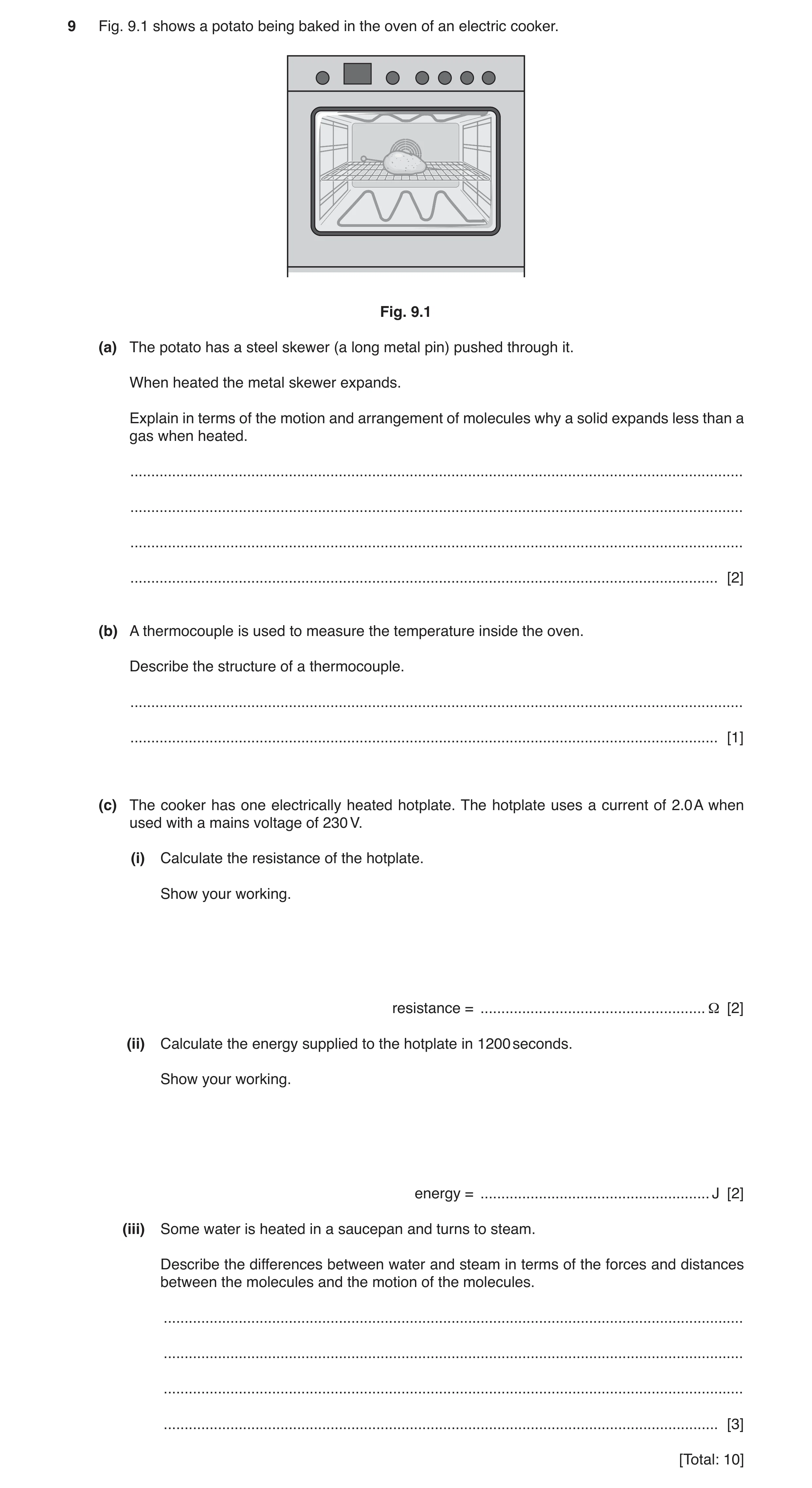
9 Fig. 9.1 shows a potato being baked in the oven of an electric cooker. Fig. 9.1 (a) The potato has a steel skewer (a long metal pin) pushed through it. When heated the metal skewer expands. Explain in terms of the motion and arrangement of molecules why a solid expands less than a gas when heated. … … … … [2] (b) A thermocouple is used to measure the temperature inside the oven. Describe the structure of a thermocouple. … … [1] (c) The cooker has one electrically heated hotplate. The hotplate uses a current of 2.0 A when used with a mains voltage of 230 V. (i) Calculate the resistance of the hotplate. Show your working. resistance = … Ω [2] (ii) Calculate the energy supplied to the hotplate in 1200 seconds. Show your working. energy = … J [2] (iii) Some water is heated in a saucepan and turns to steam. Describe the differences between water and steam in terms of the forces and distances between the molecules and the motion of the molecules. … … … … [3] [Total: 10]
10 marks
Mark scheme: 9(a) particles in a gas are not/weakly bonded ; particles in a gas move further apart ; 2 9(b) two different metals joined together ; 1 9(c)(i) (R =) V / I or 230 / 2.0 ; = 120 / 115 (Ω) ; 2 9(c)(ii) (E =) V × I × t or 230 × 2.0 × 1200 ; 550 000 / 552 000 (J) ; 2 9(c)(iii) stronger forces of attraction between molecules in liquid water ; molecules are closer together in liquid water ; molecules in liquid water move around each other or molecules in steam move throughout the gas / move further between collisions ; 3
This question in 0654/43 May/June 2019
Q8 · The information booklet about an oven states that the weight of the oven is 45 kg 0654/42 Oct/Nov 2020
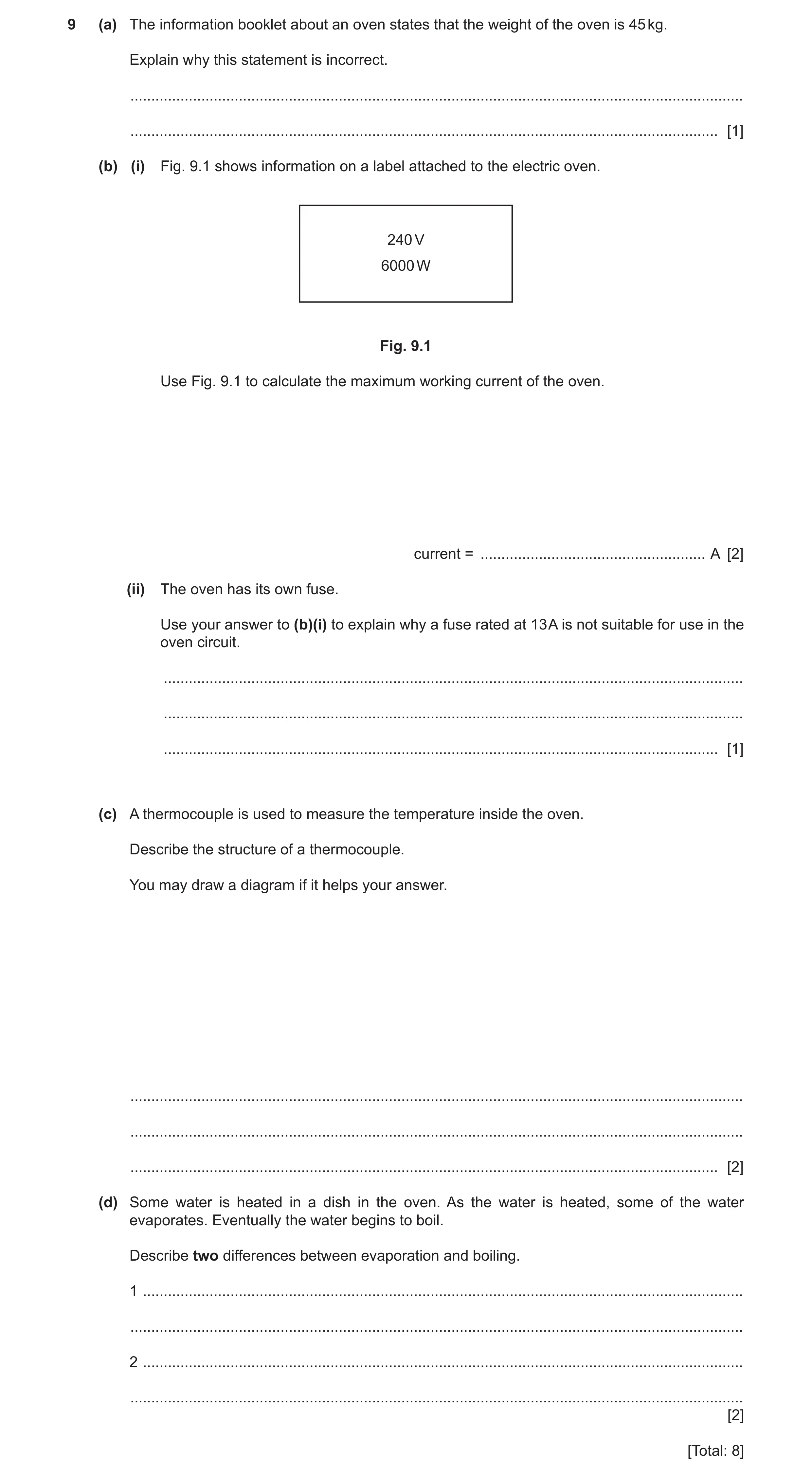
9 (a) The information booklet about an oven states that the weight of the oven is 45 kg. Explain why this statement is incorrect. … … [1] (b) (i) Fig. 9.1 shows information on a label attached to the electric oven. 240 V 6000 W Fig. 9.1 Use Fig. 9.1 to calculate the maximum working current of the oven. current = … A [2] (ii) The oven has its own fuse. Use your answer to (b)(i) to explain why a fuse rated at 13 A is not suitable for use in the oven circuit. … … … [1] (c) A thermocouple is used to measure the temperature inside the oven. Describe the structure of a thermocouple. You may draw a diagram if it helps your answer. … … … [2] (d) Some water is heated in a dish in the oven. As the water is heated, some of the water evaporates. Eventually the water begins to boil. Describe two differences between evaporation and boiling. 1 … … 2 … … [2] [Total: 8]
8 marks
Mark scheme: 9(a) mass is measured in kg / weight is measured in newtons; 1 9(b)(i) I = P / V or working 6000 / 240; current = 25 (A); 2 9(b)(ii) fuse rating should be higher than working current / fuse will blow ; 1 9(c) two different metals ; joined together / to make junction(s) ; 2 Question Answer Marks 9(d) evaporation can occur at any temperature / boiling occurs at the boiling point ; evaporation happens only at the surface / boiling occurs throughout the liquid ; during boiling, all / most, molecules have enough energy to leave / evaporation only lets the molecules with the greatest kinetic energy escape ; evaporation can occur using the internal energy of the system / boiling requires a(n external) source of heat ; evaporation is a slow process / boiling is a rapid process ; evaporation produces cooling / boiling does not produce cooling ; max 2 2
This question in 0654/42 Oct/Nov 2020
Q9 · A truck crossing a bridge 0654/42 Oct/Nov 2020
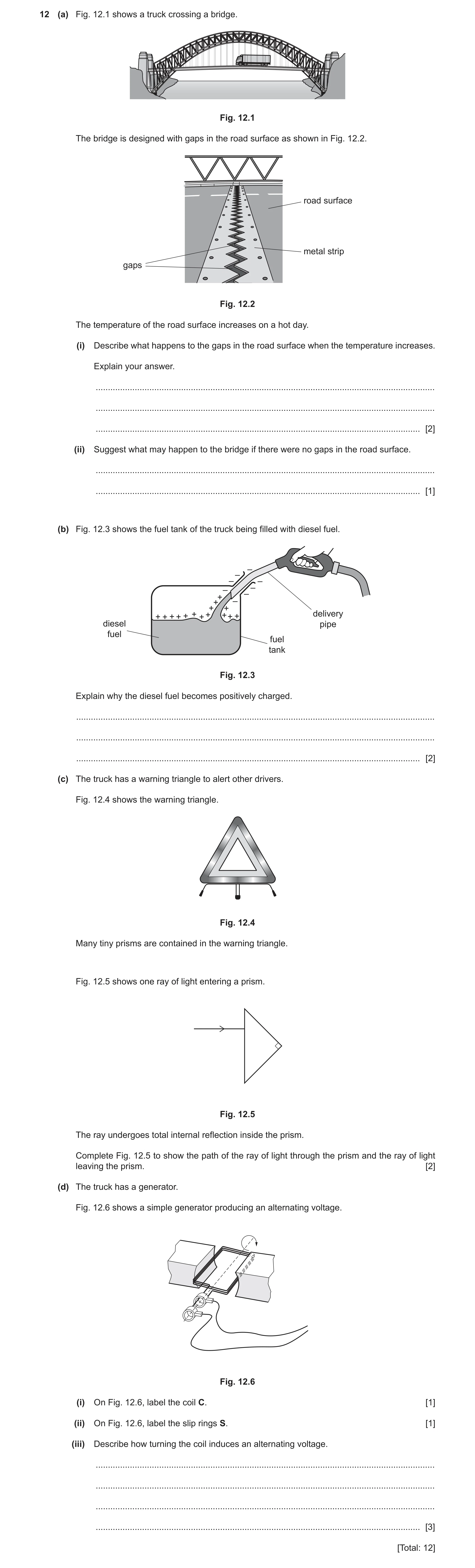
12 (a) Fig. 12.1 shows a truck crossing a bridge. Fig. 12.1 The bridge is designed with gaps in the road surface as shown in Fig. 12.2. road surface metal strip gaps Fig. 12.2 The temperature of the road surface increases on a hot day. (i) Describe what happens to the gaps in the road surface when the temperature increases. Explain your answer. … … … [2] (ii) Suggest what may happen to the bridge if there were no gaps in the road surface. … … [1] (b) Fig. 12.3 shows the fuel tank of the truck being filled with diesel fuel. – – – – – – – + + – + + + + + + + + + + ++ + delivery diesel pipe fuel fuel tank Fig. 12.3 Explain why the diesel fuel becomes positively charged. … … … [2] (c) The truck has a warning triangle to alert other drivers. Fig. 12.4 shows the warning triangle. Fig. 12.4 Many tiny prisms are contained in the warning triangle. Fig. 12.5 shows one ray of light entering a prism. Fig. 12.5 The ray undergoes total internal reflection inside the prism. Complete Fig. 12.5 to show the path of the ray of light through the prism and the ray of light leaving the prism. [2] (d) The truck has a generator. Fig. 12.6 shows a simple generator producing an alternating voltage. Fig. 12.6 (i) On Fig. 12.6, label the coil C. [1] (ii) On Fig. 12.6, label the slip rings S. [1] (iii) Describe how turning the coil induces an alternating voltage. … … … … [3] [Total: 12]
12 marks
Mark scheme: 12(a)(i) gap closes ; road expands in the heat ; 2 12(a)(ii) (the road will) buckle / bend / break / be damaged ; 1 Question Answer Marks 12(b) ref to friction / described ; transfer of electrons ; from the fuel (to the pipe) ; max 2 2 12(c) reflection only shown at first reflection ; after second reflection ray emerges parallel to incident ray ; 2 12(d)(i) coil correctly labelled ; 1 12(d)(ii) slip rings correctly labelled ; 1 12(d)(iii) magnetic field ; rotating coil cuts magnetic field or flux / experiences a changing magnetic field ; e.m.f. / current reverses every half turn ; 3
This question in 0654/42 Oct/Nov 2020
Question 10 0654/42 Feb/March 2022
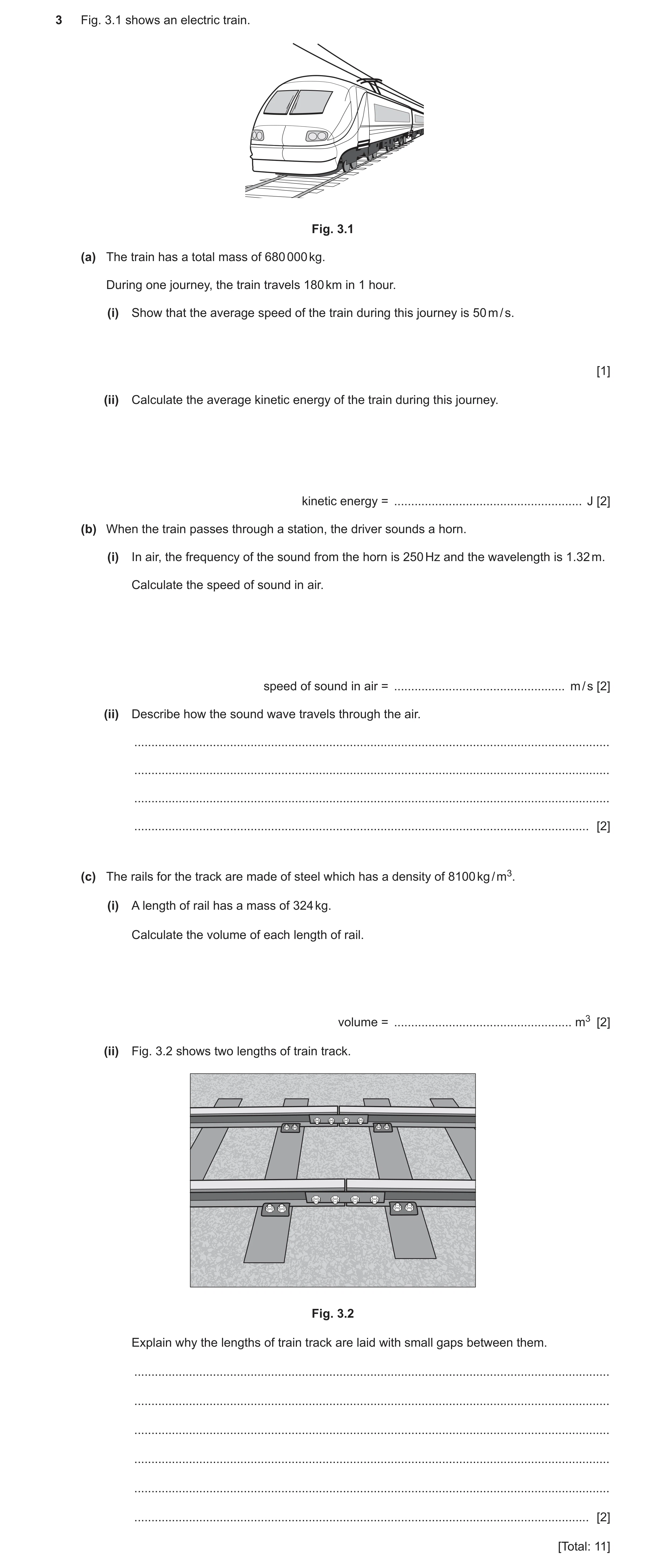
3 Fig. 3.1 shows an electric train. Fig. 3.1 (a) The train has a total mass of 680 000 kg. During one journey, the train travels 180 km in 1 hour. (i) Show that the average speed of the train during this journey is 50 m / s. [1] (ii) Calculate the average kinetic energy of the train during this journey. kinetic energy = … J [2] (b) When the train passes through a station, the driver sounds a horn. (i) In air, the frequency of the sound from the horn is 250 Hz and the wavelength is 1.32 m. Calculate the speed of sound in air. speed of sound in air = … m / s [2] (ii) Describe how the sound wave travels through the air. … … … … [2] (c) The rails for the track are made of steel which has a density of 8100 kg / m3. (i) A length of rail has a mass of 324 kg. Calculate the volume of each length of rail. volume = … m3 [2] (ii) Fig. 3.2 shows two lengths of train track. Fig. 3.2 Explain why the lengths of train track are laid with small gaps between them. … … … … … … [2] [Total: 11]
11 marks
Mark scheme: 3(a)(i) 180 000 / 3600 (= 50 m / s) ; 1 3(a)(ii) (KE = ) ½ mv2 or ½ × 680 000 × 502 ; (KE = ) 850 000 000 (J) ; 2 3(b)(i) (v = ) f λ or 250 × 1.32 ; (v = ) 330 (m / s) ; 2 3(b)(ii) vibrations / oscillations, of (air) particles ; rarefaction and compressions ; 2 3(c)(i) (V = ) m / ρ (in any form) or 324 / 8100 ; (V = ) 0.04 (m3) ; 2 3(c)(ii) when the temperature of the tracks increases, the tracks will expand ; the gaps prevent buckling of the tracks / owtte ; 2
This question in 0654/42 Feb/March 2022
Q11 · A student investigates the use of cotton wool to insulate a beaker of hot water at 90 °C 0654/42 Oct/Nov 2024
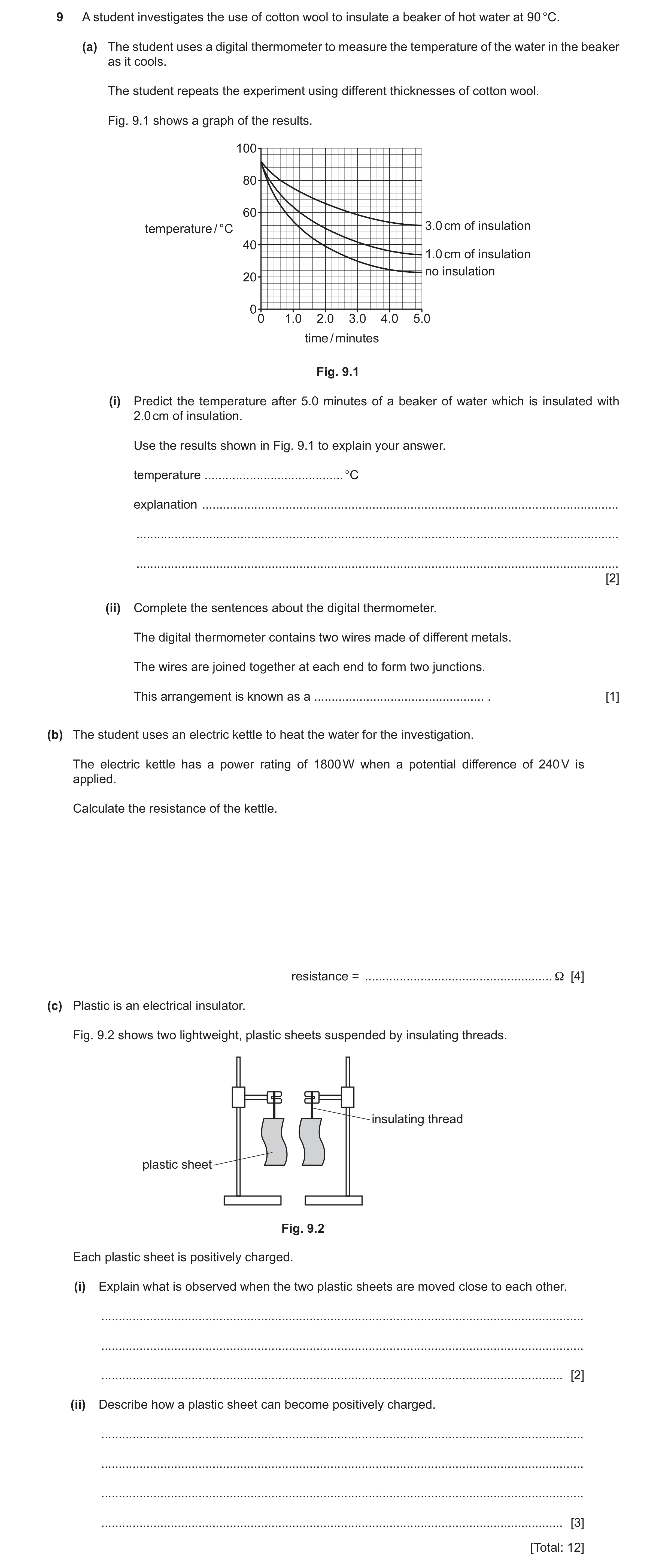
9 A student investigates the use of cotton wool to insulate a beaker of hot water at 90 °C. (a) The student uses a digital thermometer to measure the temperature of the water in the beaker as it cools. The student repeats the experiment using different thicknesses of cotton wool. Fig. 9.1 shows a graph of the results. 100 80 60 temperature / °C 3.0 cm of insulation 40 1.0 cm of insulation no insulation 20 00 1.0 2.0 3.0 4.0 5.0 time / minutes Fig. 9.1 (i) Predict the temperature after 5.0 minutes of a beaker of water which is insulated with 2.0 cm of insulation. Use the results shown in Fig. 9.1 to explain your answer. temperature … °C explanation … … … [2] (ii) Complete the sentences about the digital thermometer. The digital thermometer contains two wires made of different metals. The wires are joined together at each end to form two junctions. This arrangement is known as a … . [1] (b) The student uses an electric kettle to heat the water for the investigation. The electric kettle has a power rating of 1800 W when a potential difference of 240 V is applied. Calculate the resistance of the kettle. resistance = … Ω [4] (c) Plastic is an electrical insulator. Fig. 9.2 shows two lightweight, plastic sheets suspended by insulating threads. insulating thread plastic sheet Fig. 9.2 Each plastic sheet is positively charged. (i) Explain what is observed when the two plastic sheets are moved close to each other. … … … [2] (ii) Describe how a plastic sheet can become positively charged. … … … … [3] [Total: 12]
12 marks
Mark scheme: 9(a)(i) any temperature in the inclusive range 36–50 (°C) ; 2 2.0 cm reduces the rate of conduction (to the surroundings) more than 1.0 cm but less than 3.0 cm / OWTTE ; 9(a)(ii) thermocouple ; 1 9(b) evidence of (I =) P ÷ V or 1800 ÷ 240 ; 4 (I =) 7.5 (A) ; evidence of R = V ÷ I or 240 ÷ 7.5 ; (R =) 32 () ; 9(c)(i) move away from each other ; 2 like charges repel ; 9(c)(ii) friction (with another surface) ; 3 transfer of electrons ; (particles move) from the plastic / to the surface it is rubbing against ;
This question in 0654/42 Oct/Nov 2024
 1 / 21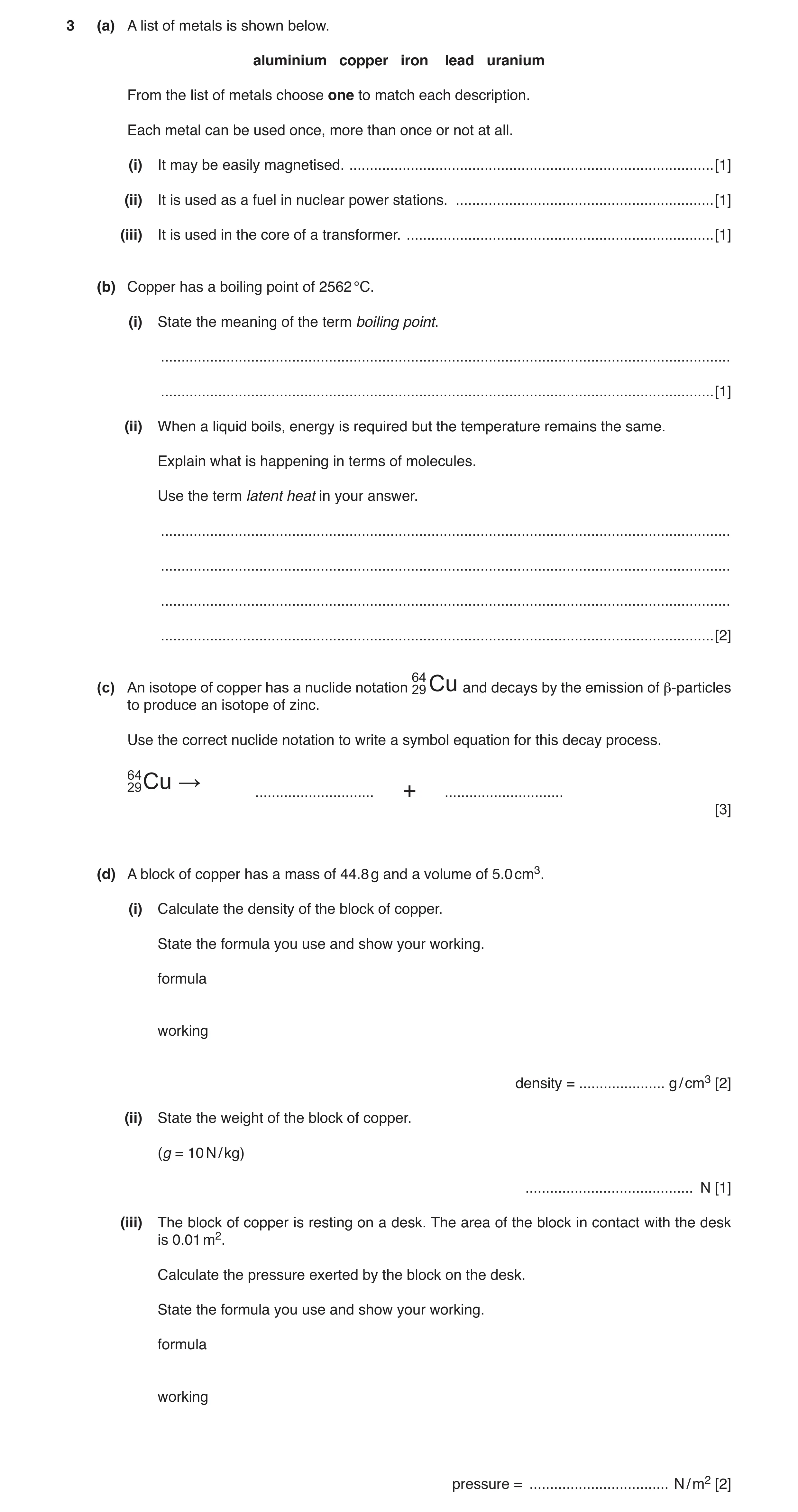
 7
7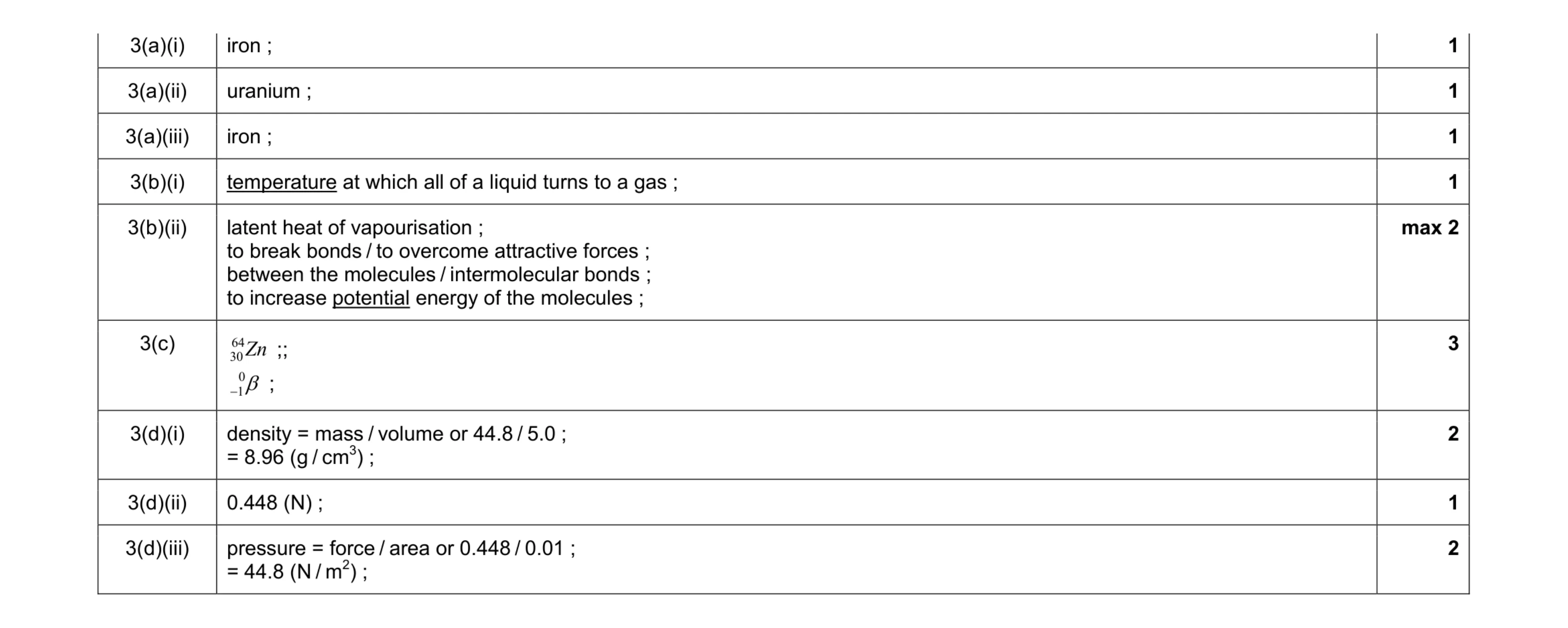 14
14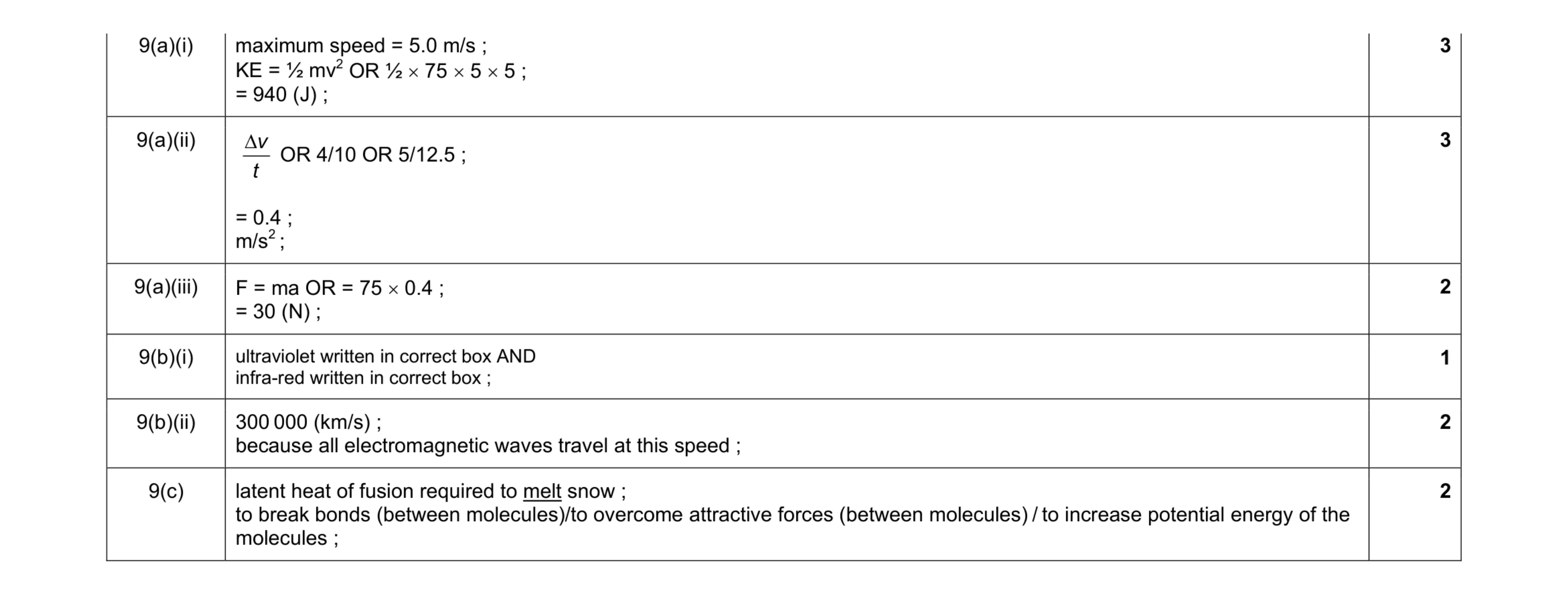 13
13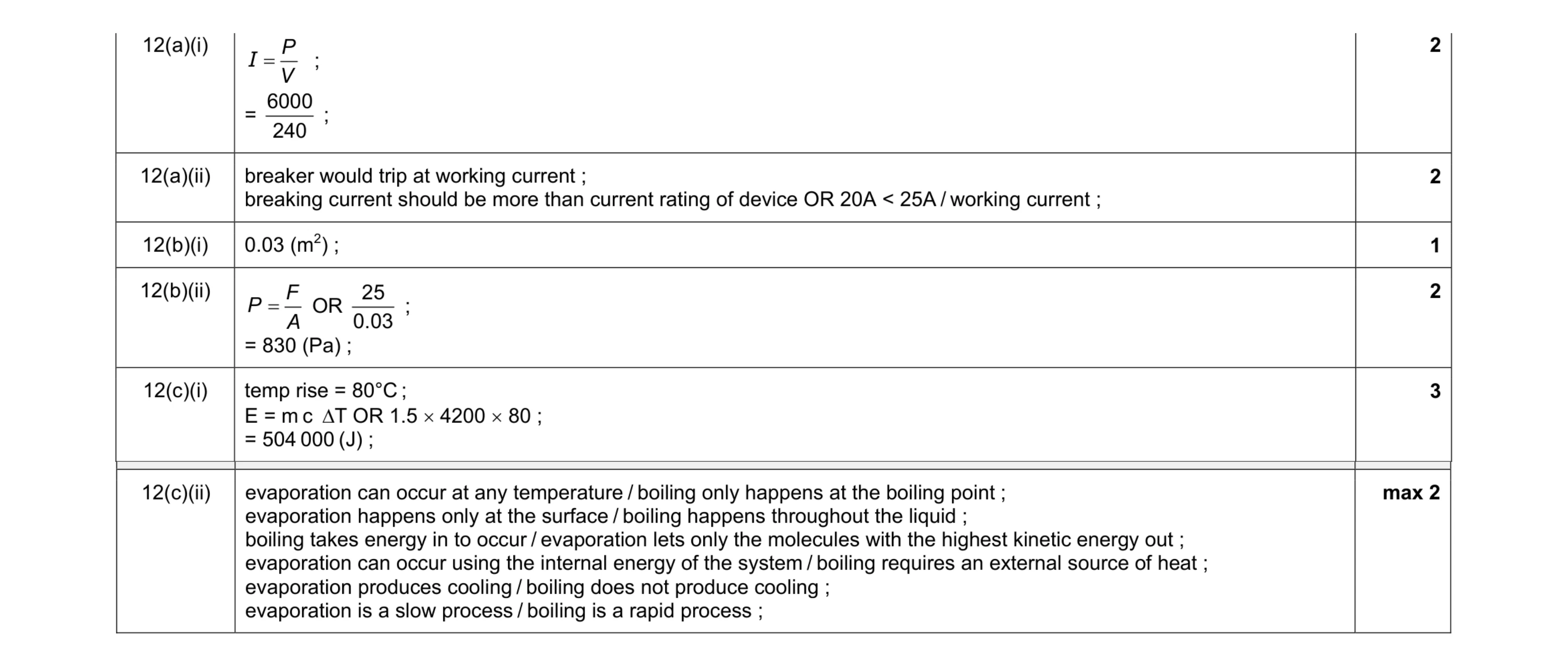 12
12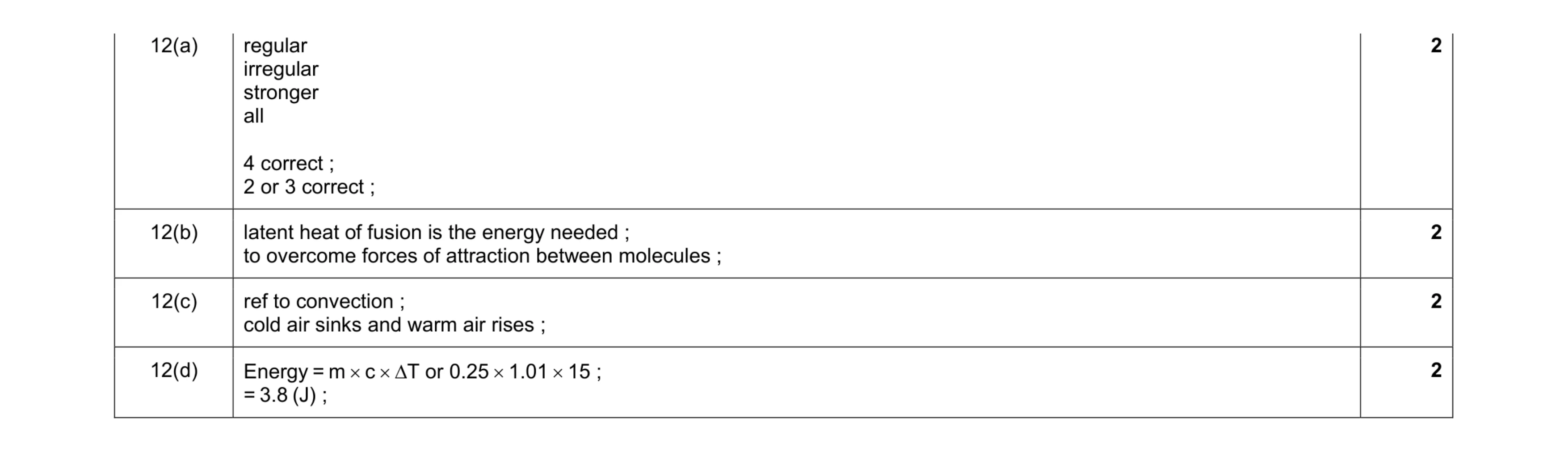 8
8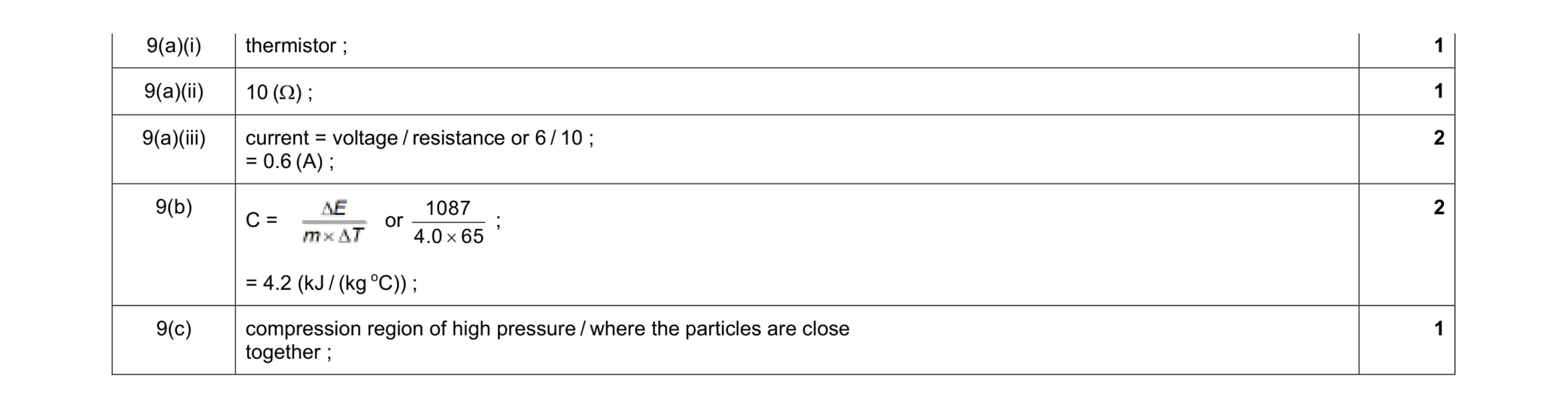 7
7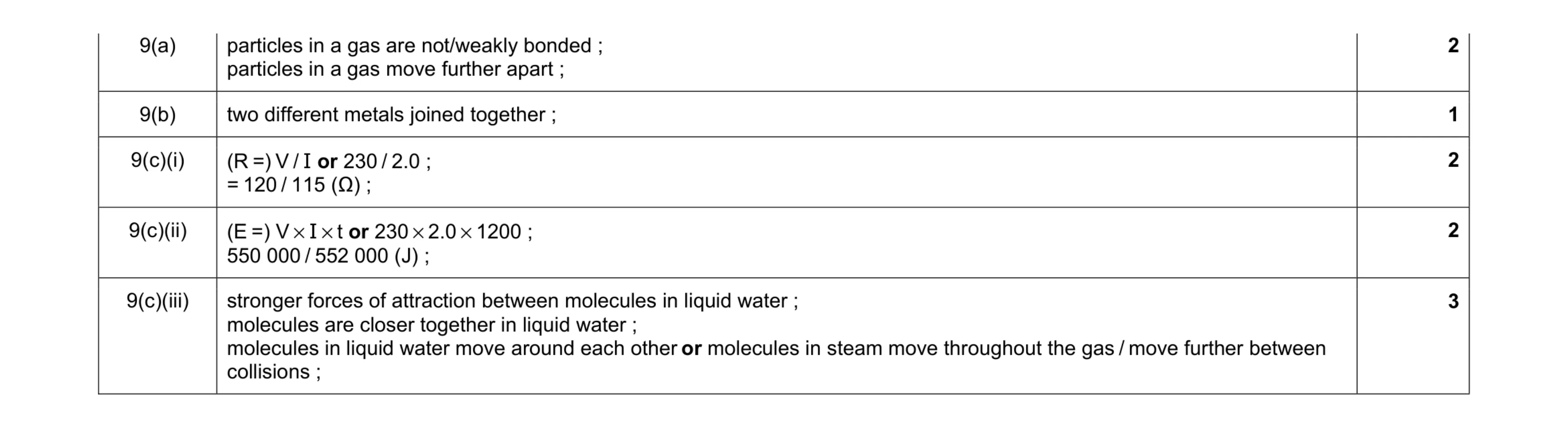 10
10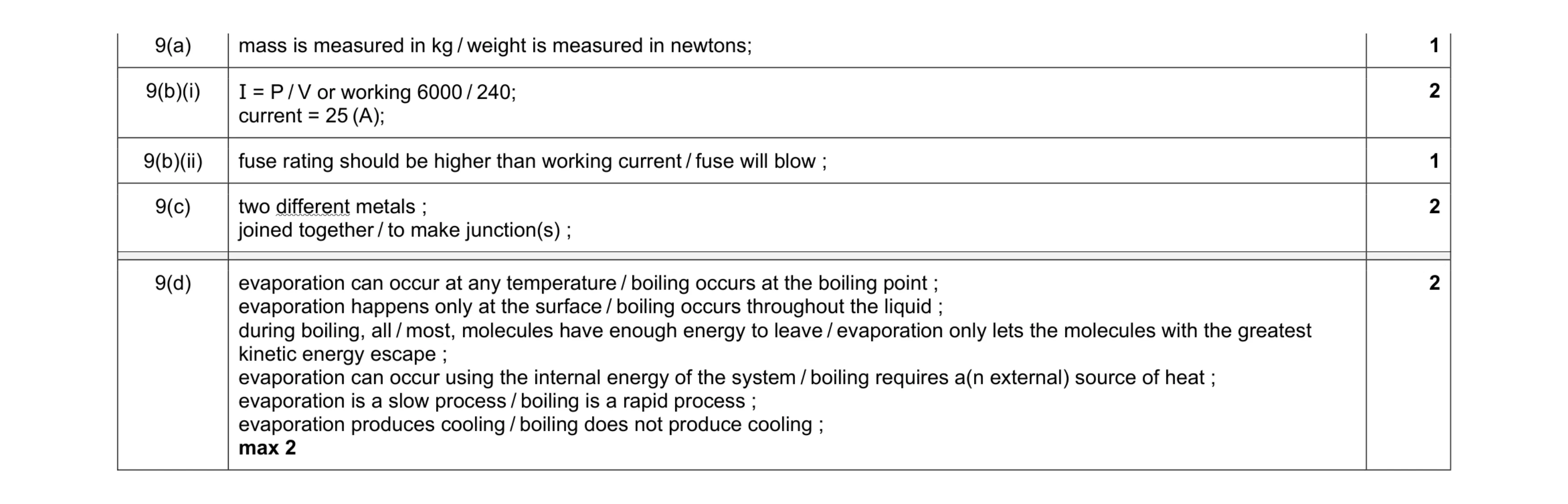 8
8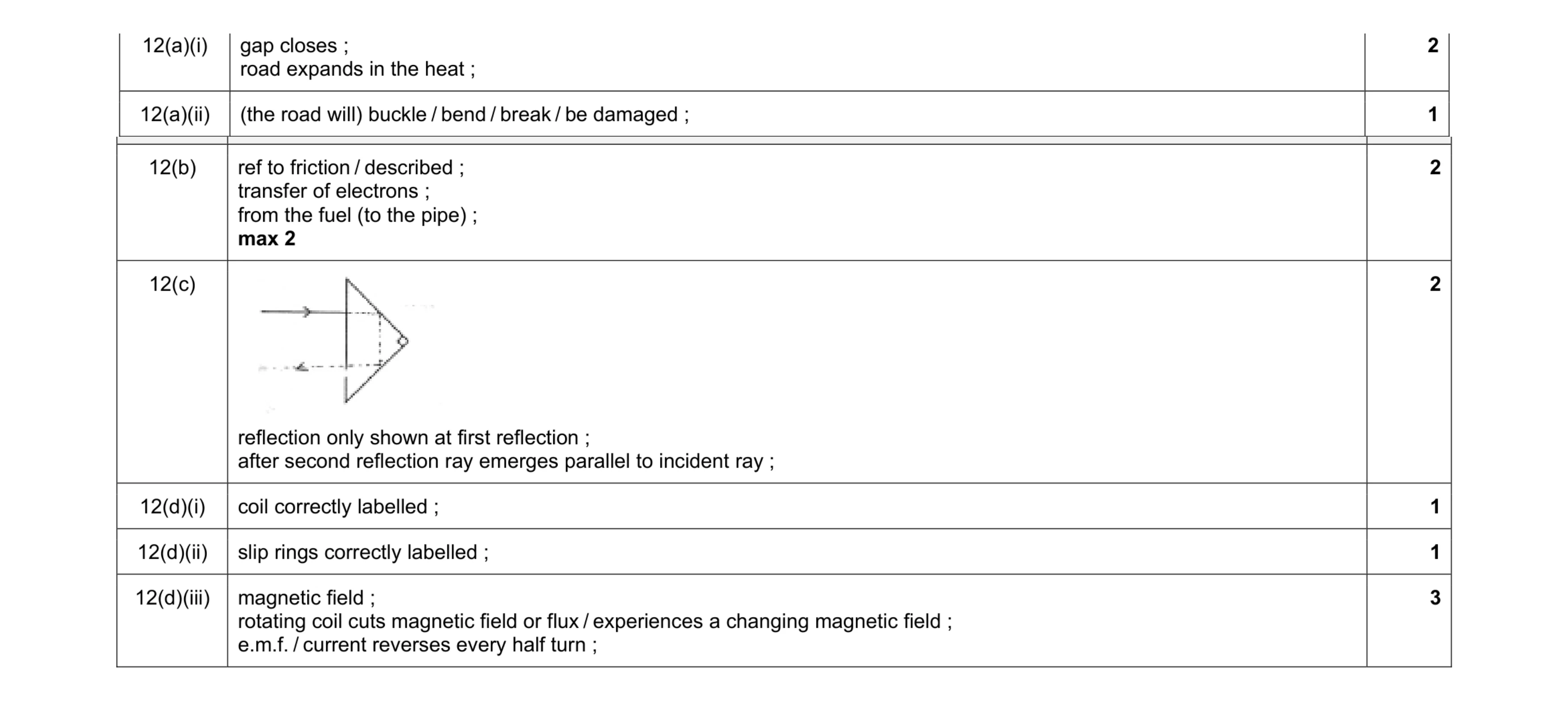 12
12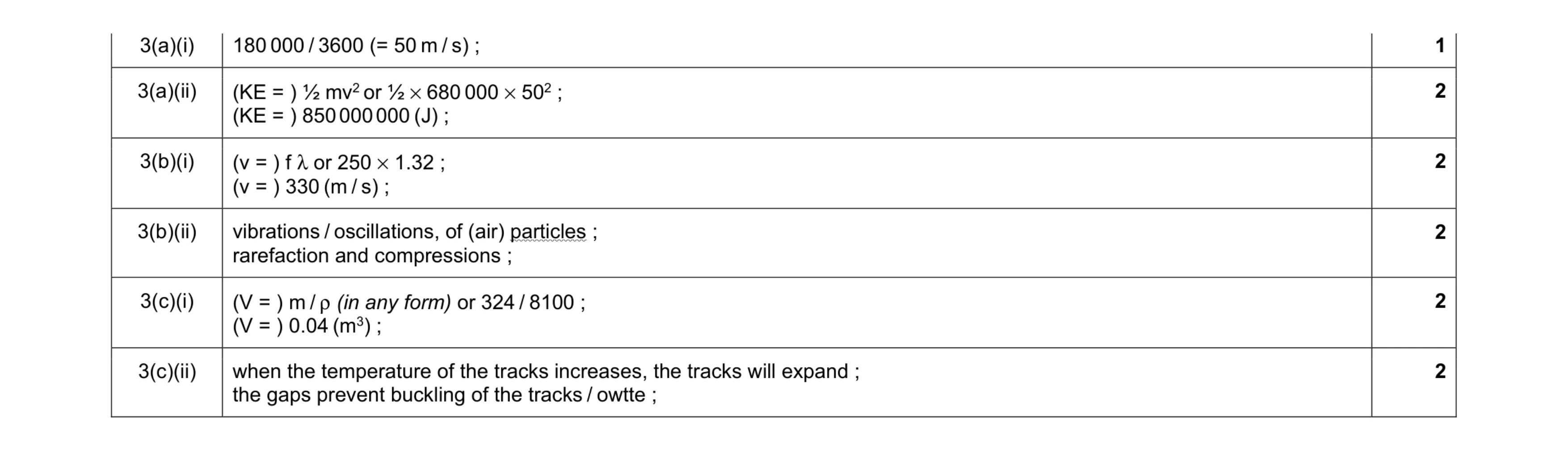 11
11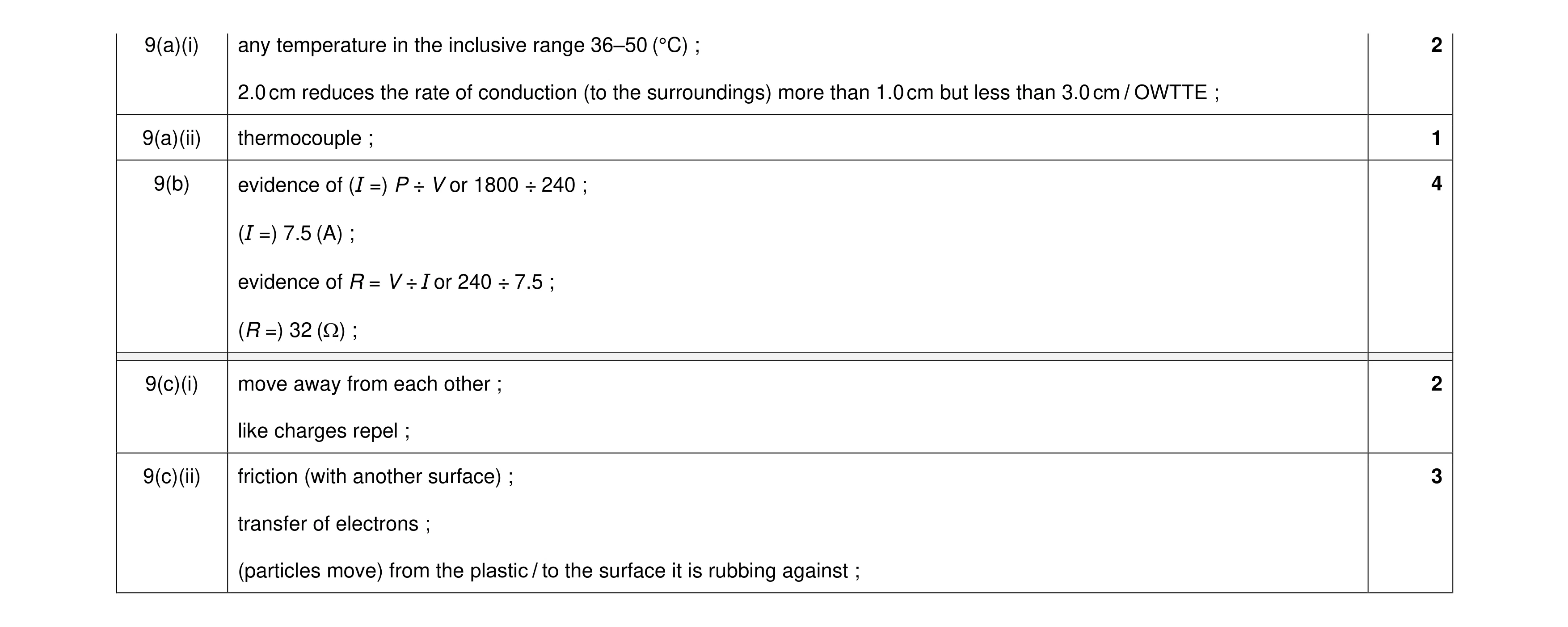 12
12