Questions as text
Q1 · Four swimmers are competing at a swimming pool 0654/31 Oct/Nov 2017
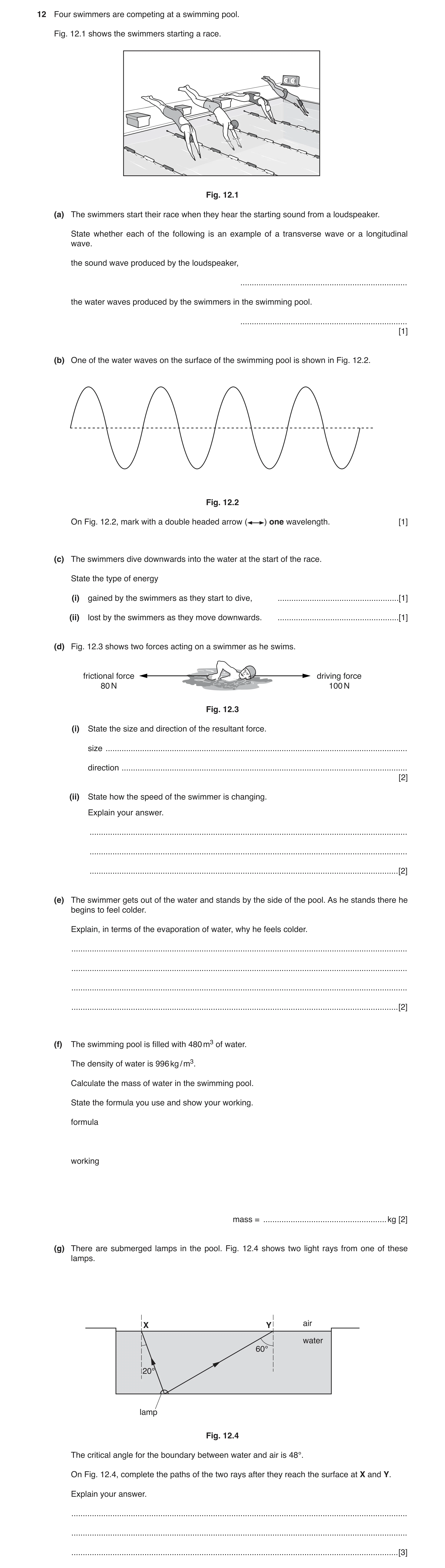
12 Four swimmers are competing at a swimming pool. Fig. 12.1 shows the swimmers starting a race. Fig. 12.1 (a) The swimmers start their race when they hear the starting sound from a loudspeaker. State whether each of the following is an example of a transverse wave or a longitudinal wave. the sound wave produced by the loudspeaker, … the water waves produced by the swimmers in the swimming pool. … [1] (b) One of the water waves on the surface of the swimming pool is shown in Fig. 12.2. Fig. 12.2 On Fig. 12.2, mark with a double headed arrow ( ) one wavelength. [1] (c) The swimmers dive downwards into the water at the start of the race. State the type of energy (i) gained by the swimmers as they start to dive, … [1] (ii) lost by the swimmers as they move downwards. … [1] (d) Fig. 12.3 shows two forces acting on a swimmer as he swims. frictional force driving force 80 N 100 N Fig. 12.3 (i) State the size and direction of the resultant force. size … direction … [2] (ii) State how the speed of the swimmer is changing. Explain your answer. … … … [2] (e) The swimmer gets out of the water and stands by the side of the pool. As he stands there he begins to feel colder. Explain, in terms of the evaporation of water, why he feels colder. … … … … [2] (f) The swimming pool is filled with 480 m3 of water. The density of water is 996 kg / m3. Calculate the mass of water in the swimming pool. State the formula you use and show your working. formula working mass = … kg [2] (g) There are submerged lamps in the pool. Fig. 12.4 shows two light rays from one of these lamps. X Y air water 60° 20° lamp Fig. 12.4 The critical angle for the boundary between water and air is 48°. On Fig. 12.4, complete the paths of the two rays after they reach the surface at X and Y. Explain your answer. … … … [3]
15 marks
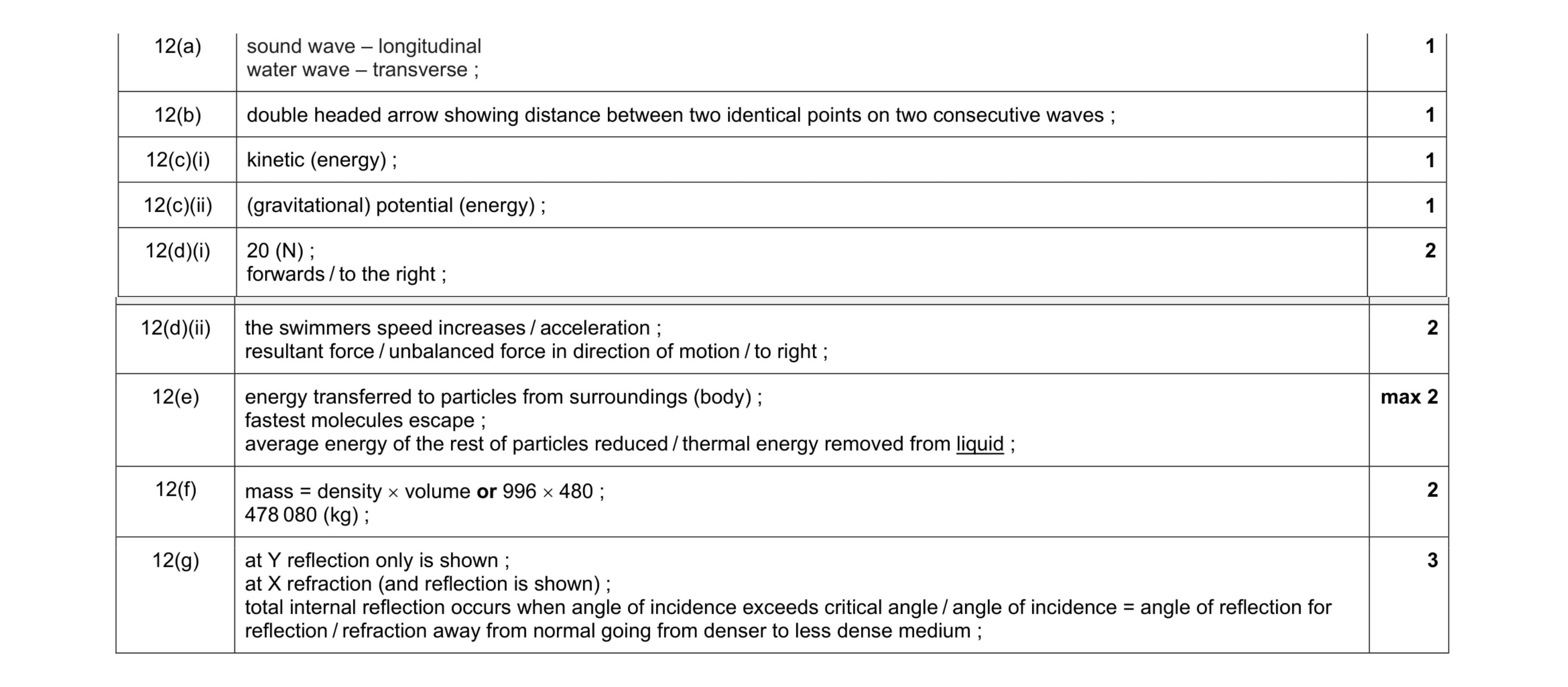
Mark scheme: 12(a) sound wave – longitudinal water wave – transverse ; 1 12(b) double headed arrow showing distance between two identical points on two consecutive waves ; 1 12(c)(i) kinetic (energy) ; 1 12(c)(ii) (gravitational) potential (energy) ; 1 12(d)(i) 20 (N) ; forwards / to the right ; 2 Question Answer Marks 12(d)(ii) the swimmers speed increases / acceleration ; resultant force / unbalanced force in direction of motion / to right ; 2 12(e) energy transferred to particles from surroundings (body) ; fastest molecules escape ; average energy of the rest of particles reduced / thermal energy removed from liquid ; max 2 12(f) mass = density × volume or 996 × 480 ; 478 080 (kg) ; 2 12(g) at Y reflection only is shown ; at X refraction (and reflection is shown) ; total internal reflection occurs when angle of incidence exceeds critical angle / angle of incidence = angle of reflection for reflection / refraction away from normal going from denser to less dense medium ; 3
This question in 0654/31 Oct/Nov 2017
Q2 · A metal saucepan containing water is placed onto the hot‑plate of an electric cooker 0654/32 Oct/Nov 2018
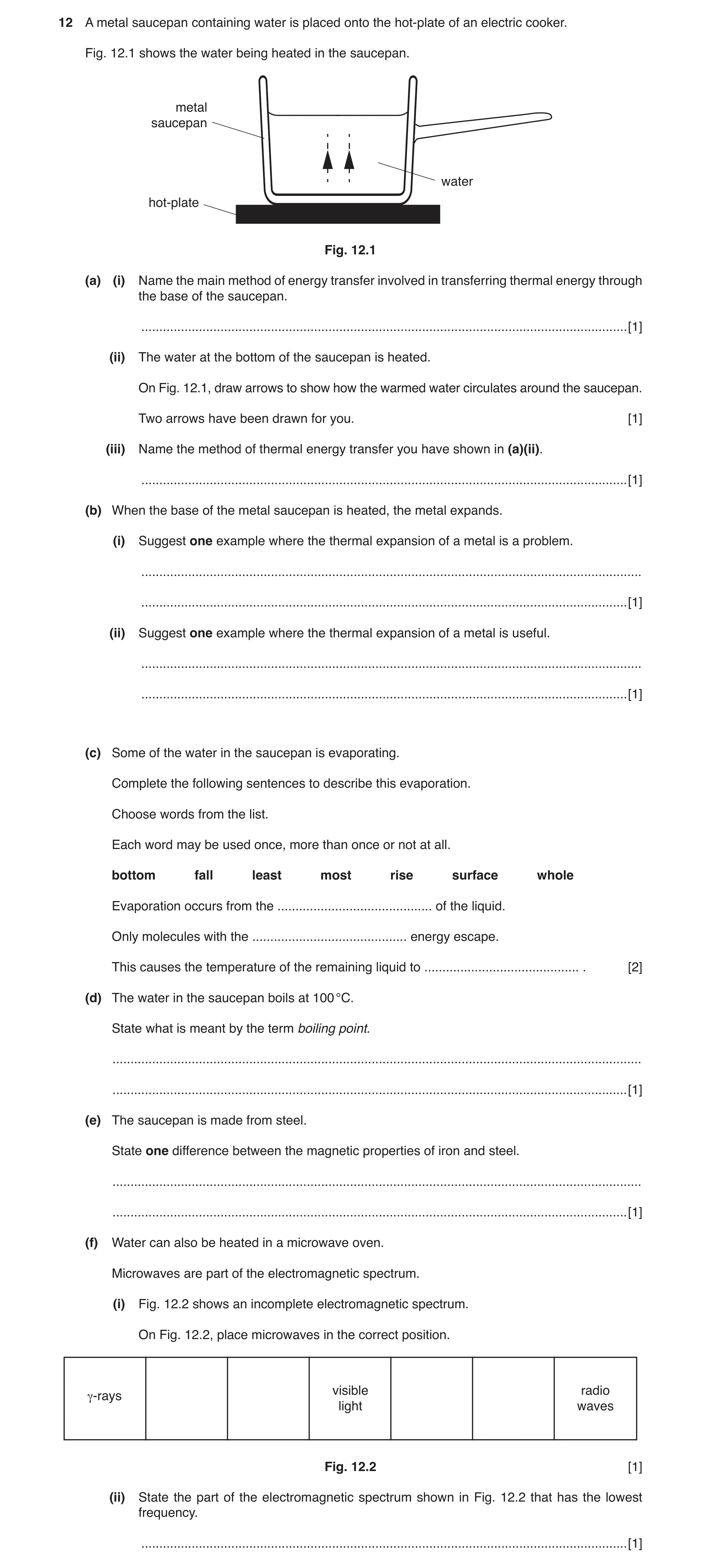
12 A metal saucepan containing water is placed onto the hot‑plate of an electric cooker. Fig. 12.1 shows the water being heated in the saucepan. metal saucepan water hot-plate Fig. 12.1 (a) (i) Name the main method of energy transfer involved in transferring thermal energy through the base of the saucepan. … [1] (ii) The water at the bottom of the saucepan is heated. On Fig. 12.1, draw arrows to show how the warmed water circulates around the saucepan. Two arrows have been drawn for you. [1] (iii) Name the method of thermal energy transfer you have shown in (a)(ii). … [1] (b) When the base of the metal saucepan is heated, the metal expands. (i) Suggest one example where the thermal expansion of a metal is a problem. … … [1] (ii) Suggest one example where the thermal expansion of a metal is useful. … … [1] (c) Some of the water in the saucepan is evaporating. Complete the following sentences to describe this evaporation. Choose words from the list. Each word may be used once, more than once or not at all. bottom fall least most rise surface whole Evaporation occurs from the … of the liquid. Only molecules with the … energy escape. This causes the temperature of the remaining liquid to … . [2] (d) The water in the saucepan boils at 100 °C. State what is meant by the term boiling point. … … [1] (e) The saucepan is made from steel. State one difference between the magnetic properties of iron and steel. … … [1] (f) Water can also be heated in a microwave oven. Microwaves are part of the electromagnetic spectrum. (i) Fig. 12.2 shows an incomplete electromagnetic spectrum. On Fig. 12.2, place microwaves in the correct position. visible radioγ-rays light waves Fig. 12.2 [1] (ii) State the part of the electromagnetic spectrum shown in Fig. 12.2 that has the lowest frequency. … [1]
11 marks
Mark scheme: 12(a)(i) conduction; 1 12(a)(ii) convection current drawn; 1 12(a)(iii) convection; 1 12(b)(i) railway tracks / overhead power cables; 1 12(b)(ii) thermostat / thermometer; 1 12(c) surface most fall 1 or 2 correct; 3 correct; 2 12(d) temperature at which a liquid changes into a gas; 1 12(e) iron loses magnetism quicker than steel steel is magnetised more slowly than iron; 1 12(f)(i) box to the left of radio waves; 1 12(f)(ii) radio waves; 1
This question in 0654/32 Oct/Nov 2018
Q3 · Some ice has been made by freezing water 0654/33 Oct/Nov 2018
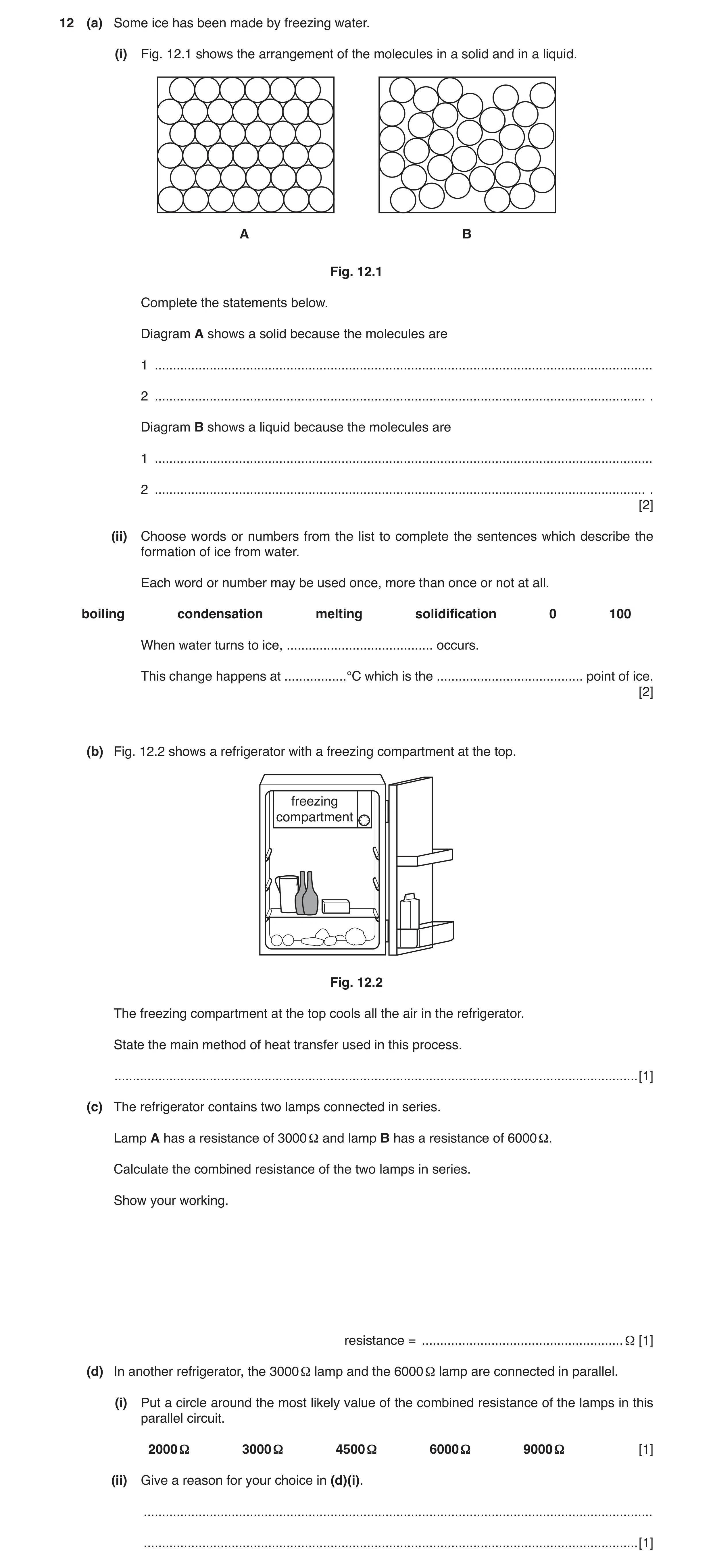
12 (a) Some ice has been made by freezing water. (i) Fig. 12.1 shows the arrangement of the molecules in a solid and in a liquid. A B Fig. 12.1 Complete the statements below. Diagram A shows a solid because the molecules are 1 … 2 … . Diagram B shows a liquid because the molecules are 1 … 2 … . [2] (ii) Choose words or numbers from the list to complete the sentences which describe the formation of ice from water. Each word or number may be used once, more than once or not at all. boiling condensation melting solidification 0 100 When water turns to ice, … occurs. This change happens at … °C which is the … point of ice. [2] (b) Fig. 12.2 shows a refrigerator with a freezing compartment at the top. freezing compartment Fig. 12.2 The freezing compartment at the top cools all the air in the refrigerator. State the main method of heat transfer used in this process. … [1] (c) The refrigerator contains two lamps connected in series. Lamp A has a resistance of 3000 Ω and lamp B has a resistance of 6000 Ω. Calculate the combined resistance of the two lamps in series. Show your working. resistance = … Ω [1] (d) In another refrigerator, the 3000 Ω lamp and the 6000 Ω lamp are connected in parallel. (i) Put a circle around the most likely value of the combined resistance of the lamps in this parallel circuit. 2000 Ω 3000 Ω 4500 Ω 6000 Ω 9000 Ω [1] (ii) Give a reason for your choice in (d)(i). … … [1]
8 marks
Mark scheme: 12(a)(i) Solid: close-packed regular arrangement Liquid: close-packed irregular arrangement 2 or 3 correct ; 4 correct ; 2 12(a)(ii) solidification 0 Melting 2 correct ; 3 correct ; 2 12(b) convection ; 1 12(c) = 9000 (Ω) ; 1 12(d)(i) 2000 Ω ; 1 12(d)(ii) combined resistance in parallel is less than resistance of either resistance ; 1
This question in 0654/33 Oct/Nov 2018
Q4 · Petroleum is a non-renewable energy resource used to produce electricity 0654/32 May/June 2019
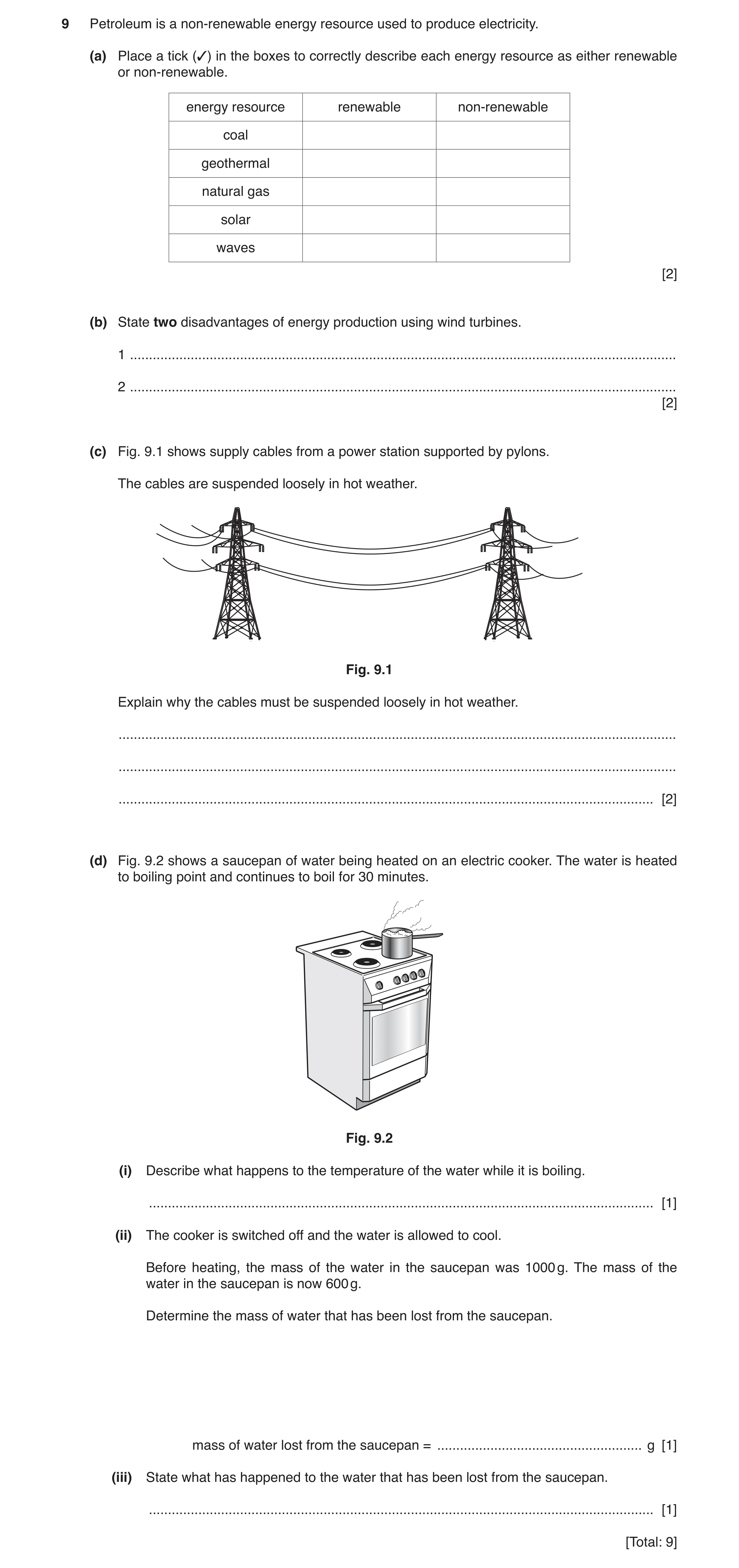
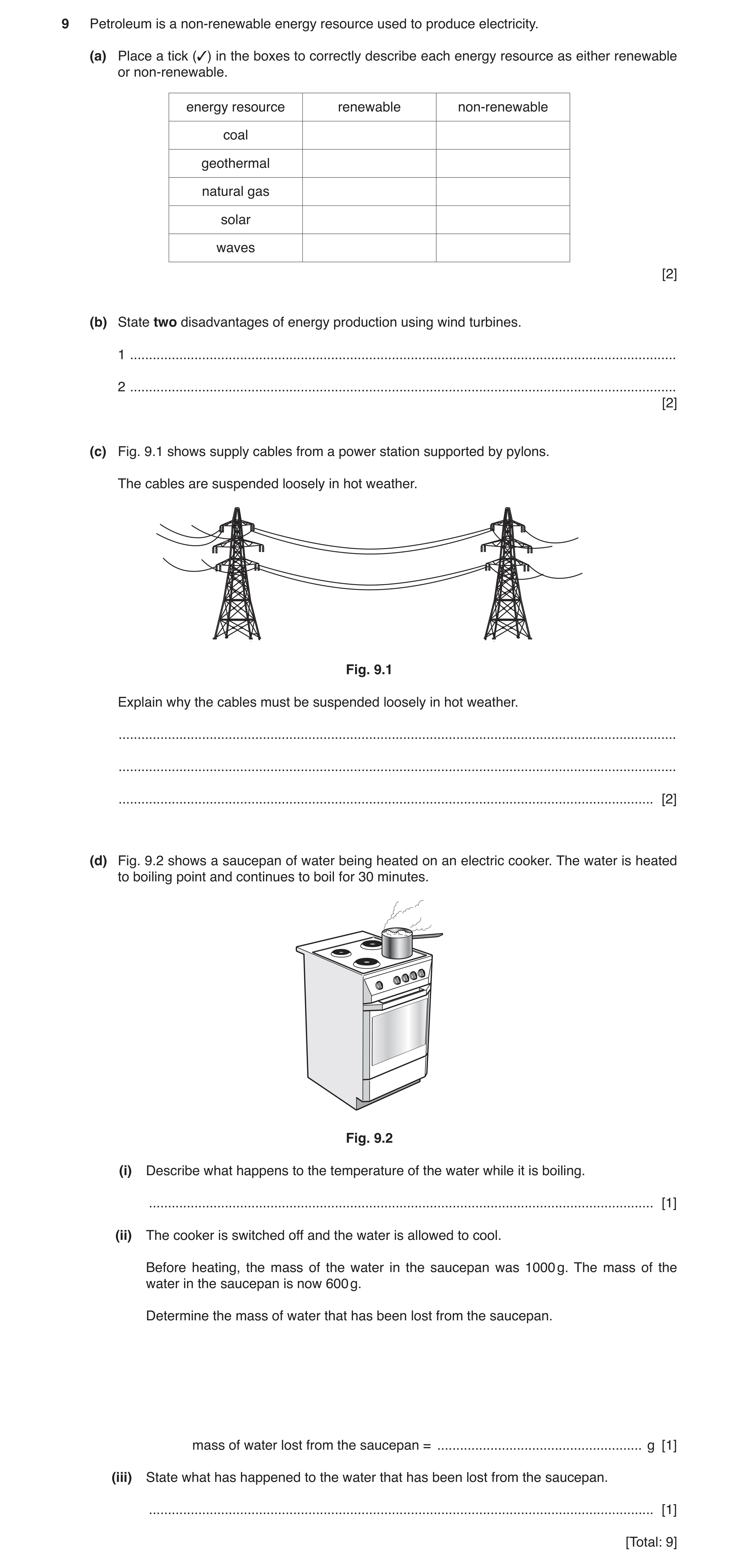
9 Petroleum is a non-renewable energy resource used to produce electricity. (a) Place a tick (3) in the boxes to correctly describe each energy resource as either renewable or non-renewable. energy resource renewable non-renewable coal geothermal natural gas solar waves [2] (b) State two disadvantages of energy production using wind turbines. 1 … 2 … [2] (c) Fig. 9.1 shows supply cables from a power station supported by pylons. The cables are suspended loosely in hot weather. Fig. 9.1 Explain why the cables must be suspended loosely in hot weather. … … … [2] (d) Fig. 9.2 shows a saucepan of water being heated on an electric cooker. The water is heated to boiling point and continues to boil for 30 minutes. Fig. 9.2 (i) Describe what happens to the temperature of the water while it is boiling. … [1] (ii) The cooker is switched off and the water is allowed to cool. Before heating, the mass of the water in the saucepan was 1000 g. The mass of the water in the saucepan is now 600 g. Determine the mass of water that has been lost from the saucepan. mass of water lost from the saucepan = … g [1] (iii) State what has happened to the water that has been lost from the saucepan. … [1] [Total: 9]
9 marks
Mark scheme: 9(a) energy resource renewable non-renewable coal 9 geothermal 9 natural gas 9 solar 9 waves 9 2, 3 or 4 correct ; 5 correct ; 2 9(b) noise of blades rotating ; no wind means no electricity produced ; 2 9(c) during cold weather cables will contract ; could snap cables / damage pylons ; 2 9(d)(i) remains constant ; 1 9(d)(ii) 1000 – 600 = 400 (g) ; 1 9(d)(iii) converted to steam ; 1
This question in 0654/32 May/June 2019
Q5 · Petroleum is a non-renewable energy resource used to produce electricity 0654/33 May/June 2019
9 Petroleum is a non-renewable energy resource used to produce electricity. (a) Place a tick (3) in the boxes to correctly describe each energy resource as either renewable or non-renewable. energy resource renewable non-renewable coal geothermal natural gas solar waves [2] (b) State two disadvantages of energy production using wind turbines. 1 … 2 … [2] (c) Fig. 9.1 shows supply cables from a power station supported by pylons. The cables are suspended loosely in hot weather. Fig. 9.1 Explain why the cables must be suspended loosely in hot weather. … … … [2] (d) Fig. 9.2 shows a saucepan of water being heated on an electric cooker. The water is heated to boiling point and continues to boil for 30 minutes. Fig. 9.2 (i) Describe what happens to the temperature of the water while it is boiling. … [1] (ii) The cooker is switched off and the water is allowed to cool. Before heating, the mass of the water in the saucepan was 1000 g. The mass of the water in the saucepan is now 600 g. Determine the mass of water that has been lost from the saucepan. mass of water lost from the saucepan = … g [1] (iii) State what has happened to the water that has been lost from the saucepan. … [1] [Total: 9]
9 marks
Mark scheme: 9(a) energy resource renewable non-renewable coal 9 geothermal 9 natural gas 9 solar 9 waves 9 2, 3 or 4 correct ; 5 correct ; 2 9(b) noise of blades rotating ; no wind means no electricity produced ; 2 9(c) during cold weather cables will contract ; could snap cables / damage pylons ; 2 9(d)(i) remains constant ; 1 9(d)(ii) 1000 – 600 = 400 (g) ; 1 9(d)(iii) converted to steam ; 1
This question in 0654/33 May/June 2019
Q6 · A ray of light from a lamp striking the surface of an ice rink 0654/31 Oct/Nov 2019
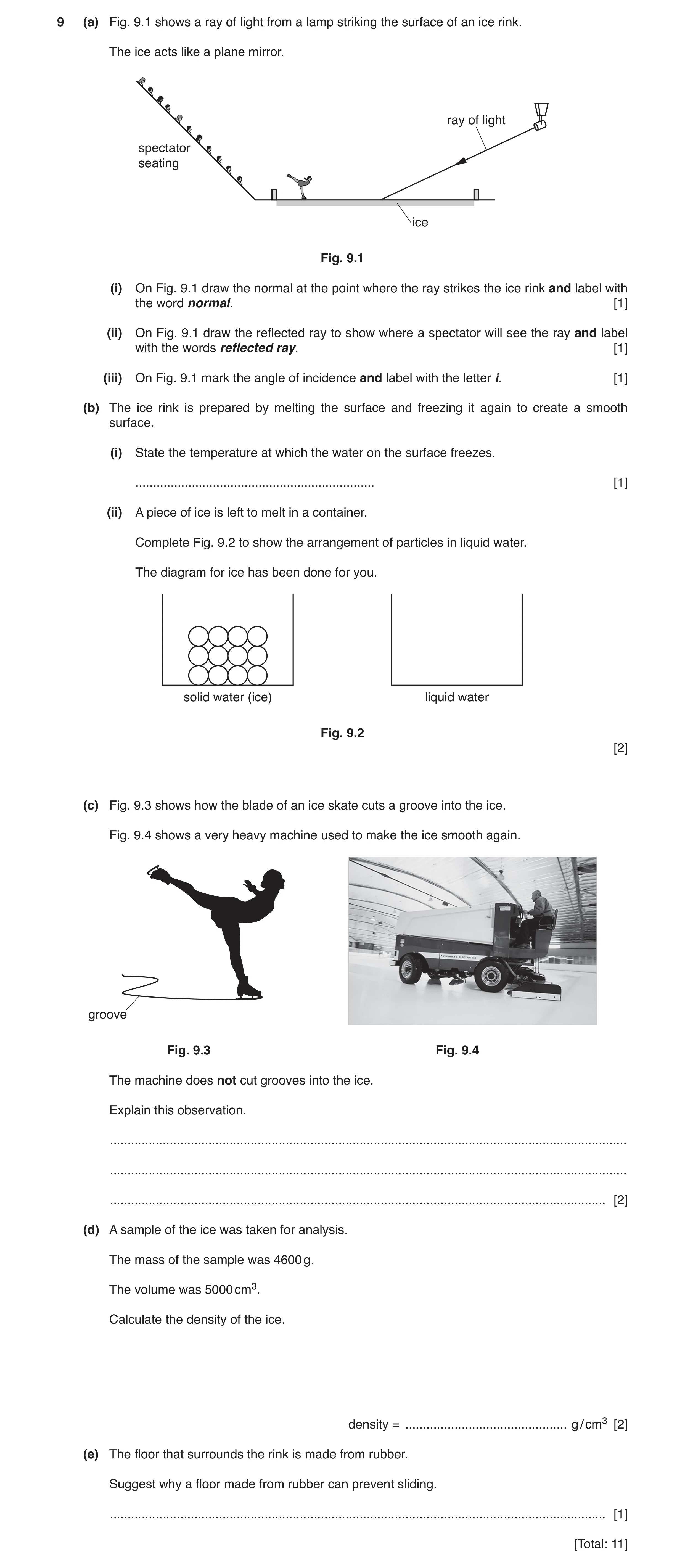
9 (a) Fig. 9.1 shows a ray of light from a lamp striking the surface of an ice rink. The ice acts like a plane mirror. ray of light spectator seating ice Fig. 9.1 (i) On Fig. 9.1 draw the normal at the point where the ray strikes the ice rink and label with the word normal. [1] (ii) On Fig. 9.1 draw the reflected ray to show where a spectator will see the ray and label with the words reflected ray. [1] (iii) On Fig. 9.1 mark the angle of incidence and label with the letter i. [1] (b) The ice rink is prepared by melting the surface and freezing it again to create a smooth surface. (i) State the temperature at which the water on the surface freezes. … [1] (ii) A piece of ice is left to melt in a container. Complete Fig. 9.2 to show the arrangement of particles in liquid water. The diagram for ice has been done for you. solid water (ice) liquid water Fig. 9.2 [2] (c) Fig. 9.3 shows how the blade of an ice skate cuts a groove into the ice. Fig. 9.4 shows a very heavy machine used to make the ice smooth again. groove Fig. 9.3 Fig. 9.4 The machine does not cut grooves into the ice. Explain this observation. … … … [2] (d) A sample of the ice was taken for analysis. The mass of the sample was 4600 g. The volume was 5000 cm3. Calculate the density of the ice. density = … g / cm3 [2] (e) The floor that surrounds the rink is made from rubber. Suggest why a floor made from rubber can prevent sliding. … [1] [Total: 11]
11 marks
Mark scheme: 9(a)(i) normal drawn from ice and ray intercept, 90° to the ice ; 1 9(a)(ii) reflected ray to correct point in spectator area (symmetrical about the normal to the incident ray) and labelled ‘reflected ray’ ; 1 9(a)(iii) angle drawn between the normal and the incident ray and labelled ‘i’ ; 1 9(b)(i) 0 °C ; 1 9(b)(ii) in liquid water : molecules drawn touching in random arrangement ; in liquid water: random arrangement ; 2 9(c) larger area; so smaller pressure; 2 9(d) ρ = m/v or 4600 / 5000 or 4.6 / 5000 seen ; 0.92 g/cm3 ; 2 9(e) friction ; 1
This question in 0654/31 Oct/Nov 2019
Q7 · Solar cells can be used to generate electricity for a house 0654/31 May/June 2020
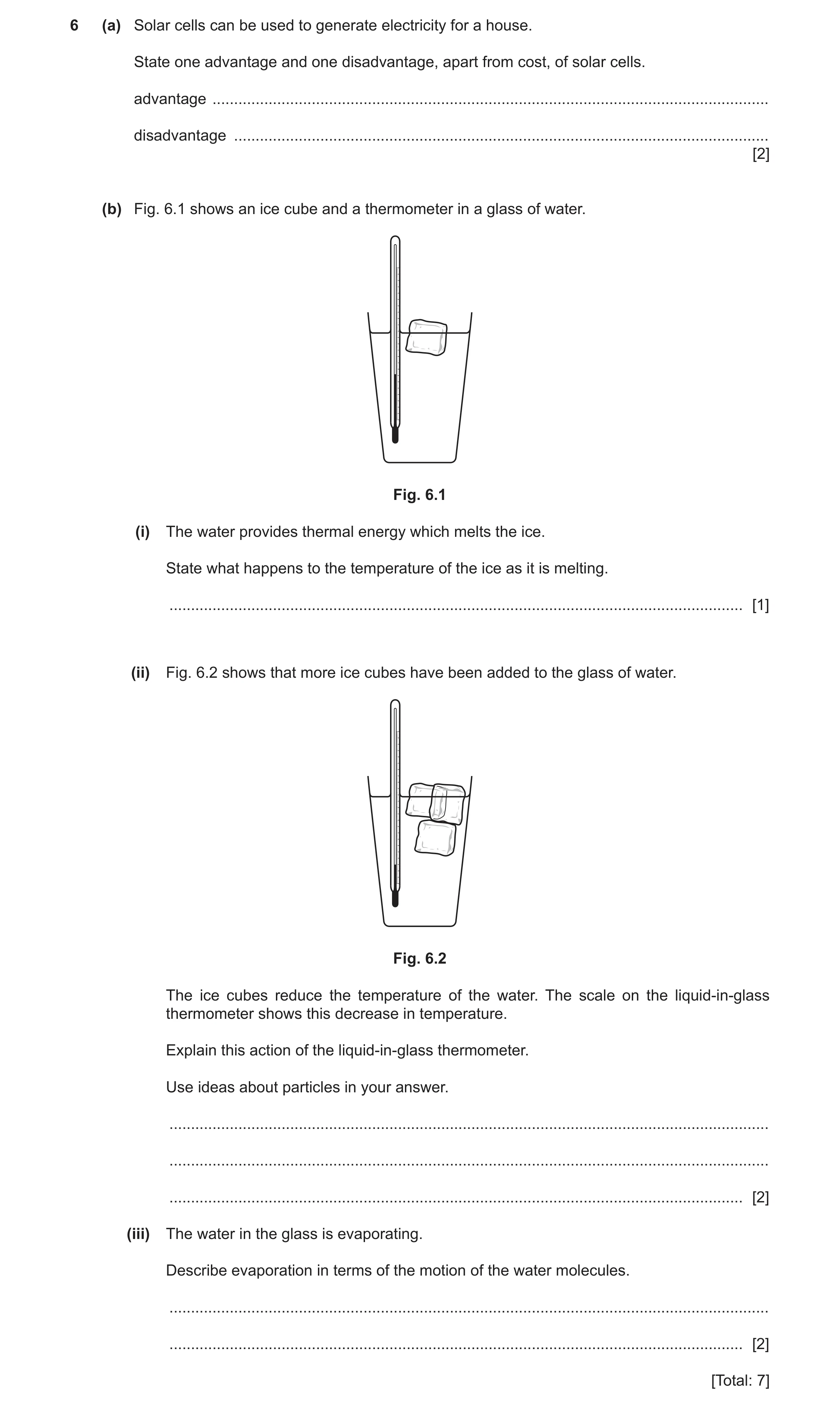
6 (a) Solar cells can be used to generate electricity for a house. State one advantage and one disadvantage, apart from cost, of solar cells. advantage … disadvantage … [2] (b) Fig. 6.1 shows an ice cube and a thermometer in a glass of water. Fig. 6.1 (i) The water provides thermal energy which melts the ice. State what happens to the temperature of the ice as it is melting. … [1] (ii) Fig. 6.2 shows that more ice cubes have been added to the glass of water. Fig. 6.2 The ice cubes reduce the temperature of the water. The scale on the liquid-in-glass thermometer shows this decrease in temperature. Explain this action of the liquid-in-glass thermometer. Use ideas about particles in your answer. … … … [2] (iii) The water in the glass is evaporating. Describe evaporation in terms of the motion of the water molecules. … … [2] [Total: 7]
7 marks
Mark scheme: 6(a) advantage – renewable source ; disadvantage – cannot produce electricity when it is dark ; 2 6(b)(i) remains constant (at 0°C); 1 6(b)(ii) the liquid contracts / particles closer together ; idea of particles having less (kinetic) energy; 2 6(b)(iii) escape of water molecules from the surface; escape of more energetic molecules; 2
This question in 0654/31 May/June 2020
Q8 · Solids, liquids and gases have different properties 0654/32 May/June 2020
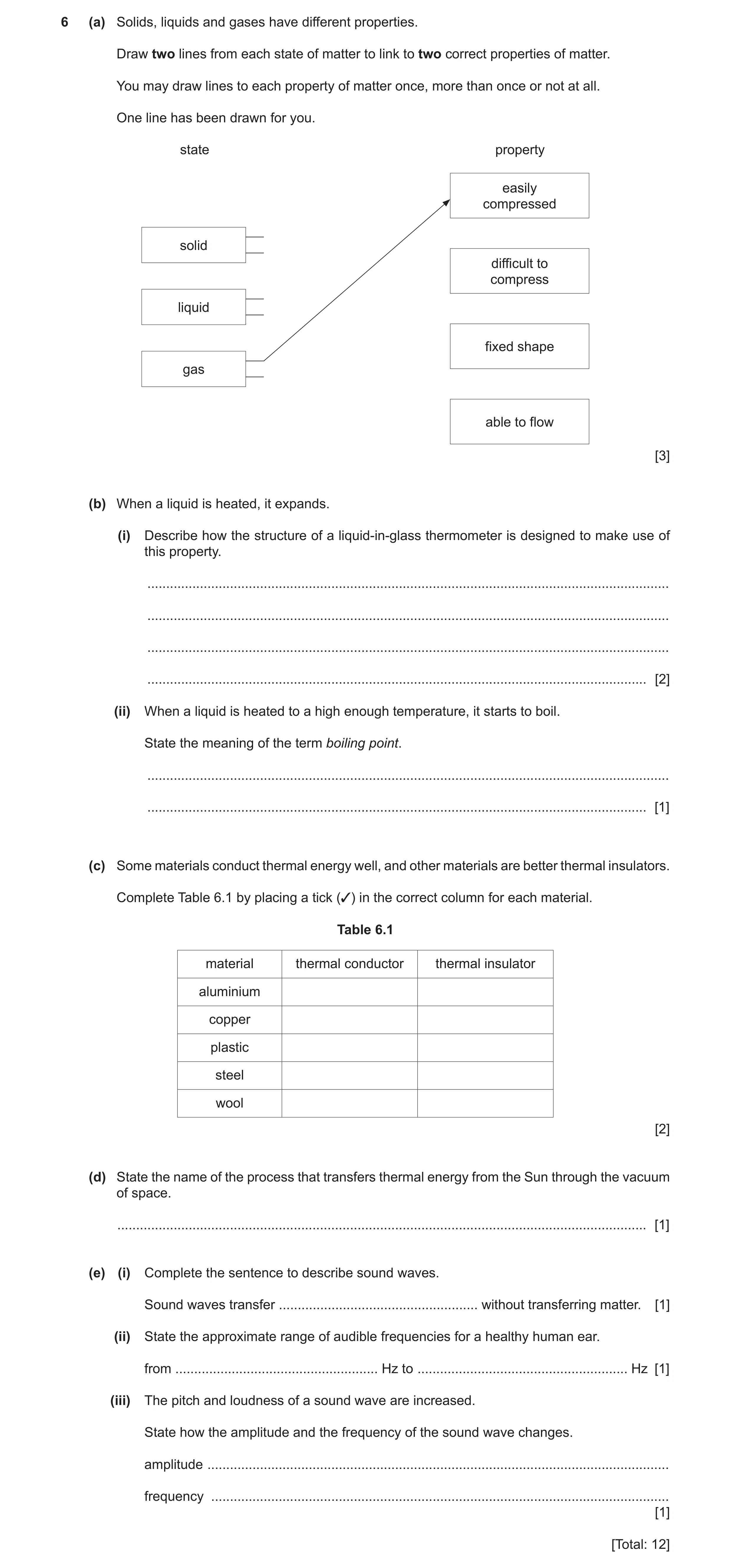
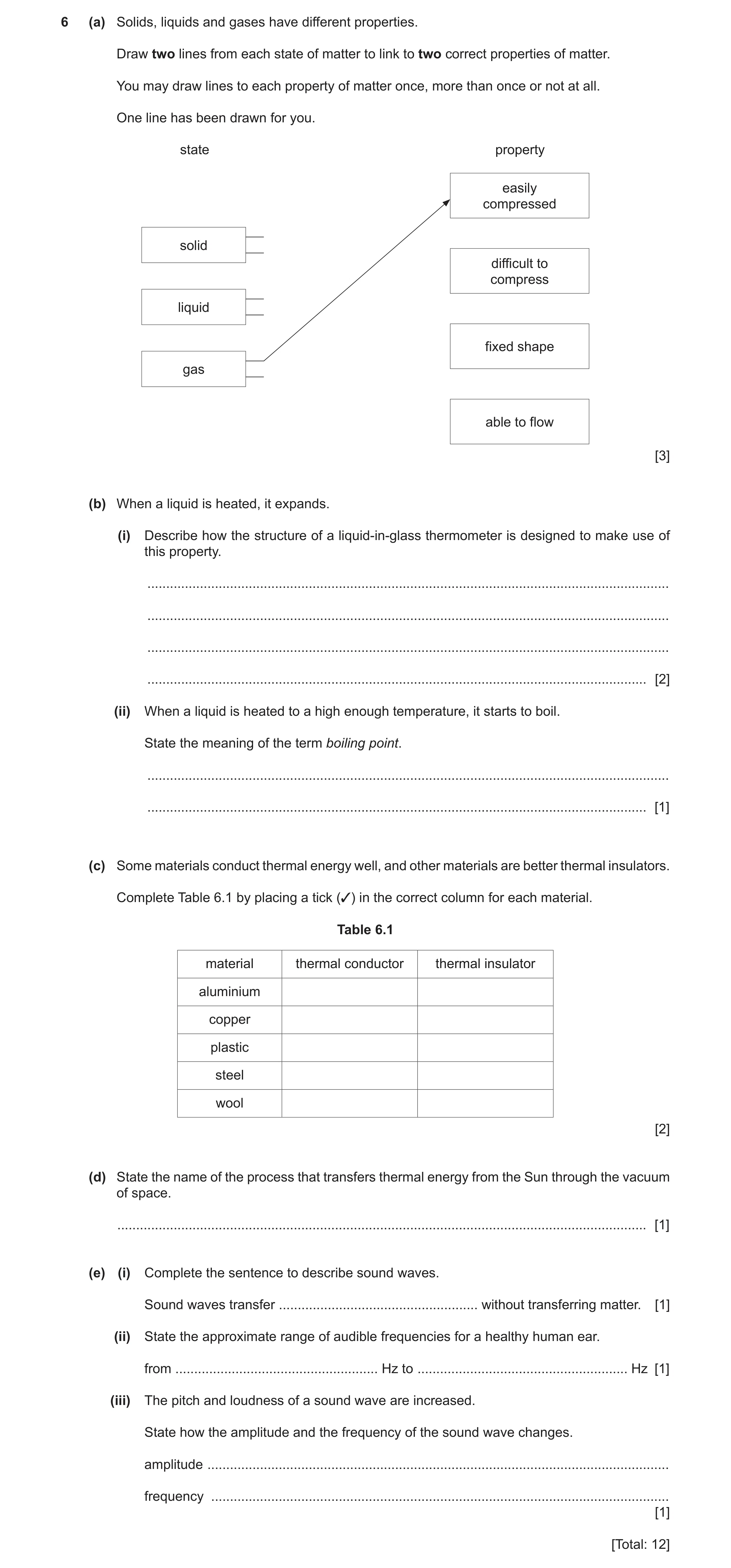
6 (a) Solids, liquids and gases have different properties. Draw two lines from each state of matter to link to two correct properties of matter. You may draw lines to each property of matter once, more than once or not at all. One line has been drawn for you. state property easily compressed solid difficult to compress liquid fixed shape gas able to flow [3] (b) When a liquid is heated, it expands. (i) Describe how the structure of a liquid-in-glass thermometer is designed to make use of this property. … … … … [2] (ii) When a liquid is heated to a high enough temperature, it starts to boil. State the meaning of the term boiling point. … … [1] (c) Some materials conduct thermal energy well, and other materials are better thermal insulators. Complete Table 6.1 by placing a tick (3) in the correct column for each material. Table 6.1 material thermal conductor thermal insulator aluminium copper plastic steel wool [2] (d) State the name of the process that transfers thermal energy from the Sun through the vacuum of space. … [1] (e) (i) Complete the sentence to describe sound waves. Sound waves transfer … without transferring matter. [1] (ii) State the approximate range of audible frequencies for a healthy human ear. from … Hz to … Hz [1] (iii) The pitch and loudness of a sound wave are increased. State how the amplitude and the frequency of the sound wave changes. amplitude … frequency … [1] [Total: 12]
12 marks
Mark scheme: 6(a) solid: difficult to compress and fixed shape; liquid: difficult to compress and able to flow; gas: easily compressed and able to flow 3 6(b)(i) liquid can be held in a tube; as it is heated or cools it rises up or falls down the tube; 2 6(b)(ii) the temperature at which a liquid turns to a gas; 1 6(c) material thermal conductor thermal insulator aluminium √ copper √ plastic √ steel √ wool √ ;; 3 correct for 1 mark all correct for 2 marks 2 6(d) radiation; 1 Question Answer Marks 6(e)(i) energy; 1 6(e)(ii) 20 to 20 000; 1 6(e)(iii) amplitude increases and frequency increases; 1
This question in 0654/32 May/June 2020
Q9 · Solids, liquids and gases have different properties 0654/33 May/June 2020
6 (a) Solids, liquids and gases have different properties. Draw two lines from each state of matter to link to two correct properties of matter. You may draw lines to each property of matter once, more than once or not at all. One line has been drawn for you. state property easily compressed solid difficult to compress liquid fixed shape gas able to flow [3] (b) When a liquid is heated, it expands. (i) Describe how the structure of a liquid-in-glass thermometer is designed to make use of this property. … … … … [2] (ii) When a liquid is heated to a high enough temperature, it starts to boil. State the meaning of the term boiling point. … … [1] (c) Some materials conduct thermal energy well, and other materials are better thermal insulators. Complete Table 6.1 by placing a tick (3) in the correct column for each material. Table 6.1 material thermal conductor thermal insulator aluminium copper plastic steel wool [2] (d) State the name of the process that transfers thermal energy from the Sun through the vacuum of space. … [1] (e) (i) Complete the sentence to describe sound waves. Sound waves transfer … without transferring matter. [1] (ii) State the approximate range of audible frequencies for a healthy human ear. from … Hz to … Hz [1] (iii) The pitch and loudness of a sound wave are increased. State how the amplitude and the frequency of the sound wave changes. amplitude … frequency … [1] [Total: 12]
12 marks
Mark scheme: 6(a) solid: difficult to compress and fixed shape; liquid: difficult to compress and able to flow; gas: easily compressed and able to flow 3 6(b)(i) liquid can be held in a tube; as it is heated or cools it rises up or falls down the tube; 2 6(b)(ii) the temperature at which a liquid turns to a gas; 1 6(c) material thermal conductor thermal insulator aluminium √ copper √ plastic √ steel √ wool √ ;; 3 correct for 1 mark all correct for 2 marks 2 6(d) radiation; 1 Question Answer Marks 6(e)(i) energy; 1 6(e)(ii) 20 to 20 000; 1 6(e)(iii) amplitude increases and frequency increases; 1
This question in 0654/33 May/June 2020
Q10 · Beneath the surface of the Earth, solid rocks are heated and form liquid rock (magma) and… 0654/31 Oct/Nov 2020
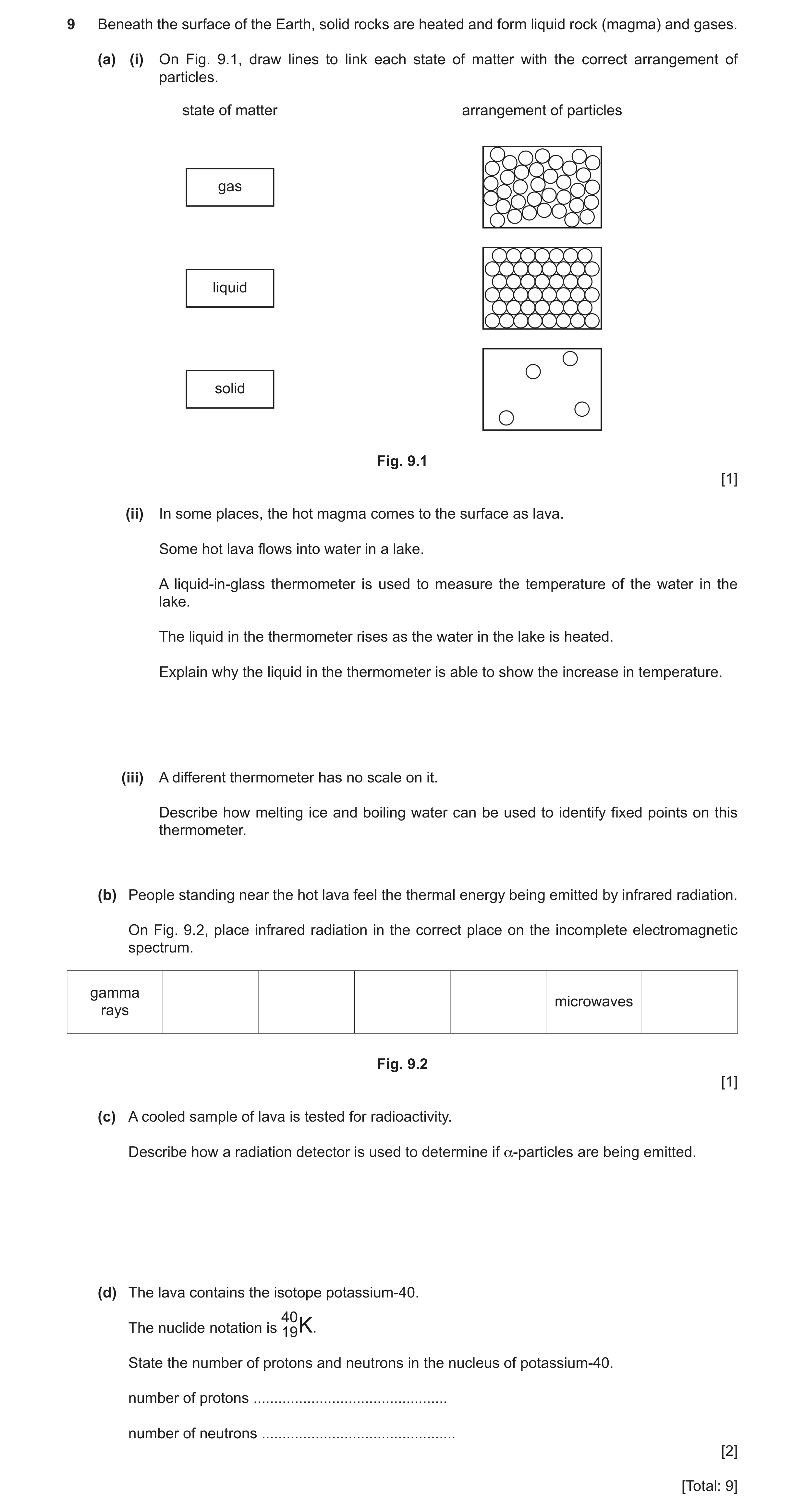
9 Beneath the surface of the Earth, solid rocks are heated and form liquid rock (magma) and gases. (a) (i) On Fig. 9.1, draw lines to link each state of matter with the correct arrangement of particles. state of matter arrangement of particles gas liquid solid Fig. 9.1 [1] (ii) In some places, the hot magma comes to the surface as lava. Some hot lava flows into water in a lake. A liquid‑in‑glass thermometer is used to measure the temperature of the water in the lake. The liquid in the thermometer rises as the water in the lake is heated. Explain why the liquid in the thermometer is able to show the increase in temperature. (iii) A different thermometer has no scale on it. Describe how melting ice and boiling water can be used to identify fixed points on this thermometer. (b) People standing near the hot lava feel the thermal energy being emitted by infrared radiation. On Fig. 9.2, place infrared radiation in the correct place on the incomplete electromagnetic spectrum. gamma microwaves rays Fig. 9.2 [1] (c) A cooled sample of lava is tested for radioactivity. Describe how a radiation detector is used to determine if α‑particles are being emitted. (d) The lava contains the isotope potassium‑40. 40 The nuclide notation is 19K. State the number of protons and neutrons in the nucleus of potassium‑40. number of protons … number of neutrons … [2] [Total: 9]
9 marks
Mark scheme: 9(a)(i) gas to bottom box, liquid to top box, solid to middle box ; 1 9(a)(ii) (as a liquid is heated) it expands ; 1 9(a)(iii) ref to 0°C and 100°C; identify / mark temperatures on scale ; 2 9(b) infrared to box left on microwaves ; 1 Question Answer Marks 9(c) paper placed between sample and detector ; remove paper and if counts increase, α radiation detected ; 2 9(d) protons = 19 ; neutrons = 21 ; 2
This question in 0654/31 Oct/Nov 2020
Q11 · Beneath the surface of the Earth, solid rocks are heated and form liquid rock (magma) and… 0654/33 Oct/Nov 2020
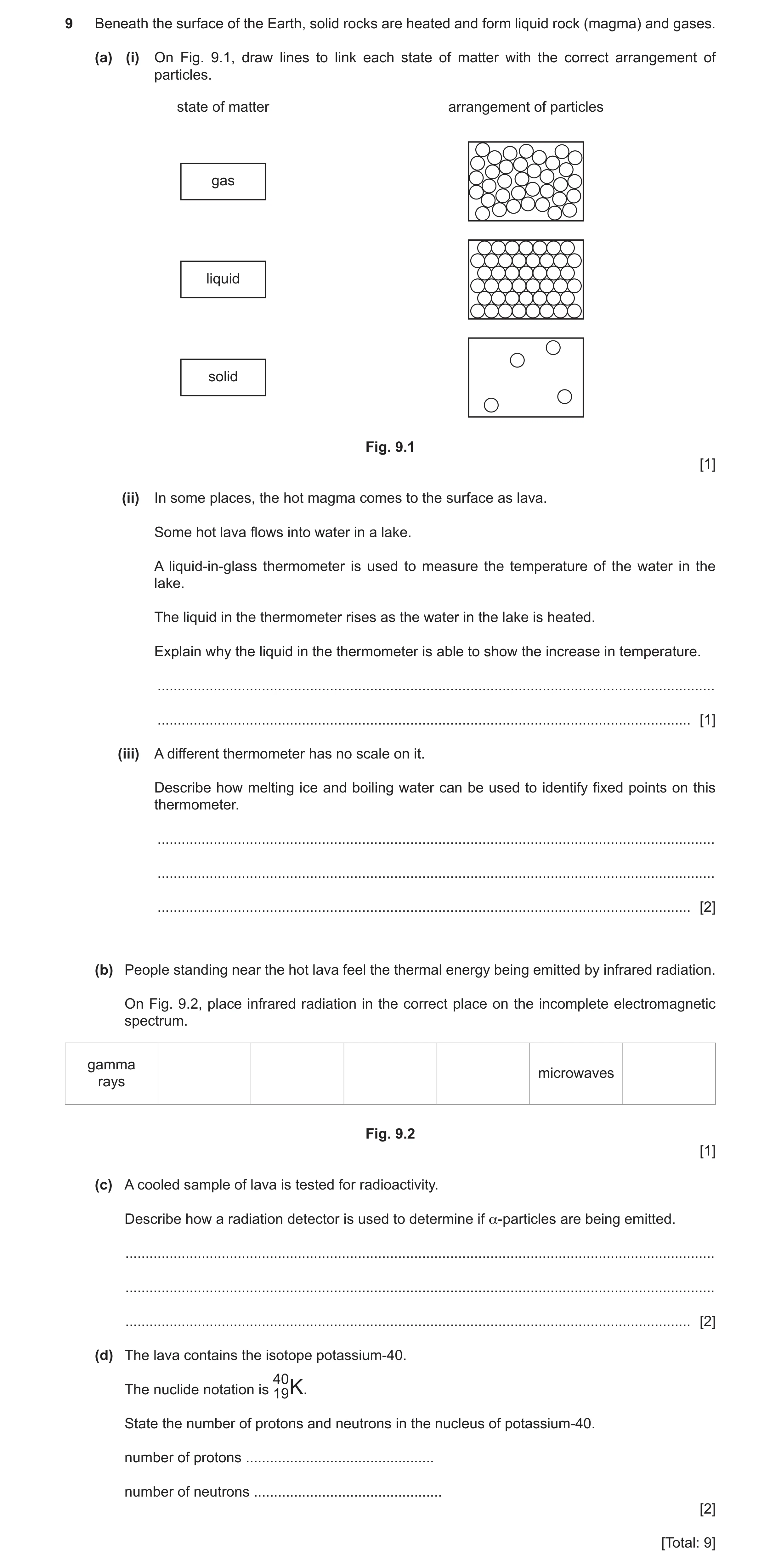
9 Beneath the surface of the Earth, solid rocks are heated and form liquid rock (magma) and gases. (a) (i) On Fig. 9.1, draw lines to link each state of matter with the correct arrangement of particles. state of matter arrangement of particles gas liquid solid Fig. 9.1 [1] (ii) In some places, the hot magma comes to the surface as lava. Some hot lava flows into water in a lake. A liquid‑in‑glass thermometer is used to measure the temperature of the water in the lake. The liquid in the thermometer rises as the water in the lake is heated. Explain why the liquid in the thermometer is able to show the increase in temperature. … … [1] (iii) A different thermometer has no scale on it. Describe how melting ice and boiling water can be used to identify fixed points on this thermometer. … … … [2] (b) People standing near the hot lava feel the thermal energy being emitted by infrared radiation. On Fig. 9.2, place infrared radiation in the correct place on the incomplete electromagnetic spectrum. gamma microwaves rays Fig. 9.2 [1] (c) A cooled sample of lava is tested for radioactivity. Describe how a radiation detector is used to determine if α‑particles are being emitted. … … … [2] (d) The lava contains the isotope potassium‑40. 40 The nuclide notation is 19K. State the number of protons and neutrons in the nucleus of potassium‑40. number of protons … number of neutrons … [2] [Total: 9]
9 marks
Mark scheme: 9(a)(i) gas to bottom box, liquid to top box, solid to middle box ; 1 9(a)(ii) (as a liquid is heated) it expands ; 1 9(a)(iii) ref to 0°C and 100°C; identify / mark temperatures on scale ; 2 9(b) infrared to box left on microwaves ; 1 Question Answer Marks 9(c) paper placed between sample and detector ; remove paper and if counts increase, α radiation detected ; 2 9(d) protons = 19 ; neutrons = 21 ; 2
This question in 0654/33 Oct/Nov 2020
Question 12 0654/31 Oct/Nov 2021
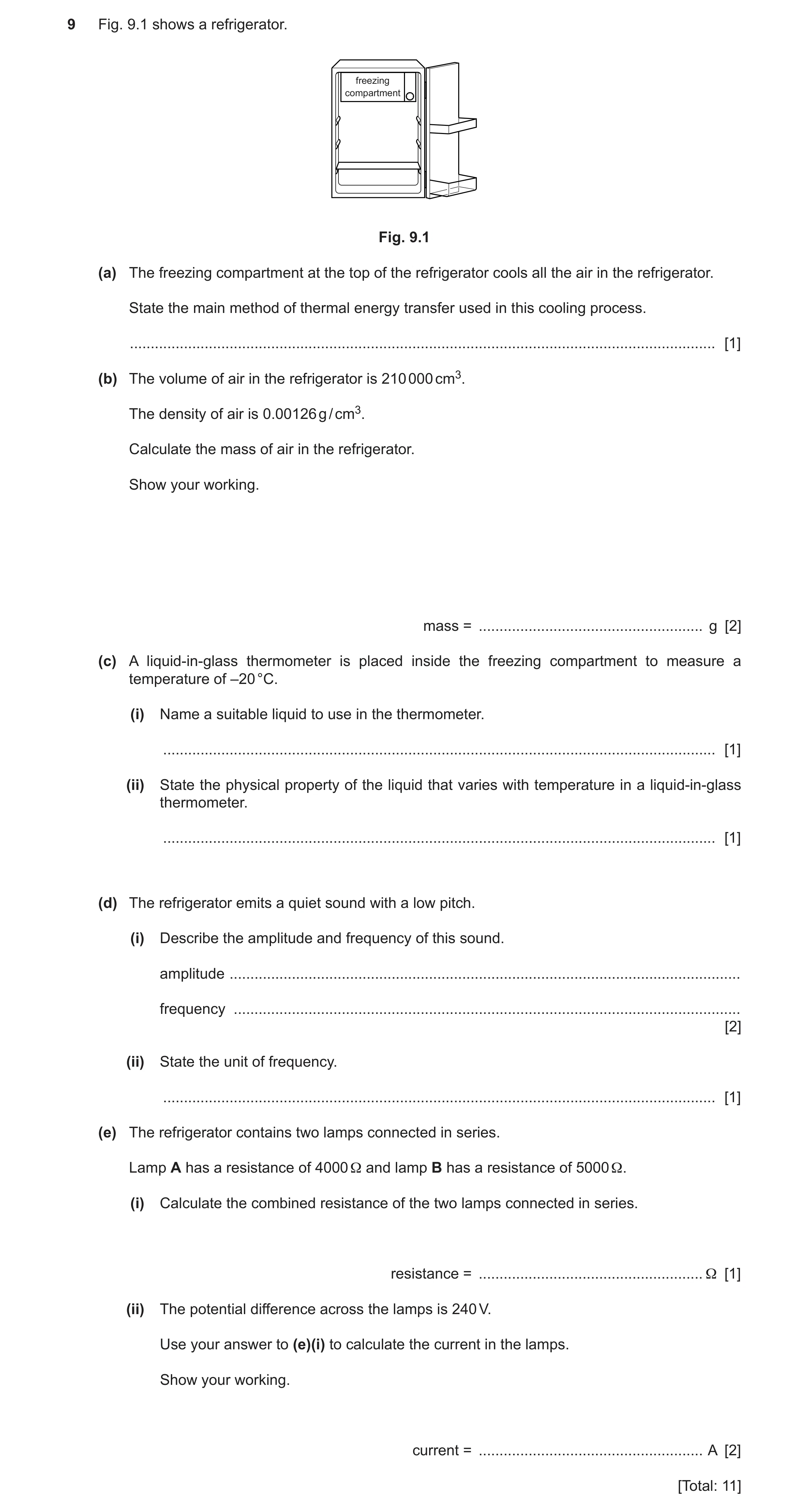
9 Fig. 9.1 shows a refrigerator. freezing compartment Fig. 9.1 (a) The freezing compartment at the top of the refrigerator cools all the air in the refrigerator. State the main method of thermal energy transfer used in this cooling process. … [1] (b) The volume of air in the refrigerator is 210 000 cm3. The density of air is 0.00126 g / cm3. Calculate the mass of air in the refrigerator. Show your working. mass = … g [2] (c) A liquid-in-glass thermometer is placed inside the freezing compartment to measure a temperature of –20 °C. (i) Name a suitable liquid to use in the thermometer. … [1] (ii) State the physical property of the liquid that varies with temperature in a liquid-in-glass thermometer. … [1] (d) The refrigerator emits a quiet sound with a low pitch. (i) Describe the amplitude and frequency of this sound. amplitude … frequency … [2] (ii) State the unit of frequency. … [1] (e) The refrigerator contains two lamps connected in series. Lamp A has a resistance of 4000 Ω and lamp B has a resistance of 5000 Ω. (i) Calculate the combined resistance of the two lamps connected in series. resistance = … Ω [1] (ii) The potential difference across the lamps is 240 V. Use your answer to (e)(i) to calculate the current in the lamps. Show your working. current = … A [2] [Total: 11]
11 marks
Mark scheme: 9(a) convection ; 1 9(b) mass = density × volume or 0.00126 × 210 000 ; = 265 g ; 2 9(c)(i) mercury / alcohol ; 1 9(c)(ii) volume ; 1 9(d)(i) small amplitude ; low frequency ; 2 9(d)(ii) hertz ; 1 9(e)(i) 9000 Ω ; 1 Question Answer Marks 9(e)(ii) current = voltage / resistance or 240 / 9000 ; 0.027 (A) ; 2
This question in 0654/31 Oct/Nov 2021
Q13 · Water in a saucepan on an electric cooker 0654/33 Oct/Nov 2021
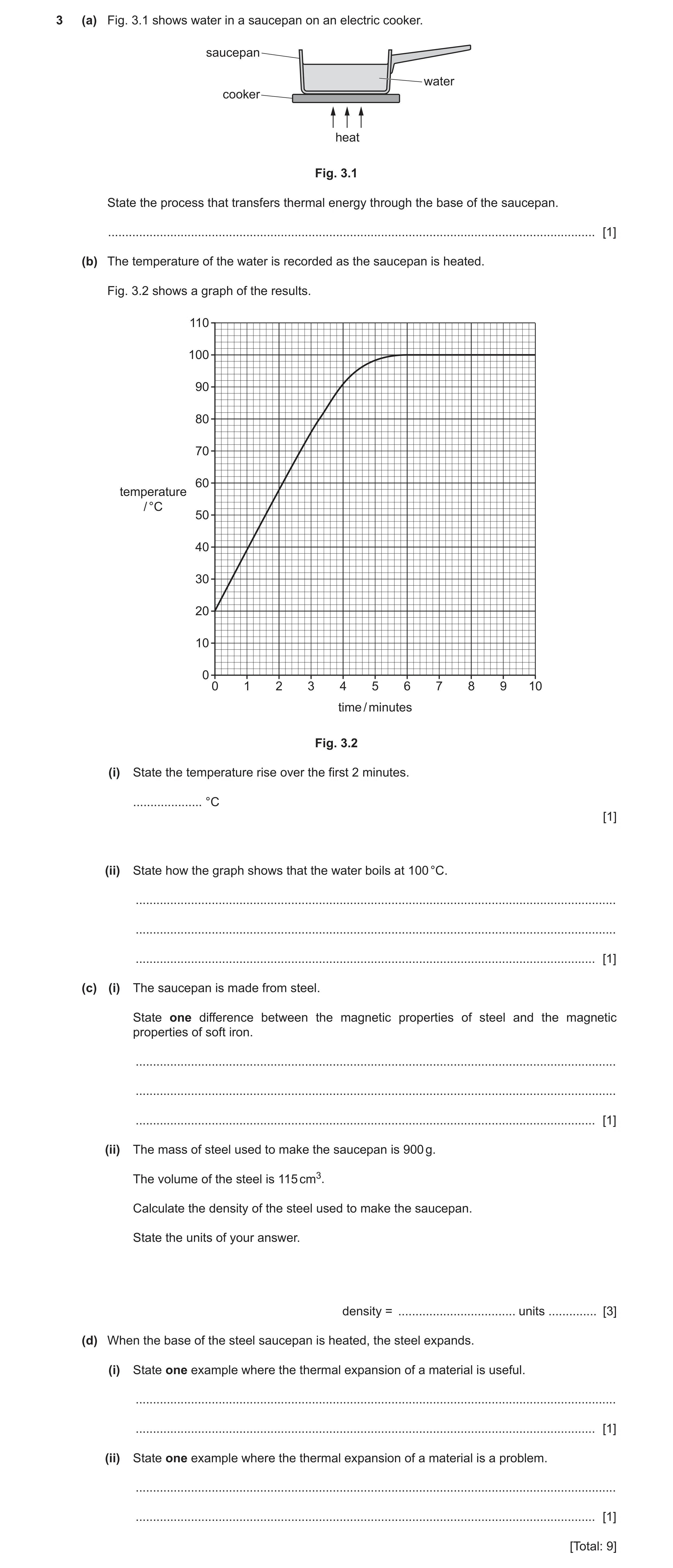
3 (a) Fig. 3.1 shows water in a saucepan on an electric cooker. saucepan water cooker heat Fig. 3.1 State the process that transfers thermal energy through the base of the saucepan. … [1] (b) The temperature of the water is recorded as the saucepan is heated. Fig. 3.2 shows a graph of the results. 110 100 90 80 70 60 temperature / °C 50 40 30 20 10 0 0 1 2 3 4 5 6 7 8 9 10 time / minutes Fig. 3.2 (i) State the temperature rise over the first 2 minutes. … °C [1] (ii) State how the graph shows that the water boils at 100 °C. … … … [1] (c) (i) The saucepan is made from steel. State one difference between the magnetic properties of steel and the magnetic properties of soft iron. … … … [1] (ii) The mass of steel used to make the saucepan is 900 g. The volume of the steel is 115 cm3. Calculate the density of the steel used to make the saucepan. State the units of your answer. density = … units … [3] (d) When the base of the steel saucepan is heated, the steel expands. (i) State one example where the thermal expansion of a material is useful. … … [1] (ii) State one example where the thermal expansion of a material is a problem. … … [1] [Total: 9]
9 marks
Mark scheme: 3(a)(i) conduction ; 1 3(b)(i) 38 °C ; 1 3(b)(ii) temperature stops increasing ; 1 3(c)(i) (soft) iron is magnetised quickly / steel is magnetised slowly ; or (soft) iron loses its magnetism quickly / steel loses magnetism slowly ; 1 3(c)(ii) density = mass ÷ volume or mass value ÷ volume value or 900 ÷ 115 ; 7.83 ; g / cm3 ; 3 3(d)(i) (liquid in glass) thermometers / bimetallic strips ; 1 3(d)(ii) bridges / roads / overhead electricity cables etc. ; 1
This question in 0654/33 Oct/Nov 2021
Q14 · A wind surfer on a surfboard, driven by the wind, sailing at a constant speed across the… 0654/31 May/June 2022
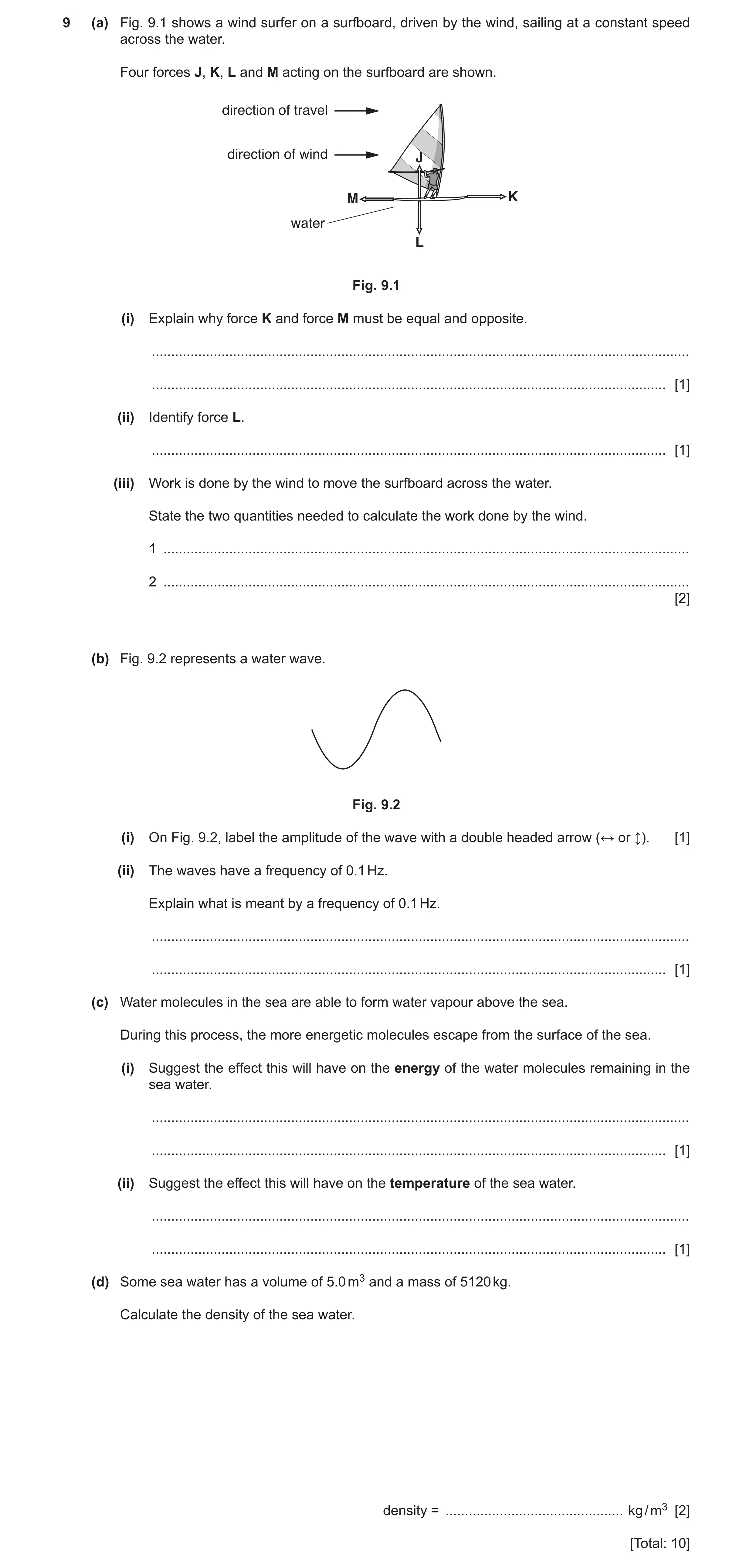
9 (a) Fig. 9.1 shows a wind surfer on a surfboard, driven by the wind, sailing at a constant speed across the water. Four forces J, K, L and M acting on the surfboard are shown. direction of travel direction of wind J M K water L Fig. 9.1 (i) Explain why force K and force M must be equal and opposite. … … [1] (ii) Identify force L. … [1] (iii) Work is done by the wind to move the surfboard across the water. State the two quantities needed to calculate the work done by the wind. 1 … 2 … [2] (b) Fig. 9.2 represents a water wave. Fig. 9.2 (i) On Fig. 9.2, label the amplitude of the wave with a double headed arrow (↔ or ↕). [1] (ii) The waves have a frequency of 0.1 Hz. Explain what is meant by a frequency of 0.1 Hz. … … [1] (c) Water molecules in the sea are able to form water vapour above the sea. During this process, the more energetic molecules escape from the surface of the sea. (i) Suggest the effect this will have on the energy of the water molecules remaining in the sea water. … … [1] (ii) Suggest the effect this will have on the temperature of the sea water. … … [1] (d) Some sea water has a volume of 5.0 m3 and a mass of 5120 kg. Calculate the density of the sea water. density = … kg / m3 [2] [Total: 10]
10 marks
Mark scheme: 9(a)(i) surfboard is moving at constant speed; 1 9(a)(ii) gravitational (force) / weight; 1 9(a)(iii) force; distance; 2 9(b)(i) amplitude correctly labelled; 1 9(b)(ii) one wave passes every 10 seconds; 1 9(c)(i) less energetic molecules ; owtte 1 9(c)(ii) decrease / cool ; 1 9(d) density = mass / volume or 5120 / 5; density = 1024 (kg / m3) ; 2
This question in 0654/31 May/June 2022
Q15 · A car has two headlamps, connected in parallel, across a 12 V battery 0654/31 Oct/Nov 2022
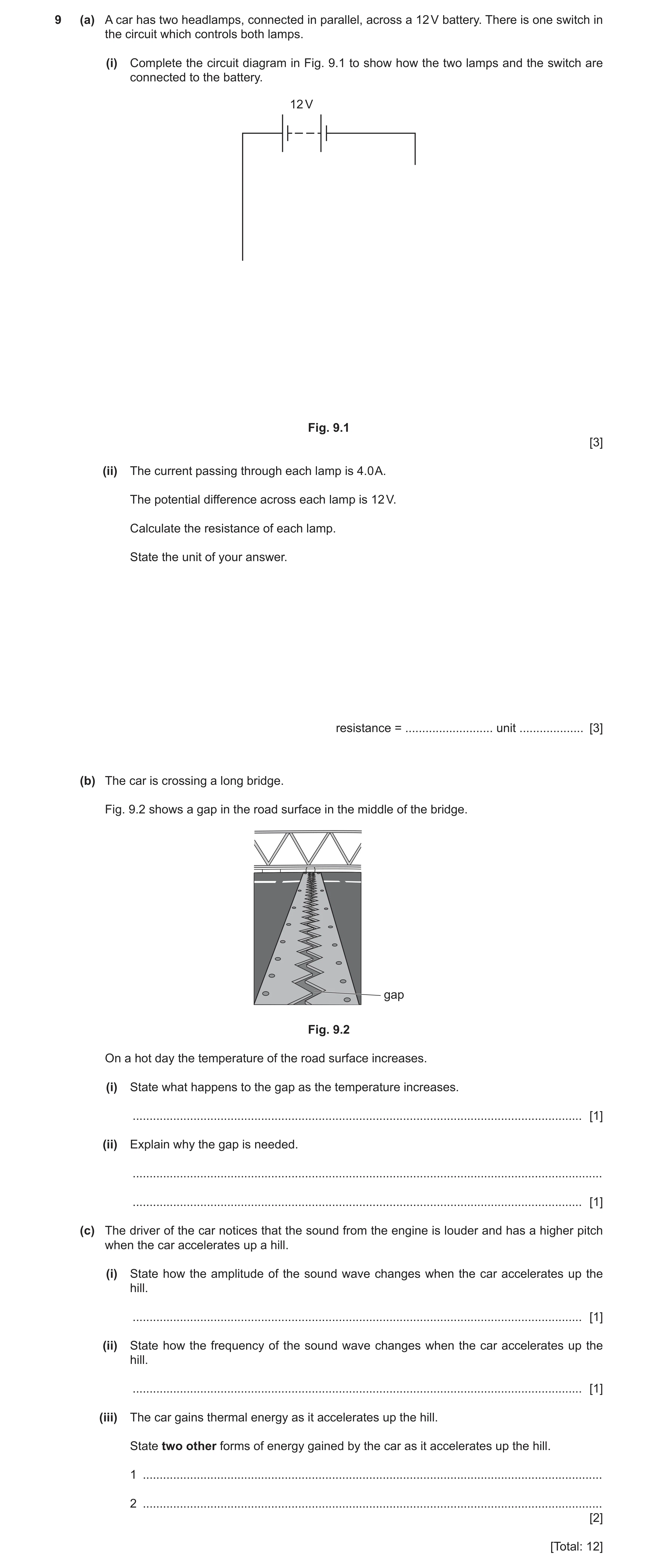
9 (a) A car has two headlamps, connected in parallel, across a 12 V battery. There is one switch in the circuit which controls both lamps. (i) Complete the circuit diagram in Fig. 9.1 to show how the two lamps and the switch are connected to the battery. 12 V Fig. 9.1 [3] (ii) The current passing through each lamp is 4.0 A. The potential difference across each lamp is 12 V. Calculate the resistance of each lamp. State the unit of your answer. resistance = … unit … [3] (b) The car is crossing a long bridge. Fig. 9.2 shows a gap in the road surface in the middle of the bridge. gap Fig. 9.2 On a hot day the temperature of the road surface increases. (i) State what happens to the gap as the temperature increases. … [1] (ii) Explain why the gap is needed. … … [1] (c) The driver of the car notices that the sound from the engine is louder and has a higher pitch when the car accelerates up a hill. (i) State how the amplitude of the sound wave changes when the car accelerates up the hill. … [1] (ii) State how the frequency of the sound wave changes when the car accelerates up the hill. … [1] (iii) The car gains thermal energy as it accelerates up the hill. State two other forms of energy gained by the car as it accelerates up the hill. 1 … 2 … [2] [Total: 12]
12 marks
Mark scheme: 9(a)(i) all symbols correct ; 3 two lamps in parallel with battery ; switch to control both lamps ; 9(a)(ii) R = V / I (in any form symbols or words) or 12 / 4 ; 3 = 3 ; ohms / ; 9(b)(i) gap is smaller / closes ; 1 9(b)(ii) road/bridge needs to expand on hot day / 1 road/bridge could be damaged by expansion ; 9(c)(i) amplitude increases ; 1 9(c)(ii) frequency increases ; 1 9(c)(iii) kinetic (energy); 2 gravitational potential (energy) ;
This question in 0654/31 Oct/Nov 2022
Q16 · Two different car tyres 0654/32 Feb/March 2023
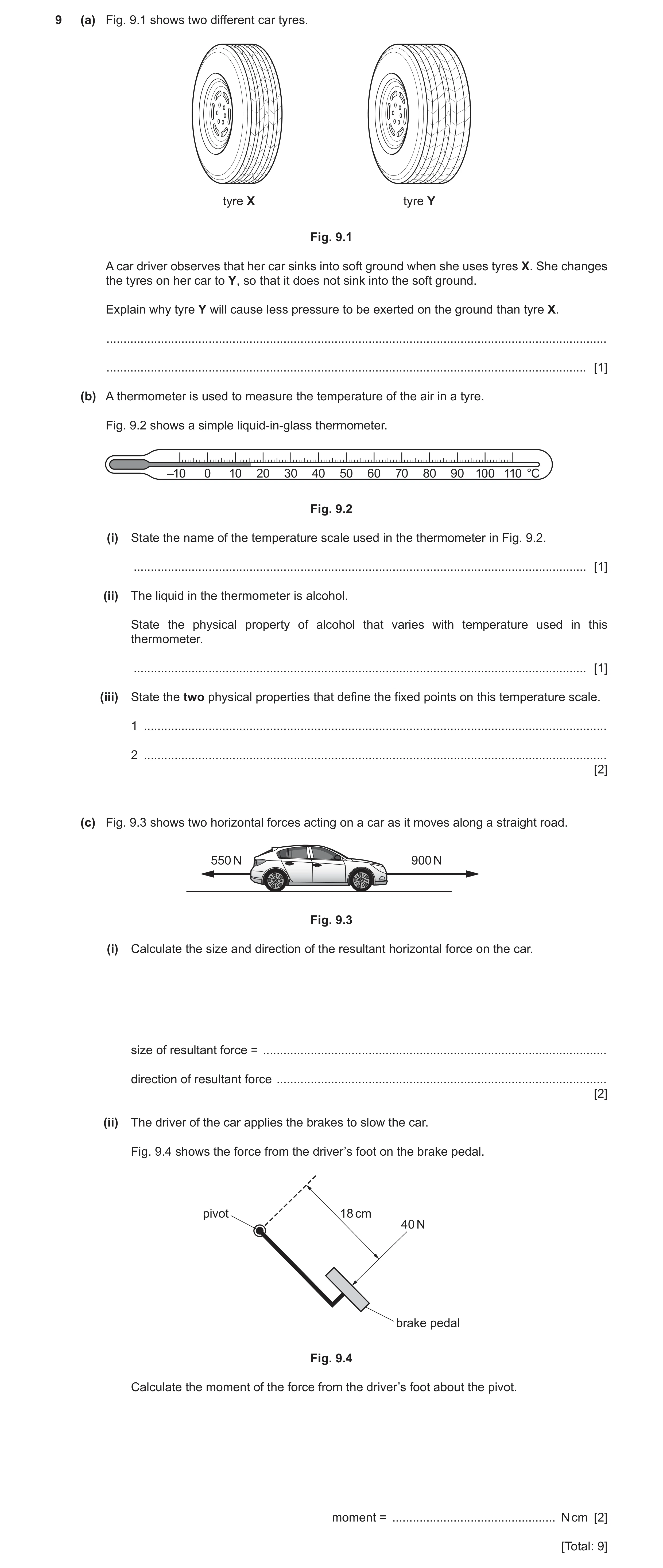
9 (a) Fig. 9.1 shows two different car tyres. tyre X tyre Y Fig. 9.1 A car driver observes that her car sinks into soft ground when she uses tyres X. She changes the tyres on her car to Y, so that it does not sink into the soft ground. Explain why tyre Y will cause less pressure to be exerted on the ground than tyre X. … … [1] (b) A thermometer is used to measure the temperature of the air in a tyre. Fig. 9.2 shows a simple liquid-in-glass thermometer. –10 0 10 20 30 40 50 60 70 80 90 100 110 °C Fig. 9.2 (i) State the name of the temperature scale used in the thermometer in Fig. 9.2. … [1] (ii) The liquid in the thermometer is alcohol. State the physical property of alcohol that varies with temperature used in this thermometer. … [1] (iii) State the two physical properties that define the fixed points on this temperature scale. 1 … 2 … [2] (c) Fig. 9.3 shows two horizontal forces acting on a car as it moves along a straight road. 550 N 900 N Fig. 9.3 (i) Calculate the size and direction of the resultant horizontal force on the car. size of resultant force = … direction of resultant force … [2] (ii) The driver of the car applies the brakes to slow the car. Fig. 9.4 shows the force from the driver’s foot on the brake pedal. pivot 18 cm 40 N brake pedal Fig. 9.4 Calculate the moment of the force from the driver’s foot about the pivot. moment = … N cm [2] [Total: 9]
9 marks
Mark scheme: 9(a) any one from 1 greater surface area (in contact with ground) ; same force acts over a larger area ; 9(b)(i) celsius ; 1 9(b)(ii) volume ; 1 9(b)(iii) melting point of ice / freezing point of water (0) ; 2 boiling point of water (100) ; 9(c)(i) 350 (N) ; 2 to the right / forward ; 9(c)(ii) moment = force (perpendicular) distance or formula or 40 18 ; 2 = 720 (N cm) ;
This question in 0654/32 Feb/March 2023
Q17 · Train track is made of lengths of steel rails with small gaps between them 0654/31 Oct/Nov 2023
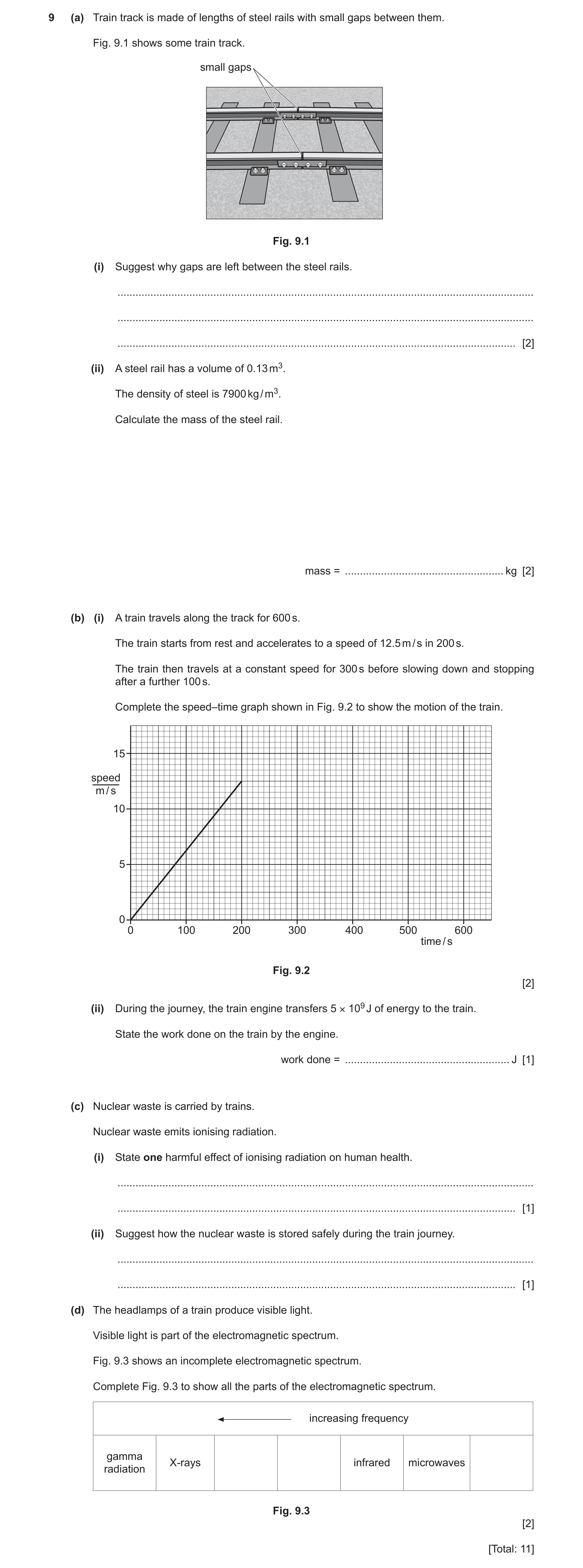
9 (a) Train track is made of lengths of steel rails with small gaps between them. Fig. 9.1 shows some train track. small gaps Fig. 9.1 (i) Suggest why gaps are left between the steel rails. … … … [2] (ii) A steel rail has a volume of 0.13 m3. The density of steel is 7900 kg / m3. Calculate the mass of the steel rail. mass = … kg [2] (b) (i) A train travels along the track for 600 s. The train starts from rest and accelerates to a speed of 12.5 m / s in 200 s. The train then travels at a constant speed for 300 s before slowing down and stopping after a further 100 s. Complete the speed–time graph shown in Fig. 9.2 to show the motion of the train. 15 speed m / s 10 5 0 0 100 200 300 400 500 600 time / s Fig. 9.2 [2] (ii) During the journey, the train engine transfers 5 × 10⁹ J of energy to the train. State the work done on the train by the engine. work done = … J [1] (c) Nuclear waste is carried by trains. Nuclear waste emits ionising radiation. (i) State one harmful effect of ionising radiation on human health. … … [1] (ii) Suggest how the nuclear waste is stored safely during the train journey. … … [1] (d) The headlamps of a train produce visible light. Visible light is part of the electromagnetic spectrum. Fig. 9.3 shows an incomplete electromagnetic spectrum. Complete Fig. 9.3 to show all the parts of the electromagnetic spectrum. increasing frequency gamma X-rays infrared microwaves radiation Fig. 9.3 [2] [Total: 11]
11 marks
Mark scheme: 9(a)(i) to allow for expansion ; 2 so rails are not damaged / in hot weather ; 9(a)(ii) mass = density volume (in any form) or 7900 0.13 ; 2 1000 (kg) or 1027 (kg) ; 9(b)(i) horizontal section correct ; 2 slowing down section taking 100 s ; 9(b)(ii) 5 109 (J) ; 1 9(c)(i) cancer / radiation burns / AVP ; 1 9(c)(ii) lead lined container ; 1 9(d) 2 gamma visible radio X-rays ultraviolet infrared microwaves radiation light waves three correct ; in correct order ;
This question in 0654/31 Oct/Nov 2023
Question 18 0654/32 Oct/Nov 2023
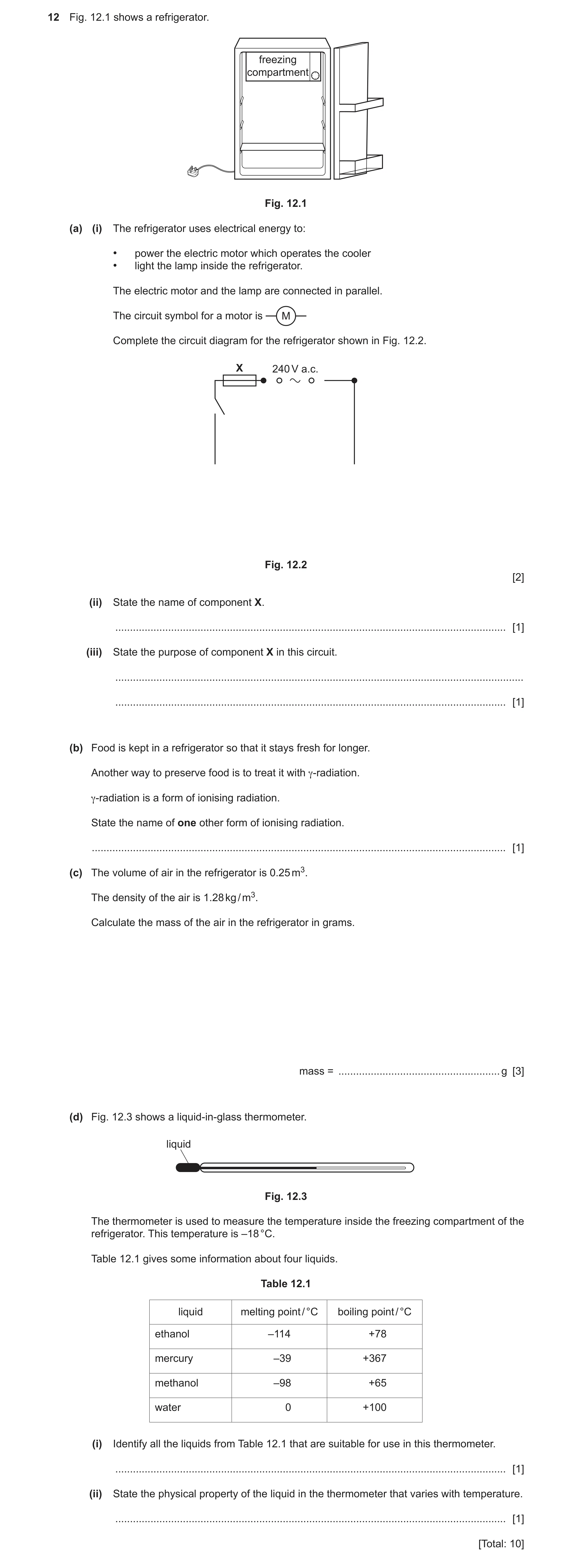
12 Fig. 12.1 shows a refrigerator. freezing compartment Fig. 12.1 (a) (i) The refrigerator uses electrical energy to: • power the electric motor which operates the cooler • light the lamp inside the refrigerator. The electric motor and the lamp are connected in parallel. The circuit symbol for a motor is M Complete the circuit diagram for the refrigerator shown in Fig. 12.2. X 240 V a.c. Fig. 12.2 [2] (ii) State the name of component X. … [1] (iii) State the purpose of component X in this circuit. … … [1] (b) Food is kept in a refrigerator so that it stays fresh for longer. Another way to preserve food is to treat it with γ-radiation. γ-radiation is a form of ionising radiation. State the name of one other form of ionising radiation. … [1] (c) The volume of air in the refrigerator is 0.25 m3. The density of the air is 1.28 kg / m3. Calculate the mass of the air in the refrigerator in grams. mass = … g [3] (d) Fig. 12.3 shows a liquid-in-glass thermometer. liquid Fig. 12.3 The thermometer is used to measure the temperature inside the freezing compartment of the refrigerator. This temperature is –18 °C. Table 12.1 gives some information about four liquids. Table 12.1 liquid melting point / °C boiling point / °C ethanol –114 +78 mercury –39 +367 methanol –98 +65 water 0 +100 (i) Identify all the liquids from Table 12.1 that are suitable for use in this thermometer. … [1] (ii) State the physical property of the liquid in the thermometer that varies with temperature. … [1] [Total: 10]
10 marks
Mark scheme: 12(a)(i) correct symbol for lamp ; 2 lamp and motor in parallel ; 12(a)(ii) fuse ; 1 12(a)(iii) protect circuit ; 1 12(b) alpha / beta / X-rays ; 1 12(c) mass = density volume (in any form) / 1.28 0.25 ; 3 evidence of conversion of mass to grams ; = 320 (g) ; 12(d)(i) ethanol, mercury and methanol ; 1 12(d)(ii) density / volume ; 1
This question in 0654/32 Oct/Nov 2023
Q19 · An electric heater used in a classroom in a school 0654/32 Oct/Nov 2024
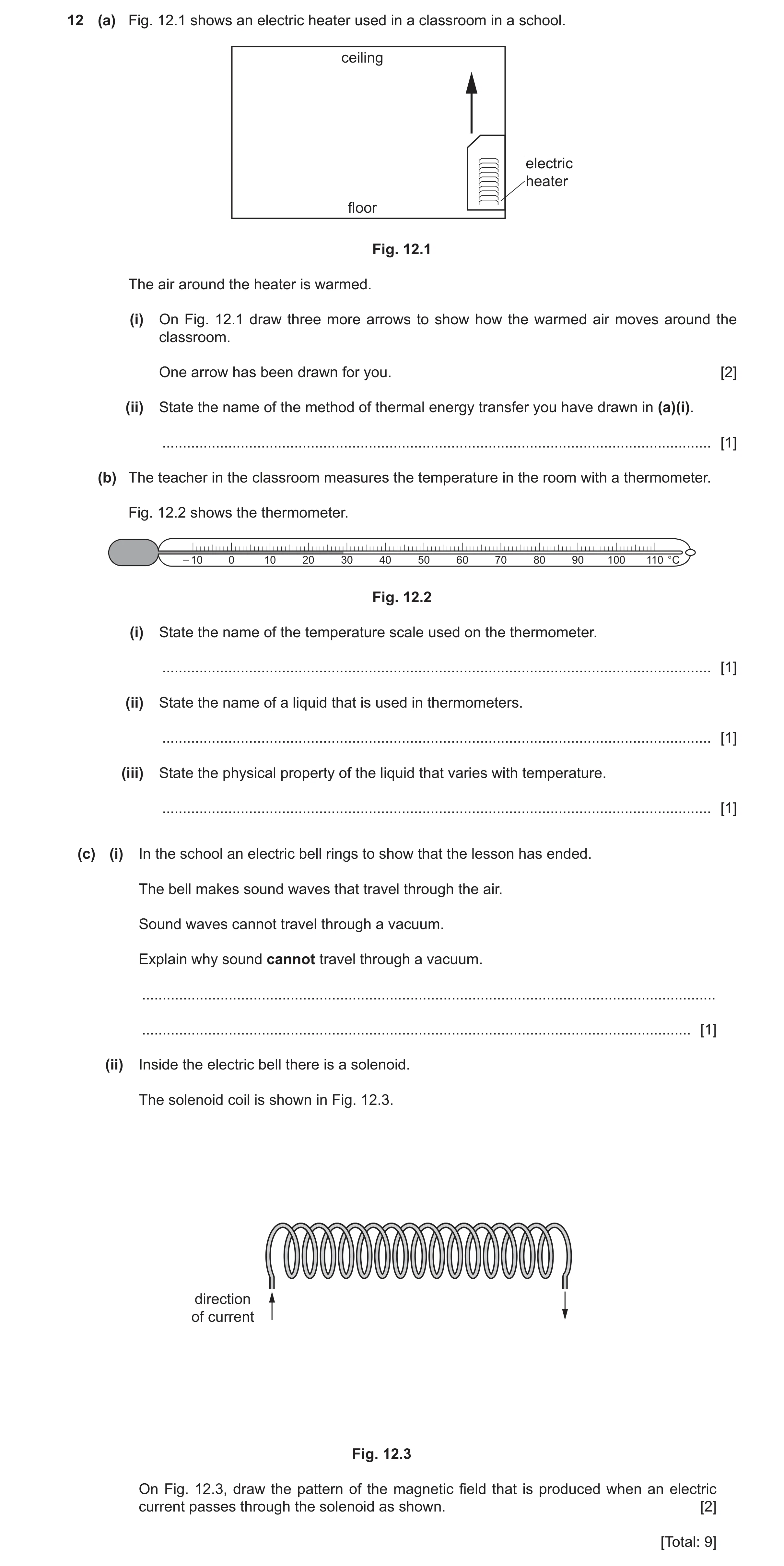
12 (a) Fig. 12.1 shows an electric heater used in a classroom in a school. ceiling electric heater floor Fig. 12.1 The air around the heater is warmed. (i) On Fig. 12.1 draw three more arrows to show how the warmed air moves around the classroom. One arrow has been drawn for you. [2] (ii) State the name of the method of thermal energy transfer you have drawn in (a)(i). … [1] (b) The teacher in the classroom measures the temperature in the room with a thermometer. Fig. 12.2 shows the thermometer. – 10 0 10 20 30 40 50 60 70 80 90 100 110 °C Fig. 12.2 (i) State the name of the temperature scale used on the thermometer. … [1] (ii) State the name of a liquid that is used in thermometers. … [1] (iii) State the physical property of the liquid that varies with temperature. … [1] (c) (i) In the school an electric bell rings to show that the lesson has ended. The bell makes sound waves that travel through the air. Sound waves cannot travel through a vacuum. Explain why sound cannot travel through a vacuum. … … [1] (ii) Inside the electric bell there is a solenoid. The solenoid coil is shown in Fig. 12.3. direction of current Fig. 12.3 On Fig. 12.3, draw the pattern of the magnetic field that is produced when an electric current passes through the solenoid as shown. [2] [Total: 9]
9 marks
Mark scheme: 12(a)(i) arrow 2 across the top then dropping down then left to right along floor 1 mark for any one correct arrow ; 1 mark for all three arrows correct ; 12(a)(ii) convection ; 1 12(b)(i) celsius ; 1 12(b)(ii) alcohol or mercury ; 1 12(b)(iii) volume / density ; 1 12(c)(i) There is no medium (for the propagation of the sound wave) ; 1 12(c)(ii) at least two lines going all the way through coil ; 2 line curving upwards and line curving downwards ;
This question in 0654/32 Oct/Nov 2024
Q20 · An electric heater used in a classroom in a school 0654/33 Oct/Nov 2024
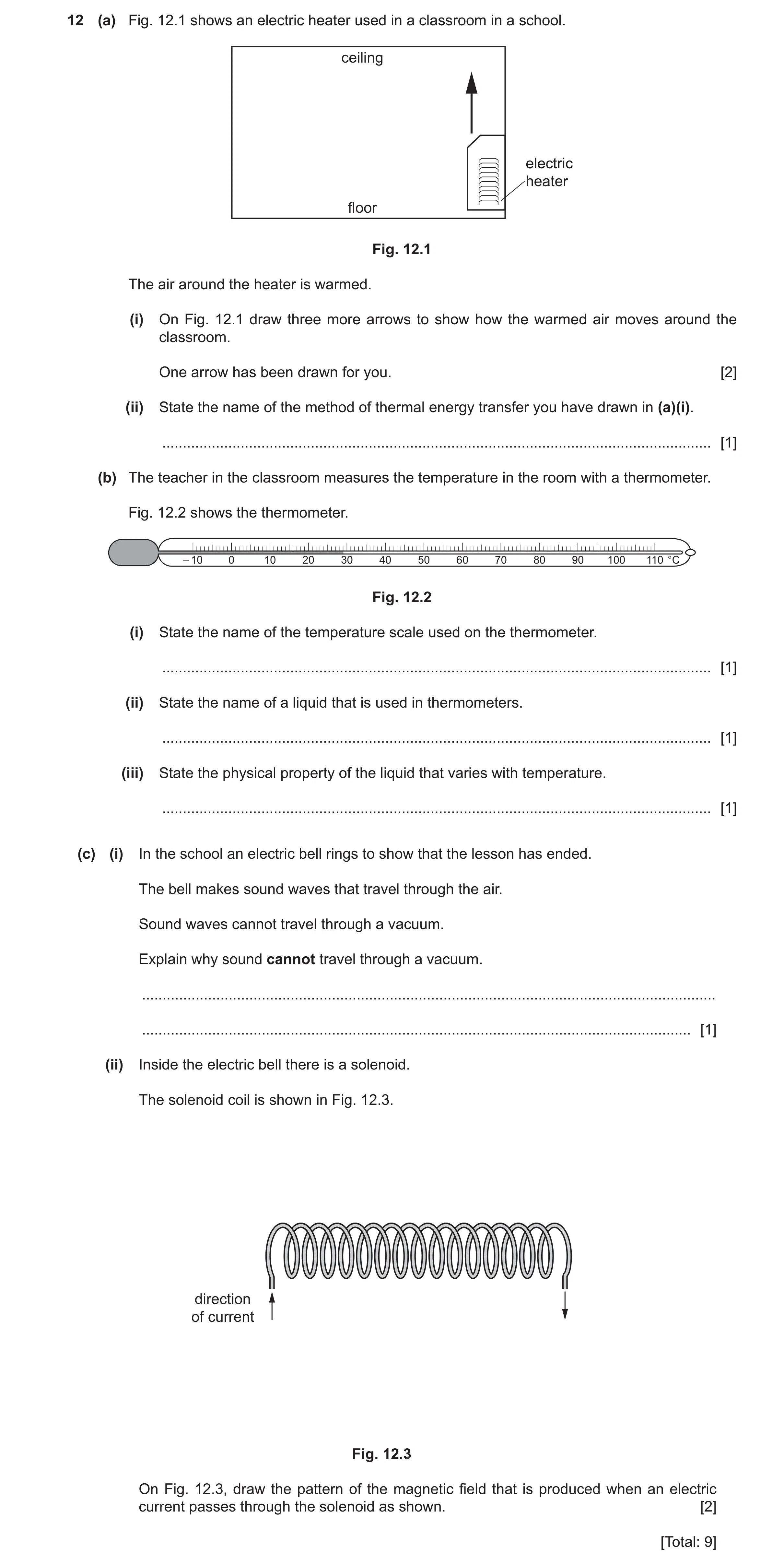
12 (a) Fig. 12.1 shows an electric heater used in a classroom in a school. ceiling electric heater floor Fig. 12.1 The air around the heater is warmed. (i) On Fig. 12.1 draw three more arrows to show how the warmed air moves around the classroom. One arrow has been drawn for you. [2] (ii) State the name of the method of thermal energy transfer you have drawn in (a)(i). … [1] (b) The teacher in the classroom measures the temperature in the room with a thermometer. Fig. 12.2 shows the thermometer. – 10 0 10 20 30 40 50 60 70 80 90 100 110 °C Fig. 12.2 (i) State the name of the temperature scale used on the thermometer. … [1] (ii) State the name of a liquid that is used in thermometers. … [1] (iii) State the physical property of the liquid that varies with temperature. … [1] (c) (i) In the school an electric bell rings to show that the lesson has ended. The bell makes sound waves that travel through the air. Sound waves cannot travel through a vacuum. Explain why sound cannot travel through a vacuum. … … [1] (ii) Inside the electric bell there is a solenoid. The solenoid coil is shown in Fig. 12.3. direction of current Fig. 12.3 On Fig. 12.3, draw the pattern of the magnetic field that is produced when an electric current passes through the solenoid as shown. [2] [Total: 9]
9 marks
Mark scheme: 12(a)(i) arrow 2 across the top then dropping down then left to right along floor 1 mark for any one correct arrow ; 1 mark for all three arrows correct ; 12(a)(ii) convection ; 1 12(b)(i) celsius ; 1 12(b)(ii) alcohol or mercury ; 1 12(b)(iii) volume / density ; 1 12(c)(i) There is no medium (for the propagation of the sound wave) ; 1 12(c)(ii) at least two lines going all the way through coil ; 2 line curving upwards and line curving downwards ;
This question in 0654/33 Oct/Nov 2024
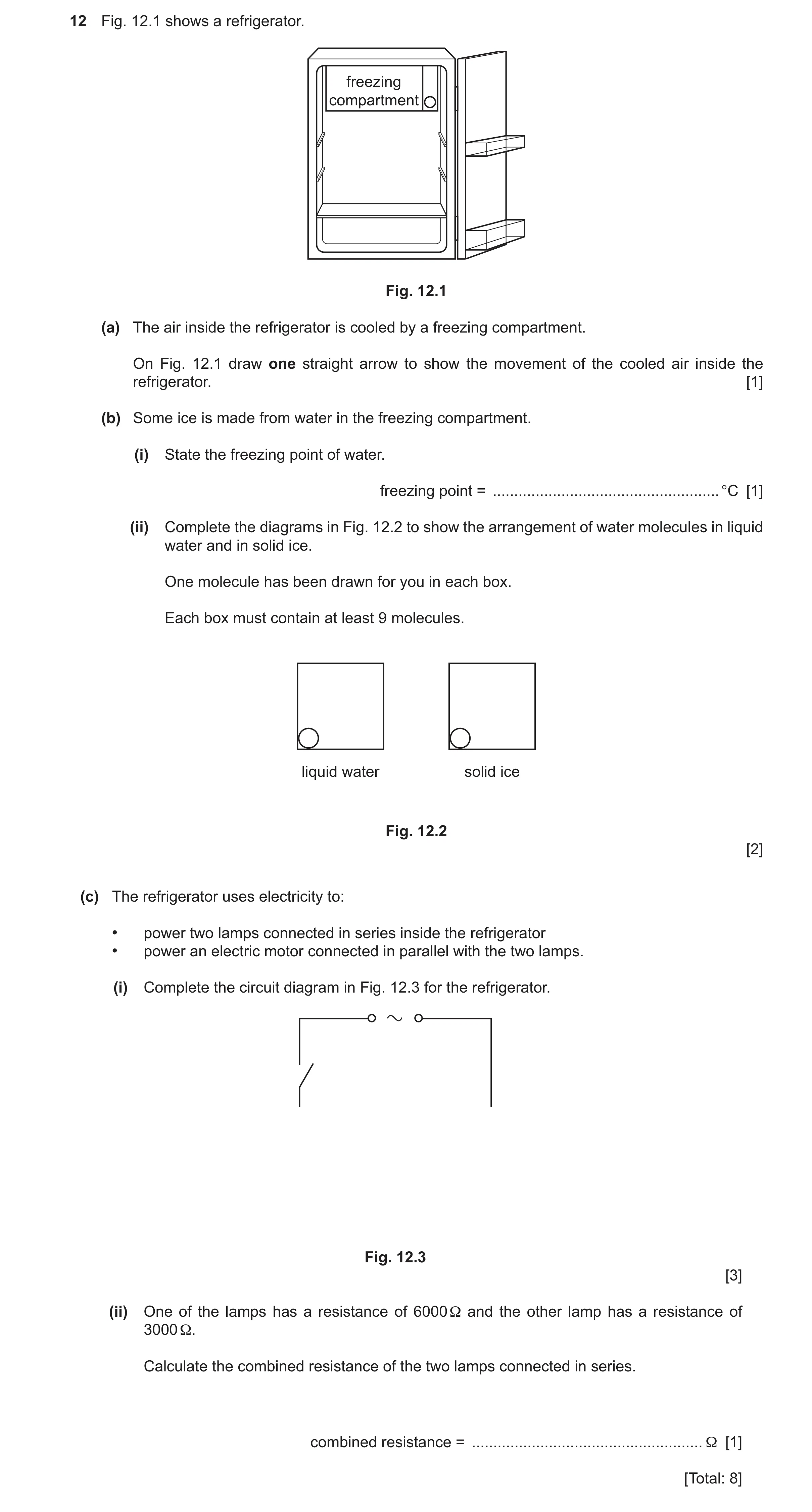
Question 21 0654/32 Feb/March 2025
12 Fig. 12.1 shows a refrigerator. freezing compartment Fig. 12.1 (a) The air inside the refrigerator is cooled by a freezing compartment. On Fig. 12.1 draw one straight arrow to show the movement of the cooled air inside the refrigerator. [1] (b) Some ice is made from water in the freezing compartment. (i) State the freezing point of water. freezing point = … °C [1] (ii) Complete the diagrams in Fig. 12.2 to show the arrangement of water molecules in liquid water and in solid ice. One molecule has been drawn for you in each box. Each box must contain at least 9 molecules. liquid water solid ice Fig. 12.2 [2] (c) The refrigerator uses electricity to: • power two lamps connected in series inside the refrigerator • power an electric motor connected in parallel with the two lamps. (i) Complete the circuit diagram in Fig. 12.3 for the refrigerator. Fig. 12.3 [3] (ii) One of the lamps has a resistance of 6000 Ω and the other lamp has a resistance of 3000 Ω. Calculate the combined resistance of the two lamps connected in series. combined resistance = … Ω [1] [Total: 8]
8 marks
Mark scheme: 12(a) arrow going downwards ; 1 12(b)(i) 0 (°C) ; 1 12(b)(ii) liquid – (at least) 9 particles (all) touching and random arrangement ; 2 solid – (at least) 9 particles all touching and regular arrangement ; 12(c)(i) correct symbols for motor and lamps ; 3 lamps in series with each other ; motor in parallel with lamps ; 12(c)(ii) 9000 () ; 1
This question in 0654/32 Feb/March 2025
 15
15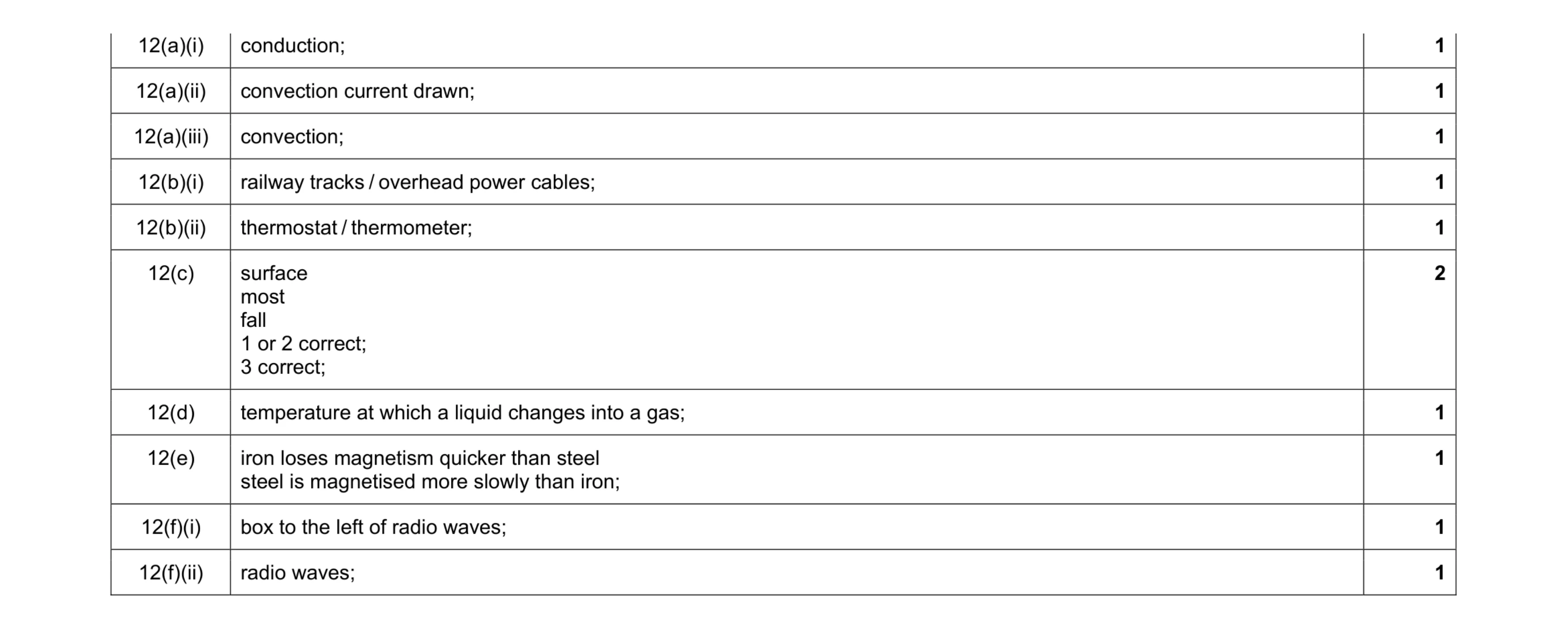 11
11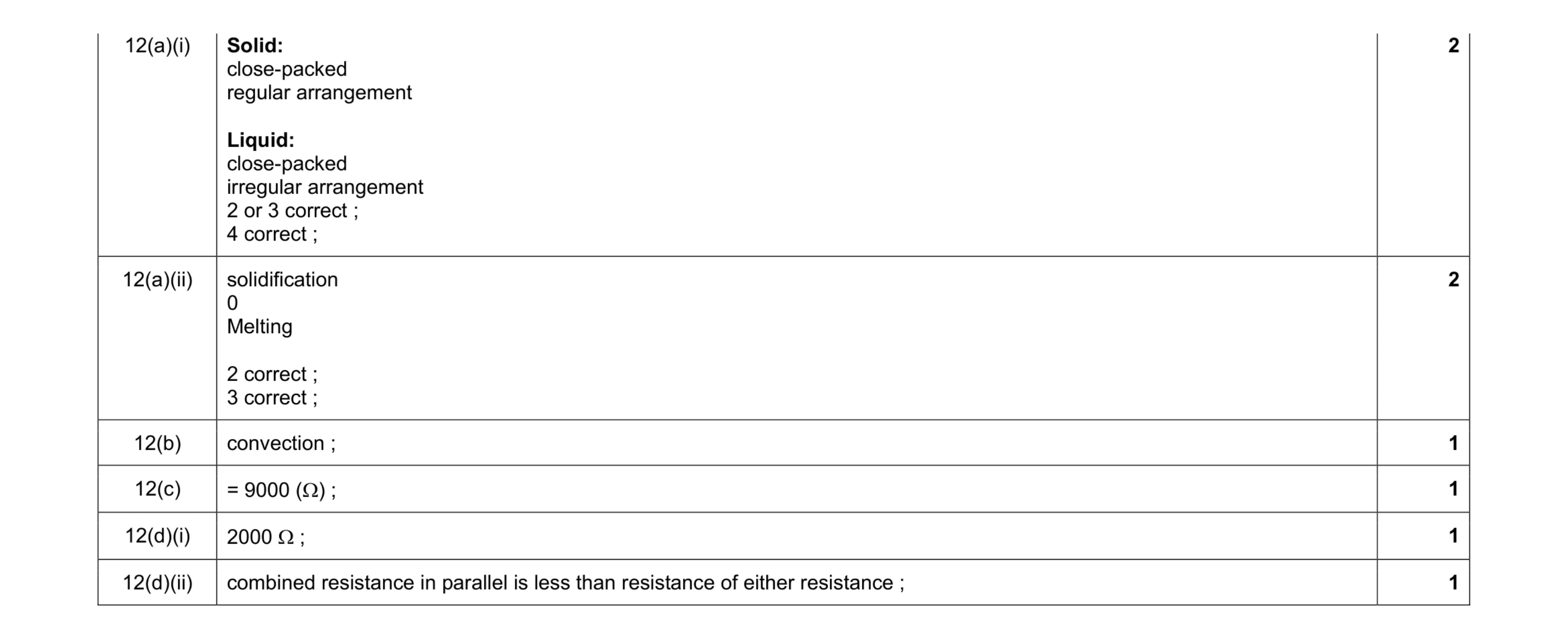 8
8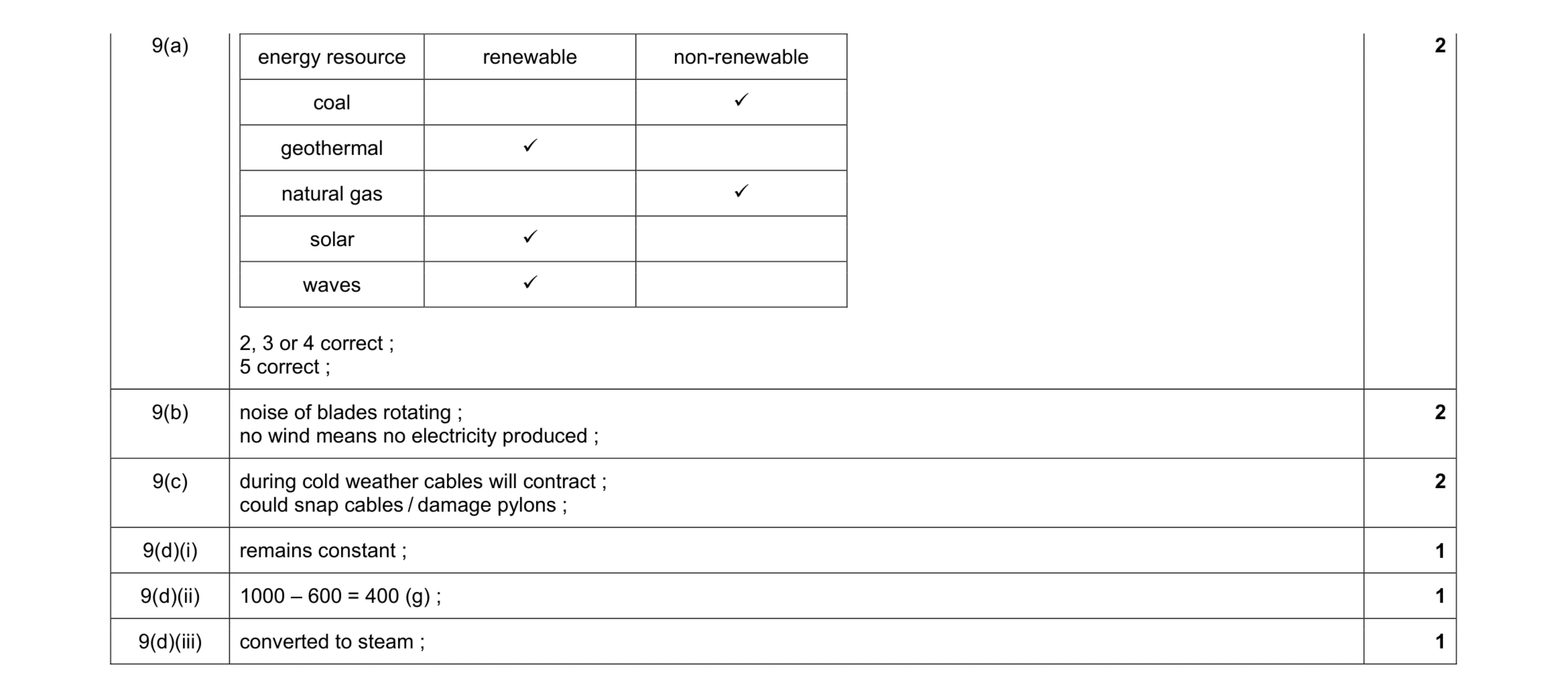 9
9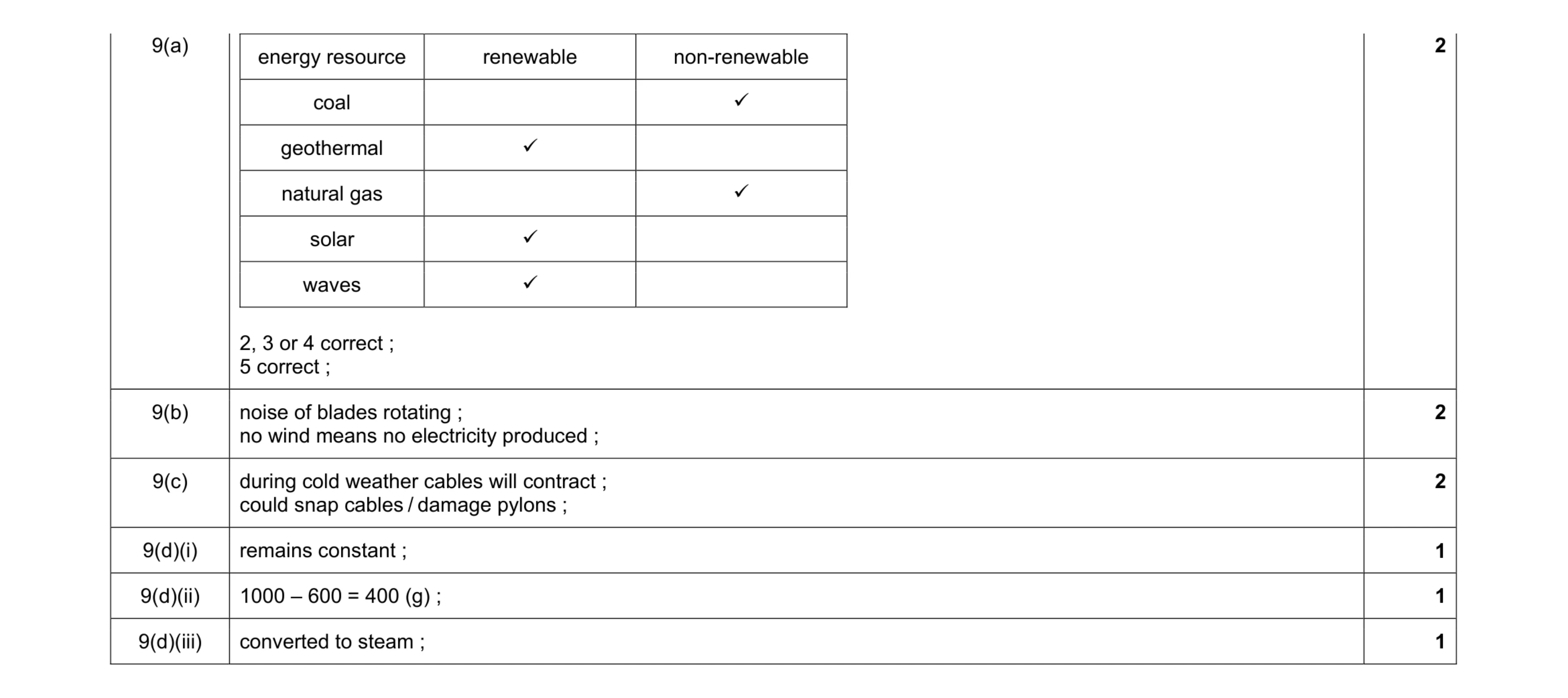 9
9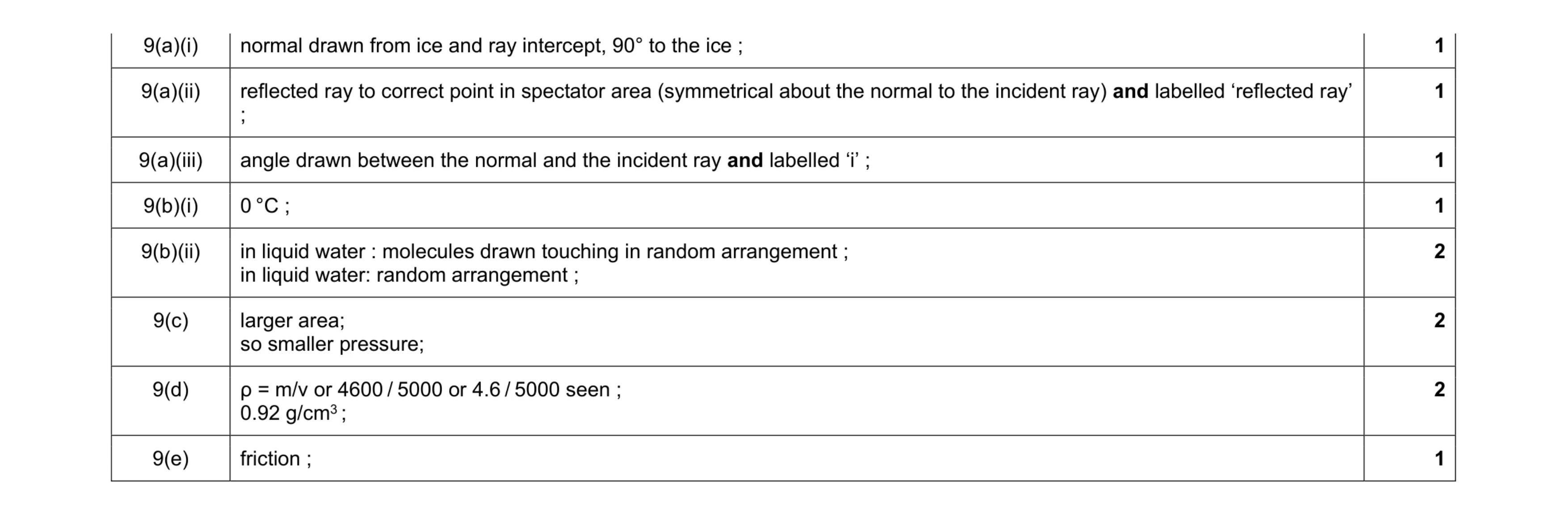 11
11 7
7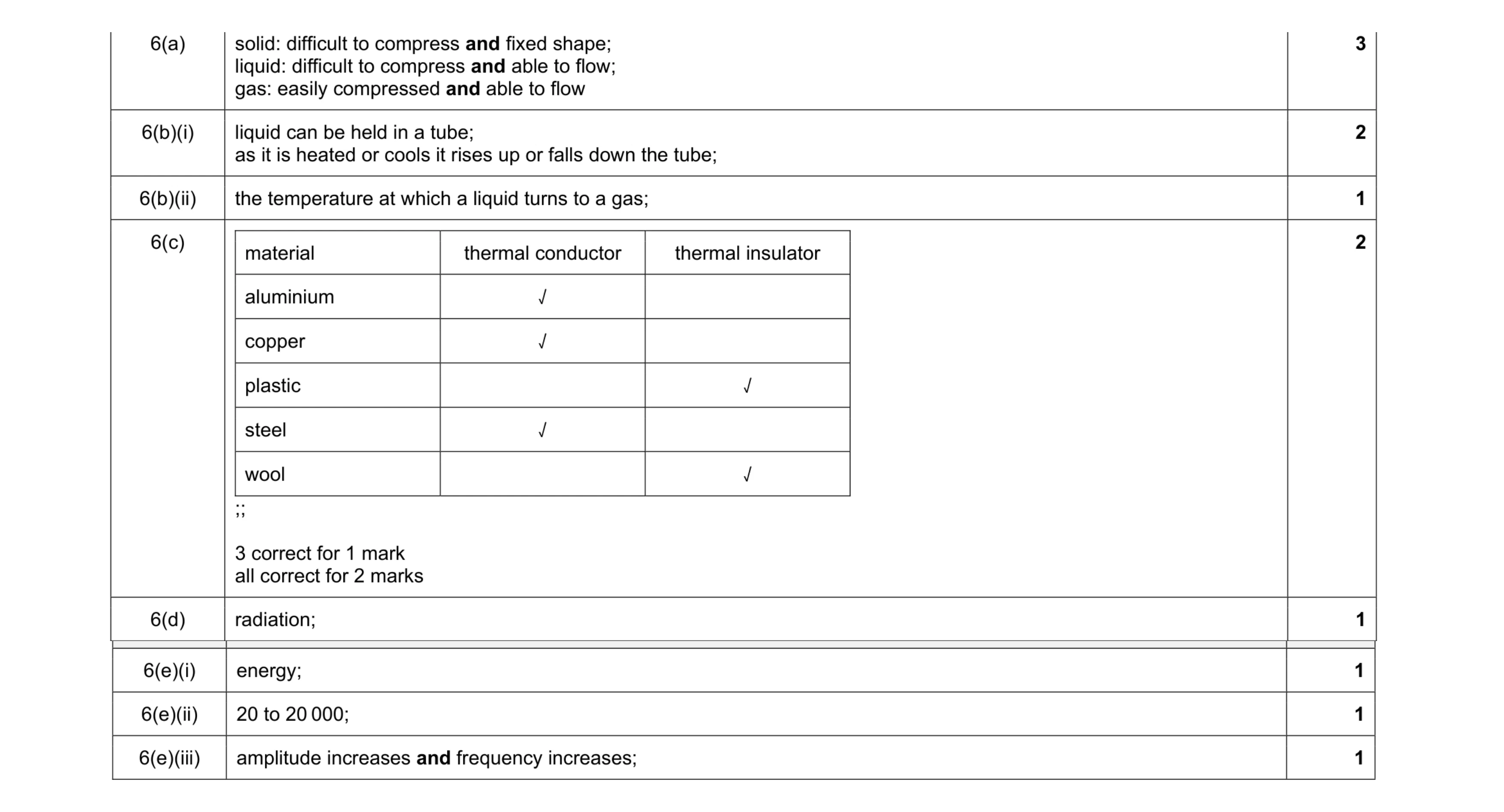 12
12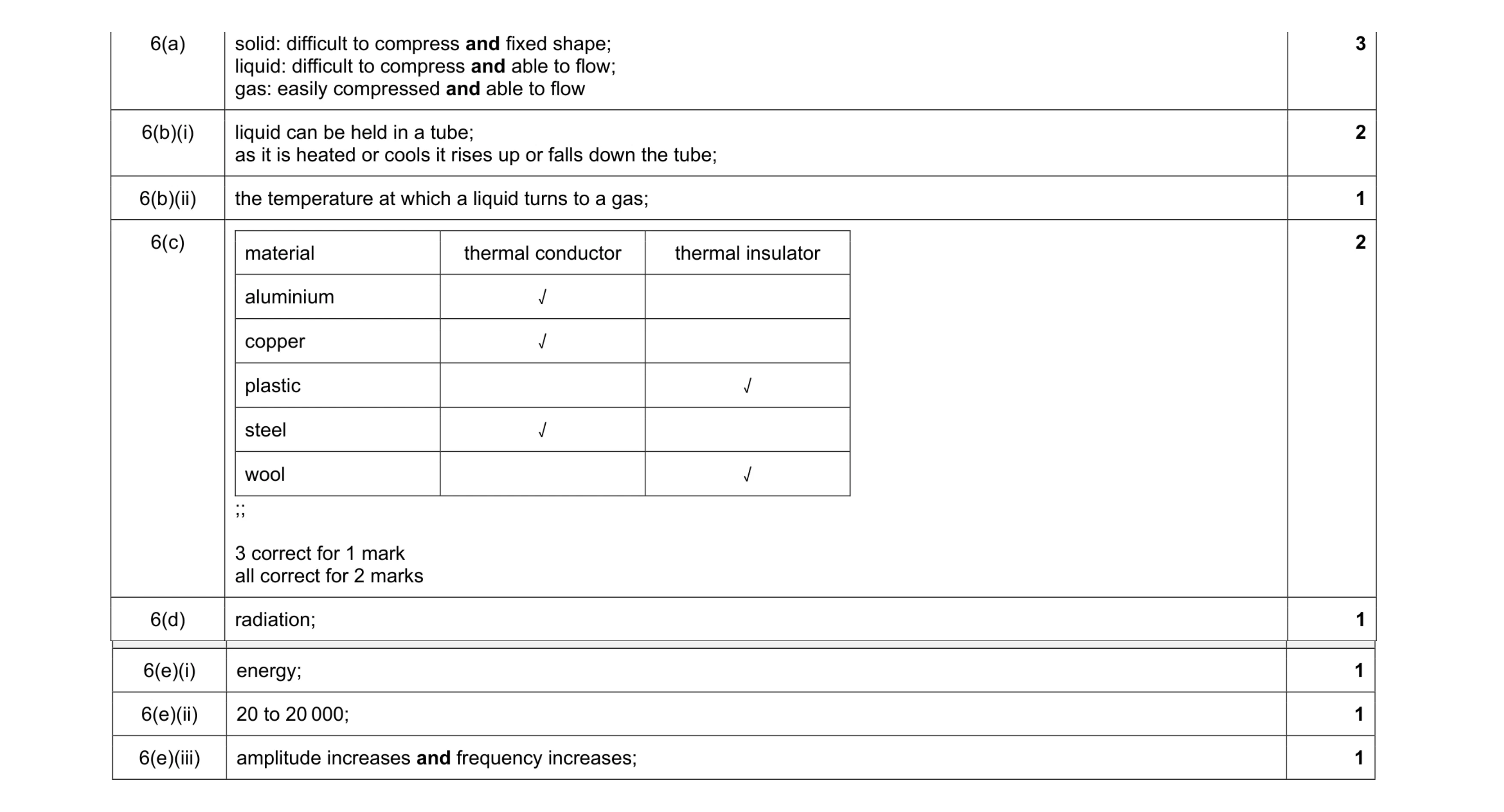 12
12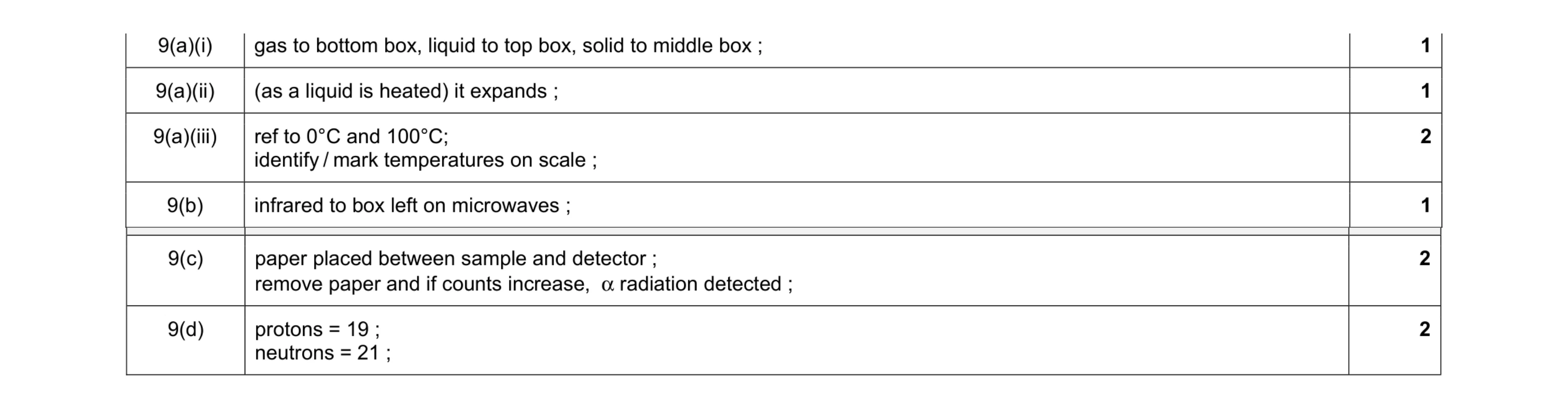 9
9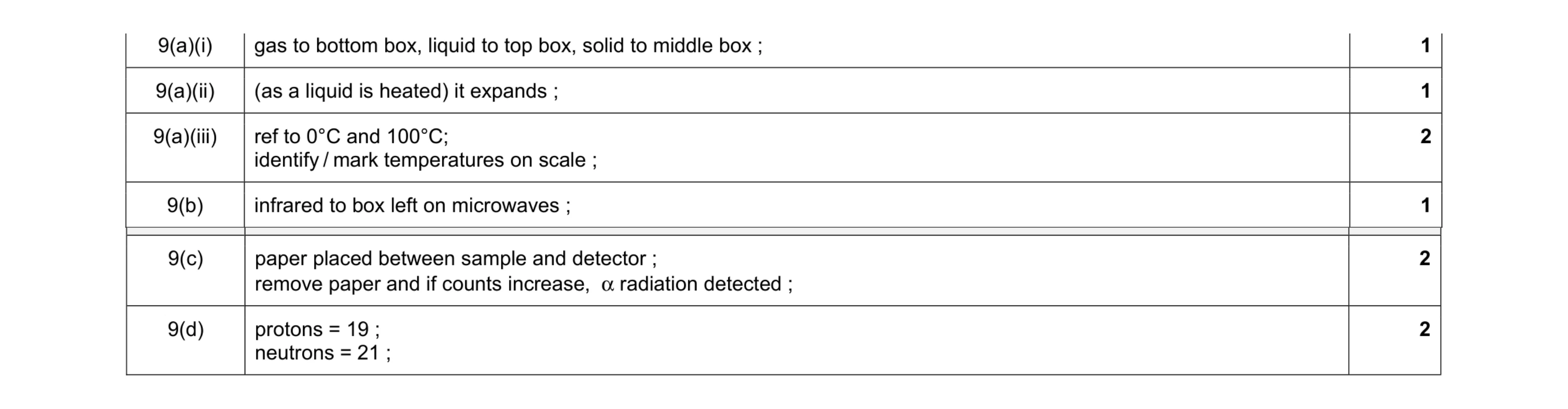 9
9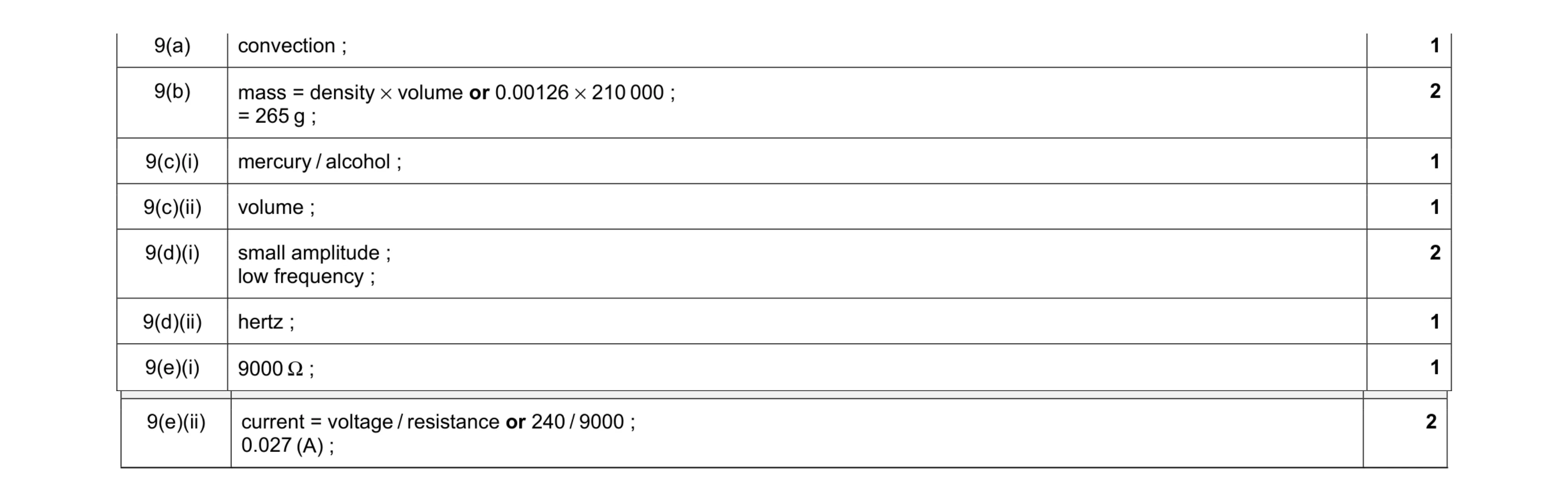 11
11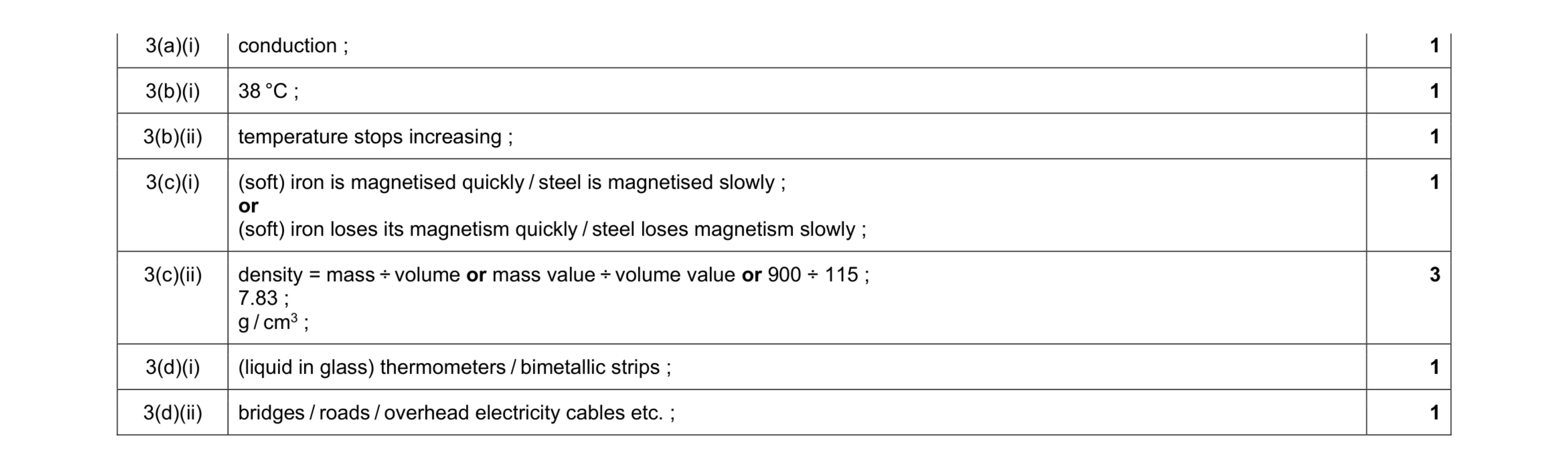 9
9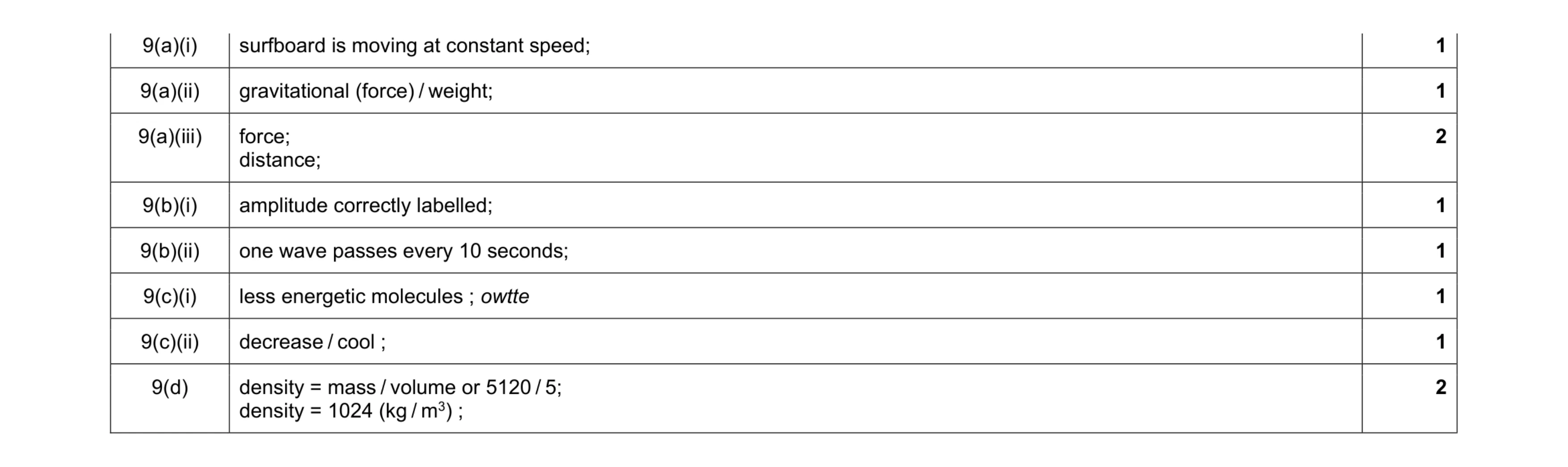 10
10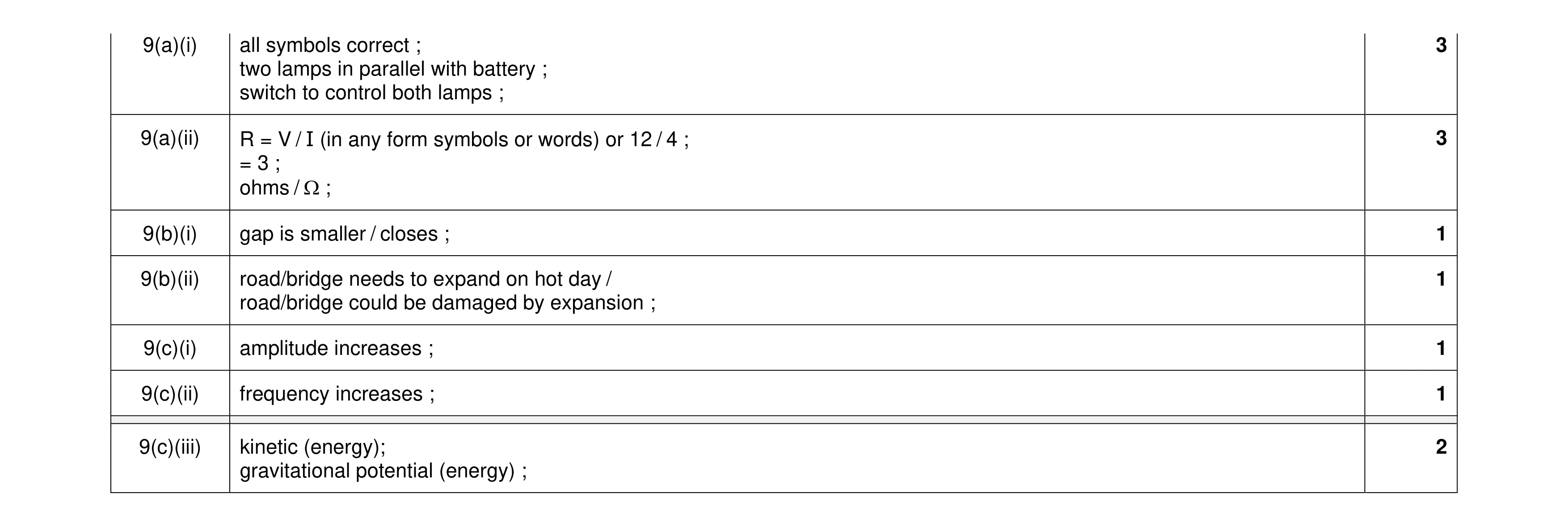 12
12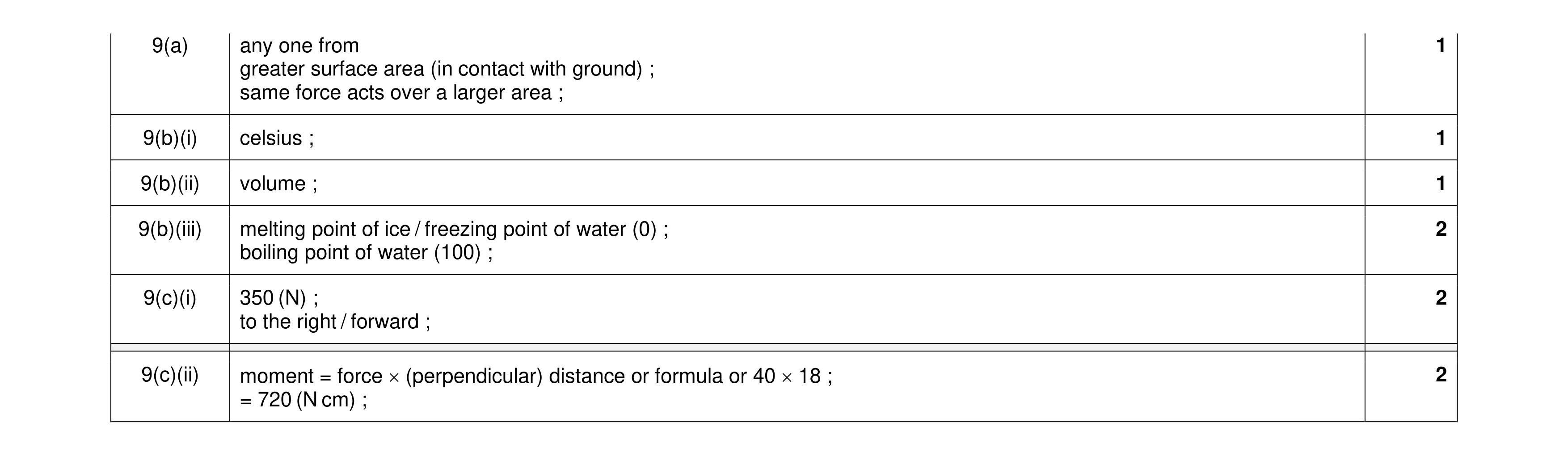 9
9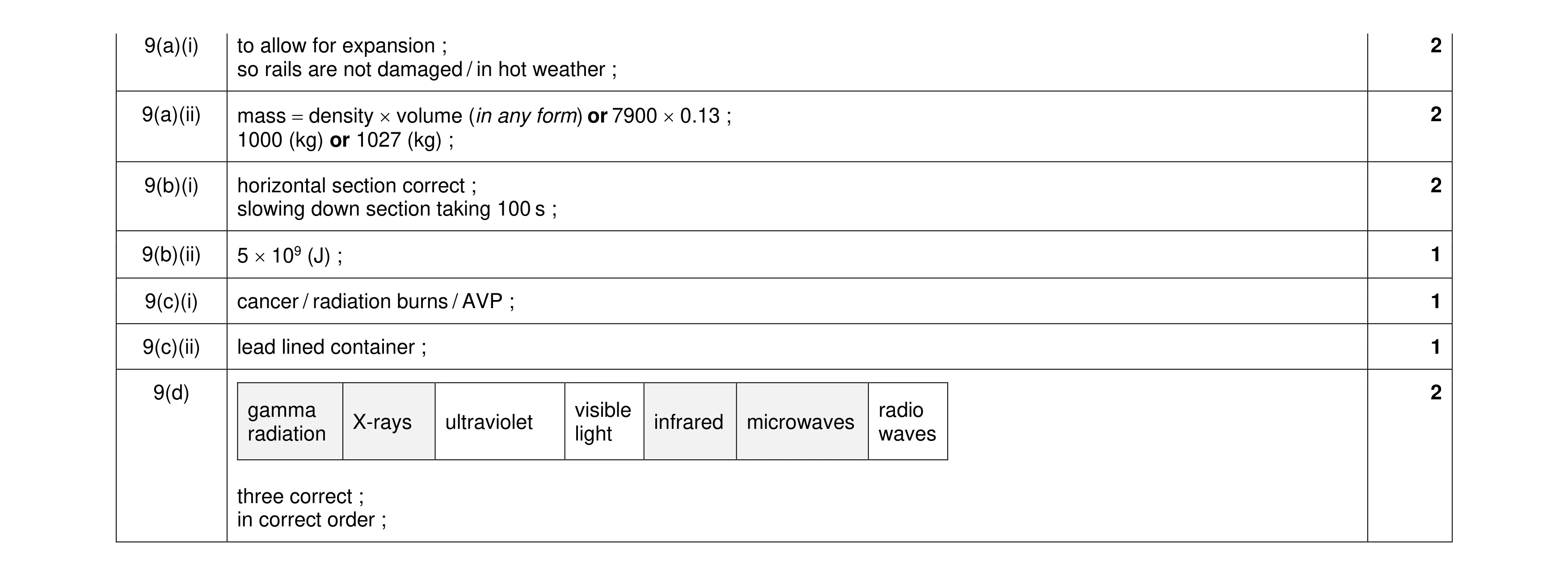 11
11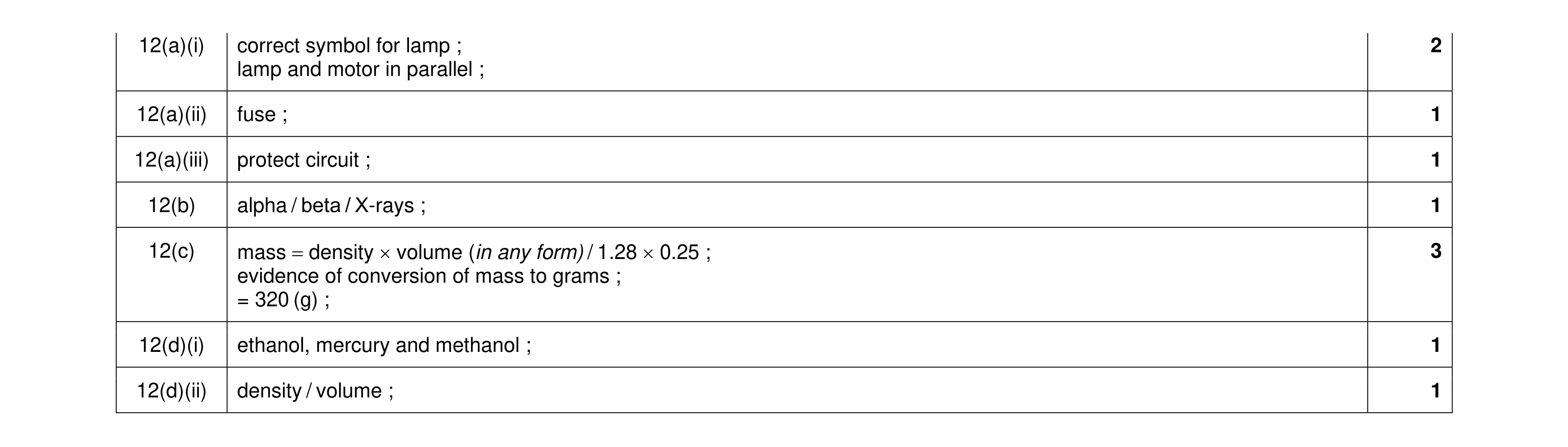 10
10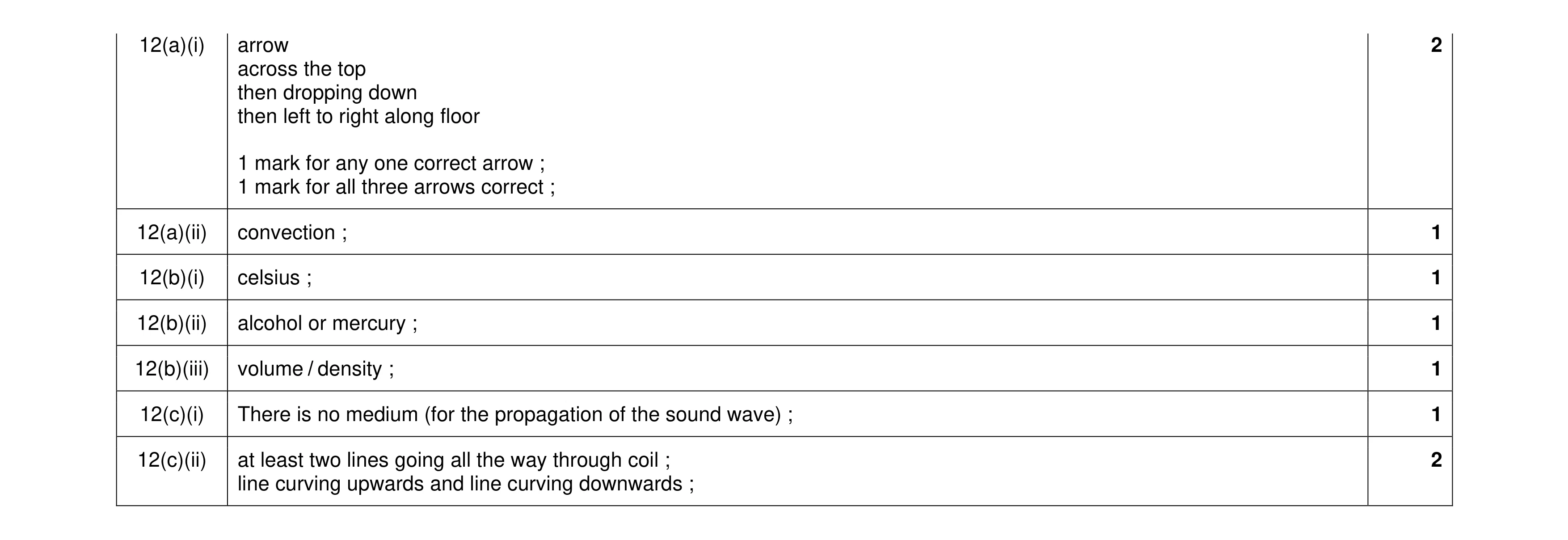 9
9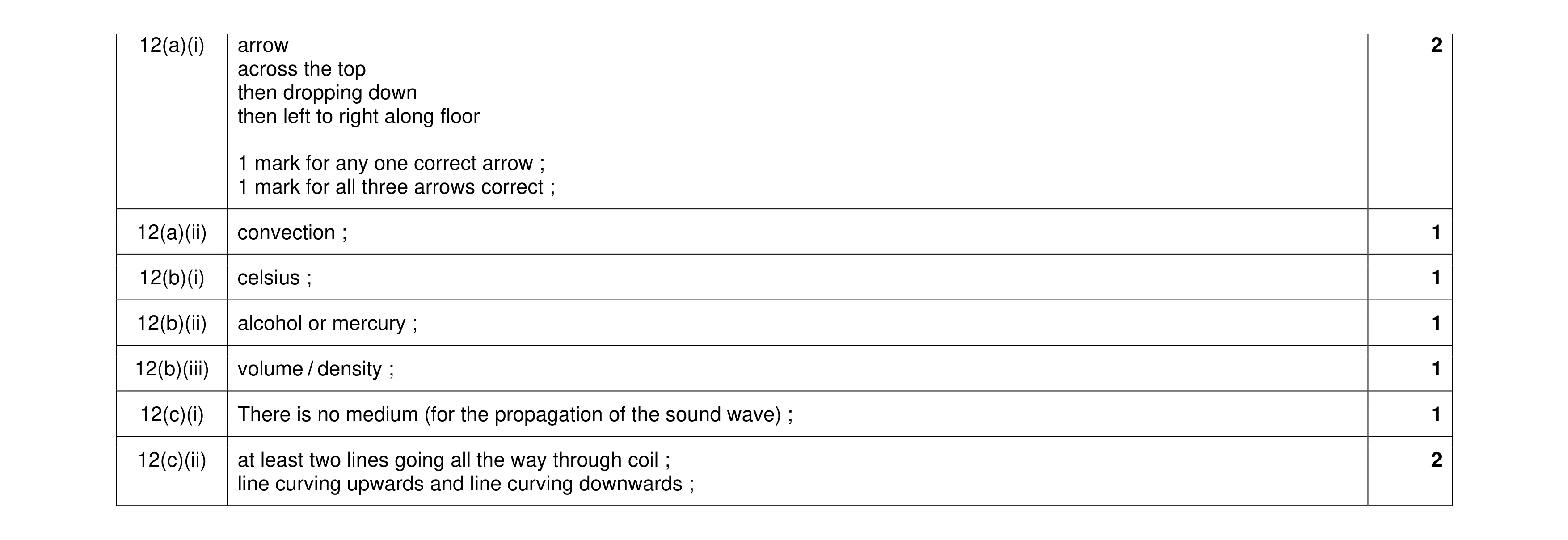 9
9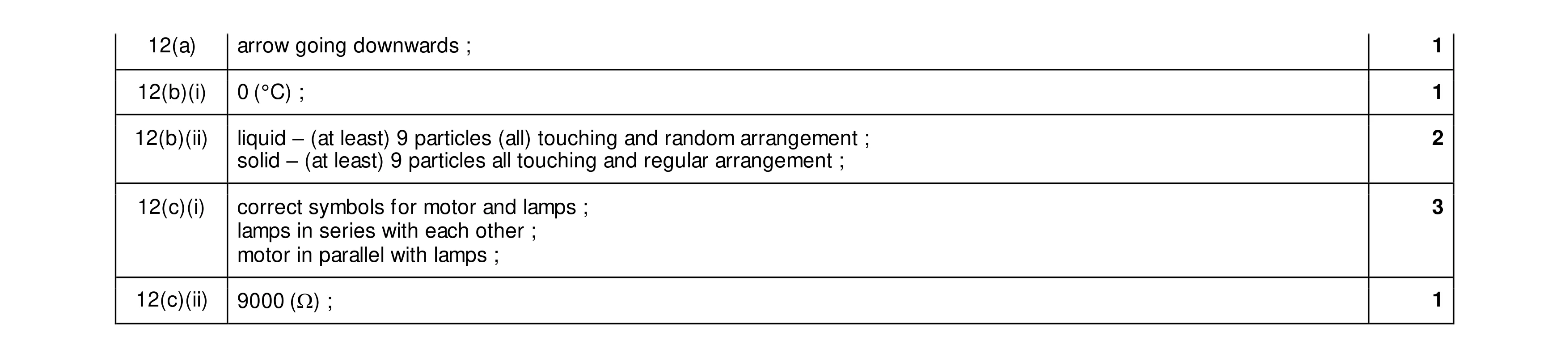 8
8