Questions as text
Q1 · Which element is used to extract some metals from their ores? 0654/21 May/June 2017
22 Which element is used to extract some metals from their ores? A carbon B copper C iron D nitrogen
1 marks
Answer: A
This question in 0654/21 May/June 2017
Q2 · Underwater pipes made from steel are prevented from rusting by sacrificial protection 0654/23 Oct/Nov 2017
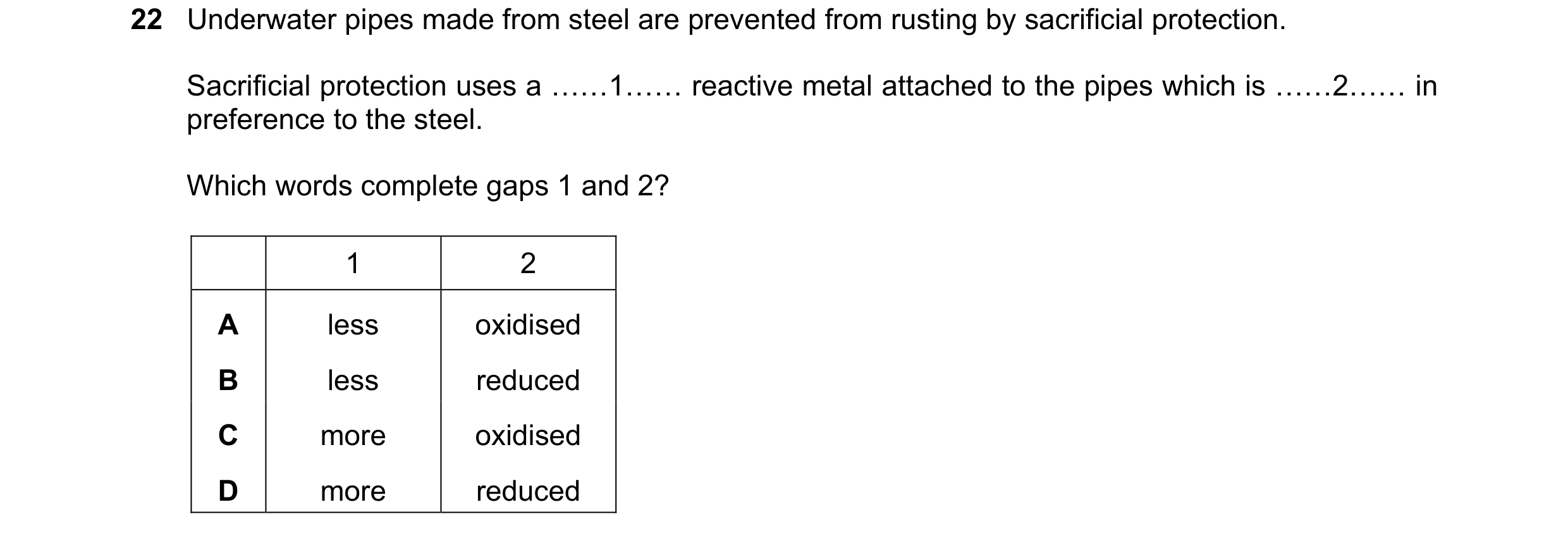
22 Underwater pipes made from steel are prevented from rusting by sacrificial protection. Sacrificial protection uses a ««1«« reactive metal attached to the pipes which is ««2«« in preference to the steel. Which words complete gaps 1 and 2? 1 2 A less oxidised B less reduced C more oxidised D more reduced
1 marks
Answer: C
This question in 0654/23 Oct/Nov 2017
Q3 · Part of the reactivity series is shown 0654/21 Oct/Nov 2018
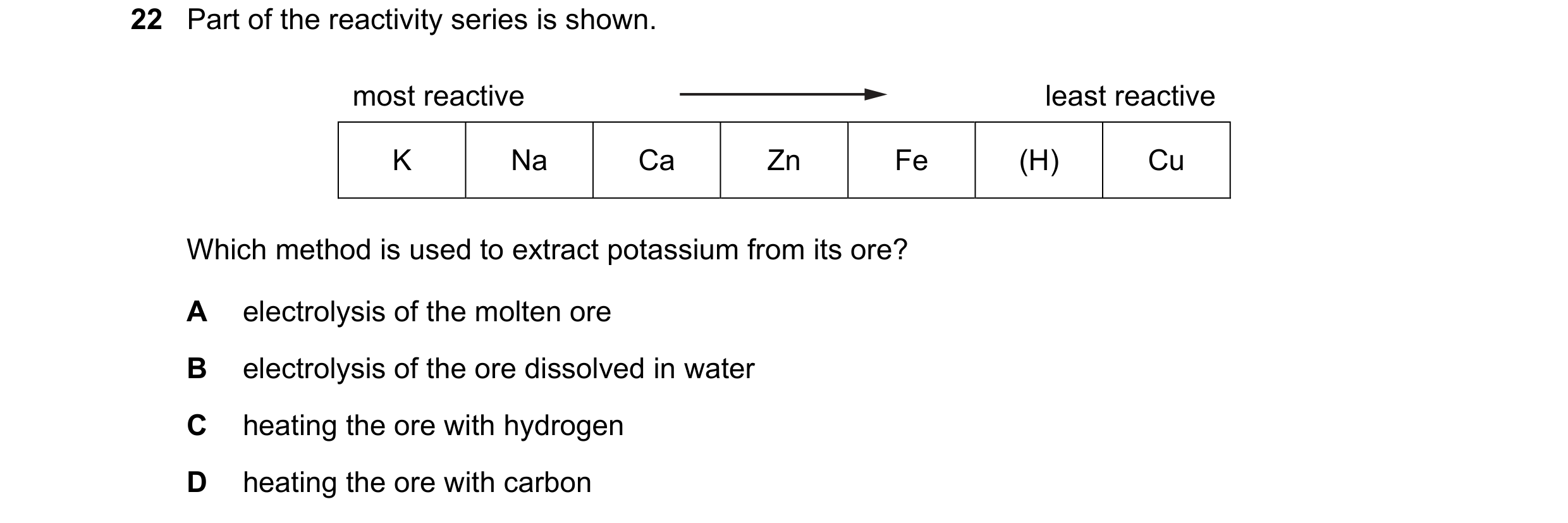
22 Part of the reactivity series is shown. most reactive least reactive K Na Ca Zn Fe (H) Cu Which method is used to extract potassium from its ore? A electrolysis of the molten ore B electrolysis of the ore dissolved in water C heating the ore with hydrogen D heating the ore with carbon
1 marks
Answer: A
This question in 0654/21 Oct/Nov 2018
Q4 · A block of zinc is attached to an underground steel pipe as shown 0654/23 Oct/Nov 2018
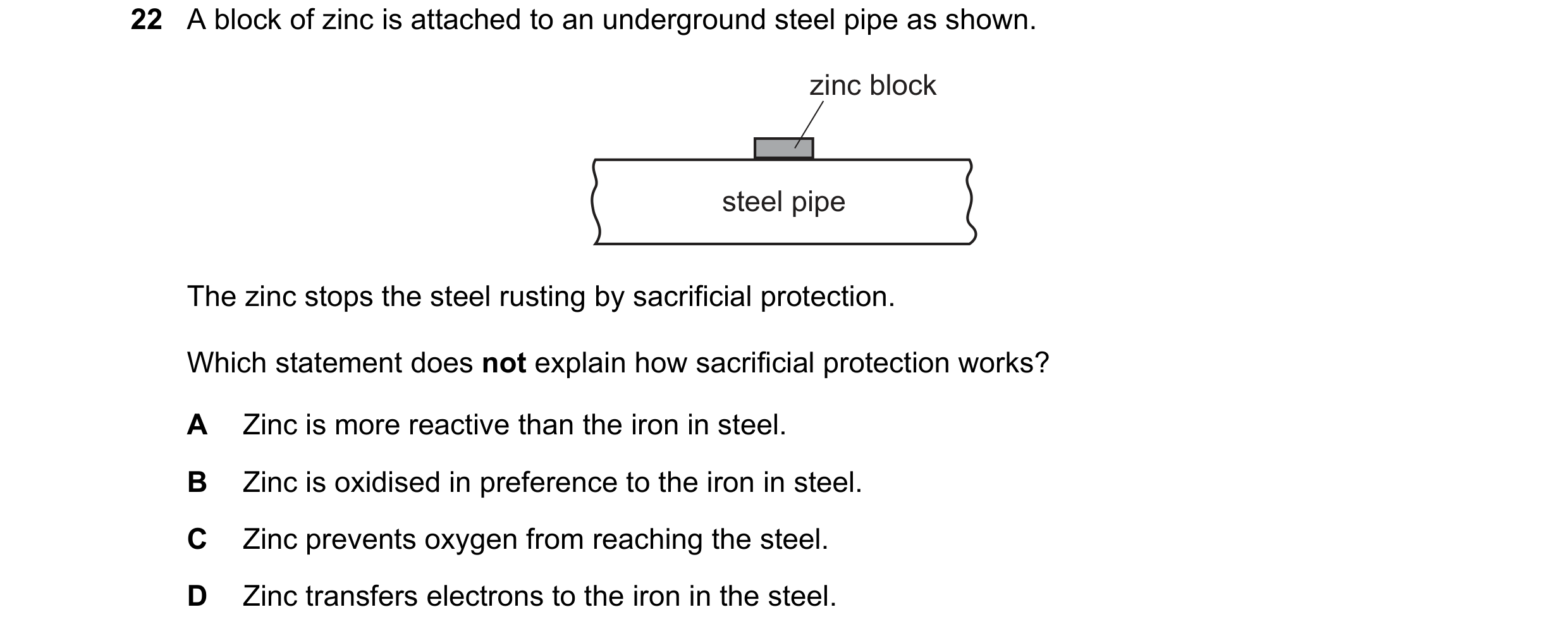
22 A block of zinc is attached to an underground steel pipe as shown. zinc block steel pipe The zinc stops the steel rusting by sacrificial protection. Which statement does not explain how sacrificial protection works? A Zinc is more reactive than the iron in steel. B Zinc is oxidised in preference to the iron in steel. C Zinc prevents oxygen from reaching the steel. D Zinc transfers electrons to the iron in the steel.
1 marks
Answer: C
This question in 0654/23 Oct/Nov 2018
Q5 · Samples of four different metals, L, M, N and O, are added to solutions of the metal… 0654/21 May/June 2019
22 Samples of four different metals, L, M, N and O, are added to solutions of the metal chlorides.
The table shows which metals react with the metal chlorides.
L chloride | Mchloride | Nchloride | Ochloride
L x x x
M J x J
N J J J
O J x x
What is the order of reactivity?
most least
reactive reactive
A L M O N
B L O M N
Cc N M O L
D N O M L
key
JY = reaction
X = no reaction
1 marks
Answer: C
This question in 0654/21 May/June 2019
Q6 · Tin is extracted from cassiterite (tin oxide) 0654/22 Oct/Nov 2019
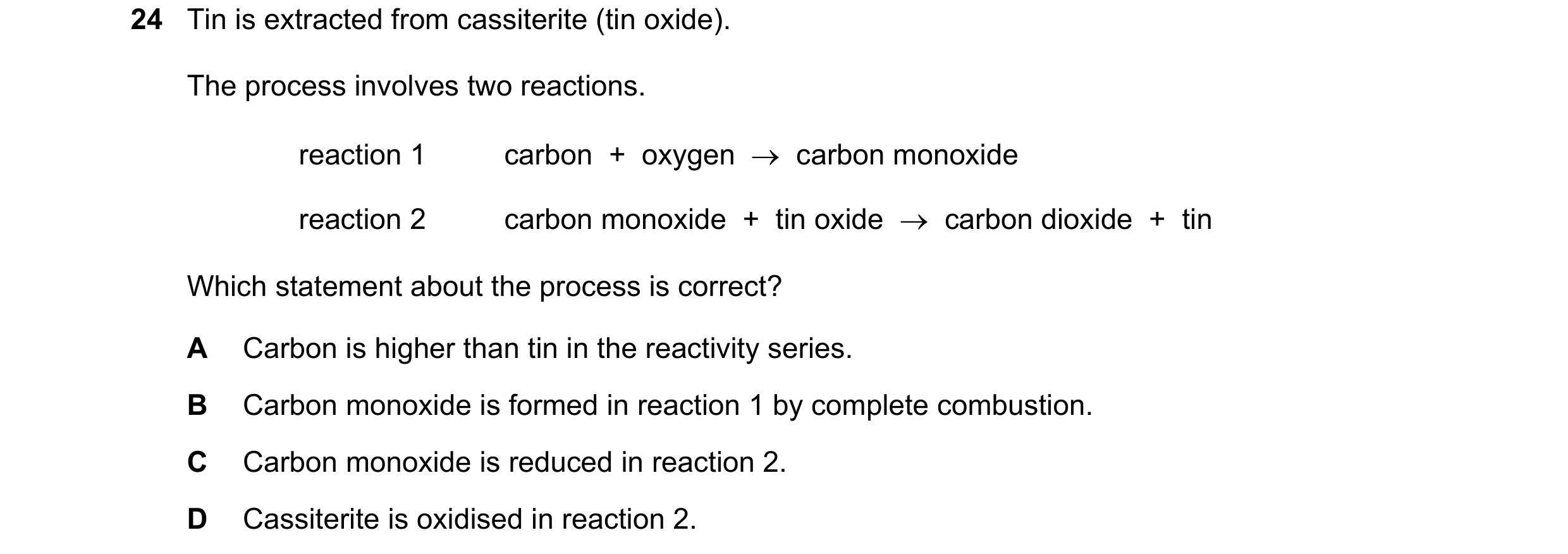
24 Tin is extracted from cassiterite (tin oxide). The process involves two reactions. reaction 1 carbon + oxygen → carbon monoxide reaction 2 carbon monoxide + tin oxide → carbon dioxide + tin Which statement about the process is correct? A Carbon is higher than tin in the reactivity series. B Carbon monoxide is formed in reaction 1 by complete combustion. C Carbon monoxide is reduced in reaction 2. D Cassiterite is oxidised in reaction 2.
1 marks
Answer: A
This question in 0654/22 Oct/Nov 2019
Q7 · Which pair of substances do not react with each other? 0654/23 Oct/Nov 2019
24 Which pair of substances do not react with each other? A copper and aqueous magnesium sulfate B iron and aqueous copper(II) sulfate C magnesium and aqueous zinc sulfate D zinc and aqueous iron(II) sulfate
1 marks
Answer: A
This question in 0654/23 Oct/Nov 2019
Q8 · The equations for four reactions are shown 0654/21 Oct/Nov 2020
22 The equations for four reactions are shown. Mn + Ni(NO3)2 Mn(NO3)2 + Ni Ni + PbO NiO + Pb PbO + Sn SnO + Pb Sn(NO3)2 + Ni Ni(NO3)2 + Sn What is the order of reactivity of the metals? most least reactive reactive A lead tin nickel manganese B manganese nickel tin lead C manganese tin nickel lead D lead nickel tin manganese
1 marks
Answer: B
This question in 0654/21 Oct/Nov 2020
Q9 · Four different metals are separately heated with their metal oxides 0654/22 Oct/Nov 2020
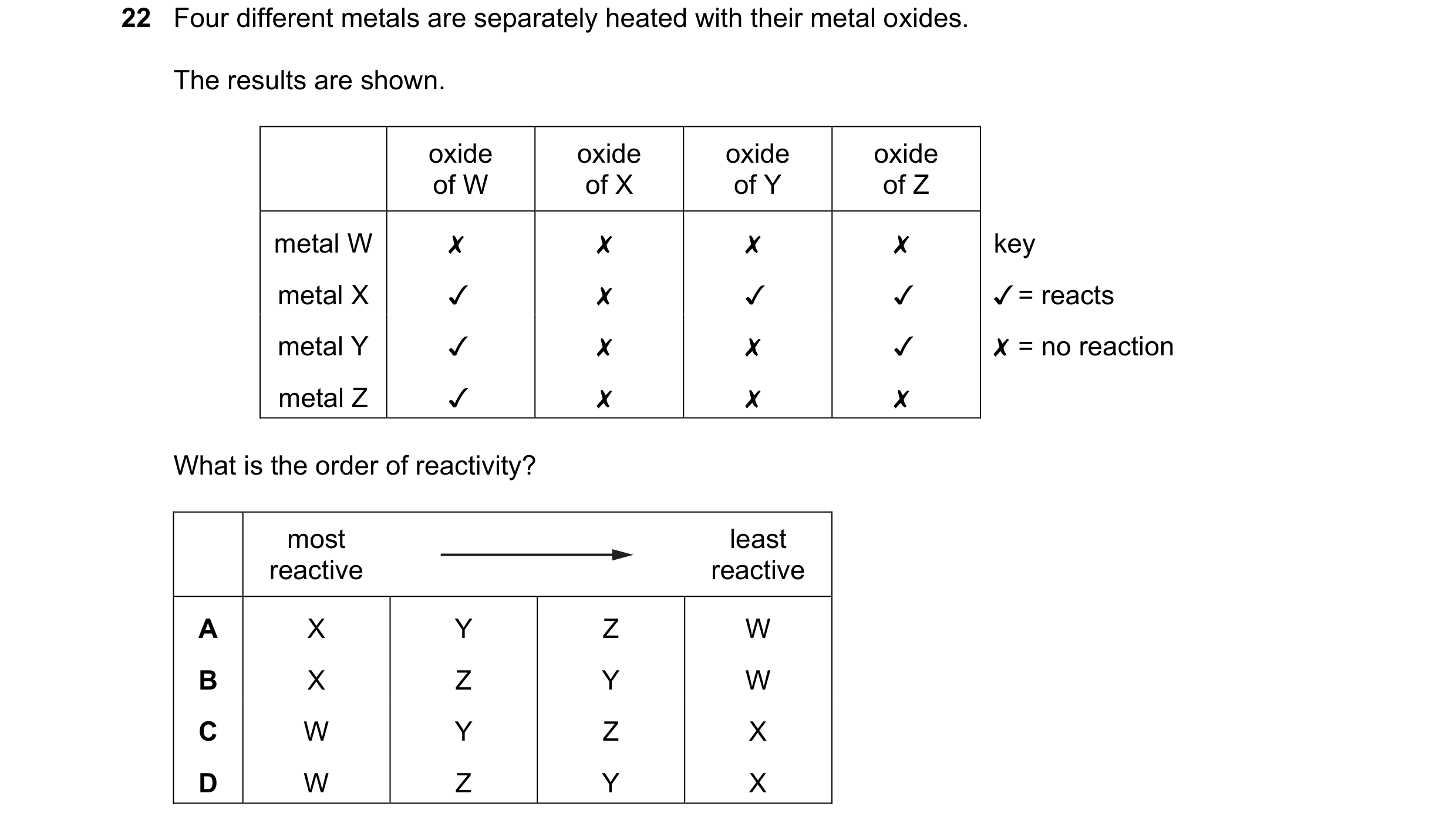
22 Four different metals are separately heated with their metal oxides.
The results are shown.
oxide oxide oxide oxide
of W of X of Y of Z
metal W x x x x
metal X v x v v
metal Y v x x v
metal Z v Xx Xx x
What is the order of reactivity?
most least
reactive reactive
Y Z WwW
Z Y WwW
Y Z X
Z Y X
key
J/ = reacts
X = no reaction
1 marks
Answer: A
This question in 0654/22 Oct/Nov 2020
Q10 · Four metals W, X, Y and Z are added to aqueous solutions of their ions 0654/23 Oct/Nov 2020
22 Four metals W, X, Y and Z are added to aqueous solutions of their ions. The results are shown. metal Y ions Z ions W ions X ions W reaction reaction no reaction reaction X reaction reaction no reaction no reaction Y no reaction reaction no reaction no reaction Z no reaction no reaction no reaction no reaction What is the order of reactivity? least reactive most reactive A W X Y Z B W Y X Z C Z X Y W D Z Y X W
1 marks
Answer: D
This question in 0654/23 Oct/Nov 2020
Q11 · Part of the reactivity series is shown 0654/22 Feb/March 2021
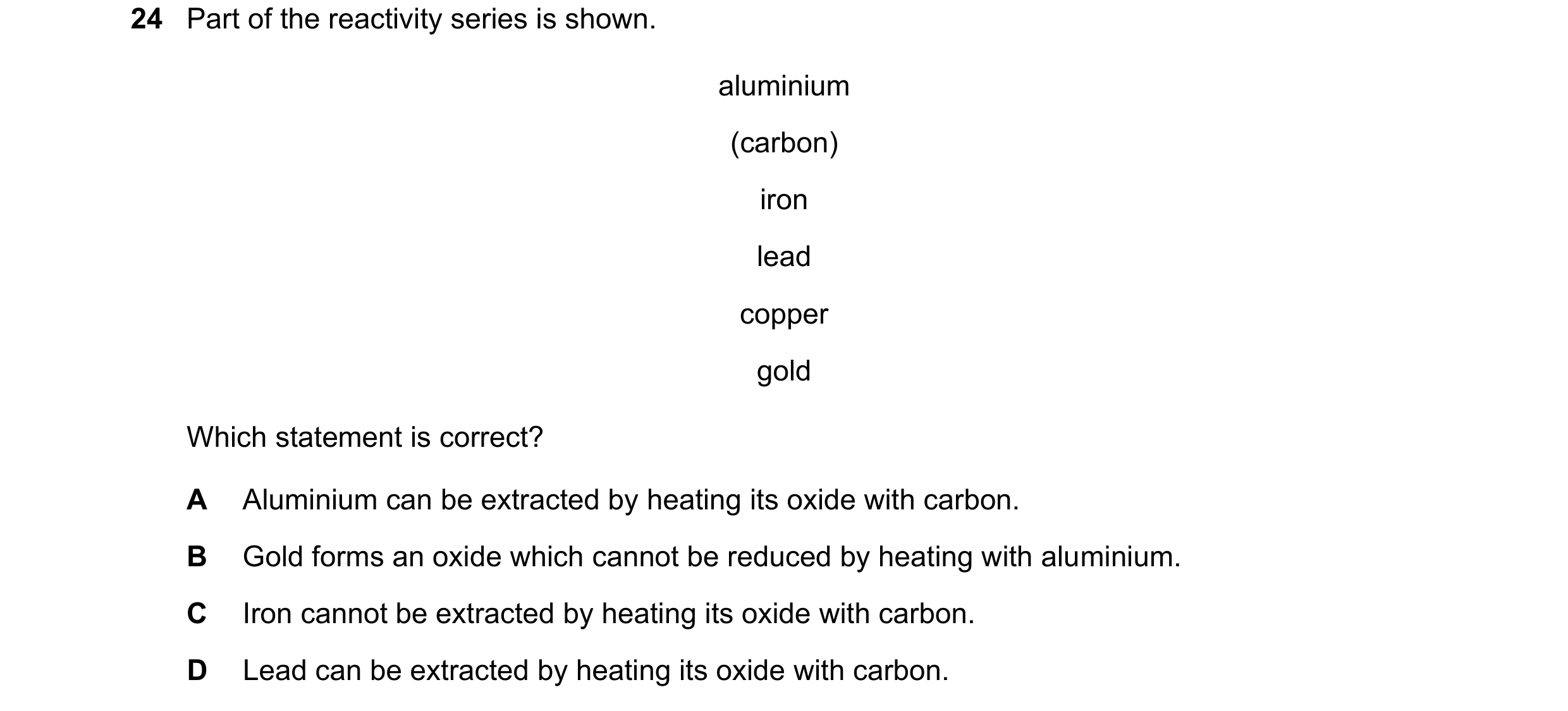
24 Part of the reactivity series is shown. aluminium (carbon) iron lead copper gold Which statement is correct? A Aluminium can be extracted by heating its oxide with carbon. B Gold forms an oxide which cannot be reduced by heating with aluminium. C Iron cannot be extracted by heating its oxide with carbon. D Lead can be extracted by heating its oxide with carbon.
1 marks
Answer: D
This question in 0654/22 Feb/March 2021
Q12 · Four metals W, X, Y and Z are added to different solutions of metal nitrates 0654/21 May/June 2021
22 Four metals W, X, Y and Z are added to different solutions of metal nitrates.
The results are shown.
metal nitrate solution
WwW Xx Y Z
Ww x x x key
Xx Jv v x J/ = reacts
metal
Y Jv x x X = no reaction
Z v Jv J
Which statements are correct?
A
1
2
3
4
1 and 2
Metal Z is the most reactive.
Metal W has the lowest tendency to form positive ions.
Metal X is less reactive than metal W.
Metal Y is more reactive than metal X.
B 1and4 C 2and3 D 3and4
1 marks
Answer: A
This question in 0654/21 May/June 2021
Q13 · Some observations from an investigation are shown 0654/22 May/June 2021
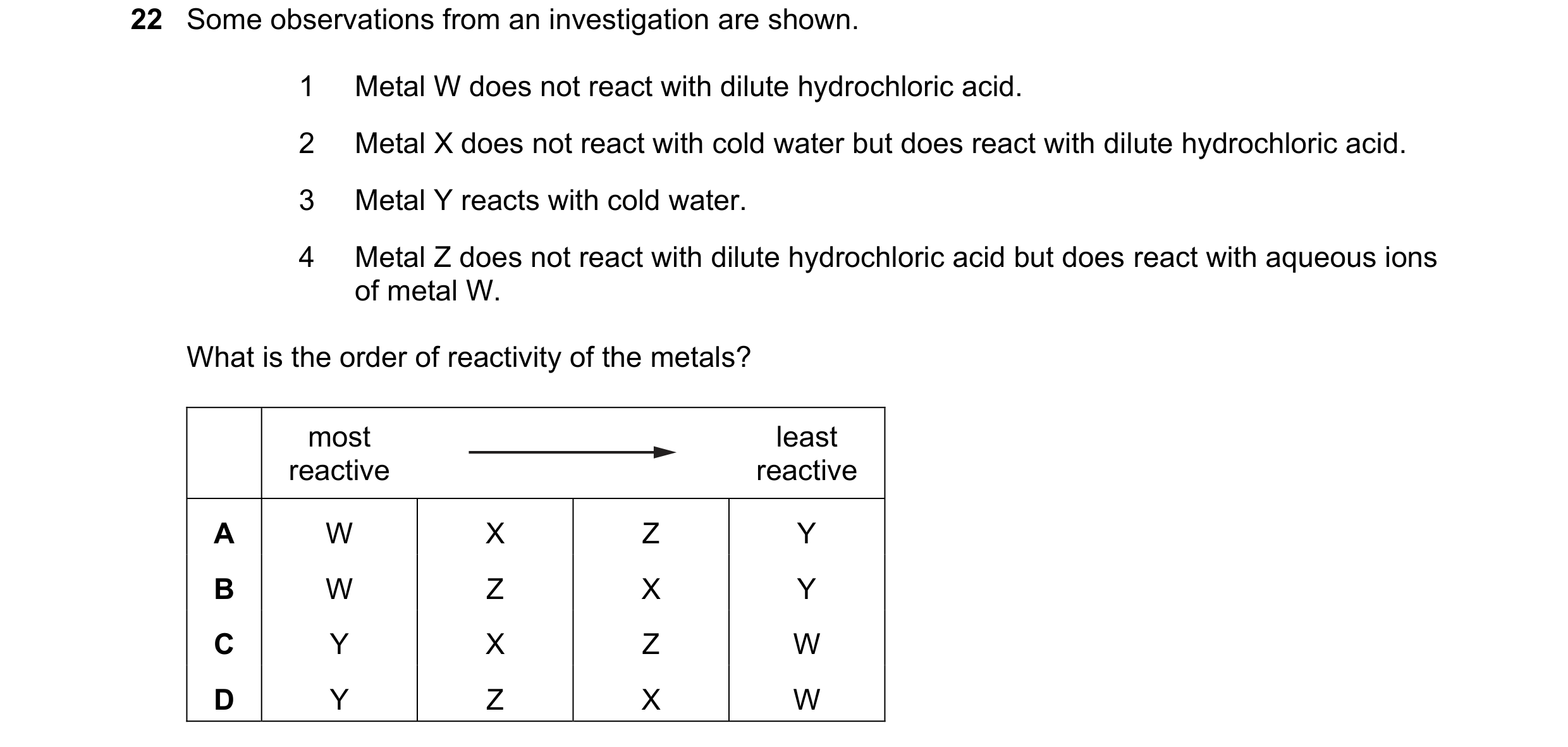
22 Some observations from an investigation are shown. 1 Metal W does not react with dilute hydrochloric acid. 2 Metal X does not react with cold water but does react with dilute hydrochloric acid. 3 Metal Y reacts with cold water. 4 Metal Z does not react with dilute hydrochloric acid but does react with aqueous ions of metal W. What is the order of reactivity of the metals? most least reactive reactive A W X Z Y B W Z X Y C Y X Z W D Y Z X W
1 marks
Answer: C
This question in 0654/22 May/June 2021
Q14 · An experiment is carried out to investigate the reactions of four metals M, N, O and P… 0654/23 May/June 2021
22 An experiment is carried out to investigate the reactions of four metals M, N, O and P with solutions of their sulfates. The results of the experiment are listed. metal N + metal O sulfate = reacts metal N + metal P sulfate = reacts metal O + metal M sulfate = no reaction metal M + metal P sulfate = reacts What is the order of the reactivity of these metals, from most to least reactive? A N M P O B N P M O C O M P N D O P M N
1 marks
Answer: A
This question in 0654/23 May/June 2021
Q15 · A block of zinc is attached to an underground steel pipe as shown 0654/21 Oct/Nov 2021
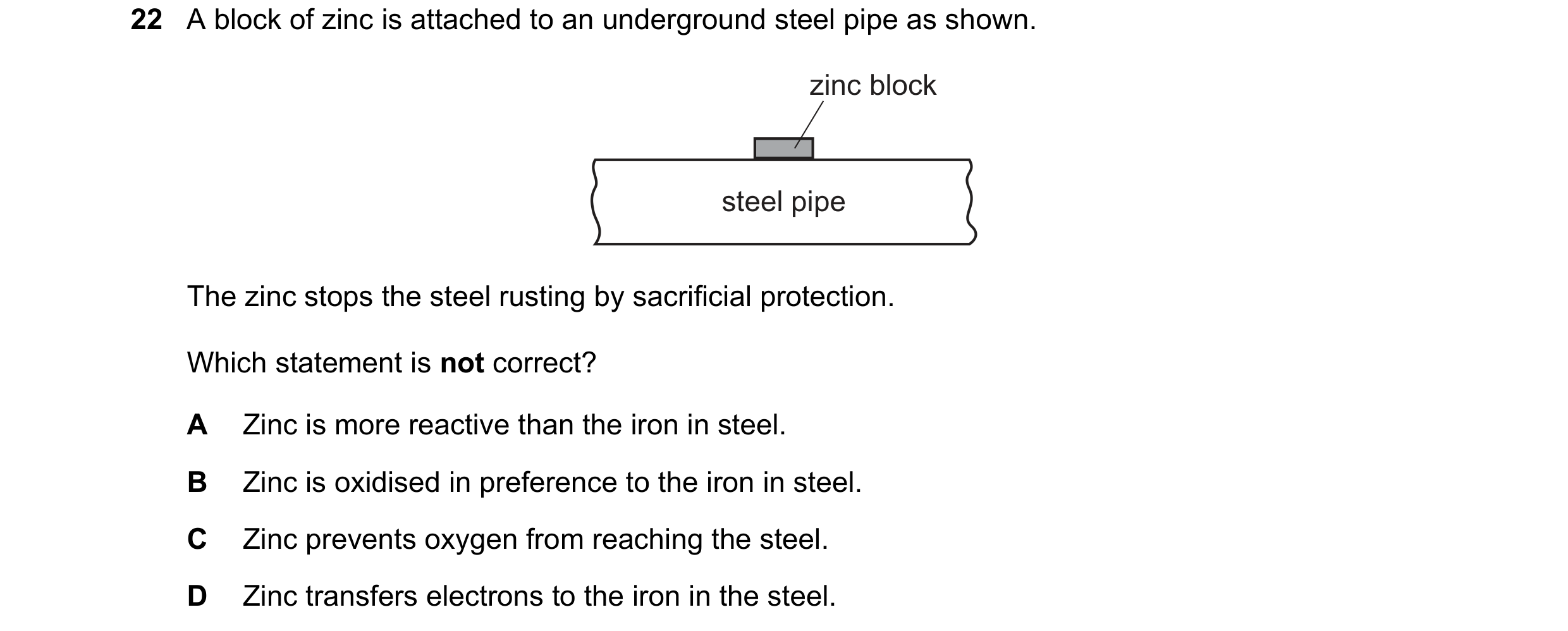
22 A block of zinc is attached to an underground steel pipe as shown. zinc block steel pipe The zinc stops the steel rusting by sacrificial protection. Which statement is not correct? A Zinc is more reactive than the iron in steel. B Zinc is oxidised in preference to the iron in steel. C Zinc prevents oxygen from reaching the steel. D Zinc transfers electrons to the iron in the steel.
1 marks
Answer: C
This question in 0654/21 Oct/Nov 2021
Q16 · A block of zinc is attached to an underground steel pipe as shown 0654/22 Oct/Nov 2021
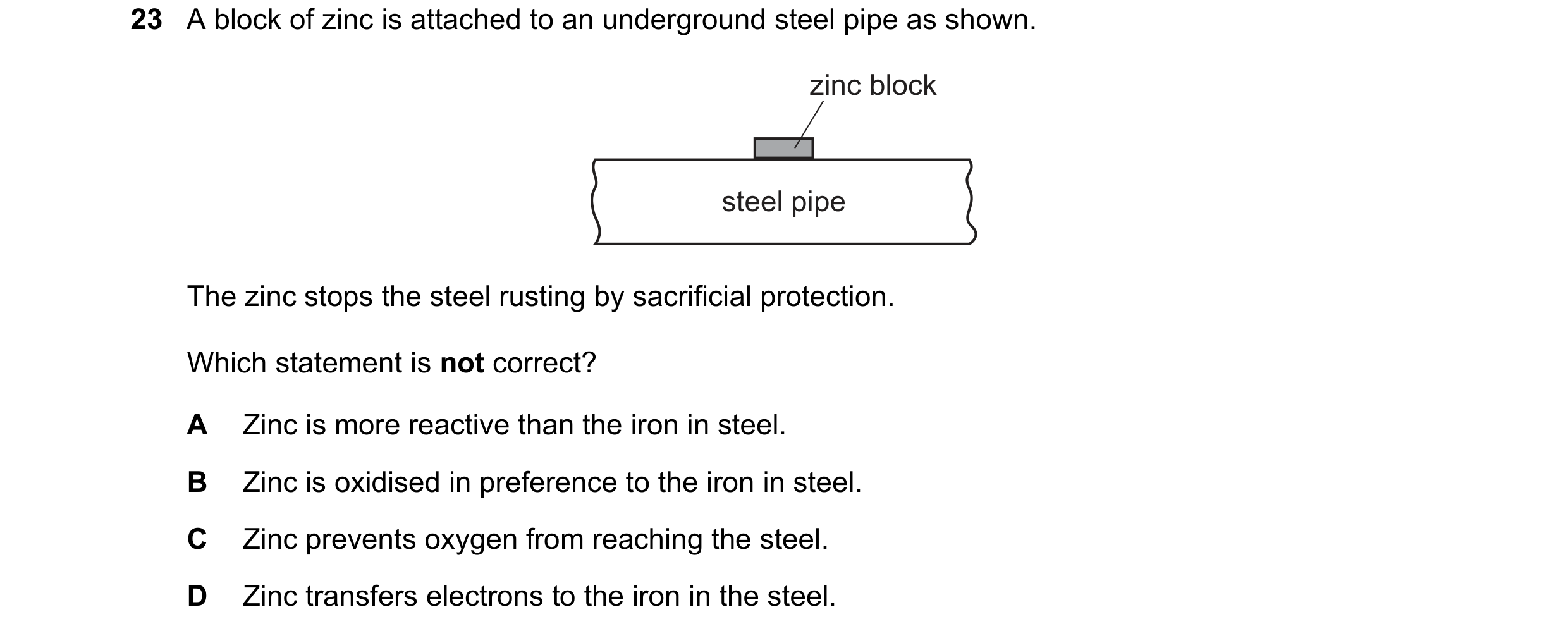
23 A block of zinc is attached to an underground steel pipe as shown. zinc block steel pipe The zinc stops the steel rusting by sacrificial protection. Which statement is not correct? A Zinc is more reactive than the iron in steel. B Zinc is oxidised in preference to the iron in steel. C Zinc prevents oxygen from reaching the steel. D Zinc transfers electrons to the iron in the steel.
1 marks
Answer: C
This question in 0654/22 Oct/Nov 2021
Q17 · A block of zinc is attached to an underground steel pipe as shown 0654/23 Oct/Nov 2021
23 A block of zinc is attached to an underground steel pipe as shown. zinc block steel pipe The zinc stops the steel rusting by sacrificial protection. Which statement is not correct? A Zinc is more reactive than the iron in steel. B Zinc is oxidised in preference to the iron in steel. C Zinc prevents oxygen from reaching the steel. D Zinc transfers electrons to the iron in the steel.
1 marks
Answer: C
This question in 0654/23 Oct/Nov 2021
Q18 · A piece of iron is coated with a layer of zinc 0654/21 May/June 2022
23 A piece of iron is coated with a layer of zinc. Which statement explains why zinc prevents iron from rusting, even when the layer of zinc is damaged? A Iron is less reactive than zinc and zinc atoms lose electrons less easily than iron atoms. B Iron is less reactive than zinc and zinc atoms lose electrons more easily than iron atoms. C Iron is more reactive than zinc and zinc atoms lose electrons less easily than iron atoms. D Iron is more reactive than zinc and zinc atoms lose electrons more easily than iron atoms.
1 marks
Answer: B
This question in 0654/21 May/June 2022
Q19 · Carbon is below aluminium but above zinc in the reactivity series 0654/22 May/June 2022
22 Carbon is below aluminium but above zinc in the reactivity series. Iron is below zinc in the reactivity series. Which statements are correct? 1 Carbon can be used to extract aluminium and iron from their ores. 2 Aluminium can be used to extract zinc and iron from their ores. 3 Carbon can be used to extract zinc and iron from their ores. 4 Zinc can be used to extract aluminium and iron from their ores. A 1 and 2 B 1 and 3 C 2 and 3 D 3 and 4
1 marks
Answer: C
This question in 0654/22 May/June 2022
Q20 · Which metal oxide is reduced when heated with magnesium powder? 0654/23 May/June 2022
22 Which metal oxide is reduced when heated with magnesium powder? A calcium oxide B copper oxide C magnesium oxide D sodium oxide
1 marks
Answer: B
This question in 0654/23 May/June 2022
Q21 · Which statement about reactions of metals is correct? 0654/21 Oct/Nov 2022
24 Which statement about reactions of metals is correct? A When copper is added to aqueous aluminium nitrate, the colourless solution turns blue. B When magnesium oxide is heated with iron, solid iron(III) oxide is formed. C When potassium oxide is heated with copper, an orange-brown solid is formed. D When zinc is added to aqueous copper sulfate, the blue solution turns colourless.
1 marks
Answer: D
This question in 0654/21 Oct/Nov 2022
Q22 · Part of the reactivity series is shown 0654/22 Oct/Nov 2022
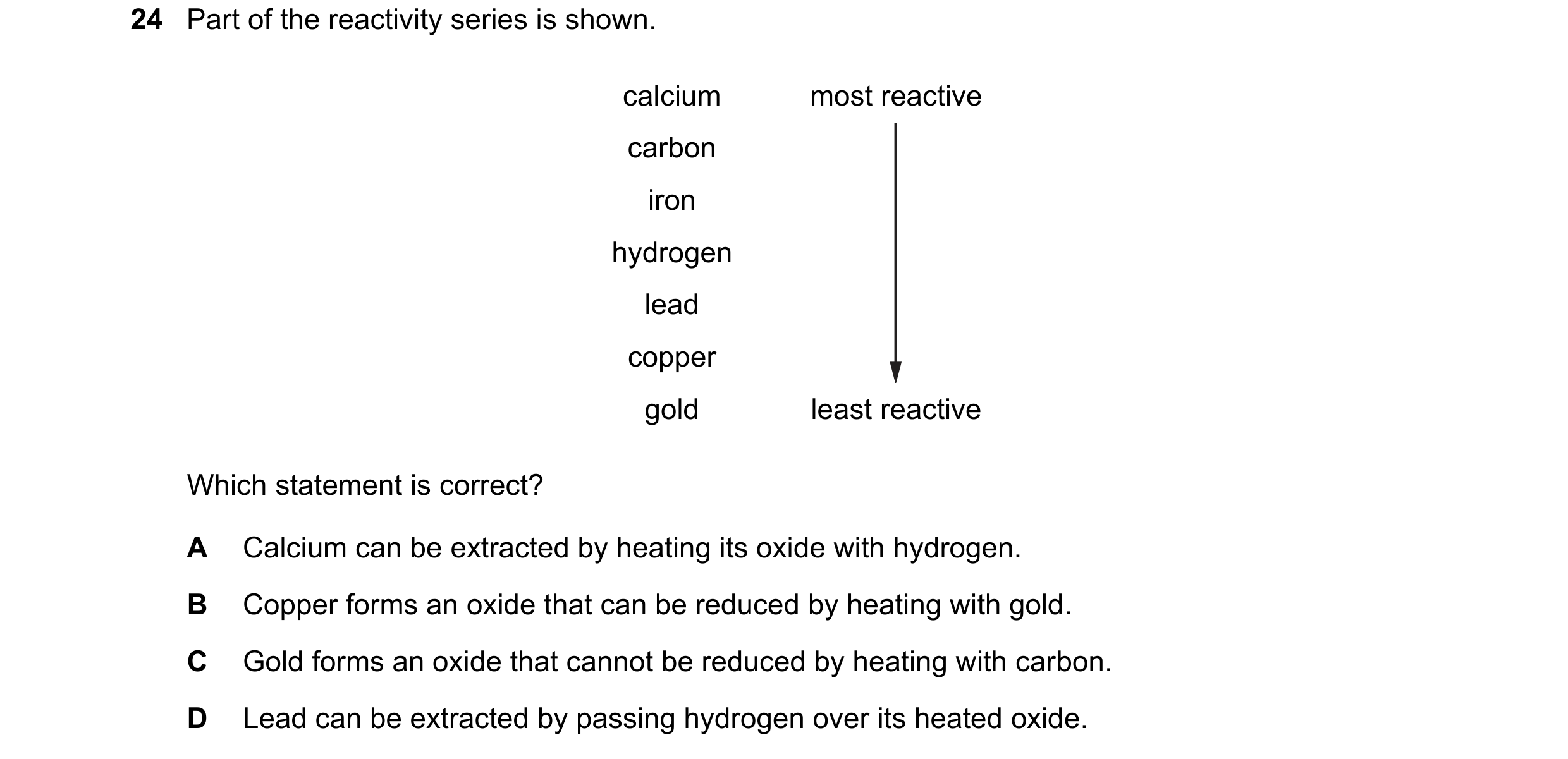
24 Part of the reactivity series is shown. calcium most reactive carbon iron hydrogen lead copper gold least reactive Which statement is correct? A Calcium can be extracted by heating its oxide with hydrogen. B Copper forms an oxide that can be reduced by heating with gold. C Gold forms an oxide that cannot be reduced by heating with carbon. D Lead can be extracted by passing hydrogen over its heated oxide.
1 marks
Answer: D
This question in 0654/22 Oct/Nov 2022
Q23 · P, Q, R and S are four metals 0654/23 Oct/Nov 2022
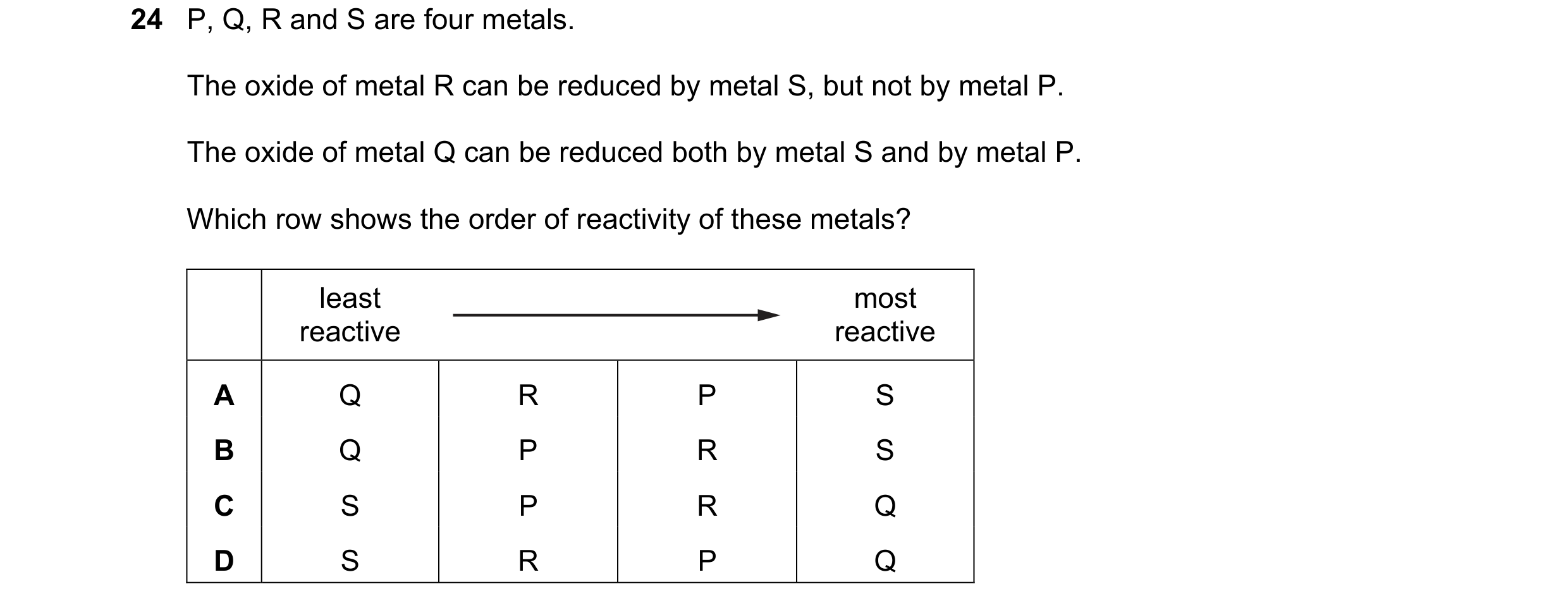
24 P, Q, R and S are four metals. The oxide of metal R can be reduced by metal S, but not by metal P. The oxide of metal Q can be reduced both by metal S and by metal P. Which row shows the order of reactivity of these metals? least most reactive reactive A Q R P S B Q P R S C S P R Q D S R P Q
1 marks
Answer: B
This question in 0654/23 Oct/Nov 2022
Q24 · Which metal cannot be extracted from its ore by heating with carbon? 0654/22 Feb/March 2023
24 Which metal cannot be extracted from its ore by heating with carbon? A aluminium B copper C iron D zinc
1 marks
Answer: A
This question in 0654/22 Feb/March 2023
Q25 · Silver oxide is reduced by heating with carbon more easily than copper oxide is reduced… 0654/21 Oct/Nov 2023
24 Silver oxide is reduced by heating with carbon more easily than copper oxide is reduced by
heating with carbon.
A copper strip is placed into a solution of silver nitrate as shown.
silver nitrate
solution
copper strip
Which row describes the reaction?
the colourless the copper .
solution slowly strip slowly a silver-grey
; metal is formed
turns blue dissolves
0 OW >
x \ \ x
\ «MK \ x
x \ \ x
1 marks
Answer: B
This question in 0654/21 Oct/Nov 2023
Q26 · W, X, Y and Z are metals 0654/22 Oct/Nov 2023
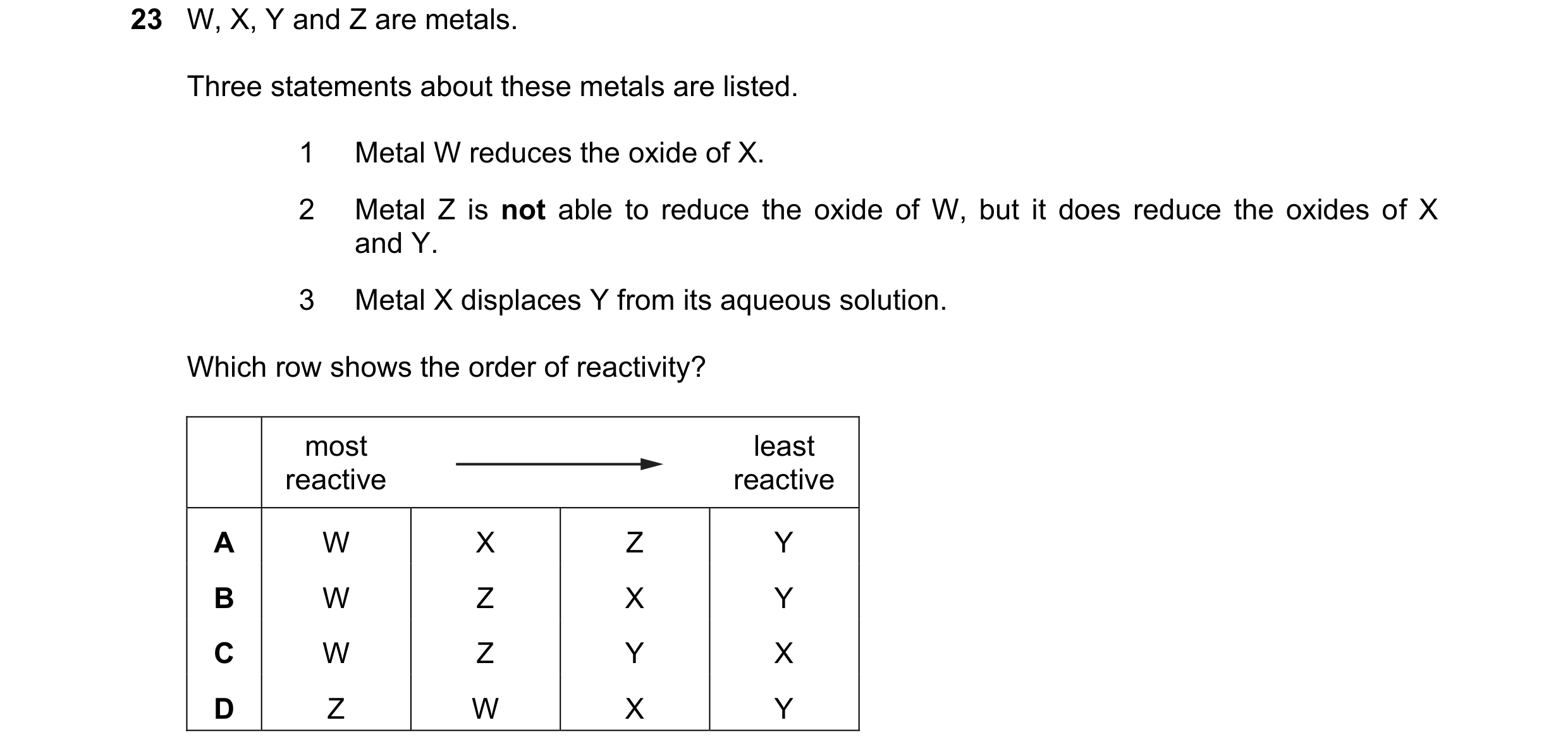
23 W, X, Y and Z are metals. Three statements about these metals are listed. 1 Metal W reduces the oxide of X. 2 Metal Z is not able to reduce the oxide of W, but it does reduce the oxides of X and Y. 3 Metal X displaces Y from its aqueous solution. Which row shows the order of reactivity? most least reactive reactive A W X Z Y B W Z X Y C W Z Y X D Z W X Y
1 marks
Answer: B
This question in 0654/22 Oct/Nov 2023
Q27 · Elements Q, T, X and Z are metals 0654/22 Feb/March 2024
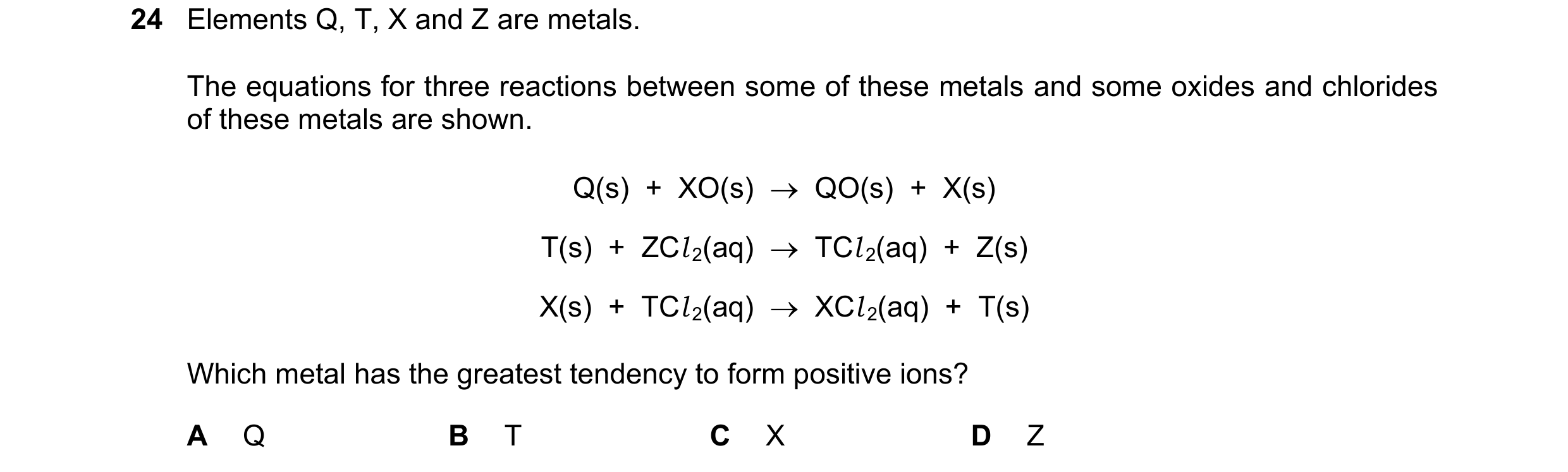
24 Elements Q, T, X and Z are metals. The equations for three reactions between some of these metals and some oxides and chlorides of these metals are shown. Q(s) + XO(s) QO(s) + X(s) T(s) + ZCl 2(aq) TCl 2(aq) + Z(s) X(s) + TCl 2(aq) XCl 2(aq) + T(s) Which metal has the greatest tendency to form positive ions? A Q B T C X D Z
1 marks
Answer: A
This question in 0654/22 Feb/March 2024
Q28 · Metal X reacts with aqueous metal Y2+ ions 0654/22 May/June 2024
22 Metal X reacts with aqueous metal Y2+ ions. The ionic equation for the reaction is shown. X + Y2+ X2+ + Y What are metals X and Y? X Y A copper iron B copper zinc C zinc copper D aluminium iron
1 marks
Answer: C
This question in 0654/22 May/June 2024
Q29 · The reactions of four different metals W, X, Y and Z with aqueous solutions of their ions… 0654/22 Oct/Nov 2024
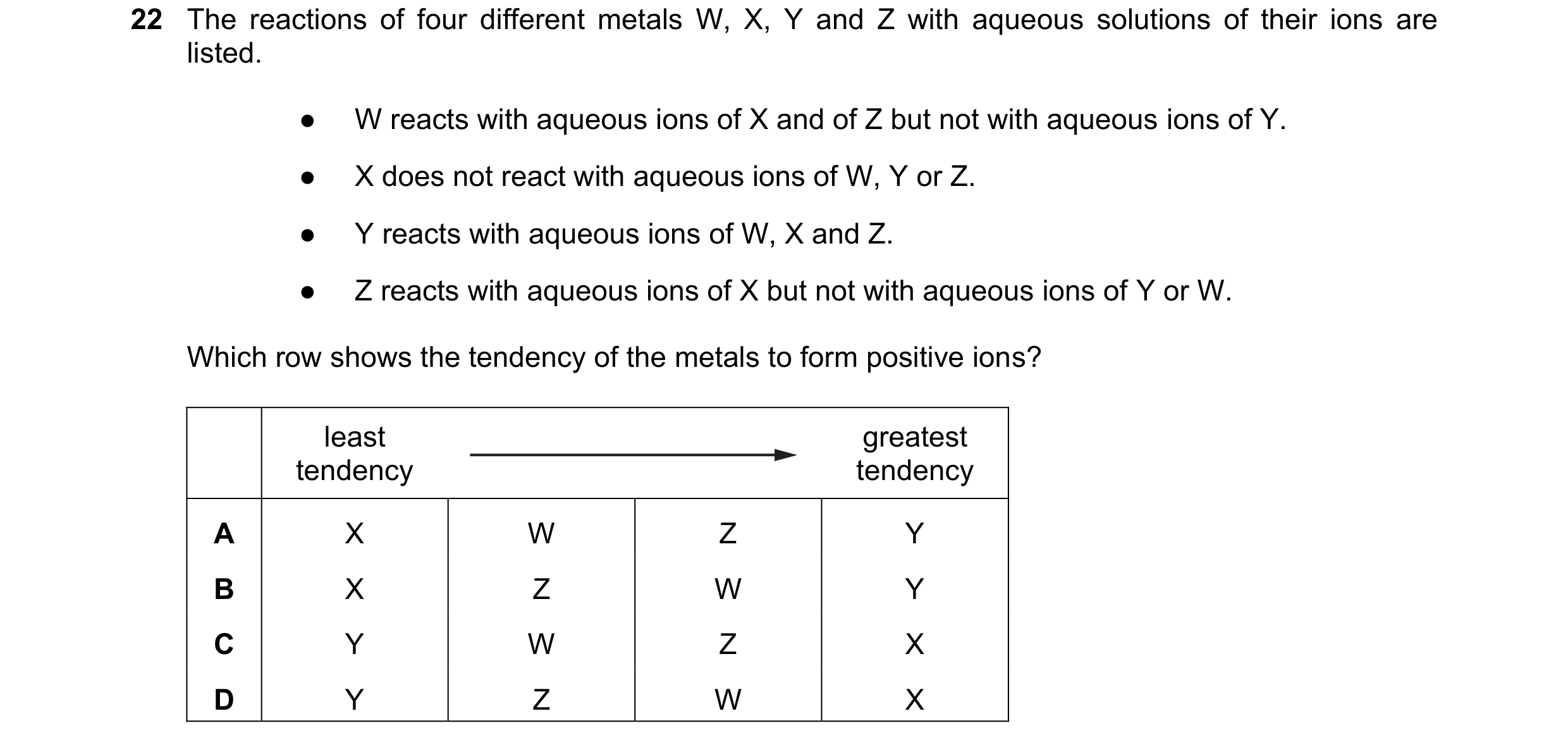
22 The reactions of four different metals W, X, Y and Z with aqueous solutions of their ions are listed. ● W reacts with aqueous ions of X and of Z but not with aqueous ions of Y. ● X does not react with aqueous ions of W, Y or Z. ● Y reacts with aqueous ions of W, X and Z. ● Z reacts with aqueous ions of X but not with aqueous ions of Y or W. Which row shows the tendency of the metals to form positive ions? least greatest tendency tendency A X W Z Y B X Z W Y C Y W Z X D Y Z W X
1 marks
Answer: B
This question in 0654/22 Oct/Nov 2024
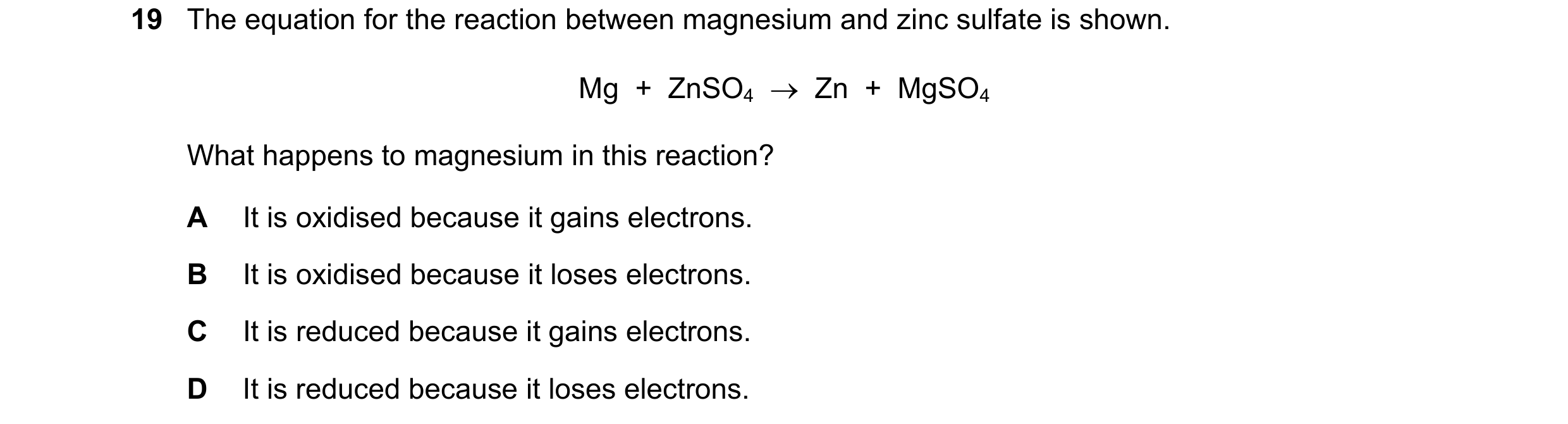
Q30 · The equation for the reaction between magnesium and zinc sulfate is shown 0654/23 Oct/Nov 2024
19 The equation for the reaction between magnesium and zinc sulfate is shown. Mg + ZnSO4 Zn + MgSO4 What happens to magnesium in this reaction? A It is oxidised because it gains electrons. B It is oxidised because it loses electrons. C It is reduced because it gains electrons. D It is reduced because it loses electrons.
1 marks
Answer: B
This question in 0654/23 Oct/Nov 2024
Q31 · When iron is galvanised, it is coated with a layer of zinc 0654/23 Oct/Nov 2024
24 When iron is galvanised, it is coated with a layer of zinc. Which statements about galvanising are correct? 1 Zinc has a greater tendency to form positive ions than iron. 2 Zinc prevents iron from rusting by sacrificial protection. 3 Iron is more reactive than zinc. 4 Zinc acts as a barrier method of rust prevention if scratched. A 1 and 2 B 1 and 4 C 2 and 3 D 3 and 4
1 marks
Answer: A
This question in 0654/23 Oct/Nov 2024
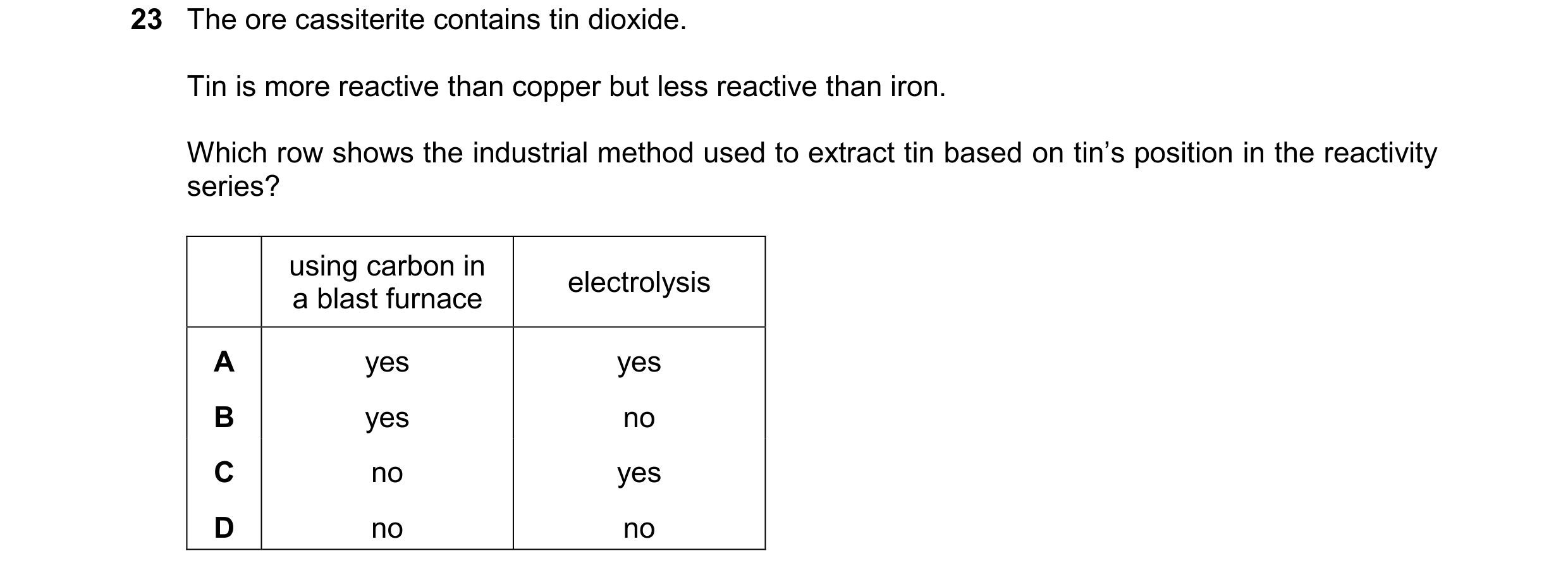
Q32 · The ore cassiterite contains tin dioxide 0654/22 Feb/March 2025
23 The ore cassiterite contains tin dioxide. Tin is more reactive than copper but less reactive than iron. Which row shows the industrial method used to extract tin based on tin’s position in the reactivity series? using carbon in electrolysis a blast furnace A yes yes B yes no C no yes D no no
1 marks
Answer: B
This question in 0654/22 Feb/March 2025
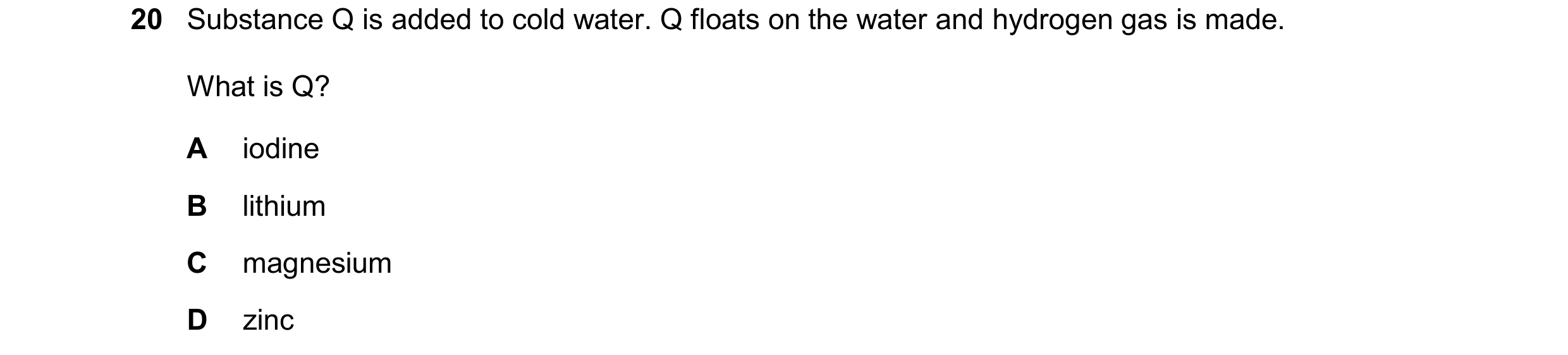
Q33 · Substance Q is added to cold water 0654/21 Oct/Nov 2025
20 Substance Q is added to cold water. Q floats on the water and hydrogen gas is made. What is Q? A iodine B lithium C magnesium D zinc
1 marks
Answer: B
This question in 0654/21 Oct/Nov 2025
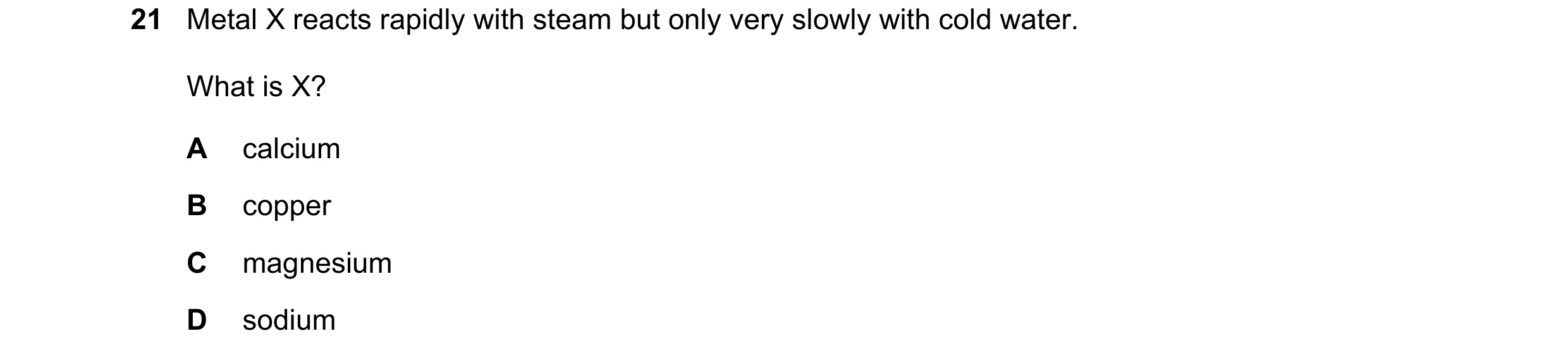
Q34 · Metal X reacts rapidly with steam but only very slowly with cold water 0654/23 Oct/Nov 2025
21 Metal X reacts rapidly with steam but only very slowly with cold water. What is X? A calcium B copper C magnesium D sodium
1 marks
Answer: C
This question in 0654/23 Oct/Nov 2025

 1 / 11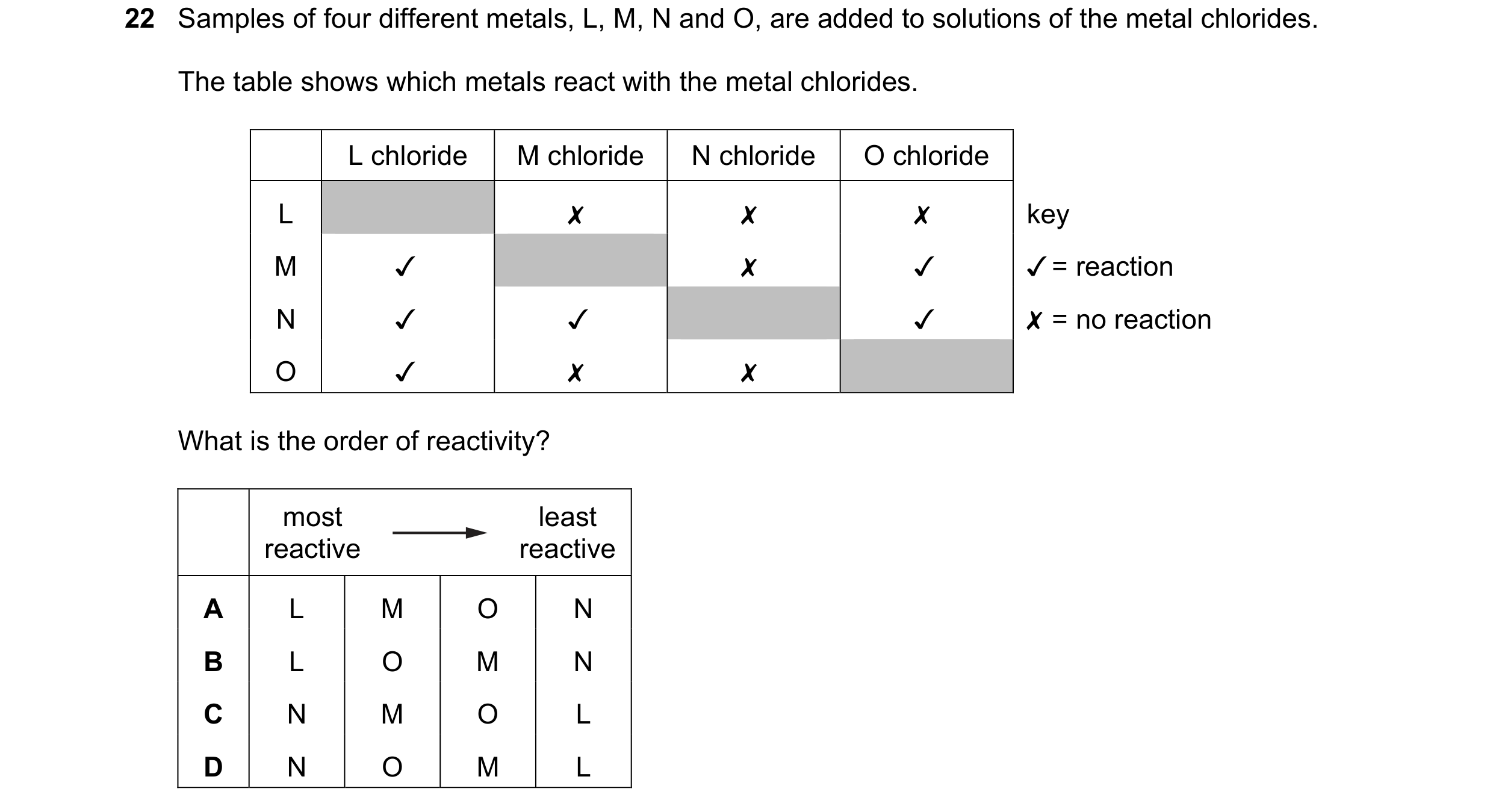
 2 / 11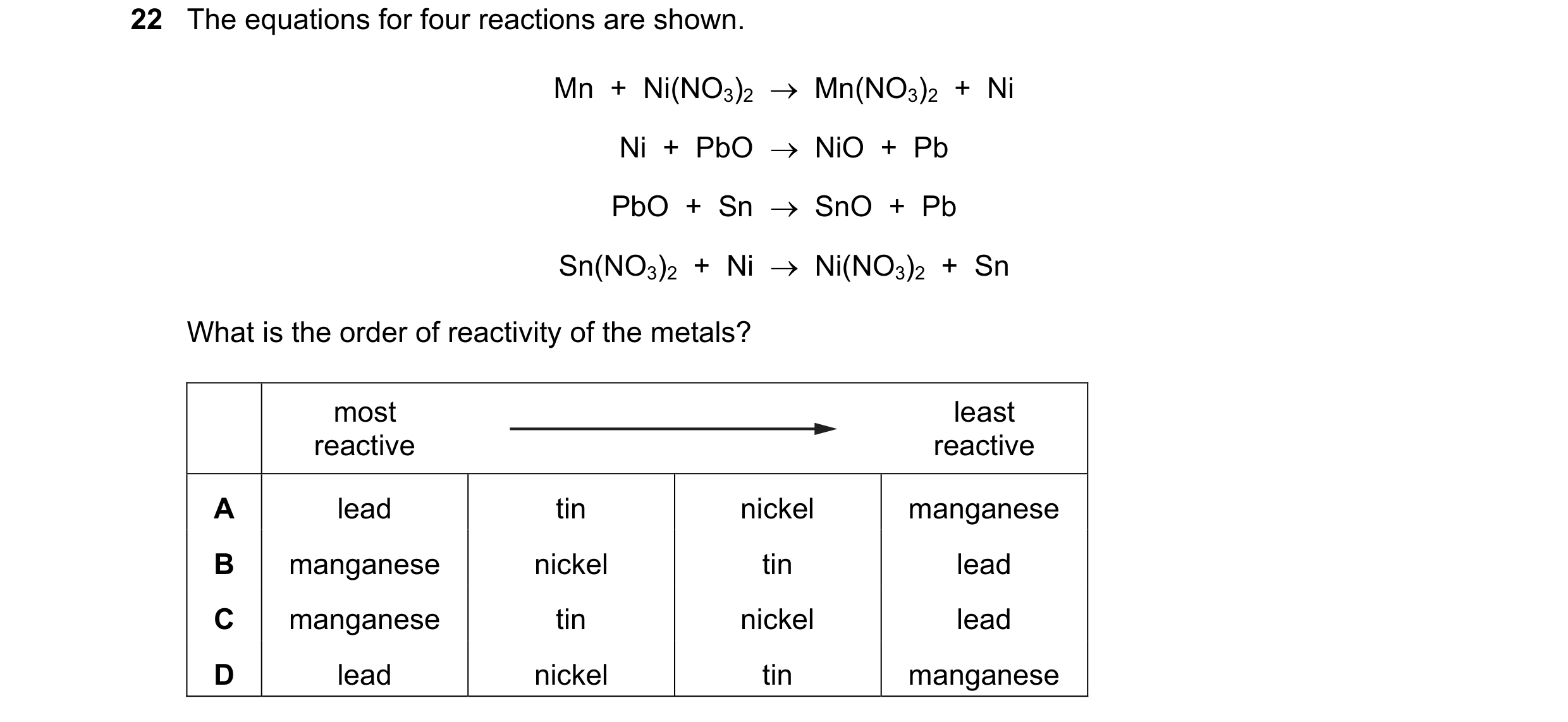
 3 / 11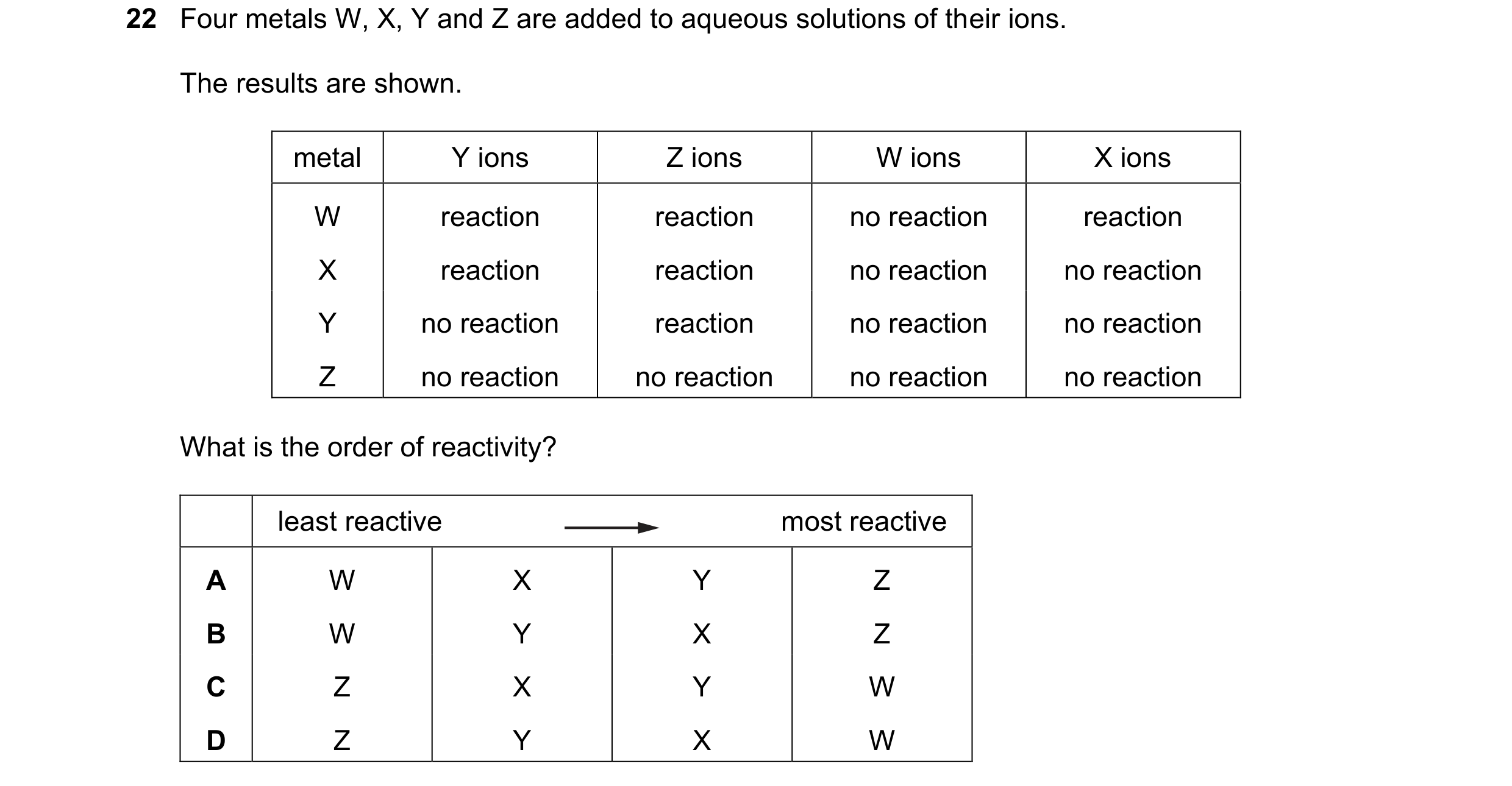
 4 / 11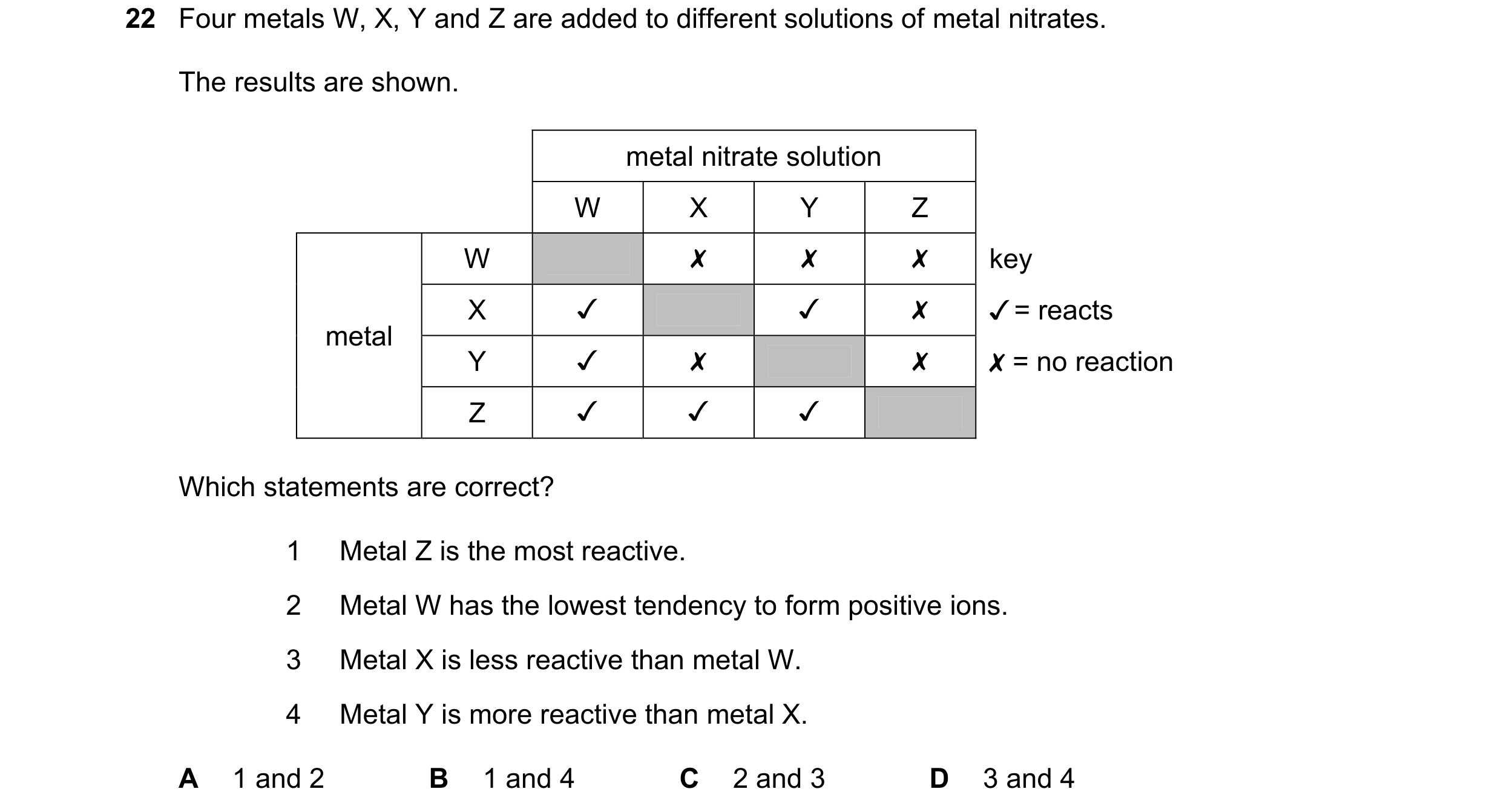
 5 / 11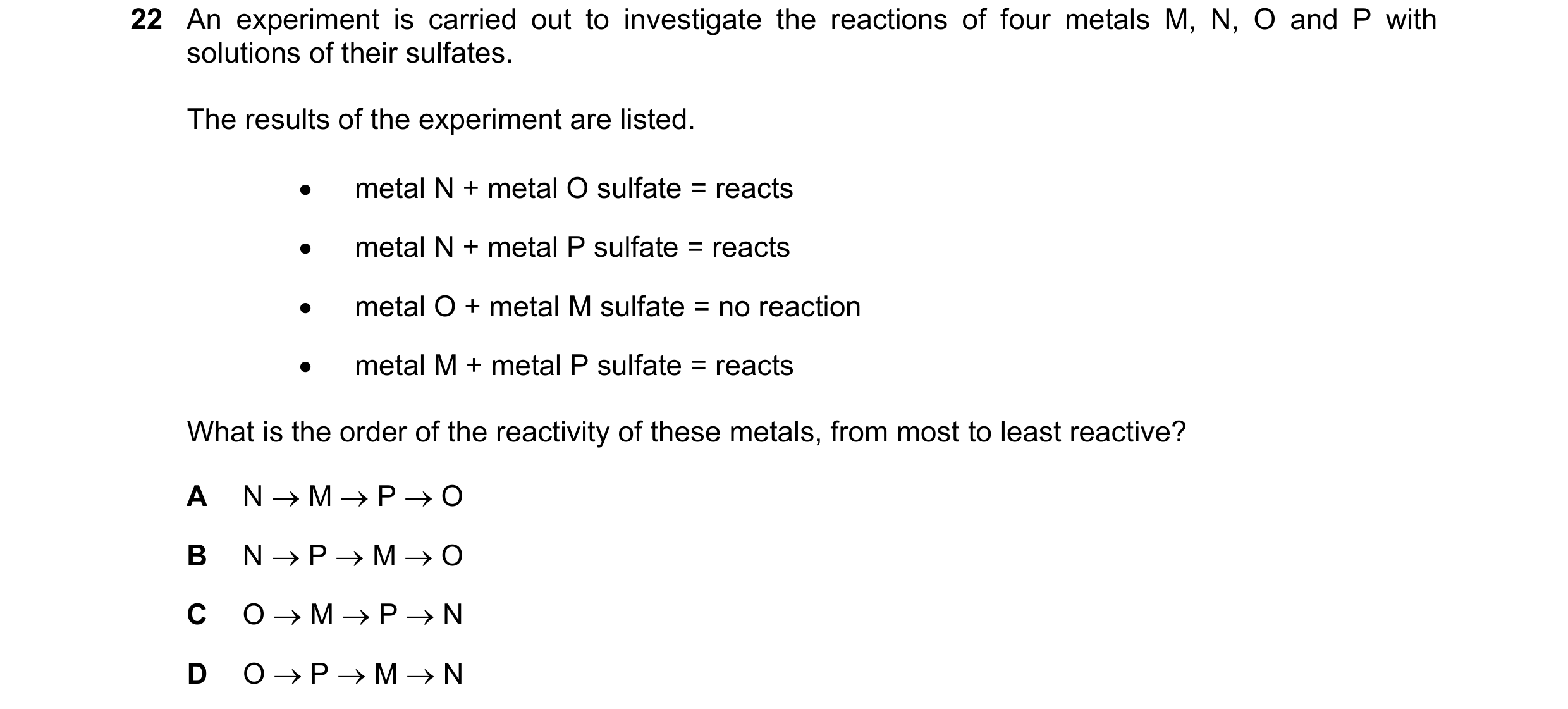
 6 / 11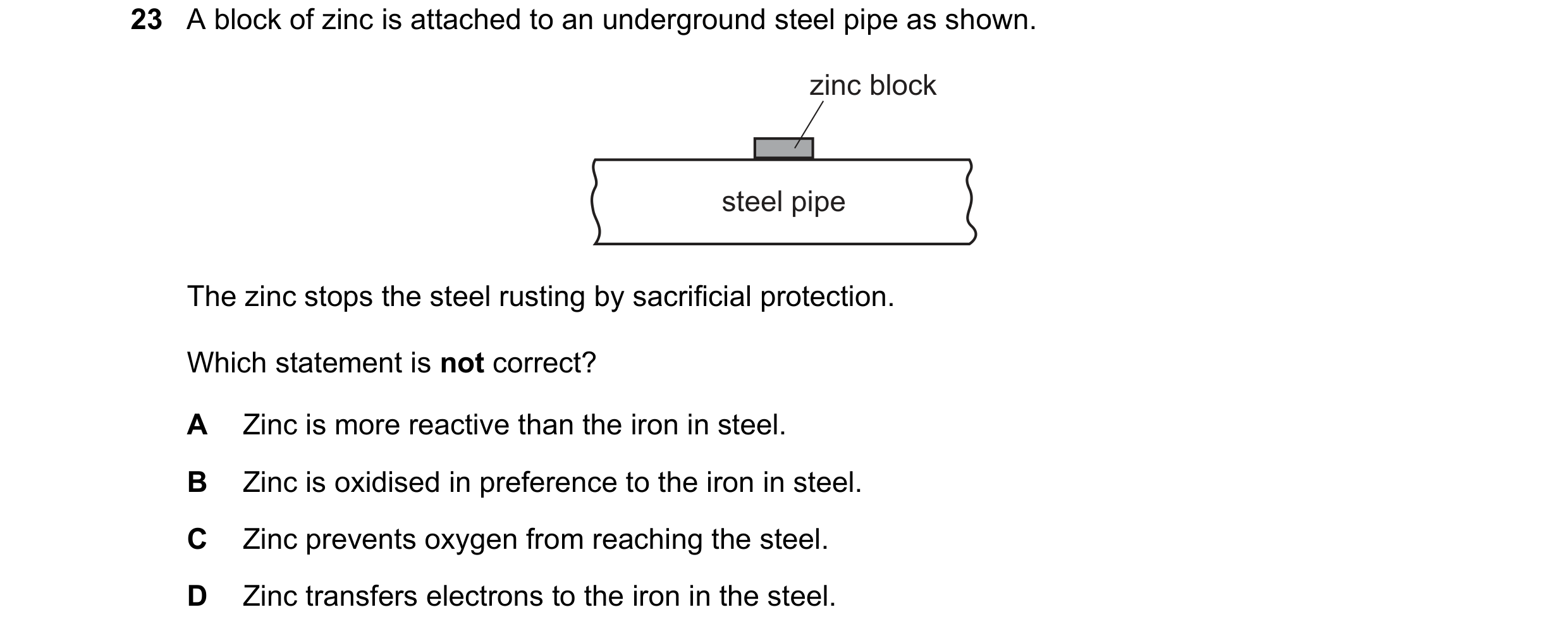
 7 / 11
 8 / 11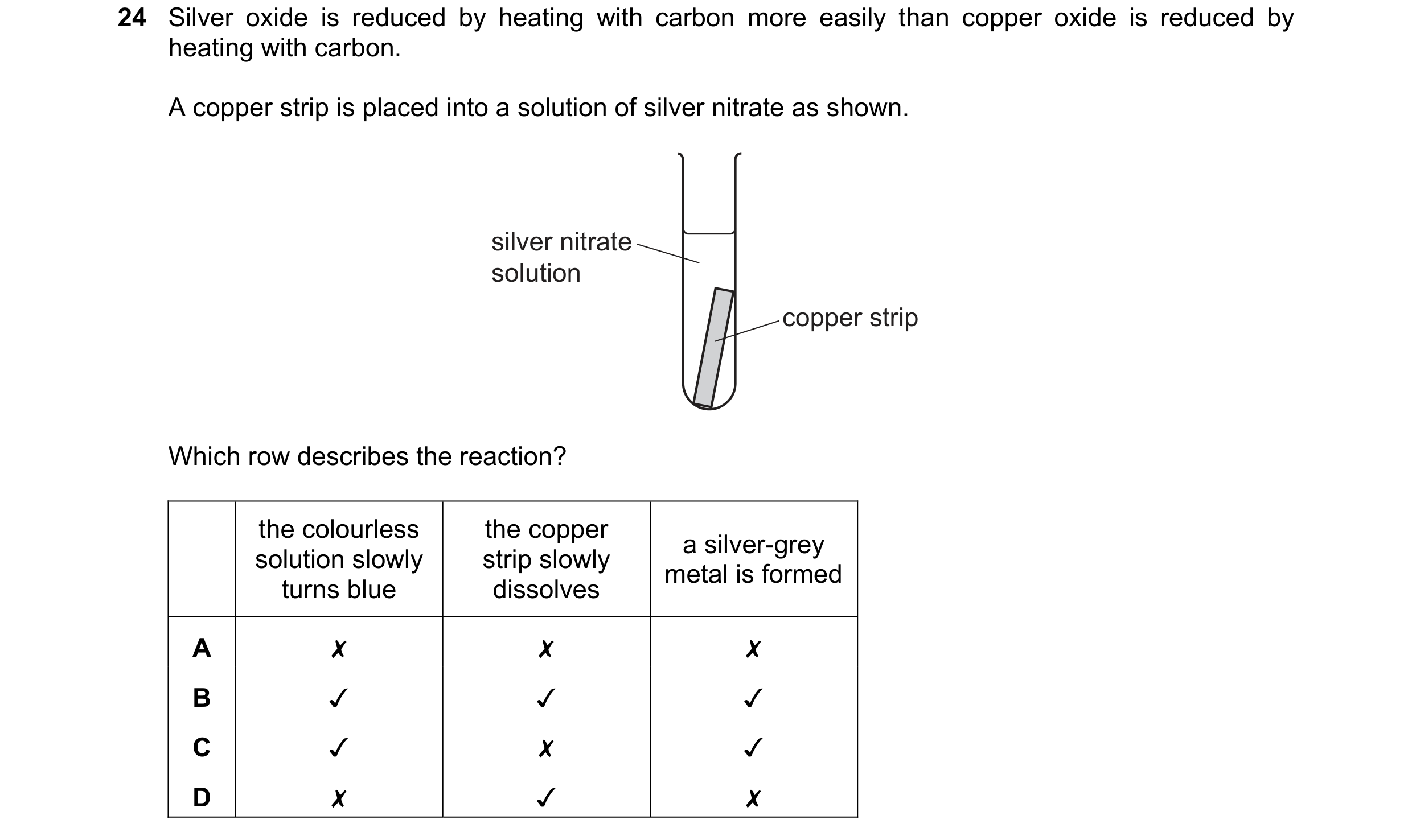
 9 / 11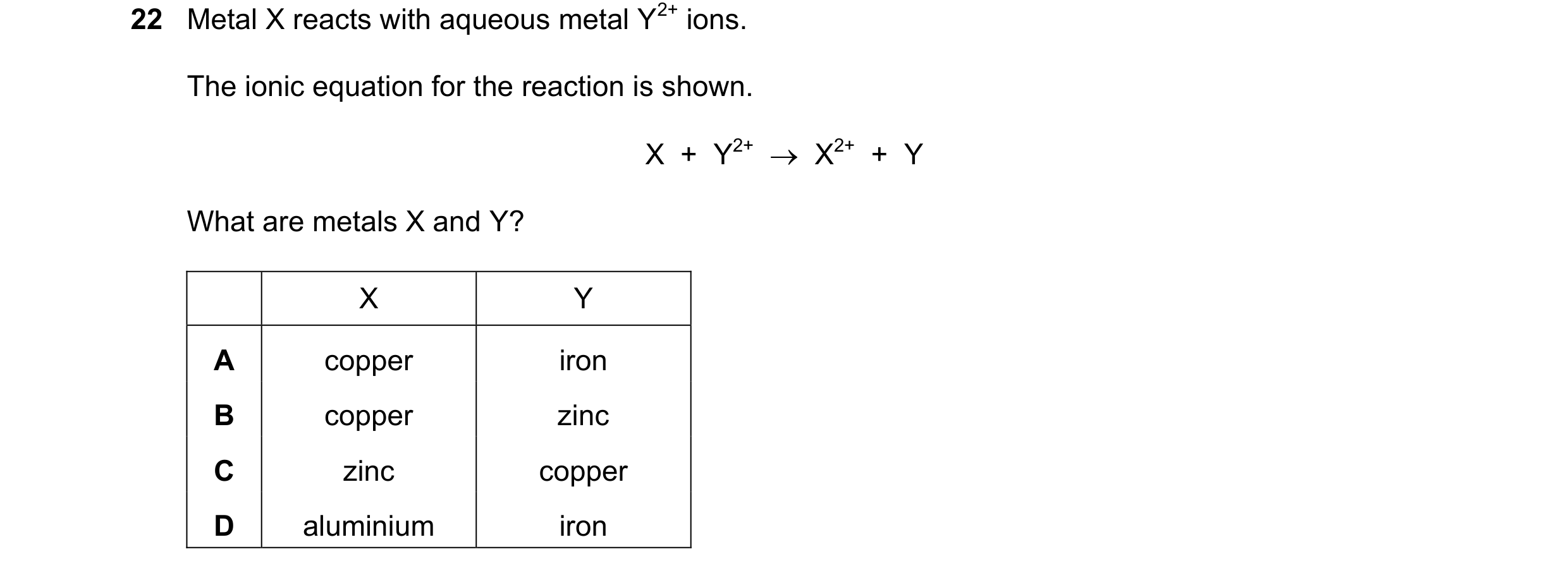
 10 / 11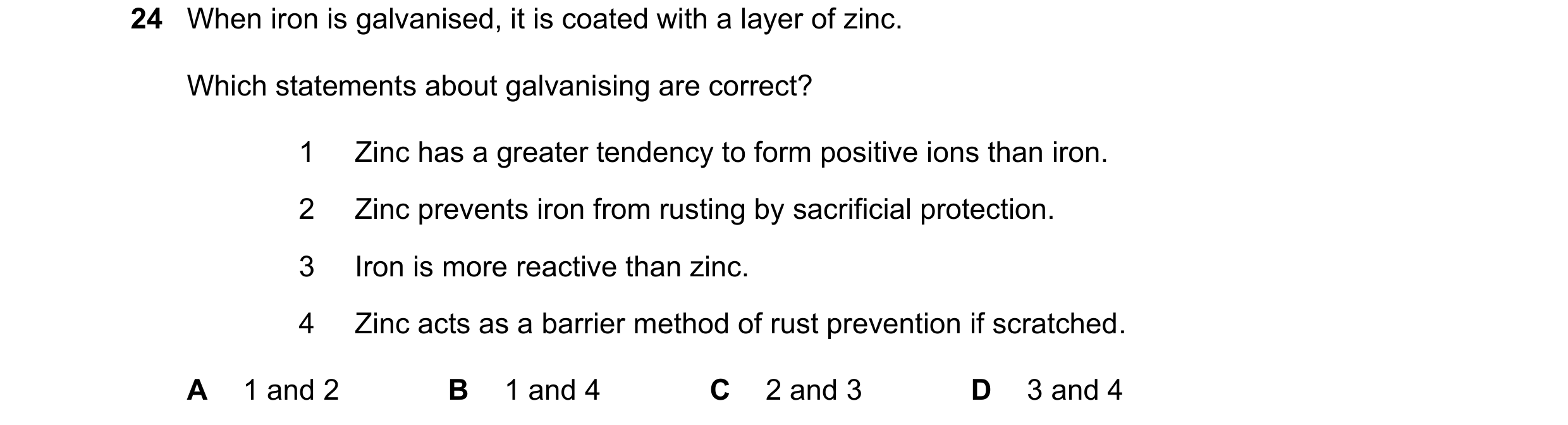
 11 / 11