Questions as text
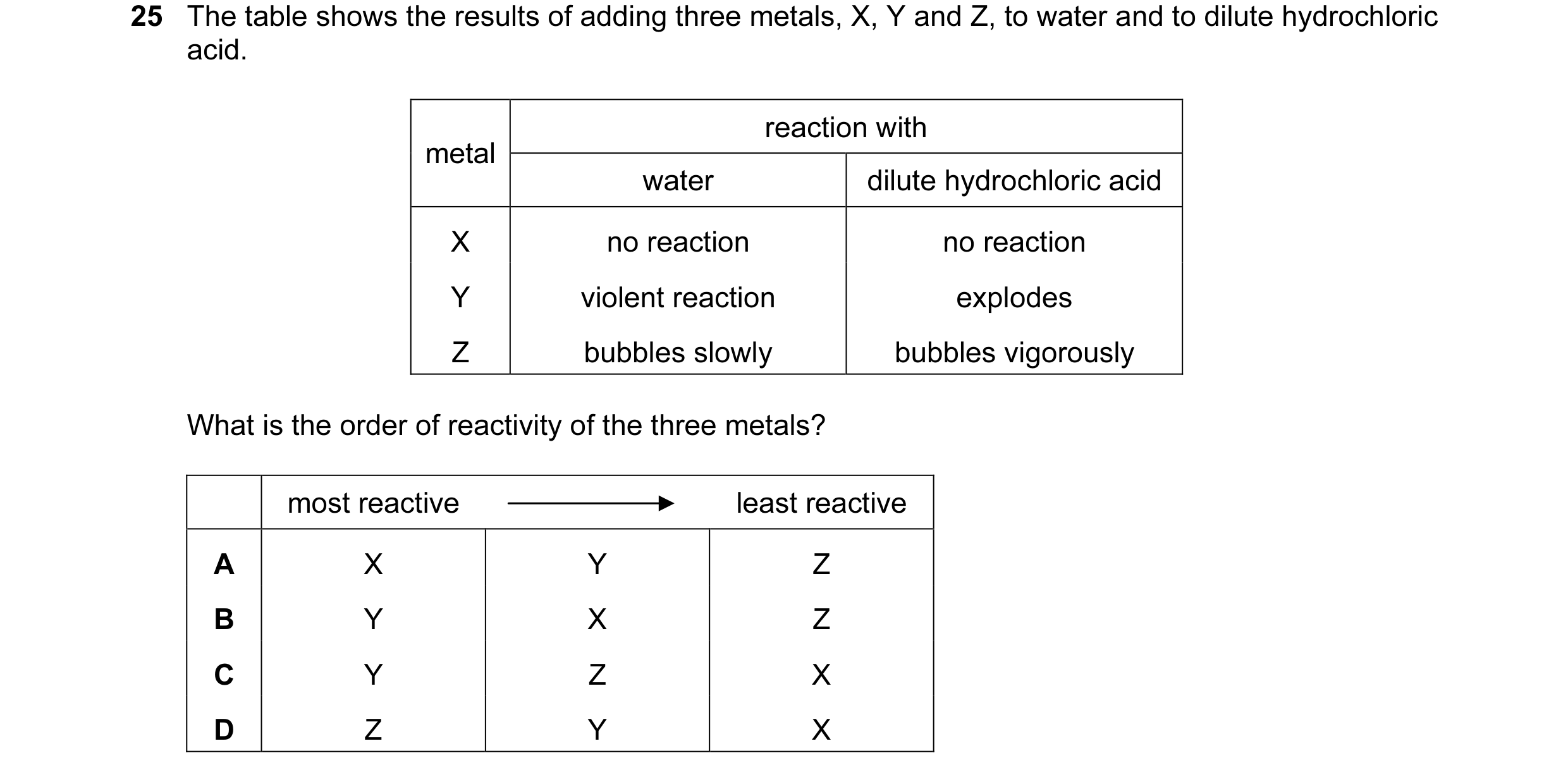
Q1 · The table shows the results of adding three metals, X, Y and Z, to water and to dilute… 0654/11 May/June 2006
25 The table shows the results of adding three metals, X, Y and Z, to water and to dilute hydrochloric acid. reaction with metal water dilute hydrochloric acid X no reaction no reaction Y violent reaction explodes Z bubbles slowly bubbles vigorously What is the order of reactivity of the three metals? most reactive least reactive A X Y Z B Y X Z C Y Z X D Z Y X
1 marks
Answer: C
This question in 0654/11 May/June 2006
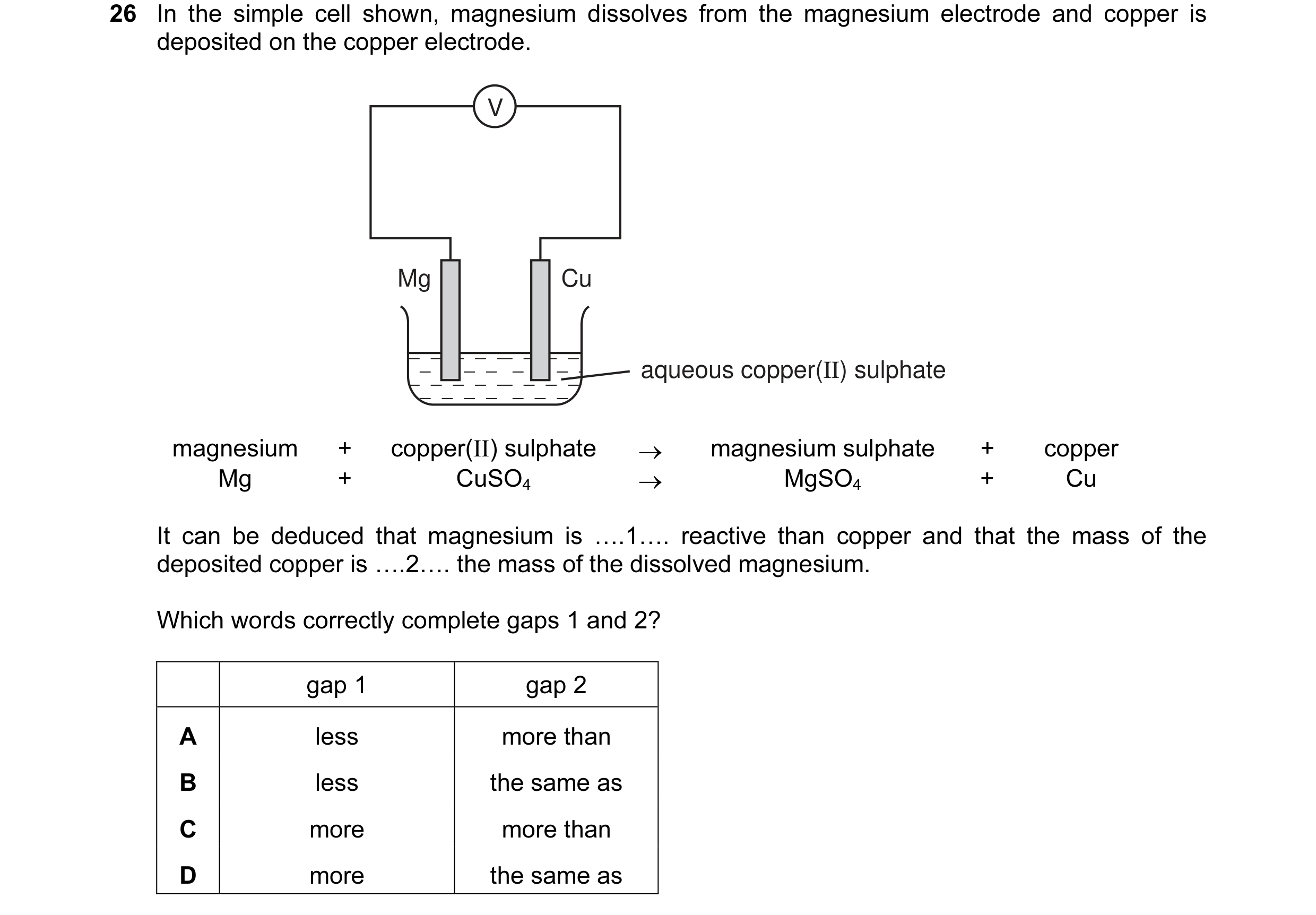
Q2 · In the simple cell shown, magnesium dissolves from the magnesium electrode and copper is… 0654/11 Oct/Nov 2006
26 In the simple cell shown, magnesium dissolves from the magnesium electrode and copper is deposited on the copper electrode. V Mg Cu aqueous copper(II) sulphate magnesium + copper(II) sulphate → magnesium sulphate + copper Mg + CuSO4 → MgSO4 + Cu It can be deduced that magnesium is ….1…. reactive than copper and that the mass of the deposited copper is ….2…. the mass of the dissolved magnesium. Which words correctly complete gaps 1 and 2? gap 1 gap 2 A less more than B less the same as C more more than D more the same as
1 marks
Answer: C
This question in 0654/11 Oct/Nov 2006
Q3 · The diagram shows apparatus used to investigate the reactivity of metals with a dilute… 0654/11 May/June 2007
24 The diagram shows apparatus used to investigate the reactivity of metals with a dilute acid. dilute hydrochloric acid stopwatch gas syringe mins secs metal The experiment is repeated using an equal volume of the same acid each time, but changing the metal. With which metal is the time taken to fill the syringe the shortest? A copper foil B copper powder C magnesium powder D magnesium ribbon
1 marks
Answer: C
This question in 0654/11 May/June 2007
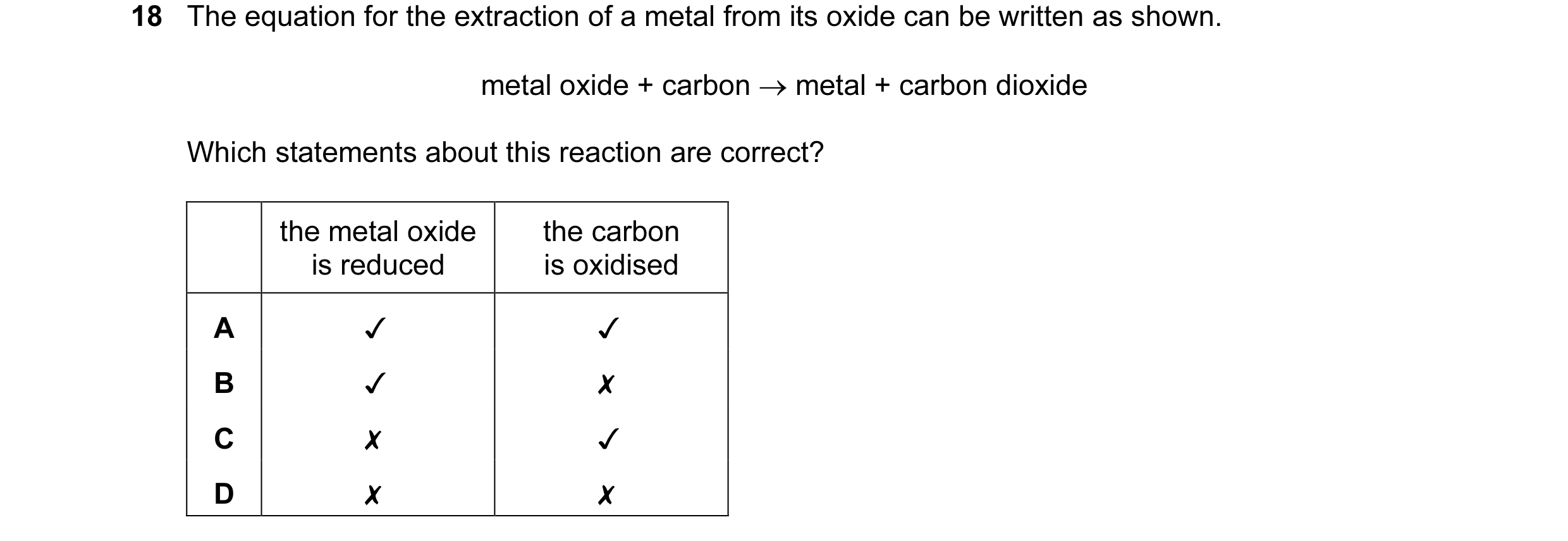
Q4 · The equation for the extraction of a metal from its oxide can be written as shown 0654/11 May/June 2009
18 The equation for the extraction of a metal from its oxide can be written as shown.
metal oxide + carbon — metal + carbon dioxide
Which statements about this reaction are correct?
the metal oxide the carbon
is reduced is oxidised
A v v
B v x
Cc x v
D x x
1 marks
Answer: A
This question in 0654/11 May/June 2009
Q5 · The diagram shows an experiment using a lemon 0654/11 May/June 2010
25 The diagram shows an experiment using a lemon.
metal X
Which statements are correct?
copper
lemon
0 0O DW >
lemon juice is an
electrolyte
~~ KOM
X could be copper
Kk 4 4
X could be zinc
a a SN
1 marks
Answer: C
This question in 0654/11 May/June 2010
Q6 · The diagram shows an experiment using a lemon 0654/12 May/June 2010
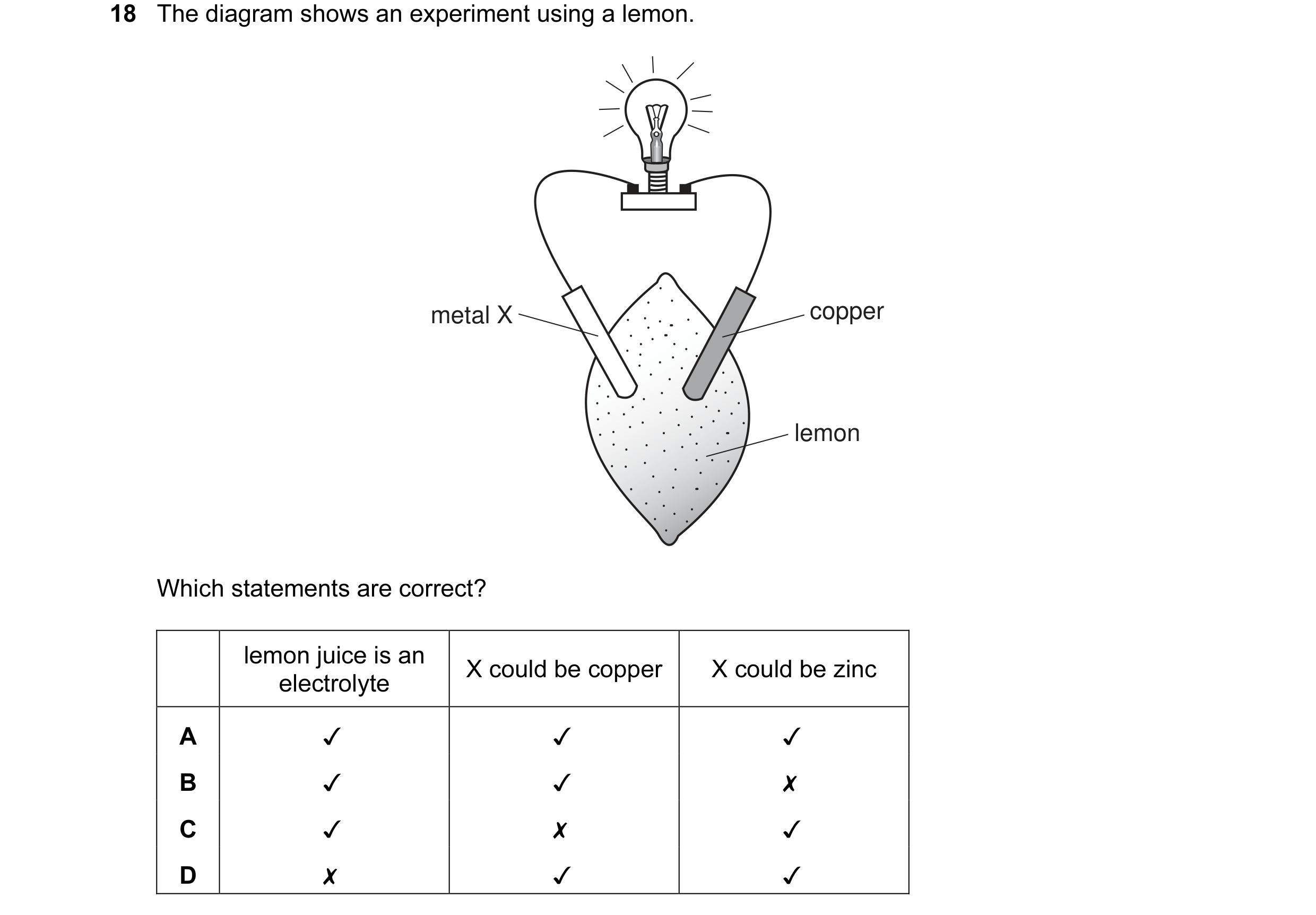
18 The diagram shows an experiment using a lemon.
metal X
Which statements are correct?
copper
lemon
0 0O DW >
lemon juice is an
electrolyte
~~ KOM
X could be copper
Kk 4 4
X could be zinc
a a SN
1 marks
Answer: C
This question in 0654/12 May/June 2010
Q7 · Copper(II) oxide is mixed with a solid Q 0654/12 May/June 2012
23 Copper(II) oxide is mixed with a solid Q. On heating the mixture, a reaction occurs and the limewater turns milky. copper(II) oxide and solid Q heat limewater What is solid Q? A carbon B iron C sulfur D zinc
1 marks
Answer: A
This question in 0654/12 May/June 2012
Q8 · Copper(II) oxide is mixed with a solid Q 0654/13 May/June 2012
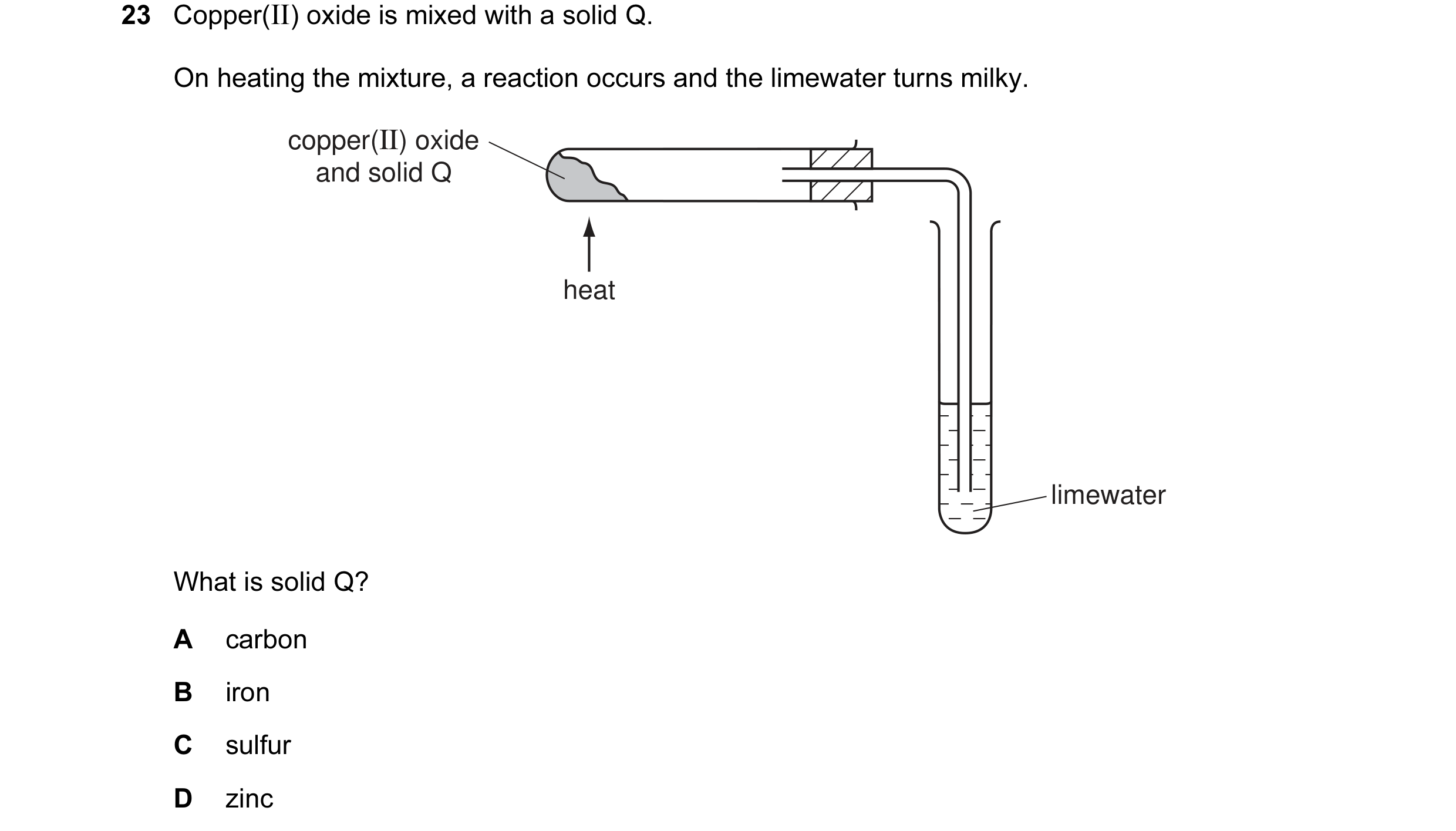
23 Copper(II) oxide is mixed with a solid Q. On heating the mixture, a reaction occurs and the limewater turns milky. copper(II) oxide and solid Q heat limewater What is solid Q? A carbon B iron C sulfur D zinc
1 marks
Answer: A
This question in 0654/13 May/June 2012
Q9 · Similar sized pieces of five different metals P, Q, R, S and T are reacted with equal… 0654/13 May/June 2015
24 Similar sized pieces of five different metals P, Q, R, S and T are reacted with equal volumes of dilute hydrochloric acid of the same concentration. The results are shown below. key bubble of gas metal P Q R S T What is the order of reactivity? least most reactive reactive A P S T Q R B R Q T S P C R T Q P S D Q R S T P
1 marks
Answer: B
This question in 0654/13 May/June 2015
Q10 · Metal X is extracted from its ore by heating the ore with carbon 0654/12 Oct/Nov 2015
25 Metal X is extracted from its ore by heating the ore with carbon. Which statement explains why carbon is used? A Carbon is a non-metal. B Carbon is more reactive than X. C Carbon reacts with oxygen in the air. D X is more reactive than carbon.
1 marks
Answer: B
This question in 0654/12 Oct/Nov 2015
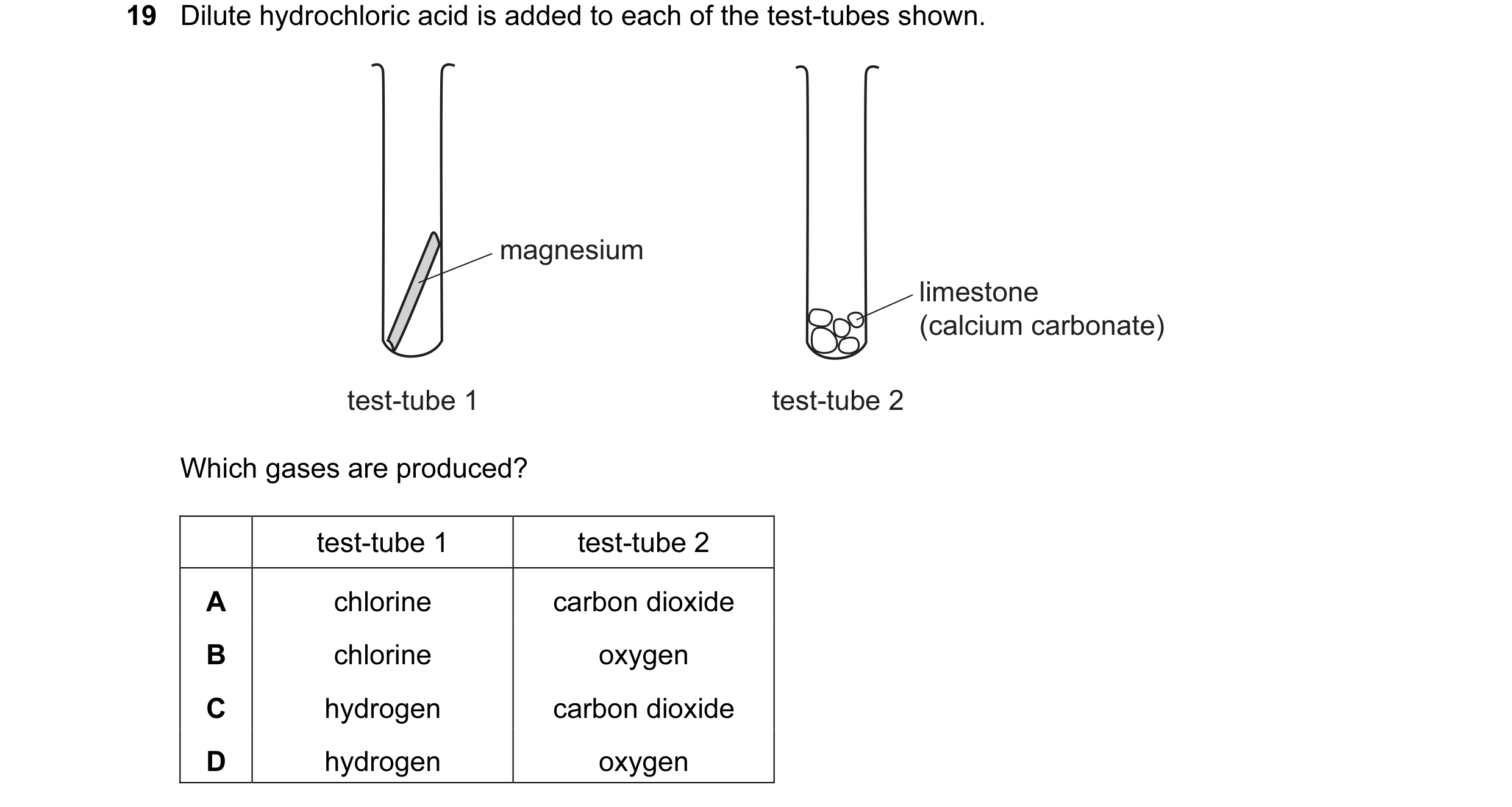
Q11 · Dilute hydrochloric acid is added to each of the test-tubes shown 0654/12 May/June 2016
19 Dilute hydrochloric acid is added to each of the test-tubes shown. magnesium limestone (calcium carbonate) test-tube 1 test-tube 2 Which gases are produced? test-tube 1 test-tube 2 A chlorine carbon dioxide B chlorine oxygen C hydrogen carbon dioxide D hydrogen oxygen
1 marks
Answer: C
This question in 0654/12 May/June 2016
Q12 · Five metals are reacted with cold water and with dilute hydrochloric acid 0654/12 Oct/Nov 2016
24 Five metals are reacted with cold water and with dilute hydrochloric acid. Some of the results are shown. cold water dilute hydrochloric acid calcium rapid reaction copper no observable change iron a few bubbles of gas magnesium a few bubbles of gas many bubbles of gas sodium violent reaction What is the order of reactivity, from most to least reactive? A copper → calcium → magnesium → iron → sodium B copper → iron → magnesium → calcium → sodium C sodium → calcium → magnesium → iron → copper D sodium → iron → magnesium → calcium → copper
1 marks
Answer: C
This question in 0654/12 Oct/Nov 2016
Q13 · A piece of magnesium ribbon is placed in dilute hydrochloric acid 0654/13 Oct/Nov 2016
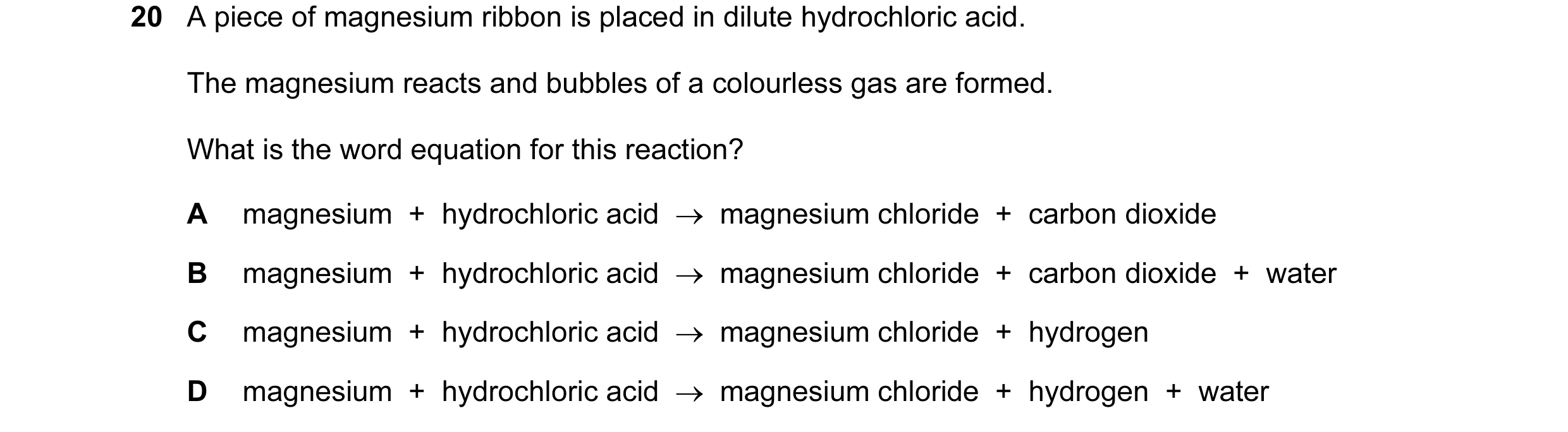
20 A piece of magnesium ribbon is placed in dilute hydrochloric acid. The magnesium reacts and bubbles of a colourless gas are formed. What is the word equation for this reaction? A magnesium + hydrochloric acid → magnesium chloride + carbon dioxide B magnesium + hydrochloric acid → magnesium chloride + carbon dioxide + water C magnesium + hydrochloric acid → magnesium chloride + hydrogen D magnesium + hydrochloric acid → magnesium chloride + hydrogen + water
1 marks
Answer: C
This question in 0654/13 Oct/Nov 2016
Q14 · A student reacts five metals with cold water and with dilute hydrochloric acid 0654/13 Oct/Nov 2016
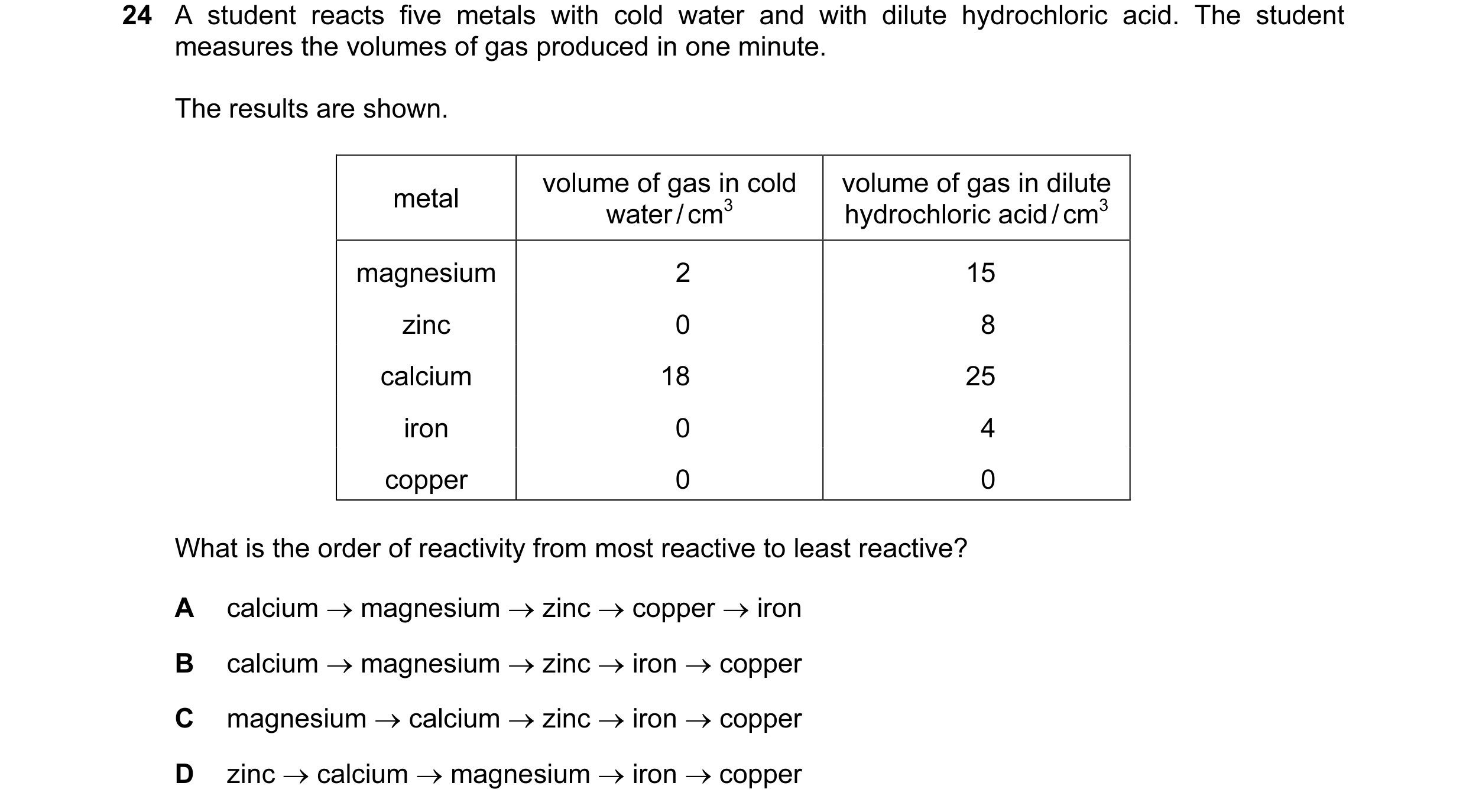
24 A student reacts five metals with cold water and with dilute hydrochloric acid. The student measures the volumes of gas produced in one minute. The results are shown. volume of gas in cold volume of gas in dilute metal water / cm3 hydrochloric acid / cm3 magnesium 2 15 zinc 0 8 calcium 18 25 iron 0 4 copper 0 0 What is the order of reactivity from most reactive to least reactive? A calcium → magnesium → zinc → copper → iron B calcium → magnesium → zinc → iron → copper C magnesium → calcium → zinc → iron → copper D zinc → calcium → magnesium → iron → copper
1 marks
Answer: B
This question in 0654/13 Oct/Nov 2016
Q15 · Which metal reacts most quickly with dilute hydrochloric acid? 0654/11 Oct/Nov 2018
23 Which metal reacts most quickly with dilute hydrochloric acid? A calcium B copper C magnesium D zinc
1 marks
Answer: A
This question in 0654/11 Oct/Nov 2018
Q16 · Which statement is not a reason why aluminium is used in aircraft manufacture? 0654/11 May/June 2020
23 Which statement is not a reason why aluminium is used in aircraft manufacture? A It forms low density alloys. B It is malleable. C It is more reactive than iron. D It is resistant to corrosion.
1 marks
Answer: C
This question in 0654/11 May/June 2020
Q17 · Which statement is not a reason why aluminium is used in aircraft manufacture? 0654/12 May/June 2020
23 Which statement is not a reason why aluminium is used in aircraft manufacture? A It forms low density alloys. B It is malleable. C It is more reactive than iron. D It is resistant to corrosion.
1 marks
Answer: C
This question in 0654/12 May/June 2020
Q18 · Which statement is not a reason why aluminium is used in aircraft manufacture? 0654/13 May/June 2020
21 Which statement is not a reason why aluminium is used in aircraft manufacture? A It forms low density alloys. B It is malleable. C It is more reactive than iron. D It is resistant to corrosion.
1 marks
Answer: C
This question in 0654/13 May/June 2020
Q19 · Magnesium is tested as shown 0654/11 Oct/Nov 2020
23 Magnesium is tested as shown. magnesium dilute hydrochloric lamp acid magnesium test 1 test 2 Which row shows the results of the tests? test 1 test 2 A bubbles lamp does not light B bubbles lamp lights C no bubbles lamp does not light D no bubbles lamp lights
1 marks
Answer: B
This question in 0654/11 Oct/Nov 2020
Q20 · Which process does not produce carbon dioxide? 0654/12 Oct/Nov 2020
24 Which process does not produce carbon dioxide? A acid reacting with a metal B acid reacting with sodium carbonate C complete combustion of methane D respiration
1 marks
Answer: A
This question in 0654/12 Oct/Nov 2020
Q21 · Which metal reacts most vigorously with dilute hydrochloric acid? 0654/12 Feb/March 2021
23 Which metal reacts most vigorously with dilute hydrochloric acid? A aluminium B copper C magnesium D zinc
1 marks
Answer: C
This question in 0654/12 Feb/March 2021
Q22 · Three metals X, Y and Z are added separately to water and to dilute hydrochloric acid 0654/11 May/June 2022
23 Three metals X, Y and Z are added separately to water and to dilute hydrochloric acid.
The results are shown.
result with dilute
metal result with water hydrochloric acid
Xx x Jv key
Jv v ¥ = hydrogen is given off
Z x x X = hydrogen is not given off
What is the order of reactivity of X, Y and Z?
most least
reactive reactive
A X Z
B Y X Z
Cc Y Z X
D Z X Y
1 marks
Answer: B
This question in 0654/11 May/June 2022
Q23 · Metal X is extracted from its ore by heating the ore with carbon 0654/11 Oct/Nov 2022
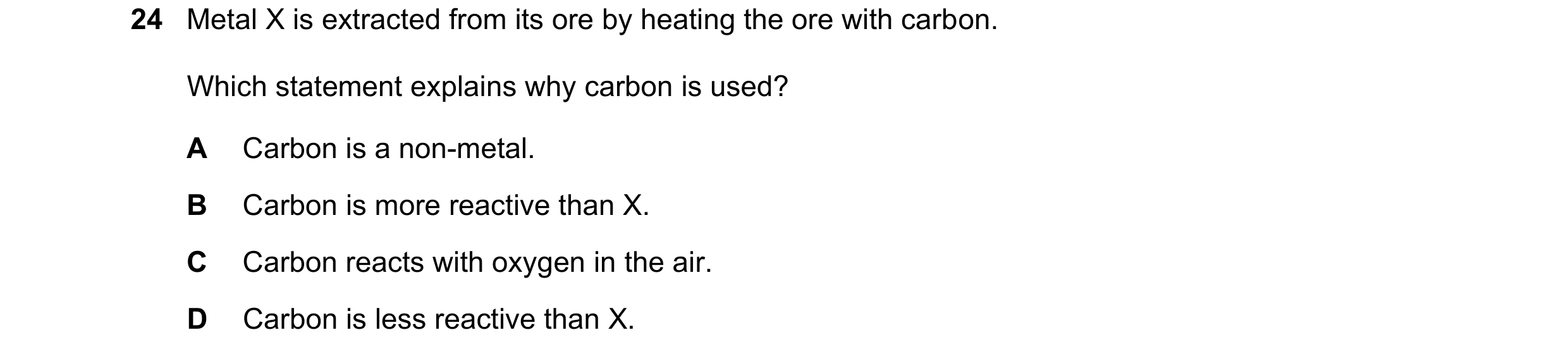
24 Metal X is extracted from its ore by heating the ore with carbon. Which statement explains why carbon is used? A Carbon is a non-metal. B Carbon is more reactive than X. C Carbon reacts with oxygen in the air. D Carbon is less reactive than X.
1 marks
Answer: B
This question in 0654/11 Oct/Nov 2022
Q24 · Metal X is extracted from its ore by heating the ore with carbon 0654/12 Oct/Nov 2022
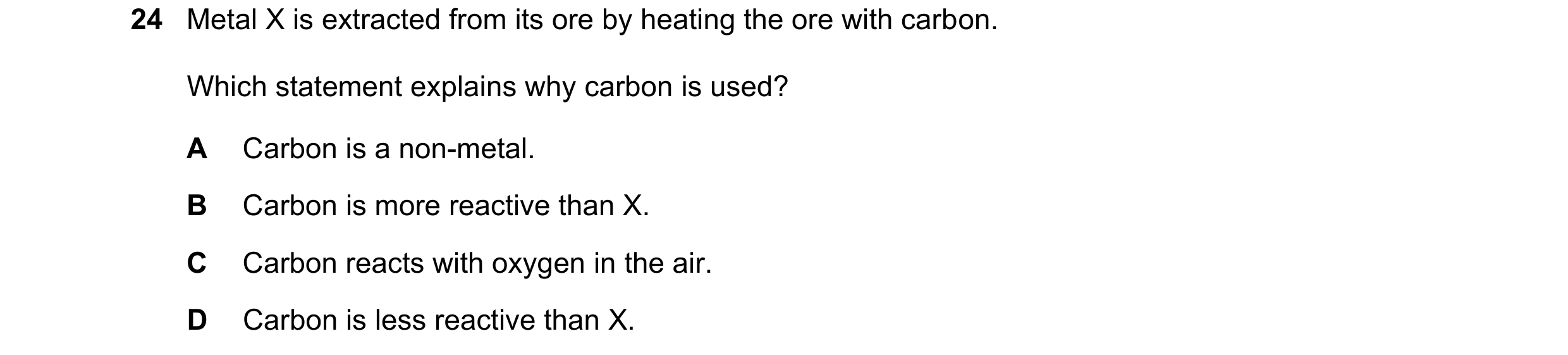
24 Metal X is extracted from its ore by heating the ore with carbon. Which statement explains why carbon is used? A Carbon is a non-metal. B Carbon is more reactive than X. C Carbon reacts with oxygen in the air. D Carbon is less reactive than X.
1 marks
Answer: B
This question in 0654/12 Oct/Nov 2022
Q25 · Which gas is produced when zinc reacts with dilute hydrochloric acid? 0654/13 Oct/Nov 2022
20 Which gas is produced when zinc reacts with dilute hydrochloric acid? A carbon dioxide B hydrogen C oxygen D sulfur dioxide
1 marks
Answer: B
This question in 0654/13 Oct/Nov 2022
Q26 · Pieces of four metals are added separately to test-tubes containing dilute hydrochloric… 0654/12 Feb/March 2023
24 Pieces of four metals are added separately to test-tubes containing dilute hydrochloric acid. The results are shown. metal results 1 bubbles produced slowly 2 no reaction 3 vigorous bubbling 4 steady bubbling What is the order of reactivity of the metals from most to least reactive? A 2 1 4 3 B 2 4 1 3 C 3 1 4 2 D 3 4 1 2
1 marks
Answer: D
This question in 0654/12 Feb/March 2023
Q27 · Which statement explains why carbon is used in the extraction of copper from its ore? 0654/13 Oct/Nov 2023
24 Which statement explains why carbon is used in the extraction of copper from its ore? A It is in Group IV of the Periodic Table. B It is more reactive than copper. C It is a non-metal. D It forms a giant covalent molecule.
1 marks
Answer: B
This question in 0654/13 Oct/Nov 2023
Q28 · What is the order of reactivity of metals, from highest to lowest? 0654/11 Oct/Nov 2024
25 What is the order of reactivity of metals, from highest to lowest? A aluminium calcium copper iron B calcium iron copper aluminium C calcium magnesium iron copper D aluminium magnesium iron copper
1 marks
Answer: C
This question in 0654/11 Oct/Nov 2024
Q29 · Which row describes the order of reactivity of the metals? 0654/12 May/June 2025
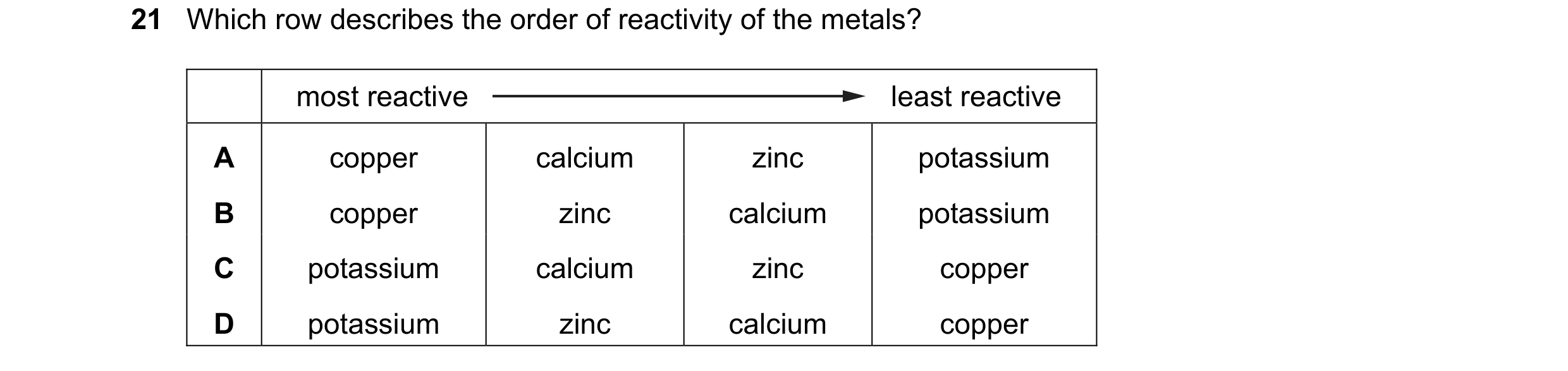
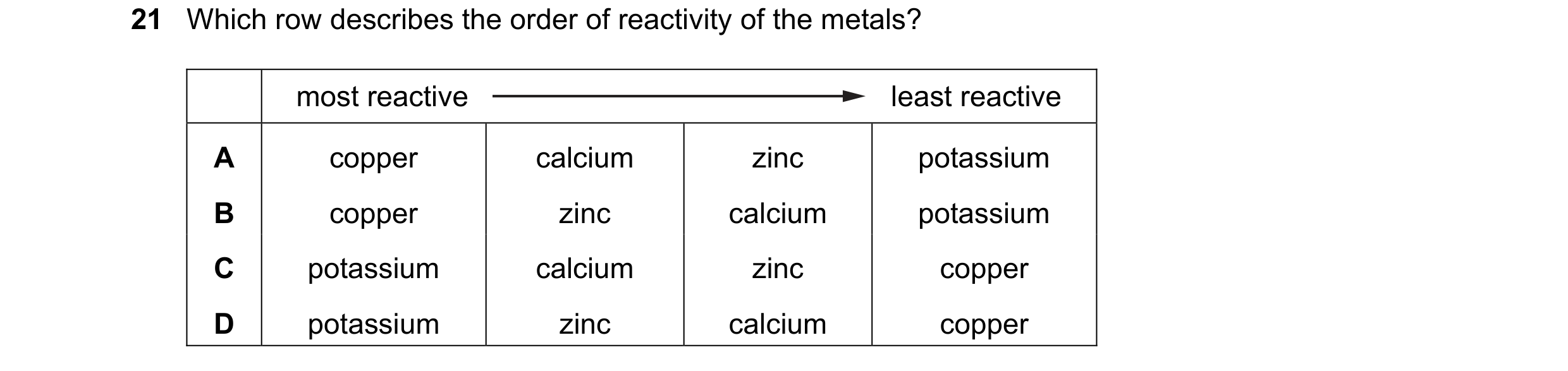
21 Which row describes the order of reactivity of the metals? most reactive least reactive A copper calcium zinc potassium B copper zinc calcium potassium C potassium calcium zinc copper D potassium zinc calcium copper
1 marks
Answer: C
This question in 0654/12 May/June 2025
Q30 · Which row describes the order of reactivity of the metals? 0654/13 May/June 2025
21 Which row describes the order of reactivity of the metals? most reactive least reactive A copper calcium zinc potassium B copper zinc calcium potassium C potassium calcium zinc copper D potassium zinc calcium copper
1 marks
Answer: C
This question in 0654/13 May/June 2025
 1 / 11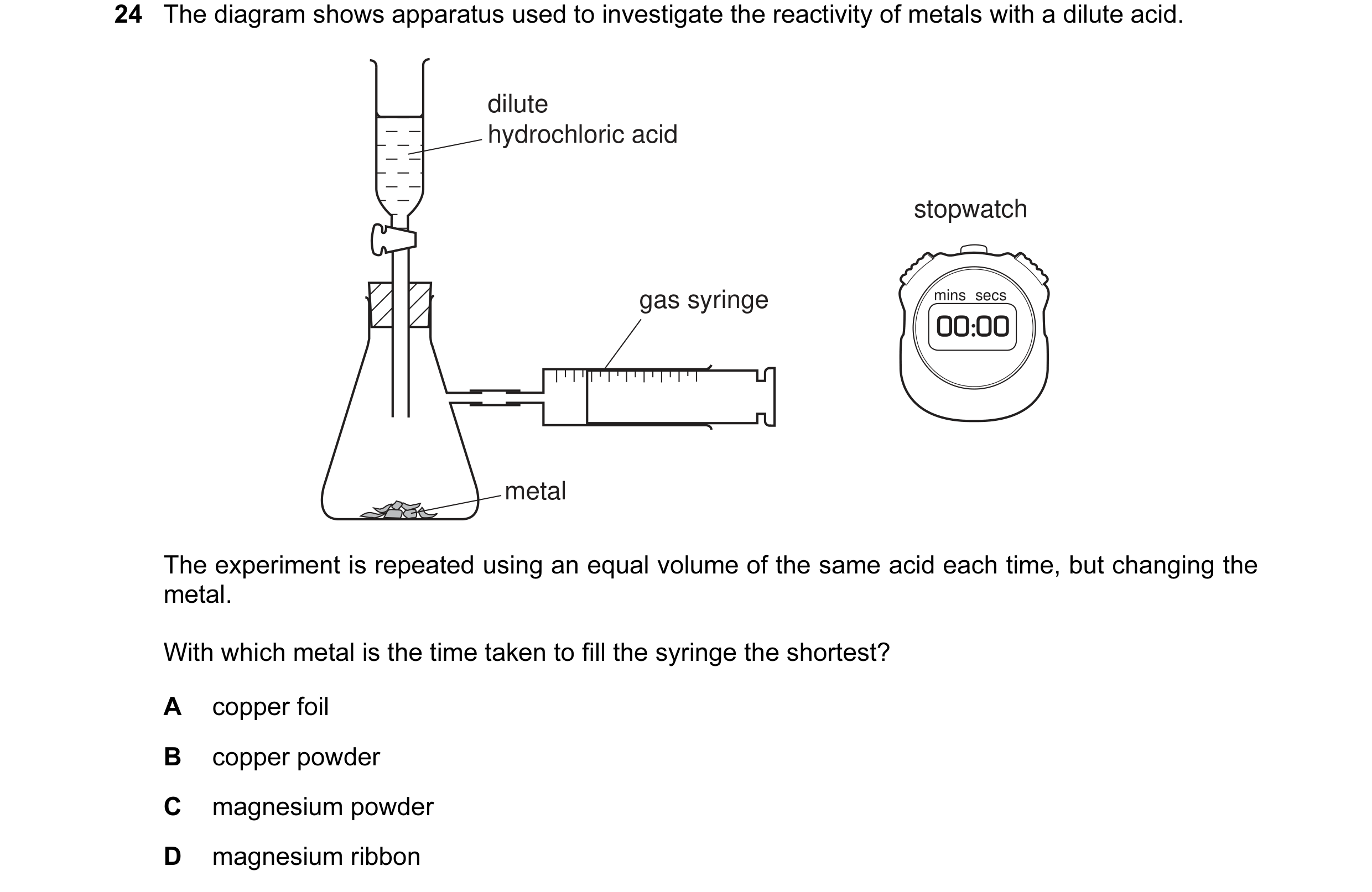
 2 / 11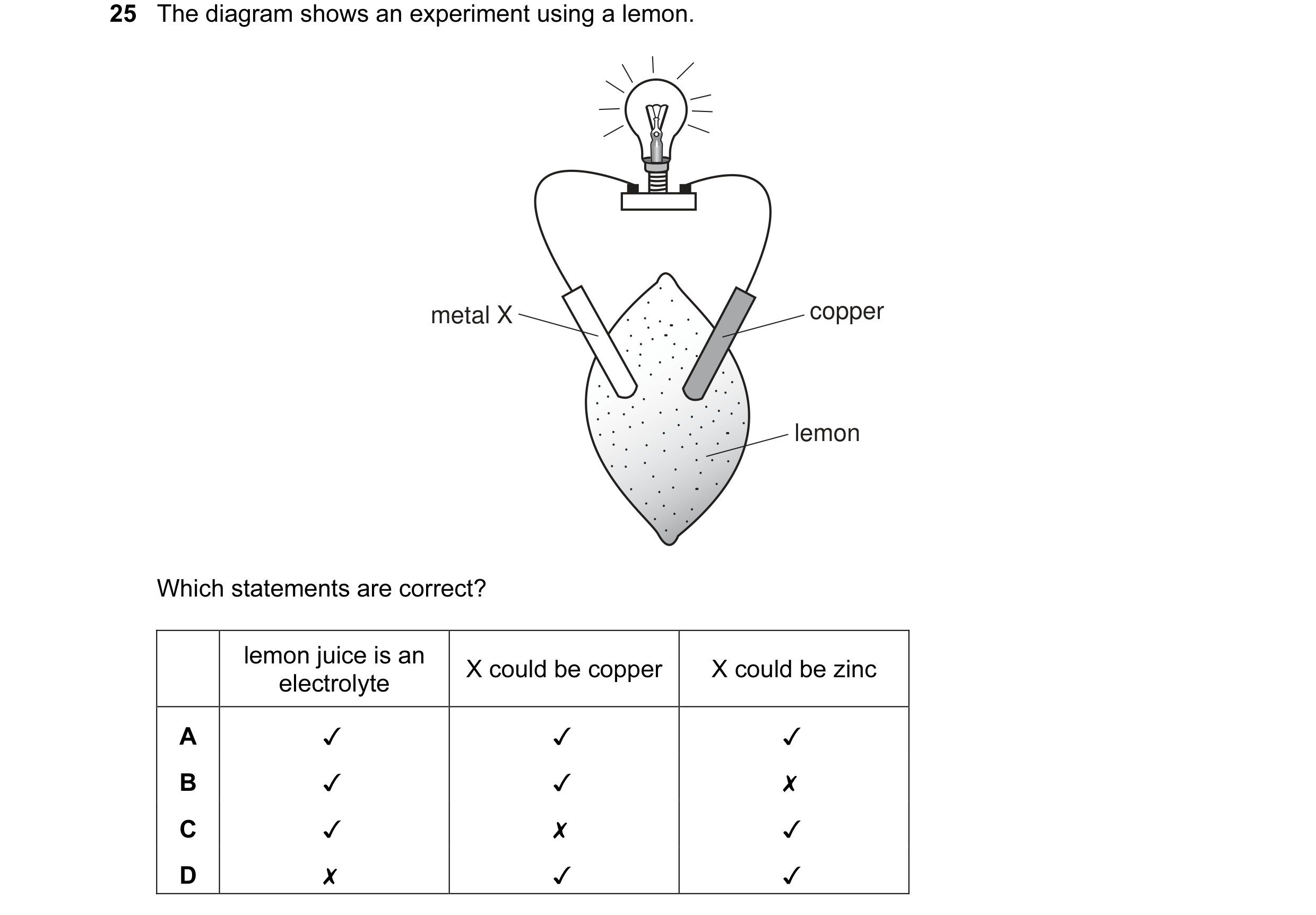
 3 / 11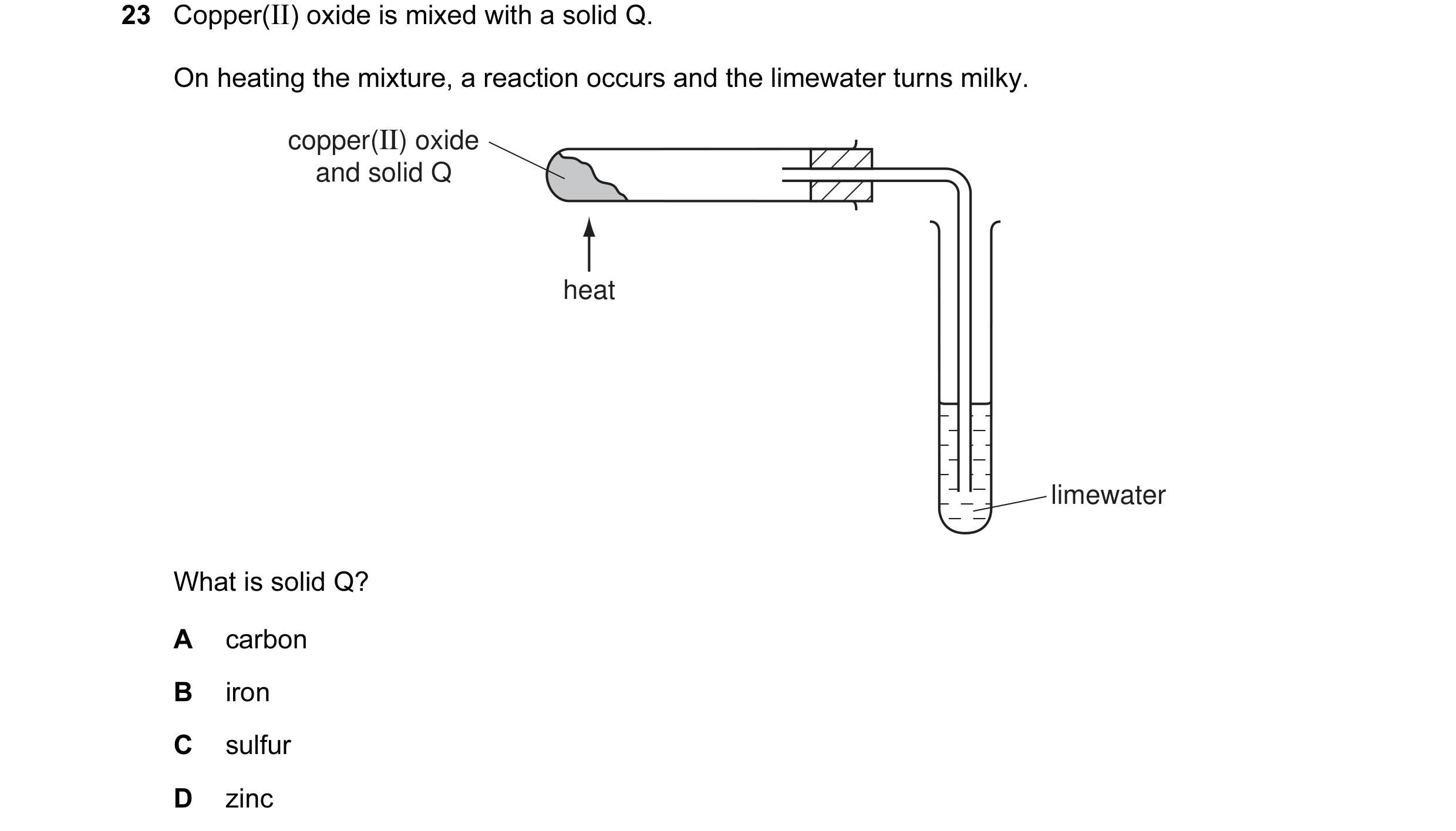
 4 / 11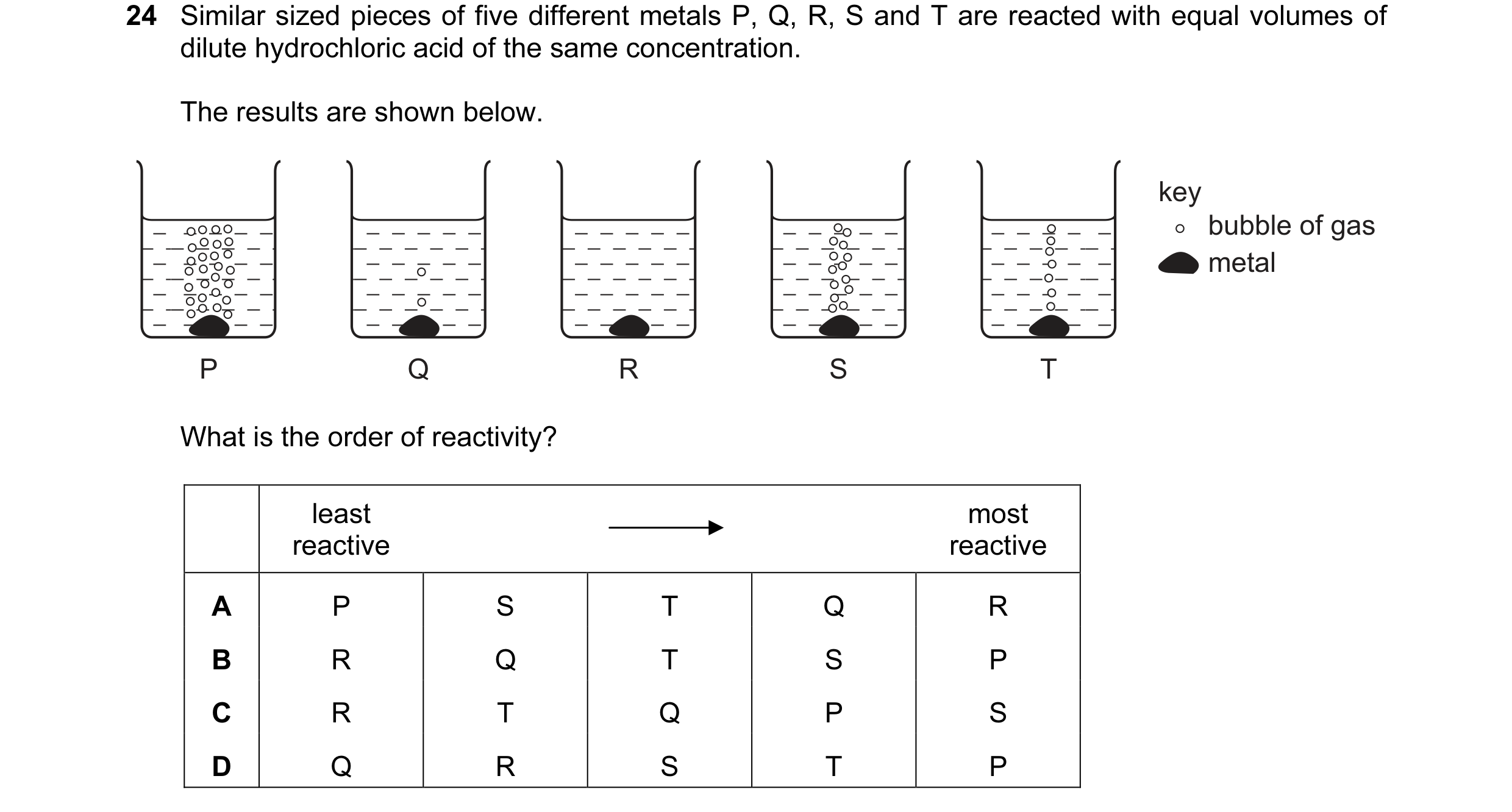
 5 / 11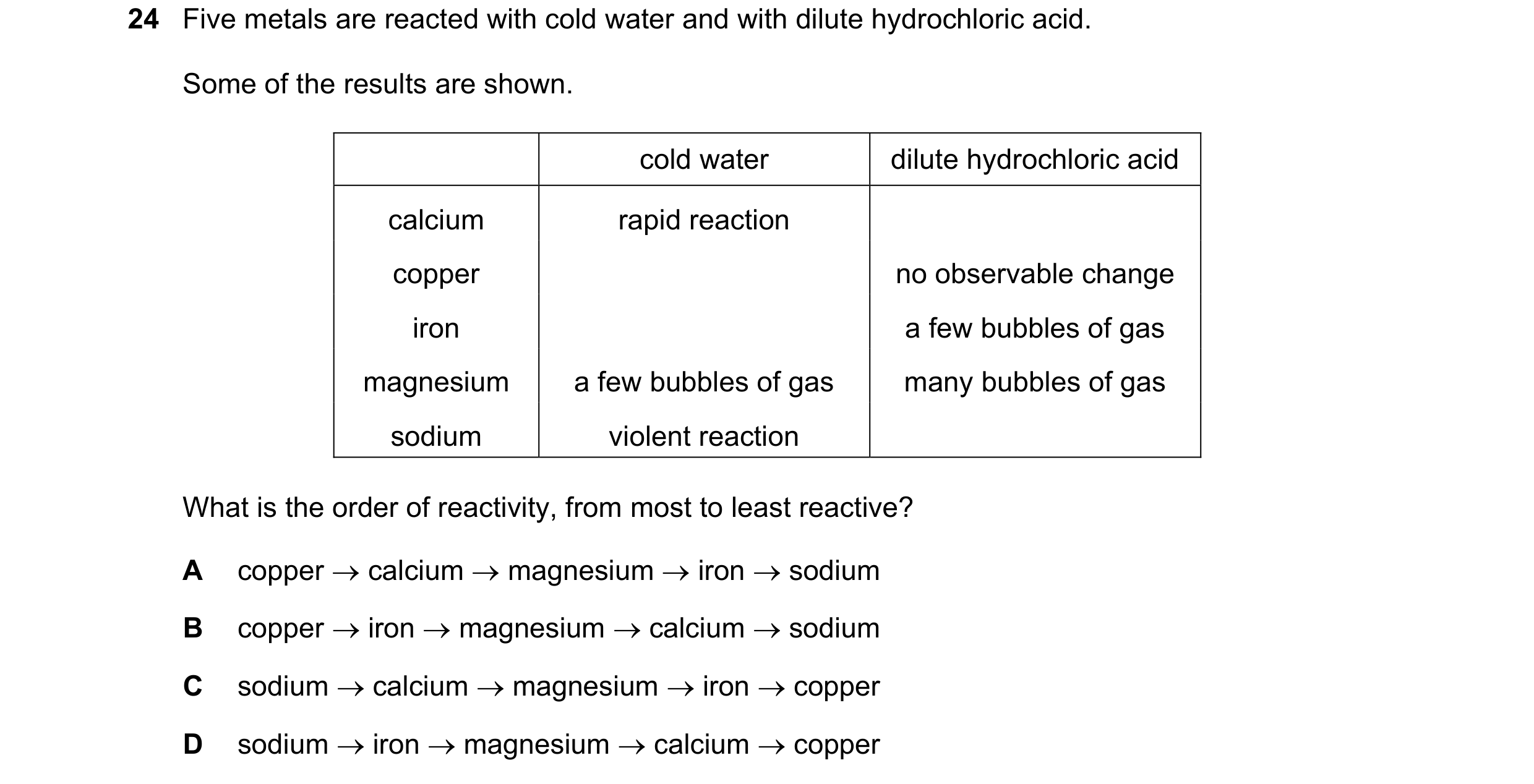
 6 / 11


 7 / 11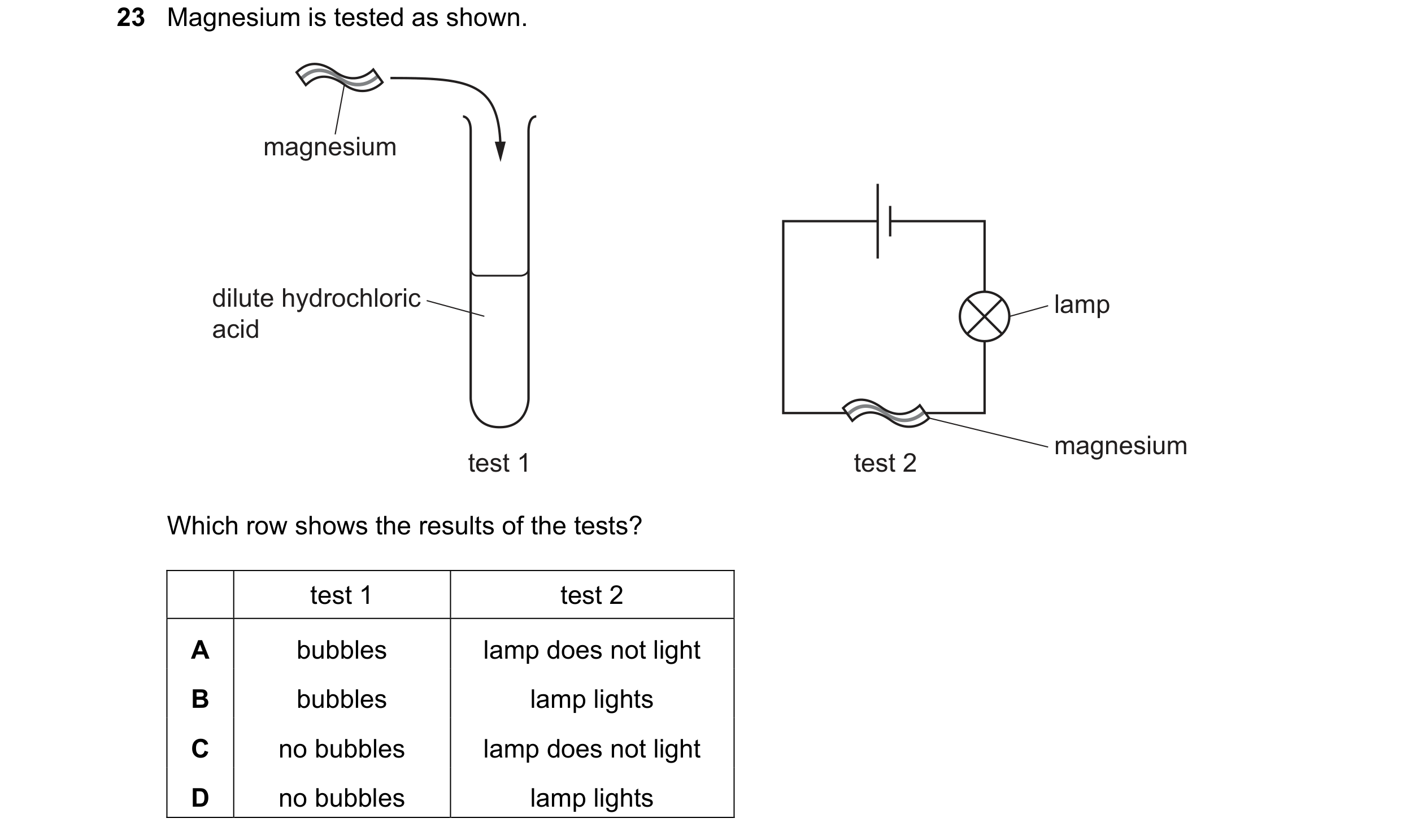

 8 / 11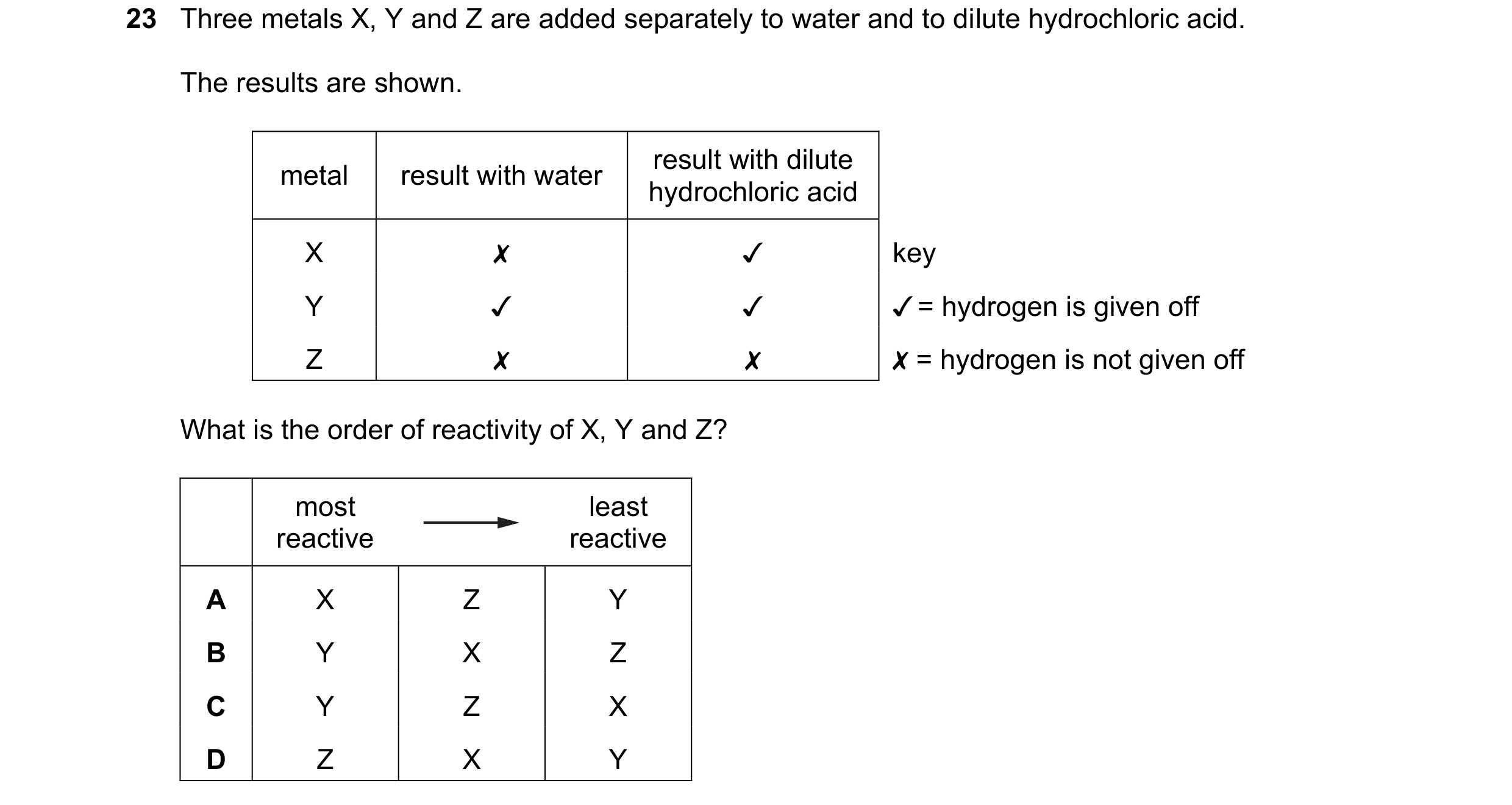
 9 / 11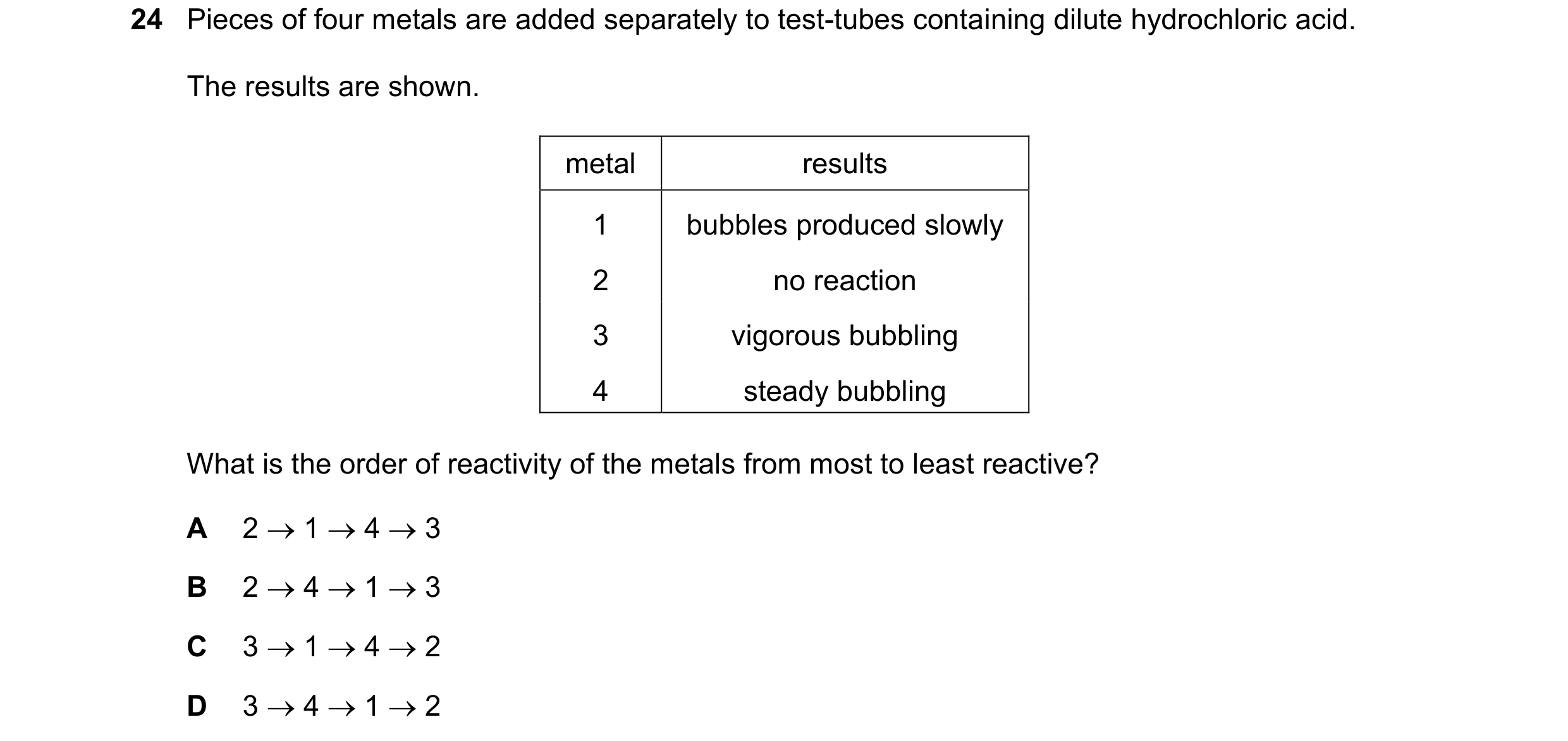


 10 / 11
 11 / 11